INSTITUTE –University School of
Business
DEPARTMENT -Management
M.B.A
People Management: 21BAT621
Faculty Name : Dr. Apoorva Singh
(Assistant Professor)
UNIT-2; Chapter-6
Introduction to Career
Planning and
Succession Planning
DISCOVER . LEARN . EMPOWER
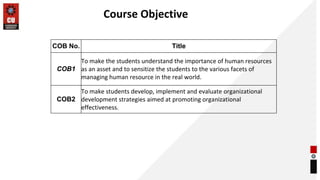
Course Objective
COB No. Title
COB1
To make the students understand the importance of human resources
as an asset and to sensitize the students to the various facets of
managing human resource in the real world.
COB2
To make students develop, implement and evaluate organizational
development strategies aimed at promoting organizational
effectiveness.
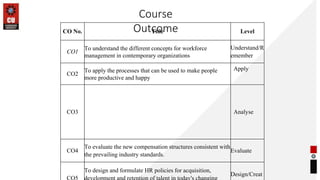
Course
Outcome
CO No. Title Level
CO1
To understand the different concepts for workforce
management in contemporary organizations
Understand/R
emember
CO2
To apply the processes that can be used to make people
more productive and happy
Apply
CO3 Analyse
CO4
To evaluate the new compensation structures consistent with
the prevailing industry standards.
Evaluate
CO5
To design and formulate HR policies for acquisition,
Design/Creat
Introduction to Career Planning
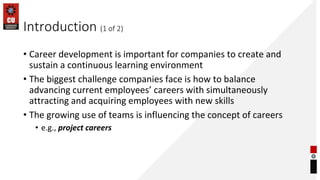
Introduction (1 of 2)
• Career development is important for companies to create and
sustain a continuous learning environment
• The biggest challenge companies face is how to balance
advancing current employees’ careers with simultaneously
attracting and acquiring employees with new skills
• The growing use of teams is influencing the concept of careers
• e.g., project careers
Introduction (2 of 2)
• Changes in the concept of career affect:
• employees’ motivation to attend training programs
• the outcomes they expect to gain from attendance
• their choice of programs
• how and what they need to know
What Is Career Management?
• Career management is the process through which employees:
• Become aware of their own interests, values, strengths, and weaknesses
• Obtain information about job opportunities within the company
• Identify career goals
• Establish action plans to achieve career goals
Why Is Career Management Important? (1 of 2)
• From the company’s perspective, the failure to motivate employees
to plan their careers can result in:
• a shortage of employees to fill open positions
• lower employee commitment
• inappropriate use of monies allocated for training and development programs
Why Is Career Management Important?
(2 of 2)
• From the employees’ perspective, lack of career management can
result in:
• frustration
• feelings of not being valued by the company
• being unable to find suitable employment should a job change be necessary
due to mergers, acquisitions, restructuring, or downsizing
Career Management and Career Motivation (1 of 2)
• Career motivation refers to:
• Employees’ energy to invest in their careers
• Their awareness of the direction they want their careers to take
• The ability to maintain energy and direction despite barriers they may
encounter
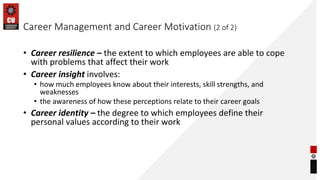
• Career motivation has three aspects:
• Career resilience
• Career insight
• Career identity
Career Management and Career Motivation (2 of 2)
• Career resilience – the extent to which employees are able to cope
with problems that affect their work
• Career insight involves:
• how much employees know about their interests, skill strengths, and
weaknesses
• the awareness of how these perceptions relate to their career goals
• Career identity – the degree to which employees define their
personal values according to their work
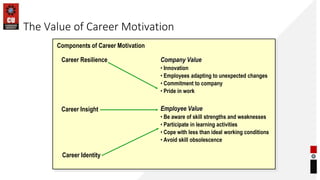
The Value of Career Motivation
Components of Career Motivation
Career Resilience Company Value
• Innovation
• Employees adapting to unexpected changes
• Commitment to company
• Pride in work
Employee Value
• Be aware of skill strengths and weaknesses
• Participate in learning activities
• Cope with less than ideal working conditions
• Avoid skill obsolescence
Career Insight
Career Identity
Summary
• The importance of career planning can’t be
overemphasized. Having a career plan is crucial for every
person aspiring to become successful in life. It is a multi-
stage process that needs to be thoroughly planned and
executed to reap the desired benefits.
REFERENCES
Text Books
▪Dessler, G.2013. Human Resource Management. 15th Edition, Prentice-Hall, India, ISBN:9780134235455.
Online Articles
•https://hbr.org/2011/12/get-ready-for-your-next-assignment
•https://80000hours.org/articles/career-planning/
14
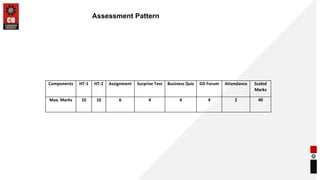
Assessment Pattern
Components HT-1 HT-2 Assignment Surprise Test Business Quiz GD Forum Attendance Scaled
Marks
Max. Marks 10 10 6 4 4 4 2 40
THANK YOU
For queries you can reach me on
Email:
apoorva.e8931@cumail.in

Lecture 16.pptx

  • 1.
    INSTITUTE –University Schoolof Business DEPARTMENT -Management M.B.A People Management: 21BAT621 Faculty Name : Dr. Apoorva Singh (Assistant Professor) UNIT-2; Chapter-6 Introduction to Career Planning and Succession Planning DISCOVER . LEARN . EMPOWER
  • 2.
    Course Objective COB No.Title COB1 To make the students understand the importance of human resources as an asset and to sensitize the students to the various facets of managing human resource in the real world. COB2 To make students develop, implement and evaluate organizational development strategies aimed at promoting organizational effectiveness.
  • 3.
    Course Outcome CO No. TitleLevel CO1 To understand the different concepts for workforce management in contemporary organizations Understand/R emember CO2 To apply the processes that can be used to make people more productive and happy Apply CO3 Analyse CO4 To evaluate the new compensation structures consistent with the prevailing industry standards. Evaluate CO5 To design and formulate HR policies for acquisition, Design/Creat
  • 4.
  • 5.
    Introduction (1 of2) • Career development is important for companies to create and sustain a continuous learning environment • The biggest challenge companies face is how to balance advancing current employees’ careers with simultaneously attracting and acquiring employees with new skills • The growing use of teams is influencing the concept of careers • e.g., project careers
  • 6.
    Introduction (2 of2) • Changes in the concept of career affect: • employees’ motivation to attend training programs • the outcomes they expect to gain from attendance • their choice of programs • how and what they need to know
  • 7.
    What Is CareerManagement? • Career management is the process through which employees: • Become aware of their own interests, values, strengths, and weaknesses • Obtain information about job opportunities within the company • Identify career goals • Establish action plans to achieve career goals
  • 8.
    Why Is CareerManagement Important? (1 of 2) • From the company’s perspective, the failure to motivate employees to plan their careers can result in: • a shortage of employees to fill open positions • lower employee commitment • inappropriate use of monies allocated for training and development programs
  • 9.
    Why Is CareerManagement Important? (2 of 2) • From the employees’ perspective, lack of career management can result in: • frustration • feelings of not being valued by the company • being unable to find suitable employment should a job change be necessary due to mergers, acquisitions, restructuring, or downsizing
  • 10.
    Career Management andCareer Motivation (1 of 2) • Career motivation refers to: • Employees’ energy to invest in their careers • Their awareness of the direction they want their careers to take • The ability to maintain energy and direction despite barriers they may encounter • Career motivation has three aspects: • Career resilience • Career insight • Career identity
  • 11.
    Career Management andCareer Motivation (2 of 2) • Career resilience – the extent to which employees are able to cope with problems that affect their work • Career insight involves: • how much employees know about their interests, skill strengths, and weaknesses • the awareness of how these perceptions relate to their career goals • Career identity – the degree to which employees define their personal values according to their work
  • 12.
    The Value ofCareer Motivation Components of Career Motivation Career Resilience Company Value • Innovation • Employees adapting to unexpected changes • Commitment to company • Pride in work Employee Value • Be aware of skill strengths and weaknesses • Participate in learning activities • Cope with less than ideal working conditions • Avoid skill obsolescence Career Insight Career Identity
  • 13.
    Summary • The importanceof career planning can’t be overemphasized. Having a career plan is crucial for every person aspiring to become successful in life. It is a multi- stage process that needs to be thoroughly planned and executed to reap the desired benefits.
  • 14.
    REFERENCES Text Books ▪Dessler, G.2013.Human Resource Management. 15th Edition, Prentice-Hall, India, ISBN:9780134235455. Online Articles •https://hbr.org/2011/12/get-ready-for-your-next-assignment •https://80000hours.org/articles/career-planning/ 14
  • 15.
    Assessment Pattern Components HT-1HT-2 Assignment Surprise Test Business Quiz GD Forum Attendance Scaled Marks Max. Marks 10 10 6 4 4 4 2 40
  • 16.
    THANK YOU For queriesyou can reach me on Email: apoorva.e8931@cumail.in