Group members
IqraJahangir
Rabia Naeem
Muhammad Qasim
Hafiza Sundleen Hassan
Asma Ihsan
Mehreen
Muqaddas Munsif
3.
Table of content
Introductionto career planning 1
Career planning process 2
Understanding Career paths. 3
Role of HRM in developing career paths 4
Career counseling 5
Career counselling process and techniques 6
Challenges and future trends in career planning and counseling. 7
Career Planning
Careerplanning in HRM is a systematic and collaborative process where individuals and
organizations work together to identify career goals, explore opportunities, and create
actionable plans to achieve desired outcomes.
Through career planning, HRM can identify employees’ strengths, knowledge, and
competencies. This ensures that employees are placed in roles where they can utilize their
skills to the fullest and add maximum value
7.
Reasons why careerPlanning is important
1 Provides clarity & direction
When you are busy with your studies, it is easy to lose sight of your goals. Career planning
provides a roadmap that tells you where you are now and the best routes to your ultimate
goal. You can map out the steps to achieve your desired career. This helps you stay focused
and motivated, especially during challenging times.
8.
2. Helpsin goal-setting
Career planning makes you sit down and think about what you want. Concrete goals emerge whether it is
finding a specific job, reaching a certain salary, or mastering a particular skill. These goals become your
milestones – something to strive for.
3. Supports skill development
Career planning ensures you are learning the right things and not just getting a degree for the sake of it. You
identify what is in demand in your field and what employers want. You pinpoint skill gaps and take steps to
address them. This way, you are developing skills that open doors to job opportunities.
9.
4 Enhances jobsatisfaction
Landing your dream job and doing work you genuinely enjoy is the result of a solid career plan. Career planning
helps you figure out what you love doing and what aligns with your values.
5. Improves performance
You might think your performance is all about grades but it goes beyond that. Without a plan, you won’t do
justice to your potential. Career planning gives your academic journey a purpose. Knowing where you want to
go keeps you focused and engaged.
10.
6. Increases employability
Withouta career plan, you have the degree but employers would struggle to see
how you fit into their team. They love candidates who customise their education and skill set to fit the job
market. Career planning makes you a candidate employers can’t just ignore.
7 Supports career transitions
You start in one field but find your passion pulling you elsewhere. Now what? Without a plan, changing
careers can be chaotic. But with career planning, you already mapped potential routes. You know what skills
are transferable and what industries want your expertise.
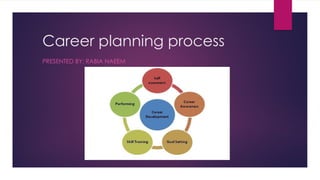
The careerplanning process in Human Resource Management (HRM) is a structured approach to help employees set
career goals and develop skills to achieve them. It aligns individual aspirations with organizational objectives. The process
typically includes the following steps:
1. Self-Assessment
Employees evaluate their skills, interests, values, strengths, and weaknesses to identify suitable career paths. Self-assessment
is the first and most crucial step in the career planning process. It involves evaluating your skills, interests, values, personality
traits, and strengths to determine the best career path for you.
2. Career Exploration
Employees explore different career opportunities within and outside the organization, considering job roles, industry trends,
and future prospects.
13.
3. GoalSetting
Goal setting is a pivotal component of career planning, enabling individuals to establish clear, actionable objectives that guide their
professional growth.
Employees set short-term and long-term career goals based on their self-assessment and available opportunities. Goals should be SMART
(Specific, Measurable, Achievable, Relevant, Time-bound).
4. Career Development Planning
A Career Development Plan (CDP) is a structured roadmap that outlines an individual’s career goals and the steps needed to achieve them.
It helps employees identify their strengths, areas for improvement, and opportunities for professional growth, ensuring long-term career
success.
14.
5. SkillDevelopment & Training
Skill development and training are essential components of career planning that help employees
enhance their abilities, stay competitive, and achieve their career goals. Organizations invest in
training programs to ensure employees acquire the necessary skills to perform their roles effectively
and contribute to business success.
6. Implementation and Execution
Once goals are set and skill development is planned, the next step is implementation and execution—
putting career plans into action. This stage involves taking concrete steps toward achieving career
objectives through learning, gaining experience, and applying acquired skills in real work scenarios.
15.
7. Monitoring& Feedback in Career Planning
Monitoring and feedback play a critical role in career planning by ensuring employees stay on track
toward their goals. This step involves regularly assessing progress, identifying areas for
improvement, and making necessary adjustments based on feedback.
8. Career Progression and Advancement in Career Planning
Career progression and advancement refer to the continuous growth of an employee within an
organization or industry, leading to higher responsibilities, better job roles, and increased
compensation. It is the ultimate goal of career planning, where employees move forward based on
their skills, experience, and contributions.
What is careerpath
A career path refers to the progression of jobs and roles that an individual takes throughout
their working life. It encompasses the various positions, skills, and experiences acquired over
time, guiding professionals toward their long-term career goals.
Understanding career paths is essential as it helps individuals set realistic professional goals,
make informed decisions, and develop the necessary skills for career growth. Well-planned
career paths can lead to job satisfaction, financial stability, and personal fulfillment.
18.
Why is careerpath so imp
1. Increased employee engagement and satisfaction: Employees are more likely to
stay with a company when a well-defined career path is in place. Employees are also
motivated to grow within a company when there's a well-understood career path.
2. Improved retention rates: When employees see opportunities for advancement
within their organization, they're less likely to seek opportunities elsewhere. This can
significantly reduce turnover rates, saving companies the time and expense of hiring
and training new employees.
19.
3. Better successionplanning: A well-defined career path can help
organizations identify and prepare future leaders. This ensures a smooth
transition when key employees leave or retire.
4. Enhanced employer brand: Companies that offer clear career
pathways can attract top talent. These companies are often seen as more
employee-centric, which can improve their reputation and make them more
appealing to job seekers.
20.
5. More effectivetalent management: With a clear career path, HR
and management can more effectively identify gaps in skills and
experience, allowing them to strategically invest in employee
development. This can lead to a more skilled and capable workforce.
6. Reduced employee turnover: A Glassdoor study found
that having a lack of career growth leads to employee turnover.
Employees who don't receive a pay increase or change in title after a
few years are more likely to resign.
21.
Four Different CareerStyles
1. Linear – Climbs the ladder:
People with the linear career style start at an entry level position and continue to climb the
ladder in their chosen field, often climbing all the way to the top of the organization.
Someone might start in the mail room and eventually work their way up to becoming the
boss. People with this career style are the people who want to be in charge. They focus on
leadership, competition, and always look for ways to be more efficient and cost effective.
Example: From mailroom assistant to CEO of a company
22.
2. Expert –specific, niche field:
As the name implies, people with the expert career style are experts in their field. They are
often researchers, scientists or professors with PhDs. They tend to specialise in a certain
area and don’t typically look beyond their one chosen field. They are heavily invested in
that topic and usually don’t change careers very much because of the time and
commitment involved in becoming an expert in their field.
Example: Researcher or scientist
23.
3. Expanding –Broad area of expertise :
People with the expanding career style want to broaden their area of expertise; they are curious about different
areas within their field. They typically value team work and sharing ideas. They are also quite creative. These
people are rarely bosses, but have often worked in many different areas within the same field. An example
would be someone who works with different HR-related tasks or a computer programmer who works in
different types of companies, but doesn’t necessarily move very high up the ladder into upper-level management
positions.
Example: An HR professional who works with recruitment, then with rehabilitating workers back into the
work force after an injury, then with salaries
24.
4. Episodic –changes between completely non – related fields:
People with the episodic career style have many interests and change between completely
non-related jobs. These people tend to be very adaptable. For them, change is a good
thing. They are curious and flexible.
Example: From Florist to Accountant to Personal trainer
25.
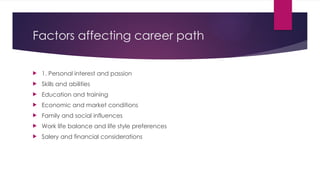
Factors affecting careerpath
1. Personal interest and passion
Skills and abilities
Education and training
Economic and market conditions
Family and social influences
Work life balance and life style preferences
Salery and financial considerations
26.
Role of HRMin developing career
paths
PRESENTED BY: SUNDLEEN HASSAN
27.
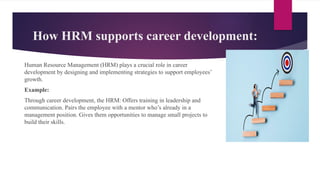
How HRM supportscareer development:
Human Resource Management (HRM) plays a crucial role in career
development by designing and implementing strategies to support employees’
growth.
Example:
Through career development, the HRM: Offers training in leadership and
communication. Pairs the employee with a mentor who’s already in a
management position. Gives them opportunities to manage small projects to
build their skills.
28.
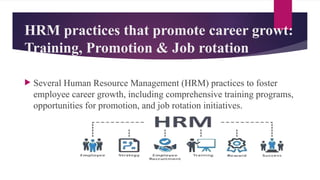
HRM practices thatpromote career growt:
Training, Promotion & Job rotation
Several Human Resource Management (HRM) practices to foster
employee career growth, including comprehensive training programs,
opportunities for promotion, and job rotation initiatives.
29.
Training and development:
HRMemphasizes continuous employee development through
various training programs. Training delivery methods include
discussions, simulations, and on-the-job training, ensuring
employees acquire relevant skills effectively. These programs
are evaluated for their impact on employee performance and
alignment with organizational goals.
30.
Promotion:
Promotion valuesinternal talent development, often
promoting from within to fill higher-level positions. The
company utilizes internal recruitment sources like
promotions, transfers, and internships to meet its HR
needs. This approach motivates employees by recognizing
their contributions and providing clear pathways for
career progression.
31.
Job rotation:
Job rotationat involves systematically moving employees
between different roles or departments, enhancing their
skills and understanding of the organization. This practice
serves multiple purposes, including orienting new
employees, training staff, fostering career development, and
preventing job boredom or burnout.
32.
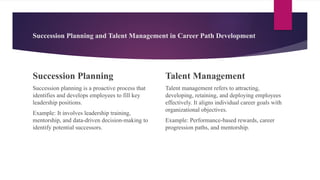
Succession Planning andTalent Management in Career Path Development
Succession Planning
Succession planning is a proactive process that
identifies and develops employees to fill key
leadership positions.
Example: It involves leadership training,
mentorship, and data-driven decision-making to
identify potential successors.
Talent Management
Talent management refers to attracting,
developing, retaining, and deploying employees
effectively. It aligns individual career goals with
organizational objectives.
Example: Performance-based rewards, career
progression paths, and mentorship.
Definition andPurpose of Career Counseling in HRM
Career Counseling in HRM: Guidance provided to employees regarding their
career development and progression.
Purpose:
• Align employees with the right roles.
• Help employees set achievable career goals.
• Enhance employee satisfaction, retention, and productivity.
• Support career growth that aligns with both personal and organizational needs.
35.
The Roleof Career Counselors in Guiding Employees
• Identifying Career Goals: Helping employees set clear career ambitions and paths.
• Skill Assessment: Identifying skills needed to advance and advising employees on improvement areas.
• Career Development Plans: Creating personalized plans to reach career goals.
• Providing Support and Motivation: Offering emotional and psychological support during career
transitions.
• Coaching and Mentoring: Enhancing self-awareness and leadership skills to support career growth.
36.
Key Skillsfor Career Counselors
Listening: Active listening to understand employees’ concerns and aspirations.
Communication: Clear, concise communication for providing guidance and
feedback.
Empathy: Building trust and connecting on an emotional level to guide
through career challenges.
Steps
1. Assessment
Thecounselor evaluates the individual’s
interests, personality, strengths, and values
using psychological tests (e.g., Holland’s
Career Typology, MBTI, Strong Interest
Inventory).
Example: A counselor administers the
Holland Code (RIASEC) test to a student to
determine whether they are best suited for
realistic, investigative, artistic, social,
enterprising, or conventional careers.
39.
Guidance
The counselorhelps the individual
interpret the assessment results
and provides insights on potential
career options.
Example: A student with high
social and artistic scores might be
guided toward careers in
teaching, counseling, or design.
40.
Action plan
The counselorand the individual develop
a step-by-step career roadmap, including
education choices, skill-building,
internships, and job search strategies.
Example: A student aspiring to become a
psychologist is advised to pursue a
Bachelor’s degree in Psychology, gain
internship experience, and later apply for
a Master’s program.
41.
Methods used incareer counseling process
One-on-One counseling
A personalized approach where a counselor
provides direct support and guidance.
Example: A college student struggling to
choose between business and law receives
one-on-one sessions to explore job
prospects, interests, and required
qualifications.
42.
Workshops
Group sessionsthat focus on
career planning, resume writing,
interview skills, and networking.
Example: A company organizes
a workshop for employees on
“How to Transition to Leadership
Roles” to help them prepare for
promotions.
43.
Online Tools
Digitalplatforms like career assessment
websites, virtual job shadowing, and
AI-based career suggestions.
Example: A student unsure of their
career path takes an online career
assessment test (e.g., Career Explorer,
O*NET Interest Profiler) to receive
tailored career recommendations.
44.
Best Practices forEffective Career Counseling in Organizations
Tailoring Counseling to Individual
Needs Personalizing career advice
based on employees’ skills,
aspirations, and company goals.
Example: Google’s internal career
coaching program matches
employees with mentors to help
them grow within the company.
45.
Integrating Career DevelopmentPrograms
Providing continuous learning
opportunities such as mentorship
programs, training sessions, and career
development workshops.
Example: IBM offers employees access
to its AI-driven career coaching tool,
MyCareerAdvisor, to support skill
development and career planning.
46.
Using Data-Driven DecisionMaking
Utilizing employee performance data
and career progression metrics to
provide evidence-based counseling.
Example: A multinational company
uses AI analytics to identify
employees who are at risk of career
stagnation and offers them targeted
training programs.
47.
Encouraging Lifelong Learning
Promoting reskilling and upskilling
initiatives to adapt to changing job
markets.
Example: Amazon’s “Career
Choice” program funds tuition for
employees looking to transition into
high-demand fields like healthcare
and IT.
Common Challenges inCareer Planning and Counseling
1. Changing Job Markets
Rapid technological advancements
Automation and AI impact on jobs
Shift from traditional to digital industries
2. Employee Expectations
Increased demand for work-life balance
Desire for remote/hybrid work models
Higher focus on mental well-being
50.
3. Skill Mismatch
Employersstruggling to find candidates with relevant skills
Need for upskilling and reskilling
4. Career Uncertainty and Job Security
Economic fluctuations impacting job stability
Rise of short-term contracts over permanent roles
51.
Future Trends inHRM - Remote Work
Increased adoption of hybrid and fully remote jobs
Flexibility and productivity concerns
Use of digital collaboration tools
Impact on work culture and employee engagement.
52.
Future Trends inHRM - Gig Economy
Growth of freelance and contract-based jobs
Companies outsourcing tasks rather than hiring full-time
employee.
Workers enjoying flexibility but facing income instability
Platforms like Upwork, Fiverr, and Uber shaping the
workforce
53.
Future Trends inHRM - Lifelong Learning
Importance of continuous skill development
Rise of online learning platforms (Coursera, Udemy,
LinkedIn Learning)
Employers investing in employee education and training
Lifelong learning as a competitive advantage
54.
Reference
Niles, S.G., & Harris-Bowlsbey, J. (2017). Career Development Interventions in the 21st Century
(5th ed.). Pearson.
Brown, D. (2016). Career Information, Career Counseling, and Career Development.
Niles, S. G., & Harris-Bowlsbey, J. (2017). Career Development Interventions.
- Online sources: LinkedIn Career Explorer, U.S. Department of Labor Resources.
55.
https://au.prosple.com/career-planning/10-reasons-why-career-planning-i
s-important-how-to-do-it
https://www.oecd.org
https://www.hbr.org
https://unstop.com/blog/career-development-in-hrm
https://www.slideshare.net/slideshow/google-hrm-process-and-practices/
76222880
https://www.shrm.org/topics-tools/tools/policies/job-rotation-policy
Berger, L. A., & Berger, D. R. (2018). The Talent Management Handbook:
Creating a Sustainable Competitive Advantage by Selecting, Developing,
and Promoting the Best People. McGraw-Hill Education.