More Related Content

PPT

PDF

PPT
ch 5 Daatabase Recovery.ppt 
PPTX
chapter22 Database Management Lecture Slides .pptx 
PDF
Database recovery techniques 
PDF
Chapter 7. Database Recovery Techniques.pdf 
PPT
Unit-V Recovery software wngineering should learn software 
PPT
Similar to LECTURE 11-Backup and Recovery - Dr Preeti Aggarwal.pptx

PPT
RDBMS Transactiona management from raghu ramakrishna 
PDF
DBMS data recovery techniques and slides pptx 
PDF
Database recovery techniques and slides pptx 
PPTX
Chapter 3 - Recogfytru6y5tfvery Techniques.pptx 
PPTX
fffffffChapter 1- Recovery Techniques.pptx 
PPTX
gyuftfChapter 1- Recovery Techniques.pptx 
PPTX

PPTX

PPT
DBMS UNIT 5 CHAPTER 3.ppt 
PPTX

PPTX

PPTX
Recovery & Atom city & Log based Recovery 
PPT

PPTX
Log based and Recovery with concurrent transaction 
PPTX
Lec 4 Recovery in database management system.pptx 
PPTX
Metropolis GIS System for Rishikesh City 
PDF

PPTX
DATABASE RECOVERY_by_aditya_singhhh.pptx 
PDF
Lesson12 recovery architectures 
PPTX
database recovery techniques More from PreetiAggarwal52

PPTX
Regression analysis and Correlation.pptx 
PPTX
ttest-2331bbbbbbbbbbbbbbbbbbbbbbbb6.pptx 
PPTX
RM-5 Procedure-for-Writing-a-Research-Proposal-and-Research-Report.pptx 
PPT
Ethicgsgfgghfhfgdhfgdhfgdfhhhjhhjs-2.ppt 
PPT
2. Dependeccnt_Independent Variables.ppt 
PPTX
Thesis Ivvvvvvvvvvvvvvvvvvvvvvvntro.pptx 
PPT
Siddu_RegiocccccccccccccccccnGrowing.ppt 
PPT
EE 583-Lectursssse1sffgdhfdhgdhfdfdg0.ppt 
PPTX
ERD_to_Rel2.PPThhhhhhhhhhhhhhhhhhhh.pptx 
PPT
Lecture10-File Systems-PAfgfgfgfgfgfgf.ppt 
PPT
Lecture12-Secondary Storage-PAhsjfhsjf.ppt Recently uploaded

PPTX
Pig- piggy bank in Big Data Analytics.ppt.pptx 
PPTX
AN EXTREMELY BORING GENERAL QUIZ FOR UG.pptx 
PPTX
Overview of how to Create a Model in Odoo 18 
PPTX
4 G8_Q3_L4 (Evaluating opinion editorials for textual evidence and quality).pptx 
PPTX
META-ANALYSIS INTERPRETATION, PUBLICATION BIAS AND GRADE ASSESSMENT.pptx 
PPTX
PURPOSIVE SAMPLING IN EDUCATIONAL RESEARCH RACHITHRA RK.pptx 
PPTX
Repeat Orders_ Use Odoo Blanket Agreement 
PPTX
ATTENTION -PART 2.pptx Shilpa Hotakar for I semester BSc students 
PDF
Cultivating Greatness Pune's Best Preschools and Schools.pdf 
PPTX
Details of Epithelial and Connective Tissue.pptx 
PPTX
Planning Assessment for Outcome-based Education 
PPTX
REVISED DEFENSE MECHANISM / ADJUSTMENT MECHANISM-FINAL 
PPTX
Basics in Phytochemistry, Extraction, Isolation methods, Characterisation etc. 
PDF
International Men's Day Event: Breaking the Silence: Embracing Vulnerability ... 
PDF
Most Imp Chapters & Weightage for Boards 2025.pdf 
PDF
Risk management in Moroccan public hospitals_ a literature review 
PPTX
3 G8_Q3_L3_ (Cartoon as Representation in Opinion Editorial Article).pptx 
PDF
M.Sc. Nonchordates Complete Syllabus PPT | All Important Topics Covered 
PDF
Multiple Myeloma , definition, etiology, PP, CM , DE and management 
PDF
Scalable-MADDPG-Based Cooperative Target Invasion for a Multi-USV System.pdf LECTURE 11-Backup and Recovery - Dr Preeti Aggarwal.pptx
- 1.
- 2.
Copyright © 2007Ramez Elmasri and Shamkant B. Navathe
Database Recovery Techniques
- 3.
Copyright © 2007Ramez Elmasri and Shamkant B. Navathe Slide 19- 3
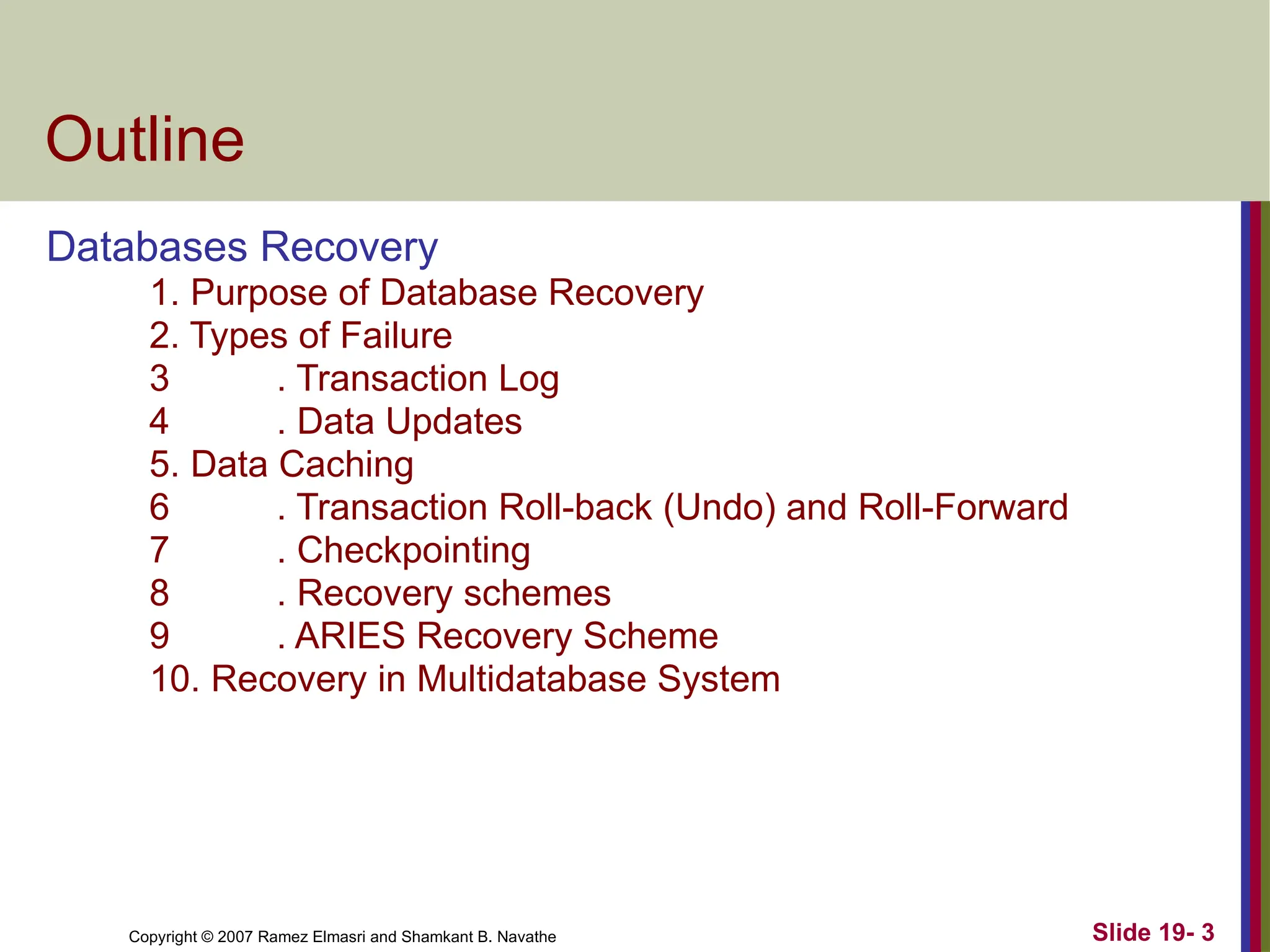
Outline
Databases Recovery
1. Purpose of Database Recovery
2. Types of Failure
3 . Transaction Log
4 . Data Updates
5. Data Caching
6 . Transaction Roll-back (Undo) and Roll-Forward
7 . Checkpointing
8 . Recovery schemes
9 . ARIES Recovery Scheme
10. Recovery in Multidatabase System
- 4.
Copyright © 2007Ramez Elmasri and Shamkant B. Navathe Slide 19- 4
Database Recovery
1 Purpose of Database Recovery
To bring the database into the last consistent state,
which existed prior to the failure.
To preserve transaction properties (Atomicity,
Consistency, Isolation and Durability).
Example:
If the system crashes before a fund transfer
transaction completes its execution, then either one or
both accounts may have incorrect value. Thus, the
database must be restored to the state before the
transaction modified any of the accounts.
- 5.
Copyright © 2007Ramez Elmasri and Shamkant B. Navathe Slide 19- 5
Database Recovery
2 Types of Failure
The database may become unavailable for use due to
Transaction failure: Transactions may fail because of
incorrect input, deadlock, incorrect synchronization.
a) Logical errors: transaction cannot complete due to some
internal error condition
b) System errors: the database system must terminate an active
transaction due to an error condition (e.g., deadlock)
System failure: System may fail because of addressing error,
application error, power failure, operating system fault, RAM
failure, etc.
Media failure: Disk head crash, power disruption, etc.
- 6.
Copyright © 2007Ramez Elmasri and Shamkant B. Navathe
Failure Classification Concluded
Types of failures
1. Transaction failure
Erroneous parameter values
Logical programming error
System error like integer overflow, division by zero
Local error like “data not found”
User interrupt
Concurrency control enforcement
2. Malicious transaction
3. System crash
A hardware, software, or network
4. Disk failure
- 7.
Copyright © 2007Ramez Elmasri and Shamkant B. Navathe
Recovery and Atomicity
To ensure atomicity despite failures, we first output information describing the
modifications to stable storage without modifying the database itself.
We study two approaches:
log-based recovery, Two approaches using logs
Deferred database modification
Immediate database modification
And
shadow-paging
We assume (initially) that transactions run serially, that is, one after the other.
- 8.
Copyright © 2007Ramez Elmasri and Shamkant B. Navathe Slide 19- 8
Database Recovery
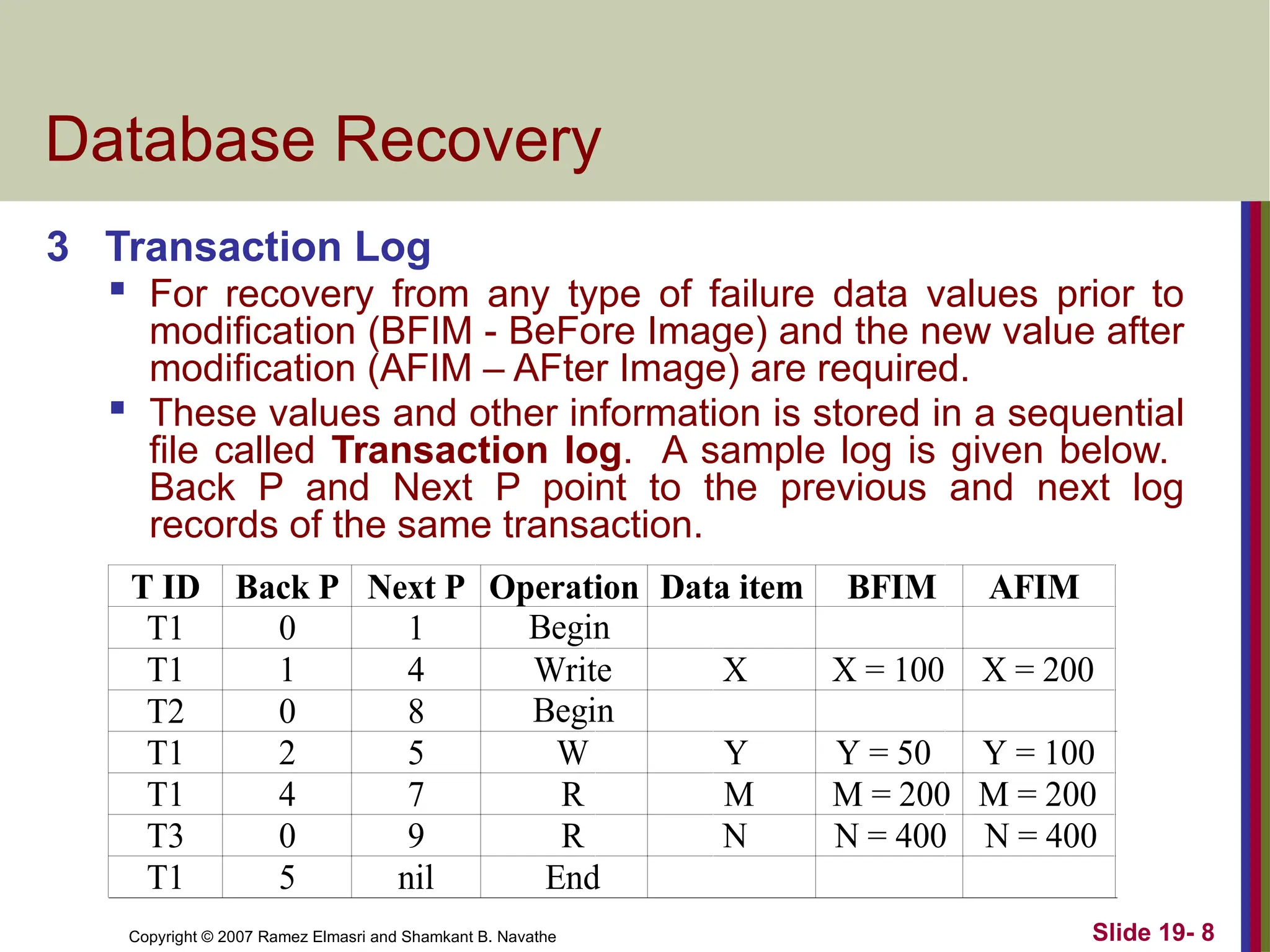
3 Transaction Log
For recovery from any type of failure data values prior to
modification (BFIM - BeFore Image) and the new value after
modification (AFIM – AFter Image) are required.
These values and other information is stored in a sequential
file called Transaction log. A sample log is given below.
Back P and Next P point to the previous and next log
records of the same transaction.
T ID Back P Next P Operation Data item BFIM AFIM
T1 0 1
T1 1 4
T2 0 8
T1 2 5
T1 4 7
T3 0 9
T1 5 nil
Begin
Write
W
R
R
End
Begin
X
Y
M
N
X = 200
Y = 100
M = 200
N = 400
X = 100
Y = 50
M = 200
N = 400
- 9.
Copyright © 2007Ramez Elmasri and Shamkant B. Navathe Slide 19- 9
Database Recovery
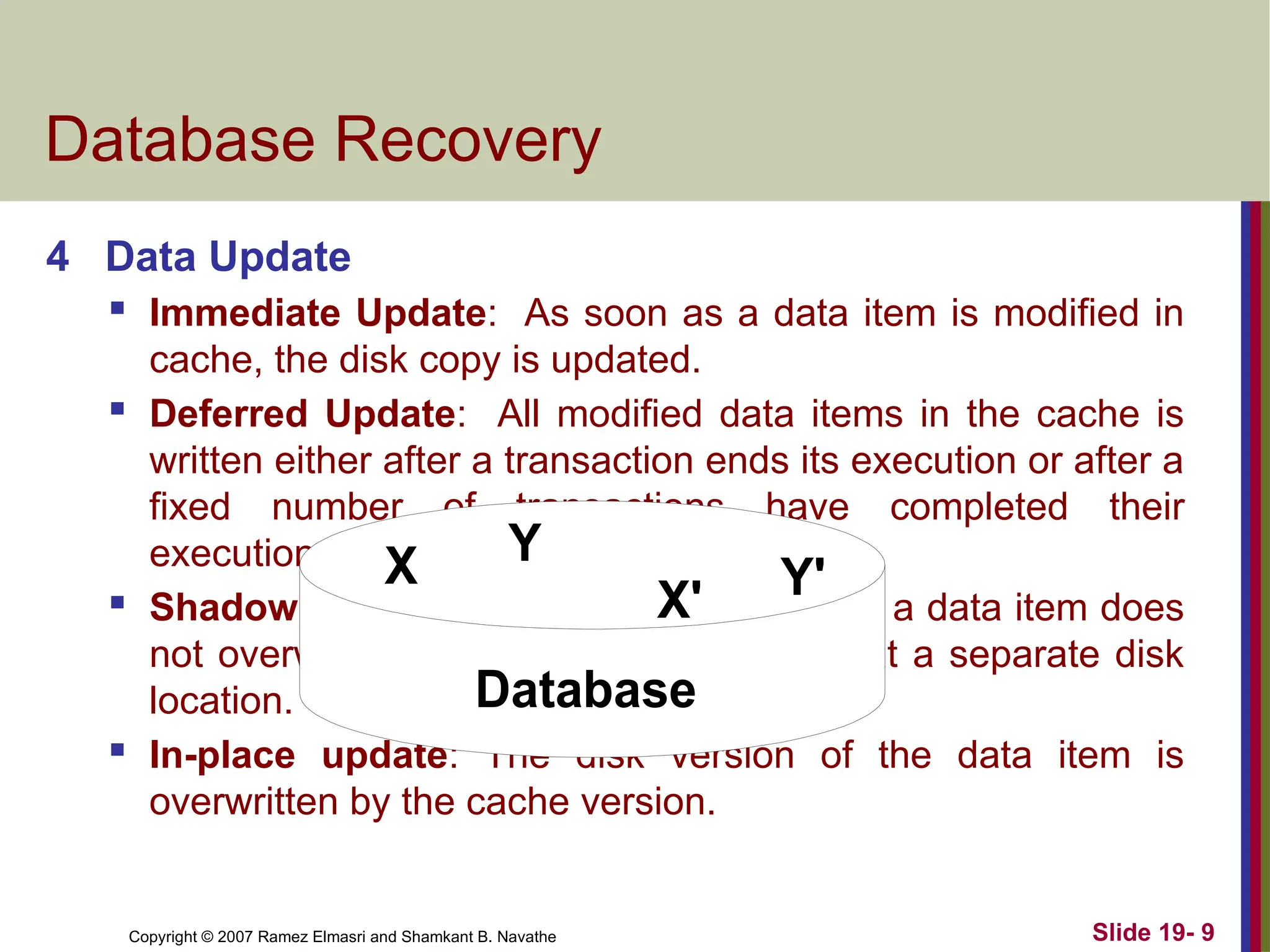
4 Data Update
Immediate Update: As soon as a data item is modified in
cache, the disk copy is updated.
Deferred Update: All modified data items in the cache is
written either after a transaction ends its execution or after a
fixed number of transactions have completed their
execution.
Shadow update: The modified version of a data item does
not overwrite its disk copy but is written at a separate disk
location.
In-place update: The disk version of the data item is
overwritten by the cache version.
X Y
Database
X' Y'
- 10.
Copyright © 2007Ramez Elmasri and Shamkant B. Navathe Slide 19- 10
Database Recovery
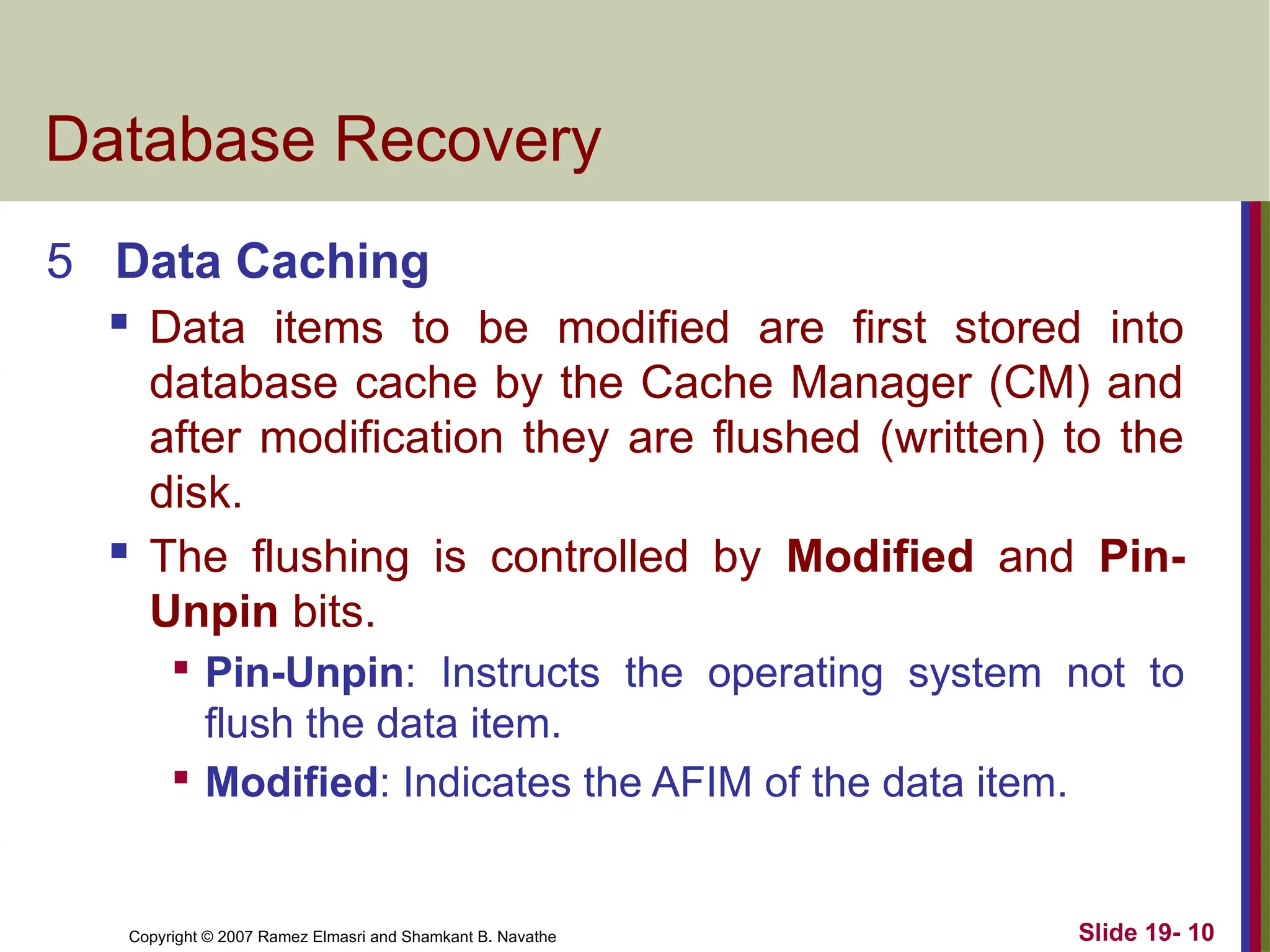
5 Data Caching
Data items to be modified are first stored into
database cache by the Cache Manager (CM) and
after modification they are flushed (written) to the
disk.
The flushing is controlled by Modified and Pin-
Unpin bits.
Pin-Unpin: Instructs the operating system not to
flush the data item.
Modified: Indicates the AFIM of the data item.
- 11.
Copyright © 2007Ramez Elmasri and Shamkant B. Navathe Slide 19- 11
Database Recovery
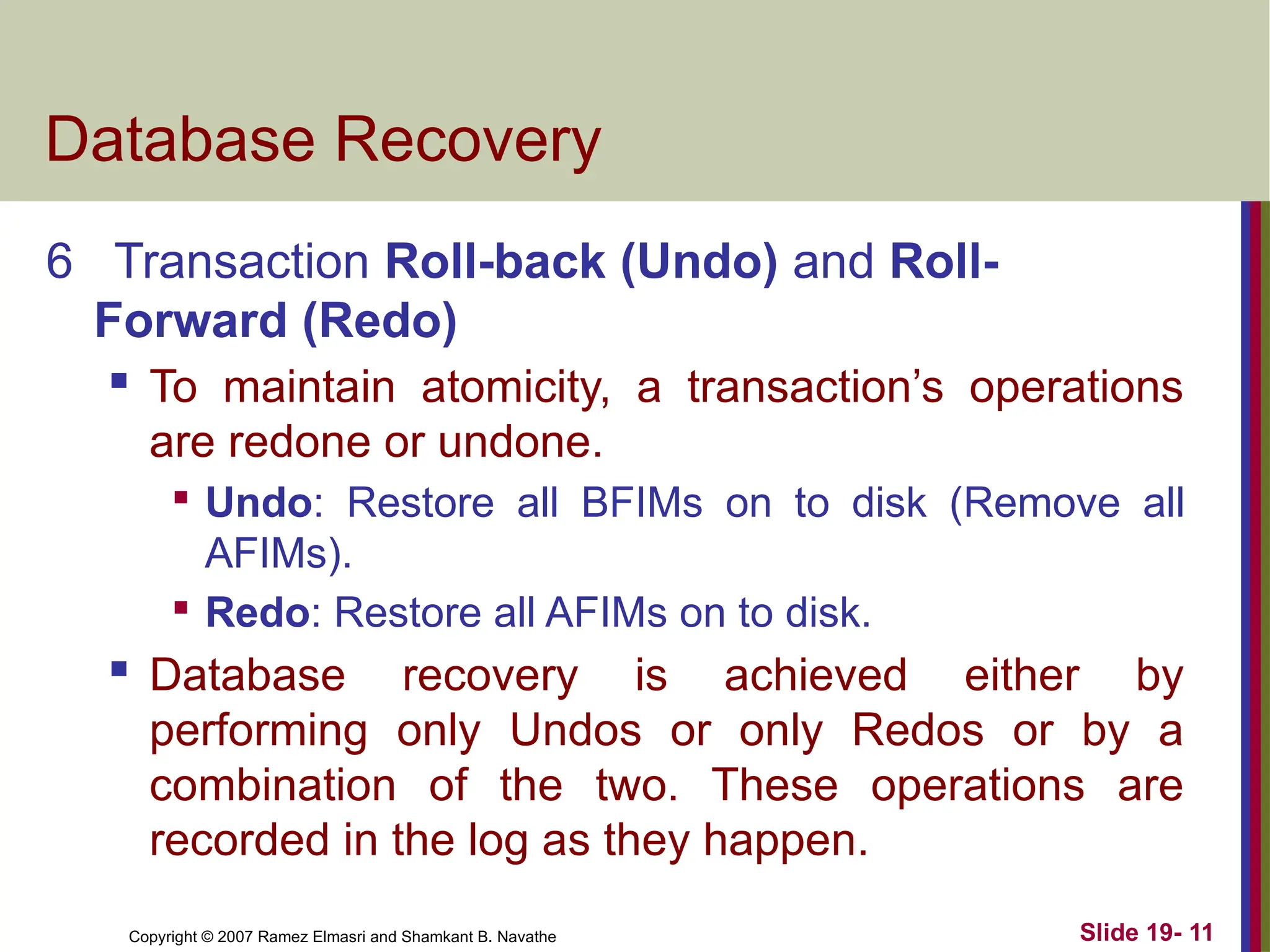
6 Transaction Roll-back (Undo) and Roll-
Forward (Redo)
To maintain atomicity, a transaction’s operations
are redone or undone.
Undo: Restore all BFIMs on to disk (Remove all
AFIMs).
Redo: Restore all AFIMs on to disk.
Database recovery is achieved either by
performing only Undos or only Redos or by a
combination of the two. These operations are
recorded in the log as they happen.
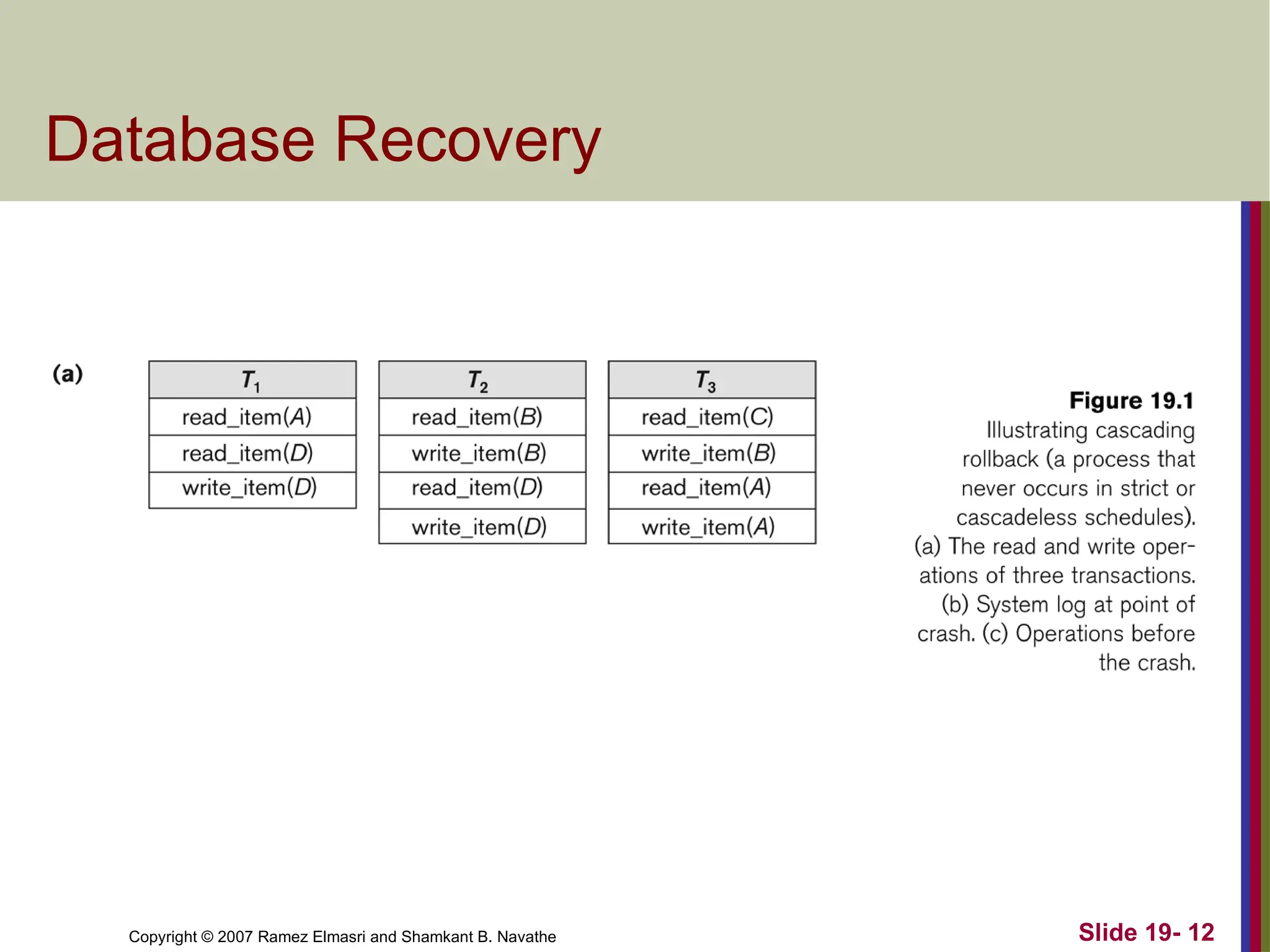
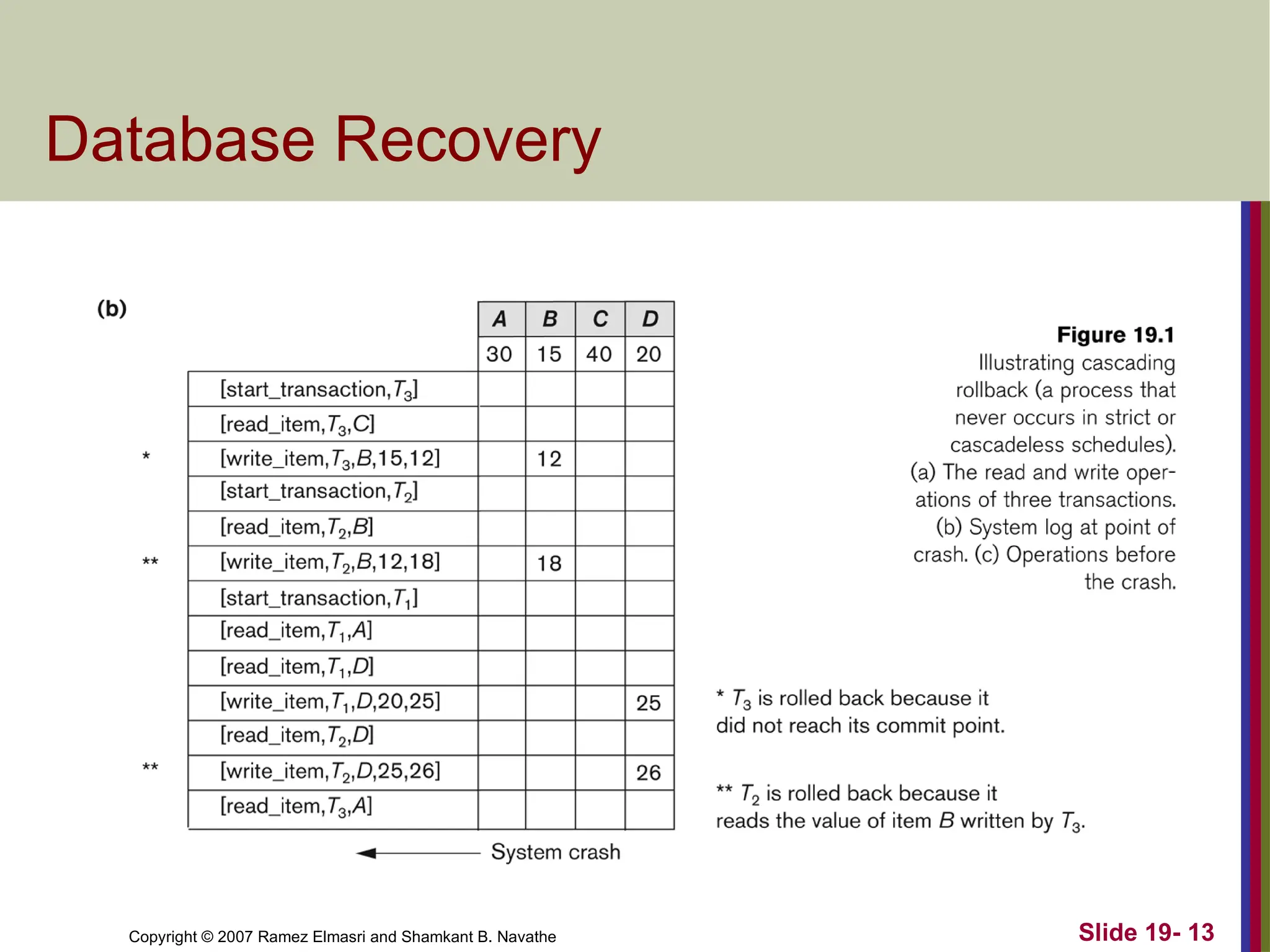
- 12.
Copyright © 2007Ramez Elmasri and Shamkant B. Navathe Slide 19- 12
Database Recovery
- 13.
Copyright © 2007Ramez Elmasri and Shamkant B. Navathe Slide 19- 13
Database Recovery
- 14.
Copyright © 2007Ramez Elmasri and Shamkant B. Navathe Slide 19- 14
Database Recovery
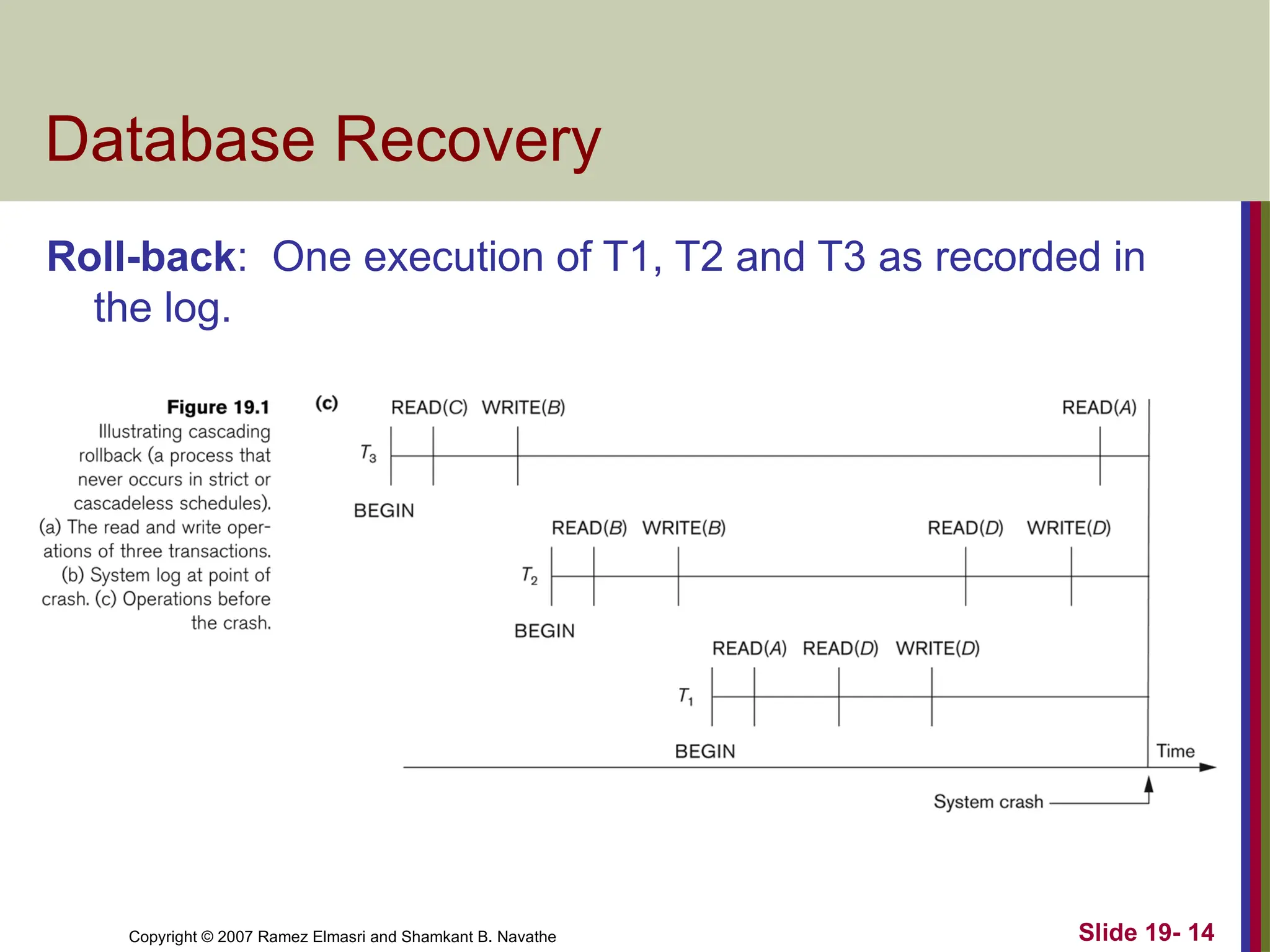
Roll-back: One execution of T1, T2 and T3 as recorded in
the log.
- 15.
Copyright © 2007Ramez Elmasri and Shamkant B. Navathe Slide 19- 15
Database Recovery
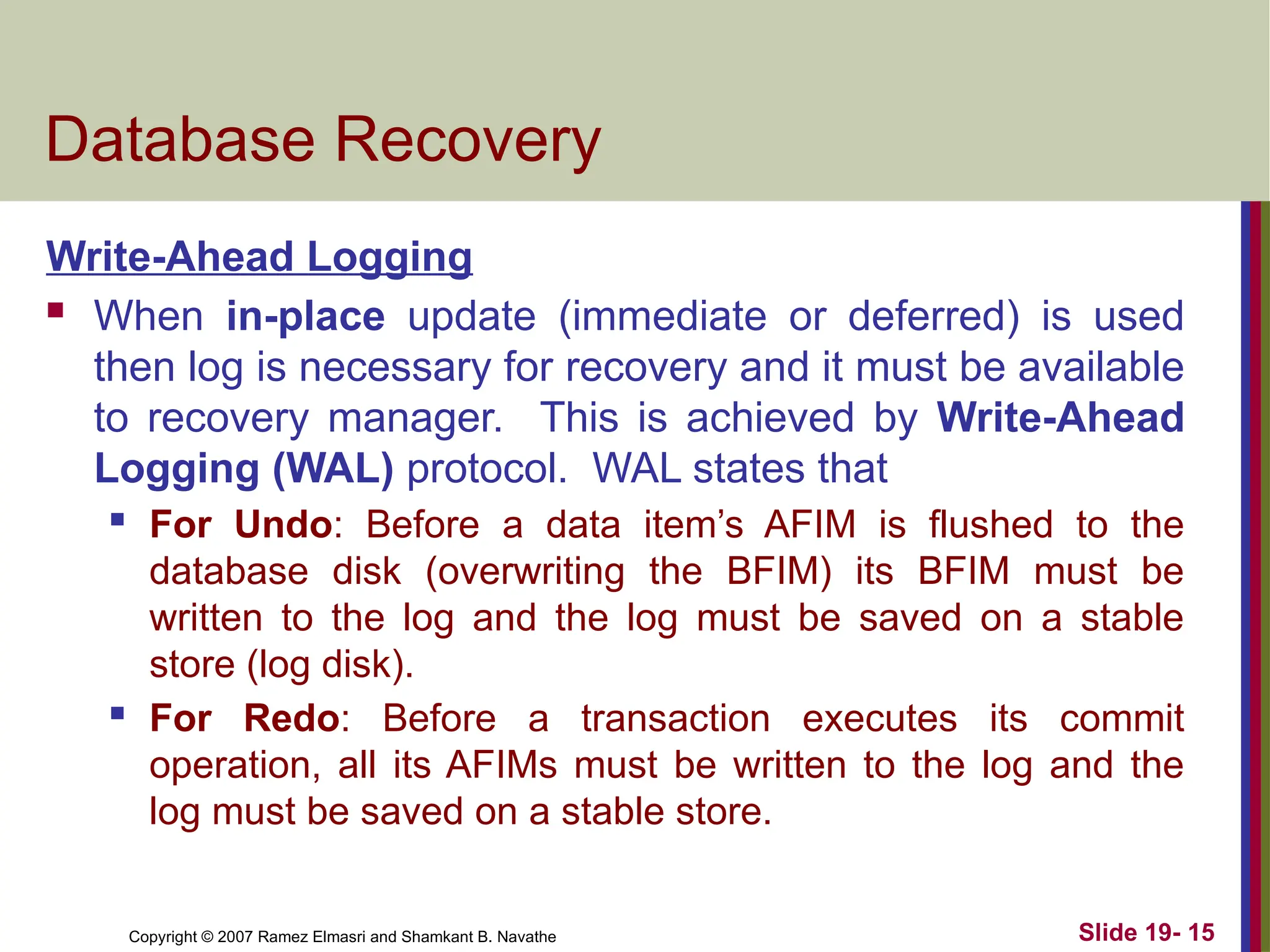
Write-Ahead Logging
When in-place update (immediate or deferred) is used
then log is necessary for recovery and it must be available
to recovery manager. This is achieved by Write-Ahead
Logging (WAL) protocol. WAL states that
For Undo: Before a data item’s AFIM is flushed to the
database disk (overwriting the BFIM) its BFIM must be
written to the log and the log must be saved on a stable
store (log disk).
For Redo: Before a transaction executes its commit
operation, all its AFIMs must be written to the log and the
log must be saved on a stable store.
- 16.
Copyright © 2007Ramez Elmasri and Shamkant B. Navathe
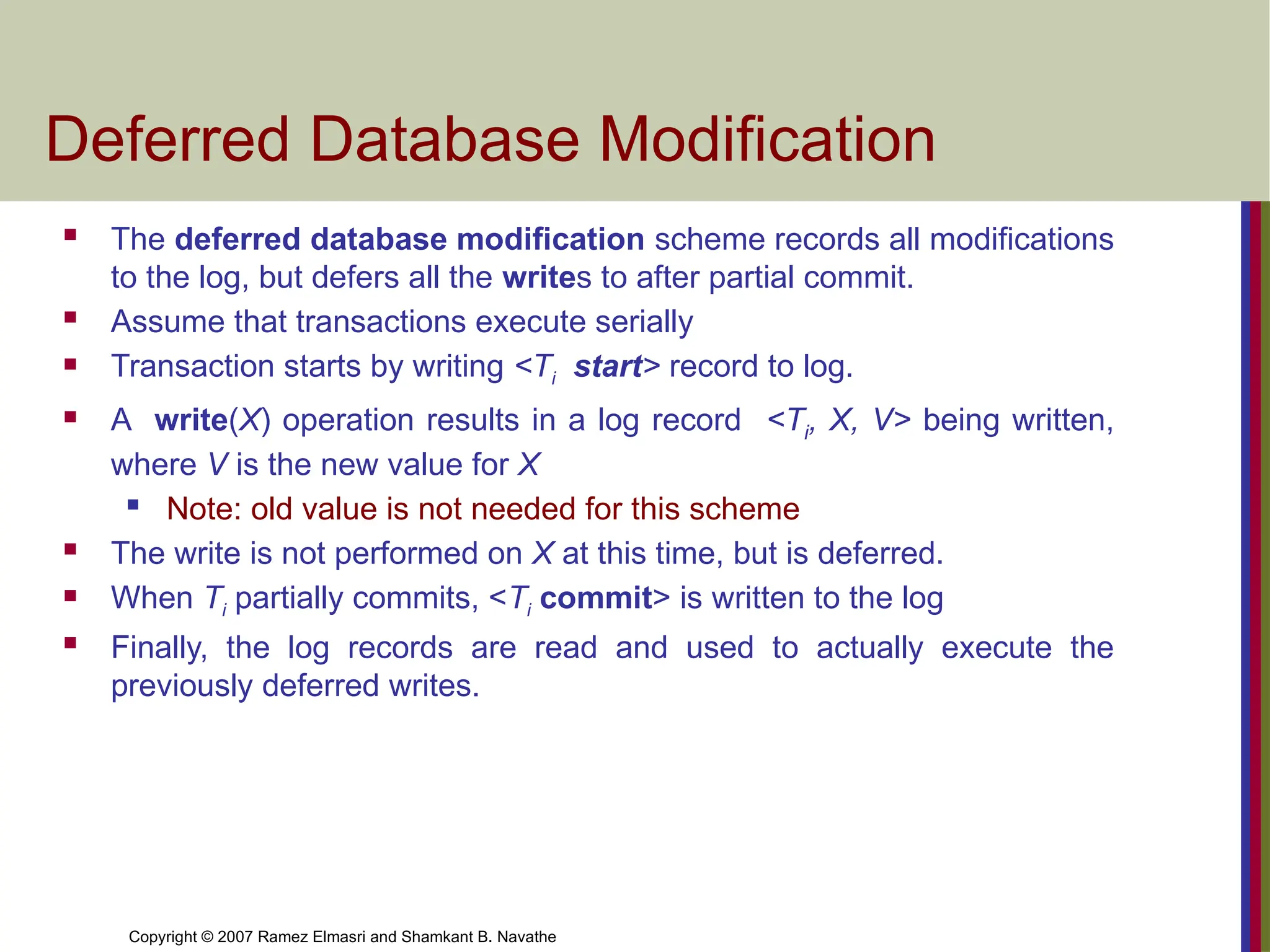
Deferred Database Modification
The deferred database modification scheme records all modifications
to the log, but defers all the writes to after partial commit.
Assume that transactions execute serially
Transaction starts by writing <Ti start> record to log.
A write(X) operation results in a log record <Ti, X, V> being written,
where V is the new value for X
Note: old value is not needed for this scheme
The write is not performed on X at this time, but is deferred.
When Ti partially commits, <Ti commit> is written to the log
Finally, the log records are read and used to actually execute the
previously deferred writes.
- 17.
Copyright © 2007Ramez Elmasri and Shamkant B. Navathe
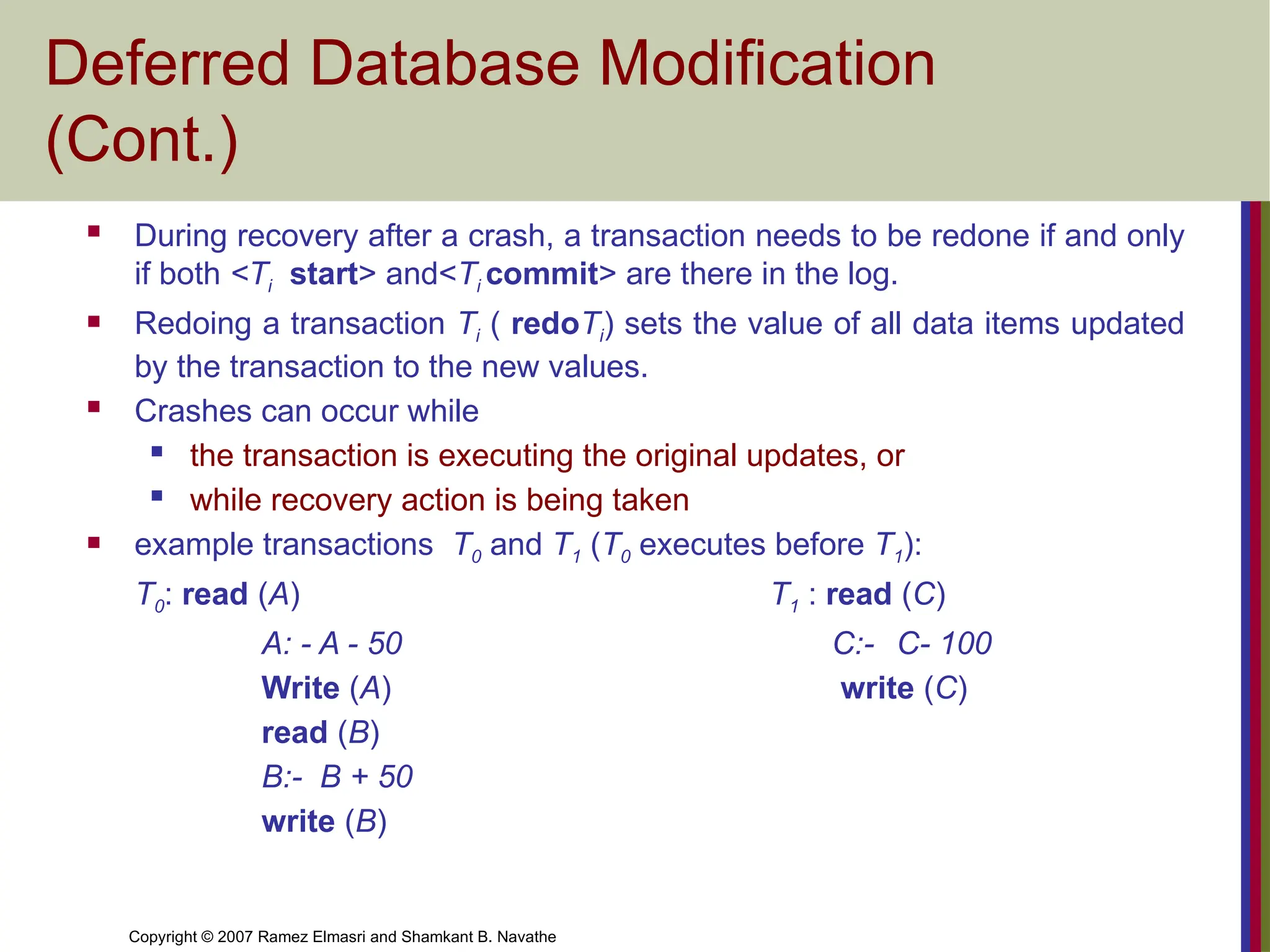
Deferred Database Modification
(Cont.)
During recovery after a crash, a transaction needs to be redone if and only
if both <Ti start> and<Ti commit> are there in the log.
Redoing a transaction Ti ( redoTi) sets the value of all data items updated
by the transaction to the new values.
Crashes can occur while
the transaction is executing the original updates, or
while recovery action is being taken
example transactions T0 and T1 (T0 executes before T1):
T0: read (A) T1 : read (C)
A: - A - 50 C:- C- 100
Write (A) write (C)
read (B)
B:- B + 50
write (B)
- 18.
Copyright © 2007Ramez Elmasri and Shamkant B. Navathe
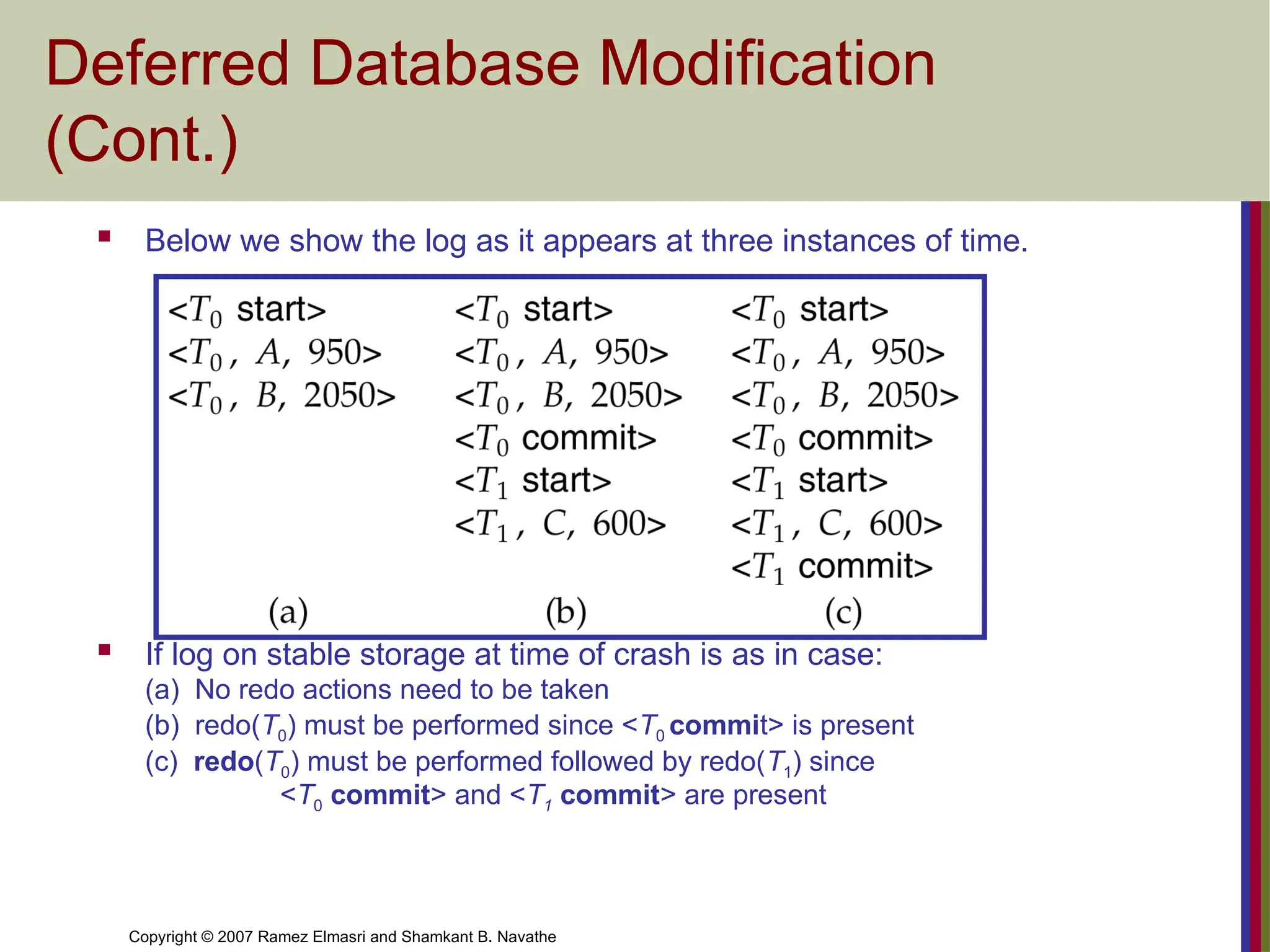
Deferred Database Modification
(Cont.)
Below we show the log as it appears at three instances of time.
If log on stable storage at time of crash is as in case:
(a) No redo actions need to be taken
(b) redo(T0) must be performed since <T0 commit> is present
(c) redo(T0) must be performed followed by redo(T1) since
<T0 commit> and <T1 commit> are present
- 19.
Copyright © 2007Ramez Elmasri and Shamkant B. Navathe
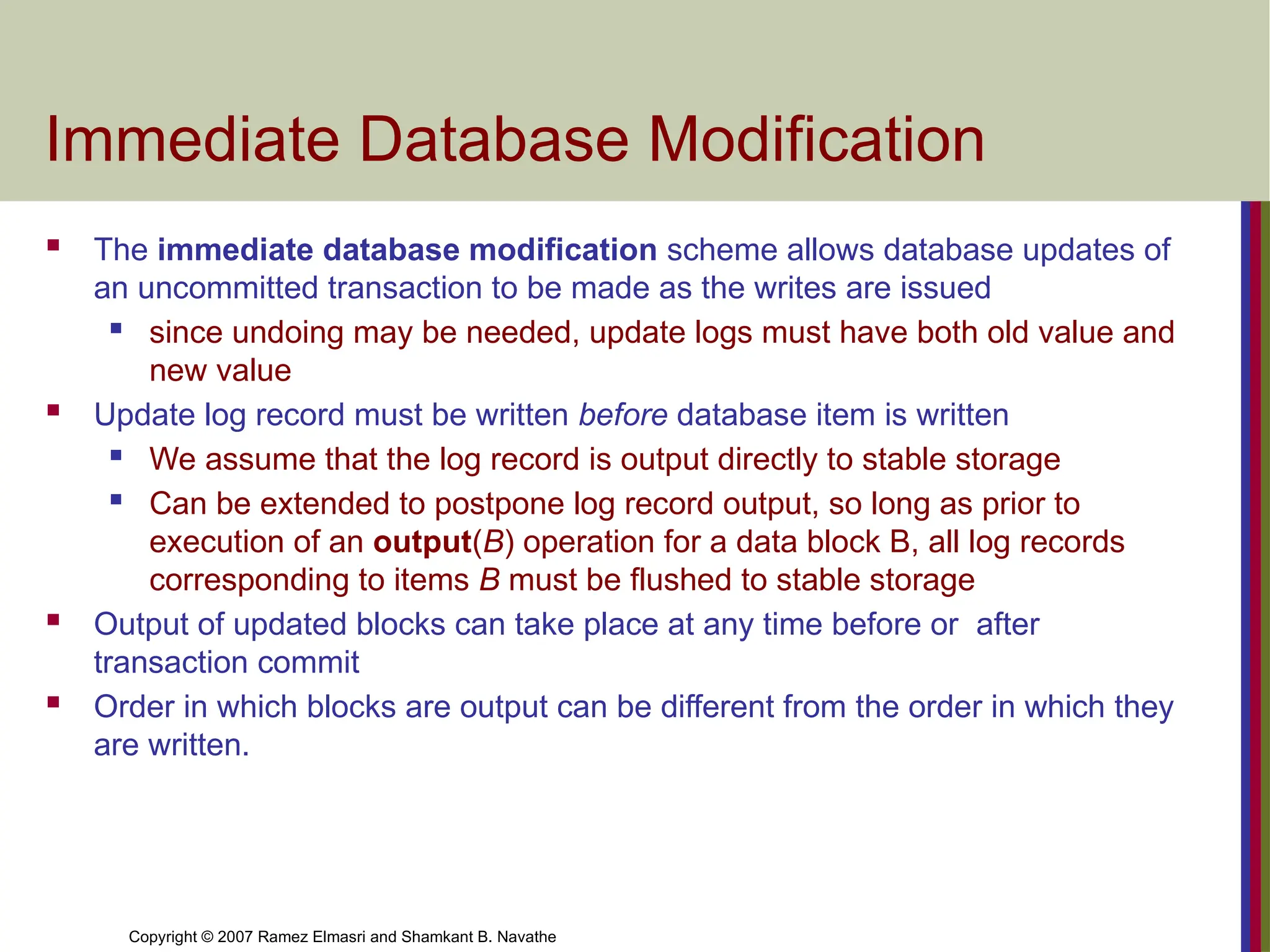
Immediate Database Modification
The immediate database modification scheme allows database updates of
an uncommitted transaction to be made as the writes are issued
since undoing may be needed, update logs must have both old value and
new value
Update log record must be written before database item is written
We assume that the log record is output directly to stable storage
Can be extended to postpone log record output, so long as prior to
execution of an output(B) operation for a data block B, all log records
corresponding to items B must be flushed to stable storage
Output of updated blocks can take place at any time before or after
transaction commit
Order in which blocks are output can be different from the order in which they
are written.
- 20.
Copyright © 2007Ramez Elmasri and Shamkant B. Navathe
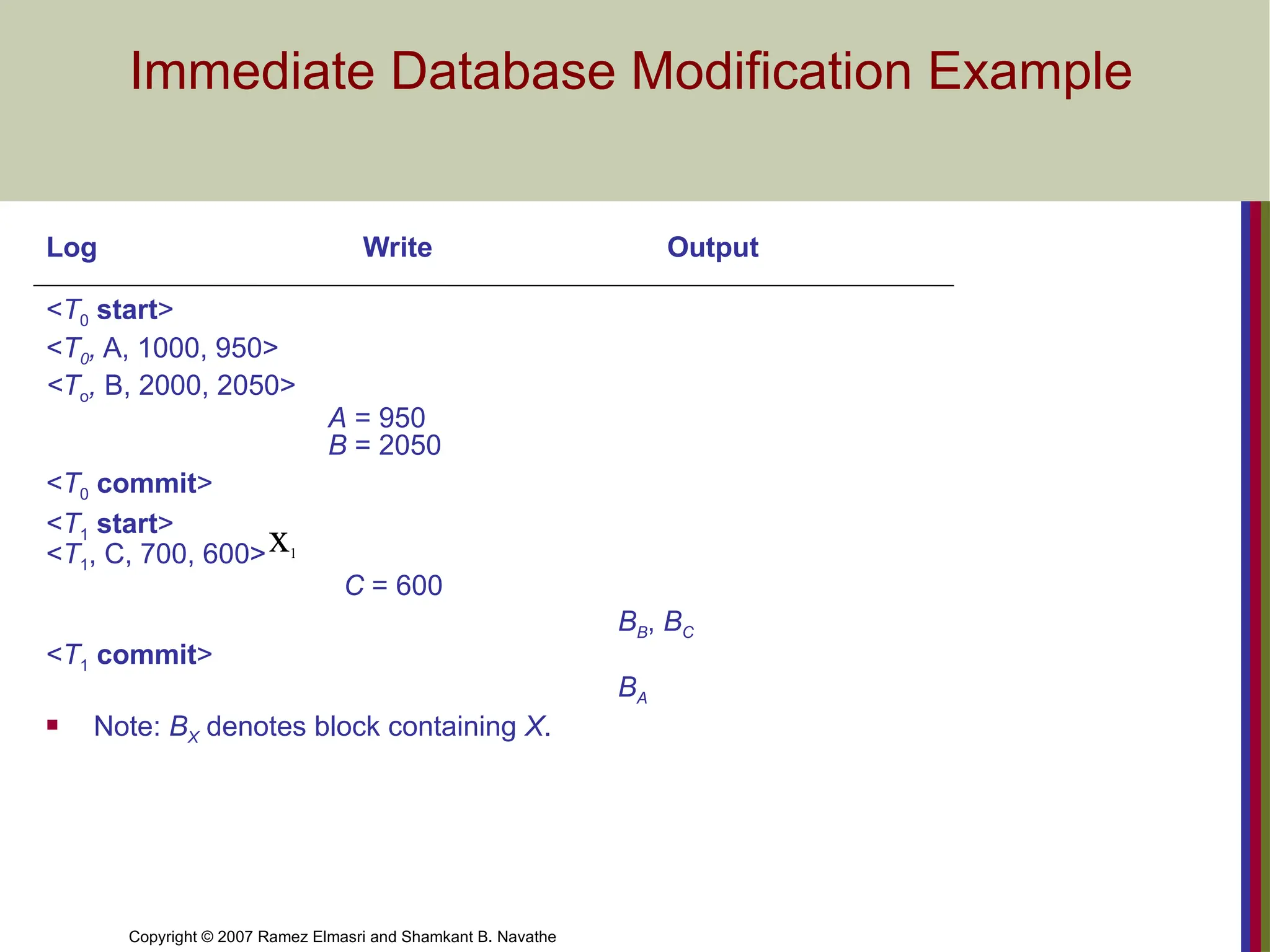
Immediate Database Modification Example
Log Write Output
<T0 start>
<T0, A, 1000, 950>
<To, B, 2000, 2050>
A = 950
B = 2050
<T0 commit>
<T1 start>
<T1, C, 700, 600>
C = 600
BB, BC
<T1 commit>
BA
Note: BX denotes block containing X.
x1
- 21.
Copyright © 2007Ramez Elmasri and Shamkant B. Navathe
Immediate Database Modification
(Cont.)
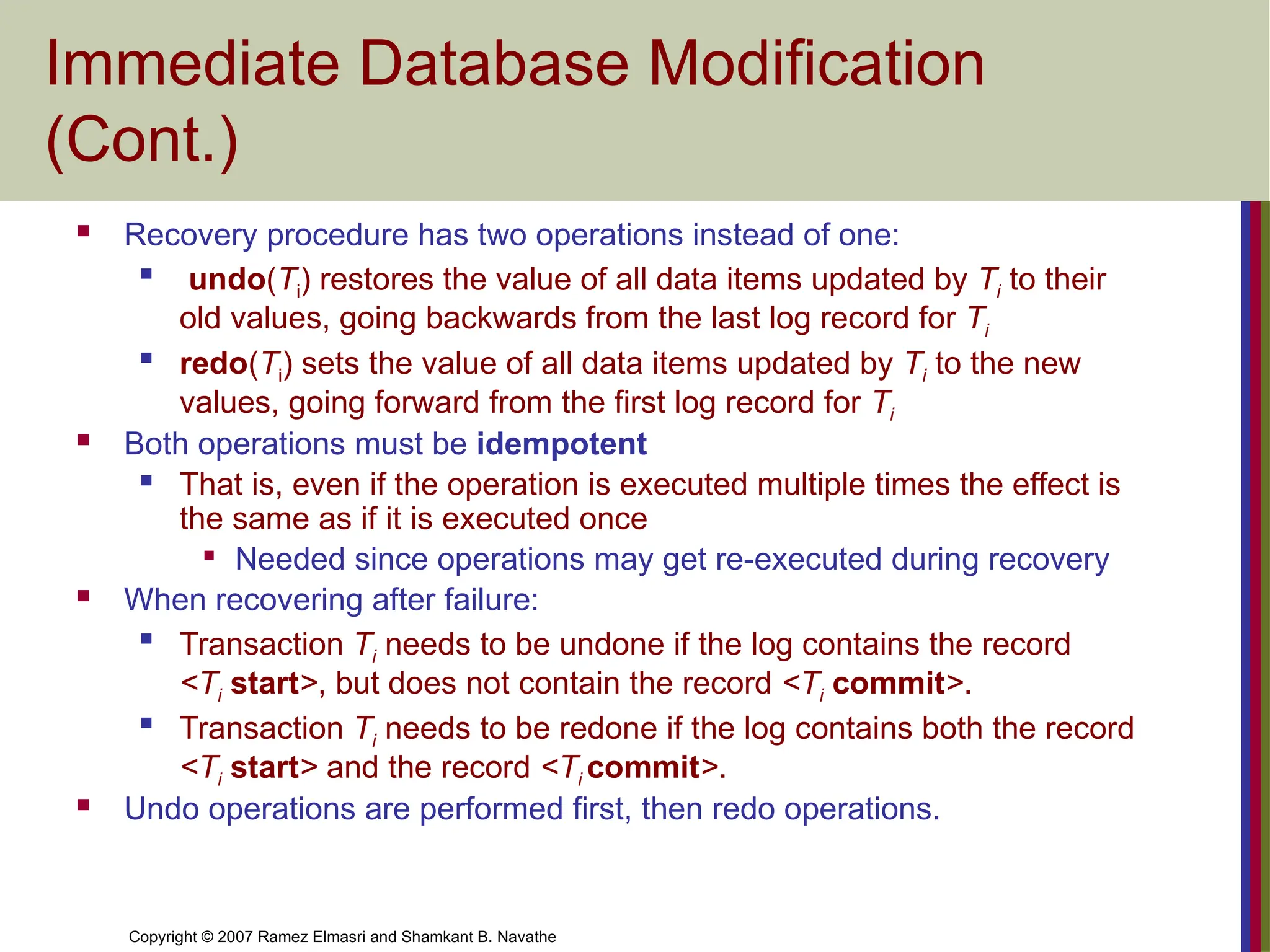
Recovery procedure has two operations instead of one:
undo(Ti) restores the value of all data items updated by Ti to their
old values, going backwards from the last log record for Ti
redo(Ti) sets the value of all data items updated by Ti to the new
values, going forward from the first log record for Ti
Both operations must be idempotent
That is, even if the operation is executed multiple times the effect is
the same as if it is executed once
Needed since operations may get re-executed during recovery
When recovering after failure:
Transaction Ti needs to be undone if the log contains the record
<Ti start>, but does not contain the record <Ti commit>.
Transaction Ti needs to be redone if the log contains both the record
<Ti start> and the record <Ti commit>.
Undo operations are performed first, then redo operations.
- 22.
Copyright © 2007Ramez Elmasri and Shamkant B. Navathe
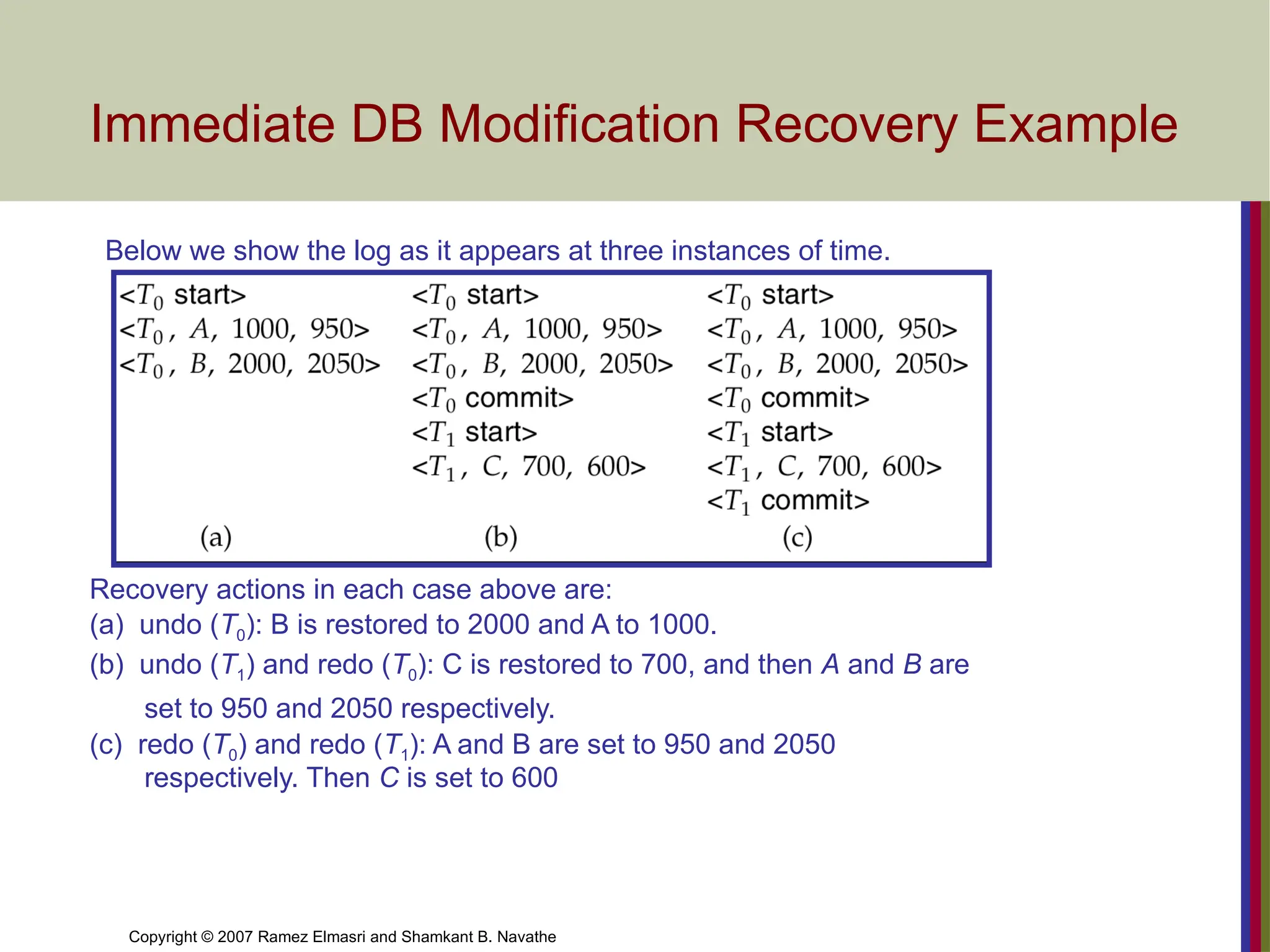
Immediate DB Modification Recovery Example
Below we show the log as it appears at three instances of time.
Recovery actions in each case above are:
(a) undo (T0): B is restored to 2000 and A to 1000.
(b) undo (T1) and redo (T0): C is restored to 700, and then A and B are
set to 950 and 2050 respectively.
(c) redo (T0) and redo (T1): A and B are set to 950 and 2050
respectively. Then C is set to 600
- 23.
Copyright © 2007Ramez Elmasri and Shamkant B. Navathe Slide 19- 23
Database Recovery
7 Checkpointing
Time to time (randomly or under some criteria) the
database flushes its buffer to database disk to minimize
the task of recovery. The following steps defines a
checkpoint operation:
1. Suspend execution of transactions temporarily.
2. Force write modified buffer data to disk.
3. Write a [checkpoint] record to the log, save the log to disk.
4. Resume normal transaction execution.
During recovery redo or undo is required to transactions
appearing after [checkpoint] record.
- 24.
Copyright © 2007Ramez Elmasri and Shamkant B. Navathe
Checkpoints
Problems in recovery procedure as discussed earlier :
1. searching the entire log is time-consuming
2. we might unnecessarily redo transactions which have already output
their updates to the database.
Streamline recovery procedure by periodically performing checkpointing
1. Output all log records currently residing in main memory onto stable
storage.
2. Output all modified buffer blocks to the disk.
3. Write a log record < checkpoint> onto stable storage.
- 25.
Copyright © 2007Ramez Elmasri and Shamkant B. Navathe
Checkpoints (Cont.)
During recovery we need to consider only the most recent transaction Ti that
started before the checkpoint, and transactions that started after Ti.
1. Scan backwards from end of log to find the most recent <checkpoint>
record
2. Continue scanning backwards till a record <Ti start> is found.
3. Need only consider the part of log following above start record. Earlier
part of log can be ignored during recovery, and can be erased whenever
desired.
4. For all transactions (starting from Ti or later) with no <Ti commit>,
execute undo(Ti). (Done only in case of immediate modification.)
5. Scanning forward in the log, for all transactions starting from Ti or
later with a <Ti commit>, execute redo(Ti).
- 26.
Copyright © 2007Ramez Elmasri and Shamkant B. Navathe
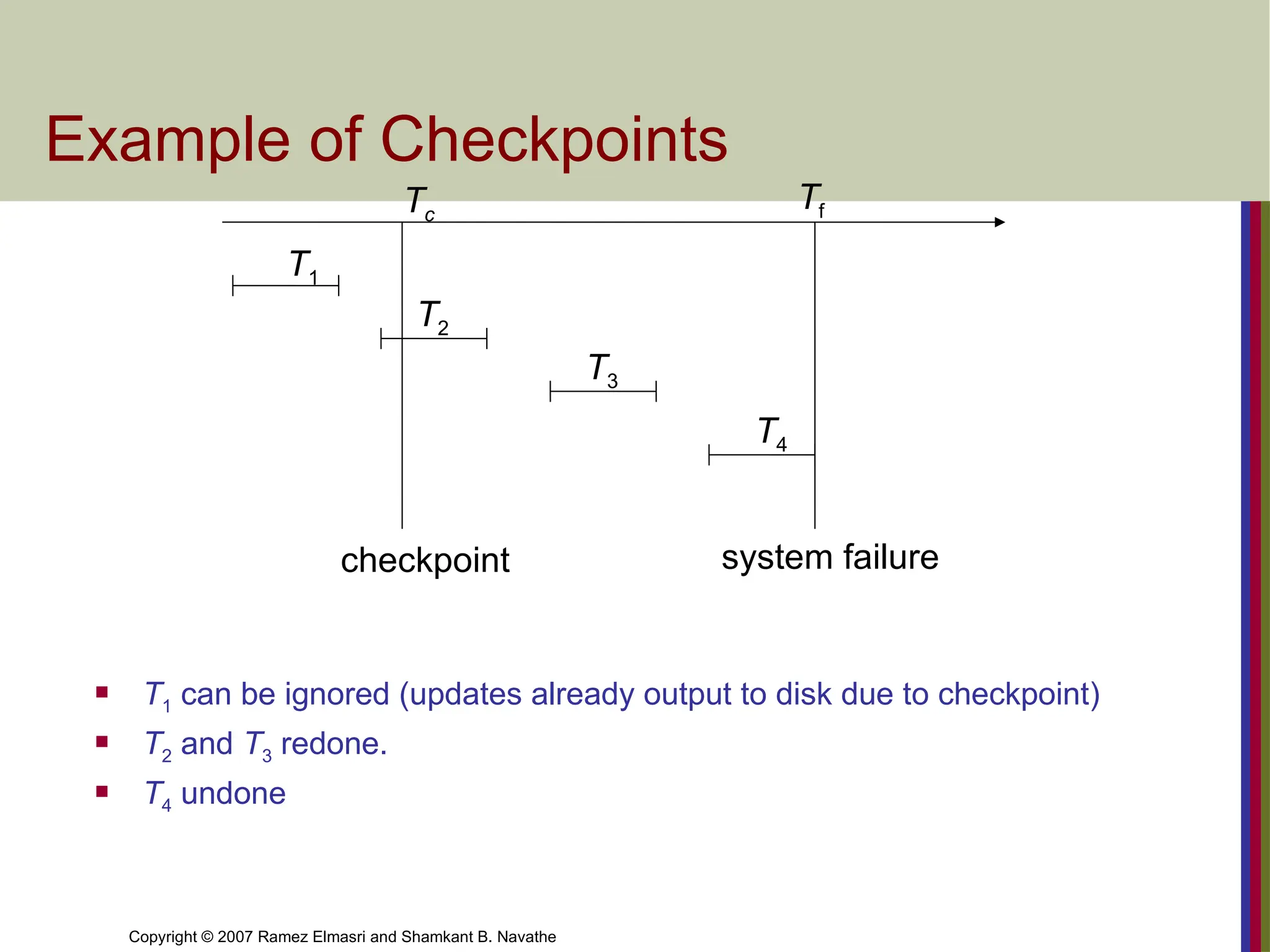
Example of Checkpoints
T1 can be ignored (updates already output to disk due to checkpoint)
T2 and T3 redone.
T4 undone
Tc
Tf
T1
T2
T3
T4
checkpoint system failure
- 27.
Copyright © 2007Ramez Elmasri and Shamkant B. Navathe Slide 19- 31
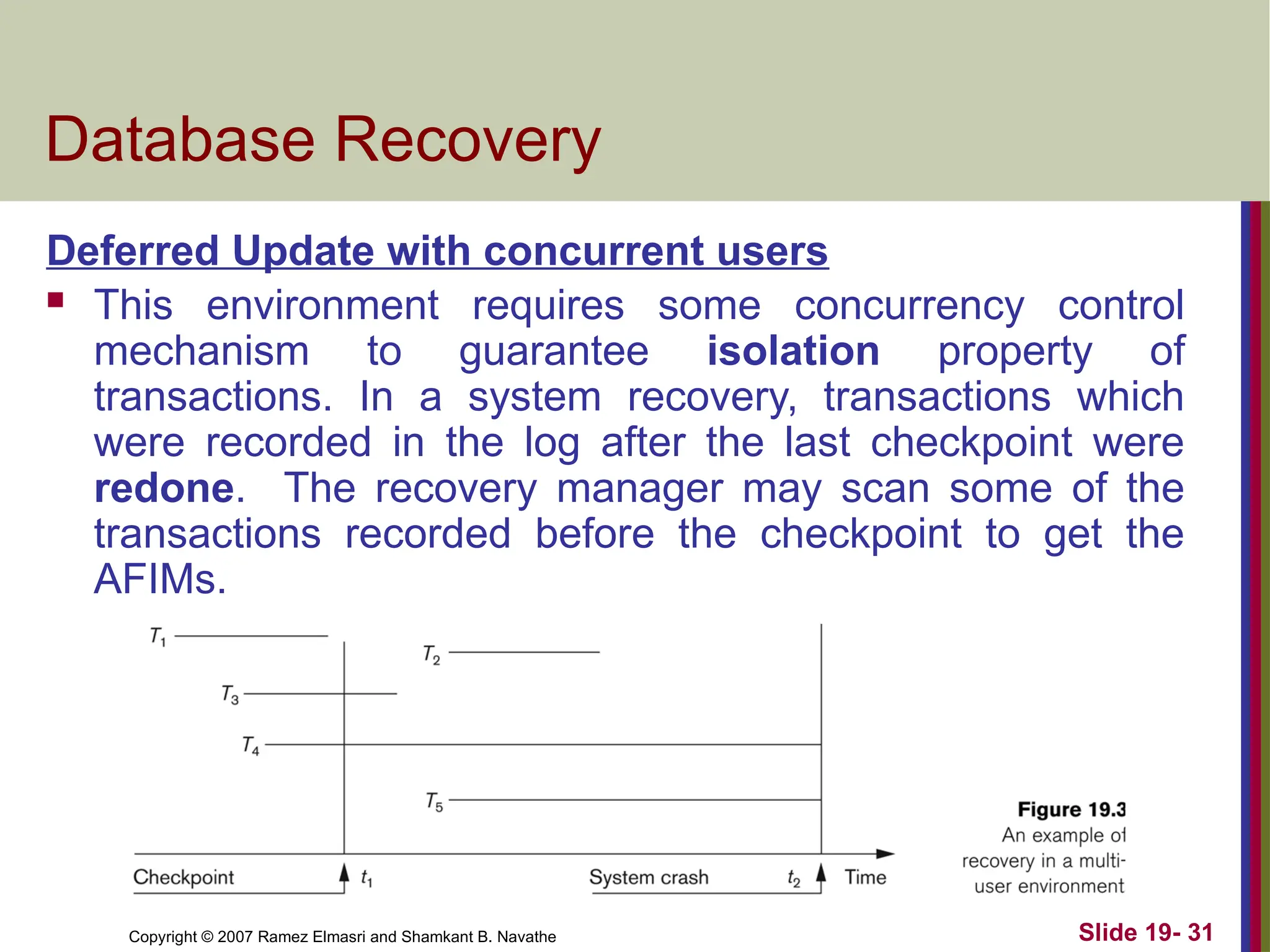
Database Recovery
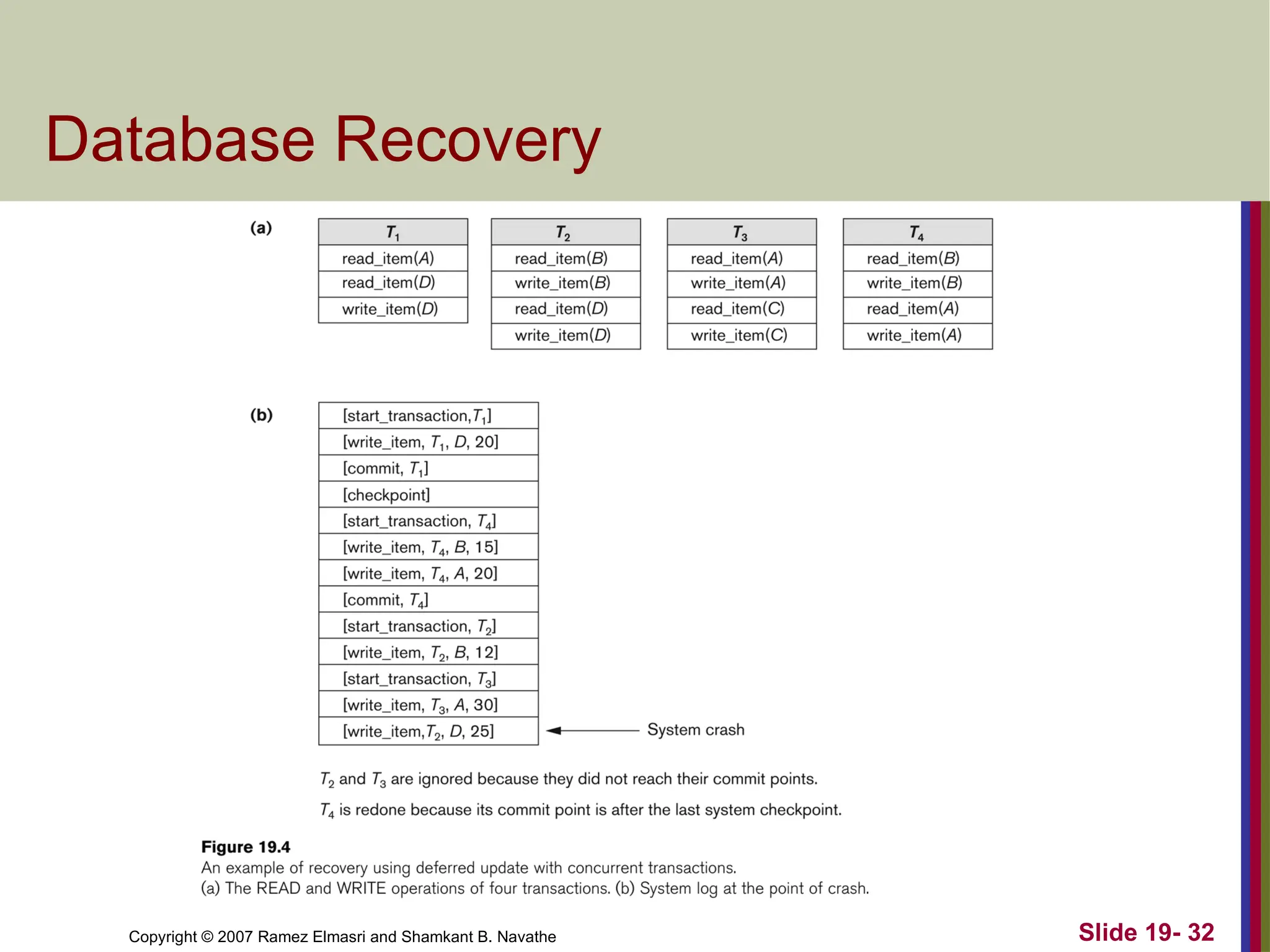
Deferred Update with concurrent users
This environment requires some concurrency control
mechanism to guarantee isolation property of
transactions. In a system recovery, transactions which
were recorded in the log after the last checkpoint were
redone. The recovery manager may scan some of the
transactions recorded before the checkpoint to get the
AFIMs.
- 28.
Copyright © 2007Ramez Elmasri and Shamkant B. Navathe Slide 19- 32
Database Recovery
- 29.
Copyright © 2007Ramez Elmasri and Shamkant B. Navathe Slide 19- 33
Database Recovery
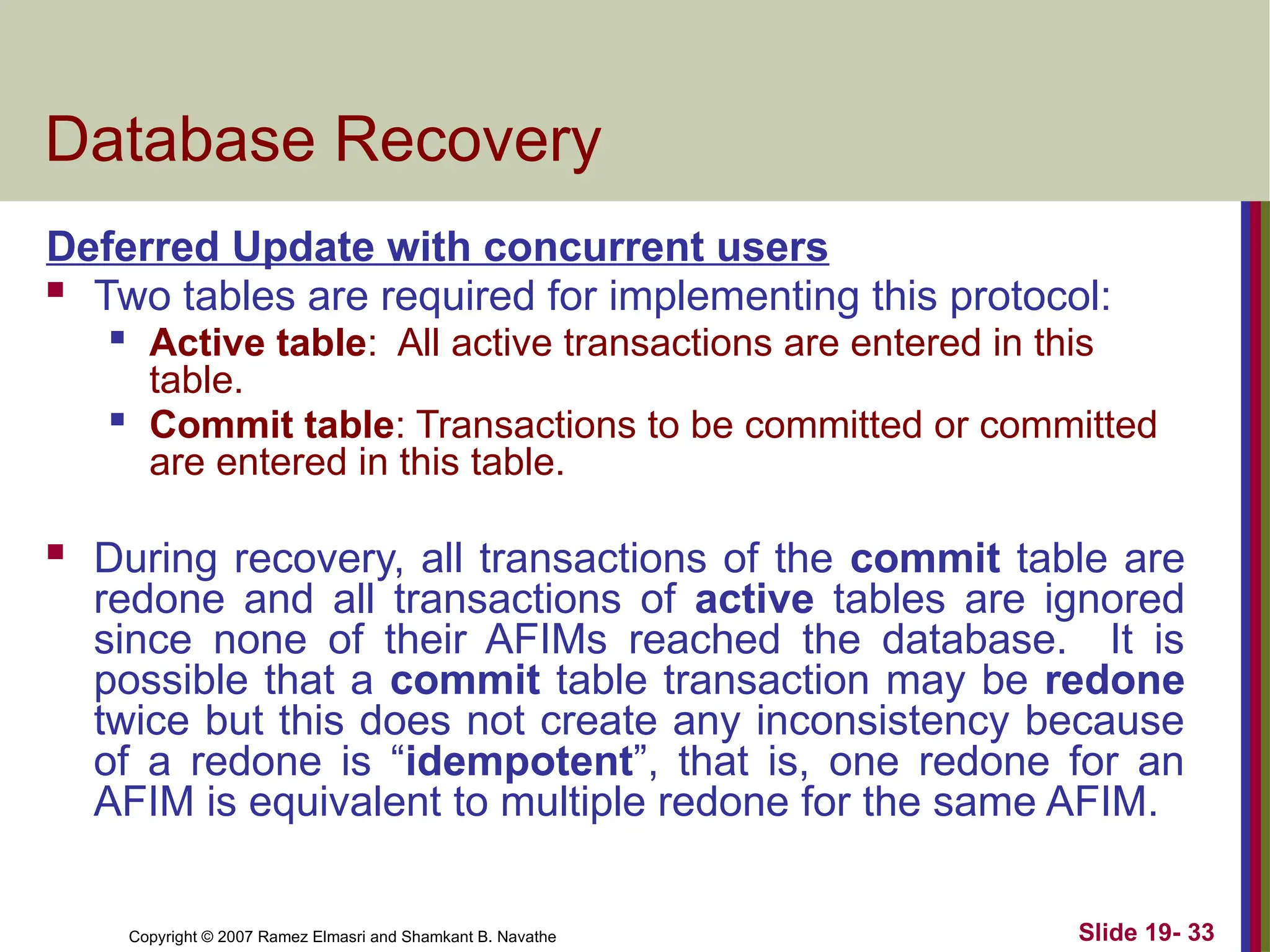
Deferred Update with concurrent users
Two tables are required for implementing this protocol:
Active table: All active transactions are entered in this
table.
Commit table: Transactions to be committed or committed
are entered in this table.
During recovery, all transactions of the commit table are
redone and all transactions of active tables are ignored
since none of their AFIMs reached the database. It is
possible that a commit table transaction may be redone
twice but this does not create any inconsistency because
of a redone is “idempotent”, that is, one redone for an
AFIM is equivalent to multiple redone for the same AFIM.
- 30.
Copyright © 2007Ramez Elmasri and Shamkant B. Navathe Slide 19- 37
Database Recovery
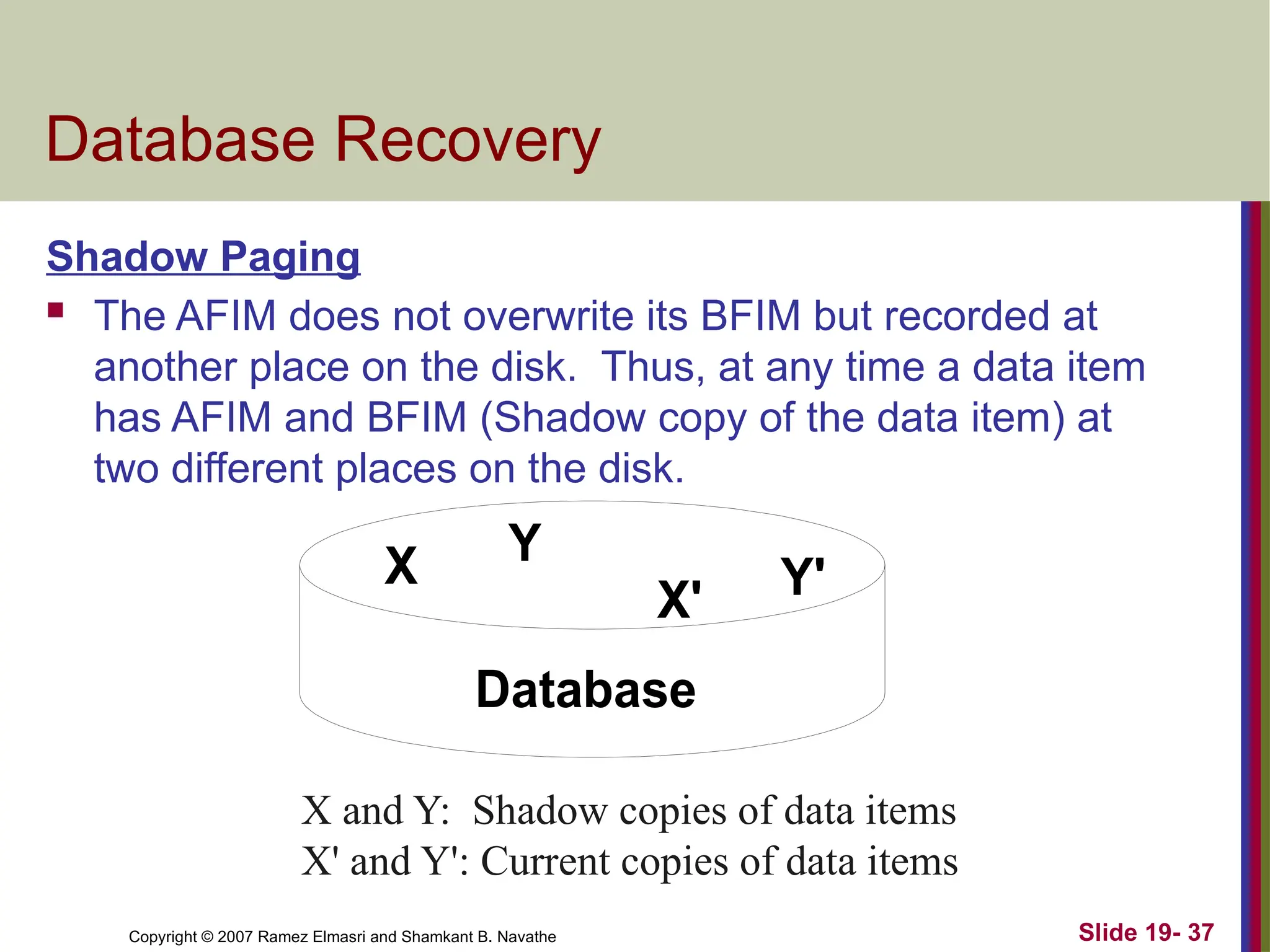
Shadow Paging
The AFIM does not overwrite its BFIM but recorded at
another place on the disk. Thus, at any time a data item
has AFIM and BFIM (Shadow copy of the data item) at
two different places on the disk.
X Y
Database
X' Y'
X and Y: Shadow copies of data items
X' and Y': Current copies of data items
- 31.
Copyright © 2007Ramez Elmasri and Shamkant B. Navathe Slide 19- 38
Database Recovery
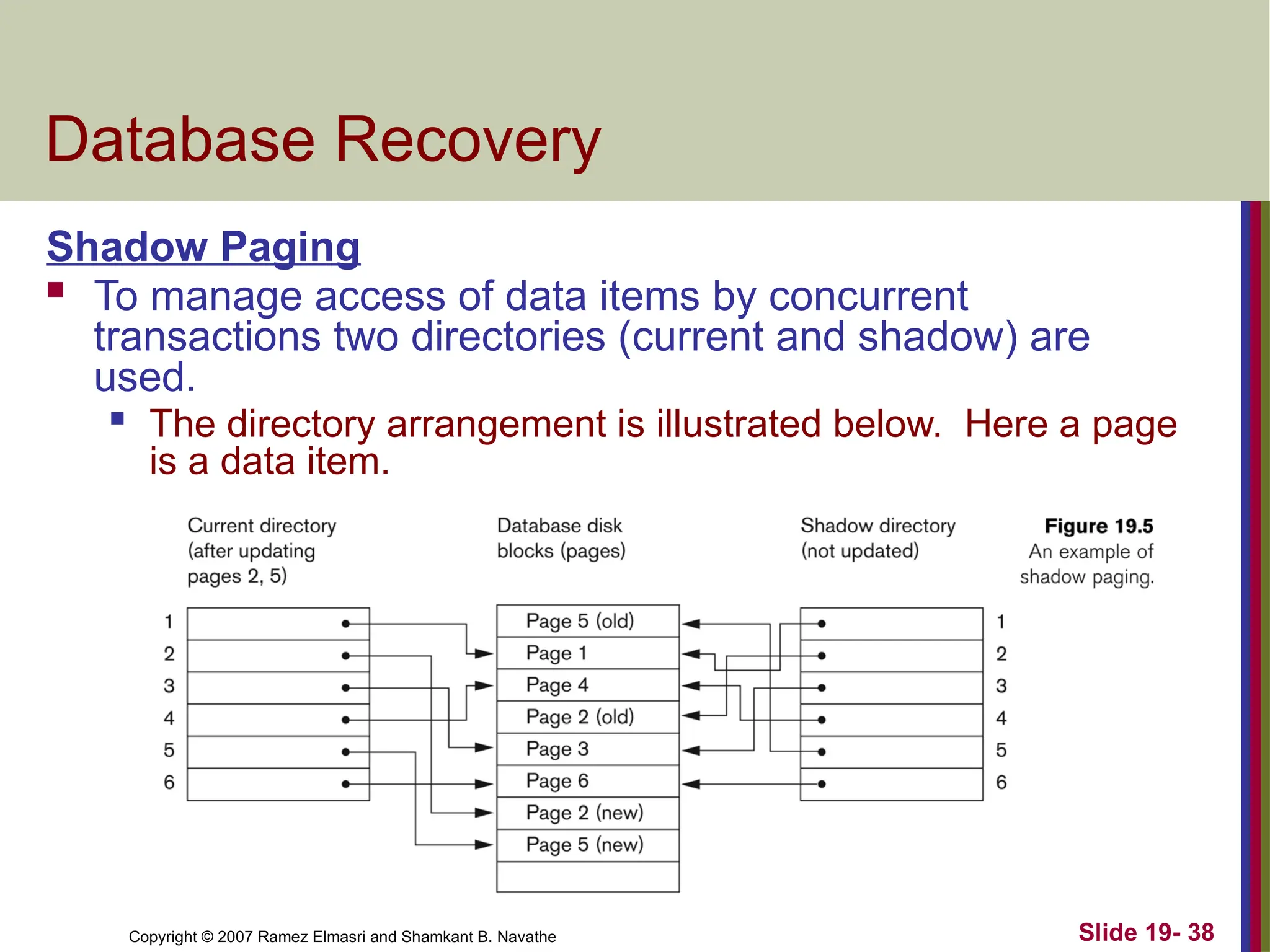
Shadow Paging
To manage access of data items by concurrent
transactions two directories (current and shadow) are
used.
The directory arrangement is illustrated below. Here a page
is a data item.
- 32.
Copyright © 2007Ramez Elmasri and Shamkant B. Navathe
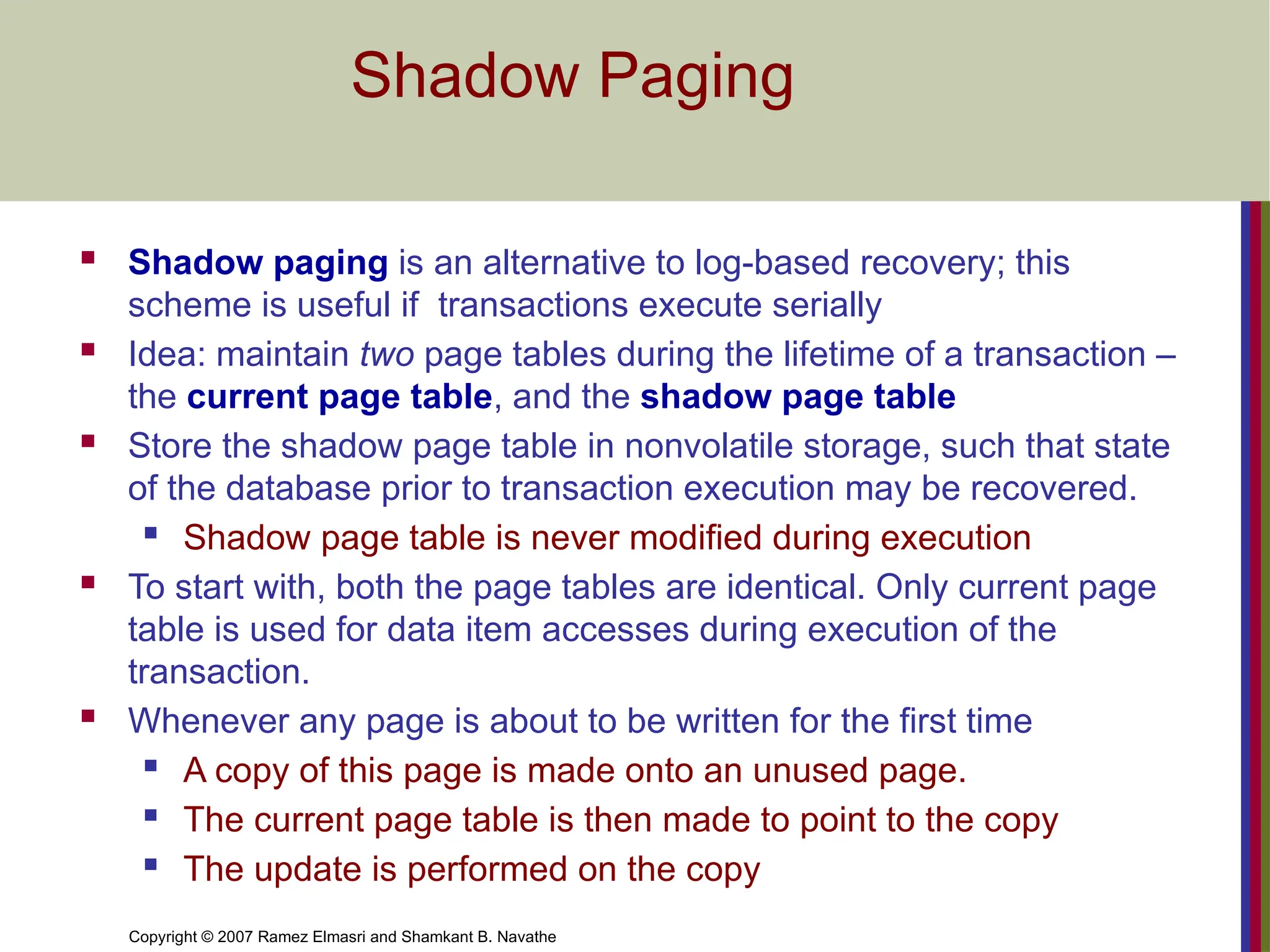
Shadow Paging
Shadow paging is an alternative to log-based recovery; this
scheme is useful if transactions execute serially
Idea: maintain two page tables during the lifetime of a transaction –
the current page table, and the shadow page table
Store the shadow page table in nonvolatile storage, such that state
of the database prior to transaction execution may be recovered.
Shadow page table is never modified during execution
To start with, both the page tables are identical. Only current page
table is used for data item accesses during execution of the
transaction.
Whenever any page is about to be written for the first time
A copy of this page is made onto an unused page.
The current page table is then made to point to the copy
The update is performed on the copy
- 33.
Copyright © 2007Ramez Elmasri and Shamkant B. Navathe
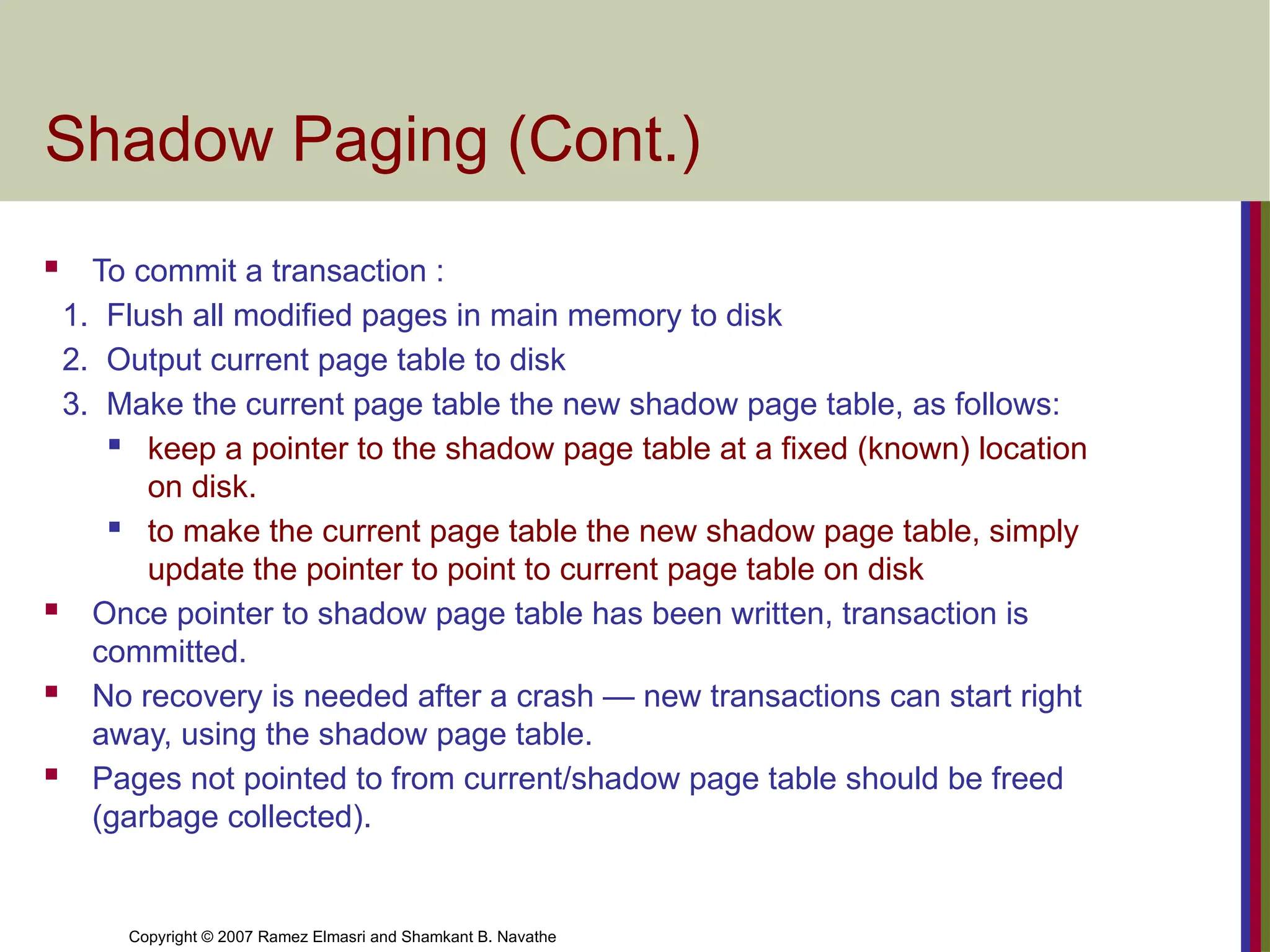
Shadow Paging (Cont.)
To commit a transaction :
1. Flush all modified pages in main memory to disk
2. Output current page table to disk
3. Make the current page table the new shadow page table, as follows:
keep a pointer to the shadow page table at a fixed (known) location
on disk.
to make the current page table the new shadow page table, simply
update the pointer to point to current page table on disk
Once pointer to shadow page table has been written, transaction is
committed.
No recovery is needed after a crash — new transactions can start right
away, using the shadow page table.
Pages not pointed to from current/shadow page table should be freed
(garbage collected).
- 34.
Copyright © 2007Ramez Elmasri and Shamkant B. Navathe
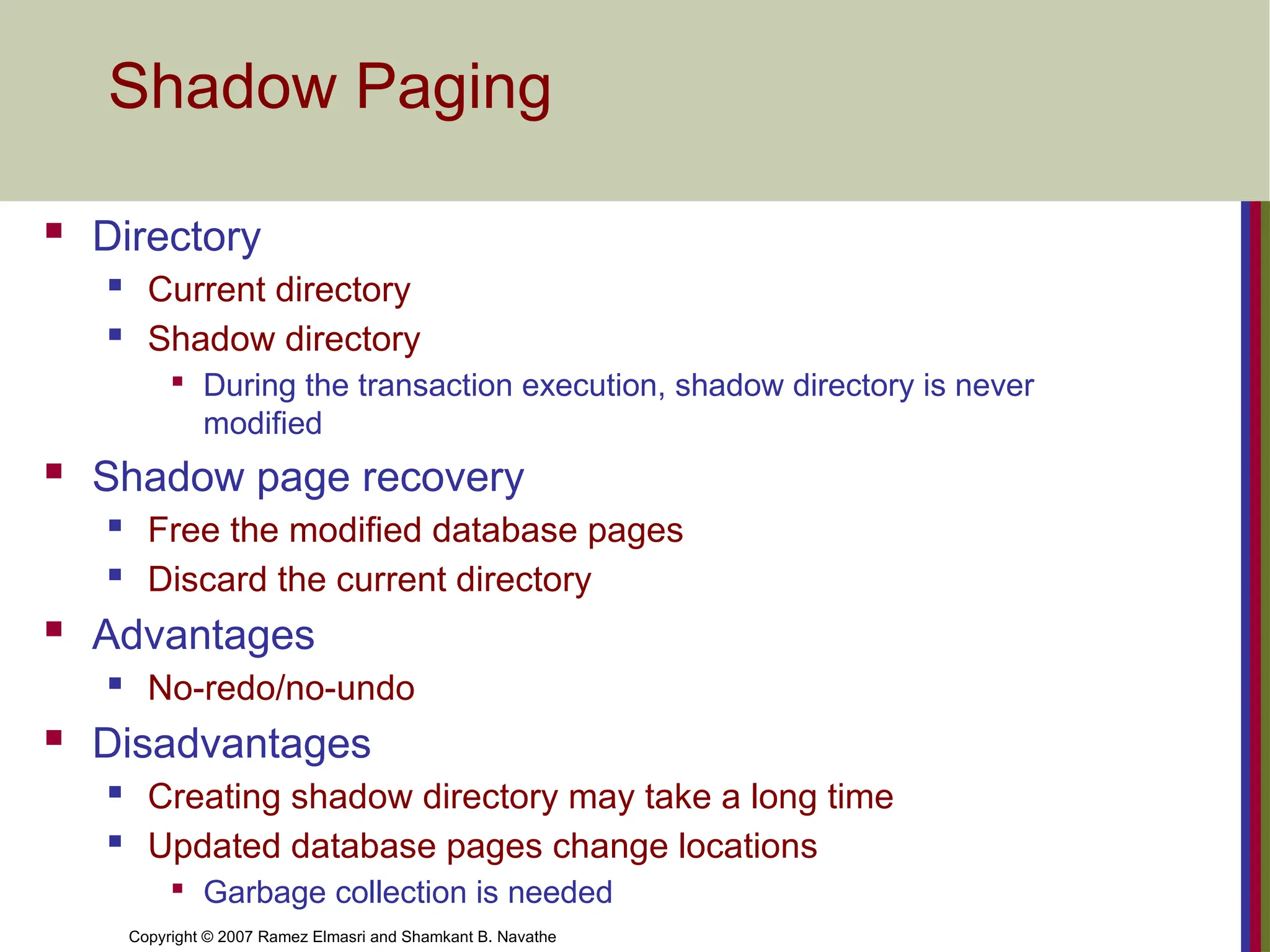
Shadow Paging
Directory
Current directory
Shadow directory
During the transaction execution, shadow directory is never
modified
Shadow page recovery
Free the modified database pages
Discard the current directory
Advantages
No-redo/no-undo
Disadvantages
Creating shadow directory may take a long time
Updated database pages change locations
Garbage collection is needed
- 35.
Copyright © 2007Ramez Elmasri and Shamkant B. Navathe
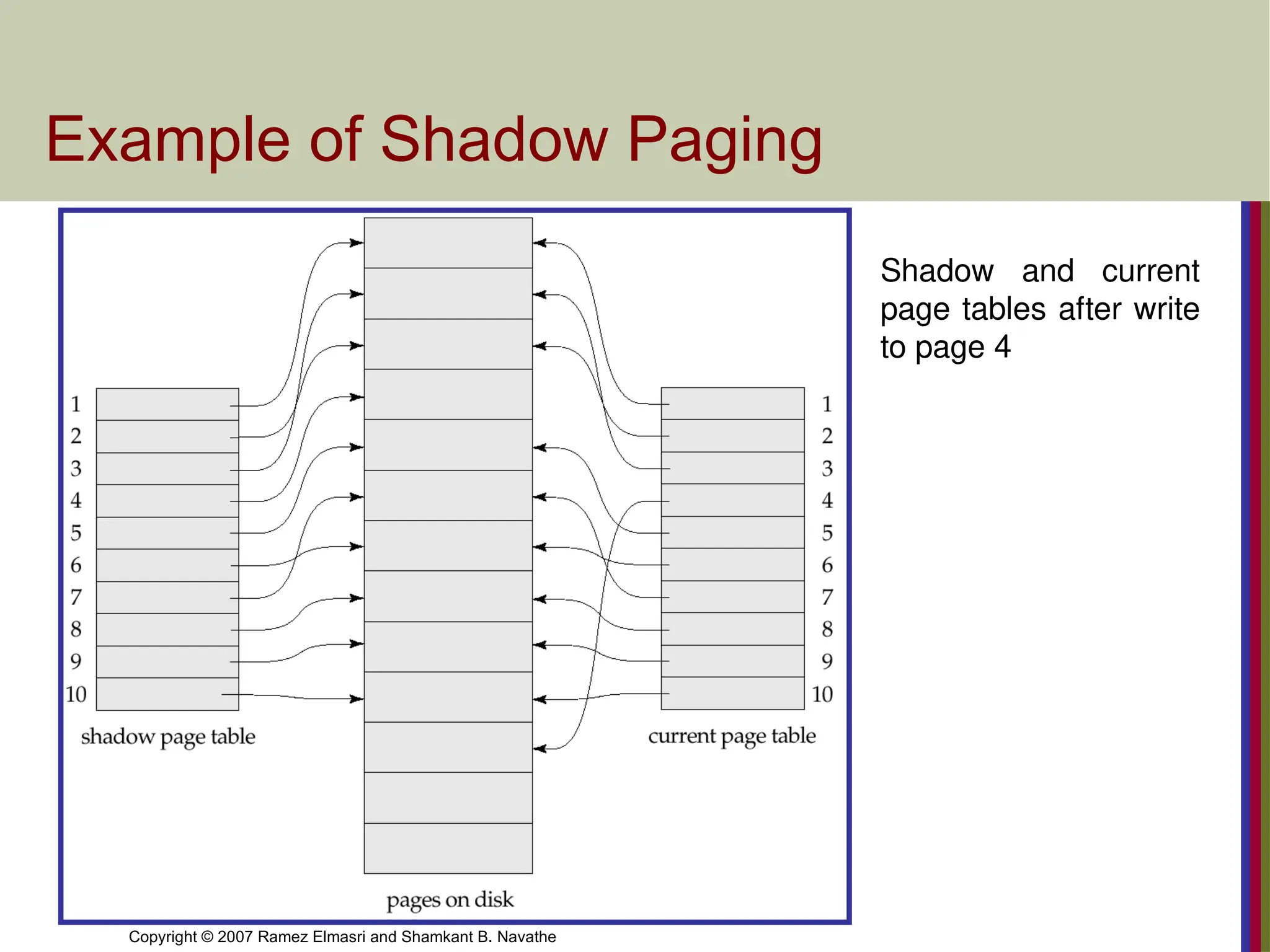
Example of Shadow Paging
Shadow and current
page tables after write
to page 4
- 36.
Copyright © 2007Ramez Elmasri and Shamkant B. Navathe
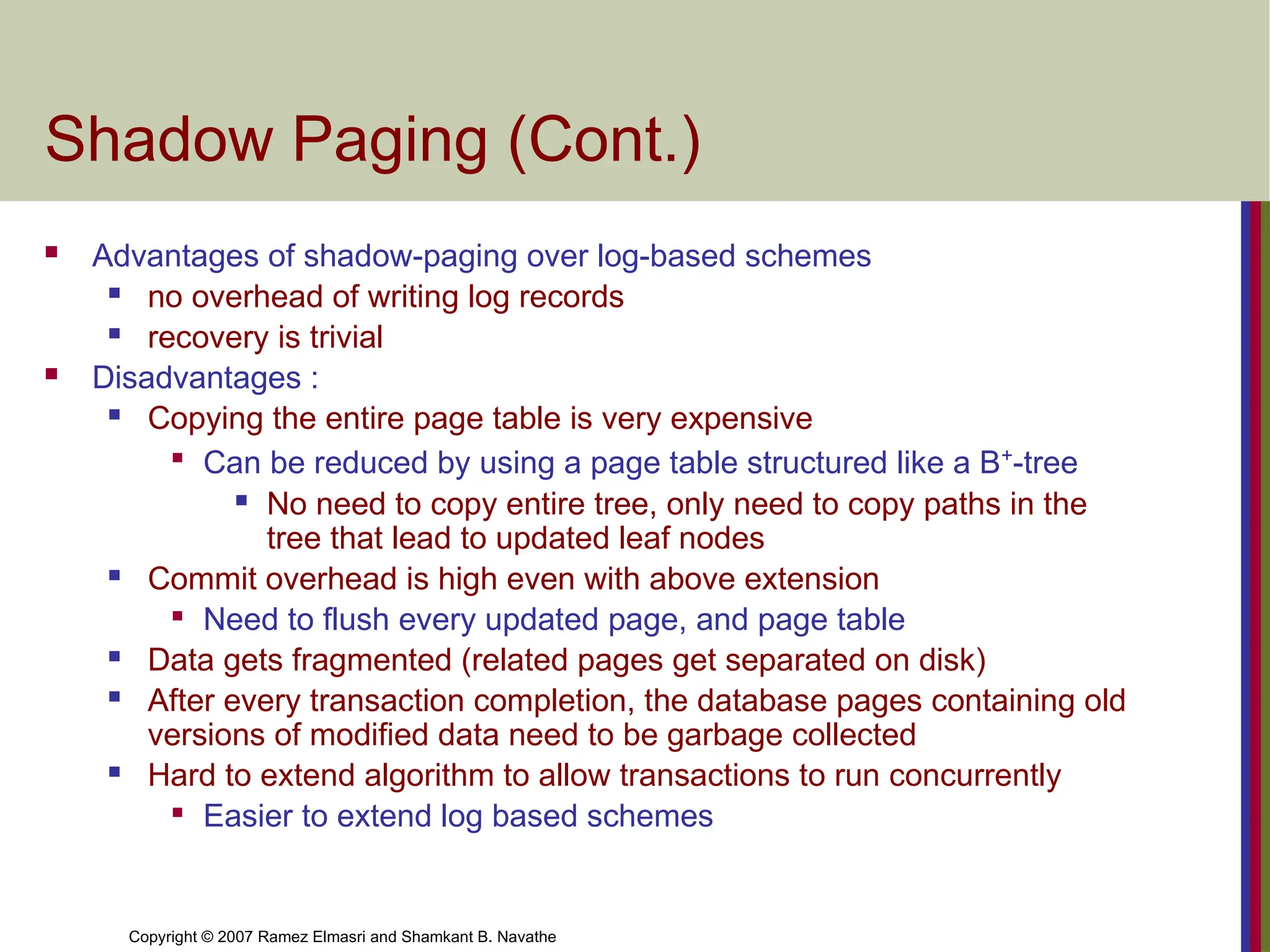
Shadow Paging (Cont.)
Advantages of shadow-paging over log-based schemes
no overhead of writing log records
recovery is trivial
Disadvantages :
Copying the entire page table is very expensive
Can be reduced by using a page table structured like a B+
-tree
No need to copy entire tree, only need to copy paths in the
tree that lead to updated leaf nodes
Commit overhead is high even with above extension
Need to flush every updated page, and page table
Data gets fragmented (related pages get separated on disk)
After every transaction completion, the database pages containing old
versions of modified data need to be garbage collected
Hard to extend algorithm to allow transactions to run concurrently
Easier to extend log based schemes
- 37.
Copyright © 2007Ramez Elmasri and Shamkant B. Navathe
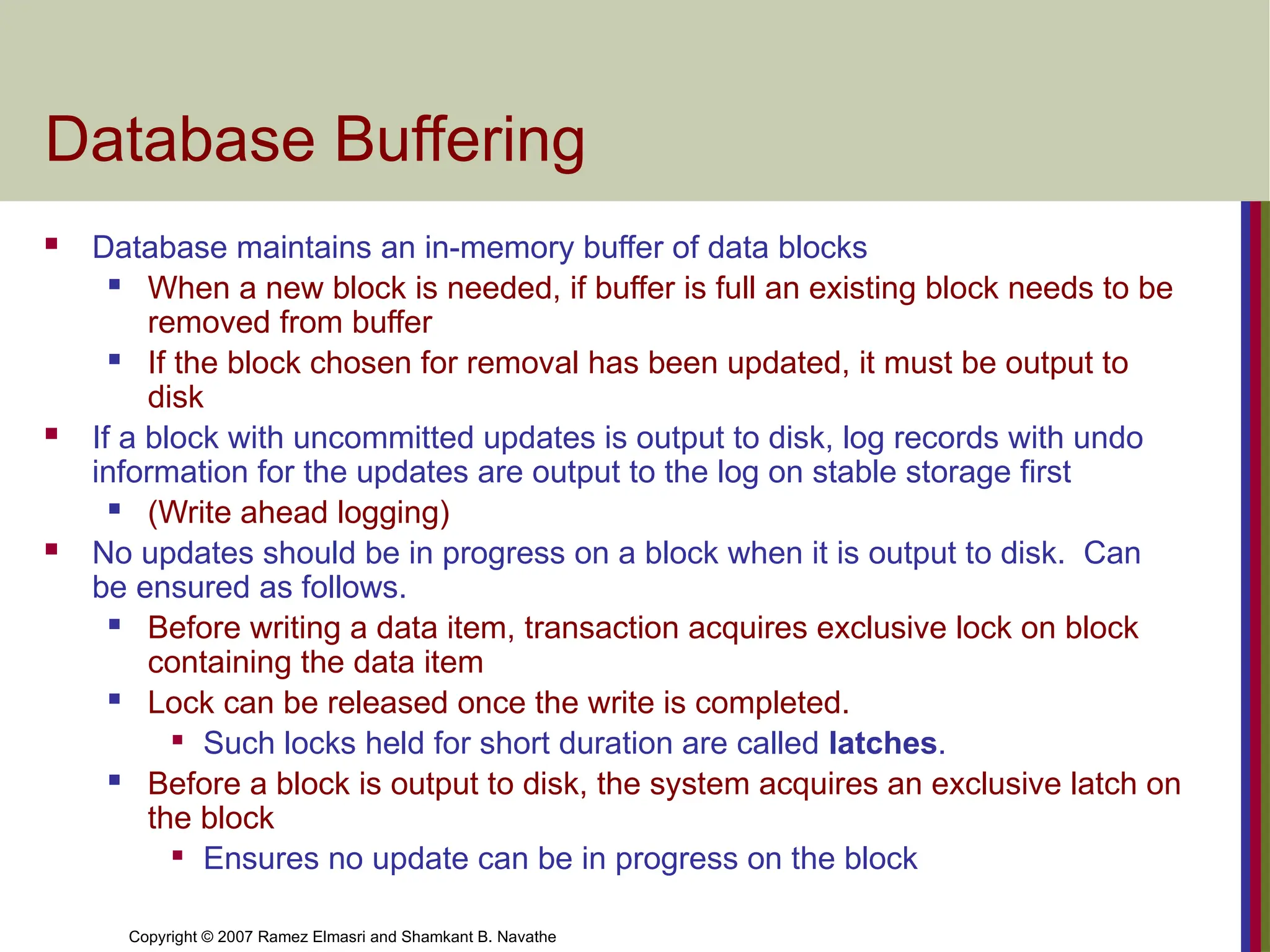
Database Buffering
Database maintains an in-memory buffer of data blocks
When a new block is needed, if buffer is full an existing block needs to be
removed from buffer
If the block chosen for removal has been updated, it must be output to
disk
If a block with uncommitted updates is output to disk, log records with undo
information for the updates are output to the log on stable storage first
(Write ahead logging)
No updates should be in progress on a block when it is output to disk. Can
be ensured as follows.
Before writing a data item, transaction acquires exclusive lock on block
containing the data item
Lock can be released once the write is completed.
Such locks held for short duration are called latches.
Before a block is output to disk, the system acquires an exclusive latch on
the block
Ensures no update can be in progress on the block
- 38.
Copyright © 2007Ramez Elmasri and Shamkant B. Navathe
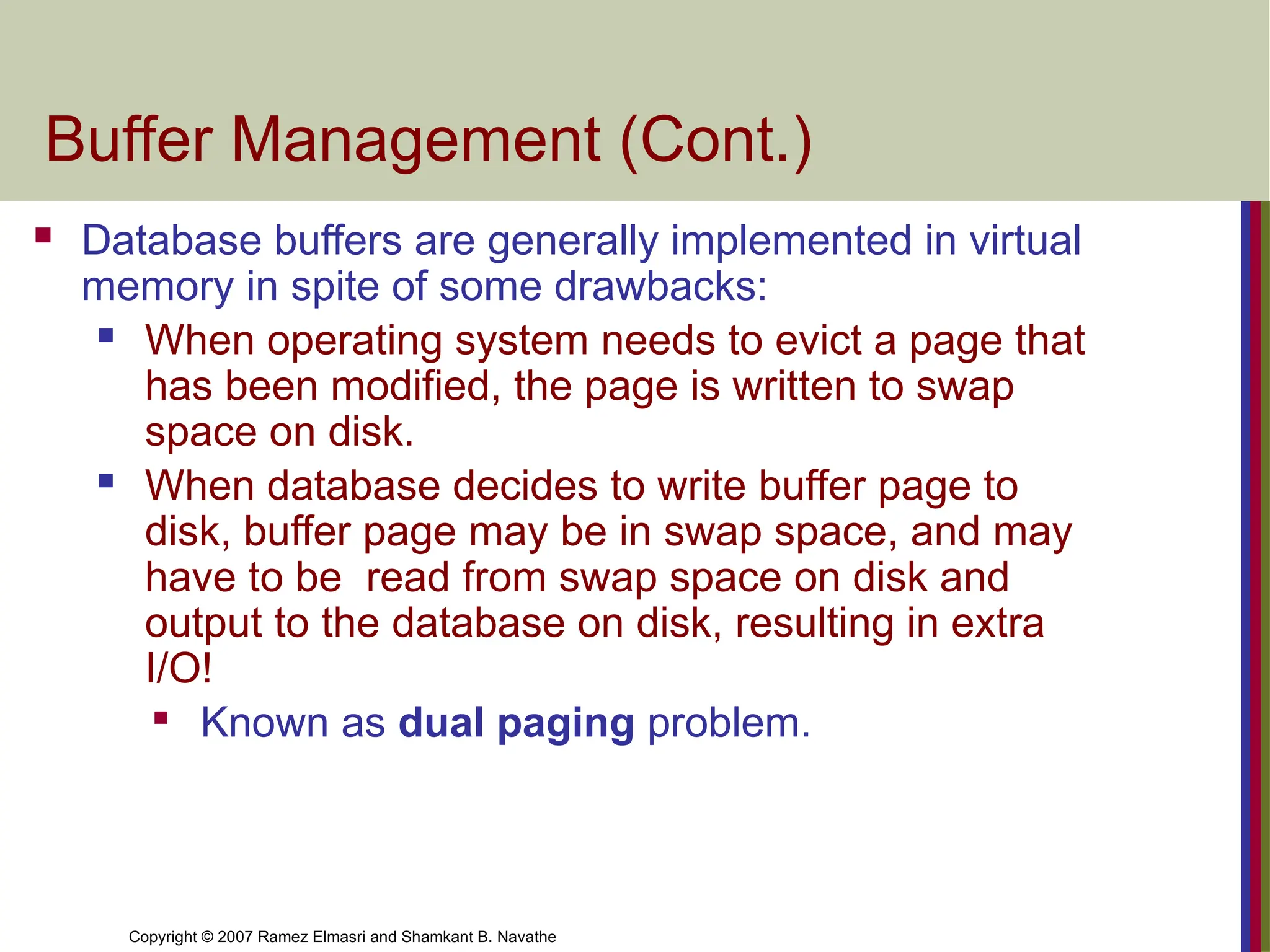
Buffer Management (Cont.)
Database buffers are generally implemented in virtual
memory in spite of some drawbacks:
When operating system needs to evict a page that
has been modified, the page is written to swap
space on disk.
When database decides to write buffer page to
disk, buffer page may be in swap space, and may
have to be read from swap space on disk and
output to the database on disk, resulting in extra
I/O!
Known as dual paging problem.
- 39.
- 40.
Copyright © 2007Ramez Elmasri and Shamkant B. Navathe
Next Slides are not in Syllabus
Slide 19- 49
- 41.
Copyright © 2007Ramez Elmasri and Shamkant B. Navathe Slide 19- 50
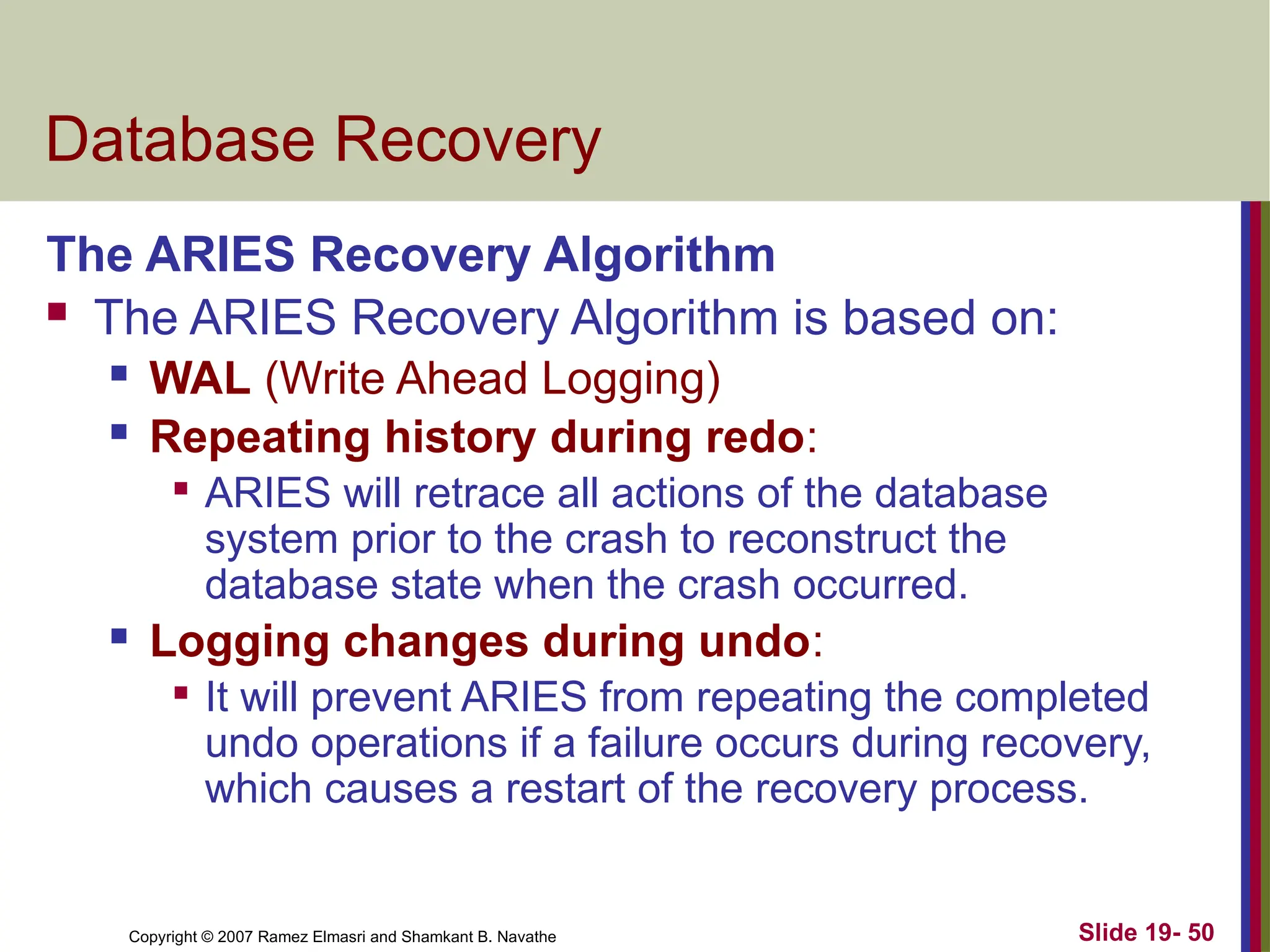
Database Recovery
The ARIES Recovery Algorithm
The ARIES Recovery Algorithm is based on:
WAL (Write Ahead Logging)
Repeating history during redo:
ARIES will retrace all actions of the database
system prior to the crash to reconstruct the
database state when the crash occurred.
Logging changes during undo:
It will prevent ARIES from repeating the completed
undo operations if a failure occurs during recovery,
which causes a restart of the recovery process.
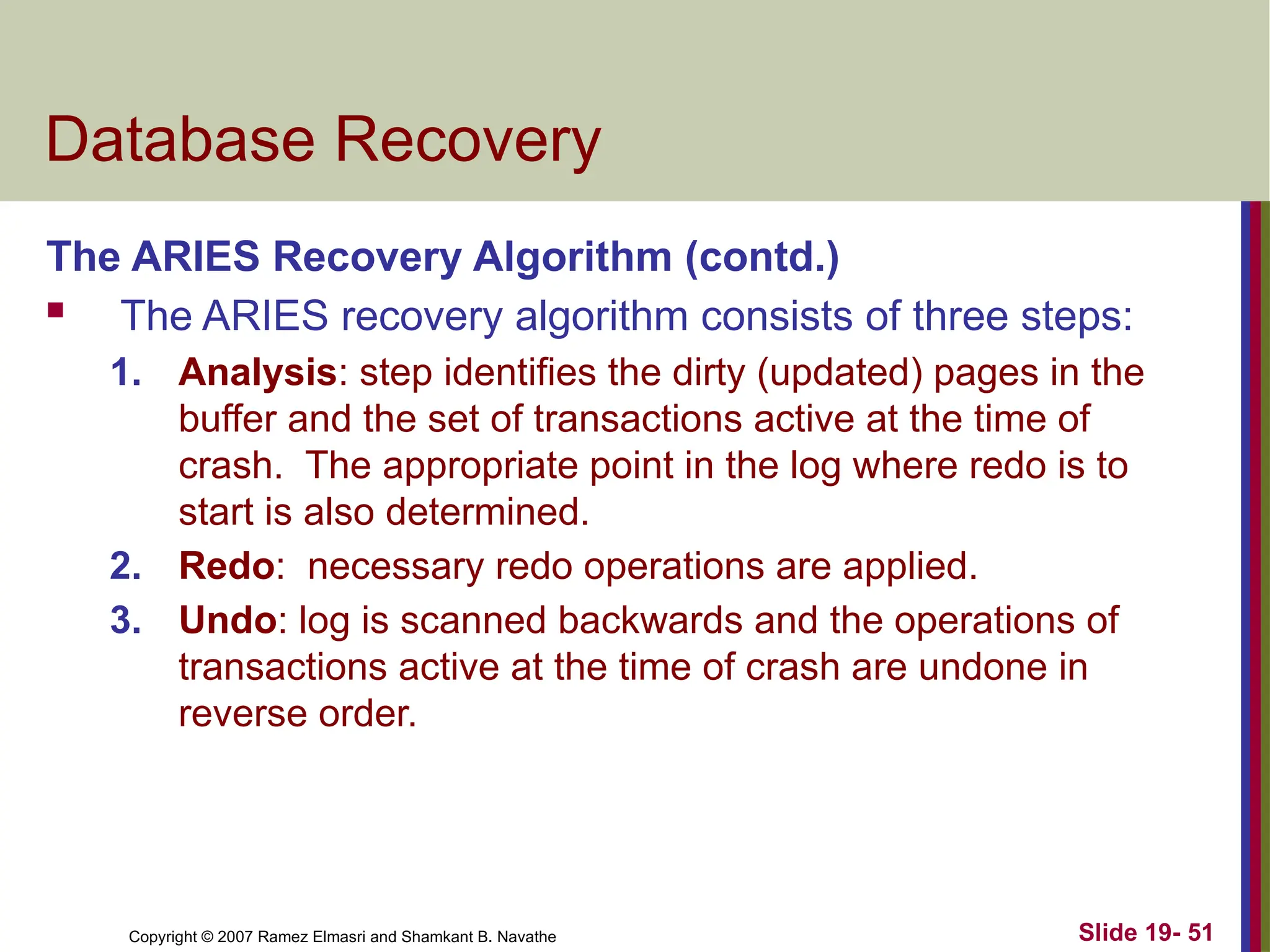
- 42.
Copyright © 2007Ramez Elmasri and Shamkant B. Navathe Slide 19- 51
Database Recovery
The ARIES Recovery Algorithm (contd.)
The ARIES recovery algorithm consists of three steps:
1. Analysis: step identifies the dirty (updated) pages in the
buffer and the set of transactions active at the time of
crash. The appropriate point in the log where redo is to
start is also determined.
2. Redo: necessary redo operations are applied.
3. Undo: log is scanned backwards and the operations of
transactions active at the time of crash are undone in
reverse order.
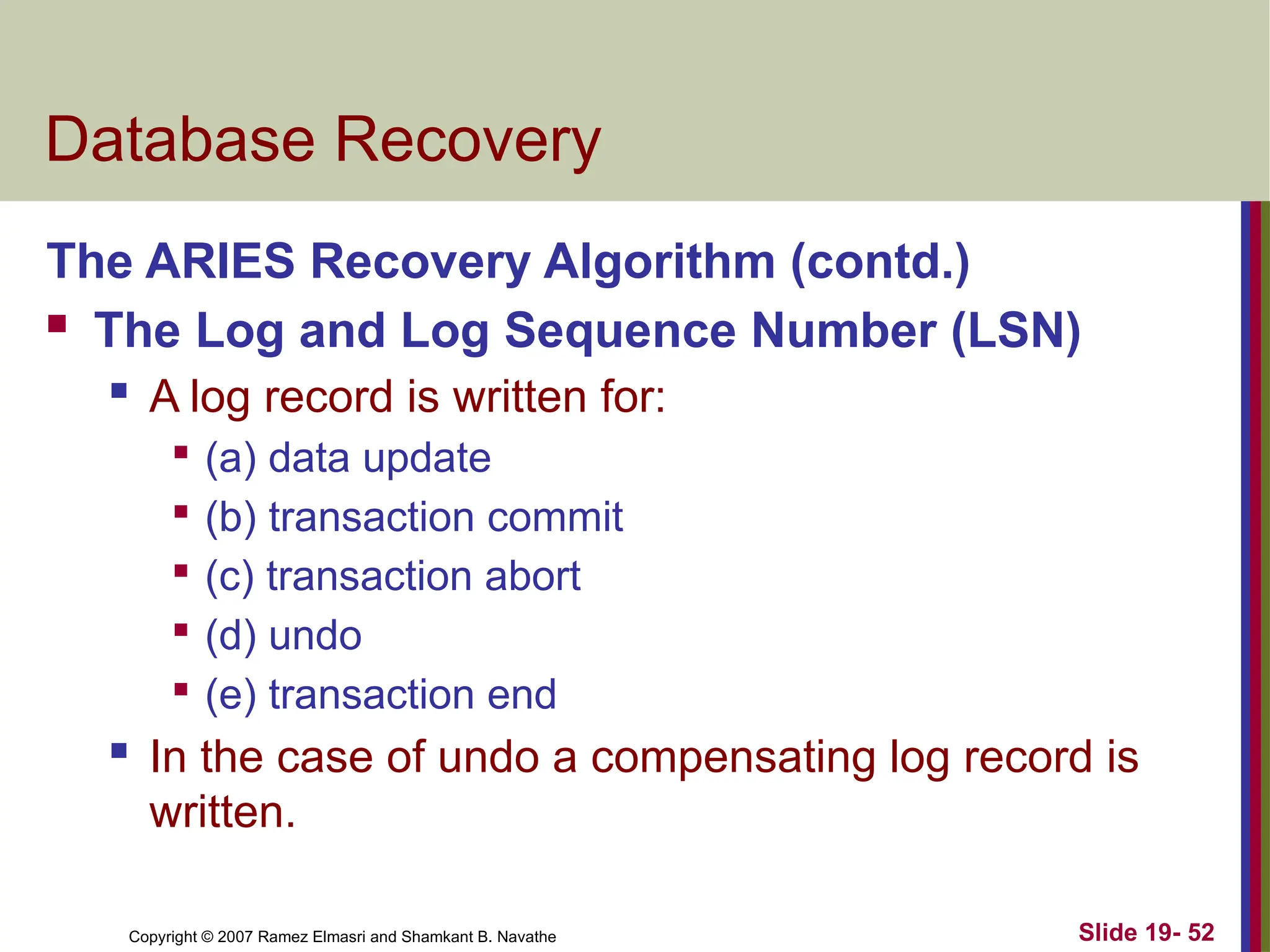
- 43.
Copyright © 2007Ramez Elmasri and Shamkant B. Navathe Slide 19- 52
Database Recovery
The ARIES Recovery Algorithm (contd.)
The Log and Log Sequence Number (LSN)
A log record is written for:
(a) data update
(b) transaction commit
(c) transaction abort
(d) undo
(e) transaction end
In the case of undo a compensating log record is
written.
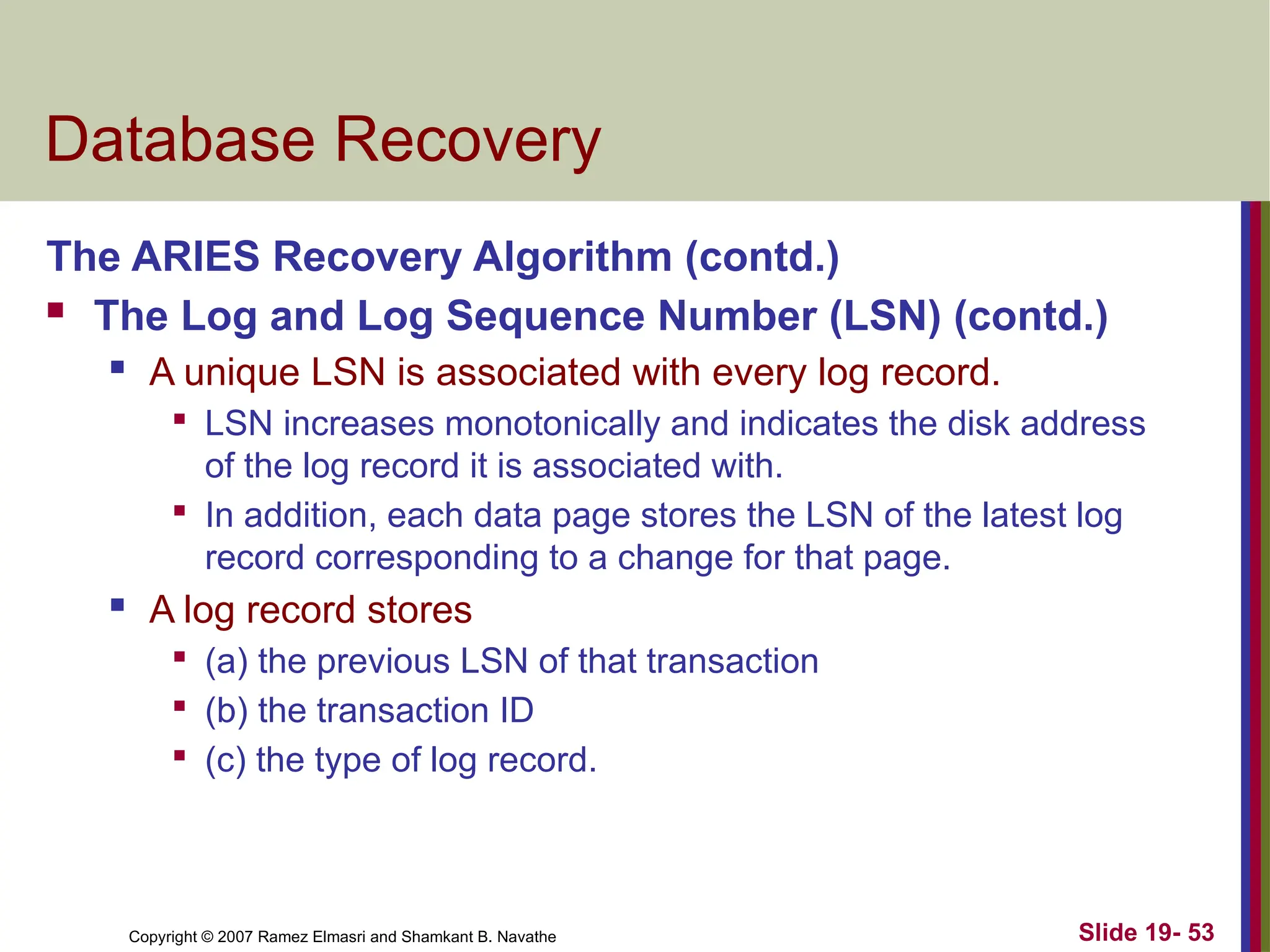
- 44.
Copyright © 2007Ramez Elmasri and Shamkant B. Navathe Slide 19- 53
Database Recovery
The ARIES Recovery Algorithm (contd.)
The Log and Log Sequence Number (LSN) (contd.)
A unique LSN is associated with every log record.
LSN increases monotonically and indicates the disk address
of the log record it is associated with.
In addition, each data page stores the LSN of the latest log
record corresponding to a change for that page.
A log record stores
(a) the previous LSN of that transaction
(b) the transaction ID
(c) the type of log record.
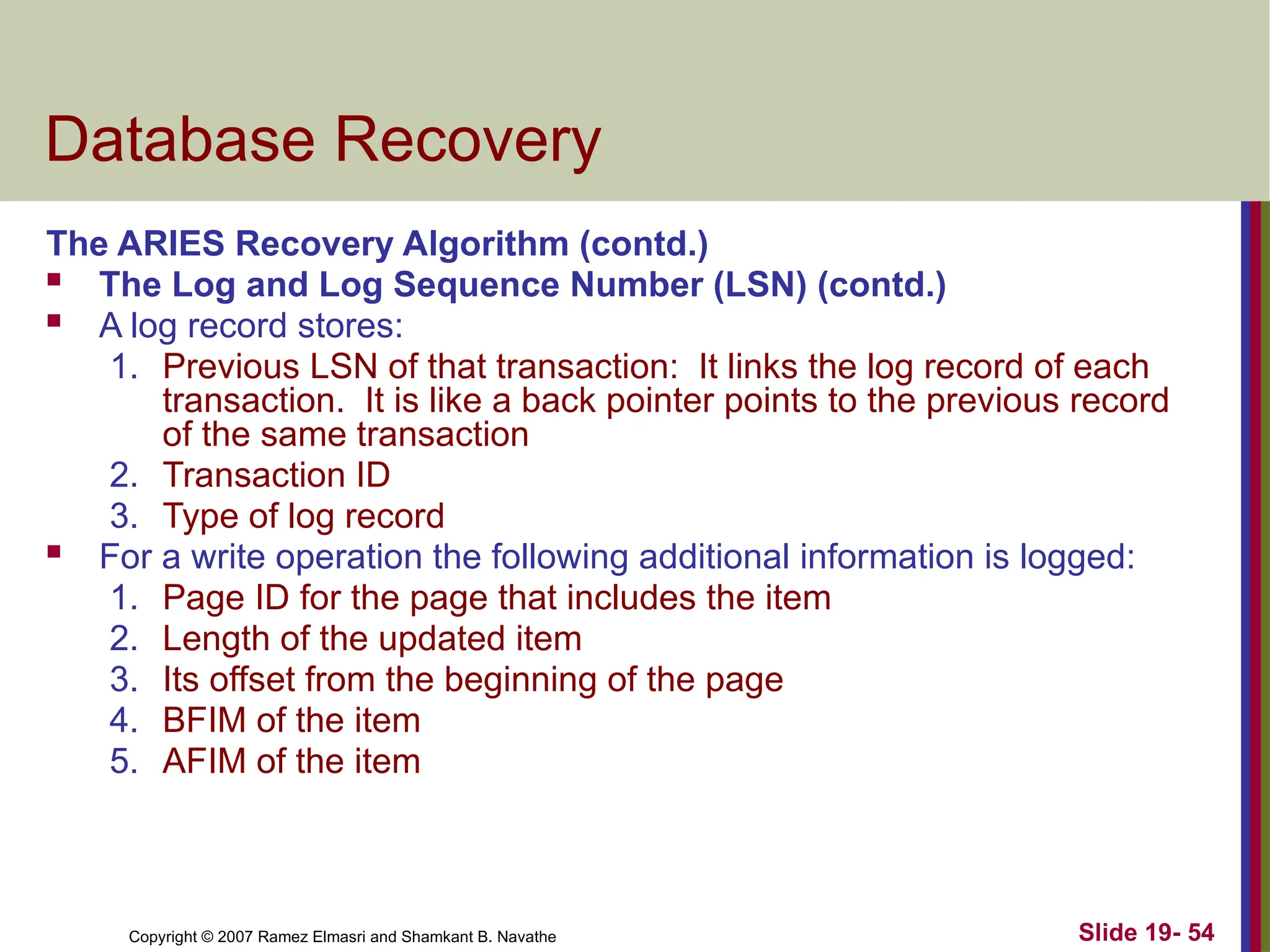
- 45.
Copyright © 2007Ramez Elmasri and Shamkant B. Navathe Slide 19- 54
Database Recovery
The ARIES Recovery Algorithm (contd.)
The Log and Log Sequence Number (LSN) (contd.)
A log record stores:
1. Previous LSN of that transaction: It links the log record of each
transaction. It is like a back pointer points to the previous record
of the same transaction
2. Transaction ID
3. Type of log record
For a write operation the following additional information is logged:
1. Page ID for the page that includes the item
2. Length of the updated item
3. Its offset from the beginning of the page
4. BFIM of the item
5. AFIM of the item
- 46.
Copyright © 2007Ramez Elmasri and Shamkant B. Navathe Slide 19- 55
Database Recovery
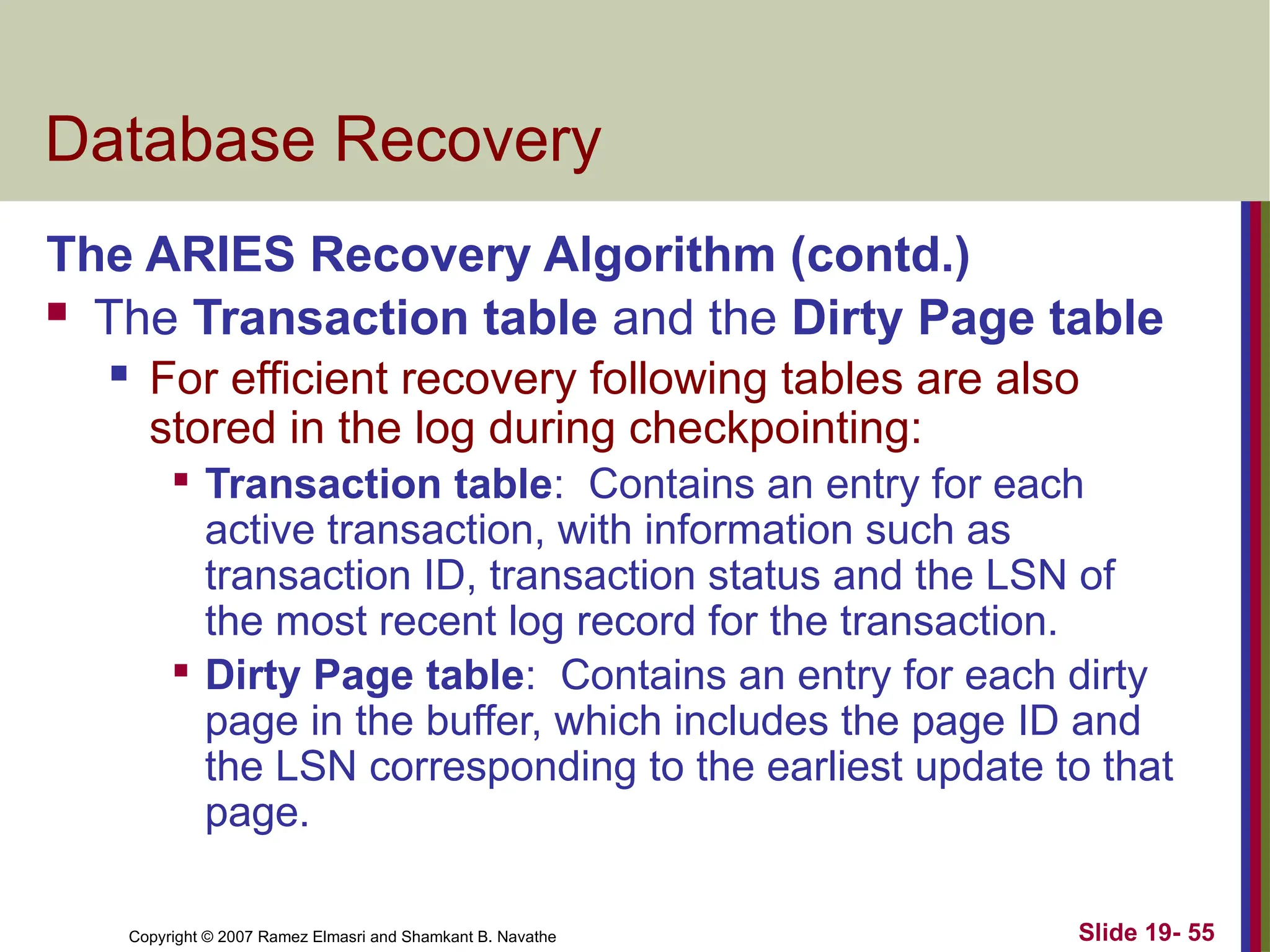
The ARIES Recovery Algorithm (contd.)
The Transaction table and the Dirty Page table
For efficient recovery following tables are also
stored in the log during checkpointing:
Transaction table: Contains an entry for each
active transaction, with information such as
transaction ID, transaction status and the LSN of
the most recent log record for the transaction.
Dirty Page table: Contains an entry for each dirty
page in the buffer, which includes the page ID and
the LSN corresponding to the earliest update to that
page.
- 47.
Copyright © 2007Ramez Elmasri and Shamkant B. Navathe Slide 19- 56
Database Recovery
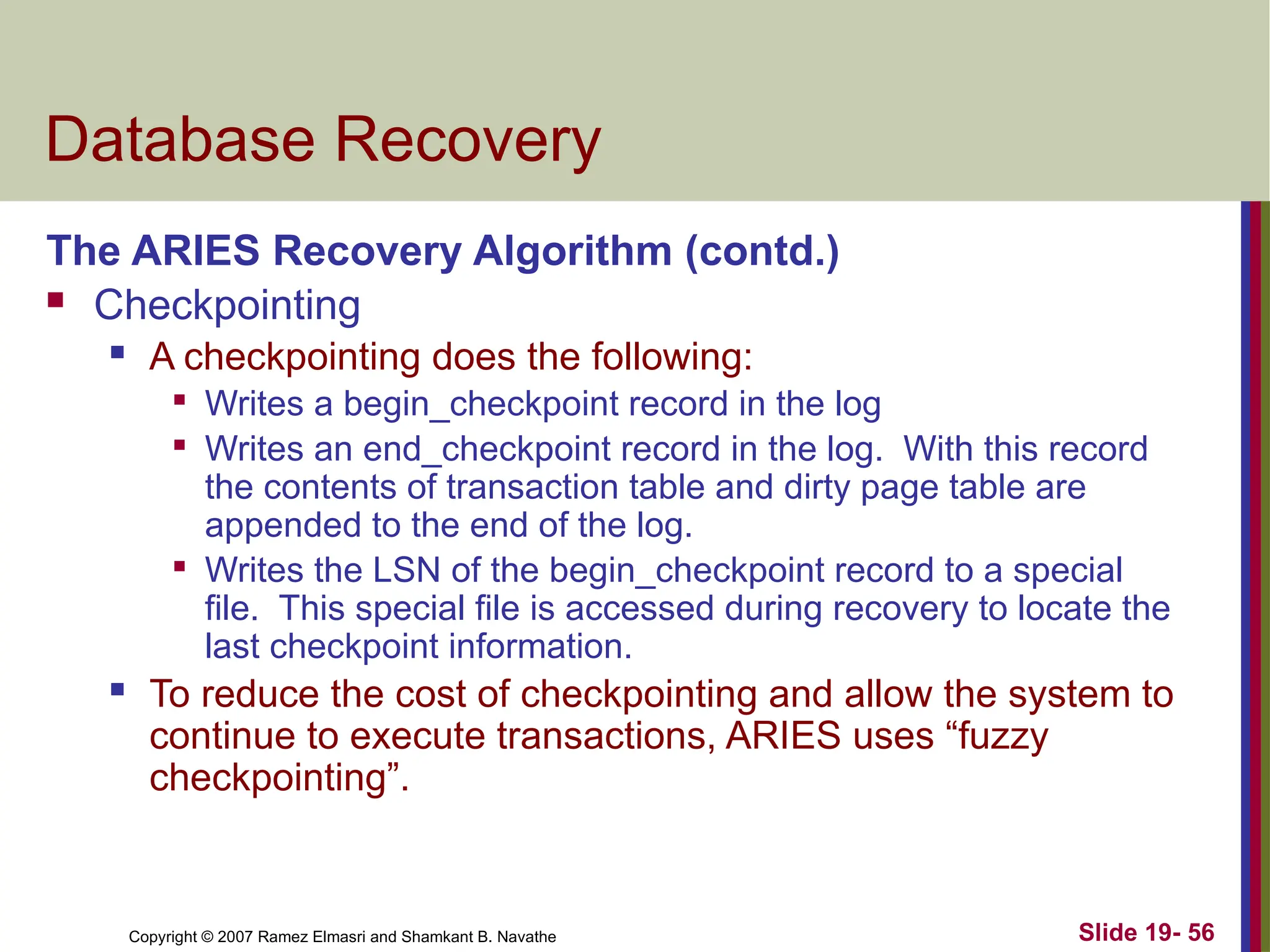
The ARIES Recovery Algorithm (contd.)
Checkpointing
A checkpointing does the following:
Writes a begin_checkpoint record in the log
Writes an end_checkpoint record in the log. With this record
the contents of transaction table and dirty page table are
appended to the end of the log.
Writes the LSN of the begin_checkpoint record to a special
file. This special file is accessed during recovery to locate the
last checkpoint information.
To reduce the cost of checkpointing and allow the system to
continue to execute transactions, ARIES uses “fuzzy
checkpointing”.
- 48.
Copyright © 2007Ramez Elmasri and Shamkant B. Navathe Slide 19- 57
Database Recovery
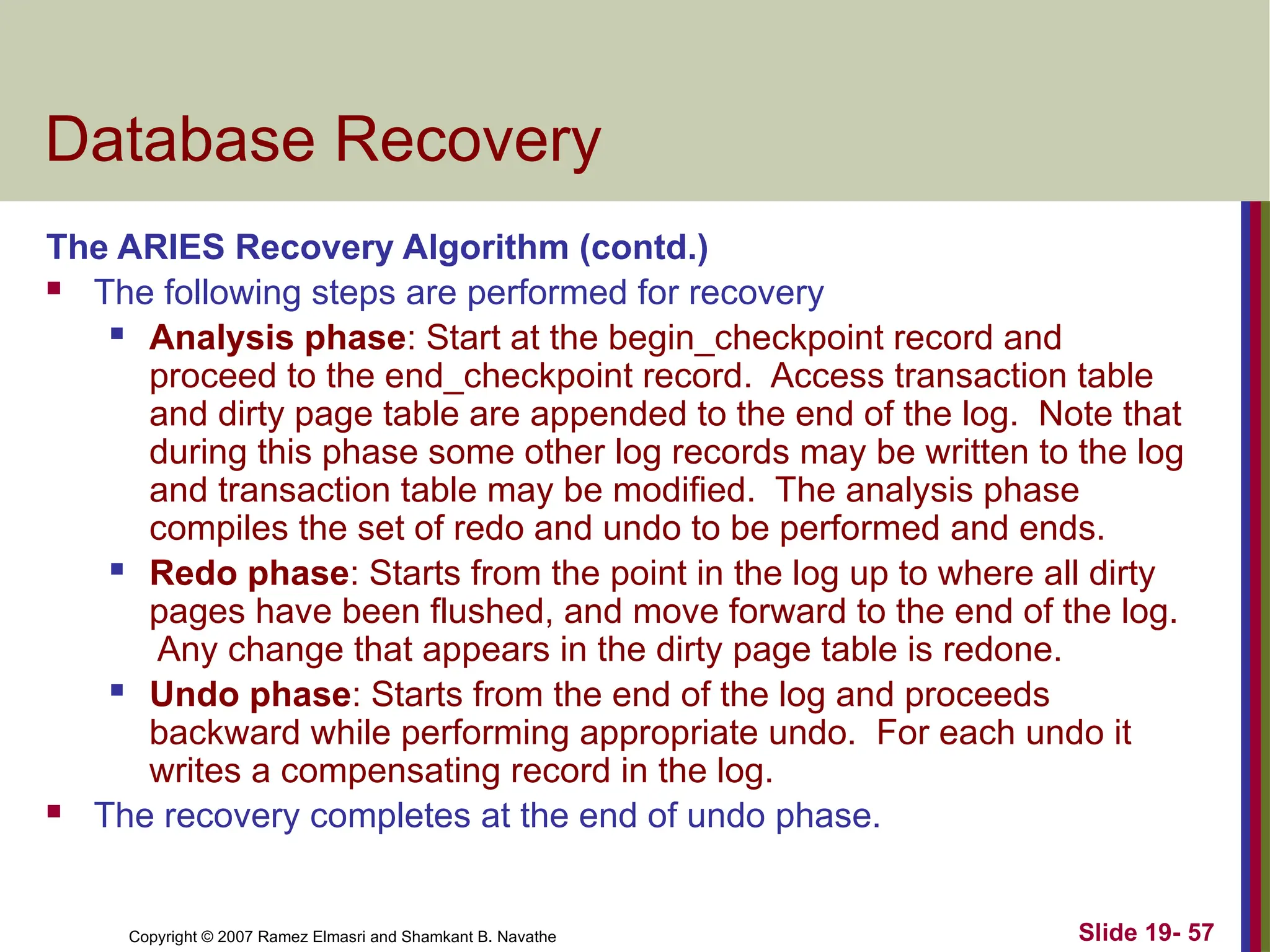
The ARIES Recovery Algorithm (contd.)
The following steps are performed for recovery
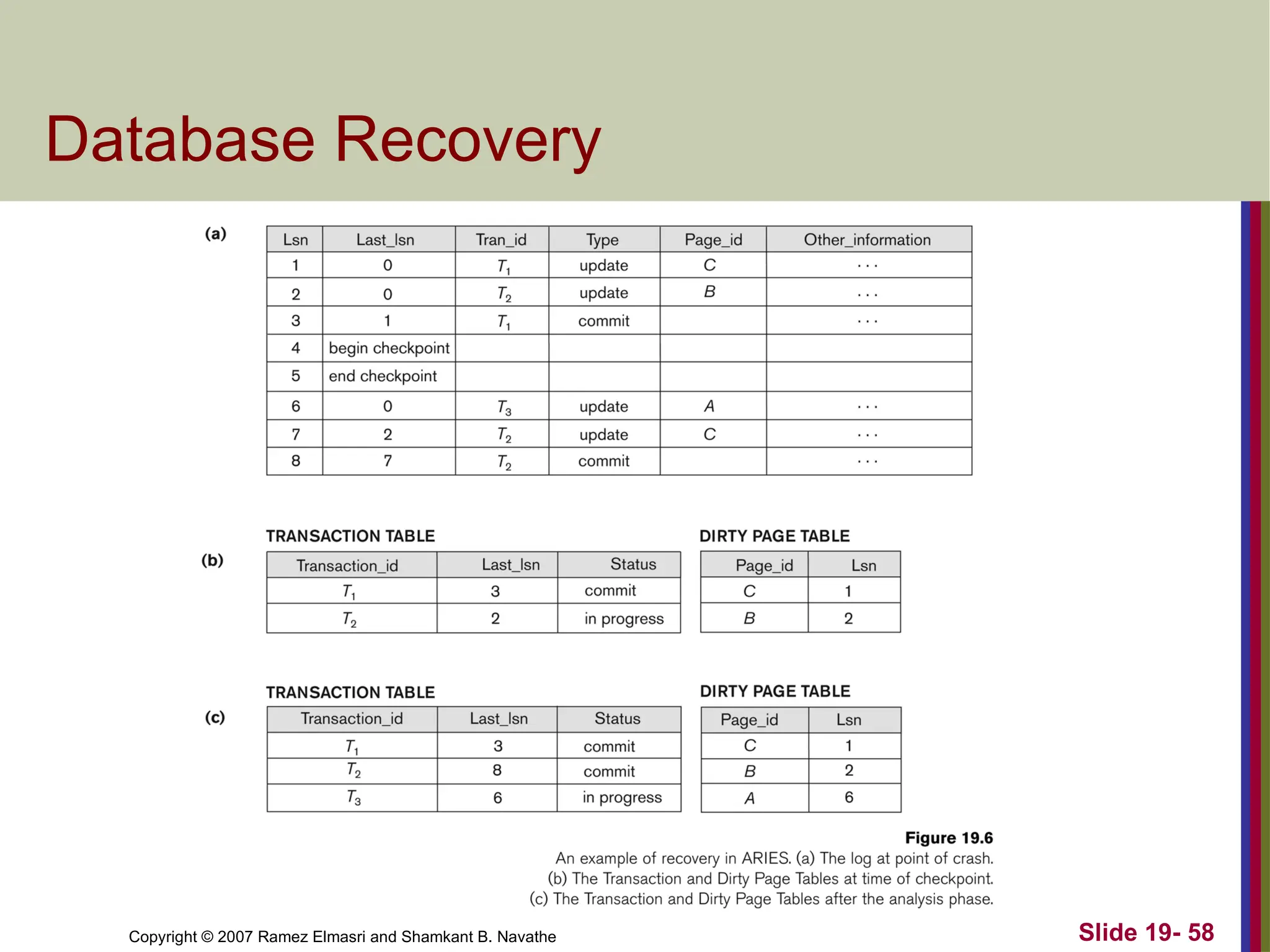
Analysis phase: Start at the begin_checkpoint record and
proceed to the end_checkpoint record. Access transaction table
and dirty page table are appended to the end of the log. Note that
during this phase some other log records may be written to the log
and transaction table may be modified. The analysis phase
compiles the set of redo and undo to be performed and ends.
Redo phase: Starts from the point in the log up to where all dirty
pages have been flushed, and move forward to the end of the log.
Any change that appears in the dirty page table is redone.
Undo phase: Starts from the end of the log and proceeds
backward while performing appropriate undo. For each undo it
writes a compensating record in the log.
The recovery completes at the end of undo phase.
- 49.
Copyright © 2007Ramez Elmasri and Shamkant B. Navathe Slide 19- 58
Database Recovery
- 50.
Copyright © 2007Ramez Elmasri and Shamkant B. Navathe Slide 19- 60
Summary
Databases Recovery
Types of Failure
Transaction Log
Data Updates
Data Caching
Transaction Roll-back (Undo) and Roll-Forward
Checkpointing
Recovery schemes
ARIES Recovery Scheme
Recovery in Multidatabase System
![Copyright © 2007 Ramez Elmasri and Shamkant B. Navathe Slide 19- 23
Database Recovery
7 Checkpointing
Time to time (randomly or under some criteria) the
database flushes its buffer to database disk to minimize
the task of recovery. The following steps defines a
checkpoint operation:
1. Suspend execution of transactions temporarily.
2. Force write modified buffer data to disk.
3. Write a [checkpoint] record to the log, save the log to disk.
4. Resume normal transaction execution.
During recovery redo or undo is required to transactions
appearing after [checkpoint] record.](https://image.slidesharecdn.com/lecture11-backupandrecovery-drpreetiaggarwal-250316162900-77552f48/75/LECTURE-11-Backup-and-Recovery-Dr-Preeti-Aggarwal-pptx-23-2048.jpg)