Context-Free Grammar (CFG)
●
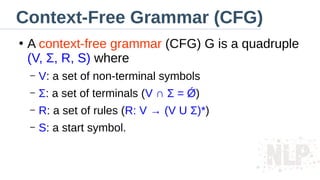
Acontext-free grammar (CFG) G is a quadruple
(V, Σ, R, S) where
– V: a set of non-terminal symbols
– Σ: a set of terminals (V ∩ Σ = Ǿ)
– R: a set of rules (R: V → (V U Σ)*)
– S: a start symbol.
6.
CFG - Example
●
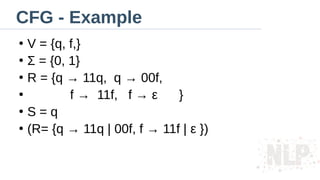
V= {q, f,}
●
Σ = {0, 1}
●
R = {q → 11q, q → 00f,
●
f → 11f, f → ε }
●
S = q
●
(R= {q → 11q | 00f, f → 11f | ε })
7.
CFG - Rules
●
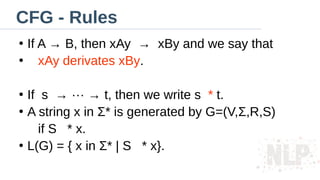
IfA → B, then xAy → xBy and we say that
●
xAy derivates xBy.
●
If s → ··· → t, then we write s * t.
●
A string x in Σ* is generated by G=(V,Σ,R,S)
if S * x.
●
L(G) = { x in Σ* | S * x}.
8.
CFG - Example
●
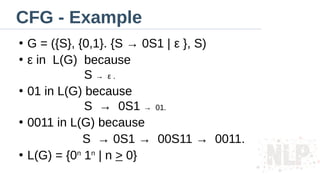
G= ({S}, {0,1}. {S → 0S1 | ε }, S)
●
ε in L(G) because
S → ε .
●
01 in L(G) because
S → 0S1 → 01.
●
0011 in L(G) because
S → 0S1 → 00S11 → 0011.
●
L(G) = {0n
1n
| n > 0}
9.
Context-free Language (CFL)
●
Alanguage L is context-free if there exists a
CFG G such that L = L(G).
●
A grammar G generates a language L
10.
Example
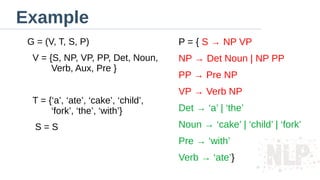
G = (V,T, S, P)
V = {S, NP, VP, PP, Det, Noun,
Verb, Aux, Pre }
T = {‘a’, ‘ate’, ‘cake’, ‘child’,
‘fork’, ‘the’, ‘with’}
S = S
P = { S → NP VP
NP → Det Noun | NP PP
PP → Pre NP
VP → Verb NP
Det → ‘a’ | ‘the’
Noun → ‘cake’ | ‘child’ | ‘fork’
Pre → ‘with’
Verb → ‘ate’}
11.
Example
●
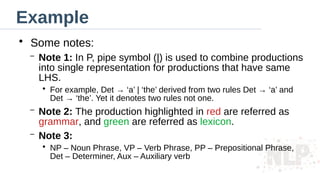
Some notes:
– Note1: In P, pipe symbol (|) is used to combine productions
into single representation for productions that have same
LHS.
●
For example, Det → ‘a’ | ‘the’ derived from two rules Det → ‘a’ and
Det → ‘the’. Yet it denotes two rules not one.
– Note 2: The production highlighted in red are referred as
grammar, and green are referred as lexicon.
– Note 3:
●
NP – Noun Phrase, VP – Verb Phrase, PP – Prepositional Phrase,
Det – Determiner, Aux – Auxiliary verb
12.
Sample derivation
●
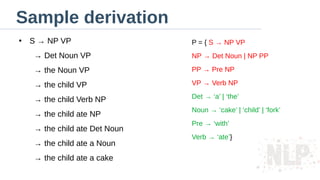
S →NP VP
→ Det Noun VP
→ the Noun VP
→ the child VP
→ the child Verb NP
→ the child ate NP
→ the child ate Det Noun
→ the child ate a Noun
→ the child ate a cake
P = { S → NP VP
NP → Det Noun | NP PP
PP → Pre NP
VP → Verb NP
Det → ‘a’ | ‘the’
Noun → ‘cake’ | ‘child’ | ‘fork’
Pre → ‘with’
Verb → ‘ate’}
13.
Probabilistic Context FreeGrammar (PCFG)
●
PCFG is an extension of CFG with a probability for
each production rule
●
Ambiguity is the reason why we are using probabilistic
version of CFG
– For instance, some sentences may have more than one underlying derivation.
– The sentence can be parsed in more than one ways.
– In this case, the parse of the sentence become ambiguous.
●
To eliminate this ambiguity, we can use PCFG to find
the probability of each parse of the given sentence
14.
PCFG - Definition
●
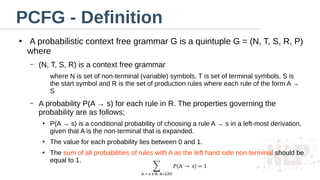
Aprobabilistic context free grammar G is a quintuple G = (N, T, S, R, P)
where
– (N, T, S, R) is a context free grammar
where N is set of non-terminal (variable) symbols, T is set of terminal symbols, S is
the start symbol and R is the set of production rules where each rule of the form A →
S
– A probability P(A → s) for each rule in R. The properties governing the
probability are as follows;
●
P(A → s) is a conditional probability of choosing a rule A → s in a left-most derivation,
given that A is the non-terminal that is expanded.
●
The value for each probability lies between 0 and 1.
●
The sum of all probabilities of rules with A as the left hand side non-terminal should be
equal to 1.
15.
PCFG - Example
●
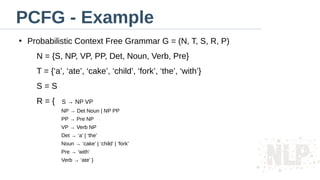
ProbabilisticContext Free Grammar G = (N, T, S, R, P)
N = {S, NP, VP, PP, Det, Noun, Verb, Pre}
T = {‘a’, ‘ate’, ‘cake’, ‘child’, ‘fork’, ‘the’, ‘with’}
S = S
R = { S → NP VP
NP → Det Noun | NP PP
PP → Pre NP
VP → Verb NP
Det → ‘a’ | ‘the’
Noun → ‘cake’ | ‘child’ | ‘fork’
Pre → ‘with’
Verb → ‘ate’ }
16.
PCFG - Example
●
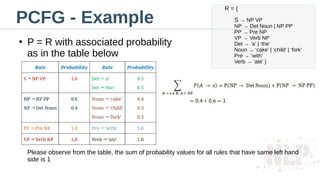
P= R with associated probability
as in the table below
Please observe from the table, the sum of probability values for all rules that have same left hand
side is 1
R = {
S → NP VP
NP → Det Noun | NP PP
PP → Pre NP
VP → Verb NP
Det → ‘a’ | ‘the’
Noun → ‘cake’ | ‘child’ | ‘fork’
Pre → ‘with’
Verb → ‘ate’ }
17.
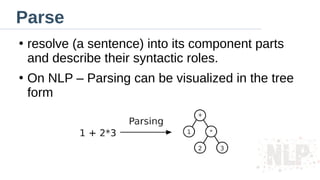
Parse
●
resolve (a sentence)into its component parts
and describe their syntactic roles.
●
On NLP – Parsing can be visualized in the tree
form
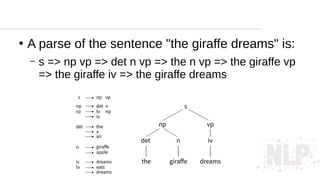
●
A parse ofthe sentence "the giraffe dreams" is:
– s => np vp => det n vp => the n vp => the giraffe vp
=> the giraffe iv => the giraffe dreams
20.
Probability of aparse tree
●
Use of PCFG
●
A sentence can be parsed into more than one
way
●
We can have more than one parse trees for the
sentence as per the CFG due to ambiguity.
21.
Probability of aparse tree
●
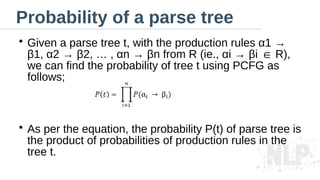
Given a parse tree t, with the production rules α1 →
β1, α2 → β2, … , αn → βn from R (ie., αi → βi R),
∈
we can find the probability of tree t using PCFG as
follows;
●
As per the equation, the probability P(t) of parse tree is
the product of probabilities of production rules in the
tree t.
22.
Probability of aparse tree
●
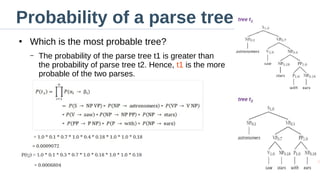
Which is the most probable tree?
– The probability of the parse tree t1 is greater than
the probability of parse tree t2. Hence, t1 is the more
probable of the two parses.
23.
Probability of asentence
●
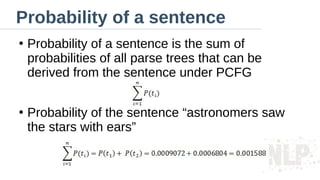
Probability of a sentence is the sum of
probabilities of all parse trees that can be
derived from the sentence under PCFG
●
Probability of the sentence “astronomers saw
the stars with ears”
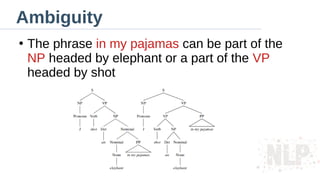
Ambiguity
●
The phrase inmy pajamas can be part of the
NP headed by elephant or a part of the VP
headed by shot
26.
Ambiguity
●
Two common kindsof ambiguity are
– attachment ambiguity and
– coordination ambiguity
●
A sentence has an attachment ambiguity if a
particular constituent can be attached to
attachment ambiguity the parse tree at more than
one place
●
In coordination ambiguity phrases can be
conjoined by a conjunction like and