Computational Syntax
Koldo Gojenola. HAP/LAP.
1 / 144
1 Context-free Grammars
Introduction
A Context-free Grammar for English (taken from Eisenstein 2019)
Context-free Grammar: exercises
2 Context-Free Parsing
Implementing Context-free Grammar Based Analyzers
Weighted Context-free Grammars (WCFG)
Probabilistic Context-free Grammars (PCFG)
Grammar Refinement
Parent Annotation
Lexicalized Context-free Grammars
3 Unification-based Grammars
4 Dependency Parsing
2 / 144
Bibliography
Computational Approaches to Morphology and Syntax (Oxford Surveys in
Syntax & Morphology), 2007 by Brian Roark, Richard Sproat
Introduction to Natural Language Processing (Adaptive Computation and
Machine Learning series, MIT Press). Jacob Eisenstein. 2019
Notes (2018 version): https://github.com/jacobeisenstein/
gt-nlp-class/blob/master/notes/eisenstein-nlp-notes.pdf
Michael Collins, slides:
Probabilistic Context-Free Grammars (PCFGs): http:
//www.cs.columbia.edu/~mcollins/courses/nlp2011/notes/pcfgs.pdf
Lexicalized Probabilistic Context-Free Grammars (PCFGs): http://www.cs.
columbia.edu/~mcollins/courses/nlp2011/notes/lexpcfgs.pdf
Natural Language Processing with Python. NLTK Book. Chapter 8.
Analyzing Sentence Structure. http://www.nltk.org/book/ch08.html
Dependency Parsing (Synthesis Lectures on Human Language
Technologies), 2009 by Sandra Kubler, Ryan McDonald, Joakim Nivre.
Morgan & Claypool Publishers
3 / 144
Index
1 Context-free Grammars
Introduction
A Context-free Grammar for English (taken from Eisenstein 2019)
Context-free Grammar: exercises
2 Context-Free Parsing
3 Unification-based Grammars
4 Dependency Parsing
4 / 144
Context-free Grammars
Introduction
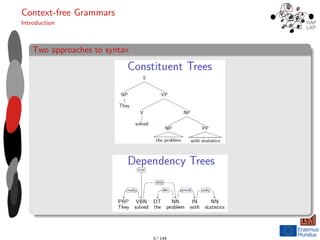
Two approaches to syntax
5 / 144
Context-free Grammars
Introduction
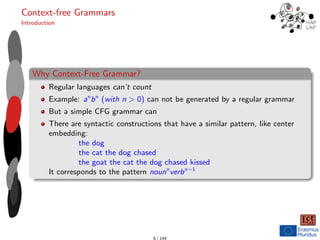
Why Context-Free Grammar?
Regular languages can’t count
Example: an
bn
(with n > 0) can not be generated by a regular grammar
But a simple CFG grammar can
There are syntactic constructions that have a similar pattern, like center
embedding:
the dog
the cat the dog chased
the goat the cat the dog chased kissed
It corresponds to the pattern nounn
verbn−1
6 / 144
Context-free Grammars
Introduction
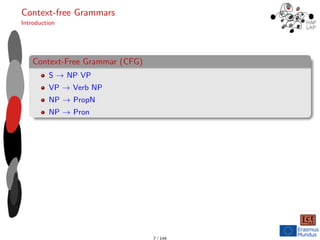
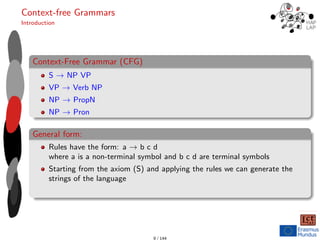
Context-Free Grammar (CFG)
S → NP VP
VP → Verb NP
NP → PropN
NP → Pron
7 / 144
Context-free Grammars
Introduction
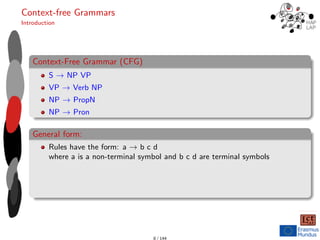
Context-Free Grammar (CFG)
S → NP VP
VP → Verb NP
NP → PropN
NP → Pron
General form:
Rules have the form: a → b c d
where a is a non-terminal symbol and b c d are terminal symbols
8 / 144
Context-free Grammars
Introduction
Context-Free Grammar (CFG)
S → NP VP
VP → Verb NP
NP → PropN
NP → Pron
General form:
Rules have the form: a → b c d
where a is a non-terminal symbol and b c d are terminal symbols
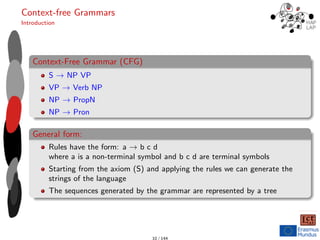
Starting from the axiom (S) and applying the rules we can generate the
strings of the language
9 / 144
Context-free Grammars
Introduction
Context-Free Grammar (CFG)
S → NP VP
VP → Verb NP
NP → PropN
NP → Pron
General form:
Rules have the form: a → b c d
where a is a non-terminal symbol and b c d are terminal symbols
Starting from the axiom (S) and applying the rules we can generate the
strings of the language
The sequences generated by the grammar are represented by a tree
10 / 144
Context-free Grammars
Introduction
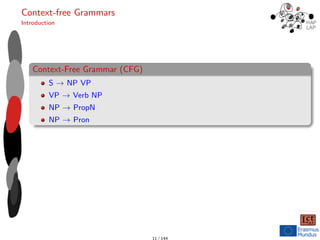
Context-Free Grammar (CFG)
S → NP VP
VP → Verb NP
NP → PropN
NP → Pron
11 / 144
Context-free Grammars
Introduction
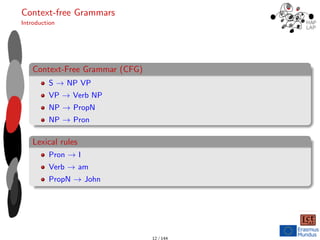
Context-Free Grammar (CFG)
S → NP VP
VP → Verb NP
NP → PropN
NP → Pron
Lexical rules
Pron → I
Verb → am
PropN → John
12 / 144
Context-free Grammars
Introduction
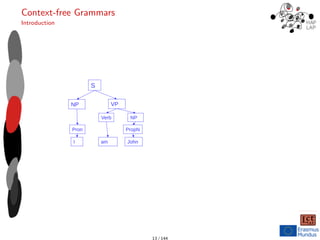
S
NP VP
NP
Verb
I
Pron PropN
John
am
13 / 144
Context-free Grammars
Introduction
General architecture
14 / 144
Context-free Grammars
Introduction
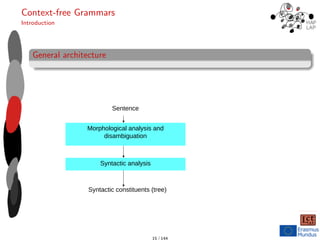
General architecture
Sentence
Morphological analysis and
disambiguation
Syntactic constituents (tree)
Syntactic analysis
15 / 144
Context-free Grammars
A Context-free Grammar for English (taken from Eisenstein 2019)
Main Syntactic Categories
Sentence
Noun Phrase
Verb Phrase
Other
Prepositional Phrases
Adverbial Phrases
Adjectival Phrases
16 / 144
Context-free Grammars
A Context-free Grammar for English (taken from Eisenstein 2019)
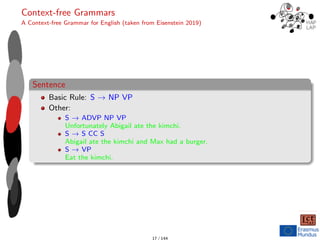
Sentence
Basic Rule: S → NP VP
Other:
S → ADVP NP VP
Unfortunately Abigail ate the kimchi.
S → S CC S
Abigail ate the kimchi and Max had a burger.
S → VP
Eat the kimchi.
17 / 144
Context-free Grammars
A Context-free Grammar for English (taken from Eisenstein 2019)
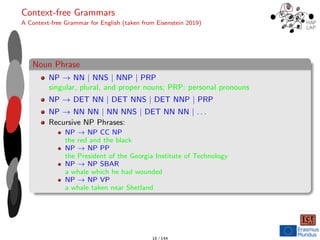
Noun Phrase
NP → NN | NNS | NNP | PRP
singular, plural, and proper nouns; PRP: personal pronouns
NP → DET NN | DET NNS | DET NNP | PRP
NP → NN NN | NN NNS | DET NN NN | . . .
Recursive NP Phrases:
NP → NP CC NP
the red and the black
NP → NP PP
the President of the Georgia Institute of Technology
NP → NP SBAR
a whale which he had wounded
NP → NP VP
a whale taken near Shetland
18 / 144
Context-free Grammars
A Context-free Grammar for English (taken from Eisenstein 2019)
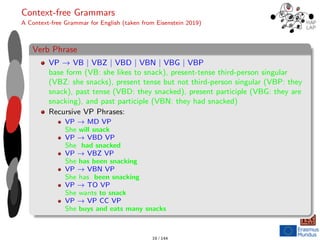
Verb Phrase
VP → VB | VBZ | VBD | VBN | VBG | VBP
base form (VB: she likes to snack), present-tense third-person singular
(VBZ: she snacks), present tense but not third-person singular (VBP: they
snack), past tense (VBD: they snacked), present participle (VBG: they are
snacking), and past participle (VBN: they had snacked)
Recursive VP Phrases:
VP → MD VP
She will snack
VP → VBD VP
She had snacked
VP → VBZ VP
She has been snacking
VP → VBN VP
She has been snacking
VP → TO VP
She wants to snack
VP → VP CC VP
She buys and eats many snacks
19 / 144
Context-free Grammars
A Context-free Grammar for English (taken from Eisenstein 2019)
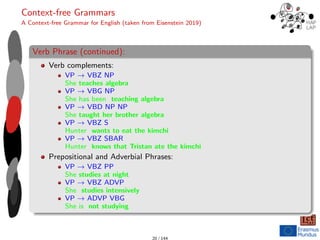
Verb Phrase (continued):
Verb complements:
VP → VBZ NP
She teaches algebra
VP → VBG NP
She has been teaching algebra
VP → VBD NP NP
She taught her brother algebra
VP → VBZ S
Hunter wants to eat the kimchi
VP → VBZ SBAR
Hunter knows that Tristan ate the kimchi
Prepositional and Adverbial Phrases:
VP → VBZ PP
She studies at night
VP → VBZ ADVP
She studies intensively
VP → ADVP VBG
She is not studying
20 / 144
Context-free Grammars
A Context-free Grammar for English (taken from Eisenstein 2019)
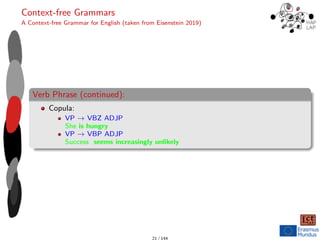
Verb Phrase (continued):
Copula:
VP → VBZ ADJP
She is hungry
VP → VBP ADJP
Success seems increasingly unlikely
21 / 144
Context-free Grammars
A Context-free Grammar for English (taken from Eisenstein 2019)
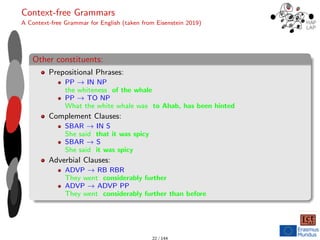
Other constituents:
Prepositional Phrases:
PP → IN NP
the whiteness of the whale
PP → TO NP
What the white whale was to Ahab, has been hinted
Complement Clauses:
SBAR → IN S
She said that it was spicy
SBAR → S
She said it was spicy
Adverbial Clauses:
ADVP → RB RBR
They went considerably further
ADVP → ADVP PP
They went considerably further than before
22 / 144
Context-free Grammars
A Context-free Grammar for English (taken from Eisenstein 2019)
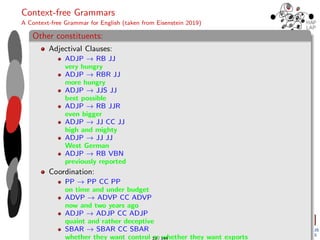
Other constituents:
Adjectival Clauses:
ADJP → RB JJ
very hungry
ADJP → RBR JJ
more hungry
ADJP → JJS JJ
best possible
ADJP → RB JJR
even bigger
ADJP → JJ CC JJ
high and mighty
ADJP → JJ JJ
West German
ADJP → RB VBN
previously reported
Coordination:
PP → PP CC PP
on time and under budget
ADVP → ADVP CC ADVP
now and two years ago
ADJP → ADJP CC ADJP
quaint and rather deceptive
SBAR → SBAR CC SBAR
whether they want control or whether they want exports
23 / 144
Context-free Grammars
A Context-free Grammar for English (taken from Eisenstein 2019)
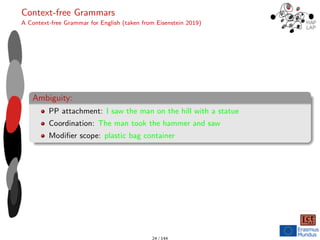
Ambiguity:
PP attachment: I saw the man on the hill with a statue
Coordination: The man took the hammer and saw
Modifier scope: plastic bag container
24 / 144
Context-free Grammars
Context-free Grammar: exercises
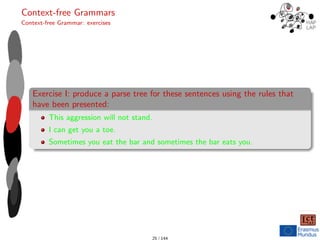
Exercise I: produce a parse tree for these sentences using the rules that
have been presented:
This aggression will not stand.
I can get you a toe.
Sometimes you eat the bar and sometimes the bar eats you.
25 / 144
Context-free Grammars
Context-free Grammar: exercises
Exercise II: write a grammar to capture the following agreement in Spanish:
La casa bonita
El perro bonito
26 / 144
Context-free Grammars
Context-free Grammar: exercises
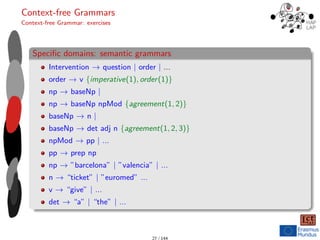
Specific domains: semantic grammars
Intervention → question | order | ...
order → v {imperative(1), order(1)}
np → baseNp |
np → baseNp npMod {agreement(1, 2)}
baseNp → n |
baseNp → det adj n {agreement(1, 2, 3)}
npMod → pp | ...
pp → prep np
np → ”barcelona” | ”valencia” | ...
n → “ticket” | ”euromed” ...
v → “give” | ...
det → “a” | “the” | ...
27 / 144
Context-free Grammars
Context-free Grammar: exercises
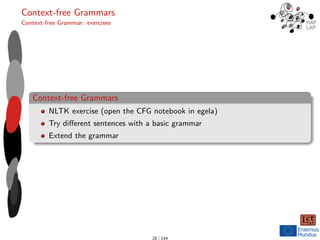
Context-free Grammars
NLTK exercise (open the CFG notebook in egela)
Try different sentences with a basic grammar
Extend the grammar
28 / 144
Index
1 Context-free Grammars
2 Context-Free Parsing
Implementing Context-free Grammar Based Analyzers
Grammar Refinement
3 Unification-based Grammars
4 Dependency Parsing
29 / 144
Context-Free Parsing
Implementing Context-free Grammar Based Analyzers
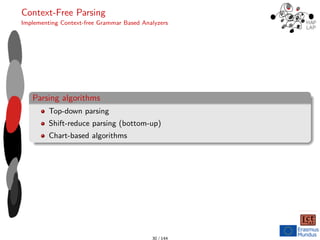
Parsing algorithms
Top-down parsing
Shift-reduce parsing (bottom-up)
Chart-based algorithms
30 / 144
Context-Free Parsing
Implementing Context-free Grammar Based Analyzers
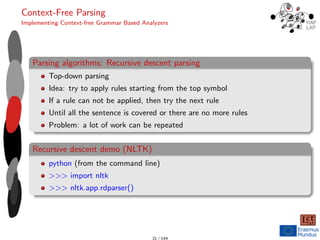
Parsing algorithms: Recursive descent parsing
Top-down parsing
Idea: try to apply rules starting from the top symbol
If a rule can not be applied, then try the next rule
Until all the sentence is covered or there are no more rules
Problem: a lot of work can be repeated
Recursive descent demo (NLTK)
python (from the command line)
>>> import nltk
>>> nltk.app.rdparser()
31 / 144
Context-Free Parsing
Implementing Context-free Grammar Based Analyzers
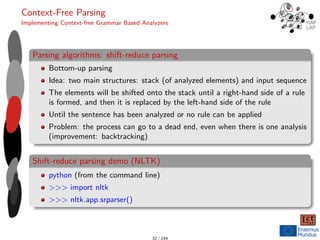
Parsing algorithms: shift-reduce parsing
Bottom-up parsing
Idea: two main structures: stack (of analyzed elements) and input sequence
The elements will be shifted onto the stack until a right-hand side of a rule
is formed, and then it is replaced by the left-hand side of the rule
Until the sentence has been analyzed or no rule can be applied
Problem: the process can go to a dead end, even when there is one analysis
(improvement: backtracking)
Shift-reduce parsing demo (NLTK)
python (from the command line)
>>> import nltk
>>> nltk.app.srparser()
32 / 144
Context-Free Parsing
Implementing Context-free Grammar Based Analyzers
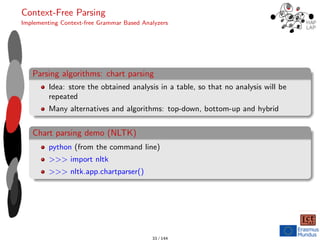
Parsing algorithms: chart parsing
Idea: store the obtained analysis in a table, so that no analysis will be
repeated
Many alternatives and algorithms: top-down, bottom-up and hybrid
Chart parsing demo (NLTK)
python (from the command line)
>>> import nltk
>>> nltk.app.chartparser()
33 / 144
Context-Free Parsing
Implementing Context-free Grammar Based Analyzers
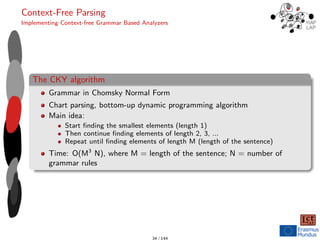
The CKY algorithm
Grammar in Chomsky Normal Form
Chart parsing, bottom-up dynamic programming algorithm
Main idea:
Start finding the smallest elements (length 1)
Then continue finding elements of length 2, 3, ...
Repeat until finding elements of length M (length of the sentence)
Time: O(M3
N), where M = length of the sentence; N = number of
grammar rules
34 / 144
Context-Free Parsing
Implementing Context-free Grammar Based Analyzers
CKY algorithm: Grammar in Chomsky Normal Form (CNF)
Grammar equivalence
A single CF Language can be expressed by more than one CF Grammar
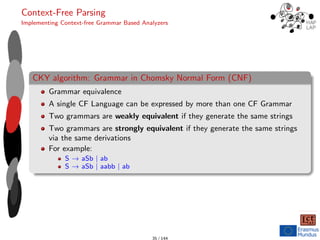
Two grammars are weakly equivalent if they generate the same strings
Two grammars are strongly equivalent if they generate the same strings
via the same derivations
For example:
S → aSb | ab
S → aSb | aabb | ab
35 / 144
Context-Free Parsing
Implementing Context-free Grammar Based Analyzers
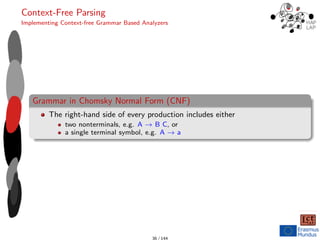
Grammar in Chomsky Normal Form (CNF)
The right-hand side of every production includes either
two nonterminals, e.g. A → B C, or
a single terminal symbol, e.g. A → a
36 / 144
Context-Free Parsing
Implementing Context-free Grammar Based Analyzers
Grammar Transformation (CNF)
Any CFG can be converted to a CNF grammar
For example: W → X Y Z
Can be replaced by two productions:
W → X WX
WX → Y Z |
37 / 144
Context-Free Parsing
Implementing Context-free Grammar Based Analyzers
Grammar Transformation (CNF)
Any CFG can be converted to a CNF grammar
For example: W → X Y Z
Can be replaced by two productions:
W → X WX
WX → Y Z |
Exercise1: convert the following grammar to CNF:
S → a S b | a b
Exercise2: convert the following grammar to CNF:
NP → Det ADJ N | NP CORD NP
Det → a | the
N → dog | cat
ADJ → big | ADJ big
CORD → and
38 / 144
Context-Free Parsing
Implementing Context-free Grammar Based Analyzers
Example. A grammar in CNF:
Sentence → NP VP
NP → A B
VP → C NP
A → det
B → n
NP → n
VP → vi
C → vt
39 / 144
Context-Free Parsing
Implementing Context-free Grammar Based Analyzers
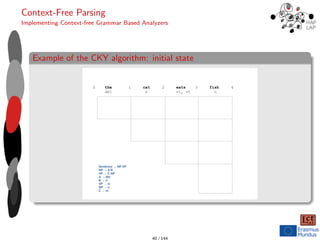
Example of the CKY algorithm: initial state
Sentence → NP VP
NP → A B
VP → C NP
A → det
B → n
VP → vi
NP → n
C → vt
0 the 1 cat 2 eats 3 fish 4
det n vi, vt n
40 / 144
Context-Free Parsing
Implementing Context-free Grammar Based Analyzers
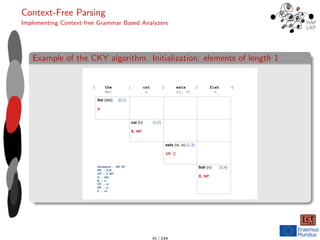
Example of the CKY algorithm. Initialization: elements of length 1
the (det) (0,1)
A
cat (n) (1,2)
B, NP
eats (vt, vi) (2,3)
VP, C
Sentence → NP VP
NP → A B
VP → C NP
A → det
B → n
VP → vi
NP → n
C → vt
fish (n) (3,4)
B, NP
0 the 1 cat 2 eats 3 fish 4
det n vi, vt n
41 / 144
Context-Free Parsing
Implementing Context-free Grammar Based Analyzers
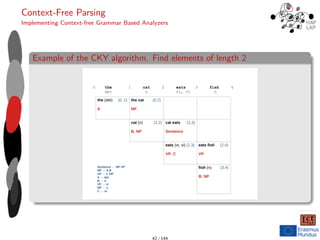
Example of the CKY algorithm. Find elements of length 2
the (det) (0, 1)
A
the cat (0,2)
NP
cat (n) (1,2)
B, NP
cat eats (1,3)
Sentence
eats (vt, vi) (2,3)
VP, C
eats fish (2,4)
VP
Sentence → NP VP
NP → A B
VP → C NP
A → det
B → n
VP → vi
NP → n
C → vt
fish (n) (3,4)
B, NP
0 the 1 cat 2 eats 3 fish 4
det n vi, vt n
42 / 144
Context-Free Parsing
Implementing Context-free Grammar Based Analyzers
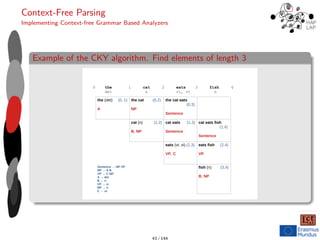
Example of the CKY algorithm. Find elements of length 3
the (det) (0, 1)
A
the cat (0,2)
NP
the cat eats
(0,3)
Sentence
cat (n) (1,2)
B, NP
cat eats (1,3)
Sentence
cat eats fish
(1,4)
Sentence
eats (vt, vi) (2,3)
VP, C
eats fish (2,4)
VP
Sentence → NP VP
NP → A B
VP → C NP
A → det
B → n
VP → vi
NP → n
C → vt
fish (n) (3,4)
B, NP
0 the 1 cat 2 eats 3 fish 4
det n vi, vt n
43 / 144
Context-Free Parsing
Implementing Context-free Grammar Based Analyzers
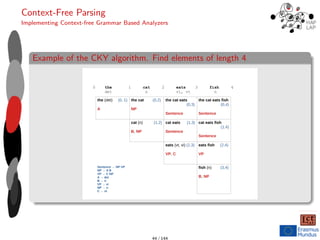
Example of the CKY algorithm. Find elements of length 4
the (det) (0, 1)
A
the cat (0,2)
NP
the cat eats
(0,3)
Sentence
the cat eats fish
(0,4)
Sentence
cat (n) (1,2)
B, NP
cat eats (1,3)
Sentence
cat eats fish
(1,4)
Sentence
eats (vt, vi) (2,3)
VP, C
eats fish (2,4)
VP
Sentence → NP VP
NP → A B
VP → C NP
A → det
B → n
VP → vi
NP → n
C → vt
fish (n) (3,4)
B, NP
0 the 1 cat 2 eats 3 fish 4
det n vi, vt n
44 / 144
Context-Free Parsing
Implementing Context-free Grammar Based Analyzers
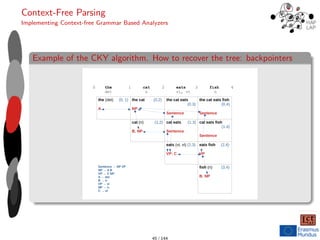
Example of the CKY algorithm. How to recover the tree: backpointers
the (det) (0, 1)
A
the cat (0,2)
NP
the cat eats
(0,3)
Sentence
the cat eats fish
(0,4)
Sentence
cat (n) (1,2)
B, NP
cat eats (1,3)
Sentence
cat eats fish
(1,4)
Sentence
eats (vt, vi) (2,3)
VP, C
eats fish (2,4)
VP
Sentence → NP VP
NP → A B
VP → C NP
A → det
B → n
VP → vi
NP → n
C → vt
fish (n) (3,4)
B, NP
0 the 1 cat 2 eats 3 fish 4
det n vi, vt n
45 / 144
Context-Free Parsing
Implementing Context-free Grammar Based Analyzers
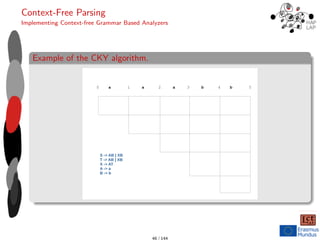
Example of the CKY algorithm.
S -> AB | XB
T -> AB | XB
X -> AT
A -> a
B -> b
0 a 1 a 2 a 3 b 4 b 5
46 / 144
Context-Free Parsing
Implementing Context-free Grammar Based Analyzers
Example of the CKY algorithm
S → N VP
N → N N
VP → V N
N → students | Jeff
| geometry | trains
| Andy’s | guitar
V → trains | play
0 Jeff 1 trains 2 geometry 3 students 4
47 / 144
Context-Free Parsing
Implementing Context-free Grammar Based Analyzers
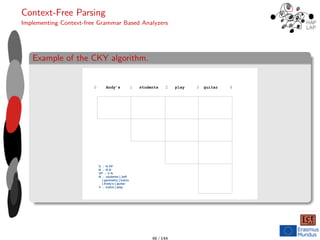
Example of the CKY algorithm.
S → N VP
N → N N
VP → V N
N → students | Jeff
| geometry | trains
| Andy’s | guitar
V → trains | play
0 Andy’s 1 students 2 play 3 guitar 4
48 / 144
Context-Free Parsing
Implementing Context-free Grammar Based Analyzers
The CKY algorithm (taken from Eisenstein 2019)
228 CHAPTER 10. CONTEXT-FREE PARSING
Algorithm 13 The CKY algorithm for parsing a sequence w ∈ Σ∗ in a context-free gram-
mar G = (N, Σ, R, S), with non-terminals N, production rules R, and start symbol S.
The grammar is assumed to be in Chomsky normal form (section 9.2.1). The function
PICKFROM(b[i, j, X]) selects an element of the set b[i, j, X] arbitrarily. All values of t and
b are initialized to ∅.
1: procedure CKY(w, G = (N, Σ, R, S))
2: for m ∈ {1 . . . M} do
3: t[m − 1, m] ← {X : (X → wm) ∈ R}
4: for � ∈ {2, 3, . . . , M} do � Iterate over constituent lengths
5: for m ∈ {0, 1, . . . M − �} do � Iterate over left endpoints
6: for k ∈ {m + 1, m + 2, . . . , m + � − 1} do � Iterate over split points
7: for (X → Y Z) ∈ R do � Iterate over rules
8: if Y ∈ t[m, k] ∧ Z ∈ t[k, m + �] then
9: t[m, m + �] ← t[m, m + �] ∪ X � Add non-terminal to table
10: b[m, m + �, X] ← b[m, m + �, X] ∪ (Y, Z, k) � Add back-pointers
11: if S ∈ t[0, M] then
12: return TRACEBACK(S, 0, M, b)
13: else
14: return ∅
15: procedure TRACEBACK(X, i, j, b)
16: if j = i + 1 then
17: return X
18: else
19: (Y, Z, k) ← PICKFROM(b[i, j, X])
20: return X → (TRACEBACK(Y, i, k, b), TRACEBACK(Z, k, j, b))
• Productions with more than two elements on the right-hand side can be binarized
by creating additional non-terminals, as described in section 9.2.1. For example,
the production VP → V NP NP (for ditransitive verbs) can be converted to VP →
VPditrans/NP NP, by adding the non-terminal VPditrans/NP and the production
VP /NP → V NP. 49 / 144
Context-Free Parsing
Implementing Context-free Grammar Based Analyzers
Implementation details for CKY. Every item in the chart must indicate:
X → α (i,j,k)
X spans wi+1,j
For binary rules, k marks the split point i < k < j
For example, if α = Y Z, then Y spans wi+1,k and Z spans wk+1,j
Another table (or the same one) can store the backpointers to Y and Z
50 / 144
Context-Free Parsing
Implementing Context-free Grammar Based Analyzers
Example: CKY demo
http://sujeet.me/CYK/parser.html
51 / 144
Context-Free Parsing
Implementing Context-free Grammar Based Analyzers
Evaluating parsers:
Precision: the fraction of constituents in the system parse that match a
constituent in the reference parse.
Recall: the fraction of constituents in the reference parse that match a
constituent in the system parse.
52 / 144
Context-Free Parsing
Implementing Context-free Grammar Based Analyzers
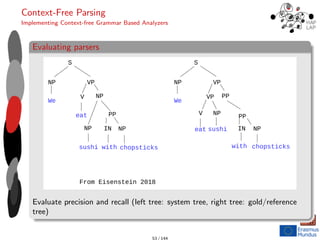
Evaluating parsers
S
NP
We
VP
V NP
eat
NP
PP
IN NP
sushi with chopsticks
S
NP
We
VP
VP PP
eat
NP PP
IN NP
sushi
with chopsticks
V
From Eisenstein 2018
Evaluate precision and recall (left tree: system tree, right tree: gold/reference
tree)
53 / 144
Context-Free Parsing
Implementing Context-free Grammar Based Analyzers
Weighted Context-free Grammars (WCFG)
With a real language grammar, typically the parser can obtain hundreds or
thousands of syntactic trees for a sentence
54 / 144
Context-Free Parsing
Implementing Context-free Grammar Based Analyzers
Weighted Context-free Grammars (WCFG)
With a real language grammar, typically the parser can obtain hundreds or
thousands of syntactic trees for a sentence
How to select the best one?
55 / 144
Context-Free Parsing
Implementing Context-free Grammar Based Analyzers
Weighted Context-free Grammars (WCFG)
With a real language grammar, typically the parser can obtain hundreds or
thousands of syntactic trees for a sentence
How to select the best one?
Use weights calculated somehow (treebank, corpora, ...)
56 / 144
Context-Free Parsing
Implementing Context-free Grammar Based Analyzers
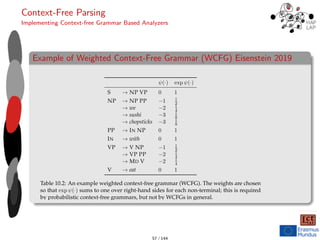
Example of Weighted Context-Free Grammar (WCFG) Eisenstein 2019
10.3. WEIGHTED CONTEXT-FREE GRAMMARS 233
ψ(·) exp ψ(·)
S → NP VP 0 1
NP → NP PP −1 1
2
→ we −2 1
4
→ sushi −3 1
8
→ chopsticks −3 1
8
PP → IN NP 0 1
IN → with 0 1
VP → V NP −1 1
2
→ VP PP −2 1
4
→ MD V −2 1
4
V → eat 0 1
Table 10.2: An example weighted context-free grammar (WCFG). The weights are chosen
so that exp ψ(·) sums to one over right-hand sides for each non-terminal; this is required
by probabilistic context-free grammars, but not by WCFGs in general.
which are computed independently. In a weighted context-free grammar (WCFG), the
score of each anchored production X → (α, (i, j, k)) is simply ψ(X → α), ignoring the
anchor (i, j, k). In other parsing models, the anchors can be used to access features of the
57 / 144
Context-Free Parsing
Implementing Context-free Grammar Based Analyzers
Weighted Context-Free Grammar (WCFG)
S
NP
We
VP
V NP
eat
NP
PP
IN NP
sushi with chopsticks
S
NP
We
VP
VP PP
eat
NP PP
IN NP
sushi
with chopsticks
V
From Eisenstein 2018
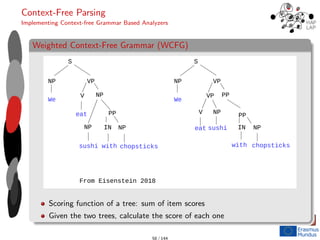
Scoring function of a tree: sum of item scores
Given the two trees, calculate the score of each one
58 / 144
Context-Free Parsing
Implementing Context-free Grammar Based Analyzers
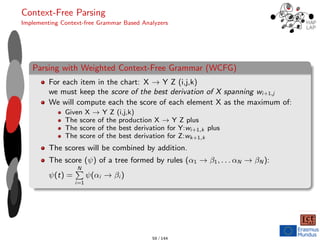
Parsing with Weighted Context-Free Grammar (WCFG)
For each item in the chart: X → Y Z (i,j,k)
we must keep the score of the best derivation of X spanning wi+1,j
We will compute each the score of each element X as the maximum of:
Given X → Y Z (i,j,k)
The score of the production X → Y Z plus
The score of the best derivation for Y:wi+1,k plus
The score of the best derivation for Z:wk+1,k
The scores will be combined by addition.
The score (ψ) of a tree formed by rules (α1 → β1, . . . αN → βN ):
ψ(t) =
N
P
i=1
ψ(αi → βi )
59 / 144
Context-Free Parsing
Implementing Context-free Grammar Based Analyzers
The CKY algorithm with a WCFG (Eisenstein 2019)
234 CHAPTER 10. CONTEXT-FREE PARSING
Algorithm 14 CKY algorithm for parsing a string w ∈ Σ∗ in a weighted context-free
grammar (N, Σ, R, S), where N is the set of non-terminals and R is the set of weighted
productions. The grammar is assumed to be in Chomsky normal form (section 9.2.1). The
function TRACEBACK is defined in Algorithm 13.
procedure WCKY(w, G = (N, Σ, R, S))
for all i, j, X do � Initialization
t[i, j, X] ← 0
b[i, j, X] ← ∅
for m ∈ {1, 2, . . . , M} do
for all X ∈ N do
t[m, m + 1, X] ← ψ(X → wm, (m, m + 1, m))
for � ∈ {2, 3, . . . M} do
for m ∈ {0, 1, . . . , M − �} do
for k ∈ {m + 1, m + 2, . . . , m + � − 1} do
t[m, m + �, X] ← max
k,Y,Z
ψ(X → Y Z, (m, m + �, k)) + t[m, k, Y ] + t[k, m + �, Z]
b[m, m + �, X] ← argmax
k,Y,Z
ψ(X → Y Z, (m + �, k)) + t[m, k, Y ] + t[k, m + �, Z]
return TRACEBACK(S, 0, M, b)
10.3.1 Parsing with weighted context-free grammars
The optimization problem in Equation 10.4 can be solved by modifying the CKY algo-
rithm. In the deterministic CKY algorithm, each cell t[i, j] stored a set of non-terminals
60 / 144
Context-Free Parsing
Implementing Context-free Grammar Based Analyzers
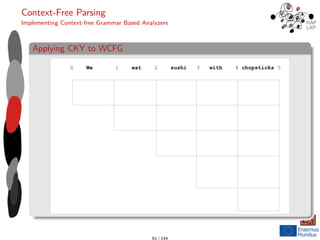
Applying CKY to WCFG
0 We 1 eat 2 sushi 3 with 4 chopsticks 5
61 / 144
Context-Free Parsing
Implementing Context-free Grammar Based Analyzers
Probabilistic Context-free Grammars (PCFG): Special case of WCFG
The weights are probabilities
62 / 144
Context-Free Parsing
Implementing Context-free Grammar Based Analyzers
Probabilistic Context-free Grammars (PCFG): Special case of WCFG
The weights are probabilities
Advantage: easier interpretation
63 / 144
Context-Free Parsing
Implementing Context-free Grammar Based Analyzers
Probabilistic Context-free Grammars (PCFG): Special case of WCFG
The weights are probabilities
Advantage: easier interpretation
They must obey the constraints on probabilities (sum to 1, ...)
64 / 144
Context-Free Parsing
Implementing Context-free Grammar Based Analyzers
Probabilistic Context-free Grammars (PCFG): Special case of WCFG
The weights are probabilities
Advantage: easier interpretation
They must obey the constraints on probabilities (sum to 1, ...)
Parsing: apply multiplication of probabilities
65 / 144
Context-Free Parsing
Implementing Context-free Grammar Based Analyzers
Probabilistic Context-free Grammars (PCFG)
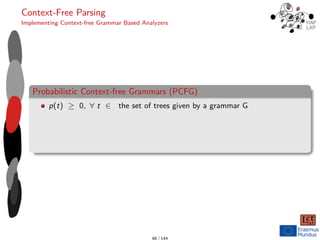
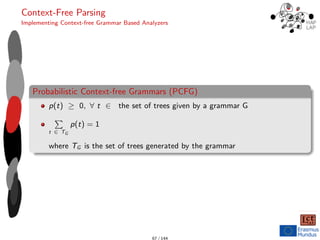
p(t) ≥ 0, ∀ t ∈ the set of trees given by a grammar G
66 / 144
Context-Free Parsing
Implementing Context-free Grammar Based Analyzers
Probabilistic Context-free Grammars (PCFG)
p(t) ≥ 0, ∀ t ∈ the set of trees given by a grammar G
P
t ∈ TG
p(t) = 1
where TG is the set of trees generated by the grammar
67 / 144
Context-Free Parsing
Implementing Context-free Grammar Based Analyzers
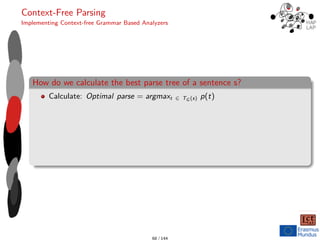
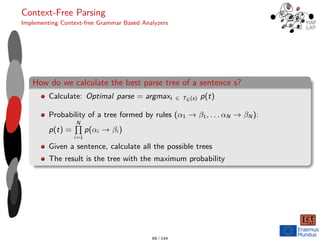
How do we calculate the best parse tree of a sentence s?
Calculate: Optimal parse = argmaxt ∈ TG (s) p(t)
68 / 144
Context-Free Parsing
Implementing Context-free Grammar Based Analyzers
How do we calculate the best parse tree of a sentence s?
Calculate: Optimal parse = argmaxt ∈ TG (s) p(t)
Probability of a tree formed by rules (α1 → β1, . . . αN → βN ):
p(t) =
N
Q
i=1
p(αi → βi )
Given a sentence, calculate all the possible trees
The result is the tree with the maximum probability
69 / 144
Context-Free Parsing
Implementing Context-free Grammar Based Analyzers
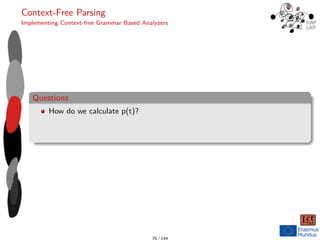
Questions
How do we calculate p(t)?
70 / 144
Context-Free Parsing
Implementing Context-free Grammar Based Analyzers
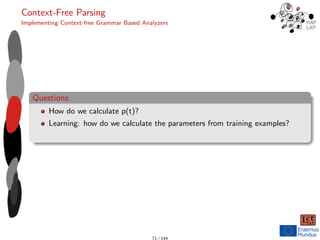
Questions
How do we calculate p(t)?
Learning: how do we calculate the parameters from training examples?
71 / 144
Context-Free Parsing
Implementing Context-free Grammar Based Analyzers
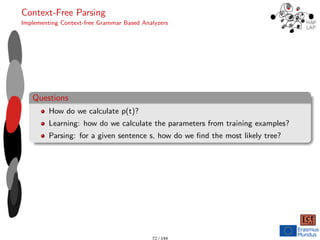
Questions
How do we calculate p(t)?
Learning: how do we calculate the parameters from training examples?
Parsing: for a given sentence s, how do we find the most likely tree?
72 / 144
Context-Free Parsing
Implementing Context-free Grammar Based Analyzers
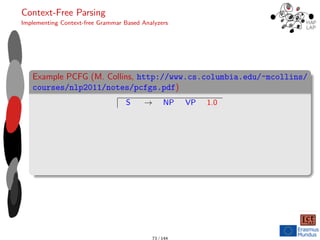
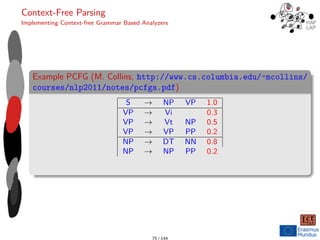
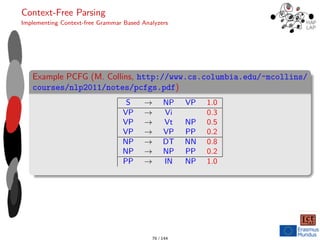
Example PCFG (M. Collins, http://www.cs.columbia.edu/~mcollins/
courses/nlp2011/notes/pcfgs.pdf)
S → NP VP 1.0
73 / 144
Context-Free Parsing
Implementing Context-free Grammar Based Analyzers
Example PCFG (M. Collins, http://www.cs.columbia.edu/~mcollins/
courses/nlp2011/notes/pcfgs.pdf)
S → NP VP 1.0
VP → Vi 0.3
VP → Vt NP 0.5
VP → VP PP 0.2
74 / 144
Context-Free Parsing
Implementing Context-free Grammar Based Analyzers
Example PCFG (M. Collins, http://www.cs.columbia.edu/~mcollins/
courses/nlp2011/notes/pcfgs.pdf)
S → NP VP 1.0
VP → Vi 0.3
VP → Vt NP 0.5
VP → VP PP 0.2
NP → DT NN 0.8
NP → NP PP 0.2
75 / 144
Context-Free Parsing
Implementing Context-free Grammar Based Analyzers
Example PCFG (M. Collins, http://www.cs.columbia.edu/~mcollins/
courses/nlp2011/notes/pcfgs.pdf)
S → NP VP 1.0
VP → Vi 0.3
VP → Vt NP 0.5
VP → VP PP 0.2
NP → DT NN 0.8
NP → NP PP 0.2
PP → IN NP 1.0
76 / 144
Context-Free Parsing
Implementing Context-free Grammar Based Analyzers
Example PCFG (M. Collins, http://www.cs.columbia.edu/~mcollins/
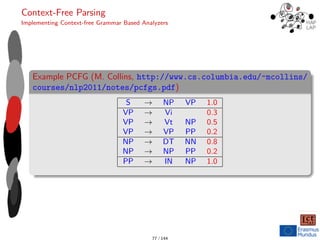
courses/nlp2011/notes/pcfgs.pdf)
S → NP VP 1.0
VP → Vi 0.3
VP → Vt NP 0.5
VP → VP PP 0.2
NP → DT NN 0.8
NP → NP PP 0.2
PP → IN NP 1.0
77 / 144
Context-Free Parsing
Implementing Context-free Grammar Based Analyzers
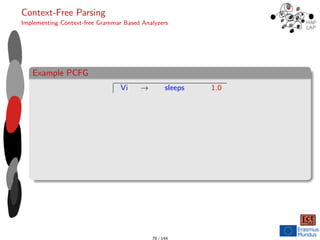
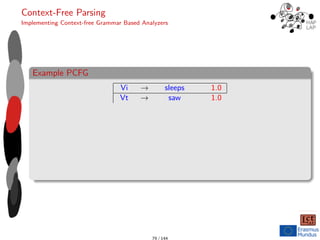
Example PCFG
Vi → sleeps 1.0
78 / 144
Context-Free Parsing
Implementing Context-free Grammar Based Analyzers
Example PCFG
Vi → sleeps 1.0
Vt → saw 1.0
79 / 144
Context-Free Parsing
Implementing Context-free Grammar Based Analyzers
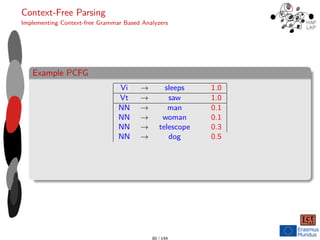
Example PCFG
Vi → sleeps 1.0
Vt → saw 1.0
NN → man 0.1
NN → woman 0.1
NN → telescope 0.3
NN → dog 0.5
80 / 144
Context-Free Parsing
Implementing Context-free Grammar Based Analyzers
Example PCFG
Vi → sleeps 1.0
Vt → saw 1.0
NN → man 0.1
NN → woman 0.1
NN → telescope 0.3
NN → dog 0.5
DT → the 1.0
81 / 144
Context-Free Parsing
Implementing Context-free Grammar Based Analyzers
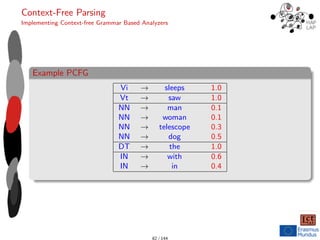
Example PCFG
Vi → sleeps 1.0
Vt → saw 1.0
NN → man 0.1
NN → woman 0.1
NN → telescope 0.3
NN → dog 0.5
DT → the 1.0
IN → with 0.6
IN → in 0.4
82 / 144
Context-Free Parsing
Implementing Context-free Grammar Based Analyzers
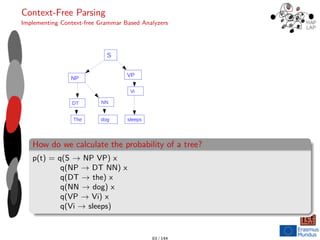
S
NP
VP
Vi
NN
The
DT
sleeps
dog
How do we calculate the probability of a tree?
p(t) = q(S → NP VP) x
q(NP → DT NN) x
q(DT → the) x
q(NN → dog) x
q(VP → Vi) x
q(Vi → sleeps)
83 / 144
Context-Free Parsing
Implementing Context-free Grammar Based Analyzers
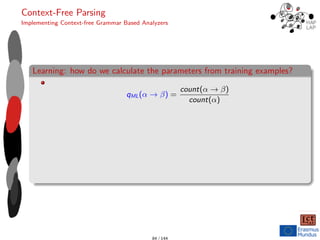
Learning: how do we calculate the parameters from training examples?
qML(α → β) =
count(α → β)
count(α)
84 / 144
Context-Free Parsing
Implementing Context-free Grammar Based Analyzers
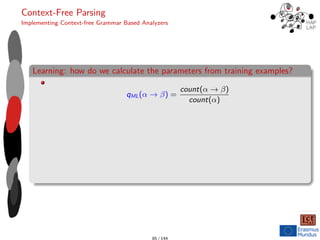
Learning: how do we calculate the parameters from training examples?
qML(α → β) =
count(α → β)
count(α)
85 / 144
Context-Free Parsing
Implementing Context-free Grammar Based Analyzers
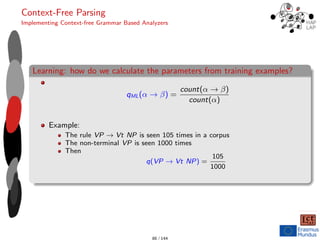
Learning: how do we calculate the parameters from training examples?
qML(α → β) =
count(α → β)
count(α)
Example:
The rule VP → Vt NP is seen 105 times in a corpus
The non-terminal VP is seen 1000 times
Then
q(VP → Vt NP) =
105
1000
86 / 144
Context-Free Parsing
Implementing Context-free Grammar Based Analyzers
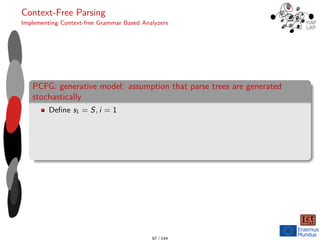
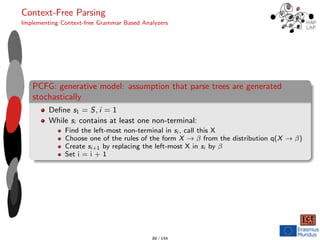
PCFG: generative model: assumption that parse trees are generated
stochastically
Define s1 = S, i = 1
87 / 144
Context-Free Parsing
Implementing Context-free Grammar Based Analyzers
PCFG: generative model: assumption that parse trees are generated
stochastically
Define s1 = S, i = 1
While si contains at least one non-terminal:
Find the left-most non-terminal in si , call this X
Choose one of the rules of the form X → β from the distribution q(X → β)
Create si+1 by replacing the left-most X in si by β
Set i = i + 1
88 / 144
Context-Free Parsing
Implementing Context-free Grammar Based Analyzers
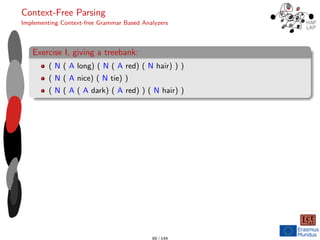
Exercise I, giving a treebank:
( N ( A long) ( N ( A red) ( N hair) ) )
( N ( A nice) ( N tie) )
( N ( A ( A dark) ( A red) ) ( N hair) )
89 / 144
Context-Free Parsing
Implementing Context-free Grammar Based Analyzers
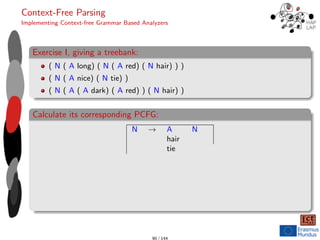
Exercise I, giving a treebank:
( N ( A long) ( N ( A red) ( N hair) ) )
( N ( A nice) ( N tie) )
( N ( A ( A dark) ( A red) ) ( N hair) )
Calculate its corresponding PCFG:
N → A N
hair
tie
90 / 144
Context-Free Parsing
Implementing Context-free Grammar Based Analyzers
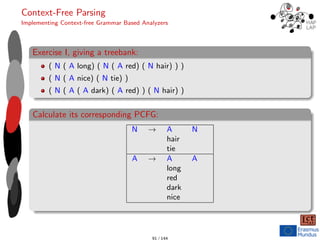
Exercise I, giving a treebank:
( N ( A long) ( N ( A red) ( N hair) ) )
( N ( A nice) ( N tie) )
( N ( A ( A dark) ( A red) ) ( N hair) )
Calculate its corresponding PCFG:
N → A N
hair
tie
A → A A
long
red
dark
nice
91 / 144
Context-Free Parsing
Implementing Context-free Grammar Based Analyzers
Exercise I: Calculate the best tree for “nice red hair”
92 / 144
Context-Free Parsing
Implementing Context-free Grammar Based Analyzers
Exercise II. Given a PCFG:
S → NP NP [1.0]
NP → NP PP [0.2]
NP → NP NP [0.2]
PP → P NP [1.0]
VP → V NP [0.7]
VP → VP PP [0.3]
P → with [1.0]
V → saw [1.0]
NP → astronomers [0.1]
NP → ears [0.18]
NP → saw [0.02]
NP → stars [0.18]
NP → telescopes [0.1]
NP → astronomer’s [0.02]
Calculate the trees corresponding to the sentence astronomers saw stars with
telescopes and give the one with the highest probability.
93 / 144
Context-Free Parsing
Implementing Context-free Grammar Based Analyzers
Exercise III. Given a PCFG:
S → V N [0.6]
S → NP V [0.4]
NP → D N [1.0]
D → a [0.2]
D → the [0.8]
V → support [0.6]
V → hate [0.4]
N → president [1.0]
Calculate all the sentences with p(x) > 0, each with its corresponding probability.
94 / 144
Context-Free Parsing
Implementing Context-free Grammar Based Analyzers
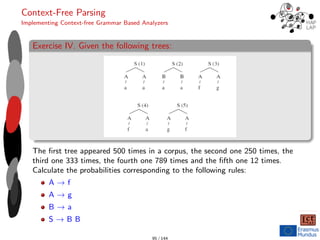
Exercise IV. Given the following trees:
The first tree appeared 500 times in a corpus, the second one 250 times, the
third one 333 times, the fourth one 789 times and the fifth one 12 times.
Calculate the probabilities corresponding to the following rules:
A → f
A → g
B → a
S → B B
95 / 144
Context-Free Parsing
Implementing Context-free Grammar Based Analyzers
NLTK: Probabilistic Context-free Grammars
Notebook in egela (PCFG)
Apply the grammars
96 / 144
Context-Free Parsing
Grammar Refinement
Some weaknesses of Probabilistic Context-free Grammars
Lack of sensitivity to lexical information
Lack of sensitivity to structural preferences
97 / 144
Context-Free Parsing
Grammar Refinement
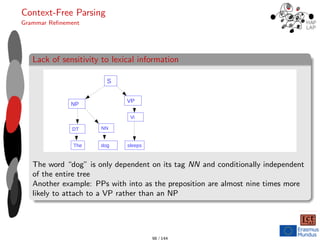
Lack of sensitivity to lexical information
S
NP
VP
Vi
NN
The
DT
sleeps
dog
The word “dog” is only dependent on its tag NN and conditionally independent
of the entire tree
Another example: PPs with into as the preposition are almost nine times more
likely to attach to a VP rather than an NP
98 / 144
Context-Free Parsing
Grammar Refinement
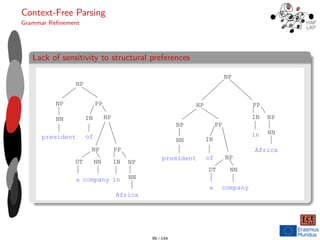
Lack of sensitivity to structural preferences
NP
NP
NN
president
PP
IN NP
of
NP PP
DT NN IN NP
NN
a company in
Africa
NP
NP
NN
president
PP
IN
of NP
DT NN
a company
PP
IN NP
NN
in
Africa
NP
99 / 144
Context-Free Parsing
Grammar Refinement
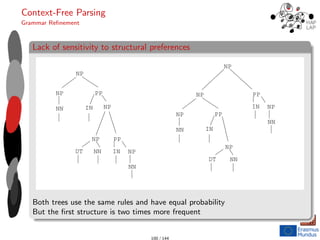
Lack of sensitivity to structural preferences
NP
NP
NN
PP
IN NP
NP PP
DT NN IN NP
NN
NP
NP
NN
PP
IN
NP
DT NN
PP
IN NP
NN
NP
Both trees use the same rules and have equal probability
But the first structure is two times more frequent
100 / 144
Context-Free Parsing
Grammar Refinement
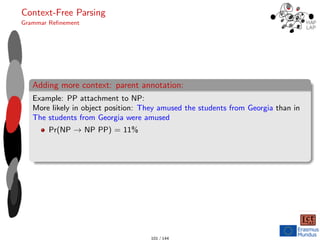
Adding more context: parent annotation:
Example: PP attachment to NP:
More likely in object position: They amused the students from Georgia than in
The students from Georgia were amused
Pr(NP → NP PP) = 11%
101 / 144
Context-Free Parsing
Grammar Refinement
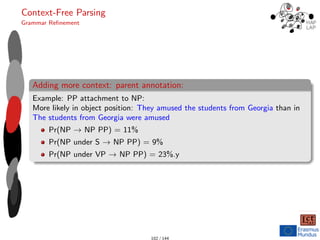
Adding more context: parent annotation:
Example: PP attachment to NP:
More likely in object position: They amused the students from Georgia than in
The students from Georgia were amused
Pr(NP → NP PP) = 11%
Pr(NP under S → NP PP) = 9%
Pr(NP under VP → NP PP) = 23%.y
102 / 144
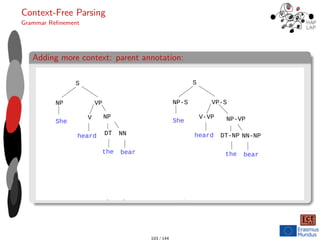
Context-Free Parsing
Grammar Refinement
Adding more context: parent annotation:
S
NP
She
VP
V NP
heard DT NN
the bear
Example of parent annotation.
(from Eisenstein 2018)
S
NP-S
She
VP-S
V-VP NP-VP
heard DT-NP NN-NP
the bear
103 / 144
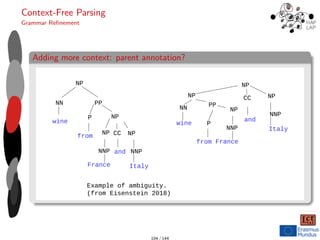
Context-Free Parsing
Grammar Refinement
Adding more context: parent annotation?
NP
NN
wine
PP
P NP
from CC NP
and
Italy
Example of ambiguity.
(from Eisenstein 2018)
NP
France
NNP NNP
NP
NN
wine
PP
P
from
CC NP
and
Italy
NP
France
NNP
NNP
NP
104 / 144
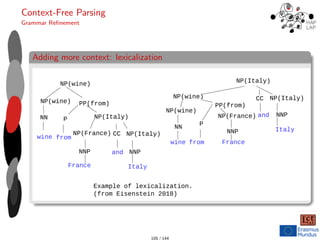
Context-Free Parsing
Grammar Refinement
Adding more context: lexicalization
NP(wine)
NN
wine
PP(from)
P
NP(Italy)
from
CC NP(Italy)
and
Italy
Example of lexicalization.
(from Eisenstein 2018)
NP(France)
France
NNP NNP
PP(from)
P
from
CC
and
Italy
NP(France)
France
NNP
NNP
NP(wine)
NN
wine
NP(wine)
NP(Italy)
NP(wine)
NP(Italy)
105 / 144
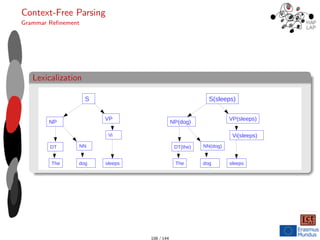
Context-Free Parsing
Grammar Refinement
Lexicalization
S
NP
VP
Vi
NN
The
DT
sleeps
dog
S(sleeps)
NP(dog)
VP(sleeps)
Vi(sleeps)
NN(dog)
The
DT(the)
sleeps
dog
106 / 144
Context-Free Parsing
Grammar Refinement
Lexicalization
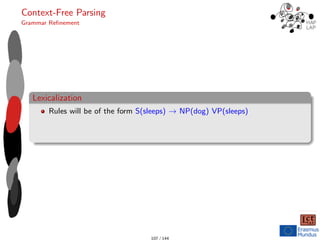
Rules will be of the form S(sleeps) → NP(dog) VP(sleeps)
107 / 144
Context-Free Parsing
Grammar Refinement
Lexicalization
Rules will be of the form S(sleeps) → NP(dog) VP(sleeps)
Many rules!
108 / 144
Context-Free Parsing
Grammar Refinement
Lexicalization
Rules will be of the form S(sleeps) → NP(dog) VP(sleeps)
Many rules!
Smoothing is necessary
109 / 144
Context-Free Parsing
Grammar Refinement
Performance od PCFGs
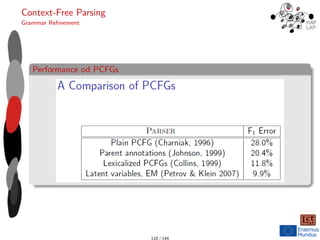
110 / 144
Context-Free Parsing
Grammar Refinement
Beyond Context-free Parsing
Reranking
111 / 144
Context-Free Parsing
Grammar Refinement
Beyond Context-free Parsing
Reranking
A context-free parser generates a k-best list of candidates
112 / 144
Context-Free Parsing
Grammar Refinement
Beyond Context-free Parsing
Reranking
A context-free parser generates a k-best list of candidates
The reranker selects the best parse
Arbitrary non-local features can be incorporated
(e.g. NP(France) CC NP(Italy))
Can obtain substantial improvements in accuracy
Transition-based parsing (shift-reduce parsing)
113 / 144
Context-Free Parsing
Grammar Refinement
Beyond Context-free Parsing
Reranking
A context-free parser generates a k-best list of candidates
The reranker selects the best parse
Arbitrary non-local features can be incorporated
(e.g. NP(France) CC NP(Italy))
Can obtain substantial improvements in accuracy
Transition-based parsing (shift-reduce parsing)
Two structures: stack and input
Two actions: shift and reduce
Very efficient
Error propagation when taking a bad decision
Example: analyze They eat sushi
114 / 144
Index
1 Context-free Grammars
2 Context-Free Parsing
3 Unification-based Grammars
4 Dependency Parsing
115 / 144
Unification-based Grammars
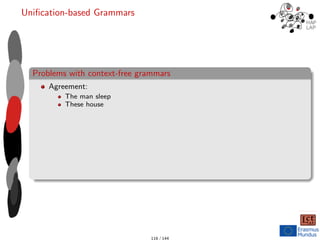
Problems with context-free grammars
Agreement:
The man sleep
These house
116 / 144
Unification-based Grammars
Problems with context-free grammars
Agreement:
The man sleep
These house
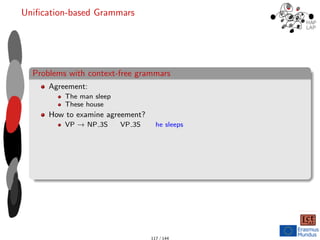
How to examine agreement?
VP → NP 3S VP 3S he sleeps
117 / 144
Unification-based Grammars
Problems with context-free grammars
Agreement:
The man sleep
These house
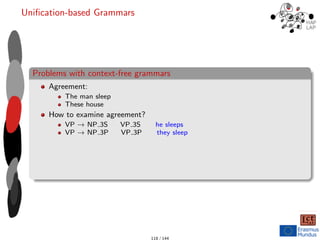
How to examine agreement?
VP → NP 3S VP 3S he sleeps
VP → NP 3P VP 3P they sleep
118 / 144
Unification-based Grammars
Problems with context-free grammars
Agreement:
The man sleep
These house
How to examine agreement?
VP → NP 3S VP 3S he sleeps
VP → NP 3P VP 3P they sleep
NP → Det 3P N 3P these houses
. . .
119 / 144
Unification-based Grammars
Problems with context-free grammars
Agreement:
The man sleep
These house
How to examine agreement?
VP → NP 3S VP 3S he sleeps
VP → NP 3P VP 3P they sleep
NP → Det 3P N 3P these houses
. . .
Many rules!
120 / 144
Unification-based Grammars
Problems with context-free grammars
Agreement:
The man sleep
These house
How to examine agreement?
VP → NP 3S VP 3S he sleeps
VP → NP 3P VP 3P they sleep
NP → Det 3P N 3P these houses
. . .
Many rules!
Feature-structures: each syntactic constituent will have features
121 / 144
Unification-based Grammars
Unification-based Grammars are useful for treating several phenomena
Agreement:
Case control
Subcategorization
Long-distance dependencies
Control
Coordination
122 / 144
Unification-based Grammars
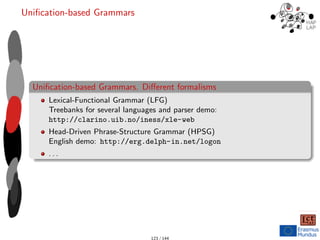
Unification-based Grammars. Different formalisms
Lexical-Functional Grammar (LFG)
Treebanks for several languages and parser demo:
http://clarino.uib.no/iness/xle-web
Head-Driven Phrase-Structure Grammar (HPSG)
English demo: http://erg.delph-in.net/logon
. . .
123 / 144
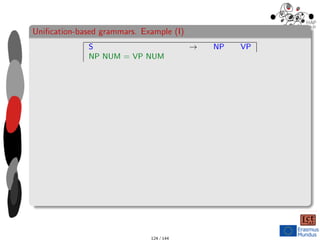
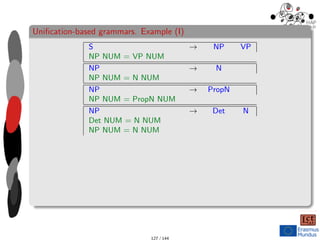
Unification-based grammars. Example (I)
S → NP VP
NP NUM = VP NUM
124 / 144
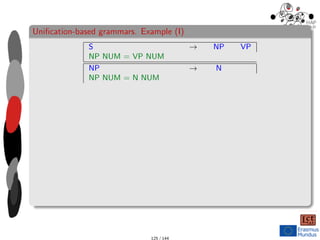
Unification-based grammars. Example (I)
S → NP VP
NP NUM = VP NUM
NP → N
NP NUM = N NUM
125 / 144
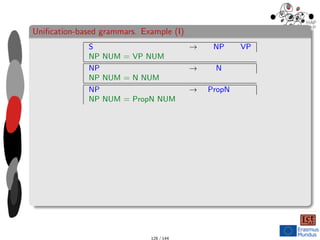
Unification-based grammars. Example (I)
S → NP VP
NP NUM = VP NUM
NP → N
NP NUM = N NUM
NP → PropN
NP NUM = PropN NUM
126 / 144
Unification-based grammars. Example (I)
S → NP VP
NP NUM = VP NUM
NP → N
NP NUM = N NUM
NP → PropN
NP NUM = PropN NUM
NP → Det N
Det NUM = N NUM
NP NUM = N NUM
127 / 144
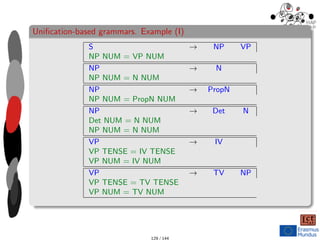
Unification-based grammars. Example (I)
S → NP VP
NP NUM = VP NUM
NP → N
NP NUM = N NUM
NP → PropN
NP NUM = PropN NUM
NP → Det N
Det NUM = N NUM
NP NUM = N NUM
VP → IV
VP TENSE = IV TENSE
VP NUM = IV NUM
128 / 144
Unification-based grammars. Example (I)
S → NP VP
NP NUM = VP NUM
NP → N
NP NUM = N NUM
NP → PropN
NP NUM = PropN NUM
NP → Det N
Det NUM = N NUM
NP NUM = N NUM
VP → IV
VP TENSE = IV TENSE
VP NUM = IV NUM
VP → TV NP
VP TENSE = TV TENSE
VP NUM = TV NUM
129 / 144
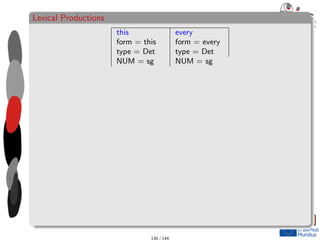
Lexical Productions
this every
form = this form = every
type = Det type = Det
NUM = sg NUM = sg
130 / 144
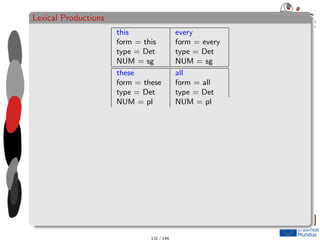
Lexical Productions
this every
form = this form = every
type = Det type = Det
NUM = sg NUM = sg
these all
form = these form = all
type = Det type = Det
NUM = pl NUM = pl
131 / 144
Lexical Productions
this every
form = this form = every
type = Det type = Det
NUM = sg NUM = sg
these all
form = these form = all
type = Det type = Det
NUM = pl NUM = pl
Kim Jody
form = Kim form = some
type = PropN type = PropN
132 / 144
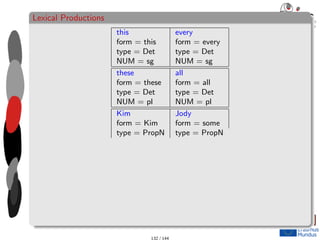
Lexical Productions
this every
form = this form = every
type = Det type = Det
NUM = sg NUM = sg
these all
form = these form = all
type = Det type = Det
NUM = pl NUM = pl
Kim Jody
form = Kim form = some
type = PropN type = PropN
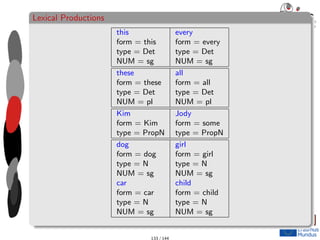
dog girl
form = dog form = girl
type = N type = N
NUM = sg NUM = sg
car child
form = car form = child
type = N type = N
NUM = sg NUM = sg
133 / 144
Lexical Productions
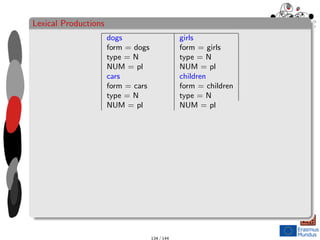
dogs girls
form = dogs form = girls
type = N type = N
NUM = pl NUM = pl
cars children
form = cars form = children
type = N type = N
NUM = pl NUM = pl
134 / 144
Lexical Productions
dogs girls
form = dogs form = girls
type = N type = N
NUM = pl NUM = pl
cars children
form = cars form = children
type = N type = N
NUM = pl NUM = pl
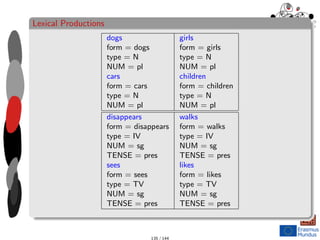
disappears walks
form = disappears form = walks
type = IV type = IV
NUM = sg NUM = sg
TENSE = pres TENSE = pres
sees likes
form = sees form = likes
type = TV type = TV
NUM = sg NUM = sg
TENSE = pres TENSE = pres
135 / 144
Lexical Productions
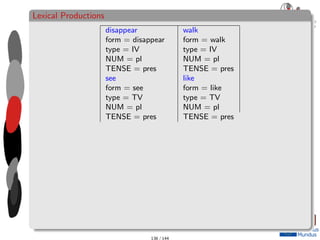
disappear walk
form = disappear form = walk
type = IV type = IV
NUM = pl NUM = pl
TENSE = pres TENSE = pres
see like
form = see form = like
type = TV type = TV
NUM = pl NUM = pl
TENSE = pres TENSE = pres
136 / 144
Lexical Productions
disappear walk
form = disappear form = walk
type = IV type = IV
NUM = pl NUM = pl
TENSE = pres TENSE = pres
see like
form = see form = like
type = TV type = TV
NUM = pl NUM = pl
TENSE = pres TENSE = pres
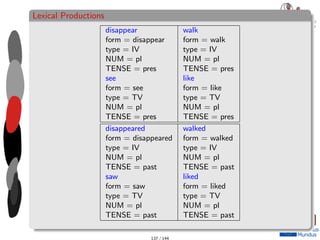
disappeared walked
form = disappeared form = walked
type = IV type = IV
NUM = pl NUM = pl
TENSE = past TENSE = past
saw liked
form = saw form = liked
type = TV type = TV
NUM = pl NUM = pl
TENSE = past TENSE = past
137 / 144
Unification-based Grammars
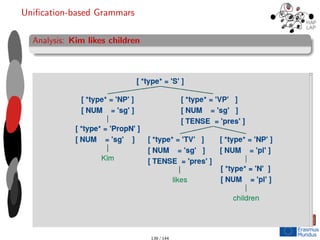
Analysis: Kim likes children
138 / 144
Unification-based Grammars
Analysis: Kim likes children
139 / 144
Unification-based Grammars
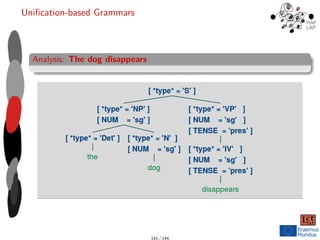
Analysis: The dog disappears
140 / 144
Unification-based Grammars
Analysis: The dog disappears
141 / 144
Unification-based Grammars
NLTK: Unification-based Grammars
Notebook in egela
Apply the grammars
142 / 144
Index
1 Context-free Grammars
2 Context-Free Parsing
3 Unification-based Grammars
4 Dependency Parsing
143 / 144
Dependency Parsing
TBC
144 / 144

Morphology-and-Syntax-CFG for another random place

  • 1.
  • 2.
    1 Context-free Grammars Introduction AContext-free Grammar for English (taken from Eisenstein 2019) Context-free Grammar: exercises 2 Context-Free Parsing Implementing Context-free Grammar Based Analyzers Weighted Context-free Grammars (WCFG) Probabilistic Context-free Grammars (PCFG) Grammar Refinement Parent Annotation Lexicalized Context-free Grammars 3 Unification-based Grammars 4 Dependency Parsing 2 / 144
  • 3.
    Bibliography Computational Approaches toMorphology and Syntax (Oxford Surveys in Syntax & Morphology), 2007 by Brian Roark, Richard Sproat Introduction to Natural Language Processing (Adaptive Computation and Machine Learning series, MIT Press). Jacob Eisenstein. 2019 Notes (2018 version): https://github.com/jacobeisenstein/ gt-nlp-class/blob/master/notes/eisenstein-nlp-notes.pdf Michael Collins, slides: Probabilistic Context-Free Grammars (PCFGs): http: //www.cs.columbia.edu/~mcollins/courses/nlp2011/notes/pcfgs.pdf Lexicalized Probabilistic Context-Free Grammars (PCFGs): http://www.cs. columbia.edu/~mcollins/courses/nlp2011/notes/lexpcfgs.pdf Natural Language Processing with Python. NLTK Book. Chapter 8. Analyzing Sentence Structure. http://www.nltk.org/book/ch08.html Dependency Parsing (Synthesis Lectures on Human Language Technologies), 2009 by Sandra Kubler, Ryan McDonald, Joakim Nivre. Morgan & Claypool Publishers 3 / 144
  • 4.
    Index 1 Context-free Grammars Introduction AContext-free Grammar for English (taken from Eisenstein 2019) Context-free Grammar: exercises 2 Context-Free Parsing 3 Unification-based Grammars 4 Dependency Parsing 4 / 144
  • 5.
  • 6.
    Context-free Grammars Introduction Why Context-FreeGrammar? Regular languages can’t count Example: an bn (with n > 0) can not be generated by a regular grammar But a simple CFG grammar can There are syntactic constructions that have a similar pattern, like center embedding: the dog the cat the dog chased the goat the cat the dog chased kissed It corresponds to the pattern nounn verbn−1 6 / 144
  • 7.
    Context-free Grammars Introduction Context-Free Grammar(CFG) S → NP VP VP → Verb NP NP → PropN NP → Pron 7 / 144
  • 8.
    Context-free Grammars Introduction Context-Free Grammar(CFG) S → NP VP VP → Verb NP NP → PropN NP → Pron General form: Rules have the form: a → b c d where a is a non-terminal symbol and b c d are terminal symbols 8 / 144
  • 9.
    Context-free Grammars Introduction Context-Free Grammar(CFG) S → NP VP VP → Verb NP NP → PropN NP → Pron General form: Rules have the form: a → b c d where a is a non-terminal symbol and b c d are terminal symbols Starting from the axiom (S) and applying the rules we can generate the strings of the language 9 / 144
  • 10.
    Context-free Grammars Introduction Context-Free Grammar(CFG) S → NP VP VP → Verb NP NP → PropN NP → Pron General form: Rules have the form: a → b c d where a is a non-terminal symbol and b c d are terminal symbols Starting from the axiom (S) and applying the rules we can generate the strings of the language The sequences generated by the grammar are represented by a tree 10 / 144
  • 11.
    Context-free Grammars Introduction Context-Free Grammar(CFG) S → NP VP VP → Verb NP NP → PropN NP → Pron 11 / 144
  • 12.
    Context-free Grammars Introduction Context-Free Grammar(CFG) S → NP VP VP → Verb NP NP → PropN NP → Pron Lexical rules Pron → I Verb → am PropN → John 12 / 144
  • 13.
  • 14.
  • 15.
    Context-free Grammars Introduction General architecture Sentence Morphologicalanalysis and disambiguation Syntactic constituents (tree) Syntactic analysis 15 / 144
  • 16.
    Context-free Grammars A Context-freeGrammar for English (taken from Eisenstein 2019) Main Syntactic Categories Sentence Noun Phrase Verb Phrase Other Prepositional Phrases Adverbial Phrases Adjectival Phrases 16 / 144
  • 17.
    Context-free Grammars A Context-freeGrammar for English (taken from Eisenstein 2019) Sentence Basic Rule: S → NP VP Other: S → ADVP NP VP Unfortunately Abigail ate the kimchi. S → S CC S Abigail ate the kimchi and Max had a burger. S → VP Eat the kimchi. 17 / 144
  • 18.
    Context-free Grammars A Context-freeGrammar for English (taken from Eisenstein 2019) Noun Phrase NP → NN | NNS | NNP | PRP singular, plural, and proper nouns; PRP: personal pronouns NP → DET NN | DET NNS | DET NNP | PRP NP → NN NN | NN NNS | DET NN NN | . . . Recursive NP Phrases: NP → NP CC NP the red and the black NP → NP PP the President of the Georgia Institute of Technology NP → NP SBAR a whale which he had wounded NP → NP VP a whale taken near Shetland 18 / 144
  • 19.
    Context-free Grammars A Context-freeGrammar for English (taken from Eisenstein 2019) Verb Phrase VP → VB | VBZ | VBD | VBN | VBG | VBP base form (VB: she likes to snack), present-tense third-person singular (VBZ: she snacks), present tense but not third-person singular (VBP: they snack), past tense (VBD: they snacked), present participle (VBG: they are snacking), and past participle (VBN: they had snacked) Recursive VP Phrases: VP → MD VP She will snack VP → VBD VP She had snacked VP → VBZ VP She has been snacking VP → VBN VP She has been snacking VP → TO VP She wants to snack VP → VP CC VP She buys and eats many snacks 19 / 144
  • 20.
    Context-free Grammars A Context-freeGrammar for English (taken from Eisenstein 2019) Verb Phrase (continued): Verb complements: VP → VBZ NP She teaches algebra VP → VBG NP She has been teaching algebra VP → VBD NP NP She taught her brother algebra VP → VBZ S Hunter wants to eat the kimchi VP → VBZ SBAR Hunter knows that Tristan ate the kimchi Prepositional and Adverbial Phrases: VP → VBZ PP She studies at night VP → VBZ ADVP She studies intensively VP → ADVP VBG She is not studying 20 / 144
  • 21.
    Context-free Grammars A Context-freeGrammar for English (taken from Eisenstein 2019) Verb Phrase (continued): Copula: VP → VBZ ADJP She is hungry VP → VBP ADJP Success seems increasingly unlikely 21 / 144
  • 22.
    Context-free Grammars A Context-freeGrammar for English (taken from Eisenstein 2019) Other constituents: Prepositional Phrases: PP → IN NP the whiteness of the whale PP → TO NP What the white whale was to Ahab, has been hinted Complement Clauses: SBAR → IN S She said that it was spicy SBAR → S She said it was spicy Adverbial Clauses: ADVP → RB RBR They went considerably further ADVP → ADVP PP They went considerably further than before 22 / 144
  • 23.
    Context-free Grammars A Context-freeGrammar for English (taken from Eisenstein 2019) Other constituents: Adjectival Clauses: ADJP → RB JJ very hungry ADJP → RBR JJ more hungry ADJP → JJS JJ best possible ADJP → RB JJR even bigger ADJP → JJ CC JJ high and mighty ADJP → JJ JJ West German ADJP → RB VBN previously reported Coordination: PP → PP CC PP on time and under budget ADVP → ADVP CC ADVP now and two years ago ADJP → ADJP CC ADJP quaint and rather deceptive SBAR → SBAR CC SBAR whether they want control or whether they want exports 23 / 144
  • 24.
    Context-free Grammars A Context-freeGrammar for English (taken from Eisenstein 2019) Ambiguity: PP attachment: I saw the man on the hill with a statue Coordination: The man took the hammer and saw Modifier scope: plastic bag container 24 / 144
  • 25.
    Context-free Grammars Context-free Grammar:exercises Exercise I: produce a parse tree for these sentences using the rules that have been presented: This aggression will not stand. I can get you a toe. Sometimes you eat the bar and sometimes the bar eats you. 25 / 144
  • 26.
    Context-free Grammars Context-free Grammar:exercises Exercise II: write a grammar to capture the following agreement in Spanish: La casa bonita El perro bonito 26 / 144
  • 27.
    Context-free Grammars Context-free Grammar:exercises Specific domains: semantic grammars Intervention → question | order | ... order → v {imperative(1), order(1)} np → baseNp | np → baseNp npMod {agreement(1, 2)} baseNp → n | baseNp → det adj n {agreement(1, 2, 3)} npMod → pp | ... pp → prep np np → ”barcelona” | ”valencia” | ... n → “ticket” | ”euromed” ... v → “give” | ... det → “a” | “the” | ... 27 / 144
  • 28.
    Context-free Grammars Context-free Grammar:exercises Context-free Grammars NLTK exercise (open the CFG notebook in egela) Try different sentences with a basic grammar Extend the grammar 28 / 144
  • 29.
    Index 1 Context-free Grammars 2Context-Free Parsing Implementing Context-free Grammar Based Analyzers Grammar Refinement 3 Unification-based Grammars 4 Dependency Parsing 29 / 144
  • 30.
    Context-Free Parsing Implementing Context-freeGrammar Based Analyzers Parsing algorithms Top-down parsing Shift-reduce parsing (bottom-up) Chart-based algorithms 30 / 144
  • 31.
    Context-Free Parsing Implementing Context-freeGrammar Based Analyzers Parsing algorithms: Recursive descent parsing Top-down parsing Idea: try to apply rules starting from the top symbol If a rule can not be applied, then try the next rule Until all the sentence is covered or there are no more rules Problem: a lot of work can be repeated Recursive descent demo (NLTK) python (from the command line) >>> import nltk >>> nltk.app.rdparser() 31 / 144
  • 32.
    Context-Free Parsing Implementing Context-freeGrammar Based Analyzers Parsing algorithms: shift-reduce parsing Bottom-up parsing Idea: two main structures: stack (of analyzed elements) and input sequence The elements will be shifted onto the stack until a right-hand side of a rule is formed, and then it is replaced by the left-hand side of the rule Until the sentence has been analyzed or no rule can be applied Problem: the process can go to a dead end, even when there is one analysis (improvement: backtracking) Shift-reduce parsing demo (NLTK) python (from the command line) >>> import nltk >>> nltk.app.srparser() 32 / 144
  • 33.
    Context-Free Parsing Implementing Context-freeGrammar Based Analyzers Parsing algorithms: chart parsing Idea: store the obtained analysis in a table, so that no analysis will be repeated Many alternatives and algorithms: top-down, bottom-up and hybrid Chart parsing demo (NLTK) python (from the command line) >>> import nltk >>> nltk.app.chartparser() 33 / 144
  • 34.
    Context-Free Parsing Implementing Context-freeGrammar Based Analyzers The CKY algorithm Grammar in Chomsky Normal Form Chart parsing, bottom-up dynamic programming algorithm Main idea: Start finding the smallest elements (length 1) Then continue finding elements of length 2, 3, ... Repeat until finding elements of length M (length of the sentence) Time: O(M3 N), where M = length of the sentence; N = number of grammar rules 34 / 144
  • 35.
    Context-Free Parsing Implementing Context-freeGrammar Based Analyzers CKY algorithm: Grammar in Chomsky Normal Form (CNF) Grammar equivalence A single CF Language can be expressed by more than one CF Grammar Two grammars are weakly equivalent if they generate the same strings Two grammars are strongly equivalent if they generate the same strings via the same derivations For example: S → aSb | ab S → aSb | aabb | ab 35 / 144
  • 36.
    Context-Free Parsing Implementing Context-freeGrammar Based Analyzers Grammar in Chomsky Normal Form (CNF) The right-hand side of every production includes either two nonterminals, e.g. A → B C, or a single terminal symbol, e.g. A → a 36 / 144
  • 37.
    Context-Free Parsing Implementing Context-freeGrammar Based Analyzers Grammar Transformation (CNF) Any CFG can be converted to a CNF grammar For example: W → X Y Z Can be replaced by two productions: W → X WX WX → Y Z | 37 / 144
  • 38.
    Context-Free Parsing Implementing Context-freeGrammar Based Analyzers Grammar Transformation (CNF) Any CFG can be converted to a CNF grammar For example: W → X Y Z Can be replaced by two productions: W → X WX WX → Y Z | Exercise1: convert the following grammar to CNF: S → a S b | a b Exercise2: convert the following grammar to CNF: NP → Det ADJ N | NP CORD NP Det → a | the N → dog | cat ADJ → big | ADJ big CORD → and 38 / 144
  • 39.
    Context-Free Parsing Implementing Context-freeGrammar Based Analyzers Example. A grammar in CNF: Sentence → NP VP NP → A B VP → C NP A → det B → n NP → n VP → vi C → vt 39 / 144
  • 40.
    Context-Free Parsing Implementing Context-freeGrammar Based Analyzers Example of the CKY algorithm: initial state Sentence → NP VP NP → A B VP → C NP A → det B → n VP → vi NP → n C → vt 0 the 1 cat 2 eats 3 fish 4 det n vi, vt n 40 / 144
  • 41.
    Context-Free Parsing Implementing Context-freeGrammar Based Analyzers Example of the CKY algorithm. Initialization: elements of length 1 the (det) (0,1) A cat (n) (1,2) B, NP eats (vt, vi) (2,3) VP, C Sentence → NP VP NP → A B VP → C NP A → det B → n VP → vi NP → n C → vt fish (n) (3,4) B, NP 0 the 1 cat 2 eats 3 fish 4 det n vi, vt n 41 / 144
  • 42.
    Context-Free Parsing Implementing Context-freeGrammar Based Analyzers Example of the CKY algorithm. Find elements of length 2 the (det) (0, 1) A the cat (0,2) NP cat (n) (1,2) B, NP cat eats (1,3) Sentence eats (vt, vi) (2,3) VP, C eats fish (2,4) VP Sentence → NP VP NP → A B VP → C NP A → det B → n VP → vi NP → n C → vt fish (n) (3,4) B, NP 0 the 1 cat 2 eats 3 fish 4 det n vi, vt n 42 / 144
  • 43.
    Context-Free Parsing Implementing Context-freeGrammar Based Analyzers Example of the CKY algorithm. Find elements of length 3 the (det) (0, 1) A the cat (0,2) NP the cat eats (0,3) Sentence cat (n) (1,2) B, NP cat eats (1,3) Sentence cat eats fish (1,4) Sentence eats (vt, vi) (2,3) VP, C eats fish (2,4) VP Sentence → NP VP NP → A B VP → C NP A → det B → n VP → vi NP → n C → vt fish (n) (3,4) B, NP 0 the 1 cat 2 eats 3 fish 4 det n vi, vt n 43 / 144
  • 44.
    Context-Free Parsing Implementing Context-freeGrammar Based Analyzers Example of the CKY algorithm. Find elements of length 4 the (det) (0, 1) A the cat (0,2) NP the cat eats (0,3) Sentence the cat eats fish (0,4) Sentence cat (n) (1,2) B, NP cat eats (1,3) Sentence cat eats fish (1,4) Sentence eats (vt, vi) (2,3) VP, C eats fish (2,4) VP Sentence → NP VP NP → A B VP → C NP A → det B → n VP → vi NP → n C → vt fish (n) (3,4) B, NP 0 the 1 cat 2 eats 3 fish 4 det n vi, vt n 44 / 144
  • 45.
    Context-Free Parsing Implementing Context-freeGrammar Based Analyzers Example of the CKY algorithm. How to recover the tree: backpointers the (det) (0, 1) A the cat (0,2) NP the cat eats (0,3) Sentence the cat eats fish (0,4) Sentence cat (n) (1,2) B, NP cat eats (1,3) Sentence cat eats fish (1,4) Sentence eats (vt, vi) (2,3) VP, C eats fish (2,4) VP Sentence → NP VP NP → A B VP → C NP A → det B → n VP → vi NP → n C → vt fish (n) (3,4) B, NP 0 the 1 cat 2 eats 3 fish 4 det n vi, vt n 45 / 144
  • 46.
    Context-Free Parsing Implementing Context-freeGrammar Based Analyzers Example of the CKY algorithm. S -> AB | XB T -> AB | XB X -> AT A -> a B -> b 0 a 1 a 2 a 3 b 4 b 5 46 / 144
  • 47.
    Context-Free Parsing Implementing Context-freeGrammar Based Analyzers Example of the CKY algorithm S → N VP N → N N VP → V N N → students | Jeff | geometry | trains | Andy’s | guitar V → trains | play 0 Jeff 1 trains 2 geometry 3 students 4 47 / 144
  • 48.
    Context-Free Parsing Implementing Context-freeGrammar Based Analyzers Example of the CKY algorithm. S → N VP N → N N VP → V N N → students | Jeff | geometry | trains | Andy’s | guitar V → trains | play 0 Andy’s 1 students 2 play 3 guitar 4 48 / 144
  • 49.
    Context-Free Parsing Implementing Context-freeGrammar Based Analyzers The CKY algorithm (taken from Eisenstein 2019) 228 CHAPTER 10. CONTEXT-FREE PARSING Algorithm 13 The CKY algorithm for parsing a sequence w ∈ Σ∗ in a context-free gram- mar G = (N, Σ, R, S), with non-terminals N, production rules R, and start symbol S. The grammar is assumed to be in Chomsky normal form (section 9.2.1). The function PICKFROM(b[i, j, X]) selects an element of the set b[i, j, X] arbitrarily. All values of t and b are initialized to ∅. 1: procedure CKY(w, G = (N, Σ, R, S)) 2: for m ∈ {1 . . . M} do 3: t[m − 1, m] ← {X : (X → wm) ∈ R} 4: for � ∈ {2, 3, . . . , M} do � Iterate over constituent lengths 5: for m ∈ {0, 1, . . . M − �} do � Iterate over left endpoints 6: for k ∈ {m + 1, m + 2, . . . , m + � − 1} do � Iterate over split points 7: for (X → Y Z) ∈ R do � Iterate over rules 8: if Y ∈ t[m, k] ∧ Z ∈ t[k, m + �] then 9: t[m, m + �] ← t[m, m + �] ∪ X � Add non-terminal to table 10: b[m, m + �, X] ← b[m, m + �, X] ∪ (Y, Z, k) � Add back-pointers 11: if S ∈ t[0, M] then 12: return TRACEBACK(S, 0, M, b) 13: else 14: return ∅ 15: procedure TRACEBACK(X, i, j, b) 16: if j = i + 1 then 17: return X 18: else 19: (Y, Z, k) ← PICKFROM(b[i, j, X]) 20: return X → (TRACEBACK(Y, i, k, b), TRACEBACK(Z, k, j, b)) • Productions with more than two elements on the right-hand side can be binarized by creating additional non-terminals, as described in section 9.2.1. For example, the production VP → V NP NP (for ditransitive verbs) can be converted to VP → VPditrans/NP NP, by adding the non-terminal VPditrans/NP and the production VP /NP → V NP. 49 / 144
  • 50.
    Context-Free Parsing Implementing Context-freeGrammar Based Analyzers Implementation details for CKY. Every item in the chart must indicate: X → α (i,j,k) X spans wi+1,j For binary rules, k marks the split point i < k < j For example, if α = Y Z, then Y spans wi+1,k and Z spans wk+1,j Another table (or the same one) can store the backpointers to Y and Z 50 / 144
  • 51.
    Context-Free Parsing Implementing Context-freeGrammar Based Analyzers Example: CKY demo http://sujeet.me/CYK/parser.html 51 / 144
  • 52.
    Context-Free Parsing Implementing Context-freeGrammar Based Analyzers Evaluating parsers: Precision: the fraction of constituents in the system parse that match a constituent in the reference parse. Recall: the fraction of constituents in the reference parse that match a constituent in the system parse. 52 / 144
  • 53.
    Context-Free Parsing Implementing Context-freeGrammar Based Analyzers Evaluating parsers S NP We VP V NP eat NP PP IN NP sushi with chopsticks S NP We VP VP PP eat NP PP IN NP sushi with chopsticks V From Eisenstein 2018 Evaluate precision and recall (left tree: system tree, right tree: gold/reference tree) 53 / 144
  • 54.
    Context-Free Parsing Implementing Context-freeGrammar Based Analyzers Weighted Context-free Grammars (WCFG) With a real language grammar, typically the parser can obtain hundreds or thousands of syntactic trees for a sentence 54 / 144
  • 55.
    Context-Free Parsing Implementing Context-freeGrammar Based Analyzers Weighted Context-free Grammars (WCFG) With a real language grammar, typically the parser can obtain hundreds or thousands of syntactic trees for a sentence How to select the best one? 55 / 144
  • 56.
    Context-Free Parsing Implementing Context-freeGrammar Based Analyzers Weighted Context-free Grammars (WCFG) With a real language grammar, typically the parser can obtain hundreds or thousands of syntactic trees for a sentence How to select the best one? Use weights calculated somehow (treebank, corpora, ...) 56 / 144
  • 57.
    Context-Free Parsing Implementing Context-freeGrammar Based Analyzers Example of Weighted Context-Free Grammar (WCFG) Eisenstein 2019 10.3. WEIGHTED CONTEXT-FREE GRAMMARS 233 ψ(·) exp ψ(·) S → NP VP 0 1 NP → NP PP −1 1 2 → we −2 1 4 → sushi −3 1 8 → chopsticks −3 1 8 PP → IN NP 0 1 IN → with 0 1 VP → V NP −1 1 2 → VP PP −2 1 4 → MD V −2 1 4 V → eat 0 1 Table 10.2: An example weighted context-free grammar (WCFG). The weights are chosen so that exp ψ(·) sums to one over right-hand sides for each non-terminal; this is required by probabilistic context-free grammars, but not by WCFGs in general. which are computed independently. In a weighted context-free grammar (WCFG), the score of each anchored production X → (α, (i, j, k)) is simply ψ(X → α), ignoring the anchor (i, j, k). In other parsing models, the anchors can be used to access features of the 57 / 144
  • 58.
    Context-Free Parsing Implementing Context-freeGrammar Based Analyzers Weighted Context-Free Grammar (WCFG) S NP We VP V NP eat NP PP IN NP sushi with chopsticks S NP We VP VP PP eat NP PP IN NP sushi with chopsticks V From Eisenstein 2018 Scoring function of a tree: sum of item scores Given the two trees, calculate the score of each one 58 / 144
  • 59.
    Context-Free Parsing Implementing Context-freeGrammar Based Analyzers Parsing with Weighted Context-Free Grammar (WCFG) For each item in the chart: X → Y Z (i,j,k) we must keep the score of the best derivation of X spanning wi+1,j We will compute each the score of each element X as the maximum of: Given X → Y Z (i,j,k) The score of the production X → Y Z plus The score of the best derivation for Y:wi+1,k plus The score of the best derivation for Z:wk+1,k The scores will be combined by addition. The score (ψ) of a tree formed by rules (α1 → β1, . . . αN → βN ): ψ(t) = N P i=1 ψ(αi → βi ) 59 / 144
  • 60.
    Context-Free Parsing Implementing Context-freeGrammar Based Analyzers The CKY algorithm with a WCFG (Eisenstein 2019) 234 CHAPTER 10. CONTEXT-FREE PARSING Algorithm 14 CKY algorithm for parsing a string w ∈ Σ∗ in a weighted context-free grammar (N, Σ, R, S), where N is the set of non-terminals and R is the set of weighted productions. The grammar is assumed to be in Chomsky normal form (section 9.2.1). The function TRACEBACK is defined in Algorithm 13. procedure WCKY(w, G = (N, Σ, R, S)) for all i, j, X do � Initialization t[i, j, X] ← 0 b[i, j, X] ← ∅ for m ∈ {1, 2, . . . , M} do for all X ∈ N do t[m, m + 1, X] ← ψ(X → wm, (m, m + 1, m)) for � ∈ {2, 3, . . . M} do for m ∈ {0, 1, . . . , M − �} do for k ∈ {m + 1, m + 2, . . . , m + � − 1} do t[m, m + �, X] ← max k,Y,Z ψ(X → Y Z, (m, m + �, k)) + t[m, k, Y ] + t[k, m + �, Z] b[m, m + �, X] ← argmax k,Y,Z ψ(X → Y Z, (m + �, k)) + t[m, k, Y ] + t[k, m + �, Z] return TRACEBACK(S, 0, M, b) 10.3.1 Parsing with weighted context-free grammars The optimization problem in Equation 10.4 can be solved by modifying the CKY algo- rithm. In the deterministic CKY algorithm, each cell t[i, j] stored a set of non-terminals 60 / 144
  • 61.
    Context-Free Parsing Implementing Context-freeGrammar Based Analyzers Applying CKY to WCFG 0 We 1 eat 2 sushi 3 with 4 chopsticks 5 61 / 144
  • 62.
    Context-Free Parsing Implementing Context-freeGrammar Based Analyzers Probabilistic Context-free Grammars (PCFG): Special case of WCFG The weights are probabilities 62 / 144
  • 63.
    Context-Free Parsing Implementing Context-freeGrammar Based Analyzers Probabilistic Context-free Grammars (PCFG): Special case of WCFG The weights are probabilities Advantage: easier interpretation 63 / 144
  • 64.
    Context-Free Parsing Implementing Context-freeGrammar Based Analyzers Probabilistic Context-free Grammars (PCFG): Special case of WCFG The weights are probabilities Advantage: easier interpretation They must obey the constraints on probabilities (sum to 1, ...) 64 / 144
  • 65.
    Context-Free Parsing Implementing Context-freeGrammar Based Analyzers Probabilistic Context-free Grammars (PCFG): Special case of WCFG The weights are probabilities Advantage: easier interpretation They must obey the constraints on probabilities (sum to 1, ...) Parsing: apply multiplication of probabilities 65 / 144
  • 66.
    Context-Free Parsing Implementing Context-freeGrammar Based Analyzers Probabilistic Context-free Grammars (PCFG) p(t) ≥ 0, ∀ t ∈ the set of trees given by a grammar G 66 / 144
  • 67.
    Context-Free Parsing Implementing Context-freeGrammar Based Analyzers Probabilistic Context-free Grammars (PCFG) p(t) ≥ 0, ∀ t ∈ the set of trees given by a grammar G P t ∈ TG p(t) = 1 where TG is the set of trees generated by the grammar 67 / 144
  • 68.
    Context-Free Parsing Implementing Context-freeGrammar Based Analyzers How do we calculate the best parse tree of a sentence s? Calculate: Optimal parse = argmaxt ∈ TG (s) p(t) 68 / 144
  • 69.
    Context-Free Parsing Implementing Context-freeGrammar Based Analyzers How do we calculate the best parse tree of a sentence s? Calculate: Optimal parse = argmaxt ∈ TG (s) p(t) Probability of a tree formed by rules (α1 → β1, . . . αN → βN ): p(t) = N Q i=1 p(αi → βi ) Given a sentence, calculate all the possible trees The result is the tree with the maximum probability 69 / 144
  • 70.
    Context-Free Parsing Implementing Context-freeGrammar Based Analyzers Questions How do we calculate p(t)? 70 / 144
  • 71.
    Context-Free Parsing Implementing Context-freeGrammar Based Analyzers Questions How do we calculate p(t)? Learning: how do we calculate the parameters from training examples? 71 / 144
  • 72.
    Context-Free Parsing Implementing Context-freeGrammar Based Analyzers Questions How do we calculate p(t)? Learning: how do we calculate the parameters from training examples? Parsing: for a given sentence s, how do we find the most likely tree? 72 / 144
  • 73.
    Context-Free Parsing Implementing Context-freeGrammar Based Analyzers Example PCFG (M. Collins, http://www.cs.columbia.edu/~mcollins/ courses/nlp2011/notes/pcfgs.pdf) S → NP VP 1.0 73 / 144
  • 74.
    Context-Free Parsing Implementing Context-freeGrammar Based Analyzers Example PCFG (M. Collins, http://www.cs.columbia.edu/~mcollins/ courses/nlp2011/notes/pcfgs.pdf) S → NP VP 1.0 VP → Vi 0.3 VP → Vt NP 0.5 VP → VP PP 0.2 74 / 144
  • 75.
    Context-Free Parsing Implementing Context-freeGrammar Based Analyzers Example PCFG (M. Collins, http://www.cs.columbia.edu/~mcollins/ courses/nlp2011/notes/pcfgs.pdf) S → NP VP 1.0 VP → Vi 0.3 VP → Vt NP 0.5 VP → VP PP 0.2 NP → DT NN 0.8 NP → NP PP 0.2 75 / 144
  • 76.
    Context-Free Parsing Implementing Context-freeGrammar Based Analyzers Example PCFG (M. Collins, http://www.cs.columbia.edu/~mcollins/ courses/nlp2011/notes/pcfgs.pdf) S → NP VP 1.0 VP → Vi 0.3 VP → Vt NP 0.5 VP → VP PP 0.2 NP → DT NN 0.8 NP → NP PP 0.2 PP → IN NP 1.0 76 / 144
  • 77.
    Context-Free Parsing Implementing Context-freeGrammar Based Analyzers Example PCFG (M. Collins, http://www.cs.columbia.edu/~mcollins/ courses/nlp2011/notes/pcfgs.pdf) S → NP VP 1.0 VP → Vi 0.3 VP → Vt NP 0.5 VP → VP PP 0.2 NP → DT NN 0.8 NP → NP PP 0.2 PP → IN NP 1.0 77 / 144
  • 78.
    Context-Free Parsing Implementing Context-freeGrammar Based Analyzers Example PCFG Vi → sleeps 1.0 78 / 144
  • 79.
    Context-Free Parsing Implementing Context-freeGrammar Based Analyzers Example PCFG Vi → sleeps 1.0 Vt → saw 1.0 79 / 144
  • 80.
    Context-Free Parsing Implementing Context-freeGrammar Based Analyzers Example PCFG Vi → sleeps 1.0 Vt → saw 1.0 NN → man 0.1 NN → woman 0.1 NN → telescope 0.3 NN → dog 0.5 80 / 144
  • 81.
    Context-Free Parsing Implementing Context-freeGrammar Based Analyzers Example PCFG Vi → sleeps 1.0 Vt → saw 1.0 NN → man 0.1 NN → woman 0.1 NN → telescope 0.3 NN → dog 0.5 DT → the 1.0 81 / 144
  • 82.
    Context-Free Parsing Implementing Context-freeGrammar Based Analyzers Example PCFG Vi → sleeps 1.0 Vt → saw 1.0 NN → man 0.1 NN → woman 0.1 NN → telescope 0.3 NN → dog 0.5 DT → the 1.0 IN → with 0.6 IN → in 0.4 82 / 144
  • 83.
    Context-Free Parsing Implementing Context-freeGrammar Based Analyzers S NP VP Vi NN The DT sleeps dog How do we calculate the probability of a tree? p(t) = q(S → NP VP) x q(NP → DT NN) x q(DT → the) x q(NN → dog) x q(VP → Vi) x q(Vi → sleeps) 83 / 144
  • 84.
    Context-Free Parsing Implementing Context-freeGrammar Based Analyzers Learning: how do we calculate the parameters from training examples? qML(α → β) = count(α → β) count(α) 84 / 144
  • 85.
    Context-Free Parsing Implementing Context-freeGrammar Based Analyzers Learning: how do we calculate the parameters from training examples? qML(α → β) = count(α → β) count(α) 85 / 144
  • 86.
    Context-Free Parsing Implementing Context-freeGrammar Based Analyzers Learning: how do we calculate the parameters from training examples? qML(α → β) = count(α → β) count(α) Example: The rule VP → Vt NP is seen 105 times in a corpus The non-terminal VP is seen 1000 times Then q(VP → Vt NP) = 105 1000 86 / 144
  • 87.
    Context-Free Parsing Implementing Context-freeGrammar Based Analyzers PCFG: generative model: assumption that parse trees are generated stochastically Define s1 = S, i = 1 87 / 144
  • 88.
    Context-Free Parsing Implementing Context-freeGrammar Based Analyzers PCFG: generative model: assumption that parse trees are generated stochastically Define s1 = S, i = 1 While si contains at least one non-terminal: Find the left-most non-terminal in si , call this X Choose one of the rules of the form X → β from the distribution q(X → β) Create si+1 by replacing the left-most X in si by β Set i = i + 1 88 / 144
  • 89.
    Context-Free Parsing Implementing Context-freeGrammar Based Analyzers Exercise I, giving a treebank: ( N ( A long) ( N ( A red) ( N hair) ) ) ( N ( A nice) ( N tie) ) ( N ( A ( A dark) ( A red) ) ( N hair) ) 89 / 144
  • 90.
    Context-Free Parsing Implementing Context-freeGrammar Based Analyzers Exercise I, giving a treebank: ( N ( A long) ( N ( A red) ( N hair) ) ) ( N ( A nice) ( N tie) ) ( N ( A ( A dark) ( A red) ) ( N hair) ) Calculate its corresponding PCFG: N → A N hair tie 90 / 144
  • 91.
    Context-Free Parsing Implementing Context-freeGrammar Based Analyzers Exercise I, giving a treebank: ( N ( A long) ( N ( A red) ( N hair) ) ) ( N ( A nice) ( N tie) ) ( N ( A ( A dark) ( A red) ) ( N hair) ) Calculate its corresponding PCFG: N → A N hair tie A → A A long red dark nice 91 / 144
  • 92.
    Context-Free Parsing Implementing Context-freeGrammar Based Analyzers Exercise I: Calculate the best tree for “nice red hair” 92 / 144
  • 93.
    Context-Free Parsing Implementing Context-freeGrammar Based Analyzers Exercise II. Given a PCFG: S → NP NP [1.0] NP → NP PP [0.2] NP → NP NP [0.2] PP → P NP [1.0] VP → V NP [0.7] VP → VP PP [0.3] P → with [1.0] V → saw [1.0] NP → astronomers [0.1] NP → ears [0.18] NP → saw [0.02] NP → stars [0.18] NP → telescopes [0.1] NP → astronomer’s [0.02] Calculate the trees corresponding to the sentence astronomers saw stars with telescopes and give the one with the highest probability. 93 / 144
  • 94.
    Context-Free Parsing Implementing Context-freeGrammar Based Analyzers Exercise III. Given a PCFG: S → V N [0.6] S → NP V [0.4] NP → D N [1.0] D → a [0.2] D → the [0.8] V → support [0.6] V → hate [0.4] N → president [1.0] Calculate all the sentences with p(x) > 0, each with its corresponding probability. 94 / 144
  • 95.
    Context-Free Parsing Implementing Context-freeGrammar Based Analyzers Exercise IV. Given the following trees: The first tree appeared 500 times in a corpus, the second one 250 times, the third one 333 times, the fourth one 789 times and the fifth one 12 times. Calculate the probabilities corresponding to the following rules: A → f A → g B → a S → B B 95 / 144
  • 96.
    Context-Free Parsing Implementing Context-freeGrammar Based Analyzers NLTK: Probabilistic Context-free Grammars Notebook in egela (PCFG) Apply the grammars 96 / 144
  • 97.
    Context-Free Parsing Grammar Refinement Someweaknesses of Probabilistic Context-free Grammars Lack of sensitivity to lexical information Lack of sensitivity to structural preferences 97 / 144
  • 98.
    Context-Free Parsing Grammar Refinement Lackof sensitivity to lexical information S NP VP Vi NN The DT sleeps dog The word “dog” is only dependent on its tag NN and conditionally independent of the entire tree Another example: PPs with into as the preposition are almost nine times more likely to attach to a VP rather than an NP 98 / 144
  • 99.
    Context-Free Parsing Grammar Refinement Lackof sensitivity to structural preferences NP NP NN president PP IN NP of NP PP DT NN IN NP NN a company in Africa NP NP NN president PP IN of NP DT NN a company PP IN NP NN in Africa NP 99 / 144
  • 100.
    Context-Free Parsing Grammar Refinement Lackof sensitivity to structural preferences NP NP NN PP IN NP NP PP DT NN IN NP NN NP NP NN PP IN NP DT NN PP IN NP NN NP Both trees use the same rules and have equal probability But the first structure is two times more frequent 100 / 144
  • 101.
    Context-Free Parsing Grammar Refinement Addingmore context: parent annotation: Example: PP attachment to NP: More likely in object position: They amused the students from Georgia than in The students from Georgia were amused Pr(NP → NP PP) = 11% 101 / 144
  • 102.
    Context-Free Parsing Grammar Refinement Addingmore context: parent annotation: Example: PP attachment to NP: More likely in object position: They amused the students from Georgia than in The students from Georgia were amused Pr(NP → NP PP) = 11% Pr(NP under S → NP PP) = 9% Pr(NP under VP → NP PP) = 23%.y 102 / 144
  • 103.
    Context-Free Parsing Grammar Refinement Addingmore context: parent annotation: S NP She VP V NP heard DT NN the bear Example of parent annotation. (from Eisenstein 2018) S NP-S She VP-S V-VP NP-VP heard DT-NP NN-NP the bear 103 / 144
  • 104.
    Context-Free Parsing Grammar Refinement Addingmore context: parent annotation? NP NN wine PP P NP from CC NP and Italy Example of ambiguity. (from Eisenstein 2018) NP France NNP NNP NP NN wine PP P from CC NP and Italy NP France NNP NNP NP 104 / 144
  • 105.
    Context-Free Parsing Grammar Refinement Addingmore context: lexicalization NP(wine) NN wine PP(from) P NP(Italy) from CC NP(Italy) and Italy Example of lexicalization. (from Eisenstein 2018) NP(France) France NNP NNP PP(from) P from CC and Italy NP(France) France NNP NNP NP(wine) NN wine NP(wine) NP(Italy) NP(wine) NP(Italy) 105 / 144
  • 106.
  • 107.
    Context-Free Parsing Grammar Refinement Lexicalization Ruleswill be of the form S(sleeps) → NP(dog) VP(sleeps) 107 / 144
  • 108.
    Context-Free Parsing Grammar Refinement Lexicalization Ruleswill be of the form S(sleeps) → NP(dog) VP(sleeps) Many rules! 108 / 144
  • 109.
    Context-Free Parsing Grammar Refinement Lexicalization Ruleswill be of the form S(sleeps) → NP(dog) VP(sleeps) Many rules! Smoothing is necessary 109 / 144
  • 110.
  • 111.
    Context-Free Parsing Grammar Refinement BeyondContext-free Parsing Reranking 111 / 144
  • 112.
    Context-Free Parsing Grammar Refinement BeyondContext-free Parsing Reranking A context-free parser generates a k-best list of candidates 112 / 144
  • 113.
    Context-Free Parsing Grammar Refinement BeyondContext-free Parsing Reranking A context-free parser generates a k-best list of candidates The reranker selects the best parse Arbitrary non-local features can be incorporated (e.g. NP(France) CC NP(Italy)) Can obtain substantial improvements in accuracy Transition-based parsing (shift-reduce parsing) 113 / 144
  • 114.
    Context-Free Parsing Grammar Refinement BeyondContext-free Parsing Reranking A context-free parser generates a k-best list of candidates The reranker selects the best parse Arbitrary non-local features can be incorporated (e.g. NP(France) CC NP(Italy)) Can obtain substantial improvements in accuracy Transition-based parsing (shift-reduce parsing) Two structures: stack and input Two actions: shift and reduce Very efficient Error propagation when taking a bad decision Example: analyze They eat sushi 114 / 144
  • 115.
    Index 1 Context-free Grammars 2Context-Free Parsing 3 Unification-based Grammars 4 Dependency Parsing 115 / 144
  • 116.
    Unification-based Grammars Problems withcontext-free grammars Agreement: The man sleep These house 116 / 144
  • 117.
    Unification-based Grammars Problems withcontext-free grammars Agreement: The man sleep These house How to examine agreement? VP → NP 3S VP 3S he sleeps 117 / 144
  • 118.
    Unification-based Grammars Problems withcontext-free grammars Agreement: The man sleep These house How to examine agreement? VP → NP 3S VP 3S he sleeps VP → NP 3P VP 3P they sleep 118 / 144
  • 119.
    Unification-based Grammars Problems withcontext-free grammars Agreement: The man sleep These house How to examine agreement? VP → NP 3S VP 3S he sleeps VP → NP 3P VP 3P they sleep NP → Det 3P N 3P these houses . . . 119 / 144
  • 120.
    Unification-based Grammars Problems withcontext-free grammars Agreement: The man sleep These house How to examine agreement? VP → NP 3S VP 3S he sleeps VP → NP 3P VP 3P they sleep NP → Det 3P N 3P these houses . . . Many rules! 120 / 144
  • 121.
    Unification-based Grammars Problems withcontext-free grammars Agreement: The man sleep These house How to examine agreement? VP → NP 3S VP 3S he sleeps VP → NP 3P VP 3P they sleep NP → Det 3P N 3P these houses . . . Many rules! Feature-structures: each syntactic constituent will have features 121 / 144
  • 122.
    Unification-based Grammars Unification-based Grammarsare useful for treating several phenomena Agreement: Case control Subcategorization Long-distance dependencies Control Coordination 122 / 144
  • 123.
    Unification-based Grammars Unification-based Grammars.Different formalisms Lexical-Functional Grammar (LFG) Treebanks for several languages and parser demo: http://clarino.uib.no/iness/xle-web Head-Driven Phrase-Structure Grammar (HPSG) English demo: http://erg.delph-in.net/logon . . . 123 / 144
  • 124.
    Unification-based grammars. Example(I) S → NP VP NP NUM = VP NUM 124 / 144
  • 125.
    Unification-based grammars. Example(I) S → NP VP NP NUM = VP NUM NP → N NP NUM = N NUM 125 / 144
  • 126.
    Unification-based grammars. Example(I) S → NP VP NP NUM = VP NUM NP → N NP NUM = N NUM NP → PropN NP NUM = PropN NUM 126 / 144
  • 127.
    Unification-based grammars. Example(I) S → NP VP NP NUM = VP NUM NP → N NP NUM = N NUM NP → PropN NP NUM = PropN NUM NP → Det N Det NUM = N NUM NP NUM = N NUM 127 / 144
  • 128.
    Unification-based grammars. Example(I) S → NP VP NP NUM = VP NUM NP → N NP NUM = N NUM NP → PropN NP NUM = PropN NUM NP → Det N Det NUM = N NUM NP NUM = N NUM VP → IV VP TENSE = IV TENSE VP NUM = IV NUM 128 / 144
  • 129.
    Unification-based grammars. Example(I) S → NP VP NP NUM = VP NUM NP → N NP NUM = N NUM NP → PropN NP NUM = PropN NUM NP → Det N Det NUM = N NUM NP NUM = N NUM VP → IV VP TENSE = IV TENSE VP NUM = IV NUM VP → TV NP VP TENSE = TV TENSE VP NUM = TV NUM 129 / 144
  • 130.
    Lexical Productions this every form= this form = every type = Det type = Det NUM = sg NUM = sg 130 / 144
  • 131.
    Lexical Productions this every form= this form = every type = Det type = Det NUM = sg NUM = sg these all form = these form = all type = Det type = Det NUM = pl NUM = pl 131 / 144
  • 132.
    Lexical Productions this every form= this form = every type = Det type = Det NUM = sg NUM = sg these all form = these form = all type = Det type = Det NUM = pl NUM = pl Kim Jody form = Kim form = some type = PropN type = PropN 132 / 144
  • 133.
    Lexical Productions this every form= this form = every type = Det type = Det NUM = sg NUM = sg these all form = these form = all type = Det type = Det NUM = pl NUM = pl Kim Jody form = Kim form = some type = PropN type = PropN dog girl form = dog form = girl type = N type = N NUM = sg NUM = sg car child form = car form = child type = N type = N NUM = sg NUM = sg 133 / 144
  • 134.
    Lexical Productions dogs girls form= dogs form = girls type = N type = N NUM = pl NUM = pl cars children form = cars form = children type = N type = N NUM = pl NUM = pl 134 / 144
  • 135.
    Lexical Productions dogs girls form= dogs form = girls type = N type = N NUM = pl NUM = pl cars children form = cars form = children type = N type = N NUM = pl NUM = pl disappears walks form = disappears form = walks type = IV type = IV NUM = sg NUM = sg TENSE = pres TENSE = pres sees likes form = sees form = likes type = TV type = TV NUM = sg NUM = sg TENSE = pres TENSE = pres 135 / 144
  • 136.
    Lexical Productions disappear walk form= disappear form = walk type = IV type = IV NUM = pl NUM = pl TENSE = pres TENSE = pres see like form = see form = like type = TV type = TV NUM = pl NUM = pl TENSE = pres TENSE = pres 136 / 144
  • 137.
    Lexical Productions disappear walk form= disappear form = walk type = IV type = IV NUM = pl NUM = pl TENSE = pres TENSE = pres see like form = see form = like type = TV type = TV NUM = pl NUM = pl TENSE = pres TENSE = pres disappeared walked form = disappeared form = walked type = IV type = IV NUM = pl NUM = pl TENSE = past TENSE = past saw liked form = saw form = liked type = TV type = TV NUM = pl NUM = pl TENSE = past TENSE = past 137 / 144
  • 138.
  • 139.
  • 140.
  • 141.
  • 142.
    Unification-based Grammars NLTK: Unification-basedGrammars Notebook in egela Apply the grammars 142 / 144
  • 143.
    Index 1 Context-free Grammars 2Context-Free Parsing 3 Unification-based Grammars 4 Dependency Parsing 143 / 144
  • 144.