PULP AND PERIRADICULAR
PATHOSIS -- 2
SAJJAD ALI DARVESH
BDS FCPS
ASISSTANT PROFESSOR
ENDODONTIC DEPARTMENT
LEARNING OBJECTIVES
By the end of lecture final year BDS student should be able
to :
 Classify peri radicular lesions of pulpal origin along with
their clinical and histological features.
RE-CAP
 A 23-year-old female presented to you with chief complain
of pain in tooth 36. Clinical examination showed a reddish,
cauliflower like outgrowth of connective tissue into the
caries that has resulted in a large occlusal exposure. The
tooth responded within normal limits when palpated and
percussed. What is your diagnosis?
 Excessive gingival overgrowth
 Giant cell granuloma
 Hyperplastic pulpitis
 Irreversible pulpitis
A patient aged 25 years old came to the OPD with a history of
trauma to upper central incisor a year back. The tooth was
grayish- blue. During examination you perform pulp vitality
test with ethyl chloride (cold) spray to which the tooth did
not respond. What is the most probable reason for negative
response?
 Irreversible pulpitis
 Necrosis
 Normal pulp
 Reversible pulpitis
CLASSIFICATION OF
PERIRADICULAR LESIONS
OF PULPAL ORIGIN
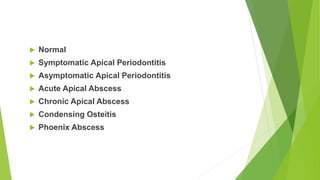
 Normal
 Symptomatic Apical Periodontitis
 Asymptomatic Apical Periodontitis
 Acute Apical Abscess
 Chronic Apical Abscess
 Condensing Osteitis
 Phoenix Abscess
CLINICAL AND
HISTOPATHOLOGICAL
FEATURES OF
PERIRADICULAR
LESIONS
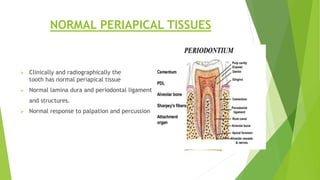
NORMAL PERIAPICAL TISSUES
 Clinically and radiographically the
tooth has normal periapical tissue
 Normal lamina dura and periodontal ligament
and structures.
 Normal response to palpation and percussion
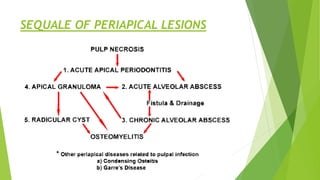
SEQUALE OF PERIAPICAL LESIONS
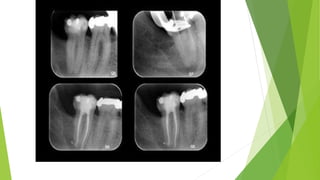
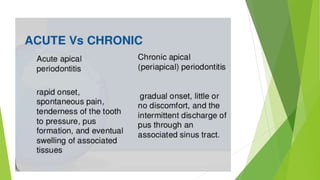
SYMPTOMATIC APICAL PERIODONTITIS
Clinical Features:
 Moderate to severe spontaneous discomfort as well as pain on biting or
percussion.
 Responsive to cold heat and electricity.
 Percussion can cause marked to excruciating pain.
 May or may not be associated with an apical radiolucent area.
 Thickening of PDL
 Normal PDL or intact lamina dura.
 Treatment adjustment of occlusion, removal of irritants or a pathologic
pulp or removal of periapical exudate.
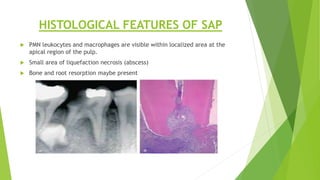
HISTOLOGICAL FEATURES OF SAP
 PMN leukocytes and macrophages are visible within localized area at the
apical region of the pulp.
 Small area of liquefaction necrosis (abscess)
 Bone and root resorption maybe present
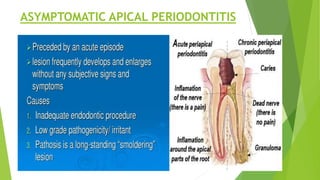
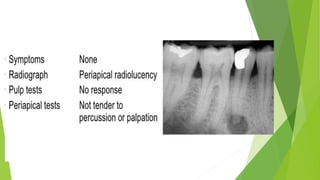
ASYMPTOMATIC APICAL PERIODONTITIS
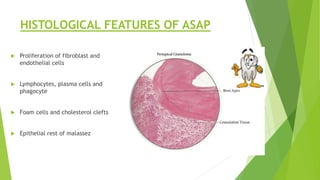
HISTOLOGICAL FEATURES OF ASAP
 Proliferation of fibroblast and
endothelial cells
 Lymphocytes, plasma cells and
phagocyte
 Foam cells and cholesterol clefts
 Epithelial rest of malassez
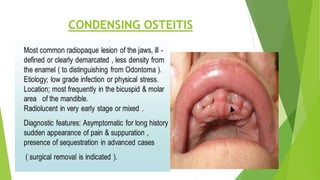
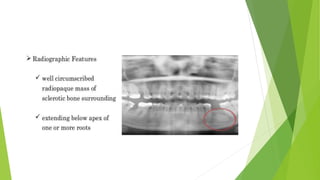
CONDENSING OSTEITIS
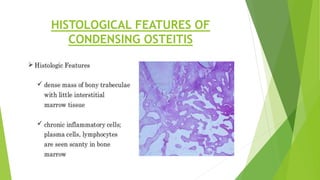
HISTOLOGICAL FEATURES OF
CONDENSING OSTEITIS
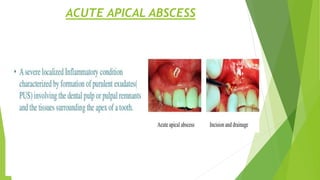
ACUTE APICAL ABSCESS
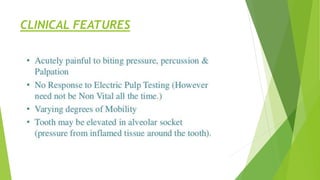
CLINICAL FEATURES
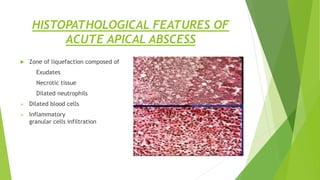
HISTOPATHOLOGICAL FEATURES OF
ACUTE APICAL ABSCESS
 Zone of liquefaction composed of
Exudates
Necrotic tissue
Dilated neutrophils
 Dilated blood cells
 Inflammatory
granular cells infiltration
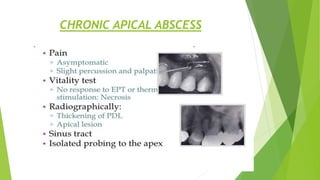
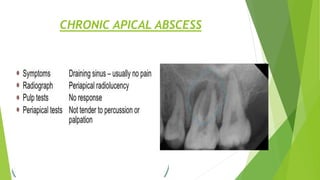
CHRONIC APICAL ABSCESS
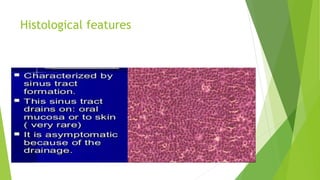
Histological features
LECTURE SUMMARY BY 2 STUDENTS
THANK YOU

LECT#4 1Pulpal and periradicular pathosis 2.pptx