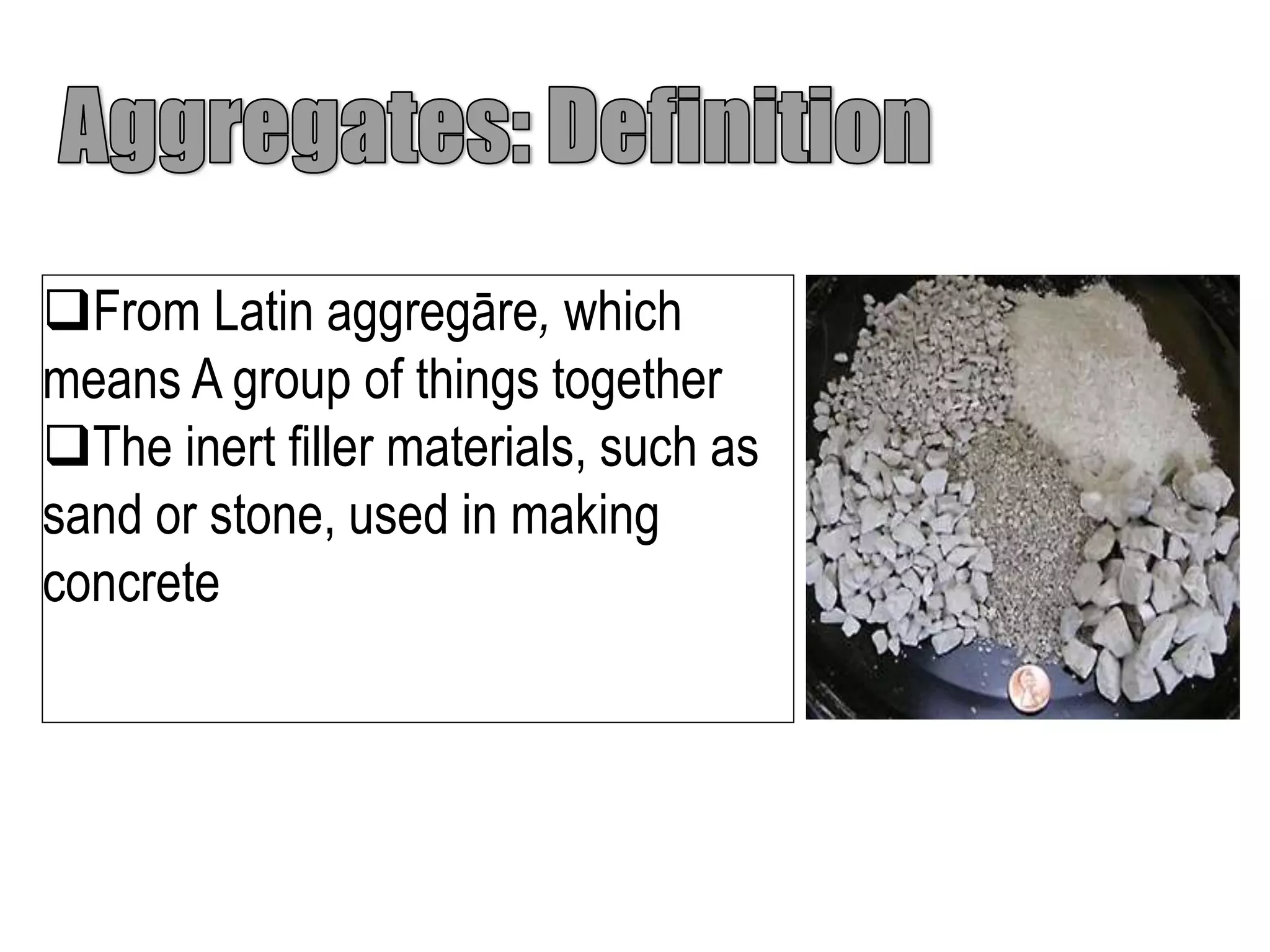
From Latin aggregāre, which
means A group of things together
The inert filler materials, such as
sand or stone, used in making
concrete
A crusher is a machine designed to reduce
large rocks into smaller rocks, gravel, or
rock dust.
 Fine aggregates or sand
 The particles range in diameter from
0.0625mm (or 1⁄16 mm, or 62.5
micrometers) to 2 millimeters (0.1 inch)
 Coarse aggregates or gravel
 The particles range in diameter from 2
mm up to 64 mm (2.5 in).
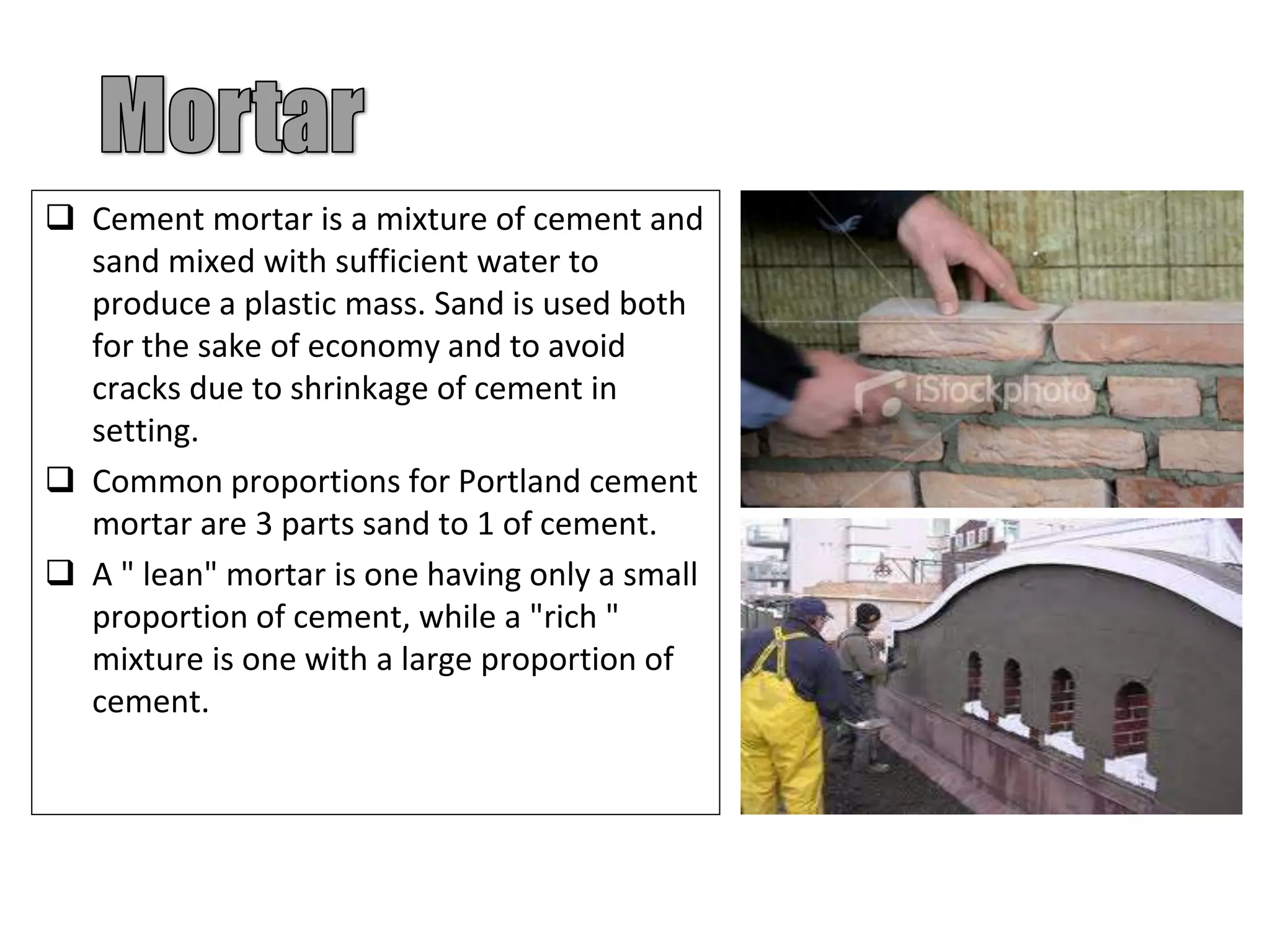
 Cement mortar is a mixture of cement and
sand mixed with sufficient water to
produce a plastic mass. Sand is used both
for the sake of economy and to avoid
cracks due to shrinkage of cement in
setting.
 Common proportions for Portland cement
mortar are 3 parts sand to 1 of cement.
 A " lean" mortar is one having only a small
proportion of cement, while a "rich "
mixture is one with a large proportion of
cement.
• 25-40% cement
(absolute volume of cement = 7-
15% ; water = 14-21 %)
• Up to 8% air (depending on top
size of coarse aggregate)
Therefore:
Aggregates make up 60-75% of
total volume of concrete.
 Classification according to strength
 Ordinary Concrete
Ordinary concrete has a varying strength from about 10 MPa (1450 psi) to about
40 MPa (5800 psi).
 High strength Concrete
High-strength concrete has a compressive strength generally greater than 6,000
pounds per square inch (40 MPa = 5800 psi). High-strength concrete is made by
lowering the water-cement (W/C) ratio to 0.35 or lower.
 Classification according to design
 Plain Cement Concrete (PCC)
In which no steel reinforcement is provided.
 Reinforced Cement Concrete (RCC)
In which steel reinforcement is provided to give tensile strength to concrete.
 Polymer concrete is prepared by
mixing synthetic resin or polymers
as a binder with an aggregate.
 The polymers are Polyethylene (PE),
polystyrene, polyvinyl chloride
(PVC)etc.
 Polymer concrete is costly and is
used for chemical resistant pipes,
light weight drainage channels, for
quick repair and strengthening
applications, and for structures
subjected to corrosion and erosion.
 SC mix usually consists of sulfur (2
per cent by weight), fine aggregate
(32 per cent by weight), coarse
aggregate (48 per cent by weight)
and a mineral filler such as crusher
dust or silica four.
 The mix contains no water or
cement. The ingredients are mixed
in a conventional mixer, which
contains a heater, at a temperature
of about 140°C. After mixing,
ingredients form a uniform mixture,
which can be cast into moulds.
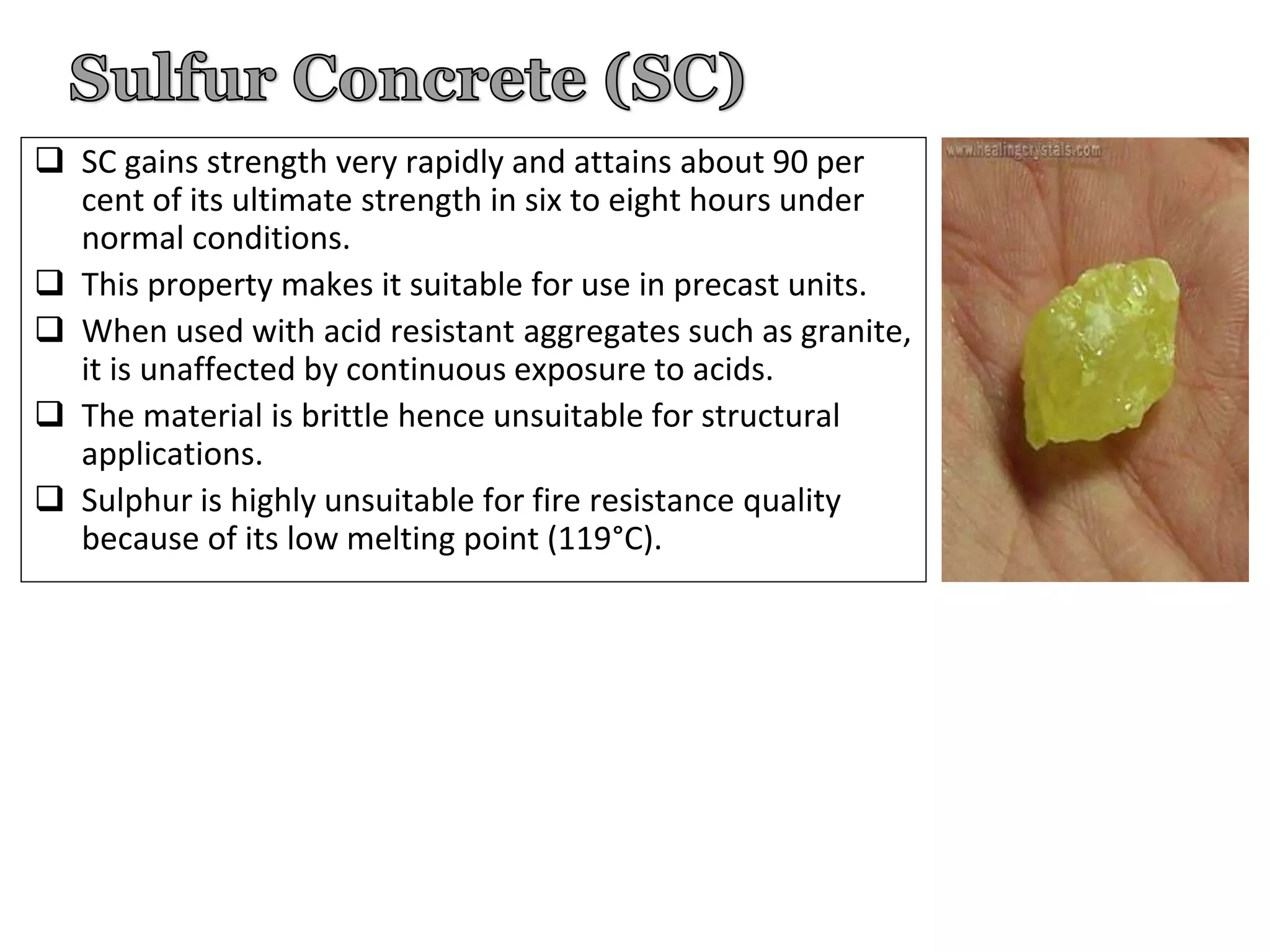
Fig. A SULPHUR MINER WORKS ON KAWAH IJEN VOLCANIC
CRATER IN EAST JAVA. THE MINERS TREK OVER FIVE MILES
WITH LOADS WEIGHING UP TO 220 POUNDS ON THEIR BACKS
TO EARN £4.50 A DAY
 SC gains strength very rapidly and attains about 90 per
cent of its ultimate strength in six to eight hours under
normal conditions.
 This property makes it suitable for use in precast units.
 When used with acid resistant aggregates such as granite,
it is unaffected by continuous exposure to acids.
 The material is brittle hence unsuitable for structural
applications.
 Sulphur is highly unsuitable for fire resistance quality
because of its low melting point (119°C).
 RCC is used for the construction of
dams, heavy-duty pavements and
parking areas.
 Roller-Compacted Concrete (RCC) is a
special blend of concrete that has the
same ingredients as conventional
concrete but in different ratios. It has
cement, water, and aggregates, but
RCC is much drier and essentially has
no slump.
 RCC is placed in a manner similar to
paving, often by dump trucks or
conveyors, spread by bulldozers or
special modified asphalt pavers. After
placement it is compacted by vibratory
rollers.
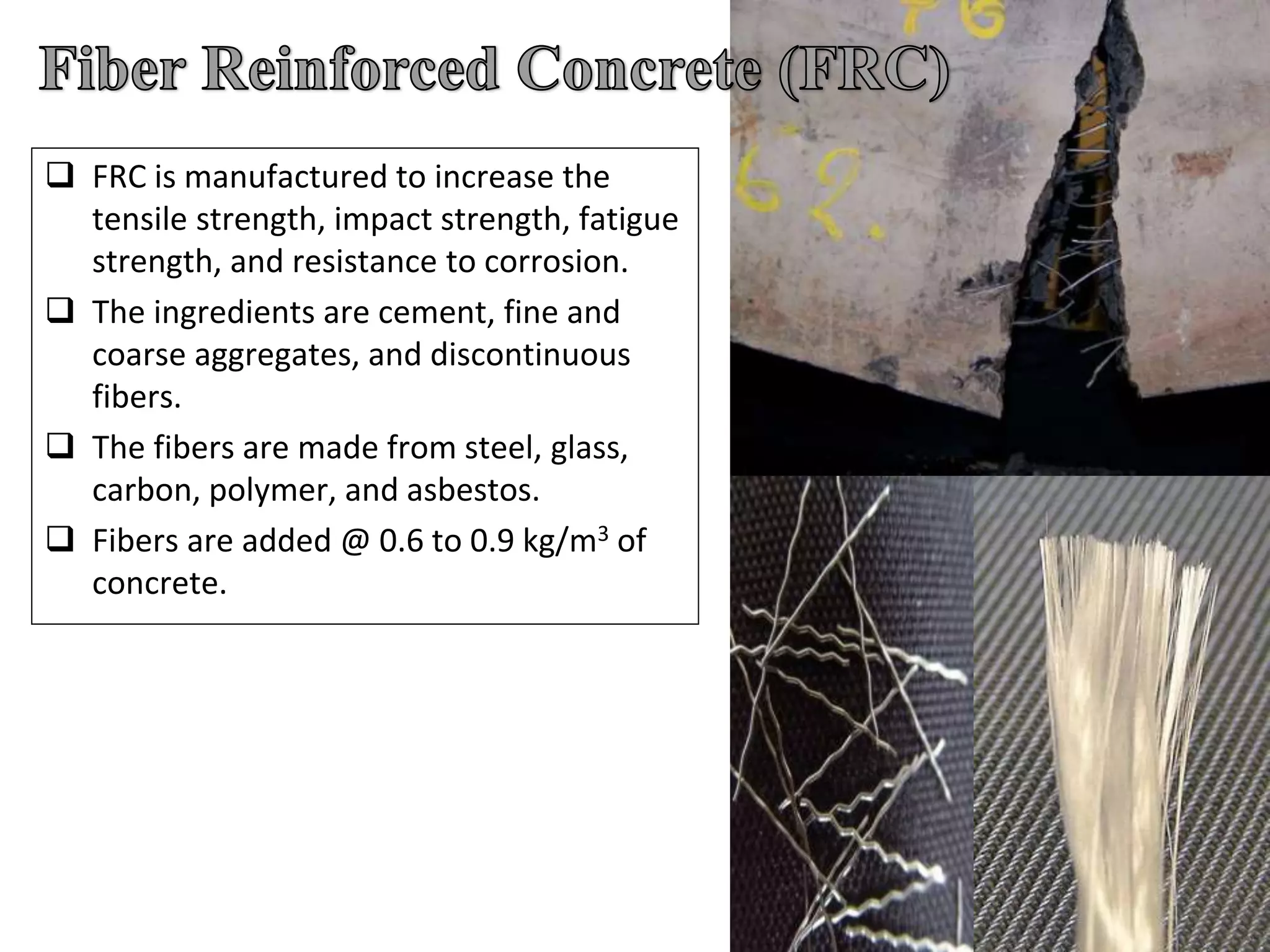
 FRC is manufactured to increase the
tensile strength, impact strength, fatigue
strength, and resistance to corrosion.
 The ingredients are cement, fine and
coarse aggregates, and discontinuous
fibers.
 The fibers are made from steel, glass,
carbon, polymer, and asbestos.
 Fibers are added @ 0.6 to 0.9 kg/m3 of
concrete.
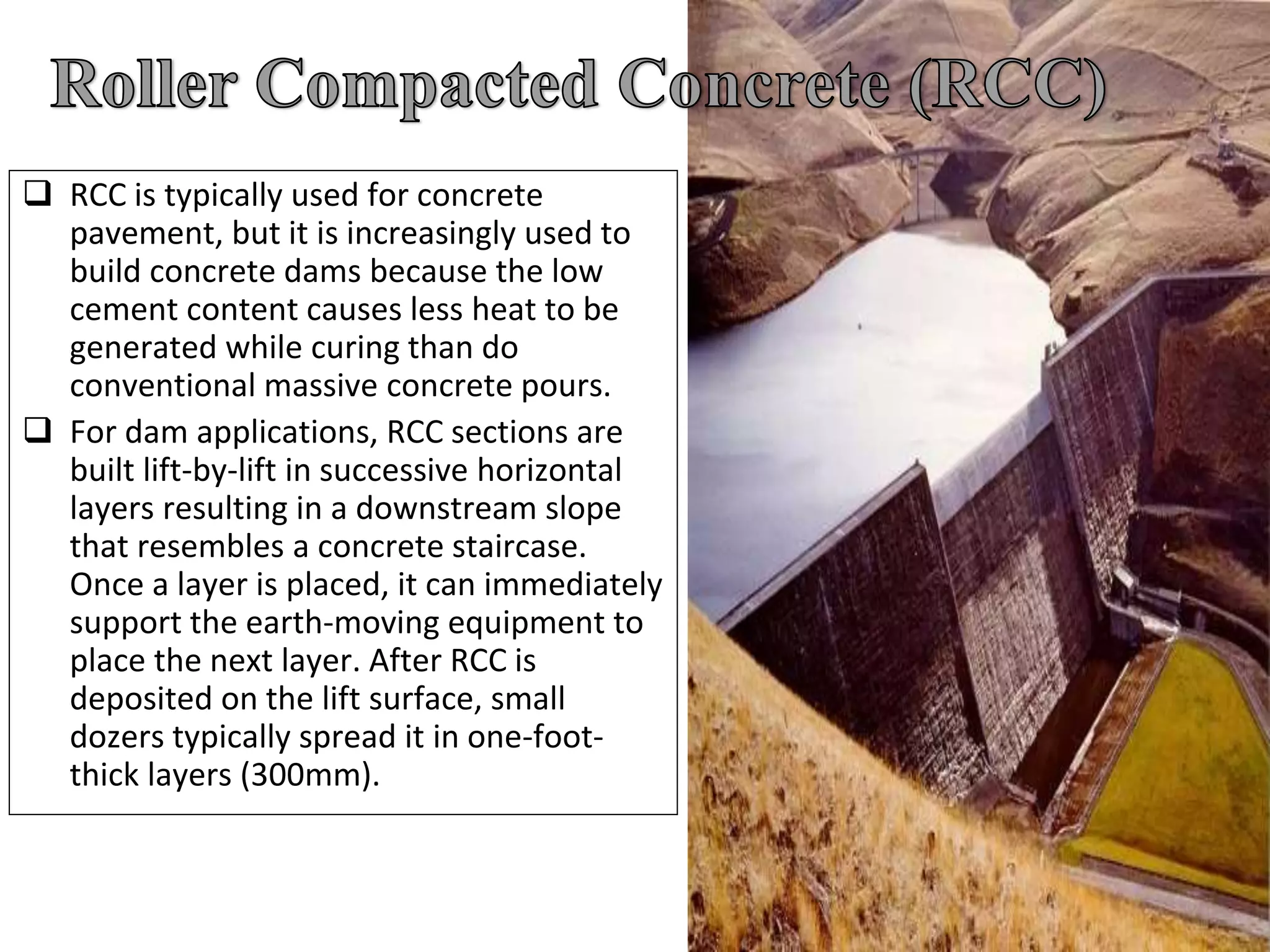
 RCC is typically used for concrete
pavement, but it is increasingly used to
build concrete dams because the low
cement content causes less heat to be
generated while curing than do
conventional massive concrete pours.
 For dam applications, RCC sections are
built lift-by-lift in successive horizontal
layers resulting in a downstream slope
that resembles a concrete staircase.
Once a layer is placed, it can immediately
support the earth-moving equipment to
place the next layer. After RCC is
deposited on the lift surface, small
dozers typically spread it in one-foot-
thick layers (300mm).
 Ferrocement is a composite material which is
used in building or sculpture with cement,
sand, water and wire or mesh material The
steel frame is made according to the
geometry and shape of the structure.
 The desired shape may be built from a multi-
layered construction of chicken wire or other
steel mesh, and if needed reinforced with
steel wire or steel bars. Over this finished
framework, an appropriate mixture of
cement, sand and water is spread out. During
hardening, the ferrocement is kept moist, to
ensure the cement is able to set and harden.
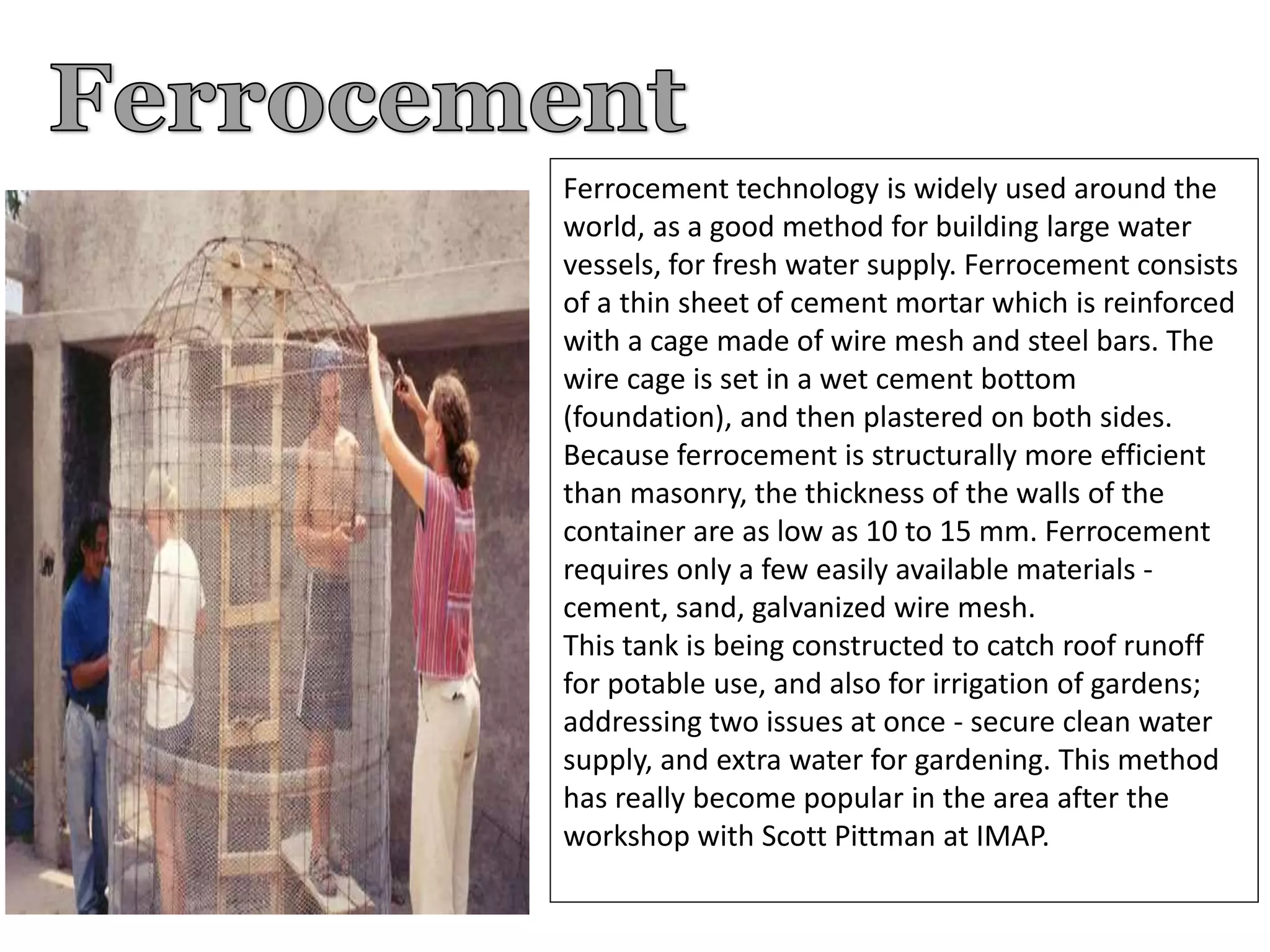
Ferrocement technology is widely used around the
world, as a good method for building large water
vessels, for fresh water supply. Ferrocement consists
of a thin sheet of cement mortar which is reinforced
with a cage made of wire mesh and steel bars. The
wire cage is set in a wet cement bottom
(foundation), and then plastered on both sides.
Because ferrocement is structurally more efficient
than masonry, the thickness of the walls of the
container are as low as 10 to 15 mm. Ferrocement
requires only a few easily available materials -
cement, sand, galvanized wire mesh.
This tank is being constructed to catch roof runoff
for potable use, and also for irrigation of gardens;
addressing two issues at once - secure clean water
supply, and extra water for gardening. This method
has really become popular in the area after the
workshop with Scott Pittman at IMAP.
 High strength or High Performance Concrete (HPC) is used in bridges, highways,
and in buildings.
 The strength varies from 70 to 140 MPa (10 to 20 Ksi).
 HPC usually consists water-cement ratio from 0.27 to 0.50, and a super
plasticizer. Cement content is from 392 to 557 kg/m3.
 In buildings, column sections can be reduced in size. The amount of
reinforcement can be reduced.
 HPC increases durability, enhances mechanical properties.
Chloride attack
Sulfate attack
Carbonation
Alkali-Aggregate reaction
Acid attack
Chlorides in de-icing salts or in soils, sea water and ground
water can enter concrete and destroy the passive oxide
film, which normally protects the steel against corrosion.
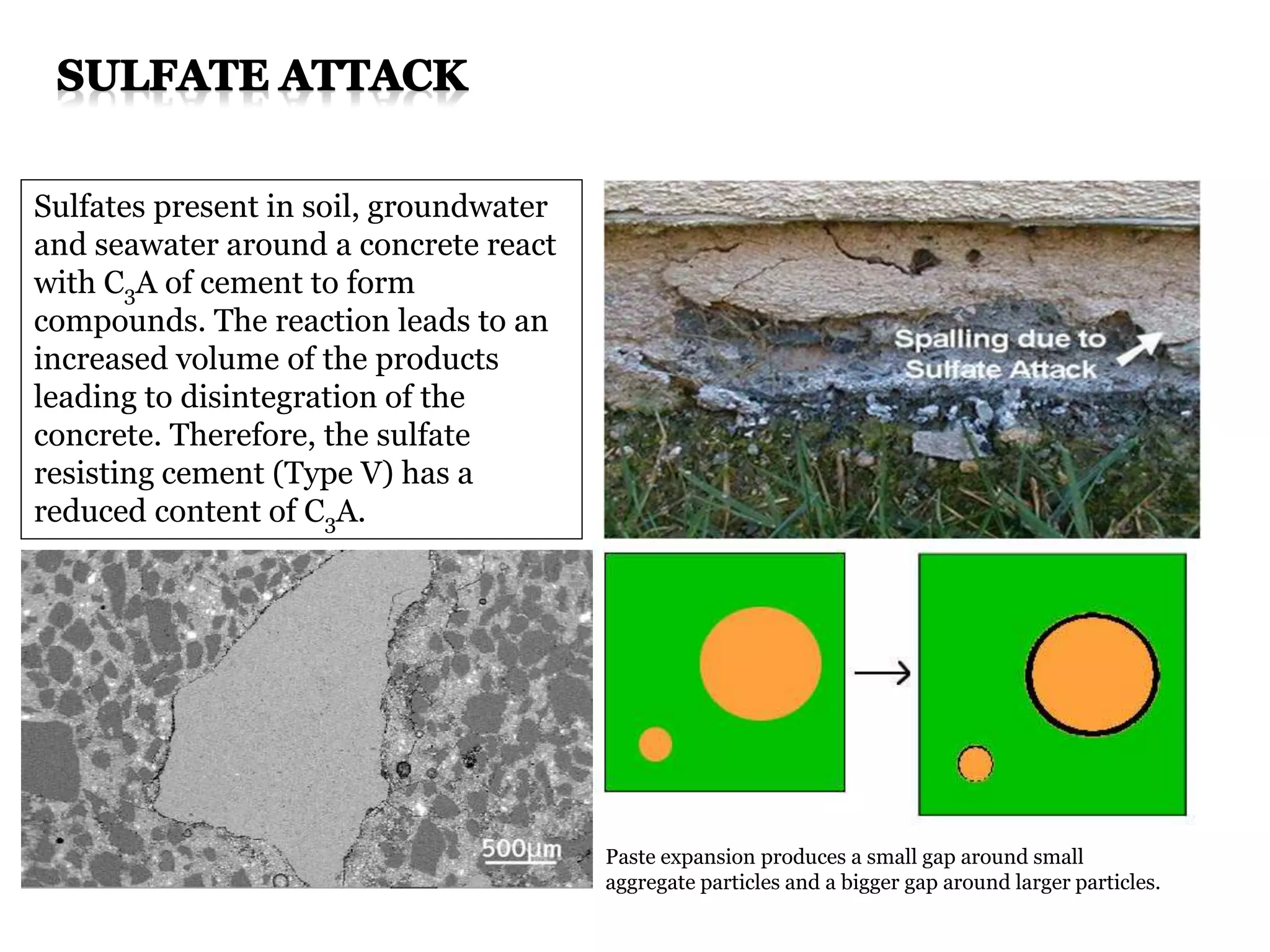
Paste expansion produces a small gap around small
aggregate particles and a bigger gap around larger particles.
Sulfates present in soil, groundwater
and seawater around a concrete react
with C3A of cement to form
compounds. The reaction leads to an
increased volume of the products
leading to disintegration of the
concrete. Therefore, the sulfate
resisting cement (Type V) has a
reduced content of C3A.
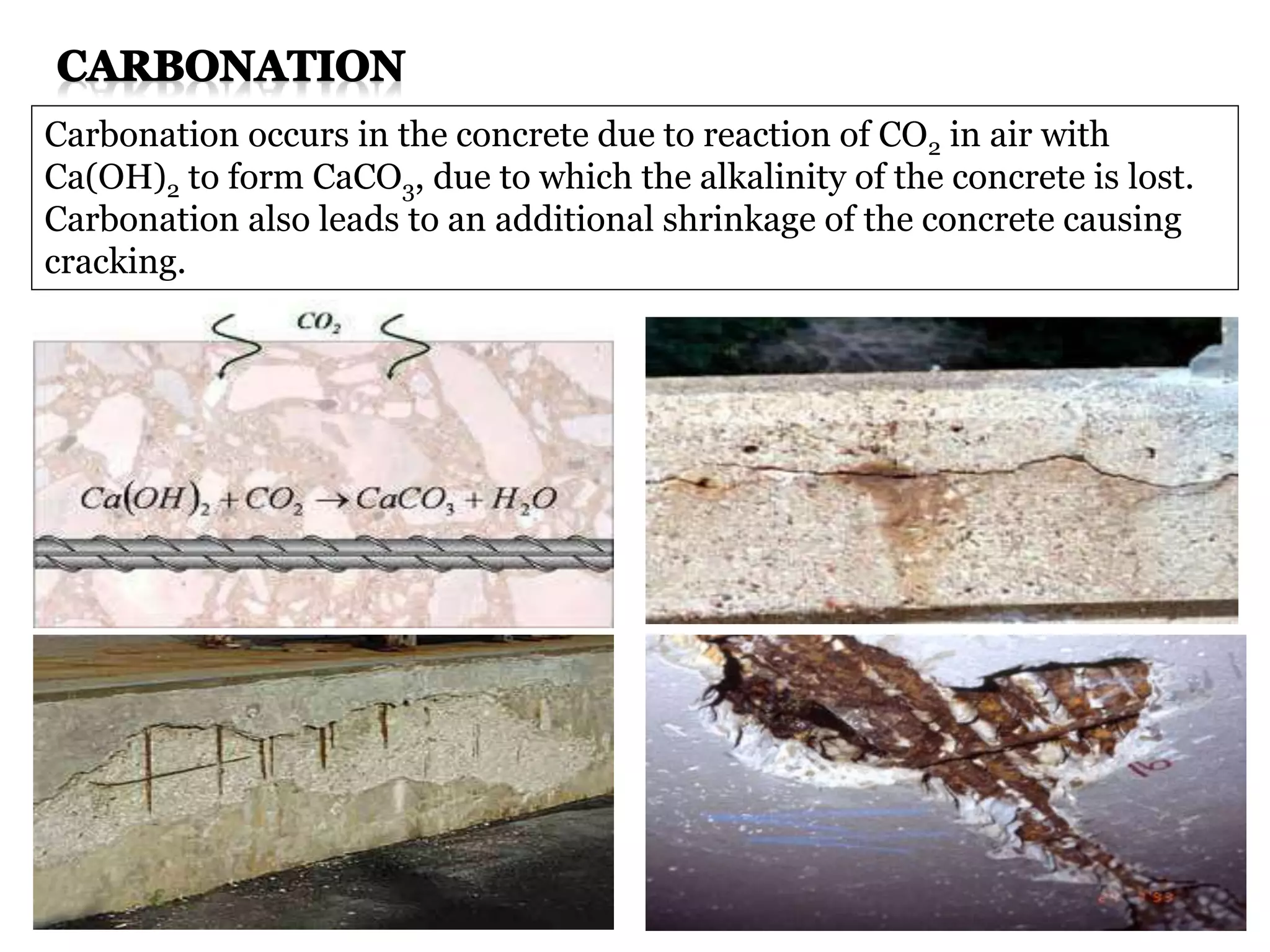
Carbonation occurs in the concrete due to reaction of CO2 in air with
Ca(OH)2 to form CaCO3, due to which the alkalinity of the concrete is lost.
Carbonation also leads to an additional shrinkage of the concrete causing
cracking.
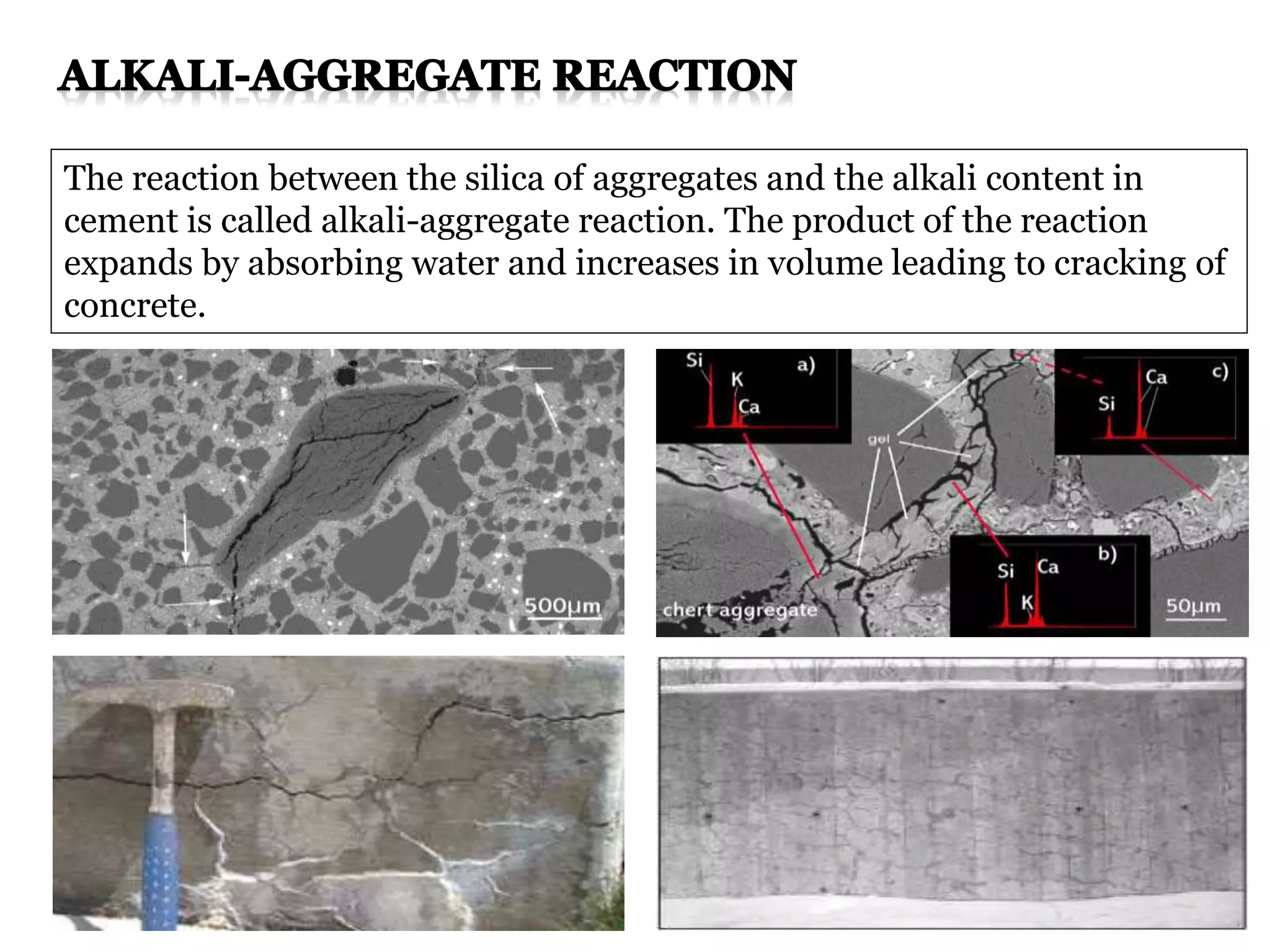
The reaction between the silica of aggregates and the alkali content in
cement is called alkali-aggregate reaction. The product of the reaction
expands by absorbing water and increases in volume leading to cracking of
concrete.
Concrete is not acid resistant. The reaction between Ca(OH)2 and acid
produces water-soluble calcium compounds, which are leached away.
Thus acid attack may remove a part of the set concrete.
lec#4Cementatious Mat.ppt

lec#4Cementatious Mat.ppt

  • 2.
    From Latin aggregāre,which means A group of things together The inert filler materials, such as sand or stone, used in making concrete
  • 3.
    A crusher isa machine designed to reduce large rocks into smaller rocks, gravel, or rock dust.
  • 4.
     Fine aggregatesor sand  The particles range in diameter from 0.0625mm (or 1⁄16 mm, or 62.5 micrometers) to 2 millimeters (0.1 inch)  Coarse aggregates or gravel  The particles range in diameter from 2 mm up to 64 mm (2.5 in).
  • 5.
     Cement mortaris a mixture of cement and sand mixed with sufficient water to produce a plastic mass. Sand is used both for the sake of economy and to avoid cracks due to shrinkage of cement in setting.  Common proportions for Portland cement mortar are 3 parts sand to 1 of cement.  A " lean" mortar is one having only a small proportion of cement, while a "rich " mixture is one with a large proportion of cement.
  • 6.
    • 25-40% cement (absolutevolume of cement = 7- 15% ; water = 14-21 %) • Up to 8% air (depending on top size of coarse aggregate) Therefore: Aggregates make up 60-75% of total volume of concrete.
  • 7.
     Classification accordingto strength  Ordinary Concrete Ordinary concrete has a varying strength from about 10 MPa (1450 psi) to about 40 MPa (5800 psi).  High strength Concrete High-strength concrete has a compressive strength generally greater than 6,000 pounds per square inch (40 MPa = 5800 psi). High-strength concrete is made by lowering the water-cement (W/C) ratio to 0.35 or lower.
  • 8.
     Classification accordingto design  Plain Cement Concrete (PCC) In which no steel reinforcement is provided.  Reinforced Cement Concrete (RCC) In which steel reinforcement is provided to give tensile strength to concrete.
  • 10.
     Polymer concreteis prepared by mixing synthetic resin or polymers as a binder with an aggregate.  The polymers are Polyethylene (PE), polystyrene, polyvinyl chloride (PVC)etc.  Polymer concrete is costly and is used for chemical resistant pipes, light weight drainage channels, for quick repair and strengthening applications, and for structures subjected to corrosion and erosion.
  • 11.
     SC mixusually consists of sulfur (2 per cent by weight), fine aggregate (32 per cent by weight), coarse aggregate (48 per cent by weight) and a mineral filler such as crusher dust or silica four.  The mix contains no water or cement. The ingredients are mixed in a conventional mixer, which contains a heater, at a temperature of about 140°C. After mixing, ingredients form a uniform mixture, which can be cast into moulds. Fig. A SULPHUR MINER WORKS ON KAWAH IJEN VOLCANIC CRATER IN EAST JAVA. THE MINERS TREK OVER FIVE MILES WITH LOADS WEIGHING UP TO 220 POUNDS ON THEIR BACKS TO EARN £4.50 A DAY
  • 12.
     SC gainsstrength very rapidly and attains about 90 per cent of its ultimate strength in six to eight hours under normal conditions.  This property makes it suitable for use in precast units.  When used with acid resistant aggregates such as granite, it is unaffected by continuous exposure to acids.  The material is brittle hence unsuitable for structural applications.  Sulphur is highly unsuitable for fire resistance quality because of its low melting point (119°C).
  • 13.
     RCC isused for the construction of dams, heavy-duty pavements and parking areas.  Roller-Compacted Concrete (RCC) is a special blend of concrete that has the same ingredients as conventional concrete but in different ratios. It has cement, water, and aggregates, but RCC is much drier and essentially has no slump.  RCC is placed in a manner similar to paving, often by dump trucks or conveyors, spread by bulldozers or special modified asphalt pavers. After placement it is compacted by vibratory rollers.
  • 14.
     FRC ismanufactured to increase the tensile strength, impact strength, fatigue strength, and resistance to corrosion.  The ingredients are cement, fine and coarse aggregates, and discontinuous fibers.  The fibers are made from steel, glass, carbon, polymer, and asbestos.  Fibers are added @ 0.6 to 0.9 kg/m3 of concrete.
  • 15.
     RCC istypically used for concrete pavement, but it is increasingly used to build concrete dams because the low cement content causes less heat to be generated while curing than do conventional massive concrete pours.  For dam applications, RCC sections are built lift-by-lift in successive horizontal layers resulting in a downstream slope that resembles a concrete staircase. Once a layer is placed, it can immediately support the earth-moving equipment to place the next layer. After RCC is deposited on the lift surface, small dozers typically spread it in one-foot- thick layers (300mm).
  • 16.
     Ferrocement isa composite material which is used in building or sculpture with cement, sand, water and wire or mesh material The steel frame is made according to the geometry and shape of the structure.  The desired shape may be built from a multi- layered construction of chicken wire or other steel mesh, and if needed reinforced with steel wire or steel bars. Over this finished framework, an appropriate mixture of cement, sand and water is spread out. During hardening, the ferrocement is kept moist, to ensure the cement is able to set and harden.
  • 17.
    Ferrocement technology iswidely used around the world, as a good method for building large water vessels, for fresh water supply. Ferrocement consists of a thin sheet of cement mortar which is reinforced with a cage made of wire mesh and steel bars. The wire cage is set in a wet cement bottom (foundation), and then plastered on both sides. Because ferrocement is structurally more efficient than masonry, the thickness of the walls of the container are as low as 10 to 15 mm. Ferrocement requires only a few easily available materials - cement, sand, galvanized wire mesh. This tank is being constructed to catch roof runoff for potable use, and also for irrigation of gardens; addressing two issues at once - secure clean water supply, and extra water for gardening. This method has really become popular in the area after the workshop with Scott Pittman at IMAP.
  • 18.
     High strengthor High Performance Concrete (HPC) is used in bridges, highways, and in buildings.  The strength varies from 70 to 140 MPa (10 to 20 Ksi).  HPC usually consists water-cement ratio from 0.27 to 0.50, and a super plasticizer. Cement content is from 392 to 557 kg/m3.  In buildings, column sections can be reduced in size. The amount of reinforcement can be reduced.  HPC increases durability, enhances mechanical properties.
  • 19.
  • 20.
    Chlorides in de-icingsalts or in soils, sea water and ground water can enter concrete and destroy the passive oxide film, which normally protects the steel against corrosion.
  • 21.
    Paste expansion producesa small gap around small aggregate particles and a bigger gap around larger particles. Sulfates present in soil, groundwater and seawater around a concrete react with C3A of cement to form compounds. The reaction leads to an increased volume of the products leading to disintegration of the concrete. Therefore, the sulfate resisting cement (Type V) has a reduced content of C3A.
  • 22.
    Carbonation occurs inthe concrete due to reaction of CO2 in air with Ca(OH)2 to form CaCO3, due to which the alkalinity of the concrete is lost. Carbonation also leads to an additional shrinkage of the concrete causing cracking.
  • 23.
    The reaction betweenthe silica of aggregates and the alkali content in cement is called alkali-aggregate reaction. The product of the reaction expands by absorbing water and increases in volume leading to cracking of concrete.
  • 24.
    Concrete is notacid resistant. The reaction between Ca(OH)2 and acid produces water-soluble calcium compounds, which are leached away. Thus acid attack may remove a part of the set concrete.