HACCP implementation for traditional fish processing techniques.pptx
1.
Arish university
Faculty ofAquaculture and marine fisheries
HACCP implementation for
traditional fish processing
techniques
Submitted by
Nagy Ibrahim Ali
Hager Maged Basuony
Submitted to
Dr . Hassan Rab3
2.
1. Traditional FishProcessing Techniques
• Focus: Traditional Fish Smoking
2. HACCP application to traditional fish smoking
Table of contents
3.
Traditional fish processingtechniques
• Typically operated as small and less developed businesses (SLDB)
• Techniques
• Smoking
• Salting
• Fermentation
• Frying
• Sun/solar drying
4.
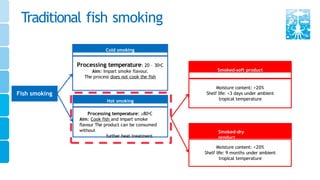
Traditional fish smoking
Fishsmoking
Cold smoking
Processing temperature: 20 – 30oC
Aim: Impart smoke flavour.
The process does not cook the fish
Hot smoking
Processing temperature: ≥80oC
Aim: Cook fish and impart smoke
flavour The product can be consumed
without
further heat treatment
Smoked-soft product
Moisture content: >20%
Shelf life: <3 days under ambient
tropical temperature
Smoked-dry
product
Moisture content: <20%
Shelf life: 9 months under ambient
tropical temperature
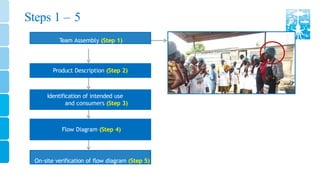
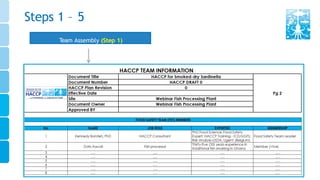
Steps 1 –5
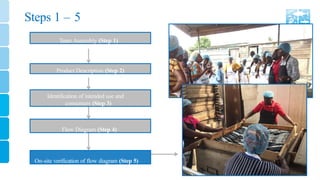
On-site verification of flow diagram (Step 5)
Team Assembly (Step 1)
Flow Diagram (Step 4)
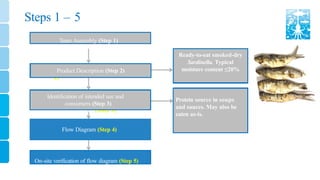
Ready-to-eat smoked-
dry
Sardinella. Typical
moisture content ≤20%
Protein source in soups
and sauces. May also
be eaten as-is.
Consumers: ≥ 6 m old*
Product Description (Step
2)
Product Description (Step 2)
Identification of intended use
and
consumers (Step 3)
Identification of intended use and
consumers (Step 3)
Ready-to-eat smoked-dry
Sardinella. Typical
moisture content ≤20%
Protein source in soups
and sauces. May also be
eaten as-is.
9.
Smoked-dry Sardinella
Air cooling
Heatand smoke curing
Air drying
Gutting C Slicing
Washing
Washing
Packaging
Step 4: Process Flow Diagram
Fresh fish Frozen fish
Thawing
~15 mins, ambient temp. (~25oC)
~180oC heat source, 4 h, internal fish temp. ~80oC
Principle 1: HazardAnalysis (HACCP Step 6)
Hazard: Biological, chemical or physical agent in, or condition of food with potential to cause adverse health effect
(Codex)
Hazard analysis requirements:
i. List ALL POTENTIAL hazards
ii. Identify SIGNIFICANT hazards
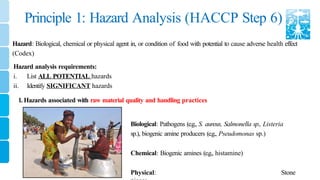
1. Hazards associated with raw material quality and handling practices
Biological: Pathogens (e.g., S. aureus, Salmonella sp., Listeria
sp.), biogenic amine producers (e.g., Pseudomonas sp.)
Chemical: Biogenic amines (e.g., histamine)
Physical: Stone
13.
Chemicals in thesmoke [e.g., Polycyclic Aromatic Hydrocarbons (PAHs)]
2. Hazards associated with the smoking technique
Principle 1: Hazard Analysis (HACCP Step 6)
14.
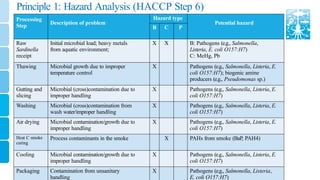
Principle 1: HazardAnalysis (HACCP Step 6)
Processing
Step
Description of problem
Hazard type
Potential hazard
B C P
Raw
Sardinella
receipt
Initial microbial load; heavy metals
from aquatic environment;
X X B: Pathogens (e.g., Salmonella,
Listeria, E. coli O157:H7)
C: MeHg, Pb
Thawing Microbial growth due to improper
temperature control
X Pathogens (e.g., Salmonella, Listeria, E.
coli O157:H7); biogenic amine
producers (e.g., Pseudomonas sp.)
Gutting and
slicing
Microbial (cross)contamination due to
improper handling
X Pathogens (e.g., Salmonella, Listeria, E.
coli O157:H7)
Washing Microbial (cross)contamination from
wash water/improper handling
X Pathogens (e.g., Salmonella, Listeria, E.
coli O157:H7)
Air drying Microbial contamination/growth due to
improper handling
X Pathogens (e.g., Salmonella, Listeria, E.
coli O157:H7)
Heat C smoke
curing
Process contaminants in the smoke X PAHs from smoke (BaP, PAH4)
Cooling Microbial contamination/growth due to
improper handling
X Pathogens (e.g., Salmonella, Listeria, E.
coli O157:H7)
Packaging Contamination from unsanitary
handling
X Pathogens (e.g., Salmonella, Listeria,
E. coli O157:H7)
15.
Principle 1: HazardAnalysis (HACCP Step 6)
• Not all
ha
• Significan
ards ar
t
hazard
e significant
s pose risks to public health in
t
he absence of
controls
• Risk =
Like
lihood x Severity of adverse health
effec
t
Category Score Likelihood Severity
Low (L)
z 1 Unlikely to happen (e.g., 0-1 per 100 batches) No serious impact on health
Medium (M) 2 May happen (e.g., once per 50 batches) Adverse but non-fatal effect
High (H) 3 Very high (e.g., every batch) Adverse, potentially fatal effect
High risk = Significant hazard
Medium Risk = Not significant hazard
Low Risk = Not significant
hazard;
16.
Principle 1: Hazard
Analysis
Processing
Step
Potentialhazard Likelihood Severity Risk
Frozen
Sardinella
receipt
B: Pathogens (e.g.,
Salmonella, Listeria, E. coli
O157:H7)
[*C: MeHg, Pb]
1 2 2
Thawing Pathogens (e.g.,
Salmonella, Listeria, E. coli
O157:H7)
2 2 4
Wash, Gut
and slice
Pathogens (e.g.,
Salmonella, Listeria, E. coli
O157:H7)
2 2 4
Washing Pathogens (e.g.,
Salmonella, Listeria, E. coli
O157:H7)
1 2 2
Air drying Pathogens (e.g.,
Salmonella, Listeria, E. coli
O157:H7)
1 2 2
Heat s smoke
curing
PAHs from smoke (BaP, PAH4) 3 3 9
Cooling Pathogens (e.g., Salmonella,
Listeria, E. coli O157:H7)
1 2 2
High risk = Significant
Medium Risk = Manage by
PRP
Low Risk = Manage by PRP
PAHs = Significant
hazards
17.
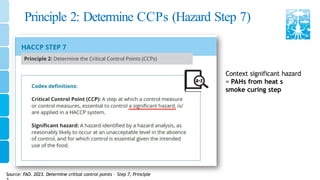
Principle 2: DetermineCCPs (Hazard Step 7)
Source: FAO. 2023. Determine critical control points – Step 7, Principle
Context significant hazard
= PAHs from heat s
smoke curing step
Smoked-dry Sardinella
Air cooling
Air
drying
Washing
GuttingC
Slicing
Washing
Washing
Packaging
Principle 2: Determine CCPs (Hazard Step 7)
Fresh fish Frozen fish
Thawing
NOT CCPs
See Q1 s Q2
Gutting C Slicing
Washing
Air drying
Heat and smoke
curing
Thawing
20.
Air cooling
Smoked-dry Sardinella
Heatand smoke
curing
Air
drying
Washing
Gutting C
Slicing
Washing
Washing
Packaging
Principle 2: Determine CCPs (HACCP Step 7)
Fresh fish Frozen fish
Thawing
Green = NOT
CCPs See Q1 s
Q2
Gutting C Slicing
Washing
Air drying
Thawing
Heat and smoke curing
CCP 1
Confirmed
at Q4
21.
Smoked-dry Sardinella
Air
cooling
Heat andsmoke
curing
Air
drying
Washing
Gutting C
Slicing
Washing
Washing
Packaging
Principle 2: Determine CCPs (HACCP Step 7)
Fresh fish Frozen fish
Thawing
Green = NOT
CCPs See Q1 s
Q2
Gutting C Slicing
Washing
Air drying
Thawing
Heat and smoke curing
CCP 1-(C)
Confirmed
at Q4
Air cooling Packaging
Manage by PRPs
Control measure should be applied at
this point [CCP 1-(C)]
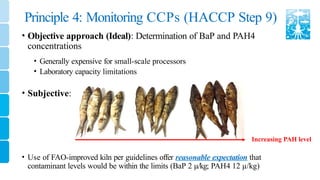
Principle 4: MonitoringCCPs (HACCP Step 9)
• Objective approach (Ideal): Determination of BaP and PAH4
concentrations
• Generally expensive for small-scale processors
• Laboratory capacity limitations
• Subjective:
Increasing PAH level
• Use of FAO-improved kiln per guidelines offer reasonable expectation that
contaminant levels would be within the limits (BaP 2 µ/kg; PAH4 12 µ/kg)
25.
Principle 5: CorrectiveActions (HACCP Step 10)
• Root cause analysis of the deviation (BaP and PAH4 > critical limits)
• Kiln operation
• Fuel type
• Duration of heat and smoke exposure
26.
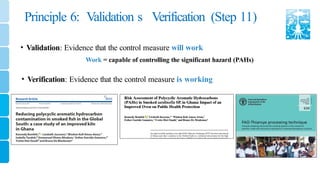
Principle 6: Validations Verification (Step 11)
• Validation: Evidence that the control measure will work
Work = capable of controlling the significant hazard (PAHs)
• Verification: Evidence that the control measure is working
27.
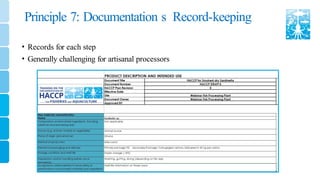
Principle 7: Documentations Record-keeping
• Records for each step
• Generally challenging for artisanal processors
28.
Principle 7: Documentations Record-keeping
• Records for each step
• Generally challenging for artisanal processors
29.
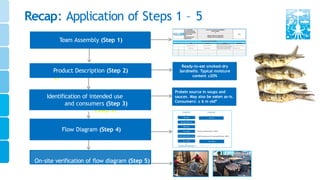
Recap: Application ofSteps 1 – 5
On-site verification of flow diagram (Step 5)
Team Assembly (Step 1)
Flow Diagram (Step 4)
Ready-to-eat smoked-dry
Sardinella. Typical moisture
content ≤20%
Protein source in soups and
sauces. May also be eaten as-is.
Consumers: ≥ 6 m old*
Product Description (Step
2)
Product Description (Step 2)
Identification of intended use
and
consumers (Step 3)
Identification of intended use
and consumers (Step 3)




![Chemicals in the smoke [e.g., Polycyclic Aromatic Hydrocarbons (PAHs)]
2. Hazards associated with the smoking technique
Principle 1: Hazard Analysis (HACCP Step 6)](https://image.slidesharecdn.com/haccpimplementationfortraditionalfishprocessingtechniques-250609120957-69d741f3/85/HACCP-implementation-for-traditional-fish-processing-techniques-pptx-13-320.jpg)

![Principle 1: Hazard
Analysis
Processing
Step
Potential hazard Likelihood Severity Risk
Frozen
Sardinella
receipt
B: Pathogens (e.g.,
Salmonella, Listeria, E. coli
O157:H7)
[*C: MeHg, Pb]
1 2 2
Thawing Pathogens (e.g.,
Salmonella, Listeria, E. coli
O157:H7)
2 2 4
Wash, Gut
and slice
Pathogens (e.g.,
Salmonella, Listeria, E. coli
O157:H7)
2 2 4
Washing Pathogens (e.g.,
Salmonella, Listeria, E. coli
O157:H7)
1 2 2
Air drying Pathogens (e.g.,
Salmonella, Listeria, E. coli
O157:H7)
1 2 2
Heat s smoke
curing
PAHs from smoke (BaP, PAH4) 3 3 9
Cooling Pathogens (e.g., Salmonella,
Listeria, E. coli O157:H7)
1 2 2
High risk = Significant
Medium Risk = Manage by
PRP
Low Risk = Manage by PRP
PAHs = Significant
hazards](https://image.slidesharecdn.com/haccpimplementationfortraditionalfishprocessingtechniques-250609120957-69d741f3/85/HACCP-implementation-for-traditional-fish-processing-techniques-pptx-16-320.jpg)


![Smoked-dry Sardinella
Air
cooling
Heat and smoke
curing
Air
drying
Washing
Gutting C
Slicing
Washing
Washing
Packaging
Principle 2: Determine CCPs (HACCP Step 7)
Fresh fish Frozen fish
Thawing
Green = NOT
CCPs See Q1 s
Q2
Gutting C Slicing
Washing
Air drying
Thawing
Heat and smoke curing
CCP 1-(C)
Confirmed
at Q4
Air cooling Packaging
Manage by PRPs
Control measure should be applied at
this point [CCP 1-(C)]](https://image.slidesharecdn.com/haccpimplementationfortraditionalfishprocessingtechniques-250609120957-69d741f3/85/HACCP-implementation-for-traditional-fish-processing-techniques-pptx-21-320.jpg)





![Guidehaccpplan[1]](https://cdn.slidesharecdn.com/ss_thumbnails/guidehaccpplan1-171129082810-thumbnail.jpg?width=640&height=640&fit=bounds)


