 Heart sounds are the sounds produced by
mechanical activities of heart during each
cardiac cycle.
 Heart sounds are produced by:
 1. Closure of valves of the heart.
 2. Flow of blood through cardiac chambers
 3. Contraction of cardiac muscle
 Heart sounds are heard by placing the ear
over the chest or by using a stethoscope
 Heart sounds can also be recorded
graphically.
 Four heart sounds are produced during each
cardiac cycle:
 1. First heart sound
 2. Second heart sound
 3. Third heart sound
 4. Fourth heart sound.
 Heart sounds are studied by three methods:
 1. By using stethoscope (most common)
 2. By using microphone
 3. By using phonocardiogram.(graphical
recording)
 First and second heart sounds are called
classical heart sounds and are heard by using
the stethoscope. (normally heard by
stethoscope)
 These two sounds are more prominent and
resemble the spoken words ‘LUB, (or LUBB)
and ‘DUBB’ (or DUP), respectively.
 Third heart sound is a mild sound and it is
not heard by using stethoscope in normal
conditions. But it can be heard by using a
microphone.
 Fourth heart sound is an inaudible sound. It
becomes audible in pathological conditions
only. This sound is studied only graphically.
 Study of heart sounds has important
diagnostic value in clinical practice because
alteration in the heart sounds indicates
cardiac diseases involving valves of the heart.
 Major cause for first heart sound is the
sudden and synchronous (simultaneous)
closure of atrioventricular valves.
 Resembles the word ‘LUBB’
 Second heart sound is produced due to the
sudden and synchronous closure of the
semilunar valves.
 Resembles the word ‘DUBB’
 Produced due to Rushing of blood into
ventricles during the filling phase of the
cardiac cycle.
 It is inaudible by stethoscope.
 Can only be heard by using microphone.
 It is produced due to contraction of atrial
musculature.
 Normally, the fourth heart sound is an
inaudible sound.
 It becomes audible only in pathological
conditions.
 It is studied only by graphical recording
Only first and second heart
sounds are audible by
stethoscope
 Cardiac murmur is the abnormal or unusual
heart sound.
 It is also called abnormal heart sound
 Any other sound heard on stethoscope other
than the normal heart sounds is called a
murmur.
 Cardiac murmur is heard by stethoscope,
along with normal heart sounds.
 Cardiac murmur is produced because of
change in the pattern of blood flow.
Normally, blood flows in streamline through
the heart and blood vessels.
 However, during abnormal conditions like
valvular diseases, the blood flow becomes
turbulent. It produces the cardiac murmur.
 Valvular diseases are of two types:
 1. Stenosis
 2. Incompetence.
 1. Stenosis
 Stenosis means narrowing of heart valve.
Blood flows rapidly with turbulence through
the narrow orifice of the valve, resulting in
murmur.
 2. Incompetence
 Incompetence refers to weakening of the
heart valve. When the valve becomes weak, it
cannot close properly. It causes back flow of
blood, resulting in turbulence.
 Cardiac murmur is classified into three types:
 A. Systolic murmur
 B. Diastolic murmur
 C. Continuous murmur.
 SYSTOLIC MURMUR
 Systolic murmur is the murmur which is
produced during systole.(contraction of
cardiac chambers)
 DIASTOLIC MURMUR
 Diastolic murmur is the murmur that is
produced during diastole. (relaxation of
cardiac chambers)
 CONTINUOUS MURMUR
 Heard both during systole and diastole.
 It is the graphical record or of electrical activities of
the heart and conduction of impulses through the
heart.
 USES OF ECG
 Electrocardiogram is useful in determining and
 diagnosing the following:
 1. Heart rate
 2. Heart rhythm
 3. Abnormal electrical conduction
 4. Poor blood flow to heart muscle (ischemia)
 5. Heart attack
 6. Coronary artery disease
 7. Hypertrophy of heart chambers
 ECG shows the spread of electrical signals
generated by SA node as it travels through
the AV node and the ventricles.
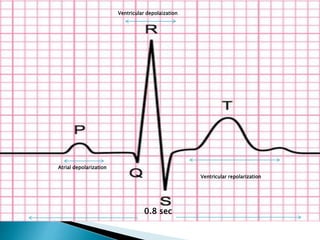
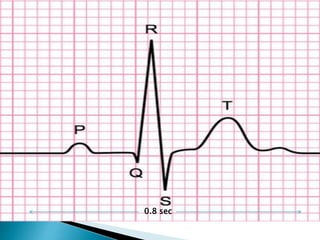
 The normal ECG tracing shows five waves
which, by convention, have been named P, Q,
R, S and T.
0.8 sec
Atrial depolarization
Ventricular depolaization
Ventricular repolarization
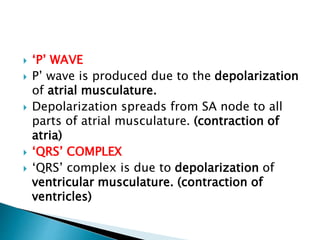
 ‘P’ WAVE
 P’ wave is produced due to the depolarization
of atrial musculature.
 Depolarization spreads from SA node to all
parts of atrial musculature. (contraction of
atria)
 ‘QRS’ COMPLEX
 ‘QRS’ complex is due to depolarization of
ventricular musculature. (contraction of
ventricles)
0.8 sec
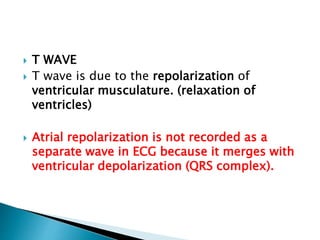
 T WAVE
 T wave is due to the repolarization of
ventricular musculature. (relaxation of
ventricles)
 Atrial repolarization is not recorded as a
separate wave in ECG because it merges with
ventricular depolarization (QRS complex).
 Heart rate refers to the number of times
the heart beats in a minute.
 It is normally 70-80 beats per minute (72
bpm in an average adult male at rest).
 When rhythmic cardiac impulses normally
originate in SA node, it is called the normal
sinus rhythm.
 A sinus rhythm is any cardiac rhythm in which
depolarization of the cardiac muscle begins
at the sinus node.
 Autonomic nervous system
 It is the most important determinant of heart rate.
 Heart is influenced by autonomic (sympathetic and
parasympathetic) nerves originating in the
cardiovascular centre in the medulla oblongata.
 The vagus nerves (parasympathetic) supply mainly
the SA and AV nodes and atrial muscle.
Parasympathetic stimulation reduces the rate at
which impulses are produced, decreasing the rate
and force of the heartbeat.
 The sympathetic nerves supply the SA and AV nodes
and the myocardium of atria and ventricles.
Sympathetic stimulation increases the rate and force
of the heartbeat.
 Impulses from higher centers (hypothalamus
and frontal lobe
 Excitement increases HR
 Sudden shock decreases HR.
 Respiration
 During Inspiration there is an increase in
HR(increase in venous return)
 During expiration there is a decrease in HR
 Moderate increase in Carbon dioxide….
Stimulates HR
 Decrease in Oxygen….increases HR.
 Increase in body temperature
 In fever HR increases (due to release of
pyrogens and interleukins)
 Muscular exercise
 Increases HR
 Thyroxine
 Increases HR by increasing BMR and
metabolism
 Heart rate less than 60 bpm is called bradycardia.
 Causes:
 Sleep
 Athletes
 Sinus Bradycardia in athletes (physiological)
is due to the heart adapting to the physical
stresses that it is put under by
the athlete's physical activity. This causes the
heart to become more efficient which in return
allows the heart to circulate the same amount of
blood with fewer contractions.
 Vagal stimulation (parasympathetic stimulation)
 Increase HR above 100 bpm.
 Causes:
 Fever
 Emotion
 Exercise
 Sympathetic stimulation
 Abnormal variation in the normal sinus
rhythm (from SA node ) is called Cardiac
Arrhythmias.
 Causes:
 Abnormal activity of pace maker SA node
 Shift of pace maker from SA node to else
where.
 Blocks in the conducting pathways
 Block of impulse transmission at any critical
point from SA node (pace maker ) through
conducting pathway of heart is called Heart
block.
 Types
 Sino atrial block
 Atrio-ventricular block
 Right or left bundle branch block
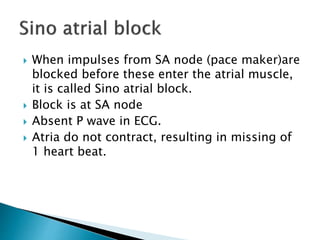
 When impulses from SA node (pace maker)are
blocked before these enter the atrial muscle,
it is called Sino atrial block.
 Block is at SA node
 Absent P wave in ECG.
 Atria do not contract, resulting in missing of
1 heart beat.
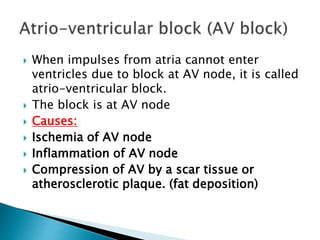
 When impulses from atria cannot enter
ventricles due to block at AV node, it is called
atrio-ventricular block.
 The block is at AV node
 Causes:
 Ischemia of AV node
 Inflammation of AV node
 Compression of AV by a scar tissue or
atherosclerotic plaque. (fat deposition)
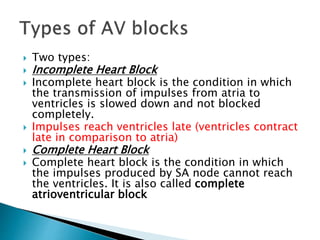
 Two types:
 Incomplete Heart Block
 Incomplete heart block is the condition in which
the transmission of impulses from atria to
ventricles is slowed down and not blocked
completely.
 Impulses reach ventricles late (ventricles contract
late in comparison to atria)
 Complete Heart Block
 Complete heart block is the condition in which
the impulses produced by SA node cannot reach
the ventricles. It is also called complete
atrioventricular block
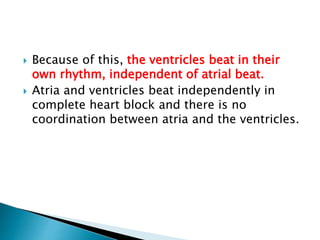
 Because of this, the ventricles beat in their
own rhythm, independent of atrial beat.
 Atria and ventricles beat independently in
complete heart block and there is no
coordination between atria and the ventricles.
 This is the contraction of cardiac muscle
fibers in a disorderly sequence.
 It is a type of cardiac arrhythmia
 It is characterized by:
 Rapid heart rate
 Incoordinated contraction of cardiac muscle
so that no part of cardiac muscle contracts in
union, resulting In failure of atria and
ventricles to pump blood.
 There is uncoordinated contraction of atria and
pumping is ineffective.
 Common in older people.
 The most common cause is atrial enlargement
 It may be asymptomatic, as most of the
ventricular filling occurs passively so cardiac
output is maintained.
 Patient may present with palpitations, tachycardia
and fatigue.
 Patient has irregular pulse.
 AFib can develop due to many heart diseases,
alcoholism and lung diseases.
 There is uncoordinated contraction of ventricles.
 Seen in
 Dilatation of ventricles
 Blockage of impulses in the purkinje system.
 Myocardial ischemia.
 The uncoordinated electrical activity with in the
ventricles cannot cause effective pumping of
blood into the pulmonary and systemic
circulation and leads to cardiac arrest.
 So it’s a medical emergency and can lead to
death if not treated immediately.
 Myocardial infarction (MI) refers to tissue
death (infarction) of the heart muscle
(myocardium).
 In a myocardial infarction transmural
ischemia develops.
 In the first hours and days after the onset of
a myocardial infarction, several changes can
be observed on the ECG.
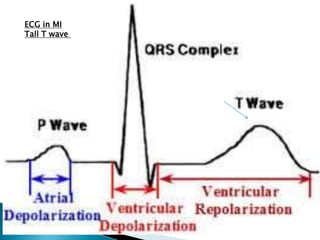
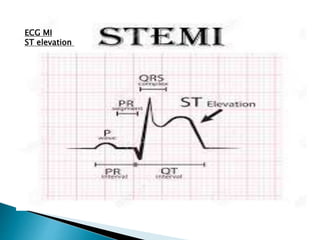
 First, large peaked T waves then ST elevation,
finally pathologic Q waves develop.
ECG in MI
Tall T wave
ECG MI
ST elevation
lec 4.pptx

lec 4.pptx

  • 2.
     Heart soundsare the sounds produced by mechanical activities of heart during each cardiac cycle.  Heart sounds are produced by:  1. Closure of valves of the heart.  2. Flow of blood through cardiac chambers  3. Contraction of cardiac muscle  Heart sounds are heard by placing the ear over the chest or by using a stethoscope  Heart sounds can also be recorded graphically.
  • 3.
     Four heartsounds are produced during each cardiac cycle:  1. First heart sound  2. Second heart sound  3. Third heart sound  4. Fourth heart sound.
  • 4.
     Heart soundsare studied by three methods:  1. By using stethoscope (most common)  2. By using microphone  3. By using phonocardiogram.(graphical recording)
  • 5.
     First andsecond heart sounds are called classical heart sounds and are heard by using the stethoscope. (normally heard by stethoscope)  These two sounds are more prominent and resemble the spoken words ‘LUB, (or LUBB) and ‘DUBB’ (or DUP), respectively.
  • 6.
     Third heartsound is a mild sound and it is not heard by using stethoscope in normal conditions. But it can be heard by using a microphone.  Fourth heart sound is an inaudible sound. It becomes audible in pathological conditions only. This sound is studied only graphically.
  • 7.
     Study ofheart sounds has important diagnostic value in clinical practice because alteration in the heart sounds indicates cardiac diseases involving valves of the heart.
  • 8.
     Major causefor first heart sound is the sudden and synchronous (simultaneous) closure of atrioventricular valves.  Resembles the word ‘LUBB’
  • 9.
     Second heartsound is produced due to the sudden and synchronous closure of the semilunar valves.  Resembles the word ‘DUBB’
  • 10.
     Produced dueto Rushing of blood into ventricles during the filling phase of the cardiac cycle.  It is inaudible by stethoscope.  Can only be heard by using microphone.
  • 11.
     It isproduced due to contraction of atrial musculature.  Normally, the fourth heart sound is an inaudible sound.  It becomes audible only in pathological conditions.  It is studied only by graphical recording
  • 12.
    Only first andsecond heart sounds are audible by stethoscope
  • 14.
     Cardiac murmuris the abnormal or unusual heart sound.  It is also called abnormal heart sound  Any other sound heard on stethoscope other than the normal heart sounds is called a murmur.  Cardiac murmur is heard by stethoscope, along with normal heart sounds.
  • 15.
     Cardiac murmuris produced because of change in the pattern of blood flow. Normally, blood flows in streamline through the heart and blood vessels.  However, during abnormal conditions like valvular diseases, the blood flow becomes turbulent. It produces the cardiac murmur.
  • 16.
     Valvular diseasesare of two types:  1. Stenosis  2. Incompetence.  1. Stenosis  Stenosis means narrowing of heart valve. Blood flows rapidly with turbulence through the narrow orifice of the valve, resulting in murmur.
  • 17.
     2. Incompetence Incompetence refers to weakening of the heart valve. When the valve becomes weak, it cannot close properly. It causes back flow of blood, resulting in turbulence.
  • 18.
     Cardiac murmuris classified into three types:  A. Systolic murmur  B. Diastolic murmur  C. Continuous murmur.  SYSTOLIC MURMUR  Systolic murmur is the murmur which is produced during systole.(contraction of cardiac chambers)
  • 19.
     DIASTOLIC MURMUR Diastolic murmur is the murmur that is produced during diastole. (relaxation of cardiac chambers)  CONTINUOUS MURMUR  Heard both during systole and diastole.
  • 21.
     It isthe graphical record or of electrical activities of the heart and conduction of impulses through the heart.  USES OF ECG  Electrocardiogram is useful in determining and  diagnosing the following:  1. Heart rate  2. Heart rhythm  3. Abnormal electrical conduction  4. Poor blood flow to heart muscle (ischemia)  5. Heart attack  6. Coronary artery disease  7. Hypertrophy of heart chambers
  • 22.
     ECG showsthe spread of electrical signals generated by SA node as it travels through the AV node and the ventricles.
  • 23.
     The normalECG tracing shows five waves which, by convention, have been named P, Q, R, S and T.
  • 24.
    0.8 sec Atrial depolarization Ventriculardepolaization Ventricular repolarization
  • 25.
     ‘P’ WAVE P’ wave is produced due to the depolarization of atrial musculature.  Depolarization spreads from SA node to all parts of atrial musculature. (contraction of atria)  ‘QRS’ COMPLEX  ‘QRS’ complex is due to depolarization of ventricular musculature. (contraction of ventricles)
  • 26.
  • 27.
     T WAVE T wave is due to the repolarization of ventricular musculature. (relaxation of ventricles)  Atrial repolarization is not recorded as a separate wave in ECG because it merges with ventricular depolarization (QRS complex).
  • 29.
     Heart raterefers to the number of times the heart beats in a minute.  It is normally 70-80 beats per minute (72 bpm in an average adult male at rest).
  • 30.
     When rhythmiccardiac impulses normally originate in SA node, it is called the normal sinus rhythm.  A sinus rhythm is any cardiac rhythm in which depolarization of the cardiac muscle begins at the sinus node.
  • 31.
     Autonomic nervoussystem  It is the most important determinant of heart rate.  Heart is influenced by autonomic (sympathetic and parasympathetic) nerves originating in the cardiovascular centre in the medulla oblongata.  The vagus nerves (parasympathetic) supply mainly the SA and AV nodes and atrial muscle. Parasympathetic stimulation reduces the rate at which impulses are produced, decreasing the rate and force of the heartbeat.  The sympathetic nerves supply the SA and AV nodes and the myocardium of atria and ventricles. Sympathetic stimulation increases the rate and force of the heartbeat.
  • 32.
     Impulses fromhigher centers (hypothalamus and frontal lobe  Excitement increases HR  Sudden shock decreases HR.  Respiration  During Inspiration there is an increase in HR(increase in venous return)  During expiration there is a decrease in HR  Moderate increase in Carbon dioxide…. Stimulates HR  Decrease in Oxygen….increases HR.
  • 33.
     Increase inbody temperature  In fever HR increases (due to release of pyrogens and interleukins)  Muscular exercise  Increases HR  Thyroxine  Increases HR by increasing BMR and metabolism
  • 34.
     Heart rateless than 60 bpm is called bradycardia.  Causes:  Sleep  Athletes  Sinus Bradycardia in athletes (physiological) is due to the heart adapting to the physical stresses that it is put under by the athlete's physical activity. This causes the heart to become more efficient which in return allows the heart to circulate the same amount of blood with fewer contractions.  Vagal stimulation (parasympathetic stimulation)
  • 35.
     Increase HRabove 100 bpm.  Causes:  Fever  Emotion  Exercise  Sympathetic stimulation
  • 37.
     Abnormal variationin the normal sinus rhythm (from SA node ) is called Cardiac Arrhythmias.  Causes:  Abnormal activity of pace maker SA node  Shift of pace maker from SA node to else where.  Blocks in the conducting pathways
  • 39.
     Block ofimpulse transmission at any critical point from SA node (pace maker ) through conducting pathway of heart is called Heart block.  Types  Sino atrial block  Atrio-ventricular block  Right or left bundle branch block
  • 40.
     When impulsesfrom SA node (pace maker)are blocked before these enter the atrial muscle, it is called Sino atrial block.  Block is at SA node  Absent P wave in ECG.  Atria do not contract, resulting in missing of 1 heart beat.
  • 41.
     When impulsesfrom atria cannot enter ventricles due to block at AV node, it is called atrio-ventricular block.  The block is at AV node  Causes:  Ischemia of AV node  Inflammation of AV node  Compression of AV by a scar tissue or atherosclerotic plaque. (fat deposition)
  • 42.
     Two types: Incomplete Heart Block  Incomplete heart block is the condition in which the transmission of impulses from atria to ventricles is slowed down and not blocked completely.  Impulses reach ventricles late (ventricles contract late in comparison to atria)  Complete Heart Block  Complete heart block is the condition in which the impulses produced by SA node cannot reach the ventricles. It is also called complete atrioventricular block
  • 43.
     Because ofthis, the ventricles beat in their own rhythm, independent of atrial beat.  Atria and ventricles beat independently in complete heart block and there is no coordination between atria and the ventricles.
  • 45.
     This isthe contraction of cardiac muscle fibers in a disorderly sequence.  It is a type of cardiac arrhythmia  It is characterized by:  Rapid heart rate  Incoordinated contraction of cardiac muscle so that no part of cardiac muscle contracts in union, resulting In failure of atria and ventricles to pump blood.
  • 46.
     There isuncoordinated contraction of atria and pumping is ineffective.  Common in older people.  The most common cause is atrial enlargement  It may be asymptomatic, as most of the ventricular filling occurs passively so cardiac output is maintained.  Patient may present with palpitations, tachycardia and fatigue.  Patient has irregular pulse.  AFib can develop due to many heart diseases, alcoholism and lung diseases.
  • 47.
     There isuncoordinated contraction of ventricles.  Seen in  Dilatation of ventricles  Blockage of impulses in the purkinje system.  Myocardial ischemia.  The uncoordinated electrical activity with in the ventricles cannot cause effective pumping of blood into the pulmonary and systemic circulation and leads to cardiac arrest.  So it’s a medical emergency and can lead to death if not treated immediately.
  • 49.
     Myocardial infarction(MI) refers to tissue death (infarction) of the heart muscle (myocardium).  In a myocardial infarction transmural ischemia develops.  In the first hours and days after the onset of a myocardial infarction, several changes can be observed on the ECG.  First, large peaked T waves then ST elevation, finally pathologic Q waves develop.
  • 50.
  • 51.