Chemical Engineering Department | University of Jordan | Amman 11942, Jordan
Tel. +962 6 535 5000 | 22888
1
Prof. Zayed Al-Hamamre
Chemical Reaction Engineering (II)
Lec 3: Heterogeneous Catalysis: External
Diffusion Effects
Chemical Engineering Department | University of Jordan | Amman 11942, Jordan
Tel. +962 6 535 5000 | 22888
2
Content
 Introduction
 Diffusion Mass Transfer
 External Resistance to Mass Transfer
 Mass Transfer-Limited Reactions in Packed Beds
Giving up is the ultimate tragedy
Chemical Engineering Department | University of Jordan | Amman 11942, Jordan
Tel. +962 6 535 5000 | 22888
3
 Heterogeneous reactions are distinguished from homogeneous ones by the different
phases present during reaction.
Introduction
 For the design of heterogeneous chemical reactors a special consideration should be
taken for
 The transfer of matter between phases,
Transport processes play a critical role, capable to have strong influence on the
degree of conversion and the selectivity. The heat and mass transfer coefficient
as well as the exchange area are the parameters that describe the transport rate,
 The fluid dynamics and chemistry of the system.
 Additional complexity enters into the problem
 Complication of the rate expression, and
 Complication of the contacting patterns for two-phase systems
Chemical Engineering Department | University of Jordan | Amman 11942, Jordan
Tel. +962 6 535 5000 | 22888
4
Introduction
The Complications of the Rate Equation.
 Since more than one phase is present, the movement of material from phase to
phase must be considered in the rate equation.
 The rate expression in general will incorporate mass transfer terms in addition to the
usual chemical kinetics term.
 These mass transfer terms are different in type and numbers in the different kinds of
heterogeneous systems; hence, no single rate expression has general application
 Thus, in addition to an equation describing the rate at which the chemical reaction
proceeds, one must also provide a relationship or algorithm to account for the various
physical processes which occur.
Chemical Engineering Department | University of Jordan | Amman 11942, Jordan
Tel. +962 6 535 5000 | 22888
5
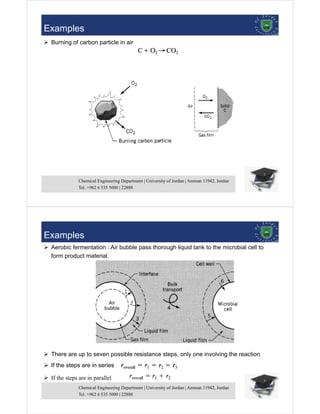
 Burning of carbon particle in air
Examples
Chemical Engineering Department | University of Jordan | Amman 11942, Jordan
Tel. +962 6 535 5000 | 22888
6
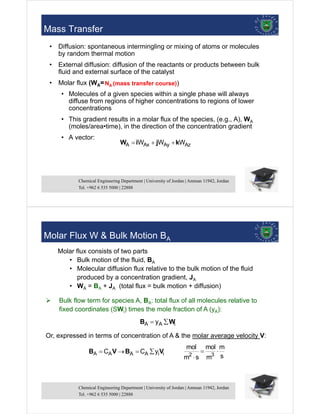
 Aerobic fermentation : Air bubble pass thorough liquid tank to the microbial cell to
form product material.
 There are up to seven possible resistance steps, only one involving the reaction
 If the steps are in series
 If the steps are in parallel
Examples
Chemical Engineering Department | University of Jordan | Amman 11942, Jordan
Tel. +962 6 535 5000 | 22888
7
Mass Transfer
• Diffusion: spontaneous intermingling or mixing of atoms or molecules
by random thermal motion
• External diffusion: diffusion of the reactants or products between bulk
fluid and external surface of the catalyst
• Molar flux (WA=
• Molecules of a given species within a single phase will always
diffuse from regions of higher concentrations to regions of lower
concentrations
• This gradient results in a molar flux of the species, (e.g., A), WA
(moles/area•time), in the direction of the concentration gradient
• A vector:
A Ax Ay Az
W W W
  
W i j k
NA (mass transfer course))
Chemical Engineering Department | University of Jordan | Amman 11942, Jordan
Tel. +962 6 535 5000 | 22888
8
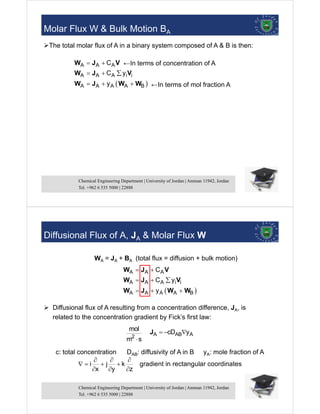
Molar Flux W & Bulk Motion BA
Molar flux consists of two parts
• Bulk motion of the fluid, BA
• Molecular diffusion flux relative to the bulk motion of the fluid
produced by a concentration gradient, JA
• WA = BA + JA (total flux = bulk motion + diffusion)
 Bulk flow term for species A, BA: total flux of all molecules relative to
fixed coordinates (SWi) times the mole fraction of A (yA):
A A i
y
 
B W
Or, expressed in terms of concentration of A & the molar average velocity V:
A A A A i i
C C y
   
B V B V 2 3
mol mol m
s
m s m
 

Chemical Engineering Department | University of Jordan | Amman 11942, Jordan
Tel. +962 6 535 5000 | 22888
9
The total molar flux of A in a binary system composed of A & B is then:
 
A A A
A A A i i
A A A A B
C
C y
y
 
  
  
W J V
W J V
W J W W
←In terms of concentration of A
←In terms of mol fraction A
Molar Flux W & Bulk Motion BA
Chemical Engineering Department | University of Jordan | Amman 11942, Jordan
Tel. +962 6 535 5000 | 22888
10
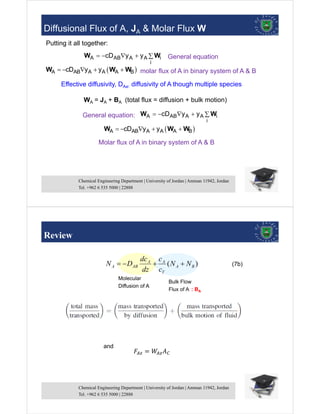
 Diffusional flux of A resulting from a concentration difference, JA, is
related to the concentration gradient by Fick’s first law:
c: total concentration DAB: diffusivity of A in B yA: mole fraction of A
A AB A
cD y
  
J
2
mol
m s

Diffusional Flux of A, JA & Molar Flux W
 
A A A
A A A i i
A A A A B
C
C y
y
 
  
  
W J V
W J V
W J W W
i j k gradient in rectangular coordinates
x y z
  
   
  
WA = JA + BA (total flux = diffusion + bulk motion)
Chemical Engineering Department | University of Jordan | Amman 11942, Jordan
Tel. +962 6 535 5000 | 22888
11
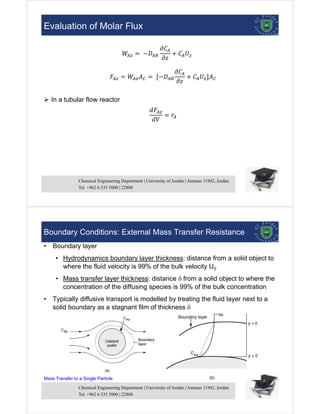
Putting it all together:
 
A AB A A A B
cD y y
    
W W W molar flux of A in binary system of A & B
A AB A A i
i
cD y y
    
W W General equation
Effective diffusivity, DAe: diffusivity of A though multiple species
Molar flux of A in binary system of A & B
 
A AB A A A B
cD y y
    
W W W
A AB A A i
i
cD y y
    
W W
General equation:
WA = JA + BA (total flux = diffusion + bulk motion)
Diffusional Flux of A, JA & Molar Flux W
Chemical Engineering Department | University of Jordan | Amman 11942, Jordan
Tel. +962 6 535 5000 | 22888
12
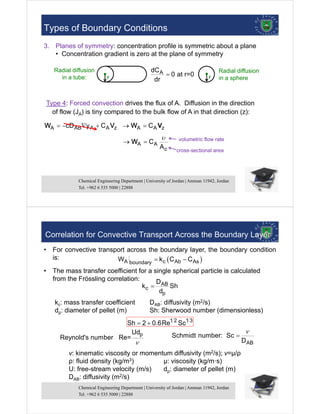
and
Review
)
( B
A
T
A
A
AB
A N
N
c
c
dz
dc
D
N 



Molecular
Diffusion of A
Bulk Flow
Flux of A
(7b)
: BA
𝐹 𝑊 𝐴
Chemical Engineering Department | University of Jordan | Amman 11942, Jordan
Tel. +962 6 535 5000 | 22888
13
Type 1: Equimolar counter diffusion (EMCD)
• For every mole of A that diffuses in a given direction, one mole of B
diffuses in the opposite direction
• Fluxes of A and B are equal in magnitude & flow counter to each other:
WA = - WB  
A AB A A A B
cD y y
    
W
W
W
A AB A
or for constant total concentration: D C
  
W
0 bulk motion ≈ 0
A AB A
cD y
   
W
Type 2: Dilute concentration of A:
 
A AB A A A B
cD y y
    
W
W
W
A AB A
cD y
   
W
0
A i
i
y W 0

total
A AB A
or constant C :
D C
  
W
=
Evaluation of Molar Flux
Chemical Engineering Department | University of Jordan | Amman 11942, Jordan
Tel. +962 6 535 5000 | 22888
14
Type 3: Diffusion of A though stagnant B: WB=0
 
A AB A A A B
cD y y
    
W
W
W
A AB A
A
1
cD y
1 y

  

W
0
Evaluation of Molar Flux
Chemical Engineering Department | University of Jordan | Amman 11942, Jordan
Tel. +962 6 535 5000 | 22888
15
 In a tubular flow reactor
Evaluation of Molar Flux
𝑊 𝐷
𝜕𝐶
𝜕𝑧
𝐶 𝑈
𝐹 𝑊 𝐴 𝐷
𝜕𝐶
𝜕𝑧
𝐶 𝑈 𝐴
𝑑𝐹
𝑑𝑉
𝑟
Chemical Engineering Department | University of Jordan | Amman 11942, Jordan
Tel. +962 6 535 5000 | 22888
16
Boundary Conditions: External Mass Transfer Resistance
• Boundary layer
• Hydrodynamics boundary layer thickness: distance from a solid object to
where the fluid velocity is 99% of the bulk velocity U0
• Mass transfer layer thickness: distance  from a solid object to where the
concentration of the diffusing species is 99% of the bulk concentration
• Typically diffusive transport is modelled by treating the fluid layer next to a
solid boundary as a stagnant film of thickness 
Mass Transfer to a Single Particle
Chemical Engineering Department | University of Jordan | Amman 11942, Jordan
Tel. +962 6 535 5000 | 22888
17
In order to solve a design equation that accounts
for external diffusion limitations we need to set the
boundary conditions
CAs: Concentration of A at surface CAb: Concentration of A in bulk
Boundary Conditions: External Mass Transfer Resistance
Chemical Engineering Department | University of Jordan | Amman 11942, Jordan
Tel. +962 6 535 5000 | 22888
18
Types of Boundary Conditions
1. Concentration at the boundary (i.e., catalyst particle surface) is specified:
• If a specific reactant concentration is maintained or measured at the
surface, use the specified concentration
• When an instantaneous reaction occurs at the boundary, then CAs≈0
2. Flux at the boundary (i.e., catalyst particle surface) is specified:
a) No mass transfer at surface (nonreacting surface)
b) Reaction that occurs at the surface is at steady state: set the molar flux
on the surface equal to the rate of reaction at the surface
c) Convective transport across the boundary layer occurs
A surface
W 0

A A
surface
W r ''
 
 
A c Ab As
boundary
W k C C
 
reaction rate per unit surface area (mol/m2ꞏsec)
Chemical Engineering Department | University of Jordan | Amman 11942, Jordan
Tel. +962 6 535 5000 | 22888
19
Types of Boundary Conditions
3. Planes of symmetry: concentration profile is symmetric about a plane
• Concentration gradient is zero at the plane of symmetry
Radial diffusion
in a tube: r
A
dC
0 at r=0
dr
 r
Radial diffusion
in a sphere
Type 4: Forced convection drives the flux of A. Diffusion in the direction
of flow (JA) is tiny compared to the bulk flow of A in that direction (z):
A AB A A z
cD y C
   
W
V
A A z
C
  V
W
A A
c
C
A

 
W
volumetric flow rate
cross-sectional area
Chemical Engineering Department | University of Jordan | Amman 11942, Jordan
Tel. +962 6 535 5000 | 22888
20
Correlation for Convective Transport Across the Boundary Layer
 
A c Ab As
boundary
W k C C
 
• For convective transport across the boundary layer, the boundary condition
is:
• The mass transfer coefficient for a single spherical particle is calculated
from the Frössling correlation:
AB
c
p
D
k Sh
d

kc: mass transfer coefficient DAB: diffusivity (m2/s)
dp: diameter of pellet (m) Sh: Sherwood number (dimensionless)
1 2 1 3
Sh 2 0.6Re Sc
 
p
Ud
Reynold's number Re=

ν: kinematic viscosity or momentum diffusivity (m2/s); ν=μ/ρ
ρ: fluid density (kg/m3) μ: viscosity (kg/mꞏs)
U: free-stream velocity (m/s) dp: diameter of pellet (m)
DAB: diffusivity (m2/s)
AB
Schmidt number: Sc
D


Chemical Engineering Department | University of Jordan | Amman 11942, Jordan
Tel. +962 6 535 5000 | 22888
21
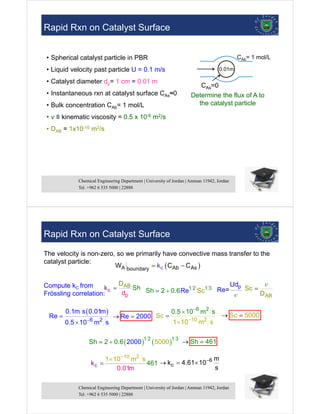
Rapid Rxn on Catalyst Surface
• Spherical catalyst particle in PBR
• Liquid velocity past particle U = 0.1 m/s
• Catalyst diameter dp= 1 cm = 0.01 m
• Instantaneous rxn at catalyst surface CAs≈0
• Bulk concentration CAb= 1 mol/L
• ν ≡ kinematic viscosity = 0.5 x 10⁻⁶ m2/s
• DAB = 1x10⁻¹⁰ m2/s
Determine the flux of A to
the catalyst particle
CAs=0
0.01m
CAb= 1 mol/L
Chemical Engineering Department | University of Jordan | Amman 11942, Jordan
Tel. +962 6 535 5000 | 22888
22
Rapid Rxn on Catalyst Surface
The velocity is non-zero, so we primarily have convective mass transfer to the
catalyst particle:
 
A Ab As
boundary c C
k
W C
 
Compute kC from
Frössling correlation:
p
Re=
Ud

 
6 2
0.1m s 0.01m
Re
0.5 10 m s



AB
c
p
h
D
k
d
S

Re 2000
 
1 2 1 3
Re
Sh 2 0.6 Sc


AB
Sc
D


6 2
10 2
0.5 10 m s
Sc
1 10 m s




 Sc 5000
 
   
1 2 1 3
200
Sh 2 50
.6 0
0 00

 Sh 461
 
1
c
0 2
1 10 m
0.01
461
k
s
m


 6
c
m
k 4.61 10
s

  
Chemical Engineering Department | University of Jordan | Amman 11942, Jordan
Tel. +962 6 535 5000 | 22888
23
The velocity is non-zero, so we primarily have convective mass transfer to the
catalyst particle:
 
A boundary A s
b
c A
C
k
W C
 
Computed kC from
Frössling correlation:
AB
c
p
D
k Sh
d
 6
c
m
k 4.61 10
s



A bound
6
ary 3
mo 1000L
W
m
m
4.61 1
l
1
s
0
L
0  
 
 
 
 
 
 
 3
A boundary 2
mol
W 4.61 10
m s

  

Because the reactant is consumed as soon as it reaches the surface
3
A As
boundary 2
mol
W r '' 4.61 10
m s

   

Rapid Rxn on Catalyst Surface
Chemical Engineering Department | University of Jordan | Amman 11942, Jordan
Tel. +962 6 535 5000 | 22888
24
For the previous example, derive an equation for the flux if the reaction
were not instantaneous, and was instead at steady state (WA|surface =-rA”)
and followed the kinetics: -rAS’’=krCAs (Observed rate is not diffusion limited)
A As
boundary
W r ''
 
 
As
c Ab A
r s
k C k
C C
 
Because the reaction at the surface is at the steady state & not instantaneous:
So if CAs were in terms of measurable species, we would know WA,boundary
c A A As
b r
s
cC C
k C k k
   c A A As
b c
s
rC C
k C k k
  
 
c Ab As A boundary
k C C W
  As r As
r '' k C
 
As
r
k C

Use the equality to put CAs in terms of measurable species (solve for CAs)
 
A
c Ab r c
s
C
k C k k
  
c Ab
As
r c
k C
C
k k


 Plug into -r’’As
As
C 0

Rapid Rxn on Catalyst Surface
Chemical Engineering Department | University of Jordan | Amman 11942, Jordan
Tel. +962 6 535 5000 | 22888
25
A
A As r
bounda y s
r
C
W r '' k
   r
A As
boundary
c Ab
r c
k
W r''
k C
k k
  


Rapid rxn, kr>>kc→ kc in
denominator is negligible
r c Ab
As
r c
k k C
r''
k k
 

r c Ab
As
r
k k C
r''
k
   As c Ab
r '' k C
  
Diffusion limited
Slow rxn, kr<<kc→ kr in
denominator is negligible
r c Ab
As
r c
k k C
r''
k k
 

r c Ab
As
c
k k C
r ''
k
   As r Ab
r '' k C
  
Reaction limited
Rapid Rxn on Catalyst Surface
Chemical Engineering Department | University of Jordan | Amman 11942, Jordan
Tel. +962 6 535 5000 | 22888
26
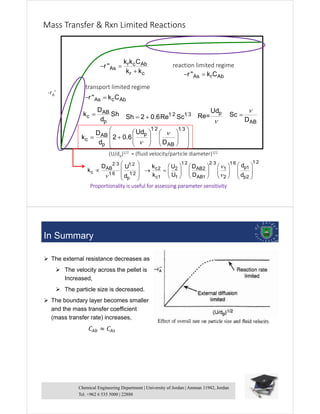
Mass Transfer & Rxn Limited Reactions
transport limited regime
-rA’
(U/dp)1/2
(fluid velocity/particle diameter)1/2
reaction limited regime
As r Ab
r '' k C
 
As c Ab
r '' k C
 
AB
c
p
D
k Sh
d

1 2 1 3
p
AB
c
p AB
Ud
D
k 2 0.6
d D


 
   
 
     
 
 
 
 
1 2 1 3
Sh 2 0.6Re Sc
 
p
Ud
Re=
 AB
Sc
D


When measuring rates in the lab, use high velocities or small particles to
ensure the reaction is not mass transfer limited
r c Ab
As
r c
k k C
r''
k k
 

Mass Transfer & Rxn Limited Reactions
transport limited regime
‐rA’
(U/dp)1/2 = (fluid velocity/particle diameter)1/2
reaction limited regime
As r Ab
r'' k C
 
As c Ab
r'' k C
 
AB
c
p
D
k Sh
d

1 2 1 3
p
AB
c
p AB
Ud
D
k 2 0.6
d D


 
   
 
     
 
 
 
 
1 2 1 3
Sh 2 0.6Re Sc
 
p
Ud
Re=
 AB
Sc
D


r c Ab
As
r c
k k C
r''
k k
 

1 2
1 2 2 3 1 6
p1
c2 2 AB2 1
c1 1 AB1 2 p2
d
k U D
k U D d


 
     
   
       
       
Proportionality is useful for assessing parameter sensitivity
2 3 1 2
AB
c 1 6 1 2
p
D U
k
d

 
 

 
 
Chemical Engineering Department | University of Jordan | Amman 11942, Jordan
Tel. +962 6 535 5000 | 22888
28
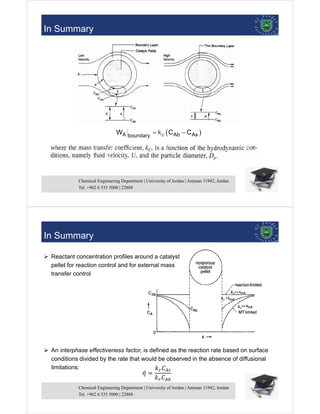
In Summary
 The external resistance decreases as
 The velocity across the pellet is
Increased,
 The particle size is decreased.
 The boundary layer becomes smaller
and the mass transfer coefficient
(mass transfer rate) increases,
𝐶 𝐶
Chemical Engineering Department | University of Jordan | Amman 11942, Jordan
Tel. +962 6 535 5000 | 22888
29
In Summary
 
A Ab As
boundary c C
k
W C
 
Chemical Engineering Department | University of Jordan | Amman 11942, Jordan
Tel. +962 6 535 5000 | 22888
30
In Summary
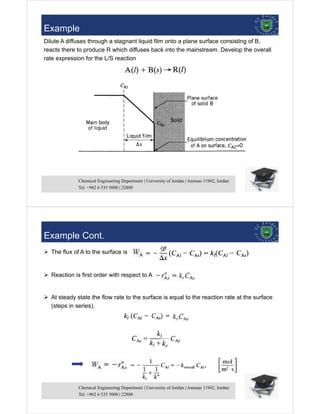
 An interphase effectiveness factor, is defined as the reaction rate based on surface
conditions divided by the rate that would be observed in the absence of diffusional
limitations:
𝜂̅
𝑘 𝐶
𝑘 𝐶
 Reactant concentration profiles around a catalyst
pellet for reaction control and for external mass
transfer control
Chemical Engineering Department | University of Jordan | Amman 11942, Jordan
Tel. +962 6 535 5000 | 22888
31
Example
Dilute A diffuses through a stagnant liquid film onto a plane surface consisting of B,
reacts there to produce R which diffuses back into the mainstream. Develop the overall
rate expression for the L/S reaction
Chemical Engineering Department | University of Jordan | Amman 11942, Jordan
Tel. +962 6 535 5000 | 22888
32
 The flux of A to the surface is
Example Cont.
 Reaction is first order with respect to A
 At steady state the flow rate to the surface is equal to the reaction rate at the surface
(steps in series).
Chemical Engineering Department | University of Jordan | Amman 11942, Jordan
Tel. +962 6 535 5000 | 22888
33
Mass Transfer Limited Rxn in PBR
ac: external surface area of catalyst per volume of catalytic bed (m2/m3)
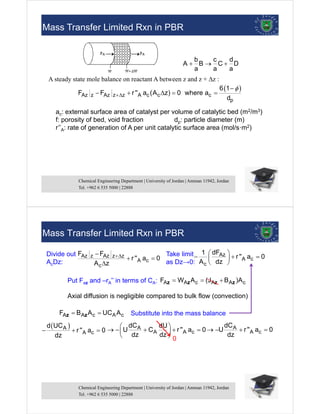
f: porosity of bed, void fraction dp: particle diameter (m)
r’’A: rate of generation of A per unit catalytic surface area (mol/sꞏm2)
b c d
A B C D
a a a
  
A steady state mole balance on reactant A between z and z + z :
 
Az z Az z z A c c c
p
6 1
F F r '' a (A z) 0 where a
d



    
Chemical Engineering Department | University of Jordan | Amman 11942, Jordan
Tel. +962 6 535 5000 | 22888
34
Mass Transfer Limited Rxn in PBR
Divide out
AcDz:
Az z Az z z
A c
c
F F
r '' a 0
A z


 

Take limit
as Dz→0:
Az
A c
c
dF
1
r '' a 0
A dz
 
  
 
 
Put Faz and –rA’’ in terms of CA: A A c A A c
F W A (J B )A
  
z z z z
Axial diffusion is negligible compared to bulk flow (convection)
A A c A c
F B A UC A
 
z z Substitute into the mass balance
 
A
A c
d UC
r '' a 0
dz
   A
A A c
dC dU
U C r '' a 0
dz dz
 
    
 
  0
A
A c
dC
U r '' a 0
dz
   
Chemical Engineering Department | University of Jordan | Amman 11942, Jordan
Tel. +962 6 535 5000 | 22888
35
b c d
A B C D
a a a
   A
A c
dC
U r '' a 0
dz
  
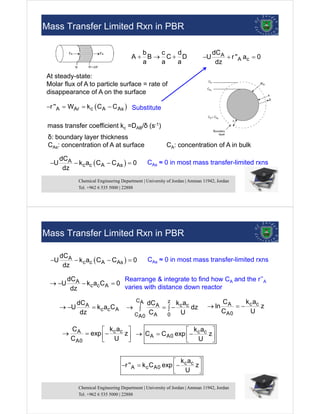
At steady-state:
Molar flux of A to particle surface = rate of
disappearance of A on the surface
 
A Ar c A As
r '' W k C C
   
δ: boundary layer thickness
CAs: concentration of A at surface CA: concentration of A in bulk
Substitute
 
A
c c A As
dC
U k a C C 0
dz
    CAs ≈ 0 in most mass transfer-limited rxns
Mass Transfer Limited Rxn in PBR
mass transfer coefficient kc =DAB/δ (s-1)
Chemical Engineering Department | University of Jordan | Amman 11942, Jordan
Tel. +962 6 535 5000 | 22888
36
 
A
c c A As
dC
U k a C C 0
dz
    CAs ≈ 0 in most mass transfer-limited rxns
A
c c A
dC
U k a C 0
dz
   
Rearrange & integrate to find how CA and the r’’A
varies with distance down reactor
A
c c A
dC
U k a C
dz
  
C z
A
c c
A
A
C 0
A0
k a
dC
dz
C U
  
 
c c
A
A0
k a
C
ln z
C U
  
c c
A
A0
k a
C
exp z
C U
 
  
 
 
c c
A A0
k a
C C exp z
U
 
  
 
 
c c
A c A0
k a
r '' k C exp z
U
 
  
 
 
Mass Transfer Limited Rxn in PBR
Chemical Engineering Department | University of Jordan | Amman 11942, Jordan
Tel. +962 6 535 5000 | 22888
37
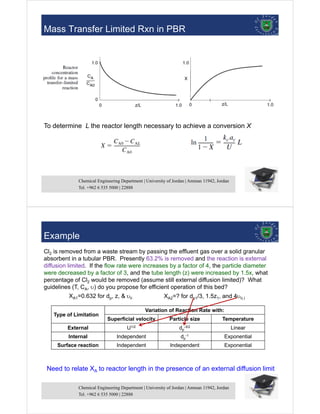
To determine L the reactor length necessary to achieve a conversion X
Mass Transfer Limited Rxn in PBR
Chemical Engineering Department | University of Jordan | Amman 11942, Jordan
Tel. +962 6 535 5000 | 22888
38
XA1=0.632 for dp, z, & 
Type of Limitation
Variation of Reaction Rate with:
Superficial velocity Particle size Temperature
External U1/2 dp
-3/2 Linear
Internal Independent dp
-1 Exponential
Surface reaction Independent Independent Exponential
XA2=? for dp1/3, 1.5z1, and 4
Cl2 is removed from a waste stream by passing the effluent gas over a solid granular
absorbent in a tubular PBR. Presently 63.2% is removed and the reaction is external
diffusion limited. If the flow rate were increases by a factor of 4, the particle diameter
were decreased by a factor of 3, and the tube length (z) were increased by 1.5x, what
percentage of Cl2 would be removed (assume still external diffusion limited)? What
guidelines (T, CA, ) do you propose for efficient operation of this bed?
Example
Need to relate XA to reactor length in the presence of an external diffusion limit
Chemical Engineering Department | University of Jordan | Amman 11942, Jordan
Tel. +962 6 535 5000 | 22888
39
Example
ac: external surface
area of catalyst per
catalyst bed volume
: porosity of bed
For an external diffusion
limited rxn in a PBR, we
found (L19):
c c
A
A0
k a
C
exp z
C U
 
 
 
 
 
c
p
6 1
a
d



In terms of XA:  
A0 A c c
A0
C 1 X k a
exp z
C U
  
 
 
 
  c c
A
k a
ln 1 X z
U
   
Express XA at 2
reaction conditions
as a ratio:
 
   
A1 c1 c1 2
A2 c2 c2 1
ln 1 X k a zU
ln 1 X k a 1.5z U



Relate U to  & ac to dp
 
 
p1
c1
c2
p2
6 1
d
a
6 1
a
d





p2
c1
c2 p1
d
a
a d
 
0 c c
U= A where A cross-sectional area of PBR
 
0,1 c 0,1
1 1
2 0,2 c 2 0,2
A
U U
U A U
 
 
  
Chemical Engineering Department | University of Jordan | Amman 11942, Jordan
Tel. +962 6 535 5000 | 22888
40
 
   
A1 c1 c1 2
A2 c2 c2 1
ln 1 X k a zU
ln 1 X k a 1.5z U



p2
c1
c2 p1
d
a
a d

0,1
1
2 0,2
U
U


 How are kc1 and kc2
related?
1 2 1 3
p
AB
c
p AB
Ud
D
k 2 0.6
d D


 
   
 
     
 
 
 
 
Typically the 2 is negligible so
  p
AB
B
1 2 3
c
p
1
A
U
k 0.
D
d
6
d
D


   
     
 
 
2 3
1 6
A
1
c 2
2
B
1
p
U
k
D
0.6
d

 
1 2
2 3 1
AB
1 2
1 6 p,1
c1
2 3 1 2
c2 AB 2
1 6 1 2
p,2
U
D
d
k 0.6
k 0.6 D U
d



1 2
1 2
p,2
c1 1
1 2 1 2
c2 p,1 2
d
k U
k d U
  
  
 
  
  
Solution Cont.d
Chemical Engineering Department | University of Jordan | Amman 11942, Jordan
Tel. +962 6 535 5000 | 22888
41
p2
c1
c2 p1
d
a
a d
 0,1
1
2 0,2
U
U



1 2
1 2
p,2
c1 1
1 2 1 2
c2 p,1 2
d
k U
k d U
  
  

  
  
 
 
A1 c1 c1 2
A2 c2 c2 1
ln 1 X k a U
z
ln 1 X k a 1.5z U
   
   
 
  
 
 
 
1 2
0,2
A1 1
1 2
A2 0,1
2
1 2
p1
1 2
p,2
p
2
1
p
,
ln 1 X U z
ln 1 X 1.5z
d
U
d
d d 

   
  
  
    
 
  
  
 
  
 
  3 2
p,1
3 2
p,2 0,2
A1
A
1 2
1
1 2
2
2 0,1
d
ln 1 X 1
l
U
U
n 1 X
d
1.5


 
  
 
   
 
  
 
 
 
3 2
p,2 0,
1 2
0,1
1 2
0,2
2
A1
3 2
A2 0,1
p,1
d
ln 1 X 1
ln 1 X 1.5
d




 
  
 
   
 
  
 
 
 
1 2 3 2
0,2 p,2
A1
1 2 3 2
A2 0,1 p,1
d
ln 1 X 1
ln 1 X 1.5
d


 
  
 
   
 
  
 
 
 
 
0,1
3 2
1 2
1 2 3 2
A2 0,1 p,1
p,1
ln 1 1
ln
0.632
1 X 1.
4
d
d 3
5


 
  
 
   
 
  
 
 
 
   
A1 c1 c1 2
A2 c2 c2 1
ln 1 X k a zU
ln 1 X k a 1.5z U



Solution Cont.d
Chemical Engineering Department | University of Jordan | Amman 11942, Jordan
Tel. +962 6 535 5000 | 22888
42
 
 
 
3 2
1 2
0,1 p,1
1 2 3 2
A2 0,1 p,1
4 d 3
ln 1 0.632 1
ln 1 X 1.5
d


 
  
 
   
 
  
 
 
 
 
 3 2
A2
ln 1 0.632
2 1 3 0.667
ln 1 X

 

 
 
A2
ln 0.368
0.257
ln 1 X
 
  
A2
0.99967
0.257
ln 1 X

 

 
A2
3.8898 ln 1 X
    3.8898
A2
e 1 X

   A2
0.0204 1 X
  
A2
X 0.98
 
Solution Cont.d
Chemical Engineering Department | University of Jordan | Amman 11942, Jordan
Tel. +962 6 535 5000 | 22888
43
•To keep the rate of Cl2 consumption (surface reaction) faster than external diffusion
(still in external diffusion limited regime), use high T
Type of Limitation
Variation of Reaction Rate with:
Superficial velocity Particle size Temperature
External U1/2 dp
-3/2 Linear
Internal Independent dp
-1 Exponential
Surface reaction Independent Independent Exponential
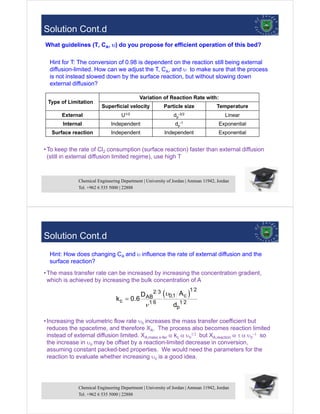
Hint for T: The conversion of 0.98 is dependent on the reaction still being external
diffusion-limited. How can we adjust the T, CA, and  to make sure that the process
is not instead slowed down by the surface reaction, but without slowing down
external diffusion?
What guidelines (T, CA, ) do you propose for efficient operation of this bed?
Solution Cont.d
Chemical Engineering Department | University of Jordan | Amman 11942, Jordan
Tel. +962 6 535 5000 | 22888
44
•The mass transfer rate can be increased by increasing the concentration gradient,
which is achieved by increasing the bulk concentration of A
•Increasing the volumetric flow rate  increases the mass transfer coefficient but
reduces the spacetime, and therefore XA. The process also becomes reaction limited
instead of external diffusion limited. XA,mass x-fer  kc 
 but XA,reaction  
 so
the increase in  may be offset by a reaction-limited decrease in conversion,
assuming constant packed-bed properties. We would need the parameters for the
reaction to evaluate whether increasing  is a good idea.
 1 2
2 3
0,1 c
AB
c 1 6 1 2
p
A
D
k 0.6
d



Hint: How does changing CA and influence the rate of external diffusion and the
surface reaction?
Solution Cont.d
Chemical Engineering Department | University of Jordan | Amman 11942, Jordan
Tel. +962 6 535 5000 | 22888
45
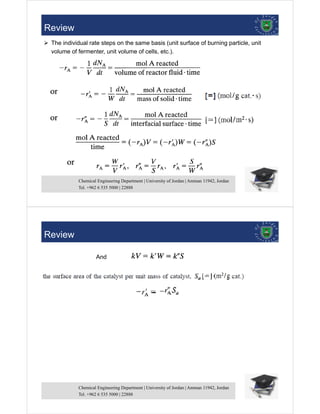
 The individual rate steps on the same basis (unit surface of burning particle, unit
volume of fermenter, unit volume of cells, etc.).
Review
Chemical Engineering Department | University of Jordan | Amman 11942, Jordan
Tel. +962 6 535 5000 | 22888
46
And
Review

Lec 3_Heterogeneous catalysis-external diffusion.pdf

  • 1.
    Chemical Engineering Department| University of Jordan | Amman 11942, Jordan Tel. +962 6 535 5000 | 22888 1 Prof. Zayed Al-Hamamre Chemical Reaction Engineering (II) Lec 3: Heterogeneous Catalysis: External Diffusion Effects Chemical Engineering Department | University of Jordan | Amman 11942, Jordan Tel. +962 6 535 5000 | 22888 2 Content  Introduction  Diffusion Mass Transfer  External Resistance to Mass Transfer  Mass Transfer-Limited Reactions in Packed Beds Giving up is the ultimate tragedy
  • 2.
    Chemical Engineering Department| University of Jordan | Amman 11942, Jordan Tel. +962 6 535 5000 | 22888 3  Heterogeneous reactions are distinguished from homogeneous ones by the different phases present during reaction. Introduction  For the design of heterogeneous chemical reactors a special consideration should be taken for  The transfer of matter between phases, Transport processes play a critical role, capable to have strong influence on the degree of conversion and the selectivity. The heat and mass transfer coefficient as well as the exchange area are the parameters that describe the transport rate,  The fluid dynamics and chemistry of the system.  Additional complexity enters into the problem  Complication of the rate expression, and  Complication of the contacting patterns for two-phase systems Chemical Engineering Department | University of Jordan | Amman 11942, Jordan Tel. +962 6 535 5000 | 22888 4 Introduction The Complications of the Rate Equation.  Since more than one phase is present, the movement of material from phase to phase must be considered in the rate equation.  The rate expression in general will incorporate mass transfer terms in addition to the usual chemical kinetics term.  These mass transfer terms are different in type and numbers in the different kinds of heterogeneous systems; hence, no single rate expression has general application  Thus, in addition to an equation describing the rate at which the chemical reaction proceeds, one must also provide a relationship or algorithm to account for the various physical processes which occur.
  • 3.
    Chemical Engineering Department| University of Jordan | Amman 11942, Jordan Tel. +962 6 535 5000 | 22888 5  Burning of carbon particle in air Examples Chemical Engineering Department | University of Jordan | Amman 11942, Jordan Tel. +962 6 535 5000 | 22888 6  Aerobic fermentation : Air bubble pass thorough liquid tank to the microbial cell to form product material.  There are up to seven possible resistance steps, only one involving the reaction  If the steps are in series  If the steps are in parallel Examples
  • 4.
    Chemical Engineering Department| University of Jordan | Amman 11942, Jordan Tel. +962 6 535 5000 | 22888 7 Mass Transfer • Diffusion: spontaneous intermingling or mixing of atoms or molecules by random thermal motion • External diffusion: diffusion of the reactants or products between bulk fluid and external surface of the catalyst • Molar flux (WA= • Molecules of a given species within a single phase will always diffuse from regions of higher concentrations to regions of lower concentrations • This gradient results in a molar flux of the species, (e.g., A), WA (moles/area•time), in the direction of the concentration gradient • A vector: A Ax Ay Az W W W    W i j k NA (mass transfer course)) Chemical Engineering Department | University of Jordan | Amman 11942, Jordan Tel. +962 6 535 5000 | 22888 8 Molar Flux W & Bulk Motion BA Molar flux consists of two parts • Bulk motion of the fluid, BA • Molecular diffusion flux relative to the bulk motion of the fluid produced by a concentration gradient, JA • WA = BA + JA (total flux = bulk motion + diffusion)  Bulk flow term for species A, BA: total flux of all molecules relative to fixed coordinates (SWi) times the mole fraction of A (yA): A A i y   B W Or, expressed in terms of concentration of A & the molar average velocity V: A A A A i i C C y     B V B V 2 3 mol mol m s m s m   
  • 5.
    Chemical Engineering Department| University of Jordan | Amman 11942, Jordan Tel. +962 6 535 5000 | 22888 9 The total molar flux of A in a binary system composed of A & B is then:   A A A A A A i i A A A A B C C y y         W J V W J V W J W W ←In terms of concentration of A ←In terms of mol fraction A Molar Flux W & Bulk Motion BA Chemical Engineering Department | University of Jordan | Amman 11942, Jordan Tel. +962 6 535 5000 | 22888 10  Diffusional flux of A resulting from a concentration difference, JA, is related to the concentration gradient by Fick’s first law: c: total concentration DAB: diffusivity of A in B yA: mole fraction of A A AB A cD y    J 2 mol m s  Diffusional Flux of A, JA & Molar Flux W   A A A A A A i i A A A A B C C y y         W J V W J V W J W W i j k gradient in rectangular coordinates x y z           WA = JA + BA (total flux = diffusion + bulk motion)
  • 6.
    Chemical Engineering Department| University of Jordan | Amman 11942, Jordan Tel. +962 6 535 5000 | 22888 11 Putting it all together:   A AB A A A B cD y y      W W W molar flux of A in binary system of A & B A AB A A i i cD y y      W W General equation Effective diffusivity, DAe: diffusivity of A though multiple species Molar flux of A in binary system of A & B   A AB A A A B cD y y      W W W A AB A A i i cD y y      W W General equation: WA = JA + BA (total flux = diffusion + bulk motion) Diffusional Flux of A, JA & Molar Flux W Chemical Engineering Department | University of Jordan | Amman 11942, Jordan Tel. +962 6 535 5000 | 22888 12 and Review ) ( B A T A A AB A N N c c dz dc D N     Molecular Diffusion of A Bulk Flow Flux of A (7b) : BA 𝐹 𝑊 𝐴
  • 7.
    Chemical Engineering Department| University of Jordan | Amman 11942, Jordan Tel. +962 6 535 5000 | 22888 13 Type 1: Equimolar counter diffusion (EMCD) • For every mole of A that diffuses in a given direction, one mole of B diffuses in the opposite direction • Fluxes of A and B are equal in magnitude & flow counter to each other: WA = - WB   A AB A A A B cD y y      W W W A AB A or for constant total concentration: D C    W 0 bulk motion ≈ 0 A AB A cD y     W Type 2: Dilute concentration of A:   A AB A A A B cD y y      W W W A AB A cD y     W 0 A i i y W 0  total A AB A or constant C : D C    W = Evaluation of Molar Flux Chemical Engineering Department | University of Jordan | Amman 11942, Jordan Tel. +962 6 535 5000 | 22888 14 Type 3: Diffusion of A though stagnant B: WB=0   A AB A A A B cD y y      W W W A AB A A 1 cD y 1 y      W 0 Evaluation of Molar Flux
  • 8.
    Chemical Engineering Department| University of Jordan | Amman 11942, Jordan Tel. +962 6 535 5000 | 22888 15  In a tubular flow reactor Evaluation of Molar Flux 𝑊 𝐷 𝜕𝐶 𝜕𝑧 𝐶 𝑈 𝐹 𝑊 𝐴 𝐷 𝜕𝐶 𝜕𝑧 𝐶 𝑈 𝐴 𝑑𝐹 𝑑𝑉 𝑟 Chemical Engineering Department | University of Jordan | Amman 11942, Jordan Tel. +962 6 535 5000 | 22888 16 Boundary Conditions: External Mass Transfer Resistance • Boundary layer • Hydrodynamics boundary layer thickness: distance from a solid object to where the fluid velocity is 99% of the bulk velocity U0 • Mass transfer layer thickness: distance  from a solid object to where the concentration of the diffusing species is 99% of the bulk concentration • Typically diffusive transport is modelled by treating the fluid layer next to a solid boundary as a stagnant film of thickness  Mass Transfer to a Single Particle
  • 9.
    Chemical Engineering Department| University of Jordan | Amman 11942, Jordan Tel. +962 6 535 5000 | 22888 17 In order to solve a design equation that accounts for external diffusion limitations we need to set the boundary conditions CAs: Concentration of A at surface CAb: Concentration of A in bulk Boundary Conditions: External Mass Transfer Resistance Chemical Engineering Department | University of Jordan | Amman 11942, Jordan Tel. +962 6 535 5000 | 22888 18 Types of Boundary Conditions 1. Concentration at the boundary (i.e., catalyst particle surface) is specified: • If a specific reactant concentration is maintained or measured at the surface, use the specified concentration • When an instantaneous reaction occurs at the boundary, then CAs≈0 2. Flux at the boundary (i.e., catalyst particle surface) is specified: a) No mass transfer at surface (nonreacting surface) b) Reaction that occurs at the surface is at steady state: set the molar flux on the surface equal to the rate of reaction at the surface c) Convective transport across the boundary layer occurs A surface W 0  A A surface W r ''     A c Ab As boundary W k C C   reaction rate per unit surface area (mol/m2ꞏsec)
  • 10.
    Chemical Engineering Department| University of Jordan | Amman 11942, Jordan Tel. +962 6 535 5000 | 22888 19 Types of Boundary Conditions 3. Planes of symmetry: concentration profile is symmetric about a plane • Concentration gradient is zero at the plane of symmetry Radial diffusion in a tube: r A dC 0 at r=0 dr  r Radial diffusion in a sphere Type 4: Forced convection drives the flux of A. Diffusion in the direction of flow (JA) is tiny compared to the bulk flow of A in that direction (z): A AB A A z cD y C     W V A A z C   V W A A c C A    W volumetric flow rate cross-sectional area Chemical Engineering Department | University of Jordan | Amman 11942, Jordan Tel. +962 6 535 5000 | 22888 20 Correlation for Convective Transport Across the Boundary Layer   A c Ab As boundary W k C C   • For convective transport across the boundary layer, the boundary condition is: • The mass transfer coefficient for a single spherical particle is calculated from the Frössling correlation: AB c p D k Sh d  kc: mass transfer coefficient DAB: diffusivity (m2/s) dp: diameter of pellet (m) Sh: Sherwood number (dimensionless) 1 2 1 3 Sh 2 0.6Re Sc   p Ud Reynold's number Re=  ν: kinematic viscosity or momentum diffusivity (m2/s); ν=μ/ρ ρ: fluid density (kg/m3) μ: viscosity (kg/mꞏs) U: free-stream velocity (m/s) dp: diameter of pellet (m) DAB: diffusivity (m2/s) AB Schmidt number: Sc D  
  • 11.
    Chemical Engineering Department| University of Jordan | Amman 11942, Jordan Tel. +962 6 535 5000 | 22888 21 Rapid Rxn on Catalyst Surface • Spherical catalyst particle in PBR • Liquid velocity past particle U = 0.1 m/s • Catalyst diameter dp= 1 cm = 0.01 m • Instantaneous rxn at catalyst surface CAs≈0 • Bulk concentration CAb= 1 mol/L • ν ≡ kinematic viscosity = 0.5 x 10⁻⁶ m2/s • DAB = 1x10⁻¹⁰ m2/s Determine the flux of A to the catalyst particle CAs=0 0.01m CAb= 1 mol/L Chemical Engineering Department | University of Jordan | Amman 11942, Jordan Tel. +962 6 535 5000 | 22888 22 Rapid Rxn on Catalyst Surface The velocity is non-zero, so we primarily have convective mass transfer to the catalyst particle:   A Ab As boundary c C k W C   Compute kC from Frössling correlation: p Re= Ud    6 2 0.1m s 0.01m Re 0.5 10 m s    AB c p h D k d S  Re 2000   1 2 1 3 Re Sh 2 0.6 Sc   AB Sc D   6 2 10 2 0.5 10 m s Sc 1 10 m s      Sc 5000       1 2 1 3 200 Sh 2 50 .6 0 0 00   Sh 461   1 c 0 2 1 10 m 0.01 461 k s m    6 c m k 4.61 10 s    
  • 12.
    Chemical Engineering Department| University of Jordan | Amman 11942, Jordan Tel. +962 6 535 5000 | 22888 23 The velocity is non-zero, so we primarily have convective mass transfer to the catalyst particle:   A boundary A s b c A C k W C   Computed kC from Frössling correlation: AB c p D k Sh d  6 c m k 4.61 10 s    A bound 6 ary 3 mo 1000L W m m 4.61 1 l 1 s 0 L 0                3 A boundary 2 mol W 4.61 10 m s      Because the reactant is consumed as soon as it reaches the surface 3 A As boundary 2 mol W r '' 4.61 10 m s       Rapid Rxn on Catalyst Surface Chemical Engineering Department | University of Jordan | Amman 11942, Jordan Tel. +962 6 535 5000 | 22888 24 For the previous example, derive an equation for the flux if the reaction were not instantaneous, and was instead at steady state (WA|surface =-rA”) and followed the kinetics: -rAS’’=krCAs (Observed rate is not diffusion limited) A As boundary W r ''     As c Ab A r s k C k C C   Because the reaction at the surface is at the steady state & not instantaneous: So if CAs were in terms of measurable species, we would know WA,boundary c A A As b r s cC C k C k k    c A A As b c s rC C k C k k      c Ab As A boundary k C C W   As r As r '' k C   As r k C  Use the equality to put CAs in terms of measurable species (solve for CAs)   A c Ab r c s C k C k k    c Ab As r c k C C k k    Plug into -r’’As As C 0  Rapid Rxn on Catalyst Surface
  • 13.
    Chemical Engineering Department| University of Jordan | Amman 11942, Jordan Tel. +962 6 535 5000 | 22888 25 A A As r bounda y s r C W r '' k    r A As boundary c Ab r c k W r'' k C k k      Rapid rxn, kr>>kc→ kc in denominator is negligible r c Ab As r c k k C r'' k k    r c Ab As r k k C r'' k    As c Ab r '' k C    Diffusion limited Slow rxn, kr<<kc→ kr in denominator is negligible r c Ab As r c k k C r'' k k    r c Ab As c k k C r '' k    As r Ab r '' k C    Reaction limited Rapid Rxn on Catalyst Surface Chemical Engineering Department | University of Jordan | Amman 11942, Jordan Tel. +962 6 535 5000 | 22888 26 Mass Transfer & Rxn Limited Reactions transport limited regime -rA’ (U/dp)1/2 (fluid velocity/particle diameter)1/2 reaction limited regime As r Ab r '' k C   As c Ab r '' k C   AB c p D k Sh d  1 2 1 3 p AB c p AB Ud D k 2 0.6 d D                         1 2 1 3 Sh 2 0.6Re Sc   p Ud Re=  AB Sc D   When measuring rates in the lab, use high velocities or small particles to ensure the reaction is not mass transfer limited r c Ab As r c k k C r'' k k   
  • 14.
    Mass Transfer &Rxn Limited Reactions transport limited regime ‐rA’ (U/dp)1/2 = (fluid velocity/particle diameter)1/2 reaction limited regime As r Ab r'' k C   As c Ab r'' k C   AB c p D k Sh d  1 2 1 3 p AB c p AB Ud D k 2 0.6 d D                         1 2 1 3 Sh 2 0.6Re Sc   p Ud Re=  AB Sc D   r c Ab As r c k k C r'' k k    1 2 1 2 2 3 1 6 p1 c2 2 AB2 1 c1 1 AB1 2 p2 d k U D k U D d                               Proportionality is useful for assessing parameter sensitivity 2 3 1 2 AB c 1 6 1 2 p D U k d           Chemical Engineering Department | University of Jordan | Amman 11942, Jordan Tel. +962 6 535 5000 | 22888 28 In Summary  The external resistance decreases as  The velocity across the pellet is Increased,  The particle size is decreased.  The boundary layer becomes smaller and the mass transfer coefficient (mass transfer rate) increases, 𝐶 𝐶
  • 15.
    Chemical Engineering Department| University of Jordan | Amman 11942, Jordan Tel. +962 6 535 5000 | 22888 29 In Summary   A Ab As boundary c C k W C   Chemical Engineering Department | University of Jordan | Amman 11942, Jordan Tel. +962 6 535 5000 | 22888 30 In Summary  An interphase effectiveness factor, is defined as the reaction rate based on surface conditions divided by the rate that would be observed in the absence of diffusional limitations: 𝜂̅ 𝑘 𝐶 𝑘 𝐶  Reactant concentration profiles around a catalyst pellet for reaction control and for external mass transfer control
  • 16.
    Chemical Engineering Department| University of Jordan | Amman 11942, Jordan Tel. +962 6 535 5000 | 22888 31 Example Dilute A diffuses through a stagnant liquid film onto a plane surface consisting of B, reacts there to produce R which diffuses back into the mainstream. Develop the overall rate expression for the L/S reaction Chemical Engineering Department | University of Jordan | Amman 11942, Jordan Tel. +962 6 535 5000 | 22888 32  The flux of A to the surface is Example Cont.  Reaction is first order with respect to A  At steady state the flow rate to the surface is equal to the reaction rate at the surface (steps in series).
  • 17.
    Chemical Engineering Department| University of Jordan | Amman 11942, Jordan Tel. +962 6 535 5000 | 22888 33 Mass Transfer Limited Rxn in PBR ac: external surface area of catalyst per volume of catalytic bed (m2/m3) f: porosity of bed, void fraction dp: particle diameter (m) r’’A: rate of generation of A per unit catalytic surface area (mol/sꞏm2) b c d A B C D a a a    A steady state mole balance on reactant A between z and z + z :   Az z Az z z A c c c p 6 1 F F r '' a (A z) 0 where a d         Chemical Engineering Department | University of Jordan | Amman 11942, Jordan Tel. +962 6 535 5000 | 22888 34 Mass Transfer Limited Rxn in PBR Divide out AcDz: Az z Az z z A c c F F r '' a 0 A z      Take limit as Dz→0: Az A c c dF 1 r '' a 0 A dz          Put Faz and –rA’’ in terms of CA: A A c A A c F W A (J B )A    z z z z Axial diffusion is negligible compared to bulk flow (convection) A A c A c F B A UC A   z z Substitute into the mass balance   A A c d UC r '' a 0 dz    A A A c dC dU U C r '' a 0 dz dz            0 A A c dC U r '' a 0 dz    
  • 18.
    Chemical Engineering Department| University of Jordan | Amman 11942, Jordan Tel. +962 6 535 5000 | 22888 35 b c d A B C D a a a    A A c dC U r '' a 0 dz    At steady-state: Molar flux of A to particle surface = rate of disappearance of A on the surface   A Ar c A As r '' W k C C     δ: boundary layer thickness CAs: concentration of A at surface CA: concentration of A in bulk Substitute   A c c A As dC U k a C C 0 dz     CAs ≈ 0 in most mass transfer-limited rxns Mass Transfer Limited Rxn in PBR mass transfer coefficient kc =DAB/δ (s-1) Chemical Engineering Department | University of Jordan | Amman 11942, Jordan Tel. +962 6 535 5000 | 22888 36   A c c A As dC U k a C C 0 dz     CAs ≈ 0 in most mass transfer-limited rxns A c c A dC U k a C 0 dz     Rearrange & integrate to find how CA and the r’’A varies with distance down reactor A c c A dC U k a C dz    C z A c c A A C 0 A0 k a dC dz C U      c c A A0 k a C ln z C U    c c A A0 k a C exp z C U          c c A A0 k a C C exp z U          c c A c A0 k a r '' k C exp z U          Mass Transfer Limited Rxn in PBR
  • 19.
    Chemical Engineering Department| University of Jordan | Amman 11942, Jordan Tel. +962 6 535 5000 | 22888 37 To determine L the reactor length necessary to achieve a conversion X Mass Transfer Limited Rxn in PBR Chemical Engineering Department | University of Jordan | Amman 11942, Jordan Tel. +962 6 535 5000 | 22888 38 XA1=0.632 for dp, z, &  Type of Limitation Variation of Reaction Rate with: Superficial velocity Particle size Temperature External U1/2 dp -3/2 Linear Internal Independent dp -1 Exponential Surface reaction Independent Independent Exponential XA2=? for dp1/3, 1.5z1, and 4 Cl2 is removed from a waste stream by passing the effluent gas over a solid granular absorbent in a tubular PBR. Presently 63.2% is removed and the reaction is external diffusion limited. If the flow rate were increases by a factor of 4, the particle diameter were decreased by a factor of 3, and the tube length (z) were increased by 1.5x, what percentage of Cl2 would be removed (assume still external diffusion limited)? What guidelines (T, CA, ) do you propose for efficient operation of this bed? Example Need to relate XA to reactor length in the presence of an external diffusion limit
  • 20.
    Chemical Engineering Department| University of Jordan | Amman 11942, Jordan Tel. +962 6 535 5000 | 22888 39 Example ac: external surface area of catalyst per catalyst bed volume : porosity of bed For an external diffusion limited rxn in a PBR, we found (L19): c c A A0 k a C exp z C U           c p 6 1 a d    In terms of XA:   A0 A c c A0 C 1 X k a exp z C U            c c A k a ln 1 X z U     Express XA at 2 reaction conditions as a ratio:       A1 c1 c1 2 A2 c2 c2 1 ln 1 X k a zU ln 1 X k a 1.5z U    Relate U to  & ac to dp     p1 c1 c2 p2 6 1 d a 6 1 a d      p2 c1 c2 p1 d a a d   0 c c U= A where A cross-sectional area of PBR   0,1 c 0,1 1 1 2 0,2 c 2 0,2 A U U U A U        Chemical Engineering Department | University of Jordan | Amman 11942, Jordan Tel. +962 6 535 5000 | 22888 40       A1 c1 c1 2 A2 c2 c2 1 ln 1 X k a zU ln 1 X k a 1.5z U    p2 c1 c2 p1 d a a d  0,1 1 2 0,2 U U    How are kc1 and kc2 related? 1 2 1 3 p AB c p AB Ud D k 2 0.6 d D                         Typically the 2 is negligible so   p AB B 1 2 3 c p 1 A U k 0. D d 6 d D                 2 3 1 6 A 1 c 2 2 B 1 p U k D 0.6 d    1 2 2 3 1 AB 1 2 1 6 p,1 c1 2 3 1 2 c2 AB 2 1 6 1 2 p,2 U D d k 0.6 k 0.6 D U d    1 2 1 2 p,2 c1 1 1 2 1 2 c2 p,1 2 d k U k d U               Solution Cont.d
  • 21.
    Chemical Engineering Department| University of Jordan | Amman 11942, Jordan Tel. +962 6 535 5000 | 22888 41 p2 c1 c2 p1 d a a d  0,1 1 2 0,2 U U    1 2 1 2 p,2 c1 1 1 2 1 2 c2 p,1 2 d k U k d U                  A1 c1 c1 2 A2 c2 c2 1 ln 1 X k a U z ln 1 X k a 1.5z U                    1 2 0,2 A1 1 1 2 A2 0,1 2 1 2 p1 1 2 p,2 p 2 1 p , ln 1 X U z ln 1 X 1.5z d U d d d                                   3 2 p,1 3 2 p,2 0,2 A1 A 1 2 1 1 2 2 2 0,1 d ln 1 X 1 l U U n 1 X d 1.5                         3 2 p,2 0, 1 2 0,1 1 2 0,2 2 A1 3 2 A2 0,1 p,1 d ln 1 X 1 ln 1 X 1.5 d                           1 2 3 2 0,2 p,2 A1 1 2 3 2 A2 0,1 p,1 d ln 1 X 1 ln 1 X 1.5 d                           0,1 3 2 1 2 1 2 3 2 A2 0,1 p,1 p,1 ln 1 1 ln 0.632 1 X 1. 4 d d 3 5                             A1 c1 c1 2 A2 c2 c2 1 ln 1 X k a zU ln 1 X k a 1.5z U    Solution Cont.d Chemical Engineering Department | University of Jordan | Amman 11942, Jordan Tel. +962 6 535 5000 | 22888 42       3 2 1 2 0,1 p,1 1 2 3 2 A2 0,1 p,1 4 d 3 ln 1 0.632 1 ln 1 X 1.5 d                            3 2 A2 ln 1 0.632 2 1 3 0.667 ln 1 X         A2 ln 0.368 0.257 ln 1 X      A2 0.99967 0.257 ln 1 X       A2 3.8898 ln 1 X     3.8898 A2 e 1 X     A2 0.0204 1 X    A2 X 0.98   Solution Cont.d
  • 22.
    Chemical Engineering Department| University of Jordan | Amman 11942, Jordan Tel. +962 6 535 5000 | 22888 43 •To keep the rate of Cl2 consumption (surface reaction) faster than external diffusion (still in external diffusion limited regime), use high T Type of Limitation Variation of Reaction Rate with: Superficial velocity Particle size Temperature External U1/2 dp -3/2 Linear Internal Independent dp -1 Exponential Surface reaction Independent Independent Exponential Hint for T: The conversion of 0.98 is dependent on the reaction still being external diffusion-limited. How can we adjust the T, CA, and  to make sure that the process is not instead slowed down by the surface reaction, but without slowing down external diffusion? What guidelines (T, CA, ) do you propose for efficient operation of this bed? Solution Cont.d Chemical Engineering Department | University of Jordan | Amman 11942, Jordan Tel. +962 6 535 5000 | 22888 44 •The mass transfer rate can be increased by increasing the concentration gradient, which is achieved by increasing the bulk concentration of A •Increasing the volumetric flow rate  increases the mass transfer coefficient but reduces the spacetime, and therefore XA. The process also becomes reaction limited instead of external diffusion limited. XA,mass x-fer  kc   but XA,reaction    so the increase in  may be offset by a reaction-limited decrease in conversion, assuming constant packed-bed properties. We would need the parameters for the reaction to evaluate whether increasing  is a good idea.  1 2 2 3 0,1 c AB c 1 6 1 2 p A D k 0.6 d    Hint: How does changing CA and influence the rate of external diffusion and the surface reaction? Solution Cont.d
  • 23.
    Chemical Engineering Department| University of Jordan | Amman 11942, Jordan Tel. +962 6 535 5000 | 22888 45  The individual rate steps on the same basis (unit surface of burning particle, unit volume of fermenter, unit volume of cells, etc.). Review Chemical Engineering Department | University of Jordan | Amman 11942, Jordan Tel. +962 6 535 5000 | 22888 46 And Review