COMPUTER NETWORKS AND
APPLICATIONS
LECTURE - 02
ES/CIT/11 1
COMPUTER NETWORKS AND APPLICATIONS
Recap
 Identify data communication process and methods
 Identify computer network
 Understand computer network architectures
 Understand computer network types
 Identify computer network topologies
ES/CIT/11 2
COMPUTER NETWORKS AND APPLICATIONS
NETWORK MODELS
ES/CIT/11 – COMPUTER NETWORKS AND APPLICATIONS
ES/CIT/11 3
COMPUTER NETWORKS AND APPLICATIONS
Content
 Concept of layers
 Network Models
 OSI Model
 TCP/IP Model
 Network Layers
ES/CIT/11 4
COMPUTER NETWORKS AND APPLICATIONS
Concept of Layers
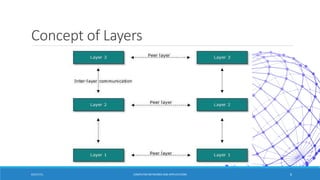
 One whole network process is divided into small tasks
 Each small task is then assigned to a particular layer which works
dedicatedly to process the task only.
 Every layer does only specific work
 One layer on a host deals with work done or to be done by its peer
layer at the same level on the remote host.
ES/CIT/11 5
COMPUTER NETWORKS AND APPLICATIONS
Concept of Layers
ES/CIT/11 6
COMPUTER NETWORKS AND APPLICATIONS
Concept of Layers
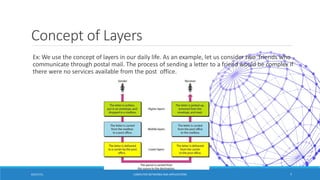
Ex: We use the concept of layers in our daily life. As an example, let us consider two friends who
communicate through postal mail. The process of sending a letter to a friend would be complex if
there were no services available from the post office.
ES/CIT/11 7
COMPUTER NETWORKS AND APPLICATIONS
Network Models
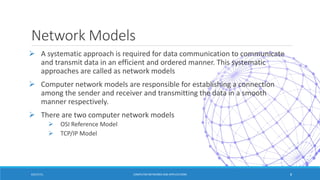
 A systematic approach is required for data communication to communicate
and transmit data in an efficient and ordered manner. This systematic
approaches are called as network models
 Computer network models are responsible for establishing a connection
among the sender and receiver and transmitting the data in a smooth
manner respectively.
 There are two computer network models
 OSI Reference Model
 TCP/IP Model
ES/CIT/11 COMPUTER NETWORKS AND APPLICATIONS 8
Network Models
ES/CIT/11 9
COMPUTER NETWORKS AND APPLICATIONS
OSI Reference Model
 OSI stands for “Open System Interconnection” and
the name of this reference model was given by an
organization known as “International Organization
for Standardization” (ISO). The ISO is responsible for
generating and promoting industrial and commercial
standards applicable for all the users or universally.
 The OSI Model is one of the general purpose
networking or communication model among
computer network models, which is responsible for
establishing connection in an open manner between
all the communicable devices present across the
globe.
ES/CIT/11 COMPUTER NETWORKS AND APPLICATIONS 10
TCP/IP Model
 The TCP/IP model is a concise version of the OSI model. It

contains four layers, unlike the seven layers in the OSI model.
 TCP/IP stand for Transmission Control Protocol
 TCP/IP was developed during the Cold War as a way for the
U.S. Department of Defense to connect computers within
their networks and with each other across national
boundaries. It's been used since the late 1960s when it was
formalized by DARPA and later adopted by government
agencies and universities worldwide as a common networking
standard.
 The first version of TCP/IP was ARPANET (1975), which stands
for Advanced Research Projects Administration Network.
ES/CIT/11 COMPUTER NETWORKS AND APPLICATIONS 11
Application Layer
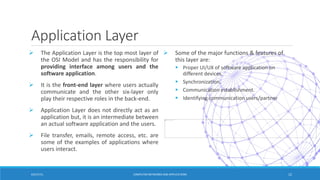
 The Application Layer is the top most layer of
the OSI Model and has the responsibility for
providing interface among users and the
software application.
 It is the front-end layer where users actually
communicate and the other six-layer only
play their respective roles in the back-end.
 Application Layer does not directly act as an
application but, it is an intermediate between
an actual software application and the users.
 File transfer, emails, remote access, etc. are
some of the examples of applications where
users interact.
 Some of the major functions & features of
this layer are:
 Proper UI/UX of software application on
different devices.
 Synchronization.
 Communication establishment.
 Identifying communication users/partner
ES/CIT/11 COMPUTER NETWORKS AND APPLICATIONS 12
Presentation Layer
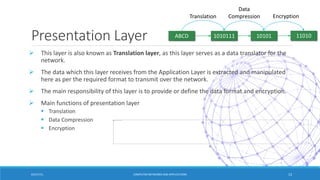
 This layer is also known as Translation layer, as this layer serves as a data translator for the
network.
 The data which this layer receives from the Application Layer is extracted and manipulated
here as per the required format to transmit over the network.
 The main responsibility of this layer is to provide or define the data format and encryption.
 Main functions of presentation layer
 Translation
 Data Compression
 Encryption
ES/CIT/11 COMPUTER NETWORKS AND APPLICATIONS 13
ABCD 1010111 10101 11010
Translation
Data
Compression Encryption
Session Layer
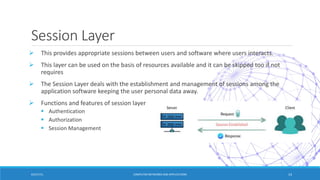
 This provides appropriate sessions between users and software where users interacts.
 This layer can be used on the basis of resources available and it can be skipped too if not
requires
 The Session Layer deals with the establishment and management of sessions among the
application software keeping the user personal data away.
 Functions and features of session layer
 Authentication
 Authorization
 Session Management
ES/CIT/11 COMPUTER NETWORKS AND APPLICATIONS 14
Transport Layer
 The Transport-Layer acts as the transition point between the functions performed by Upper
layers (Application Layer, Presentation Layer, Session Layer) & Lower layers(Network Layer,
Data Link Layer, Physical Layer)
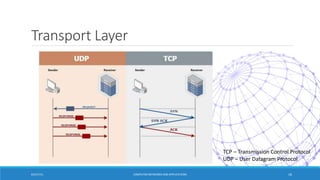
 This layer is responsible for end to end data transmission service using connection oriented
or either through connection-less protocols
 The transport layer controls the reliability of a given link through flow control, segmentation
and de-segmentation, and error control
 Flow Control - ensures that faster data transmission and slow data absorption or slow data
transmission and faster data absorption must not occur
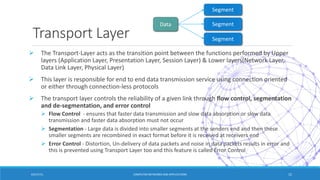
 Segmentation - Large data is divided into smaller segments at the senders end and then these
smaller segments are recombined in exact format before it is received at receivers end
 Error Control - Distortion, Un-delivery of data packets and noise in data packets results in error and
this is prevented using Transport Layer too and this feature is called Error Control
ES/CIT/11 COMPUTER NETWORKS AND APPLICATIONS 15
Data
Segment
Segment
Segment
Transport Layer
ES/CIT/11 COMPUTER NETWORKS AND APPLICATIONS 16
TCP – Transmission Control Protocol
UDP – User Datagram Protocol
Network Layer
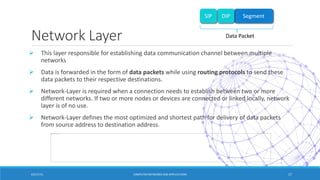
 This layer responsible for establishing data communication channel between multiple
networks
 Data is forwarded in the form of data packets while using routing protocols to send these
data packets to their respective destinations.
 Network-Layer is required when a connection needs to establish between two or more
different networks. If two or more nodes or devices are connected or linked locally, network
layer is of no use.
 Network-Layer defines the most optimized and shortest path for delivery of data packets
from source address to destination address.
ES/CIT/11 COMPUTER NETWORKS AND APPLICATIONS 17
Segment
DIP
SIP
Data Packet
Network Layer
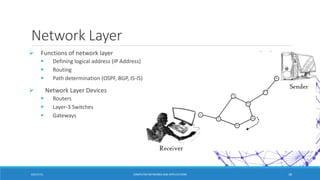
 Functions of network layer
 Defining logical address (IP Address)
 Routing
 Path determination (OSPF, BGP, IS-IS)
 Network Layer Devices
 Routers
 Layer-3 Switches
 Gateways
ES/CIT/11 COMPUTER NETWORKS AND APPLICATIONS 18
Data Link Layer
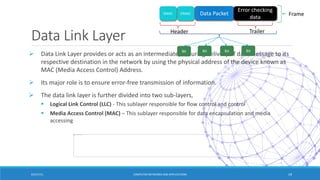
 Data Link Layer provides or acts as an intermediate, ensuring delivery of data message to its
respective destination in the network by using the physical address of the device known as
MAC (Media Access Control) Address.
 Its major role is to ensure error-free transmission of information.
 The data link layer is further divided into two sub-layers,
 Logical Link Control (LLC) - This sublayer responsible for flow control and control
 Media Access Control (MAC) – This sublayer responsible for data encapsulation and media
accessing
ES/CIT/11 COMPUTER NETWORKS AND APPLICATIONS 19
Data Packet
DMAC
SMAC
Error checking
data
Header Trailer
Frame
Bit Bit Bit Bit
Data Link Layer
 Functions of data link layer
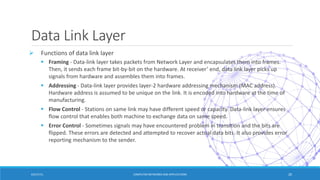
 Framing - Data-link layer takes packets from Network Layer and encapsulates them into frames.
Then, it sends each frame bit-by-bit on the hardware. At receiver’ end, data link layer picks up
signals from hardware and assembles them into frames.
 Addressing - Data-link layer provides layer-2 hardware addressing mechanism (MAC address).
Hardware address is assumed to be unique on the link. It is encoded into hardware at the time of
manufacturing.
 Flow Control - Stations on same link may have different speed or capacity. Data-link layer ensures
flow control that enables both machine to exchange data on same speed.
 Error Control - Sometimes signals may have encountered problem in transition and the bits are
flipped. These errors are detected and attempted to recover actual data bits. It also provides error
reporting mechanism to the sender.
ES/CIT/11 COMPUTER NETWORKS AND APPLICATIONS 20
Physical Layer
ES/CIT/11 COMPUTER NETWORKS AND APPLICATIONS 21
 This is the first and lowest layer in network communication models
 The physical layer function is to transport data using electrical, mechanical or procedural
interfaces.
 Physical layer deals with all the physical devices that can be used for data communication in
a network including the types of cables and transmission modes such as Simplex Mode, Half
Duplex Mode and Full Duplex Mode.
 Functions of physical layer
 Define Data Rate – Define how fast the data flow in bits per second
 Synchronization – Ensure that sending and receiving devices are using the same timing and frequency references
 Define transmission mode
 Convert data (bits) into radio signal or electrical signal / modulation
Summery of OSI model
ES/CIT/11 COMPUTER NETWORKS AND APPLICATIONS 22
ES/CIT/11 COMPUTER NETWORKS AND APPLICATIONS 23
Thank You!

Lec 02 - Network Models.pptx

  • 1.
    COMPUTER NETWORKS AND APPLICATIONS LECTURE- 02 ES/CIT/11 1 COMPUTER NETWORKS AND APPLICATIONS
  • 2.
    Recap  Identify datacommunication process and methods  Identify computer network  Understand computer network architectures  Understand computer network types  Identify computer network topologies ES/CIT/11 2 COMPUTER NETWORKS AND APPLICATIONS
  • 3.
    NETWORK MODELS ES/CIT/11 –COMPUTER NETWORKS AND APPLICATIONS ES/CIT/11 3 COMPUTER NETWORKS AND APPLICATIONS
  • 4.
    Content  Concept oflayers  Network Models  OSI Model  TCP/IP Model  Network Layers ES/CIT/11 4 COMPUTER NETWORKS AND APPLICATIONS
  • 5.
    Concept of Layers One whole network process is divided into small tasks  Each small task is then assigned to a particular layer which works dedicatedly to process the task only.  Every layer does only specific work  One layer on a host deals with work done or to be done by its peer layer at the same level on the remote host. ES/CIT/11 5 COMPUTER NETWORKS AND APPLICATIONS
  • 6.
    Concept of Layers ES/CIT/116 COMPUTER NETWORKS AND APPLICATIONS
  • 7.
    Concept of Layers Ex:We use the concept of layers in our daily life. As an example, let us consider two friends who communicate through postal mail. The process of sending a letter to a friend would be complex if there were no services available from the post office. ES/CIT/11 7 COMPUTER NETWORKS AND APPLICATIONS
  • 8.
    Network Models  Asystematic approach is required for data communication to communicate and transmit data in an efficient and ordered manner. This systematic approaches are called as network models  Computer network models are responsible for establishing a connection among the sender and receiver and transmitting the data in a smooth manner respectively.  There are two computer network models  OSI Reference Model  TCP/IP Model ES/CIT/11 COMPUTER NETWORKS AND APPLICATIONS 8
  • 9.
    Network Models ES/CIT/11 9 COMPUTERNETWORKS AND APPLICATIONS
  • 10.
    OSI Reference Model OSI stands for “Open System Interconnection” and the name of this reference model was given by an organization known as “International Organization for Standardization” (ISO). The ISO is responsible for generating and promoting industrial and commercial standards applicable for all the users or universally.  The OSI Model is one of the general purpose networking or communication model among computer network models, which is responsible for establishing connection in an open manner between all the communicable devices present across the globe. ES/CIT/11 COMPUTER NETWORKS AND APPLICATIONS 10
  • 11.
    TCP/IP Model  TheTCP/IP model is a concise version of the OSI model. It contains four layers, unlike the seven layers in the OSI model.  TCP/IP stand for Transmission Control Protocol  TCP/IP was developed during the Cold War as a way for the U.S. Department of Defense to connect computers within their networks and with each other across national boundaries. It's been used since the late 1960s when it was formalized by DARPA and later adopted by government agencies and universities worldwide as a common networking standard.  The first version of TCP/IP was ARPANET (1975), which stands for Advanced Research Projects Administration Network. ES/CIT/11 COMPUTER NETWORKS AND APPLICATIONS 11

  • 12.
    Application Layer  TheApplication Layer is the top most layer of the OSI Model and has the responsibility for providing interface among users and the software application.  It is the front-end layer where users actually communicate and the other six-layer only play their respective roles in the back-end.  Application Layer does not directly act as an application but, it is an intermediate between an actual software application and the users.  File transfer, emails, remote access, etc. are some of the examples of applications where users interact.  Some of the major functions & features of this layer are:  Proper UI/UX of software application on different devices.  Synchronization.  Communication establishment.  Identifying communication users/partner ES/CIT/11 COMPUTER NETWORKS AND APPLICATIONS 12
  • 13.
    Presentation Layer  Thislayer is also known as Translation layer, as this layer serves as a data translator for the network.  The data which this layer receives from the Application Layer is extracted and manipulated here as per the required format to transmit over the network.  The main responsibility of this layer is to provide or define the data format and encryption.  Main functions of presentation layer  Translation  Data Compression  Encryption ES/CIT/11 COMPUTER NETWORKS AND APPLICATIONS 13 ABCD 1010111 10101 11010 Translation Data Compression Encryption
  • 14.
    Session Layer  Thisprovides appropriate sessions between users and software where users interacts.  This layer can be used on the basis of resources available and it can be skipped too if not requires  The Session Layer deals with the establishment and management of sessions among the application software keeping the user personal data away.  Functions and features of session layer  Authentication  Authorization  Session Management ES/CIT/11 COMPUTER NETWORKS AND APPLICATIONS 14
  • 15.
    Transport Layer  TheTransport-Layer acts as the transition point between the functions performed by Upper layers (Application Layer, Presentation Layer, Session Layer) & Lower layers(Network Layer, Data Link Layer, Physical Layer)  This layer is responsible for end to end data transmission service using connection oriented or either through connection-less protocols  The transport layer controls the reliability of a given link through flow control, segmentation and de-segmentation, and error control  Flow Control - ensures that faster data transmission and slow data absorption or slow data transmission and faster data absorption must not occur  Segmentation - Large data is divided into smaller segments at the senders end and then these smaller segments are recombined in exact format before it is received at receivers end  Error Control - Distortion, Un-delivery of data packets and noise in data packets results in error and this is prevented using Transport Layer too and this feature is called Error Control ES/CIT/11 COMPUTER NETWORKS AND APPLICATIONS 15 Data Segment Segment Segment
  • 16.
    Transport Layer ES/CIT/11 COMPUTERNETWORKS AND APPLICATIONS 16 TCP – Transmission Control Protocol UDP – User Datagram Protocol
  • 17.
    Network Layer  Thislayer responsible for establishing data communication channel between multiple networks  Data is forwarded in the form of data packets while using routing protocols to send these data packets to their respective destinations.  Network-Layer is required when a connection needs to establish between two or more different networks. If two or more nodes or devices are connected or linked locally, network layer is of no use.  Network-Layer defines the most optimized and shortest path for delivery of data packets from source address to destination address. ES/CIT/11 COMPUTER NETWORKS AND APPLICATIONS 17 Segment DIP SIP Data Packet
  • 18.
    Network Layer  Functionsof network layer  Defining logical address (IP Address)  Routing  Path determination (OSPF, BGP, IS-IS)  Network Layer Devices  Routers  Layer-3 Switches  Gateways ES/CIT/11 COMPUTER NETWORKS AND APPLICATIONS 18
  • 19.
    Data Link Layer Data Link Layer provides or acts as an intermediate, ensuring delivery of data message to its respective destination in the network by using the physical address of the device known as MAC (Media Access Control) Address.  Its major role is to ensure error-free transmission of information.  The data link layer is further divided into two sub-layers,  Logical Link Control (LLC) - This sublayer responsible for flow control and control  Media Access Control (MAC) – This sublayer responsible for data encapsulation and media accessing ES/CIT/11 COMPUTER NETWORKS AND APPLICATIONS 19 Data Packet DMAC SMAC Error checking data Header Trailer Frame Bit Bit Bit Bit
  • 20.
    Data Link Layer Functions of data link layer  Framing - Data-link layer takes packets from Network Layer and encapsulates them into frames. Then, it sends each frame bit-by-bit on the hardware. At receiver’ end, data link layer picks up signals from hardware and assembles them into frames.  Addressing - Data-link layer provides layer-2 hardware addressing mechanism (MAC address). Hardware address is assumed to be unique on the link. It is encoded into hardware at the time of manufacturing.  Flow Control - Stations on same link may have different speed or capacity. Data-link layer ensures flow control that enables both machine to exchange data on same speed.  Error Control - Sometimes signals may have encountered problem in transition and the bits are flipped. These errors are detected and attempted to recover actual data bits. It also provides error reporting mechanism to the sender. ES/CIT/11 COMPUTER NETWORKS AND APPLICATIONS 20
  • 21.
    Physical Layer ES/CIT/11 COMPUTERNETWORKS AND APPLICATIONS 21  This is the first and lowest layer in network communication models  The physical layer function is to transport data using electrical, mechanical or procedural interfaces.  Physical layer deals with all the physical devices that can be used for data communication in a network including the types of cables and transmission modes such as Simplex Mode, Half Duplex Mode and Full Duplex Mode.  Functions of physical layer  Define Data Rate – Define how fast the data flow in bits per second  Synchronization – Ensure that sending and receiving devices are using the same timing and frequency references  Define transmission mode  Convert data (bits) into radio signal or electrical signal / modulation
  • 22.
    Summery of OSImodel ES/CIT/11 COMPUTER NETWORKS AND APPLICATIONS 22
  • 23.
    ES/CIT/11 COMPUTER NETWORKSAND APPLICATIONS 23 Thank You!