8/17/2020
1
Basic Planning
Course Code: PLAN 411
Course tutor: Assistant Professor Dr. Syeda Jafrina Nancy
Department of Architecture
Bangladesh University of Engineering and Technology (BUET)
Prepared by:
Asst. Prof. Dr. Syeda Jafrina Nancy
09/05/2025
2
Urban/City/Town Planning
Prepared by:
Asst. Prof. Dr. Syeda Jafrina Nancy
Lecture : 01
09/05/2025
3
Department of ArchitectureMilitary Institute of Science and Technology
(MIST)
Prepared by:
Asst. Prof. Dr. Syeda Jafrina Nancy
Lecture Outline
• Planning
• Town/ city planning and regional planning
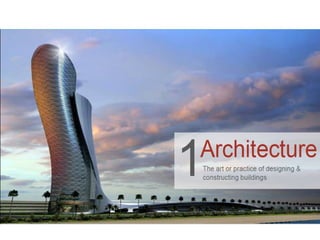
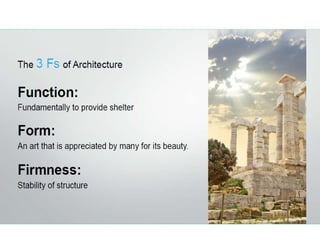
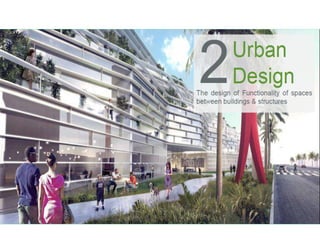
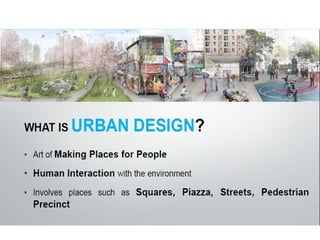
• Aims of Town planning
• Urban planning
• What urban planners do?
• Architecture, urban design and urban planning
• Why town and urban planning is needed?
• Levels of urban planning
• How town planning provides health?
• What do planners do?
• What does beauty and convenience mean?
• Urban planning devices
• Overview of course
09/05/2025
4
Prepared by:
Asst. Prof. Dr. Syeda Jafrina Nancy
What is Planning ?
09/05/2025
5
T/Y-1/4
Prepared by:
Asst. Prof. Dr. Syeda Jafrina Nancy
6
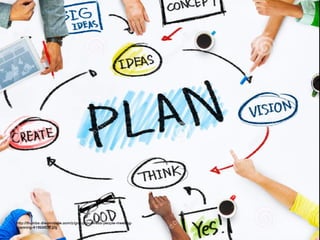
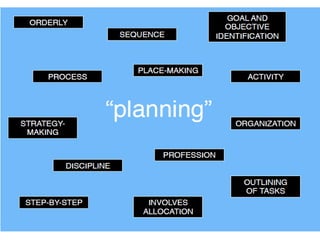
Planningcan be defined as thinking in advance
What is to be done?
When it is to be done?
How it should be done?
And by whom it should be done?
Planning involves setting objectives and deciding in advance the appropriate
course of action to achieve these objectives.
So we can also define planning as setting up objectives and targets and
formulating and action plan to achieve them.
09/05/2025
7
T/Y-1/4
Prepared by:
Asst. Prof. Dr. Syeda Jafrina Nancy
09/05/2025
8
What is planning?
• Definition of planning is subjective.
• It is considered a multi-disciplinary science and art.
• It is pre-thinking and pre-arranging things.
• Planning is a future-oriented problem solving process.
• It is a way of thinking about social and economic problems
• It is concerned with the relation of goals to collective decisions and strives
for comprehensiveness in policies and programs (freidman)
• It is the link between technical knowledge and action in the public domain.
• An orderly sequence of activities that will lead to the accomplishment of
stated goals
09/05/2025
What is planning?
Planning can be defined an scientific and artistic future oriented problem
solving process which involves identifying a problem, setting up objectives and
goals and a step by step orderly sequence of activities in order to achieve those
objectives and ultimately reach the goal.
10
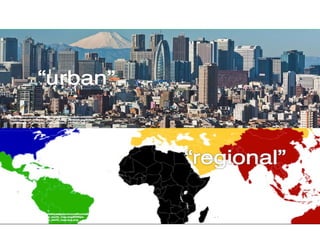
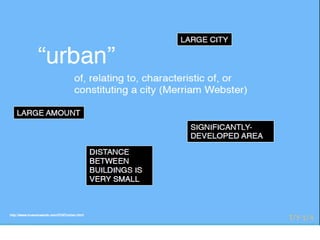
Urban
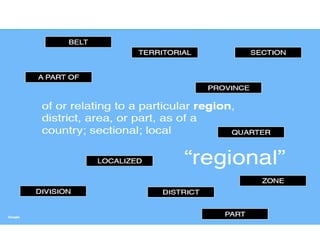
Regional
09/05/2025
11
Prepared by:
Asst. Prof. Dr. Syeda Jafrina Nancy
09/05/2025
12
T/Y-1/4
Prepared by:
Asst. Prof. Dr. Syeda Jafrina Nancy
09/05/2025
13
Prepared by:
Asst. Prof. Dr. Syeda Jafrina Nancy
09/05/2025
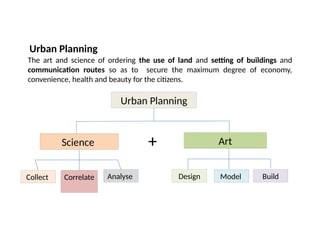
The art and science of ordering the use of land and setting of buildings and
communication routes so as to secure the maximum degree of economy,
convenience, health and beauty for the citizens.
Urban Planning
Science Art
Collect Correlate Analyse
+
Build
Model
Design
Urban Planning
09/05/2025
15
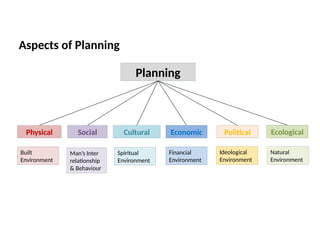
Aspects of Planning
Planning
Physical Cultural
Social
Built
Environment
Spiritual
Environment
Financial
Environment
Ideological
Environment
Natural
Environment
Economic Political Ecological
Man’s Inter
relationship
& Behaviour
09/05/2025
16
Prepared by:
Asst. Prof. Dr. Syeda Jafrina Nancy
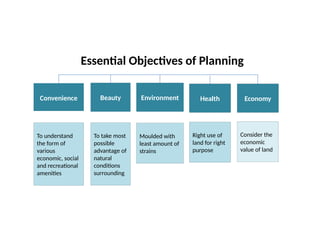
Essential Objectives of Planning
Convenience Environment
Beauty
To understand
the form of
various
economic, social
and recreational
amenities
Moulded with
least amount of
strains
Right use of
land for right
purpose
Consider the
economic
value of land
Health Economy
To take most
possible
advantage of
natural
conditions
surrounding
09/05/2025
What does beauty and convenience mean?
• Convenience is understood in the form of various economic, social
and recreational amenities to be given to the public
• Provision of jobs, provision of places for social gatherings, provisions
of basic infrastructure facilities such as electricity, water, sewerage
system, roads
• Beauty means to preserve the aesthetic in the design of all elements
of the town or city plan.
• Beauty is achieved by taking the best possible advantages of the
natural conditions.
09/05/2025
18
Prepared by:
Asst. Prof. Dr. Syeda Jafrina Nancy
How town planning provides health?
• Regulating and reducing pollutions of different kinds – air, noise,
water
• Providing open spaces such as parks for public use
• Water and waste treatment facilities
• Use of renewable technologies for provision of electricity
• Providing pathways that encourage walking and reduce the use of
vehicles that use non renewable fuels
• Implementation of environmental protection laws
• Proper disposal of waste
09/05/2025
19
T/Y-1/4
Prepared by:
Asst. Prof. Dr. Syeda Jafrina Nancy
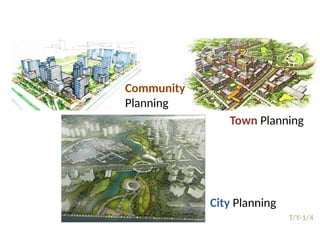
Town Planning
Community
Planning
City Planning
09/05/2025
20
T/Y-1/4
Prepared by:
Asst. Prof. Dr. Syeda Jafrina Nancy
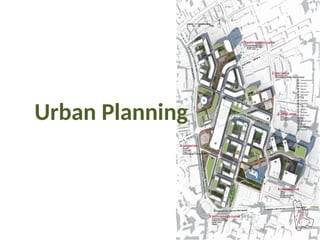
Urban Planning
09/05/2025
What is town planning?
• It is the art and science of organizing land use and siting of buildings and
communication routes to provide best possible degree of economy, beauty and
convenience in terms of the available resources and time.
• It is the organization of all elements of a town or other urban Environment
• Town planning integrates land use and other managerial aspects of settlements
to improve the economic and social environments of communities and achieving
health, beauty, convenience, preservation and sustainability.
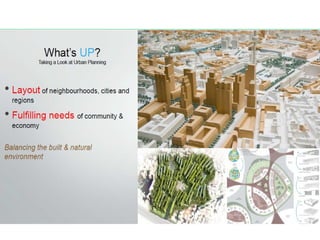
Urban planning
• Similar to town planning but done on a much larger scale
• An urban environment is one in which natural environment is dominated by the
man made environment
• A city is a large human settlement, a town is a mid sized human settlement
• Economic base and infrastructure are also used to define whether a human
settlement is a city, town or village.
09/05/2025
23
What is Urban Planning?
Urban planning is a collaborative as well as a technical and political process
concerned with the development and use of land, planning permissions,
protection and use of the environment, public welfare, and the design of the
urban environment, including air, water, and the infrastructure passing into and
out of urban areas, such as transportation and communication, and distribution
networks to improve a community by creating convenient, equitable, efficient,
and attractive environments for present and future generations.”
09/05/2025
24
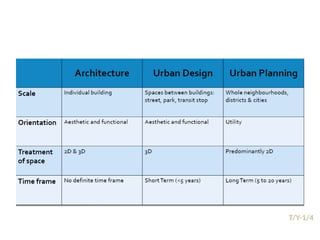
The relationship is historical:
In the 1960s, planning and architecture were split (Gosling & maitland,
1984:7)
Planning concentrated on land use patterns and socio-economic issues
(macro)
Architecture concentrated on the design of buildings (micro)
There emerged a responsibility gap where design of public space was
concerned
Urban design came in to bridge this gap
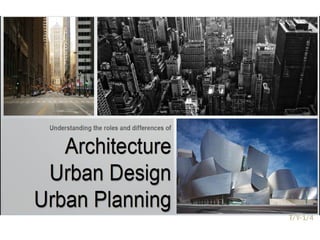
Urban Planning - Urban Design - Architecture Axis
09/05/2025
25
T/Y-1/4
Prepared by:
Asst. Prof. Dr. Syeda Jafrina Nancy
09/05/2025
26
T/Y-1/4
Prepared by:
Asst. Prof. Dr. Syeda Jafrina Nancy
09/05/2025
27
T/Y-1/4
Prepared by:
Asst. Prof. Dr. Syeda Jafrina Nancy
09/05/2025
28
T/Y-1/4
Prepared by:
Asst. Prof. Dr. Syeda Jafrina Nancy
09/05/2025
29
T/Y-1/4
Prepared by:
Asst. Prof. Dr. Syeda Jafrina Nancy
09/05/2025
30
T/Y-1/4
Prepared by:
Asst. Prof. Dr. Syeda Jafrina Nancy
09/05/2025
31
T/Y-1/4
Prepared by:
Asst. Prof. Dr. Syeda Jafrina Nancy
09/05/2025
32
T/Y-1/4
Prepared by:
Asst. Prof. Dr. Syeda Jafrina Nancy
09/05/2025
33
T/Y-1/4
Prepared by:
Asst. Prof. Dr. Syeda Jafrina Nancy
09/05/2025
34
T/Y-1/4
Prepared by:
Asst. Prof. Dr. Syeda Jafrina Nancy
09/05/2025
35
T/Y-1/4
Prepared by:
Asst. Prof. Dr. Syeda Jafrina Nancy
09/05/2025
36
T/Y-1/4
Prepared by:
Asst. Prof. Dr. Syeda Jafrina Nancy
Urban Planning Decisions = Future Oriented Decisions
09/05/2025
37
T/Y-1/4
Prepared by:
Asst. Prof. Dr. Syeda Jafrina Nancy
Levels of Urban Planning
• Local/District – short or medium term development of a town
• Regional – medium term development focusing on solving problems
with regional dimensions
• National– economic and long term development for national
interests
09/05/2025
38
T/Y-1/4
Prepared by:
Asst. Prof. Dr. Syeda Jafrina Nancy
Aims of Planning
• Production of the guidelines dictating the course of development of a city or town
• Improve built environment
• Preserve the best features of our environment for benefit of future generations –
 cultural preservation
 historical preservation
 environmental conservation
• Fulfill social and economic needs of population and nations
• Reduce poverty and inequality in development
• Health, beauty, convenience, comfort and security
09/05/2025
39
T/Y-1/4
Prepared by:
Asst. Prof. Dr. Syeda Jafrina Nancy
Necessity of Planning
• Comfort and Convenience to Public
• To avoid Uneven and Chaotic development – contrasting urban scenario
• Efficient and effective use of Land
• Balance the springing land uses
• Ensure environment which is functional, efficient, healthy and aesthetically
satisfying for human activity
09/05/2025
40
T/Y-1/4
Prepared by:
Asst. Prof. Dr. Syeda Jafrina Nancy
Elements of a city
• Transportation and communication routes
• Buildings; public, commercial, residential, recreational, educational, industrial, military,
government
• Urban agriculture, vegetation
09/05/2025
41
Prepared by:
Asst. Prof. Dr. Syeda Jafrina Nancy
Why urban/town planning is needed?
• Urbanization is increasing
• Population is growing. Planning is needed to make better use of resources
• Social inequality
• Facing new socio-economic and climatic challenges:
• Urban security
• Public Health and Safety
• Financial crises
• Global Warming and climate change
• Social changes
• Realizing a settlement’s economic potential by overcoming weaknesses such as:
• Lack of innovative urban development vision
• Lack of coordination between departments responsible for urban development
• Unsustainable development
• Environmental Degradation
• Corrupt and poorly managed Urban governance institutions
09/05/2025
42
Prepared by:
Asst. Prof. Dr. Syeda Jafrina Nancy
Principles of town planning
• No Haphazard methods of planning are to be employed
• Fulfillment of basic needs such as housing is necessary for all levels of
society
• Provision of basic infrastructure facilities or civic amenities
• Provision of open spaces
• Accessibility ( modes of transportation – rail, road, air, water)
• Proper systems of zoning to be implemented
• Provision of green belts to control future growth of a city and prevent
environmental degradation
09/05/2025
43
What do planners do?
• Devise land use
• Address transportation and infrastructure requirements
• Planning social and community services
• Creating economic capacity in local communities
• Working internationally
Involves:
Politicians, developers, architects, engineers, citizens
09/05/2025
44
Prepared by:
Asst. Prof. Dr. Syeda Jafrina Nancy
45
Prepared by:
Asst. Prof. Dr. Syeda Jafrina Nancy
Urban planning devices
• Development plans
• Zoning regulations
• Building regulations
• Environmental protection laws
• Conservation areas laws
• Enforcements laws and machinery
09/05/2025
46
Key Readings:
1. Berke, Philip R. (1987).Urban Land Use Planning
2. Hall, P. G.(1996). Cities of Tommorrow: An Intellectual History of Urban
Planning and Design in the Twentieth Century.
3. Jacobs, Jane (1961). The Death and Life of Great American Cities. New
York:Vintage Books
Additional Readings:
4. Gravin A., What makes a Great City
5. Greed, C. (1996) Introducing Town Planning, 2nd
edn. Essex: Addison Wesley
Longman..
6. Hall, P. (1994) Urban & Regional Planning, 3rd
edn. London: Routledge
7. Levy, J.M. (2009) Contemporary Urban Planning, 8th
edn. New Jersey: Pearson
[Chapter 1]
09/05/2025
47
T/Y-1/4
Prepared by:
Asst. Prof. Dr. Syeda Jafrina Nancy
Thank you

Lec-01-Introduction-ARCH-2105-Basic-Planning-Copy.pptx

  • 1.
    8/17/2020 1 Basic Planning Course Code:PLAN 411 Course tutor: Assistant Professor Dr. Syeda Jafrina Nancy Department of Architecture Bangladesh University of Engineering and Technology (BUET) Prepared by: Asst. Prof. Dr. Syeda Jafrina Nancy
  • 2.
    09/05/2025 2 Urban/City/Town Planning Prepared by: Asst.Prof. Dr. Syeda Jafrina Nancy Lecture : 01
  • 3.
    09/05/2025 3 Department of ArchitectureMilitaryInstitute of Science and Technology (MIST) Prepared by: Asst. Prof. Dr. Syeda Jafrina Nancy Lecture Outline • Planning • Town/ city planning and regional planning • Aims of Town planning • Urban planning • What urban planners do? • Architecture, urban design and urban planning • Why town and urban planning is needed? • Levels of urban planning • How town planning provides health? • What do planners do? • What does beauty and convenience mean? • Urban planning devices • Overview of course
  • 4.
    09/05/2025 4 Prepared by: Asst. Prof.Dr. Syeda Jafrina Nancy What is Planning ?
  • 5.
  • 6.
    6 Planningcan be definedas thinking in advance What is to be done? When it is to be done? How it should be done? And by whom it should be done? Planning involves setting objectives and deciding in advance the appropriate course of action to achieve these objectives. So we can also define planning as setting up objectives and targets and formulating and action plan to achieve them.
  • 7.
  • 8.
    09/05/2025 8 What is planning? •Definition of planning is subjective. • It is considered a multi-disciplinary science and art. • It is pre-thinking and pre-arranging things. • Planning is a future-oriented problem solving process. • It is a way of thinking about social and economic problems • It is concerned with the relation of goals to collective decisions and strives for comprehensiveness in policies and programs (freidman) • It is the link between technical knowledge and action in the public domain. • An orderly sequence of activities that will lead to the accomplishment of stated goals
  • 9.
    09/05/2025 What is planning? Planningcan be defined an scientific and artistic future oriented problem solving process which involves identifying a problem, setting up objectives and goals and a step by step orderly sequence of activities in order to achieve those objectives and ultimately reach the goal.
  • 10.
  • 11.
  • 12.
  • 13.
  • 14.
    09/05/2025 The art andscience of ordering the use of land and setting of buildings and communication routes so as to secure the maximum degree of economy, convenience, health and beauty for the citizens. Urban Planning Science Art Collect Correlate Analyse + Build Model Design Urban Planning
  • 15.
    09/05/2025 15 Aspects of Planning Planning PhysicalCultural Social Built Environment Spiritual Environment Financial Environment Ideological Environment Natural Environment Economic Political Ecological Man’s Inter relationship & Behaviour
  • 16.
    09/05/2025 16 Prepared by: Asst. Prof.Dr. Syeda Jafrina Nancy Essential Objectives of Planning Convenience Environment Beauty To understand the form of various economic, social and recreational amenities Moulded with least amount of strains Right use of land for right purpose Consider the economic value of land Health Economy To take most possible advantage of natural conditions surrounding
  • 17.
    09/05/2025 What does beautyand convenience mean? • Convenience is understood in the form of various economic, social and recreational amenities to be given to the public • Provision of jobs, provision of places for social gatherings, provisions of basic infrastructure facilities such as electricity, water, sewerage system, roads • Beauty means to preserve the aesthetic in the design of all elements of the town or city plan. • Beauty is achieved by taking the best possible advantages of the natural conditions.
  • 18.
    09/05/2025 18 Prepared by: Asst. Prof.Dr. Syeda Jafrina Nancy How town planning provides health? • Regulating and reducing pollutions of different kinds – air, noise, water • Providing open spaces such as parks for public use • Water and waste treatment facilities • Use of renewable technologies for provision of electricity • Providing pathways that encourage walking and reduce the use of vehicles that use non renewable fuels • Implementation of environmental protection laws • Proper disposal of waste
  • 19.
    09/05/2025 19 T/Y-1/4 Prepared by: Asst. Prof.Dr. Syeda Jafrina Nancy Town Planning Community Planning City Planning
  • 20.
    09/05/2025 20 T/Y-1/4 Prepared by: Asst. Prof.Dr. Syeda Jafrina Nancy Urban Planning
  • 21.
    09/05/2025 What is townplanning? • It is the art and science of organizing land use and siting of buildings and communication routes to provide best possible degree of economy, beauty and convenience in terms of the available resources and time. • It is the organization of all elements of a town or other urban Environment • Town planning integrates land use and other managerial aspects of settlements to improve the economic and social environments of communities and achieving health, beauty, convenience, preservation and sustainability.
  • 22.
    Urban planning • Similarto town planning but done on a much larger scale • An urban environment is one in which natural environment is dominated by the man made environment • A city is a large human settlement, a town is a mid sized human settlement • Economic base and infrastructure are also used to define whether a human settlement is a city, town or village.
  • 23.
    09/05/2025 23 What is UrbanPlanning? Urban planning is a collaborative as well as a technical and political process concerned with the development and use of land, planning permissions, protection and use of the environment, public welfare, and the design of the urban environment, including air, water, and the infrastructure passing into and out of urban areas, such as transportation and communication, and distribution networks to improve a community by creating convenient, equitable, efficient, and attractive environments for present and future generations.”
  • 24.
    09/05/2025 24 The relationship ishistorical: In the 1960s, planning and architecture were split (Gosling & maitland, 1984:7) Planning concentrated on land use patterns and socio-economic issues (macro) Architecture concentrated on the design of buildings (micro) There emerged a responsibility gap where design of public space was concerned Urban design came in to bridge this gap Urban Planning - Urban Design - Architecture Axis
  • 25.
  • 26.
  • 27.
  • 28.
  • 29.
  • 30.
  • 31.
  • 32.
  • 33.
  • 34.
  • 35.
  • 36.
    09/05/2025 36 T/Y-1/4 Prepared by: Asst. Prof.Dr. Syeda Jafrina Nancy Urban Planning Decisions = Future Oriented Decisions
  • 37.
    09/05/2025 37 T/Y-1/4 Prepared by: Asst. Prof.Dr. Syeda Jafrina Nancy Levels of Urban Planning • Local/District – short or medium term development of a town • Regional – medium term development focusing on solving problems with regional dimensions • National– economic and long term development for national interests
  • 38.
    09/05/2025 38 T/Y-1/4 Prepared by: Asst. Prof.Dr. Syeda Jafrina Nancy Aims of Planning • Production of the guidelines dictating the course of development of a city or town • Improve built environment • Preserve the best features of our environment for benefit of future generations –  cultural preservation  historical preservation  environmental conservation • Fulfill social and economic needs of population and nations • Reduce poverty and inequality in development • Health, beauty, convenience, comfort and security
  • 39.
    09/05/2025 39 T/Y-1/4 Prepared by: Asst. Prof.Dr. Syeda Jafrina Nancy Necessity of Planning • Comfort and Convenience to Public • To avoid Uneven and Chaotic development – contrasting urban scenario • Efficient and effective use of Land • Balance the springing land uses • Ensure environment which is functional, efficient, healthy and aesthetically satisfying for human activity
  • 40.
    09/05/2025 40 T/Y-1/4 Prepared by: Asst. Prof.Dr. Syeda Jafrina Nancy Elements of a city • Transportation and communication routes • Buildings; public, commercial, residential, recreational, educational, industrial, military, government • Urban agriculture, vegetation
  • 41.
    09/05/2025 41 Prepared by: Asst. Prof.Dr. Syeda Jafrina Nancy Why urban/town planning is needed? • Urbanization is increasing • Population is growing. Planning is needed to make better use of resources • Social inequality • Facing new socio-economic and climatic challenges: • Urban security • Public Health and Safety • Financial crises • Global Warming and climate change • Social changes • Realizing a settlement’s economic potential by overcoming weaknesses such as: • Lack of innovative urban development vision • Lack of coordination between departments responsible for urban development • Unsustainable development • Environmental Degradation • Corrupt and poorly managed Urban governance institutions
  • 42.
    09/05/2025 42 Prepared by: Asst. Prof.Dr. Syeda Jafrina Nancy Principles of town planning • No Haphazard methods of planning are to be employed • Fulfillment of basic needs such as housing is necessary for all levels of society • Provision of basic infrastructure facilities or civic amenities • Provision of open spaces • Accessibility ( modes of transportation – rail, road, air, water) • Proper systems of zoning to be implemented • Provision of green belts to control future growth of a city and prevent environmental degradation
  • 43.
    09/05/2025 43 What do plannersdo? • Devise land use • Address transportation and infrastructure requirements • Planning social and community services • Creating economic capacity in local communities • Working internationally Involves: Politicians, developers, architects, engineers, citizens
  • 44.
  • 45.
    45 Prepared by: Asst. Prof.Dr. Syeda Jafrina Nancy Urban planning devices • Development plans • Zoning regulations • Building regulations • Environmental protection laws • Conservation areas laws • Enforcements laws and machinery
  • 46.
    09/05/2025 46 Key Readings: 1. Berke,Philip R. (1987).Urban Land Use Planning 2. Hall, P. G.(1996). Cities of Tommorrow: An Intellectual History of Urban Planning and Design in the Twentieth Century. 3. Jacobs, Jane (1961). The Death and Life of Great American Cities. New York:Vintage Books Additional Readings: 4. Gravin A., What makes a Great City 5. Greed, C. (1996) Introducing Town Planning, 2nd edn. Essex: Addison Wesley Longman.. 6. Hall, P. (1994) Urban & Regional Planning, 3rd edn. London: Routledge 7. Levy, J.M. (2009) Contemporary Urban Planning, 8th edn. New Jersey: Pearson [Chapter 1]
  • 47.
    09/05/2025 47 T/Y-1/4 Prepared by: Asst. Prof.Dr. Syeda Jafrina Nancy Thank you