Open Textbooks:
Opening the doors
to education
• Mary Burgess, Director, Open Education,
BCcampus
• University of Saskatchewan, April 2014
Agenda
• What is Open?
• What is an Open Educational Resource?
• What is an Open Textbook?
• BC Open Textbook Project
• Case Studies
• Food for thought
Introductions
What’s your role at the institution? Show of hands…
•Faculty?
•Administrator?
•Librarian?
•Student?
•Instructional Designer?
•Educational Technologist?
•Other?
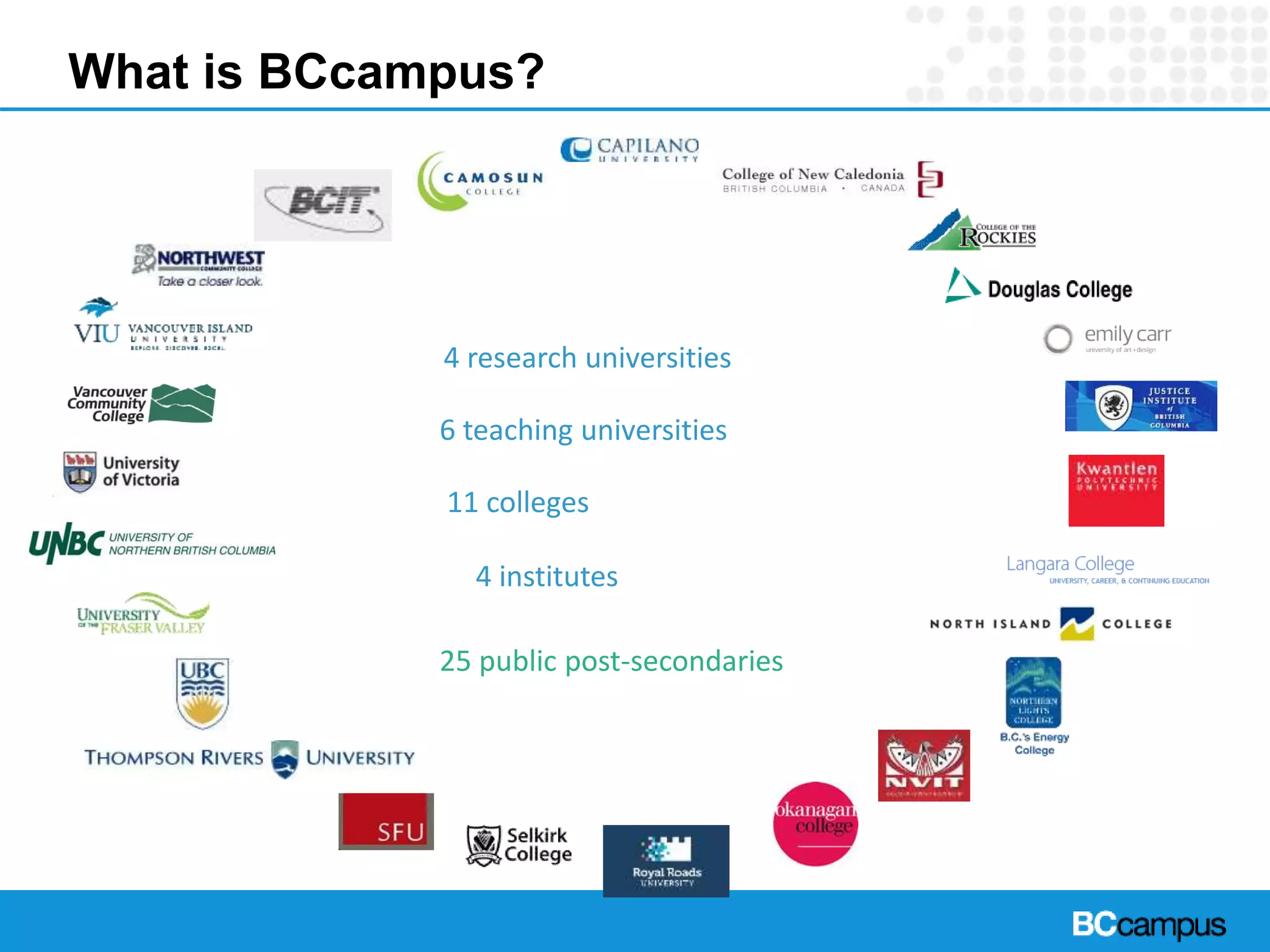
What is BCcampus?
4 research universities
6 teaching universities
11 colleges
4 institutes
25 public post-secondaries
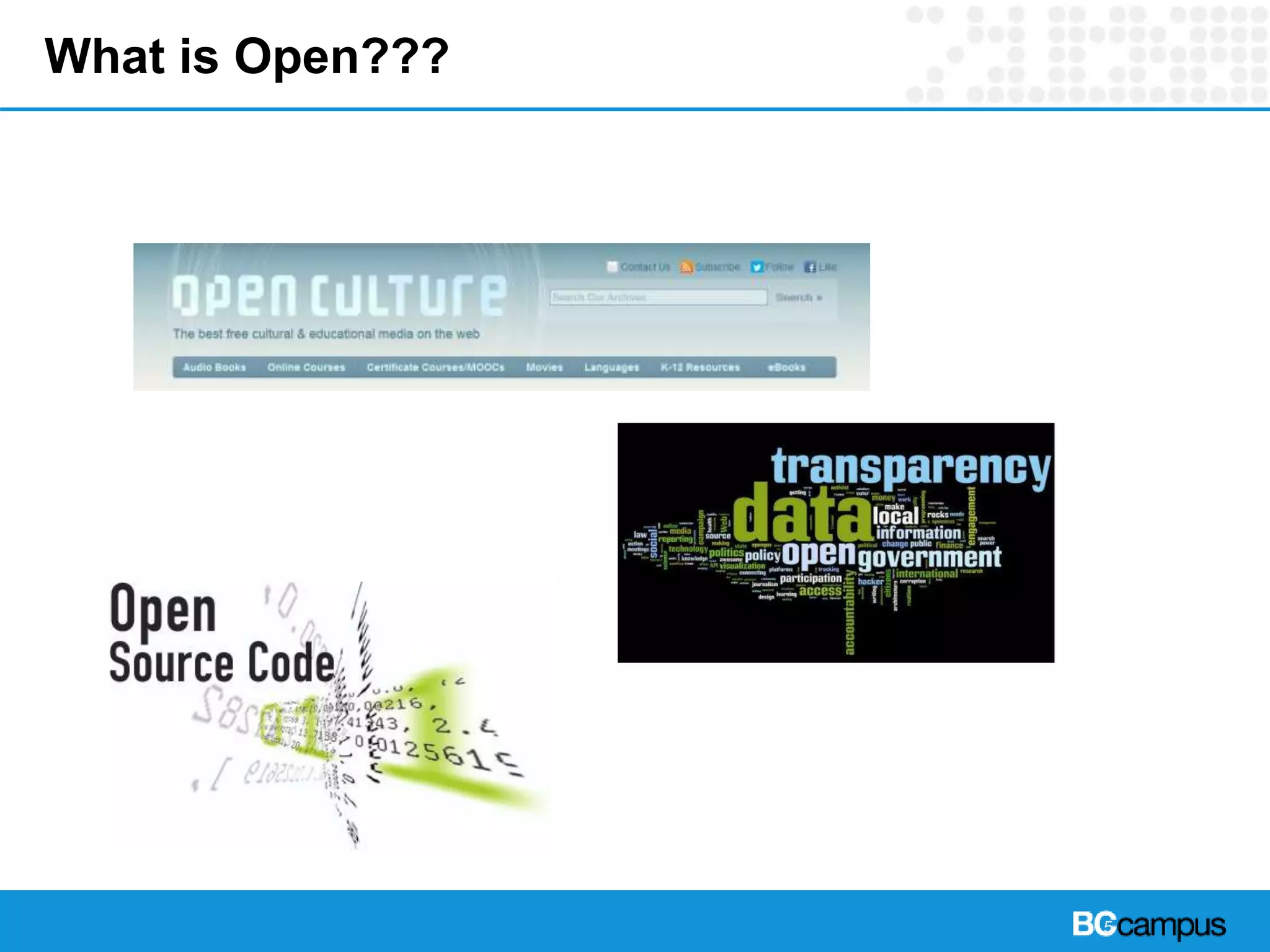
What is Open???
5
6
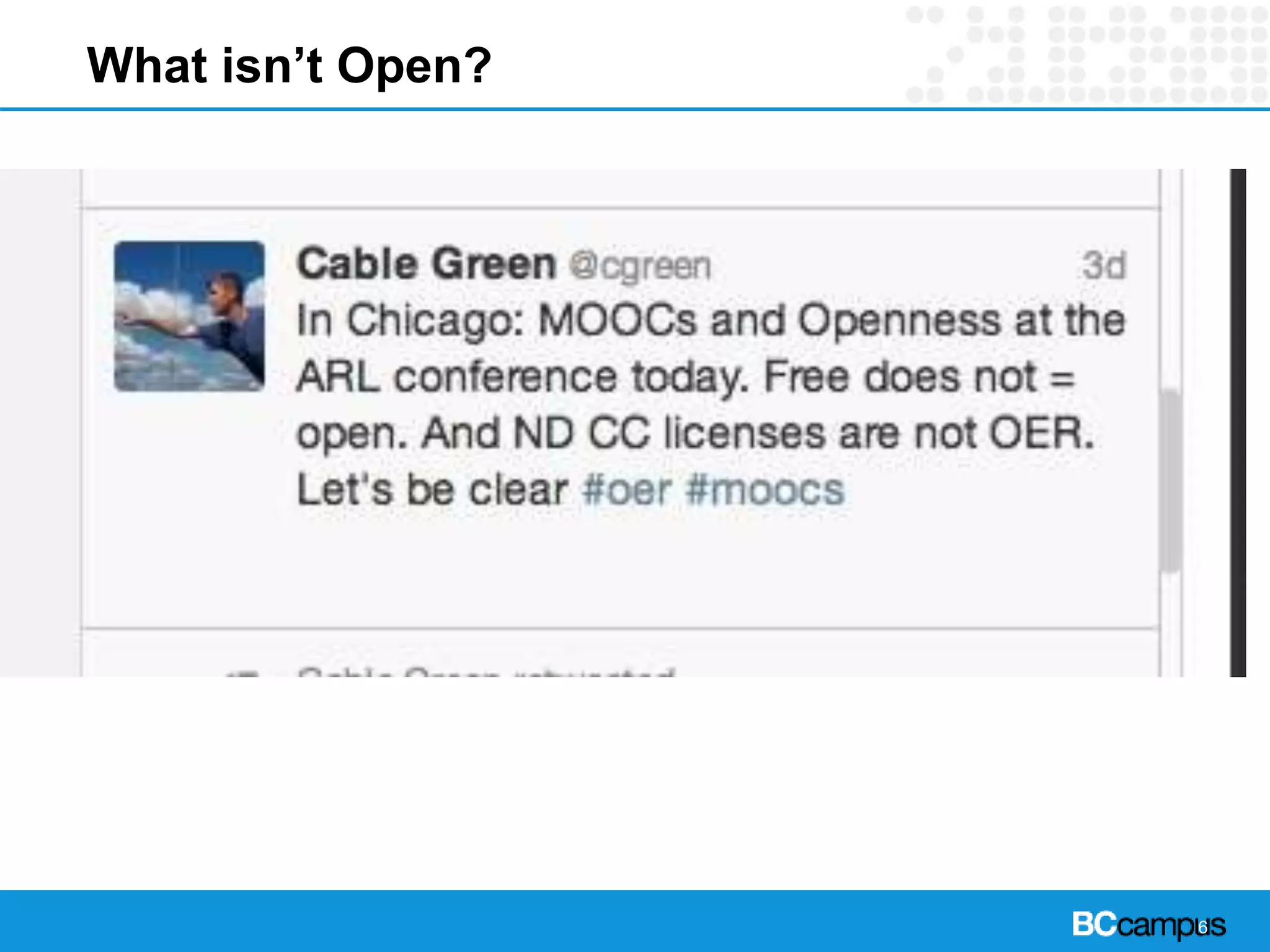
What isn’t Open?isn’t Open?
New Section
Title
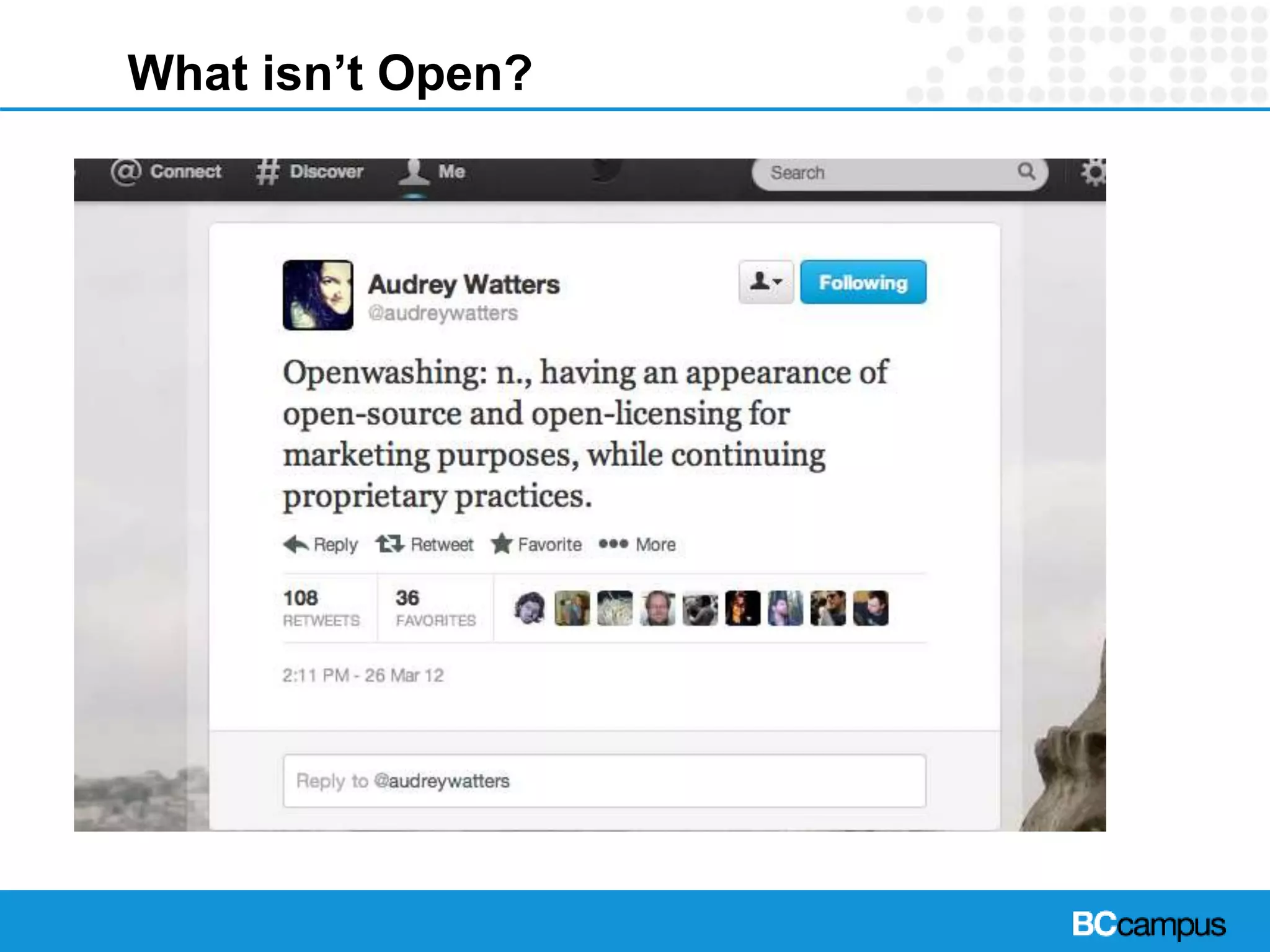
What isn’t Open?
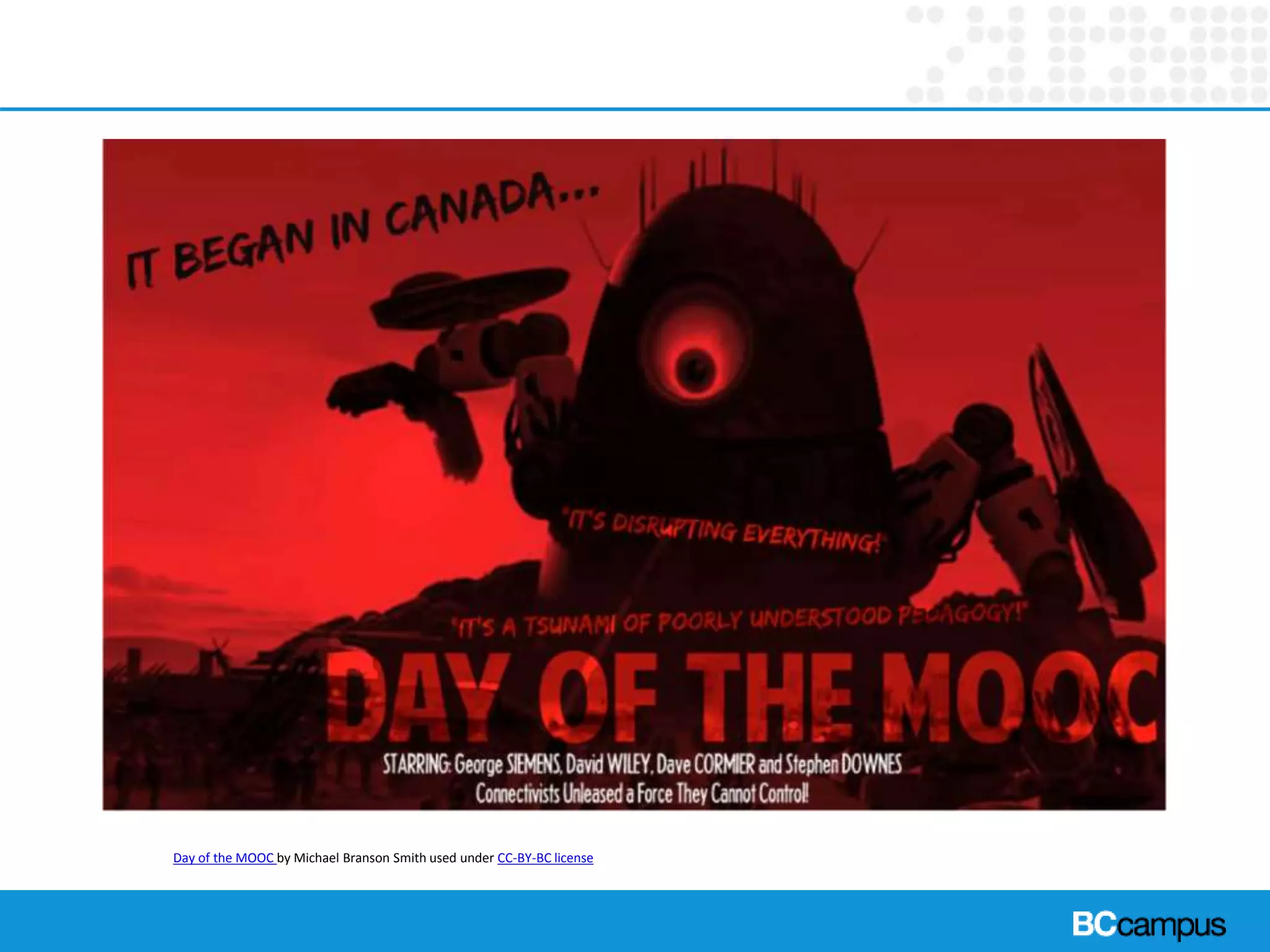
Day of the MOOC by Michael Branson Smith used under CC-BY-BC license
What is an OER?
Headline
“OER are teaching, learning, and research
resources that reside in the public domain or have
been released under an intellectual property license
that permits their free use and re-purposing by
others.”
William & Flora Hewlett Foundation
http://www.hewlett.org/programs/education-program/open-educational-resources
What are Open Educational Resources?
Thank You
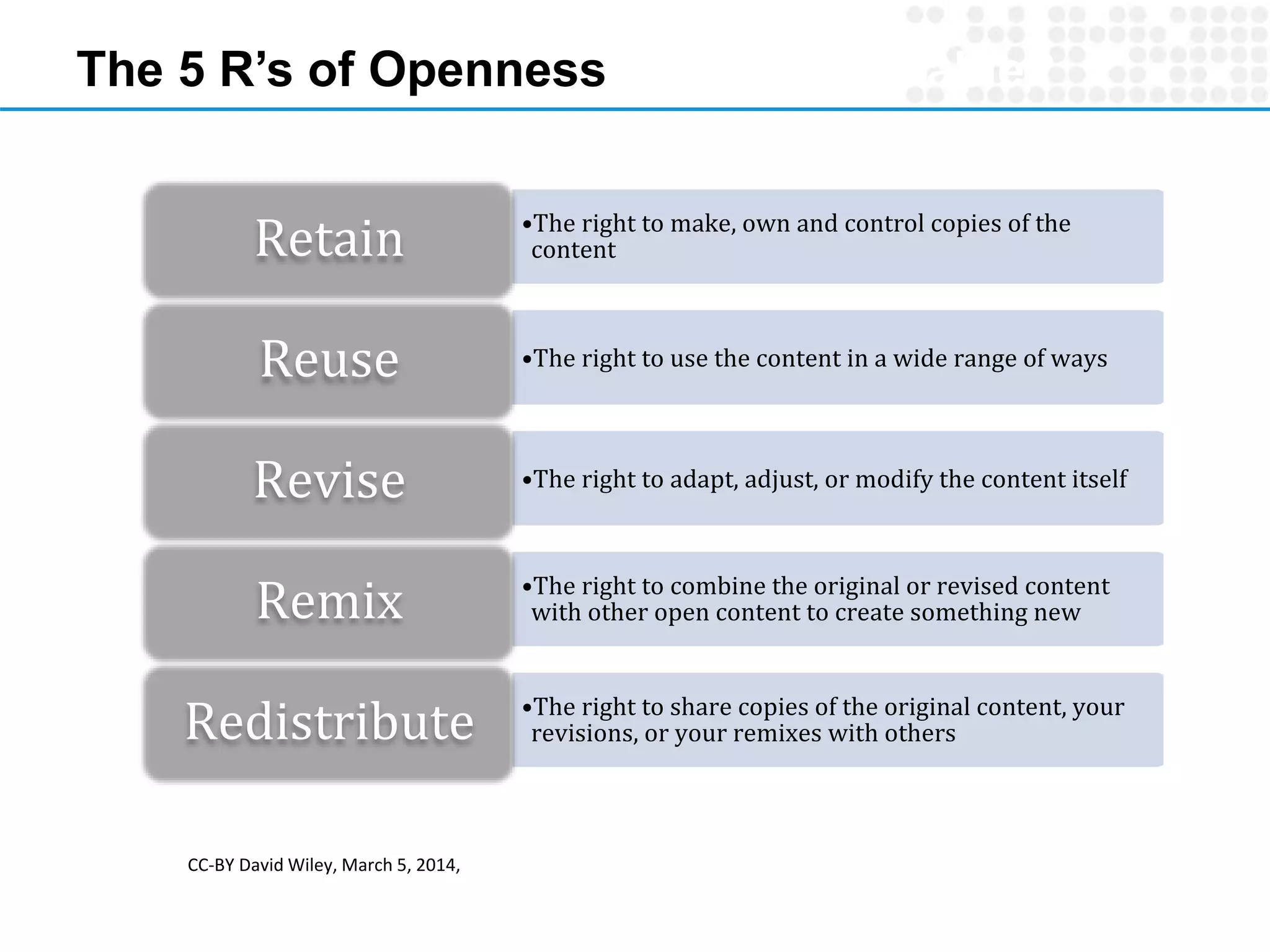
The 5 R’s of Opennessdoes open enable?
•The right to make, own and control copies of the
contentRetain
•The right to use the content in a wide range of waysReuse
•The right to adapt, adjust, or modify the content itselfRevise
•The right to combine the original or revised content
with other open content to create something newRemix
•The right to share copies of the original content, your
revisions, or your remixes with othersRedistribute
CC-BY David Wiley, March 5, 2014,
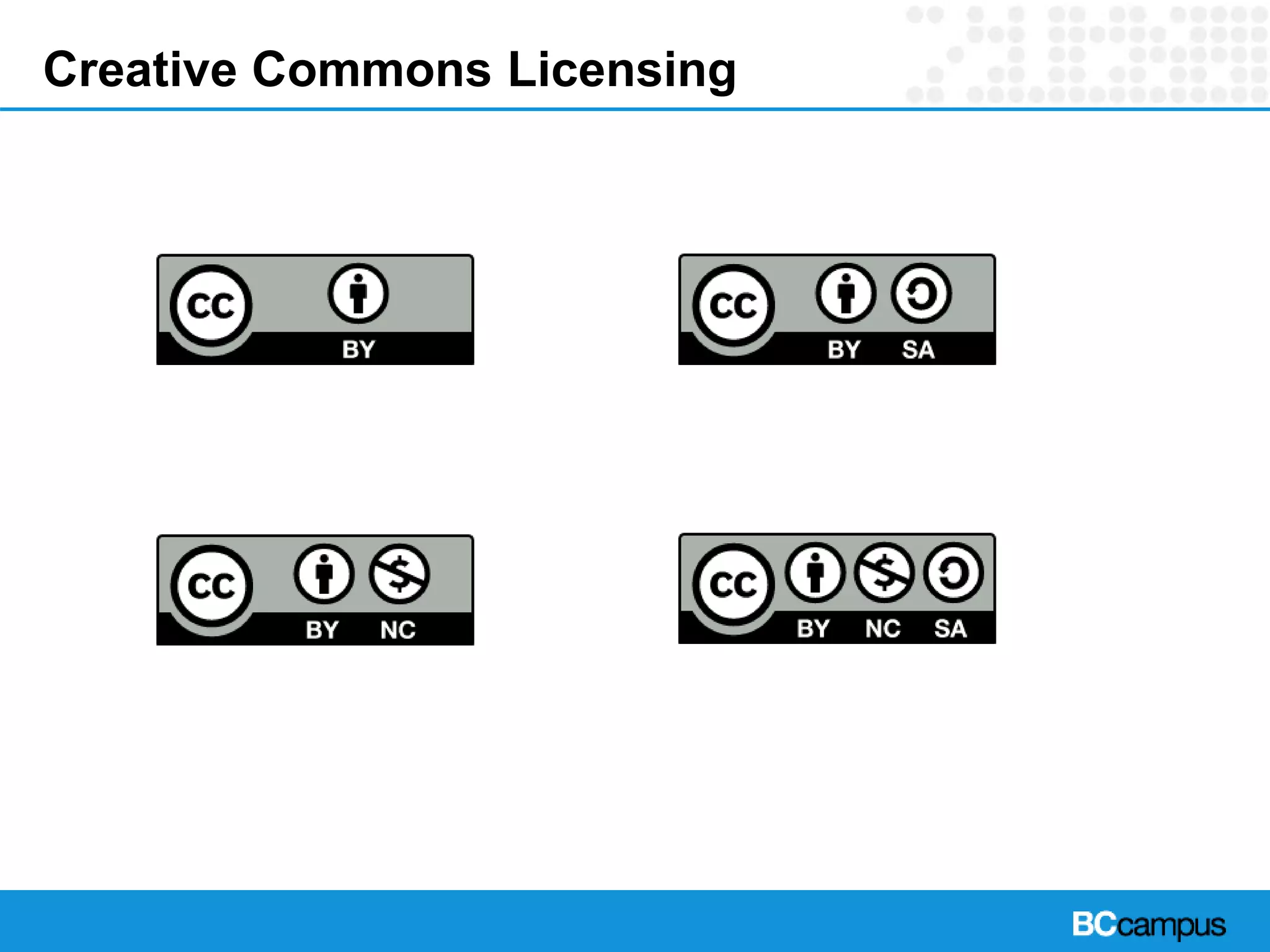
Creative Commons Licensing
Obscurity
is a far greater threat to
authors
than
piracy .
-Tim O’Reilly
Why
14
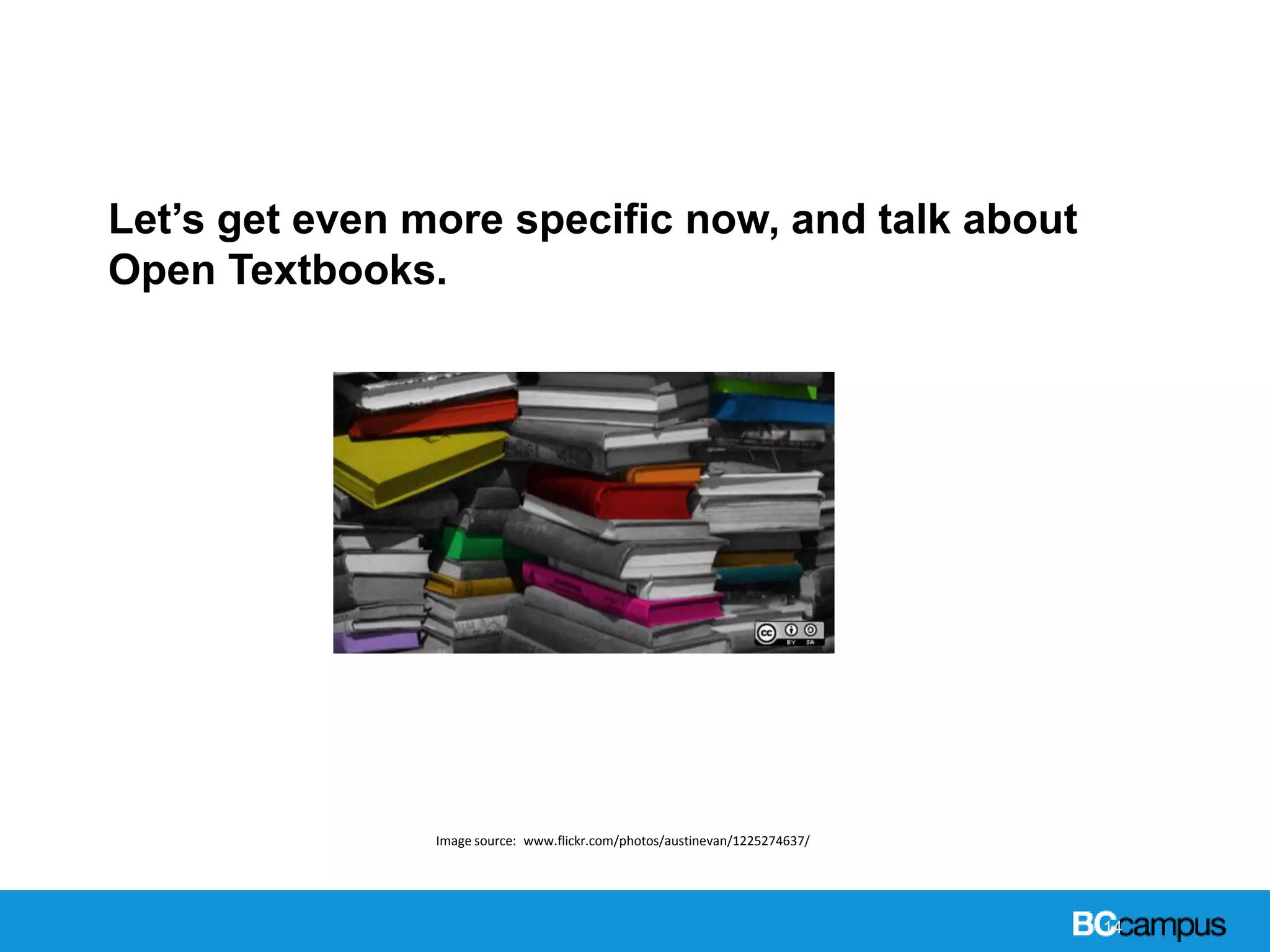
Let’s get even more specific now, and talk about
Open Textbooks.
Open Textbooks
Image source: www.flickr.com/photos/austinevan/1225274637/
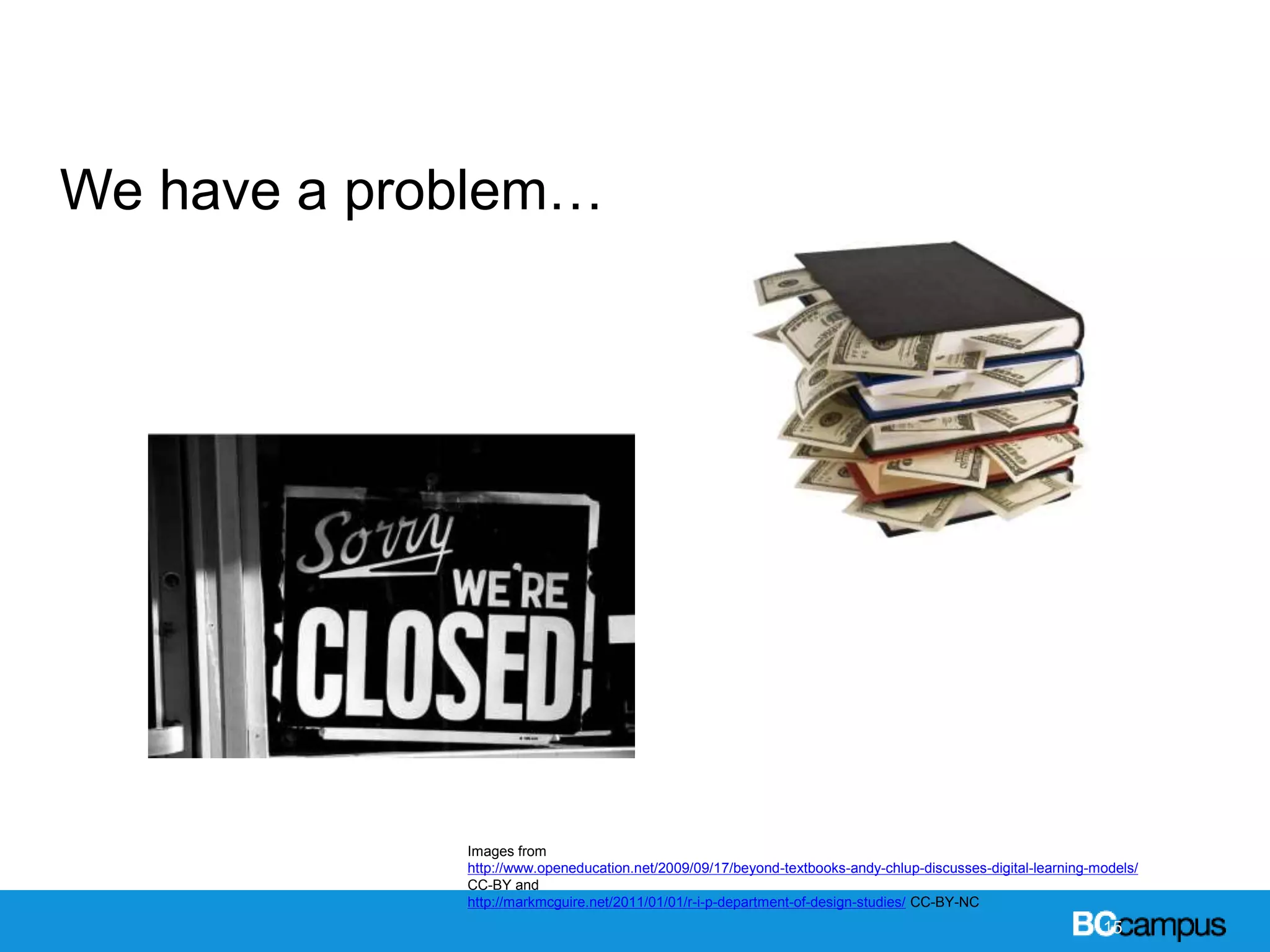
We have a problem…
15
Images from
http://www.openeducation.net/2009/09/17/beyond-textbooks-andy-chlup-discusses-digital-learning-models/
CC-BY and
http://markmcguire.net/2011/01/01/r-i-p-department-of-design-studies/ CC-BY-NC
What students think of textbooks
•“The price of textbooks has influenced my decision to take classes. When
the same class is offered by three different instructors, I check which book
is the cheapest, and even though the professor might not be good, I’m
forced to take that class because the textbook is the cheapest.”
•“For my ‘Intro to Stats’ class, the usual cost of the textbook is like $120.
But then I got a copy from India for like $29. And it’s the exact same copy.”
•“I was in lab one day and the guy sitting next to me had the PDF version
of the book opened on his computer. And I was like, Oh, can I have a
copy? And he sent it over to me.”
•“I have a friend who actually didn’t spend any money last year for books
because he went to the library at the beginning of the quarter, borrowed
books, scanned everything, and had the PDF file.”
•“My most expensive class was clinical psych, because she writes the
textbook herself, and it has a new edition every semester or something
ridiculous. So it was like almost $200. And the thing is that you can’t use
the previous edition, because she changes it herself because she knows
the textbooks sell well. It’s like so manipulative.”
Students Get Savvier about Textbook Buying,
The Chronicle of Higher Education, January 2013
http://chronicle.com/article/Students-Get-Savvier-About/136827
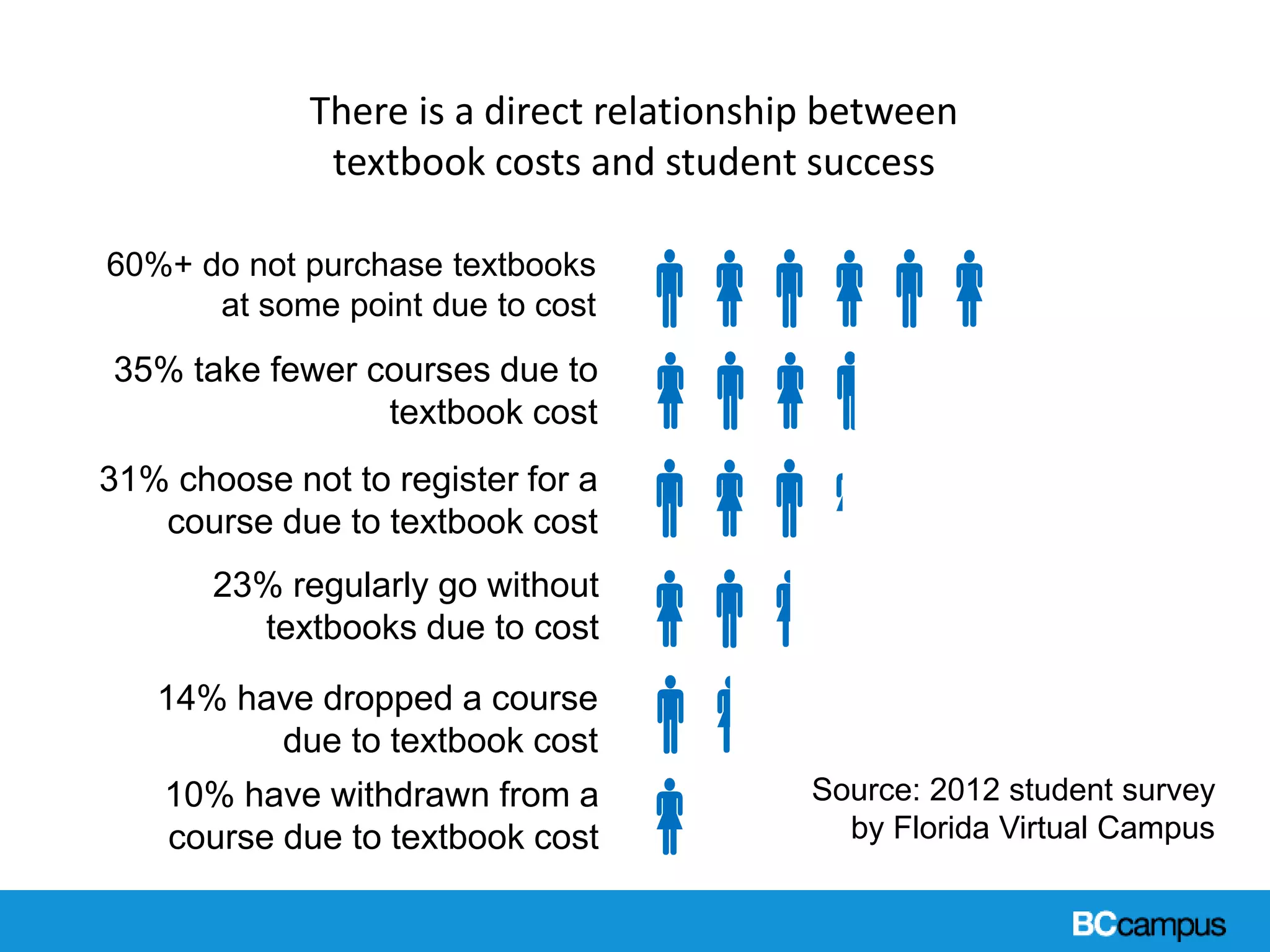
There is a direct relationship between
textbook costs and student success






60%+ do not purchase textbooks
at some point due to cost
35% take fewer courses due to
textbook cost
31% choose not to register for a
course due to textbook cost
23% regularly go without
textbooks due to cost
14% have dropped a course
due to textbook cost
10% have withdrawn from a
course due to textbook cost
Source: 2012 student survey
by Florida Virtual Campus
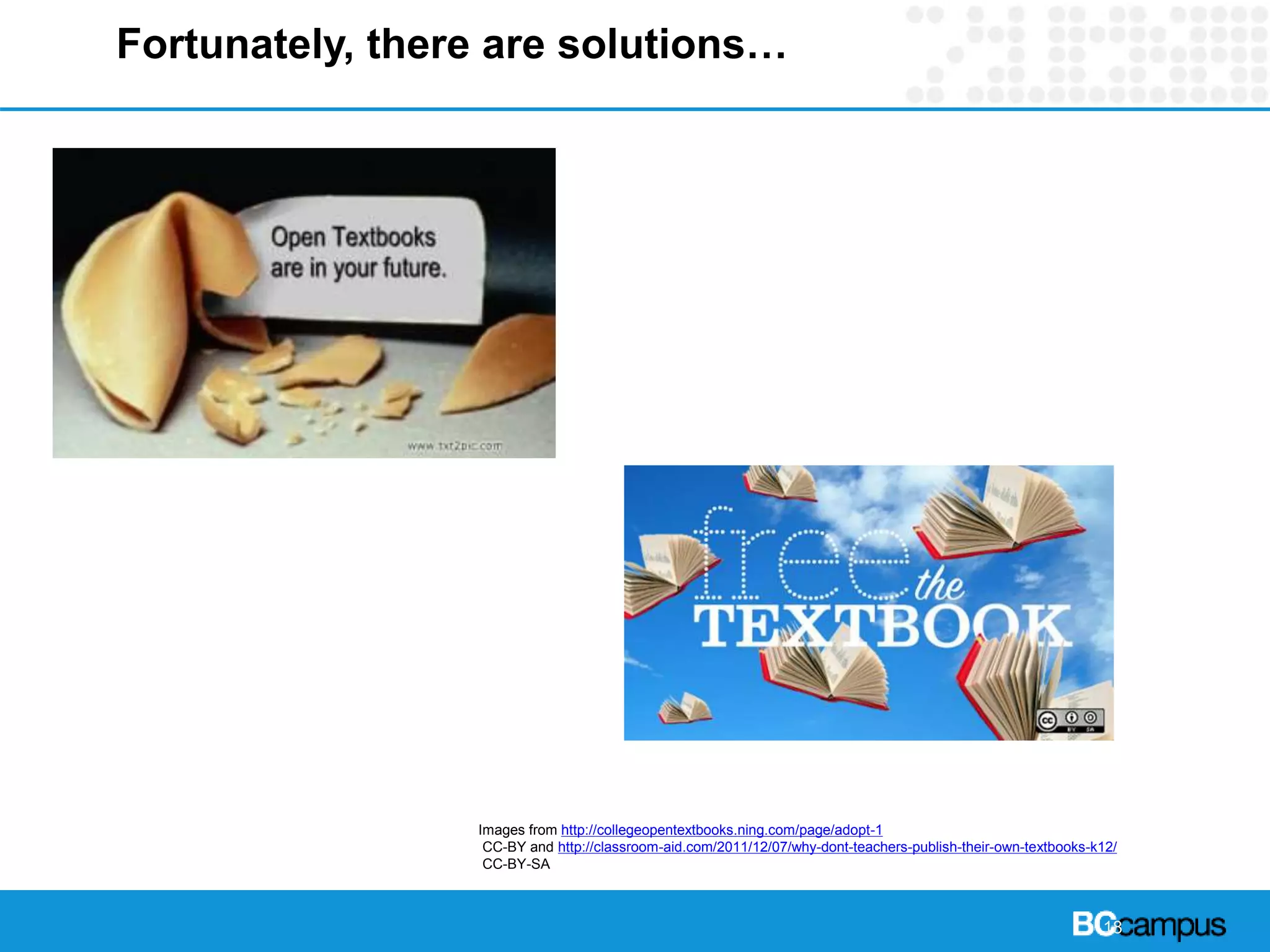
Fortunately, there are solutions…
18
Images from http://collegeopentextbooks.ning.com/page/adopt-1
CC-BY and http://classroom-aid.com/2011/12/07/why-dont-teachers-publish-their-own-textbooks-k12/
CC-BY-SA
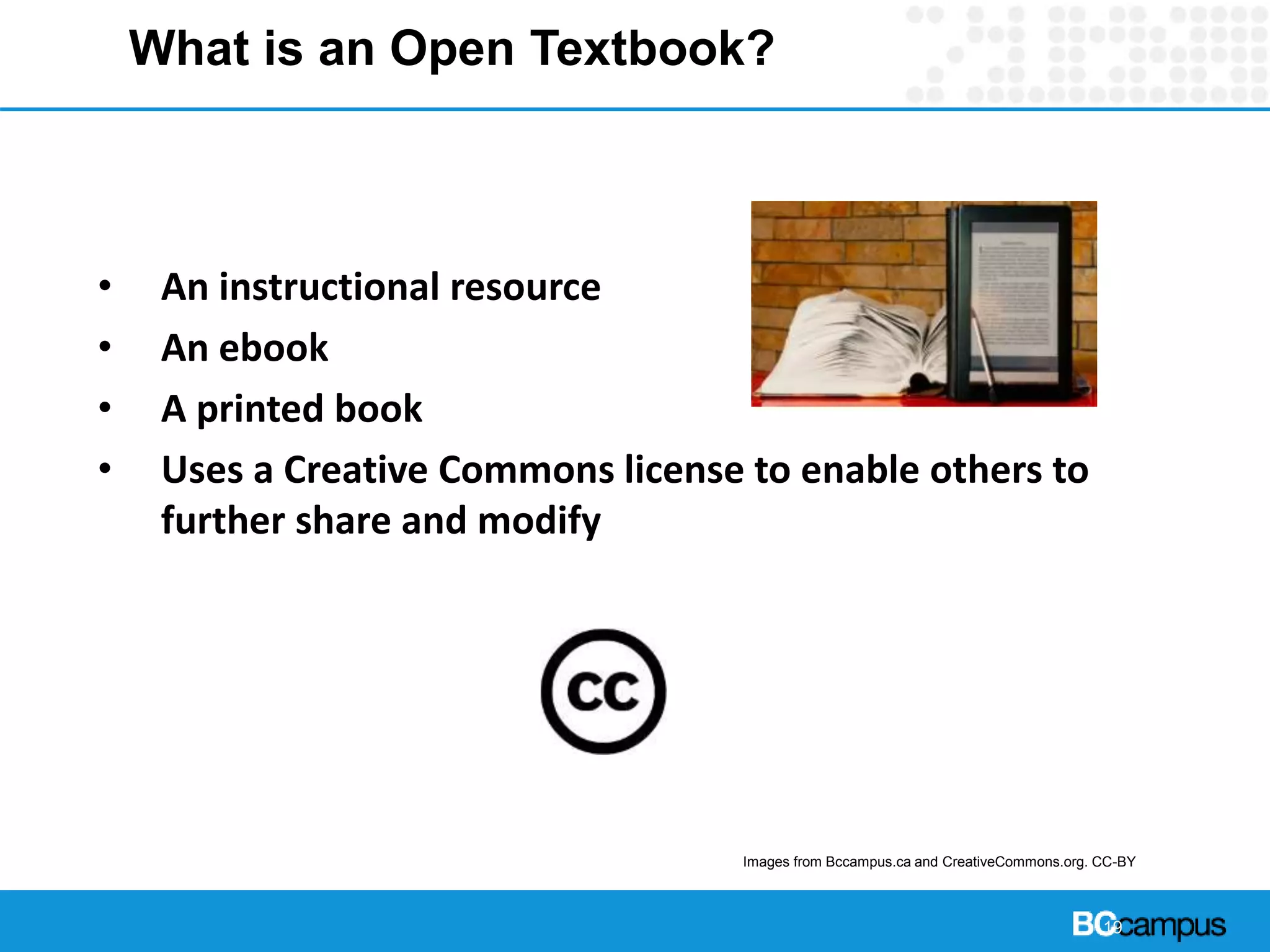
What is an Open Textbook?
• An instructional resource
• An ebook
• A printed book
• Uses a Creative Commons license to enable others to
further share and modify
19
Images from Bccampus.ca and CreativeCommons.org. CC-BY
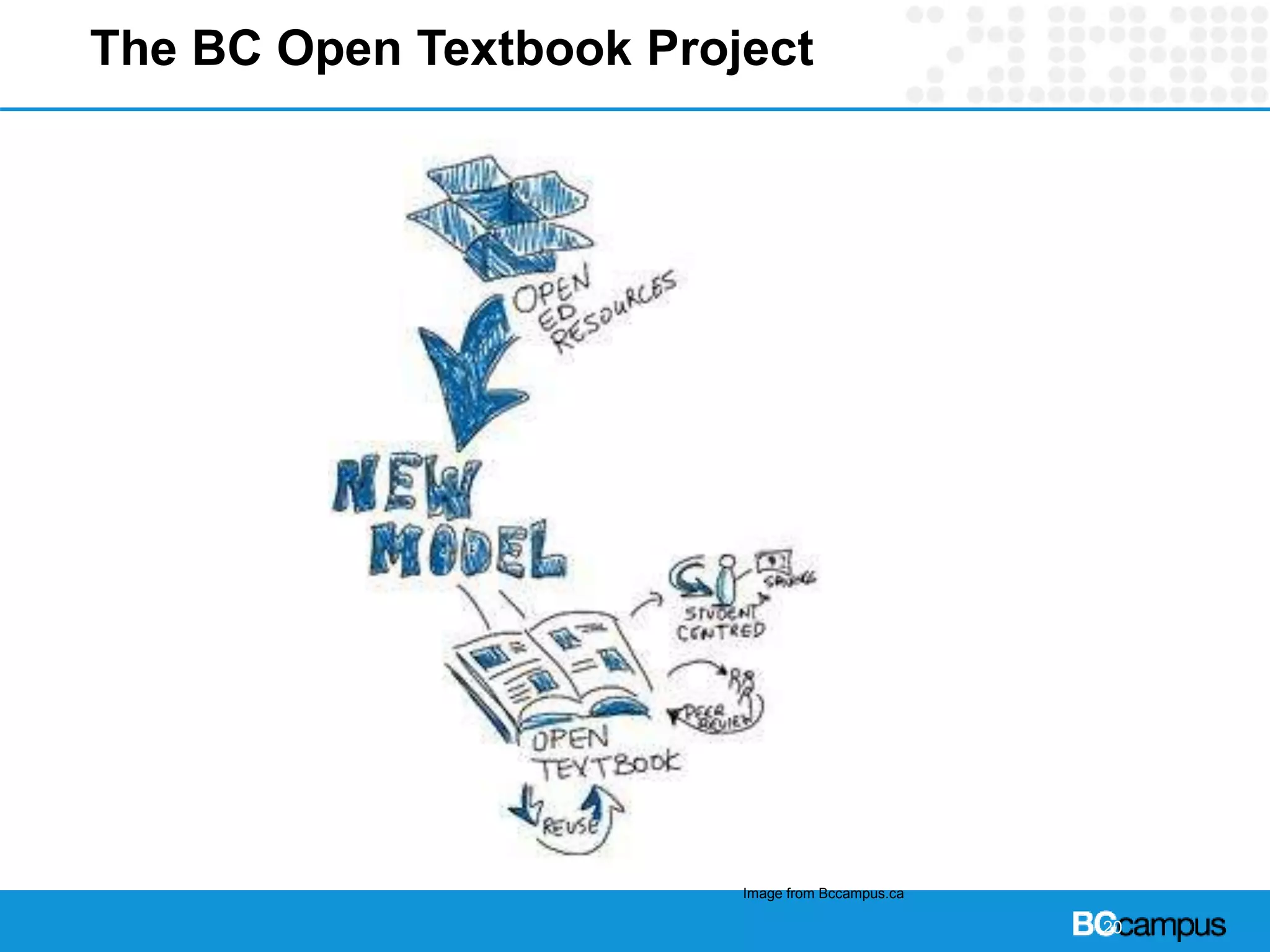
The BC Open Textbook Project
20
Image from Bccampus.ca
21
Why are we doing this?Yhy are
we doing this project?
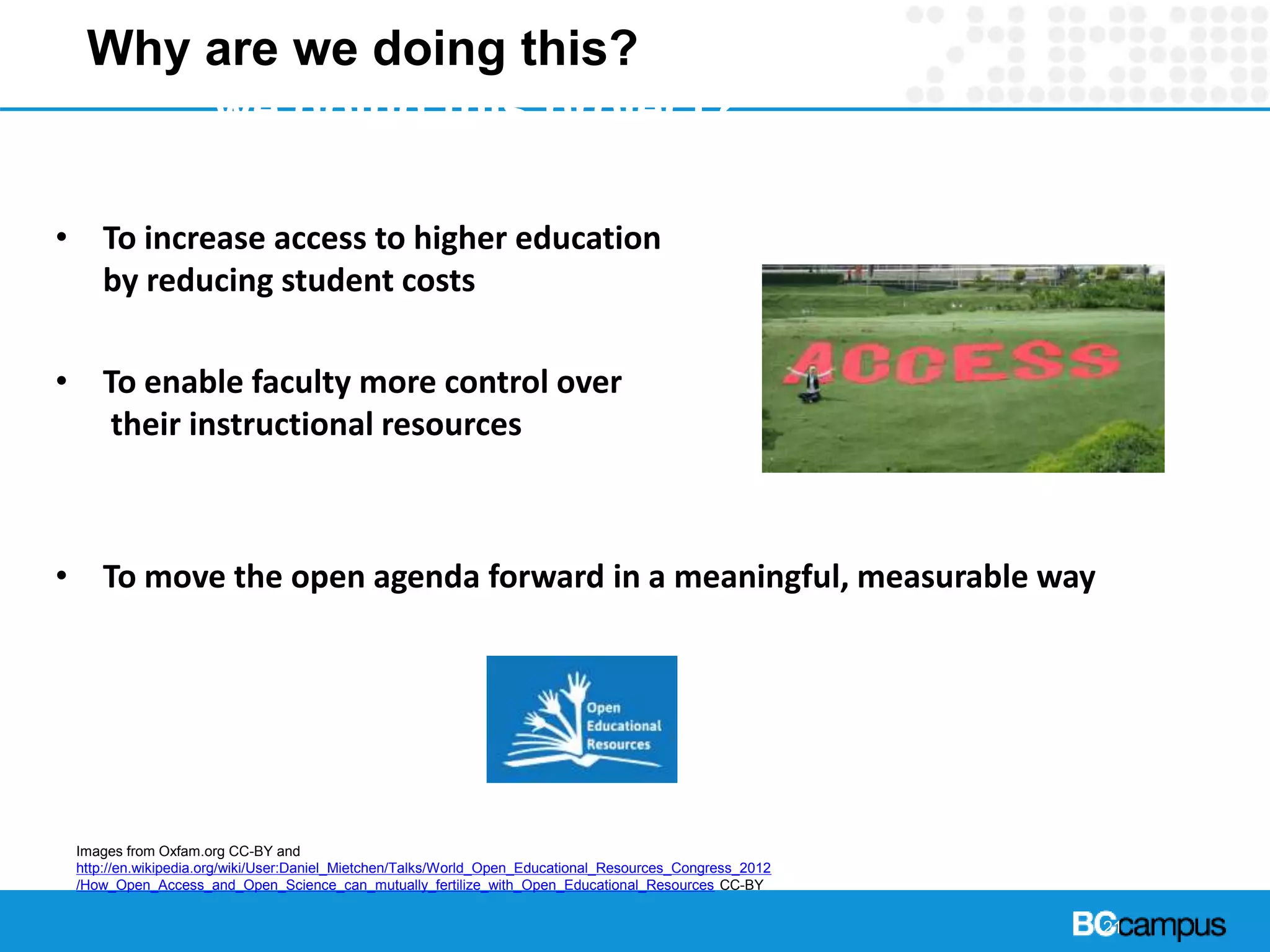
• To increase access to higher education
by reducing student costs
• To enable faculty more control over
their instructional resources
• To move the open agenda forward in a meaningful, measurable way
Images from Oxfam.org CC-BY and
http://en.wikipedia.org/wiki/User:Daniel_Mietchen/Talks/World_Open_Educational_Resources_Congress_2012
/How_Open_Access_and_Open_Science_can_mutually_fertilize_with_Open_Educational_Resources CC-BY
The project:
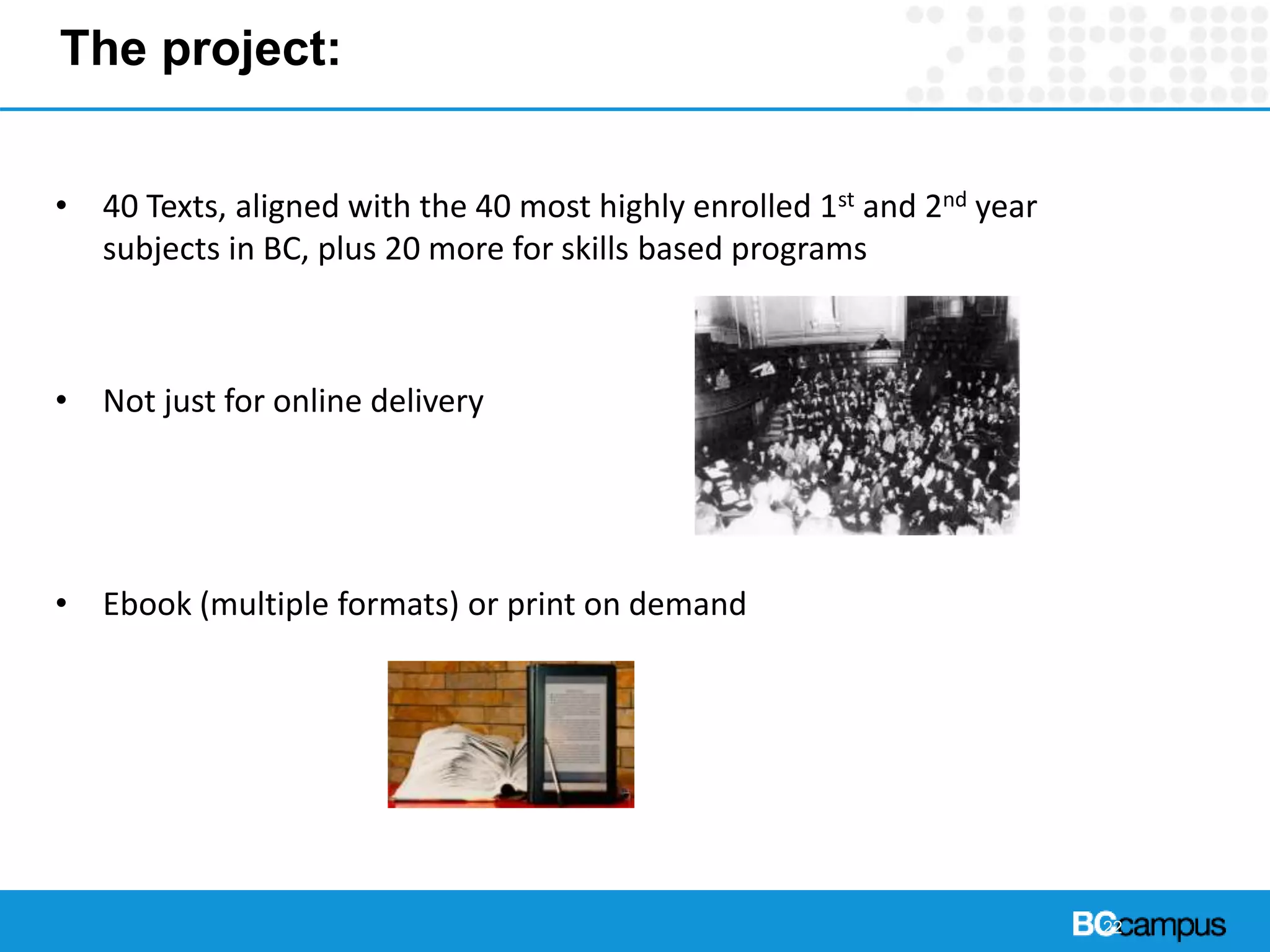
• 40 Texts, aligned with the 40 most highly enrolled 1st and 2nd year
subjects in BC, plus 20 more for skills based programs
• Not just for online delivery
• Ebook (multiple formats) or print on demand
22
Project Phases
Phase One – Harvest and Review
Phase Two – Adapt
Phase Three - Create
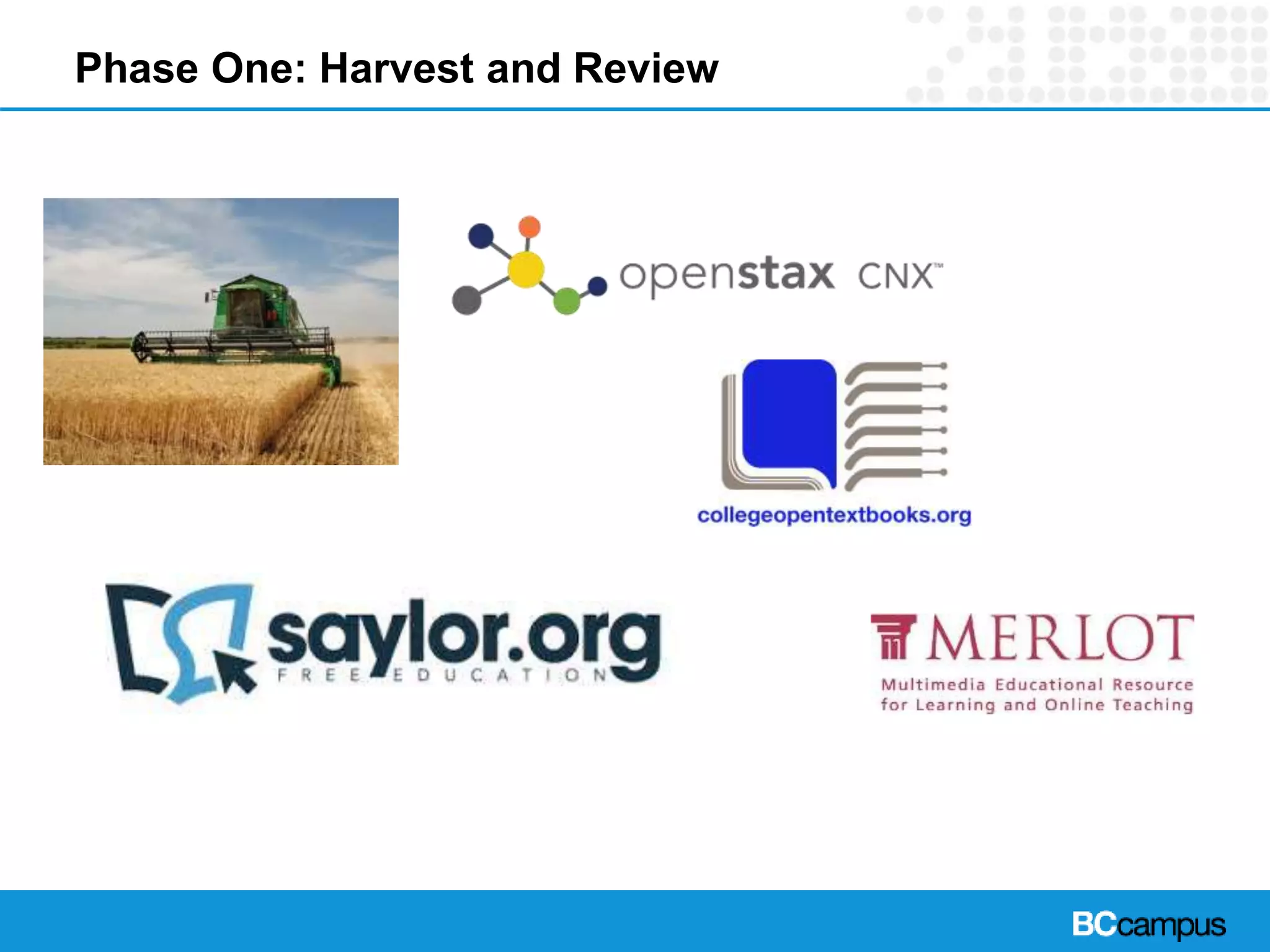
Phase One: Harvest and Review
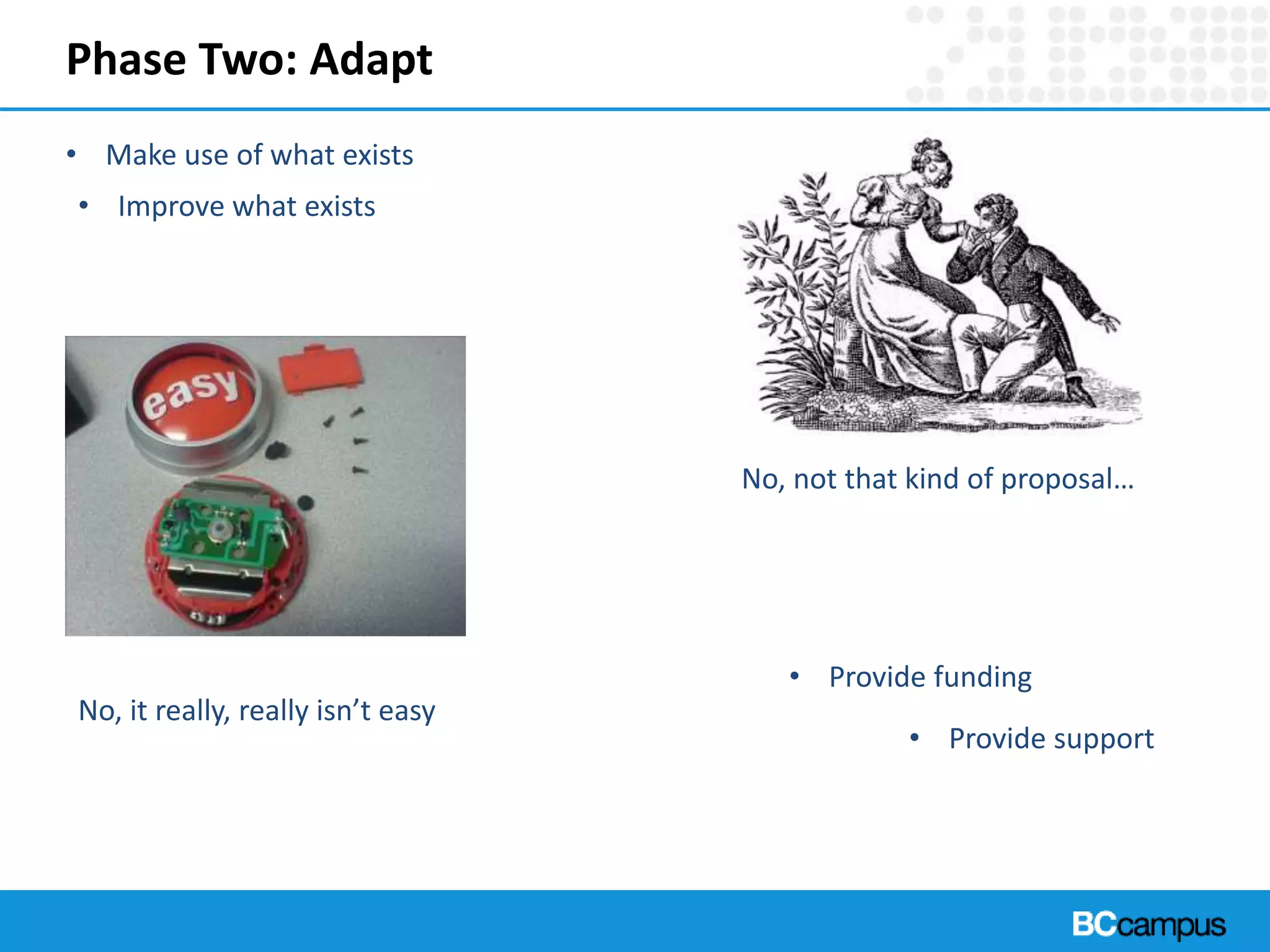
Phase Two: Adapt
• Make use of what exists
• Improve what exists
No, not that kind of proposal…
No, it really, really isn’t easy
• Provide funding
• Provide support
Phase Three: Create
What are some ways of doing this?
Faculty collaboratively authoring
Buy the rights from publishers
Book sprint
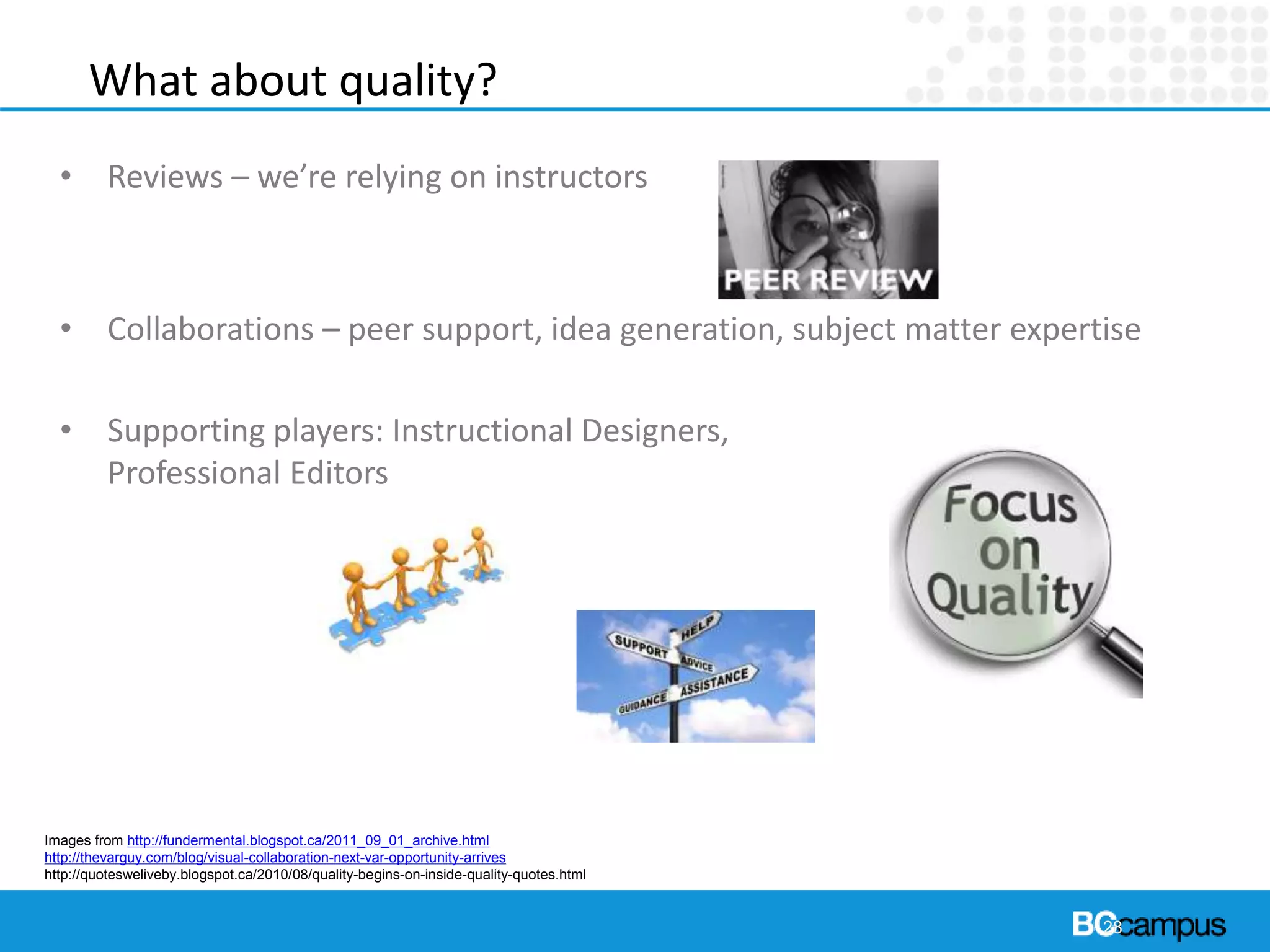
• Reviews – we’re relying on instructors
• Collaborations – peer support, idea generation, subject matter expertise
• Supporting players: Instructional Designers,
Professional Editors
28
Images from http://fundermental.blogspot.ca/2011_09_01_archive.html
http://thevarguy.com/blog/visual-collaboration-next-var-opportunity-arrives
http://quotesweliveby.blogspot.ca/2010/08/quality-begins-on-inside-quality-quotes.html
What about quality?
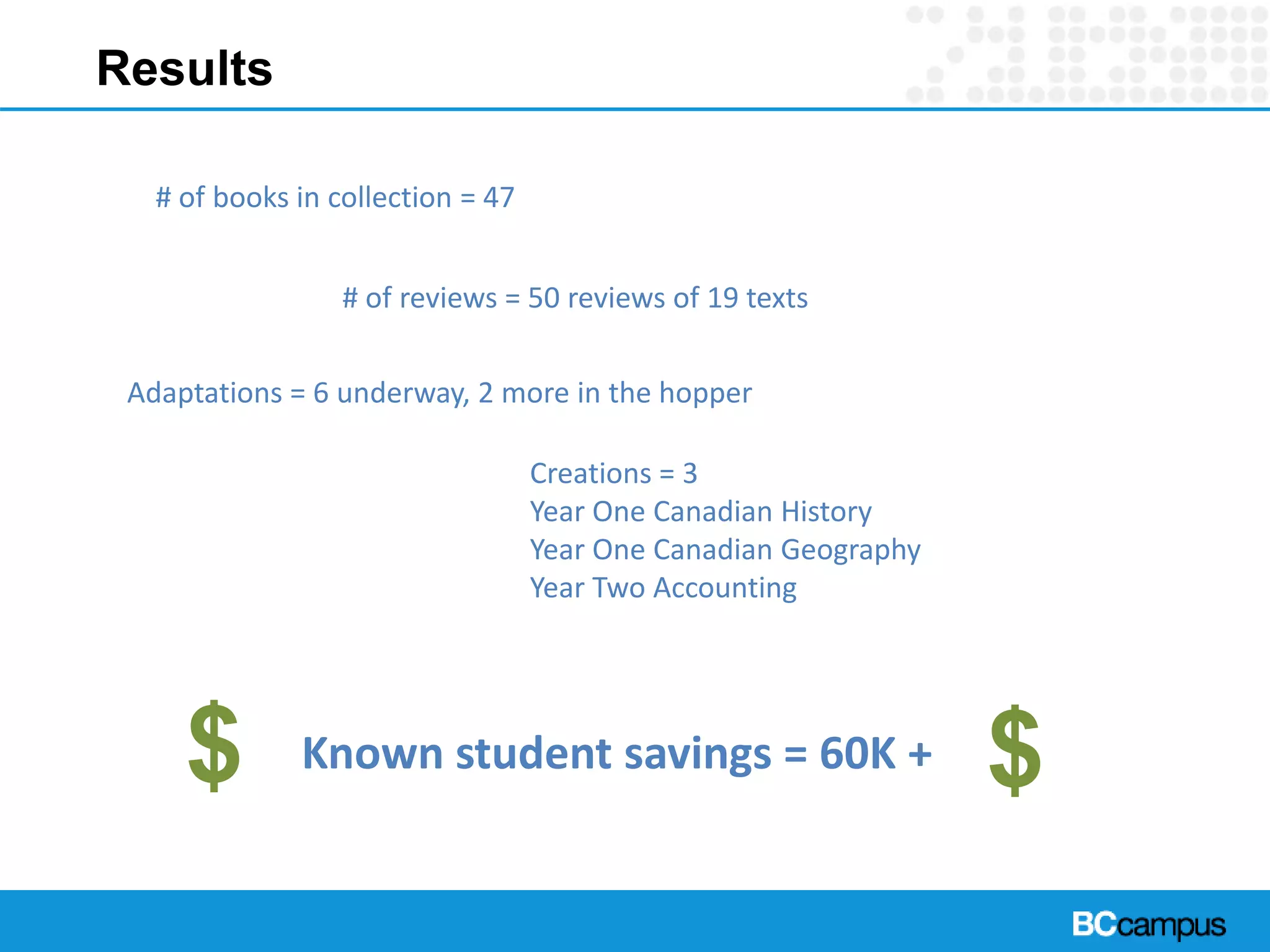
Results
Known student savings = 60K +
# of books in collection = 47
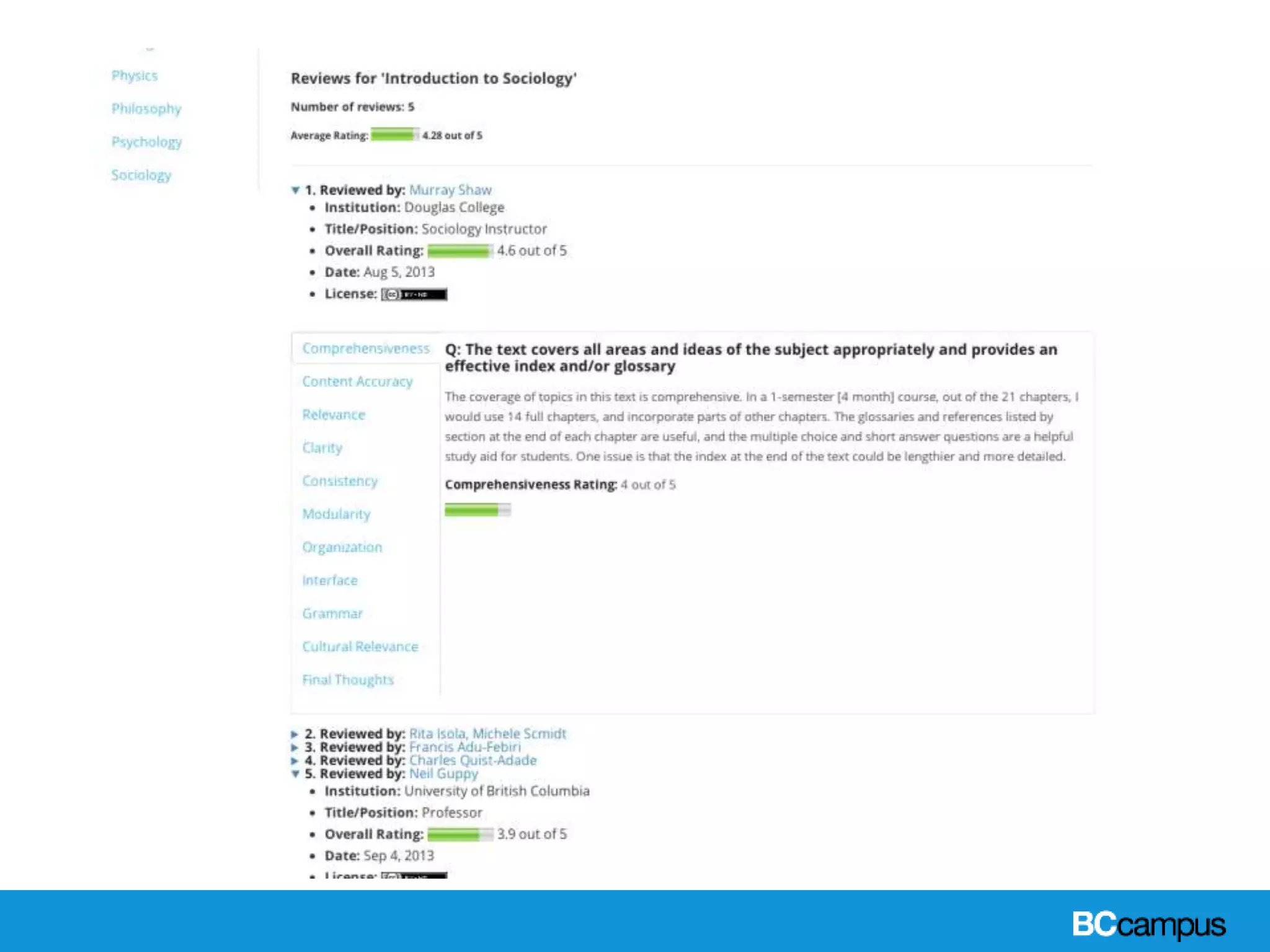
# of reviews = 50 reviews of 19 texts
Adaptations = 6 underway, 2 more in the hopper
Creations = 3
Year One Canadian History
Year One Canadian Geography
Year Two Accounting
$ $
30
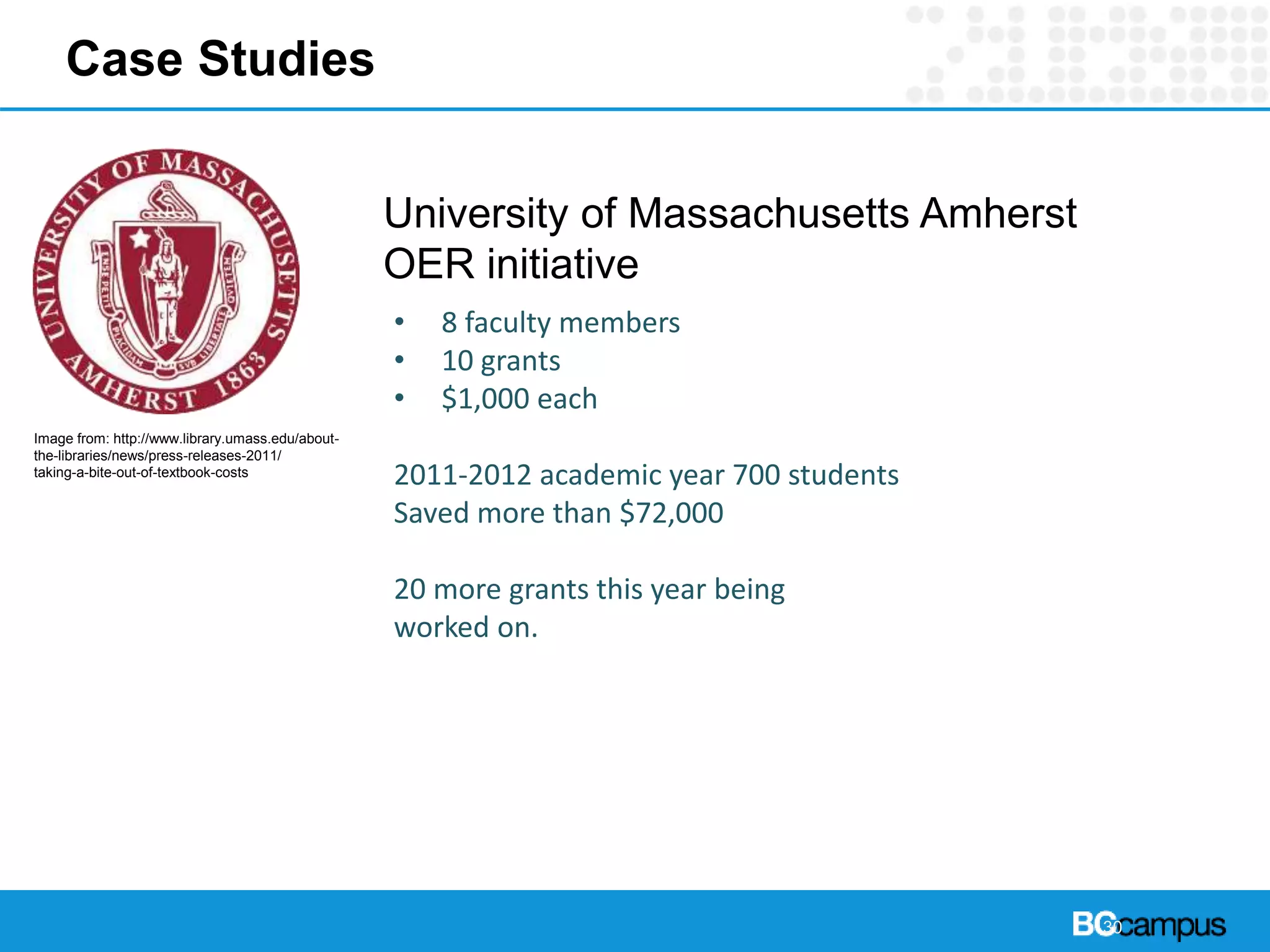
Case Studies
University of Massachusetts Amherst
OER initiative
• 8 faculty members
• 10 grants
• $1,000 each
2011-2012 academic year 700 students
Saved more than $72,000
20 more grants this year being
worked on.
Image from: http://www.library.umass.edu/about-
the-libraries/news/press-releases-2011/
taking-a-bite-out-of-textbook-costs
31
Case Studies
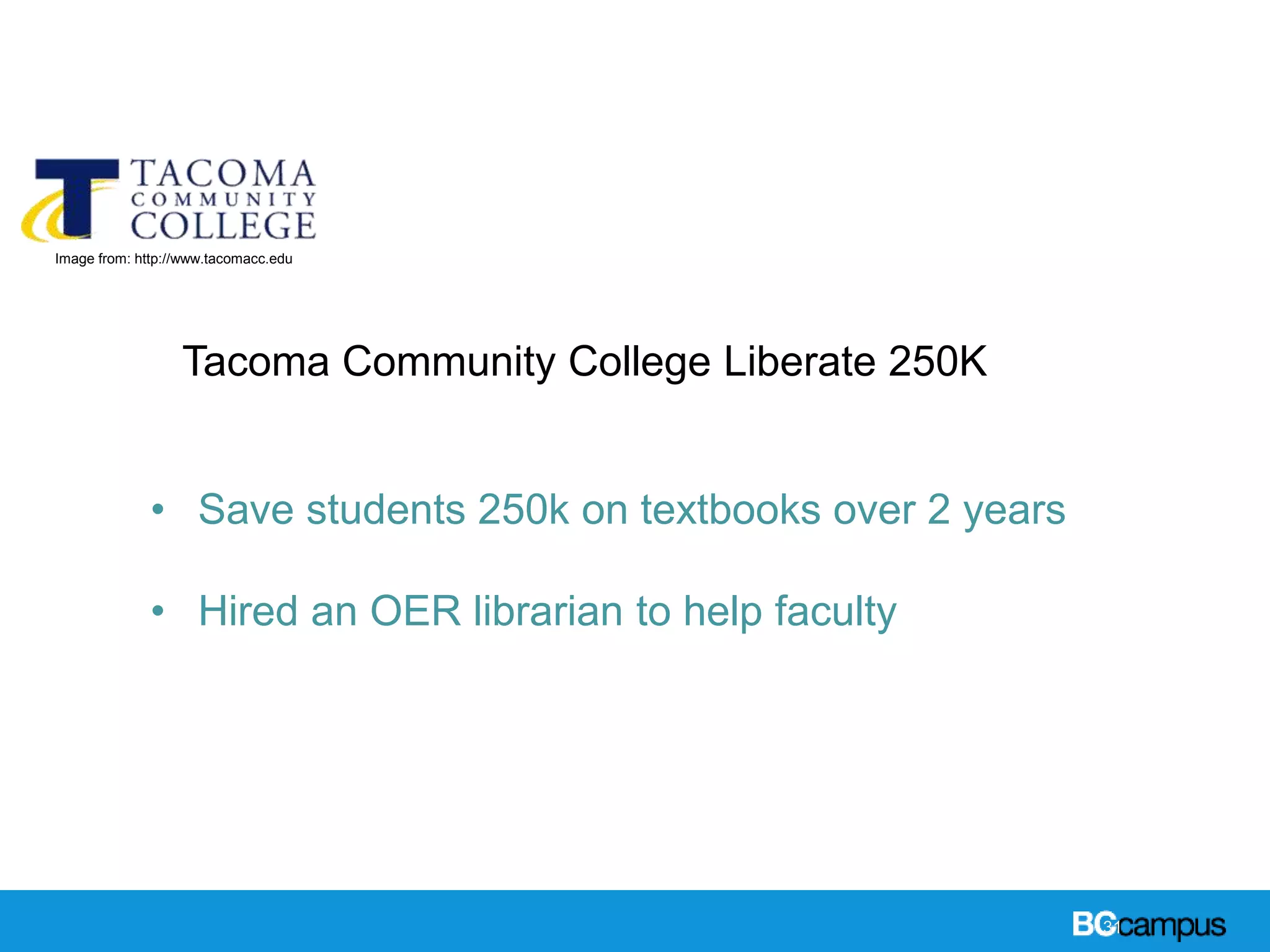
Tacoma Community College Liberate 250K
Image from: http://www.tacomacc.edu
• Save students 250k on textbooks over 2 years
• Hired an OER librarian to help faculty
32
Case Studies
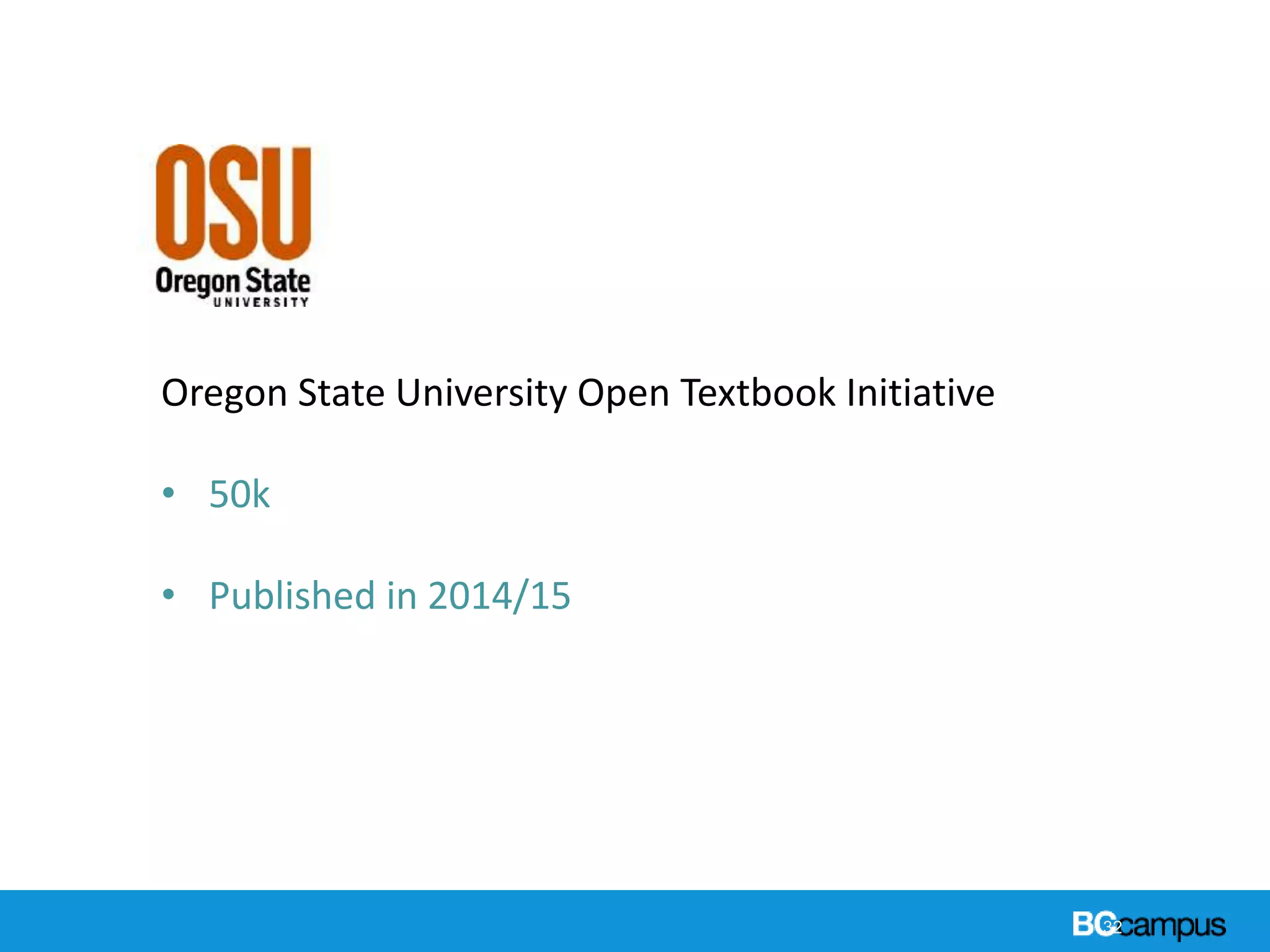
Oregon State University Open Textbook Initiative
• 50k
• Published in 2014/15
Institutional and individual readiness for
a change to more openness:
Consider the following…
Food for thought
• What would need to be in place for you to adopt an
open textbook?
• Is collaboration valued at your institution?
• Is the creation of new work more highly valued at your
institution than the reuse or revision of existing work?
• To what extent do current institutional policies motivate
educators to invest at least a portion of their time in
ongoing curriculum design, creation of effective
learning environments and the development of high
quality instructional materials?
• What is the culture of your discipline? Would OER work
be accepted by your peers?
34
Questions?
http://open.bccampus.ca
Thanks!
mburgess@bccampus.ca
@maryeburgess

University of Saskatchewan April 2014

  • 1.
    Open Textbooks: Opening thedoors to education • Mary Burgess, Director, Open Education, BCcampus • University of Saskatchewan, April 2014
  • 2.
    Agenda • What isOpen? • What is an Open Educational Resource? • What is an Open Textbook? • BC Open Textbook Project • Case Studies • Food for thought
  • 3.
    Introductions What’s your roleat the institution? Show of hands… •Faculty? •Administrator? •Librarian? •Student? •Instructional Designer? •Educational Technologist? •Other?
  • 4.
    What is BCcampus? 4research universities 6 teaching universities 11 colleges 4 institutes 25 public post-secondaries
  • 5.
  • 6.
  • 7.
  • 8.
    Day of theMOOC by Michael Branson Smith used under CC-BY-BC license
  • 9.
  • 10.
    Headline “OER are teaching,learning, and research resources that reside in the public domain or have been released under an intellectual property license that permits their free use and re-purposing by others.” William & Flora Hewlett Foundation http://www.hewlett.org/programs/education-program/open-educational-resources What are Open Educational Resources?
  • 11.
    Thank You The 5R’s of Opennessdoes open enable? •The right to make, own and control copies of the contentRetain •The right to use the content in a wide range of waysReuse •The right to adapt, adjust, or modify the content itselfRevise •The right to combine the original or revised content with other open content to create something newRemix •The right to share copies of the original content, your revisions, or your remixes with othersRedistribute CC-BY David Wiley, March 5, 2014,
  • 12.
  • 13.
    Obscurity is a fargreater threat to authors than piracy . -Tim O’Reilly Why
  • 14.
    14 Let’s get evenmore specific now, and talk about Open Textbooks. Open Textbooks Image source: www.flickr.com/photos/austinevan/1225274637/
  • 15.
    We have aproblem… 15 Images from http://www.openeducation.net/2009/09/17/beyond-textbooks-andy-chlup-discusses-digital-learning-models/ CC-BY and http://markmcguire.net/2011/01/01/r-i-p-department-of-design-studies/ CC-BY-NC
  • 16.
    What students thinkof textbooks •“The price of textbooks has influenced my decision to take classes. When the same class is offered by three different instructors, I check which book is the cheapest, and even though the professor might not be good, I’m forced to take that class because the textbook is the cheapest.” •“For my ‘Intro to Stats’ class, the usual cost of the textbook is like $120. But then I got a copy from India for like $29. And it’s the exact same copy.” •“I was in lab one day and the guy sitting next to me had the PDF version of the book opened on his computer. And I was like, Oh, can I have a copy? And he sent it over to me.” •“I have a friend who actually didn’t spend any money last year for books because he went to the library at the beginning of the quarter, borrowed books, scanned everything, and had the PDF file.” •“My most expensive class was clinical psych, because she writes the textbook herself, and it has a new edition every semester or something ridiculous. So it was like almost $200. And the thing is that you can’t use the previous edition, because she changes it herself because she knows the textbooks sell well. It’s like so manipulative.” Students Get Savvier about Textbook Buying, The Chronicle of Higher Education, January 2013 http://chronicle.com/article/Students-Get-Savvier-About/136827
  • 17.
    There is adirect relationship between textbook costs and student success       60%+ do not purchase textbooks at some point due to cost 35% take fewer courses due to textbook cost 31% choose not to register for a course due to textbook cost 23% regularly go without textbooks due to cost 14% have dropped a course due to textbook cost 10% have withdrawn from a course due to textbook cost Source: 2012 student survey by Florida Virtual Campus
  • 18.
    Fortunately, there aresolutions… 18 Images from http://collegeopentextbooks.ning.com/page/adopt-1 CC-BY and http://classroom-aid.com/2011/12/07/why-dont-teachers-publish-their-own-textbooks-k12/ CC-BY-SA
  • 19.
    What is anOpen Textbook? • An instructional resource • An ebook • A printed book • Uses a Creative Commons license to enable others to further share and modify 19 Images from Bccampus.ca and CreativeCommons.org. CC-BY
  • 20.
    The BC OpenTextbook Project 20 Image from Bccampus.ca
  • 21.
    21 Why are wedoing this?Yhy are we doing this project? • To increase access to higher education by reducing student costs • To enable faculty more control over their instructional resources • To move the open agenda forward in a meaningful, measurable way Images from Oxfam.org CC-BY and http://en.wikipedia.org/wiki/User:Daniel_Mietchen/Talks/World_Open_Educational_Resources_Congress_2012 /How_Open_Access_and_Open_Science_can_mutually_fertilize_with_Open_Educational_Resources CC-BY
  • 22.
    The project: • 40Texts, aligned with the 40 most highly enrolled 1st and 2nd year subjects in BC, plus 20 more for skills based programs • Not just for online delivery • Ebook (multiple formats) or print on demand 22
  • 23.
    Project Phases Phase One– Harvest and Review Phase Two – Adapt Phase Three - Create
  • 24.
  • 26.
    Phase Two: Adapt •Make use of what exists • Improve what exists No, not that kind of proposal… No, it really, really isn’t easy • Provide funding • Provide support
  • 27.
    Phase Three: Create Whatare some ways of doing this? Faculty collaboratively authoring Buy the rights from publishers Book sprint
  • 28.
    • Reviews –we’re relying on instructors • Collaborations – peer support, idea generation, subject matter expertise • Supporting players: Instructional Designers, Professional Editors 28 Images from http://fundermental.blogspot.ca/2011_09_01_archive.html http://thevarguy.com/blog/visual-collaboration-next-var-opportunity-arrives http://quotesweliveby.blogspot.ca/2010/08/quality-begins-on-inside-quality-quotes.html What about quality?
  • 29.
    Results Known student savings= 60K + # of books in collection = 47 # of reviews = 50 reviews of 19 texts Adaptations = 6 underway, 2 more in the hopper Creations = 3 Year One Canadian History Year One Canadian Geography Year Two Accounting $ $
  • 30.
    30 Case Studies University ofMassachusetts Amherst OER initiative • 8 faculty members • 10 grants • $1,000 each 2011-2012 academic year 700 students Saved more than $72,000 20 more grants this year being worked on. Image from: http://www.library.umass.edu/about- the-libraries/news/press-releases-2011/ taking-a-bite-out-of-textbook-costs
  • 31.
    31 Case Studies Tacoma CommunityCollege Liberate 250K Image from: http://www.tacomacc.edu • Save students 250k on textbooks over 2 years • Hired an OER librarian to help faculty
  • 32.
    32 Case Studies Oregon StateUniversity Open Textbook Initiative • 50k • Published in 2014/15
  • 33.
    Institutional and individualreadiness for a change to more openness: Consider the following…
  • 34.
    Food for thought •What would need to be in place for you to adopt an open textbook? • Is collaboration valued at your institution? • Is the creation of new work more highly valued at your institution than the reuse or revision of existing work? • To what extent do current institutional policies motivate educators to invest at least a portion of their time in ongoing curriculum design, creation of effective learning environments and the development of high quality instructional materials? • What is the culture of your discipline? Would OER work be accepted by your peers? 34
  • 35.
  • 36.