Presented by Josh Barnhart
Learning To
  Read Music
Reading music is easy!
When you see a staff of
music just remember the
trick on the right!

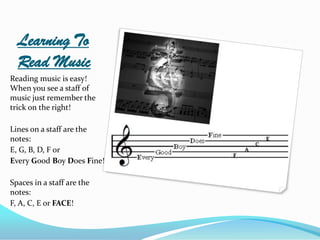
Lines on a staff are the
notes:
E, G, B, D, F or
Every Good Boy Does Fine!

Spaces in a staff are the
notes:
F, A, C, E or FACE!
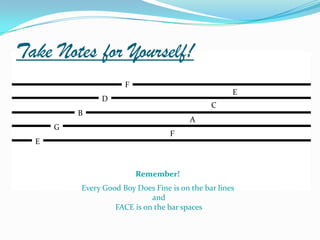
Take Notes for Yourself!
                      F
                                                     E
               D
                                               C
          B
                                         A
      G
                                   F
  E


                          Remember!
          Every Good Boy Does Fine is on the bar lines
                             and
                   FACE is on the bar spaces
Note Practice
This music game will
help you learn the
notes better! Click on
the link to play the
game and practice
your notes!!

Play Eek! Shark!
http://www.makingm
usicfun.net/
Feel the
Rhythm!
Now that you
know the
notes, let’s learn
more about the
rhythm!

Rhythm is what
holds music
together and
creates the “pulse”
of the music!
Learning the Rhythm
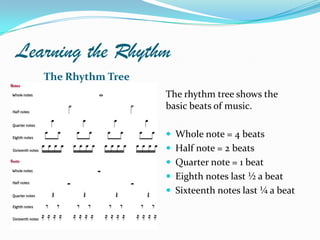
   The Rhythm Tree
                     The rhythm tree shows the
                     basic beats of music.

                      Whole note = 4 beats
                      Half note = 2 beats
                      Quarter note = 1 beat
                      Eighth notes last ½ a beat
                      Sixteenth notes last ¼ a beat
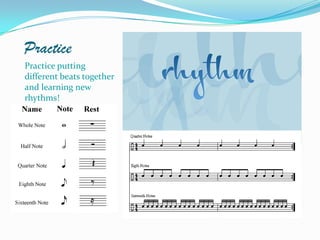
Practice
Practice putting
different beats together
and learning new
rhythms!
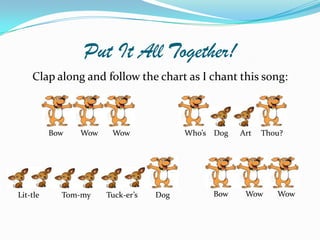
Put It All Together!
    Clap along and follow the chart as I chant this song:


          Bow   Wow    Wow              Who’s Dog   Art   Thou?


Lit-tle     Tom-my    Tuck-er’s   Dog        Bow     Wow     Wow
You have learned how to read music
     and understand rhythm!
•   http://www.tarleton.edu/Faculty/boucher/Elementary%20Music%
    20Resources.htm

•   http://www.makingmusicfun.net/

•   http://www.smartboardmusic.org/freegames.html

•   Steele, Daniel. Music Is Fundamental: Fundamentals and Methods
    for Elementary Music, 2nd ed. Dubuque, IA: Kendall/Hunt
    Publishing, 2009

Learning the music!

  • 1.
  • 2.
    Learning To Read Music Reading music is easy! When you see a staff of music just remember the trick on the right! Lines on a staff are the notes: E, G, B, D, F or Every Good Boy Does Fine! Spaces in a staff are the notes: F, A, C, E or FACE!
  • 3.
    Take Notes forYourself! F E D C B A G F E Remember! Every Good Boy Does Fine is on the bar lines and FACE is on the bar spaces
  • 4.
    Note Practice This musicgame will help you learn the notes better! Click on the link to play the game and practice your notes!! Play Eek! Shark! http://www.makingm usicfun.net/
  • 5.
    Feel the Rhythm! Now thatyou know the notes, let’s learn more about the rhythm! Rhythm is what holds music together and creates the “pulse” of the music!
  • 6.
    Learning the Rhythm The Rhythm Tree The rhythm tree shows the basic beats of music.  Whole note = 4 beats  Half note = 2 beats  Quarter note = 1 beat  Eighth notes last ½ a beat  Sixteenth notes last ¼ a beat
  • 7.
    Practice Practice putting different beatstogether and learning new rhythms!
  • 8.
    Put It AllTogether! Clap along and follow the chart as I chant this song: Bow Wow Wow Who’s Dog Art Thou? Lit-tle Tom-my Tuck-er’s Dog Bow Wow Wow
  • 9.
    You have learnedhow to read music and understand rhythm!
  • 10.
    http://www.tarleton.edu/Faculty/boucher/Elementary%20Music% 20Resources.htm • http://www.makingmusicfun.net/ • http://www.smartboardmusic.org/freegames.html • Steele, Daniel. Music Is Fundamental: Fundamentals and Methods for Elementary Music, 2nd ed. Dubuque, IA: Kendall/Hunt Publishing, 2009