Refers to a range of competing and
contested theories that aim to account for
differences in individuals’ learning.
The common concept of learning style is
that individuals differ in how they learn.
Mastery Style Learner
Sensing-Thinking learner
- absorbs information concretely;
processes information sequentially, in a
step-by-step manner; and judges the value
of learning in terms of its clarity and
practicality.
Interpersonal style learner
(Sensing-Feeling Learner)
- like the Mastery learner, focuses on
concrete, palpable information; prefers to
learn socially; and judges learning in terms
of its potential use in helping others.
Understanding style learner
(Intuitive-Thinking Learner)
- focuses more on ideas and abstractions;
learns through a process of questioning,
reasoning, and testing; and evaluates
learning by standards of logic and the use of
evidence.
Self-Expressive style learner
(Intuitive-Feeling Learner)
- looks for images implied in learning; uses
feelings and emotions to construct new ideas
and products; and judges the learning
process according to its originality,
aesthetics, and capacity to surprise or
delight.
Linguistic
Mastery: The ability to use language to describe
events and sequence activities (journalist,
technical writer, administrator, contractor)
Interpersonal: The ability to use language to build
trust and rapport (salesperson, counselor,
clergyperson, therapist)
Understanding: The ability to develop logical
arguments and use rhetoric (lawyer, professor,
orator, philosopher)
Self-expressive: The ability to use metaphoric and
expressive language (playwright, poet,
advertising copywriter, novelist)
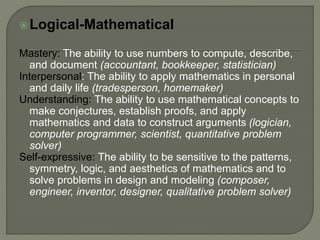
Logical-Mathematical
Mastery: The ability to use numbers to compute, describe,
and document (accountant, bookkeeper, statistician)
Interpersonal: The ability to apply mathematics in personal
and daily life (tradesperson, homemaker)
Understanding: The ability to use mathematical concepts to
make conjectures, establish proofs, and apply
mathematics and data to construct arguments (logician,
computer programmer, scientist, quantitative problem
solver)
Self-expressive: The ability to be sensitive to the patterns,
symmetry, logic, and aesthetics of mathematics and to
solve problems in design and modeling (composer,
engineer, inventor, designer, qualitative problem solver)
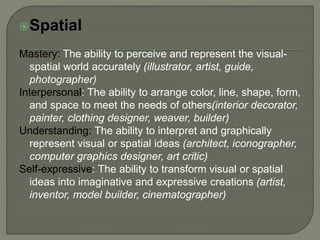
Spatial
Mastery: The ability to perceive and represent the visual-
spatial world accurately (illustrator, artist, guide,
photographer)
Interpersonal: The ability to arrange color, line, shape, form,
and space to meet the needs of others(interior decorator,
painter, clothing designer, weaver, builder)
Understanding: The ability to interpret and graphically
represent visual or spatial ideas (architect, iconographer,
computer graphics designer, art critic)
Self-expressive: The ability to transform visual or spatial
ideas into imaginative and expressive creations (artist,
inventor, model builder, cinematographer)
Bodily-Kinesthetic
Mastery: The ability to use the body and tools to take
effective action or to construct or repair(mechanic,
trainer, contractor, craftsperson, tool and dye maker)
Interpersonal: The ability to use the body to build rapport,
to console and persuade, and to support others (coach,
counselor, salesperson, trainer)
Understanding: The ability to plan strategically or to
critique the actions of the body (physical educator,
sports analyst, professional athlete, dance critic)
Self-expressive: The ability to appreciate the aesthetics of
the body and to use those values to create new forms
of expression (sculptor, choreographer, actor, dancer,
mime, puppeteer)
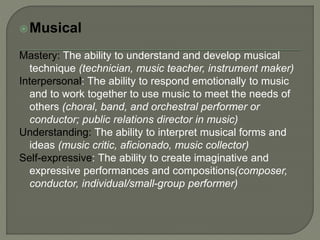
Musical
Mastery: The ability to understand and develop musical
technique (technician, music teacher, instrument maker)
Interpersonal: The ability to respond emotionally to music
and to work together to use music to meet the needs of
others (choral, band, and orchestral performer or
conductor; public relations director in music)
Understanding: The ability to interpret musical forms and
ideas (music critic, aficionado, music collector)
Self-expressive: The ability to create imaginative and
expressive performances and compositions(composer,
conductor, individual/small-group performer)
 Interpersonal
Mastery: The ability to organize people and to
communicate clearly what needs to be
done(administrator, manager, politician)
Interpersonal: The ability to use empathy to help others and
to solve problems (social worker, doctor, nurse, therapist,
teacher)
Understanding: The ability to discriminate and interpret
among different kinds of interpersonal clues(sociologist,
psychologist, psychotherapist, professor of psychology or
sociology)
Self-expressive: The ability to influence and inspire others
to work toward a common goal(consultant, charismatic
leader, politician, evangelist)
Intrapersonal
Mastery: The ability to assess one's own strengths,
weaknesses, talents, and interests and use them to set
goals (planner, small business owner)
Interpersonal: The ability to use understanding of oneself to
be of service to others (counselor, social worker)
Understanding: The ability to form and develop concepts
and theories based on an examination of
oneself (psychologist)
Self-expressive: The ability to reflect on one's inner moods,
intuitions, and temperament and to use them to create or
express a personal vision (artist, religious leader, writer)
THE END.
Jackielyn V. Nuevo
BEED – General Education 3E

Learning styles final

  • 2.
    Refers to arange of competing and contested theories that aim to account for differences in individuals’ learning. The common concept of learning style is that individuals differ in how they learn.
  • 4.
    Mastery Style Learner Sensing-Thinkinglearner - absorbs information concretely; processes information sequentially, in a step-by-step manner; and judges the value of learning in terms of its clarity and practicality.
  • 5.
    Interpersonal style learner (Sensing-FeelingLearner) - like the Mastery learner, focuses on concrete, palpable information; prefers to learn socially; and judges learning in terms of its potential use in helping others.
  • 6.
    Understanding style learner (Intuitive-ThinkingLearner) - focuses more on ideas and abstractions; learns through a process of questioning, reasoning, and testing; and evaluates learning by standards of logic and the use of evidence.
  • 7.
    Self-Expressive style learner (Intuitive-FeelingLearner) - looks for images implied in learning; uses feelings and emotions to construct new ideas and products; and judges the learning process according to its originality, aesthetics, and capacity to surprise or delight.
  • 9.
    Linguistic Mastery: The abilityto use language to describe events and sequence activities (journalist, technical writer, administrator, contractor) Interpersonal: The ability to use language to build trust and rapport (salesperson, counselor, clergyperson, therapist) Understanding: The ability to develop logical arguments and use rhetoric (lawyer, professor, orator, philosopher) Self-expressive: The ability to use metaphoric and expressive language (playwright, poet, advertising copywriter, novelist)
  • 10.
    Logical-Mathematical Mastery: The abilityto use numbers to compute, describe, and document (accountant, bookkeeper, statistician) Interpersonal: The ability to apply mathematics in personal and daily life (tradesperson, homemaker) Understanding: The ability to use mathematical concepts to make conjectures, establish proofs, and apply mathematics and data to construct arguments (logician, computer programmer, scientist, quantitative problem solver) Self-expressive: The ability to be sensitive to the patterns, symmetry, logic, and aesthetics of mathematics and to solve problems in design and modeling (composer, engineer, inventor, designer, qualitative problem solver)
  • 11.
    Spatial Mastery: The abilityto perceive and represent the visual- spatial world accurately (illustrator, artist, guide, photographer) Interpersonal: The ability to arrange color, line, shape, form, and space to meet the needs of others(interior decorator, painter, clothing designer, weaver, builder) Understanding: The ability to interpret and graphically represent visual or spatial ideas (architect, iconographer, computer graphics designer, art critic) Self-expressive: The ability to transform visual or spatial ideas into imaginative and expressive creations (artist, inventor, model builder, cinematographer)
  • 12.
    Bodily-Kinesthetic Mastery: The abilityto use the body and tools to take effective action or to construct or repair(mechanic, trainer, contractor, craftsperson, tool and dye maker) Interpersonal: The ability to use the body to build rapport, to console and persuade, and to support others (coach, counselor, salesperson, trainer) Understanding: The ability to plan strategically or to critique the actions of the body (physical educator, sports analyst, professional athlete, dance critic) Self-expressive: The ability to appreciate the aesthetics of the body and to use those values to create new forms of expression (sculptor, choreographer, actor, dancer, mime, puppeteer)
  • 13.
    Musical Mastery: The abilityto understand and develop musical technique (technician, music teacher, instrument maker) Interpersonal: The ability to respond emotionally to music and to work together to use music to meet the needs of others (choral, band, and orchestral performer or conductor; public relations director in music) Understanding: The ability to interpret musical forms and ideas (music critic, aficionado, music collector) Self-expressive: The ability to create imaginative and expressive performances and compositions(composer, conductor, individual/small-group performer)
  • 14.
     Interpersonal Mastery: Theability to organize people and to communicate clearly what needs to be done(administrator, manager, politician) Interpersonal: The ability to use empathy to help others and to solve problems (social worker, doctor, nurse, therapist, teacher) Understanding: The ability to discriminate and interpret among different kinds of interpersonal clues(sociologist, psychologist, psychotherapist, professor of psychology or sociology) Self-expressive: The ability to influence and inspire others to work toward a common goal(consultant, charismatic leader, politician, evangelist)
  • 15.
    Intrapersonal Mastery: The abilityto assess one's own strengths, weaknesses, talents, and interests and use them to set goals (planner, small business owner) Interpersonal: The ability to use understanding of oneself to be of service to others (counselor, social worker) Understanding: The ability to form and develop concepts and theories based on an examination of oneself (psychologist) Self-expressive: The ability to reflect on one's inner moods, intuitions, and temperament and to use them to create or express a personal vision (artist, religious leader, writer)
  • 16.
    THE END. Jackielyn V.Nuevo BEED – General Education 3E