Learning SQL
Alan Beaulieu
Editor
Mary Treseler
Copyright © 2009 O'Reilly Media, Inc.
This book uses RepKover™, a durable and flexible lay-flat
binding.
O’Reilly books may be purchased for educational,
business, or sales promotional use. Online editions are
also available for most titles (http://safari.oreilly.com).
For more information, contact our corporate/institutional
sales department: (800) 998-9938 or
corporate@oreilly.com.
Nutshell Handbook, the Nutshell Handbook logo, and the
O’Reilly logo are registered trademarks of O’Reilly
Media, Inc. Learning SQL, the image of an Andean
marsupial tree frog, and related trade dress are
trademarks of O’Reilly Media, Inc.
Many of the designations used by manufacturers and
sellers to distinguish their products are claimed as
trademarks. Where those designations appear in this
book, and O’Reilly Media, Inc. was aware of a trademark
claim, the designations have been printed in caps or
initial caps.
While every precaution has been taken in the preparation
of this book, the publisher and author assume no
responsibility for errors or omissions, or for damages
resulting from the use of the information contained
herein.
O'Reilly Media
SPECIAL OFFER: Upgrade this ebook with
O’Reilly
Click here for more information on this offer!
A Note Regarding Supplemental Files
Supplemental files and examples for this book can be
found at http://examples.oreilly.com/9780596520847/.
Please use a standard desktop web browser to access
these files, as they may not be accessible from all
ereader devices.
All code files or examples referenced in the book will be
available online. For physical books that ship with an
accompanying disc, whenever possible, we’ve posted all
CD/DVD content. Note that while we provide as much of
the media content as we are able via free download, we
are sometimes limited by licensing restrictions. Please
direct any questions or concerns to
booktech@oreilly.com.
Preface
Programming languages come and go constantly, and
very few languages in use today have roots going back
more than a decade or so. Some examples are Cobol,
which is still used quite heavily in mainframe
environments, and C, which is still quite popular for
operating system and server development and for
embedded systems. In the database arena, we have SQL,
whose roots go all the way back to the 1970s.
SQL is the language for generating, manipulating, and
retrieving data from a relational database. One of the
reasons for the popularity of relational databases is that
properly designed relational databases can handle huge
amounts of data. When working with large data sets, SQL
is akin to one of those snazzy digital cameras with the
high-power zoom lens in that you can use SQL to look at
large sets of data, or you can zoom in on individual rows
(or anywhere in between). Other database management
systems tend to break down under heavy loads because
their focus is too narrow (the zoom lens is stuck on
maximum), which is why attempts to dethrone relational
databases and SQL have largely failed. Therefore, even
though SQL is an old language, it is going to be around
for a lot longer and has a bright future in store.
Why Learn SQL?
If you are going to work with a relational database,
whether you are writing applications, performing
administrative tasks, or generating reports, you will need
to know how to interact with the data in your database.
Even if you are using a tool that generates SQL for you,
such as a reporting tool, there may be times when you
need to bypass the automatic generation feature and
write your own SQL statements.
Learning SQL has the added benefit of forcing you to
confront and understand the data structures used to
store information about your organization. As you
become comfortable with the tables in your database,
you may find yourself proposing modifications or
additions to your database schema.
Why Use This Book to Do It?
The SQL language is broken into several categories.
Statements used to create database objects (tables,
indexes, constraints, etc.) are collectively known as SQL
schema statements. The statements used to create,
manipulate, and retrieve the data stored in a database
are known as the SQL data statements. If you are an
administrator, you will be using both SQL schema and
SQL data statements. If you are a programmer or report
writer, you may only need to use (or be allowed to use)
SQL data statements. While this book demonstrates
many of the SQL schema statements, the main focus of
this book is on programming features.
With only a handful of commands, the SQL data
statements look deceptively simple. In my opinion, many
of the available SQL books help to foster this notion by
only skimming the surface of what is possible with the
language. However, if you are going to work with SQL, it
behooves you to understand fully the capabilities of the
language and how different features can be combined to
produce powerful results. I feel that this is the only book
that provides detailed coverage of the SQL language
without the added benefit of doubling as a “door stop”
(you know, those 1,250-page “complete references” that
tend to gather dust on people’s cubicle shelves).
While the examples in this book run on MySQL, Oracle
Database, and SQL Server, I had to pick one of those
products to host my sample database and to format the
result sets returned by the example queries. Of the three,
I chose MySQL because it is freely obtainable, easy to
install, and simple to administer. For those readers using
a different server, I ask that you download and install
MySQL and load the sample database so that you can run
the examples and experiment with the data.
Structure of This Book
This book is divided into 15 chapters and 3 appendixes:
Chapter 1, A Little Background, explores the history of
computerized databases, including the rise of the relation
model and the SQL language.
Chapter 2, Creating and Populating a Database,
demonstrates how to create a MySQL database, create the
tables used for the examples in this book, and populate th
tables with data.
Chapter 3, Query Primer, introduces the select statement
and further demonstrates the most common clauses (select,
from, where).
Chapter 4, Filtering, demonstrates the different types of
conditions that can be used in the where clause of a select,
update, or delete statement.
Chapter 5, Querying Multiple Tables, shows how queries
can utilize multiple tables via table joins.
Chapter 6, Working with Sets, is all about data sets and
how they can interact within queries.
Chapter 7, Data Generation, Conversion, and Manipulatio
demonstrates several built-in functions used for
manipulating or converting data.
Chapter 8, Grouping and Aggregates, shows how data can
be aggregated.
Chapter 9, Subqueries, introduces the subquery (a person
favorite) and shows how and where they can be utilized.
Chapter 10, Joins Revisited, further explores the various
types of table joins.
Chapter 11, Conditional Logic, explores how conditional
logic (i.e., if-then-else) can be utilized in select, insert, update,
and delete statements.
Chapter 12, Transactions, introduces transactions and
shows how to use them.
Chapter 13, Indexes and Constraints, explores indexes an
constraints.
Chapter 14, Views, shows how to build an interface to
shield users from data complexities.
Chapter 15, Metadata, demonstrates the utility of the data
dictionary.
Appendix A, shows the database schema used for all
examples in the book.
Appendix B, demonstrates some of the interesting non-
ANSI features of MySQL’s SQL implementation.
Appendix C, shows solutions to the chapter exercises.
Conventions Used in This Book
The following typographical conventions are used in this
book:
Italic
Used for filenames, directory names, and URLs. Also
used for emphasis and to indicate the first use of a
technical term.
Constant width
Used for code examples and to indicate SQL keywords
within text.
Constant width italic
Used to indicate user-defined terms.
UPPERCASE
Used to indicate SQL keywords within example code.
Constant width bold
Indicates user input in examples showing an
interaction. Also indicates emphasized code elements
to which you should pay particular attention.
Note ✎
Indicates a tip, suggestion, or general note. For
example, I use notes to point you to useful new
features in Oracle9i.
Warning ☠
Indicates a warning or caution. For example, I’ll tell
you if a certain SQL clause might have unintended
consequences if not used carefully.
How to Contact Us
Please address comments and questions concerning this
book to the publisher:
O’Reilly Media, Inc.
1005 Gravenstein Highway North
Sebastopol, CA 95472
800-998-9938 (in the United States or Canada)
707-829-0515 (international or local)
707-829-0104 (fax)
O’Reilly maintains a web page for this book, which lists
errata, examples, and any additional information. You can
access this page at:
http://www.oreilly.com/catalog/9780596520830
To comment or ask technical questions about this book,
send email to:
bookquestions@oreilly.com
For more information about O’Reilly books, conferences,
Resource Centers, and the O’Reilly Network, see the
website at:
http://www.oreilly.com
Using Code Examples
This book is here to help you get your job done. In
general, you may use the code in this book in your
programs and documentation. You do not need to contact
us for permission unless you’re reproducing a significant
portion of the code. For example, writing a program that
uses several chunks of code from this book does not
require permission. Selling or distributing a CD-ROM of
examples from O’Reilly books does require permission.
Answering a question by citing this book and quoting
example code does not require permission. Incorporating
a significant amount of example code from this book into
your product’s documentation does require permission.
We appreciate, but do not require, attribution. An
attribution usually includes the title, author, publisher,
and ISBN. For example, “Learning SQL, Second Edition,
by Alan Beaulieu. Copyright 2009 O’Reilly Media, Inc.,
978-0-596-52083-0.”
If you feel your use of code examples falls outside fair
use or the permission given above, feel free to contact us
at permissions@oreilly.com.
Safari® Books Online
Note ✎
When you see a Safari® Books Online icon on the
cover of your favorite technology book, that means
the book is available online through the O’Reilly
Network Safari Bookshelf.
Safari offers a solution that’s better than e-books. It’s a
virtual library that lets you easily search thousands of top
tech books, cut and paste code samples, download
chapters, and find quick answers when you need the
most accurate, current information. Try it for free at
http://my.safaribooksonline.com.
Acknowledgments
I would like to thank my editor, Mary Treseler, for
helping to make this second edition a reality, and many
thanks to Kevin Kline, Roy Owens, Richard Sonen, and
Matthew Russell, who were kind enough to review the
book for me over the Christmas/New Year holidays. I
would also like to thank the many readers of my first
edition who were kind enough to send questions,
comments, and corrections. Lastly, I thank my wife,
Nancy, and my daughters, Michelle and Nicole, for their
encouragement and inspiration.
Chapter 1. A Little Background
Before we roll up our sleeves and get to work, it might be
beneficial to introduce some basic database concepts and
look at the history of computerized data storage and
retrieval.
Introduction to Databases
A database is nothing more than a set of related
information. A telephone book, for example, is a database
of the names, phone numbers, and addresses of all
people living in a particular region. While a telephone
book is certainly a ubiquitous and frequently used
database, it suffers from the following:
Finding a person’s telephone number can be time-
consuming, especially if the telephone book contains
a large number of entries.
A telephone book is indexed only by last/first names,
so finding the names of the people living at a
particular address, while possible in theory, is not a
practical use for this database.
From the moment the telephone book is printed, the
information becomes less and less accurate as people
move into or out of a region, change their telephone
numbers, or move to another location within the
same region.
The same drawbacks attributed to telephone books can
also apply to any manual data storage system, such as
patient records stored in a filing cabinet. Because of the
cumbersome nature of paper databases, some of the first
computer applications developed were database systems,
which are computerized data storage and retrieval
mechanisms. Because a database system stores data
electronically rather than on paper, a database system is
able to retrieve data more quickly, index data in multiple
ways, and deliver up-to-the-minute information to its user
community.
Early database systems managed data stored on
magnetic tapes. Because there were generally far more
tapes than tape readers, technicians were tasked with
loading and unloading tapes as specific data was
requested. Because the computers of that era had very
little memory, multiple requests for the same data
generally required the data to be read from the tape
multiple times. While these database systems were a
significant improvement over paper databases, they are a
far cry from what is possible with today’s technology.
(Modern database systems can manage terabytes of data
spread across many fast-access disk drives, holding tens
of gigabytes of that data in high-speed memory, but I’m
getting a bit ahead of myself.)
Nonrelational Database Systems
Note ✎
This section contains some background information
about pre-relational database systems. For those
readers eager to dive into SQL, feel free to skip
ahead a couple of pages to the next section.
Over the first several decades of computerized database
systems, data was stored and represented to users in
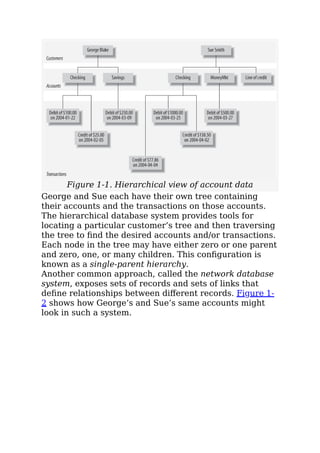
various ways. In a hierarchical database system, for
example, data is represented as one or more tree
structures. Figure 1-1 shows how data relating to George
Blake’s and Sue Smith’s bank accounts might be
represented via tree structures.
Figure 1-1. Hierarchical view of account data
George and Sue each have their own tree containing
their accounts and the transactions on those accounts.
The hierarchical database system provides tools for
locating a particular customer’s tree and then traversing
the tree to find the desired accounts and/or transactions.
Each node in the tree may have either zero or one parent
and zero, one, or many children. This configuration is
known as a single-parent hierarchy.
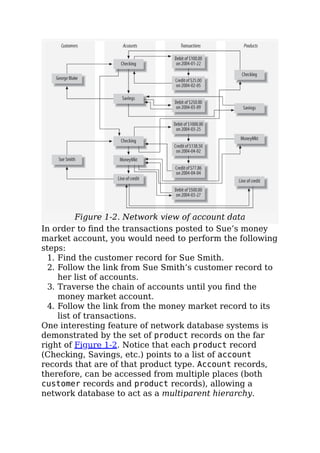
Another common approach, called the network database
system, exposes sets of records and sets of links that
define relationships between different records. Figure 1-
2 shows how George’s and Sue’s same accounts might
look in such a system.
Figure 1-2. Network view of account data
In order to find the transactions posted to Sue’s money
market account, you would need to perform the following
steps:
1. Find the customer record for Sue Smith.
2. Follow the link from Sue Smith’s customer record to
her list of accounts.
3. Traverse the chain of accounts until you find the
money market account.
4. Follow the link from the money market record to its
list of transactions.
One interesting feature of network database systems is
demonstrated by the set of product records on the far
right of Figure 1-2. Notice that each product record
(Checking, Savings, etc.) points to a list of account
records that are of that product type. Account records,
therefore, can be accessed from multiple places (both
customer records and product records), allowing a
network database to act as a multiparent hierarchy.
Both hierarchical and network database systems are
alive and well today, although generally in the mainframe
world. Additionally, hierarchical database systems have
enjoyed a rebirth in the directory services realm, such as
Microsoft’s Active Directory and the Red Hat Directory
Server, as well as with Extensible Markup Language
(XML). Beginning in the 1970s, however, a new way of
representing data began to take root, one that was more
rigorous yet easy to understand and implement.
The Relational Model
In 1970, Dr. E. F. Codd of IBM’s research laboratory
published a paper titled “A Relational Model of Data for
Large Shared Data Banks” that proposed that data be
represented as sets of tables. Rather than using pointers
to navigate between related entities, redundant data is
used to link records in different tables. Figure 1-3 shows
how George’s and Sue’s account information would
appear in this context.
Figure 1-3. Relational view of account data
There are four tables in Figure 1-3 representing the four
entities discussed so far: customer, product, account,
and transaction. Looking across the top of the
customer table in Figure 1-3, you can see three columns:
cust_id (which contains the customer’s ID number),
fname (which contains the customer’s first name), and
lname (which contains the customer’s last name).
Looking down the side of the customer table, you can see
two rows, one containing George Blake’s data and the
other containing Sue Smith’s data. The number of
columns that a table may contain differs from server to
server, but it is generally large enough not to be an issue
(Microsoft SQL Server, for example, allows up to 1,024
columns per table). The number of rows that a table may
contain is more a matter of physical limits (i.e., how
much disk drive space is available) and maintainability
(i.e., how large a table can get before it becomes difficult
to work with) than of database server limitations.
Each table in a relational database includes information
that uniquely identifies a row in that table (known as the
primary key), along with additional information needed
to describe the entity completely. Looking again at the
customer table, the cust_id column holds a different
number for each customer; George Blake, for example,
can be uniquely identified by customer ID #1. No other
customer will ever be assigned that identifier, and no
other information is needed to locate George Blake’s
data in the customer table.
Note ✎
Every database server provides a mechanism for
generating unique sets of numbers to use as primary
key values, so you won’t need to worry about keeping
track of what numbers have been assigned.
While I might have chosen to use the combination of the
fname and lname columns as the primary key (a primary
key consisting of two or more columns is known as a
compound key), there could easily be two or more people
with the same first and last names that have accounts at
the bank. Therefore, I chose to include the cust_id
column in the customer table specifically for use as a
primary key column.
Note ✎
In this example, choosing fname/lname as the primary
key would be referred to as a natural key, whereas
the choice of cust_id would be referred to as a
surrogate key. The decision whether to employ
natural or surrogate keys is a topic of widespread
debate, but in this particular case the choice is clear,
since a person’s last name may change (such as when
a person adopts a spouse’s last name), and primary
key columns should never be allowed to change once
a value has been assigned.
Some of the tables also include information used to
navigate to another table; this is where the “redundant
data” mentioned earlier comes in. For example, the
account table includes a column called cust_id, which
contains the unique identifier of the customer who
opened the account, along with a column called
product_cd, which contains the unique identifier of the
product to which the account will conform. These
columns are known as foreign keys, and they serve the
same purpose as the lines that connect the entities in the
hierarchical and network versions of the account
information. If you are looking at a particular account
record and want to know more information about the
customer who opened the account, you would take the
value of the cust_id column and use it to find the
appropriate row in the customer table (this process is
known, in relational database lingo, as a join; joins are
introduced in Chapter 3 and probed deeply in Chapters 5
and 10).
It might seem wasteful to store the same data many
times, but the relational model is quite clear on what
redundant data may be stored. For example, it is proper
for the account table to include a column for the unique
identifier of the customer who opened the account, but it
is not proper to include the customer’s first and last
names in the account table as well. If a customer were to
change her name, for example, you want to make sure
that there is only one place in the database that holds the
customer’s name; otherwise, the data might be changed
in one place but not another, causing the data in the
database to be unreliable. The proper place for this data
is the customer table, and only the cust_id values
should be included in other tables. It is also not proper
for a single column to contain multiple pieces of
information, such as a name column that contains both a
person’s first and last names, or an address column that
contains street, city, state, and zip code information. The
process of refining a database design to ensure that each
independent piece of information is in only one place
(except for foreign keys) is known as normalization.
Getting back to the four tables in Figure 1-3, you may
wonder how you would use these tables to find George
Blake’s transactions against his checking account. First,
you would find George Blake’s unique identifier in the
customer table. Then, you would find the row in the
account table whose cust_id column contains George’s
unique identifier and whose product_cd column matches
the row in the product table whose name column equals
“Checking.” Finally, you would locate the rows in the
transaction table whose account_id column matches
the unique identifier from the account table. This might
sound complicated, but you can do it in a single
command, using the SQL language, as you will see
shortly.
Some Terminology
I introduced some new terminology in the previous
sections, so maybe it’s time for some formal definitions.
Table 1-1 shows the terms we use for the remainder of
the book along with their definitions.
Table 1-1. Terms and definitions
Term Definition
Entity Something of interest to the database user community. Examples
include customers, parts, geographic locations, etc.
Column An individual piece of data stored in a table.
Term Definition
Row A set of columns that together completely describe an entity or
some action on an entity. Also called a record.
Table A set of rows, held either in memory (nonpersistent) or on
permanent storage (persistent).
Result
set
Another name for a nonpersistent table, generally the result of an
SQL query.
Primary
key
One or more columns that can be used as a unique identifier for
each row in a table.
Foreign
key
One or more columns that can be used together to identify a
single row in another table.
What Is SQL?
Along with Codd’s definition of the relational model, he
proposed a language called DSL/Alpha for manipulating
the data in relational tables. Shortly after Codd’s paper
was released, IBM commissioned a group to build a
prototype based on Codd’s ideas. This group created a
simplified version of DSL/Alpha that they called
SQUARE. Refinements to SQUARE led to a language
called SEQUEL, which was, finally, renamed SQL.
SQL is now entering middle age (as is this author, alas),
and it has undergone a great deal of change along the
way. In the mid-1980s, the American National Standards
Institute (ANSI) began working on the first standard for
the SQL language, which was published in 1986.
Subsequent refinements led to new releases of the SQL
standard in 1989, 1992, 1999, 2003, and 2006. Along
with refinements to the core language, new features have
been added to the SQL language to incorporate object-
oriented functionality, among other things. The latest
standard, SQL:2006, focuses on the integration of SQL
and XML and defines a language called XQuery which is
used to query data in XML documents.
SQL goes hand in hand with the relational model because
the result of an SQL query is a table (also called, in this
context, a result set). Thus, a new permanent table can
be created in a relational database simply by storing the
result set of a query. Similarly, a query can use both
permanent tables and the result sets from other queries
as inputs (we explore this in detail in Chapter 9).
One final note: SQL is not an acronym for anything
(although many people will insist it stands for
“Structured Query Language”). When referring to the
language, it is equally acceptable to say the letters
individually (i.e., S. Q. L.) or to use the word sequel.
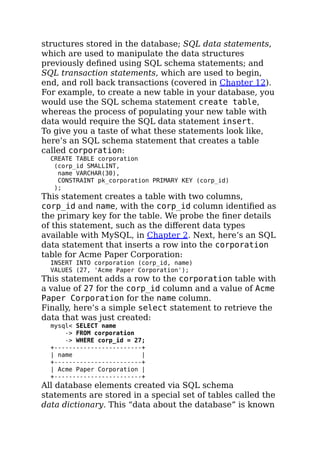
SQL Statement Classes
The SQL language is divided into several distinct parts:
the parts that we explore in this book include SQL
schema statements, which are used to define the data
structures stored in the database; SQL data statements,
which are used to manipulate the data structures
previously defined using SQL schema statements; and
SQL transaction statements, which are used to begin,
end, and roll back transactions (covered in Chapter 12).
For example, to create a new table in your database, you
would use the SQL schema statement create table,
whereas the process of populating your new table with
data would require the SQL data statement insert.
To give you a taste of what these statements look like,
here’s an SQL schema statement that creates a table
called corporation:
CREATE TABLE corporation
(corp_id SMALLINT,
name VARCHAR(30),
CONSTRAINT pk_corporation PRIMARY KEY (corp_id)
);
This statement creates a table with two columns,
corp_id and name, with the corp_id column identified as
the primary key for the table. We probe the finer details
of this statement, such as the different data types
available with MySQL, in Chapter 2. Next, here’s an SQL
data statement that inserts a row into the corporation
table for Acme Paper Corporation:
INSERT INTO corporation (corp_id, name)
VALUES (27, 'Acme Paper Corporation');
This statement adds a row to the corporation table with
a value of 27 for the corp_id column and a value of Acme
Paper Corporation for the name column.
Finally, here’s a simple select statement to retrieve the
data that was just created:
mysql< SELECT name
-> FROM corporation
-> WHERE corp_id = 27;
+------------------------+
| name |
+------------------------+
| Acme Paper Corporation |
+------------------------+
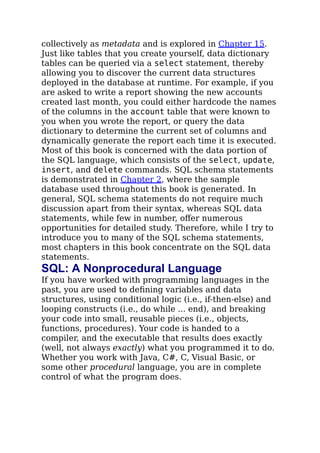
All database elements created via SQL schema
statements are stored in a special set of tables called the
data dictionary. This “data about the database” is known
collectively as metadata and is explored in Chapter 15.
Just like tables that you create yourself, data dictionary
tables can be queried via a select statement, thereby
allowing you to discover the current data structures
deployed in the database at runtime. For example, if you
are asked to write a report showing the new accounts
created last month, you could either hardcode the names
of the columns in the account table that were known to
you when you wrote the report, or query the data
dictionary to determine the current set of columns and
dynamically generate the report each time it is executed.
Most of this book is concerned with the data portion of
the SQL language, which consists of the select, update,
insert, and delete commands. SQL schema statements
is demonstrated in Chapter 2, where the sample
database used throughout this book is generated. In
general, SQL schema statements do not require much
discussion apart from their syntax, whereas SQL data
statements, while few in number, offer numerous
opportunities for detailed study. Therefore, while I try to
introduce you to many of the SQL schema statements,
most chapters in this book concentrate on the SQL data
statements.
SQL: A Nonprocedural Language
If you have worked with programming languages in the
past, you are used to defining variables and data
structures, using conditional logic (i.e., if-then-else) and
looping constructs (i.e., do while ... end), and breaking
your code into small, reusable pieces (i.e., objects,
functions, procedures). Your code is handed to a
compiler, and the executable that results does exactly
(well, not always exactly) what you programmed it to do.
Whether you work with Java, C#, C, Visual Basic, or
some other procedural language, you are in complete
control of what the program does.
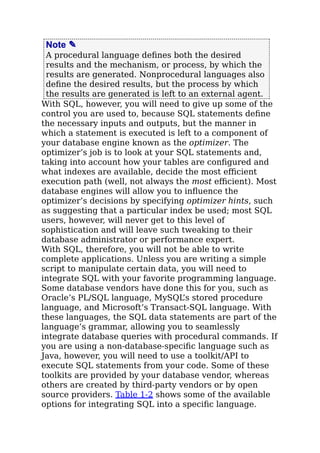
Note ✎
A procedural language defines both the desired
results and the mechanism, or process, by which the
results are generated. Nonprocedural languages also
define the desired results, but the process by which
the results are generated is left to an external agent.
With SQL, however, you will need to give up some of the
control you are used to, because SQL statements define
the necessary inputs and outputs, but the manner in
which a statement is executed is left to a component of
your database engine known as the optimizer. The
optimizer’s job is to look at your SQL statements and,
taking into account how your tables are configured and
what indexes are available, decide the most efficient
execution path (well, not always the most efficient). Most
database engines will allow you to influence the
optimizer’s decisions by specifying optimizer hints, such
as suggesting that a particular index be used; most SQL
users, however, will never get to this level of
sophistication and will leave such tweaking to their
database administrator or performance expert.
With SQL, therefore, you will not be able to write
complete applications. Unless you are writing a simple
script to manipulate certain data, you will need to
integrate SQL with your favorite programming language.
Some database vendors have done this for you, such as
Oracle’s PL/SQL language, MySQL’s stored procedure
language, and Microsoft’s Transact-SQL language. With
these languages, the SQL data statements are part of the
language’s grammar, allowing you to seamlessly
integrate database queries with procedural commands. If
you are using a non-database-specific language such as
Java, however, you will need to use a toolkit/API to
execute SQL statements from your code. Some of these
toolkits are provided by your database vendor, whereas
others are created by third-party vendors or by open
source providers. Table 1-2 shows some of the available
options for integrating SQL into a specific language.
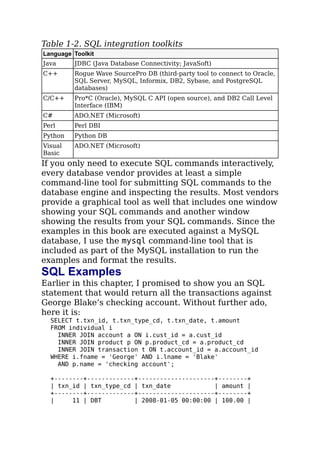
Table 1-2. SQL integration toolkits
Language Toolkit
Java JDBC (Java Database Connectivity; JavaSoft)
C++ Rogue Wave SourcePro DB (third-party tool to connect to Oracle,
SQL Server, MySQL, Informix, DB2, Sybase, and PostgreSQL
databases)
C/C++ Pro*C (Oracle), MySQL C API (open source), and DB2 Call Level
Interface (IBM)
C# ADO.NET (Microsoft)
Perl Perl DBI
Python Python DB
Visual
Basic
ADO.NET (Microsoft)
If you only need to execute SQL commands interactively,
every database vendor provides at least a simple
command-line tool for submitting SQL commands to the
database engine and inspecting the results. Most vendors
provide a graphical tool as well that includes one window
showing your SQL commands and another window
showing the results from your SQL commands. Since the
examples in this book are executed against a MySQL
database, I use the mysql command-line tool that is
included as part of the MySQL installation to run the
examples and format the results.
SQL Examples
Earlier in this chapter, I promised to show you an SQL
statement that would return all the transactions against
George Blake’s checking account. Without further ado,
here it is:
SELECT t.txn_id, t.txn_type_cd, t.txn_date, t.amount
FROM individual i
INNER JOIN account a ON i.cust_id = a.cust_id
INNER JOIN product p ON p.product_cd = a.product_cd
INNER JOIN transaction t ON t.account_id = a.account_id
WHERE i.fname = 'George' AND i.lname = 'Blake'
AND p.name = 'checking account';
+--------+-------------+---------------------+--------+
| txn_id | txn_type_cd | txn_date | amount |
+--------+-------------+---------------------+--------+
| 11 | DBT | 2008-01-05 00:00:00 | 100.00 |
+--------+-------------+---------------------+--------+
1 row in set (0.00 sec)
Without going into too much detail at this point, this
query identifies the row in the individual table for
George Blake and the row in the product table for the
“checking” product, finds the row in the account table
for this individual/product combination, and returns four
columns from the transaction table for all transactions
posted to this account. If you happen to know that
George Blake’s customer ID is 8 and that checking
accounts are designated by the code 'CHK', then you can
simply find George Blake’s checking account in the
account table based on the customer ID and use the
account ID to find the appropriate transactions:
SELECT t.txn_id, t.txn_type_cd, t.txn_date, t.amount
FROM account a
INNER JOIN transaction t ON t.account_id = a.account_id
WHERE a.cust_id = 8 AND a.product_cd = 'CHK';
I cover all of the concepts in these queries (plus a lot
more) in the following chapters, but I wanted to at least
show what they would look like.
The previous queries contain three different clauses:
select, from, and where. Almost every query that you
encounter will include at least these three clauses,
although there are several more that can be used for
more specialized purposes. The role of each of these
three clauses is demonstrated by the following:
SELECT /* one or more things */ ...
FROM /* one or more places */ ...
WHERE /* one or more conditions apply */ ...
Note ✎
Most SQL implementations treat any text between
the /* and */ tags as comments.
When constructing your query, your first task is generally
to determine which table or tables will be needed and
then add them to your from clause. Next, you will need to
add conditions to your where clause to filter out the data
from these tables that you aren’t interested in. Finally,
you will decide which columns from the different tables
need to be retrieved and add them to your select clause.
Here’s a simple example that shows how you would find
all customers with the last name “Smith”:
SELECT cust_id, fname
FROM individual
WHERE lname = 'Smith';
This query searches the individual table for all rows
whose lname column matches the string 'Smith' and
returns the cust_id and fname columns from those rows.
Along with querying your database, you will most likely
be involved with populating and modifying the data in
your database. Here’s a simple example of how you
would insert a new row into the product table:
INSERT INTO product (product_cd, name)
VALUES ('CD', 'Certificate of Depysit')
Whoops, looks like you misspelled “Deposit.” No
problem. You can clean that up with an update
statement:
UPDATE product
SET name = 'Certificate of Deposit'
WHERE product_cd = 'CD';
Notice that the update statement also contains a where
clause, just like the select statement. This is because an
update statement must identify the rows to be modified;
in this case, you are specifying that only those rows
whose product_cd column matches the string 'CD'
should be modified. Since the product_cd column is the
primary key for the product table, you should expect
your update statement to modify exactly one row (or
zero, if the value doesn’t exist in the table). Whenever
you execute an SQL data statement, you will receive
feedback from the database engine as to how many rows
were affected by your statement. If you are using an
interactive tool such as the mysql command-line tool
mentioned earlier, then you will receive feedback
concerning how many rows were either:
Returned by your select statement
Created by your insert statement
Modified by your update statement
Removed by your delete statement
If you are using a procedural language with one of the
toolkits mentioned earlier, the toolkit will include a call
to ask for this information after your SQL data statement
has executed. In general, it’s a good idea to check this
info to make sure your statement didn’t do something
unexpected (like when you forget to put a where clause
on your delete statement and delete every row in the
table!).
What Is MySQL?
Relational databases have been available commercially
for over two decades. Some of the most mature and
popular commercial products include:
Oracle Database from Oracle Corporation
SQL Server from Microsoft
DB2 Universal Database from IBM
Sybase Adaptive Server from Sybase
All these database servers do approximately the same
thing, although some are better equipped to run very
large or very-high-throughput databases. Others are
better at handling objects or very large files or XML
documents, and so on. Additionally, all these servers do a
pretty good job of complying with the latest ANSI SQL
standard. This is a good thing, and I make it a point to
show you how to write SQL statements that will run on
any of these platforms with little or no modification.
Along with the commercial database servers, there has
been quite a bit of activity in the open source community
in the past five years with the goal of creating a viable
alternative to the commercial database servers. Two of
the most commonly used open source database servers
are PostgreSQL and MySQL. The MySQL website
(http://www.mysql.com) currently claims over 10 million
installations, its server is available for free, and I have
found its server to be extremely simple to download and
install. For these reasons, I have decided that all
examples for this book be run against a MySQL (version
6.0) database, and that the mysql command-line tool be
used to format query results. Even if you are already
using another server and never plan to use MySQL, I
urge you to install the latest MySQL server, load the
sample schema and data, and experiment with the data
and examples in this book.
However, keep in mind the following caveat:
This is not a book about MySQL
’s SQL implementation.
Rather, this book is designed to teach you how to craft
SQL statements that will run on MySQL with no
modifications, and will run on recent releases of Oracle
Database, Sybase Adaptive Server, and SQL Server with
few or no modifications.
To keep the code in this book as vendor-independent as
possible, I will refrain from demonstrating some of the
interesting things that the MySQL SQL language
implementers have decided to do that can’t be done on
other database implementations. Instead, Appendix B
covers some of these features for readers who are
planning to continue using MySQL.
What’s in Store
The overall goal of the next four chapters is to introduce the
SQL data statements, with a special emphasis on the three
main clauses of the select statement. Additionally, you will
see many examples that use the bank schema (introduced in
the next chapter), which will be used for all examples in the
book. It is my hope that familiarity with a single database will
allow you to get to the crux of an example without your having
to stop and examine the tables being used each time. If it
becomes a bit tedious working with the same set of tables,
feel free to augment the sample database with additional
tables, or invent your own database with which to experiment.
After you have a solid grasp on the basics, the remaining
chapters will drill deep into additional concepts, most of
which are independent of each other. Thus, if you find yourself
getting confused, you can always move ahead and come back
later to revisit a chapter. When you have finished the book
and worked through all of the examples, you will be well on
your way to becoming a seasoned SQL practitioner.
For readers interested in learning more about relational
databases, the history of computerized database systems, or
the SQL language than was covered in this short introduction,
here are a few resources worth checking out:
C.J. Date’s Database in Depth: Relational Theory for
Practitioners (O’Reilly)
C.J. Date’s An Introduction to Database Systems, Eighth
Edition (Addison-Wesley)
C.J. Date’s The Database Relational Model: A
Retrospective Review and Analysis: A Historical Account
and Assessment of E. F. Codd’s Contribution to the Field
of Database Technology (Addison-Wesley)
http://en.wikipedia.org/wiki/Database_management_system
http://www.mcjones.org/System_R/
Chapter 2. Creating and Populating a
Database
This chapter provides you with the information you need
to create your first database and to create the tables and
associated data used for the examples in this book. You
will also learn about various data types and see how to
create tables using them. Because the examples in this
book are executed against a MySQL database, this
chapter is somewhat skewed toward MySQL’s features
and syntax, but most concepts are applicable to any
server.
Creating a MySQL Database
If you already have a MySQL database server available
for your use, you can skip the installation instructions
and start with the instructions in Table 2-1. Keep in mind,
however, that this book assumes that you are using
MySQL version 6.0 or later, so you may want to consider
upgrading your server or installing another server if you
are using an earlier release.
The following instructions show you the minimum steps
required to install a MySQL 6.0 server on a Windows
computer:
1. Go to the download page for the MySQL Database
Server at http://dev.mysql.com/downloads. If you are
loading version 6.0, the full URL is
http://dev.mysql.com/downloads/mysql/6.0.html.
2. Download the Windows Essentials (x86) package,
which includes only the commonly used tools.
3. When asked “Do you want to run or save this file?”
click Run.
4. The MySQL Server 6.0—Setup Wizard window
appears. Click Next.
5. Activate the Typical Install radio button, and click
Next.
6. Click Install.
7. A MySQL Enterprise window appears. Click Next
twice.
8. When the installation is complete, make sure the box
is checked next to “Configure the MySQL Server
now,” and then click Finish. This launches the
Configuration Wizard.
9. When the Configuration Wizard launches, activate
the Standard Configuration radio button, and then
select both the “Install as Windows Service” and
“Include Bin Directory in Windows Path” checkboxes.
Click Next.
10. Select the Modify Security Settings checkbox and
enter a password for the root user (make sure you
write down the password, because you will need it
shortly!), and click Next.
11. Click Execute.
At this point, if all went well, the MySQL server is
installed and running. If not, I suggest you uninstall the
server and read the “Troubleshooting a MySQL
Installation Under Windows” guide (which you can find
at http://dev.mysql.com/doc/refman/6.0/en/windows-
troubleshooting.html).
Warning ☠
If you uninstalled an older version of MySQL before
loading version 6.0, you may have some further
cleanup to do (I had to clean out some old Registry
entries) before you can get the Configuration Wizard
to run successfully.
Next, you will need to open a Windows command
window, launch the mysql tool, and create your database
and database user. Table 2-1 describes the necessary
steps. In step 5, feel free to choose your own password
for the lrngsql user rather than “xyz” (but don’t forget
to write it down!).
Table 2-1. Creating the sample database
Step Description Action
1 Open the Run dialog box from the
Start menu
Choose Start and then Run
2 Launch a command window Type cmd and click OK
3 Log in to MySQL as root mysql -u root -p
Step Description Action
4 Create a database for the sample
data
create database bank;
5 Create the lrngsql database user
with full privileges on the bank
database
grant all privileges on bank.* to
'lrngsql'@'localhost' identified by
'xyz';
6 Exit the mysql tool quit;
7 Log in to MySQL as lrngsql mysql -u lrngsql -p;
8 Attach to the bank database use bank;
You now have a MySQL server, a database, and a
database user; the only thing left to do is create the
database tables and populate them with sample data. To
do so, download the script at
http://examples.oreilly.com/learningsql/ and run it from
the mysql utility. If you saved the file as
c:tempLearningSQLExample.sql, you would need to do
the following:
1. If you have logged out of the mysql tool, repeat steps
7 and 8 from Table 2-1.
2. Type source c:tempLearningSQLExample.sql;
and press Enter.
You should now have a working database populated with
all the data needed for the examples in this book.
Using the mysql Command-Line Tool
Whenever you invoke the mysql command-line tool, you
can specify the username and database to use, as in the
following:
mysql -u lrngsql -p bank
This will save you from having to type use bank; every
time you start up the tool. You will be asked for your
password, and then the mysql> prompt will appear, via
which you will be able to issue SQL statements and view
the results. For example, if you want to know the current
date and time, you could issue the following query:
mysql> SELECT now();
+---------------------+
| now() |
+---------------------+
| 2008-02-19 16:48:46 |
+---------------------+
1 row in set (0.01 sec)
The now() function is a built-in MySQL function that
returns the current date and time. As you can see, the
mysql command-line tool formats the results of your
queries within a rectangle bounded by +, -, and |
characters. After the results have been exhausted (in this
case, there is only a single row of results), the mysql
command-line tool shows how many rows were returned
and how long the SQL statement took to execute.
About Missing from Clauses
With some database servers, you won’t be able to issue
a query without a from clause that names at least one
table. Oracle Database is a commonly used server for
which this is true. For cases when you only need to call
a function, Oracle provides a table called dual, which
consists of a single column called dummy that contains a
single row of data. In order to be compatible with
Oracle Database, MySQL also provides a dual table.
The previous query to determine the current date and
time could therefore be written as:
mysql> SELECT now()
FROM dual;
+---------------------+
| now() |
+---------------------+
| 2005-05-06 16:48:46 |
+---------------------+
1 row in set (0.01 sec)
If you are not using Oracle and have no need to be
compatible with Oracle, you can ignore the dual table
altogether and use just a select clause without a from
clause.
When you are done with the mysql command-line tool,
simply type quit; or exit; to return to the Windows
command shell.
MySQL Data Types
In general, all the popular database servers have the
capacity to store the same types of data, such as strings,
dates, and numbers. Where they typically differ is in the
specialty data types, such as XML documents or very
large text or binary documents. Since this is an
introductory book on SQL, and since 98% of the columns
you encounter will be simple data types, this book covers
only the character, date, and numeric data types.
Character Data
Character data can be stored as either fixed-length or
variable-length strings; the difference is that fixed-length
strings are right-padded with spaces and always
consume the same number of bytes, and variable-length
strings are not right-padded with spaces and don’t
always consume the same number of bytes. When
defining a character column, you must specify the
maximum size of any string to be stored in the column.
For example, if you want to store strings up to 20
characters in length, you could use either of the
following definitions:
char(20) /* fixed-length */
varchar(20) /* variable-length */
The maximum length for char columns is currently 255
bytes, whereas varchar columns can be up to 65,535
bytes. If you need to store longer strings (such as emails,
XML documents, etc.), then you will want to use one of
the text types (mediumtext and longtext), which I cover
later in this section. In general, you should use the char
type when all strings to be stored in the column are of
the same length, such as state abbreviations, and the
varchar type when strings to be stored in the column are
of varying lengths. Both char and varchar are used in a
similar fashion in all the major database servers.
Note ✎
Oracle Database is an exception when it comes to the
use of varchar. Oracle users should use the
varchar2 type when defining variable-length
character columns.
Character sets
For languages that use the Latin alphabet, such as
English, there is a sufficiently small number of
characters such that only a single byte is needed to store
each character. Other languages, such as Japanese and
Korean, contain large numbers of characters, thus
requiring multiple bytes of storage for each character.
Such character sets are therefore called multibyte
character sets.
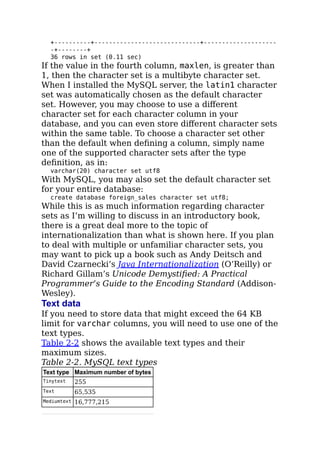
MySQL can store data using various character sets, both
single- and multibyte. To view the supported character
sets in your server, you can use the show command, as in:
mysql> SHOW CHARACTER SET;
+----------+-----------------------------+--------------------
-+--------+
| Charset | Description | Default collation
| Maxlen |
+----------+-----------------------------+--------------------
-+--------+
| big5 | Big5 Traditional Chinese | big5_chinese_ci
| 2 |
| dec8 | DEC West European | dec8_swedish_ci
| 1 |
| cp850 | DOS West European | cp850_general_ci
| 1 |
| hp8 | HP West European | hp8_english_ci
| 1 |
| koi8r | KOI8-R Relcom Russian | koi8r_general_ci
| 1 |
| latin1 | cp1252 West European | latin1_swedish_ci
| 1 |
| latin2 | ISO 8859-2 Central European | latin2_general_ci
| 1 |
| swe7 | 7bit Swedish | swe7_swedish_ci
| 1 |
| ascii | US ASCII | ascii_general_ci
| 1 |
| ujis | EUC-JP Japanese | ujis_japanese_ci
| 3 |
| sjis | Shift-JIS Japanese | sjis_japanese_ci
| 2 |
| hebrew | ISO 8859-8 Hebrew | hebrew_general_ci
| 1 |
| tis620 | TIS620 Thai | tis620_thai_ci
| 1 |
| euckr | EUC-KR Korean | euckr_korean_ci
| 2 |
| koi8u | KOI8-U Ukrainian | koi8u_general_ci
| 1 |
| gb2312 | GB2312 Simplified Chinese | gb2312_chinese_ci
| 2 |
| greek | ISO 8859-7 Greek | greek_general_ci
| 1 |
| cp1250 | Windows Central European | cp1250_general_ci
| 1 |
| gbk | GBK Simplified Chinese | gbk_chinese_ci
| 2 |
| latin5 | ISO 8859-9 Turkish | latin5_turkish_ci
| 1 |
| armscii8 | ARMSCII-8 Armenian | armscii8_general_ci
| 1 |
| utf8 | UTF-8 Unicode | utf8_general_ci
| 3 |
| ucs2 | UCS-2 Unicode | ucs2_general_ci
| 2 |
| cp866 | DOS Russian | cp866_general_ci
| 1 |
| keybcs2 | DOS Kamenicky Czech-Slovak | keybcs2_general_ci
| 1 |
| macce | Mac Central European | macce_general_ci
| 1 |
| macroman | Mac West European | macroman_general_ci
| 1 |
| cp852 | DOS Central European | cp852_general_ci
| 1 |
| latin7 | ISO 8859-13 Baltic | latin7_general_ci
| 1 |
| cp1251 | Windows Cyrillic | cp1251_general_ci
| 1 |
| cp1256 | Windows Arabic | cp1256_general_ci
| 1 |
| cp1257 | Windows Baltic | cp1257_general_ci
| 1 |
| binary | Binary pseudo charset | binary
| 1 |
| geostd8 | GEOSTD8 Georgian | geostd8_general_ci
| 1 |
| cp932 | SJIS for Windows Japanese | cp932_japanese_ci
| 2 |
| eucjpms | UJIS for Windows Japanese | eucjpms_japanese_ci
| 3 |
+----------+-----------------------------+--------------------
-+--------+
36 rows in set (0.11 sec)
If the value in the fourth column, maxlen, is greater than
1, then the character set is a multibyte character set.
When I installed the MySQL server, the latin1 character
set was automatically chosen as the default character
set. However, you may choose to use a different
character set for each character column in your
database, and you can even store different character sets
within the same table. To choose a character set other
than the default when defining a column, simply name
one of the supported character sets after the type
definition, as in:
varchar(20) character set utf8
With MySQL, you may also set the default character set
for your entire database:
create database foreign_sales character set utf8;
While this is as much information regarding character
sets as I’m willing to discuss in an introductory book,
there is a great deal more to the topic of
internationalization than what is shown here. If you plan
to deal with multiple or unfamiliar character sets, you
may want to pick up a book such as Andy Deitsch and
David Czarnecki’s Java Internationalization (O’Reilly) or
Richard Gillam’s Unicode Demystified: A Practical
Programmer’s Guide to the Encoding Standard (Addison-
Wesley).
Text data
If you need to store data that might exceed the 64 KB
limit for varchar columns, you will need to use one of the
text types.
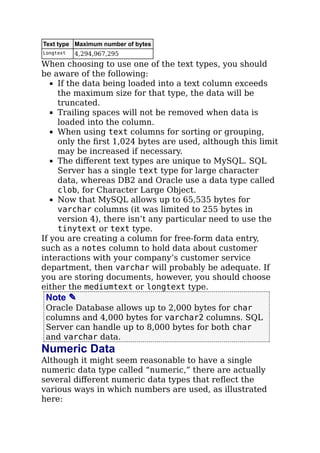
Table 2-2 shows the available text types and their
maximum sizes.
Table 2-2. MySQL text types
Text type Maximum number of bytes
Tinytext 255
Text 65,535
Mediumtext 16,777,215
Text type Maximum number of bytes
Longtext 4,294,967,295
When choosing to use one of the text types, you should
be aware of the following:
If the data being loaded into a text column exceeds
the maximum size for that type, the data will be
truncated.
Trailing spaces will not be removed when data is
loaded into the column.
When using text columns for sorting or grouping,
only the first 1,024 bytes are used, although this limit
may be increased if necessary.
The different text types are unique to MySQL. SQL
Server has a single text type for large character
data, whereas DB2 and Oracle use a data type called
clob, for Character Large Object.
Now that MySQL allows up to 65,535 bytes for
varchar columns (it was limited to 255 bytes in
version 4), there isn’t any particular need to use the
tinytext or text type.
If you are creating a column for free-form data entry,
such as a notes column to hold data about customer
interactions with your company’s customer service
department, then varchar will probably be adequate. If
you are storing documents, however, you should choose
either the mediumtext or longtext type.
Note ✎
Oracle Database allows up to 2,000 bytes for char
columns and 4,000 bytes for varchar2 columns. SQL
Server can handle up to 8,000 bytes for both char
and varchar data.
Numeric Data
Although it might seem reasonable to have a single
numeric data type called “numeric,” there are actually
several different numeric data types that reflect the
various ways in which numbers are used, as illustrated
here:
A column indicating whether a customer order has been
shipped
This type of column, referred to as a Boolean, would
contain a 0 to indicate false and a 1 to indicate true.
A system-generated primary key for a transaction table
This data would generally start at 1 and increase in
increments of one up to a potentially very large
number.
An item number for a customer’s electronic shopping
basket
The values for this type of column would be positive
whole numbers between 1 and, at most, 200 (for
shopaholics).
Positional data for a circuit board drill machine
High-precision scientific or manufacturing data often
requires accuracy to eight decimal points.
To handle these types of data (and more), MySQL has
several different numeric data types. The most commonly
used numeric types are those used to store whole
numbers. When specifying one of these types, you may
also specify that the data is unsigned, which tells the
server that all data stored in the column will be greater
than or equal to zero. Table 2-3 shows the five different
data types used to store whole-number integers.
Table 2-3. MySQL integer types
Type Signed range Unsigned range
Tinyint −128 to 127 0 to 255
Smallint −32,768 to 32,767 0 to 65,535
Mediumint −8,388,608 to 8,388,607 0 to 16,777,215
Int −2,147,483,648 to 2,147,483,647 0 to 4,294,967,295
Bigint −9,223,372,036,854,775,808 to
9,223,372,036,854,775,807
0 to
18,446,744,073,709,551,615
When you create a column using one of the integer types,
MySQL will allocate an appropriate amount of space to
store the data, which ranges from one byte for a tinyint
to eight bytes for a bigint. Therefore, you should try to
choose a type that will be large enough to hold the
biggest number you can envision being stored in the
column without needlessly wasting storage space.
For floating-point numbers (such as 3.1415927), you may
choose from the numeric types shown in Table 2-4.
Table 2-4. MySQL floating-point types
Type Numeric range
Float( p , s ) −3.402823466E+38 to −1.175494351E-38
and 1.175494351E-38 to 3.402823466E+38
Double( p , s
)
−1.7976931348623157E+308 to −2.2250738585072014E-
308
and 2.2250738585072014E-308 to
1.7976931348623157E+308
When using a floating-point type, you can specify a
precision (the total number of allowable digits both to
the left and to the right of the decimal point) and a scale
(the number of allowable digits to the right of the
decimal point), but they are not required. These values
are represented in Table 2-4 as p and s. If you specify a
precision and scale for your floating-point column,
remember that the data stored in the column will be
rounded if the number of digits exceeds the scale and/or
precision of the column. For example, a column defined
as float(4,2) will store a total of four digits, two to the
left of the decimal and two to the right of the decimal.
Therefore, such a column would handle the numbers
27.44 and 8.19 just fine, but the number 17.8675 would
be rounded to 17.87, and attempting to store the number
178.375 in your float(4,2) column would generate an
error.
Like the integer types, floating-point columns can be
defined as unsigned, but this designation only prevents
negative numbers from being stored in the column rather
than altering the range of data that may be stored in the
column.
Temporal Data
Along with strings and numbers, you will almost certainly
be working with information about dates and/or times.
This type of data is referred to as temporal, and some
examples of temporal data in a database include:
The future date that a particular event is expected to
happen, such as shipping a customer’s order
The date that a customer’s order was shipped
The date and time that a user modified a particular
row in a table
An employee’s birth date
The year corresponding to a row in a yearly_sales
fact table in a data warehouse
The elapsed time needed to complete a wiring
harness on an automobile assembly line
MySQL includes data types to handle all of these
situations. Table 2-5 shows the temporal data types
supported by MySQL.
Table 2-5. MySQL temporal types
Type Default format Allowable values
Date YYYY-MM-DD 1000-01-01 to 9999-12-31
Datetime YYYY-MM-DD HH:MI:SS 1000-01-01 00:00:00 to 9999-12-31 23:59:59
Timestamp YYYY-MM-DD HH:MI:SS 1970-01-01 00:00:00 to 2037-12-31 23:59:59
Year YYYY 1901 to 2155
Time HHH:MI:SS −838:59:59 to 838:59:59
While database servers store temporal data in various
ways, the purpose of a format string (second column of
Table 2-5) is to show how the data will be represented
when retrieved, along with how a date string should be
constructed when inserting or updating a temporal
column. Thus, if you wanted to insert the date March 23,
2005 into a date column using the default format YYYY-
MM-DD, you would use the string '2005-03-23'.
Chapter 7 fully explores how temporal data is
constructed and displayed.
Note ✎
Each database server allows a different range of
dates for temporal columns. Oracle Database accepts
dates ranging from 4712 BC to 9999 AD, while SQL
Server only handles dates ranging from 1753 AD to
9999 AD (unless you are using SQL Server 2008’s
new datetime2 data type, which allows for dates
ranging from 1 AD to 9999 AD). MySQL falls in
between Oracle and SQL Server and can store dates
from 1000 AD to 9999 AD. Although this might not
make any difference for most systems that track
current and future events, it is important to keep in
mind if you are storing historical dates.
Table 2-6 describes the various components of the date
formats shown in Table 2-5.
Table 2-6. Date format components
Component Definition Range
YYYY Year, including century 1000 to 9999
MM Month 01 (January) to 12 (December)
DD Day 01 to 31
HH Hour 00 to 23
HHH Hours (elapsed) −838 to 838
MI Minute 00 to 59
SS Second 00 to 59
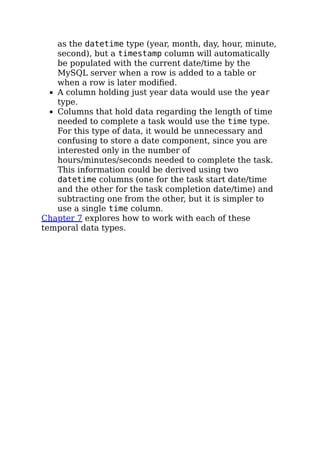
Here’s how the various temporal types would be used to
implement the examples shown earlier:
Columns to hold the expected future shipping date of
a customer order and an employee’s birth date would
use the date type, since it is unnecessary to know at
what time a person was born and unrealistic to
schedule a future shipment down to the second.
A column to hold information about when a customer
order was actually shipped would use the datetime
type, since it is important to track not only the date
that the shipment occurred but the time as well.
A column that tracks when a user last modified a
particular row in a table would use the timestamp
type. The timestamp type holds the same information
as the datetime type (year, month, day, hour, minute,
second), but a timestamp column will automatically
be populated with the current date/time by the
MySQL server when a row is added to a table or
when a row is later modified.
A column holding just year data would use the year
type.
Columns that hold data regarding the length of time
needed to complete a task would use the time type.
For this type of data, it would be unnecessary and
confusing to store a date component, since you are
interested only in the number of
hours/minutes/seconds needed to complete the task.
This information could be derived using two
datetime columns (one for the task start date/time
and the other for the task completion date/time) and
subtracting one from the other, but it is simpler to
use a single time column.
Chapter 7 explores how to work with each of these
temporal data types.
Table Creation
Now that you have a firm grasp on what data types may
be stored in a MySQL database, it’s time to see how to
use these types in table definitions. Let’s start by
defining a table to hold information about a person.
Step 1: Design
A good way to start designing a table is to do a bit of
brainstorming to see what kind of information would be
helpful to include. Here’s what I came up with after
thinking for a short time about the types of information
that describe a person:
Name
Gender
Birth date
Address
Favorite foods
This is certainly not an exhaustive list, but it’s good
enough for now. The next step is to assign column names
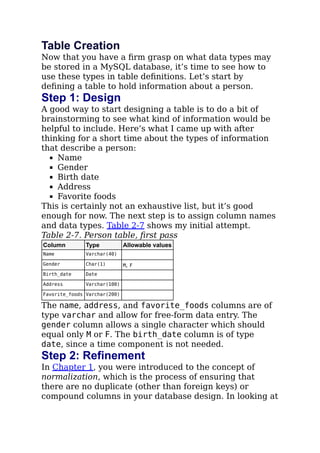
and data types. Table 2-7 shows my initial attempt.
Table 2-7. Person table, first pass
Column Type Allowable values
Name Varchar(40)
Gender Char(1) M, F
Birth_date Date
Address Varchar(100)
Favorite_foods Varchar(200)
The name, address, and favorite_foods columns are of
type varchar and allow for free-form data entry. The
gender column allows a single character which should
equal only M or F. The birth_date column is of type
date, since a time component is not needed.
Step 2: Refinement
In Chapter 1, you were introduced to the concept of
normalization, which is the process of ensuring that
there are no duplicate (other than foreign keys) or
compound columns in your database design. In looking at
the columns in the person table a second time, the
following issues arise:
The name column is actually a compound object
consisting of a first name and a last name.
Since multiple people can have the same name,
gender, birth date, and so forth, there are no columns
in the person table that guarantee uniqueness.
The address column is also a compound object
consisting of street, city, state/province, country, and
postal code.
The favorite_foods column is a list containing 0, 1,
or more independent items. It would be best to
create a separate table for this data that includes a
foreign key to the person table so that you know to
which person a particular food may be attributed.
After taking these issues into consideration, Table 2-8
gives a normalized version of the person table.
Table 2-8. Person table, second pass
Column Type Allowable values
Person_id Smallint (unsigned)
First_name Varchar(20)
Last_name Varchar(20)
Gender Char(1) M, F
Birth_date Date
Street Varchar(30)
City Varchar(20)
State Varchar(20)
Country Varchar(20)
Postal_code Varchar(20)
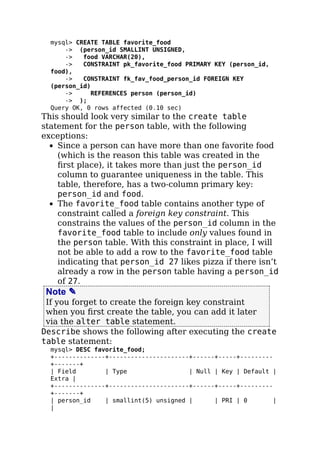
Now that the person table has a primary key (person_id)
to guarantee uniqueness, the next step is to build a
favorite_food table that includes a foreign key to the
person table. Table 2-9 shows the result.
Table 2-9. Favorite_food table
Column Type
Person_id Smallint (unsigned)
Food Varchar(20)
The person_id and food columns comprise the primary
key of the favorite_food table, and the person_id
column is also a foreign key to the person table.
How Much Is Enough?
Moving the favorite_foods column out of the person
table was definitely a good idea, but are we done yet?
What happens, for example, if one person lists “pasta”
as a favorite food while another person lists
“spaghetti”? Are they the same thing? In order to
prevent this problem, you might decide that you want
people to choose their favorite foods from a list of
options, in which case you should create a food table
with food_id and food_name columns, and then change
the favorite_food table to contain a foreign key to the
food table. While this design would be fully
normalized, you might decide that you simply want to
store the values that the user has entered, in which
case you may leave the table as is.
Step 3: Building SQL Schema Statements
Now that the design is complete for the two tables
holding information about people and their favorite
foods, the next step is to generate SQL statements to
create the tables in the database. Here is the statement
to create the person table:
CREATE TABLE person
(person_id SMALLINT UNSIGNED,
fname VARCHAR(20),
lname VARCHAR(20),
gender CHAR(1),
birth_date DATE,
street VARCHAR(30),
city VARCHAR(20),
state VARCHAR(20),
country VARCHAR(20),
postal_code VARCHAR(20),
CONSTRAINT pk_person PRIMARY KEY (person_id)
);
Everything in this statement should be fairly self-
explanatory except for the last item; when you define
your table, you need to tell the database server what
column or columns will serve as the primary key for the
table. You do this by creating a constraint on the table.
You can add several types of constraints to a table
definition. This constraint is a primary key constraint. It
is created on the person_id column and given the name
pk_person.
While on the topic of constraints, there is another type of
constraint that would be useful for the person table. In
Table 2-7, I added a third column to show the allowable
values for certain columns (such as 'M' and 'F' for the
gender column). Another type of constraint called a
check constraint constrains the allowable values for a
particular column. MySQL allows a check constraint to
be attached to a column definition, as in the following:
gender CHAR(1) CHECK (gender IN ('M','F')),
While check constraints operate as expected on most
database servers, the MySQL server allows check
constraints to be defined but does not enforce them.
However, MySQL does provide another character data
type called enum that merges the check constraint into
the data type definition. Here’s what it would look like
for the gender column definition:
gender ENUM('M','F'),
Here’s how the person table definition looks with an
enum data type for the gender column:
CREATE TABLE person
(person_id SMALLINT UNSIGNED,
fname VARCHAR(20),
lname VARCHAR(20),
gender ENUM('M','F'),
birth_date DATE,
street VARCHAR(30),
city VARCHAR(20),
state VARCHAR(20),
country VARCHAR(20),
postal_code VARCHAR(20),
CONSTRAINT pk_person PRIMARY KEY (person_id)
);
Later in this chapter, you will see what happens if you try
to add data to a column that violates its check constraint
(or, in the case of MySQL, its enumeration values).
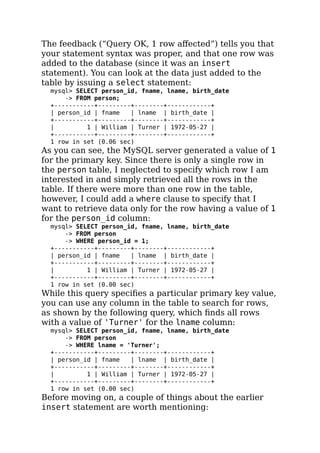
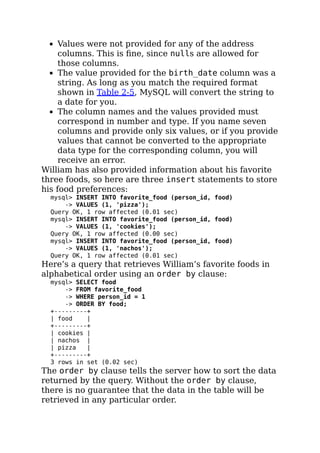
You are now ready to run the create table statement
using the mysql command-line tool. Here’s what it looks
like:
mysql> CREATE TABLE person
-> (person_id SMALLINT UNSIGNED,
-> fname VARCHAR(20),
-> lname VARCHAR(20),
-> gender ENUM('M','F'),
-> birth_date DATE,
-> street VARCHAR(30),
-> city VARCHAR(20),
-> state VARCHAR(20),
-> country VARCHAR(20),
-> postal_code VARCHAR(20),
-> CONSTRAINT pk_person PRIMARY KEY (person_id)
-> );
Query OK, 0 rows affected (0.27 sec)
After processing the create table statement, the
MySQL server returns the message “Query OK, 0 rows
affected,” which tells me that the statement had no
syntax errors. If you want to make sure that the person
table does, in fact, exist, you can use the describe
command (or desc for short) to look at the table
definition:
mysql> DESC person;
+-------------+----------------------+------+-----+---------+-
------+
| Field | Type | Null | Key | Default |
Extra |
+-------------+----------------------+------+-----+---------+-
------+
| person_id | smallint(5) unsigned | | PRI | 0 |
|
| fname | varchar(20) | YES | | NULL |
|
| lname | varchar(20) | YES | | NULL |
|
| gender | enum('M','F') | YES | | NULL |
|
| birth_date | date | YES | | NULL |
|
| street | varchar(30) | YES | | NULL |
|
| city | varchar(20) | YES | | NULL |
|
| state | varchar(20) | YES | | NULL |
|
| country | varchar(20) | YES | | NULL |
|
| postal_code | varchar(20) | YES | | NULL |
|
+-------------+----------------------+------+-----+---------+-
------+
10 rows in set (0.06 sec)
Columns 1 and 2 of the describe output are self-
explanatory. Column 3 shows whether a particular
column can be omitted when data is inserted into the
table. I purposefully left this topic out of the discussion
for now (see the sidebar What Is Null? for a short
discourse), but we explore it fully in Chapter 4. The
fourth column shows whether a column takes part in any
keys (primary or foreign); in this case, the person_id
column is marked as the primary key. Column 5 shows
whether a particular column will be populated with a
default value if you omit the column when inserting data
into the table. The person_id column shows a default
value of 0, although this would work only once, since
each row in the person table must contain a unique value
for this column (since it is the primary key). The sixth
column (called “Extra”) shows any other pertinent
information that might apply to a column.
What Is Null?
In some cases, it is not possible or applicable to
provide a value for a particular column in your table.
For example, when adding data about a new customer
order, the ship_date column cannot yet be determined.
In this case, the column is said to be null (note that I do
not say that it equals null), which indicates the absence
of a value. Null is used for various cases where a value
cannot be supplied, such as:
Not applicable
Unknown
Empty set
When designing a table, you may specify which
columns are allowed to be null (the default), and which
columns are not allowed to be null (designated by
adding the keywords not null after the type
definition).
Now that you’ve created the person table, your next step
is to create the favorite_food table:
mysql> CREATE TABLE favorite_food
-> (person_id SMALLINT UNSIGNED,
-> food VARCHAR(20),
-> CONSTRAINT pk_favorite_food PRIMARY KEY (person_id,
food),
-> CONSTRAINT fk_fav_food_person_id FOREIGN KEY
(person_id)
-> REFERENCES person (person_id)
-> );
Query OK, 0 rows affected (0.10 sec)
This should look very similar to the create table
statement for the person table, with the following
exceptions:
Since a person can have more than one favorite food
(which is the reason this table was created in the
first place), it takes more than just the person_id
column to guarantee uniqueness in the table. This
table, therefore, has a two-column primary key:
person_id and food.
The favorite_food table contains another type of
constraint called a foreign key constraint. This
constrains the values of the person_id column in the
favorite_food table to include only values found in
the person table. With this constraint in place, I will
not be able to add a row to the favorite_food table
indicating that person_id 27 likes pizza if there isn’t
already a row in the person table having a person_id
of 27.
Note ✎
If you forget to create the foreign key constraint
when you first create the table, you can add it later
via the alter table statement.
Describe shows the following after executing the create
table statement:
mysql> DESC favorite_food;
+--------------+----------------------+------+-----+---------
+-------+
| Field | Type | Null | Key | Default |
Extra |
+--------------+----------------------+------+-----+---------
+-------+
| person_id | smallint(5) unsigned | | PRI | 0 |
|
| food | varchar(20) | | PRI | |
|
+--------------+----------------------+------+-----+---------
+-------+
Now that the tables are in place, the next logical step is
to add some data.
Populating and Modifying Tables
With the person and favorite_food tables in place, you
can now begin to explore the four SQL data statements:
insert, update, delete, and select.
Inserting Data
Since there is not yet any data in the person and
favorite_food tables, the first of the four SQL data
statements to be explored will be the insert statement.
There are three main components to an insert
statement:
The name of the table into which to add the data
The names of the columns in the table to be
populated
The values with which to populate the columns
You are not required to provide data for every column in
the table (unless all the columns in the table have been
defined as not null). In some cases, those columns that
are not included in the initial insert statement will be
given a value later via an update statement. In other
cases, a column may never receive a value for a
particular row of data (such as a customer order that is
canceled before being shipped, thus rendering the
ship_date column inapplicable).
Generating numeric key data
Before inserting data into the person table, it would be
useful to discuss how values are generated for numeric
primary keys. Other than picking a number out of thin
air, you have a couple of options:
Look at the largest value currently in the table and
add one.
Let the database server provide the value for you.
Although the first option may seem valid, it proves
problematic in a multiuser environment, since two users
might look at the table at the same time and generate the
same value for the primary key. Instead, all database
servers on the market today provide a safe, robust
method for generating numeric keys. In some servers,
such as the Oracle Database, a separate schema object is
used (called a sequence); in the case of MySQL, however,
you simply need to turn on the auto-increment feature for
your primary key column. Normally, you would do this at
table creation, but doing it now provides the opportunity
to learn another SQL schema statement, alter table,
which is used to modify the definition of an existing
table:
ALTER TABLE person MODIFY person_id SMALLINT UNSIGNED
AUTO_INCREMENT;
This statement essentially redefines the person_id
column in the person table. If you describe the table, you
will now see the auto-increment feature listed under the
“Extra” column for person_id:
mysql> DESC person;
+-------------+----------------------------+------+-----+-----
----+-----------------+
| Field | Type | Null | Key |
Default | Extra |
+-------------+----------------------------+------+-----+-----
----+-----------------+
| person_id | smallint(5) unsigned | | PRI | NULL
| auto_increment |
| . | | | |
| |
| . | | | |
| |
| . | | | |
| |
When you insert data into the person table, simply
provide a null value for the person_id column, and
MySQL will populate the column with the next available
number (by default, MySQL starts at 1 for auto-
increment columns).
The insert statement
Now that all the pieces are in place, it’s time to add some
data. The following statement creates a row in the
person table for William Turner:
mysql> INSERT INTO person
-> (person_id, fname, lname, gender, birth_date)
-> VALUES (null, 'William','Turner', 'M', '1972-05-27');
Query OK, 1 row affected (0.01 sec)
The feedback (“Query OK, 1 row affected”) tells you that
your statement syntax was proper, and that one row was
added to the database (since it was an insert
statement). You can look at the data just added to the
table by issuing a select statement:
mysql> SELECT person_id, fname, lname, birth_date
-> FROM person;
+-----------+---------+--------+------------+
| person_id | fname | lname | birth_date |
+-----------+---------+--------+------------+
| 1 | William | Turner | 1972-05-27 |
+-----------+---------+--------+------------+
1 row in set (0.06 sec)
As you can see, the MySQL server generated a value of 1
for the primary key. Since there is only a single row in
the person table, I neglected to specify which row I am
interested in and simply retrieved all the rows in the
table. If there were more than one row in the table,
however, I could add a where clause to specify that I
want to retrieve data only for the row having a value of 1
for the person_id column:
mysql> SELECT person_id, fname, lname, birth_date
-> FROM person
-> WHERE person_id = 1;
+-----------+---------+--------+------------+
| person_id | fname | lname | birth_date |
+-----------+---------+--------+------------+
| 1 | William | Turner | 1972-05-27 |
+-----------+---------+--------+------------+
1 row in set (0.00 sec)
While this query specifies a particular primary key value,
you can use any column in the table to search for rows,
as shown by the following query, which finds all rows
with a value of 'Turner' for the lname column:
mysql> SELECT person_id, fname, lname, birth_date
-> FROM person
-> WHERE lname = 'Turner';
+-----------+---------+--------+------------+
| person_id | fname | lname | birth_date |
+-----------+---------+--------+------------+
| 1 | William | Turner | 1972-05-27 |
+-----------+---------+--------+------------+
1 row in set (0.00 sec)
Before moving on, a couple of things about the earlier
insert statement are worth mentioning:
Values were not provided for any of the address
columns. This is fine, since nulls are allowed for
those columns.
The value provided for the birth_date column was a
string. As long as you match the required format
shown in Table 2-5, MySQL will convert the string to
a date for you.
The column names and the values provided must
correspond in number and type. If you name seven
columns and provide only six values, or if you provide
values that cannot be converted to the appropriate
data type for the corresponding column, you will
receive an error.
William has also provided information about his favorite
three foods, so here are three insert statements to store
his food preferences:
mysql> INSERT INTO favorite_food (person_id, food)
-> VALUES (1, 'pizza');
Query OK, 1 row affected (0.01 sec)
mysql> INSERT INTO favorite_food (person_id, food)
-> VALUES (1, 'cookies');
Query OK, 1 row affected (0.00 sec)
mysql> INSERT INTO favorite_food (person_id, food)
-> VALUES (1, 'nachos');
Query OK, 1 row affected (0.01 sec)
Here’s a query that retrieves William’s favorite foods in
alphabetical order using an order by clause:
mysql> SELECT food
-> FROM favorite_food
-> WHERE person_id = 1
-> ORDER BY food;
+---------+
| food |
+---------+
| cookies |
| nachos |
| pizza |
+---------+
3 rows in set (0.02 sec)
The order by clause tells the server how to sort the data
returned by the query. Without the order by clause,
there is no guarantee that the data in the table will be
retrieved in any particular order.
So that William doesn’t get lonely, you can execute
another insert statement to add Susan Smith to the
person table:
mysql> INSERT INTO person
-> (person_id, fname, lname, gender, birth_date,
-> street, city, state, country, postal_code)
-> VALUES (null, 'Susan','Smith', 'F', '1975-11-02',
-> '23 Maple St.', 'Arlington', 'VA', 'USA', '20220');
Query OK, 1 row affected (0.01 sec)
Since Susan was kind enough to provide her address, we
included five more columns than when William’s data
was inserted. If you query the table again, you will see
that Susan’s row has been assigned the value 2 for its
primary key value:
mysql> SELECT person_id, fname, lname, birth_date
-> FROM person;
+-----------+---------+--------+------------+
| person_id | fname | lname | birth_date |
+-----------+---------+--------+------------+
| 1 | William | Turner | 1972-05-27 |
| 2 | Susan | Smith | 1975-11-02 |
+-----------+---------+--------+------------+
2 rows in set (0.00 sec)
Can I Get That in XML?
If you will be working with XML data, you will be happy
to know that most database servers provide a simple
way to generate XML output from a query. With
MySQL, for example, you can use the --xml option
when invoking the mysql tool, and all your output will
automatically be formatted using XML. Here’s what the
favorite-food data looks like as an XML document:
C:database> mysql -u lrngsql -p --xml bank
Enter password: xxxxxx
Welcome to the MySQL Monitor...
Mysql> SELECT * FROM favorite_food;
<?xml version="1.0"?>
<resultset statement="select * from favorite_food"
xmlns:xsi="http://www.w3.org/2001/XMLSchema-instance">
<row>
<field name="person_id">1</field>
<field name="food">cookies</field>
</row>
<row>
<field name="person_id">1</field>
<field name="food">nachos</field>
</row>
<row>
<field name="person_id">1</field>
<field name="food">pizza</field>
</row>
</resultset>
3 rows in set (0.00 sec)
With SQL Server, you don’t need to configure your
command-line tool; you just need to add the for xml
clause to the end of your query, as in:
SELECT * FROM favorite_food
FOR XML AUTO, ELEMENTS
Updating Data
When the data for William Turner was initially added to
the table, data for the various address columns was
omitted from the insert statement. The next statement
shows how these columns can be populated via an
update statement:
mysql> UPDATE person
-> SET street = '1225 Tremont St.',
-> city = 'Boston',
-> state = 'MA',
-> country = 'USA',
-> postal_code = '02138'
-> WHERE person_id = 1;
Query OK, 1 row affected (0.04 sec)
Rows matched: 1 Changed: 1 Warnings: 0
The server responded with a two-line message: the
“Rows matched: 1” item tells you that the condition in
the where clause matched a single row in the table, and
the “Changed: 1” item tells you that a single row in the
table has been modified. Since the where clause specifies
the primary key of William’s row, this is exactly what you
would expect to have happen.
Depending on the conditions in your where clause, it is
also possible to modify more than one row using a single
statement. Consider, for example, what would happen if
your where clause looked as follows:
WHERE person_id < 10
Since both William and Susan have a person_id value
less than 10, both of their rows would be modified. If you
leave off the where clause altogether, your update
statement will modify every row in the table.
Deleting Data
It seems that William and Susan aren’t getting along very
well together, so one of them has got to go. Since William
was there first, Susan will get the boot courtesy of the
delete statement:
mysql> DELETE FROM person
-> WHERE person_id = 2;
Query OK, 1 row affected (0.01 sec)
Again, the primary key is being used to isolate the row of
interest, so a single row is deleted from the table. Similar
to the update statement, more than one row can be
deleted depending on the conditions in your where
clause, and all rows will be deleted if the where clause is
omitted.
When Good Statements Go Bad
So far, all of the SQL data statements shown in this
chapter have been well formed and have played by the
rules. Based on the table definitions for the person and
favorite_food tables, however, there are lots of ways
that you can run afoul when inserting or modifying data.
This section shows you some of the common mistakes
that you might come across and how the MySQL server
will respond.
Nonunique Primary Key
Because the table definitions include the creation of
primary key constraints, MySQL will make sure that
duplicate key values are not inserted into the tables. The
next statement attempts to bypass the auto-increment
feature of the person_id column and create another row
in the person table with a person_id of 1:
mysql> INSERT INTO person
-> (person_id, fname, lname, gender, birth_date)
-> VALUES (1, 'Charles','Fulton', 'M', '1968-01-15');
ERROR 1062 (23000): Duplicate entry '1' for key 'PRIMARY'
There is nothing stopping you (with the current schema
objects, at least) from creating two rows with identical
names, addresses, birth dates, and so on, as long as they
have different values for the person_id column.
Nonexistent Foreign Key
The table definition for the favorite_food table includes
the creation of a foreign key constraint on the person_id
column. This constraint ensures that all values of
person_id entered into the favorite_food table exist in
the person table. Here’s what would happen if you tried
to create a row that violates this constraint:
mysql> INSERT INTO favorite_food (person_id, food)
-> VALUES (999, 'lasagna');
ERROR 1452 (23000): Cannot add or update a child row: a
foreign key constraint
fails ('bank'.'favorite_food', CONSTRAINT
'fk_fav_food_person_id' FOREIGN KEY
('person_id') REFERENCES 'person' ('person_id'))
In this case, the favorite_food table is considered the
child and the person table is considered the parent, since
the favorite_food table is dependent on the person
table for some of its data. If you plan to enter data into
both tables, you will need to create a row in parent
before you can enter data into favorite_food.
Note ✎
Foreign key constraints are enforced only if your
tables are created using the InnoDB storage engine.
We discuss MySQL’s storage engines in Chapter 12.
Column Value Violations
The gender column in the person table is restricted to
the values 'M' for male and 'F' for female. If you
mistakenly attempt to set the value of the column to any
other value, you will receive the following response:
mysql> UPDATE person
-> SET gender = 'Z'
-> WHERE person_id = 1;
ERROR 1265 (01000): Data truncated for column 'gender' at row
1
The error message is a bit confusing, but it gives you the
general idea that the server is unhappy about the value
provided for the gender column.
Invalid Date Conversions
If you construct a string with which to populate a date
column, and that string does not match the expected
format, you will receive another error. Here’s an example
that uses a date format that does not match the default
date format of “YYYY-MM-DD”:
mysql> UPDATE person
-> SET birth_date = 'DEC-21-1980'
-> WHERE person_id = 1;
ERROR 1292 (22007): Incorrect date value: 'DEC-21-1980' for
column 'birth_date'
at row 1
In general, it is always a good idea to explicitly specify
the format string rather than relying on the default
format. Here’s another version of the statement that uses
the str_to_date function to specify which format string
to use:
mysql> UPDATE person
-> SET birth_date = str_to_date('DEC-21-1980' , '%b-%d-
%Y')
-> WHERE person_id = 1;
Query OK, 1 row affected (0.12 sec)
Rows matched: 1 Changed: 1 Warnings: 0
Not only is the database server happy, but William is
happy as well (we just made him eight years younger,
without the need for expensive cosmetic surgery!).
Note ✎
Earlier in the chapter, when I discussed the various
temporal data types, I showed date-formatting
strings such as “YYYY-MM-DD”. While many database
servers use this style of formatting, MySQL uses %Y
to indicate a four-character year. Here are a few
more formatters that you might need when
converting strings to datetimes in MySQL:
%a The short weekday name, such as Sun, Mon, ...
%b The short month name, such as Jan, Feb, ...
%c The numeric month (0..12)
%d The numeric day of the month (00..31)
%f The number of microseconds (000000..999999)
%H The hour of the day, in 24-hour format (00..23)
%h The hour of the day, in 12-hour format (01..12)
%i The minutes within the hour (00..59)
%j The day of year (001..366)
%M The full month name (January..December)
%m The numeric month
%p AM or PM
%s The number of seconds (00..59)
%W The full weekday name (Sunday..Saturday)
%w The numeric day of the week (0=Sunday..6=Saturday)
%Y The four-digit year
The Bank Schema
For the remainder of the book, you use a group of tables
that model a community bank. Some of the tables include
Employee, Branch, Account, Customer, Product, and
Transaction. The entire schema and example data
should have been created when you followed the final
steps at the beginning of the chapter for loading the
MySQL server and generating the sample data. To see a
diagram of the tables and their columns and
relationships, see Appendix A.
Table 2-10 shows all the tables used in the bank schema
along with short definitions.
Table 2-10. Bank schema definitions
Table name Definition
Account A particular product opened for a particular customer
Branch A location at which banking transactions are conducted
Business A corporate customer (subtype of the Customer table)
Customer A person or corporation known to the bank
Department A group of bank employees implementing a particular banking
function
Employee A person working for the bank
Individual A noncorporate customer (subtype of the Customer table)
Officer A person allowed to transact business for a corporate customer
Product A banking service offered to customers
Product_type A group of products having a similar function
Transaction A change made to an account balance
Feel free to experiment with the tables as much as you
want, including adding your own tables to expand the
bank’s business functions. You can always drop the
database and re-create it from the downloaded file if you
want to make sure your sample data is intact.
If you want to see the tables available in your database,
you can use the show tables command, as in:
mysql> SHOW TABLES;
+----------------+
| Tables_in_bank |
+----------------+
| account |
| branch |
| business |
| customer |
| department |
| employee |
| favorite_food |
| individual |
| officer |
| person |
| product |
| product_type |
| transaction |
+----------------+
13 rows in set (0.10 sec)
Along with the 11 tables in the bank schema, the table
listing also includes the two tables created in this
chapter: person and favorite_food. These tables will
not be used in later chapters, so feel free to drop them by
issuing the following commands:
mysql> DROP TABLE favorite_food;
Query OK, 0 rows affected (0.56 sec)
mysql> DROP TABLE person;
Query OK, 0 rows affected (0.05 sec)
If you want to look at the columns in a table, you can use
the describe command. Here’s an example of the
describe output for the customer table:
mysql> DESC customer;
+--------------+------------------+------+-----+---------+----
------------+
| Field | Type | Null | Key | Default |
Extra |
+--------------+------------------+------+-----+---------+----
------------+
| cust_id | int(10) unsigned | NO | PRI | NULL |
auto_increment |
| fed_id | varchar(12) | NO | | NULL |
|
| cust_type_cd | enum('I','B') | NO | | NULL |
|
| address | varchar(30) | YES | | NULL |
|
| city | varchar(20) | YES | | NULL |
|
| state | varchar(20) | YES | | NULL |
|
| postal_code | varchar(10) | YES | | NULL |
|
+--------------+------------------+------+-----+---------+----
------------+
7 rows in set (0.03 sec)
The more comfortable you are with the example
database, the better you will understand the examples
and, consequently, the concepts in the following
chapters.
Chapter 3. Query Primer
So far, you have seen a few examples of database queries
(a.k.a. select statements) sprinkled throughout the first
two chapters. Now it’s time to take a closer look at the
different parts of the select statement and how they
interact.
Query Mechanics
Before dissecting the select statement, it might be
interesting to look at how queries are executed by the
MySQL server (or, for that matter, any database server).
If you are using the mysql command-line tool (which I
assume you are), then you have already logged in to the
MySQL server by providing your username and password
(and possibly a hostname if the MySQL server is running
on a different computer). Once the server has verified
that your username and password are correct, a
database connection is generated for you to use. This
connection is held by the application that requested it
(which, in this case, is the mysql tool) until the
application releases the connection (i.e., as a result of
your typing quit) or the server closes the connection
(i.e., when the server is shut down). Each connection to
the MySQL server is assigned an identifier, which is
shown to you when you first log in:
Welcome to the MySQL monitor. Commands end with ; or g.
Your MySQL connection id is 11
Server version: 6.0.3-alpha-community MySQL Community Server
(GPL)
Type 'help;' or 'h' for help. Type 'c' to clear the buffer.
In this case, my connection ID is 11. This information
might be useful to your database administrator if
something goes awry, such as a malformed query that
runs for hours, so you might want to jot it down.
Once the server has verified your username and
password and issued you a connection, you are ready to
execute queries (along with other SQL statements). Each
time a query is sent to the server, the server checks the
following things prior to statement execution:
Do you have permission to execute the statement?
Do you have permission to access the desired data?
Is your statement syntax correct?
If your statement passes these three tests, then your
query is handed to the query optimizer, whose job it is to
determine the most efficient way to execute your query.
The optimizer will look at such things as the order in
which to join the tables named in your from clause and
what indexes are available, and then picks an execution
plan, which the server uses to execute your query.
Note ✎
Understanding and influencing how your database
server chooses execution plans is a fascinating topic
that many of you will wish to explore. For those
readers using MySQL, you might consider reading
Baron Schwartz et al.’s High Performance MySQL
(O’Reilly). Among other things, you will learn how to
generate indexes, analyze execution plans, influence
the optimizer via query hints, and tune your server’s
startup parameters. If you are using Oracle Database
or SQL Server, dozens of tuning books are available.
Once the server has finished executing your query, the
result set is returned to the calling application (which is,
once again, the mysql tool). As I mentioned in Chapter 1,
a result set is just another table containing rows and
columns. If your query fails to yield any results, the
mysql tool will show you the message found at the end of
the following example:
mysql> SELECT emp_id, fname, lname
-> FROM employee
-> WHERE lname = 'Bkadfl';
Empty set(0.00 sec)
If the query returns one or more rows, the mysql tool will
format the results by adding column headers and by
constructing boxes around the columns using the -, |, and
+ symbols, as shown in the next example:
mysql> SELECT fname, lname
-> FROM employee;
+----------+-----------+
| fname | lname |
+----------+-----------+
| Michael | Smith |
| Susan | Barker |
| Robert | Tyler |
| Susan | Hawthorne |
| John | Gooding |
| Helen | Fleming |
| Chris | Tucker |
| Sarah | Parker |
| Jane | Grossman |
| Paula | Roberts |
| Thomas | Ziegler |
| Samantha | Jameson |
| John | Blake |
| Cindy | Mason |
| Frank | Portman |
| Theresa | Markham |
| Beth | Fowler |
| Rick | Tulman |
+----------+-----------+
18 rows in set (0.00 sec)
This query returns the first and last names of all the
employees in the employee table. After the last row of
data is displayed, the mysql tool displays a message
telling you how many rows were returned, which, in this
case, is 18.
Query Clauses
Several components or clauses make up the select
statement. While only one of them is mandatory when
using MySQL (the select clause), you will usually
include at least two or three of the six available clauses.
Table 3-1 shows the different clauses and their purposes.
Table 3-1. Query clauses
Clause
name
Purpose
Select Determines which columns to include in the query’s result set
From Identifies the tables from which to draw data and how the tables
should be joined
Where Filters out unwanted data
Group by Used to group rows together by common column values
Having Filters out unwanted groups
Order by Sorts the rows of the final result set by one or more columns
All of the clauses shown in Table 3-1 are included in the
ANSI specification; additionally, several other clauses are
unique to MySQL that we explore in Appendix B. The
following sections delve into the uses of the six major
query clauses.
The select Clause
Even though the select clause is the first clause of a
select statement, it is one of the last clauses that the
database server evaluates. The reason for this is that
before you can determine what to include in the final
result set, you need to know all of the possible columns
that could be included in the final result set. In order to
fully understand the role of the select clause, therefore,
you will need to understand a bit about the from clause.
Here’s a query to get started:
mysql> SELECT *
-> FROM department;
+---------+----------------+
| dept_id | name |
+---------+----------------+
| 1 | Operations |
| 2 | Loans |
| 3 | Administration |
+---------+----------------+
3 rows in set (0.04 sec)
In this query, the from clause lists a single table
(department), and the select clause indicates that all
columns (designated by *) in the department table
should be included in the result set. This query could be
described in English as follows:
Show me all the columns and all the rows in the
department table.
In addition to specifying all the columns via the asterisk
character, you can explicitly name the columns you are
interested in, such as:
mysql> SELECT dept_id, name
-> FROM department;
+---------+----------------+
| dept_id | name |
+---------+----------------+
| 1 | Operations |
| 2 | Loans |
| 3 | Administration |
+---------+----------------+
3 rows in set (0.01 sec)
The results are identical to the first query, since all the
columns in the department table (dept_id and name) are
named in the select clause. You can choose to include
only a subset of the columns in the department table as
well:
mysql> SELECT name
-> FROM department;
+----------------+
| name |
+----------------+
| Operations |
| Loans |
| Administration |
+----------------+
3 rows in set (0.00 sec)
The job of the select clause, therefore, is the following:
The select clause determines which of all possible
columns should be included in the query’s result set.
If you were limited to including only columns from the
table or tables named in the from clause, things would be
rather dull. However, you can spice things up by
including in your select clause such things as:
Literals, such as numbers or strings
Expressions, such as transaction.amount * −1
Built-in function calls, such as
ROUND(transaction.amount, 2)
User-defined function calls
The next query demonstrates the use of a table column, a
literal, an expression, and a built-in function call in a
single query against the employee table:
mysql> SELECT emp_id,
-> 'ACTIVE',
-> emp_id * 3.14159,
-> UPPER(lname)
-> FROM employee;
+--------+--------+------------------+--------------+
| emp_id | ACTIVE | emp_id * 3.14159 | UPPER(lname) |
+--------+--------+------------------+--------------+
| 1 | ACTIVE | 3.14159 | SMITH |
| 2 | ACTIVE | 6.28318 | BARKER |
| 3 | ACTIVE | 9.42477 | TYLER |
| 4 | ACTIVE | 12.56636 | HAWTHORNE |
| 5 | ACTIVE | 15.70795 | GOODING |
| 6 | ACTIVE | 18.84954 | FLEMING |
| 7 | ACTIVE | 21.99113 | TUCKER |
| 8 | ACTIVE | 25.13272 | PARKER |
| 9 | ACTIVE | 28.27431 | GROSSMAN |
| 10 | ACTIVE | 31.41590 | ROBERTS |
| 11 | ACTIVE | 34.55749 | ZIEGLER |
| 12 | ACTIVE | 37.69908 | JAMESON |
| 13 | ACTIVE | 40.84067 | BLAKE |
| 14 | ACTIVE | 43.98226 | MASON |
| 15 | ACTIVE | 47.12385 | PORTMAN |
| 16 | ACTIVE | 50.26544 | MARKHAM |
| 17 | ACTIVE | 53.40703 | FOWLER |
| 18 | ACTIVE | 56.54862 | TULMAN |
+--------+--------+------------------+--------------+
18 rows in set (0.05 sec)
We cover expressions and built-in functions in detail
later, but I wanted to give you a feel for what kinds of
things can be included in the select clause. If you only
need to execute a built-in function or evaluate a simple
expression, you can skip the from clause entirely. Here’s
an example:
mysql> SELECT VERSION(),
-> USER(),
-> DATABASE();
+-----------------------+-------------------+------------+
| version() | user() | database() |
+-----------------------+-------------------+------------+
| 6.0.3-alpha-community | lrngsql@localhost | bank |
+-----------------------+-------------------+------------+
1 row in set (0.05 sec)
Since this query simply calls three built-in functions and
doesn’t retrieve data from any tables, there is no need
for a from clause.
Column Aliases
Although the mysql tool will generate labels for the
columns returned by your queries, you may want to
assign your own labels. While you might want to assign a
new label to a column from a table (if it is poorly or
ambiguously named), you will almost certainly want to
assign your own labels to those columns in your result
set that are generated by expressions or built-in function
calls. You can do so by adding a column alias after each
element of your select clause. Here’s the previous query
against the employee table with column aliases applied
to three of the columns:
mysql> SELECT emp_id,
-> 'ACTIVE' status,
-> emp_id * 3.14159 empid_x_pi,
-> UPPER(lname) last_name_upper
-> FROM employee;
+--------+--------+------------+-----------------+
| emp_id | status | empid_x_pi | last_name_upper |
+--------+--------+------------+-----------------+
| 1 | ACTIVE | 3.14159 | SMITH |
| 2 | ACTIVE | 6.28318 | BARKER |
| 3 | ACTIVE | 9.42477 | TYLER |
| 4 | ACTIVE | 12.56636 | HAWTHORNE |
| 5 | ACTIVE | 15.70795 | GOODING |
| 6 | ACTIVE | 18.84954 | FLEMING |
| 7 | ACTIVE | 21.99113 | TUCKER |
| 8 | ACTIVE | 25.13272 | PARKER |
| 9 | ACTIVE | 28.27431 | GROSSMAN |
| 10 | ACTIVE | 31.41590 | ROBERTS |
| 11 | ACTIVE | 34.55749 | ZIEGLER |
| 12 | ACTIVE | 37.69908 | JAMESON |
| 13 | ACTIVE | 40.84067 | BLAKE |
| 14 | ACTIVE | 43.98226 | MASON |
| 15 | ACTIVE | 47.12385 | PORTMAN |
| 16 | ACTIVE | 50.26544 | MARKHAM |
| 17 | ACTIVE | 53.40703 | FOWLER |
| 18 | ACTIVE | 56.54862 | TULMAN |
+--------+--------+------------+-----------------+
18 rows in set (0.00 sec)
If you look at the column headers, you can see that the
second, third, and fourth columns now have reasonable
names instead of simply being labeled with the function
or expression that generated the column. If you look at
the select clause, you can see how the column aliases
status, empid_x_pi, and last_name_upper are added
after the second, third, and fourth columns. I think you
will agree that the output is easier to understand with
column aliases in place, and it would be easier to work
with programmatically if you were issuing the query from
within Java or C# rather than interactively via the mysql
tool. In order to make your column aliases stand out even
more, you also have the option of using the as keyword
before the alias name, as in:
mysql> SELECT emp_id,
-> 'ACTIVE' AS status,
-> emp_id * 3.14159 AS empid_x_pi,
-> UPPER(lname) AS last_name_upper
-> FROM employee;
Many people feel that including the optional as keyword
improves readability, although I have chosen not to use it
for the examples in this book.
Removing Duplicates
In some cases, a query might return duplicate rows of
data. For example, if you were to retrieve the IDs of all
customers that have accounts, you would see the
following:
mysql> SELECT cust_id
-> FROM account;
+---------+
| cust_id |
+---------+
| 1 |
| 1 |
| 1 |
| 2 |
| 2 |
| 3 |
| 3 |
| 4 |
| 4 |
| 4 |
| 5 |
| 6 |
| 6 |
| 7 |
| 8 |
| 8 |
| 9 |
| 9 |
| 9 |
| 10 |
| 10 |
| 11 |
| 12 |
| 13 |
+---------+
24 rows in set (0.00 sec)
Since some customers have more than one account, you
will see the same customer ID once for each account
owned by that customer. What you probably want in this
case is the distinct set of customers that have accounts,
instead of seeing the customer ID for each row in the
account table. You can achieve this by adding the
keyword distinct directly after the select keyword, as
demonstrated by the following:
mysql> SELECT DISTINCT cust_id
-> FROM account;
+---------+
| cust_id |
+---------+
| 1 |
| 2 |
| 3 |
| 4 |
| 5 |
| 6 |
| 7 |
| 8 |
| 9 |
| 10 |
| 11 |
| 12 |
| 13 |
+---------+
13 rows in set (0.01 sec)
The result set now contains 13 rows, one for each
distinct customer, rather than 24 rows, one for each
account.
If you do not want the server to remove duplicate data,
or you are sure there will be no duplicates in your result
set, you can specify the ALL keyword instead of
specifying DISTINCT. However, the ALL keyword is the
default and never needs to be explicitly named, so most
programmers do not include ALL in their queries.
Warning ☠
Keep in mind that generating a distinct set of results
requires the data to be sorted, which can be time-
consuming for large result sets. Don’t fall into the
trap of using DISTINCT just to be sure there are no
duplicates; instead, take the time to understand the
data you are working with so that you will know
whether duplicates are possible.
The from Clause
Thus far, you have seen queries whose from clauses
contain a single table. Although most SQL books will
define the from clause as simply a list of one or more
tables, I would like to broaden the definition as follows:
The from clause defines the tables used by a query, along
with the means of linking the tables together.
This definition is composed of two separate but related
concepts, which we explore in the following sections.
Tables
When confronted with the term table, most people think
of a set of related rows stored in a database. While this
does describe one type of table, I would like to use the
word in a more general way by removing any notion of
how the data might be stored and concentrating on just
the set of related rows. Three different types of tables
meet this relaxed definition:
Permanent tables (i.e., created using the create
table statement)
Temporary tables (i.e., rows returned by a subquery)
Virtual tables (i.e., created using the create view
statement)
Each of these table types may be included in a query’s
from clause. By now, you should be comfortable with
including a permanent table in a from clause, so I briefly
describe the other types of tables that can be referenced
in a from clause.
Subquery-generated tables
A subquery is a query contained within another query.
Subqueries are surrounded by parentheses and can be
found in various parts of a select statement; within the
from clause, however, a subquery serves the role of
generating a temporary table that is visible from all other
query clauses and can interact with other tables named
in the from clause. Here’s a simple example:
mysql> SELECT e.emp_id, e.fname, e.lname
-> FROM (SELECT emp_id, fname, lname, start_date, title
-> FROM employee) e;
+--------+----------+-----------+
| emp_id | fname | lname |
+--------+----------+-----------+
| 1 | Michael | Smith |
| 2 | Susan | Barker |
| 3 | Robert | Tyler |
| 4 | Susan | Hawthorne |
| 5 | John | Gooding |
| 6 | Helen | Fleming |
| 7 | Chris | Tucker |
| 8 | Sarah | Parker |
| 9 | Jane | Grossman |
| 10 | Paula | Roberts |
| 11 | Thomas | Ziegler |
| 12 | Samantha | Jameson |
| 13 | John | Blake |
| 14 | Cindy | Mason |
| 15 | Frank | Portman |
| 16 | Theresa | Markham |
| 17 | Beth | Fowler |
| 18 | Rick | Tulman |
+--------+----------+-----------+
18 rows in set (0.00 sec)
In this example, a subquery against the employee table
returns five columns, and the containing query
references three of the five available columns. The
subquery is referenced by the containing query via its
alias, which, in this case, is e. This is a simplistic and not
particularly useful example of a subquery in a from
clause; you will find detailed coverage of subqueries in
Chapter 9.
Views
A view is a query that is stored in the data dictionary. It
looks and acts like a table, but there is no data
associated with a view (this is why I call it a virtual
table). When you issue a query against a view, your query
is merged with the view definition to create a final query
to be executed.
To demonstrate, here’s a view definition that queries the
employee table and includes a call to a built-in function:
mysql> CREATE VIEW employee_vw AS
-> SELECT emp_id, fname, lname,
-> YEAR(start_date) start_year
-> FROM employee;
Query OK, 0 rows affected (0.10 sec)
When the view is created, no additional data is generated
or stored: the server simply tucks away the select
statement for future use. Now that the view exists, you
can issue queries against it, as in:
mysql> SELECT emp_id, start_year
-> FROM employee_vw;
+--------+------------+
| emp_id | start_year |
+--------+------------+
| 1 | 2005 |
| 2 | 2006 |
| 3 | 2005 |
| 4 | 2006 |
| 5 | 2007 |
| 6 | 2008 |
| 7 | 2008 |
| 8 | 2006 |
| 9 | 2006 |
| 10 | 2006 |
| 11 | 2004 |
| 12 | 2007 |
| 13 | 2004 |
| 14 | 2006 |
| 15 | 2007 |
| 16 | 2005 |
| 17 | 2006 |
| 18 | 2006 |
+--------+------------+
18 rows in set (0.07 sec)
Views are created for various reasons, including to hide
columns from users and to simplify complex database
designs.
Table Links
The second deviation from the simple from clause
definition is the mandate that if more than one table
appears in the from clause, the conditions used to link
the tables must be included as well. This is not a
requirement of MySQL or any other database server, but
it is the ANSI-approved method of joining multiple tables,
and it is the most portable across the various database
servers. We explore joining multiple tables in depth in
Chapters 5 and 10, but here’s a simple example in case I
have piqued your curiosity:
mysql> SELECT employee.emp_id, employee.fname,
-> employee.lname, department.name dept_name
-> FROM employee INNER JOIN department
-> ON employee.dept_id = department.dept_id;
+--------+----------+-----------+----------------+
| emp_id | fname | lname | dept_name |
+--------+----------+-----------+----------------+
| 1 | Michael | Smith | Administration |
| 2 | Susan | Barker | Administration |
| 3 | Robert | Tyler | Administration |
| 4 | Susan | Hawthorne | Operations |
| 5 | John | Gooding | Loans |
| 6 | Helen | Fleming | Operations |
| 7 | Chris | Tucker | Operations |
| 8 | Sarah | Parker | Operations |
| 9 | Jane | Grossman | Operations |
| 10 | Paula | Roberts | Operations |
| 11 | Thomas | Ziegler | Operations |
| 12 | Samantha | Jameson | Operations |
| 13 | John | Blake | Operations |
| 14 | Cindy | Mason | Operations |
| 15 | Frank | Portman | Operations |
| 16 | Theresa | Markham | Operations |
| 17 | Beth | Fowler | Operations |
| 18 | Rick | Tulman | Operations |
+--------+----------+-----------+----------------+
18 rows in set (0.05 sec)
The previous query displays data from both the employee
table (emp_id, fname, lname) and the department table
(name), so both tables are included in the from clause.
The mechanism for linking the two tables (referred to as
a join) is the employee’s department affiliation stored in
the employee table. Thus, the database server is
instructed to use the value of the dept_id column in the
employee table to look up the associated department
name in the department table. Join conditions for two
tables are found in the on subclause of the from clause;
in this case, the join condition is ON employee.dept_id =
department.dept_id. Again, please refer to Chapter 5
for a thorough discussion of joining multiple tables.
Defining Table Aliases
When multiple tables are joined in a single query, you
need a way to identify which table you are referring to
when you reference columns in the select, where, group
by, having, and order by clauses. You have two choices
when referencing a table outside the from clause:
Use the entire table name, such as employee.emp_id.
Assign each table an alias and use the alias
throughout the query.
In the previous query, I chose to use the entire table
name in the select and on clauses. Here’s what the
same query looks like using table aliases:
SELECT e.emp_id, e.fname, e.lname,
d.name dept_name
FROM employee e INNER JOIN department d
ON e.dept_id = d.dept_id;
If you look closely at the from clause, you will see that
the employee table is assigned the alias e, and the
department table is assigned the alias d. These aliases
are then used in the on clause when defining the join
condition as well as in the select clause when specifying
the columns to include in the result set. I hope you will
agree that using aliases makes for a more compact
statement without causing confusion (as long as your
choices for alias names are reasonable). Additionally, you
may use the as keyword with your table aliases, similar
to what was demonstrated earlier for column aliases:
SELECT e.emp_id, e.fname, e.lname,
d.name dept_name
FROM employee AS e INNER JOIN department AS d
ON e.dept_id = d.dept_id;
I have found that roughly half of the database developers
I have worked with use the as keyword with their column
and table aliases, and half do not.
The where Clause
The queries shown thus far in the chapter have selected
every row from the employee, department, or account
table (except for the demonstration of distinct earlier
in the chapter). Most of the time, however, you will not
wish to retrieve every row from a table but will want a
way to filter out those rows that are not of interest. This
is a job for the where clause.
The where clause is the mechanism for filtering out
unwanted rows from your result set.
For example, perhaps you are interested in retrieving
data from the employee table, but only for those
employees who are employed as head tellers. The
following query employs a where clause to retrieve only
the four head tellers:
mysql> SELECT emp_id, fname, lname, start_date, title
-> FROM employee
-> WHERE title = 'Head Teller';
+--------+---------+---------+------------+-------------+
| emp_id | fname | lname | start_date | title |
+--------+---------+---------+------------+-------------+
| 6 | Helen | Fleming | 2008-03-17 | Head Teller |
| 10 | Paula | Roberts | 2006-07-27 | Head Teller |
| 13 | John | Blake | 2004-05-11 | Head Teller |
| 16 | Theresa | Markham | 2005-03-15 | Head Teller |
+--------+---------+---------+------------+-------------+
4 rows in set (1.17 sec)
In this case the where clause filtered out 14 of the 18
employee rows. This where clause contains a single filter
condition, but you can include as many conditions as
required; individual conditions are separated using
operators such as and, or, and not (see Chapter 4 for a
complete discussion of the where clause and filter
conditions). Here’s an extension of the previous query
that includes a second condition stating that only those
employees with a start date later than January 1, 2006
should be included:
mysql> SELECT emp_id, fname, lname, start_date, title
-> FROM employee
-> WHERE title = 'Head Teller'
-> AND start_date > '2006-01-01';
+--------+-------+---------+------------+-------------+
| emp_id | fname | lname | start_date | title |
+--------+-------+---------+------------+-------------+
| 6 | Helen | Fleming | 2008-03-17 | Head Teller |
| 10 | Paula | Roberts | 2006-07-27 | Head Teller |
+--------+-------+---------+------------+-------------+
2 rows in set (0.01 sec)
The first condition (title = 'Head Teller') filtered out
14 of 18 employee rows, and the second condition
(start_date > '2006-01-01') filtered out an additional
2 rows, leaving 2 rows in the final result set. Let’s see
what would happen if you change the operator
separating the two conditions from and to or:
mysql> SELECT emp_id, fname, lname, start_date, title
-> FROM employee
-> WHERE title = 'Head Teller'
-> OR start_date > '2006-01-01';
+--------+----------+-----------+------------+----------------
----+
| emp_id | fname | lname | start_date | title
|
+--------+----------+-----------+------------+----------------
----+
| 2 | Susan | Barker | 2006-09-12 | Vice President
|
| 4 | Susan | Hawthorne | 2006-04-24 | Operations
Manager |
| 5 | John | Gooding | 2007-11-14 | Loan Manager
|
| 6 | Helen | Fleming | 2008-03-17 | Head Teller
|
| 7 | Chris | Tucker | 2008-09-15 | Teller
|
| 8 | Sarah | Parker | 2006-12-02 | Teller
|
| 9 | Jane | Grossman | 2006-05-03 | Teller
|
| 10 | Paula | Roberts | 2006-07-27 | Head Teller
|
| 12 | Samantha | Jameson | 2007-01-08 | Teller
|
| 13 | John | Blake | 2004-05-11 | Head Teller
|
| 14 | Cindy | Mason | 2006-08-09 | Teller
|
| 15 | Frank | Portman | 2007-04-01 | Teller
|
| 16 | Theresa | Markham | 2005-03-15 | Head Teller
|
| 17 | Beth | Fowler | 2006-06-29 | Teller
|
| 18 | Rick | Tulman | 2006-12-12 | Teller
|
+--------+----------+-----------+------------+----------------
----+
15 rows in set (0.00 sec)
Looking at the output, you can see that all four head
tellers are included in the result set, along with any other
employee who started working for the bank after January
1, 2006. At least one of the two conditions is true for 15
of the 18 employees in the employee table. Thus, when
you separate conditions using the and operator, all
conditions must evaluate to true to be included in the
result set; when you use or, however, only one of the
conditions needs to evaluate to true for a row to be
included.
So, what should you do if you need to use both and and
or operators in your where clause? Glad you asked. You
should use parentheses to group conditions together. The
next query specifies that only those employees who are
head tellers and began working for the company after
January 1, 2006 or those employees who are tellers and
began working after January 1, 2007 be included in the
result set:
mysql> SELECT emp_id, fname, lname, start_date, title
-> FROM employee
-> WHERE (title = 'Head Teller' AND start_date > '2006-01-
01')
-> OR (title = 'Teller' AND start_date > '2007-01-01');
+--------+----------+---------+------------+-------------+
| emp_id | fname | lname | start_date | title |
+--------+----------+---------+------------+-------------+
| 6 | Helen | Fleming | 2008-03-17 | Head Teller |
| 7 | Chris | Tucker | 2008-09-15 | Teller |
| 10 | Paula | Roberts | 2006-07-27 | Head Teller |
| 12 | Samantha | Jameson | 2007-01-08 | Teller |
| 15 | Frank | Portman | 2007-04-01 | Teller |
+--------+----------+---------+------------+-------------+
5 rows in set (0.00 sec)
You should always use parentheses to separate groups of
conditions when mixing different operators so that you,
the database server, and anyone who comes along later
to modify your code will be on the same page.
The group by and having Clauses
All the queries thus far have retrieved raw data without
any manipulation. Sometimes, however, you will want to
find trends in your data that will require the database
server to cook the data a bit before you retrieve your
result set. One such mechanism is the group by clause,
which is used to group data by column values. For
example, rather than looking at a list of employees and
the departments to which they are assigned, you might
want to look at a list of departments along with the
number of employees assigned to each department.
When using the group by clause, you may also use the
having clause, which allows you to filter group data in
the same way the where clause lets you filter raw data.
Here’s a quick look at a query that counts all the
employees in each department and returns the names of
those departments having more than two employees:
mysql> SELECT d.name, count(e.emp_id) num_employees
-> FROM department d INNER JOIN employee e
-> ON d.dept_id = e.dept_id
-> GROUP BY d.name
-> HAVING count(e.emp_id) > 2;
+----------------+---------------+
| name | num_employees |
+----------------+---------------+
| Administration | 3 |
| Operations | 14 |
+----------------+---------------+
2 rows in set (0.00 sec)
I wanted to briefly mention these two clauses so that
they don’t catch you by surprise later in the book, but
they are a bit more advanced than the other four select
clauses. Therefore, I ask that you wait until Chapter 8 for
a full description of how and when to use group by and
having.
The order by Clause
In general, the rows in a result set returned from a query
are not in any particular order. If you want your result
set in a particular order, you will need to instruct the
server to sort the results using the order by clause:
The order by clause is the mechanism for sorting your
result set using either raw column data or expressions
based on column data.
For example, here’s another look at an earlier query
against the account table:
mysql> SELECT open_emp_id, product_cd
-> FROM account;
+-------------+------------+
| open_emp_id | product_cd |
+-------------+------------+
| 10 | CHK |
| 10 | SAV |
| 10 | CD |
| 10 | CHK |
| 10 | SAV |
| 13 | CHK |
| 13 | MM |
| 1 | CHK |
| 1 | SAV |
| 1 | MM |
| 16 | CHK |
| 1 | CHK |
| 1 | CD |
| 10 | CD |
| 16 | CHK |
| 16 | SAV |
| 1 | CHK |
| 1 | MM |
| 1 | CD |
| 16 | CHK |
| 16 | BUS |
| 10 | BUS |
| 16 | CHK |
| 13 | SBL |
+-------------+------------+
24 rows in set (0.00 sec)
If you are trying to analyze data for each employee, it
would be helpful to sort the results by the open_emp_id
column; to do so, simply add this column to the order by
clause:
mysql> SELECT open_emp_id, product_cd
-> FROM account
-> ORDER BY open_emp_id;
+-------------+------------+
| open_emp_id | product_cd |
+-------------+------------+
| 1 | CHK |
| 1 | SAV |
| 1 | MM |
| 1 | CHK |
| 1 | CD |
| 1 | CHK |
| 1 | MM |
| 1 | CD |
| 10 | CHK |
| 10 | SAV |
| 10 | CD |
| 10 | CHK |
| 10 | SAV |
| 10 | CD |
| 10 | BUS |
| 13 | CHK |
| 13 | MM |
| 13 | SBL |
| 16 | CHK |
| 16 | CHK |
| 16 | SAV |
| 16 | CHK |
| 16 | BUS |
| 16 | CHK |
+-------------+------------+
24 rows in set (0.00 sec)
It is now easier to see what types of accounts each
employee opened. However, it might be even better if
you could ensure that the account types were shown in
the same order for each distinct employee; you can
accomplish this by adding the product_cd column after
the open_emp_id column in the order by clause:
mysql> SELECT open_emp_id, product_cd
-> FROM account
-> ORDER BY open_emp_id, product_cd;
+-------------+------------+
| open_emp_id | product_cd |
+-------------+------------+
| 1 | CD |
| 1 | CD |
| 1 | CHK |
| 1 | CHK |
| 1 | CHK |
| 1 | MM |
| 1 | MM |
| 1 | SAV |
| 10 | BUS |
| 10 | CD |
| 10 | CD |
| 10 | CHK |
| 10 | CHK |
| 10 | SAV |
| 10 | SAV |
| 13 | CHK |
| 13 | MM |
| 13 | SBL |
| 16 | BUS |
| 16 | CHK |
| 16 | CHK |
| 16 | CHK |
| 16 | CHK |
| 16 | SAV |
+-------------+------------+
24 rows in set (0.00 sec)
The result set has now been sorted first by employee ID
and then by account type. The order in which columns
appear in your order by clause does make a difference.
Ascending Versus Descending Sort Order
When sorting, you have the option of specifying
ascending or descending order via the asc and desc
keywords. The default is ascending, so you will need to
add the desc keyword, only if you want to use a
descending sort. For example, the following query lists
all accounts sorted by available balance with the highest
balance listed at the top:
mysql> SELECT account_id, product_cd, open_date, avail_balance
-> FROM account
-> ORDER BY avail_balance DESC;
+------------+------------+------------+---------------+
| account_id | product_cd | open_date | avail_balance |
+------------+------------+------------+---------------+
| 29 | SBL | 2004-02-22 | 50000.00 |
| 28 | CHK | 2003-07-30 | 38552.05 |
| 24 | CHK | 2002-09-30 | 23575.12 |
| 15 | CD | 2004-12-28 | 10000.00 |
| 27 | BUS | 2004-03-22 | 9345.55 |
| 22 | MM | 2004-10-28 | 9345.55 |
| 12 | MM | 2004-09-30 | 5487.09 |
| 17 | CD | 2004-01-12 | 5000.00 |
| 18 | CHK | 2001-05-23 | 3487.19 |
| 3 | CD | 2004-06-30 | 3000.00 |
| 4 | CHK | 2001-03-12 | 2258.02 |
| 13 | CHK | 2004-01-27 | 2237.97 |
| 8 | MM | 2002-12-15 | 2212.50 |
| 23 | CD | 2004-06-30 | 1500.00 |
| 1 | CHK | 2000-01-15 | 1057.75 |
| 7 | CHK | 2002-11-23 | 1057.75 |
| 11 | SAV | 2000-01-15 | 767.77 |
| 10 | CHK | 2003-09-12 | 534.12 |
| 2 | SAV | 2000-01-15 | 500.00 |
| 19 | SAV | 2001-05-23 | 387.99 |
| 5 | SAV | 2001-03-12 | 200.00 |
| 21 | CHK | 2003-07-30 | 125.67 |
| 14 | CHK | 2002-08-24 | 122.37 |
| 25 | BUS | 2002-10-01 | 0.00 |
+------------+------------+------------+---------------+
24 rows in set (0.05 sec)
Descending sorts are commonly used for ranking
queries, such as “show me the top five account
balances.” MySQL includes a limit clause that allows
you to sort your data and then discard all but the first X
rows; see Appendix B for a discussion of the limit
clause, along with other non-ANSI extensions.
Sorting via Expressions
Sorting your results using column data is all well and
good, but sometimes you might need to sort by
something that is not stored in the database, and
possibly doesn’t appear anywhere in your query. You can
add an expression to your order by clause to handle
such situations. For example, perhaps you would like to
sort your customer data by the last three digits of the
customer’s federal ID number (which is either a Social
Security number for individuals or a corporate ID for
businesses):
mysql> SELECT cust_id, cust_type_cd, city, state, fed_id
-> FROM customer
-> ORDER BY RIGHT(fed_id, 3);
+---------+--------------+------------+-------+-------------+
| cust_id | cust_type_cd | city | state | fed_id |
+---------+--------------+------------+-------+-------------+
| 1 | I | Lynnfield | MA | 111-11-1111 |
| 10 | B | Salem | NH | 04-1111111 |
| 2 | I | Woburn | MA | 222-22-2222 |
| 11 | B | Wilmington | MA | 04-2222222 |
| 3 | I | Quincy | MA | 333-33-3333 |
| 12 | B | Salem | NH | 04-3333333 |
| 13 | B | Quincy | MA | 04-4444444 |
| 4 | I | Waltham | MA | 444-44-4444 |
| 5 | I | Salem | NH | 555-55-5555 |
| 6 | I | Waltham | MA | 666-66-6666 |
| 7 | I | Wilmington | MA | 777-77-7777 |
| 8 | I | Salem | NH | 888-88-8888 |
| 9 | I | Newton | MA | 999-99-9999 |
+---------+--------------+------------+-------+-------------+
13 rows in set (0.24 sec)
This query uses the built-in function right() to extract
the last three characters of the fed_id column and then
sorts the rows based on this value.
Sorting via Numeric Placeholders
If you are sorting using the columns in your select
clause, you can opt to reference the columns by their
position in the select clause rather than by name. For
example, if you want to sort using the second and fifth
columns returned by a query, you could do the following:
mysql> SELECT emp_id, title, start_date, fname, lname
-> FROM employee
-> ORDER BY 2, 5;
+--------+--------------------+------------+----------+-------
----+
| emp_id | title | start_date | fname | lname
|
+--------+--------------------+------------+----------+-------
----+
| 13 | Head Teller | 2004-05-11 | John | Blake
|
| 6 | Head Teller | 2008-03-17 | Helen |
Fleming |
| 16 | Head Teller | 2005-03-15 | Theresa |
Markham |
| 10 | Head Teller | 2006-07-27 | Paula |
Roberts |
| 5 | Loan Manager | 2007-11-14 | John |
Gooding |
| 4 | Operations Manager | 2006-04-24 | Susan |
Hawthorne |
| 1 | President | 2005-06-22 | Michael | Smith
|
| 17 | Teller | 2006-06-29 | Beth | Fowler
|
| 9 | Teller | 2006-05-03 | Jane |
Grossman |
| 12 | Teller | 2007-01-08 | Samantha |
Jameson |
| 14 | Teller | 2006-08-09 | Cindy | Mason
|
| 8 | Teller | 2006-12-02 | Sarah | Parker
|
| 15 | Teller | 2007-04-01 | Frank |
Portman |
| 7 | Teller | 2008-09-15 | Chris | Tucker
|
| 18 | Teller | 2006-12-12 | Rick | Tulman
|
| 11 | Teller | 2004-10-23 | Thomas |
Ziegler |
| 3 | Treasurer | 2005-02-09 | Robert | Tyler
|
| 2 | Vice President | 2006-09-12 | Susan | Barker
|
+--------+--------------------+------------+----------+-------
----+
18 rows in set (0.00 sec)
You might want to use this feature sparingly, since
adding a column to the select clause without changing
the numbers in the order by clause can lead to
unexpected results. Personally, I may reference columns
positionally when writing ad hoc queries, but I always
reference columns by name when writing code.
Test Your Knowledge
The following exercises are designed to strengthen your
understanding of the select statement and its various
clauses. Please see Appendix C for solutions.
Exercise 3-1
Retrieve the employee ID, first name, and last name for
all bank employees. Sort by last name and then by first
name.
Exercise 3-2
Retrieve the account ID, customer ID, and available
balance for all accounts whose status equals 'ACTIVE'
and whose available balance is greater than $2,500.
Exercise 3-3
Write a query against the account table that returns the
IDs of the employees who opened the accounts (use the
account.open_emp_id column). Include a single row for
each distinct employee.
Exercise 3-4
Fill in the blanks (denoted by <#>) for this multi-data-set
query to achieve the results shown here:
mysql> SELECT p.product_cd, a.cust_id, a.avail_balance
-> FROM product p INNER JOIN account <1>
-> ON p.product_cd = <2>
-> WHERE p.<3> = 'ACCOUNT'
-> ORDER BY <4>, <5>;
+------------+---------+---------------+
| product_cd | cust_id | avail_balance |
+------------+---------+---------------+
| CD | 1 | 3000.00 |
| CD | 6 | 10000.00 |
| CD | 7 | 5000.00 |
| CD | 9 | 1500.00 |
| CHK | 1 | 1057.75 |
| CHK | 2 | 2258.02 |
| CHK | 3 | 1057.75 |
| CHK | 4 | 534.12 |
| CHK | 5 | 2237.97 |
| CHK | 6 | 122.37 |
| CHK | 8 | 3487.19 |
| CHK | 9 | 125.67 |
| CHK | 10 | 23575.12 |
| CHK | 12 | 38552.05 |
| MM | 3 | 2212.50 |
| MM | 4 | 5487.09 |
| MM | 9 | 9345.55 |
| SAV | 1 | 500.00 |
| SAV | 2 | 200.00 |
| SAV | 4 | 767.77 |
| SAV | 8 | 387.99 |
+------------+---------+---------------+
21 rows in set (0.09 sec)
Chapter 4. Filtering
Sometimes you will want to work with every row in a
table, such as:
Purging all data from a table used to stage new data
warehouse feeds
Modifying all rows in a table after a new column has
been added
Retrieving all rows from a message queue table
In cases like these, your SQL statements won’t need to
have a where clause, since you don’t need to exclude any
rows from consideration. Most of the time, however, you
will want to narrow your focus to a subset of a table’s
rows. Therefore, all the SQL data statements (except the
insert statement) include an optional where clause to
house filter conditions used to restrict the number of
rows acted on by the SQL statement. Additionally, the
select statement includes a having clause in which filter
conditions pertaining to grouped data may be included.
This chapter explores the various types of filter
conditions that you can employ in the where clauses of
select, update, and delete statements; we explore the
use of filter conditions in the having clause of a select
statement in Chapter 8.
Condition Evaluation
A where clause may contain one or more conditions,
separated by the operators and and or. If multiple
conditions are separated only by the and operator, then
all the conditions must evaluate to true for the row to be
included in the result set. Consider the following where
clause:
WHERE title = 'Teller' AND start_date < '2007-01-01'
Given these two conditions, only tellers who began
working for the bank prior to 2007 will be included (or, to
look at it another way, any employee who is either not a
teller or began working for the bank in 2007 or later will
be removed from consideration). Although this example
uses only two conditions, no matter how many conditions
are in your where clause, if they are separated by the and
operator they must all evaluate to true for the row to be
included in the result set.
If all conditions in the where clause are separated by the
or operator, however, only one of the conditions must
evaluate to true for the row to be included in the result
set. Consider the following two conditions:
WHERE title = 'Teller' OR start_date < '2007-01-01'
There are now various ways for a given employee row to
be included in the result set:
The employee is a teller and was employed prior to
2007.
The employee is a teller and was employed after
January 1, 2007.
The employee is something other than a teller but
was employed prior to 2007.
Table 4-1 shows the possible outcomes for a where clause
containing two conditions separated by the or operator.
Table 4-1. Two-condition evaluation using or
Intermediate result Final result
WHERE true OR true True
WHERE true OR false True
WHERE false OR true True
WHERE false OR false False
In the case of the preceding example, the only way for a
row to be excluded from the result set is if the employee
is not a teller and was employed on or after January 1,
2007.
Using Parentheses
If your where clause includes three or more conditions
using both the and and or operators, you should use
parentheses to make your intent clear, both to the
database server and to anyone else reading your code.
Here’s a where clause that extends the previous example
by checking to make sure that the employee is still
employed by the bank:
WHERE end_date IS NULL
AND (title = 'Teller' OR start_date < '2007-01-01')
There are now three conditions; for a row to make it to
the final result set, the first condition must evaluate to
true, and either the second or third condition (or both)
must evaluate to true. Table 4-2 shows the possible
outcomes for this where clause.
Table 4-2. Three-condition evaluation using and, or
Intermediate result Final result
WHERE true AND (true OR true) True
WHERE true AND (true OR false) True
WHERE true AND (false OR true) True
WHERE true AND (false OR false) False
WHERE false AND (true OR true) False
WHERE false AND (true OR false) False
WHERE false AND (false OR true) False
WHERE false AND (false OR false) False
As you can see, the more conditions you have in your
where clause, the more combinations there are for the
server to evaluate. In this case, only three of the eight
combinations yield a final result of true.
Using the not Operator
Hopefully, the previous three-condition example is fairly
easy to understand. Consider the following modification,
however:
WHERE end_date IS NULL
AND NOT (title = 'Teller' OR start_date < '2007-01-01')
Did you spot the change from the previous example? I
added the not operator after the and operator on the
second line. Now, instead of looking for nonterminated
employees who either are tellers or began working for
the bank prior to 2007, I am looking for nonterminated
employees who both are nontellers and began working
for the bank in 2007 or later. Table 4-3 shows the
possible outcomes for this example.
Table 4-3. Three-condition evaluation using and, or, and
not
Intermediate result Final result
WHERE true AND NOT (true OR true) False
WHERE true AND NOT (true OR false) False
WHERE true AND NOT (false OR true) False
WHERE true AND NOT (false OR false) True
WHERE false AND NOT (true OR true) False
WHERE false AND NOT (true OR false) False
Intermediate result Final result
WHERE false AND NOT (false OR true) False
WHERE false AND NOT (false OR false) False
While it is easy for the database server to handle, it is
typically difficult for a person to evaluate a where clause
that includes the not operator, which is why you won’t
encounter it very often. In this case, you can rewrite the
where clause to avoid using the not operator:
WHERE end_date IS NULL
AND title != 'Teller' AND start_date >= '2007-01-01'
While I’m sure that the server doesn’t have a preference,
you probably have an easier time understanding this
version of the where clause.
Building a Condition
Now that you have seen how the server evaluates
multiple conditions, let’s take a step back and look at
what comprises a single condition. A condition is made
up of one or more expressions coupled with one or more
operators. An expression can be any of the following:
A number
A column in a table or view
A string literal, such as 'Teller'
A built-in function, such as concat('Learning', '
', 'SQL')
A subquery
A list of expressions, such as ('Teller', 'Head
Teller', 'Operations Manager')
The operators used within conditions include:
Comparison operators, such as =, !=, <, >, <>, LIKE,
IN, and BETWEEN
Arithmetic operators, such as +, −, *, and /
The following section demonstrates how you can combine
these expressions and operators to manufacture the
various types of conditions.
Condition Types
There are many different ways to filter out unwanted
data. You can look for specific values, sets of values, or
ranges of values to include or exclude, or you can use
various pattern-searching techniques to look for partial
matches when dealing with string data. The next four
subsections explore each of these condition types in
detail.
Equality Conditions
A large percentage of the filter conditions that you write
or come across will be of the form 'column =
expression' as in:
title = 'Teller'
fed_id = '111-11-1111'
amount = 375.25
dept_id = (SELECT dept_id FROM department WHERE name =
'Loans')
Conditions such as these are called equality conditions
because they equate one expression to another. The first
three examples equate a column to a literal (two strings
and a number), and the fourth example equates a column
to the value returned from a subquery. The following
query uses two equality conditions; one in the on clause
(a join condition), and the other in the where clause (a
filter condition):
mysql> SELECT pt.name product_type, p.name product
-> FROM product p INNER JOIN product_type pt
-> ON p.product_type_cd = pt.product_type_cd
-> WHERE pt.name = 'Customer Accounts';
+-------------------+------------------------+
| product_type | product |
+-------------------+------------------------+
| Customer Accounts | certificate of deposit |
| Customer Accounts | checking account |
| Customer Accounts | money market account |
| Customer Accounts | savings account |
+-------------------+------------------------+
4 rows in set (0.08 sec)
This query shows all products that are customer account
types.
Inequality conditions
Another fairly common type of condition is the inequality
condition, which asserts that two expressions are not
equal. Here’s the previous query with the filter condition
in the where clause changed to an inequality condition:
mysql> SELECT pt.name product_type, p.name product
-> FROM product p INNER JOIN product_type pt
-> ON p.product_type_cd = pt.product_type_cd
-> WHERE pt.name <> 'Customer Accounts';
+-------------------------------+-------------------------+
| product_type | product |
+-------------------------------+-------------------------+
| Individual and Business Loans | auto loan |
| Individual and Business Loans | business line of credit |
| Individual and Business Loans | home mortgage |
| Individual and Business Loans | small business loan |
+-------------------------------+-------------------------+
4 rows in set (0.00 sec)
This query shows all products that are not customer
account types. When building inequality conditions, you
may choose to use either the != or <> operator.
Data modification using equality conditions
Equality/inequality conditions are commonly used when
modifying data. For example, let’s say that the bank has
a policy of removing old account rows once per year.
Your task is to remove rows from the account table that
were closed in 2002. Here’s one way to tackle it:
DELETE FROM account
WHERE status = 'CLOSED' AND YEAR(close_date) = 2002;
This statement includes two equality conditions: one to
find only closed accounts, and another to check for those
accounts closed in 2002.
Note ✎
When crafting examples of delete and update
statements, I try to write each statement such that no
rows are modified. That way, when you execute the
statements, your data will remain unchanged, and
your output from select statements will always
match that shown in this book.
Since MySQL sessions are in auto-commit mode by
default (see Chapter 12), you would not be able to
roll back (undo) any changes made to the example
data if one of my statements modified the data. You
may, of course, do whatever you want with the
example data, including wiping it clean and
rerunning the scripts I have provided, but I try to
leave it intact.
Range Conditions
Along with checking that an expression is equal to (or not
equal to) another expression, you can build conditions
that check whether an expression falls within a certain
range. This type of condition is common when working
with numeric or temporal data. Consider the following
query:
mysql> SELECT emp_id, fname, lname, start_date
-> FROM employee
-> WHERE start_date < '2007-01-01';
+--------+---------+-----------+------------+
| emp_id | fname | lname | start_date |
+--------+---------+-----------+------------+
| 1 | Michael | Smith | 2005-06-22 |
| 2 | Susan | Barker | 2006-09-12 |
| 3 | Robert | Tyler | 2005-02-09 |
| 4 | Susan | Hawthorne | 2006-04-24 |
| 8 | Sarah | Parker | 2006-12-02 |
| 9 | Jane | Grossman | 2006-05-03 |
| 10 | Paula | Roberts | 2006-07-27 |
| 11 | Thomas | Ziegler | 2004-10-23 |
| 13 | John | Blake | 2004-05-11 |
| 14 | Cindy | Mason | 2006-08-09 |
| 16 | Theresa | Markham | 2005-03-15 |
| 17 | Beth | Fowler | 2006-06-29 |
| 18 | Rick | Tulman | 2006-12-12 |
+--------+---------+-----------+------------+
13 rows in set (0.15 sec)
This query finds all employees hired prior to 2007. Along
with specifying an upper limit for the start date, you may
also want to specify a lower range for the start date:
mysql> SELECT emp_id, fname, lname, start_date
-> FROM employee
-> WHERE start_date < '2007-01-01'
-> AND start_date >= '2005-01-01';
+--------+---------+-----------+------------+
| emp_id | fname | lname | start_date |
+--------+---------+-----------+------------+
| 1 | Michael | Smith | 2005-06-22 |
| 2 | Susan | Barker | 2006-09-12 |
| 3 | Robert | Tyler | 2005-02-09 |
| 4 | Susan | Hawthorne | 2006-04-24 |
| 8 | Sarah | Parker | 2006-12-02 |
| 9 | Jane | Grossman | 2006-05-03 |
| 10 | Paula | Roberts | 2006-07-27 |
| 14 | Cindy | Mason | 2006-08-09 |
| 16 | Theresa | Markham | 2005-03-15 |
| 17 | Beth | Fowler | 2006-06-29 |
| 18 | Rick | Tulman | 2006-12-12 |
+--------+---------+-----------+------------+
11 rows in set (0.00 sec)
This version of the query retrieves all employees hired in
2005 or 2006.
The between operator
When you have both an upper and lower limit for your
range, you may choose to use a single condition that
utilizes the between operator rather than using two
separate conditions, as in:
mysql> SELECT emp_id, fname, lname, start_date
-> FROM employee
-> WHERE start_date BETWEEN '2005-01-01' AND '2007-01-01';
+--------+---------+-----------+------------+
| emp_id | fname | lname | start_date |
+--------+---------+-----------+------------+
| 1 | Michael | Smith | 2005-06-22 |
| 2 | Susan | Barker | 2006-09-12 |
| 3 | Robert | Tyler | 2005-02-09 |
| 4 | Susan | Hawthorne | 2006-04-24 |
| 8 | Sarah | Parker | 2006-12-02 |
| 9 | Jane | Grossman | 2006-05-03 |
| 10 | Paula | Roberts | 2006-07-27 |
| 14 | Cindy | Mason | 2006-08-09 |
| 16 | Theresa | Markham | 2005-03-15 |
| 17 | Beth | Fowler | 2006-06-29 |
| 18 | Rick | Tulman | 2006-12-12 |
+--------+---------+-----------+------------+
11 rows in set (0.03 sec)
When using the between operator, there are a couple of
things to keep in mind. You should always specify the
lower limit of the range first (after between) and the
upper limit of the range second (after and). Here’s what
happens if you mistakenly specify the upper limit first:
mysql> SELECT emp_id, fname, lname, start_date
-> FROM employee
-> WHERE start_date BETWEEN '2007-01-01' AND '2005-01-01';
Empty set (0.00 sec)
As you can see, no data is returned. This is because the
server is, in effect, generating two conditions from your
single condition using the <= and >= operators, as in:
mysql> SELECT emp_id, fname, lname, start_date
-> FROM employee
-> WHERE start_date >= '2007-01-01'
-> AND start_date <= '2005-01-01';
Empty set (0.00 sec)
Since it is impossible to have a date that is both greater
than January 1, 2007 and less than January 1, 2005, the
query returns an empty set. This brings me to the second
pitfall when using between, which is to remember that
your upper and lower limits are inclusive, meaning that
the values you provide are included in the range limits.
In this case, I want to specify 2005-01-01 as the lower
end of the range and 2006-12-31 as the upper end,
rather than 2007-01-01. Even though there probably
weren’t any employees who started working for the bank
on New Year’s Day 2007, it is best to specify exactly what
you want.
Along with dates, you can also build conditions to specify
ranges of numbers. Numeric ranges are fairly easy to
grasp, as demonstrated by the following:
mysql> SELECT account_id, product_cd, cust_id, avail_balance
-> FROM account
-> WHERE avail_balance BETWEEN 3000 AND 5000;
+------------+------------+---------+---------------+
| account_id | product_cd | cust_id | avail_balance |
+------------+------------+---------+---------------+
| 3 | CD | 1 | 3000.00 |
| 17 | CD | 7 | 5000.00 |
| 18 | CHK | 8 | 3487.19 |
+------------+------------+---------+---------------+
3 rows in set (0.10 sec)
All accounts with between $3,000 and $5,000 of an
available balance are returned. Again, make sure that
you specify the lower amount first.
String ranges
While ranges of dates and numbers are easy to
understand, you can also build conditions that search for
ranges of strings, which are a bit harder to visualize. Say,
for example, you are searching for customers having a
Social Security number that falls within a certain range.
The format for a Social Security number is “XXX-XX-
XXXX,” where X is a number from 0 to 9, and you want to
find every customer whose Social Security number lies
between “500-00-0000” and “999-99-9999.” Here’s what
the statement would look like:
mysql> SELECT cust_id, fed_id
-> FROM customer
-> WHERE cust_type_cd = 'I'
-> AND fed_id BETWEEN '500-00-0000' AND '999-99-9999';
+---------+-------------+
| cust_id | fed_id |
+---------+-------------+
| 5 | 555-55-5555 |
| 6 | 666-66-6666 |
| 7 | 777-77-7777 |
| 8 | 888-88-8888 |
| 9 | 999-99-9999 |
+---------+-------------+
5 rows in set (0.01 sec)
To work with string ranges, you need to know the order
of the characters within your character set (the order in
which the characters within a character set are sorted is
called a collation).
Membership Conditions
In some cases, you will not be restricting an expression
to a single value or range of values, but rather to a finite
set of values. For example, you might want to locate all
accounts whose product code is either 'CHK', 'SAV',
'CD', or 'MM':
mysql> SELECT account_id, product_cd, cust_id, avail_balance
-> FROM account
-> WHERE product_cd = 'CHK' OR product_cd = 'SAV'
-> OR product_cd = 'CD' OR product_cd = 'MM';
+------------+------------+---------+---------------+
| account_id | product_cd | cust_id | avail_balance |
+------------+------------+---------+---------------+
| 1 | CHK | 1 | 1057.75 |
| 2 | SAV | 1 | 500.00 |
| 3 | CD | 1 | 3000.00 |
| 4 | CHK | 2 | 2258.02 |
| 5 | SAV | 2 | 200.00 |
| 7 | CHK | 3 | 1057.75 |
| 8 | MM | 3 | 2212.50 |
| 10 | CHK | 4 | 534.12 |
| 11 | SAV | 4 | 767.77 |
| 12 | MM | 4 | 5487.09 |
| 13 | CHK | 5 | 2237.97 |
| 14 | CHK | 6 | 122.37 |
| 15 | CD | 6 | 10000.00 |
| 17 | CD | 7 | 5000.00 |
| 18 | CHK | 8 | 3487.19 |
| 19 | SAV | 8 | 387.99 |
| 21 | CHK | 9 | 125.67 |
| 22 | MM | 9 | 9345.55 |
| 23 | CD | 9 | 1500.00 |
| 24 | CHK | 10 | 23575.12 |
| 28 | CHK | 12 | 38552.05 |
+------------+------------+---------+---------------+
21 rows in set (0.28 sec)
While this where clause (four conditions or‘d together)
wasn’t too tedious to generate, imagine if the set of
expressions contained 10 or 20 members. For these
situations, you can use the in operator instead:
SELECT account_id, product_cd, cust_id, avail_balance
FROM account
WHERE product_cd IN ('CHK','SAV','CD','MM');
With the in operator, you can write a single condition no
matter how many expressions are in the set.
Using subqueries
Along with writing your own set of expressions, such as
('CHK','SAV','CD','MM'), you can use a subquery to
generate a set for you on the fly. For example, all four
product types used in the previous query have a
product_type_cd of 'ACCOUNT', so why not use a
subquery against the product table to retrieve the four
product codes instead of explicitly naming them:
mysql> SELECT account_id, product_cd, cust_id, avail_balance
-> FROM account
-> WHERE product_cd IN (SELECT product_cd FROM product
-> WHERE product_type_cd = 'ACCOUNT');
+------------+------------+---------+---------------+
| account_id | product_cd | cust_id | avail_balance |
+------------+------------+---------+---------------+
| 3 | CD | 1 | 3000.00 |
| 15 | CD | 6 | 10000.00 |
| 17 | CD | 7 | 5000.00 |
| 23 | CD | 9 | 1500.00 |
| 1 | CHK | 1 | 1057.75 |
| 4 | CHK | 2 | 2258.02 |
| 7 | CHK | 3 | 1057.75 |
| 10 | CHK | 4 | 534.12 |
| 13 | CHK | 5 | 2237.97 |
| 14 | CHK | 6 | 122.37 |
| 18 | CHK | 8 | 3487.19 |
| 21 | CHK | 9 | 125.67 |
| 24 | CHK | 10 | 23575.12 |
| 28 | CHK | 12 | 38552.05 |
| 8 | MM | 3 | 2212.50 |
| 12 | MM | 4 | 5487.09 |
| 22 | MM | 9 | 9345.55 |
| 2 | SAV | 1 | 500.00 |
| 5 | SAV | 2 | 200.00 |
| 11 | SAV | 4 | 767.77 |
| 19 | SAV | 8 | 387.99 |
+------------+------------+---------+---------------+
21 rows in set (0.11 sec)
The subquery returns a set of four values, and the main
query checks to see whether the value of the product_cd
column can be found in the set that the subquery
returned.
Using not in
Sometimes you want to see whether a particular
expression exists within a set of expressions, and
sometimes you want to see whether the expression does
not exist. For these situations, you can use the not in
operator:
mysql> SELECT account_id, product_cd, cust_id, avail_balance
-> FROM account
-> WHERE product_cd NOT IN ('CHK','SAV','CD','MM');
+------------+------------+---------+---------------+
| account_id | product_cd | cust_id | avail_balance |
+------------+------------+---------+---------------+
| 25 | BUS | 10 | 0.00 |
| 27 | BUS | 11 | 9345.55 |
| 29 | SBL | 13 | 50000.00 |
+------------+------------+---------+---------------+
3 rows in set (0.09 sec)
This query finds all accounts that are not checking,
savings, certificate of deposit, or money market
accounts.
Matching Conditions
So far, you have been introduced to conditions that
identify an exact string, a range of strings, or a set of
strings; the final condition type deals with partial string
matches. You may, for example, want to find all
employees whose last name begins with T. You could use
a built-in function to strip off the first letter of the lname
column, as in:
mysql> SELECT emp_id, fname, lname
-> FROM employee
-> WHERE LEFT(lname, 1) = 'T';
+--------+--------+--------+
| emp_id | fname | lname |
+--------+--------+--------+
| 3 | Robert | Tyler |
| 7 | Chris | Tucker |
| 18 | Rick | Tulman |
+--------+--------+--------+
3 rows in set (0.01 sec)
While the built-in function left() does the job, it doesn’t
give you much flexibility. Instead, you can use wildcard
characters to build search expressions, as demonstrated
in the next section.
Using wildcards
When searching for partial string matches, you might be
interested in:
Strings beginning/ending with a certain character
Strings beginning/ending with a substring
Strings containing a certain character anywhere
within the string
Strings containing a substring anywhere within the
string
Strings with a specific format, regardless of
individual characters
You can build search expressions to identify these and
many other partial string matches by using the wildcard
characters shown in Table 4-4.
Table 4-4. Wildcard characters
Wildcard character Matches
_ Exactly one character
% Any number of characters (including 0)
The underscore character takes the place of a single
character, while the percent sign can take the place of a
variable number of characters. When building conditions
that utilize search expressions, you use the like
operator, as in:
mysql> SELECT lname
-> FROM employee
-> WHERE lname LIKE '_a%e%';
+-----------+
| lname |
+-----------+
| Barker |
| Hawthorne |
| Parker |
| Jameson |
+-----------+
4 rows in set (0.00 sec)
The search expression in the previous example specifies
strings containing an a in the second position and
followed by an e at any other position in the string
(including the last position). Table 4-5 shows some more
search expressions and their interpretations.
Table 4-5. Sample search expressions
Search
expression
Interpretation
F% Strings beginning with F
%t Strings ending with t
%bas% Strings containing the substring 'bas'
_ _t_ Four-character strings with a t in the third position
_ _ _-_ _-_ _ _
_
11-character strings with dashes in the fourth and seventh
positions
You could use the last example in Table 4-5 to find
customers whose federal ID matches the format used for
Social Security numbers, as in:
mysql> SELECT cust_id, fed_id
-> FROM customer
-> WHERE fed_id LIKE '___-__-____';
+---------+-------------+
| cust_id | fed_id |
+---------+-------------+
| 1 | 111-11-1111 |
| 2 | 222-22-2222 |
| 3 | 333-33-3333 |
| 4 | 444-44-4444 |
| 5 | 555-55-5555 |
| 6 | 666-66-6666 |
| 7 | 777-77-7777 |
| 8 | 888-88-8888 |
| 9 | 999-99-9999 |
+---------+-------------+
9 rows in set (0.02 sec)
The wildcard characters work fine for building simple
search expressions; if your needs are a bit more
sophisticated, however, you can use multiple search
expressions, as demonstrated by the following:
mysql> SELECT emp_id, fname, lname
-> FROM employee
-> WHERE lname LIKE 'F%' OR lname LIKE 'G%';
+--------+-------+----------+
| emp_id | fname | lname |
+--------+-------+----------+
| 5 | John | Gooding |
| 6 | Helen | Fleming |
| 9 | Jane | Grossman |
| 17 | Beth | Fowler |
+--------+-------+----------+
4 rows in set (0.00 sec)
This query finds all employees whose last name begins
with F or G.
Using regular expressions
If you find that the wildcard characters don’t provide
enough flexibility, you can use regular expressions to
build search expressions. A regular expression is, in
essence, a search expression on steroids. If you are new
to SQL but have coded using programming languages
such as Perl, then you might already be intimately
familiar with regular expressions. If you have never used
regular expressions, then you may want to consult Jeffrey
E.F. Friedl’s Mastering Regular Expressions (O’Reilly),
since it is far too large a topic to try to cover in this book.
Here’s what the previous query (find all employees
whose last name starts with F or G) would look like using
the MySQL implementation of regular expressions:
mysql> SELECT emp_id, fname, lname
-> FROM employee
-> WHERE lname REGEXP '^[FG]';
+--------+-------+----------+
| emp_id | fname | lname |
+--------+-------+----------+
| 5 | John | Gooding |
| 6 | Helen | Fleming |
| 9 | Jane | Grossman |
| 17 | Beth | Fowler |
+--------+-------+----------+
4 rows in set (0.00 sec)
The regexp operator takes a regular expression ('^[FG]'
in this example) and applies it to the expression on the
lefthand side of the condition (the column lname). The
query now contains a single condition using a regular
expression rather than two conditions using wildcard
characters.
Oracle Database and Microsoft SQL Server also support
regular expressions. With Oracle Database, you would
use the regexp_like function instead of the regexp
operator shown in the previous example, whereas SQL
Server allows regular expressions to be used with the
like operator.
Null: That Four-Letter Word
I put it off as long as I could, but it’s time to broach a
topic that tends to be met with fear, uncertainty, and
dread: the null value. Null is the absence of a value;
before an employee is terminated, for example, her
end_date column in the employee table should be null.
There is no value that can be assigned to the end_date
column that would make sense in this situation. Null is a
bit slippery, however, as there are various flavors of null:
Not applicable
Such as the employee ID column for a transaction that
took place at an ATM machine
Value not yet known
Such as when the federal ID is not known at the time
a customer row is created
Value undefined
Such as when an account is created for a product that
has not yet been added to the database
Note ✎
Some theorists argue that there should be a different
expression to cover each of these (and more)
situations, but most practitioners would agree that
having multiple null values would be far too
confusing.
When working with null, you should remember:
An expression can be null, but it can never equal
null.
Two nulls are never equal to each other.
To test whether an expression is null, you need to use
the is null operator, as demonstrated by the following:
mysql> SELECT emp_id, fname, lname, superior_emp_id
-> FROM employee
-> WHERE superior_emp_id IS NULL;
+--------+---------+-------+-----------------+
| emp_id | fname | lname | superior_emp_id |
+--------+---------+-------+-----------------+
| 1 | Michael | Smith | NULL |
+--------+---------+-------+-----------------+
1 row in set (0.00 sec)
This query returns all employees who do not have a boss
(wouldn’t that be nice?). Here’s the same query using =
null instead of is null:
mysql> SELECT emp_id, fname, lname, superior_emp_id
-> FROM employee
-> WHERE superior_emp_id = NULL;
Empty set (0.01 sec)
As you can see, the query parses and executes but does
not return any rows. This is a common mistake made by
inexperienced SQL programmers, and the database
server will not alert you to your error, so be careful when
constructing conditions that test for null.
If you want to see whether a value has been assigned to
a column, you can use the is not null operator, as in:
mysql> SELECT emp_id, fname, lname, superior_emp_id
-> FROM employee
-> WHERE superior_emp_id IS NOT NULL;
+--------+----------+-----------+-----------------+
| emp_id | fname | lname | superior_emp_id |
+--------+----------+-----------+-----------------+
| 2 | Susan | Barker | 1 |
| 3 | Robert | Tyler | 1 |
| 4 | Susan | Hawthorne | 3 |
| 5 | John | Gooding | 4 |
| 6 | Helen | Fleming | 4 |
| 7 | Chris | Tucker | 6 |
| 8 | Sarah | Parker | 6 |
| 9 | Jane | Grossman | 6 |
| 10 | Paula | Roberts | 4 |
| 11 | Thomas | Ziegler | 10 |
| 12 | Samantha | Jameson | 10 |
| 13 | John | Blake | 4 |
| 14 | Cindy | Mason | 13 |
| 15 | Frank | Portman | 13 |
| 16 | Theresa | Markham | 4 |
| 17 | Beth | Fowler | 16 |
| 18 | Rick | Tulman | 16 |
+--------+----------+-----------+-----------------+
17 rows in set (0.00 sec)
This version of the query returns the other 17 employees
who, unlike Michael Smith, have a boss.
Before putting null aside for a while, it would be helpful
to investigate one more potential pitfall. Suppose that
you have been asked to identify all employees who are
not managed by Helen Fleming (whose employee ID is 6).
Your first instinct might be to do the following:
mysql> SELECT emp_id, fname, lname, superior_emp_id
-> FROM employee
-> WHERE superior_emp_id != 6;
+--------+----------+-----------+-----------------+
| emp_id | fname | lname | superior_emp_id |
+--------+----------+-----------+-----------------+
| 2 | Susan | Barker | 1 |
| 3 | Robert | Tyler | 1 |
| 4 | Susan | Hawthorne | 3 |
| 5 | John | Gooding | 4 |
| 6 | Helen | Fleming | 4 |
| 10 | Paula | Roberts | 4 |
| 11 | Thomas | Ziegler | 10 |
| 12 | Samantha | Jameson | 10 |
| 13 | John | Blake | 4 |
| 14 | Cindy | Mason | 13 |
| 15 | Frank | Portman | 13 |
| 16 | Theresa | Markham | 4 |
| 17 | Beth | Fowler | 16 |
| 18 | Rick | Tulman | 16 |
+--------+----------+-----------+-----------------+
14 rows in set (0.00 sec)
While it is true that these 14 employees do not work for
Helen Fleming, if you look carefully at the data, you will
see that there is one more employee who doesn’t work
for Helen who is not listed here. That employee is
Michael Smith, and his superior_emp_id column is null
(because he’s the big cheese). To answer the question
correctly, therefore, you need to account for the
possibility that some rows might contain a null in the
superior_emp_id column:
mysql> SELECT emp_id, fname, lname, superior_emp_id
-> FROM employee
-> WHERE superior_emp_id != 6 OR superior_emp_id IS NULL;
+--------+----------+-----------+-----------------+
| emp_id | fname | lname | superior_emp_id |
+--------+----------+-----------+-----------------+
| 1 | Michael | Smith | NULL |
| 2 | Susan | Barker | 1 |
| 3 | Robert | Tyler | 1 |
| 4 | Susan | Hawthorne | 3 |
| 5 | John | Gooding | 4 |
| 6 | Helen | Fleming | 4 |
| 10 | Paula | Roberts | 4 |
| 11 | Thomas | Ziegler | 10 |
| 12 | Samantha | Jameson | 10 |
| 13 | John | Blake | 4 |
| 14 | Cindy | Mason | 13 |
| 15 | Frank | Portman | 13 |
| 16 | Theresa | Markham | 4 |
| 17 | Beth | Fowler | 16 |
| 18 | Rick | Tulman | 16 |
+--------+----------+-----------+-----------------+
15 rows in set (0.00 sec)
The result set now includes all 15 employees who don’t
work for Helen. When working with a database that you
are not familiar with, it is a good idea to find out which
columns in a table allow nulls so that you can take
appropriate measures with your filter conditions to keep
data from slipping through the cracks.
Test Your Knowledge
The following exercises test your understanding of filter
conditions. Please see Appendix C for solutions.
The following transaction data is used for the first two
exercises:
Txn_id Txn_date Account_id Txn_type_cd Amount
1 2005-02-22 101 CDT 1000.00
2 2005-02-23 102 CDT 525.75
3 2005-02-24 101 DBT 100.00
4 2005-02-24 103 CDT 55
5 2005-02-25 101 DBT 50
6 2005-02-25 103 DBT 25
7 2005-02-25 102 CDT 125.37
8 2005-02-26 103 DBT 10
9 2005-02-27 101 CDT 75
Exercise 4-1
Which of the transaction IDs would be returned by the
following filter conditions?
txn_date < '2005-02-26' AND (txn_type_cd = 'DBT' OR amount >
100)
Exercise 4-2
Which of the transaction IDs would be returned by the
following filter conditions?
account_id IN (101,103) AND NOT (txn_type_cd = 'DBT' OR amount
> 100)
Exercise 4-3
Construct a query that retrieves all accounts opened in
2002.
Exercise 4-4
Construct a query that finds all nonbusiness customers
whose last name contains an a in the second position and
an e anywhere after the a.
Chapter 5. Querying Multiple Tables
Back in Chapter 2, I demonstrated how related concepts
are broken into separate pieces through a process known
as normalization. The end result of this exercise was two
tables: person and favorite_food. If, however, you want
to generate a single report showing a person’s name,
address, and favorite foods, you will need a mechanism
to bring the data from these two tables back together
again; this mechanism is known as a join, and this
chapter concentrates on the simplest and most common
join, the inner join. Chapter 10 demonstrates all of the
different join types.
What Is a Join?
Queries against a single table are certainly not rare, but
you will find that most of your queries will require two,
three, or even more tables. To illustrate, let’s look at the
definitions for the employee and department tables and
then define a query that retrieves data from both tables:
mysql> DESC employee;
+--------------------+----------------------+------+-----+----
-----+
| Field | Type | Null | Key |
Default |
+--------------------+----------------------+------+-----+----
-----+
| emp_id | smallint(5) unsigned | NO | PRI |
NULL |
| fname | varchar(20) | NO | |
NULL |
| lname | varchar(20) | NO | |
NULL |
| start_date | date | NO | |
NULL |
| end_date | date | YES | |
NULL |
| superior_emp_id | smallint(5) unsigned | YES | MUL |
NULL |
| dept_id | smallint(5) unsigned | YES | MUL |
NULL |
| title | varchar(20) | YES | |
NULL |
| assigned_branch_id | smallint(5) unsigned | YES | MUL |
NULL |
+--------------------+----------------------+------+-----+----
-----+
9 rows in set (0.11 sec)
mysql> DESC department;
+---------+----------------------+------+-----+---------+
| Field | Type | Null | Key | Default |
+---------+----------------------+------+-----+---------+
| dept_id | smallint(5) unsigned | No | PRI | NULL |
| name | varchar(20) | No | | NULL |
+---------+----------------------+------+-----+---------+
2 rows in set (0.03 sec)
Let’s say you want to retrieve the first and last names of
each employee along with the name of the department to
which each employee is assigned. Your query will
therefore need to retrieve the employee.fname,
employee.lname, and department.name columns. But
how can you retrieve data from both tables in the same
query? The answer lies in the employee.dept_id column,
which holds the ID of the department to which each
employee is assigned (in more formal terms, the
employee.dept_id column is the foreign key to the
department table). The query, which you will see shortly,
instructs the server to use the employee.dept_id column
as the bridge between the employee and department
tables, thereby allowing columns from both tables to be
included in the query’s result set. This type of operation
is known as a join.
Cartesian Product
The easiest way to start is to put the employee and
department tables into the from clause of a query and
see what happens. Here’s a query that retrieves the
employee’s first and last names along with the
department name, with a from clause naming both tables
separated by the join keyword:
mysql> SELECT e.fname, e.lname, d.name
-> FROM employee e JOIN department d;
+----------+-----------+----------------+
| fname | lname | name |
+----------+-----------+----------------+
| Michael | Smith | Operations |
| Michael | Smith | Loans |
| Michael | Smith | Administration |
| Susan | Barker | Operations |
| Susan | Barker | Loans |
| Susan | Barker | Administration |
| Robert | Tyler | Operations |
| Robert | Tyler | Loans |
| Robert | Tyler | Administration |
| Susan | Hawthorne | Operations |
| Susan | Hawthorne | Loans |
| Susan | Hawthorne | Administration |
| John | Gooding | Operations |
| John | Gooding | Loans |
| John | Gooding | Administration |
| Helen | Fleming | Operations |
| Helen | Fleming | Loans |
| Helen | Fleming | Administration |
| Chris | Tucker | Operations |
| Chris | Tucker | Loans |
| Chris | Tucker | Administration |
| Sarah | Parker | Operations |
| Sarah | Parker | Loans |
| Sarah | Parker | Administration |
| Jane | Grossman | Operations |
| Jane | Grossman | Loans |
| Jane | Grossman | Administration |
| Paula | Roberts | Operations |
| Paula | Roberts | Loans |
| Paula | Roberts | Administration |
| Thomas | Ziegler | Operations |
| Thomas | Ziegler | Loans |
| Thomas | Ziegler | Administration |
| Samantha | Jameson | Operations |
| Samantha | Jameson | Loans |
| Samantha | Jameson | Administration |
| John | Blake | Operations |
| John | Blake | Loans |
| John | Blake | Administration |
| Cindy | Mason | Operations |
| Cindy | Mason | Loans |
| Cindy | Mason | Administration |
| Frank | Portman | Operations |
| Frank | Portman | Loans |
| Frank | Portman | Administration |
| Theresa | Markham | Operations |
| Theresa | Markham | Loans |
| Theresa | Markham | Administration |
| Beth | Fowler | Operations |
| Beth | Fowler | Loans |
| Beth | Fowler | Administration |
| Rick | Tulman | Operations |
| Rick | Tulman | Loans |
| Rick | Tulman | Administration |
+----------+-----------+----------------+
54 rows in set (0.23 sec)
Hmmm…there are only 18 employees and 3 different
departments, so how did the result set end up with 54
rows? Looking more closely, you can see that the set of
18 employees is repeated three times, with all the data
identical except for the department name. Because the
query didn’t specify how the two tables should be joined,
the database server generated the Cartesian product,
which is every permutation of the two tables (18
employees × 3 departments = 54 permutations). This
type of join is known as a cross join, and it is rarely used
(on purpose, at least). Cross joins are one of the join
types that we study in Chapter 10.
Inner Joins
To modify the previous query so that only 18 rows are
included in the result set (one for each employee), you
need to describe how the two tables are related. Earlier, I
showed that the employee.dept_id column serves as the
link between the two tables, so this information needs to
be added to the on subclause of the from clause:
mysql> SELECT e.fname, e.lname, d.name
-> FROM employee e JOIN department d
-> ON e.dept_id = d.dept_id;
+----------+-----------+----------------+
| fname | lname | name |
+----------+-----------+----------------+
| Michael | Smith | Administration |
| Susan | Barker | Administration |
| Robert | Tyler | Administration |
| Susan | Hawthorne | Operations |
| John | Gooding | Loans |
| Helen | Fleming | Operations |
| Chris | Tucker | Operations |
| Sarah | Parker | Operations |
| Jane | Grossman | Operations |
| Paula | Roberts | Operations |
| Thomas | Ziegler | Operations |
| Samantha | Jameson | Operations |
| John | Blake | Operations |
| Cindy | Mason | Operations |
| Frank | Portman | Operations |
| Theresa | Markham | Operations |
| Beth | Fowler | Operations |
| Rick | Tulman | Operations |
+----------+-----------+----------------+
18 rows in set (0.00 sec)
Instead of 54 rows, you now have the expected 18 rows
due to the addition of the on subclause, which instructs
the server to join the employee and department tables by
using the dept_id column to traverse from one table to
the other. For example, Susan Hawthorne’s row in the
employee table contains a value of 1 in the dept_id
column (not shown in the example). The server uses this
value to look up the row in the department table having a
value of 1 in its dept_id column and then retrieves the
value 'Operations' from the name column in that row.
If a value exists for the dept_id column in one table but
not the other, then the join fails for the rows containing
that value and those rows are excluded from the result
set. This type of join is known as an inner join, and it is
the most commonly used type of join. To clarify, if the
department table contains a fourth row for the marketing
department, but no employees have been assigned to
that department, then the marketing department would
not be included in the result set. Likewise, if some of the
employees had been assigned to department ID 99,
which doesn’t exist in the department table, then these
employees would be left out of the result set. If you want
to include all rows from one table or the other regardless
of whether a match exists, you need to specify an outer
join, but we cover this later in the book.
In the previous example, I did not specify in the from
clause which type of join to use. However, when you wish
to join two tables using an inner join, you should
explicitly specify this in your from clause; here’s the
same example, with the addition of the join type (note the
keyword INNER):
mysql> SELECT e.fname, e.lname, d.name
-> FROM employee e INNER JOIN department d
-> ON e.dept_id = d.dept_id;
+----------+-----------+----------------+
| fname | lname | name |
+----------+-----------+----------------+
| Michael | Smith | Administration |
| Susan | Barker | Administration |
| Robert | Tyler | Administration |
| Susan | Hawthorne | Operations |
| John | Gooding | Loans |
| Helen | Fleming | Operations |
| Chris | Tucker | Operations |
| Sarah | Parker | Operations |
| Jane | Grossman | Operations |
| Paula | Roberts | Operations |
| Thomas | Ziegler | Operations |
| Samantha | Jameson | Operations |
| John | Blake | Operations |
| Cindy | Mason | Operations |
| Frank | Portman | Operations |
| Theresa | Markham | Operations |
| Beth | Fowler | Operations |
| Rick | Tulman | Operations |
+----------+-----------+----------------+
18 rows in set (0.00 sec)
If you do not specify the type of join, then the server will
do an inner join by default. As you will see later in the
book, however, there are several types of joins, so you
should get in the habit of specifying the exact type of join
that you require.
If the names of the columns used to join the two tables
are identical, which is true in the previous query, you can
use the using subclause instead of the on subclause, as
in:
mysql> SELECT e.fname, e.lname, d.name
-> FROM employee e INNER JOIN department d
-> USING (dept_id);
+----------+-----------+----------------+
| fname | lname | name |
+----------+-----------+----------------+
| Michael | Smith | Administration |
| Susan | Barker | Administration |
| Robert | Tyler | Administration |
| Susan | Hawthorne | Operations |
| John | Gooding | Loans |
| Helen | Fleming | Operations |
| Chris | Tucker | Operations |
| Sarah | Parker | Operations |
| Jane | Grossman | Operations |
| Paula | Roberts | Operations |
| Thomas | Ziegler | Operations |
| Samantha | Jameson | Operations |
| John | Blake | Operations |
| Cindy | Mason | Operations |
| Frank | Portman | Operations |
| Theresa | Markham | Operations |
| Beth | Fowler | Operations |
| Rick | Tulman | Operations |
+----------+-----------+----------------+
18 rows in set (0.01 sec)
Since using is a shorthand notation that you can use in
only a specific situation, I prefer always to use the on
subclause to avoid confusion.
The ANSI Join Syntax
The notation used throughout this book for joining tables
was introduced in the SQL92 version of the ANSI SQL
standard. All the major databases (Oracle Database,
Microsoft SQL Server, MySQL, IBM DB2 Universal
Database, and Sybase Adaptive Server) have adopted the
SQL92 join syntax. Because most of these servers have
been around since before the release of the SQL92
specification, they all include an older join syntax as well.
For example, all these servers would understand the
following variation of the previous query:
mysql> SELECT e.fname, e.lname, d.name
-> FROM employee e, department d
-> WHERE e.dept_id = d.dept_id;
+----------+-----------+----------------+
| fname | lname | name |
+----------+-----------+----------------+
| Michael | Smith | Administration |
| Susan | Barker | Administration |
| Robert | Tyler | Administration |
| Susan | Hawthorne | Operations |
| John | Gooding | Loans |
| Helen | Fleming | Operations |
| Chris | Tucker | Operations |
| Sarah | Parker | Operations |
| Jane | Grossman | Operations |
| Paula | Roberts | Operations |
| Thomas | Ziegler | Operations |
| Samantha | Jameson | Operations |
| John | Blake | Operations |
| Cindy | Mason | Operations |
| Frank | Portman | Operations |
| Theresa | Markham | Operations |
| Beth | Fowler | Operations |
| Rick | Tulman | Operations |
+----------+-----------+----------------+
18 rows in set (0.01 sec)
This older method of specifying joins does not include the
on subclause; instead, tables are named in the from
clause separated by commas, and join conditions are
included in the where clause. While you may decide to
ignore the SQL92 syntax in favor of the older join syntax,
the ANSI join syntax has the following advantages:
Join conditions and filter conditions are separated
into two different clauses (the on subclause and the
where clause, respectively), making a query easier to
understand.
The join conditions for each pair of tables are
contained in their own on clause, making it less likely
that part of a join will be mistakenly omitted.
Queries that use the SQL92 join syntax are portable
across database servers, whereas the older syntax is
slightly different across the different servers.
The benefits of the SQL92 join syntax are easier to
identify for complex queries that include both join and
filter conditions. Consider the following query, which
returns all accounts opened by experienced tellers (hired
prior to 2007) currently assigned to the Woburn branch:
mysql> SELECT a.account_id, a.cust_id, a.open_date,
a.product_cd
-> FROM account a, branch b, employee e
-> WHERE a.open_emp_id = e.emp_id
-> AND e.start_date < '2007-01-01'
-> AND e.assigned_branch_id = b.branch_id
-> AND (e.title = 'Teller' OR e.title = 'Head Teller')
-> AND b.name = 'Woburn Branch';
+------------+---------+------------+------------+
| account_id | cust_id | open_date | product_cd |
+------------+---------+------------+------------+
| 1 | 1 | 2000-01-15 | CHK |
| 2 | 1 | 2000-01-15 | SAV |
| 3 | 1 | 2004-06-30 | CD |
| 4 | 2 | 2001-03-12 | CHK |
| 5 | 2 | 2001-03-12 | SAV |
| 17 | 7 | 2004-01-12 | CD |
| 27 | 11 | 2004-03-22 | BUS |
+------------+---------+------------+------------+
7 rows in set (0.00 sec)
With this query, it is not so easy to determine which
conditions in the where clause are join conditions and
which are filter conditions. It is also not readily apparent
which type of join is being employed (to identify the type
of join, you would need to look closely at the join
conditions in the where clause to see whether any special
characters are employed), nor is it easy to determine
whether any join conditions have been mistakenly left
out. Here’s the same query using the SQL92 join syntax:
mysql> SELECT a.account_id, a.cust_id, a.open_date,
a.product_cd
-> FROM account a INNER JOIN employee e
-> ON a.open_emp_id = e.emp_id
-> INNER JOIN branch b
-> ON e.assigned_branch_id = b.branch_id
-> WHERE e.start_date < '2007-01-01'
-> AND (e.title = 'Teller' OR e.title = 'Head Teller')
-> AND b.name = 'Woburn Branch';
+------------+---------+------------+------------+
| account_id | cust_id | open_date | product_cd |
+------------+---------+------------+------------+
| 1 | 1 | 2000-01-15 | CHK |
| 2 | 1 | 2000-01-15 | SAV |
| 3 | 1 | 2004-06-30 | CD |
| 4 | 2 | 2001-03-12 | CHK |
| 5 | 2 | 2001-03-12 | SAV |
| 17 | 7 | 2004-01-12 | CD |
| 27 | 11 | 2004-03-22 | BUS |
+------------+---------+------------+------------+
7 rows in set (0.05 sec)
Hopefully, you will agree that the version using SQL92
join syntax is easier to understand.
Joining Three or More Tables
Joining three tables is similar to joining two tables, but
with one slight wrinkle. With a two-table join, there are
two tables and one join type in the from clause, and a
single on subclause to define how the tables are joined.
With a three-table join, there are three tables and two
join types in the from clause, and two on subclauses.
Here’s another example of a query with a two-table join:
mysql> SELECT a.account_id, c.fed_id
-> FROM account a INNER JOIN customer c
-> ON a.cust_id = c.cust_id
-> WHERE c.cust_type_cd = 'B';
+------------+------------+
| account_id | fed_id |
+------------+------------+
| 24 | 04-1111111 |
| 25 | 04-1111111 |
| 27 | 04-2222222 |
| 28 | 04-3333333 |
| 29 | 04-4444444 |
+------------+------------+
5 rows in set (0.15 sec)
This query, which returns the account ID and federal tax
number for all business accounts, should look fairly
straightforward by now. If, however, you add the
employee table to the query to also retrieve the name of
the teller who opened each account, it looks as follows:
mysql> SELECT a.account_id, c.fed_id, e.fname, e.lname
-> FROM account a INNER JOIN customer c
-> ON a.cust_id = c.cust_id
-> INNER JOIN employee e
-> ON a.open_emp_id = e.emp_id
-> WHERE c.cust_type_cd = 'B';
+------------+------------+---------+---------+
| account_id | fed_id | fname | lname |
+------------+------------+---------+---------+
| 24 | 04-1111111 | Theresa | Markham |
| 25 | 04-1111111 | Theresa | Markham |
| 27 | 04-2222222 | Paula | Roberts |
| 28 | 04-3333333 | Theresa | Markham |
| 29 | 04-4444444 | John | Blake |
+------------+------------+---------+---------+
5 rows in set (0.00 sec)
Now three tables, two join types, and two on subclauses
are listed in the from clause, so things have gotten quite
a bit busier. At first glance, the order in which the tables
are named might cause you to think that the employee
table is being joined to the customer table, since the
account table is named first, followed by the customer
table, and then the employee table. If you switch the
order in which the first two tables appear, however, you
will get the exact same results:
mysql> SELECT a.account_id, c.fed_id, e.fname, e.lname
-> FROM customer c INNER JOIN account a
-> ON a.cust_id = c.cust_id
-> INNER JOIN employee e
-> ON a.open_emp_id = e.emp_id
-> WHERE c.cust_type_cd = 'B';
+------------+------------+---------+---------+
| account_id | fed_id | fname | lname |
+------------+------------+---------+---------+
| 24 | 04-1111111 | Theresa | Markham |
| 25 | 04-1111111 | Theresa | Markham |
| 27 | 04-2222222 | Paula | Roberts |
| 28 | 04-3333333 | Theresa | Markham |
| 29 | 04-4444444 | John | Blake |
+------------+------------+---------+---------+
5 rows in set (0.09 sec)
The customer table is now listed first, followed by the
account table and then the employee table. Since the on
subclauses haven’t changed, the results are the same.
For the sake of completeness, here’s the same query one
last time, but with the table order completely reversed
(employee to account to customer):
mysql> SELECT a.account_id, c.fed_id, e.fname, e.lname
-> FROM employee e INNER JOIN account a
-> ON e.emp_id = a.open_emp_id
-> INNER JOIN customer c
-> ON a.cust_id = c.cust_id
-> WHERE c.cust_type_cd = 'B';
+------------+------------+---------+---------+
| account_id | fed_id | fname | lname |
+------------+------------+---------+---------+
| 24 | 04-1111111 | Theresa | Markham |
| 25 | 04-1111111 | Theresa | Markham |
| 27 | 04-2222222 | Paula | Roberts |
| 28 | 04-3333333 | Theresa | Markham |
| 29 | 04-4444444 | John | Blake |
+------------+------------+---------+---------+
5 rows in set (0.00 sec)
Does Join Order Matter?
If you are confused about why all three versions of the
account/employee/customer query yield the same
results, keep in mind that SQL is a nonprocedural
language, meaning that you describe what you want to
retrieve and which database objects need to be
involved, but it is up to the database server to
determine how best to execute your query. Using
statistics gathered from your database objects, the
server must pick one of three tables as a starting point
(the chosen table is thereafter known as the driving
table), and then decide in which order to join the
remaining tables. Therefore, the order in which tables
appear in your from clause is not significant.
If, however, you believe that the tables in your query
should always be joined in a particular order, you can
place the tables in the desired order and then specify
the keyword STRAIGHT_JOIN in MySQL, request the
FORCE ORDER option in SQL Server, or use either the
ORDERED or the LEADING optimizer hint in Oracle
Database. For example, to tell the MySQL server to use
the customer table as the driving table and to then join
the account and employee tables, you could do the
following:
mysql> SELECT STRAIGHT_JOIN a.account_id, c.fed_id, e.fname,
e.lname
-> FROM customer c INNER JOIN account a
-> ON a.cust_id = c.cust_id
-> INNER JOIN employee e
-> ON a.open_emp_id = e.emp_id
-> WHERE c.cust_type_cd = 'B';
One way to think of a query that uses three or more
tables is as a snowball rolling down a hill. The first two
tables get the ball rolling, and each subsequent table
gets tacked on to the snowball as it heads downhill. You
can think of the snowball as the intermediate result set,
which is picking up more and more columns as
subsequent tables are joined. Therefore, the employee
table is not really being joined to the account table, but
rather the intermediate result set created when the
customer and account tables were joined. (In case you
were wondering why I chose a snowball analogy, I wrote
this chapter in the midst of a New England winter: 110
inches so far, and more coming tomorrow. Oh joy.)
Using Subqueries As Tables
You have already seen several examples of queries that
use three tables, but there is one variation worth
mentioning: what to do if some of the data sets are
generated by subqueries. Subqueries is the focus of
Chapter 9, but I already introduced the concept of a
subquery in the from clause in the previous chapter.
Here’s another version of an earlier query (find all
accounts opened by experienced tellers currently
assigned to the Woburn branch) that joins the account
table to subqueries against the branch and employee
tables:
1 SELECT a.account_id, a.cust_id, a.open_date, a.product_cd
2 FROM account a INNER JOIN
3 (SELECT emp_id, assigned_branch_id
4 FROM employee
5 WHERE start_date < '2007-01-01'
6 AND (title = 'Teller' OR title = 'Head Teller')) e
7 ON a.open_emp_id = e.emp_id
8 INNER JOIN
9 (SELECT branch_id
10 FROM branch
11 WHERE name = 'Woburn Branch') b
12 ON e.assigned_branch_id = b.branch_id;
The first subquery, which starts on line 3 and is given the
alias e, finds all experienced tellers. The second
subquery, which starts on line 9 and is given the alias b,
finds the ID of the Woburn branch. First, the account
table is joined to the experienced-teller subquery using
the employee ID and then the table that results is joined
to the Woburn branch subquery using the branch ID. The
results are the same as those of the previous version of
the query (try it and see for yourself), but the queries
look very different from one another.
There isn’t really anything shocking here, but it might
take a minute to figure out what’s going on. Notice, for
example, the lack of a where clause in the main query;
since all the filter conditions are against the employee
and branch tables, the filter conditions are all inside the
subqueries, so there is no need for any filter conditions in
the main query. One way to visualize what is going on is
to run the subqueries and look at the result sets. Here
are the results of the first subquery against the employee
table:
mysql> SELECT emp_id, assigned_branch_id
-> FROM employee
-> WHERE start_date < '2007-01-01'
-> AND (title = 'Teller' OR title = 'Head Teller');
+--------+--------------------+
| emp_id | assigned_branch_id |
+--------+--------------------+
| 8 | 1 |
| 9 | 1 |
| 10 | 2 |
| 11 | 2 |
| 13 | 3 |
| 14 | 3 |
| 16 | 4 |
| 17 | 4 |
| 18 | 4 |
+--------+--------------------+
9 rows in set (0.03 sec)
Thus, this result set consists of a set of employee IDs and
their corresponding branch IDs. When they are joined to
the account table via the emp_id column, you now have
an intermediate result set consisting of all rows from the
account table with the additional column holding the
branch ID of the employee that opened each account.
Here are the results of the second subquery against the
branch table:
mysql> SELECT branch_id
-> FROM branch
-> WHERE name = 'Woburn Branch';
+-----------+
| branch_id |
+-----------+
| 2 |
+-----------+
1 row in set (0.02 sec)
This query returns a single row containing a single
column: the ID of the Woburn branch. This table is joined
to the assigned_branch_id column of the intermediate
result set, causing all accounts opened by non-Woburn-
based employees to be filtered out of the final result set.
Using the Same Table Twice
If you are joining multiple tables, you might find that you
need to join the same table more than once. In the
sample database, for example, there are foreign keys to
the branch table from both the account table (the branch
at which the account was opened) and the employee
table (the branch at which the employee works). If you
want to include both branches in your result set, you can
include the branch table twice in the from clause, joined
once to the employee table and once to the account
table. For this to work, you will need to give each
instance of the branch table a different alias so that the
server knows which one you are referring to in the
various clauses, as in:
mysql> SELECT a.account_id, e.emp_id,
-> b_a.name open_branch, b_e.name emp_branch
-> FROM account a INNER JOIN branch b_a
-> ON a.open_branch_id = b_a.branch_id
-> INNER JOIN employee e
-> ON a.open_emp_id = e.emp_id
-> INNER JOIN branch b_e
-> ON e.assigned_branch_id = b_e.branch_id
-> WHERE a.product_cd = 'CHK';
+------------+--------+---------------+---------------+
| account_id | emp_id | open_branch | emp_branch |
+------------+--------+---------------+---------------+
| 10 | 1 | Headquarters | Headquarters |
| 14 | 1 | Headquarters | Headquarters |
| 21 | 1 | Headquarters | Headquarters |
| 1 | 10 | Woburn Branch | Woburn Branch |
| 4 | 10 | Woburn Branch | Woburn Branch |
| 7 | 13 | Quincy Branch | Quincy Branch |
| 13 | 16 | So. NH Branch | So. NH Branch |
| 18 | 16 | So. NH Branch | So. NH Branch |
| 24 | 16 | So. NH Branch | So. NH Branch |
| 28 | 16 | So. NH Branch | So. NH Branch |
+------------+--------+---------------+---------------+
10 rows in set (0.16 sec)
This query shows who opened each checking account,
what branch it was opened at, and to which branch the
employee who opened the account is currently assigned.
The branch table is included twice, with aliases b_a and
b_e. By assigning different aliases to each instance of the
branch table, the server is able to understand which
instance you are referring to: the one joined to the
account table, or the one joined to the employee table.
Therefore, this is one example of a query that requires
the use of table aliases.
Self-Joins
Not only can you include the same table more than once
in the same query, but you can actually join a table to
itself. This might seem like a strange thing to do at first,
but there are valid reasons for doing so. The employee
table, for example, includes a self-referencing foreign
key, which means that it includes a column
(superior_emp_id) that points to the primary key within
the same table. This column points to the employee’s
manager (unless the employee is the head honcho, in
which case the column is null). Using a self-join, you can
write a query that lists every employee’s name along
with the name of his or her manager:
mysql> SELECT e.fname, e.lname,
-> e_mgr.fname mgr_fname, e_mgr.lname mgr_lname
-> FROM employee e INNER JOIN employee e_mgr
-> ON e.superior_emp_id = e_mgr.emp_id;
+----------+-----------+-----------+-----------+
| fname | lname | mgr_fname | mgr_lname |
+----------+-----------+-----------+-----------+
| Susan | Barker | Michael | Smith |
| Robert | Tyler | Michael | Smith |
| Susan | Hawthorne | Robert | Tyler |
| John | Gooding | Susan | Hawthorne |
| Helen | Fleming | Susan | Hawthorne |
| Chris | Tucker | Helen | Fleming |
| Sarah | Parker | Helen | Fleming |
| Jane | Grossman | Helen | Fleming |
| Paula | Roberts | Susan | Hawthorne |
| Thomas | Ziegler | Paula | Roberts |
| Samantha | Jameson | Paula | Roberts |
| John | Blake | Susan | Hawthorne |
| Cindy | Mason | John | Blake |
| Frank | Portman | John | Blake |
| Theresa | Markham | Susan | Hawthorne |
| Beth | Fowler | Theresa | Markham |
| Rick | Tulman | Theresa | Markham |
+----------+-----------+-----------+-----------+
17 rows in set (0.00 sec)
This query includes two instances of the employee table:
one to provide employee names (with the table alias e),
and the other to provide manager names (with the table
alias e_mgr). The on subclause uses these aliases to join
the employee table to itself via the superior_emp_id
foreign key. This is another example of a query for which
table aliases are required; otherwise, the server wouldn’t
know whether you are referring to an employee or an
employee’s manager.
While there are 18 rows in the employee table, the query
returned only 17 rows; the president of the bank,
Michael Smith, has no superior (his superior_emp_id
column is null), so the join failed for his row. To include
Michael Smith in the result set, you would need to use an
outer join, which we cover in Chapter 10.
Equi-Joins Versus Non-Equi-Joins
All of the multitable queries shown thus far have
employed equi-joins, meaning that values from the two
tables must match for the join to succeed. An equi-join
always employs an equals sign, as in:
ON e.assigned_branch_id = b.branch_id
While the majority of your queries will employ equi-joins,
you can also join your tables via ranges of values, which
are referred to as non-equi-joins. Here’s an example of a
query that joins by a range of values:
SELECT e.emp_id, e.fname, e.lname, e.start_date
FROM employee e INNER JOIN product p
ON e.start_date >= p.date_offered
AND e.start_date <= p.date_retired
WHERE p.name = 'no-fee checking';
This query joins two tables that have no foreign key
relationships. The intent is to find all employees who
began working for the bank while the No-Fee Checking
product was being offered. Thus, an employee’s start
date must be between the date the product was offered
and the date the product was retired.
You may also find a need for a self-non-equi-join, meaning
that a table is joined to itself using a non-equi-join. For
example, let’s say that the operations manager has
decided to have a chess tournament for all bank tellers.
You have been asked to create a list of all the pairings.
You might try joining the employee table to itself for all
tellers (title = 'Teller') and return all rows where
the emp_ids don’t match (since a person can’t play chess
against himself):
mysql> SELECT e1.fname, e1.lname, 'VS' vs, e2.fname, e2.lname
-> FROM employee e1 INNER JOIN employee e2
-> ON e1.emp_id != e2.emp_id
-> WHERE e1.title = 'Teller' AND e2.title = 'Teller';
+----------+----------+----+----------+----------+
| fname | lname | vs | fname | lname |
+----------+----------+----+----------+----------+
| Sarah | Parker | VS | Chris | Tucker |
| Jane | Grossman | VS | Chris | Tucker |
| Thomas | Ziegler | VS | Chris | Tucker |
| Samantha | Jameson | VS | Chris | Tucker |
| Cindy | Mason | VS | Chris | Tucker |
| Frank | Portman | VS | Chris | Tucker |
| Beth | Fowler | VS | Chris | Tucker |
| Rick | Tulman | VS | Chris | Tucker |
| Chris | Tucker | VS | Sarah | Parker |
| Jane | Grossman | VS | Sarah | Parker |
| Thomas | Ziegler | VS | Sarah | Parker |
| Samantha | Jameson | VS | Sarah | Parker |
| Cindy | Mason | VS | Sarah | Parker |
| Frank | Portman | VS | Sarah | Parker |
| Beth | Fowler | VS | Sarah | Parker |
| Rick | Tulman | VS | Sarah | Parker |
...
| Chris | Tucker | VS | Rick | Tulman |
| Sarah | Parker | VS | Rick | Tulman |
| Jane | Grossman | VS | Rick | Tulman |
| Thomas | Ziegler | VS | Rick | Tulman |
| Samantha | Jameson | VS | Rick | Tulman |
| Cindy | Mason | VS | Rick | Tulman |
| Frank | Portman | VS | Rick | Tulman |
| Beth | Fowler | VS | Rick | Tulman |
+----------+----------+----+----------+----------+
72 rows in set (0.01 sec)
You’re on the right track, but the problem here is that for
each pairing (e.g., Sarah Parker versus Chris Tucker),
there is also a reverse pairing (e.g., Chris Tucker versus
Sarah Parker). One way to achieve the desired results is
to use the join condition e1.emp_id < e2.emp_id so that
each teller is paired only with those tellers having a
higher employee ID (you can also use e1.emp_id >
e2.emp_id if you wish):
mysql> SELECT e1.fname, e1.lname, 'VS' vs, e2.fname, e2.lname
-> FROM employee e1 INNER JOIN employee e2
-> ON e1.emp_id < e2.emp_id
-> WHERE e1.title = 'Teller' AND e2.title = 'Teller';
+----------+----------+----+----------+----------+
| fname | lname | vs | fname | lname |
+----------+----------+----+----------+----------+
| Chris | Tucker | VS | Sarah | Parker |
| Chris | Tucker | VS | Jane | Grossman |
| Sarah | Parker | VS | Jane | Grossman |
| Chris | Tucker | VS | Thomas | Ziegler |
| Sarah | Parker | VS | Thomas | Ziegler |
| Jane | Grossman | VS | Thomas | Ziegler |
| Chris | Tucker | VS | Samantha | Jameson |
| Sarah | Parker | VS | Samantha | Jameson |
| Jane | Grossman | VS | Samantha | Jameson |
| Thomas | Ziegler | VS | Samantha | Jameson |
| Chris | Tucker | VS | Cindy | Mason |
| Sarah | Parker | VS | Cindy | Mason |
| Jane | Grossman | VS | Cindy | Mason |
| Thomas | Ziegler | VS | Cindy | Mason |
| Samantha | Jameson | VS | Cindy | Mason |
| Chris | Tucker | VS | Frank | Portman |
| Sarah | Parker | VS | Frank | Portman |
| Jane | Grossman | VS | Frank | Portman |
| Thomas | Ziegler | VS | Frank | Portman |
| Samantha | Jameson | VS | Frank | Portman |
| Cindy | Mason | VS | Frank | Portman |
| Chris | Tucker | VS | Beth | Fowler |
| Sarah | Parker | VS | Beth | Fowler |
| Jane | Grossman | VS | Beth | Fowler |
| Thomas | Ziegler | VS | Beth | Fowler |
| Samantha | Jameson | VS | Beth | Fowler |
| Cindy | Mason | VS | Beth | Fowler |
| Frank | Portman | VS | Beth | Fowler |
| Chris | Tucker | VS | Rick | Tulman |
| Sarah | Parker | VS | Rick | Tulman |
| Jane | Grossman | VS | Rick | Tulman |
| Thomas | Ziegler | VS | Rick | Tulman |
| Samantha | Jameson | VS | Rick | Tulman |
| Cindy | Mason | VS | Rick | Tulman |
| Frank | Portman | VS | Rick | Tulman |
| Beth | Fowler | VS | Rick | Tulman |
+----------+----------+----+----------+----------+
36 rows in set (0.00 sec)
You now have a list of 36 pairings, which is the correct
number when choosing pairs of 9 distinct things.
Join Conditions Versus Filter Conditions
You are now familiar with the concept that join
conditions belong in the on subclause, while filter
conditions belong in the where clause. However, SQL is
flexible as to where you place your conditions, so you will
need to take care when constructing your queries. For
example, the following query joins two tables using a
single join condition, and also includes a single filter
condition in the where clause:
mysql> SELECT a.account_id, a.product_cd, c.fed_id
-> FROM account a INNER JOIN customer c
-> ON a.cust_id = c.cust_id
-> WHERE c.cust_type_cd = 'B';
+------------+------------+------------+
| account_id | product_cd | fed_id |
+------------+------------+------------+
| 24 | CHK | 04-1111111 |
| 25 | BUS | 04-1111111 |
| 27 | BUS | 04-2222222 |
| 28 | CHK | 04-3333333 |
| 29 | SBL | 04-4444444 |
+------------+------------+------------+
5 rows in set (0.01 sec)
That was pretty straightforward, but what happens if you
mistakenly put the filter condition in the on subclause
instead of in the where clause?
mysql> SELECT a.account_id, a.product_cd, c.fed_id
-> FROM account a INNER JOIN customer c
-> ON a.cust_id = c.cust_id
-> AND c.cust_type_cd = 'B';
+------------+------------+------------+
| account_id | product_cd | fed_id |
+------------+------------+------------+
| 24 | CHK | 04-1111111 |
| 25 | BUS | 04-1111111 |
| 27 | BUS | 04-2222222 |
| 28 | CHK | 04-3333333 |
| 29 | SBL | 04-4444444 |
+------------+------------+------------+
5 rows in set (0.01 sec)
As you can see, the second version, which has both
conditions in the on subclause and has no where clause,
generates the same results. What if both conditions are
placed in the where clause but the from clause still uses
the ANSI join syntax?
mysql> SELECT a.account_id, a.product_cd, c.fed_id
-> FROM account a INNER JOIN customer c
-> WHERE a.cust_id = c.cust_id
-> AND c.cust_type_cd = 'B';
+------------+------------+------------+
| account_id | product_cd | fed_id |
+------------+------------+------------+
| 24 | CHK | 04-1111111 |
| 25 | BUS | 04-1111111 |
| 27 | BUS | 04-2222222 |
| 28 | CHK | 04-3333333 |
| 29 | SBL | 04-4444444 |
+------------+------------+------------+
5 rows in set (0.01 sec)
Once again, the MySQL server has generated the same
result set. It will be up to you to put your conditions in
the proper place so that your queries are easy to
understand and maintain.
Test Your Knowledge
The following exercises are designed to test your
understanding of inner joins. Please see Appendix C for
the solutions to these exercises.
Exercise 5-1
Fill in the blanks (denoted by <#>) for the following query
to obtain the results that follow:
mysql> SELECT e.emp_id, e.fname, e.lname, b.name
-> FROM employee e INNER JOIN <1> b
-> ON e.assigned_branch_id = b.<2>;
+--------+----------+-----------+---------------+
| emp_id | fname | lname | name |
+--------+----------+-----------+---------------+
| 1 | Michael | Smith | Headquarters |
| 2 | Susan | Barker | Headquarters |
| 3 | Robert | Tyler | Headquarters |
| 4 | Susan | Hawthorne | Headquarters |
| 5 | John | Gooding | Headquarters |
| 6 | Helen | Fleming | Headquarters |
| 7 | Chris | Tucker | Headquarters |
| 8 | Sarah | Parker | Headquarters |
| 9 | Jane | Grossman | Headquarters |
| 10 | Paula | Roberts | Woburn Branch |
| 11 | Thomas | Ziegler | Woburn Branch |
| 12 | Samantha | Jameson | Woburn Branch |
| 13 | John | Blake | Quincy Branch |
| 14 | Cindy | Mason | Quincy Branch |
| 15 | Frank | Portman | Quincy Branch |
| 16 | Theresa | Markham | So. NH Branch |
| 17 | Beth | Fowler | So. NH Branch |
| 18 | Rick | Tulman | So. NH Branch |
+--------+----------+-----------+---------------+
18 rows in set (0.03 sec)
Exercise 5-2
Write a query that returns the account ID for each
nonbusiness customer (customer.cust_type_cd = 'I')
with the customer’s federal ID (customer.fed_id) and
the name of the product on which the account is based
(product.name).
Exercise 5-3
Construct a query that finds all employees whose
supervisor is assigned to a different department. Retrieve
the employees’ ID, first name, and last name.
Chapter 6. Working with Sets
Although you can interact with the data in a database
one row at a time, relational databases are really all
about sets. You have seen how you can create tables via
queries or subqueries, make them persistent via insert
statements, and bring them together via joins; this
chapter explores how you can combine multiple tables
using various set operators.
Set Theory Primer
In many parts of the world, basic set theory is included in
elementary-level math curriculums. Perhaps you recall
looking at something like what is shown in Figure 6-1.
Figure 6-1. The union operation
The shaded area in Figure 6-1 represents the union of
sets A and B, which is the combination of the two sets
(with any overlapping regions included only once). Is this
starting to look familiar? If so, then you’ll finally get a
chance to put that knowledge to use; if not, don’t worry,
because it’s easy to visualize using a couple of diagrams.
Using circles to represent two data sets (A and B),
imagine a subset of data that is common to both sets; this
common data is represented by the overlapping area
shown in Figure 6-1. Since set theory is rather
uninteresting without an overlap between data sets, I use
the same diagram to illustrate each set operation. There
is another set operation that is concerned only with the
overlap between two data sets; this operation is known
as the intersection and is demonstrated in Figure 6-2.
Figure 6-2. The intersection operation
The data set generated by the intersection of sets A and
B is just the area of overlap between the two sets. If the
two sets have no overlap, then the intersection operation
yields the empty set.
The third and final set operation, which is demonstrated
in Figure 6-3, is known as the except operation.
Figure 6-3. The except operation
Figure 6-3 shows the results of A except B, which is the
whole of set A minus any overlap with set B. If the two
sets have no overlap, then the operation A except B
yields the whole of set A.
Using these three operations, or by combining different
operations together, you can generate whatever results
you need. For example, imagine that you want to build a
set demonstrated by Figure 6-4.
Figure 6-4. Mystery data set
The data set you are looking for includes all of sets A and
B without the overlapping region. You can’t achieve this
outcome with just one of the three operations shown
earlier; instead, you will need to first build a data set that
encompasses all of sets A and B, and then utilize a
second operation to remove the overlapping region. If
the combined set is described as A union B, and the
overlapping region is described as A intersect B, then
the operation needed to generate the data set
represented by Figure 6-4 would look as follows:
(A union B) except (A intersect B)
Of course, there are often multiple ways to achieve the
same results; you could reach a similar outcome using
the following operation:
(A except B) union (B except A)
While these concepts are fairly easy to understand using
diagrams, the next sections show you how these concepts
are applied to a relational database using the SQL set
operators.
Set Theory in Practice
The circles used in the previous section’s diagrams to
represent data sets don’t convey anything about what the
data sets comprise. When dealing with actual data,
however, there is a need to describe the composition of
the data sets involved if they are to be combined.
Imagine, for example, what would happen if you tried to
generate the union of the product table and the
customer table, whose table definitions are as follows:
mysql> DESC product;
+-----------------+-------------+------+-----+---------+------
-+
| Field | Type | Null | Key | Default | Extra
|
+-----------------+-------------+------+-----+---------+------
-+
| product_cd | varchar(10) | NO | PRI | NULL |
|
| name | varchar(50) | NO | | NULL |
|
| product_type_cd | varchar(10) | NO | MUL | NULL |
|
| date_offered | date | YES | | NULL |
|
| date_retired | date | YES | | NULL |
|
+-----------------+-------------+------+-----+---------+------
-+
5 rows in set (0.23 sec)
mysql> DESC customer;
+--------------+------------------+------+-----+---------+----
------------+
| Field | Type | Null | Key | Default |
Extra |
+--------------+------------------+------+-----+---------+----
------------+
| cust_id | int(10) unsigned | NO | PRI | NULL |
auto_increment |
| fed_id | varchar(12) | NO | | NULL |
|
| cust_type_cd | enum('I','B') | NO | | NULL |
|
| address | varchar(30) | YES | | NULL |
|
| city | varchar(20) | YES | | NULL |
|
| state | varchar(20) | YES | | NULL |
|
| postal_code | varchar(10) | YES | | NULL |
|
+--------------+------------------+------+-----+---------+----
------------+
7 rows in set (0.04 sec)
When combined, the first column in the table that results
would be the combination of the product.product_cd
and customer.cust_id columns, the second column
would be the combination of the product.name and
customer.fed_id columns, and so forth. While some of
the column pairs are easy to combine (e.g., two numeric
columns), it is unclear how other column pairs should be
combined, such as a numeric column with a string
column or a string column with a date column.
Additionally, the sixth and seventh columns of the
combined tables would include data from only the
customer table’s sixth and seventh columns, since the
product table has only five columns. Clearly, there needs
to be some commonality between two tables that you
wish to combine.
Therefore, when performing set operations on two data
sets, the following guidelines must apply:
Both data sets must have the same number of
columns.
The data types of each column across the two data
sets must be the same (or the server must be able to
convert one to the other).
With these rules in place, it is easier to envision what
“overlapping data” means in practice; each column pair
from the two sets being combined must contain the same
string, number, or date for rows in the two tables to be
considered the same.
You perform a set operation by placing a set operator
between two select statements, as demonstrated by the
following:
mysql> SELECT 1 num, 'abc' str
-> UNION
-> SELECT 9 num, 'xyz' str;
+-----+-----+
| num | str |
+-----+-----+
| 1 | abc |
| 9 | xyz |
+-----+-----+
2 rows in set (0.02 sec)
Each of the individual queries yields a data set consisting
of a single row having a numeric column and a string
column. The set operator, which in this case is union,
tells the database server to combine all rows from the
two sets. Thus, the final set includes two rows of two
columns. This query is known as a compound query
because it comprises multiple, otherwise-independent
queries. As you will see later, compound queries may
include more than two queries if multiple set operations
are needed to attain the final results.
Set Operators
The SQL language includes three set operators that allow
you to perform each of the various set operations
described earlier in the chapter. Additionally, each set
operator has two flavors, one that includes duplicates
and another that removes duplicates (but not necessarily
all of the duplicates). The following subsections define
each operator and demonstrate how they are used.
The union Operator
The union and union all operators allow you to
combine multiple data sets. The difference between the
two is that union sorts the combined set and removes
duplicates, whereas union all does not. With union
all, the number of rows in the final data set will always
equal the sum of the number of rows in the sets being
combined. This operation is the simplest set operation to
perform (from the server’s point of view), since there is
no need for the server to check for overlapping data. The
following example demonstrates how you can use the
union all operator to generate a full set of customer
data from the two customer subtype tables:
mysql> SELECT 'IND' type_cd, cust_id, lname name
-> FROM individual
-> UNION ALL
-> SELECT 'BUS' type_cd, cust_id, name
-> FROM business;
+---------+---------+------------------------+
| type_cd | cust_id | name |
+---------+---------+------------------------+
| IND | 1 | Hadley |
| IND | 2 | Tingley |
| IND | 3 | Tucker |
| IND | 4 | Hayward |
| IND | 5 | Frasier |
| IND | 6 | Spencer |
| IND | 7 | Young |
| IND | 8 | Blake |
| IND | 9 | Farley |
| BUS | 10 | Chilton Engineering |
| BUS | 11 | Northeast Cooling Inc. |
| BUS | 12 | Superior Auto Body |
| BUS | 13 | AAA Insurance Inc. |
+---------+---------+------------------------+
13 rows in set (0.04 sec)
The query returns all 13 customers, with nine rows
coming from the individual table and the other four
coming from the business table. While the business
table includes a single column to hold the company
name, the individual table includes two name columns,
one each for the person’s first and last names. In this
case, I chose to include only the last name from the
individual table.
Just to drive home the point that the union all operator
doesn’t remove duplicates, here’s the same query as the
previous example but with an additional query against
the business table:
mysql> SELECT 'IND' type_cd, cust_id, lname name
-> FROM individual
-> UNION ALL
-> SELECT 'BUS' type_cd, cust_id, name
-> FROM business
-> UNION ALL
-> SELECT 'BUS' type_cd, cust_id, name
-> FROM business;
+---------+---------+------------------------+
| type_cd | cust_id | name |
+---------+---------+------------------------+
| IND | 1 | Hadley |
| IND | 2 | Tingley |
| IND | 3 | Tucker |
| IND | 4 | Hayward |
| IND | 5 | Frasier |
| IND | 6 | Spencer |
| IND | 7 | Young |
| IND | 8 | Blake |
| IND | 9 | Farley |
| BUS | 10 | Chilton Engineering |
| BUS | 11 | Northeast Cooling Inc. |
| BUS | 12 | Superior Auto Body |
| BUS | 13 | AAA Insurance Inc. |
| BUS | 10 | Chilton Engineering |
| BUS | 11 | Northeast Cooling Inc. |
| BUS | 12 | Superior Auto Body |
| BUS | 13 | AAA Insurance Inc. |
+---------+---------+------------------------+
17 rows in set (0.01 sec)
This compound query includes three select statements,
two of which are identical. As you can see by the results,
the four rows from the business table are included twice
(customer IDs 10, 11, 12, and 13).
While you are unlikely to repeat the same query twice in
a compound query, here is another compound query that
returns duplicate data:
mysql> SELECT emp_id
-> FROM employee
-> WHERE assigned_branch_id = 2
-> AND (title = 'Teller' OR title = 'Head Teller')
-> UNION ALL
-> SELECT DISTINCT open_emp_id
-> FROM account
-> WHERE open_branch_id = 2;
+--------+
| emp_id |
+--------+
| 10 |
| 11 |
| 12 |
| 10 |
+--------+
4 rows in set (0.01 sec)
The first query in the compound statement retrieves all
tellers assigned to the Woburn branch, whereas the
second query returns the distinct set of tellers who
opened accounts at the Woburn branch. Of the four rows
in the result set, one of them is a duplicate (employee ID
10). If you would like your combined table to exclude
duplicate rows, you need to use the union operator
instead of union all:
mysql> SELECT emp_id
-> FROM employee
-> WHERE assigned_branch_id = 2
-> AND (title = 'Teller' OR title = 'Head Teller')
-> UNION
-> SELECT DISTINCT open_emp_id
-> FROM account
-> WHERE open_branch_id = 2;
+--------+
| emp_id |
+--------+
| 10 |
| 11 |
| 12 |
+--------+
3 rows in set (0.01 sec)
For this version of the query, only the three distinct rows
are included in the result set, rather than the four rows
(three distinct, one duplicate) returned when using union
all.
The intersect Operator
The ANSI SQL specification includes the intersect
operator for performing intersections. Unfortunately,
version 6.0 of MySQL does not implement the intersect
operator. If you are using Oracle or SQL Server 2008,
you will be able to use intersect; since I am using
MySQL for all examples in this book, however, the result
sets for the example queries in this section are fabricated
and cannot be executed with any versions up to and
including version 6.0. I also refrain from showing the
MySQL prompt (mysql>), since the statements are not
being executed by the MySQL server.
If the two queries in a compound query return
nonoverlapping data sets, then the intersection will be an
empty set. Consider the following query:
SELECT emp_id, fname, lname
FROM employee
INTERSECT
SELECT cust_id, fname, lname
FROM individual;
Empty set (0.04 sec)
The first query returns the ID and name of each
employee, while the second query returns the ID and
name of each customer. These sets are completely
nonoverlapping, so the intersection of the two sets yields
the empty set.
The next step is to identify two queries that do have
overlapping data and then apply the intersect operator.
For this purpose, I use the same query used to
demonstrate the difference between union and union
all, except this time using intersect:
SELECT emp_id
FROM employee
WHERE assigned_branch_id = 2
AND (title = 'Teller' OR title = 'Head Teller')
INTERSECT
SELECT DISTINCT open_emp_id
FROM account
WHERE open_branch_id = 2;
+--------+
| emp_id |
+--------+
| 10 |
+--------+
1 row in set (0.01 sec)
The intersection of these two queries yields employee ID
10, which is the only value found in both queries’ result
sets.
Along with the intersect operator, which removes any
duplicate rows found in the overlapping region, the ANSI
SQL specification calls for an intersect all operator,
which does not remove duplicates. The only database
server that currently implements the intersect all
operator is IBM’s DB2 Universal Server.
The except Operator
The ANSI SQL specification includes the except operator
for performing the except operation. Once again,
unfortunately, version 6.0 of MySQL does not implement
the except operator, so the same rules apply for this
section as for the previous section.
Note ✎
If you are using Oracle Database, you will need to
use the non-ANSI-compliant minus operator instead.
The except operator returns the first table minus any
overlap with the second table. Here’s the example from
the previous section, but using except instead of
intersect:
SELECT emp_id
FROM employee
WHERE assigned_branch_id = 2
AND (title = 'Teller' OR title = 'Head Teller')
EXCEPT
SELECT DISTINCT open_emp_id
FROM account
WHERE open_branch_id = 2;
+--------+
| emp_id |
+--------+
| 11 |
| 12 |
+--------+
2 rows in set (0.01 sec)
In this version of the query, the result set consists of the
three rows from the first query minus employee ID 10,
which is found in the result sets from both queries. There
is also an except all operator specified in the ANSI SQL
specification, but once again, only IBM’s DB2 Universal
Server has implemented the except all operator.
The except all operator is a bit tricky, so here’s an
example to demonstrate how duplicate data is handled.
Let’s say you have two data sets that look as follows:
Set A
+--------+
| emp_id |
+--------+
| 10 |
| 11 |
| 12 |
| 10 |
| 10 |
+--------+
Set B
+--------+
| emp_id |
+--------+
| 10 |
| 10 |
+--------+
The operation A except B yields the following:
+--------+
| emp_id |
+--------+
| 11 |
| 12 |
+--------+
If you change the operation to A except all B, you will
see the following:
+--------+
| emp_id |
+--------+
| 10 |
| 11 |
| 12 |
+--------+
Therefore, the difference between the two operations is
that except removes all occurrences of duplicate data
from set A, whereas except all only removes one
occurrence of duplicate data from set A for every
occurrence in set B.
Set Operation Rules
The following sections outline some rules that you must
follow when working with compound queries.
Sorting Compound Query Results
If you want the results of your compound query to be
sorted, you can add an order by clause after the last
query. When specifying column names in the order by
clause, you will need to choose from the column names in
the first query of the compound query. Frequently, the
column names are the same for both queries in a
compound query, but this does not need to be the case,
as demonstrated by the following:
mysql> SELECT emp_id, assigned_branch_id
-> FROM employee
-> WHERE title = 'Teller'
-> UNION
-> SELECT open_emp_id, open_branch_id
-> FROM account
-> WHERE product_cd = 'SAV'
-> ORDER BY emp_id;
+--------+--------------------+
| emp_id | assigned_branch_id |
+--------+--------------------+
| 1 | 1 |
| 7 | 1 |
| 8 | 1 |
| 9 | 1 |
| 10 | 2 |
| 11 | 2 |
| 12 | 2 |
| 14 | 3 |
| 15 | 3 |
| 16 | 4 |
| 17 | 4 |
| 18 | 4 |
+--------+--------------------+
12 rows in set (0.04 sec)
The column names specified in the two queries are
different in this example. If you specify a column name
from the second query in your order by clause, you will
see the following error:
mysql> SELECT emp_id, assigned_branch_id
-> FROM employee
-> WHERE title = 'Teller'
-> UNION
-> SELECT open_emp_id, open_branch_id
-> FROM account
-> WHERE product_cd = 'SAV'
-> ORDER BY open_emp_id;
ERROR 1054 (42S22): Unknown column 'open_emp_id' in 'order
clause'
I recommend giving the columns in both queries identical
column aliases in order to avoid this issue.
Set Operation Precedence
If your compound query contains more than two queries
using different set operators, you need to think about the
order in which to place the queries in your compound
statement to achieve the desired results. Consider the
following three-query compound statement:
mysql> SELECT cust_id
-> FROM account
-> WHERE product_cd IN ('SAV', 'MM')
-> UNION ALL
-> SELECT a.cust_id
-> FROM account a INNER JOIN branch b
-> ON a.open_branch_id = b.branch_id
-> WHERE b.name = 'Woburn Branch'
-> UNION
-> SELECT cust_id
-> FROM account
-> WHERE avail_balance BETWEEN 500 AND 2500;
+---------+
| cust_id |
+---------+
| 1 |
| 2 |
| 3 |
| 4 |
| 8 |
| 9 |
| 7 |
| 11 |
| 5 |
+---------+
9 rows in set (0.00 sec)
This compound query includes three queries that return
sets of nonunique customer IDs; the first and second
queries are separated with the union all operator, while
the second and third queries are separated with the
union operator. While it might not seem to make much
difference where the union and union all operators are
placed, it does, in fact, make a difference. Here’s the
same compound query with the set operators reversed:
mysql> SELECT cust_id
-> FROM account
-> WHERE product_cd IN ('SAV', 'MM')
-> UNION
-> SELECT a.cust_id
-> FROM account a INNER JOIN branch b
-> ON a.open_branch_id = b.branch_id
-> WHERE b.name = 'Woburn Branch'
-> UNION ALL
-> SELECT cust_id
-> FROM account
-> WHERE avail_balance BETWEEN 500 AND 2500;
+---------+
| cust_id |
+---------+
| 1 |
| 2 |
| 3 |
| 4 |
| 8 |
| 9 |
| 7 |
| 11 |
| 1 |
| 1 |
| 2 |
| 3 |
| 3 |
| 4 |
| 4 |
| 5 |
| 9 |
+---------+
17 rows in set (0.00 sec)
Looking at the results, it’s obvious that it does make a
difference how the compound query is arranged when
using different set operators. In general, compound
queries containing three or more queries are evaluated
in order from top to bottom, but with the following
caveats:
The ANSI SQL specification calls for the intersect
operator to have precedence over the other set
operators.
You may dictate the order in which queries are
combined by enclosing multiple queries in
parentheses.
However, since MySQL does not yet implement
intersect or allow parentheses in compound queries,
you will need to carefully arrange the queries in your
compound query so that you achieve the desired results.
If you are using a different database server, you can wrap
adjoining queries in parentheses to override the default
top-to-bottom processing of compound queries, as in:
(SELECT cust_id
FROM account
WHERE product_cd IN ('SAV', 'MM')
UNION ALL
SELECT a.cust_id
FROM account a INNER JOIN branch b
ON a.open_branch_id = b.branch_id
WHERE b.name = 'Woburn Branch')
INTERSECT
(SELECT cust_id
FROM account
WHERE avail_balance BETWEEN 500 AND 2500
EXCEPT
SELECT cust_id
FROM account
WHERE product_cd = 'CD'
AND avail_balance < 1000);
For this compound query, the first and second queries
would be combined using the union all operator, then
the third and fourth queries would be combined using
the except operator, and finally, the results from these
two operations would be combined using the intersect
operator to generate the final result set.
Test Your Knowledge
The following exercises are designed to test your
understanding of set operations. See Appendix C for
answers to these exercises.
Exercise 6-1
If set A = {L M N O P} and set B = {P Q R S T}, what
sets are generated by the following operations?
A union B
A union all B
A intersect B
A except B
Exercise 6-2
Write a compound query that finds the first and last
names of all individual customers along with the first and
last names of all employees.
Exercise 6-3
Sort the results from Exercise 6-2 by the lname column.
Chapter 7. Data Generation, Conversion,
and Manipulation
As I mentioned in the Preface, this book strives to teach
generic SQL techniques that can be applied across
multiple database servers. This chapter, however, deals
with the generation, conversion, and manipulation of
string, numeric, and temporal data, and the SQL
language does not include commands covering this
functionality. Rather, built-in functions are used to
facilitate data generation, conversion, and manipulation,
and while the SQL standard does specify some functions,
the database vendors often do not comply with the
function specifications.
Therefore, my approach for this chapter is to show you
some of the common ways in which data is manipulated
within SQL statements, and then demonstrate some of
the built-in functions implemented by Microsoft SQL
Server, Oracle Database, and MySQL. Along with reading
this chapter, I strongly recommend you purchase a
reference guide covering all the functions implemented
by your server. If you work with more than one database
server, there are several reference guides that cover
multiple servers, such as Kevin Kline et al.’s SQL in a
Nutshell and Jonathan Gennick’s SQL Pocket Guide ,
both from O’Reilly.
Working with String Data
When working with string data, you will be using one of
the following character data types:
CHAR
Holds fixed-length, blank-padded strings. MySQL
allows CHAR values up to 255 characters in length,
Oracle Database permits up to 2,000 characters, and
SQL Server allows up to 8,000 characters.
varchar
Holds variable-length strings. MySQL permits up to
65,535 characters in a varchar column, Oracle
Database (via the varchar2 type) allows up to 4,000
characters, and SQL Server allows up to 8,000
characters.
text (MySQL and SQL Server) or CLOB (Character Large
Object; Oracle Database)
Holds very large variable-length strings (generally
referred to as documents in this context). MySQL has
multiple text types (tinytext, text, mediumtext, and
longtext) for documents up to 4 GB in size. SQL
Server has a single text type for documents up to 2
GB in size, and Oracle Database includes the CLOB
data type, which can hold documents up to a
whopping 128 TB. SQL Server 2005 also includes the
varchar(max) data type and recommends its use
instead of the text type, which will be removed from
the server in some future release.
To demonstrate how you can use these various types, I
use the following table for some of the examples in this
section:
CREATE TABLE string_tbl
(char_fld CHAR(30),
vchar_fld VARCHAR(30),
text_fld TEXT
);
The next two subsections show how you can generate
and manipulate string data.
String Generation
The simplest way to populate a character column is to
enclose a string in quotes, as in:
mysql> INSERT INTO string_tbl (char_fld, vchar_fld, text_fld)
-> VALUES ('This is char data',
-> 'This is varchar data',
-> 'This is text data');
Query OK, 1 row affected (0.00 sec)
When inserting string data into a table, remember that if
the length of the string exceeds the maximum size for the
character column (either the designated maximum or the
maximum allowed for the data type), the server will
throw an exception. Although this is the default behavior
for all three servers, you can configure MySQL and SQL
Server to silently truncate the string instead of throwing
an exception. To demonstrate how MySQL handles this
situation, the following update statement attempts to
modify the vchar_fld column, whose maximum length is
defined as 30, with a string that is 46 characters in
length:
mysql> UPDATE string_tbl
-> SET vchar_fld = 'This is a piece of extremely long
varchar data';
ERROR 1406 (22001): Data too long for column 'vchar_fld' at
row 1
With MySQL 6.0, the default behavior is now “strict”
mode, which means that exceptions are thrown when
problems arise, whereas in older versions of the server
the string would have been truncated and a warning
issued. If you would rather have the engine truncate the
string and issue a warning instead of raising an
exception, you can opt to be in ANSI mode. The following
example shows how to check which mode you are in, and
then how to change the mode using the SET command:
mysql> SELECT @@session.sql_mode;
+-------------------------------------------------------------
---+
| @@session.sql_mode
|
+-------------------------------------------------------------
---+
|
STRICT_TRANS_TABLES,NO_AUTO_CREATE_USER,NO_ENGINE_SUBSTITUTION
|
+-------------------------------------------------------------
---+
1 row in set (0.00 sec)
mysql> SET sql_mode='ansi';
Query OK, 0 rows affected (0.08 sec)
mysql> SELECT @@session.sql_mode;
+-------------------------------------------------------------
+
| @@session.sql_mode
|
+-------------------------------------------------------------
+
| REAL_AS_FLOAT,PIPES_AS_CONCAT,ANSI_QUOTES,IGNORE_SPACE,ANSI
|
+-------------------------------------------------------------
+
1 row in set (0.00 sec)
If you rerun the previous UPDATE statement, you will find
that the column has been modified, but the following
warning is generated:
mysql> SHOW WARNINGS;
+---------+------+--------------------------------------------
----+
| Level | Code | Message
|
+---------+------+--------------------------------------------
----+
| Warning | 1265 | Data truncated for column 'vchar_fld' at
row 1 |
+---------+------+--------------------------------------------
----+
1 row in set (0.00 sec)
If you retrieve the vchar_fld column, you will see that
the string has indeed been truncated:
mysql> SELECT vchar_fld
-> FROM string_tbl;
+--------------------------------+
| vchar_fld |
+--------------------------------+
| This is a piece of extremely l |
+--------------------------------+
1 row in set (0.05 sec)
As you can see, only the first 30 characters of the 46-
character string made it into the vchar_fld column. The
best way to avoid string truncation (or exceptions, in the
case of Oracle Database or MySQL in strict mode) when
working with varchar columns is to set the upper limit of
a column to a high enough value to handle the longest
strings that might be stored in the column (keeping in
mind that the server allocates only enough space to store
the string, so it is not wasteful to set a high upper limit
for varchar columns).
Including single quotes
Since strings are demarcated by single quotes, you will
need to be alert for strings that include single quotes or
apostrophes. For example, you won’t be able to insert the
following string because the server will think that the
apostrophe in the word doesn’t marks the end of the
string:
UPDATE string_tbl
SET text_fld = 'This string doesn't work';
To make the server ignore the apostrophe in the word
doesn’t, you will need to add an escape to the string so
that the server treats the apostrophe like any other
character in the string. All three servers allow you to
escape a single quote by adding another single quote
directly before, as in:
mysql> UPDATE string_tbl
-> SET text_fld = 'This string didn''t work, but it does
now';
Query OK, 1 row affected (0.01 sec)
Rows matched: 1 Changed: 1 Warnings: 0
Note ✎
Oracle Database and MySQL users may also choose
to escape a single quote by adding a backslash
character immediately before, as in:
UPDATE string_tbl SET text_fld =
'This string didn't work, but it does now'
If you retrieve a string for use in a screen or report field,
you don’t need to do anything special to handle
embedded quotes:
mysql> SELECT text_fld
-> FROM string_tbl;
+------------------------------------------+
| text_fld |
+------------------------------------------+
| This string didn't work, but it does now |
+------------------------------------------+
1 row in set (0.00 sec)
However, if you are retrieving the string to add to a file
that another program will read, you may want to include
the escape as part of the retrieved string. If you are
using MySQL, you can use the built-in function quote(),
which places quotes around the entire string and adds
escapes to any single quotes/apostrophes within the
string. Here’s what our string looks like when retrieved
via the quote() function:
mysql> SELECT quote(text_fld)
-> FROM string_tbl;
+---------------------------------------------+
| QUOTE(text_fld) |
+---------------------------------------------+
| 'This string didn't work, but it does now' |
+---------------------------------------------+
1 row in set (0.04 sec)
When retrieving data for data export, you may want to
use the quote() function for all non-system-generated
character columns, such as a customer_notes column.
Including special characters
If your application is multinational in scope, you might
find yourself working with strings that include characters
that do not appear on your keyboard. When working with
the French and German languages, for example, you
might need to include accented characters such as é and
ö. The SQL Server and MySQL servers include the built-
in function char() so that you can build strings from any
of the 255 characters in the ASCII character set (Oracle
Database users can use the chr() function). To
demonstrate, the next example retrieves a typed string
and its equivalent built via individual characters:
mysql> SELECT 'abcdefg', CHAR(97,98,99,100,101,102,103);
+---------+--------------------------------+
| abcdefg | CHAR(97,98,99,100,101,102,103) |
+---------+--------------------------------+
| abcdefg | abcdefg |
+---------+--------------------------------+
1 row in set (0.01 sec)
Thus, the 97th character in the ASCII character set is the
letter a. While the characters shown in the preceding
example are not special, the following examples show the
location of the accented characters along with other
special characters, such as currency symbols:
mysql> SELECT CHAR(128,129,130,131,132,133,134,135,136,137);
+-----------------------------------------------+
| CHAR(128,129,130,131,132,133,134,135,136,137) |
+-----------------------------------------------+
| Çüéâäàåçêë |
+-----------------------------------------------+
1 row in set (0.01 sec)
mysql> SELECT CHAR(138,139,140,141,142,143,144,145,146,147);
+-----------------------------------------------+
| CHAR(138,139,140,141,142,143,144,145,146,147) |
+-----------------------------------------------+
| èïîìÄÅÉæÆô |
+-----------------------------------------------+
1 row in set (0.01 sec)
mysql> SELECT CHAR(148,149,150,151,152,153,154,155,156,157);
+-----------------------------------------------+
| CHAR(148,149,150,151,152,153,154,155,156,157) |
+-----------------------------------------------+
| öòÛùÿ...Ü¢£¥ |
+-----------------------------------------------+
1 row in set (0.00 sec)
mysql> SELECT CHAR(158,159,160,161,162,163,164,165);
+---------------------------------------+
| CHAR(158,159,160,161,162,163,164,165) |
+---------------------------------------+
| fáíóúñÑ |
+---------------------------------------+
1 row in set (0.01 sec)
Note ✎
I am using the latin1 character set for the examples
in this section. If your session is configured for a
different character set, you will see a different set of
characters than what is shown here. The same
concepts apply, but you will need to familiarize
yourself with the layout of your character set to
locate specific characters.
Building strings character by character can be quite
tedious, especially if only a few of the characters in the
string are accented. Fortunately, you can use the
concat() function to concatenate individual strings,
some of which you can type while others you can
generate via the char() function. For example, the
following shows how to build the phrase danke schön
using the concat() and char() functions:
mysql> SELECT CONCAT('danke sch', CHAR(148), 'n');
+-------------------------------------+
| CONCAT('danke sch', CHAR(148), 'n') |
+-------------------------------------+
| danke schön |
+-------------------------------------+
1 row in set (0.00 sec)
Note ✎
Oracle Database users can use the concatenation
operator (||) instead of the concat() function, as in:
SELECT 'danke sch' || CHR(148) || 'n'
FROM dual;
SQL Server does not include a concat() function, so
you will need to use the concatenation operator (+),
as in:
SELECT 'danke sch' + CHAR(148) + 'n'
If you have a character and need to find its ASCII
equivalent, you can use the ascii() function, which
takes the leftmost character in the string and returns a
number:
mysql> SELECT ASCII('ö');
+------------+
| ASCII('ö') |
+------------+
| 148 |
+------------+
1 row in set (0.00 sec)
Using the char(), ascii(), and concat() functions (or
concatenation operators), you should be able to work
with any Roman language even if you are using a
keyboard that does not include accented or special
characters.
String Manipulation
Each database server includes many built-in functions for
manipulating strings. This section explores two types of
string functions: those that return numbers and those
that return strings. Before I begin, however, I reset the
data in the string_tbl table to the following:
mysql> DELETE FROM string_tbl;
Query OK, 1 row affected (0.02 sec)
mysql> INSERT INTO string_tbl (char_fld, vchar_fld, text_fld)
-> VALUES ('This string is 28 characters',
-> 'This string is 28 characters',
-> 'This string is 28 characters');
Query OK, 1 row affected (0.00 sec)
String functions that return numbers
Of the string functions that return numbers, one of the
most commonly used is the length() function, which
returns the number of characters in the string (SQL
Server users will need to use the len() function). The
following query applies the length() function to each
column in the string_tbl table:
mysql> SELECT LENGTH(char_fld) char_length,
-> LENGTH(vchar_fld) varchar_length,
-> LENGTH(text_fld) text_length
-> FROM string_tbl;
+-------------+----------------+-------------+
| char_length | varchar_length | text_length |
+-------------+----------------+-------------+
| 28 | 28 | 28 |
+-------------+----------------+-------------+
1 row in set (0.00 sec)
While the lengths of the varchar and text columns are
as expected, you might have expected the length of the
char column to be 30, since I told you that strings stored
in char columns are right-padded with spaces. The
MySQL server removes trailing spaces from char data
when it is retrieved, however, so you will see the same
results from all string functions regardless of the type of
column in which the strings are stored.
Along with finding the length of a string, you might want
to find the location of a substring within a string. For
example, if you want to find the position at which the
string 'characters' appears in the vchar_fld column,
you could use the position() function, as demonstrated
by the following:
mysql> SELECT POSITION('characters' IN vchar_fld)
-> FROM string_tbl;
+-------------------------------------+
| POSITION('characters' IN vchar_fld) |
+-------------------------------------+
| 19 |
+-------------------------------------+
1 row in set (0.12 sec)
If the substring cannot be found, the position()
function returns 0.
Warning ☠
For those of you who program in a language such as
C or C++, where the first element of an array is at
position 0, remember when working with databases
that the first character in a string is at position 1. A
return value of 0 from position() indicates that the
substring could not be found, not that the substring
was found at the first position in the string.
If you want to start your search at something other than
the first character of your target string, you will need to
use the locate() function, which is similar to the
position() function except that it allows an optional
third parameter, which is used to define the search’s
start position. The locate() function is also proprietary,
whereas the position() function is part of the SQL:2003
standard. Here’s an example asking for the position of
the string 'is' starting at the fifth character in the
vchar_fld column:
mysql> SELECT LOCATE('is', vchar_fld, 5)
-> FROM string_tbl;
+----------------------------+
| LOCATE('is', vchar_fld, 5) |
+----------------------------+
| 13 |
+----------------------------+
1 row in set (0.02 sec)
Note ✎
Oracle Database does not include the position() or
locate() function, but it does include the instr()
function, which mimics the position() function
when provided with two arguments and mimics the
locate() function when provided with three
arguments. SQL Server also doesn’t include a
position() or locate() function, but it does include
the charindx() function, which also accepts either
two or three arguments similar to Oracle’s instr()
function.
Another function that takes strings as arguments and
returns numbers is the string comparison function
strcmp(). Strcmp(), which is implemented only by
MySQL and has no analog in Oracle Database or SQL
Server, takes two strings as arguments, and returns one
of the following:
−1 if the first string comes before the second string
in sort order
0 if the strings are identical
1 if the first string comes after the second string in
sort order
To illustrate how the function works, I first show the sort
order of five strings using a query, and then show how
the strings compare to one another using strcmp(). Here
are the five strings that I insert into the string_tbl
table:
mysql> DELETE FROM string_tbl;
Query OK, 1 row affected (0.00 sec)
mysql> INSERT INTO string_tbl(vchar_fld) VALUES ('abcd');
Query OK, 1 row affected (0.03 sec)
mysql> INSERT INTO string_tbl(vchar_fld) VALUES ('xyz');
Query OK, 1 row affected (0.00 sec)
mysql> INSERT INTO string_tbl(vchar_fld) VALUES ('QRSTUV');
Query OK, 1 row affected (0.00 sec)
mysql> INSERT INTO string_tbl(vchar_fld) VALUES ('qrstuv');
Query OK, 1 row affected (0.00 sec)
mysql> INSERT INTO string_tbl(vchar_fld) VALUES ('12345');
Query OK, 1 row affected (0.00 sec)
Here are the five strings in their sort order:
mysql> SELECT vchar_fld
-> FROM string_tbl
-> ORDER BY vchar_fld;
+-----------+
| vchar_fld |
+-----------+
| 12345 |
| abcd |
| QRSTUV |
| qrstuv |
| xyz |
+-----------+
5 rows in set (0.00 sec)
The next query makes six comparisons among the five
different strings:
mysql> SELECT STRCMP('12345','12345') 12345_12345,
-> STRCMP('abcd','xyz') abcd_xyz,
-> STRCMP('abcd','QRSTUV') abcd_QRSTUV,
-> STRCMP('qrstuv','QRSTUV') qrstuv_QRSTUV,
-> STRCMP('12345','xyz') 12345_xyz,
-> STRCMP('xyz','qrstuv') xyz_qrstuv;
+-------------+----------+-------------+---------------+------
-----+------------+
| 12345_12345 | abcd_xyz | abcd_QRSTUV | qrstuv_QRSTUV |
12345_xyz | xyz_qrstuv |
+-------------+----------+-------------+---------------+------
-----+------------+
| 0 | −1 | −1 | 0 |
−1 | 1 |
+-------------+----------+-------------+---------------+------
-----+------------+
1 row in set (0.00 sec)
The first comparison yields 0, which is to be expected
since I compared a string to itself. The fourth comparison
also yields 0, which is a bit surprising, since the strings
are composed of the same letters, with one string all
uppercase and the other all lowercase. The reason for
this result is that MySQL’s strcmp() function is case-
insensitive, which is something to remember when using
the function. The other four comparisons yield either −1
or 1 depending on whether the first string comes before
or after the second string in sort order. For example,
strcmp('abcd','xyz') yields −1, since the string 'abcd'
comes before the string 'xyz'.
Along with the strcmp() function, MySQL also allows
you to use the like and regexp operators to compare
strings in the select clause. Such comparisons will yield
1 (for true) or 0 (for false). Therefore, these operators
allow you to build expressions that return a number,
much like the functions described in this section. Here’s
an example using like:
mysql> SELECT name, name LIKE '%ns' ends_in_ns
-> FROM department;
+----------------+------------+
| name | ends_in_ns |
+----------------+------------+
| Operations | 1 |
| Loans | 1 |
| Administration | 0 |
+----------------+------------+
3 rows in set (0.25 sec)
This example retrieves all the department names, along
with an expression that returns 1 if the department name
ends in “ns” or 0 otherwise. If you want to perform more
complex pattern matches, you can use the regexp
operator, as demonstrated by the following:
mysql> SELECT cust_id, cust_type_cd, fed_id,
-> fed_id REGEXP '.{3}-.{2}-.{4}' is_ss_no_format
-> FROM customer;
+---------+--------------+-------------+-----------------+
| cust_id | cust_type_cd | fed_id | is_ss_no_format |
+---------+--------------+-------------+-----------------+
| 1 | I | 111-11-1111 | 1 |
| 2 | I | 222-22-2222 | 1 |
| 3 | I | 333-33-3333 | 1 |
| 4 | I | 444-44-4444 | 1 |
| 5 | I | 555-55-5555 | 1 |
| 6 | I | 666-66-6666 | 1 |
| 7 | I | 777-77-7777 | 1 |
| 8 | I | 888-88-8888 | 1 |
| 9 | I | 999-99-9999 | 1 |
| 10 | B | 04-1111111 | 0 |
| 11 | B | 04-2222222 | 0 |
| 12 | B | 04-3333333 | 0 |
| 13 | B | 04-4444444 | 0 |
+---------+--------------+-------------+-----------------+
13 rows in set (0.00 sec)
The fourth column of this query returns 1 if the value
stored in the fed_id column matches the format for a
Social Security number.
Note ✎
SQL Server and Oracle Database users can achieve
similar results by building case expressions, which I
describe in detail in Chapter 11.
String functions that return strings
In some cases, you will need to modify existing strings,
either by extracting part of the string or by adding
additional text to the string. Every database server
includes multiple functions to help with these tasks.
Before I begin, I once again reset the data in the
string_tbl table:
mysql> DELETE FROM string_tbl;
Query OK, 5 rows affected (0.00 sec)
mysql> INSERT INTO string_tbl (text_fld)
-> VALUES ('This string was 29 characters');
Query OK, 1 row affected (0.01 sec)
Earlier in the chapter, I demonstrated the use of the
concat() function to help build words that include
accented characters. The concat() function is useful in
many other situations, including when you need to
append additional characters to a stored string. For
instance, the following example modifies the string
stored in the text_fld column by tacking an additional
phrase on the end:
mysql> UPDATE string_tbl
-> SET text_fld = CONCAT(text_fld, ', but now it is
longer');
Query OK, 1 row affected (0.03 sec)
Rows matched: 1 Changed: 1 Warnings: 0
The contents of the text_fld column are now as follows:
mysql> SELECT text_fld
-> FROM string_tbl;
+-----------------------------------------------------+
| text_fld |
+-----------------------------------------------------+
| This string was 29 characters, but now it is longer |
+-----------------------------------------------------+
1 row in set (0.00 sec)
Thus, like all functions that return a string, you can use
concat() to replace the data stored in a character
column.
Another common use for the concat() function is to
build a string from individual pieces of data. For
example, the following query generates a narrative string
for each bank teller:
mysql> SELECT CONCAT(fname, ' ', lname, ' has been a ',
-> title, ' since ', start_date) emp_narrative
-> FROM employee
-> WHERE title = 'Teller' OR title = 'Head Teller';
+---------------------------------------------------------+
| emp_narrative |
+---------------------------------------------------------+
| Helen Fleming has been a Head Teller since 2008-03-17 |
| Chris Tucker has been a Teller since 2008-09-15 |
| Sarah Parker has been a Teller since 2006-12-02 |
| Jane Grossman has been a Teller since 2006-05-03 |
| Paula Roberts has been a Head Teller since 2006-07-27 |
| Thomas Ziegler has been a Teller since 2004-10-23 |
| Samantha Jameson has been a Teller since 2007-01-08 |
| John Blake has been a Head Teller since 2004-05-11 |
| Cindy Mason has been a Teller since 2006-08-09 |
| Frank Portman has been a Teller since 2007-04-01 |
| Theresa Markham has been a Head Teller since 2005-03-15 |
| Beth Fowler has been a Teller since 2006-06-29 |
| Rick Tulman has been a Teller since 2006-12-12 |
+---------------------------------------------------------+
13 rows in set (0.30 sec)
The concat() function can handle any expression that
returns a string, and will even convert numbers and
dates to string format, as evidenced by the date column
(start_date) used as an argument. Although Oracle
Database includes the concat() function, it will accept
only two string arguments, so the previous query will not
work on Oracle. Instead, you would need to use the
concatenation operator (||) rather than a function call,
as in:
SELECT fname || ' ' || lname || ' has been a ' ||
title || ' since ' || start_date emp_narrative
FROM employee
WHERE title = 'Teller' OR title = 'Head Teller';
SQL Server does not include a concat() function, so you
would need to use the same approach as the previous
query, except that you would use SQL Server’s
concatenation operator (+) instead of ||.
While concat() is useful for adding characters to the
beginning or end of a string, you may also have a need to
add or replace characters in the middle of a string. All
three database servers provide functions for this
purpose, but all of them are different, so I demonstrate
the MySQL function and then show the functions from
the other two servers.
MySQL includes the insert() function, which takes four
arguments: the original string, the position at which to
start, the number of characters to replace, and the
replacement string. Depending on the value of the third
argument, the function may be used to either insert or
replace characters in a string. With a value of 0 for the
third argument, the replacement string is inserted and
any trailing characters are pushed to the right, as in:
mysql> SELECT INSERT('goodbye world', 9, 0, 'cruel ') string;
+---------------------+
| string |
+---------------------+
| goodbye cruel world |
+---------------------+
1 row in set (0.00 sec)
In this example, all characters starting from position 9
are pushed to the right and the string 'cruel' is
inserted. If the third argument is greater than zero, then
that number of characters is replaced with the
replacement string, as in:
mysql> SELECT INSERT('goodbye world', 1, 7, 'hello') string;
+-------------+
| string |
+-------------+
| hello world |
+-------------+
1 row in set (0.00 sec)
For this example, the first seven characters are replaced
with the string 'hello'. Oracle Database does not
provide a single function with the flexibility of MySQL’s
insert() function, but Oracle does provide the
replace() function, which is useful for replacing one
substring with another. Here’s the previous example
reworked to use replace():
SELECT REPLACE('goodbye world', 'goodbye', 'hello')
FROM dual;
All instances of the string 'goodbye' will be replaced
with the string 'hello', resulting in the string 'hello
world'. The replace() function will replace every
instance of the search string with the replacement string,
so you need to be careful that you don’t end up with
more replacements than you anticipated.
SQL Server also includes a replace() function with the
same functionality as Oracle’s, but SQL Server also
includes a function called stuff() with similar
functionality to MySQL’s insert() function. Here’s an
example:
SELECT STUFF('hello world', 1, 5, 'goodbye cruel')
When executed, five characters are removed starting at
position 1, and then the string 'goodbye cruel' is
inserted at the starting position, resulting in the string
'goodbye cruel world'.
Along with inserting characters into a string, you may
have a need to extract a substring from a string. For this
purpose, all three servers include the substring()
function (although Oracle Database’s version is called
substr()), which extracts a specified number of
characters starting at a specified position. The following
example extracts five characters from a string starting at
the ninth position:
mysql> SELECT SUBSTRING('goodbye cruel world', 9, 5);
+----------------------------------------+
| SUBSTRING('goodbye cruel world', 9, 5) |
+----------------------------------------+
| cruel |
+----------------------------------------+
1 row in set (0.00 sec)
Along with the functions demonstrated here, all three
servers include many more built-in functions for
manipulating string data. While many of them are
designed for very specific purposes, such as generating
the string equivalent of octal or hexadecimal numbers,
there are many other general-purpose functions as well,
such as functions that remove or add trailing spaces. For
more information, consult your server’s SQL reference
guide, or a general-purpose SQL reference guide such as
SQL in a Nutshell (O’Reilly).
Working with Numeric Data
Unlike string data (and temporal data, as you will see
shortly), numeric data generation is quite
straightforward. You can type a number, retrieve it from
another column, or generate it via a calculation. All the
usual arithmetic operators (+, -, *, /) are available for
performing calculations, and parentheses may be used to
dictate precedence, as in:
mysql> SELECT (37 * 59) / (78 - (8 * 6));
+----------------------------+
| (37 * 59) / (78 - (8 * 6)) |
+----------------------------+
| 72.77 |
+----------------------------+
1 row in set (0.00 sec)
As I mentioned in Chapter 2, the main concern when
storing numeric data is that numbers might be rounded if
they are larger than the specified size for a numeric
column. For example, the number 9.96 will be rounded to
10.0 if stored in a column defined as float(3,1).
Performing Arithmetic Functions
Most of the built-in numeric functions are used for
specific arithmetic purposes, such as determining the
square root of a number. Table 7-1 lists some of the
common numeric functions that take a single numeric
argument and return a number.
Table 7-1. Single-argument numeric functions
Function name Description
Acos( x ) Calculates the arc cosine of x
Asin( x ) Calculates the arc sine of x
Atan( x ) Calculates the arc tangent of x
Cos( x ) Calculates the cosine of x
Cot( x ) Calculates the cotangent of x
Exp( x ) Calculates ex
Ln( x ) Calculates the natural log of x
Sin( x ) Calculates the sine of x
Sqrt( x ) Calculates the square root of x
Tan( x ) Calculates the tangent of x
These functions perform very specific tasks, and I refrain
from showing examples for these functions (if you don’t
recognize a function by name or description, then you
probably don’t need it). Other numeric functions used for
calculations, however, are a bit more flexible and deserve
some explanation.
For example, the modulo operator, which calculates the
remainder when one number is divided into another
number, is implemented in MySQL and Oracle Database
via the mod() function. The following example calculates
the remainder when 4 is divided into 10:
mysql> SELECT MOD(10,4);
+-----------+
| MOD(10,4) |
+-----------+
| 2 |
+-----------+
1 row in set (0.02 sec)
While the mod() function is typically used with integer
arguments, with MySQL you can also use real numbers,
as in:
mysql> SELECT MOD(22.75, 5);
+---------------+
| MOD(22.75, 5) |
+---------------+
| 2.75 |
+---------------+
1 row in set (0.02 sec)
Note ✎
SQL Server does not have a mod() function. Instead,
the operator % is used for finding remainders. The
expression 10 % 4 will therefore yield the value 2.
Another numeric function that takes two numeric
arguments is the pow() function (or power() if you are
using Oracle Database or SQL Server), which returns one
number raised to the power of a second number, as in:
mysql> SELECT POW(2,8);
+----------+
| POW(2,8) |
+----------+
| 256 |
+----------+
1 row in set (0.03 sec)
Thus, pow(2,8) is the MySQL equivalent of specifying 28.
Since computer memory is allocated in chunks of 2x
bytes, the pow() function can be a handy way to
determine the exact number of bytes in a certain amount
of memory:
mysql> SELECT POW(2,10) kilobyte, POW(2,20) megabyte,
-> POW(2,30) gigabyte, POW(2,40) terabyte;
+----------+----------+------------+---------------+
| kilobyte | megabyte | gigabyte | terabyte |
+----------+----------+------------+---------------+
| 1024 | 1048576 | 1073741824 | 1099511627776 |
+----------+----------+------------+---------------+
1 row in set (0.00 sec)
I don’t know about you, but I find it easier to remember
that a gigabyte is 230 bytes than to remember the
number 1,073,741,824.
Controlling Number Precision
When working with floating-point numbers, you may not
always want to interact with or display a number with its
full precision. For example, you may store monetary
transaction data with a precision to six decimal places,
but you might want to round to the nearest hundredth for
display purposes. Four functions are useful when limiting
the precision of floating-point numbers: ceil(), floor(),
round(), and truncate(). All three servers include these
functions, although Oracle Database includes trunc()
instead of truncate(), and SQL Server includes
ceiling() instead of ceil().
The ceil() and floor() functions are used to round
either up or down to the closest integer, as demonstrated
by the following:
mysql> SELECT CEIL(72.445), FLOOR(72.445);
+--------------+---------------+
| CEIL(72.445) | FLOOR(72.445) |
+--------------+---------------+
| 73 | 72 |
+--------------+---------------+
1 row in set (0.06 sec)
Thus, any number between 72 and 73 will be evaluated
as 73 by the ceil() function and 72 by the floor()
function. Remember that ceil() will round up even if
the decimal portion of a number is very small, and
floor() will round down even if the decimal portion is
quite significant, as in:
mysql> SELECT CEIL(72.000000001), FLOOR(72.999999999);
+--------------------+---------------------+
| CEIL(72.000000001) | FLOOR(72.999999999) |
+--------------------+---------------------+
| 73 | 72 |
+--------------------+---------------------+
1 row in set (0.00 sec)
If this is a bit too severe for your application, you can use
the round() function to round up or down from the
midpoint between two integers, as in:
mysql> SELECT ROUND(72.49999), ROUND(72.5), ROUND(72.50001);
+-----------------+-------------+-----------------+
| ROUND(72.49999) | ROUND(72.5) | ROUND(72.50001) |
+-----------------+-------------+-----------------+
| 72 | 73 | 73 |
+-----------------+-------------+-----------------+
1 row in set (0.00 sec)
Using round(), any number whose decimal portion is
halfway or more between two integers will be rounded
up, whereas the number will be rounded down if the
decimal portion is anything less than halfway between
the two integers.
Most of the time, you will want to keep at least some part
of the decimal portion of a number rather than rounding
to the nearest integer; the round() function allows an
optional second argument to specify how many digits to
the right of the decimal place to round to. The next
example shows how you can use the second argument to
round the number 72.0909 to one, two, and three
decimal places:
mysql> SELECT ROUND(72.0909, 1), ROUND(72.0909, 2),
ROUND(72.0909, 3);
+-------------------+-------------------+-------------------+
| ROUND(72.0909, 1) | ROUND(72.0909, 2) | ROUND(72.0909, 3) |
+-------------------+-------------------+-------------------+
| 72.1 | 72.09 | 72.091 |
+-------------------+-------------------+-------------------+
1 row in set (0.00 sec)
Like the round() function, the truncate() function
allows an optional second argument to specify the
number of digits to the right of the decimal, but
truncate() simply discards the unwanted digits without
rounding. The next example shows how the number
72.0909 would be truncated to one, two, and three
decimal places:
mysql> SELECT TRUNCATE(72.0909, 1), TRUNCATE(72.0909, 2),
-> TRUNCATE(72.0909, 3);
+----------------------+----------------------+---------------
-------+
| TRUNCATE(72.0909, 1) | TRUNCATE(72.0909, 2) |
TRUNCATE(72.0909, 3) |
+----------------------+----------------------+---------------
-------+
| 72.0 | 72.09 |
72.090 |
+----------------------+----------------------+---------------
-------+
1 row in set (0.00 sec)
Note ✎
SQL Server does not include a truncate() function.
Instead, the round() function allows for an optional
third argument which, if present and nonzero, calls
for the number to be truncated rather than rounded.
Both truncate() and round() also allow a negative
value for the second argument, meaning that numbers to
the left of the decimal place are truncated or rounded.
This might seem like a strange thing to do at first, but
there are valid applications. For example, you might sell
a product that can be purchased only in units of 10. If a
customer were to order 17 units, you could choose from
one of the following methods to modify the customer’s
order quantity:
mysql> SELECT ROUND(17, −1), TRUNCATE(17, −1);
+---------------+------------------+
| ROUND(17, −1) | TRUNCATE(17, −1) |
+---------------+------------------+
| 20 | 10 |
+---------------+------------------+
1 row in set (0.00 sec)
If the product in question is thumbtacks, then it might
not make much difference to your bottom line whether
you sold the customer 10 or 20 thumbtacks when only 17
were requested; if you are selling Rolex watches,
however, your business may fare better by rounding.
Handling Signed Data
If you are working with numeric columns that allow
negative values (in Chapter 2, I showed how a numeric
column may be labeled unsigned, meaning that only
positive numbers are allowed), several numeric functions
might be of use. Let’s say, for example, that you are
asked to generate a report showing the current status of
each bank account. The following query returns three
columns useful for generating the report:
mysql> SELECT account_id, SIGN(avail_balance),
ABS(avail_balance)
-> FROM account;
+------------+---------------------+--------------------+
| account_id | SIGN(avail_balance) | ABS(avail_balance) |
+------------+---------------------+--------------------+
| 1 | 1 | 1057.75 |
| 2 | 1 | 500.00 |
| 3 | 1 | 3000.00 |
| 4 | 1 | 2258.02 |
| 5 | 1 | 200.00 |
| ... |
| 19 | 1 | 1500.00 |
| 20 | 1 | 23575.12 |
| 21 | 0 | 0.00 |
| 22 | 1 | 9345.55 |
| 23 | 1 | 38552.05 |
| 24 | 1 | 50000.00 |
+------------+---------------------+--------------------+
24 rows in set (0.00 sec)
The second column uses the sign() function to return −1
if the account balance is negative, 0 if the account
balance is zero, and 1 if the account balance is positive.
The third column returns the absolute value of the
account balance via the abs() function.
Working with Temporal Data
Of the three types of data discussed in this chapter
(character, numeric, and temporal), temporal data is the
most involved when it comes to data generation and
manipulation. Some of the complexity of temporal data is
caused by the myriad ways in which a single date and
time can be described. For example, the date on which I
wrote this paragraph can be described in all the
following ways:
Wednesday, September 17, 2008
9/17/2008 2:14:56 P.M. EST
9/17/2008 19:14:56 GMT
2612008 (Julian format)
Star date [−4] 85712.03 14:14:56 (Star Trek format)
While some of these differences are purely a matter of
formatting, most of the complexity has to do with your
frame of reference, which we explore in the next section.
Dealing with Time Zones
Because people around the world prefer that noon
coincides roughly with the sun’s peak at their location,
there has never been a serious attempt to coerce
everyone to use a universal clock. Instead, the world has
been sliced into 24 imaginary sections, called time zones;
within a particular time zone, everyone agrees on the
current time, whereas people in different time zones do
not. While this seems simple enough, some geographic
regions shift their time by one hour twice a year
(implementing what is known as daylight saving time)
and some do not, so the time difference between two
points on Earth might be four hours for one half of the
year and five hours for the other half of the year. Even
within a single time zone, different regions may or may
not adhere to daylight saving time, causing different
clocks in the same time zone to agree for one half of the
year but be one hour different for the rest of the year.
While the computer age has exacerbated the issue,
people have been dealing with time zone differences
since the early days of naval exploration. To ensure a
common point of reference for timekeeping, fifteenth-
century navigators set their clocks to the time of day in
Greenwich, England. This became known as Greenwich
Mean Time, or GMT. All other time zones can be
described by the number of hours’ difference from GMT;
for example, the time zone for the Eastern United States,
known as Eastern Standard Time, can be described as
GMT −5:00, or five hours earlier than GMT.
Today, we use a variation of GMT called Coordinated
Universal Time, or UTC, which is based on an atomic
clock (or, to be more precise, the average time of 200
atomic clocks in 50 locations worldwide, which is
referred to as Universal Time). Both SQL Server and
MySQL provide functions that will return the current
UTC timestamp (getutcdate() for SQL Server and
utc_timestamp() for MySQL).
Most database servers default to the time zone setting of
the server on which it resides and provide tools for
modifying the time zone if needed. For example, a
database used to store stock exchange transactions from
around the world would generally be configured to use
UTC time, whereas a database used to store transactions
at a particular retail establishment might use the
server’s time zone.
MySQL keeps two different time zone settings: a global
time zone, and a session time zone, which may be
different for each user logged in to a database. You can
see both settings via the following query:
mysql> SELECT @@global.time_zone, @@session.time_zone;
+--------------------+---------------------+
| @@global.time_zone | @@session.time_zone |
+--------------------+---------------------+
| SYSTEM | SYSTEM |
+--------------------+---------------------+
1 row in set (0.00 sec)
A value of system tells you that the server is using the
time zone setting from the server on which the database
resides.
If you are sitting at a computer in Zurich, Switzerland,
and you open a session across the network to a MySQL
server situated in New York, you may want to change the
time zone setting for your session, which you can do via
the following command:
mysql> SET time_zone = 'Europe/Zurich';
Query OK, 0 rows affected (0.18 sec)
If you check the time zone settings again, you will see
the following:
mysql> SELECT @@global.time_zone, @@session.time_zone;
+--------------------+---------------------+
| @@global.time_zone | @@session.time_zone |
+--------------------+---------------------+
| SYSTEM | Europe/Zurich |
+--------------------+---------------------+
1 row in set (0.00 sec)
All dates displayed in your session will now conform to
Zurich time.
Note ✎
Oracle Database users can change the time zone
setting for a session via the following command:
ALTER SESSION TIMEZONE = 'Europe/Zurich'
Generating Temporal Data
You can generate temporal data via any of the following
means:
Copying data from an existing date, datetime, or
time column
Executing a built-in function that returns a date,
datetime, or time
Building a string representation of the temporal data
to be evaluated by the server
To use the last method, you will need to understand the
various components used in formatting dates.
String representations of temporal data
Table 2-5 in Chapter 2 presented the more popular date
components; to refresh your memory, Table 7-2 shows
these same components.
Loading MySQL Time Zone Data
If you are running the MySQL server on a Windows
platform, you will need to load time zone data manually
before you can set global or session time zones. To do
so, you need to follow these steps:
1. Download the time zone data from
http://dev.mysql.com/downloads/timezones.html.
2. Shut down your MySQL server.
3. Extract the files from the downloaded ZIP file (in
my case, the file was called timezone-2006p.zip)
and place them in your MySQL installation
directory under /data/mysql (the full path for my
installation was /Program Files/MySQL/MySQL
Server 6.0/data/mysql).
4. Restart your MySQL server.
To look at the time zone data, change to the mysql
database via the use mysql command, and execute
the following query:
mysql> SELECT name FROM time_zone_name;
+----------------------------------+
| name |
+----------------------------------+
| Africa/Abidjan |
| Africa/Accra |
| Africa/Addis_Ababa |
| Africa/Algiers |
| Africa/Asmera |
| Africa/Bamako |
| Africa/Bangui |
| Africa/Banjul |
| Africa/Bissau |
| Africa/Blantyre |
| Africa/Brazzaville |
| Africa/Bujumbura |
...
| US/Alaska |
| US/Aleutian |
| US/Arizona |
| US/Central |
| US/East-Indiana |
| US/Eastern |
| US/Hawaii |
| US/Indiana-Starke |
| US/Michigan |
| US/Mountain |
| US/Pacific |
| US/Pacific-New |
| US/Samoa |
| UTC |
| W-SU |
| WET |
| Zulu |
+----------------------------------+
546 rows in set (0.01 sec)
To change your time zone setting, choose one of the
names from the previous query that best matches
your location.
Table 7-2. Date format components
Component Definition Range
YYYY Year, including century 1000 to 9999
MM Month 01 (January) to 12 (December)
DD Day 01 to 31
HH Hour 00 to 23
HHH Hours (elapsed) −838 to 838
MI Minute 00 to 59
SS Second 00 to 59
To build a string that the server can interpret as a date,
datetime, or time, you need to put the various
components together in the order shown in Table 7-3.
Table 7-3. Required date components
Type Default format
Date YYYY-MM-DD
Datetime YYYY-MM-DD HH:MI:SS
Timestamp YYYY-MM-DD HH:MI:SS
Time HHH:MI:SS
Thus, to populate a datetime column with 3:30 P.M. on
September 17, 2008, you will need to build the following
string:
'2008-09-17 15:30:00'
If the server is expecting a datetime value, such as when
updating a datetime column or when calling a built-in
function that takes a datetime argument, you can
provide a properly formatted string with the required
date components, and the server will do the conversion
for you. For example, here’s a statement used to modify
the date of a bank transaction:
UPDATE transaction
SET txn_date = '2008-09-17 15:30:00'
WHERE txn_id = 99999;
The server determines that the string provided in the set
clause must be a datetime value, since the string is
being used to populate a datetime column. Therefore,
the server will attempt to convert the string for you by
parsing the string into the six components (year, month,
day, hour, minute, second) included in the default
datetime format.
String-to-date conversions
If the server is not expecting a datetime value, or if you
would like to represent the datetime using a nondefault
format, you will need to tell the server to convert the
string to a datetime. For example, here is a simple query
that returns a datetime value using the cast() function:
mysql> SELECT CAST('2008-09-17 15:30:00' AS DATETIME);
+-----------------------------------------+
| CAST('2008-09-17 15:30:00' AS DATETIME) |
+-----------------------------------------+
| 2008-09-17 15:30:00 |
+-----------------------------------------+
1 row in set (0.00 sec)
We cover the cast() function at the end of this chapter.
While this example demonstrates how to build datetime
values, the same logic applies to the date and time types
as well. The following query uses the cast() function to
generate a date value and a time value:
mysql> SELECT CAST('2008-09-17' AS DATE) date_field,
-> CAST('108:17:57' AS TIME) time_field;
+------------+------------+
| date_field | time_field |
+------------+------------+
| 2008-09-17 | 108:17:57 |
+------------+------------+
1 row in set (0.00 sec)
You may, of course, explicitly convert your strings even
when the server is expecting a date, datetime, or time
value, rather than letting the server do an implicit
conversion.
When strings are converted to temporal values—whether
explicitly or implicitly—you must provide all the date
components in the required order. While some servers
are quite strict regarding the date format, the MySQL
server is quite lenient about the separators used between
the components. For example, MySQL will accept all of
the following strings as valid representations of 3:30 P.M.
on September 17, 2008:
'2008-09-17 15:30:00'
'2008/09/17 15:30:00'
'2008,09,17,15,30,00'
'20080917153000'
Although this gives you a bit more flexibility, you may
find yourself trying to generate a temporal value without
the default date components; the next section
demonstrates a built-in function that is far more flexible
than the cast() function.
Functions for generating dates
If you need to generate temporal data from a string, and
the string is not in the proper form to use the cast()
function, you can use a built-in function that allows you
to provide a format string along with the date string.
MySQL includes the str_to_date() function for this
purpose. Say, for example, that you pull the string
'September 17, 2008' from a file and need to use it to
update a date column. Since the string is not in the
required YYYY-MM-DD format, you can use
str_to_date() instead of reformatting the string so that
you can use the cast() function, as in:
UPDATE individual
SET birth_date = STR_TO_DATE('September 17, 2008', '%M %d,
%Y')
WHERE cust_id = 9999;
The second argument in the call to str_to_date()
defines the format of the date string, with, in this case, a
month name (%M), a numeric day (%d), and a four-digit
numeric year (%Y). While there are over 30 recognized
format components, Table 7-4 defines the dozen or so
most commonly used components.
Table 7-4. Date format components
Format component Description
%M Month name (January to December)
%m Month numeric (01 to 12)
%d Day numeric (01 to 31)
%j Day of year (001 to 366)
Format component Description
%W Weekday name (Sunday to Saturday)
%Y Year, four-digit numeric
%y Year, two-digit numeric
%H Hour (00 to 23)
%h Hour (01 to 12)
%i Minutes (00 to 59)
%s Seconds (00 to 59)
%f Microseconds (000000 to 999999)
%p A.M. or P.M.
The str_to_date() function returns a datetime, date,
or time value depending on the contents of the format
string. For example, if the format string includes only %H,
%i, and %s, then a time value will be returned.
Note ✎
Oracle Database users can use the to_date()
function in the same manner as MySQL’s
str_to_date() function. SQL Server includes a
convert() function that is not quite as flexible as
MySQL and Oracle Database; rather than supplying a
custom format string, your date string must conform
to one of 21 predefined formats.
If you are trying to generate the current date/time, then
you won’t need to build a string, because the following
built-in functions will access the system clock and return
the current date and/or time as a string for you:
mysql> SELECT CURRENT_DATE(), CURRENT_TIME(),
CURRENT_TIMESTAMP();
+----------------+----------------+---------------------+
| CURRENT_DATE() | CURRENT_TIME() | CURRENT_TIMESTAMP() |
+----------------+----------------+---------------------+
| 2008-09-18 | 19:53:12 | 2008-09-18 19:53:12 |
+----------------+----------------+---------------------+
1 row in set (0.12 sec)
The values returned by these functions are in the default
format for the temporal type being returned. Oracle
Database includes current_date() and
current_timestamp() but not current_time(), and SQL
Server includes only the current_timestamp() function.
Manipulating Temporal Data
This section explores the built-in functions that take date
arguments and return dates, strings, or numbers.
Temporal functions that return dates
Many of the built-in temporal functions take one date as
an argument and return another date. MySQL’s
date_add() function, for example, allows you to add any
kind of interval (e.g., days, months, years) to a specified
date to generate another date. Here’s an example that
demonstrates how to add five days to the current date:
mysql> SELECT DATE_ADD(CURRENT_DATE(), INTERVAL 5 DAY);
+------------------------------------------+
| DATE_ADD(CURRENT_DATE(), INTERVAL 5 DAY) |
+------------------------------------------+
| 2008-09-22 |
+------------------------------------------+
1 row in set (0.06 sec)
The second argument is composed of three elements: the
interval keyword, the desired quantity, and the type of
interval. Table 7-5 shows some of the commonly used
interval types.
Table 7-5. Common interval types
Interval name Description
Second Number of seconds
Minute Number of minutes
Hour Number of hours
Day Number of days
Month Number of months
Year Number of years
Minute_second Number of minutes and seconds, separated by “:”
Hour_second Number of hours, minutes, and seconds, separated by “:”
Year_month Number of years and months, separated by “-”
While the first six types listed in Table 7-5 are pretty
straightforward, the last three types require a bit more
explanation since they have multiple elements. For
example, if you are told that transaction ID 9999 actually
occurred 3 hours, 27 minutes, and 11 seconds later than
what was posted to the transaction table, you can fix it
via the following:
UPDATE transaction
SET txn_date = DATE_ADD(txn_date, INTERVAL '3:27:11'
HOUR_SECOND)
WHERE txn_id = 9999;
In this example, the date_add() function takes the value
in the txn_date column, adds 3 hours, 27 minutes, and
11 seconds to it, and uses the value that results to modify
the txn_date column.
Or, if you work in HR and found out that employee ID
4789 claimed to be younger than he actually is, you could
add 9 years and 11 months to his birth date, as in:
UPDATE employee
SET birth_date = DATE_ADD(birth_date, INTERVAL '9-11'
YEAR_MONTH)
WHERE emp_id = 4789;
Note ✎
SQL Server users can accomplish the previous
example using the dateadd() function:
UPDATE employee
SET birth_date =
DATEADD(MONTH, 119, birth_date)
WHERE emp_id = 4789
SQL Server doesn’t have combined intervals (i.e.,
year_month), so I converted 9 years, 11 months to
119 months.
Oracle Database users can use the add_months()
function for this example, as in:
UPDATE employee
SET birth_date = ADD_MONTHS(birth_date, 119)
WHERE emp_id = 4789;
There are some cases where you want to add an interval
to a date, and you know where you want to arrive but not
how many days it takes to get there. For example, let’s
say that a bank customer logs on to the online banking
system and schedules a transfer for the end of the
month. Rather than writing some code that figures out
what month you are currently in and looks up the
number of days in that month, you can call the
last_day() function, which does the work for you (both
MySQL and Oracle Database include the last_day()
function; SQL Server has no comparable function). If the
customer asks for the transfer on September 17, 2008,
you could find the last day of September via the
following:
mysql> SELECT LAST_DAY('2008-09-17');
+------------------------+
| LAST_DAY('2008-09-17') |
+------------------------+
| 2008-09-30 |
+------------------------+
1 row in set (0.10 sec)
Whether you provide a date or datetime value, the
last_day() function always returns a date. Although
this function may not seem like an enormous timesaver,
the underlying logic can be tricky if you’re trying to find
the last day of February and need to figure out whether
the current year is a leap year.
Another temporal function that returns a date is one that
converts a datetime value from one time zone to another.
For this purpose, MySQL includes the convert_tz()
function and Oracle Database includes the new_time()
function. If I want to convert my current local time to
UTC, for example, I could do the following:
mysql> SELECT CURRENT_TIMESTAMP() current_est,
-> CONVERT_TZ(CURRENT_TIMESTAMP(), 'US/Eastern', 'UTC')
current_utc;
+---------------------+---------------------+
| current_est | current_utc |
+---------------------+---------------------+
| 2008-09-18 20:01:25 | 2008-09-19 00:01:25 |
+---------------------+---------------------+
1 row in set (0.76 sec)
This function comes in handy when receiving dates in a
different time zone than what is stored in your database.
Temporal functions that return strings
Most of the temporal functions that return string values
are used to extract a portion of a date or time. For
example, MySQL includes the dayname() function to
determine which day of the week a certain date falls on,
as in:
mysql> SELECT DAYNAME('2008-09-18');
+-----------------------+
| DAYNAME('2008-09-18') |
+-----------------------+
| Thursday |
+-----------------------+
1 row in set (0.08 sec)
Many such functions are included with MySQL for
extracting information from date values, but I
recommend that you use the extract() function instead,
since it’s easier to remember a few variations of one
function than to remember a dozen different functions.
Additionally, the extract() function is part of the
SQL:2003 standard and has been implemented by Oracle
Database as well as MySQL.
The extract() function uses the same interval types as
the date_add() function (see Table 7-5) to define which
element of the date interests you. For example, if you
want to extract just the year portion of a datetime value,
you can do the following:
mysql> SELECT EXTRACT(YEAR FROM '2008-09-18 22:19:05');
+------------------------------------------+
| EXTRACT(YEAR FROM '2008-09-18 22:19:05') |
+------------------------------------------+
| 2008 |
+------------------------------------------+
1 row in set (0.00 sec)
Note ✎
SQL Server doesn’t include an implementation of
extract(), but it does include the datepart()
function. Here’s how you would extract the year from
a datetime value using datepart():
SELECT DATEPART(YEAR, GETDATE())
Temporal functions that return numbers
Earlier in this chapter, I showed you a function used to
add a given interval to a date value, thus generating
another date value. Another common activity when
working with dates is to take two date values and
determine the number of intervals (days, weeks, years)
between the two dates. For this purpose, MySQL
includes the function datediff(), which returns the
number of full days between two dates. For example, if I
want to know the number of days that my kids will be out
of school this summer, I can do the following:
mysql> SELECT DATEDIFF('2009-09-03', '2009-06-24');
+--------------------------------------+
| DATEDIFF('2009-09-03', '2009-06-24') |
+--------------------------------------+
| 71 |
+--------------------------------------+
1 row in set (0.05 sec)
Thus, I will have to endure 71 days of poison ivy,
mosquito bites, and scraped knees before the kids are
safely back at school. The datediff() function ignores
the time of day in its arguments. Even if I include a time-
of-day, setting it to one second until midnight for the first
date and to one second after midnight for the second
date, those times will have no effect on the calculation:
mysql> SELECT DATEDIFF('2009-09-03 23:59:59', '2009-06-24
00:00:01');
+--------------------------------------------------------+
| DATEDIFF('2009-09-03 23:59:59', '2009-06-24 00:00:01') |
+--------------------------------------------------------+
| 71 |
+--------------------------------------------------------+
1 row in set (0.00 sec)
If I switch the arguments and have the earlier date first,
datediff() will return a negative number, as in:
mysql> SELECT DATEDIFF('2009-06-24', '2009-09-03');
+--------------------------------------+
| DATEDIFF('2009-06-24', '2009-09-03') |
+--------------------------------------+
| −71 |
+--------------------------------------+
1 row in set (0.01 sec)
Note ✎
SQL Server also includes the datediff() function,
but it is more flexible than the MySQL
implementation in that you can specify the interval
type (i.e., year, month, day, hour) instead of counting
only the number of days between two dates. Here’s
how SQL Server would accomplish the previous
example:
SELECT DATEDIFF(DAY, '2009-06-24', '2009-09-03')
Oracle Database allows you to determine the number
of days between two dates simply by subtracting one
date from another.
Conversion Functions
Earlier in this chapter, I showed you how to use the
cast() function to convert a string to a datetime value.
While every database server includes a number of
proprietary functions used to convert data from one type
to another, I recommend using the cast() function,
which is included in the SQL:2003 standard and has been
implemented by MySQL, Oracle Database, and Microsoft
SQL Server.
To use cast(), you provide a value or expression, the as
keyword, and the type to which you want the value
converted. Here’s an example that converts a string to an
integer:
mysql> SELECT CAST('1456328' AS SIGNED INTEGER);
+-----------------------------------+
| CAST('1456328' AS SIGNED INTEGER) |
+-----------------------------------+
| 1456328 |
+-----------------------------------+
1 row in set (0.01 sec)
When converting a string to a number, the cast()
function will attempt to convert the entire string from
left to right; if any non-numeric characters are found in
the string, the conversion halts without an error.
Consider the following example:
mysql> SELECT CAST('999ABC111' AS UNSIGNED INTEGER);
+---------------------------------------+
| CAST('999ABC111' AS UNSIGNED INTEGER) |
+---------------------------------------+
| 999 |
+---------------------------------------+
1 row in set, 1 warning (0.08 sec)
mysql> show warnings;
+---------+------+--------------------------------------------
----+
| Level | Code | Message
|
+---------+------+--------------------------------------------
----+
| Warning | 1292 | Truncated incorrect INTEGER value:
'999ABC111' |
+---------+------+--------------------------------------------
----+
1 row in set (0.07 sec)
In this case, the first three digits of the string are
converted, whereas the rest of the string is discarded,
resulting in a value of 999. The server did, however, issue
a warning to let you know that not all the string was
converted.
If you are converting a string to a date, time, or
datetime value, then you will need to stick with the
default formats for each type, since you can’t provide the
cast() function with a format string. If your date string
is not in the default format (i.e., YYYY-MM-DD HH:MI:SS
for datetime types), then you will need to resort to using
another function, such as MySQL’s str_to_date()
function described earlier in the chapter.
Test Your Knowledge
These exercises are designed to test your understanding
of some of the built-in functions shown in this chapter.
See Appendix C for the answers.
Exercise 7-1
Write a query that returns the 17th through 25th
characters of the string 'Please find the substring
in this string'.
Exercise 7-2
Write a query that returns the absolute value and sign
(−1, 0, or 1) of the number −25.76823. Also return the
number rounded to the nearest hundredth.
Exercise 7-3
Write a query to return just the month portion of the
current date.
Chapter 8. Grouping and Aggregates
Data is generally stored at the lowest level of granularity
needed by any of a database’s users; if Chuck in
accounting needs to look at individual customer
transactions, then there needs to be a table in the
database that stores individual transactions. That doesn’t
mean, however, that all users must deal with the data as
it is stored in the database. The focus of this chapter is
on how data can be grouped and aggregated to allow
users to interact with it at some higher level of
granularity than what is stored in the database.
Grouping Concepts
Sometimes you will want to find trends in your data that
will require the database server to cook the data a bit
before you can generate the results you are looking for.
For example, let’s say that you are in charge of
operations at the bank, and you would like to find out
how many accounts are being opened by each bank
teller. You could issue a simple query to look at the raw
data:
mysql> SELECT open_emp_id
-> FROM account;
+-------------+
| open_emp_id |
+-------------+
| 1 |
| 1 |
| 1 |
| 1 |
| 1 |
| 1 |
| 1 |
| 1 |
| 10 |
| 10 |
| 10 |
| 10 |
| 10 |
| 10 |
| 10 |
| 13 |
| 13 |
| 13 |
| 16 |
| 16 |
| 16 |
| 16 |
| 16 |
| 16 |
+-------------+
24 rows in set (0.01 sec)
With only 24 rows in the account table, it is relatively
easy to see that four different employees opened
accounts and that employee ID 16 has opened six
accounts; however, if the bank has dozens of employees
and thousands of accounts, this approach would prove
tedious and error-prone.
Instead, you can ask the database server to group the
data for you by using the group by clause. Here’s the
same query but employing a group by clause to group
the account data by employee ID:
mysql> SELECT open_emp_id
-> FROM account
-> GROUP BY open_emp_id;
+-------------+
| open_emp_id |
+-------------+
| 1 |
| 10 |
| 13 |
| 16 |
+-------------+
4 rows in set (0.00 sec)
The result set contains one row for each distinct value in
the open_emp_id column, resulting in four rows instead
of the full 24 rows. The reason for the smaller result set
is that each of the four employees opened more than one
account. To see how many accounts each teller opened,
you can use an aggregate function in the select clause
to count the number of rows in each group:
mysql> SELECT open_emp_id, COUNT(*) how_many
-> FROM account
-> GROUP BY open_emp_id;
+-------------+----------+
| open_emp_id | how_many |
+-------------+----------+
| 1 | 8 |
| 10 | 7 |
| 13 | 3 |
| 16 | 6 |
+-------------+----------+
4 rows in set (0.00 sec)
The aggregate function count() counts the number of
rows in each group, and the asterisk tells the server to
count everything in the group. Using the combination of
a group by clause and the count() aggregate function,
you are able to generate exactly the data needed to
answer the business question without having to look at
the raw data.
When grouping data, you may need to filter out
undesired data from your result set based on groups of
data rather than based on the raw data. Since the group
by clause runs after the where clause has been evaluated,
you cannot add filter conditions to your where clause for
this purpose. For example, here’s an attempt to filter out
any cases where an employee has opened fewer than five
accounts:
mysql> SELECT open_emp_id, COUNT(*) how_many
-> FROM account
-> WHERE COUNT(*) > 4
-> GROUP BY open_emp_id;
ERROR 1111 (HY000): Invalid use of group function
You cannot refer to the aggregate function count(*) in
your where clause, because the groups have not yet been
generated at the time the where clause is evaluated.
Instead, you must put your group filter conditions in the
having clause. Here’s what the query would look like
using having:
mysql> SELECT open_emp_id, COUNT(*) how_many
-> FROM account
-> GROUP BY open_emp_id
-> HAVING COUNT(*) > 4;
+-------------+----------+
| open_emp_id | how_many |
+-------------+----------+
| 1 | 8 |
| 10 | 7 |
| 16 | 6 |
+-------------+----------+
3 rows in set (0.00 sec)
Because those groups containing fewer than five
members have been filtered out via the having clause,
the result set now contains only those employees who
have opened five or more accounts, thus eliminating
employee ID 13 from the results.
Aggregate Functions
Aggregate functions perform a specific operation over all
rows in a group. Although every database server has its
own set of specialty aggregate functions, the common
aggregate functions implemented by all major servers
include:
Max()
Returns the maximum value within a set
Min()
Returns the minimum value within a set
Avg()
Returns the average value across a set
Sum()
Returns the sum of the values across a set
Count()
Returns the number of values in a set
Here’s a query that uses all of the common aggregate
functions to analyze the available balances for all
checking accounts:
mysql> SELECT MAX(avail_balance) max_balance,
-> MIN(avail_balance) min_balance,
-> AVG(avail_balance) avg_balance,
-> SUM(avail_balance) tot_balance,
-> COUNT(*) num_accounts
-> FROM account
-> WHERE product_cd = 'CHK';
+-------------+-------------+-------------+-------------+-----
---------+
| max_balance | min_balance | avg_balance | tot_balance |
num_accounts |
+-------------+-------------+-------------+-------------+-----
---------+
| 38552.05 | 122.37 | 7300.800985 | 73008.01 |
10 |
+-------------+-------------+-------------+-------------+-----
---------+
1 row in set (0.09 sec)
The results from this query tell you that, across the 10
checking accounts in the account table, there is a
maximum balance of $38,552.05, a minimum balance of
$122.37, an average balance of $7,300.80, and a total
balance across all 10 accounts of $73,008.01. Hopefully,
this gives you an appreciation for the role of these
aggregate functions; the next subsections further clarify
how you can utilize these functions.
Implicit Versus Explicit Groups
In the previous example, every value returned by the
query is generated by an aggregate function, and the
aggregate functions are applied across the group of rows
specified by the filter condition product_cd = 'CHK'.
Since there is no group by clause, there is a single,
implicit group (all rows returned by the query).
In most cases, however, you will want to retrieve
additional columns along with columns generated by
aggregate functions. What if, for example, you wanted to
extend the previous query to execute the same five
aggregate functions for each product type, instead of just
for checking accounts? For this query, you would want to
retrieve the product_cd column along with the five
aggregate functions, as in:
SELECT product_cd,
MAX(avail_balance) max_balance,
MIN(avail_balance) min_balance,
AVG(avail_balance) avg_balance,
SUM(avail_balance) tot_balance,
COUNT(*) num_accounts
FROM account;
However, if you try to execute the query, you will receive
the following error:
ERROR 1140 (42000): Mixing of GROUP columns
(MIN(),MAX(),COUNT(),...) with no GROUP
columns is illegal if there is no GROUP BY clause
While it may be obvious to you that you want the
aggregate functions applied to each set of products
found in the account table, this query fails because you
have not explicitly specified how the data should be
grouped. Therefore, you will need to add a group by
clause to specify over which group of rows the aggregate
functions should be applied:
mysql> SELECT product_cd,
-> MAX(avail_balance) max_balance,
-> MIN(avail_balance) min_balance,
-> AVG(avail_balance) avg_balance,
-> SUM(avail_balance) tot_balance,
-> COUNT(*) num_accts
-> FROM account
-> GROUP BY product_cd;
+------------+-------------+-------------+--------------+-----
--------+-----------+
| product_cd | max_balance | min_balance | avg_balance |
tot_balance | num_accts |
+------------+-------------+-------------+--------------+-----
--------+-----------+
| BUS | 9345.55 | 0.00 | 4672.774902 |
9345.55 | 2 |
| CD | 10000.00 | 1500.00 | 4875.000000 |
19500.00 | 4 |
| CHK | 38552.05 | 122.37 | 7300.800985 |
73008.01 | 10 |
| MM | 9345.55 | 2212.50 | 5681.713216 |
17045.14 | 3 |
| SAV | 767.77 | 200.00 | 463.940002 |
1855.76 | 4 |
| SBL | 50000.00 | 50000.00 | 50000.000000 |
50000.00 | 1 |
+------------+-------------+-------------+--------------+-----
--------+-----------+
6 rows in set (0.00 sec)
With the inclusion of the group by clause, the server
knows to group together rows having the same value in
the product_cd column first and then to apply the five
aggregate functions to each of the six groups.
Counting Distinct Values
When using the count() function to determine the
number of members in each group, you have your choice
of counting all members in the group, or counting only
the distinct values for a column across all members of
the group. For example, consider the following data,
which shows the employee responsible for opening each
account:
mysql> SELECT account_id, open_emp_id
-> FROM account
-> ORDER BY open_emp_id;
+------------+-------------+
| account_id | open_emp_id |
+------------+-------------+
| 8 | 1 |
| 9 | 1 |
| 10 | 1 |
| 12 | 1 |
| 13 | 1 |
| 17 | 1 |
| 18 | 1 |
| 19 | 1 |
| 1 | 10 |
| 2 | 10 |
| 3 | 10 |
| 4 | 10 |
| 5 | 10 |
| 14 | 10 |
| 22 | 10 |
| 6 | 13 |
| 7 | 13 |
| 24 | 13 |
| 11 | 16 |
| 15 | 16 |
| 16 | 16 |
| 20 | 16 |
| 21 | 16 |
| 23 | 16 |
+------------+-------------+
24 rows in set (0.00 sec)
As you can see, multiple accounts were opened by four
different employees (employee IDs 1, 10, 13, and 16).
Let’s say that, instead of performing a manual count, you
want to create a query that counts the number of
employees who have opened accounts. If you apply the
count() function to the open_emp_id column, you will
see the following results:
mysql> SELECT COUNT(open_emp_id)
-> FROM account;
+--------------------+
| COUNT(open_emp_id) |
+--------------------+
| 24 |
+--------------------+
1 row in set (0.00 sec)
In this case, specifying the open_emp_id column as the
column to be counted generates the same results as
specifying count(*). If you want to count distinct values
in the group rather than just counting the number of
rows in the group, you need to specify the distinct
keyword, as in:
mysql> SELECT COUNT(DISTINCT open_emp_id)
-> FROM account;
+-----------------------------+
| COUNT(DISTINCT open_emp_id) |
+-----------------------------+
| 4 |
+-----------------------------+
1 row in set (0.00 sec)
By specifying distinct, therefore, the count() function
examines the values of a column for each member of the
group in order to find and remove duplicates, rather than
simply counting the number of values in the group.
Using Expressions
Along with using columns as arguments to aggregate
functions, you can build expressions to use as arguments.
For example, you may want to find the maximum value of
pending deposits across all accounts, which is calculated
by subtracting the available balance from the pending
balance. You can achieve this via the following query:
mysql> SELECT MAX(pending_balance - avail_balance)
max_uncleared
-> FROM account;
+---------------+
| max_uncleared |
+---------------+
| 660.00 |
+---------------+
1 row in set (0.00 sec)
While this example uses a fairly simple expression,
expressions used as arguments to aggregate functions
can be as complex as needed, as long as they return a
number, string, or date. In Chapter 11, I show you how
you can use case expressions with aggregate functions to
determine whether a particular row should or should not
be included in an aggregation.
How Nulls Are Handled
When performing aggregations, or, indeed, any type of
numeric calculation, you should always consider how
null values might affect the outcome of your calculation.
To illustrate, I will build a simple table to hold numeric
data and populate it with the set {1, 3, 5}:
mysql> CREATE TABLE number_tbl
-> (val SMALLINT);
Query OK, 0 rows affected (0.01 sec)
mysql> INSERT INTO number_tbl VALUES (1);
Query OK, 1 row affected (0.00 sec)
mysql> INSERT INTO number_tbl VALUES (3);
Query OK, 1 row affected (0.00 sec)
mysql> INSERT INTO number_tbl VALUES (5);
Query OK, 1 row affected (0.00 sec)
Consider the following query, which performs five
aggregate functions on the set of numbers:
mysql> SELECT COUNT(*) num_rows,
-> COUNT(val) num_vals,
-> SUM(val) total,
-> MAX(val) max_val,
-> AVG(val) avg_val
-> FROM number_tbl;
+----------+----------+-------+---------+---------+
| num_rows | num_vals | total | max_val | avg_val |
+----------+----------+-------+---------+---------+
| 3 | 3 | 9 | 5 | 3.0000 |
+----------+----------+-------+---------+---------+
1 row in set (0.08 sec)
The results are as you would expect: both count(*) and
count(val) return the value 3, sum(val) returns the
value 9, max(val) returns 5, and avg(val) returns 3.
Next, I will add a null value to the number_tbl table and
run the query again:
mysql> INSERT INTO number_tbl VALUES (NULL);
Query OK, 1 row affected (0.01 sec)
mysql> SELECT COUNT(*) num_rows,
-> COUNT(val) num_vals,
-> SUM(val) total,
-> MAX(val) max_val,
-> AVG(val) avg_val
-> FROM number_tbl;
+----------+----------+-------+---------+---------+
| num_rows | num_vals | total | max_val | avg_val |
+----------+----------+-------+---------+---------+
| 4 | 3 | 9 | 5 | 3.0000 |
+----------+----------+-------+---------+---------+
1 row in set (0.00 sec)
Even with the addition of the null value to the table, the
sum(), max(), and avg() functions all return the same
values, indicating that they ignore any null values
encountered. The count(*) function now returns the
value 4, which is valid since the number_tbl table
contains four rows, while the count(val) function still
returns the value 3. The difference is that count(*)
counts the number of rows, whereas count(val) counts
the number of values contained in the val column and
ignores any null values encountered.
Generating Groups
People are rarely interested in looking at raw data;
instead, people engaging in data analysis will want to
manipulate the raw data to better suit their needs.
Examples of common data manipulations include:
Generating totals for a geographic region, such as
total European sales
Finding outliers, such as the top salesperson for 2005
Determining frequencies, such as the number of new
accounts opened for each branch
To answer these types of queries, you will need to ask the
database server to group rows together by one or more
columns or expressions. As you have seen already in
several examples, the group by clause is the mechanism
for grouping data within a query. In this section, you will
see how to group data by one or more columns, how to
group data using expressions, and how to generate
rollups within groups.
Single-Column Grouping
Single-column groups are the simplest and most-often-
used type of grouping. If you want to find the total
balances for each product, for example, you need only
group on the account.product_cd column, as in:
mysql> SELECT product_cd, SUM(avail_balance) prod_balance
-> FROM account
-> GROUP BY product_cd;
+------------+--------------+
| product_cd | prod_balance |
+------------+--------------+
| BUS | 9345.55 |
| CD | 19500.00 |
| CHK | 73008.01 |
| MM | 17045.14 |
| SAV | 1855.76 |
| SBL | 50000.00 |
+------------+--------------+
6 rows in set (0.00 sec)
This query generates six groups, one for each product,
and then sums the available balances for each member of
the group.
Multicolumn Grouping
In some cases, you may want to generate groups that
span more than one column. Expanding on the previous
example, imagine that you want to find the total balances
not just for each product, but for both products and
branches (e.g., what’s the total balance for all checking
accounts opened at the Woburn branch?). The following
example shows how you can accomplish this:
mysql> SELECT product_cd, open_branch_id,
-> SUM(avail_balance) tot_balance
-> FROM account
-> GROUP BY product_cd, open_branch_id;
+------------+----------------+-------------+
| product_cd | open_branch_id | tot_balance |
+------------+----------------+-------------+
| BUS | 2 | 9345.55 |
| BUS | 4 | 0.00 |
| CD | 1 | 11500.00 |
| CD | 2 | 8000.00 |
| CHK | 1 | 782.16 |
| CHK | 2 | 3315.77 |
| CHK | 3 | 1057.75 |
| CHK | 4 | 67852.33 |
| MM | 1 | 14832.64 |
| MM | 3 | 2212.50 |
| SAV | 1 | 767.77 |
| SAV | 2 | 700.00 |
| SAV | 4 | 387.99 |
| SBL | 3 | 50000.00 |
+------------+----------------+-------------+
14 rows in set (0.00 sec)
This version of the query generates 14 groups, one for
each combination of product and branch found in the
account table. Along with adding the open_branch_id
column to the select clause, I also added it to the group
by clause, since open_branch_id is retrieved from a table
and is not generated via an aggregate function.
Grouping via Expressions
Along with using columns to group data, you can build
groups based on the values generated by expressions.
Consider the following query, which groups employees by
the year they began working for the bank:
mysql> SELECT EXTRACT(YEAR FROM start_date) year,
-> COUNT(*) how_many
-> FROM employee
-> GROUP BY EXTRACT(YEAR FROM start_date);
+------+----------+
| year | how_many |
+------+----------+
| 2004 | 2 |
| 2005 | 3 |
| 2006 | 8 |
| 2007 | 3 |
| 2008 | 2 |
+------+----------+
5 rows in set (0.15 sec)
This query employs a fairly simple expression, which
uses the extract() function to return only the year
portion of a date, to group the rows in the employee
table.
Generating Rollups
In Multicolumn Grouping, I showed an example that
generates total account balances for each product and
branch. Let’s say, however, that along with the total
balances for each product/branch combination, you also
want total balances for each distinct product. You could
run an additional query and merge the results, you could
load the results of the query into a spreadsheet, or you
could build a Perl script, Java program, or some other
mechanism to take that data and perform the additional
calculations. Better yet, you could use the with rollup
option to have the database server do the work for you.
Here’s the revised query using with rollup in the group
by clause:
mysql> SELECT product_cd, open_branch_id,
-> SUM(avail_balance) tot_balance
-> FROM account
-> GROUP BY product_cd, open_branch_id WITH ROLLUP;
+------------+----------------+-------------+
| product_cd | open_branch_id | tot_balance |
+------------+----------------+-------------+
| BUS | 2 | 9345.55 |
| BUS | 4 | 0.00 |
| BUS | NULL | 9345.55 |
| CD | 1 | 11500.00 |
| CD | 2 | 8000.00 |
| CD | NULL | 19500.00 |
| CHK | 1 | 782.16 |
| CHK | 2 | 3315.77 |
| CHK | 3 | 1057.75 |
| CHK | 4 | 67852.33 |
| CHK | NULL | 73008.01 |
| MM | 1 | 14832.64 |
| MM | 3 | 2212.50 |
| MM | NULL | 17045.14 |
| SAV | 1 | 767.77 |
| SAV | 2 | 700.00 |
| SAV | 4 | 387.99 |
| SAV | NULL | 1855.76 |
| SBL | 3 | 50000.00 |
| SBL | NULL | 50000.00 |
| NULL | NULL | 170754.46 |
+------------+----------------+-------------+
21 rows in set (0.02 sec)
There are now seven additional rows in the result set,
one for each of the six distinct products and one for the
grand total (all products combined). For the six product
rollups, a null value is provided for the open_branch_id
column, since the rollup is being performed across all
branches. Looking at the third line of the output, for
example, you will see that a total of $9,345.55 was
deposited in BUS accounts across all branches. For the
grand total row, a null value is provided for both the
product_cd and open_branch_id columns; the last line
of output shows a total of $170,754.46 across all
products and branches.
Note ✎
If you are using Oracle Database, you need to use a
slightly different syntax to indicate that you want a
rollup performed. The group by clause for the
previous query would look as follows when using
Oracle:
GROUP BY ROLLUP(product_cd, open_branch_id)
The advantage of this syntax is that it allows you to
perform rollups on a subset of the columns in the
group by clause. If you are grouping by columns a, b,
and c, for example, you could indicate that the server
should perform rollups on only b and c via the
following:
GROUP BY a, ROLLUP(b, c)
If, along with totals by product, you also want to
calculate totals per branch, then you can use the with
cube option, which generates summary rows for all
possible combinations of the grouping columns.
Unfortunately, with cube is not available in version 6.0
of MySQL, but it is available with SQL Server and Oracle
Database. Here’s an example using with cube, but I
have removed the mysql> prompt to show that the query
cannot yet be performed with MySQL:
SELECT product_cd, open_branch_id,
SUM(avail_balance) tot_balance
FROM account
GROUP BY product_cd, open_branch_id WITH CUBE;
+------------+----------------+-------------+
| product_cd | open_branch_id | tot_balance |
+------------+----------------+-------------+
| NULL | NULL | 170754.46 |
| NULL | 1 | 27882.57 |
| NULL | 2 | 21361.32 |
| NULL | 3 | 53270.25 |
| NULL | 4 | 68240.32 |
| BUS | 2 | 9345.55 |
| BUS | 4 | 0.00 |
| BUS | NULL | 9345.55 |
| CD | 1 | 11500.00 |
| CD | 2 | 8000.00 |
| CD | NULL | 19500.00 |
| CHK | 1 | 782.16 |
| CHK | 2 | 3315.77 |
| CHK | 3 | 1057.75 |
| CHK | 4 | 67852.33 |
| CHK | NULL | 73008.01 |
| MM | 1 | 14832.64 |
| MM | 3 | 2212.50 |
| MM | NULL | 17045.14 |
| SAV | 1 | 767.77 |
| SAV | 2 | 700.00 |
| SAV | 4 | 387.99 |
| SAV | NULL | 1855.76 |
| SBL | 3 | 50000.00 |
| SBL | NULL | 50000.00 |
+------------+----------------+-------------+
25 rows in set (0.02 sec)
Using with cube generates four more rows than the
with rollup version of the query, one for each of the
four branch IDs. Similar to with rollup, null values are
placed in the product_cd column to indicate that a
branch summary is being performed.
Note ✎
Once again, if you are using Oracle Database, you
need to use a slightly different syntax to indicate that
you want a cube operation performed. The group by
clause for the previous query would look as follows
when using Oracle:
GROUP BY CUBE(product_cd, open_branch_id)
Group Filter Conditions
In Chapter 4, I introduced you to various types of filter
conditions and showed how you can use them in the
where clause. When grouping data, you also can apply
filter conditions to the data after the groups have been
generated. The having clause is where you should place
these types of filter conditions. Consider the following
example:
mysql> SELECT product_cd, SUM(avail_balance) prod_balance
-> FROM account
-> WHERE status = 'ACTIVE'
-> GROUP BY product_cd
-> HAVING SUM(avail_balance) >= 10000;
+------------+--------------+
| product_cd | prod_balance |
+------------+--------------+
| CD | 19500.00 |
| CHK | 73008.01 |
| MM | 17045.14 |
| SBL | 50000.00 |
+------------+--------------+
4 rows in set (0.00 sec)
This query has two filter conditions: one in the where
clause, which filters out inactive accounts, and the other
in the having clause, which filters out any product whose
total available balance is less than $10,000. Thus, one of
the filters acts on data before it is grouped, and the other
filter acts on data after the groups have been created. If
you mistakenly put both filters in the where clause, you
will see the following error:
mysql> SELECT product_cd, SUM(avail_balance) prod_balance
-> FROM account
-> WHERE status = 'ACTIVE'
-> AND SUM(avail_balance) > 10000
-> GROUP BY product_cd;
ERROR 1111 (HY000): Invalid use of group function
This query fails because you cannot include an aggregate
function in a query’s where clause. This is because the
filters in the where clause are evaluated before the
grouping occurs, so the server can’t yet perform any
functions on groups.
Warning ☠
When adding filters to a query that includes a group
by clause, think carefully about whether the filter
acts on raw data, in which case it belongs in the
where clause, or on grouped data, in which case it
belongs in the having clause.
You may, however, include aggregate functions in the
having clause, that do not appear in the select clause,
as demonstrated by the following:
mysql> SELECT product_cd, SUM(avail_balance) prod_balance
-> FROM account
-> WHERE status = 'ACTIVE'
-> GROUP BY product_cd
-> HAVING MIN(avail_balance) >= 1000
-> AND MAX(avail_balance) <= 10000;
+------------+--------------+
| product_cd | prod_balance |
+------------+--------------+
| CD | 19500.00 |
| MM | 17045.14 |
+------------+--------------+
2 rows in set (0.00 sec)
This query generates total balances for each active
product, but then the filter condition in the having clause
excludes all products for which the minimum balance is
less than $1,000 or the maximum balance is greater than
$10,000.
Test Your Knowledge
Work through the following exercises to test your grasp
of SQL’s grouping and aggregating features. Check your
work with the answers in Appendix C.
Exercise 8-1
Construct a query that counts the number of rows in the
account table.
Exercise 8-2
Modify your query from Exercise 8-1 to count the
number of accounts held by each customer. Show the
customer ID and the number of accounts for each
customer.
Exercise 8-3
Modify your query from Exercise 8-2 to include only
those customers having at least two accounts.
Exercise 8-4 (Extra Credit)
Find the total available balance by product and branch
where there is more than one account per product and
branch. Order the results by total balance (highest to
lowest).
Chapter 9. Subqueries
Subqueries are a powerful tool that you can use in all
four SQL data statements. This chapter explores in great
detail the many uses of the subquery.
What Is a Subquery?
A subquery is a query contained within another SQL
statement (which I refer to as the containing statement
for the rest of this discussion). A subquery is always
enclosed within parentheses, and it is usually executed
prior to the containing statement. Like any query, a
subquery returns a result set that may consist of:
A single row with a single column
Multiple rows with a single column
Multiple rows and columns
The type of result set the subquery returns determines
how it may be used and which operators the containing
statement may use to interact with the data the subquery
returns. When the containing statement has finished
executing, the data returned by any subqueries is
discarded, making a subquery act like a temporary table
with statement scope (meaning that the server frees up
any memory allocated to the subquery results after the
SQL statement has finished execution).
You already saw several examples of subqueries in
earlier chapters, but here’s a simple example to get
started:
mysql> SELECT account_id, product_cd, cust_id, avail_balance
-> FROM account
-> WHERE account_id = (SELECT MAX(account_id) FROM
account);
+------------+------------+---------+---------------+
| account_id | product_cd | cust_id | avail_balance |
+------------+------------+---------+---------------+
| 29 | SBL | 13 | 50000.00 |
+------------+------------+---------+---------------+
1 row in set (0.65 sec)
In this example, the subquery returns the maximum
value found in the account_id column in the account
table, and the containing statement then returns data
about that account. If you are ever confused about what
a subquery is doing, you can run the subquery by itself
(without the parentheses) to see what it returns. Here’s
the subquery from the previous example:
mysql> SELECT MAX(account_id) FROM account;
+-----------------+
| MAX(account_id) |
+-----------------+
| 29 |
+-----------------+
1 row in set (0.00 sec)
So, the subquery returns a single row with a single
column, which allows it to be used as one of the
expressions in an equality condition (if the subquery
returned two or more rows, it could be compared to
something but could not be equal to anything, but more
on this later). In this case, you can take the value the
subquery returned and substitute it into the righthand
expression of the filter condition in the containing query,
as in:
mysql> SELECT account_id, product_cd, cust_id, avail_balance
-> FROM account
-> WHERE account_id = 29;
+------------+------------+---------+---------------+
| account_id | product_cd | cust_id | avail_balance |
+------------+------------+---------+---------------+
| 29 | SBL | 13 | 50000.00 |
+------------+------------+---------+---------------+
1 row in set (0.02 sec)
The subquery is useful in this case because it allows you
to retrieve information about the highest numbered
account in a single query, rather than retrieving the
maximum account_id using one query and then writing
a second query to retrieve the desired data from the
account table. As you will see, subqueries are useful in
many other situations as well, and may become one of
the most powerful tools in your SQL toolkit.
Subquery Types
Along with the differences noted previously regarding
the type of result set a subquery returns (single
row/column, single row/multicolumn, or multiple
columns), you can use another factor to differentiate
subqueries; some subqueries are completely self-
contained (called noncorrelated subqueries), while
others reference columns from the containing statement
(called correlated subqueries). The next several sections
explore these two subquery types and show the different
operators that you can employ to interact with them.
Noncorrelated Subqueries
The example from earlier in the chapter is a
noncorrelated subquery; it may be executed alone and
does not reference anything from the containing
statement. Most subqueries that you encounter will be of
this type unless you are writing update or delete
statements, which frequently make use of correlated
subqueries (more on this later). Along with being
noncorrelated, the example from earlier in the chapter
also returns a table comprising a single row and column.
This type of subquery is known as a scalar subquery and
can appear on either side of a condition using the usual
operators (=, <>, <, >, <=, >=). The next example shows
how you can use a scalar subquery in an inequality
condition:
mysql> SELECT account_id, product_cd, cust_id, avail_balance
-> FROM account
-> WHERE open_emp_id <> (SELECT e.emp_id
-> FROM employee e INNER JOIN branch b
-> ON e.assigned_branch_id = b.branch_id
-> WHERE e.title = 'Head Teller' AND b.city = 'Woburn');
+------------+------------+---------+---------------+
| account_id | product_cd | cust_id | avail_balance |
+------------+------------+---------+---------------+
| 7 | CHK | 3 | 1057.75 |
| 8 | MM | 3 | 2212.50 |
| 10 | CHK | 4 | 534.12 |
| 11 | SAV | 4 | 767.77 |
| 12 | MM | 4 | 5487.09 |
| 13 | CHK | 5 | 2237.97 |
| 14 | CHK | 6 | 122.37 |
| 15 | CD | 6 | 10000.00 |
| 18 | CHK | 8 | 3487.19 |
| 19 | SAV | 8 | 387.99 |
| 21 | CHK | 9 | 125.67 |
| 22 | MM | 9 | 9345.55 |
| 23 | CD | 9 | 1500.00 |
| 24 | CHK | 10 | 23575.12 |
| 25 | BUS | 10 | 0.00 |
| 28 | CHK | 12 | 38552.05 |
| 29 | SBL | 13 | 50000.00 |
+------------+------------+---------+---------------+
17 rows in set (0.86 sec)
This query returns data concerning all accounts that
were not opened by the head teller at the Woburn branch
(the subquery is written using the assumption that there
is only a single head teller at each branch). The subquery
in this example is a bit more complex than in the
previous example, in that it joins two tables and includes
two filter conditions. Subqueries may be as simple or as
complex as you need them to be, and they may utilize any
and all the available query clauses (select, from, where,
group by, having, and order by).
If you use a subquery in an equality condition, but the
subquery returns more than one row, you will receive an
error. For example, if you modify the previous query such
that the subquery returns all tellers at the Woburn
branch instead of the single head teller, you will receive
the following error:
mysql> SELECT account_id, product_cd, cust_id, avail_balance
-> FROM account
-> WHERE open_emp_id <> (SELECT e.emp_id
-> FROM employee e INNER JOIN branch b
-> ON e.assigned_branch_id = b.branch_id
-> WHERE e.title = 'Teller' AND b.city = 'Woburn');
ERROR 1242 (21000): Subquery returns more than 1 row
If you run the subquery by itself, you will see the
following results:
mysql> SELECT e.emp_id
-> FROM employee e INNER JOIN branch b
-> ON e.assigned_branch_id = b.branch_id
-> WHERE e.title = 'Teller' AND b.city = 'Woburn';
+--------+
| emp_id |
+--------+
| 11 |
| 12 |
+--------+
2 rows in set (0.02 sec)
The containing query fails because an expression
(open_emp_id) cannot be equated to a set of expressions
(emp_ids 11 and 12). In other words, a single thing
cannot be equated to a set of things. In the next section,
you will see how to fix the problem by using a different
operator.
Multiple-Row, Single-Column Subqueries
If your subquery returns more than one row, you will not
be able to use it on one side of an equality condition, as
the previous example demonstrated. However, there are
four additional operators that you can use to build
conditions with these types of subqueries.
The in and not in operators
While you can’t equate a single value to a set of values,
you can check to see whether a single value can be found
within a set of values. The next example, while it doesn’t
use a subquery, demonstrates how to build a condition
that uses the in operator to search for a value within a
set of values:
mysql> SELECT branch_id, name, city
-> FROM branch
-> WHERE name IN ('Headquarters', 'Quincy Branch');
+-----------+---------------+---------+
| branch_id | name | city |
+-----------+---------------+---------+
| 1 | Headquarters | Waltham |
| 3 | Quincy Branch | Quincy |
+-----------+---------------+---------+
2 rows in set (0.03 sec)
The expression on the lefthand side of the condition is
the name column, while the righthand side of the
condition is a set of strings. The in operator checks to
see whether either of the strings can be found in the
name column; if so, the condition is met and the row is
added to the result set. You could achieve the same
results using two equality conditions, as in:
mysql> SELECT branch_id, name, city
-> FROM branch
-> WHERE name = 'Headquarters' OR name = 'Quincy Branch';
+-----------+---------------+---------+
| branch_id | name | city |
+-----------+---------------+---------+
| 1 | Headquarters | Waltham |
| 3 | Quincy Branch | Quincy |
+-----------+---------------+---------+
2 rows in set (0.01 sec)
While this approach seems reasonable when the set
contains only two expressions, it is easy to see why a
single condition using the in operator would be
preferable if the set contained dozens (or hundreds,
thousands, etc.) of values.
Although you will occasionally create a set of strings,
dates, or numbers to use on one side of a condition, you
are more likely to generate the set at query execution via
a subquery that returns one or more rows. The following
query uses the in operator with a subquery on the
righthand side of the filter condition to see which
employees supervise other employees:
mysql> SELECT emp_id, fname, lname, title
-> FROM employee
-> WHERE emp_id IN (SELECT superior_emp_id
-> FROM employee);
+--------+---------+-----------+--------------------+
| emp_id | fname | lname | title |
+--------+---------+-----------+--------------------+
| 1 | Michael | Smith | President |
| 3 | Robert | Tyler | Treasurer |
| 4 | Susan | Hawthorne | Operations Manager |
| 6 | Helen | Fleming | Head Teller |
| 10 | Paula | Roberts | Head Teller |
| 13 | John | Blake | Head Teller |
| 16 | Theresa | Markham | Head Teller |
+--------+---------+-----------+--------------------+
7 rows in set (0.01 sec)
The subquery returns the IDs of all employees who
supervise other employees, and the containing query
retrieves four columns from the employee table for these
employees. Here are the results of the subquery:
mysql> SELECT superior_emp_id
-> FROM employee;
+-----------------+
| superior_emp_id |
+-----------------+
| NULL |
| 1 |
| 1 |
| 3 |
| 4 |
| 4 |
| 4 |
| 4 |
| 4 |
| 6 |
| 6 |
| 6 |
| 10 |
| 10 |
| 13 |
| 13 |
| 16 |
| 16 |
+-----------------+
18 rows in set (0.00 sec)
As you can see, some employee IDs are listed more than
once, since some employees supervise multiple people.
This doesn’t adversely affect the results of the containing
query, since it doesn’t matter whether an employee ID
can be found in the result set of the subquery once or
more than once. Of course, you could add the distinct
keyword to the subquery’s select clause if it bothers you
to have duplicates in the table returned by the subquery,
but it won’t change the containing query’s result set.
Along with seeing whether a value exists within a set of
values, you can check the converse using the not in
operator. Here’s another version of the previous query
using not in instead of in:
mysql> SELECT emp_id, fname, lname, title
-> FROM employee
-> WHERE emp_id NOT IN (SELECT superior_emp_id
-> FROM employee
-> WHERE superior_emp_id IS NOT NULL);
+--------+----------+----------+----------------+
| emp_id | fname | lname | title |
+--------+----------+----------+----------------+
| 2 | Susan | Barker | Vice President |
| 5 | John | Gooding | Loan Manager |
| 7 | Chris | Tucker | Teller |
| 8 | Sarah | Parker | Teller |
| 9 | Jane | Grossman | Teller |
| 11 | Thomas | Ziegler | Teller |
| 12 | Samantha | Jameson | Teller |
| 14 | Cindy | Mason | Teller |
| 15 | Frank | Portman | Teller |
| 17 | Beth | Fowler | Teller |
| 18 | Rick | Tulman | Teller |
+--------+----------+----------+----------------+
11 rows in set (0.00 sec)
This query finds all employees who do not supervise
other people. For this query, I needed to add a filter
condition to the subquery to ensure that null values do
not appear in the table returned by the subquery; see the
next section for an explanation of why this filter is
needed in this case.
The all operator
While the in operator is used to see whether an
expression can be found within a set of expressions, the
all operator allows you to make comparisons between a
single value and every value in a set. To build such a
condition, you will need to use one of the comparison
operators (=, <>, <, >, etc.) in conjunction with the all
operator. For example, the next query finds all employees
whose employee IDs are not equal to any of the
supervisor employee IDs:
mysql> SELECT emp_id, fname, lname, title
-> FROM employee
-> WHERE emp_id <> ALL (SELECT superior_emp_id
-> FROM employee
-> WHERE superior_emp_id IS NOT NULL);
+--------+----------+----------+----------------+
| emp_id | fname | lname | title |
+--------+----------+----------+----------------+
| 2 | Susan | Barker | Vice President |
| 5 | John | Gooding | Loan Manager |
| 7 | Chris | Tucker | Teller |
| 8 | Sarah | Parker | Teller |
| 9 | Jane | Grossman | Teller |
| 11 | Thomas | Ziegler | Teller |
| 12 | Samantha | Jameson | Teller |
| 14 | Cindy | Mason | Teller |
| 15 | Frank | Portman | Teller |
| 17 | Beth | Fowler | Teller |
| 18 | Rick | Tulman | Teller |
+--------+----------+----------+----------------+
11 rows in set (0.05 sec)
Once again, the subquery returns the set of IDs for those
employees who supervise other people, and the
containing query returns data for each employee whose
ID is not equal to all of the IDs returned by the subquery.
In other words, the query finds all employees who are not
supervisors. If this approach seems a bit clumsy to you,
you are in good company; most people would prefer to
phrase the query differently and avoid using the all
operator. For example, this query generates the same
results as the last example in the previous section, which
used the not in operator. It’s a matter of preference, but
I think that most people would find the version that uses
not in to be easier to understand.
Note ✎
When using not in or <> all to compare a value to
a set of values, you must be careful to ensure that the
set of values does not contain a null value, because
the server equates the value on the lefthand side of
the expression to each member of the set, and any
attempt to equate a value to null yields unknown.
Thus, the following query returns an empty set:
mysql> SELECT emp_id, fname, lname, title
-> FROM employee
-> WHERE emp_id NOT IN (1, 2, NULL);
Empty set (0.00 sec)
In some cases, the all operator is a bit more natural.
The next example uses all to find accounts having an
available balance smaller than all of Frank Tucker’s
accounts:
mysql> SELECT account_id, cust_id, product_cd, avail_balance
-> FROM account
-> WHERE avail_balance < ALL (SELECT a.avail_balance
-> FROM account a INNER JOIN individual i
-> ON a.cust_id = i.cust_id
-> WHERE i.fname = 'Frank' AND i.lname = 'Tucker');
+------------+---------+------------+---------------+
| account_id | cust_id | product_cd | avail_balance |
+------------+---------+------------+---------------+
| 2 | 1 | SAV | 500.00 |
| 5 | 2 | SAV | 200.00 |
| 10 | 4 | CHK | 534.12 |
| 11 | 4 | SAV | 767.77 |
| 14 | 6 | CHK | 122.37 |
| 19 | 8 | SAV | 387.99 |
| 21 | 9 | CHK | 125.67 |
| 25 | 10 | BUS | 0.00 |
+------------+---------+------------+---------------+
8 rows in set (0.17 sec)
Here’s the data returned by the subquery, which consists
of the available balance from each of Frank’s accounts:
mysql> SELECT a.avail_balance
-> FROM account a INNER JOIN individual i
-> ON a.cust_id = i.cust_id
-> WHERE i.fname = 'Frank' AND i.lname = 'Tucker';
+---------------+
| avail_balance |
+---------------+
| 1057.75 |
| 2212.50 |
+---------------+
2 rows in set (0.01 sec)
Frank has two accounts, with the lowest balance being
$1,057.75. The containing query finds all accounts
having a balance smaller than any of Frank’s accounts,
so the result set includes all accounts having a balance
less than $1,057.75.
The any operator
Like the all operator, the any operator allows a value to
be compared to the members of a set of values; unlike
all, however, a condition using the any operator
evaluates to true as soon as a single comparison is
favorable. This is different from the previous example
using the all operator, which evaluates to true only if
comparisons against all members of the set are
favorable. For example, you might want to find all
accounts having an available balance greater than any of
Frank Tucker’s accounts:
mysql> SELECT account_id, cust_id, product_cd, avail_balance
-> FROM account
-> WHERE avail_balance > ANY (SELECT a.avail_balance
-> FROM account a INNER JOIN individual i
-> ON a.cust_id = i.cust_id
-> WHERE i.fname = 'Frank' AND i.lname = 'Tucker');
+------------+---------+------------+---------------+
| account_id | cust_id | product_cd | avail_balance |
+------------+---------+------------+---------------+
| 3 | 1 | CD | 3000.00 |
| 4 | 2 | CHK | 2258.02 |
| 8 | 3 | MM | 2212.50 |
| 12 | 4 | MM | 5487.09 |
| 13 | 5 | CHK | 2237.97 |
| 15 | 6 | CD | 10000.00 |
| 17 | 7 | CD | 5000.00 |
| 18 | 8 | CHK | 3487.19 |
| 22 | 9 | MM | 9345.55 |
| 23 | 9 | CD | 1500.00 |
| 24 | 10 | CHK | 23575.12 |
| 27 | 11 | BUS | 9345.55 |
| 28 | 12 | CHK | 38552.05 |
| 29 | 13 | SBL | 50000.00 |
+------------+---------+------------+---------------+
14 rows in set (0.00 sec)
Frank has two accounts with balances of $1,057.75 and
$2,212.50; to have a balance greater than any of these
two accounts, an account must have a balance of at least
$1,057.75.
Note ✎
Although most people prefer to use in, using = any is
equivalent to using the in operator.
Multicolumn Subqueries
So far, all of the subquery examples in this chapter have
returned a single column and one or more rows. In
certain situations, however, you can use subqueries that
return two or more columns. To show the utility of
multiple-column subqueries, it might help to look first at
an example that uses multiple, single-column subqueries:
mysql> SELECT account_id, product_cd, cust_id
-> FROM account
-> WHERE open_branch_id = (SELECT branch_id
-> FROM branch
-> WHERE name = 'Woburn Branch')
-> AND open_emp_id IN (SELECT emp_id
-> FROM employee
-> WHERE title = 'Teller' OR title = 'Head Teller');
+------------+------------+---------+
| account_id | product_cd | cust_id |
+------------+------------+---------+
| 1 | CHK | 1 |
| 2 | SAV | 1 |
| 3 | CD | 1 |
| 4 | CHK | 2 |
| 5 | SAV | 2 |
| 17 | CD | 7 |
| 27 | BUS | 11 |
+------------+------------+---------+
7 rows in set (0.09 sec)
This query uses two subqueries to identify the ID of the
Woburn branch and the IDs of all bank tellers, and the
containing query then uses this information to retrieve
all checking accounts opened by a teller at the Woburn
branch. However, since the employee table includes
information about which branch each employee is
assigned to, you can achieve the same results by
comparing both the account.open_branch_id and
account.open_emp_id columns to a single subquery
against the employee and branch tables. To do so, your
filter condition must name both columns from the
account table surrounded by parentheses and in the
same order as returned by the subquery, as in:
mysql> SELECT account_id, product_cd, cust_id
-> FROM account
-> WHERE (open_branch_id, open_emp_id) IN
-> (SELECT b.branch_id, e.emp_id
-> FROM branch b INNER JOIN employee e
-> ON b.branch_id = e.assigned_branch_id
-> WHERE b.name = 'Woburn Branch'
-> AND (e.title = 'Teller' OR e.title = 'Head
Teller'));
+------------+------------+---------+
| account_id | product_cd | cust_id |
+------------+------------+---------+
| 1 | CHK | 1 |
| 2 | SAV | 1 |
| 3 | CD | 1 |
| 4 | CHK | 2 |
| 5 | SAV | 2 |
| 17 | CD | 7 |
| 27 | BUS | 11 |
+------------+------------+---------+
7 rows in set (0.00 sec)
This version of the query performs the same function as
the previous example, but with a single subquery that
returns two columns instead of two subqueries that each
return a single column.
Of course, you could rewrite the previous example simply
to join the three tables instead of using a subquery, but
it’s helpful when learning SQL to see multiple ways of
achieving the same results. Here’s another example,
however, that requires a subquery. Let’s say that there
have been some customer complaints regarding incorrect
values in the available/pending balance columns in the
account table. Your job is to find all accounts whose
balances don’t match the sum of the transaction amounts
for that account. Here’s a partial solution to the problem:
SELECT 'ALERT! : Account #1 Has Incorrect Balance!'
FROM account
WHERE (avail_balance, pending_balance) <>
(SELECT SUM(<expression to generate available balance>),
SUM(<expression to generate pending balance>)
FROM transaction
WHERE account_id = 1)
AND account_id = 1;
As you can see, I have neglected to fill in the expressions
used to sum the transaction amounts for the available
and pending balance calculations, but I promise to finish
the job in Chapter 11 after you learn how to build case
expressions. Even so, the query is complete enough to
see that the subquery is generating two sums from the
transaction table that are then compared to the
avail_balance and pending_balance columns in the
account table. Both the subquery and the containing
query include the filter condition account_id = 1, so the
query in its present form will check only a single account
at a time. In the next section, you will learn how to write
a more general form of the query that will check all
accounts with a single execution.
Correlated Subqueries
All of the subqueries shown thus far have been
independent of their containing statements, meaning
that you can execute them by themselves and inspect the
results. A correlated subquery, on the other hand, is
dependent on its containing statement from which it
references one or more columns. Unlike a noncorrelated
subquery, a correlated subquery is not executed once
prior to execution of the containing statement; instead,
the correlated subquery is executed once for each
candidate row (rows that might be included in the final
results). For example, the following query uses a
correlated subquery to count the number of accounts for
each customer, and the containing query then retrieves
those customers having exactly two accounts:
mysql> SELECT c.cust_id, c.cust_type_cd, c.city
-> FROM customer c
-> WHERE 2 = (SELECT COUNT(*)
-> FROM account a
-> WHERE a.cust_id = c.cust_id);
+---------+--------------+---------+
| cust_id | cust_type_cd | city |
+---------+--------------+---------+
| 2 | I | Woburn |
| 3 | I | Quincy |
| 6 | I | Waltham |
| 8 | I | Salem |
| 10 | B | Salem |
+---------+--------------+---------+
5 rows in set (0.01 sec)
The reference to c.cust_id at the very end of the
subquery is what makes the subquery correlated; the
containing query must supply values for c.cust_id for
the subquery to execute. In this case, the containing
query retrieves all 13 rows from the customer table and
executes the subquery once for each customer, passing in
the appropriate customer ID for each execution. If the
subquery returns the value 2, then the filter condition is
met and the row is added to the result set.
Along with equality conditions, you can use correlated
subqueries in other types of conditions, such as the
range condition illustrated here:
mysql> SELECT c.cust_id, c.cust_type_cd, c.city
-> FROM customer c
-> WHERE (SELECT SUM(a.avail_balance)
-> FROM account a
-> WHERE a.cust_id = c.cust_id)
-> BETWEEN 5000 AND 10000;
+---------+--------------+------------+
| cust_id | cust_type_cd | city |
+---------+--------------+------------+
| 4 | I | Waltham |
| 7 | I | Wilmington |
| 11 | B | Wilmington |
+---------+--------------+------------+
3 rows in set (0.02 sec)
This variation on the previous query finds all customers
whose total available balance across all accounts lies
between $5,000 and $10,000. Once again, the correlated
subquery is executed 13 times (once for each customer
row), and each execution of the subquery returns the
total account balance for the given customer.
Note ✎
Another subtle difference in the previous query is
that the subquery is on the lefthand side of the
condition, which may look a bit odd but is perfectly
valid.
At the end of the previous section, I demonstrated how to
check the available and pending balances of an account
against the transactions logged against the account, and
I promised to show you how to modify the example to run
all accounts in a single execution. Here’s the example
again:
SELECT 'ALERT! : Account #1 Has Incorrect Balance!'
FROM account
WHERE (avail_balance, pending_balance) <>
(SELECT SUM(<expression to generate available balance>),
SUM(<expression to generate pending balance>)
FROM transaction
WHERE account_id = 1)
AND account_id = 1;
Using a correlated subquery instead of a noncorrelated
subquery, you can execute the containing query once,
and the subquery will be run for each account. Here’s
the updated version:
SELECT CONCAT('ALERT! : Account #', a.account_id,
' Has Incorrect Balance!')
FROM account a
WHERE (a.avail_balance, a.pending_balance) <>
(SELECT SUM(<expression to generate available balance>),
SUM(<expression to generate pending balance>)
FROM transaction t
WHERE t.account_id = a.account_id);
The subquery now includes a filter condition linking the
transaction’s account ID to the account ID from the
containing query. The select clause has also been
modified to concatenate an alert message that includes
the account ID rather than the hardcoded value 1.
The exists Operator
While you will often see correlated subqueries used in
equality and range conditions, the most common
operator used to build conditions that utilize correlated
subqueries is the exists operator. You use the exists
operator when you want to identify that a relationship
exists without regard for the quantity; for example, the
following query finds all the accounts for which a
transaction was posted on a particular day, without
regard for how many transactions were posted:
SELECT a.account_id, a.product_cd, a.cust_id, a.avail_balance
FROM account a
WHERE EXISTS (SELECT 1
FROM transaction t
WHERE t.account_id = a.account_id
AND t.txn_date = '2008-09-22');
Using the exists operator, your subquery can return
zero, one, or many rows, and the condition simply checks
whether the subquery returned any rows. If you look at
the select clause of the subquery, you will see that it
consists of a single literal (1); since the condition in the
containing query only needs to know how many rows
have been returned, the actual data the subquery
returned is irrelevant. Your subquery can return
whatever strikes your fancy, as demonstrated next:
SELECT a.account_id, a.product_cd, a.cust_id, a.avail_balance
FROM account a
WHERE EXISTS (SELECT t.txn_id, 'hello', 3.1415927
FROM transaction t
WHERE t.account_id = a.account_id
AND t.txn_date = '2008-09-22');
However, the convention is to specify either select 1 or
select * when using exists.
You may also use not exists to check for subqueries
that return no rows, as demonstrated by the following:
mysql> SELECT a.account_id, a.product_cd, a.cust_id
-> FROM account a
-> WHERE NOT EXISTS (SELECT 1
-> FROM business b
-> WHERE b.cust_id = a.cust_id);
+------------+------------+---------+
| account_id | product_cd | cust_id |
+------------+------------+---------+
| 1 | CHK | 1 |
| 2 | SAV | 1 |
| 3 | CD | 1 |
| 4 | CHK | 2 |
| 5 | SAV | 2 |
| 7 | CHK | 3 |
| 8 | MM | 3 |
| 10 | CHK | 4 |
| 11 | SAV | 4 |
| 12 | MM | 4 |
| 13 | CHK | 5 |
| 14 | CHK | 6 |
| 15 | CD | 6 |
| 17 | CD | 7 |
| 18 | CHK | 8 |
| 19 | SAV | 8 |
| 21 | CHK | 9 |
| 22 | MM | 9 |
| 23 | CD | 9 |
+------------+------------+---------+
19 rows in set (0.99 sec)
This query finds all customers whose customer ID does
not appear in the business table, which is a roundabout
way of finding all nonbusiness customers.
Data Manipulation Using Correlated
Subqueries
All of the examples thus far in the chapter have been
select statements, but don’t think that means that
subqueries aren’t useful in other SQL statements.
Subqueries are used heavily in update, delete, and
insert statements as well, with correlated subqueries
appearing frequently in update and delete statements.
Here’s an example of a correlated subquery used to
modify the last_activity_date column in the account
table:
UPDATE account a
SET a.last_activity_date =
(SELECT MAX(t.txn_date)
FROM transaction t
WHERE t.account_id = a.account_id);
This statement modifies every row in the account table
(since there is no where clause) by finding the latest
transaction date for each account. While it seems
reasonable to expect that every account will have at least
one transaction linked to it, it would be best to check
whether an account has any transactions before
attempting to update the last_activity_date column;
otherwise, the column will be set to null, since the
subquery would return no rows. Here’s another version
of the update statement, this time employing a where
clause with a second correlated subquery:
UPDATE account a
SET a.last_activity_date =
(SELECT MAX(t.txn_date)
FROM transaction t
WHERE t.account_id = a.account_id)
WHERE EXISTS (SELECT 1
FROM transaction t
WHERE t.account_id = a.account_id);
The two correlated subqueries are identical except for
the select clauses. The subquery in the set clause,
however, executes only if the condition in the update
statement’s where clause evaluates to true (meaning
that at least one transaction was found for the account),
thus protecting the data in the last_activity_date
column from being overwritten with a null.
Correlated subqueries are also common in delete
statements. For example, you may run a data
maintenance script at the end of each month that
removes unnecessary data. The script might include the
following statement, which removes data from the
department table that has no child rows in the employee
table:
DELETE FROM department
WHERE NOT EXISTS (SELECT 1
FROM employee
WHERE employee.dept_id = department.dept_id);
When using correlated subqueries with delete
statements in MySQL, keep in mind that, for whatever
reason, table aliases are not allowed when using delete,
which is why I had to use the entire table name in the
subquery. With most other database servers, you could
provide aliases for the department and employee tables,
such as:
DELETE FROM department d
WHERE NOT EXISTS (SELECT 1
FROM employee e
WHERE e.dept_id = d.dept_id);
When to Use Subqueries
Now that you have learned about the different types of
subqueries and the different operators that you can
employ to interact with the data returned by subqueries,
it’s time to explore the many ways in which you can use
subqueries to build powerful SQL statements. The next
three sections demonstrate how you may use subqueries
to construct custom tables, to build conditions, and to
generate column values in result sets.
Subqueries As Data Sources
Back in Chapter 3, I stated that the from clause of a
select statement names the tables to be used by the
query. Since a subquery generates a result set containing
rows and columns of data, it is perfectly valid to include
subqueries in your from clause along with tables.
Although it might, at first glance, seem like an
interesting feature without much practical merit, using
subqueries alongside tables is one of the most powerful
tools available when writing queries. Here’s a simple
example:
mysql> SELECT d.dept_id, d.name, e_cnt.how_many num_employees
-> FROM department d INNER JOIN
-> (SELECT dept_id, COUNT(*) how_many
-> FROM employee
-> GROUP BY dept_id) e_cnt
-> ON d.dept_id = e_cnt.dept_id;
+---------+----------------+---------------+
| dept_id | name | num_employees |
+---------+----------------+---------------+
| 1 | Operations | 14 |
| 2 | Loans | 1 |
| 3 | Administration | 3 |
+---------+----------------+---------------+
3 rows in set (0.04 sec)
In this example, a subquery generates a list of
department IDs along with the number of employees
assigned to each department. Here’s the result set
generated by the subquery:
mysql> SELECT dept_id, COUNT(*) how_many
-> FROM employee
-> GROUP BY dept_id;
+---------+----------+
| dept_id | how_many |
+---------+----------+
| 1 | 14 |
| 2 | 1 |
| 3 | 3 |
+---------+----------+
3 rows in set (0.00 sec)
The subquery is given the name e_cnt and is joined to
the department table via the dept_id column. The
containing query then retrieves the department ID and
name from the department table, along with the
employee count from the e_cnt subquery.
Subqueries used in the from clause must be
noncorrelated; they are executed first, and the data is
held in memory until the containing query finishes
execution. Subqueries offer immense flexibility when
writing queries, because you can go far beyond the set of
available tables to create virtually any view of the data
that you desire, and then join the results to other tables
or subqueries. If you are writing reports or generating
data feeds to external systems, you may be able to do
things with a single query that used to demand multiple
queries or a procedural language to accomplish.
Data fabrication
Along with using subqueries to summarize existing data,
you can use subqueries to generate data that doesn’t
exist in any form within your database. For example, you
may wish to group your customers by the amount of
money held in deposit accounts, but you want to use
group definitions that are not stored in your database.
For example, let’s say you want to sort your customers
into the groups shown in Table 9-1.
Table 9-1. Customer balance groups
Group name Lower limit Upper limit
Small Fry 0 $4,999.99
Average Joes $5,000 $9,999.99
Heavy Hitters $10,000 $9,999,999.99
To generate these groups within a single query, you will
need a way to define these three groups. The first step is
to define a query that generates the group definitions:
mysql> SELECT 'Small Fry' name, 0 low_limit, 4999.99
high_limit
-> UNION ALL
-> SELECT 'Average Joes' name, 5000 low_limit, 9999.99
high_limit
-> UNION ALL
-> SELECT 'Heavy Hitters' name, 10000 low_limit,
9999999.99 high_limit;
+---------------+-----------+------------+
| name | low_limit | high_limit |
+---------------+-----------+------------+
| Small Fry | 0 | 4999.99 |
| Average Joes | 5000 | 9999.99 |
| Heavy Hitters | 10000 | 9999999.99 |
+---------------+-----------+------------+
3 rows in set (0.00 sec)
I have used the set operator union all to merge the
results from three separate queries into a single result
set. Each query retrieves three literals, and the results
from the three queries are put together to generate a
result set with three rows and three columns. You now
have a query to generate the desired groups, and you can
place it into the from clause of another query to generate
your customer groups:
mysql> SELECT groups.name, COUNT(*) num_customers
-> FROM
-> (SELECT SUM(a.avail_balance) cust_balance
-> FROM account a INNER JOIN product p
-> ON a.product_cd = p.product_cd
-> WHERE p.product_type_cd = 'ACCOUNT'
-> GROUP BY a.cust_id) cust_rollup
-> INNER JOIN
-> (SELECT 'Small Fry' name, 0 low_limit, 4999.99
high_limit
-> UNION ALL
-> SELECT 'Average Joes' name, 5000 low_limit,
-> 9999.99 high_limit
-> UNION ALL
-> SELECT 'Heavy Hitters' name, 10000 low_limit,
-> 9999999.99 high_limit) groups
-> ON cust_rollup.cust_balance
-> BETWEEN groups.low_limit AND groups.high_limit
-> GROUP BY groups.name;
+---------------+---------------+
| name | num_customers |
+---------------+---------------+
| Average Joes | 2 |
| Heavy Hitters | 4 |
| Small Fry | 5 |
+---------------+---------------+
3 rows in set (0.01 sec)
The from clause contains two subqueries; the first
subquery, named cust_rollup, returns the total deposit
balances for each customer, while the second subquery,
named groups, generates the three customer groupings.
Here’s the data generated by cust_rollup:
mysql> SELECT SUM(a.avail_balance) cust_balance
-> FROM account a INNER JOIN product p
-> ON a.product_cd = p.product_cd
-> WHERE p.product_type_cd = 'ACCOUNT'
-> GROUP BY a.cust_id;
+--------------+
| cust_balance |
+--------------+
| 4557.75 |
| 2458.02 |
| 3270.25 |
| 6788.98 |
| 2237.97 |
| 10122.37 |
| 5000.00 |
| 3875.18 |
| 10971.22 |
| 23575.12 |
| 38552.05 |
+--------------+
11 rows in set (0.05 sec)
The data generated by cust_rollup is then joined to the
groups table via a range condition
(cust_rollup.cust_balance BETWEEN groups.low_limit
AND groups.high_limit). Finally, the joined data is
grouped and the number of customers in each group is
counted to generate the final result set.
Of course, you could simply decide to build a permanent
table to hold the group definitions instead of using a
subquery. Using that approach, you would find your
database to be littered with small special-purpose tables
after awhile, and you wouldn’t remember the reason for
which most of them were created. I’ve worked in
environments where the database users were allowed to
create their own tables for special purposes, and the
results were disastrous (tables not included in backups,
tables lost during server upgrades, server downtime due
to space allocation issues, etc.). Armed with subqueries,
however, you will be able to adhere to a policy where
tables are added to a database only when there is a clear
business need to store new data.
Task-oriented subqueries
In systems used for reporting or data-feed generation,
you will often come across queries such as the following:
mysql> SELECT p.name product, b.name branch,
-> CONCAT(e.fname, ' ', e.lname) name,
-> SUM(a.avail_balance) tot_deposits
-> FROM account a INNER JOIN employee e
-> ON a.open_emp_id = e.emp_id
-> INNER JOIN branch b
-> ON a.open_branch_id = b.branch_id
-> INNER JOIN product p
-> ON a.product_cd = p.product_cd
-> WHERE p.product_type_cd = 'ACCOUNT'
-> GROUP BY p.name, b.name, e.fname, e.lname
-> ORDER BY 1,2;
+------------------------+---------------+-----------------+--
------------+
| product | branch | name |
tot_deposits |
+------------------------+---------------+-----------------+--
------------+
| certificate of deposit | Headquarters | Michael Smith |
11500.00 |
| certificate of deposit | Woburn Branch | Paula Roberts |
8000.00 |
| checking account | Headquarters | Michael Smith |
782.16 |
| checking account | Quincy Branch | John Blake |
1057.75 |
| checking account | So. NH Branch | Theresa Markham |
67852.33 |
| checking account | Woburn Branch | Paula Roberts |
3315.77 |
| money market account | Headquarters | Michael Smith |
14832.64 |
| money market account | Quincy Branch | John Blake |
2212.50 |
| savings account | Headquarters | Michael Smith |
767.77 |
| savings account | So. NH Branch | Theresa Markham |
387.99 |
| savings account | Woburn Branch | Paula Roberts |
700.00 |
+------------------------+---------------+-----------------+--
------------+
11 rows in set (0.00 sec)
This query sums all deposit account balances by account
type, the employee that opened the accounts, and the
branches at which the accounts were opened. If you look
at the query closely, you will see that the product,
branch, and employee tables are needed only for display
purposes, and that the account table has everything
needed to generate the groupings (product_cd,
open_branch_id, open_emp_id, and avail_balance).
Therefore, you could separate out the task of generating
the groups into a subquery, and then join the other three
tables to the table generated by the subquery to achieve
the desired end result. Here’s the grouping subquery:
mysql> SELECT product_cd, open_branch_id branch_id,
open_emp_id emp_id,
-> SUM(avail_balance) tot_deposits
-> FROM account
-> GROUP BY product_cd, open_branch_id, open_emp_id;
+------------+-----------+--------+--------------+
| product_cd | branch_id | emp_id | tot_deposits |
+------------+-----------+--------+--------------+
| BUS | 2 | 10 | 9345.55 |
| BUS | 4 | 16 | 0.00 |
| CD | 1 | 1 | 11500.00 |
| CD | 2 | 10 | 8000.00 |
| CHK | 1 | 1 | 782.16 |
| CHK | 2 | 10 | 3315.77 |
| CHK | 3 | 13 | 1057.75 |
| CHK | 4 | 16 | 67852.33 |
| MM | 1 | 1 | 14832.64 |
| MM | 3 | 13 | 2212.50 |
| SAV | 1 | 1 | 767.77 |
| SAV | 2 | 10 | 700.00 |
| SAV | 4 | 16 | 387.99 |
| SBL | 3 | 13 | 50000.00 |
+------------+-----------+--------+--------------+
14 rows in set (0.02 sec)
This is the heart of the query; the other tables are
needed only to provide meaningful strings in place of the
product_cd, open_branch_id, and open_emp_id foreign
key columns. The next query wraps the query against the
account table in a subquery and joins the table that
results to the other three tables:
mysql> SELECT p.name product, b.name branch,
-> CONCAT(e.fname, ' ', e.lname) name,
-> account_groups.tot_deposits
-> FROM
-> (SELECT product_cd, open_branch_id branch_id,
-> open_emp_id emp_id,
-> SUM(avail_balance) tot_deposits
-> FROM account
-> GROUP BY product_cd, open_branch_id, open_emp_id)
account_groups
-> INNER JOIN employee e ON e.emp_id =
account_groups.emp_id
-> INNER JOIN branch b ON b.branch_id =
account_groups.branch_id
-> INNER JOIN product p ON p.product_cd =
account_groups.product_cd
-> WHERE p.product_type_cd = 'ACCOUNT';
+------------------------+---------------+-----------------+--
------------+
| product | branch | name |
tot_deposits |
+------------------------+---------------+-----------------+--
------------+
| certificate of deposit | Headquarters | Michael Smith |
11500.00 |
| certificate of deposit | Woburn Branch | Paula Roberts |
8000.00 |
| checking account | Headquarters | Michael Smith |
782.16 |
| checking account | Quincy Branch | John Blake |
1057.75 |
| checking account | So. NH Branch | Theresa Markham |
67852.33 |
| checking account | Woburn Branch | Paula Roberts |
3315.77 |
| money market account | Headquarters | Michael Smith |
14832.64 |
| money market account | Quincy Branch | John Blake |
2212.50 |
| savings account | Headquarters | Michael Smith |
767.77 |
| savings account | So. NH Branch | Theresa Markham |
387.99 |
| savings account | Woburn Branch | Paula Roberts |
700.00 |
+------------------------+---------------+-----------------+--
------------+
11 rows in set (0.01 sec)
I realize that beauty is in the eye of the beholder, but I
find this version of the query to be far more satisfying
than the big, flat version. This version may execute
faster, as well, because the grouping is being done on
small, numeric foreign key columns (product_cd,
open_branch_id, open_emp_id) instead of potentially
lengthy string columns (branch.name, product.name,
employee.fname, employee.lname).
Subqueries in Filter Conditions
Many of the examples in this chapter used subqueries as
expressions in filter conditions, so it should not surprise
you that this is one of the main uses for subqueries.
However, filter conditions using subqueries are not found
only in the where clause. For example, the next query
uses a subquery in the having clause to find the
employee responsible for opening the most accounts:
mysql> SELECT open_emp_id, COUNT(*) how_many
-> FROM account
-> GROUP BY open_emp_id
-> HAVING COUNT(*) = (SELECT MAX(emp_cnt.how_many)
-> FROM (SELECT COUNT(*) how_many
-> FROM account
-> GROUP BY open_emp_id) emp_cnt);
+-------------+----------+
| open_emp_id | how_many |
+-------------+----------+
| 1 | 8 |
+-------------+----------+
1 row in set (0.01 sec)
The subquery in the having clause finds the maximum
number of accounts opened by any employee, and the
containing query finds the employee that has opened that
number of accounts. If multiple employees tie for the
highest number of opened accounts, then the query
would return multiple rows.
Subqueries As Expression Generators
For this last section of the chapter, I finish where I
began: with single-column, single-row scalar subqueries.
Along with being used in filter conditions, scalar
subqueries may be used wherever an expression can
appear, including the select and order by clauses of a
query and the values clause of an insert statement.
In Task-oriented subqueries, I showed you how to use a
subquery to separate out the grouping mechanism from
the rest of the query. Here’s another version of the same
query that uses subqueries for the same purpose, but in
a different way:
mysql> SELECT
-> (SELECT p.name FROM product p
-> WHERE p.product_cd = a.product_cd
-> AND p.product_type_cd = 'ACCOUNT') product,
-> (SELECT b.name FROM branch b
-> WHERE b.branch_id = a.open_branch_id) branch,
-> (SELECT CONCAT(e.fname, ' ', e.lname) FROM employee e
-> WHERE e.emp_id = a.open_emp_id) name,
-> SUM(a.avail_balance) tot_deposits
-> FROM account a
-> GROUP BY a.product_cd, a.open_branch_id, a.open_emp_id
-> ORDER BY 1,2;
+------------------------+---------------+-----------------+--
------------+
| product | branch | name |
tot_deposits |
+------------------------+---------------+-----------------+--
------------+
| NULL | Quincy Branch | John Blake |
50000.00 |
| NULL | So. NH Branch | Theresa Markham |
0.00 |
| NULL | Woburn Branch | Paula Roberts |
9345.55 |
| certificate of deposit | Headquarters | Michael Smith |
11500.00 |
| certificate of deposit | Woburn Branch | Paula Roberts |
8000.00 |
| checking account | Headquarters | Michael Smith |
782.16 |
| checking account | Quincy Branch | John Blake |
1057.75 |
| checking account | So. NH Branch | Theresa Markham |
67852.33 |
| checking account | Woburn Branch | Paula Roberts |
3315.77 |
| money market account | Headquarters | Michael Smith |
14832.64 |
| money market account | Quincy Branch | John Blake |
2212.50 |
| savings account | Headquarters | Michael Smith |
767.77 |
| savings account | So. NH Branch | Theresa Markham |
387.99 |
| savings account | Woburn Branch | Paula Roberts |
700.00 |
+------------------------+---------------+-----------------+--
------------+
14 rows in set (0.01 sec)
There are two main differences between this query and
the earlier version using a subquery in the from clause:
Instead of joining the product, branch, and employee
tables to the account data, correlated scalar
subqueries are used in the select clause to look up
the product, branch, and employee names.
The result set has 14 rows instead of 11 rows, and
three of the product names are null.
The reason for the extra three rows in the result set is
that the previous version of the query included the filter
condition p.product_type_cd = 'ACCOUNT'. That filter
eliminated rows with product types of INSURANCE and
LOAN, such as small business loans. Since this version of
the query doesn’t include a join to the product table,
there is no way to include the filter condition in the main
query. The correlated subquery against the product table
does include this filter, but the only effect is to leave the
product name null. If you want to get rid of the extra
three rows, you could join the product table to the
account table and include the filter condition, or you
could simply do the following:
mysql> SELECT all_prods.product, all_prods.branch,
-> all_prods.name, all_prods.tot_deposits
-> FROM
-> (SELECT
-> (SELECT p.name FROM product p
-> WHERE p.product_cd = a.product_cd
-> AND p.product_type_cd = 'ACCOUNT') product,
-> (SELECT b.name FROM branch b
-> WHERE b.branch_id = a.open_branch_id) branch,
-> (SELECT CONCAT(e.fname, ' ', e.lname) FROM employee
e
-> WHERE e.emp_id = a.open_emp_id) name,
-> SUM(a.avail_balance) tot_deposits
-> FROM account a
-> GROUP BY a.product_cd, a.open_branch_id,
a.open_emp_id
-> ) all_prods
-> WHERE all_prods.product IS NOT NULL
-> ORDER BY 1,2;
+------------------------+---------------+-----------------+--
------------+
| product | branch | name |
tot_deposits |
+------------------------+---------------+-----------------+--
------------+
| certificate of deposit | Headquarters | Michael Smith |
11500.00 |
| certificate of deposit | Woburn Branch | Paula Roberts |
8000.00 |
| checking account | Headquarters | Michael Smith |
782.16 |
| checking account | Quincy Branch | John Blake |
1057.75 |
| checking account | So. NH Branch | Theresa Markham |
67852.33 |
| checking account | Woburn Branch | Paula Roberts |
3315.77 |
| money market account | Headquarters | Michael Smith |
14832.64 |
| money market account | Quincy Branch | John Blake |
2212.50 |
| savings account | Headquarters | Michael Smith |
767.77 |
| savings account | So. NH Branch | Theresa Markham |
387.99 |
| savings account | Woburn Branch | Paula Roberts |
700.00 |
+------------------------+---------------+-----------------+--
------------+
11 rows in set (0.01 sec)
Simply by wrapping the previous query in a subquery
(called all_prods) and adding a filter condition to
exclude null values of the product column, the query
now returns the desired 11 rows. The end result is a
query that performs all grouping against raw data in the
account table, and then embellishes the output using
data in three other tables, and without doing any joins.
As previously noted, scalar subqueries can also appear in
the order by clause. The following query retrieves
employee data sorted by the last name of each
employee’s boss, and then by the employee’s last name:
mysql> SELECT emp.emp_id, CONCAT(emp.fname, ' ', emp.lname)
emp_name,
-> (SELECT CONCAT(boss.fname, ' ', boss.lname)
-> FROM employee boss
-> WHERE boss.emp_id = emp.superior_emp_id) boss_name
-> FROM employee emp
-> WHERE emp.superior_emp_id IS NOT NULL
-> ORDER BY (SELECT boss.lname FROM employee boss
-> WHERE boss.emp_id = emp.superior_emp_id), emp.lname;
+--------+------------------+-----------------+
| emp_id | emp_name | boss_name |
+--------+------------------+-----------------+
| 14 | Cindy Mason | John Blake |
| 15 | Frank Portman | John Blake |
| 9 | Jane Grossman | Helen Fleming |
| 8 | Sarah Parker | Helen Fleming |
| 7 | Chris Tucker | Helen Fleming |
| 13 | John Blake | Susan Hawthorne |
| 6 | Helen Fleming | Susan Hawthorne |
| 5 | John Gooding | Susan Hawthorne |
| 16 | Theresa Markham | Susan Hawthorne |
| 10 | Paula Roberts | Susan Hawthorne |
| 17 | Beth Fowler | Theresa Markham |
| 18 | Rick Tulman | Theresa Markham |
| 12 | Samantha Jameson | Paula Roberts |
| 11 | Thomas Ziegler | Paula Roberts |
| 2 | Susan Barker | Michael Smith |
| 3 | Robert Tyler | Michael Smith |
| 4 | Susan Hawthorne | Robert Tyler |
+--------+------------------+-----------------+
17 rows in set (0.01 sec)
The query uses two correlated scalar subqueries: one in
the select clause to retrieve the full name of each
employee’s boss, and another in the order by clause to
return just the last name of each employee’s boss for
sorting purposes.
Along with using correlated scalar subqueries in select
statements, you can use noncorrelated scalar subqueries
to generate values for an insert statement. For example,
let’s say you are going to generate a new account row,
and you’ve been given the following data:
The product name (“savings account”)
The customer’s federal ID (“555-55-5555”)
The name of the branch where the account was
opened (“Quincy Branch”)
The first and last names of the teller who opened the
account (“Frank Portman”)
Before you can create a row in the account table, you
will need to look up the key values for all of these pieces
of data so that you can populate the foreign key columns
in the account table. You have two choices for how to go
about it: execute four queries to retrieve the primary key
values and place those values into an insert statement,
or use subqueries to retrieve the four key values from
within an insert statement. Here’s an example of the
latter approach:
INSERT INTO account
(account_id, product_cd, cust_id, open_date,
last_activity_date,
status, open_branch_id, open_emp_id, avail_balance,
pending_balance)
VALUES (NULL,
(SELECT product_cd FROM product WHERE name = 'savings
account'),
(SELECT cust_id FROM customer WHERE fed_id = '555-55-5555'),
'2008-09-25', '2008-09-25', 'ACTIVE',
(SELECT branch_id FROM branch WHERE name = 'Quincy Branch'),
(SELECT emp_id FROM employee WHERE lname = 'Portman' AND
fname = 'Frank'),
0, 0);
Using a single SQL statement, you can create a row in
the account table and look up four foreign key column
values at the same time. There is one downside to this
approach, however. When you use subqueries to
generate data for columns that allow null values, your
insert statement will succeed even if one of your
subqueries fails to return a value. For example, if you
mistyped Frank Portman’s name in the fourth subquery, a
row will still be created in account, but the open_emp_id
would be set to null.
Subquery Wrap-up
I covered a lot of ground in this chapter, so it might be a
good idea to review it. The examples I used in this
chapter demonstrated subqueries that:
Return a single column and row, a single column with
multiple rows, and multiple columns and rows
Are independent of the containing statement
(noncorrelated subqueries)
Reference one or more columns from the containing
statement (correlated subqueries)
Are used in conditions that utilize comparison
operators as well as the special-purpose operators
in, not in, exists, and not exists
Can be found in select, update, delete, and insert
statements
Generate result sets that can be joined to other
tables (or subqueries) in a query
Can be used to generate values to populate a table or
to populate columns in a query’s result set
Are used in the select, from, where, having, and
order by clauses of queries
Obviously, subqueries are a very versatile tool, so don’t
feel bad if all these concepts haven’t sunk in after
reading this chapter for the first time. Keep
experimenting with the various uses for subqueries, and
you will soon find yourself thinking about how you might
utilize a subquery every time you write a nontrivial SQL
statement.
Test Your Knowledge
These exercises are designed to test your understanding
of subqueries. Please see Appendix C for the solutions.
Exercise 9-1
Construct a query against the account table that uses a
filter condition with a noncorrelated subquery against
the product table to find all loan accounts
(product.product_type_cd = 'LOAN'). Retrieve the
account ID, product code, customer ID, and available
balance.
Exercise 9-2
Rework the query from Exercise 9-1 using a correlated
subquery against the product table to achieve the same
results.
Exercise 9-3
Join the following query to the employee table to show
the experience level of each employee:
SELECT 'trainee' name, '2004-01-01' start_dt, '2005-12-31'
end_dt
UNION ALL
SELECT 'worker' name, '2002-01-01' start_dt, '2003-12-31'
end_dt
UNION ALL
SELECT 'mentor' name, '2000-01-01' start_dt, '2001-12-31'
end_dt
Give the subquery the alias levels, and include the
employee ID, first name, last name, and experience level
(levels.name). (Hint: build a join condition using an
inequality condition to determine into which level the
employee.start_date column falls.)
Exercise 9-4
Construct a query against the employee table that
retrieves the employee ID, first name, and last name,
along with the names of the department and branch to
which the employee is assigned. Do not join any tables.
Chapter 10. Joins Revisited
By now, you should be comfortable with the concept of
the inner join, which I introduced in Chapter 5. This
chapter focuses on other ways in which you can join
tables, including the outer join and the cross join.
Outer Joins
In all the examples thus far that have included multiple
tables, we haven’t been concerned that the join
conditions might fail to find matches for all the rows in
the tables. For example, when joining the account table
to the customer table, I did not mention the possibility
that a value in the cust_id column of the account table
might not match a value in the cust_id column of the
customer table. If that were the case, then some of the
rows in one table or the other would be left out of the
result set.
Just to be sure, let’s check the data in the tables. Here
are the account_id and cust_id columns from the
account table:
mysql> SELECT account_id, cust_id
-> FROM account;
+------------+---------+
| account_id | cust_id |
+------------+---------+
| 1 | 1 |
| 2 | 1 |
| 3 | 1 |
| 4 | 2 |
| 5 | 2 |
| 7 | 3 |
| 8 | 3 |
| 10 | 4 |
| 11 | 4 |
| 12 | 4 |
| 13 | 5 |
| 14 | 6 |
| 15 | 6 |
| 17 | 7 |
| 18 | 8 |
| 19 | 8 |
| 21 | 9 |
| 22 | 9 |
| 23 | 9 |
| 24 | 10 |
| 25 | 10 |
| 27 | 11 |
| 28 | 12 |
| 29 | 13 |
+------------+---------+
24 rows in set (1.50 sec)
There are 24 accounts spanning 13 different customers,
with customer IDs 1 through 13 having at least one
account. Here’s the set of customer IDs from the
customer table:
mysql> SELECT cust_id
-> FROM customer;
+---------+
| cust_id |
+---------+
| 1 |
| 2 |
| 3 |
| 4 |
| 5 |
| 6 |
| 7 |
| 8 |
| 9 |
| 10 |
| 11 |
| 12 |
| 13 |
+---------+
13 rows in set (0.02 sec)
There are 13 rows in the customer table with IDs 1
through 13, so every customer ID is included at least
once in the account table. When the two tables are
joined on the cust_id column, therefore, you would
expect all 24 rows to be included in the result set
(barring any other filter conditions):
mysql> SELECT a.account_id, c.cust_id
-> FROM account a INNER JOIN customer c
-> ON a.cust_id = c.cust_id;
+------------+---------+
| account_id | cust_id |
+------------+---------+
| 1 | 1 |
| 2 | 1 |
| 3 | 1 |
| 4 | 2 |
| 5 | 2 |
| 7 | 3 |
| 8 | 3 |
| 10 | 4 |
| 11 | 4 |
| 12 | 4 |
| 13 | 5 |
| 14 | 6 |
| 15 | 6 |
| 17 | 7 |
| 18 | 8 |
| 19 | 8 |
| 21 | 9 |
| 22 | 9 |
| 23 | 9 |
| 24 | 10 |
| 25 | 10 |
| 27 | 11 |
| 28 | 12 |
| 29 | 13 |
+------------+---------+
24 rows in set (0.06 sec)
As expected, all 24 accounts are present in the result set.
But what happens if you join the account table to one of
the specialized customer tables, such as the business
table?
mysql> SELECT a.account_id, b.cust_id, b.name
-> FROM account a INNER JOIN business b
-> ON a.cust_id = b.cust_id;
+------------+---------+------------------------+
| account_id | cust_id | name |
+------------+---------+------------------------+
| 24 | 10 | Chilton Engineering |
| 25 | 10 | Chilton Engineering |
| 27 | 11 | Northeast Cooling Inc. |
| 28 | 12 | Superior Auto Body |
| 29 | 13 | AAA Insurance Inc. |
+------------+---------+------------------------+
5 rows in set (0.10 sec)
Instead of 24 rows in the result set, there are now only
five. Let’s look in the business table to see why this is:
mysql> SELECT cust_id, name
-> FROM business;
+---------+------------------------+
| cust_id | name |
+---------+------------------------+
| 10 | Chilton Engineering |
| 11 | Northeast Cooling Inc. |
| 12 | Superior Auto Body |
| 13 | AAA Insurance Inc. |
+---------+------------------------+
4 rows in set (0.01 sec)
Of the 13 rows in the customer table, only four are
business customers, and since one of the business
customers has two accounts, a total of five rows in the
account table are linked to business customers.
But what if you want your query to return all the
accounts, but to include the business name only if the
account is linked to a business customer? This is an
example where you would need an outer join between
the account and business tables, as in:
mysql> SELECT a.account_id, a.cust_id, b.name
-> FROM account a LEFT OUTER JOIN business b
-> ON a.cust_id = b.cust_id;
+------------+---------+------------------------+
| account_id | cust_id | name |
+------------+---------+------------------------+
| 1 | 1 | NULL |
| 2 | 1 | NULL |
| 3 | 1 | NULL |
| 4 | 2 | NULL |
| 5 | 2 | NULL |
| 7 | 3 | NULL |
| 8 | 3 | NULL |
| 10 | 4 | NULL |
| 11 | 4 | NULL |
| 12 | 4 | NULL |
| 13 | 5 | NULL |
| 14 | 6 | NULL |
| 15 | 6 | NULL |
| 17 | 7 | NULL |
| 18 | 8 | NULL |
| 19 | 8 | NULL |
| 21 | 9 | NULL |
| 22 | 9 | NULL |
| 23 | 9 | NULL |
| 24 | 10 | Chilton Engineering |
| 25 | 10 | Chilton Engineering |
| 27 | 11 | Northeast Cooling Inc. |
| 28 | 12 | Superior Auto Body |
| 29 | 13 | AAA Insurance Inc. |
+------------+---------+------------------------+
24 rows in set (0.04 sec)
An outer join includes all of the rows from one table and
includes data from the second table only if matching
rows are found. In this case, all rows from the account
table are included, since I specified left outer join
and the account table is on the left side of the join
definition. The name column is null for all rows except
for the four business customers (cust_ids 10, 11, 12,
and 13). Here’s a similar query with an outer join to the
individual table instead of the business table:
mysql> SELECT a.account_id, a.cust_id, i.fname, i.lname
-> FROM account a LEFT OUTER JOIN individual i
-> ON a.cust_id = i.cust_id;
+------------+---------+----------+---------+
| account_id | cust_id | fname | lname |
+------------+---------+----------+---------+
| 1 | 1 | James | Hadley |
| 2 | 1 | James | Hadley |
| 3 | 1 | James | Hadley |
| 4 | 2 | Susan | Tingley |
| 5 | 2 | Susan | Tingley |
| 7 | 3 | Frank | Tucker |
| 8 | 3 | Frank | Tucker |
| 10 | 4 | John | Hayward |
| 11 | 4 | John | Hayward |
| 12 | 4 | John | Hayward |
| 13 | 5 | Charles | Frasier |
| 14 | 6 | John | Spencer |
| 15 | 6 | John | Spencer |
| 17 | 7 | Margaret | Young |
| 18 | 8 | George | Blake |
| 19 | 8 | George | Blake |
| 21 | 9 | Richard | Farley |
| 22 | 9 | Richard | Farley |
| 23 | 9 | Richard | Farley |
| 24 | 10 | NULL | NULL |
| 25 | 10 | NULL | NULL |
| 27 | 11 | NULL | NULL |
| 28 | 12 | NULL | NULL |
| 29 | 13 | NULL | NULL |
+------------+---------+----------+---------+
24 rows in set (0.09 sec)
This query is essentially the reverse of the previous
query: first and last names are supplied for the individual
customers, whereas the columns are null for the
business customers.
Left Versus Right Outer Joins
In each of the outer join examples in the previous
section, I specified left outer join. The keyword left
indicates that the table on the left side of the join is
responsible for determining the number of rows in the
result set, whereas the table on the right side is used to
provide column values whenever a match is found.
Consider the following query:
mysql> SELECT c.cust_id, b.name
-> FROM customer c LEFT OUTER JOIN business b
-> ON c.cust_id = b.cust_id;
+---------+------------------------+
| cust_id | name |
+---------+------------------------+
| 1 | NULL |
| 2 | NULL |
| 3 | NULL |
| 4 | NULL |
| 5 | NULL |
| 6 | NULL |
| 7 | NULL |
| 8 | NULL |
| 9 | NULL |
| 10 | Chilton Engineering |
| 11 | Northeast Cooling Inc. |
| 12 | Superior Auto Body |
| 13 | AAA Insurance Inc. |
+---------+------------------------+
13 rows in set (0.00 sec)
The from clause specifies a left outer join, so all 13 rows
from the customer table are included in the result set,
with the business table contributing values to the
second column in the result set for the four business
customers. If you execute the same query, but indicate
right outer join, you would see the following results:
mysql> SELECT c.cust_id, b.name
-> FROM customer c RIGHT OUTER JOIN business b
-> ON c.cust_id = b.cust_id;
+---------+------------------------+
| cust_id | name |
+---------+------------------------+
| 10 | Chilton Engineering |
| 11 | Northeast Cooling Inc. |
| 12 | Superior Auto Body |
| 13 | AAA Insurance Inc. |
+---------+------------------------+
4 rows in set (0.00 sec)
The number of rows in the result set is now determined
by the number of rows in the business table, which is
why there are only four rows in the result set.
Keep in mind that both queries are performing outer
joins; the keywords left and right are there just to tell
the server which table is allowed to have gaps in the
data. If you want to outer-join tables A and B and you
want all rows from A with additional columns from B
whenever there is matching data, you can specify either
A left outer join B or B right outer join A.
Three-Way Outer Joins
In some cases, you may want to outer-join one table with
two other tables. For example, you may want a list of all
accounts showing either the customer’s first and last
names for individuals or the business name for business
customers, as in:
mysql> SELECT a.account_id, a.product_cd,
-> CONCAT(i.fname, ' ', i.lname) person_name,
-> b.name business_name
-> FROM account a LEFT OUTER JOIN individual i
-> ON a.cust_id = i.cust_id
-> LEFT OUTER JOIN business b
-> ON a.cust_id = b.cust_id;
+------------+------------+-----------------+-----------------
-------+
| account_id | product_cd | person_name | business_name
|
+------------+------------+-----------------+-----------------
-------+
| 1 | CHK | James Hadley | NULL
|
| 2 | SAV | James Hadley | NULL
|
| 3 | CD | James Hadley | NULL
|
| 4 | CHK | Susan Tingley | NULL
|
| 5 | SAV | Susan Tingley | NULL
|
| 7 | CHK | Frank Tucker | NULL
|
| 8 | MM | Frank Tucker | NULL
|
| 10 | CHK | John Hayward | NULL
|
| 11 | SAV | John Hayward | NULL
|
| 12 | MM | John Hayward | NULL
|
| 13 | CHK | Charles Frasier | NULL
|
| 14 | CHK | John Spencer | NULL
|
| 15 | CD | John Spencer | NULL
|
| 17 | CD | Margaret Young | NULL
|
| 18 | CHK | George Blake | NULL
|
| 19 | SAV | George Blake | NULL
|
| 21 | CHK | Richard Farley | NULL
|
| 22 | MM | Richard Farley | NULL
|
| 23 | CD | Richard Farley | NULL
|
| 24 | CHK | NULL | Chilton
Engineering |
| 25 | BUS | NULL | Chilton
Engineering |
| 27 | BUS | NULL | Northeast
Cooling Inc. |
| 28 | CHK | NULL | Superior Auto
Body |
| 29 | SBL | NULL | AAA Insurance
Inc. |
+------------+------------+-----------------+-----------------
-------+
24 rows in set (0.08 sec)
The results include all 24 rows from the account table,
along with either a person’s name or a business name
coming from the two outer-joined tables.
I don’t know of any restrictions with MySQL regarding
the number of tables that can be outer-joined to the same
table, but you can always use subqueries to limit the
number of joins in your query. For instance, you can
rewrite the previous example as follows:
mysql> SELECT account_ind.account_id, account_ind.product_cd,
-> account_ind.person_name,
-> b.name business_name
-> FROM
-> (SELECT a.account_id, a.product_cd, a.cust_id,
-> CONCAT(i.fname, ' ', i.lname) person_name
-> FROM account a LEFT OUTER JOIN individual i
-> ON a.cust_id = i.cust_id) account_ind
-> LEFT OUTER JOIN business b
-> ON account_ind.cust_id = b.cust_id;
+------------+------------+-----------------+-----------------
-------+
| account_id | product_cd | person_name | business_name
|
+------------+------------+-----------------+-----------------
-------+
| 1 | CHK | James Hadley | NULL
|
| 2 | SAV | James Hadley | NULL
|
| 3 | CD | James Hadley | NULL
|
| 4 | CHK | Susan Tingley | NULL
|
| 5 | SAV | Susan Tingley | NULL
|
| 7 | CHK | Frank Tucker | NULL
|
| 8 | MM | Frank Tucker | NULL
|
| 10 | CHK | John Hayward | NULL
|
| 11 | SAV | John Hayward | NULL
|
| 12 | MM | John Hayward | NULL
|
| 13 | CHK | Charles Frasier | NULL
|
| 14 | CHK | John Spencer | NULL
|
| 15 | CD | John Spencer | NULL
|
| 17 | CD | Margaret Young | NULL
|
| 18 | CHK | George Blake | NULL
|
| 19 | SAV | George Blake | NULL
|
| 21 | CHK | Richard Farley | NULL
|
| 22 | MM | Richard Farley | NULL
|
| 23 | CD | Richard Farley | NULL
|
| 24 | CHK | NULL | Chilton
Engineering |
| 25 | BUS | NULL | Chilton
Engineering |
| 27 | BUS | NULL | Northeast
Cooling Inc. |
| 28 | CHK | NULL | Superior Auto
Body |
| 29 | SBL | NULL | AAA Insurance
Inc. |
+------------+------------+-----------------+-----------------
-------+
24 rows in set (0.08 sec)
In this version of the query, the individual table is
outer-joined to the account table within a subquery
named account_ind, the results of which are then outer-
joined to the business table. Thus, each query (the
subquery and the containing query) uses only a single
outer join. If you are using a database other than MySQL,
you may need to utilize this strategy if you want to outer-
join more than one table.
Self Outer Joins
In Chapter 5, I introduced you to the concept of the self-
join, where a table is joined to itself. Here’s a self-join
example from Chapter 5, which joins the employee table
to itself to generate a list of employees and their
supervisors:
mysql> SELECT e.fname, e.lname,
-> e_mgr.fname mgr_fname, e_mgr.lname mgr_lname
-> FROM employee e INNER JOIN employee e_mgr
-> ON e.superior_emp_id = e_mgr.emp_id;
+----------+-----------+-----------+-----------+
| fname | lname | mgr_fname | mgr_lname |
+----------+-----------+-----------+-----------+
| Susan | Barker | Michael | Smith |
| Robert | Tyler | Michael | Smith |
| Susan | Hawthorne | Robert | Tyler |
| John | Gooding | Susan | Hawthorne |
| Helen | Fleming | Susan | Hawthorne |
| Chris | Tucker | Helen | Fleming |
| Sarah | Parker | Helen | Fleming |
| Jane | Grossman | Helen | Fleming |
| Paula | Roberts | Susan | Hawthorne |
| Thomas | Ziegler | Paula | Roberts |
| Samantha | Jameson | Paula | Roberts |
| John | Blake | Susan | Hawthorne |
| Cindy | Mason | John | Blake |
| Frank | Portman | John | Blake |
| Theresa | Markham | Susan | Hawthorne |
| Beth | Fowler | Theresa | Markham |
| Rick | Tulman | Theresa | Markham |
+----------+-----------+-----------+-----------+
17 rows in set (0.02 sec)
This query works fine except for one small issue:
employees who don’t have a supervisor are left out of the
result set. By changing the join from an inner join to an
outer join, however, the result set will include all
employees, including those without supervisors:
mysql> SELECT e.fname, e.lname,
-> e_mgr.fname mgr_fname, e_mgr.lname mgr_lname
-> FROM employee e LEFT OUTER JOIN employee e_mgr
-> ON e.superior_emp_id = e_mgr.emp_id;
+----------+-----------+-----------+-----------+
| fname | lname | mgr_fname | mgr_lname |
+----------+-----------+-----------+-----------+
| Michael | Smith | NULL | NULL |
| Susan | Barker | Michael | Smith |
| Robert | Tyler | Michael | Smith |
| Susan | Hawthorne | Robert | Tyler |
| John | Gooding | Susan | Hawthorne |
| Helen | Fleming | Susan | Hawthorne |
| Chris | Tucker | Helen | Fleming |
| Sarah | Parker | Helen | Fleming |
| Jane | Grossman | Helen | Fleming |
| Paula | Roberts | Susan | Hawthorne |
| Thomas | Ziegler | Paula | Roberts |
| Samantha | Jameson | Paula | Roberts |
| John | Blake | Susan | Hawthorne |
| Cindy | Mason | John | Blake |
| Frank | Portman | John | Blake |
| Theresa | Markham | Susan | Hawthorne |
| Beth | Fowler | Theresa | Markham |
| Rick | Tulman | Theresa | Markham |
+----------+-----------+-----------+-----------+
18 rows in set (0.00 sec)
The result set now includes Michael Smith, who is the
president of the bank and, therefore, does not have a
supervisor. The query utilizes a left outer join to generate
a list of all employees and, if applicable, their supervisor.
If you change the join to be a right outer join, you would
see the following results:
mysql> SELECT e.fname, e.lname,
-> e_mgr.fname mgr_fname, e_mgr.lname mgr_lname
-> FROM employee e RIGHT OUTER JOIN employee e_mgr
-> ON e.superior_emp_id = e_mgr.emp_id;
+----------+-----------+-----------+-----------+
| fname | lname | mgr_fname | mgr_lname |
+----------+-----------+-----------+-----------+
| Susan | Barker | Michael | Smith |
| Robert | Tyler | Michael | Smith |
| NULL | NULL | Susan | Barker |
| Susan | Hawthorne | Robert | Tyler |
| John | Gooding | Susan | Hawthorne |
| Helen | Fleming | Susan | Hawthorne |
| Paula | Roberts | Susan | Hawthorne |
| John | Blake | Susan | Hawthorne |
| Theresa | Markham | Susan | Hawthorne |
| NULL | NULL | John | Gooding |
| Chris | Tucker | Helen | Fleming |
| Sarah | Parker | Helen | Fleming |
| Jane | Grossman | Helen | Fleming |
| NULL | NULL | Chris | Tucker |
| NULL | NULL | Sarah | Parker |
| NULL | NULL | Jane | Grossman |
| Thomas | Ziegler | Paula | Roberts |
| Samantha | Jameson | Paula | Roberts |
| NULL | NULL | Thomas | Ziegler |
| NULL | NULL | Samantha | Jameson |
| Cindy | Mason | John | Blake |
| Frank | Portman | John | Blake |
| NULL | NULL | Cindy | Mason |
| NULL | NULL | Frank | Portman |
| Beth | Fowler | Theresa | Markham |
| Rick | Tulman | Theresa | Markham |
| NULL | NULL | Beth | Fowler |
| NULL | NULL | Rick | Tulman |
+----------+-----------+-----------+-----------+
28 rows in set (0.00 sec)
This query shows each supervisor (still the third and
fourth columns) along with the set of employees he or
she supervises. Therefore, Michael Smith appears twice
as supervisor to Susan Barker and Robert Tyler; Susan
Barker appears once as a supervisor to nobody (null
values in the first and second columns). All 18 employees
appear at least once in the third and fourth columns,
with some appearing more than once if they supervise
more than one employee, making a total of 28 rows in the
result set. This is a very different outcome from the
previous query, and it was prompted by changing only a
single keyword (left to right). Therefore, when using
outer joins, make sure you think carefully about whether
to specify a left or right outer join.
Cross Joins
Back in Chapter 5, I introduced the concept of a
Cartesian product, which is essentially the result of
joining multiple tables without specifying any join
conditions. Cartesian products are used fairly frequently
by accident (e.g., forgetting to add the join condition to
the from clause) but are not so common otherwise. If,
however, you do intend to generate the Cartesian
product of two tables, you should specify a cross join, as
in:
mysql> SELECT pt.name, p.product_cd, p.name
-> FROM product p CROSS JOIN product_type pt;
+-------------------------------+------------+----------------
---------+
| name | product_cd | name
|
+-------------------------------+------------+----------------
---------+
| Customer Accounts | AUT | auto loan
|
| Customer Accounts | BUS | business line
of credit |
| Customer Accounts | CD | certificate of
deposit |
| Customer Accounts | CHK | checking
account |
| Customer Accounts | MM | money market
account |
| Customer Accounts | MRT | home mortgage
|
| Customer Accounts | SAV | savings account
|
| Customer Accounts | SBL | small business
loan |
| Insurance Offerings | AUT | auto loan
|
| Insurance Offerings | BUS | business line
of credit |
| Insurance Offerings | CD | certificate of
deposit |
| Insurance Offerings | CHK | checking
account |
| Insurance Offerings | MM | money market
account |
| Insurance Offerings | MRT | home mortgage
|
| Insurance Offerings | SAV | savings account
|
| Insurance Offerings | SBL | small business
loan |
| Individual and Business Loans | AUT | auto loan
|
| Individual and Business Loans | BUS | business line
of credit |
| Individual and Business Loans | CD | certificate of
deposit |
| Individual and Business Loans | CHK | checking
account |
| Individual and Business Loans | MM | money market
account |
| Individual and Business Loans | MRT | home mortgage
|
| Individual and Business Loans | SAV | savings account
|
| Individual and Business Loans | SBL | small business
loan |
+-------------------------------+------------+----------------
---------+
24 rows in set (0.00 sec)
This query generates the Cartesian product of the
product and product_type tables, resulting in 24 rows
(8 product rows × 3 product_type rows). But now that
you know what a cross join is and how to specify it, what
is it used for? Most SQL books will describe what a cross
join is and then tell you that it is seldom useful, but I
would like to share with you a situation in which I find
the cross join to be quite helpful.
In Chapter 9, I discussed how to use subqueries to
fabricate tables. The example I used showed how to build
a three-row table that could be joined to other tables.
Here’s the fabricated table from the example:
mysql> SELECT 'Small Fry' name, 0 low_limit, 4999.99
high_limit
-> UNION ALL
-> SELECT 'Average Joes' name, 5000 low_limit, 9999.99
high_limit
-> UNION ALL
-> SELECT 'Heavy Hitters' name, 10000 low_limit,
9999999.99 high_limit;
+---------------+-----------+------------+
| name | low_limit | high_limit |
+---------------+-----------+------------+
| Small Fry | 0 | 4999.99 |
| Average Joes | 5000 | 9999.99 |
| Heavy Hitters | 10000 | 9999999.99 |
+---------------+-----------+------------+
3 rows in set (0.00 sec)
While this table was exactly what was needed for placing
customers into three groups based on their aggregate
account balance, this strategy of merging single-row
tables using the set operator union all doesn’t work
very well if you need to fabricate a large table.
Say, for example, that you want to create a query that
generates a row for every day in the year 2008, but you
don’t have a table in your database that contains a row
for every day. Using the strategy from the example in
Chapter 9, you could do something like the following:
SELECT '2008-01-01' dt
UNION ALL
SELECT '2008-01-02' dt
UNION ALL
SELECT '2008-01-03' dt
UNION ALL
...
...
...
SELECT '2008-12-29' dt
UNION ALL
SELECT '2008-12-30' dt
UNION ALL
SELECT '2008-12-31' dt
Building a query that merges together the results of 366
queries is a bit tedious, so maybe a different strategy is
needed. What if you generate a table with 366 rows
(2008 was a leap year) with a single column containing a
number between 0 and 366, and then add that number of
days to January 1, 2008? Here’s one possible method to
generate such a table:
mysql> SELECT ones.num + tens.num + hundreds.num
-> FROM
-> (SELECT 0 num UNION ALL
-> SELECT 1 num UNION ALL
-> SELECT 2 num UNION ALL
-> SELECT 3 num UNION ALL
-> SELECT 4 num UNION ALL
-> SELECT 5 num UNION ALL
-> SELECT 6 num UNION ALL
-> SELECT 7 num UNION ALL
-> SELECT 8 num UNION ALL
-> SELECT 9 num) ones
-> CROSS JOIN
-> (SELECT 0 num UNION ALL
-> SELECT 10 num UNION ALL
-> SELECT 20 num UNION ALL
-> SELECT 30 num UNION ALL
-> SELECT 40 num UNION ALL
-> SELECT 50 num UNION ALL
-> SELECT 60 num UNION ALL
-> SELECT 70 num UNION ALL
-> SELECT 80 num UNION ALL
-> SELECT 90 num) tens
-> CROSS JOIN
-> (SELECT 0 num UNION ALL
-> SELECT 100 num UNION ALL
-> SELECT 200 num UNION ALL
-> SELECT 300 num) hundreds;
+------------------------------------+
| ones.num + tens.num + hundreds.num |
+------------------------------------+
| 0 |
| 1 |
| 2 |
| 3 |
| 4 |
| 5 |
| 6 |
| 7 |
| 8 |
| 9 |
| 10 |
| 11 |
| 12 |
...
...
...
| 391 |
| 392 |
| 393 |
| 394 |
| 395 |
| 396 |
| 397 |
| 398 |
| 399 |
+------------------------------------+
400 rows in set (0.00 sec)
If you take the Cartesian product of the three sets {0, 1,
2, 3, 4, 5, 6, 7, 8, 9}, {0, 10, 20, 30, 40, 50, 60, 70, 80,
90}, and {0, 100, 200, 300} and add the values in the
three columns, you get a 400-row result set containing
all numbers between 0 and 399. While this is more than
the 366 rows needed to generate the set of days in 2008,
it’s easy enough to get rid of the excess rows, and I’ll
show you how shortly.
The next step is to convert the set of numbers to a set of
dates. To do this, I will use the date_add() function to
add each number in the result set to January 1, 2008.
Then I’ll add a filter condition to throw away any dates
that venture into 2009:
mysql> SELECT DATE_ADD('2008-01-01',
-> INTERVAL (ones.num + tens.num + hundreds.num) DAY) dt
-> FROM
-> (SELECT 0 num UNION ALL
-> SELECT 1 num UNION ALL
-> SELECT 2 num UNION ALL
-> SELECT 3 num UNION ALL
-> SELECT 4 num UNION ALL
-> SELECT 5 num UNION ALL
-> SELECT 6 num UNION ALL
-> SELECT 7 num UNION ALL
-> SELECT 8 num UNION ALL
-> SELECT 9 num) ones
-> CROSS JOIN
-> (SELECT 0 num UNION ALL
-> SELECT 10 num UNION ALL
-> SELECT 20 num UNION ALL
-> SELECT 30 num UNION ALL
-> SELECT 40 num UNION ALL
-> SELECT 50 num UNION ALL
-> SELECT 60 num UNION ALL
-> SELECT 70 num UNION ALL
-> SELECT 80 num UNION ALL
-> SELECT 90 num) tens
-> CROSS JOIN
-> (SELECT 0 num UNION ALL
-> SELECT 100 num UNION ALL
-> SELECT 200 num UNION ALL
-> SELECT 300 num) hundreds
-> WHERE DATE_ADD('2008-01-01',
-> INTERVAL (ones.num + tens.num + hundreds.num) DAY) <
'2009-01-01'
-> ORDER BY 1;
+------------+
| dt |
+------------+
| 2008-01-01 |
| 2008-01-02 |
| 2008-01-03 |
| 2008-01-04 |
| 2008-01-05 |
| 2008-01-06 |
| 2008-01-07 |
| 2008-01-08 |
| 2008-01-09 |
| 2008-01-10 |
...
...
...
| 2008-02-20 |
| 2008-02-21 |
| 2008-02-22 |
| 2008-02-23 |
| 2008-02-24 |
| 2008-02-25 |
| 2008-02-26 |
| 2008-02-27 |
| 2008-02-28 |
| 2008-02-29 |
| 2008-03-01 |
...
...
...
| 2008-12-20 |
| 2008-12-21 |
| 2008-12-22 |
| 2008-12-23 |
| 2008-12-24 |
| 2008-12-25 |
| 2008-12-26 |
| 2008-12-27 |
| 2008-12-28 |
| 2008-12-29 |
| 2008-12-30 |
| 2008-12-31 |
+------------+
366 rows in set (0.01 sec)
The nice thing about this approach is that the result set
automatically includes the extra leap day (February 29)
without your intervention, since the database server
figures it out when it adds 59 days to January 1, 2008.
Now that you have a mechanism for fabricating all the
days in 2008, what should you do with it? Well, you might
be asked to generate a query that shows every day in
2008 along with the number of banking transactions
conducted on that day, the number of accounts opened
on that day, and so forth. Here’s an example that answers
the first question:
mysql> SELECT days.dt, COUNT(t.txn_id)
-> FROM transaction t RIGHT OUTER JOIN
-> (SELECT DATE_ADD('2008-01-01',
-> INTERVAL (ones.num + tens.num + hundreds.num) DAY)
dt
-> FROM
-> (SELECT 0 num UNION ALL
-> SELECT 1 num UNION ALL
-> SELECT 2 num UNION ALL
-> SELECT 3 num UNION ALL
-> SELECT 4 num UNION ALL
-> SELECT 5 num UNION ALL
-> SELECT 6 num UNION ALL
-> SELECT 7 num UNION ALL
-> SELECT 8 num UNION ALL
-> SELECT 9 num) ones
-> CROSS JOIN
-> (SELECT 0 num UNION ALL
-> SELECT 10 num UNION ALL
-> SELECT 20 num UNION ALL
-> SELECT 30 num UNION ALL
-> SELECT 40 num UNION ALL
-> SELECT 50 num UNION ALL
-> SELECT 60 num UNION ALL
-> SELECT 70 num UNION ALL
-> SELECT 80 num UNION ALL
-> SELECT 90 num) tens
-> CROSS JOIN
-> (SELECT 0 num UNION ALL
-> SELECT 100 num UNION ALL
-> SELECT 200 num UNION ALL
-> SELECT 300 num) hundreds
-> WHERE DATE_ADD('2008-01-01',
-> INTERVAL (ones.num + tens.num + hundreds.num) DAY)
<
-> '2009-01-01') days
-> ON days.dt = t.txn_date
-> GROUP BY days.dt
-> ORDER BY 1;
+------------+-----------------+
| dt | COUNT(t.txn_id) |
+------------+-----------------+
| 2008-01-01 | 0 |
| 2008-01-02 | 0 |
| 2008-01-03 | 0 |
| 2008-01-04 | 0 |
| 2008-01-05 | 21 |
| 2008-01-06 | 0 |
| 2008-01-07 | 0 |
| 2008-01-08 | 0 |
| 2008-01-09 | 0 |
| 2008-01-10 | 0 |
| 2008-01-11 | 0 |
| 2008-01-12 | 0 |
| 2008-01-13 | 0 |
| 2008-01-14 | 0 |
| 2008-01-15 | 0 |
...
| 2008-12-31 | 0 |
+------------+-----------------+
366 rows in set (0.03 sec)
This is one of the more interesting queries thus far in the
book, in that it includes cross joins, outer joins, a date
function, grouping, set operations (union all), and an
aggregate function (count()). It is also not the most
elegant solution to the given problem, but it should serve
as an example of how, with a little creativity and a firm
grasp on the language, you can make even a seldom-used
feature like cross joins a potent tool in your SQL toolkit.
Natural Joins
If you are lazy (and aren’t we all), you can choose a join
type that allows you to name the tables to be joined but
lets the database server determine what the join
conditions need to be. Known as the natural join, this join
type relies on identical column names across multiple
tables to infer the proper join conditions. For example,
the account table includes a column named cust_id,
which is the foreign key to the customer table, whose
primary key is also named cust_id. Thus, you can write
a query that uses natural join to join the two tables:
mysql> SELECT a.account_id, a.cust_id, c.cust_type_cd,
c.fed_id
-> FROM account a NATURAL JOIN customer c;
+------------+---------+--------------+-------------+
| account_id | cust_id | cust_type_cd | fed_id |
+------------+---------+--------------+-------------+
| 1 | 1 | I | 111-11-1111 |
| 2 | 1 | I | 111-11-1111 |
| 3 | 1 | I | 111-11-1111 |
| 4 | 2 | I | 222-22-2222 |
| 5 | 2 | I | 222-22-2222 |
| 6 | 3 | I | 333-33-3333 |
| 7 | 3 | I | 333-33-3333 |
| 8 | 4 | I | 444-44-4444 |
| 9 | 4 | I | 444-44-4444 |
| 10 | 4 | I | 444-44-4444 |
| 11 | 5 | I | 555-55-5555 |
| 12 | 6 | I | 666-66-6666 |
| 13 | 6 | I | 666-66-6666 |
| 14 | 7 | I | 777-77-7777 |
| 15 | 8 | I | 888-88-8888 |
| 16 | 8 | I | 888-88-8888 |
| 17 | 9 | I | 999-99-9999 |
| 18 | 9 | I | 999-99-9999 |
| 19 | 9 | I | 999-99-9999 |
| 20 | 10 | B | 04-1111111 |
| 21 | 10 | B | 04-1111111 |
| 22 | 11 | B | 04-2222222 |
| 23 | 12 | B | 04-3333333 |
| 24 | 13 | B | 04-4444444 |
+------------+---------+--------------+-------------+
24 rows in set (0.02 sec)
Because you specified a natural join, the server inspected
the table definitions and added the join condition
a.cust_id = c.cust_id to join the two tables.
This is all well and good, but what if the columns don’t
have the same name across the tables? For example, the
account table also has a foreign key to the branch table,
but the column in the account table is named
open_branch_id instead of just branch_id. Let’s see
what happens if I use natural join between the
account and branch tables:
mysql> SELECT a.account_id, a.cust_id, a.open_branch_id,
b.name
-> FROM account a NATURAL JOIN branch b;
+------------+---------+----------------+---------------+
| account_id | cust_id | open_branch_id | name |
+------------+---------+----------------+---------------+
| 1 | 1 | 2 | Headquarters |
| 1 | 1 | 2 | Woburn Branch |
| 1 | 1 | 2 | Quincy Branch |
| 1 | 1 | 2 | So. NH Branch |
| 2 | 1 | 2 | Headquarters |
| 2 | 1 | 2 | Woburn Branch |
| 2 | 1 | 2 | Quincy Branch |
| 2 | 1 | 2 | So. NH Branch |
| 3 | 1 | 2 | Headquarters |
| 3 | 1 | 2 | Woburn Branch |
| 3 | 1 | 2 | Quincy Branch |
| 3 | 1 | 2 | So. NH Branch |
| 4 | 2 | 2 | Headquarters |
| 4 | 2 | 2 | Woburn Branch |
| 4 | 2 | 2 | Quincy Branch |
| 4 | 2 | 2 | So. NH Branch |
| 5 | 2 | 2 | Headquarters |
| 5 | 2 | 2 | Woburn Branch |
| 5 | 2 | 2 | Quincy Branch |
| 5 | 2 | 2 | So. NH Branch |
| 7 | 3 | 3 | Headquarters |
| 7 | 3 | 3 | Woburn Branch |
| 7 | 3 | 3 | Quincy Branch |
| 7 | 3 | 3 | So. NH Branch |
| 8 | 3 | 3 | Headquarters |
| 8 | 3 | 3 | Woburn Branch |
| 8 | 3 | 3 | Quincy Branch |
| 8 | 3 | 3 | So. NH Branch |
| 10 | 4 | 1 | Headquarters |
| 10 | 4 | 1 | Woburn Branch |
| 10 | 4 | 1 | Quincy Branch |
| 10 | 4 | 1 | So. NH Branch |
...
...
...
| 24 | 10 | 4 | Headquarters |
| 24 | 10 | 4 | Woburn Branch |
| 24 | 10 | 4 | Quincy Branch |
| 24 | 10 | 4 | So. NH Branch |
| 25 | 10 | 4 | Headquarters |
| 25 | 10 | 4 | Woburn Branch |
| 25 | 10 | 4 | Quincy Branch |
| 25 | 10 | 4 | So. NH Branch |
| 27 | 11 | 2 | Headquarters |
| 27 | 11 | 2 | Woburn Branch |
| 27 | 11 | 2 | Quincy Branch |
| 27 | 11 | 2 | So. NH Branch |
| 28 | 12 | 4 | Headquarters |
| 28 | 12 | 4 | Woburn Branch |
| 28 | 12 | 4 | Quincy Branch |
| 28 | 12 | 4 | So. NH Branch |
| 29 | 13 | 3 | Headquarters |
| 29 | 13 | 3 | Woburn Branch |
| 29 | 13 | 3 | Quincy Branch |
| 29 | 13 | 3 | So. NH Branch |
+------------+---------+----------------+---------------+
96 rows in set (0.07 sec)
It looks like something has gone wrong; the query should
return no more than 24 rows, since there are 24 rows in
the account table. What has happened is that, since the
server couldn’t find two identically named columns in the
two tables, no join condition was generated and the two
tables were cross-joined instead, resulting in 96 rows (24
accounts × 4 branches).
So, is the reduced wear and tear on the old fingers from
not having to type the join condition worth the trouble?
Absolutely not; you should avoid this join type and use
inner joins with explicit join conditions.
Test Your Knowledge
The following exercises test your understanding of outer
and cross joins. Please see Appendix C for solutions.
Exercise 10-1
Write a query that returns all product names along with
the accounts based on that product (use the product_cd
column in the account table to link to the product table).
Include all products, even if no accounts have been
opened for that product.
Exercise 10-2
Reformulate your query from Exercise 10-1 to use the
other outer join type (e.g., if you used a left outer join in
Exercise 10-1, use a right outer join this time) such that
the results are identical to Exercise 10-1.
Exercise 10-3
Outer-join the account table to both the individual and
business tables (via the account.cust_id column) such
that the result set contains one row per account.
Columns to include are account.account_id,
account.product_cd, individual.fname,
individual.lname, and business.name.
Exercise 10-4 (Extra Credit)
Devise a query that will generate the set {1, 2, 3,..., 99,
100}. (Hint: use a cross join with at least two from clause
subqueries.)
Chapter 11. Conditional Logic
In certain situations, you may want your SQL logic to
branch in one direction or another depending on the
values of certain columns or expressions. This chapter
focuses on how to write statements that can behave
differently depending on the data encountered during
statement execution.
What Is Conditional Logic?
Conditional logic is simply the ability to take one of
several paths during program execution. For example,
when querying customer information, you might want to
retrieve either the fname/lname columns from the
individual table or the name column from the business
table depending on what type of customer is
encountered. Using outer joins, you could return both
strings and let the caller figure out which one to use, as
in:
mysql> SELECT c.cust_id, c.fed_id, c.cust_type_cd,
-> CONCAT(i.fname, ' ', i.lname) indiv_name,
-> b.name business_name
-> FROM customer c LEFT OUTER JOIN individual i
-> ON c.cust_id = i.cust_id
-> LEFT OUTER JOIN business b
-> ON c.cust_id = b.cust_id;
+---------+-------------+--------------+-----------------+----
--------------------+
| cust_id | fed_id | cust_type_cd | indiv_name |
business_name |
+---------+-------------+--------------+-----------------+----
--------------------+
| 1 | 111-11-1111 | I | James Hadley |
NULL |
| 2 | 222-22-2222 | I | Susan Tingley |
NULL |
| 3 | 333-33-3333 | I | Frank Tucker |
NULL |
| 4 | 444-44-4444 | I | John Hayward |
NULL |
| 5 | 555-55-5555 | I | Charles Frasier |
NULL |
| 6 | 666-66-6666 | I | John Spencer |
NULL |
| 7 | 777-77-7777 | I | Margaret Young |
NULL |
| 8 | 888-88-8888 | I | Louis Blake |
NULL |
| 9 | 999-99-9999 | I | Richard Farley |
NULL |
| 10 | 04-1111111 | B | NULL |
Chilton Engineering |
| 11 | 04-2222222 | B | NULL |
Northeast Cooling Inc. |
| 12 | 04-3333333 | B | NULL |
Superior Auto Body |
| 13 | 04-4444444 | B | NULL | AAA
Insurance Inc. |
+---------+-------------+--------------+-----------------+----
--------------------+
13 rows in set (0.13 sec)
The caller can look at the value of the cust_type_cd
column and decide whether to use the indiv_name or
business_name column. Instead, however, you could use
conditional logic via a case expression to determine the
type of customer and return the appropriate string, as in:
mysql> SELECT c.cust_id, c.fed_id,
-> CASE
-> WHEN c.cust_type_cd = 'I'
-> THEN CONCAT(i.fname, ' ', i.lname)
-> WHEN c.cust_type_cd = 'B'
-> THEN b.name
-> ELSE 'Unknown'
-> END name
-> FROM customer c LEFT OUTER JOIN individual i
-> ON c.cust_id = i.cust_id
-> LEFT OUTER JOIN business b
-> ON c.cust_id = b.cust_id;
+---------+-------------+------------------------+
| cust_id | fed_id | name |
+---------+-------------+------------------------+
| 1 | 111-11-1111 | James Hadley |
| 2 | 222-22-2222 | Susan Tingley |
| 3 | 333-33-3333 | Frank Tucker |
| 4 | 444-44-4444 | John Hayward |
| 5 | 555-55-5555 | Charles Frasier |
| 6 | 666-66-6666 | John Spencer |
| 7 | 777-77-7777 | Margaret Young |
| 8 | 888-88-8888 | Louis Blake |
| 9 | 999-99-9999 | Richard Farley |
| 10 | 04-1111111 | Chilton Engineering |
| 11 | 04-2222222 | Northeast Cooling Inc. |
| 12 | 04-3333333 | Superior Auto Body |
| 13 | 04-4444444 | AAA Insurance Inc. |
+---------+-------------+------------------------+
13 rows in set (0.00 sec)
This version of the query returns a single name column
that is generated by the case expression starting on the
second line of the query, which, in this example, checks
the value of the cust_type_cd column and returns either
the individual’s first/last names or the business name.
The Case Expression
All of the major database servers include built-in
functions designed to mimic the if-then-else statement
found in most programming languages (examples include
Oracle’s decode() function, MySQL’s if() function, and
SQL Server’s coalesce() function). Case expressions are
also designed to facilitate if-then-else logic but enjoy two
advantages over built-in functions:
The case expression is part of the SQL standard
(SQL92 release) and has been implemented by
Oracle Database, SQL Server, MySQL, Sybase,
PostgreSQL, IBM UDB, and others.
Case expressions are built into the SQL grammar and
can be included in select, insert, update, and
delete statements.
The next two subsections introduce the two different
types of case expressions, and then I show you some
examples of case expressions in action.
Searched Case Expressions
The case expression demonstrated earlier in the chapter
is an example of a searched case expression, which has
the following syntax:
CASE
WHEN C1 THEN E1
WHEN C2 THEN E2
...
WHEN CN THEN EN
[ELSE ED]
END
In the previous definition, the symbols C1, C2,..., CN
represent conditions, and the symbols E1, E2,..., EN
represent expressions to be returned by the case
expression. If the condition in a when clause evaluates to
true, then the case expression returns the corresponding
expression. Additionally, the ED symbol represents the
default expression, which the case expression returns if
none of the conditions C1, C2,..., CN evaluate to true (the
else clause is optional, which is why it is enclosed in
square brackets). All the expressions returned by the
various when clauses must evaluate to the same type
(e.g., date, number, varchar).
Here’s an example of a searched case expression:
CASE
WHEN employee.title = 'Head Teller'
THEN 'Head Teller'
WHEN employee.title = 'Teller'
AND YEAR(employee.start_date) > 2007
THEN 'Teller Trainee'
WHEN employee.title = 'Teller'
AND YEAR(employee.start_date) < 2006
THEN 'Experienced Teller'
WHEN employee.title = 'Teller'
THEN 'Teller'
ELSE 'Non-Teller'
END
This case expression returns a string that can be used to
determine hourly pay scales, print name badges, and so
forth. When the case expression is evaluated, the when
clauses are evaluated in order from top to bottom; as
soon as one of the conditions in a when clause evaluates
to true, the corresponding expression is returned and
any remaining when clauses are ignored. If none of the
when clause conditions evaluate to true, then the
expression in the else clause is returned.
Although the previous example returns string
expressions, keep in mind that case expressions may
return any type of expression, including subqueries.
Here’s another version of the individual/business name
query from earlier in the chapter that uses subqueries
instead of outer joins to retrieve data from the
individual and business tables:
mysql> SELECT c.cust_id, c.fed_id,
-> CASE
-> WHEN c.cust_type_cd = 'I' THEN
-> (SELECT CONCAT(i.fname, ' ', i.lname)
-> FROM individual i
-> WHERE i.cust_id = c.cust_id)
-> WHEN c.cust_type_cd = 'B' THEN
-> (SELECT b.name
-> FROM business b
-> WHERE b.cust_id = c.cust_id)
-> ELSE 'Unknown'
-> END name
-> FROM customer c;
+---------+-------------+------------------------+
| cust_id | fed_id | name |
+---------+-------------+------------------------+
| 1 | 111-11-1111 | James Hadley |
| 2 | 222-22-2222 | Susan Tingley |
| 3 | 333-33-3333 | Frank Tucker |
| 4 | 444-44-4444 | John Hayward |
| 5 | 555-55-5555 | Charles Frasier |
| 6 | 666-66-6666 | John Spencer |
| 7 | 777-77-7777 | Margaret Young |
| 8 | 888-88-8888 | Louis Blake |
| 9 | 999-99-9999 | Richard Farley |
| 10 | 04-1111111 | Chilton Engineering |
| 11 | 04-2222222 | Northeast Cooling Inc. |
| 12 | 04-3333333 | Superior Auto Body |
| 13 | 04-4444444 | AAA Insurance Inc. |
+---------+-------------+------------------------+
13 rows in set (0.01 sec)
This version of the query includes only the customer
table in the from clause and uses correlated subqueries
to retrieve the appropriate name for each customer. I
prefer this version over the outer join version from
earlier in the chapter, since the server reads from the
individual and business tables only as needed instead
of always joining all three tables.
Simple Case Expressions
The simple case expression is quite similar to the
searched case expression but is a bit less flexible. Here’s
the syntax:
CASE V0
WHEN V1 THEN E1
WHEN V2 THEN E2
...
WHEN VN THEN EN
[ELSE ED]
END
In the preceding definition, V0 represents a value, and
the symbols V1, V2,..., VN represent values that are to be
compared to V0. The symbols E1, E2,..., EN represent
expressions to be returned by the case expression, and
ED represents the expression to be returned if none of
the values in the set V1, V2,..., VN match the V0 value.
Here’s an example of a simple case expression:
CASE customer.cust_type_cd
WHEN 'I' THEN
(SELECT CONCAT(i.fname, ' ', i.lname)
FROM individual I
WHERE i.cust_id = customer.cust_id)
WHEN 'B' THEN
(SELECT b.name
FROM business b
WHERE b.cust_id = customer.cust_id)
ELSE 'Unknown Customer Type'
END
Simple case expressions are less powerful than searched
case expressions because you can’t specify your own
conditions; instead, equality conditions are built for you.
To show you what I mean, here’s a searched case
expression having the same logic as the previous simple
case expression:
CASE
WHEN customer.cust_type_cd = 'I' THEN
(SELECT CONCAT(i.fname, ' ', i.lname)
FROM individual I
WHERE i.cust_id = customer.cust_id)
WHEN customer.cust_type_cd = 'B' THEN
(SELECT b.name
FROM business b
WHERE b.cust_id = customer.cust_id)
ELSE 'Unknown Customer Type'
END
With searched case expressions, you can build range
conditions, inequality conditions, and multipart
conditions using and/or/not, so I would recommend using
searched case expressions for all but the simplest logic.
Case Expression Examples
The following sections present a variety of examples
illustrating the utility of conditional logic in SQL
statements.
Result Set Transformations
You may have run into a situation where you are
performing aggregations over a finite set of values, such
as days of the week, but you want the result set to
contain a single row with one column per value instead
of one row per value. As an example, let’s say you have
been asked to write a query that shows the number of
accounts opened in the years 2000 through 2005:
mysql> SELECT YEAR(open_date) year, COUNT(*) how_many
-> FROM account
-> WHERE open_date > '1999-12-31'
-> AND open_date < '2006-01-01'
-> GROUP BY YEAR(open_date);
+------+----------+
| year | how_many |
+------+----------+
| 2000 | 3 |
| 2001 | 4 |
| 2002 | 5 |
| 2003 | 3 |
| 2004 | 9 |
+------+----------+
5 rows in set (0.00 sec)
However, you have also been instructed to return a
single row of data with six columns (one for each year in
the data range). To transform this result set into a single
row, you will need to create six columns and, within each
column, sum only those rows pertaining to the year in
question:
mysql> SELECT
-> SUM(CASE
-> WHEN EXTRACT(YEAR FROM open_date) = 2000 THEN 1
-> ELSE 0
-> END) year_2000,
-> SUM(CASE
-> WHEN EXTRACT(YEAR FROM open_date) = 2001 THEN 1
-> ELSE 0
-> END) year_2001,
-> SUM(CASE
-> WHEN EXTRACT(YEAR FROM open_date) = 2002 THEN 1
-> ELSE 0
-> END) year_2002,
-> SUM(CASE
-> WHEN EXTRACT(YEAR FROM open_date) = 2003 THEN 1
-> ELSE 0
-> END) year_2003,
-> SUM(CASE
-> WHEN EXTRACT(YEAR FROM open_date) = 2004 THEN 1
-> ELSE 0
-> END) year_2004,
-> SUM(CASE
-> WHEN EXTRACT(YEAR FROM open_date) = 2005 THEN 1
-> ELSE 0
-> END) year_2005
-> FROM account
-> WHERE open_date > '1999-12-31' AND open_date < '2006-
01-01';
+-----------+-----------+-----------+-----------+-----------+-
----------+
| year_2000 | year_2001 | year_2002 | year_2003 | year_2004 |
year_2005 |
+-----------+-----------+-----------+-----------+-----------+-
----------+
| 3 | 4 | 5 | 3 | 9 |
0 |
+-----------+-----------+-----------+-----------+-----------+-
----------+
1 row in set (0.01 sec)
Each of the six columns in the previous query are
identical, except for the year value. When the extract()
function returns the desired year for that column, the
case expression returns the value 1; otherwise, it returns
a 0. When summed over all accounts opened since 2000,
each column returns the number of accounts opened for
that year. Obviously, such transformations are practical
for only a small number of values; generating one column
for each year since 1905 would quickly become tedious.
Note ✎
Although it is a bit advanced for this book, it is worth
pointing out that both SQL Server and Oracle
Database 11g include PIVOT clauses specifically for
these types of queries.
Selective Aggregation
Back in Chapter 9, I showed a partial solution for an
example that demonstrated how to find accounts whose
account balances don’t agree with the raw data in the
transaction table. The reason for the partial solution
was that a full solution requires the use of conditional
logic, so all the pieces are now in place to finish the job.
Here’s where I left off in Chapter 9:
SELECT CONCAT('ALERT! : Account #', a.account_id,
' Has Incorrect Balance!')
FROM account a
WHERE (a.avail_balance, a.pending_balance) <>
(SELECT SUM(<expression to generate available balance>),
SUM(<expression to generate pending balance>)
FROM transaction t
WHERE t.account_id = a.account_id);
The query uses a correlated subquery on the
transaction table to sum together the individual
transactions for a given account. When summing
transactions, you need to consider the following two
issues:
Transaction amounts are always positive, so you need
to look at the transaction type to see whether the
transaction is a debit or a credit and flip the sign
(multiply by −1) for debit transactions.
If the date in the funds_avail_date column is
greater than the current day, the transaction should
be added to the pending balance total but not to the
available balance total.
While some transactions need to be excluded from the
available balance, all transactions are included in the
pending balance, making it the simpler of the two
calculations. Here’s the case expression used to calculate
the pending balance:
CASE
WHEN transaction.txn_type_cd = 'DBT'
THEN transaction.amount * −1
ELSE transaction.amount
END
Thus, all transaction amounts are multiplied by −1 for
debit transactions and are left as is for credit
transactions. This same logic applies to the available
balance calculation as well, but only transactions that
have become available should be included. Therefore, the
case expression used to calculate available balance
includes one additional when clause:
CASE
WHEN transaction.funds_avail_date > CURRENT_TIMESTAMP()
THEN 0
WHEN transaction.txn_type_cd = 'DBT'
THEN transaction.amount * −1
ELSE transaction.amount
END
With the first when clause in place, unavailable funds,
such as checks that have not cleared, will contribute $0
to the sum. Here’s the final query with the two case
expressions in place:
SELECT CONCAT('ALERT! : Account #', a.account_id,
' Has Incorrect Balance!')
FROM account a
WHERE (a.avail_balance, a.pending_balance) <>
(SELECT
SUM(CASE
WHEN t.funds_avail_date > CURRENT_TIMESTAMP()
THEN 0
WHEN t.txn_type_cd = 'DBT'
THEN t.amount * −1
ELSE t.amount
END),
SUM(CASE
WHEN t.txn_type_cd = 'DBT'
THEN t.amount * −1
ELSE t.amount
END)
FROM transaction t
WHERE t.account_id = a.account_id);
By using conditional logic, the sum() aggregate functions
are being fed manipulated data by the two case
expressions, allowing the appropriate amounts to be
summed.
Checking for Existence
Sometimes you will want to determine whether a
relationship exists between two entities without regard
for the quantity. For example, you might want to know
whether a customer has any checking or savings
accounts, but you don’t care whether a customer has
more than one of each type of account. Here’s a query
that uses multiple case expressions to generate two
output columns, one to show whether the customer has
any checking accounts and the other to show whether
the customer has any savings accounts:
mysql> SELECT c.cust_id, c.fed_id, c.cust_type_cd,
-> CASE
-> WHEN EXISTS (SELECT 1 FROM account a
-> WHERE a.cust_id = c.cust_id
-> AND a.product_cd = 'CHK') THEN 'Y'
-> ELSE 'N'
-> END has_checking,
-> CASE
-> WHEN EXISTS (SELECT 1 FROM account a
-> WHERE a.cust_id = c.cust_id
-> AND a.product_cd = 'SAV') THEN 'Y'
-> ELSE 'N'
-> END has_savings
-> FROM customer c;
+---------+-------------+--------------+--------------+-------
------+
| cust_id | fed_id | cust_type_cd | has_checking |
has_savings |
+---------+-------------+--------------+--------------+-------
------+
| 1 | 111-11-1111 | I | Y | Y
|
| 2 | 222-22-2222 | I | Y | Y
|
| 3 | 333-33-3333 | I | Y | N
|
| 4 | 444-44-4444 | I | Y | Y
|
| 5 | 555-55-5555 | I | Y | N
|
| 6 | 666-66-6666 | I | Y | N
|
| 7 | 777-77-7777 | I | N | N
|
| 8 | 888-88-8888 | I | Y | Y
|
| 9 | 999-99-9999 | I | Y | N
|
| 10 | 04-1111111 | B | Y | N
|
| 11 | 04-2222222 | B | N | N
|
| 12 | 04-3333333 | B | Y | N
|
| 13 | 04-4444444 | B | N | N
|
+---------+-------------+--------------+--------------+-------
------+
13 rows in set (0.00 sec)
Each case expression includes a correlated subquery
against the account table; one looks for checking
accounts, the other for savings accounts. Since each
when clause uses the exists operator, the conditions
evaluate to true as long as the customer has at least one
of the desired accounts.
In other cases, you may care how many rows are
encountered, but only up to a point. For example, the
next query uses a simple case expression to count the
number of accounts for each customer, and then returns
either 'None', '1', '2', or '3+':
mysql> SELECT c.cust_id, c.fed_id, c.cust_type_cd,
-> CASE (SELECT COUNT(*) FROM account a
-> WHERE a.cust_id = c.cust_id)
-> WHEN 0 THEN 'None'
-> WHEN 1 THEN '1'
-> WHEN 2 THEN '2'
-> ELSE '3+'
-> END num_accounts
-> FROM customer c;
+---------+-------------+--------------+--------------+
| cust_id | fed_id | cust_type_cd | num_accounts |
+---------+-------------+--------------+--------------+
| 1 | 111-11-1111 | I | 3+ |
| 2 | 222-22-2222 | I | 2 |
| 3 | 333-33-3333 | I | 2 |
| 4 | 444-44-4444 | I | 3+ |
| 5 | 555-55-5555 | I | 1 |
| 6 | 666-66-6666 | I | 2 |
| 7 | 777-77-7777 | I | 1 |
| 8 | 888-88-8888 | I | 2 |
| 9 | 999-99-9999 | I | 3+ |
| 10 | 04-1111111 | B | 2 |
| 11 | 04-2222222 | B | 1 |
| 12 | 04-3333333 | B | 1 |
| 13 | 04-4444444 | B | 1 |
+---------+-------------+--------------+--------------+
13 rows in set (0.01 sec)
For this query, I didn’t want to differentiate between
customers having more than two accounts, so the case
expression simply creates a '3+' category. Such a query
might be useful if you were looking for customers to
contact regarding opening a new account with the bank.
Division-by-Zero Errors
When performing calculations that include division, you
should always take care to ensure that the denominators
are never equal to zero. Whereas some database servers,
such as Oracle Database, will throw an error when a zero
denominator is encountered, MySQL simply sets the
result of the calculation to null, as demonstrated by the
following:
mysql> SELECT 100 / 0;
+---------+
| 100 / 0 |
+---------+
| NULL |
+---------+
1 row in set (0.00 sec)
To safeguard your calculations from encountering errors
or, even worse, from being mysteriously set to null, you
should wrap all denominators in conditional logic, as
demonstrated by the following:
mysql> SELECT a.cust_id, a.product_cd, a.avail_balance /
-> CASE
-> WHEN prod_tots.tot_balance = 0 THEN 1
-> ELSE prod_tots.tot_balance
-> END percent_of_total
-> FROM account a INNER JOIN
-> (SELECT a.product_cd, SUM(a.avail_balance) tot_balance
-> FROM account a
-> GROUP BY a.product_cd) prod_tots
-> ON a.product_cd = prod_tots.product_cd;
+---------+------------+------------------+
| cust_id | product_cd | percent_of_total |
+---------+------------+------------------+
| 10 | BUS | 0.000000 |
| 11 | BUS | 1.000000 |
| 1 | CD | 0.153846 |
| 6 | CD | 0.512821 |
| 7 | CD | 0.256410 |
| 9 | CD | 0.076923 |
| 1 | CHK | 0.014488 |
| 2 | CHK | 0.030928 |
| 3 | CHK | 0.014488 |
| 4 | CHK | 0.007316 |
| 5 | CHK | 0.030654 |
| 6 | CHK | 0.001676 |
| 8 | CHK | 0.047764 |
| 9 | CHK | 0.001721 |
| 10 | CHK | 0.322911 |
| 12 | CHK | 0.528052 |
| 3 | MM | 0.129802 |
| 4 | MM | 0.321915 |
| 9 | MM | 0.548282 |
| 1 | SAV | 0.269431 |
| 2 | SAV | 0.107773 |
| 4 | SAV | 0.413723 |
| 8 | SAV | 0.209073 |
| 13 | SBL | 1.000000 |
+---------+------------+------------------+
24 rows in set (0.13 sec)
This query computes the ratio of each account balance to
the total balance for all accounts of the same product
type. Since some product types, such as business loans,
could have a total balance of zero if all loans were
currently paid in full, it is best to include the case
expression to ensure that the denominator is never zero.
Conditional Updates
When updating rows in a table, you sometimes need to
decide what values to set certain columns to. For
example, after inserting a new transaction, you need to
modify the avail_balance, pending_balance, and
last_activity_date columns in the account table.
Although the last two columns are easily updated, to
correctly modify the avail_balance column you need to
know whether the funds from the transaction are
immediately available by checking the
funds_avail_date column in the transaction table.
Given that transaction ID 999 has just been inserted, you
can use the following update statement to modify the
three columns in the account table:
1 UPDATE account
2 SET last_activity_date = CURRENT_TIMESTAMP(),
3 pending_balance = pending_balance +
4 (SELECT t.amount *
5 CASE t.txn_type_cd WHEN 'DBT' THEN −1 ELSE 1 END
6 FROM transaction t
7 WHERE t.txn_id = 999),
8 avail_balance = avail_balance +
9 (SELECT
10 CASE
11 WHEN t.funds_avail_date > CURRENT_TIMESTAMP()
THEN 0
12 ELSE t.amount *
13 CASE t.txn_type_cd WHEN 'DBT' THEN −1 ELSE 1
END
14 END
15 FROM transaction t
16 WHERE t.txn_id = 999)
17 WHERE account.account_id =
18 (SELECT t.account_id
19 FROM transaction t
20 WHERE t.txn_id = 999);
This statement contains a total of three case expressions
: two of them (lines 5 and 13) are used to flip the sign on
the transaction amount for debit transactions, and the
third case expression (line 10) is used to check the funds
availability date. If the date is in the future, then zero is
added to the available balance; otherwise, the
transaction amount is added.
Handling Null Values
While null values are the appropriate thing to store in a
table if the value for a column is unknown, it is not
always appropriate to retrieve null values for display or
to take part in expressions. For example, you might want
to display the word unknown on a data entry screen
rather than leaving a field blank. When retrieving the
data, you can use a case expression to substitute the
string if the value is null, as in:
SELECT emp_id, fname, lname,
CASE
WHEN title IS NULL THEN 'Unknown'
ELSE title
END
FROM employee;
For calculations, null values often cause a null result,
as demonstrated by the following:
mysql> SELECT (7 * 5) / ((3 + 14) * null);
+-----------------------------+
| (7 * 5) / ((3 + 14) * null) |
+-----------------------------+
| NULL |
+-----------------------------+
1 row in set (0.08 sec)
When performing calculations, case expressions are
useful for translating a null value into a number (usually
0 or 1) that will allow the calculation to yield a non-null
value. If you are performing a calculation that includes
the account.avail_balance column, for example, you
could substitute a 0 (if doing addition or subtraction) or a
1 (if doing multiplication or division) for those accounts
that have been established but haven’t yet been funded:
SELECT <some calculation> +
CASE
WHEN avail_balance IS NULL THEN 0
ELSE avail_balance
END
+ <rest of calculation>
...
If a numeric column is allowed to contain null values, it
is generally a good idea to use conditional logic in any
calculations that include the column so that the results
are usable.
Test Your Knowledge
Challenge your ability to work through conditional logic
problems with the examples that follow. When you’re
done, compare your solutions with those in Appendix C.
Exercise 11-1
Rewrite the following query, which uses a simple case
expression, so that the same results are achieved using a
searched case expression. Try to use as few when clauses
as possible.
SELECT emp_id,
CASE title
WHEN 'President' THEN 'Management'
WHEN 'Vice President' THEN 'Management'
WHEN 'Treasurer' THEN 'Management'
WHEN 'Loan Manager' THEN 'Management'
WHEN 'Operations Manager' THEN 'Operations'
WHEN 'Head Teller' THEN 'Operations'
WHEN 'Teller' THEN 'Operations'
ELSE 'Unknown'
END
FROM employee;
Exercise 11-2
Rewrite the following query so that the result set
contains a single row with four columns (one for each
branch). Name the four columns branch_1 through
branch_4.
mysql> SELECT open_branch_id, COUNT(*)
-> FROM account
-> GROUP BY open_branch_id;
+----------------+----------+
| open_branch_id | COUNT(*) |
+----------------+----------+
| 1 | 8 |
| 2 | 7 |
| 3 | 3 |
| 4 | 6 |
+----------------+----------+
4 rows in set (0.00 sec)

_Learning SQL_ by Alan Beaulieu.pdf

  • 2.
    Learning SQL Alan Beaulieu Editor MaryTreseler Copyright © 2009 O'Reilly Media, Inc. This book uses RepKover™, a durable and flexible lay-flat binding. O’Reilly books may be purchased for educational, business, or sales promotional use. Online editions are also available for most titles (http://safari.oreilly.com). For more information, contact our corporate/institutional sales department: (800) 998-9938 or corporate@oreilly.com. Nutshell Handbook, the Nutshell Handbook logo, and the O’Reilly logo are registered trademarks of O’Reilly Media, Inc. Learning SQL, the image of an Andean marsupial tree frog, and related trade dress are trademarks of O’Reilly Media, Inc. Many of the designations used by manufacturers and sellers to distinguish their products are claimed as trademarks. Where those designations appear in this book, and O’Reilly Media, Inc. was aware of a trademark claim, the designations have been printed in caps or initial caps. While every precaution has been taken in the preparation of this book, the publisher and author assume no responsibility for errors or omissions, or for damages resulting from the use of the information contained herein. O'Reilly Media
  • 3.
    SPECIAL OFFER: Upgradethis ebook with O’Reilly Click here for more information on this offer!
  • 4.
    A Note RegardingSupplemental Files Supplemental files and examples for this book can be found at http://examples.oreilly.com/9780596520847/. Please use a standard desktop web browser to access these files, as they may not be accessible from all ereader devices. All code files or examples referenced in the book will be available online. For physical books that ship with an accompanying disc, whenever possible, we’ve posted all CD/DVD content. Note that while we provide as much of the media content as we are able via free download, we are sometimes limited by licensing restrictions. Please direct any questions or concerns to booktech@oreilly.com.
  • 5.
    Preface Programming languages comeand go constantly, and very few languages in use today have roots going back more than a decade or so. Some examples are Cobol, which is still used quite heavily in mainframe environments, and C, which is still quite popular for operating system and server development and for embedded systems. In the database arena, we have SQL, whose roots go all the way back to the 1970s. SQL is the language for generating, manipulating, and retrieving data from a relational database. One of the reasons for the popularity of relational databases is that properly designed relational databases can handle huge amounts of data. When working with large data sets, SQL is akin to one of those snazzy digital cameras with the high-power zoom lens in that you can use SQL to look at large sets of data, or you can zoom in on individual rows (or anywhere in between). Other database management systems tend to break down under heavy loads because their focus is too narrow (the zoom lens is stuck on maximum), which is why attempts to dethrone relational databases and SQL have largely failed. Therefore, even though SQL is an old language, it is going to be around for a lot longer and has a bright future in store. Why Learn SQL? If you are going to work with a relational database, whether you are writing applications, performing administrative tasks, or generating reports, you will need to know how to interact with the data in your database. Even if you are using a tool that generates SQL for you, such as a reporting tool, there may be times when you need to bypass the automatic generation feature and write your own SQL statements. Learning SQL has the added benefit of forcing you to confront and understand the data structures used to store information about your organization. As you become comfortable with the tables in your database,
  • 6.
    you may findyourself proposing modifications or additions to your database schema.
  • 7.
    Why Use ThisBook to Do It? The SQL language is broken into several categories. Statements used to create database objects (tables, indexes, constraints, etc.) are collectively known as SQL schema statements. The statements used to create, manipulate, and retrieve the data stored in a database are known as the SQL data statements. If you are an administrator, you will be using both SQL schema and SQL data statements. If you are a programmer or report writer, you may only need to use (or be allowed to use) SQL data statements. While this book demonstrates many of the SQL schema statements, the main focus of this book is on programming features. With only a handful of commands, the SQL data statements look deceptively simple. In my opinion, many of the available SQL books help to foster this notion by only skimming the surface of what is possible with the language. However, if you are going to work with SQL, it behooves you to understand fully the capabilities of the language and how different features can be combined to produce powerful results. I feel that this is the only book that provides detailed coverage of the SQL language without the added benefit of doubling as a “door stop” (you know, those 1,250-page “complete references” that tend to gather dust on people’s cubicle shelves). While the examples in this book run on MySQL, Oracle Database, and SQL Server, I had to pick one of those products to host my sample database and to format the result sets returned by the example queries. Of the three, I chose MySQL because it is freely obtainable, easy to install, and simple to administer. For those readers using a different server, I ask that you download and install MySQL and load the sample database so that you can run the examples and experiment with the data.
  • 8.
    Structure of ThisBook This book is divided into 15 chapters and 3 appendixes: Chapter 1, A Little Background, explores the history of computerized databases, including the rise of the relation model and the SQL language. Chapter 2, Creating and Populating a Database, demonstrates how to create a MySQL database, create the tables used for the examples in this book, and populate th tables with data. Chapter 3, Query Primer, introduces the select statement and further demonstrates the most common clauses (select, from, where). Chapter 4, Filtering, demonstrates the different types of conditions that can be used in the where clause of a select, update, or delete statement. Chapter 5, Querying Multiple Tables, shows how queries can utilize multiple tables via table joins. Chapter 6, Working with Sets, is all about data sets and how they can interact within queries. Chapter 7, Data Generation, Conversion, and Manipulatio demonstrates several built-in functions used for manipulating or converting data. Chapter 8, Grouping and Aggregates, shows how data can be aggregated. Chapter 9, Subqueries, introduces the subquery (a person favorite) and shows how and where they can be utilized. Chapter 10, Joins Revisited, further explores the various types of table joins. Chapter 11, Conditional Logic, explores how conditional logic (i.e., if-then-else) can be utilized in select, insert, update, and delete statements. Chapter 12, Transactions, introduces transactions and shows how to use them. Chapter 13, Indexes and Constraints, explores indexes an constraints. Chapter 14, Views, shows how to build an interface to shield users from data complexities. Chapter 15, Metadata, demonstrates the utility of the data dictionary.
  • 9.
    Appendix A, showsthe database schema used for all examples in the book. Appendix B, demonstrates some of the interesting non- ANSI features of MySQL’s SQL implementation. Appendix C, shows solutions to the chapter exercises.
  • 10.
    Conventions Used inThis Book The following typographical conventions are used in this book: Italic Used for filenames, directory names, and URLs. Also used for emphasis and to indicate the first use of a technical term. Constant width Used for code examples and to indicate SQL keywords within text. Constant width italic Used to indicate user-defined terms. UPPERCASE Used to indicate SQL keywords within example code. Constant width bold Indicates user input in examples showing an interaction. Also indicates emphasized code elements to which you should pay particular attention. Note ✎ Indicates a tip, suggestion, or general note. For example, I use notes to point you to useful new features in Oracle9i. Warning ☠ Indicates a warning or caution. For example, I’ll tell you if a certain SQL clause might have unintended consequences if not used carefully.
  • 11.
    How to ContactUs Please address comments and questions concerning this book to the publisher: O’Reilly Media, Inc. 1005 Gravenstein Highway North Sebastopol, CA 95472 800-998-9938 (in the United States or Canada) 707-829-0515 (international or local) 707-829-0104 (fax) O’Reilly maintains a web page for this book, which lists errata, examples, and any additional information. You can access this page at: http://www.oreilly.com/catalog/9780596520830 To comment or ask technical questions about this book, send email to: bookquestions@oreilly.com For more information about O’Reilly books, conferences, Resource Centers, and the O’Reilly Network, see the website at: http://www.oreilly.com
  • 12.
    Using Code Examples Thisbook is here to help you get your job done. In general, you may use the code in this book in your programs and documentation. You do not need to contact us for permission unless you’re reproducing a significant portion of the code. For example, writing a program that uses several chunks of code from this book does not require permission. Selling or distributing a CD-ROM of examples from O’Reilly books does require permission. Answering a question by citing this book and quoting example code does not require permission. Incorporating a significant amount of example code from this book into your product’s documentation does require permission. We appreciate, but do not require, attribution. An attribution usually includes the title, author, publisher, and ISBN. For example, “Learning SQL, Second Edition, by Alan Beaulieu. Copyright 2009 O’Reilly Media, Inc., 978-0-596-52083-0.” If you feel your use of code examples falls outside fair use or the permission given above, feel free to contact us at permissions@oreilly.com.
  • 13.
    Safari® Books Online Note✎ When you see a Safari® Books Online icon on the cover of your favorite technology book, that means the book is available online through the O’Reilly Network Safari Bookshelf. Safari offers a solution that’s better than e-books. It’s a virtual library that lets you easily search thousands of top tech books, cut and paste code samples, download chapters, and find quick answers when you need the most accurate, current information. Try it for free at http://my.safaribooksonline.com.
  • 14.
    Acknowledgments I would liketo thank my editor, Mary Treseler, for helping to make this second edition a reality, and many thanks to Kevin Kline, Roy Owens, Richard Sonen, and Matthew Russell, who were kind enough to review the book for me over the Christmas/New Year holidays. I would also like to thank the many readers of my first edition who were kind enough to send questions, comments, and corrections. Lastly, I thank my wife, Nancy, and my daughters, Michelle and Nicole, for their encouragement and inspiration.
  • 15.
    Chapter 1. ALittle Background Before we roll up our sleeves and get to work, it might be beneficial to introduce some basic database concepts and look at the history of computerized data storage and retrieval. Introduction to Databases A database is nothing more than a set of related information. A telephone book, for example, is a database of the names, phone numbers, and addresses of all people living in a particular region. While a telephone book is certainly a ubiquitous and frequently used database, it suffers from the following: Finding a person’s telephone number can be time- consuming, especially if the telephone book contains a large number of entries. A telephone book is indexed only by last/first names, so finding the names of the people living at a particular address, while possible in theory, is not a practical use for this database. From the moment the telephone book is printed, the information becomes less and less accurate as people move into or out of a region, change their telephone numbers, or move to another location within the same region. The same drawbacks attributed to telephone books can also apply to any manual data storage system, such as patient records stored in a filing cabinet. Because of the cumbersome nature of paper databases, some of the first computer applications developed were database systems, which are computerized data storage and retrieval mechanisms. Because a database system stores data electronically rather than on paper, a database system is able to retrieve data more quickly, index data in multiple ways, and deliver up-to-the-minute information to its user community. Early database systems managed data stored on magnetic tapes. Because there were generally far more tapes than tape readers, technicians were tasked with
  • 16.
    loading and unloadingtapes as specific data was requested. Because the computers of that era had very little memory, multiple requests for the same data generally required the data to be read from the tape multiple times. While these database systems were a significant improvement over paper databases, they are a far cry from what is possible with today’s technology. (Modern database systems can manage terabytes of data spread across many fast-access disk drives, holding tens of gigabytes of that data in high-speed memory, but I’m getting a bit ahead of myself.) Nonrelational Database Systems Note ✎ This section contains some background information about pre-relational database systems. For those readers eager to dive into SQL, feel free to skip ahead a couple of pages to the next section. Over the first several decades of computerized database systems, data was stored and represented to users in various ways. In a hierarchical database system, for example, data is represented as one or more tree structures. Figure 1-1 shows how data relating to George Blake’s and Sue Smith’s bank accounts might be represented via tree structures.
  • 17.
    Figure 1-1. Hierarchicalview of account data George and Sue each have their own tree containing their accounts and the transactions on those accounts. The hierarchical database system provides tools for locating a particular customer’s tree and then traversing the tree to find the desired accounts and/or transactions. Each node in the tree may have either zero or one parent and zero, one, or many children. This configuration is known as a single-parent hierarchy. Another common approach, called the network database system, exposes sets of records and sets of links that define relationships between different records. Figure 1- 2 shows how George’s and Sue’s same accounts might look in such a system.
  • 18.
    Figure 1-2. Networkview of account data In order to find the transactions posted to Sue’s money market account, you would need to perform the following steps: 1. Find the customer record for Sue Smith. 2. Follow the link from Sue Smith’s customer record to her list of accounts. 3. Traverse the chain of accounts until you find the money market account. 4. Follow the link from the money market record to its list of transactions. One interesting feature of network database systems is demonstrated by the set of product records on the far right of Figure 1-2. Notice that each product record (Checking, Savings, etc.) points to a list of account records that are of that product type. Account records, therefore, can be accessed from multiple places (both customer records and product records), allowing a network database to act as a multiparent hierarchy.
  • 19.
    Both hierarchical andnetwork database systems are alive and well today, although generally in the mainframe world. Additionally, hierarchical database systems have enjoyed a rebirth in the directory services realm, such as Microsoft’s Active Directory and the Red Hat Directory Server, as well as with Extensible Markup Language (XML). Beginning in the 1970s, however, a new way of representing data began to take root, one that was more rigorous yet easy to understand and implement. The Relational Model In 1970, Dr. E. F. Codd of IBM’s research laboratory published a paper titled “A Relational Model of Data for Large Shared Data Banks” that proposed that data be represented as sets of tables. Rather than using pointers to navigate between related entities, redundant data is used to link records in different tables. Figure 1-3 shows how George’s and Sue’s account information would appear in this context.
  • 20.
    Figure 1-3. Relationalview of account data There are four tables in Figure 1-3 representing the four entities discussed so far: customer, product, account, and transaction. Looking across the top of the customer table in Figure 1-3, you can see three columns: cust_id (which contains the customer’s ID number), fname (which contains the customer’s first name), and lname (which contains the customer’s last name). Looking down the side of the customer table, you can see two rows, one containing George Blake’s data and the other containing Sue Smith’s data. The number of columns that a table may contain differs from server to server, but it is generally large enough not to be an issue (Microsoft SQL Server, for example, allows up to 1,024
  • 21.
    columns per table).The number of rows that a table may contain is more a matter of physical limits (i.e., how much disk drive space is available) and maintainability (i.e., how large a table can get before it becomes difficult to work with) than of database server limitations. Each table in a relational database includes information that uniquely identifies a row in that table (known as the primary key), along with additional information needed to describe the entity completely. Looking again at the customer table, the cust_id column holds a different number for each customer; George Blake, for example, can be uniquely identified by customer ID #1. No other customer will ever be assigned that identifier, and no other information is needed to locate George Blake’s data in the customer table. Note ✎ Every database server provides a mechanism for generating unique sets of numbers to use as primary key values, so you won’t need to worry about keeping track of what numbers have been assigned. While I might have chosen to use the combination of the fname and lname columns as the primary key (a primary key consisting of two or more columns is known as a compound key), there could easily be two or more people with the same first and last names that have accounts at the bank. Therefore, I chose to include the cust_id column in the customer table specifically for use as a primary key column.
  • 22.
    Note ✎ In thisexample, choosing fname/lname as the primary key would be referred to as a natural key, whereas the choice of cust_id would be referred to as a surrogate key. The decision whether to employ natural or surrogate keys is a topic of widespread debate, but in this particular case the choice is clear, since a person’s last name may change (such as when a person adopts a spouse’s last name), and primary key columns should never be allowed to change once a value has been assigned. Some of the tables also include information used to navigate to another table; this is where the “redundant data” mentioned earlier comes in. For example, the account table includes a column called cust_id, which contains the unique identifier of the customer who opened the account, along with a column called product_cd, which contains the unique identifier of the product to which the account will conform. These columns are known as foreign keys, and they serve the same purpose as the lines that connect the entities in the hierarchical and network versions of the account information. If you are looking at a particular account record and want to know more information about the customer who opened the account, you would take the value of the cust_id column and use it to find the appropriate row in the customer table (this process is known, in relational database lingo, as a join; joins are introduced in Chapter 3 and probed deeply in Chapters 5 and 10). It might seem wasteful to store the same data many times, but the relational model is quite clear on what redundant data may be stored. For example, it is proper for the account table to include a column for the unique identifier of the customer who opened the account, but it is not proper to include the customer’s first and last names in the account table as well. If a customer were to change her name, for example, you want to make sure
  • 23.
    that there isonly one place in the database that holds the customer’s name; otherwise, the data might be changed in one place but not another, causing the data in the database to be unreliable. The proper place for this data is the customer table, and only the cust_id values should be included in other tables. It is also not proper for a single column to contain multiple pieces of information, such as a name column that contains both a person’s first and last names, or an address column that contains street, city, state, and zip code information. The process of refining a database design to ensure that each independent piece of information is in only one place (except for foreign keys) is known as normalization. Getting back to the four tables in Figure 1-3, you may wonder how you would use these tables to find George Blake’s transactions against his checking account. First, you would find George Blake’s unique identifier in the customer table. Then, you would find the row in the account table whose cust_id column contains George’s unique identifier and whose product_cd column matches the row in the product table whose name column equals “Checking.” Finally, you would locate the rows in the transaction table whose account_id column matches the unique identifier from the account table. This might sound complicated, but you can do it in a single command, using the SQL language, as you will see shortly. Some Terminology I introduced some new terminology in the previous sections, so maybe it’s time for some formal definitions. Table 1-1 shows the terms we use for the remainder of the book along with their definitions. Table 1-1. Terms and definitions Term Definition Entity Something of interest to the database user community. Examples include customers, parts, geographic locations, etc. Column An individual piece of data stored in a table.
  • 24.
    Term Definition Row Aset of columns that together completely describe an entity or some action on an entity. Also called a record. Table A set of rows, held either in memory (nonpersistent) or on permanent storage (persistent). Result set Another name for a nonpersistent table, generally the result of an SQL query. Primary key One or more columns that can be used as a unique identifier for each row in a table. Foreign key One or more columns that can be used together to identify a single row in another table.
  • 25.
    What Is SQL? Alongwith Codd’s definition of the relational model, he proposed a language called DSL/Alpha for manipulating the data in relational tables. Shortly after Codd’s paper was released, IBM commissioned a group to build a prototype based on Codd’s ideas. This group created a simplified version of DSL/Alpha that they called SQUARE. Refinements to SQUARE led to a language called SEQUEL, which was, finally, renamed SQL. SQL is now entering middle age (as is this author, alas), and it has undergone a great deal of change along the way. In the mid-1980s, the American National Standards Institute (ANSI) began working on the first standard for the SQL language, which was published in 1986. Subsequent refinements led to new releases of the SQL standard in 1989, 1992, 1999, 2003, and 2006. Along with refinements to the core language, new features have been added to the SQL language to incorporate object- oriented functionality, among other things. The latest standard, SQL:2006, focuses on the integration of SQL and XML and defines a language called XQuery which is used to query data in XML documents. SQL goes hand in hand with the relational model because the result of an SQL query is a table (also called, in this context, a result set). Thus, a new permanent table can be created in a relational database simply by storing the result set of a query. Similarly, a query can use both permanent tables and the result sets from other queries as inputs (we explore this in detail in Chapter 9). One final note: SQL is not an acronym for anything (although many people will insist it stands for “Structured Query Language”). When referring to the language, it is equally acceptable to say the letters individually (i.e., S. Q. L.) or to use the word sequel. SQL Statement Classes The SQL language is divided into several distinct parts: the parts that we explore in this book include SQL schema statements, which are used to define the data
  • 26.
    structures stored inthe database; SQL data statements, which are used to manipulate the data structures previously defined using SQL schema statements; and SQL transaction statements, which are used to begin, end, and roll back transactions (covered in Chapter 12). For example, to create a new table in your database, you would use the SQL schema statement create table, whereas the process of populating your new table with data would require the SQL data statement insert. To give you a taste of what these statements look like, here’s an SQL schema statement that creates a table called corporation: CREATE TABLE corporation (corp_id SMALLINT, name VARCHAR(30), CONSTRAINT pk_corporation PRIMARY KEY (corp_id) ); This statement creates a table with two columns, corp_id and name, with the corp_id column identified as the primary key for the table. We probe the finer details of this statement, such as the different data types available with MySQL, in Chapter 2. Next, here’s an SQL data statement that inserts a row into the corporation table for Acme Paper Corporation: INSERT INTO corporation (corp_id, name) VALUES (27, 'Acme Paper Corporation'); This statement adds a row to the corporation table with a value of 27 for the corp_id column and a value of Acme Paper Corporation for the name column. Finally, here’s a simple select statement to retrieve the data that was just created: mysql< SELECT name -> FROM corporation -> WHERE corp_id = 27; +------------------------+ | name | +------------------------+ | Acme Paper Corporation | +------------------------+ All database elements created via SQL schema statements are stored in a special set of tables called the data dictionary. This “data about the database” is known
  • 27.
    collectively as metadataand is explored in Chapter 15. Just like tables that you create yourself, data dictionary tables can be queried via a select statement, thereby allowing you to discover the current data structures deployed in the database at runtime. For example, if you are asked to write a report showing the new accounts created last month, you could either hardcode the names of the columns in the account table that were known to you when you wrote the report, or query the data dictionary to determine the current set of columns and dynamically generate the report each time it is executed. Most of this book is concerned with the data portion of the SQL language, which consists of the select, update, insert, and delete commands. SQL schema statements is demonstrated in Chapter 2, where the sample database used throughout this book is generated. In general, SQL schema statements do not require much discussion apart from their syntax, whereas SQL data statements, while few in number, offer numerous opportunities for detailed study. Therefore, while I try to introduce you to many of the SQL schema statements, most chapters in this book concentrate on the SQL data statements. SQL: A Nonprocedural Language If you have worked with programming languages in the past, you are used to defining variables and data structures, using conditional logic (i.e., if-then-else) and looping constructs (i.e., do while ... end), and breaking your code into small, reusable pieces (i.e., objects, functions, procedures). Your code is handed to a compiler, and the executable that results does exactly (well, not always exactly) what you programmed it to do. Whether you work with Java, C#, C, Visual Basic, or some other procedural language, you are in complete control of what the program does.
  • 28.
    Note ✎ A procedurallanguage defines both the desired results and the mechanism, or process, by which the results are generated. Nonprocedural languages also define the desired results, but the process by which the results are generated is left to an external agent. With SQL, however, you will need to give up some of the control you are used to, because SQL statements define the necessary inputs and outputs, but the manner in which a statement is executed is left to a component of your database engine known as the optimizer. The optimizer’s job is to look at your SQL statements and, taking into account how your tables are configured and what indexes are available, decide the most efficient execution path (well, not always the most efficient). Most database engines will allow you to influence the optimizer’s decisions by specifying optimizer hints, such as suggesting that a particular index be used; most SQL users, however, will never get to this level of sophistication and will leave such tweaking to their database administrator or performance expert. With SQL, therefore, you will not be able to write complete applications. Unless you are writing a simple script to manipulate certain data, you will need to integrate SQL with your favorite programming language. Some database vendors have done this for you, such as Oracle’s PL/SQL language, MySQL’s stored procedure language, and Microsoft’s Transact-SQL language. With these languages, the SQL data statements are part of the language’s grammar, allowing you to seamlessly integrate database queries with procedural commands. If you are using a non-database-specific language such as Java, however, you will need to use a toolkit/API to execute SQL statements from your code. Some of these toolkits are provided by your database vendor, whereas others are created by third-party vendors or by open source providers. Table 1-2 shows some of the available options for integrating SQL into a specific language.
  • 29.
    Table 1-2. SQLintegration toolkits Language Toolkit Java JDBC (Java Database Connectivity; JavaSoft) C++ Rogue Wave SourcePro DB (third-party tool to connect to Oracle, SQL Server, MySQL, Informix, DB2, Sybase, and PostgreSQL databases) C/C++ Pro*C (Oracle), MySQL C API (open source), and DB2 Call Level Interface (IBM) C# ADO.NET (Microsoft) Perl Perl DBI Python Python DB Visual Basic ADO.NET (Microsoft) If you only need to execute SQL commands interactively, every database vendor provides at least a simple command-line tool for submitting SQL commands to the database engine and inspecting the results. Most vendors provide a graphical tool as well that includes one window showing your SQL commands and another window showing the results from your SQL commands. Since the examples in this book are executed against a MySQL database, I use the mysql command-line tool that is included as part of the MySQL installation to run the examples and format the results. SQL Examples Earlier in this chapter, I promised to show you an SQL statement that would return all the transactions against George Blake’s checking account. Without further ado, here it is: SELECT t.txn_id, t.txn_type_cd, t.txn_date, t.amount FROM individual i INNER JOIN account a ON i.cust_id = a.cust_id INNER JOIN product p ON p.product_cd = a.product_cd INNER JOIN transaction t ON t.account_id = a.account_id WHERE i.fname = 'George' AND i.lname = 'Blake' AND p.name = 'checking account'; +--------+-------------+---------------------+--------+ | txn_id | txn_type_cd | txn_date | amount | +--------+-------------+---------------------+--------+ | 11 | DBT | 2008-01-05 00:00:00 | 100.00 |
  • 30.
    +--------+-------------+---------------------+--------+ 1 row inset (0.00 sec) Without going into too much detail at this point, this query identifies the row in the individual table for George Blake and the row in the product table for the “checking” product, finds the row in the account table for this individual/product combination, and returns four columns from the transaction table for all transactions posted to this account. If you happen to know that George Blake’s customer ID is 8 and that checking accounts are designated by the code 'CHK', then you can simply find George Blake’s checking account in the account table based on the customer ID and use the account ID to find the appropriate transactions: SELECT t.txn_id, t.txn_type_cd, t.txn_date, t.amount FROM account a INNER JOIN transaction t ON t.account_id = a.account_id WHERE a.cust_id = 8 AND a.product_cd = 'CHK'; I cover all of the concepts in these queries (plus a lot more) in the following chapters, but I wanted to at least show what they would look like. The previous queries contain three different clauses: select, from, and where. Almost every query that you encounter will include at least these three clauses, although there are several more that can be used for more specialized purposes. The role of each of these three clauses is demonstrated by the following: SELECT /* one or more things */ ... FROM /* one or more places */ ... WHERE /* one or more conditions apply */ ... Note ✎ Most SQL implementations treat any text between the /* and */ tags as comments. When constructing your query, your first task is generally to determine which table or tables will be needed and then add them to your from clause. Next, you will need to add conditions to your where clause to filter out the data from these tables that you aren’t interested in. Finally, you will decide which columns from the different tables need to be retrieved and add them to your select clause.
  • 31.
    Here’s a simpleexample that shows how you would find all customers with the last name “Smith”: SELECT cust_id, fname FROM individual WHERE lname = 'Smith'; This query searches the individual table for all rows whose lname column matches the string 'Smith' and returns the cust_id and fname columns from those rows. Along with querying your database, you will most likely be involved with populating and modifying the data in your database. Here’s a simple example of how you would insert a new row into the product table: INSERT INTO product (product_cd, name) VALUES ('CD', 'Certificate of Depysit') Whoops, looks like you misspelled “Deposit.” No problem. You can clean that up with an update statement: UPDATE product SET name = 'Certificate of Deposit' WHERE product_cd = 'CD'; Notice that the update statement also contains a where clause, just like the select statement. This is because an update statement must identify the rows to be modified; in this case, you are specifying that only those rows whose product_cd column matches the string 'CD' should be modified. Since the product_cd column is the primary key for the product table, you should expect your update statement to modify exactly one row (or zero, if the value doesn’t exist in the table). Whenever you execute an SQL data statement, you will receive feedback from the database engine as to how many rows were affected by your statement. If you are using an interactive tool such as the mysql command-line tool mentioned earlier, then you will receive feedback concerning how many rows were either: Returned by your select statement Created by your insert statement Modified by your update statement Removed by your delete statement
  • 32.
    If you areusing a procedural language with one of the toolkits mentioned earlier, the toolkit will include a call to ask for this information after your SQL data statement has executed. In general, it’s a good idea to check this info to make sure your statement didn’t do something unexpected (like when you forget to put a where clause on your delete statement and delete every row in the table!).
  • 33.
    What Is MySQL? Relationaldatabases have been available commercially for over two decades. Some of the most mature and popular commercial products include: Oracle Database from Oracle Corporation SQL Server from Microsoft DB2 Universal Database from IBM Sybase Adaptive Server from Sybase All these database servers do approximately the same thing, although some are better equipped to run very large or very-high-throughput databases. Others are better at handling objects or very large files or XML documents, and so on. Additionally, all these servers do a pretty good job of complying with the latest ANSI SQL standard. This is a good thing, and I make it a point to show you how to write SQL statements that will run on any of these platforms with little or no modification. Along with the commercial database servers, there has been quite a bit of activity in the open source community in the past five years with the goal of creating a viable alternative to the commercial database servers. Two of the most commonly used open source database servers are PostgreSQL and MySQL. The MySQL website (http://www.mysql.com) currently claims over 10 million installations, its server is available for free, and I have found its server to be extremely simple to download and install. For these reasons, I have decided that all examples for this book be run against a MySQL (version 6.0) database, and that the mysql command-line tool be used to format query results. Even if you are already using another server and never plan to use MySQL, I urge you to install the latest MySQL server, load the sample schema and data, and experiment with the data and examples in this book. However, keep in mind the following caveat: This is not a book about MySQL ’s SQL implementation. Rather, this book is designed to teach you how to craft SQL statements that will run on MySQL with no
  • 34.
    modifications, and willrun on recent releases of Oracle Database, Sybase Adaptive Server, and SQL Server with few or no modifications. To keep the code in this book as vendor-independent as possible, I will refrain from demonstrating some of the interesting things that the MySQL SQL language implementers have decided to do that can’t be done on other database implementations. Instead, Appendix B covers some of these features for readers who are planning to continue using MySQL.
  • 35.
    What’s in Store Theoverall goal of the next four chapters is to introduce the SQL data statements, with a special emphasis on the three main clauses of the select statement. Additionally, you will see many examples that use the bank schema (introduced in the next chapter), which will be used for all examples in the book. It is my hope that familiarity with a single database will allow you to get to the crux of an example without your having to stop and examine the tables being used each time. If it becomes a bit tedious working with the same set of tables, feel free to augment the sample database with additional tables, or invent your own database with which to experiment. After you have a solid grasp on the basics, the remaining chapters will drill deep into additional concepts, most of which are independent of each other. Thus, if you find yourself getting confused, you can always move ahead and come back later to revisit a chapter. When you have finished the book and worked through all of the examples, you will be well on your way to becoming a seasoned SQL practitioner. For readers interested in learning more about relational databases, the history of computerized database systems, or the SQL language than was covered in this short introduction, here are a few resources worth checking out: C.J. Date’s Database in Depth: Relational Theory for Practitioners (O’Reilly) C.J. Date’s An Introduction to Database Systems, Eighth Edition (Addison-Wesley) C.J. Date’s The Database Relational Model: A Retrospective Review and Analysis: A Historical Account and Assessment of E. F. Codd’s Contribution to the Field of Database Technology (Addison-Wesley) http://en.wikipedia.org/wiki/Database_management_system http://www.mcjones.org/System_R/
  • 36.
    Chapter 2. Creatingand Populating a Database This chapter provides you with the information you need to create your first database and to create the tables and associated data used for the examples in this book. You will also learn about various data types and see how to create tables using them. Because the examples in this book are executed against a MySQL database, this chapter is somewhat skewed toward MySQL’s features and syntax, but most concepts are applicable to any server. Creating a MySQL Database If you already have a MySQL database server available for your use, you can skip the installation instructions and start with the instructions in Table 2-1. Keep in mind, however, that this book assumes that you are using MySQL version 6.0 or later, so you may want to consider upgrading your server or installing another server if you are using an earlier release. The following instructions show you the minimum steps required to install a MySQL 6.0 server on a Windows computer: 1. Go to the download page for the MySQL Database Server at http://dev.mysql.com/downloads. If you are loading version 6.0, the full URL is http://dev.mysql.com/downloads/mysql/6.0.html. 2. Download the Windows Essentials (x86) package, which includes only the commonly used tools. 3. When asked “Do you want to run or save this file?” click Run. 4. The MySQL Server 6.0—Setup Wizard window appears. Click Next. 5. Activate the Typical Install radio button, and click Next. 6. Click Install. 7. A MySQL Enterprise window appears. Click Next twice.
  • 37.
    8. When theinstallation is complete, make sure the box is checked next to “Configure the MySQL Server now,” and then click Finish. This launches the Configuration Wizard. 9. When the Configuration Wizard launches, activate the Standard Configuration radio button, and then select both the “Install as Windows Service” and “Include Bin Directory in Windows Path” checkboxes. Click Next. 10. Select the Modify Security Settings checkbox and enter a password for the root user (make sure you write down the password, because you will need it shortly!), and click Next. 11. Click Execute. At this point, if all went well, the MySQL server is installed and running. If not, I suggest you uninstall the server and read the “Troubleshooting a MySQL Installation Under Windows” guide (which you can find at http://dev.mysql.com/doc/refman/6.0/en/windows- troubleshooting.html). Warning ☠ If you uninstalled an older version of MySQL before loading version 6.0, you may have some further cleanup to do (I had to clean out some old Registry entries) before you can get the Configuration Wizard to run successfully. Next, you will need to open a Windows command window, launch the mysql tool, and create your database and database user. Table 2-1 describes the necessary steps. In step 5, feel free to choose your own password for the lrngsql user rather than “xyz” (but don’t forget to write it down!). Table 2-1. Creating the sample database Step Description Action 1 Open the Run dialog box from the Start menu Choose Start and then Run 2 Launch a command window Type cmd and click OK 3 Log in to MySQL as root mysql -u root -p
  • 38.
    Step Description Action 4Create a database for the sample data create database bank; 5 Create the lrngsql database user with full privileges on the bank database grant all privileges on bank.* to 'lrngsql'@'localhost' identified by 'xyz'; 6 Exit the mysql tool quit; 7 Log in to MySQL as lrngsql mysql -u lrngsql -p; 8 Attach to the bank database use bank; You now have a MySQL server, a database, and a database user; the only thing left to do is create the database tables and populate them with sample data. To do so, download the script at http://examples.oreilly.com/learningsql/ and run it from the mysql utility. If you saved the file as c:tempLearningSQLExample.sql, you would need to do the following: 1. If you have logged out of the mysql tool, repeat steps 7 and 8 from Table 2-1. 2. Type source c:tempLearningSQLExample.sql; and press Enter. You should now have a working database populated with all the data needed for the examples in this book.
  • 39.
    Using the mysqlCommand-Line Tool Whenever you invoke the mysql command-line tool, you can specify the username and database to use, as in the following: mysql -u lrngsql -p bank This will save you from having to type use bank; every time you start up the tool. You will be asked for your password, and then the mysql> prompt will appear, via which you will be able to issue SQL statements and view the results. For example, if you want to know the current date and time, you could issue the following query: mysql> SELECT now(); +---------------------+ | now() | +---------------------+ | 2008-02-19 16:48:46 | +---------------------+ 1 row in set (0.01 sec) The now() function is a built-in MySQL function that returns the current date and time. As you can see, the mysql command-line tool formats the results of your queries within a rectangle bounded by +, -, and | characters. After the results have been exhausted (in this case, there is only a single row of results), the mysql command-line tool shows how many rows were returned and how long the SQL statement took to execute. About Missing from Clauses With some database servers, you won’t be able to issue a query without a from clause that names at least one table. Oracle Database is a commonly used server for which this is true. For cases when you only need to call a function, Oracle provides a table called dual, which consists of a single column called dummy that contains a single row of data. In order to be compatible with Oracle Database, MySQL also provides a dual table. The previous query to determine the current date and time could therefore be written as: mysql> SELECT now() FROM dual; +---------------------+ | now() |
  • 40.
    +---------------------+ | 2005-05-06 16:48:46| +---------------------+ 1 row in set (0.01 sec) If you are not using Oracle and have no need to be compatible with Oracle, you can ignore the dual table altogether and use just a select clause without a from clause. When you are done with the mysql command-line tool, simply type quit; or exit; to return to the Windows command shell.
  • 41.
    MySQL Data Types Ingeneral, all the popular database servers have the capacity to store the same types of data, such as strings, dates, and numbers. Where they typically differ is in the specialty data types, such as XML documents or very large text or binary documents. Since this is an introductory book on SQL, and since 98% of the columns you encounter will be simple data types, this book covers only the character, date, and numeric data types. Character Data Character data can be stored as either fixed-length or variable-length strings; the difference is that fixed-length strings are right-padded with spaces and always consume the same number of bytes, and variable-length strings are not right-padded with spaces and don’t always consume the same number of bytes. When defining a character column, you must specify the maximum size of any string to be stored in the column. For example, if you want to store strings up to 20 characters in length, you could use either of the following definitions: char(20) /* fixed-length */ varchar(20) /* variable-length */ The maximum length for char columns is currently 255 bytes, whereas varchar columns can be up to 65,535 bytes. If you need to store longer strings (such as emails, XML documents, etc.), then you will want to use one of the text types (mediumtext and longtext), which I cover later in this section. In general, you should use the char type when all strings to be stored in the column are of the same length, such as state abbreviations, and the varchar type when strings to be stored in the column are of varying lengths. Both char and varchar are used in a similar fashion in all the major database servers.
  • 42.
    Note ✎ Oracle Databaseis an exception when it comes to the use of varchar. Oracle users should use the varchar2 type when defining variable-length character columns. Character sets For languages that use the Latin alphabet, such as English, there is a sufficiently small number of characters such that only a single byte is needed to store each character. Other languages, such as Japanese and Korean, contain large numbers of characters, thus requiring multiple bytes of storage for each character. Such character sets are therefore called multibyte character sets. MySQL can store data using various character sets, both single- and multibyte. To view the supported character sets in your server, you can use the show command, as in: mysql> SHOW CHARACTER SET; +----------+-----------------------------+-------------------- -+--------+ | Charset | Description | Default collation | Maxlen | +----------+-----------------------------+-------------------- -+--------+ | big5 | Big5 Traditional Chinese | big5_chinese_ci | 2 | | dec8 | DEC West European | dec8_swedish_ci | 1 | | cp850 | DOS West European | cp850_general_ci | 1 | | hp8 | HP West European | hp8_english_ci | 1 | | koi8r | KOI8-R Relcom Russian | koi8r_general_ci | 1 | | latin1 | cp1252 West European | latin1_swedish_ci | 1 | | latin2 | ISO 8859-2 Central European | latin2_general_ci | 1 | | swe7 | 7bit Swedish | swe7_swedish_ci | 1 | | ascii | US ASCII | ascii_general_ci | 1 | | ujis | EUC-JP Japanese | ujis_japanese_ci | 3 | | sjis | Shift-JIS Japanese | sjis_japanese_ci
  • 43.
    | 2 | |hebrew | ISO 8859-8 Hebrew | hebrew_general_ci | 1 | | tis620 | TIS620 Thai | tis620_thai_ci | 1 | | euckr | EUC-KR Korean | euckr_korean_ci | 2 | | koi8u | KOI8-U Ukrainian | koi8u_general_ci | 1 | | gb2312 | GB2312 Simplified Chinese | gb2312_chinese_ci | 2 | | greek | ISO 8859-7 Greek | greek_general_ci | 1 | | cp1250 | Windows Central European | cp1250_general_ci | 1 | | gbk | GBK Simplified Chinese | gbk_chinese_ci | 2 | | latin5 | ISO 8859-9 Turkish | latin5_turkish_ci | 1 | | armscii8 | ARMSCII-8 Armenian | armscii8_general_ci | 1 | | utf8 | UTF-8 Unicode | utf8_general_ci | 3 | | ucs2 | UCS-2 Unicode | ucs2_general_ci | 2 | | cp866 | DOS Russian | cp866_general_ci | 1 | | keybcs2 | DOS Kamenicky Czech-Slovak | keybcs2_general_ci | 1 | | macce | Mac Central European | macce_general_ci | 1 | | macroman | Mac West European | macroman_general_ci | 1 | | cp852 | DOS Central European | cp852_general_ci | 1 | | latin7 | ISO 8859-13 Baltic | latin7_general_ci | 1 | | cp1251 | Windows Cyrillic | cp1251_general_ci | 1 | | cp1256 | Windows Arabic | cp1256_general_ci | 1 | | cp1257 | Windows Baltic | cp1257_general_ci | 1 | | binary | Binary pseudo charset | binary | 1 | | geostd8 | GEOSTD8 Georgian | geostd8_general_ci | 1 | | cp932 | SJIS for Windows Japanese | cp932_japanese_ci | 2 | | eucjpms | UJIS for Windows Japanese | eucjpms_japanese_ci | 3 |
  • 44.
    +----------+-----------------------------+-------------------- -+--------+ 36 rows inset (0.11 sec) If the value in the fourth column, maxlen, is greater than 1, then the character set is a multibyte character set. When I installed the MySQL server, the latin1 character set was automatically chosen as the default character set. However, you may choose to use a different character set for each character column in your database, and you can even store different character sets within the same table. To choose a character set other than the default when defining a column, simply name one of the supported character sets after the type definition, as in: varchar(20) character set utf8 With MySQL, you may also set the default character set for your entire database: create database foreign_sales character set utf8; While this is as much information regarding character sets as I’m willing to discuss in an introductory book, there is a great deal more to the topic of internationalization than what is shown here. If you plan to deal with multiple or unfamiliar character sets, you may want to pick up a book such as Andy Deitsch and David Czarnecki’s Java Internationalization (O’Reilly) or Richard Gillam’s Unicode Demystified: A Practical Programmer’s Guide to the Encoding Standard (Addison- Wesley). Text data If you need to store data that might exceed the 64 KB limit for varchar columns, you will need to use one of the text types. Table 2-2 shows the available text types and their maximum sizes. Table 2-2. MySQL text types Text type Maximum number of bytes Tinytext 255 Text 65,535 Mediumtext 16,777,215
  • 45.
    Text type Maximumnumber of bytes Longtext 4,294,967,295 When choosing to use one of the text types, you should be aware of the following: If the data being loaded into a text column exceeds the maximum size for that type, the data will be truncated. Trailing spaces will not be removed when data is loaded into the column. When using text columns for sorting or grouping, only the first 1,024 bytes are used, although this limit may be increased if necessary. The different text types are unique to MySQL. SQL Server has a single text type for large character data, whereas DB2 and Oracle use a data type called clob, for Character Large Object. Now that MySQL allows up to 65,535 bytes for varchar columns (it was limited to 255 bytes in version 4), there isn’t any particular need to use the tinytext or text type. If you are creating a column for free-form data entry, such as a notes column to hold data about customer interactions with your company’s customer service department, then varchar will probably be adequate. If you are storing documents, however, you should choose either the mediumtext or longtext type. Note ✎ Oracle Database allows up to 2,000 bytes for char columns and 4,000 bytes for varchar2 columns. SQL Server can handle up to 8,000 bytes for both char and varchar data. Numeric Data Although it might seem reasonable to have a single numeric data type called “numeric,” there are actually several different numeric data types that reflect the various ways in which numbers are used, as illustrated here:
  • 46.
    A column indicatingwhether a customer order has been shipped This type of column, referred to as a Boolean, would contain a 0 to indicate false and a 1 to indicate true. A system-generated primary key for a transaction table This data would generally start at 1 and increase in increments of one up to a potentially very large number. An item number for a customer’s electronic shopping basket The values for this type of column would be positive whole numbers between 1 and, at most, 200 (for shopaholics). Positional data for a circuit board drill machine High-precision scientific or manufacturing data often requires accuracy to eight decimal points. To handle these types of data (and more), MySQL has several different numeric data types. The most commonly used numeric types are those used to store whole numbers. When specifying one of these types, you may also specify that the data is unsigned, which tells the server that all data stored in the column will be greater than or equal to zero. Table 2-3 shows the five different data types used to store whole-number integers. Table 2-3. MySQL integer types Type Signed range Unsigned range Tinyint −128 to 127 0 to 255 Smallint −32,768 to 32,767 0 to 65,535 Mediumint −8,388,608 to 8,388,607 0 to 16,777,215 Int −2,147,483,648 to 2,147,483,647 0 to 4,294,967,295 Bigint −9,223,372,036,854,775,808 to 9,223,372,036,854,775,807 0 to 18,446,744,073,709,551,615 When you create a column using one of the integer types, MySQL will allocate an appropriate amount of space to store the data, which ranges from one byte for a tinyint to eight bytes for a bigint. Therefore, you should try to choose a type that will be large enough to hold the
  • 47.
    biggest number youcan envision being stored in the column without needlessly wasting storage space. For floating-point numbers (such as 3.1415927), you may choose from the numeric types shown in Table 2-4. Table 2-4. MySQL floating-point types Type Numeric range Float( p , s ) −3.402823466E+38 to −1.175494351E-38 and 1.175494351E-38 to 3.402823466E+38 Double( p , s ) −1.7976931348623157E+308 to −2.2250738585072014E- 308 and 2.2250738585072014E-308 to 1.7976931348623157E+308 When using a floating-point type, you can specify a precision (the total number of allowable digits both to the left and to the right of the decimal point) and a scale (the number of allowable digits to the right of the decimal point), but they are not required. These values are represented in Table 2-4 as p and s. If you specify a precision and scale for your floating-point column, remember that the data stored in the column will be rounded if the number of digits exceeds the scale and/or precision of the column. For example, a column defined as float(4,2) will store a total of four digits, two to the left of the decimal and two to the right of the decimal. Therefore, such a column would handle the numbers 27.44 and 8.19 just fine, but the number 17.8675 would be rounded to 17.87, and attempting to store the number 178.375 in your float(4,2) column would generate an error. Like the integer types, floating-point columns can be defined as unsigned, but this designation only prevents negative numbers from being stored in the column rather than altering the range of data that may be stored in the column. Temporal Data Along with strings and numbers, you will almost certainly be working with information about dates and/or times. This type of data is referred to as temporal, and some examples of temporal data in a database include:
  • 48.
    The future datethat a particular event is expected to happen, such as shipping a customer’s order The date that a customer’s order was shipped The date and time that a user modified a particular row in a table An employee’s birth date The year corresponding to a row in a yearly_sales fact table in a data warehouse The elapsed time needed to complete a wiring harness on an automobile assembly line MySQL includes data types to handle all of these situations. Table 2-5 shows the temporal data types supported by MySQL. Table 2-5. MySQL temporal types Type Default format Allowable values Date YYYY-MM-DD 1000-01-01 to 9999-12-31 Datetime YYYY-MM-DD HH:MI:SS 1000-01-01 00:00:00 to 9999-12-31 23:59:59 Timestamp YYYY-MM-DD HH:MI:SS 1970-01-01 00:00:00 to 2037-12-31 23:59:59 Year YYYY 1901 to 2155 Time HHH:MI:SS −838:59:59 to 838:59:59 While database servers store temporal data in various ways, the purpose of a format string (second column of Table 2-5) is to show how the data will be represented when retrieved, along with how a date string should be constructed when inserting or updating a temporal column. Thus, if you wanted to insert the date March 23, 2005 into a date column using the default format YYYY- MM-DD, you would use the string '2005-03-23'. Chapter 7 fully explores how temporal data is constructed and displayed.
  • 49.
    Note ✎ Each databaseserver allows a different range of dates for temporal columns. Oracle Database accepts dates ranging from 4712 BC to 9999 AD, while SQL Server only handles dates ranging from 1753 AD to 9999 AD (unless you are using SQL Server 2008’s new datetime2 data type, which allows for dates ranging from 1 AD to 9999 AD). MySQL falls in between Oracle and SQL Server and can store dates from 1000 AD to 9999 AD. Although this might not make any difference for most systems that track current and future events, it is important to keep in mind if you are storing historical dates. Table 2-6 describes the various components of the date formats shown in Table 2-5. Table 2-6. Date format components Component Definition Range YYYY Year, including century 1000 to 9999 MM Month 01 (January) to 12 (December) DD Day 01 to 31 HH Hour 00 to 23 HHH Hours (elapsed) −838 to 838 MI Minute 00 to 59 SS Second 00 to 59 Here’s how the various temporal types would be used to implement the examples shown earlier: Columns to hold the expected future shipping date of a customer order and an employee’s birth date would use the date type, since it is unnecessary to know at what time a person was born and unrealistic to schedule a future shipment down to the second. A column to hold information about when a customer order was actually shipped would use the datetime type, since it is important to track not only the date that the shipment occurred but the time as well. A column that tracks when a user last modified a particular row in a table would use the timestamp type. The timestamp type holds the same information
  • 50.
    as the datetimetype (year, month, day, hour, minute, second), but a timestamp column will automatically be populated with the current date/time by the MySQL server when a row is added to a table or when a row is later modified. A column holding just year data would use the year type. Columns that hold data regarding the length of time needed to complete a task would use the time type. For this type of data, it would be unnecessary and confusing to store a date component, since you are interested only in the number of hours/minutes/seconds needed to complete the task. This information could be derived using two datetime columns (one for the task start date/time and the other for the task completion date/time) and subtracting one from the other, but it is simpler to use a single time column. Chapter 7 explores how to work with each of these temporal data types.
  • 51.
    Table Creation Now thatyou have a firm grasp on what data types may be stored in a MySQL database, it’s time to see how to use these types in table definitions. Let’s start by defining a table to hold information about a person. Step 1: Design A good way to start designing a table is to do a bit of brainstorming to see what kind of information would be helpful to include. Here’s what I came up with after thinking for a short time about the types of information that describe a person: Name Gender Birth date Address Favorite foods This is certainly not an exhaustive list, but it’s good enough for now. The next step is to assign column names and data types. Table 2-7 shows my initial attempt. Table 2-7. Person table, first pass Column Type Allowable values Name Varchar(40) Gender Char(1) M, F Birth_date Date Address Varchar(100) Favorite_foods Varchar(200) The name, address, and favorite_foods columns are of type varchar and allow for free-form data entry. The gender column allows a single character which should equal only M or F. The birth_date column is of type date, since a time component is not needed. Step 2: Refinement In Chapter 1, you were introduced to the concept of normalization, which is the process of ensuring that there are no duplicate (other than foreign keys) or compound columns in your database design. In looking at
  • 52.
    the columns inthe person table a second time, the following issues arise: The name column is actually a compound object consisting of a first name and a last name. Since multiple people can have the same name, gender, birth date, and so forth, there are no columns in the person table that guarantee uniqueness. The address column is also a compound object consisting of street, city, state/province, country, and postal code. The favorite_foods column is a list containing 0, 1, or more independent items. It would be best to create a separate table for this data that includes a foreign key to the person table so that you know to which person a particular food may be attributed. After taking these issues into consideration, Table 2-8 gives a normalized version of the person table. Table 2-8. Person table, second pass Column Type Allowable values Person_id Smallint (unsigned) First_name Varchar(20) Last_name Varchar(20) Gender Char(1) M, F Birth_date Date Street Varchar(30) City Varchar(20) State Varchar(20) Country Varchar(20) Postal_code Varchar(20) Now that the person table has a primary key (person_id) to guarantee uniqueness, the next step is to build a favorite_food table that includes a foreign key to the person table. Table 2-9 shows the result. Table 2-9. Favorite_food table Column Type Person_id Smallint (unsigned) Food Varchar(20)
  • 53.
    The person_id andfood columns comprise the primary key of the favorite_food table, and the person_id column is also a foreign key to the person table. How Much Is Enough? Moving the favorite_foods column out of the person table was definitely a good idea, but are we done yet? What happens, for example, if one person lists “pasta” as a favorite food while another person lists “spaghetti”? Are they the same thing? In order to prevent this problem, you might decide that you want people to choose their favorite foods from a list of options, in which case you should create a food table with food_id and food_name columns, and then change the favorite_food table to contain a foreign key to the food table. While this design would be fully normalized, you might decide that you simply want to store the values that the user has entered, in which case you may leave the table as is. Step 3: Building SQL Schema Statements Now that the design is complete for the two tables holding information about people and their favorite foods, the next step is to generate SQL statements to create the tables in the database. Here is the statement to create the person table: CREATE TABLE person (person_id SMALLINT UNSIGNED, fname VARCHAR(20), lname VARCHAR(20), gender CHAR(1), birth_date DATE, street VARCHAR(30), city VARCHAR(20), state VARCHAR(20), country VARCHAR(20), postal_code VARCHAR(20), CONSTRAINT pk_person PRIMARY KEY (person_id) ); Everything in this statement should be fairly self- explanatory except for the last item; when you define your table, you need to tell the database server what column or columns will serve as the primary key for the
  • 54.
    table. You dothis by creating a constraint on the table. You can add several types of constraints to a table definition. This constraint is a primary key constraint. It is created on the person_id column and given the name pk_person. While on the topic of constraints, there is another type of constraint that would be useful for the person table. In Table 2-7, I added a third column to show the allowable values for certain columns (such as 'M' and 'F' for the gender column). Another type of constraint called a check constraint constrains the allowable values for a particular column. MySQL allows a check constraint to be attached to a column definition, as in the following: gender CHAR(1) CHECK (gender IN ('M','F')), While check constraints operate as expected on most database servers, the MySQL server allows check constraints to be defined but does not enforce them. However, MySQL does provide another character data type called enum that merges the check constraint into the data type definition. Here’s what it would look like for the gender column definition: gender ENUM('M','F'), Here’s how the person table definition looks with an enum data type for the gender column: CREATE TABLE person (person_id SMALLINT UNSIGNED, fname VARCHAR(20), lname VARCHAR(20), gender ENUM('M','F'), birth_date DATE, street VARCHAR(30), city VARCHAR(20), state VARCHAR(20), country VARCHAR(20), postal_code VARCHAR(20), CONSTRAINT pk_person PRIMARY KEY (person_id) ); Later in this chapter, you will see what happens if you try to add data to a column that violates its check constraint (or, in the case of MySQL, its enumeration values). You are now ready to run the create table statement using the mysql command-line tool. Here’s what it looks
  • 55.
    like: mysql> CREATE TABLEperson -> (person_id SMALLINT UNSIGNED, -> fname VARCHAR(20), -> lname VARCHAR(20), -> gender ENUM('M','F'), -> birth_date DATE, -> street VARCHAR(30), -> city VARCHAR(20), -> state VARCHAR(20), -> country VARCHAR(20), -> postal_code VARCHAR(20), -> CONSTRAINT pk_person PRIMARY KEY (person_id) -> ); Query OK, 0 rows affected (0.27 sec) After processing the create table statement, the MySQL server returns the message “Query OK, 0 rows affected,” which tells me that the statement had no syntax errors. If you want to make sure that the person table does, in fact, exist, you can use the describe command (or desc for short) to look at the table definition: mysql> DESC person; +-------------+----------------------+------+-----+---------+- ------+ | Field | Type | Null | Key | Default | Extra | +-------------+----------------------+------+-----+---------+- ------+ | person_id | smallint(5) unsigned | | PRI | 0 | | | fname | varchar(20) | YES | | NULL | | | lname | varchar(20) | YES | | NULL | | | gender | enum('M','F') | YES | | NULL | | | birth_date | date | YES | | NULL | | | street | varchar(30) | YES | | NULL | | | city | varchar(20) | YES | | NULL | | | state | varchar(20) | YES | | NULL | | | country | varchar(20) | YES | | NULL | | | postal_code | varchar(20) | YES | | NULL | |
  • 56.
    +-------------+----------------------+------+-----+---------+- ------+ 10 rows inset (0.06 sec) Columns 1 and 2 of the describe output are self- explanatory. Column 3 shows whether a particular column can be omitted when data is inserted into the table. I purposefully left this topic out of the discussion for now (see the sidebar What Is Null? for a short discourse), but we explore it fully in Chapter 4. The fourth column shows whether a column takes part in any keys (primary or foreign); in this case, the person_id column is marked as the primary key. Column 5 shows whether a particular column will be populated with a default value if you omit the column when inserting data into the table. The person_id column shows a default value of 0, although this would work only once, since each row in the person table must contain a unique value for this column (since it is the primary key). The sixth column (called “Extra”) shows any other pertinent information that might apply to a column. What Is Null? In some cases, it is not possible or applicable to provide a value for a particular column in your table. For example, when adding data about a new customer order, the ship_date column cannot yet be determined. In this case, the column is said to be null (note that I do not say that it equals null), which indicates the absence of a value. Null is used for various cases where a value cannot be supplied, such as: Not applicable Unknown Empty set When designing a table, you may specify which columns are allowed to be null (the default), and which columns are not allowed to be null (designated by adding the keywords not null after the type definition). Now that you’ve created the person table, your next step is to create the favorite_food table:
  • 57.
    mysql> CREATE TABLEfavorite_food -> (person_id SMALLINT UNSIGNED, -> food VARCHAR(20), -> CONSTRAINT pk_favorite_food PRIMARY KEY (person_id, food), -> CONSTRAINT fk_fav_food_person_id FOREIGN KEY (person_id) -> REFERENCES person (person_id) -> ); Query OK, 0 rows affected (0.10 sec) This should look very similar to the create table statement for the person table, with the following exceptions: Since a person can have more than one favorite food (which is the reason this table was created in the first place), it takes more than just the person_id column to guarantee uniqueness in the table. This table, therefore, has a two-column primary key: person_id and food. The favorite_food table contains another type of constraint called a foreign key constraint. This constrains the values of the person_id column in the favorite_food table to include only values found in the person table. With this constraint in place, I will not be able to add a row to the favorite_food table indicating that person_id 27 likes pizza if there isn’t already a row in the person table having a person_id of 27. Note ✎ If you forget to create the foreign key constraint when you first create the table, you can add it later via the alter table statement. Describe shows the following after executing the create table statement: mysql> DESC favorite_food; +--------------+----------------------+------+-----+--------- +-------+ | Field | Type | Null | Key | Default | Extra | +--------------+----------------------+------+-----+--------- +-------+ | person_id | smallint(5) unsigned | | PRI | 0 | |
  • 58.
    | food |varchar(20) | | PRI | | | +--------------+----------------------+------+-----+--------- +-------+ Now that the tables are in place, the next logical step is to add some data.
  • 59.
    Populating and ModifyingTables With the person and favorite_food tables in place, you can now begin to explore the four SQL data statements: insert, update, delete, and select. Inserting Data Since there is not yet any data in the person and favorite_food tables, the first of the four SQL data statements to be explored will be the insert statement. There are three main components to an insert statement: The name of the table into which to add the data The names of the columns in the table to be populated The values with which to populate the columns You are not required to provide data for every column in the table (unless all the columns in the table have been defined as not null). In some cases, those columns that are not included in the initial insert statement will be given a value later via an update statement. In other cases, a column may never receive a value for a particular row of data (such as a customer order that is canceled before being shipped, thus rendering the ship_date column inapplicable). Generating numeric key data Before inserting data into the person table, it would be useful to discuss how values are generated for numeric primary keys. Other than picking a number out of thin air, you have a couple of options: Look at the largest value currently in the table and add one. Let the database server provide the value for you. Although the first option may seem valid, it proves problematic in a multiuser environment, since two users might look at the table at the same time and generate the same value for the primary key. Instead, all database servers on the market today provide a safe, robust method for generating numeric keys. In some servers,
  • 60.
    such as theOracle Database, a separate schema object is used (called a sequence); in the case of MySQL, however, you simply need to turn on the auto-increment feature for your primary key column. Normally, you would do this at table creation, but doing it now provides the opportunity to learn another SQL schema statement, alter table, which is used to modify the definition of an existing table: ALTER TABLE person MODIFY person_id SMALLINT UNSIGNED AUTO_INCREMENT; This statement essentially redefines the person_id column in the person table. If you describe the table, you will now see the auto-increment feature listed under the “Extra” column for person_id: mysql> DESC person; +-------------+----------------------------+------+-----+----- ----+-----------------+ | Field | Type | Null | Key | Default | Extra | +-------------+----------------------------+------+-----+----- ----+-----------------+ | person_id | smallint(5) unsigned | | PRI | NULL | auto_increment | | . | | | | | | | . | | | | | | | . | | | | | | When you insert data into the person table, simply provide a null value for the person_id column, and MySQL will populate the column with the next available number (by default, MySQL starts at 1 for auto- increment columns). The insert statement Now that all the pieces are in place, it’s time to add some data. The following statement creates a row in the person table for William Turner: mysql> INSERT INTO person -> (person_id, fname, lname, gender, birth_date) -> VALUES (null, 'William','Turner', 'M', '1972-05-27'); Query OK, 1 row affected (0.01 sec)
  • 61.
    The feedback (“QueryOK, 1 row affected”) tells you that your statement syntax was proper, and that one row was added to the database (since it was an insert statement). You can look at the data just added to the table by issuing a select statement: mysql> SELECT person_id, fname, lname, birth_date -> FROM person; +-----------+---------+--------+------------+ | person_id | fname | lname | birth_date | +-----------+---------+--------+------------+ | 1 | William | Turner | 1972-05-27 | +-----------+---------+--------+------------+ 1 row in set (0.06 sec) As you can see, the MySQL server generated a value of 1 for the primary key. Since there is only a single row in the person table, I neglected to specify which row I am interested in and simply retrieved all the rows in the table. If there were more than one row in the table, however, I could add a where clause to specify that I want to retrieve data only for the row having a value of 1 for the person_id column: mysql> SELECT person_id, fname, lname, birth_date -> FROM person -> WHERE person_id = 1; +-----------+---------+--------+------------+ | person_id | fname | lname | birth_date | +-----------+---------+--------+------------+ | 1 | William | Turner | 1972-05-27 | +-----------+---------+--------+------------+ 1 row in set (0.00 sec) While this query specifies a particular primary key value, you can use any column in the table to search for rows, as shown by the following query, which finds all rows with a value of 'Turner' for the lname column: mysql> SELECT person_id, fname, lname, birth_date -> FROM person -> WHERE lname = 'Turner'; +-----------+---------+--------+------------+ | person_id | fname | lname | birth_date | +-----------+---------+--------+------------+ | 1 | William | Turner | 1972-05-27 | +-----------+---------+--------+------------+ 1 row in set (0.00 sec) Before moving on, a couple of things about the earlier insert statement are worth mentioning:
  • 62.
    Values were notprovided for any of the address columns. This is fine, since nulls are allowed for those columns. The value provided for the birth_date column was a string. As long as you match the required format shown in Table 2-5, MySQL will convert the string to a date for you. The column names and the values provided must correspond in number and type. If you name seven columns and provide only six values, or if you provide values that cannot be converted to the appropriate data type for the corresponding column, you will receive an error. William has also provided information about his favorite three foods, so here are three insert statements to store his food preferences: mysql> INSERT INTO favorite_food (person_id, food) -> VALUES (1, 'pizza'); Query OK, 1 row affected (0.01 sec) mysql> INSERT INTO favorite_food (person_id, food) -> VALUES (1, 'cookies'); Query OK, 1 row affected (0.00 sec) mysql> INSERT INTO favorite_food (person_id, food) -> VALUES (1, 'nachos'); Query OK, 1 row affected (0.01 sec) Here’s a query that retrieves William’s favorite foods in alphabetical order using an order by clause: mysql> SELECT food -> FROM favorite_food -> WHERE person_id = 1 -> ORDER BY food; +---------+ | food | +---------+ | cookies | | nachos | | pizza | +---------+ 3 rows in set (0.02 sec) The order by clause tells the server how to sort the data returned by the query. Without the order by clause, there is no guarantee that the data in the table will be retrieved in any particular order.
  • 63.
    So that Williamdoesn’t get lonely, you can execute another insert statement to add Susan Smith to the person table: mysql> INSERT INTO person -> (person_id, fname, lname, gender, birth_date, -> street, city, state, country, postal_code) -> VALUES (null, 'Susan','Smith', 'F', '1975-11-02', -> '23 Maple St.', 'Arlington', 'VA', 'USA', '20220'); Query OK, 1 row affected (0.01 sec) Since Susan was kind enough to provide her address, we included five more columns than when William’s data was inserted. If you query the table again, you will see that Susan’s row has been assigned the value 2 for its primary key value: mysql> SELECT person_id, fname, lname, birth_date -> FROM person; +-----------+---------+--------+------------+ | person_id | fname | lname | birth_date | +-----------+---------+--------+------------+ | 1 | William | Turner | 1972-05-27 | | 2 | Susan | Smith | 1975-11-02 | +-----------+---------+--------+------------+ 2 rows in set (0.00 sec) Can I Get That in XML? If you will be working with XML data, you will be happy to know that most database servers provide a simple way to generate XML output from a query. With MySQL, for example, you can use the --xml option when invoking the mysql tool, and all your output will automatically be formatted using XML. Here’s what the favorite-food data looks like as an XML document: C:database> mysql -u lrngsql -p --xml bank Enter password: xxxxxx Welcome to the MySQL Monitor... Mysql> SELECT * FROM favorite_food; <?xml version="1.0"?> <resultset statement="select * from favorite_food" xmlns:xsi="http://www.w3.org/2001/XMLSchema-instance"> <row> <field name="person_id">1</field> <field name="food">cookies</field> </row> <row> <field name="person_id">1</field>
  • 64.
    <field name="food">nachos</field> </row> <row> <field name="person_id">1</field> <fieldname="food">pizza</field> </row> </resultset> 3 rows in set (0.00 sec) With SQL Server, you don’t need to configure your command-line tool; you just need to add the for xml clause to the end of your query, as in: SELECT * FROM favorite_food FOR XML AUTO, ELEMENTS Updating Data When the data for William Turner was initially added to the table, data for the various address columns was omitted from the insert statement. The next statement shows how these columns can be populated via an update statement: mysql> UPDATE person -> SET street = '1225 Tremont St.', -> city = 'Boston', -> state = 'MA', -> country = 'USA', -> postal_code = '02138' -> WHERE person_id = 1; Query OK, 1 row affected (0.04 sec) Rows matched: 1 Changed: 1 Warnings: 0 The server responded with a two-line message: the “Rows matched: 1” item tells you that the condition in the where clause matched a single row in the table, and the “Changed: 1” item tells you that a single row in the table has been modified. Since the where clause specifies the primary key of William’s row, this is exactly what you would expect to have happen. Depending on the conditions in your where clause, it is also possible to modify more than one row using a single statement. Consider, for example, what would happen if your where clause looked as follows: WHERE person_id < 10 Since both William and Susan have a person_id value less than 10, both of their rows would be modified. If you
  • 65.
    leave off thewhere clause altogether, your update statement will modify every row in the table. Deleting Data It seems that William and Susan aren’t getting along very well together, so one of them has got to go. Since William was there first, Susan will get the boot courtesy of the delete statement: mysql> DELETE FROM person -> WHERE person_id = 2; Query OK, 1 row affected (0.01 sec) Again, the primary key is being used to isolate the row of interest, so a single row is deleted from the table. Similar to the update statement, more than one row can be deleted depending on the conditions in your where clause, and all rows will be deleted if the where clause is omitted.
  • 66.
    When Good StatementsGo Bad So far, all of the SQL data statements shown in this chapter have been well formed and have played by the rules. Based on the table definitions for the person and favorite_food tables, however, there are lots of ways that you can run afoul when inserting or modifying data. This section shows you some of the common mistakes that you might come across and how the MySQL server will respond. Nonunique Primary Key Because the table definitions include the creation of primary key constraints, MySQL will make sure that duplicate key values are not inserted into the tables. The next statement attempts to bypass the auto-increment feature of the person_id column and create another row in the person table with a person_id of 1: mysql> INSERT INTO person -> (person_id, fname, lname, gender, birth_date) -> VALUES (1, 'Charles','Fulton', 'M', '1968-01-15'); ERROR 1062 (23000): Duplicate entry '1' for key 'PRIMARY' There is nothing stopping you (with the current schema objects, at least) from creating two rows with identical names, addresses, birth dates, and so on, as long as they have different values for the person_id column. Nonexistent Foreign Key The table definition for the favorite_food table includes the creation of a foreign key constraint on the person_id column. This constraint ensures that all values of person_id entered into the favorite_food table exist in the person table. Here’s what would happen if you tried to create a row that violates this constraint: mysql> INSERT INTO favorite_food (person_id, food) -> VALUES (999, 'lasagna'); ERROR 1452 (23000): Cannot add or update a child row: a foreign key constraint fails ('bank'.'favorite_food', CONSTRAINT 'fk_fav_food_person_id' FOREIGN KEY ('person_id') REFERENCES 'person' ('person_id')) In this case, the favorite_food table is considered the child and the person table is considered the parent, since
  • 67.
    the favorite_food tableis dependent on the person table for some of its data. If you plan to enter data into both tables, you will need to create a row in parent before you can enter data into favorite_food. Note ✎ Foreign key constraints are enforced only if your tables are created using the InnoDB storage engine. We discuss MySQL’s storage engines in Chapter 12. Column Value Violations The gender column in the person table is restricted to the values 'M' for male and 'F' for female. If you mistakenly attempt to set the value of the column to any other value, you will receive the following response: mysql> UPDATE person -> SET gender = 'Z' -> WHERE person_id = 1; ERROR 1265 (01000): Data truncated for column 'gender' at row 1 The error message is a bit confusing, but it gives you the general idea that the server is unhappy about the value provided for the gender column. Invalid Date Conversions If you construct a string with which to populate a date column, and that string does not match the expected format, you will receive another error. Here’s an example that uses a date format that does not match the default date format of “YYYY-MM-DD”: mysql> UPDATE person -> SET birth_date = 'DEC-21-1980' -> WHERE person_id = 1; ERROR 1292 (22007): Incorrect date value: 'DEC-21-1980' for column 'birth_date' at row 1 In general, it is always a good idea to explicitly specify the format string rather than relying on the default format. Here’s another version of the statement that uses the str_to_date function to specify which format string to use: mysql> UPDATE person -> SET birth_date = str_to_date('DEC-21-1980' , '%b-%d- %Y')
  • 68.
    -> WHERE person_id= 1; Query OK, 1 row affected (0.12 sec) Rows matched: 1 Changed: 1 Warnings: 0 Not only is the database server happy, but William is happy as well (we just made him eight years younger, without the need for expensive cosmetic surgery!). Note ✎ Earlier in the chapter, when I discussed the various temporal data types, I showed date-formatting strings such as “YYYY-MM-DD”. While many database servers use this style of formatting, MySQL uses %Y to indicate a four-character year. Here are a few more formatters that you might need when converting strings to datetimes in MySQL: %a The short weekday name, such as Sun, Mon, ... %b The short month name, such as Jan, Feb, ... %c The numeric month (0..12) %d The numeric day of the month (00..31) %f The number of microseconds (000000..999999) %H The hour of the day, in 24-hour format (00..23) %h The hour of the day, in 12-hour format (01..12) %i The minutes within the hour (00..59) %j The day of year (001..366) %M The full month name (January..December) %m The numeric month %p AM or PM %s The number of seconds (00..59) %W The full weekday name (Sunday..Saturday) %w The numeric day of the week (0=Sunday..6=Saturday) %Y The four-digit year
  • 69.
    The Bank Schema Forthe remainder of the book, you use a group of tables that model a community bank. Some of the tables include Employee, Branch, Account, Customer, Product, and Transaction. The entire schema and example data should have been created when you followed the final steps at the beginning of the chapter for loading the MySQL server and generating the sample data. To see a diagram of the tables and their columns and relationships, see Appendix A. Table 2-10 shows all the tables used in the bank schema along with short definitions. Table 2-10. Bank schema definitions Table name Definition Account A particular product opened for a particular customer Branch A location at which banking transactions are conducted Business A corporate customer (subtype of the Customer table) Customer A person or corporation known to the bank Department A group of bank employees implementing a particular banking function Employee A person working for the bank Individual A noncorporate customer (subtype of the Customer table) Officer A person allowed to transact business for a corporate customer Product A banking service offered to customers Product_type A group of products having a similar function Transaction A change made to an account balance Feel free to experiment with the tables as much as you want, including adding your own tables to expand the bank’s business functions. You can always drop the database and re-create it from the downloaded file if you want to make sure your sample data is intact. If you want to see the tables available in your database, you can use the show tables command, as in: mysql> SHOW TABLES; +----------------+ | Tables_in_bank | +----------------+ | account | | branch |
  • 70.
    | business | |customer | | department | | employee | | favorite_food | | individual | | officer | | person | | product | | product_type | | transaction | +----------------+ 13 rows in set (0.10 sec) Along with the 11 tables in the bank schema, the table listing also includes the two tables created in this chapter: person and favorite_food. These tables will not be used in later chapters, so feel free to drop them by issuing the following commands: mysql> DROP TABLE favorite_food; Query OK, 0 rows affected (0.56 sec) mysql> DROP TABLE person; Query OK, 0 rows affected (0.05 sec) If you want to look at the columns in a table, you can use the describe command. Here’s an example of the describe output for the customer table: mysql> DESC customer; +--------------+------------------+------+-----+---------+---- ------------+ | Field | Type | Null | Key | Default | Extra | +--------------+------------------+------+-----+---------+---- ------------+ | cust_id | int(10) unsigned | NO | PRI | NULL | auto_increment | | fed_id | varchar(12) | NO | | NULL | | | cust_type_cd | enum('I','B') | NO | | NULL | | | address | varchar(30) | YES | | NULL | | | city | varchar(20) | YES | | NULL | | | state | varchar(20) | YES | | NULL | | | postal_code | varchar(10) | YES | | NULL | | +--------------+------------------+------+-----+---------+---- ------------+ 7 rows in set (0.03 sec)
  • 71.
    The more comfortableyou are with the example database, the better you will understand the examples and, consequently, the concepts in the following chapters.
  • 72.
    Chapter 3. QueryPrimer So far, you have seen a few examples of database queries (a.k.a. select statements) sprinkled throughout the first two chapters. Now it’s time to take a closer look at the different parts of the select statement and how they interact. Query Mechanics Before dissecting the select statement, it might be interesting to look at how queries are executed by the MySQL server (or, for that matter, any database server). If you are using the mysql command-line tool (which I assume you are), then you have already logged in to the MySQL server by providing your username and password (and possibly a hostname if the MySQL server is running on a different computer). Once the server has verified that your username and password are correct, a database connection is generated for you to use. This connection is held by the application that requested it (which, in this case, is the mysql tool) until the application releases the connection (i.e., as a result of your typing quit) or the server closes the connection (i.e., when the server is shut down). Each connection to the MySQL server is assigned an identifier, which is shown to you when you first log in: Welcome to the MySQL monitor. Commands end with ; or g. Your MySQL connection id is 11 Server version: 6.0.3-alpha-community MySQL Community Server (GPL) Type 'help;' or 'h' for help. Type 'c' to clear the buffer. In this case, my connection ID is 11. This information might be useful to your database administrator if something goes awry, such as a malformed query that runs for hours, so you might want to jot it down. Once the server has verified your username and password and issued you a connection, you are ready to execute queries (along with other SQL statements). Each time a query is sent to the server, the server checks the following things prior to statement execution:
  • 73.
    Do you havepermission to execute the statement? Do you have permission to access the desired data? Is your statement syntax correct? If your statement passes these three tests, then your query is handed to the query optimizer, whose job it is to determine the most efficient way to execute your query. The optimizer will look at such things as the order in which to join the tables named in your from clause and what indexes are available, and then picks an execution plan, which the server uses to execute your query. Note ✎ Understanding and influencing how your database server chooses execution plans is a fascinating topic that many of you will wish to explore. For those readers using MySQL, you might consider reading Baron Schwartz et al.’s High Performance MySQL (O’Reilly). Among other things, you will learn how to generate indexes, analyze execution plans, influence the optimizer via query hints, and tune your server’s startup parameters. If you are using Oracle Database or SQL Server, dozens of tuning books are available. Once the server has finished executing your query, the result set is returned to the calling application (which is, once again, the mysql tool). As I mentioned in Chapter 1, a result set is just another table containing rows and columns. If your query fails to yield any results, the mysql tool will show you the message found at the end of the following example: mysql> SELECT emp_id, fname, lname -> FROM employee -> WHERE lname = 'Bkadfl'; Empty set(0.00 sec) If the query returns one or more rows, the mysql tool will format the results by adding column headers and by constructing boxes around the columns using the -, |, and + symbols, as shown in the next example: mysql> SELECT fname, lname -> FROM employee; +----------+-----------+ | fname | lname |
  • 74.
    +----------+-----------+ | Michael |Smith | | Susan | Barker | | Robert | Tyler | | Susan | Hawthorne | | John | Gooding | | Helen | Fleming | | Chris | Tucker | | Sarah | Parker | | Jane | Grossman | | Paula | Roberts | | Thomas | Ziegler | | Samantha | Jameson | | John | Blake | | Cindy | Mason | | Frank | Portman | | Theresa | Markham | | Beth | Fowler | | Rick | Tulman | +----------+-----------+ 18 rows in set (0.00 sec) This query returns the first and last names of all the employees in the employee table. After the last row of data is displayed, the mysql tool displays a message telling you how many rows were returned, which, in this case, is 18.
  • 75.
    Query Clauses Several componentsor clauses make up the select statement. While only one of them is mandatory when using MySQL (the select clause), you will usually include at least two or three of the six available clauses. Table 3-1 shows the different clauses and their purposes. Table 3-1. Query clauses Clause name Purpose Select Determines which columns to include in the query’s result set From Identifies the tables from which to draw data and how the tables should be joined Where Filters out unwanted data Group by Used to group rows together by common column values Having Filters out unwanted groups Order by Sorts the rows of the final result set by one or more columns All of the clauses shown in Table 3-1 are included in the ANSI specification; additionally, several other clauses are unique to MySQL that we explore in Appendix B. The following sections delve into the uses of the six major query clauses.
  • 76.
    The select Clause Eventhough the select clause is the first clause of a select statement, it is one of the last clauses that the database server evaluates. The reason for this is that before you can determine what to include in the final result set, you need to know all of the possible columns that could be included in the final result set. In order to fully understand the role of the select clause, therefore, you will need to understand a bit about the from clause. Here’s a query to get started: mysql> SELECT * -> FROM department; +---------+----------------+ | dept_id | name | +---------+----------------+ | 1 | Operations | | 2 | Loans | | 3 | Administration | +---------+----------------+ 3 rows in set (0.04 sec) In this query, the from clause lists a single table (department), and the select clause indicates that all columns (designated by *) in the department table should be included in the result set. This query could be described in English as follows: Show me all the columns and all the rows in the department table. In addition to specifying all the columns via the asterisk character, you can explicitly name the columns you are interested in, such as: mysql> SELECT dept_id, name -> FROM department; +---------+----------------+ | dept_id | name | +---------+----------------+ | 1 | Operations | | 2 | Loans | | 3 | Administration | +---------+----------------+ 3 rows in set (0.01 sec) The results are identical to the first query, since all the columns in the department table (dept_id and name) are named in the select clause. You can choose to include
  • 77.
    only a subsetof the columns in the department table as well: mysql> SELECT name -> FROM department; +----------------+ | name | +----------------+ | Operations | | Loans | | Administration | +----------------+ 3 rows in set (0.00 sec) The job of the select clause, therefore, is the following: The select clause determines which of all possible columns should be included in the query’s result set. If you were limited to including only columns from the table or tables named in the from clause, things would be rather dull. However, you can spice things up by including in your select clause such things as: Literals, such as numbers or strings Expressions, such as transaction.amount * −1 Built-in function calls, such as ROUND(transaction.amount, 2) User-defined function calls The next query demonstrates the use of a table column, a literal, an expression, and a built-in function call in a single query against the employee table: mysql> SELECT emp_id, -> 'ACTIVE', -> emp_id * 3.14159, -> UPPER(lname) -> FROM employee; +--------+--------+------------------+--------------+ | emp_id | ACTIVE | emp_id * 3.14159 | UPPER(lname) | +--------+--------+------------------+--------------+ | 1 | ACTIVE | 3.14159 | SMITH | | 2 | ACTIVE | 6.28318 | BARKER | | 3 | ACTIVE | 9.42477 | TYLER | | 4 | ACTIVE | 12.56636 | HAWTHORNE | | 5 | ACTIVE | 15.70795 | GOODING | | 6 | ACTIVE | 18.84954 | FLEMING | | 7 | ACTIVE | 21.99113 | TUCKER | | 8 | ACTIVE | 25.13272 | PARKER | | 9 | ACTIVE | 28.27431 | GROSSMAN | | 10 | ACTIVE | 31.41590 | ROBERTS | | 11 | ACTIVE | 34.55749 | ZIEGLER |
  • 78.
    | 12 |ACTIVE | 37.69908 | JAMESON | | 13 | ACTIVE | 40.84067 | BLAKE | | 14 | ACTIVE | 43.98226 | MASON | | 15 | ACTIVE | 47.12385 | PORTMAN | | 16 | ACTIVE | 50.26544 | MARKHAM | | 17 | ACTIVE | 53.40703 | FOWLER | | 18 | ACTIVE | 56.54862 | TULMAN | +--------+--------+------------------+--------------+ 18 rows in set (0.05 sec) We cover expressions and built-in functions in detail later, but I wanted to give you a feel for what kinds of things can be included in the select clause. If you only need to execute a built-in function or evaluate a simple expression, you can skip the from clause entirely. Here’s an example: mysql> SELECT VERSION(), -> USER(), -> DATABASE(); +-----------------------+-------------------+------------+ | version() | user() | database() | +-----------------------+-------------------+------------+ | 6.0.3-alpha-community | lrngsql@localhost | bank | +-----------------------+-------------------+------------+ 1 row in set (0.05 sec) Since this query simply calls three built-in functions and doesn’t retrieve data from any tables, there is no need for a from clause. Column Aliases Although the mysql tool will generate labels for the columns returned by your queries, you may want to assign your own labels. While you might want to assign a new label to a column from a table (if it is poorly or ambiguously named), you will almost certainly want to assign your own labels to those columns in your result set that are generated by expressions or built-in function calls. You can do so by adding a column alias after each element of your select clause. Here’s the previous query against the employee table with column aliases applied to three of the columns: mysql> SELECT emp_id, -> 'ACTIVE' status, -> emp_id * 3.14159 empid_x_pi, -> UPPER(lname) last_name_upper -> FROM employee;
  • 79.
    +--------+--------+------------+-----------------+ | emp_id |status | empid_x_pi | last_name_upper | +--------+--------+------------+-----------------+ | 1 | ACTIVE | 3.14159 | SMITH | | 2 | ACTIVE | 6.28318 | BARKER | | 3 | ACTIVE | 9.42477 | TYLER | | 4 | ACTIVE | 12.56636 | HAWTHORNE | | 5 | ACTIVE | 15.70795 | GOODING | | 6 | ACTIVE | 18.84954 | FLEMING | | 7 | ACTIVE | 21.99113 | TUCKER | | 8 | ACTIVE | 25.13272 | PARKER | | 9 | ACTIVE | 28.27431 | GROSSMAN | | 10 | ACTIVE | 31.41590 | ROBERTS | | 11 | ACTIVE | 34.55749 | ZIEGLER | | 12 | ACTIVE | 37.69908 | JAMESON | | 13 | ACTIVE | 40.84067 | BLAKE | | 14 | ACTIVE | 43.98226 | MASON | | 15 | ACTIVE | 47.12385 | PORTMAN | | 16 | ACTIVE | 50.26544 | MARKHAM | | 17 | ACTIVE | 53.40703 | FOWLER | | 18 | ACTIVE | 56.54862 | TULMAN | +--------+--------+------------+-----------------+ 18 rows in set (0.00 sec) If you look at the column headers, you can see that the second, third, and fourth columns now have reasonable names instead of simply being labeled with the function or expression that generated the column. If you look at the select clause, you can see how the column aliases status, empid_x_pi, and last_name_upper are added after the second, third, and fourth columns. I think you will agree that the output is easier to understand with column aliases in place, and it would be easier to work with programmatically if you were issuing the query from within Java or C# rather than interactively via the mysql tool. In order to make your column aliases stand out even more, you also have the option of using the as keyword before the alias name, as in: mysql> SELECT emp_id, -> 'ACTIVE' AS status, -> emp_id * 3.14159 AS empid_x_pi, -> UPPER(lname) AS last_name_upper -> FROM employee; Many people feel that including the optional as keyword improves readability, although I have chosen not to use it for the examples in this book.
  • 80.
    Removing Duplicates In somecases, a query might return duplicate rows of data. For example, if you were to retrieve the IDs of all customers that have accounts, you would see the following: mysql> SELECT cust_id -> FROM account; +---------+ | cust_id | +---------+ | 1 | | 1 | | 1 | | 2 | | 2 | | 3 | | 3 | | 4 | | 4 | | 4 | | 5 | | 6 | | 6 | | 7 | | 8 | | 8 | | 9 | | 9 | | 9 | | 10 | | 10 | | 11 | | 12 | | 13 | +---------+ 24 rows in set (0.00 sec) Since some customers have more than one account, you will see the same customer ID once for each account owned by that customer. What you probably want in this case is the distinct set of customers that have accounts, instead of seeing the customer ID for each row in the account table. You can achieve this by adding the keyword distinct directly after the select keyword, as demonstrated by the following: mysql> SELECT DISTINCT cust_id -> FROM account;
  • 81.
    +---------+ | cust_id | +---------+ |1 | | 2 | | 3 | | 4 | | 5 | | 6 | | 7 | | 8 | | 9 | | 10 | | 11 | | 12 | | 13 | +---------+ 13 rows in set (0.01 sec) The result set now contains 13 rows, one for each distinct customer, rather than 24 rows, one for each account. If you do not want the server to remove duplicate data, or you are sure there will be no duplicates in your result set, you can specify the ALL keyword instead of specifying DISTINCT. However, the ALL keyword is the default and never needs to be explicitly named, so most programmers do not include ALL in their queries. Warning ☠ Keep in mind that generating a distinct set of results requires the data to be sorted, which can be time- consuming for large result sets. Don’t fall into the trap of using DISTINCT just to be sure there are no duplicates; instead, take the time to understand the data you are working with so that you will know whether duplicates are possible.
  • 82.
    The from Clause Thusfar, you have seen queries whose from clauses contain a single table. Although most SQL books will define the from clause as simply a list of one or more tables, I would like to broaden the definition as follows: The from clause defines the tables used by a query, along with the means of linking the tables together. This definition is composed of two separate but related concepts, which we explore in the following sections. Tables When confronted with the term table, most people think of a set of related rows stored in a database. While this does describe one type of table, I would like to use the word in a more general way by removing any notion of how the data might be stored and concentrating on just the set of related rows. Three different types of tables meet this relaxed definition: Permanent tables (i.e., created using the create table statement) Temporary tables (i.e., rows returned by a subquery) Virtual tables (i.e., created using the create view statement) Each of these table types may be included in a query’s from clause. By now, you should be comfortable with including a permanent table in a from clause, so I briefly describe the other types of tables that can be referenced in a from clause. Subquery-generated tables A subquery is a query contained within another query. Subqueries are surrounded by parentheses and can be found in various parts of a select statement; within the from clause, however, a subquery serves the role of generating a temporary table that is visible from all other query clauses and can interact with other tables named in the from clause. Here’s a simple example: mysql> SELECT e.emp_id, e.fname, e.lname -> FROM (SELECT emp_id, fname, lname, start_date, title -> FROM employee) e;
  • 83.
    +--------+----------+-----------+ | emp_id |fname | lname | +--------+----------+-----------+ | 1 | Michael | Smith | | 2 | Susan | Barker | | 3 | Robert | Tyler | | 4 | Susan | Hawthorne | | 5 | John | Gooding | | 6 | Helen | Fleming | | 7 | Chris | Tucker | | 8 | Sarah | Parker | | 9 | Jane | Grossman | | 10 | Paula | Roberts | | 11 | Thomas | Ziegler | | 12 | Samantha | Jameson | | 13 | John | Blake | | 14 | Cindy | Mason | | 15 | Frank | Portman | | 16 | Theresa | Markham | | 17 | Beth | Fowler | | 18 | Rick | Tulman | +--------+----------+-----------+ 18 rows in set (0.00 sec) In this example, a subquery against the employee table returns five columns, and the containing query references three of the five available columns. The subquery is referenced by the containing query via its alias, which, in this case, is e. This is a simplistic and not particularly useful example of a subquery in a from clause; you will find detailed coverage of subqueries in Chapter 9. Views A view is a query that is stored in the data dictionary. It looks and acts like a table, but there is no data associated with a view (this is why I call it a virtual table). When you issue a query against a view, your query is merged with the view definition to create a final query to be executed. To demonstrate, here’s a view definition that queries the employee table and includes a call to a built-in function: mysql> CREATE VIEW employee_vw AS -> SELECT emp_id, fname, lname, -> YEAR(start_date) start_year -> FROM employee; Query OK, 0 rows affected (0.10 sec)
  • 84.
    When the viewis created, no additional data is generated or stored: the server simply tucks away the select statement for future use. Now that the view exists, you can issue queries against it, as in: mysql> SELECT emp_id, start_year -> FROM employee_vw; +--------+------------+ | emp_id | start_year | +--------+------------+ | 1 | 2005 | | 2 | 2006 | | 3 | 2005 | | 4 | 2006 | | 5 | 2007 | | 6 | 2008 | | 7 | 2008 | | 8 | 2006 | | 9 | 2006 | | 10 | 2006 | | 11 | 2004 | | 12 | 2007 | | 13 | 2004 | | 14 | 2006 | | 15 | 2007 | | 16 | 2005 | | 17 | 2006 | | 18 | 2006 | +--------+------------+ 18 rows in set (0.07 sec) Views are created for various reasons, including to hide columns from users and to simplify complex database designs. Table Links The second deviation from the simple from clause definition is the mandate that if more than one table appears in the from clause, the conditions used to link the tables must be included as well. This is not a requirement of MySQL or any other database server, but it is the ANSI-approved method of joining multiple tables, and it is the most portable across the various database servers. We explore joining multiple tables in depth in Chapters 5 and 10, but here’s a simple example in case I have piqued your curiosity: mysql> SELECT employee.emp_id, employee.fname, -> employee.lname, department.name dept_name
  • 85.
    -> FROM employeeINNER JOIN department -> ON employee.dept_id = department.dept_id; +--------+----------+-----------+----------------+ | emp_id | fname | lname | dept_name | +--------+----------+-----------+----------------+ | 1 | Michael | Smith | Administration | | 2 | Susan | Barker | Administration | | 3 | Robert | Tyler | Administration | | 4 | Susan | Hawthorne | Operations | | 5 | John | Gooding | Loans | | 6 | Helen | Fleming | Operations | | 7 | Chris | Tucker | Operations | | 8 | Sarah | Parker | Operations | | 9 | Jane | Grossman | Operations | | 10 | Paula | Roberts | Operations | | 11 | Thomas | Ziegler | Operations | | 12 | Samantha | Jameson | Operations | | 13 | John | Blake | Operations | | 14 | Cindy | Mason | Operations | | 15 | Frank | Portman | Operations | | 16 | Theresa | Markham | Operations | | 17 | Beth | Fowler | Operations | | 18 | Rick | Tulman | Operations | +--------+----------+-----------+----------------+ 18 rows in set (0.05 sec) The previous query displays data from both the employee table (emp_id, fname, lname) and the department table (name), so both tables are included in the from clause. The mechanism for linking the two tables (referred to as a join) is the employee’s department affiliation stored in the employee table. Thus, the database server is instructed to use the value of the dept_id column in the employee table to look up the associated department name in the department table. Join conditions for two tables are found in the on subclause of the from clause; in this case, the join condition is ON employee.dept_id = department.dept_id. Again, please refer to Chapter 5 for a thorough discussion of joining multiple tables. Defining Table Aliases When multiple tables are joined in a single query, you need a way to identify which table you are referring to when you reference columns in the select, where, group by, having, and order by clauses. You have two choices when referencing a table outside the from clause:
  • 86.
    Use the entiretable name, such as employee.emp_id. Assign each table an alias and use the alias throughout the query. In the previous query, I chose to use the entire table name in the select and on clauses. Here’s what the same query looks like using table aliases: SELECT e.emp_id, e.fname, e.lname, d.name dept_name FROM employee e INNER JOIN department d ON e.dept_id = d.dept_id; If you look closely at the from clause, you will see that the employee table is assigned the alias e, and the department table is assigned the alias d. These aliases are then used in the on clause when defining the join condition as well as in the select clause when specifying the columns to include in the result set. I hope you will agree that using aliases makes for a more compact statement without causing confusion (as long as your choices for alias names are reasonable). Additionally, you may use the as keyword with your table aliases, similar to what was demonstrated earlier for column aliases: SELECT e.emp_id, e.fname, e.lname, d.name dept_name FROM employee AS e INNER JOIN department AS d ON e.dept_id = d.dept_id; I have found that roughly half of the database developers I have worked with use the as keyword with their column and table aliases, and half do not.
  • 87.
    The where Clause Thequeries shown thus far in the chapter have selected every row from the employee, department, or account table (except for the demonstration of distinct earlier in the chapter). Most of the time, however, you will not wish to retrieve every row from a table but will want a way to filter out those rows that are not of interest. This is a job for the where clause. The where clause is the mechanism for filtering out unwanted rows from your result set. For example, perhaps you are interested in retrieving data from the employee table, but only for those employees who are employed as head tellers. The following query employs a where clause to retrieve only the four head tellers: mysql> SELECT emp_id, fname, lname, start_date, title -> FROM employee -> WHERE title = 'Head Teller'; +--------+---------+---------+------------+-------------+ | emp_id | fname | lname | start_date | title | +--------+---------+---------+------------+-------------+ | 6 | Helen | Fleming | 2008-03-17 | Head Teller | | 10 | Paula | Roberts | 2006-07-27 | Head Teller | | 13 | John | Blake | 2004-05-11 | Head Teller | | 16 | Theresa | Markham | 2005-03-15 | Head Teller | +--------+---------+---------+------------+-------------+ 4 rows in set (1.17 sec) In this case the where clause filtered out 14 of the 18 employee rows. This where clause contains a single filter condition, but you can include as many conditions as required; individual conditions are separated using operators such as and, or, and not (see Chapter 4 for a complete discussion of the where clause and filter conditions). Here’s an extension of the previous query that includes a second condition stating that only those employees with a start date later than January 1, 2006 should be included: mysql> SELECT emp_id, fname, lname, start_date, title -> FROM employee -> WHERE title = 'Head Teller' -> AND start_date > '2006-01-01'; +--------+-------+---------+------------+-------------+
  • 88.
    | emp_id |fname | lname | start_date | title | +--------+-------+---------+------------+-------------+ | 6 | Helen | Fleming | 2008-03-17 | Head Teller | | 10 | Paula | Roberts | 2006-07-27 | Head Teller | +--------+-------+---------+------------+-------------+ 2 rows in set (0.01 sec) The first condition (title = 'Head Teller') filtered out 14 of 18 employee rows, and the second condition (start_date > '2006-01-01') filtered out an additional 2 rows, leaving 2 rows in the final result set. Let’s see what would happen if you change the operator separating the two conditions from and to or: mysql> SELECT emp_id, fname, lname, start_date, title -> FROM employee -> WHERE title = 'Head Teller' -> OR start_date > '2006-01-01'; +--------+----------+-----------+------------+---------------- ----+ | emp_id | fname | lname | start_date | title | +--------+----------+-----------+------------+---------------- ----+ | 2 | Susan | Barker | 2006-09-12 | Vice President | | 4 | Susan | Hawthorne | 2006-04-24 | Operations Manager | | 5 | John | Gooding | 2007-11-14 | Loan Manager | | 6 | Helen | Fleming | 2008-03-17 | Head Teller | | 7 | Chris | Tucker | 2008-09-15 | Teller | | 8 | Sarah | Parker | 2006-12-02 | Teller | | 9 | Jane | Grossman | 2006-05-03 | Teller | | 10 | Paula | Roberts | 2006-07-27 | Head Teller | | 12 | Samantha | Jameson | 2007-01-08 | Teller | | 13 | John | Blake | 2004-05-11 | Head Teller | | 14 | Cindy | Mason | 2006-08-09 | Teller | | 15 | Frank | Portman | 2007-04-01 | Teller | | 16 | Theresa | Markham | 2005-03-15 | Head Teller | | 17 | Beth | Fowler | 2006-06-29 | Teller
  • 89.
    | | 18 |Rick | Tulman | 2006-12-12 | Teller | +--------+----------+-----------+------------+---------------- ----+ 15 rows in set (0.00 sec) Looking at the output, you can see that all four head tellers are included in the result set, along with any other employee who started working for the bank after January 1, 2006. At least one of the two conditions is true for 15 of the 18 employees in the employee table. Thus, when you separate conditions using the and operator, all conditions must evaluate to true to be included in the result set; when you use or, however, only one of the conditions needs to evaluate to true for a row to be included. So, what should you do if you need to use both and and or operators in your where clause? Glad you asked. You should use parentheses to group conditions together. The next query specifies that only those employees who are head tellers and began working for the company after January 1, 2006 or those employees who are tellers and began working after January 1, 2007 be included in the result set: mysql> SELECT emp_id, fname, lname, start_date, title -> FROM employee -> WHERE (title = 'Head Teller' AND start_date > '2006-01- 01') -> OR (title = 'Teller' AND start_date > '2007-01-01'); +--------+----------+---------+------------+-------------+ | emp_id | fname | lname | start_date | title | +--------+----------+---------+------------+-------------+ | 6 | Helen | Fleming | 2008-03-17 | Head Teller | | 7 | Chris | Tucker | 2008-09-15 | Teller | | 10 | Paula | Roberts | 2006-07-27 | Head Teller | | 12 | Samantha | Jameson | 2007-01-08 | Teller | | 15 | Frank | Portman | 2007-04-01 | Teller | +--------+----------+---------+------------+-------------+ 5 rows in set (0.00 sec) You should always use parentheses to separate groups of conditions when mixing different operators so that you, the database server, and anyone who comes along later to modify your code will be on the same page.
  • 90.
    The group byand having Clauses All the queries thus far have retrieved raw data without any manipulation. Sometimes, however, you will want to find trends in your data that will require the database server to cook the data a bit before you retrieve your result set. One such mechanism is the group by clause, which is used to group data by column values. For example, rather than looking at a list of employees and the departments to which they are assigned, you might want to look at a list of departments along with the number of employees assigned to each department. When using the group by clause, you may also use the having clause, which allows you to filter group data in the same way the where clause lets you filter raw data. Here’s a quick look at a query that counts all the employees in each department and returns the names of those departments having more than two employees: mysql> SELECT d.name, count(e.emp_id) num_employees -> FROM department d INNER JOIN employee e -> ON d.dept_id = e.dept_id -> GROUP BY d.name -> HAVING count(e.emp_id) > 2; +----------------+---------------+ | name | num_employees | +----------------+---------------+ | Administration | 3 | | Operations | 14 | +----------------+---------------+ 2 rows in set (0.00 sec) I wanted to briefly mention these two clauses so that they don’t catch you by surprise later in the book, but they are a bit more advanced than the other four select clauses. Therefore, I ask that you wait until Chapter 8 for a full description of how and when to use group by and having.
  • 91.
    The order byClause In general, the rows in a result set returned from a query are not in any particular order. If you want your result set in a particular order, you will need to instruct the server to sort the results using the order by clause: The order by clause is the mechanism for sorting your result set using either raw column data or expressions based on column data. For example, here’s another look at an earlier query against the account table: mysql> SELECT open_emp_id, product_cd -> FROM account; +-------------+------------+ | open_emp_id | product_cd | +-------------+------------+ | 10 | CHK | | 10 | SAV | | 10 | CD | | 10 | CHK | | 10 | SAV | | 13 | CHK | | 13 | MM | | 1 | CHK | | 1 | SAV | | 1 | MM | | 16 | CHK | | 1 | CHK | | 1 | CD | | 10 | CD | | 16 | CHK | | 16 | SAV | | 1 | CHK | | 1 | MM | | 1 | CD | | 16 | CHK | | 16 | BUS | | 10 | BUS | | 16 | CHK | | 13 | SBL | +-------------+------------+ 24 rows in set (0.00 sec) If you are trying to analyze data for each employee, it would be helpful to sort the results by the open_emp_id column; to do so, simply add this column to the order by clause:
  • 92.
    mysql> SELECT open_emp_id,product_cd -> FROM account -> ORDER BY open_emp_id; +-------------+------------+ | open_emp_id | product_cd | +-------------+------------+ | 1 | CHK | | 1 | SAV | | 1 | MM | | 1 | CHK | | 1 | CD | | 1 | CHK | | 1 | MM | | 1 | CD | | 10 | CHK | | 10 | SAV | | 10 | CD | | 10 | CHK | | 10 | SAV | | 10 | CD | | 10 | BUS | | 13 | CHK | | 13 | MM | | 13 | SBL | | 16 | CHK | | 16 | CHK | | 16 | SAV | | 16 | CHK | | 16 | BUS | | 16 | CHK | +-------------+------------+ 24 rows in set (0.00 sec) It is now easier to see what types of accounts each employee opened. However, it might be even better if you could ensure that the account types were shown in the same order for each distinct employee; you can accomplish this by adding the product_cd column after the open_emp_id column in the order by clause: mysql> SELECT open_emp_id, product_cd -> FROM account -> ORDER BY open_emp_id, product_cd; +-------------+------------+ | open_emp_id | product_cd | +-------------+------------+ | 1 | CD | | 1 | CD | | 1 | CHK | | 1 | CHK | | 1 | CHK |
  • 93.
    | 1 |MM | | 1 | MM | | 1 | SAV | | 10 | BUS | | 10 | CD | | 10 | CD | | 10 | CHK | | 10 | CHK | | 10 | SAV | | 10 | SAV | | 13 | CHK | | 13 | MM | | 13 | SBL | | 16 | BUS | | 16 | CHK | | 16 | CHK | | 16 | CHK | | 16 | CHK | | 16 | SAV | +-------------+------------+ 24 rows in set (0.00 sec) The result set has now been sorted first by employee ID and then by account type. The order in which columns appear in your order by clause does make a difference. Ascending Versus Descending Sort Order When sorting, you have the option of specifying ascending or descending order via the asc and desc keywords. The default is ascending, so you will need to add the desc keyword, only if you want to use a descending sort. For example, the following query lists all accounts sorted by available balance with the highest balance listed at the top: mysql> SELECT account_id, product_cd, open_date, avail_balance -> FROM account -> ORDER BY avail_balance DESC; +------------+------------+------------+---------------+ | account_id | product_cd | open_date | avail_balance | +------------+------------+------------+---------------+ | 29 | SBL | 2004-02-22 | 50000.00 | | 28 | CHK | 2003-07-30 | 38552.05 | | 24 | CHK | 2002-09-30 | 23575.12 | | 15 | CD | 2004-12-28 | 10000.00 | | 27 | BUS | 2004-03-22 | 9345.55 | | 22 | MM | 2004-10-28 | 9345.55 | | 12 | MM | 2004-09-30 | 5487.09 | | 17 | CD | 2004-01-12 | 5000.00 | | 18 | CHK | 2001-05-23 | 3487.19 |
  • 94.
    | 3 |CD | 2004-06-30 | 3000.00 | | 4 | CHK | 2001-03-12 | 2258.02 | | 13 | CHK | 2004-01-27 | 2237.97 | | 8 | MM | 2002-12-15 | 2212.50 | | 23 | CD | 2004-06-30 | 1500.00 | | 1 | CHK | 2000-01-15 | 1057.75 | | 7 | CHK | 2002-11-23 | 1057.75 | | 11 | SAV | 2000-01-15 | 767.77 | | 10 | CHK | 2003-09-12 | 534.12 | | 2 | SAV | 2000-01-15 | 500.00 | | 19 | SAV | 2001-05-23 | 387.99 | | 5 | SAV | 2001-03-12 | 200.00 | | 21 | CHK | 2003-07-30 | 125.67 | | 14 | CHK | 2002-08-24 | 122.37 | | 25 | BUS | 2002-10-01 | 0.00 | +------------+------------+------------+---------------+ 24 rows in set (0.05 sec) Descending sorts are commonly used for ranking queries, such as “show me the top five account balances.” MySQL includes a limit clause that allows you to sort your data and then discard all but the first X rows; see Appendix B for a discussion of the limit clause, along with other non-ANSI extensions. Sorting via Expressions Sorting your results using column data is all well and good, but sometimes you might need to sort by something that is not stored in the database, and possibly doesn’t appear anywhere in your query. You can add an expression to your order by clause to handle such situations. For example, perhaps you would like to sort your customer data by the last three digits of the customer’s federal ID number (which is either a Social Security number for individuals or a corporate ID for businesses): mysql> SELECT cust_id, cust_type_cd, city, state, fed_id -> FROM customer -> ORDER BY RIGHT(fed_id, 3); +---------+--------------+------------+-------+-------------+ | cust_id | cust_type_cd | city | state | fed_id | +---------+--------------+------------+-------+-------------+ | 1 | I | Lynnfield | MA | 111-11-1111 | | 10 | B | Salem | NH | 04-1111111 | | 2 | I | Woburn | MA | 222-22-2222 | | 11 | B | Wilmington | MA | 04-2222222 | | 3 | I | Quincy | MA | 333-33-3333 |
  • 95.
    | 12 |B | Salem | NH | 04-3333333 | | 13 | B | Quincy | MA | 04-4444444 | | 4 | I | Waltham | MA | 444-44-4444 | | 5 | I | Salem | NH | 555-55-5555 | | 6 | I | Waltham | MA | 666-66-6666 | | 7 | I | Wilmington | MA | 777-77-7777 | | 8 | I | Salem | NH | 888-88-8888 | | 9 | I | Newton | MA | 999-99-9999 | +---------+--------------+------------+-------+-------------+ 13 rows in set (0.24 sec) This query uses the built-in function right() to extract the last three characters of the fed_id column and then sorts the rows based on this value. Sorting via Numeric Placeholders If you are sorting using the columns in your select clause, you can opt to reference the columns by their position in the select clause rather than by name. For example, if you want to sort using the second and fifth columns returned by a query, you could do the following: mysql> SELECT emp_id, title, start_date, fname, lname -> FROM employee -> ORDER BY 2, 5; +--------+--------------------+------------+----------+------- ----+ | emp_id | title | start_date | fname | lname | +--------+--------------------+------------+----------+------- ----+ | 13 | Head Teller | 2004-05-11 | John | Blake | | 6 | Head Teller | 2008-03-17 | Helen | Fleming | | 16 | Head Teller | 2005-03-15 | Theresa | Markham | | 10 | Head Teller | 2006-07-27 | Paula | Roberts | | 5 | Loan Manager | 2007-11-14 | John | Gooding | | 4 | Operations Manager | 2006-04-24 | Susan | Hawthorne | | 1 | President | 2005-06-22 | Michael | Smith | | 17 | Teller | 2006-06-29 | Beth | Fowler | | 9 | Teller | 2006-05-03 | Jane | Grossman | | 12 | Teller | 2007-01-08 | Samantha | Jameson |
  • 96.
    | 14 |Teller | 2006-08-09 | Cindy | Mason | | 8 | Teller | 2006-12-02 | Sarah | Parker | | 15 | Teller | 2007-04-01 | Frank | Portman | | 7 | Teller | 2008-09-15 | Chris | Tucker | | 18 | Teller | 2006-12-12 | Rick | Tulman | | 11 | Teller | 2004-10-23 | Thomas | Ziegler | | 3 | Treasurer | 2005-02-09 | Robert | Tyler | | 2 | Vice President | 2006-09-12 | Susan | Barker | +--------+--------------------+------------+----------+------- ----+ 18 rows in set (0.00 sec) You might want to use this feature sparingly, since adding a column to the select clause without changing the numbers in the order by clause can lead to unexpected results. Personally, I may reference columns positionally when writing ad hoc queries, but I always reference columns by name when writing code.
  • 97.
    Test Your Knowledge Thefollowing exercises are designed to strengthen your understanding of the select statement and its various clauses. Please see Appendix C for solutions. Exercise 3-1 Retrieve the employee ID, first name, and last name for all bank employees. Sort by last name and then by first name. Exercise 3-2 Retrieve the account ID, customer ID, and available balance for all accounts whose status equals 'ACTIVE' and whose available balance is greater than $2,500. Exercise 3-3 Write a query against the account table that returns the IDs of the employees who opened the accounts (use the account.open_emp_id column). Include a single row for each distinct employee. Exercise 3-4 Fill in the blanks (denoted by <#>) for this multi-data-set query to achieve the results shown here: mysql> SELECT p.product_cd, a.cust_id, a.avail_balance -> FROM product p INNER JOIN account <1> -> ON p.product_cd = <2> -> WHERE p.<3> = 'ACCOUNT' -> ORDER BY <4>, <5>; +------------+---------+---------------+ | product_cd | cust_id | avail_balance | +------------+---------+---------------+ | CD | 1 | 3000.00 | | CD | 6 | 10000.00 | | CD | 7 | 5000.00 | | CD | 9 | 1500.00 | | CHK | 1 | 1057.75 | | CHK | 2 | 2258.02 | | CHK | 3 | 1057.75 | | CHK | 4 | 534.12 | | CHK | 5 | 2237.97 | | CHK | 6 | 122.37 | | CHK | 8 | 3487.19 | | CHK | 9 | 125.67 | | CHK | 10 | 23575.12 | | CHK | 12 | 38552.05 |
  • 98.
    | MM |3 | 2212.50 | | MM | 4 | 5487.09 | | MM | 9 | 9345.55 | | SAV | 1 | 500.00 | | SAV | 2 | 200.00 | | SAV | 4 | 767.77 | | SAV | 8 | 387.99 | +------------+---------+---------------+ 21 rows in set (0.09 sec)
  • 99.
    Chapter 4. Filtering Sometimesyou will want to work with every row in a table, such as: Purging all data from a table used to stage new data warehouse feeds Modifying all rows in a table after a new column has been added Retrieving all rows from a message queue table In cases like these, your SQL statements won’t need to have a where clause, since you don’t need to exclude any rows from consideration. Most of the time, however, you will want to narrow your focus to a subset of a table’s rows. Therefore, all the SQL data statements (except the insert statement) include an optional where clause to house filter conditions used to restrict the number of rows acted on by the SQL statement. Additionally, the select statement includes a having clause in which filter conditions pertaining to grouped data may be included. This chapter explores the various types of filter conditions that you can employ in the where clauses of select, update, and delete statements; we explore the use of filter conditions in the having clause of a select statement in Chapter 8. Condition Evaluation A where clause may contain one or more conditions, separated by the operators and and or. If multiple conditions are separated only by the and operator, then all the conditions must evaluate to true for the row to be included in the result set. Consider the following where clause: WHERE title = 'Teller' AND start_date < '2007-01-01' Given these two conditions, only tellers who began working for the bank prior to 2007 will be included (or, to look at it another way, any employee who is either not a teller or began working for the bank in 2007 or later will be removed from consideration). Although this example uses only two conditions, no matter how many conditions are in your where clause, if they are separated by the and
  • 100.
    operator they mustall evaluate to true for the row to be included in the result set. If all conditions in the where clause are separated by the or operator, however, only one of the conditions must evaluate to true for the row to be included in the result set. Consider the following two conditions: WHERE title = 'Teller' OR start_date < '2007-01-01' There are now various ways for a given employee row to be included in the result set: The employee is a teller and was employed prior to 2007. The employee is a teller and was employed after January 1, 2007. The employee is something other than a teller but was employed prior to 2007. Table 4-1 shows the possible outcomes for a where clause containing two conditions separated by the or operator. Table 4-1. Two-condition evaluation using or Intermediate result Final result WHERE true OR true True WHERE true OR false True WHERE false OR true True WHERE false OR false False In the case of the preceding example, the only way for a row to be excluded from the result set is if the employee is not a teller and was employed on or after January 1, 2007. Using Parentheses If your where clause includes three or more conditions using both the and and or operators, you should use parentheses to make your intent clear, both to the database server and to anyone else reading your code. Here’s a where clause that extends the previous example by checking to make sure that the employee is still employed by the bank: WHERE end_date IS NULL AND (title = 'Teller' OR start_date < '2007-01-01') There are now three conditions; for a row to make it to the final result set, the first condition must evaluate to
  • 101.
    true, and eitherthe second or third condition (or both) must evaluate to true. Table 4-2 shows the possible outcomes for this where clause. Table 4-2. Three-condition evaluation using and, or Intermediate result Final result WHERE true AND (true OR true) True WHERE true AND (true OR false) True WHERE true AND (false OR true) True WHERE true AND (false OR false) False WHERE false AND (true OR true) False WHERE false AND (true OR false) False WHERE false AND (false OR true) False WHERE false AND (false OR false) False As you can see, the more conditions you have in your where clause, the more combinations there are for the server to evaluate. In this case, only three of the eight combinations yield a final result of true. Using the not Operator Hopefully, the previous three-condition example is fairly easy to understand. Consider the following modification, however: WHERE end_date IS NULL AND NOT (title = 'Teller' OR start_date < '2007-01-01') Did you spot the change from the previous example? I added the not operator after the and operator on the second line. Now, instead of looking for nonterminated employees who either are tellers or began working for the bank prior to 2007, I am looking for nonterminated employees who both are nontellers and began working for the bank in 2007 or later. Table 4-3 shows the possible outcomes for this example. Table 4-3. Three-condition evaluation using and, or, and not Intermediate result Final result WHERE true AND NOT (true OR true) False WHERE true AND NOT (true OR false) False WHERE true AND NOT (false OR true) False WHERE true AND NOT (false OR false) True WHERE false AND NOT (true OR true) False WHERE false AND NOT (true OR false) False
  • 102.
    Intermediate result Finalresult WHERE false AND NOT (false OR true) False WHERE false AND NOT (false OR false) False While it is easy for the database server to handle, it is typically difficult for a person to evaluate a where clause that includes the not operator, which is why you won’t encounter it very often. In this case, you can rewrite the where clause to avoid using the not operator: WHERE end_date IS NULL AND title != 'Teller' AND start_date >= '2007-01-01' While I’m sure that the server doesn’t have a preference, you probably have an easier time understanding this version of the where clause.
  • 103.
    Building a Condition Nowthat you have seen how the server evaluates multiple conditions, let’s take a step back and look at what comprises a single condition. A condition is made up of one or more expressions coupled with one or more operators. An expression can be any of the following: A number A column in a table or view A string literal, such as 'Teller' A built-in function, such as concat('Learning', ' ', 'SQL') A subquery A list of expressions, such as ('Teller', 'Head Teller', 'Operations Manager') The operators used within conditions include: Comparison operators, such as =, !=, <, >, <>, LIKE, IN, and BETWEEN Arithmetic operators, such as +, −, *, and / The following section demonstrates how you can combine these expressions and operators to manufacture the various types of conditions.
  • 104.
    Condition Types There aremany different ways to filter out unwanted data. You can look for specific values, sets of values, or ranges of values to include or exclude, or you can use various pattern-searching techniques to look for partial matches when dealing with string data. The next four subsections explore each of these condition types in detail. Equality Conditions A large percentage of the filter conditions that you write or come across will be of the form 'column = expression' as in: title = 'Teller' fed_id = '111-11-1111' amount = 375.25 dept_id = (SELECT dept_id FROM department WHERE name = 'Loans') Conditions such as these are called equality conditions because they equate one expression to another. The first three examples equate a column to a literal (two strings and a number), and the fourth example equates a column to the value returned from a subquery. The following query uses two equality conditions; one in the on clause (a join condition), and the other in the where clause (a filter condition): mysql> SELECT pt.name product_type, p.name product -> FROM product p INNER JOIN product_type pt -> ON p.product_type_cd = pt.product_type_cd -> WHERE pt.name = 'Customer Accounts'; +-------------------+------------------------+ | product_type | product | +-------------------+------------------------+ | Customer Accounts | certificate of deposit | | Customer Accounts | checking account | | Customer Accounts | money market account | | Customer Accounts | savings account | +-------------------+------------------------+ 4 rows in set (0.08 sec) This query shows all products that are customer account types. Inequality conditions
  • 105.
    Another fairly commontype of condition is the inequality condition, which asserts that two expressions are not equal. Here’s the previous query with the filter condition in the where clause changed to an inequality condition: mysql> SELECT pt.name product_type, p.name product -> FROM product p INNER JOIN product_type pt -> ON p.product_type_cd = pt.product_type_cd -> WHERE pt.name <> 'Customer Accounts'; +-------------------------------+-------------------------+ | product_type | product | +-------------------------------+-------------------------+ | Individual and Business Loans | auto loan | | Individual and Business Loans | business line of credit | | Individual and Business Loans | home mortgage | | Individual and Business Loans | small business loan | +-------------------------------+-------------------------+ 4 rows in set (0.00 sec) This query shows all products that are not customer account types. When building inequality conditions, you may choose to use either the != or <> operator. Data modification using equality conditions Equality/inequality conditions are commonly used when modifying data. For example, let’s say that the bank has a policy of removing old account rows once per year. Your task is to remove rows from the account table that were closed in 2002. Here’s one way to tackle it: DELETE FROM account WHERE status = 'CLOSED' AND YEAR(close_date) = 2002; This statement includes two equality conditions: one to find only closed accounts, and another to check for those accounts closed in 2002.
  • 106.
    Note ✎ When craftingexamples of delete and update statements, I try to write each statement such that no rows are modified. That way, when you execute the statements, your data will remain unchanged, and your output from select statements will always match that shown in this book. Since MySQL sessions are in auto-commit mode by default (see Chapter 12), you would not be able to roll back (undo) any changes made to the example data if one of my statements modified the data. You may, of course, do whatever you want with the example data, including wiping it clean and rerunning the scripts I have provided, but I try to leave it intact. Range Conditions Along with checking that an expression is equal to (or not equal to) another expression, you can build conditions that check whether an expression falls within a certain range. This type of condition is common when working with numeric or temporal data. Consider the following query: mysql> SELECT emp_id, fname, lname, start_date -> FROM employee -> WHERE start_date < '2007-01-01'; +--------+---------+-----------+------------+ | emp_id | fname | lname | start_date | +--------+---------+-----------+------------+ | 1 | Michael | Smith | 2005-06-22 | | 2 | Susan | Barker | 2006-09-12 | | 3 | Robert | Tyler | 2005-02-09 | | 4 | Susan | Hawthorne | 2006-04-24 | | 8 | Sarah | Parker | 2006-12-02 | | 9 | Jane | Grossman | 2006-05-03 | | 10 | Paula | Roberts | 2006-07-27 | | 11 | Thomas | Ziegler | 2004-10-23 | | 13 | John | Blake | 2004-05-11 | | 14 | Cindy | Mason | 2006-08-09 | | 16 | Theresa | Markham | 2005-03-15 | | 17 | Beth | Fowler | 2006-06-29 | | 18 | Rick | Tulman | 2006-12-12 | +--------+---------+-----------+------------+ 13 rows in set (0.15 sec)
  • 107.
    This query findsall employees hired prior to 2007. Along with specifying an upper limit for the start date, you may also want to specify a lower range for the start date: mysql> SELECT emp_id, fname, lname, start_date -> FROM employee -> WHERE start_date < '2007-01-01' -> AND start_date >= '2005-01-01'; +--------+---------+-----------+------------+ | emp_id | fname | lname | start_date | +--------+---------+-----------+------------+ | 1 | Michael | Smith | 2005-06-22 | | 2 | Susan | Barker | 2006-09-12 | | 3 | Robert | Tyler | 2005-02-09 | | 4 | Susan | Hawthorne | 2006-04-24 | | 8 | Sarah | Parker | 2006-12-02 | | 9 | Jane | Grossman | 2006-05-03 | | 10 | Paula | Roberts | 2006-07-27 | | 14 | Cindy | Mason | 2006-08-09 | | 16 | Theresa | Markham | 2005-03-15 | | 17 | Beth | Fowler | 2006-06-29 | | 18 | Rick | Tulman | 2006-12-12 | +--------+---------+-----------+------------+ 11 rows in set (0.00 sec) This version of the query retrieves all employees hired in 2005 or 2006. The between operator When you have both an upper and lower limit for your range, you may choose to use a single condition that utilizes the between operator rather than using two separate conditions, as in: mysql> SELECT emp_id, fname, lname, start_date -> FROM employee -> WHERE start_date BETWEEN '2005-01-01' AND '2007-01-01'; +--------+---------+-----------+------------+ | emp_id | fname | lname | start_date | +--------+---------+-----------+------------+ | 1 | Michael | Smith | 2005-06-22 | | 2 | Susan | Barker | 2006-09-12 | | 3 | Robert | Tyler | 2005-02-09 | | 4 | Susan | Hawthorne | 2006-04-24 | | 8 | Sarah | Parker | 2006-12-02 | | 9 | Jane | Grossman | 2006-05-03 | | 10 | Paula | Roberts | 2006-07-27 | | 14 | Cindy | Mason | 2006-08-09 | | 16 | Theresa | Markham | 2005-03-15 | | 17 | Beth | Fowler | 2006-06-29 | | 18 | Rick | Tulman | 2006-12-12 |
  • 108.
    +--------+---------+-----------+------------+ 11 rows inset (0.03 sec) When using the between operator, there are a couple of things to keep in mind. You should always specify the lower limit of the range first (after between) and the upper limit of the range second (after and). Here’s what happens if you mistakenly specify the upper limit first: mysql> SELECT emp_id, fname, lname, start_date -> FROM employee -> WHERE start_date BETWEEN '2007-01-01' AND '2005-01-01'; Empty set (0.00 sec) As you can see, no data is returned. This is because the server is, in effect, generating two conditions from your single condition using the <= and >= operators, as in: mysql> SELECT emp_id, fname, lname, start_date -> FROM employee -> WHERE start_date >= '2007-01-01' -> AND start_date <= '2005-01-01'; Empty set (0.00 sec) Since it is impossible to have a date that is both greater than January 1, 2007 and less than January 1, 2005, the query returns an empty set. This brings me to the second pitfall when using between, which is to remember that your upper and lower limits are inclusive, meaning that the values you provide are included in the range limits. In this case, I want to specify 2005-01-01 as the lower end of the range and 2006-12-31 as the upper end, rather than 2007-01-01. Even though there probably weren’t any employees who started working for the bank on New Year’s Day 2007, it is best to specify exactly what you want. Along with dates, you can also build conditions to specify ranges of numbers. Numeric ranges are fairly easy to grasp, as demonstrated by the following: mysql> SELECT account_id, product_cd, cust_id, avail_balance -> FROM account -> WHERE avail_balance BETWEEN 3000 AND 5000; +------------+------------+---------+---------------+ | account_id | product_cd | cust_id | avail_balance | +------------+------------+---------+---------------+ | 3 | CD | 1 | 3000.00 | | 17 | CD | 7 | 5000.00 | | 18 | CHK | 8 | 3487.19 |
  • 109.
    +------------+------------+---------+---------------+ 3 rows inset (0.10 sec) All accounts with between $3,000 and $5,000 of an available balance are returned. Again, make sure that you specify the lower amount first. String ranges While ranges of dates and numbers are easy to understand, you can also build conditions that search for ranges of strings, which are a bit harder to visualize. Say, for example, you are searching for customers having a Social Security number that falls within a certain range. The format for a Social Security number is “XXX-XX- XXXX,” where X is a number from 0 to 9, and you want to find every customer whose Social Security number lies between “500-00-0000” and “999-99-9999.” Here’s what the statement would look like: mysql> SELECT cust_id, fed_id -> FROM customer -> WHERE cust_type_cd = 'I' -> AND fed_id BETWEEN '500-00-0000' AND '999-99-9999'; +---------+-------------+ | cust_id | fed_id | +---------+-------------+ | 5 | 555-55-5555 | | 6 | 666-66-6666 | | 7 | 777-77-7777 | | 8 | 888-88-8888 | | 9 | 999-99-9999 | +---------+-------------+ 5 rows in set (0.01 sec) To work with string ranges, you need to know the order of the characters within your character set (the order in which the characters within a character set are sorted is called a collation). Membership Conditions In some cases, you will not be restricting an expression to a single value or range of values, but rather to a finite set of values. For example, you might want to locate all accounts whose product code is either 'CHK', 'SAV', 'CD', or 'MM': mysql> SELECT account_id, product_cd, cust_id, avail_balance -> FROM account -> WHERE product_cd = 'CHK' OR product_cd = 'SAV'
  • 110.
    -> OR product_cd= 'CD' OR product_cd = 'MM'; +------------+------------+---------+---------------+ | account_id | product_cd | cust_id | avail_balance | +------------+------------+---------+---------------+ | 1 | CHK | 1 | 1057.75 | | 2 | SAV | 1 | 500.00 | | 3 | CD | 1 | 3000.00 | | 4 | CHK | 2 | 2258.02 | | 5 | SAV | 2 | 200.00 | | 7 | CHK | 3 | 1057.75 | | 8 | MM | 3 | 2212.50 | | 10 | CHK | 4 | 534.12 | | 11 | SAV | 4 | 767.77 | | 12 | MM | 4 | 5487.09 | | 13 | CHK | 5 | 2237.97 | | 14 | CHK | 6 | 122.37 | | 15 | CD | 6 | 10000.00 | | 17 | CD | 7 | 5000.00 | | 18 | CHK | 8 | 3487.19 | | 19 | SAV | 8 | 387.99 | | 21 | CHK | 9 | 125.67 | | 22 | MM | 9 | 9345.55 | | 23 | CD | 9 | 1500.00 | | 24 | CHK | 10 | 23575.12 | | 28 | CHK | 12 | 38552.05 | +------------+------------+---------+---------------+ 21 rows in set (0.28 sec) While this where clause (four conditions or‘d together) wasn’t too tedious to generate, imagine if the set of expressions contained 10 or 20 members. For these situations, you can use the in operator instead: SELECT account_id, product_cd, cust_id, avail_balance FROM account WHERE product_cd IN ('CHK','SAV','CD','MM'); With the in operator, you can write a single condition no matter how many expressions are in the set. Using subqueries Along with writing your own set of expressions, such as ('CHK','SAV','CD','MM'), you can use a subquery to generate a set for you on the fly. For example, all four product types used in the previous query have a product_type_cd of 'ACCOUNT', so why not use a subquery against the product table to retrieve the four product codes instead of explicitly naming them: mysql> SELECT account_id, product_cd, cust_id, avail_balance -> FROM account
  • 111.
    -> WHERE product_cdIN (SELECT product_cd FROM product -> WHERE product_type_cd = 'ACCOUNT'); +------------+------------+---------+---------------+ | account_id | product_cd | cust_id | avail_balance | +------------+------------+---------+---------------+ | 3 | CD | 1 | 3000.00 | | 15 | CD | 6 | 10000.00 | | 17 | CD | 7 | 5000.00 | | 23 | CD | 9 | 1500.00 | | 1 | CHK | 1 | 1057.75 | | 4 | CHK | 2 | 2258.02 | | 7 | CHK | 3 | 1057.75 | | 10 | CHK | 4 | 534.12 | | 13 | CHK | 5 | 2237.97 | | 14 | CHK | 6 | 122.37 | | 18 | CHK | 8 | 3487.19 | | 21 | CHK | 9 | 125.67 | | 24 | CHK | 10 | 23575.12 | | 28 | CHK | 12 | 38552.05 | | 8 | MM | 3 | 2212.50 | | 12 | MM | 4 | 5487.09 | | 22 | MM | 9 | 9345.55 | | 2 | SAV | 1 | 500.00 | | 5 | SAV | 2 | 200.00 | | 11 | SAV | 4 | 767.77 | | 19 | SAV | 8 | 387.99 | +------------+------------+---------+---------------+ 21 rows in set (0.11 sec) The subquery returns a set of four values, and the main query checks to see whether the value of the product_cd column can be found in the set that the subquery returned. Using not in Sometimes you want to see whether a particular expression exists within a set of expressions, and sometimes you want to see whether the expression does not exist. For these situations, you can use the not in operator: mysql> SELECT account_id, product_cd, cust_id, avail_balance -> FROM account -> WHERE product_cd NOT IN ('CHK','SAV','CD','MM'); +------------+------------+---------+---------------+ | account_id | product_cd | cust_id | avail_balance | +------------+------------+---------+---------------+ | 25 | BUS | 10 | 0.00 | | 27 | BUS | 11 | 9345.55 | | 29 | SBL | 13 | 50000.00 |
  • 112.
    +------------+------------+---------+---------------+ 3 rows inset (0.09 sec) This query finds all accounts that are not checking, savings, certificate of deposit, or money market accounts. Matching Conditions So far, you have been introduced to conditions that identify an exact string, a range of strings, or a set of strings; the final condition type deals with partial string matches. You may, for example, want to find all employees whose last name begins with T. You could use a built-in function to strip off the first letter of the lname column, as in: mysql> SELECT emp_id, fname, lname -> FROM employee -> WHERE LEFT(lname, 1) = 'T'; +--------+--------+--------+ | emp_id | fname | lname | +--------+--------+--------+ | 3 | Robert | Tyler | | 7 | Chris | Tucker | | 18 | Rick | Tulman | +--------+--------+--------+ 3 rows in set (0.01 sec) While the built-in function left() does the job, it doesn’t give you much flexibility. Instead, you can use wildcard characters to build search expressions, as demonstrated in the next section. Using wildcards When searching for partial string matches, you might be interested in: Strings beginning/ending with a certain character Strings beginning/ending with a substring Strings containing a certain character anywhere within the string Strings containing a substring anywhere within the string Strings with a specific format, regardless of individual characters You can build search expressions to identify these and many other partial string matches by using the wildcard
  • 113.
    characters shown inTable 4-4. Table 4-4. Wildcard characters Wildcard character Matches _ Exactly one character % Any number of characters (including 0) The underscore character takes the place of a single character, while the percent sign can take the place of a variable number of characters. When building conditions that utilize search expressions, you use the like operator, as in: mysql> SELECT lname -> FROM employee -> WHERE lname LIKE '_a%e%'; +-----------+ | lname | +-----------+ | Barker | | Hawthorne | | Parker | | Jameson | +-----------+ 4 rows in set (0.00 sec) The search expression in the previous example specifies strings containing an a in the second position and followed by an e at any other position in the string (including the last position). Table 4-5 shows some more search expressions and their interpretations. Table 4-5. Sample search expressions Search expression Interpretation F% Strings beginning with F %t Strings ending with t %bas% Strings containing the substring 'bas' _ _t_ Four-character strings with a t in the third position _ _ _-_ _-_ _ _ _ 11-character strings with dashes in the fourth and seventh positions You could use the last example in Table 4-5 to find customers whose federal ID matches the format used for Social Security numbers, as in: mysql> SELECT cust_id, fed_id -> FROM customer -> WHERE fed_id LIKE '___-__-____';
  • 114.
    +---------+-------------+ | cust_id |fed_id | +---------+-------------+ | 1 | 111-11-1111 | | 2 | 222-22-2222 | | 3 | 333-33-3333 | | 4 | 444-44-4444 | | 5 | 555-55-5555 | | 6 | 666-66-6666 | | 7 | 777-77-7777 | | 8 | 888-88-8888 | | 9 | 999-99-9999 | +---------+-------------+ 9 rows in set (0.02 sec) The wildcard characters work fine for building simple search expressions; if your needs are a bit more sophisticated, however, you can use multiple search expressions, as demonstrated by the following: mysql> SELECT emp_id, fname, lname -> FROM employee -> WHERE lname LIKE 'F%' OR lname LIKE 'G%'; +--------+-------+----------+ | emp_id | fname | lname | +--------+-------+----------+ | 5 | John | Gooding | | 6 | Helen | Fleming | | 9 | Jane | Grossman | | 17 | Beth | Fowler | +--------+-------+----------+ 4 rows in set (0.00 sec) This query finds all employees whose last name begins with F or G. Using regular expressions If you find that the wildcard characters don’t provide enough flexibility, you can use regular expressions to build search expressions. A regular expression is, in essence, a search expression on steroids. If you are new to SQL but have coded using programming languages such as Perl, then you might already be intimately familiar with regular expressions. If you have never used regular expressions, then you may want to consult Jeffrey E.F. Friedl’s Mastering Regular Expressions (O’Reilly), since it is far too large a topic to try to cover in this book. Here’s what the previous query (find all employees whose last name starts with F or G) would look like using
  • 115.
    the MySQL implementationof regular expressions: mysql> SELECT emp_id, fname, lname -> FROM employee -> WHERE lname REGEXP '^[FG]'; +--------+-------+----------+ | emp_id | fname | lname | +--------+-------+----------+ | 5 | John | Gooding | | 6 | Helen | Fleming | | 9 | Jane | Grossman | | 17 | Beth | Fowler | +--------+-------+----------+ 4 rows in set (0.00 sec) The regexp operator takes a regular expression ('^[FG]' in this example) and applies it to the expression on the lefthand side of the condition (the column lname). The query now contains a single condition using a regular expression rather than two conditions using wildcard characters. Oracle Database and Microsoft SQL Server also support regular expressions. With Oracle Database, you would use the regexp_like function instead of the regexp operator shown in the previous example, whereas SQL Server allows regular expressions to be used with the like operator.
  • 116.
    Null: That Four-LetterWord I put it off as long as I could, but it’s time to broach a topic that tends to be met with fear, uncertainty, and dread: the null value. Null is the absence of a value; before an employee is terminated, for example, her end_date column in the employee table should be null. There is no value that can be assigned to the end_date column that would make sense in this situation. Null is a bit slippery, however, as there are various flavors of null: Not applicable Such as the employee ID column for a transaction that took place at an ATM machine Value not yet known Such as when the federal ID is not known at the time a customer row is created Value undefined Such as when an account is created for a product that has not yet been added to the database Note ✎ Some theorists argue that there should be a different expression to cover each of these (and more) situations, but most practitioners would agree that having multiple null values would be far too confusing. When working with null, you should remember: An expression can be null, but it can never equal null. Two nulls are never equal to each other. To test whether an expression is null, you need to use the is null operator, as demonstrated by the following: mysql> SELECT emp_id, fname, lname, superior_emp_id -> FROM employee -> WHERE superior_emp_id IS NULL; +--------+---------+-------+-----------------+ | emp_id | fname | lname | superior_emp_id | +--------+---------+-------+-----------------+ | 1 | Michael | Smith | NULL | +--------+---------+-------+-----------------+ 1 row in set (0.00 sec)
  • 117.
    This query returnsall employees who do not have a boss (wouldn’t that be nice?). Here’s the same query using = null instead of is null: mysql> SELECT emp_id, fname, lname, superior_emp_id -> FROM employee -> WHERE superior_emp_id = NULL; Empty set (0.01 sec) As you can see, the query parses and executes but does not return any rows. This is a common mistake made by inexperienced SQL programmers, and the database server will not alert you to your error, so be careful when constructing conditions that test for null. If you want to see whether a value has been assigned to a column, you can use the is not null operator, as in: mysql> SELECT emp_id, fname, lname, superior_emp_id -> FROM employee -> WHERE superior_emp_id IS NOT NULL; +--------+----------+-----------+-----------------+ | emp_id | fname | lname | superior_emp_id | +--------+----------+-----------+-----------------+ | 2 | Susan | Barker | 1 | | 3 | Robert | Tyler | 1 | | 4 | Susan | Hawthorne | 3 | | 5 | John | Gooding | 4 | | 6 | Helen | Fleming | 4 | | 7 | Chris | Tucker | 6 | | 8 | Sarah | Parker | 6 | | 9 | Jane | Grossman | 6 | | 10 | Paula | Roberts | 4 | | 11 | Thomas | Ziegler | 10 | | 12 | Samantha | Jameson | 10 | | 13 | John | Blake | 4 | | 14 | Cindy | Mason | 13 | | 15 | Frank | Portman | 13 | | 16 | Theresa | Markham | 4 | | 17 | Beth | Fowler | 16 | | 18 | Rick | Tulman | 16 | +--------+----------+-----------+-----------------+ 17 rows in set (0.00 sec) This version of the query returns the other 17 employees who, unlike Michael Smith, have a boss. Before putting null aside for a while, it would be helpful to investigate one more potential pitfall. Suppose that you have been asked to identify all employees who are not managed by Helen Fleming (whose employee ID is 6). Your first instinct might be to do the following:
  • 118.
    mysql> SELECT emp_id,fname, lname, superior_emp_id -> FROM employee -> WHERE superior_emp_id != 6; +--------+----------+-----------+-----------------+ | emp_id | fname | lname | superior_emp_id | +--------+----------+-----------+-----------------+ | 2 | Susan | Barker | 1 | | 3 | Robert | Tyler | 1 | | 4 | Susan | Hawthorne | 3 | | 5 | John | Gooding | 4 | | 6 | Helen | Fleming | 4 | | 10 | Paula | Roberts | 4 | | 11 | Thomas | Ziegler | 10 | | 12 | Samantha | Jameson | 10 | | 13 | John | Blake | 4 | | 14 | Cindy | Mason | 13 | | 15 | Frank | Portman | 13 | | 16 | Theresa | Markham | 4 | | 17 | Beth | Fowler | 16 | | 18 | Rick | Tulman | 16 | +--------+----------+-----------+-----------------+ 14 rows in set (0.00 sec) While it is true that these 14 employees do not work for Helen Fleming, if you look carefully at the data, you will see that there is one more employee who doesn’t work for Helen who is not listed here. That employee is Michael Smith, and his superior_emp_id column is null (because he’s the big cheese). To answer the question correctly, therefore, you need to account for the possibility that some rows might contain a null in the superior_emp_id column: mysql> SELECT emp_id, fname, lname, superior_emp_id -> FROM employee -> WHERE superior_emp_id != 6 OR superior_emp_id IS NULL; +--------+----------+-----------+-----------------+ | emp_id | fname | lname | superior_emp_id | +--------+----------+-----------+-----------------+ | 1 | Michael | Smith | NULL | | 2 | Susan | Barker | 1 | | 3 | Robert | Tyler | 1 | | 4 | Susan | Hawthorne | 3 | | 5 | John | Gooding | 4 | | 6 | Helen | Fleming | 4 | | 10 | Paula | Roberts | 4 | | 11 | Thomas | Ziegler | 10 | | 12 | Samantha | Jameson | 10 | | 13 | John | Blake | 4 | | 14 | Cindy | Mason | 13 |
  • 119.
    | 15 |Frank | Portman | 13 | | 16 | Theresa | Markham | 4 | | 17 | Beth | Fowler | 16 | | 18 | Rick | Tulman | 16 | +--------+----------+-----------+-----------------+ 15 rows in set (0.00 sec) The result set now includes all 15 employees who don’t work for Helen. When working with a database that you are not familiar with, it is a good idea to find out which columns in a table allow nulls so that you can take appropriate measures with your filter conditions to keep data from slipping through the cracks.
  • 120.
    Test Your Knowledge Thefollowing exercises test your understanding of filter conditions. Please see Appendix C for solutions. The following transaction data is used for the first two exercises: Txn_id Txn_date Account_id Txn_type_cd Amount 1 2005-02-22 101 CDT 1000.00 2 2005-02-23 102 CDT 525.75 3 2005-02-24 101 DBT 100.00 4 2005-02-24 103 CDT 55 5 2005-02-25 101 DBT 50 6 2005-02-25 103 DBT 25 7 2005-02-25 102 CDT 125.37 8 2005-02-26 103 DBT 10 9 2005-02-27 101 CDT 75 Exercise 4-1 Which of the transaction IDs would be returned by the following filter conditions? txn_date < '2005-02-26' AND (txn_type_cd = 'DBT' OR amount > 100) Exercise 4-2 Which of the transaction IDs would be returned by the following filter conditions? account_id IN (101,103) AND NOT (txn_type_cd = 'DBT' OR amount > 100) Exercise 4-3 Construct a query that retrieves all accounts opened in 2002. Exercise 4-4 Construct a query that finds all nonbusiness customers whose last name contains an a in the second position and an e anywhere after the a.
  • 121.
    Chapter 5. QueryingMultiple Tables Back in Chapter 2, I demonstrated how related concepts are broken into separate pieces through a process known as normalization. The end result of this exercise was two tables: person and favorite_food. If, however, you want to generate a single report showing a person’s name, address, and favorite foods, you will need a mechanism to bring the data from these two tables back together again; this mechanism is known as a join, and this chapter concentrates on the simplest and most common join, the inner join. Chapter 10 demonstrates all of the different join types. What Is a Join? Queries against a single table are certainly not rare, but you will find that most of your queries will require two, three, or even more tables. To illustrate, let’s look at the definitions for the employee and department tables and then define a query that retrieves data from both tables: mysql> DESC employee; +--------------------+----------------------+------+-----+---- -----+ | Field | Type | Null | Key | Default | +--------------------+----------------------+------+-----+---- -----+ | emp_id | smallint(5) unsigned | NO | PRI | NULL | | fname | varchar(20) | NO | | NULL | | lname | varchar(20) | NO | | NULL | | start_date | date | NO | | NULL | | end_date | date | YES | | NULL | | superior_emp_id | smallint(5) unsigned | YES | MUL | NULL | | dept_id | smallint(5) unsigned | YES | MUL | NULL | | title | varchar(20) | YES | | NULL | | assigned_branch_id | smallint(5) unsigned | YES | MUL | NULL | +--------------------+----------------------+------+-----+----
  • 122.
    -----+ 9 rows inset (0.11 sec) mysql> DESC department; +---------+----------------------+------+-----+---------+ | Field | Type | Null | Key | Default | +---------+----------------------+------+-----+---------+ | dept_id | smallint(5) unsigned | No | PRI | NULL | | name | varchar(20) | No | | NULL | +---------+----------------------+------+-----+---------+ 2 rows in set (0.03 sec) Let’s say you want to retrieve the first and last names of each employee along with the name of the department to which each employee is assigned. Your query will therefore need to retrieve the employee.fname, employee.lname, and department.name columns. But how can you retrieve data from both tables in the same query? The answer lies in the employee.dept_id column, which holds the ID of the department to which each employee is assigned (in more formal terms, the employee.dept_id column is the foreign key to the department table). The query, which you will see shortly, instructs the server to use the employee.dept_id column as the bridge between the employee and department tables, thereby allowing columns from both tables to be included in the query’s result set. This type of operation is known as a join. Cartesian Product The easiest way to start is to put the employee and department tables into the from clause of a query and see what happens. Here’s a query that retrieves the employee’s first and last names along with the department name, with a from clause naming both tables separated by the join keyword: mysql> SELECT e.fname, e.lname, d.name -> FROM employee e JOIN department d; +----------+-----------+----------------+ | fname | lname | name | +----------+-----------+----------------+ | Michael | Smith | Operations | | Michael | Smith | Loans | | Michael | Smith | Administration | | Susan | Barker | Operations |
  • 123.
    | Susan |Barker | Loans | | Susan | Barker | Administration | | Robert | Tyler | Operations | | Robert | Tyler | Loans | | Robert | Tyler | Administration | | Susan | Hawthorne | Operations | | Susan | Hawthorne | Loans | | Susan | Hawthorne | Administration | | John | Gooding | Operations | | John | Gooding | Loans | | John | Gooding | Administration | | Helen | Fleming | Operations | | Helen | Fleming | Loans | | Helen | Fleming | Administration | | Chris | Tucker | Operations | | Chris | Tucker | Loans | | Chris | Tucker | Administration | | Sarah | Parker | Operations | | Sarah | Parker | Loans | | Sarah | Parker | Administration | | Jane | Grossman | Operations | | Jane | Grossman | Loans | | Jane | Grossman | Administration | | Paula | Roberts | Operations | | Paula | Roberts | Loans | | Paula | Roberts | Administration | | Thomas | Ziegler | Operations | | Thomas | Ziegler | Loans | | Thomas | Ziegler | Administration | | Samantha | Jameson | Operations | | Samantha | Jameson | Loans | | Samantha | Jameson | Administration | | John | Blake | Operations | | John | Blake | Loans | | John | Blake | Administration | | Cindy | Mason | Operations | | Cindy | Mason | Loans | | Cindy | Mason | Administration | | Frank | Portman | Operations | | Frank | Portman | Loans | | Frank | Portman | Administration | | Theresa | Markham | Operations | | Theresa | Markham | Loans | | Theresa | Markham | Administration | | Beth | Fowler | Operations | | Beth | Fowler | Loans | | Beth | Fowler | Administration | | Rick | Tulman | Operations | | Rick | Tulman | Loans | | Rick | Tulman | Administration |
  • 124.
    +----------+-----------+----------------+ 54 rows inset (0.23 sec) Hmmm…there are only 18 employees and 3 different departments, so how did the result set end up with 54 rows? Looking more closely, you can see that the set of 18 employees is repeated three times, with all the data identical except for the department name. Because the query didn’t specify how the two tables should be joined, the database server generated the Cartesian product, which is every permutation of the two tables (18 employees × 3 departments = 54 permutations). This type of join is known as a cross join, and it is rarely used (on purpose, at least). Cross joins are one of the join types that we study in Chapter 10. Inner Joins To modify the previous query so that only 18 rows are included in the result set (one for each employee), you need to describe how the two tables are related. Earlier, I showed that the employee.dept_id column serves as the link between the two tables, so this information needs to be added to the on subclause of the from clause: mysql> SELECT e.fname, e.lname, d.name -> FROM employee e JOIN department d -> ON e.dept_id = d.dept_id; +----------+-----------+----------------+ | fname | lname | name | +----------+-----------+----------------+ | Michael | Smith | Administration | | Susan | Barker | Administration | | Robert | Tyler | Administration | | Susan | Hawthorne | Operations | | John | Gooding | Loans | | Helen | Fleming | Operations | | Chris | Tucker | Operations | | Sarah | Parker | Operations | | Jane | Grossman | Operations | | Paula | Roberts | Operations | | Thomas | Ziegler | Operations | | Samantha | Jameson | Operations | | John | Blake | Operations | | Cindy | Mason | Operations | | Frank | Portman | Operations | | Theresa | Markham | Operations | | Beth | Fowler | Operations |
  • 125.
    | Rick |Tulman | Operations | +----------+-----------+----------------+ 18 rows in set (0.00 sec) Instead of 54 rows, you now have the expected 18 rows due to the addition of the on subclause, which instructs the server to join the employee and department tables by using the dept_id column to traverse from one table to the other. For example, Susan Hawthorne’s row in the employee table contains a value of 1 in the dept_id column (not shown in the example). The server uses this value to look up the row in the department table having a value of 1 in its dept_id column and then retrieves the value 'Operations' from the name column in that row. If a value exists for the dept_id column in one table but not the other, then the join fails for the rows containing that value and those rows are excluded from the result set. This type of join is known as an inner join, and it is the most commonly used type of join. To clarify, if the department table contains a fourth row for the marketing department, but no employees have been assigned to that department, then the marketing department would not be included in the result set. Likewise, if some of the employees had been assigned to department ID 99, which doesn’t exist in the department table, then these employees would be left out of the result set. If you want to include all rows from one table or the other regardless of whether a match exists, you need to specify an outer join, but we cover this later in the book. In the previous example, I did not specify in the from clause which type of join to use. However, when you wish to join two tables using an inner join, you should explicitly specify this in your from clause; here’s the same example, with the addition of the join type (note the keyword INNER): mysql> SELECT e.fname, e.lname, d.name -> FROM employee e INNER JOIN department d -> ON e.dept_id = d.dept_id; +----------+-----------+----------------+ | fname | lname | name | +----------+-----------+----------------+ | Michael | Smith | Administration |
  • 126.
    | Susan |Barker | Administration | | Robert | Tyler | Administration | | Susan | Hawthorne | Operations | | John | Gooding | Loans | | Helen | Fleming | Operations | | Chris | Tucker | Operations | | Sarah | Parker | Operations | | Jane | Grossman | Operations | | Paula | Roberts | Operations | | Thomas | Ziegler | Operations | | Samantha | Jameson | Operations | | John | Blake | Operations | | Cindy | Mason | Operations | | Frank | Portman | Operations | | Theresa | Markham | Operations | | Beth | Fowler | Operations | | Rick | Tulman | Operations | +----------+-----------+----------------+ 18 rows in set (0.00 sec) If you do not specify the type of join, then the server will do an inner join by default. As you will see later in the book, however, there are several types of joins, so you should get in the habit of specifying the exact type of join that you require. If the names of the columns used to join the two tables are identical, which is true in the previous query, you can use the using subclause instead of the on subclause, as in: mysql> SELECT e.fname, e.lname, d.name -> FROM employee e INNER JOIN department d -> USING (dept_id); +----------+-----------+----------------+ | fname | lname | name | +----------+-----------+----------------+ | Michael | Smith | Administration | | Susan | Barker | Administration | | Robert | Tyler | Administration | | Susan | Hawthorne | Operations | | John | Gooding | Loans | | Helen | Fleming | Operations | | Chris | Tucker | Operations | | Sarah | Parker | Operations | | Jane | Grossman | Operations | | Paula | Roberts | Operations | | Thomas | Ziegler | Operations | | Samantha | Jameson | Operations | | John | Blake | Operations | | Cindy | Mason | Operations |
  • 127.
    | Frank |Portman | Operations | | Theresa | Markham | Operations | | Beth | Fowler | Operations | | Rick | Tulman | Operations | +----------+-----------+----------------+ 18 rows in set (0.01 sec) Since using is a shorthand notation that you can use in only a specific situation, I prefer always to use the on subclause to avoid confusion. The ANSI Join Syntax The notation used throughout this book for joining tables was introduced in the SQL92 version of the ANSI SQL standard. All the major databases (Oracle Database, Microsoft SQL Server, MySQL, IBM DB2 Universal Database, and Sybase Adaptive Server) have adopted the SQL92 join syntax. Because most of these servers have been around since before the release of the SQL92 specification, they all include an older join syntax as well. For example, all these servers would understand the following variation of the previous query: mysql> SELECT e.fname, e.lname, d.name -> FROM employee e, department d -> WHERE e.dept_id = d.dept_id; +----------+-----------+----------------+ | fname | lname | name | +----------+-----------+----------------+ | Michael | Smith | Administration | | Susan | Barker | Administration | | Robert | Tyler | Administration | | Susan | Hawthorne | Operations | | John | Gooding | Loans | | Helen | Fleming | Operations | | Chris | Tucker | Operations | | Sarah | Parker | Operations | | Jane | Grossman | Operations | | Paula | Roberts | Operations | | Thomas | Ziegler | Operations | | Samantha | Jameson | Operations | | John | Blake | Operations | | Cindy | Mason | Operations | | Frank | Portman | Operations | | Theresa | Markham | Operations | | Beth | Fowler | Operations | | Rick | Tulman | Operations | +----------+-----------+----------------+ 18 rows in set (0.01 sec)
  • 128.
    This older methodof specifying joins does not include the on subclause; instead, tables are named in the from clause separated by commas, and join conditions are included in the where clause. While you may decide to ignore the SQL92 syntax in favor of the older join syntax, the ANSI join syntax has the following advantages: Join conditions and filter conditions are separated into two different clauses (the on subclause and the where clause, respectively), making a query easier to understand. The join conditions for each pair of tables are contained in their own on clause, making it less likely that part of a join will be mistakenly omitted. Queries that use the SQL92 join syntax are portable across database servers, whereas the older syntax is slightly different across the different servers. The benefits of the SQL92 join syntax are easier to identify for complex queries that include both join and filter conditions. Consider the following query, which returns all accounts opened by experienced tellers (hired prior to 2007) currently assigned to the Woburn branch: mysql> SELECT a.account_id, a.cust_id, a.open_date, a.product_cd -> FROM account a, branch b, employee e -> WHERE a.open_emp_id = e.emp_id -> AND e.start_date < '2007-01-01' -> AND e.assigned_branch_id = b.branch_id -> AND (e.title = 'Teller' OR e.title = 'Head Teller') -> AND b.name = 'Woburn Branch'; +------------+---------+------------+------------+ | account_id | cust_id | open_date | product_cd | +------------+---------+------------+------------+ | 1 | 1 | 2000-01-15 | CHK | | 2 | 1 | 2000-01-15 | SAV | | 3 | 1 | 2004-06-30 | CD | | 4 | 2 | 2001-03-12 | CHK | | 5 | 2 | 2001-03-12 | SAV | | 17 | 7 | 2004-01-12 | CD | | 27 | 11 | 2004-03-22 | BUS | +------------+---------+------------+------------+ 7 rows in set (0.00 sec) With this query, it is not so easy to determine which conditions in the where clause are join conditions and
  • 129.
    which are filterconditions. It is also not readily apparent which type of join is being employed (to identify the type of join, you would need to look closely at the join conditions in the where clause to see whether any special characters are employed), nor is it easy to determine whether any join conditions have been mistakenly left out. Here’s the same query using the SQL92 join syntax: mysql> SELECT a.account_id, a.cust_id, a.open_date, a.product_cd -> FROM account a INNER JOIN employee e -> ON a.open_emp_id = e.emp_id -> INNER JOIN branch b -> ON e.assigned_branch_id = b.branch_id -> WHERE e.start_date < '2007-01-01' -> AND (e.title = 'Teller' OR e.title = 'Head Teller') -> AND b.name = 'Woburn Branch'; +------------+---------+------------+------------+ | account_id | cust_id | open_date | product_cd | +------------+---------+------------+------------+ | 1 | 1 | 2000-01-15 | CHK | | 2 | 1 | 2000-01-15 | SAV | | 3 | 1 | 2004-06-30 | CD | | 4 | 2 | 2001-03-12 | CHK | | 5 | 2 | 2001-03-12 | SAV | | 17 | 7 | 2004-01-12 | CD | | 27 | 11 | 2004-03-22 | BUS | +------------+---------+------------+------------+ 7 rows in set (0.05 sec) Hopefully, you will agree that the version using SQL92 join syntax is easier to understand.
  • 130.
    Joining Three orMore Tables Joining three tables is similar to joining two tables, but with one slight wrinkle. With a two-table join, there are two tables and one join type in the from clause, and a single on subclause to define how the tables are joined. With a three-table join, there are three tables and two join types in the from clause, and two on subclauses. Here’s another example of a query with a two-table join: mysql> SELECT a.account_id, c.fed_id -> FROM account a INNER JOIN customer c -> ON a.cust_id = c.cust_id -> WHERE c.cust_type_cd = 'B'; +------------+------------+ | account_id | fed_id | +------------+------------+ | 24 | 04-1111111 | | 25 | 04-1111111 | | 27 | 04-2222222 | | 28 | 04-3333333 | | 29 | 04-4444444 | +------------+------------+ 5 rows in set (0.15 sec) This query, which returns the account ID and federal tax number for all business accounts, should look fairly straightforward by now. If, however, you add the employee table to the query to also retrieve the name of the teller who opened each account, it looks as follows: mysql> SELECT a.account_id, c.fed_id, e.fname, e.lname -> FROM account a INNER JOIN customer c -> ON a.cust_id = c.cust_id -> INNER JOIN employee e -> ON a.open_emp_id = e.emp_id -> WHERE c.cust_type_cd = 'B'; +------------+------------+---------+---------+ | account_id | fed_id | fname | lname | +------------+------------+---------+---------+ | 24 | 04-1111111 | Theresa | Markham | | 25 | 04-1111111 | Theresa | Markham | | 27 | 04-2222222 | Paula | Roberts | | 28 | 04-3333333 | Theresa | Markham | | 29 | 04-4444444 | John | Blake | +------------+------------+---------+---------+ 5 rows in set (0.00 sec) Now three tables, two join types, and two on subclauses are listed in the from clause, so things have gotten quite
  • 131.
    a bit busier.At first glance, the order in which the tables are named might cause you to think that the employee table is being joined to the customer table, since the account table is named first, followed by the customer table, and then the employee table. If you switch the order in which the first two tables appear, however, you will get the exact same results: mysql> SELECT a.account_id, c.fed_id, e.fname, e.lname -> FROM customer c INNER JOIN account a -> ON a.cust_id = c.cust_id -> INNER JOIN employee e -> ON a.open_emp_id = e.emp_id -> WHERE c.cust_type_cd = 'B'; +------------+------------+---------+---------+ | account_id | fed_id | fname | lname | +------------+------------+---------+---------+ | 24 | 04-1111111 | Theresa | Markham | | 25 | 04-1111111 | Theresa | Markham | | 27 | 04-2222222 | Paula | Roberts | | 28 | 04-3333333 | Theresa | Markham | | 29 | 04-4444444 | John | Blake | +------------+------------+---------+---------+ 5 rows in set (0.09 sec) The customer table is now listed first, followed by the account table and then the employee table. Since the on subclauses haven’t changed, the results are the same. For the sake of completeness, here’s the same query one last time, but with the table order completely reversed (employee to account to customer): mysql> SELECT a.account_id, c.fed_id, e.fname, e.lname -> FROM employee e INNER JOIN account a -> ON e.emp_id = a.open_emp_id -> INNER JOIN customer c -> ON a.cust_id = c.cust_id -> WHERE c.cust_type_cd = 'B'; +------------+------------+---------+---------+ | account_id | fed_id | fname | lname | +------------+------------+---------+---------+ | 24 | 04-1111111 | Theresa | Markham | | 25 | 04-1111111 | Theresa | Markham | | 27 | 04-2222222 | Paula | Roberts | | 28 | 04-3333333 | Theresa | Markham | | 29 | 04-4444444 | John | Blake | +------------+------------+---------+---------+ 5 rows in set (0.00 sec) Does Join Order Matter?
  • 132.
    If you areconfused about why all three versions of the account/employee/customer query yield the same results, keep in mind that SQL is a nonprocedural language, meaning that you describe what you want to retrieve and which database objects need to be involved, but it is up to the database server to determine how best to execute your query. Using statistics gathered from your database objects, the server must pick one of three tables as a starting point (the chosen table is thereafter known as the driving table), and then decide in which order to join the remaining tables. Therefore, the order in which tables appear in your from clause is not significant. If, however, you believe that the tables in your query should always be joined in a particular order, you can place the tables in the desired order and then specify the keyword STRAIGHT_JOIN in MySQL, request the FORCE ORDER option in SQL Server, or use either the ORDERED or the LEADING optimizer hint in Oracle Database. For example, to tell the MySQL server to use the customer table as the driving table and to then join the account and employee tables, you could do the following: mysql> SELECT STRAIGHT_JOIN a.account_id, c.fed_id, e.fname, e.lname -> FROM customer c INNER JOIN account a -> ON a.cust_id = c.cust_id -> INNER JOIN employee e -> ON a.open_emp_id = e.emp_id -> WHERE c.cust_type_cd = 'B'; One way to think of a query that uses three or more tables is as a snowball rolling down a hill. The first two tables get the ball rolling, and each subsequent table gets tacked on to the snowball as it heads downhill. You can think of the snowball as the intermediate result set, which is picking up more and more columns as subsequent tables are joined. Therefore, the employee table is not really being joined to the account table, but rather the intermediate result set created when the customer and account tables were joined. (In case you
  • 133.
    were wondering whyI chose a snowball analogy, I wrote this chapter in the midst of a New England winter: 110 inches so far, and more coming tomorrow. Oh joy.) Using Subqueries As Tables You have already seen several examples of queries that use three tables, but there is one variation worth mentioning: what to do if some of the data sets are generated by subqueries. Subqueries is the focus of Chapter 9, but I already introduced the concept of a subquery in the from clause in the previous chapter. Here’s another version of an earlier query (find all accounts opened by experienced tellers currently assigned to the Woburn branch) that joins the account table to subqueries against the branch and employee tables: 1 SELECT a.account_id, a.cust_id, a.open_date, a.product_cd 2 FROM account a INNER JOIN 3 (SELECT emp_id, assigned_branch_id 4 FROM employee 5 WHERE start_date < '2007-01-01' 6 AND (title = 'Teller' OR title = 'Head Teller')) e 7 ON a.open_emp_id = e.emp_id 8 INNER JOIN 9 (SELECT branch_id 10 FROM branch 11 WHERE name = 'Woburn Branch') b 12 ON e.assigned_branch_id = b.branch_id; The first subquery, which starts on line 3 and is given the alias e, finds all experienced tellers. The second subquery, which starts on line 9 and is given the alias b, finds the ID of the Woburn branch. First, the account table is joined to the experienced-teller subquery using the employee ID and then the table that results is joined to the Woburn branch subquery using the branch ID. The results are the same as those of the previous version of the query (try it and see for yourself), but the queries look very different from one another. There isn’t really anything shocking here, but it might take a minute to figure out what’s going on. Notice, for example, the lack of a where clause in the main query; since all the filter conditions are against the employee
  • 134.
    and branch tables,the filter conditions are all inside the subqueries, so there is no need for any filter conditions in the main query. One way to visualize what is going on is to run the subqueries and look at the result sets. Here are the results of the first subquery against the employee table: mysql> SELECT emp_id, assigned_branch_id -> FROM employee -> WHERE start_date < '2007-01-01' -> AND (title = 'Teller' OR title = 'Head Teller'); +--------+--------------------+ | emp_id | assigned_branch_id | +--------+--------------------+ | 8 | 1 | | 9 | 1 | | 10 | 2 | | 11 | 2 | | 13 | 3 | | 14 | 3 | | 16 | 4 | | 17 | 4 | | 18 | 4 | +--------+--------------------+ 9 rows in set (0.03 sec) Thus, this result set consists of a set of employee IDs and their corresponding branch IDs. When they are joined to the account table via the emp_id column, you now have an intermediate result set consisting of all rows from the account table with the additional column holding the branch ID of the employee that opened each account. Here are the results of the second subquery against the branch table: mysql> SELECT branch_id -> FROM branch -> WHERE name = 'Woburn Branch'; +-----------+ | branch_id | +-----------+ | 2 | +-----------+ 1 row in set (0.02 sec) This query returns a single row containing a single column: the ID of the Woburn branch. This table is joined to the assigned_branch_id column of the intermediate
  • 135.
    result set, causingall accounts opened by non-Woburn- based employees to be filtered out of the final result set. Using the Same Table Twice If you are joining multiple tables, you might find that you need to join the same table more than once. In the sample database, for example, there are foreign keys to the branch table from both the account table (the branch at which the account was opened) and the employee table (the branch at which the employee works). If you want to include both branches in your result set, you can include the branch table twice in the from clause, joined once to the employee table and once to the account table. For this to work, you will need to give each instance of the branch table a different alias so that the server knows which one you are referring to in the various clauses, as in: mysql> SELECT a.account_id, e.emp_id, -> b_a.name open_branch, b_e.name emp_branch -> FROM account a INNER JOIN branch b_a -> ON a.open_branch_id = b_a.branch_id -> INNER JOIN employee e -> ON a.open_emp_id = e.emp_id -> INNER JOIN branch b_e -> ON e.assigned_branch_id = b_e.branch_id -> WHERE a.product_cd = 'CHK'; +------------+--------+---------------+---------------+ | account_id | emp_id | open_branch | emp_branch | +------------+--------+---------------+---------------+ | 10 | 1 | Headquarters | Headquarters | | 14 | 1 | Headquarters | Headquarters | | 21 | 1 | Headquarters | Headquarters | | 1 | 10 | Woburn Branch | Woburn Branch | | 4 | 10 | Woburn Branch | Woburn Branch | | 7 | 13 | Quincy Branch | Quincy Branch | | 13 | 16 | So. NH Branch | So. NH Branch | | 18 | 16 | So. NH Branch | So. NH Branch | | 24 | 16 | So. NH Branch | So. NH Branch | | 28 | 16 | So. NH Branch | So. NH Branch | +------------+--------+---------------+---------------+ 10 rows in set (0.16 sec) This query shows who opened each checking account, what branch it was opened at, and to which branch the employee who opened the account is currently assigned. The branch table is included twice, with aliases b_a and
  • 136.
    b_e. By assigningdifferent aliases to each instance of the branch table, the server is able to understand which instance you are referring to: the one joined to the account table, or the one joined to the employee table. Therefore, this is one example of a query that requires the use of table aliases.
  • 137.
    Self-Joins Not only canyou include the same table more than once in the same query, but you can actually join a table to itself. This might seem like a strange thing to do at first, but there are valid reasons for doing so. The employee table, for example, includes a self-referencing foreign key, which means that it includes a column (superior_emp_id) that points to the primary key within the same table. This column points to the employee’s manager (unless the employee is the head honcho, in which case the column is null). Using a self-join, you can write a query that lists every employee’s name along with the name of his or her manager: mysql> SELECT e.fname, e.lname, -> e_mgr.fname mgr_fname, e_mgr.lname mgr_lname -> FROM employee e INNER JOIN employee e_mgr -> ON e.superior_emp_id = e_mgr.emp_id; +----------+-----------+-----------+-----------+ | fname | lname | mgr_fname | mgr_lname | +----------+-----------+-----------+-----------+ | Susan | Barker | Michael | Smith | | Robert | Tyler | Michael | Smith | | Susan | Hawthorne | Robert | Tyler | | John | Gooding | Susan | Hawthorne | | Helen | Fleming | Susan | Hawthorne | | Chris | Tucker | Helen | Fleming | | Sarah | Parker | Helen | Fleming | | Jane | Grossman | Helen | Fleming | | Paula | Roberts | Susan | Hawthorne | | Thomas | Ziegler | Paula | Roberts | | Samantha | Jameson | Paula | Roberts | | John | Blake | Susan | Hawthorne | | Cindy | Mason | John | Blake | | Frank | Portman | John | Blake | | Theresa | Markham | Susan | Hawthorne | | Beth | Fowler | Theresa | Markham | | Rick | Tulman | Theresa | Markham | +----------+-----------+-----------+-----------+ 17 rows in set (0.00 sec) This query includes two instances of the employee table: one to provide employee names (with the table alias e), and the other to provide manager names (with the table alias e_mgr). The on subclause uses these aliases to join the employee table to itself via the superior_emp_id
  • 138.
    foreign key. Thisis another example of a query for which table aliases are required; otherwise, the server wouldn’t know whether you are referring to an employee or an employee’s manager. While there are 18 rows in the employee table, the query returned only 17 rows; the president of the bank, Michael Smith, has no superior (his superior_emp_id column is null), so the join failed for his row. To include Michael Smith in the result set, you would need to use an outer join, which we cover in Chapter 10.
  • 139.
    Equi-Joins Versus Non-Equi-Joins Allof the multitable queries shown thus far have employed equi-joins, meaning that values from the two tables must match for the join to succeed. An equi-join always employs an equals sign, as in: ON e.assigned_branch_id = b.branch_id While the majority of your queries will employ equi-joins, you can also join your tables via ranges of values, which are referred to as non-equi-joins. Here’s an example of a query that joins by a range of values: SELECT e.emp_id, e.fname, e.lname, e.start_date FROM employee e INNER JOIN product p ON e.start_date >= p.date_offered AND e.start_date <= p.date_retired WHERE p.name = 'no-fee checking'; This query joins two tables that have no foreign key relationships. The intent is to find all employees who began working for the bank while the No-Fee Checking product was being offered. Thus, an employee’s start date must be between the date the product was offered and the date the product was retired. You may also find a need for a self-non-equi-join, meaning that a table is joined to itself using a non-equi-join. For example, let’s say that the operations manager has decided to have a chess tournament for all bank tellers. You have been asked to create a list of all the pairings. You might try joining the employee table to itself for all tellers (title = 'Teller') and return all rows where the emp_ids don’t match (since a person can’t play chess against himself): mysql> SELECT e1.fname, e1.lname, 'VS' vs, e2.fname, e2.lname -> FROM employee e1 INNER JOIN employee e2 -> ON e1.emp_id != e2.emp_id -> WHERE e1.title = 'Teller' AND e2.title = 'Teller'; +----------+----------+----+----------+----------+ | fname | lname | vs | fname | lname | +----------+----------+----+----------+----------+ | Sarah | Parker | VS | Chris | Tucker | | Jane | Grossman | VS | Chris | Tucker | | Thomas | Ziegler | VS | Chris | Tucker | | Samantha | Jameson | VS | Chris | Tucker | | Cindy | Mason | VS | Chris | Tucker | | Frank | Portman | VS | Chris | Tucker |
  • 140.
    | Beth |Fowler | VS | Chris | Tucker | | Rick | Tulman | VS | Chris | Tucker | | Chris | Tucker | VS | Sarah | Parker | | Jane | Grossman | VS | Sarah | Parker | | Thomas | Ziegler | VS | Sarah | Parker | | Samantha | Jameson | VS | Sarah | Parker | | Cindy | Mason | VS | Sarah | Parker | | Frank | Portman | VS | Sarah | Parker | | Beth | Fowler | VS | Sarah | Parker | | Rick | Tulman | VS | Sarah | Parker | ... | Chris | Tucker | VS | Rick | Tulman | | Sarah | Parker | VS | Rick | Tulman | | Jane | Grossman | VS | Rick | Tulman | | Thomas | Ziegler | VS | Rick | Tulman | | Samantha | Jameson | VS | Rick | Tulman | | Cindy | Mason | VS | Rick | Tulman | | Frank | Portman | VS | Rick | Tulman | | Beth | Fowler | VS | Rick | Tulman | +----------+----------+----+----------+----------+ 72 rows in set (0.01 sec) You’re on the right track, but the problem here is that for each pairing (e.g., Sarah Parker versus Chris Tucker), there is also a reverse pairing (e.g., Chris Tucker versus Sarah Parker). One way to achieve the desired results is to use the join condition e1.emp_id < e2.emp_id so that each teller is paired only with those tellers having a higher employee ID (you can also use e1.emp_id > e2.emp_id if you wish): mysql> SELECT e1.fname, e1.lname, 'VS' vs, e2.fname, e2.lname -> FROM employee e1 INNER JOIN employee e2 -> ON e1.emp_id < e2.emp_id -> WHERE e1.title = 'Teller' AND e2.title = 'Teller'; +----------+----------+----+----------+----------+ | fname | lname | vs | fname | lname | +----------+----------+----+----------+----------+ | Chris | Tucker | VS | Sarah | Parker | | Chris | Tucker | VS | Jane | Grossman | | Sarah | Parker | VS | Jane | Grossman | | Chris | Tucker | VS | Thomas | Ziegler | | Sarah | Parker | VS | Thomas | Ziegler | | Jane | Grossman | VS | Thomas | Ziegler | | Chris | Tucker | VS | Samantha | Jameson | | Sarah | Parker | VS | Samantha | Jameson | | Jane | Grossman | VS | Samantha | Jameson | | Thomas | Ziegler | VS | Samantha | Jameson | | Chris | Tucker | VS | Cindy | Mason | | Sarah | Parker | VS | Cindy | Mason | | Jane | Grossman | VS | Cindy | Mason |
  • 141.
    | Thomas |Ziegler | VS | Cindy | Mason | | Samantha | Jameson | VS | Cindy | Mason | | Chris | Tucker | VS | Frank | Portman | | Sarah | Parker | VS | Frank | Portman | | Jane | Grossman | VS | Frank | Portman | | Thomas | Ziegler | VS | Frank | Portman | | Samantha | Jameson | VS | Frank | Portman | | Cindy | Mason | VS | Frank | Portman | | Chris | Tucker | VS | Beth | Fowler | | Sarah | Parker | VS | Beth | Fowler | | Jane | Grossman | VS | Beth | Fowler | | Thomas | Ziegler | VS | Beth | Fowler | | Samantha | Jameson | VS | Beth | Fowler | | Cindy | Mason | VS | Beth | Fowler | | Frank | Portman | VS | Beth | Fowler | | Chris | Tucker | VS | Rick | Tulman | | Sarah | Parker | VS | Rick | Tulman | | Jane | Grossman | VS | Rick | Tulman | | Thomas | Ziegler | VS | Rick | Tulman | | Samantha | Jameson | VS | Rick | Tulman | | Cindy | Mason | VS | Rick | Tulman | | Frank | Portman | VS | Rick | Tulman | | Beth | Fowler | VS | Rick | Tulman | +----------+----------+----+----------+----------+ 36 rows in set (0.00 sec) You now have a list of 36 pairings, which is the correct number when choosing pairs of 9 distinct things.
  • 142.
    Join Conditions VersusFilter Conditions You are now familiar with the concept that join conditions belong in the on subclause, while filter conditions belong in the where clause. However, SQL is flexible as to where you place your conditions, so you will need to take care when constructing your queries. For example, the following query joins two tables using a single join condition, and also includes a single filter condition in the where clause: mysql> SELECT a.account_id, a.product_cd, c.fed_id -> FROM account a INNER JOIN customer c -> ON a.cust_id = c.cust_id -> WHERE c.cust_type_cd = 'B'; +------------+------------+------------+ | account_id | product_cd | fed_id | +------------+------------+------------+ | 24 | CHK | 04-1111111 | | 25 | BUS | 04-1111111 | | 27 | BUS | 04-2222222 | | 28 | CHK | 04-3333333 | | 29 | SBL | 04-4444444 | +------------+------------+------------+ 5 rows in set (0.01 sec) That was pretty straightforward, but what happens if you mistakenly put the filter condition in the on subclause instead of in the where clause? mysql> SELECT a.account_id, a.product_cd, c.fed_id -> FROM account a INNER JOIN customer c -> ON a.cust_id = c.cust_id -> AND c.cust_type_cd = 'B'; +------------+------------+------------+ | account_id | product_cd | fed_id | +------------+------------+------------+ | 24 | CHK | 04-1111111 | | 25 | BUS | 04-1111111 | | 27 | BUS | 04-2222222 | | 28 | CHK | 04-3333333 | | 29 | SBL | 04-4444444 | +------------+------------+------------+ 5 rows in set (0.01 sec) As you can see, the second version, which has both conditions in the on subclause and has no where clause, generates the same results. What if both conditions are placed in the where clause but the from clause still uses the ANSI join syntax?
  • 143.
    mysql> SELECT a.account_id,a.product_cd, c.fed_id -> FROM account a INNER JOIN customer c -> WHERE a.cust_id = c.cust_id -> AND c.cust_type_cd = 'B'; +------------+------------+------------+ | account_id | product_cd | fed_id | +------------+------------+------------+ | 24 | CHK | 04-1111111 | | 25 | BUS | 04-1111111 | | 27 | BUS | 04-2222222 | | 28 | CHK | 04-3333333 | | 29 | SBL | 04-4444444 | +------------+------------+------------+ 5 rows in set (0.01 sec) Once again, the MySQL server has generated the same result set. It will be up to you to put your conditions in the proper place so that your queries are easy to understand and maintain.
  • 144.
    Test Your Knowledge Thefollowing exercises are designed to test your understanding of inner joins. Please see Appendix C for the solutions to these exercises. Exercise 5-1 Fill in the blanks (denoted by <#>) for the following query to obtain the results that follow: mysql> SELECT e.emp_id, e.fname, e.lname, b.name -> FROM employee e INNER JOIN <1> b -> ON e.assigned_branch_id = b.<2>; +--------+----------+-----------+---------------+ | emp_id | fname | lname | name | +--------+----------+-----------+---------------+ | 1 | Michael | Smith | Headquarters | | 2 | Susan | Barker | Headquarters | | 3 | Robert | Tyler | Headquarters | | 4 | Susan | Hawthorne | Headquarters | | 5 | John | Gooding | Headquarters | | 6 | Helen | Fleming | Headquarters | | 7 | Chris | Tucker | Headquarters | | 8 | Sarah | Parker | Headquarters | | 9 | Jane | Grossman | Headquarters | | 10 | Paula | Roberts | Woburn Branch | | 11 | Thomas | Ziegler | Woburn Branch | | 12 | Samantha | Jameson | Woburn Branch | | 13 | John | Blake | Quincy Branch | | 14 | Cindy | Mason | Quincy Branch | | 15 | Frank | Portman | Quincy Branch | | 16 | Theresa | Markham | So. NH Branch | | 17 | Beth | Fowler | So. NH Branch | | 18 | Rick | Tulman | So. NH Branch | +--------+----------+-----------+---------------+ 18 rows in set (0.03 sec) Exercise 5-2 Write a query that returns the account ID for each nonbusiness customer (customer.cust_type_cd = 'I') with the customer’s federal ID (customer.fed_id) and the name of the product on which the account is based (product.name). Exercise 5-3 Construct a query that finds all employees whose supervisor is assigned to a different department. Retrieve the employees’ ID, first name, and last name.
  • 145.
    Chapter 6. Workingwith Sets Although you can interact with the data in a database one row at a time, relational databases are really all about sets. You have seen how you can create tables via queries or subqueries, make them persistent via insert statements, and bring them together via joins; this chapter explores how you can combine multiple tables using various set operators. Set Theory Primer In many parts of the world, basic set theory is included in elementary-level math curriculums. Perhaps you recall looking at something like what is shown in Figure 6-1. Figure 6-1. The union operation The shaded area in Figure 6-1 represents the union of sets A and B, which is the combination of the two sets (with any overlapping regions included only once). Is this starting to look familiar? If so, then you’ll finally get a chance to put that knowledge to use; if not, don’t worry, because it’s easy to visualize using a couple of diagrams. Using circles to represent two data sets (A and B), imagine a subset of data that is common to both sets; this common data is represented by the overlapping area shown in Figure 6-1. Since set theory is rather uninteresting without an overlap between data sets, I use

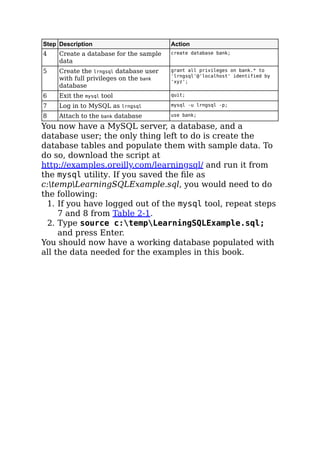
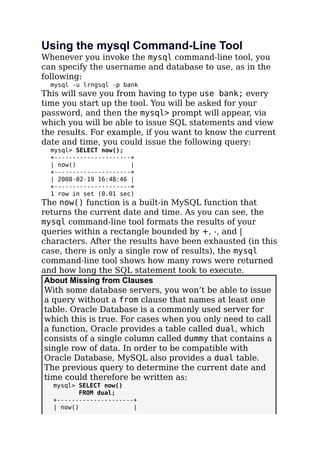
  • 146.
    the same diagramto illustrate each set operation. There is another set operation that is concerned only with the overlap between two data sets; this operation is known as the intersection and is demonstrated in Figure 6-2. Figure 6-2. The intersection operation The data set generated by the intersection of sets A and B is just the area of overlap between the two sets. If the two sets have no overlap, then the intersection operation yields the empty set. The third and final set operation, which is demonstrated in Figure 6-3, is known as the except operation.
  • 147.
    Figure 6-3. Theexcept operation Figure 6-3 shows the results of A except B, which is the whole of set A minus any overlap with set B. If the two sets have no overlap, then the operation A except B yields the whole of set A. Using these three operations, or by combining different operations together, you can generate whatever results you need. For example, imagine that you want to build a set demonstrated by Figure 6-4. Figure 6-4. Mystery data set
  • 148.
    The data setyou are looking for includes all of sets A and B without the overlapping region. You can’t achieve this outcome with just one of the three operations shown earlier; instead, you will need to first build a data set that encompasses all of sets A and B, and then utilize a second operation to remove the overlapping region. If the combined set is described as A union B, and the overlapping region is described as A intersect B, then the operation needed to generate the data set represented by Figure 6-4 would look as follows: (A union B) except (A intersect B) Of course, there are often multiple ways to achieve the same results; you could reach a similar outcome using the following operation: (A except B) union (B except A) While these concepts are fairly easy to understand using diagrams, the next sections show you how these concepts are applied to a relational database using the SQL set operators.
  • 149.
    Set Theory inPractice The circles used in the previous section’s diagrams to represent data sets don’t convey anything about what the data sets comprise. When dealing with actual data, however, there is a need to describe the composition of the data sets involved if they are to be combined. Imagine, for example, what would happen if you tried to generate the union of the product table and the customer table, whose table definitions are as follows: mysql> DESC product; +-----------------+-------------+------+-----+---------+------ -+ | Field | Type | Null | Key | Default | Extra | +-----------------+-------------+------+-----+---------+------ -+ | product_cd | varchar(10) | NO | PRI | NULL | | | name | varchar(50) | NO | | NULL | | | product_type_cd | varchar(10) | NO | MUL | NULL | | | date_offered | date | YES | | NULL | | | date_retired | date | YES | | NULL | | +-----------------+-------------+------+-----+---------+------ -+ 5 rows in set (0.23 sec) mysql> DESC customer; +--------------+------------------+------+-----+---------+---- ------------+ | Field | Type | Null | Key | Default | Extra | +--------------+------------------+------+-----+---------+---- ------------+ | cust_id | int(10) unsigned | NO | PRI | NULL | auto_increment | | fed_id | varchar(12) | NO | | NULL | | | cust_type_cd | enum('I','B') | NO | | NULL | | | address | varchar(30) | YES | | NULL | | | city | varchar(20) | YES | | NULL | | | state | varchar(20) | YES | | NULL | |
  • 150.
    | postal_code |varchar(10) | YES | | NULL | | +--------------+------------------+------+-----+---------+---- ------------+ 7 rows in set (0.04 sec) When combined, the first column in the table that results would be the combination of the product.product_cd and customer.cust_id columns, the second column would be the combination of the product.name and customer.fed_id columns, and so forth. While some of the column pairs are easy to combine (e.g., two numeric columns), it is unclear how other column pairs should be combined, such as a numeric column with a string column or a string column with a date column. Additionally, the sixth and seventh columns of the combined tables would include data from only the customer table’s sixth and seventh columns, since the product table has only five columns. Clearly, there needs to be some commonality between two tables that you wish to combine. Therefore, when performing set operations on two data sets, the following guidelines must apply: Both data sets must have the same number of columns. The data types of each column across the two data sets must be the same (or the server must be able to convert one to the other). With these rules in place, it is easier to envision what “overlapping data” means in practice; each column pair from the two sets being combined must contain the same string, number, or date for rows in the two tables to be considered the same. You perform a set operation by placing a set operator between two select statements, as demonstrated by the following: mysql> SELECT 1 num, 'abc' str -> UNION -> SELECT 9 num, 'xyz' str; +-----+-----+ | num | str | +-----+-----+
  • 151.
    | 1 |abc | | 9 | xyz | +-----+-----+ 2 rows in set (0.02 sec) Each of the individual queries yields a data set consisting of a single row having a numeric column and a string column. The set operator, which in this case is union, tells the database server to combine all rows from the two sets. Thus, the final set includes two rows of two columns. This query is known as a compound query because it comprises multiple, otherwise-independent queries. As you will see later, compound queries may include more than two queries if multiple set operations are needed to attain the final results.
  • 152.
    Set Operators The SQLlanguage includes three set operators that allow you to perform each of the various set operations described earlier in the chapter. Additionally, each set operator has two flavors, one that includes duplicates and another that removes duplicates (but not necessarily all of the duplicates). The following subsections define each operator and demonstrate how they are used. The union Operator The union and union all operators allow you to combine multiple data sets. The difference between the two is that union sorts the combined set and removes duplicates, whereas union all does not. With union all, the number of rows in the final data set will always equal the sum of the number of rows in the sets being combined. This operation is the simplest set operation to perform (from the server’s point of view), since there is no need for the server to check for overlapping data. The following example demonstrates how you can use the union all operator to generate a full set of customer data from the two customer subtype tables: mysql> SELECT 'IND' type_cd, cust_id, lname name -> FROM individual -> UNION ALL -> SELECT 'BUS' type_cd, cust_id, name -> FROM business; +---------+---------+------------------------+ | type_cd | cust_id | name | +---------+---------+------------------------+ | IND | 1 | Hadley | | IND | 2 | Tingley | | IND | 3 | Tucker | | IND | 4 | Hayward | | IND | 5 | Frasier | | IND | 6 | Spencer | | IND | 7 | Young | | IND | 8 | Blake | | IND | 9 | Farley | | BUS | 10 | Chilton Engineering | | BUS | 11 | Northeast Cooling Inc. | | BUS | 12 | Superior Auto Body | | BUS | 13 | AAA Insurance Inc. |
  • 153.
    +---------+---------+------------------------+ 13 rows inset (0.04 sec) The query returns all 13 customers, with nine rows coming from the individual table and the other four coming from the business table. While the business table includes a single column to hold the company name, the individual table includes two name columns, one each for the person’s first and last names. In this case, I chose to include only the last name from the individual table. Just to drive home the point that the union all operator doesn’t remove duplicates, here’s the same query as the previous example but with an additional query against the business table: mysql> SELECT 'IND' type_cd, cust_id, lname name -> FROM individual -> UNION ALL -> SELECT 'BUS' type_cd, cust_id, name -> FROM business -> UNION ALL -> SELECT 'BUS' type_cd, cust_id, name -> FROM business; +---------+---------+------------------------+ | type_cd | cust_id | name | +---------+---------+------------------------+ | IND | 1 | Hadley | | IND | 2 | Tingley | | IND | 3 | Tucker | | IND | 4 | Hayward | | IND | 5 | Frasier | | IND | 6 | Spencer | | IND | 7 | Young | | IND | 8 | Blake | | IND | 9 | Farley | | BUS | 10 | Chilton Engineering | | BUS | 11 | Northeast Cooling Inc. | | BUS | 12 | Superior Auto Body | | BUS | 13 | AAA Insurance Inc. | | BUS | 10 | Chilton Engineering | | BUS | 11 | Northeast Cooling Inc. | | BUS | 12 | Superior Auto Body | | BUS | 13 | AAA Insurance Inc. | +---------+---------+------------------------+ 17 rows in set (0.01 sec) This compound query includes three select statements, two of which are identical. As you can see by the results,
  • 154.
    the four rowsfrom the business table are included twice (customer IDs 10, 11, 12, and 13). While you are unlikely to repeat the same query twice in a compound query, here is another compound query that returns duplicate data: mysql> SELECT emp_id -> FROM employee -> WHERE assigned_branch_id = 2 -> AND (title = 'Teller' OR title = 'Head Teller') -> UNION ALL -> SELECT DISTINCT open_emp_id -> FROM account -> WHERE open_branch_id = 2; +--------+ | emp_id | +--------+ | 10 | | 11 | | 12 | | 10 | +--------+ 4 rows in set (0.01 sec) The first query in the compound statement retrieves all tellers assigned to the Woburn branch, whereas the second query returns the distinct set of tellers who opened accounts at the Woburn branch. Of the four rows in the result set, one of them is a duplicate (employee ID 10). If you would like your combined table to exclude duplicate rows, you need to use the union operator instead of union all: mysql> SELECT emp_id -> FROM employee -> WHERE assigned_branch_id = 2 -> AND (title = 'Teller' OR title = 'Head Teller') -> UNION -> SELECT DISTINCT open_emp_id -> FROM account -> WHERE open_branch_id = 2; +--------+ | emp_id | +--------+ | 10 | | 11 | | 12 | +--------+ 3 rows in set (0.01 sec)
  • 155.
    For this versionof the query, only the three distinct rows are included in the result set, rather than the four rows (three distinct, one duplicate) returned when using union all. The intersect Operator The ANSI SQL specification includes the intersect operator for performing intersections. Unfortunately, version 6.0 of MySQL does not implement the intersect operator. If you are using Oracle or SQL Server 2008, you will be able to use intersect; since I am using MySQL for all examples in this book, however, the result sets for the example queries in this section are fabricated and cannot be executed with any versions up to and including version 6.0. I also refrain from showing the MySQL prompt (mysql>), since the statements are not being executed by the MySQL server. If the two queries in a compound query return nonoverlapping data sets, then the intersection will be an empty set. Consider the following query: SELECT emp_id, fname, lname FROM employee INTERSECT SELECT cust_id, fname, lname FROM individual; Empty set (0.04 sec) The first query returns the ID and name of each employee, while the second query returns the ID and name of each customer. These sets are completely nonoverlapping, so the intersection of the two sets yields the empty set. The next step is to identify two queries that do have overlapping data and then apply the intersect operator. For this purpose, I use the same query used to demonstrate the difference between union and union all, except this time using intersect: SELECT emp_id FROM employee WHERE assigned_branch_id = 2 AND (title = 'Teller' OR title = 'Head Teller') INTERSECT SELECT DISTINCT open_emp_id
  • 156.
    FROM account WHERE open_branch_id= 2; +--------+ | emp_id | +--------+ | 10 | +--------+ 1 row in set (0.01 sec) The intersection of these two queries yields employee ID 10, which is the only value found in both queries’ result sets. Along with the intersect operator, which removes any duplicate rows found in the overlapping region, the ANSI SQL specification calls for an intersect all operator, which does not remove duplicates. The only database server that currently implements the intersect all operator is IBM’s DB2 Universal Server. The except Operator The ANSI SQL specification includes the except operator for performing the except operation. Once again, unfortunately, version 6.0 of MySQL does not implement the except operator, so the same rules apply for this section as for the previous section. Note ✎ If you are using Oracle Database, you will need to use the non-ANSI-compliant minus operator instead. The except operator returns the first table minus any overlap with the second table. Here’s the example from the previous section, but using except instead of intersect: SELECT emp_id FROM employee WHERE assigned_branch_id = 2 AND (title = 'Teller' OR title = 'Head Teller') EXCEPT SELECT DISTINCT open_emp_id FROM account WHERE open_branch_id = 2; +--------+ | emp_id | +--------+ | 11 | | 12 |
  • 157.
    +--------+ 2 rows inset (0.01 sec) In this version of the query, the result set consists of the three rows from the first query minus employee ID 10, which is found in the result sets from both queries. There is also an except all operator specified in the ANSI SQL specification, but once again, only IBM’s DB2 Universal Server has implemented the except all operator. The except all operator is a bit tricky, so here’s an example to demonstrate how duplicate data is handled. Let’s say you have two data sets that look as follows: Set A +--------+ | emp_id | +--------+ | 10 | | 11 | | 12 | | 10 | | 10 | +--------+ Set B +--------+ | emp_id | +--------+ | 10 | | 10 | +--------+ The operation A except B yields the following: +--------+ | emp_id | +--------+ | 11 | | 12 | +--------+ If you change the operation to A except all B, you will see the following: +--------+ | emp_id | +--------+ | 10 | | 11 | | 12 | +--------+ Therefore, the difference between the two operations is that except removes all occurrences of duplicate data
  • 158.
    from set A,whereas except all only removes one occurrence of duplicate data from set A for every occurrence in set B.
  • 159.
    Set Operation Rules Thefollowing sections outline some rules that you must follow when working with compound queries. Sorting Compound Query Results If you want the results of your compound query to be sorted, you can add an order by clause after the last query. When specifying column names in the order by clause, you will need to choose from the column names in the first query of the compound query. Frequently, the column names are the same for both queries in a compound query, but this does not need to be the case, as demonstrated by the following: mysql> SELECT emp_id, assigned_branch_id -> FROM employee -> WHERE title = 'Teller' -> UNION -> SELECT open_emp_id, open_branch_id -> FROM account -> WHERE product_cd = 'SAV' -> ORDER BY emp_id; +--------+--------------------+ | emp_id | assigned_branch_id | +--------+--------------------+ | 1 | 1 | | 7 | 1 | | 8 | 1 | | 9 | 1 | | 10 | 2 | | 11 | 2 | | 12 | 2 | | 14 | 3 | | 15 | 3 | | 16 | 4 | | 17 | 4 | | 18 | 4 | +--------+--------------------+ 12 rows in set (0.04 sec) The column names specified in the two queries are different in this example. If you specify a column name from the second query in your order by clause, you will see the following error: mysql> SELECT emp_id, assigned_branch_id -> FROM employee -> WHERE title = 'Teller' -> UNION
  • 160.
    -> SELECT open_emp_id,open_branch_id -> FROM account -> WHERE product_cd = 'SAV' -> ORDER BY open_emp_id; ERROR 1054 (42S22): Unknown column 'open_emp_id' in 'order clause' I recommend giving the columns in both queries identical column aliases in order to avoid this issue. Set Operation Precedence If your compound query contains more than two queries using different set operators, you need to think about the order in which to place the queries in your compound statement to achieve the desired results. Consider the following three-query compound statement: mysql> SELECT cust_id -> FROM account -> WHERE product_cd IN ('SAV', 'MM') -> UNION ALL -> SELECT a.cust_id -> FROM account a INNER JOIN branch b -> ON a.open_branch_id = b.branch_id -> WHERE b.name = 'Woburn Branch' -> UNION -> SELECT cust_id -> FROM account -> WHERE avail_balance BETWEEN 500 AND 2500; +---------+ | cust_id | +---------+ | 1 | | 2 | | 3 | | 4 | | 8 | | 9 | | 7 | | 11 | | 5 | +---------+ 9 rows in set (0.00 sec) This compound query includes three queries that return sets of nonunique customer IDs; the first and second queries are separated with the union all operator, while the second and third queries are separated with the union operator. While it might not seem to make much difference where the union and union all operators are
  • 161.
    placed, it does,in fact, make a difference. Here’s the same compound query with the set operators reversed: mysql> SELECT cust_id -> FROM account -> WHERE product_cd IN ('SAV', 'MM') -> UNION -> SELECT a.cust_id -> FROM account a INNER JOIN branch b -> ON a.open_branch_id = b.branch_id -> WHERE b.name = 'Woburn Branch' -> UNION ALL -> SELECT cust_id -> FROM account -> WHERE avail_balance BETWEEN 500 AND 2500; +---------+ | cust_id | +---------+ | 1 | | 2 | | 3 | | 4 | | 8 | | 9 | | 7 | | 11 | | 1 | | 1 | | 2 | | 3 | | 3 | | 4 | | 4 | | 5 | | 9 | +---------+ 17 rows in set (0.00 sec) Looking at the results, it’s obvious that it does make a difference how the compound query is arranged when using different set operators. In general, compound queries containing three or more queries are evaluated in order from top to bottom, but with the following caveats: The ANSI SQL specification calls for the intersect operator to have precedence over the other set operators. You may dictate the order in which queries are combined by enclosing multiple queries in
  • 162.
    parentheses. However, since MySQLdoes not yet implement intersect or allow parentheses in compound queries, you will need to carefully arrange the queries in your compound query so that you achieve the desired results. If you are using a different database server, you can wrap adjoining queries in parentheses to override the default top-to-bottom processing of compound queries, as in: (SELECT cust_id FROM account WHERE product_cd IN ('SAV', 'MM') UNION ALL SELECT a.cust_id FROM account a INNER JOIN branch b ON a.open_branch_id = b.branch_id WHERE b.name = 'Woburn Branch') INTERSECT (SELECT cust_id FROM account WHERE avail_balance BETWEEN 500 AND 2500 EXCEPT SELECT cust_id FROM account WHERE product_cd = 'CD' AND avail_balance < 1000); For this compound query, the first and second queries would be combined using the union all operator, then the third and fourth queries would be combined using the except operator, and finally, the results from these two operations would be combined using the intersect operator to generate the final result set.
  • 163.
    Test Your Knowledge Thefollowing exercises are designed to test your understanding of set operations. See Appendix C for answers to these exercises. Exercise 6-1 If set A = {L M N O P} and set B = {P Q R S T}, what sets are generated by the following operations? A union B A union all B A intersect B A except B Exercise 6-2 Write a compound query that finds the first and last names of all individual customers along with the first and last names of all employees. Exercise 6-3 Sort the results from Exercise 6-2 by the lname column.
  • 164.
    Chapter 7. DataGeneration, Conversion, and Manipulation As I mentioned in the Preface, this book strives to teach generic SQL techniques that can be applied across multiple database servers. This chapter, however, deals with the generation, conversion, and manipulation of string, numeric, and temporal data, and the SQL language does not include commands covering this functionality. Rather, built-in functions are used to facilitate data generation, conversion, and manipulation, and while the SQL standard does specify some functions, the database vendors often do not comply with the function specifications. Therefore, my approach for this chapter is to show you some of the common ways in which data is manipulated within SQL statements, and then demonstrate some of the built-in functions implemented by Microsoft SQL Server, Oracle Database, and MySQL. Along with reading this chapter, I strongly recommend you purchase a reference guide covering all the functions implemented by your server. If you work with more than one database server, there are several reference guides that cover multiple servers, such as Kevin Kline et al.’s SQL in a Nutshell and Jonathan Gennick’s SQL Pocket Guide , both from O’Reilly. Working with String Data When working with string data, you will be using one of the following character data types: CHAR Holds fixed-length, blank-padded strings. MySQL allows CHAR values up to 255 characters in length, Oracle Database permits up to 2,000 characters, and SQL Server allows up to 8,000 characters. varchar Holds variable-length strings. MySQL permits up to 65,535 characters in a varchar column, Oracle Database (via the varchar2 type) allows up to 4,000
  • 165.
    characters, and SQLServer allows up to 8,000 characters. text (MySQL and SQL Server) or CLOB (Character Large Object; Oracle Database) Holds very large variable-length strings (generally referred to as documents in this context). MySQL has multiple text types (tinytext, text, mediumtext, and longtext) for documents up to 4 GB in size. SQL Server has a single text type for documents up to 2 GB in size, and Oracle Database includes the CLOB data type, which can hold documents up to a whopping 128 TB. SQL Server 2005 also includes the varchar(max) data type and recommends its use instead of the text type, which will be removed from the server in some future release. To demonstrate how you can use these various types, I use the following table for some of the examples in this section: CREATE TABLE string_tbl (char_fld CHAR(30), vchar_fld VARCHAR(30), text_fld TEXT ); The next two subsections show how you can generate and manipulate string data. String Generation The simplest way to populate a character column is to enclose a string in quotes, as in: mysql> INSERT INTO string_tbl (char_fld, vchar_fld, text_fld) -> VALUES ('This is char data', -> 'This is varchar data', -> 'This is text data'); Query OK, 1 row affected (0.00 sec) When inserting string data into a table, remember that if the length of the string exceeds the maximum size for the character column (either the designated maximum or the maximum allowed for the data type), the server will throw an exception. Although this is the default behavior for all three servers, you can configure MySQL and SQL Server to silently truncate the string instead of throwing
  • 166.
    an exception. Todemonstrate how MySQL handles this situation, the following update statement attempts to modify the vchar_fld column, whose maximum length is defined as 30, with a string that is 46 characters in length: mysql> UPDATE string_tbl -> SET vchar_fld = 'This is a piece of extremely long varchar data'; ERROR 1406 (22001): Data too long for column 'vchar_fld' at row 1 With MySQL 6.0, the default behavior is now “strict” mode, which means that exceptions are thrown when problems arise, whereas in older versions of the server the string would have been truncated and a warning issued. If you would rather have the engine truncate the string and issue a warning instead of raising an exception, you can opt to be in ANSI mode. The following example shows how to check which mode you are in, and then how to change the mode using the SET command: mysql> SELECT @@session.sql_mode; +------------------------------------------------------------- ---+ | @@session.sql_mode | +------------------------------------------------------------- ---+ | STRICT_TRANS_TABLES,NO_AUTO_CREATE_USER,NO_ENGINE_SUBSTITUTION | +------------------------------------------------------------- ---+ 1 row in set (0.00 sec) mysql> SET sql_mode='ansi'; Query OK, 0 rows affected (0.08 sec) mysql> SELECT @@session.sql_mode; +------------------------------------------------------------- + | @@session.sql_mode | +------------------------------------------------------------- + | REAL_AS_FLOAT,PIPES_AS_CONCAT,ANSI_QUOTES,IGNORE_SPACE,ANSI | +-------------------------------------------------------------
  • 167.
    + 1 row inset (0.00 sec) If you rerun the previous UPDATE statement, you will find that the column has been modified, but the following warning is generated: mysql> SHOW WARNINGS; +---------+------+-------------------------------------------- ----+ | Level | Code | Message | +---------+------+-------------------------------------------- ----+ | Warning | 1265 | Data truncated for column 'vchar_fld' at row 1 | +---------+------+-------------------------------------------- ----+ 1 row in set (0.00 sec) If you retrieve the vchar_fld column, you will see that the string has indeed been truncated: mysql> SELECT vchar_fld -> FROM string_tbl; +--------------------------------+ | vchar_fld | +--------------------------------+ | This is a piece of extremely l | +--------------------------------+ 1 row in set (0.05 sec) As you can see, only the first 30 characters of the 46- character string made it into the vchar_fld column. The best way to avoid string truncation (or exceptions, in the case of Oracle Database or MySQL in strict mode) when working with varchar columns is to set the upper limit of a column to a high enough value to handle the longest strings that might be stored in the column (keeping in mind that the server allocates only enough space to store the string, so it is not wasteful to set a high upper limit for varchar columns). Including single quotes Since strings are demarcated by single quotes, you will need to be alert for strings that include single quotes or apostrophes. For example, you won’t be able to insert the following string because the server will think that the apostrophe in the word doesn’t marks the end of the string:
  • 168.
    UPDATE string_tbl SET text_fld= 'This string doesn't work'; To make the server ignore the apostrophe in the word doesn’t, you will need to add an escape to the string so that the server treats the apostrophe like any other character in the string. All three servers allow you to escape a single quote by adding another single quote directly before, as in: mysql> UPDATE string_tbl -> SET text_fld = 'This string didn''t work, but it does now'; Query OK, 1 row affected (0.01 sec) Rows matched: 1 Changed: 1 Warnings: 0 Note ✎ Oracle Database and MySQL users may also choose to escape a single quote by adding a backslash character immediately before, as in: UPDATE string_tbl SET text_fld = 'This string didn't work, but it does now' If you retrieve a string for use in a screen or report field, you don’t need to do anything special to handle embedded quotes: mysql> SELECT text_fld -> FROM string_tbl; +------------------------------------------+ | text_fld | +------------------------------------------+ | This string didn't work, but it does now | +------------------------------------------+ 1 row in set (0.00 sec) However, if you are retrieving the string to add to a file that another program will read, you may want to include the escape as part of the retrieved string. If you are using MySQL, you can use the built-in function quote(), which places quotes around the entire string and adds escapes to any single quotes/apostrophes within the string. Here’s what our string looks like when retrieved via the quote() function: mysql> SELECT quote(text_fld) -> FROM string_tbl; +---------------------------------------------+ | QUOTE(text_fld) | +---------------------------------------------+
  • 169.
    | 'This stringdidn't work, but it does now' | +---------------------------------------------+ 1 row in set (0.04 sec) When retrieving data for data export, you may want to use the quote() function for all non-system-generated character columns, such as a customer_notes column. Including special characters If your application is multinational in scope, you might find yourself working with strings that include characters that do not appear on your keyboard. When working with the French and German languages, for example, you might need to include accented characters such as é and ö. The SQL Server and MySQL servers include the built- in function char() so that you can build strings from any of the 255 characters in the ASCII character set (Oracle Database users can use the chr() function). To demonstrate, the next example retrieves a typed string and its equivalent built via individual characters: mysql> SELECT 'abcdefg', CHAR(97,98,99,100,101,102,103); +---------+--------------------------------+ | abcdefg | CHAR(97,98,99,100,101,102,103) | +---------+--------------------------------+ | abcdefg | abcdefg | +---------+--------------------------------+ 1 row in set (0.01 sec) Thus, the 97th character in the ASCII character set is the letter a. While the characters shown in the preceding example are not special, the following examples show the location of the accented characters along with other special characters, such as currency symbols: mysql> SELECT CHAR(128,129,130,131,132,133,134,135,136,137); +-----------------------------------------------+ | CHAR(128,129,130,131,132,133,134,135,136,137) | +-----------------------------------------------+ | Çüéâäàåçêë | +-----------------------------------------------+ 1 row in set (0.01 sec) mysql> SELECT CHAR(138,139,140,141,142,143,144,145,146,147); +-----------------------------------------------+ | CHAR(138,139,140,141,142,143,144,145,146,147) | +-----------------------------------------------+ | èïîìÄÅÉæÆô | +-----------------------------------------------+
  • 170.
    1 row inset (0.01 sec) mysql> SELECT CHAR(148,149,150,151,152,153,154,155,156,157); +-----------------------------------------------+ | CHAR(148,149,150,151,152,153,154,155,156,157) | +-----------------------------------------------+ | öòÛùÿ...Ü¢£¥ | +-----------------------------------------------+ 1 row in set (0.00 sec) mysql> SELECT CHAR(158,159,160,161,162,163,164,165); +---------------------------------------+ | CHAR(158,159,160,161,162,163,164,165) | +---------------------------------------+ | fáíóúñÑ | +---------------------------------------+ 1 row in set (0.01 sec) Note ✎ I am using the latin1 character set for the examples in this section. If your session is configured for a different character set, you will see a different set of characters than what is shown here. The same concepts apply, but you will need to familiarize yourself with the layout of your character set to locate specific characters. Building strings character by character can be quite tedious, especially if only a few of the characters in the string are accented. Fortunately, you can use the concat() function to concatenate individual strings, some of which you can type while others you can generate via the char() function. For example, the following shows how to build the phrase danke schön using the concat() and char() functions: mysql> SELECT CONCAT('danke sch', CHAR(148), 'n'); +-------------------------------------+ | CONCAT('danke sch', CHAR(148), 'n') | +-------------------------------------+ | danke schön | +-------------------------------------+ 1 row in set (0.00 sec)
  • 171.
    Note ✎ Oracle Databaseusers can use the concatenation operator (||) instead of the concat() function, as in: SELECT 'danke sch' || CHR(148) || 'n' FROM dual; SQL Server does not include a concat() function, so you will need to use the concatenation operator (+), as in: SELECT 'danke sch' + CHAR(148) + 'n' If you have a character and need to find its ASCII equivalent, you can use the ascii() function, which takes the leftmost character in the string and returns a number: mysql> SELECT ASCII('ö'); +------------+ | ASCII('ö') | +------------+ | 148 | +------------+ 1 row in set (0.00 sec) Using the char(), ascii(), and concat() functions (or concatenation operators), you should be able to work with any Roman language even if you are using a keyboard that does not include accented or special characters. String Manipulation Each database server includes many built-in functions for manipulating strings. This section explores two types of string functions: those that return numbers and those that return strings. Before I begin, however, I reset the data in the string_tbl table to the following: mysql> DELETE FROM string_tbl; Query OK, 1 row affected (0.02 sec) mysql> INSERT INTO string_tbl (char_fld, vchar_fld, text_fld) -> VALUES ('This string is 28 characters', -> 'This string is 28 characters', -> 'This string is 28 characters'); Query OK, 1 row affected (0.00 sec) String functions that return numbers
  • 172.
    Of the stringfunctions that return numbers, one of the most commonly used is the length() function, which returns the number of characters in the string (SQL Server users will need to use the len() function). The following query applies the length() function to each column in the string_tbl table: mysql> SELECT LENGTH(char_fld) char_length, -> LENGTH(vchar_fld) varchar_length, -> LENGTH(text_fld) text_length -> FROM string_tbl; +-------------+----------------+-------------+ | char_length | varchar_length | text_length | +-------------+----------------+-------------+ | 28 | 28 | 28 | +-------------+----------------+-------------+ 1 row in set (0.00 sec) While the lengths of the varchar and text columns are as expected, you might have expected the length of the char column to be 30, since I told you that strings stored in char columns are right-padded with spaces. The MySQL server removes trailing spaces from char data when it is retrieved, however, so you will see the same results from all string functions regardless of the type of column in which the strings are stored. Along with finding the length of a string, you might want to find the location of a substring within a string. For example, if you want to find the position at which the string 'characters' appears in the vchar_fld column, you could use the position() function, as demonstrated by the following: mysql> SELECT POSITION('characters' IN vchar_fld) -> FROM string_tbl; +-------------------------------------+ | POSITION('characters' IN vchar_fld) | +-------------------------------------+ | 19 | +-------------------------------------+ 1 row in set (0.12 sec) If the substring cannot be found, the position() function returns 0.
  • 173.
    Warning ☠ For thoseof you who program in a language such as C or C++, where the first element of an array is at position 0, remember when working with databases that the first character in a string is at position 1. A return value of 0 from position() indicates that the substring could not be found, not that the substring was found at the first position in the string. If you want to start your search at something other than the first character of your target string, you will need to use the locate() function, which is similar to the position() function except that it allows an optional third parameter, which is used to define the search’s start position. The locate() function is also proprietary, whereas the position() function is part of the SQL:2003 standard. Here’s an example asking for the position of the string 'is' starting at the fifth character in the vchar_fld column: mysql> SELECT LOCATE('is', vchar_fld, 5) -> FROM string_tbl; +----------------------------+ | LOCATE('is', vchar_fld, 5) | +----------------------------+ | 13 | +----------------------------+ 1 row in set (0.02 sec) Note ✎ Oracle Database does not include the position() or locate() function, but it does include the instr() function, which mimics the position() function when provided with two arguments and mimics the locate() function when provided with three arguments. SQL Server also doesn’t include a position() or locate() function, but it does include the charindx() function, which also accepts either two or three arguments similar to Oracle’s instr() function. Another function that takes strings as arguments and returns numbers is the string comparison function strcmp(). Strcmp(), which is implemented only by
  • 174.
    MySQL and hasno analog in Oracle Database or SQL Server, takes two strings as arguments, and returns one of the following: −1 if the first string comes before the second string in sort order 0 if the strings are identical 1 if the first string comes after the second string in sort order To illustrate how the function works, I first show the sort order of five strings using a query, and then show how the strings compare to one another using strcmp(). Here are the five strings that I insert into the string_tbl table: mysql> DELETE FROM string_tbl; Query OK, 1 row affected (0.00 sec) mysql> INSERT INTO string_tbl(vchar_fld) VALUES ('abcd'); Query OK, 1 row affected (0.03 sec) mysql> INSERT INTO string_tbl(vchar_fld) VALUES ('xyz'); Query OK, 1 row affected (0.00 sec) mysql> INSERT INTO string_tbl(vchar_fld) VALUES ('QRSTUV'); Query OK, 1 row affected (0.00 sec) mysql> INSERT INTO string_tbl(vchar_fld) VALUES ('qrstuv'); Query OK, 1 row affected (0.00 sec) mysql> INSERT INTO string_tbl(vchar_fld) VALUES ('12345'); Query OK, 1 row affected (0.00 sec) Here are the five strings in their sort order: mysql> SELECT vchar_fld -> FROM string_tbl -> ORDER BY vchar_fld; +-----------+ | vchar_fld | +-----------+ | 12345 | | abcd | | QRSTUV | | qrstuv | | xyz | +-----------+ 5 rows in set (0.00 sec) The next query makes six comparisons among the five different strings:
  • 175.
    mysql> SELECT STRCMP('12345','12345')12345_12345, -> STRCMP('abcd','xyz') abcd_xyz, -> STRCMP('abcd','QRSTUV') abcd_QRSTUV, -> STRCMP('qrstuv','QRSTUV') qrstuv_QRSTUV, -> STRCMP('12345','xyz') 12345_xyz, -> STRCMP('xyz','qrstuv') xyz_qrstuv; +-------------+----------+-------------+---------------+------ -----+------------+ | 12345_12345 | abcd_xyz | abcd_QRSTUV | qrstuv_QRSTUV | 12345_xyz | xyz_qrstuv | +-------------+----------+-------------+---------------+------ -----+------------+ | 0 | −1 | −1 | 0 | −1 | 1 | +-------------+----------+-------------+---------------+------ -----+------------+ 1 row in set (0.00 sec) The first comparison yields 0, which is to be expected since I compared a string to itself. The fourth comparison also yields 0, which is a bit surprising, since the strings are composed of the same letters, with one string all uppercase and the other all lowercase. The reason for this result is that MySQL’s strcmp() function is case- insensitive, which is something to remember when using the function. The other four comparisons yield either −1 or 1 depending on whether the first string comes before or after the second string in sort order. For example, strcmp('abcd','xyz') yields −1, since the string 'abcd' comes before the string 'xyz'. Along with the strcmp() function, MySQL also allows you to use the like and regexp operators to compare strings in the select clause. Such comparisons will yield 1 (for true) or 0 (for false). Therefore, these operators allow you to build expressions that return a number, much like the functions described in this section. Here’s an example using like: mysql> SELECT name, name LIKE '%ns' ends_in_ns -> FROM department; +----------------+------------+ | name | ends_in_ns | +----------------+------------+ | Operations | 1 | | Loans | 1 | | Administration | 0 |
  • 176.
    +----------------+------------+ 3 rows inset (0.25 sec) This example retrieves all the department names, along with an expression that returns 1 if the department name ends in “ns” or 0 otherwise. If you want to perform more complex pattern matches, you can use the regexp operator, as demonstrated by the following: mysql> SELECT cust_id, cust_type_cd, fed_id, -> fed_id REGEXP '.{3}-.{2}-.{4}' is_ss_no_format -> FROM customer; +---------+--------------+-------------+-----------------+ | cust_id | cust_type_cd | fed_id | is_ss_no_format | +---------+--------------+-------------+-----------------+ | 1 | I | 111-11-1111 | 1 | | 2 | I | 222-22-2222 | 1 | | 3 | I | 333-33-3333 | 1 | | 4 | I | 444-44-4444 | 1 | | 5 | I | 555-55-5555 | 1 | | 6 | I | 666-66-6666 | 1 | | 7 | I | 777-77-7777 | 1 | | 8 | I | 888-88-8888 | 1 | | 9 | I | 999-99-9999 | 1 | | 10 | B | 04-1111111 | 0 | | 11 | B | 04-2222222 | 0 | | 12 | B | 04-3333333 | 0 | | 13 | B | 04-4444444 | 0 | +---------+--------------+-------------+-----------------+ 13 rows in set (0.00 sec) The fourth column of this query returns 1 if the value stored in the fed_id column matches the format for a Social Security number. Note ✎ SQL Server and Oracle Database users can achieve similar results by building case expressions, which I describe in detail in Chapter 11. String functions that return strings In some cases, you will need to modify existing strings, either by extracting part of the string or by adding additional text to the string. Every database server includes multiple functions to help with these tasks. Before I begin, I once again reset the data in the string_tbl table: mysql> DELETE FROM string_tbl; Query OK, 5 rows affected (0.00 sec)
  • 177.
    mysql> INSERT INTOstring_tbl (text_fld) -> VALUES ('This string was 29 characters'); Query OK, 1 row affected (0.01 sec) Earlier in the chapter, I demonstrated the use of the concat() function to help build words that include accented characters. The concat() function is useful in many other situations, including when you need to append additional characters to a stored string. For instance, the following example modifies the string stored in the text_fld column by tacking an additional phrase on the end: mysql> UPDATE string_tbl -> SET text_fld = CONCAT(text_fld, ', but now it is longer'); Query OK, 1 row affected (0.03 sec) Rows matched: 1 Changed: 1 Warnings: 0 The contents of the text_fld column are now as follows: mysql> SELECT text_fld -> FROM string_tbl; +-----------------------------------------------------+ | text_fld | +-----------------------------------------------------+ | This string was 29 characters, but now it is longer | +-----------------------------------------------------+ 1 row in set (0.00 sec) Thus, like all functions that return a string, you can use concat() to replace the data stored in a character column. Another common use for the concat() function is to build a string from individual pieces of data. For example, the following query generates a narrative string for each bank teller: mysql> SELECT CONCAT(fname, ' ', lname, ' has been a ', -> title, ' since ', start_date) emp_narrative -> FROM employee -> WHERE title = 'Teller' OR title = 'Head Teller'; +---------------------------------------------------------+ | emp_narrative | +---------------------------------------------------------+ | Helen Fleming has been a Head Teller since 2008-03-17 | | Chris Tucker has been a Teller since 2008-09-15 | | Sarah Parker has been a Teller since 2006-12-02 | | Jane Grossman has been a Teller since 2006-05-03 | | Paula Roberts has been a Head Teller since 2006-07-27 | | Thomas Ziegler has been a Teller since 2004-10-23 |
  • 178.
    | Samantha Jamesonhas been a Teller since 2007-01-08 | | John Blake has been a Head Teller since 2004-05-11 | | Cindy Mason has been a Teller since 2006-08-09 | | Frank Portman has been a Teller since 2007-04-01 | | Theresa Markham has been a Head Teller since 2005-03-15 | | Beth Fowler has been a Teller since 2006-06-29 | | Rick Tulman has been a Teller since 2006-12-12 | +---------------------------------------------------------+ 13 rows in set (0.30 sec) The concat() function can handle any expression that returns a string, and will even convert numbers and dates to string format, as evidenced by the date column (start_date) used as an argument. Although Oracle Database includes the concat() function, it will accept only two string arguments, so the previous query will not work on Oracle. Instead, you would need to use the concatenation operator (||) rather than a function call, as in: SELECT fname || ' ' || lname || ' has been a ' || title || ' since ' || start_date emp_narrative FROM employee WHERE title = 'Teller' OR title = 'Head Teller'; SQL Server does not include a concat() function, so you would need to use the same approach as the previous query, except that you would use SQL Server’s concatenation operator (+) instead of ||. While concat() is useful for adding characters to the beginning or end of a string, you may also have a need to add or replace characters in the middle of a string. All three database servers provide functions for this purpose, but all of them are different, so I demonstrate the MySQL function and then show the functions from the other two servers. MySQL includes the insert() function, which takes four arguments: the original string, the position at which to start, the number of characters to replace, and the replacement string. Depending on the value of the third argument, the function may be used to either insert or replace characters in a string. With a value of 0 for the third argument, the replacement string is inserted and any trailing characters are pushed to the right, as in:
  • 179.
    mysql> SELECT INSERT('goodbyeworld', 9, 0, 'cruel ') string; +---------------------+ | string | +---------------------+ | goodbye cruel world | +---------------------+ 1 row in set (0.00 sec) In this example, all characters starting from position 9 are pushed to the right and the string 'cruel' is inserted. If the third argument is greater than zero, then that number of characters is replaced with the replacement string, as in: mysql> SELECT INSERT('goodbye world', 1, 7, 'hello') string; +-------------+ | string | +-------------+ | hello world | +-------------+ 1 row in set (0.00 sec) For this example, the first seven characters are replaced with the string 'hello'. Oracle Database does not provide a single function with the flexibility of MySQL’s insert() function, but Oracle does provide the replace() function, which is useful for replacing one substring with another. Here’s the previous example reworked to use replace(): SELECT REPLACE('goodbye world', 'goodbye', 'hello') FROM dual; All instances of the string 'goodbye' will be replaced with the string 'hello', resulting in the string 'hello world'. The replace() function will replace every instance of the search string with the replacement string, so you need to be careful that you don’t end up with more replacements than you anticipated. SQL Server also includes a replace() function with the same functionality as Oracle’s, but SQL Server also includes a function called stuff() with similar functionality to MySQL’s insert() function. Here’s an example: SELECT STUFF('hello world', 1, 5, 'goodbye cruel') When executed, five characters are removed starting at position 1, and then the string 'goodbye cruel' is
  • 180.
    inserted at thestarting position, resulting in the string 'goodbye cruel world'. Along with inserting characters into a string, you may have a need to extract a substring from a string. For this purpose, all three servers include the substring() function (although Oracle Database’s version is called substr()), which extracts a specified number of characters starting at a specified position. The following example extracts five characters from a string starting at the ninth position: mysql> SELECT SUBSTRING('goodbye cruel world', 9, 5); +----------------------------------------+ | SUBSTRING('goodbye cruel world', 9, 5) | +----------------------------------------+ | cruel | +----------------------------------------+ 1 row in set (0.00 sec) Along with the functions demonstrated here, all three servers include many more built-in functions for manipulating string data. While many of them are designed for very specific purposes, such as generating the string equivalent of octal or hexadecimal numbers, there are many other general-purpose functions as well, such as functions that remove or add trailing spaces. For more information, consult your server’s SQL reference guide, or a general-purpose SQL reference guide such as SQL in a Nutshell (O’Reilly).
  • 181.
    Working with NumericData Unlike string data (and temporal data, as you will see shortly), numeric data generation is quite straightforward. You can type a number, retrieve it from another column, or generate it via a calculation. All the usual arithmetic operators (+, -, *, /) are available for performing calculations, and parentheses may be used to dictate precedence, as in: mysql> SELECT (37 * 59) / (78 - (8 * 6)); +----------------------------+ | (37 * 59) / (78 - (8 * 6)) | +----------------------------+ | 72.77 | +----------------------------+ 1 row in set (0.00 sec) As I mentioned in Chapter 2, the main concern when storing numeric data is that numbers might be rounded if they are larger than the specified size for a numeric column. For example, the number 9.96 will be rounded to 10.0 if stored in a column defined as float(3,1). Performing Arithmetic Functions Most of the built-in numeric functions are used for specific arithmetic purposes, such as determining the square root of a number. Table 7-1 lists some of the common numeric functions that take a single numeric argument and return a number. Table 7-1. Single-argument numeric functions Function name Description Acos( x ) Calculates the arc cosine of x Asin( x ) Calculates the arc sine of x Atan( x ) Calculates the arc tangent of x Cos( x ) Calculates the cosine of x Cot( x ) Calculates the cotangent of x Exp( x ) Calculates ex Ln( x ) Calculates the natural log of x Sin( x ) Calculates the sine of x Sqrt( x ) Calculates the square root of x Tan( x ) Calculates the tangent of x
  • 182.
    These functions performvery specific tasks, and I refrain from showing examples for these functions (if you don’t recognize a function by name or description, then you probably don’t need it). Other numeric functions used for calculations, however, are a bit more flexible and deserve some explanation. For example, the modulo operator, which calculates the remainder when one number is divided into another number, is implemented in MySQL and Oracle Database via the mod() function. The following example calculates the remainder when 4 is divided into 10: mysql> SELECT MOD(10,4); +-----------+ | MOD(10,4) | +-----------+ | 2 | +-----------+ 1 row in set (0.02 sec) While the mod() function is typically used with integer arguments, with MySQL you can also use real numbers, as in: mysql> SELECT MOD(22.75, 5); +---------------+ | MOD(22.75, 5) | +---------------+ | 2.75 | +---------------+ 1 row in set (0.02 sec) Note ✎ SQL Server does not have a mod() function. Instead, the operator % is used for finding remainders. The expression 10 % 4 will therefore yield the value 2. Another numeric function that takes two numeric arguments is the pow() function (or power() if you are using Oracle Database or SQL Server), which returns one number raised to the power of a second number, as in: mysql> SELECT POW(2,8); +----------+ | POW(2,8) | +----------+ | 256 | +----------+ 1 row in set (0.03 sec)
  • 183.
    Thus, pow(2,8) isthe MySQL equivalent of specifying 28. Since computer memory is allocated in chunks of 2x bytes, the pow() function can be a handy way to determine the exact number of bytes in a certain amount of memory: mysql> SELECT POW(2,10) kilobyte, POW(2,20) megabyte, -> POW(2,30) gigabyte, POW(2,40) terabyte; +----------+----------+------------+---------------+ | kilobyte | megabyte | gigabyte | terabyte | +----------+----------+------------+---------------+ | 1024 | 1048576 | 1073741824 | 1099511627776 | +----------+----------+------------+---------------+ 1 row in set (0.00 sec) I don’t know about you, but I find it easier to remember that a gigabyte is 230 bytes than to remember the number 1,073,741,824. Controlling Number Precision When working with floating-point numbers, you may not always want to interact with or display a number with its full precision. For example, you may store monetary transaction data with a precision to six decimal places, but you might want to round to the nearest hundredth for display purposes. Four functions are useful when limiting the precision of floating-point numbers: ceil(), floor(), round(), and truncate(). All three servers include these functions, although Oracle Database includes trunc() instead of truncate(), and SQL Server includes ceiling() instead of ceil(). The ceil() and floor() functions are used to round either up or down to the closest integer, as demonstrated by the following: mysql> SELECT CEIL(72.445), FLOOR(72.445); +--------------+---------------+ | CEIL(72.445) | FLOOR(72.445) | +--------------+---------------+ | 73 | 72 | +--------------+---------------+ 1 row in set (0.06 sec) Thus, any number between 72 and 73 will be evaluated as 73 by the ceil() function and 72 by the floor() function. Remember that ceil() will round up even if
  • 184.
    the decimal portionof a number is very small, and floor() will round down even if the decimal portion is quite significant, as in: mysql> SELECT CEIL(72.000000001), FLOOR(72.999999999); +--------------------+---------------------+ | CEIL(72.000000001) | FLOOR(72.999999999) | +--------------------+---------------------+ | 73 | 72 | +--------------------+---------------------+ 1 row in set (0.00 sec) If this is a bit too severe for your application, you can use the round() function to round up or down from the midpoint between two integers, as in: mysql> SELECT ROUND(72.49999), ROUND(72.5), ROUND(72.50001); +-----------------+-------------+-----------------+ | ROUND(72.49999) | ROUND(72.5) | ROUND(72.50001) | +-----------------+-------------+-----------------+ | 72 | 73 | 73 | +-----------------+-------------+-----------------+ 1 row in set (0.00 sec) Using round(), any number whose decimal portion is halfway or more between two integers will be rounded up, whereas the number will be rounded down if the decimal portion is anything less than halfway between the two integers. Most of the time, you will want to keep at least some part of the decimal portion of a number rather than rounding to the nearest integer; the round() function allows an optional second argument to specify how many digits to the right of the decimal place to round to. The next example shows how you can use the second argument to round the number 72.0909 to one, two, and three decimal places: mysql> SELECT ROUND(72.0909, 1), ROUND(72.0909, 2), ROUND(72.0909, 3); +-------------------+-------------------+-------------------+ | ROUND(72.0909, 1) | ROUND(72.0909, 2) | ROUND(72.0909, 3) | +-------------------+-------------------+-------------------+ | 72.1 | 72.09 | 72.091 | +-------------------+-------------------+-------------------+ 1 row in set (0.00 sec) Like the round() function, the truncate() function allows an optional second argument to specify the number of digits to the right of the decimal, but
  • 185.
    truncate() simply discardsthe unwanted digits without rounding. The next example shows how the number 72.0909 would be truncated to one, two, and three decimal places: mysql> SELECT TRUNCATE(72.0909, 1), TRUNCATE(72.0909, 2), -> TRUNCATE(72.0909, 3); +----------------------+----------------------+--------------- -------+ | TRUNCATE(72.0909, 1) | TRUNCATE(72.0909, 2) | TRUNCATE(72.0909, 3) | +----------------------+----------------------+--------------- -------+ | 72.0 | 72.09 | 72.090 | +----------------------+----------------------+--------------- -------+ 1 row in set (0.00 sec) Note ✎ SQL Server does not include a truncate() function. Instead, the round() function allows for an optional third argument which, if present and nonzero, calls for the number to be truncated rather than rounded. Both truncate() and round() also allow a negative value for the second argument, meaning that numbers to the left of the decimal place are truncated or rounded. This might seem like a strange thing to do at first, but there are valid applications. For example, you might sell a product that can be purchased only in units of 10. If a customer were to order 17 units, you could choose from one of the following methods to modify the customer’s order quantity: mysql> SELECT ROUND(17, −1), TRUNCATE(17, −1); +---------------+------------------+ | ROUND(17, −1) | TRUNCATE(17, −1) | +---------------+------------------+ | 20 | 10 | +---------------+------------------+ 1 row in set (0.00 sec) If the product in question is thumbtacks, then it might not make much difference to your bottom line whether you sold the customer 10 or 20 thumbtacks when only 17 were requested; if you are selling Rolex watches, however, your business may fare better by rounding.
  • 186.
    Handling Signed Data Ifyou are working with numeric columns that allow negative values (in Chapter 2, I showed how a numeric column may be labeled unsigned, meaning that only positive numbers are allowed), several numeric functions might be of use. Let’s say, for example, that you are asked to generate a report showing the current status of each bank account. The following query returns three columns useful for generating the report: mysql> SELECT account_id, SIGN(avail_balance), ABS(avail_balance) -> FROM account; +------------+---------------------+--------------------+ | account_id | SIGN(avail_balance) | ABS(avail_balance) | +------------+---------------------+--------------------+ | 1 | 1 | 1057.75 | | 2 | 1 | 500.00 | | 3 | 1 | 3000.00 | | 4 | 1 | 2258.02 | | 5 | 1 | 200.00 | | ... | | 19 | 1 | 1500.00 | | 20 | 1 | 23575.12 | | 21 | 0 | 0.00 | | 22 | 1 | 9345.55 | | 23 | 1 | 38552.05 | | 24 | 1 | 50000.00 | +------------+---------------------+--------------------+ 24 rows in set (0.00 sec) The second column uses the sign() function to return −1 if the account balance is negative, 0 if the account balance is zero, and 1 if the account balance is positive. The third column returns the absolute value of the account balance via the abs() function.
  • 187.
    Working with TemporalData Of the three types of data discussed in this chapter (character, numeric, and temporal), temporal data is the most involved when it comes to data generation and manipulation. Some of the complexity of temporal data is caused by the myriad ways in which a single date and time can be described. For example, the date on which I wrote this paragraph can be described in all the following ways: Wednesday, September 17, 2008 9/17/2008 2:14:56 P.M. EST 9/17/2008 19:14:56 GMT 2612008 (Julian format) Star date [−4] 85712.03 14:14:56 (Star Trek format) While some of these differences are purely a matter of formatting, most of the complexity has to do with your frame of reference, which we explore in the next section. Dealing with Time Zones Because people around the world prefer that noon coincides roughly with the sun’s peak at their location, there has never been a serious attempt to coerce everyone to use a universal clock. Instead, the world has been sliced into 24 imaginary sections, called time zones; within a particular time zone, everyone agrees on the current time, whereas people in different time zones do not. While this seems simple enough, some geographic regions shift their time by one hour twice a year (implementing what is known as daylight saving time) and some do not, so the time difference between two points on Earth might be four hours for one half of the year and five hours for the other half of the year. Even within a single time zone, different regions may or may not adhere to daylight saving time, causing different clocks in the same time zone to agree for one half of the year but be one hour different for the rest of the year. While the computer age has exacerbated the issue, people have been dealing with time zone differences since the early days of naval exploration. To ensure a
  • 188.
    common point ofreference for timekeeping, fifteenth- century navigators set their clocks to the time of day in Greenwich, England. This became known as Greenwich Mean Time, or GMT. All other time zones can be described by the number of hours’ difference from GMT; for example, the time zone for the Eastern United States, known as Eastern Standard Time, can be described as GMT −5:00, or five hours earlier than GMT. Today, we use a variation of GMT called Coordinated Universal Time, or UTC, which is based on an atomic clock (or, to be more precise, the average time of 200 atomic clocks in 50 locations worldwide, which is referred to as Universal Time). Both SQL Server and MySQL provide functions that will return the current UTC timestamp (getutcdate() for SQL Server and utc_timestamp() for MySQL). Most database servers default to the time zone setting of the server on which it resides and provide tools for modifying the time zone if needed. For example, a database used to store stock exchange transactions from around the world would generally be configured to use UTC time, whereas a database used to store transactions at a particular retail establishment might use the server’s time zone. MySQL keeps two different time zone settings: a global time zone, and a session time zone, which may be different for each user logged in to a database. You can see both settings via the following query: mysql> SELECT @@global.time_zone, @@session.time_zone; +--------------------+---------------------+ | @@global.time_zone | @@session.time_zone | +--------------------+---------------------+ | SYSTEM | SYSTEM | +--------------------+---------------------+ 1 row in set (0.00 sec) A value of system tells you that the server is using the time zone setting from the server on which the database resides. If you are sitting at a computer in Zurich, Switzerland, and you open a session across the network to a MySQL
  • 189.
    server situated inNew York, you may want to change the time zone setting for your session, which you can do via the following command: mysql> SET time_zone = 'Europe/Zurich'; Query OK, 0 rows affected (0.18 sec) If you check the time zone settings again, you will see the following: mysql> SELECT @@global.time_zone, @@session.time_zone; +--------------------+---------------------+ | @@global.time_zone | @@session.time_zone | +--------------------+---------------------+ | SYSTEM | Europe/Zurich | +--------------------+---------------------+ 1 row in set (0.00 sec) All dates displayed in your session will now conform to Zurich time. Note ✎ Oracle Database users can change the time zone setting for a session via the following command: ALTER SESSION TIMEZONE = 'Europe/Zurich' Generating Temporal Data You can generate temporal data via any of the following means: Copying data from an existing date, datetime, or time column Executing a built-in function that returns a date, datetime, or time Building a string representation of the temporal data to be evaluated by the server To use the last method, you will need to understand the various components used in formatting dates. String representations of temporal data Table 2-5 in Chapter 2 presented the more popular date components; to refresh your memory, Table 7-2 shows these same components. Loading MySQL Time Zone Data If you are running the MySQL server on a Windows platform, you will need to load time zone data manually
  • 190.
    before you canset global or session time zones. To do so, you need to follow these steps: 1. Download the time zone data from http://dev.mysql.com/downloads/timezones.html. 2. Shut down your MySQL server. 3. Extract the files from the downloaded ZIP file (in my case, the file was called timezone-2006p.zip) and place them in your MySQL installation directory under /data/mysql (the full path for my installation was /Program Files/MySQL/MySQL Server 6.0/data/mysql). 4. Restart your MySQL server. To look at the time zone data, change to the mysql database via the use mysql command, and execute the following query: mysql> SELECT name FROM time_zone_name; +----------------------------------+ | name | +----------------------------------+ | Africa/Abidjan | | Africa/Accra | | Africa/Addis_Ababa | | Africa/Algiers | | Africa/Asmera | | Africa/Bamako | | Africa/Bangui | | Africa/Banjul | | Africa/Bissau | | Africa/Blantyre | | Africa/Brazzaville | | Africa/Bujumbura | ... | US/Alaska | | US/Aleutian | | US/Arizona | | US/Central | | US/East-Indiana | | US/Eastern | | US/Hawaii | | US/Indiana-Starke | | US/Michigan | | US/Mountain | | US/Pacific | | US/Pacific-New | | US/Samoa | | UTC |
  • 191.
    | W-SU | |WET | | Zulu | +----------------------------------+ 546 rows in set (0.01 sec) To change your time zone setting, choose one of the names from the previous query that best matches your location. Table 7-2. Date format components Component Definition Range YYYY Year, including century 1000 to 9999 MM Month 01 (January) to 12 (December) DD Day 01 to 31 HH Hour 00 to 23 HHH Hours (elapsed) −838 to 838 MI Minute 00 to 59 SS Second 00 to 59 To build a string that the server can interpret as a date, datetime, or time, you need to put the various components together in the order shown in Table 7-3. Table 7-3. Required date components Type Default format Date YYYY-MM-DD Datetime YYYY-MM-DD HH:MI:SS Timestamp YYYY-MM-DD HH:MI:SS Time HHH:MI:SS Thus, to populate a datetime column with 3:30 P.M. on September 17, 2008, you will need to build the following string: '2008-09-17 15:30:00' If the server is expecting a datetime value, such as when updating a datetime column or when calling a built-in function that takes a datetime argument, you can provide a properly formatted string with the required date components, and the server will do the conversion for you. For example, here’s a statement used to modify the date of a bank transaction: UPDATE transaction SET txn_date = '2008-09-17 15:30:00' WHERE txn_id = 99999;
  • 192.
    The server determinesthat the string provided in the set clause must be a datetime value, since the string is being used to populate a datetime column. Therefore, the server will attempt to convert the string for you by parsing the string into the six components (year, month, day, hour, minute, second) included in the default datetime format. String-to-date conversions If the server is not expecting a datetime value, or if you would like to represent the datetime using a nondefault format, you will need to tell the server to convert the string to a datetime. For example, here is a simple query that returns a datetime value using the cast() function: mysql> SELECT CAST('2008-09-17 15:30:00' AS DATETIME); +-----------------------------------------+ | CAST('2008-09-17 15:30:00' AS DATETIME) | +-----------------------------------------+ | 2008-09-17 15:30:00 | +-----------------------------------------+ 1 row in set (0.00 sec) We cover the cast() function at the end of this chapter. While this example demonstrates how to build datetime values, the same logic applies to the date and time types as well. The following query uses the cast() function to generate a date value and a time value: mysql> SELECT CAST('2008-09-17' AS DATE) date_field, -> CAST('108:17:57' AS TIME) time_field; +------------+------------+ | date_field | time_field | +------------+------------+ | 2008-09-17 | 108:17:57 | +------------+------------+ 1 row in set (0.00 sec) You may, of course, explicitly convert your strings even when the server is expecting a date, datetime, or time value, rather than letting the server do an implicit conversion. When strings are converted to temporal values—whether explicitly or implicitly—you must provide all the date components in the required order. While some servers are quite strict regarding the date format, the MySQL server is quite lenient about the separators used between
  • 193.
    the components. Forexample, MySQL will accept all of the following strings as valid representations of 3:30 P.M. on September 17, 2008: '2008-09-17 15:30:00' '2008/09/17 15:30:00' '2008,09,17,15,30,00' '20080917153000' Although this gives you a bit more flexibility, you may find yourself trying to generate a temporal value without the default date components; the next section demonstrates a built-in function that is far more flexible than the cast() function. Functions for generating dates If you need to generate temporal data from a string, and the string is not in the proper form to use the cast() function, you can use a built-in function that allows you to provide a format string along with the date string. MySQL includes the str_to_date() function for this purpose. Say, for example, that you pull the string 'September 17, 2008' from a file and need to use it to update a date column. Since the string is not in the required YYYY-MM-DD format, you can use str_to_date() instead of reformatting the string so that you can use the cast() function, as in: UPDATE individual SET birth_date = STR_TO_DATE('September 17, 2008', '%M %d, %Y') WHERE cust_id = 9999; The second argument in the call to str_to_date() defines the format of the date string, with, in this case, a month name (%M), a numeric day (%d), and a four-digit numeric year (%Y). While there are over 30 recognized format components, Table 7-4 defines the dozen or so most commonly used components. Table 7-4. Date format components Format component Description %M Month name (January to December) %m Month numeric (01 to 12) %d Day numeric (01 to 31) %j Day of year (001 to 366)
  • 194.
    Format component Description %WWeekday name (Sunday to Saturday) %Y Year, four-digit numeric %y Year, two-digit numeric %H Hour (00 to 23) %h Hour (01 to 12) %i Minutes (00 to 59) %s Seconds (00 to 59) %f Microseconds (000000 to 999999) %p A.M. or P.M. The str_to_date() function returns a datetime, date, or time value depending on the contents of the format string. For example, if the format string includes only %H, %i, and %s, then a time value will be returned. Note ✎ Oracle Database users can use the to_date() function in the same manner as MySQL’s str_to_date() function. SQL Server includes a convert() function that is not quite as flexible as MySQL and Oracle Database; rather than supplying a custom format string, your date string must conform to one of 21 predefined formats. If you are trying to generate the current date/time, then you won’t need to build a string, because the following built-in functions will access the system clock and return the current date and/or time as a string for you: mysql> SELECT CURRENT_DATE(), CURRENT_TIME(), CURRENT_TIMESTAMP(); +----------------+----------------+---------------------+ | CURRENT_DATE() | CURRENT_TIME() | CURRENT_TIMESTAMP() | +----------------+----------------+---------------------+ | 2008-09-18 | 19:53:12 | 2008-09-18 19:53:12 | +----------------+----------------+---------------------+ 1 row in set (0.12 sec) The values returned by these functions are in the default format for the temporal type being returned. Oracle Database includes current_date() and current_timestamp() but not current_time(), and SQL Server includes only the current_timestamp() function.
  • 195.
    Manipulating Temporal Data Thissection explores the built-in functions that take date arguments and return dates, strings, or numbers. Temporal functions that return dates Many of the built-in temporal functions take one date as an argument and return another date. MySQL’s date_add() function, for example, allows you to add any kind of interval (e.g., days, months, years) to a specified date to generate another date. Here’s an example that demonstrates how to add five days to the current date: mysql> SELECT DATE_ADD(CURRENT_DATE(), INTERVAL 5 DAY); +------------------------------------------+ | DATE_ADD(CURRENT_DATE(), INTERVAL 5 DAY) | +------------------------------------------+ | 2008-09-22 | +------------------------------------------+ 1 row in set (0.06 sec) The second argument is composed of three elements: the interval keyword, the desired quantity, and the type of interval. Table 7-5 shows some of the commonly used interval types. Table 7-5. Common interval types Interval name Description Second Number of seconds Minute Number of minutes Hour Number of hours Day Number of days Month Number of months Year Number of years Minute_second Number of minutes and seconds, separated by “:” Hour_second Number of hours, minutes, and seconds, separated by “:” Year_month Number of years and months, separated by “-” While the first six types listed in Table 7-5 are pretty straightforward, the last three types require a bit more explanation since they have multiple elements. For example, if you are told that transaction ID 9999 actually occurred 3 hours, 27 minutes, and 11 seconds later than what was posted to the transaction table, you can fix it via the following:
  • 196.
    UPDATE transaction SET txn_date= DATE_ADD(txn_date, INTERVAL '3:27:11' HOUR_SECOND) WHERE txn_id = 9999; In this example, the date_add() function takes the value in the txn_date column, adds 3 hours, 27 minutes, and 11 seconds to it, and uses the value that results to modify the txn_date column. Or, if you work in HR and found out that employee ID 4789 claimed to be younger than he actually is, you could add 9 years and 11 months to his birth date, as in: UPDATE employee SET birth_date = DATE_ADD(birth_date, INTERVAL '9-11' YEAR_MONTH) WHERE emp_id = 4789; Note ✎ SQL Server users can accomplish the previous example using the dateadd() function: UPDATE employee SET birth_date = DATEADD(MONTH, 119, birth_date) WHERE emp_id = 4789 SQL Server doesn’t have combined intervals (i.e., year_month), so I converted 9 years, 11 months to 119 months. Oracle Database users can use the add_months() function for this example, as in: UPDATE employee SET birth_date = ADD_MONTHS(birth_date, 119) WHERE emp_id = 4789; There are some cases where you want to add an interval to a date, and you know where you want to arrive but not how many days it takes to get there. For example, let’s say that a bank customer logs on to the online banking system and schedules a transfer for the end of the month. Rather than writing some code that figures out what month you are currently in and looks up the number of days in that month, you can call the last_day() function, which does the work for you (both MySQL and Oracle Database include the last_day()
  • 197.
    function; SQL Serverhas no comparable function). If the customer asks for the transfer on September 17, 2008, you could find the last day of September via the following: mysql> SELECT LAST_DAY('2008-09-17'); +------------------------+ | LAST_DAY('2008-09-17') | +------------------------+ | 2008-09-30 | +------------------------+ 1 row in set (0.10 sec) Whether you provide a date or datetime value, the last_day() function always returns a date. Although this function may not seem like an enormous timesaver, the underlying logic can be tricky if you’re trying to find the last day of February and need to figure out whether the current year is a leap year. Another temporal function that returns a date is one that converts a datetime value from one time zone to another. For this purpose, MySQL includes the convert_tz() function and Oracle Database includes the new_time() function. If I want to convert my current local time to UTC, for example, I could do the following: mysql> SELECT CURRENT_TIMESTAMP() current_est, -> CONVERT_TZ(CURRENT_TIMESTAMP(), 'US/Eastern', 'UTC') current_utc; +---------------------+---------------------+ | current_est | current_utc | +---------------------+---------------------+ | 2008-09-18 20:01:25 | 2008-09-19 00:01:25 | +---------------------+---------------------+ 1 row in set (0.76 sec) This function comes in handy when receiving dates in a different time zone than what is stored in your database. Temporal functions that return strings Most of the temporal functions that return string values are used to extract a portion of a date or time. For example, MySQL includes the dayname() function to determine which day of the week a certain date falls on, as in: mysql> SELECT DAYNAME('2008-09-18'); +-----------------------+ | DAYNAME('2008-09-18') |
  • 198.
    +-----------------------+ | Thursday | +-----------------------+ 1row in set (0.08 sec) Many such functions are included with MySQL for extracting information from date values, but I recommend that you use the extract() function instead, since it’s easier to remember a few variations of one function than to remember a dozen different functions. Additionally, the extract() function is part of the SQL:2003 standard and has been implemented by Oracle Database as well as MySQL. The extract() function uses the same interval types as the date_add() function (see Table 7-5) to define which element of the date interests you. For example, if you want to extract just the year portion of a datetime value, you can do the following: mysql> SELECT EXTRACT(YEAR FROM '2008-09-18 22:19:05'); +------------------------------------------+ | EXTRACT(YEAR FROM '2008-09-18 22:19:05') | +------------------------------------------+ | 2008 | +------------------------------------------+ 1 row in set (0.00 sec) Note ✎ SQL Server doesn’t include an implementation of extract(), but it does include the datepart() function. Here’s how you would extract the year from a datetime value using datepart(): SELECT DATEPART(YEAR, GETDATE()) Temporal functions that return numbers Earlier in this chapter, I showed you a function used to add a given interval to a date value, thus generating another date value. Another common activity when working with dates is to take two date values and determine the number of intervals (days, weeks, years) between the two dates. For this purpose, MySQL includes the function datediff(), which returns the number of full days between two dates. For example, if I
  • 199.
    want to knowthe number of days that my kids will be out of school this summer, I can do the following: mysql> SELECT DATEDIFF('2009-09-03', '2009-06-24'); +--------------------------------------+ | DATEDIFF('2009-09-03', '2009-06-24') | +--------------------------------------+ | 71 | +--------------------------------------+ 1 row in set (0.05 sec) Thus, I will have to endure 71 days of poison ivy, mosquito bites, and scraped knees before the kids are safely back at school. The datediff() function ignores the time of day in its arguments. Even if I include a time- of-day, setting it to one second until midnight for the first date and to one second after midnight for the second date, those times will have no effect on the calculation: mysql> SELECT DATEDIFF('2009-09-03 23:59:59', '2009-06-24 00:00:01'); +--------------------------------------------------------+ | DATEDIFF('2009-09-03 23:59:59', '2009-06-24 00:00:01') | +--------------------------------------------------------+ | 71 | +--------------------------------------------------------+ 1 row in set (0.00 sec) If I switch the arguments and have the earlier date first, datediff() will return a negative number, as in: mysql> SELECT DATEDIFF('2009-06-24', '2009-09-03'); +--------------------------------------+ | DATEDIFF('2009-06-24', '2009-09-03') | +--------------------------------------+ | −71 | +--------------------------------------+ 1 row in set (0.01 sec)
  • 200.
    Note ✎ SQL Serveralso includes the datediff() function, but it is more flexible than the MySQL implementation in that you can specify the interval type (i.e., year, month, day, hour) instead of counting only the number of days between two dates. Here’s how SQL Server would accomplish the previous example: SELECT DATEDIFF(DAY, '2009-06-24', '2009-09-03') Oracle Database allows you to determine the number of days between two dates simply by subtracting one date from another.
  • 201.
    Conversion Functions Earlier inthis chapter, I showed you how to use the cast() function to convert a string to a datetime value. While every database server includes a number of proprietary functions used to convert data from one type to another, I recommend using the cast() function, which is included in the SQL:2003 standard and has been implemented by MySQL, Oracle Database, and Microsoft SQL Server. To use cast(), you provide a value or expression, the as keyword, and the type to which you want the value converted. Here’s an example that converts a string to an integer: mysql> SELECT CAST('1456328' AS SIGNED INTEGER); +-----------------------------------+ | CAST('1456328' AS SIGNED INTEGER) | +-----------------------------------+ | 1456328 | +-----------------------------------+ 1 row in set (0.01 sec) When converting a string to a number, the cast() function will attempt to convert the entire string from left to right; if any non-numeric characters are found in the string, the conversion halts without an error. Consider the following example: mysql> SELECT CAST('999ABC111' AS UNSIGNED INTEGER); +---------------------------------------+ | CAST('999ABC111' AS UNSIGNED INTEGER) | +---------------------------------------+ | 999 | +---------------------------------------+ 1 row in set, 1 warning (0.08 sec) mysql> show warnings; +---------+------+-------------------------------------------- ----+ | Level | Code | Message | +---------+------+-------------------------------------------- ----+ | Warning | 1292 | Truncated incorrect INTEGER value: '999ABC111' | +---------+------+-------------------------------------------- ----+ 1 row in set (0.07 sec)
  • 202.
    In this case,the first three digits of the string are converted, whereas the rest of the string is discarded, resulting in a value of 999. The server did, however, issue a warning to let you know that not all the string was converted. If you are converting a string to a date, time, or datetime value, then you will need to stick with the default formats for each type, since you can’t provide the cast() function with a format string. If your date string is not in the default format (i.e., YYYY-MM-DD HH:MI:SS for datetime types), then you will need to resort to using another function, such as MySQL’s str_to_date() function described earlier in the chapter.
  • 203.
    Test Your Knowledge Theseexercises are designed to test your understanding of some of the built-in functions shown in this chapter. See Appendix C for the answers. Exercise 7-1 Write a query that returns the 17th through 25th characters of the string 'Please find the substring in this string'. Exercise 7-2 Write a query that returns the absolute value and sign (−1, 0, or 1) of the number −25.76823. Also return the number rounded to the nearest hundredth. Exercise 7-3 Write a query to return just the month portion of the current date.
  • 204.
    Chapter 8. Groupingand Aggregates Data is generally stored at the lowest level of granularity needed by any of a database’s users; if Chuck in accounting needs to look at individual customer transactions, then there needs to be a table in the database that stores individual transactions. That doesn’t mean, however, that all users must deal with the data as it is stored in the database. The focus of this chapter is on how data can be grouped and aggregated to allow users to interact with it at some higher level of granularity than what is stored in the database. Grouping Concepts Sometimes you will want to find trends in your data that will require the database server to cook the data a bit before you can generate the results you are looking for. For example, let’s say that you are in charge of operations at the bank, and you would like to find out how many accounts are being opened by each bank teller. You could issue a simple query to look at the raw data: mysql> SELECT open_emp_id -> FROM account; +-------------+ | open_emp_id | +-------------+ | 1 | | 1 | | 1 | | 1 | | 1 | | 1 | | 1 | | 1 | | 10 | | 10 | | 10 | | 10 | | 10 | | 10 | | 10 | | 13 | | 13 | | 13 | | 16 |
  • 205.
    | 16 | |16 | | 16 | | 16 | | 16 | +-------------+ 24 rows in set (0.01 sec) With only 24 rows in the account table, it is relatively easy to see that four different employees opened accounts and that employee ID 16 has opened six accounts; however, if the bank has dozens of employees and thousands of accounts, this approach would prove tedious and error-prone. Instead, you can ask the database server to group the data for you by using the group by clause. Here’s the same query but employing a group by clause to group the account data by employee ID: mysql> SELECT open_emp_id -> FROM account -> GROUP BY open_emp_id; +-------------+ | open_emp_id | +-------------+ | 1 | | 10 | | 13 | | 16 | +-------------+ 4 rows in set (0.00 sec) The result set contains one row for each distinct value in the open_emp_id column, resulting in four rows instead of the full 24 rows. The reason for the smaller result set is that each of the four employees opened more than one account. To see how many accounts each teller opened, you can use an aggregate function in the select clause to count the number of rows in each group: mysql> SELECT open_emp_id, COUNT(*) how_many -> FROM account -> GROUP BY open_emp_id; +-------------+----------+ | open_emp_id | how_many | +-------------+----------+ | 1 | 8 | | 10 | 7 | | 13 | 3 | | 16 | 6 |
  • 206.
    +-------------+----------+ 4 rows inset (0.00 sec) The aggregate function count() counts the number of rows in each group, and the asterisk tells the server to count everything in the group. Using the combination of a group by clause and the count() aggregate function, you are able to generate exactly the data needed to answer the business question without having to look at the raw data. When grouping data, you may need to filter out undesired data from your result set based on groups of data rather than based on the raw data. Since the group by clause runs after the where clause has been evaluated, you cannot add filter conditions to your where clause for this purpose. For example, here’s an attempt to filter out any cases where an employee has opened fewer than five accounts: mysql> SELECT open_emp_id, COUNT(*) how_many -> FROM account -> WHERE COUNT(*) > 4 -> GROUP BY open_emp_id; ERROR 1111 (HY000): Invalid use of group function You cannot refer to the aggregate function count(*) in your where clause, because the groups have not yet been generated at the time the where clause is evaluated. Instead, you must put your group filter conditions in the having clause. Here’s what the query would look like using having: mysql> SELECT open_emp_id, COUNT(*) how_many -> FROM account -> GROUP BY open_emp_id -> HAVING COUNT(*) > 4; +-------------+----------+ | open_emp_id | how_many | +-------------+----------+ | 1 | 8 | | 10 | 7 | | 16 | 6 | +-------------+----------+ 3 rows in set (0.00 sec) Because those groups containing fewer than five members have been filtered out via the having clause, the result set now contains only those employees who
  • 207.
    have opened fiveor more accounts, thus eliminating employee ID 13 from the results.
  • 208.
    Aggregate Functions Aggregate functionsperform a specific operation over all rows in a group. Although every database server has its own set of specialty aggregate functions, the common aggregate functions implemented by all major servers include: Max() Returns the maximum value within a set Min() Returns the minimum value within a set Avg() Returns the average value across a set Sum() Returns the sum of the values across a set Count() Returns the number of values in a set Here’s a query that uses all of the common aggregate functions to analyze the available balances for all checking accounts: mysql> SELECT MAX(avail_balance) max_balance, -> MIN(avail_balance) min_balance, -> AVG(avail_balance) avg_balance, -> SUM(avail_balance) tot_balance, -> COUNT(*) num_accounts -> FROM account -> WHERE product_cd = 'CHK'; +-------------+-------------+-------------+-------------+----- ---------+ | max_balance | min_balance | avg_balance | tot_balance | num_accounts | +-------------+-------------+-------------+-------------+----- ---------+ | 38552.05 | 122.37 | 7300.800985 | 73008.01 | 10 | +-------------+-------------+-------------+-------------+----- ---------+ 1 row in set (0.09 sec) The results from this query tell you that, across the 10 checking accounts in the account table, there is a maximum balance of $38,552.05, a minimum balance of $122.37, an average balance of $7,300.80, and a total balance across all 10 accounts of $73,008.01. Hopefully,
  • 209.
    this gives youan appreciation for the role of these aggregate functions; the next subsections further clarify how you can utilize these functions. Implicit Versus Explicit Groups In the previous example, every value returned by the query is generated by an aggregate function, and the aggregate functions are applied across the group of rows specified by the filter condition product_cd = 'CHK'. Since there is no group by clause, there is a single, implicit group (all rows returned by the query). In most cases, however, you will want to retrieve additional columns along with columns generated by aggregate functions. What if, for example, you wanted to extend the previous query to execute the same five aggregate functions for each product type, instead of just for checking accounts? For this query, you would want to retrieve the product_cd column along with the five aggregate functions, as in: SELECT product_cd, MAX(avail_balance) max_balance, MIN(avail_balance) min_balance, AVG(avail_balance) avg_balance, SUM(avail_balance) tot_balance, COUNT(*) num_accounts FROM account; However, if you try to execute the query, you will receive the following error: ERROR 1140 (42000): Mixing of GROUP columns (MIN(),MAX(),COUNT(),...) with no GROUP columns is illegal if there is no GROUP BY clause While it may be obvious to you that you want the aggregate functions applied to each set of products found in the account table, this query fails because you have not explicitly specified how the data should be grouped. Therefore, you will need to add a group by clause to specify over which group of rows the aggregate functions should be applied: mysql> SELECT product_cd, -> MAX(avail_balance) max_balance, -> MIN(avail_balance) min_balance, -> AVG(avail_balance) avg_balance, -> SUM(avail_balance) tot_balance,
  • 210.
    -> COUNT(*) num_accts ->FROM account -> GROUP BY product_cd; +------------+-------------+-------------+--------------+----- --------+-----------+ | product_cd | max_balance | min_balance | avg_balance | tot_balance | num_accts | +------------+-------------+-------------+--------------+----- --------+-----------+ | BUS | 9345.55 | 0.00 | 4672.774902 | 9345.55 | 2 | | CD | 10000.00 | 1500.00 | 4875.000000 | 19500.00 | 4 | | CHK | 38552.05 | 122.37 | 7300.800985 | 73008.01 | 10 | | MM | 9345.55 | 2212.50 | 5681.713216 | 17045.14 | 3 | | SAV | 767.77 | 200.00 | 463.940002 | 1855.76 | 4 | | SBL | 50000.00 | 50000.00 | 50000.000000 | 50000.00 | 1 | +------------+-------------+-------------+--------------+----- --------+-----------+ 6 rows in set (0.00 sec) With the inclusion of the group by clause, the server knows to group together rows having the same value in the product_cd column first and then to apply the five aggregate functions to each of the six groups. Counting Distinct Values When using the count() function to determine the number of members in each group, you have your choice of counting all members in the group, or counting only the distinct values for a column across all members of the group. For example, consider the following data, which shows the employee responsible for opening each account: mysql> SELECT account_id, open_emp_id -> FROM account -> ORDER BY open_emp_id; +------------+-------------+ | account_id | open_emp_id | +------------+-------------+ | 8 | 1 | | 9 | 1 | | 10 | 1 | | 12 | 1 | | 13 | 1 |
  • 211.
    | 17 |1 | | 18 | 1 | | 19 | 1 | | 1 | 10 | | 2 | 10 | | 3 | 10 | | 4 | 10 | | 5 | 10 | | 14 | 10 | | 22 | 10 | | 6 | 13 | | 7 | 13 | | 24 | 13 | | 11 | 16 | | 15 | 16 | | 16 | 16 | | 20 | 16 | | 21 | 16 | | 23 | 16 | +------------+-------------+ 24 rows in set (0.00 sec) As you can see, multiple accounts were opened by four different employees (employee IDs 1, 10, 13, and 16). Let’s say that, instead of performing a manual count, you want to create a query that counts the number of employees who have opened accounts. If you apply the count() function to the open_emp_id column, you will see the following results: mysql> SELECT COUNT(open_emp_id) -> FROM account; +--------------------+ | COUNT(open_emp_id) | +--------------------+ | 24 | +--------------------+ 1 row in set (0.00 sec) In this case, specifying the open_emp_id column as the column to be counted generates the same results as specifying count(*). If you want to count distinct values in the group rather than just counting the number of rows in the group, you need to specify the distinct keyword, as in: mysql> SELECT COUNT(DISTINCT open_emp_id) -> FROM account; +-----------------------------+ | COUNT(DISTINCT open_emp_id) | +-----------------------------+
  • 212.
    | 4 | +-----------------------------+ 1row in set (0.00 sec) By specifying distinct, therefore, the count() function examines the values of a column for each member of the group in order to find and remove duplicates, rather than simply counting the number of values in the group. Using Expressions Along with using columns as arguments to aggregate functions, you can build expressions to use as arguments. For example, you may want to find the maximum value of pending deposits across all accounts, which is calculated by subtracting the available balance from the pending balance. You can achieve this via the following query: mysql> SELECT MAX(pending_balance - avail_balance) max_uncleared -> FROM account; +---------------+ | max_uncleared | +---------------+ | 660.00 | +---------------+ 1 row in set (0.00 sec) While this example uses a fairly simple expression, expressions used as arguments to aggregate functions can be as complex as needed, as long as they return a number, string, or date. In Chapter 11, I show you how you can use case expressions with aggregate functions to determine whether a particular row should or should not be included in an aggregation. How Nulls Are Handled When performing aggregations, or, indeed, any type of numeric calculation, you should always consider how null values might affect the outcome of your calculation. To illustrate, I will build a simple table to hold numeric data and populate it with the set {1, 3, 5}: mysql> CREATE TABLE number_tbl -> (val SMALLINT); Query OK, 0 rows affected (0.01 sec) mysql> INSERT INTO number_tbl VALUES (1); Query OK, 1 row affected (0.00 sec)
  • 213.
    mysql> INSERT INTOnumber_tbl VALUES (3); Query OK, 1 row affected (0.00 sec) mysql> INSERT INTO number_tbl VALUES (5); Query OK, 1 row affected (0.00 sec) Consider the following query, which performs five aggregate functions on the set of numbers: mysql> SELECT COUNT(*) num_rows, -> COUNT(val) num_vals, -> SUM(val) total, -> MAX(val) max_val, -> AVG(val) avg_val -> FROM number_tbl; +----------+----------+-------+---------+---------+ | num_rows | num_vals | total | max_val | avg_val | +----------+----------+-------+---------+---------+ | 3 | 3 | 9 | 5 | 3.0000 | +----------+----------+-------+---------+---------+ 1 row in set (0.08 sec) The results are as you would expect: both count(*) and count(val) return the value 3, sum(val) returns the value 9, max(val) returns 5, and avg(val) returns 3. Next, I will add a null value to the number_tbl table and run the query again: mysql> INSERT INTO number_tbl VALUES (NULL); Query OK, 1 row affected (0.01 sec) mysql> SELECT COUNT(*) num_rows, -> COUNT(val) num_vals, -> SUM(val) total, -> MAX(val) max_val, -> AVG(val) avg_val -> FROM number_tbl; +----------+----------+-------+---------+---------+ | num_rows | num_vals | total | max_val | avg_val | +----------+----------+-------+---------+---------+ | 4 | 3 | 9 | 5 | 3.0000 | +----------+----------+-------+---------+---------+ 1 row in set (0.00 sec) Even with the addition of the null value to the table, the sum(), max(), and avg() functions all return the same values, indicating that they ignore any null values encountered. The count(*) function now returns the value 4, which is valid since the number_tbl table contains four rows, while the count(val) function still returns the value 3. The difference is that count(*)
  • 214.
    counts the numberof rows, whereas count(val) counts the number of values contained in the val column and ignores any null values encountered.
  • 215.
    Generating Groups People arerarely interested in looking at raw data; instead, people engaging in data analysis will want to manipulate the raw data to better suit their needs. Examples of common data manipulations include: Generating totals for a geographic region, such as total European sales Finding outliers, such as the top salesperson for 2005 Determining frequencies, such as the number of new accounts opened for each branch To answer these types of queries, you will need to ask the database server to group rows together by one or more columns or expressions. As you have seen already in several examples, the group by clause is the mechanism for grouping data within a query. In this section, you will see how to group data by one or more columns, how to group data using expressions, and how to generate rollups within groups. Single-Column Grouping Single-column groups are the simplest and most-often- used type of grouping. If you want to find the total balances for each product, for example, you need only group on the account.product_cd column, as in: mysql> SELECT product_cd, SUM(avail_balance) prod_balance -> FROM account -> GROUP BY product_cd; +------------+--------------+ | product_cd | prod_balance | +------------+--------------+ | BUS | 9345.55 | | CD | 19500.00 | | CHK | 73008.01 | | MM | 17045.14 | | SAV | 1855.76 | | SBL | 50000.00 | +------------+--------------+ 6 rows in set (0.00 sec) This query generates six groups, one for each product, and then sums the available balances for each member of the group. Multicolumn Grouping
  • 216.
    In some cases,you may want to generate groups that span more than one column. Expanding on the previous example, imagine that you want to find the total balances not just for each product, but for both products and branches (e.g., what’s the total balance for all checking accounts opened at the Woburn branch?). The following example shows how you can accomplish this: mysql> SELECT product_cd, open_branch_id, -> SUM(avail_balance) tot_balance -> FROM account -> GROUP BY product_cd, open_branch_id; +------------+----------------+-------------+ | product_cd | open_branch_id | tot_balance | +------------+----------------+-------------+ | BUS | 2 | 9345.55 | | BUS | 4 | 0.00 | | CD | 1 | 11500.00 | | CD | 2 | 8000.00 | | CHK | 1 | 782.16 | | CHK | 2 | 3315.77 | | CHK | 3 | 1057.75 | | CHK | 4 | 67852.33 | | MM | 1 | 14832.64 | | MM | 3 | 2212.50 | | SAV | 1 | 767.77 | | SAV | 2 | 700.00 | | SAV | 4 | 387.99 | | SBL | 3 | 50000.00 | +------------+----------------+-------------+ 14 rows in set (0.00 sec) This version of the query generates 14 groups, one for each combination of product and branch found in the account table. Along with adding the open_branch_id column to the select clause, I also added it to the group by clause, since open_branch_id is retrieved from a table and is not generated via an aggregate function. Grouping via Expressions Along with using columns to group data, you can build groups based on the values generated by expressions. Consider the following query, which groups employees by the year they began working for the bank: mysql> SELECT EXTRACT(YEAR FROM start_date) year, -> COUNT(*) how_many -> FROM employee -> GROUP BY EXTRACT(YEAR FROM start_date);
  • 217.
    +------+----------+ | year |how_many | +------+----------+ | 2004 | 2 | | 2005 | 3 | | 2006 | 8 | | 2007 | 3 | | 2008 | 2 | +------+----------+ 5 rows in set (0.15 sec) This query employs a fairly simple expression, which uses the extract() function to return only the year portion of a date, to group the rows in the employee table. Generating Rollups In Multicolumn Grouping, I showed an example that generates total account balances for each product and branch. Let’s say, however, that along with the total balances for each product/branch combination, you also want total balances for each distinct product. You could run an additional query and merge the results, you could load the results of the query into a spreadsheet, or you could build a Perl script, Java program, or some other mechanism to take that data and perform the additional calculations. Better yet, you could use the with rollup option to have the database server do the work for you. Here’s the revised query using with rollup in the group by clause: mysql> SELECT product_cd, open_branch_id, -> SUM(avail_balance) tot_balance -> FROM account -> GROUP BY product_cd, open_branch_id WITH ROLLUP; +------------+----------------+-------------+ | product_cd | open_branch_id | tot_balance | +------------+----------------+-------------+ | BUS | 2 | 9345.55 | | BUS | 4 | 0.00 | | BUS | NULL | 9345.55 | | CD | 1 | 11500.00 | | CD | 2 | 8000.00 | | CD | NULL | 19500.00 | | CHK | 1 | 782.16 | | CHK | 2 | 3315.77 | | CHK | 3 | 1057.75 | | CHK | 4 | 67852.33 |
  • 218.
    | CHK |NULL | 73008.01 | | MM | 1 | 14832.64 | | MM | 3 | 2212.50 | | MM | NULL | 17045.14 | | SAV | 1 | 767.77 | | SAV | 2 | 700.00 | | SAV | 4 | 387.99 | | SAV | NULL | 1855.76 | | SBL | 3 | 50000.00 | | SBL | NULL | 50000.00 | | NULL | NULL | 170754.46 | +------------+----------------+-------------+ 21 rows in set (0.02 sec) There are now seven additional rows in the result set, one for each of the six distinct products and one for the grand total (all products combined). For the six product rollups, a null value is provided for the open_branch_id column, since the rollup is being performed across all branches. Looking at the third line of the output, for example, you will see that a total of $9,345.55 was deposited in BUS accounts across all branches. For the grand total row, a null value is provided for both the product_cd and open_branch_id columns; the last line of output shows a total of $170,754.46 across all products and branches. Note ✎ If you are using Oracle Database, you need to use a slightly different syntax to indicate that you want a rollup performed. The group by clause for the previous query would look as follows when using Oracle: GROUP BY ROLLUP(product_cd, open_branch_id) The advantage of this syntax is that it allows you to perform rollups on a subset of the columns in the group by clause. If you are grouping by columns a, b, and c, for example, you could indicate that the server should perform rollups on only b and c via the following: GROUP BY a, ROLLUP(b, c)
  • 219.
    If, along withtotals by product, you also want to calculate totals per branch, then you can use the with cube option, which generates summary rows for all possible combinations of the grouping columns. Unfortunately, with cube is not available in version 6.0 of MySQL, but it is available with SQL Server and Oracle Database. Here’s an example using with cube, but I have removed the mysql> prompt to show that the query cannot yet be performed with MySQL: SELECT product_cd, open_branch_id, SUM(avail_balance) tot_balance FROM account GROUP BY product_cd, open_branch_id WITH CUBE; +------------+----------------+-------------+ | product_cd | open_branch_id | tot_balance | +------------+----------------+-------------+ | NULL | NULL | 170754.46 | | NULL | 1 | 27882.57 | | NULL | 2 | 21361.32 | | NULL | 3 | 53270.25 | | NULL | 4 | 68240.32 | | BUS | 2 | 9345.55 | | BUS | 4 | 0.00 | | BUS | NULL | 9345.55 | | CD | 1 | 11500.00 | | CD | 2 | 8000.00 | | CD | NULL | 19500.00 | | CHK | 1 | 782.16 | | CHK | 2 | 3315.77 | | CHK | 3 | 1057.75 | | CHK | 4 | 67852.33 | | CHK | NULL | 73008.01 | | MM | 1 | 14832.64 | | MM | 3 | 2212.50 | | MM | NULL | 17045.14 | | SAV | 1 | 767.77 | | SAV | 2 | 700.00 | | SAV | 4 | 387.99 | | SAV | NULL | 1855.76 | | SBL | 3 | 50000.00 | | SBL | NULL | 50000.00 | +------------+----------------+-------------+ 25 rows in set (0.02 sec) Using with cube generates four more rows than the with rollup version of the query, one for each of the four branch IDs. Similar to with rollup, null values are
  • 220.
    placed in theproduct_cd column to indicate that a branch summary is being performed. Note ✎ Once again, if you are using Oracle Database, you need to use a slightly different syntax to indicate that you want a cube operation performed. The group by clause for the previous query would look as follows when using Oracle: GROUP BY CUBE(product_cd, open_branch_id)
  • 221.
    Group Filter Conditions InChapter 4, I introduced you to various types of filter conditions and showed how you can use them in the where clause. When grouping data, you also can apply filter conditions to the data after the groups have been generated. The having clause is where you should place these types of filter conditions. Consider the following example: mysql> SELECT product_cd, SUM(avail_balance) prod_balance -> FROM account -> WHERE status = 'ACTIVE' -> GROUP BY product_cd -> HAVING SUM(avail_balance) >= 10000; +------------+--------------+ | product_cd | prod_balance | +------------+--------------+ | CD | 19500.00 | | CHK | 73008.01 | | MM | 17045.14 | | SBL | 50000.00 | +------------+--------------+ 4 rows in set (0.00 sec) This query has two filter conditions: one in the where clause, which filters out inactive accounts, and the other in the having clause, which filters out any product whose total available balance is less than $10,000. Thus, one of the filters acts on data before it is grouped, and the other filter acts on data after the groups have been created. If you mistakenly put both filters in the where clause, you will see the following error: mysql> SELECT product_cd, SUM(avail_balance) prod_balance -> FROM account -> WHERE status = 'ACTIVE' -> AND SUM(avail_balance) > 10000 -> GROUP BY product_cd; ERROR 1111 (HY000): Invalid use of group function This query fails because you cannot include an aggregate function in a query’s where clause. This is because the filters in the where clause are evaluated before the grouping occurs, so the server can’t yet perform any functions on groups.
  • 222.
    Warning ☠ When addingfilters to a query that includes a group by clause, think carefully about whether the filter acts on raw data, in which case it belongs in the where clause, or on grouped data, in which case it belongs in the having clause. You may, however, include aggregate functions in the having clause, that do not appear in the select clause, as demonstrated by the following: mysql> SELECT product_cd, SUM(avail_balance) prod_balance -> FROM account -> WHERE status = 'ACTIVE' -> GROUP BY product_cd -> HAVING MIN(avail_balance) >= 1000 -> AND MAX(avail_balance) <= 10000; +------------+--------------+ | product_cd | prod_balance | +------------+--------------+ | CD | 19500.00 | | MM | 17045.14 | +------------+--------------+ 2 rows in set (0.00 sec) This query generates total balances for each active product, but then the filter condition in the having clause excludes all products for which the minimum balance is less than $1,000 or the maximum balance is greater than $10,000.
  • 223.
    Test Your Knowledge Workthrough the following exercises to test your grasp of SQL’s grouping and aggregating features. Check your work with the answers in Appendix C. Exercise 8-1 Construct a query that counts the number of rows in the account table. Exercise 8-2 Modify your query from Exercise 8-1 to count the number of accounts held by each customer. Show the customer ID and the number of accounts for each customer. Exercise 8-3 Modify your query from Exercise 8-2 to include only those customers having at least two accounts. Exercise 8-4 (Extra Credit) Find the total available balance by product and branch where there is more than one account per product and branch. Order the results by total balance (highest to lowest).
  • 224.
    Chapter 9. Subqueries Subqueriesare a powerful tool that you can use in all four SQL data statements. This chapter explores in great detail the many uses of the subquery. What Is a Subquery? A subquery is a query contained within another SQL statement (which I refer to as the containing statement for the rest of this discussion). A subquery is always enclosed within parentheses, and it is usually executed prior to the containing statement. Like any query, a subquery returns a result set that may consist of: A single row with a single column Multiple rows with a single column Multiple rows and columns The type of result set the subquery returns determines how it may be used and which operators the containing statement may use to interact with the data the subquery returns. When the containing statement has finished executing, the data returned by any subqueries is discarded, making a subquery act like a temporary table with statement scope (meaning that the server frees up any memory allocated to the subquery results after the SQL statement has finished execution). You already saw several examples of subqueries in earlier chapters, but here’s a simple example to get started: mysql> SELECT account_id, product_cd, cust_id, avail_balance -> FROM account -> WHERE account_id = (SELECT MAX(account_id) FROM account); +------------+------------+---------+---------------+ | account_id | product_cd | cust_id | avail_balance | +------------+------------+---------+---------------+ | 29 | SBL | 13 | 50000.00 | +------------+------------+---------+---------------+ 1 row in set (0.65 sec) In this example, the subquery returns the maximum value found in the account_id column in the account table, and the containing statement then returns data about that account. If you are ever confused about what
  • 225.
    a subquery isdoing, you can run the subquery by itself (without the parentheses) to see what it returns. Here’s the subquery from the previous example: mysql> SELECT MAX(account_id) FROM account; +-----------------+ | MAX(account_id) | +-----------------+ | 29 | +-----------------+ 1 row in set (0.00 sec) So, the subquery returns a single row with a single column, which allows it to be used as one of the expressions in an equality condition (if the subquery returned two or more rows, it could be compared to something but could not be equal to anything, but more on this later). In this case, you can take the value the subquery returned and substitute it into the righthand expression of the filter condition in the containing query, as in: mysql> SELECT account_id, product_cd, cust_id, avail_balance -> FROM account -> WHERE account_id = 29; +------------+------------+---------+---------------+ | account_id | product_cd | cust_id | avail_balance | +------------+------------+---------+---------------+ | 29 | SBL | 13 | 50000.00 | +------------+------------+---------+---------------+ 1 row in set (0.02 sec) The subquery is useful in this case because it allows you to retrieve information about the highest numbered account in a single query, rather than retrieving the maximum account_id using one query and then writing a second query to retrieve the desired data from the account table. As you will see, subqueries are useful in many other situations as well, and may become one of the most powerful tools in your SQL toolkit.
  • 226.
    Subquery Types Along withthe differences noted previously regarding the type of result set a subquery returns (single row/column, single row/multicolumn, or multiple columns), you can use another factor to differentiate subqueries; some subqueries are completely self- contained (called noncorrelated subqueries), while others reference columns from the containing statement (called correlated subqueries). The next several sections explore these two subquery types and show the different operators that you can employ to interact with them.
  • 227.
    Noncorrelated Subqueries The examplefrom earlier in the chapter is a noncorrelated subquery; it may be executed alone and does not reference anything from the containing statement. Most subqueries that you encounter will be of this type unless you are writing update or delete statements, which frequently make use of correlated subqueries (more on this later). Along with being noncorrelated, the example from earlier in the chapter also returns a table comprising a single row and column. This type of subquery is known as a scalar subquery and can appear on either side of a condition using the usual operators (=, <>, <, >, <=, >=). The next example shows how you can use a scalar subquery in an inequality condition: mysql> SELECT account_id, product_cd, cust_id, avail_balance -> FROM account -> WHERE open_emp_id <> (SELECT e.emp_id -> FROM employee e INNER JOIN branch b -> ON e.assigned_branch_id = b.branch_id -> WHERE e.title = 'Head Teller' AND b.city = 'Woburn'); +------------+------------+---------+---------------+ | account_id | product_cd | cust_id | avail_balance | +------------+------------+---------+---------------+ | 7 | CHK | 3 | 1057.75 | | 8 | MM | 3 | 2212.50 | | 10 | CHK | 4 | 534.12 | | 11 | SAV | 4 | 767.77 | | 12 | MM | 4 | 5487.09 | | 13 | CHK | 5 | 2237.97 | | 14 | CHK | 6 | 122.37 | | 15 | CD | 6 | 10000.00 | | 18 | CHK | 8 | 3487.19 | | 19 | SAV | 8 | 387.99 | | 21 | CHK | 9 | 125.67 | | 22 | MM | 9 | 9345.55 | | 23 | CD | 9 | 1500.00 | | 24 | CHK | 10 | 23575.12 | | 25 | BUS | 10 | 0.00 | | 28 | CHK | 12 | 38552.05 | | 29 | SBL | 13 | 50000.00 | +------------+------------+---------+---------------+ 17 rows in set (0.86 sec) This query returns data concerning all accounts that were not opened by the head teller at the Woburn branch
  • 228.
    (the subquery iswritten using the assumption that there is only a single head teller at each branch). The subquery in this example is a bit more complex than in the previous example, in that it joins two tables and includes two filter conditions. Subqueries may be as simple or as complex as you need them to be, and they may utilize any and all the available query clauses (select, from, where, group by, having, and order by). If you use a subquery in an equality condition, but the subquery returns more than one row, you will receive an error. For example, if you modify the previous query such that the subquery returns all tellers at the Woburn branch instead of the single head teller, you will receive the following error: mysql> SELECT account_id, product_cd, cust_id, avail_balance -> FROM account -> WHERE open_emp_id <> (SELECT e.emp_id -> FROM employee e INNER JOIN branch b -> ON e.assigned_branch_id = b.branch_id -> WHERE e.title = 'Teller' AND b.city = 'Woburn'); ERROR 1242 (21000): Subquery returns more than 1 row If you run the subquery by itself, you will see the following results: mysql> SELECT e.emp_id -> FROM employee e INNER JOIN branch b -> ON e.assigned_branch_id = b.branch_id -> WHERE e.title = 'Teller' AND b.city = 'Woburn'; +--------+ | emp_id | +--------+ | 11 | | 12 | +--------+ 2 rows in set (0.02 sec) The containing query fails because an expression (open_emp_id) cannot be equated to a set of expressions (emp_ids 11 and 12). In other words, a single thing cannot be equated to a set of things. In the next section, you will see how to fix the problem by using a different operator. Multiple-Row, Single-Column Subqueries
  • 229.
    If your subqueryreturns more than one row, you will not be able to use it on one side of an equality condition, as the previous example demonstrated. However, there are four additional operators that you can use to build conditions with these types of subqueries. The in and not in operators While you can’t equate a single value to a set of values, you can check to see whether a single value can be found within a set of values. The next example, while it doesn’t use a subquery, demonstrates how to build a condition that uses the in operator to search for a value within a set of values: mysql> SELECT branch_id, name, city -> FROM branch -> WHERE name IN ('Headquarters', 'Quincy Branch'); +-----------+---------------+---------+ | branch_id | name | city | +-----------+---------------+---------+ | 1 | Headquarters | Waltham | | 3 | Quincy Branch | Quincy | +-----------+---------------+---------+ 2 rows in set (0.03 sec) The expression on the lefthand side of the condition is the name column, while the righthand side of the condition is a set of strings. The in operator checks to see whether either of the strings can be found in the name column; if so, the condition is met and the row is added to the result set. You could achieve the same results using two equality conditions, as in: mysql> SELECT branch_id, name, city -> FROM branch -> WHERE name = 'Headquarters' OR name = 'Quincy Branch'; +-----------+---------------+---------+ | branch_id | name | city | +-----------+---------------+---------+ | 1 | Headquarters | Waltham | | 3 | Quincy Branch | Quincy | +-----------+---------------+---------+ 2 rows in set (0.01 sec) While this approach seems reasonable when the set contains only two expressions, it is easy to see why a single condition using the in operator would be
  • 230.
    preferable if theset contained dozens (or hundreds, thousands, etc.) of values. Although you will occasionally create a set of strings, dates, or numbers to use on one side of a condition, you are more likely to generate the set at query execution via a subquery that returns one or more rows. The following query uses the in operator with a subquery on the righthand side of the filter condition to see which employees supervise other employees: mysql> SELECT emp_id, fname, lname, title -> FROM employee -> WHERE emp_id IN (SELECT superior_emp_id -> FROM employee); +--------+---------+-----------+--------------------+ | emp_id | fname | lname | title | +--------+---------+-----------+--------------------+ | 1 | Michael | Smith | President | | 3 | Robert | Tyler | Treasurer | | 4 | Susan | Hawthorne | Operations Manager | | 6 | Helen | Fleming | Head Teller | | 10 | Paula | Roberts | Head Teller | | 13 | John | Blake | Head Teller | | 16 | Theresa | Markham | Head Teller | +--------+---------+-----------+--------------------+ 7 rows in set (0.01 sec) The subquery returns the IDs of all employees who supervise other employees, and the containing query retrieves four columns from the employee table for these employees. Here are the results of the subquery: mysql> SELECT superior_emp_id -> FROM employee; +-----------------+ | superior_emp_id | +-----------------+ | NULL | | 1 | | 1 | | 3 | | 4 | | 4 | | 4 | | 4 | | 4 | | 6 | | 6 | | 6 | | 10 |
  • 231.
    | 10 | |13 | | 13 | | 16 | | 16 | +-----------------+ 18 rows in set (0.00 sec) As you can see, some employee IDs are listed more than once, since some employees supervise multiple people. This doesn’t adversely affect the results of the containing query, since it doesn’t matter whether an employee ID can be found in the result set of the subquery once or more than once. Of course, you could add the distinct keyword to the subquery’s select clause if it bothers you to have duplicates in the table returned by the subquery, but it won’t change the containing query’s result set. Along with seeing whether a value exists within a set of values, you can check the converse using the not in operator. Here’s another version of the previous query using not in instead of in: mysql> SELECT emp_id, fname, lname, title -> FROM employee -> WHERE emp_id NOT IN (SELECT superior_emp_id -> FROM employee -> WHERE superior_emp_id IS NOT NULL); +--------+----------+----------+----------------+ | emp_id | fname | lname | title | +--------+----------+----------+----------------+ | 2 | Susan | Barker | Vice President | | 5 | John | Gooding | Loan Manager | | 7 | Chris | Tucker | Teller | | 8 | Sarah | Parker | Teller | | 9 | Jane | Grossman | Teller | | 11 | Thomas | Ziegler | Teller | | 12 | Samantha | Jameson | Teller | | 14 | Cindy | Mason | Teller | | 15 | Frank | Portman | Teller | | 17 | Beth | Fowler | Teller | | 18 | Rick | Tulman | Teller | +--------+----------+----------+----------------+ 11 rows in set (0.00 sec) This query finds all employees who do not supervise other people. For this query, I needed to add a filter condition to the subquery to ensure that null values do not appear in the table returned by the subquery; see the
  • 232.
    next section foran explanation of why this filter is needed in this case. The all operator While the in operator is used to see whether an expression can be found within a set of expressions, the all operator allows you to make comparisons between a single value and every value in a set. To build such a condition, you will need to use one of the comparison operators (=, <>, <, >, etc.) in conjunction with the all operator. For example, the next query finds all employees whose employee IDs are not equal to any of the supervisor employee IDs: mysql> SELECT emp_id, fname, lname, title -> FROM employee -> WHERE emp_id <> ALL (SELECT superior_emp_id -> FROM employee -> WHERE superior_emp_id IS NOT NULL); +--------+----------+----------+----------------+ | emp_id | fname | lname | title | +--------+----------+----------+----------------+ | 2 | Susan | Barker | Vice President | | 5 | John | Gooding | Loan Manager | | 7 | Chris | Tucker | Teller | | 8 | Sarah | Parker | Teller | | 9 | Jane | Grossman | Teller | | 11 | Thomas | Ziegler | Teller | | 12 | Samantha | Jameson | Teller | | 14 | Cindy | Mason | Teller | | 15 | Frank | Portman | Teller | | 17 | Beth | Fowler | Teller | | 18 | Rick | Tulman | Teller | +--------+----------+----------+----------------+ 11 rows in set (0.05 sec) Once again, the subquery returns the set of IDs for those employees who supervise other people, and the containing query returns data for each employee whose ID is not equal to all of the IDs returned by the subquery. In other words, the query finds all employees who are not supervisors. If this approach seems a bit clumsy to you, you are in good company; most people would prefer to phrase the query differently and avoid using the all operator. For example, this query generates the same results as the last example in the previous section, which
  • 233.
    used the notin operator. It’s a matter of preference, but I think that most people would find the version that uses not in to be easier to understand. Note ✎ When using not in or <> all to compare a value to a set of values, you must be careful to ensure that the set of values does not contain a null value, because the server equates the value on the lefthand side of the expression to each member of the set, and any attempt to equate a value to null yields unknown. Thus, the following query returns an empty set: mysql> SELECT emp_id, fname, lname, title -> FROM employee -> WHERE emp_id NOT IN (1, 2, NULL); Empty set (0.00 sec) In some cases, the all operator is a bit more natural. The next example uses all to find accounts having an available balance smaller than all of Frank Tucker’s accounts: mysql> SELECT account_id, cust_id, product_cd, avail_balance -> FROM account -> WHERE avail_balance < ALL (SELECT a.avail_balance -> FROM account a INNER JOIN individual i -> ON a.cust_id = i.cust_id -> WHERE i.fname = 'Frank' AND i.lname = 'Tucker'); +------------+---------+------------+---------------+ | account_id | cust_id | product_cd | avail_balance | +------------+---------+------------+---------------+ | 2 | 1 | SAV | 500.00 | | 5 | 2 | SAV | 200.00 | | 10 | 4 | CHK | 534.12 | | 11 | 4 | SAV | 767.77 | | 14 | 6 | CHK | 122.37 | | 19 | 8 | SAV | 387.99 | | 21 | 9 | CHK | 125.67 | | 25 | 10 | BUS | 0.00 | +------------+---------+------------+---------------+ 8 rows in set (0.17 sec) Here’s the data returned by the subquery, which consists of the available balance from each of Frank’s accounts: mysql> SELECT a.avail_balance -> FROM account a INNER JOIN individual i -> ON a.cust_id = i.cust_id -> WHERE i.fname = 'Frank' AND i.lname = 'Tucker';
  • 234.
    +---------------+ | avail_balance | +---------------+ |1057.75 | | 2212.50 | +---------------+ 2 rows in set (0.01 sec) Frank has two accounts, with the lowest balance being $1,057.75. The containing query finds all accounts having a balance smaller than any of Frank’s accounts, so the result set includes all accounts having a balance less than $1,057.75. The any operator Like the all operator, the any operator allows a value to be compared to the members of a set of values; unlike all, however, a condition using the any operator evaluates to true as soon as a single comparison is favorable. This is different from the previous example using the all operator, which evaluates to true only if comparisons against all members of the set are favorable. For example, you might want to find all accounts having an available balance greater than any of Frank Tucker’s accounts: mysql> SELECT account_id, cust_id, product_cd, avail_balance -> FROM account -> WHERE avail_balance > ANY (SELECT a.avail_balance -> FROM account a INNER JOIN individual i -> ON a.cust_id = i.cust_id -> WHERE i.fname = 'Frank' AND i.lname = 'Tucker'); +------------+---------+------------+---------------+ | account_id | cust_id | product_cd | avail_balance | +------------+---------+------------+---------------+ | 3 | 1 | CD | 3000.00 | | 4 | 2 | CHK | 2258.02 | | 8 | 3 | MM | 2212.50 | | 12 | 4 | MM | 5487.09 | | 13 | 5 | CHK | 2237.97 | | 15 | 6 | CD | 10000.00 | | 17 | 7 | CD | 5000.00 | | 18 | 8 | CHK | 3487.19 | | 22 | 9 | MM | 9345.55 | | 23 | 9 | CD | 1500.00 | | 24 | 10 | CHK | 23575.12 | | 27 | 11 | BUS | 9345.55 | | 28 | 12 | CHK | 38552.05 | | 29 | 13 | SBL | 50000.00 |
  • 235.
    +------------+---------+------------+---------------+ 14 rows inset (0.00 sec) Frank has two accounts with balances of $1,057.75 and $2,212.50; to have a balance greater than any of these two accounts, an account must have a balance of at least $1,057.75. Note ✎ Although most people prefer to use in, using = any is equivalent to using the in operator. Multicolumn Subqueries So far, all of the subquery examples in this chapter have returned a single column and one or more rows. In certain situations, however, you can use subqueries that return two or more columns. To show the utility of multiple-column subqueries, it might help to look first at an example that uses multiple, single-column subqueries: mysql> SELECT account_id, product_cd, cust_id -> FROM account -> WHERE open_branch_id = (SELECT branch_id -> FROM branch -> WHERE name = 'Woburn Branch') -> AND open_emp_id IN (SELECT emp_id -> FROM employee -> WHERE title = 'Teller' OR title = 'Head Teller'); +------------+------------+---------+ | account_id | product_cd | cust_id | +------------+------------+---------+ | 1 | CHK | 1 | | 2 | SAV | 1 | | 3 | CD | 1 | | 4 | CHK | 2 | | 5 | SAV | 2 | | 17 | CD | 7 | | 27 | BUS | 11 | +------------+------------+---------+ 7 rows in set (0.09 sec) This query uses two subqueries to identify the ID of the Woburn branch and the IDs of all bank tellers, and the containing query then uses this information to retrieve all checking accounts opened by a teller at the Woburn branch. However, since the employee table includes information about which branch each employee is assigned to, you can achieve the same results by
  • 236.
    comparing both theaccount.open_branch_id and account.open_emp_id columns to a single subquery against the employee and branch tables. To do so, your filter condition must name both columns from the account table surrounded by parentheses and in the same order as returned by the subquery, as in: mysql> SELECT account_id, product_cd, cust_id -> FROM account -> WHERE (open_branch_id, open_emp_id) IN -> (SELECT b.branch_id, e.emp_id -> FROM branch b INNER JOIN employee e -> ON b.branch_id = e.assigned_branch_id -> WHERE b.name = 'Woburn Branch' -> AND (e.title = 'Teller' OR e.title = 'Head Teller')); +------------+------------+---------+ | account_id | product_cd | cust_id | +------------+------------+---------+ | 1 | CHK | 1 | | 2 | SAV | 1 | | 3 | CD | 1 | | 4 | CHK | 2 | | 5 | SAV | 2 | | 17 | CD | 7 | | 27 | BUS | 11 | +------------+------------+---------+ 7 rows in set (0.00 sec) This version of the query performs the same function as the previous example, but with a single subquery that returns two columns instead of two subqueries that each return a single column. Of course, you could rewrite the previous example simply to join the three tables instead of using a subquery, but it’s helpful when learning SQL to see multiple ways of achieving the same results. Here’s another example, however, that requires a subquery. Let’s say that there have been some customer complaints regarding incorrect values in the available/pending balance columns in the account table. Your job is to find all accounts whose balances don’t match the sum of the transaction amounts for that account. Here’s a partial solution to the problem: SELECT 'ALERT! : Account #1 Has Incorrect Balance!' FROM account WHERE (avail_balance, pending_balance) <> (SELECT SUM(<expression to generate available balance>),
  • 237.
    SUM(<expression to generatepending balance>) FROM transaction WHERE account_id = 1) AND account_id = 1; As you can see, I have neglected to fill in the expressions used to sum the transaction amounts for the available and pending balance calculations, but I promise to finish the job in Chapter 11 after you learn how to build case expressions. Even so, the query is complete enough to see that the subquery is generating two sums from the transaction table that are then compared to the avail_balance and pending_balance columns in the account table. Both the subquery and the containing query include the filter condition account_id = 1, so the query in its present form will check only a single account at a time. In the next section, you will learn how to write a more general form of the query that will check all accounts with a single execution.
  • 238.
    Correlated Subqueries All ofthe subqueries shown thus far have been independent of their containing statements, meaning that you can execute them by themselves and inspect the results. A correlated subquery, on the other hand, is dependent on its containing statement from which it references one or more columns. Unlike a noncorrelated subquery, a correlated subquery is not executed once prior to execution of the containing statement; instead, the correlated subquery is executed once for each candidate row (rows that might be included in the final results). For example, the following query uses a correlated subquery to count the number of accounts for each customer, and the containing query then retrieves those customers having exactly two accounts: mysql> SELECT c.cust_id, c.cust_type_cd, c.city -> FROM customer c -> WHERE 2 = (SELECT COUNT(*) -> FROM account a -> WHERE a.cust_id = c.cust_id); +---------+--------------+---------+ | cust_id | cust_type_cd | city | +---------+--------------+---------+ | 2 | I | Woburn | | 3 | I | Quincy | | 6 | I | Waltham | | 8 | I | Salem | | 10 | B | Salem | +---------+--------------+---------+ 5 rows in set (0.01 sec) The reference to c.cust_id at the very end of the subquery is what makes the subquery correlated; the containing query must supply values for c.cust_id for the subquery to execute. In this case, the containing query retrieves all 13 rows from the customer table and executes the subquery once for each customer, passing in the appropriate customer ID for each execution. If the subquery returns the value 2, then the filter condition is met and the row is added to the result set. Along with equality conditions, you can use correlated subqueries in other types of conditions, such as the range condition illustrated here:
  • 239.
    mysql> SELECT c.cust_id,c.cust_type_cd, c.city -> FROM customer c -> WHERE (SELECT SUM(a.avail_balance) -> FROM account a -> WHERE a.cust_id = c.cust_id) -> BETWEEN 5000 AND 10000; +---------+--------------+------------+ | cust_id | cust_type_cd | city | +---------+--------------+------------+ | 4 | I | Waltham | | 7 | I | Wilmington | | 11 | B | Wilmington | +---------+--------------+------------+ 3 rows in set (0.02 sec) This variation on the previous query finds all customers whose total available balance across all accounts lies between $5,000 and $10,000. Once again, the correlated subquery is executed 13 times (once for each customer row), and each execution of the subquery returns the total account balance for the given customer. Note ✎ Another subtle difference in the previous query is that the subquery is on the lefthand side of the condition, which may look a bit odd but is perfectly valid. At the end of the previous section, I demonstrated how to check the available and pending balances of an account against the transactions logged against the account, and I promised to show you how to modify the example to run all accounts in a single execution. Here’s the example again: SELECT 'ALERT! : Account #1 Has Incorrect Balance!' FROM account WHERE (avail_balance, pending_balance) <> (SELECT SUM(<expression to generate available balance>), SUM(<expression to generate pending balance>) FROM transaction WHERE account_id = 1) AND account_id = 1; Using a correlated subquery instead of a noncorrelated subquery, you can execute the containing query once, and the subquery will be run for each account. Here’s the updated version:
  • 240.
    SELECT CONCAT('ALERT! :Account #', a.account_id, ' Has Incorrect Balance!') FROM account a WHERE (a.avail_balance, a.pending_balance) <> (SELECT SUM(<expression to generate available balance>), SUM(<expression to generate pending balance>) FROM transaction t WHERE t.account_id = a.account_id); The subquery now includes a filter condition linking the transaction’s account ID to the account ID from the containing query. The select clause has also been modified to concatenate an alert message that includes the account ID rather than the hardcoded value 1. The exists Operator While you will often see correlated subqueries used in equality and range conditions, the most common operator used to build conditions that utilize correlated subqueries is the exists operator. You use the exists operator when you want to identify that a relationship exists without regard for the quantity; for example, the following query finds all the accounts for which a transaction was posted on a particular day, without regard for how many transactions were posted: SELECT a.account_id, a.product_cd, a.cust_id, a.avail_balance FROM account a WHERE EXISTS (SELECT 1 FROM transaction t WHERE t.account_id = a.account_id AND t.txn_date = '2008-09-22'); Using the exists operator, your subquery can return zero, one, or many rows, and the condition simply checks whether the subquery returned any rows. If you look at the select clause of the subquery, you will see that it consists of a single literal (1); since the condition in the containing query only needs to know how many rows have been returned, the actual data the subquery returned is irrelevant. Your subquery can return whatever strikes your fancy, as demonstrated next: SELECT a.account_id, a.product_cd, a.cust_id, a.avail_balance FROM account a WHERE EXISTS (SELECT t.txn_id, 'hello', 3.1415927 FROM transaction t
  • 241.
    WHERE t.account_id =a.account_id AND t.txn_date = '2008-09-22'); However, the convention is to specify either select 1 or select * when using exists. You may also use not exists to check for subqueries that return no rows, as demonstrated by the following: mysql> SELECT a.account_id, a.product_cd, a.cust_id -> FROM account a -> WHERE NOT EXISTS (SELECT 1 -> FROM business b -> WHERE b.cust_id = a.cust_id); +------------+------------+---------+ | account_id | product_cd | cust_id | +------------+------------+---------+ | 1 | CHK | 1 | | 2 | SAV | 1 | | 3 | CD | 1 | | 4 | CHK | 2 | | 5 | SAV | 2 | | 7 | CHK | 3 | | 8 | MM | 3 | | 10 | CHK | 4 | | 11 | SAV | 4 | | 12 | MM | 4 | | 13 | CHK | 5 | | 14 | CHK | 6 | | 15 | CD | 6 | | 17 | CD | 7 | | 18 | CHK | 8 | | 19 | SAV | 8 | | 21 | CHK | 9 | | 22 | MM | 9 | | 23 | CD | 9 | +------------+------------+---------+ 19 rows in set (0.99 sec) This query finds all customers whose customer ID does not appear in the business table, which is a roundabout way of finding all nonbusiness customers. Data Manipulation Using Correlated Subqueries All of the examples thus far in the chapter have been select statements, but don’t think that means that subqueries aren’t useful in other SQL statements. Subqueries are used heavily in update, delete, and insert statements as well, with correlated subqueries
  • 242.
    appearing frequently inupdate and delete statements. Here’s an example of a correlated subquery used to modify the last_activity_date column in the account table: UPDATE account a SET a.last_activity_date = (SELECT MAX(t.txn_date) FROM transaction t WHERE t.account_id = a.account_id); This statement modifies every row in the account table (since there is no where clause) by finding the latest transaction date for each account. While it seems reasonable to expect that every account will have at least one transaction linked to it, it would be best to check whether an account has any transactions before attempting to update the last_activity_date column; otherwise, the column will be set to null, since the subquery would return no rows. Here’s another version of the update statement, this time employing a where clause with a second correlated subquery: UPDATE account a SET a.last_activity_date = (SELECT MAX(t.txn_date) FROM transaction t WHERE t.account_id = a.account_id) WHERE EXISTS (SELECT 1 FROM transaction t WHERE t.account_id = a.account_id); The two correlated subqueries are identical except for the select clauses. The subquery in the set clause, however, executes only if the condition in the update statement’s where clause evaluates to true (meaning that at least one transaction was found for the account), thus protecting the data in the last_activity_date column from being overwritten with a null. Correlated subqueries are also common in delete statements. For example, you may run a data maintenance script at the end of each month that removes unnecessary data. The script might include the following statement, which removes data from the department table that has no child rows in the employee table:
  • 243.
    DELETE FROM department WHERENOT EXISTS (SELECT 1 FROM employee WHERE employee.dept_id = department.dept_id); When using correlated subqueries with delete statements in MySQL, keep in mind that, for whatever reason, table aliases are not allowed when using delete, which is why I had to use the entire table name in the subquery. With most other database servers, you could provide aliases for the department and employee tables, such as: DELETE FROM department d WHERE NOT EXISTS (SELECT 1 FROM employee e WHERE e.dept_id = d.dept_id);
  • 244.
    When to UseSubqueries Now that you have learned about the different types of subqueries and the different operators that you can employ to interact with the data returned by subqueries, it’s time to explore the many ways in which you can use subqueries to build powerful SQL statements. The next three sections demonstrate how you may use subqueries to construct custom tables, to build conditions, and to generate column values in result sets. Subqueries As Data Sources Back in Chapter 3, I stated that the from clause of a select statement names the tables to be used by the query. Since a subquery generates a result set containing rows and columns of data, it is perfectly valid to include subqueries in your from clause along with tables. Although it might, at first glance, seem like an interesting feature without much practical merit, using subqueries alongside tables is one of the most powerful tools available when writing queries. Here’s a simple example: mysql> SELECT d.dept_id, d.name, e_cnt.how_many num_employees -> FROM department d INNER JOIN -> (SELECT dept_id, COUNT(*) how_many -> FROM employee -> GROUP BY dept_id) e_cnt -> ON d.dept_id = e_cnt.dept_id; +---------+----------------+---------------+ | dept_id | name | num_employees | +---------+----------------+---------------+ | 1 | Operations | 14 | | 2 | Loans | 1 | | 3 | Administration | 3 | +---------+----------------+---------------+ 3 rows in set (0.04 sec) In this example, a subquery generates a list of department IDs along with the number of employees assigned to each department. Here’s the result set generated by the subquery: mysql> SELECT dept_id, COUNT(*) how_many -> FROM employee -> GROUP BY dept_id; +---------+----------+
  • 245.
    | dept_id |how_many | +---------+----------+ | 1 | 14 | | 2 | 1 | | 3 | 3 | +---------+----------+ 3 rows in set (0.00 sec) The subquery is given the name e_cnt and is joined to the department table via the dept_id column. The containing query then retrieves the department ID and name from the department table, along with the employee count from the e_cnt subquery. Subqueries used in the from clause must be noncorrelated; they are executed first, and the data is held in memory until the containing query finishes execution. Subqueries offer immense flexibility when writing queries, because you can go far beyond the set of available tables to create virtually any view of the data that you desire, and then join the results to other tables or subqueries. If you are writing reports or generating data feeds to external systems, you may be able to do things with a single query that used to demand multiple queries or a procedural language to accomplish. Data fabrication Along with using subqueries to summarize existing data, you can use subqueries to generate data that doesn’t exist in any form within your database. For example, you may wish to group your customers by the amount of money held in deposit accounts, but you want to use group definitions that are not stored in your database. For example, let’s say you want to sort your customers into the groups shown in Table 9-1. Table 9-1. Customer balance groups Group name Lower limit Upper limit Small Fry 0 $4,999.99 Average Joes $5,000 $9,999.99 Heavy Hitters $10,000 $9,999,999.99 To generate these groups within a single query, you will need a way to define these three groups. The first step is to define a query that generates the group definitions:
  • 246.
    mysql> SELECT 'SmallFry' name, 0 low_limit, 4999.99 high_limit -> UNION ALL -> SELECT 'Average Joes' name, 5000 low_limit, 9999.99 high_limit -> UNION ALL -> SELECT 'Heavy Hitters' name, 10000 low_limit, 9999999.99 high_limit; +---------------+-----------+------------+ | name | low_limit | high_limit | +---------------+-----------+------------+ | Small Fry | 0 | 4999.99 | | Average Joes | 5000 | 9999.99 | | Heavy Hitters | 10000 | 9999999.99 | +---------------+-----------+------------+ 3 rows in set (0.00 sec) I have used the set operator union all to merge the results from three separate queries into a single result set. Each query retrieves three literals, and the results from the three queries are put together to generate a result set with three rows and three columns. You now have a query to generate the desired groups, and you can place it into the from clause of another query to generate your customer groups: mysql> SELECT groups.name, COUNT(*) num_customers -> FROM -> (SELECT SUM(a.avail_balance) cust_balance -> FROM account a INNER JOIN product p -> ON a.product_cd = p.product_cd -> WHERE p.product_type_cd = 'ACCOUNT' -> GROUP BY a.cust_id) cust_rollup -> INNER JOIN -> (SELECT 'Small Fry' name, 0 low_limit, 4999.99 high_limit -> UNION ALL -> SELECT 'Average Joes' name, 5000 low_limit, -> 9999.99 high_limit -> UNION ALL -> SELECT 'Heavy Hitters' name, 10000 low_limit, -> 9999999.99 high_limit) groups -> ON cust_rollup.cust_balance -> BETWEEN groups.low_limit AND groups.high_limit -> GROUP BY groups.name; +---------------+---------------+ | name | num_customers | +---------------+---------------+ | Average Joes | 2 | | Heavy Hitters | 4 | | Small Fry | 5 |
  • 247.
    +---------------+---------------+ 3 rows inset (0.01 sec) The from clause contains two subqueries; the first subquery, named cust_rollup, returns the total deposit balances for each customer, while the second subquery, named groups, generates the three customer groupings. Here’s the data generated by cust_rollup: mysql> SELECT SUM(a.avail_balance) cust_balance -> FROM account a INNER JOIN product p -> ON a.product_cd = p.product_cd -> WHERE p.product_type_cd = 'ACCOUNT' -> GROUP BY a.cust_id; +--------------+ | cust_balance | +--------------+ | 4557.75 | | 2458.02 | | 3270.25 | | 6788.98 | | 2237.97 | | 10122.37 | | 5000.00 | | 3875.18 | | 10971.22 | | 23575.12 | | 38552.05 | +--------------+ 11 rows in set (0.05 sec) The data generated by cust_rollup is then joined to the groups table via a range condition (cust_rollup.cust_balance BETWEEN groups.low_limit AND groups.high_limit). Finally, the joined data is grouped and the number of customers in each group is counted to generate the final result set. Of course, you could simply decide to build a permanent table to hold the group definitions instead of using a subquery. Using that approach, you would find your database to be littered with small special-purpose tables after awhile, and you wouldn’t remember the reason for which most of them were created. I’ve worked in environments where the database users were allowed to create their own tables for special purposes, and the results were disastrous (tables not included in backups, tables lost during server upgrades, server downtime due
  • 248.
    to space allocationissues, etc.). Armed with subqueries, however, you will be able to adhere to a policy where tables are added to a database only when there is a clear business need to store new data. Task-oriented subqueries In systems used for reporting or data-feed generation, you will often come across queries such as the following: mysql> SELECT p.name product, b.name branch, -> CONCAT(e.fname, ' ', e.lname) name, -> SUM(a.avail_balance) tot_deposits -> FROM account a INNER JOIN employee e -> ON a.open_emp_id = e.emp_id -> INNER JOIN branch b -> ON a.open_branch_id = b.branch_id -> INNER JOIN product p -> ON a.product_cd = p.product_cd -> WHERE p.product_type_cd = 'ACCOUNT' -> GROUP BY p.name, b.name, e.fname, e.lname -> ORDER BY 1,2; +------------------------+---------------+-----------------+-- ------------+ | product | branch | name | tot_deposits | +------------------------+---------------+-----------------+-- ------------+ | certificate of deposit | Headquarters | Michael Smith | 11500.00 | | certificate of deposit | Woburn Branch | Paula Roberts | 8000.00 | | checking account | Headquarters | Michael Smith | 782.16 | | checking account | Quincy Branch | John Blake | 1057.75 | | checking account | So. NH Branch | Theresa Markham | 67852.33 | | checking account | Woburn Branch | Paula Roberts | 3315.77 | | money market account | Headquarters | Michael Smith | 14832.64 | | money market account | Quincy Branch | John Blake | 2212.50 | | savings account | Headquarters | Michael Smith | 767.77 | | savings account | So. NH Branch | Theresa Markham | 387.99 | | savings account | Woburn Branch | Paula Roberts | 700.00 | +------------------------+---------------+-----------------+--
  • 249.
    ------------+ 11 rows inset (0.00 sec) This query sums all deposit account balances by account type, the employee that opened the accounts, and the branches at which the accounts were opened. If you look at the query closely, you will see that the product, branch, and employee tables are needed only for display purposes, and that the account table has everything needed to generate the groupings (product_cd, open_branch_id, open_emp_id, and avail_balance). Therefore, you could separate out the task of generating the groups into a subquery, and then join the other three tables to the table generated by the subquery to achieve the desired end result. Here’s the grouping subquery: mysql> SELECT product_cd, open_branch_id branch_id, open_emp_id emp_id, -> SUM(avail_balance) tot_deposits -> FROM account -> GROUP BY product_cd, open_branch_id, open_emp_id; +------------+-----------+--------+--------------+ | product_cd | branch_id | emp_id | tot_deposits | +------------+-----------+--------+--------------+ | BUS | 2 | 10 | 9345.55 | | BUS | 4 | 16 | 0.00 | | CD | 1 | 1 | 11500.00 | | CD | 2 | 10 | 8000.00 | | CHK | 1 | 1 | 782.16 | | CHK | 2 | 10 | 3315.77 | | CHK | 3 | 13 | 1057.75 | | CHK | 4 | 16 | 67852.33 | | MM | 1 | 1 | 14832.64 | | MM | 3 | 13 | 2212.50 | | SAV | 1 | 1 | 767.77 | | SAV | 2 | 10 | 700.00 | | SAV | 4 | 16 | 387.99 | | SBL | 3 | 13 | 50000.00 | +------------+-----------+--------+--------------+ 14 rows in set (0.02 sec) This is the heart of the query; the other tables are needed only to provide meaningful strings in place of the product_cd, open_branch_id, and open_emp_id foreign key columns. The next query wraps the query against the account table in a subquery and joins the table that results to the other three tables:
  • 250.
    mysql> SELECT p.nameproduct, b.name branch, -> CONCAT(e.fname, ' ', e.lname) name, -> account_groups.tot_deposits -> FROM -> (SELECT product_cd, open_branch_id branch_id, -> open_emp_id emp_id, -> SUM(avail_balance) tot_deposits -> FROM account -> GROUP BY product_cd, open_branch_id, open_emp_id) account_groups -> INNER JOIN employee e ON e.emp_id = account_groups.emp_id -> INNER JOIN branch b ON b.branch_id = account_groups.branch_id -> INNER JOIN product p ON p.product_cd = account_groups.product_cd -> WHERE p.product_type_cd = 'ACCOUNT'; +------------------------+---------------+-----------------+-- ------------+ | product | branch | name | tot_deposits | +------------------------+---------------+-----------------+-- ------------+ | certificate of deposit | Headquarters | Michael Smith | 11500.00 | | certificate of deposit | Woburn Branch | Paula Roberts | 8000.00 | | checking account | Headquarters | Michael Smith | 782.16 | | checking account | Quincy Branch | John Blake | 1057.75 | | checking account | So. NH Branch | Theresa Markham | 67852.33 | | checking account | Woburn Branch | Paula Roberts | 3315.77 | | money market account | Headquarters | Michael Smith | 14832.64 | | money market account | Quincy Branch | John Blake | 2212.50 | | savings account | Headquarters | Michael Smith | 767.77 | | savings account | So. NH Branch | Theresa Markham | 387.99 | | savings account | Woburn Branch | Paula Roberts | 700.00 | +------------------------+---------------+-----------------+-- ------------+ 11 rows in set (0.01 sec) I realize that beauty is in the eye of the beholder, but I find this version of the query to be far more satisfying
  • 251.
    than the big,flat version. This version may execute faster, as well, because the grouping is being done on small, numeric foreign key columns (product_cd, open_branch_id, open_emp_id) instead of potentially lengthy string columns (branch.name, product.name, employee.fname, employee.lname). Subqueries in Filter Conditions Many of the examples in this chapter used subqueries as expressions in filter conditions, so it should not surprise you that this is one of the main uses for subqueries. However, filter conditions using subqueries are not found only in the where clause. For example, the next query uses a subquery in the having clause to find the employee responsible for opening the most accounts: mysql> SELECT open_emp_id, COUNT(*) how_many -> FROM account -> GROUP BY open_emp_id -> HAVING COUNT(*) = (SELECT MAX(emp_cnt.how_many) -> FROM (SELECT COUNT(*) how_many -> FROM account -> GROUP BY open_emp_id) emp_cnt); +-------------+----------+ | open_emp_id | how_many | +-------------+----------+ | 1 | 8 | +-------------+----------+ 1 row in set (0.01 sec) The subquery in the having clause finds the maximum number of accounts opened by any employee, and the containing query finds the employee that has opened that number of accounts. If multiple employees tie for the highest number of opened accounts, then the query would return multiple rows. Subqueries As Expression Generators For this last section of the chapter, I finish where I began: with single-column, single-row scalar subqueries. Along with being used in filter conditions, scalar subqueries may be used wherever an expression can appear, including the select and order by clauses of a query and the values clause of an insert statement.
  • 252.
    In Task-oriented subqueries,I showed you how to use a subquery to separate out the grouping mechanism from the rest of the query. Here’s another version of the same query that uses subqueries for the same purpose, but in a different way: mysql> SELECT -> (SELECT p.name FROM product p -> WHERE p.product_cd = a.product_cd -> AND p.product_type_cd = 'ACCOUNT') product, -> (SELECT b.name FROM branch b -> WHERE b.branch_id = a.open_branch_id) branch, -> (SELECT CONCAT(e.fname, ' ', e.lname) FROM employee e -> WHERE e.emp_id = a.open_emp_id) name, -> SUM(a.avail_balance) tot_deposits -> FROM account a -> GROUP BY a.product_cd, a.open_branch_id, a.open_emp_id -> ORDER BY 1,2; +------------------------+---------------+-----------------+-- ------------+ | product | branch | name | tot_deposits | +------------------------+---------------+-----------------+-- ------------+ | NULL | Quincy Branch | John Blake | 50000.00 | | NULL | So. NH Branch | Theresa Markham | 0.00 | | NULL | Woburn Branch | Paula Roberts | 9345.55 | | certificate of deposit | Headquarters | Michael Smith | 11500.00 | | certificate of deposit | Woburn Branch | Paula Roberts | 8000.00 | | checking account | Headquarters | Michael Smith | 782.16 | | checking account | Quincy Branch | John Blake | 1057.75 | | checking account | So. NH Branch | Theresa Markham | 67852.33 | | checking account | Woburn Branch | Paula Roberts | 3315.77 | | money market account | Headquarters | Michael Smith | 14832.64 | | money market account | Quincy Branch | John Blake | 2212.50 | | savings account | Headquarters | Michael Smith | 767.77 | | savings account | So. NH Branch | Theresa Markham | 387.99 | | savings account | Woburn Branch | Paula Roberts |
  • 253.
    700.00 | +------------------------+---------------+-----------------+-- ------------+ 14 rowsin set (0.01 sec) There are two main differences between this query and the earlier version using a subquery in the from clause: Instead of joining the product, branch, and employee tables to the account data, correlated scalar subqueries are used in the select clause to look up the product, branch, and employee names. The result set has 14 rows instead of 11 rows, and three of the product names are null. The reason for the extra three rows in the result set is that the previous version of the query included the filter condition p.product_type_cd = 'ACCOUNT'. That filter eliminated rows with product types of INSURANCE and LOAN, such as small business loans. Since this version of the query doesn’t include a join to the product table, there is no way to include the filter condition in the main query. The correlated subquery against the product table does include this filter, but the only effect is to leave the product name null. If you want to get rid of the extra three rows, you could join the product table to the account table and include the filter condition, or you could simply do the following: mysql> SELECT all_prods.product, all_prods.branch, -> all_prods.name, all_prods.tot_deposits -> FROM -> (SELECT -> (SELECT p.name FROM product p -> WHERE p.product_cd = a.product_cd -> AND p.product_type_cd = 'ACCOUNT') product, -> (SELECT b.name FROM branch b -> WHERE b.branch_id = a.open_branch_id) branch, -> (SELECT CONCAT(e.fname, ' ', e.lname) FROM employee e -> WHERE e.emp_id = a.open_emp_id) name, -> SUM(a.avail_balance) tot_deposits -> FROM account a -> GROUP BY a.product_cd, a.open_branch_id, a.open_emp_id -> ) all_prods -> WHERE all_prods.product IS NOT NULL -> ORDER BY 1,2;
  • 254.
    +------------------------+---------------+-----------------+-- ------------+ | product |branch | name | tot_deposits | +------------------------+---------------+-----------------+-- ------------+ | certificate of deposit | Headquarters | Michael Smith | 11500.00 | | certificate of deposit | Woburn Branch | Paula Roberts | 8000.00 | | checking account | Headquarters | Michael Smith | 782.16 | | checking account | Quincy Branch | John Blake | 1057.75 | | checking account | So. NH Branch | Theresa Markham | 67852.33 | | checking account | Woburn Branch | Paula Roberts | 3315.77 | | money market account | Headquarters | Michael Smith | 14832.64 | | money market account | Quincy Branch | John Blake | 2212.50 | | savings account | Headquarters | Michael Smith | 767.77 | | savings account | So. NH Branch | Theresa Markham | 387.99 | | savings account | Woburn Branch | Paula Roberts | 700.00 | +------------------------+---------------+-----------------+-- ------------+ 11 rows in set (0.01 sec) Simply by wrapping the previous query in a subquery (called all_prods) and adding a filter condition to exclude null values of the product column, the query now returns the desired 11 rows. The end result is a query that performs all grouping against raw data in the account table, and then embellishes the output using data in three other tables, and without doing any joins. As previously noted, scalar subqueries can also appear in the order by clause. The following query retrieves employee data sorted by the last name of each employee’s boss, and then by the employee’s last name: mysql> SELECT emp.emp_id, CONCAT(emp.fname, ' ', emp.lname) emp_name, -> (SELECT CONCAT(boss.fname, ' ', boss.lname) -> FROM employee boss -> WHERE boss.emp_id = emp.superior_emp_id) boss_name -> FROM employee emp
  • 255.
    -> WHERE emp.superior_emp_idIS NOT NULL -> ORDER BY (SELECT boss.lname FROM employee boss -> WHERE boss.emp_id = emp.superior_emp_id), emp.lname; +--------+------------------+-----------------+ | emp_id | emp_name | boss_name | +--------+------------------+-----------------+ | 14 | Cindy Mason | John Blake | | 15 | Frank Portman | John Blake | | 9 | Jane Grossman | Helen Fleming | | 8 | Sarah Parker | Helen Fleming | | 7 | Chris Tucker | Helen Fleming | | 13 | John Blake | Susan Hawthorne | | 6 | Helen Fleming | Susan Hawthorne | | 5 | John Gooding | Susan Hawthorne | | 16 | Theresa Markham | Susan Hawthorne | | 10 | Paula Roberts | Susan Hawthorne | | 17 | Beth Fowler | Theresa Markham | | 18 | Rick Tulman | Theresa Markham | | 12 | Samantha Jameson | Paula Roberts | | 11 | Thomas Ziegler | Paula Roberts | | 2 | Susan Barker | Michael Smith | | 3 | Robert Tyler | Michael Smith | | 4 | Susan Hawthorne | Robert Tyler | +--------+------------------+-----------------+ 17 rows in set (0.01 sec) The query uses two correlated scalar subqueries: one in the select clause to retrieve the full name of each employee’s boss, and another in the order by clause to return just the last name of each employee’s boss for sorting purposes. Along with using correlated scalar subqueries in select statements, you can use noncorrelated scalar subqueries to generate values for an insert statement. For example, let’s say you are going to generate a new account row, and you’ve been given the following data: The product name (“savings account”) The customer’s federal ID (“555-55-5555”) The name of the branch where the account was opened (“Quincy Branch”) The first and last names of the teller who opened the account (“Frank Portman”) Before you can create a row in the account table, you will need to look up the key values for all of these pieces of data so that you can populate the foreign key columns in the account table. You have two choices for how to go
  • 256.
    about it: executefour queries to retrieve the primary key values and place those values into an insert statement, or use subqueries to retrieve the four key values from within an insert statement. Here’s an example of the latter approach: INSERT INTO account (account_id, product_cd, cust_id, open_date, last_activity_date, status, open_branch_id, open_emp_id, avail_balance, pending_balance) VALUES (NULL, (SELECT product_cd FROM product WHERE name = 'savings account'), (SELECT cust_id FROM customer WHERE fed_id = '555-55-5555'), '2008-09-25', '2008-09-25', 'ACTIVE', (SELECT branch_id FROM branch WHERE name = 'Quincy Branch'), (SELECT emp_id FROM employee WHERE lname = 'Portman' AND fname = 'Frank'), 0, 0); Using a single SQL statement, you can create a row in the account table and look up four foreign key column values at the same time. There is one downside to this approach, however. When you use subqueries to generate data for columns that allow null values, your insert statement will succeed even if one of your subqueries fails to return a value. For example, if you mistyped Frank Portman’s name in the fourth subquery, a row will still be created in account, but the open_emp_id would be set to null.
  • 257.
    Subquery Wrap-up I covereda lot of ground in this chapter, so it might be a good idea to review it. The examples I used in this chapter demonstrated subqueries that: Return a single column and row, a single column with multiple rows, and multiple columns and rows Are independent of the containing statement (noncorrelated subqueries) Reference one or more columns from the containing statement (correlated subqueries) Are used in conditions that utilize comparison operators as well as the special-purpose operators in, not in, exists, and not exists Can be found in select, update, delete, and insert statements Generate result sets that can be joined to other tables (or subqueries) in a query Can be used to generate values to populate a table or to populate columns in a query’s result set Are used in the select, from, where, having, and order by clauses of queries Obviously, subqueries are a very versatile tool, so don’t feel bad if all these concepts haven’t sunk in after reading this chapter for the first time. Keep experimenting with the various uses for subqueries, and you will soon find yourself thinking about how you might utilize a subquery every time you write a nontrivial SQL statement.
  • 258.
    Test Your Knowledge Theseexercises are designed to test your understanding of subqueries. Please see Appendix C for the solutions. Exercise 9-1 Construct a query against the account table that uses a filter condition with a noncorrelated subquery against the product table to find all loan accounts (product.product_type_cd = 'LOAN'). Retrieve the account ID, product code, customer ID, and available balance. Exercise 9-2 Rework the query from Exercise 9-1 using a correlated subquery against the product table to achieve the same results. Exercise 9-3 Join the following query to the employee table to show the experience level of each employee: SELECT 'trainee' name, '2004-01-01' start_dt, '2005-12-31' end_dt UNION ALL SELECT 'worker' name, '2002-01-01' start_dt, '2003-12-31' end_dt UNION ALL SELECT 'mentor' name, '2000-01-01' start_dt, '2001-12-31' end_dt Give the subquery the alias levels, and include the employee ID, first name, last name, and experience level (levels.name). (Hint: build a join condition using an inequality condition to determine into which level the employee.start_date column falls.) Exercise 9-4 Construct a query against the employee table that retrieves the employee ID, first name, and last name, along with the names of the department and branch to which the employee is assigned. Do not join any tables.
  • 259.
    Chapter 10. JoinsRevisited By now, you should be comfortable with the concept of the inner join, which I introduced in Chapter 5. This chapter focuses on other ways in which you can join tables, including the outer join and the cross join. Outer Joins In all the examples thus far that have included multiple tables, we haven’t been concerned that the join conditions might fail to find matches for all the rows in the tables. For example, when joining the account table to the customer table, I did not mention the possibility that a value in the cust_id column of the account table might not match a value in the cust_id column of the customer table. If that were the case, then some of the rows in one table or the other would be left out of the result set. Just to be sure, let’s check the data in the tables. Here are the account_id and cust_id columns from the account table: mysql> SELECT account_id, cust_id -> FROM account; +------------+---------+ | account_id | cust_id | +------------+---------+ | 1 | 1 | | 2 | 1 | | 3 | 1 | | 4 | 2 | | 5 | 2 | | 7 | 3 | | 8 | 3 | | 10 | 4 | | 11 | 4 | | 12 | 4 | | 13 | 5 | | 14 | 6 | | 15 | 6 | | 17 | 7 | | 18 | 8 | | 19 | 8 | | 21 | 9 | | 22 | 9 | | 23 | 9 | | 24 | 10 |
  • 260.
    | 25 |10 | | 27 | 11 | | 28 | 12 | | 29 | 13 | +------------+---------+ 24 rows in set (1.50 sec) There are 24 accounts spanning 13 different customers, with customer IDs 1 through 13 having at least one account. Here’s the set of customer IDs from the customer table: mysql> SELECT cust_id -> FROM customer; +---------+ | cust_id | +---------+ | 1 | | 2 | | 3 | | 4 | | 5 | | 6 | | 7 | | 8 | | 9 | | 10 | | 11 | | 12 | | 13 | +---------+ 13 rows in set (0.02 sec) There are 13 rows in the customer table with IDs 1 through 13, so every customer ID is included at least once in the account table. When the two tables are joined on the cust_id column, therefore, you would expect all 24 rows to be included in the result set (barring any other filter conditions): mysql> SELECT a.account_id, c.cust_id -> FROM account a INNER JOIN customer c -> ON a.cust_id = c.cust_id; +------------+---------+ | account_id | cust_id | +------------+---------+ | 1 | 1 | | 2 | 1 | | 3 | 1 | | 4 | 2 | | 5 | 2 |
  • 261.
    | 7 |3 | | 8 | 3 | | 10 | 4 | | 11 | 4 | | 12 | 4 | | 13 | 5 | | 14 | 6 | | 15 | 6 | | 17 | 7 | | 18 | 8 | | 19 | 8 | | 21 | 9 | | 22 | 9 | | 23 | 9 | | 24 | 10 | | 25 | 10 | | 27 | 11 | | 28 | 12 | | 29 | 13 | +------------+---------+ 24 rows in set (0.06 sec) As expected, all 24 accounts are present in the result set. But what happens if you join the account table to one of the specialized customer tables, such as the business table? mysql> SELECT a.account_id, b.cust_id, b.name -> FROM account a INNER JOIN business b -> ON a.cust_id = b.cust_id; +------------+---------+------------------------+ | account_id | cust_id | name | +------------+---------+------------------------+ | 24 | 10 | Chilton Engineering | | 25 | 10 | Chilton Engineering | | 27 | 11 | Northeast Cooling Inc. | | 28 | 12 | Superior Auto Body | | 29 | 13 | AAA Insurance Inc. | +------------+---------+------------------------+ 5 rows in set (0.10 sec) Instead of 24 rows in the result set, there are now only five. Let’s look in the business table to see why this is: mysql> SELECT cust_id, name -> FROM business; +---------+------------------------+ | cust_id | name | +---------+------------------------+ | 10 | Chilton Engineering | | 11 | Northeast Cooling Inc. | | 12 | Superior Auto Body | | 13 | AAA Insurance Inc. |
  • 262.
    +---------+------------------------+ 4 rows inset (0.01 sec) Of the 13 rows in the customer table, only four are business customers, and since one of the business customers has two accounts, a total of five rows in the account table are linked to business customers. But what if you want your query to return all the accounts, but to include the business name only if the account is linked to a business customer? This is an example where you would need an outer join between the account and business tables, as in: mysql> SELECT a.account_id, a.cust_id, b.name -> FROM account a LEFT OUTER JOIN business b -> ON a.cust_id = b.cust_id; +------------+---------+------------------------+ | account_id | cust_id | name | +------------+---------+------------------------+ | 1 | 1 | NULL | | 2 | 1 | NULL | | 3 | 1 | NULL | | 4 | 2 | NULL | | 5 | 2 | NULL | | 7 | 3 | NULL | | 8 | 3 | NULL | | 10 | 4 | NULL | | 11 | 4 | NULL | | 12 | 4 | NULL | | 13 | 5 | NULL | | 14 | 6 | NULL | | 15 | 6 | NULL | | 17 | 7 | NULL | | 18 | 8 | NULL | | 19 | 8 | NULL | | 21 | 9 | NULL | | 22 | 9 | NULL | | 23 | 9 | NULL | | 24 | 10 | Chilton Engineering | | 25 | 10 | Chilton Engineering | | 27 | 11 | Northeast Cooling Inc. | | 28 | 12 | Superior Auto Body | | 29 | 13 | AAA Insurance Inc. | +------------+---------+------------------------+ 24 rows in set (0.04 sec) An outer join includes all of the rows from one table and includes data from the second table only if matching rows are found. In this case, all rows from the account table are included, since I specified left outer join
  • 263.
    and the accounttable is on the left side of the join definition. The name column is null for all rows except for the four business customers (cust_ids 10, 11, 12, and 13). Here’s a similar query with an outer join to the individual table instead of the business table: mysql> SELECT a.account_id, a.cust_id, i.fname, i.lname -> FROM account a LEFT OUTER JOIN individual i -> ON a.cust_id = i.cust_id; +------------+---------+----------+---------+ | account_id | cust_id | fname | lname | +------------+---------+----------+---------+ | 1 | 1 | James | Hadley | | 2 | 1 | James | Hadley | | 3 | 1 | James | Hadley | | 4 | 2 | Susan | Tingley | | 5 | 2 | Susan | Tingley | | 7 | 3 | Frank | Tucker | | 8 | 3 | Frank | Tucker | | 10 | 4 | John | Hayward | | 11 | 4 | John | Hayward | | 12 | 4 | John | Hayward | | 13 | 5 | Charles | Frasier | | 14 | 6 | John | Spencer | | 15 | 6 | John | Spencer | | 17 | 7 | Margaret | Young | | 18 | 8 | George | Blake | | 19 | 8 | George | Blake | | 21 | 9 | Richard | Farley | | 22 | 9 | Richard | Farley | | 23 | 9 | Richard | Farley | | 24 | 10 | NULL | NULL | | 25 | 10 | NULL | NULL | | 27 | 11 | NULL | NULL | | 28 | 12 | NULL | NULL | | 29 | 13 | NULL | NULL | +------------+---------+----------+---------+ 24 rows in set (0.09 sec) This query is essentially the reverse of the previous query: first and last names are supplied for the individual customers, whereas the columns are null for the business customers. Left Versus Right Outer Joins In each of the outer join examples in the previous section, I specified left outer join. The keyword left indicates that the table on the left side of the join is responsible for determining the number of rows in the
  • 264.
    result set, whereasthe table on the right side is used to provide column values whenever a match is found. Consider the following query: mysql> SELECT c.cust_id, b.name -> FROM customer c LEFT OUTER JOIN business b -> ON c.cust_id = b.cust_id; +---------+------------------------+ | cust_id | name | +---------+------------------------+ | 1 | NULL | | 2 | NULL | | 3 | NULL | | 4 | NULL | | 5 | NULL | | 6 | NULL | | 7 | NULL | | 8 | NULL | | 9 | NULL | | 10 | Chilton Engineering | | 11 | Northeast Cooling Inc. | | 12 | Superior Auto Body | | 13 | AAA Insurance Inc. | +---------+------------------------+ 13 rows in set (0.00 sec) The from clause specifies a left outer join, so all 13 rows from the customer table are included in the result set, with the business table contributing values to the second column in the result set for the four business customers. If you execute the same query, but indicate right outer join, you would see the following results: mysql> SELECT c.cust_id, b.name -> FROM customer c RIGHT OUTER JOIN business b -> ON c.cust_id = b.cust_id; +---------+------------------------+ | cust_id | name | +---------+------------------------+ | 10 | Chilton Engineering | | 11 | Northeast Cooling Inc. | | 12 | Superior Auto Body | | 13 | AAA Insurance Inc. | +---------+------------------------+ 4 rows in set (0.00 sec) The number of rows in the result set is now determined by the number of rows in the business table, which is why there are only four rows in the result set. Keep in mind that both queries are performing outer joins; the keywords left and right are there just to tell
  • 265.
    the server whichtable is allowed to have gaps in the data. If you want to outer-join tables A and B and you want all rows from A with additional columns from B whenever there is matching data, you can specify either A left outer join B or B right outer join A. Three-Way Outer Joins In some cases, you may want to outer-join one table with two other tables. For example, you may want a list of all accounts showing either the customer’s first and last names for individuals or the business name for business customers, as in: mysql> SELECT a.account_id, a.product_cd, -> CONCAT(i.fname, ' ', i.lname) person_name, -> b.name business_name -> FROM account a LEFT OUTER JOIN individual i -> ON a.cust_id = i.cust_id -> LEFT OUTER JOIN business b -> ON a.cust_id = b.cust_id; +------------+------------+-----------------+----------------- -------+ | account_id | product_cd | person_name | business_name | +------------+------------+-----------------+----------------- -------+ | 1 | CHK | James Hadley | NULL | | 2 | SAV | James Hadley | NULL | | 3 | CD | James Hadley | NULL | | 4 | CHK | Susan Tingley | NULL | | 5 | SAV | Susan Tingley | NULL | | 7 | CHK | Frank Tucker | NULL | | 8 | MM | Frank Tucker | NULL | | 10 | CHK | John Hayward | NULL | | 11 | SAV | John Hayward | NULL | | 12 | MM | John Hayward | NULL | | 13 | CHK | Charles Frasier | NULL | | 14 | CHK | John Spencer | NULL
  • 266.
    | | 15 |CD | John Spencer | NULL | | 17 | CD | Margaret Young | NULL | | 18 | CHK | George Blake | NULL | | 19 | SAV | George Blake | NULL | | 21 | CHK | Richard Farley | NULL | | 22 | MM | Richard Farley | NULL | | 23 | CD | Richard Farley | NULL | | 24 | CHK | NULL | Chilton Engineering | | 25 | BUS | NULL | Chilton Engineering | | 27 | BUS | NULL | Northeast Cooling Inc. | | 28 | CHK | NULL | Superior Auto Body | | 29 | SBL | NULL | AAA Insurance Inc. | +------------+------------+-----------------+----------------- -------+ 24 rows in set (0.08 sec) The results include all 24 rows from the account table, along with either a person’s name or a business name coming from the two outer-joined tables. I don’t know of any restrictions with MySQL regarding the number of tables that can be outer-joined to the same table, but you can always use subqueries to limit the number of joins in your query. For instance, you can rewrite the previous example as follows: mysql> SELECT account_ind.account_id, account_ind.product_cd, -> account_ind.person_name, -> b.name business_name -> FROM -> (SELECT a.account_id, a.product_cd, a.cust_id, -> CONCAT(i.fname, ' ', i.lname) person_name -> FROM account a LEFT OUTER JOIN individual i -> ON a.cust_id = i.cust_id) account_ind -> LEFT OUTER JOIN business b -> ON account_ind.cust_id = b.cust_id; +------------+------------+-----------------+----------------- -------+ | account_id | product_cd | person_name | business_name
  • 267.
    | +------------+------------+-----------------+----------------- -------+ | 1 |CHK | James Hadley | NULL | | 2 | SAV | James Hadley | NULL | | 3 | CD | James Hadley | NULL | | 4 | CHK | Susan Tingley | NULL | | 5 | SAV | Susan Tingley | NULL | | 7 | CHK | Frank Tucker | NULL | | 8 | MM | Frank Tucker | NULL | | 10 | CHK | John Hayward | NULL | | 11 | SAV | John Hayward | NULL | | 12 | MM | John Hayward | NULL | | 13 | CHK | Charles Frasier | NULL | | 14 | CHK | John Spencer | NULL | | 15 | CD | John Spencer | NULL | | 17 | CD | Margaret Young | NULL | | 18 | CHK | George Blake | NULL | | 19 | SAV | George Blake | NULL | | 21 | CHK | Richard Farley | NULL | | 22 | MM | Richard Farley | NULL | | 23 | CD | Richard Farley | NULL | | 24 | CHK | NULL | Chilton Engineering | | 25 | BUS | NULL | Chilton Engineering | | 27 | BUS | NULL | Northeast Cooling Inc. | | 28 | CHK | NULL | Superior Auto Body | | 29 | SBL | NULL | AAA Insurance Inc. |
  • 268.
    +------------+------------+-----------------+----------------- -------+ 24 rows inset (0.08 sec) In this version of the query, the individual table is outer-joined to the account table within a subquery named account_ind, the results of which are then outer- joined to the business table. Thus, each query (the subquery and the containing query) uses only a single outer join. If you are using a database other than MySQL, you may need to utilize this strategy if you want to outer- join more than one table. Self Outer Joins In Chapter 5, I introduced you to the concept of the self- join, where a table is joined to itself. Here’s a self-join example from Chapter 5, which joins the employee table to itself to generate a list of employees and their supervisors: mysql> SELECT e.fname, e.lname, -> e_mgr.fname mgr_fname, e_mgr.lname mgr_lname -> FROM employee e INNER JOIN employee e_mgr -> ON e.superior_emp_id = e_mgr.emp_id; +----------+-----------+-----------+-----------+ | fname | lname | mgr_fname | mgr_lname | +----------+-----------+-----------+-----------+ | Susan | Barker | Michael | Smith | | Robert | Tyler | Michael | Smith | | Susan | Hawthorne | Robert | Tyler | | John | Gooding | Susan | Hawthorne | | Helen | Fleming | Susan | Hawthorne | | Chris | Tucker | Helen | Fleming | | Sarah | Parker | Helen | Fleming | | Jane | Grossman | Helen | Fleming | | Paula | Roberts | Susan | Hawthorne | | Thomas | Ziegler | Paula | Roberts | | Samantha | Jameson | Paula | Roberts | | John | Blake | Susan | Hawthorne | | Cindy | Mason | John | Blake | | Frank | Portman | John | Blake | | Theresa | Markham | Susan | Hawthorne | | Beth | Fowler | Theresa | Markham | | Rick | Tulman | Theresa | Markham | +----------+-----------+-----------+-----------+ 17 rows in set (0.02 sec) This query works fine except for one small issue: employees who don’t have a supervisor are left out of the
  • 269.
    result set. Bychanging the join from an inner join to an outer join, however, the result set will include all employees, including those without supervisors: mysql> SELECT e.fname, e.lname, -> e_mgr.fname mgr_fname, e_mgr.lname mgr_lname -> FROM employee e LEFT OUTER JOIN employee e_mgr -> ON e.superior_emp_id = e_mgr.emp_id; +----------+-----------+-----------+-----------+ | fname | lname | mgr_fname | mgr_lname | +----------+-----------+-----------+-----------+ | Michael | Smith | NULL | NULL | | Susan | Barker | Michael | Smith | | Robert | Tyler | Michael | Smith | | Susan | Hawthorne | Robert | Tyler | | John | Gooding | Susan | Hawthorne | | Helen | Fleming | Susan | Hawthorne | | Chris | Tucker | Helen | Fleming | | Sarah | Parker | Helen | Fleming | | Jane | Grossman | Helen | Fleming | | Paula | Roberts | Susan | Hawthorne | | Thomas | Ziegler | Paula | Roberts | | Samantha | Jameson | Paula | Roberts | | John | Blake | Susan | Hawthorne | | Cindy | Mason | John | Blake | | Frank | Portman | John | Blake | | Theresa | Markham | Susan | Hawthorne | | Beth | Fowler | Theresa | Markham | | Rick | Tulman | Theresa | Markham | +----------+-----------+-----------+-----------+ 18 rows in set (0.00 sec) The result set now includes Michael Smith, who is the president of the bank and, therefore, does not have a supervisor. The query utilizes a left outer join to generate a list of all employees and, if applicable, their supervisor. If you change the join to be a right outer join, you would see the following results: mysql> SELECT e.fname, e.lname, -> e_mgr.fname mgr_fname, e_mgr.lname mgr_lname -> FROM employee e RIGHT OUTER JOIN employee e_mgr -> ON e.superior_emp_id = e_mgr.emp_id; +----------+-----------+-----------+-----------+ | fname | lname | mgr_fname | mgr_lname | +----------+-----------+-----------+-----------+ | Susan | Barker | Michael | Smith | | Robert | Tyler | Michael | Smith | | NULL | NULL | Susan | Barker | | Susan | Hawthorne | Robert | Tyler | | John | Gooding | Susan | Hawthorne |
  • 270.
    | Helen |Fleming | Susan | Hawthorne | | Paula | Roberts | Susan | Hawthorne | | John | Blake | Susan | Hawthorne | | Theresa | Markham | Susan | Hawthorne | | NULL | NULL | John | Gooding | | Chris | Tucker | Helen | Fleming | | Sarah | Parker | Helen | Fleming | | Jane | Grossman | Helen | Fleming | | NULL | NULL | Chris | Tucker | | NULL | NULL | Sarah | Parker | | NULL | NULL | Jane | Grossman | | Thomas | Ziegler | Paula | Roberts | | Samantha | Jameson | Paula | Roberts | | NULL | NULL | Thomas | Ziegler | | NULL | NULL | Samantha | Jameson | | Cindy | Mason | John | Blake | | Frank | Portman | John | Blake | | NULL | NULL | Cindy | Mason | | NULL | NULL | Frank | Portman | | Beth | Fowler | Theresa | Markham | | Rick | Tulman | Theresa | Markham | | NULL | NULL | Beth | Fowler | | NULL | NULL | Rick | Tulman | +----------+-----------+-----------+-----------+ 28 rows in set (0.00 sec) This query shows each supervisor (still the third and fourth columns) along with the set of employees he or she supervises. Therefore, Michael Smith appears twice as supervisor to Susan Barker and Robert Tyler; Susan Barker appears once as a supervisor to nobody (null values in the first and second columns). All 18 employees appear at least once in the third and fourth columns, with some appearing more than once if they supervise more than one employee, making a total of 28 rows in the result set. This is a very different outcome from the previous query, and it was prompted by changing only a single keyword (left to right). Therefore, when using outer joins, make sure you think carefully about whether to specify a left or right outer join.
  • 271.
    Cross Joins Back inChapter 5, I introduced the concept of a Cartesian product, which is essentially the result of joining multiple tables without specifying any join conditions. Cartesian products are used fairly frequently by accident (e.g., forgetting to add the join condition to the from clause) but are not so common otherwise. If, however, you do intend to generate the Cartesian product of two tables, you should specify a cross join, as in: mysql> SELECT pt.name, p.product_cd, p.name -> FROM product p CROSS JOIN product_type pt; +-------------------------------+------------+---------------- ---------+ | name | product_cd | name | +-------------------------------+------------+---------------- ---------+ | Customer Accounts | AUT | auto loan | | Customer Accounts | BUS | business line of credit | | Customer Accounts | CD | certificate of deposit | | Customer Accounts | CHK | checking account | | Customer Accounts | MM | money market account | | Customer Accounts | MRT | home mortgage | | Customer Accounts | SAV | savings account | | Customer Accounts | SBL | small business loan | | Insurance Offerings | AUT | auto loan | | Insurance Offerings | BUS | business line of credit | | Insurance Offerings | CD | certificate of deposit | | Insurance Offerings | CHK | checking account | | Insurance Offerings | MM | money market account | | Insurance Offerings | MRT | home mortgage | | Insurance Offerings | SAV | savings account
  • 272.
    | | Insurance Offerings| SBL | small business loan | | Individual and Business Loans | AUT | auto loan | | Individual and Business Loans | BUS | business line of credit | | Individual and Business Loans | CD | certificate of deposit | | Individual and Business Loans | CHK | checking account | | Individual and Business Loans | MM | money market account | | Individual and Business Loans | MRT | home mortgage | | Individual and Business Loans | SAV | savings account | | Individual and Business Loans | SBL | small business loan | +-------------------------------+------------+---------------- ---------+ 24 rows in set (0.00 sec) This query generates the Cartesian product of the product and product_type tables, resulting in 24 rows (8 product rows × 3 product_type rows). But now that you know what a cross join is and how to specify it, what is it used for? Most SQL books will describe what a cross join is and then tell you that it is seldom useful, but I would like to share with you a situation in which I find the cross join to be quite helpful. In Chapter 9, I discussed how to use subqueries to fabricate tables. The example I used showed how to build a three-row table that could be joined to other tables. Here’s the fabricated table from the example: mysql> SELECT 'Small Fry' name, 0 low_limit, 4999.99 high_limit -> UNION ALL -> SELECT 'Average Joes' name, 5000 low_limit, 9999.99 high_limit -> UNION ALL -> SELECT 'Heavy Hitters' name, 10000 low_limit, 9999999.99 high_limit; +---------------+-----------+------------+ | name | low_limit | high_limit | +---------------+-----------+------------+ | Small Fry | 0 | 4999.99 | | Average Joes | 5000 | 9999.99 |
  • 273.
    | Heavy Hitters| 10000 | 9999999.99 | +---------------+-----------+------------+ 3 rows in set (0.00 sec) While this table was exactly what was needed for placing customers into three groups based on their aggregate account balance, this strategy of merging single-row tables using the set operator union all doesn’t work very well if you need to fabricate a large table. Say, for example, that you want to create a query that generates a row for every day in the year 2008, but you don’t have a table in your database that contains a row for every day. Using the strategy from the example in Chapter 9, you could do something like the following: SELECT '2008-01-01' dt UNION ALL SELECT '2008-01-02' dt UNION ALL SELECT '2008-01-03' dt UNION ALL ... ... ... SELECT '2008-12-29' dt UNION ALL SELECT '2008-12-30' dt UNION ALL SELECT '2008-12-31' dt Building a query that merges together the results of 366 queries is a bit tedious, so maybe a different strategy is needed. What if you generate a table with 366 rows (2008 was a leap year) with a single column containing a number between 0 and 366, and then add that number of days to January 1, 2008? Here’s one possible method to generate such a table: mysql> SELECT ones.num + tens.num + hundreds.num -> FROM -> (SELECT 0 num UNION ALL -> SELECT 1 num UNION ALL -> SELECT 2 num UNION ALL -> SELECT 3 num UNION ALL -> SELECT 4 num UNION ALL -> SELECT 5 num UNION ALL -> SELECT 6 num UNION ALL -> SELECT 7 num UNION ALL -> SELECT 8 num UNION ALL -> SELECT 9 num) ones
  • 274.
    -> CROSS JOIN ->(SELECT 0 num UNION ALL -> SELECT 10 num UNION ALL -> SELECT 20 num UNION ALL -> SELECT 30 num UNION ALL -> SELECT 40 num UNION ALL -> SELECT 50 num UNION ALL -> SELECT 60 num UNION ALL -> SELECT 70 num UNION ALL -> SELECT 80 num UNION ALL -> SELECT 90 num) tens -> CROSS JOIN -> (SELECT 0 num UNION ALL -> SELECT 100 num UNION ALL -> SELECT 200 num UNION ALL -> SELECT 300 num) hundreds; +------------------------------------+ | ones.num + tens.num + hundreds.num | +------------------------------------+ | 0 | | 1 | | 2 | | 3 | | 4 | | 5 | | 6 | | 7 | | 8 | | 9 | | 10 | | 11 | | 12 | ... ... ... | 391 | | 392 | | 393 | | 394 | | 395 | | 396 | | 397 | | 398 | | 399 | +------------------------------------+ 400 rows in set (0.00 sec) If you take the Cartesian product of the three sets {0, 1, 2, 3, 4, 5, 6, 7, 8, 9}, {0, 10, 20, 30, 40, 50, 60, 70, 80, 90}, and {0, 100, 200, 300} and add the values in the three columns, you get a 400-row result set containing
  • 275.
    all numbers between0 and 399. While this is more than the 366 rows needed to generate the set of days in 2008, it’s easy enough to get rid of the excess rows, and I’ll show you how shortly. The next step is to convert the set of numbers to a set of dates. To do this, I will use the date_add() function to add each number in the result set to January 1, 2008. Then I’ll add a filter condition to throw away any dates that venture into 2009: mysql> SELECT DATE_ADD('2008-01-01', -> INTERVAL (ones.num + tens.num + hundreds.num) DAY) dt -> FROM -> (SELECT 0 num UNION ALL -> SELECT 1 num UNION ALL -> SELECT 2 num UNION ALL -> SELECT 3 num UNION ALL -> SELECT 4 num UNION ALL -> SELECT 5 num UNION ALL -> SELECT 6 num UNION ALL -> SELECT 7 num UNION ALL -> SELECT 8 num UNION ALL -> SELECT 9 num) ones -> CROSS JOIN -> (SELECT 0 num UNION ALL -> SELECT 10 num UNION ALL -> SELECT 20 num UNION ALL -> SELECT 30 num UNION ALL -> SELECT 40 num UNION ALL -> SELECT 50 num UNION ALL -> SELECT 60 num UNION ALL -> SELECT 70 num UNION ALL -> SELECT 80 num UNION ALL -> SELECT 90 num) tens -> CROSS JOIN -> (SELECT 0 num UNION ALL -> SELECT 100 num UNION ALL -> SELECT 200 num UNION ALL -> SELECT 300 num) hundreds -> WHERE DATE_ADD('2008-01-01', -> INTERVAL (ones.num + tens.num + hundreds.num) DAY) < '2009-01-01' -> ORDER BY 1; +------------+ | dt | +------------+ | 2008-01-01 | | 2008-01-02 | | 2008-01-03 |
  • 276.
    | 2008-01-04 | |2008-01-05 | | 2008-01-06 | | 2008-01-07 | | 2008-01-08 | | 2008-01-09 | | 2008-01-10 | ... ... ... | 2008-02-20 | | 2008-02-21 | | 2008-02-22 | | 2008-02-23 | | 2008-02-24 | | 2008-02-25 | | 2008-02-26 | | 2008-02-27 | | 2008-02-28 | | 2008-02-29 | | 2008-03-01 | ... ... ... | 2008-12-20 | | 2008-12-21 | | 2008-12-22 | | 2008-12-23 | | 2008-12-24 | | 2008-12-25 | | 2008-12-26 | | 2008-12-27 | | 2008-12-28 | | 2008-12-29 | | 2008-12-30 | | 2008-12-31 | +------------+ 366 rows in set (0.01 sec) The nice thing about this approach is that the result set automatically includes the extra leap day (February 29) without your intervention, since the database server figures it out when it adds 59 days to January 1, 2008. Now that you have a mechanism for fabricating all the days in 2008, what should you do with it? Well, you might be asked to generate a query that shows every day in 2008 along with the number of banking transactions conducted on that day, the number of accounts opened
  • 277.
    on that day,and so forth. Here’s an example that answers the first question: mysql> SELECT days.dt, COUNT(t.txn_id) -> FROM transaction t RIGHT OUTER JOIN -> (SELECT DATE_ADD('2008-01-01', -> INTERVAL (ones.num + tens.num + hundreds.num) DAY) dt -> FROM -> (SELECT 0 num UNION ALL -> SELECT 1 num UNION ALL -> SELECT 2 num UNION ALL -> SELECT 3 num UNION ALL -> SELECT 4 num UNION ALL -> SELECT 5 num UNION ALL -> SELECT 6 num UNION ALL -> SELECT 7 num UNION ALL -> SELECT 8 num UNION ALL -> SELECT 9 num) ones -> CROSS JOIN -> (SELECT 0 num UNION ALL -> SELECT 10 num UNION ALL -> SELECT 20 num UNION ALL -> SELECT 30 num UNION ALL -> SELECT 40 num UNION ALL -> SELECT 50 num UNION ALL -> SELECT 60 num UNION ALL -> SELECT 70 num UNION ALL -> SELECT 80 num UNION ALL -> SELECT 90 num) tens -> CROSS JOIN -> (SELECT 0 num UNION ALL -> SELECT 100 num UNION ALL -> SELECT 200 num UNION ALL -> SELECT 300 num) hundreds -> WHERE DATE_ADD('2008-01-01', -> INTERVAL (ones.num + tens.num + hundreds.num) DAY) < -> '2009-01-01') days -> ON days.dt = t.txn_date -> GROUP BY days.dt -> ORDER BY 1; +------------+-----------------+ | dt | COUNT(t.txn_id) | +------------+-----------------+ | 2008-01-01 | 0 | | 2008-01-02 | 0 | | 2008-01-03 | 0 | | 2008-01-04 | 0 | | 2008-01-05 | 21 | | 2008-01-06 | 0 | | 2008-01-07 | 0 |
  • 278.
    | 2008-01-08 |0 | | 2008-01-09 | 0 | | 2008-01-10 | 0 | | 2008-01-11 | 0 | | 2008-01-12 | 0 | | 2008-01-13 | 0 | | 2008-01-14 | 0 | | 2008-01-15 | 0 | ... | 2008-12-31 | 0 | +------------+-----------------+ 366 rows in set (0.03 sec) This is one of the more interesting queries thus far in the book, in that it includes cross joins, outer joins, a date function, grouping, set operations (union all), and an aggregate function (count()). It is also not the most elegant solution to the given problem, but it should serve as an example of how, with a little creativity and a firm grasp on the language, you can make even a seldom-used feature like cross joins a potent tool in your SQL toolkit.
  • 279.
    Natural Joins If youare lazy (and aren’t we all), you can choose a join type that allows you to name the tables to be joined but lets the database server determine what the join conditions need to be. Known as the natural join, this join type relies on identical column names across multiple tables to infer the proper join conditions. For example, the account table includes a column named cust_id, which is the foreign key to the customer table, whose primary key is also named cust_id. Thus, you can write a query that uses natural join to join the two tables: mysql> SELECT a.account_id, a.cust_id, c.cust_type_cd, c.fed_id -> FROM account a NATURAL JOIN customer c; +------------+---------+--------------+-------------+ | account_id | cust_id | cust_type_cd | fed_id | +------------+---------+--------------+-------------+ | 1 | 1 | I | 111-11-1111 | | 2 | 1 | I | 111-11-1111 | | 3 | 1 | I | 111-11-1111 | | 4 | 2 | I | 222-22-2222 | | 5 | 2 | I | 222-22-2222 | | 6 | 3 | I | 333-33-3333 | | 7 | 3 | I | 333-33-3333 | | 8 | 4 | I | 444-44-4444 | | 9 | 4 | I | 444-44-4444 | | 10 | 4 | I | 444-44-4444 | | 11 | 5 | I | 555-55-5555 | | 12 | 6 | I | 666-66-6666 | | 13 | 6 | I | 666-66-6666 | | 14 | 7 | I | 777-77-7777 | | 15 | 8 | I | 888-88-8888 | | 16 | 8 | I | 888-88-8888 | | 17 | 9 | I | 999-99-9999 | | 18 | 9 | I | 999-99-9999 | | 19 | 9 | I | 999-99-9999 | | 20 | 10 | B | 04-1111111 | | 21 | 10 | B | 04-1111111 | | 22 | 11 | B | 04-2222222 | | 23 | 12 | B | 04-3333333 | | 24 | 13 | B | 04-4444444 | +------------+---------+--------------+-------------+ 24 rows in set (0.02 sec) Because you specified a natural join, the server inspected the table definitions and added the join condition a.cust_id = c.cust_id to join the two tables.
  • 280.
    This is allwell and good, but what if the columns don’t have the same name across the tables? For example, the account table also has a foreign key to the branch table, but the column in the account table is named open_branch_id instead of just branch_id. Let’s see what happens if I use natural join between the account and branch tables: mysql> SELECT a.account_id, a.cust_id, a.open_branch_id, b.name -> FROM account a NATURAL JOIN branch b; +------------+---------+----------------+---------------+ | account_id | cust_id | open_branch_id | name | +------------+---------+----------------+---------------+ | 1 | 1 | 2 | Headquarters | | 1 | 1 | 2 | Woburn Branch | | 1 | 1 | 2 | Quincy Branch | | 1 | 1 | 2 | So. NH Branch | | 2 | 1 | 2 | Headquarters | | 2 | 1 | 2 | Woburn Branch | | 2 | 1 | 2 | Quincy Branch | | 2 | 1 | 2 | So. NH Branch | | 3 | 1 | 2 | Headquarters | | 3 | 1 | 2 | Woburn Branch | | 3 | 1 | 2 | Quincy Branch | | 3 | 1 | 2 | So. NH Branch | | 4 | 2 | 2 | Headquarters | | 4 | 2 | 2 | Woburn Branch | | 4 | 2 | 2 | Quincy Branch | | 4 | 2 | 2 | So. NH Branch | | 5 | 2 | 2 | Headquarters | | 5 | 2 | 2 | Woburn Branch | | 5 | 2 | 2 | Quincy Branch | | 5 | 2 | 2 | So. NH Branch | | 7 | 3 | 3 | Headquarters | | 7 | 3 | 3 | Woburn Branch | | 7 | 3 | 3 | Quincy Branch | | 7 | 3 | 3 | So. NH Branch | | 8 | 3 | 3 | Headquarters | | 8 | 3 | 3 | Woburn Branch | | 8 | 3 | 3 | Quincy Branch | | 8 | 3 | 3 | So. NH Branch | | 10 | 4 | 1 | Headquarters | | 10 | 4 | 1 | Woburn Branch | | 10 | 4 | 1 | Quincy Branch | | 10 | 4 | 1 | So. NH Branch | ... ... ... | 24 | 10 | 4 | Headquarters |
  • 281.
    | 24 |10 | 4 | Woburn Branch | | 24 | 10 | 4 | Quincy Branch | | 24 | 10 | 4 | So. NH Branch | | 25 | 10 | 4 | Headquarters | | 25 | 10 | 4 | Woburn Branch | | 25 | 10 | 4 | Quincy Branch | | 25 | 10 | 4 | So. NH Branch | | 27 | 11 | 2 | Headquarters | | 27 | 11 | 2 | Woburn Branch | | 27 | 11 | 2 | Quincy Branch | | 27 | 11 | 2 | So. NH Branch | | 28 | 12 | 4 | Headquarters | | 28 | 12 | 4 | Woburn Branch | | 28 | 12 | 4 | Quincy Branch | | 28 | 12 | 4 | So. NH Branch | | 29 | 13 | 3 | Headquarters | | 29 | 13 | 3 | Woburn Branch | | 29 | 13 | 3 | Quincy Branch | | 29 | 13 | 3 | So. NH Branch | +------------+---------+----------------+---------------+ 96 rows in set (0.07 sec) It looks like something has gone wrong; the query should return no more than 24 rows, since there are 24 rows in the account table. What has happened is that, since the server couldn’t find two identically named columns in the two tables, no join condition was generated and the two tables were cross-joined instead, resulting in 96 rows (24 accounts × 4 branches). So, is the reduced wear and tear on the old fingers from not having to type the join condition worth the trouble? Absolutely not; you should avoid this join type and use inner joins with explicit join conditions.
  • 282.
    Test Your Knowledge Thefollowing exercises test your understanding of outer and cross joins. Please see Appendix C for solutions. Exercise 10-1 Write a query that returns all product names along with the accounts based on that product (use the product_cd column in the account table to link to the product table). Include all products, even if no accounts have been opened for that product. Exercise 10-2 Reformulate your query from Exercise 10-1 to use the other outer join type (e.g., if you used a left outer join in Exercise 10-1, use a right outer join this time) such that the results are identical to Exercise 10-1. Exercise 10-3 Outer-join the account table to both the individual and business tables (via the account.cust_id column) such that the result set contains one row per account. Columns to include are account.account_id, account.product_cd, individual.fname, individual.lname, and business.name. Exercise 10-4 (Extra Credit) Devise a query that will generate the set {1, 2, 3,..., 99, 100}. (Hint: use a cross join with at least two from clause subqueries.)
  • 283.
    Chapter 11. ConditionalLogic In certain situations, you may want your SQL logic to branch in one direction or another depending on the values of certain columns or expressions. This chapter focuses on how to write statements that can behave differently depending on the data encountered during statement execution. What Is Conditional Logic? Conditional logic is simply the ability to take one of several paths during program execution. For example, when querying customer information, you might want to retrieve either the fname/lname columns from the individual table or the name column from the business table depending on what type of customer is encountered. Using outer joins, you could return both strings and let the caller figure out which one to use, as in: mysql> SELECT c.cust_id, c.fed_id, c.cust_type_cd, -> CONCAT(i.fname, ' ', i.lname) indiv_name, -> b.name business_name -> FROM customer c LEFT OUTER JOIN individual i -> ON c.cust_id = i.cust_id -> LEFT OUTER JOIN business b -> ON c.cust_id = b.cust_id; +---------+-------------+--------------+-----------------+---- --------------------+ | cust_id | fed_id | cust_type_cd | indiv_name | business_name | +---------+-------------+--------------+-----------------+---- --------------------+ | 1 | 111-11-1111 | I | James Hadley | NULL | | 2 | 222-22-2222 | I | Susan Tingley | NULL | | 3 | 333-33-3333 | I | Frank Tucker | NULL | | 4 | 444-44-4444 | I | John Hayward | NULL | | 5 | 555-55-5555 | I | Charles Frasier | NULL | | 6 | 666-66-6666 | I | John Spencer | NULL | | 7 | 777-77-7777 | I | Margaret Young | NULL | | 8 | 888-88-8888 | I | Louis Blake |
  • 284.
    NULL | | 9| 999-99-9999 | I | Richard Farley | NULL | | 10 | 04-1111111 | B | NULL | Chilton Engineering | | 11 | 04-2222222 | B | NULL | Northeast Cooling Inc. | | 12 | 04-3333333 | B | NULL | Superior Auto Body | | 13 | 04-4444444 | B | NULL | AAA Insurance Inc. | +---------+-------------+--------------+-----------------+---- --------------------+ 13 rows in set (0.13 sec) The caller can look at the value of the cust_type_cd column and decide whether to use the indiv_name or business_name column. Instead, however, you could use conditional logic via a case expression to determine the type of customer and return the appropriate string, as in: mysql> SELECT c.cust_id, c.fed_id, -> CASE -> WHEN c.cust_type_cd = 'I' -> THEN CONCAT(i.fname, ' ', i.lname) -> WHEN c.cust_type_cd = 'B' -> THEN b.name -> ELSE 'Unknown' -> END name -> FROM customer c LEFT OUTER JOIN individual i -> ON c.cust_id = i.cust_id -> LEFT OUTER JOIN business b -> ON c.cust_id = b.cust_id; +---------+-------------+------------------------+ | cust_id | fed_id | name | +---------+-------------+------------------------+ | 1 | 111-11-1111 | James Hadley | | 2 | 222-22-2222 | Susan Tingley | | 3 | 333-33-3333 | Frank Tucker | | 4 | 444-44-4444 | John Hayward | | 5 | 555-55-5555 | Charles Frasier | | 6 | 666-66-6666 | John Spencer | | 7 | 777-77-7777 | Margaret Young | | 8 | 888-88-8888 | Louis Blake | | 9 | 999-99-9999 | Richard Farley | | 10 | 04-1111111 | Chilton Engineering | | 11 | 04-2222222 | Northeast Cooling Inc. | | 12 | 04-3333333 | Superior Auto Body | | 13 | 04-4444444 | AAA Insurance Inc. | +---------+-------------+------------------------+ 13 rows in set (0.00 sec)
  • 285.
    This version ofthe query returns a single name column that is generated by the case expression starting on the second line of the query, which, in this example, checks the value of the cust_type_cd column and returns either the individual’s first/last names or the business name.
  • 286.
    The Case Expression Allof the major database servers include built-in functions designed to mimic the if-then-else statement found in most programming languages (examples include Oracle’s decode() function, MySQL’s if() function, and SQL Server’s coalesce() function). Case expressions are also designed to facilitate if-then-else logic but enjoy two advantages over built-in functions: The case expression is part of the SQL standard (SQL92 release) and has been implemented by Oracle Database, SQL Server, MySQL, Sybase, PostgreSQL, IBM UDB, and others. Case expressions are built into the SQL grammar and can be included in select, insert, update, and delete statements. The next two subsections introduce the two different types of case expressions, and then I show you some examples of case expressions in action. Searched Case Expressions The case expression demonstrated earlier in the chapter is an example of a searched case expression, which has the following syntax: CASE WHEN C1 THEN E1 WHEN C2 THEN E2 ... WHEN CN THEN EN [ELSE ED] END In the previous definition, the symbols C1, C2,..., CN represent conditions, and the symbols E1, E2,..., EN represent expressions to be returned by the case expression. If the condition in a when clause evaluates to true, then the case expression returns the corresponding expression. Additionally, the ED symbol represents the default expression, which the case expression returns if none of the conditions C1, C2,..., CN evaluate to true (the else clause is optional, which is why it is enclosed in square brackets). All the expressions returned by the
  • 287.
    various when clausesmust evaluate to the same type (e.g., date, number, varchar). Here’s an example of a searched case expression: CASE WHEN employee.title = 'Head Teller' THEN 'Head Teller' WHEN employee.title = 'Teller' AND YEAR(employee.start_date) > 2007 THEN 'Teller Trainee' WHEN employee.title = 'Teller' AND YEAR(employee.start_date) < 2006 THEN 'Experienced Teller' WHEN employee.title = 'Teller' THEN 'Teller' ELSE 'Non-Teller' END This case expression returns a string that can be used to determine hourly pay scales, print name badges, and so forth. When the case expression is evaluated, the when clauses are evaluated in order from top to bottom; as soon as one of the conditions in a when clause evaluates to true, the corresponding expression is returned and any remaining when clauses are ignored. If none of the when clause conditions evaluate to true, then the expression in the else clause is returned. Although the previous example returns string expressions, keep in mind that case expressions may return any type of expression, including subqueries. Here’s another version of the individual/business name query from earlier in the chapter that uses subqueries instead of outer joins to retrieve data from the individual and business tables: mysql> SELECT c.cust_id, c.fed_id, -> CASE -> WHEN c.cust_type_cd = 'I' THEN -> (SELECT CONCAT(i.fname, ' ', i.lname) -> FROM individual i -> WHERE i.cust_id = c.cust_id) -> WHEN c.cust_type_cd = 'B' THEN -> (SELECT b.name -> FROM business b -> WHERE b.cust_id = c.cust_id) -> ELSE 'Unknown' -> END name -> FROM customer c;
  • 288.
    +---------+-------------+------------------------+ | cust_id |fed_id | name | +---------+-------------+------------------------+ | 1 | 111-11-1111 | James Hadley | | 2 | 222-22-2222 | Susan Tingley | | 3 | 333-33-3333 | Frank Tucker | | 4 | 444-44-4444 | John Hayward | | 5 | 555-55-5555 | Charles Frasier | | 6 | 666-66-6666 | John Spencer | | 7 | 777-77-7777 | Margaret Young | | 8 | 888-88-8888 | Louis Blake | | 9 | 999-99-9999 | Richard Farley | | 10 | 04-1111111 | Chilton Engineering | | 11 | 04-2222222 | Northeast Cooling Inc. | | 12 | 04-3333333 | Superior Auto Body | | 13 | 04-4444444 | AAA Insurance Inc. | +---------+-------------+------------------------+ 13 rows in set (0.01 sec) This version of the query includes only the customer table in the from clause and uses correlated subqueries to retrieve the appropriate name for each customer. I prefer this version over the outer join version from earlier in the chapter, since the server reads from the individual and business tables only as needed instead of always joining all three tables. Simple Case Expressions The simple case expression is quite similar to the searched case expression but is a bit less flexible. Here’s the syntax: CASE V0 WHEN V1 THEN E1 WHEN V2 THEN E2 ... WHEN VN THEN EN [ELSE ED] END In the preceding definition, V0 represents a value, and the symbols V1, V2,..., VN represent values that are to be compared to V0. The symbols E1, E2,..., EN represent expressions to be returned by the case expression, and ED represents the expression to be returned if none of the values in the set V1, V2,..., VN match the V0 value. Here’s an example of a simple case expression: CASE customer.cust_type_cd WHEN 'I' THEN
  • 289.
    (SELECT CONCAT(i.fname, '', i.lname) FROM individual I WHERE i.cust_id = customer.cust_id) WHEN 'B' THEN (SELECT b.name FROM business b WHERE b.cust_id = customer.cust_id) ELSE 'Unknown Customer Type' END Simple case expressions are less powerful than searched case expressions because you can’t specify your own conditions; instead, equality conditions are built for you. To show you what I mean, here’s a searched case expression having the same logic as the previous simple case expression: CASE WHEN customer.cust_type_cd = 'I' THEN (SELECT CONCAT(i.fname, ' ', i.lname) FROM individual I WHERE i.cust_id = customer.cust_id) WHEN customer.cust_type_cd = 'B' THEN (SELECT b.name FROM business b WHERE b.cust_id = customer.cust_id) ELSE 'Unknown Customer Type' END With searched case expressions, you can build range conditions, inequality conditions, and multipart conditions using and/or/not, so I would recommend using searched case expressions for all but the simplest logic.
  • 290.
    Case Expression Examples Thefollowing sections present a variety of examples illustrating the utility of conditional logic in SQL statements. Result Set Transformations You may have run into a situation where you are performing aggregations over a finite set of values, such as days of the week, but you want the result set to contain a single row with one column per value instead of one row per value. As an example, let’s say you have been asked to write a query that shows the number of accounts opened in the years 2000 through 2005: mysql> SELECT YEAR(open_date) year, COUNT(*) how_many -> FROM account -> WHERE open_date > '1999-12-31' -> AND open_date < '2006-01-01' -> GROUP BY YEAR(open_date); +------+----------+ | year | how_many | +------+----------+ | 2000 | 3 | | 2001 | 4 | | 2002 | 5 | | 2003 | 3 | | 2004 | 9 | +------+----------+ 5 rows in set (0.00 sec) However, you have also been instructed to return a single row of data with six columns (one for each year in the data range). To transform this result set into a single row, you will need to create six columns and, within each column, sum only those rows pertaining to the year in question: mysql> SELECT -> SUM(CASE -> WHEN EXTRACT(YEAR FROM open_date) = 2000 THEN 1 -> ELSE 0 -> END) year_2000, -> SUM(CASE -> WHEN EXTRACT(YEAR FROM open_date) = 2001 THEN 1 -> ELSE 0 -> END) year_2001, -> SUM(CASE -> WHEN EXTRACT(YEAR FROM open_date) = 2002 THEN 1
  • 291.
    -> ELSE 0 ->END) year_2002, -> SUM(CASE -> WHEN EXTRACT(YEAR FROM open_date) = 2003 THEN 1 -> ELSE 0 -> END) year_2003, -> SUM(CASE -> WHEN EXTRACT(YEAR FROM open_date) = 2004 THEN 1 -> ELSE 0 -> END) year_2004, -> SUM(CASE -> WHEN EXTRACT(YEAR FROM open_date) = 2005 THEN 1 -> ELSE 0 -> END) year_2005 -> FROM account -> WHERE open_date > '1999-12-31' AND open_date < '2006- 01-01'; +-----------+-----------+-----------+-----------+-----------+- ----------+ | year_2000 | year_2001 | year_2002 | year_2003 | year_2004 | year_2005 | +-----------+-----------+-----------+-----------+-----------+- ----------+ | 3 | 4 | 5 | 3 | 9 | 0 | +-----------+-----------+-----------+-----------+-----------+- ----------+ 1 row in set (0.01 sec) Each of the six columns in the previous query are identical, except for the year value. When the extract() function returns the desired year for that column, the case expression returns the value 1; otherwise, it returns a 0. When summed over all accounts opened since 2000, each column returns the number of accounts opened for that year. Obviously, such transformations are practical for only a small number of values; generating one column for each year since 1905 would quickly become tedious. Note ✎ Although it is a bit advanced for this book, it is worth pointing out that both SQL Server and Oracle Database 11g include PIVOT clauses specifically for these types of queries. Selective Aggregation Back in Chapter 9, I showed a partial solution for an example that demonstrated how to find accounts whose
  • 292.
    account balances don’tagree with the raw data in the transaction table. The reason for the partial solution was that a full solution requires the use of conditional logic, so all the pieces are now in place to finish the job. Here’s where I left off in Chapter 9: SELECT CONCAT('ALERT! : Account #', a.account_id, ' Has Incorrect Balance!') FROM account a WHERE (a.avail_balance, a.pending_balance) <> (SELECT SUM(<expression to generate available balance>), SUM(<expression to generate pending balance>) FROM transaction t WHERE t.account_id = a.account_id); The query uses a correlated subquery on the transaction table to sum together the individual transactions for a given account. When summing transactions, you need to consider the following two issues: Transaction amounts are always positive, so you need to look at the transaction type to see whether the transaction is a debit or a credit and flip the sign (multiply by −1) for debit transactions. If the date in the funds_avail_date column is greater than the current day, the transaction should be added to the pending balance total but not to the available balance total. While some transactions need to be excluded from the available balance, all transactions are included in the pending balance, making it the simpler of the two calculations. Here’s the case expression used to calculate the pending balance: CASE WHEN transaction.txn_type_cd = 'DBT' THEN transaction.amount * −1 ELSE transaction.amount END Thus, all transaction amounts are multiplied by −1 for debit transactions and are left as is for credit transactions. This same logic applies to the available balance calculation as well, but only transactions that have become available should be included. Therefore, the
  • 293.
    case expression usedto calculate available balance includes one additional when clause: CASE WHEN transaction.funds_avail_date > CURRENT_TIMESTAMP() THEN 0 WHEN transaction.txn_type_cd = 'DBT' THEN transaction.amount * −1 ELSE transaction.amount END With the first when clause in place, unavailable funds, such as checks that have not cleared, will contribute $0 to the sum. Here’s the final query with the two case expressions in place: SELECT CONCAT('ALERT! : Account #', a.account_id, ' Has Incorrect Balance!') FROM account a WHERE (a.avail_balance, a.pending_balance) <> (SELECT SUM(CASE WHEN t.funds_avail_date > CURRENT_TIMESTAMP() THEN 0 WHEN t.txn_type_cd = 'DBT' THEN t.amount * −1 ELSE t.amount END), SUM(CASE WHEN t.txn_type_cd = 'DBT' THEN t.amount * −1 ELSE t.amount END) FROM transaction t WHERE t.account_id = a.account_id); By using conditional logic, the sum() aggregate functions are being fed manipulated data by the two case expressions, allowing the appropriate amounts to be summed. Checking for Existence Sometimes you will want to determine whether a relationship exists between two entities without regard for the quantity. For example, you might want to know whether a customer has any checking or savings accounts, but you don’t care whether a customer has more than one of each type of account. Here’s a query that uses multiple case expressions to generate two
  • 294.
    output columns, oneto show whether the customer has any checking accounts and the other to show whether the customer has any savings accounts: mysql> SELECT c.cust_id, c.fed_id, c.cust_type_cd, -> CASE -> WHEN EXISTS (SELECT 1 FROM account a -> WHERE a.cust_id = c.cust_id -> AND a.product_cd = 'CHK') THEN 'Y' -> ELSE 'N' -> END has_checking, -> CASE -> WHEN EXISTS (SELECT 1 FROM account a -> WHERE a.cust_id = c.cust_id -> AND a.product_cd = 'SAV') THEN 'Y' -> ELSE 'N' -> END has_savings -> FROM customer c; +---------+-------------+--------------+--------------+------- ------+ | cust_id | fed_id | cust_type_cd | has_checking | has_savings | +---------+-------------+--------------+--------------+------- ------+ | 1 | 111-11-1111 | I | Y | Y | | 2 | 222-22-2222 | I | Y | Y | | 3 | 333-33-3333 | I | Y | N | | 4 | 444-44-4444 | I | Y | Y | | 5 | 555-55-5555 | I | Y | N | | 6 | 666-66-6666 | I | Y | N | | 7 | 777-77-7777 | I | N | N | | 8 | 888-88-8888 | I | Y | Y | | 9 | 999-99-9999 | I | Y | N | | 10 | 04-1111111 | B | Y | N | | 11 | 04-2222222 | B | N | N | | 12 | 04-3333333 | B | Y | N | | 13 | 04-4444444 | B | N | N | +---------+-------------+--------------+--------------+-------
  • 295.
    ------+ 13 rows inset (0.00 sec) Each case expression includes a correlated subquery against the account table; one looks for checking accounts, the other for savings accounts. Since each when clause uses the exists operator, the conditions evaluate to true as long as the customer has at least one of the desired accounts. In other cases, you may care how many rows are encountered, but only up to a point. For example, the next query uses a simple case expression to count the number of accounts for each customer, and then returns either 'None', '1', '2', or '3+': mysql> SELECT c.cust_id, c.fed_id, c.cust_type_cd, -> CASE (SELECT COUNT(*) FROM account a -> WHERE a.cust_id = c.cust_id) -> WHEN 0 THEN 'None' -> WHEN 1 THEN '1' -> WHEN 2 THEN '2' -> ELSE '3+' -> END num_accounts -> FROM customer c; +---------+-------------+--------------+--------------+ | cust_id | fed_id | cust_type_cd | num_accounts | +---------+-------------+--------------+--------------+ | 1 | 111-11-1111 | I | 3+ | | 2 | 222-22-2222 | I | 2 | | 3 | 333-33-3333 | I | 2 | | 4 | 444-44-4444 | I | 3+ | | 5 | 555-55-5555 | I | 1 | | 6 | 666-66-6666 | I | 2 | | 7 | 777-77-7777 | I | 1 | | 8 | 888-88-8888 | I | 2 | | 9 | 999-99-9999 | I | 3+ | | 10 | 04-1111111 | B | 2 | | 11 | 04-2222222 | B | 1 | | 12 | 04-3333333 | B | 1 | | 13 | 04-4444444 | B | 1 | +---------+-------------+--------------+--------------+ 13 rows in set (0.01 sec) For this query, I didn’t want to differentiate between customers having more than two accounts, so the case expression simply creates a '3+' category. Such a query might be useful if you were looking for customers to contact regarding opening a new account with the bank.
  • 296.
    Division-by-Zero Errors When performingcalculations that include division, you should always take care to ensure that the denominators are never equal to zero. Whereas some database servers, such as Oracle Database, will throw an error when a zero denominator is encountered, MySQL simply sets the result of the calculation to null, as demonstrated by the following: mysql> SELECT 100 / 0; +---------+ | 100 / 0 | +---------+ | NULL | +---------+ 1 row in set (0.00 sec) To safeguard your calculations from encountering errors or, even worse, from being mysteriously set to null, you should wrap all denominators in conditional logic, as demonstrated by the following: mysql> SELECT a.cust_id, a.product_cd, a.avail_balance / -> CASE -> WHEN prod_tots.tot_balance = 0 THEN 1 -> ELSE prod_tots.tot_balance -> END percent_of_total -> FROM account a INNER JOIN -> (SELECT a.product_cd, SUM(a.avail_balance) tot_balance -> FROM account a -> GROUP BY a.product_cd) prod_tots -> ON a.product_cd = prod_tots.product_cd; +---------+------------+------------------+ | cust_id | product_cd | percent_of_total | +---------+------------+------------------+ | 10 | BUS | 0.000000 | | 11 | BUS | 1.000000 | | 1 | CD | 0.153846 | | 6 | CD | 0.512821 | | 7 | CD | 0.256410 | | 9 | CD | 0.076923 | | 1 | CHK | 0.014488 | | 2 | CHK | 0.030928 | | 3 | CHK | 0.014488 | | 4 | CHK | 0.007316 | | 5 | CHK | 0.030654 | | 6 | CHK | 0.001676 | | 8 | CHK | 0.047764 | | 9 | CHK | 0.001721 | | 10 | CHK | 0.322911 |
  • 297.
    | 12 |CHK | 0.528052 | | 3 | MM | 0.129802 | | 4 | MM | 0.321915 | | 9 | MM | 0.548282 | | 1 | SAV | 0.269431 | | 2 | SAV | 0.107773 | | 4 | SAV | 0.413723 | | 8 | SAV | 0.209073 | | 13 | SBL | 1.000000 | +---------+------------+------------------+ 24 rows in set (0.13 sec) This query computes the ratio of each account balance to the total balance for all accounts of the same product type. Since some product types, such as business loans, could have a total balance of zero if all loans were currently paid in full, it is best to include the case expression to ensure that the denominator is never zero. Conditional Updates When updating rows in a table, you sometimes need to decide what values to set certain columns to. For example, after inserting a new transaction, you need to modify the avail_balance, pending_balance, and last_activity_date columns in the account table. Although the last two columns are easily updated, to correctly modify the avail_balance column you need to know whether the funds from the transaction are immediately available by checking the funds_avail_date column in the transaction table. Given that transaction ID 999 has just been inserted, you can use the following update statement to modify the three columns in the account table: 1 UPDATE account 2 SET last_activity_date = CURRENT_TIMESTAMP(), 3 pending_balance = pending_balance + 4 (SELECT t.amount * 5 CASE t.txn_type_cd WHEN 'DBT' THEN −1 ELSE 1 END 6 FROM transaction t 7 WHERE t.txn_id = 999), 8 avail_balance = avail_balance + 9 (SELECT 10 CASE 11 WHEN t.funds_avail_date > CURRENT_TIMESTAMP() THEN 0 12 ELSE t.amount *
  • 298.
    13 CASE t.txn_type_cdWHEN 'DBT' THEN −1 ELSE 1 END 14 END 15 FROM transaction t 16 WHERE t.txn_id = 999) 17 WHERE account.account_id = 18 (SELECT t.account_id 19 FROM transaction t 20 WHERE t.txn_id = 999); This statement contains a total of three case expressions : two of them (lines 5 and 13) are used to flip the sign on the transaction amount for debit transactions, and the third case expression (line 10) is used to check the funds availability date. If the date is in the future, then zero is added to the available balance; otherwise, the transaction amount is added. Handling Null Values While null values are the appropriate thing to store in a table if the value for a column is unknown, it is not always appropriate to retrieve null values for display or to take part in expressions. For example, you might want to display the word unknown on a data entry screen rather than leaving a field blank. When retrieving the data, you can use a case expression to substitute the string if the value is null, as in: SELECT emp_id, fname, lname, CASE WHEN title IS NULL THEN 'Unknown' ELSE title END FROM employee; For calculations, null values often cause a null result, as demonstrated by the following: mysql> SELECT (7 * 5) / ((3 + 14) * null); +-----------------------------+ | (7 * 5) / ((3 + 14) * null) | +-----------------------------+ | NULL | +-----------------------------+ 1 row in set (0.08 sec) When performing calculations, case expressions are useful for translating a null value into a number (usually 0 or 1) that will allow the calculation to yield a non-null
  • 299.
    value. If youare performing a calculation that includes the account.avail_balance column, for example, you could substitute a 0 (if doing addition or subtraction) or a 1 (if doing multiplication or division) for those accounts that have been established but haven’t yet been funded: SELECT <some calculation> + CASE WHEN avail_balance IS NULL THEN 0 ELSE avail_balance END + <rest of calculation> ... If a numeric column is allowed to contain null values, it is generally a good idea to use conditional logic in any calculations that include the column so that the results are usable.
  • 300.
    Test Your Knowledge Challengeyour ability to work through conditional logic problems with the examples that follow. When you’re done, compare your solutions with those in Appendix C. Exercise 11-1 Rewrite the following query, which uses a simple case expression, so that the same results are achieved using a searched case expression. Try to use as few when clauses as possible. SELECT emp_id, CASE title WHEN 'President' THEN 'Management' WHEN 'Vice President' THEN 'Management' WHEN 'Treasurer' THEN 'Management' WHEN 'Loan Manager' THEN 'Management' WHEN 'Operations Manager' THEN 'Operations' WHEN 'Head Teller' THEN 'Operations' WHEN 'Teller' THEN 'Operations' ELSE 'Unknown' END FROM employee; Exercise 11-2 Rewrite the following query so that the result set contains a single row with four columns (one for each branch). Name the four columns branch_1 through branch_4. mysql> SELECT open_branch_id, COUNT(*) -> FROM account -> GROUP BY open_branch_id; +----------------+----------+ | open_branch_id | COUNT(*) | +----------------+----------+ | 1 | 8 | | 2 | 7 | | 3 | 3 | | 4 | 6 | +----------------+----------+ 4 rows in set (0.00 sec)