Sql In A Nutshell 4th Edition Second Early Release Kevin Kline
Sql In A Nutshell 4th Edition Second Early Release Kevin Kline
Sql In A Nutshell 4th Edition Second Early Release Kevin Kline
Sql In A Nutshell 4th Edition Second Early Release Kevin Kline
Sql In A Nutshell 4th Edition Second Early Release Kevin Kline
1.
Sql In ANutshell 4th Edition Second Early
Release Kevin Kline download
https://ebookbell.com/product/sql-in-a-nutshell-4th-edition-
second-early-release-kevin-kline-36865300
Explore and download more ebooks at ebookbell.com
2.
Here are somerecommended products that we believe you will be
interested in. You can click the link to download.
Sql In A Nutshell A Desktop Quick Reference 4th Edition 4th Kevin
Kline
https://ebookbell.com/product/sql-in-a-nutshell-a-desktop-quick-
reference-4th-edition-4th-kevin-kline-44870608
Sql In A Nutshell A Desktop Quick Reference Guide In A Nutshell
Oreilly 3rd Edition Kevin Kline
https://ebookbell.com/product/sql-in-a-nutshell-a-desktop-quick-
reference-guide-in-a-nutshell-oreilly-3rd-edition-kevin-kline-55460784
Sql In A Nutshell 3rd Kevin Kline Brand Hunt Daniel Kline
https://ebookbell.com/product/sql-in-a-nutshell-3rd-kevin-kline-brand-
hunt-daniel-kline-4069114
Sql In A Nutshell Second Edition Kevin Kline Daniel Kline Brand Hunt
https://ebookbell.com/product/sql-in-a-nutshell-second-edition-kevin-
kline-daniel-kline-brand-hunt-924876
3.
Learn Sql InA Month Of Lunches Meap V05 Chapters 1 To 9 Of 24 Jeff
Iannucci
https://ebookbell.com/product/learn-sql-in-a-month-of-lunches-
meap-v05-chapters-1-to-9-of-24-jeff-iannucci-48223878
Learn Sql In A Weekend 1st Edition Deanna Dicken Kevin Thompson
https://ebookbell.com/product/learn-sql-in-a-weekend-1st-edition-
deanna-dicken-kevin-thompson-2450150
Sql In 10 Minutes A Day Sams Teach Yourself 5th Edition Ben Forta
https://ebookbell.com/product/sql-in-10-minutes-a-day-sams-teach-
yourself-5th-edition-ben-forta-23848394
Tsql In One Hour A Day Sams Teach Yourself Kindle Edition Alison
Balter
https://ebookbell.com/product/tsql-in-one-hour-a-day-sams-teach-
yourself-kindle-edition-alison-balter-10422510
Learn Sql Server Administration In A Month Of Lunches Covers Microsoft
Sql Server 20052014 1st Edition Don Jones
https://ebookbell.com/product/learn-sql-server-administration-in-a-
month-of-lunches-covers-microsoft-sql-server-20052014-1st-edition-don-
jones-4686332
6.
SQL in aNutshell
A Desktop Quick Reference
With Early Release ebooks, you get books in their earliest form—the author’s raw and unedited
content as they write—so you can take advantage of these technologies long before the official
release of these titles.
Kevin Kline, Regina O. Obe, and Leo S. Hsu
O’Reilly Media, Inc.
Theviews expressed in this work are those of the authors, and do not
represent the publisher’s views. While the publisher and the authors have
used good faith efforts to ensure that the information and instructions
contained in this work are accurate, the publisher and the authors disclaim
all responsibility for errors or omissions, including without limitation
responsibility for damages resulting from the use of or reliance on this
work. Use of the information and instructions contained in this work is at
your own risk. If any code samples or other technology this work contains
or describes is subject to open source licenses or the intellectual property
rights of others, it is your responsibility to ensure that your use thereof
complies with such licenses and/or rights.
978-1-492-08879-0
[FILL IN]
9.
Chapter 1. SQLHistory and
Implementations
A NOTE FOR EARLY RELEASE READERS
With Early Release ebooks, you get books in their earliest form—the author’s raw and unedited
content as they write—so you can take advantage of these technologies long before the official
release of these titles.
This will be the 1st chapter of the final book.
If you have comments about how we might improve the content and/or examples in this book,
or if you notice missing material within this chapter, please reach out to the editor at
rfernando@oreilly.com.
In the early 1970s, the seminal work of IBM research fellow Dr. E. F. Codd
led to the development of a relational data model product called SEQUEL,
or Structured English Query Language. SEQUEL ultimately became SQL,
or Structured Query Language.
IBM, along with other relational database vendors, wanted a standardized
method for accessing and manipulating data in a relational database.
Although IBM was the first to develop relational database theory, Oracle
was first to market the technology. Over time, SQL proved popular enough
in the marketplace to attract the attention of the American National
Standards Institute (ANSI) in cooperation with the International Standards
Organization (ISO), which released standards for SQL in 1986, 1989, 1992,
1999, 2003, 2006, 2011, and 2016.
Since 1986, various competing languages have allowed developers to
access and manipulate relational data. However, few were as easy to learn
or as universally accepted as SQL. Programmers and administrators now
have the benefit of being able to learn a single language that, with minor
adjustments, is applicable to a wide variety of database platforms,
applications, and products.
10.
SQL in aNutshell, Fourth Edition, provides the syntax for five common
implementations of SQL:
The ANSI/ISO SQL standard
MySQL version 8 and MariaDB 10.5
Oracle Database 19c
PostgreSQL version 13
Microsoft’s SQL Server 2019
The Relational Model and ANSI SQL
Relational database management systems (RDBMSs) such as those covered
in this book are the primary engines of information systems worldwide, and
particularly of web applications and distributed client/server computing
systems. They enable a multitude of users to quickly and simultaneously
access, create, edit, and manipulate data without impacting other users.
They also allow developers to write useful applications to access their
resources and provide administrators with the capabilities they need to
maintain, secure, and optimize organizational data resources.
An RDBMS is defined as a system whose users view data as a collection of
tables related to each other through common data values. Data is stored in
tables, which are composed of rows and columns. Tables of independent
data can be linked (or related) to one another if they each have unique,
identifying columns of data (called keys) that represent data values held in
common. E. F. Codd first described relational database theory in his
landmark paper “A Relational Model of Data for Large Shared Data
Banks,” published in the Communications of the ACM (Association for
Computing Machinery) in June, 1970. Under Codd’s new relational data
model, data was structured (into tables of rows and columns); manageable
using operations such as selections, projections, and joins; and consistent as
the result of integrity rules such as keys and referential integrity. Codd also
11.
articulated rules thatgoverned how a relational database should be
designed. The process for applying these rules is now known as
normalization.
Codd’s Rules for Relational Database Systems
Codd applied rigorous mathematical theories (primarily set theory) to the
management of data, and he compiled a list of criteria a database must meet
to be considered relational. At its core, the relational database concept
centers around storing data in tables. This concept is now so common as to
seem trivial; however, not long ago the goal of designing a system capable
of sustaining the relational model was considered a long shot with limited
usefulness.
Following are Codd’s Twelve Principles of Relational Databases:
1. Information is represented logically in tables.
2. Data must be logically accessible by table, primary key, and column.
3. Null values must be uniformly treated as “missing information,” not
as empty strings, blanks, or zeros.
4. Metadata (data about the database) must be stored in the database just
as regular data is.
5. A single language must be able to define data, views, integrity
constraints, authorization, transactions, and data manipulation.
6. Views must show the updates of their base tables and vice versa.
7. A single operation must be available to do each of the following
operations: retrieve data, insert data, update data, or delete data.
8. Batch and end-user operations are logically separate from physical
storage and access methods.
9. Batch and end-user operations can change the database schema
without having to recreate it or the applications built upon it.
12.
10. Integrity constraintsmust be available and stored in the metadata, not
in an application program.
11. The data manipulation language of the relational system should not
care where or how the physical data is distributed and should not
require alteration if the physical data is centralized or distributed.
12. Any row processing done in the system must obey the same integrity
rules and constraints that set-processing operations do.
These principles continue to be the litmus test used to validate the
“relational” characteristics of a database platform; a database that does not
meet all of these rules is not fully relational. While these rules do not apply
to applications development, they do determine whether the database
engine itself can be considered truly “relational.” Currently, most
commercial RDBMS products pass Codd’s test. All platforms discussed in
the reference material of SQL in a Nutshell, Fourth Edition satisfy these
requirements, while the most prominent NoSQL data platforms are
discovered in Chapter 9.
Understanding Codd’s principles assists developers in the proper
development and design of relational databases (RDBs). The following
sections detail how some of these requirements are met within SQL using
RDBs.
Data structures (rules 1, 2, and 8)
Codd’s rules 1 and 2 state that “information is represented logically in
tables” and that “data must be logically accessible by table, primary key,
and column.” So, the process of defining a table for a relational database
does not require that programs instruct the database how to interact with the
underlying physical data structures. Furthermore, SQL logically isolates the
processes of accessing data and physically maintaining that data, as
required by rule 8: “batch and end-user operations are logically separate
from physical storage and access methods.”
In the relational model, data is shown logically as a two-dimensional table
that describes a single entity (for example, business expenses). Academics
13.
refer to tablesas entities and to columns as attributes. Tables are composed
of rows, or records (academics call them tuples), and columns (called
attributes, since each column of a table describes a specific attribute of the
entity). The intersection of a record and a column provides a single value.
However, it is quite common to hear this referred to as a field, from
spreadsheet parlance. The column or columns whose values uniquely
identify each record can act as a primary key. These days this representation
seems elementary, but it was actually quite innovative when it was first
proposed.
The SQL standard defines a whole data structure hierarchy beyond simple
tables, though tables are the core data structure. Relational design handles
data on a table-by-table basis, not on a record-by-record basis. This table-
centric orientation is the heart of set programming. Consequently, almost all
SQL commands operate much more efficiently against sets of data within or
across tables than against individual records. Said another way, effective
SQL programming requires that you think in terms of sets of data, rather
than of individual rows.
Figure 1-1 is a description of SQL’s terminology used to describe the
hierarchical data structures used by a relational database: clusters contain
sets of catalogs; catalogs contain sets of schemas; schemas contain sets of
objects, such as tables and views; and tables are composed of sets of
columns and records.
15.
Figure 1-1. SQL3dataset hierarchy
For example, in a Business_Expense table, a column called Expense_Date
might show when an expense was incurred. Each record in the table
describes a specific entity; in this case, everything that makes up a business
expense (when it happened, how much it cost, who incurred the expense,
what it was for, and so on).
Each attribute of an expense—in other words, each column—is supposed to
be atomic; that is, each column is supposed to contain one, and only one,
value. If a table is constructed in which the intersection of a row and
column can contain more than one distinct value, one of SQL’s primary
design guidelines has been violated. Some of the database platforms
discussed in this book do allow you to place more than one value into a
column, via the VARRAY or TABLE data types or, more common in the last
several years, XML or JSON data types.
Rules of behavior are specified for column values. Foremost is that column
values must share a common domain, better known as a data type. For
example, if the Expense_Date field is defined as having a DATE data type,
the value ELMER should not be placed into that field because it is a string,
not a date, and the Expense_Date field can contain only dates. In addition,
the SQL standard allows further control of column values through the
application of constraints (discussed in detail in Chapter 2) and assertions.
A SQL constraint might, for instance, limit Expense_Date to expenses less
than a year old. Additionally, data access for all individuals and computer
processes is controlled at the schema level by an AuthorizationID or user.
Permissions to access or modify specific sets of data may be granted or
restricted on a per-user basis.
SQL databases also employ character sets and collations. Character sets are
the “symbols” or “alphabets” used by the “language” of the data. For
example, the American English character set does not contain the special
character for ñ in the Spanish character set. Collations are sets of sorting
rules that operate on a character set. A collation defines how a given data
manipulation operation sorts data. For example, an American English
16.
character set mightbe sorted either by character-order, case-insensitive, or
by character-order, case-sensitive.
NOTE
The ANSI/ISO standard does not say how data should be sorted, only that platforms must provide
common collations found in a given language.
It is important to know what collation you are using when writing SQL
code against a database platform, as it can have a direct impact on how
queries behave, and particularly on the behavior of the WHERE and
ORDER BY clauses of SELECT statements. For example, a query that sorts
data using a binary collation will return data in a very different order than
one that sorts data using, say, an American English collation. This is also
very important when migrating SQL code between database platforms since
their default behavior may vary widely. For example, Oracle is normally
case-sensitive, while Microsoft SQL Server is not case sensitive. So moving
an unmodified query from Oracle to SQL Server might produce a wildly
different result set because Oracle would evaluate “Halloween” and
“HALLOWEEN” as two unequal values, whereas SQL Server would see
them as equal, by default.
NULLs (rule 3)
Most databases allow any of their supported data types to store NULL
values. Inexperienced SQL developers tend to think of NULL as zero or
blank. In fact, NULL is neither of these. In SQL, NULL literally means that
the value is unknown or indeterminate. (This question alone—whether
NULL should be considered unknown or indeterminate—is the subject of
much academic debate.) This differentiation enables a database designer to
distinguish between those entries that represent a deliberately placed zero,
for example, and those where either the data is not recorded in the system or
a NULL has been explicitly entered. As an illustration of this semantic
difference, consider a system that tracks payments. If a product has a NULL
price, that does not mean the product is free; instead, a NULL price
17.
indicates that theamount is not known or perhaps has not yet been
determined.
NOTE
There is a good deal of differentiation between the database platforms in terms of how they handle
NULL values. This leads to some major porting issues between those platforms relating to
NULLs. For example, an empty string (i.e., a NULL string) is inserted as a NULL value on
Oracle. All the other databases covered in this book permit the insertion of an empty string into
VARCHAR and CHAR columns.
One side effect of the indeterminate nature of a NULL value is that it
cannot be used in a calculation or a comparison. Here are a few brief but
very important rules, from the ANSI/ISO standard, to remember about the
behavior of NULL values when dealing with NULLs in SQL statements:
A NULL value cannot be inserted into a column defined with NOT
NULL constraint.
NULL values are not equal to each other. It is a frequent mistake to
compare two columns that contain NULL and expect the NULL values
to match. (The proper way to identify a NULL value in a WHERE clause
or in a Boolean expression is to use phrases such as “value IS NULL”
and “value IS NOT NULL”.)
A column containing a NULL value is ignored in the calculation of
aggregate values such as AVG, SUM, or MAX COUNT.
When columns that contain NULL values are listed in the GROUP BY
clause of a query, the query output contains a single row for NULL
values. In essence, the ANSI/ISO standard considers all NULLs found to
be in a single group.
DISTINCT and ORDER BY clauses, like GROUP BY, also see NULL
values as indistinguishable from each other. With the ORDER BY clause,
the vendor is free to choose whether NULL values sort high (first in the
result set) or sort low (last in the result set) by default.
18.
Metadata (rules 4and 10)
Codd’s fourth rule for relational databases states that data about the
database must be stored in standard tables, just as all other data is. Data that
describes the database itself is called metadata. For example, every time
you create a new table or view in a database, records are created and stored
that describe the new table. Additional records are needed to store any
columns, keys, or constraints on the table. This technique is implemented in
most commercial and open source SQL database products. For example,
SQL Server uses what it calls “system tables” to track all the information
about the databases, tables, and database objects in any given database. It
also has “system databases” that keep track of information about the server
on which the database is installed and configured. In addition to system
tables, the SQL standard defines a set of basic metadata available through a
widely adopted set of views referenced in the schema called
Information_Schema.
Notably, Oracle (since 2015) and IBM DB2 do not support the SQL
standard information schema.
The language (rules 5 and 11)
Codd’s rules do not require SQL to be used with a relational database. His
rules, particularly rules 5 and 11, only specify how the language should
behave when coupled with a relational database. At one time SQL
competed with other languages (such as Digital’s RDO and Fox/PRO) that
might have fit the relational bill, but SQL won out, for three reasons. First,
SQL is a relatively simple, intuitive, English-like language that handles
most aspects of data manipulation. If you can read and speak English, SQL
simply makes sense. Second, SQL is satisfyingly high-level. A developer or
database administrator (DBA) does not have to spend time ensuring that
data is stored in the proper memory registers or that data is cached from
disk to memory; the database management system (DBMS) handles that
task automatically. Finally, because no single vendor owns SQL, it was
adopted across a number of platforms ensuring broad support and wide
popularity.
19.
Views (rule 6)
Aview is a virtual table that does not exist as a physical repository of data,
but is instead constructed on the fly from a SELECT statement whenever
that view is queried. Views enable you to construct different representations
of the same source data for a variety of audiences without having to alter
the way in which the data is stored.
NOTE
Some vendors support database objects called materialized views. Don’t let the similarity of terms
confuse you; materialized views are not governed by the same rules as ANSI/ISO standard views.
Set operations (rules 7 and 12)
Other database manipulation languages, such as the venerable Xbase,
perform their data operations quite differently from SQL. These languages
require you to tell the program exactly how to treat the data, one record at a
time. Since the program iterates down through a list of records, performing
its logic on one record after another, this style of programming is frequently
called row, processing or procedural programming.
In contrast, SQL programs operate on logical sets of data. Set theory is
applied in almost all SQL statements, including SELECT, INSERT,
UPDATE, and DELETE statements. In effect, data is selected from a set
called a “table.” Unlike the row-processing style, set processing allows a
programmer to tell the database simply what is required, not how each
individual piece of data should be handled. Sometimes set processing is
referred to as declarative processing, since a developer declares only what
data is wanted (as in declaration, “Return all employees in the southern
region who earn more than $70,000 per year”) rather than describing the
exact steps used to retrieve or manipulate the data.
20.
NOTE
Set theory wasthe brainchild of mathematician Georg Cantor, who developed it at the end of the
nineteenth century. At the time, set theory (and Cantor’s theory of the infinite) was quite
controversial. Today, set theory is such a common part of life that it is learned in elementary
school. Things like card catalogs, the Dewey Decimal System, and alphabetized phone books are
all simple and common examples of applied set theory.
Relational databases use relational algebra and tuple relational calculus to mathematically model
the data in a given database and queries acting upon that data. These theories were also introduced
by E. F. Codd along with his twelve rules for relational databases.
Examples of set theory in conjunction with relational databases are detailed
in the following section.
Codd’s Rules in Action: Simple SELECT Examples
Up to this point, this chapter has focused on the individual aspects of a
relational database platform as defined by Codd and implemented under
ANSI/ISO SQL. This following section presents a high-level overview of
the most important SQL statement, SELECT, and some of its most salient
points—namely, the relational operations known as projections, selections,
and joins:
Projection
Retrieves specific columns of data
Selection
Retrieves specific rows of data
Join
Returns columns and rows from two or more tables in a single result set
Although at first glance it might appear as though the SELECT statement
deals only with the relational selection operation, in actuality, SELECT
deals with all three operations.
21.
The following statementembodies the projection operation by selecting the
first and last names of an author, plus their home state, from the authors
table:
SELECT au_fname, au_lname, state
FROM authors;
The results from any such SELECT statement are presented as another table
of data:
au_fname au_lname state
---------------- -------------------- ---------------
-
Johnson White CA
Marjorie Green CA
Cheryl Carson CA
Michael O'Leary CA
Meander Smith KS
Morningstar Greene TN
Reginald Blotchet-Halls OR
Innes del Castillo MI
The resulting data is sometimes called a result set, work table, or derived
table, differentiating it from the base table in the database that is the target
of the SELECT statement.
It is important to note that the relational operation of projection, not
selection, is specified using the SELECT clause (that is, the keyword
SELECT followed by a list of expressions to be retrieved) of a SELECT
statement. Selection—the operation of retrieving specific rows of data—is
specified using the WHERE clause in a SELECT statement. WHERE filters
out unwanted rows of data and retrieves only the requested rows.
Continuing with the previous example, the following statement selects
authors from states other than California:
SELECT au_fname, au_lname, state
22.
FROM authors
WHERE state<> 'CA';
Whereas the first query retrieved all authors, the result of this second query
is a much smaller set of records:
au_fname au_lname state
---------------- ------------------------- ------------
Meander Smith KS
Morningstar Greene TN
Reginald Blotchet-Halls OR
Innes del Castillo MI
By combining the capabilities of projection and selection in a single query,
you can use SQL to retrieve only the columns and records that you need at
any given time.
Joins are the next, and last, relational operation covered in this section. A
join relates one table to another in order to return a result set consisting of
related data from both tables.
NOTE
Different vendors allow you to join varying numbers of tables in a single join operation. For
example, older database platforms topped out at 256 tables join operations in a given query.
Today, most database platforms are limited only by available system resources.
However, keep in mind that your database engine will consume more system resources and incur
more latency the more tables you join in a single query. For example, a single SELECT statement
joining 12 tables will have to consider up to 28,158,588,057,600 possible join orders.
Consequently, many experienced SQL developers try to limit their SELECT statements to no more
than 6 joins. When a SELECT statement exceeds 6 joins, they usually break the query into
multiple distinct queries for faster processing.
The ANSI/ISO standard method of performing joins is to use the JOIN
clause in a SELECT statement. An older method, sometimes called a theta
join, analyzes the join search argument in the WHERE clause. The
23.
following example showsboth approaches. Each statement retrieves
employee information from the employee base table as well as job
descriptions from the jobs base table. The first SELECT uses the newer,
ANSI/ISO JOIN clause, while the second SELECT uses a theta join:
-- ANSI style
SELECT a.au_fname, a.au_lname, t.title_id
FROM authors AS a
JOIN titleauthor AS t ON a.au_id = t.au_id
WHERE a.state <> 'CA';
-- Theta style
SELECT a.au_fname, a.au_lname, t.title_id
FROM authors AS a,
titleauthor AS t
WHERE a.au_id = t.au_id
AND a.state <> 'CA';
Although theta joins are universally supported across the various platforms
and incur no performance penalty, it is considered an inferior coding pattern
because anyone reading or maintaining the query cannot immediately
discern the arguments used to define the join condition from those used as
filtering conditions.
For more information about joins, see the “JOIN Subclause” section in
Chapter 4.
History of the SQL Standard
In response to the proliferation of SQL dialects, ANSI published its first
SQL standard in 1986 to bring about greater conformity among vendors.
This was followed by a second, widely adopted standard in 1989. The
International Standards Organization (ISO) also later approved the SQL
standard in 1987. ANSI/ISO released their first joint update in 1992, also
known as SQL:1992, SQL92, or SQL2. Another release came in 1999,
termed SQL:1999, SQL99, or SQL3. The next update, made in 2003, is
referred to as SQL:2003, and so on.
24.
Each time itrevises the SQL standard, ANSI/ISO adds new features and
incorporates new commands and capabilities into the language. For
example, the SQL:99 standard added a group of capabilities that handled
object-oriented data type extensions. Interestingly, though the ANSI/ISO
standards body often defines new parts to the SQL standard, not every part
is released nor, once released, does every part see widespread adoption.
What’s New in SQL:2016
The ANSI/ISO standards body that regulates SQL issued a new standard in
2016, which described an entirely new functional area of behavior for the
SQL standard, namely, how SQL interacts with JSON (JavaScript Object
Notation). Of the 44 new features in this release, half detail JSON
functionality. The SQL:2016 standard defines storage data types, functions
and syntax for ingesting and querying JSON in a SQL database. In the same
way that the SQL:2006 standard defined the details for database behavior
using XML, so SQL:2016 does for JSON.
The next largest set of features released in SQL:2016 support Polymorphic
table functions, which are table functions that enable you to return a result
set without a predefined return data type. Other highlights include the new
data type, DECFLOAT, the function LISTAGG, allowing you to return a
group of rows as a delimited string, and improvements to regular
expressions, along with date and time handling features. Introductory level
coverage is provided for JSON functionality in Chapter 8.
What’s New in SQL:2011
SQL:2011 introduced new features for managing temporal data. These
include a number of new predicates OVERLAPS, EQUALS, PRECEDES,
AS OF SYSTEM_TIME, and several others. Along with these new
constructs, syntax was added for application time periods, bitemporal
tables, and system versioned temporal tables. These features together
provided the capability to do point-in-time reporting and data management.
Under this method of data processing, for example, you could write a query
“as-of” 5 months. The query would then return a result set as if you were
25.
executing the SELECTat precisely that point in time, excluding data newer
than 5-months ago that exists in the table which otherwise satisfy the filter
arguments of the query.
What’s New in SQL:2008
Released in the summer of 2008, SQL:2008 solidified improvements and
enhancements that were already well in place across several of the most
prominent relational database platforms. These enhancements added,
among other things, a handful of important statements and improvements to
the Foundation, such as TRUNCATE TABLE, INSTEAD OF triggers,
partitioned JOIN tables, and improvements to CASE, MERGE, and
DIAGNOSTIC statements.
What’s New in SQL:2006
The ANSI/ISO SQL:2006 release was evolutionary over the SQL:2003
release, but it did not include any significant changes to the SQL:2003
commands and functions that were described in the second edition of this
book. Instead, SQL:2006 described an entirely new functional area of
behavior for the SQL standard delineated in Part 14 of the standard.
Briefly, SQL:2006 describes how SQL and XML (the eXtensible Markup
Language) interact. For example, the SQL:2006 standard describes how to
import and store XML data in a SQL database, manipulate that data, and
then publish the data both in native XML form and as conventional SQL
data wrapped in XML form. The SQL:2006 standard provides a means of
integrating SQL application code using XQuery, the XML Query Language
standardized by the World Wide Web Consortium (W3C). Because XML
and XQuery are disciplines in their own right, they are considered beyond
the scope of this book and are not covered here. Introductory level coverage
is provided for this functionality in Chapter 8.
What’s New in SQL:2003 (aka SQL3)
26.
SQL:1999 had twomain parts, Foundation:1999 and Bindings:1999. The
SQL3 Foundation section includes all of the Foundation and Bindings
standards from SQL:1999, as well as a new section called Schemata.
The Core requirements of SQL3 did not change from Core SQL:1999, so
the database platforms that conformed to Core SQL:1999 automatically
conform to SQL3. Although the Core of SQL3 had no additions (except for
a few new reserved words), a number of individual statements and
behaviors were updated or modified. Because these updates are reflected in
the individual syntax descriptions of each statement in Chapter 3, we won’t
spend time on them here.
The ANSI/ISO standards body not only adds new elements to the standards,
it may also take elements away. For example, few elements of the Core in
SQL99 were deleted in SQL3, including:
The BIT and BIT VARYING data types
The UNION JOIN clause
The UPDATE . . . SET ROW statement
A number of other features, most of which were or are rather obscure, have
also been added, deleted, or renamed. Many of the new features of the
SQL3 standard are currently interesting mostly from an academic
standpoint, because none of the database platforms support them yet.
However, a few new features hold more than passing interest:
Elementary OLAP functions
SQL3 adds an Online Analytical Processing (OLAP) amendment,
including a number of windowing functions to support widely used
calculations such as moving averages and cumulative sums. Windowing
functions are aggregates computed over a window of data:
ROW_NUMBER, RANK, DENSE_RANK, PERCENT_RANK, and
CUME_DIST. OLAP functions are fully described in T611 of the
standard. Some database platforms are starting to support the OLAP
functions. Refer to Chapter 7 for details.
27.
Sampling
SQL3 adds theTABLESAMPLE clause to the FROM clause. This is
useful for statistical queries on large databases, such as a data
warehouse.
Enhanced numeric functions
SQL3 adds a large number of numeric functions. In this case, the
standard was mostly catching up with the trend in the industry, since
one or more database platforms already supported the new functions.
Refer to Chapter 7 for details.
Levels of Conformance
SQL:1999 is built upon SQL:1992’s levels of conformance. SQL92 first
introduced levels of conformance by defining three categories: Entry,
Intermediate, and Full. Vendors had to achieve at least Entry-level
conformance to claim ANSI/ISO SQL compliance. The U.S. National
Institute of Standards and Technology (NIST) later added the Transitional
level between the Entry and Intermediate levels, so NIST’s levels of
conformance were Entry, Transitional, Intermediate, and Full, while
ANSI/ISO’s were only Entry, Intermediate, and Full. Each higher level of
the standard was a superset of the subordinate level, meaning that each
higher level included all the features of the lower levels of conformance.
Later, SQL99 altered the base levels of conformance, doing away with the
Entry, Intermediate, and Full levels. With SQL99, vendors must implement
all the features of the lowest level of conformance, Core SQL99 (now
commonly called simply ‘Core SQL’), in order to claim (and advertise) that
they are SQL99 compliant. Core SQL99 includes the old Entry SQL92
feature set, features from other SQL92 levels, and some brand new features.
A vendor may also choose to implement additional feature packages
described in the SQL99 standard.
Supplemental Features Packages in the SQL3 Standard
28.
The SQL3 standardrepresents the ideal, but very few vendors currently
meet or exceed the Core SQL3 requirements. The Core standard is like the
interstate speed limit: some drivers go above it and others go below it, but
few go exactly at the speed limit. Similarly, vendor implementations can
vary greatly.
Two committees—one within ANSI, the other within ISO, and both
composed of representatives from virtually every RDBMS vendor—drafted
the supplemental feature definitions described in this section. In this
collaborative and somewhat political environment, vendors compromised
on exactly which proposed features and implementations would be
incorporated into the new standard.
New features in the ANSI/ISO standard often are derived from an existing
product or are the outgrowth of new research and development in the
academic community. Consequently, vendor adoption of specific ANSI/ISO
standards can be spotty. A relatively new addition to the SQL3 standard is
SQL/XML (greatly expanded in SQL:2006.) The other parts of the SQL99
standard remain in SQL3, though their names may have changed and they
may have been slightly rearranged.
The nine supplemental features packages, representing different subsets of
commands, are platform-optional. Note that a handful of these parts were
never released and, thus, do not show up in the list below. Also, some
features might show up in multiple packages, while others do not appear in
any of the packages. These packages and their features are described in the
following list:
Part 1, SQL/Framework
Includes common definitions and concepts used throughout the
standard. Defines the way the standard is structured and how the various
parts relate to one another, and describes the conformance requirements
set out by the standards committee.
Part 2, SQL/Foundation
Includes the Core, an augmentation of the SQL99 Core. This is the
largest and most important part of the standard.
29.
Part 3, SQL/CLI(Call-Level Interface)
Defines the call-level interface for dynamically invoking SQL
statements from external application programs. Also includes over 60
routine specifications to facilitate the development of truly portable
shrink-wrapped software.
Part 4, SQL/PSM (Persistent Stored Modules)
Standardizes procedural language constructs similar to those found in
database platform-specific SQL dialects such as PL/SQL and Transact-
SQL.
Part 9, SQL/MED (Management of External Data)
Defines the management of data located outside of the database
platform using datalinks and a wrapper interface.
Part 10, SQL/OBJ (Object Language Binding)
Describes how to embed SQL statements in Java programs. It is closely
related to JDBC, but offers a few advantages. It is also very different
from the traditional host language binding possible in early versions of
the standard.
Part 11, SQL/Schemata
Defines over 85 views (three more than in SQL99) used to describe the
metadata of each database and stored in a special schema called
INFORMATION_SCHEMA. Updates a number of views that existed in
SQL99.
Part 12, SQL/JRT (Java Routines and Types)
Defines a number of SQL routines and types using the Java
programming language. Several features of Java, such as Java static
methods and classes, are now supported.
Part 14, SQL/XML
Adds a new type called XML, four new operators (XMLPARSE,
XMLSERIALIZE, XMLROOT, and XMLCONCAT), several new
30.
functions (described inChapter 4), and the new IS DOCUMENT
predicate. Also includes rules for mapping SQL-related elements (like
identifiers, schemas, and objects) to XML-related elements.
Note that parts 5 through 8, and part 12, are not released to the public by
design.
Be aware that an RDBMS platform may claim SQL3 compliance by
meeting Core SQL99 standards, so read the vendor’s fine print for a full
description of its ANSI/ISO conformity features. By understanding what
features comprise the nine packages, users can gain a clear idea both of the
capabilities of a particular RDBMS and of how the various features behave
when SQL code is transported to other database products.
The ANSI/ISO standards—which cover retrieval, manipulation, and
management of data in commands such as SELECT, JOIN, ALTER TABLE,
and DROP—formalize many SQL behaviors and syntax structures across a
variety of platforms. These standards have become even more important as
open source database products, such as MySQL and PostgreSQL, have
grown in popularity and begun being developed by virtual teams rather than
large corporations.
SQL in a Nutshell, Fourth Edition explains the SQL implementation of four
popular RDBMSs. These vendors do not meet all the SQL3 standards; in
fact, all RDBMS platforms play a constant game of tag with the standards
bodies. Often, as soon as vendors close in on the standard, the standards
bodies update, refine, or otherwise change the benchmark. Conversely, the
vendors often implement new features that are not yet a part of the standard
but that boost the effectiveness of their users.
SQL3 Statement Classes
Comparing statement classes further delineates SQL3 from SQL92.
However, the older terms are still used frequently, so readers need to know
them. SQL92 grouped statements into three broad categories:
Data Manipulation Language (DML)
31.
Provides specific data-manipulationcommands such as SELECT,
INSERT, UPDATE, and DELETE
Data Definition Language (DDL)
Contains commands that handle the accessibility and manipulation of
database objects, including CREATE and DROP
Data Control Language (DCL)
Contains the permission-related commands GRANT and REVOKE
In contrast, SQL3 supplies seven core categories, now called classes, that
provide a general framework for the types of commands available in SQL.
These statement “classes” are slightly different from the SQL92 statement
categories, because they attempt to identify the statements within each class
more accurately and logically and they provide for the development of new
features and statement classes. Additionally, the new statement classes now
allow some “orphaned” statements that did not fit well into any of the old
categories to be properly classified.
Table 1-1 identifies the SQL3 statement classes and lists some of the
commands in each class, each of which is fully discussed later. At this
point, the key is to remember the statement class titles.
Table 1-1. SQL3 statement classes
Class
Description Example
commands
SQL
connection
statements
Start and end a client connection
CONNECT,
DISCONNECT
SQL control
statements
Control the execution of a set of SQL statements
CALL, RETURN
32.
Class
Description Example
commands
SQL data
statements
Mayhave a persistent and enduring effect upon
data SELECT,
INSERT, UPDATE,
DELETE
SQL
diagnostic
statements
Provide diagnostic information and raise exceptions
and errors GET
DIAGNOSTICS
SQL schema
statements
May have a persistent and enduring effect on a
database schema and objects within that schema ALTER,
CREATE, DROP
SQL session
statements
Control default behavior and other parameters for a
session
SET statements like SET
CONSTRAINT
SQL
transaction
statements
Set the starting and ending point of a transaction
COMMIT,
ROLLBACK
Those who work with SQL regularly should become familiar with both the
old (SQL92) and the new (SQL3 and later) statement classes, since both
nomenclatures are still used to refer to SQL features and statements.
SQL Dialects
The constantly evolving nature of the SQL standard has given rise to a
number of SQL dialects among the various vendors and platforms. These
dialects commonly evolve because a given database vendor’s user
community requires capabilities in the database before the ANSI/ISO
committee creates an applicable standard. Occasionally, though, the
academic or research communities introduce a new feature in response to
pressures from competing technologies. For example, many database
vendors are augmenting their current programmatic offerings with either
33.
JSON or .In the future, developers will use these programming languages
in concert with SQL to build SQL programs.
Many of these dialects include conditional processing capabilities (such as
those that control processing through IF . . . THEN statements), control-of-
flow functions (such as WHILE loops), variables, and error-handling
capabilities. Because ANSI/ISO had not yet developed a standard for these
important features at the time users began to demand them, RDBMS
developers and vendors created their own commands and syntax. In fact,
some of the earliest vendors from the 1980s have variances in the most
elementary commands, such as SELECT, because their implementations
predate the standards. When attempting to create SQL code that is
interoperable across database platforms, keep in mind that your mileage
may vary.
Some of these dialects introduced procedural commands to support the
functionality of a more complete programming language. For example,
these procedural implementations contain error-handling commands,
control-of-flow language, conditional commands, variable-handling
commands, support for arrays, and many other extensions. Although these
are technically divergent procedural implementations, they are called
dialects here. The SQL/PSM (Persistent Stored Module) package provides
many features associated with programming stored procedures and
incorporates many of the extensions offered by these dialects.
Some popular dialects of SQL include:
PL/pgSQL
SQL dialect and extensions implemented in PostgreSQL. The acronym
stands for Procedural Language/PostgreSQL.
PL/SQL
Found in Oracle. PL/SQL stands for Procedural Language/SQL and
contains many similarities to the language Ada.
SQL/PSM
34.
MySQL and MariaDBimplement the SQL/Persistent Stored Module of
the Core SQL standard. MariaDB also supports PL/SQL.
Transact-SQL
Used by both Microsoft SQL Server and Sybase Adaptive Server, now
owned by SAP. As Microsoft and SAP/Sybase have moved away from
the common platform they shared early in the 1990s, their
implementations of Transact-SQL have also diverged widely. But the
most basic commands are still very similar.
Users who plan to work extensively with a single database system should
learn the intricacies of their preferred SQL dialect or platform.
35.
Chapter 2. Foundational
Concepts
ANOTE FOR EARLY RELEASE READERS
With Early Release ebooks, you get books in their earliest form—the author’s raw and unedited
content as they write—so you can take advantage of these technologies long before the official
release of these titles.
This will be the 2nd chapter of the final book.
If you have comments about how we might improve the content and/or examples in this book,
or if you notice missing material within this chapter, please reach out to the editor at
rfernando@oreilly.com.
SQL provides an easy, intuitive way to interact with a database. While the
SQL standard does not define the concept of a “database,” it does define all
the functions and concepts needed for a user to create, retrieve, update, and
delete data. It is important to know the types of syntax in the ANSI/ISO
SQL standard and the particular platform-specific syntax guidelines. This
chapter will provide you with a grounding in those areas. For brevity, we
will refer to the ANSI/ISO standard as, simply, SQL or “the SQL standard”
in the remainder of this chapter.
Database Platforms Described in This Book
SQL in a Nutshell, Fourth Edition describes the SQL standard and the
platform-specific implementations of several leading RDBMSs:
MySQL / MariaDB
MySQL is a popular open source DBMS that is known for its ease of
use and good performance. It runs on numerous operating systems,
including most Linux variants. To improve performance, it has a
slimmer feature set than many other DBMSs. Since the purchase of Sun
Microsystems by Oracle, the MySQL user-base has been split into 2-
36.
factions - MySQL(maintained by Oracle) and MariaDb (by MariaDB
Foundation whose head, Monty Widenius, was the original creator of
MySQL). This book covers MySQL 8, now owned by Oracle, and the
most popular MySQL fork MariaDB 10.5. Both have more or less
equivalent and compatible offering of functionality and MariaDb does
pull in changes from MySQL core. Where they deviate most is in the
storage engines they offer and their release cycle. At some point in the
near future, MySQL and MariaDB will be divergent enough to warrant
distinct entries throughout this book. For now, they are maintained as
one.
Oracle
Oracle is a leading RDBMS in the commercial sector. Oracle was the
first commercially available SQL database platform, released in the
summer of 1979, running on Vax computers as Oracle v2. Since that
time, Oracle has grown to run on a multitude of operating systems and
hardware platforms. Its scalable, reliable architecture has made it the
platform of choice for many users. In this edition, we cover Oracle
Database 19c.
PostgreSQL
PostgreSQL is the most feature-rich open source database platform
available. For the last several years, PostgreSQL has seen a steep rise in
popularity with a strongly upward trend. PostgreSQL is best known for
its excellent support for ANSI/ISO standards and robust transaction
processing capabilities, as well as its rich data type and database object
support. In addition to its full set of features, PostgreSQL runs on a
wide variety of operating systems and hardware platforms. This book
covers PostgreSQL 13.
SQL Server
Microsoft SQL Server is a popular RDBMS that runs on the Windows
and Linux operating systems. Its features include ease of use, an all-
inclusive feature set covering OLTP and analytic workloads, low cost,
and high performance. This book covers Microsoft SQL Server 2019.
37.
Categories of Syntax
Tobegin to use SQL, readers should understand how statements are written.
SQL syntax falls into four main categories. Each category is introduced in
the following list and then explained in further detail in the sections that
follow:
Identifiers
Describe a user- or system-supplied name for a database object, such as
a database, a table, a constraint on a table, a column in a table, a view,
etc.
Literals
Describe a user- or system-supplied string or value that is not otherwise
an identifier or a keyword. Literals may be strings like “hello”,
numbers like 1234, dates like “Jan 01, 2002”, or Boolean values like
TRUE.
Operators
Are symbols specifying an action to be performed on one or more
expressions, most often in DELETE, INSERT, SELECT, or UPDATE
statements. Operators are also used frequently in the creation of
database objects.
Reserved words and keywords
Have special meaning to the database SQL parser. Keywords such as
SELECT, GRANT, DELETE, or CREATE are words that cannot be used
as identifiers within the database platform. These are usually commands
or SQL statements. Reserved words are words that may become
reserved some time in the future. Elsewhere in the book, we use the
term keyword to describe both concepts. You can circumvent the
restriction on using reserved words and keywords as identifiers by using
quoted identifiers, which will be described in a moment. However, this
is not recommended since a single typo could play havok with your
code.
38.
Identifiers
In its simplestterms, an identifier is the name of an object you create on
your database platform. However, you can create identifiers at a variety of
levels within a database. So lets start at the top. In ANSI terms, clusters
contain sets of catalogs, catalogs contain sets of schemas, schemas contain
sets of objects, and so on. Most database platforms use corollary terms:
instances contain one or more databases; databases contain one or more
schemas; and schemas contain one or more tables, views, or stored
procedures, and the privileges associated with each object. At each level of
this structure, items require unique names (that is, identifiers) so that they
can be referenced by programs and system processes. This means that each
object (whether a database, table, view, column, index, key, trigger, stored
procedure, or constraint) in an RDBMS must be identified. When issuing
the command that creates a database object, you must specify an identifier
(i.e., a name) for that new object.
There are two important categories of rules that experienced developers
keep in mind when choosing an identifier for a given item:
Naming conventions
Are logical rules of thumb that govern how database designers name
objects. Consistently following these rules ultimately creates better
database structures and enables improved data tracking. These are not
so much SQL requirements as the distilled experience of practiced
programmers.
Identifier rules
Are naming rules set by the SQL standard and implemented by the
platforms. These rules govern characteristics such as how long a name
may be. These identifier conventions are covered for each vendor later
in this chapter.
Naming conventions
Naming conventions establish a standard baseline for choosing object
identifiers. In this section, we present a list of naming conventions (rules for
picking your identifiers) that are based on long years of experience. The
39.
SQL standard hasno comment on naming conventions outside of the
uniqueness of an identifier, its length, and the characters that are valid
within the identifier. However, here are some conventions that you should
follow:
Select a name that is meaningful, relevant, and descriptive
Avoid names that are encoded, such as a table named XP21, and instead
use human-readable names like Expenses_2021, so that others can
immediately know that the table stores expenses for the year 2021.
Remember that those developers and DBAs maintaining the database
objects you create incur a burden on those maintaining, perhaps long
after you have gone, and the names you use should make sense at a
glance. Each database vendor has limits on object name size, but names
generally can be long enough to make sense to anyone reading them.
Choose and apply the same case throughout
Use either all uppercase or all lowercase for all objects throughout the
database. Some database servers are case-sensitive, so using mixed-case
identifiers might cause problems later. Many ORM products, such as
Entity Framework, default to camelcase notation. This may cause
problems later down the road, if you need to port your application to
database platforms which are case sensitive.For Oracle you should use
all uppercase and for PostgreSQL use all lower case.
Use abbreviations consistently
Once you’ve chosen an abbreviation, use it consistently throughout the
database. For example, if you use EMP as an abbreviation for
EMPLOYEE, you should use EMP throughout the database; do not use
EMP in some places and EMPLOYEE in others.
Use complete, descriptive, meaningful names with underscores for reading
clarity
A column name like UPPERCASEWITHUNDERSCORES is not as easy
to read as UPPERCASE_WITH_UNDERSCORES.
Do not put company or product names in database object names
40.
Companies get acquired,and products change names. These elements
are too transitory to be included in database object names.
Do not use overly obvious prefixes or suffixes
For example, don’t use DB_ as a prefix for a database, and don’t prefix
every view with V_. Simple queries to the system table of the database
can tell the DBA or database programmer what type of object an
identifier represents.
Do not fill up all available space for the object name
If the database platform allows a 32-character table name, try to leave at
least a few free characters at the end. Some database platforms append
prefixes or suffixes to table names when manipulating temporary copies
of the tables.
Do not use quoted identifiers
Quoted identifiers are object names stored within double quotation
marks. (The ANSI standard calls these delimited identifiers.) Quoted
identifiers are also case-sensitive. Encapsulating an identifier within
double quotes allows creation of names that may be difficult to use and
may cause problems later. For example, users could embed spaces,
special characters, mixed-case characters, or even escape sequences
within a quoted identifier, but some third-party tools (and even vendor-
supplied tools) cannot handle special characters in names. Therefore,
quoted identifiers should not be used.
NOTE
Some platforms allow delimiting symbols other than double quotes. For example, SQL Server
uses brackets ([ ]) to designate quoted identifiers.
There are several benefits to following a consistent set of naming
conventions. First, your SQL code becomes, in a sense, self-documenting,
because the chosen names are meaningful and understandable to other
users. Second, your SQL code and database objects are easier to maintain—
41.
especially for otherusers who come later—because the objects are
consistently named. Finally, maintaining consistency increases database
functionality. If the database ever has to be transferred or migrated to
another RDBMS, consistent and descriptive naming saves both time and
energy. Giving a few minutes of thought to naming SQL objects in the
beginning can prevent problems later.
Identifier rules
Identifier rules are rules for identifying objects within the database that are
rigidly enforced by the database platforms. These rules apply to normal
identifiers, not quoted identifiers. Rules specified by the SQL standard
generally differ somewhat from those of specific database vendors. Table 2-
1 contrasts the SQL rules with those of the RDBMS platforms covered in
this book.
Table 2-1. Table 2-1. Platform-specific rules for regular object
identifiers (excludes quoted identifiers)
Character
istic
Pla
tfo
rm
Specification
Identifier
size
SQ
L
128 characters.
My
SQ
L
64 characters; aliases may be 255 characters.
Ora
cle
30 bytes (number of characters depends on the character set); database
names are limited to 8 bytes; database links are limited to 128 bytes.
Pos
tgre
SQ
L
63 characters (NAMEDATALEN property minus 1).
SQ
L
Ser
ver
128 characters; temp tables are limited to 116 characters.
42.
Character
istic
Pla
tfo
rm
Specification
Identifier
may
contain
SQ
L
Any number orcharacter, and the underscore (_) symbol.
My
SQ
L
Any number, character, or symbol. Cannot be composed entirely of
numbers.
Ora
cle
Any number or character, and the underscore (_), pound sign (#), and dollar
sign ($) symbols (though the last two are discouraged). Database links may
also contain a period (.).
Pos
tgre
SQ
L
Any number or character or _. Unquoted upper case characters are
equivalent to lower case.
SQ
L
Ser
ver
Any number or character, and the underscore (_), at sign (@), pound sign
(#), and dollar sign ($) symbols.
Identifier
must begin
with
SQ
L
A letter.
My
SQ
L
A letter or number. Cannot be composed entirely of numbers.
Ora
cle
A letter.
Pos
tgre
SQ
L
A letter or underscore (_).
43.
Character
istic
Pla
tfo
rm
Specification
SQ
L
Ser
ver
A letter, underscore(_), at sign (@), or pound sign (#).
Identifier
cannot
contain
SQ
L
Spaces or special characters.
My
SQ
L
Period (.), slash (/), or any ASCII(0) or ASCII(255) character. Single quotes
(“) and double quotes (“ “) are allowed only in quoted identifiers.
Identifiers should not end with space characters.
Ora
cle
Spaces, double quotes (“ “), or special characters.
Pos
tgre
SQ
L
Double quotes (“ “).
SQ
L
Ser
ver
Spaces or special characters.
Allows
quoted
identifiers
SQ
L
Yes.
My
SQ
L
Yes.
Ora
cle
Yes.
Character
istic
Pla
tfo
rm
Specification
Ora
cle
No, unless asa quoted identifier.
Pos
tgre
SQ
L
No, unless as a quoted identifier.
SQ
L
Ser
ver
No, unless as a quoted identifier.
Schema
addressing
SQ
L Catalog.schema.object
My
SQ
L
Database.object.
Ora
cle
Schema.object.
Pos
tgre
SQ
L
Database.schema.object.
SQ
L
Ser
ver
Server.database.schema.object.
Identifier
must be
unique
SQ
L
Yes.
Character
istic
Pla
tfo
rm
Specification
My
SQ
L
May not containnumbers only.
Ora
cle
Database links are limited to 128 bytes and may not be quoted identifiers.
Pos
tgre
SQ
L
None.
SQ
L
Ser
ver
Microsoft commonly uses brackets rather than double quotes for quoted
identifiers.
Identifiers must be unique within their scope. Thus, given our earlier
discussion of the hierarchy of database objects, database names must be
unique on a particular instance of a database server, while the names of
tables, views, functions, triggers, and stored procedures must be unique
within a particular schema. On the other hand, a table and a stored
procedure can have the same name, since they are different types of object.
The names of columns, keys, and indexes must be unique on a single table
or view, and so forth. Check your database platform’s documentation for
more information—some platforms require unique identifiers where others
may not. For example, Oracle requires that all index identifiers be unique
throughout the database, while others (such as SQL Server) require that the
index identifier be unique only for the table on which it depends.
Remember, quoted identifiers (object names encapsulated within a special
delimiter, usually double quotes or brackets [LikeThis]) may be used to
break some of the identifier rules specified earlier. One example is that
quoted identifiers are case sensitive—that is, “foo” does not equal “FOO”
or “Foo”. Furthermore, quoted identifiers may be used to bestow a reserved
word as a name, or to allow normally unusable characters and symbols
within a name. For instance, you normally can’t use the percent sign (%) in
a table name. However, you can, if you must, use that symbol in a table
48.
name so longas you always enclose that table name within double quotes.
That is, to name a table expense%%ratios, you would specify the name in
quotes: “expense%%ratios” or [expense%%ratios]. Again, remember
that in SQL such names are sometimes known as “delimited identifiers.”
NOTE
Once you have created an object name as a quoted identifier, we recommend that users always
reference it using its special delimiter. Inconsistency often leads to problematic or poorly
performing code.
Literals
SQL defines a literal value as any explicit numeric value, character string,
temporal value (e.g., date or time), or Boolean value that is not an identifier
or a keyword. SQL databases allow a variety of literal values in a SQL
program. Literal values are allowed for most of the numeric, character,
Boolean, and date data types. For example, SQL Server numeric data types
include (among others) INTEGER, REAL, and MONEY. Thus, numeric
literals can look like:
30
−117
+883.3338
−6.66
$70000
2E5
7E-3
As these examples illustrate, SQL Server allows signed and unsigned
numerals, in scientific or normal notation. And since SQL Server has a
money data type, even a dollar sign can be included. SQL Server does not
allow other symbols in numeric literals (besides 0 1 2 3 4 5 6 7 8 9 + - $ . E
e), however, so exclude commas or periods, in European countries where a
comma is used in place of a period in decimal or monetary values. Most
49.
databases interpret acomma in a numeric literal as a list item separator.
Thus, the literal value 3,000 would likely be interpreted as two values: 3
and, separately, 000.
Boolean, character string, and date literals look like:
TRUE
'Hello world!'
'OCT-28-1966 22:14:30:00'
Character string literals should always be enclosed in single quotation
marks (''). This is the standard delimiter for all character string literals.
Character string literals are not restricted just to the letters of the alphabet.
In fact, any character in the character set can be represented as a string
literal. All of the following are string literals:
'1998'
'70,000 + 14000'
'There once was a man from Nantucket,'
'Oct 28, 1966'
and are compatible with the CHARACTER data type. Remember not to
confuse the string literal ‘1998’ with the numeric literal 1998. Once string
literals are associated with a character data type, it is poor practice to use
them in arithmetic operations without explicitly converting them to a
numeric data type. Some database products will perform automatic
conversion of string literals containing numbers when comparing them
against any DATE or NUMBER data type values, but not all. On some
database platforms, performance declines when you do not explicitly
convert such data types.
By doubling the delimiter, you can effectively represent a single quotation
mark in a literal string, if necessary. That is, you can use two quotation
marks each time a single quotation mark is part of the value. This example,
taken from SQL Server, illustrates the idea:
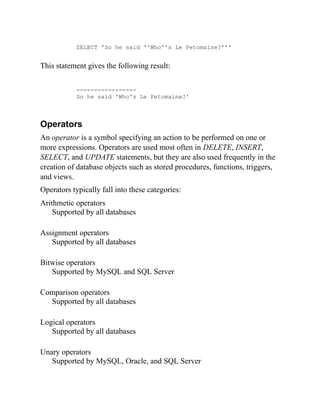
50.
SELECT 'So hesaid ''Who''s Le Petomaine?'''
This statement gives the following result:
-----------------
So he said 'Who's Le Petomaine?'
Operators
An operator is a symbol specifying an action to be performed on one or
more expressions. Operators are used most often in DELETE, INSERT,
SELECT, and UPDATE statements, but they are also used frequently in the
creation of database objects such as stored procedures, functions, triggers,
and views.
Operators typically fall into these categories:
Arithmetic operators
Supported by all databases
Assignment operators
Supported by all databases
Bitwise operators
Supported by MySQL and SQL Server
Comparison operators
Supported by all databases
Logical operators
Supported by all databases
Unary operators
Supported by MySQL, Oracle, and SQL Server
51.
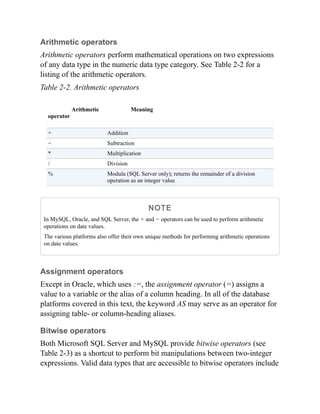
Arithmetic operators
Arithmetic operatorsperform mathematical operations on two expressions
of any data type in the numeric data type category. See Table 2-2 for a
listing of the arithmetic operators.
Table 2-2. Arithmetic operators
Arithmetic
operator
Meaning
+ Addition
− Subtraction
* Multiplication
/ Division
% Modula (SQL Server only); returns the remainder of a division
operation as an integer value
NOTE
In MySQL, Oracle, and SQL Server, the + and − operators can be used to perform arithmetic
operations on date values.
The various platforms also offer their own unique methods for performing arithmetic operations
on date values.
Assignment operators
Except in Oracle, which uses :=, the assignment operator (=) assigns a
value to a variable or the alias of a column heading. In all of the database
platforms covered in this text, the keyword AS may serve as an operator for
assigning table- or column-heading aliases.
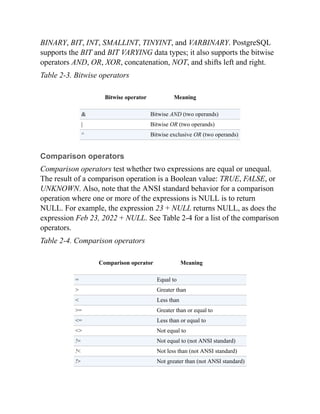
Bitwise operators
Both Microsoft SQL Server and MySQL provide bitwise operators (see
Table 2-3) as a shortcut to perform bit manipulations between two-integer
expressions. Valid data types that are accessible to bitwise operators include
52.
BINARY, BIT, INT,SMALLINT, TINYINT, and VARBINARY. PostgreSQL
supports the BIT and BIT VARYING data types; it also supports the bitwise
operators AND, OR, XOR, concatenation, NOT, and shifts left and right.
Table 2-3. Bitwise operators
Bitwise operator Meaning
& Bitwise AND (two operands)
| Bitwise OR (two operands)
^ Bitwise exclusive OR (two operands)
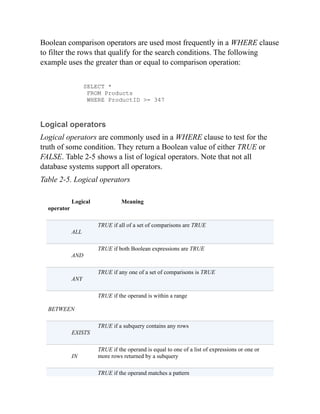
Comparison operators
Comparison operators test whether two expressions are equal or unequal.
The result of a comparison operation is a Boolean value: TRUE, FALSE, or
UNKNOWN. Also, note that the ANSI standard behavior for a comparison
operation where one or more of the expressions is NULL is to return
NULL. For example, the expression 23 + NULL returns NULL, as does the
expression Feb 23, 2022 + NULL. See Table 2-4 for a list of the comparison
operators.
Table 2-4. Comparison operators
Comparison operator Meaning
= Equal to
> Greater than
< Less than
>= Greater than or equal to
<= Less than or equal to
<> Not equal to
!= Not equal to (not ANSI standard)
!< Not less than (not ANSI standard)
!> Not greater than (not ANSI standard)
53.
Boolean comparison operatorsare used most frequently in a WHERE clause
to filter the rows that qualify for the search conditions. The following
example uses the greater than or equal to comparison operation:
SELECT *
FROM Products
WHERE ProductID >= 347
Logical operators
Logical operators are commonly used in a WHERE clause to test for the
truth of some condition. They return a Boolean value of either TRUE or
FALSE. Table 2-5 shows a list of logical operators. Note that not all
database systems support all operators.
Table 2-5. Logical operators
Logical
operator
Meaning
ALL
TRUE if all of a set of comparisons are TRUE
AND
TRUE if both Boolean expressions are TRUE
ANY
TRUE if any one of a set of comparisons is TRUE
BETWEEN
TRUE if the operand is within a range
EXISTS
TRUE if a subquery contains any rows
IN
TRUE if the operand is equal to one of a list of expressions or one or
more rows returned by a subquery
TRUE if the operand matches a pattern
54.
LIKE
NOT
Reverses the valueof any other Boolean operator
OR
TRUE if either Boolean expression is TRUE
SOME
TRUE if some of a set of comparisons are TRUE
Unary operators
Unary operators perform an operation on only one expression of any of the
data types in the numeric data type category. Unary operators may be used
on any numeric data type, though the bitwise operator (~) may be used only
on integer data types (see Table 2-6).
Table 2-6. Unary operators
Unary
operator
Meaning
+ Numeric value is positive
− Numeric value is negative
~ A bitwise NOT; returns the complement of the number (not in
Oracle)
Operator precedence
Sometimes operator expressions become rather complex, with multiple
levels of nesting. When an expression has multiple operators, operator
precedence determines the sequence in which the operations are performed.
The order of execution can significantly affect the resulting value.
Operators have different precedence levels. An operator on a higher level is
evaluated before an operator on a lower level. The following listing shows
the operators’ precedence levels, from highest to lowest:
Barbara's face andbleach her hair to the colour of ripe corn; rain
and wind and frost might redden and cut her hands, but Lucy's
cheeks were always satin smooth, and her curls black and glistening.
She tempted her sister with ointment made from cowslips, with
distilled rose-water, and balm of elder-flowers—all the sweetest
odours that ever perfumed woodland air were concentrated into
those green phials—but she tempted in vain. Barbara laughed. There
were the cows to milk, the sheep to herd, hoeing and weeding and
seed-sowing to do; what time had she for such fanglements?
The eastern clouds were rosy with the rays of the rising sun when
Lucy stole downstairs and opened the kitchen door. The four-poster
stood with its curtains closed like an Arab's tent in lonely gloom. The
girl shivered as she looked at it. The thought of the old woman lying
within took all the brightness from her eyes and the lightness from
her step. She was afraid of her great-grandmother as of something
unknown. What right had anyone so old to be still among the living?
Her place was with the dead, with the men and women whose
names had become a faint memory in the dale, but who were to her
personalities, that she had touched and handled. Lucy's mother had
died when she was a baby, and the grim old figure, that sometimes
rocked her cradle, had filled her infant mind with fear. Now that she
had grown to womanhood the fear remained, though she hid it
under a gay and careless demeanour. Still, the shadow of her great-
grandmother fell like a blight on Lucy's life.
She tiptoed to the fireplace and soon had the smouldering turf in a
glow. Then, opening the outer door and stepping out into the
sunlight, she filled the kettle at the spring. It was a fair morning.
The chorus of birds had ceased and busy feathered things were
marketing among the sprouting green of the beck-side. Far away up
the dale she saw the red cows move, and knew that Barbara was
somewhere near, driving them to new pastures. Thundergay was still
swathed with smokelike mists, rolling upwards in the breeze, and
gradually disclosing grey precipices, and slatey screes, with here and
there patches of emerald, where the young ferns were beginning to
57.
spring, and higherup, wide fields of snow. Lucy paused to pluck a
cluster of primroses, and place them in her hair. But she was startled
by a cough from a stunted tree near. Among its knarled roots
crouched a little figure, wrapped in a sack to keep itself warm.
"Oh, it's you, Jan!" said Lucy. "I thought you were a sheep coughing.
You should have stayed in bed to-day and taken a rest."
The creature raised a pair of watery eyes to her face, then dropped
them.
"I's always gotten up at dawn," was the reply.
"But it's so cold!"
Again the pale eyes were raised and dropped.
"Verra cold, lass."
"You must come to the kitchen."
"Nay."
Lucy laid her fingers upon his withered hand.
"Come and get warm," she entreated. "I've got such a grand fire
burning."
The old man made no reply, but kept his gaze upon her slender
fingers. At last his voice came slowly, as though he were drawing up
something from the dark well of his memory.
"Onced I seed a hand like yourn, onced, long ago. I's forgotten
when, but I minds the hand."
"Come," said Lucy.
He rose painfully and crawled by her side. But at the kitchen door he
held back.
"Nay," he repeated.
58.
"Why?"
"I must work."
"Rubbish,"said Lucy scornfully, and again she laid her hand upon
his. "You've been working all your life, you can have a rest now. Let
the new hind—Tom, do what's to be done."
The old man stared anew at her fingers.
"I minds where I saw that hand," he said, "it was outside a white
winding sheet ... long ago."
Lucy tried to draw him into the kitchen, but he was obstinate, and
afraid of Mistress Lynn.
"I'll go and feed the chickens," he mumbled, and shuffled away
round the end of the house.
Lucy looked after him sadly, then returned to her work. As she was
shaking the sheepskin rug a coin fell out of it and lay glittering upon
the ground. Picking it up with an exclamation of surprise, she turned
it over and over. It was a sovereign. For some minutes she stood
with her brows knit and her blue eyes darkening as thought took
shape. The coin was her great-grandmother's, there could be no
doubt of it. Lucy had always had suspicions about the locked
cupboard of the bridewain, which she had never seen opened. Now
she knew something was hidden there—money most likely, perhaps
many more coins like the one she had found, perhaps bags of them.
If one could be lost without a hue and cry being raised for it, they
must be as plentiful as blackberries.
What should she do? Should she keep it? Was it not her due,
considering the way she worked and yet received no recompense?
The temptation to put the coin in her pocket was strong, and she
thought longingly of the many pretty things it would buy. Then she
spurned the suggestion. She remembered Jan Straw, whose life had
been bought for a few pounds and a sup of porridge; she saw
Barbara wearing out her strong young life upon the fells; she
59.
thought of herself,drudging from daylight to day-darkening. The
bitterness of it set her teeth on edge. She looked again at the yellow
coin, and it seemed to have taken upon it a tinge of blood.
Then the curtain rings of the bed jingled, and turning round, she
saw that her great-grandmother was sitting up, looking at her.
Lucy might fear the old woman, but she was not lacking in courage
when the moment called for it. She balanced the coin upon her
thumb-nail, spun it into the air, and caught it as it fell.
"See what I've found," she said.
Mistress Lynn stared at the shining thing, lying on the girl's palm.
"Where didst get it?" she asked sharply.
"At the end of the rainbow."
"Rainbow! fiddlesticks! Give it to me."
Lucy dropped the coin into the outstretched hand without a word.
But she stood looking down, her eyes fierce and more like the old
woman's than Barbara's were, although in face and figure there was
no other resemblance.
"Where didst get it?" again asked Mistress Lynn.
"It fell out of the rug."
"Ah! I sold some sheep to a man from the South yesterday. I
thought he had paid me short money—they're such cheats in the
South! Well, well, it must have dropped out of his hand. Thee shall
have a shilling come Good Friday, Lucy."
"A shilling!" Lucy was scornful, "a shilling!"
Mistress Lynn looked narrowly at her great-granddaughter. Between
the girl and her little love was lost.
60.
"What ails theeat a shilling? It's over much when I come to think of
it. Thee shall have sixpence. That's enough for a young lass to
spend on fallals."
"1 wonder at you, I wonder at you, great-grandmother," exclaimed
Lucy. "I wonder at you hoarding up the money, and you so old."
"Wouldst like to see me play ducks and drakes with it in the beck?"
Lucy tossed her head impatiently.
"Why do you keep Barbara and me penniless?" she asked.
"I feed you well and clothe you warm—what more dost need?"
"Barbara," began Lucy, but the old woman interrupted her.
"What's Barbara complaining about?"
"Barbara never complains. But I know she's heart-sick for something
better than a lone life on the fells."
"If she's sweethearting," said Mistress Lynn, "if she's taken up with a
lad, I's nought to say against it," for the old woman thought that the
services of a young strong man would be of great value now that
Jan Straw was past work.
"Sweethearting!" replied Lucy. "It's learning Barbara's after!"
"Learning! Hasn't she enough learning for any lass, and more than
most? Doesn't she ken the lift like the palm of her hand, and the
dales and fells better than her ten toes?"
"It's book-learning Barbara wants."
"Book-learning! I don't hold with book-learning. Hark to me, great-
granddaughter. You'll be a good lass, and when I's gone there'll be a
nice little sum put by for you and your sister. Now, see to your work;
the porridge is burning," and the old woman sniffed the air
disdainfully.
61.
"Oh," said Lucy,with a shrug of her shoulders, "Mickle Crags will
have buried us all by then—you and me and Barbara and the money,
all in one grave."
"Hold thy tongue," replied the old woman calmly, but with such an
edge to her words that Lucy kept her peace.
Later in the day Lucy went up the dale to find Barbara. She eagerly
drank in the sunlight. It comforted her like a cup of sweet wine.
From the mosses of the beck-side, where she followed the cattle
road, a whispering could be heard as of life—innumerable, and
infinitesimal—waking to activity after its long winter sleep. Bees
were buzzing; birds were mating; the village geese, in charge of a
goose-girl, were being driven to their feeding grounds; Tom, the new
hind, with a boy to drive the horses, was ploughing in a steep field;
and Jan Straw was gathering rushes. Everything was up and active.
The dale in which Greystones was situated wound into the heart of
Thundergay. On the right rose Nab Head—a grey bastion streaked
with little streams trickling from the melting snows, and now all
aglitter in the sun. On the left, gloomy as its name, hung Darkling
Crag. The dale lay between like a green lizard, basking in the warm
light. It was green with marsh-mosses, and soon would be yellow
with king-cups. Lucy sang to herself as she climbed upward:
"Oh! have you found my golden ball?
And have you come to set me free?
Or have you come to see me hanging
On the gallows tree?"
There was no smile upon her face, but her eyes were wistful. She
was hoping that Joel Hart would soon find a golden ball and come to
set her free, before Greystones, and the tyrannical old woman there,
had robbed her life of its youth and sweetness. She was just twenty,
62.
and panting tospread her wings and fly away. She turned round to
look at her home.
It was the most solitary of habitations. About it hung an atmosphere
of old forgotten things. It had a tragic air as though its past, by
some strange process, were still in being. Even on a golden
afternoon such as this, it could not exorcise the grey spirit that
haunted it—the spirit of the ancient grey stones of which it was built.
The slates were green with moss: the drip-stone was feathered with
weeds which, before long, would belt it with a flowery garland: soon
the great sycamores would burst into leaf; but even then the house
would keep its gloom. It was a fitting habitation for Mistress Annas
Lynn, who was nearly a hundred years old.
Lucy turned her eyes away from it, and looked at the mountain at
the head of the dale, down whose sides the streams slid in thin
white lines to fall with many a rainbow cascade into Swirtle Tarn,
lying at its feet, blue as a violet. Thundergay dominated the dale. Its
jagged peaks soared high above the fells around. It was the birth-
place of eagles, mists and storms; and it was also the nurse of her
sister Barbara.
Her mind turned to Barbara.
If Lucy ever visualised such abstract ideas as goodness, integrity,
and justice, she saw them under the living form of her sister. Joel
Hart she loved; Barbara she worshipped. With Joel she stood on an
equality—he was as humanly imperfect as she—but Barbara stood
on a mountain height, a great, grand figure, with a great, grand
heart, sublime in her magnanimity, immovable as granite among the
storms of her world.
She felt, too, that it was among the mountains that Barbara found
her secret inspiration and strength. Since childhood she had spent
the greater part of her life upon Thundergay, and, though it had
been a rough nurse, beating her with winds like scorpions, training
63.
her by hungerand cold and weariness, yet she loved it still, but it
had made her silent.
Lucy did not put her thought into these words, but she felt them,
nevertheless.
She now left the cattle road, and followed a sheep-track round
Swirtle Tarn. A shoulder of Thundergay seemed to block her way,
but the track wound in and out of knowes and hollows, and led her
at last through a gap, where she looked down upon a scene of
pastoral beauty. A lawn of velvet grass lay by the margin of the tarn,
dotted with sheep and a few lambs—the firstlings of the flock. It
sloped gently upwards, and surged like a full green tide against the
bases of the cliffs. Here was a cave, called for generations Ketel's
Parlour, in memory of some Northern robber who had made it his
eyrie. Now Barbara claimed it, and often slept there when her work
kept her abroad at night. The flocks were her especial care, and she
"shepherded and improved the same according to the due course of
good shepherding," as the old title-deeds of Greystones
recommended.
Lucy looked in. By the threshold her sister lay fast asleep, her long
limbs sunk in repose upon a bed of straw. Her head was near the
entrance, and the sun, as it got lower, flowed in golden ripples
across the threshold. When it touched her eyes she would awake,
for the sun was her clock by day, as the Great Bear was her clock by
night.
Lucy did not speak, but took her knitting from her pocket, and sat
down on a rock to wait.
The cave had been partly built up long, long ago, and two narrow
slits of windows made in the artificial wall. The rusty remains of iron
bolts and hinges showed that a door had once closed the entrance.
A huge slab of slate lay across the threshold, and underneath it a
little spring that babbled out of the floor of the cave disappeared,
appearing again some few yards further down the slope.
64.
It was notlong before Barbara awoke. The sun was sinking; the tarn
lay in shadow, blue as steel and glassy as a mirror; now and then a
heron struck an evanescent star from the shallows where it
splashed. But the fellside still stood full in the vivid light, and was
dyed to a rich green, like the colour seen on old silken needlework.
Upon Barbara, standing at the mouth of the cave, the sunshine
seemed to concentrate. She looked larger and grander and more
remote than a simple human being. She might be an incarnation of
some Nature-power, older than the mountains around her,
unassailed by time, and partaking of the perpetual youth of
immortals.
"One of the ewes has died," she said to Lucy, "and I've spent hours
trying to get its lamb fostered. Like enough thee'll have to take it
home, and bring it up by hand."
"Botherment!" exclaimed her sister; "haven't I plenty to do already?"
Barbara made no reply. She was wondering what it felt like to be
dead, wondering what that strange thing was which came but once,
but came to all living, to men and women and sheep, and, in the
twinkling of an eye, sent them out of the Known into the Unknown,
where all mysteries might abound.
"Hast ever thought, Lucy," she said at last, "how strange it is that we
should die like sheep and sheep like us?"
"Not I!" replied the younger girl. "My head's stuffed with lighter
rubbish," and she shuddered as her eyes fell upon a huddled white
heap under a thorn.
"It mazes me," continued Barbara, "when I think that yon poor
creature I've thought so silly mappen knows more than I do now.
Death must be a queer waking, Lucy. It's likely we'll find that we're
very different to what we fancied we were. It's likely we're not the
only things with souls. It's likely that the world wasn't just made for
us, and all the creatures for our use. Old Camomile says that every
blade of grass has its own little green soul, and loves the wind and
65.
the sunshine andthe rain, and has its ideas about the sky and the
stars. Mappen it puts us down as girt senseless creatures, too
coarse-minded to understand its thoughts."
"Old Camomile is getting old," said Lucy. "He havers a lot."
Barbara was silent. She rarely spoke because she rarely found
anyone to understand her, save the old man Timothy Hadwin, called
by the villagers Old Camomile, because he made potions, and
electuaries, and essences, curing their aches and pains as if by
magic.
Lucy rolled up her wool, put the ball in her pocket, and looked slowly
round.
"It's a lonely-like place to spend the night," she said. "I wonder
you're not afraid."
"Sometimes I am," replied Barbara. She recalled nights when she
had trembled before the vastness of the hills, when the winds had
deafened her with stories of things she could not comprehend, when
she had turned from gazing at the cold light of the stars with a fear
at her heart, because they would answer nothing to all her
questions.
Barbara was not educated as the world counts education. It is true
that she knew the fells and dales, the tarns and meres of her native
country, as well as the oldest shepherd, who had spent his long life
among them. She could tell the names of the constellations, and
take her direction upon the darkling moors from them. She knew
when to plough and sow and reap. No one was so weather-wise as
she in the village. But this is not education in the eyes of the world,
and Barbara set little value upon her knowledge. She could not
speak the King's English, though she spoke something much more
picturesque and vigorous; she only read the simplest books; and
wrote an ungainly, but characteristic hand. She knew no history, but
her mind was furnished with a collection of tales and legends, which
held more of the inner truth of history than the bare facts. Yet she
66.
longed with allher ardent nature for the learning contained in
books; for the power to grasp the thoughts that flashed across her
mind and left upon it an impression as of a great flying light, which,
if it had not eluded her, would have illumined her whole being. She
pined for the life of the intellect.
"I wish we could get out of our bodies," said she, breaking the long
silence. "I wish we could shake them off like an old shift, and leave
them here on the grass, while our souls sailed in the air naked-free."
"What a horrid idea!" said Lucy, shrugging her shoulders.
"But our bodies are so earthy—always wanting meat and drink, and
crying out for sleep. They throw a shadow on us, like a great rock
blocking the light o' the sun."
"I know nought about it," answered Lucy, carelessly.
Barbara laughed at the puzzle of her own thoughts.
"I know nought either," she said; "yet something in me would like to
win out if it could."
Lucy went up the sheep-path. On the brow of the knoll she paused,
looking back. Barbara was kindling a fire outside the cave, and the
smoke, as it coiled upwards, hung between them like a blue veil. Her
sister seemed to be moving among mysterious things, and there was
symbolical meaning in the blue veil. For two worlds lie side by side,
the material and the spiritual, and from either the view into the
other seems hazy and unreal. But the greatest intellects try to
reconcile them. Towards such a reconciliation Barbara, in her
untutored mind, was striving.
The sun had gone down, and, though the sky was still flushed with
red and yellow, a subdued light and solemn stillness filled the dale—
a stillness made the more impressive by the distant splashing of
waterfalls and the calling of birds by the tarn.
67.
Lucy felt sad.She had dropped over the knoll with a sigh. Barbara
had listened to her story of the gold coin, and dismissed it without
comment. She had not been impressed by the idea of their great-
grandmother's hidden wealth. She had suggested no way of making
life easier or pleasanter. Instead, her mind was possessed by vague
ideas and strange questionings, which her sister could not
understand, and which had no bearing upon their everyday life. Lucy
went home in the waning light with reluctant feet.
But she was mistaken about Barbara's interest. For her sister had
long known of the secret hoard, and had once remonstrated with the
old woman about saving it in this way. But it had been in vain, as
everything was in vain which opposed the will of Mistress Annas
Lynn. The failure of the attempt had only served to strengthen the
patience of her generous nature—the patience which can school
itself to wait for the fulfilment of its desires, and, if need be, to
receive without a murmur their denial. No shadow of a quarrel ever
dimmed Barbara's out-goings or comings in; her intercourse with her
ancient kinswoman was serene and reverent, and she would not
hazard it in an attempt that could only result in an upheaval of the
bitterest passion. Barbara then put the matter from her. In this she
was different to Lucy, who could not cease to think and wonder and
debate even after she had made up her mind.
68.
CHAPTER III
Peter Fleming
Theswift night came down; fells and dales were folded in purple
gloom. Stars began to shine, and Barbara, eating her supper of
coarse bread, let her eyes wander from group to group with
meditative enjoyment. To her the sky was no vast abyss dotted with
a formless multitude of shining points, but a field of wonderful fiery
things, each following its own appointed course. Yonder glittered
Leo, there swung the Great Bear and the Dragon; and, there on a
mountain peak, shimmered the Northern Crown. It led her thoughts
to Timothy Hadwin's prophecy, when he cast her horoscope; for she
should wear a crown, he said, and though Barbara was too wise to
put a strict construction upon his words, nevertheless, she found
pleasure and inspiration in them, wondering what they might mean.
She flung an extra armful of wood upon the fire, for the night air
nipped frostily. Then, taking her lantern, she went among the sheep
to see that all was well with them and their lambs. The little orphan
had been adopted, and nestled with its foster-brother against a
warm woolly side. A sense of placid well-being lay over the fold, so
the girl returned to the fire. As she sat in silence, her fingers busy
making a withy basket, and her mind active, there came from over
the tarn a sudden burst of melody, ethereal as elfin music. It was
echoed to and fro from cliff to cliff, now it danced overhead, then it
stole like a whisper out of a dale far away. The shores of the tarn
were ringed with sounds, so haunting that they seemed to be
unearthly. Barbara listened in amazement.
Someone was playing a flute from the Rock of the Seven Echoes.
69.
Again the musiccame rippling across the water and was tossed
about from hillside to hillside in airy phantasy. When at last it died
into silence, Barbara became conscious of the other sounds of the
night—the tinkling of distant waterfalls, the cropping of a sheep
close by. She listened expectantly, but the sounds were not
repeated.
"It must be Peter," she thought, "only Peter plays the flute hereaway,
except Jake, the ratter, and only Peter would play it at such a place."
Her eyes brightened when she thought that he was back again in
the dale. Between him and the sisters lay a good fellowship. Often
he spent hours with Barbara among the sheep, reading to her stories
of old combats and great doings from the Iliad and Odyssey. But he
was equally at ease when he helped Lucy to top and tail
gooseberries, or sought among the bracken for the nest of the
laying-away hen.
Barbara stirred her fire to a brighter glow. She knew that he would
see it on the other side of the tarn, and perhaps he might come
round to the cave and greet her after his long absence.
Peter was the only son of John Fleming, the miller—called Dusty
John in the village—who was a man of some substance, plain habits
and little education. But he gave his son every advantage. The boy
was sent to school, and afterwards, proving himself apt beyond
expectation, went to St. Bees, from which ancient seat of learning
he won a scholarship to Oxford. The miller's ambition was to see his
son in the church, where he did not doubt Peter would soon be
promoted to the highest office. In dreams he beheld him Archbishop
of York or Canterbury. But the lad said neither yea nor nay to his
father's wishes. He enjoyed himself to the full, coming home for
vacations with a light heart, accepting the truckle bed in the mill-
house and the homely fare with as lively a humour as he did the
varied life of Oxford.
70.
He reached thecave just as the moon was rising, and leaned his
back against the cliffs to watch the light sparkle on the water.
"When did you get home?" asked Barbara, putting her withies aside,
and bringing him a cup of milk.
He laughed.
"I've not got home yet," he said, "for I left the coach early in the
afternoon to come over the tops. But they were too deep in snow,
so I had to take the Girdlestone Pass instead. I stayed at the
Shepherd's Rest for an hour. Now here I am, late as usual."
Then he plied her with eager questions about his father and mother,
the village folk, and the welfare of all at Greystones.
"How goes the studying, Barbara?" he asked. "Have you read the
book I sent you?"
She shook her head.
"Nay; it's not that I haven't the will, but there's no time. Jan Straw is
grown so old, and the new hind hasn't got into the way of things
yet, so that the heavy end falls on me." Then she added with a
smile, "There's such a lot of me to get tired, Peter."
He looked at her. Though he could not see the calm eyes and the
corn-coloured hair, the outlines of her form were splendid in the
silvery light. He felt dwarfed beside her, not physically, but morally.
Hers was the finer spirit. He acknowledged it with a glow of
generous feeling, for he was given to hero-worshipping.
"We'll make a pact, Barbara," he said, "while I'm at home I'll
shepherd the sheep, and you shall read."
"You are good and kind, Peter," replied she, "but I remember how
you helped me once before. If it wasn't a rainbow, it was a flower,
and if it wasn't a flower, it was a bird, but never the sheep-salving or
the cattle-herding. The kye got into the barley-field—do you mind?"
71.
They both laughed.
"Whata careless brute I am to be sure," said he. "But if you won't
let me look after the farm, I'll come and read to you, when you have
time to listen. I've brought you a new book; you'll like it."
He unstrapped the pack he carried, and took out a stout volume. In
the light of the fire he showed it to her. It was Pope's Homer.
"Some warm day," he continued, "we'll sit on the fellside and wake
again echoes of great deeds, and old battles. Thundergay shall be
Olympus, and you shall be Athene, the azure-eyed maid. Listen to
this——"
He bent down by the fire and held the book so that he could read by
its light.
"'Now heaven's dread arms her mighty limbs invest,
Jove's cuirass blazes on her ample breast....'
"I can see you in them, Barbara."
'The massy golden helm she next assumes,
That dreadful nods with four o'er shading plumes;
So vast, the broad circumference contains
A hundred battles on a hundred plains.
The goddess thus the imperial car ascends;
Shook by her arm the mighty javelin bends,
Ponderous and huge; that when her fury burns,
Proud tyrants humbles, and whole hosts o'erturns.'"
He closed the book and put it into the girl's hands.
"I've never seen you roused up to do battle," he laughed, "but you'll
look like that when the spirit moves you. Good-night, Barbara."
Something stirred her like the call of a trumpet heard by her spiritual
ears alone. Was her placid life upon the mountains going to end?
72.
Would she haveto fight with her desires, because Duty still pointed
a stern finger towards the sheep-paths, while another road opened
before her—a broad and pleasant road. Peter always roused this
restlessness in her heart. She was glad, yet sorry, when he went
singing home, leaving her to the night-loneliness with her book of
old battles.
The next morning Peter Fleming was walking up and down the
cobbled path of the mill-garden between flowering currant bushes,
and sheaves of lent-lilies, whose buds were still encased in their
pale-green sheaths. Everything sparkled in a sudden burst of
sunshine. From the mill-wheel the water fell like a glittering fringe,
and the beck raced merrily by, clutching at the weeds and grasses
on its rim, and drawing them down to make them gorgeously green
under its clear surface. On the other side of the stream stood Cringel
Forest.
The mill-house was a tall building with the date, 1600, carved over
the door under a coat of arms of a wheat-sheaf and a sickle. The
Flemings, or De Flemings, as they were then called—had been
millers in the dale since the reign of Elizabeth, a fact which Dusty
John prided himself upon, although he was as simple an old man as
ever spoke the vernacular.
The kitchen door was open at the end of the cobbled path, and in its
hot and sunny atmosphere, Peter's mother stood ironing. Her muslin
kerchief—as fine as ever came from the looms of the East India
Company—her gown of russet, and white apron were the essence of
cleanliness and order.
"Get away with thy blandishments," she said, for Peter had paused
on the threshold to tell her that she looked like a ripe hazel-nut, her
face was so brown and rosy and round. "Thee'd witch the wisdom
out of my old head with thy flattery. And as for thy dadda—he
cannot walk for swaggering, thee's lillied him up so handsome!"
73.
She smiled proudlyinto the clear-eyed face looking so affectionately
into her own. Peter made her feel that she was still young and
worthy of admiration. When he came home she always wore white
stockings—though she thought them an extravagance at other times
—and placed a flower or a bow of ribbon under her chin.
She held up a kerchief that she was ironing, and said tenderly:
"It will be a great day for thy father and me when we see thee
consecrated, Peter."
He stepped across the floor where the sunshine lay in a broad band,
and kissed her.
"And a blessed day when I does up thy lawn sleeves, my son. Thee
must never let anyone do up thy sleeves but me, lad, not even thy
wife when thee gets one. There's nobody kens the art of clear
starching and ironing better than thy old mother."
The young man sat on the edge of the table and swung his legs.
"You'll be disappointed, mother," he said, "but I never can see
myself—in spite of your dear visions—in bishop's sleeves. I'm a lazy
beggar, and more likely to be lying under a tree, finding sermons in
stones and books in the running brooks than beating the pulpit
cushions of Durham or Carlisle."
She shook her head indulgently.
"Time enough, time enough," she said. "Thee's too young yet to
know thy own mind."
Peter looked round the kitchen and laughed.
"Would you like to live in a palace, mother?" he asked.
"A palace! And what would I do there?" she replied, seeing no
further than the lawn sleeves which she would wash and iron.
74.
The kitchen ofthe mill-house was small, clean and simple. Brass
fire-irons, two or three candlesticks, a burnished copper warming-
pan reflected the strong sunshine, but otherwise the puritanical
severity of the white-washed walls was unrelieved. The floor was
strewn with river sand, and the chairs and dresser glistened with
constant oiling and rubbing. On the dresser was a pile of newly-
made clap-cakes, and round the fire stood an oak maiden hung with
clean linen. The place had a kindly, homely smell, and Peter sniffed it
with enjoyment. He loved the towers of Oxford, and the shadow of
his college cloisters, but this small and sunlit kitchen, where his
mother baked and ironed, and his father smoked his evening pipe,
brought him back to those primitive passions of man out of which
the strength of his life springs.
Peter returned to the garden and continued his walk up and down
the cobbled path.
He was thinking of his future, and wondering what he would be able
to make of it. He had almost decided that he would not take orders
when his college days were done, which would be at the summer
vacation. The prospect of becoming a curate, or even a North
Country vicar did not attract him; on the other hand, he had no
particular leanings in any other direction. That which would have
suited him down to the ground, he sometimes told himself
whimsically, was the position of a country gentleman, with a good
library, a well-stocked stable, plenty of dogs and troops of friends.
His was a genial, breezy nature; he had a firm hand, a just mind,
and a clear brain, added to a boyish love of the unusual and
adventurous. Peter was a favourite in the village. He liked pretty
faces, and flirted openly, but he left the lasses' hearts none the
worse. He fished and hunted with the lads; he talked politics with
the tailor, religion with the cobbler, and with Jake, the rat-catcher,
spent many a long afternoon. It was Jake who taught him to play
upon the flute, and though he never managed to charm the rats
with his music—as the strange little man did—he had the young men
75.
and maids caperingon the bit of green before the inn door on
summer evenings, long after they ought to have been abed.
His meditation was interrupted by a horseman calling from over the
wall:
"Halloa! Peter, back again?"
It was Joel Hart.
"I'm glad to see you," said he.
"I thought you'd made up your mind to go abroad and seek your
fortune," replied Peter, shaking hands heartily.
"So I had, but I broke it again. I couldn't be quite sure where to find
the fortune."
They both laughed, but Joel had a note of envy in his mirth.
"You're a lucky dog, Peter," he exclaimed, "to have money in your
pockets and a fond father ready to supply more. How long are you
home for?"
"Six weeks. It's the Easter vacation."
"Good! we'll have some fishing and wrestling—eh? We'll make a
damned fine holiday of it. I want something to take my mind off the
worry of wondering where my bread and butter is to come from. You
don't want to work, I bet; had enough of that sort of thing down
yonder—eh? Come and have a glass at the Wild Boar."
He alighted and leading his horse by the bridle walked down the
village street with Peter.
When they were boys they had gone nutting and fishing together,
and the memory of many a hairbreadth escape still bound them with
the links of affection, though in mind and character they had long
since drifted apart.
76.
Joel Hart wasa handsome man. Beside him, Peter with his homely
face, honest grey eyes, and loosely built figure looked rough-hewn—
looked, indeed, that which he was, the off-spring of clean-living,
hard-working peasant forefathers. The two men were of a height,
but the one carried himself proudly, looking neither to right nor left;
the other with an easy swing, that could stoop to give pennies to a
crying child, or lift a bundle for an old woman. There was an
expression of arrogance and dissatisfaction on Joel's features that
marred their beauty. He had dark curling hair, which he wore rather
long, his eyes were large, well-shaped, full of a smouldering fire or
melting sadness as his mood chanced to be.
The world had dealt hardly with him, and he could not forgive it. His
father, the son of that ill-fated Joel Hart whom Annas Lynn had
hidden in the wool-barn, had married late in life, and died shortly
after, leaving his infant to be brought up by the widow—a vain and
foolish woman. She had been indifferent to his discipline and
education, and when she died, left the estate—it was a very small
one—burdened with debts, a burden that increased rapidly, owing to
extravagance and bad management. Joel was not competent to deal
with it. A habit of indolence, fostered by his up-bringing, had
become second nature to him; his temper was uncertain; yet he
cared deeply for two things—Forest Hall and Lucy Lynn. To preserve
the one, and gain the other was a wild dream that he dreamed, but
made only fitful attempts to realise. He felt that he was bound by
invisible bonds which he could not break.
"I'm getting to the end of my resources, Peter," he said as they
stood in the inn parlour, drinking. He often make a joke of his
poverty; it was too well-known to be hidden; and he did not care
that folk should see how much he felt it. "I've only one hope left."
"I trust it's a substantial one," remarked Peter.
Joel flung back his head and laughed.
77.
"Ha, ha," hecried, "ha, ha. It's the old great-grandmother up at
Greystones."
"You're not thinking of marrying her—are you?" said Peter, his eyes
twinkling.
"'Pon my soul I never thought of it! What a pity. She'd have had me,
Peter, for the love she bore my grand-dad. I needn't have waited till
she was dead, then, to have got her money."
"She's rich—is she?"
"Must be! an old miser! She told me she was going to leave the little
she had—little, mind you, and Greystones is the most prosperous
farm for miles round—she said she was going to leave it to be
divided between Barbara, Lucy, and me. She's ninety-five now, and
can't live much longer, though she looks as hale and hearty an old
sinner as ever laid up treasure in this world. I hope she'll not forget
her promise."
"Court her," replied Peter, briefly.
"Her or her great-granddaughters?" Joel shot a sharp glance at his
companion. He sometimes thought that Peter had a warm side for
Lucy as well as himself. "All the same," he continued, tossing off
another glass, "I'm breeding dogs, as a stand-by, in case she dies
without leaving me a shilling. You must come and see them. I've got
a litter of the prettiest pups you ever saw. I keep 'em in the parlour
because the kennels are all out of repair. It's a comedown, eh, for
the master to sup his porridge in the kitchen, but feed his dogs
under the very noses of his forefathers in their gilt frames?"
They talked a little longer, made plans to join the fox-hunt next
morning, then Joel mounted his horse and rode away, while Peter
retraced his steps up the village street.
He thought that Joel was changing. The man looked unhappy and
restless in spite of his gay demeanour. He talked too much, and he
drank too much. He might be as poor as he asserted, but he rode a
78.
fine horse—Peter wasa judge of horse-flesh—and his clothes were
dandified beyond the fashion of the times. Yet there was something
in him that appealed to Peter, who thought he looked like a gay bird
in a trap. And what trap could be worse than one made out of family
pride, poverty, and lack of education?
Pondering upon his friend's character and circumstances, he passed
through the village.
High Fold, in the midst of which the mill stood, was a cluster of
houses on the fringe of Cringel Forest. They were built of grey stone,
roofed with rough-hewn slates, where the yellow stonecrop ran riot,
hung with queer little balconies, giving them a foreign air. They
stood at all angles on either side of a steep road, at the foot of
which was the inn, at the top the church. Except for the house
known as Forest Hall, the farm of Greystones and a few solitary cots,
High Fold marked the limit of human habitation in that direction.
Beyond it were many miles of heathy moorland, a wild expanse of
mountain, barren ravines, each with its own gushing beck, and wild
marshes. The people were a healthy, thrifty race, lacking little—and
those things not necessities—working hard and simply, and living to
a good old age. Many of them herded sheep on the common lands;
a few wrought in a silver mine some distance off; others spun and
carded wool; a tailor, a weaver, a rat-catcher and a blacksmith were
respected members of the community. They owned a large flock of
geese, each bird was smit with its owner's private mark, and a
goose-girl, in the common employ, led them daily to their feeding-
grounds. There were few idle hands in the village, even the old men
knitted stockings, sitting on the inn bench of a spring or summer
evening.
Peter followed the road beyond the village, where it turned into a
cart-track, and wound through Cringel Forest, leading to Forest Hall,
and then on up the dale to Greystones.
As he lay under a beech-tree, watching the birds fluttering among
the smooth branches, a little old man came wandering through and
79.
sat beside him.
Thehair of the little old man curled on his shoulders, like a child's—
though it was grey instead of golden—and his eyes were also like a
child's, bright and questioning. He was primly dressed in a flowered
waistcoat buff breeches and blue stockings, but the garments were
faded and threadbare. On his knee he held a basket of roots and
leaves.
"Meditation," he said, "is the mother of great thoughts, and repose
fosters them till they be well-grown."
"That's comforting to my lazy soul," drawled Peter.
The thin old voice continued, carefully choosing the words as
though, even in meditation, nothing slipshod or ill-fitting was allowed
to pass.
"We should find time to be idle," he said. "When the soul is
possessed by tranquillity, there enters in an angel called thought—a
mysterious being, whose birth and origin is far beyond our
knowledge or understanding. But we can give her housing, care for
her like kind folk, and she will reward us abundantly. Her presence
with us is her reward."
Peter chewed a blade of grass, basking in the warm light. For a little
while neither spoke. The last week had shaken off all the
appearance of winter from the forest. The trees were budding, a tall
poplar rose purple as a plum, yonder a group of larches were turning
green, and a sycamore had all its tips dipped in crimson. The
blackthorn thicket was white, and the lesser celandines were golden
on the banks. In the forest lay a deep blue silence—the silence of
old wise trees, but on the topmost branches, gay and giddy birds
were pouring out their hearts to the spring sunshine in a wild burst
of melody.
"It's all very beautiful," said Peter; "that light on the beech-stems—it
might be a splash of pure gold. The trees seem to be aware of it too
80.
—if only theirleaves were out they would be clapping their hands for
joy." Then he turned to Timothy Hadwin. "I'm becoming a convert to
your Faith," he said. "I believe the earth has a soul and every living
thing."
"You feel it, then?" replied the old man, eagerly. "You feel a magic in
the woods which only comes from the communion of souls? You and
I and the trees are not alone here. You feel that other minds are
reaching out to touch you, as you are reaching out to touch them?
You have in your own mind this vision of the truth—the kinship of
the living world?"
"Perhaps it's imagination after all," said Peter.
"Imagination does not lie."
"It may deceive."
"No, no. What we imagine is true for ourselves, though no one else
may see it to be so. We each of us have senses, feelings, thoughts
of our own. Were you to tell me that you saw a hamadryad coming
out of yon beech-tree, I should not contradict you because I could
not see it. But if you plucked a buttercup, and said it was only
coloured matter, I should say you were wrong, for I know it to be
something more. The greatest blessing of life is sight, and the
commonest ill is blindness." He laid his hand upon the ground and
continued. "We are all akin, because we are all the children of the
Earth. Her great mind is made up of our little minds. She knows us
better than we know ourselves—do we know ourselves at all? I love
to think of the Earth, a personality, a great angel rejoicing as a
strong man to run a race, rushing along through the dark night or
the bright day, through clouds and through sunshine, never halting
or stumbling or going astray, carrying upon her bosom a
multitudinous life, caring for it, as a thoughtful mother."
After this conversation the two men were silent for a while, each
following the trend of his own thoughts. Then Timothy got up and
went away. But Peter remained under the beech-tree.
81.
Peter had capacityfor the full enjoyment of life, and a boundless
curiosity concerning it. As he lay on the ground he seemed to feel
the heart of the Earth-mother beating under his own, and he was
filled with a sense of her teeming vitality and his individual share of
it. He opened his mind to the sounds and sights around. It delighted
him to follow with his eyes the stems of the trees as they sprang
straight from the bosom of their universal mother into the blue air.
He listened to the whistling of the birds, the hum of the bees, and
watched a rabbit leap among the ferns—pleased with such simple
demonstrations of life. Perhaps a change was working in his own
nature, for never had the common things about him seemed to be
so full of absorbing interest as now; never had he been so conscious
of the sap running up the branches of the trees, and of his own
vitality. At present he did but enjoy the sense of power, which he
could use if he desired. But soon, he told himself, he would labour,
singing in the light of the sun.
Then through the forest came Barbara Lynn, driving her primitive
cart home from market. She did not see the figure under the beech-
tree, for her eyes were dreaming, neither did Peter try to draw her
attention. She sat with her hands lying loosely on her lap, the reins
hanging slack as the old pony took its own pace home. Her fine,
large features were composed, and she kept her jolting seat with
unconcern. There was something patriarchal in the cart, and its
rough-cut wooden wheels, and the regal form of Barbara, deep-
bosomed, yellow-haired and clear-eyed as the off-spring of shepherd
kings should be.
She passed on, while the over-arching trees dropped lights and
shadows across her face. Peter watched her till the blue distance of
the forest closed round the cart, and the creaking of its wheels died
into silence.
He came back to a knowledge of himself with a rush. For the time
being his mind had been merged in the mind of another. The forest,
too, was waking as from a trance. Barbara had seemed to hold it in
the spell of her own dreaming. Now the wind blew down the track,
82.
trundling dead leavesbefore it, and drawing a low chiming from the
branches overhead. The birds burst into renewed twittering, and the
rabbits leaped among the fern.
83.
CHAPTER IV
The Shieldof Achilles
Barbara was driving sheep on the fells above Cringel Forest. She
looked down and saw the trees bourgeoning into leaf, and rising out
of them, on the top of a jutting crag, the old house belonging to Joel
Hart. It was an unpretentious place, but battlemented and loop-
holed, made for defence when moss-troopers paid frequent visits,
and not for beauty or comfort. It was, in fact, little better than a
fortified farm-house; underneath it ran a long dark cellar, where the
cattle of the villagers could be driven for safety in times of alarm.
Barbara's keen eyes—keen as an eagle's to scan the broad fellside—
noted the air of decay which had settled upon it, the thicket of
brambles among the chimneys, and how a pine, growing out of the
rocks, encroached upon the doorway. Behind the house the ground
swept steeply up, strewn with shattered boulders and weeping with
waterfalls.
"Poor Joel," she said to herself. "He's like Paris, in the book Peter
gave me—beautiful Paris that Helen loved, whose soul ill-matched
his fair form."
She thought of her sister's adoration of this man, and was sad.
There could be nothing but disappointment in store for Lucy, she felt
sure of it, unless the girl overcame her affection and set her heart
upon a more worthy object. But she was attracted by the glamour of
fallen greatness, by his handsome presence, and she admired his
pride. Barbara, with clearer vision, saw a man tossed about by
circumstance, without a guiding principle in his life, whose pride was
as hollow a thing as a soul ever cherished.
84.
She turned awayfrom Forest Hall, and the disquieting thoughts
which Joel roused, and looked up the dale. It wound in sun-swept
greenness to Thundergay, where Swirtle Tarn glittered like a silver
sixpence. For some days clouds had been gathering there, piled one
on the other like wool-sacks, white and soft as wool just now, but
stained crimson at sunrise, and black as smoke at night. The light
was vivid, and had that peculiar quality of deepening the colours of
the landscape, often the forerunner of storm; the purple of the
distant hills was more intense, the green of the grass richer, the red
of ploughed earth more passionate.
The sheep that Barbara was driving were uneasy, making many
attempts to break and turn back. Then the leader, recognising the
summer heaf to which the flocks return in spring, after having
wintered in a more sheltered place, set off at a run, followed by the
rest. Shading her eyes from the sun, she watched them leap gladly
upwards, bleating their welcome to the well-remembered spot—for
the bond binding the sheep to their hill-pasture, is as the bond
between man and his own hearthstone.
She turned homewards. As she threaded her way among the rocks
of the rough path, she came upon Jan Straw gathering wool, which
the sheep had left behind them upon the heath and brambles.
"Her was buried in a linen shift," he said, answering her remark that
he was busy at a strange gleaning. "Her was buried in a linen shift,
fine and white and soft as snow."
"Who?" asked the girl, for she saw that his mind was wandering.
"Her o' the white fingers, white as Lucy Lynn's, white like the linen
she was buried in, white as snow."
"Your wife, Jan?" said Barbara, having in her mind's eye a vision of
golden curls and a little pale face, which had been buried long
before she was born.
Jan said no more, but, turning away, continued his gleaning.
85.
"What are thewisps for?" she asked.
"I mun be buried in woollen," he muttered, "the law says so—it said
so then—but she had a linen shroud, the best linen as ever was
wove, shining like snow, like them little white flowers she loved."
He stood up, trying to straighten his crooked back, crooked with the
toil and poverty of years.
"I mun be buried in woollen," he repeated, "and I's picking my
shroud off the brambles. Yon little lass, Lucy, her o' the white hands,
she promised to spin it for me and get it wove. It wunna be white
like snow, like her own bonny hands, but it'll match my old grey
face. I's'll not be buried by the parish. I's'll lie aside her in the kirk-
garth below there."
He wiped a tear from his eye.
"Her should have been buried in woollen too," he added, bringing
these memories from the abyss of his mind, where they had long
lain in darkness, "but her was so white and soft, white as milk and
soft as silk, her couldna abide the touch o' a woollen shift. So her
was buried in linen, and I paid the fine."
"It will take a lot of gathering, Jan, before you get enough to make a
shroud," said Barbara. "But let it be, let it be; leave it for the birds to
build their nests of. You shall have a fleece, and a decent bed, too,
when you need it, beside her o' the little white hands."
He looked at the girl slowly, from her feet to the crown of her head.
"Thee's a girt lass," he said, "as big as the mistress, and they used
to call her daughter o' the giant that lived at Ketel's Parlour. But
thee's got a kind, soft voice, Barbara Lynn, like the cooin' o' wood-
doves. Wilta gie me a fleece?"
She nodded, and the pale watery eyes brightened.
86.
"The birds iswelcome to my gatherin'," he replied scattering his
bundle of wool. "I's'll go and pull rushes. We's gettin' short o'
candles down-by," and he shuffled away.
Barbara watched him go. She thought how hard it was to be old and
lonely and poor. Jan had bed and whittle-gate at the farm—decency
could do no other after a life of honest service—but, as the old man
was past work, what use had he for wages? Such was her great-
grandmother's argument for refusing to part with a penny of her
hoard.
Barbara went slowly down-hill. She had an hour to spare before
milking-time, and it was too precious to be lost. She passed along a
ledge of the Mickle Crags, found a sheltered spot, and sat down. She
could not see Greystones, as it lay right below her, but she could
smell the turf-smoke from its fire.
There, with her hands clasped upon her knees, surrounded by a
wilderness of grey rocks, she gave wings to her mind. All through
this Easter-tide she had walked as in a dream; but it was the dream
and not the actual that had life. She came and went, rose before
dawn, and passed the day toiling upon the fells, but now and again
she culled an hour to spend with her book—Pope's "Homer"—at the
cave. Sometimes Peter came there and read to her, often the old
herbalist Timothy Hadwin accompanied him, and the two men would
talk, while she listened, weaving withy baskets, but weaving into her
own mind many a wonderful thought. Thus she learned to know the
old stories of Achilles and Hector and Helen, of Ulysses and
Penelope; she was thrilled with the beauty, pathos and madness of
them. The natural objects about her began to take on a new
meaning; she was able to feel the freshness of the early world,
when men's hearts were fuller of the mystery of things, less sure of
their own place in the Universe, and stricken with fear before the
veiled faces of the gods.
She likened her mind to the shield of Achilles, which Vulcan forged
for him; she thought of it as a great disc engraved with strange
87.
pictures—emblems of allthat she thought and knew and felt. But as
the ocean encompassed the shield—
"In living silver seemed the waves to roll,
And beat the buckler's verge, and bound the whole,"
so about her beat the waves of a mystery, which shut in a part of
her life, that her inward eye might concentrate upon it, and yet be
conscious of the depths surging round.
The human mind is stupendous, she thought, beyond the power of
man to understand. When she considered her own mind, and all that
was written upon it—its ideas of life, of men and women, of religion
and destiny, she was awed with wonder that a thing so mighty
should have been forged for her by the hand which gave her life.
Her own existence was too uneventful, too full of commonplaces,
too mean, to provide a satisfying food for her strong intellect. But in
"Homer" she found a feast spread. His men and women lived down
to the depths of their being, and she lived in them. Hecuba and
Andromache! the greatness and bitterness of their lives appalled and
stirred her. When she stood upon the heights and saw the mists rise
like smoke from the dale, or roll from ledge to ledge down the
fellside, when she saw the beck in spate, when she looked through
the gloaming at the ruined outlines of the crags, then she
participated in the very thoughts of these great women; then she
felt the presence of gods in the mist; then she saw Achilles flee
before the angry River; then she saw Troy and the long black ships,
and the lines of glittering warriors, and in her own heart she heard
the cry of defeated hosts, of exultation, of death, of resignation.
Barbara roused herself from these thoughts. She was lingering too
long in idleness. She must go and call the cattle, for milking-time
was near. So she came swiftly down the crags behind the house.
They were rough and steep, rotten in many places, and drilled with
springs. But a little sheep-path led in and out, bordered with
blueberries and parsley ferns. In one cleft a thorn had taken root,
88.
Welcome to ourwebsite – the perfect destination for book lovers and
knowledge seekers. We believe that every book holds a new world,
offering opportunities for learning, discovery, and personal growth.
That’s why we are dedicated to bringing you a diverse collection of
books, ranging from classic literature and specialized publications to
self-development guides and children's books.
More than just a book-buying platform, we strive to be a bridge
connecting you with timeless cultural and intellectual values. With an
elegant, user-friendly interface and a smart search system, you can
quickly find the books that best suit your interests. Additionally,
our special promotions and home delivery services help you save time
and fully enjoy the joy of reading.
Join us on a journey of knowledge exploration, passion nurturing, and
personal growth every day!
ebookbell.com



![O’Reilly Media, Inc.
The views expressed in this work are those of the authors, and do not
represent the publisher’s views. While the publisher and the authors have
used good faith efforts to ensure that the information and instructions
contained in this work are accurate, the publisher and the authors disclaim
all responsibility for errors or omissions, including without limitation
responsibility for damages resulting from the use of or reliance on this
work. Use of the information and instructions contained in this work is at
your own risk. If any code samples or other technology this work contains
or describes is subject to open source licenses or the intellectual property
rights of others, it is your responsibility to ensure that your use thereof
complies with such licenses and/or rights.
978-1-492-08879-0
[FILL IN]](https://image.slidesharecdn.com/18432650-250530091232-683fc2f0/85/Sql-In-A-Nutshell-4th-Edition-Second-Early-Release-Kevin-Kline-8-320.jpg)


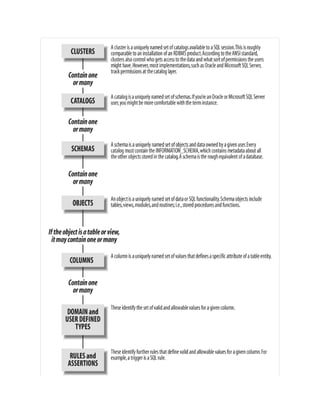
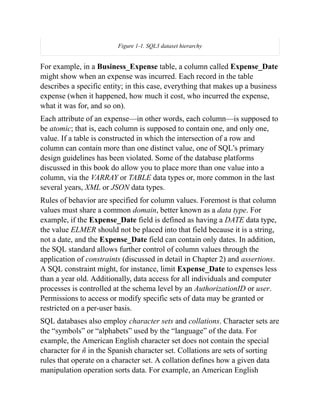


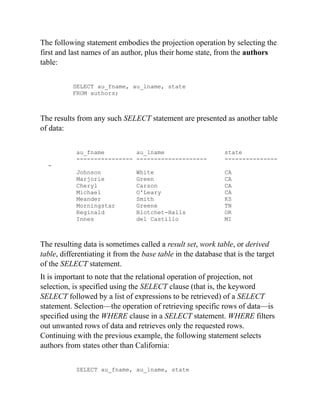

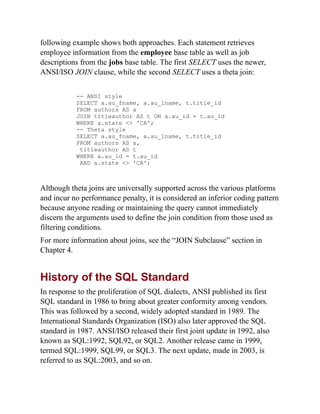
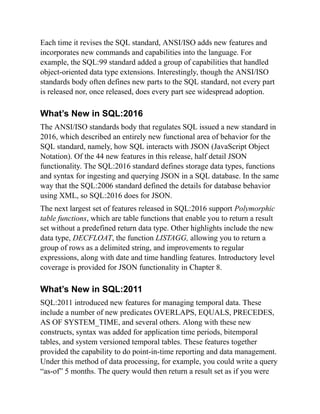
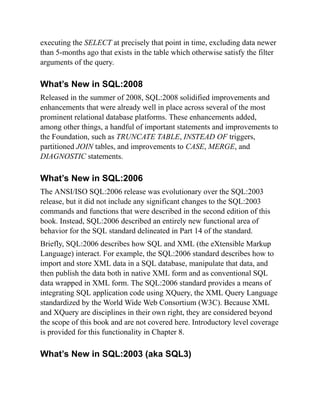


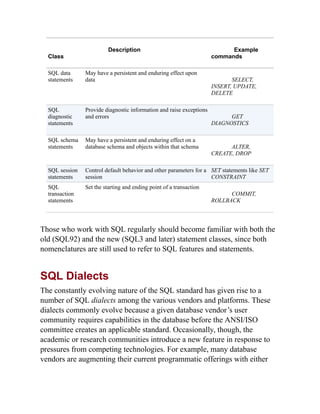

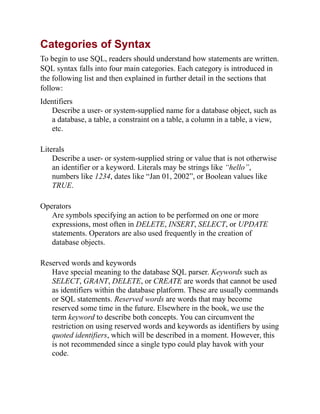
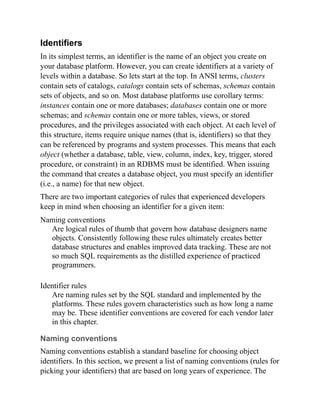
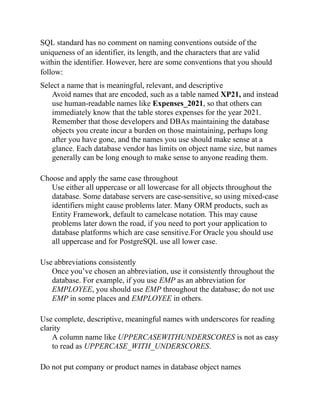
![Companies get acquired, and products change names. These elements
are too transitory to be included in database object names.
Do not use overly obvious prefixes or suffixes
For example, don’t use DB_ as a prefix for a database, and don’t prefix
every view with V_. Simple queries to the system table of the database
can tell the DBA or database programmer what type of object an
identifier represents.
Do not fill up all available space for the object name
If the database platform allows a 32-character table name, try to leave at
least a few free characters at the end. Some database platforms append
prefixes or suffixes to table names when manipulating temporary copies
of the tables.
Do not use quoted identifiers
Quoted identifiers are object names stored within double quotation
marks. (The ANSI standard calls these delimited identifiers.) Quoted
identifiers are also case-sensitive. Encapsulating an identifier within
double quotes allows creation of names that may be difficult to use and
may cause problems later. For example, users could embed spaces,
special characters, mixed-case characters, or even escape sequences
within a quoted identifier, but some third-party tools (and even vendor-
supplied tools) cannot handle special characters in names. Therefore,
quoted identifiers should not be used.
NOTE
Some platforms allow delimiting symbols other than double quotes. For example, SQL Server
uses brackets ([ ]) to designate quoted identifiers.
There are several benefits to following a consistent set of naming
conventions. First, your SQL code becomes, in a sense, self-documenting,
because the chosen names are meaningful and understandable to other
users. Second, your SQL code and database objects are easier to maintain—](https://image.slidesharecdn.com/18432650-250530091232-683fc2f0/85/Sql-In-A-Nutshell-4th-Edition-Second-Early-Release-Kevin-Kline-40-320.jpg)
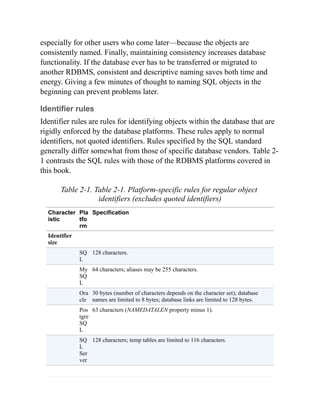

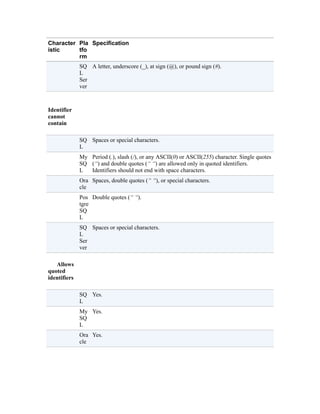
![Character
istic
Pla
tfo
rm
Specification
Pos
tgre
SQ
L
Yes.
SQ
L
Ser
ver
Yes.
Quoted
identifier
symbol
SQ
L
Double quotes (“ “).
My
SQ
L
Single quotes (“) or double quotes (“ “) in ANSI compatibility mode.
Ora
cle
Double-quotes (“ “).
Pos
tgre
SQ
L
Double-quotes (“ “).
SQ
L
Ser
ver
Double quotes (“ “) or brackets ([ ]); brackets are preferred.
Identifier
may be
reserved
SQ
L
No, unless as a quoted identifier.
My
SQ
L
No, unless as a quoted identifier.](https://image.slidesharecdn.com/18432650-250530091232-683fc2f0/85/Sql-In-A-Nutshell-4th-Edition-Second-Early-Release-Kevin-Kline-44-320.jpg)
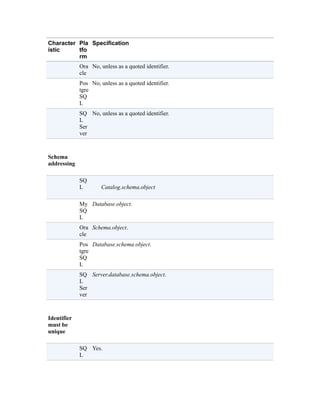
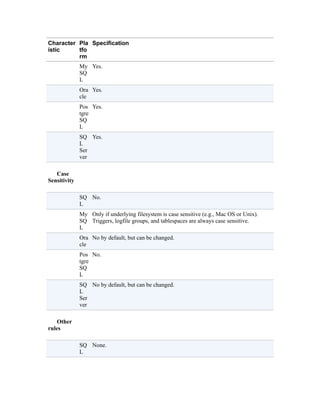
![Character
istic
Pla
tfo
rm
Specification
My
SQ
L
May not contain numbers only.
Ora
cle
Database links are limited to 128 bytes and may not be quoted identifiers.
Pos
tgre
SQ
L
None.
SQ
L
Ser
ver
Microsoft commonly uses brackets rather than double quotes for quoted
identifiers.
Identifiers must be unique within their scope. Thus, given our earlier
discussion of the hierarchy of database objects, database names must be
unique on a particular instance of a database server, while the names of
tables, views, functions, triggers, and stored procedures must be unique
within a particular schema. On the other hand, a table and a stored
procedure can have the same name, since they are different types of object.
The names of columns, keys, and indexes must be unique on a single table
or view, and so forth. Check your database platform’s documentation for
more information—some platforms require unique identifiers where others
may not. For example, Oracle requires that all index identifiers be unique
throughout the database, while others (such as SQL Server) require that the
index identifier be unique only for the table on which it depends.
Remember, quoted identifiers (object names encapsulated within a special
delimiter, usually double quotes or brackets [LikeThis]) may be used to
break some of the identifier rules specified earlier. One example is that
quoted identifiers are case sensitive—that is, “foo” does not equal “FOO”
or “Foo”. Furthermore, quoted identifiers may be used to bestow a reserved
word as a name, or to allow normally unusable characters and symbols
within a name. For instance, you normally can’t use the percent sign (%) in
a table name. However, you can, if you must, use that symbol in a table](https://image.slidesharecdn.com/18432650-250530091232-683fc2f0/85/Sql-In-A-Nutshell-4th-Edition-Second-Early-Release-Kevin-Kline-47-320.jpg)
![name so long as you always enclose that table name within double quotes.
That is, to name a table expense%%ratios, you would specify the name in
quotes: “expense%%ratios” or [expense%%ratios]. Again, remember
that in SQL such names are sometimes known as “delimited identifiers.”
NOTE
Once you have created an object name as a quoted identifier, we recommend that users always
reference it using its special delimiter. Inconsistency often leads to problematic or poorly
performing code.
Literals
SQL defines a literal value as any explicit numeric value, character string,
temporal value (e.g., date or time), or Boolean value that is not an identifier
or a keyword. SQL databases allow a variety of literal values in a SQL
program. Literal values are allowed for most of the numeric, character,
Boolean, and date data types. For example, SQL Server numeric data types
include (among others) INTEGER, REAL, and MONEY. Thus, numeric
literals can look like:
30
−117
+883.3338
−6.66
$70000
2E5
7E-3
As these examples illustrate, SQL Server allows signed and unsigned
numerals, in scientific or normal notation. And since SQL Server has a
money data type, even a dollar sign can be included. SQL Server does not
allow other symbols in numeric literals (besides 0 1 2 3 4 5 6 7 8 9 + - $ . E
e), however, so exclude commas or periods, in European countries where a
comma is used in place of a period in decimal or monetary values. Most](https://image.slidesharecdn.com/18432650-250530091232-683fc2f0/85/Sql-In-A-Nutshell-4th-Edition-Second-Early-Release-Kevin-Kline-48-320.jpg)