UNIT 1: TEACHINGPROCESS PHASES
Tema 1: Activation and Exploration
3.
3
Subtopic 2: Howto shape an EFL classroom
• Expose students to extensive language input (listening/reading) before expecting them to
produce (speaking/writing).
• Avoid "baby talk" and use age-appropriate language.
• Teach listening, speaking, reading, and writing in an interconnected manner, as they reinforce
each other.
• Emphasize language acquisition through meaningful communication and authentic materials,
mirroring how we learn our first language (Natural approach)
• Engaging lessons
• Knowing and respecting students
• Passion and patience
• Focus on student progress
• Needs-based lesson planning
• Appropriate lesson evaluation
• Adapt and supplement coursebook materials to suit students' needs.
• Use technology as a complement, not a replacement, for the teacher.
• Incorporate authentic materials (real-world texts, videos, etc.) to expose students to natural
language use.
4.
4
Scenario 1
You arean EFL teacher planning a lesson on the topic of travel. You want to introduce new vocabulary
related to transportation and have students practice using it in context.
Question: Which of the following activities best aligns with the Natural Approach and promotes meaningful
language acquisition in this context?
A) Have students memorize a list of transportation vocabulary words and their definitions.
B) Ask students to complete a gap-fill exercise in their textbook with the new vocabulary.
C) Show a video about different modes of transportation and have students discuss their experiences and
preferences.
D) Have students write a paragraph about their dream vacation, incorporating the new vocabulary.
Correct answer: It aligns with the Natural Approach by providing meaningful context for the new vocabulary (video) and
encouraging authentic communication (discussion). Students are engaged in real-world language use, promoting natural
language acquisition. The other options are more focused on rote learning and less conducive to meaningful
communication.
Subtopic 2: How to shape an EFL classroom
5.
5
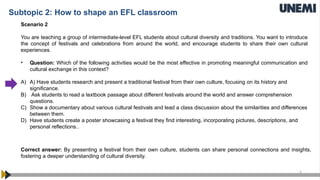
Scenario 2
You areteaching a group of intermediate-level EFL students about cultural diversity and traditions. You want to introduce
the concept of festivals and celebrations from around the world, and encourage students to share their own cultural
experiences.
• Question: Which of the following activities would be the most effective in promoting meaningful communication and
cultural exchange in this context?
A) A) Have students research and present a traditional festival from their own culture, focusing on its history and
significance.
B) Ask students to read a textbook passage about different festivals around the world and answer comprehension
questions.
C) Show a documentary about various cultural festivals and lead a class discussion about the similarities and differences
between them.
D) Have students create a poster showcasing a festival they find interesting, incorporating pictures, descriptions, and
personal reflections..
Correct answer: By presenting a festival from their own culture, students can share personal connections and insights,
fostering a deeper understanding of cultural diversity.
Subtopic 2: How to shape an EFL classroom
6.
6
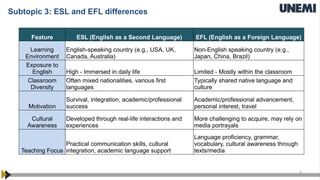
Subtopic 3: ESLand EFL differences
Feature ESL (English as a Second Language) EFL (English as a Foreign Language)
Learning
Environment
English-speaking country (e.g., USA, UK,
Canada, Australia)
Non-English speaking country (e.g.,
Japan, China, Brazil)
Exposure to
English High - Immersed in daily life Limited - Mostly within the classroom
Classroom
Diversity
Often mixed nationalities, various first
languages
Typically shared native language and
culture
Motivation
Survival, integration, academic/professional
success
Academic/professional advancement,
personal interest, travel
Cultural
Awareness
Developed through real-life interactions and
experiences
More challenging to acquire, may rely on
media portrayals
Teaching Focus
Practical communication skills, cultural
integration, academic language support
Language proficiency, grammar,
vocabulary, cultural awareness through
texts/media
7.
7
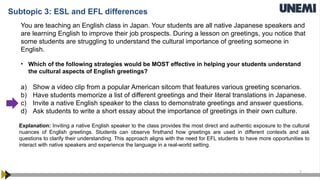
You are teachingan English class in Japan. Your students are all native Japanese speakers and
are learning English to improve their job prospects. During a lesson on greetings, you notice that
some students are struggling to understand the cultural importance of greeting someone in
English.
• Which of the following strategies would be MOST effective in helping your students understand
the cultural aspects of English greetings?
a) Show a video clip from a popular American sitcom that features various greeting scenarios.
b) Have students memorize a list of different greetings and their literal translations in Japanese.
c) Invite a native English speaker to the class to demonstrate greetings and answer questions.
d) Ask students to write a short essay about the importance of greetings in their own culture.
Explanation: Inviting a native English speaker to the class provides the most direct and authentic exposure to the cultural
nuances of English greetings. Students can observe firsthand how greetings are used in different contexts and ask
questions to clarify their understanding. This approach aligns with the need for EFL students to have more opportunities to
interact with native speakers and experience the language in a real-world setting.
Subtopic 3: ESL and EFL differences
8.
8
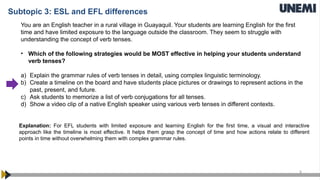
You are anEnglish teacher in a rural village in Guayaquil. Your students are learning English for the first
time and have limited exposure to the language outside the classroom. They seem to struggle with
understanding the concept of verb tenses.
• Which of the following strategies would be MOST effective in helping your students understand
verb tenses?
a) Explain the grammar rules of verb tenses in detail, using complex linguistic terminology.
b) Create a timeline on the board and have students place pictures or drawings to represent actions in the
past, present, and future.
c) Ask students to memorize a list of verb conjugations for all tenses.
d) Show a video clip of a native English speaker using various verb tenses in different contexts.
Explanation: For EFL students with limited exposure and learning English for the first time, a visual and interactive
approach like the timeline is most effective. It helps them grasp the concept of time and how actions relate to different
points in time without overwhelming them with complex grammar rules.
Subtopic 3: ESL and EFL differences
9.
UNIT 1: TEACHINGPROCESS PHASES
Tema 2: Connection, application and evaluation
of knowledge
10.
10
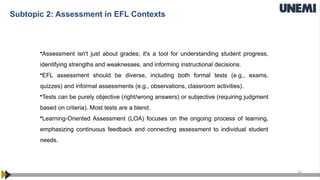
Subtopic 2: Assessmentin EFL Contexts
•Assessment isn't just about grades; it's a tool for understanding student progress,
identifying strengths and weaknesses, and informing instructional decisions.
•EFL assessment should be diverse, including both formal tests (e.g., exams,
quizzes) and informal assessments (e.g., observations, classroom activities).
•Tests can be purely objective (right/wrong answers) or subjective (requiring judgment
based on criteria). Most tests are a blend.
•Learning-Oriented Assessment (LOA) focuses on the ongoing process of learning,
emphasizing continuous feedback and connecting assessment to individual student
needs.
11.
11
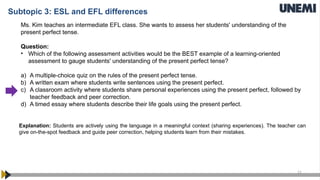
Ms. Kim teachesan intermediate EFL class. She wants to assess her students' understanding of the
present perfect tense.
Question:
• Which of the following assessment activities would be the BEST example of a learning-oriented
assessment to gauge students' understanding of the present perfect tense?
a) A multiple-choice quiz on the rules of the present perfect tense.
b) A written exam where students write sentences using the present perfect.
c) A classroom activity where students share personal experiences using the present perfect, followed by
teacher feedback and peer correction.
d) A timed essay where students describe their life goals using the present perfect.
Explanation: Students are actively using the language in a meaningful context (sharing experiences). The teacher can
give on-the-spot feedback and guide peer correction, helping students learn from their mistakes.
Subtopic 3: ESL and EFL differences