Learning from the Past;
Looking to the Future:
A discussion on work for racial justice
Yardley Warner: Quaker
Contributions to Education
in East Tennessee Post-Civil War
By Joan VanSickle Sloan
For Wilmington Yearly Meeting – July 23, 2015
Friends Established Education for
both Black & White Students.
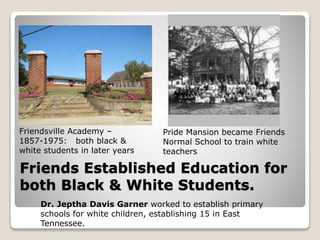
Friendsville Academy –
1857-1975: both black &
white students in later years
Pride Mansion became Friends
Normal School to train white
teachers
Dr. Jeptha Davis Garner worked to establish primary
schools for white children, establishing 15 in East
Tennessee.
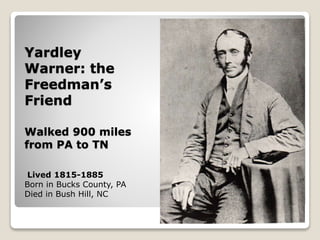
Yardley
Warner: the
Freedman’s
Friend
Walked 900 miles
from PA to TN
Lived 1815-1885
Born in Bucks County, PA
Died in Bush Hill, NC
When the Civil War ended,
4½ million freed people released
from their bonds of slavery:
• No jobs,
• No property (illegal to own
property for several years) and
• No education.
Options for recently emancipated:
1. their transport back to Africa,
2. their subjugation – (YW: “both of these
impossible and unthinkable”)
3. their education (YW: “both possible and
feasible”)
 Believing that education was the way to lift
themselves & their families to higher levels of
achievement, freedmen in Maryville initiated
plans to build a normal school for training
teachers.
 Yardley Warner raised money
– many trips to Northeast
Friends & to England.
 Free Negroes provided labor
and some money.
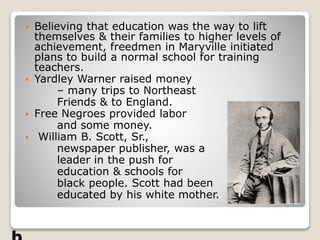
 William B. Scott, Sr.,
newspaper publisher, was a
leader in the push for
education & schools for
black people. Scott had been
educated by his white mother.
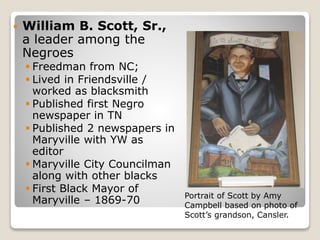
 William B. Scott, Sr.,
a leader among the
Negroes
 Freedman from NC;
 Lived in Friendsville /
worked as blacksmith
 Published first Negro
newspaper in TN
 Published 2 newspapers in
Maryville with YW as
editor
 Maryville City Councilman
along with other blacks
 First Black Mayor of
Maryville – 1869-70 Portrait of Scott by Amy
Campbell based on photo of
Scott’s grandson, Cansler.
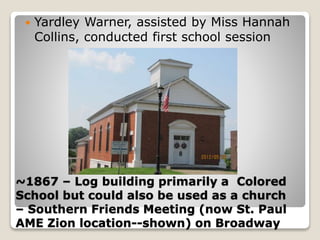
~1867 – Log building primarily a Colored
School but could also be used as a church
– Southern Friends Meeting (now St. Paul
AME Zion location--shown) on Broadway
 Yardley Warner, assisted by Miss Hannah
Collins, conducted first school session
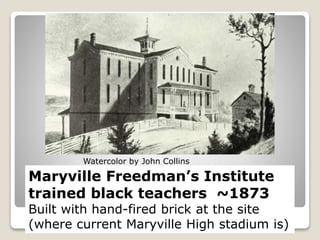
Maryville Freedman’s Institute
trained black teachers ~1873
Built with hand-fired brick at the site
(where current Maryville High stadium is)
Watercolor by John Collins
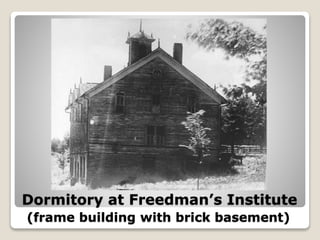
Dormitory at Freedman’s Institute
(frame building with brick basement)
Yardley Warner’s Journal logged careful
financial records of receipts from fundraising
trips and precise logs of expenditures at each
of the schools. When he died, his wife, Anna,
said there was no debt for any school.
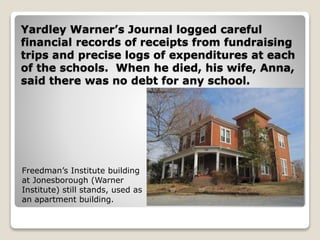
Freedman’s Institute building
at Jonesborough (Warner
Institute) still stands, used as
an apartment building.
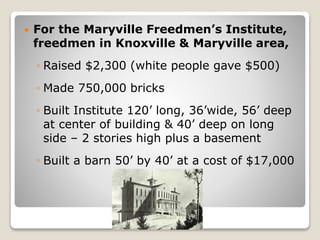
 For the Maryville Freedmen’s Institute,
freedmen in Knoxville & Maryville area,
◦ Raised $2,300 (white people gave $500)
◦ Made 750,000 bricks
◦ Built Institute 120’ long, 36’wide, 56’ deep
at center of building & 40’ deep on long
side – 2 stories high plus a basement
◦ Built a barn 50’ by 40’ at a cost of $17,000
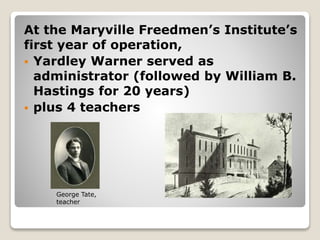
At the Maryville Freedmen’s Institute’s
first year of operation,
 Yardley Warner served as
administrator (followed by William B.
Hastings for 20 years)
 plus 4 teachers
George Tate,
teacher
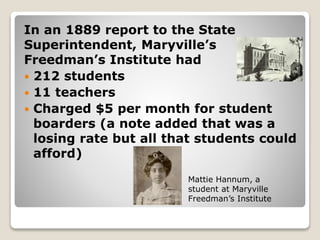
In an 1889 report to the State
Superintendent, Maryville’s
Freedman’s Institute had
 212 students
 11 teachers
 Charged $5 per month for student
boarders (a note added that was a
losing rate but all that students could
afford)
Mattie Hannum, a
student at Maryville
Freedman’s Institute
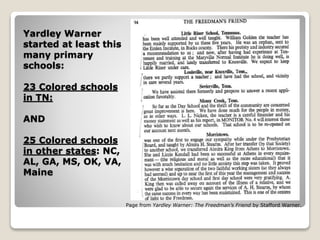
Yardley Warner
started at least this
many primary
schools:
23 Colored schools
in TN:
AND
25 Colored schools
in other states: NC,
AL, GA, MS, OK, VA,
Maine
Page from Yardley Warner: The Freedman’s Friend by Stafford Warner.
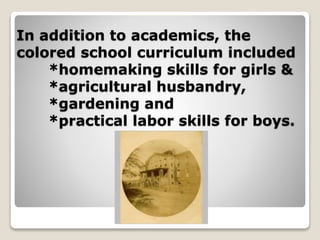
In addition to academics, the
colored school curriculum included
*homemaking skills for girls &
*agricultural husbandry,
*gardening and
*practical labor skills for boys.
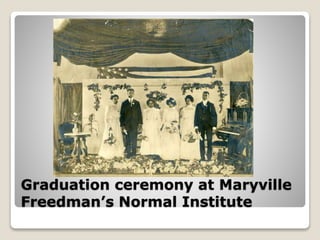
Graduation ceremony at Maryville
Freedman’s Normal Institute
No schools existed for either race so
some whites complained in newspaper
editorials about Federal money coming
for only the Negro schools.
Education of Negroes met with resistance
by many whites, however.
E.g., Maryville – almost completely burned by
skirmishes & scavenges of both armies
 Sherman – 3 units = ~25,000 men +
horses (to relieve Burnside from Longstreet)
 Maryville’s population = ~2,000
 Friendsville area – more buildings survived;
some still standing even today.
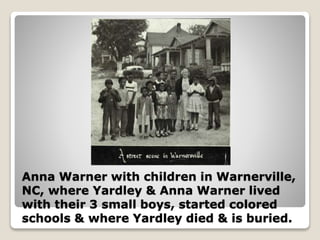
Anna Warner with children in Warnerville,
NC, where Yardley & Anna Warner lived
with their 3 small boys, started colored
schools & where Yardley died & is buried.
When the Civil War ended in 1865,
emancipating 4½ million people, Yardley
Warner became convinced that the greatest
need of his country was for schools for
Negroes. While his entire life was spent in
service of the poor and downtrodden, he
spent almost every waking moment of the
last 20 years of his life raising money and
setting up Freedman’s Institutes to train
black teachers and raising money and
setting up elementary schools for Negro
children. What are we doing to address
a need in our community?
Current Local African American Traditions
August 8: Andrew Johnson, from Johnson City, TN,
freed his slaves on August 8, 1865, following Lincoln’s
January Emancipation Proclamation. Blacks in this area
were permitted to visit Knoxville’s Chilhowee Park only
on that one date each year, so that day is still
recognized and celebrated by locals.
Integration of Schools: 1963 in Maryville and Alcoa.
Kuumba Festival: Annual African American Cultural
Arts Festival in Knoxville, celebrated in June.
Kwanzaa: An annual event (Dec. 26-Jan.1), created
in 1965 as the first African American holiday in which
candles represent the 7 core principles of African
heritage.
Sources:
 Cansler, Charles W. Three Generations: The Story of a Colored
Family of East Tennessee. USA:Privately printed, August
1939.
 Friendsville Quarterly Meeting. Minutes. East Tennessee:
Unpublished, 1880-1975.
 Warner, Stafford Allen. Yardley Warner, The Freedman’s
Friend: His Life and Times. Abingdon: The Abbey Press, 1957.
Illustrations:
 Yardley Warner portrait, John Collins watercolor of Maryville
Freedman’s Institute & Anna Warner with children in
Warnersville: Reprints from Warner, Stafford Allen. Yardley
Warner, The Freedman’s Friend: His Life and Times.
Abingdon: The Abbey Press, 1957.
 Sepia Freedman’s Institute, Graduation Ceremony & George
Tate portrait: W.O. Garner Digital Photograph Collection.
Blount County Public Library website, www.blountlibrary.org
and UT Digital Library, www.diglib.lib.utk.edu on July 21,
2015.
 Remainder of photos (Friendsville Academy, William B. Scott,
Sr. painting, St. Paul AMEZ Church, Warner Institute) were
taken by Joan VanSickle Sloan.

Learning from the Past.Yardley Warner & Educationpptx

  • 1.
    Learning from thePast; Looking to the Future: A discussion on work for racial justice Yardley Warner: Quaker Contributions to Education in East Tennessee Post-Civil War By Joan VanSickle Sloan For Wilmington Yearly Meeting – July 23, 2015
  • 2.
    Friends Established Educationfor both Black & White Students. Friendsville Academy – 1857-1975: both black & white students in later years Pride Mansion became Friends Normal School to train white teachers Dr. Jeptha Davis Garner worked to establish primary schools for white children, establishing 15 in East Tennessee.
  • 3.
    Yardley Warner: the Freedman’s Friend Walked 900miles from PA to TN Lived 1815-1885 Born in Bucks County, PA Died in Bush Hill, NC
  • 4.
    When the CivilWar ended, 4½ million freed people released from their bonds of slavery: • No jobs, • No property (illegal to own property for several years) and • No education.
  • 5.
    Options for recentlyemancipated: 1. their transport back to Africa, 2. their subjugation – (YW: “both of these impossible and unthinkable”) 3. their education (YW: “both possible and feasible”)
  • 6.
     Believing thateducation was the way to lift themselves & their families to higher levels of achievement, freedmen in Maryville initiated plans to build a normal school for training teachers.  Yardley Warner raised money – many trips to Northeast Friends & to England.  Free Negroes provided labor and some money.  William B. Scott, Sr., newspaper publisher, was a leader in the push for education & schools for black people. Scott had been educated by his white mother.
  • 7.
     William B.Scott, Sr., a leader among the Negroes  Freedman from NC;  Lived in Friendsville / worked as blacksmith  Published first Negro newspaper in TN  Published 2 newspapers in Maryville with YW as editor  Maryville City Councilman along with other blacks  First Black Mayor of Maryville – 1869-70 Portrait of Scott by Amy Campbell based on photo of Scott’s grandson, Cansler.
  • 8.
    ~1867 – Logbuilding primarily a Colored School but could also be used as a church – Southern Friends Meeting (now St. Paul AME Zion location--shown) on Broadway  Yardley Warner, assisted by Miss Hannah Collins, conducted first school session
  • 9.
    Maryville Freedman’s Institute trainedblack teachers ~1873 Built with hand-fired brick at the site (where current Maryville High stadium is) Watercolor by John Collins
  • 10.
    Dormitory at Freedman’sInstitute (frame building with brick basement)
  • 11.
    Yardley Warner’s Journallogged careful financial records of receipts from fundraising trips and precise logs of expenditures at each of the schools. When he died, his wife, Anna, said there was no debt for any school. Freedman’s Institute building at Jonesborough (Warner Institute) still stands, used as an apartment building.
  • 12.
     For theMaryville Freedmen’s Institute, freedmen in Knoxville & Maryville area, ◦ Raised $2,300 (white people gave $500) ◦ Made 750,000 bricks ◦ Built Institute 120’ long, 36’wide, 56’ deep at center of building & 40’ deep on long side – 2 stories high plus a basement ◦ Built a barn 50’ by 40’ at a cost of $17,000
  • 13.
    At the MaryvilleFreedmen’s Institute’s first year of operation,  Yardley Warner served as administrator (followed by William B. Hastings for 20 years)  plus 4 teachers George Tate, teacher
  • 14.
    In an 1889report to the State Superintendent, Maryville’s Freedman’s Institute had  212 students  11 teachers  Charged $5 per month for student boarders (a note added that was a losing rate but all that students could afford) Mattie Hannum, a student at Maryville Freedman’s Institute
  • 15.
    Yardley Warner started atleast this many primary schools: 23 Colored schools in TN: AND 25 Colored schools in other states: NC, AL, GA, MS, OK, VA, Maine Page from Yardley Warner: The Freedman’s Friend by Stafford Warner.
  • 16.
    In addition toacademics, the colored school curriculum included *homemaking skills for girls & *agricultural husbandry, *gardening and *practical labor skills for boys.
  • 17.
    Graduation ceremony atMaryville Freedman’s Normal Institute
  • 18.
    No schools existedfor either race so some whites complained in newspaper editorials about Federal money coming for only the Negro schools. Education of Negroes met with resistance by many whites, however. E.g., Maryville – almost completely burned by skirmishes & scavenges of both armies  Sherman – 3 units = ~25,000 men + horses (to relieve Burnside from Longstreet)  Maryville’s population = ~2,000  Friendsville area – more buildings survived; some still standing even today.
  • 19.
    Anna Warner withchildren in Warnerville, NC, where Yardley & Anna Warner lived with their 3 small boys, started colored schools & where Yardley died & is buried.
  • 20.
    When the CivilWar ended in 1865, emancipating 4½ million people, Yardley Warner became convinced that the greatest need of his country was for schools for Negroes. While his entire life was spent in service of the poor and downtrodden, he spent almost every waking moment of the last 20 years of his life raising money and setting up Freedman’s Institutes to train black teachers and raising money and setting up elementary schools for Negro children. What are we doing to address a need in our community?
  • 21.
    Current Local AfricanAmerican Traditions August 8: Andrew Johnson, from Johnson City, TN, freed his slaves on August 8, 1865, following Lincoln’s January Emancipation Proclamation. Blacks in this area were permitted to visit Knoxville’s Chilhowee Park only on that one date each year, so that day is still recognized and celebrated by locals. Integration of Schools: 1963 in Maryville and Alcoa. Kuumba Festival: Annual African American Cultural Arts Festival in Knoxville, celebrated in June. Kwanzaa: An annual event (Dec. 26-Jan.1), created in 1965 as the first African American holiday in which candles represent the 7 core principles of African heritage.
  • 22.
    Sources:  Cansler, CharlesW. Three Generations: The Story of a Colored Family of East Tennessee. USA:Privately printed, August 1939.  Friendsville Quarterly Meeting. Minutes. East Tennessee: Unpublished, 1880-1975.  Warner, Stafford Allen. Yardley Warner, The Freedman’s Friend: His Life and Times. Abingdon: The Abbey Press, 1957. Illustrations:  Yardley Warner portrait, John Collins watercolor of Maryville Freedman’s Institute & Anna Warner with children in Warnersville: Reprints from Warner, Stafford Allen. Yardley Warner, The Freedman’s Friend: His Life and Times. Abingdon: The Abbey Press, 1957.  Sepia Freedman’s Institute, Graduation Ceremony & George Tate portrait: W.O. Garner Digital Photograph Collection. Blount County Public Library website, www.blountlibrary.org and UT Digital Library, www.diglib.lib.utk.edu on July 21, 2015.  Remainder of photos (Friendsville Academy, William B. Scott, Sr. painting, St. Paul AMEZ Church, Warner Institute) were taken by Joan VanSickle Sloan.

Editor's Notes

  • #4 During childhood, helped father & brothers drive wagon to transport runaway slaves on the underground rr; walked 900 miles to TN (to be a good steward of money); looked like a storybook character – Rip VanWinkle
  • #10 In 1884, YW wrote that the normal schools at Maryville and Jonesborough had graduated “over 300 well qualified colored teachers, who have given the highest satisfaction….” (Warner 200)
  • #19 Sherman, on way to relieve Burnside, brought 3 units totally almost 27,000