LEARNING BARRIERS-
LIFE SKILLS
WHAT IS LIFE SKILLS?
source:
rp.edu.sg
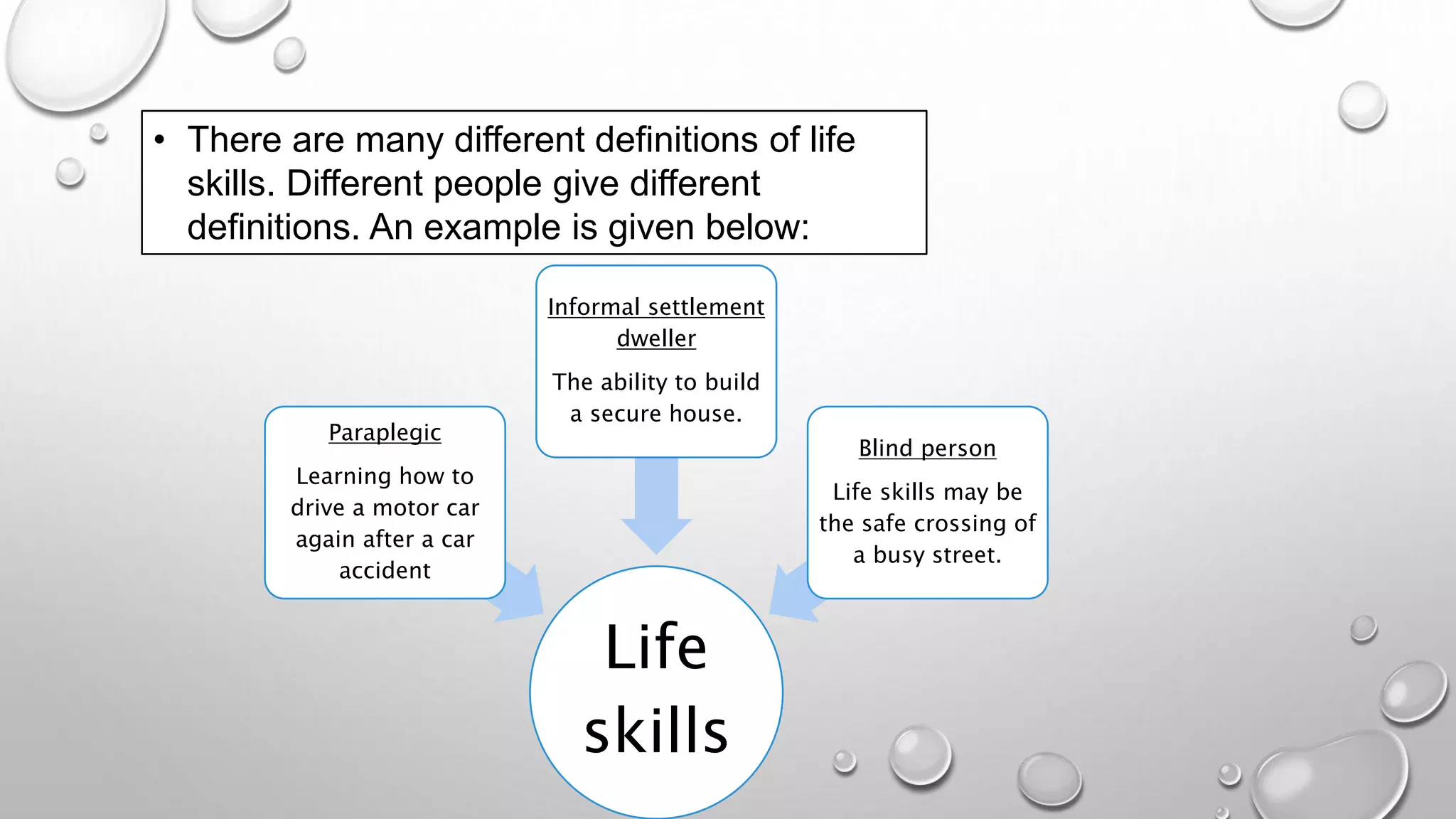
• There are many different definitions of life
skills. Different people give different
definitions. An example is given below:
Life
skills
Paraplegic
Learning how to
drive a motor car
again after a car
accident
Informal settlement
dweller
The ability to build
a secure house.
Blind person
Life skills may be
the safe crossing of
a busy street.
Source:Life Skills- Wikimedia
Commons
• Life skills is a skill that is necessary or desirable for full
participation in everyday life (DoBE,2011a: 8).
• Life skills can be seen a coping tool to survive everyday
life.
• To “cope” means to deal effectively or successfully with a
challenge (Hutchinson, 2000: 180).
• A “tool” can be defined as an implement that gives the
user an advantage over a person who does not have such
a tool (Hutchinson, 2000: 828).
Source:
macmillanenglish.com
• Cope with demands of modern life
• Survive everyday emotional, social and cognitive
onslaught
• Insight into life tasks
• Manage life tasks
• Necessary for personal, educational, financial and
socioeconomic realities
• Learn more about themselves
Source:
onestepfurther.co
HOW TO IDENTIFY WHEN LIFE SKILLS
IS A LEARNING BARRIER?
Learners that lack life skills:
• do not treat others with respect and understanding
• do not respect other peoples cultures
• do not exhibit creative thinking
• do not exhibit critical thinking and effective problem
solving
• do not work hard, stay on task and be motivated
According to Edge Research(2018)
However...
• As Vygotsky (as cited in Kinginger, 2002: 240) has
stated that all learners should be able to learn about
themselves and their environments with guidance
and the help of a mentor.
Some challenges in acquiring life skills:
• Many learners grow up in non-caring, non-sharing
environments (Lantieri, 2001: 33)
• People are unaware of their contribution to learners’
developing antisocial behaviour(Morris, 2002: 66)
• Schools do not always have time to focus on life
skills. Schools may focus on the distribution of
knowledge and not developing young minds.
How to support life skills as a learning barrier?
• Mentoring is becoming a popular strategy for addressing the needs
of young learner(Evans & Ave,2000).
• life skills( Life orientation) is a subject at school which should be
taken seriously.
• Incorporate life skills themes and principles into other subjects
• learners have the need to belong and to be appreciated (Elias, 2001:
20-33)
• There are links between life skills and other impairments. Educators
need to understand when learners may have non-verbal learning
impairments
• motivation
• Cooperative learning (McLaughin, 2001:14)
References
Department of Basic Education (DoBE). 2011a. National Curriculum Statement (NCS). Curriculum and
Assessment Policy Statement (CAPS). English Life Skills. Foundation Phase Grades R-3. Pretoria:
Department of Basic Education.
Elias, M.J.2001. Easing transitions with social-emotional learning. Principal Leadership,1(7):20-25.
Evans, I.M. Ave, K.T. 2000.Mentoring children and youth: principles, issues and policy implications for
community programmes in New Zealand. New Zealand Journal of Psychology, 29(1):41-49.
Hutchinson Concise Encyclopaedic dictionary. 2000. London: Helicon.
Kinginger, C. 2002. Defining the zone of proximal development in US foreign language education.
Applied Linguistics, 23(2):240-261.
Lantieri,L.2001. An ounce of prevention is worth a pound more than metal detectors. Reclaiming
Children and Youth, 10(1):33-38.
McLaughlin, M.W. 2001. Community counts. Educational Leadership, 58(7): 14-18.
Morris, S. 2002. Promoting social skills among students with non-verbal learning disabilities. Teaching
Exceptional Children, 34(3): 66-70.

Learning barrier- life skills

  • 1.
  • 2.
    WHAT IS LIFESKILLS? source: rp.edu.sg
  • 3.
    • There aremany different definitions of life skills. Different people give different definitions. An example is given below: Life skills Paraplegic Learning how to drive a motor car again after a car accident Informal settlement dweller The ability to build a secure house. Blind person Life skills may be the safe crossing of a busy street.
  • 4.
  • 5.
    • Life skillsis a skill that is necessary or desirable for full participation in everyday life (DoBE,2011a: 8). • Life skills can be seen a coping tool to survive everyday life. • To “cope” means to deal effectively or successfully with a challenge (Hutchinson, 2000: 180). • A “tool” can be defined as an implement that gives the user an advantage over a person who does not have such a tool (Hutchinson, 2000: 828).
  • 6.
  • 7.
    • Cope withdemands of modern life • Survive everyday emotional, social and cognitive onslaught • Insight into life tasks • Manage life tasks • Necessary for personal, educational, financial and socioeconomic realities • Learn more about themselves
  • 8.
  • 9.
    HOW TO IDENTIFYWHEN LIFE SKILLS IS A LEARNING BARRIER?
  • 10.
    Learners that lacklife skills: • do not treat others with respect and understanding • do not respect other peoples cultures • do not exhibit creative thinking • do not exhibit critical thinking and effective problem solving • do not work hard, stay on task and be motivated According to Edge Research(2018)
  • 11.
    However... • As Vygotsky(as cited in Kinginger, 2002: 240) has stated that all learners should be able to learn about themselves and their environments with guidance and the help of a mentor.
  • 12.
    Some challenges inacquiring life skills: • Many learners grow up in non-caring, non-sharing environments (Lantieri, 2001: 33) • People are unaware of their contribution to learners’ developing antisocial behaviour(Morris, 2002: 66) • Schools do not always have time to focus on life skills. Schools may focus on the distribution of knowledge and not developing young minds.
  • 13.
    How to supportlife skills as a learning barrier? • Mentoring is becoming a popular strategy for addressing the needs of young learner(Evans & Ave,2000). • life skills( Life orientation) is a subject at school which should be taken seriously. • Incorporate life skills themes and principles into other subjects • learners have the need to belong and to be appreciated (Elias, 2001: 20-33) • There are links between life skills and other impairments. Educators need to understand when learners may have non-verbal learning impairments • motivation • Cooperative learning (McLaughin, 2001:14)
  • 14.
    References Department of BasicEducation (DoBE). 2011a. National Curriculum Statement (NCS). Curriculum and Assessment Policy Statement (CAPS). English Life Skills. Foundation Phase Grades R-3. Pretoria: Department of Basic Education. Elias, M.J.2001. Easing transitions with social-emotional learning. Principal Leadership,1(7):20-25. Evans, I.M. Ave, K.T. 2000.Mentoring children and youth: principles, issues and policy implications for community programmes in New Zealand. New Zealand Journal of Psychology, 29(1):41-49. Hutchinson Concise Encyclopaedic dictionary. 2000. London: Helicon. Kinginger, C. 2002. Defining the zone of proximal development in US foreign language education. Applied Linguistics, 23(2):240-261. Lantieri,L.2001. An ounce of prevention is worth a pound more than metal detectors. Reclaiming Children and Youth, 10(1):33-38. McLaughlin, M.W. 2001. Community counts. Educational Leadership, 58(7): 14-18. Morris, S. 2002. Promoting social skills among students with non-verbal learning disabilities. Teaching Exceptional Children, 34(3): 66-70.