LEARNING AND
CONDITIONING
Chapter 7
WHAT IS LEARNING?
• Learning is a relatively permanent change in knowledge or behavior that is the result
of experience.
• Learning is perhaps the most important human capacity. Learning allows us to create
effective lives by being able to respond to changes.
• Without the ability to learn from our experiences, our lives would be remarkably
dangerous and inefficient.
• How do we know when a behavior has been influenced by learning—or even is a
result of learning? (Nurture)
• There are two basic kinds of learning: non-associative learning and associative
learning.
• Non-associative learning involves learning about a single stimulus, and it includes
habituation and sensitization.
NON-ASSOCIATIVE LEARNING
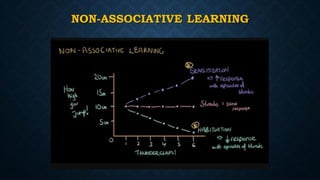
• Habituation is the decrease in response to a stimulus that occurs after repeated
presentations of the same stimulus.
• Sensitization is a type of non-associative learning whereby there is an increase in a
behavioral response to an intense stimulus.
• Both habituation and sensitization are typically relatively short-lived, lasting for
minutes to hours.
• Sensitization typically occurs when noxious or fearful stimuli are presented to an
organism.
NON-ASSOCIATIVE LEARNING
ASSOCIATIVE LEARNING.
• Associative learning is much more complicated than non-associative learning,
because it involves learning relationships among events.
• It includes classical conditioning and instrumental conditioning.
• Classical and instrumental conditioning both involve forming associations – that is,
learning that certain events go together.
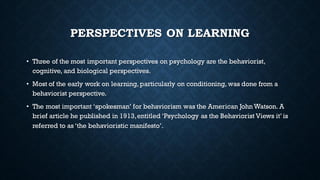
PERSPECTIVES ON LEARNING
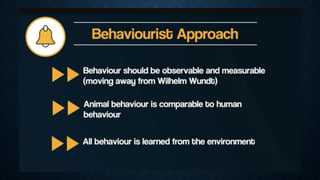
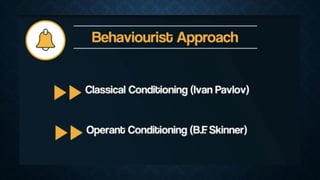
• Three of the most important perspectives on psychology are the behaviorist,
cognitive, and biological perspectives.
• Most of the early work on learning, particularly on conditioning, was done from a
behaviorist perspective.
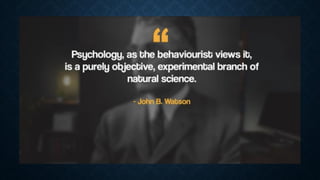
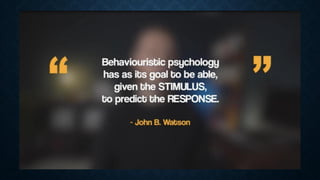
• The most important ‘spokesman’ for behaviorism was the American John Watson. A
brief article he published in 1913,entitled ‘Psychology as the Behaviorist Views it’ is
referred to as ‘the behavioristic manifesto’.
THE BASICS OF CLASSICAL CONDITIONING
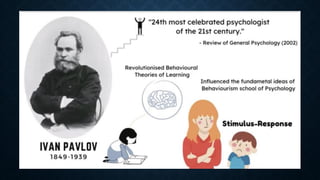
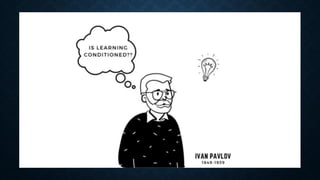
• Ivan Pavlov, a Russian physiologist, never intended to do psychological research. In
1904 he won the Nobel Prize for his work on digestion, testimony to his contribution
to that field.
• Yet Pavlov is remembered not for his physiological research but for his Page 170
experiments on basic learning processes—work that he began quite accidentally.
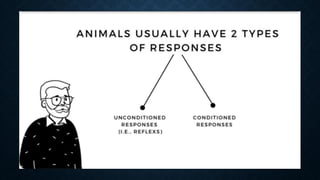
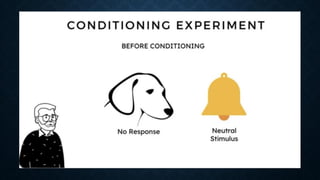
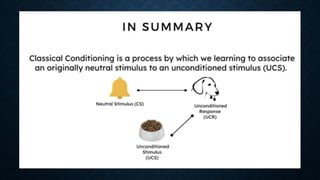
• Pavlov identified in classical conditioning: Learning through association.
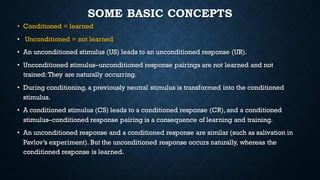
SOME BASIC CONCEPTS
• Conditioned = learned
• Unconditioned = not learned
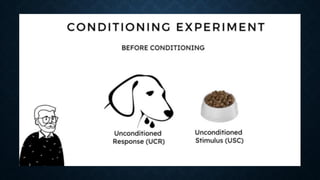
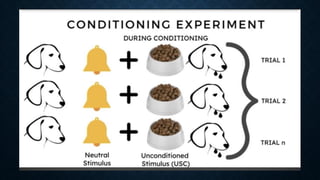
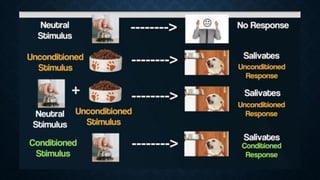
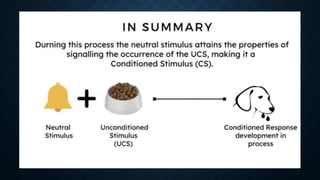
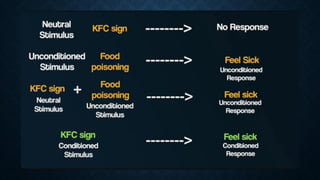
• An unconditioned stimulus (US) leads to an unconditioned response (UR).
• Unconditioned stimulus–unconditioned response pairings are not learned and not
trained: They are naturally occurring.
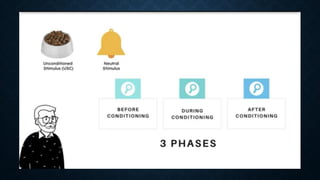
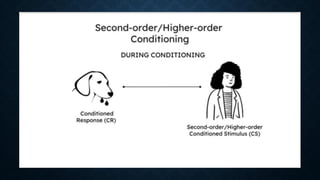
• During conditioning, a previously neutral stimulus is transformed into the conditioned
stimulus.
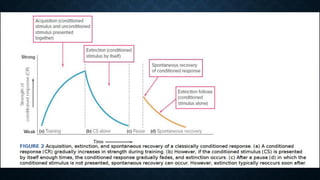
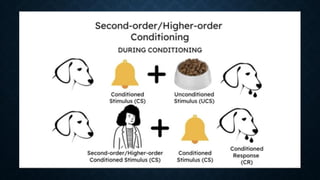
• A conditioned stimulus (CS) leads to a conditioned response (CR), and a conditioned
stimulus–conditioned response pairing is a consequence of learning and training.
• An unconditioned response and a conditioned response are similar (such as salivation in
Pavlov’s experiment). But the unconditioned response occurs naturally, whereas the
conditioned response is learned.
LEARNING AND COGNITION
• Latent Learning (Edward C.Tolman,1930) –
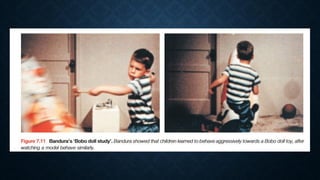
• Observational Learning (Bandura, 1961)
• Bandura emphasized the cognitive abilities that are necessary for observational learning
to occur (Bandura, 1977,2001).The learner must be able to
(1) pay attention to the model’s behavior and observe its consequences,
(2) remember what was observed,
(3) Be able to reproduce the behavior, and
(4) be motivated to do so.
In other words: observational learning involves the ability to imagine and anticipate –
thoughts and intentions are essential.
LEARNING AND MOTIVATION
• Psychology does have much to say about the kind of processes involved in the how
and the why of complex learning.
• the ‘how’ of complex human learning addresses memory and cognition,
• Questions regarding the ‘why’ of certain behaviors addressed motivation.
• In this section, we will briefly review some of the most relevant theories that tie
concepts from the field of motivation to the study of complex human learning.
LEARNING AND MOTIVATION
• Arousal
• From incentives to goals
• Intrinsic motivation and learning

Learning-and-conditioning.CH7.pdf Learning-and-conditioningLearning-and-conditioning

  • 1.
  • 2.
    WHAT IS LEARNING? •Learning is a relatively permanent change in knowledge or behavior that is the result of experience. • Learning is perhaps the most important human capacity. Learning allows us to create effective lives by being able to respond to changes. • Without the ability to learn from our experiences, our lives would be remarkably dangerous and inefficient. • How do we know when a behavior has been influenced by learning—or even is a result of learning? (Nurture) • There are two basic kinds of learning: non-associative learning and associative learning. • Non-associative learning involves learning about a single stimulus, and it includes habituation and sensitization.
  • 3.
    NON-ASSOCIATIVE LEARNING • Habituationis the decrease in response to a stimulus that occurs after repeated presentations of the same stimulus. • Sensitization is a type of non-associative learning whereby there is an increase in a behavioral response to an intense stimulus. • Both habituation and sensitization are typically relatively short-lived, lasting for minutes to hours. • Sensitization typically occurs when noxious or fearful stimuli are presented to an organism.
  • 4.
  • 5.
    ASSOCIATIVE LEARNING. • Associativelearning is much more complicated than non-associative learning, because it involves learning relationships among events. • It includes classical conditioning and instrumental conditioning. • Classical and instrumental conditioning both involve forming associations – that is, learning that certain events go together.
  • 6.
    PERSPECTIVES ON LEARNING •Three of the most important perspectives on psychology are the behaviorist, cognitive, and biological perspectives. • Most of the early work on learning, particularly on conditioning, was done from a behaviorist perspective. • The most important ‘spokesman’ for behaviorism was the American John Watson. A brief article he published in 1913,entitled ‘Psychology as the Behaviorist Views it’ is referred to as ‘the behavioristic manifesto’.
  • 12.
    THE BASICS OFCLASSICAL CONDITIONING • Ivan Pavlov, a Russian physiologist, never intended to do psychological research. In 1904 he won the Nobel Prize for his work on digestion, testimony to his contribution to that field. • Yet Pavlov is remembered not for his physiological research but for his Page 170 experiments on basic learning processes—work that he began quite accidentally. • Pavlov identified in classical conditioning: Learning through association.
  • 16.
    SOME BASIC CONCEPTS •Conditioned = learned • Unconditioned = not learned • An unconditioned stimulus (US) leads to an unconditioned response (UR). • Unconditioned stimulus–unconditioned response pairings are not learned and not trained: They are naturally occurring. • During conditioning, a previously neutral stimulus is transformed into the conditioned stimulus. • A conditioned stimulus (CS) leads to a conditioned response (CR), and a conditioned stimulus–conditioned response pairing is a consequence of learning and training. • An unconditioned response and a conditioned response are similar (such as salivation in Pavlov’s experiment). But the unconditioned response occurs naturally, whereas the conditioned response is learned.
  • 63.
    LEARNING AND COGNITION •Latent Learning (Edward C.Tolman,1930) – • Observational Learning (Bandura, 1961) • Bandura emphasized the cognitive abilities that are necessary for observational learning to occur (Bandura, 1977,2001).The learner must be able to (1) pay attention to the model’s behavior and observe its consequences, (2) remember what was observed, (3) Be able to reproduce the behavior, and (4) be motivated to do so. In other words: observational learning involves the ability to imagine and anticipate – thoughts and intentions are essential.
  • 66.
    LEARNING AND MOTIVATION •Psychology does have much to say about the kind of processes involved in the how and the why of complex learning. • the ‘how’ of complex human learning addresses memory and cognition, • Questions regarding the ‘why’ of certain behaviors addressed motivation. • In this section, we will briefly review some of the most relevant theories that tie concepts from the field of motivation to the study of complex human learning.
  • 67.
    LEARNING AND MOTIVATION •Arousal • From incentives to goals • Intrinsic motivation and learning