LEADERSHIP TRAINING PARTICIPANT GUIDE 
BASICS OF LEADERSHIP 
LAWANDA BURRELL 
Instructional Designer
Leadership Training Page 1 of 19 
Participant Guide 
PURPOSE 
● Assist each manager meet the expectations and needs of the company leadership model. 
● Create clear lines of communication between associates and management. 
● Provide management with tools and resources to do a better job. 
AGENDA 
● Day 1 - Introduction to Leadership 
● Day 2 - Your Leadership Style 
● Day 3 - Leadership Principles 
● Day 4 - Leadership Model 
● Day 5 - Tools and Resources
Leadership Training Page 2 of 19 
Participant Guide 
ICEBREAKER 
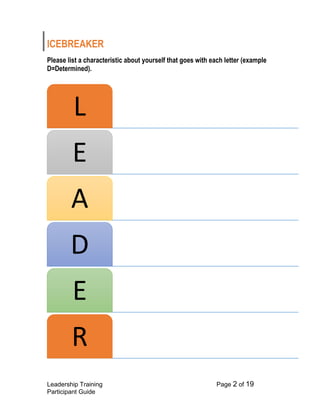
Please list a characteristic about yourself that goes with each letter (example D=Determined). 
L 
E 
A 
D 
E 
R
Leadership Training Page 3 of 19 
Participant Guide 
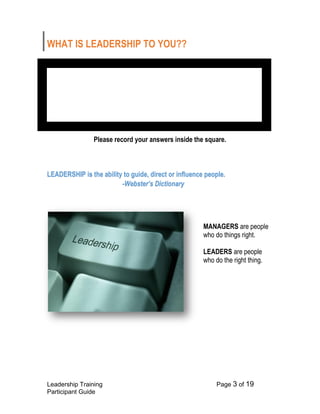
WHAT IS LEADERSHIP TO YOU?? 
Please record your answers inside the square. 
LEADERSHIP is the ability to guide, direct or influence people. -Webster’s Dictionary 
MANAGERS are people who do things right. 
LEADERS are people who do the right thing.
Leadership Training Page 4 of 19 
Participant Guide 
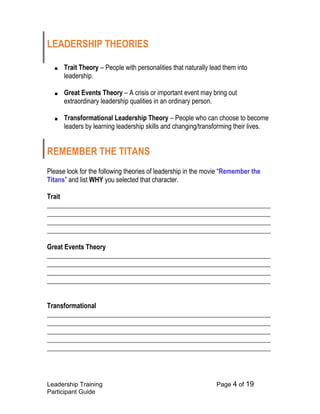
LEADERSHIP THEORIES 
■ Trait Theory – People with personalities that naturally lead them into leadership. 
■ Great Events Theory – A crisis or important event may bring out extraordinary leadership qualities in an ordinary person. 
■ Transformational Leadership Theory – People who can choose to become leaders by learning leadership skills and changing/transforming their lives. 
REMEMBER THE TITANS 
Please look for the following theories of leadership in the movie “Remember the Titans” and list WHY you selected that character. 
Trait 
___________________________________________________________________ ___________________________________________________________________ ___________________________________________________________________ ___________________________________________________________________ 
Great Events Theory ___________________________________________________________________ ___________________________________________________________________ ___________________________________________________________________ ___________________________________________________________________ 
Transformational ___________________________________________________________________ ___________________________________________________________________ ___________________________________________________________________ ___________________________________________________________________ ___________________________________________________________________
Leadership Training Page 5 of 19 
Participant Guide 
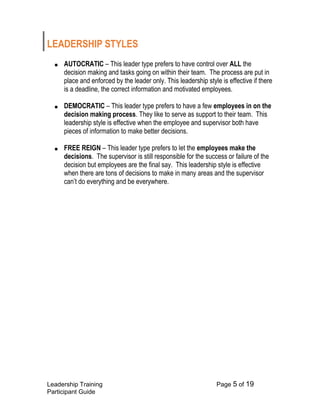
LEADERSHIP STYLES 
■ AUTOCRATIC – This leader type prefers to have control over ALL the decision making and tasks going on within their team. The process are put in place and enforced by the leader only. This leadership style is effective if there is a deadline, the correct information and motivated employees. 
■ DEMOCRATIC – This leader type prefers to have a few employees in on the decision making process. They like to serve as support to their team. This leadership style is effective when the employee and supervisor both have pieces of information to make better decisions. 
■ FREE REIGN – This leader type prefers to let the employees make the decisions. The supervisor is still responsible for the success or failure of the decision but employees are the final say. This leadership style is effective when there are tons of decisions to make in many areas and the supervisor can’t do everything and be everywhere.
Leadership Training Page 6 of 19 
Participant Guide 
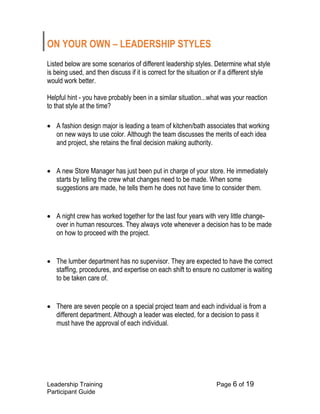
ON YOUR OWN – LEADERSHIP STYLES 
Listed below are some scenarios of different leadership styles. Determine what style is being used, and then discuss if it is correct for the situation or if a different style would work better. 
Helpful hint - you have probably been in a similar situation...what was your reaction to that style at the time? 
 A fashion design major is leading a team of kitchen/bath associates that working on new ways to use color. Although the team discusses the merits of each idea and project, she retains the final decision making authority. 
 A new Store Manager has just been put in charge of your store. He immediately starts by telling the crew what changes need to be made. When some suggestions are made, he tells them he does not have time to consider them. 
 A night crew has worked together for the last four years with very little change- over in human resources. They always vote whenever a decision has to be made on how to proceed with the project. 
 The lumber department has no supervisor. They are expected to have the correct staffing, procedures, and expertise on each shift to ensure no customer is waiting to be taken care of. 
 There are seven people on a special project team and each individual is from a different department. Although a leader was elected, for a decision to pass it must have the approval of each individual.
Leadership Training Page 7 of 19 
Participant Guide 
REMEMBER THE TITANS 
Please look for the following styles of leadership in the movie “Remember the Titans” and list WHY you selected that character. 
Autocratic 
___________________________________________________________________ ___________________________________________________________________ ___________________________________________________________________ ___________________________________________________________________ ___________________________________________________________________ ___________________________________________________________________ ___________________________________________________________________ ___________________________________________________________________ 
Democratic ___________________________________________________________________ ___________________________________________________________________ ___________________________________________________________________ ___________________________________________________________________ ___________________________________________________________________ ___________________________________________________________________ ___________________________________________________________________ ___________________________________________________________________ 
Free Reign 
___________________________________________________________________ ___________________________________________________________________ ___________________________________________________________________ ___________________________________________________________________ ___________________________________________________________________ ___________________________________________________________________ ___________________________________________________________________ ___________________________________________________________________
Leadership Training Page 8 of 19 
Participant Guide 
PRINCIPLES OF LEADERSHIP 
 Know yourself and seek self-improvement. In order to know yourself, you have to understand your be, know, and do, attributes. Seeking self-improvement means continually strengthening your attributes. 
 Be technically proficient. As a leader, you must know your job and have a solid familiarity with your employees' jobs. 
 Seek responsibility and take responsibility for your actions. Search for ways to guide your organization to new heights. And when things go wrong, they will sooner or later, do not blame others. Analyze the situation, take corrective action, and move on to the next challenge. 
 Make sound and timely decisions. Use good problem solving, decision making, and planning tools. 
 Set the example. Be a good role model for your employees. They must not only hear what they are expected to do, but also see. 
 Know your people and look out for their well-being. Know human nature and the importance of sincerely caring for your workers. 
 Keep your people informed. Know how to communicate with your people, seniors, and other key people within the organization. 
 Develop a sense of responsibility in your people. Develop good character traits within your people that will help them carry out their professional responsibilities. 
 Ensure that tasks are understood, supervised, and accomplished. Communication is the key to this responsibility. 
 Train your people as a team. Although many so called leaders call their organization, department, section, etc. a team; they are not really teams...they are just a group of people doing their jobs. 
 Use the full capabilities of your organization. By developing a team spirit, you will be able to employ your organization, department, section, etc. to its fullest capabilities.
Leadership Training Page 9 of 19 
Participant Guide 
PRINCIPLES OF LEADERSHIP EXERCISES 
In the blank area below please select 4 Principles of Leadership. Two that you currently use and two that you will use in the future. 
1. ______________________________________________________________ ______________________________________________________________ ______________________________________________________________ ______________________________________________________________ ______________________________________________________________ 
2. ______________________________________________________________ ______________________________________________________________ ______________________________________________________________ ______________________________________________________________ ______________________________________________________________ 
3. ______________________________________________________________ ______________________________________________________________ ______________________________________________________________ ______________________________________________________________ ______________________________________________________________ 
4. ______________________________________________________________ ______________________________________________________________ ______________________________________________________________ ______________________________________________________________ ______________________________________________________________
Leadership Training Page 10 of 19 
Participant Guide 
REMEMBER THE TITANS 
Please list what “principles” the following characters displayed in “Remember the Titans”. 
Coach Boone 
___________________________________________________________________ ___________________________________________________________________ ___________________________________________________________________ ___________________________________________________________________ ___________________________________________________________________ 
Coach Yoast 
___________________________________________________________________ ___________________________________________________________________ ___________________________________________________________________ ___________________________________________________________________ ___________________________________________________________________ 
Gary – The Captain 
___________________________________________________________________ ___________________________________________________________________ ___________________________________________________________________ ___________________________________________________________________ ___________________________________________________________________ ___________________________________________________________________ 
Julius 
___________________________________________________________________ ___________________________________________________________________ ___________________________________________________________________ ___________________________________________________________________ ___________________________________________________________________
Leadership Training Page 11 of 19 
Participant Guide 
THE COMPANY LEADERSHIP ESSENTIALS 
■ Delivers Results ______________________________________________________________ ______________________________________________________________ ______________________________________________________________ ______________________________________________________________ ______________________________________________________________ 
■ Acts Strategically ______________________________________________________________ ______________________________________________________________ ______________________________________________________________ ______________________________________________________________ ______________________________________________________________ 
■ Drives Excellence ______________________________________________________________ ______________________________________________________________ ______________________________________________________________ ______________________________________________________________ ______________________________________________________________ 
■ Excels in Customer Service ______________________________________________________________ ______________________________________________________________ ______________________________________________________________ ______________________________________________________________ ______________________________________________________________
Leadership Training Page 12 of 19 
Participant Guide 
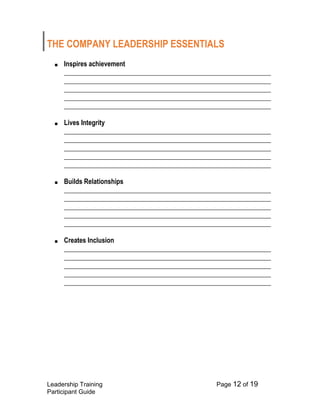
THE COMPANY LEADERSHIP ESSENTIALS 
■ Inspires achievement ______________________________________________________________ ______________________________________________________________ ______________________________________________________________ ______________________________________________________________ ______________________________________________________________ 
■ Lives Integrity ______________________________________________________________ ______________________________________________________________ ______________________________________________________________ ______________________________________________________________ ______________________________________________________________ 
■ Builds Relationships ______________________________________________________________ ______________________________________________________________ ______________________________________________________________ ______________________________________________________________ ______________________________________________________________ 
■ Creates Inclusion ______________________________________________________________ ______________________________________________________________ ______________________________________________________________ ______________________________________________________________ ______________________________________________________________
Leadership Training Page 13 of 19 
Participant Guide 
TOOLS & RESOURCES 
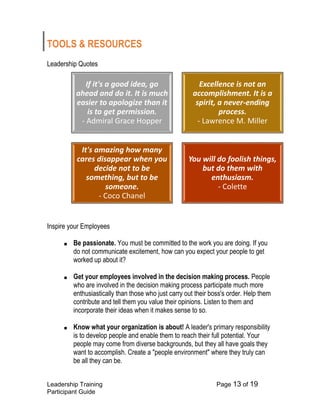
Leadership Quotes 
Inspire your Employees 
■ Be passionate. You must be committed to the work you are doing. If you do not communicate excitement, how can you expect your people to get worked up about it? 
■ Get your employees involved in the decision making process. People who are involved in the decision making process participate much more enthusiastically than those who just carry out their boss's order. Help them contribute and tell them you value their opinions. Listen to them and incorporate their ideas when it makes sense to so. 
■ Know what your organization is about! A leader's primary responsibility is to develop people and enable them to reach their full potential. Your people may come from diverse backgrounds, but they all have goals they want to accomplish. Create a "people environment" where they truly can be all they can be. 
If it's a good idea, go ahead and do it. It is much easier to apologize than it is to get permission. -Admiral Grace Hopper 
Excellence is not an accomplishment. It is a spirit, a never-ending process. -Lawrence M. Miller 
It's amazing how many cares disappear when you decide not to be something, but to be someone. -Coco Chanel 
You will do foolish things, but do them with enthusiasm. -Colette
Leadership Training Page 14 of 19 
Participant Guide 
RESOURCES 
 The Home Depot Leadership Essentials Brochure 
 Webster’s dictionary 
 http://www.nwlink.com/~donclark/leader/survstyl.html 
 http://www.nwlink.com/~donclark/leader/leadstl.html
Leadership Training Page 15 of 19 
Participant Guide 
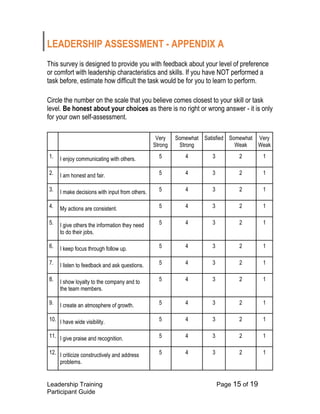
LEADERSHIP ASSESSMENT - APPENDIX A 
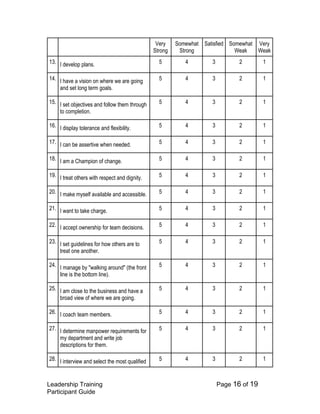
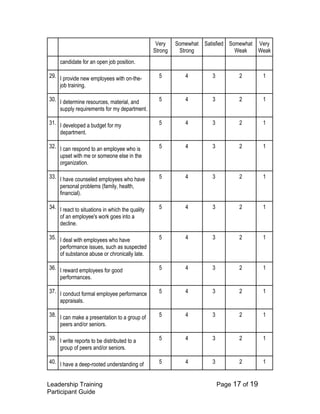
This survey is designed to provide you with feedback about your level of preference or comfort with leadership characteristics and skills. If you have NOT performed a task before, estimate how difficult the task would be for you to learn to perform. 
Circle the number on the scale that you believe comes closest to your skill or task level. Be honest about your choices as there is no right or wrong answer - it is only for your own self-assessment. 
Very Strong 
Somewhat Strong 
Satisfied 
Somewhat Weak 
Very Weak 
1. 
I enjoy communicating with others. 
5 
4 
3 
2 
1 
2. 
I am honest and fair. 
5 
4 
3 
2 
1 
3. 
I make decisions with input from others. 
5 
4 
3 
2 
1 
4. 
My actions are consistent. 
5 
4 
3 
2 
1 
5. 
I give others the information they need to do their jobs. 
5 
4 
3 
2 
1 
6. 
I keep focus through follow up. 
5 
4 
3 
2 
1 
7. 
I listen to feedback and ask questions. 
5 
4 
3 
2 
1 
8. 
I show loyalty to the company and to the team members. 
5 
4 
3 
2 
1 
9. 
I create an atmosphere of growth. 
5 
4 
3 
2 
1 
10. 
I have wide visibility. 
5 
4 
3 
2 
1 
11. 
I give praise and recognition. 
5 
4 
3 
2 
1 
12. 
I criticize constructively and address problems. 
5 
4 
3 
2 
1
Leadership Training Page 16 of 19 
Participant Guide 
Very Strong 
Somewhat Strong 
Satisfied 
Somewhat Weak 
Very Weak 
13. 
I develop plans. 
5 
4 
3 
2 
1 
14. 
I have a vision on where we are going and set long term goals. 
5 
4 
3 
2 
1 
15. 
I set objectives and follow them through to completion. 
5 
4 
3 
2 
1 
16. 
I display tolerance and flexibility. 
5 
4 
3 
2 
1 
17. 
I can be assertive when needed. 
5 
4 
3 
2 
1 
18. 
I am a Champion of change. 
5 
4 
3 
2 
1 
19. 
I treat others with respect and dignity. 
5 
4 
3 
2 
1 
20. 
I make myself available and accessible. 
5 
4 
3 
2 
1 
21. 
I want to take charge. 
5 
4 
3 
2 
1 
22. 
I accept ownership for team decisions. 
5 
4 
3 
2 
1 
23. 
I set guidelines for how others are to treat one another. 
5 
4 
3 
2 
1 
24. 
I manage by "walking around" (the front line is the bottom line). 
5 
4 
3 
2 
1 
25. 
I am close to the business and have a broad view of where we are going. 
5 
4 
3 
2 
1 
26. 
I coach team members. 
5 
4 
3 
2 
1 
27. 
I determine manpower requirements for my department and write job descriptions for them. 
5 
4 
3 
2 
1 
28. 
I interview and select the most qualified 
5 
4 
3 
2 
1
Leadership Training Page 17 of 19 
Participant Guide 
Very Strong 
Somewhat Strong 
Satisfied 
Somewhat Weak 
Very Weak 
candidate for an open job position. 
29. 
I provide new employees with on-the- job training. 
5 
4 
3 
2 
1 
30. 
I determine resources, material, and supply requirements for my department. 
5 
4 
3 
2 
1 
31. 
I developed a budget for my department. 
5 
4 
3 
2 
1 
32. 
I can respond to an employee who is upset with me or someone else in the organization. 
5 
4 
3 
2 
1 
33. 
I have counseled employees who have personal problems (family, health, financial). 
5 
4 
3 
2 
1 
34. 
I react to situations in which the quality of an employee's work goes into a decline. 
5 
4 
3 
2 
1 
35. 
I deal with employees who have performance issues, such as suspected of substance abuse or chronically late. 
5 
4 
3 
2 
1 
36. 
I reward employees for good performances. 
5 
4 
3 
2 
1 
37. 
I conduct formal employee performance appraisals. 
5 
4 
3 
2 
1 
38. 
I can make a presentation to a group of peers and/or seniors. 
5 
4 
3 
2 
1 
39. 
I write reports to be distributed to a group of peers and/or seniors. 
5 
4 
3 
2 
1 
40. 
I have a deep-rooted understanding of 
5 
4 
3 
2 
1
Leadership Training Page 18 of 19 
Participant Guide 
Very Strong 
Somewhat Strong 
Satisfied 
Somewhat Weak 
Very Weak 
the functions of my organization. 
41. 
I am curious. 
5 
4 
3 
2 
1 
42. 
I know how to sell. 
5 
4 
3 
2 
1 
43. 
I am a good learner. 
5 
4 
3 
2 
1 
44. 
I know how to influence people and get support. 
5 
4 
3 
2 
1 
45. 
I admit my mistakes and take responsibility for my actions. 
5 
4 
3 
2 
1 
46. 
I like to talk to people and I am a great listener. 
5 
4 
3 
2 
1 
47. 
I am a good delegator. 
5 
4 
3 
2 
1 
48. 
I can separate the important issues from inconsequential ones. 
5 
4 
3 
2 
1 
49. 
I have integrity and can be trusted. 
5 
4 
3 
2 
1 
50. 
I am political only when needed. 
5 
4 
3 
2 
1 
TOTAL 
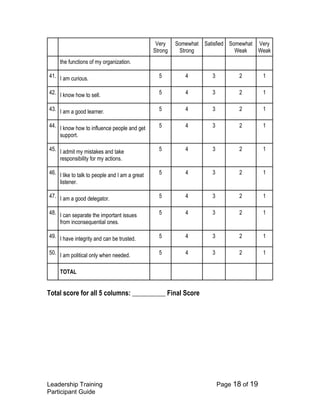
Total score for all 5 columns: __________ Final Score
Leadership Training Page 19 of 19 
Participant Guide 
SCORING 
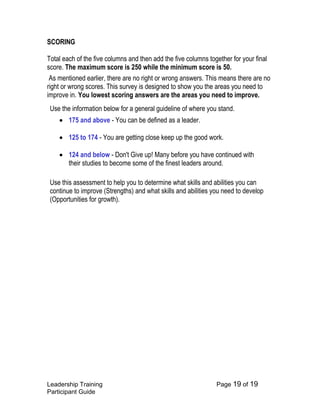
Total each of the five columns and then add the five columns together for your final score. The maximum score is 250 while the minimum score is 50. 
As mentioned earlier, there are no right or wrong answers. This means there are no right or wrong scores. This survey is designed to show you the areas you need to improve in. You lowest scoring answers are the areas you need to improve. 
Use the information below for a general guideline of where you stand. 
 175 and above - You can be defined as a leader. 
 125 to 174 - You are getting close keep up the good work. 
 124 and below - Don't Give up! Many before you have continued with their studies to become some of the finest leaders around. 
Use this assessment to help you to determine what skills and abilities you can continue to improve (Strengths) and what skills and abilities you need to develop (Opportunities for growth).

Leadership trainingparticipantguide 1pdf

  • 1.
    LEADERSHIP TRAINING PARTICIPANTGUIDE BASICS OF LEADERSHIP LAWANDA BURRELL Instructional Designer
  • 2.
    Leadership Training Page1 of 19 Participant Guide PURPOSE ● Assist each manager meet the expectations and needs of the company leadership model. ● Create clear lines of communication between associates and management. ● Provide management with tools and resources to do a better job. AGENDA ● Day 1 - Introduction to Leadership ● Day 2 - Your Leadership Style ● Day 3 - Leadership Principles ● Day 4 - Leadership Model ● Day 5 - Tools and Resources
  • 3.
    Leadership Training Page2 of 19 Participant Guide ICEBREAKER Please list a characteristic about yourself that goes with each letter (example D=Determined). L E A D E R
  • 4.
    Leadership Training Page3 of 19 Participant Guide WHAT IS LEADERSHIP TO YOU?? Please record your answers inside the square. LEADERSHIP is the ability to guide, direct or influence people. -Webster’s Dictionary MANAGERS are people who do things right. LEADERS are people who do the right thing.
  • 5.
    Leadership Training Page4 of 19 Participant Guide LEADERSHIP THEORIES ■ Trait Theory – People with personalities that naturally lead them into leadership. ■ Great Events Theory – A crisis or important event may bring out extraordinary leadership qualities in an ordinary person. ■ Transformational Leadership Theory – People who can choose to become leaders by learning leadership skills and changing/transforming their lives. REMEMBER THE TITANS Please look for the following theories of leadership in the movie “Remember the Titans” and list WHY you selected that character. Trait ___________________________________________________________________ ___________________________________________________________________ ___________________________________________________________________ ___________________________________________________________________ Great Events Theory ___________________________________________________________________ ___________________________________________________________________ ___________________________________________________________________ ___________________________________________________________________ Transformational ___________________________________________________________________ ___________________________________________________________________ ___________________________________________________________________ ___________________________________________________________________ ___________________________________________________________________
  • 6.
    Leadership Training Page5 of 19 Participant Guide LEADERSHIP STYLES ■ AUTOCRATIC – This leader type prefers to have control over ALL the decision making and tasks going on within their team. The process are put in place and enforced by the leader only. This leadership style is effective if there is a deadline, the correct information and motivated employees. ■ DEMOCRATIC – This leader type prefers to have a few employees in on the decision making process. They like to serve as support to their team. This leadership style is effective when the employee and supervisor both have pieces of information to make better decisions. ■ FREE REIGN – This leader type prefers to let the employees make the decisions. The supervisor is still responsible for the success or failure of the decision but employees are the final say. This leadership style is effective when there are tons of decisions to make in many areas and the supervisor can’t do everything and be everywhere.
  • 7.
    Leadership Training Page6 of 19 Participant Guide ON YOUR OWN – LEADERSHIP STYLES Listed below are some scenarios of different leadership styles. Determine what style is being used, and then discuss if it is correct for the situation or if a different style would work better. Helpful hint - you have probably been in a similar situation...what was your reaction to that style at the time?  A fashion design major is leading a team of kitchen/bath associates that working on new ways to use color. Although the team discusses the merits of each idea and project, she retains the final decision making authority.  A new Store Manager has just been put in charge of your store. He immediately starts by telling the crew what changes need to be made. When some suggestions are made, he tells them he does not have time to consider them.  A night crew has worked together for the last four years with very little change- over in human resources. They always vote whenever a decision has to be made on how to proceed with the project.  The lumber department has no supervisor. They are expected to have the correct staffing, procedures, and expertise on each shift to ensure no customer is waiting to be taken care of.  There are seven people on a special project team and each individual is from a different department. Although a leader was elected, for a decision to pass it must have the approval of each individual.
  • 8.
    Leadership Training Page7 of 19 Participant Guide REMEMBER THE TITANS Please look for the following styles of leadership in the movie “Remember the Titans” and list WHY you selected that character. Autocratic ___________________________________________________________________ ___________________________________________________________________ ___________________________________________________________________ ___________________________________________________________________ ___________________________________________________________________ ___________________________________________________________________ ___________________________________________________________________ ___________________________________________________________________ Democratic ___________________________________________________________________ ___________________________________________________________________ ___________________________________________________________________ ___________________________________________________________________ ___________________________________________________________________ ___________________________________________________________________ ___________________________________________________________________ ___________________________________________________________________ Free Reign ___________________________________________________________________ ___________________________________________________________________ ___________________________________________________________________ ___________________________________________________________________ ___________________________________________________________________ ___________________________________________________________________ ___________________________________________________________________ ___________________________________________________________________
  • 9.
    Leadership Training Page8 of 19 Participant Guide PRINCIPLES OF LEADERSHIP  Know yourself and seek self-improvement. In order to know yourself, you have to understand your be, know, and do, attributes. Seeking self-improvement means continually strengthening your attributes.  Be technically proficient. As a leader, you must know your job and have a solid familiarity with your employees' jobs.  Seek responsibility and take responsibility for your actions. Search for ways to guide your organization to new heights. And when things go wrong, they will sooner or later, do not blame others. Analyze the situation, take corrective action, and move on to the next challenge.  Make sound and timely decisions. Use good problem solving, decision making, and planning tools.  Set the example. Be a good role model for your employees. They must not only hear what they are expected to do, but also see.  Know your people and look out for their well-being. Know human nature and the importance of sincerely caring for your workers.  Keep your people informed. Know how to communicate with your people, seniors, and other key people within the organization.  Develop a sense of responsibility in your people. Develop good character traits within your people that will help them carry out their professional responsibilities.  Ensure that tasks are understood, supervised, and accomplished. Communication is the key to this responsibility.  Train your people as a team. Although many so called leaders call their organization, department, section, etc. a team; they are not really teams...they are just a group of people doing their jobs.  Use the full capabilities of your organization. By developing a team spirit, you will be able to employ your organization, department, section, etc. to its fullest capabilities.
  • 10.
    Leadership Training Page9 of 19 Participant Guide PRINCIPLES OF LEADERSHIP EXERCISES In the blank area below please select 4 Principles of Leadership. Two that you currently use and two that you will use in the future. 1. ______________________________________________________________ ______________________________________________________________ ______________________________________________________________ ______________________________________________________________ ______________________________________________________________ 2. ______________________________________________________________ ______________________________________________________________ ______________________________________________________________ ______________________________________________________________ ______________________________________________________________ 3. ______________________________________________________________ ______________________________________________________________ ______________________________________________________________ ______________________________________________________________ ______________________________________________________________ 4. ______________________________________________________________ ______________________________________________________________ ______________________________________________________________ ______________________________________________________________ ______________________________________________________________
  • 11.
    Leadership Training Page10 of 19 Participant Guide REMEMBER THE TITANS Please list what “principles” the following characters displayed in “Remember the Titans”. Coach Boone ___________________________________________________________________ ___________________________________________________________________ ___________________________________________________________________ ___________________________________________________________________ ___________________________________________________________________ Coach Yoast ___________________________________________________________________ ___________________________________________________________________ ___________________________________________________________________ ___________________________________________________________________ ___________________________________________________________________ Gary – The Captain ___________________________________________________________________ ___________________________________________________________________ ___________________________________________________________________ ___________________________________________________________________ ___________________________________________________________________ ___________________________________________________________________ Julius ___________________________________________________________________ ___________________________________________________________________ ___________________________________________________________________ ___________________________________________________________________ ___________________________________________________________________
  • 12.
    Leadership Training Page11 of 19 Participant Guide THE COMPANY LEADERSHIP ESSENTIALS ■ Delivers Results ______________________________________________________________ ______________________________________________________________ ______________________________________________________________ ______________________________________________________________ ______________________________________________________________ ■ Acts Strategically ______________________________________________________________ ______________________________________________________________ ______________________________________________________________ ______________________________________________________________ ______________________________________________________________ ■ Drives Excellence ______________________________________________________________ ______________________________________________________________ ______________________________________________________________ ______________________________________________________________ ______________________________________________________________ ■ Excels in Customer Service ______________________________________________________________ ______________________________________________________________ ______________________________________________________________ ______________________________________________________________ ______________________________________________________________
  • 13.
    Leadership Training Page12 of 19 Participant Guide THE COMPANY LEADERSHIP ESSENTIALS ■ Inspires achievement ______________________________________________________________ ______________________________________________________________ ______________________________________________________________ ______________________________________________________________ ______________________________________________________________ ■ Lives Integrity ______________________________________________________________ ______________________________________________________________ ______________________________________________________________ ______________________________________________________________ ______________________________________________________________ ■ Builds Relationships ______________________________________________________________ ______________________________________________________________ ______________________________________________________________ ______________________________________________________________ ______________________________________________________________ ■ Creates Inclusion ______________________________________________________________ ______________________________________________________________ ______________________________________________________________ ______________________________________________________________ ______________________________________________________________
  • 14.
    Leadership Training Page13 of 19 Participant Guide TOOLS & RESOURCES Leadership Quotes Inspire your Employees ■ Be passionate. You must be committed to the work you are doing. If you do not communicate excitement, how can you expect your people to get worked up about it? ■ Get your employees involved in the decision making process. People who are involved in the decision making process participate much more enthusiastically than those who just carry out their boss's order. Help them contribute and tell them you value their opinions. Listen to them and incorporate their ideas when it makes sense to so. ■ Know what your organization is about! A leader's primary responsibility is to develop people and enable them to reach their full potential. Your people may come from diverse backgrounds, but they all have goals they want to accomplish. Create a "people environment" where they truly can be all they can be. If it's a good idea, go ahead and do it. It is much easier to apologize than it is to get permission. -Admiral Grace Hopper Excellence is not an accomplishment. It is a spirit, a never-ending process. -Lawrence M. Miller It's amazing how many cares disappear when you decide not to be something, but to be someone. -Coco Chanel You will do foolish things, but do them with enthusiasm. -Colette
  • 15.
    Leadership Training Page14 of 19 Participant Guide RESOURCES  The Home Depot Leadership Essentials Brochure  Webster’s dictionary  http://www.nwlink.com/~donclark/leader/survstyl.html  http://www.nwlink.com/~donclark/leader/leadstl.html
  • 16.
    Leadership Training Page15 of 19 Participant Guide LEADERSHIP ASSESSMENT - APPENDIX A This survey is designed to provide you with feedback about your level of preference or comfort with leadership characteristics and skills. If you have NOT performed a task before, estimate how difficult the task would be for you to learn to perform. Circle the number on the scale that you believe comes closest to your skill or task level. Be honest about your choices as there is no right or wrong answer - it is only for your own self-assessment. Very Strong Somewhat Strong Satisfied Somewhat Weak Very Weak 1. I enjoy communicating with others. 5 4 3 2 1 2. I am honest and fair. 5 4 3 2 1 3. I make decisions with input from others. 5 4 3 2 1 4. My actions are consistent. 5 4 3 2 1 5. I give others the information they need to do their jobs. 5 4 3 2 1 6. I keep focus through follow up. 5 4 3 2 1 7. I listen to feedback and ask questions. 5 4 3 2 1 8. I show loyalty to the company and to the team members. 5 4 3 2 1 9. I create an atmosphere of growth. 5 4 3 2 1 10. I have wide visibility. 5 4 3 2 1 11. I give praise and recognition. 5 4 3 2 1 12. I criticize constructively and address problems. 5 4 3 2 1
  • 17.
    Leadership Training Page16 of 19 Participant Guide Very Strong Somewhat Strong Satisfied Somewhat Weak Very Weak 13. I develop plans. 5 4 3 2 1 14. I have a vision on where we are going and set long term goals. 5 4 3 2 1 15. I set objectives and follow them through to completion. 5 4 3 2 1 16. I display tolerance and flexibility. 5 4 3 2 1 17. I can be assertive when needed. 5 4 3 2 1 18. I am a Champion of change. 5 4 3 2 1 19. I treat others with respect and dignity. 5 4 3 2 1 20. I make myself available and accessible. 5 4 3 2 1 21. I want to take charge. 5 4 3 2 1 22. I accept ownership for team decisions. 5 4 3 2 1 23. I set guidelines for how others are to treat one another. 5 4 3 2 1 24. I manage by "walking around" (the front line is the bottom line). 5 4 3 2 1 25. I am close to the business and have a broad view of where we are going. 5 4 3 2 1 26. I coach team members. 5 4 3 2 1 27. I determine manpower requirements for my department and write job descriptions for them. 5 4 3 2 1 28. I interview and select the most qualified 5 4 3 2 1
  • 18.
    Leadership Training Page17 of 19 Participant Guide Very Strong Somewhat Strong Satisfied Somewhat Weak Very Weak candidate for an open job position. 29. I provide new employees with on-the- job training. 5 4 3 2 1 30. I determine resources, material, and supply requirements for my department. 5 4 3 2 1 31. I developed a budget for my department. 5 4 3 2 1 32. I can respond to an employee who is upset with me or someone else in the organization. 5 4 3 2 1 33. I have counseled employees who have personal problems (family, health, financial). 5 4 3 2 1 34. I react to situations in which the quality of an employee's work goes into a decline. 5 4 3 2 1 35. I deal with employees who have performance issues, such as suspected of substance abuse or chronically late. 5 4 3 2 1 36. I reward employees for good performances. 5 4 3 2 1 37. I conduct formal employee performance appraisals. 5 4 3 2 1 38. I can make a presentation to a group of peers and/or seniors. 5 4 3 2 1 39. I write reports to be distributed to a group of peers and/or seniors. 5 4 3 2 1 40. I have a deep-rooted understanding of 5 4 3 2 1
  • 19.
    Leadership Training Page18 of 19 Participant Guide Very Strong Somewhat Strong Satisfied Somewhat Weak Very Weak the functions of my organization. 41. I am curious. 5 4 3 2 1 42. I know how to sell. 5 4 3 2 1 43. I am a good learner. 5 4 3 2 1 44. I know how to influence people and get support. 5 4 3 2 1 45. I admit my mistakes and take responsibility for my actions. 5 4 3 2 1 46. I like to talk to people and I am a great listener. 5 4 3 2 1 47. I am a good delegator. 5 4 3 2 1 48. I can separate the important issues from inconsequential ones. 5 4 3 2 1 49. I have integrity and can be trusted. 5 4 3 2 1 50. I am political only when needed. 5 4 3 2 1 TOTAL Total score for all 5 columns: __________ Final Score
  • 20.
    Leadership Training Page19 of 19 Participant Guide SCORING Total each of the five columns and then add the five columns together for your final score. The maximum score is 250 while the minimum score is 50. As mentioned earlier, there are no right or wrong answers. This means there are no right or wrong scores. This survey is designed to show you the areas you need to improve in. You lowest scoring answers are the areas you need to improve. Use the information below for a general guideline of where you stand.  175 and above - You can be defined as a leader.  125 to 174 - You are getting close keep up the good work.  124 and below - Don't Give up! Many before you have continued with their studies to become some of the finest leaders around. Use this assessment to help you to determine what skills and abilities you can continue to improve (Strengths) and what skills and abilities you need to develop (Opportunities for growth).