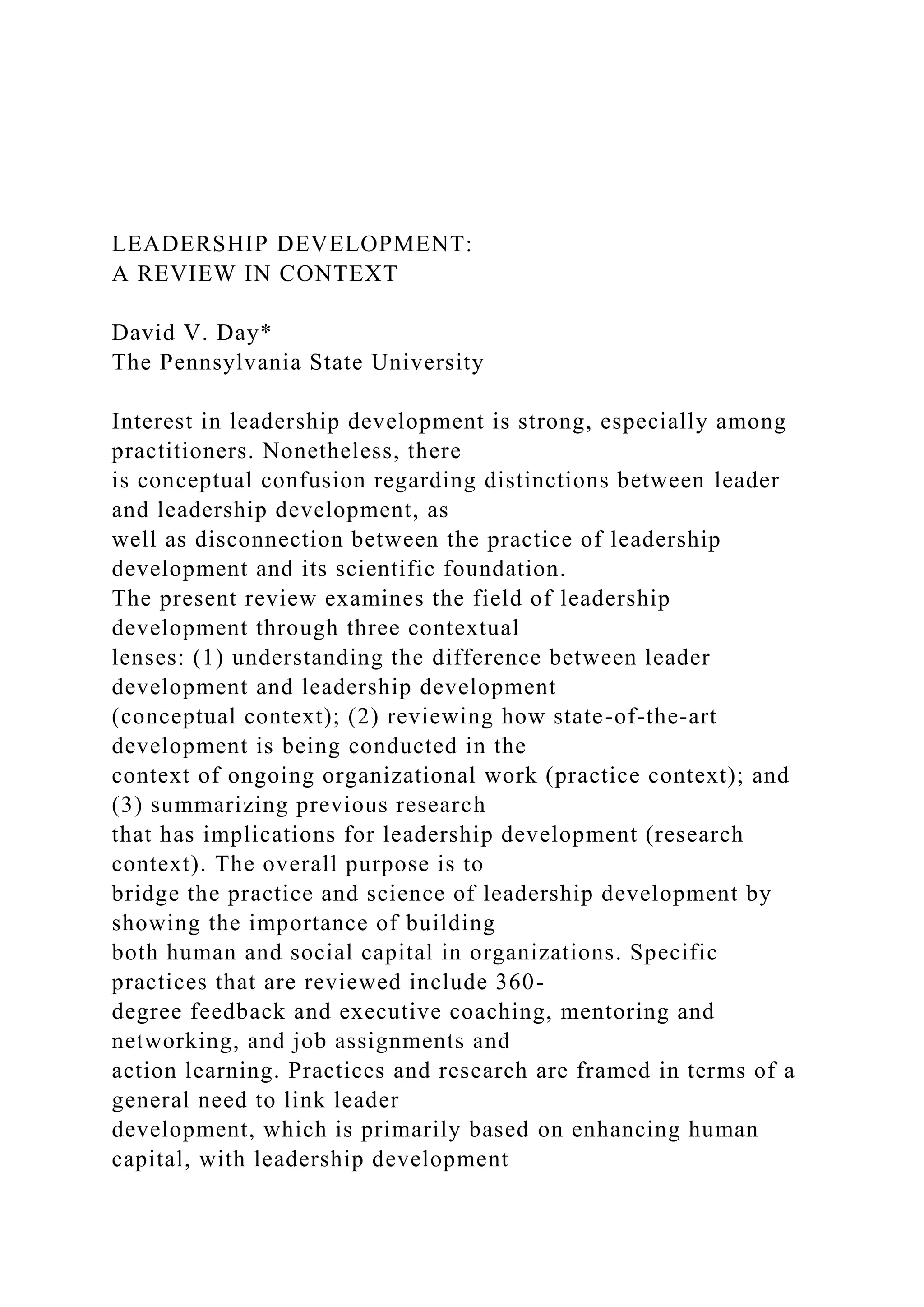
LEADERSHIP DEVELOPMENT:
A REVIEW IN CONTEXT
David V. Day*
The Pennsylvania State University
Interest in leadership development is strong, especially among
practitioners. Nonetheless, there
is conceptual confusion regarding distinctions between leader
and leadership development, as
well as disconnection between the practice of leadership
development and its scientific foundation.
The present review examines the field of leadership
development through three contextual
lenses: (1) understanding the difference between leader
development and leadership development
(conceptual context); (2) reviewing how state-of-the-art
development is being conducted in the
context of ongoing organizational work (practice context); and
(3) summarizing previous research
that has implications for leadership development (research
context). The overall purpose is to
bridge the practice and science of leadership development by
showing the importance of building
both human and social capital in organizations. Specific
practices that are reviewed include 360-
degree feedback and executive coaching, mentoring and
networking, and job assignments and
action learning. Practices and research are framed in terms of a
general need to link leader
development, which is primarily based on enhancing human
capital, with leadership development
that emphasizes the creation of social capital in organizations.
In the traditional organization—the organization of the last one
hundred
years—the skeleton or internal structure, was a combination of
rank and
power. In the emerging organization, it has to be mutual
understanding and
responsibility.
—Peter F. Drucker, Managing in Times of Great Change
Interest in leadership development appears to be at its zenith.
One indicator of
this interest is seen in survey results highlighting the increased
attention and re-
sources given to leadership development (The Conference
Board, 1999). Many
organizations are viewing leadership as a source of competitive
advantage and are
investing in its development accordingly (McCall, 1998; Vicere
& Fulmer, 1998).
* Direct all correspondence to: David V. Day, Department of
Psychology, The Pennsylvania State
University, University Park, PA 16802; e-mail:
[email protected]
Leadership Quarterly, 11(4), 581–613.
Copyright
All rights of reproduction in any form reserved.
ISSN: 1048-9843
582 LEADERSHIP QUARTERLY Vol. 11 No. 4 2000
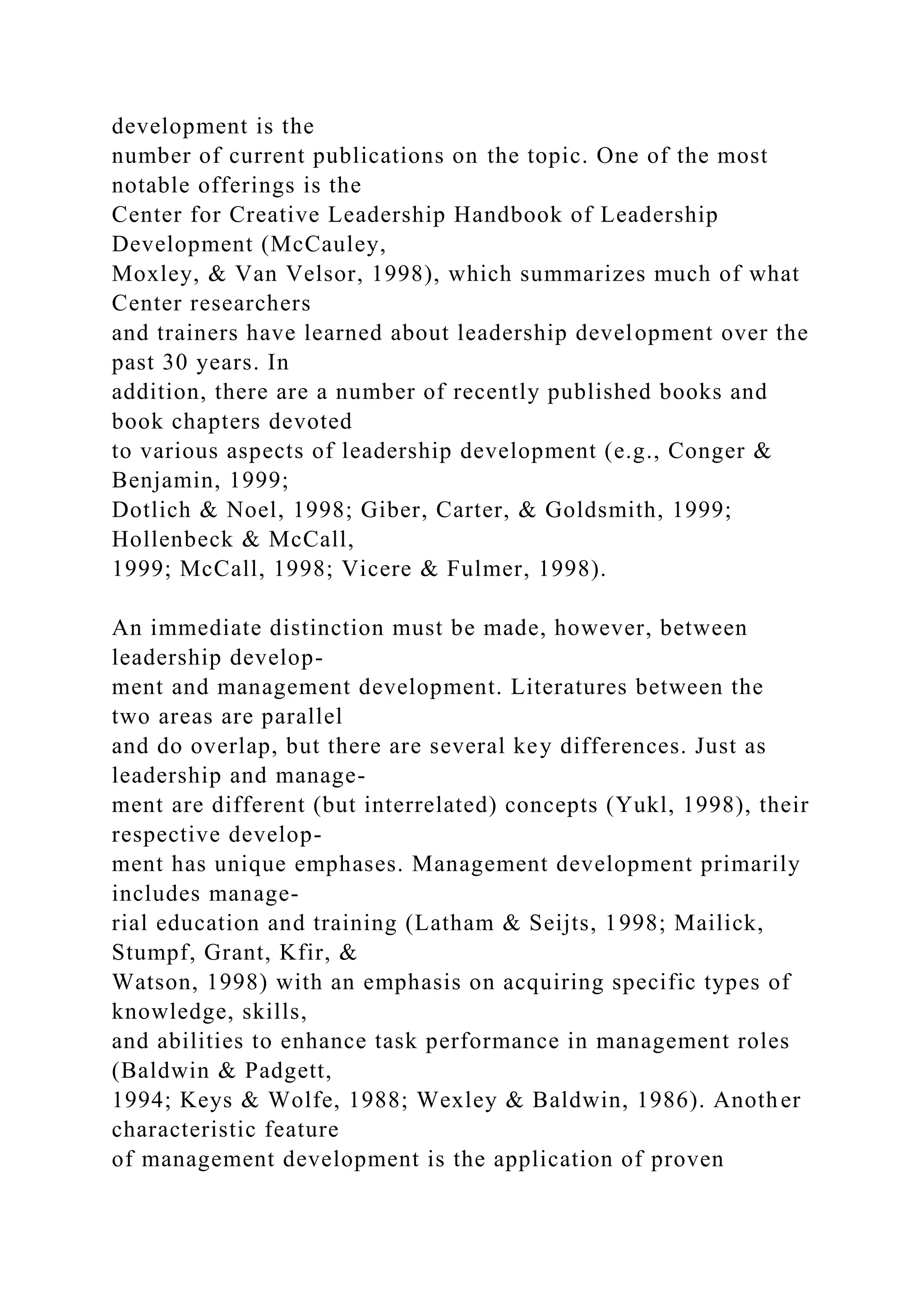
Another indicator of the burgeoning interest in leadership
development is the
number of current publications on the topic. One of the most
notable offerings is the
Center for Creative Leadership Handbook of Leadership
Development (McCauley,
Moxley, & Van Velsor, 1998), which summarizes much of what
Center researchers
and trainers have learned about leadership development over the
past 30 years. In
addition, there are a number of recently published books and
book chapters devoted
to various aspects of leadership development (e.g., Conger &
Benjamin, 1999;
Dotlich & Noel, 1998; Giber, Carter, & Goldsmith, 1999;
Hollenbeck & McCall,
1999; McCall, 1998; Vicere & Fulmer, 1998).
An immediate distinction must be made, however, between
leadership develop-
ment and management development. Literatures between the
two areas are parallel
and do overlap, but there are several key differences. Just as
leadership and manage-
ment are different (but interrelated) concepts (Yukl, 1998), their
respective develop-
ment has unique emphases. Management development primarily
includes manage-
rial education and training (Latham & Seijts, 1998; Mailick,
Stumpf, Grant, Kfir, &
Watson, 1998) with an emphasis on acquiring specific types of
knowledge, skills,
and abilities to enhance task performance in management roles
(Baldwin & Padgett,
1994; Keys & Wolfe, 1988; Wexley & Baldwin, 1986). Another
characteristic feature
of management development is the application of proven
solutions to known prob-
lems, which gives it mainly a training orientation.
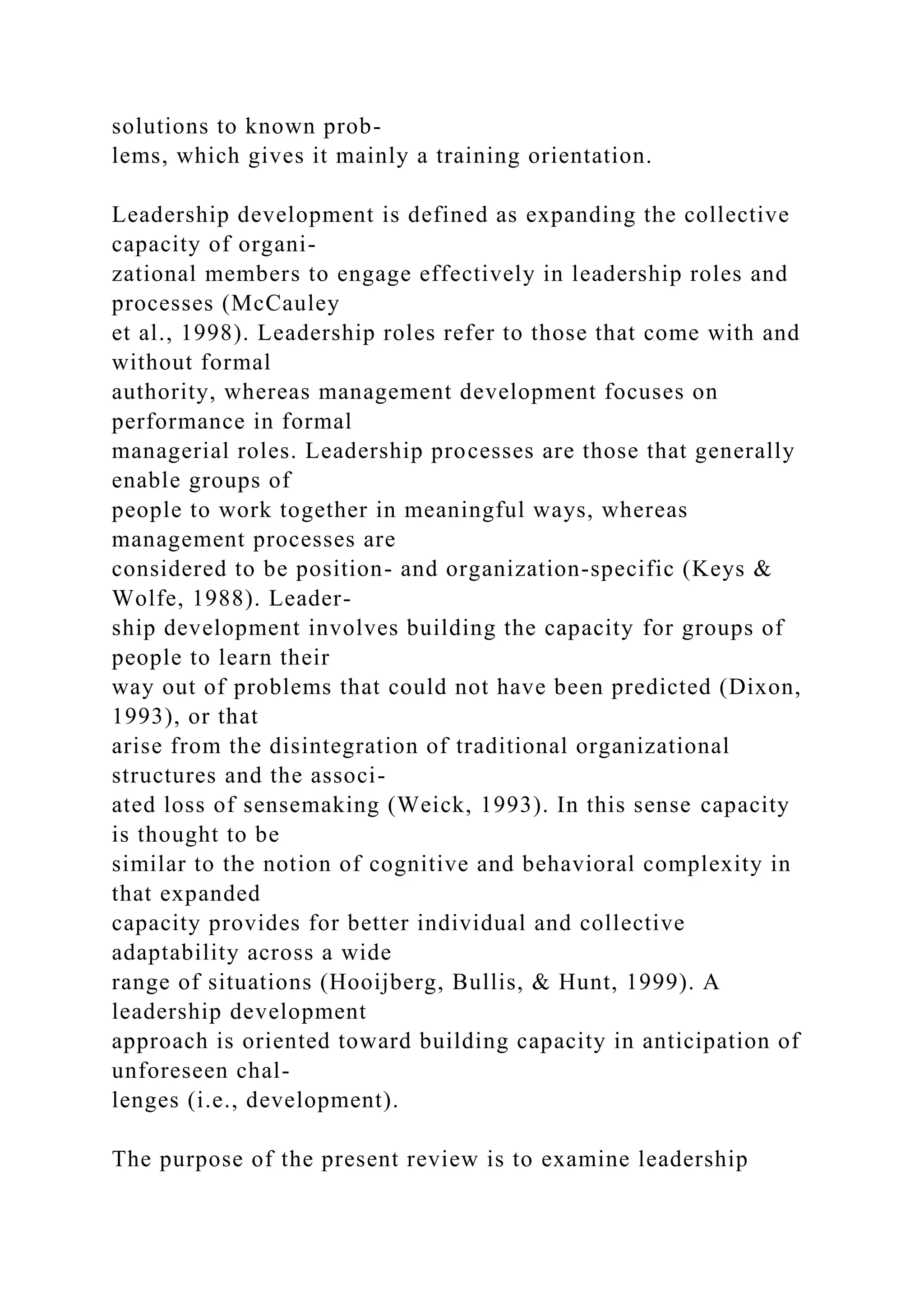
Leadership development is defined as expanding the collective
capacity of organi-
zational members to engage effectively in leadership roles and
processes (McCauley
et al., 1998). Leadership roles refer to those that come with and
without formal
authority, whereas management development focuses on
performance in formal
managerial roles. Leadership processes are those that generally
enable groups of
people to work together in meaningful ways, whereas
management processes are
considered to be position- and organization-specific (Keys &
Wolfe, 1988). Leader-
ship development involves building the capacity for groups of
people to learn their
way out of problems that could not have been predicted (Dixon,
1993), or that
arise from the disintegration of traditional organizational
structures and the associ-
ated loss of sensemaking (Weick, 1993). In this sense capacity
is thought to be
similar to the notion of cognitive and behavioral complexity in
that expanded
capacity provides for better individual and collective
adaptability across a wide
range of situations (Hooijberg, Bullis, & Hunt, 1999). A
leadership development
approach is oriented toward building capacity in anticipation of
unforeseen chal-
lenges (i.e., development).
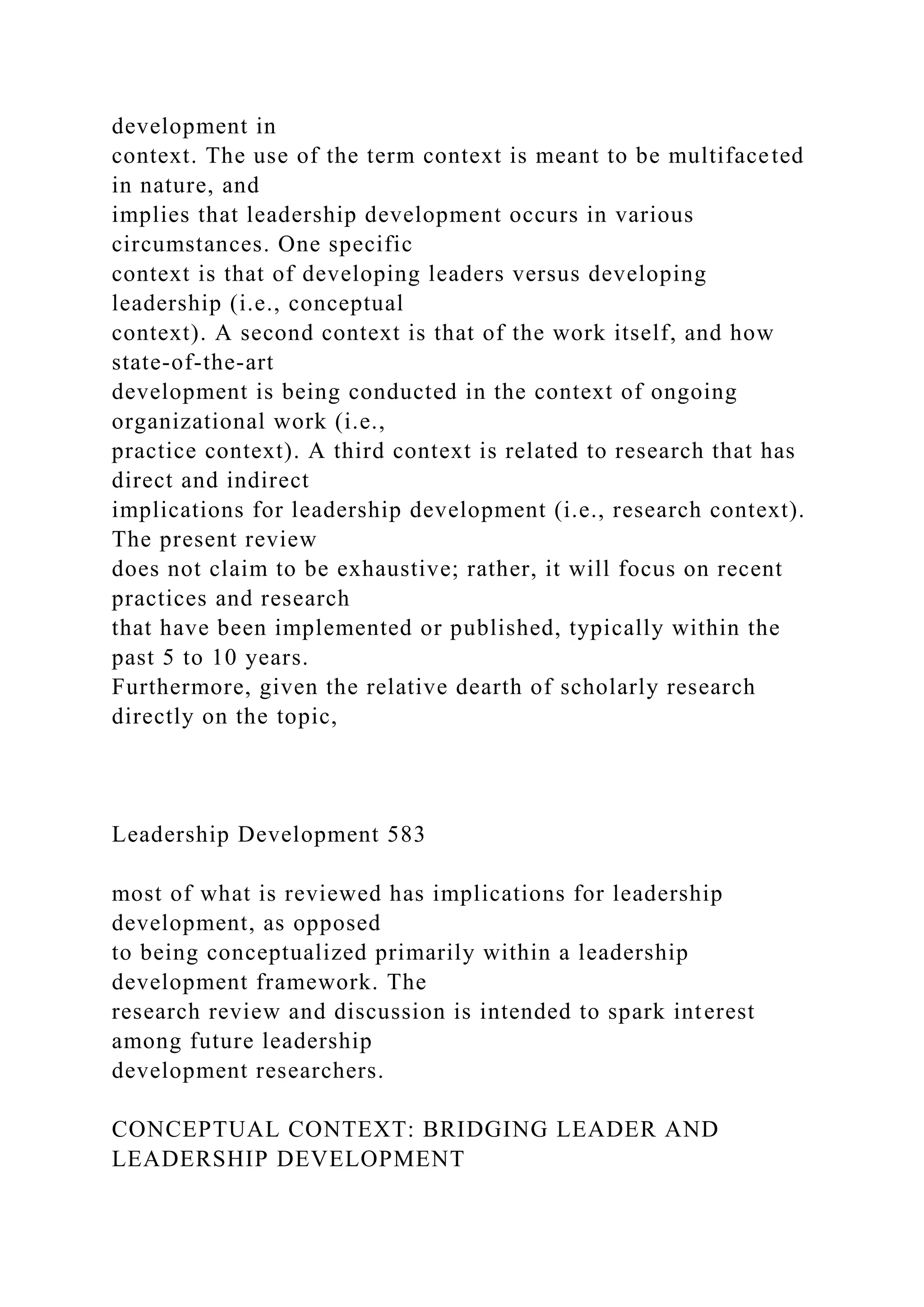
The purpose of the present review is to examine leadership
development in
context. The use of the term context is meant to be multifaceted
in nature, and
implies that leadership development occurs in various
circumstances. One specific
context is that of developing leaders versus developing
leadership (i.e., conceptual
context). A second context is that of the work itself, and how
state-of-the-art
development is being conducted in the context of ongoing
organizational work (i.e.,
practice context). A third context is related to research that has
direct and indirect
implications for leadership development (i.e., research context).
The present review
does not claim to be exhaustive; rather, it will focus on recent
practices and research
that have been implemented or published, typically within the
past 5 to 10 years.
Furthermore, given the relative dearth of scholarly research
directly on the topic,
Leadership Development 583
most of what is reviewed has implications for leadership
development, as opposed
to being conceptualized primarily within a leadership
development framework. The
research review and discussion is intended to spark interest
among future leadership
development researchers.
CONCEPTUAL CONTEXT: BRIDGING LEADER AND
LEADERSHIP DEVELOPMENT
Leadership has been traditionally conceptualized as an
individual-level skill. A
good example of this is found in transformational leadership
theory, which proposes
that transformational leaders engage in behaviors related to the
dimensions of
Charisma, Intellectual Stimulation, and Individualized
Consideration (Bass, 1985).
The corresponding approach to research and theory testing
assumes an individualis-
tic conceptualization of leadership, in which sharp distinction is
drawn between
leaders and followers (e.g., followers evaluate their “leader”
using a number of
behavioral items). Within this tradition, development is thought
to occur primarily
through training individual, primarily intrapersonal, skills and
abilities (Barling,
Weber, & Kelloway, 1996; Neck & Manz, 1996; Skarlicki &
Latham, 1997; Stewart,
Carson, & Cardy, 1996). These kinds of training approaches,
however, ignore almost
50 years of research showing leadership to be a complex
interaction between the
designated leader and the social and organizational environment
(Fiedler, 1996).
In addition to building individual leaders by training a set of
skills or abilities
and assuming that leadership will result, a complementary
perspective approaches
leadership as a social process that engages everyone in the
community (Barker,
1997; Drath & Palus, 1994; Wenger & Snyder, 2000). In this
way, each person is
considered a leader, and leadership is conceptualized as an
effect rather than a
cause (Drath, 1998). Leadership is therefore an emergent
property of effective
systems design (Salancik, Calder, Rowland, Leblebici, &
Conway, 1975). Leadership
development from this perspective consists of using social (i.e.,
relational) systems
to help build commitments among members of a community of
practice (Wenger,
1998). It is proposed that both individual and relational lenses
are important con-
cerns.
Lester Thurow (1999) has argued: “Businesses must be willing
to destroy the
old while it is still successful if they wish to build the new that
will be successful.
If they don’t destroy themselves, others will destroy them” (p.
59). In building the
leadership capacity necessary continually to reinvent
themselves, organizations need
to attend to both individual leader and collective leadership
development. Further-
more, these approaches must be linked with each other and
connected to a broader
organizational strategy (Hall & Seibert, 1992; Latham & Seijts,
1998) for maximum
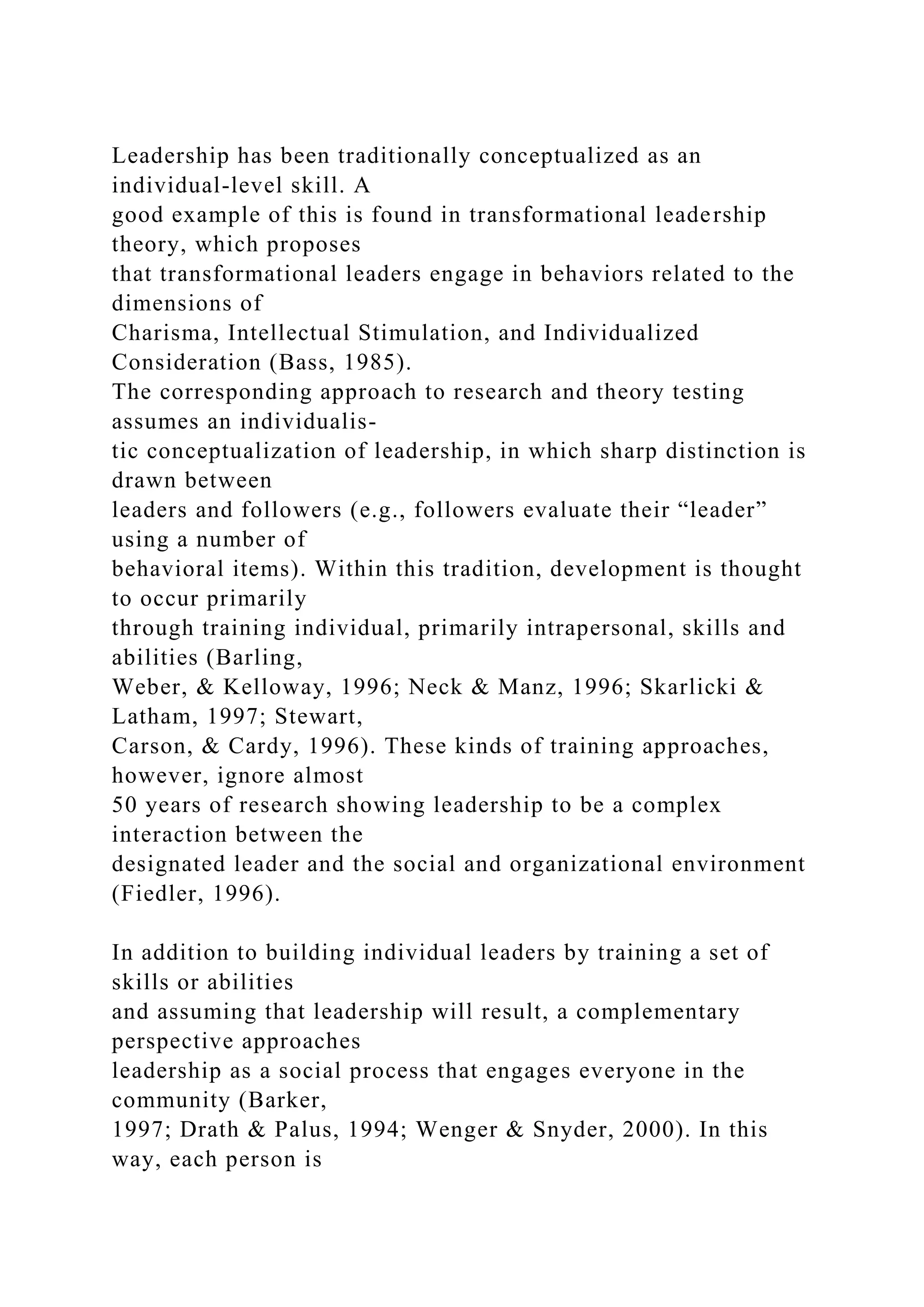
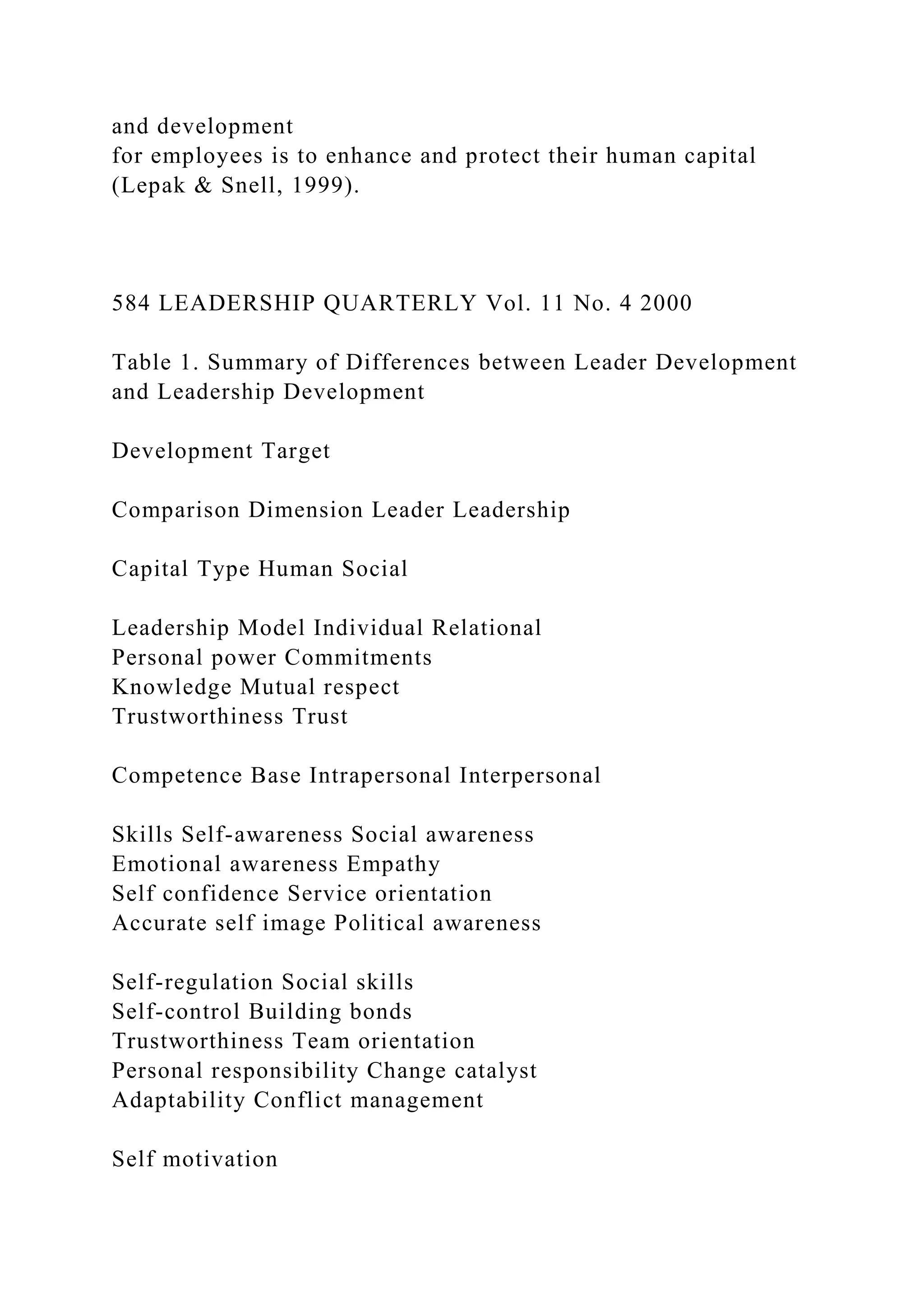
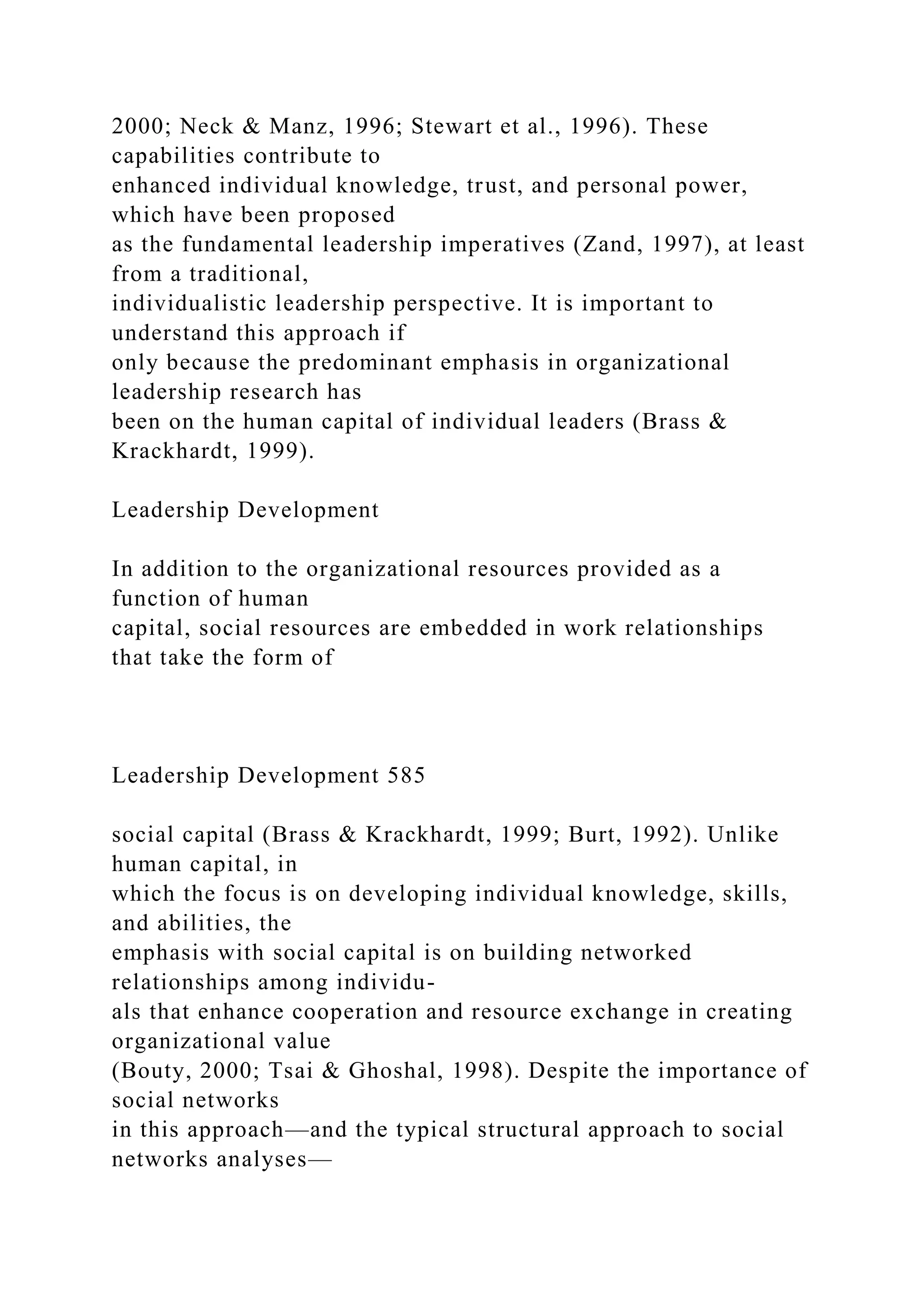
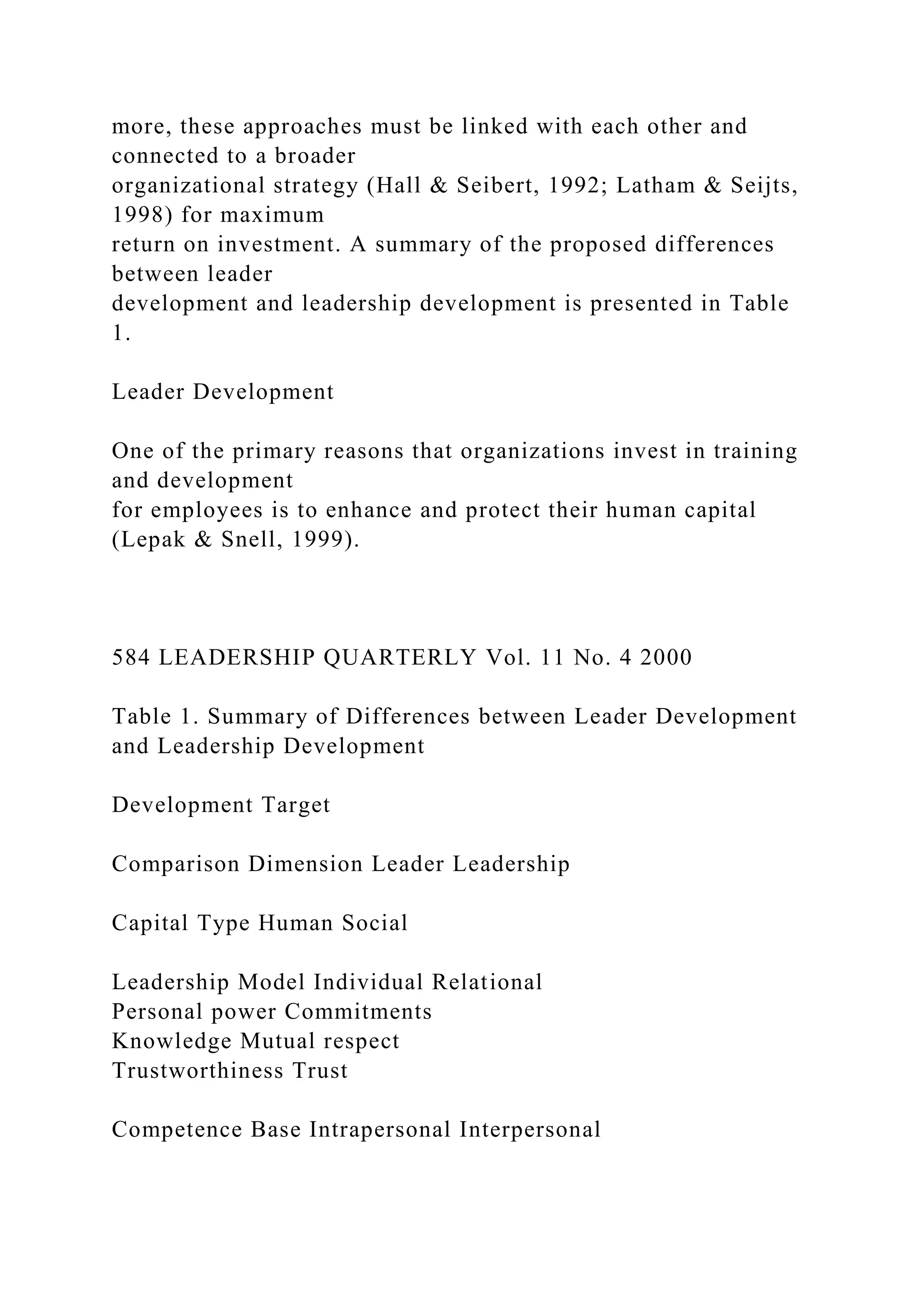
return on investment. A summary of the proposed differences
between leader
development and leadership development is presented in Table
1.
Leader Development
One of the primary reasons that organizations invest in training
and development
for employees is to enhance and protect their human capital
(Lepak & Snell, 1999).
584 LEADERSHIP QUARTERLY Vol. 11 No. 4 2000
Table 1. Summary of Differences between Leader Development
and Leadership Development
Development Target
Comparison Dimension Leader Leadership
Capital Type Human Social
Leadership Model Individual Relational
Personal power Commitments
Knowledge Mutual respect
Trustworthiness Trust
Competence Base Intrapersonal Interpersonal
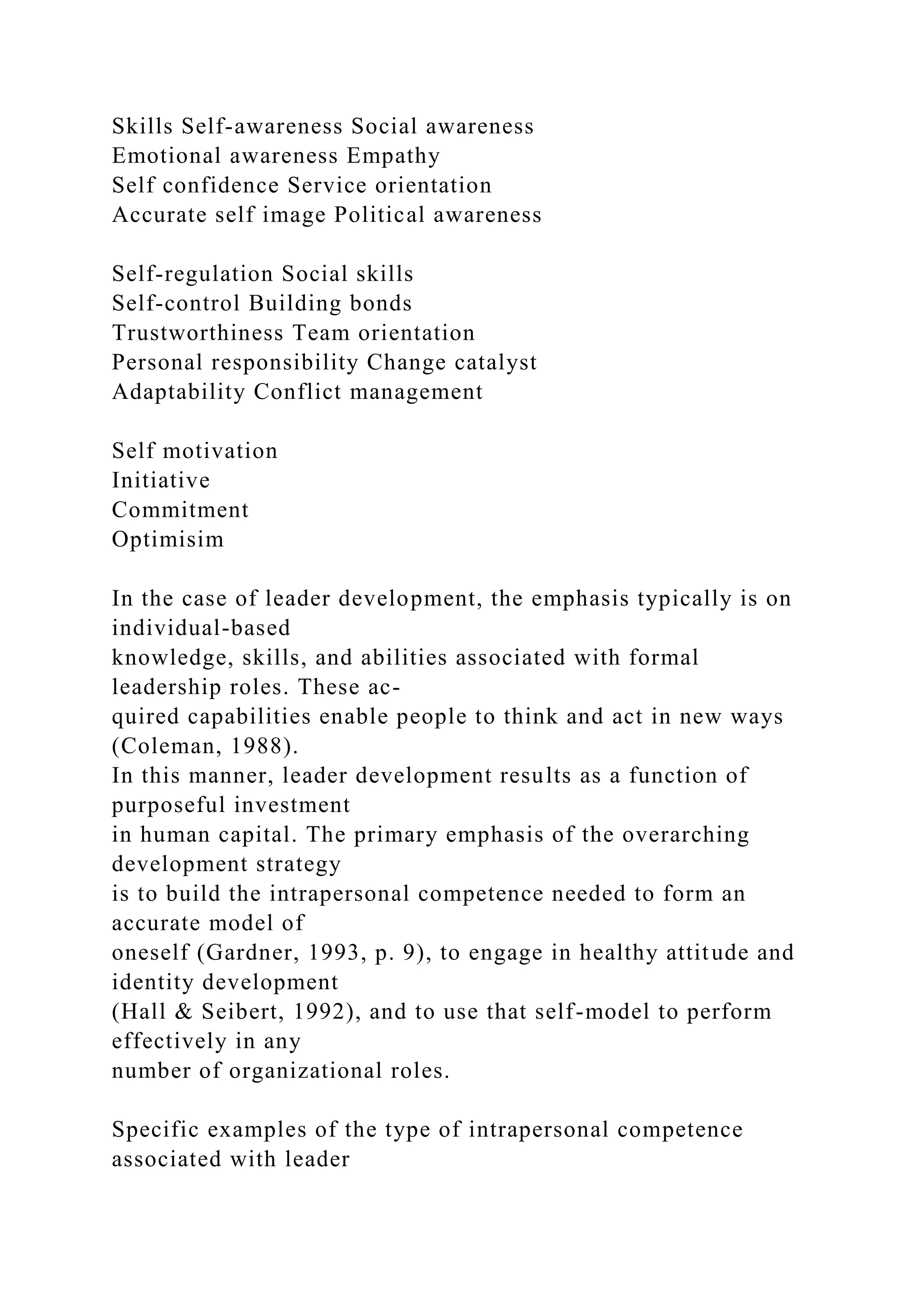
Skills Self-awareness Social awareness
Emotional awareness Empathy
Self confidence Service orientation
Accurate self image Political awareness
Self-regulation Social skills
Self-control Building bonds
Trustworthiness Team orientation
Personal responsibility Change catalyst
Adaptability Conflict management
Self motivation
Initiative
Commitment
Optimisim
In the case of leader development, the emphasis typically is on
individual-based
knowledge, skills, and abilities associated with formal
leadership roles. These ac-
quired capabilities enable people to think and act in new ways
(Coleman, 1988).
In this manner, leader development results as a function of
purposeful investment
in human capital. The primary emphasis of the overarching
development strategy
is to build the intrapersonal competence needed to form an
accurate model of
oneself (Gardner, 1993, p. 9), to engage in healthy attitude and
identity development
(Hall & Seibert, 1992), and to use that self-model to perform
effectively in any
number of organizational roles.
Specific examples of the type of intrapersonal competence
associated with leader
development initiatives include self-awareness (e.g., emotional
awareness, self con-
fidence), self-regulation (e.g., self-control, trustworthiness,
adaptability), and self-
motivation (e.g., commitment, initiative, optimism) (Manz &
Sims, 1989; McCauley,
2000; Neck & Manz, 1996; Stewart et al., 1996). These
capabilities contribute to
enhanced individual knowledge, trust, and personal power,
which have been proposed
as the fundamental leadership imperatives (Zand, 1997), at least
from a traditional,
individualistic leadership perspective. It is important to
understand this approach if
only because the predominant emphasis in organizational
leadership research has
been on the human capital of individual leaders (Brass &
Krackhardt, 1999).
Leadership Development
In addition to the organizational resources provided as a
function of human
capital, social resources are embedded in work relationships
that take the form of
Leadership Development 585
social capital (Brass & Krackhardt, 1999; Burt, 1992). Unlike
human capital, in
which the focus is on developing individual knowledge, skills,
and abilities, the
emphasis with social capital is on building networked
relationships among individu-
als that enhance cooperation and resource exchange in creating
organizational value
(Bouty, 2000; Tsai & Ghoshal, 1998). Despite the importance of
social networks
in this approach—and the typical structural approach to social
networks analyses—
social capital is defined more by its function than by its
structure (Coleman, 1988;
Whitener, 2000). That is, social capital is based on
relationships, which are created
through interpersonal exchange (Bourdieu, 1986). In this
manner social capital
requires an interpersonal lens that is grounded in a relational
model of leadership
(Drath & Palus, 1994). At the heart of this relational model are
commitments in
the form of mutual obligations, which are supported by
reciprocated trust and
respect (Brower, Schoorman, & Tan, 2000).
Commitments, trust, and respect correspond roughly to three
different aspects
of social capital proposed by Nahapiet and Ghoshal (1998):
structural, relational,
and cognitive. The structural dimension pertains primarily to
social interactions
typically assessed by means of network ties (Tsai & Ghoshal,
1998). The social
structure of interactions—and an actor’s location in relation to
his or her contacts—
has been shown to provide resources to the actor as well as the
organization (Burt,
1992). This structure is formed as a result of the commitments
among all parties in
a given social network. The relational dimension of social
capital refers to functional
assets that are rooted in networked relationships, such as trust
and trustworthiness
(Tsai & Ghoshal, 1998), which describe the kind of personal
relationships developed
through a history of interactions. This is a particularly
interesting dimension.
Whereas trust is an attribute of the relationship, trustworthiness
rests in the intraper-
sonal qualities of the individual (Barney & Hansen, 1994). This
highlights the
importance of developing both intrapersonal and interpersonal
competence, and
of linking leader development with leadership development.
The third aspect of social capital is the cognitive dimension,
which refers to
resources embodied in shared representations and collective
meanings among peo-
ple. Expressions of the cognitive dimension to social capital can
be found in organiza-
tion culture or a shared vision based on a set of common values
that produces and
is a product of mutual respect. These facets of social capital
(i.e., structural, rela-
tional, and cognitive) are interrelated and not independent
concerns, and have been
empirically linked to value creation in organizations through
their separate effects
on resource exchange and combination (Bouty, 2000; Tsai &
Ghoshal, 1998).
The primary emphasis in leadership development is on building
and using inter-
personal competence. Gardner (1993) defines interpersonal
intelligence in terms
of the ability to understand people—a basic concern in building
trust, respect, and
ultimately, commitments. Key components of interpersonal
competence include
social awareness (e.g., empathy, service orientation, and
developing others) and
social skills (e.g., collaboration and cooperation, building
bonds, and conflict man-
agement) (Goleman, 1995; McCauley, 2000). The emphasis is
on the social nature
of this competence, and the idea that effective development best
occurs in an
interpersonal (i.e., social) context.
The notion of leadership development offered in the present
review focuses on
the interaction between an individual and the social and
organizational environment
586 LEADERSHIP QUARTERLY Vol. 11 No. 4 2000
(Fiedler, 1996). As such, it is a more complex endeavor than
one concerned solely
with individual leader development. Although there is still a
need to develop a
sound foundation of intrapersonal and interpersonal skills, it is
proposed that the
most value resides in combining what is considered the
traditional, individualistic
approach to leader development with a more shared and
relational approach.
Another way to conceptualize the distinction is that leader
development can be
interpreted as a form of individual-based differentiation in
terms of helping individu-
als enhance a unique self-understanding and construct
independent identities
(Hall & Seibert, 1992; McCauley et al., 1998). Leadership
development can be
thought of as an integration strategy by helping people
understand how to relate
to others, coordinate their efforts, build commitments, and
develop extended social
networks by applying self-understanding to social and
organizational imperatives.
An overall approach to leadership development as a type of
organizational develop-
ment strategy requires a purposeful transformation toward
higher levels of both
leadership integration and differentiation. This is an example of
a move toward
what has been termed “organized complexity” (Gharajedaghi,
1999, pp. 92–93).
The profound changes shaping the competitive business
environment are also
affecting how organizations prepare people for present and
future challenges. One
emphasis has been on investing more intensely in leader and
leadership development
across all organization levels, and to develop leadership
capacity in all employees
and across all organizational systems. Scholarly researchers
potentially have much
to contribute to the understanding and improvement of
leadership development in
organizations. In particular, researchers can help enhance the
purposefulness of
leadership development by examining how various practices and
processes, alone
and in combination, contribute to better leadership. One of the
biggest challenges
facing organizations is reversing a tendency that allows
leadership development to
become a “haphazard process” (Conger, 1993, p. 46), which
results from embedding
development in the ongoing work of an organization without
sufficient notice to
intentionality, accountability, and evaluation.
To be of any help in this endeavor, academic researchers need
to first transcend
the outdated notion that leadership development occurs only
through specially
designed programs held in particular locations. Instead, it is a
continuous process
that can take place anywhere (Fulmer, 1997). Leadership
development in practice
today means helping people learn from their work rather than
taking them away
from their work to learn (Moxley & O’Connor Wilson, 1998).
State-of-the-art
leadership development is occurring in the context of ongoing
work initiatives that
are tied to strategic business imperatives (Dotlich & Noel,
1998).
Of course, classroom programs are still widely used by
organizations as one type
of development practice. A 1995 survey sponsored by the
American Society of
Training and Development indicated that 85% of companies that
engage in leader-
ship development activities use formal classroom programs
(American Society for
Training and Development, 1995); however, many organizations
are realizing that
such programs are not enough. Classroom programs suffer from
transfer of training
challenges and high start-up costs, among other limitations. The
real movement is
toward understanding and practicing leadership development
more effectively in
the context of the work itself.
Leadership Development 587
PRACTICE AND RESEARCH CONTEXTS: BRIDGING THE
APPLIED AND
ACADEMIC COMMUNITIES
A variety of practices have been developed and implemented in
organizations for
reasons other than leadership development. Most typically,
these practices were pri-
marily intended to improve performance management (e.g., 360-
degree feedback),
facilitate corporate socialization (e.g., mentoring), or enhance
productivity (e.g., job
assignments, action learning). Often the practices are
completely embedded in the
work. In many cases, these practices also form the backbone of
contemporary leader-
ship development systems. The present review will examine the
most popular and
promising practices used to develop leaders and leadership in
the context of ongoing
work in an organization. Each section will contain a brief
overview of the practice,
how it is used for development, and a synthesis of recent theory
and research with
implications for understanding or improving the effectiveness of
leadership develop-
ment in work contexts. Literature from both the practitioner and
academic domains
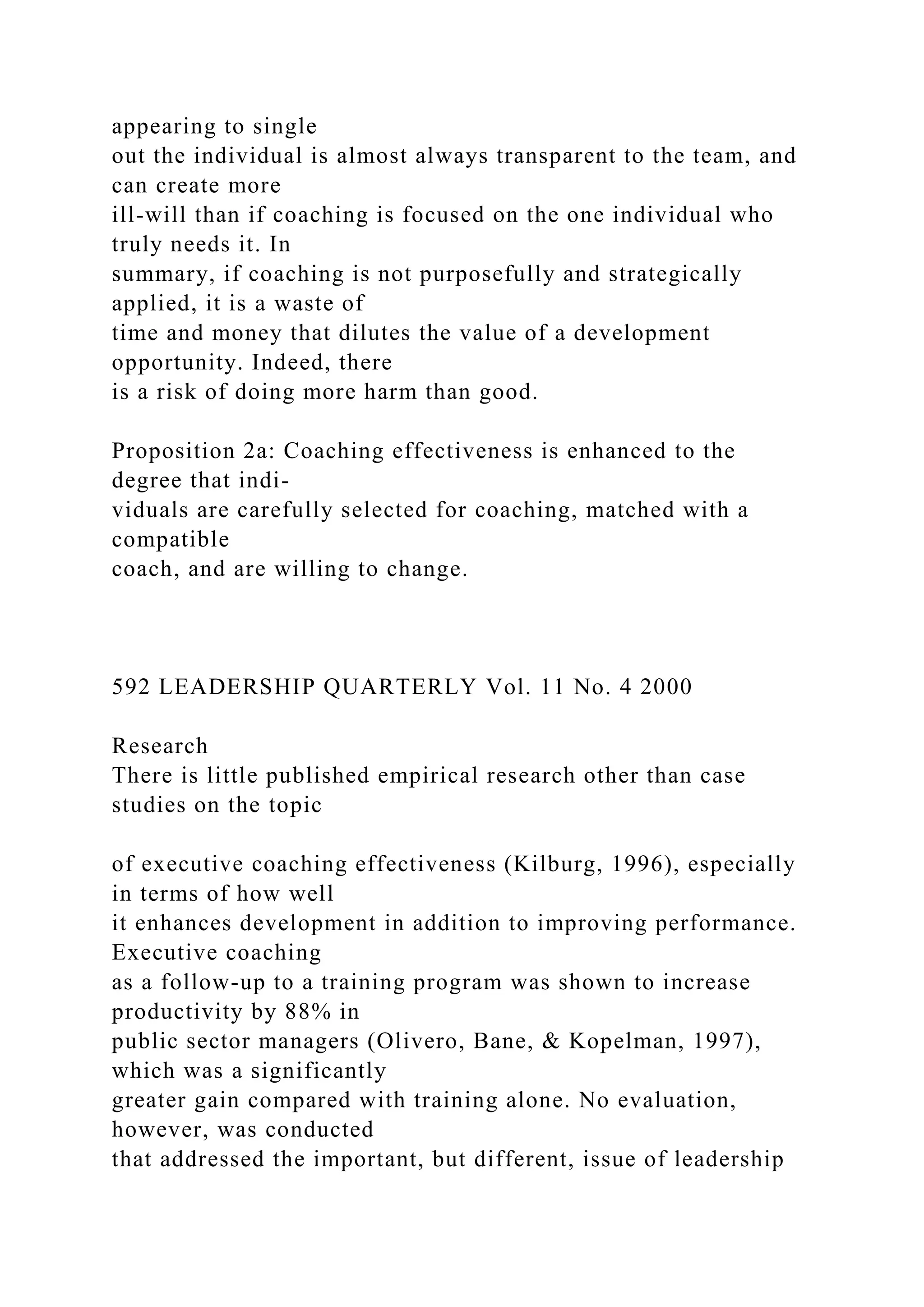
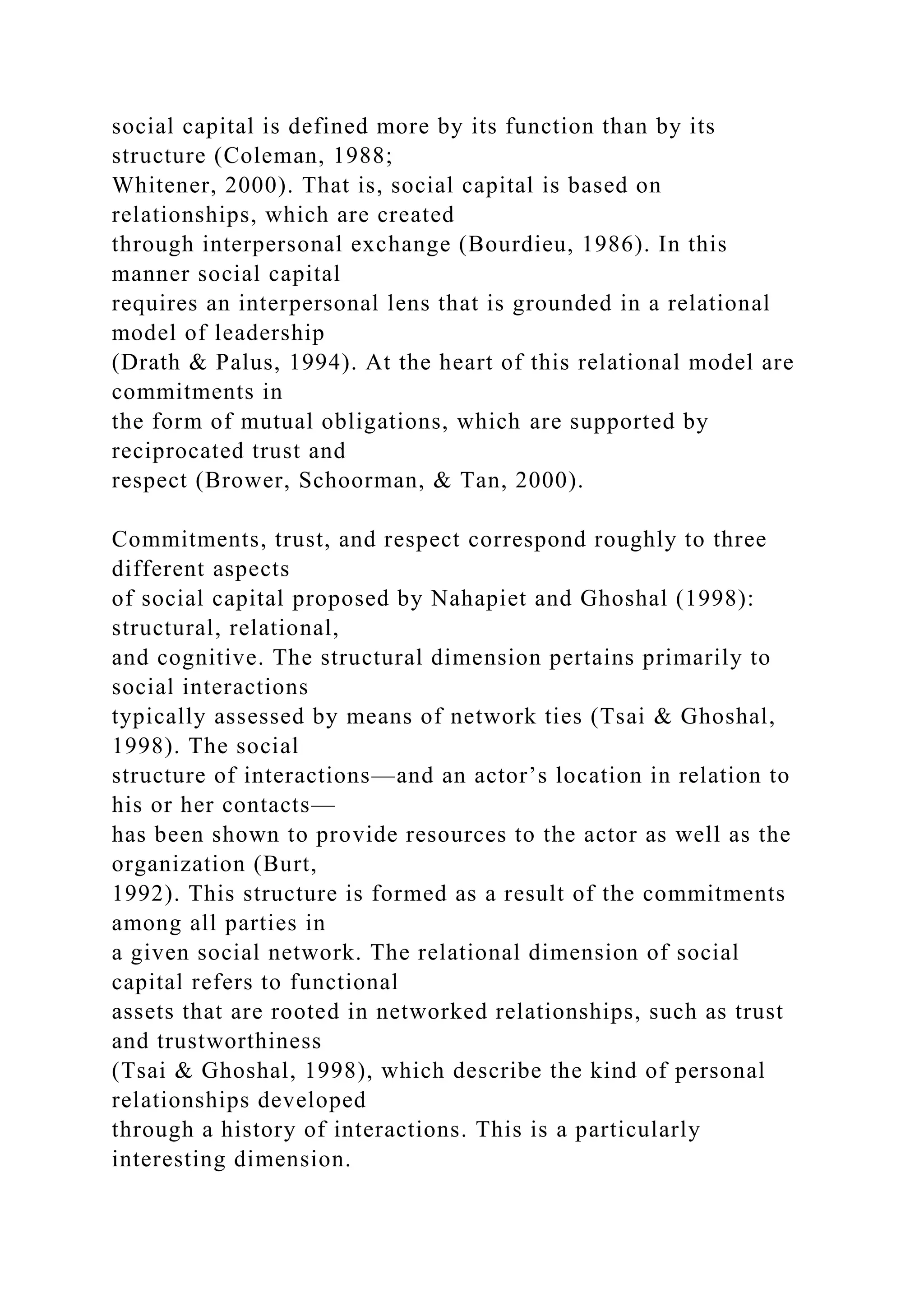
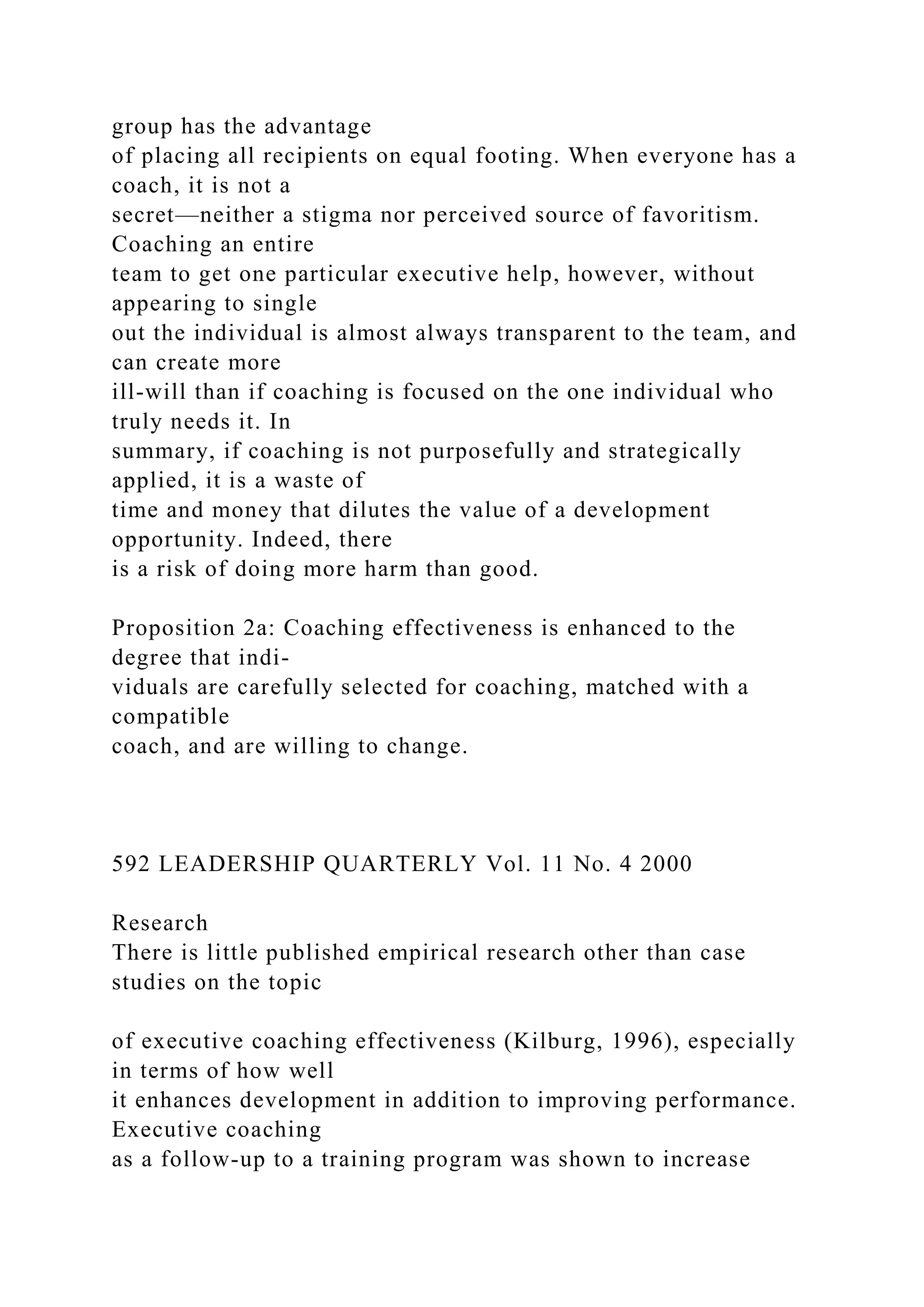
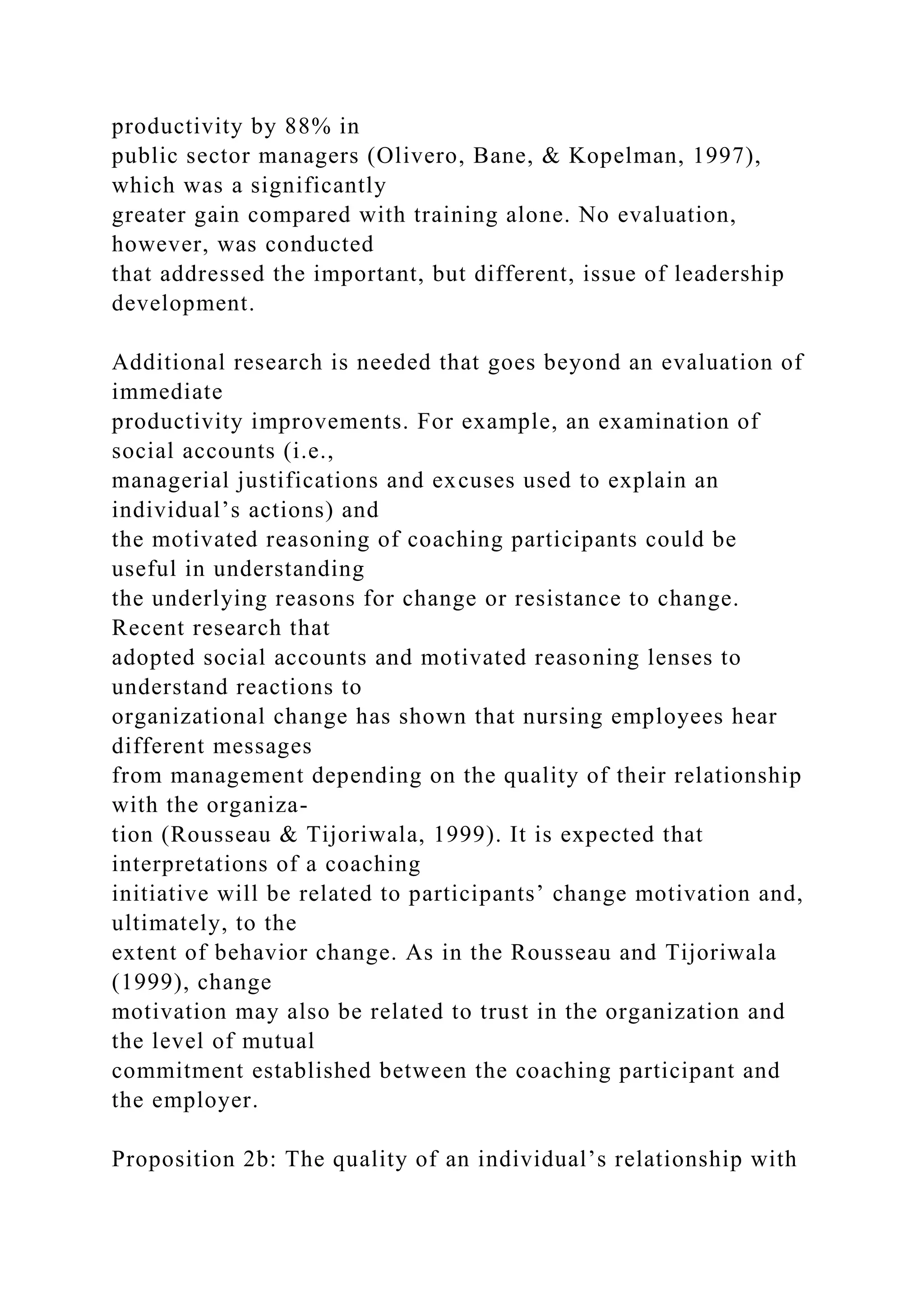
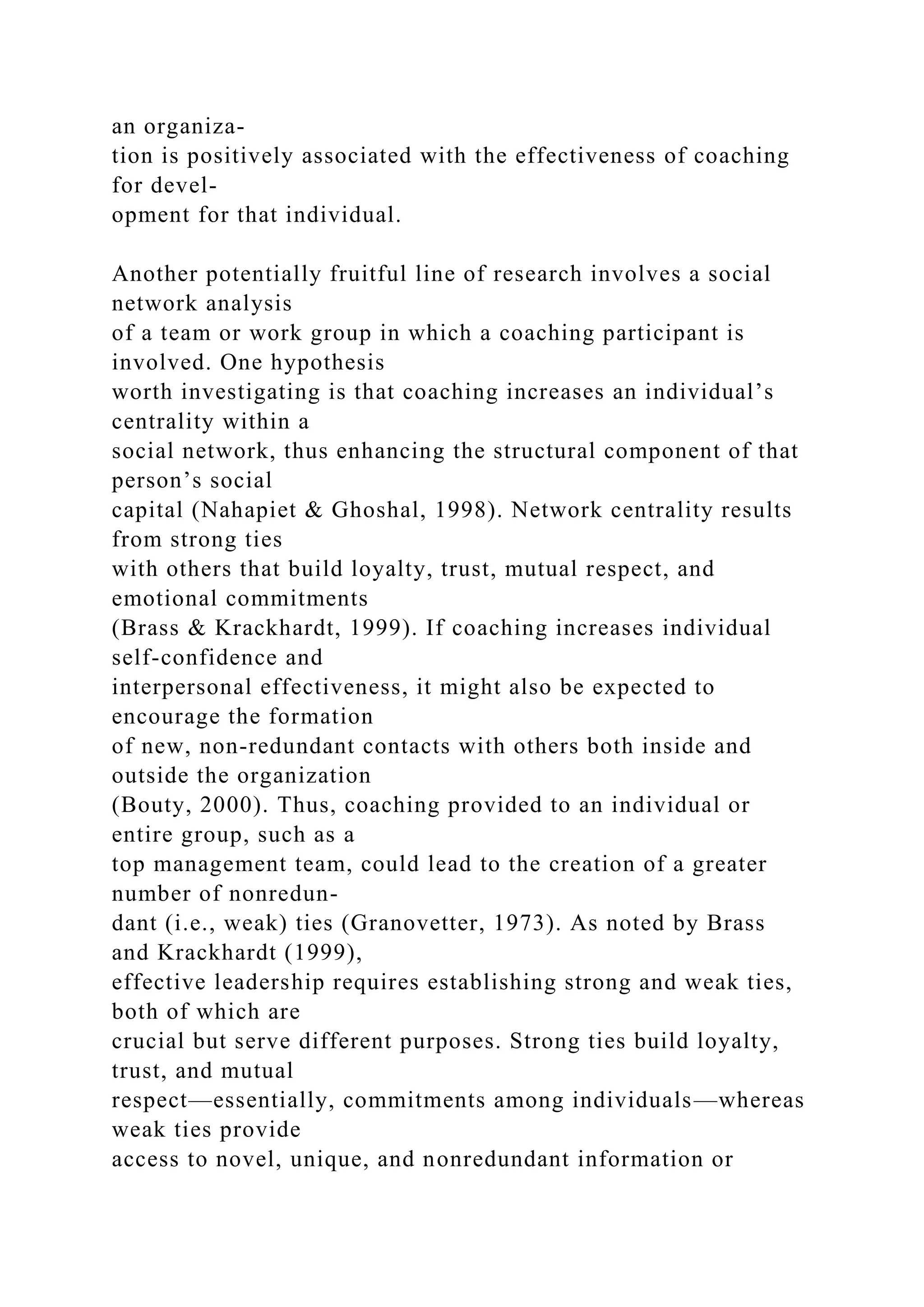
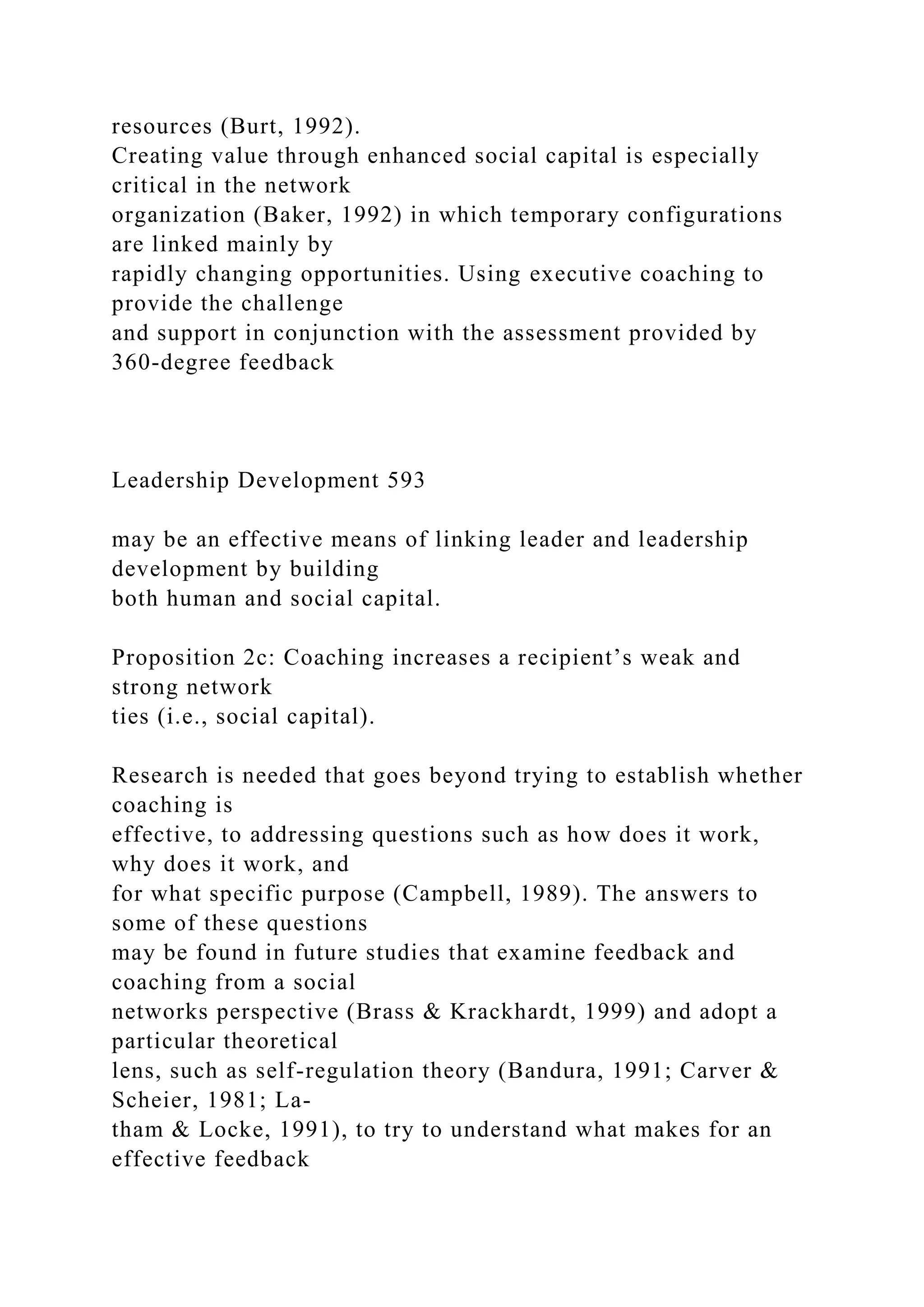
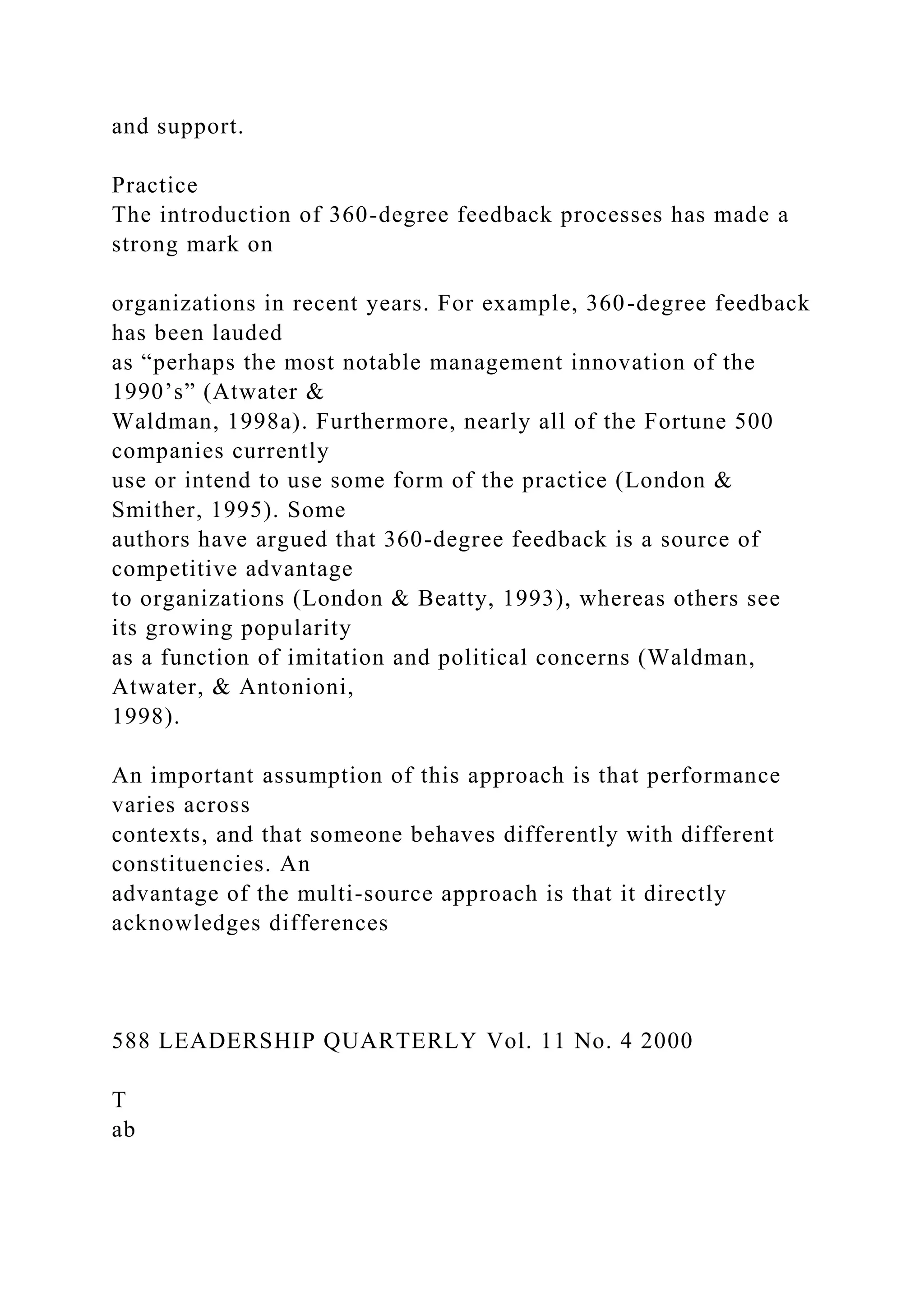
will be examined. The specific practices to be reviewed (see
Table 2) are 360-degree
feedback and executive coaching, mentoring and networking,
and job assignments
and action learning. These practices are arranged roughly on a
continuum of least
to most embedded in ongoing organizational work.
360-degree Feedback
Overview
360-degree feedback, multi-source feedback, and multi-rater
feedback are all
terms used to describe this method of systematically collecting
perceptions of an
individual’s performance from the entire circle of relevant
viewpoints (Warech,
Smither, Reilly, Millsap, & Reilly, 1998). Rating sources
typically include peers,
direct reports, supervisors, and, occasionally, such external
stakeholders as custom-
ers and suppliers. A purported advantage of such intense,
comprehensive scrutiny
is that a more complete and accurate picture of an individual’s
performance can
be obtained. In terms of the tripartite developmental strategy of
linking assessment,
challenge, and support (Van Velsor, McCauley, & Moxley,
1998), 360-degree feed-
back is strong on assessment but typically weak on challenge
and support.
Practice
The introduction of 360-degree feedback processes has made a
strong mark on
organizations in recent years. For example, 360-degree feedback
has been lauded
as “perhaps the most notable management innovation of the
1990’s” (Atwater &
Waldman, 1998a). Furthermore, nearly all of the Fortune 500
companies currently
use or intend to use some form of the practice (London &
Smither, 1995). Some
authors have argued that 360-degree feedback is a source of
competitive advantage
to organizations (London & Beatty, 1993), whereas others see
its growing popularity
as a function of imitation and political concerns (Waldman,
Atwater, & Antonioni,
1998).
An important assumption of this approach is that performance
varies across
contexts, and that someone behaves differently with different
constituencies. An
advantage of the multi-source approach is that it directly
acknowledges differences
588 LEADERSHIP QUARTERLY Vol. 11 No. 4 2000
T
ab
le
2.
S
u
m
m
ar
y
o
f
S
el
ec
te
d
P
ra
ct
ic
es
in
L
ea
d
er
sh
ip
D
ev
el
o
p
m
en
t
P
ra
ct
ic
e
D
es
cr
ip
ti
o
n
D
ev
el
o
p
m
en
t
T
ar
ge
t
H
C
S
C
S
tr
en
gt
h
s
W
ea
k
n
es
se
s
36
0-
d
eg
re
e
M
u
lt
i-
so
u
rc
e
ra
ti
n
gs
o
f
S
el
f-
k
n
o
w
le
d
ge
✓
x
C
o
m
p
re
h
en
si
ve
O
ve
rw
h
el
m
in
g
am
o
u
n
t
o
f
fe
ed
b
ac
k
p
er
fo
rm
an
ce
,
o
rg
an
iz
ed
B
eh
av
io
ra
l
ch
an
ge
p
ic
tu
re
;
b
ro
ad
d
at
a;
n
o
gu
id
an
ce
o
n
h
o
w
an
d
p
re
se
n
te
d
to
an
p
ar
ti
ci
p
at
io
n
(A
)
to
ch
an
ge
;
ti
m
e
an
d
in
d
iv
id
u
al
ef
fo
rt
(C
,
S
)
C
o
ac
h
in
g
P
ra
ct
ic
al
,
go
al
-f
o
cu
se
d
fo
rm
S
el
f-
k
n
o
w
le
d
ge
✓
?
P
er
so
n
al
iz
ed
;
P
er
ce
iv
ed
st
ig
m
a
o
f
o
n
e-
o
n
-o
n
e
le
ar
n
in
g
B
eh
av
io
ra
l
ch
an
ge
in
te
n
si
ve
(C
,
S
)
(r
em
ed
ia
l)
;
ex
p
en
si
ve
C
ar
ee
r
d
ev
el
o
p
m
en
t
M
en
to
ri
n
g
A
d
vi
si
n
g/
d
ev
el
o
p
m
en
ta
l
B
ro
ad
er
✓
?
S
tr
o
n
g
p
er
so
n
al
P
ee
r
je
al
o
u
sy
;
o
ve
r
re
la
ti
o
n
sh
ip
,
u
su
al
ly
w
it
h
a
u
n
d
er
st
an
d
in
g.
b
o
n
d
(S
)
d
ep
en
d
en
ce
;
(A
,
C
)
m
o
re
se
n
io
r
m
an
ag
er
A
d
va
n
ce
m
en
t
ca
ta
ly
st
.
L
es
so
n
s
le
ar
n
ed
/
av
o
id
m
is
ta
k
es
.
N
et
w
o
rk
s
C
o
n
n
ec
ti
n
g
to
o
th
er
s
in
B
et
te
r
p
ro
b
le
m
-
?
✓
B
u
il
d
s
o
rg
an
iz
at
io
n
A
d
h
o
c;
u
n
st
ru
ct
u
re
d
(A
)
d
if
fe
re
n
t
fu
n
ct
io
n
s
an
d
so
lv
in
g.
(S
)
ar
ea
s
L
ea
rn
in
g
w
h
o
to
co
n
su
lt
fo
r
p
ro
je
ct
h
el
p
.
S
o
ci
al
iz
at
io
n
Jo
b
A
ss
ig
n
m
en
ts
P
ro
vi
d
in
g
“s
tr
et
ch
”
S
k
il
ls
d
ev
el
o
p
m
en
t.
✓
?
Jo
b
re
le
va
n
t;
C
o
n
fl
ic
t
b
et
w
ee
n
as
si
gn
m
en
ts
in
te
rm
s
o
f
B
ro
ad
er
ac
ce
le
ra
te
s
p
er
fo
rm
an
ce
an
d
d
ev
el
.;
ro
le
,
fu
n
ct
io
n
,
o
r
u
n
d
er
st
an
d
in
g
o
f
le
ar
n
in
g
(C
)
n
o
st
ru
ct
u
re
fo
r
le
ar
n
in
g
ge
o
gr
ap
h
y
th
e
b
u
si
n
es
s.
(A
,
S
)
A
ct
io
n
L
ea
rn
in
g
P
ro
je
ct
-b
as
ed
le
ar
n
in
g
S
o
ci
al
iz
at
io
n
✓
✓
T
ie
d
to
b
u
si
n
es
s
T
im
e
in
te
n
si
ve
;
le
ad
er
sh
ip
d
ir
ec
te
d
at
im
p
o
rt
an
t
T
ea
m
w
o
rk
Im
p
le
m
en
t
im
p
er
at
iv
es
;
le
ss
o
n
s
n
o
t
al
w
ay
s
cl
ea
r;
b
u
si
n
es
s
p
ro
b
le
m
s
st
ra
te
gy
.
ac
ti
o
n
-o
ri
en
te
d
o
ve
r-
em
p
h
as
is
o
n
re
su
lt
s
(C
,
S
)
(A
)
N
o
te
:
H
C
5
h
u
m
an
ca
p
it
al
;
S
C
5
so
ci
al
ca
p
it
al
;
✓
5
in
te
n
d
ed
d
ev
el
o
p
m
en
ta
l
ta
rg
et
;
x
5
n
o
t
an
in
te
n
d
ed
d
ev
el
o
p
m
en
ta
l
ta
rg
et
;
?
5
p
o
ss
ib
le
d
ev
el
o
p
m
en
ta
l
ta
rg
et
;
A
5
as
se
ss
m
en
t;
C
5
ch
al
le
n
ge
;
S
5
su
p
p
o
rt
.
Leadership Development 589
across sources in the opportunity to observe various aspects of
an individual’s
performance. Research findings corroborate these assumptions
in showing that
ratings across sources correlate only moderately (e.g., Atwater,
Ostroff, Yammar-
ino, & Fleenor, 1998; Atwater & Yammarino, 1997; Carless,
Mann, & Wearing,
1998). Rather than being a problem, this finding suggests that
performance may be
different, and may be perceived differently, across various
constituencies. Multi-
source or 360-degree ratings are needed to capture this variety
of behavior and
perspective. It should also be noted that additional research
found little evidence
of within-source rating agreement (Greguras & Robie, 1998),
even among raters
with similar observational opportunities (Van Scotter & Steel,
2000). Thus, using
multiple raters within multiple rating sources makes good
psychometric sense in
terms of enhancing the overall reliability of feedback.
The growing popularity of 360-degree feedback may have
something to do with
a deeper appreciation for the business necessity of self-
understanding. Lack of
self-awareness can jeopardize projects by contributing to sub-
optimal individual
performance, or by creating increased stress and anxiety in
others (Dotlich & Noel,
1998). Other possible reasons for the popularity of 360-degree
feedback include its
effectiveness as a developmental tool, its initial ease of
implementation (although
it is more complicated to manage effectively than many
companies realize), and
that many of the “most-admired” firms have adopted the
practice (Waldman et
al., 1998). A somewhat different explanation for the increased
use of 360-degree
evaluations lies with the changing nature of the U.S. industrial
economy. In the
past, the measure of a company’s success was its property, not
its people. Among
leading-edge companies, that ratio is now reversed, and the
majority of the wealth
in many organizations is in its employees (i.e., intellectual
capital). Thus, if a large
portion of that talent becomes frustrated with their co-workers
or bosses and quit
the company, the economic results could be devastating for an
organization. A
substantial amount of value could potentially end up employed
by a competitor,
or—with the attractiveness of entrepreneurial start-ups—
become the competition.
Multi-source feedback can be a useful developmental tool for
building intraper-
sonal competence in the form of self-knowledge and increased
self-awareness of
one’s impact on others, which is connected to building
individual trustworthiness
(Barney & Hansen, 1994). If the feedback process is handled
professionally and
with sensitivity, an individual’s trusting intentions toward
others can be enhanced
(McKnight, Cummings, & Chervany, 1998). Because trust
facilitates the cooperation
needed for effective teamwork in organizations (Nahapiet &
Ghoshal, 1998), there
is an indirect link between 360-degree feedback and the
development of social
capital; its primary contribution, however, is on developing
intrapersonal compe-
tence associated with enhanced human capital.
Proposition 1a: The use of 360-degree or multi-source feedback
is associated
with the development of human capital (i.e., intrapersonal
competence)
in organizations.
Research
Nothing guarantees that feedback inherently leads to positive
individual change.
Indeed, research indicates that over one-third of the feedback
interventions reported
590 LEADERSHIP QUARTERLY Vol. 11 No. 4 2000
in the literature resulted in decreased performance (Kluger &
DeNisi, 1996). One
reason that behavioral change may not follow from feedback is
that most people
have well-developed defense mechanisms that protect them from
feedback that is
perceived as too threatening (Chappelow, 1998). Conversely,
some might recognize
feedback as accurate but do not want to change their behavior.
For any leadership
development effort to be effective—particularly one based on
360-degree feed-
back—a participant must first be willing to accept feedback as
relevant and useful,
and be open to change. They must also be realistic and resilient
in that change is
rarely a simple path forward; a large investment of time and
energy is required
before the needed change becomes part of an individual’s
behavioral repertoire.
Recent research findings indicate that what managers do with
their feedback
does matter. Specifically, managers who met with direct reports
to discuss their
upward feedback demonstrated greater change in the form of
performance improve-
ment than managers who did not discuss their feedback (Walker
& Smither, 1999).
Other research found that perceived organization support
enhances the usefulness
of subordinate feedback over and above the overall favorability
of the feedback
(Facteau, Facteau, Schoel, Russell, & Poteet, 1998). Only
favorability predicted the
usefulness of peer ratings.
Another difficulty is that measuring change using 360-degree
survey instruments
has proven to be a challenge, given associated changes in
expectations about a
target as a result of program participation (i.e., beta change),
and changes in thinking
about the constructs being rated (i.e., gamma change). For these
reasons, some
researchers have adopted a retrospective methodology in which
a measure of the
perceived degree of a target’s behavioral change is gathered at
the second wave of
data collection (Martineau, 1998; Peterson, 1993). This
methodology is intriguing
in that it attempts directly to assess the degree of perceived
change rather than
basing it on difference scores, which are associated with their
own set of psychomet-
ric challenges. For this reason, the retrospective methodology is
deserving of greater
research attention.
A willingness to accept and use feedback might be insufficient
for change, however,
if the feedback is complex or inconsistent, or if the recipient
lacks the requisite skills
to interpret the data and translate it into behaving in a different
manner. For these
reasons, executive coaching has emerged as a popular
leadership development tool.
Proposition 1b: The effectiveness of 360-degree feedback for
the develop-
ment of social capital development depends on the extent that it
is linked
to follow-up coaching.
Executive Coaching
Overview
Executive coaching involves practical, goal-focused forms of
one-on-one learning
and behavioral change (Hall, Otazo, & Hollenbeck, 1999;
Peterson, 1996). The
objectives of coaching are focused on improving individual
performance and per-
sonal satisfaction, and, consequently, enhancing organizational
effectiveness (Kil-
burg, 1996). The term connotes an ongoing process rather than a
discrete event.
Coaching may be used to improve individual performance,
enhance a career, or
Leadership Development 591
work through organizational issues such as culture change (Katz
& Miller, 1996).
It can be a relatively short-term activity aimed at improving
specific leadership
skills or solving specific problems, or a lengthy series of
meetings over an extended
time period (Tobias, 1996). Given that the cost of coaching
provided by an external
consultant ranges from $1,500 for a single day to more than
$100,000 for a multi-
year program (for a single executive), it is understandable why
most firms prefer
to keep this as short-term as possible. The approach, however,
is comprehensive in
terms of integrating assessment, challenge, and support in the
name of development,
especially when linked with 360-degree feedback.
Practice
One area of executive coaching that deserves greater attention
concerns the
underlying models of change adopted by coaches. One proposed
coaching model
consists of four general steps (Saporito, 1996):
1. Setting the foundation and defining the context;
2. Individual assessment, including the 360-degree process;
3. Development planning based on feedback to the individual
and a three-way
discussion with the supervisor; and
4. Implementation that focuses coaching around development
experiences.
The Individual Coaching for Effectiveness model at Personnel
Decisions, Inc. (Hel-
lervik, Hazucha, & Schneider, 1992) consists of three major
phases: diagnosis,
coaching, and maintenance/support—similar to the assessment,
challenge, and sup-
port perspective on how to enhance the potency of
developmental experiences
(Van Velsor et al., 1998).
Although it could be argued that nearly anyone would benefit
from coaching,
at least one study has estimated that three-quarters of
participants were in some
danger of derailing when they began a coaching process
(Thompson, 1987). In
addition, the typical motives for participating are remedial in
nature, and usually
associated with interpersonal insensitivity or a lack of influence
ability (Hellervik
et al., 1992). For these reasons, organizations that use
coaches—as well as the
coaches themselves—need to be aware of a possible stigma
associated with being
assigned a coach. Providing a coach to an entire executive
group has the advantage
of placing all recipients on equal footing. When everyone has a
coach, it is not a
secret—neither a stigma nor perceived source of favoritism.
Coaching an entire
team to get one particular executive help, however, without
appearing to single
out the individual is almost always transparent to the team, and
can create more
ill-will than if coaching is focused on the one individual who
truly needs it. In
summary, if coaching is not purposefully and strategically
applied, it is a waste of
time and money that dilutes the value of a development
opportunity. Indeed, there
is a risk of doing more harm than good.
Proposition 2a: Coaching effectiveness is enhanced to the
degree that indi-
viduals are carefully selected for coaching, matched with a
compatible
coach, and are willing to change.
592 LEADERSHIP QUARTERLY Vol. 11 No. 4 2000
Research
There is little published empirical research other than case
studies on the topic
of executive coaching effectiveness (Kilburg, 1996), especially
in terms of how well
it enhances development in addition to improving performance.
Executive coaching
as a follow-up to a training program was shown to increase
productivity by 88% in
public sector managers (Olivero, Bane, & Kopelman, 1997),
which was a significantly
greater gain compared with training alone. No evaluation,
however, was conducted
that addressed the important, but different, issue of leadership
development.
Additional research is needed that goes beyond an evaluation of
immediate
productivity improvements. For example, an examination of
social accounts (i.e.,
managerial justifications and excuses used to explain an
individual’s actions) and
the motivated reasoning of coaching participants could be
useful in understanding
the underlying reasons for change or resistance to change.
Recent research that
adopted social accounts and motivated reasoning lenses to
understand reactions to
organizational change has shown that nursing employees hear
different messages
from management depending on the quality of their relationship
with the organiza-
tion (Rousseau & Tijoriwala, 1999). It is expected that
interpretations of a coaching
initiative will be related to participants’ change motivation and,
ultimately, to the
extent of behavior change. As in the Rousseau and Tijoriwala
(1999), change
motivation may also be related to trust in the organization and
the level of mutual
commitment established between the coaching participant and
the employer.
Proposition 2b: The quality of an individual’s relationship with
an organiza-
tion is positively associated with the effectiveness of coaching
for devel-
opment for that individual.
Another potentially fruitful line of research involves a social
network analysis
of a team or work group in which a coaching participant is
involved. One hypothesis
worth investigating is that coaching increases an individual’s
centrality within a
social network, thus enhancing the structural component of that
person’s social
capital (Nahapiet & Ghoshal, 1998). Network centrality results
from strong ties
with others that build loyalty, trust, mutual respect, and
emotional commitments
(Brass & Krackhardt, 1999). If coaching increases individual
self-confidence and
interpersonal effectiveness, it might also be expected to
encourage the formation
of new, non-redundant contacts with others both inside and
outside the organization
(Bouty, 2000). Thus, coaching provided to an individual or
entire group, such as a
top management team, could lead to the creation of a greater
number of nonredun-
dant (i.e., weak) ties (Granovetter, 1973). As noted by Brass
and Krackhardt (1999),
effective leadership requires establishing strong and weak ties,
both of which are
crucial but serve different purposes. Strong ties build loyalty,
trust, and mutual
respect—essentially, commitments among individuals—whereas
weak ties provide
access to novel, unique, and nonredundant information or
resources (Burt, 1992).
Creating value through enhanced social capital is especially
critical in the network
organization (Baker, 1992) in which temporary configurations
are linked mainly by
rapidly changing opportunities. Using executive coaching to
provide the challenge
and support in conjunction with the assessment provided by
360-degree feedback
Leadership Development 593
may be an effective means of linking leader and leadership
development by building
both human and social capital.
Proposition 2c: Coaching increases a recipient’s weak and
strong network
ties (i.e., social capital).
Research is needed that goes beyond trying to establish whether
coaching is
effective, to addressing questions such as how does it work,
why does it work, and
for what specific purpose (Campbell, 1989). The answers to
some of these questions
may be found in future studies that examine feedback and
coaching from a social
networks perspective (Brass & Krackhardt, 1999) and adopt a
particular theoretical
lens, such as self-regulation theory (Bandura, 1991; Carver &
Scheier, 1981; La-
tham & Locke, 1991), to try to understand what makes for an
effective feedback
process.
Other possibilities for understanding the how, why, and what of
effective coaching
include the compelling literature on implementation intentions
(Gollwitzer, 1993;
Gollwitzer & Brandstatter, 1997). Consistent findings document
that when people
experience difficulty translating their goals into action, they can
use situational cues
to help make their responses relatively effortless and automatic
by forming the
cognitive structure “when situation x arises, I will do y”
(Gollwitzer, 1999, p. 494).
In other words, a person commits to responding to a certain
situation in a specific,
pre-designated manner. By coaching executives in how to link
their development
goals to implementation intentions, there may be ways of
encouraging behavioral
change while also removing the underlying impetus from
conscious control. Imple-
mentation intentions could serve as a behavioral change catalyst
in executive coach-
ing efforts; because the cues for implementing the desired
behaviors are removed
from conscious control, however, some question remains as to
the extent of learning
that occurs through automatically enacted behavior. Clearly,
there is a research
need for a better understanding of the benefits and potential
drawbacks of imple-
mentation intentions in organizational contexts.
Proposition 2d: The use of implementation intentions as part of
coaching
increases the amount and extent of behavioral change observed.
Mentoring
Overview
Formal developmental relationships are a venerable form of on-
the-job experi-
ence used for leadership development. There are formal
mentoring programs as
well as informal processes. Formal, planned mentoring
programs are assigned,
maintained, and monitored by the organization (Kram & Bragar,
1992). Informal,
unplanned mentoring is usually encouraged by an organization,
but not initiated
or administered by it. Regardless of the formality of the
mentoring relationship,
effective developmental relationships come about from a mix of
opportunity and
intent (Sherman, 1995). A challenge facing any organization is
how to find the most
appropriate combination of these ingredients. As typically
implemented, mentoring
594 LEADERSHIP QUARTERLY Vol. 11 No. 4 2000
programs are heavily skewed toward support, with some
attention to challenge,
but relatively little consideration of assessment.
Practice
Most formal mentoring programs pair a junior manager with a
more senior
executive outside of his or her direct reporting line (McCauley
& Douglas, 1998),
although the pairing can sometimes occur with a peer or an
external consultant
(Douglas, 1997). In the latter cases, the line between mentoring
and coaching
becomes blurred. Indeed, coaching has been proposed as one
particular mentoring
role, along with sponsorship, protection, challenging
assignments, and exposure to
senior management thinking (Kram, 1985).
Mentoring is seen as an especially effective component of
development in context.
In a survey of over 350 companies involved in leadership
development, those efforts
reported as most successful included mentoring programs, as
well as action learning
and 360-degree feedback (Giber et al., 1999). The opportunity
to observe and
interact with members of senior management is an especially
critical part of men-
toring because it helps develop a more sophisticated and
strategic perspective on
the organization (i.e., a type of intrapersonal competence).
Despite its apparent
effectiveness at enhancing individual development, formal
research has not been
published on the topic of senior management exposure.
Specifically, what is it about
interacting with senior managers that sparks the development of
more sophisticated
perspectives? One possibility is that it enhances shared mental
representations and
interpretations of important organizational concerns. As such,
mentoring might be
partially effective due to its influence on the cognitive
dimension of social capital.
Proposition 3a: Effective mentoring processes result in
sophisticated mental
representations of strategic issues and organizational concerns
on the
part of recipients.
Research
An area of particular research interest has been comparing
formal and informal
mentoring practices. Results indicate that there are differential
outcomes, with
more positive benefits associated with informal mentoring
(Chao, Walz, & Gardner,
1992; Ragins & Cotton, 1999). Research has also demonstrated
the positive effects
of intragroup relations in the context of mentoring (i.e., group
mentoring) on career

outcomes (Dansky, 1996). Another area of interest has been the
area of gender
differences in mentoring outcomes, with results suggesting that
protégés of male
mentors received greater financial reward than those of female
mentors (Dreher &
Cox, 1996). Recent findings suggest a more complex pattern
related to the gender
composition of the dyad (Ragins & Cotton, 1999), with male
protégés of female
mentors having the lowest overall promotion rate; the Ragins
and Cotton study,
however, was limited by a relatively small number of male
protégé/female mentor
dyads (n 5 23). It was both an interesting and disheartening
finding that female
protégés of female mentors had the lowest compensation level
of any of the possible
dyadic combination.
There are theoretical and empirical reasons to believe that
women and members
Leadership Development 595
of underrepresented groups experience mentoring relationships
differently than
white men (Murrell, Crosby, & Ely, 1999; Ruderman & Hughes-
James, 1998).
Recent laboratory research has demonstrated that Black and
White students experi-
ence differently critical feedback from a mentor (Cohen, Steele,
& Ross, 1999).
Black students who received critical feedback responded less
favorably than White
students; when the feedback was accompanied by an appeal for
maintaining high
standards and an assurance that the student could attain those
standards, however,
Black students responded as positively as Whites. The Cohen et
al. (1999) study

illustrates not only a need to appreciate how various races might
make sense of
critical feedback provided by a mentor but also that mentoring
itself is a dynamic
and complex mixture of coaching, modeling, and feedback.
Earlier research on
cross-race mentoring relationships demonstrated that a
congruence in the type of
strategy adopted in discussing racial differences was associated
with the develop-
ment of high-quality, supportive relationships (Thomas, 1993).
It is surprising that there are so few studies examining the
qualities, characteris-
tics, and behaviors of high-performing mentors in general. An
apparent assumption
exists that all mentors perform identically in terms of the
quality of experience that
is offered. A recent exception to this tendency, however,
attempted to understand
the common characteristics of an ideal mentor using interview
data across five
organizations (Allen & Poteet, 1999). Results of the qualitative
analysis (i.e., content
coding), suggested a number of different dimensions of ideal
mentor characteristics,
such as listening and communication skills, patience, knowledge
of organization
and industry, ability to read and understand others, and honesty
and trustworthiness.
These skills and characteristics could provide the foundation for
a mentoring taxon-
omy for future researchers. To the extent that a mentor is seen
as displaying these
behaviors and characteristics, a more beneficial mentoring
relationship is predicted.
This is potentially a useful research focus because of the
empirical evidence
demonstrating that subordinates do not perceive mentoring to be
distinct from the
quality of their leadership exchange, although supervisors do
make such a distinction
(Scandura & Schriesheim, 1994). From a subordinate’s
perspective, improving the
quality of mentoring would also improve the quality of
leadership experienced.
More attention is needed regarding the apparent overlap
between developing sound
mentoring skills and leadership development. Greater intention
can be placed on
what constitutes effective mentoring within broader leadership
development efforts.
In particular, mentoring processes could focus on building
mutual trust and respect
as a means of forging commitments. A potentially interesting
research question
would be to examine the degree that these hypothesized
enhancements in the
social capital of a mentoring relationship generalize beyond the
particular dyadic
boundaries.
Proposition 3b: Attention to developing effective mentoring
skills increases
the amount and quality of informal mentoring, resulting in
greater mutual
trust, respect, and commitments (i.e., social capital).
There is one potential negative issue to be aware of regarding
mentoring pro-
cesses: over-dependence. An unintended side-effect of a close
mentoring relation-
596 LEADERSHIP QUARTERLY Vol. 11 No. 4 2000
ship is the possibility that a protégé might become too closely
aligned with a single
senior executive. Others in the organization might come to
resent this relationship,
or question the protégé’s ability to perform autonomously.
Another risk is that if
the senior executive falls from favor, so does the protégé. For
these reasons, over-
dependence on a mentor or advocate was identified as one of the
“ten fatal flaws”
originally associated with leader derailment (McCall &
Lombardo, 1983). Although
it is still a potential concern, over-dependence may not be as
career threatening as
a difficulty to change or adapt, or having problems with
interpersonal relationships
(Van Velsor & Leslie, 1995). In sum, the potential
developmental benefits associated
with mentoring far outweigh the risks associated with over-
dependence.
Networking
Overview
As a way of breaking down barriers between functional areas,
some organizations
include development activities aimed at fostering broader
individual networks. An
important goal of networking initiatives is to develop leaders
beyond merely know-
ing what and knowing how, to knowing who in terms of
problem-solving resources.
Networking is also about expanding one’s definition of what
and how through
exposure to others’ thinking, which can challenge basic
assumptions about what
we think we know. It is also a means of encouraging
organization members to form
commitments with others outside of their immediate work
group. In this way,
networking is about investing in and developing social capital
with a primary devel-
opmental emphasis on building support.
Practice
Specific networking initiatives that have been implemented with
the goal of
leadership development include efforts at Andersen Consulting
and Motorola. An-
dersen’s Worldwide Organization Executive Program is a five-
day seminar to ad-
dress the development needs of its global partners, including the
chance to meet
and exchange views with partners from all practice areas and all
parts of the world.
The goal is to allow partners to strengthen their personal
networks as a means of
creating entrepreneurial opportunities. At Motorola’s Vice
President Institute, the
three overall goals of the program are to
1. Teach the vice presidents (VPs) about the company’s unique
heritage and
culture;
2. Help the VPs explore new ways to invent new technologies
and businesses;
and
3. Foster networking (Eller, 1995).
Another type of networking involves the interaction of groups
of managers and
executives who have common training or job experiences. These
groups meet regu-
larly over lunches or through electronic dialogue to share their
mutual challenges
and opportunities, with the goals of applying their learning or
making their learning
relevant to present leadership challenges on an informal,
ongoing basis. Enhancing
Leadership Development 597
individual networks is believed to be an effective way to
increase managers’ innova-
tion and problem-solving capacities.
Working in a globally dispersed yet technologically
sophisticated organization
presents numerous challenges (and creative opportunities) with
regard to net-
working. Nortel uses its advanced video and data-networking
technologies to air a
Virtual Leadership Academy once a month. The show is
simulcast in offices in 47
countries, with simultaneous translation from English into
Spanish and Portuguese.
Although the technology does not facilitate face-to-face
networking between partici-
pants, managers can call with questions or concerns and get
real-time responses.
The program is geared to reinforce a core Nortel value that
“technology is about
elevating, not replacing, human interaction” (Global reach . . .
virtual leadership,
1999).
Research
One reason why networking is thought to be beneficial to
professional and
personal development is because it fosters peer relationships in
work settings. Peer
relationships offer unique value for development because of the
degree of mutual
obligation and the duration of the relationship. Research has
shown that some peer
relationships can span an entire 20- or 30-year career (Kram &
Isabella, 1985), as
compared with a typical mentoring relationship that lasts
between three and six
years (Kram, 1985), or an executive coaching relationship that
generally lasts around
six months (Levinson, 1996). Organizations should consider
peer relationships as
a potentially valuable component of an overall leadership
development system. As
with general mentoring processes, the more effective efforts
will not attempt to
formalize relationships at the expense of informal ones; instead,
formal programs
should mimic the development of informal relationships (Ragins
& Cotton, 1999)
by intentionally making networking opportunities available,
modeling successful
developmental relationships in the organization, and
highlighting the relative bene-
fits of networking.
Proposition 4a: Networking opportunities build peer
relationships across
functional areas, leading to the creation of additional social
capital.
Networking is a prime means of enhancing social capital in an
organization.
Managers who build the kinds of networks that allow them to
transcend the organiza-
tion’s formal structure—especially when they form non-
redundant ties with people
in other networks—are most likely to benefit in terms of
information and entrepre-
neurial opportunities (Burt, 1992). Managers embedded in a
limited network with
many redundant ties will not experience these same benefits. Of
course, a manager
needs the appropriate self-awareness, motivation, and self-
regulation skills (i.e.,
intrapersonal competence), in addition to a well-defined set of
developmental and
strategic objectives, to benefit maximally from networking
opportunities. For this
reason, feedback, coaching, mentoring, and networking
processes should be linked
in a way that produces an integrated leadership development
system that covers
all aspects of assessment, challenge, and support. By including
these linked processes
within the context of a developmental job assignment or an
action learning project,
598 LEADERSHIP QUARTERLY Vol. 11 No. 4 2000
the link between leader development and leadership
development can be enhanced.
Proposition 4b: When used in conjunction with other
developmental prac-
tices, networking links individual leader development with
collective
leadership development.
Job Assignments
Overview
It has long been recognized that experience is among the most
important teachers,
including the development of leadership. Development through
job experiences
pertains to how managers learn, undergo personal change, and
acquire leadership
capacity as a result of the roles, responsibilities, and tasks
encountered in their jobs
(McCauley & Brutus, 1998). Prior to its popularity in the
United States, a number
of practitioners and researchers in the United Kingdom were
engaged in using and
understanding how job experiences enhance development (e.g.,
Davies & Easterby-
Smith, 1984; Mumford, 1980; Stewart, 1984). Job assignments
have been identified
as particularly helpful to managers in learning about building
teams, how to be
better strategic thinkers, and how to gain valuable persuasion
and influence skills
(McCall, Lombardo, & Morrison, 1988). The primary
developmental experience,
however, is that of providing challenge and, occasionally,
support. More attention
should be paid to assessment, especially in terms of matching
individuals with the
appropriate developmental assignment.
Proposition 5a: Leadership development is enhanced when
assignments are
matched with individuals’ developmental needs.
Practice
An example of where job assignments play a prominent role in a
leadership
development initiative is the Coca-Cola Company, which
transferred more than 300
professional and managerial staff to new countries in one year
under its leadership
development program. Gillette International makes 12- to 36-
month assignments
to take U.S. managers overseas to get broader experience and
exposure to other
countries and operational areas before returning to a U.S.
assignment, usually of
greater authority (Laabs, 1991). Regardless of how potent job
assignments can be
for development, the most challenging or fascinating assignment
in the world may
not teach much unless a person has the latitude to try out
different leadership
approaches as part of the developmental role. Intentionality
must surround leader-
ship development, otherwise the focus of a challenging new
assignment will likely
be on performance with little regard for development.
Organizations can take specific action to promote learning from
experience, and
specific things can impede it. Some types of jobs are more
developmental than
others, and different kinds of developmental assignments are
associated with differ-
ent kinds of learning (McCauley & Brutus, 1998). Jobs that are
more developmental
include “stretch” assignments that put a manager in a new
situation with unfamiliar
responsibilities, especially high-responsibility and high-latitude
jobs. Those projects
Leadership Development 599
requiring a manager to bring about change or build relationships
(and commitments)
also tend to be associated with the most meaningful learning.
Negative experiences or hardships tend to promote learning and
trigger self-
reflection (Moxley, 1998). The way in which influential
members of an organization
respond to failure can be instrumental in fostering a learning
climate. Unfortunately,
too few senior executives take a developmental view of failure.
It is far more
common to find top organizational levels populated with those
who push maximum
performance over a concern for development (Hollenbeck &
McCall, 1999), despite
that learning from hardships can help performance in the long
run by enhancing
individuals’ resiliency in the face of challenge and change.
Jack Welch, Chairman and CEO of General Electric (GE), might
be expected
to frame failure in a developmental light. Welch is legendary
for his commitment
to leadership development. It has been reported that Welch
“knows intimately”
the career paths of more than a thousand GE employees (Frost,
1997, p. 335).
During an employee review session, it is common for Welch to
display a willingness
to put a manager in a certain position because it is the right
professional growth
experience for that person, regardless of immediate business
needs. Choosing the
right “stretch” job assignments for people is about using
succession planning for
intentional leadership development by linking individual
learning with organizational
strategy (Hall & Seibert, 1992). Despite the pro-development
approach of someone
like Welch, some jobs may be too important for developmental
assignments (Ohlott,
1998). The difficult task is deciding what are those all-
important jobs.
Research
One study on the role of succession planning for leadership
development reported
that 31% of promotions were considered developmental in
nature (Ruderman &
Ohlott, 1994). Some organizations are more intentional than
others about using
promotions as developmental tools. Citibank makes it a practice
to place high-
potential managers in job assignments for which they are no
more than 60–70%
prepared, thus making it likely that the kinds of challenges that
contribute to
ongoing development will be encountered (Clark & Lyness,
1991). Although a key
element in using job assignments for development is challenge,
the importance of
assessment and support should not be overlooked (Ohlott,
1998). Attending to all
three important aspects of assessment, challenge, and support
(Van Velsor et al.,
1998) in job assignments may help foster a learning goal
climate. Taken as an
extension of work on individual motivational patterns (Dweck,
1986), a learning
goal climate is one in which the organization especially values
understanding or
mastering something new. It can be differentiated from a
performance goal climate
in which the emphasis is on gaining favorable (or avoiding
negative) judgments of
competence.
Proposition 5b: Emphasizing the assessment, challenge, and
support aspects
of developmental job assignments fosters a learning goal
environment.
Despite the noted advantages of using job assignments for
development, there has
been relatively little theoretical guidance on how to
conceptualize work experience
within the context of leadership development. Fortunately, work
has recently been
600 LEADERSHIP QUARTERLY Vol. 11 No. 4 2000
done in this area. A taxonomy of work experience based on the
dimensions of
measurement mode (amount, time, and type) and level of
specificity (task, job,
organizational) was proposed, forming nine categories of work
experience (Qui-
ñones, Ford, & Teachout, 1995). This taxonomy was shown to
be helpful in organiz-
ing the empirical research on the relationships between work
experience and job
performance; the issue of development, however, was not
addressed. Subsequent
conceptual work refined the experience concept further to
differentiate between
the qualitative and quantitative components that operate at
different levels of
specificity (Tesluk & Jacobs, 1998). These components are
thought to interact and
build over time. Again, they were conceptualized as having
primary implications
for work performance rather than development.
At least one empirical study tried to ascertain the developmental
components
of jobs, and to develop and test a measure for assessing the
developmental potential
of different jobs (McCauley, Ruderman, Ohlott, & Morrow,
1994). The Develop-
mental Challenge Profile (DCP) assesses job characteristics
organized into three
general categories: job transitions (e.g., unfamiliar
responsibilities, proving yourself),
task-related characteristics (e.g., creating change, non-authority
relationships), and
obstacles (e.g., adverse business conditions, lack of top
management support). Data
collected from approximately 700 managers across various
organizations and levels
supported the basic premise that challenging jobs are associated
with greater on-
the-job learning. Subsequent research using the DCP suggested
that men report
greater task-related developmental challenges than women, and
women report
experiencing more developmental challenges stemming from
obstacles faced on the
job than men (Ohlott, Ruderman, & McCauley, 1994). These
findings highlight the
importance of knowing the developmental components of
various jobs and carefully
matching individuals with jobs that will best develop them (see
Proposition 5a).
Otherwise, subtle patterns of unintentional discrimination in job
assignments could
impede the development of women managers for top-level
positions and contribute
to the broader phenomenon of a glass ceiling (Martell, Lane, &
Emrich, 1996).
Research on the topic of job rotations (i.e., lateral transfers of
employees within
an organization) has revealed that the most common answers to
the question of
what skills are gained through rotation are: broader perspective
on the business
(46% of executive respondents), adaptability and flexibility
(31%), and leadership
skills (19%) (Campion, Cheraskin, & Stevens, 1994). The first
and second categories
could be construed as cognitive and intrapersonal competence
(e.g., self-regulation);
the third category of leadership probably means very different
things to respondents.
There was no elaboration on the specific kinds of leadership
skills that are suppos-
edly gained.
Although job assignments might be considered the epitome of
development in
context, they often lack the kind of intentionality in terms of
implementation and
follow-up to be confident in understanding the amount and type
of development
that has occurred. There is agreement that some types of jobs
are more develop-
mental than others, and different kinds of developmental
assignments are associated
with different kinds of learning (McCauley & Brutus, 1998).
More developmental
types of job assignments put a manager in a new situation with
unfamiliar responsi-
bilities, especially those that go along with high-responsibility
and high-latitude
Leadership Development 601
jobs. Those assignments requiring a manager to bring about
change or build relation-
ships and commitments tend to be associated with significant
learning and develop-
ment, as do negative experiences or hardships. Nonetheless,
additional theoretical
and empirical work is needed to better map the various
dimensions and types of
experience onto individual and organizational development. In
doing so, research
can help inform practitioners on how to match assignments and
developmental
needs on a more scientific basis.
Proposition 5c: Linking specific job experiences with desired
developmental
goals enhances the intentionality and effectiveness of leadership
develop-
ment.
Action Learning
Overview
Many organizations realize that the type of traditional, lecture-
based, classroom
training found in most formal leadership development programs
is at best only
partially effective at preparing leaders for 21st-century
problems (Dotlich & Noel,
1998). In particular, the lessons learned from traditional
classroom development
programs do not last much beyond the end of the program. Soon
after the course
ends, people slip back into their previous behavioral patterns,
and little lasting
change or developmental progress is achieved. As a result, the
sponsors of traditional
programs became justifiably frustrated. For these reasons, a
number of organizations
have embraced the action learning process, which can be
described as a continuous
process of learning and reflection, supported by colleagues,
with a corresponding
emphasis on getting things done.
Action learning is based on the assumption that people learn
most effectively
when working on real-time organizational problems (Revans,
1980). This sounds
relatively straightforward, but someone who has worked in the
area for almost 20
years put it this way: “Action learning may be a simple idea, but
only at the
philosophical level” (Pedler, 1997, p. 248). Because action
learning is primarily a
generative practice, each application is a unique performance of
sorts in which
participants collectively construct social meanings and shared
realities in a commu-
nity of practice (Drath, 1998; Drath & Palus, 1994). As
typically implemented,
action learning tends to provide a good deal of challenge and
support; more emphasis
is needed on formal assessment, especially in terms of choosing
suitable individuals
for a given project.
Proposition 6a: Using formal assessments to select action
learning project
members will enhance the quality of the developmental
experience and
result in greater leadership development.
Practice
Perhaps the best-known action learning initiative is GE’s
“Work-Out” program.
The origin of the name is allegedly based on a comment made to
Jack Welch to
the effect that: “Now that you have rid yourself of so many
people (more than
602 LEADERSHIP QUARTERLY Vol. 11 No. 4 2000
100,000 employees had been let go at that time) when are you
going to get some
of the work out?” Welch picked up on the multiple meanings of
work-out in terms
of working out problems as well as a fitness metaphor, and
chose it as a prominent
initiative in his culture transformation effort at GE (Vicere &
Fulmer, 1998, p. 289).
An important cultural aspect of Work-Out is its link to a core
management value
at GE: empowered or boundaryless behavior. GE leaders must
have the trust,
respect, and self-confidence to involve others and to be open to
ideas from anywhere.
This effort personifies an attempt to make everyone responsible
for leadership.
Although Work-Out contains a number of critical roles, a key to
implementation
success is the champion. Somebody has to own the idea and
help make it happen.
There is nothing new about having groups of people come up
with ideas and propose
them to management (e.g., quality circles). The only innovative
feature in GE’s
program was the idea of a champion, or somebody in the group
who owns the idea
and is accountable for implementation success. The champion is
the person who
frames the central issue of the Work-Out session, clarifies the
specific topics to
address, and selects the participants for the Work-Out team.
Selection of participants is particularly important. Because
action learning proj-
ects are tied to a business imperative, individuals should
carefully be matched to
the core problem at hand. Not every developmental need can be
addressed in every
problem context. Many of the GE action learning projects
focused on sending
managers to foreign countries as a way of accomplishing two
goals: figuring out
how to expand globally and open new markets for GE products,
and developing
a manager’s capability to lead in different cultures. In this
manner the content
of the leadership development effort was linked to important
strategic business
imperatives.
Citibank is another example of an organization that has
successfully used action
learning. In particular, the Citibank case provides a good
overview of how action
learning typically unfolds in an organization (Dotlich & Noel,
1998). The business
imperative at Citibank dealt with the general inability of top
managers to think
with a broad, systems perspective. The issues and participants
were selected using
explicit criteria. Issues were recommended by business heads or
the CEO and had
to be seen as affecting total Citibank performance across the
various businesses.
Participants were chosen globally and had passed an internal
talent inventory review
process. Next there was a three-day, off-site team building and
issue-orientation
session. Data collection followed over the next two or three
weeks, involving travel
both inside and outside Citibank. A week was then spent on data
analysis and
developing recommendations. Presentations were made to the
CEO and to business
heads. Each team was given 90 minutes to present its case,
consisting of a 30-minute
formal presentation followed by a 60-minute focused
discussion. Following the
presentation was a one-day debriefing and reflection with a
coach that was structured
around the recommendations, team process, and individual
development opportuni-
ties. Finally, a senior management follow-up was given within
one or two weeks of
the presentation whereby decisions were made regarding
implementation.
The basic action learning process is similar across different
organizations; the
business imperatives that drive the process are different. For
instance, at ARA-
MARK the imperative was one of promoting cross-
organizational awareness of
capabilities and opportunities, whereas Shell Oil’s imperative
stemmed from a
Leadership Development 603
pervasive misperception regarding the company’s financial
strength (Vicere &
Fulmer, 1998). Ameritech was faced with an impending
deregulation and the inabil-
ity of managers to compete in a more challenging environment,
whereas Johnson &
Johnson needed to upgrade human resources globally and
develop executive talent
in its leadership pipeline, given its expectations of explosive
growth (Dotlich &
Noel, 1998). Even the U.S. Army uses its own version of action
learning called the
After Action Review as a means of quickly surfacing and
sharing the lessons learned
from battlefield simulations (Baird, Holland, & Deacon, 1999).
Although the business imperatives behind action learning
programs may vary
widely, common catalysts underlie the successes. Perhaps the
most important com-
monality is creating a microworld (Senge, 1990), which enables
learning through
doing. This type of parallel, temporary system is designed to be
realistic yet safe.
People are encouraged to try new things and to trust themselves
and others to stretch
their thinking and behavior. For maximal effect, action should
be accompanied by
reflection about the action; otherwise, there is little structured
guidance for learning
from experience (Froiland, 1994).
Proposition 6b: Leadership development is enhanced to the
extent that struc-
tured opportunities for individual and group reflection are
included as
part of action learning.
Research
Little research has been published on action learning, especially
anything other
than qualitative program descriptions. As mentioned, this may
be a function of the
generative nature of the concept. It has been described as an
“idea rather than a
method, capable of taking many forms” (Pedler, 1997, p. 262).
Several research
streams have the potential to advance our practice and
understanding of action
learning. In particular, research in the areas of trust and
empowerment are especially
relevant to action learning.
A recent study of psychological safety in work teams
(Edmondson, 1999) has
important implications for action learning projects. Team
psychological safety is
defined by Edmondson (1999) as “a shared belief that the team
is safe for interper-
sonal risk taking” (p. 354). There is a direct link between
psychological safety and
leadership development stemming from the assumption that
organizations need to
create a climate of psychological safety for individuals to feel
secure and supported
to change (Schein & Bennis, 1965). The concept is similar to
that of respectful
interaction, which has been proposed as a vital component of
resilient organizations
(Weick, 1993). When team psychological safety is high, team
members are more
likely to overcome threats of embarrassment and admit errors,
ask for help, and
discuss problems. This type of climate enhances both the
challenge and support
elements of experience (Van Velsor et al., 1998), and
encourages the type of
flexibility that is hypothesized to be an antecedent of team
learning. It also facilitates
a learning goal orientation among team members (Dweck,
1986). Results of qualita-
tive and quantitative analyses based on 51 work teams in a
manufacturing company
indicated that team psychological safety enhanced learning
behavior, which in turn
predicted team performance. In a related study, higher levels of
trust and empow-
erment among members of 43 process improvement work teams
in a Big Three
604 LEADERSHIP QUARTERLY Vol. 11 No. 4 2000
automotive firm was shown to be related to team involvement,
which in turn was
related to higher levels of team performance (Spreitzer, Noble,
Mishra, & Coole,
1999). Given that action learning projects typically focus on the
developmental
target of improved teamwork (Day, 1999), and that group
dynamics often are a
key variable in helping executives learn from their project
experiences (Marsick,
1990), much could be gained by facilitating a climate of trust
and psychological
safety (i.e., encouraging interpersonal risk taking) in action

learning project teams.
It has recently been proposed that unconditional trust represents
the most highly
evolved trust state and is based on mutual respect and shared
values (Jones &
George, 1998). Unconditional trust is thought to be directly and
indirectly related
(through such interpersonal processes as communal
relationships and free exchange
of information) to interpersonal cooperation and teamwork.
Trust is conceptualized
as an important relational asset of social capital (Tsai &
Ghoshal, 1998); further-
more, the notion of mutual respect based on shared values is the
foundation of the
cognitive dimension of social capital (Nahapiet & Ghoshal,
1998). Thus, designing
action learning projects with the intention of developing trust
among participants
would likely enhance the relational and cognitive dimensions of
social capital.
Depending on the composition of the groups, there is also the
likelihood of action
learning projects enhancing the structural dimension of social
capital. Based on this
hypothesized relationship between action learning and social
capital, and between
social capital and leadership development, how action learning
projects can be used
for effective leadership development in organizations can be
appreciated.
Proposition 6c: High trust and psychological safety among
action learning
project team members is positively related to the social capital
of the
team.
Another recent study with implications for leadership
development adopted a
Personal Projects Analysis methodology to examine the
relationship between self-
appraised goal characteristics and the project factors of
happiness and meaning
(McGregor & Little, 1998). It was proposed that goal efficacy
(“doing well”) would
be associated with happiness, whereas goal integrity (“being
yourself”) would be
associated with meaning, defined as a special type of well-
being. Results generally
supported these propositions, and the notion that happiness and
meaning were
found to be independent factors in personal projects. Most
fascinating of all were
the results from archival data in a sample of 110 senior
managers suggesting an
“integrity shift” whereby success either became habituated to or
a source of disen-
chantment. Simply put, doing well was no longer enough. That
left integrity as the
main source of well-being and meaning. From the results of
McGregor and Little’s
study, an optimistic conclusion can be drawn that the
developmental impact of
action learning projects can be improved by emphasizing not
only doing well, but
also being oneself within the project context. In this manner,
action learning can
be use as a process of creating personal meaning in
organizations.
Proposition 6d: Action learning goals that are aligned with
individual goals
result in meaningful developmental experiences.
Leadership Development 605
SUMMARY AND CONCLUSIONS
The proposed distinction between leader development and
leadership development
is more than mere semantics. At the core of the difference is an
orientation toward
developing human capital (leader development) as compared
with social capital
(leadership development). Orientation toward human capital
emphasizes the devel-
opment of individual capabilities such as those related to self-
awareness, self-regula-
tion, and self-motivation that serve as the foundation of
intrapersonal competence
(McCauley, 2000). Orientation toward social capital emphasizes
the development
of reciprocal obligations and commitments built on a foundation
of mutual trust
and respect (Drath, 1998; Whitener, 2000); it rests on a
foundation of interpersonal
competence, but ultimately, it requires enactment. Leadership is
developed through
the enactment of leadership.
The proposed distinction is an essential because the respective
development
approaches are grounded in very different leadership models.
Leader development
is based on a traditional, individualistic conceptualization of
leadership. The under-
lying assumption is that more effective leadership occurs
through the development
of individual leaders. It also assumes that leadership is
something that can be added
to organizations to improve social and operational
effectiveness. On the other hand,
leadership development has its origins in a more contemporary,
relational model
of leadership. This model assumes that leadership is a function
of the social resources
that are embedded in relationships. In this manner, leadership is
considered an
emergent property of social systems (Salancik et al., 1975),
rather than something
that is added to existing systems. Leadership emerges with the
process of creating
shared meaning, both in terms of sensemaking and in terms of
value-added. From
this approach everyone is considered to be a leader. Rather than
asking the question
“How can I be an effective leader” the more pertinent question
from the relational
approach is “How can I participate productively in the
leadership process” (Drath &
Palus, 1994). The latter is a more complex way of thinking
about leadership. Because
thinking is for doing (Fiske, 1992), greater complexity in terms
of thinking about
leadership may be a prerequisite for greater behavioral
complexity that is needed
for enhanced adaptability (Hooijberg, Hunt, & Dodge, 1997;
Jacobs & Jaques, 1987).
The distinction between leader development and leadership
development should
not be taken as edict for organizations to choose one approach
over the other.
Either approach is incomplete by itself. Developing individual
leaders without
concern for reciprocal relations among people or their
interactions within a broader
social context ignores the research demonstrating that
leadership is a complex
interaction between individuals and their social and
organizational environments.
Attempting to build shared meaning systems and mutual
commitments among
communities of practice without a proper investment in
individual preparation runs
the risk of placing people in challenging developmental
situations that are too far
over their heads.
The preferred approach is to link leader development with
leadership develop-
ment such that the development of leadership transcends but
does not replace the
development of individual leaders. It has been said that a bridge
must be well
anchored on either side for effective development to occur
(Kegan, 1994). In moving
606 LEADERSHIP QUARTERLY Vol. 11 No. 4 2000
toward a vision of the organization that is based on the social
capital imperatives
of mutual understanding and responsibility (Drucker, 1995)
there must also be an
appropriate investment in developing human capital across all
organizational levels.
As with any change effort, success depends on the extent that
people who are
responsible for the success of the effort share the same
assumptions about it and
have been prepared appropriately (Schein, 1997).
The practices of 360-degree feedback and executive coaching,
mentoring and
networking, and job assignment and action learning have all
been lauded as benefi-
cial for leadership development in one application or another.
Unfortunately, little
hard evaluation evidence supports those claims. It is probably
safe to conclude that
any of these practices could be effective for leadership
development, and that any
could be ineffective. Effective leadership development is less
about which specific
practices are endorsed than about consistent and intentional
implementation. A
key to effective implementation is having the organizational
discipline to introduce
leadership development throughout the organization, rather than
bounded by spe-
cific (usually top) levels. Another key to effectiveness is
linking initiatives across
organizational levels and in terms of an overall developmental
purpose within the
context of a strategic business challenge.
As proposed earlier, one conceptualization of leadership is that
it emerges as
people rely on their mutual commitments, trust, and respect to
create new meaning
that replaces what has been traditionally provided by formal
structure, planning,
and control. It is this kind of leadership and not simply a
collection of individual
leaders that many contemporary organizations are striving to
develop. Leadership
development needs to evolve to a level of contribution whereby
it is considered an
investment in the social capital of the organization, to
complement its human and
intellectual capital (Nahapiet & Ghoshal, 1998).
Where are the leadership researchers in the midst of these
exciting advances in
the practice of leadership development? It has been noted that
over the past 15
years there has been a “remarkable flowering” in research and
theory on charismatic
and transformational leadership (Conger & Hunt, 1999, p. 121).
It might also be
noted that too many flowers of the same type makes for a
relatively dull garden.
The charismatic and transformational leadership approaches
have merit and should
not be ignored; these approaches, however, do not come close to
representing the
entire depth or complexity of thinking on leadership needed to
design, evaluate,
and improve leadership development efforts for the present and
the future. A
potential lens that is offered in the present review connects the
interrelated concerns
of developing human and social capital in organizations. The
differences between
approaches is proposed as an overarching framework for
conceptualizing leadership
development practice, research, and theory in hopes of
encouraging future research-
ers to contribute, in particular, to a better understanding of this
important topic.
Acknowledgments: Work on this article was supported by the
Center for Creative
Leadership and the Army Research Institute. Thanks to Patricia
O’Connor, Kevin
Liu, Cindy McCauley, Alicia Grandey, and participants in the
“Frontiers in Leader-
ship” symposium at the University of Mississippi for their
helpful comments.
Leadership Development 607
REFERENCES
Allen, T. D., & Poteet, M. L. (1999). Developing effective
mentoring relationships: Strategies
from the mentor’s viewpoint. Career Development Quarterly,
48(1), 59–73.
American Society for Training and Development. (1995).
National HRD executive survey.
Alexandria, VA: Author.
Atwater, L., & Waldman, D. (1998a). 360 degree feedback and
leadership development.
Leadership Quarterly, 9, 423–426.
Atwater, L., & Yammarino, F. J. (1997). Self-other rating
agreement: A review and model.
Research in Personnel and Human Resources Management, 15,
121–174.
Atwater, L. E., Ostroff, C., Yammarino, F. J., & Fleenor, J. W.
(1998). Self-other agreement:
Does it really matter? Personnel Psychology, 51, 577–598.
Baird, L., Holland, P., & Deacon, S. (1999). Learning from
action: Imbedding more learning
into the performance fast enough to make a difference.
Organizational Dynamics,
27(4), 19–32.
Baker, W. E. (1992). The network organization in theory and
practice. In N. Nohria & R.
Eccles (Eds.), Networks and organizations: Structure, form, and
action (pp. 397–429).
Boston: Harvard Business School.
Baldwin, T. T., & Padgett, M. Y. (1994). Management
development: A review and commen-
tary. In C. L. Cooper, I. T. Robertson, & Associates (Eds.), Key
reviews in managerial
psychology: Concepts and research for practice (pp. 270–320).
Chichester, UK: Wiley.
Bandura, A. (1991). Social cognitive theory of self-regulation.
Organizational Behavior and
Human Decision Processes, 50, 248–287.
Barker, R. A. (1997). How can we train leaders if we do not
know what leadership is?
Human Relations, 50, 343–362.
Barling, J., Weber, T., & Kelloway, E. K. (1996). Effects of
transformational leadership
training on attitudinal and financial outcomes. Journal of
Applied Psychology, 81,
827–832.
Barney, J. B., & Hansen, M. H. (1994). Trustworthiness as a
source of competitive advantage.
Strategic Management Journal, 15, 175–190.
Bass, B. M. (1985). Leadership and performance beyond
expectations. New York: Free Press.
Bourdieu, P. (1986). The forms of capital. In J. G. Richardson
(Ed.), Handbook of theory
and research for the sociology of education (pp. 241–258). New
York: Greenwood.
Bouty, I. (2000). Interpersonal and interaction influences on
informal resource exchanges
between R&D researchers across organizational boundaries.
Academy of Management
Journal, 43, 50–65.
Brass, D. J., & Krackhardt, D. (1999). The social capital of
twenty-first century leaders. In
J. G. Hunt, G. E. Dodge, & L. Wong (Eds.), Out-of-the-box
leadership: Transforming
the twenty-first-century army and other top-performing
organizations (pp. 179–194).
Stamford, CT: JAI.
Brower, H. H., Schoorman, F. D., & Tan, H. H. (2000). A model
of relational leadership: The
integration of trust and leader-member exchange. Leadership
Quarterly, 11, 227–250.
Burt, R. S. (1992). Structural holes: The social structure of
competition. Cambridge, MA:
Harvard University Press.
Campbell, J. P. (1989). The agenda for theory and research. In
I. L. Goldstein, & Associates
(Ed.), Training and development in organizations (pp. 469–
486). San Francisco: Jossey-
Bass.
Campion, M. A., Cheraskin, L., & Stevens, M. J. (1994).
Career-related antecedents and
outcomes of job rotation. Academy of Management Journal, 37,
1518–1542.
Carless, S. A., Mann, L., & Wearing, A. J. (1998). Leadership,
managerial performance and
360-degree feedback. Applied Psychology: An International
Review, 47, 481–496.
608 LEADERSHIP QUARTERLY Vol. 11 No. 4 2000
Carver, C. S., & Scheier, M. F. (1981). Attention and self-
regulation: A control theory approach
to human behavior. New York: Springer-Verlag.
Chao, G. T., Walz, P. M., & Gardner, P. D. (1992). Formal and
informal mentorships:
A comparison on mentoring functions and contrast with
nonmentored counterparts.
Personnel Psychology, 45, 619–636.
Chappelow, C. T. (1998). 360-degree feedback. In C. D.
McCauley, R. S. Moxley, & E. Van
Velsor (Eds.), The Center for Creative Leadership handbook of
leadership development
(pp. 29–65). San Francisco: Jossey-Bass.
Clark, L. A., & Lyness, K. S. (1991). Succession planning as
strategic activity at Citicorp. In
L. W. Foster (Ed.), Advances in applied business strategy (vol.
2; pp. 25–57). Greenwich,
CT: JAI.
Cohen, G. L., Steele, C. M., & Ross, L. D. (1999). The mentor’s
dilemma: Providing critical
feedback across the racial divide. Personality and Social
Psychology Bulletin, 25, 1302–
1318.
Coleman, J. S. (1988). Social capital in the creation of human
capital. American Journal of
Sociology, 94, S95–S120.
Conger, J. A. (1993). The brave new world of leadership
training. Organizational Dynamics,
21(3), 46–58.
Conger, J. A., & Benjamin, B. (1999). Building leaders: How
successful companies develop
the next generation. San Francisco: Jossey-Bass.
Conger, J. A., & Hunt, J. G. (1999). Charismatic and
transformational leadership: Taking
stock of the present and future (Part I). Leadership Quarterly,
10, 121–127.
Dansky, K. H. (1996). The effect of group mentoring on career
outcomes. Group & Organiza-
tion Management, 21, 5–21.
Davies, J., & Easterby-Smith, M. (1984). Learning and
developing from managerial work
experiences. Journal of Management Studies, 21, 169–183.
Day, D. V. (1999). Leadership development: A review of
industry best practices (Tech. Rep.
No. 1141). Fort Leavenworth, KS: Army Research Institute.
Dixon, N. M. (1993). Developing managers for the learning
organization. Human Resource
Management Review, 3, 243–254.
Dotlich, D. L., & Noel, J. L. (1998). Action learning: How the
world’s top companies are re-
creating their leaders and themselves (1st ed.). San Francisco:
Jossey-Bass.
Douglas, C. A. (1997). Formal mentoring programs in
organizations: An annotated bibliogra-
phy. Greensboro, NC: Center for Creative Leadership.
Drath, W. H. (1998). Approaching the future of leadership
development. In C. D. McCauley,
R. S. Moxley, & E. Van Velsor (Eds.), The Center for Creative
Leadership handbook
of leadership development (pp. 403–432). San Francisco:
Jossey-Bass.
Drath, W. H., & Palus, C. J. (1994). Making common sense:
Leadership as meaning-making
in a community of practice. Greensboro, NC: Center for
Creative Leadership.
Dreher, G., & Cox, T. H., Jr. (1996). Race, gender, and
opportunity: A study of compensation
attainment and the establishment of mentoring relationships.
Journal of Applied Psy-
chology, 81, 297–308.
Drucker, P. F. (1995). Managing in a time of great change. New
York: Truman Talley Books/
Dutton.
Dweck, C. S. (1986). Motivational processes affecting learning.
American Psychologist, 41,
1040–1048.
Edmondson, A. (1999). Psychological safety and learning
behavior in work teams. Administra-
tive Science Quarterly, 44, 350–383.
Eller, D. (1995). Motorola trains VPs to become growth leaders.
HRMagazine,(June), 82–87.
Facteau, C. L., Facteau, J. D., Schoel, L. C., Russell, J. E., &
Poteet, M. L. (1998). Reactions
Leadership Development 609
of leaders to 360-degree feedback from subordinates and peers.
Leadership Quarterly,
9, 427–448.
Fiedler, F. E. (1996). Research on leadership selection and
training: One view of the future.
Administrative Science Quarterly, 41, 241–250.
Fiske, S. T. (1992). Thinking is for doing: Portraits of social
cognition from daguerreotype
to laserphoto. Journal of Personality and Social Psychology, 63,
877–889.
Froiland, P. (1994). Action learning: Taming real problems in
real time. Training, 31(1),
27–34.
Frost, P. J. (1997). Bridging academia and business: A
conversation with Steve Kerr. Organi-
zation Science, 8(3), 332–347.
Fulmer, R. M. (1997). The evolving paradigm of leadership
development. Organizational
Dynamics, 25(4), 59–72.
Gardner, H. (1993). Multiple intelligences: The theory in
practice. New York: Basic Books.
Gharajedaghi, J. (1999). Systems thinking: Managing chaos and
complexity. Boston: Butter-
worth Heinemann.
Giber, D., Carter, L., & Goldsmith, M. (Eds.). (1999). Linkage,
Inc.’s best practices in
leadership development handbook. Lexington, MA: Linkage
Press.
Global reach . . . virtual leadership. (1999). Fast Company, 80.
Goleman, D. (1995). Emotional intelligence. New York: Bantam
Books.
Gollwitzer, P. M. (1993). Goal achievement: The role of
intentions. In W. Stroebe & M.
Hewstone (Eds.), European review of social psychology (vol. 4;
pp. 141–185). Chiches-
ter, UK: Wiley.
Gollwitzer, P. M. (1999). Implementation intentions: Strong
effects of simple plans. American
Psychologist, 54, 493–503.
Gollwitzer, P. M., & Brandstatter, V. (1997). Implementation
intentions and effective goal
pursuit. Journal of Personality and Social Psychology, 73, 186–
199.
Granovetter, M. S. (1973). The strength of weak ties. American
Journal of Sociology, 78,
1360–1380.
Greguras, G. J., & Robie, C. (1998). A new look at within-
source interrater reliability of
360-degree feedback ratings. Journal of Applied Psychology,
83, 960–968.
Hall, D. T., Otazo, K. L., & Hollenbeck, G. P. (1999). Behind
closed doors: What really
happens in executive coaching. Organizational Dynamics,
29(Winter), 39–53.
Hall, D. T., & Seibert, K. W. (1992). Strategic management
development: Linking organiza-
tional strategy, succession planning, and managerial learning. In
D. H. Montross & C.
J. Shinkman (Eds.), Career development: Theory and practice
(pp. 255–275). Springfield,
IL: Charles C. Thomas.
Hellervik, L. W., Hazucha, J. F., & Schneider, R. L. (1992).
Behavior change: Models,
methods, and a review of evidence. In M. D. Dunnette & L. M.
Hough (Eds.), Hand-
book of industrial and organizational psychology (vol. 3; 2nd
ed.; pp. 823–896). Palo
Alto, CA: Consulting Psychologists.
Hollenbeck, G. P., & McCall, M. W., Jr. (1999). Leadership
development: Contemporary
practices. In A. I. Kraut & A. K. Korman (Eds.), Evolving
practices in human resource
management (pp. 172–200). San Francisco: Jossey-Bass.
Hooijberg, R., Bullis, R. C., & Hunt, J. G. (1999). Behavioral
complexity and the development
of military leadership for the twenty-first century. In J. G. Hunt,
G. E. Dodge, & L.
Wong (Eds.), Out-of-the-box leadership: Transforming the
twenty-first army and other
top-performing organizations (pp. 111–130). Stamford, CT: JAI.
Hooijberg, R., Hunt, J. G., & Dodge, G. E. (1997). Leadership
complexity and development
of the Leaderplex model. Journal of Management, 23, 375–408.
610 LEADERSHIP QUARTERLY Vol. 11 No. 4 2000
Jacobs, T. O., & Jaques, E. (1987). Leadership in complex
systems. In J. Zeidner (Ed.),
Human productivity enhancment (vol. 2; pp. 7–65). New York:
Praeger.
Jones, G. R., & George, J. M. (1998). The experience and
evolution of trust: Implications
for cooperation and teamwork. Academy of Management
Review, 23, 531–546.
Katz, J. H., & Miller, F., A. (1996). Coaching leaders through
culture change. Consulting
Psychology Journal: Practice and Research, 48, 104–114.
Kegan, R. (1994). In over our heads: The mental demands of
modern life. Cambridge, MA:
Harvard University.
Keys, J. B., & Wolfe, J. (1988). Management education and
development: Current issues
and emerging trends. Journal of Management, 16, 307–336.
Kilburg, R. R. (1996). Toward a conceptual understanding and
definition of executive coach-
ing. Consulting Psychology Journal: Practice and Research, 48,
134–144.
Kluger, A. N., & DeNisi, A. (1996). The effects of feedback on
performance: A historical
review, a meta-analysis, and a preliminary feedback
intervention. Psychological Bulle-
tin, 119, 254–284.
Kram, K. E. (1985). Mentoring at work: Developmental
relationships in organizational life.
Glenview, IL: Scott Foresman.
Kram, K. E., & Bragar, M. C. (1992). Development through
mentoring: A strategic approach.
In D. H. Montross & C. J. Shinkman (Eds.), Career
development: Theory and practice
(pp. 221–254). Springfield, IL: Charles C. Thomas.
Kram, K. E., & Isabella, L. A. (1985). Mentoring alternatives:
The role of peer relationships
in career development. Academy of Management Journal, 28,
110–132.
Laabs, J. J. (1991). The global talent search. Personnel Journal,
(August), 38–44.
Latham, G. P., & Locke, E. A. (1991). Self-regulation through
goal setting. Organizational
Behavior and Human Decision Processes, 50, 212–247.
Latham, G. P., & Seijts, G. H. (1998). Management
development. In P. J. D. Drenth, H.
Thierry, & Associates (Eds.), Handbook of work and
organizational psychology (vol.
3; 2nd ed.; pp. 257–272). Hove, UK: Psychology Press/Erlbaum.
Lepak, D. P., & Snell, S. A. (1999). The human resource
architecture: Toward a theory of
human capital allocation and development. Academy of
Management Review, 24, 31–48.
Levinson, H. (1996). Executive coaching. Consulting
Psychology Journal: Practice and Re-
search, 48, 115–123.
London, M., & Beatty, R. W. (1993). 360-degree feedback as a
competitive advantage.
Human Resource Management, 32, 353–372.
London, M., & Smither, J. W. (1995). Can multi-source
feedback change perceptions of goal
accomplishment, self-evaluations, and performance-related
outcomes? Theory-based
applications and directions for research. Personnel Psychology,
48, 803–839.
Mailick, S., Stumpf, S. A., Grant, S., Kfir, A., & Watson, M. A.
(1998). Learning theory in
the practice of management development: Evolution and
applications. Westport, CT:
Quorum.
Manz, C. C., & Sims, H. P. (1989). SuperLeadership: Leading
others to lead themselves. New
York: Prentice-Hall.
Marsick, V. (1990). Experience-based learning: Executive
learning outside the classroom.
Journal of Management Development, 9(4), 50–60.
Martell, R. F., Lane, D. M., & Emrich, C. E. (1996). Male-
female differences: A computer
simulation. American Psychologist, 51, 157–158.
Martineau, J. W. (1998). Using 360-degree surveys to assess
change. In W. W. Tornow, M.
London, & Associates (Eds.), Maximizing the value of 360-
degree feedback (pp. 217–
248). San Francisco: Jossey-Bass.
Leadership Development 611
McCall, M. W. (1998). High flyers: Developing the next
generation of leaders. Boston: Harvard
Business School.
McCall, M. W., & Lombardo, M. M. (1983). Off the track: Why
and how successful executives
get derailed (Tech. Rep. No. 21). Greensboro, NC: Center for
Creative Leadership.
McCall, M. W., Lombardo, M. M., & Morrison, A. M. (1988).
The lessons of experience:
How successful executives develop on the job. Lexington, MA:
Lexington Books.
McCauley, C. D. (2000). A systemic approach to leadership
development. Paper presented
at the 15th Annual Conference of the Society for Industrial and
Organizational Psychol-
ogy, New Orleans, LA, April.
McCauley, C. D., & Brutus, S. (1998). Management
development through job experiences:
An annotated bibliography. Greensboro, NC: Center for
Creative Leadership.
McCauley, C. D., & Douglas, C. A. (1998). Developmental
relationships. In C. D. McCauley,
R. S. Moxley, & E. Van Velsor (Eds.), The Center for Creative
Leadership handbook
of leadership development (pp. 160–193). San Francisco:
Jossey-Bass.
McCauley, C. D., Moxley, R. S., & Van Velsor, E. (Eds.).
(1998). The Center for Creative
Leadership handbook of leadership development. San Francisco:
Jossey-Bass.
McCauley, C. D., Ruderman, M. N., Ohlott, P. J., & Morrow, J.
E. (1994). Assessing the
developmental components of managerial jobs. Journal of
Applied Psychology, 79,
544–560.
McGregor, I., & Little, B. R. (1998). Personal projects,
happiness, and meaning: On doing
well and being yourself. Journal of Personality and Social
Psychology, 74, 494–512.
McKnight, D. H., Cummings, L. L., & Chervany, N. L. (1998).
Initial trust formation in new
organizational relationships. Academy of Management Review,
23, 473–490.
Moxley, R. S. (1998). Hardships. In C. D. McCauley, R. S.
Moxlet, & E. Van Velsor (Eds.),
The Center for Creative Leadership handbook of leadership
development (pp. 194–213).
San Francisco: Jossey-Bass.
Moxley, R. S., & O’Connor Wilson, P. (1998). A systems
approach to leadership development.
In C. D. McCauley, R. S. Moxley, & E. Van Velsor (Eds.), The
Center for Creative
Leadership handbook of leadership development (pp. 217–241).
San Francisco: Jossey-
Bass.
Mumford, A. (1980). Making experience pay. Berkshire, UK:
McGraw-Hill.
Murrell, A. J., Crosby, F. J., & Ely, R. J. (Eds.). (1999).
Mentoring dilemmas: Developmental
relationships within multicultural organizations. Mahwah, NJ:
Erlbaum.
Nahapiet, J., & Ghoshal, S. (1998). Social capital, intellectual
capital, and the organizational
advantage. Academy of Management Review, 23, 242–266.
Neck, C., & Manz, C. C. (1996). Thought self-leadership: The
impact of mental strategies
training on employee cognition, behavior, and affect. Journal of
Organizational Behav-
ior, 17, 445–467.
Ohlott, P. J. (1998). Job assignments. In C. D. McCauley, R. S.
Moxley, & E. Van Velsor
(Eds.), The Center for Creative Leadership handbook of
leadership development (pp.
127–159). San Francisco: Jossey-Bass.
Ohlott, P. J., Ruderman, M. N., & McCauley, C. D. (1994).
Gender differences in managers’
developmental job experiences. Academy of Management
Journal, 37, 46–67.
Olivero, G., Bane, D. K., & Kopelman, R. E. (1997). Executive
coaching as a transfer of
training tool: Effects on productivity in a public agency. Public
Personnel Management,
26, 461–469.
Pedler, M. (1997). Interpreting action learning. In J. Burgoyne
& M. Reynolds (Eds.),
Management learning: Integrating perspective in theory and
practice (pp. 248–264).
London: Sage.
Peterson, D. B. (1993). Measuring change: A psychometric
approach to evaluating individual
612 LEADERSHIP QUARTERLY Vol. 11 No. 4 2000
training outcomes. Paper presented at the Eighth Annual
Conference of the Society
for Industrial and Organizational Psychology, San Francisco,
CA, May.
Peterson, D. B. (1996). Executive coaching at work: The art of
one-on-one change. Consulting
Psychology Journal: Practice and Research, 48, 78–86.
Quiñones, M. A., Ford, J. K., & Teachout, M. S. (1995). The
relationship between work
experience and job performance: A conceptual and meta-
analytic review. Personnel
Psychology, 48, 887–910.
Ragins, B. R., & Cotton, J. L. (1999). Mentor functions and
outcomes: A comparison of
men and women in formal and informal mentoring relationships.
Journal of Applied
Psychology, 84, 529–550.
Revans, R. W. (1980). Action learning. London: Blond &
Briggs.
Rousseau, D. M., & Tijoriwala, S. A. (1999). What’s a good
reason to change? Motivated
reasoning and social accounts in promoting organizational
change. Journal of Applied
Psychology, 84, 514–528.
Ruderman, M. N., & Hughes-James, M. W. (1998). Leadership
development across race and
gender. In C. D. McCauley, R. S. Moxley, & E. Van Velsor
(Eds.), The Center for
Creative Leadership handbook of leadership development (pp.
291–335). San Francisco:
Jossey-Bass.
Ruderman, M. N., & Ohlott, P. J. (1994). The realities of
management promotion. Greensboro,
NC: Center for Creative Leadership.
Salancik, G. R., Calder, B. J., Rowland, K. M., Leblebici, H., &
Conway, M. (1975). Leadership
as an outcome of social structure and process: A
multidimensional analysis. In J. G.
Hunt & L. L. Larson (Eds.), Leadership frontiers (pp. 81–101).
Kent, OH: Kent State
University.
Saporito, T. J. (1996). Business-linked executive development:
Coaching senior executives.
Consulting Psychology Journal: Practice and Research, 48, 96–
103.
Scandura, T. A., & Schriesheim, C. A. (1994). Leader-member
exchange and supervisor
career mentoring as complementary constructs in leadership
research. Academy of
Management Journal, 37, 1588–1602.
Schein, E. H. (1997). Organizational culture and leadership
(2nd ed.). San Francisco: Jossey-
Bass.
Schein, E. H., & Bennis, W. (1965). Personal and organizational
change via group methods.
New York: Wiley.
Senge, P. M. (1990). The fifth discipline: The art and practice
of the learning organization.
New York: Doubleday.
Sherman, S. (1995). How tomorrow’s leaders are learning their
stuff. Fortune, 132,(November
27), 90–102.
Skarlicki, D. P., & Latham, G. P. (1997). Leadership training in
organizational justice to
increase citizenship behavior within a labor union: A
replication. Personnel Psychology,
50, 617–633.
Spreitzer, G. M., Noble, D. S., Mishra, A. K., & Coole, W. N.
(1999). Predicting process
improvement team performance in an automotive firm:
Explicating the roles of trust
and empowerment. In R. Wageman (Ed.), Research on managing
groups and teams:
Groups in context (vol. 2; pp. 71–92). Stamford, CT: JAI.
Stewart, G. L., Carson, K. P., & Cardy, R. L. (1996). The joint
effects of conscientiousness
and self-leadership training on employee self-directed behavior
in a service setting.
Personnel Psychology, 49, 143–164.
Stewart, R. (1984). Developing managers by radical job moves.
Journal of Management
Development, 3(2), 48–85.
Leadership Development 613
Tesluk, P. E., & Jacobs, R. R. (1998). Toward an integrated
model of work experience.
Personnel Psychology, 51, 321–355.
The Conference Board. (1999). Developing leaders. HR
Executive Review, 7(1), 1–19.
Thomas, D. A. (1993). Racial dynamics in cross-race
developmental relationships. Adminis-
trative Science Quarterly, 38, 169–194.
Thompson, D. A. (1987). A formative evaluation of an
individualized coaching program for
business managers and professionals (Doctoral dissertation,
University of Minnesota,
1987). Dissertation Abstracts International, 47(12-A, Pt. 1),
4339.
Tobias, L. L. (1996). Coaching executives. Consulting
Psychology Journal: Practice and
Research, 48, 87–95.
Tsai, W., & Ghoshal, S. (1998). Social capital and value
creation: The role of intrafirm
networks. Academy of Management Journal, 41, 464–476.
Van Scotter, J. R., & Steel, R. P. (2000). Is a rater’s opportunity
to observe over-rated? A
test of the effects of observational opportunity on rater
agreement. Paper presented at
the 15th Annual Conference of the Society for Industrial and
Organizational Psychol-
ogy, New Orleanns, LA, April.
Van Velsor, E., & Leslie, J. B. (1995). Why executives derail:
Perspectives across time and
cultures. Academy of Management Executive, 9(4), 62–72.
Van Velsor, E., McCauley, C. D., & Moxley, R. S. (1998). Our
view of leadership develop-
ment. In C. D. McCauley, R. S. Moxley, & E. Van Velsor
(Eds.), The Center for
Creative Leadership handbook of leadership development (pp.
1–25). San Francisco:
Jossey-Bass.
Vicere, A. A., & Fulmer, R. M. (1998). Leadership by design.
Boston, MA: Harvard Business
School.
Waldman, D. A., Atwater, L. E., & Antonioni, D. (1998). Has
360 degree feedback gone
amok? Academy of Management Executive, 12(2), 86–94.
Walker, A. G., & Smither, J. W. (1999). A five-year study of
upward feedback: What managers
do with their results matters. Personnel Psychology, 52, 393–
423.
Warech, M. A., Smither, J. W., Reilly, R. R., Millsap, R. E., &
Reilly, S. P. (1998). Self-
monitoring and 360-degree ratings. Leadership Quarterly, 9,
449–473.
Weick, K. E. (1993). The collapse of sensemaking in
organizations: The Mann Gulch disaster.
Administrative Science Quarterly, 38, 628–652.
Wenger, E. (1998). Communities of practice: Learning,
meaning, and identity. Cambridge,
UK: Cambridge University.
Wenger, E. C., & Snyder, W. M. (2000). Communities of
practice: The organizational frontier.
Harvard Business Review, (January-February), 139–145.
Wexley, K. N., & Baldwin, T. T. (1986). Management
development. Journal of Management,
12, 277–294.
Whitener, E. M. (2000). The processes of building social capital
in organizations: The integrat-
ing role of trust. Paper presented at the Academy of
Management Annual Meeting,
Toronto, Ontario, Canada, August.
Yukl, G. A. (1998). Leadership in organizations (4th ed.).
Upper Saddle River, NJ: Prentice
Hall.
Zand, D. E. (1997). The leadership triad: Knowledge, trust, and
power. New York: Oxford
University.
LEADERSHIP DEVELOPMENT:
A REVIEW IN CONTEXT
David V. Day*
The Pennsylvania State University
Interest in leadership development is strong, especially among
practitioners. Nonetheless, there
is conceptual confusion regarding distinctions between leader
and leadership development, as
well as disconnection between the practice of leadership
development and its scientific foundation.
The present review examines the field of leadership
development through three contextual
lenses: (1) understanding the difference between leader
development and leadership development
(conceptual context); (2) reviewing how state-of-the-art
development is being conducted in the
context of ongoing organizational work (practice context); and
(3) summarizing previous research
that has implications for leadership development (research
context). The overall purpose is to
bridge the practice and science of leadership development by
showing the importance of building
both human and social capital in organizations. Specific
practices that are reviewed include 360-
degree feedback and executive coaching, mentoring and
networking, and job assignments and
action learning. Practices and research are framed in terms of a
general need to link leader
development, which is primarily based on enhancing human
capital, with leadership development
that emphasizes the creation of social capital in organizations.
In the traditional organization—the organization of the last one
hundred
years—the skeleton or internal structure, was a combination of
rank and
power. In the emerging organization, it has to be mutual
understanding and
responsibility.
—Peter F. Drucker, Managing in Times of Great Change
Interest in leadership development appears to be at its zenith.
One indicator of
this interest is seen in survey results highlighting the increased
attention and re-
sources given to leadership development (The Conference
Board, 1999). Many
organizations are viewing leadership as a source of competitive
advantage and are
investing in its development accordingly (McCall, 1998; Vicere
& Fulmer, 1998).
* Direct all correspondence to: David V. Day, Department of
Psychology, The Pennsylvania State
University, University Park, PA 16802; e-mail:
[email protected]
Leadership Quarterly, 11(4), 581–613.
All rights of reproduction in any form reserved.
ISSN: 1048-9843
582 LEADERSHIP QUARTERLY Vol. 11 No. 4 2000
Another indicator of the burgeoning interest in leadership
development is the
number of current publications on the topic. One of the most
notable offerings is the
Center for Creative Leadership Handbook of Leadership
Development (McCauley,
Moxley, & Van Velsor, 1998), which summarizes much of what
Center researchers
and trainers have learned about leadership development over the
past 30 years. In
addition, there are a number of recently published books and
book chapters devoted
to various aspects of leadership development (e.g., Conger &
Benjamin, 1999;
Dotlich & Noel, 1998; Giber, Carter, & Goldsmith, 1999;
Hollenbeck & McCall,
1999; McCall, 1998; Vicere & Fulmer, 1998).
An immediate distinction must be made, however, between
leadership develop-
ment and management development. Literatures between the
two areas are parallel
and do overlap, but there are several key differences. Just as
leadership and manage-
ment are different (but interrelated) concepts (Yukl, 1998), their
respective develop-
ment has unique emphases. Management development primarily
includes manage-
rial education and training (Latham & Seijts, 1998; Mailick,
Stumpf, Grant, Kfir, &
Watson, 1998) with an emphasis on acquiring specific types of
knowledge, skills,
and abilities to enhance task performance in management roles
(Baldwin & Padgett,
1994; Keys & Wolfe, 1988; Wexley & Baldwin, 1986). Another
characteristic feature
of management development is the application of proven
solutions to known prob-
lems, which gives it mainly a training orientation.
Leadership development is defined as expanding the collective
capacity of organi-
zational members to engage effectively in leadership roles and
processes (McCauley
et al., 1998). Leadership roles refer to those that come with and
without formal
authority, whereas management development focuses on
performance in formal
managerial roles. Leadership processes are those that generally
enable groups of
people to work together in meaningful ways, whereas
management processes are
considered to be position- and organization-specific (Keys &
Wolfe, 1988). Leader-
ship development involves building the capacity for groups of
people to learn their
way out of problems that could not have been predicted (Dixon,
1993), or that
arise from the disintegration of traditional organizational
structures and the associ-
ated loss of sensemaking (Weick, 1993). In this sense capacity
is thought to be
similar to the notion of cognitive and behavioral complexity in
that expanded
capacity provides for better individual and collective
adaptability across a wide
range of situations (Hooijberg, Bullis, & Hunt, 1999). A
leadership development
approach is oriented toward building capacity in anticipation of
unforeseen chal-
lenges (i.e., development).
The purpose of the present review is to examine leadership
development in
context. The use of the term context is meant to be multifaceted
in nature, and
implies that leadership development occurs in various
circumstances. One specific
context is that of developing leaders versus developing
leadership (i.e., conceptual
context). A second context is that of the work itself, and how
state-of-the-art
development is being conducted in the context of ongoing
organizational work (i.e.,
practice context). A third context is related to research that has
direct and indirect
implications for leadership development (i.e., research context).
The present review
does not claim to be exhaustive; rather, it will focus on recent
practices and research
that have been implemented or published, typically within the
past 5 to 10 years.
Furthermore, given the relative dearth of scholarly research
directly on the topic,
Leadership Development 583
most of what is reviewed has implications for leadership
development, as opposed
to being conceptualized primarily within a leadership
development framework. The
research review and discussion is intended to spark interest
among future leadership
development researchers.
CONCEPTUAL CONTEXT: BRIDGING LEADER AND
LEADERSHIP DEVELOPMENT
Leadership has been traditionally conceptualized as an
individual-level skill. A
good example of this is found in transformational leadership
theory, which proposes
that transformational leaders engage in behaviors related to the
dimensions of
Charisma, Intellectual Stimulation, and Individualized
Consideration (Bass, 1985).
The corresponding approach to research and theory testing
assumes an individualis-
tic conceptualization of leadership, in which sharp distinction is
drawn between
leaders and followers (e.g., followers evaluate their “leader”
using a number of
behavioral items). Within this tradition, development is thought
to occur primarily
through training individual, primarily intrapersonal, skills and
abilities (Barling,
Weber, & Kelloway, 1996; Neck & Manz, 1996; Skarlicki &
Latham, 1997; Stewart,
Carson, & Cardy, 1996). These kinds of training approaches,
however, ignore almost
50 years of research showing leadership to be a complex
interaction between the
designated leader and the social and organizational environment
(Fiedler, 1996).
In addition to building individual leaders by training a set of
skills or abilities
and assuming that leadership will result, a complementary
perspective approaches
leadership as a social process that engages everyone in the
community (Barker,
1997; Drath & Palus, 1994; Wenger & Snyder, 2000). In this
way, each person is
considered a leader, and leadership is conceptualized as an
effect rather than a
cause (Drath, 1998). Leadership is therefore an emergent
property of effective
systems design (Salancik, Calder, Rowland, Leblebici, &
Conway, 1975). Leadership
development from this perspective consists of using social (i.e.,
relational) systems
to help build commitments among members of a community of
practice (Wenger,
1998). It is proposed that both individual and relational lenses
are important con-
cerns.
Lester Thurow (1999) has argued: “Businesses must be willing
to destroy the
old while it is still successful if they wish to build the new that
will be successful.
If they don’t destroy themselves, others will destroy them” (p.
59). In building the
leadership capacity necessary continually to reinvent
themselves, organizations need
to attend to both individual leader and collective leadership
development. Further-
more, these approaches must be linked with each other and
connected to a broader
organizational strategy (Hall & Seibert, 1992; Latham & Seijts,
1998) for maximum
return on investment. A summary of the proposed differences
between leader
development and leadership development is presented in Table
1.
Leader Development
One of the primary reasons that organizations invest in training
and development
for employees is to enhance and protect their human capital
(Lepak & Snell, 1999).
584 LEADERSHIP QUARTERLY Vol. 11 No. 4 2000
Table 1. Summary of Differences between Leader Development
and Leadership Development
Development Target
Comparison Dimension Leader Leadership
Capital Type Human Social
Leadership Model Individual Relational
Personal power Commitments
Knowledge Mutual respect
Trustworthiness Trust
Competence Base Intrapersonal Interpersonal
Skills Self-awareness Social awareness
Emotional awareness Empathy
Self confidence Service orientation
Accurate self image Political awareness
Self-regulation Social skills
Self-control Building bonds
Trustworthiness Team orientation
Personal responsibility Change catalyst
Adaptability Conflict management
Self motivation
Initiative
Commitment
Optimisim
In the case of leader development, the emphasis typically is on
individual-based
knowledge, skills, and abilities associated with formal
leadership roles. These ac-
quired capabilities enable people to think and act in new ways
(Coleman, 1988).
In this manner, leader development results as a function of
purposeful investment
in human capital. The primary emphasis of the overarching
development strategy
is to build the intrapersonal competence needed to form an
accurate model of
oneself (Gardner, 1993, p. 9), to engage in healthy attitude and
identity development
(Hall & Seibert, 1992), and to use that self-model to perform
effectively in any
number of organizational roles.
Specific examples of the type of intrapersonal competence
associated with leader
development initiatives include self-awareness (e.g., emotional
awareness, self con-
fidence), self-regulation (e.g., self-control, trustworthiness,
adaptability), and self-
motivation (e.g., commitment, initiative, optimism) (Manz &
Sims, 1989; McCauley,
2000; Neck & Manz, 1996; Stewart et al., 1996). These
capabilities contribute to
enhanced individual knowledge, trust, and personal power,
which have been proposed
as the fundamental leadership imperatives (Zand, 1997), at least
from a traditional,
individualistic leadership perspective. It is important to
understand this approach if
only because the predominant emphasis in organizational
leadership research has
been on the human capital of individual leaders (Brass &
Krackhardt, 1999).
Leadership Development
In addition to the organizational resources provided as a
function of human
capital, social resources are embedded in work relationships
that take the form of
Leadership Development 585
social capital (Brass & Krackhardt, 1999; Burt, 1992). Unlike
human capital, in
which the focus is on developing individual knowledge, skills,
and abilities, the
emphasis with social capital is on building networked
relationships among individu-
als that enhance cooperation and resource exchange in creating
organizational value
(Bouty, 2000; Tsai & Ghoshal, 1998). Despite the importance of
social networks
in this approach—and the typical structural approach to social
networks analyses—
social capital is defined more by its function than by its
structure (Coleman, 1988;
Whitener, 2000). That is, social capital is based on
relationships, which are created
through interpersonal exchange (Bourdieu, 1986). In this
manner social capital
requires an interpersonal lens that is grounded in a relational
model of leadership
(Drath & Palus, 1994). At the heart of this relational model are
commitments in
the form of mutual obligations, which are supported by
reciprocated trust and
respect (Brower, Schoorman, & Tan, 2000).
Commitments, trust, and respect correspond roughly to three
different aspects
of social capital proposed by Nahapiet and Ghoshal (1998):
structural, relational,
and cognitive. The structural dimension pertains primarily to
social interactions
typically assessed by means of network ties (Tsai & Ghoshal,
1998). The social
structure of interactions—and an actor’s location in relation to
his or her contacts—
has been shown to provide resources to the actor as well as the
organization (Burt,
1992). This structure is formed as a result of the commitments
among all parties in
a given social network. The relational dimension of social
capital refers to functional
assets that are rooted in networked relationships, such as trust
and trustworthiness
(Tsai & Ghoshal, 1998), which describe the kind of personal
relationships developed
through a history of interactions. This is a particularly
interesting dimension.
Whereas trust is an attribute of the relationship, trustworthiness
rests in the intraper-
sonal qualities of the individual (Barney & Hansen, 1994). This
highlights the
importance of developing both intrapersonal and interpersonal
competence, and
of linking leader development with leadership development.
The third aspect of social capital is the cognitive dimension,
which refers to
resources embodied in shared representations and collective
meanings among peo-
ple. Expressions of the cognitive dimension to social capital can
be found in organiza-
tion culture or a shared vision based on a set of common values
that produces and
is a product of mutual respect. These facets of social capital
(i.e., structural, rela-
tional, and cognitive) are interrelated and not independent
concerns, and have been
empirically linked to value creation in organizations through
their separate effects
on resource exchange and combination (Bouty, 2000; Tsai &
Ghoshal, 1998).
The primary emphasis in leadership development is on building
and using inter-
personal competence. Gardner (1993) defines interpersonal
intelligence in terms
of the ability to understand people—a basic concern in building
trust, respect, and
ultimately, commitments. Key components of interpersonal
competence include
social awareness (e.g., empathy, service orientation, and
developing others) and
social skills (e.g., collaboration and cooperation, building
bonds, and conflict man-
agement) (Goleman, 1995; McCauley, 2000). The emphasis is
on the social nature
of this competence, and the idea that effective development best
occurs in an
interpersonal (i.e., social) context.
The notion of leadership development offered in the present
review focuses on
the interaction between an individual and the social and
organizational environment
586 LEADERSHIP QUARTERLY Vol. 11 No. 4 2000
(Fiedler, 1996). As such, it is a more complex endeavor than
one concerned solely
with individual leader development. Although there is still a
need to develop a
sound foundation of intrapersonal and interpersonal skills, it is
proposed that the
most value resides in combining what is considered the
traditional, individualistic
approach to leader development with a more shared and
relational approach.
Another way to conceptualize the distinction is that leader
development can be
interpreted as a form of individual-based differentiation in
terms of helping individu-
als enhance a unique self-understanding and construct
independent identities
(Hall & Seibert, 1992; McCauley et al., 1998). Leadership
development can be
thought of as an integration strategy by helping people
understand how to relate
to others, coordinate their efforts, build commitments, and
develop extended social
networks by applying self-understanding to social and
organizational imperatives.
An overall approach to leadership development as a type of
organizational develop-
ment strategy requires a purposeful transformation toward
higher levels of both
leadership integration and differentiation. This is an example of
a move toward
what has been termed “organized complexity” (Gharajedaghi,
1999, pp. 92–93).
The profound changes shaping the competitive business
environment are also
affecting how organizations prepare people for present and
future challenges. One
emphasis has been on investing more intensely in leader and
leadership development
across all organization levels, and to develop leadership
capacity in all employees
and across all organizational systems. Scholarly researchers
potentially have much
to contribute to the understanding and improvement of
leadership development in
organizations. In particular, researchers can help enhance the
purposefulness of
leadership development by examining how various practices and
processes, alone
and in combination, contribute to better leadership. One of the
biggest challenges
facing organizations is reversing a tendency that allows
leadership development to
become a “haphazard process” (Conger, 1993, p. 46), which
results from embedding
development in the ongoing work of an organization without
sufficient notice to
intentionality, accountability, and evaluation.
To be of any help in this endeavor, academic researchers need
to first transcend
the outdated notion that leadership development occurs only
through specially
designed programs held in particular locations. Instead, it is a
continuous process
that can take place anywhere (Fulmer, 1997). Leadership
development in practice
today means helping people learn from their work rather than
taking them away
from their work to learn (Moxley & O’Connor Wilson, 1998).
State-of-the-art
leadership development is occurring in the context of ongoing
work initiatives that
are tied to strategic business imperatives (Dotlich & Noel,
1998).
Of course, classroom programs are still widely used by
organizations as one type
of development practice. A 1995 survey sponsored by the
American Society of
Training and Development indicated that 85% of companies that
engage in leader-
ship development activities use formal classroom programs
(American Society for
Training and Development, 1995); however, many organizations
are realizing that
such programs are not enough. Classroom programs suffer from
transfer of training
challenges and high start-up costs, among other limitations. The
real movement is
toward understanding and practicing leadership development
more effectively in
the context of the work itself.
Leadership Development 587
PRACTICE AND RESEARCH CONTEXTS: BRIDGING THE
APPLIED AND
ACADEMIC COMMUNITIES
A variety of practices have been developed and implemented in
organizations for
reasons other than leadership development. Most typically,
these practices were pri-
marily intended to improve performance management (e.g., 360-
degree feedback),
facilitate corporate socialization (e.g., mentoring), or enhance
productivity (e.g., job
assignments, action learning). Often the practices are
completely embedded in the
work. In many cases, these practices also form the backbone of
contemporary leader-
ship development systems. The present review will examine the
most popular and
promising practices used to develop leaders and leadership in
the context of ongoing
work in an organization. Each section will contain a brief
overview of the practice,
how it is used for development, and a synthesis of recent theory
and research with
implications for understanding or improving the effectiveness of
leadership develop-
ment in work contexts. Literature from both the practitioner and
academic domains
will be examined. The specific practices to be reviewed (see
Table 2) are 360-degree
feedback and executive coaching, mentoring and networking,
and job assignments
and action learning. These practices are arranged roughly on a
continuum of least
to most embedded in ongoing organizational work.
360-degree Feedback
Overview
360-degree feedback, multi-source feedback, and multi-rater
feedback are all
terms used to describe this method of systematically collecting
perceptions of an
individual’s performance from the entire circle of relevant
viewpoints (Warech,
Smither, Reilly, Millsap, & Reilly, 1998). Rating sources
typically include peers,
direct reports, supervisors, and, occasionally, such external
stakeholders as custom-
ers and suppliers. A purported advantage of such intense,
comprehensive scrutiny
is that a more complete and accurate picture of an individual’s
performance can
be obtained. In terms of the tripartite developmental strategy of
linking assessment,
challenge, and support (Van Velsor, McCauley, & Moxley,
1998), 360-degree feed-
back is strong on assessment but typically weak on challenge
and support.
Practice
The introduction of 360-degree feedback processes has made a
strong mark on
organizations in recent years. For example, 360-degree feedback
has been lauded
as “perhaps the most notable management innovation of the
1990’s” (Atwater &
Waldman, 1998a). Furthermore, nearly all of the Fortune 500
companies currently
use or intend to use some form of the practice (London &
Smither, 1995). Some
authors have argued that 360-degree feedback is a source of
competitive advantage
to organizations (London & Beatty, 1993), whereas others see
its growing popularity
as a function of imitation and political concerns (Waldman,
Atwater, & Antonioni,
1998).
An important assumption of this approach is that performance
varies across
contexts, and that someone behaves differently with different
constituencies. An
advantage of the multi-source approach is that it directly
acknowledges differences
588 LEADERSHIP QUARTERLY Vol. 11 No. 4 2000
T
ab
le
2.
S
u
m
m
ar
y
o
f
S
el
ec
te
d
P
ra
ct
ic
es
in
L
ea
d
er
sh
ip
D
ev
el
o
p
m
en
t
P
ra
ct
ic
e
D
es
cr
ip
ti
o
n
D
ev
el
o
p
m
en
t
T
ar
ge
t
H
C
S
C
S
tr
en
gt
h
s
W
ea
k
n
es
se
s
36
0-
d
eg
re
e
M
u
lt
i-
so
u
rc
e
ra
ti
n
gs
o
f
S
el
f-
k
n
o
w
le
d
ge
✓
x
C
o
m
p
re
h
en
si
ve
O
ve
rw
h
el
m
in
g
am
o
u
n
t
o
f
fe
ed
b
ac
k
p
er
fo
rm
an
ce
,
o
rg
an
iz
ed
B
eh
av
io
ra
l
ch
an
ge
p
ic
tu
re
;
b
ro
ad
d
at
a;
n
o
gu
id
an
ce
o
n
h
o
w
an
d
p
re
se
n
te
d
to
an
p
ar
ti
ci
p
at
io
n
(A
)
to
ch
an
ge
;
ti
m
e
an
d
in
d
iv
id
u
al
ef
fo
rt
(C
,
S
)
C
o
ac
h
in
g
P
ra
ct
ic
al
,
go
al
-f
o
cu
se
d
fo
rm
S
el
f-
k
n
o
w
le
d
ge
✓
?
P
er
so
n
al
iz
ed
;
P
er
ce
iv
ed
st
ig
m
a
o
f
o
n
e-
o
n
-o
n
e
le
ar
n
in
g
B
eh
av
io
ra
l
ch
an
ge
in
te
n
si
ve
(C
,
S
)
(r
em
ed
ia
l)
;
ex
p
en
si
ve
C
ar
ee
r
d
ev
el
o
p
m
en
t
M
en
to
ri
n
g
A
d
vi
si
n
g/
d
ev
el
o
p
m
en
ta
l
B
ro
ad
er
✓
?
S
tr
o
n
g
p
er
so
n
al
P
ee
r
je
al
o
u
sy
;
o
ve
r
re
la
ti
o
n
sh
ip
,
u
su
al
ly
w
it
h
a
u
n
d
er
st
an
d
in
g.
b
o
n
d
(S
)
d
ep
en
d
en
ce
;
(A
,
C
)
m
o
re
se
n
io
r
m
an
ag
er
A
d
va
n
ce
m
en
t
ca
ta
ly
st
.
L
es
so
n
s
le
ar
n
ed
/
av
o
id
m
is
ta
k
es
.
N
et
w
o
rk
s
C
o
n
n
ec
ti
n
g
to
o
th
er
s
in
B
et
te
r
p
ro
b
le
m
-
?
✓
B
u
il
d
s
o
rg
an
iz
at
io
n
A
d
h
o
c;
u
n
st
ru
ct
u
re
d
(A
)
d
if
fe
re
n
t
fu
n
ct
io
n
s
an
d
so
lv
in
g.
(S
)
ar
ea
s
L
ea
rn
in
g
w
h
o
to
co
n
su
lt
fo
r
p
ro
je
ct
h
el
p
.
S
o
ci
al
iz
at
io
n
Jo
b
A
ss
ig
n
m
en
ts
P
ro
vi
d
in
g
“s
tr
et
ch
”
S
k
il
ls
d
ev
el
o
p
m
en
t.
✓
?
Jo
b
re
le
va
n
t;
C
o
n
fl
ic
t
b
et
w
ee
n
as
si
gn
m
en
ts
in
te
rm
s
o
f
B
ro
ad
er
ac
ce
le
ra
te
s
p
er
fo
rm
an
ce
an
d
d
ev
el
.;
ro
le
,
fu
n
ct
io
n
,
o
r
u
n
d
er
st
an
d
in
g
o
f
le
ar
n
in
g
(C
)
n
o
st
ru
ct
u
re
fo
r
le
ar
n
in
g
ge
o
gr
ap
h
y
th
e
b
u
si
n
es
s.
(A
,
S
)
A
ct
io
n
L
ea
rn
in
g
P
ro
je
ct
-b
as
ed
le
ar
n
in
g
S
o
ci
al
iz
at
io
n
✓
✓
T
ie
d
to
b
u
si
n
es
s
T
im
e
in
te
n
si
ve
;
le
ad
er
sh
ip
d
ir
ec
te
d
at
im
p
o
rt
an
t
T
ea
m
w
o
rk
Im
p
le
m
en
t
im
p
er
at
iv
es
;
le
ss
o
n
s
n
o
t
al
w
ay
s
cl
ea
r;
b
u
si
n
es
s
p
ro
b
le
m
s
st
ra
te
gy
.
ac
ti
o
n
-o
ri
en
te
d
o
ve
r-
em
p
h
as
is
o
n
re
su
lt
s
(C
,
S
)
(A
)
N
o
te
:
H
C
5
h
u
m
an
ca
p
it
al
;
S
C
5
so
ci
al
ca
p
it
al
;
✓
5
in
te
n
d
ed
d
ev
el
o
p
m
en
ta
l
ta
rg
et
;
x
5
n
o
t
an
in
te
n
d
ed
d
ev
el
o
p
m
en
ta
l
ta
rg
et
;
?
5
p
o
ss
ib
le
d
ev
el
o
p
m
en
ta
l
ta
rg
et
;
A
5
as
se
ss
m
en
t;
C
5
ch
al
le
n
ge
;
S
5
su
p
p
o
rt
.
Leadership Development 589
across sources in the opportunity to observe various aspects of
an individual’s
performance. Research findings corroborate these assumptions
in showing that
ratings across sources correlate only moderately (e.g., Atwater,
Ostroff, Yammar-
ino, & Fleenor, 1998; Atwater & Yammarino, 1997; Carless,
Mann, & Wearing,
1998). Rather than being a problem, this finding suggests that
performance may be
different, and may be perceived differently, across various
constituencies. Multi-
source or 360-degree ratings are needed to capture this variety
of behavior and
perspective. It should also be noted that additional research
found little evidence
of within-source rating agreement (Greguras & Robie, 1998),
even among raters
with similar observational opportunities (Van Scotter & Steel,
2000). Thus, using
multiple raters within multiple rating sources makes good
psychometric sense in
terms of enhancing the overall reliability of feedback.
The growing popularity of 360-degree feedback may have
something to do with
a deeper appreciation for the business necessity of self-
understanding. Lack of
self-awareness can jeopardize projects by contributing to sub-
optimal individual
performance, or by creating increased stress and anxiety in
others (Dotlich & Noel,
1998). Other possible reasons for the popularity of 360-degree
feedback include its
effectiveness as a developmental tool, its initial ease of
implementation (although
it is more complicated to manage effectively than many
companies realize), and
that many of the “most-admired” firms have adopted the
practice (Waldman et
al., 1998). A somewhat different explanation for the increased
use of 360-degree
evaluations lies with the changing nature of the U.S. industrial
economy. In the
past, the measure of a company’s success was its property, not
its people. Among
leading-edge companies, that ratio is now reversed, and the
majority of the wealth
in many organizations is in its employees (i.e., intellectual
capital). Thus, if a large
portion of that talent becomes frustrated with their co-workers
or bosses and quit
the company, the economic results could be devastating for an
organization. A
substantial amount of value could potentially end up employed
by a competitor,
or—with the attractiveness of entrepreneurial start-ups—
become the competition.
Multi-source feedback can be a useful developmental tool for
building intraper-
sonal competence in the form of self-knowledge and increased
self-awareness of
one’s impact on others, which is connected to building
individual trustworthiness
(Barney & Hansen, 1994). If the feedback process is handled
professionally and
with sensitivity, an individual’s trusting intentions toward
others can be enhanced
(McKnight, Cummings, & Chervany, 1998). Because trust
facilitates the cooperation
needed for effective teamwork in organizations (Nahapiet &
Ghoshal, 1998), there
is an indirect link between 360-degree feedback and the
development of social
capital; its primary contribution, however, is on developing
intrapersonal compe-
tence associated with enhanced human capital.
Proposition 1a: The use of 360-degree or multi-source feedback
is associated
with the development of human capital (i.e., intrapersonal
competence)
in organizations.
Research
Nothing guarantees that feedback inherently leads to positive
individual change.
Indeed, research indicates that over one-third of the feedback
interventions reported
590 LEADERSHIP QUARTERLY Vol. 11 No. 4 2000
in the literature resulted in decreased performance (Kluger &
DeNisi, 1996). One
reason that behavioral change may not follow from feedback is
that most people
have well-developed defense mechanisms that protect them from
feedback that is
perceived as too threatening (Chappelow, 1998). Conversely,
some might recognize
feedback as accurate but do not want to change their behavior.
For any leadership
development effort to be effective—particularly one based on
360-degree feed-
back—a participant must first be willing to accept feedback as
relevant and useful,
and be open to change. They must also be realistic and resilient
in that change is
rarely a simple path forward; a large investment of time and
energy is required
before the needed change becomes part of an individual’s
behavioral repertoire.
Recent research findings indicate that what managers do with
their feedback
does matter. Specifically, managers who met with direct reports
to discuss their
upward feedback demonstrated greater change in the form of
performance improve-
ment than managers who did not discuss their feedback (Walker
& Smither, 1999).
Other research found that perceived organization support
enhances the usefulness
of subordinate feedback over and above the overall favorability
of the feedback
(Facteau, Facteau, Schoel, Russell, & Poteet, 1998). Only
favorability predicted the
usefulness of peer ratings.
Another difficulty is that measuring change using 360-degree
survey instruments
has proven to be a challenge, given associated changes in
expectations about a
target as a result of program participation (i.e., beta change),
and changes in thinking
about the constructs being rated (i.e., gamma change). For these
reasons, some
researchers have adopted a retrospective methodology in which
a measure of the
perceived degree of a target’s behavioral change is gathered at
the second wave of
data collection (Martineau, 1998; Peterson, 1993). This
methodology is intriguing
in that it attempts directly to assess the degree of perceived
change rather than
basing it on difference scores, which are associated with their
own set of psychomet-
ric challenges. For this reason, the retrospective methodology is
deserving of greater
research attention.
A willingness to accept and use feedback might be insufficient
for change, however,
if the feedback is complex or inconsistent, or if the recipient
lacks the requisite skills
to interpret the data and translate it into behaving in a different
manner. For these
reasons, executive coaching has emerged as a popular
leadership development tool.
Proposition 1b: The effectiveness of 360-degree feedback for
the develop-
ment of social capital development depends on the extent that it
is linked
to follow-up coaching.
Executive Coaching
Overview
Executive coaching involves practical, goal-focused forms of
one-on-one learning
and behavioral change (Hall, Otazo, & Hollenbeck, 1999;
Peterson, 1996). The
objectives of coaching are focused on improving individual
performance and per-
sonal satisfaction, and, consequently, enhancing organizational
effectiveness (Kil-
burg, 1996). The term connotes an ongoing process rather than a
discrete event.
Coaching may be used to improve individual performance,
enhance a career, or
Leadership Development 591
work through organizational issues such as culture change (Katz
& Miller, 1996).
It can be a relatively short-term activity aimed at improving
specific leadership
skills or solving specific problems, or a lengthy series of
meetings over an extended
time period (Tobias, 1996). Given that the cost of coaching
provided by an external
consultant ranges from $1,500 for a single day to more than
$100,000 for a multi-
year program (for a single executive), it is understandable why
most firms prefer
to keep this as short-term as possible. The approach, however,
is comprehensive in
terms of integrating assessment, challenge, and support in the
name of development,
especially when linked with 360-degree feedback.
Practice
One area of executive coaching that deserves greater attention
concerns the
underlying models of change adopted by coaches. One proposed
coaching model
consists of four general steps (Saporito, 1996):
1. Setting the foundation and defining the context;
2. Individual assessment, including the 360-degree process;
3. Development planning based on feedback to the individual
and a three-way
discussion with the supervisor; and
4. Implementation that focuses coaching around development
experiences.
The Individual Coaching for Effectiveness model at Personnel
Decisions, Inc. (Hel-
lervik, Hazucha, & Schneider, 1992) consists of three major
phases: diagnosis,
coaching, and maintenance/support—similar to the assessment,
challenge, and sup-
port perspective on how to enhance the potency of
developmental experiences
(Van Velsor et al., 1998).
Although it could be argued that nearly anyone would benefit
from coaching,
at least one study has estimated that three-quarters of
participants were in some
danger of derailing when they began a coaching process
(Thompson, 1987). In
addition, the typical motives for participating are remedial in
nature, and usually
associated with interpersonal insensitivity or a lack of influence
ability (Hellervik
et al., 1992). For these reasons, organizations that use
coaches—as well as the
coaches themselves—need to be aware of a possible stigma
associated with being
assigned a coach. Providing a coach to an entire executive
group has the advantage
of placing all recipients on equal footing. When everyone has a
coach, it is not a
secret—neither a stigma nor perceived source of favoritism.
Coaching an entire
team to get one particular executive help, however, without
appearing to single
out the individual is almost always transparent to the team, and
can create more
ill-will than if coaching is focused on the one individual who
truly needs it. In
summary, if coaching is not purposefully and strategically
applied, it is a waste of
time and money that dilutes the value of a development
opportunity. Indeed, there
is a risk of doing more harm than good.
Proposition 2a: Coaching effectiveness is enhanced to the
degree that indi-
viduals are carefully selected for coaching, matched with a
compatible
coach, and are willing to change.
592 LEADERSHIP QUARTERLY Vol. 11 No. 4 2000
Research
There is little published empirical research other than case
studies on the topic
of executive coaching effectiveness (Kilburg, 1996), especially
in terms of how well
it enhances development in addition to improving performance.
Executive coaching
as a follow-up to a training program was shown to increase
productivity by 88% in
public sector managers (Olivero, Bane, & Kopelman, 1997),
which was a significantly
greater gain compared with training alone. No evaluation,
however, was conducted
that addressed the important, but different, issue of leadership
development.
Additional research is needed that goes beyond an evaluation of
immediate
productivity improvements. For example, an examination of
social accounts (i.e.,
managerial justifications and excuses used to explain an
individual’s actions) and
the motivated reasoning of coaching participants could be
useful in understanding
the underlying reasons for change or resistance to change.
Recent research that
adopted social accounts and motivated reasoning lenses to
understand reactions to
organizational change has shown that nursing employees hear
different messages
from management depending on the quality of their relationship
with the organiza-
tion (Rousseau & Tijoriwala, 1999). It is expected that
interpretations of a coaching
initiative will be related to participants’ change motivation and,
ultimately, to the
extent of behavior change. As in the Rousseau and Tijoriwala
(1999), change
motivation may also be related to trust in the organization and
the level of mutual
commitment established between the coaching participant and
the employer.
Proposition 2b: The quality of an individual’s relationship with
an organiza-
tion is positively associated with the effectiveness of coaching
for devel-
opment for that individual.
Another potentially fruitful line of research involves a social
network analysis
of a team or work group in which a coaching participant is
involved. One hypothesis
worth investigating is that coaching increases an individual’s
centrality within a
social network, thus enhancing the structural component of that
person’s social
capital (Nahapiet & Ghoshal, 1998). Network centrality results
from strong ties
with others that build loyalty, trust, mutual respect, and
emotional commitments
(Brass & Krackhardt, 1999). If coaching increases individual
self-confidence and
interpersonal effectiveness, it might also be expected to
encourage the formation
of new, non-redundant contacts with others both inside and
outside the organization
(Bouty, 2000). Thus, coaching provided to an individual or
entire group, such as a
top management team, could lead to the creation of a greater
number of nonredun-
dant (i.e., weak) ties (Granovetter, 1973). As noted by Brass
and Krackhardt (1999),
effective leadership requires establishing strong and weak ties,
both of which are
crucial but serve different purposes. Strong ties build loyalty,
trust, and mutual
respect—essentially, commitments among individuals—whereas
weak ties provide
access to novel, unique, and nonredundant information or
resources (Burt, 1992).
Creating value through enhanced social capital is especially
critical in the network
organization (Baker, 1992) in which temporary configurations
are linked mainly by
rapidly changing opportunities. Using executive coaching to
provide the challenge
and support in conjunction with the assessment provided by
360-degree feedback
Leadership Development 593
may be an effective means of linking leader and leadership
development by building
both human and social capital.
Proposition 2c: Coaching increases a recipient’s weak and
strong network
ties (i.e., social capital).
Research is needed that goes beyond trying to establish whether
coaching is
effective, to addressing questions such as how does it work,
why does it work, and
for what specific purpose (Campbell, 1989). The answers to
some of these questions
may be found in future studies that examine feedback and
coaching from a social
networks perspective (Brass & Krackhardt, 1999) and adopt a
particular theoretical
lens, such as self-regulation theory (Bandura, 1991; Carver &
Scheier, 1981; La-
tham & Locke, 1991), to try to understand what makes for an
effective feedback
process.
Other possibilities for understanding the how, why, and what of
effective coaching
include the compelling literature on implementation intentions
(Gollwitzer, 1993;
Gollwitzer & Brandstatter, 1997). Consistent findings document
that when people
experience difficulty translating their goals into action, they can
use situational cues
to help make their responses relatively effortless and automatic
by forming the
cognitive structure “when situation x arises, I will do y”
(Gollwitzer, 1999, p. 494).
In other words, a person commits to responding to a certain
situation in a specific,
pre-designated manner. By coaching executives in how to link
their development
goals to implementation intentions, there may be ways of
encouraging behavioral
change while also removing the underlying impetus from
conscious control. Imple-
mentation intentions could serve as a behavioral change catalyst
in executive coach-
ing efforts; because the cues for implementing the desired
behaviors are removed
from conscious control, however, some question remains as to
the extent of learning
that occurs through automatically enacted behavior. Clearly,
there is a research
need for a better understanding of the benefits and potential
drawbacks of imple-
mentation intentions in organizational contexts.
Proposition 2d: The use of implementation intentions as part of
coaching
increases the amount and extent of behavioral change observed.
Mentoring
Overview
Formal developmental relationships are a venerable form of on-
the-job experi-
ence used for leadership development. There are formal
mentoring programs as
well as informal processes. Formal, planned mentoring
programs are assigned,
maintained, and monitored by the organization (Kram & Bragar,
1992). Informal,
unplanned mentoring is usually encouraged by an organization,
but not initiated
or administered by it. Regardless of the formality of the
mentoring relationship,
effective developmental relationships come about from a mix of
opportunity and
intent (Sherman, 1995). A challenge facing any organization is
how to find the most
appropriate combination of these ingredients. As typically
implemented, mentoring
594 LEADERSHIP QUARTERLY Vol. 11 No. 4 2000
programs are heavily skewed toward support, with some
attention to challenge,
but relatively little consideration of assessment.
Practice
Most formal mentoring programs pair a junior manager with a
more senior
executive outside of his or her direct reporting line (McCauley
& Douglas, 1998),
although the pairing can sometimes occur with a peer or an
external consultant
(Douglas, 1997). In the latter cases, the line between mentoring
and coaching
becomes blurred. Indeed, coaching has been proposed as one
particular mentoring
role, along with sponsorship, protection, challenging
assignments, and exposure to
senior management thinking (Kram, 1985).
Mentoring is seen as an especially effective component of
development in context.
In a survey of over 350 companies involved in leadership
development, those efforts
reported as most successful included mentoring programs, as
well as action learning
and 360-degree feedback (Giber et al., 1999). The opportunity
to observe and
interact with members of senior management is an especially
critical part of men-
toring because it helps develop a more sophisticated and
strategic perspective on
the organization (i.e., a type of intrapersonal competence).
Despite its apparent
effectiveness at enhancing individual development, formal
research has not been
published on the topic of senior management exposure.
Specifically, what is it about
interacting with senior managers that sparks the development of
more sophisticated
perspectives? One possibility is that it enhances shared mental
representations and
interpretations of important organizational concerns. As such,
mentoring might be
partially effective due to its influence on the cognitive
dimension of social capital.
Proposition 3a: Effective mentoring processes result in
sophisticated mental
representations of strategic issues and organizational concerns
on the
part of recipients.
Research
An area of particular research interest has been comparing
formal and informal
mentoring practices. Results indicate that there are differential
outcomes, with
more positive benefits associated with informal mentoring
(Chao, Walz, & Gardner,
1992; Ragins & Cotton, 1999). Research has also demonstrated
the positive effects
of intragroup relations in the context of mentoring (i.e., group
mentoring) on career

outcomes (Dansky, 1996). Another area of interest has been the
area of gender
differences in mentoring outcomes, with results suggesting that
protégés of male
mentors received greater financial reward than those of female
mentors (Dreher &
Cox, 1996). Recent findings suggest a more complex pattern
related to the gender
composition of the dyad (Ragins & Cotton, 1999), with male
protégés of female
mentors having the lowest overall promotion rate; the Ragins
and Cotton study,
however, was limited by a relatively small number of male
protégé/female mentor
dyads (n 5 23). It was both an interesting and disheartening
finding that female
protégés of female mentors had the lowest compensation level
of any of the possible
dyadic combination.
There are theoretical and empirical reasons to believe that
women and members
Leadership Development 595
of underrepresented groups experience mentoring relationships
differently than
white men (Murrell, Crosby, & Ely, 1999; Ruderman & Hughes-
James, 1998).
Recent laboratory research has demonstrated that Black and
White students experi-
ence differently critical feedback from a mentor (Cohen, Steele,
& Ross, 1999).
Black students who received critical feedback responded less
favorably than White
students; when the feedback was accompanied by an appeal for
maintaining high
standards and an assurance that the student could attain those
standards, however,
Black students responded as positively as Whites. The Cohen et
al. (1999) study

illustrates not only a need to appreciate how various races might
make sense of
critical feedback provided by a mentor but also that mentoring
itself is a dynamic
and complex mixture of coaching, modeling, and feedback.
Earlier research on
cross-race mentoring relationships demonstrated that a
congruence in the type of
strategy adopted in discussing racial differences was associated
with the develop-
ment of high-quality, supportive relationships (Thomas, 1993).
It is surprising that there are so few studies examining the
qualities, characteris-
tics, and behaviors of high-performing mentors in general. An
apparent assumption
exists that all mentors perform identically in terms of the
quality of experience that
is offered. A recent exception to this tendency, however,
attempted to understand
the common characteristics of an ideal mentor using interview
data across five
organizations (Allen & Poteet, 1999). Results of the qualitative
analysis (i.e., content
coding), suggested a number of different dimensions of ideal
mentor characteristics,
such as listening and communication skills, patience, knowledge
of organization
and industry, ability to read and understand others, and honesty
and trustworthiness.
These skills and characteristics could provide the foundation for
a mentoring taxon-
omy for future researchers. To the extent that a mentor is seen
as displaying these
behaviors and characteristics, a more beneficial mentoring
relationship is predicted.
This is potentially a useful research focus because of the
empirical evidence
demonstrating that subordinates do not perceive mentoring to be
distinct from the
quality of their leadership exchange, although supervisors do
make such a distinction
(Scandura & Schriesheim, 1994). From a subordinate’s
perspective, improving the
quality of mentoring would also improve the quality of
leadership experienced.
More attention is needed regarding the apparent overlap
between developing sound
mentoring skills and leadership development. Greater intention
can be placed on
what constitutes effective mentoring within broader leadership
development efforts.
In particular, mentoring processes could focus on building
mutual trust and respect
as a means of forging commitments. A potentially interesting
research question
would be to examine the degree that these hypothesized
enhancements in the
social capital of a mentoring relationship generalize beyond the
particular dyadic
boundaries.
Proposition 3b: Attention to developing effective mentoring
skills increases
the amount and quality of informal mentoring, resulting in
greater mutual
trust, respect, and commitments (i.e., social capital).
There is one potential negative issue to be aware of regarding
mentoring pro-
cesses: over-dependence. An unintended side-effect of a close
mentoring relation-
596 LEADERSHIP QUARTERLY Vol. 11 No. 4 2000
ship is the possibility that a protégé might become too closely
aligned with a single
senior executive. Others in the organization might come to
resent this relationship,
or question the protégé’s ability to perform autonomously.
Another risk is that if
the senior executive falls from favor, so does the protégé. For
these reasons, over-
dependence on a mentor or advocate was identified as one of the
“ten fatal flaws”
originally associated with leader derailment (McCall &
Lombardo, 1983). Although
it is still a potential concern, over-dependence may not be as
career threatening as
a difficulty to change or adapt, or having problems with
interpersonal relationships
(Van Velsor & Leslie, 1995). In sum, the potential
developmental benefits associated
with mentoring far outweigh the risks associated with over-
dependence.
Networking
Overview
As a way of breaking down barriers between functional areas,
some organizations
include development activities aimed at fostering broader
individual networks. An
important goal of networking initiatives is to develop leaders
beyond merely know-
ing what and knowing how, to knowing who in terms of
problem-solving resources.
Networking is also about expanding one’s definition of what
and how through
exposure to others’ thinking, which can challenge basic
assumptions about what
we think we know. It is also a means of encouraging
organization members to form
commitments with others outside of their immediate work
group. In this way,
networking is about investing in and developing social capital
with a primary devel-
opmental emphasis on building support.
Practice
Specific networking initiatives that have been implemented with
the goal of
leadership development include efforts at Andersen Consulting
and Motorola. An-
dersen’s Worldwide Organization Executive Program is a five-
day seminar to ad-
dress the development needs of its global partners, including the
chance to meet
and exchange views with partners from all practice areas and all
parts of the world.
The goal is to allow partners to strengthen their personal
networks as a means of
creating entrepreneurial opportunities. At Motorola’s Vice
President Institute, the
three overall goals of the program are to
1. Teach the vice presidents (VPs) about the company’s unique
heritage and
culture;
2. Help the VPs explore new ways to invent new technologies
and businesses;
and
3. Foster networking (Eller, 1995).
Another type of networking involves the interaction of groups
of managers and
executives who have common training or job experiences. These
groups meet regu-
larly over lunches or through electronic dialogue to share their
mutual challenges
and opportunities, with the goals of applying their learning or
making their learning
relevant to present leadership challenges on an informal,
ongoing basis. Enhancing
Leadership Development 597
individual networks is believed to be an effective way to
increase managers’ innova-
tion and problem-solving capacities.
Working in a globally dispersed yet technologically
sophisticated organization
presents numerous challenges (and creative opportunities) with
regard to net-
working. Nortel uses its advanced video and data-networking
technologies to air a
Virtual Leadership Academy once a month. The show is
simulcast in offices in 47
countries, with simultaneous translation from English into
Spanish and Portuguese.
Although the technology does not facilitate face-to-face
networking between partici-
pants, managers can call with questions or concerns and get
real-time responses.
The program is geared to reinforce a core Nortel value that
“technology is about
elevating, not replacing, human interaction” (Global reach . . .
virtual leadership,
1999).
Research
One reason why networking is thought to be beneficial to
professional and
personal development is because it fosters peer relationships in
work settings. Peer
relationships offer unique value for development because of the
degree of mutual
obligation and the duration of the relationship. Research has
shown that some peer
relationships can span an entire 20- or 30-year career (Kram &
Isabella, 1985), as
compared with a typical mentoring relationship that lasts
between three and six
years (Kram, 1985), or an executive coaching relationship that
generally lasts around
six months (Levinson, 1996). Organizations should consider
peer relationships as
a potentially valuable component of an overall leadership
development system. As
with general mentoring processes, the more effective efforts
will not attempt to
formalize relationships at the expense of informal ones; instead,
formal programs
should mimic the development of informal relationships (Ragins
& Cotton, 1999)
by intentionally making networking opportunities available,
modeling successful
developmental relationships in the organization, and
highlighting the relative bene-
fits of networking.
Proposition 4a: Networking opportunities build peer
relationships across
functional areas, leading to the creation of additional social
capital.
Networking is a prime means of enhancing social capital in an
organization.
Managers who build the kinds of networks that allow them to
transcend the organiza-
tion’s formal structure—especially when they form non-
redundant ties with people
in other networks—are most likely to benefit in terms of
information and entrepre-
neurial opportunities (Burt, 1992). Managers embedded in a
limited network with
many redundant ties will not experience these same benefits. Of
course, a manager
needs the appropriate self-awareness, motivation, and self-
regulation skills (i.e.,
intrapersonal competence), in addition to a well-defined set of
developmental and
strategic objectives, to benefit maximally from networking
opportunities. For this
reason, feedback, coaching, mentoring, and networking
processes should be linked
in a way that produces an integrated leadership development
system that covers
all aspects of assessment, challenge, and support. By including
these linked processes
within the context of a developmental job assignment or an
action learning project,
598 LEADERSHIP QUARTERLY Vol. 11 No. 4 2000
the link between leader development and leadership
development can be enhanced.
Proposition 4b: When used in conjunction with other
developmental prac-
tices, networking links individual leader development with
collective
leadership development.
Job Assignments
Overview
It has long been recognized that experience is among the most
important teachers,
including the development of leadership. Development through
job experiences
pertains to how managers learn, undergo personal change, and
acquire leadership
capacity as a result of the roles, responsibilities, and tasks
encountered in their jobs
(McCauley & Brutus, 1998). Prior to its popularity in the
United States, a number
of practitioners and researchers in the United Kingdom were
engaged in using and
understanding how job experiences enhance development (e.g.,
Davies & Easterby-
Smith, 1984; Mumford, 1980; Stewart, 1984). Job assignments
have been identified
as particularly helpful to managers in learning about building
teams, how to be
better strategic thinkers, and how to gain valuable persuasion
and influence skills
(McCall, Lombardo, & Morrison, 1988). The primary
developmental experience,
however, is that of providing challenge and, occasionally,
support. More attention
should be paid to assessment, especially in terms of matching
individuals with the
appropriate developmental assignment.
Proposition 5a: Leadership development is enhanced when
assignments are
matched with individuals’ developmental needs.
Practice
An example of where job assignments play a prominent role in a
leadership
development initiative is the Coca-Cola Company, which
transferred more than 300
professional and managerial staff to new countries in one year
under its leadership
development program. Gillette International makes 12- to 36-
month assignments
to take U.S. managers overseas to get broader experience and
exposure to other
countries and operational areas before returning to a U.S.
assignment, usually of
greater authority (Laabs, 1991). Regardless of how potent job
assignments can be
for development, the most challenging or fascinating assignment
in the world may
not teach much unless a person has the latitude to try out
different leadership
approaches as part of the developmental role. Intentionality
must surround leader-
ship development, otherwise the focus of a challenging new
assignment will likely
be on performance with little regard for development.
Organizations can take specific action to promote learning from
experience, and
specific things can impede it. Some types of jobs are more
developmental than
others, and different kinds of developmental assignments are
associated with differ-
ent kinds of learning (McCauley & Brutus, 1998). Jobs that are
more developmental
include “stretch” assignments that put a manager in a new
situation with unfamiliar
responsibilities, especially high-responsibility and high-latitude
jobs. Those projects
Leadership Development 599
requiring a manager to bring about change or build relationships
(and commitments)
also tend to be associated with the most meaningful learning.
Negative experiences or hardships tend to promote learning and
trigger self-
reflection (Moxley, 1998). The way in which influential
members of an organization
respond to failure can be instrumental in fostering a learning
climate. Unfortunately,
too few senior executives take a developmental view of failure.
It is far more
common to find top organizational levels populated with those
who push maximum
performance over a concern for development (Hollenbeck &
McCall, 1999), despite
that learning from hardships can help performance in the long
run by enhancing
individuals’ resiliency in the face of challenge and change.
Jack Welch, Chairman and CEO of General Electric (GE), might
be expected
to frame failure in a developmental light. Welch is legendary
for his commitment
to leadership development. It has been reported that Welch
“knows intimately”
the career paths of more than a thousand GE employees (Frost,
1997, p. 335).
During an employee review session, it is common for Welch to
display a willingness
to put a manager in a certain position because it is the right
professional growth
experience for that person, regardless of immediate business
needs. Choosing the
right “stretch” job assignments for people is about using
succession planning for
intentional leadership development by linking individual
learning with organizational
strategy (Hall & Seibert, 1992). Despite the pro-development
approach of someone
like Welch, some jobs may be too important for developmental
assignments (Ohlott,
1998). The difficult task is deciding what are those all-
important jobs.
Research
One study on the role of succession planning for leadership
development reported
that 31% of promotions were considered developmental in
nature (Ruderman &
Ohlott, 1994). Some organizations are more intentional than
others about using
promotions as developmental tools. Citibank makes it a practice
to place high-
potential managers in job assignments for which they are no
more than 60–70%
prepared, thus making it likely that the kinds of challenges that
contribute to
ongoing development will be encountered (Clark & Lyness,
1991). Although a key
element in using job assignments for development is challenge,
the importance of
assessment and support should not be overlooked (Ohlott,
1998). Attending to all
three important aspects of assessment, challenge, and support
(Van Velsor et al.,
1998) in job assignments may help foster a learning goal
climate. Taken as an
extension of work on individual motivational patterns (Dweck,
1986), a learning
goal climate is one in which the organization especially values
understanding or
mastering something new. It can be differentiated from a
performance goal climate
in which the emphasis is on gaining favorable (or avoiding
negative) judgments of
competence.
Proposition 5b: Emphasizing the assessment, challenge, and
support aspects
of developmental job assignments fosters a learning goal
environment.
Despite the noted advantages of using job assignments for
development, there has
been relatively little theoretical guidance on how to
conceptualize work experience
within the context of leadership development. Fortunately, work
has recently been
600 LEADERSHIP QUARTERLY Vol. 11 No. 4 2000
done in this area. A taxonomy of work experience based on the
dimensions of
measurement mode (amount, time, and type) and level of
specificity (task, job,
organizational) was proposed, forming nine categories of work
experience (Qui-
ñones, Ford, & Teachout, 1995). This taxonomy was shown to
be helpful in organiz-
ing the empirical research on the relationships between work
experience and job
performance; the issue of development, however, was not
addressed. Subsequent
conceptual work refined the experience concept further to
differentiate between
the qualitative and quantitative components that operate at
different levels of
specificity (Tesluk & Jacobs, 1998). These components are
thought to interact and
build over time. Again, they were conceptualized as having
primary implications
for work performance rather than development.
At least one empirical study tried to ascertain the developmental
components
of jobs, and to develop and test a measure for assessing the
developmental potential
of different jobs (McCauley, Ruderman, Ohlott, & Morrow,
1994). The Develop-
mental Challenge Profile (DCP) assesses job characteristics
organized into three
general categories: job transitions (e.g., unfamiliar
responsibilities, proving yourself),
task-related characteristics (e.g., creating change, non-authority
relationships), and
obstacles (e.g., adverse business conditions, lack of top
management support). Data
collected from approximately 700 managers across various
organizations and levels
supported the basic premise that challenging jobs are associated
with greater on-
the-job learning. Subsequent research using the DCP suggested
that men report
greater task-related developmental challenges than women, and
women report
experiencing more developmental challenges stemming from
obstacles faced on the
job than men (Ohlott, Ruderman, & McCauley, 1994). These
findings highlight the
importance of knowing the developmental components of
various jobs and carefully
matching individuals with jobs that will best develop them (see
Proposition 5a).
Otherwise, subtle patterns of unintentional discrimination in job
assignments could
impede the development of women managers for top-level
positions and contribute
to the broader phenomenon of a glass ceiling (Martell, Lane, &
Emrich, 1996).
Research on the topic of job rotations (i.e., lateral transfers of
employees within
an organization) has revealed that the most common answers to
the question of
what skills are gained through rotation are: broader perspective
on the business
(46% of executive respondents), adaptability and flexibility
(31%), and leadership
skills (19%) (Campion, Cheraskin, & Stevens, 1994). The first
and second categories
could be construed as cognitive and intrapersonal competence
(e.g., self-regulation);
the third category of leadership probably means very different
things to respondents.
There was no elaboration on the specific kinds of leadership
skills that are suppos-
edly gained.
Although job assignments might be considered the epitome of
development in
context, they often lack the kind of intentionality in terms of
implementation and
follow-up to be confident in understanding the amount and type
of development
that has occurred. There is agreement that some types of jobs
are more develop-
mental than others, and different kinds of developmental
assignments are associated
with different kinds of learning (McCauley & Brutus, 1998).
More developmental
types of job assignments put a manager in a new situation with
unfamiliar responsi-
bilities, especially those that go along with high-responsibility
and high-latitude
Leadership Development 601
jobs. Those assignments requiring a manager to bring about
change or build relation-
ships and commitments tend to be associated with significant
learning and develop-
ment, as do negative experiences or hardships. Nonetheless,
additional theoretical
and empirical work is needed to better map the various
dimensions and types of
experience onto individual and organizational development. In
doing so, research
can help inform practitioners on how to match assignments and
developmental
needs on a more scientific basis.
Proposition 5c: Linking specific job experiences with desired
developmental
goals enhances the intentionality and effectiveness of leadership
develop-
ment.
Action Learning
Overview
Many organizations realize that the type of traditional, lecture-
based, classroom
training found in most formal leadership development programs
is at best only
partially effective at preparing leaders for 21st-century
problems (Dotlich & Noel,
1998). In particular, the lessons learned from traditional
classroom development
programs do not last much beyond the end of the program. Soon
after the course
ends, people slip back into their previous behavioral patterns,
and little lasting
change or developmental progress is achieved. As a result, the
sponsors of traditional
programs became justifiably frustrated. For these reasons, a
number of organizations
have embraced the action learning process, which can be
described as a continuous
process of learning and reflection, supported by colleagues,
with a corresponding
emphasis on getting things done.
Action learning is based on the assumption that people learn
most effectively
when working on real-time organizational problems (Revans,
1980). This sounds
relatively straightforward, but someone who has worked in the
area for almost 20
years put it this way: “Action learning may be a simple idea, but
only at the
philosophical level” (Pedler, 1997, p. 248). Because action
learning is primarily a
generative practice, each application is a unique performance of
sorts in which
participants collectively construct social meanings and shared
realities in a commu-
nity of practice (Drath, 1998; Drath & Palus, 1994). As
typically implemented,
action learning tends to provide a good deal of challenge and
support; more emphasis
is needed on formal assessment, especially in terms of choosing
suitable individuals
for a given project.
Proposition 6a: Using formal assessments to select action
learning project
members will enhance the quality of the developmental
experience and
result in greater leadership development.
Practice
Perhaps the best-known action learning initiative is GE’s
“Work-Out” program.
The origin of the name is allegedly based on a comment made to
Jack Welch to
the effect that: “Now that you have rid yourself of so many
people (more than
602 LEADERSHIP QUARTERLY Vol. 11 No. 4 2000
100,000 employees had been let go at that time) when are you
going to get some
of the work out?” Welch picked up on the multiple meanings of
work-out in terms
of working out problems as well as a fitness metaphor, and
chose it as a prominent
initiative in his culture transformation effort at GE (Vicere &
Fulmer, 1998, p. 289).
An important cultural aspect of Work-Out is its link to a core
management value
at GE: empowered or boundaryless behavior. GE leaders must
have the trust,
respect, and self-confidence to involve others and to be open to
ideas from anywhere.
This effort personifies an attempt to make everyone responsible
for leadership.
Although Work-Out contains a number of critical roles, a key to
implementation
success is the champion. Somebody has to own the idea and
help make it happen.
There is nothing new about having groups of people come up
with ideas and propose
them to management (e.g., quality circles). The only innovative
feature in GE’s
program was the idea of a champion, or somebody in the group
who owns the idea
and is accountable for implementation success. The champion is
the person who
frames the central issue of the Work-Out session, clarifies the
specific topics to
address, and selects the participants for the Work-Out team.
Selection of participants is particularly important. Because
action learning proj-
ects are tied to a business imperative, individuals should
carefully be matched to
the core problem at hand. Not every developmental need can be
addressed in every
problem context. Many of the GE action learning projects
focused on sending
managers to foreign countries as a way of accomplishing two
goals: figuring out
how to expand globally and open new markets for GE products,
and developing
a manager’s capability to lead in different cultures. In this
manner the content
of the leadership development effort was linked to important
strategic business
imperatives.
Citibank is another example of an organization that has
successfully used action
learning. In particular, the Citibank case provides a good
overview of how action
learning typically unfolds in an organization (Dotlich & Noel,
1998). The business
imperative at Citibank dealt with the general inability of top
managers to think
with a broad, systems perspective. The issues and participants
were selected using
explicit criteria. Issues were recommended by business heads or
the CEO and had
to be seen as affecting total Citibank performance across the
various businesses.
Participants were chosen globally and had passed an internal
talent inventory review
process. Next there was a three-day, off-site team building and
issue-orientation
session. Data collection followed over the next two or three
weeks, involving travel
both inside and outside Citibank. A week was then spent on data
analysis and
developing recommendations. Presentations were made to the
CEO and to business
heads. Each team was given 90 minutes to present its case,
consisting of a 30-minute
formal presentation followed by a 60-minute focused
discussion. Following the
presentation was a one-day debriefing and reflection with a
coach that was structured
around the recommendations, team process, and individual
development opportuni-
ties. Finally, a senior management follow-up was given within
one or two weeks of
the presentation whereby decisions were made regarding
implementation.
The basic action learning process is similar across different
organizations; the
business imperatives that drive the process are different. For
instance, at ARA-
MARK the imperative was one of promoting cross-
organizational awareness of
capabilities and opportunities, whereas Shell Oil’s imperative
stemmed from a
Leadership Development 603
pervasive misperception regarding the company’s financial
strength (Vicere &
Fulmer, 1998). Ameritech was faced with an impending
deregulation and the inabil-
ity of managers to compete in a more challenging environment,
whereas Johnson &
Johnson needed to upgrade human resources globally and
develop executive talent
in its leadership pipeline, given its expectations of explosive
growth (Dotlich &
Noel, 1998). Even the U.S. Army uses its own version of action
learning called the
After Action Review as a means of quickly surfacing and
sharing the lessons learned
from battlefield simulations (Baird, Holland, & Deacon, 1999).
Although the business imperatives behind action learning
programs may vary
widely, common catalysts underlie the successes. Perhaps the
most important com-
monality is creating a microworld (Senge, 1990), which enables
learning through
doing. This type of parallel, temporary system is designed to be
realistic yet safe.
People are encouraged to try new things and to trust themselves
and others to stretch
their thinking and behavior. For maximal effect, action should
be accompanied by
reflection about the action; otherwise, there is little structured
guidance for learning
from experience (Froiland, 1994).
Proposition 6b: Leadership development is enhanced to the
extent that struc-
tured opportunities for individual and group reflection are
included as
part of action learning.
Research
Little research has been published on action learning, especially
anything other
than qualitative program descriptions. As mentioned, this may
be a function of the
generative nature of the concept. It has been described as an
“idea rather than a
method, capable of taking many forms” (Pedler, 1997, p. 262).
Several research
streams have the potential to advance our practice and
understanding of action
learning. In particular, research in the areas of trust and
empowerment are especially
relevant to action learning.
A recent study of psychological safety in work teams
(Edmondson, 1999) has
important implications for action learning projects. Team
psychological safety is
defined by Edmondson (1999) as “a shared belief that the team
is safe for interper-
sonal risk taking” (p. 354). There is a direct link between
psychological safety and
leadership development stemming from the assumption that
organizations need to
create a climate of psychological safety for individuals to feel
secure and supported
to change (Schein & Bennis, 1965). The concept is similar to
that of respectful
interaction, which has been proposed as a vital component of
resilient organizations
(Weick, 1993). When team psychological safety is high, team
members are more
likely to overcome threats of embarrassment and admit errors,
ask for help, and
discuss problems. This type of climate enhances both the
challenge and support
elements of experience (Van Velsor et al., 1998), and
encourages the type of
flexibility that is hypothesized to be an antecedent of team
learning. It also facilitates
a learning goal orientation among team members (Dweck,
1986). Results of qualita-
tive and quantitative analyses based on 51 work teams in a
manufacturing company
indicated that team psychological safety enhanced learning
behavior, which in turn
predicted team performance. In a related study, higher levels of
trust and empow-
erment among members of 43 process improvement work teams
in a Big Three
604 LEADERSHIP QUARTERLY Vol. 11 No. 4 2000
automotive firm was shown to be related to team involvement,
which in turn was
related to higher levels of team performance (Spreitzer, Noble,
Mishra, & Coole,
1999). Given that action learning projects typically focus on the
developmental
target of improved teamwork (Day, 1999), and that group
dynamics often are a
key variable in helping executives learn from their project
experiences (Marsick,
1990), much could be gained by facilitating a climate of trust
and psychological
safety (i.e., encouraging interpersonal risk taking) in action
learning project teams.
It has recently been proposed that unconditional trust represents
the most highly
evolved trust state and is based on mutual respect and shared
values (Jones &
George, 1998). Unconditional trust is thought to be directly and
indirectly related
(through such interpersonal processes as communal
relationships and free exchange
of information) to interpersonal cooperation and teamwork.
Trust is conceptualized
as an important relational asset of social capital (Tsai &
Ghoshal, 1998); further-
more, the notion of mutual respect based on shared values is the
foundation of the
cognitive dimension of social capital (Nahapiet & Ghoshal,
1998). Thus, designing
action learning projects with the intention of developing trust
among participants
would likely enhance the relational and cognitive dimensions of
social capital.
Depending on the composition of the groups, there is also the
likelihood of action
learning projects enhancing the structural dimension of social
capital. Based on this
hypothesized relationship between action learning and social
capital, and between
social capital and leadership development, how action learning
projects can be used
for effective leadership development in organizations can be
appreciated.
Proposition 6c: High trust and psychological safety among
action learning
project team members is positively related to the social capital
of the
team.
Another recent study with implications for leadership
development adopted a
Personal Projects Analysis methodology to examine the
relationship between self-
appraised goal characteristics and the project factors of
happiness and meaning
(McGregor & Little, 1998). It was proposed that goal efficacy
(“doing well”) would
be associated with happiness, whereas goal integrity (“being
yourself”) would be
associated with meaning, defined as a special type of well-
being. Results generally
supported these propositions, and the notion that happiness and
meaning were
found to be independent factors in personal projects. Most
fascinating of all were
the results from archival data in a sample of 110 senior
managers suggesting an
“integrity shift” whereby success either became habituated to or
a source of disen-
chantment. Simply put, doing well was no longer enough. That
left integrity as the
main source of well-being and meaning. From the results of
McGregor and Little’s
study, an optimistic conclusion can be drawn that the
developmental impact of
action learning projects can be improved by emphasizing not
only doing well, but
also being oneself within the project context. In this manner,
action learning can
be use as a process of creating personal meaning in
organizations.
Proposition 6d: Action learning goals that are aligned with
individual goals
result in meaningful developmental experiences.
Leadership Development 605
SUMMARY AND CONCLUSIONS
The proposed distinction between leader development and
leadership development
is more than mere semantics. At the core of the difference is an
orientation toward
developing human capital (leader development) as compared
with social capital
(leadership development). Orientation toward human capital
emphasizes the devel-
opment of individual capabilities such as those related to self-
awareness, self-regula-
tion, and self-motivation that serve as the foundation of
intrapersonal competence
(McCauley, 2000). Orientation toward social capital emphasizes
the development
of reciprocal obligations and commitments built on a foundation
of mutual trust
and respect (Drath, 1998; Whitener, 2000); it rests on a
foundation of interpersonal
competence, but ultimately, it requires enactment. Leadership is
developed through
the enactment of leadership.
The proposed distinction is an essential because the respective
development
approaches are grounded in very different leadership models.
Leader development
is based on a traditional, individualistic conceptualization of
leadership. The under-
lying assumption is that more effective leadership occurs
through the development
of individual leaders. It also assumes that leadership is
something that can be added
to organizations to improve social and operational
effectiveness. On the other hand,
leadership development has its origins in a more contemporary,
relational model
of leadership. This model assumes that leadership is a function
of the social resources
that are embedded in relationships. In this manner, leadership is
considered an
emergent property of social systems (Salancik et al., 1975),
rather than something
that is added to existing systems. Leadership emerges with the
process of creating
shared meaning, both in terms of sensemaking and in terms of
value-added. From
this approach everyone is considered to be a leader. Rather than
asking the question
“How can I be an effective leader” the more pertinent question
from the relational
approach is “How can I participate productively in the
leadership process” (Drath &
Palus, 1994). The latter is a more complex way of thinking
about leadership. Because
thinking is for doing (Fiske, 1992), greater complexity in terms
of thinking about
leadership may be a prerequisite for greater behavioral
complexity that is needed
for enhanced adaptability (Hooijberg, Hunt, & Dodge, 1997;
Jacobs & Jaques, 1987).
The distinction between leader development and leadership
development should
not be taken as edict for organizations to choose one approach
over the other.
Either approach is incomplete by itself. Developing individual
leaders without
concern for reciprocal relations among people or their
interactions within a broader
social context ignores the research demonstrating that
leadership is a complex
interaction between individuals and their social and
organizational environments.
Attempting to build shared meaning systems and mutual
commitments among
communities of practice without a proper investment in
individual preparation runs
the risk of placing people in challenging developmental
situations that are too far
over their heads.
The preferred approach is to link leader development with
leadership develop-
ment such that the development of leadership transcends but
does not replace the
development of individual leaders. It has been said that a bridge
must be well
anchored on either side for effective development to occur
(Kegan, 1994). In moving
606 LEADERSHIP QUARTERLY Vol. 11 No. 4 2000
toward a vision of the organization that is based on the social
capital imperatives
of mutual understanding and responsibility (Drucker, 1995)
there must also be an
appropriate investment in developing human capital across all
organizational levels.
As with any change effort, success depends on the extent that
people who are
responsible for the success of the effort share the same
assumptions about it and
have been prepared appropriately (Schein, 1997).
The practices of 360-degree feedback and executive coaching,
mentoring and
networking, and job assignment and action learning have all
been lauded as benefi-
cial for leadership development in one application or another.
Unfortunately, little
hard evaluation evidence supports those claims. It is probably
safe to conclude that
any of these practices could be effective for leadership
development, and that any
could be ineffective. Effective leadership development is less
about which specific
practices are endorsed than about consistent and intentional
implementation. A
key to effective implementation is having the organizational
discipline to introduce
leadership development throughout the organization, rather than
bounded by spe-
cific (usually top) levels. Another key to effectiveness is
linking initiatives across
organizational levels and in terms of an overall developmental
purpose within the
context of a strategic business challenge.
As proposed earlier, one conceptualization of leadership is that
it emerges as
people rely on their mutual commitments, trust, and respect to
create new meaning
that replaces what has been traditionally provided by formal
structure, planning,
and control. It is this kind of leadership and not simply a
collection of individual
leaders that many contemporary organizations are striving to
develop. Leadership
development needs to evolve to a level of contribution whereby
it is considered an
investment in the social capital of the organization, to
complement its human and
intellectual capital (Nahapiet & Ghoshal, 1998).
Where are the leadership researchers in the midst of these
exciting advances in
the practice of leadership development? It has been noted that
over the past 15
years there has been a “remarkable flowering” in research and
theory on charismatic
and transformational leadership (Conger & Hunt, 1999, p. 121).
It might also be
noted that too many flowers of the same type makes for a
relatively dull garden.
The charismatic and transformational leadership approaches
have merit and should
not be ignored; these approaches, however, do not come close to
representing the
entire depth or complexity of thinking on leadership needed to
design, evaluate,
and improve leadership development efforts for the present and
the future. A
potential lens that is offered in the present review connects the
interrelated concerns
of developing human and social capital in organizations. The
differences between
approaches is proposed as an overarching framework for
conceptualizing leadership
development practice, research, and theory in hopes of
encouraging future research-
ers to contribute, in particular, to a better understanding of this
important topic.
Acknowledgments: Work on this article was supported by the
Center for Creative
Leadership and the Army Research Institute. Thanks to Patricia
O’Connor, Kevin
Liu, Cindy McCauley, Alicia Grandey, and participants in the
“Frontiers in Leader-
ship” symposium at the University of Mississippi for their
helpful comments.
Leadership Development 607
REFERENCES
Allen, T. D., & Poteet, M. L. (1999). Developing effective
mentoring relationships: Strategies
from the mentor’s viewpoint. Career Development Quarterly,
48(1), 59–73.
American Society for Training and Development. (1995).
National HRD executive survey.
Alexandria, VA: Author.
Atwater, L., & Waldman, D. (1998a). 360 degree feedback and
leadership development.
Leadership Quarterly, 9, 423–426.
Atwater, L., & Yammarino, F. J. (1997). Self-other rating
agreement: A review and model.
Research in Personnel and Human Resources Management, 15,
121–174.
Atwater, L. E., Ostroff, C., Yammarino, F. J., & Fleenor, J. W.
(1998). Self-other agreement:
Does it really matter? Personnel Psychology, 51, 577–598.
Baird, L., Holland, P., & Deacon, S. (1999). Learning from
action: Imbedding more learning
into the performance fast enough to make a difference.
Organizational Dynamics,
27(4), 19–32.
Baker, W. E. (1992). The network organization in theory and
practice. In N. Nohria & R.
Eccles (Eds.), Networks and organizations: Structure, form, and
action (pp. 397–429).
Boston: Harvard Business School.
Baldwin, T. T., & Padgett, M. Y. (1994). Management
development: A review and commen-
tary. In C. L. Cooper, I. T. Robertson, & Associates (Eds.), Key
reviews in managerial
psychology: Concepts and research for practice (pp. 270–320).
Chichester, UK: Wiley.
Bandura, A. (1991). Social cognitive theory of self-regulation.
Organizational Behavior and
Human Decision Processes, 50, 248–287.
Barker, R. A. (1997). How can we train leaders if we do not
know what leadership is?
Human Relations, 50, 343–362.
Barling, J., Weber, T., & Kelloway, E. K. (1996). Effects of
transformational leadership
training on attitudinal and financial outcomes. Journal of
Applied Psychology, 81,
827–832.
Barney, J. B., & Hansen, M. H. (1994). Trustworthiness as a
source of competitive advantage.
Strategic Management Journal, 15, 175–190.
Bass, B. M. (1985). Leadership and performance beyond
expectations. New York: Free Press.
Bourdieu, P. (1986). The forms of capital. In J. G. Richardson
(Ed.), Handbook of theory
and research for the sociology of education (pp. 241–258). New
York: Greenwood.
Bouty, I. (2000). Interpersonal and interaction influences on
informal resource exchanges
between R&D researchers across organizational boundaries.
Academy of Management
Journal, 43, 50–65.
Brass, D. J., & Krackhardt, D. (1999). The social capital of
twenty-first century leaders. In
J. G. Hunt, G. E. Dodge, & L. Wong (Eds.), Out-of-the-box
leadership: Transforming
the twenty-first-century army and other top-performing
organizations (pp. 179–194).
Stamford, CT: JAI.
Brower, H. H., Schoorman, F. D., & Tan, H. H. (2000). A model
of relational leadership: The
integration of trust and leader-member exchange. Leadership
Quarterly, 11, 227–250.
Burt, R. S. (1992). Structural holes: The social structure of
competition. Cambridge, MA:
Harvard University Press.
Campbell, J. P. (1989). The agenda for theory and research. In
I. L. Goldstein, & Associates
(Ed.), Training and development in organizations (pp. 469–
486). San Francisco: Jossey-
Bass.
Campion, M. A., Cheraskin, L., & Stevens, M. J. (1994).
Career-related antecedents and
outcomes of job rotation. Academy of Management Journal, 37,
1518–1542.
Carless, S. A., Mann, L., & Wearing, A. J. (1998). Leadership,
managerial performance and
360-degree feedback. Applied Psychology: An International
Review, 47, 481–496.
608 LEADERSHIP QUARTERLY Vol. 11 No. 4 2000
Carver, C. S., & Scheier, M. F. (1981). Attention and self-
regulation: A control theory approach
to human behavior. New York: Springer-Verlag.
Chao, G. T., Walz, P. M., & Gardner, P. D. (1992). Formal and
informal mentorships:
A comparison on mentoring functions and contrast with
nonmentored counterparts.
Personnel Psychology, 45, 619–636.
Chappelow, C. T. (1998). 360-degree feedback. In C. D.
McCauley, R. S. Moxley, & E. Van
Velsor (Eds.), The Center for Creative Leadership handbook of
leadership development
(pp. 29–65). San Francisco: Jossey-Bass.
Clark, L. A., & Lyness, K. S. (1991). Succession planning as
strategic activity at Citicorp. In
L. W. Foster (Ed.), Advances in applied business strategy (vol.
2; pp. 25–57). Greenwich,
CT: JAI.
Cohen, G. L., Steele, C. M., & Ross, L. D. (1999). The mentor’s
dilemma: Providing critical
feedback across the racial divide. Personality and Social
Psychology Bulletin, 25, 1302–
1318.
Coleman, J. S. (1988). Social capital in the creation of human
capital. American Journal of
Sociology, 94, S95–S120.
Conger, J. A. (1993). The brave new world of leadership
training. Organizational Dynamics,
21(3), 46–58.
Conger, J. A., & Benjamin, B. (1999). Building leaders: How
successful companies develop
the next generation. San Francisco: Jossey-Bass.
Conger, J. A., & Hunt, J. G. (1999). Charismatic and
transformational leadership: Taking
stock of the present and future (Part I). Leadership Quarterly,
10, 121–127.
Dansky, K. H. (1996). The effect of group mentoring on career
outcomes. Group & Organiza-
tion Management, 21, 5–21.
Davies, J., & Easterby-Smith, M. (1984). Learning and
developing from managerial work
experiences. Journal of Management Studies, 21, 169–183.
Day, D. V. (1999). Leadership development: A review of
industry best practices (Tech. Rep.
No. 1141). Fort Leavenworth, KS: Army Research Institute.
Dixon, N. M. (1993). Developing managers for the learning
organization. Human Resource
Management Review, 3, 243–254.
Dotlich, D. L., & Noel, J. L. (1998). Action learning: How the
world’s top companies are re-
creating their leaders and themselves (1st ed.). San Francisco:
Jossey-Bass.
Douglas, C. A. (1997). Formal mentoring programs in
organizations: An annotated bibliogra-
phy. Greensboro, NC: Center for Creative Leadership.
Drath, W. H. (1998). Approaching the future of leadership
development. In C. D. McCauley,
R. S. Moxley, & E. Van Velsor (Eds.), The Center for Creative
Leadership handbook
of leadership development (pp. 403–432). San Francisco:
Jossey-Bass.
Drath, W. H., & Palus, C. J. (1994). Making common sense:
Leadership as meaning-making
in a community of practice. Greensboro, NC: Center for
Creative Leadership.
Dreher, G., & Cox, T. H., Jr. (1996). Race, gender, and
opportunity: A study of compensation
attainment and the establishment of mentoring relationships.
Journal of Applied Psy-
chology, 81, 297–308.
Drucker, P. F. (1995). Managing in a time of great change. New
York: Truman Talley Books/
Dutton.
Dweck, C. S. (1986). Motivational processes affecting learning.
American Psychologist, 41,
1040–1048.
Edmondson, A. (1999). Psychological safety and learning
behavior in work teams. Administra-
tive Science Quarterly, 44, 350–383.
Eller, D. (1995). Motorola trains VPs to become growth leaders.
HRMagazine,(June), 82–87.
Facteau, C. L., Facteau, J. D., Schoel, L. C., Russell, J. E., &
Poteet, M. L. (1998). Reactions
Leadership Development 609
of leaders to 360-degree feedback from subordinates and peers.
Leadership Quarterly,
9, 427–448.
Fiedler, F. E. (1996). Research on leadership selection and
training: One view of the future.
Administrative Science Quarterly, 41, 241–250.
Fiske, S. T. (1992). Thinking is for doing: Portraits of social
cognition from daguerreotype
to laserphoto. Journal of Personality and Social Psychology, 63,
877–889.
Froiland, P. (1994). Action learning: Taming real problems in
real time. Training, 31(1),
27–34.
Frost, P. J. (1997). Bridging academia and business: A
conversation with Steve Kerr. Organi-
zation Science, 8(3), 332–347.
Fulmer, R. M. (1997). The evolving paradigm of leadership
development. Organizational
Dynamics, 25(4), 59–72.
Gardner, H. (1993). Multiple intelligences: The theory in
practice. New York: Basic Books.
Gharajedaghi, J. (1999). Systems thinking: Managing chaos and
complexity. Boston: Butter-
worth Heinemann.
Giber, D., Carter, L., & Goldsmith, M. (Eds.). (1999). Linkage,
Inc.’s best practices in
leadership development handbook. Lexington, MA: Linkage
Press.
Global reach . . . virtual leadership. (1999). Fast Company, 80.
Goleman, D. (1995). Emotional intelligence. New York: Bantam
Books.
Gollwitzer, P. M. (1993). Goal achievement: The role of
intentions. In W. Stroebe & M.
Hewstone (Eds.), European review of social psychology (vol. 4;
pp. 141–185). Chiches-
ter, UK: Wiley.
Gollwitzer, P. M. (1999). Implementation intentions: Strong
effects of simple plans. American
Psychologist, 54, 493–503.
Gollwitzer, P. M., & Brandstatter, V. (1997). Implementation
intentions and effective goal
pursuit. Journal of Personality and Social Psychology, 73, 186–
199.
Granovetter, M. S. (1973). The strength of weak ties. American
Journal of Sociology, 78,
1360–1380.
Greguras, G. J., & Robie, C. (1998). A new look at within-
source interrater reliability of
360-degree feedback ratings. Journal of Applied Psychology,
83, 960–968.
Hall, D. T., Otazo, K. L., & Hollenbeck, G. P. (1999). Behind
closed doors: What really
happens in executive coaching. Organizational Dynamics,
29(Winter), 39–53.
Hall, D. T., & Seibert, K. W. (1992). Strategic management
development: Linking organiza-
tional strategy, succession planning, and managerial learning. In
D. H. Montross & C.
J. Shinkman (Eds.), Career development: Theory and practice
(pp. 255–275). Springfield,
IL: Charles C. Thomas.
Hellervik, L. W., Hazucha, J. F., & Schneider, R. L. (1992).
Behavior change: Models,
methods, and a review of evidence. In M. D. Dunnette & L. M.
Hough (Eds.), Hand-
book of industrial and organizational psychology (vol. 3; 2nd
ed.; pp. 823–896). Palo
Alto, CA: Consulting Psychologists.
Hollenbeck, G. P., & McCall, M. W., Jr. (1999). Leadership
development: Contemporary
practices. In A. I. Kraut & A. K. Korman (Eds.), Evolving
practices in human resource
management (pp. 172–200). San Francisco: Jossey-Bass.
Hooijberg, R., Bullis, R. C., & Hunt, J. G. (1999). Behavioral
complexity and the development
of military leadership for the twenty-first century. In J. G. Hunt,
G. E. Dodge, & L.
Wong (Eds.), Out-of-the-box leadership: Transforming the
twenty-first army and other
top-performing organizations (pp. 111–130). Stamford, CT: JAI.
Hooijberg, R., Hunt, J. G., & Dodge, G. E. (1997). Leadership
complexity and development
of the Leaderplex model. Journal of Management, 23, 375–408.
610 LEADERSHIP QUARTERLY Vol. 11 No. 4 2000
Jacobs, T. O., & Jaques, E. (1987). Leadership in complex
systems. In J. Zeidner (Ed.),
Human productivity enhancment (vol. 2; pp. 7–65). New York:
Praeger.
Jones, G. R., & George, J. M. (1998). The experience and
evolution of trust: Implications
for cooperation and teamwork. Academy of Management
Review, 23, 531–546.
Katz, J. H., & Miller, F., A. (1996). Coaching leaders through
culture change. Consulting
Psychology Journal: Practice and Research, 48, 104–114.
Kegan, R. (1994). In over our heads: The mental demands of
modern life. Cambridge, MA:
Harvard University.
Keys, J. B., & Wolfe, J. (1988). Management education and
development: Current issues
and emerging trends. Journal of Management, 16, 307–336.
Kilburg, R. R. (1996). Toward a conceptual understanding and
definition of executive coach-
ing. Consulting Psychology Journal: Practice and Research, 48,
134–144.
Kluger, A. N., & DeNisi, A. (1996). The effects of feedback on
performance: A historical
review, a meta-analysis, and a preliminary feedback
intervention. Psychological Bulle-
tin, 119, 254–284.
Kram, K. E. (1985). Mentoring at work: Developmental
relationships in organizational life.
Glenview, IL: Scott Foresman.
Kram, K. E., & Bragar, M. C. (1992). Development through
mentoring: A strategic approach.
In D. H. Montross & C. J. Shinkman (Eds.), Career
development: Theory and practice
(pp. 221–254). Springfield, IL: Charles C. Thomas.
Kram, K. E., & Isabella, L. A. (1985). Mentoring alternatives:
The role of peer relationships
in career development. Academy of Management Journal, 28,
110–132.
Laabs, J. J. (1991). The global talent search. Personnel Journal,
(August), 38–44.
Latham, G. P., & Locke, E. A. (1991). Self-regulation through
goal setting. Organizational
Behavior and Human Decision Processes, 50, 212–247.
Latham, G. P., & Seijts, G. H. (1998). Management
development. In P. J. D. Drenth, H.
Thierry, & Associates (Eds.), Handbook of work and
organizational psychology (vol.
3; 2nd ed.; pp. 257–272). Hove, UK: Psychology Press/Erlbaum.
Lepak, D. P., & Snell, S. A. (1999). The human resource
architecture: Toward a theory of
human capital allocation and development. Academy of
Management Review, 24, 31–48.
Levinson, H. (1996). Executive coaching. Consulting
Psychology Journal: Practice and Re-
search, 48, 115–123.
London, M., & Beatty, R. W. (1993). 360-degree feedback as a
competitive advantage.
Human Resource Management, 32, 353–372.
London, M., & Smither, J. W. (1995). Can multi-source
feedback change perceptions of goal
accomplishment, self-evaluations, and performance-related
outcomes? Theory-based
applications and directions for research. Personnel Psychology,
48, 803–839.
Mailick, S., Stumpf, S. A., Grant, S., Kfir, A., & Watson, M. A.
(1998). Learning theory in
the practice of management development: Evolution and
applications. Westport, CT:
Quorum.
Manz, C. C., & Sims, H. P. (1989). SuperLeadership: Leading
others to lead themselves. New
York: Prentice-Hall.
Marsick, V. (1990). Experience-based learning: Executive
learning outside the classroom.
Journal of Management Development, 9(4), 50–60.
Martell, R. F., Lane, D. M., & Emrich, C. E. (1996). Male-
female differences: A computer
simulation. American Psychologist, 51, 157–158.
Martineau, J. W. (1998). Using 360-degree surveys to assess
change. In W. W. Tornow, M.
London, & Associates (Eds.), Maximizing the value of 360-
degree feedback (pp. 217–
248). San Francisco: Jossey-Bass.
Leadership Development 611
McCall, M. W. (1998). High flyers: Developing the next
generation of leaders. Boston: Harvard
Business School.
McCall, M. W., & Lombardo, M. M. (1983). Off the track: Why
and how successful executives
get derailed (Tech. Rep. No. 21). Greensboro, NC: Center for
Creative Leadership.
McCall, M. W., Lombardo, M. M., & Morrison, A. M. (1988).
The lessons of experience:
How successful executives develop on the job. Lexington, MA:
Lexington Books.
McCauley, C. D. (2000). A systemic approach to leadership
development. Paper presented
at the 15th Annual Conference of the Society for Industrial and
Organizational Psychol-
ogy, New Orleans, LA, April.
McCauley, C. D., & Brutus, S. (1998). Management
development through job experiences:
An annotated bibliography. Greensboro, NC: Center for
Creative Leadership.
McCauley, C. D., & Douglas, C. A. (1998). Developmental
relationships. In C. D. McCauley,
R. S. Moxley, & E. Van Velsor (Eds.), The Center for Creative
Leadership handbook
of leadership development (pp. 160–193). San Francisco:
Jossey-Bass.
McCauley, C. D., Moxley, R. S., & Van Velsor, E. (Eds.).
(1998). The Center for Creative
Leadership handbook of leadership development. San Francisco:
Jossey-Bass.
McCauley, C. D., Ruderman, M. N., Ohlott, P. J., & Morrow, J.
E. (1994). Assessing the
developmental components of managerial jobs. Journal of
Applied Psychology, 79,
544–560.
McGregor, I., & Little, B. R. (1998). Personal projects,
happiness, and meaning: On doing
well and being yourself. Journal of Personality and Social
Psychology, 74, 494–512.
McKnight, D. H., Cummings, L. L., & Chervany, N. L. (1998).
Initial trust formation in new
organizational relationships. Academy of Management Review,
23, 473–490.
Moxley, R. S. (1998). Hardships. In C. D. McCauley, R. S.
Moxlet, & E. Van Velsor (Eds.),
The Center for Creative Leadership handbook of leadership
development (pp. 194–213).
San Francisco: Jossey-Bass.
Moxley, R. S., & O’Connor Wilson, P. (1998). A systems
approach to leadership development.
In C. D. McCauley, R. S. Moxley, & E. Van Velsor (Eds.), The
Center for Creative
Leadership handbook of leadership development (pp. 217–241).
San Francisco: Jossey-
Bass.
Mumford, A. (1980). Making experience pay. Berkshire, UK:
McGraw-Hill.
Murrell, A. J., Crosby, F. J., & Ely, R. J. (Eds.). (1999).
Mentoring dilemmas: Developmental
relationships within multicultural organizations. Mahwah, NJ:
Erlbaum.
Nahapiet, J., & Ghoshal, S. (1998). Social capital, intellectual
capital, and the organizational
advantage. Academy of Management Review, 23, 242–266.
Neck, C., & Manz, C. C. (1996). Thought self-leadership: The
impact of mental strategies
training on employee cognition, behavior, and affect. Journal of
Organizational Behav-
ior, 17, 445–467.
Ohlott, P. J. (1998). Job assignments. In C. D. McCauley, R. S.
Moxley, & E. Van Velsor
(Eds.), The Center for Creative Leadership handbook of
leadership development (pp.
127–159). San Francisco: Jossey-Bass.
Ohlott, P. J., Ruderman, M. N., & McCauley, C. D. (1994).
Gender differences in managers’
developmental job experiences. Academy of Management
Journal, 37, 46–67.
Olivero, G., Bane, D. K., & Kopelman, R. E. (1997). Executive
coaching as a transfer of
training tool: Effects on productivity in a public agency. Public
Personnel Management,
26, 461–469.
Pedler, M. (1997). Interpreting action learning. In J. Burgoyne
& M. Reynolds (Eds.),
Management learning: Integrating perspective in theory and
practice (pp. 248–264).
London: Sage.
Peterson, D. B. (1993). Measuring change: A psychometric
approach to evaluating individual
612 LEADERSHIP QUARTERLY Vol. 11 No. 4 2000
training outcomes. Paper presented at the Eighth Annual
Conference of the Society
for Industrial and Organizational Psychology, San Francisco,
CA, May.
Peterson, D. B. (1996). Executive coaching at work: The art of
one-on-one change. Consulting
Psychology Journal: Practice and Research, 48, 78–86.
Quiñones, M. A., Ford, J. K., & Teachout, M. S. (1995). The
relationship between work
experience and job performance: A conceptual and meta-
analytic review. Personnel
Psychology, 48, 887–910.
Ragins, B. R., & Cotton, J. L. (1999). Mentor functions and
outcomes: A comparison of
men and women in formal and informal mentoring relationships.
Journal of Applied
Psychology, 84, 529–550.
Revans, R. W. (1980). Action learning. London: Blond &
Briggs.
Rousseau, D. M., & Tijoriwala, S. A. (1999). What’s a good
reason to change? Motivated
reasoning and social accounts in promoting organizational
change. Journal of Applied
Psychology, 84, 514–528.
Ruderman, M. N., & Hughes-James, M. W. (1998). Leadership
development across race and
gender. In C. D. McCauley, R. S. Moxley, & E. Van Velsor
(Eds.), The Center for
Creative Leadership handbook of leadership development (pp.
291–335). San Francisco:
Jossey-Bass.
Ruderman, M. N., & Ohlott, P. J. (1994). The realities of
management promotion. Greensboro,
NC: Center for Creative Leadership.
Salancik, G. R., Calder, B. J., Rowland, K. M., Leblebici, H., &
Conway, M. (1975). Leadership
as an outcome of social structure and process: A
multidimensional analysis. In J. G.
Hunt & L. L. Larson (Eds.), Leadership frontiers (pp. 81–101).
Kent, OH: Kent State
University.
Saporito, T. J. (1996). Business-linked executive development:
Coaching senior executives.
Consulting Psychology Journal: Practice and Research, 48, 96–
103.
Scandura, T. A., & Schriesheim, C. A. (1994). Leader-member
exchange and supervisor
career mentoring as complementary constructs in leadership
research. Academy of
Management Journal, 37, 1588–1602.
Schein, E. H. (1997). Organizational culture and leadership
(2nd ed.). San Francisco: Jossey-
Bass.
Schein, E. H., & Bennis, W. (1965). Personal and organizational
change via group methods.
New York: Wiley.
Senge, P. M. (1990). The fifth discipline: The art and practice
of the learning organization.
New York: Doubleday.
Sherman, S. (1995). How tomorrow’s leaders are learning their
stuff. Fortune, 132,(November
27), 90–102.
Skarlicki, D. P., & Latham, G. P. (1997). Leadership training in
organizational justice to
increase citizenship behavior within a labor union: A
replication. Personnel Psychology,
50, 617–633.
Spreitzer, G. M., Noble, D. S., Mishra, A. K., & Coole, W. N.
(1999). Predicting process
improvement team performance in an automotive firm:
Explicating the roles of trust
and empowerment. In R. Wageman (Ed.), Research on managing
groups and teams:
Groups in context (vol. 2; pp. 71–92). Stamford, CT: JAI.
Stewart, G. L., Carson, K. P., & Cardy, R. L. (1996). The joint
effects of conscientiousness
and self-leadership training on employee self-directed behavior
in a service setting.
Personnel Psychology, 49, 143–164.
Stewart, R. (1984). Developing managers by radical job moves.
Journal of Management
Development, 3(2), 48–85.
Leadership Development 613
Tesluk, P. E., & Jacobs, R. R. (1998). Toward an integrated
model of work experience.
Personnel Psychology, 51, 321–355.
The Conference Board. (1999). Developing leaders. HR
Executive Review, 7(1), 1–19.
Thomas, D. A. (1993). Racial dynamics in cross-race
developmental relationships. Adminis-
trative Science Quarterly, 38, 169–194.
Thompson, D. A. (1987). A formative evaluation of an
individualized coaching program for
business managers and professionals (Doctoral dissertation,
University of Minnesota,
1987). Dissertation Abstracts International, 47(12-A, Pt. 1),
4339.
Tobias, L. L. (1996). Coaching executives. Consulting
Psychology Journal: Practice and
Research, 48, 87–95.
Tsai, W., & Ghoshal, S. (1998). Social capital and value
creation: The role of intrafirm
networks. Academy of Management Journal, 41, 464–476.
Van Scotter, J. R., & Steel, R. P. (2000). Is a rater’s opportunity
to observe over-rated? A
test of the effects of observational opportunity on rater
agreement. Paper presented at
the 15th Annual Conference of the Society for Industrial and
Organizational Psychol-
ogy, New Orleanns, LA, April.
Van Velsor, E., & Leslie, J. B. (1995). Why executives derail:
Perspectives across time and
cultures. Academy of Management Executive, 9(4), 62–72.
Van Velsor, E., McCauley, C. D., & Moxley, R. S. (1998). Our
view of leadership develop-
ment. In C. D. McCauley, R. S. Moxley, & E. Van Velsor
(Eds.), The Center for
Creative Leadership handbook of leadership development (pp.
1–25). San Francisco:
Jossey-Bass.
Vicere, A. A., & Fulmer, R. M. (1998). Leadership by design.
Boston, MA: Harvard Business
School.
Waldman, D. A., Atwater, L. E., & Antonioni, D. (1998). Has
360 degree feedback gone
amok? Academy of Management Executive, 12(2), 86–94.
Walker, A. G., & Smither, J. W. (1999). A five-year study of
upward feedback: What managers
do with their results matters. Personnel Psychology, 52, 393–
423.
Warech, M. A., Smither, J. W., Reilly, R. R., Millsap, R. E., &
Reilly, S. P. (1998). Self-
monitoring and 360-degree ratings. Leadership Quarterly, 9,
449–473.
Weick, K. E. (1993). The collapse of sensemaking in
organizations: The Mann Gulch disaster.
Administrative Science Quarterly, 38, 628–652.
Wenger, E. (1998). Communities of practice: Learning,
meaning, and identity. Cambridge,
UK: Cambridge University.
Wenger, E. C., & Snyder, W. M. (2000). Communities of
practice: The organizational frontier.
Harvard Business Review, (January-February), 139–145.
Wexley, K. N., & Baldwin, T. T. (1986). Management
development. Journal of Management,
12, 277–294.
Whitener, E. M. (2000). The processes of building social capital
in organizations: The integrat-
ing role of trust. Paper presented at the Academy of
Management Annual Meeting,
Toronto, Ontario, Canada, August.
Yukl, G. A. (1998). Leadership in organizations (4th ed.).
Upper Saddle River, NJ: Prentice
Hall.
Zand, D. E. (1997). The leadership triad: Knowledge, trust, and
power. New York: Oxford
University.
LEADERSHIP DEVELOPMENT:
A REVIEW IN CONTEXT
David V. Day*
The Pennsylvania State University
Interest in leadership development is strong, especially among
practitioners. Nonetheless, there
is conceptual confusion regarding distinctions between leader
and leadership development, as
well as disconnection between the practice of leadership
development and its scientific foundation.
The present review examines the field of leadership
development through three contextual
lenses: (1) understanding the difference between leader
development and leadership development
(conceptual context); (2) reviewing how state-of-the-art
development is being conducted in the
context of ongoing organizational work (practice context); and
(3) summarizing previous research
that has implications for leadership development (research
context). The overall purpose is to
bridge the practice and science of leadership development by
showing the importance of building
both human and social capital in organizations. Specific
practices that are reviewed include 360-
degree feedback and executive coaching, mentoring and
networking, and job assignments and
action learning. Practices and research are framed in terms of a
general need to link leader
development, which is primarily based on enhancing human
capital, with leadership development
that emphasizes the creation of social capital in organizations.
In the traditional organization—the organization of the last one
hundred
years—the skeleton or internal structure, was a combination of
rank and
power. In the emerging organization, it has to be mutual
understanding and
responsibility.
—Peter F. Drucker, Managing in Times of Great Change
Interest in leadership development appears to be at its zenith.
One indicator of
this interest is seen in survey results highlighting the increased
attention and re-
sources given to leadership development (The Conference
Board, 1999). Many
organizations are viewing leadership as a source of competitive
advantage and are
investing in its development accordingly (McCall, 1998; Vicere
& Fulmer, 1998).
* Direct all correspondence to: David V. Day, Department of
Psychology, The Pennsylvania State
University, University Park, PA 16802; e-mail:
[email protected]
Leadership Quarterly, 11(4), 581–613.
All rights of reproduction in any form reserved.
ISSN: 1048-9843
582 LEADERSHIP QUARTERLY Vol. 11 No. 4 2000
Another indicator of the burgeoning interest in leadership
development is the
number of current publications on the topic. One of the most
notable offerings is the
Center for Creative Leadership Handbook of Leadership
Development (McCauley,
Moxley, & Van Velsor, 1998), which summarizes much of what
Center researchers
and trainers have learned about leadership development over the
past 30 years. In
addition, there are a number of recently published books and
book chapters devoted
to various aspects of leadership development (e.g., Conger &
Benjamin, 1999;
Dotlich & Noel, 1998; Giber, Carter, & Goldsmith, 1999;
Hollenbeck & McCall,
1999; McCall, 1998; Vicere & Fulmer, 1998).
An immediate distinction must be made, however, between
leadership develop-
ment and management development. Literatures between the
two areas are parallel
and do overlap, but there are several key differences. Just as
leadership and manage-
ment are different (but interrelated) concepts (Yukl, 1998), their
respective develop-
ment has unique emphases. Management development primarily
includes manage-
rial education and training (Latham & Seijts, 1998; Mailick,
Stumpf, Grant, Kfir, &
Watson, 1998) with an emphasis on acquiring specific types of
knowledge, skills,
and abilities to enhance task performance in management roles
(Baldwin & Padgett,
1994; Keys & Wolfe, 1988; Wexley & Baldwin, 1986). Another
characteristic feature
of management development is the application of proven
solutions to known prob-
lems, which gives it mainly a training orientation.
Leadership development is defined as expanding the collective
capacity of organi-
zational members to engage effectively in leadership roles and
processes (McCauley
et al., 1998). Leadership roles refer to those that come with and
without formal
authority, whereas management development focuses on
performance in formal
managerial roles. Leadership processes are those that generally
enable groups of
people to work together in meaningful ways, whereas
management processes are
considered to be position- and organization-specific (Keys &
Wolfe, 1988). Leader-
ship development involves building the capacity for groups of
people to learn their
way out of problems that could not have been predicted (Dixon,
1993), or that
arise from the disintegration of traditional organizational
structures and the associ-
ated loss of sensemaking (Weick, 1993). In this sense capacity
is thought to be
similar to the notion of cognitive and behavioral complexity in
that expanded
capacity provides for better individual and collective
adaptability across a wide
range of situations (Hooijberg, Bullis, & Hunt, 1999). A
leadership development
approach is oriented toward building capacity in anticipation of
unforeseen chal-
lenges (i.e., development).
The purpose of the present review is to examine leadership
development in
context. The use of the term context is meant to be multifaceted
in nature, and
implies that leadership development occurs in various
circumstances. One specific
context is that of developing leaders versus developing
leadership (i.e., conceptual
context). A second context is that of the work itself, and how
state-of-the-art
development is being conducted in the context of ongoing
organizational work (i.e.,
practice context). A third context is related to research that has
direct and indirect
implications for leadership development (i.e., research context).
The present review
does not claim to be exhaustive; rather, it will focus on recent
practices and research
that have been implemented or published, typically within the
past 5 to 10 years.
Furthermore, given the relative dearth of scholarly research
directly on the topic,
Leadership Development 583
most of what is reviewed has implications for leadership
development, as opposed
to being conceptualized primarily within a leadership
development framework. The
research review and discussion is intended to spark interest
among future leadership
development researchers.
CONCEPTUAL CONTEXT: BRIDGING LEADER AND
LEADERSHIP DEVELOPMENT
Leadership has been traditionally conceptualized as an
individual-level skill. A
good example of this is found in transformational leadership
theory, which proposes
that transformational leaders engage in behaviors related to the
dimensions of
Charisma, Intellectual Stimulation, and Individualized
Consideration (Bass, 1985).
The corresponding approach to research and theory testing
assumes an individualis-
tic conceptualization of leadership, in which sharp distinction is
drawn between
leaders and followers (e.g., followers evaluate their “leader”
using a number of
behavioral items). Within this tradition, development is thought
to occur primarily
through training individual, primarily intrapersonal, skills and
abilities (Barling,
Weber, & Kelloway, 1996; Neck & Manz, 1996; Skarlicki &
Latham, 1997; Stewart,
Carson, & Cardy, 1996). These kinds of training approaches,
however, ignore almost
50 years of research showing leadership to be a complex
interaction between the
designated leader and the social and organizational environment
(Fiedler, 1996).
In addition to building individual leaders by training a set of
skills or abilities
and assuming that leadership will result, a complementary
perspective approaches
leadership as a social process that engages everyone in the
community (Barker,
1997; Drath & Palus, 1994; Wenger & Snyder, 2000). In this
way, each person is
considered a leader, and leadership is conceptualized as an
effect rather than a
cause (Drath, 1998). Leadership is therefore an emergent
property of effective
systems design (Salancik, Calder, Rowland, Leblebici, &
Conway, 1975). Leadership
development from this perspective consists of using social (i.e.,
relational) systems
to help build commitments among members of a community of
practice (Wenger,
1998). It is proposed that both individual and relational lenses
are important con-
cerns.
Lester Thurow (1999) has argued: “Businesses must be willing
to destroy the
old while it is still successful if they wish to build the new that
will be successful.
If they don’t destroy themselves, others will destroy them” (p.
59). In building the
leadership capacity necessary continually to reinvent
themselves, organizations need
to attend to both individual leader and collective leadership
development. Further-
more, these approaches must be linked with each other and
connected to a broader
organizational strategy (Hall & Seibert, 1992; Latham & Seijts,
1998) for maximum
return on investment. A summary of the proposed differences
between leader
development and leadership development is presented in Table
1.
Leader Development
One of the primary reasons that organizations invest in training
and development
for employees is to enhance and protect their human capital
(Lepak & Snell, 1999).
584 LEADERSHIP QUARTERLY Vol. 11 No. 4 2000
Table 1. Summary of Differences between Leader Development
and Leadership Development
Development Target
Comparison Dimension Leader Leadership
Capital Type Human Social
Leadership Model Individual Relational
Personal power Commitments
Knowledge Mutual respect
Trustworthiness Trust
Competence Base Intrapersonal Interpersonal
Skills Self-awareness Social awareness
Emotional awareness Empathy
Self confidence Service orientation
Accurate self image Political awareness
Self-regulation Social skills
Self-control Building bonds
Trustworthiness Team orientation
Personal responsibility Change catalyst
Adaptability Conflict management
Self motivation
Initiative
Commitment
Optimisim
In the case of leader development, the emphasis typically is on
individual-based
knowledge, skills, and abilities associated with formal
leadership roles. These ac-
quired capabilities enable people to think and act in new ways
(Coleman, 1988).
In this manner, leader development results as a function of
purposeful investment
in human capital. The primary emphasis of the overarching
development strategy
is to build the intrapersonal competence needed to form an
accurate model of
oneself (Gardner, 1993, p. 9), to engage in healthy attitude and
identity development
(Hall & Seibert, 1992), and to use that self-model to perform
effectively in any
number of organizational roles.
Specific examples of the type of intrapersonal competence
associated with leader
development initiatives include self-awareness (e.g., emotional
awareness, self con-
fidence), self-regulation (e.g., self-control, trustworthiness,
adaptability), and self-
motivation (e.g., commitment, initiative, optimism) (Manz &
Sims, 1989; McCauley,
2000; Neck & Manz, 1996; Stewart et al., 1996). These
capabilities contribute to
enhanced individual knowledge, trust, and personal power,
which have been proposed
as the fundamental leadership imperatives (Zand, 1997), at least
from a traditional,
individualistic leadership perspective. It is important to
understand this approach if
only because the predominant emphasis in organizational
leadership research has
been on the human capital of individual leaders (Brass &
Krackhardt, 1999).
Leadership Development
In addition to the organizational resources provided as a
function of human
capital, social resources are embedded in work relationships
that take the form of
Leadership Development 585
social capital (Brass & Krackhardt, 1999; Burt, 1992). Unlike
human capital, in
which the focus is on developing individual knowledge, skills,
and abilities, the
emphasis with social capital is on building networked
relationships among individu-
als that enhance cooperation and resource exchange in creating
organizational value
(Bouty, 2000; Tsai & Ghoshal, 1998). Despite the importance of
social networks
in this approach—and the typical structural approach to social
networks analyses—
social capital is defined more by its function than by its
structure (Coleman, 1988;
Whitener, 2000). That is, social capital is based on
relationships, which are created
through interpersonal exchange (Bourdieu, 1986). In this
manner social capital
requires an interpersonal lens that is grounded in a relational
model of leadership
(Drath & Palus, 1994). At the heart of this relational model are
commitments in
the form of mutual obligations, which are supported by
reciprocated trust and
respect (Brower, Schoorman, & Tan, 2000).
Commitments, trust, and respect correspond roughly to three
different aspects
of social capital proposed by Nahapiet and Ghoshal (1998):
structural, relational,
and cognitive. The structural dimension pertains primarily to
social interactions
typically assessed by means of network ties (Tsai & Ghoshal,
1998). The social
structure of interactions—and an actor’s location in relation to
his or her contacts—
has been shown to provide resources to the actor as well as the
organization (Burt,
1992). This structure is formed as a result of the commitments
among all parties in
a given social network. The relational dimension of social
capital refers to functional
assets that are rooted in networked relationships, such as trust
and trustworthiness
(Tsai & Ghoshal, 1998), which describe the kind of personal
relationships developed
through a history of interactions. This is a particularly
interesting dimension.
Whereas trust is an attribute of the relationship, trustworthiness
rests in the intraper-
sonal qualities of the individual (Barney & Hansen, 1994). This
highlights the
importance of developing both intrapersonal and interpersonal
competence, and
of linking leader development with leadership development.
The third aspect of social capital is the cognitive dimension,
which refers to
resources embodied in shared representations and collective
meanings among peo-
ple. Expressions of the cognitive dimension to social capital can
be found in organiza-
tion culture or a shared vision based on a set of common values
that produces and
is a product of mutual respect. These facets of social capital
(i.e., structural, rela-
tional, and cognitive) are interrelated and not independent
concerns, and have been
empirically linked to value creation in organizations through
their separate effects
on resource exchange and combination (Bouty, 2000; Tsai &
Ghoshal, 1998).
The primary emphasis in leadership development is on building
and using inter-
personal competence. Gardner (1993) defines interpersonal
intelligence in terms
of the ability to understand people—a basic concern in building
trust, respect, and
ultimately, commitments. Key components of interpersonal
competence include
social awareness (e.g., empathy, service orientation, and
developing others) and
social skills (e.g., collaboration and cooperation, building
bonds, and conflict man-
agement) (Goleman, 1995; McCauley, 2000). The emphasis is
on the social nature
of this competence, and the idea that effective development best
occurs in an
interpersonal (i.e., social) context.
The notion of leadership development offered in the present
review focuses on
the interaction between an individual and the social and
organizational environment
586 LEADERSHIP QUARTERLY Vol. 11 No. 4 2000
(Fiedler, 1996). As such, it is a more complex endeavor than
one concerned solely
with individual leader development. Although there is still a
need to develop a
sound foundation of intrapersonal and interpersonal skills, it is
proposed that the
most value resides in combining what is considered the
traditional, individualistic
approach to leader development with a more shared and
relational approach.
Another way to conceptualize the distinction is that leader
development can be
interpreted as a form of individual-based differentiation in
terms of helping individu-
als enhance a unique self-understanding and construct
independent identities
(Hall & Seibert, 1992; McCauley et al., 1998). Leadership
development can be
thought of as an integration strategy by helping people
understand how to relate
to others, coordinate their efforts, build commitments, and
develop extended social
networks by applying self-understanding to social and
organizational imperatives.
An overall approach to leadership development as a type of
organizational develop-
ment strategy requires a purposeful transformation toward
higher levels of both
leadership integration and differentiation. This is an example of
a move toward
what has been termed “organized complexity” (Gharajedaghi,
1999, pp. 92–93).
The profound changes shaping the competitive business
environment are also
affecting how organizations prepare people for present and
future challenges. One
emphasis has been on investing more intensely in leader and
leadership development
across all organization levels, and to develop leadership
capacity in all employees
and across all organizational systems. Scholarly researchers
potentially have much
to contribute to the understanding and improvement of
leadership development in
organizations. In particular, researchers can help enhance the
purposefulness of
leadership development by examining how various practices and
processes, alone
and in combination, contribute to better leadership. One of the
biggest challenges
facing organizations is reversing a tendency that allows
leadership development to
become a “haphazard process” (Conger, 1993, p. 46), which
results from embedding
development in the ongoing work of an organization without
sufficient notice to
intentionality, accountability, and evaluation.
To be of any help in this endeavor, academic researchers need
to first transcend
the outdated notion that leadership development occurs only
through specially
designed programs held in particular locations. Instead, it is a
continuous process
that can take place anywhere (Fulmer, 1997). Leadership
development in practice
today means helping people learn from their work rather than
taking them away
from their work to learn (Moxley & O’Connor Wilson, 1998).
State-of-the-art
leadership development is occurring in the context of ongoing
work initiatives that
are tied to strategic business imperatives (Dotlich & Noel,
1998).
Of course, classroom programs are still widely used by
organizations as one type
of development practice. A 1995 survey sponsored by the
American Society of
Training and Development indicated that 85% of companies that
engage in leader-
ship development activities use formal classroom programs
(American Society for
Training and Development, 1995); however, many organizations
are realizing that
such programs are not enough. Classroom programs suffer from
transfer of training
challenges and high start-up costs, among other limitations. The
real movement is
toward understanding and practicing leadership development
more effectively in
the context of the work itself.
Leadership Development 587
PRACTICE AND RESEARCH CONTEXTS: BRIDGING THE
APPLIED AND
ACADEMIC COMMUNITIES
A variety of practices have been developed and implemented in
organizations for
reasons other than leadership development. Most typically,
these practices were pri-
marily intended to improve performance management (e.g., 360-
degree feedback),
facilitate corporate socialization (e.g., mentoring), or enhance
productivity (e.g., job
assignments, action learning). Often the practices are
completely embedded in the
work. In many cases, these practices also form the backbone of
contemporary leader-
ship development systems. The present review will examine the
most popular and
promising practices used to develop leaders and leadership in
the context of ongoing
work in an organization. Each section will contain a brief
overview of the practice,
how it is used for development, and a synthesis of recent theory
and research with
implications for understanding or improving the effectiveness of
leadership develop-
ment in work contexts. Literature from both the practitioner and
academic domains
will be examined. The specific practices to be reviewed (see
Table 2) are 360-degree
feedback and executive coaching, mentoring and networking,
and job assignments
and action learning. These practices are arranged roughly on a
continuum of least
to most embedded in ongoing organizational work.
360-degree Feedback
Overview
360-degree feedback, multi-source feedback, and multi-rater
feedback are all
terms used to describe this method of systematically collecting
perceptions of an
individual’s performance from the entire circle of relevant
viewpoints (Warech,
Smither, Reilly, Millsap, & Reilly, 1998). Rating sources
typically include peers,
direct reports, supervisors, and, occasionally, such external
stakeholders as custom-
ers and suppliers. A purported advantage of such intense,
comprehensive scrutiny
is that a more complete and accurate picture of an individual’s
performance can
be obtained. In terms of the tripartite developmental strategy of
linking assessment,
challenge, and support (Van Velsor, McCauley, & Moxley,
1998), 360-degree feed-
back is strong on assessment but typically weak on challenge
and support.
Practice
The introduction of 360-degree feedback processes has made a
strong mark on
organizations in recent years. For example, 360-degree feedback
has been lauded
as “perhaps the most notable management innovation of the
1990’s” (Atwater &
Waldman, 1998a). Furthermore, nearly all of the Fortune 500
companies currently
use or intend to use some form of the practice (London &
Smither, 1995). Some
authors have argued that 360-degree feedback is a source of
competitive advantage
to organizations (London & Beatty, 1993), whereas others see
its growing popularity
as a function of imitation and political concerns (Waldman,
Atwater, & Antonioni,
1998).
An important assumption of this approach is that performance
varies across
contexts, and that someone behaves differently with different
constituencies. An
advantage of the multi-source approach is that it directly
acknowledges differences
588 LEADERSHIP QUARTERLY Vol. 11 No. 4 2000
T
ab
le
2.
Su
m
m
ar
y
of
Se
le
ct
ed
P
ra
ct
ic
es
in
L
ea
de
rs
hi
p
D
ev
el
op
m
en
t
P
ra
ct
ic
e
D
es
cr
ip
tio
n
D
ev
el
op
m
en
t
T
ar
ge
t
H
C
SC
St
re
ng
th
s
W
ea
kn
es
se
s
36
0-
de
gr
ee
M
ul
ti
-s
ou
rc
e
ra
ti
ng
s
of
Se
lf
-k
no
w
le
dg
e
✓
x
C
om
pr
eh
en
si
ve
O
ve
rw
he
lm
in
g
am
ou
nt
of
fe
ed
ba
ck
pe
rf
or
m
an
ce
,
or
ga
ni
ze
d
B
eh
av
io
ra
l
ch
an
ge
pi
ct
ur
e;
br
oa
d
da
ta
;n
o
gu
id
an
ce
on
ho
w
an
d
pr
es
en
te
d
to
an
pa
rt
ic
ip
at
io
n
(A
)
to
ch
an
ge
;t
im
e
an
d
in
di
vi
du
al
ef
fo
rt
(C
,S
)
C
oa
ch
in
g
P
ra
ct
ic
al
,
go
al
-f
oc
us
ed
fo
rm
Se
lf
-k
no
w
le
dg
e
✓
?
P
er
so
na
liz
ed
;
P
er
ce
iv
ed
st
ig
m
a
of
on
e-
on
-o
ne
le
ar
ni
ng
B
eh
av
io
ra
l
ch
an
ge
in
te
ns
iv
e
(C
,S
)
(r
em
ed
ia
l)
;e
xp
en
si
ve
C
ar
ee
r
de
ve
lo
pm
en
t
M
en
to
ri
ng
A
dv
is
in
g/
de
ve
lo
pm
en
ta
l
B
ro
ad
er
✓
?
St
ro
ng
pe
rs
on
al
P
ee
r
je
al
ou
sy
;o
ve
r
re
la
ti
on
sh
ip
,u
su
al
ly
w
it
h
a
un
de
rs
ta
nd
in
g.
bo
nd
(S
)
de
pe
nd
en
ce
;(
A
,C
)
m
or
e
se
ni
or
m
an
ag
er
A
dv
an
ce
m
en
t
ca
ta
ly
st
.
L
es
so
ns
le
ar
ne
d/
av
oi
d
m
is
ta
ke
s.
N
et
w
or
ks
C
on
ne
ct
in
g
to
ot
he
rs
in
B
et
te
r
pr
ob
le
m
-
?
✓
B
ui
ld
s
or
ga
ni
za
ti
on
A
d
ho
c;
un
st
ru
ct
ur
ed
(A
)
di
ff
er
en
t
fu
nc
ti
on
s
an
d
so
lv
in
g.
(S
)
ar
ea
s
L
ea
rn
in
g
w
ho
to
co
ns
ul
t
fo
r
pr
oj
ec
t
he
lp
.
So
ci
al
iz
at
io
n
Jo
b
A
ss
ig
nm
en
ts
P
ro
vi
di
ng
“s
tr
et
ch
”
Sk
ill
s
de
ve
lo
pm
en
t.
✓
?
Jo
b
re
le
va
nt
;
C
on
fl
ic
t
be
tw
ee
n
as
si
gn
m
en
ts
in
te
rm
s
of
B
ro
ad
er
ac
ce
le
ra
te
s
pe
rf
or
m
an
ce
an
d
de
ve
l.;
ro
le
,f
un
ct
io
n,
or
un
de
rs
ta
nd
in
g
of
le
ar
ni
ng
(C
)
no
st
ru
ct
ur
e
fo
r
le
ar
ni
ng
ge
og
ra
ph
y
th
e
bu
si
ne
ss
.
(A
,S
)
A
ct
io
n
L
ea
rn
in
g
P
ro
je
ct
-b
as
ed
le
ar
ni
ng
So
ci
al
iz
at
io
n
✓
✓
T
ie
d
to
bu
si
ne
ss
T
im
e
in
te
ns
iv
e;
le
ad
er
sh
ip
di
re
ct
ed
at
im
po
rt
an
t
T
ea
m
w
or
k
Im
pl
em
en
t
im
pe
ra
ti
ve
s;
le
ss
on
s
no
t
al
w
ay
s
cl
ea
r;
bu
si
ne
ss
pr
ob
le
m
s
st
ra
te
gy
.
ac
ti
on
-o
ri
en
te
d
ov
er
-e
m
ph
as
is
on
re
su
lt
s
(C
,S
)
(A
)
N
ot
e:
H
C
5
hu
m
an
ca
pi
ta
l;
SC
5
so
ci
al
ca
pi
ta
l;
✓
5
in
te
nd
ed
de
ve
lo
pm
en
ta
l
ta
rg
et
;
x
5
no
t
an
in
te
nd
ed
de
ve
lo
pm
en
ta
l
ta
rg
et
;
?
5
po
ss
ib
le
de
ve
lo
pm
en
ta
l
ta
rg
et
;
A
5
as
se
ss
m
en
t;
C
5
ch
al
le
ng
e;
S
5
su
pp
or
t.
Leadership Development 589
across sources in the opportunity to observe various aspects of
an individual’s
performance. Research findings corroborate these assumptions
in showing that
ratings across sources correlate only moderately (e.g., Atwater,
Ostroff, Yammar-
ino, & Fleenor, 1998; Atwater & Yammarino, 1997; Carless,
Mann, & Wearing,
1998). Rather than being a problem, this finding suggests that
performance may be
different, and may be perceived differently, across various
constituencies. Multi-
source or 360-degree ratings are needed to capture this variety
of behavior and
perspective. It should also be noted that additional research
found little evidence
of within-source rating agreement (Greguras & Robie, 1998),
even among raters
with similar observational opportunities (Van Scotter & Steel,
2000). Thus, using
multiple raters within multiple rating sources makes good
psychometric sense in
terms of enhancing the overall reliability of feedback.
The growing popularity of 360-degree feedback may have
something to do with
a deeper appreciation for the business necessity of self-
understanding. Lack of
self-awareness can jeopardize projects by contributing to sub-
optimal individual
performance, or by creating increased stress and anxiety in
others (Dotlich & Noel,
1998). Other possible reasons for the popularity of 360-degree
feedback include its
effectiveness as a developmental tool, its initial ease of
implementation (although
it is more complicated to manage effectively than many
companies realize), and
that many of the “most-admired” firms have adopted the
practice (Waldman et
al., 1998). A somewhat different explanation for the increased
use of 360-degree
evaluations lies with the changing nature of the U.S. industrial
economy. In the
past, the measure of a company’s success was its property, not
its people. Among
leading-edge companies, that ratio is now reversed, and the
majority of the wealth
in many organizations is in its employees (i.e., intellectual
capital). Thus, if a large
portion of that talent becomes frustrated with their co-workers
or bosses and quit
the company, the economic results could be devastating for an
organization. A
substantial amount of value could potentially end up employed
by a competitor,
or—with the attractiveness of entrepreneurial start-ups—
become the competition.
Multi-source feedback can be a useful developmental tool for
building intraper-
sonal competence in the form of self-knowledge and increased
self-awareness of
one’s impact on others, which is connected to building
individual trustworthiness
(Barney & Hansen, 1994). If the feedback process is handled
professionally and
with sensitivity, an individual’s trusting intentions toward
others can be enhanced
(McKnight, Cummings, & Chervany, 1998). Because trust
facilitates the cooperation
needed for effective teamwork in organizations (Nahapiet &
Ghoshal, 1998), there
is an indirect link between 360-degree feedback and the
development of social
capital; its primary contribution, however, is on developing
intrapersonal compe-
tence associated with enhanced human capital.
Proposition 1a: The use of 360-degree or multi-source feedback
is associated
with the development of human capital (i.e., intrapersonal
competence)
in organizations.
Research
Nothing guarantees that feedback inherently leads to positive
individual change.
Indeed, research indicates that over one-third of the feedback
interventions reported
590 LEADERSHIP QUARTERLY Vol. 11 No. 4 2000
in the literature resulted in decreased performance (Kluger &
DeNisi, 1996). One
reason that behavioral change may not follow from feedback is
that most people
have well-developed defense mechanisms that protect them from
feedback that is
perceived as too threatening (Chappelow, 1998). Conversely,
some might recognize
feedback as accurate but do not want to change their behavior.
For any leadership
development effort to be effective—particularly one based on
360-degree feed-
back—a participant must first be willing to accept feedback as
relevant and useful,
and be open to change. They must also be realistic and resilient
in that change is
rarely a simple path forward; a large investment of time and
energy is required
before the needed change becomes part of an individual’s
behavioral repertoire.
Recent research findings indicate that what managers do with
their feedback
does matter. Specifically, managers who met with direct reports
to discuss their
upward feedback demonstrated greater change in the form of
performance improve-
ment than managers who did not discuss their feedback (Walker
& Smither, 1999).
Other research found that perceived organization support
enhances the usefulness
of subordinate feedback over and above the overall favorability
of the feedback
(Facteau, Facteau, Schoel, Russell, & Poteet, 1998). Only
favorability predicted the
usefulness of peer ratings.
Another difficulty is that measuring change using 360-degree
survey instruments
has proven to be a challenge, given associated changes in
expectations about a
target as a result of program participation (i.e., beta change),
and changes in thinking
about the constructs being rated (i.e., gamma change). For these
reasons, some
researchers have adopted a retrospective methodology in which
a measure of the
perceived degree of a target’s behavioral change is gathered at
the second wave of
data collection (Martineau, 1998; Peterson, 1993). This
methodology is intriguing
in that it attempts directly to assess the degree of perceived
change rather than
basing it on difference scores, which are associated with their
own set of psychomet-
ric challenges. For this reason, the retrospective methodology is
deserving of greater
research attention.
A willingness to accept and use feedback might be insufficient
for change, however,
if the feedback is complex or inconsistent, or if the recipient
lacks the requisite skills
to interpret the data and translate it into behaving in a different
manner. For these
reasons, executive coaching has emerged as a popular
leadership development tool.
Proposition 1b: The effectiveness of 360-degree feedback for
the develop-
ment of social capital development depends on the extent that it
is linked
to follow-up coaching.
Executive Coaching
Overview
Executive coaching involves practical, goal-focused forms of
one-on-one learning
and behavioral change (Hall, Otazo, & Hollenbeck, 1999;
Peterson, 1996). The
objectives of coaching are focused on improving individual
performance and per-
sonal satisfaction, and, consequently, enhancing organizational
effectiveness (Kil-
burg, 1996). The term connotes an ongoing process rather than a
discrete event.
Coaching may be used to improve individual performance,
enhance a career, or
Leadership Development 591
work through organizational issues such as culture change (Katz
& Miller, 1996).
It can be a relatively short-term activity aimed at improving
specific leadership
skills or solving specific problems, or a lengthy series of
meetings over an extended
time period (Tobias, 1996). Given that the cost of coaching
provided by an external
consultant ranges from $1,500 for a single day to more than
$100,000 for a multi-
year program (for a single executive), it is understandable why
most firms prefer
to keep this as short-term as possible. The approach, however,
is comprehensive in
terms of integrating assessment, challenge, and support in the
name of development,
especially when linked with 360-degree feedback.
Practice
One area of executive coaching that deserves greater attention
concerns the
underlying models of change adopted by coaches. One proposed
coaching model
consists of four general steps (Saporito, 1996):
1. Setting the foundation and defining the context;
2. Individual assessment, including the 360-degree process;
3. Development planning based on feedback to the individual
and a three-way
discussion with the supervisor; and
4. Implementation that focuses coaching around development
experiences.
The Individual Coaching for Effectiveness model at Personnel
Decisions, Inc. (Hel-
lervik, Hazucha, & Schneider, 1992) consists of three major
phases: diagnosis,
coaching, and maintenance/support—similar to the assessment,
challenge, and sup-
port perspective on how to enhance the potency of
developmental experiences
(Van Velsor et al., 1998).
Although it could be argued that nearly anyone would benefit
from coaching,
at least one study has estimated that three-quarters of
participants were in some
danger of derailing when they began a coaching process
(Thompson, 1987). In
addition, the typical motives for participating are remedial in
nature, and usually
associated with interpersonal insensitivity or a lack of influence
ability (Hellervik
et al., 1992). For these reasons, organizations that use
coaches—as well as the
coaches themselves—need to be aware of a possible stigma
associated with being
assigned a coach. Providing a coach to an entire executive
group has the advantage
of placing all recipients on equal footing. When everyone has a
coach, it is not a
secret—neither a stigma nor perceived source of favoritism.
Coaching an entire
team to get one particular executive help, however, without
appearing to single
out the individual is almost always transparent to the team, and
can create more
ill-will than if coaching is focused on the one individual who
truly needs it. In
summary, if coaching is not purposefully and strategically
applied, it is a waste of
time and money that dilutes the value of a development
opportunity. Indeed, there
is a risk of doing more harm than good.
Proposition 2a: Coaching effectiveness is enhanced to the
degree that indi-
viduals are carefully selected for coaching, matched with a
compatible
coach, and are willing to change.
592 LEADERSHIP QUARTERLY Vol. 11 No. 4 2000
Research
There is little published empirical research other than case
studies on the topic
of executive coaching effectiveness (Kilburg, 1996), especially
in terms of how well
it enhances development in addition to improving performance.
Executive coaching
as a follow-up to a training program was shown to increase
productivity by 88% in
public sector managers (Olivero, Bane, & Kopelman, 1997),
which was a significantly
greater gain compared with training alone. No evaluation,
however, was conducted
that addressed the important, but different, issue of leadership
development.
Additional research is needed that goes beyond an evaluation of
immediate
productivity improvements. For example, an examination of
social accounts (i.e.,
managerial justifications and excuses used to explain an
individual’s actions) and
the motivated reasoning of coaching participants could be
useful in understanding
the underlying reasons for change or resistance to change.
Recent research that
adopted social accounts and motivated reasoning lenses to
understand reactions to
organizational change has shown that nursing employees hear
different messages
from management depending on the quality of their relationship
with the organiza-
tion (Rousseau & Tijoriwala, 1999). It is expected that
interpretations of a coaching
initiative will be related to participants’ change motivation and,
ultimately, to the
extent of behavior change. As in the Rousseau and Tijoriwala
(1999), change
motivation may also be related to trust in the organization and
the level of mutual
commitment established between the coaching participant and
the employer.
Proposition 2b: The quality of an individual’s relationship with
an organiza-
tion is positively associated with the effectiveness of coaching
for devel-
opment for that individual.
Another potentially fruitful line of research involves a social
network analysis
of a team or work group in which a coaching participant is
involved. One hypothesis
worth investigating is that coaching increases an individual’s
centrality within a
social network, thus enhancing the structural component of that
person’s social
capital (Nahapiet & Ghoshal, 1998). Network centrality results
from strong ties
with others that build loyalty, trust, mutual respect, and
emotional commitments
(Brass & Krackhardt, 1999). If coaching increases individual
self-confidence and
interpersonal effectiveness, it might also be expected to
encourage the formation
of new, non-redundant contacts with others both inside and
outside the organization
(Bouty, 2000). Thus, coaching provided to an individual or
entire group, such as a
top management team, could lead to the creation of a greater
number of nonredun-
dant (i.e., weak) ties (Granovetter, 1973). As noted by Brass
and Krackhardt (1999),
effective leadership requires establishing strong and weak ties,
both of which are
crucial but serve different purposes. Strong ties build loyalty,
trust, and mutual
respect—essentially, commitments among individuals—whereas
weak ties provide
access to novel, unique, and nonredundant information or
resources (Burt, 1992).
Creating value through enhanced social capital is especially
critical in the network
organization (Baker, 1992) in which temporary configurations
are linked mainly by
rapidly changing opportunities. Using executive coaching to
provide the challenge
and support in conjunction with the assessment provided by
360-degree feedback
Leadership Development 593
may be an effective means of linking leader and leadership
development by building
both human and social capital.
Proposition 2c: Coaching increases a recipient’s weak and
strong network
ties (i.e., social capital).
Research is needed that goes beyond trying to establish whether
coaching is
effective, to addressing questions such as how does it work,
why does it work, and
for what specific purpose (Campbell, 1989). The answers to
some of these questions
may be found in future studies that examine feedback and
coaching from a social
networks perspective (Brass & Krackhardt, 1999) and adopt a
particular theoretical
lens, such as self-regulation theory (Bandura, 1991; Carver &
Scheier, 1981; La-
tham & Locke, 1991), to try to understand what makes for an
effective feedback
process.
Other possibilities for understanding the how, why, and what of
effective coaching
include the compelling literature on implementation intentions
(Gollwitzer, 1993;
Gollwitzer & Brandstatter, 1997). Consistent findings document
that when people
experience difficulty translating their goals into action, they can
use situational cues
to help make their responses relatively effortless and automatic
by forming the
cognitive structure “when situation x arises, I will do y”
(Gollwitzer, 1999, p. 494).
In other words, a person commits to responding to a certain
situation in a specific,
pre-designated manner. By coaching executives in how to link
their development
goals to implementation intentions, there may be ways of
encouraging behavioral
change while also removing the underlying impetus from
conscious control. Imple-
mentation intentions could serve as a behavioral change catalyst
in executive coach-
ing efforts; because the cues for implementing the desired
behaviors are removed
from conscious control, however, some question remains as to
the extent of learning
that occurs through automatically enacted behavior. Clearly,
there is a research
need for a better understanding of the benefits and potential
drawbacks of imple-
mentation intentions in organizational contexts.
Proposition 2d: The use of implementation intentions as part of
coaching
increases the amount and extent of behavioral change observed.
Mentoring
Overview
Formal developmental relationships are a venerable form of on-
the-job experi-
ence used for leadership development. There are formal
mentoring programs as
well as informal processes. Formal, planned mentoring
programs are assigned,
maintained, and monitored by the organization (Kram & Bragar,
1992). Informal,
unplanned mentoring is usually encouraged by an organization,
but not initiated
or administered by it. Regardless of the formality of the
mentoring relationship,
effective developmental relationships come about from a mix of
opportunity and
intent (Sherman, 1995). A challenge facing any organization is
how to find the most
appropriate combination of these ingredients. As typically
implemented, mentoring
594 LEADERSHIP QUARTERLY Vol. 11 No. 4 2000
programs are heavily skewed toward support, with some
attention to challenge,
but relatively little consideration of assessment.
Practice
Most formal mentoring programs pair a junior manager with a
more senior
executive outside of his or her direct reporting line (McCauley
& Douglas, 1998),
although the pairing can sometimes occur with a peer or an
external consultant
(Douglas, 1997). In the latter cases, the line between mentoring
and coaching
becomes blurred. Indeed, coaching has been proposed as one
particular mentoring
role, along with sponsorship, protection, challenging
assignments, and exposure to
senior management thinking (Kram, 1985).
Mentoring is seen as an especially effective component of
development in context.
In a survey of over 350 companies involved in leadership
development, those efforts
reported as most successful included mentoring programs, as
well as action learning
and 360-degree feedback (Giber et al., 1999). The opportunity
to observe and
interact with members of senior management is an especially
critical part of men-
toring because it helps develop a more sophisticated and
strategic perspective on
the organization (i.e., a type of intrapersonal competence).
Despite its apparent
effectiveness at enhancing individual development, formal
research has not been
published on the topic of senior management exposure.
Specifically, what is it about
interacting with senior managers that sparks the development of
more sophisticated
perspectives? One possibility is that it enhances shared mental
representations and
interpretations of important organizational concerns. As such,
mentoring might be
partially effective due to its influence on the cognitive
dimension of social capital.
Proposition 3a: Effective mentoring processes result in
sophisticated mental
representations of strategic issues and organizational concerns
on the
part of recipients.
Research
An area of particular research interest has been comparing
formal and informal
mentoring practices. Results indicate that there are differential
outcomes, with
more positive benefits associated with informal mentoring
(Chao, Walz, & Gardner,
1992; Ragins & Cotton, 1999). Research has also demonstrated
the positive effects
of intragroup relations in the context of mentoring (i.e., group
mentoring) on career

outcomes (Dansky, 1996). Another area of interest has been the
area of gender
differences in mentoring outcomes, with results suggesting that
protégés of male
mentors received greater financial reward than those of female
mentors (Dreher &
Cox, 1996). Recent findings suggest a more complex pattern
related to the gender
composition of the dyad (Ragins & Cotton, 1999), with male
protégés of female
mentors having the lowest overall promotion rate; the Ragins
and Cotton study,
however, was limited by a relatively small number of male
protégé/female mentor
dyads (n 5 23). It was both an interesting and disheartening
finding that female
protégés of female mentors had the lowest compensation level
of any of the possible
dyadic combination.
There are theoretical and empirical reasons to believe that
women and members
Leadership Development 595
of underrepresented groups experience mentoring relationships
differently than
white men (Murrell, Crosby, & Ely, 1999; Ruderman & Hughes-
James, 1998).
Recent laboratory research has demonstrated that Black and
White students experi-
ence differently critical feedback from a mentor (Cohen, Steele,
& Ross, 1999).
Black students who received critical feedback responded less
favorably than White
students; when the feedback was accompanied by an appeal for
maintaining high
standards and an assurance that the student could attain those
standards, however,
Black students responded as positively as Whites. The Cohen et
al. (1999) study

illustrates not only a need to appreciate how various races might
make sense of
critical feedback provided by a mentor but also that mentoring
itself is a dynamic
and complex mixture of coaching, modeling, and feedback.
Earlier research on
cross-race mentoring relationships demonstrated that a
congruence in the type of
strategy adopted in discussing racial differences was associated
with the develop-
ment of high-quality, supportive relationships (Thomas, 1993).
It is surprising that there are so few studies examining the
qualities, characteris-
tics, and behaviors of high-performing mentors in general. An
apparent assumption
exists that all mentors perform identically in terms of the
quality of experience that
is offered. A recent exception to this tendency, however,
attempted to understand
the common characteristics of an ideal mentor using interview
data across five
organizations (Allen & Poteet, 1999). Results of the qualitative
analysis (i.e., content
coding), suggested a number of different dimensions of ideal
mentor characteristics,
such as listening and communication skills, patience, knowledge
of organization
and industry, ability to read and understand others, and honesty
and trustworthiness.
These skills and characteristics could provide the foundation for
a mentoring taxon-
omy for future researchers. To the extent that a mentor is seen
as displaying these
behaviors and characteristics, a more beneficial mentoring
relationship is predicted.
This is potentially a useful research focus because of the
empirical evidence
demonstrating that subordinates do not perceive mentoring to be
distinct from the
quality of their leadership exchange, although supervisors do
make such a distinction
(Scandura & Schriesheim, 1994). From a subordinate’s
perspective, improving the
quality of mentoring would also improve the quality of
leadership experienced.
More attention is needed regarding the apparent overlap
between developing sound
mentoring skills and leadership development. Greater intention
can be placed on
what constitutes effective mentoring within broader leadership
development efforts.
In particular, mentoring processes could focus on building
mutual trust and respect
as a means of forging commitments. A potentially interesting
research question
would be to examine the degree that these hypothesized
enhancements in the
social capital of a mentoring relationship generalize beyond the
particular dyadic
boundaries.
Proposition 3b: Attention to developing effective mentoring
skills increases
the amount and quality of informal mentoring, resulting in
greater mutual
trust, respect, and commitments (i.e., social capital).
There is one potential negative issue to be aware of regarding
mentoring pro-
cesses: over-dependence. An unintended side-effect of a close
mentoring relation-
596 LEADERSHIP QUARTERLY Vol. 11 No. 4 2000
ship is the possibility that a protégé might become too closely
aligned with a single
senior executive. Others in the organization might come to
resent this relationship,
or question the protégé’s ability to perform autonomously.
Another risk is that if
the senior executive falls from favor, so does the protégé. For
these reasons, over-
dependence on a mentor or advocate was identified as one of the
“ten fatal flaws”
originally associated with leader derailment (McCall &
Lombardo, 1983). Although
it is still a potential concern, over-dependence may not be as
career threatening as
a difficulty to change or adapt, or having problems with
interpersonal relationships
(Van Velsor & Leslie, 1995). In sum, the potential
developmental benefits associated
with mentoring far outweigh the risks associated with over-
dependence.
Networking
Overview
As a way of breaking down barriers between functional areas,
some organizations
include development activities aimed at fostering broader
individual networks. An
important goal of networking initiatives is to develop leaders
beyond merely know-
ing what and knowing how, to knowing who in terms of
problem-solving resources.
Networking is also about expanding one’s definition of what
and how through
exposure to others’ thinking, which can challenge basic
assumptions about what
we think we know. It is also a means of encouraging
organization members to form
commitments with others outside of their immediate work
group. In this way,
networking is about investing in and developing social capital
with a primary devel-
opmental emphasis on building support.
Practice
Specific networking initiatives that have been implemented with
the goal of
leadership development include efforts at Andersen Consulting
and Motorola. An-
dersen’s Worldwide Organization Executive Program is a five-
day seminar to ad-
dress the development needs of its global partners, including the
chance to meet
and exchange views with partners from all practice areas and all
parts of the world.
The goal is to allow partners to strengthen their personal
networks as a means of
creating entrepreneurial opportunities. At Motorola’s Vice
President Institute, the
three overall goals of the program are to
1. Teach the vice presidents (VPs) about the company’s unique
heritage and
culture;
2. Help the VPs explore new ways to invent new technologies
and businesses;
and
3. Foster networking (Eller, 1995).
Another type of networking involves the interaction of groups
of managers and
executives who have common training or job experiences. These
groups meet regu-
larly over lunches or through electronic dialogue to share their
mutual challenges
and opportunities, with the goals of applying their learning or
making their learning
relevant to present leadership challenges on an informal,
ongoing basis. Enhancing
Leadership Development 597
individual networks is believed to be an effective way to
increase managers’ innova-
tion and problem-solving capacities.
Working in a globally dispersed yet technologically
sophisticated organization
presents numerous challenges (and creative opportunities) with
regard to net-
working. Nortel uses its advanced video and data-networking
technologies to air a
Virtual Leadership Academy once a month. The show is
simulcast in offices in 47
countries, with simultaneous translation from English into
Spanish and Portuguese.
Although the technology does not facilitate face-to-face
networking between partici-
pants, managers can call with questions or concerns and get
real-time responses.
The program is geared to reinforce a core Nortel value that
“technology is about
elevating, not replacing, human interaction” (Global reach . . .
virtual leadership,
1999).
Research
One reason why networking is thought to be beneficial to
professional and
personal development is because it fosters peer relationships in
work settings. Peer
relationships offer unique value for development because of the
degree of mutual
obligation and the duration of the relationship. Research has
shown that some peer
relationships can span an entire 20- or 30-year career (Kram &
Isabella, 1985), as
compared with a typical mentoring relationship that lasts
between three and six
years (Kram, 1985), or an executive coaching relationship that
generally lasts around
six months (Levinson, 1996). Organizations should consider
peer relationships as
a potentially valuable component of an overall leadership
development system. As
with general mentoring processes, the more effective efforts
will not attempt to
formalize relationships at the expense of informal ones; instead,
formal programs
should mimic the development of informal relationships (Ragins
& Cotton, 1999)
by intentionally making networking opportunities available,
modeling successful
developmental relationships in the organization, and
highlighting the relative bene-
fits of networking.
Proposition 4a: Networking opportunities build peer
relationships across
functional areas, leading to the creation of additional social
capital.
Networking is a prime means of enhancing social capital in an
organization.
Managers who build the kinds of networks that allow them to
transcend the organiza-
tion’s formal structure—especially when they form non-
redundant ties with people
in other networks—are most likely to benefit in terms of
information and entrepre-
neurial opportunities (Burt, 1992). Managers embedded in a
limited network with
many redundant ties will not experience these same benefits. Of
course, a manager
needs the appropriate self-awareness, motivation, and self-
regulation skills (i.e.,
intrapersonal competence), in addition to a well-defined set of
developmental and
strategic objectives, to benefit maximally from networking
opportunities. For this
reason, feedback, coaching, mentoring, and networking
processes should be linked
in a way that produces an integrated leadership development
system that covers
all aspects of assessment, challenge, and support. By including
these linked processes
within the context of a developmental job assignment or an
action learning project,
598 LEADERSHIP QUARTERLY Vol. 11 No. 4 2000
the link between leader development and leadership
development can be enhanced.
Proposition 4b: When used in conjunction with other
developmental prac-
tices, networking links individual leader development with
collective
leadership development.
Job Assignments
Overview
It has long been recognized that experience is among the most
important teachers,
including the development of leadership. Development through
job experiences
pertains to how managers learn, undergo personal change, and
acquire leadership
capacity as a result of the roles, responsibilities, and tasks
encountered in their jobs
(McCauley & Brutus, 1998). Prior to its popularity in the
United States, a number
of practitioners and researchers in the United Kingdom were
engaged in using and
understanding how job experiences enhance development (e.g.,
Davies & Easterby-
Smith, 1984; Mumford, 1980; Stewart, 1984). Job assignments
have been identified
as particularly helpful to managers in learning about building
teams, how to be
better strategic thinkers, and how to gain valuable persuasion
and influence skills
(McCall, Lombardo, & Morrison, 1988). The primary
developmental experience,
however, is that of providing challenge and, occasionally,
support. More attention
should be paid to assessment, especially in terms of matching
individuals with the
appropriate developmental assignment.
Proposition 5a: Leadership development is enhanced when
assignments are
matched with individuals’ developmental needs.
Practice
An example of where job assignments play a prominent role in a
leadership
development initiative is the Coca-Cola Company, which
transferred more than 300
professional and managerial staff to new countries in one year
under its leadership
development program. Gillette International makes 12- to 36-
month assignments
to take U.S. managers overseas to get broader experience and
exposure to other
countries and operational areas before returning to a U.S.
assignment, usually of
greater authority (Laabs, 1991). Regardless of how potent job
assignments can be
for development, the most challenging or fascinating assignment
in the world may
not teach much unless a person has the latitude to try out
different leadership
approaches as part of the developmental role. Intentionality
must surround leader-
ship development, otherwise the focus of a challenging new
assignment will likely
be on performance with little regard for development.
Organizations can take specific action to promote learning from
experience, and
specific things can impede it. Some types of jobs are more
developmental than
others, and different kinds of developmental assignments are
associated with differ-
ent kinds of learning (McCauley & Brutus, 1998). Jobs that are
more developmental
include “stretch” assignments that put a manager in a new
situation with unfamiliar
responsibilities, especially high-responsibility and high-latitude
jobs. Those projects
Leadership Development 599
requiring a manager to bring about change or build relationships
(and commitments)
also tend to be associated with the most meaningful learning.
Negative experiences or hardships tend to promote learning and
trigger self-
reflection (Moxley, 1998). The way in which influential
members of an organization
respond to failure can be instrumental in fostering a learning
climate. Unfortunately,
too few senior executives take a developmental view of failure.
It is far more
common to find top organizational levels populated with those
who push maximum
performance over a concern for development (Hollenbeck &
McCall, 1999), despite
that learning from hardships can help performance in the long
run by enhancing
individuals’ resiliency in the face of challenge and change.
Jack Welch, Chairman and CEO of General Electric (GE), might
be expected
to frame failure in a developmental light. Welch is legendary
for his commitment
to leadership development. It has been reported that Welch
“knows intimately”
the career paths of more than a thousand GE employees (Frost,
1997, p. 335).
During an employee review session, it is common for Welch to
display a willingness
to put a manager in a certain position because it is the right
professional growth
experience for that person, regardless of immediate business
needs. Choosing the
right “stretch” job assignments for people is about using
succession planning for
intentional leadership development by linking individual
learning with organizational
strategy (Hall & Seibert, 1992). Despite the pro-development
approach of someone
like Welch, some jobs may be too important for developmental
assignments (Ohlott,
1998). The difficult task is deciding what are those all-
important jobs.
Research
One study on the role of succession planning for leadership
development reported
that 31% of promotions were considered developmental in
nature (Ruderman &
Ohlott, 1994). Some organizations are more intentional than
others about using
promotions as developmental tools. Citibank makes it a practice
to place high-
potential managers in job assignments for which they are no
more than 60–70%
prepared, thus making it likely that the kinds of challenges that
contribute to
ongoing development will be encountered (Clark & Lyness,
1991). Although a key
element in using job assignments for development is challenge,
the importance of
assessment and support should not be overlooked (Ohlott,
1998). Attending to all
three important aspects of assessment, challenge, and support
(Van Velsor et al.,
1998) in job assignments may help foster a learning goal
climate. Taken as an
extension of work on individual motivational patterns (Dweck,
1986), a learning
goal climate is one in which the organization especially values
understanding or
mastering something new. It can be differentiated from a
performance goal climate
in which the emphasis is on gaining favorable (or avoiding
negative) judgments of
competence.
Proposition 5b: Emphasizing the assessment, challenge, and
support aspects
of developmental job assignments fosters a learning goal
environment.
Despite the noted advantages of using job assignments for
development, there has
been relatively little theoretical guidance on how to
conceptualize work experience
within the context of leadership development. Fortunately, work
has recently been
600 LEADERSHIP QUARTERLY Vol. 11 No. 4 2000
done in this area. A taxonomy of work experience based on the
dimensions of
measurement mode (amount, time, and type) and level of
specificity (task, job,
organizational) was proposed, forming nine categories of work
experience (Qui-
ñones, Ford, & Teachout, 1995). This taxonomy was shown to
be helpful in organiz-
ing the empirical research on the relationships between work
experience and job
performance; the issue of development, however, was not
addressed. Subsequent
conceptual work refined the experience concept further to
differentiate between
the qualitative and quantitative components that operate at
different levels of
specificity (Tesluk & Jacobs, 1998). These components are
thought to interact and
build over time. Again, they were conceptualized as having
primary implications
for work performance rather than development.
At least one empirical study tried to ascertain the developmental
components
of jobs, and to develop and test a measure for assessing the
developmental potential
of different jobs (McCauley, Ruderman, Ohlott, & Morrow,
1994). The Develop-
mental Challenge Profile (DCP) assesses job characteristics
organized into three
general categories: job transitions (e.g., unfamiliar
responsibilities, proving yourself),
task-related characteristics (e.g., creating change, non-authority
relationships), and
obstacles (e.g., adverse business conditions, lack of top
management support). Data
collected from approximately 700 managers across various
organizations and levels
supported the basic premise that challenging jobs are associated
with greater on-
the-job learning. Subsequent research using the DCP suggested
that men report
greater task-related developmental challenges than women, and
women report
experiencing more developmental challenges stemming from
obstacles faced on the
job than men (Ohlott, Ruderman, & McCauley, 1994). These
findings highlight the
importance of knowing the developmental components of
various jobs and carefully
matching individuals with jobs that will best develop them (see
Proposition 5a).
Otherwise, subtle patterns of unintentional discrimination in job
assignments could
impede the development of women managers for top-level
positions and contribute
to the broader phenomenon of a glass ceiling (Martell, Lane, &
Emrich, 1996).
Research on the topic of job rotations (i.e., lateral transfers of
employees within
an organization) has revealed that the most common answers to
the question of
what skills are gained through rotation are: broader perspective
on the business
(46% of executive respondents), adaptability and flexibility
(31%), and leadership
skills (19%) (Campion, Cheraskin, & Stevens, 1994). The first
and second categories
could be construed as cognitive and intrapersonal competence
(e.g., self-regulation);
the third category of leadership probably means very different
things to respondents.
There was no elaboration on the specific kinds of leadership
skills that are suppos-
edly gained.
Although job assignments might be considered the epitome of
development in
context, they often lack the kind of intentionality in terms of
implementation and
follow-up to be confident in understanding the amount and type
of development
that has occurred. There is agreement that some types of jobs
are more develop-
mental than others, and different kinds of developmental
assignments are associated
with different kinds of learning (McCauley & Brutus, 1998).
More developmental
types of job assignments put a manager in a new situation with
unfamiliar responsi-
bilities, especially those that go along with high-responsibility
and high-latitude
Leadership Development 601
jobs. Those assignments requiring a manager to bring about
change or build relation-
ships and commitments tend to be associated with significant
learning and develop-
ment, as do negative experiences or hardships. Nonetheless,
additional theoretical
and empirical work is needed to better map the various
dimensions and types of
experience onto individual and organizational development. In
doing so, research
can help inform practitioners on how to match assignments and
developmental
needs on a more scientific basis.
Proposition 5c: Linking specific job experiences with desired
developmental
goals enhances the intentionality and effectiveness of leadership
develop-
ment.
Action Learning
Overview
Many organizations realize that the type of traditional, lecture-
based, classroom
training found in most formal leadership development programs
is at best only
partially effective at preparing leaders for 21st-century
problems (Dotlich & Noel,
1998). In particular, the lessons learned from traditional
classroom development
programs do not last much beyond the end of the program. Soon
after the course
ends, people slip back into their previous behavioral patterns,
and little lasting
change or developmental progress is achieved. As a result, the
sponsors of traditional
programs became justifiably frustrated. For these reasons, a
number of organizations
have embraced the action learning process, which can be
described as a continuous
process of learning and reflection, supported by colleagues,
with a corresponding
emphasis on getting things done.
Action learning is based on the assumption that people learn
most effectively
when working on real-time organizational problems (Revans,
1980). This sounds
relatively straightforward, but someone who has worked in the
area for almost 20
years put it this way: “Action learning may be a simple idea, but
only at the
philosophical level” (Pedler, 1997, p. 248). Because action
learning is primarily a
generative practice, each application is a unique performance of
sorts in which
participants collectively construct social meanings and shared
realities in a commu-
nity of practice (Drath, 1998; Drath & Palus, 1994). As
typically implemented,
action learning tends to provide a good deal of challenge and
support; more emphasis
is needed on formal assessment, especially in terms of choosing
suitable individuals
for a given project.
Proposition 6a: Using formal assessments to select action
learning project
members will enhance the quality of the developmental
experience and
result in greater leadership development.
Practice
Perhaps the best-known action learning initiative is GE’s
“Work-Out” program.
The origin of the name is allegedly based on a comment made to
Jack Welch to
the effect that: “Now that you have rid yourself of so many
people (more than
602 LEADERSHIP QUARTERLY Vol. 11 No. 4 2000
100,000 employees had been let go at that time) when are you
going to get some
of the work out?” Welch picked up on the multiple meanings of
work-out in terms
of working out problems as well as a fitness metaphor, and
chose it as a prominent
initiative in his culture transformation effort at GE (Vicere &
Fulmer, 1998, p. 289).
An important cultural aspect of Work-Out is its link to a core
management value
at GE: empowered or boundaryless behavior. GE leaders must
have the trust,
respect, and self-confidence to involve others and to be open to
ideas from anywhere.
This effort personifies an attempt to make everyone responsible
for leadership.
Although Work-Out contains a number of critical roles, a key to
implementation
success is the champion. Somebody has to own the idea and
help make it happen.
There is nothing new about having groups of people come up
with ideas and propose
them to management (e.g., quality circles). The only innovative
feature in GE’s
program was the idea of a champion, or somebody in the group
who owns the idea
and is accountable for implementation success. The champion is
the person who
frames the central issue of the Work-Out session, clarifies the
specific topics to
address, and selects the participants for the Work-Out team.
Selection of participants is particularly important. Because
action learning proj-
ects are tied to a business imperative, individuals should
carefully be matched to
the core problem at hand. Not every developmental need can be
addressed in every
problem context. Many of the GE action learning projects
focused on sending
managers to foreign countries as a way of accomplishing two
goals: figuring out
how to expand globally and open new markets for GE products,
and developing
a manager’s capability to lead in different cultures. In this
manner the content
of the leadership development effort was linked to important
strategic business
imperatives.
Citibank is another example of an organization that has
successfully used action
learning. In particular, the Citibank case provides a good
overview of how action
learning typically unfolds in an organization (Dotlich & Noel,
1998). The business
imperative at Citibank dealt with the general inability of top
managers to think
with a broad, systems perspective. The issues and participants
were selected using
explicit criteria. Issues were recommended by business heads or
the CEO and had
to be seen as affecting total Citibank performance across the
various businesses.
Participants were chosen globally and had passed an internal
talent inventory review
process. Next there was a three-day, off-site team building and
issue-orientation
session. Data collection followed over the next two or three
weeks, involving travel
both inside and outside Citibank. A week was then spent on data
analysis and
developing recommendations. Presentations were made to the
CEO and to business
heads. Each team was given 90 minutes to present its case,
consisting of a 30-minute
formal presentation followed by a 60-minute focused
discussion. Following the
presentation was a one-day debriefing and reflection with a
coach that was structured
around the recommendations, team process, and individual
development opportuni-
ties. Finally, a senior management follow-up was given within
one or two weeks of
the presentation whereby decisions were made regarding
implementation.
The basic action learning process is similar across different
organizations; the
business imperatives that drive the process are different. For
instance, at ARA-
MARK the imperative was one of promoting cross-
organizational awareness of
capabilities and opportunities, whereas Shell Oil’s imperative
stemmed from a
Leadership Development 603
pervasive misperception regarding the company’s financial
strength (Vicere &
Fulmer, 1998). Ameritech was faced with an impending
deregulation and the inabil-
ity of managers to compete in a more challenging environment,
whereas Johnson &
Johnson needed to upgrade human resources globally and
develop executive talent
in its leadership pipeline, given its expectations of explosive
growth (Dotlich &
Noel, 1998). Even the U.S. Army uses its own version of action
learning called the
After Action Review as a means of quickly surfacing and
sharing the lessons learned
from battlefield simulations (Baird, Holland, & Deacon, 1999).
Although the business imperatives behind action learning
programs may vary
widely, common catalysts underlie the successes. Perhaps the
most important com-
monality is creating a microworld (Senge, 1990), which enables
learning through
doing. This type of parallel, temporary system is designed to be
realistic yet safe.
People are encouraged to try new things and to trust themselves
and others to stretch
their thinking and behavior. For maximal effect, action should
be accompanied by
reflection about the action; otherwise, there is little structured
guidance for learning
from experience (Froiland, 1994).
Proposition 6b: Leadership development is enhanced to the
extent that struc-
tured opportunities for individual and group reflection are
included as
part of action learning.
Research
Little research has been published on action learning, especially
anything other
than qualitative program descriptions. As mentioned, this may
be a function of the
generative nature of the concept. It has been described as an
“idea rather than a
method, capable of taking many forms” (Pedler, 1997, p. 262).
Several research
streams have the potential to advance our practice and
understanding of action
learning. In particular, research in the areas of trust and
empowerment are especially
relevant to action learning.
A recent study of psychological safety in work teams
(Edmondson, 1999) has
important implications for action learning projects. Team
psychological safety is
defined by Edmondson (1999) as “a shared belief that the team
is safe for interper-
sonal risk taking” (p. 354). There is a direct link between
psychological safety and
leadership development stemming from the assumption that
organizations need to
create a climate of psychological safety for individuals to feel
secure and supported
to change (Schein & Bennis, 1965). The concept is similar to
that of respectful
interaction, which has been proposed as a vital component of
resilient organizations
(Weick, 1993). When team psychological safety is high, team
members are more
likely to overcome threats of embarrassment and admit errors,
ask for help, and
discuss problems. This type of climate enhances both the
challenge and support
elements of experience (Van Velsor et al., 1998), and
encourages the type of
flexibility that is hypothesized to be an antecedent of team
learning. It also facilitates
a learning goal orientation among team members (Dweck,
1986). Results of qualita-
tive and quantitative analyses based on 51 work teams in a
manufacturing company
indicated that team psychological safety enhanced learning
behavior, which in turn
predicted team performance. In a related study, higher levels of
trust and empow-
erment among members of 43 process improvement work teams
in a Big Three
604 LEADERSHIP QUARTERLY Vol. 11 No. 4 2000
automotive firm was shown to be related to team involvement,
which in turn was
related to higher levels of team performance (Spreitzer, Noble,
Mishra, & Coole,
1999). Given that action learning projects typically focus on the
developmental
target of improved teamwork (Day, 1999), and that group
dynamics often are a
key variable in helping executives learn from their project
experiences (Marsick,
1990), much could be gained by facilitating a climate of trust
and psychological
safety (i.e., encouraging interpersonal risk taking) in action
learning project teams.
It has recently been proposed that unconditional trust represents
the most highly
evolved trust state and is based on mutual respect and shared
values (Jones &
George, 1998). Unconditional trust is thought to be directly and
indirectly related
(through such interpersonal processes as communal
relationships and free exchange
of information) to interpersonal cooperation and teamwork.
Trust is conceptualized
as an important relational asset of social capital (Tsai &
Ghoshal, 1998); further-
more, the notion of mutual respect based on shared values is the
foundation of the
cognitive dimension of social capital (Nahapiet & Ghoshal,
1998). Thus, designing
action learning projects with the intention of developing trust
among participants
would likely enhance the relational and cognitive dimensions of
social capital.
Depending on the composition of the groups, there is also the
likelihood of action
learning projects enhancing the structural dimension of social
capital. Based on this
hypothesized relationship between action learning and social
capital, and between
social capital and leadership development, how action learning
projects can be used
for effective leadership development in organizations can be
appreciated.
Proposition 6c: High trust and psychological safety among
action learning
project team members is positively related to the social capital
of the
team.
Another recent study with implications for leadership
development adopted a
Personal Projects Analysis methodology to examine the
relationship between self-
appraised goal characteristics and the project factors of
happiness and meaning
(McGregor & Little, 1998). It was proposed that goal efficacy
(“doing well”) would
be associated with happiness, whereas goal integrity (“being
yourself”) would be
associated with meaning, defined as a special type of well-
being. Results generally
supported these propositions, and the notion that happiness and
meaning were
found to be independent factors in personal projects. Most
fascinating of all were
the results from archival data in a sample of 110 senior
managers suggesting an
“integrity shift” whereby success either became habituated to or
a source of disen-
chantment. Simply put, doing well was no longer enough. That
left integrity as the
main source of well-being and meaning. From the results of
McGregor and Little’s
study, an optimistic conclusion can be drawn that the
developmental impact of
action learning projects can be improved by emphasizing not
only doing well, but
also being oneself within the project context. In this manner,
action learning can
be use as a process of creating personal meaning in
organizations.
Proposition 6d: Action learning goals that are aligned with
individual goals
result in meaningful developmental experiences.
Leadership Development 605
SUMMARY AND CONCLUSIONS
The proposed distinction between leader development and
leadership development
is more than mere semantics. At the core of the difference is an
orientation toward
developing human capital (leader development) as compared
with social capital
(leadership development). Orientation toward human capital
emphasizes the devel-
opment of individual capabilities such as those related to self-
awareness, self-regula-
tion, and self-motivation that serve as the foundation of
intrapersonal competence
(McCauley, 2000). Orientation toward social capital emphasizes
the development
of reciprocal obligations and commitments built on a foundation
of mutual trust
and respect (Drath, 1998; Whitener, 2000); it rests on a
foundation of interpersonal
competence, but ultimately, it requires enactment. Leadership is
developed through
the enactment of leadership.
The proposed distinction is an essential because the respective
development
approaches are grounded in very different leadership models.
Leader development
is based on a traditional, individualistic conceptualization of
leadership. The under-
lying assumption is that more effective leadership occurs
through the development
of individual leaders. It also assumes that leadership is
something that can be added
to organizations to improve social and operational
effectiveness. On the other hand,
leadership development has its origins in a more contemporary,
relational model
of leadership. This model assumes that leadership is a function
of the social resources
that are embedded in relationships. In this manner, leadership is
considered an
emergent property of social systems (Salancik et al., 1975),
rather than something
that is added to existing systems. Leadership emerges with the
process of creating
shared meaning, both in terms of sensemaking and in terms of
value-added. From
this approach everyone is considered to be a leader. Rather than
asking the question
“How can I be an effective leader” the more pertinent question
from the relational
approach is “How can I participate productively in the
leadership process” (Drath &
Palus, 1994). The latter is a more complex way of thinking
about leadership. Because
thinking is for doing (Fiske, 1992), greater complexity in terms
of thinking about
leadership may be a prerequisite for greater behavioral
complexity that is needed
for enhanced adaptability (Hooijberg, Hunt, & Dodge, 1997;
Jacobs & Jaques, 1987).
The distinction between leader development and leadership
development should
not be taken as edict for organizations to choose one approach
over the other.
Either approach is incomplete by itself. Developing individual
leaders without
concern for reciprocal relations among people or their
interactions within a broader
social context ignores the research demonstrating that
leadership is a complex
interaction between individuals and their social and
organizational environments.
Attempting to build shared meaning systems and mutual
commitments among
communities of practice without a proper investment in
individual preparation runs
the risk of placing people in challenging developmental
situations that are too far
over their heads.
The preferred approach is to link leader development with
leadership develop-
ment such that the development of leadership transcends but
does not replace the
development of individual leaders. It has been said that a bridge
must be well
anchored on either side for effective development to occur
(Kegan, 1994). In moving
606 LEADERSHIP QUARTERLY Vol. 11 No. 4 2000
toward a vision of the organization that is based on the social
capital imperatives
of mutual understanding and responsibility (Drucker, 1995)
there must also be an
appropriate investment in developing human capital across all
organizational levels.
As with any change effort, success depends on the extent that
people who are
responsible for the success of the effort share the same
assumptions about it and
have been prepared appropriately (Schein, 1997).
The practices of 360-degree feedback and executive coaching,
mentoring and
networking, and job assignment and action learning have all
been lauded as benefi-
cial for leadership development in one application or another.
Unfortunately, little
hard evaluation evidence supports those claims. It is probably
safe to conclude that
any of these practices could be effective for leadership
development, and that any
could be ineffective. Effective leadership development is less
about which specific
practices are endorsed than about consistent and intentional
implementation. A
key to effective implementation is having the organizational
discipline to introduce
leadership development throughout the organization, rather than
bounded by spe-
cific (usually top) levels. Another key to effectiveness is
linking initiatives across
organizational levels and in terms of an overall developmental
purpose within the
context of a strategic business challenge.
As proposed earlier, one conceptualization of leadership is that
it emerges as
people rely on their mutual commitments, trust, and respect to
create new meaning
that replaces what has been traditionally provided by formal
structure, planning,
and control. It is this kind of leadership and not simply a
collection of individual
leaders that many contemporary organizations are striving to
develop. Leadership
development needs to evolve to a level of contribution whereby
it is considered an
investment in the social capital of the organization, to
complement its human and
intellectual capital (Nahapiet & Ghoshal, 1998).
Where are the leadership researchers in the midst of these
exciting advances in
the practice of leadership development? It has been noted that
over the past 15
years there has been a “remarkable flowering” in research and
theory on charismatic
and transformational leadership (Conger & Hunt, 1999, p. 121).
It might also be
noted that too many flowers of the same type makes for a
relatively dull garden.
The charismatic and transformational leadership approaches
have merit and should
not be ignored; these approaches, however, do not come close to
representing the
entire depth or complexity of thinking on leadership needed to
design, evaluate,
and improve leadership development efforts for the present and
the future. A
potential lens that is offered in the present review connects the
interrelated concerns
of developing human and social capital in organizations. The
differences between
approaches is proposed as an overarching framework for
conceptualizing leadership
development practice, research, and theory in hopes of
encouraging future research-
ers to contribute, in particular, to a better understanding of this
important topic.
Acknowledgments: Work on this article was supported by the
Center for Creative
Leadership and the Army Research Institute. Thanks to Patricia
O’Connor, Kevin
Liu, Cindy McCauley, Alicia Grandey, and participants in the
“Frontiers in Leader-
ship” symposium at the University of Mississippi for their
helpful comments.
Leadership Development 607
REFERENCES
Allen, T. D., & Poteet, M. L. (1999). Developing effective
mentoring relationships: Strategies
from the mentor’s viewpoint. Career Development Quarterly,
48(1), 59–73.
American Society for Training and Development. (1995).
National HRD executive survey.
Alexandria, VA: Author.
Atwater, L., & Waldman, D. (1998a). 360 degree feedback and
leadership development.
Leadership Quarterly, 9, 423–426.
Atwater, L., & Yammarino, F. J. (1997). Self-other rating
agreement: A review and model.
Research in Personnel and Human Resources Management, 15,
121–174.
Atwater, L. E., Ostroff, C., Yammarino, F. J., & Fleenor, J. W.
(1998). Self-other agreement:
Does it really matter? Personnel Psychology, 51, 577–598.
Baird, L., Holland, P., & Deacon, S. (1999). Learning from
action: Imbedding more learning
into the performance fast enough to make a difference.
Organizational Dynamics,
27(4), 19–32.
Baker, W. E. (1992). The network organization in theory and
practice. In N. Nohria & R.
Eccles (Eds.), Networks and organizations: Structure, form, and
action (pp. 397–429).
Boston: Harvard Business School.
Baldwin, T. T., & Padgett, M. Y. (1994). Management
development: A review and commen-
tary. In C. L. Cooper, I. T. Robertson, & Associates (Eds.), Key
reviews in managerial
psychology: Concepts and research for practice (pp. 270–320).
Chichester, UK: Wiley.
Bandura, A. (1991). Social cognitive theory of self-regulation.
Organizational Behavior and
Human Decision Processes, 50, 248–287.
Barker, R. A. (1997). How can we train leaders if we do not
know what leadership is?
Human Relations, 50, 343–362.
Barling, J., Weber, T., & Kelloway, E. K. (1996). Effects of
transformational leadership
training on attitudinal and financial outcomes. Journal of
Applied Psychology, 81,
827–832.
Barney, J. B., & Hansen, M. H. (1994). Trustworthiness as a
source of competitive advantage.
Strategic Management Journal, 15, 175–190.
Bass, B. M. (1985). Leadership and performance beyond
expectations. New York: Free Press.
Bourdieu, P. (1986). The forms of capital. In J. G. Richardson
(Ed.), Handbook of theory
and research for the sociology of education (pp. 241–258). New
York: Greenwood.
Bouty, I. (2000). Interpersonal and interaction influences on
informal resource exchanges
between R&D researchers across organizational boundaries.
Academy of Management
Journal, 43, 50–65.
Brass, D. J., & Krackhardt, D. (1999). The social capital of
twenty-first century leaders. In
J. G. Hunt, G. E. Dodge, & L. Wong (Eds.), Out-of-the-box
leadership: Transforming
the twenty-first-century army and other top-performing
organizations (pp. 179–194).
Stamford, CT: JAI.
Brower, H. H., Schoorman, F. D., & Tan, H. H. (2000). A model
of relational leadership: The
integration of trust and leader-member exchange. Leadership
Quarterly, 11, 227–250.
Burt, R. S. (1992). Structural holes: The social structure of
competition. Cambridge, MA:
Harvard University Press.
Campbell, J. P. (1989). The agenda for theory and research. In
I. L. Goldstein, & Associates
(Ed.), Training and development in organizations (pp. 469–
486). San Francisco: Jossey-
Bass.
Campion, M. A., Cheraskin, L., & Stevens, M. J. (1994).
Career-related antecedents and
outcomes of job rotation. Academy of Management Journal, 37,
1518–1542.
Carless, S. A., Mann, L., & Wearing, A. J. (1998). Leadership,
managerial performance and
360-degree feedback. Applied Psychology: An International
Review, 47, 481–496.
608 LEADERSHIP QUARTERLY Vol. 11 No. 4 2000
Carver, C. S., & Scheier, M. F. (1981). Attention and self-
regulation: A control theory approach
to human behavior. New York: Springer-Verlag.
Chao, G. T., Walz, P. M., & Gardner, P. D. (1992). Formal and
informal mentorships:
A comparison on mentoring functions and contrast with
nonmentored counterparts.
Personnel Psychology, 45, 619–636.
Chappelow, C. T. (1998). 360-degree feedback. In C. D.
McCauley, R. S. Moxley, & E. Van
Velsor (Eds.), The Center for Creative Leadership handbook of
leadership development
(pp. 29–65). San Francisco: Jossey-Bass.
Clark, L. A., & Lyness, K. S. (1991). Succession planning as
strategic activity at Citicorp. In
L. W. Foster (Ed.), Advances in applied business strategy (vol.
2; pp. 25–57). Greenwich,
CT: JAI.
Cohen, G. L., Steele, C. M., & Ross, L. D. (1999). The mentor’s
dilemma: Providing critical
feedback across the racial divide. Personality and Social
Psychology Bulletin, 25, 1302–
1318.
Coleman, J. S. (1988). Social capital in the creation of human
capital. American Journal of
Sociology, 94, S95–S120.
Conger, J. A. (1993). The brave new world of leadership
training. Organizational Dynamics,
21(3), 46–58.
Conger, J. A., & Benjamin, B. (1999). Building leaders: How
successful companies develop
the next generation. San Francisco: Jossey-Bass.
Conger, J. A., & Hunt, J. G. (1999). Charismatic and
transformational leadership: Taking
stock of the present and future (Part I). Leadership Quarterly,
10, 121–127.
Dansky, K. H. (1996). The effect of group mentoring on career
outcomes. Group & Organiza-
tion Management, 21, 5–21.
Davies, J., & Easterby-Smith, M. (1984). Learning and
developing from managerial work
experiences. Journal of Management Studies, 21, 169–183.
Day, D. V. (1999). Leadership development: A review of
industry best practices (Tech. Rep.
No. 1141). Fort Leavenworth, KS: Army Research Institute.
Dixon, N. M. (1993). Developing managers for the learning
organization. Human Resource
Management Review, 3, 243–254.
Dotlich, D. L., & Noel, J. L. (1998). Action learning: How the
world’s top companies are re-
creating their leaders and themselves (1st ed.). San Francisco:
Jossey-Bass.
Douglas, C. A. (1997). Formal mentoring programs in
organizations: An annotated bibliogra-
phy. Greensboro, NC: Center for Creative Leadership.
Drath, W. H. (1998). Approaching the future of leadership
development. In C. D. McCauley,
R. S. Moxley, & E. Van Velsor (Eds.), The Center for Creative
Leadership handbook
of leadership development (pp. 403–432). San Francisco:
Jossey-Bass.
Drath, W. H., & Palus, C. J. (1994). Making common sense:
Leadership as meaning-making
in a community of practice. Greensboro, NC: Center for
Creative Leadership.
Dreher, G., & Cox, T. H., Jr. (1996). Race, gender, and
opportunity: A study of compensation
attainment and the establishment of mentoring relationships.
Journal of Applied Psy-
chology, 81, 297–308.
Drucker, P. F. (1995). Managing in a time of great change. New
York: Truman Talley Books/
Dutton.
Dweck, C. S. (1986). Motivational processes affecting learning.
American Psychologist, 41,
1040–1048.
Edmondson, A. (1999). Psychological safety and learning
behavior in work teams. Administra-
tive Science Quarterly, 44, 350–383.
Eller, D. (1995). Motorola trains VPs to become growth leaders.
HRMagazine,(June), 82–87.
Facteau, C. L., Facteau, J. D., Schoel, L. C., Russell, J. E., &
Poteet, M. L. (1998). Reactions
Leadership Development 609
of leaders to 360-degree feedback from subordinates and peers.
Leadership Quarterly,
9, 427–448.
Fiedler, F. E. (1996). Research on leadership selection and
training: One view of the future.
Administrative Science Quarterly, 41, 241–250.
Fiske, S. T. (1992). Thinking is for doing: Portraits of social
cognition from daguerreotype
to laserphoto. Journal of Personality and Social Psychology, 63,
877–889.
Froiland, P. (1994). Action learning: Taming real problems in
real time. Training, 31(1),
27–34.
Frost, P. J. (1997). Bridging academia and business: A
conversation with Steve Kerr. Organi-
zation Science, 8(3), 332–347.
Fulmer, R. M. (1997). The evolving paradigm of leadership
development. Organizational
Dynamics, 25(4), 59–72.
Gardner, H. (1993). Multiple intelligences: The theory in
practice. New York: Basic Books.
Gharajedaghi, J. (1999). Systems thinking: Managing chaos and
complexity. Boston: Butter-
worth Heinemann.
Giber, D., Carter, L., & Goldsmith, M. (Eds.). (1999). Linkage,
Inc.’s best practices in
leadership development handbook. Lexington, MA: Linkage
Press.
Global reach . . . virtual leadership. (1999). Fast Company, 80.
Goleman, D. (1995). Emotional intelligence. New York: Bantam
Books.
Gollwitzer, P. M. (1993). Goal achievement: The role of
intentions. In W. Stroebe & M.
Hewstone (Eds.), European review of social psychology (vol. 4;
pp. 141–185). Chiches-
ter, UK: Wiley.
Gollwitzer, P. M. (1999). Implementation intentions: Strong
effects of simple plans. American
Psychologist, 54, 493–503.
Gollwitzer, P. M., & Brandstatter, V. (1997). Implementation
intentions and effective goal
pursuit. Journal of Personality and Social Psychology, 73, 186–
199.
Granovetter, M. S. (1973). The strength of weak ties. American
Journal of Sociology, 78,
1360–1380.
Greguras, G. J., & Robie, C. (1998). A new look at within-
source interrater reliability of
360-degree feedback ratings. Journal of Applied Psychology,
83, 960–968.
Hall, D. T., Otazo, K. L., & Hollenbeck, G. P. (1999). Behind
closed doors: What really
happens in executive coaching. Organizational Dynamics,
29(Winter), 39–53.
Hall, D. T., & Seibert, K. W. (1992). Strategic management
development: Linking organiza-
tional strategy, succession planning, and managerial learning. In
D. H. Montross & C.
J. Shinkman (Eds.), Career development: Theory and practice
(pp. 255–275). Springfield,
IL: Charles C. Thomas.
Hellervik, L. W., Hazucha, J. F., & Schneider, R. L. (1992).
Behavior change: Models,
methods, and a review of evidence. In M. D. Dunnette & L. M.
Hough (Eds.), Hand-
book of industrial and organizational psychology (vol. 3; 2nd
ed.; pp. 823–896). Palo
Alto, CA: Consulting Psychologists.
Hollenbeck, G. P., & McCall, M. W., Jr. (1999). Leadership
development: Contemporary
practices. In A. I. Kraut & A. K. Korman (Eds.), Evolving
practices in human resource
management (pp. 172–200). San Francisco: Jossey-Bass.
Hooijberg, R., Bullis, R. C., & Hunt, J. G. (1999). Behavioral
complexity and the development
of military leadership for the twenty-first century. In J. G. Hunt,
G. E. Dodge, & L.
Wong (Eds.), Out-of-the-box leadership: Transforming the
twenty-first army and other
top-performing organizations (pp. 111–130). Stamford, CT: JAI.
Hooijberg, R., Hunt, J. G., & Dodge, G. E. (1997). Leadership
complexity and development
of the Leaderplex model. Journal of Management, 23, 375–408.
610 LEADERSHIP QUARTERLY Vol. 11 No. 4 2000
Jacobs, T. O., & Jaques, E. (1987). Leadership in complex
systems. In J. Zeidner (Ed.),
Human productivity enhancment (vol. 2; pp. 7–65). New York:
Praeger.
Jones, G. R., & George, J. M. (1998). The experience and
evolution of trust: Implications
for cooperation and teamwork. Academy of Management
Review, 23, 531–546.
Katz, J. H., & Miller, F., A. (1996). Coaching leaders through
culture change. Consulting
Psychology Journal: Practice and Research, 48, 104–114.
Kegan, R. (1994). In over our heads: The mental demands of
modern life. Cambridge, MA:
Harvard University.
Keys, J. B., & Wolfe, J. (1988). Management education and
development: Current issues
and emerging trends. Journal of Management, 16, 307–336.
Kilburg, R. R. (1996). Toward a conceptual understanding and
definition of executive coach-
ing. Consulting Psychology Journal: Practice and Research, 48,
134–144.
Kluger, A. N., & DeNisi, A. (1996). The effects of feedback on
performance: A historical
review, a meta-analysis, and a preliminary feedback
intervention. Psychological Bulle-
tin, 119, 254–284.
Kram, K. E. (1985). Mentoring at work: Developmental
relationships in organizational life.
Glenview, IL: Scott Foresman.
Kram, K. E., & Bragar, M. C. (1992). Development through
mentoring: A strategic approach.
In D. H. Montross & C. J. Shinkman (Eds.), Career
development: Theory and practice
(pp. 221–254). Springfield, IL: Charles C. Thomas.
Kram, K. E., & Isabella, L. A. (1985). Mentoring alternatives:
The role of peer relationships
in career development. Academy of Management Journal, 28,
110–132.
Laabs, J. J. (1991). The global talent search. Personnel Journal,
(August), 38–44.
Latham, G. P., & Locke, E. A. (1991). Self-regulation through
goal setting. Organizational
Behavior and Human Decision Processes, 50, 212–247.
Latham, G. P., & Seijts, G. H. (1998). Management
development. In P. J. D. Drenth, H.
Thierry, & Associates (Eds.), Handbook of work and
organizational psychology (vol.
3; 2nd ed.; pp. 257–272). Hove, UK: Psychology Press/Erlbaum.
Lepak, D. P., & Snell, S. A. (1999). The human resource
architecture: Toward a theory of
human capital allocation and development. Academy of
Management Review, 24, 31–48.
Levinson, H. (1996). Executive coaching. Consulting
Psychology Journal: Practice and Re-
search, 48, 115–123.
London, M., & Beatty, R. W. (1993). 360-degree feedback as a
competitive advantage.
Human Resource Management, 32, 353–372.
London, M., & Smither, J. W. (1995). Can multi-source
feedback change perceptions of goal
accomplishment, self-evaluations, and performance-related
outcomes? Theory-based
applications and directions for research. Personnel Psychology,
48, 803–839.
Mailick, S., Stumpf, S. A., Grant, S., Kfir, A., & Watson, M. A.
(1998). Learning theory in
the practice of management development: Evolution and
applications. Westport, CT:
Quorum.
Manz, C. C., & Sims, H. P. (1989). SuperLeadership: Leading
others to lead themselves. New
York: Prentice-Hall.
Marsick, V. (1990). Experience-based learning: Executive
learning outside the classroom.
Journal of Management Development, 9(4), 50–60.
Martell, R. F., Lane, D. M., & Emrich, C. E. (1996). Male-
female differences: A computer
simulation. American Psychologist, 51, 157–158.
Martineau, J. W. (1998). Using 360-degree surveys to assess
change. In W. W. Tornow, M.
London, & Associates (Eds.), Maximizing the value of 360-
degree feedback (pp. 217–
248). San Francisco: Jossey-Bass.
Leadership Development 611
McCall, M. W. (1998). High flyers: Developing the next
generation of leaders. Boston: Harvard
Business School.
McCall, M. W., & Lombardo, M. M. (1983). Off the track: Why
and how successful executives
get derailed (Tech. Rep. No. 21). Greensboro, NC: Center for
Creative Leadership.
McCall, M. W., Lombardo, M. M., & Morrison, A. M. (1988).
The lessons of experience:
How successful executives develop on the job. Lexington, MA:
Lexington Books.
McCauley, C. D. (2000). A systemic approach to leadership
development. Paper presented
at the 15th Annual Conference of the Society for Industrial and
Organizational Psychol-
ogy, New Orleans, LA, April.
McCauley, C. D., & Brutus, S. (1998). Management
development through job experiences:
An annotated bibliography. Greensboro, NC: Center for
Creative Leadership.
McCauley, C. D., & Douglas, C. A. (1998). Developmental
relationships. In C. D. McCauley,
R. S. Moxley, & E. Van Velsor (Eds.), The Center for Creative
Leadership handbook
of leadership development (pp. 160–193). San Francisco:
Jossey-Bass.
McCauley, C. D., Moxley, R. S., & Van Velsor, E. (Eds.).
(1998). The Center for Creative
Leadership handbook of leadership development. San Francisco:
Jossey-Bass.
McCauley, C. D., Ruderman, M. N., Ohlott, P. J., & Morrow, J.
E. (1994). Assessing the
developmental components of managerial jobs. Journal of
Applied Psychology, 79,
544–560.
McGregor, I., & Little, B. R. (1998). Personal projects,
happiness, and meaning: On doing
well and being yourself. Journal of Personality and Social
Psychology, 74, 494–512.
McKnight, D. H., Cummings, L. L., & Chervany, N. L. (1998).
Initial trust formation in new
organizational relationships. Academy of Management Review,
23, 473–490.
Moxley, R. S. (1998). Hardships. In C. D. McCauley, R. S.
Moxlet, & E. Van Velsor (Eds.),
The Center for Creative Leadership handbook of leadership
development (pp. 194–213).
San Francisco: Jossey-Bass.
Moxley, R. S., & O’Connor Wilson, P. (1998). A systems
approach to leadership development.
In C. D. McCauley, R. S. Moxley, & E. Van Velsor (Eds.), The
Center for Creative
Leadership handbook of leadership development (pp. 217–241).
San Francisco: Jossey-
Bass.
Mumford, A. (1980). Making experience pay. Berkshire, UK:
McGraw-Hill.
Murrell, A. J., Crosby, F. J., & Ely, R. J. (Eds.). (1999).
Mentoring dilemmas: Developmental
relationships within multicultural organizations. Mahwah, NJ:
Erlbaum.
Nahapiet, J., & Ghoshal, S. (1998). Social capital, intellectual
capital, and the organizational
advantage. Academy of Management Review, 23, 242–266.
Neck, C., & Manz, C. C. (1996). Thought self-leadership: The
impact of mental strategies
training on employee cognition, behavior, and affect. Journal of
Organizational Behav-
ior, 17, 445–467.
Ohlott, P. J. (1998). Job assignments. In C. D. McCauley, R. S.
Moxley, & E. Van Velsor
(Eds.), The Center for Creative Leadership handbook of
leadership development (pp.
127–159). San Francisco: Jossey-Bass.
Ohlott, P. J., Ruderman, M. N., & McCauley, C. D. (1994).
Gender differences in managers’
developmental job experiences. Academy of Management
Journal, 37, 46–67.
Olivero, G., Bane, D. K., & Kopelman, R. E. (1997). Executive
coaching as a transfer of
training tool: Effects on productivity in a public agency. Public
Personnel Management,
26, 461–469.
Pedler, M. (1997). Interpreting action learning. In J. Burgoyne
& M. Reynolds (Eds.),
Management learning: Integrating perspective in theory and
practice (pp. 248–264).
London: Sage.
Peterson, D. B. (1993). Measuring change: A psychometric
approach to evaluating individual
612 LEADERSHIP QUARTERLY Vol. 11 No. 4 2000
training outcomes. Paper presented at the Eighth Annual
Conference of the Society
for Industrial and Organizational Psychology, San Francisco,
CA, May.
Peterson, D. B. (1996). Executive coaching at work: The art of
one-on-one change. Consulting
Psychology Journal: Practice and Research, 48, 78–86.
Quiñones, M. A., Ford, J. K., & Teachout, M. S. (1995). The
relationship between work
experience and job performance: A conceptual and meta-
analytic review. Personnel
Psychology, 48, 887–910.
Ragins, B. R., & Cotton, J. L. (1999). Mentor functions and
outcomes: A comparison of
men and women in formal and informal mentoring relationships.
Journal of Applied
Psychology, 84, 529–550.
Revans, R. W. (1980). Action learning. London: Blond &
Briggs.
Rousseau, D. M., & Tijoriwala, S. A. (1999). What’s a good
reason to change? Motivated
reasoning and social accounts in promoting organizational
change. Journal of Applied
Psychology, 84, 514–528.
Ruderman, M. N., & Hughes-James, M. W. (1998). Leadership
development across race and
gender. In C. D. McCauley, R. S. Moxley, & E. Van Velsor
(Eds.), The Center for
Creative Leadership handbook of leadership development (pp.
291–335). San Francisco:
Jossey-Bass.
Ruderman, M. N., & Ohlott, P. J. (1994). The realities of
management promotion. Greensboro,
NC: Center for Creative Leadership.
Salancik, G. R., Calder, B. J., Rowland, K. M., Leblebici, H., &
Conway, M. (1975). Leadership
as an outcome of social structure and process: A
multidimensional analysis. In J. G.
Hunt & L. L. Larson (Eds.), Leadership frontiers (pp. 81–101).
Kent, OH: Kent State
University.
Saporito, T. J. (1996). Business-linked executive development:
Coaching senior executives.
Consulting Psychology Journal: Practice and Research, 48, 96–
103.
Scandura, T. A., & Schriesheim, C. A. (1994). Leader-member
exchange and supervisor
career mentoring as complementary constructs in leadership
research. Academy of
Management Journal, 37, 1588–1602.
Schein, E. H. (1997). Organizational culture and leadership
(2nd ed.). San Francisco: Jossey-
Bass.
Schein, E. H., & Bennis, W. (1965). Personal and organizational
change via group methods.
New York: Wiley.
Senge, P. M. (1990). The fifth discipline: The art and practice
of the learning organization.
New York: Doubleday.
Sherman, S. (1995). How tomorrow’s leaders are learning their
stuff. Fortune, 132,(November
27), 90–102.
Skarlicki, D. P., & Latham, G. P. (1997). Leadership training in
organizational justice to
increase citizenship behavior within a labor union: A
replication. Personnel Psychology,
50, 617–633.
Spreitzer, G. M., Noble, D. S., Mishra, A. K., & Coole, W. N.
(1999). Predicting process
improvement team performance in an automotive firm:
Explicating the roles of trust
and empowerment. In R. Wageman (Ed.), Research on managing
groups and teams:
Groups in context (vol. 2; pp. 71–92). Stamford, CT: JAI.
Stewart, G. L., Carson, K. P., & Cardy, R. L. (1996). The joint
effects of conscientiousness
and self-leadership training on employee self-directed behavior
in a service setting.
Personnel Psychology, 49, 143–164.
Stewart, R. (1984). Developing managers by radical job moves.
Journal of Management
Development, 3(2), 48–85.
Leadership Development 613
Tesluk, P. E., & Jacobs, R. R. (1998). Toward an integrated
model of work experience.
Personnel Psychology, 51, 321–355.
The Conference Board. (1999). Developing leaders. HR
Executive Review, 7(1), 1–19.
Thomas, D. A. (1993). Racial dynamics in cross-race
developmental relationships. Adminis-
trative Science Quarterly, 38, 169–194.
Thompson, D. A. (1987). A formative evaluation of an
individualized coaching program for
business managers and professionals (Doctoral dissertation,
University of Minnesota,
1987). Dissertation Abstracts International, 47(12-A, Pt. 1),
4339.
Tobias, L. L. (1996). Coaching executives. Consulting
Psychology Journal: Practice and
Research, 48, 87–95.
Tsai, W., & Ghoshal, S. (1998). Social capital and value
creation: The role of intrafirm
networks. Academy of Management Journal, 41, 464–476.
Van Scotter, J. R., & Steel, R. P. (2000). Is a rater’s opportunity
to observe over-rated? A
test of the effects of observational opportunity on rater
agreement. Paper presented at
the 15th Annual Conference of the Society for Industrial and
Organizational Psychol-
ogy, New Orleanns, LA, April.
Van Velsor, E., & Leslie, J. B. (1995). Why executives derail:
Perspectives across time and
cultures. Academy of Management Executive, 9(4), 62–72.
Van Velsor, E., McCauley, C. D., & Moxley, R. S. (1998). Our
view of leadership develop-
ment. In C. D. McCauley, R. S. Moxley, & E. Van Velsor
(Eds.), The Center for
Creative Leadership handbook of leadership development (pp.
1–25). San Francisco:
Jossey-Bass.
Vicere, A. A., & Fulmer, R. M. (1998). Leadership by design.
Boston, MA: Harvard Business
School.
Waldman, D. A., Atwater, L. E., & Antonioni, D. (1998). Has
360 degree feedback gone
amok? Academy of Management Executive, 12(2), 86–94.
Walker, A. G., & Smither, J. W. (1999). A five-year study of
upward feedback: What managers
do with their results matters. Personnel Psychology, 52, 393–
423.
Warech, M. A., Smither, J. W., Reilly, R. R., Millsap, R. E., &
Reilly, S. P. (1998). Self-
monitoring and 360-degree ratings. Leadership Quarterly, 9,
449–473.
Weick, K. E. (1993). The collapse of sensemaking in
organizations: The Mann Gulch disaster.
Administrative Science Quarterly, 38, 628–652.
Wenger, E. (1998). Communities of practice: Learning,
meaning, and identity. Cambridge,
UK: Cambridge University.
Wenger, E. C., & Snyder, W. M. (2000). Communities of
practice: The organizational frontier.
Harvard Business Review, (January-February), 139–145.
Wexley, K. N., & Baldwin, T. T. (1986). Management
development. Journal of Management,
12, 277–294.
Whitener, E. M. (2000). The processes of building social capital
in organizations: The integrat-
ing role of trust. Paper presented at the Academy of
Management Annual Meeting,
Toronto, Ontario, Canada, August.
Yukl, G. A. (1998). Leadership in organizations (4th ed.).
Upper Saddle River, NJ: Prentice
Hall.
Zand, D. E. (1997). The leadership triad: Knowledge, trust, and
power. New York: Oxford
University.
117
Journal of Business Studies Quarterly
2014, Volume 5, Number 4
ISSN 2152-1034
Situational, Transformational, and Transactional Leadership and
Leadership Development
Jim Allen McCleskey
Abstract
In order to advance our knowledge of leadership, it is necessary
to understand where the study
of leadership has been. McCleskey (2014) argued that the study
of leadership spans more than
100 years. This manuscript describes three seminal leadership
theories and their development.
Analysis of a sampling of recent articles in each theory is
included. The manuscript also
discusses the concept of leadership development in light of
those three seminal theories and
offers suggestions for moving forward both the academic study
of leadership and the practical
application of research findings on the field.
Keywords: Leadership, Situational Leadership, Transactional
Leadership, Transformational
Leadership, Development, Review
Introduction
This manuscript analyzes three seminal leadership theories:
situational leadership,
transformational leadership (TL), and transactional leadership.
It begins with introductory
comments about the academic field of leadership, continues
with a look at the three theories
including their history and development, and proceeds to a
micro-level, examining several recent
published studies in each area. It presents a comparison and
contrast of the key principles of
each. The manuscript also discusses modern leadership
challenges and leadership development
in the context of all three theories. First, a brief history of
leadership follows.
Leadership Theory
One of the earliest studies of leadership, Galton’s (1869)
Hereditary Genius emphasized
a basic concept that informed popular ideas about leadership
(Zaccaro, 2007). The idea is that
leadership is a characteristic ability of extraordinary
individuals. This conception of leadership,
known as the great man theory, evolved into the study of
leadership traits, only to be supplanted
later the theories under discussion here (Glynn & DeJordy,
2010). Before discussing leadership,
it is useful to define the term. The question of the correct
definition of leadership is a nontrivial
matter. Rost (1993) discovered 221 different definitions and
conceptions of leadership. Some of
those definitions were narrow while others offered broader
conceptions. Bass (2000; 2008)
argued that the search for a single definition of leadership was
pointless. Among multiple
118
definitions and conceptions, the correct definition of leadership
depends on the specific aspect of
leadership of interest to the individual (Bass, 2008). This
manuscript focuses on three specific
conceptions of leadership: situational, transformational, and TL.
The next section begins with
situational leadership.
Situational leadership
Situational leadership theory proposes that effective leadership
requires a rational
understanding of the situation and an appropriate response,
rather than a charismatic leader with
a large group of dedicated followers (Graeff, 1997; Grint,
2011). Situational leadership in
general and Situational Leadership Theory (SLT) in particular
evolved from a task-oriented
versus people-oriented leadership continuum (Bass, 2008;
Conger, 2010; Graeff, 1997; Lorsch,
2010). The continuum represented the extent that the leader
focuses on the required tasks or
focuses on their relations with their followers. Originally
developed by Hershey and Blanchard
(1969; 1979; 1996), SLT described leadership style, and
stressed the need to relate the leader’s
style to the maturity level of the followers. Task-oriented
leaders define the roles for followers,
give definite instructions, create organizational patterns, and
establish formal communication
channels (Bass, 2008; Hersey & Blanchard, 1969; 1979; 1996;
1980; 1981). In contrast,
relation-oriented leaders practice concern for others, attempt to
reduce emotional conflicts, seek
harmonious relations, and regulate equal participation (Bass,
2008; Hersey & Blanchard, 1969;
1979; 1996; 1980; 1981; Shin, Heath, & Lee, 2011). Various
authors have classified SLT as a
behavioral theory (Bass, 2008) or a contingency theory (Yukl,
2011). Both conceptions contain
some validity. SLT focuses on leaders’ behaviors as either task
or people focused. This supports
its inclusion as a behavioral approach to leadership, similar to
the leadership styles approach
(autocratic, democratic, and laissez-faire), the Michigan
production-oriented versus employee-
oriented approach, the Ohio State initiation versus consideration
dichotomy, and the directive
versus participative approach (Bass, 2008; Glynn & DeJordy,
2010). It also portrays effective
leadership as contingent on follower maturity. This fits with
other contingency-based leadership
theories including Fiedler’s contingency theory, path-goal
theory, leadership substitutes theory,
and Vroom’s normative contingency model (Glynn & DeJordy,
2010; Bass, 2008; Yukl, 2011).
Both conceptualizations of SLT admit that task-oriented and
relation-oriented behaviors are
dependent, rather than mutually exclusive approaches. The
effective leader engages in a mix of
task and relation behaviors (Cubero, 2007; Graeff, 1997; Shin et
al., 2011; Yukl, 2008; 2011;
Yukl & Mahsud, 2010). The level of maturity (both job and
psychological maturity) of
followers determines the correct leadership style and relates to
previous education and training
interventions (Bass, 2008; Hersey & Blanchard, 1969). Some
scholars criticize SLT specifically
and situational leadership in general.
Criticisms of situational leadership
SLT was a popular conception of leadership; however, as
experience with the original
Hersey & Blanchard model accrued, problems with the construct
appeared. Nicholls (1985)
described three flaws with SLT dealing with its consistency,
continuity, and conformity. Bass
(2008) agreed, noting lack of internal consistency, conceptual
contradictions, and ambiguities.
Other scholars suggested additional weaknesses of SLT (Bass,
2008; Glynn & DeJordy, 2010).
Research revealed that no particular leadership style was
universally effective and behavioral
theories relied on abstract leadership types that were difficult to
identify (Glynn & DeJordy,
2010). A number of recent studies utilized the situational
leadership approach. Next, this
manuscript describes two of them.
119
Research articles on situational leadership
Paul and Elder (2008) presented a guide for the analysis of
research articles. Paul and
Elder (2008) suggested that the examination of an article
explicitly consider the purpose,
question, information, concepts, assumptions, inferences, point
of view, and implications in the
study. Arvidsson, Johansson, Ek, and Akselsson (2007), used a
situational leadership framework
in the study of air traffic control employees. Arvidsson et al.
(2007) set out to investigate how
leadership styles and adaptability differ across various
situations, conditions, structures, and
tasks in the air traffic control arena. The authors asked a
variety of research questions about the
relationship between leadership adaptability, task-orientation of
the leader, leadership style,
working situation, operational conditions, organizational
structure, and level of leadership
experience (Arvidsson et al., 2007). The information contained
in the article included a
discussion of the literature linking leadership and safety and a
relationship between leadership
and reduced stress levels. The article described the SLT model,
the study, methods, results, and
discussion. The specific concepts presented included leadership
and SLT. The authors’ implicit
assumptions included a relationship between effective
leadership and workplace safety as well as
a relationship between leadership effectiveness and stress and
between stress and poor workplace
performance. The authors also assumed that differences among
coworkers require leaders to
exhibit sensitivity to and the ability to diagnose varying levels
of maturity or readiness among
employees (Arvidsson et al, 2007). The point of view of the
article is quantitative, positivist, and
objectivist. The authors hypothesize a correlation between
independent and dependent variables
and then set out to investigate and confirm that relationship
(Creswell, 2009). Arvidsson et al.
(2007) discussed implications of their work. In particular,
despite the fact that previous research
indicated that relation-oriented leadership is preferred over
task-oriented leadership, task-
orientation is suitable in some situations. Assigning tasks and
job roles, specifying procedures,
and clarifying follower expectations result in increased job
satisfaction (Arvidsson et al., 2007).
The next section examines another recent study.
Larsson and Vinberg (2010) conducted a study to identify
common leadership behaviors
at a small group of successful companies and to organize those
behaviors into suitable categories
to discuss theoretical implications of situational aspects of
effective leadership. The study
attempted to uncover common leadership behaviors as they
related to quality, effectiveness,
environment, and health perceptions. The implicit questions
included which leadership
behaviors relate to outcomes, situational aspects, effectiveness,
productivity, quality, and job
satisfaction (Larsson & Vinberg, 2010). The information in the
article covered situational
leadership theories, theoretical constructs of effectiveness, and
a description of four case studies
of effective organizations. The study addressed the concepts of
leadership effectiveness, task
orientation, relation orientation, change leadership, and case
study methodology. Larsson and
Vinberg (2010) started from the position of endorsing the
relationship between leadership and
organizational success. Then they sought to identify the
behaviors common to successful
leadership across four subject organizations. Larsson and
Vinberg conducted the study from a
qualitative, comparative, positivist point of view (2010). The
authors discuss the implications as
well as the need for additional research. Larsson and Vinberg
(2010) conclude that successful
leadership includes both universally applicable elements (task-
oriented) and contingency
elements (relation and change-oriented). The authors suggest
additional research in leadership
and quality, and in leadership and follower health outcomes
(Larsson & Vinberg, 2010). The
next section presents the transformational leadership theory.
120
Transformational leadership (TL)
Over the past 30 years, TL has been “the single most studied
and debated idea with the
field of leadership” (Diaz-Saenz, 2011, p. 299). Published
studies link TL to CEO success (Jung,
Wu, & Chow, 2008), middle manager effectiveness (Singh &
Krishnan, 2008), military
leadership (Eid, Johnsen, Bartone, & Nissestad, 2008), cross-
cultural leadership (Kirkman, Chen,
Farh, Chen, & Lowe, 2009), virtual teams (Hambley, O’Neill, &
Kline, 2007), personality
(Hautala, 2006), emotional intelligence (Barbuto & Burbach,
2006), and a variety of other topics
(Diaz-Saenz, 2011). Burns (1978) operationalized the theory of
TL as one of two leadership
styles represented as a dichotomy: transformational and
transactional leadership. While distinct
from the concept of charismatic leadership (see Weber,
1924/1947), charisma is an element of
TL (Bass, 1985; 1990; 2000; 2008; Bass & Riggio, 2006;
Conger, 1999; 2011; Conger & Hunt,
1999; Diaz-Saenz, 2011). Burns (1978) defined a
transformational leader as “one who raises the
followers’ level of consciousness about the importance and
value of desired outcomes and the
methods of reaching those outcomes” (p. 141). The
transformational leader convinced his
followers to transcend their self-interest for the sake of the
organization, while elevating “the
followers’ level of need on Maslow's (1954) hierarchy from
lower-level concerns for safety and
security to higher-level needs for achievement and self-
actualization” (Bass, 2008, p. 619).
Based on empirical evidence, Bass (1985) modified the original
TL construct. Over time, four
factors or components of TL emerged. These components
include idealized influence,
inspirational motivation, intellectual stimulation, and
individualized consideration. Researchers
frequently group the first two components together as charisma
(Bass & Riggio, 2006). The
transformational leader exhibits each of these four components
to varying degrees in order to
bring about desired organizational outcomes through their
followers (Bass 1985; 1990; 2000;
Bass & Riggio, 2006). Idealized influence incorporates two
separate aspects of the follower
relationship. First, followers attribute the leader with certain
qualities that followers wish to
emulate. Second, leaders impress followers through their
behaviors. Inspirational motivation
involves behavior to motivate and inspire followers by
providing a shared meaning and a
challenge to those followers. Enthusiasm and optimism are key
characteristics of inspirational
motivation (Bass & Riggio, 2006). Intellectual stimulation
allows leaders to increase their
followers’ efforts at innovation by questioning assumptions,
reframing known problems, and
applying new frameworks and perspectives to old and
established situations and challenges (Bass
& Riggio, 2006). Intellectual stimulation requires openness on
the part of the leader. Openness
without fear of criticism and increased levels of confidence in
problem solving situation combine
to increase the self-efficacy of followers. Increased self-
efficacy leads to increased effectiveness
(Bandura, 1977). Individualized consideration involves acting
as a coach or mentor in order to
assist followers with reaching their full potential. Leaders
provide learning opportunities and a
supportive climate (Bass & Riggio, 2006). These four
components combine to make leaders
transformational figures. In spite of significant empirical
support, a number of criticisms of TL
theory exist.
Criticisms of transformational leadership
Empirical research supports the idea that TL positively
influences follower and
organizational performance (Diaz-Saenz, 2011). However, a
number of scholars criticize TL
(Beyer, 1999; Hunt, 1999; Yukl, 1999; 2011). Yukl (1999) took
TL to task and many of his
criticisms retain their relevance today. He noted that the
underlying mechanism of leader
influence at work in TL was unclear and that little empirical
work existed examining the effect of
TL on work groups, teams, or organizations. He joined other
authors and noted an overlap
121
between the constructs of idealized influence and inspirational
motivation (Hunt, 1999; Yukl,
1999). Yukl suggested that the theory lacked sufficient
identification of the impact of situational
and context variables on leadership effectiveness (1999; 2011).
Despite its critics, an ongoing
and vibrant body of research exists on TL and an analysis of
two recent articles follows below.
Recent articles on transformational leadership
Gundersen, Hellesoy, and Raeder (2012) studied TL and
leadership effectiveness in
international project teams facing dynamic work environments.
As noted previously, Paul and
Elder (2008) presented guidelines for the analysis of research
articles. The article presented an
examination of the relationship between TL and work
adjustment including the mediating role of
trust. The research questions created included the relationship
between TL and team
performance, the mediating role of trust, the moderating role of
a dynamic work environment,
the relationship between TL and work adjustment, and the
relationship between TL and job
satisfaction. Information contained in the article included brief
reviews of TL, team
performance, dynamic work environment, trust, work
adjustment, and job satisfaction. The
article also discussed the study sample, measures, statistical
procedures, limitations, future
research suggestions, implications, and overall conclusion. The
specific concepts presented
included TL, trust, dynamic work environment, team
performance, work adjustment, and job
satisfaction. The assumptions of the authors included three
explicit premises. The suitability of
TL varies according to context, the need for additional
empirical work on the relationship
between TL and team outcomes exists, and no previous
empirical studies on work adjustment in
international settings as an outcome of leader behaviors exists
(Gundersen et al., 2012). The
authors write from a quantitative, positivist, objectivist
viewpoint with a confirmatory purpose.
The authors hypothesized a correlation between independent
and dependent variables and then
set out to investigate and confirm that relationship (Creswell,
2009). Gundersen et al. (2012)
argue that their study increases knowledge of the drivers of
organizational effectiveness.
Specifically, TL behaviors affect performance on international
assignments in a variety of
complex projects by contributing to work adjustment and
positive outcomes. These implications
apply to high-stakes organizational outcomes including
selection of organizational leaders.
Another TL study follows below.
Hamstra, Yperen, Wisse, and Sassenberg (2011) studied
transformational (and
transactional) leadership style in relation to followers’ preferred
regulatory style, workforce
stability, and organizational effectiveness. The authors
intended to address a gap in the
leadership literature by addressing regulatory fit in the context
of turnover intentions, while
integrating both transformational and transactional leadership
and examining both promotion and
prevention focused regulatory strategies (Hamstra et al., 2011).
The research addressed the
relationship between TL and turnover intentions, given a
promotion-focused regulatory strategy,
given a prevention-focused regulatory strategy; and the
relationship between transactional
leadership and turnover intentions given a promotion-focused
regulatory strategy, and given a
prevention-focused regulatory strategy. Information contained
in the article included a brief
discussion of TL, transactional leadership, workforce turnover
intentions, regulatory strategy,
participants and procedures, measures used, results, and a
general discussion of the research
findings. The specific concepts enumerated above include
transactional and TL style, and
followers’ regulatory focus. The authors assumed that
leadership influences followers turnover
intentions, that a match between followers self-regulatory
strategy influences organizational
outcomes, and that leadership style preferences may fit with
regulatory style preferences. The
authors worked from a positivist, objectivist, and confirmatory
point of view. The authors
122
hypothesized a correlation between independent and dependent
variables and then set out to
investigate and confirm that relationship (Creswell, 2009).
Hamstra et al. (2011) discussed
several implications of the study including the idea that
tailoring specific leadership behaviors or
styles to followers prefer self-regulatory orientation may
improve employee retention,
organizational stability, and the engagement of followers. The
authors recommended further
research on the relationship between leadership style, turnover
intention, and follower
commitment. The authors also suggested additional research on
preferred self-regulatory
orientation and other organizational outcomes variables. The
next section of the manuscript
explores transactional leadership theory.
Transactional leadership
Transactional leadership focuses on the exchanges that occur
between leaders and
followers (Bass 1985; 1990; 2000; 2008; Burns, 1978). These
exchanges allow leaders to
accomplish their performance objectives, complete required
tasks, maintain the current
organizational situation, motivate followers through contractual
agreement, direct behavior of
followers toward achievement of established goals, emphasize
extrinsic rewards, avoid
unnecessary risks, and focus on improve organizational
efficiency. In turn, transactional
leadership allows followers to fulfill their own self-interest,
minimize workplace anxiety, and
concentrate on clear organizational objectives such as increased
quality, customer service,
reduced costs, and increased production (Sadeghi & Pihie,
2012). Burns (1978) operationalized
the concepts of both transformational and transactional
leadership as distinct leadership styles.
Transactional leadership theory described by Burns (1978)
posited the relationship between
leaders and followers as a series of exchanges of gratification
designed to maximize
organizational and individual gains. Transactional leadership
evolved for the marketplace of
fast, simple transactions among multiple leaders and followers,
each moving from transaction to
transaction in search of gratification. The marketplace demands
reciprocity, flexibility,
adaptability, and real-time cost-benefit analysis (Burns, 1978).
Empirical evidence supports the
relationship between transactional leadership and effectiveness
in some settings (Bass, 1985;
1999; 2000; Bass, Avolio, Jung, & Berson, 2003; Bass &
Riggio, 2006; Hater & Bass, 1988;
Zhu, Sosik, Riggio, & Yang, 2012). Today, researchers study
transactional leadership within the
continuum of the full range of leadership model (Bass & Riggio,
2006). Some researchers
criticize transactional leadership.
Criticisms of transactional leadership
Burns (1978) argued that transactional leadership practices lead
followers to short-term
relationships of exchange with the leader. These relationships
tend toward shallow, temporary
exchanges of gratification and often create resentments between
the participants. Additionally, a
number of scholars criticize transactional leadership theory
because it utilizes a one-size-fits-all
universal approach to leadership theory construction that
disregards situational and contextual
factors related organizational challenges (Beyer, 1999; Yukl,
1999; 2011; Yukl & Mahsud,
2010). Empirical support for transactional leadership typically
includes both transactional and
transformational behaviors (Gundersen et al., 2012; Liu, Liu, &
Zeng, 2011). Next, this
manuscript reviews two recent articles featuring transactional
leadership theory.
123
Recent articles on transactional leadership
Liu et al. (2011) looked at the relationship between
transactional leadership and team
innovativeness. The authors focused on the potential
moderating role of emotional labor and
examined a mediating role for team efficacy. The authors
intended to contribute to the
leadership field by closing an identified gap in the literature
with the introduction of emotional
labor and team efficacy as important factors in the existing
relationship between transactional
leadership and team innovativeness. The authors predicted a
significant negative relationship
between transactional leadership and team innovativeness. The
article included an overview
discussion of teams, innovativeness, transactional leadership,
emotional labor, and team efficacy.
The authors assumed that transactional leadership could foster
team innovativeness in some
settings. The authors also assumed that emotional labor was a
moderating factor in that
relationship. Liu et al. (2011) conducted the study from the
quantitative, positivist, objectivist,
and confirmatory point of view. The authors hypothesized a
correlation between independent
and dependent variables and then set out to investigate and
confirm that relationship (Creswell,
2009). Liu et al. (2011) discussed several implications of their
findings. Emotional labor acts as
a boundary condition on the relationship between transactional
leadership and team
innovativeness. This knowledge helps deepen the understanding
of the context in which
transactional leadership leads to organizational effectiveness.
Liu et al. (2011) recommended
additional research on transactional leadership and other
positive organizational outcomes, and
additional research on other possible boundary conditions. The
next section addresses another
study on transactional leadership.
Groves and LaRocca (2011) studied both transactional and TL
in the context of ethical
behavior. In contrast to the full range of leadership model view
of transactional leadership as
part of a continuum of behaviors, Groves and LaRocca see
transactional leadership and TL as
distinct constructs underpinned by separate ethical foundations.
Specifically, transactional
leadership flows from “teleological ethical values
(utilitarianism)” and TL flows from
“deontological ethical values (altruism, universal rights,
Kantian principle, etc.)” (Groves &
LaRocca, 2011, p. 511). While an in-depth discussion of ethics
is outside the scope of this
manuscript, it is noteworthy that other authors (Bass &
Steidlmeier, 1999; Singh & Krishnan,
2008) also discussed the relationship between ethics and
transactional leadership. The concepts
presented by Groves and LaRocca (2011) include corporate
social responsibility, ethics, TL,
transactional leadership, and managerial decision-making. The
authors examined ethics in
relation to leadership style and its impact on follower values
and corporate social responsibility.
The point of view presented by the authors is quantitative,
positivist, objective, and confirmatory
as evidenced by a research design that hypothesizes a
correlation between independent and
dependent variables and then set out to investigate and confirm
that relationship (Creswell,
2009). Liu et al. (2011) confirmed empirical support for their
view. Author identified
limitations included: results oriented toward leaders description
of what they would do rather
than actual behavior, omission of measures designed to identify
social desirability, and inability
to generalize findings to the larger population. Additional
limitations mentioned included
potential common source and common method bias, lack of
longitudinal data, follower response
bias, and an inability to separate personal ethics from preferred
leadership style (Liu et al., 2011).
The authors suggested additional research to address these
limitations. Next, this manuscript
summarizes the key concepts in situational, transformational,
and transactional leadership.
124
Situational, Transformational, and Transactional Leadership
This manuscript analyzes three seminal leadership theories:
situational leadership, TL,
and transactional leadership. Situational leadership emphasized
leadership behaviors along a
continuum between task-orientation in relation-orientation.
Situational leadership also
emphasized the level of maturity, or readiness of the followers
as a contingency or context that
leaders need to account for in order to establish the correct fit
between the leader and follower
(Bass, 2008). In TL, leaders achieve results by employing
idealized influence, inspirational
motivation, intellectual stimulation, and individualized
consideration (Bass, 2000; 2008; Bass &
Riggio, 2006). The transformational leader exhibits each of
these four components to varying
degrees in order to bring about desired organizational outcomes
through their followers (Bass &
Riggio, 2006). Transformational leaders share a vision, inspire
followers, mentor, coach, respect
individuals, foster creativity, and act with integrity (Bass, 1990;
1999; 2008; Bass & Riggio,
2006).
Transactional leadership involves exchanges between leaders
and followers designed to
provide benefits to both. Leaders influence followers through
contingent rewards and negative
feedback or corrective coaching. Despite originating as distinct
constructs, transactional and TL
exist as parts of another leadership model, the full range of
leadership model (Bass & Riggio,
2006). One notable difference between these three leadership
theories involves the subject of
charisma (Conger, 1999; 2011; Conger & Hunt, 1999; Hunt,
1999; Shamir & Howell, 1999).
Many scholars combine idealized influence and inspirational
motivation under the
heading charismatic-inspirational leadership or simply
charismatic leadership (Bass, 2008; Bass
& Riggio, 2006; Hunt, 1999; Shamir & Howell, 1999). The
concept of charisma in entered the
social sciences from religion through the work of Max Weber
(1924/1947). In contrast to TL,
both situational and transactional leadership theories ignore the
role of individual differences
between leaders (Bass, 2008). Charisma is a key example of
one such individual difference.
Summary of key differences and similarities
As described above, similarities exist between task-oriented
leadership and transactional
leadership (Bass, 1985; 1990; 1999; Bass & Riggio, 2006;
Burns, 1978). Both focus on the
exchange between leaders and followers and both emphasize
work products or outcomes.
Relation-oriented leadership compares to TL (Bass 1985; 1990;
1999; Burns 1978; Conger,
2011), authentic leadership (Avolio, 2010; Bass, 2008; Caza &
Jackson, 2011), and servant
leadership (Bass, 2008). Relation-oriented leadership is people
focused, inspirational,
persuasive, and intellectually stimulating (Bass, 2008). Both
situational leadership theory and
transactional leadership focus on leadership behaviors to the
exclusion of leadership traits or
individual differences, while TL looks at leadership behaviors
and individual differences.
Transactional and TL theories involve universal approaches to
leadership. TL applies to a wide
range of situations and contexts and evidence suggests TL fits a
variety of diverse cultural
contexts (Den Hartog, House, Hanges, Ruiz-Quintanilla, &
Dorfman, 1999; Leong, 2011;
Rowold & Rohmann, 2009; Tsai, Chen, & Cheng, 2009; Zhu et
al., 2012). In contrast,
situational leadership theories and contingent leadership
approaches advocate for the right
leadership style and behaviors for the context and situation
faced by the organization (Bass,
2008; Hersey & Blanchard, 1969; 1979; 1996; Yukl, 1999,
2008; 2011). Transformational and
transactional leadership theories, and the corresponding full
range of leadership theory, continue
to add to an impressive 30-year history of empirical support
(Diaz-Saenz, 2011; Gundersen et al.,
2012; Hamstra et al., 2011; Judge & Piccolo, 2004; Leong,
2011; Reichard, Riggio, Guerin,
Oliver, Gottfried, & Gottfried, 2009; Yukl; 2011). However, 30
years of history does not
125
guarantee that transformational and transactional leadership
adequately address the challenges
facing the modern field of leadership.
Contemporary Leadership Challenges and the Future of
Leadership Development
A vital challenge to the academic leadership field involves the
need to develop leaders
and leadership. Day (2011) argued that over time, some leaders
developed “the erroneous belief
that leadership develops mainly in leadership development
programs” (p. 37). Historically,
leadership development targeted specific skills and
competencies, while focusing on diffusion of
best practices. For example, leadership development programs
target self-management
strategies, social competencies, and work facilitation (Day,
2009). Day (2011) suggested a
transition in leadership development beyond the best practices
orientation. Day argued for a
more scientific approach to developing leaders and leadership.
Modern leadership requires a
new focus on developing leadership expertise (Day, 2009), new
perspectives on the role of leader
identity (Day & Harrison, 2007), and the development of
adaptive leadership capacity (DeRue &
Wellman, 2009). Each of the three leadership theories
discussed in this manuscript approaches
the subject of leadership development differently.
Situational leadership theory advocates matching the leader to
the situation if possible or
matching the leadership orientation (task versus relation) to the
follower maturity (Hersey &
Blanchard, 1969; 1979; 1996). Leadership development efforts
aimed at improving
organizational effectiveness should use instruments designed to
gauge the level of task-
orientation and relation-orientation of the leader in order to
establish a fit with the current level
of follower maturity. Existing leaders should receive skills and
competency training aimed at
developing their task-oriented or relational-oriented skill
deficits. Previous empirical research
indicated that level of follower maturity related to previous
education and training interventions
(Bass, 2008; Hersey & Blanchard, 1969; 1979; 1996).
Bass & Riggio (2006) suggested that TL development could not
focus on specific, narrow
skills. Bass (2008) argued for TL as a reflection of the “whole
integrated person and their deeply
held values and self-concepts” (p. 1106). Development in TL
requires a broadly established
educational process. Burns (1978) agreed, advocating for the
joint involvement of facilitators
and students in an effort to reach "higher stages of moral
reasoning" and higher levels of
individual judgment (Burns, 1978, p. 449). Based on these
recommendations for a broad
educational process, targeting the leader’s values and self-
concepts, aimed at higher stages of
moral reasoning, it is reasonable to doubt whether TL
development is possible. This represents
another key difference between TL and situational leadership.
The extant leadership literature provides little guidance on
transactional leadership
development. This may stem from the fact that most leaders do
not need development to behave
transactionally with their followers. Transactional leadership is
traditional leadership (Burns,
1978). As Weber (1924/1947) indicated, a system of operation
and coordination is called
“traditional” if it is part of an existing system of control, and if
the leader enjoys authority based
on status and on the existence of personal loyalty created
through a process of education (p. 341).
This process of education is transactional leadership
development. Real-world examples,
available practice, and on-the-job training opportunities abound
for the leader attempting to
develop their transactional leadership behaviors. This
manuscript closes with a brief description
of the future of leadership.
Bass (2008) predicted the continued importance of both
personal traits and situations to
leadership. Bass argued that large, purely transactional
organizations would give way to
transformational ones as modern leaders become more
innovative, responsive, flexible, and
126
adaptive (Bass, 2008). The study of leadership marches on
toward follower-centered approaches
(Bligh, 2011), hybrid configurations (Gronn, 2011), complexity
theory (Uhl-Bien & Marion,
2011), and a variety of other arenas. The increase in theoretical
pluralism, evident since the 90s,
continues as the academic field of leadership continues its
search for the truth (Bryman,
Collinson, Grint, Jackson, & Uhl-Bien, 2011). Leadership
scholars must continue to engage in
thorough and thoughtful research into the connections between
development and efficacy,
organizations and outcomes, and between leaders and followers.
That is both the future
challenge and the historical past of leadership.
References
Arvidsson, M., Johansson, C. R., Ek, Å., & Akselsson, R.
(2007). Situational leadership in air
traffic control. Journal of Air Transportation, 12(1), 67-86.
Retrieved from
http://ezproxy.library.capella.edu/login?url=http://search.ebscoh
ost.com.library.capella.ed
u/login.aspx?direct=true&db=bth&AN=25644644&site=ehost-
live&scope=site
Avolio, B. J. (2010). Pursuing authentic leadership
development. In N. Nohria, & R. Khurana
(Eds.), Handbook of leadership theory and practice (pp. 739-
765). Boston, MA: Harvard
Business Press.
Bandura, A. (1977). Social learning theory. Upper Saddle River,
NJ: Prentice Hall.
Bass, B. M. (1985). Leadership: Good, better, best.
Organizational Dynamics, 13(3), 26-40.
doi:10.1016/0090-2616(85)90028-2
Bass, B. M. (1990). From transactional to transformational
leadership: Learning to share the
vision. Organizational Dynamics, 18(3), 19-31. Retrieved from
http://ezproxy.library.capella.edu/login?url=http://search.ebscoh
ost.com.library.capella.ed
u/login.aspx?direct=true&db=bth&AN=9607211357&site=ehost
-live&scope=site
Bass, B. M. (1999). Two decades of research and development
in transformational leadership.
European Journal of Work & Organizational Psychology, 8(1),
9-32.
doi:10.1080/135943299398410
Bass, B. M. (2000). The future of leadership in learning
organizations. Journal of Leadership &
Organizational Studies, 7(3), 18-40.
doi:10.1177/107179190000700302
Bass, B. M. (2008). The Bass handbook of leadership: Theory,
research, & managerial
applications (4th ed.). New York, NY: Free Press.
Bass, B. M., Avolio, B. J., Jung, D. I., & Berson, Y. (2003).
Predicting unit performance by
assessing transformational and transactional leadership. Journal
of Applied Psychology,
88(2), 207-218. doi:10.1037/0021-9010.88.2.207
Bass, B. M., & Riggio, R. E. (2006). Transformational
leadership (2nd ed.). New York, NY:
Psychology Press.
Bass, B. M., & Steidlmeier, P. (1999). Ethics, character, and
authentic transformational
leadership behavior. The Leadership Quarterly, 10(2), 181-217.
doi:10.1016/S1048-
9843(99)00016-8
Beyer, J. M. (1999). Taming and promoting charisma to change
organizations. The Leadership
Quarterly, 10(2), 307-330. doi:10.1016/S1048-9843(99)00019-3
Bligh, M. C. (2011). Followership and follower-centered
approaches. In A. Bryman, D.
Collinson, K. Grint, B. Jackson & M. Uhl-Bien (Eds.), The
SAGE handbook of leadership
(pp. 425-436). Thousand Oaks, CA: Sage.
Bryman, A., Collinson, D., Grint, K., Jackson, B., & Uhl-Bien,
M. (Eds.). (2011). The SAGE
handbook of leadership. Thousand Oaks, CA: Sage.
127
Burns, J. M. (1978). Leadership. New York, NY: HarperCollins.
Caza, A., & Jackson, B. (2011). Authentic leadership. In A.
Bryman, D. Collinson, K. Grint, B.
Jackson & M. Uhl-Bien (Eds.), The SAGE handbook of
leadership (pp. 352-364).
Thousand Oaks, CA: Sage.
Conger, J. A. (1999). Charismatic and transformational
leadership in organizations: An insider's
perspective on these developing streams of research. The
Leadership Quarterly, 10(2),
145-179. doi:10.1016/S1048-9843(99)00012-0
Conger, J. A. (2011). Charismatic leadership. In A. Bryman, D.
Collinson, K. Grint, B. Jackson
& M. Uhl-Bien (Eds.), The SAGE handbook of leadership (pp.
86-102). Thousand Oaks,
CA: Sage.
Conger, J. A., & Hunt, J. G. (1999). Charismatic and
transformational leadership: Taking stock
of the present and future (part i). The Leadership Quarterly,
10(2), 121-127. doi:
10.1016/S1048-9843(99)00017-X
Creswell, J. H. (2009). Research design: Qualitative,
quantitative, and mixed methods
approaches (3rd ed.). Los Angeles, CA: Sage.
Cubero, C. G. (2007). Situational leadership and persons with
disabilities. Work, 29(4), 351-356.
Retrieved from
http://ezproxy.library.capella.edu/login?url=http://search.ebscoh
ost.com.library.capella.ed
u/login.aspx?direct=true&db=bth&AN=27621294&site=ehost-
live&scope=site
Day, D. V. (2009). Executive selection is a process not a
decision. Industrial & Organizational
Psychology, 2(2), 159-162. doi:10.1111/j.1754-
9434.2009.01126.x
Day, D. V. (2011). Leadership development. In A. Bryman, D.
Collinson, K. Grint, B. Jackson &
M. Uhl-Bien (Eds.), The SAGE handbook of leadership (pp. 37-
50). Thousand Oaks, CA:
Sage.
Day, D. V., & Harrison, M. M. (2007). A multilevel, identity-
based approach to leadership
development. Human Resource Management Review, 17(4),
360-373.
doi:10.1016/j.hrmr.2007.08.007
Den Hartog, D. N., House, R. J., Hanges, P. J., Ruiz-
Quintanilla, S. A., & Dorfman, P. W.
(1999). Culture specific and cross-culturally generalizable
implicit leadership theories:
Are attributes of charismatic/transformational leadership
universally endorsed? The
Leadership Quarterly, 10(2), 219-256. doi:10.1016/S1048-
9843(99)00018-1
DeRue, D. S., & Wellman, N. (2009). Developing leaders via
experience: The role of
developmental challenge, learning orientation, and feedback
availability. Journal of
Applied Psychology, 94(4), 859-875. Retrieved from
http://ezproxy.library.capella.edu/login?url=http://search.ebscoh
ost.com.library.capella.ed
u/login.aspx?direct=true&db=bth&AN=42838422&site=ehost-
live&scope=site
Diaz-Saenz, H. R. (2011). Transformational leadership. In A.
Bryman, D. Collinson, K. Grint, B.
Jackson & M. Uhl-Bien (Eds.), The SAGE handbook of
leadership (pp. 299-310).
Thousand Oaks, CA: Sage.
Eid, J., Johnsen, B. H., Bartone, P. T., & Nissestad, O. A.
(2008). Growing transformational
leaders: Exploring the role of personality hardiness. Leadership
& Organization
Development Journal, 29(1), 4-23. Retrieved from
http://dx.doi.org.library.capella.edu/10.1108/014377308108452
70
Glynn, M. A., & DeJordy, R. (2010). Leadership through an
organizational behavior lens: A look
at the last half-century of research. In N. Nohria, & R. Khurana
(Eds.), Handbook of
leadership and practice (pp. 119-158). Boston, MA: Harvard
Business Press.
128
Graeff, C. L. (1997). Evolution of situational leadership theory:
A critical review. The
Leadership Quarterly, 8(2), 153-170. doi:10.1016/S1048-
9843(97)90014-X
Grint, K. (2011). A history of leadership. In A. Bryman, D.
Collinson, K. Grint, B. Jackson & M.
Uhl-Bien (Eds.), The SAGE handbook of leadership (pp. 3-14).
Thousand Oaks, CA:
Sage.
Gronn, P. (2011). Hybrid configurations of leadership. In A.
Bryman, D. Collinson, K. Grint, B.
Jackson & M. Uhl-Bien (Eds.), The SAGE handbook of
leadership (pp. 437-454).
Thousand Oaks, CA: Sage.
Groves, K. S., & LaRocca, M. A. (2011). An empirical study of
leader ethical values,
transformational and transactional leadership, and follower
attitudes toward corporate
social responsibility. Journal of Business Ethics, 103(4), 511-
528. Retrieved from
http://dx.doi.org.library.capella.edu/10.1007/s10551-011-0877-y
Gundersen, G., Hellesoy, B. T., & Raeder, S. (2012). Leading
international project teams: The
effectiveness of transformational leadership in dynamic work
environments. Journal of
Leadership & Organizational Studies, 19(1), 46-57.
doi:10.1177/1548051811429573
Hambley, L. A., O’Neill, T. A., & Kline, T. J. B. (2007).
Virtual team leadership: The effects of
leadership style and communication medium on team interaction
styles and outcomes.
Organizational Behavior and Human Decision Processes,
103(1), 1-20.
doi:10.1016/j.obhdp.2006.09.004
Hamstra, M. R. W., Van Yperen, N. W., Wisse, B., &
Sassenberg, K. (2011). Transformational-
transactional leadership styles and followers’ regulatory focus:
Fit reduces followers’
turnover intentions. Journal of Personnel Psychology, 10(4),
182-186. doi:10.1027/1866-
5888/a000043
Hater, J. J., & Bass, B. M. (1988). Superior's evaluations and
subordinates' perceptions of
transformational and transactional leadership. Journal of
Applied Psychology, 73(4), 695-
702. Retrieved from
http://ezproxy.library.capella.edu/login?url=http://search.ebscoh
ost.com.library.capella.ed
u/login.aspx?direct=true&db=bth&AN=5111775&site=ehost-
live&scope=site
Hautala, T.M. (2006). The relationship between personality and
transformational leadership.
Journal of Management Development, 25(8), 777-794.
doi:10.1108/02621710610684259
Hersey, P., & Blanchard, K. H. (1969). Life cycle theory of
leadership. Training & Development
Journal, 23(5), 26. Retrieved from
http://ezproxy.library.capella.edu/login?url=http://search.ebscoh
ost.com.library.capella.ed
u/login.aspx?direct=true&db=aph&AN=7465530&site=ehost-
live&scope=site
Hersey, P., & Blanchard, K. H. (1979). Life cycle theory of
leadership. Training & Development
Journal, 33(6), 94. Retrieved from
http://ezproxy.library.capella.edu/login?url=http://search.ebscoh
ost.com.library.capella.ed
u/login.aspx?direct=true&db=aph&AN=9067469&site=ehost-
live&scope=site
Hersey, P., & Blanchard, K. H. (1980). The management of
change. Training & Development
Journal, 34(6), 80. Retrieved from
http://ezproxy.library.capella.edu/login?url=http://search.ebscoh
ost.com.library.capella.ed
u/login.aspx?direct=true&db=aph&AN=9072349&site=ehost-
live&scope=site
Hersey, P., & Blanchard, K. H. (1981). So you want to know
your leadership style? Training &
Development Journal, 35(6), 34. Retrieved from
http://ezproxy.library.capella.edu/login?url=http://search.ebscoh
ost.com.library.capella.ed
u/login.aspx?direct=true&db=aph&AN=7471134&site=ehost-
live&scope=site
129
Hersey, P., & Blanchard, K. H. (1996). Great ideas revisited:
Revisiting the life-cycle theory of
leadership. Training & Development Journal, 50(1), 42.
Hunt, J. G. (1999). Transformational/charismatic leadership's
transformation of the field: An
historical essay. The Leadership Quarterly, 10(2), 129-144.
doi:10.1016/S1048-
9843(99)00015-6
Judge, T. A., & Piccolo, R. F. (2004). Transformational and
transactional leadership: A meta-
analytic test of their relative validity. Journal of Applied
Psychology, 89(5), 755-768.
doi:10.1037/0021-9010.89.5.755
Jung, D., Wu, A., & Chow, C. W. (2008). Towards
understanding the direct and indirect effects
of CEOs' transformational leadership on firm innovation. The
Leadership Quarterly,
19(5), 582-594. doi:10.1016/j.leaqua.2008.07.007
Kirkman, B. L., Chen, G., Farh, J.-L., Chen, Z., & Lowe, K. B.
(2009). Individual power
distance orientation and follower reactions to transformational
leaders: A cross-level,
cross-cultural examination. Academy of Management Journal,
52(4), 744-764.
doi:10.5465/AMJ.2009.43669971
Larsson, J., & Vinberg, S. (2010). Leadership behaviour in
successful organisations: Universal or
situation-dependent? Total Quality Management & Business
Excellence, 21(3), 317-334.
doi:10.1080/14783360903561779
Leong, L. Y. C. (2011). Is transformational leadership
universal? A meta-analytical investigation
of multifactor leadership questionnaire means across cultures.
Journal of Leadership &
Organizational Studies, 18(2), 164-174.
doi:10.1177/1548051810385003
Liu, J., Liu, X., & Zeng, X. (2011). Does transactional
leadership count for team innovativeness?
Journal of Organizational Change Management, 24(3), 282-298.
doi:10.1108/09534811111132695
Lorsch, J. W. (2010). A contingency theory of leadership. In N.
Nohria, & R. Khurana (Eds.),
Handbook of leadership theory and practice (pp. 411-432).
Boston, MA: Harvard
Business Press.
Maslow, A. H. (1954). Motivation and personality. New York,
NY: Harper.
Nicholls, J. R. (1985). A new approach to situational leadership.
Leadership & Organization
Development Journal, 6(4), 2.
Paul, R. & Elder, L. (2008). The miniature guide to critical
thinking. ( No. 520m).
www.criticalthinking.org: Foundation for Critical Thinking
Press. Retrieved from
http://courseroom2.capella.edu/webct/RelativeResourceManager
/Template/OM8004/Cour
se_Files/cf_Miniature_Guide_to_Critical_Thinking-
Concepts_and_Tools.pdf
Reichard, R. J., Riggio, R. E., Guerin, D. W., Oliver, P. H.,
Gottfried, A. W., & Gottfried, A. E.
(2011). A longitudinal analysis of relationships between
adolescent personality and
intelligence with adult leader emergence and transformational
leadership. The Leadership
Quarterly, 22(3), 471-481. doi:10.1016/j.leaqua.2011.04.005
Rost, J. C. (1993). Leadership development in the new
millennium. Journal of Leadership &
Organizational Studies, 1(1), 91-110.
doi:10.1177/107179199300100109
Rowold, J., & Rohmann, A. (2009). Transformational and
transactional leadership styles,
followers' positive and negative emotions, and performance in
German nonprofit
orchestras. Nonprofit Management & Leadership, 20(1), 41-59.
doi:10.1002/nml.240
Sadeghi, A., & Pihie, Z. A. L. (2012). Transformational
leadership and its predictive effects on
leadership effectiveness. International Journal of Business and
Social Science, 3(7), 186-
197.
130
Shamir, B., & Howell, J. M. (1999). Organizational and
contextual influences on the emergence
and effectiveness of charismatic leadership. The Leadership
Quarterly, 10(2), 257-283.
doi:10.1016/S1048-9843(99)00014-4
Shin, J., Heath, R. L., & Lee, J. (2011). A contingency
explanation of public relations
practitioner leadership styles: Situation and culture. Journal of
Public Relations Research,
23(2), 167-190. doi:10.1080/1062726X.2010.505121
Singh, N., & Krishnan, V. R. (2008). Self-sacrifice and
transformational leadership: Mediating
role of altruism. Leadership & Organization Development
Journal, 29(3), 261-274.
Retrieved from
http://dx.doi.org.library.capella.edu/10.1108/014377308108613
17
Tsai, W., Chen, H., & Cheng, J. (2009). Employee positive
moods as a mediator linking
transformational leadership and employee work outcomes.
International Journal of
Human Resource Management, 20(1), 206-219.
doi:10.1080/09585190802528714
Uhl-Bien, M., & Marion, R. (2011). Complexity leadership
theory. In A. Bryman, D. Collinson,
K. Grint, B. Jackson & M. Uhl-Bien (Eds.), The SAGE
handbook of leadership (pp. 468-
482). Thousand Oaks, CA: Sage.
Weber, M. (1947). The theory of social and economic
organization (T. Parsons Trans.). New
York, NY: Free Press. (Original work published in 1924)
Yukl, G. (1999). An evaluation of conceptual weaknesses in
transformational and charismatic
leadership theories. The Leadership Quarterly, 10(2), 285-305.
doi:10.1016/S1048-
9843(99)00013-2
Yukl, G. (2008). How leaders influence organizational
effectiveness. The Leadership Quarterly,
19(6), 708-722.
Yukl, G. (2011). Contingency theories of effective leadership.
In A. Bryman, D. Collinson, K.
Grint, B. Jackson & M. Uhl-Bien (Eds.), The SAGE handbook
of leadership (pp. 286-
298). Thousand Oaks, CA: Sage.
Yukl, G., & Mahsud, R. (2010). Why flexible and adaptive
leadership is essential. Consulting
Psychology Journal: Practice and Research, 62(2), 81-93.
doi:10.1037/a0019835
Zaccaro, S. J. (2007). Trait-based perspectives of leadership.
American Psychologist, 62(1), 6-
16. doi:10.1037/0003-066X.62.1.6
Zhu, W., Sosik, J.J., Riggio, R.E. & Yang, B. (2012).
Relationships between transformational
and active transactional leadership and followers' organizational
identification: The role of
psychological empowerment. Journal of Behavioral and Applied
Management, 13(3), 186.
The Social Responsibility of Business is to Increase its Profits
Milton Friedman
The New York Times Magazine
September 13, 1970
When I hear businessmen speak eloquently about the "social
responsibilities of business in a
free-enterprise system," I am reminded of the wonderful line
about the Frenchman who
discovered at the age of 70 that he had been speaking prose all
his life. The businessmen
believe that they are defending free enterprise when they
declaim that business is not
concerned "merely" with profit but also with promoting
desirable "social" ends; that business
has a "social conscience" and takes seriously its responsibilities
for providing employment,
eliminating discrimination, avoiding pollution and whatever
else may be the catchwords of
the contemporary crop of reformers. In fact they are--or would
be if they or anyone else took
them seriously--preaching pure and unadulterated socialism.
Businessmen who talk this way
are unwitting puppets of the intellectual forces that have been
undermining the basis of a free
society these past decades.
The discussions of the "social responsibilities of business" are
notable for their analytical
looseness and lack of rigor. What does it mean to say that
"business" has responsibilities?
Only people have responsibilities. A corporation is an artificial
person and in this sense may
have artificial responsibilities, but "business" as a whole cannot
be said to have
responsibilities, even in this vague sense. The first step toward
clarity in examining the
doctrine of the social responsibility of business is to ask
precisely what it implies for whom.
Presumably, the individuals who are to be responsible are
businessmen, which means
individual proprietors or corporate executives. Most of the
discussion of social responsibility
is directed at corporations, so in what follows I shall mostly
neglect the individual proprietors
and speak of corporate executives.
In a free-enterprise, private-property system, a corporate
executive is an employee of the
owners of the business. He has direct responsibility to his
employers. That responsibility is to
conduct the business in accordance with their desires, which
generally will be to make as
much money as possible while conforming to their basic rules of
the society, both those
embodied in law and those embodied in ethical custom. Of
course, in some cases his
employers may have a different objective. A group of persons
might establish a corporation
for an eleemosynary purpose--for example, a hospital or a
school. The manager of such a
corporation will not have money profit as his objectives but the
rendering of certain services.
In either case, the key point is that, in his capacity as a
corporate executive, the manager is the
agent of the individuals who own the corporation or establish
the eleemosynary institution,
and his primary responsibility is to them.
Needless to say, this does not mean that it is easy to judge how
well he is performing his task.
But at least the criterion of performance is straight-forward, and
the persons among whom a
voluntary contractual arrangement exists are clearly defined.
Of course, the corporate executive is also a person in his own
right. As a person, he may have
many other responsibilities that he recognizes or assumes
voluntarily--to his family, his
conscience, his feelings of charity, his church, his clubs, his
city, his country. He may feel
impelled by these responsibilities to devote part of his income
to causes he regards as worthy,
to refuse to work for particular corporations, even to leave his
job, for example, to join his
country's armed forces. If we wish, we may refer to some of
these responsibilities as "social
responsibilities." But in these respects he is acting as a
principal, not an agent; he is spending
his own money or time or energy, not the money of his
employers or the time or energy he
has contracted to devote to their purposes. If these are "social
responsibilities," they are the
social responsibilities of individuals, not business.
What does it mean to say that the corporate executive has a
"social responsibility" in his
capacity as businessman? If this statement is not pure rhetoric,
it must mean that he is to act in
some way that is not in the interest of his employers. For
example, that he is to refrain from
increasing the price of the product in order to contribute to the
social objective of preventing
inflation, even though a price increase would be in the best
interests of the corporation. Or
that he is to make expenditures on reducing pollution beyond
the amount that is in the best
interests of the corporation or that is required by law in order to
contribute to the social
objective of improving the environment. Or that, at the expense
of corporate profits, he is to
hire "hardcore" unemployed instead of better qualified available
workmen to contribute to the
social objective of reducing poverty.
In each of these cases, the corporate executive would be
spending someone else's money for a
general social interest. Insofar as his actions in accord with his
"social responsibility" reduce
returns to stockholders, he is spending their money. Insofar as
his actions raise the price to
customers, he is spending the customers' money. Insofar as his
actions lower the wages of
some employees, he is spending their money.
The stockholders or the customers or the employees could
separately spend their own money
on the particular action if they wished to do so. The executive is
exercising a distinct "social
responsibility," rather than serving as an agent of the
stockholders or the customers or the
employees, only if he spends the money in a different way than
they would have spent it.
But if he does this, he is in effect imposing taxes, on the one
hand, and deciding how the tax
proceeds shall be spent, on the other.
This process raises political questions on two levels: principle
and consequences. On the level
of political principle, the imposition of taxes and the
expenditure of tax proceeds are
governmental functions. We have established elaborate
constitutional, parliamentary and
judicial provisions to control these functions, to assure that
taxes are imposed so far as
possible in accordance with the preferences and desires of the
public--after all, "taxation
2
without representation" was one of the battle cries of the
American Revolution. We have a
system of checks and balances to separate the legislative
function of imposing taxes and
enacting expenditures from the executive function of collecting
taxes and administering
expenditure programs and from the judicial function of
mediating disputes and interpreting
the law.
Here the businessman--self-selected or appointed directly or
indirectly by stockholders--is to
be simultaneously legislator, executive and jurist. He is to
decide whom to tax by how much
and for what purpose, and he is to spend the proceeds--all this
guided only by general
exhortations from on high to restrain inflation, improve the
environment, fight poverty and so
on and on.
The whole justification for permitting the corporate executive to
be selected by the
stockholders is that the executive is an agent serving the
interests of his principal. This
justification disappears when the corporate executive imposes
taxes and spends the proceeds
for "social" purposes. He becomes in effect a public employee,
a civil servant, even though he
remains in name an employee of a private enterprise. On
grounds of political principle, it is
intolerable that such civil servants--insofar as their actions in
the name of social responsibility
are real and not just window-dressing--should be selected as
they are now. If they are to be
civil servants, then they must be elected through a political
process. If they are to impose
taxes and make expenditures to foster "social" objectives, then
political machinery must be set
up to make the assessment of taxes and to determine through a
political process the objectives
to be served.
This is the basic reason why the doctrine of "social
responsibility" involves the acceptance of
the socialist view that political mechanisms, not market
mechanisms, are the appropriate way
to determine the allocation of scarce resources to alternative
uses.
On the grounds of consequences, can the corporate executive in
fact discharge his alleged
"social responsibilities"? On the one hand, suppose he could get
away with spending the
stockholders' or customers' or employees' money. How is he to
know how to spend it? He is
told that he must contribute to fighting inflation. How is he to
know what action of his will
contribute to that end? He is presumably an expert in running
his company--in producing a
product or selling it or financing it. But nothing about his
selection makes him an expert on
inflation. Will his holding down the price of his product reduce
inflationary pressure? Or, by
leaving more spending power in the hands of his customers,
simply divert it elsewhere? Or,
by forcing him to produce less because of the lower price, will
it simply contribute to
shortages? Even if he could answer these questions, how much
cost is he justified in imposing
on his stockholders, customers and employees for this social
purpose? What is his appropriate
share and what is the appropriate share of others?
And, whether he wants to or not, can he get away with spending
his stockholders', customers'
or employees money? Will not the stockholders fire him?
(Either the present ones or those
who take over when his actions in the name of social
responsibility have reduced the
corporation's profits and the price of its stock.) His customers
and his employees can desert
3
him for other producers and employers less scrupulous in
exercising their social
responsibilities.
This facet of "social responsibility" doctrine is brought into
sharp relief when the doctrine is
used to justify wage restraint by trade unions. The conflict of
interest is naked and clear when
union officials are asked to subordinate the interest of their
members to some more general
purpose. If the union officials try to enforce wage restraint, the
consequence is likely to be
wildcat strikes, rank-and-file revolts and the emergence of
strong competitors for their jobs.
We thus have the ironic phenomenon that union leaders--at least
in the U.S.--have objected to
Government interference with the market far more consistently
and courageously than have
business leaders.
The difficulty of exercising "social responsibility" illustrates, of
course, the great virtue of
private competitive enterprise--it forces people to be
responsible for their own actions and
makes it difficult for them to "exploit" other people for either
selfish or unselfish purposes.
They can do good--but only at their own expense.
Many a reader who has followed the argument this far may be
tempted to remonstrate that it is
all well and good to speak of Government's having the
responsibility to impose taxes and
determine expenditures for such "social" purposes as controlling
pollution or training the
hard-core unemployed, but that the problems are too urgent to
wait on the slow course of
political processes, that the exercise of social responsibility by
businessmen is a quicker and
surer way to solve pressing current problems.
Aside from the question of fact--I share Adam Smith's
skepticism about the benefits that can
be expected from "those who affected to trade for the public
good"--this argument must be
rejected on the grounds of principle. What it amounts to is an
assertion that those who favor
the taxes and expenditures in question have failed to persuade a
majority of their fellow
citizens to be of like mind and that they are seeking to attain by
undemocratic procedures
what they cannot attain by democratic procedures. In a free
society, it is hard for "evil" people
to do "evil," especially since one man's good is another's evil.
I have, for simplicity, concentrated on the special case of the
corporate executive, except only
for the brief digression on trade unions. But precisely the same
argument applies to the newer
phenomenon of calling upon stockholders to require
corporations to exercise social
responsibility (the recent G.M. crusade, for example). In most
of these cases, what is in effect
involved is some stockholders trying to get other stockholders
(or customers or employees) to
contribute against their will to "social" causes favored by
activists. Insofar as they succeed,
they are again imposing taxes and spending the proceeds.
The situation of the individual proprietor is somewhat different.
If he acts to reduce the
returns of his enterprise in order to exercise his "social
responsibility," he is spending his own
money, not someone else's. If he wishes to spend his money on
such purposes, that is his right
and I cannot see that there is any objection to his doing so. In
the process, he, too, may impose
4
costs on employees and customers. However, because he is far
less likely than a large
corporation or union to have monopolistic power, any such side
effects will tend to be minor.
Of course, in practice the doctrine of social responsibility is
frequently a cloak for actions that
are justified on other grounds rather than a reason for those
actions.
To illustrate, it may well be in the long-run interest of a
corporation that is a major employer
in a small community to devote resources to providing
amenities to that community or to
improving its government. That may make it easier to attract
desirable employees, it may
reduce the wage bill or lessen losses from pilferage and
sabotage or have other worthwhile
effects. Or it may be that, given the laws about the deductibility
of corporate charitable
contributions, the stockholders can contribute more to charities
they favor by having the
corporation make the gift than by doing it themselves, since
they can in that way contribute an
amount that would otherwise have been paid as corporate taxes.
In each of these--and many similar--cases, there is a strong
temptation to rationalize these
actions as an exercise of "social responsibility." In the present
climate of opinion, with its
widespread aversion to "capitalism," "profits," the "soulless
corporation" and so on, this is one
way for a corporation to generate goodwill as a by-product of
expenditures that are entirely
justified on its own self-interest.
It would be inconsistent of me to call on corporate executives to
refrain from this hypocritical
window-dressing because it harms the foundation of a free
society. That would be to call on
them to exercise a "social responsibility"! If our institutions,
and the attitudes of the public
make it in their self-interest to cloak their actions in this way, I
cannot summon much
indignation to denounce them. At the same time, I can express
admiration for those individual
proprietors or owners of closely held corporations or
stockholders of more broadly held
corporations who disdain such tactics as approaching fraud.
Whether blameworthy or not, the use of the cloak of social
responsibility, and the nonsense
spoken in its name by influential and prestigious businessmen,
does clearly harm the
foundations of a free society. I have been impressed time and
again by the schizophrenic
character of many businessmen. They are capable of being
extremely far-sighted and clear-
headed in matters that are internal to their businesses. They are
incredibly short-sighted and
muddle-headed in matters that are outside their businesses but
affect the possible survival of
business in general. This short-sightedness is strikingly
exemplified in the calls from many
businessmen for wage and price guidelines or controls or
income policies. There is nothing
that could do more in a brief period to destroy a market system
and replace it by a centrally
controlled system than effective governmental control of prices
and wages.
The short-sightedness is also exemplified in speeches by
businessmen on social responsibility.
This may gain them kudos in the short run. But it helps to
strengthen the already too prevalent
view that the pursuit of profits is wicked and immoral and must
be curbed and controlled by
external forces. Once this view is adopted, the external forces
that curb the market will not be
the social consciences, however highly developed, of the
pontificating executives; it will be
5
the iron fist of Government bureaucrats. Here, as with price and
wage controls, businessmen
seem to me to reveal a suicidal impulse.
The political principle that underlies the market mechanism is
unanimity. In an ideal free
market resting on private property, no individual can coerce any
other, all cooperation is
voluntary, all parties to such cooperation benefit or they need
not participate. There are not
values, no "social" responsibilities in any sense other than the
shared values and
responsibilities of individuals. Society is a collection of
individuals and of the various groups
they voluntarily form.
The political principle that underlies the political mechanism is
conformity. The individual
must serve a more general social interest--whether that be
determined by a church or a
dictator or a majority. The individual may have a vote and say
in what is to be done, but if he
is overruled, he must conform. It is appropriate for some to
require others to contribute to a
general social purpose whether they wish to or not.
Unfortunately, unanimity is not always feasible. There are some
respects in which conformity
appears unavoidable, so I do not see how one can avoid the use
of the political mechanism
altogether.
But the doctrine of "social responsibility" taken seriously would
extend the scope of the
political mechanism to every human activity. It does not differ
in philosophy from the most
explicitly collective doctrine. It differs only by professing to
believe that collectivist ends can
be attained without collectivist means. That is why, in my book
Capitalism and Freedom, I
have called it a "fundamentally subversive doctrine" in a free
society, and have said that in
such a society, "there is one and only one social responsibility
of business--to use its resources
and engage in activities designed to increase its profits so long
as it stays within the rules of
the game, which is to say, engages in open and free competition
without deception or fraud."
6

LEADERSHIP DEVELOPMENTA REVIEW IN CONTEXTDavid V. Day.docx

  • 1.
    LEADERSHIP DEVELOPMENT: A REVIEWIN CONTEXT David V. Day* The Pennsylvania State University Interest in leadership development is strong, especially among practitioners. Nonetheless, there is conceptual confusion regarding distinctions between leader and leadership development, as well as disconnection between the practice of leadership development and its scientific foundation. The present review examines the field of leadership development through three contextual lenses: (1) understanding the difference between leader development and leadership development (conceptual context); (2) reviewing how state-of-the-art development is being conducted in the context of ongoing organizational work (practice context); and (3) summarizing previous research that has implications for leadership development (research context). The overall purpose is to bridge the practice and science of leadership development by showing the importance of building both human and social capital in organizations. Specific practices that are reviewed include 360- degree feedback and executive coaching, mentoring and networking, and job assignments and action learning. Practices and research are framed in terms of a general need to link leader development, which is primarily based on enhancing human capital, with leadership development
  • 2.
    that emphasizes thecreation of social capital in organizations. In the traditional organization—the organization of the last one hundred years—the skeleton or internal structure, was a combination of rank and power. In the emerging organization, it has to be mutual understanding and responsibility. —Peter F. Drucker, Managing in Times of Great Change Interest in leadership development appears to be at its zenith. One indicator of this interest is seen in survey results highlighting the increased attention and re- sources given to leadership development (The Conference Board, 1999). Many organizations are viewing leadership as a source of competitive advantage and are investing in its development accordingly (McCall, 1998; Vicere & Fulmer, 1998). * Direct all correspondence to: David V. Day, Department of Psychology, The Pennsylvania State University, University Park, PA 16802; e-mail: [email protected] Leadership Quarterly, 11(4), 581–613. Copyright All rights of reproduction in any form reserved. ISSN: 1048-9843 582 LEADERSHIP QUARTERLY Vol. 11 No. 4 2000 Another indicator of the burgeoning interest in leadership
  • 3.
    development is the numberof current publications on the topic. One of the most notable offerings is the Center for Creative Leadership Handbook of Leadership Development (McCauley, Moxley, & Van Velsor, 1998), which summarizes much of what Center researchers and trainers have learned about leadership development over the past 30 years. In addition, there are a number of recently published books and book chapters devoted to various aspects of leadership development (e.g., Conger & Benjamin, 1999; Dotlich & Noel, 1998; Giber, Carter, & Goldsmith, 1999; Hollenbeck & McCall, 1999; McCall, 1998; Vicere & Fulmer, 1998). An immediate distinction must be made, however, between leadership develop- ment and management development. Literatures between the two areas are parallel and do overlap, but there are several key differences. Just as leadership and manage- ment are different (but interrelated) concepts (Yukl, 1998), their respective develop- ment has unique emphases. Management development primarily includes manage- rial education and training (Latham & Seijts, 1998; Mailick, Stumpf, Grant, Kfir, & Watson, 1998) with an emphasis on acquiring specific types of knowledge, skills, and abilities to enhance task performance in management roles (Baldwin & Padgett, 1994; Keys & Wolfe, 1988; Wexley & Baldwin, 1986). Another characteristic feature of management development is the application of proven
  • 4.
    solutions to knownprob- lems, which gives it mainly a training orientation. Leadership development is defined as expanding the collective capacity of organi- zational members to engage effectively in leadership roles and processes (McCauley et al., 1998). Leadership roles refer to those that come with and without formal authority, whereas management development focuses on performance in formal managerial roles. Leadership processes are those that generally enable groups of people to work together in meaningful ways, whereas management processes are considered to be position- and organization-specific (Keys & Wolfe, 1988). Leader- ship development involves building the capacity for groups of people to learn their way out of problems that could not have been predicted (Dixon, 1993), or that arise from the disintegration of traditional organizational structures and the associ- ated loss of sensemaking (Weick, 1993). In this sense capacity is thought to be similar to the notion of cognitive and behavioral complexity in that expanded capacity provides for better individual and collective adaptability across a wide range of situations (Hooijberg, Bullis, & Hunt, 1999). A leadership development approach is oriented toward building capacity in anticipation of unforeseen chal- lenges (i.e., development). The purpose of the present review is to examine leadership
  • 5.
    development in context. Theuse of the term context is meant to be multifaceted in nature, and implies that leadership development occurs in various circumstances. One specific context is that of developing leaders versus developing leadership (i.e., conceptual context). A second context is that of the work itself, and how state-of-the-art development is being conducted in the context of ongoing organizational work (i.e., practice context). A third context is related to research that has direct and indirect implications for leadership development (i.e., research context). The present review does not claim to be exhaustive; rather, it will focus on recent practices and research that have been implemented or published, typically within the past 5 to 10 years. Furthermore, given the relative dearth of scholarly research directly on the topic, Leadership Development 583 most of what is reviewed has implications for leadership development, as opposed to being conceptualized primarily within a leadership development framework. The research review and discussion is intended to spark interest among future leadership development researchers. CONCEPTUAL CONTEXT: BRIDGING LEADER AND LEADERSHIP DEVELOPMENT
  • 6.
    Leadership has beentraditionally conceptualized as an individual-level skill. A good example of this is found in transformational leadership theory, which proposes that transformational leaders engage in behaviors related to the dimensions of Charisma, Intellectual Stimulation, and Individualized Consideration (Bass, 1985). The corresponding approach to research and theory testing assumes an individualis- tic conceptualization of leadership, in which sharp distinction is drawn between leaders and followers (e.g., followers evaluate their “leader” using a number of behavioral items). Within this tradition, development is thought to occur primarily through training individual, primarily intrapersonal, skills and abilities (Barling, Weber, & Kelloway, 1996; Neck & Manz, 1996; Skarlicki & Latham, 1997; Stewart, Carson, & Cardy, 1996). These kinds of training approaches, however, ignore almost 50 years of research showing leadership to be a complex interaction between the designated leader and the social and organizational environment (Fiedler, 1996). In addition to building individual leaders by training a set of skills or abilities and assuming that leadership will result, a complementary perspective approaches leadership as a social process that engages everyone in the community (Barker, 1997; Drath & Palus, 1994; Wenger & Snyder, 2000). In this way, each person is
  • 7.
    considered a leader,and leadership is conceptualized as an effect rather than a cause (Drath, 1998). Leadership is therefore an emergent property of effective systems design (Salancik, Calder, Rowland, Leblebici, & Conway, 1975). Leadership development from this perspective consists of using social (i.e., relational) systems to help build commitments among members of a community of practice (Wenger, 1998). It is proposed that both individual and relational lenses are important con- cerns. Lester Thurow (1999) has argued: “Businesses must be willing to destroy the old while it is still successful if they wish to build the new that will be successful. If they don’t destroy themselves, others will destroy them” (p. 59). In building the leadership capacity necessary continually to reinvent themselves, organizations need to attend to both individual leader and collective leadership development. Further- more, these approaches must be linked with each other and connected to a broader organizational strategy (Hall & Seibert, 1992; Latham & Seijts, 1998) for maximum return on investment. A summary of the proposed differences between leader development and leadership development is presented in Table 1. Leader Development One of the primary reasons that organizations invest in training
  • 8.
    and development for employeesis to enhance and protect their human capital (Lepak & Snell, 1999). 584 LEADERSHIP QUARTERLY Vol. 11 No. 4 2000 Table 1. Summary of Differences between Leader Development and Leadership Development Development Target Comparison Dimension Leader Leadership Capital Type Human Social Leadership Model Individual Relational Personal power Commitments Knowledge Mutual respect Trustworthiness Trust Competence Base Intrapersonal Interpersonal Skills Self-awareness Social awareness Emotional awareness Empathy Self confidence Service orientation Accurate self image Political awareness Self-regulation Social skills Self-control Building bonds Trustworthiness Team orientation Personal responsibility Change catalyst Adaptability Conflict management Self motivation
  • 9.
    Initiative Commitment Optimisim In the caseof leader development, the emphasis typically is on individual-based knowledge, skills, and abilities associated with formal leadership roles. These ac- quired capabilities enable people to think and act in new ways (Coleman, 1988). In this manner, leader development results as a function of purposeful investment in human capital. The primary emphasis of the overarching development strategy is to build the intrapersonal competence needed to form an accurate model of oneself (Gardner, 1993, p. 9), to engage in healthy attitude and identity development (Hall & Seibert, 1992), and to use that self-model to perform effectively in any number of organizational roles. Specific examples of the type of intrapersonal competence associated with leader development initiatives include self-awareness (e.g., emotional awareness, self con- fidence), self-regulation (e.g., self-control, trustworthiness, adaptability), and self- motivation (e.g., commitment, initiative, optimism) (Manz & Sims, 1989; McCauley, 2000; Neck & Manz, 1996; Stewart et al., 1996). These capabilities contribute to enhanced individual knowledge, trust, and personal power, which have been proposed as the fundamental leadership imperatives (Zand, 1997), at least from a traditional,
  • 10.
    individualistic leadership perspective.It is important to understand this approach if only because the predominant emphasis in organizational leadership research has been on the human capital of individual leaders (Brass & Krackhardt, 1999). Leadership Development In addition to the organizational resources provided as a function of human capital, social resources are embedded in work relationships that take the form of Leadership Development 585 social capital (Brass & Krackhardt, 1999; Burt, 1992). Unlike human capital, in which the focus is on developing individual knowledge, skills, and abilities, the emphasis with social capital is on building networked relationships among individu- als that enhance cooperation and resource exchange in creating organizational value (Bouty, 2000; Tsai & Ghoshal, 1998). Despite the importance of social networks in this approach—and the typical structural approach to social networks analyses— social capital is defined more by its function than by its structure (Coleman, 1988; Whitener, 2000). That is, social capital is based on relationships, which are created through interpersonal exchange (Bourdieu, 1986). In this manner social capital
  • 11.
    requires an interpersonallens that is grounded in a relational model of leadership (Drath & Palus, 1994). At the heart of this relational model are commitments in the form of mutual obligations, which are supported by reciprocated trust and respect (Brower, Schoorman, & Tan, 2000). Commitments, trust, and respect correspond roughly to three different aspects of social capital proposed by Nahapiet and Ghoshal (1998): structural, relational, and cognitive. The structural dimension pertains primarily to social interactions typically assessed by means of network ties (Tsai & Ghoshal, 1998). The social structure of interactions—and an actor’s location in relation to his or her contacts— has been shown to provide resources to the actor as well as the organization (Burt, 1992). This structure is formed as a result of the commitments among all parties in a given social network. The relational dimension of social capital refers to functional assets that are rooted in networked relationships, such as trust and trustworthiness (Tsai & Ghoshal, 1998), which describe the kind of personal relationships developed through a history of interactions. This is a particularly interesting dimension. Whereas trust is an attribute of the relationship, trustworthiness rests in the intraper- sonal qualities of the individual (Barney & Hansen, 1994). This highlights the importance of developing both intrapersonal and interpersonal competence, and
  • 12.
    of linking leaderdevelopment with leadership development. The third aspect of social capital is the cognitive dimension, which refers to resources embodied in shared representations and collective meanings among peo- ple. Expressions of the cognitive dimension to social capital can be found in organiza- tion culture or a shared vision based on a set of common values that produces and is a product of mutual respect. These facets of social capital (i.e., structural, rela- tional, and cognitive) are interrelated and not independent concerns, and have been empirically linked to value creation in organizations through their separate effects on resource exchange and combination (Bouty, 2000; Tsai & Ghoshal, 1998). The primary emphasis in leadership development is on building and using inter- personal competence. Gardner (1993) defines interpersonal intelligence in terms of the ability to understand people—a basic concern in building trust, respect, and ultimately, commitments. Key components of interpersonal competence include social awareness (e.g., empathy, service orientation, and developing others) and social skills (e.g., collaboration and cooperation, building bonds, and conflict man- agement) (Goleman, 1995; McCauley, 2000). The emphasis is on the social nature of this competence, and the idea that effective development best occurs in an interpersonal (i.e., social) context.
  • 13.
    The notion ofleadership development offered in the present review focuses on the interaction between an individual and the social and organizational environment 586 LEADERSHIP QUARTERLY Vol. 11 No. 4 2000 (Fiedler, 1996). As such, it is a more complex endeavor than one concerned solely with individual leader development. Although there is still a need to develop a sound foundation of intrapersonal and interpersonal skills, it is proposed that the most value resides in combining what is considered the traditional, individualistic approach to leader development with a more shared and relational approach. Another way to conceptualize the distinction is that leader development can be interpreted as a form of individual-based differentiation in terms of helping individu- als enhance a unique self-understanding and construct independent identities (Hall & Seibert, 1992; McCauley et al., 1998). Leadership development can be thought of as an integration strategy by helping people understand how to relate to others, coordinate their efforts, build commitments, and develop extended social networks by applying self-understanding to social and organizational imperatives. An overall approach to leadership development as a type of
  • 14.
    organizational develop- ment strategyrequires a purposeful transformation toward higher levels of both leadership integration and differentiation. This is an example of a move toward what has been termed “organized complexity” (Gharajedaghi, 1999, pp. 92–93). The profound changes shaping the competitive business environment are also affecting how organizations prepare people for present and future challenges. One emphasis has been on investing more intensely in leader and leadership development across all organization levels, and to develop leadership capacity in all employees and across all organizational systems. Scholarly researchers potentially have much to contribute to the understanding and improvement of leadership development in organizations. In particular, researchers can help enhance the purposefulness of leadership development by examining how various practices and processes, alone and in combination, contribute to better leadership. One of the biggest challenges facing organizations is reversing a tendency that allows leadership development to become a “haphazard process” (Conger, 1993, p. 46), which results from embedding development in the ongoing work of an organization without sufficient notice to intentionality, accountability, and evaluation. To be of any help in this endeavor, academic researchers need to first transcend
  • 15.
    the outdated notionthat leadership development occurs only through specially designed programs held in particular locations. Instead, it is a continuous process that can take place anywhere (Fulmer, 1997). Leadership development in practice today means helping people learn from their work rather than taking them away from their work to learn (Moxley & O’Connor Wilson, 1998). State-of-the-art leadership development is occurring in the context of ongoing work initiatives that are tied to strategic business imperatives (Dotlich & Noel, 1998). Of course, classroom programs are still widely used by organizations as one type of development practice. A 1995 survey sponsored by the American Society of Training and Development indicated that 85% of companies that engage in leader- ship development activities use formal classroom programs (American Society for Training and Development, 1995); however, many organizations are realizing that such programs are not enough. Classroom programs suffer from transfer of training challenges and high start-up costs, among other limitations. The real movement is toward understanding and practicing leadership development more effectively in the context of the work itself. Leadership Development 587
  • 16.
    PRACTICE AND RESEARCHCONTEXTS: BRIDGING THE APPLIED AND ACADEMIC COMMUNITIES A variety of practices have been developed and implemented in organizations for reasons other than leadership development. Most typically, these practices were pri- marily intended to improve performance management (e.g., 360- degree feedback), facilitate corporate socialization (e.g., mentoring), or enhance productivity (e.g., job assignments, action learning). Often the practices are completely embedded in the work. In many cases, these practices also form the backbone of contemporary leader- ship development systems. The present review will examine the most popular and promising practices used to develop leaders and leadership in the context of ongoing work in an organization. Each section will contain a brief overview of the practice, how it is used for development, and a synthesis of recent theory and research with implications for understanding or improving the effectiveness of leadership develop- ment in work contexts. Literature from both the practitioner and academic domains will be examined. The specific practices to be reviewed (see Table 2) are 360-degree feedback and executive coaching, mentoring and networking, and job assignments and action learning. These practices are arranged roughly on a continuum of least to most embedded in ongoing organizational work.
  • 17.
    360-degree Feedback Overview 360-degree feedback,multi-source feedback, and multi-rater feedback are all terms used to describe this method of systematically collecting perceptions of an individual’s performance from the entire circle of relevant viewpoints (Warech, Smither, Reilly, Millsap, & Reilly, 1998). Rating sources typically include peers, direct reports, supervisors, and, occasionally, such external stakeholders as custom- ers and suppliers. A purported advantage of such intense, comprehensive scrutiny is that a more complete and accurate picture of an individual’s performance can be obtained. In terms of the tripartite developmental strategy of linking assessment, challenge, and support (Van Velsor, McCauley, & Moxley, 1998), 360-degree feed- back is strong on assessment but typically weak on challenge and support. Practice The introduction of 360-degree feedback processes has made a strong mark on organizations in recent years. For example, 360-degree feedback has been lauded as “perhaps the most notable management innovation of the 1990’s” (Atwater & Waldman, 1998a). Furthermore, nearly all of the Fortune 500 companies currently
  • 18.
    use or intendto use some form of the practice (London & Smither, 1995). Some authors have argued that 360-degree feedback is a source of competitive advantage to organizations (London & Beatty, 1993), whereas others see its growing popularity as a function of imitation and political concerns (Waldman, Atwater, & Antonioni, 1998). An important assumption of this approach is that performance varies across contexts, and that someone behaves differently with different constituencies. An advantage of the multi-source approach is that it directly acknowledges differences 588 LEADERSHIP QUARTERLY Vol. 11 No. 4 2000 T ab le 2. S u m m ar y
  • 19.
  • 20.
  • 21.
  • 22.
  • 23.
  • 24.
  • 25.
  • 26.
  • 27.
  • 28.
  • 29.
  • 30.
  • 31.
  • 32.
  • 33.
  • 34.
  • 35.
  • 36.
  • 37.
  • 38.
  • 39.
  • 40.
  • 41.
  • 42.
  • 43.
  • 44.
  • 45.
  • 46.
  • 47.
  • 48.
  • 49.
  • 50.
  • 51.
  • 52.
  • 53.
  • 54.
  • 55.
  • 56.
  • 57.
  • 58.
  • 59.
    en t; C 5 ch al le n ge ; S 5 su p p o rt . Leadership Development 589 acrosssources in the opportunity to observe various aspects of an individual’s performance. Research findings corroborate these assumptions in showing that ratings across sources correlate only moderately (e.g., Atwater,
  • 60.
    Ostroff, Yammar- ino, &Fleenor, 1998; Atwater & Yammarino, 1997; Carless, Mann, & Wearing, 1998). Rather than being a problem, this finding suggests that performance may be different, and may be perceived differently, across various constituencies. Multi- source or 360-degree ratings are needed to capture this variety of behavior and perspective. It should also be noted that additional research found little evidence of within-source rating agreement (Greguras & Robie, 1998), even among raters with similar observational opportunities (Van Scotter & Steel, 2000). Thus, using multiple raters within multiple rating sources makes good psychometric sense in terms of enhancing the overall reliability of feedback. The growing popularity of 360-degree feedback may have something to do with a deeper appreciation for the business necessity of self- understanding. Lack of self-awareness can jeopardize projects by contributing to sub- optimal individual performance, or by creating increased stress and anxiety in others (Dotlich & Noel, 1998). Other possible reasons for the popularity of 360-degree feedback include its effectiveness as a developmental tool, its initial ease of implementation (although it is more complicated to manage effectively than many companies realize), and that many of the “most-admired” firms have adopted the practice (Waldman et al., 1998). A somewhat different explanation for the increased
  • 61.
    use of 360-degree evaluationslies with the changing nature of the U.S. industrial economy. In the past, the measure of a company’s success was its property, not its people. Among leading-edge companies, that ratio is now reversed, and the majority of the wealth in many organizations is in its employees (i.e., intellectual capital). Thus, if a large portion of that talent becomes frustrated with their co-workers or bosses and quit the company, the economic results could be devastating for an organization. A substantial amount of value could potentially end up employed by a competitor, or—with the attractiveness of entrepreneurial start-ups— become the competition. Multi-source feedback can be a useful developmental tool for building intraper- sonal competence in the form of self-knowledge and increased self-awareness of one’s impact on others, which is connected to building individual trustworthiness (Barney & Hansen, 1994). If the feedback process is handled professionally and with sensitivity, an individual’s trusting intentions toward others can be enhanced (McKnight, Cummings, & Chervany, 1998). Because trust facilitates the cooperation needed for effective teamwork in organizations (Nahapiet & Ghoshal, 1998), there is an indirect link between 360-degree feedback and the development of social capital; its primary contribution, however, is on developing intrapersonal compe-
  • 62.
    tence associated withenhanced human capital. Proposition 1a: The use of 360-degree or multi-source feedback is associated with the development of human capital (i.e., intrapersonal competence) in organizations. Research Nothing guarantees that feedback inherently leads to positive individual change. Indeed, research indicates that over one-third of the feedback interventions reported 590 LEADERSHIP QUARTERLY Vol. 11 No. 4 2000 in the literature resulted in decreased performance (Kluger & DeNisi, 1996). One reason that behavioral change may not follow from feedback is that most people have well-developed defense mechanisms that protect them from feedback that is perceived as too threatening (Chappelow, 1998). Conversely, some might recognize feedback as accurate but do not want to change their behavior. For any leadership development effort to be effective—particularly one based on 360-degree feed- back—a participant must first be willing to accept feedback as relevant and useful, and be open to change. They must also be realistic and resilient in that change is rarely a simple path forward; a large investment of time and
  • 63.
    energy is required beforethe needed change becomes part of an individual’s behavioral repertoire. Recent research findings indicate that what managers do with their feedback does matter. Specifically, managers who met with direct reports to discuss their upward feedback demonstrated greater change in the form of performance improve- ment than managers who did not discuss their feedback (Walker & Smither, 1999). Other research found that perceived organization support enhances the usefulness of subordinate feedback over and above the overall favorability of the feedback (Facteau, Facteau, Schoel, Russell, & Poteet, 1998). Only favorability predicted the usefulness of peer ratings. Another difficulty is that measuring change using 360-degree survey instruments has proven to be a challenge, given associated changes in expectations about a target as a result of program participation (i.e., beta change), and changes in thinking about the constructs being rated (i.e., gamma change). For these reasons, some researchers have adopted a retrospective methodology in which a measure of the perceived degree of a target’s behavioral change is gathered at the second wave of data collection (Martineau, 1998; Peterson, 1993). This methodology is intriguing in that it attempts directly to assess the degree of perceived change rather than
  • 64.
    basing it ondifference scores, which are associated with their own set of psychomet- ric challenges. For this reason, the retrospective methodology is deserving of greater research attention. A willingness to accept and use feedback might be insufficient for change, however, if the feedback is complex or inconsistent, or if the recipient lacks the requisite skills to interpret the data and translate it into behaving in a different manner. For these reasons, executive coaching has emerged as a popular leadership development tool. Proposition 1b: The effectiveness of 360-degree feedback for the develop- ment of social capital development depends on the extent that it is linked to follow-up coaching. Executive Coaching Overview Executive coaching involves practical, goal-focused forms of one-on-one learning and behavioral change (Hall, Otazo, & Hollenbeck, 1999; Peterson, 1996). The objectives of coaching are focused on improving individual performance and per- sonal satisfaction, and, consequently, enhancing organizational effectiveness (Kil- burg, 1996). The term connotes an ongoing process rather than a discrete event. Coaching may be used to improve individual performance,
  • 65.
    enhance a career,or Leadership Development 591 work through organizational issues such as culture change (Katz & Miller, 1996). It can be a relatively short-term activity aimed at improving specific leadership skills or solving specific problems, or a lengthy series of meetings over an extended time period (Tobias, 1996). Given that the cost of coaching provided by an external consultant ranges from $1,500 for a single day to more than $100,000 for a multi- year program (for a single executive), it is understandable why most firms prefer to keep this as short-term as possible. The approach, however, is comprehensive in terms of integrating assessment, challenge, and support in the name of development, especially when linked with 360-degree feedback. Practice One area of executive coaching that deserves greater attention concerns the underlying models of change adopted by coaches. One proposed coaching model consists of four general steps (Saporito, 1996): 1. Setting the foundation and defining the context; 2. Individual assessment, including the 360-degree process; 3. Development planning based on feedback to the individual and a three-way
  • 66.
    discussion with thesupervisor; and 4. Implementation that focuses coaching around development experiences. The Individual Coaching for Effectiveness model at Personnel Decisions, Inc. (Hel- lervik, Hazucha, & Schneider, 1992) consists of three major phases: diagnosis, coaching, and maintenance/support—similar to the assessment, challenge, and sup- port perspective on how to enhance the potency of developmental experiences (Van Velsor et al., 1998). Although it could be argued that nearly anyone would benefit from coaching, at least one study has estimated that three-quarters of participants were in some danger of derailing when they began a coaching process (Thompson, 1987). In addition, the typical motives for participating are remedial in nature, and usually associated with interpersonal insensitivity or a lack of influence ability (Hellervik et al., 1992). For these reasons, organizations that use coaches—as well as the coaches themselves—need to be aware of a possible stigma associated with being assigned a coach. Providing a coach to an entire executive group has the advantage of placing all recipients on equal footing. When everyone has a coach, it is not a secret—neither a stigma nor perceived source of favoritism. Coaching an entire team to get one particular executive help, however, without
  • 67.
    appearing to single outthe individual is almost always transparent to the team, and can create more ill-will than if coaching is focused on the one individual who truly needs it. In summary, if coaching is not purposefully and strategically applied, it is a waste of time and money that dilutes the value of a development opportunity. Indeed, there is a risk of doing more harm than good. Proposition 2a: Coaching effectiveness is enhanced to the degree that indi- viduals are carefully selected for coaching, matched with a compatible coach, and are willing to change. 592 LEADERSHIP QUARTERLY Vol. 11 No. 4 2000 Research There is little published empirical research other than case studies on the topic of executive coaching effectiveness (Kilburg, 1996), especially in terms of how well it enhances development in addition to improving performance. Executive coaching as a follow-up to a training program was shown to increase productivity by 88% in public sector managers (Olivero, Bane, & Kopelman, 1997), which was a significantly greater gain compared with training alone. No evaluation, however, was conducted that addressed the important, but different, issue of leadership
  • 68.
    development. Additional research isneeded that goes beyond an evaluation of immediate productivity improvements. For example, an examination of social accounts (i.e., managerial justifications and excuses used to explain an individual’s actions) and the motivated reasoning of coaching participants could be useful in understanding the underlying reasons for change or resistance to change. Recent research that adopted social accounts and motivated reasoning lenses to understand reactions to organizational change has shown that nursing employees hear different messages from management depending on the quality of their relationship with the organiza- tion (Rousseau & Tijoriwala, 1999). It is expected that interpretations of a coaching initiative will be related to participants’ change motivation and, ultimately, to the extent of behavior change. As in the Rousseau and Tijoriwala (1999), change motivation may also be related to trust in the organization and the level of mutual commitment established between the coaching participant and the employer. Proposition 2b: The quality of an individual’s relationship with an organiza- tion is positively associated with the effectiveness of coaching for devel- opment for that individual. Another potentially fruitful line of research involves a social
  • 69.
    network analysis of ateam or work group in which a coaching participant is involved. One hypothesis worth investigating is that coaching increases an individual’s centrality within a social network, thus enhancing the structural component of that person’s social capital (Nahapiet & Ghoshal, 1998). Network centrality results from strong ties with others that build loyalty, trust, mutual respect, and emotional commitments (Brass & Krackhardt, 1999). If coaching increases individual self-confidence and interpersonal effectiveness, it might also be expected to encourage the formation of new, non-redundant contacts with others both inside and outside the organization (Bouty, 2000). Thus, coaching provided to an individual or entire group, such as a top management team, could lead to the creation of a greater number of nonredun- dant (i.e., weak) ties (Granovetter, 1973). As noted by Brass and Krackhardt (1999), effective leadership requires establishing strong and weak ties, both of which are crucial but serve different purposes. Strong ties build loyalty, trust, and mutual respect—essentially, commitments among individuals—whereas weak ties provide access to novel, unique, and nonredundant information or resources (Burt, 1992). Creating value through enhanced social capital is especially critical in the network organization (Baker, 1992) in which temporary configurations are linked mainly by rapidly changing opportunities. Using executive coaching to
  • 70.
    provide the challenge andsupport in conjunction with the assessment provided by 360-degree feedback Leadership Development 593 may be an effective means of linking leader and leadership development by building both human and social capital. Proposition 2c: Coaching increases a recipient’s weak and strong network ties (i.e., social capital). Research is needed that goes beyond trying to establish whether coaching is effective, to addressing questions such as how does it work, why does it work, and for what specific purpose (Campbell, 1989). The answers to some of these questions may be found in future studies that examine feedback and coaching from a social networks perspective (Brass & Krackhardt, 1999) and adopt a particular theoretical lens, such as self-regulation theory (Bandura, 1991; Carver & Scheier, 1981; La- tham & Locke, 1991), to try to understand what makes for an effective feedback process. Other possibilities for understanding the how, why, and what of effective coaching include the compelling literature on implementation intentions (Gollwitzer, 1993;
  • 71.
    Gollwitzer & Brandstatter,1997). Consistent findings document that when people experience difficulty translating their goals into action, they can use situational cues to help make their responses relatively effortless and automatic by forming the cognitive structure “when situation x arises, I will do y” (Gollwitzer, 1999, p. 494). In other words, a person commits to responding to a certain situation in a specific, pre-designated manner. By coaching executives in how to link their development goals to implementation intentions, there may be ways of encouraging behavioral change while also removing the underlying impetus from conscious control. Imple- mentation intentions could serve as a behavioral change catalyst in executive coach- ing efforts; because the cues for implementing the desired behaviors are removed from conscious control, however, some question remains as to the extent of learning that occurs through automatically enacted behavior. Clearly, there is a research need for a better understanding of the benefits and potential drawbacks of imple- mentation intentions in organizational contexts. Proposition 2d: The use of implementation intentions as part of coaching increases the amount and extent of behavioral change observed. Mentoring Overview Formal developmental relationships are a venerable form of on-
  • 72.
    the-job experi- ence usedfor leadership development. There are formal mentoring programs as well as informal processes. Formal, planned mentoring programs are assigned, maintained, and monitored by the organization (Kram & Bragar, 1992). Informal, unplanned mentoring is usually encouraged by an organization, but not initiated or administered by it. Regardless of the formality of the mentoring relationship, effective developmental relationships come about from a mix of opportunity and intent (Sherman, 1995). A challenge facing any organization is how to find the most appropriate combination of these ingredients. As typically implemented, mentoring 594 LEADERSHIP QUARTERLY Vol. 11 No. 4 2000 programs are heavily skewed toward support, with some attention to challenge, but relatively little consideration of assessment. Practice Most formal mentoring programs pair a junior manager with a more senior executive outside of his or her direct reporting line (McCauley & Douglas, 1998), although the pairing can sometimes occur with a peer or an external consultant (Douglas, 1997). In the latter cases, the line between mentoring
  • 73.
    and coaching becomes blurred.Indeed, coaching has been proposed as one particular mentoring role, along with sponsorship, protection, challenging assignments, and exposure to senior management thinking (Kram, 1985). Mentoring is seen as an especially effective component of development in context. In a survey of over 350 companies involved in leadership development, those efforts reported as most successful included mentoring programs, as well as action learning and 360-degree feedback (Giber et al., 1999). The opportunity to observe and interact with members of senior management is an especially critical part of men- toring because it helps develop a more sophisticated and strategic perspective on the organization (i.e., a type of intrapersonal competence). Despite its apparent effectiveness at enhancing individual development, formal research has not been published on the topic of senior management exposure. Specifically, what is it about interacting with senior managers that sparks the development of more sophisticated perspectives? One possibility is that it enhances shared mental representations and interpretations of important organizational concerns. As such, mentoring might be partially effective due to its influence on the cognitive dimension of social capital. Proposition 3a: Effective mentoring processes result in sophisticated mental
  • 74.
    representations of strategicissues and organizational concerns on the part of recipients. Research An area of particular research interest has been comparing formal and informal mentoring practices. Results indicate that there are differential outcomes, with more positive benefits associated with informal mentoring (Chao, Walz, & Gardner, 1992; Ragins & Cotton, 1999). Research has also demonstrated the positive effects of intragroup relations in the context of mentoring (i.e., group mentoring) on career outcomes (Dansky, 1996). Another area of interest has been the area of gender differences in mentoring outcomes, with results suggesting that protégés of male mentors received greater financial reward than those of female mentors (Dreher & Cox, 1996). Recent findings suggest a more complex pattern related to the gender composition of the dyad (Ragins & Cotton, 1999), with male protégés of female mentors having the lowest overall promotion rate; the Ragins and Cotton study, however, was limited by a relatively small number of male protégé/female mentor dyads (n 5 23). It was both an interesting and disheartening finding that female protégés of female mentors had the lowest compensation level of any of the possible dyadic combination.
  • 75.
    There are theoreticaland empirical reasons to believe that women and members Leadership Development 595 of underrepresented groups experience mentoring relationships differently than white men (Murrell, Crosby, & Ely, 1999; Ruderman & Hughes- James, 1998). Recent laboratory research has demonstrated that Black and White students experi- ence differently critical feedback from a mentor (Cohen, Steele, & Ross, 1999). Black students who received critical feedback responded less favorably than White students; when the feedback was accompanied by an appeal for maintaining high standards and an assurance that the student could attain those standards, however, Black students responded as positively as Whites. The Cohen et al. (1999) study illustrates not only a need to appreciate how various races might make sense of critical feedback provided by a mentor but also that mentoring itself is a dynamic and complex mixture of coaching, modeling, and feedback. Earlier research on cross-race mentoring relationships demonstrated that a congruence in the type of strategy adopted in discussing racial differences was associated with the develop- ment of high-quality, supportive relationships (Thomas, 1993). It is surprising that there are so few studies examining the
  • 76.
    qualities, characteris- tics, andbehaviors of high-performing mentors in general. An apparent assumption exists that all mentors perform identically in terms of the quality of experience that is offered. A recent exception to this tendency, however, attempted to understand the common characteristics of an ideal mentor using interview data across five organizations (Allen & Poteet, 1999). Results of the qualitative analysis (i.e., content coding), suggested a number of different dimensions of ideal mentor characteristics, such as listening and communication skills, patience, knowledge of organization and industry, ability to read and understand others, and honesty and trustworthiness. These skills and characteristics could provide the foundation for a mentoring taxon- omy for future researchers. To the extent that a mentor is seen as displaying these behaviors and characteristics, a more beneficial mentoring relationship is predicted. This is potentially a useful research focus because of the empirical evidence demonstrating that subordinates do not perceive mentoring to be distinct from the quality of their leadership exchange, although supervisors do make such a distinction (Scandura & Schriesheim, 1994). From a subordinate’s perspective, improving the quality of mentoring would also improve the quality of leadership experienced. More attention is needed regarding the apparent overlap between developing sound
  • 77.
    mentoring skills andleadership development. Greater intention can be placed on what constitutes effective mentoring within broader leadership development efforts. In particular, mentoring processes could focus on building mutual trust and respect as a means of forging commitments. A potentially interesting research question would be to examine the degree that these hypothesized enhancements in the social capital of a mentoring relationship generalize beyond the particular dyadic boundaries. Proposition 3b: Attention to developing effective mentoring skills increases the amount and quality of informal mentoring, resulting in greater mutual trust, respect, and commitments (i.e., social capital). There is one potential negative issue to be aware of regarding mentoring pro- cesses: over-dependence. An unintended side-effect of a close mentoring relation- 596 LEADERSHIP QUARTERLY Vol. 11 No. 4 2000 ship is the possibility that a protégé might become too closely aligned with a single senior executive. Others in the organization might come to resent this relationship, or question the protégé’s ability to perform autonomously. Another risk is that if the senior executive falls from favor, so does the protégé. For
  • 78.
    these reasons, over- dependenceon a mentor or advocate was identified as one of the “ten fatal flaws” originally associated with leader derailment (McCall & Lombardo, 1983). Although it is still a potential concern, over-dependence may not be as career threatening as a difficulty to change or adapt, or having problems with interpersonal relationships (Van Velsor & Leslie, 1995). In sum, the potential developmental benefits associated with mentoring far outweigh the risks associated with over- dependence. Networking Overview As a way of breaking down barriers between functional areas, some organizations include development activities aimed at fostering broader individual networks. An important goal of networking initiatives is to develop leaders beyond merely know- ing what and knowing how, to knowing who in terms of problem-solving resources. Networking is also about expanding one’s definition of what and how through exposure to others’ thinking, which can challenge basic assumptions about what we think we know. It is also a means of encouraging organization members to form commitments with others outside of their immediate work group. In this way, networking is about investing in and developing social capital with a primary devel-
  • 79.
    opmental emphasis onbuilding support. Practice Specific networking initiatives that have been implemented with the goal of leadership development include efforts at Andersen Consulting and Motorola. An- dersen’s Worldwide Organization Executive Program is a five- day seminar to ad- dress the development needs of its global partners, including the chance to meet and exchange views with partners from all practice areas and all parts of the world. The goal is to allow partners to strengthen their personal networks as a means of creating entrepreneurial opportunities. At Motorola’s Vice President Institute, the three overall goals of the program are to 1. Teach the vice presidents (VPs) about the company’s unique heritage and culture; 2. Help the VPs explore new ways to invent new technologies and businesses; and 3. Foster networking (Eller, 1995). Another type of networking involves the interaction of groups of managers and executives who have common training or job experiences. These groups meet regu- larly over lunches or through electronic dialogue to share their mutual challenges
  • 80.
    and opportunities, withthe goals of applying their learning or making their learning relevant to present leadership challenges on an informal, ongoing basis. Enhancing Leadership Development 597 individual networks is believed to be an effective way to increase managers’ innova- tion and problem-solving capacities. Working in a globally dispersed yet technologically sophisticated organization presents numerous challenges (and creative opportunities) with regard to net- working. Nortel uses its advanced video and data-networking technologies to air a Virtual Leadership Academy once a month. The show is simulcast in offices in 47 countries, with simultaneous translation from English into Spanish and Portuguese. Although the technology does not facilitate face-to-face networking between partici- pants, managers can call with questions or concerns and get real-time responses. The program is geared to reinforce a core Nortel value that “technology is about elevating, not replacing, human interaction” (Global reach . . . virtual leadership, 1999). Research One reason why networking is thought to be beneficial to professional and
  • 81.
    personal development isbecause it fosters peer relationships in work settings. Peer relationships offer unique value for development because of the degree of mutual obligation and the duration of the relationship. Research has shown that some peer relationships can span an entire 20- or 30-year career (Kram & Isabella, 1985), as compared with a typical mentoring relationship that lasts between three and six years (Kram, 1985), or an executive coaching relationship that generally lasts around six months (Levinson, 1996). Organizations should consider peer relationships as a potentially valuable component of an overall leadership development system. As with general mentoring processes, the more effective efforts will not attempt to formalize relationships at the expense of informal ones; instead, formal programs should mimic the development of informal relationships (Ragins & Cotton, 1999) by intentionally making networking opportunities available, modeling successful developmental relationships in the organization, and highlighting the relative bene- fits of networking. Proposition 4a: Networking opportunities build peer relationships across functional areas, leading to the creation of additional social capital. Networking is a prime means of enhancing social capital in an organization.
  • 82.
    Managers who buildthe kinds of networks that allow them to transcend the organiza- tion’s formal structure—especially when they form non- redundant ties with people in other networks—are most likely to benefit in terms of information and entrepre- neurial opportunities (Burt, 1992). Managers embedded in a limited network with many redundant ties will not experience these same benefits. Of course, a manager needs the appropriate self-awareness, motivation, and self- regulation skills (i.e., intrapersonal competence), in addition to a well-defined set of developmental and strategic objectives, to benefit maximally from networking opportunities. For this reason, feedback, coaching, mentoring, and networking processes should be linked in a way that produces an integrated leadership development system that covers all aspects of assessment, challenge, and support. By including these linked processes within the context of a developmental job assignment or an action learning project, 598 LEADERSHIP QUARTERLY Vol. 11 No. 4 2000 the link between leader development and leadership development can be enhanced. Proposition 4b: When used in conjunction with other developmental prac- tices, networking links individual leader development with collective
  • 83.
    leadership development. Job Assignments Overview Ithas long been recognized that experience is among the most important teachers, including the development of leadership. Development through job experiences pertains to how managers learn, undergo personal change, and acquire leadership capacity as a result of the roles, responsibilities, and tasks encountered in their jobs (McCauley & Brutus, 1998). Prior to its popularity in the United States, a number of practitioners and researchers in the United Kingdom were engaged in using and understanding how job experiences enhance development (e.g., Davies & Easterby- Smith, 1984; Mumford, 1980; Stewart, 1984). Job assignments have been identified as particularly helpful to managers in learning about building teams, how to be better strategic thinkers, and how to gain valuable persuasion and influence skills (McCall, Lombardo, & Morrison, 1988). The primary developmental experience, however, is that of providing challenge and, occasionally, support. More attention should be paid to assessment, especially in terms of matching individuals with the appropriate developmental assignment. Proposition 5a: Leadership development is enhanced when assignments are
  • 84.
    matched with individuals’developmental needs. Practice An example of where job assignments play a prominent role in a leadership development initiative is the Coca-Cola Company, which transferred more than 300 professional and managerial staff to new countries in one year under its leadership development program. Gillette International makes 12- to 36- month assignments to take U.S. managers overseas to get broader experience and exposure to other countries and operational areas before returning to a U.S. assignment, usually of greater authority (Laabs, 1991). Regardless of how potent job assignments can be for development, the most challenging or fascinating assignment in the world may not teach much unless a person has the latitude to try out different leadership approaches as part of the developmental role. Intentionality must surround leader- ship development, otherwise the focus of a challenging new assignment will likely be on performance with little regard for development. Organizations can take specific action to promote learning from experience, and specific things can impede it. Some types of jobs are more developmental than others, and different kinds of developmental assignments are associated with differ- ent kinds of learning (McCauley & Brutus, 1998). Jobs that are more developmental
  • 85.
    include “stretch” assignmentsthat put a manager in a new situation with unfamiliar responsibilities, especially high-responsibility and high-latitude jobs. Those projects Leadership Development 599 requiring a manager to bring about change or build relationships (and commitments) also tend to be associated with the most meaningful learning. Negative experiences or hardships tend to promote learning and trigger self- reflection (Moxley, 1998). The way in which influential members of an organization respond to failure can be instrumental in fostering a learning climate. Unfortunately, too few senior executives take a developmental view of failure. It is far more common to find top organizational levels populated with those who push maximum performance over a concern for development (Hollenbeck & McCall, 1999), despite that learning from hardships can help performance in the long run by enhancing individuals’ resiliency in the face of challenge and change. Jack Welch, Chairman and CEO of General Electric (GE), might be expected to frame failure in a developmental light. Welch is legendary for his commitment to leadership development. It has been reported that Welch “knows intimately” the career paths of more than a thousand GE employees (Frost,
  • 86.
    1997, p. 335). Duringan employee review session, it is common for Welch to display a willingness to put a manager in a certain position because it is the right professional growth experience for that person, regardless of immediate business needs. Choosing the right “stretch” job assignments for people is about using succession planning for intentional leadership development by linking individual learning with organizational strategy (Hall & Seibert, 1992). Despite the pro-development approach of someone like Welch, some jobs may be too important for developmental assignments (Ohlott, 1998). The difficult task is deciding what are those all- important jobs. Research One study on the role of succession planning for leadership development reported that 31% of promotions were considered developmental in nature (Ruderman & Ohlott, 1994). Some organizations are more intentional than others about using promotions as developmental tools. Citibank makes it a practice to place high- potential managers in job assignments for which they are no more than 60–70% prepared, thus making it likely that the kinds of challenges that contribute to ongoing development will be encountered (Clark & Lyness, 1991). Although a key element in using job assignments for development is challenge, the importance of
  • 87.
    assessment and supportshould not be overlooked (Ohlott, 1998). Attending to all three important aspects of assessment, challenge, and support (Van Velsor et al., 1998) in job assignments may help foster a learning goal climate. Taken as an extension of work on individual motivational patterns (Dweck, 1986), a learning goal climate is one in which the organization especially values understanding or mastering something new. It can be differentiated from a performance goal climate in which the emphasis is on gaining favorable (or avoiding negative) judgments of competence. Proposition 5b: Emphasizing the assessment, challenge, and support aspects of developmental job assignments fosters a learning goal environment. Despite the noted advantages of using job assignments for development, there has been relatively little theoretical guidance on how to conceptualize work experience within the context of leadership development. Fortunately, work has recently been 600 LEADERSHIP QUARTERLY Vol. 11 No. 4 2000 done in this area. A taxonomy of work experience based on the dimensions of measurement mode (amount, time, and type) and level of specificity (task, job,
  • 88.
    organizational) was proposed,forming nine categories of work experience (Qui- ñones, Ford, & Teachout, 1995). This taxonomy was shown to be helpful in organiz- ing the empirical research on the relationships between work experience and job performance; the issue of development, however, was not addressed. Subsequent conceptual work refined the experience concept further to differentiate between the qualitative and quantitative components that operate at different levels of specificity (Tesluk & Jacobs, 1998). These components are thought to interact and build over time. Again, they were conceptualized as having primary implications for work performance rather than development. At least one empirical study tried to ascertain the developmental components of jobs, and to develop and test a measure for assessing the developmental potential of different jobs (McCauley, Ruderman, Ohlott, & Morrow, 1994). The Develop- mental Challenge Profile (DCP) assesses job characteristics organized into three general categories: job transitions (e.g., unfamiliar responsibilities, proving yourself), task-related characteristics (e.g., creating change, non-authority relationships), and obstacles (e.g., adverse business conditions, lack of top management support). Data collected from approximately 700 managers across various organizations and levels supported the basic premise that challenging jobs are associated with greater on-
  • 89.
    the-job learning. Subsequentresearch using the DCP suggested that men report greater task-related developmental challenges than women, and women report experiencing more developmental challenges stemming from obstacles faced on the job than men (Ohlott, Ruderman, & McCauley, 1994). These findings highlight the importance of knowing the developmental components of various jobs and carefully matching individuals with jobs that will best develop them (see Proposition 5a). Otherwise, subtle patterns of unintentional discrimination in job assignments could impede the development of women managers for top-level positions and contribute to the broader phenomenon of a glass ceiling (Martell, Lane, & Emrich, 1996). Research on the topic of job rotations (i.e., lateral transfers of employees within an organization) has revealed that the most common answers to the question of what skills are gained through rotation are: broader perspective on the business (46% of executive respondents), adaptability and flexibility (31%), and leadership skills (19%) (Campion, Cheraskin, & Stevens, 1994). The first and second categories could be construed as cognitive and intrapersonal competence (e.g., self-regulation); the third category of leadership probably means very different things to respondents. There was no elaboration on the specific kinds of leadership skills that are suppos- edly gained.
  • 90.
    Although job assignmentsmight be considered the epitome of development in context, they often lack the kind of intentionality in terms of implementation and follow-up to be confident in understanding the amount and type of development that has occurred. There is agreement that some types of jobs are more develop- mental than others, and different kinds of developmental assignments are associated with different kinds of learning (McCauley & Brutus, 1998). More developmental types of job assignments put a manager in a new situation with unfamiliar responsi- bilities, especially those that go along with high-responsibility and high-latitude Leadership Development 601 jobs. Those assignments requiring a manager to bring about change or build relation- ships and commitments tend to be associated with significant learning and develop- ment, as do negative experiences or hardships. Nonetheless, additional theoretical and empirical work is needed to better map the various dimensions and types of experience onto individual and organizational development. In doing so, research can help inform practitioners on how to match assignments and developmental needs on a more scientific basis.
  • 91.
    Proposition 5c: Linkingspecific job experiences with desired developmental goals enhances the intentionality and effectiveness of leadership develop- ment. Action Learning Overview Many organizations realize that the type of traditional, lecture- based, classroom training found in most formal leadership development programs is at best only partially effective at preparing leaders for 21st-century problems (Dotlich & Noel, 1998). In particular, the lessons learned from traditional classroom development programs do not last much beyond the end of the program. Soon after the course ends, people slip back into their previous behavioral patterns, and little lasting change or developmental progress is achieved. As a result, the sponsors of traditional programs became justifiably frustrated. For these reasons, a number of organizations have embraced the action learning process, which can be described as a continuous process of learning and reflection, supported by colleagues, with a corresponding emphasis on getting things done. Action learning is based on the assumption that people learn most effectively when working on real-time organizational problems (Revans, 1980). This sounds
  • 92.
    relatively straightforward, butsomeone who has worked in the area for almost 20 years put it this way: “Action learning may be a simple idea, but only at the philosophical level” (Pedler, 1997, p. 248). Because action learning is primarily a generative practice, each application is a unique performance of sorts in which participants collectively construct social meanings and shared realities in a commu- nity of practice (Drath, 1998; Drath & Palus, 1994). As typically implemented, action learning tends to provide a good deal of challenge and support; more emphasis is needed on formal assessment, especially in terms of choosing suitable individuals for a given project. Proposition 6a: Using formal assessments to select action learning project members will enhance the quality of the developmental experience and result in greater leadership development. Practice Perhaps the best-known action learning initiative is GE’s “Work-Out” program. The origin of the name is allegedly based on a comment made to Jack Welch to the effect that: “Now that you have rid yourself of so many people (more than 602 LEADERSHIP QUARTERLY Vol. 11 No. 4 2000
  • 93.
    100,000 employees hadbeen let go at that time) when are you going to get some of the work out?” Welch picked up on the multiple meanings of work-out in terms of working out problems as well as a fitness metaphor, and chose it as a prominent initiative in his culture transformation effort at GE (Vicere & Fulmer, 1998, p. 289). An important cultural aspect of Work-Out is its link to a core management value at GE: empowered or boundaryless behavior. GE leaders must have the trust, respect, and self-confidence to involve others and to be open to ideas from anywhere. This effort personifies an attempt to make everyone responsible for leadership. Although Work-Out contains a number of critical roles, a key to implementation success is the champion. Somebody has to own the idea and help make it happen. There is nothing new about having groups of people come up with ideas and propose them to management (e.g., quality circles). The only innovative feature in GE’s program was the idea of a champion, or somebody in the group who owns the idea and is accountable for implementation success. The champion is the person who frames the central issue of the Work-Out session, clarifies the specific topics to address, and selects the participants for the Work-Out team. Selection of participants is particularly important. Because action learning proj-
  • 94.
    ects are tiedto a business imperative, individuals should carefully be matched to the core problem at hand. Not every developmental need can be addressed in every problem context. Many of the GE action learning projects focused on sending managers to foreign countries as a way of accomplishing two goals: figuring out how to expand globally and open new markets for GE products, and developing a manager’s capability to lead in different cultures. In this manner the content of the leadership development effort was linked to important strategic business imperatives. Citibank is another example of an organization that has successfully used action learning. In particular, the Citibank case provides a good overview of how action learning typically unfolds in an organization (Dotlich & Noel, 1998). The business imperative at Citibank dealt with the general inability of top managers to think with a broad, systems perspective. The issues and participants were selected using explicit criteria. Issues were recommended by business heads or the CEO and had to be seen as affecting total Citibank performance across the various businesses. Participants were chosen globally and had passed an internal talent inventory review process. Next there was a three-day, off-site team building and issue-orientation session. Data collection followed over the next two or three weeks, involving travel
  • 95.
    both inside andoutside Citibank. A week was then spent on data analysis and developing recommendations. Presentations were made to the CEO and to business heads. Each team was given 90 minutes to present its case, consisting of a 30-minute formal presentation followed by a 60-minute focused discussion. Following the presentation was a one-day debriefing and reflection with a coach that was structured around the recommendations, team process, and individual development opportuni- ties. Finally, a senior management follow-up was given within one or two weeks of the presentation whereby decisions were made regarding implementation. The basic action learning process is similar across different organizations; the business imperatives that drive the process are different. For instance, at ARA- MARK the imperative was one of promoting cross- organizational awareness of capabilities and opportunities, whereas Shell Oil’s imperative stemmed from a Leadership Development 603 pervasive misperception regarding the company’s financial strength (Vicere & Fulmer, 1998). Ameritech was faced with an impending deregulation and the inabil- ity of managers to compete in a more challenging environment, whereas Johnson &
  • 96.
    Johnson needed toupgrade human resources globally and develop executive talent in its leadership pipeline, given its expectations of explosive growth (Dotlich & Noel, 1998). Even the U.S. Army uses its own version of action learning called the After Action Review as a means of quickly surfacing and sharing the lessons learned from battlefield simulations (Baird, Holland, & Deacon, 1999). Although the business imperatives behind action learning programs may vary widely, common catalysts underlie the successes. Perhaps the most important com- monality is creating a microworld (Senge, 1990), which enables learning through doing. This type of parallel, temporary system is designed to be realistic yet safe. People are encouraged to try new things and to trust themselves and others to stretch their thinking and behavior. For maximal effect, action should be accompanied by reflection about the action; otherwise, there is little structured guidance for learning from experience (Froiland, 1994). Proposition 6b: Leadership development is enhanced to the extent that struc- tured opportunities for individual and group reflection are included as part of action learning. Research Little research has been published on action learning, especially anything other
  • 97.
    than qualitative programdescriptions. As mentioned, this may be a function of the generative nature of the concept. It has been described as an “idea rather than a method, capable of taking many forms” (Pedler, 1997, p. 262). Several research streams have the potential to advance our practice and understanding of action learning. In particular, research in the areas of trust and empowerment are especially relevant to action learning. A recent study of psychological safety in work teams (Edmondson, 1999) has important implications for action learning projects. Team psychological safety is defined by Edmondson (1999) as “a shared belief that the team is safe for interper- sonal risk taking” (p. 354). There is a direct link between psychological safety and leadership development stemming from the assumption that organizations need to create a climate of psychological safety for individuals to feel secure and supported to change (Schein & Bennis, 1965). The concept is similar to that of respectful interaction, which has been proposed as a vital component of resilient organizations (Weick, 1993). When team psychological safety is high, team members are more likely to overcome threats of embarrassment and admit errors, ask for help, and discuss problems. This type of climate enhances both the challenge and support elements of experience (Van Velsor et al., 1998), and encourages the type of
  • 98.
    flexibility that ishypothesized to be an antecedent of team learning. It also facilitates a learning goal orientation among team members (Dweck, 1986). Results of qualita- tive and quantitative analyses based on 51 work teams in a manufacturing company indicated that team psychological safety enhanced learning behavior, which in turn predicted team performance. In a related study, higher levels of trust and empow- erment among members of 43 process improvement work teams in a Big Three 604 LEADERSHIP QUARTERLY Vol. 11 No. 4 2000 automotive firm was shown to be related to team involvement, which in turn was related to higher levels of team performance (Spreitzer, Noble, Mishra, & Coole, 1999). Given that action learning projects typically focus on the developmental target of improved teamwork (Day, 1999), and that group dynamics often are a key variable in helping executives learn from their project experiences (Marsick, 1990), much could be gained by facilitating a climate of trust and psychological safety (i.e., encouraging interpersonal risk taking) in action learning project teams. It has recently been proposed that unconditional trust represents the most highly evolved trust state and is based on mutual respect and shared values (Jones &
  • 99.
    George, 1998). Unconditionaltrust is thought to be directly and indirectly related (through such interpersonal processes as communal relationships and free exchange of information) to interpersonal cooperation and teamwork. Trust is conceptualized as an important relational asset of social capital (Tsai & Ghoshal, 1998); further- more, the notion of mutual respect based on shared values is the foundation of the cognitive dimension of social capital (Nahapiet & Ghoshal, 1998). Thus, designing action learning projects with the intention of developing trust among participants would likely enhance the relational and cognitive dimensions of social capital. Depending on the composition of the groups, there is also the likelihood of action learning projects enhancing the structural dimension of social capital. Based on this hypothesized relationship between action learning and social capital, and between social capital and leadership development, how action learning projects can be used for effective leadership development in organizations can be appreciated. Proposition 6c: High trust and psychological safety among action learning project team members is positively related to the social capital of the team. Another recent study with implications for leadership development adopted a Personal Projects Analysis methodology to examine the
  • 100.
    relationship between self- appraisedgoal characteristics and the project factors of happiness and meaning (McGregor & Little, 1998). It was proposed that goal efficacy (“doing well”) would be associated with happiness, whereas goal integrity (“being yourself”) would be associated with meaning, defined as a special type of well- being. Results generally supported these propositions, and the notion that happiness and meaning were found to be independent factors in personal projects. Most fascinating of all were the results from archival data in a sample of 110 senior managers suggesting an “integrity shift” whereby success either became habituated to or a source of disen- chantment. Simply put, doing well was no longer enough. That left integrity as the main source of well-being and meaning. From the results of McGregor and Little’s study, an optimistic conclusion can be drawn that the developmental impact of action learning projects can be improved by emphasizing not only doing well, but also being oneself within the project context. In this manner, action learning can be use as a process of creating personal meaning in organizations. Proposition 6d: Action learning goals that are aligned with individual goals result in meaningful developmental experiences.
  • 101.
    Leadership Development 605 SUMMARYAND CONCLUSIONS The proposed distinction between leader development and leadership development is more than mere semantics. At the core of the difference is an orientation toward developing human capital (leader development) as compared with social capital (leadership development). Orientation toward human capital emphasizes the devel- opment of individual capabilities such as those related to self- awareness, self-regula- tion, and self-motivation that serve as the foundation of intrapersonal competence (McCauley, 2000). Orientation toward social capital emphasizes the development of reciprocal obligations and commitments built on a foundation of mutual trust and respect (Drath, 1998; Whitener, 2000); it rests on a foundation of interpersonal competence, but ultimately, it requires enactment. Leadership is developed through the enactment of leadership. The proposed distinction is an essential because the respective development approaches are grounded in very different leadership models. Leader development is based on a traditional, individualistic conceptualization of leadership. The under- lying assumption is that more effective leadership occurs through the development of individual leaders. It also assumes that leadership is something that can be added
  • 102.
    to organizations toimprove social and operational effectiveness. On the other hand, leadership development has its origins in a more contemporary, relational model of leadership. This model assumes that leadership is a function of the social resources that are embedded in relationships. In this manner, leadership is considered an emergent property of social systems (Salancik et al., 1975), rather than something that is added to existing systems. Leadership emerges with the process of creating shared meaning, both in terms of sensemaking and in terms of value-added. From this approach everyone is considered to be a leader. Rather than asking the question “How can I be an effective leader” the more pertinent question from the relational approach is “How can I participate productively in the leadership process” (Drath & Palus, 1994). The latter is a more complex way of thinking about leadership. Because thinking is for doing (Fiske, 1992), greater complexity in terms of thinking about leadership may be a prerequisite for greater behavioral complexity that is needed for enhanced adaptability (Hooijberg, Hunt, & Dodge, 1997; Jacobs & Jaques, 1987). The distinction between leader development and leadership development should not be taken as edict for organizations to choose one approach over the other. Either approach is incomplete by itself. Developing individual leaders without concern for reciprocal relations among people or their
  • 103.
    interactions within abroader social context ignores the research demonstrating that leadership is a complex interaction between individuals and their social and organizational environments. Attempting to build shared meaning systems and mutual commitments among communities of practice without a proper investment in individual preparation runs the risk of placing people in challenging developmental situations that are too far over their heads. The preferred approach is to link leader development with leadership develop- ment such that the development of leadership transcends but does not replace the development of individual leaders. It has been said that a bridge must be well anchored on either side for effective development to occur (Kegan, 1994). In moving 606 LEADERSHIP QUARTERLY Vol. 11 No. 4 2000 toward a vision of the organization that is based on the social capital imperatives of mutual understanding and responsibility (Drucker, 1995) there must also be an appropriate investment in developing human capital across all organizational levels. As with any change effort, success depends on the extent that people who are responsible for the success of the effort share the same assumptions about it and
  • 104.
    have been preparedappropriately (Schein, 1997). The practices of 360-degree feedback and executive coaching, mentoring and networking, and job assignment and action learning have all been lauded as benefi- cial for leadership development in one application or another. Unfortunately, little hard evaluation evidence supports those claims. It is probably safe to conclude that any of these practices could be effective for leadership development, and that any could be ineffective. Effective leadership development is less about which specific practices are endorsed than about consistent and intentional implementation. A key to effective implementation is having the organizational discipline to introduce leadership development throughout the organization, rather than bounded by spe- cific (usually top) levels. Another key to effectiveness is linking initiatives across organizational levels and in terms of an overall developmental purpose within the context of a strategic business challenge. As proposed earlier, one conceptualization of leadership is that it emerges as people rely on their mutual commitments, trust, and respect to create new meaning that replaces what has been traditionally provided by formal structure, planning, and control. It is this kind of leadership and not simply a collection of individual leaders that many contemporary organizations are striving to develop. Leadership
  • 105.
    development needs toevolve to a level of contribution whereby it is considered an investment in the social capital of the organization, to complement its human and intellectual capital (Nahapiet & Ghoshal, 1998). Where are the leadership researchers in the midst of these exciting advances in the practice of leadership development? It has been noted that over the past 15 years there has been a “remarkable flowering” in research and theory on charismatic and transformational leadership (Conger & Hunt, 1999, p. 121). It might also be noted that too many flowers of the same type makes for a relatively dull garden. The charismatic and transformational leadership approaches have merit and should not be ignored; these approaches, however, do not come close to representing the entire depth or complexity of thinking on leadership needed to design, evaluate, and improve leadership development efforts for the present and the future. A potential lens that is offered in the present review connects the interrelated concerns of developing human and social capital in organizations. The differences between approaches is proposed as an overarching framework for conceptualizing leadership development practice, research, and theory in hopes of encouraging future research- ers to contribute, in particular, to a better understanding of this important topic. Acknowledgments: Work on this article was supported by the
  • 106.
    Center for Creative Leadershipand the Army Research Institute. Thanks to Patricia O’Connor, Kevin Liu, Cindy McCauley, Alicia Grandey, and participants in the “Frontiers in Leader- ship” symposium at the University of Mississippi for their helpful comments. Leadership Development 607 REFERENCES Allen, T. D., & Poteet, M. L. (1999). Developing effective mentoring relationships: Strategies from the mentor’s viewpoint. Career Development Quarterly, 48(1), 59–73. American Society for Training and Development. (1995). National HRD executive survey. Alexandria, VA: Author. Atwater, L., & Waldman, D. (1998a). 360 degree feedback and leadership development. Leadership Quarterly, 9, 423–426. Atwater, L., & Yammarino, F. J. (1997). Self-other rating agreement: A review and model. Research in Personnel and Human Resources Management, 15, 121–174. Atwater, L. E., Ostroff, C., Yammarino, F. J., & Fleenor, J. W. (1998). Self-other agreement: Does it really matter? Personnel Psychology, 51, 577–598.
  • 107.
    Baird, L., Holland,P., & Deacon, S. (1999). Learning from action: Imbedding more learning into the performance fast enough to make a difference. Organizational Dynamics, 27(4), 19–32. Baker, W. E. (1992). The network organization in theory and practice. In N. Nohria & R. Eccles (Eds.), Networks and organizations: Structure, form, and action (pp. 397–429). Boston: Harvard Business School. Baldwin, T. T., & Padgett, M. Y. (1994). Management development: A review and commen- tary. In C. L. Cooper, I. T. Robertson, & Associates (Eds.), Key reviews in managerial psychology: Concepts and research for practice (pp. 270–320). Chichester, UK: Wiley. Bandura, A. (1991). Social cognitive theory of self-regulation. Organizational Behavior and Human Decision Processes, 50, 248–287. Barker, R. A. (1997). How can we train leaders if we do not know what leadership is? Human Relations, 50, 343–362. Barling, J., Weber, T., & Kelloway, E. K. (1996). Effects of transformational leadership training on attitudinal and financial outcomes. Journal of Applied Psychology, 81, 827–832. Barney, J. B., & Hansen, M. H. (1994). Trustworthiness as a source of competitive advantage. Strategic Management Journal, 15, 175–190.
  • 108.
    Bass, B. M.(1985). Leadership and performance beyond expectations. New York: Free Press. Bourdieu, P. (1986). The forms of capital. In J. G. Richardson (Ed.), Handbook of theory and research for the sociology of education (pp. 241–258). New York: Greenwood. Bouty, I. (2000). Interpersonal and interaction influences on informal resource exchanges between R&D researchers across organizational boundaries. Academy of Management Journal, 43, 50–65. Brass, D. J., & Krackhardt, D. (1999). The social capital of twenty-first century leaders. In J. G. Hunt, G. E. Dodge, & L. Wong (Eds.), Out-of-the-box leadership: Transforming the twenty-first-century army and other top-performing organizations (pp. 179–194). Stamford, CT: JAI. Brower, H. H., Schoorman, F. D., & Tan, H. H. (2000). A model of relational leadership: The integration of trust and leader-member exchange. Leadership Quarterly, 11, 227–250. Burt, R. S. (1992). Structural holes: The social structure of competition. Cambridge, MA: Harvard University Press. Campbell, J. P. (1989). The agenda for theory and research. In I. L. Goldstein, & Associates (Ed.), Training and development in organizations (pp. 469– 486). San Francisco: Jossey-
  • 109.
    Bass. Campion, M. A.,Cheraskin, L., & Stevens, M. J. (1994). Career-related antecedents and outcomes of job rotation. Academy of Management Journal, 37, 1518–1542. Carless, S. A., Mann, L., & Wearing, A. J. (1998). Leadership, managerial performance and 360-degree feedback. Applied Psychology: An International Review, 47, 481–496. 608 LEADERSHIP QUARTERLY Vol. 11 No. 4 2000 Carver, C. S., & Scheier, M. F. (1981). Attention and self- regulation: A control theory approach to human behavior. New York: Springer-Verlag. Chao, G. T., Walz, P. M., & Gardner, P. D. (1992). Formal and informal mentorships: A comparison on mentoring functions and contrast with nonmentored counterparts. Personnel Psychology, 45, 619–636. Chappelow, C. T. (1998). 360-degree feedback. In C. D. McCauley, R. S. Moxley, & E. Van Velsor (Eds.), The Center for Creative Leadership handbook of leadership development (pp. 29–65). San Francisco: Jossey-Bass. Clark, L. A., & Lyness, K. S. (1991). Succession planning as strategic activity at Citicorp. In L. W. Foster (Ed.), Advances in applied business strategy (vol. 2; pp. 25–57). Greenwich,
  • 110.
    CT: JAI. Cohen, G.L., Steele, C. M., & Ross, L. D. (1999). The mentor’s dilemma: Providing critical feedback across the racial divide. Personality and Social Psychology Bulletin, 25, 1302– 1318. Coleman, J. S. (1988). Social capital in the creation of human capital. American Journal of Sociology, 94, S95–S120. Conger, J. A. (1993). The brave new world of leadership training. Organizational Dynamics, 21(3), 46–58. Conger, J. A., & Benjamin, B. (1999). Building leaders: How successful companies develop the next generation. San Francisco: Jossey-Bass. Conger, J. A., & Hunt, J. G. (1999). Charismatic and transformational leadership: Taking stock of the present and future (Part I). Leadership Quarterly, 10, 121–127. Dansky, K. H. (1996). The effect of group mentoring on career outcomes. Group & Organiza- tion Management, 21, 5–21. Davies, J., & Easterby-Smith, M. (1984). Learning and developing from managerial work experiences. Journal of Management Studies, 21, 169–183. Day, D. V. (1999). Leadership development: A review of industry best practices (Tech. Rep. No. 1141). Fort Leavenworth, KS: Army Research Institute.
  • 111.
    Dixon, N. M.(1993). Developing managers for the learning organization. Human Resource Management Review, 3, 243–254. Dotlich, D. L., & Noel, J. L. (1998). Action learning: How the world’s top companies are re- creating their leaders and themselves (1st ed.). San Francisco: Jossey-Bass. Douglas, C. A. (1997). Formal mentoring programs in organizations: An annotated bibliogra- phy. Greensboro, NC: Center for Creative Leadership. Drath, W. H. (1998). Approaching the future of leadership development. In C. D. McCauley, R. S. Moxley, & E. Van Velsor (Eds.), The Center for Creative Leadership handbook of leadership development (pp. 403–432). San Francisco: Jossey-Bass. Drath, W. H., & Palus, C. J. (1994). Making common sense: Leadership as meaning-making in a community of practice. Greensboro, NC: Center for Creative Leadership. Dreher, G., & Cox, T. H., Jr. (1996). Race, gender, and opportunity: A study of compensation attainment and the establishment of mentoring relationships. Journal of Applied Psy- chology, 81, 297–308. Drucker, P. F. (1995). Managing in a time of great change. New York: Truman Talley Books/ Dutton.
  • 112.
    Dweck, C. S.(1986). Motivational processes affecting learning. American Psychologist, 41, 1040–1048. Edmondson, A. (1999). Psychological safety and learning behavior in work teams. Administra- tive Science Quarterly, 44, 350–383. Eller, D. (1995). Motorola trains VPs to become growth leaders. HRMagazine,(June), 82–87. Facteau, C. L., Facteau, J. D., Schoel, L. C., Russell, J. E., & Poteet, M. L. (1998). Reactions Leadership Development 609 of leaders to 360-degree feedback from subordinates and peers. Leadership Quarterly, 9, 427–448. Fiedler, F. E. (1996). Research on leadership selection and training: One view of the future. Administrative Science Quarterly, 41, 241–250. Fiske, S. T. (1992). Thinking is for doing: Portraits of social cognition from daguerreotype to laserphoto. Journal of Personality and Social Psychology, 63, 877–889. Froiland, P. (1994). Action learning: Taming real problems in real time. Training, 31(1), 27–34. Frost, P. J. (1997). Bridging academia and business: A conversation with Steve Kerr. Organi-
  • 113.
    zation Science, 8(3),332–347. Fulmer, R. M. (1997). The evolving paradigm of leadership development. Organizational Dynamics, 25(4), 59–72. Gardner, H. (1993). Multiple intelligences: The theory in practice. New York: Basic Books. Gharajedaghi, J. (1999). Systems thinking: Managing chaos and complexity. Boston: Butter- worth Heinemann. Giber, D., Carter, L., & Goldsmith, M. (Eds.). (1999). Linkage, Inc.’s best practices in leadership development handbook. Lexington, MA: Linkage Press. Global reach . . . virtual leadership. (1999). Fast Company, 80. Goleman, D. (1995). Emotional intelligence. New York: Bantam Books. Gollwitzer, P. M. (1993). Goal achievement: The role of intentions. In W. Stroebe & M. Hewstone (Eds.), European review of social psychology (vol. 4; pp. 141–185). Chiches- ter, UK: Wiley. Gollwitzer, P. M. (1999). Implementation intentions: Strong effects of simple plans. American Psychologist, 54, 493–503. Gollwitzer, P. M., & Brandstatter, V. (1997). Implementation intentions and effective goal pursuit. Journal of Personality and Social Psychology, 73, 186– 199.
  • 114.
    Granovetter, M. S.(1973). The strength of weak ties. American Journal of Sociology, 78, 1360–1380. Greguras, G. J., & Robie, C. (1998). A new look at within- source interrater reliability of 360-degree feedback ratings. Journal of Applied Psychology, 83, 960–968. Hall, D. T., Otazo, K. L., & Hollenbeck, G. P. (1999). Behind closed doors: What really happens in executive coaching. Organizational Dynamics, 29(Winter), 39–53. Hall, D. T., & Seibert, K. W. (1992). Strategic management development: Linking organiza- tional strategy, succession planning, and managerial learning. In D. H. Montross & C. J. Shinkman (Eds.), Career development: Theory and practice (pp. 255–275). Springfield, IL: Charles C. Thomas. Hellervik, L. W., Hazucha, J. F., & Schneider, R. L. (1992). Behavior change: Models, methods, and a review of evidence. In M. D. Dunnette & L. M. Hough (Eds.), Hand- book of industrial and organizational psychology (vol. 3; 2nd ed.; pp. 823–896). Palo Alto, CA: Consulting Psychologists. Hollenbeck, G. P., & McCall, M. W., Jr. (1999). Leadership development: Contemporary practices. In A. I. Kraut & A. K. Korman (Eds.), Evolving practices in human resource management (pp. 172–200). San Francisco: Jossey-Bass.
  • 115.
    Hooijberg, R., Bullis,R. C., & Hunt, J. G. (1999). Behavioral complexity and the development of military leadership for the twenty-first century. In J. G. Hunt, G. E. Dodge, & L. Wong (Eds.), Out-of-the-box leadership: Transforming the twenty-first army and other top-performing organizations (pp. 111–130). Stamford, CT: JAI. Hooijberg, R., Hunt, J. G., & Dodge, G. E. (1997). Leadership complexity and development of the Leaderplex model. Journal of Management, 23, 375–408. 610 LEADERSHIP QUARTERLY Vol. 11 No. 4 2000 Jacobs, T. O., & Jaques, E. (1987). Leadership in complex systems. In J. Zeidner (Ed.), Human productivity enhancment (vol. 2; pp. 7–65). New York: Praeger. Jones, G. R., & George, J. M. (1998). The experience and evolution of trust: Implications for cooperation and teamwork. Academy of Management Review, 23, 531–546. Katz, J. H., & Miller, F., A. (1996). Coaching leaders through culture change. Consulting Psychology Journal: Practice and Research, 48, 104–114. Kegan, R. (1994). In over our heads: The mental demands of modern life. Cambridge, MA: Harvard University. Keys, J. B., & Wolfe, J. (1988). Management education and development: Current issues
  • 116.
    and emerging trends.Journal of Management, 16, 307–336. Kilburg, R. R. (1996). Toward a conceptual understanding and definition of executive coach- ing. Consulting Psychology Journal: Practice and Research, 48, 134–144. Kluger, A. N., & DeNisi, A. (1996). The effects of feedback on performance: A historical review, a meta-analysis, and a preliminary feedback intervention. Psychological Bulle- tin, 119, 254–284. Kram, K. E. (1985). Mentoring at work: Developmental relationships in organizational life. Glenview, IL: Scott Foresman. Kram, K. E., & Bragar, M. C. (1992). Development through mentoring: A strategic approach. In D. H. Montross & C. J. Shinkman (Eds.), Career development: Theory and practice (pp. 221–254). Springfield, IL: Charles C. Thomas. Kram, K. E., & Isabella, L. A. (1985). Mentoring alternatives: The role of peer relationships in career development. Academy of Management Journal, 28, 110–132. Laabs, J. J. (1991). The global talent search. Personnel Journal, (August), 38–44. Latham, G. P., & Locke, E. A. (1991). Self-regulation through goal setting. Organizational Behavior and Human Decision Processes, 50, 212–247. Latham, G. P., & Seijts, G. H. (1998). Management development. In P. J. D. Drenth, H.
  • 117.
    Thierry, & Associates(Eds.), Handbook of work and organizational psychology (vol. 3; 2nd ed.; pp. 257–272). Hove, UK: Psychology Press/Erlbaum. Lepak, D. P., & Snell, S. A. (1999). The human resource architecture: Toward a theory of human capital allocation and development. Academy of Management Review, 24, 31–48. Levinson, H. (1996). Executive coaching. Consulting Psychology Journal: Practice and Re- search, 48, 115–123. London, M., & Beatty, R. W. (1993). 360-degree feedback as a competitive advantage. Human Resource Management, 32, 353–372. London, M., & Smither, J. W. (1995). Can multi-source feedback change perceptions of goal accomplishment, self-evaluations, and performance-related outcomes? Theory-based applications and directions for research. Personnel Psychology, 48, 803–839. Mailick, S., Stumpf, S. A., Grant, S., Kfir, A., & Watson, M. A. (1998). Learning theory in the practice of management development: Evolution and applications. Westport, CT: Quorum. Manz, C. C., & Sims, H. P. (1989). SuperLeadership: Leading others to lead themselves. New York: Prentice-Hall. Marsick, V. (1990). Experience-based learning: Executive
  • 118.
    learning outside theclassroom. Journal of Management Development, 9(4), 50–60. Martell, R. F., Lane, D. M., & Emrich, C. E. (1996). Male- female differences: A computer simulation. American Psychologist, 51, 157–158. Martineau, J. W. (1998). Using 360-degree surveys to assess change. In W. W. Tornow, M. London, & Associates (Eds.), Maximizing the value of 360- degree feedback (pp. 217– 248). San Francisco: Jossey-Bass. Leadership Development 611 McCall, M. W. (1998). High flyers: Developing the next generation of leaders. Boston: Harvard Business School. McCall, M. W., & Lombardo, M. M. (1983). Off the track: Why and how successful executives get derailed (Tech. Rep. No. 21). Greensboro, NC: Center for Creative Leadership. McCall, M. W., Lombardo, M. M., & Morrison, A. M. (1988). The lessons of experience: How successful executives develop on the job. Lexington, MA: Lexington Books. McCauley, C. D. (2000). A systemic approach to leadership development. Paper presented at the 15th Annual Conference of the Society for Industrial and Organizational Psychol- ogy, New Orleans, LA, April.
  • 119.
    McCauley, C. D.,& Brutus, S. (1998). Management development through job experiences: An annotated bibliography. Greensboro, NC: Center for Creative Leadership. McCauley, C. D., & Douglas, C. A. (1998). Developmental relationships. In C. D. McCauley, R. S. Moxley, & E. Van Velsor (Eds.), The Center for Creative Leadership handbook of leadership development (pp. 160–193). San Francisco: Jossey-Bass. McCauley, C. D., Moxley, R. S., & Van Velsor, E. (Eds.). (1998). The Center for Creative Leadership handbook of leadership development. San Francisco: Jossey-Bass. McCauley, C. D., Ruderman, M. N., Ohlott, P. J., & Morrow, J. E. (1994). Assessing the developmental components of managerial jobs. Journal of Applied Psychology, 79, 544–560. McGregor, I., & Little, B. R. (1998). Personal projects, happiness, and meaning: On doing well and being yourself. Journal of Personality and Social Psychology, 74, 494–512. McKnight, D. H., Cummings, L. L., & Chervany, N. L. (1998). Initial trust formation in new organizational relationships. Academy of Management Review, 23, 473–490. Moxley, R. S. (1998). Hardships. In C. D. McCauley, R. S. Moxlet, & E. Van Velsor (Eds.),
  • 120.
    The Center forCreative Leadership handbook of leadership development (pp. 194–213). San Francisco: Jossey-Bass. Moxley, R. S., & O’Connor Wilson, P. (1998). A systems approach to leadership development. In C. D. McCauley, R. S. Moxley, & E. Van Velsor (Eds.), The Center for Creative Leadership handbook of leadership development (pp. 217–241). San Francisco: Jossey- Bass. Mumford, A. (1980). Making experience pay. Berkshire, UK: McGraw-Hill. Murrell, A. J., Crosby, F. J., & Ely, R. J. (Eds.). (1999). Mentoring dilemmas: Developmental relationships within multicultural organizations. Mahwah, NJ: Erlbaum. Nahapiet, J., & Ghoshal, S. (1998). Social capital, intellectual capital, and the organizational advantage. Academy of Management Review, 23, 242–266. Neck, C., & Manz, C. C. (1996). Thought self-leadership: The impact of mental strategies training on employee cognition, behavior, and affect. Journal of Organizational Behav- ior, 17, 445–467. Ohlott, P. J. (1998). Job assignments. In C. D. McCauley, R. S. Moxley, & E. Van Velsor (Eds.), The Center for Creative Leadership handbook of leadership development (pp. 127–159). San Francisco: Jossey-Bass.
  • 121.
    Ohlott, P. J.,Ruderman, M. N., & McCauley, C. D. (1994). Gender differences in managers’ developmental job experiences. Academy of Management Journal, 37, 46–67. Olivero, G., Bane, D. K., & Kopelman, R. E. (1997). Executive coaching as a transfer of training tool: Effects on productivity in a public agency. Public Personnel Management, 26, 461–469. Pedler, M. (1997). Interpreting action learning. In J. Burgoyne & M. Reynolds (Eds.), Management learning: Integrating perspective in theory and practice (pp. 248–264). London: Sage. Peterson, D. B. (1993). Measuring change: A psychometric approach to evaluating individual 612 LEADERSHIP QUARTERLY Vol. 11 No. 4 2000 training outcomes. Paper presented at the Eighth Annual Conference of the Society for Industrial and Organizational Psychology, San Francisco, CA, May. Peterson, D. B. (1996). Executive coaching at work: The art of one-on-one change. Consulting Psychology Journal: Practice and Research, 48, 78–86. Quiñones, M. A., Ford, J. K., & Teachout, M. S. (1995). The relationship between work experience and job performance: A conceptual and meta-
  • 122.
    analytic review. Personnel Psychology,48, 887–910. Ragins, B. R., & Cotton, J. L. (1999). Mentor functions and outcomes: A comparison of men and women in formal and informal mentoring relationships. Journal of Applied Psychology, 84, 529–550. Revans, R. W. (1980). Action learning. London: Blond & Briggs. Rousseau, D. M., & Tijoriwala, S. A. (1999). What’s a good reason to change? Motivated reasoning and social accounts in promoting organizational change. Journal of Applied Psychology, 84, 514–528. Ruderman, M. N., & Hughes-James, M. W. (1998). Leadership development across race and gender. In C. D. McCauley, R. S. Moxley, & E. Van Velsor (Eds.), The Center for Creative Leadership handbook of leadership development (pp. 291–335). San Francisco: Jossey-Bass. Ruderman, M. N., & Ohlott, P. J. (1994). The realities of management promotion. Greensboro, NC: Center for Creative Leadership. Salancik, G. R., Calder, B. J., Rowland, K. M., Leblebici, H., & Conway, M. (1975). Leadership as an outcome of social structure and process: A multidimensional analysis. In J. G. Hunt & L. L. Larson (Eds.), Leadership frontiers (pp. 81–101). Kent, OH: Kent State
  • 123.
    University. Saporito, T. J.(1996). Business-linked executive development: Coaching senior executives. Consulting Psychology Journal: Practice and Research, 48, 96– 103. Scandura, T. A., & Schriesheim, C. A. (1994). Leader-member exchange and supervisor career mentoring as complementary constructs in leadership research. Academy of Management Journal, 37, 1588–1602. Schein, E. H. (1997). Organizational culture and leadership (2nd ed.). San Francisco: Jossey- Bass. Schein, E. H., & Bennis, W. (1965). Personal and organizational change via group methods. New York: Wiley. Senge, P. M. (1990). The fifth discipline: The art and practice of the learning organization. New York: Doubleday. Sherman, S. (1995). How tomorrow’s leaders are learning their stuff. Fortune, 132,(November 27), 90–102. Skarlicki, D. P., & Latham, G. P. (1997). Leadership training in organizational justice to increase citizenship behavior within a labor union: A replication. Personnel Psychology, 50, 617–633. Spreitzer, G. M., Noble, D. S., Mishra, A. K., & Coole, W. N.
  • 124.
    (1999). Predicting process improvementteam performance in an automotive firm: Explicating the roles of trust and empowerment. In R. Wageman (Ed.), Research on managing groups and teams: Groups in context (vol. 2; pp. 71–92). Stamford, CT: JAI. Stewart, G. L., Carson, K. P., & Cardy, R. L. (1996). The joint effects of conscientiousness and self-leadership training on employee self-directed behavior in a service setting. Personnel Psychology, 49, 143–164. Stewart, R. (1984). Developing managers by radical job moves. Journal of Management Development, 3(2), 48–85. Leadership Development 613 Tesluk, P. E., & Jacobs, R. R. (1998). Toward an integrated model of work experience. Personnel Psychology, 51, 321–355. The Conference Board. (1999). Developing leaders. HR Executive Review, 7(1), 1–19. Thomas, D. A. (1993). Racial dynamics in cross-race developmental relationships. Adminis- trative Science Quarterly, 38, 169–194. Thompson, D. A. (1987). A formative evaluation of an individualized coaching program for business managers and professionals (Doctoral dissertation, University of Minnesota,
  • 125.
    1987). Dissertation AbstractsInternational, 47(12-A, Pt. 1), 4339. Tobias, L. L. (1996). Coaching executives. Consulting Psychology Journal: Practice and Research, 48, 87–95. Tsai, W., & Ghoshal, S. (1998). Social capital and value creation: The role of intrafirm networks. Academy of Management Journal, 41, 464–476. Van Scotter, J. R., & Steel, R. P. (2000). Is a rater’s opportunity to observe over-rated? A test of the effects of observational opportunity on rater agreement. Paper presented at the 15th Annual Conference of the Society for Industrial and Organizational Psychol- ogy, New Orleanns, LA, April. Van Velsor, E., & Leslie, J. B. (1995). Why executives derail: Perspectives across time and cultures. Academy of Management Executive, 9(4), 62–72. Van Velsor, E., McCauley, C. D., & Moxley, R. S. (1998). Our view of leadership develop- ment. In C. D. McCauley, R. S. Moxley, & E. Van Velsor (Eds.), The Center for Creative Leadership handbook of leadership development (pp. 1–25). San Francisco: Jossey-Bass. Vicere, A. A., & Fulmer, R. M. (1998). Leadership by design. Boston, MA: Harvard Business School. Waldman, D. A., Atwater, L. E., & Antonioni, D. (1998). Has
  • 126.
    360 degree feedbackgone amok? Academy of Management Executive, 12(2), 86–94. Walker, A. G., & Smither, J. W. (1999). A five-year study of upward feedback: What managers do with their results matters. Personnel Psychology, 52, 393– 423. Warech, M. A., Smither, J. W., Reilly, R. R., Millsap, R. E., & Reilly, S. P. (1998). Self- monitoring and 360-degree ratings. Leadership Quarterly, 9, 449–473. Weick, K. E. (1993). The collapse of sensemaking in organizations: The Mann Gulch disaster. Administrative Science Quarterly, 38, 628–652. Wenger, E. (1998). Communities of practice: Learning, meaning, and identity. Cambridge, UK: Cambridge University. Wenger, E. C., & Snyder, W. M. (2000). Communities of practice: The organizational frontier. Harvard Business Review, (January-February), 139–145. Wexley, K. N., & Baldwin, T. T. (1986). Management development. Journal of Management, 12, 277–294. Whitener, E. M. (2000). The processes of building social capital in organizations: The integrat- ing role of trust. Paper presented at the Academy of Management Annual Meeting, Toronto, Ontario, Canada, August. Yukl, G. A. (1998). Leadership in organizations (4th ed.).
  • 127.
    Upper Saddle River,NJ: Prentice Hall. Zand, D. E. (1997). The leadership triad: Knowledge, trust, and power. New York: Oxford University. LEADERSHIP DEVELOPMENT: A REVIEW IN CONTEXT David V. Day* The Pennsylvania State University Interest in leadership development is strong, especially among practitioners. Nonetheless, there is conceptual confusion regarding distinctions between leader and leadership development, as well as disconnection between the practice of leadership development and its scientific foundation. The present review examines the field of leadership development through three contextual lenses: (1) understanding the difference between leader development and leadership development (conceptual context); (2) reviewing how state-of-the-art development is being conducted in the context of ongoing organizational work (practice context); and (3) summarizing previous research that has implications for leadership development (research context). The overall purpose is to bridge the practice and science of leadership development by showing the importance of building both human and social capital in organizations. Specific practices that are reviewed include 360-
  • 128.
    degree feedback andexecutive coaching, mentoring and networking, and job assignments and action learning. Practices and research are framed in terms of a general need to link leader development, which is primarily based on enhancing human capital, with leadership development that emphasizes the creation of social capital in organizations. In the traditional organization—the organization of the last one hundred years—the skeleton or internal structure, was a combination of rank and power. In the emerging organization, it has to be mutual understanding and responsibility. —Peter F. Drucker, Managing in Times of Great Change Interest in leadership development appears to be at its zenith. One indicator of this interest is seen in survey results highlighting the increased attention and re- sources given to leadership development (The Conference Board, 1999). Many organizations are viewing leadership as a source of competitive advantage and are investing in its development accordingly (McCall, 1998; Vicere & Fulmer, 1998). * Direct all correspondence to: David V. Day, Department of Psychology, The Pennsylvania State University, University Park, PA 16802; e-mail: [email protected] Leadership Quarterly, 11(4), 581–613. All rights of reproduction in any form reserved. ISSN: 1048-9843
  • 129.
    582 LEADERSHIP QUARTERLYVol. 11 No. 4 2000 Another indicator of the burgeoning interest in leadership development is the number of current publications on the topic. One of the most notable offerings is the Center for Creative Leadership Handbook of Leadership Development (McCauley, Moxley, & Van Velsor, 1998), which summarizes much of what Center researchers and trainers have learned about leadership development over the past 30 years. In addition, there are a number of recently published books and book chapters devoted to various aspects of leadership development (e.g., Conger & Benjamin, 1999; Dotlich & Noel, 1998; Giber, Carter, & Goldsmith, 1999; Hollenbeck & McCall, 1999; McCall, 1998; Vicere & Fulmer, 1998). An immediate distinction must be made, however, between leadership develop- ment and management development. Literatures between the two areas are parallel and do overlap, but there are several key differences. Just as leadership and manage- ment are different (but interrelated) concepts (Yukl, 1998), their respective develop- ment has unique emphases. Management development primarily includes manage- rial education and training (Latham & Seijts, 1998; Mailick, Stumpf, Grant, Kfir, & Watson, 1998) with an emphasis on acquiring specific types of
  • 130.
    knowledge, skills, and abilitiesto enhance task performance in management roles (Baldwin & Padgett, 1994; Keys & Wolfe, 1988; Wexley & Baldwin, 1986). Another characteristic feature of management development is the application of proven solutions to known prob- lems, which gives it mainly a training orientation. Leadership development is defined as expanding the collective capacity of organi- zational members to engage effectively in leadership roles and processes (McCauley et al., 1998). Leadership roles refer to those that come with and without formal authority, whereas management development focuses on performance in formal managerial roles. Leadership processes are those that generally enable groups of people to work together in meaningful ways, whereas management processes are considered to be position- and organization-specific (Keys & Wolfe, 1988). Leader- ship development involves building the capacity for groups of people to learn their way out of problems that could not have been predicted (Dixon, 1993), or that arise from the disintegration of traditional organizational structures and the associ- ated loss of sensemaking (Weick, 1993). In this sense capacity is thought to be similar to the notion of cognitive and behavioral complexity in that expanded capacity provides for better individual and collective adaptability across a wide range of situations (Hooijberg, Bullis, & Hunt, 1999). A
  • 131.
    leadership development approach isoriented toward building capacity in anticipation of unforeseen chal- lenges (i.e., development). The purpose of the present review is to examine leadership development in context. The use of the term context is meant to be multifaceted in nature, and implies that leadership development occurs in various circumstances. One specific context is that of developing leaders versus developing leadership (i.e., conceptual context). A second context is that of the work itself, and how state-of-the-art development is being conducted in the context of ongoing organizational work (i.e., practice context). A third context is related to research that has direct and indirect implications for leadership development (i.e., research context). The present review does not claim to be exhaustive; rather, it will focus on recent practices and research that have been implemented or published, typically within the past 5 to 10 years. Furthermore, given the relative dearth of scholarly research directly on the topic, Leadership Development 583 most of what is reviewed has implications for leadership development, as opposed to being conceptualized primarily within a leadership development framework. The
  • 132.
    research review anddiscussion is intended to spark interest among future leadership development researchers. CONCEPTUAL CONTEXT: BRIDGING LEADER AND LEADERSHIP DEVELOPMENT Leadership has been traditionally conceptualized as an individual-level skill. A good example of this is found in transformational leadership theory, which proposes that transformational leaders engage in behaviors related to the dimensions of Charisma, Intellectual Stimulation, and Individualized Consideration (Bass, 1985). The corresponding approach to research and theory testing assumes an individualis- tic conceptualization of leadership, in which sharp distinction is drawn between leaders and followers (e.g., followers evaluate their “leader” using a number of behavioral items). Within this tradition, development is thought to occur primarily through training individual, primarily intrapersonal, skills and abilities (Barling, Weber, & Kelloway, 1996; Neck & Manz, 1996; Skarlicki & Latham, 1997; Stewart, Carson, & Cardy, 1996). These kinds of training approaches, however, ignore almost 50 years of research showing leadership to be a complex interaction between the designated leader and the social and organizational environment (Fiedler, 1996). In addition to building individual leaders by training a set of skills or abilities
  • 133.
    and assuming thatleadership will result, a complementary perspective approaches leadership as a social process that engages everyone in the community (Barker, 1997; Drath & Palus, 1994; Wenger & Snyder, 2000). In this way, each person is considered a leader, and leadership is conceptualized as an effect rather than a cause (Drath, 1998). Leadership is therefore an emergent property of effective systems design (Salancik, Calder, Rowland, Leblebici, & Conway, 1975). Leadership development from this perspective consists of using social (i.e., relational) systems to help build commitments among members of a community of practice (Wenger, 1998). It is proposed that both individual and relational lenses are important con- cerns. Lester Thurow (1999) has argued: “Businesses must be willing to destroy the old while it is still successful if they wish to build the new that will be successful. If they don’t destroy themselves, others will destroy them” (p. 59). In building the leadership capacity necessary continually to reinvent themselves, organizations need to attend to both individual leader and collective leadership development. Further- more, these approaches must be linked with each other and connected to a broader organizational strategy (Hall & Seibert, 1992; Latham & Seijts, 1998) for maximum return on investment. A summary of the proposed differences between leader
  • 134.
    development and leadershipdevelopment is presented in Table 1. Leader Development One of the primary reasons that organizations invest in training and development for employees is to enhance and protect their human capital (Lepak & Snell, 1999). 584 LEADERSHIP QUARTERLY Vol. 11 No. 4 2000 Table 1. Summary of Differences between Leader Development and Leadership Development Development Target Comparison Dimension Leader Leadership Capital Type Human Social Leadership Model Individual Relational Personal power Commitments Knowledge Mutual respect Trustworthiness Trust Competence Base Intrapersonal Interpersonal Skills Self-awareness Social awareness Emotional awareness Empathy Self confidence Service orientation Accurate self image Political awareness Self-regulation Social skills
  • 135.
    Self-control Building bonds TrustworthinessTeam orientation Personal responsibility Change catalyst Adaptability Conflict management Self motivation Initiative Commitment Optimisim In the case of leader development, the emphasis typically is on individual-based knowledge, skills, and abilities associated with formal leadership roles. These ac- quired capabilities enable people to think and act in new ways (Coleman, 1988). In this manner, leader development results as a function of purposeful investment in human capital. The primary emphasis of the overarching development strategy is to build the intrapersonal competence needed to form an accurate model of oneself (Gardner, 1993, p. 9), to engage in healthy attitude and identity development (Hall & Seibert, 1992), and to use that self-model to perform effectively in any number of organizational roles. Specific examples of the type of intrapersonal competence associated with leader development initiatives include self-awareness (e.g., emotional awareness, self con- fidence), self-regulation (e.g., self-control, trustworthiness, adaptability), and self- motivation (e.g., commitment, initiative, optimism) (Manz & Sims, 1989; McCauley,
  • 136.
    2000; Neck &Manz, 1996; Stewart et al., 1996). These capabilities contribute to enhanced individual knowledge, trust, and personal power, which have been proposed as the fundamental leadership imperatives (Zand, 1997), at least from a traditional, individualistic leadership perspective. It is important to understand this approach if only because the predominant emphasis in organizational leadership research has been on the human capital of individual leaders (Brass & Krackhardt, 1999). Leadership Development In addition to the organizational resources provided as a function of human capital, social resources are embedded in work relationships that take the form of Leadership Development 585 social capital (Brass & Krackhardt, 1999; Burt, 1992). Unlike human capital, in which the focus is on developing individual knowledge, skills, and abilities, the emphasis with social capital is on building networked relationships among individu- als that enhance cooperation and resource exchange in creating organizational value (Bouty, 2000; Tsai & Ghoshal, 1998). Despite the importance of social networks in this approach—and the typical structural approach to social networks analyses—
  • 137.
    social capital isdefined more by its function than by its structure (Coleman, 1988; Whitener, 2000). That is, social capital is based on relationships, which are created through interpersonal exchange (Bourdieu, 1986). In this manner social capital requires an interpersonal lens that is grounded in a relational model of leadership (Drath & Palus, 1994). At the heart of this relational model are commitments in the form of mutual obligations, which are supported by reciprocated trust and respect (Brower, Schoorman, & Tan, 2000). Commitments, trust, and respect correspond roughly to three different aspects of social capital proposed by Nahapiet and Ghoshal (1998): structural, relational, and cognitive. The structural dimension pertains primarily to social interactions typically assessed by means of network ties (Tsai & Ghoshal, 1998). The social structure of interactions—and an actor’s location in relation to his or her contacts— has been shown to provide resources to the actor as well as the organization (Burt, 1992). This structure is formed as a result of the commitments among all parties in a given social network. The relational dimension of social capital refers to functional assets that are rooted in networked relationships, such as trust and trustworthiness (Tsai & Ghoshal, 1998), which describe the kind of personal relationships developed through a history of interactions. This is a particularly interesting dimension.
  • 138.
    Whereas trust isan attribute of the relationship, trustworthiness rests in the intraper- sonal qualities of the individual (Barney & Hansen, 1994). This highlights the importance of developing both intrapersonal and interpersonal competence, and of linking leader development with leadership development. The third aspect of social capital is the cognitive dimension, which refers to resources embodied in shared representations and collective meanings among peo- ple. Expressions of the cognitive dimension to social capital can be found in organiza- tion culture or a shared vision based on a set of common values that produces and is a product of mutual respect. These facets of social capital (i.e., structural, rela- tional, and cognitive) are interrelated and not independent concerns, and have been empirically linked to value creation in organizations through their separate effects on resource exchange and combination (Bouty, 2000; Tsai & Ghoshal, 1998). The primary emphasis in leadership development is on building and using inter- personal competence. Gardner (1993) defines interpersonal intelligence in terms of the ability to understand people—a basic concern in building trust, respect, and ultimately, commitments. Key components of interpersonal competence include social awareness (e.g., empathy, service orientation, and developing others) and social skills (e.g., collaboration and cooperation, building
  • 139.
    bonds, and conflictman- agement) (Goleman, 1995; McCauley, 2000). The emphasis is on the social nature of this competence, and the idea that effective development best occurs in an interpersonal (i.e., social) context. The notion of leadership development offered in the present review focuses on the interaction between an individual and the social and organizational environment 586 LEADERSHIP QUARTERLY Vol. 11 No. 4 2000 (Fiedler, 1996). As such, it is a more complex endeavor than one concerned solely with individual leader development. Although there is still a need to develop a sound foundation of intrapersonal and interpersonal skills, it is proposed that the most value resides in combining what is considered the traditional, individualistic approach to leader development with a more shared and relational approach. Another way to conceptualize the distinction is that leader development can be interpreted as a form of individual-based differentiation in terms of helping individu- als enhance a unique self-understanding and construct independent identities (Hall & Seibert, 1992; McCauley et al., 1998). Leadership development can be thought of as an integration strategy by helping people
  • 140.
    understand how torelate to others, coordinate their efforts, build commitments, and develop extended social networks by applying self-understanding to social and organizational imperatives. An overall approach to leadership development as a type of organizational develop- ment strategy requires a purposeful transformation toward higher levels of both leadership integration and differentiation. This is an example of a move toward what has been termed “organized complexity” (Gharajedaghi, 1999, pp. 92–93). The profound changes shaping the competitive business environment are also affecting how organizations prepare people for present and future challenges. One emphasis has been on investing more intensely in leader and leadership development across all organization levels, and to develop leadership capacity in all employees and across all organizational systems. Scholarly researchers potentially have much to contribute to the understanding and improvement of leadership development in organizations. In particular, researchers can help enhance the purposefulness of leadership development by examining how various practices and processes, alone and in combination, contribute to better leadership. One of the biggest challenges facing organizations is reversing a tendency that allows leadership development to become a “haphazard process” (Conger, 1993, p. 46), which results from embedding
  • 141.
    development in theongoing work of an organization without sufficient notice to intentionality, accountability, and evaluation. To be of any help in this endeavor, academic researchers need to first transcend the outdated notion that leadership development occurs only through specially designed programs held in particular locations. Instead, it is a continuous process that can take place anywhere (Fulmer, 1997). Leadership development in practice today means helping people learn from their work rather than taking them away from their work to learn (Moxley & O’Connor Wilson, 1998). State-of-the-art leadership development is occurring in the context of ongoing work initiatives that are tied to strategic business imperatives (Dotlich & Noel, 1998). Of course, classroom programs are still widely used by organizations as one type of development practice. A 1995 survey sponsored by the American Society of Training and Development indicated that 85% of companies that engage in leader- ship development activities use formal classroom programs (American Society for Training and Development, 1995); however, many organizations are realizing that such programs are not enough. Classroom programs suffer from transfer of training challenges and high start-up costs, among other limitations. The real movement is toward understanding and practicing leadership development
  • 142.
    more effectively in thecontext of the work itself. Leadership Development 587 PRACTICE AND RESEARCH CONTEXTS: BRIDGING THE APPLIED AND ACADEMIC COMMUNITIES A variety of practices have been developed and implemented in organizations for reasons other than leadership development. Most typically, these practices were pri- marily intended to improve performance management (e.g., 360- degree feedback), facilitate corporate socialization (e.g., mentoring), or enhance productivity (e.g., job assignments, action learning). Often the practices are completely embedded in the work. In many cases, these practices also form the backbone of contemporary leader- ship development systems. The present review will examine the most popular and promising practices used to develop leaders and leadership in the context of ongoing work in an organization. Each section will contain a brief overview of the practice, how it is used for development, and a synthesis of recent theory and research with implications for understanding or improving the effectiveness of leadership develop- ment in work contexts. Literature from both the practitioner and academic domains will be examined. The specific practices to be reviewed (see
  • 143.
    Table 2) are360-degree feedback and executive coaching, mentoring and networking, and job assignments and action learning. These practices are arranged roughly on a continuum of least to most embedded in ongoing organizational work. 360-degree Feedback Overview 360-degree feedback, multi-source feedback, and multi-rater feedback are all terms used to describe this method of systematically collecting perceptions of an individual’s performance from the entire circle of relevant viewpoints (Warech, Smither, Reilly, Millsap, & Reilly, 1998). Rating sources typically include peers, direct reports, supervisors, and, occasionally, such external stakeholders as custom- ers and suppliers. A purported advantage of such intense, comprehensive scrutiny is that a more complete and accurate picture of an individual’s performance can be obtained. In terms of the tripartite developmental strategy of linking assessment, challenge, and support (Van Velsor, McCauley, & Moxley, 1998), 360-degree feed- back is strong on assessment but typically weak on challenge and support. Practice The introduction of 360-degree feedback processes has made a strong mark on
  • 144.
    organizations in recentyears. For example, 360-degree feedback has been lauded as “perhaps the most notable management innovation of the 1990’s” (Atwater & Waldman, 1998a). Furthermore, nearly all of the Fortune 500 companies currently use or intend to use some form of the practice (London & Smither, 1995). Some authors have argued that 360-degree feedback is a source of competitive advantage to organizations (London & Beatty, 1993), whereas others see its growing popularity as a function of imitation and political concerns (Waldman, Atwater, & Antonioni, 1998). An important assumption of this approach is that performance varies across contexts, and that someone behaves differently with different constituencies. An advantage of the multi-source approach is that it directly acknowledges differences 588 LEADERSHIP QUARTERLY Vol. 11 No. 4 2000 T ab le 2. S u
  • 145.
  • 146.
  • 147.
  • 148.
  • 149.
  • 150.
  • 151.
  • 152.
  • 153.
  • 154.
  • 155.
  • 156.
  • 157.
  • 158.
  • 159.
  • 160.
  • 161.
  • 162.
  • 163.
  • 164.
  • 165.
  • 166.
  • 167.
  • 168.
  • 169.
  • 170.
  • 171.
  • 172.
  • 173.
  • 174.
  • 175.
  • 176.
  • 177.
  • 178.
  • 179.
  • 180.
  • 181.
  • 182.
  • 183.
  • 184.
  • 185.
  • 186.
    across sources inthe opportunity to observe various aspects of an individual’s performance. Research findings corroborate these assumptions in showing that ratings across sources correlate only moderately (e.g., Atwater, Ostroff, Yammar- ino, & Fleenor, 1998; Atwater & Yammarino, 1997; Carless, Mann, & Wearing, 1998). Rather than being a problem, this finding suggests that performance may be different, and may be perceived differently, across various constituencies. Multi- source or 360-degree ratings are needed to capture this variety of behavior and perspective. It should also be noted that additional research found little evidence of within-source rating agreement (Greguras & Robie, 1998), even among raters with similar observational opportunities (Van Scotter & Steel, 2000). Thus, using multiple raters within multiple rating sources makes good psychometric sense in terms of enhancing the overall reliability of feedback. The growing popularity of 360-degree feedback may have something to do with a deeper appreciation for the business necessity of self- understanding. Lack of self-awareness can jeopardize projects by contributing to sub- optimal individual performance, or by creating increased stress and anxiety in others (Dotlich & Noel, 1998). Other possible reasons for the popularity of 360-degree feedback include its effectiveness as a developmental tool, its initial ease of
  • 187.
    implementation (although it ismore complicated to manage effectively than many companies realize), and that many of the “most-admired” firms have adopted the practice (Waldman et al., 1998). A somewhat different explanation for the increased use of 360-degree evaluations lies with the changing nature of the U.S. industrial economy. In the past, the measure of a company’s success was its property, not its people. Among leading-edge companies, that ratio is now reversed, and the majority of the wealth in many organizations is in its employees (i.e., intellectual capital). Thus, if a large portion of that talent becomes frustrated with their co-workers or bosses and quit the company, the economic results could be devastating for an organization. A substantial amount of value could potentially end up employed by a competitor, or—with the attractiveness of entrepreneurial start-ups— become the competition. Multi-source feedback can be a useful developmental tool for building intraper- sonal competence in the form of self-knowledge and increased self-awareness of one’s impact on others, which is connected to building individual trustworthiness (Barney & Hansen, 1994). If the feedback process is handled professionally and with sensitivity, an individual’s trusting intentions toward others can be enhanced (McKnight, Cummings, & Chervany, 1998). Because trust facilitates the cooperation
  • 188.
    needed for effectiveteamwork in organizations (Nahapiet & Ghoshal, 1998), there is an indirect link between 360-degree feedback and the development of social capital; its primary contribution, however, is on developing intrapersonal compe- tence associated with enhanced human capital. Proposition 1a: The use of 360-degree or multi-source feedback is associated with the development of human capital (i.e., intrapersonal competence) in organizations. Research Nothing guarantees that feedback inherently leads to positive individual change. Indeed, research indicates that over one-third of the feedback interventions reported 590 LEADERSHIP QUARTERLY Vol. 11 No. 4 2000 in the literature resulted in decreased performance (Kluger & DeNisi, 1996). One reason that behavioral change may not follow from feedback is that most people have well-developed defense mechanisms that protect them from feedback that is perceived as too threatening (Chappelow, 1998). Conversely, some might recognize feedback as accurate but do not want to change their behavior. For any leadership development effort to be effective—particularly one based on
  • 189.
    360-degree feed- back—a participantmust first be willing to accept feedback as relevant and useful, and be open to change. They must also be realistic and resilient in that change is rarely a simple path forward; a large investment of time and energy is required before the needed change becomes part of an individual’s behavioral repertoire. Recent research findings indicate that what managers do with their feedback does matter. Specifically, managers who met with direct reports to discuss their upward feedback demonstrated greater change in the form of performance improve- ment than managers who did not discuss their feedback (Walker & Smither, 1999). Other research found that perceived organization support enhances the usefulness of subordinate feedback over and above the overall favorability of the feedback (Facteau, Facteau, Schoel, Russell, & Poteet, 1998). Only favorability predicted the usefulness of peer ratings. Another difficulty is that measuring change using 360-degree survey instruments has proven to be a challenge, given associated changes in expectations about a target as a result of program participation (i.e., beta change), and changes in thinking about the constructs being rated (i.e., gamma change). For these reasons, some researchers have adopted a retrospective methodology in which a measure of the
  • 190.
    perceived degree ofa target’s behavioral change is gathered at the second wave of data collection (Martineau, 1998; Peterson, 1993). This methodology is intriguing in that it attempts directly to assess the degree of perceived change rather than basing it on difference scores, which are associated with their own set of psychomet- ric challenges. For this reason, the retrospective methodology is deserving of greater research attention. A willingness to accept and use feedback might be insufficient for change, however, if the feedback is complex or inconsistent, or if the recipient lacks the requisite skills to interpret the data and translate it into behaving in a different manner. For these reasons, executive coaching has emerged as a popular leadership development tool. Proposition 1b: The effectiveness of 360-degree feedback for the develop- ment of social capital development depends on the extent that it is linked to follow-up coaching. Executive Coaching Overview Executive coaching involves practical, goal-focused forms of one-on-one learning and behavioral change (Hall, Otazo, & Hollenbeck, 1999; Peterson, 1996). The objectives of coaching are focused on improving individual
  • 191.
    performance and per- sonalsatisfaction, and, consequently, enhancing organizational effectiveness (Kil- burg, 1996). The term connotes an ongoing process rather than a discrete event. Coaching may be used to improve individual performance, enhance a career, or Leadership Development 591 work through organizational issues such as culture change (Katz & Miller, 1996). It can be a relatively short-term activity aimed at improving specific leadership skills or solving specific problems, or a lengthy series of meetings over an extended time period (Tobias, 1996). Given that the cost of coaching provided by an external consultant ranges from $1,500 for a single day to more than $100,000 for a multi- year program (for a single executive), it is understandable why most firms prefer to keep this as short-term as possible. The approach, however, is comprehensive in terms of integrating assessment, challenge, and support in the name of development, especially when linked with 360-degree feedback. Practice One area of executive coaching that deserves greater attention concerns the underlying models of change adopted by coaches. One proposed coaching model
  • 192.
    consists of fourgeneral steps (Saporito, 1996): 1. Setting the foundation and defining the context; 2. Individual assessment, including the 360-degree process; 3. Development planning based on feedback to the individual and a three-way discussion with the supervisor; and 4. Implementation that focuses coaching around development experiences. The Individual Coaching for Effectiveness model at Personnel Decisions, Inc. (Hel- lervik, Hazucha, & Schneider, 1992) consists of three major phases: diagnosis, coaching, and maintenance/support—similar to the assessment, challenge, and sup- port perspective on how to enhance the potency of developmental experiences (Van Velsor et al., 1998). Although it could be argued that nearly anyone would benefit from coaching, at least one study has estimated that three-quarters of participants were in some danger of derailing when they began a coaching process (Thompson, 1987). In addition, the typical motives for participating are remedial in nature, and usually associated with interpersonal insensitivity or a lack of influence ability (Hellervik et al., 1992). For these reasons, organizations that use coaches—as well as the coaches themselves—need to be aware of a possible stigma associated with being assigned a coach. Providing a coach to an entire executive
  • 193.
    group has theadvantage of placing all recipients on equal footing. When everyone has a coach, it is not a secret—neither a stigma nor perceived source of favoritism. Coaching an entire team to get one particular executive help, however, without appearing to single out the individual is almost always transparent to the team, and can create more ill-will than if coaching is focused on the one individual who truly needs it. In summary, if coaching is not purposefully and strategically applied, it is a waste of time and money that dilutes the value of a development opportunity. Indeed, there is a risk of doing more harm than good. Proposition 2a: Coaching effectiveness is enhanced to the degree that indi- viduals are carefully selected for coaching, matched with a compatible coach, and are willing to change. 592 LEADERSHIP QUARTERLY Vol. 11 No. 4 2000 Research There is little published empirical research other than case studies on the topic of executive coaching effectiveness (Kilburg, 1996), especially in terms of how well it enhances development in addition to improving performance. Executive coaching as a follow-up to a training program was shown to increase
  • 194.
    productivity by 88%in public sector managers (Olivero, Bane, & Kopelman, 1997), which was a significantly greater gain compared with training alone. No evaluation, however, was conducted that addressed the important, but different, issue of leadership development. Additional research is needed that goes beyond an evaluation of immediate productivity improvements. For example, an examination of social accounts (i.e., managerial justifications and excuses used to explain an individual’s actions) and the motivated reasoning of coaching participants could be useful in understanding the underlying reasons for change or resistance to change. Recent research that adopted social accounts and motivated reasoning lenses to understand reactions to organizational change has shown that nursing employees hear different messages from management depending on the quality of their relationship with the organiza- tion (Rousseau & Tijoriwala, 1999). It is expected that interpretations of a coaching initiative will be related to participants’ change motivation and, ultimately, to the extent of behavior change. As in the Rousseau and Tijoriwala (1999), change motivation may also be related to trust in the organization and the level of mutual commitment established between the coaching participant and the employer. Proposition 2b: The quality of an individual’s relationship with
  • 195.
    an organiza- tion ispositively associated with the effectiveness of coaching for devel- opment for that individual. Another potentially fruitful line of research involves a social network analysis of a team or work group in which a coaching participant is involved. One hypothesis worth investigating is that coaching increases an individual’s centrality within a social network, thus enhancing the structural component of that person’s social capital (Nahapiet & Ghoshal, 1998). Network centrality results from strong ties with others that build loyalty, trust, mutual respect, and emotional commitments (Brass & Krackhardt, 1999). If coaching increases individual self-confidence and interpersonal effectiveness, it might also be expected to encourage the formation of new, non-redundant contacts with others both inside and outside the organization (Bouty, 2000). Thus, coaching provided to an individual or entire group, such as a top management team, could lead to the creation of a greater number of nonredun- dant (i.e., weak) ties (Granovetter, 1973). As noted by Brass and Krackhardt (1999), effective leadership requires establishing strong and weak ties, both of which are crucial but serve different purposes. Strong ties build loyalty, trust, and mutual respect—essentially, commitments among individuals—whereas weak ties provide access to novel, unique, and nonredundant information or
  • 196.
    resources (Burt, 1992). Creatingvalue through enhanced social capital is especially critical in the network organization (Baker, 1992) in which temporary configurations are linked mainly by rapidly changing opportunities. Using executive coaching to provide the challenge and support in conjunction with the assessment provided by 360-degree feedback Leadership Development 593 may be an effective means of linking leader and leadership development by building both human and social capital. Proposition 2c: Coaching increases a recipient’s weak and strong network ties (i.e., social capital). Research is needed that goes beyond trying to establish whether coaching is effective, to addressing questions such as how does it work, why does it work, and for what specific purpose (Campbell, 1989). The answers to some of these questions may be found in future studies that examine feedback and coaching from a social networks perspective (Brass & Krackhardt, 1999) and adopt a particular theoretical lens, such as self-regulation theory (Bandura, 1991; Carver & Scheier, 1981; La- tham & Locke, 1991), to try to understand what makes for an effective feedback
  • 197.
    process. Other possibilities forunderstanding the how, why, and what of effective coaching include the compelling literature on implementation intentions (Gollwitzer, 1993; Gollwitzer & Brandstatter, 1997). Consistent findings document that when people experience difficulty translating their goals into action, they can use situational cues to help make their responses relatively effortless and automatic by forming the cognitive structure “when situation x arises, I will do y” (Gollwitzer, 1999, p. 494). In other words, a person commits to responding to a certain situation in a specific, pre-designated manner. By coaching executives in how to link their development goals to implementation intentions, there may be ways of encouraging behavioral change while also removing the underlying impetus from conscious control. Imple- mentation intentions could serve as a behavioral change catalyst in executive coach- ing efforts; because the cues for implementing the desired behaviors are removed from conscious control, however, some question remains as to the extent of learning that occurs through automatically enacted behavior. Clearly, there is a research need for a better understanding of the benefits and potential drawbacks of imple- mentation intentions in organizational contexts. Proposition 2d: The use of implementation intentions as part of coaching
  • 198.
    increases the amountand extent of behavioral change observed. Mentoring Overview Formal developmental relationships are a venerable form of on- the-job experi- ence used for leadership development. There are formal mentoring programs as well as informal processes. Formal, planned mentoring programs are assigned, maintained, and monitored by the organization (Kram & Bragar, 1992). Informal, unplanned mentoring is usually encouraged by an organization, but not initiated or administered by it. Regardless of the formality of the mentoring relationship, effective developmental relationships come about from a mix of opportunity and intent (Sherman, 1995). A challenge facing any organization is how to find the most appropriate combination of these ingredients. As typically implemented, mentoring 594 LEADERSHIP QUARTERLY Vol. 11 No. 4 2000 programs are heavily skewed toward support, with some attention to challenge, but relatively little consideration of assessment. Practice Most formal mentoring programs pair a junior manager with a more senior
  • 199.
    executive outside ofhis or her direct reporting line (McCauley & Douglas, 1998), although the pairing can sometimes occur with a peer or an external consultant (Douglas, 1997). In the latter cases, the line between mentoring and coaching becomes blurred. Indeed, coaching has been proposed as one particular mentoring role, along with sponsorship, protection, challenging assignments, and exposure to senior management thinking (Kram, 1985). Mentoring is seen as an especially effective component of development in context. In a survey of over 350 companies involved in leadership development, those efforts reported as most successful included mentoring programs, as well as action learning and 360-degree feedback (Giber et al., 1999). The opportunity to observe and interact with members of senior management is an especially critical part of men- toring because it helps develop a more sophisticated and strategic perspective on the organization (i.e., a type of intrapersonal competence). Despite its apparent effectiveness at enhancing individual development, formal research has not been published on the topic of senior management exposure. Specifically, what is it about interacting with senior managers that sparks the development of more sophisticated perspectives? One possibility is that it enhances shared mental representations and interpretations of important organizational concerns. As such,
  • 200.
    mentoring might be partiallyeffective due to its influence on the cognitive dimension of social capital. Proposition 3a: Effective mentoring processes result in sophisticated mental representations of strategic issues and organizational concerns on the part of recipients. Research An area of particular research interest has been comparing formal and informal mentoring practices. Results indicate that there are differential outcomes, with more positive benefits associated with informal mentoring (Chao, Walz, & Gardner, 1992; Ragins & Cotton, 1999). Research has also demonstrated the positive effects of intragroup relations in the context of mentoring (i.e., group mentoring) on career outcomes (Dansky, 1996). Another area of interest has been the area of gender differences in mentoring outcomes, with results suggesting that protégés of male mentors received greater financial reward than those of female mentors (Dreher & Cox, 1996). Recent findings suggest a more complex pattern related to the gender composition of the dyad (Ragins & Cotton, 1999), with male protégés of female mentors having the lowest overall promotion rate; the Ragins and Cotton study, however, was limited by a relatively small number of male protégé/female mentor
  • 201.
    dyads (n 523). It was both an interesting and disheartening finding that female protégés of female mentors had the lowest compensation level of any of the possible dyadic combination. There are theoretical and empirical reasons to believe that women and members Leadership Development 595 of underrepresented groups experience mentoring relationships differently than white men (Murrell, Crosby, & Ely, 1999; Ruderman & Hughes- James, 1998). Recent laboratory research has demonstrated that Black and White students experi- ence differently critical feedback from a mentor (Cohen, Steele, & Ross, 1999). Black students who received critical feedback responded less favorably than White students; when the feedback was accompanied by an appeal for maintaining high standards and an assurance that the student could attain those standards, however, Black students responded as positively as Whites. The Cohen et al. (1999) study illustrates not only a need to appreciate how various races might make sense of critical feedback provided by a mentor but also that mentoring itself is a dynamic and complex mixture of coaching, modeling, and feedback. Earlier research on cross-race mentoring relationships demonstrated that a
  • 202.
    congruence in thetype of strategy adopted in discussing racial differences was associated with the develop- ment of high-quality, supportive relationships (Thomas, 1993). It is surprising that there are so few studies examining the qualities, characteris- tics, and behaviors of high-performing mentors in general. An apparent assumption exists that all mentors perform identically in terms of the quality of experience that is offered. A recent exception to this tendency, however, attempted to understand the common characteristics of an ideal mentor using interview data across five organizations (Allen & Poteet, 1999). Results of the qualitative analysis (i.e., content coding), suggested a number of different dimensions of ideal mentor characteristics, such as listening and communication skills, patience, knowledge of organization and industry, ability to read and understand others, and honesty and trustworthiness. These skills and characteristics could provide the foundation for a mentoring taxon- omy for future researchers. To the extent that a mentor is seen as displaying these behaviors and characteristics, a more beneficial mentoring relationship is predicted. This is potentially a useful research focus because of the empirical evidence demonstrating that subordinates do not perceive mentoring to be distinct from the quality of their leadership exchange, although supervisors do make such a distinction
  • 203.
    (Scandura & Schriesheim,1994). From a subordinate’s perspective, improving the quality of mentoring would also improve the quality of leadership experienced. More attention is needed regarding the apparent overlap between developing sound mentoring skills and leadership development. Greater intention can be placed on what constitutes effective mentoring within broader leadership development efforts. In particular, mentoring processes could focus on building mutual trust and respect as a means of forging commitments. A potentially interesting research question would be to examine the degree that these hypothesized enhancements in the social capital of a mentoring relationship generalize beyond the particular dyadic boundaries. Proposition 3b: Attention to developing effective mentoring skills increases the amount and quality of informal mentoring, resulting in greater mutual trust, respect, and commitments (i.e., social capital). There is one potential negative issue to be aware of regarding mentoring pro- cesses: over-dependence. An unintended side-effect of a close mentoring relation- 596 LEADERSHIP QUARTERLY Vol. 11 No. 4 2000 ship is the possibility that a protégé might become too closely
  • 204.
    aligned with asingle senior executive. Others in the organization might come to resent this relationship, or question the protégé’s ability to perform autonomously. Another risk is that if the senior executive falls from favor, so does the protégé. For these reasons, over- dependence on a mentor or advocate was identified as one of the “ten fatal flaws” originally associated with leader derailment (McCall & Lombardo, 1983). Although it is still a potential concern, over-dependence may not be as career threatening as a difficulty to change or adapt, or having problems with interpersonal relationships (Van Velsor & Leslie, 1995). In sum, the potential developmental benefits associated with mentoring far outweigh the risks associated with over- dependence. Networking Overview As a way of breaking down barriers between functional areas, some organizations include development activities aimed at fostering broader individual networks. An important goal of networking initiatives is to develop leaders beyond merely know- ing what and knowing how, to knowing who in terms of problem-solving resources. Networking is also about expanding one’s definition of what and how through exposure to others’ thinking, which can challenge basic assumptions about what
  • 205.
    we think weknow. It is also a means of encouraging organization members to form commitments with others outside of their immediate work group. In this way, networking is about investing in and developing social capital with a primary devel- opmental emphasis on building support. Practice Specific networking initiatives that have been implemented with the goal of leadership development include efforts at Andersen Consulting and Motorola. An- dersen’s Worldwide Organization Executive Program is a five- day seminar to ad- dress the development needs of its global partners, including the chance to meet and exchange views with partners from all practice areas and all parts of the world. The goal is to allow partners to strengthen their personal networks as a means of creating entrepreneurial opportunities. At Motorola’s Vice President Institute, the three overall goals of the program are to 1. Teach the vice presidents (VPs) about the company’s unique heritage and culture; 2. Help the VPs explore new ways to invent new technologies and businesses; and 3. Foster networking (Eller, 1995).
  • 206.
    Another type ofnetworking involves the interaction of groups of managers and executives who have common training or job experiences. These groups meet regu- larly over lunches or through electronic dialogue to share their mutual challenges and opportunities, with the goals of applying their learning or making their learning relevant to present leadership challenges on an informal, ongoing basis. Enhancing Leadership Development 597 individual networks is believed to be an effective way to increase managers’ innova- tion and problem-solving capacities. Working in a globally dispersed yet technologically sophisticated organization presents numerous challenges (and creative opportunities) with regard to net- working. Nortel uses its advanced video and data-networking technologies to air a Virtual Leadership Academy once a month. The show is simulcast in offices in 47 countries, with simultaneous translation from English into Spanish and Portuguese. Although the technology does not facilitate face-to-face networking between partici- pants, managers can call with questions or concerns and get real-time responses. The program is geared to reinforce a core Nortel value that “technology is about elevating, not replacing, human interaction” (Global reach . . .
  • 207.
    virtual leadership, 1999). Research One reasonwhy networking is thought to be beneficial to professional and personal development is because it fosters peer relationships in work settings. Peer relationships offer unique value for development because of the degree of mutual obligation and the duration of the relationship. Research has shown that some peer relationships can span an entire 20- or 30-year career (Kram & Isabella, 1985), as compared with a typical mentoring relationship that lasts between three and six years (Kram, 1985), or an executive coaching relationship that generally lasts around six months (Levinson, 1996). Organizations should consider peer relationships as a potentially valuable component of an overall leadership development system. As with general mentoring processes, the more effective efforts will not attempt to formalize relationships at the expense of informal ones; instead, formal programs should mimic the development of informal relationships (Ragins & Cotton, 1999) by intentionally making networking opportunities available, modeling successful developmental relationships in the organization, and highlighting the relative bene- fits of networking. Proposition 4a: Networking opportunities build peer
  • 208.
    relationships across functional areas,leading to the creation of additional social capital. Networking is a prime means of enhancing social capital in an organization. Managers who build the kinds of networks that allow them to transcend the organiza- tion’s formal structure—especially when they form non- redundant ties with people in other networks—are most likely to benefit in terms of information and entrepre- neurial opportunities (Burt, 1992). Managers embedded in a limited network with many redundant ties will not experience these same benefits. Of course, a manager needs the appropriate self-awareness, motivation, and self- regulation skills (i.e., intrapersonal competence), in addition to a well-defined set of developmental and strategic objectives, to benefit maximally from networking opportunities. For this reason, feedback, coaching, mentoring, and networking processes should be linked in a way that produces an integrated leadership development system that covers all aspects of assessment, challenge, and support. By including these linked processes within the context of a developmental job assignment or an action learning project, 598 LEADERSHIP QUARTERLY Vol. 11 No. 4 2000 the link between leader development and leadership
  • 209.
    development can beenhanced. Proposition 4b: When used in conjunction with other developmental prac- tices, networking links individual leader development with collective leadership development. Job Assignments Overview It has long been recognized that experience is among the most important teachers, including the development of leadership. Development through job experiences pertains to how managers learn, undergo personal change, and acquire leadership capacity as a result of the roles, responsibilities, and tasks encountered in their jobs (McCauley & Brutus, 1998). Prior to its popularity in the United States, a number of practitioners and researchers in the United Kingdom were engaged in using and understanding how job experiences enhance development (e.g., Davies & Easterby- Smith, 1984; Mumford, 1980; Stewart, 1984). Job assignments have been identified as particularly helpful to managers in learning about building teams, how to be better strategic thinkers, and how to gain valuable persuasion and influence skills (McCall, Lombardo, & Morrison, 1988). The primary developmental experience, however, is that of providing challenge and, occasionally, support. More attention
  • 210.
    should be paidto assessment, especially in terms of matching individuals with the appropriate developmental assignment. Proposition 5a: Leadership development is enhanced when assignments are matched with individuals’ developmental needs. Practice An example of where job assignments play a prominent role in a leadership development initiative is the Coca-Cola Company, which transferred more than 300 professional and managerial staff to new countries in one year under its leadership development program. Gillette International makes 12- to 36- month assignments to take U.S. managers overseas to get broader experience and exposure to other countries and operational areas before returning to a U.S. assignment, usually of greater authority (Laabs, 1991). Regardless of how potent job assignments can be for development, the most challenging or fascinating assignment in the world may not teach much unless a person has the latitude to try out different leadership approaches as part of the developmental role. Intentionality must surround leader- ship development, otherwise the focus of a challenging new assignment will likely be on performance with little regard for development. Organizations can take specific action to promote learning from experience, and
  • 211.
    specific things canimpede it. Some types of jobs are more developmental than others, and different kinds of developmental assignments are associated with differ- ent kinds of learning (McCauley & Brutus, 1998). Jobs that are more developmental include “stretch” assignments that put a manager in a new situation with unfamiliar responsibilities, especially high-responsibility and high-latitude jobs. Those projects Leadership Development 599 requiring a manager to bring about change or build relationships (and commitments) also tend to be associated with the most meaningful learning. Negative experiences or hardships tend to promote learning and trigger self- reflection (Moxley, 1998). The way in which influential members of an organization respond to failure can be instrumental in fostering a learning climate. Unfortunately, too few senior executives take a developmental view of failure. It is far more common to find top organizational levels populated with those who push maximum performance over a concern for development (Hollenbeck & McCall, 1999), despite that learning from hardships can help performance in the long run by enhancing individuals’ resiliency in the face of challenge and change. Jack Welch, Chairman and CEO of General Electric (GE), might
  • 212.
    be expected to framefailure in a developmental light. Welch is legendary for his commitment to leadership development. It has been reported that Welch “knows intimately” the career paths of more than a thousand GE employees (Frost, 1997, p. 335). During an employee review session, it is common for Welch to display a willingness to put a manager in a certain position because it is the right professional growth experience for that person, regardless of immediate business needs. Choosing the right “stretch” job assignments for people is about using succession planning for intentional leadership development by linking individual learning with organizational strategy (Hall & Seibert, 1992). Despite the pro-development approach of someone like Welch, some jobs may be too important for developmental assignments (Ohlott, 1998). The difficult task is deciding what are those all- important jobs. Research One study on the role of succession planning for leadership development reported that 31% of promotions were considered developmental in nature (Ruderman & Ohlott, 1994). Some organizations are more intentional than others about using promotions as developmental tools. Citibank makes it a practice to place high- potential managers in job assignments for which they are no more than 60–70%
  • 213.
    prepared, thus makingit likely that the kinds of challenges that contribute to ongoing development will be encountered (Clark & Lyness, 1991). Although a key element in using job assignments for development is challenge, the importance of assessment and support should not be overlooked (Ohlott, 1998). Attending to all three important aspects of assessment, challenge, and support (Van Velsor et al., 1998) in job assignments may help foster a learning goal climate. Taken as an extension of work on individual motivational patterns (Dweck, 1986), a learning goal climate is one in which the organization especially values understanding or mastering something new. It can be differentiated from a performance goal climate in which the emphasis is on gaining favorable (or avoiding negative) judgments of competence. Proposition 5b: Emphasizing the assessment, challenge, and support aspects of developmental job assignments fosters a learning goal environment. Despite the noted advantages of using job assignments for development, there has been relatively little theoretical guidance on how to conceptualize work experience within the context of leadership development. Fortunately, work has recently been
  • 214.
    600 LEADERSHIP QUARTERLYVol. 11 No. 4 2000 done in this area. A taxonomy of work experience based on the dimensions of measurement mode (amount, time, and type) and level of specificity (task, job, organizational) was proposed, forming nine categories of work experience (Qui- ñones, Ford, & Teachout, 1995). This taxonomy was shown to be helpful in organiz- ing the empirical research on the relationships between work experience and job performance; the issue of development, however, was not addressed. Subsequent conceptual work refined the experience concept further to differentiate between the qualitative and quantitative components that operate at different levels of specificity (Tesluk & Jacobs, 1998). These components are thought to interact and build over time. Again, they were conceptualized as having primary implications for work performance rather than development. At least one empirical study tried to ascertain the developmental components of jobs, and to develop and test a measure for assessing the developmental potential of different jobs (McCauley, Ruderman, Ohlott, & Morrow, 1994). The Develop- mental Challenge Profile (DCP) assesses job characteristics organized into three general categories: job transitions (e.g., unfamiliar responsibilities, proving yourself), task-related characteristics (e.g., creating change, non-authority relationships), and
  • 215.
    obstacles (e.g., adversebusiness conditions, lack of top management support). Data collected from approximately 700 managers across various organizations and levels supported the basic premise that challenging jobs are associated with greater on- the-job learning. Subsequent research using the DCP suggested that men report greater task-related developmental challenges than women, and women report experiencing more developmental challenges stemming from obstacles faced on the job than men (Ohlott, Ruderman, & McCauley, 1994). These findings highlight the importance of knowing the developmental components of various jobs and carefully matching individuals with jobs that will best develop them (see Proposition 5a). Otherwise, subtle patterns of unintentional discrimination in job assignments could impede the development of women managers for top-level positions and contribute to the broader phenomenon of a glass ceiling (Martell, Lane, & Emrich, 1996). Research on the topic of job rotations (i.e., lateral transfers of employees within an organization) has revealed that the most common answers to the question of what skills are gained through rotation are: broader perspective on the business (46% of executive respondents), adaptability and flexibility (31%), and leadership skills (19%) (Campion, Cheraskin, & Stevens, 1994). The first and second categories could be construed as cognitive and intrapersonal competence
  • 216.
    (e.g., self-regulation); the thirdcategory of leadership probably means very different things to respondents. There was no elaboration on the specific kinds of leadership skills that are suppos- edly gained. Although job assignments might be considered the epitome of development in context, they often lack the kind of intentionality in terms of implementation and follow-up to be confident in understanding the amount and type of development that has occurred. There is agreement that some types of jobs are more develop- mental than others, and different kinds of developmental assignments are associated with different kinds of learning (McCauley & Brutus, 1998). More developmental types of job assignments put a manager in a new situation with unfamiliar responsi- bilities, especially those that go along with high-responsibility and high-latitude Leadership Development 601 jobs. Those assignments requiring a manager to bring about change or build relation- ships and commitments tend to be associated with significant learning and develop- ment, as do negative experiences or hardships. Nonetheless, additional theoretical and empirical work is needed to better map the various dimensions and types of
  • 217.
    experience onto individualand organizational development. In doing so, research can help inform practitioners on how to match assignments and developmental needs on a more scientific basis. Proposition 5c: Linking specific job experiences with desired developmental goals enhances the intentionality and effectiveness of leadership develop- ment. Action Learning Overview Many organizations realize that the type of traditional, lecture- based, classroom training found in most formal leadership development programs is at best only partially effective at preparing leaders for 21st-century problems (Dotlich & Noel, 1998). In particular, the lessons learned from traditional classroom development programs do not last much beyond the end of the program. Soon after the course ends, people slip back into their previous behavioral patterns, and little lasting change or developmental progress is achieved. As a result, the sponsors of traditional programs became justifiably frustrated. For these reasons, a number of organizations have embraced the action learning process, which can be described as a continuous process of learning and reflection, supported by colleagues, with a corresponding
  • 218.
    emphasis on gettingthings done. Action learning is based on the assumption that people learn most effectively when working on real-time organizational problems (Revans, 1980). This sounds relatively straightforward, but someone who has worked in the area for almost 20 years put it this way: “Action learning may be a simple idea, but only at the philosophical level” (Pedler, 1997, p. 248). Because action learning is primarily a generative practice, each application is a unique performance of sorts in which participants collectively construct social meanings and shared realities in a commu- nity of practice (Drath, 1998; Drath & Palus, 1994). As typically implemented, action learning tends to provide a good deal of challenge and support; more emphasis is needed on formal assessment, especially in terms of choosing suitable individuals for a given project. Proposition 6a: Using formal assessments to select action learning project members will enhance the quality of the developmental experience and result in greater leadership development. Practice Perhaps the best-known action learning initiative is GE’s “Work-Out” program. The origin of the name is allegedly based on a comment made to Jack Welch to
  • 219.
    the effect that:“Now that you have rid yourself of so many people (more than 602 LEADERSHIP QUARTERLY Vol. 11 No. 4 2000 100,000 employees had been let go at that time) when are you going to get some of the work out?” Welch picked up on the multiple meanings of work-out in terms of working out problems as well as a fitness metaphor, and chose it as a prominent initiative in his culture transformation effort at GE (Vicere & Fulmer, 1998, p. 289). An important cultural aspect of Work-Out is its link to a core management value at GE: empowered or boundaryless behavior. GE leaders must have the trust, respect, and self-confidence to involve others and to be open to ideas from anywhere. This effort personifies an attempt to make everyone responsible for leadership. Although Work-Out contains a number of critical roles, a key to implementation success is the champion. Somebody has to own the idea and help make it happen. There is nothing new about having groups of people come up with ideas and propose them to management (e.g., quality circles). The only innovative feature in GE’s program was the idea of a champion, or somebody in the group who owns the idea and is accountable for implementation success. The champion is the person who
  • 220.
    frames the centralissue of the Work-Out session, clarifies the specific topics to address, and selects the participants for the Work-Out team. Selection of participants is particularly important. Because action learning proj- ects are tied to a business imperative, individuals should carefully be matched to the core problem at hand. Not every developmental need can be addressed in every problem context. Many of the GE action learning projects focused on sending managers to foreign countries as a way of accomplishing two goals: figuring out how to expand globally and open new markets for GE products, and developing a manager’s capability to lead in different cultures. In this manner the content of the leadership development effort was linked to important strategic business imperatives. Citibank is another example of an organization that has successfully used action learning. In particular, the Citibank case provides a good overview of how action learning typically unfolds in an organization (Dotlich & Noel, 1998). The business imperative at Citibank dealt with the general inability of top managers to think with a broad, systems perspective. The issues and participants were selected using explicit criteria. Issues were recommended by business heads or the CEO and had to be seen as affecting total Citibank performance across the various businesses.
  • 221.
    Participants were chosenglobally and had passed an internal talent inventory review process. Next there was a three-day, off-site team building and issue-orientation session. Data collection followed over the next two or three weeks, involving travel both inside and outside Citibank. A week was then spent on data analysis and developing recommendations. Presentations were made to the CEO and to business heads. Each team was given 90 minutes to present its case, consisting of a 30-minute formal presentation followed by a 60-minute focused discussion. Following the presentation was a one-day debriefing and reflection with a coach that was structured around the recommendations, team process, and individual development opportuni- ties. Finally, a senior management follow-up was given within one or two weeks of the presentation whereby decisions were made regarding implementation. The basic action learning process is similar across different organizations; the business imperatives that drive the process are different. For instance, at ARA- MARK the imperative was one of promoting cross- organizational awareness of capabilities and opportunities, whereas Shell Oil’s imperative stemmed from a Leadership Development 603
  • 222.
    pervasive misperception regardingthe company’s financial strength (Vicere & Fulmer, 1998). Ameritech was faced with an impending deregulation and the inabil- ity of managers to compete in a more challenging environment, whereas Johnson & Johnson needed to upgrade human resources globally and develop executive talent in its leadership pipeline, given its expectations of explosive growth (Dotlich & Noel, 1998). Even the U.S. Army uses its own version of action learning called the After Action Review as a means of quickly surfacing and sharing the lessons learned from battlefield simulations (Baird, Holland, & Deacon, 1999). Although the business imperatives behind action learning programs may vary widely, common catalysts underlie the successes. Perhaps the most important com- monality is creating a microworld (Senge, 1990), which enables learning through doing. This type of parallel, temporary system is designed to be realistic yet safe. People are encouraged to try new things and to trust themselves and others to stretch their thinking and behavior. For maximal effect, action should be accompanied by reflection about the action; otherwise, there is little structured guidance for learning from experience (Froiland, 1994). Proposition 6b: Leadership development is enhanced to the extent that struc- tured opportunities for individual and group reflection are included as
  • 223.
    part of actionlearning. Research Little research has been published on action learning, especially anything other than qualitative program descriptions. As mentioned, this may be a function of the generative nature of the concept. It has been described as an “idea rather than a method, capable of taking many forms” (Pedler, 1997, p. 262). Several research streams have the potential to advance our practice and understanding of action learning. In particular, research in the areas of trust and empowerment are especially relevant to action learning. A recent study of psychological safety in work teams (Edmondson, 1999) has important implications for action learning projects. Team psychological safety is defined by Edmondson (1999) as “a shared belief that the team is safe for interper- sonal risk taking” (p. 354). There is a direct link between psychological safety and leadership development stemming from the assumption that organizations need to create a climate of psychological safety for individuals to feel secure and supported to change (Schein & Bennis, 1965). The concept is similar to that of respectful interaction, which has been proposed as a vital component of resilient organizations (Weick, 1993). When team psychological safety is high, team members are more
  • 224.
    likely to overcomethreats of embarrassment and admit errors, ask for help, and discuss problems. This type of climate enhances both the challenge and support elements of experience (Van Velsor et al., 1998), and encourages the type of flexibility that is hypothesized to be an antecedent of team learning. It also facilitates a learning goal orientation among team members (Dweck, 1986). Results of qualita- tive and quantitative analyses based on 51 work teams in a manufacturing company indicated that team psychological safety enhanced learning behavior, which in turn predicted team performance. In a related study, higher levels of trust and empow- erment among members of 43 process improvement work teams in a Big Three 604 LEADERSHIP QUARTERLY Vol. 11 No. 4 2000 automotive firm was shown to be related to team involvement, which in turn was related to higher levels of team performance (Spreitzer, Noble, Mishra, & Coole, 1999). Given that action learning projects typically focus on the developmental target of improved teamwork (Day, 1999), and that group dynamics often are a key variable in helping executives learn from their project experiences (Marsick, 1990), much could be gained by facilitating a climate of trust and psychological safety (i.e., encouraging interpersonal risk taking) in action
  • 225.
    learning project teams. Ithas recently been proposed that unconditional trust represents the most highly evolved trust state and is based on mutual respect and shared values (Jones & George, 1998). Unconditional trust is thought to be directly and indirectly related (through such interpersonal processes as communal relationships and free exchange of information) to interpersonal cooperation and teamwork. Trust is conceptualized as an important relational asset of social capital (Tsai & Ghoshal, 1998); further- more, the notion of mutual respect based on shared values is the foundation of the cognitive dimension of social capital (Nahapiet & Ghoshal, 1998). Thus, designing action learning projects with the intention of developing trust among participants would likely enhance the relational and cognitive dimensions of social capital. Depending on the composition of the groups, there is also the likelihood of action learning projects enhancing the structural dimension of social capital. Based on this hypothesized relationship between action learning and social capital, and between social capital and leadership development, how action learning projects can be used for effective leadership development in organizations can be appreciated. Proposition 6c: High trust and psychological safety among action learning project team members is positively related to the social capital
  • 226.
    of the team. Another recentstudy with implications for leadership development adopted a Personal Projects Analysis methodology to examine the relationship between self- appraised goal characteristics and the project factors of happiness and meaning (McGregor & Little, 1998). It was proposed that goal efficacy (“doing well”) would be associated with happiness, whereas goal integrity (“being yourself”) would be associated with meaning, defined as a special type of well- being. Results generally supported these propositions, and the notion that happiness and meaning were found to be independent factors in personal projects. Most fascinating of all were the results from archival data in a sample of 110 senior managers suggesting an “integrity shift” whereby success either became habituated to or a source of disen- chantment. Simply put, doing well was no longer enough. That left integrity as the main source of well-being and meaning. From the results of McGregor and Little’s study, an optimistic conclusion can be drawn that the developmental impact of action learning projects can be improved by emphasizing not only doing well, but also being oneself within the project context. In this manner, action learning can be use as a process of creating personal meaning in organizations.
  • 227.
    Proposition 6d: Actionlearning goals that are aligned with individual goals result in meaningful developmental experiences. Leadership Development 605 SUMMARY AND CONCLUSIONS The proposed distinction between leader development and leadership development is more than mere semantics. At the core of the difference is an orientation toward developing human capital (leader development) as compared with social capital (leadership development). Orientation toward human capital emphasizes the devel- opment of individual capabilities such as those related to self- awareness, self-regula- tion, and self-motivation that serve as the foundation of intrapersonal competence (McCauley, 2000). Orientation toward social capital emphasizes the development of reciprocal obligations and commitments built on a foundation of mutual trust and respect (Drath, 1998; Whitener, 2000); it rests on a foundation of interpersonal competence, but ultimately, it requires enactment. Leadership is developed through the enactment of leadership. The proposed distinction is an essential because the respective development approaches are grounded in very different leadership models. Leader development
  • 228.
    is based ona traditional, individualistic conceptualization of leadership. The under- lying assumption is that more effective leadership occurs through the development of individual leaders. It also assumes that leadership is something that can be added to organizations to improve social and operational effectiveness. On the other hand, leadership development has its origins in a more contemporary, relational model of leadership. This model assumes that leadership is a function of the social resources that are embedded in relationships. In this manner, leadership is considered an emergent property of social systems (Salancik et al., 1975), rather than something that is added to existing systems. Leadership emerges with the process of creating shared meaning, both in terms of sensemaking and in terms of value-added. From this approach everyone is considered to be a leader. Rather than asking the question “How can I be an effective leader” the more pertinent question from the relational approach is “How can I participate productively in the leadership process” (Drath & Palus, 1994). The latter is a more complex way of thinking about leadership. Because thinking is for doing (Fiske, 1992), greater complexity in terms of thinking about leadership may be a prerequisite for greater behavioral complexity that is needed for enhanced adaptability (Hooijberg, Hunt, & Dodge, 1997; Jacobs & Jaques, 1987). The distinction between leader development and leadership
  • 229.
    development should not betaken as edict for organizations to choose one approach over the other. Either approach is incomplete by itself. Developing individual leaders without concern for reciprocal relations among people or their interactions within a broader social context ignores the research demonstrating that leadership is a complex interaction between individuals and their social and organizational environments. Attempting to build shared meaning systems and mutual commitments among communities of practice without a proper investment in individual preparation runs the risk of placing people in challenging developmental situations that are too far over their heads. The preferred approach is to link leader development with leadership develop- ment such that the development of leadership transcends but does not replace the development of individual leaders. It has been said that a bridge must be well anchored on either side for effective development to occur (Kegan, 1994). In moving 606 LEADERSHIP QUARTERLY Vol. 11 No. 4 2000 toward a vision of the organization that is based on the social capital imperatives of mutual understanding and responsibility (Drucker, 1995) there must also be an
  • 230.
    appropriate investment indeveloping human capital across all organizational levels. As with any change effort, success depends on the extent that people who are responsible for the success of the effort share the same assumptions about it and have been prepared appropriately (Schein, 1997). The practices of 360-degree feedback and executive coaching, mentoring and networking, and job assignment and action learning have all been lauded as benefi- cial for leadership development in one application or another. Unfortunately, little hard evaluation evidence supports those claims. It is probably safe to conclude that any of these practices could be effective for leadership development, and that any could be ineffective. Effective leadership development is less about which specific practices are endorsed than about consistent and intentional implementation. A key to effective implementation is having the organizational discipline to introduce leadership development throughout the organization, rather than bounded by spe- cific (usually top) levels. Another key to effectiveness is linking initiatives across organizational levels and in terms of an overall developmental purpose within the context of a strategic business challenge. As proposed earlier, one conceptualization of leadership is that it emerges as people rely on their mutual commitments, trust, and respect to create new meaning
  • 231.
    that replaces whathas been traditionally provided by formal structure, planning, and control. It is this kind of leadership and not simply a collection of individual leaders that many contemporary organizations are striving to develop. Leadership development needs to evolve to a level of contribution whereby it is considered an investment in the social capital of the organization, to complement its human and intellectual capital (Nahapiet & Ghoshal, 1998). Where are the leadership researchers in the midst of these exciting advances in the practice of leadership development? It has been noted that over the past 15 years there has been a “remarkable flowering” in research and theory on charismatic and transformational leadership (Conger & Hunt, 1999, p. 121). It might also be noted that too many flowers of the same type makes for a relatively dull garden. The charismatic and transformational leadership approaches have merit and should not be ignored; these approaches, however, do not come close to representing the entire depth or complexity of thinking on leadership needed to design, evaluate, and improve leadership development efforts for the present and the future. A potential lens that is offered in the present review connects the interrelated concerns of developing human and social capital in organizations. The differences between approaches is proposed as an overarching framework for conceptualizing leadership
  • 232.
    development practice, research,and theory in hopes of encouraging future research- ers to contribute, in particular, to a better understanding of this important topic. Acknowledgments: Work on this article was supported by the Center for Creative Leadership and the Army Research Institute. Thanks to Patricia O’Connor, Kevin Liu, Cindy McCauley, Alicia Grandey, and participants in the “Frontiers in Leader- ship” symposium at the University of Mississippi for their helpful comments. Leadership Development 607 REFERENCES Allen, T. D., & Poteet, M. L. (1999). Developing effective mentoring relationships: Strategies from the mentor’s viewpoint. Career Development Quarterly, 48(1), 59–73. American Society for Training and Development. (1995). National HRD executive survey. Alexandria, VA: Author. Atwater, L., & Waldman, D. (1998a). 360 degree feedback and leadership development. Leadership Quarterly, 9, 423–426. Atwater, L., & Yammarino, F. J. (1997). Self-other rating agreement: A review and model. Research in Personnel and Human Resources Management, 15,
  • 233.
    121–174. Atwater, L. E.,Ostroff, C., Yammarino, F. J., & Fleenor, J. W. (1998). Self-other agreement: Does it really matter? Personnel Psychology, 51, 577–598. Baird, L., Holland, P., & Deacon, S. (1999). Learning from action: Imbedding more learning into the performance fast enough to make a difference. Organizational Dynamics, 27(4), 19–32. Baker, W. E. (1992). The network organization in theory and practice. In N. Nohria & R. Eccles (Eds.), Networks and organizations: Structure, form, and action (pp. 397–429). Boston: Harvard Business School. Baldwin, T. T., & Padgett, M. Y. (1994). Management development: A review and commen- tary. In C. L. Cooper, I. T. Robertson, & Associates (Eds.), Key reviews in managerial psychology: Concepts and research for practice (pp. 270–320). Chichester, UK: Wiley. Bandura, A. (1991). Social cognitive theory of self-regulation. Organizational Behavior and Human Decision Processes, 50, 248–287. Barker, R. A. (1997). How can we train leaders if we do not know what leadership is? Human Relations, 50, 343–362. Barling, J., Weber, T., & Kelloway, E. K. (1996). Effects of transformational leadership training on attitudinal and financial outcomes. Journal of
  • 234.
    Applied Psychology, 81, 827–832. Barney,J. B., & Hansen, M. H. (1994). Trustworthiness as a source of competitive advantage. Strategic Management Journal, 15, 175–190. Bass, B. M. (1985). Leadership and performance beyond expectations. New York: Free Press. Bourdieu, P. (1986). The forms of capital. In J. G. Richardson (Ed.), Handbook of theory and research for the sociology of education (pp. 241–258). New York: Greenwood. Bouty, I. (2000). Interpersonal and interaction influences on informal resource exchanges between R&D researchers across organizational boundaries. Academy of Management Journal, 43, 50–65. Brass, D. J., & Krackhardt, D. (1999). The social capital of twenty-first century leaders. In J. G. Hunt, G. E. Dodge, & L. Wong (Eds.), Out-of-the-box leadership: Transforming the twenty-first-century army and other top-performing organizations (pp. 179–194). Stamford, CT: JAI. Brower, H. H., Schoorman, F. D., & Tan, H. H. (2000). A model of relational leadership: The integration of trust and leader-member exchange. Leadership Quarterly, 11, 227–250. Burt, R. S. (1992). Structural holes: The social structure of competition. Cambridge, MA:
  • 235.
    Harvard University Press. Campbell,J. P. (1989). The agenda for theory and research. In I. L. Goldstein, & Associates (Ed.), Training and development in organizations (pp. 469– 486). San Francisco: Jossey- Bass. Campion, M. A., Cheraskin, L., & Stevens, M. J. (1994). Career-related antecedents and outcomes of job rotation. Academy of Management Journal, 37, 1518–1542. Carless, S. A., Mann, L., & Wearing, A. J. (1998). Leadership, managerial performance and 360-degree feedback. Applied Psychology: An International Review, 47, 481–496. 608 LEADERSHIP QUARTERLY Vol. 11 No. 4 2000 Carver, C. S., & Scheier, M. F. (1981). Attention and self- regulation: A control theory approach to human behavior. New York: Springer-Verlag. Chao, G. T., Walz, P. M., & Gardner, P. D. (1992). Formal and informal mentorships: A comparison on mentoring functions and contrast with nonmentored counterparts. Personnel Psychology, 45, 619–636. Chappelow, C. T. (1998). 360-degree feedback. In C. D. McCauley, R. S. Moxley, & E. Van Velsor (Eds.), The Center for Creative Leadership handbook of leadership development
  • 236.
    (pp. 29–65). SanFrancisco: Jossey-Bass. Clark, L. A., & Lyness, K. S. (1991). Succession planning as strategic activity at Citicorp. In L. W. Foster (Ed.), Advances in applied business strategy (vol. 2; pp. 25–57). Greenwich, CT: JAI. Cohen, G. L., Steele, C. M., & Ross, L. D. (1999). The mentor’s dilemma: Providing critical feedback across the racial divide. Personality and Social Psychology Bulletin, 25, 1302– 1318. Coleman, J. S. (1988). Social capital in the creation of human capital. American Journal of Sociology, 94, S95–S120. Conger, J. A. (1993). The brave new world of leadership training. Organizational Dynamics, 21(3), 46–58. Conger, J. A., & Benjamin, B. (1999). Building leaders: How successful companies develop the next generation. San Francisco: Jossey-Bass. Conger, J. A., & Hunt, J. G. (1999). Charismatic and transformational leadership: Taking stock of the present and future (Part I). Leadership Quarterly, 10, 121–127. Dansky, K. H. (1996). The effect of group mentoring on career outcomes. Group & Organiza- tion Management, 21, 5–21. Davies, J., & Easterby-Smith, M. (1984). Learning and
  • 237.
    developing from managerialwork experiences. Journal of Management Studies, 21, 169–183. Day, D. V. (1999). Leadership development: A review of industry best practices (Tech. Rep. No. 1141). Fort Leavenworth, KS: Army Research Institute. Dixon, N. M. (1993). Developing managers for the learning organization. Human Resource Management Review, 3, 243–254. Dotlich, D. L., & Noel, J. L. (1998). Action learning: How the world’s top companies are re- creating their leaders and themselves (1st ed.). San Francisco: Jossey-Bass. Douglas, C. A. (1997). Formal mentoring programs in organizations: An annotated bibliogra- phy. Greensboro, NC: Center for Creative Leadership. Drath, W. H. (1998). Approaching the future of leadership development. In C. D. McCauley, R. S. Moxley, & E. Van Velsor (Eds.), The Center for Creative Leadership handbook of leadership development (pp. 403–432). San Francisco: Jossey-Bass. Drath, W. H., & Palus, C. J. (1994). Making common sense: Leadership as meaning-making in a community of practice. Greensboro, NC: Center for Creative Leadership. Dreher, G., & Cox, T. H., Jr. (1996). Race, gender, and opportunity: A study of compensation attainment and the establishment of mentoring relationships. Journal of Applied Psy-
  • 238.
    chology, 81, 297–308. Drucker,P. F. (1995). Managing in a time of great change. New York: Truman Talley Books/ Dutton. Dweck, C. S. (1986). Motivational processes affecting learning. American Psychologist, 41, 1040–1048. Edmondson, A. (1999). Psychological safety and learning behavior in work teams. Administra- tive Science Quarterly, 44, 350–383. Eller, D. (1995). Motorola trains VPs to become growth leaders. HRMagazine,(June), 82–87. Facteau, C. L., Facteau, J. D., Schoel, L. C., Russell, J. E., & Poteet, M. L. (1998). Reactions Leadership Development 609 of leaders to 360-degree feedback from subordinates and peers. Leadership Quarterly, 9, 427–448. Fiedler, F. E. (1996). Research on leadership selection and training: One view of the future. Administrative Science Quarterly, 41, 241–250. Fiske, S. T. (1992). Thinking is for doing: Portraits of social cognition from daguerreotype to laserphoto. Journal of Personality and Social Psychology, 63, 877–889.
  • 239.
    Froiland, P. (1994).Action learning: Taming real problems in real time. Training, 31(1), 27–34. Frost, P. J. (1997). Bridging academia and business: A conversation with Steve Kerr. Organi- zation Science, 8(3), 332–347. Fulmer, R. M. (1997). The evolving paradigm of leadership development. Organizational Dynamics, 25(4), 59–72. Gardner, H. (1993). Multiple intelligences: The theory in practice. New York: Basic Books. Gharajedaghi, J. (1999). Systems thinking: Managing chaos and complexity. Boston: Butter- worth Heinemann. Giber, D., Carter, L., & Goldsmith, M. (Eds.). (1999). Linkage, Inc.’s best practices in leadership development handbook. Lexington, MA: Linkage Press. Global reach . . . virtual leadership. (1999). Fast Company, 80. Goleman, D. (1995). Emotional intelligence. New York: Bantam Books. Gollwitzer, P. M. (1993). Goal achievement: The role of intentions. In W. Stroebe & M. Hewstone (Eds.), European review of social psychology (vol. 4; pp. 141–185). Chiches- ter, UK: Wiley. Gollwitzer, P. M. (1999). Implementation intentions: Strong effects of simple plans. American Psychologist, 54, 493–503.
  • 240.
    Gollwitzer, P. M.,& Brandstatter, V. (1997). Implementation intentions and effective goal pursuit. Journal of Personality and Social Psychology, 73, 186– 199. Granovetter, M. S. (1973). The strength of weak ties. American Journal of Sociology, 78, 1360–1380. Greguras, G. J., & Robie, C. (1998). A new look at within- source interrater reliability of 360-degree feedback ratings. Journal of Applied Psychology, 83, 960–968. Hall, D. T., Otazo, K. L., & Hollenbeck, G. P. (1999). Behind closed doors: What really happens in executive coaching. Organizational Dynamics, 29(Winter), 39–53. Hall, D. T., & Seibert, K. W. (1992). Strategic management development: Linking organiza- tional strategy, succession planning, and managerial learning. In D. H. Montross & C. J. Shinkman (Eds.), Career development: Theory and practice (pp. 255–275). Springfield, IL: Charles C. Thomas. Hellervik, L. W., Hazucha, J. F., & Schneider, R. L. (1992). Behavior change: Models, methods, and a review of evidence. In M. D. Dunnette & L. M. Hough (Eds.), Hand- book of industrial and organizational psychology (vol. 3; 2nd ed.; pp. 823–896). Palo Alto, CA: Consulting Psychologists.
  • 241.
    Hollenbeck, G. P.,& McCall, M. W., Jr. (1999). Leadership development: Contemporary practices. In A. I. Kraut & A. K. Korman (Eds.), Evolving practices in human resource management (pp. 172–200). San Francisco: Jossey-Bass. Hooijberg, R., Bullis, R. C., & Hunt, J. G. (1999). Behavioral complexity and the development of military leadership for the twenty-first century. In J. G. Hunt, G. E. Dodge, & L. Wong (Eds.), Out-of-the-box leadership: Transforming the twenty-first army and other top-performing organizations (pp. 111–130). Stamford, CT: JAI. Hooijberg, R., Hunt, J. G., & Dodge, G. E. (1997). Leadership complexity and development of the Leaderplex model. Journal of Management, 23, 375–408. 610 LEADERSHIP QUARTERLY Vol. 11 No. 4 2000 Jacobs, T. O., & Jaques, E. (1987). Leadership in complex systems. In J. Zeidner (Ed.), Human productivity enhancment (vol. 2; pp. 7–65). New York: Praeger. Jones, G. R., & George, J. M. (1998). The experience and evolution of trust: Implications for cooperation and teamwork. Academy of Management Review, 23, 531–546. Katz, J. H., & Miller, F., A. (1996). Coaching leaders through culture change. Consulting Psychology Journal: Practice and Research, 48, 104–114.
  • 242.
    Kegan, R. (1994).In over our heads: The mental demands of modern life. Cambridge, MA: Harvard University. Keys, J. B., & Wolfe, J. (1988). Management education and development: Current issues and emerging trends. Journal of Management, 16, 307–336. Kilburg, R. R. (1996). Toward a conceptual understanding and definition of executive coach- ing. Consulting Psychology Journal: Practice and Research, 48, 134–144. Kluger, A. N., & DeNisi, A. (1996). The effects of feedback on performance: A historical review, a meta-analysis, and a preliminary feedback intervention. Psychological Bulle- tin, 119, 254–284. Kram, K. E. (1985). Mentoring at work: Developmental relationships in organizational life. Glenview, IL: Scott Foresman. Kram, K. E., & Bragar, M. C. (1992). Development through mentoring: A strategic approach. In D. H. Montross & C. J. Shinkman (Eds.), Career development: Theory and practice (pp. 221–254). Springfield, IL: Charles C. Thomas. Kram, K. E., & Isabella, L. A. (1985). Mentoring alternatives: The role of peer relationships in career development. Academy of Management Journal, 28, 110–132. Laabs, J. J. (1991). The global talent search. Personnel Journal, (August), 38–44.
  • 243.
    Latham, G. P.,& Locke, E. A. (1991). Self-regulation through goal setting. Organizational Behavior and Human Decision Processes, 50, 212–247. Latham, G. P., & Seijts, G. H. (1998). Management development. In P. J. D. Drenth, H. Thierry, & Associates (Eds.), Handbook of work and organizational psychology (vol. 3; 2nd ed.; pp. 257–272). Hove, UK: Psychology Press/Erlbaum. Lepak, D. P., & Snell, S. A. (1999). The human resource architecture: Toward a theory of human capital allocation and development. Academy of Management Review, 24, 31–48. Levinson, H. (1996). Executive coaching. Consulting Psychology Journal: Practice and Re- search, 48, 115–123. London, M., & Beatty, R. W. (1993). 360-degree feedback as a competitive advantage. Human Resource Management, 32, 353–372. London, M., & Smither, J. W. (1995). Can multi-source feedback change perceptions of goal accomplishment, self-evaluations, and performance-related outcomes? Theory-based applications and directions for research. Personnel Psychology, 48, 803–839. Mailick, S., Stumpf, S. A., Grant, S., Kfir, A., & Watson, M. A. (1998). Learning theory in the practice of management development: Evolution and applications. Westport, CT: Quorum.
  • 244.
    Manz, C. C.,& Sims, H. P. (1989). SuperLeadership: Leading others to lead themselves. New York: Prentice-Hall. Marsick, V. (1990). Experience-based learning: Executive learning outside the classroom. Journal of Management Development, 9(4), 50–60. Martell, R. F., Lane, D. M., & Emrich, C. E. (1996). Male- female differences: A computer simulation. American Psychologist, 51, 157–158. Martineau, J. W. (1998). Using 360-degree surveys to assess change. In W. W. Tornow, M. London, & Associates (Eds.), Maximizing the value of 360- degree feedback (pp. 217– 248). San Francisco: Jossey-Bass. Leadership Development 611 McCall, M. W. (1998). High flyers: Developing the next generation of leaders. Boston: Harvard Business School. McCall, M. W., & Lombardo, M. M. (1983). Off the track: Why and how successful executives get derailed (Tech. Rep. No. 21). Greensboro, NC: Center for Creative Leadership. McCall, M. W., Lombardo, M. M., & Morrison, A. M. (1988). The lessons of experience: How successful executives develop on the job. Lexington, MA: Lexington Books.
  • 245.
    McCauley, C. D.(2000). A systemic approach to leadership development. Paper presented at the 15th Annual Conference of the Society for Industrial and Organizational Psychol- ogy, New Orleans, LA, April. McCauley, C. D., & Brutus, S. (1998). Management development through job experiences: An annotated bibliography. Greensboro, NC: Center for Creative Leadership. McCauley, C. D., & Douglas, C. A. (1998). Developmental relationships. In C. D. McCauley, R. S. Moxley, & E. Van Velsor (Eds.), The Center for Creative Leadership handbook of leadership development (pp. 160–193). San Francisco: Jossey-Bass. McCauley, C. D., Moxley, R. S., & Van Velsor, E. (Eds.). (1998). The Center for Creative Leadership handbook of leadership development. San Francisco: Jossey-Bass. McCauley, C. D., Ruderman, M. N., Ohlott, P. J., & Morrow, J. E. (1994). Assessing the developmental components of managerial jobs. Journal of Applied Psychology, 79, 544–560. McGregor, I., & Little, B. R. (1998). Personal projects, happiness, and meaning: On doing well and being yourself. Journal of Personality and Social Psychology, 74, 494–512. McKnight, D. H., Cummings, L. L., & Chervany, N. L. (1998).
  • 246.
    Initial trust formationin new organizational relationships. Academy of Management Review, 23, 473–490. Moxley, R. S. (1998). Hardships. In C. D. McCauley, R. S. Moxlet, & E. Van Velsor (Eds.), The Center for Creative Leadership handbook of leadership development (pp. 194–213). San Francisco: Jossey-Bass. Moxley, R. S., & O’Connor Wilson, P. (1998). A systems approach to leadership development. In C. D. McCauley, R. S. Moxley, & E. Van Velsor (Eds.), The Center for Creative Leadership handbook of leadership development (pp. 217–241). San Francisco: Jossey- Bass. Mumford, A. (1980). Making experience pay. Berkshire, UK: McGraw-Hill. Murrell, A. J., Crosby, F. J., & Ely, R. J. (Eds.). (1999). Mentoring dilemmas: Developmental relationships within multicultural organizations. Mahwah, NJ: Erlbaum. Nahapiet, J., & Ghoshal, S. (1998). Social capital, intellectual capital, and the organizational advantage. Academy of Management Review, 23, 242–266. Neck, C., & Manz, C. C. (1996). Thought self-leadership: The impact of mental strategies training on employee cognition, behavior, and affect. Journal of Organizational Behav- ior, 17, 445–467.
  • 247.
    Ohlott, P. J.(1998). Job assignments. In C. D. McCauley, R. S. Moxley, & E. Van Velsor (Eds.), The Center for Creative Leadership handbook of leadership development (pp. 127–159). San Francisco: Jossey-Bass. Ohlott, P. J., Ruderman, M. N., & McCauley, C. D. (1994). Gender differences in managers’ developmental job experiences. Academy of Management Journal, 37, 46–67. Olivero, G., Bane, D. K., & Kopelman, R. E. (1997). Executive coaching as a transfer of training tool: Effects on productivity in a public agency. Public Personnel Management, 26, 461–469. Pedler, M. (1997). Interpreting action learning. In J. Burgoyne & M. Reynolds (Eds.), Management learning: Integrating perspective in theory and practice (pp. 248–264). London: Sage. Peterson, D. B. (1993). Measuring change: A psychometric approach to evaluating individual 612 LEADERSHIP QUARTERLY Vol. 11 No. 4 2000 training outcomes. Paper presented at the Eighth Annual Conference of the Society for Industrial and Organizational Psychology, San Francisco, CA, May. Peterson, D. B. (1996). Executive coaching at work: The art of
  • 248.
    one-on-one change. Consulting PsychologyJournal: Practice and Research, 48, 78–86. Quiñones, M. A., Ford, J. K., & Teachout, M. S. (1995). The relationship between work experience and job performance: A conceptual and meta- analytic review. Personnel Psychology, 48, 887–910. Ragins, B. R., & Cotton, J. L. (1999). Mentor functions and outcomes: A comparison of men and women in formal and informal mentoring relationships. Journal of Applied Psychology, 84, 529–550. Revans, R. W. (1980). Action learning. London: Blond & Briggs. Rousseau, D. M., & Tijoriwala, S. A. (1999). What’s a good reason to change? Motivated reasoning and social accounts in promoting organizational change. Journal of Applied Psychology, 84, 514–528. Ruderman, M. N., & Hughes-James, M. W. (1998). Leadership development across race and gender. In C. D. McCauley, R. S. Moxley, & E. Van Velsor (Eds.), The Center for Creative Leadership handbook of leadership development (pp. 291–335). San Francisco: Jossey-Bass. Ruderman, M. N., & Ohlott, P. J. (1994). The realities of management promotion. Greensboro, NC: Center for Creative Leadership.
  • 249.
    Salancik, G. R.,Calder, B. J., Rowland, K. M., Leblebici, H., & Conway, M. (1975). Leadership as an outcome of social structure and process: A multidimensional analysis. In J. G. Hunt & L. L. Larson (Eds.), Leadership frontiers (pp. 81–101). Kent, OH: Kent State University. Saporito, T. J. (1996). Business-linked executive development: Coaching senior executives. Consulting Psychology Journal: Practice and Research, 48, 96– 103. Scandura, T. A., & Schriesheim, C. A. (1994). Leader-member exchange and supervisor career mentoring as complementary constructs in leadership research. Academy of Management Journal, 37, 1588–1602. Schein, E. H. (1997). Organizational culture and leadership (2nd ed.). San Francisco: Jossey- Bass. Schein, E. H., & Bennis, W. (1965). Personal and organizational change via group methods. New York: Wiley. Senge, P. M. (1990). The fifth discipline: The art and practice of the learning organization. New York: Doubleday. Sherman, S. (1995). How tomorrow’s leaders are learning their stuff. Fortune, 132,(November 27), 90–102. Skarlicki, D. P., & Latham, G. P. (1997). Leadership training in
  • 250.
    organizational justice to increasecitizenship behavior within a labor union: A replication. Personnel Psychology, 50, 617–633. Spreitzer, G. M., Noble, D. S., Mishra, A. K., & Coole, W. N. (1999). Predicting process improvement team performance in an automotive firm: Explicating the roles of trust and empowerment. In R. Wageman (Ed.), Research on managing groups and teams: Groups in context (vol. 2; pp. 71–92). Stamford, CT: JAI. Stewart, G. L., Carson, K. P., & Cardy, R. L. (1996). The joint effects of conscientiousness and self-leadership training on employee self-directed behavior in a service setting. Personnel Psychology, 49, 143–164. Stewart, R. (1984). Developing managers by radical job moves. Journal of Management Development, 3(2), 48–85. Leadership Development 613 Tesluk, P. E., & Jacobs, R. R. (1998). Toward an integrated model of work experience. Personnel Psychology, 51, 321–355. The Conference Board. (1999). Developing leaders. HR Executive Review, 7(1), 1–19. Thomas, D. A. (1993). Racial dynamics in cross-race developmental relationships. Adminis-
  • 251.
    trative Science Quarterly,38, 169–194. Thompson, D. A. (1987). A formative evaluation of an individualized coaching program for business managers and professionals (Doctoral dissertation, University of Minnesota, 1987). Dissertation Abstracts International, 47(12-A, Pt. 1), 4339. Tobias, L. L. (1996). Coaching executives. Consulting Psychology Journal: Practice and Research, 48, 87–95. Tsai, W., & Ghoshal, S. (1998). Social capital and value creation: The role of intrafirm networks. Academy of Management Journal, 41, 464–476. Van Scotter, J. R., & Steel, R. P. (2000). Is a rater’s opportunity to observe over-rated? A test of the effects of observational opportunity on rater agreement. Paper presented at the 15th Annual Conference of the Society for Industrial and Organizational Psychol- ogy, New Orleanns, LA, April. Van Velsor, E., & Leslie, J. B. (1995). Why executives derail: Perspectives across time and cultures. Academy of Management Executive, 9(4), 62–72. Van Velsor, E., McCauley, C. D., & Moxley, R. S. (1998). Our view of leadership develop- ment. In C. D. McCauley, R. S. Moxley, & E. Van Velsor (Eds.), The Center for Creative Leadership handbook of leadership development (pp. 1–25). San Francisco: Jossey-Bass.
  • 252.
    Vicere, A. A.,& Fulmer, R. M. (1998). Leadership by design. Boston, MA: Harvard Business School. Waldman, D. A., Atwater, L. E., & Antonioni, D. (1998). Has 360 degree feedback gone amok? Academy of Management Executive, 12(2), 86–94. Walker, A. G., & Smither, J. W. (1999). A five-year study of upward feedback: What managers do with their results matters. Personnel Psychology, 52, 393– 423. Warech, M. A., Smither, J. W., Reilly, R. R., Millsap, R. E., & Reilly, S. P. (1998). Self- monitoring and 360-degree ratings. Leadership Quarterly, 9, 449–473. Weick, K. E. (1993). The collapse of sensemaking in organizations: The Mann Gulch disaster. Administrative Science Quarterly, 38, 628–652. Wenger, E. (1998). Communities of practice: Learning, meaning, and identity. Cambridge, UK: Cambridge University. Wenger, E. C., & Snyder, W. M. (2000). Communities of practice: The organizational frontier. Harvard Business Review, (January-February), 139–145. Wexley, K. N., & Baldwin, T. T. (1986). Management development. Journal of Management, 12, 277–294. Whitener, E. M. (2000). The processes of building social capital
  • 253.
    in organizations: Theintegrat- ing role of trust. Paper presented at the Academy of Management Annual Meeting, Toronto, Ontario, Canada, August. Yukl, G. A. (1998). Leadership in organizations (4th ed.). Upper Saddle River, NJ: Prentice Hall. Zand, D. E. (1997). The leadership triad: Knowledge, trust, and power. New York: Oxford University. LEADERSHIP DEVELOPMENT: A REVIEW IN CONTEXT David V. Day* The Pennsylvania State University Interest in leadership development is strong, especially among practitioners. Nonetheless, there is conceptual confusion regarding distinctions between leader and leadership development, as well as disconnection between the practice of leadership development and its scientific foundation. The present review examines the field of leadership development through three contextual lenses: (1) understanding the difference between leader development and leadership development (conceptual context); (2) reviewing how state-of-the-art development is being conducted in the context of ongoing organizational work (practice context); and (3) summarizing previous research
  • 254.
    that has implicationsfor leadership development (research context). The overall purpose is to bridge the practice and science of leadership development by showing the importance of building both human and social capital in organizations. Specific practices that are reviewed include 360- degree feedback and executive coaching, mentoring and networking, and job assignments and action learning. Practices and research are framed in terms of a general need to link leader development, which is primarily based on enhancing human capital, with leadership development that emphasizes the creation of social capital in organizations. In the traditional organization—the organization of the last one hundred years—the skeleton or internal structure, was a combination of rank and power. In the emerging organization, it has to be mutual understanding and responsibility. —Peter F. Drucker, Managing in Times of Great Change Interest in leadership development appears to be at its zenith. One indicator of this interest is seen in survey results highlighting the increased attention and re- sources given to leadership development (The Conference Board, 1999). Many organizations are viewing leadership as a source of competitive advantage and are investing in its development accordingly (McCall, 1998; Vicere & Fulmer, 1998). * Direct all correspondence to: David V. Day, Department of Psychology, The Pennsylvania State
  • 255.
    University, University Park,PA 16802; e-mail: [email protected] Leadership Quarterly, 11(4), 581–613. All rights of reproduction in any form reserved. ISSN: 1048-9843 582 LEADERSHIP QUARTERLY Vol. 11 No. 4 2000 Another indicator of the burgeoning interest in leadership development is the number of current publications on the topic. One of the most notable offerings is the Center for Creative Leadership Handbook of Leadership Development (McCauley, Moxley, & Van Velsor, 1998), which summarizes much of what Center researchers and trainers have learned about leadership development over the past 30 years. In addition, there are a number of recently published books and book chapters devoted to various aspects of leadership development (e.g., Conger & Benjamin, 1999; Dotlich & Noel, 1998; Giber, Carter, & Goldsmith, 1999; Hollenbeck & McCall, 1999; McCall, 1998; Vicere & Fulmer, 1998). An immediate distinction must be made, however, between leadership develop- ment and management development. Literatures between the two areas are parallel and do overlap, but there are several key differences. Just as leadership and manage- ment are different (but interrelated) concepts (Yukl, 1998), their
  • 256.
    respective develop- ment hasunique emphases. Management development primarily includes manage- rial education and training (Latham & Seijts, 1998; Mailick, Stumpf, Grant, Kfir, & Watson, 1998) with an emphasis on acquiring specific types of knowledge, skills, and abilities to enhance task performance in management roles (Baldwin & Padgett, 1994; Keys & Wolfe, 1988; Wexley & Baldwin, 1986). Another characteristic feature of management development is the application of proven solutions to known prob- lems, which gives it mainly a training orientation. Leadership development is defined as expanding the collective capacity of organi- zational members to engage effectively in leadership roles and processes (McCauley et al., 1998). Leadership roles refer to those that come with and without formal authority, whereas management development focuses on performance in formal managerial roles. Leadership processes are those that generally enable groups of people to work together in meaningful ways, whereas management processes are considered to be position- and organization-specific (Keys & Wolfe, 1988). Leader- ship development involves building the capacity for groups of people to learn their way out of problems that could not have been predicted (Dixon, 1993), or that arise from the disintegration of traditional organizational structures and the associ- ated loss of sensemaking (Weick, 1993). In this sense capacity
  • 257.
    is thought tobe similar to the notion of cognitive and behavioral complexity in that expanded capacity provides for better individual and collective adaptability across a wide range of situations (Hooijberg, Bullis, & Hunt, 1999). A leadership development approach is oriented toward building capacity in anticipation of unforeseen chal- lenges (i.e., development). The purpose of the present review is to examine leadership development in context. The use of the term context is meant to be multifaceted in nature, and implies that leadership development occurs in various circumstances. One specific context is that of developing leaders versus developing leadership (i.e., conceptual context). A second context is that of the work itself, and how state-of-the-art development is being conducted in the context of ongoing organizational work (i.e., practice context). A third context is related to research that has direct and indirect implications for leadership development (i.e., research context). The present review does not claim to be exhaustive; rather, it will focus on recent practices and research that have been implemented or published, typically within the past 5 to 10 years. Furthermore, given the relative dearth of scholarly research directly on the topic,
  • 258.
    Leadership Development 583 mostof what is reviewed has implications for leadership development, as opposed to being conceptualized primarily within a leadership development framework. The research review and discussion is intended to spark interest among future leadership development researchers. CONCEPTUAL CONTEXT: BRIDGING LEADER AND LEADERSHIP DEVELOPMENT Leadership has been traditionally conceptualized as an individual-level skill. A good example of this is found in transformational leadership theory, which proposes that transformational leaders engage in behaviors related to the dimensions of Charisma, Intellectual Stimulation, and Individualized Consideration (Bass, 1985). The corresponding approach to research and theory testing assumes an individualis- tic conceptualization of leadership, in which sharp distinction is drawn between leaders and followers (e.g., followers evaluate their “leader” using a number of behavioral items). Within this tradition, development is thought to occur primarily through training individual, primarily intrapersonal, skills and abilities (Barling, Weber, & Kelloway, 1996; Neck & Manz, 1996; Skarlicki & Latham, 1997; Stewart, Carson, & Cardy, 1996). These kinds of training approaches, however, ignore almost 50 years of research showing leadership to be a complex
  • 259.
    interaction between the designatedleader and the social and organizational environment (Fiedler, 1996). In addition to building individual leaders by training a set of skills or abilities and assuming that leadership will result, a complementary perspective approaches leadership as a social process that engages everyone in the community (Barker, 1997; Drath & Palus, 1994; Wenger & Snyder, 2000). In this way, each person is considered a leader, and leadership is conceptualized as an effect rather than a cause (Drath, 1998). Leadership is therefore an emergent property of effective systems design (Salancik, Calder, Rowland, Leblebici, & Conway, 1975). Leadership development from this perspective consists of using social (i.e., relational) systems to help build commitments among members of a community of practice (Wenger, 1998). It is proposed that both individual and relational lenses are important con- cerns. Lester Thurow (1999) has argued: “Businesses must be willing to destroy the old while it is still successful if they wish to build the new that will be successful. If they don’t destroy themselves, others will destroy them” (p. 59). In building the leadership capacity necessary continually to reinvent themselves, organizations need to attend to both individual leader and collective leadership development. Further-
  • 260.
    more, these approachesmust be linked with each other and connected to a broader organizational strategy (Hall & Seibert, 1992; Latham & Seijts, 1998) for maximum return on investment. A summary of the proposed differences between leader development and leadership development is presented in Table 1. Leader Development One of the primary reasons that organizations invest in training and development for employees is to enhance and protect their human capital (Lepak & Snell, 1999). 584 LEADERSHIP QUARTERLY Vol. 11 No. 4 2000 Table 1. Summary of Differences between Leader Development and Leadership Development Development Target Comparison Dimension Leader Leadership Capital Type Human Social Leadership Model Individual Relational Personal power Commitments Knowledge Mutual respect Trustworthiness Trust Competence Base Intrapersonal Interpersonal
  • 261.
    Skills Self-awareness Socialawareness Emotional awareness Empathy Self confidence Service orientation Accurate self image Political awareness Self-regulation Social skills Self-control Building bonds Trustworthiness Team orientation Personal responsibility Change catalyst Adaptability Conflict management Self motivation Initiative Commitment Optimisim In the case of leader development, the emphasis typically is on individual-based knowledge, skills, and abilities associated with formal leadership roles. These ac- quired capabilities enable people to think and act in new ways (Coleman, 1988). In this manner, leader development results as a function of purposeful investment in human capital. The primary emphasis of the overarching development strategy is to build the intrapersonal competence needed to form an accurate model of oneself (Gardner, 1993, p. 9), to engage in healthy attitude and identity development (Hall & Seibert, 1992), and to use that self-model to perform effectively in any number of organizational roles. Specific examples of the type of intrapersonal competence associated with leader
  • 262.
    development initiatives includeself-awareness (e.g., emotional awareness, self con- fidence), self-regulation (e.g., self-control, trustworthiness, adaptability), and self- motivation (e.g., commitment, initiative, optimism) (Manz & Sims, 1989; McCauley, 2000; Neck & Manz, 1996; Stewart et al., 1996). These capabilities contribute to enhanced individual knowledge, trust, and personal power, which have been proposed as the fundamental leadership imperatives (Zand, 1997), at least from a traditional, individualistic leadership perspective. It is important to understand this approach if only because the predominant emphasis in organizational leadership research has been on the human capital of individual leaders (Brass & Krackhardt, 1999). Leadership Development In addition to the organizational resources provided as a function of human capital, social resources are embedded in work relationships that take the form of Leadership Development 585 social capital (Brass & Krackhardt, 1999; Burt, 1992). Unlike human capital, in which the focus is on developing individual knowledge, skills, and abilities, the emphasis with social capital is on building networked relationships among individu-
  • 263.
    als that enhancecooperation and resource exchange in creating organizational value (Bouty, 2000; Tsai & Ghoshal, 1998). Despite the importance of social networks in this approach—and the typical structural approach to social networks analyses— social capital is defined more by its function than by its structure (Coleman, 1988; Whitener, 2000). That is, social capital is based on relationships, which are created through interpersonal exchange (Bourdieu, 1986). In this manner social capital requires an interpersonal lens that is grounded in a relational model of leadership (Drath & Palus, 1994). At the heart of this relational model are commitments in the form of mutual obligations, which are supported by reciprocated trust and respect (Brower, Schoorman, & Tan, 2000). Commitments, trust, and respect correspond roughly to three different aspects of social capital proposed by Nahapiet and Ghoshal (1998): structural, relational, and cognitive. The structural dimension pertains primarily to social interactions typically assessed by means of network ties (Tsai & Ghoshal, 1998). The social structure of interactions—and an actor’s location in relation to his or her contacts— has been shown to provide resources to the actor as well as the organization (Burt, 1992). This structure is formed as a result of the commitments among all parties in a given social network. The relational dimension of social capital refers to functional
  • 264.
    assets that arerooted in networked relationships, such as trust and trustworthiness (Tsai & Ghoshal, 1998), which describe the kind of personal relationships developed through a history of interactions. This is a particularly interesting dimension. Whereas trust is an attribute of the relationship, trustworthiness rests in the intraper- sonal qualities of the individual (Barney & Hansen, 1994). This highlights the importance of developing both intrapersonal and interpersonal competence, and of linking leader development with leadership development. The third aspect of social capital is the cognitive dimension, which refers to resources embodied in shared representations and collective meanings among peo- ple. Expressions of the cognitive dimension to social capital can be found in organiza- tion culture or a shared vision based on a set of common values that produces and is a product of mutual respect. These facets of social capital (i.e., structural, rela- tional, and cognitive) are interrelated and not independent concerns, and have been empirically linked to value creation in organizations through their separate effects on resource exchange and combination (Bouty, 2000; Tsai & Ghoshal, 1998). The primary emphasis in leadership development is on building and using inter- personal competence. Gardner (1993) defines interpersonal intelligence in terms of the ability to understand people—a basic concern in building
  • 265.
    trust, respect, and ultimately,commitments. Key components of interpersonal competence include social awareness (e.g., empathy, service orientation, and developing others) and social skills (e.g., collaboration and cooperation, building bonds, and conflict man- agement) (Goleman, 1995; McCauley, 2000). The emphasis is on the social nature of this competence, and the idea that effective development best occurs in an interpersonal (i.e., social) context. The notion of leadership development offered in the present review focuses on the interaction between an individual and the social and organizational environment 586 LEADERSHIP QUARTERLY Vol. 11 No. 4 2000 (Fiedler, 1996). As such, it is a more complex endeavor than one concerned solely with individual leader development. Although there is still a need to develop a sound foundation of intrapersonal and interpersonal skills, it is proposed that the most value resides in combining what is considered the traditional, individualistic approach to leader development with a more shared and relational approach. Another way to conceptualize the distinction is that leader development can be interpreted as a form of individual-based differentiation in
  • 266.
    terms of helpingindividu- als enhance a unique self-understanding and construct independent identities (Hall & Seibert, 1992; McCauley et al., 1998). Leadership development can be thought of as an integration strategy by helping people understand how to relate to others, coordinate their efforts, build commitments, and develop extended social networks by applying self-understanding to social and organizational imperatives. An overall approach to leadership development as a type of organizational develop- ment strategy requires a purposeful transformation toward higher levels of both leadership integration and differentiation. This is an example of a move toward what has been termed “organized complexity” (Gharajedaghi, 1999, pp. 92–93). The profound changes shaping the competitive business environment are also affecting how organizations prepare people for present and future challenges. One emphasis has been on investing more intensely in leader and leadership development across all organization levels, and to develop leadership capacity in all employees and across all organizational systems. Scholarly researchers potentially have much to contribute to the understanding and improvement of leadership development in organizations. In particular, researchers can help enhance the purposefulness of leadership development by examining how various practices and processes, alone
  • 267.
    and in combination,contribute to better leadership. One of the biggest challenges facing organizations is reversing a tendency that allows leadership development to become a “haphazard process” (Conger, 1993, p. 46), which results from embedding development in the ongoing work of an organization without sufficient notice to intentionality, accountability, and evaluation. To be of any help in this endeavor, academic researchers need to first transcend the outdated notion that leadership development occurs only through specially designed programs held in particular locations. Instead, it is a continuous process that can take place anywhere (Fulmer, 1997). Leadership development in practice today means helping people learn from their work rather than taking them away from their work to learn (Moxley & O’Connor Wilson, 1998). State-of-the-art leadership development is occurring in the context of ongoing work initiatives that are tied to strategic business imperatives (Dotlich & Noel, 1998). Of course, classroom programs are still widely used by organizations as one type of development practice. A 1995 survey sponsored by the American Society of Training and Development indicated that 85% of companies that engage in leader- ship development activities use formal classroom programs (American Society for Training and Development, 1995); however, many organizations
  • 268.
    are realizing that suchprograms are not enough. Classroom programs suffer from transfer of training challenges and high start-up costs, among other limitations. The real movement is toward understanding and practicing leadership development more effectively in the context of the work itself. Leadership Development 587 PRACTICE AND RESEARCH CONTEXTS: BRIDGING THE APPLIED AND ACADEMIC COMMUNITIES A variety of practices have been developed and implemented in organizations for reasons other than leadership development. Most typically, these practices were pri- marily intended to improve performance management (e.g., 360- degree feedback), facilitate corporate socialization (e.g., mentoring), or enhance productivity (e.g., job assignments, action learning). Often the practices are completely embedded in the work. In many cases, these practices also form the backbone of contemporary leader- ship development systems. The present review will examine the most popular and promising practices used to develop leaders and leadership in the context of ongoing work in an organization. Each section will contain a brief overview of the practice, how it is used for development, and a synthesis of recent theory
  • 269.
    and research with implicationsfor understanding or improving the effectiveness of leadership develop- ment in work contexts. Literature from both the practitioner and academic domains will be examined. The specific practices to be reviewed (see Table 2) are 360-degree feedback and executive coaching, mentoring and networking, and job assignments and action learning. These practices are arranged roughly on a continuum of least to most embedded in ongoing organizational work. 360-degree Feedback Overview 360-degree feedback, multi-source feedback, and multi-rater feedback are all terms used to describe this method of systematically collecting perceptions of an individual’s performance from the entire circle of relevant viewpoints (Warech, Smither, Reilly, Millsap, & Reilly, 1998). Rating sources typically include peers, direct reports, supervisors, and, occasionally, such external stakeholders as custom- ers and suppliers. A purported advantage of such intense, comprehensive scrutiny is that a more complete and accurate picture of an individual’s performance can be obtained. In terms of the tripartite developmental strategy of linking assessment, challenge, and support (Van Velsor, McCauley, & Moxley, 1998), 360-degree feed- back is strong on assessment but typically weak on challenge
  • 270.
    and support. Practice The introductionof 360-degree feedback processes has made a strong mark on organizations in recent years. For example, 360-degree feedback has been lauded as “perhaps the most notable management innovation of the 1990’s” (Atwater & Waldman, 1998a). Furthermore, nearly all of the Fortune 500 companies currently use or intend to use some form of the practice (London & Smither, 1995). Some authors have argued that 360-degree feedback is a source of competitive advantage to organizations (London & Beatty, 1993), whereas others see its growing popularity as a function of imitation and political concerns (Waldman, Atwater, & Antonioni, 1998). An important assumption of this approach is that performance varies across contexts, and that someone behaves differently with different constituencies. An advantage of the multi-source approach is that it directly acknowledges differences 588 LEADERSHIP QUARTERLY Vol. 11 No. 4 2000 T ab
  • 271.
  • 272.
  • 273.
  • 274.
  • 275.
  • 276.
  • 277.
  • 278.
  • 279.
  • 280.
  • 281.
  • 282.
  • 283.
  • 284.
  • 285.
  • 286.
  • 287.
  • 288.
  • 289.
  • 290.
  • 291.
  • 292.
  • 293.
  • 294.
  • 295.
  • 296.
  • 297.
  • 298.
  • 299.
  • 300.
  • 301.
  • 302.
  • 303.
  • 304.
  • 305.
  • 306.
    e; S 5 su pp or t. Leadership Development 589 acrosssources in the opportunity to observe various aspects of an individual’s performance. Research findings corroborate these assumptions in showing that ratings across sources correlate only moderately (e.g., Atwater, Ostroff, Yammar- ino, & Fleenor, 1998; Atwater & Yammarino, 1997; Carless, Mann, & Wearing, 1998). Rather than being a problem, this finding suggests that performance may be different, and may be perceived differently, across various constituencies. Multi- source or 360-degree ratings are needed to capture this variety of behavior and perspective. It should also be noted that additional research found little evidence of within-source rating agreement (Greguras & Robie, 1998), even among raters with similar observational opportunities (Van Scotter & Steel, 2000). Thus, using
  • 307.
    multiple raters withinmultiple rating sources makes good psychometric sense in terms of enhancing the overall reliability of feedback. The growing popularity of 360-degree feedback may have something to do with a deeper appreciation for the business necessity of self- understanding. Lack of self-awareness can jeopardize projects by contributing to sub- optimal individual performance, or by creating increased stress and anxiety in others (Dotlich & Noel, 1998). Other possible reasons for the popularity of 360-degree feedback include its effectiveness as a developmental tool, its initial ease of implementation (although it is more complicated to manage effectively than many companies realize), and that many of the “most-admired” firms have adopted the practice (Waldman et al., 1998). A somewhat different explanation for the increased use of 360-degree evaluations lies with the changing nature of the U.S. industrial economy. In the past, the measure of a company’s success was its property, not its people. Among leading-edge companies, that ratio is now reversed, and the majority of the wealth in many organizations is in its employees (i.e., intellectual capital). Thus, if a large portion of that talent becomes frustrated with their co-workers or bosses and quit the company, the economic results could be devastating for an organization. A substantial amount of value could potentially end up employed by a competitor,
  • 308.
    or—with the attractivenessof entrepreneurial start-ups— become the competition. Multi-source feedback can be a useful developmental tool for building intraper- sonal competence in the form of self-knowledge and increased self-awareness of one’s impact on others, which is connected to building individual trustworthiness (Barney & Hansen, 1994). If the feedback process is handled professionally and with sensitivity, an individual’s trusting intentions toward others can be enhanced (McKnight, Cummings, & Chervany, 1998). Because trust facilitates the cooperation needed for effective teamwork in organizations (Nahapiet & Ghoshal, 1998), there is an indirect link between 360-degree feedback and the development of social capital; its primary contribution, however, is on developing intrapersonal compe- tence associated with enhanced human capital. Proposition 1a: The use of 360-degree or multi-source feedback is associated with the development of human capital (i.e., intrapersonal competence) in organizations. Research Nothing guarantees that feedback inherently leads to positive individual change. Indeed, research indicates that over one-third of the feedback interventions reported
  • 309.
    590 LEADERSHIP QUARTERLYVol. 11 No. 4 2000 in the literature resulted in decreased performance (Kluger & DeNisi, 1996). One reason that behavioral change may not follow from feedback is that most people have well-developed defense mechanisms that protect them from feedback that is perceived as too threatening (Chappelow, 1998). Conversely, some might recognize feedback as accurate but do not want to change their behavior. For any leadership development effort to be effective—particularly one based on 360-degree feed- back—a participant must first be willing to accept feedback as relevant and useful, and be open to change. They must also be realistic and resilient in that change is rarely a simple path forward; a large investment of time and energy is required before the needed change becomes part of an individual’s behavioral repertoire. Recent research findings indicate that what managers do with their feedback does matter. Specifically, managers who met with direct reports to discuss their upward feedback demonstrated greater change in the form of performance improve- ment than managers who did not discuss their feedback (Walker & Smither, 1999). Other research found that perceived organization support enhances the usefulness of subordinate feedback over and above the overall favorability
  • 310.
    of the feedback (Facteau,Facteau, Schoel, Russell, & Poteet, 1998). Only favorability predicted the usefulness of peer ratings. Another difficulty is that measuring change using 360-degree survey instruments has proven to be a challenge, given associated changes in expectations about a target as a result of program participation (i.e., beta change), and changes in thinking about the constructs being rated (i.e., gamma change). For these reasons, some researchers have adopted a retrospective methodology in which a measure of the perceived degree of a target’s behavioral change is gathered at the second wave of data collection (Martineau, 1998; Peterson, 1993). This methodology is intriguing in that it attempts directly to assess the degree of perceived change rather than basing it on difference scores, which are associated with their own set of psychomet- ric challenges. For this reason, the retrospective methodology is deserving of greater research attention. A willingness to accept and use feedback might be insufficient for change, however, if the feedback is complex or inconsistent, or if the recipient lacks the requisite skills to interpret the data and translate it into behaving in a different manner. For these reasons, executive coaching has emerged as a popular leadership development tool.
  • 311.
    Proposition 1b: Theeffectiveness of 360-degree feedback for the develop- ment of social capital development depends on the extent that it is linked to follow-up coaching. Executive Coaching Overview Executive coaching involves practical, goal-focused forms of one-on-one learning and behavioral change (Hall, Otazo, & Hollenbeck, 1999; Peterson, 1996). The objectives of coaching are focused on improving individual performance and per- sonal satisfaction, and, consequently, enhancing organizational effectiveness (Kil- burg, 1996). The term connotes an ongoing process rather than a discrete event. Coaching may be used to improve individual performance, enhance a career, or Leadership Development 591 work through organizational issues such as culture change (Katz & Miller, 1996). It can be a relatively short-term activity aimed at improving specific leadership skills or solving specific problems, or a lengthy series of meetings over an extended time period (Tobias, 1996). Given that the cost of coaching provided by an external consultant ranges from $1,500 for a single day to more than
  • 312.
    $100,000 for amulti- year program (for a single executive), it is understandable why most firms prefer to keep this as short-term as possible. The approach, however, is comprehensive in terms of integrating assessment, challenge, and support in the name of development, especially when linked with 360-degree feedback. Practice One area of executive coaching that deserves greater attention concerns the underlying models of change adopted by coaches. One proposed coaching model consists of four general steps (Saporito, 1996): 1. Setting the foundation and defining the context; 2. Individual assessment, including the 360-degree process; 3. Development planning based on feedback to the individual and a three-way discussion with the supervisor; and 4. Implementation that focuses coaching around development experiences. The Individual Coaching for Effectiveness model at Personnel Decisions, Inc. (Hel- lervik, Hazucha, & Schneider, 1992) consists of three major phases: diagnosis, coaching, and maintenance/support—similar to the assessment, challenge, and sup- port perspective on how to enhance the potency of developmental experiences (Van Velsor et al., 1998).
  • 313.
    Although it couldbe argued that nearly anyone would benefit from coaching, at least one study has estimated that three-quarters of participants were in some danger of derailing when they began a coaching process (Thompson, 1987). In addition, the typical motives for participating are remedial in nature, and usually associated with interpersonal insensitivity or a lack of influence ability (Hellervik et al., 1992). For these reasons, organizations that use coaches—as well as the coaches themselves—need to be aware of a possible stigma associated with being assigned a coach. Providing a coach to an entire executive group has the advantage of placing all recipients on equal footing. When everyone has a coach, it is not a secret—neither a stigma nor perceived source of favoritism. Coaching an entire team to get one particular executive help, however, without appearing to single out the individual is almost always transparent to the team, and can create more ill-will than if coaching is focused on the one individual who truly needs it. In summary, if coaching is not purposefully and strategically applied, it is a waste of time and money that dilutes the value of a development opportunity. Indeed, there is a risk of doing more harm than good. Proposition 2a: Coaching effectiveness is enhanced to the degree that indi- viduals are carefully selected for coaching, matched with a compatible
  • 314.
    coach, and arewilling to change. 592 LEADERSHIP QUARTERLY Vol. 11 No. 4 2000 Research There is little published empirical research other than case studies on the topic of executive coaching effectiveness (Kilburg, 1996), especially in terms of how well it enhances development in addition to improving performance. Executive coaching as a follow-up to a training program was shown to increase productivity by 88% in public sector managers (Olivero, Bane, & Kopelman, 1997), which was a significantly greater gain compared with training alone. No evaluation, however, was conducted that addressed the important, but different, issue of leadership development. Additional research is needed that goes beyond an evaluation of immediate productivity improvements. For example, an examination of social accounts (i.e., managerial justifications and excuses used to explain an individual’s actions) and the motivated reasoning of coaching participants could be useful in understanding the underlying reasons for change or resistance to change. Recent research that adopted social accounts and motivated reasoning lenses to understand reactions to organizational change has shown that nursing employees hear
  • 315.
    different messages from managementdepending on the quality of their relationship with the organiza- tion (Rousseau & Tijoriwala, 1999). It is expected that interpretations of a coaching initiative will be related to participants’ change motivation and, ultimately, to the extent of behavior change. As in the Rousseau and Tijoriwala (1999), change motivation may also be related to trust in the organization and the level of mutual commitment established between the coaching participant and the employer. Proposition 2b: The quality of an individual’s relationship with an organiza- tion is positively associated with the effectiveness of coaching for devel- opment for that individual. Another potentially fruitful line of research involves a social network analysis of a team or work group in which a coaching participant is involved. One hypothesis worth investigating is that coaching increases an individual’s centrality within a social network, thus enhancing the structural component of that person’s social capital (Nahapiet & Ghoshal, 1998). Network centrality results from strong ties with others that build loyalty, trust, mutual respect, and emotional commitments (Brass & Krackhardt, 1999). If coaching increases individual self-confidence and interpersonal effectiveness, it might also be expected to encourage the formation
  • 316.
    of new, non-redundantcontacts with others both inside and outside the organization (Bouty, 2000). Thus, coaching provided to an individual or entire group, such as a top management team, could lead to the creation of a greater number of nonredun- dant (i.e., weak) ties (Granovetter, 1973). As noted by Brass and Krackhardt (1999), effective leadership requires establishing strong and weak ties, both of which are crucial but serve different purposes. Strong ties build loyalty, trust, and mutual respect—essentially, commitments among individuals—whereas weak ties provide access to novel, unique, and nonredundant information or resources (Burt, 1992). Creating value through enhanced social capital is especially critical in the network organization (Baker, 1992) in which temporary configurations are linked mainly by rapidly changing opportunities. Using executive coaching to provide the challenge and support in conjunction with the assessment provided by 360-degree feedback Leadership Development 593 may be an effective means of linking leader and leadership development by building both human and social capital. Proposition 2c: Coaching increases a recipient’s weak and strong network ties (i.e., social capital).
  • 317.
    Research is neededthat goes beyond trying to establish whether coaching is effective, to addressing questions such as how does it work, why does it work, and for what specific purpose (Campbell, 1989). The answers to some of these questions may be found in future studies that examine feedback and coaching from a social networks perspective (Brass & Krackhardt, 1999) and adopt a particular theoretical lens, such as self-regulation theory (Bandura, 1991; Carver & Scheier, 1981; La- tham & Locke, 1991), to try to understand what makes for an effective feedback process. Other possibilities for understanding the how, why, and what of effective coaching include the compelling literature on implementation intentions (Gollwitzer, 1993; Gollwitzer & Brandstatter, 1997). Consistent findings document that when people experience difficulty translating their goals into action, they can use situational cues to help make their responses relatively effortless and automatic by forming the cognitive structure “when situation x arises, I will do y” (Gollwitzer, 1999, p. 494). In other words, a person commits to responding to a certain situation in a specific, pre-designated manner. By coaching executives in how to link their development goals to implementation intentions, there may be ways of encouraging behavioral change while also removing the underlying impetus from
  • 318.
    conscious control. Imple- mentationintentions could serve as a behavioral change catalyst in executive coach- ing efforts; because the cues for implementing the desired behaviors are removed from conscious control, however, some question remains as to the extent of learning that occurs through automatically enacted behavior. Clearly, there is a research need for a better understanding of the benefits and potential drawbacks of imple- mentation intentions in organizational contexts. Proposition 2d: The use of implementation intentions as part of coaching increases the amount and extent of behavioral change observed. Mentoring Overview Formal developmental relationships are a venerable form of on- the-job experi- ence used for leadership development. There are formal mentoring programs as well as informal processes. Formal, planned mentoring programs are assigned, maintained, and monitored by the organization (Kram & Bragar, 1992). Informal, unplanned mentoring is usually encouraged by an organization, but not initiated or administered by it. Regardless of the formality of the mentoring relationship, effective developmental relationships come about from a mix of opportunity and intent (Sherman, 1995). A challenge facing any organization is
  • 319.
    how to findthe most appropriate combination of these ingredients. As typically implemented, mentoring 594 LEADERSHIP QUARTERLY Vol. 11 No. 4 2000 programs are heavily skewed toward support, with some attention to challenge, but relatively little consideration of assessment. Practice Most formal mentoring programs pair a junior manager with a more senior executive outside of his or her direct reporting line (McCauley & Douglas, 1998), although the pairing can sometimes occur with a peer or an external consultant (Douglas, 1997). In the latter cases, the line between mentoring and coaching becomes blurred. Indeed, coaching has been proposed as one particular mentoring role, along with sponsorship, protection, challenging assignments, and exposure to senior management thinking (Kram, 1985). Mentoring is seen as an especially effective component of development in context. In a survey of over 350 companies involved in leadership development, those efforts reported as most successful included mentoring programs, as well as action learning and 360-degree feedback (Giber et al., 1999). The opportunity to observe and
  • 320.
    interact with membersof senior management is an especially critical part of men- toring because it helps develop a more sophisticated and strategic perspective on the organization (i.e., a type of intrapersonal competence). Despite its apparent effectiveness at enhancing individual development, formal research has not been published on the topic of senior management exposure. Specifically, what is it about interacting with senior managers that sparks the development of more sophisticated perspectives? One possibility is that it enhances shared mental representations and interpretations of important organizational concerns. As such, mentoring might be partially effective due to its influence on the cognitive dimension of social capital. Proposition 3a: Effective mentoring processes result in sophisticated mental representations of strategic issues and organizational concerns on the part of recipients. Research An area of particular research interest has been comparing formal and informal mentoring practices. Results indicate that there are differential outcomes, with more positive benefits associated with informal mentoring (Chao, Walz, & Gardner, 1992; Ragins & Cotton, 1999). Research has also demonstrated the positive effects of intragroup relations in the context of mentoring (i.e., group
  • 321.
    mentoring) on career outcomes(Dansky, 1996). Another area of interest has been the area of gender differences in mentoring outcomes, with results suggesting that protégés of male mentors received greater financial reward than those of female mentors (Dreher & Cox, 1996). Recent findings suggest a more complex pattern related to the gender composition of the dyad (Ragins & Cotton, 1999), with male protégés of female mentors having the lowest overall promotion rate; the Ragins and Cotton study, however, was limited by a relatively small number of male protégé/female mentor dyads (n 5 23). It was both an interesting and disheartening finding that female protégés of female mentors had the lowest compensation level of any of the possible dyadic combination. There are theoretical and empirical reasons to believe that women and members Leadership Development 595 of underrepresented groups experience mentoring relationships differently than white men (Murrell, Crosby, & Ely, 1999; Ruderman & Hughes- James, 1998). Recent laboratory research has demonstrated that Black and White students experi- ence differently critical feedback from a mentor (Cohen, Steele, & Ross, 1999).
  • 322.
    Black students whoreceived critical feedback responded less favorably than White students; when the feedback was accompanied by an appeal for maintaining high standards and an assurance that the student could attain those standards, however, Black students responded as positively as Whites. The Cohen et al. (1999) study illustrates not only a need to appreciate how various races might make sense of critical feedback provided by a mentor but also that mentoring itself is a dynamic and complex mixture of coaching, modeling, and feedback. Earlier research on cross-race mentoring relationships demonstrated that a congruence in the type of strategy adopted in discussing racial differences was associated with the develop- ment of high-quality, supportive relationships (Thomas, 1993). It is surprising that there are so few studies examining the qualities, characteris- tics, and behaviors of high-performing mentors in general. An apparent assumption exists that all mentors perform identically in terms of the quality of experience that is offered. A recent exception to this tendency, however, attempted to understand the common characteristics of an ideal mentor using interview data across five organizations (Allen & Poteet, 1999). Results of the qualitative analysis (i.e., content coding), suggested a number of different dimensions of ideal mentor characteristics, such as listening and communication skills, patience, knowledge of organization
  • 323.
    and industry, abilityto read and understand others, and honesty and trustworthiness. These skills and characteristics could provide the foundation for a mentoring taxon- omy for future researchers. To the extent that a mentor is seen as displaying these behaviors and characteristics, a more beneficial mentoring relationship is predicted. This is potentially a useful research focus because of the empirical evidence demonstrating that subordinates do not perceive mentoring to be distinct from the quality of their leadership exchange, although supervisors do make such a distinction (Scandura & Schriesheim, 1994). From a subordinate’s perspective, improving the quality of mentoring would also improve the quality of leadership experienced. More attention is needed regarding the apparent overlap between developing sound mentoring skills and leadership development. Greater intention can be placed on what constitutes effective mentoring within broader leadership development efforts. In particular, mentoring processes could focus on building mutual trust and respect as a means of forging commitments. A potentially interesting research question would be to examine the degree that these hypothesized enhancements in the social capital of a mentoring relationship generalize beyond the particular dyadic boundaries. Proposition 3b: Attention to developing effective mentoring
  • 324.
    skills increases the amountand quality of informal mentoring, resulting in greater mutual trust, respect, and commitments (i.e., social capital). There is one potential negative issue to be aware of regarding mentoring pro- cesses: over-dependence. An unintended side-effect of a close mentoring relation- 596 LEADERSHIP QUARTERLY Vol. 11 No. 4 2000 ship is the possibility that a protégé might become too closely aligned with a single senior executive. Others in the organization might come to resent this relationship, or question the protégé’s ability to perform autonomously. Another risk is that if the senior executive falls from favor, so does the protégé. For these reasons, over- dependence on a mentor or advocate was identified as one of the “ten fatal flaws” originally associated with leader derailment (McCall & Lombardo, 1983). Although it is still a potential concern, over-dependence may not be as career threatening as a difficulty to change or adapt, or having problems with interpersonal relationships (Van Velsor & Leslie, 1995). In sum, the potential developmental benefits associated with mentoring far outweigh the risks associated with over- dependence. Networking
  • 325.
    Overview As a wayof breaking down barriers between functional areas, some organizations include development activities aimed at fostering broader individual networks. An important goal of networking initiatives is to develop leaders beyond merely know- ing what and knowing how, to knowing who in terms of problem-solving resources. Networking is also about expanding one’s definition of what and how through exposure to others’ thinking, which can challenge basic assumptions about what we think we know. It is also a means of encouraging organization members to form commitments with others outside of their immediate work group. In this way, networking is about investing in and developing social capital with a primary devel- opmental emphasis on building support. Practice Specific networking initiatives that have been implemented with the goal of leadership development include efforts at Andersen Consulting and Motorola. An- dersen’s Worldwide Organization Executive Program is a five- day seminar to ad- dress the development needs of its global partners, including the chance to meet and exchange views with partners from all practice areas and all parts of the world. The goal is to allow partners to strengthen their personal
  • 326.
    networks as ameans of creating entrepreneurial opportunities. At Motorola’s Vice President Institute, the three overall goals of the program are to 1. Teach the vice presidents (VPs) about the company’s unique heritage and culture; 2. Help the VPs explore new ways to invent new technologies and businesses; and 3. Foster networking (Eller, 1995). Another type of networking involves the interaction of groups of managers and executives who have common training or job experiences. These groups meet regu- larly over lunches or through electronic dialogue to share their mutual challenges and opportunities, with the goals of applying their learning or making their learning relevant to present leadership challenges on an informal, ongoing basis. Enhancing Leadership Development 597 individual networks is believed to be an effective way to increase managers’ innova- tion and problem-solving capacities. Working in a globally dispersed yet technologically sophisticated organization
  • 327.
    presents numerous challenges(and creative opportunities) with regard to net- working. Nortel uses its advanced video and data-networking technologies to air a Virtual Leadership Academy once a month. The show is simulcast in offices in 47 countries, with simultaneous translation from English into Spanish and Portuguese. Although the technology does not facilitate face-to-face networking between partici- pants, managers can call with questions or concerns and get real-time responses. The program is geared to reinforce a core Nortel value that “technology is about elevating, not replacing, human interaction” (Global reach . . . virtual leadership, 1999). Research One reason why networking is thought to be beneficial to professional and personal development is because it fosters peer relationships in work settings. Peer relationships offer unique value for development because of the degree of mutual obligation and the duration of the relationship. Research has shown that some peer relationships can span an entire 20- or 30-year career (Kram & Isabella, 1985), as compared with a typical mentoring relationship that lasts between three and six years (Kram, 1985), or an executive coaching relationship that generally lasts around six months (Levinson, 1996). Organizations should consider peer relationships as
  • 328.
    a potentially valuablecomponent of an overall leadership development system. As with general mentoring processes, the more effective efforts will not attempt to formalize relationships at the expense of informal ones; instead, formal programs should mimic the development of informal relationships (Ragins & Cotton, 1999) by intentionally making networking opportunities available, modeling successful developmental relationships in the organization, and highlighting the relative bene- fits of networking. Proposition 4a: Networking opportunities build peer relationships across functional areas, leading to the creation of additional social capital. Networking is a prime means of enhancing social capital in an organization. Managers who build the kinds of networks that allow them to transcend the organiza- tion’s formal structure—especially when they form non- redundant ties with people in other networks—are most likely to benefit in terms of information and entrepre- neurial opportunities (Burt, 1992). Managers embedded in a limited network with many redundant ties will not experience these same benefits. Of course, a manager needs the appropriate self-awareness, motivation, and self- regulation skills (i.e., intrapersonal competence), in addition to a well-defined set of developmental and strategic objectives, to benefit maximally from networking
  • 329.
    opportunities. For this reason,feedback, coaching, mentoring, and networking processes should be linked in a way that produces an integrated leadership development system that covers all aspects of assessment, challenge, and support. By including these linked processes within the context of a developmental job assignment or an action learning project, 598 LEADERSHIP QUARTERLY Vol. 11 No. 4 2000 the link between leader development and leadership development can be enhanced. Proposition 4b: When used in conjunction with other developmental prac- tices, networking links individual leader development with collective leadership development. Job Assignments Overview It has long been recognized that experience is among the most important teachers, including the development of leadership. Development through job experiences pertains to how managers learn, undergo personal change, and acquire leadership capacity as a result of the roles, responsibilities, and tasks encountered in their jobs (McCauley & Brutus, 1998). Prior to its popularity in the
  • 330.
    United States, anumber of practitioners and researchers in the United Kingdom were engaged in using and understanding how job experiences enhance development (e.g., Davies & Easterby- Smith, 1984; Mumford, 1980; Stewart, 1984). Job assignments have been identified as particularly helpful to managers in learning about building teams, how to be better strategic thinkers, and how to gain valuable persuasion and influence skills (McCall, Lombardo, & Morrison, 1988). The primary developmental experience, however, is that of providing challenge and, occasionally, support. More attention should be paid to assessment, especially in terms of matching individuals with the appropriate developmental assignment. Proposition 5a: Leadership development is enhanced when assignments are matched with individuals’ developmental needs. Practice An example of where job assignments play a prominent role in a leadership development initiative is the Coca-Cola Company, which transferred more than 300 professional and managerial staff to new countries in one year under its leadership development program. Gillette International makes 12- to 36- month assignments to take U.S. managers overseas to get broader experience and exposure to other countries and operational areas before returning to a U.S.
  • 331.
    assignment, usually of greaterauthority (Laabs, 1991). Regardless of how potent job assignments can be for development, the most challenging or fascinating assignment in the world may not teach much unless a person has the latitude to try out different leadership approaches as part of the developmental role. Intentionality must surround leader- ship development, otherwise the focus of a challenging new assignment will likely be on performance with little regard for development. Organizations can take specific action to promote learning from experience, and specific things can impede it. Some types of jobs are more developmental than others, and different kinds of developmental assignments are associated with differ- ent kinds of learning (McCauley & Brutus, 1998). Jobs that are more developmental include “stretch” assignments that put a manager in a new situation with unfamiliar responsibilities, especially high-responsibility and high-latitude jobs. Those projects Leadership Development 599 requiring a manager to bring about change or build relationships (and commitments) also tend to be associated with the most meaningful learning. Negative experiences or hardships tend to promote learning and trigger self-
  • 332.
    reflection (Moxley, 1998).The way in which influential members of an organization respond to failure can be instrumental in fostering a learning climate. Unfortunately, too few senior executives take a developmental view of failure. It is far more common to find top organizational levels populated with those who push maximum performance over a concern for development (Hollenbeck & McCall, 1999), despite that learning from hardships can help performance in the long run by enhancing individuals’ resiliency in the face of challenge and change. Jack Welch, Chairman and CEO of General Electric (GE), might be expected to frame failure in a developmental light. Welch is legendary for his commitment to leadership development. It has been reported that Welch “knows intimately” the career paths of more than a thousand GE employees (Frost, 1997, p. 335). During an employee review session, it is common for Welch to display a willingness to put a manager in a certain position because it is the right professional growth experience for that person, regardless of immediate business needs. Choosing the right “stretch” job assignments for people is about using succession planning for intentional leadership development by linking individual learning with organizational strategy (Hall & Seibert, 1992). Despite the pro-development approach of someone like Welch, some jobs may be too important for developmental assignments (Ohlott,
  • 333.
    1998). The difficulttask is deciding what are those all- important jobs. Research One study on the role of succession planning for leadership development reported that 31% of promotions were considered developmental in nature (Ruderman & Ohlott, 1994). Some organizations are more intentional than others about using promotions as developmental tools. Citibank makes it a practice to place high- potential managers in job assignments for which they are no more than 60–70% prepared, thus making it likely that the kinds of challenges that contribute to ongoing development will be encountered (Clark & Lyness, 1991). Although a key element in using job assignments for development is challenge, the importance of assessment and support should not be overlooked (Ohlott, 1998). Attending to all three important aspects of assessment, challenge, and support (Van Velsor et al., 1998) in job assignments may help foster a learning goal climate. Taken as an extension of work on individual motivational patterns (Dweck, 1986), a learning goal climate is one in which the organization especially values understanding or mastering something new. It can be differentiated from a performance goal climate in which the emphasis is on gaining favorable (or avoiding negative) judgments of competence.
  • 334.
    Proposition 5b: Emphasizingthe assessment, challenge, and support aspects of developmental job assignments fosters a learning goal environment. Despite the noted advantages of using job assignments for development, there has been relatively little theoretical guidance on how to conceptualize work experience within the context of leadership development. Fortunately, work has recently been 600 LEADERSHIP QUARTERLY Vol. 11 No. 4 2000 done in this area. A taxonomy of work experience based on the dimensions of measurement mode (amount, time, and type) and level of specificity (task, job, organizational) was proposed, forming nine categories of work experience (Qui- ñones, Ford, & Teachout, 1995). This taxonomy was shown to be helpful in organiz- ing the empirical research on the relationships between work experience and job performance; the issue of development, however, was not addressed. Subsequent conceptual work refined the experience concept further to differentiate between the qualitative and quantitative components that operate at different levels of specificity (Tesluk & Jacobs, 1998). These components are thought to interact and build over time. Again, they were conceptualized as having
  • 335.
    primary implications for workperformance rather than development. At least one empirical study tried to ascertain the developmental components of jobs, and to develop and test a measure for assessing the developmental potential of different jobs (McCauley, Ruderman, Ohlott, & Morrow, 1994). The Develop- mental Challenge Profile (DCP) assesses job characteristics organized into three general categories: job transitions (e.g., unfamiliar responsibilities, proving yourself), task-related characteristics (e.g., creating change, non-authority relationships), and obstacles (e.g., adverse business conditions, lack of top management support). Data collected from approximately 700 managers across various organizations and levels supported the basic premise that challenging jobs are associated with greater on- the-job learning. Subsequent research using the DCP suggested that men report greater task-related developmental challenges than women, and women report experiencing more developmental challenges stemming from obstacles faced on the job than men (Ohlott, Ruderman, & McCauley, 1994). These findings highlight the importance of knowing the developmental components of various jobs and carefully matching individuals with jobs that will best develop them (see Proposition 5a). Otherwise, subtle patterns of unintentional discrimination in job assignments could impede the development of women managers for top-level
  • 336.
    positions and contribute tothe broader phenomenon of a glass ceiling (Martell, Lane, & Emrich, 1996). Research on the topic of job rotations (i.e., lateral transfers of employees within an organization) has revealed that the most common answers to the question of what skills are gained through rotation are: broader perspective on the business (46% of executive respondents), adaptability and flexibility (31%), and leadership skills (19%) (Campion, Cheraskin, & Stevens, 1994). The first and second categories could be construed as cognitive and intrapersonal competence (e.g., self-regulation); the third category of leadership probably means very different things to respondents. There was no elaboration on the specific kinds of leadership skills that are suppos- edly gained. Although job assignments might be considered the epitome of development in context, they often lack the kind of intentionality in terms of implementation and follow-up to be confident in understanding the amount and type of development that has occurred. There is agreement that some types of jobs are more develop- mental than others, and different kinds of developmental assignments are associated with different kinds of learning (McCauley & Brutus, 1998). More developmental types of job assignments put a manager in a new situation with unfamiliar responsi-
  • 337.
    bilities, especially thosethat go along with high-responsibility and high-latitude Leadership Development 601 jobs. Those assignments requiring a manager to bring about change or build relation- ships and commitments tend to be associated with significant learning and develop- ment, as do negative experiences or hardships. Nonetheless, additional theoretical and empirical work is needed to better map the various dimensions and types of experience onto individual and organizational development. In doing so, research can help inform practitioners on how to match assignments and developmental needs on a more scientific basis. Proposition 5c: Linking specific job experiences with desired developmental goals enhances the intentionality and effectiveness of leadership develop- ment. Action Learning Overview Many organizations realize that the type of traditional, lecture- based, classroom training found in most formal leadership development programs is at best only partially effective at preparing leaders for 21st-century
  • 338.
    problems (Dotlich &Noel, 1998). In particular, the lessons learned from traditional classroom development programs do not last much beyond the end of the program. Soon after the course ends, people slip back into their previous behavioral patterns, and little lasting change or developmental progress is achieved. As a result, the sponsors of traditional programs became justifiably frustrated. For these reasons, a number of organizations have embraced the action learning process, which can be described as a continuous process of learning and reflection, supported by colleagues, with a corresponding emphasis on getting things done. Action learning is based on the assumption that people learn most effectively when working on real-time organizational problems (Revans, 1980). This sounds relatively straightforward, but someone who has worked in the area for almost 20 years put it this way: “Action learning may be a simple idea, but only at the philosophical level” (Pedler, 1997, p. 248). Because action learning is primarily a generative practice, each application is a unique performance of sorts in which participants collectively construct social meanings and shared realities in a commu- nity of practice (Drath, 1998; Drath & Palus, 1994). As typically implemented, action learning tends to provide a good deal of challenge and support; more emphasis is needed on formal assessment, especially in terms of choosing
  • 339.
    suitable individuals for agiven project. Proposition 6a: Using formal assessments to select action learning project members will enhance the quality of the developmental experience and result in greater leadership development. Practice Perhaps the best-known action learning initiative is GE’s “Work-Out” program. The origin of the name is allegedly based on a comment made to Jack Welch to the effect that: “Now that you have rid yourself of so many people (more than 602 LEADERSHIP QUARTERLY Vol. 11 No. 4 2000 100,000 employees had been let go at that time) when are you going to get some of the work out?” Welch picked up on the multiple meanings of work-out in terms of working out problems as well as a fitness metaphor, and chose it as a prominent initiative in his culture transformation effort at GE (Vicere & Fulmer, 1998, p. 289). An important cultural aspect of Work-Out is its link to a core management value at GE: empowered or boundaryless behavior. GE leaders must have the trust, respect, and self-confidence to involve others and to be open to
  • 340.
    ideas from anywhere. Thiseffort personifies an attempt to make everyone responsible for leadership. Although Work-Out contains a number of critical roles, a key to implementation success is the champion. Somebody has to own the idea and help make it happen. There is nothing new about having groups of people come up with ideas and propose them to management (e.g., quality circles). The only innovative feature in GE’s program was the idea of a champion, or somebody in the group who owns the idea and is accountable for implementation success. The champion is the person who frames the central issue of the Work-Out session, clarifies the specific topics to address, and selects the participants for the Work-Out team. Selection of participants is particularly important. Because action learning proj- ects are tied to a business imperative, individuals should carefully be matched to the core problem at hand. Not every developmental need can be addressed in every problem context. Many of the GE action learning projects focused on sending managers to foreign countries as a way of accomplishing two goals: figuring out how to expand globally and open new markets for GE products, and developing a manager’s capability to lead in different cultures. In this manner the content of the leadership development effort was linked to important strategic business imperatives.
  • 341.
    Citibank is anotherexample of an organization that has successfully used action learning. In particular, the Citibank case provides a good overview of how action learning typically unfolds in an organization (Dotlich & Noel, 1998). The business imperative at Citibank dealt with the general inability of top managers to think with a broad, systems perspective. The issues and participants were selected using explicit criteria. Issues were recommended by business heads or the CEO and had to be seen as affecting total Citibank performance across the various businesses. Participants were chosen globally and had passed an internal talent inventory review process. Next there was a three-day, off-site team building and issue-orientation session. Data collection followed over the next two or three weeks, involving travel both inside and outside Citibank. A week was then spent on data analysis and developing recommendations. Presentations were made to the CEO and to business heads. Each team was given 90 minutes to present its case, consisting of a 30-minute formal presentation followed by a 60-minute focused discussion. Following the presentation was a one-day debriefing and reflection with a coach that was structured around the recommendations, team process, and individual development opportuni- ties. Finally, a senior management follow-up was given within one or two weeks of the presentation whereby decisions were made regarding
  • 342.
    implementation. The basic actionlearning process is similar across different organizations; the business imperatives that drive the process are different. For instance, at ARA- MARK the imperative was one of promoting cross- organizational awareness of capabilities and opportunities, whereas Shell Oil’s imperative stemmed from a Leadership Development 603 pervasive misperception regarding the company’s financial strength (Vicere & Fulmer, 1998). Ameritech was faced with an impending deregulation and the inabil- ity of managers to compete in a more challenging environment, whereas Johnson & Johnson needed to upgrade human resources globally and develop executive talent in its leadership pipeline, given its expectations of explosive growth (Dotlich & Noel, 1998). Even the U.S. Army uses its own version of action learning called the After Action Review as a means of quickly surfacing and sharing the lessons learned from battlefield simulations (Baird, Holland, & Deacon, 1999). Although the business imperatives behind action learning programs may vary widely, common catalysts underlie the successes. Perhaps the most important com- monality is creating a microworld (Senge, 1990), which enables
  • 343.
    learning through doing. Thistype of parallel, temporary system is designed to be realistic yet safe. People are encouraged to try new things and to trust themselves and others to stretch their thinking and behavior. For maximal effect, action should be accompanied by reflection about the action; otherwise, there is little structured guidance for learning from experience (Froiland, 1994). Proposition 6b: Leadership development is enhanced to the extent that struc- tured opportunities for individual and group reflection are included as part of action learning. Research Little research has been published on action learning, especially anything other than qualitative program descriptions. As mentioned, this may be a function of the generative nature of the concept. It has been described as an “idea rather than a method, capable of taking many forms” (Pedler, 1997, p. 262). Several research streams have the potential to advance our practice and understanding of action learning. In particular, research in the areas of trust and empowerment are especially relevant to action learning. A recent study of psychological safety in work teams (Edmondson, 1999) has important implications for action learning projects. Team
  • 344.
    psychological safety is definedby Edmondson (1999) as “a shared belief that the team is safe for interper- sonal risk taking” (p. 354). There is a direct link between psychological safety and leadership development stemming from the assumption that organizations need to create a climate of psychological safety for individuals to feel secure and supported to change (Schein & Bennis, 1965). The concept is similar to that of respectful interaction, which has been proposed as a vital component of resilient organizations (Weick, 1993). When team psychological safety is high, team members are more likely to overcome threats of embarrassment and admit errors, ask for help, and discuss problems. This type of climate enhances both the challenge and support elements of experience (Van Velsor et al., 1998), and encourages the type of flexibility that is hypothesized to be an antecedent of team learning. It also facilitates a learning goal orientation among team members (Dweck, 1986). Results of qualita- tive and quantitative analyses based on 51 work teams in a manufacturing company indicated that team psychological safety enhanced learning behavior, which in turn predicted team performance. In a related study, higher levels of trust and empow- erment among members of 43 process improvement work teams in a Big Three
  • 345.
    604 LEADERSHIP QUARTERLYVol. 11 No. 4 2000 automotive firm was shown to be related to team involvement, which in turn was related to higher levels of team performance (Spreitzer, Noble, Mishra, & Coole, 1999). Given that action learning projects typically focus on the developmental target of improved teamwork (Day, 1999), and that group dynamics often are a key variable in helping executives learn from their project experiences (Marsick, 1990), much could be gained by facilitating a climate of trust and psychological safety (i.e., encouraging interpersonal risk taking) in action learning project teams. It has recently been proposed that unconditional trust represents the most highly evolved trust state and is based on mutual respect and shared values (Jones & George, 1998). Unconditional trust is thought to be directly and indirectly related (through such interpersonal processes as communal relationships and free exchange of information) to interpersonal cooperation and teamwork. Trust is conceptualized as an important relational asset of social capital (Tsai & Ghoshal, 1998); further- more, the notion of mutual respect based on shared values is the foundation of the cognitive dimension of social capital (Nahapiet & Ghoshal, 1998). Thus, designing action learning projects with the intention of developing trust among participants would likely enhance the relational and cognitive dimensions of
  • 346.
    social capital. Depending onthe composition of the groups, there is also the likelihood of action learning projects enhancing the structural dimension of social capital. Based on this hypothesized relationship between action learning and social capital, and between social capital and leadership development, how action learning projects can be used for effective leadership development in organizations can be appreciated. Proposition 6c: High trust and psychological safety among action learning project team members is positively related to the social capital of the team. Another recent study with implications for leadership development adopted a Personal Projects Analysis methodology to examine the relationship between self- appraised goal characteristics and the project factors of happiness and meaning (McGregor & Little, 1998). It was proposed that goal efficacy (“doing well”) would be associated with happiness, whereas goal integrity (“being yourself”) would be associated with meaning, defined as a special type of well- being. Results generally supported these propositions, and the notion that happiness and meaning were found to be independent factors in personal projects. Most fascinating of all were the results from archival data in a sample of 110 senior managers suggesting an
  • 347.
    “integrity shift” wherebysuccess either became habituated to or a source of disen- chantment. Simply put, doing well was no longer enough. That left integrity as the main source of well-being and meaning. From the results of McGregor and Little’s study, an optimistic conclusion can be drawn that the developmental impact of action learning projects can be improved by emphasizing not only doing well, but also being oneself within the project context. In this manner, action learning can be use as a process of creating personal meaning in organizations. Proposition 6d: Action learning goals that are aligned with individual goals result in meaningful developmental experiences. Leadership Development 605 SUMMARY AND CONCLUSIONS The proposed distinction between leader development and leadership development is more than mere semantics. At the core of the difference is an orientation toward developing human capital (leader development) as compared with social capital (leadership development). Orientation toward human capital emphasizes the devel- opment of individual capabilities such as those related to self- awareness, self-regula- tion, and self-motivation that serve as the foundation of
  • 348.
    intrapersonal competence (McCauley, 2000).Orientation toward social capital emphasizes the development of reciprocal obligations and commitments built on a foundation of mutual trust and respect (Drath, 1998; Whitener, 2000); it rests on a foundation of interpersonal competence, but ultimately, it requires enactment. Leadership is developed through the enactment of leadership. The proposed distinction is an essential because the respective development approaches are grounded in very different leadership models. Leader development is based on a traditional, individualistic conceptualization of leadership. The under- lying assumption is that more effective leadership occurs through the development of individual leaders. It also assumes that leadership is something that can be added to organizations to improve social and operational effectiveness. On the other hand, leadership development has its origins in a more contemporary, relational model of leadership. This model assumes that leadership is a function of the social resources that are embedded in relationships. In this manner, leadership is considered an emergent property of social systems (Salancik et al., 1975), rather than something that is added to existing systems. Leadership emerges with the process of creating shared meaning, both in terms of sensemaking and in terms of value-added. From this approach everyone is considered to be a leader. Rather than
  • 349.
    asking the question “Howcan I be an effective leader” the more pertinent question from the relational approach is “How can I participate productively in the leadership process” (Drath & Palus, 1994). The latter is a more complex way of thinking about leadership. Because thinking is for doing (Fiske, 1992), greater complexity in terms of thinking about leadership may be a prerequisite for greater behavioral complexity that is needed for enhanced adaptability (Hooijberg, Hunt, & Dodge, 1997; Jacobs & Jaques, 1987). The distinction between leader development and leadership development should not be taken as edict for organizations to choose one approach over the other. Either approach is incomplete by itself. Developing individual leaders without concern for reciprocal relations among people or their interactions within a broader social context ignores the research demonstrating that leadership is a complex interaction between individuals and their social and organizational environments. Attempting to build shared meaning systems and mutual commitments among communities of practice without a proper investment in individual preparation runs the risk of placing people in challenging developmental situations that are too far over their heads. The preferred approach is to link leader development with leadership develop-
  • 350.
    ment such thatthe development of leadership transcends but does not replace the development of individual leaders. It has been said that a bridge must be well anchored on either side for effective development to occur (Kegan, 1994). In moving 606 LEADERSHIP QUARTERLY Vol. 11 No. 4 2000 toward a vision of the organization that is based on the social capital imperatives of mutual understanding and responsibility (Drucker, 1995) there must also be an appropriate investment in developing human capital across all organizational levels. As with any change effort, success depends on the extent that people who are responsible for the success of the effort share the same assumptions about it and have been prepared appropriately (Schein, 1997). The practices of 360-degree feedback and executive coaching, mentoring and networking, and job assignment and action learning have all been lauded as benefi- cial for leadership development in one application or another. Unfortunately, little hard evaluation evidence supports those claims. It is probably safe to conclude that any of these practices could be effective for leadership development, and that any could be ineffective. Effective leadership development is less about which specific practices are endorsed than about consistent and intentional
  • 351.
    implementation. A key toeffective implementation is having the organizational discipline to introduce leadership development throughout the organization, rather than bounded by spe- cific (usually top) levels. Another key to effectiveness is linking initiatives across organizational levels and in terms of an overall developmental purpose within the context of a strategic business challenge. As proposed earlier, one conceptualization of leadership is that it emerges as people rely on their mutual commitments, trust, and respect to create new meaning that replaces what has been traditionally provided by formal structure, planning, and control. It is this kind of leadership and not simply a collection of individual leaders that many contemporary organizations are striving to develop. Leadership development needs to evolve to a level of contribution whereby it is considered an investment in the social capital of the organization, to complement its human and intellectual capital (Nahapiet & Ghoshal, 1998). Where are the leadership researchers in the midst of these exciting advances in the practice of leadership development? It has been noted that over the past 15 years there has been a “remarkable flowering” in research and theory on charismatic and transformational leadership (Conger & Hunt, 1999, p. 121). It might also be noted that too many flowers of the same type makes for a
  • 352.
    relatively dull garden. Thecharismatic and transformational leadership approaches have merit and should not be ignored; these approaches, however, do not come close to representing the entire depth or complexity of thinking on leadership needed to design, evaluate, and improve leadership development efforts for the present and the future. A potential lens that is offered in the present review connects the interrelated concerns of developing human and social capital in organizations. The differences between approaches is proposed as an overarching framework for conceptualizing leadership development practice, research, and theory in hopes of encouraging future research- ers to contribute, in particular, to a better understanding of this important topic. Acknowledgments: Work on this article was supported by the Center for Creative Leadership and the Army Research Institute. Thanks to Patricia O’Connor, Kevin Liu, Cindy McCauley, Alicia Grandey, and participants in the “Frontiers in Leader- ship” symposium at the University of Mississippi for their helpful comments. Leadership Development 607 REFERENCES Allen, T. D., & Poteet, M. L. (1999). Developing effective
  • 353.
    mentoring relationships: Strategies fromthe mentor’s viewpoint. Career Development Quarterly, 48(1), 59–73. American Society for Training and Development. (1995). National HRD executive survey. Alexandria, VA: Author. Atwater, L., & Waldman, D. (1998a). 360 degree feedback and leadership development. Leadership Quarterly, 9, 423–426. Atwater, L., & Yammarino, F. J. (1997). Self-other rating agreement: A review and model. Research in Personnel and Human Resources Management, 15, 121–174. Atwater, L. E., Ostroff, C., Yammarino, F. J., & Fleenor, J. W. (1998). Self-other agreement: Does it really matter? Personnel Psychology, 51, 577–598. Baird, L., Holland, P., & Deacon, S. (1999). Learning from action: Imbedding more learning into the performance fast enough to make a difference. Organizational Dynamics, 27(4), 19–32. Baker, W. E. (1992). The network organization in theory and practice. In N. Nohria & R. Eccles (Eds.), Networks and organizations: Structure, form, and action (pp. 397–429). Boston: Harvard Business School. Baldwin, T. T., & Padgett, M. Y. (1994). Management development: A review and commen- tary. In C. L. Cooper, I. T. Robertson, & Associates (Eds.), Key
  • 354.
    reviews in managerial psychology:Concepts and research for practice (pp. 270–320). Chichester, UK: Wiley. Bandura, A. (1991). Social cognitive theory of self-regulation. Organizational Behavior and Human Decision Processes, 50, 248–287. Barker, R. A. (1997). How can we train leaders if we do not know what leadership is? Human Relations, 50, 343–362. Barling, J., Weber, T., & Kelloway, E. K. (1996). Effects of transformational leadership training on attitudinal and financial outcomes. Journal of Applied Psychology, 81, 827–832. Barney, J. B., & Hansen, M. H. (1994). Trustworthiness as a source of competitive advantage. Strategic Management Journal, 15, 175–190. Bass, B. M. (1985). Leadership and performance beyond expectations. New York: Free Press. Bourdieu, P. (1986). The forms of capital. In J. G. Richardson (Ed.), Handbook of theory and research for the sociology of education (pp. 241–258). New York: Greenwood. Bouty, I. (2000). Interpersonal and interaction influences on informal resource exchanges between R&D researchers across organizational boundaries. Academy of Management Journal, 43, 50–65.
  • 355.
    Brass, D. J.,& Krackhardt, D. (1999). The social capital of twenty-first century leaders. In J. G. Hunt, G. E. Dodge, & L. Wong (Eds.), Out-of-the-box leadership: Transforming the twenty-first-century army and other top-performing organizations (pp. 179–194). Stamford, CT: JAI. Brower, H. H., Schoorman, F. D., & Tan, H. H. (2000). A model of relational leadership: The integration of trust and leader-member exchange. Leadership Quarterly, 11, 227–250. Burt, R. S. (1992). Structural holes: The social structure of competition. Cambridge, MA: Harvard University Press. Campbell, J. P. (1989). The agenda for theory and research. In I. L. Goldstein, & Associates (Ed.), Training and development in organizations (pp. 469– 486). San Francisco: Jossey- Bass. Campion, M. A., Cheraskin, L., & Stevens, M. J. (1994). Career-related antecedents and outcomes of job rotation. Academy of Management Journal, 37, 1518–1542. Carless, S. A., Mann, L., & Wearing, A. J. (1998). Leadership, managerial performance and 360-degree feedback. Applied Psychology: An International Review, 47, 481–496. 608 LEADERSHIP QUARTERLY Vol. 11 No. 4 2000
  • 356.
    Carver, C. S.,& Scheier, M. F. (1981). Attention and self- regulation: A control theory approach to human behavior. New York: Springer-Verlag. Chao, G. T., Walz, P. M., & Gardner, P. D. (1992). Formal and informal mentorships: A comparison on mentoring functions and contrast with nonmentored counterparts. Personnel Psychology, 45, 619–636. Chappelow, C. T. (1998). 360-degree feedback. In C. D. McCauley, R. S. Moxley, & E. Van Velsor (Eds.), The Center for Creative Leadership handbook of leadership development (pp. 29–65). San Francisco: Jossey-Bass. Clark, L. A., & Lyness, K. S. (1991). Succession planning as strategic activity at Citicorp. In L. W. Foster (Ed.), Advances in applied business strategy (vol. 2; pp. 25–57). Greenwich, CT: JAI. Cohen, G. L., Steele, C. M., & Ross, L. D. (1999). The mentor’s dilemma: Providing critical feedback across the racial divide. Personality and Social Psychology Bulletin, 25, 1302– 1318. Coleman, J. S. (1988). Social capital in the creation of human capital. American Journal of Sociology, 94, S95–S120. Conger, J. A. (1993). The brave new world of leadership training. Organizational Dynamics, 21(3), 46–58.
  • 357.
    Conger, J. A.,& Benjamin, B. (1999). Building leaders: How successful companies develop the next generation. San Francisco: Jossey-Bass. Conger, J. A., & Hunt, J. G. (1999). Charismatic and transformational leadership: Taking stock of the present and future (Part I). Leadership Quarterly, 10, 121–127. Dansky, K. H. (1996). The effect of group mentoring on career outcomes. Group & Organiza- tion Management, 21, 5–21. Davies, J., & Easterby-Smith, M. (1984). Learning and developing from managerial work experiences. Journal of Management Studies, 21, 169–183. Day, D. V. (1999). Leadership development: A review of industry best practices (Tech. Rep. No. 1141). Fort Leavenworth, KS: Army Research Institute. Dixon, N. M. (1993). Developing managers for the learning organization. Human Resource Management Review, 3, 243–254. Dotlich, D. L., & Noel, J. L. (1998). Action learning: How the world’s top companies are re- creating their leaders and themselves (1st ed.). San Francisco: Jossey-Bass. Douglas, C. A. (1997). Formal mentoring programs in organizations: An annotated bibliogra- phy. Greensboro, NC: Center for Creative Leadership. Drath, W. H. (1998). Approaching the future of leadership
  • 358.
    development. In C.D. McCauley, R. S. Moxley, & E. Van Velsor (Eds.), The Center for Creative Leadership handbook of leadership development (pp. 403–432). San Francisco: Jossey-Bass. Drath, W. H., & Palus, C. J. (1994). Making common sense: Leadership as meaning-making in a community of practice. Greensboro, NC: Center for Creative Leadership. Dreher, G., & Cox, T. H., Jr. (1996). Race, gender, and opportunity: A study of compensation attainment and the establishment of mentoring relationships. Journal of Applied Psy- chology, 81, 297–308. Drucker, P. F. (1995). Managing in a time of great change. New York: Truman Talley Books/ Dutton. Dweck, C. S. (1986). Motivational processes affecting learning. American Psychologist, 41, 1040–1048. Edmondson, A. (1999). Psychological safety and learning behavior in work teams. Administra- tive Science Quarterly, 44, 350–383. Eller, D. (1995). Motorola trains VPs to become growth leaders. HRMagazine,(June), 82–87. Facteau, C. L., Facteau, J. D., Schoel, L. C., Russell, J. E., & Poteet, M. L. (1998). Reactions
  • 359.
    Leadership Development 609 ofleaders to 360-degree feedback from subordinates and peers. Leadership Quarterly, 9, 427–448. Fiedler, F. E. (1996). Research on leadership selection and training: One view of the future. Administrative Science Quarterly, 41, 241–250. Fiske, S. T. (1992). Thinking is for doing: Portraits of social cognition from daguerreotype to laserphoto. Journal of Personality and Social Psychology, 63, 877–889. Froiland, P. (1994). Action learning: Taming real problems in real time. Training, 31(1), 27–34. Frost, P. J. (1997). Bridging academia and business: A conversation with Steve Kerr. Organi- zation Science, 8(3), 332–347. Fulmer, R. M. (1997). The evolving paradigm of leadership development. Organizational Dynamics, 25(4), 59–72. Gardner, H. (1993). Multiple intelligences: The theory in practice. New York: Basic Books. Gharajedaghi, J. (1999). Systems thinking: Managing chaos and complexity. Boston: Butter- worth Heinemann. Giber, D., Carter, L., & Goldsmith, M. (Eds.). (1999). Linkage, Inc.’s best practices in
  • 360.
    leadership development handbook.Lexington, MA: Linkage Press. Global reach . . . virtual leadership. (1999). Fast Company, 80. Goleman, D. (1995). Emotional intelligence. New York: Bantam Books. Gollwitzer, P. M. (1993). Goal achievement: The role of intentions. In W. Stroebe & M. Hewstone (Eds.), European review of social psychology (vol. 4; pp. 141–185). Chiches- ter, UK: Wiley. Gollwitzer, P. M. (1999). Implementation intentions: Strong effects of simple plans. American Psychologist, 54, 493–503. Gollwitzer, P. M., & Brandstatter, V. (1997). Implementation intentions and effective goal pursuit. Journal of Personality and Social Psychology, 73, 186– 199. Granovetter, M. S. (1973). The strength of weak ties. American Journal of Sociology, 78, 1360–1380. Greguras, G. J., & Robie, C. (1998). A new look at within- source interrater reliability of 360-degree feedback ratings. Journal of Applied Psychology, 83, 960–968. Hall, D. T., Otazo, K. L., & Hollenbeck, G. P. (1999). Behind closed doors: What really happens in executive coaching. Organizational Dynamics, 29(Winter), 39–53. Hall, D. T., & Seibert, K. W. (1992). Strategic management
  • 361.
    development: Linking organiza- tionalstrategy, succession planning, and managerial learning. In D. H. Montross & C. J. Shinkman (Eds.), Career development: Theory and practice (pp. 255–275). Springfield, IL: Charles C. Thomas. Hellervik, L. W., Hazucha, J. F., & Schneider, R. L. (1992). Behavior change: Models, methods, and a review of evidence. In M. D. Dunnette & L. M. Hough (Eds.), Hand- book of industrial and organizational psychology (vol. 3; 2nd ed.; pp. 823–896). Palo Alto, CA: Consulting Psychologists. Hollenbeck, G. P., & McCall, M. W., Jr. (1999). Leadership development: Contemporary practices. In A. I. Kraut & A. K. Korman (Eds.), Evolving practices in human resource management (pp. 172–200). San Francisco: Jossey-Bass. Hooijberg, R., Bullis, R. C., & Hunt, J. G. (1999). Behavioral complexity and the development of military leadership for the twenty-first century. In J. G. Hunt, G. E. Dodge, & L. Wong (Eds.), Out-of-the-box leadership: Transforming the twenty-first army and other top-performing organizations (pp. 111–130). Stamford, CT: JAI. Hooijberg, R., Hunt, J. G., & Dodge, G. E. (1997). Leadership complexity and development of the Leaderplex model. Journal of Management, 23, 375–408. 610 LEADERSHIP QUARTERLY Vol. 11 No. 4 2000
  • 362.
    Jacobs, T. O.,& Jaques, E. (1987). Leadership in complex systems. In J. Zeidner (Ed.), Human productivity enhancment (vol. 2; pp. 7–65). New York: Praeger. Jones, G. R., & George, J. M. (1998). The experience and evolution of trust: Implications for cooperation and teamwork. Academy of Management Review, 23, 531–546. Katz, J. H., & Miller, F., A. (1996). Coaching leaders through culture change. Consulting Psychology Journal: Practice and Research, 48, 104–114. Kegan, R. (1994). In over our heads: The mental demands of modern life. Cambridge, MA: Harvard University. Keys, J. B., & Wolfe, J. (1988). Management education and development: Current issues and emerging trends. Journal of Management, 16, 307–336. Kilburg, R. R. (1996). Toward a conceptual understanding and definition of executive coach- ing. Consulting Psychology Journal: Practice and Research, 48, 134–144. Kluger, A. N., & DeNisi, A. (1996). The effects of feedback on performance: A historical review, a meta-analysis, and a preliminary feedback intervention. Psychological Bulle- tin, 119, 254–284. Kram, K. E. (1985). Mentoring at work: Developmental relationships in organizational life.
  • 363.
    Glenview, IL: ScottForesman. Kram, K. E., & Bragar, M. C. (1992). Development through mentoring: A strategic approach. In D. H. Montross & C. J. Shinkman (Eds.), Career development: Theory and practice (pp. 221–254). Springfield, IL: Charles C. Thomas. Kram, K. E., & Isabella, L. A. (1985). Mentoring alternatives: The role of peer relationships in career development. Academy of Management Journal, 28, 110–132. Laabs, J. J. (1991). The global talent search. Personnel Journal, (August), 38–44. Latham, G. P., & Locke, E. A. (1991). Self-regulation through goal setting. Organizational Behavior and Human Decision Processes, 50, 212–247. Latham, G. P., & Seijts, G. H. (1998). Management development. In P. J. D. Drenth, H. Thierry, & Associates (Eds.), Handbook of work and organizational psychology (vol. 3; 2nd ed.; pp. 257–272). Hove, UK: Psychology Press/Erlbaum. Lepak, D. P., & Snell, S. A. (1999). The human resource architecture: Toward a theory of human capital allocation and development. Academy of Management Review, 24, 31–48. Levinson, H. (1996). Executive coaching. Consulting Psychology Journal: Practice and Re- search, 48, 115–123. London, M., & Beatty, R. W. (1993). 360-degree feedback as a
  • 364.
    competitive advantage. Human ResourceManagement, 32, 353–372. London, M., & Smither, J. W. (1995). Can multi-source feedback change perceptions of goal accomplishment, self-evaluations, and performance-related outcomes? Theory-based applications and directions for research. Personnel Psychology, 48, 803–839. Mailick, S., Stumpf, S. A., Grant, S., Kfir, A., & Watson, M. A. (1998). Learning theory in the practice of management development: Evolution and applications. Westport, CT: Quorum. Manz, C. C., & Sims, H. P. (1989). SuperLeadership: Leading others to lead themselves. New York: Prentice-Hall. Marsick, V. (1990). Experience-based learning: Executive learning outside the classroom. Journal of Management Development, 9(4), 50–60. Martell, R. F., Lane, D. M., & Emrich, C. E. (1996). Male- female differences: A computer simulation. American Psychologist, 51, 157–158. Martineau, J. W. (1998). Using 360-degree surveys to assess change. In W. W. Tornow, M. London, & Associates (Eds.), Maximizing the value of 360- degree feedback (pp. 217– 248). San Francisco: Jossey-Bass.
  • 365.
    Leadership Development 611 McCall,M. W. (1998). High flyers: Developing the next generation of leaders. Boston: Harvard Business School. McCall, M. W., & Lombardo, M. M. (1983). Off the track: Why and how successful executives get derailed (Tech. Rep. No. 21). Greensboro, NC: Center for Creative Leadership. McCall, M. W., Lombardo, M. M., & Morrison, A. M. (1988). The lessons of experience: How successful executives develop on the job. Lexington, MA: Lexington Books. McCauley, C. D. (2000). A systemic approach to leadership development. Paper presented at the 15th Annual Conference of the Society for Industrial and Organizational Psychol- ogy, New Orleans, LA, April. McCauley, C. D., & Brutus, S. (1998). Management development through job experiences: An annotated bibliography. Greensboro, NC: Center for Creative Leadership. McCauley, C. D., & Douglas, C. A. (1998). Developmental relationships. In C. D. McCauley, R. S. Moxley, & E. Van Velsor (Eds.), The Center for Creative Leadership handbook of leadership development (pp. 160–193). San Francisco: Jossey-Bass. McCauley, C. D., Moxley, R. S., & Van Velsor, E. (Eds.). (1998). The Center for Creative
  • 366.
    Leadership handbook ofleadership development. San Francisco: Jossey-Bass. McCauley, C. D., Ruderman, M. N., Ohlott, P. J., & Morrow, J. E. (1994). Assessing the developmental components of managerial jobs. Journal of Applied Psychology, 79, 544–560. McGregor, I., & Little, B. R. (1998). Personal projects, happiness, and meaning: On doing well and being yourself. Journal of Personality and Social Psychology, 74, 494–512. McKnight, D. H., Cummings, L. L., & Chervany, N. L. (1998). Initial trust formation in new organizational relationships. Academy of Management Review, 23, 473–490. Moxley, R. S. (1998). Hardships. In C. D. McCauley, R. S. Moxlet, & E. Van Velsor (Eds.), The Center for Creative Leadership handbook of leadership development (pp. 194–213). San Francisco: Jossey-Bass. Moxley, R. S., & O’Connor Wilson, P. (1998). A systems approach to leadership development. In C. D. McCauley, R. S. Moxley, & E. Van Velsor (Eds.), The Center for Creative Leadership handbook of leadership development (pp. 217–241). San Francisco: Jossey- Bass. Mumford, A. (1980). Making experience pay. Berkshire, UK: McGraw-Hill. Murrell, A. J., Crosby, F. J., & Ely, R. J. (Eds.). (1999).
  • 367.
    Mentoring dilemmas: Developmental relationshipswithin multicultural organizations. Mahwah, NJ: Erlbaum. Nahapiet, J., & Ghoshal, S. (1998). Social capital, intellectual capital, and the organizational advantage. Academy of Management Review, 23, 242–266. Neck, C., & Manz, C. C. (1996). Thought self-leadership: The impact of mental strategies training on employee cognition, behavior, and affect. Journal of Organizational Behav- ior, 17, 445–467. Ohlott, P. J. (1998). Job assignments. In C. D. McCauley, R. S. Moxley, & E. Van Velsor (Eds.), The Center for Creative Leadership handbook of leadership development (pp. 127–159). San Francisco: Jossey-Bass. Ohlott, P. J., Ruderman, M. N., & McCauley, C. D. (1994). Gender differences in managers’ developmental job experiences. Academy of Management Journal, 37, 46–67. Olivero, G., Bane, D. K., & Kopelman, R. E. (1997). Executive coaching as a transfer of training tool: Effects on productivity in a public agency. Public Personnel Management, 26, 461–469. Pedler, M. (1997). Interpreting action learning. In J. Burgoyne & M. Reynolds (Eds.), Management learning: Integrating perspective in theory and practice (pp. 248–264).
  • 368.
    London: Sage. Peterson, D.B. (1993). Measuring change: A psychometric approach to evaluating individual 612 LEADERSHIP QUARTERLY Vol. 11 No. 4 2000 training outcomes. Paper presented at the Eighth Annual Conference of the Society for Industrial and Organizational Psychology, San Francisco, CA, May. Peterson, D. B. (1996). Executive coaching at work: The art of one-on-one change. Consulting Psychology Journal: Practice and Research, 48, 78–86. Quiñones, M. A., Ford, J. K., & Teachout, M. S. (1995). The relationship between work experience and job performance: A conceptual and meta- analytic review. Personnel Psychology, 48, 887–910. Ragins, B. R., & Cotton, J. L. (1999). Mentor functions and outcomes: A comparison of men and women in formal and informal mentoring relationships. Journal of Applied Psychology, 84, 529–550. Revans, R. W. (1980). Action learning. London: Blond & Briggs. Rousseau, D. M., & Tijoriwala, S. A. (1999). What’s a good reason to change? Motivated reasoning and social accounts in promoting organizational
  • 369.
    change. Journal ofApplied Psychology, 84, 514–528. Ruderman, M. N., & Hughes-James, M. W. (1998). Leadership development across race and gender. In C. D. McCauley, R. S. Moxley, & E. Van Velsor (Eds.), The Center for Creative Leadership handbook of leadership development (pp. 291–335). San Francisco: Jossey-Bass. Ruderman, M. N., & Ohlott, P. J. (1994). The realities of management promotion. Greensboro, NC: Center for Creative Leadership. Salancik, G. R., Calder, B. J., Rowland, K. M., Leblebici, H., & Conway, M. (1975). Leadership as an outcome of social structure and process: A multidimensional analysis. In J. G. Hunt & L. L. Larson (Eds.), Leadership frontiers (pp. 81–101). Kent, OH: Kent State University. Saporito, T. J. (1996). Business-linked executive development: Coaching senior executives. Consulting Psychology Journal: Practice and Research, 48, 96– 103. Scandura, T. A., & Schriesheim, C. A. (1994). Leader-member exchange and supervisor career mentoring as complementary constructs in leadership research. Academy of Management Journal, 37, 1588–1602. Schein, E. H. (1997). Organizational culture and leadership (2nd ed.). San Francisco: Jossey-
  • 370.
    Bass. Schein, E. H.,& Bennis, W. (1965). Personal and organizational change via group methods. New York: Wiley. Senge, P. M. (1990). The fifth discipline: The art and practice of the learning organization. New York: Doubleday. Sherman, S. (1995). How tomorrow’s leaders are learning their stuff. Fortune, 132,(November 27), 90–102. Skarlicki, D. P., & Latham, G. P. (1997). Leadership training in organizational justice to increase citizenship behavior within a labor union: A replication. Personnel Psychology, 50, 617–633. Spreitzer, G. M., Noble, D. S., Mishra, A. K., & Coole, W. N. (1999). Predicting process improvement team performance in an automotive firm: Explicating the roles of trust and empowerment. In R. Wageman (Ed.), Research on managing groups and teams: Groups in context (vol. 2; pp. 71–92). Stamford, CT: JAI. Stewart, G. L., Carson, K. P., & Cardy, R. L. (1996). The joint effects of conscientiousness and self-leadership training on employee self-directed behavior in a service setting. Personnel Psychology, 49, 143–164. Stewart, R. (1984). Developing managers by radical job moves. Journal of Management
  • 371.
    Development, 3(2), 48–85. LeadershipDevelopment 613 Tesluk, P. E., & Jacobs, R. R. (1998). Toward an integrated model of work experience. Personnel Psychology, 51, 321–355. The Conference Board. (1999). Developing leaders. HR Executive Review, 7(1), 1–19. Thomas, D. A. (1993). Racial dynamics in cross-race developmental relationships. Adminis- trative Science Quarterly, 38, 169–194. Thompson, D. A. (1987). A formative evaluation of an individualized coaching program for business managers and professionals (Doctoral dissertation, University of Minnesota, 1987). Dissertation Abstracts International, 47(12-A, Pt. 1), 4339. Tobias, L. L. (1996). Coaching executives. Consulting Psychology Journal: Practice and Research, 48, 87–95. Tsai, W., & Ghoshal, S. (1998). Social capital and value creation: The role of intrafirm networks. Academy of Management Journal, 41, 464–476. Van Scotter, J. R., & Steel, R. P. (2000). Is a rater’s opportunity to observe over-rated? A test of the effects of observational opportunity on rater agreement. Paper presented at
  • 372.
    the 15th AnnualConference of the Society for Industrial and Organizational Psychol- ogy, New Orleanns, LA, April. Van Velsor, E., & Leslie, J. B. (1995). Why executives derail: Perspectives across time and cultures. Academy of Management Executive, 9(4), 62–72. Van Velsor, E., McCauley, C. D., & Moxley, R. S. (1998). Our view of leadership develop- ment. In C. D. McCauley, R. S. Moxley, & E. Van Velsor (Eds.), The Center for Creative Leadership handbook of leadership development (pp. 1–25). San Francisco: Jossey-Bass. Vicere, A. A., & Fulmer, R. M. (1998). Leadership by design. Boston, MA: Harvard Business School. Waldman, D. A., Atwater, L. E., & Antonioni, D. (1998). Has 360 degree feedback gone amok? Academy of Management Executive, 12(2), 86–94. Walker, A. G., & Smither, J. W. (1999). A five-year study of upward feedback: What managers do with their results matters. Personnel Psychology, 52, 393– 423. Warech, M. A., Smither, J. W., Reilly, R. R., Millsap, R. E., & Reilly, S. P. (1998). Self- monitoring and 360-degree ratings. Leadership Quarterly, 9, 449–473. Weick, K. E. (1993). The collapse of sensemaking in organizations: The Mann Gulch disaster.
  • 373.
    Administrative Science Quarterly,38, 628–652. Wenger, E. (1998). Communities of practice: Learning, meaning, and identity. Cambridge, UK: Cambridge University. Wenger, E. C., & Snyder, W. M. (2000). Communities of practice: The organizational frontier. Harvard Business Review, (January-February), 139–145. Wexley, K. N., & Baldwin, T. T. (1986). Management development. Journal of Management, 12, 277–294. Whitener, E. M. (2000). The processes of building social capital in organizations: The integrat- ing role of trust. Paper presented at the Academy of Management Annual Meeting, Toronto, Ontario, Canada, August. Yukl, G. A. (1998). Leadership in organizations (4th ed.). Upper Saddle River, NJ: Prentice Hall. Zand, D. E. (1997). The leadership triad: Knowledge, trust, and power. New York: Oxford University. 117 Journal of Business Studies Quarterly
  • 374.
    2014, Volume 5,Number 4 ISSN 2152-1034 Situational, Transformational, and Transactional Leadership and Leadership Development Jim Allen McCleskey Abstract In order to advance our knowledge of leadership, it is necessary to understand where the study of leadership has been. McCleskey (2014) argued that the study of leadership spans more than 100 years. This manuscript describes three seminal leadership theories and their development. Analysis of a sampling of recent articles in each theory is included. The manuscript also discusses the concept of leadership development in light of those three seminal theories and offers suggestions for moving forward both the academic study of leadership and the practical application of research findings on the field.
  • 375.
    Keywords: Leadership, SituationalLeadership, Transactional Leadership, Transformational Leadership, Development, Review Introduction This manuscript analyzes three seminal leadership theories: situational leadership, transformational leadership (TL), and transactional leadership. It begins with introductory comments about the academic field of leadership, continues with a look at the three theories including their history and development, and proceeds to a micro-level, examining several recent published studies in each area. It presents a comparison and contrast of the key principles of each. The manuscript also discusses modern leadership challenges and leadership development in the context of all three theories. First, a brief history of leadership follows. Leadership Theory One of the earliest studies of leadership, Galton’s (1869)
  • 376.
    Hereditary Genius emphasized abasic concept that informed popular ideas about leadership (Zaccaro, 2007). The idea is that leadership is a characteristic ability of extraordinary individuals. This conception of leadership, known as the great man theory, evolved into the study of leadership traits, only to be supplanted later the theories under discussion here (Glynn & DeJordy, 2010). Before discussing leadership, it is useful to define the term. The question of the correct definition of leadership is a nontrivial matter. Rost (1993) discovered 221 different definitions and conceptions of leadership. Some of those definitions were narrow while others offered broader conceptions. Bass (2000; 2008) argued that the search for a single definition of leadership was pointless. Among multiple 118 definitions and conceptions, the correct definition of leadership
  • 377.
    depends on thespecific aspect of leadership of interest to the individual (Bass, 2008). This manuscript focuses on three specific conceptions of leadership: situational, transformational, and TL. The next section begins with situational leadership. Situational leadership Situational leadership theory proposes that effective leadership requires a rational understanding of the situation and an appropriate response, rather than a charismatic leader with a large group of dedicated followers (Graeff, 1997; Grint, 2011). Situational leadership in general and Situational Leadership Theory (SLT) in particular evolved from a task-oriented versus people-oriented leadership continuum (Bass, 2008; Conger, 2010; Graeff, 1997; Lorsch, 2010). The continuum represented the extent that the leader focuses on the required tasks or focuses on their relations with their followers. Originally developed by Hershey and Blanchard (1969; 1979; 1996), SLT described leadership style, and stressed the need to relate the leader’s
  • 378.
    style to thematurity level of the followers. Task-oriented leaders define the roles for followers, give definite instructions, create organizational patterns, and establish formal communication channels (Bass, 2008; Hersey & Blanchard, 1969; 1979; 1996; 1980; 1981). In contrast, relation-oriented leaders practice concern for others, attempt to reduce emotional conflicts, seek harmonious relations, and regulate equal participation (Bass, 2008; Hersey & Blanchard, 1969; 1979; 1996; 1980; 1981; Shin, Heath, & Lee, 2011). Various authors have classified SLT as a behavioral theory (Bass, 2008) or a contingency theory (Yukl, 2011). Both conceptions contain some validity. SLT focuses on leaders’ behaviors as either task or people focused. This supports its inclusion as a behavioral approach to leadership, similar to the leadership styles approach (autocratic, democratic, and laissez-faire), the Michigan production-oriented versus employee- oriented approach, the Ohio State initiation versus consideration dichotomy, and the directive versus participative approach (Bass, 2008; Glynn & DeJordy, 2010). It also portrays effective
  • 379.
    leadership as contingenton follower maturity. This fits with other contingency-based leadership theories including Fiedler’s contingency theory, path-goal theory, leadership substitutes theory, and Vroom’s normative contingency model (Glynn & DeJordy, 2010; Bass, 2008; Yukl, 2011). Both conceptualizations of SLT admit that task-oriented and relation-oriented behaviors are dependent, rather than mutually exclusive approaches. The effective leader engages in a mix of task and relation behaviors (Cubero, 2007; Graeff, 1997; Shin et al., 2011; Yukl, 2008; 2011; Yukl & Mahsud, 2010). The level of maturity (both job and psychological maturity) of followers determines the correct leadership style and relates to previous education and training interventions (Bass, 2008; Hersey & Blanchard, 1969). Some scholars criticize SLT specifically and situational leadership in general. Criticisms of situational leadership SLT was a popular conception of leadership; however, as experience with the original
  • 380.
    Hersey & Blanchardmodel accrued, problems with the construct appeared. Nicholls (1985) described three flaws with SLT dealing with its consistency, continuity, and conformity. Bass (2008) agreed, noting lack of internal consistency, conceptual contradictions, and ambiguities. Other scholars suggested additional weaknesses of SLT (Bass, 2008; Glynn & DeJordy, 2010). Research revealed that no particular leadership style was universally effective and behavioral theories relied on abstract leadership types that were difficult to identify (Glynn & DeJordy, 2010). A number of recent studies utilized the situational leadership approach. Next, this manuscript describes two of them. 119 Research articles on situational leadership Paul and Elder (2008) presented a guide for the analysis of research articles. Paul and
  • 381.
    Elder (2008) suggestedthat the examination of an article explicitly consider the purpose, question, information, concepts, assumptions, inferences, point of view, and implications in the study. Arvidsson, Johansson, Ek, and Akselsson (2007), used a situational leadership framework in the study of air traffic control employees. Arvidsson et al. (2007) set out to investigate how leadership styles and adaptability differ across various situations, conditions, structures, and tasks in the air traffic control arena. The authors asked a variety of research questions about the relationship between leadership adaptability, task-orientation of the leader, leadership style, working situation, operational conditions, organizational structure, and level of leadership experience (Arvidsson et al., 2007). The information contained in the article included a discussion of the literature linking leadership and safety and a relationship between leadership and reduced stress levels. The article described the SLT model, the study, methods, results, and discussion. The specific concepts presented included leadership and SLT. The authors’ implicit
  • 382.
    assumptions included arelationship between effective leadership and workplace safety as well as a relationship between leadership effectiveness and stress and between stress and poor workplace performance. The authors also assumed that differences among coworkers require leaders to exhibit sensitivity to and the ability to diagnose varying levels of maturity or readiness among employees (Arvidsson et al, 2007). The point of view of the article is quantitative, positivist, and objectivist. The authors hypothesize a correlation between independent and dependent variables and then set out to investigate and confirm that relationship (Creswell, 2009). Arvidsson et al. (2007) discussed implications of their work. In particular, despite the fact that previous research indicated that relation-oriented leadership is preferred over task-oriented leadership, task- orientation is suitable in some situations. Assigning tasks and job roles, specifying procedures, and clarifying follower expectations result in increased job satisfaction (Arvidsson et al., 2007). The next section examines another recent study. Larsson and Vinberg (2010) conducted a study to identify
  • 383.
    common leadership behaviors ata small group of successful companies and to organize those behaviors into suitable categories to discuss theoretical implications of situational aspects of effective leadership. The study attempted to uncover common leadership behaviors as they related to quality, effectiveness, environment, and health perceptions. The implicit questions included which leadership behaviors relate to outcomes, situational aspects, effectiveness, productivity, quality, and job satisfaction (Larsson & Vinberg, 2010). The information in the article covered situational leadership theories, theoretical constructs of effectiveness, and a description of four case studies of effective organizations. The study addressed the concepts of leadership effectiveness, task orientation, relation orientation, change leadership, and case study methodology. Larsson and Vinberg (2010) started from the position of endorsing the relationship between leadership and organizational success. Then they sought to identify the behaviors common to successful leadership across four subject organizations. Larsson and
  • 384.
    Vinberg conducted thestudy from a qualitative, comparative, positivist point of view (2010). The authors discuss the implications as well as the need for additional research. Larsson and Vinberg (2010) conclude that successful leadership includes both universally applicable elements (task- oriented) and contingency elements (relation and change-oriented). The authors suggest additional research in leadership and quality, and in leadership and follower health outcomes (Larsson & Vinberg, 2010). The next section presents the transformational leadership theory. 120 Transformational leadership (TL) Over the past 30 years, TL has been “the single most studied and debated idea with the field of leadership” (Diaz-Saenz, 2011, p. 299). Published studies link TL to CEO success (Jung,
  • 385.
    Wu, & Chow,2008), middle manager effectiveness (Singh & Krishnan, 2008), military leadership (Eid, Johnsen, Bartone, & Nissestad, 2008), cross- cultural leadership (Kirkman, Chen, Farh, Chen, & Lowe, 2009), virtual teams (Hambley, O’Neill, & Kline, 2007), personality (Hautala, 2006), emotional intelligence (Barbuto & Burbach, 2006), and a variety of other topics (Diaz-Saenz, 2011). Burns (1978) operationalized the theory of TL as one of two leadership styles represented as a dichotomy: transformational and transactional leadership. While distinct from the concept of charismatic leadership (see Weber, 1924/1947), charisma is an element of TL (Bass, 1985; 1990; 2000; 2008; Bass & Riggio, 2006; Conger, 1999; 2011; Conger & Hunt, 1999; Diaz-Saenz, 2011). Burns (1978) defined a transformational leader as “one who raises the followers’ level of consciousness about the importance and value of desired outcomes and the methods of reaching those outcomes” (p. 141). The transformational leader convinced his followers to transcend their self-interest for the sake of the organization, while elevating “the
  • 386.
    followers’ level ofneed on Maslow's (1954) hierarchy from lower-level concerns for safety and security to higher-level needs for achievement and self- actualization” (Bass, 2008, p. 619). Based on empirical evidence, Bass (1985) modified the original TL construct. Over time, four factors or components of TL emerged. These components include idealized influence, inspirational motivation, intellectual stimulation, and individualized consideration. Researchers frequently group the first two components together as charisma (Bass & Riggio, 2006). The transformational leader exhibits each of these four components to varying degrees in order to bring about desired organizational outcomes through their followers (Bass 1985; 1990; 2000; Bass & Riggio, 2006). Idealized influence incorporates two separate aspects of the follower relationship. First, followers attribute the leader with certain qualities that followers wish to emulate. Second, leaders impress followers through their behaviors. Inspirational motivation involves behavior to motivate and inspire followers by providing a shared meaning and a
  • 387.
    challenge to thosefollowers. Enthusiasm and optimism are key characteristics of inspirational motivation (Bass & Riggio, 2006). Intellectual stimulation allows leaders to increase their followers’ efforts at innovation by questioning assumptions, reframing known problems, and applying new frameworks and perspectives to old and established situations and challenges (Bass & Riggio, 2006). Intellectual stimulation requires openness on the part of the leader. Openness without fear of criticism and increased levels of confidence in problem solving situation combine to increase the self-efficacy of followers. Increased self- efficacy leads to increased effectiveness (Bandura, 1977). Individualized consideration involves acting as a coach or mentor in order to assist followers with reaching their full potential. Leaders provide learning opportunities and a supportive climate (Bass & Riggio, 2006). These four components combine to make leaders transformational figures. In spite of significant empirical support, a number of criticisms of TL theory exist.
  • 388.
    Criticisms of transformationalleadership Empirical research supports the idea that TL positively influences follower and organizational performance (Diaz-Saenz, 2011). However, a number of scholars criticize TL (Beyer, 1999; Hunt, 1999; Yukl, 1999; 2011). Yukl (1999) took TL to task and many of his criticisms retain their relevance today. He noted that the underlying mechanism of leader influence at work in TL was unclear and that little empirical work existed examining the effect of TL on work groups, teams, or organizations. He joined other authors and noted an overlap 121 between the constructs of idealized influence and inspirational motivation (Hunt, 1999; Yukl, 1999). Yukl suggested that the theory lacked sufficient identification of the impact of situational and context variables on leadership effectiveness (1999; 2011). Despite its critics, an ongoing
  • 389.
    and vibrant bodyof research exists on TL and an analysis of two recent articles follows below. Recent articles on transformational leadership Gundersen, Hellesoy, and Raeder (2012) studied TL and leadership effectiveness in international project teams facing dynamic work environments. As noted previously, Paul and Elder (2008) presented guidelines for the analysis of research articles. The article presented an examination of the relationship between TL and work adjustment including the mediating role of trust. The research questions created included the relationship between TL and team performance, the mediating role of trust, the moderating role of a dynamic work environment, the relationship between TL and work adjustment, and the relationship between TL and job satisfaction. Information contained in the article included brief reviews of TL, team performance, dynamic work environment, trust, work adjustment, and job satisfaction. The article also discussed the study sample, measures, statistical procedures, limitations, future
  • 390.
    research suggestions, implications,and overall conclusion. The specific concepts presented included TL, trust, dynamic work environment, team performance, work adjustment, and job satisfaction. The assumptions of the authors included three explicit premises. The suitability of TL varies according to context, the need for additional empirical work on the relationship between TL and team outcomes exists, and no previous empirical studies on work adjustment in international settings as an outcome of leader behaviors exists (Gundersen et al., 2012). The authors write from a quantitative, positivist, objectivist viewpoint with a confirmatory purpose. The authors hypothesized a correlation between independent and dependent variables and then set out to investigate and confirm that relationship (Creswell, 2009). Gundersen et al. (2012) argue that their study increases knowledge of the drivers of organizational effectiveness. Specifically, TL behaviors affect performance on international assignments in a variety of complex projects by contributing to work adjustment and positive outcomes. These implications
  • 391.
    apply to high-stakesorganizational outcomes including selection of organizational leaders. Another TL study follows below. Hamstra, Yperen, Wisse, and Sassenberg (2011) studied transformational (and transactional) leadership style in relation to followers’ preferred regulatory style, workforce stability, and organizational effectiveness. The authors intended to address a gap in the leadership literature by addressing regulatory fit in the context of turnover intentions, while integrating both transformational and transactional leadership and examining both promotion and prevention focused regulatory strategies (Hamstra et al., 2011). The research addressed the relationship between TL and turnover intentions, given a promotion-focused regulatory strategy, given a prevention-focused regulatory strategy; and the relationship between transactional leadership and turnover intentions given a promotion-focused regulatory strategy, and given a prevention-focused regulatory strategy. Information contained in the article included a brief discussion of TL, transactional leadership, workforce turnover
  • 392.
    intentions, regulatory strategy, participantsand procedures, measures used, results, and a general discussion of the research findings. The specific concepts enumerated above include transactional and TL style, and followers’ regulatory focus. The authors assumed that leadership influences followers turnover intentions, that a match between followers self-regulatory strategy influences organizational outcomes, and that leadership style preferences may fit with regulatory style preferences. The authors worked from a positivist, objectivist, and confirmatory point of view. The authors 122 hypothesized a correlation between independent and dependent variables and then set out to investigate and confirm that relationship (Creswell, 2009). Hamstra et al. (2011) discussed several implications of the study including the idea that tailoring specific leadership behaviors or
  • 393.
    styles to followersprefer self-regulatory orientation may improve employee retention, organizational stability, and the engagement of followers. The authors recommended further research on the relationship between leadership style, turnover intention, and follower commitment. The authors also suggested additional research on preferred self-regulatory orientation and other organizational outcomes variables. The next section of the manuscript explores transactional leadership theory. Transactional leadership Transactional leadership focuses on the exchanges that occur between leaders and followers (Bass 1985; 1990; 2000; 2008; Burns, 1978). These exchanges allow leaders to accomplish their performance objectives, complete required tasks, maintain the current organizational situation, motivate followers through contractual agreement, direct behavior of followers toward achievement of established goals, emphasize extrinsic rewards, avoid unnecessary risks, and focus on improve organizational
  • 394.
    efficiency. In turn,transactional leadership allows followers to fulfill their own self-interest, minimize workplace anxiety, and concentrate on clear organizational objectives such as increased quality, customer service, reduced costs, and increased production (Sadeghi & Pihie, 2012). Burns (1978) operationalized the concepts of both transformational and transactional leadership as distinct leadership styles. Transactional leadership theory described by Burns (1978) posited the relationship between leaders and followers as a series of exchanges of gratification designed to maximize organizational and individual gains. Transactional leadership evolved for the marketplace of fast, simple transactions among multiple leaders and followers, each moving from transaction to transaction in search of gratification. The marketplace demands reciprocity, flexibility, adaptability, and real-time cost-benefit analysis (Burns, 1978). Empirical evidence supports the relationship between transactional leadership and effectiveness in some settings (Bass, 1985; 1999; 2000; Bass, Avolio, Jung, & Berson, 2003; Bass &
  • 395.
    Riggio, 2006; Hater& Bass, 1988; Zhu, Sosik, Riggio, & Yang, 2012). Today, researchers study transactional leadership within the continuum of the full range of leadership model (Bass & Riggio, 2006). Some researchers criticize transactional leadership. Criticisms of transactional leadership Burns (1978) argued that transactional leadership practices lead followers to short-term relationships of exchange with the leader. These relationships tend toward shallow, temporary exchanges of gratification and often create resentments between the participants. Additionally, a number of scholars criticize transactional leadership theory because it utilizes a one-size-fits-all universal approach to leadership theory construction that disregards situational and contextual factors related organizational challenges (Beyer, 1999; Yukl, 1999; 2011; Yukl & Mahsud, 2010). Empirical support for transactional leadership typically includes both transactional and transformational behaviors (Gundersen et al., 2012; Liu, Liu, & Zeng, 2011). Next, this
  • 396.
    manuscript reviews tworecent articles featuring transactional leadership theory. 123 Recent articles on transactional leadership Liu et al. (2011) looked at the relationship between transactional leadership and team innovativeness. The authors focused on the potential moderating role of emotional labor and examined a mediating role for team efficacy. The authors intended to contribute to the leadership field by closing an identified gap in the literature with the introduction of emotional labor and team efficacy as important factors in the existing relationship between transactional leadership and team innovativeness. The authors predicted a significant negative relationship
  • 397.
    between transactional leadershipand team innovativeness. The article included an overview discussion of teams, innovativeness, transactional leadership, emotional labor, and team efficacy. The authors assumed that transactional leadership could foster team innovativeness in some settings. The authors also assumed that emotional labor was a moderating factor in that relationship. Liu et al. (2011) conducted the study from the quantitative, positivist, objectivist, and confirmatory point of view. The authors hypothesized a correlation between independent and dependent variables and then set out to investigate and confirm that relationship (Creswell, 2009). Liu et al. (2011) discussed several implications of their findings. Emotional labor acts as a boundary condition on the relationship between transactional leadership and team innovativeness. This knowledge helps deepen the understanding of the context in which transactional leadership leads to organizational effectiveness. Liu et al. (2011) recommended additional research on transactional leadership and other positive organizational outcomes, and
  • 398.
    additional research onother possible boundary conditions. The next section addresses another study on transactional leadership. Groves and LaRocca (2011) studied both transactional and TL in the context of ethical behavior. In contrast to the full range of leadership model view of transactional leadership as part of a continuum of behaviors, Groves and LaRocca see transactional leadership and TL as distinct constructs underpinned by separate ethical foundations. Specifically, transactional leadership flows from “teleological ethical values (utilitarianism)” and TL flows from “deontological ethical values (altruism, universal rights, Kantian principle, etc.)” (Groves & LaRocca, 2011, p. 511). While an in-depth discussion of ethics is outside the scope of this manuscript, it is noteworthy that other authors (Bass & Steidlmeier, 1999; Singh & Krishnan, 2008) also discussed the relationship between ethics and transactional leadership. The concepts presented by Groves and LaRocca (2011) include corporate social responsibility, ethics, TL, transactional leadership, and managerial decision-making. The
  • 399.
    authors examined ethicsin relation to leadership style and its impact on follower values and corporate social responsibility. The point of view presented by the authors is quantitative, positivist, objective, and confirmatory as evidenced by a research design that hypothesizes a correlation between independent and dependent variables and then set out to investigate and confirm that relationship (Creswell, 2009). Liu et al. (2011) confirmed empirical support for their view. Author identified limitations included: results oriented toward leaders description of what they would do rather than actual behavior, omission of measures designed to identify social desirability, and inability to generalize findings to the larger population. Additional limitations mentioned included potential common source and common method bias, lack of longitudinal data, follower response bias, and an inability to separate personal ethics from preferred leadership style (Liu et al., 2011). The authors suggested additional research to address these limitations. Next, this manuscript summarizes the key concepts in situational, transformational,
  • 400.
    and transactional leadership. 124 Situational,Transformational, and Transactional Leadership This manuscript analyzes three seminal leadership theories: situational leadership, TL, and transactional leadership. Situational leadership emphasized leadership behaviors along a continuum between task-orientation in relation-orientation. Situational leadership also emphasized the level of maturity, or readiness of the followers as a contingency or context that leaders need to account for in order to establish the correct fit between the leader and follower (Bass, 2008). In TL, leaders achieve results by employing idealized influence, inspirational motivation, intellectual stimulation, and individualized consideration (Bass, 2000; 2008; Bass &
  • 401.
    Riggio, 2006). Thetransformational leader exhibits each of these four components to varying degrees in order to bring about desired organizational outcomes through their followers (Bass & Riggio, 2006). Transformational leaders share a vision, inspire followers, mentor, coach, respect individuals, foster creativity, and act with integrity (Bass, 1990; 1999; 2008; Bass & Riggio, 2006). Transactional leadership involves exchanges between leaders and followers designed to provide benefits to both. Leaders influence followers through contingent rewards and negative feedback or corrective coaching. Despite originating as distinct constructs, transactional and TL exist as parts of another leadership model, the full range of leadership model (Bass & Riggio, 2006). One notable difference between these three leadership theories involves the subject of charisma (Conger, 1999; 2011; Conger & Hunt, 1999; Hunt, 1999; Shamir & Howell, 1999). Many scholars combine idealized influence and inspirational motivation under the heading charismatic-inspirational leadership or simply
  • 402.
    charismatic leadership (Bass,2008; Bass & Riggio, 2006; Hunt, 1999; Shamir & Howell, 1999). The concept of charisma in entered the social sciences from religion through the work of Max Weber (1924/1947). In contrast to TL, both situational and transactional leadership theories ignore the role of individual differences between leaders (Bass, 2008). Charisma is a key example of one such individual difference. Summary of key differences and similarities As described above, similarities exist between task-oriented leadership and transactional leadership (Bass, 1985; 1990; 1999; Bass & Riggio, 2006; Burns, 1978). Both focus on the exchange between leaders and followers and both emphasize work products or outcomes. Relation-oriented leadership compares to TL (Bass 1985; 1990; 1999; Burns 1978; Conger, 2011), authentic leadership (Avolio, 2010; Bass, 2008; Caza & Jackson, 2011), and servant leadership (Bass, 2008). Relation-oriented leadership is people focused, inspirational, persuasive, and intellectually stimulating (Bass, 2008). Both
  • 403.
    situational leadership theoryand transactional leadership focus on leadership behaviors to the exclusion of leadership traits or individual differences, while TL looks at leadership behaviors and individual differences. Transactional and TL theories involve universal approaches to leadership. TL applies to a wide range of situations and contexts and evidence suggests TL fits a variety of diverse cultural contexts (Den Hartog, House, Hanges, Ruiz-Quintanilla, & Dorfman, 1999; Leong, 2011; Rowold & Rohmann, 2009; Tsai, Chen, & Cheng, 2009; Zhu et al., 2012). In contrast, situational leadership theories and contingent leadership approaches advocate for the right leadership style and behaviors for the context and situation faced by the organization (Bass, 2008; Hersey & Blanchard, 1969; 1979; 1996; Yukl, 1999, 2008; 2011). Transformational and transactional leadership theories, and the corresponding full range of leadership theory, continue to add to an impressive 30-year history of empirical support (Diaz-Saenz, 2011; Gundersen et al., 2012; Hamstra et al., 2011; Judge & Piccolo, 2004; Leong,
  • 404.
    2011; Reichard, Riggio,Guerin, Oliver, Gottfried, & Gottfried, 2009; Yukl; 2011). However, 30 years of history does not 125 guarantee that transformational and transactional leadership adequately address the challenges facing the modern field of leadership. Contemporary Leadership Challenges and the Future of Leadership Development A vital challenge to the academic leadership field involves the need to develop leaders and leadership. Day (2011) argued that over time, some leaders developed “the erroneous belief that leadership develops mainly in leadership development programs” (p. 37). Historically, leadership development targeted specific skills and competencies, while focusing on diffusion of best practices. For example, leadership development programs target self-management
  • 405.
    strategies, social competencies,and work facilitation (Day, 2009). Day (2011) suggested a transition in leadership development beyond the best practices orientation. Day argued for a more scientific approach to developing leaders and leadership. Modern leadership requires a new focus on developing leadership expertise (Day, 2009), new perspectives on the role of leader identity (Day & Harrison, 2007), and the development of adaptive leadership capacity (DeRue & Wellman, 2009). Each of the three leadership theories discussed in this manuscript approaches the subject of leadership development differently. Situational leadership theory advocates matching the leader to the situation if possible or matching the leadership orientation (task versus relation) to the follower maturity (Hersey & Blanchard, 1969; 1979; 1996). Leadership development efforts aimed at improving organizational effectiveness should use instruments designed to gauge the level of task- orientation and relation-orientation of the leader in order to establish a fit with the current level of follower maturity. Existing leaders should receive skills and
  • 406.
    competency training aimedat developing their task-oriented or relational-oriented skill deficits. Previous empirical research indicated that level of follower maturity related to previous education and training interventions (Bass, 2008; Hersey & Blanchard, 1969; 1979; 1996). Bass & Riggio (2006) suggested that TL development could not focus on specific, narrow skills. Bass (2008) argued for TL as a reflection of the “whole integrated person and their deeply held values and self-concepts” (p. 1106). Development in TL requires a broadly established educational process. Burns (1978) agreed, advocating for the joint involvement of facilitators and students in an effort to reach "higher stages of moral reasoning" and higher levels of individual judgment (Burns, 1978, p. 449). Based on these recommendations for a broad educational process, targeting the leader’s values and self- concepts, aimed at higher stages of moral reasoning, it is reasonable to doubt whether TL development is possible. This represents another key difference between TL and situational leadership.
  • 407.
    The extant leadershipliterature provides little guidance on transactional leadership development. This may stem from the fact that most leaders do not need development to behave transactionally with their followers. Transactional leadership is traditional leadership (Burns, 1978). As Weber (1924/1947) indicated, a system of operation and coordination is called “traditional” if it is part of an existing system of control, and if the leader enjoys authority based on status and on the existence of personal loyalty created through a process of education (p. 341). This process of education is transactional leadership development. Real-world examples, available practice, and on-the-job training opportunities abound for the leader attempting to develop their transactional leadership behaviors. This manuscript closes with a brief description of the future of leadership. Bass (2008) predicted the continued importance of both personal traits and situations to leadership. Bass argued that large, purely transactional organizations would give way to transformational ones as modern leaders become more
  • 408.
    innovative, responsive, flexible,and 126 adaptive (Bass, 2008). The study of leadership marches on toward follower-centered approaches (Bligh, 2011), hybrid configurations (Gronn, 2011), complexity theory (Uhl-Bien & Marion, 2011), and a variety of other arenas. The increase in theoretical pluralism, evident since the 90s, continues as the academic field of leadership continues its search for the truth (Bryman, Collinson, Grint, Jackson, & Uhl-Bien, 2011). Leadership scholars must continue to engage in thorough and thoughtful research into the connections between development and efficacy, organizations and outcomes, and between leaders and followers. That is both the future challenge and the historical past of leadership. References
  • 409.
    Arvidsson, M., Johansson,C. R., Ek, Å., & Akselsson, R. (2007). Situational leadership in air traffic control. Journal of Air Transportation, 12(1), 67-86. Retrieved from http://ezproxy.library.capella.edu/login?url=http://search.ebscoh ost.com.library.capella.ed u/login.aspx?direct=true&db=bth&AN=25644644&site=ehost- live&scope=site Avolio, B. J. (2010). Pursuing authentic leadership development. In N. Nohria, & R. Khurana (Eds.), Handbook of leadership theory and practice (pp. 739- 765). Boston, MA: Harvard Business Press. Bandura, A. (1977). Social learning theory. Upper Saddle River, NJ: Prentice Hall. Bass, B. M. (1985). Leadership: Good, better, best. Organizational Dynamics, 13(3), 26-40. doi:10.1016/0090-2616(85)90028-2 Bass, B. M. (1990). From transactional to transformational leadership: Learning to share the vision. Organizational Dynamics, 18(3), 19-31. Retrieved from http://ezproxy.library.capella.edu/login?url=http://search.ebscoh ost.com.library.capella.ed
  • 410.
    u/login.aspx?direct=true&db=bth&AN=9607211357&site=ehost -live&scope=site Bass, B. M.(1999). Two decades of research and development in transformational leadership. European Journal of Work & Organizational Psychology, 8(1), 9-32. doi:10.1080/135943299398410 Bass, B. M. (2000). The future of leadership in learning organizations. Journal of Leadership & Organizational Studies, 7(3), 18-40. doi:10.1177/107179190000700302 Bass, B. M. (2008). The Bass handbook of leadership: Theory, research, & managerial applications (4th ed.). New York, NY: Free Press. Bass, B. M., Avolio, B. J., Jung, D. I., & Berson, Y. (2003). Predicting unit performance by assessing transformational and transactional leadership. Journal of Applied Psychology, 88(2), 207-218. doi:10.1037/0021-9010.88.2.207 Bass, B. M., & Riggio, R. E. (2006). Transformational leadership (2nd ed.). New York, NY: Psychology Press. Bass, B. M., & Steidlmeier, P. (1999). Ethics, character, and
  • 411.
    authentic transformational leadership behavior.The Leadership Quarterly, 10(2), 181-217. doi:10.1016/S1048- 9843(99)00016-8 Beyer, J. M. (1999). Taming and promoting charisma to change organizations. The Leadership Quarterly, 10(2), 307-330. doi:10.1016/S1048-9843(99)00019-3 Bligh, M. C. (2011). Followership and follower-centered approaches. In A. Bryman, D. Collinson, K. Grint, B. Jackson & M. Uhl-Bien (Eds.), The SAGE handbook of leadership (pp. 425-436). Thousand Oaks, CA: Sage. Bryman, A., Collinson, D., Grint, K., Jackson, B., & Uhl-Bien, M. (Eds.). (2011). The SAGE handbook of leadership. Thousand Oaks, CA: Sage. 127 Burns, J. M. (1978). Leadership. New York, NY: HarperCollins. Caza, A., & Jackson, B. (2011). Authentic leadership. In A. Bryman, D. Collinson, K. Grint, B.
  • 412.
    Jackson & M.Uhl-Bien (Eds.), The SAGE handbook of leadership (pp. 352-364). Thousand Oaks, CA: Sage. Conger, J. A. (1999). Charismatic and transformational leadership in organizations: An insider's perspective on these developing streams of research. The Leadership Quarterly, 10(2), 145-179. doi:10.1016/S1048-9843(99)00012-0 Conger, J. A. (2011). Charismatic leadership. In A. Bryman, D. Collinson, K. Grint, B. Jackson & M. Uhl-Bien (Eds.), The SAGE handbook of leadership (pp. 86-102). Thousand Oaks, CA: Sage. Conger, J. A., & Hunt, J. G. (1999). Charismatic and transformational leadership: Taking stock of the present and future (part i). The Leadership Quarterly, 10(2), 121-127. doi: 10.1016/S1048-9843(99)00017-X Creswell, J. H. (2009). Research design: Qualitative, quantitative, and mixed methods approaches (3rd ed.). Los Angeles, CA: Sage. Cubero, C. G. (2007). Situational leadership and persons with
  • 413.
    disabilities. Work, 29(4),351-356. Retrieved from http://ezproxy.library.capella.edu/login?url=http://search.ebscoh ost.com.library.capella.ed u/login.aspx?direct=true&db=bth&AN=27621294&site=ehost- live&scope=site Day, D. V. (2009). Executive selection is a process not a decision. Industrial & Organizational Psychology, 2(2), 159-162. doi:10.1111/j.1754- 9434.2009.01126.x Day, D. V. (2011). Leadership development. In A. Bryman, D. Collinson, K. Grint, B. Jackson & M. Uhl-Bien (Eds.), The SAGE handbook of leadership (pp. 37- 50). Thousand Oaks, CA: Sage. Day, D. V., & Harrison, M. M. (2007). A multilevel, identity- based approach to leadership development. Human Resource Management Review, 17(4), 360-373. doi:10.1016/j.hrmr.2007.08.007 Den Hartog, D. N., House, R. J., Hanges, P. J., Ruiz- Quintanilla, S. A., & Dorfman, P. W. (1999). Culture specific and cross-culturally generalizable
  • 414.
    implicit leadership theories: Areattributes of charismatic/transformational leadership universally endorsed? The Leadership Quarterly, 10(2), 219-256. doi:10.1016/S1048- 9843(99)00018-1 DeRue, D. S., & Wellman, N. (2009). Developing leaders via experience: The role of developmental challenge, learning orientation, and feedback availability. Journal of Applied Psychology, 94(4), 859-875. Retrieved from http://ezproxy.library.capella.edu/login?url=http://search.ebscoh ost.com.library.capella.ed u/login.aspx?direct=true&db=bth&AN=42838422&site=ehost- live&scope=site Diaz-Saenz, H. R. (2011). Transformational leadership. In A. Bryman, D. Collinson, K. Grint, B. Jackson & M. Uhl-Bien (Eds.), The SAGE handbook of leadership (pp. 299-310). Thousand Oaks, CA: Sage. Eid, J., Johnsen, B. H., Bartone, P. T., & Nissestad, O. A. (2008). Growing transformational leaders: Exploring the role of personality hardiness. Leadership & Organization
  • 415.
    Development Journal, 29(1),4-23. Retrieved from http://dx.doi.org.library.capella.edu/10.1108/014377308108452 70 Glynn, M. A., & DeJordy, R. (2010). Leadership through an organizational behavior lens: A look at the last half-century of research. In N. Nohria, & R. Khurana (Eds.), Handbook of leadership and practice (pp. 119-158). Boston, MA: Harvard Business Press. 128 Graeff, C. L. (1997). Evolution of situational leadership theory: A critical review. The Leadership Quarterly, 8(2), 153-170. doi:10.1016/S1048- 9843(97)90014-X Grint, K. (2011). A history of leadership. In A. Bryman, D. Collinson, K. Grint, B. Jackson & M. Uhl-Bien (Eds.), The SAGE handbook of leadership (pp. 3-14). Thousand Oaks, CA: Sage. Gronn, P. (2011). Hybrid configurations of leadership. In A.
  • 416.
    Bryman, D. Collinson,K. Grint, B. Jackson & M. Uhl-Bien (Eds.), The SAGE handbook of leadership (pp. 437-454). Thousand Oaks, CA: Sage. Groves, K. S., & LaRocca, M. A. (2011). An empirical study of leader ethical values, transformational and transactional leadership, and follower attitudes toward corporate social responsibility. Journal of Business Ethics, 103(4), 511- 528. Retrieved from http://dx.doi.org.library.capella.edu/10.1007/s10551-011-0877-y Gundersen, G., Hellesoy, B. T., & Raeder, S. (2012). Leading international project teams: The effectiveness of transformational leadership in dynamic work environments. Journal of Leadership & Organizational Studies, 19(1), 46-57. doi:10.1177/1548051811429573 Hambley, L. A., O’Neill, T. A., & Kline, T. J. B. (2007). Virtual team leadership: The effects of leadership style and communication medium on team interaction styles and outcomes. Organizational Behavior and Human Decision Processes, 103(1), 1-20.
  • 417.
    doi:10.1016/j.obhdp.2006.09.004 Hamstra, M. R.W., Van Yperen, N. W., Wisse, B., & Sassenberg, K. (2011). Transformational- transactional leadership styles and followers’ regulatory focus: Fit reduces followers’ turnover intentions. Journal of Personnel Psychology, 10(4), 182-186. doi:10.1027/1866- 5888/a000043 Hater, J. J., & Bass, B. M. (1988). Superior's evaluations and subordinates' perceptions of transformational and transactional leadership. Journal of Applied Psychology, 73(4), 695- 702. Retrieved from http://ezproxy.library.capella.edu/login?url=http://search.ebscoh ost.com.library.capella.ed u/login.aspx?direct=true&db=bth&AN=5111775&site=ehost- live&scope=site Hautala, T.M. (2006). The relationship between personality and transformational leadership. Journal of Management Development, 25(8), 777-794. doi:10.1108/02621710610684259 Hersey, P., & Blanchard, K. H. (1969). Life cycle theory of leadership. Training & Development
  • 418.
    Journal, 23(5), 26.Retrieved from http://ezproxy.library.capella.edu/login?url=http://search.ebscoh ost.com.library.capella.ed u/login.aspx?direct=true&db=aph&AN=7465530&site=ehost- live&scope=site Hersey, P., & Blanchard, K. H. (1979). Life cycle theory of leadership. Training & Development Journal, 33(6), 94. Retrieved from http://ezproxy.library.capella.edu/login?url=http://search.ebscoh ost.com.library.capella.ed u/login.aspx?direct=true&db=aph&AN=9067469&site=ehost- live&scope=site Hersey, P., & Blanchard, K. H. (1980). The management of change. Training & Development Journal, 34(6), 80. Retrieved from http://ezproxy.library.capella.edu/login?url=http://search.ebscoh ost.com.library.capella.ed u/login.aspx?direct=true&db=aph&AN=9072349&site=ehost- live&scope=site Hersey, P., & Blanchard, K. H. (1981). So you want to know your leadership style? Training & Development Journal, 35(6), 34. Retrieved from http://ezproxy.library.capella.edu/login?url=http://search.ebscoh
  • 419.
    ost.com.library.capella.ed u/login.aspx?direct=true&db=aph&AN=7471134&site=ehost- live&scope=site 129 Hersey, P., &Blanchard, K. H. (1996). Great ideas revisited: Revisiting the life-cycle theory of leadership. Training & Development Journal, 50(1), 42. Hunt, J. G. (1999). Transformational/charismatic leadership's transformation of the field: An historical essay. The Leadership Quarterly, 10(2), 129-144. doi:10.1016/S1048- 9843(99)00015-6 Judge, T. A., & Piccolo, R. F. (2004). Transformational and transactional leadership: A meta- analytic test of their relative validity. Journal of Applied Psychology, 89(5), 755-768. doi:10.1037/0021-9010.89.5.755 Jung, D., Wu, A., & Chow, C. W. (2008). Towards understanding the direct and indirect effects
  • 420.
    of CEOs' transformationalleadership on firm innovation. The Leadership Quarterly, 19(5), 582-594. doi:10.1016/j.leaqua.2008.07.007 Kirkman, B. L., Chen, G., Farh, J.-L., Chen, Z., & Lowe, K. B. (2009). Individual power distance orientation and follower reactions to transformational leaders: A cross-level, cross-cultural examination. Academy of Management Journal, 52(4), 744-764. doi:10.5465/AMJ.2009.43669971 Larsson, J., & Vinberg, S. (2010). Leadership behaviour in successful organisations: Universal or situation-dependent? Total Quality Management & Business Excellence, 21(3), 317-334. doi:10.1080/14783360903561779 Leong, L. Y. C. (2011). Is transformational leadership universal? A meta-analytical investigation of multifactor leadership questionnaire means across cultures. Journal of Leadership & Organizational Studies, 18(2), 164-174. doi:10.1177/1548051810385003 Liu, J., Liu, X., & Zeng, X. (2011). Does transactional leadership count for team innovativeness?
  • 421.
    Journal of OrganizationalChange Management, 24(3), 282-298. doi:10.1108/09534811111132695 Lorsch, J. W. (2010). A contingency theory of leadership. In N. Nohria, & R. Khurana (Eds.), Handbook of leadership theory and practice (pp. 411-432). Boston, MA: Harvard Business Press. Maslow, A. H. (1954). Motivation and personality. New York, NY: Harper. Nicholls, J. R. (1985). A new approach to situational leadership. Leadership & Organization Development Journal, 6(4), 2. Paul, R. & Elder, L. (2008). The miniature guide to critical thinking. ( No. 520m). www.criticalthinking.org: Foundation for Critical Thinking Press. Retrieved from http://courseroom2.capella.edu/webct/RelativeResourceManager /Template/OM8004/Cour se_Files/cf_Miniature_Guide_to_Critical_Thinking- Concepts_and_Tools.pdf Reichard, R. J., Riggio, R. E., Guerin, D. W., Oliver, P. H., Gottfried, A. W., & Gottfried, A. E. (2011). A longitudinal analysis of relationships between
  • 422.
    adolescent personality and intelligencewith adult leader emergence and transformational leadership. The Leadership Quarterly, 22(3), 471-481. doi:10.1016/j.leaqua.2011.04.005 Rost, J. C. (1993). Leadership development in the new millennium. Journal of Leadership & Organizational Studies, 1(1), 91-110. doi:10.1177/107179199300100109 Rowold, J., & Rohmann, A. (2009). Transformational and transactional leadership styles, followers' positive and negative emotions, and performance in German nonprofit orchestras. Nonprofit Management & Leadership, 20(1), 41-59. doi:10.1002/nml.240 Sadeghi, A., & Pihie, Z. A. L. (2012). Transformational leadership and its predictive effects on leadership effectiveness. International Journal of Business and Social Science, 3(7), 186- 197. 130
  • 423.
    Shamir, B., &Howell, J. M. (1999). Organizational and contextual influences on the emergence and effectiveness of charismatic leadership. The Leadership Quarterly, 10(2), 257-283. doi:10.1016/S1048-9843(99)00014-4 Shin, J., Heath, R. L., & Lee, J. (2011). A contingency explanation of public relations practitioner leadership styles: Situation and culture. Journal of Public Relations Research, 23(2), 167-190. doi:10.1080/1062726X.2010.505121 Singh, N., & Krishnan, V. R. (2008). Self-sacrifice and transformational leadership: Mediating role of altruism. Leadership & Organization Development Journal, 29(3), 261-274. Retrieved from http://dx.doi.org.library.capella.edu/10.1108/014377308108613 17 Tsai, W., Chen, H., & Cheng, J. (2009). Employee positive moods as a mediator linking transformational leadership and employee work outcomes. International Journal of Human Resource Management, 20(1), 206-219. doi:10.1080/09585190802528714
  • 424.
    Uhl-Bien, M., &Marion, R. (2011). Complexity leadership theory. In A. Bryman, D. Collinson, K. Grint, B. Jackson & M. Uhl-Bien (Eds.), The SAGE handbook of leadership (pp. 468- 482). Thousand Oaks, CA: Sage. Weber, M. (1947). The theory of social and economic organization (T. Parsons Trans.). New York, NY: Free Press. (Original work published in 1924) Yukl, G. (1999). An evaluation of conceptual weaknesses in transformational and charismatic leadership theories. The Leadership Quarterly, 10(2), 285-305. doi:10.1016/S1048- 9843(99)00013-2 Yukl, G. (2008). How leaders influence organizational effectiveness. The Leadership Quarterly, 19(6), 708-722. Yukl, G. (2011). Contingency theories of effective leadership. In A. Bryman, D. Collinson, K. Grint, B. Jackson & M. Uhl-Bien (Eds.), The SAGE handbook of leadership (pp. 286- 298). Thousand Oaks, CA: Sage. Yukl, G., & Mahsud, R. (2010). Why flexible and adaptive leadership is essential. Consulting
  • 425.
    Psychology Journal: Practiceand Research, 62(2), 81-93. doi:10.1037/a0019835 Zaccaro, S. J. (2007). Trait-based perspectives of leadership. American Psychologist, 62(1), 6- 16. doi:10.1037/0003-066X.62.1.6 Zhu, W., Sosik, J.J., Riggio, R.E. & Yang, B. (2012). Relationships between transformational and active transactional leadership and followers' organizational identification: The role of psychological empowerment. Journal of Behavioral and Applied Management, 13(3), 186. The Social Responsibility of Business is to Increase its Profits Milton Friedman The New York Times Magazine September 13, 1970 When I hear businessmen speak eloquently about the "social responsibilities of business in a free-enterprise system," I am reminded of the wonderful line about the Frenchman who discovered at the age of 70 that he had been speaking prose all
  • 426.
    his life. Thebusinessmen believe that they are defending free enterprise when they declaim that business is not concerned "merely" with profit but also with promoting desirable "social" ends; that business has a "social conscience" and takes seriously its responsibilities for providing employment, eliminating discrimination, avoiding pollution and whatever else may be the catchwords of the contemporary crop of reformers. In fact they are--or would be if they or anyone else took them seriously--preaching pure and unadulterated socialism. Businessmen who talk this way are unwitting puppets of the intellectual forces that have been undermining the basis of a free society these past decades. The discussions of the "social responsibilities of business" are notable for their analytical looseness and lack of rigor. What does it mean to say that "business" has responsibilities? Only people have responsibilities. A corporation is an artificial person and in this sense may have artificial responsibilities, but "business" as a whole cannot be said to have responsibilities, even in this vague sense. The first step toward clarity in examining the doctrine of the social responsibility of business is to ask precisely what it implies for whom. Presumably, the individuals who are to be responsible are businessmen, which means individual proprietors or corporate executives. Most of the discussion of social responsibility is directed at corporations, so in what follows I shall mostly neglect the individual proprietors
  • 427.
    and speak ofcorporate executives. In a free-enterprise, private-property system, a corporate executive is an employee of the owners of the business. He has direct responsibility to his employers. That responsibility is to conduct the business in accordance with their desires, which generally will be to make as much money as possible while conforming to their basic rules of the society, both those embodied in law and those embodied in ethical custom. Of course, in some cases his employers may have a different objective. A group of persons might establish a corporation for an eleemosynary purpose--for example, a hospital or a school. The manager of such a corporation will not have money profit as his objectives but the rendering of certain services. In either case, the key point is that, in his capacity as a corporate executive, the manager is the agent of the individuals who own the corporation or establish the eleemosynary institution, and his primary responsibility is to them. Needless to say, this does not mean that it is easy to judge how well he is performing his task. But at least the criterion of performance is straight-forward, and the persons among whom a voluntary contractual arrangement exists are clearly defined. Of course, the corporate executive is also a person in his own right. As a person, he may have many other responsibilities that he recognizes or assumes
  • 428.
    voluntarily--to his family,his conscience, his feelings of charity, his church, his clubs, his city, his country. He may feel impelled by these responsibilities to devote part of his income to causes he regards as worthy, to refuse to work for particular corporations, even to leave his job, for example, to join his country's armed forces. If we wish, we may refer to some of these responsibilities as "social responsibilities." But in these respects he is acting as a principal, not an agent; he is spending his own money or time or energy, not the money of his employers or the time or energy he has contracted to devote to their purposes. If these are "social responsibilities," they are the social responsibilities of individuals, not business. What does it mean to say that the corporate executive has a "social responsibility" in his capacity as businessman? If this statement is not pure rhetoric, it must mean that he is to act in some way that is not in the interest of his employers. For example, that he is to refrain from increasing the price of the product in order to contribute to the social objective of preventing inflation, even though a price increase would be in the best interests of the corporation. Or that he is to make expenditures on reducing pollution beyond the amount that is in the best interests of the corporation or that is required by law in order to contribute to the social objective of improving the environment. Or that, at the expense of corporate profits, he is to hire "hardcore" unemployed instead of better qualified available workmen to contribute to the social objective of reducing poverty.
  • 429.
    In each ofthese cases, the corporate executive would be spending someone else's money for a general social interest. Insofar as his actions in accord with his "social responsibility" reduce returns to stockholders, he is spending their money. Insofar as his actions raise the price to customers, he is spending the customers' money. Insofar as his actions lower the wages of some employees, he is spending their money. The stockholders or the customers or the employees could separately spend their own money on the particular action if they wished to do so. The executive is exercising a distinct "social responsibility," rather than serving as an agent of the stockholders or the customers or the employees, only if he spends the money in a different way than they would have spent it. But if he does this, he is in effect imposing taxes, on the one hand, and deciding how the tax proceeds shall be spent, on the other. This process raises political questions on two levels: principle and consequences. On the level of political principle, the imposition of taxes and the expenditure of tax proceeds are governmental functions. We have established elaborate constitutional, parliamentary and judicial provisions to control these functions, to assure that taxes are imposed so far as possible in accordance with the preferences and desires of the public--after all, "taxation 2
  • 430.
    without representation" wasone of the battle cries of the American Revolution. We have a system of checks and balances to separate the legislative function of imposing taxes and enacting expenditures from the executive function of collecting taxes and administering expenditure programs and from the judicial function of mediating disputes and interpreting the law. Here the businessman--self-selected or appointed directly or indirectly by stockholders--is to be simultaneously legislator, executive and jurist. He is to decide whom to tax by how much and for what purpose, and he is to spend the proceeds--all this guided only by general exhortations from on high to restrain inflation, improve the environment, fight poverty and so on and on. The whole justification for permitting the corporate executive to be selected by the stockholders is that the executive is an agent serving the interests of his principal. This justification disappears when the corporate executive imposes taxes and spends the proceeds for "social" purposes. He becomes in effect a public employee, a civil servant, even though he remains in name an employee of a private enterprise. On grounds of political principle, it is intolerable that such civil servants--insofar as their actions in the name of social responsibility are real and not just window-dressing--should be selected as
  • 431.
    they are now.If they are to be civil servants, then they must be elected through a political process. If they are to impose taxes and make expenditures to foster "social" objectives, then political machinery must be set up to make the assessment of taxes and to determine through a political process the objectives to be served. This is the basic reason why the doctrine of "social responsibility" involves the acceptance of the socialist view that political mechanisms, not market mechanisms, are the appropriate way to determine the allocation of scarce resources to alternative uses. On the grounds of consequences, can the corporate executive in fact discharge his alleged "social responsibilities"? On the one hand, suppose he could get away with spending the stockholders' or customers' or employees' money. How is he to know how to spend it? He is told that he must contribute to fighting inflation. How is he to know what action of his will contribute to that end? He is presumably an expert in running his company--in producing a product or selling it or financing it. But nothing about his selection makes him an expert on inflation. Will his holding down the price of his product reduce inflationary pressure? Or, by leaving more spending power in the hands of his customers, simply divert it elsewhere? Or, by forcing him to produce less because of the lower price, will it simply contribute to shortages? Even if he could answer these questions, how much cost is he justified in imposing
  • 432.
    on his stockholders,customers and employees for this social purpose? What is his appropriate share and what is the appropriate share of others? And, whether he wants to or not, can he get away with spending his stockholders', customers' or employees money? Will not the stockholders fire him? (Either the present ones or those who take over when his actions in the name of social responsibility have reduced the corporation's profits and the price of its stock.) His customers and his employees can desert 3 him for other producers and employers less scrupulous in exercising their social responsibilities. This facet of "social responsibility" doctrine is brought into sharp relief when the doctrine is used to justify wage restraint by trade unions. The conflict of interest is naked and clear when union officials are asked to subordinate the interest of their members to some more general purpose. If the union officials try to enforce wage restraint, the consequence is likely to be wildcat strikes, rank-and-file revolts and the emergence of strong competitors for their jobs. We thus have the ironic phenomenon that union leaders--at least in the U.S.--have objected to Government interference with the market far more consistently and courageously than have business leaders.
  • 433.
    The difficulty ofexercising "social responsibility" illustrates, of course, the great virtue of private competitive enterprise--it forces people to be responsible for their own actions and makes it difficult for them to "exploit" other people for either selfish or unselfish purposes. They can do good--but only at their own expense. Many a reader who has followed the argument this far may be tempted to remonstrate that it is all well and good to speak of Government's having the responsibility to impose taxes and determine expenditures for such "social" purposes as controlling pollution or training the hard-core unemployed, but that the problems are too urgent to wait on the slow course of political processes, that the exercise of social responsibility by businessmen is a quicker and surer way to solve pressing current problems. Aside from the question of fact--I share Adam Smith's skepticism about the benefits that can be expected from "those who affected to trade for the public good"--this argument must be rejected on the grounds of principle. What it amounts to is an assertion that those who favor the taxes and expenditures in question have failed to persuade a majority of their fellow citizens to be of like mind and that they are seeking to attain by undemocratic procedures what they cannot attain by democratic procedures. In a free society, it is hard for "evil" people to do "evil," especially since one man's good is another's evil. I have, for simplicity, concentrated on the special case of the
  • 434.
    corporate executive, exceptonly for the brief digression on trade unions. But precisely the same argument applies to the newer phenomenon of calling upon stockholders to require corporations to exercise social responsibility (the recent G.M. crusade, for example). In most of these cases, what is in effect involved is some stockholders trying to get other stockholders (or customers or employees) to contribute against their will to "social" causes favored by activists. Insofar as they succeed, they are again imposing taxes and spending the proceeds. The situation of the individual proprietor is somewhat different. If he acts to reduce the returns of his enterprise in order to exercise his "social responsibility," he is spending his own money, not someone else's. If he wishes to spend his money on such purposes, that is his right and I cannot see that there is any objection to his doing so. In the process, he, too, may impose 4 costs on employees and customers. However, because he is far less likely than a large corporation or union to have monopolistic power, any such side effects will tend to be minor. Of course, in practice the doctrine of social responsibility is frequently a cloak for actions that are justified on other grounds rather than a reason for those actions.
  • 435.
    To illustrate, itmay well be in the long-run interest of a corporation that is a major employer in a small community to devote resources to providing amenities to that community or to improving its government. That may make it easier to attract desirable employees, it may reduce the wage bill or lessen losses from pilferage and sabotage or have other worthwhile effects. Or it may be that, given the laws about the deductibility of corporate charitable contributions, the stockholders can contribute more to charities they favor by having the corporation make the gift than by doing it themselves, since they can in that way contribute an amount that would otherwise have been paid as corporate taxes. In each of these--and many similar--cases, there is a strong temptation to rationalize these actions as an exercise of "social responsibility." In the present climate of opinion, with its widespread aversion to "capitalism," "profits," the "soulless corporation" and so on, this is one way for a corporation to generate goodwill as a by-product of expenditures that are entirely justified on its own self-interest. It would be inconsistent of me to call on corporate executives to refrain from this hypocritical window-dressing because it harms the foundation of a free society. That would be to call on them to exercise a "social responsibility"! If our institutions, and the attitudes of the public make it in their self-interest to cloak their actions in this way, I cannot summon much indignation to denounce them. At the same time, I can express admiration for those individual
  • 436.
    proprietors or ownersof closely held corporations or stockholders of more broadly held corporations who disdain such tactics as approaching fraud. Whether blameworthy or not, the use of the cloak of social responsibility, and the nonsense spoken in its name by influential and prestigious businessmen, does clearly harm the foundations of a free society. I have been impressed time and again by the schizophrenic character of many businessmen. They are capable of being extremely far-sighted and clear- headed in matters that are internal to their businesses. They are incredibly short-sighted and muddle-headed in matters that are outside their businesses but affect the possible survival of business in general. This short-sightedness is strikingly exemplified in the calls from many businessmen for wage and price guidelines or controls or income policies. There is nothing that could do more in a brief period to destroy a market system and replace it by a centrally controlled system than effective governmental control of prices and wages. The short-sightedness is also exemplified in speeches by businessmen on social responsibility. This may gain them kudos in the short run. But it helps to strengthen the already too prevalent view that the pursuit of profits is wicked and immoral and must be curbed and controlled by external forces. Once this view is adopted, the external forces that curb the market will not be the social consciences, however highly developed, of the pontificating executives; it will be
  • 437.
    5 the iron fistof Government bureaucrats. Here, as with price and wage controls, businessmen seem to me to reveal a suicidal impulse. The political principle that underlies the market mechanism is unanimity. In an ideal free market resting on private property, no individual can coerce any other, all cooperation is voluntary, all parties to such cooperation benefit or they need not participate. There are not values, no "social" responsibilities in any sense other than the shared values and responsibilities of individuals. Society is a collection of individuals and of the various groups they voluntarily form. The political principle that underlies the political mechanism is conformity. The individual must serve a more general social interest--whether that be determined by a church or a dictator or a majority. The individual may have a vote and say in what is to be done, but if he is overruled, he must conform. It is appropriate for some to require others to contribute to a general social purpose whether they wish to or not. Unfortunately, unanimity is not always feasible. There are some respects in which conformity appears unavoidable, so I do not see how one can avoid the use of the political mechanism altogether.
  • 438.
    But the doctrineof "social responsibility" taken seriously would extend the scope of the political mechanism to every human activity. It does not differ in philosophy from the most explicitly collective doctrine. It differs only by professing to believe that collectivist ends can be attained without collectivist means. That is why, in my book Capitalism and Freedom, I have called it a "fundamentally subversive doctrine" in a free society, and have said that in such a society, "there is one and only one social responsibility of business--to use its resources and engage in activities designed to increase its profits so long as it stays within the rules of the game, which is to say, engages in open and free competition without deception or fraud." 6