Financial Services
Technology 2020 and Beyond:
Embracing disruption
To succeed in this rapidly changing landscape, IT executives will need to agree with the rest of the
management team on the posture they wish to adopt. Will they try to be industry leaders, fast
followers, or will they just react? Whichever direction they choose, they will need to devise a clear
strategy to move forward.
www.pwc.com/fstech2020
Contents
Foreword 3
Executive Summary 5
The ten technology forces that matter: how to compete in the financial services industry 7
in 2020 and beyond
1 FinTech will drive the new business model 8
2 The sharing economy will be embedded in every part of the financial system 11
3 Blockchain will shake things up 12
4 Digital becomes mainstream 15
5 ‘Customer intelligence’ will be the most important predictor of revenue growth and profitability 17
6 Advances in robotics and AI will start a wave of ‘re-shoring’ and localisation 20
7 The public cloud will become the dominant infrastructure model 22
8 Cyber-security will be one of the top risks facing financial institutions 23
9 Asia will emerge as a key centre of technology-driven innovation 25
10 Regulators will turn to technology, too 27
Six priorities for 2020 28
1 Update your IT operating model to get ready for the ‘new normal’ 29
2 Slash costs by simplifying legacy systems, taking SaaS beyond the cloud, and adopting robotics/AI 32
3 Build the technology capabilities to get more intelligent about your customers’ needs 35
4 Prepare your architecture to connect to anything, anywhere 37
5 You can’t pay enough attention to cyber-security 40
6 Make sure you have access to the necessary talent and skills to execute and win 42
Conclusion 45
This paper complements PwC’s Project Blue1
and the PwC Megatrends framework2
, which
examines the forces that are disrupting the
role, structure, and competitive environment
for financial institutions and the markets
and societies in which they operate. It
also continues our series of publications
examining the future of financial services,
including:
• Retail Banking 2020: Evolution or
Revolution?3
• Capital Markets 2020: Will it Change for
Good?4
• Asset Management 2020: A Brave New
World5
Can you envision branches and operation
centres staffed by sophisticated robots
instead of human tellers? Or picture
everyone from high net worth investors to
high school teachers taking financial advice
from artificially intelligent apps – and then
investing across asset classes, currencies and
geographies on a real-time basis? Or imagine
if launching a bank, an asset manager or
an insurance company was as simple as
plugging in an appliance?
We can. This is not fantasy; it is where
things are headed. We have been looking at
the financial services landscape and asking
some tough questions about what comes
next. These are some agenda items for the
leaders who operate and supervise the
global financial system: Will blockchain be
as significant to the future of banking as the
Internet was to physical stores? Or will fraud
and technical complications marginalise its
application? Will the public cloud be safe and
reliable enough to outcompete on-premises
solutions? Could cyber-attacks really cause
worldwide panic and loss of confidence in
the financial system?
The post-crisis regulatory frameworks have
been gradually settling into place, and
financial institutions have been adjusting
their business models accordingly. It is now
becoming obvious that the accelerating pace
of technological change is the most creative
force – and also the most destructive – in the
financial services ecosystem today. In this
paper, we set out to capture the real world
implications of these technological advances
on the financial services industry and those
who must supervise and use it.
Foreword
Is your business equipped to compete?
We are pleased to introduce Financial Services Technology 2020 and Beyond:
Embracing disruption.
PwC 3
Julien Courbe
Global FS Technology Leader
PwC US
+1 646 471 4771
julien.courbe@us.pwc.com
1 http://www.pwc.com/gx/en/financial-services/
projectblue
2 http://www.pwc.com/gx/en/issues/megatrends
3 https://www.pwc.com/gx/en/industries/financial-
services/banking-capital-markets/banking-2020.
html
4 https://www.pwc.com/gx/en/industries/financial-
services/banking-capital-markets/capital-
markets-2020.html
5 https://www.pwc.com/gx/en/industries/financial-
services/asset-management/publications/asset-
management-2020-a-brave-new-world.html
4 PwC Financial Services Technology 2020 and Beyond
Project Blue
There are huge forces at work in the global
economy today – from a shift in global
economic power and climate change to
urbanisation, demographic shifts, and more.
Many of our clients have been using our
Project Blue framework to help assess how
these megatrends will affect their strategies
and business models for 2020 and beyond.
Project Blue offers a structured process for
adapting to these changes. Seeing the future
clearly and developing a proactive, strategic
response – rather than simply reacting to
events – will set apart the winners from
the losers in a fast-evolving market. There
is no single ‘best answer’; whether these
developments are threats or opportunities
depends on the nature of the organisation
and where in the world it sits. The results
will help your institution better target
investment, identify talent requirements
and develop the necessary operational
capabilities needed to make the most of its
competitive potential.
Each of these forces will shape our lives
in many ways. But for the financial services
industry, as the post-Financial Crisis
regulatory wave retreats, technology stands
above the rest. In this paper, we look at
these changes, and offer some suggestions
on how to prepare for the opportunities and
threats ahead.
Executive Summary
A glimpse of what is to come
Let’s say you are a bank executive. Imagine
that you are competing against a truly
global, multi-service, low-cost, digital bank:
customers accessing their accounts through
their mobile phones, paying with a tap on
their wearables, sweeping savings to an
ETF portfolio (designed by an AI (artificial
intelligence) engine based on their savings
goals and risk appetite profile) offering
no-fee, cross-border payments. Imagine if
you faced a competitor bank like this, with
a low and nimble footprint, prototyping
new services quickly, managing regulatory
compliance transparently, using an AI system
to limit fraud losses, and hedging currency
risk using cryptocurrencies.
This competitor does not exist today. But in
the next few years, it is a very real possibility.
Now what?
The financial services industry has seen
drastic technology-led changes over the past
few years. Many executives look to their
IT departments to improve efficiency and
facilitate game-changing innovation – while
somehow also lowering costs and continuing
to support legacy systems. Meanwhile,
FinTech start-ups are encroaching upon
established markets, leading with customer-
friendly solutions developed from the ground
up and unencumbered by legacy systems.
Customers have had their expectations set
by other industries; they are now demanding
better services, seamless experiences
regardless of channel, and more value for
their money. Regulators demand more from
the industry too, and have started to adopt
new technologies that will revolutionise their
ability to collect and analyse information.
And the pace of change shows no signs of
slowing.
In our latest Global CEO Survey, across all
sectors business leaders told us the speed of
technological change is one of their biggest
concerns. In fact, in financial services, 70%
of the leaders told us the speed of change in
technology was a concern.6
One factor is that
the time it takes to go from breakthrough
technology to mass-market application
is collapsing. For example, in the United
States, it took the telephone 76 years to be
adopted by half the population. By contrast,
the smartphone did it in under ten years. We
are now watching blockchain move from a
notebook sketch to an established technology
in a tiny fraction of the time it took for the
Internet to be accepted as a standard tool.
Indeed, technology-driven change is so
pervasive that no financial institution is
immune. In Section 2, we address how these
and other global megatrends are affecting
the financial services industry, with a
particular focus on the IT department.
PwC Financial Services Technology 2020 and Beyond 5
6 Source: PwC’s 19th Annual 19th Annual Global CEO
Survey, Jan 2016
You are a bank executive. Imagine
that you are competing against a
truly global, multi-service, low-cost,
digital bank: customers accessing
their accounts through their mobile
phones, paying with a tap on their
wearables, sweeping savings to an
ETF portfolio
6 PwC Financial Services Technology 2020 and Beyond
Ten competitive technology-
driven influencers for 2020
It is clear that technology is affecting
financial services in a multitude of ways.
In the following section, we discuss ten key
themes that we believe IT executives will
need to address as they begin their strategic
planning for 2020 and beyond. These ten
themes include:
• FinTech will drive the new business model
• The sharing economy will be embedded in
every part of the financial system
• Blockchain will shake things up
• Digital becomes mainstream
• ‘Customer intelligence’ will be the most
important predictor of revenue growth
and profitability
• Advances in robotics and AI will start a
wave of ‘re-shoring’ and localisation
• The public cloud will become the
dominant infrastructure model
• Cyber-security will be one of the top risks
facing financial institutions
• Asia will emerge as a key centre of
technology-driven innovation
• Regulators will turn to technology as well
Each of these themes is likely to affect
financial services companies and their
leadership teams in far-reaching ways. And
while each may have a disproportionately
strong effect on a given geography, customer
set or industry segment, they all present
opportunities for the thinking executive
to get ahead. When you know a robotics
movement is coming, for example, you have
a choice: to lead the charge, to make sure
your organisation has the right listening
capabilities and agile architecture to be
a ‘fast follower’, or to watch others take
advantage of a generational shift. This
section sets up a challenge around the ten
themes: to understand them, prepare for
them and see how to use them to get a
competitive advantage.
Priorities for 2020
The pace of change is increasing and shows
no sign of slowing. Financial institutions
are looking to the IT organisation to do
more to help make sure they are well-
positioned to succeed in the future. There are
macroeconomic trends sweeping the world,
and technology-driven influences buffeting
the industry. What is the best approach to
moving forward?
We see six priorities for success for 2020
and beyond, based on our research and our
experience in the field:
1. Update your IT operating model to get
ready for the new normal
2. Slash costs by simplifying legacy systems,
taking SaaS beyond the cloud, and
adopting robotics/AI
3. Build the technology capabilities to get
more intelligent about your customers’
needs
4. Prepare your architecture to connect to
anything, anywhere
5. You can’t pay enough attention to
cyber-security
6. Make sure you have access to the talent
and skills necessary to execute and win
To succeed in this rapidly changing
landscape, IT executives will need to agree
with the rest of the management team on
the posture they wish to adopt. Will they
try to be industry leaders, fast followers, or
will they just react? Whichever direction
they choose, they will need to devise a
clear strategy to move forward. Most
likely, there will be a need to partner with
innovative FinTech start-ups and change
their business practices based on lessons
from other industries. They will certainly
need to maintain laser-sharp focus on their
customers’ preferences, both stated and
unstated.
Frankly, each priority is important. The good
news is that each one is also achievable.
The answer: combining tactical short-term
actions with long-term initiatives that tie to a
larger, strategic vision. This is how financial
services firms will succeed in 2020 and
beyond.
The ten technology forces that matter:
how to compete in the financial services
industry in 2020 and beyond
PwC Financial Services Technology 2020 and Beyond 7
There are many large forces sweeping society, from demographic and social
changes to shifts in global economic power. But one force in particular –
namely, technological breakthroughs – is having a disproportionate affect on
financial services. Here we look at the ten most important technology-driven
influencers that will shape competition in this industry by the decade’s end.
FinTech will drive the
new business model
For a long time, new market
entrants found it difficult to break
into the financial services industry.
The large, well-established
financial institution that we call
‘incumbents’ had advantages in
size, and their networks added
a multiplier effect. They had
strong compliance systems in
place to manage ever-increasing
regulations, and they had the
client base and resources to
prosper even in tough economic
conditions.
8 PwC
Banking
and
Payments
Insurance,
Asset Management
and Wealth
Management
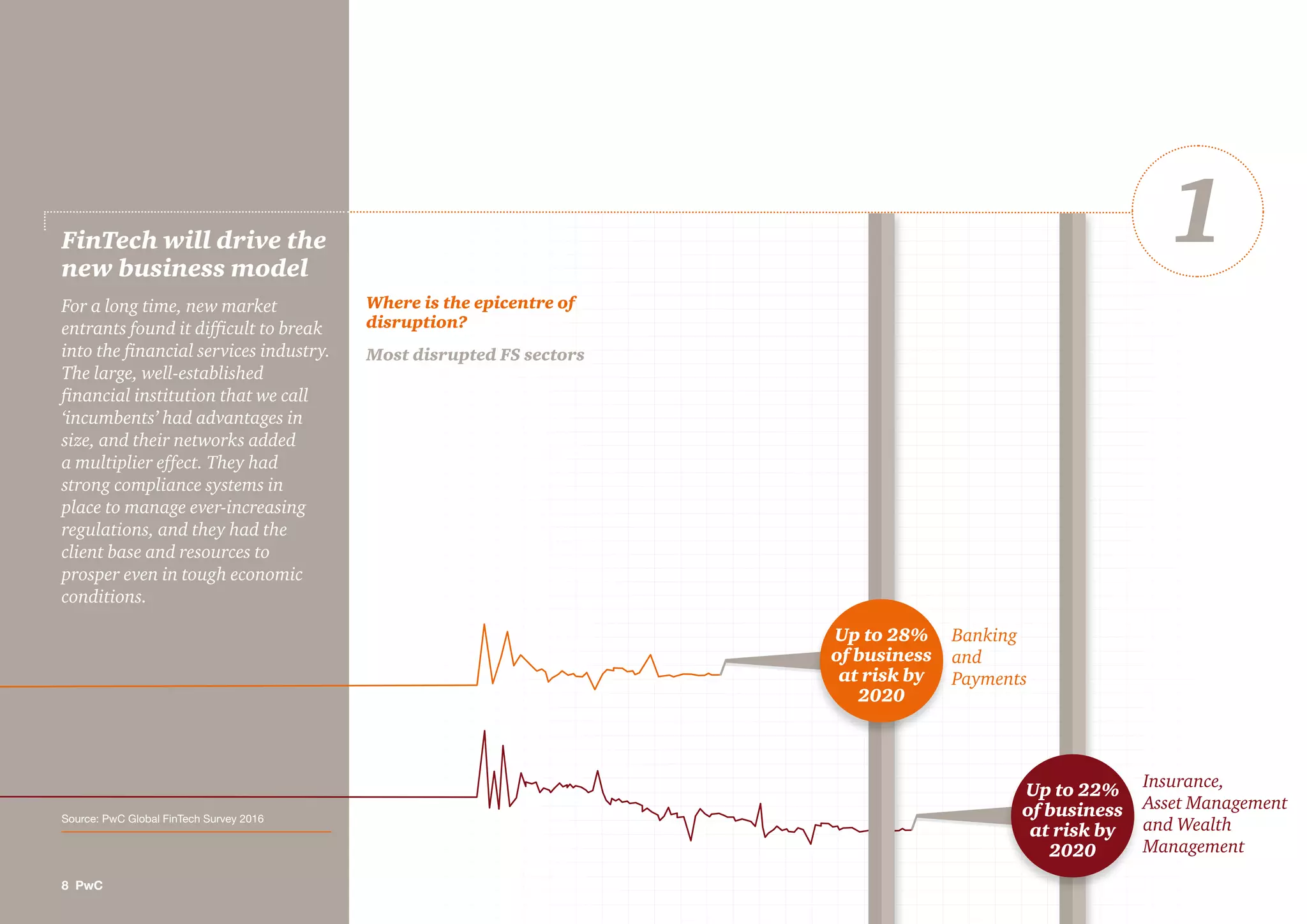
Up to 22%
of business
at risk by
2020
Up to 28%
of business
at risk by
2020
Where is the epicentre of
disruption?
Most disrupted FS sectors
1
Source: PwC Global FinTech Survey 2016
PwC Financial Services Technology 2020 and Beyond 9
Well, not any more. FinTech disruptors have
been finding a way in. Disruptors are fast-
moving companies, often start-ups, focused
on a particular innovative technology or
process in everything from mobile payments
to insurance. And, they have been attacking
some of the most profitable elements of the
financial services value chain. This has been
particularly damaging to the incumbents
who have historically subsidised important
but less profitable service offerings. In our
recent PwC Global FinTech Survey, industry
respondents told us that a quarter of their
business, or more, could be at risk of being
lost to standalone FinTech companies within
five years.7
Global investments in FinTech more than
tripled in 2014, reaching more than $12
billion. In comparison, banks spent an
estimated $215 billion on IT worldwide in
2014, including hardware, software, and
internal and external services.8
This is a
material number, and because it is so highly
targeted, the FinTech spending will really
make an impact.
A cast of thousands (of start-ups)
PwC created a tool to allow ourselves (and
others) to analyse the size and complexity of
the challenge to incumbents and the speed
of change facing the industry.9
Our online
platform, which we call DeNovo, defines
approximately 40 different value chains for
the financial services industry. We identified
several thousand companies that are new
market entrants to various components
of these chains. Here is what we have seen
so far:
• Successful disruptors typically offer a
better customer experience and greater
convenience at a much lower price.
• The effects of disruptors vary significantly
across countries and value chains, largely
because of differences in regulatory
barriers and the robustness of local
FinTech ecosystems.
• Regulatory authorities are caught
between wanting to encourage
competition and innovation and wanting
to provide meaningful oversight of these
disruptors.
Despite regulation and other potential
barriers to entry, we see tremendous demand
for FinTech-related services in areas such as
consumer banking and wealth management.
This will open up new opportunities for both
incumbents and disruptors. For example,
consider the rise of ‘robo-investing platforms’
offered by both online-only and traditional
wealth management companies. New players
are using the online-only model to reach
millennials and increasingly other segments
too. Meanwhile, traditional players are
employing this approach to significantly
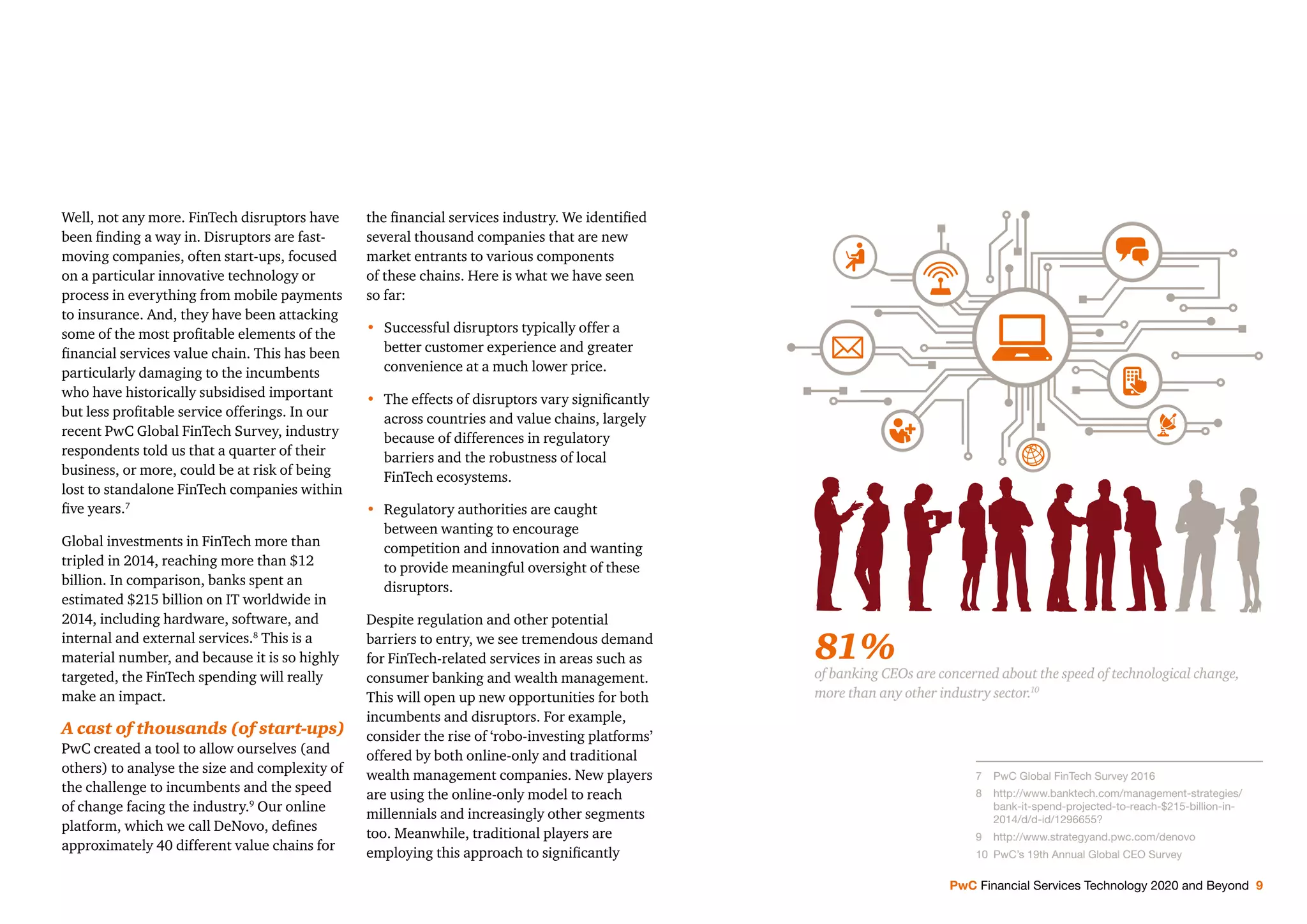
81%
of banking CEOs are concerned about the speed of technological change,
more than any other industry sector.10
7 PwC Global FinTech Survey 2016
8 http://www.banktech.com/management-strategies/
bank-it-spend-projected-to-reach-$215-billion-in-
2014/d/d-id/1296655?
9 http://www.strategyand.pwc.com/denovo
10 PwC’s 19th Annual Global CEO Survey
10 PwC Financial Services Technology 2020 and Beyond
reduce their operational costs. They are also
using it to find more cost-effective ways to
comply with regulatory mandates such as
the UK Retail Distribution Review rules.
In Asia, a new wealth-management app
was launched with almost one thousand
products, all without commissions or fees.
This experience is being repeated across
virtually every sector within financial
services. Disruptors in retail banking are
using this online-only model to grow market
share by offering a highly customised user
experience combined with lower fixed
costs. We have also seen emerging FinTech
companies targeting customers using
so-called “closed-loop interactions” (bi-
directional messaging between institutions
and their clients) that avoid the costs of
larger public-facing platforms. There are
new high-tech, low-footprint companies
with huge potential to drive down costs
and offer better customer experience in
the marketplace lending arena. And we
are seeing upstarts jumping into the global
payments and foreign exchange sectors,
sidestepping existing costly networks by
leveraging innovations such as digital
currencies. In one such example, an
increasingly well-known start-up is using a
proprietary blockchain-based cryptocurrency
and the cross-border payments model to
route foreign-exchange payments between
virtually any currency pair for free. And
the disruption is just beginning in capital
markets.
The bottom line: there are many smart
people with good ideas and abundant
funding trying to disrupt and improve the
industry. If you work for an incumbent,
scanning the market for new competitors,
studying how they think about infrastructure
and regulation, and considering what
defense or collaboration approaches make
sense are all business imperatives.
The DeNovo™ platform
DeNovo is a new platform to help leading financial institutions get better strategic
advice about the disruptive technologies, new business models, and other FinTech
forces that are shaking up the industry. It is a resource for financial services CEOs,
CTOs, business unit heads, heads of strategy, and other key decision makers who
need a trusted, objective resource to help them make better strategic and operational
decisions.
The platform includes a dashboard with regular updates to explain developments in key
industry segments; dossiers that provide information on companies’ differentiations,
strategic focus, leadership, and investment information; technical information; a
comprehensive view of where innovation is most aggressive (or not); competitive
considerations; and other resources.
The content is developed and curated by PwC’s Strategy& FinTech subject matter
specialists, leading a dedicated team of over 50 strategists, equity analysts, engineers,
and technologists. Using both public and proprietary data from over 40,000 sources,
as well as research from across PwC’s global
network of over 200,000 professionals,
DeNovo helps clients determine which
startups, technologies, trends, and new
market entrants are most relevant to
them – and why.
Today, we tend to think of financial
institutions as the entities that initiate
and manage transactions from end to end,
typically putting their own capital at risk.
Increasingly, financial institutions may
play either an intermediary role, with less
at stake, or just be one node in a network.
This evolution will be driven by peer-to-
peer transactions, enabled by partnerships
between today’s financial services firms and
a new breed of FinTech companies. We have
already witnessed this with peer-to-peer
lending platforms, often in partnership with
traditional banks, which exist today in places
such as the UK, US and China. Many of these
new companies are designing and building
services that focus on a specific sliver of the
value chain, or a specific subset of customers.
Consumers are getting smarter about their
options, too. Recent PwC research shows that
44% of those who earn less than $75,000
per year would trust a technology company
for peer-to-peer payments, and this rises
to 68% among earners making more than
$100,000.11
A number of enabler companies target
specific verticals like student debt, or
connecting debtors and investors. They are
building platforms that enable ordinary
individuals to raise funds and draw credit
lines from retail investors. Apple has
filed a patent application for “person-to-
person payments using electronic devices”
that could allow iPhone users to transfer
money more easily. This could potentially
commoditise retail banking even further.
Instead of using relatively high cost bankers
to broker the connection between those who
have and those who want, the disruptors are
using technology to make the match: faster,
cheaper, and maybe even better.
In developing markets, where branch
networks are typically less dense, particularly
in rural areas, physical distribution will
continue to evolve, and banks are more
likely to partner with new entrants to
create alternative distribution channels. For
example, M-PESA in Kenya, handles deposits
and payments using customers’ cellphones
and a network of agents. According to a
recent report, the service is now being
used by 90% of the adult population in the
country.12
Financial institutions should seriously
consider sharing economy opportunities such
as partnerships with digital intermediaries
or even end users with an eye towards how
they might deliver services at much lower
costs. With their relatively informal profiles,
start-ups may not, at first, seem like a threat.
But in the new digital age, when businesses
as well as individuals are increasingly tech-
savvy, new customers will gravitate toward
lower fees, convenience, and ease-of-use.
And once there is enough critical mass and
liquidity, the network effect takes over, and
the disruptors’ market share could grow
exponentially, as it has in Kenya.
The sharing economy
will be embedded
in every part of the
financial system
By 2020, consumers will need
banking services, but they may
not turn to a bank to get them.
Or, at least, maybe not what we
think of as a bank today. The
so-called sharing economy may
have started with cars, taxis, and
hotel rooms, but financial services
will follow soon enough. In this
case, the sharing economy refers
to decentralised asset ownership
and using information technology
to find efficient matches between
providers and users of capital,
rather than automatically turning
to a bank as an intermediary.
PwC Financial Services Technology 2020 and Beyond 11
2
11 PwC’s 2015 Consumer Banking Survey
12 “The Future of Money” which aired on Nov. 22,
2015, 60 Minutes, CBS.
Last year alone, 13 blockchain companies
obtained over $365 million in funding.13
According to multiple sources, by the start
of 2016, blockchain companies had raised
well over a billion dollars to fund their
development and operations.14
Blockchain will
shake things up
In the late 1990s, when companies
began to realise the Internet’s
potential power, e-commerce
investment and experimentation
soared. And despite the ‘dot com
crash,’ it is unlikely that anyone
would deny just how revolutionary
the technology has proved to
be. Today, there are curious
similarities with blockchain—
both in how companies are being
funded and how they are exploring
use cases.
12 PwC
3
Is the impact of blockchain
technology taken into account?
56%
of survey respondents
recognise its importance,
but...
57%
say they are unsure about
or unlikely to respond to
this trend
Source: PwC Global FinTech Survey 2016
13 http://letstalkpayments.com/13-blockchain-bitcoin-
companies-that-raised-serious-funding-in-2015/
14 http://money.cnn.com/2015/11/02/technology/
bitcoin-1-billion-invested/
We have written primers to explain
what blockchain is15
and how strategists
see it16
, and even some thoughts on our
own approach to the technology. But we
are hardly alone. Many major financial
institutions have some form of blockchain
research effort underway. In our recent
PwC Global FinTech Survey, we found that
56% of survey respondents recognised the
importance of blockchain. At the same time,
however, 57% say that they are unsure or
unlikely to respond to this trend. So, what
should you do?
Several industry groups have come together
to commercialise technology and apply
it to real financial services scenarios. We
expect this surge in funding and innovation
to continue as blockchain and FinTech
move from a largely retail focus to include
more institutional uses. And while many
of these companies may not survive the
next three to five years, we believe the use
of the blockchain ‘public ledger’ will go
on to become an integral part of financial
institutions’ technology and operational
infrastructure.
Why blockchain matters
There are two aspects of blockchain
technology that have captivated so many
C-level executives, start-up founders and
private equity firms around the world.
First, blockchain could make the financial
services industry’s infrastructure much less
expensive. And second, the list of potential
uses is almost limitless, from financial
transactions to automated contractual
agreements and more.
Blockchain systems could be far cheaper
than existing platforms because they
remove an entire layer of overhead
dedicated to confirming authenticity. In a
distributed ledger system, confirmation is
effectively performed by everyone on the
network, simultaneously. This so-called
‘consensus’ process reduces the need for
existing intermediaries who touch the
transaction and extract a toll in the process.
In financial services, that includes those
who move money, adjudicate contracts, tax
transactions, store information and so on.
The sheer range of applications has attracted
FinTech providers and legacy firms who
hope to develop solutions both narrow and
broad. In the next three to five years, we
see transaction volumes and the associated
profit pools shifting from intermediaries
toward the owners of new highly efficient
blockchain platforms. These transactions
could include transferring digital or physical
assets, protecting intellectual property,
and verifying the chain of custody. In an
era of cyber-crime and stringent regulatory
requirements, a highly fraud-resistant
system for protecting and authenticating
almost any kind of transaction could have
a revolutionary impact on the financial
services industry.
In blockchain we trust?
Of course, trust does not occur overnight.
This is the challenge facing both individual
institutions and the industry as a whole. For
blockchain to be adopted on a large scale,
we will need to experience a migration of
trust from today’s effective-yet-expensive
central counterparty utilities to the
distributed model. The business benefits
for many players, or even the industry,
will not materialise if the ‘trust issue’ is not
addressed effectively. Some of the hurdles
that lie ahead: understanding whether or not
the public ledger can be hacked, addressing
Bitcoin’s negative reputation, and navigating
potential regulatory challenges related to
blockchain’s adoption. For example, while
confirmation is effectively performed by
everyone on the network simultaneously,
if a majority of the participants forming
the network consensus model were to
collude to transact a fraud, a ledger might
be manipulated. This might be an issue
in a relatively small network without
proper vetting procedures. We also see a
need to address security limitations with
linked technologies, like the external
systems that monitor events to trigger
blockchain transactions once conditions
have been met.
Still, this is a participatory sport and there
is a lot to lose from sitting on the sidelines.
Now is the time for testing, planning and
learning. Given the extraordinary range of
options and potential technology partners,
one of the bigger challenges is to sort
through the hype. Once you have a clear
vision of where to apply the technology and
why, it will be easier to create a workable
implementation plan for building blockchain
into your infrastructure.
15 https://www.pwc.com/us/en/financial-services/
publications/qa-what-is-blockchain.html
16 http://www.strategy-business.com/article/A-
Strategists-Guide-to-Blockchain
PwC Financial Services Technology 2020 and Beyond 13
14 PwC Financial Services Technology 2020 and Beyond
Sources: “Money is no object: Understanding the evolving cryptocurrency market,” PwC, 2015/“A Strategist’s Guide to Blockchain,” strategy+business, January, 2016/“How Blockchain Technology Is Disrupting Everything,” TechDay, 2016
Financial
services
Faster, cheaper settlements could shave billions
of dollars from transaction costs while improving
transparency.
Voting
Using a blockchain code, constituents could cast votes
via smartphone, tablet or computer, resulting in
immediately verifiable results.
Healthcare
Patients' encrypted health information can be shared
with multiple providers without the risk of privacy
breaches.
Automotive
Consumers can use the blockchain to manage
fractional ownership in autonomous cars.
Someone requests a
transaction.
Once verified, this
transaction is
represented as a
new block.
The transaction is
complete.
A verified transaction
can involve
cryptocurrency,
contracts, records,
or other information.
The new block is then added to the
existing blockchain.
The requested
transaction is
broadcast to a P2P
network consisting
of computers,
known as nodes
How it works:
The network of nodes
validate the transaction
using cryptography.
Authentication
Cryptocurrency
Potential applications
Cryptocurrency is a medium of
exchange, such as the US dollar,
created and stored electronically in
the blockchain, using encryption
techniques to control the creation
of monetary units and to verify
the transfer of funds.
Has no
intrinsic
value in that
it is not
redeemable
for another
commodity,
such as
gold.
Has no
physical form
and is not
currently
backed by any
government or
legal entity.
Its supply
is not
determined
by a central
bank and the
network is
completely
decentralised.
Unknowns Benefits
Increased
transparency
Accurate
tracking
Permanent
ledger
Cost
reduction
Complex
technology
Regulatory
implications
Implementation
challenges
Competing
platforms
A look at blockchain technology
What is it? The blockchain is a decentralised ledger, or list, of all transactions across a peer-to-peer network. Using this technology, participants can transfer value across the Internet without
the need for a central third party.
Today’s digital wave has the same markers:
separate teams, budgets and resources
to advance a digital agenda. This agenda
extends from customer experience and
operational efficiency to big data and
analytics. In financial services, we have seen
this approach applied to payments, retail
banking, insurance and wealth management,
and migrating toward institutional areas
such as capital markets and commercial
banking.
The digital wallet: a case study
Consider the evolution of the digital wallet,
which is rapidly just becoming ‘the wallet’.
Digital wallets – typically housed within
a mobile phone – are now at the core of
a battle between traditional financial
services providers and disruptors. They give
consumers a fast, secure, low-cost method to
use, store and send money over the Internet.
It is a service they value as well as a front-
door to many lucrative bank offerings.
Should banks care? Well, the trend toward
greater acceptance of the mobile device as
a banking channel also converges with the
billions of payment cards issued globally and
the transactions they generate. Ironically,
given the expense of deploying EMV chips
to replace magnetic stripe technology,
many consumers are now turning to the
smartphone as the preferred tool for making
online and proximity payments. Mobile
devices offer more convenience and greater
security than plastic cards, many of which
still include magnetic stripes. The tap-and-
pay mobile payment user experience can also
be faster and easier than typical plastic card
transactions.
Who is using digital wallet technology? Most
studies show that millennials are the key
early adopters of mobile payments.17
In a
recent study, roughly half of millennials said
they would rather pay for small items with
their mobile phone than with cash; a similar
share want to use mobile tools to split bills
with their peers and track spending.18
This
is a new generation of consumers, and they
are growing up associating core transactional
services with technology and start-up
brands, neither of which have historically
been associated with financial services.
Who wins?
In recent years, the banking sector has seen
a rapid rise of non-traditional competitors,
through alternative payment methods such
as gift cards and contactless payments built
into mobile operating systems. Now that
adoption has grown, banks want greater
control over alternative channels. They want
to manage the security, user experience,
and customer connectivity at the point of
purchase. Of course, controlling the digital
wallet also gives a bank a better chance of
protecting top-of-wallet status for its card
products, and the interchange fees that
follow. And this matters: for most banks,
even a modest 3%–5% reduction
(or increase) of interchange fees from
debit and credit cards would represent a
material change.
And then there is the data. A wallet creates
real-time connectivity that the bank can use
to send valuable information like balances
and alerts. If handled properly, it can also
successfully present revenue-generating,
point-of-sale offers and promotions to
customers. For example, real-time financing
offers could be directed to debit card only
customers who have expressed interest in
building their credit profiles but who do not
want to carry credit card debt. Fee income
from these offers could be worth twice as
much as average deposit revenue, making
this a very lucrative source of income for
Digital becomes
mainstream
Two decades ago, many large
financial institutions built
‘e-business’ units to ride a wave of
e-commerce interest. Eventually,
the initial ‘e’ went away, and this
became the new normal. Internet
development and large technology
investments drove unprecedented
advances in efficiency.
PwC Financial Services Technology 2020 and Beyond 15
4
17 Incidentally, high net worth consumers are
early adopters too: another group that financial
institutions cannot afford to lose.
18 http://www.adweek.com/news/advertising-
branding/why-mobile-payments-are-millennial-
must-161163
16 PwC Financial Services Technology 2020 and Beyond
banks. Non-standard providers also hope to
use point-of-sale data to get valuable insights
into consumer behaviour.
Finally, there are other security benefits
from owning and controlling the digital
wallet. By setting the terms of engagement,
banks can demand stronger authentication,
identification and verification processes.
Without this, they are at the mercy of
partners who may not have the same
priorities. User data also helps banks to
improve real-time fraud detection.
‘Change the bank’ becomes
the bank
Over the next three to five years, digital
efforts will advance in areas as diverse as
robo-investing, automation of consumer
lending and clearing and settlement of cash
and securities transactions. As they do,
they will stop being exotic, and will just be
‘how we do things’. Institutions will need
to balance the need for separate ‘change
the bank’ transformation teams with the
inevitability that digital will become the
platform. Practically, this means you have to
keep the change-the-bank and the run-the-
bank teams on the same page, operationally
and strategically. At the same time, we know
all organisations have a natural resistance to
change, especially after years of a relatively
protected status. To ward off a determined
FinTech opponent, consider ‘challenger’
models in banking, insurance and wealth
management that try to anticipate what a
fierce competitor would look like.
Institutions will need to balance the
need for separate ‘change the bank’
transformation teams with the
inevitability that digital will become
the platform.
For example, consider millennials: a key
demographic, and one that banks generally
have targeted through digital channels.
Financial institutions should look below the
surface to examine the behavioural attributes
that drive consumer decisions. The following
are key to millennial behaviour: they tend
to build wealth as a result of owning a
small business, investments, or real estate;
they turn to social networks for content,
product reviews, opinions and referrals;
and they look for opportunities to improve
their financial ‘health’. Financial institutions
that sift through available data can engage
millennials by being ready with the right
offer when relevant life events present
buying opportunities.
The data is everywhere, and over the next
five years, hyper-connectivity will give
financial institutions the opportunity to use
it. It will not only be computers and smart
devices that record and communicate data,
but everything from cars to coffee machines.
This is referred to as the ‘Internet of Things’.
Customers are learning more about the
value of their personal data. We expect to
see them tendering out their information to
banks, insurers and asset managers in return
for the best deal, much as affinity groups
already do. Within asset management,
hyper-connectivity will also pave the way
for greater product customisation. For life
and health insurers, wearable computing
(building on the technology already widely
used in fitness sensors), could make the
underwriting process more collaborative.
For example, insurers may use the real-
time insights into policyholder health and
behaviour to offer discounts, eliminate the
need for lengthy medical checks
and simplify the contract
process.
With other
developments, this
will also intensify
price competition
and pressure on
cost. Big data
analytics, sensor
technology and
the communicating
networks that
make up the Internet
of Things will allow
insurers to anticipate
risks and customer demands
with far greater precision than ever before.
The benefits would include not only keener
pricing and sharper customer targeting, but
a decisive shift in insurers’ value model from
reactive claims payer to preventative risk
advisor. But it also implies that we will see a
divergence between companies who use data
to their advantage and those who do not.
The winners will be able to price products
based on a deeper understanding of risk; the
losers will merely compete on price,
compressing their margins
with lower revenues
and proportionately
higher payouts.
Customer intelligence
will be the most
important predictor
of revenue growth
and profitability
Do you know what your customers
value? Are you sure? Customer
intelligence used to be based on
some relatively simple heuristics,
built from focus groups and
surveys. These were proxies for
real, individualised data about
consumer behaviour, and the
results were pretty hazy. Now,
technology advances have given
businesses access to exponentially
more data about what users
do and want. It is an amazing
opportunity for whomever
can use analytics to unlock
the information inside, to give
customers what they really want.
PwC Financial Services Technology 2020 and Beyond 17
5
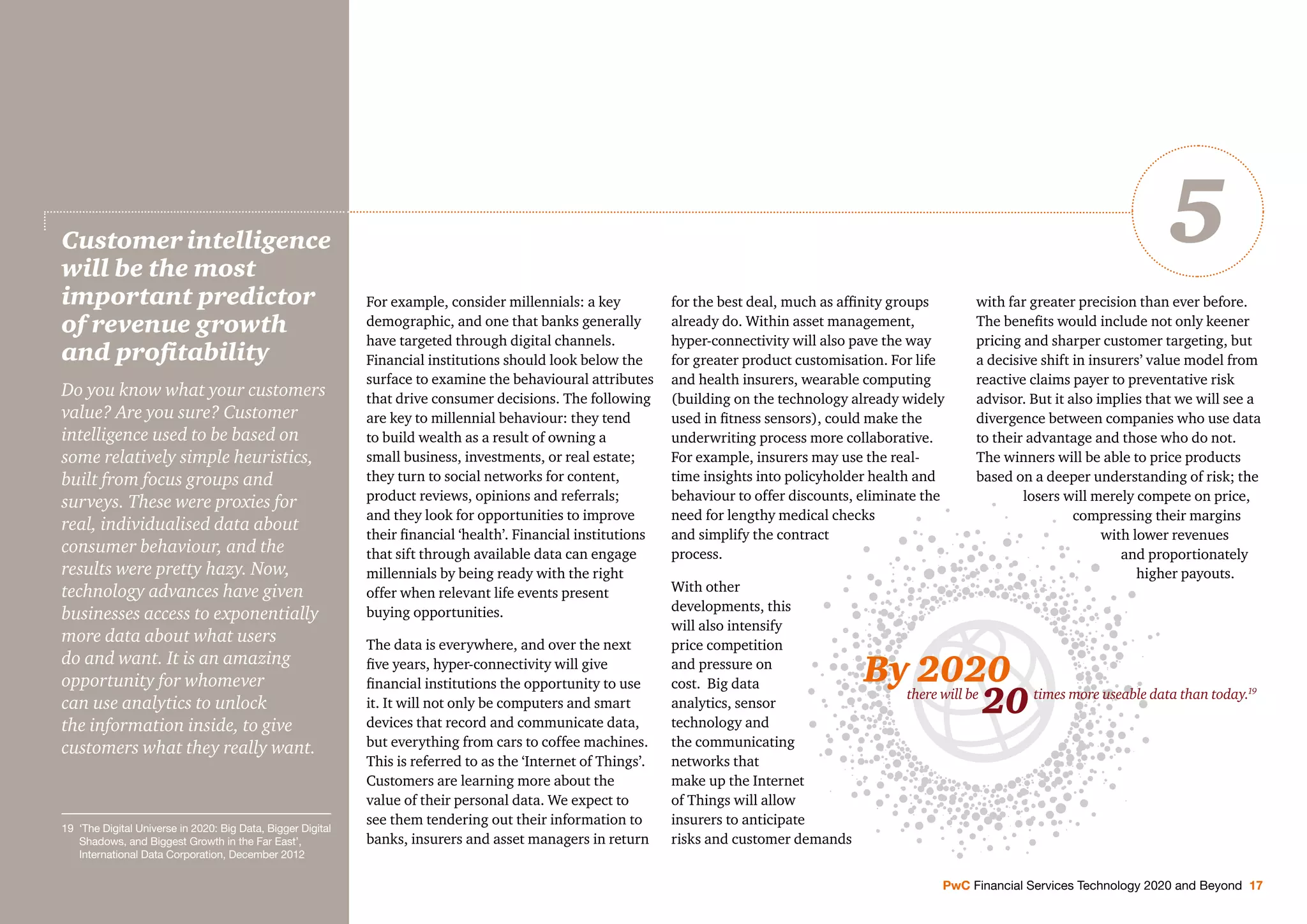
there will be times more useable data than today.19
By 2020
20
19 ‘The Digital Universe in 2020: Big Data, Bigger Digital
Shadows, and Biggest Growth in the Far East’,
International Data Corporation, December 2012
18 PwC Financial Services Technology 2020 and Beyond
The era of mass customisation
As customers become more connected
through social media, they are becoming
more demanding and less loyal. Easier
comparison and faster switching mean
that relationships can be brief and largely
transactional. We are already seeing one-
click transfer, which moves all funds, direct
debit instructions and other services to the
new provider with very little effort on behalf
of the customer. And the demographic trends
have scary implications for conventional
financial services companies because the
youngest users are the least loyal. Recent
research has found that one in three
millennials in the United States are open to
switching banks in the next 90 days and a
similar proportion believe they will not even
need a bank in the future.20
What explains
this decline in customer ‘stickiness’? Service
offerings that feel generic and tools that have
made switching less painful.
Consumers now compare financial
institutions to digital leaders across all
industries, as well as to their industry peers,
and they are falling short. Customers have
experienced first-hand that digital commerce
delivers speed and personalisation, and this
shapes their expectation of financial services,
too. Instead of a mortgage, insurance policy,
or investment plan that broadly meets their
needs, buyers want customised, adaptive
solutions that evolve and deliver specified
outcomes. For example, target-date funds
automatically adjust the asset mix to a
user’s expected retirement age. Personalised
service and tailored solutions were once
the preserve of high net worth clients. Now,
technology is opening it up to mass affluent
consumers, and beyond.
In the insurance industry, advances in
processing capacity, customer profiling,
and risk analytics are now opening the way
for a new generation of ‘smart’ policies.
While being as affordable and easy to
understand and compare as today’s off-the-
shelf products, these policies could be both
fully customised to individuals and able to
adapt to their changing needs. Crucially,
the technological developments that are
making this new generation of policies
possible would also making it easier for new
entrants to break into the market at relatively
little cost.
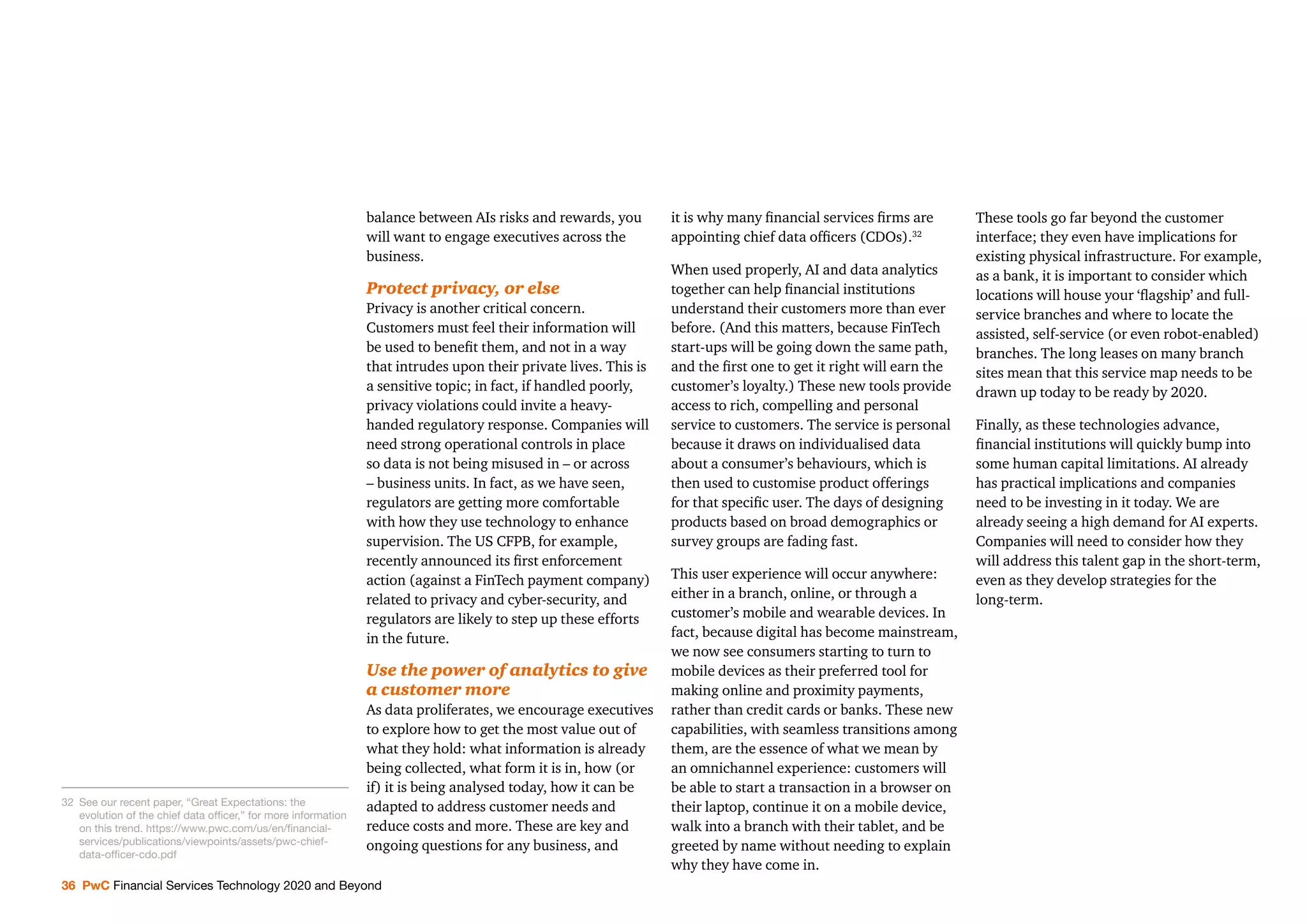
63%
of insurance CEOs believe that the Internet of Things will be
strategically important to their organisation.
One in three millennials in the United
States are open to switching banks
in the next 90 days and a similar
proportion believe they will not even
need a bank in the future.
Source: Viacom Media Networks – The Millennial Disruption Index
Source: PwC’s 18th Annual Global CEO Survey
20 Viacom Media Networks – The Millennial Disruption
Index
PwC Financial Services Technology 2020 and Beyond 19
Smarter service, smarter sales
Financial institutions are already using
artificial intelligence (AI) to experiment
with service that is far more personalised.
Many banks in the United States are piloting
AI-based client advisors, where the AI engine
is primed with the entire product manual,
past call history, policy and procedures
guidelines, and more, to provide context-
based service to their customers.
We expect AI, machine learning, and
customer analytics to become the driver of
client engagement over the next decade.
Certainly, financial institutions will need to
deliver instantaneous, seamless transactions,
but speed is just the baseline requirement.
Smart businesses will develop new forms of
virtual engagement capable of integrating
themselves into customers’ lives. They
will stick because they will be personal:
informed by intelligence gathered from data
about consumer behaviours, choices, and
volunteered preferences.
Rethinking the service
architecture
Before firms can engage customers like this,
they will have to make sense of a torrent of
data that defies human comprehension and
that will require gathering, interpreting
and presenting massive quantities of data
in real-time. Few firms are ready. In fact,
most will need to change many aspects
of how they have traditionally managed
IT. There are four building blocks for this
emerging solution architecture. At the
visualisation layer, the customer interacts
with a self-service dashboard and search
capabilities, displayed through advanced
visualisation tools that generate and present
rapid insights. In the application layer,
the visualisation layer is integrated into
the business processes management with
capabilities such as case management,
alerting and reporting. The analytics layer
does the thinking, using advanced AI
techniques to profile and predict behaviour,
detect anomalies and discover hidden
relationships. And, data lakes will form the
key layer of the solution, acquiring data
rapidly from disparate sources and ingesting
it so it can be used productively. Data lakes
are a new take on data warehousing, taking
advantage of cheaper tools to distribute
storage and processing. They offer a scalable
platform that can store a wide range of data
models, enabling analysis of both structured
and unstructured data. Unlike the existing
systems that many firms use today, they
won’t buckle under the much larger volumes
that will soon arrive.
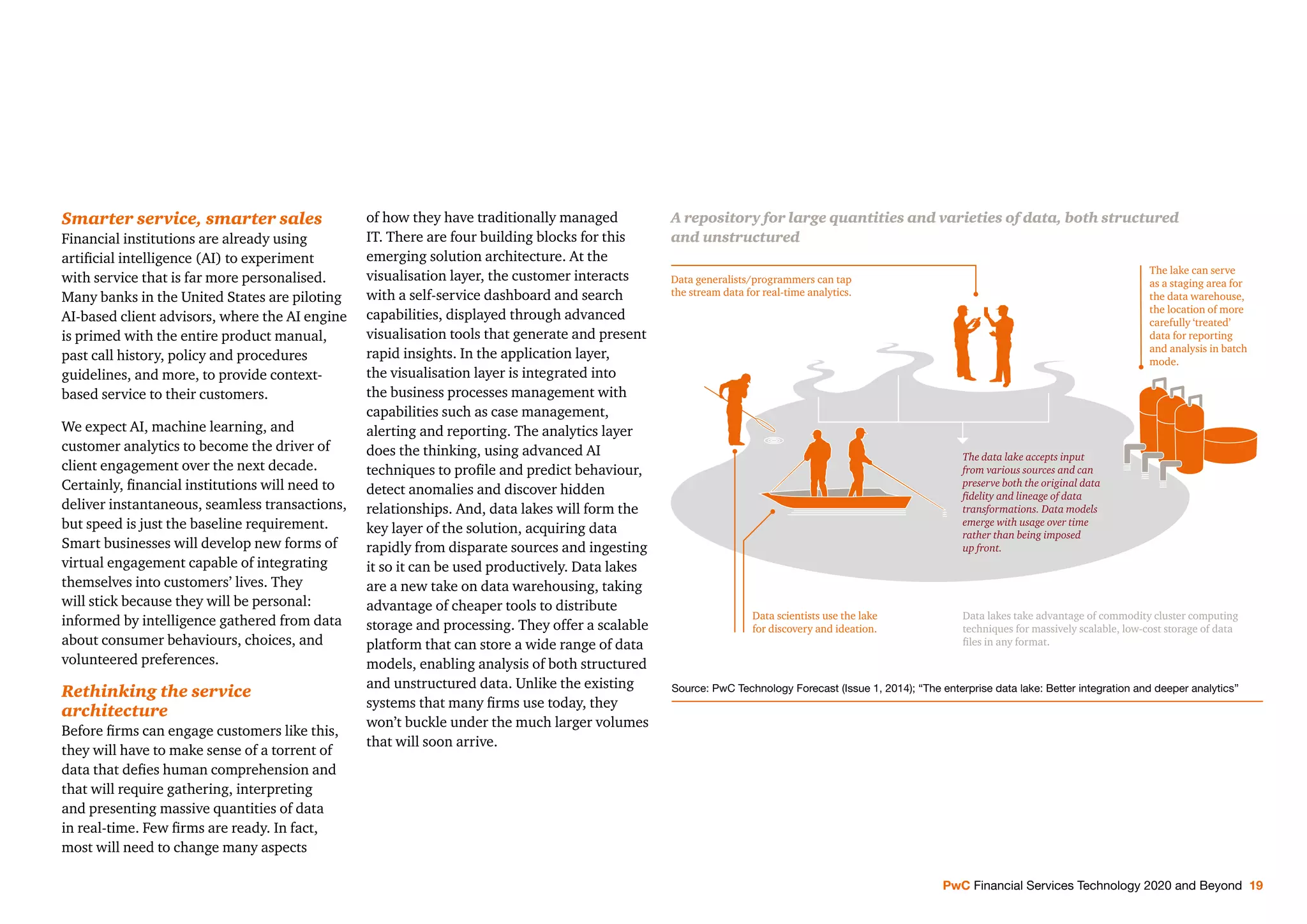
A repository for large quantities and varieties of data, both structured
and unstructured
The lake can serve
as a staging area for
the data warehouse,
the location of more
carefully ‘treated’
data for reporting
and analysis in batch
mode.
The data lake accepts input
from various sources and can
preserve both the original data
fidelity and lineage of data
transformations. Data models
emerge with usage over time
rather than being imposed
up front.
Data generalists/programmers can tap
the stream data for real-time analytics.
Data scientists use the lake
for discovery and ideation.
Data lakes take advantage of commodity cluster computing
techniques for massively scalable, low-cost storage of data
files in any format.
Source: PwC Technology Forecast (Issue 1, 2014); “The enterprise data lake: Better integration and deeper analytics”
ATMs are robots. They are very simplistic,
purpose-built robots – but they provide
consistent, convenient, low-cost service and
customers have grown to trust them. The
same principles will apply to other, more
sophisticated financial services applications.
There have been astonishing advances
in robotics and AI, machine learning and
pattern recognition in recent years. Over
the next five years, we will see a shift from
standalone uses to full integration into a
company’s business-as-usual activities.
What robots can do
We are already seeing alliances between
leading incumbent financial services and
technology companies, using robotics and
AI to address key pressure points, reduce
costs and mitigate risks. They are targeting
a specific combination of capabilities such
as social and emotional intelligence, natural
language processing, logical reasoning,
identification of patterns and self-supervised
learning, physical sensors, mobility,
navigation and more. And they are looking
far beyond replacing the bank teller.
Here are some of the capabilities shaping
these sophisticated machines:
• Cognition: The robot’s ability to perceive,
understand, plan and navigate in the
real world. Better cognitive ability means
robots can work autonomously in diverse,
dynamic and complex environments.
• Manipulation: Precise control and
dexterity for manipulating objects in
the environment. With improvements
in manipulation, robots will take on a
greater diversity of tasks and use cases.
• Interaction: The robot’s ability to learn
from and collaborate with humans.
Progress here – such as support for
verbal and nonverbal communications,
observing and copying human behaviour,
and learning from experiences – means
robots will increasingly be able to work
alongside humans.
Already, some robots can sense the details
of their environments, recognise objects,
and respond to information and objects with
safe, useful behaviours. Over time, they will
be able to perform not only more tasks, but
more complex tasks. Service robots are in
the early stages of a long development cycle,
and they still face some big technological
hurdles. In the next three to five years, we
expect modest, evolutionary gains. After
that, though, we anticipate rapid gains, as
new models combine increasingly powerful
and standard modular platforms with the
ability to learn. To take an even broader
view, robotic process automation is already
making inroads in financial services digital
operations, too. There are whole categories
of work that had not been seen as cost-
effective to automate. However, with
lightweight software ‘bots’, workers are freed
up to focus on higher value activities.
Talented people, talented
machines
In the last 20 years, US companies have
‘offshored’ repetitive tasks to lower-cost
locations such as India, China and Poland.
However, relative costs for labour in those
regions have started to rise. Combine this
with improvements in robotics and AI
capabilities and machines will soon become
credible substitutes for many human
workers. As the capabilities continue to
improve and technology continues to drive
down the cost of machines, these forces will
combine to spur re-shoring, as more tasks
can now be performed at a competitive
cost on-shore. Even functions that seem
dependent on human input, such as product
Advances in robotics
and AI will start a
wave of ‘re-shoring’
and localisation
When ATMs were first introduced,
many customers refused to use
them. Gradually though, after
time and training, they came to
see that ATMs could offer a better
service experience. And trust
followed.
20 PwC
6
PwC Financial Services Technology 2020 and Beyond 21
design, fraud prevention and underwriting,
will be affected. At the same time, the need
for software engineering talent will continue
to expand.
The B2B robot that is already
down the hall
AI already plays a prominent role in the
capital markets sector, starting with
algorithmic triggers in high-speed trading.
Next generation algorithmic trading systems
are already moving from descriptive and
predictive to prescriptive analysis, improving
their ability to anticipate and respond to
emerging trends. And while ‘algo’ trading
programs were once limited to hedge funds
and institutional investors, private investors
can now get access to them too.
AI is also prominent in investment activity.
The technology will become a core
component of the fund design process,
particularly around trading authorisations
and hand-offs with human investors. AI
systems already drive investment strategies
that complement active management,
governing the decisions of passive funds
and driving greater returns in active ones.
This, along with the increasing body of
research citing the relative advantages of
passive funds, could force asset managers to
radically rethink active fund management.
By 2020, AI will also automate a
considerable amount of underwriting,
especially in mature markets where data is
readily available. Even in situations where AI
does not completely replace an underwriter,
greater automation would allow humans to
concentrate on assessing and pricing risks in
the less data-rich emerging markets. It would
also free up underwriters to provide more
risk management, product development
advice and other higher value support for
clients.
Of course, banks already use AI to detect
payments fraud. Now, they are using AI’s
ability to spot abnormal behaviour to detect
market abuse and rogue trading. As hyper-
connectivity accelerates and more business
moves over to digital channels, the risk of
fraud, hacking, data compromise and other
cyber-vulnerabilities will continue to grow.
In response, firms will use AI to fight back
with methods like predictive analytics
(past and forecast spending behaviour)
and location data from customers’ smart
phones and wearables.
Thinking machines
We urge financial institutions to rapidly ramp
up their efforts to understand and develop
a vision for their use of robotics and AI.
They will need to find and integrate more
industrial engineers into their talent plan.
And they will need to learn from industries
such as manufacturing and technology that
have used robots extensively for decades.
A core component of the fund design
process, particularly around trading
authorisations and hand-offs with
human investors.
Banks already use AI to detect
payments fraud. Now, they are
using AI’s ability to spot abnormal
behaviour to detect market abuse and
rogue trading.
Today, many financial institutions use
cloud-based software-as-a-service (SaaS)
applications for business processes that
might be considered non-core, such as CRM,
HR and financial accounting. They also turn
to SaaS for ‘point solutions’ on the fringes of
their operations, including security analytics
and KYC verification. But as application
offerings improve and as COOs and CIOs
get comfortable with the arrangements,
the technology is rapidly becoming the way
that core activity is processed. By 2020,
core service infrastructures in areas such
as consumer payments, credit scoring, and
statements and billings for asset managers’
basic current account functions will be well
on the way to becoming utilities.
Using the cloud to scale
What is behind this shift? Data storage
costs have plummeted, facilitated by
cloud-based infrastructure. This has made
it easier to manage ‘big data’ and apply
sophisticated analytics, and it has also
reduced the barriers to entry for new FinTech
disruptors. According to the International
Data Corporation (IDC), public cloud
investments are growing quickly, spending
on private cloud is increasing, and traditional
infrastructure spending has plateaued. IDC
estimates that public cloud investments
increased by 32% in 2015 to US$21.7 billion
and private cloud investments grew in 2015
by 17%, reaching US$11.7 billion. Overall,
total cloud IT infrastructure spending grew
26% in 2015, reaching US$33.4 billion. To
put that in perspective, this is approximately
one-third of all IT spending.22
Curiously, the sharing economy also plays
a role here. After all, some companies that
have a demonstrated competence in an area
are choosing to sell it to others who need it.
For example, the payments infrastructure
of many industrial, healthcare and smaller
FinTech institutions are being provided by
conventional banks. These banks are selling
their infrastructure as a service to others,
and leveraging the cloud to do it. In our view,
this provides an important source of revenue
to these institutions.
Bring an umbrella, just in case
With customers demanding a flexible,
personalised system experience, and with
costs continuing to drop, the cloud is here
to stay. It is the sensible way to deliver
innovation within a target return on equity.
But there are many challenges in shifting
from an on-premises model to a cloud-based
model. What are the best ways to manage
an architecture that is more diffused and
fragmented than ever? How can you juggle
security, data protection and commercial
confidentiality? There are even regulatory
ramifications, as some countries have
imposed considerable restrictions on the
transfer of client data to the public cloud.
As a result of this, many financial institutions
today are leaning towards adoption of a
private-cloud solution.
Despite the cautionary note, we expect
that the next several years will result in
an increasing adoption of the public cloud
within the financial services industry. Like
FinTech, robotics and digital, this will require
new ways of thinking for organisations
and IT departments. But the benefits will
certainly be significant too.
The public cloud will
become the dominant
infrastructure model
As significant as the shift toward
cloud-based computing has been,
it is just getting started.
22 PwC
7
52%
of asset management CEOs...
...believe that cloud computing will be
strategically important to their organisation.21
21 155 asset management CEOs interviewed
for PwC’s 18th Annual Global CEO Survey: A
marketplace without boundaries? Responding to
disruption (www.pwc.com/ceosurvey)
22 http://www.fiercecio.com/story/cloud-adoption-
costs-are-down-real-savings-can-be-had-smart-
negotiators/2015-07-23
Unfortunately, it is not likely to change for
the better in the coming years, due to the
following forces:
• Use of third-party vendors
• Rapidly evolving, sophisticated and
complex technologies
• Cross-border data exchanges
• Increased use of mobile technologies by
customers, including the rapid growth of
the Internet of Things
• Heightened cross-border information
security threats
The Internet of Things (IoT):
a case study
Expected IoT growth introduces a new
set of security risks and challenges that
will require serious attention. IoT refers
to the proliferation of physical objects
(devices, cars, houses, wearables) that
contain sensors, software and the ability
to communicate. The opportunities are
fascinating, like dishwashers that can
schedule a repair visit at the sense of an
impending part failure. But every chain
has its weakest link, and the company
that maintains the dishwasher may not
be as passionate about patching software
vulnerabilities as you are.
Some industry sources see the number
of IoT devices deployed across the world
reaching about 25 billion by 2020.23
Until
now, IoT growth in financial services has
primarily occurred in payments, insurance
and banking. Banks are forming partnerships
with wearable technology manufacturers
to allow customers to make mobile payments
using watches or fitness trackers. Insurers
are using telematics technology to monitor
driving habits and provide discounts to safe
drivers.
Cyber-security is the leading challenge to the
adoption of IoT technology because insecure
interfaces increase the risk of unauthorised
access. Here are some of the concerns:
• Attack surface: Hackers can gain entry
to a corporate network through an IoT
device.
• Perimeter security: IoT technology
relies on cloud-based services, so it will
be challenging to implement effective
perimeter defenses.
Cyber-security will
be one of the top
risks facing financial
institutions
Financial services executives are
already depressingly familiar
with the impact that cyber-threats
have had on their industry.
In PwC’s 19th Annual Global CEO
Survey, 69% of financial services’
CEOs reported that they are either
somewhat or extremely concerned
about cyber-threats, compared to
61% of CEOs across all sectors.
PwC Financial Services Technology 2020 and Beyond 23
8
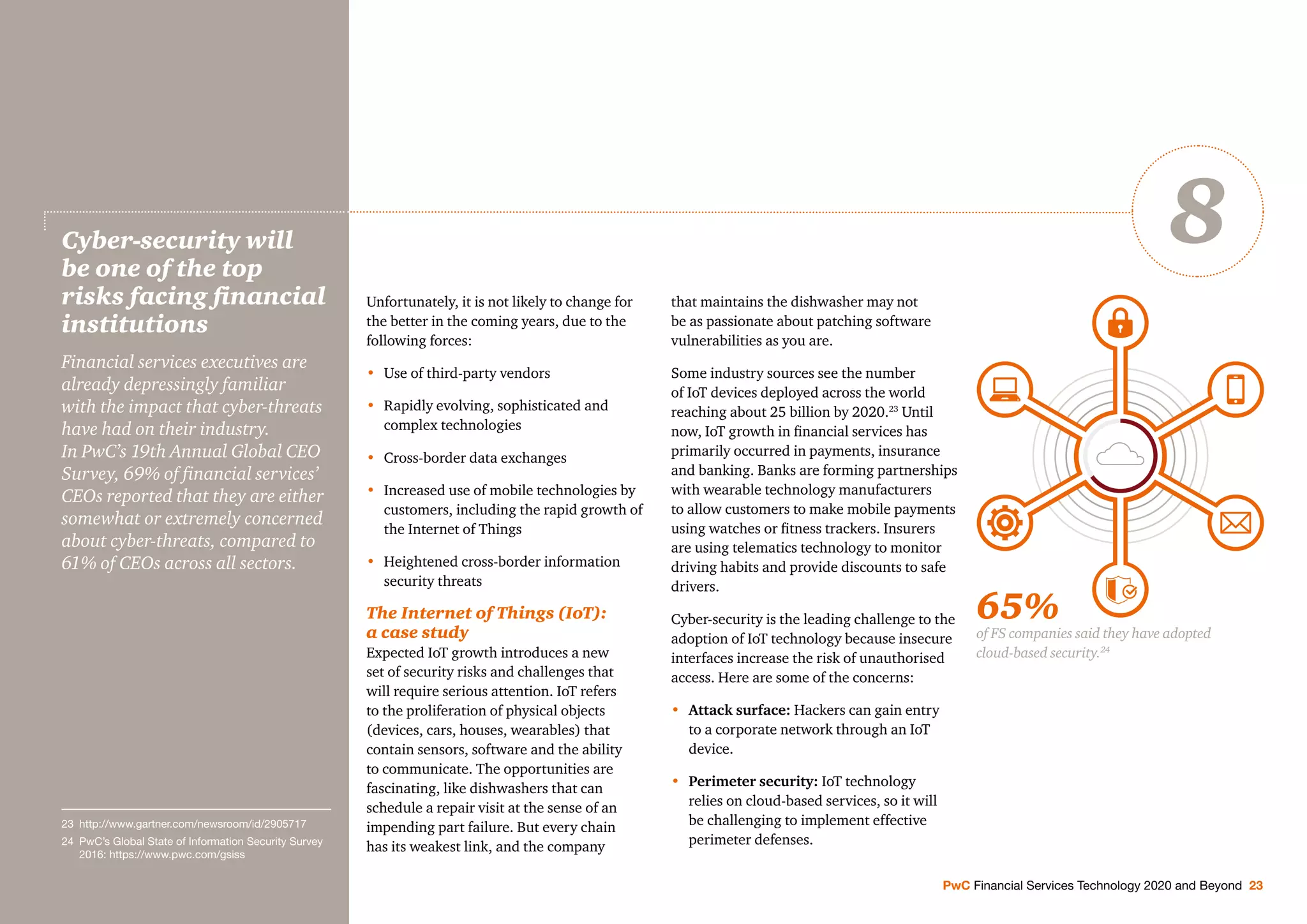
65%
of FS companies said they have adopted
cloud-based security.24
23 http://www.gartner.com/newsroom/id/2905717
24 PwC’s Global State of Information Security Survey
2016: https://www.pwc.com/gsiss
24 PwC Financial Services Technology 2020 and Beyond
• Privacy concerns: The pervasiveness of
IoT data collection coupled with advanced
analytic capabilities could potentially
result in consumer privacy violations.
• Device management: Many IoT devices
currently do not support implementation
of strong security controls, and
maintaining a security baseline will only
get harder as IoT devices proliferate.
Fighting back
As guardians of value, financial institutions
have long dealt with sophisticated threats.
However, cyber-crime is making the targets
more appealing than ever. Earlier this year,
hackers made off with tens of millions of
dollars from Bangladesh’s central bank by
using malware to gain access to accounts.
With incentives like these, criminals will
continue to look for similar vulnerabilities
in the future. And there are ominous signs
that things could get worse, as certain threat
actors now appear to be working together to
carry out attacks.
Fortunately, the same capabilities that make
networks more vulnerable can strengthen
defenses as well. Financial institutions can
use big data analytics to monitor for covert
threats. This helps them identify evolving
external and internal security risks and react
much more quickly. And the miniaturisation
of technology that has driven smartphone
growth has also made biometric security
more practical. For example, some banks
allow customers to access their accounts
using thumbprints, or even voice and facial
recognition – an approach that is more
convenient for consumers and improves
security.
Cyber-security is already important, and
it will become even more significant for
institutions and their regulators in the
future. The challenge will be to balance
safety with customer convenience. For full-
scale providers who are trying to maintain
visibility across channels, this is harder than
it looks. But there are guidelines which
can help financial institutions identify and
prioritise threats, quickly detect and mitigate
risks and understand security gaps. With
a risk-based framework, companies can
communicate and collaborate as necessary,
decide how to design, monitor and measure
their cyber-security goals, and keep their
data safe.
Asia’s rising demographics
Around the world, the middle class is
projected to grow by 180% between 2010
and 2040; Asia’s middle class is already
larger than Europe’s. By 2020, the majority
share of the population considered ‘middle
class’ is expected to shift from North America
and Europe to Asia-Pacific. And over the next
30 years, some 1.8 billion people will move
into cities, mostly in Africa and Asia, creating
one of the most important new opportunities
for financial institutions.25
These trends are directly linked to
technology-driven innovation. Initially, as
developments in agricultural technology
improved labour productivity, rural
workers began migrating to cities in
search of better opportunities. At first they
found jobs in capital-intensive industries
like manufacturing for the local market
– and then, as technology drove quality
improvements, for the global market.
Meanwhile, advances in computing and
telecommunications made it possible for
Western companies to offshore certain
support functions to places like the
Philippines and India, creating relatively
well-paying jobs. Over time, the trend has
become self-reinforcing: more jobs in cities
have led to better technology infrastructures
in cities, which has attracted employers who
can now serve global markets. The result:
more urbanisation and a growing middle
class across the emerging markets.
A rapidly growing middle class tends
to drive higher consumption: scooters,
televisions, mobile phones and more.
Asia-Pacific countries, with the world’s
largest middle class growth, will also see
the largest demand for technology-driven
innovation. There are other demographic
shifts to support this growth. Asia has
a comparatively young population of
‘digital natives’, the post-millennials who
have grown up in a world in which digital
Asia will emerge
as a key centre of
technology-driven
innovation
America’s reputation (and
Silicon Valley’s, in particular)
as a technology juggernaut is
so ingrained that it can be easy
to miss the globalisation of
innovation. But if you happen to
look behind the social network or
the router that sends your email,
you will quickly see how rapidly
things are changing everywhere.
PwC Financial Services Technology 2020 and Beyond 25
9
Global middle class statistics – population in millions
2009
North America
Source: Organisation for Economic Cooperation and Development
Europe
Central and South America
Asia Pacific
Sub-Saharan Africa
Middle East and North Africa
World
338
664
181
525
32
105
1845
333
703
251
1740
57
165
3249
322
680
313
3228
107
234
4884
18%
36%
10%
28%
2%
6%
100%
10%
22%
8%
54%
2%
5%
100%
7%
14%
6%
66%
2%
5%
100%
2020 2030
The middle class in Asia-Pacific countries is expanding rapidly as
incomes rise across the region26
25 PwC’s Retail Banking 2020: Evolution or revoluton
26 Source: PwC’s “Retailing 2020: Winning in a
polarized world”, https://www.pwc.com/us/en/
retail-consumer/publications/retailing-2020.html
26 PwC Financial Services Technology 2020 and Beyond
technology was already prevalent. Asia also
has the largest inter-connectivity of flows
with other emerging economies, and an
average GDP growth that outperforms its
peers in the West. As consumption grows,
people become more sophisticated buyers
of services, and they learn to continuously
evaluate the price vs. value equation. For
consumer-oriented companies, including
those in financial services, any ‘free ride’ in
the Asia-Pacific countries is now over; they
will need to rely on technology innovations
to get and keep customers.
Where the venture
capitalists go
Here are two statistics that may
surprise some readers: China
now has the world’s largest
peer-to-peer (P2P) lending
market, and has more mobile
smartphone users than any
other country in the world.
In fact, across Asia, we are
seeing companies jumping
to meet their customers’
rapidly rising expectations for
financial services offerings – often, ahead
of other markets. This includes embracing
mobile innovations and creating a seamless,
omnichannel customer experience. They are
using mobile analytics to serve customers
in context of their transactions. Cloud
computing is gaining traction as a top
technology priority across the Asia region,
with more than 50% of institutions reporting
public cloud as a critical or high priority.27
They are not necessarily doing it on their
own, though; banks in the region typically
partner with third parties to develop,
implement, and integrate mobile payment
technologies.
Investors have been quick to follow, and
investments in AsiaPac FinTech grew faster
in 2015 than previously predicted.28
There
were four times as many investments in
FinTech companies in the region relative
to the previous year. In the first nine
months of 2015, investors poured in a
staggering US$3.5 billion. Payments and
lending account for nearly two out of every
three dollars invested in AsiaPac FinTech
companies, and they drove much of this
growth. But while payments and lending
have dominated the scene thus far, Asian
start-ups are now starting to focus on
blockchain, cloud, and cyber-security as
untapped niches in the FinTech industry
– much like their counterparts in Silicon
Valley.
Why Asia FinTech matters
According to our research, Asia has now
become the global leader in research
and development across all industries,
accounting for about one of every three
dollars spent on corporate R&D spending.
And in FinTech, the market is second only to
the United States in investors’ interest.
As we have noted elsewhere, Asia offers
some key advantages to Western-based
companies looking for innovation, including
lower-cost but highly skilled resources
(arguably on a level with those in the
West), and a large market for testing and
launching new products and services.
Disruptive innovations typically begin as
low-cost products and services that target
the most price sensitive customers. Asia,
with its wealth constraints, vast population
and favourable regulatory environment,
represents an ideal fertile ground for
disruptive innovation, as many industries
have discovered.29
By 2020, we expect that many US financial
institutions will have fully functional Asian
hubs that can act as a catalyst for technology
innovations, for both local and global
deployment. As specialised technology
skills become harder to find, companies that
have a foothold in Asia may see recruiting
advantages, too.
27 Source: Forrester Research, https://www.forrester.com/
The+Asia+Pacific+Public+Cloud+Market+Will+Reach+
238+Billion+By+2020/-/E-PRE8912
28 http://www.moneysedge.com/newsimage?id=646
29 http://usblogs.pwc.com/growthleaders/to-launch-
disruptive-innovation-head-east/
China now has the
world’s largest peer-
to-peer (P2P) lending
market, and has more
mobile smartphone
users than any other
country in the world.
Many US financial
institutions will have
fully functional Asian
hubs that can act as a
catalyst for technology
innovations, for
both local and global
deployment.
Regulators are rapidly adopting a wide
range of data gathering and analytical tools
too. They are trying to learn more about
individual institutions’ activities and overall
systemic activity. They also hope to monitor
the industry more effectively and to predict
potential problems instead of regulating
after the fact. Examples of this include the
supervisory procedures and data requests
tied to ‘stress tests’, asset quality reviews and
enhanced reporting requirements coming
out of Washington, London and Basel.
Using sophisticated analytical tools on large
volumes of data, regulators can compare
scenarios and address potential issues before
they become full-scale market problems.
The US regulators plug in…
In United States, the Consumer Financial
Protection Bureau (CFPB), which focuses on
consumer protection, has invested heavily
in analytics and digital technology. For
example, the agency created eRegulations,
an online tool to help users find, research,
and understand regulations.30
Also from
the CFPB, Project Qu is an open source
data platform that lets users query complex
data about mortgage loans, combine it with
other data, and then summarise it. The
SEC’s Office of Compliance Inspections and
Examinations (OCIE) has invested significant
resources to enhance its data mining and
analysis capabilities, such as its National
Exam Analytics Tool. This tool, known
as NEAT, combs through data to identify
potential insider trading, improper allocation
of investment opportunities, and other
infractions.
…as do the Europeans
In Europe, the regulators have put quite a
bit of emphasis on how technology is used.
In the UK, the Financial Conduct Authority
(FCA) is stepping in to make sure that
financial institutions do not abuse their
newfound ‘big data power’. For example, the
FCA is looking into how insurance firms use
their own large data collections with web
analytics and social media data. Other EU
regulators are looking into the ‘opportunities
and challenges’ related to the use of big data
to see if current regulations and supervisory
measures are sufficient.
Financial institutions can do
their part
This is only the beginning. As financial
institutions themselves continue to automate
controls and monitoring in KYC/AML, trade
surveillance, reconciliations and other areas,
regulators will seek direct access to these
tools – either on an ongoing basis or during
supervisory reviews. As a result, firms will
need to make data and control transparency
priorities as they implement these tools and
comply with data requests. It is shortsighted
to focus solely on compliance with current
regulations. Rather, firms should develop a
better understanding of where their data and
associated controls live. This will let them
work with a growing range of interested
regulatory bodies more quickly, easily and
accurately, on everything from stress tests
and periodic exams to individual requests.
By doing so, they will improve their
credibility with regulators today and be
ready for the future.
Regulators will turn
to technology, too
The use of technology and its
implications are not limited to
financial institutions.
PwC Financial Services Technology 2020 and Beyond 27
10
30 http://www.consumerfinance.gov/eregulations/
Six priorities
for 2020
To benefit from these technology developments, we recommend that financial institutions
focus on six key priorities:
1. Update your IT operating model to get ready for the ‘new normal’
2. Slash costs by simplifying legacy systems, taking SaaS beyond the cloud and adopting
robotics/AI
3. Build the technology capabilities to get more intelligent about your customers’ needs
4. Prepare your architecture to connect to anything, anywhere
5. Pay more attention to cyber-security before it becomes urgent
6. Make sure you have access to the talent and skills necessary to execute and win
You may feel that you have already seen this movie. After all, in broad terms, these have
always been good things to do. But it is not a rerun; how you will do it, and why, is quite
different from what you may have thought about until now. What worked for the client-
server world will not work for cloud. What worked to secure card-not-present transactions
will not work with the Internet of Things. And while any given institution will find some
priorities more urgent than others, they all matter if you want to stay ahead of the changes
sweeping through the industry. The alternative – playing catch-up in the very different
financial services marketplace of 2020 – is a bad plan for anyone.
28 PwC Financial Services Technology 2020 and Beyond
You may need different hardware, software,
or storage technology. You may also
need to rethink the way you network the
components. Of course, that is just a start.
Will you build or buy? Does location matter?
How will you make decisions on what to do,
as well as what not to do? Do you have the
proper organisation to fit the new program,
now and as it continues to evolve? How will
you know if you are getting it right?
All companies have to balance where they
are with where they are going. In IT, this
means supporting both core ‘keep-the-lights-
on’ functions and large transformation
initiatives. Financial institutions have a
unique struggle though. Among other things,
these are IT-heavy companies,
built over generations of technology.
They have often grown through acquisition,
operating with relatively static products
and geographies. Typically, these operating
models just are not nimble enough to support
where things are headed.
The overriding principle is that financial
institutions and their IT organisations must
be prepared for a world where change is
constant – and where digital comes first.
For this to happen, it is time to really put
legacy assumptions on the table. It may
appear logical to continue to support core
mainframe systems, given the potential
disruption and perceived cost of transition
to something different. But if the existing
platform could be replicated at half the cost,
would the logic still apply? Or at one tenth
the cost?
Update your IT
operating model to
get ready for the
‘new normal’
By 2020, your operating model
is probably going to look quite
stale, even if it is serving you well
today. That is because what your
financial institution offers to your
customers is almost certain to
change, in ways both large and
small. This will require important
changes across, and around, the
entire IT stack.
PwC Financial Services Technology 2020 and Beyond 29
1
All companies have to balance where
they are with where they are going.
In IT, this means supporting both core
‘keep-the-lights-on’ functions and
large transformation initiatives.
30 PwC Financial Services Technology 2020 and Beyond
31 We have discussed IT governance in greater detail in
our FS Viewpoint, “Great by Governance: Improve IT
performance and value while managing risk” (https://
www.pwc.com/us/en/financial-services/publications/
viewpoints/assets/information-technology-governance-
improvement-pwc.pdf)
End user computing
Tradational data center
CYBERSECURITY
Applications
Cloud
INTEGRATION FABRIC
API
Robotics process automation
H H H
Managed
Public
Private
IDEATE ASSEMBLE CONSUME
Suppliers Partners
Mandate broker
of services
Mandate broker
of services
Organisation
Professional services organisation with
versatile generalists
Mandate
Broker and orchestration with focus on
innovation
Process
Fluid and iterative assemble-to-order approach
Architecture
Secure integration fabric with architectural
guardrails and guidance
Governance
Empower employees within parameters
to protect the organisation from risk
Governance
Now more than ever, IT is expected to
understand business issues and help the
broader organisation achieve its goals –
reshaping the brand, creating new markets,
and outperforming rivals. But poor
governance can get in the way. Governance
is not just a control or compliance function.
Ideally, it looks at how IT can support the
organisation’s strategy: how decisions are
made, what should be worked on and why.
It helps everyone understand how much
value IT creates (and for whom), measure
day-to-day performance, and improve how
risks and resources are managed. The right
governance program keeps both business
and IT initiatives on track. Finally, it provides
a framework for dialogue that links business
and technology capabilities, furthering
organisation-wide goals. An effective IT
governance program will not make up for
a bad strategy, but it can help everyone
work together to get the most out of IT
investments.31
PwC Financial Services Technology 2020 and Beyond 31
Mandate
Even the nature of the ‘keep-the-lights-on’
vs. reinvention distinction is changing,
because business-as-usual is no longer usual.
The traditional IT group will keep existing
capabilities moving, but this will start to
look more like a sophisticated supply chain
function than a manufacturing operation.
In this view, IT success will depend on
brokering and orchestration. Because
information will increasingly be processed
anywhere, financial institutions will need
to manage the flows and processes that
occur within your facilities as well as across
domains. Switching can be automated,
but humans will need to think through the
exception handling, provisioning, billing
and more.
Organisation
Increasingly, financial services and FinTech
are becoming inseparable, putting IT into
a critical position. A product team may
want to build visualisation and AI logic into
its customer service function, but it is not
qualified to assess how to do it, let alone
how this would work with the rest of the IT
infrastructure. So, along with its new revised
supply chain mandate, your IT team will also
need to advise marketing, sales, operations,
product management and other business
functions, either by embedding or aligning
facilitators. IT will require specialists with
expertise in everything from data analytics,
robotics, and user-experience design to
cyber-security and integration. These
specialists will need to be able to consult with
the business in order to better understand
what the business is trying to accomplish and
agree on the best way forward. Similarly,
IT will likely be the ones who help business
teams become more comfortable with new
forms of AI-driven decision making. Huge
amounts of data will be available, but it will
not help you without the resources to extract
meaningful conclusions. Firms will turn to IT
teams for non-IT skills too; there is no way
to separate out project management and risk
management. And, of course, all individual
projects will need to be consistent with the
overall IT and business strategy.
Process
It is no surprise that the rate of IT change is
rising quickly – or that FinTech has raised
the ante. Expect even more by 2020, as
deployment gets cheaper and connectivity
continues to scale. Unfortunately, most
financial institutions already struggle to keep
up, and process is a key part of the problem.
Fortunately, there are ways to work faster
across the full range of steps that convert
ideas into technology services, by borrowing
the same techniques that first sped up the
development process. We encourage teams
to look at four broad areas where processes
often break down under pressure.
• Flow: are the tasks, activities and
outcomes clearly defined, staged and
delivered?
• Resilience: have you anticipated how you
will need to flex as a result of mistakes,
faults, attacks or failures?
• Insight: do you have adequate visibility
into everything that you are doing? Is how
your services are actually being used tied
into real-time visibility?
• Culture: are you oriented in a way that
promotes collaboration and trust with
your stakeholders?
Architecture
In 2020, hardware, software and data could
reside anywhere. You will be expected to
make a virtually limitless combination
of inputs and work together, quickly and
securely. For this to happen, you will need
to (1) anticipate it, (2) make sure that your
infrastructure is aligned with applications so
it can scale up or down in real time, and (3) be
prepared to integrate anything. We have come
a long way from the early days of middleware;
we now have higher expectations and
demands for systems integration. This allows
new flexibility in how financial institutions
interact beyond their traditional borders,
and it is a key part of updating the operating
model. We cover this in more detail in #4,
Prepare your architecture to connect to
anything, anywhere.
The ever-spreading cost base leaves less
budget available for capital investment into
new technology, driving a vicious cycle of
increased operating costs. This is in clear
contrast to the would-be disruptors, who
typically have far lower operating costs, only
buying what they need when they need it.
It does not have to be that way. In fact, from
our experience working with a wide variety
of clients in banking and capital markets,
insurance and asset management, we think
many financial institutions are spending up
to twice as much as they need to on IT.
While every company is different, we
generally see large savings opportunities for
firms that do the following: simplify legacy
systems, adopt an aggressive SaaS-based
model and deploy robotics and AI-based
automation.
Simplify legacy systems
Legacy core systems and their related
integration architecture are expensive to
maintain and complex to modify. They also
make it hard to stay ahead of changing
market needs, given how long it takes to
develop and release functionality changes
and upgrades. At financial institutions, this is
made worse because of the need to maintain
extensive branches and sales forces. So,
legacy systems may be limiting your ability to
roll out new competitive features or service
offerings, and they are also limiting the
ability to compete on cost.
The key question for core systems and
infrastructure executives: how to offer
the best services to the business at the
lowest cost? To stay competitive, this will
invariably mean that they will selectively
decommission legacy systems and
integration infrastructure. They will also
need to develop new capabilities that run in
parallel. We are hardly suggesting that this
is a trivial problem; at many larger financial
institutions, this could involve a three-to-five
year timetable. These initiatives are capital
intensive and they force a firm to decide
if they will be buyers or providers of core
services. But this is all the more reason to
act now, because waiting to start a three-
to-five year transition until 2020 could be
disastrous.
In some cases, FinTech will drive
simplification. For example, as we discussed
earlier, blockchain has the potential to shake
up the financial services industry specifically
because it eliminates entire categories
of work. By replacing outdated systems,
blockchain could remove costs associated
with an entire layer of overhead
Adopt an aggressive SaaS-based
model
With the proliferation of network end-points,
we now have access to an unprecedented
amount of data. Enterprise architects see
the cloud as a way to access actionable
customer information on a large scale,
providing insights across geographies,
brands and products. And because the
cloud can help break down data silos across
customer channels and marketing service
providers, companies often find that it
reduces fragmentation and the overall cost
of IT ownership. In theory, it allows a firm
to break out of the organisational structures
that legacy systems have helped create.
But this can only happen if IT can make a
disparate set of hardware, software, data
and networks cooperate.
Fortunately, there has been a revolution
underway, reshaping the way we think
about systems integration. Better still: the
cost-savings from switching to cloud-based
computing can be dramatic. In fact, one of
the drivers behind the public-cloud-becomes-
Slash costs by
simplifying legacy
systems, taking
SaaS beyond the
cloud, and adopting
robotics/AI
One of the starkest differences
between a legacy financial services
institution and a FinTech upstart
comes down to fixed assets.
Incumbents carry a huge burden of
IT operating costs, stemming from
layer upon layer of systems and
code. They have bolted on a range
of one-time regulatory fixes, fraud
prevention and cyber-security
efforts, too.
32 PwC
2
PwC Financial Services Technology 2020 and Beyond 33
the-dominant-infrastructure-model trend is
how much cheaper it is than maintaining a
legacy, physical infrastructure.
These days, the concept of service-oriented
architecture can be used more broadly than
ever, starting with how systems are linked.
We encourage you to think big: essentially,
setting expectations for a systems design that
allows IT to plug anything into anything.
Core systems of record and processing will
need to plug into an integrated architecture
fabric. Cloud-based platforms will allow
financial institutions to bring innovations
to market quickly and test and adapt as
they go. These developments provide many
opportunities to reduce costs, through
economies of scale and new application
support models.
Deploy robotics and AI-based
automation
Our estimates suggest more than half of the
activities people are paid to perform can be
automated by adopting advanced robotics
and AI – either now, or surprisingly soon.
Current state
Human-centric
business processes
contained within the
walls of enterprise
and constrained
by monolithic and
complex legacy core
systems.
Human and robotics-
enabled business
processes that reside
within the enterprise
or in cloud, liberated
by component-based
modern core system.
Customer
Customer
Monolithic
legacy core
systems
Enterprise integration
Component
systems
Application 1
App 2
Customer
Account statement
Deposit processing
Payment processing
Loan processing
App 3 App 4
P1 P2 P3 P4
Bank
staff
Bank
staff
Robotics process
automation
Future state
Integration
fabric
P1
P3
P4
P2
Account opening
Origination
Underwriting
Analytics
In the United States, these activities
represent about US$2 trillion in annual
wages. And while many observers think of
automation primarily affecting low-skill,
low-wage roles, we have seen that even the
highest-paid occupations in our economy
can be enhanced through automation. As
we have said, these technologies are likely
to unleash a wave of re-shoring, as firms
discover that this approach is even cheaper
than outsourcing or offshoring. (Indeed,
this is also linked to Asia’s rise as a centre
of technology-driven innovation; the
emergence of Asia’s middle class may drive
up costs, making Asian outsourcing less
appealing to Western buyers.)
The growth of robotics and AI automation is
not a matter of ‘if’; it is a matter of ‘when’.
As such, we strongly urge financial
institutions to act now. Look for
opportunities to selectively pilot the
advances that are being made in robotics and
AI technology. By learning now about the
technical and culture issues, you will be able
to gradually increase adoption across the
enterprise, rather than doing it under duress.
Finally, we note that robotics and AI will
require new skills in the teams that support
them. You will need to find or develop people
with enterprise and integration architecture
skills who can bring together legacy systems
with the new generation of cloud services in
a flexible and resilient way. Similarly, teams
with robotics and AI solution architecture
skills to deploy automation effectively will
be required. External contractors can be
a way to augment internal staff, allowing
companies to adjust headcount numbers
as the legacy architecture is gradually
replaced and resources are shared across
the organisation.
34 PwC Financial Services Technology 2020 and Beyond
Our estimates suggest more than
half of the activities people are paid
to perform can be automated by
adopting advanced robotics and AI—
either now, or surprisingly soon.
By 2020, we expect that the ‘new normal’
operating model will be customer- and
context-centred. That is, companies will
change the way they interact with their
customers based on the context of the
exchange. They will offer a seamless
omnichannel experience, through a smart
balance of human and machines.
This will require the integration of massive
amounts of situational data, much of it from
mobile sources – smartphones, sensors,
wearables and so on – and the ability to tie
it to operational data such as transaction
history and risk profiling. If that is not
difficult enough, you will need to make these
connections in (or near) real-time, so you
can deliver ‘next-action’ recommendations
and advice. Until now, most financial
institutions have focused on building their
mobile presence. Going forward, we expect
market leaders to build on this foundation
to deliver in-the-moment information,
advice and decision-making power to their
customers. This represents an important
shift. Mobile originally developed as a
nice-to-have add-on to electronic banking.
However, advances in networks and mobile
devices have flipped the hierarchy. Now, you
need to adopt a mobile-first view of features
and development.
Understand the natural limits
of artificial intelligence
Artificial intelligence will transform
customer interactions, and all users – across
companies, market segments, and individual
customers – will value different things. But
two issues will be common to everyone,
regardless of where they fall in the financial
services industry: privacy and risk. For
financial institutions that integrate AI into
business processes, these need to be at the
top of any priority list.
AI has huge potential because of its ability
to learn and adapt. But this introduces
new kinds of risk, depending on how much
autonomy the systems are given when they
make decisions. Accordingly, it is critical
to have a clear strategy on what role AI
will have and what checks and balances to
maintain over your systems. This raises some
important questions: Will humans need to
make ultimate decisions outside of certain
parameters? Will there be spot checks on AI
decisions? How will AI systems be iteratively
tested and upgraded? From circuit-breakers
to configurators, systems can spiral out
of control quickly without proper rules.
These are complex issues; to strike the right
Build the technology
capabilities to get
more intelligent
about your
customers’ needs
As we have noted, customer
intelligence – and the ability to act
in real-time on that intelligence –
is one of the key trends affecting
the financial services industry,
and it will drive revenue and
profitability more directly in the
future. As this happens, many of
the attributes that drive today’s
brands, from design to delivery,
could become less important.
PwC Financial Services Technology 2020 and Beyond 35
3
Source: PwC Retail Banking 2020 Survey
PwC’s Retail Banking 2020 survey
indicates a growing awareness to
develop a more customer-centric
business model, but a significant gap
in preparedness remains.
Only
17%
feel “very prepared”
61%
of bank executives
say that a customer-
centric model is
“very important”
75%
of banks are making
investments in this
area (this pattern is
consistent globally)
36 PwC Financial Services Technology 2020 and Beyond
balance between AIs risks and rewards, you
will want to engage executives across the
business.
Protect privacy, or else
Privacy is another critical concern.
Customers must feel their information will
be used to benefit them, and not in a way
that intrudes upon their private lives. This is
a sensitive topic; in fact, if handled poorly,
privacy violations could invite a heavy-
handed regulatory response. Companies will
need strong operational controls in place
so data is not being misused in – or across
– business units. In fact, as we have seen,
regulators are getting more comfortable
with how they use technology to enhance
supervision. The US CFPB, for example,
recently announced its first enforcement
action (against a FinTech payment company)
related to privacy and cyber-security, and
regulators are likely to step up these efforts
in the future.
Use the power of analytics to give
a customer more
As data proliferates, we encourage executives
to explore how to get the most value out of
what they hold: what information is already
being collected, what form it is in, how (or
if) it is being analysed today, how it can be
adapted to address customer needs and
reduce costs and more. These are key and
ongoing questions for any business, and
it is why many financial services firms are
appointing chief data officers (CDOs).32
When used properly, AI and data analytics
together can help financial institutions
understand their customers more than ever
before. (And this matters, because FinTech
start-ups will be going down the same path,
and the first one to get it right will earn the
customer’s loyalty.) These new tools provide
access to rich, compelling and personal
service to customers. The service is personal
because it draws on individualised data
about a consumer’s behaviours, which is
then used to customise product offerings
for that specific user. The days of designing
products based on broad demographics or
survey groups are fading fast.
This user experience will occur anywhere:
either in a branch, online, or through a
customer’s mobile and wearable devices. In
fact, because digital has become mainstream,
we now see consumers starting to turn to
mobile devices as their preferred tool for
making online and proximity payments,
rather than credit cards or banks. These new
capabilities, with seamless transitions among
them, are the essence of what we mean by
an omnichannel experience: customers will
be able to start a transaction in a browser on
their laptop, continue it on a mobile device,
walk into a branch with their tablet, and be
greeted by name without needing to explain
why they have come in.
These tools go far beyond the customer
interface; they even have implications for
existing physical infrastructure. For example,
as a bank, it is important to consider which
locations will house your ‘flagship’ and full-
service branches and where to locate the
assisted, self-service (or even robot-enabled)
branches. The long leases on many branch
sites mean that this service map needs to be
drawn up today to be ready by 2020.
Finally, as these technologies advance,
financial institutions will quickly bump into
some human capital limitations. AI already
has practical implications and companies
need to be investing in it today. We are
already seeing a high demand for AI experts.
Companies will need to consider how they
will address this talent gap in the short-term,
even as they develop strategies for the
long-term.
32 See our recent paper, “Great Expectations: the
evolution of the chief data officer,” for more information
on this trend. https://www.pwc.com/us/en/financial-
services/publications/viewpoints/assets/pwc-chief-
data-officer-cdo.pdf
Prepare your
architecture to
connect to anything,
anywhere
The FinTech trends that we
have discussed in this paper,
from the cloud and peer-to-
peer transactions to customer
intelligence and cyber-security
concerns, all rely on the rapid
transmission and assimilation of
data. Today’s systems do this too,
of course, but without the scale
or resilience that the future will
require. To stay cost-competitive,
and to have the flexibility that
innovation requires, financial
institutions will need to update
their infrastructure to make it
more agile and responsive. You
will need an architecture that can
bend as requirements change and
interact with data and systems
that could be anywhere – because
they will be. And at most financial
institutions we know, this will
require a significant reorientation.
PwC Financial Services Technology 2020 and Beyond 37
4
$
Security and management
Infrastructure integration
Master data integration
Data integration
Application and service integration
Process and rules integration
User experience
Integration fabric
Billing Payments
Payment
gateway Analytics Social
Cloud
solution
38 PwC Financial Services Technology 2020 and Beyond
Here are just a few of the endpoints that will
need to coexist and cooperate:
• Enterprise databases, data warehouses,
applications and legacy systems
• Cloud services
• Business-to-Business (B2B) connections,
linking to comparable systems at partners
and suppliers
• Business-to-Consumer (B2C) connections,
linking to apps, wearables and mobile
devices at an individual user level
• Bring-Your-Own-Device (BYOD)
connections, using an enterprise mobility
strategy to link to employees and contractors
• Third party ‘big data’ sources
• IoT sensors
The systems are diverse, and they are getting
more complex by the week. Now, financial
institutions will need to layer on a more
sophisticated view of federated identity
management, because companies will be
dealing with new classes of users. Systems
architecture can be the key to balancing
control and accessibility. That is, the way
you assemble the technical building blocks
can protect your institution against cyber-
threats without adding needless barriers to
discourage interaction.
Work with the cloud
To work this way, you will need to manage
a lot of different forms of data, and much of
it will be beyond your control, in forms and
locations that you have not anticipated. The
cloud offers a good use case. For example,
you may turn to hybrid cloud brokers to help
you improve the way you aggregate data,
analyse activity, and react to user behaviour
through a single customer view for customer
banking. This integration is essential
for front office applications and channel
architecture domains that expose such
services to your customers. This is another
reason that cloud computing is becoming
so dominant: it makes it much easier to
manage and analyse ‘big data’. Internally,
this also allows technology teams to develop
and test solutions in the cloud without
having to rewrite and test code on dedicated
machines. It allows businesses to design
and deliver their products more quickly. For
CIOs, this also significantly reduces capital
and operating expenditures: a perennial
challenge for all IT departments.
Make an API plan
Application programming interfaces (APIs)
have come of age in financial services.
Similar to online or mobile banking today,
nearly all financial institutions will provide
external APIs in the future. (In fact,
directives from regulators in Europe and the
UK mandate access to customer data and
accounts under certain circumstances.)
For example, banks will rely heavily on
payment APIs to facilitate e-commerce. The
global industry has been standardising the
way it handles payments messaging and
remittance meta-data. These standards will
define consistent structures for individual
messages, promoting interoperability and
helping developers define API requirements.
But APIs require that financial institutions
think differently about strategy, given that
the transactions that call them may come
from third parties. The payment transaction
may become more of a commodity, but the
data itself that is captured in the process
could drive drastically different business
models. New business models will influence
how firms think about the data models they
use, how they aggregate information from
other sources, the support structures they
implement and more. This is not just an
issue for business strategists; it has clear
technical implications for the teams who are
responsible for doing the work.
Issues in planning a hybrid
integration strategy
As financial institutions move to adopt more
of a hybrid integration strategy, there are
several factors to consider, including how
hand-offs works, how data moves and how to
address security concerns.
• SaaS data policies: Financial institutions
should work with their vendors to
understand the data policies and
limitations of APIs. This will let you
consider what services can be exposed
and consumed, at the user interface (UI)
level and beyond.
• Transitioning data to the cloud: There
are various ways to move data into a
public or private cloud environment and
financial institutions should understand
the advantages of each strategy. There
are cost, risk, and time trade-offs
involved, whether you choose a parallel,
incremental, or external cross-referencing
transition method.
• Security: There is always an element
of risk when exposing data for system
consumption. Under most circumstances,
we recommend that financial institutions
only use an integration approach where
data is exposed to trusted systems using a
private cloud infrastructure.
Of course, if you want to implement a hybrid
integration strategy effectively, you have
to decide what your end-state application
landscape will look like. This is true even
during a transition period, where some
banking services will come from cloud-
based SaaS providers and others will come
from in-house. So, for example, a bank
might invest in an enterprise service bus
(ESB) infrastructure as it starts to open up
its systems; this alone can offer material
reductions in cost and time for a digital
banking upgrade project.
Given the FinTech trends we have discussed,
we think you will want to build your
hybrid integration platform assuming
true interoperability across multiple
products or suites. By 2020, this will be
the most effective way to share common
infrastructures and maintain architectural
integrity with native, on-premises data
integration.
PwC Financial Services Technology 2020 and Beyond 39
Many financial institutions still rely on the
same information security model that they
have used for years: one that is controls- and
compliance-based, perimeter-oriented, and
aimed at securing data and the back office.
But information security risks have evolved
dramatically over the past few decades, and
the approach that financial institutions use to
manage them has not kept pace.
Finding the weakest link
The Internet of Things (IoT) presents a good
example of the pending challenges. On
the one hand, IoT will play an increasingly
important role in the way that businesses
collect and aggregate previously inaccessible
data, leading to growth and innovation.
In financial services, we have already
seen IoT growth in payments (wearable
technology that allows customers to make
mobile payments via watches or fitness
trackers), insurance (telematics technology
that enables insurers to monitor customer
driving habits and provide discounts to safe
drivers) and banking. At the same time, IoT
presents some ‘weakest link’ challenges,
because many IoT devices do not support the
implementation of strong security controls.
These insecure interfaces, with billions of
potentially vulnerable devices connecting
to a corporate network, can increase the
security risk for your critical data and
infrastructure.
And IoT is just one way in. There are more
layers than ever, and this has expanded
the attack surface – the points through
which adversaries attempt to access
data. In a sharing economy, there may
be many different providers touching a
disaggregated transaction that once would
have been handled by a single bank. And
because digital has become mainstream,
the technology perimeter has moved far
beyond traditional control boundaries,
making information security exponentially
more difficult. Meanwhile, well-funded
threat actors are launching technically
sophisticated assaults that, when successful,
can siphon off valuable data undetected for
months, or even years.
Do not forget physical security
With all the risks posed by new, virtual
entry points, it is easy to get distracted
and neglect the importance of physical
security management. Physical and virtual
security must be considered together.
While information is virtual, it is stored
in a physical location, and skilled hackers
will find the weakest link, either physical
or virtual. We have found that a surprising
number of firms do not put enough effort
into identifying their infrastructure
weaknesses, let alone remediating them; this
compromises even the best cybersecurity
program.
The role of management
Cyber-risk management is complex and
rapidly evolving. To stay ahead, you will
need executive management engagement,
ongoing governance, risk management
techniques, threat correlation, collaboration
throughout the organisation and adoption of
a new operating model. You are not fighting
off a single threat, or even a single class of
threats; next week, you could see an entirely
new attack vector. So, the true goal of cyber-
risk management is to build resiliency.
You need to make sure that your systems
and operations are designed to detect
cyber-threats and respond to cyber-events,
so you can limit any business disruption or
financial losses.
In the financial sector, this takes on an added
dimension, because the perceived rewards
for the hackers are so appealing. In fact, a
financial institution’s cyber-risk management
program should be one of many components
of the overall business risk environment that
You can not pay
enough attention
to cyber-security
Financial institutions have
been addressing information
security and technology risks
for decades. But a growing
number of cybersecurity ‘events’
in recent years has shown that
the traditional approach is no
longer good enough. In fact, in
PwC’s Global State of Information
Security Survey 2016, we found
that there were 38% more security
incidents detected in 2015 than the
year before.33
40 PwC
5
33 PwC Global State of Information Security Survey
2016, https://www.pwc.com/gx/en/issues/cyber-
security/information-security-survey.html
PwC Financial Services Technology 2020 and Beyond 41
feeds into the enterprise risk management
framework. You may not be able to eliminate
all cyber-risks, but you have to be able to
manage those risks through an informed
decision-making process. Instead of seeing
a wire fraud incident or DDoS attack as an
isolated incident, we encourage looking at
them as tips of an iceberg. This is serious
enough that executive management teams
should use their leadership role to set the
proper tone and structure to enable cyber-
resiliency across their organisations. Frankly,
if you do not mitigate cyber-risks effectively,
you could jeopardise the ongoing success of
your whole institution.
We recommend executive management focus
on the following:
Proactively manage cyber-risk and
regulation: Treat cyber-risk as a strategic
business issue and focus on becoming cyber-
resilient. Develop specific cyber-risk appetite,
both corporate-wide and by business.
Understand and incorporate baseline
regulatory requirements into current
environment, and include cyber-protection
as a key priority in the organisation’s overall
regulatory program.
Build and execute a strategic cyber-
security roadmap: Organisations should
understand the evolution of cyber-threats
and threat actors on an ongoing basis,
leveraging cyber-threat intelligence from
a number of internal and external sources.
They should then develop and execute a plan
to mitigate exposure to these threats, making
adjustments to their risk control posture as
the threat landscape changes.
Establish a commercially reasonable
cyber-security capability: Cyber-protection
programs should be tailored to the risk
profile of the organisation as well as the
expectations of clients, shareholders and
regulators. Organisations should understand
how they compare to their peers and relevant
industry standards. In 2020, as more services
will be provided by vendors, cyber-security
programs will need pay more attention to
third parties, too.34
Develop a world class cyber-response:
Organisations should adopt an enterprise
risk management approach, focusing on
incident response and crisis management as
a key priority. Scenario planning should take
place with the executive management team
and attack simulations should be conducted
on an ongoing basis. The goal should be
cyber-resiliency: being able to defend against
and respond to cyber-risks that have become
a fact of life.
Acquire, develop and retain key talent:
The organisational model for cyber-
protection should be adjusted to focus more
on enterprise and business risk management.
Organisations should then determine the
required skills, capabilities and resource
requirements before hiring the necessary
talent to fill any gaps.
Align cyber-security team with business
risks: Establish governance and reporting
lines for cyber-security, reflecting its role as a
technology risk function. Make the executive
team accountable for making decisions
about IT risks. Segregate broader budgeting
and funding from the technology budget.
Develop appropriate linkages to both the risk
and technology functions.
New tools for fighting cyber-
crime
With the right tools in place, financial
institutions can improve their ability to
manage cyber-risk. For example, financial
institutions can deploy state-of-the-art
data mining tools and other technologies
to detect anomalies in security and fraud
applications, using data from both structured
and unstructured sources. We also note that
while the trend toward cloud-based services
can introduce new risks, it can also support
a financial institution’s defensive strategy.
Cloud-based cyber-security can improve
intelligence gathering and threat modeling,
block attacks more effectively, help different
teams (or organisations) collaborate and
learn more effectively, reduce the lag time
between detection and mediation and create
secure communication channels. When you
factor in potential cost reductions, cloud-
enabled cyber-security becomes all the more
compelling.
Cyber-security is a large problem and it is
not going away. Despite prevention and
authentication efforts, we can virtually
guarantee that anomalous and unauthorised
activity will continue to occur. But with the
right tools in place, you can see it when
it happens and remediate it quickly. With
a structured approach to cyber-security,
financial institutions will also be more
prepared as threats evolve. This will help
them to avoid financial damage, negative
publicity, and loss of customers’ trust, any of
which could have catastrophic effects.
34 For additional information, see PwC’s “Significant
others: How financial firms can manage third party
risk,” https://www.pwc.com/us/en/financial-services/
publications/viewpoints/assets/pwc-third-party-
vendor-risk-management.pdf. May 2015.
Looking backward, looking
forward
Financial institutions in general simply
do not have the internal knowledge and
expertise they will need to implement a
‘what do our customers want?’ approach.
For example, a COBOL programmer who
maintains a core banking platform may not
have the skills or interests to learn to code
artificial intelligence applications. From our
discussions with senior IT executives across
the industry, it is clear that many executives,
non-IT staff-members, and even technical
personnel do not have the skills needed to
build and operate an effective digital channel
offering.
Financial institutions are starting to realise
they will need talent with very different
skills by 2020. On the surface, this might
mean finding more industrial engineers for
robotics work, or retraining underwriters
to do higher value work once AI is used to
automate certain existing functions. But the
issue runs deeper than developing a different
competency model.
First, you need to understand what is
already working and what needs to be done
differently. This might involve changes
across the human capital strategy through
revitalised recruitment, learning and
development, partnering and cultural
initiatives. Typically, this could include
efforts such as:
• Recruiting expert talent from other
technology organisations and think-tanks,
rather than staying focused on recruiting
from within the financial services industry
• Developing robust learning modules to
enhance the skills of executives, IT – and
non-IT staff
• Taking more active steps to create and
foster a culture of innovative thinking and
talent development
• Engaging more extensively and creatively
with third-party sources of talent,
including the use of “talent exchanges”
Learning from Asia
One way that financial institutions can
address this priority: turning to the East,
taking advantage of Asia’s emergence as a
key centre of technology-driven innovation.
In some cases, financial institutions and
FinTech companies in Asia are already
addressing issues described in this paper,
and they may serve as a good resources
for others. We also expect that some firms
will establish Innovation Hubs in Asia,
either looking for opportunities to learn
from others’ breakout strategies or looking
for talent with specialised software and
engineering skills that may not be readily
available at home.
Different generation,
different values
Just as changing demographics are
reshaping customer attitudes, we see them
changing employee attitudes as well. This
has important implications for financial
institutions as they look to attract and
retain a new generation of talent. Incentives
that once appealed to top performers may
become less important or not relevant
at all. For example, to succeed with the
emerging cohort of millennials, financial
institutions will need to reexamine what they
offer employees in terms of compensation,
benefits, flexibility (of both time and
location), development opportunities and
more. Will a bank be able to lure away a
robotics engineer from a FinTech upstart
using the current incentives? If not, what
would it take? The answers may not be
intuitively obvious.
Make sure you
have access to the
necessary talent
and skills to execute
and win
As financial institutions look
to the future, one of the biggest
hurdles will have nothing at all
to do with technology. For years,
traditional financial institutions
have designed their offerings from
the inside out: ‘this is what we
will offer,’ rather than ‘what do
our customers want?’ But this
model no longer works. And the
skills and interests of today’s IT
team members and third-party
talent may not be up to the
challenges of tomorrow’s technical
environment, where partnering
with customers will be essential.
42 PwC
6
PwC Financial Services Technology 2020 and Beyond 43
Current state
Identify skills gaps so you can transform your
organisation from a current state where learning,
recruiting and culture are not enablers of innovation
and collaboration…
Future state
…to a future state in which learning, recruiting
and culture help to drive innovative thinking and
collaboration in a digital financial services industry
Recruiting
Organisation focuses recruiting
efforts primarily within
the industry, from other
competitor banks and financial
institutions
Learning
Firm delivers typical,
bank-focused learning
and development training
modules on existing and
archaic systems, platforms
and processes
Culture
Culture based primarily on
past objectives and instead of
forward-thinking drivers
Recruiting
Rethink the talent sourcing
process by:
• Seeking creative candidates
outside the industry at
think-tanks, technology
firms, and other non-
traditional sources
• Re-branding hiring strategies
to emphasise opportunities
to work with innovative
technology as well as
competitive compensation
• Considering flexible
workforce alternatives,
like talent exchanges and
project-based hiring
• Partner with third parties
to get needed talent on a
short- or long-term basis
Learning
Facilitate focused on-the-job
training, mentoring, and
peer coaching by:
• Implementing communities
of interest and voice of
customer initiatives to drive
digital banking information
sharing
• Partnering with skilled
professionals, technological
leaders, educational
institutions, and pertinent
professional association to
develop/deliver relevant
training materials
Learning
Promote a culture of
collaboration and innovation
by:
• Encouraging employees
to contribute ideas to
enhance and advance the
organisations as part of
innovation campaigns
and social media driven
initiatives
• Using guided sessions to find
and share best practices,
and benchmarking against
a hyper-competitor to
invigorate thinking
• Developing an Innovation
Centre of Excellence to focus
on driving imagination,
creative thinking, and
inventiveness more deeply
into the organisation’s
culture
44 PwC Financial Services Technology 2020 and Beyond
Another trend that financial institutions will
need to address is the growing preference
for flexibility and entrepreneurship among
many in the labour force. In the United
States, for example, the US Chamber of
Commerce has found that 27% of the labour
force is currently self-employed35
, and some
believe that this ‘contingent workforce’
could rise to 40% or more within several
years. Practically, for this reason alone,
financial institutions will need to adopt
a ‘talent exchange’ mindset, leveraging
part-time and/or self-employed individuals
in a creative manner. This may range
from bidding out specific tasks or work to
expanding the use of seasonal or temporary
workers. Of course, this will introduce
challenges around culture and quality, and
this will introduce new opportunities as well.
For example, we might see employers using
online platforms to manage confidentiality
and legal risks in new and creative ways.
Getting better results from
performance management
Ideally, performance management should
engage and motivate employees. This
process – setting expectations, observing
and providing feedback, and appraising
results – should encourage risk-responsible
behaviours and a focus on the “right”
things. Human capital strategy is also key to
achieving broader business goals: making
the customer the top priority; building a
healthy risk culture; improving the business;
promoting innovation; and engaging in
corporate responsibility.
Financial institutions should look to improve
the traditional performance management
model so they are inspiring their teams to do
great work:
• Goal setting: translate purpose and
values to link them with common
enterprise goals
• Real-time feedback and periodic check-
ins: provide on-the-job feedback and
coaching; enhance transparency through
informal peer and colleague feedback
• Annual reviews: manage year-end
expectations with more focus on future
state performance
• Integrated performance and rewards:
create clearly defined and evidenced links
between performance ratings and rewards
outcomes
• Include all team members: expand
feedback and performance management
processes to third-party labour and
partners
As new forces impact the industry and
attitudes toward work continue to change,
some of the attributes that have benefitted
financial institutions in the past (such as
‘we are a large, stable employer’) may lose
their appeal. Refreshing your firm’s approach
to recruiting, learning and development,
and culture may offer an effective (if low-
tech) way to address issues that FinTech has
brought into the open.
35 https://www.uschamberfoundation.org/reports/
millennial-generation-research-review
Conclusion
PwC Financial Services Technology 2020 and Beyond 45
As we see it, most financial institutions are
currently focusing much of their IT attention
on the short-term. We understand this: on
any given day, there are fires to fight, with
regulatory fixes, fraud attempts, budget
discussions and so on. But with the trends
we have described here, you will not want to
look up after a few more years of short-term
thinking to notice that the calendar says
“2020.”
In fact, we think that many financial
institutions are looking at all of these
issues, to some extent. But they are often
looking at them reactively, in silos, without
coordination. In other cases, we see CIOs
who are hesitant to ‘bite the bullet’ on big
projects, figuring that they can limp along
with older systems for another year or two
until technology stabilises and funding may
be available. Unfortunately, we think that
strategy will become more dangerous as
time passes. After all, a core simplification
project really can take three-to-five years.
Devising a talent plan for 2020, and getting
the right staff in the right places? Creating
an innovation hub – possibly in Asia, or
redesigning your architecture? These can
take several years too. To be competitive in
the game in 2020, there are steps to start
taking now.
Here is what success looks like: when
the next change comes, you are ready.
You have the models and architecture in
place to quickly understand, leverage,
and operationalise emerging technologies
without creating chaos in the organisation.
And you are able to do this while you ‘keep
the lights on’ at a fraction of today’s expense.
This is achievable. In fact, it is what the
leaders of 2020 are preparing for right now,
on their own and with outside help.
Each financial institution will respond to
these trends and priorities in their own way,
largely dependent on their unique position
in the market, desired path forward, brand
positioning, regulatory circumstances, and
organisation capabilities.
For our part, we encourage institutions
to take a realistic view of their situation –
holistically, across the entire IT organisation
– to understand the current state, the desired
state, and how to get from here to there.
With 2020 rapidly approaching, this is no
time for a piecemeal approach.
At PwC, we work with clients to build IT
2020 Readiness Programs. These start with
a strategic review that lets CIOs and other
executives understand where they stand,
and what they will need to support business
strategy by the end of the decade. We
examine an institution’s operating model,
Financial institutions have a lot on their plate: emerging competitors,
shifting demographics, rising customer expectations and changing
regulations. Technology offers solutions, allowing financial institutions to cut
costs and become more efficient at what they do. But this is tricky, because it
is a classic ‘limited time offer’. Most technology is not proprietary, so it is a bit
of a race: if you blink, you might find that your competition has already built
up advantages that are now harder for you to match.
46 PwC Financial Services Technology 2020 and Beyond
human capital approach, ability to innovate,
and ability to execute, among other things.
We also take into account what we know
about the IT environment of 2020: the
integration themes, advanced analytics, core
and digital systems, cloud adoption, talent
flexibility, and innovation culture that will
drive our world.
With the results of such an ‘IT Healthcheck’
in hand, you can work to determine the gaps
you will need to close. With these guiding
principles, you can establish the consensus
you will need to support change.
Finally, you will want to make a pragmatic
roadmap for how you will close the gaps
identified. We work with clients to reconcile
these against current initiatives, re-prioritise
as necessary, and define the funding model.
This helps everyone understand how they
will execute together, with alignment and
accountability to achieve the 2020 vision.
We hope our perspective is helpful as you
think about refreshing your own strategy for
2020 and beyond.
Here are some potential questions to get started:
• How quickly can you innovate when technologies, competitors, and markets change? Do you have a
methodology in place to help you evaluate how and where you might use emerging technology like
blockchain? Can you do this consistently, without creating chaos in the organisation? What is your strategy
for learning from, partnering with, or acquiring FinTech disruptors?
• Does your IT team understand how they will deploy AI and robotics? Do you use systems to store, process and
integrate unstructured data? When users become even more mobile, how will this change your offerings?
• Do you have a robust cybersecurity program in place? How will your program adapt to handle security
related to IoT? How often do you do update your approach to data privacy? What limits do you put on sharing
information through APIs? How resilient is your organisation to a sustained, aggressive cyber-attack?
• Do you have a migration plan to take your on-premises technology stack and migrate it to the private
(or public) cloud? What’s the optimal role for SaaS, and what changes will you need to make to expand
its use?
• Can you customise product offerings on an individual basis? How synchronised is your approach to
omnichannel delivery? Do you have the right physical/virtual mix?
• How will you find the skilled resources you need as you shift from a physical to a more virtual infrastructure?
What can you learn from competitors in other markets? How would talent exchanges and other contingent
workforce projects affect your existing operations?
Contacts
This publication has been prepared for general guidance on matters of interest only, and does not constitute professional advice. You should not act upon the information contained in
this publication without obtaining specific professional advice. No representation or warranty (express or implied) is given as to the accuracy or completeness of the information
contained in this publication, and, to the extent permitted by law, PwC does not accept or assume any liability, responsibility or duty of care for any consequences of you or anyone else
acting, or refraining to act, in reliance on the information contained in this publication or for any decision based on it.
At PwC, our purpose is to build trust in society and solve important problems. We’re a network of firms in 157 countries with more than 208,000 people who are committed to delivering
quality in assurance, advisory and tax services. Find out more and tell us what matters to you by visiting us at www.pwc.com.
For more information about the global Financial Services marketing programme, please contact Áine Bryn on +44 (0) 20 7212 8839 or aine.bryn@uk.pwc.com
Julien Courbe
Global FS Technology Leader
PwC US
+1 646 471 4771
julien.courbe@us.pwc.com
John Garvey
Principal
PwC US
+1 646 471 2422
john.garvey@us.pwc.com
Marcus von Engel
Partner
PwC Japan
+81 80 4466 1914
marcus.von.engel@jp.pwc.com
John Lyons
Partner
PwC UK
+44 (0) 20 7212 5071
john.r.lyons@uk.pwc.com
Chris O’Hara
Partner
PwC US
+1 646 471 5395
christopher.ohara@us.pwc.com
Acknowledgements
FS Technology 2020 was a global effort.
We would like to thank the following people
for their contributions: John Abrahams,
Judy Cho, Cathryn Marsh and Ketan Parekh.
www.pwc.com/fstech2020
© 2016 PwC. All rights reserved. PwC refers to the PwC network and/or one or more of its member firms, each of which is a separate legal entity.
Please see www.pwc.com/structure for further details.

Le rapport publie_par_pwc_luxembourg_0

  • 1.
    Financial Services Technology 2020and Beyond: Embracing disruption To succeed in this rapidly changing landscape, IT executives will need to agree with the rest of the management team on the posture they wish to adopt. Will they try to be industry leaders, fast followers, or will they just react? Whichever direction they choose, they will need to devise a clear strategy to move forward. www.pwc.com/fstech2020
  • 2.
    Contents Foreword 3 Executive Summary5 The ten technology forces that matter: how to compete in the financial services industry 7 in 2020 and beyond 1 FinTech will drive the new business model 8 2 The sharing economy will be embedded in every part of the financial system 11 3 Blockchain will shake things up 12 4 Digital becomes mainstream 15 5 ‘Customer intelligence’ will be the most important predictor of revenue growth and profitability 17 6 Advances in robotics and AI will start a wave of ‘re-shoring’ and localisation 20 7 The public cloud will become the dominant infrastructure model 22 8 Cyber-security will be one of the top risks facing financial institutions 23 9 Asia will emerge as a key centre of technology-driven innovation 25 10 Regulators will turn to technology, too 27 Six priorities for 2020 28 1 Update your IT operating model to get ready for the ‘new normal’ 29 2 Slash costs by simplifying legacy systems, taking SaaS beyond the cloud, and adopting robotics/AI 32 3 Build the technology capabilities to get more intelligent about your customers’ needs 35 4 Prepare your architecture to connect to anything, anywhere 37 5 You can’t pay enough attention to cyber-security 40 6 Make sure you have access to the necessary talent and skills to execute and win 42 Conclusion 45
  • 3.
    This paper complementsPwC’s Project Blue1 and the PwC Megatrends framework2 , which examines the forces that are disrupting the role, structure, and competitive environment for financial institutions and the markets and societies in which they operate. It also continues our series of publications examining the future of financial services, including: • Retail Banking 2020: Evolution or Revolution?3 • Capital Markets 2020: Will it Change for Good?4 • Asset Management 2020: A Brave New World5 Can you envision branches and operation centres staffed by sophisticated robots instead of human tellers? Or picture everyone from high net worth investors to high school teachers taking financial advice from artificially intelligent apps – and then investing across asset classes, currencies and geographies on a real-time basis? Or imagine if launching a bank, an asset manager or an insurance company was as simple as plugging in an appliance? We can. This is not fantasy; it is where things are headed. We have been looking at the financial services landscape and asking some tough questions about what comes next. These are some agenda items for the leaders who operate and supervise the global financial system: Will blockchain be as significant to the future of banking as the Internet was to physical stores? Or will fraud and technical complications marginalise its application? Will the public cloud be safe and reliable enough to outcompete on-premises solutions? Could cyber-attacks really cause worldwide panic and loss of confidence in the financial system? The post-crisis regulatory frameworks have been gradually settling into place, and financial institutions have been adjusting their business models accordingly. It is now becoming obvious that the accelerating pace of technological change is the most creative force – and also the most destructive – in the financial services ecosystem today. In this paper, we set out to capture the real world implications of these technological advances on the financial services industry and those who must supervise and use it. Foreword Is your business equipped to compete? We are pleased to introduce Financial Services Technology 2020 and Beyond: Embracing disruption. PwC 3 Julien Courbe Global FS Technology Leader PwC US +1 646 471 4771 julien.courbe@us.pwc.com 1 http://www.pwc.com/gx/en/financial-services/ projectblue 2 http://www.pwc.com/gx/en/issues/megatrends 3 https://www.pwc.com/gx/en/industries/financial- services/banking-capital-markets/banking-2020. html 4 https://www.pwc.com/gx/en/industries/financial- services/banking-capital-markets/capital- markets-2020.html 5 https://www.pwc.com/gx/en/industries/financial- services/asset-management/publications/asset- management-2020-a-brave-new-world.html
  • 4.
    4 PwC FinancialServices Technology 2020 and Beyond Project Blue There are huge forces at work in the global economy today – from a shift in global economic power and climate change to urbanisation, demographic shifts, and more. Many of our clients have been using our Project Blue framework to help assess how these megatrends will affect their strategies and business models for 2020 and beyond. Project Blue offers a structured process for adapting to these changes. Seeing the future clearly and developing a proactive, strategic response – rather than simply reacting to events – will set apart the winners from the losers in a fast-evolving market. There is no single ‘best answer’; whether these developments are threats or opportunities depends on the nature of the organisation and where in the world it sits. The results will help your institution better target investment, identify talent requirements and develop the necessary operational capabilities needed to make the most of its competitive potential. Each of these forces will shape our lives in many ways. But for the financial services industry, as the post-Financial Crisis regulatory wave retreats, technology stands above the rest. In this paper, we look at these changes, and offer some suggestions on how to prepare for the opportunities and threats ahead.
  • 5.
    Executive Summary A glimpseof what is to come Let’s say you are a bank executive. Imagine that you are competing against a truly global, multi-service, low-cost, digital bank: customers accessing their accounts through their mobile phones, paying with a tap on their wearables, sweeping savings to an ETF portfolio (designed by an AI (artificial intelligence) engine based on their savings goals and risk appetite profile) offering no-fee, cross-border payments. Imagine if you faced a competitor bank like this, with a low and nimble footprint, prototyping new services quickly, managing regulatory compliance transparently, using an AI system to limit fraud losses, and hedging currency risk using cryptocurrencies. This competitor does not exist today. But in the next few years, it is a very real possibility. Now what? The financial services industry has seen drastic technology-led changes over the past few years. Many executives look to their IT departments to improve efficiency and facilitate game-changing innovation – while somehow also lowering costs and continuing to support legacy systems. Meanwhile, FinTech start-ups are encroaching upon established markets, leading with customer- friendly solutions developed from the ground up and unencumbered by legacy systems. Customers have had their expectations set by other industries; they are now demanding better services, seamless experiences regardless of channel, and more value for their money. Regulators demand more from the industry too, and have started to adopt new technologies that will revolutionise their ability to collect and analyse information. And the pace of change shows no signs of slowing. In our latest Global CEO Survey, across all sectors business leaders told us the speed of technological change is one of their biggest concerns. In fact, in financial services, 70% of the leaders told us the speed of change in technology was a concern.6 One factor is that the time it takes to go from breakthrough technology to mass-market application is collapsing. For example, in the United States, it took the telephone 76 years to be adopted by half the population. By contrast, the smartphone did it in under ten years. We are now watching blockchain move from a notebook sketch to an established technology in a tiny fraction of the time it took for the Internet to be accepted as a standard tool. Indeed, technology-driven change is so pervasive that no financial institution is immune. In Section 2, we address how these and other global megatrends are affecting the financial services industry, with a particular focus on the IT department. PwC Financial Services Technology 2020 and Beyond 5 6 Source: PwC’s 19th Annual 19th Annual Global CEO Survey, Jan 2016 You are a bank executive. Imagine that you are competing against a truly global, multi-service, low-cost, digital bank: customers accessing their accounts through their mobile phones, paying with a tap on their wearables, sweeping savings to an ETF portfolio
  • 6.
    6 PwC FinancialServices Technology 2020 and Beyond Ten competitive technology- driven influencers for 2020 It is clear that technology is affecting financial services in a multitude of ways. In the following section, we discuss ten key themes that we believe IT executives will need to address as they begin their strategic planning for 2020 and beyond. These ten themes include: • FinTech will drive the new business model • The sharing economy will be embedded in every part of the financial system • Blockchain will shake things up • Digital becomes mainstream • ‘Customer intelligence’ will be the most important predictor of revenue growth and profitability • Advances in robotics and AI will start a wave of ‘re-shoring’ and localisation • The public cloud will become the dominant infrastructure model • Cyber-security will be one of the top risks facing financial institutions • Asia will emerge as a key centre of technology-driven innovation • Regulators will turn to technology as well Each of these themes is likely to affect financial services companies and their leadership teams in far-reaching ways. And while each may have a disproportionately strong effect on a given geography, customer set or industry segment, they all present opportunities for the thinking executive to get ahead. When you know a robotics movement is coming, for example, you have a choice: to lead the charge, to make sure your organisation has the right listening capabilities and agile architecture to be a ‘fast follower’, or to watch others take advantage of a generational shift. This section sets up a challenge around the ten themes: to understand them, prepare for them and see how to use them to get a competitive advantage. Priorities for 2020 The pace of change is increasing and shows no sign of slowing. Financial institutions are looking to the IT organisation to do more to help make sure they are well- positioned to succeed in the future. There are macroeconomic trends sweeping the world, and technology-driven influences buffeting the industry. What is the best approach to moving forward? We see six priorities for success for 2020 and beyond, based on our research and our experience in the field: 1. Update your IT operating model to get ready for the new normal 2. Slash costs by simplifying legacy systems, taking SaaS beyond the cloud, and adopting robotics/AI 3. Build the technology capabilities to get more intelligent about your customers’ needs 4. Prepare your architecture to connect to anything, anywhere 5. You can’t pay enough attention to cyber-security 6. Make sure you have access to the talent and skills necessary to execute and win To succeed in this rapidly changing landscape, IT executives will need to agree with the rest of the management team on the posture they wish to adopt. Will they try to be industry leaders, fast followers, or will they just react? Whichever direction they choose, they will need to devise a clear strategy to move forward. Most likely, there will be a need to partner with innovative FinTech start-ups and change their business practices based on lessons from other industries. They will certainly need to maintain laser-sharp focus on their customers’ preferences, both stated and unstated. Frankly, each priority is important. The good news is that each one is also achievable. The answer: combining tactical short-term actions with long-term initiatives that tie to a larger, strategic vision. This is how financial services firms will succeed in 2020 and beyond.
  • 7.
    The ten technologyforces that matter: how to compete in the financial services industry in 2020 and beyond PwC Financial Services Technology 2020 and Beyond 7 There are many large forces sweeping society, from demographic and social changes to shifts in global economic power. But one force in particular – namely, technological breakthroughs – is having a disproportionate affect on financial services. Here we look at the ten most important technology-driven influencers that will shape competition in this industry by the decade’s end.
  • 8.
    FinTech will drivethe new business model For a long time, new market entrants found it difficult to break into the financial services industry. The large, well-established financial institution that we call ‘incumbents’ had advantages in size, and their networks added a multiplier effect. They had strong compliance systems in place to manage ever-increasing regulations, and they had the client base and resources to prosper even in tough economic conditions. 8 PwC Banking and Payments Insurance, Asset Management and Wealth Management Up to 22% of business at risk by 2020 Up to 28% of business at risk by 2020 Where is the epicentre of disruption? Most disrupted FS sectors 1 Source: PwC Global FinTech Survey 2016
  • 9.
    PwC Financial ServicesTechnology 2020 and Beyond 9 Well, not any more. FinTech disruptors have been finding a way in. Disruptors are fast- moving companies, often start-ups, focused on a particular innovative technology or process in everything from mobile payments to insurance. And, they have been attacking some of the most profitable elements of the financial services value chain. This has been particularly damaging to the incumbents who have historically subsidised important but less profitable service offerings. In our recent PwC Global FinTech Survey, industry respondents told us that a quarter of their business, or more, could be at risk of being lost to standalone FinTech companies within five years.7 Global investments in FinTech more than tripled in 2014, reaching more than $12 billion. In comparison, banks spent an estimated $215 billion on IT worldwide in 2014, including hardware, software, and internal and external services.8 This is a material number, and because it is so highly targeted, the FinTech spending will really make an impact. A cast of thousands (of start-ups) PwC created a tool to allow ourselves (and others) to analyse the size and complexity of the challenge to incumbents and the speed of change facing the industry.9 Our online platform, which we call DeNovo, defines approximately 40 different value chains for the financial services industry. We identified several thousand companies that are new market entrants to various components of these chains. Here is what we have seen so far: • Successful disruptors typically offer a better customer experience and greater convenience at a much lower price. • The effects of disruptors vary significantly across countries and value chains, largely because of differences in regulatory barriers and the robustness of local FinTech ecosystems. • Regulatory authorities are caught between wanting to encourage competition and innovation and wanting to provide meaningful oversight of these disruptors. Despite regulation and other potential barriers to entry, we see tremendous demand for FinTech-related services in areas such as consumer banking and wealth management. This will open up new opportunities for both incumbents and disruptors. For example, consider the rise of ‘robo-investing platforms’ offered by both online-only and traditional wealth management companies. New players are using the online-only model to reach millennials and increasingly other segments too. Meanwhile, traditional players are employing this approach to significantly 81% of banking CEOs are concerned about the speed of technological change, more than any other industry sector.10 7 PwC Global FinTech Survey 2016 8 http://www.banktech.com/management-strategies/ bank-it-spend-projected-to-reach-$215-billion-in- 2014/d/d-id/1296655? 9 http://www.strategyand.pwc.com/denovo 10 PwC’s 19th Annual Global CEO Survey
  • 10.
    10 PwC FinancialServices Technology 2020 and Beyond reduce their operational costs. They are also using it to find more cost-effective ways to comply with regulatory mandates such as the UK Retail Distribution Review rules. In Asia, a new wealth-management app was launched with almost one thousand products, all without commissions or fees. This experience is being repeated across virtually every sector within financial services. Disruptors in retail banking are using this online-only model to grow market share by offering a highly customised user experience combined with lower fixed costs. We have also seen emerging FinTech companies targeting customers using so-called “closed-loop interactions” (bi- directional messaging between institutions and their clients) that avoid the costs of larger public-facing platforms. There are new high-tech, low-footprint companies with huge potential to drive down costs and offer better customer experience in the marketplace lending arena. And we are seeing upstarts jumping into the global payments and foreign exchange sectors, sidestepping existing costly networks by leveraging innovations such as digital currencies. In one such example, an increasingly well-known start-up is using a proprietary blockchain-based cryptocurrency and the cross-border payments model to route foreign-exchange payments between virtually any currency pair for free. And the disruption is just beginning in capital markets. The bottom line: there are many smart people with good ideas and abundant funding trying to disrupt and improve the industry. If you work for an incumbent, scanning the market for new competitors, studying how they think about infrastructure and regulation, and considering what defense or collaboration approaches make sense are all business imperatives. The DeNovo™ platform DeNovo is a new platform to help leading financial institutions get better strategic advice about the disruptive technologies, new business models, and other FinTech forces that are shaking up the industry. It is a resource for financial services CEOs, CTOs, business unit heads, heads of strategy, and other key decision makers who need a trusted, objective resource to help them make better strategic and operational decisions. The platform includes a dashboard with regular updates to explain developments in key industry segments; dossiers that provide information on companies’ differentiations, strategic focus, leadership, and investment information; technical information; a comprehensive view of where innovation is most aggressive (or not); competitive considerations; and other resources. The content is developed and curated by PwC’s Strategy& FinTech subject matter specialists, leading a dedicated team of over 50 strategists, equity analysts, engineers, and technologists. Using both public and proprietary data from over 40,000 sources, as well as research from across PwC’s global network of over 200,000 professionals, DeNovo helps clients determine which startups, technologies, trends, and new market entrants are most relevant to them – and why.
  • 11.
    Today, we tendto think of financial institutions as the entities that initiate and manage transactions from end to end, typically putting their own capital at risk. Increasingly, financial institutions may play either an intermediary role, with less at stake, or just be one node in a network. This evolution will be driven by peer-to- peer transactions, enabled by partnerships between today’s financial services firms and a new breed of FinTech companies. We have already witnessed this with peer-to-peer lending platforms, often in partnership with traditional banks, which exist today in places such as the UK, US and China. Many of these new companies are designing and building services that focus on a specific sliver of the value chain, or a specific subset of customers. Consumers are getting smarter about their options, too. Recent PwC research shows that 44% of those who earn less than $75,000 per year would trust a technology company for peer-to-peer payments, and this rises to 68% among earners making more than $100,000.11 A number of enabler companies target specific verticals like student debt, or connecting debtors and investors. They are building platforms that enable ordinary individuals to raise funds and draw credit lines from retail investors. Apple has filed a patent application for “person-to- person payments using electronic devices” that could allow iPhone users to transfer money more easily. This could potentially commoditise retail banking even further. Instead of using relatively high cost bankers to broker the connection between those who have and those who want, the disruptors are using technology to make the match: faster, cheaper, and maybe even better. In developing markets, where branch networks are typically less dense, particularly in rural areas, physical distribution will continue to evolve, and banks are more likely to partner with new entrants to create alternative distribution channels. For example, M-PESA in Kenya, handles deposits and payments using customers’ cellphones and a network of agents. According to a recent report, the service is now being used by 90% of the adult population in the country.12 Financial institutions should seriously consider sharing economy opportunities such as partnerships with digital intermediaries or even end users with an eye towards how they might deliver services at much lower costs. With their relatively informal profiles, start-ups may not, at first, seem like a threat. But in the new digital age, when businesses as well as individuals are increasingly tech- savvy, new customers will gravitate toward lower fees, convenience, and ease-of-use. And once there is enough critical mass and liquidity, the network effect takes over, and the disruptors’ market share could grow exponentially, as it has in Kenya. The sharing economy will be embedded in every part of the financial system By 2020, consumers will need banking services, but they may not turn to a bank to get them. Or, at least, maybe not what we think of as a bank today. The so-called sharing economy may have started with cars, taxis, and hotel rooms, but financial services will follow soon enough. In this case, the sharing economy refers to decentralised asset ownership and using information technology to find efficient matches between providers and users of capital, rather than automatically turning to a bank as an intermediary. PwC Financial Services Technology 2020 and Beyond 11 2 11 PwC’s 2015 Consumer Banking Survey 12 “The Future of Money” which aired on Nov. 22, 2015, 60 Minutes, CBS.
  • 12.
    Last year alone,13 blockchain companies obtained over $365 million in funding.13 According to multiple sources, by the start of 2016, blockchain companies had raised well over a billion dollars to fund their development and operations.14 Blockchain will shake things up In the late 1990s, when companies began to realise the Internet’s potential power, e-commerce investment and experimentation soared. And despite the ‘dot com crash,’ it is unlikely that anyone would deny just how revolutionary the technology has proved to be. Today, there are curious similarities with blockchain— both in how companies are being funded and how they are exploring use cases. 12 PwC 3 Is the impact of blockchain technology taken into account? 56% of survey respondents recognise its importance, but... 57% say they are unsure about or unlikely to respond to this trend Source: PwC Global FinTech Survey 2016 13 http://letstalkpayments.com/13-blockchain-bitcoin- companies-that-raised-serious-funding-in-2015/ 14 http://money.cnn.com/2015/11/02/technology/ bitcoin-1-billion-invested/
  • 13.
    We have writtenprimers to explain what blockchain is15 and how strategists see it16 , and even some thoughts on our own approach to the technology. But we are hardly alone. Many major financial institutions have some form of blockchain research effort underway. In our recent PwC Global FinTech Survey, we found that 56% of survey respondents recognised the importance of blockchain. At the same time, however, 57% say that they are unsure or unlikely to respond to this trend. So, what should you do? Several industry groups have come together to commercialise technology and apply it to real financial services scenarios. We expect this surge in funding and innovation to continue as blockchain and FinTech move from a largely retail focus to include more institutional uses. And while many of these companies may not survive the next three to five years, we believe the use of the blockchain ‘public ledger’ will go on to become an integral part of financial institutions’ technology and operational infrastructure. Why blockchain matters There are two aspects of blockchain technology that have captivated so many C-level executives, start-up founders and private equity firms around the world. First, blockchain could make the financial services industry’s infrastructure much less expensive. And second, the list of potential uses is almost limitless, from financial transactions to automated contractual agreements and more. Blockchain systems could be far cheaper than existing platforms because they remove an entire layer of overhead dedicated to confirming authenticity. In a distributed ledger system, confirmation is effectively performed by everyone on the network, simultaneously. This so-called ‘consensus’ process reduces the need for existing intermediaries who touch the transaction and extract a toll in the process. In financial services, that includes those who move money, adjudicate contracts, tax transactions, store information and so on. The sheer range of applications has attracted FinTech providers and legacy firms who hope to develop solutions both narrow and broad. In the next three to five years, we see transaction volumes and the associated profit pools shifting from intermediaries toward the owners of new highly efficient blockchain platforms. These transactions could include transferring digital or physical assets, protecting intellectual property, and verifying the chain of custody. In an era of cyber-crime and stringent regulatory requirements, a highly fraud-resistant system for protecting and authenticating almost any kind of transaction could have a revolutionary impact on the financial services industry. In blockchain we trust? Of course, trust does not occur overnight. This is the challenge facing both individual institutions and the industry as a whole. For blockchain to be adopted on a large scale, we will need to experience a migration of trust from today’s effective-yet-expensive central counterparty utilities to the distributed model. The business benefits for many players, or even the industry, will not materialise if the ‘trust issue’ is not addressed effectively. Some of the hurdles that lie ahead: understanding whether or not the public ledger can be hacked, addressing Bitcoin’s negative reputation, and navigating potential regulatory challenges related to blockchain’s adoption. For example, while confirmation is effectively performed by everyone on the network simultaneously, if a majority of the participants forming the network consensus model were to collude to transact a fraud, a ledger might be manipulated. This might be an issue in a relatively small network without proper vetting procedures. We also see a need to address security limitations with linked technologies, like the external systems that monitor events to trigger blockchain transactions once conditions have been met. Still, this is a participatory sport and there is a lot to lose from sitting on the sidelines. Now is the time for testing, planning and learning. Given the extraordinary range of options and potential technology partners, one of the bigger challenges is to sort through the hype. Once you have a clear vision of where to apply the technology and why, it will be easier to create a workable implementation plan for building blockchain into your infrastructure. 15 https://www.pwc.com/us/en/financial-services/ publications/qa-what-is-blockchain.html 16 http://www.strategy-business.com/article/A- Strategists-Guide-to-Blockchain PwC Financial Services Technology 2020 and Beyond 13
  • 14.
    14 PwC FinancialServices Technology 2020 and Beyond Sources: “Money is no object: Understanding the evolving cryptocurrency market,” PwC, 2015/“A Strategist’s Guide to Blockchain,” strategy+business, January, 2016/“How Blockchain Technology Is Disrupting Everything,” TechDay, 2016 Financial services Faster, cheaper settlements could shave billions of dollars from transaction costs while improving transparency. Voting Using a blockchain code, constituents could cast votes via smartphone, tablet or computer, resulting in immediately verifiable results. Healthcare Patients' encrypted health information can be shared with multiple providers without the risk of privacy breaches. Automotive Consumers can use the blockchain to manage fractional ownership in autonomous cars. Someone requests a transaction. Once verified, this transaction is represented as a new block. The transaction is complete. A verified transaction can involve cryptocurrency, contracts, records, or other information. The new block is then added to the existing blockchain. The requested transaction is broadcast to a P2P network consisting of computers, known as nodes How it works: The network of nodes validate the transaction using cryptography. Authentication Cryptocurrency Potential applications Cryptocurrency is a medium of exchange, such as the US dollar, created and stored electronically in the blockchain, using encryption techniques to control the creation of monetary units and to verify the transfer of funds. Has no intrinsic value in that it is not redeemable for another commodity, such as gold. Has no physical form and is not currently backed by any government or legal entity. Its supply is not determined by a central bank and the network is completely decentralised. Unknowns Benefits Increased transparency Accurate tracking Permanent ledger Cost reduction Complex technology Regulatory implications Implementation challenges Competing platforms A look at blockchain technology What is it? The blockchain is a decentralised ledger, or list, of all transactions across a peer-to-peer network. Using this technology, participants can transfer value across the Internet without the need for a central third party.
  • 15.
    Today’s digital wavehas the same markers: separate teams, budgets and resources to advance a digital agenda. This agenda extends from customer experience and operational efficiency to big data and analytics. In financial services, we have seen this approach applied to payments, retail banking, insurance and wealth management, and migrating toward institutional areas such as capital markets and commercial banking. The digital wallet: a case study Consider the evolution of the digital wallet, which is rapidly just becoming ‘the wallet’. Digital wallets – typically housed within a mobile phone – are now at the core of a battle between traditional financial services providers and disruptors. They give consumers a fast, secure, low-cost method to use, store and send money over the Internet. It is a service they value as well as a front- door to many lucrative bank offerings. Should banks care? Well, the trend toward greater acceptance of the mobile device as a banking channel also converges with the billions of payment cards issued globally and the transactions they generate. Ironically, given the expense of deploying EMV chips to replace magnetic stripe technology, many consumers are now turning to the smartphone as the preferred tool for making online and proximity payments. Mobile devices offer more convenience and greater security than plastic cards, many of which still include magnetic stripes. The tap-and- pay mobile payment user experience can also be faster and easier than typical plastic card transactions. Who is using digital wallet technology? Most studies show that millennials are the key early adopters of mobile payments.17 In a recent study, roughly half of millennials said they would rather pay for small items with their mobile phone than with cash; a similar share want to use mobile tools to split bills with their peers and track spending.18 This is a new generation of consumers, and they are growing up associating core transactional services with technology and start-up brands, neither of which have historically been associated with financial services. Who wins? In recent years, the banking sector has seen a rapid rise of non-traditional competitors, through alternative payment methods such as gift cards and contactless payments built into mobile operating systems. Now that adoption has grown, banks want greater control over alternative channels. They want to manage the security, user experience, and customer connectivity at the point of purchase. Of course, controlling the digital wallet also gives a bank a better chance of protecting top-of-wallet status for its card products, and the interchange fees that follow. And this matters: for most banks, even a modest 3%–5% reduction (or increase) of interchange fees from debit and credit cards would represent a material change. And then there is the data. A wallet creates real-time connectivity that the bank can use to send valuable information like balances and alerts. If handled properly, it can also successfully present revenue-generating, point-of-sale offers and promotions to customers. For example, real-time financing offers could be directed to debit card only customers who have expressed interest in building their credit profiles but who do not want to carry credit card debt. Fee income from these offers could be worth twice as much as average deposit revenue, making this a very lucrative source of income for Digital becomes mainstream Two decades ago, many large financial institutions built ‘e-business’ units to ride a wave of e-commerce interest. Eventually, the initial ‘e’ went away, and this became the new normal. Internet development and large technology investments drove unprecedented advances in efficiency. PwC Financial Services Technology 2020 and Beyond 15 4 17 Incidentally, high net worth consumers are early adopters too: another group that financial institutions cannot afford to lose. 18 http://www.adweek.com/news/advertising- branding/why-mobile-payments-are-millennial- must-161163
  • 16.
    16 PwC FinancialServices Technology 2020 and Beyond banks. Non-standard providers also hope to use point-of-sale data to get valuable insights into consumer behaviour. Finally, there are other security benefits from owning and controlling the digital wallet. By setting the terms of engagement, banks can demand stronger authentication, identification and verification processes. Without this, they are at the mercy of partners who may not have the same priorities. User data also helps banks to improve real-time fraud detection. ‘Change the bank’ becomes the bank Over the next three to five years, digital efforts will advance in areas as diverse as robo-investing, automation of consumer lending and clearing and settlement of cash and securities transactions. As they do, they will stop being exotic, and will just be ‘how we do things’. Institutions will need to balance the need for separate ‘change the bank’ transformation teams with the inevitability that digital will become the platform. Practically, this means you have to keep the change-the-bank and the run-the- bank teams on the same page, operationally and strategically. At the same time, we know all organisations have a natural resistance to change, especially after years of a relatively protected status. To ward off a determined FinTech opponent, consider ‘challenger’ models in banking, insurance and wealth management that try to anticipate what a fierce competitor would look like. Institutions will need to balance the need for separate ‘change the bank’ transformation teams with the inevitability that digital will become the platform.
  • 17.
    For example, considermillennials: a key demographic, and one that banks generally have targeted through digital channels. Financial institutions should look below the surface to examine the behavioural attributes that drive consumer decisions. The following are key to millennial behaviour: they tend to build wealth as a result of owning a small business, investments, or real estate; they turn to social networks for content, product reviews, opinions and referrals; and they look for opportunities to improve their financial ‘health’. Financial institutions that sift through available data can engage millennials by being ready with the right offer when relevant life events present buying opportunities. The data is everywhere, and over the next five years, hyper-connectivity will give financial institutions the opportunity to use it. It will not only be computers and smart devices that record and communicate data, but everything from cars to coffee machines. This is referred to as the ‘Internet of Things’. Customers are learning more about the value of their personal data. We expect to see them tendering out their information to banks, insurers and asset managers in return for the best deal, much as affinity groups already do. Within asset management, hyper-connectivity will also pave the way for greater product customisation. For life and health insurers, wearable computing (building on the technology already widely used in fitness sensors), could make the underwriting process more collaborative. For example, insurers may use the real- time insights into policyholder health and behaviour to offer discounts, eliminate the need for lengthy medical checks and simplify the contract process. With other developments, this will also intensify price competition and pressure on cost. Big data analytics, sensor technology and the communicating networks that make up the Internet of Things will allow insurers to anticipate risks and customer demands with far greater precision than ever before. The benefits would include not only keener pricing and sharper customer targeting, but a decisive shift in insurers’ value model from reactive claims payer to preventative risk advisor. But it also implies that we will see a divergence between companies who use data to their advantage and those who do not. The winners will be able to price products based on a deeper understanding of risk; the losers will merely compete on price, compressing their margins with lower revenues and proportionately higher payouts. Customer intelligence will be the most important predictor of revenue growth and profitability Do you know what your customers value? Are you sure? Customer intelligence used to be based on some relatively simple heuristics, built from focus groups and surveys. These were proxies for real, individualised data about consumer behaviour, and the results were pretty hazy. Now, technology advances have given businesses access to exponentially more data about what users do and want. It is an amazing opportunity for whomever can use analytics to unlock the information inside, to give customers what they really want. PwC Financial Services Technology 2020 and Beyond 17 5 there will be times more useable data than today.19 By 2020 20 19 ‘The Digital Universe in 2020: Big Data, Bigger Digital Shadows, and Biggest Growth in the Far East’, International Data Corporation, December 2012
  • 18.
    18 PwC FinancialServices Technology 2020 and Beyond The era of mass customisation As customers become more connected through social media, they are becoming more demanding and less loyal. Easier comparison and faster switching mean that relationships can be brief and largely transactional. We are already seeing one- click transfer, which moves all funds, direct debit instructions and other services to the new provider with very little effort on behalf of the customer. And the demographic trends have scary implications for conventional financial services companies because the youngest users are the least loyal. Recent research has found that one in three millennials in the United States are open to switching banks in the next 90 days and a similar proportion believe they will not even need a bank in the future.20 What explains this decline in customer ‘stickiness’? Service offerings that feel generic and tools that have made switching less painful. Consumers now compare financial institutions to digital leaders across all industries, as well as to their industry peers, and they are falling short. Customers have experienced first-hand that digital commerce delivers speed and personalisation, and this shapes their expectation of financial services, too. Instead of a mortgage, insurance policy, or investment plan that broadly meets their needs, buyers want customised, adaptive solutions that evolve and deliver specified outcomes. For example, target-date funds automatically adjust the asset mix to a user’s expected retirement age. Personalised service and tailored solutions were once the preserve of high net worth clients. Now, technology is opening it up to mass affluent consumers, and beyond. In the insurance industry, advances in processing capacity, customer profiling, and risk analytics are now opening the way for a new generation of ‘smart’ policies. While being as affordable and easy to understand and compare as today’s off-the- shelf products, these policies could be both fully customised to individuals and able to adapt to their changing needs. Crucially, the technological developments that are making this new generation of policies possible would also making it easier for new entrants to break into the market at relatively little cost. 63% of insurance CEOs believe that the Internet of Things will be strategically important to their organisation. One in three millennials in the United States are open to switching banks in the next 90 days and a similar proportion believe they will not even need a bank in the future. Source: Viacom Media Networks – The Millennial Disruption Index Source: PwC’s 18th Annual Global CEO Survey 20 Viacom Media Networks – The Millennial Disruption Index
  • 19.
    PwC Financial ServicesTechnology 2020 and Beyond 19 Smarter service, smarter sales Financial institutions are already using artificial intelligence (AI) to experiment with service that is far more personalised. Many banks in the United States are piloting AI-based client advisors, where the AI engine is primed with the entire product manual, past call history, policy and procedures guidelines, and more, to provide context- based service to their customers. We expect AI, machine learning, and customer analytics to become the driver of client engagement over the next decade. Certainly, financial institutions will need to deliver instantaneous, seamless transactions, but speed is just the baseline requirement. Smart businesses will develop new forms of virtual engagement capable of integrating themselves into customers’ lives. They will stick because they will be personal: informed by intelligence gathered from data about consumer behaviours, choices, and volunteered preferences. Rethinking the service architecture Before firms can engage customers like this, they will have to make sense of a torrent of data that defies human comprehension and that will require gathering, interpreting and presenting massive quantities of data in real-time. Few firms are ready. In fact, most will need to change many aspects of how they have traditionally managed IT. There are four building blocks for this emerging solution architecture. At the visualisation layer, the customer interacts with a self-service dashboard and search capabilities, displayed through advanced visualisation tools that generate and present rapid insights. In the application layer, the visualisation layer is integrated into the business processes management with capabilities such as case management, alerting and reporting. The analytics layer does the thinking, using advanced AI techniques to profile and predict behaviour, detect anomalies and discover hidden relationships. And, data lakes will form the key layer of the solution, acquiring data rapidly from disparate sources and ingesting it so it can be used productively. Data lakes are a new take on data warehousing, taking advantage of cheaper tools to distribute storage and processing. They offer a scalable platform that can store a wide range of data models, enabling analysis of both structured and unstructured data. Unlike the existing systems that many firms use today, they won’t buckle under the much larger volumes that will soon arrive. A repository for large quantities and varieties of data, both structured and unstructured The lake can serve as a staging area for the data warehouse, the location of more carefully ‘treated’ data for reporting and analysis in batch mode. The data lake accepts input from various sources and can preserve both the original data fidelity and lineage of data transformations. Data models emerge with usage over time rather than being imposed up front. Data generalists/programmers can tap the stream data for real-time analytics. Data scientists use the lake for discovery and ideation. Data lakes take advantage of commodity cluster computing techniques for massively scalable, low-cost storage of data files in any format. Source: PwC Technology Forecast (Issue 1, 2014); “The enterprise data lake: Better integration and deeper analytics”
  • 20.
    ATMs are robots.They are very simplistic, purpose-built robots – but they provide consistent, convenient, low-cost service and customers have grown to trust them. The same principles will apply to other, more sophisticated financial services applications. There have been astonishing advances in robotics and AI, machine learning and pattern recognition in recent years. Over the next five years, we will see a shift from standalone uses to full integration into a company’s business-as-usual activities. What robots can do We are already seeing alliances between leading incumbent financial services and technology companies, using robotics and AI to address key pressure points, reduce costs and mitigate risks. They are targeting a specific combination of capabilities such as social and emotional intelligence, natural language processing, logical reasoning, identification of patterns and self-supervised learning, physical sensors, mobility, navigation and more. And they are looking far beyond replacing the bank teller. Here are some of the capabilities shaping these sophisticated machines: • Cognition: The robot’s ability to perceive, understand, plan and navigate in the real world. Better cognitive ability means robots can work autonomously in diverse, dynamic and complex environments. • Manipulation: Precise control and dexterity for manipulating objects in the environment. With improvements in manipulation, robots will take on a greater diversity of tasks and use cases. • Interaction: The robot’s ability to learn from and collaborate with humans. Progress here – such as support for verbal and nonverbal communications, observing and copying human behaviour, and learning from experiences – means robots will increasingly be able to work alongside humans. Already, some robots can sense the details of their environments, recognise objects, and respond to information and objects with safe, useful behaviours. Over time, they will be able to perform not only more tasks, but more complex tasks. Service robots are in the early stages of a long development cycle, and they still face some big technological hurdles. In the next three to five years, we expect modest, evolutionary gains. After that, though, we anticipate rapid gains, as new models combine increasingly powerful and standard modular platforms with the ability to learn. To take an even broader view, robotic process automation is already making inroads in financial services digital operations, too. There are whole categories of work that had not been seen as cost- effective to automate. However, with lightweight software ‘bots’, workers are freed up to focus on higher value activities. Talented people, talented machines In the last 20 years, US companies have ‘offshored’ repetitive tasks to lower-cost locations such as India, China and Poland. However, relative costs for labour in those regions have started to rise. Combine this with improvements in robotics and AI capabilities and machines will soon become credible substitutes for many human workers. As the capabilities continue to improve and technology continues to drive down the cost of machines, these forces will combine to spur re-shoring, as more tasks can now be performed at a competitive cost on-shore. Even functions that seem dependent on human input, such as product Advances in robotics and AI will start a wave of ‘re-shoring’ and localisation When ATMs were first introduced, many customers refused to use them. Gradually though, after time and training, they came to see that ATMs could offer a better service experience. And trust followed. 20 PwC 6
  • 21.
    PwC Financial ServicesTechnology 2020 and Beyond 21 design, fraud prevention and underwriting, will be affected. At the same time, the need for software engineering talent will continue to expand. The B2B robot that is already down the hall AI already plays a prominent role in the capital markets sector, starting with algorithmic triggers in high-speed trading. Next generation algorithmic trading systems are already moving from descriptive and predictive to prescriptive analysis, improving their ability to anticipate and respond to emerging trends. And while ‘algo’ trading programs were once limited to hedge funds and institutional investors, private investors can now get access to them too. AI is also prominent in investment activity. The technology will become a core component of the fund design process, particularly around trading authorisations and hand-offs with human investors. AI systems already drive investment strategies that complement active management, governing the decisions of passive funds and driving greater returns in active ones. This, along with the increasing body of research citing the relative advantages of passive funds, could force asset managers to radically rethink active fund management. By 2020, AI will also automate a considerable amount of underwriting, especially in mature markets where data is readily available. Even in situations where AI does not completely replace an underwriter, greater automation would allow humans to concentrate on assessing and pricing risks in the less data-rich emerging markets. It would also free up underwriters to provide more risk management, product development advice and other higher value support for clients. Of course, banks already use AI to detect payments fraud. Now, they are using AI’s ability to spot abnormal behaviour to detect market abuse and rogue trading. As hyper- connectivity accelerates and more business moves over to digital channels, the risk of fraud, hacking, data compromise and other cyber-vulnerabilities will continue to grow. In response, firms will use AI to fight back with methods like predictive analytics (past and forecast spending behaviour) and location data from customers’ smart phones and wearables. Thinking machines We urge financial institutions to rapidly ramp up their efforts to understand and develop a vision for their use of robotics and AI. They will need to find and integrate more industrial engineers into their talent plan. And they will need to learn from industries such as manufacturing and technology that have used robots extensively for decades. A core component of the fund design process, particularly around trading authorisations and hand-offs with human investors. Banks already use AI to detect payments fraud. Now, they are using AI’s ability to spot abnormal behaviour to detect market abuse and rogue trading.
  • 22.
    Today, many financialinstitutions use cloud-based software-as-a-service (SaaS) applications for business processes that might be considered non-core, such as CRM, HR and financial accounting. They also turn to SaaS for ‘point solutions’ on the fringes of their operations, including security analytics and KYC verification. But as application offerings improve and as COOs and CIOs get comfortable with the arrangements, the technology is rapidly becoming the way that core activity is processed. By 2020, core service infrastructures in areas such as consumer payments, credit scoring, and statements and billings for asset managers’ basic current account functions will be well on the way to becoming utilities. Using the cloud to scale What is behind this shift? Data storage costs have plummeted, facilitated by cloud-based infrastructure. This has made it easier to manage ‘big data’ and apply sophisticated analytics, and it has also reduced the barriers to entry for new FinTech disruptors. According to the International Data Corporation (IDC), public cloud investments are growing quickly, spending on private cloud is increasing, and traditional infrastructure spending has plateaued. IDC estimates that public cloud investments increased by 32% in 2015 to US$21.7 billion and private cloud investments grew in 2015 by 17%, reaching US$11.7 billion. Overall, total cloud IT infrastructure spending grew 26% in 2015, reaching US$33.4 billion. To put that in perspective, this is approximately one-third of all IT spending.22 Curiously, the sharing economy also plays a role here. After all, some companies that have a demonstrated competence in an area are choosing to sell it to others who need it. For example, the payments infrastructure of many industrial, healthcare and smaller FinTech institutions are being provided by conventional banks. These banks are selling their infrastructure as a service to others, and leveraging the cloud to do it. In our view, this provides an important source of revenue to these institutions. Bring an umbrella, just in case With customers demanding a flexible, personalised system experience, and with costs continuing to drop, the cloud is here to stay. It is the sensible way to deliver innovation within a target return on equity. But there are many challenges in shifting from an on-premises model to a cloud-based model. What are the best ways to manage an architecture that is more diffused and fragmented than ever? How can you juggle security, data protection and commercial confidentiality? There are even regulatory ramifications, as some countries have imposed considerable restrictions on the transfer of client data to the public cloud. As a result of this, many financial institutions today are leaning towards adoption of a private-cloud solution. Despite the cautionary note, we expect that the next several years will result in an increasing adoption of the public cloud within the financial services industry. Like FinTech, robotics and digital, this will require new ways of thinking for organisations and IT departments. But the benefits will certainly be significant too. The public cloud will become the dominant infrastructure model As significant as the shift toward cloud-based computing has been, it is just getting started. 22 PwC 7 52% of asset management CEOs... ...believe that cloud computing will be strategically important to their organisation.21 21 155 asset management CEOs interviewed for PwC’s 18th Annual Global CEO Survey: A marketplace without boundaries? Responding to disruption (www.pwc.com/ceosurvey) 22 http://www.fiercecio.com/story/cloud-adoption- costs-are-down-real-savings-can-be-had-smart- negotiators/2015-07-23
  • 23.
    Unfortunately, it isnot likely to change for the better in the coming years, due to the following forces: • Use of third-party vendors • Rapidly evolving, sophisticated and complex technologies • Cross-border data exchanges • Increased use of mobile technologies by customers, including the rapid growth of the Internet of Things • Heightened cross-border information security threats The Internet of Things (IoT): a case study Expected IoT growth introduces a new set of security risks and challenges that will require serious attention. IoT refers to the proliferation of physical objects (devices, cars, houses, wearables) that contain sensors, software and the ability to communicate. The opportunities are fascinating, like dishwashers that can schedule a repair visit at the sense of an impending part failure. But every chain has its weakest link, and the company that maintains the dishwasher may not be as passionate about patching software vulnerabilities as you are. Some industry sources see the number of IoT devices deployed across the world reaching about 25 billion by 2020.23 Until now, IoT growth in financial services has primarily occurred in payments, insurance and banking. Banks are forming partnerships with wearable technology manufacturers to allow customers to make mobile payments using watches or fitness trackers. Insurers are using telematics technology to monitor driving habits and provide discounts to safe drivers. Cyber-security is the leading challenge to the adoption of IoT technology because insecure interfaces increase the risk of unauthorised access. Here are some of the concerns: • Attack surface: Hackers can gain entry to a corporate network through an IoT device. • Perimeter security: IoT technology relies on cloud-based services, so it will be challenging to implement effective perimeter defenses. Cyber-security will be one of the top risks facing financial institutions Financial services executives are already depressingly familiar with the impact that cyber-threats have had on their industry. In PwC’s 19th Annual Global CEO Survey, 69% of financial services’ CEOs reported that they are either somewhat or extremely concerned about cyber-threats, compared to 61% of CEOs across all sectors. PwC Financial Services Technology 2020 and Beyond 23 8 65% of FS companies said they have adopted cloud-based security.24 23 http://www.gartner.com/newsroom/id/2905717 24 PwC’s Global State of Information Security Survey 2016: https://www.pwc.com/gsiss
  • 24.
    24 PwC FinancialServices Technology 2020 and Beyond • Privacy concerns: The pervasiveness of IoT data collection coupled with advanced analytic capabilities could potentially result in consumer privacy violations. • Device management: Many IoT devices currently do not support implementation of strong security controls, and maintaining a security baseline will only get harder as IoT devices proliferate. Fighting back As guardians of value, financial institutions have long dealt with sophisticated threats. However, cyber-crime is making the targets more appealing than ever. Earlier this year, hackers made off with tens of millions of dollars from Bangladesh’s central bank by using malware to gain access to accounts. With incentives like these, criminals will continue to look for similar vulnerabilities in the future. And there are ominous signs that things could get worse, as certain threat actors now appear to be working together to carry out attacks. Fortunately, the same capabilities that make networks more vulnerable can strengthen defenses as well. Financial institutions can use big data analytics to monitor for covert threats. This helps them identify evolving external and internal security risks and react much more quickly. And the miniaturisation of technology that has driven smartphone growth has also made biometric security more practical. For example, some banks allow customers to access their accounts using thumbprints, or even voice and facial recognition – an approach that is more convenient for consumers and improves security. Cyber-security is already important, and it will become even more significant for institutions and their regulators in the future. The challenge will be to balance safety with customer convenience. For full- scale providers who are trying to maintain visibility across channels, this is harder than it looks. But there are guidelines which can help financial institutions identify and prioritise threats, quickly detect and mitigate risks and understand security gaps. With a risk-based framework, companies can communicate and collaborate as necessary, decide how to design, monitor and measure their cyber-security goals, and keep their data safe.
  • 25.
    Asia’s rising demographics Aroundthe world, the middle class is projected to grow by 180% between 2010 and 2040; Asia’s middle class is already larger than Europe’s. By 2020, the majority share of the population considered ‘middle class’ is expected to shift from North America and Europe to Asia-Pacific. And over the next 30 years, some 1.8 billion people will move into cities, mostly in Africa and Asia, creating one of the most important new opportunities for financial institutions.25 These trends are directly linked to technology-driven innovation. Initially, as developments in agricultural technology improved labour productivity, rural workers began migrating to cities in search of better opportunities. At first they found jobs in capital-intensive industries like manufacturing for the local market – and then, as technology drove quality improvements, for the global market. Meanwhile, advances in computing and telecommunications made it possible for Western companies to offshore certain support functions to places like the Philippines and India, creating relatively well-paying jobs. Over time, the trend has become self-reinforcing: more jobs in cities have led to better technology infrastructures in cities, which has attracted employers who can now serve global markets. The result: more urbanisation and a growing middle class across the emerging markets. A rapidly growing middle class tends to drive higher consumption: scooters, televisions, mobile phones and more. Asia-Pacific countries, with the world’s largest middle class growth, will also see the largest demand for technology-driven innovation. There are other demographic shifts to support this growth. Asia has a comparatively young population of ‘digital natives’, the post-millennials who have grown up in a world in which digital Asia will emerge as a key centre of technology-driven innovation America’s reputation (and Silicon Valley’s, in particular) as a technology juggernaut is so ingrained that it can be easy to miss the globalisation of innovation. But if you happen to look behind the social network or the router that sends your email, you will quickly see how rapidly things are changing everywhere. PwC Financial Services Technology 2020 and Beyond 25 9 Global middle class statistics – population in millions 2009 North America Source: Organisation for Economic Cooperation and Development Europe Central and South America Asia Pacific Sub-Saharan Africa Middle East and North Africa World 338 664 181 525 32 105 1845 333 703 251 1740 57 165 3249 322 680 313 3228 107 234 4884 18% 36% 10% 28% 2% 6% 100% 10% 22% 8% 54% 2% 5% 100% 7% 14% 6% 66% 2% 5% 100% 2020 2030 The middle class in Asia-Pacific countries is expanding rapidly as incomes rise across the region26 25 PwC’s Retail Banking 2020: Evolution or revoluton 26 Source: PwC’s “Retailing 2020: Winning in a polarized world”, https://www.pwc.com/us/en/ retail-consumer/publications/retailing-2020.html
  • 26.
    26 PwC FinancialServices Technology 2020 and Beyond technology was already prevalent. Asia also has the largest inter-connectivity of flows with other emerging economies, and an average GDP growth that outperforms its peers in the West. As consumption grows, people become more sophisticated buyers of services, and they learn to continuously evaluate the price vs. value equation. For consumer-oriented companies, including those in financial services, any ‘free ride’ in the Asia-Pacific countries is now over; they will need to rely on technology innovations to get and keep customers. Where the venture capitalists go Here are two statistics that may surprise some readers: China now has the world’s largest peer-to-peer (P2P) lending market, and has more mobile smartphone users than any other country in the world. In fact, across Asia, we are seeing companies jumping to meet their customers’ rapidly rising expectations for financial services offerings – often, ahead of other markets. This includes embracing mobile innovations and creating a seamless, omnichannel customer experience. They are using mobile analytics to serve customers in context of their transactions. Cloud computing is gaining traction as a top technology priority across the Asia region, with more than 50% of institutions reporting public cloud as a critical or high priority.27 They are not necessarily doing it on their own, though; banks in the region typically partner with third parties to develop, implement, and integrate mobile payment technologies. Investors have been quick to follow, and investments in AsiaPac FinTech grew faster in 2015 than previously predicted.28 There were four times as many investments in FinTech companies in the region relative to the previous year. In the first nine months of 2015, investors poured in a staggering US$3.5 billion. Payments and lending account for nearly two out of every three dollars invested in AsiaPac FinTech companies, and they drove much of this growth. But while payments and lending have dominated the scene thus far, Asian start-ups are now starting to focus on blockchain, cloud, and cyber-security as untapped niches in the FinTech industry – much like their counterparts in Silicon Valley. Why Asia FinTech matters According to our research, Asia has now become the global leader in research and development across all industries, accounting for about one of every three dollars spent on corporate R&D spending. And in FinTech, the market is second only to the United States in investors’ interest. As we have noted elsewhere, Asia offers some key advantages to Western-based companies looking for innovation, including lower-cost but highly skilled resources (arguably on a level with those in the West), and a large market for testing and launching new products and services. Disruptive innovations typically begin as low-cost products and services that target the most price sensitive customers. Asia, with its wealth constraints, vast population and favourable regulatory environment, represents an ideal fertile ground for disruptive innovation, as many industries have discovered.29 By 2020, we expect that many US financial institutions will have fully functional Asian hubs that can act as a catalyst for technology innovations, for both local and global deployment. As specialised technology skills become harder to find, companies that have a foothold in Asia may see recruiting advantages, too. 27 Source: Forrester Research, https://www.forrester.com/ The+Asia+Pacific+Public+Cloud+Market+Will+Reach+ 238+Billion+By+2020/-/E-PRE8912 28 http://www.moneysedge.com/newsimage?id=646 29 http://usblogs.pwc.com/growthleaders/to-launch- disruptive-innovation-head-east/ China now has the world’s largest peer- to-peer (P2P) lending market, and has more mobile smartphone users than any other country in the world. Many US financial institutions will have fully functional Asian hubs that can act as a catalyst for technology innovations, for both local and global deployment.
  • 27.
    Regulators are rapidlyadopting a wide range of data gathering and analytical tools too. They are trying to learn more about individual institutions’ activities and overall systemic activity. They also hope to monitor the industry more effectively and to predict potential problems instead of regulating after the fact. Examples of this include the supervisory procedures and data requests tied to ‘stress tests’, asset quality reviews and enhanced reporting requirements coming out of Washington, London and Basel. Using sophisticated analytical tools on large volumes of data, regulators can compare scenarios and address potential issues before they become full-scale market problems. The US regulators plug in… In United States, the Consumer Financial Protection Bureau (CFPB), which focuses on consumer protection, has invested heavily in analytics and digital technology. For example, the agency created eRegulations, an online tool to help users find, research, and understand regulations.30 Also from the CFPB, Project Qu is an open source data platform that lets users query complex data about mortgage loans, combine it with other data, and then summarise it. The SEC’s Office of Compliance Inspections and Examinations (OCIE) has invested significant resources to enhance its data mining and analysis capabilities, such as its National Exam Analytics Tool. This tool, known as NEAT, combs through data to identify potential insider trading, improper allocation of investment opportunities, and other infractions. …as do the Europeans In Europe, the regulators have put quite a bit of emphasis on how technology is used. In the UK, the Financial Conduct Authority (FCA) is stepping in to make sure that financial institutions do not abuse their newfound ‘big data power’. For example, the FCA is looking into how insurance firms use their own large data collections with web analytics and social media data. Other EU regulators are looking into the ‘opportunities and challenges’ related to the use of big data to see if current regulations and supervisory measures are sufficient. Financial institutions can do their part This is only the beginning. As financial institutions themselves continue to automate controls and monitoring in KYC/AML, trade surveillance, reconciliations and other areas, regulators will seek direct access to these tools – either on an ongoing basis or during supervisory reviews. As a result, firms will need to make data and control transparency priorities as they implement these tools and comply with data requests. It is shortsighted to focus solely on compliance with current regulations. Rather, firms should develop a better understanding of where their data and associated controls live. This will let them work with a growing range of interested regulatory bodies more quickly, easily and accurately, on everything from stress tests and periodic exams to individual requests. By doing so, they will improve their credibility with regulators today and be ready for the future. Regulators will turn to technology, too The use of technology and its implications are not limited to financial institutions. PwC Financial Services Technology 2020 and Beyond 27 10 30 http://www.consumerfinance.gov/eregulations/
  • 28.
    Six priorities for 2020 Tobenefit from these technology developments, we recommend that financial institutions focus on six key priorities: 1. Update your IT operating model to get ready for the ‘new normal’ 2. Slash costs by simplifying legacy systems, taking SaaS beyond the cloud and adopting robotics/AI 3. Build the technology capabilities to get more intelligent about your customers’ needs 4. Prepare your architecture to connect to anything, anywhere 5. Pay more attention to cyber-security before it becomes urgent 6. Make sure you have access to the talent and skills necessary to execute and win You may feel that you have already seen this movie. After all, in broad terms, these have always been good things to do. But it is not a rerun; how you will do it, and why, is quite different from what you may have thought about until now. What worked for the client- server world will not work for cloud. What worked to secure card-not-present transactions will not work with the Internet of Things. And while any given institution will find some priorities more urgent than others, they all matter if you want to stay ahead of the changes sweeping through the industry. The alternative – playing catch-up in the very different financial services marketplace of 2020 – is a bad plan for anyone. 28 PwC Financial Services Technology 2020 and Beyond
  • 29.
    You may needdifferent hardware, software, or storage technology. You may also need to rethink the way you network the components. Of course, that is just a start. Will you build or buy? Does location matter? How will you make decisions on what to do, as well as what not to do? Do you have the proper organisation to fit the new program, now and as it continues to evolve? How will you know if you are getting it right? All companies have to balance where they are with where they are going. In IT, this means supporting both core ‘keep-the-lights- on’ functions and large transformation initiatives. Financial institutions have a unique struggle though. Among other things, these are IT-heavy companies, built over generations of technology. They have often grown through acquisition, operating with relatively static products and geographies. Typically, these operating models just are not nimble enough to support where things are headed. The overriding principle is that financial institutions and their IT organisations must be prepared for a world where change is constant – and where digital comes first. For this to happen, it is time to really put legacy assumptions on the table. It may appear logical to continue to support core mainframe systems, given the potential disruption and perceived cost of transition to something different. But if the existing platform could be replicated at half the cost, would the logic still apply? Or at one tenth the cost? Update your IT operating model to get ready for the ‘new normal’ By 2020, your operating model is probably going to look quite stale, even if it is serving you well today. That is because what your financial institution offers to your customers is almost certain to change, in ways both large and small. This will require important changes across, and around, the entire IT stack. PwC Financial Services Technology 2020 and Beyond 29 1 All companies have to balance where they are with where they are going. In IT, this means supporting both core ‘keep-the-lights-on’ functions and large transformation initiatives.
  • 30.
    30 PwC FinancialServices Technology 2020 and Beyond 31 We have discussed IT governance in greater detail in our FS Viewpoint, “Great by Governance: Improve IT performance and value while managing risk” (https:// www.pwc.com/us/en/financial-services/publications/ viewpoints/assets/information-technology-governance- improvement-pwc.pdf) End user computing Tradational data center CYBERSECURITY Applications Cloud INTEGRATION FABRIC API Robotics process automation H H H Managed Public Private IDEATE ASSEMBLE CONSUME Suppliers Partners Mandate broker of services Mandate broker of services Organisation Professional services organisation with versatile generalists Mandate Broker and orchestration with focus on innovation Process Fluid and iterative assemble-to-order approach Architecture Secure integration fabric with architectural guardrails and guidance Governance Empower employees within parameters to protect the organisation from risk Governance Now more than ever, IT is expected to understand business issues and help the broader organisation achieve its goals – reshaping the brand, creating new markets, and outperforming rivals. But poor governance can get in the way. Governance is not just a control or compliance function. Ideally, it looks at how IT can support the organisation’s strategy: how decisions are made, what should be worked on and why. It helps everyone understand how much value IT creates (and for whom), measure day-to-day performance, and improve how risks and resources are managed. The right governance program keeps both business and IT initiatives on track. Finally, it provides a framework for dialogue that links business and technology capabilities, furthering organisation-wide goals. An effective IT governance program will not make up for a bad strategy, but it can help everyone work together to get the most out of IT investments.31
  • 31.
    PwC Financial ServicesTechnology 2020 and Beyond 31 Mandate Even the nature of the ‘keep-the-lights-on’ vs. reinvention distinction is changing, because business-as-usual is no longer usual. The traditional IT group will keep existing capabilities moving, but this will start to look more like a sophisticated supply chain function than a manufacturing operation. In this view, IT success will depend on brokering and orchestration. Because information will increasingly be processed anywhere, financial institutions will need to manage the flows and processes that occur within your facilities as well as across domains. Switching can be automated, but humans will need to think through the exception handling, provisioning, billing and more. Organisation Increasingly, financial services and FinTech are becoming inseparable, putting IT into a critical position. A product team may want to build visualisation and AI logic into its customer service function, but it is not qualified to assess how to do it, let alone how this would work with the rest of the IT infrastructure. So, along with its new revised supply chain mandate, your IT team will also need to advise marketing, sales, operations, product management and other business functions, either by embedding or aligning facilitators. IT will require specialists with expertise in everything from data analytics, robotics, and user-experience design to cyber-security and integration. These specialists will need to be able to consult with the business in order to better understand what the business is trying to accomplish and agree on the best way forward. Similarly, IT will likely be the ones who help business teams become more comfortable with new forms of AI-driven decision making. Huge amounts of data will be available, but it will not help you without the resources to extract meaningful conclusions. Firms will turn to IT teams for non-IT skills too; there is no way to separate out project management and risk management. And, of course, all individual projects will need to be consistent with the overall IT and business strategy. Process It is no surprise that the rate of IT change is rising quickly – or that FinTech has raised the ante. Expect even more by 2020, as deployment gets cheaper and connectivity continues to scale. Unfortunately, most financial institutions already struggle to keep up, and process is a key part of the problem. Fortunately, there are ways to work faster across the full range of steps that convert ideas into technology services, by borrowing the same techniques that first sped up the development process. We encourage teams to look at four broad areas where processes often break down under pressure. • Flow: are the tasks, activities and outcomes clearly defined, staged and delivered? • Resilience: have you anticipated how you will need to flex as a result of mistakes, faults, attacks or failures? • Insight: do you have adequate visibility into everything that you are doing? Is how your services are actually being used tied into real-time visibility? • Culture: are you oriented in a way that promotes collaboration and trust with your stakeholders? Architecture In 2020, hardware, software and data could reside anywhere. You will be expected to make a virtually limitless combination of inputs and work together, quickly and securely. For this to happen, you will need to (1) anticipate it, (2) make sure that your infrastructure is aligned with applications so it can scale up or down in real time, and (3) be prepared to integrate anything. We have come a long way from the early days of middleware; we now have higher expectations and demands for systems integration. This allows new flexibility in how financial institutions interact beyond their traditional borders, and it is a key part of updating the operating model. We cover this in more detail in #4, Prepare your architecture to connect to anything, anywhere.
  • 32.
    The ever-spreading costbase leaves less budget available for capital investment into new technology, driving a vicious cycle of increased operating costs. This is in clear contrast to the would-be disruptors, who typically have far lower operating costs, only buying what they need when they need it. It does not have to be that way. In fact, from our experience working with a wide variety of clients in banking and capital markets, insurance and asset management, we think many financial institutions are spending up to twice as much as they need to on IT. While every company is different, we generally see large savings opportunities for firms that do the following: simplify legacy systems, adopt an aggressive SaaS-based model and deploy robotics and AI-based automation. Simplify legacy systems Legacy core systems and their related integration architecture are expensive to maintain and complex to modify. They also make it hard to stay ahead of changing market needs, given how long it takes to develop and release functionality changes and upgrades. At financial institutions, this is made worse because of the need to maintain extensive branches and sales forces. So, legacy systems may be limiting your ability to roll out new competitive features or service offerings, and they are also limiting the ability to compete on cost. The key question for core systems and infrastructure executives: how to offer the best services to the business at the lowest cost? To stay competitive, this will invariably mean that they will selectively decommission legacy systems and integration infrastructure. They will also need to develop new capabilities that run in parallel. We are hardly suggesting that this is a trivial problem; at many larger financial institutions, this could involve a three-to-five year timetable. These initiatives are capital intensive and they force a firm to decide if they will be buyers or providers of core services. But this is all the more reason to act now, because waiting to start a three- to-five year transition until 2020 could be disastrous. In some cases, FinTech will drive simplification. For example, as we discussed earlier, blockchain has the potential to shake up the financial services industry specifically because it eliminates entire categories of work. By replacing outdated systems, blockchain could remove costs associated with an entire layer of overhead Adopt an aggressive SaaS-based model With the proliferation of network end-points, we now have access to an unprecedented amount of data. Enterprise architects see the cloud as a way to access actionable customer information on a large scale, providing insights across geographies, brands and products. And because the cloud can help break down data silos across customer channels and marketing service providers, companies often find that it reduces fragmentation and the overall cost of IT ownership. In theory, it allows a firm to break out of the organisational structures that legacy systems have helped create. But this can only happen if IT can make a disparate set of hardware, software, data and networks cooperate. Fortunately, there has been a revolution underway, reshaping the way we think about systems integration. Better still: the cost-savings from switching to cloud-based computing can be dramatic. In fact, one of the drivers behind the public-cloud-becomes- Slash costs by simplifying legacy systems, taking SaaS beyond the cloud, and adopting robotics/AI One of the starkest differences between a legacy financial services institution and a FinTech upstart comes down to fixed assets. Incumbents carry a huge burden of IT operating costs, stemming from layer upon layer of systems and code. They have bolted on a range of one-time regulatory fixes, fraud prevention and cyber-security efforts, too. 32 PwC 2
  • 33.
    PwC Financial ServicesTechnology 2020 and Beyond 33 the-dominant-infrastructure-model trend is how much cheaper it is than maintaining a legacy, physical infrastructure. These days, the concept of service-oriented architecture can be used more broadly than ever, starting with how systems are linked. We encourage you to think big: essentially, setting expectations for a systems design that allows IT to plug anything into anything. Core systems of record and processing will need to plug into an integrated architecture fabric. Cloud-based platforms will allow financial institutions to bring innovations to market quickly and test and adapt as they go. These developments provide many opportunities to reduce costs, through economies of scale and new application support models. Deploy robotics and AI-based automation Our estimates suggest more than half of the activities people are paid to perform can be automated by adopting advanced robotics and AI – either now, or surprisingly soon. Current state Human-centric business processes contained within the walls of enterprise and constrained by monolithic and complex legacy core systems. Human and robotics- enabled business processes that reside within the enterprise or in cloud, liberated by component-based modern core system. Customer Customer Monolithic legacy core systems Enterprise integration Component systems Application 1 App 2 Customer Account statement Deposit processing Payment processing Loan processing App 3 App 4 P1 P2 P3 P4 Bank staff Bank staff Robotics process automation Future state Integration fabric P1 P3 P4 P2 Account opening Origination Underwriting Analytics
  • 34.
    In the UnitedStates, these activities represent about US$2 trillion in annual wages. And while many observers think of automation primarily affecting low-skill, low-wage roles, we have seen that even the highest-paid occupations in our economy can be enhanced through automation. As we have said, these technologies are likely to unleash a wave of re-shoring, as firms discover that this approach is even cheaper than outsourcing or offshoring. (Indeed, this is also linked to Asia’s rise as a centre of technology-driven innovation; the emergence of Asia’s middle class may drive up costs, making Asian outsourcing less appealing to Western buyers.) The growth of robotics and AI automation is not a matter of ‘if’; it is a matter of ‘when’. As such, we strongly urge financial institutions to act now. Look for opportunities to selectively pilot the advances that are being made in robotics and AI technology. By learning now about the technical and culture issues, you will be able to gradually increase adoption across the enterprise, rather than doing it under duress. Finally, we note that robotics and AI will require new skills in the teams that support them. You will need to find or develop people with enterprise and integration architecture skills who can bring together legacy systems with the new generation of cloud services in a flexible and resilient way. Similarly, teams with robotics and AI solution architecture skills to deploy automation effectively will be required. External contractors can be a way to augment internal staff, allowing companies to adjust headcount numbers as the legacy architecture is gradually replaced and resources are shared across the organisation. 34 PwC Financial Services Technology 2020 and Beyond Our estimates suggest more than half of the activities people are paid to perform can be automated by adopting advanced robotics and AI— either now, or surprisingly soon.
  • 35.
    By 2020, weexpect that the ‘new normal’ operating model will be customer- and context-centred. That is, companies will change the way they interact with their customers based on the context of the exchange. They will offer a seamless omnichannel experience, through a smart balance of human and machines. This will require the integration of massive amounts of situational data, much of it from mobile sources – smartphones, sensors, wearables and so on – and the ability to tie it to operational data such as transaction history and risk profiling. If that is not difficult enough, you will need to make these connections in (or near) real-time, so you can deliver ‘next-action’ recommendations and advice. Until now, most financial institutions have focused on building their mobile presence. Going forward, we expect market leaders to build on this foundation to deliver in-the-moment information, advice and decision-making power to their customers. This represents an important shift. Mobile originally developed as a nice-to-have add-on to electronic banking. However, advances in networks and mobile devices have flipped the hierarchy. Now, you need to adopt a mobile-first view of features and development. Understand the natural limits of artificial intelligence Artificial intelligence will transform customer interactions, and all users – across companies, market segments, and individual customers – will value different things. But two issues will be common to everyone, regardless of where they fall in the financial services industry: privacy and risk. For financial institutions that integrate AI into business processes, these need to be at the top of any priority list. AI has huge potential because of its ability to learn and adapt. But this introduces new kinds of risk, depending on how much autonomy the systems are given when they make decisions. Accordingly, it is critical to have a clear strategy on what role AI will have and what checks and balances to maintain over your systems. This raises some important questions: Will humans need to make ultimate decisions outside of certain parameters? Will there be spot checks on AI decisions? How will AI systems be iteratively tested and upgraded? From circuit-breakers to configurators, systems can spiral out of control quickly without proper rules. These are complex issues; to strike the right Build the technology capabilities to get more intelligent about your customers’ needs As we have noted, customer intelligence – and the ability to act in real-time on that intelligence – is one of the key trends affecting the financial services industry, and it will drive revenue and profitability more directly in the future. As this happens, many of the attributes that drive today’s brands, from design to delivery, could become less important. PwC Financial Services Technology 2020 and Beyond 35 3 Source: PwC Retail Banking 2020 Survey PwC’s Retail Banking 2020 survey indicates a growing awareness to develop a more customer-centric business model, but a significant gap in preparedness remains. Only 17% feel “very prepared” 61% of bank executives say that a customer- centric model is “very important” 75% of banks are making investments in this area (this pattern is consistent globally)
  • 36.
    36 PwC FinancialServices Technology 2020 and Beyond balance between AIs risks and rewards, you will want to engage executives across the business. Protect privacy, or else Privacy is another critical concern. Customers must feel their information will be used to benefit them, and not in a way that intrudes upon their private lives. This is a sensitive topic; in fact, if handled poorly, privacy violations could invite a heavy- handed regulatory response. Companies will need strong operational controls in place so data is not being misused in – or across – business units. In fact, as we have seen, regulators are getting more comfortable with how they use technology to enhance supervision. The US CFPB, for example, recently announced its first enforcement action (against a FinTech payment company) related to privacy and cyber-security, and regulators are likely to step up these efforts in the future. Use the power of analytics to give a customer more As data proliferates, we encourage executives to explore how to get the most value out of what they hold: what information is already being collected, what form it is in, how (or if) it is being analysed today, how it can be adapted to address customer needs and reduce costs and more. These are key and ongoing questions for any business, and it is why many financial services firms are appointing chief data officers (CDOs).32 When used properly, AI and data analytics together can help financial institutions understand their customers more than ever before. (And this matters, because FinTech start-ups will be going down the same path, and the first one to get it right will earn the customer’s loyalty.) These new tools provide access to rich, compelling and personal service to customers. The service is personal because it draws on individualised data about a consumer’s behaviours, which is then used to customise product offerings for that specific user. The days of designing products based on broad demographics or survey groups are fading fast. This user experience will occur anywhere: either in a branch, online, or through a customer’s mobile and wearable devices. In fact, because digital has become mainstream, we now see consumers starting to turn to mobile devices as their preferred tool for making online and proximity payments, rather than credit cards or banks. These new capabilities, with seamless transitions among them, are the essence of what we mean by an omnichannel experience: customers will be able to start a transaction in a browser on their laptop, continue it on a mobile device, walk into a branch with their tablet, and be greeted by name without needing to explain why they have come in. These tools go far beyond the customer interface; they even have implications for existing physical infrastructure. For example, as a bank, it is important to consider which locations will house your ‘flagship’ and full- service branches and where to locate the assisted, self-service (or even robot-enabled) branches. The long leases on many branch sites mean that this service map needs to be drawn up today to be ready by 2020. Finally, as these technologies advance, financial institutions will quickly bump into some human capital limitations. AI already has practical implications and companies need to be investing in it today. We are already seeing a high demand for AI experts. Companies will need to consider how they will address this talent gap in the short-term, even as they develop strategies for the long-term. 32 See our recent paper, “Great Expectations: the evolution of the chief data officer,” for more information on this trend. https://www.pwc.com/us/en/financial- services/publications/viewpoints/assets/pwc-chief- data-officer-cdo.pdf
  • 37.
    Prepare your architecture to connectto anything, anywhere The FinTech trends that we have discussed in this paper, from the cloud and peer-to- peer transactions to customer intelligence and cyber-security concerns, all rely on the rapid transmission and assimilation of data. Today’s systems do this too, of course, but without the scale or resilience that the future will require. To stay cost-competitive, and to have the flexibility that innovation requires, financial institutions will need to update their infrastructure to make it more agile and responsive. You will need an architecture that can bend as requirements change and interact with data and systems that could be anywhere – because they will be. And at most financial institutions we know, this will require a significant reorientation. PwC Financial Services Technology 2020 and Beyond 37 4 $ Security and management Infrastructure integration Master data integration Data integration Application and service integration Process and rules integration User experience Integration fabric Billing Payments Payment gateway Analytics Social Cloud solution
  • 38.
    38 PwC FinancialServices Technology 2020 and Beyond Here are just a few of the endpoints that will need to coexist and cooperate: • Enterprise databases, data warehouses, applications and legacy systems • Cloud services • Business-to-Business (B2B) connections, linking to comparable systems at partners and suppliers • Business-to-Consumer (B2C) connections, linking to apps, wearables and mobile devices at an individual user level • Bring-Your-Own-Device (BYOD) connections, using an enterprise mobility strategy to link to employees and contractors • Third party ‘big data’ sources • IoT sensors The systems are diverse, and they are getting more complex by the week. Now, financial institutions will need to layer on a more sophisticated view of federated identity management, because companies will be dealing with new classes of users. Systems architecture can be the key to balancing control and accessibility. That is, the way you assemble the technical building blocks can protect your institution against cyber- threats without adding needless barriers to discourage interaction. Work with the cloud To work this way, you will need to manage a lot of different forms of data, and much of it will be beyond your control, in forms and locations that you have not anticipated. The cloud offers a good use case. For example, you may turn to hybrid cloud brokers to help you improve the way you aggregate data, analyse activity, and react to user behaviour through a single customer view for customer banking. This integration is essential for front office applications and channel architecture domains that expose such services to your customers. This is another reason that cloud computing is becoming so dominant: it makes it much easier to manage and analyse ‘big data’. Internally, this also allows technology teams to develop and test solutions in the cloud without having to rewrite and test code on dedicated machines. It allows businesses to design and deliver their products more quickly. For CIOs, this also significantly reduces capital and operating expenditures: a perennial challenge for all IT departments. Make an API plan Application programming interfaces (APIs) have come of age in financial services. Similar to online or mobile banking today, nearly all financial institutions will provide external APIs in the future. (In fact, directives from regulators in Europe and the UK mandate access to customer data and accounts under certain circumstances.) For example, banks will rely heavily on payment APIs to facilitate e-commerce. The global industry has been standardising the way it handles payments messaging and remittance meta-data. These standards will define consistent structures for individual messages, promoting interoperability and helping developers define API requirements. But APIs require that financial institutions think differently about strategy, given that the transactions that call them may come from third parties. The payment transaction may become more of a commodity, but the data itself that is captured in the process could drive drastically different business models. New business models will influence how firms think about the data models they use, how they aggregate information from other sources, the support structures they implement and more. This is not just an issue for business strategists; it has clear technical implications for the teams who are responsible for doing the work. Issues in planning a hybrid integration strategy As financial institutions move to adopt more of a hybrid integration strategy, there are several factors to consider, including how hand-offs works, how data moves and how to address security concerns. • SaaS data policies: Financial institutions should work with their vendors to understand the data policies and limitations of APIs. This will let you consider what services can be exposed and consumed, at the user interface (UI) level and beyond. • Transitioning data to the cloud: There are various ways to move data into a public or private cloud environment and financial institutions should understand the advantages of each strategy. There are cost, risk, and time trade-offs involved, whether you choose a parallel, incremental, or external cross-referencing transition method. • Security: There is always an element of risk when exposing data for system consumption. Under most circumstances, we recommend that financial institutions only use an integration approach where data is exposed to trusted systems using a private cloud infrastructure. Of course, if you want to implement a hybrid integration strategy effectively, you have to decide what your end-state application landscape will look like. This is true even during a transition period, where some banking services will come from cloud- based SaaS providers and others will come from in-house. So, for example, a bank might invest in an enterprise service bus
  • 39.
    (ESB) infrastructure asit starts to open up its systems; this alone can offer material reductions in cost and time for a digital banking upgrade project. Given the FinTech trends we have discussed, we think you will want to build your hybrid integration platform assuming true interoperability across multiple products or suites. By 2020, this will be the most effective way to share common infrastructures and maintain architectural integrity with native, on-premises data integration. PwC Financial Services Technology 2020 and Beyond 39
  • 40.
    Many financial institutionsstill rely on the same information security model that they have used for years: one that is controls- and compliance-based, perimeter-oriented, and aimed at securing data and the back office. But information security risks have evolved dramatically over the past few decades, and the approach that financial institutions use to manage them has not kept pace. Finding the weakest link The Internet of Things (IoT) presents a good example of the pending challenges. On the one hand, IoT will play an increasingly important role in the way that businesses collect and aggregate previously inaccessible data, leading to growth and innovation. In financial services, we have already seen IoT growth in payments (wearable technology that allows customers to make mobile payments via watches or fitness trackers), insurance (telematics technology that enables insurers to monitor customer driving habits and provide discounts to safe drivers) and banking. At the same time, IoT presents some ‘weakest link’ challenges, because many IoT devices do not support the implementation of strong security controls. These insecure interfaces, with billions of potentially vulnerable devices connecting to a corporate network, can increase the security risk for your critical data and infrastructure. And IoT is just one way in. There are more layers than ever, and this has expanded the attack surface – the points through which adversaries attempt to access data. In a sharing economy, there may be many different providers touching a disaggregated transaction that once would have been handled by a single bank. And because digital has become mainstream, the technology perimeter has moved far beyond traditional control boundaries, making information security exponentially more difficult. Meanwhile, well-funded threat actors are launching technically sophisticated assaults that, when successful, can siphon off valuable data undetected for months, or even years. Do not forget physical security With all the risks posed by new, virtual entry points, it is easy to get distracted and neglect the importance of physical security management. Physical and virtual security must be considered together. While information is virtual, it is stored in a physical location, and skilled hackers will find the weakest link, either physical or virtual. We have found that a surprising number of firms do not put enough effort into identifying their infrastructure weaknesses, let alone remediating them; this compromises even the best cybersecurity program. The role of management Cyber-risk management is complex and rapidly evolving. To stay ahead, you will need executive management engagement, ongoing governance, risk management techniques, threat correlation, collaboration throughout the organisation and adoption of a new operating model. You are not fighting off a single threat, or even a single class of threats; next week, you could see an entirely new attack vector. So, the true goal of cyber- risk management is to build resiliency. You need to make sure that your systems and operations are designed to detect cyber-threats and respond to cyber-events, so you can limit any business disruption or financial losses. In the financial sector, this takes on an added dimension, because the perceived rewards for the hackers are so appealing. In fact, a financial institution’s cyber-risk management program should be one of many components of the overall business risk environment that You can not pay enough attention to cyber-security Financial institutions have been addressing information security and technology risks for decades. But a growing number of cybersecurity ‘events’ in recent years has shown that the traditional approach is no longer good enough. In fact, in PwC’s Global State of Information Security Survey 2016, we found that there were 38% more security incidents detected in 2015 than the year before.33 40 PwC 5 33 PwC Global State of Information Security Survey 2016, https://www.pwc.com/gx/en/issues/cyber- security/information-security-survey.html
  • 41.
    PwC Financial ServicesTechnology 2020 and Beyond 41 feeds into the enterprise risk management framework. You may not be able to eliminate all cyber-risks, but you have to be able to manage those risks through an informed decision-making process. Instead of seeing a wire fraud incident or DDoS attack as an isolated incident, we encourage looking at them as tips of an iceberg. This is serious enough that executive management teams should use their leadership role to set the proper tone and structure to enable cyber- resiliency across their organisations. Frankly, if you do not mitigate cyber-risks effectively, you could jeopardise the ongoing success of your whole institution. We recommend executive management focus on the following: Proactively manage cyber-risk and regulation: Treat cyber-risk as a strategic business issue and focus on becoming cyber- resilient. Develop specific cyber-risk appetite, both corporate-wide and by business. Understand and incorporate baseline regulatory requirements into current environment, and include cyber-protection as a key priority in the organisation’s overall regulatory program. Build and execute a strategic cyber- security roadmap: Organisations should understand the evolution of cyber-threats and threat actors on an ongoing basis, leveraging cyber-threat intelligence from a number of internal and external sources. They should then develop and execute a plan to mitigate exposure to these threats, making adjustments to their risk control posture as the threat landscape changes. Establish a commercially reasonable cyber-security capability: Cyber-protection programs should be tailored to the risk profile of the organisation as well as the expectations of clients, shareholders and regulators. Organisations should understand how they compare to their peers and relevant industry standards. In 2020, as more services will be provided by vendors, cyber-security programs will need pay more attention to third parties, too.34 Develop a world class cyber-response: Organisations should adopt an enterprise risk management approach, focusing on incident response and crisis management as a key priority. Scenario planning should take place with the executive management team and attack simulations should be conducted on an ongoing basis. The goal should be cyber-resiliency: being able to defend against and respond to cyber-risks that have become a fact of life. Acquire, develop and retain key talent: The organisational model for cyber- protection should be adjusted to focus more on enterprise and business risk management. Organisations should then determine the required skills, capabilities and resource requirements before hiring the necessary talent to fill any gaps. Align cyber-security team with business risks: Establish governance and reporting lines for cyber-security, reflecting its role as a technology risk function. Make the executive team accountable for making decisions about IT risks. Segregate broader budgeting and funding from the technology budget. Develop appropriate linkages to both the risk and technology functions. New tools for fighting cyber- crime With the right tools in place, financial institutions can improve their ability to manage cyber-risk. For example, financial institutions can deploy state-of-the-art data mining tools and other technologies to detect anomalies in security and fraud applications, using data from both structured and unstructured sources. We also note that while the trend toward cloud-based services can introduce new risks, it can also support a financial institution’s defensive strategy. Cloud-based cyber-security can improve intelligence gathering and threat modeling, block attacks more effectively, help different teams (or organisations) collaborate and learn more effectively, reduce the lag time between detection and mediation and create secure communication channels. When you factor in potential cost reductions, cloud- enabled cyber-security becomes all the more compelling. Cyber-security is a large problem and it is not going away. Despite prevention and authentication efforts, we can virtually guarantee that anomalous and unauthorised activity will continue to occur. But with the right tools in place, you can see it when it happens and remediate it quickly. With a structured approach to cyber-security, financial institutions will also be more prepared as threats evolve. This will help them to avoid financial damage, negative publicity, and loss of customers’ trust, any of which could have catastrophic effects. 34 For additional information, see PwC’s “Significant others: How financial firms can manage third party risk,” https://www.pwc.com/us/en/financial-services/ publications/viewpoints/assets/pwc-third-party- vendor-risk-management.pdf. May 2015.
  • 42.
    Looking backward, looking forward Financialinstitutions in general simply do not have the internal knowledge and expertise they will need to implement a ‘what do our customers want?’ approach. For example, a COBOL programmer who maintains a core banking platform may not have the skills or interests to learn to code artificial intelligence applications. From our discussions with senior IT executives across the industry, it is clear that many executives, non-IT staff-members, and even technical personnel do not have the skills needed to build and operate an effective digital channel offering. Financial institutions are starting to realise they will need talent with very different skills by 2020. On the surface, this might mean finding more industrial engineers for robotics work, or retraining underwriters to do higher value work once AI is used to automate certain existing functions. But the issue runs deeper than developing a different competency model. First, you need to understand what is already working and what needs to be done differently. This might involve changes across the human capital strategy through revitalised recruitment, learning and development, partnering and cultural initiatives. Typically, this could include efforts such as: • Recruiting expert talent from other technology organisations and think-tanks, rather than staying focused on recruiting from within the financial services industry • Developing robust learning modules to enhance the skills of executives, IT – and non-IT staff • Taking more active steps to create and foster a culture of innovative thinking and talent development • Engaging more extensively and creatively with third-party sources of talent, including the use of “talent exchanges” Learning from Asia One way that financial institutions can address this priority: turning to the East, taking advantage of Asia’s emergence as a key centre of technology-driven innovation. In some cases, financial institutions and FinTech companies in Asia are already addressing issues described in this paper, and they may serve as a good resources for others. We also expect that some firms will establish Innovation Hubs in Asia, either looking for opportunities to learn from others’ breakout strategies or looking for talent with specialised software and engineering skills that may not be readily available at home. Different generation, different values Just as changing demographics are reshaping customer attitudes, we see them changing employee attitudes as well. This has important implications for financial institutions as they look to attract and retain a new generation of talent. Incentives that once appealed to top performers may become less important or not relevant at all. For example, to succeed with the emerging cohort of millennials, financial institutions will need to reexamine what they offer employees in terms of compensation, benefits, flexibility (of both time and location), development opportunities and more. Will a bank be able to lure away a robotics engineer from a FinTech upstart using the current incentives? If not, what would it take? The answers may not be intuitively obvious. Make sure you have access to the necessary talent and skills to execute and win As financial institutions look to the future, one of the biggest hurdles will have nothing at all to do with technology. For years, traditional financial institutions have designed their offerings from the inside out: ‘this is what we will offer,’ rather than ‘what do our customers want?’ But this model no longer works. And the skills and interests of today’s IT team members and third-party talent may not be up to the challenges of tomorrow’s technical environment, where partnering with customers will be essential. 42 PwC 6
  • 43.
    PwC Financial ServicesTechnology 2020 and Beyond 43 Current state Identify skills gaps so you can transform your organisation from a current state where learning, recruiting and culture are not enablers of innovation and collaboration… Future state …to a future state in which learning, recruiting and culture help to drive innovative thinking and collaboration in a digital financial services industry Recruiting Organisation focuses recruiting efforts primarily within the industry, from other competitor banks and financial institutions Learning Firm delivers typical, bank-focused learning and development training modules on existing and archaic systems, platforms and processes Culture Culture based primarily on past objectives and instead of forward-thinking drivers Recruiting Rethink the talent sourcing process by: • Seeking creative candidates outside the industry at think-tanks, technology firms, and other non- traditional sources • Re-branding hiring strategies to emphasise opportunities to work with innovative technology as well as competitive compensation • Considering flexible workforce alternatives, like talent exchanges and project-based hiring • Partner with third parties to get needed talent on a short- or long-term basis Learning Facilitate focused on-the-job training, mentoring, and peer coaching by: • Implementing communities of interest and voice of customer initiatives to drive digital banking information sharing • Partnering with skilled professionals, technological leaders, educational institutions, and pertinent professional association to develop/deliver relevant training materials Learning Promote a culture of collaboration and innovation by: • Encouraging employees to contribute ideas to enhance and advance the organisations as part of innovation campaigns and social media driven initiatives • Using guided sessions to find and share best practices, and benchmarking against a hyper-competitor to invigorate thinking • Developing an Innovation Centre of Excellence to focus on driving imagination, creative thinking, and inventiveness more deeply into the organisation’s culture
  • 44.
    44 PwC FinancialServices Technology 2020 and Beyond Another trend that financial institutions will need to address is the growing preference for flexibility and entrepreneurship among many in the labour force. In the United States, for example, the US Chamber of Commerce has found that 27% of the labour force is currently self-employed35 , and some believe that this ‘contingent workforce’ could rise to 40% or more within several years. Practically, for this reason alone, financial institutions will need to adopt a ‘talent exchange’ mindset, leveraging part-time and/or self-employed individuals in a creative manner. This may range from bidding out specific tasks or work to expanding the use of seasonal or temporary workers. Of course, this will introduce challenges around culture and quality, and this will introduce new opportunities as well. For example, we might see employers using online platforms to manage confidentiality and legal risks in new and creative ways. Getting better results from performance management Ideally, performance management should engage and motivate employees. This process – setting expectations, observing and providing feedback, and appraising results – should encourage risk-responsible behaviours and a focus on the “right” things. Human capital strategy is also key to achieving broader business goals: making the customer the top priority; building a healthy risk culture; improving the business; promoting innovation; and engaging in corporate responsibility. Financial institutions should look to improve the traditional performance management model so they are inspiring their teams to do great work: • Goal setting: translate purpose and values to link them with common enterprise goals • Real-time feedback and periodic check- ins: provide on-the-job feedback and coaching; enhance transparency through informal peer and colleague feedback • Annual reviews: manage year-end expectations with more focus on future state performance • Integrated performance and rewards: create clearly defined and evidenced links between performance ratings and rewards outcomes • Include all team members: expand feedback and performance management processes to third-party labour and partners As new forces impact the industry and attitudes toward work continue to change, some of the attributes that have benefitted financial institutions in the past (such as ‘we are a large, stable employer’) may lose their appeal. Refreshing your firm’s approach to recruiting, learning and development, and culture may offer an effective (if low- tech) way to address issues that FinTech has brought into the open. 35 https://www.uschamberfoundation.org/reports/ millennial-generation-research-review
  • 45.
    Conclusion PwC Financial ServicesTechnology 2020 and Beyond 45 As we see it, most financial institutions are currently focusing much of their IT attention on the short-term. We understand this: on any given day, there are fires to fight, with regulatory fixes, fraud attempts, budget discussions and so on. But with the trends we have described here, you will not want to look up after a few more years of short-term thinking to notice that the calendar says “2020.” In fact, we think that many financial institutions are looking at all of these issues, to some extent. But they are often looking at them reactively, in silos, without coordination. In other cases, we see CIOs who are hesitant to ‘bite the bullet’ on big projects, figuring that they can limp along with older systems for another year or two until technology stabilises and funding may be available. Unfortunately, we think that strategy will become more dangerous as time passes. After all, a core simplification project really can take three-to-five years. Devising a talent plan for 2020, and getting the right staff in the right places? Creating an innovation hub – possibly in Asia, or redesigning your architecture? These can take several years too. To be competitive in the game in 2020, there are steps to start taking now. Here is what success looks like: when the next change comes, you are ready. You have the models and architecture in place to quickly understand, leverage, and operationalise emerging technologies without creating chaos in the organisation. And you are able to do this while you ‘keep the lights on’ at a fraction of today’s expense. This is achievable. In fact, it is what the leaders of 2020 are preparing for right now, on their own and with outside help. Each financial institution will respond to these trends and priorities in their own way, largely dependent on their unique position in the market, desired path forward, brand positioning, regulatory circumstances, and organisation capabilities. For our part, we encourage institutions to take a realistic view of their situation – holistically, across the entire IT organisation – to understand the current state, the desired state, and how to get from here to there. With 2020 rapidly approaching, this is no time for a piecemeal approach. At PwC, we work with clients to build IT 2020 Readiness Programs. These start with a strategic review that lets CIOs and other executives understand where they stand, and what they will need to support business strategy by the end of the decade. We examine an institution’s operating model, Financial institutions have a lot on their plate: emerging competitors, shifting demographics, rising customer expectations and changing regulations. Technology offers solutions, allowing financial institutions to cut costs and become more efficient at what they do. But this is tricky, because it is a classic ‘limited time offer’. Most technology is not proprietary, so it is a bit of a race: if you blink, you might find that your competition has already built up advantages that are now harder for you to match.
  • 46.
    46 PwC FinancialServices Technology 2020 and Beyond human capital approach, ability to innovate, and ability to execute, among other things. We also take into account what we know about the IT environment of 2020: the integration themes, advanced analytics, core and digital systems, cloud adoption, talent flexibility, and innovation culture that will drive our world. With the results of such an ‘IT Healthcheck’ in hand, you can work to determine the gaps you will need to close. With these guiding principles, you can establish the consensus you will need to support change. Finally, you will want to make a pragmatic roadmap for how you will close the gaps identified. We work with clients to reconcile these against current initiatives, re-prioritise as necessary, and define the funding model. This helps everyone understand how they will execute together, with alignment and accountability to achieve the 2020 vision. We hope our perspective is helpful as you think about refreshing your own strategy for 2020 and beyond. Here are some potential questions to get started: • How quickly can you innovate when technologies, competitors, and markets change? Do you have a methodology in place to help you evaluate how and where you might use emerging technology like blockchain? Can you do this consistently, without creating chaos in the organisation? What is your strategy for learning from, partnering with, or acquiring FinTech disruptors? • Does your IT team understand how they will deploy AI and robotics? Do you use systems to store, process and integrate unstructured data? When users become even more mobile, how will this change your offerings? • Do you have a robust cybersecurity program in place? How will your program adapt to handle security related to IoT? How often do you do update your approach to data privacy? What limits do you put on sharing information through APIs? How resilient is your organisation to a sustained, aggressive cyber-attack? • Do you have a migration plan to take your on-premises technology stack and migrate it to the private (or public) cloud? What’s the optimal role for SaaS, and what changes will you need to make to expand its use? • Can you customise product offerings on an individual basis? How synchronised is your approach to omnichannel delivery? Do you have the right physical/virtual mix? • How will you find the skilled resources you need as you shift from a physical to a more virtual infrastructure? What can you learn from competitors in other markets? How would talent exchanges and other contingent workforce projects affect your existing operations?
  • 47.
    Contacts This publication hasbeen prepared for general guidance on matters of interest only, and does not constitute professional advice. You should not act upon the information contained in this publication without obtaining specific professional advice. No representation or warranty (express or implied) is given as to the accuracy or completeness of the information contained in this publication, and, to the extent permitted by law, PwC does not accept or assume any liability, responsibility or duty of care for any consequences of you or anyone else acting, or refraining to act, in reliance on the information contained in this publication or for any decision based on it. At PwC, our purpose is to build trust in society and solve important problems. We’re a network of firms in 157 countries with more than 208,000 people who are committed to delivering quality in assurance, advisory and tax services. Find out more and tell us what matters to you by visiting us at www.pwc.com. For more information about the global Financial Services marketing programme, please contact Áine Bryn on +44 (0) 20 7212 8839 or aine.bryn@uk.pwc.com Julien Courbe Global FS Technology Leader PwC US +1 646 471 4771 julien.courbe@us.pwc.com John Garvey Principal PwC US +1 646 471 2422 john.garvey@us.pwc.com Marcus von Engel Partner PwC Japan +81 80 4466 1914 marcus.von.engel@jp.pwc.com John Lyons Partner PwC UK +44 (0) 20 7212 5071 john.r.lyons@uk.pwc.com Chris O’Hara Partner PwC US +1 646 471 5395 christopher.ohara@us.pwc.com Acknowledgements FS Technology 2020 was a global effort. We would like to thank the following people for their contributions: John Abrahams, Judy Cho, Cathryn Marsh and Ketan Parekh.
  • 48.
    www.pwc.com/fstech2020 © 2016 PwC.All rights reserved. PwC refers to the PwC network and/or one or more of its member firms, each of which is a separate legal entity. Please see www.pwc.com/structure for further details.