with
Transformation Strategies
For A Connected Marketplace
DIGITAL
BANKING
PLAYBOOK
2
Digital Banking Playbook
The primary duty of any financial community is to
produce, empower and actualize opportunity. From
providing loans to jumpstarting entrepreneurial ventures,
banks can provide an arsenal of catalytic tools for
businesses and individuals alike to achieve their goals.
Introducing The
Digital Banking Frontier
The Digital Banking Playbook is a report by business intelligence
platform PSFK in partnership with Microsoft that presents
opportunities for driving financial institutions forward with an
intelligent cloud. Three scenarios highlight how cloud-based solutions
can help the industry minimize risk, ensure optimal service at scale
and think differently about security, privacy and regulatory compliance.
Backed by expert insights and key analyses of global industry trends,
the Digital Banking Playbook will guide financial institutions of all sizes
as they aim to service a broader range of global clientele.
For copies: psfk.com/digital-banking-playbook
ABOUT THIS REPORT
Piers Fawkes
Founder & Editor-in-Chief
PSFK
Likewise, the opportunities presented
with digital transformation extend to all
banking verticals—from retail banking to
capital markets. Because these shifts have
decentralized banking operations, an agile, digital ecosystem is necessary
for institutions to have greater, data-driven intelligence on their customers,
markets and internal business processes.
In the Digital Banking Playbook, PSFK highlights how digital tools
can augment a financial institution’s ability to optimize operations and
reinvigorate the client experience. Backed by marketplace trends and
strategies for successful implementation, we present three scenarios that
ground this digital conquest within the contextual framework of today’s
banking operations. This digital vision presents a new opportunity to
deliver unprecedented innovation to the customer, as well as the internal,
overarching banking enterprise.
This economic importance has forced banks to rely on decades of
established structures comprised of strictly defined roles—and in a
pre-digital world, it’s worked. However, in an economy of constraining
regulations, heightened competition and elevated customer demands,
it’s these legacy systems and siloed operations that are preventing
growth and stalling innovation.
To find success in this new landscape, financial organizations will need
to look to emerging technologies, like artificial intelligence and machine
learning software, to deliver more relevant services in the midst of
changing markets. Banks with a digital infrastructure at the core can
quickly adapt to changes in the marketplace and provide differentiated
customer experiences, effectively establishing themselves as trusted
and confident brokers for their clients’ and organization’s needs.
The keys for actualizing a successful digital business transformation
revolve around four key pillars:
1. Engage clients with differentiated experiences that tailor to their
personal financial needs and goals
2. Empower employees with tools that can provide accessible, holistic
information at their fingertips about individual clients, while meeting
critical security and compliance needs
3. Optimize internal operations with synchronized processes and
democratized data-sharing
4. Transform products with open and connected systems and real-time
predictive digital processes
The influence of technological, cultural and regulatory requirements
mandate accelerated change across financial services.
3
Digital Banking Playbook
RISE OF ALTERNATIVE
BANKING SOLUTIONS
Slow innovation by traditional
financial players has created
opportunities for nimble startups
with digital DNA at their core to
enter the marketplace. While many
lack the scale of incumbents, a
compelling mix of personalization,
transparency and flexibility have
positioned these companies
as appealing alternatives to
traditional financial institutions.
BALANCING
INNOVATION AND
REGULATION
Heavy compliance issues and
regulations imposed on financial
institutions are obstacles to the
pace of technology innovation
enjoyed by other industries.
Because banks have too high
cost-income-ratios, they need
to optimize cost in order to
drive innovation. Organizations
must learn to navigate these
complexities and position
themselves as category leaders
to drive meaningful change.
SPEED OF THE
MARKETPLACE
Accelerated market speeds are
placing increased pressure on
financial institutions to rapidly
respond to marketplace changes.
The ability to analyze data in
real time and accurately forecast
outcomes, alongside having
the right internal structures in
place to quickly act, is becoming
imperative for organizations to
remain competitive.
Financial Services
Industry Disruptors
PERSONALIZATION
EXPECTATION
The digital transformation of other
industries—retail, hospitality,
entertainment—is giving rise to
mass customization at scale,
creating an expectation for
products, services and experiences
tailored to a market size of one.
INCREASED DATA
BREACH RISK
As growth in the number of
digital transactions continues
and banking infrastructures
migrate to a broader range of
platforms, financial institutions,
their employees and clients
face increased exposure to data
breaches. Additionally, banks have
paid $280 billion dollars in fines
since 2009, indicating an elevated
need for expanded, holistic
security measures.
4
Digital Banking Playbook
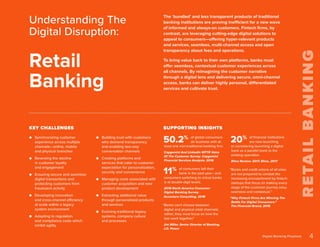
of global consumers
do business with at
least one non-traditional banking firm.
Capgemini And LinkedIn WFTR Voice
Of The Customer Survey. Capgemini
Financial Services Analysis, 2016
of consumers left their
bank in the past year—and
consumers switching to virtual banks
is at double-digit levels.
2016 North America Consumer
Digital Banking Survey.
Accenture Consulting, 2016
“Banks can’t choose between
digital and physical retail channels;
rather, they must focus on how the
two work together.”
Jim Miller. Senior Director of Banking,
J.D. Power
of financial institutions
are now launching
or considering launching a digital
bank as a parallel bank to the
existing operation.
Efma Review: 2017. Efma, 2017
“Banks and credit unions of all sizes
are not prepared to combat the
increasing encroachment by fintech
startups that focus on making every
stage of the customer journey easy,
seamless and contextual.”
“Why Fintech Firms Are Winning The
Battle For Digital Consumers.”
The Financial Brand, 2016
The ‘bundled’ and less transparent products of traditional
banking institutions are proving inefficient for a new wave
of informed and always-on customers. Fintech firms, by
contrast, are leveraging cutting-edge digital solutions to
appeal to consumers—offering hyper-relevant products
and services, seamless, multi-channel access and open
transparency about fees and operations.
To bring value back to their own platforms, banks must
offer seamless, contextual customer experiences across
all channels. By reimagining the customer narrative
through a digital lens and delivering secure, omni-channel
access, banks can deliver highly personal, differentiated
services and cultivate trust.
Understanding The
Digital Disruption:
Retail
Banking
KEY CHALLENGES SUPPORTING INSIGHTS
●
● Synchronizing customer
experience across multiple
channels—online, mobile
and physical branches
●
● Reversing the decline
in customer loyalty
and engagement
●
● Ensuring secure and seamless
digital transactions and
protecting customers from
fraudulent activity
●
● Developing innovation
and cross-channel efficiency
at scale within a legacy
system environment
●
● Adapting to regulation
and compliance costs which
inhibit agility
●
● Building trust with customers
who demand transparency
and enabling two-way
conversation channels
●
● Creating platforms and
services that cater to customer
expectation for personalization,
security and convenience
●
● Managing costs associated with
customer acquisition and new
product development
●
● Extracting additional value
through personalized products
and services
●
● Evolving traditional legacy
systems, company culture
and processes
50.2%
11%
20%
5
Digital Banking Playbook
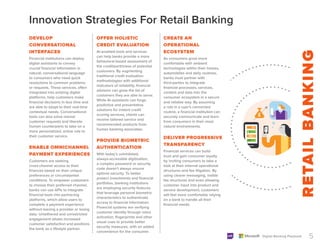
Innovation Strategies For Retail Banking
DEVELOP
CONVERSATIONAL
INTERFACES
Financial institutions can deploy
digital assistants to convey
crucial financial information in
natural, conversational language
to consumers who need quick
resolutions to common problems
or requests. These services, often
integrated into existing digital
platforms, help customers make
financial decisions in less time and
are able to adapt to their real-time
contextual needs. Conversational
tools can also solve menial
customer requests and liberate
human counterparts to take on a
more personalized, active role to
their customer service.
ENABLE OMNICHANNEL
PAYMENT EXPERIENCES
Customers are seeking
cross-channel access to their
finances based on their unique
preferences or circumstantial
conditions. To empower customers
to choose their preferred channel,
banks can use APIs to integrate
financial tools into partnering
platforms, which allow users to
complete a payment experience
without leaving a provider or losing
data. Untethered and unrestricted
engagement allows increased
customer satisfaction and positions
the bank as a lifestyle partner.
OFFER HOLISTIC
CREDIT EVALUATION
AI-enabled tools and services
can help banks provide a more
behavioral-based assessment of
the creditworthiness of potential
customers. By augmenting
traditional credit evaluation
methodologies with additional
indicators of reliability, financial
advisors can grow the list of
customers they are able to serve.
While AI-assistants can forge
predictive and preventative
solutions for instant credit
scoring services, clients can
receive tailored service and
recommended products from
human banking associates.
PROVIDE BIOMETRIC
AUTHENTICATION
With today’s uninhibited,
always-accessible digitization,
a complex password or security
code doesn’t always ensure
optimal security. To better
protect investments and financial
portfolios, banking institutions
are employing security features
that leverage personal biometric
characteristics to authenticate
access to financial information.
Financial systems are verifying
customer identity through voice
activation, fingerprints and other
visual cues to provide better
security measures, with an added
convenience for the consumer.
CREATE AN
OPERATIONAL
ECOSYSTEM
As consumers grow more
comfortable with ambient
technologies within their homes,
automobiles and daily routines,
banks must partner with
third-parties to integrate
financial processes, services,
content and data into the
consumer ecosystem in a secure
and reliable way. By assuming
a role in a user’s connected
routine, a financial institution can
securely communicate and learn
from consumers in their most
natural environments.
DELIVER PROGRESSIVE
TRANSPARENCY
Financial services can build
trust and gain consumer loyalty
by inviting consumers to take a
look at their internal operational
structures and fee litigation. By
using clearer messaging, visible
fee structures and even allowing
customer input into product and
service development, customers
will feel more comfortable relying
on a bank to handle all their
financial needs.
Quick Win Initiatives
6
Digital Banking Playbook
CUSTOMER EXPERIENCE SECURITY
●
● Gain actionable customer insights to enable higher-value
client relationships and personalized banking experiences.
Deepen your understanding of each customer by tracking
the details of every interaction—whether in person or via
phone, web, mobile, email or social media—to deliver
contextual, connected experiences
●
● Customize experiences with personalized financial
guidance, service, and offers. Increase customer
satisfaction and improve upsell and cross-sell performance
by engaging customers with personalized financial
guidance and next best offers
●
● Democratize artificial intelligence and make it valuable to
everyone. Benefit from built-in intelligence, based on deep
learning technology, with solutions that see, hear, speak,
and understand customer needs and emotions using natural
methods of communication
●
● Determine what points of the retail banking process, from
cash withdrawal to transaction authentication, are the
most vulnerable for security flaws and fortify them with
enterprise-grade encryption and biometrics
●
● Leverage AI assistants to detect, compile and
aggregate patterns of suspicious behavior that could
indicate financial fraud
●
● Build consumer trust by proactively educating clients in best
practices to protect themselves from security breaches, while
communicating your security initiatives
RISK MANAGEMENT
●
● Develop tools and content that help customers understand
the components that determine their risk profile; build
client trust by offering transparent risk assessments and
recommendations to improve creditworthiness
●
● Leverage AI to explore alternate indicators of
creditworthiness like purchase behavior, social media activity,
job history and other components of personal data to support
a more holistic risk assessment
●
● Use cloud technologies to reduce the time needed to gather
approval for loans and reduce processing time, reducing
total cost and enabling banks to reach a broader range of
potential consumers
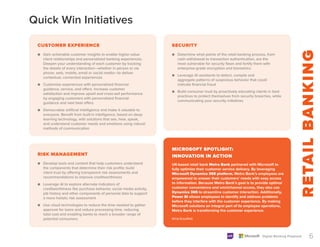
MICROSOFT SPOTLIGHT:
INNOVATION IN ACTION
UK-based retail bank Metro Bank partnered with Microsoft to
fully optimize their customer service delivery. By leveraging
Microsoft Dynamics 365 platform, Metro Bank’s employees are
empowered to answer their customers’ needs with easy access
to information. Because Metro Bank’s goal is to provide optimal
customer convenience and omnichannel access, they also use
Dynamics 365 to streamline customer interaction. Additionally,
Power BI allows employees to identify and address problems
before they interfere with the customer experience. By making
Microsoft solutions an integral part of its employee operations,
Metro Bank is transforming the customer experience.
bit.ly/2uvy5wb
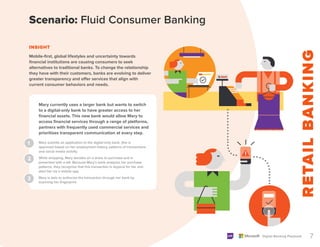
1
2
3
Mary submits an application to the digital-only bank. She is
approved based on her employment history, patterns of transactions
and social media activity.
While shopping, Mary decides on a dress to purchase and is
presented with a bill. Because Mary’s bank analyzes her purchase
patterns, they recognize that this transaction is atypical for her and
alert her via a mobile app.
Mary is able to authorize the transaction through her bank by
scanning her fingerprint.
7
Digital Banking Playbook
Mobile-first, global lifestyles and uncertainty towards
financial institutions are causing consumers to seek
alternatives to traditional banks. To change the relationship
they have with their customers, banks are evolving to deliver
greater transparency and offer services that align with
current consumer behaviors and needs.
Scenario: Fluid Consumer Banking
INSIGHT
Mary currently uses a larger bank but wants to switch
to a digital-only bank to have greater access to her
financial assets. This new bank would allow Mary to
access financial services through a range of platforms,
partners with frequently used commercial services and
prioritizes transparent communication at every step.
6
4
5
7
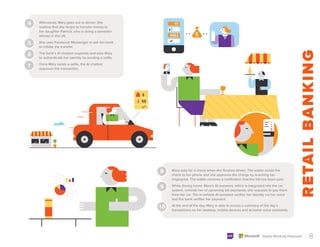
Afterwards, Mary goes out to dinner. She
realizes that she forgot to transfer money to
her daughter Patricia, who is doing a semester
abroad in the UK.
She uses Facebook Messenger to ask her bank
to initiate the transfer.
The bank’s AI chatbot responds and asks Mary
to authenticate her identity by sending a selfie.
Once Mary sends a selfie, the AI chatbot
approves the transaction.
9
10
Mary asks for a check when she finishes dinner. The waiter sends the
check to her phone and she approves the charge by scanning her
fingerprint. The waiter receives a notification that the bill has been paid.
While driving home, Mary’s AI assistant, which is integrated into the car
system, reminds her of upcoming bill payments; she requests to pay them
from her car. The in-vehicle AI assistant verifies her identity via her voice
and the bank verifies her payment.
At the end of the day, Mary is able to access a summary of the day’s
transactions on her desktop, mobile devices and at-home voice assistants.
8
8
Digital Banking Playbook
“
9
Digital Banking Playbook
Capital Markets
institutions say that
cloud-based entrants will challenge
traditional industry models.”
“Top 10 Challenges For Investment
Banks.” Accenture, 2017.
“Capital markets and investment
banking firms invested heavily in
digitizing their front offices years ago
because there was a commercial
imperative to do so. While ROEs
were high, there was less of an
immediate need to innovate in the
back office. That is no longer the
case. The business model is changing,
and we have to find new ways to
reduce structural costs and simplify
our architecture. We have to innovate,
and we are engaging our people at
every level in the organization in the
innovation agenda.”
Anthony Woolley, UK Chief Information
Officer, Société Générale
Source: EY-Capital Markets-Innovation
“Our industry is going through
a transformational time, driven
by competition, regulation and
advancements in technology.”
Daniel Pinto. CEO of the Corporate &
Investment Bank, J.P. Morgan
Source: EY-Capital Markets-Innovation
“We are at a point where we have an
opportunity to reposition financial
services. With the technology
available, we can change the way
transactions are done, reducing
costs from dollars to pennies.
Through collaboration, we have the
opportunity not only to revive
businesses that have died, but also
to create new ones that haven’t even
been thought of.”
David Rutter. Founder and CEO,
R3 CEV
Source: EY-Capital Markets-Innovation
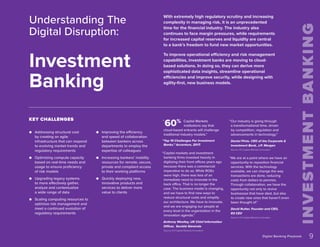
With extremely high regulatory scrutiny and increasing
complexity in managing risk, it is an unprecedented
time for the financial industry. The industry also
continues to face margin pressures, while requirements
for increased capital reserves and liquidity are central
to a bank’s freedom to fund new market opportunities.
To improve operational efficiency and risk management
capabilities, investment banks are moving to cloud-
based solutions. In doing so, they can derive more
sophisticated data insights, streamline operational
efficiencies and improve security, while designing with
agility-first, new business models.
Understanding The
Digital Disruption:
Investment
Banking
●
● Addressing structural cost
by creating an agile
infrastructure that can respond
to evolving market trends and
regulatory requirements
●
● Optimizing compute capacity
based on real-time needs and
usage to ensure proficiency
of risk models
●
● Upgrading legacy systems
to more effectively gather,
analyze and contextualize
a wide range of data
●
● Scaling computing resources to
optimize risk management and
meet a continued evolution of
regulatory requirements
●
● Improving the efficiency
and speed of collaboration
between bankers across
departments to employ the
expertise of colleagues
●
● Increasing bankers’ mobility
resources for remote, secure,
private and compliant access
to their working platforms
●
● Quickly deploying new,
innovative products and
services to deliver more
value to clients
60%
KEY CHALLENGES
10
Digital Banking Playbook
Innovation Strategies For
Investment Banking
CREATE PERSONALIZED
EXPERIENCES
AT SPEED
With ever-increasing market
speeds, the ability to predict
the efficacy of an investment
becomes more difficult. By
leveraging artificial intelligence
and data farming tools, financial
institutions can more quickly
identify risks associated with
trades or investment opportunities.
These systems analyze patterns
in local contexts, global policies
and other market fluctuations to
provide a thorough analysis of the
risks associated with investment
decisions, assess trade values or
make the trades on their own, all
at the speed of the market.
ENABLE A MODERN
WORKPLACE
By providing a modern workplace,
firms can ensure that staff are
always able to access secure
information and contribute to in-
the-moment analyses. Internally,
employees are able to collaborate
and make better-informed
decisions that are based on real-
time data, increasing accuracy and
expediting processes. Intelligent
virtual assistants can automate
tedious and time-consuming tasks,
allowing bankers to concentrate
on servicing client relationships.
OPTIMIZING RISK
MANAGEMENT
& COMPLIANCE
To expedite compliance
preparation and regulatory
requirements when underwriting
mergers, acquisitions and trading
portfolios, regulatory teams can
incorporate cloud-enabled tools
into their existing systems to
run risk models, complete stress
testing and ensure compliance.
Technology such as blockchain
provides a secure way to exchange
information between multiple
participants that need to approve
deals and transactions, saving
time and streamlining processes
to reduce operational costs.
EMBRACE THE
API ECONOMY
In order to survive in today’s
rapidly changing financial
markets, bankers need
to focus on product and
service innovation—at a
macro, enterprise-wide scale.
Although traditional financial
institutions have been siloed
and self-sufficient, bankers
must collaborate with third-
party technology developers to
compete and expand service
offerings. By embracing an
open financial ecosystem, they
can unlock new investment
opportunities for their clients
and drive growth.
Quick Win Initiatives
11
Digital Banking Playbook
REGULATORY COMPLIANCE
●
● Migrate computational systems to the cloud to protect
client, transaction and institutional data
●
● Analyze current internal data-sharing systems and
determine which steps are most vulnerable to threats;
compartmentalize these areas to create an infrastructure
that responds more quickly without compromising the
entire operation
●
● Reduce the compliance burden by analyzing internal
and market data on an ongoing basis, in order to identify
fraud patterns and offer enhanced security through
real-time fraud analytics
BANKER PRODUCTIVITY
●
● Offload preliminary research and modeling responsibilities
to machine learning technologies to reduce computational
times and better use staff time
●
● Build a mobile workforce by offering employees secure
access to real-time information from any device
●
● Encourage inter-departmental collaboration via cloud-
based workstream platforms, which share up-to-the-minute
information and updates to expedite document
preparation, compliance review and regulatory approval
ADVANCED RISK ANALYTICS
●
● Invest in cloud-based risk compute capacity to improve
modeling accuracy and evaluate risk more efficiently
●
● Create omnipresent, simplified dashboards that help
teams monitor risk exposure in real time and incorporate
risk analytics as part of their everyday activities
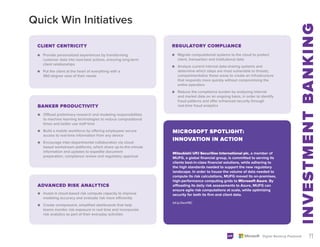
MICROSOFT SPOTLIGHT:
INNOVATION IN ACTION
Mitsubishi UFJ Securities International plc, a member of
MUFG, a global financial group, is committed to serving its
clients best-in-class financial solutions, while adhering to
the high standards needed to support the new regulatory
landscape. In order to house the volume of data needed to
compute its risk calculations, MUFG moved its on-premises,
high-performance computing grids to Microsoft Azure. By
offloading its daily risk assessments to Azure, MUFG can
ensure agile risk computations at scale, while optimizing
security for both its firm and client data.
bit.ly/2wxI19C
CLIENT CENTRICITY
●
● Provide personalized experiences by transforming
customer data into next-best actions, ensuring long-term
client relationships
●
● Put the client at the heart of everything with a
360-degree view of their needs
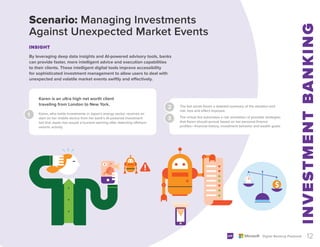
1 Karen, who holds investments in Japan’s energy sector, receives an
alert on her mobile device from her bank’s AI-powered investment
bot that Japan has issued a tsunami warning after detecting offshore
seismic activity.
The bot sends Karen a detailed summary of the situation and
risk, loss and effect imposed.
The virtual bot automates a risk simulation of possible strategies
that Karen should pursue based on her personal finance
profiles—financial history, investment behavior and wealth goals.
2
3
12
Digital Banking Playbook
By leveraging deep data insights and AI-powered advisory tools, banks
can provide faster, more intelligent advice and execution capabilities
to their clients. These intelligent digital tools improve accessibility
for sophisticated investment management to allow users to deal with
unexpected and volatile market events swiftly and effectively.
Scenario: Managing Investments
Against Unexpected Market Events
INSIGHT
Karen is an ultra high net worth client
traveling from London to New York.
The bot augments the meeting preparation
undertaken by the Relationship
Manager by providing contextual and
personalized guidance.
The bot automatically generates the
required compliance documentation.
The AI-powered investment bot also
coordinates a follow-up appointment
for Karen with her relationship manager
to discuss the long term effects of the
market event.
The bot also forecasts how each strategy
could evolve over time by conducting an
analysis of contextual market data.
Karen decides to follow through on one
of the bot-recommended investment
strategies and executes her trades.
The transactions are assured with
blockchain to optimize secure legibility
for audit purposes.
6
4 5
7 8 9
13
Digital Banking Playbook
14
Digital Banking Playbook
of asset and wealth
managers think that
at least part of their business is
at risk to Fintech.
2016 Global Fintech Survey, PwC
of high net worth
individuals (HNWIs) are
now using online/mobile banking but
only a quarter of wealth managers
currently offer digital channels
beyond email.
2016 Strategy & Global Wealth
Management Survey, PwC
of the asset and wealth
managers identify
increased data analytics as the most
important trend for the next five years.
2016 Global FinTech Survey, PwC
“The industry is already racing to
maximize productivity. How many
assets under management can you
manage as a financial adviser? Even
in the high-net-worth environment,
you have to think about how much
you can automate and drive efficiency
while not losing that personal touch.”
Oliver Bussmann. Founder & Managing
Partner, Bussmann Advisory
“We believe that the firms that
can get organized around their
data, understand and are able to
research what all those data are
telling them and predicting can
ultimately invest in a way to create
better returns for clients.”
Jody Kochansky. Head Of The Aladdin
Product Group, BlackRock
Greater access to financial information and digital
investment platforms have lowered the barriers to markets,
allowing a broader subset of customers to become their
own financial advisors, while streamlining the way that all
audiences interact and monitor their portfolios.
To maintain relevancy, financial institutions must determine
how to address the needs of different segments and
communicate their value. By utilizing technologies such
as augmented intelligence and real-time collaboration,
bankers can become the ultimate digital concierge,
anticipating customer’s needs and goals and connecting
them with the tools and opportunities to succeed.
Understanding The
Digital Disruption:
Wealth
Management
●
● Integrating with emerging
technological and digital
channels to deliver new client
value and differentiate from
competing services
●
● Providing personalized financial
management at scale based on
different customer needs
●
● Improving service agility and
speed to respond to real-time
requests or market factors
●
● Optimizing customer profitability
and turning customers into
loyal advocates
●
● Reorganizing internal processes
and appropriating spending to
areas of the business that drive
future growth
●
● Develop differentiated
deep-client services for
Ultra High Net Worth
Individuals and High Net
Worth Individuals clients and
Mass Affluents demographics
60%
69%
90%
KEY CHALLENGES SUPPORTING INSIGHTS
15
Digital Banking Playbook
Innovation Strategies For Wealth Management
OFFER MACHINE-
AUGMENTED
MANAGEMENT
Using machine learning systems
to support advisory services
enables a higher quality of advice
at a significantly lower cost to the
firm. Wealth and asset managers
who offload routine tasks such
as preliminary data collection,
research and compliance
adherence to robo-advisors can
focus on preparing more premium
strategies and packages for
each high net worth client. AI
services also allow firms to offer
a broader range of financial
services for audiences in different
income brackets.
IMPLEMENT
PREDICTIVE ANALYTICS
A portfolio’s performance is
subject to a variety of market
factors; AI services, together
with predictive analytics, can
track multiple macro- and
micro-economic indicators,
regulatory trends and social
sentiments to produce insights and
timely advice, which
managers can leverage to make
portfolio recommendations or
help customers build the right
financial management solutions
for their lifestyle.
PROMOTE
PROGRESSIVE
TRANSPARENCY
In order to retain top clients
and gain new customer loyalty,
wealth managers must reevaluate
their internal operations and
messaging to give customers
more insight and control over
their financial management. Firms
should consider incorporating
clearer messaging, preemptive
communication, transparent fee
structures and even channels for
customer feedback on product
development. By addressing
client concerns and incorporating
their ideas, firms can efficiently
appropriate spending toward
products and services that meet
client needs.
AUTOMATE PORTFOLIO
OPTIMIZATION
Until now, the pace of portfolio
optimization has relied on human
effort; now, digital and algorithmic
programs allow firms to respond
more quickly to economic, global
and market trends and optimize
returns for clients. Intelligent
money management systems
that track contextual indicators
and automatically adjust portfolios
offer a more responsive level
of service to clients without
straining staff.
Quick Win Initiatives
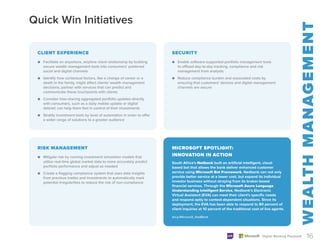
MICROSOFT SPOTLIGHT:
INNOVATION IN ACTION
South Africa’s Nedbank built an artificial intelligent, cloud-
based bot that allows the bank deliver enhanced customer
service using Microsoft Bot Framework. Nedbank can not only
provide better service at a lower cost, but expand its individual
investor business without straying from its broker-based
financial services. Through the Microsoft Azure Language
Understanding Intelligent Service, Nedbank’s Electronic
Virtual Assistant (EVA) can meet their client’s specific needs
and respond aptly to context-dependent situations. Since its
deployment, the EVA has been able to respond to 80 percent of
client inquiries at 10 percent of the traditional cost of live agents.
bit.ly/Microsoft_NedBank
16
Digital Banking Playbook
CLIENT EXPERIENCE SECURITY
●
● Facilitate an anywhere, anytime client relationship by building
secure wealth management tools into consumers’ preferred
social and digital channels
●
● Identify how contextual factors, like a change of career or a
death in the family, might affect clients’ wealth management
decisions; partner with services that can predict and
communicate these touchpoints with clients
●
● Consider how sharing aggregated portfolio updates directly
with consumers, such as a daily mobile update or digital
debrief, can help them feel in control of their investments
●
● Stratify investment tools by level of automation in order to offer
a wider range of solutions to a greater audience
●
● Enable software-supported portfolio management tools
to offload day-to-day tracking, compliance and risk
management from analysts
●
● Reduce compliance burden and associated costs by
ensuring that customers’ devices and digital management
channels are secure
RISK MANAGEMENT
●
● Mitigate risk by running investment simulation models that
utilize real-time global market data to more accurately predict
portfolio performance and adjust as needed
●
● Create a flagging compliance system that uses data insights
from previous trades and investments to automatically mark
potential irregularities to reduce the risk of non-compliance
1
2
3
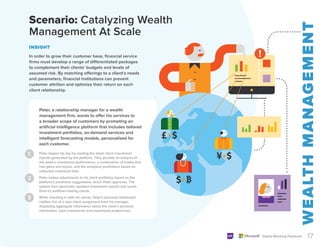
Peter begins his day by reading the latest client investment
reports generated by the platform. They provide an analysis of
the week’s investment performance, a combination of trades that
had gains and losses, and the analytical predictions based on
collected contextual data.
Peter makes adjustments to his client portfolios based on the
platform’s predictive suggestions, which Peter approves. The
system then generates updated investment reports and sends
them to portfolio-holding clients.
While checking in with his clients, Peter’s personal dashboard
notifies him of a new client assignment from his manager,
displaying aggregate information about the client’s personal
information, past investments and investment preferences.
17
Digital Banking Playbook
In order to grow their customer base, financial service
firms must develop a range of differentiated packages
to complement their clients’ budgets and levels of
assumed risk. By matching offerings to a client’s needs
and parameters, financial institutions can prevent
customer attrition and optimize their return on each
client relationship.
Scenario: Catalyzing Wealth
Management At Scale
INSIGHT
Peter, a relationship manager for a wealth
management firm, wants to offer his services to
a broader scope of customers by promoting an
artificial intelligence platform that includes tailored
investment portfolios, on-demand services and
intelligent forecasting models, personalized for
each customer.
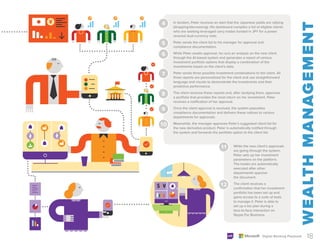
In tandem, Peter receives an alert that the Japanese yields are rallying
(dropping/decreasing). His dashboard compiles a list of eligible clients
who are seeking leveraged carry trades funded in JPY for a power
reversal dual-currency note.
Peter sends the client list to his manager for approval and
compliance documentation.
While Peter awaits approval, he runs an analysis on the new client
through the AI-based system and generates a report of various
investment portfolio options that display a combination of the
investments based on the client’s data.
Peter sends three possible investment combinations to the client. All
three reports are personalized for the client and use straightforward
language and visuals to demonstrate the investments and their
predictive performance.
The client receives these reports and, after studying them, approves
a portfolio that provides the most return on her investment. Peter
receives a notification of her approval.
Once the client approval is received, the system populates
compliance documentation and delivers these notices to various
departments for approvals.
Meanwhile, the manager approves Peter’s suggested client list for
the new derivative product. Peter is automatically notified through
the system and forwards the portfolio option to the client list.
6
4
5
7
8
While the new client’s approvals
are going through the system,
Peter sets up her investment
parameters on the platform.
The trades are automatically
executed after other
departments approve
the document.
The client receives a
confirmation that her investment
portfolio has been set up and
gains access to a suite of tools
to manage it. Peter is able to
set up a tax plan during a
face-to-face interaction on
Skype For Business.
9
10
11
12
18
Digital Banking Playbook
19
Digital Banking Playbook
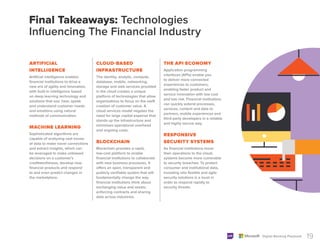
ARTIFICIAL
INTELLIGENCE
Artificial intelligence enables
financial institutions to drive a
new era of agility and innovation,
with built-in intelligence based
on deep learning technology and
solutions that see, hear, speak
and understand customer needs
and emotions using natural
methods of communication.
MACHINE LEARNING
Sophisticated algorithms are
capable of analyzing vast troves
of data to make novel connections
and extract insights, which can
be leveraged to make unbiased
decisions on a customer’s
creditworthiness, develop new
financial products and respond
to and even predict changes in
the marketplace.
Final Takeaways: Technologies
Influencing The Financial Industry
CLOUD-BASED
INFRASTRUCTURE
The identity, analytic, compute,
database, mobile, networking,
storage and web services provided
in the cloud creates a unique
platform of technologies that allow
organizations to focus on the swift
creation of customer value. A
cloud services model negates the
need for large capital expense that
stands up the infrastructure and
minimises operational overhead
and ongoing costs.
BLOCKCHAIN
Blockchain provides a rapid,
low-cost platform to enable
financial institutions to collaborate
with new business processes. It
offers an open, transparent and
publicly verifiable system that will
fundamentally change the way
financial institutions think about
exchanging value and assets,
enforcing contracts and sharing
data across industries.
THE API ECONOMY
Application programming
interfaces (APIs) enable you
to deliver more connected
experiences to customers,
enabling faster product and
service innovation with low cost
and low risk. Financial institutions
can quickly extend processes,
services, content and data to
partners, mobile experiences and
third-party developers in a reliable
and highly secure way.
RESPONSIVE
SECURITY SYSTEMS
As financial institutions move
their operations to the cloud,
systems become more vulnerable
to security breaches. To protect
consumer and institutional data,
investing into flexible and agile
security solutions is a must in
order to respond rapidly to
security threats.
About
Microsoft
20
Digital Banking Playbook
About
PSFK
PSFK is the world’s leading provider of innovation insights. Since
2004, we have offered the tools, content and advice to inspire creative
professionals to make better products, services and experiences.
Our daily business intelligence portal and newsletters help members
find and track new ideas that they can use in their work. Our reports
provide insights into trends driving creative business and our audiences
access thought leadership from pioneers at our events. PSFK Labs,
our consulting service, provides corporations with trends-led strategy,
concepting, content and delivery.
For more information, visit: psfk.com
Global digitization combined with unprecedented changes to the
financial services business model is mandating transformation.
Microsoft empowers financial institutions to drive digital
transformation with solutions to reimagine the client experience
for a digital world, empower employees with modern productivity
suites and digital workstyles, optimize operations through improved
insight into risk and operational models and transform products
with open and connected systems and real-time predictive digital
processes. Through a combination of Microsoft and partner solutions,
you can turn data into insight, transform ideas into action and turn
change into opportunity.
enterprise.microsoft.com/en-us/industries/banking-and-capital-markets
PSFK
42 Bond Street, 6th Floor
New York, NY 10012 USA
Version 1 | Published 2017
Download this report at: psfk.com/digital-banking-playbook
Piers Fawkes
President & Founder
piers.fawkes@psfk.com
+1 646.520.4672
Scott Lachut
President of Research &
Strategy
scott.lachut@psfk.com
+1 646.520.4672
Project Lead
Conner Dial
Design
Sasha Zwiebel
Illustrations
Romualdo Faura
All rights reserved.
No parts of this publication may be reproduced without the written permission of PSFK.
with

Digital Banking Playbook Final............

  • 1.
    with Transformation Strategies For AConnected Marketplace DIGITAL BANKING PLAYBOOK
  • 2.
    2 Digital Banking Playbook Theprimary duty of any financial community is to produce, empower and actualize opportunity. From providing loans to jumpstarting entrepreneurial ventures, banks can provide an arsenal of catalytic tools for businesses and individuals alike to achieve their goals. Introducing The Digital Banking Frontier The Digital Banking Playbook is a report by business intelligence platform PSFK in partnership with Microsoft that presents opportunities for driving financial institutions forward with an intelligent cloud. Three scenarios highlight how cloud-based solutions can help the industry minimize risk, ensure optimal service at scale and think differently about security, privacy and regulatory compliance. Backed by expert insights and key analyses of global industry trends, the Digital Banking Playbook will guide financial institutions of all sizes as they aim to service a broader range of global clientele. For copies: psfk.com/digital-banking-playbook ABOUT THIS REPORT Piers Fawkes Founder & Editor-in-Chief PSFK Likewise, the opportunities presented with digital transformation extend to all banking verticals—from retail banking to capital markets. Because these shifts have decentralized banking operations, an agile, digital ecosystem is necessary for institutions to have greater, data-driven intelligence on their customers, markets and internal business processes. In the Digital Banking Playbook, PSFK highlights how digital tools can augment a financial institution’s ability to optimize operations and reinvigorate the client experience. Backed by marketplace trends and strategies for successful implementation, we present three scenarios that ground this digital conquest within the contextual framework of today’s banking operations. This digital vision presents a new opportunity to deliver unprecedented innovation to the customer, as well as the internal, overarching banking enterprise. This economic importance has forced banks to rely on decades of established structures comprised of strictly defined roles—and in a pre-digital world, it’s worked. However, in an economy of constraining regulations, heightened competition and elevated customer demands, it’s these legacy systems and siloed operations that are preventing growth and stalling innovation. To find success in this new landscape, financial organizations will need to look to emerging technologies, like artificial intelligence and machine learning software, to deliver more relevant services in the midst of changing markets. Banks with a digital infrastructure at the core can quickly adapt to changes in the marketplace and provide differentiated customer experiences, effectively establishing themselves as trusted and confident brokers for their clients’ and organization’s needs. The keys for actualizing a successful digital business transformation revolve around four key pillars: 1. Engage clients with differentiated experiences that tailor to their personal financial needs and goals 2. Empower employees with tools that can provide accessible, holistic information at their fingertips about individual clients, while meeting critical security and compliance needs 3. Optimize internal operations with synchronized processes and democratized data-sharing 4. Transform products with open and connected systems and real-time predictive digital processes The influence of technological, cultural and regulatory requirements mandate accelerated change across financial services.
  • 3.
    3 Digital Banking Playbook RISEOF ALTERNATIVE BANKING SOLUTIONS Slow innovation by traditional financial players has created opportunities for nimble startups with digital DNA at their core to enter the marketplace. While many lack the scale of incumbents, a compelling mix of personalization, transparency and flexibility have positioned these companies as appealing alternatives to traditional financial institutions. BALANCING INNOVATION AND REGULATION Heavy compliance issues and regulations imposed on financial institutions are obstacles to the pace of technology innovation enjoyed by other industries. Because banks have too high cost-income-ratios, they need to optimize cost in order to drive innovation. Organizations must learn to navigate these complexities and position themselves as category leaders to drive meaningful change. SPEED OF THE MARKETPLACE Accelerated market speeds are placing increased pressure on financial institutions to rapidly respond to marketplace changes. The ability to analyze data in real time and accurately forecast outcomes, alongside having the right internal structures in place to quickly act, is becoming imperative for organizations to remain competitive. Financial Services Industry Disruptors PERSONALIZATION EXPECTATION The digital transformation of other industries—retail, hospitality, entertainment—is giving rise to mass customization at scale, creating an expectation for products, services and experiences tailored to a market size of one. INCREASED DATA BREACH RISK As growth in the number of digital transactions continues and banking infrastructures migrate to a broader range of platforms, financial institutions, their employees and clients face increased exposure to data breaches. Additionally, banks have paid $280 billion dollars in fines since 2009, indicating an elevated need for expanded, holistic security measures.
  • 4.
    4 Digital Banking Playbook ofglobal consumers do business with at least one non-traditional banking firm. Capgemini And LinkedIn WFTR Voice Of The Customer Survey. Capgemini Financial Services Analysis, 2016 of consumers left their bank in the past year—and consumers switching to virtual banks is at double-digit levels. 2016 North America Consumer Digital Banking Survey. Accenture Consulting, 2016 “Banks can’t choose between digital and physical retail channels; rather, they must focus on how the two work together.” Jim Miller. Senior Director of Banking, J.D. Power of financial institutions are now launching or considering launching a digital bank as a parallel bank to the existing operation. Efma Review: 2017. Efma, 2017 “Banks and credit unions of all sizes are not prepared to combat the increasing encroachment by fintech startups that focus on making every stage of the customer journey easy, seamless and contextual.” “Why Fintech Firms Are Winning The Battle For Digital Consumers.” The Financial Brand, 2016 The ‘bundled’ and less transparent products of traditional banking institutions are proving inefficient for a new wave of informed and always-on customers. Fintech firms, by contrast, are leveraging cutting-edge digital solutions to appeal to consumers—offering hyper-relevant products and services, seamless, multi-channel access and open transparency about fees and operations. To bring value back to their own platforms, banks must offer seamless, contextual customer experiences across all channels. By reimagining the customer narrative through a digital lens and delivering secure, omni-channel access, banks can deliver highly personal, differentiated services and cultivate trust. Understanding The Digital Disruption: Retail Banking KEY CHALLENGES SUPPORTING INSIGHTS ● ● Synchronizing customer experience across multiple channels—online, mobile and physical branches ● ● Reversing the decline in customer loyalty and engagement ● ● Ensuring secure and seamless digital transactions and protecting customers from fraudulent activity ● ● Developing innovation and cross-channel efficiency at scale within a legacy system environment ● ● Adapting to regulation and compliance costs which inhibit agility ● ● Building trust with customers who demand transparency and enabling two-way conversation channels ● ● Creating platforms and services that cater to customer expectation for personalization, security and convenience ● ● Managing costs associated with customer acquisition and new product development ● ● Extracting additional value through personalized products and services ● ● Evolving traditional legacy systems, company culture and processes 50.2% 11% 20%
  • 5.
    5 Digital Banking Playbook InnovationStrategies For Retail Banking DEVELOP CONVERSATIONAL INTERFACES Financial institutions can deploy digital assistants to convey crucial financial information in natural, conversational language to consumers who need quick resolutions to common problems or requests. These services, often integrated into existing digital platforms, help customers make financial decisions in less time and are able to adapt to their real-time contextual needs. Conversational tools can also solve menial customer requests and liberate human counterparts to take on a more personalized, active role to their customer service. ENABLE OMNICHANNEL PAYMENT EXPERIENCES Customers are seeking cross-channel access to their finances based on their unique preferences or circumstantial conditions. To empower customers to choose their preferred channel, banks can use APIs to integrate financial tools into partnering platforms, which allow users to complete a payment experience without leaving a provider or losing data. Untethered and unrestricted engagement allows increased customer satisfaction and positions the bank as a lifestyle partner. OFFER HOLISTIC CREDIT EVALUATION AI-enabled tools and services can help banks provide a more behavioral-based assessment of the creditworthiness of potential customers. By augmenting traditional credit evaluation methodologies with additional indicators of reliability, financial advisors can grow the list of customers they are able to serve. While AI-assistants can forge predictive and preventative solutions for instant credit scoring services, clients can receive tailored service and recommended products from human banking associates. PROVIDE BIOMETRIC AUTHENTICATION With today’s uninhibited, always-accessible digitization, a complex password or security code doesn’t always ensure optimal security. To better protect investments and financial portfolios, banking institutions are employing security features that leverage personal biometric characteristics to authenticate access to financial information. Financial systems are verifying customer identity through voice activation, fingerprints and other visual cues to provide better security measures, with an added convenience for the consumer. CREATE AN OPERATIONAL ECOSYSTEM As consumers grow more comfortable with ambient technologies within their homes, automobiles and daily routines, banks must partner with third-parties to integrate financial processes, services, content and data into the consumer ecosystem in a secure and reliable way. By assuming a role in a user’s connected routine, a financial institution can securely communicate and learn from consumers in their most natural environments. DELIVER PROGRESSIVE TRANSPARENCY Financial services can build trust and gain consumer loyalty by inviting consumers to take a look at their internal operational structures and fee litigation. By using clearer messaging, visible fee structures and even allowing customer input into product and service development, customers will feel more comfortable relying on a bank to handle all their financial needs.
  • 6.
    Quick Win Initiatives 6 DigitalBanking Playbook CUSTOMER EXPERIENCE SECURITY ● ● Gain actionable customer insights to enable higher-value client relationships and personalized banking experiences. Deepen your understanding of each customer by tracking the details of every interaction—whether in person or via phone, web, mobile, email or social media—to deliver contextual, connected experiences ● ● Customize experiences with personalized financial guidance, service, and offers. Increase customer satisfaction and improve upsell and cross-sell performance by engaging customers with personalized financial guidance and next best offers ● ● Democratize artificial intelligence and make it valuable to everyone. Benefit from built-in intelligence, based on deep learning technology, with solutions that see, hear, speak, and understand customer needs and emotions using natural methods of communication ● ● Determine what points of the retail banking process, from cash withdrawal to transaction authentication, are the most vulnerable for security flaws and fortify them with enterprise-grade encryption and biometrics ● ● Leverage AI assistants to detect, compile and aggregate patterns of suspicious behavior that could indicate financial fraud ● ● Build consumer trust by proactively educating clients in best practices to protect themselves from security breaches, while communicating your security initiatives RISK MANAGEMENT ● ● Develop tools and content that help customers understand the components that determine their risk profile; build client trust by offering transparent risk assessments and recommendations to improve creditworthiness ● ● Leverage AI to explore alternate indicators of creditworthiness like purchase behavior, social media activity, job history and other components of personal data to support a more holistic risk assessment ● ● Use cloud technologies to reduce the time needed to gather approval for loans and reduce processing time, reducing total cost and enabling banks to reach a broader range of potential consumers MICROSOFT SPOTLIGHT: INNOVATION IN ACTION UK-based retail bank Metro Bank partnered with Microsoft to fully optimize their customer service delivery. By leveraging Microsoft Dynamics 365 platform, Metro Bank’s employees are empowered to answer their customers’ needs with easy access to information. Because Metro Bank’s goal is to provide optimal customer convenience and omnichannel access, they also use Dynamics 365 to streamline customer interaction. Additionally, Power BI allows employees to identify and address problems before they interfere with the customer experience. By making Microsoft solutions an integral part of its employee operations, Metro Bank is transforming the customer experience. bit.ly/2uvy5wb
  • 7.
    1 2 3 Mary submits anapplication to the digital-only bank. She is approved based on her employment history, patterns of transactions and social media activity. While shopping, Mary decides on a dress to purchase and is presented with a bill. Because Mary’s bank analyzes her purchase patterns, they recognize that this transaction is atypical for her and alert her via a mobile app. Mary is able to authorize the transaction through her bank by scanning her fingerprint. 7 Digital Banking Playbook Mobile-first, global lifestyles and uncertainty towards financial institutions are causing consumers to seek alternatives to traditional banks. To change the relationship they have with their customers, banks are evolving to deliver greater transparency and offer services that align with current consumer behaviors and needs. Scenario: Fluid Consumer Banking INSIGHT Mary currently uses a larger bank but wants to switch to a digital-only bank to have greater access to her financial assets. This new bank would allow Mary to access financial services through a range of platforms, partners with frequently used commercial services and prioritizes transparent communication at every step.
  • 8.
    6 4 5 7 Afterwards, Mary goesout to dinner. She realizes that she forgot to transfer money to her daughter Patricia, who is doing a semester abroad in the UK. She uses Facebook Messenger to ask her bank to initiate the transfer. The bank’s AI chatbot responds and asks Mary to authenticate her identity by sending a selfie. Once Mary sends a selfie, the AI chatbot approves the transaction. 9 10 Mary asks for a check when she finishes dinner. The waiter sends the check to her phone and she approves the charge by scanning her fingerprint. The waiter receives a notification that the bill has been paid. While driving home, Mary’s AI assistant, which is integrated into the car system, reminds her of upcoming bill payments; she requests to pay them from her car. The in-vehicle AI assistant verifies her identity via her voice and the bank verifies her payment. At the end of the day, Mary is able to access a summary of the day’s transactions on her desktop, mobile devices and at-home voice assistants. 8 8 Digital Banking Playbook
  • 9.
    “ 9 Digital Banking Playbook CapitalMarkets institutions say that cloud-based entrants will challenge traditional industry models.” “Top 10 Challenges For Investment Banks.” Accenture, 2017. “Capital markets and investment banking firms invested heavily in digitizing their front offices years ago because there was a commercial imperative to do so. While ROEs were high, there was less of an immediate need to innovate in the back office. That is no longer the case. The business model is changing, and we have to find new ways to reduce structural costs and simplify our architecture. We have to innovate, and we are engaging our people at every level in the organization in the innovation agenda.” Anthony Woolley, UK Chief Information Officer, Société Générale Source: EY-Capital Markets-Innovation “Our industry is going through a transformational time, driven by competition, regulation and advancements in technology.” Daniel Pinto. CEO of the Corporate & Investment Bank, J.P. Morgan Source: EY-Capital Markets-Innovation “We are at a point where we have an opportunity to reposition financial services. With the technology available, we can change the way transactions are done, reducing costs from dollars to pennies. Through collaboration, we have the opportunity not only to revive businesses that have died, but also to create new ones that haven’t even been thought of.” David Rutter. Founder and CEO, R3 CEV Source: EY-Capital Markets-Innovation With extremely high regulatory scrutiny and increasing complexity in managing risk, it is an unprecedented time for the financial industry. The industry also continues to face margin pressures, while requirements for increased capital reserves and liquidity are central to a bank’s freedom to fund new market opportunities. To improve operational efficiency and risk management capabilities, investment banks are moving to cloud- based solutions. In doing so, they can derive more sophisticated data insights, streamline operational efficiencies and improve security, while designing with agility-first, new business models. Understanding The Digital Disruption: Investment Banking ● ● Addressing structural cost by creating an agile infrastructure that can respond to evolving market trends and regulatory requirements ● ● Optimizing compute capacity based on real-time needs and usage to ensure proficiency of risk models ● ● Upgrading legacy systems to more effectively gather, analyze and contextualize a wide range of data ● ● Scaling computing resources to optimize risk management and meet a continued evolution of regulatory requirements ● ● Improving the efficiency and speed of collaboration between bankers across departments to employ the expertise of colleagues ● ● Increasing bankers’ mobility resources for remote, secure, private and compliant access to their working platforms ● ● Quickly deploying new, innovative products and services to deliver more value to clients 60% KEY CHALLENGES
  • 10.
    10 Digital Banking Playbook InnovationStrategies For Investment Banking CREATE PERSONALIZED EXPERIENCES AT SPEED With ever-increasing market speeds, the ability to predict the efficacy of an investment becomes more difficult. By leveraging artificial intelligence and data farming tools, financial institutions can more quickly identify risks associated with trades or investment opportunities. These systems analyze patterns in local contexts, global policies and other market fluctuations to provide a thorough analysis of the risks associated with investment decisions, assess trade values or make the trades on their own, all at the speed of the market. ENABLE A MODERN WORKPLACE By providing a modern workplace, firms can ensure that staff are always able to access secure information and contribute to in- the-moment analyses. Internally, employees are able to collaborate and make better-informed decisions that are based on real- time data, increasing accuracy and expediting processes. Intelligent virtual assistants can automate tedious and time-consuming tasks, allowing bankers to concentrate on servicing client relationships. OPTIMIZING RISK MANAGEMENT & COMPLIANCE To expedite compliance preparation and regulatory requirements when underwriting mergers, acquisitions and trading portfolios, regulatory teams can incorporate cloud-enabled tools into their existing systems to run risk models, complete stress testing and ensure compliance. Technology such as blockchain provides a secure way to exchange information between multiple participants that need to approve deals and transactions, saving time and streamlining processes to reduce operational costs. EMBRACE THE API ECONOMY In order to survive in today’s rapidly changing financial markets, bankers need to focus on product and service innovation—at a macro, enterprise-wide scale. Although traditional financial institutions have been siloed and self-sufficient, bankers must collaborate with third- party technology developers to compete and expand service offerings. By embracing an open financial ecosystem, they can unlock new investment opportunities for their clients and drive growth.
  • 11.
    Quick Win Initiatives 11 DigitalBanking Playbook REGULATORY COMPLIANCE ● ● Migrate computational systems to the cloud to protect client, transaction and institutional data ● ● Analyze current internal data-sharing systems and determine which steps are most vulnerable to threats; compartmentalize these areas to create an infrastructure that responds more quickly without compromising the entire operation ● ● Reduce the compliance burden by analyzing internal and market data on an ongoing basis, in order to identify fraud patterns and offer enhanced security through real-time fraud analytics BANKER PRODUCTIVITY ● ● Offload preliminary research and modeling responsibilities to machine learning technologies to reduce computational times and better use staff time ● ● Build a mobile workforce by offering employees secure access to real-time information from any device ● ● Encourage inter-departmental collaboration via cloud- based workstream platforms, which share up-to-the-minute information and updates to expedite document preparation, compliance review and regulatory approval ADVANCED RISK ANALYTICS ● ● Invest in cloud-based risk compute capacity to improve modeling accuracy and evaluate risk more efficiently ● ● Create omnipresent, simplified dashboards that help teams monitor risk exposure in real time and incorporate risk analytics as part of their everyday activities MICROSOFT SPOTLIGHT: INNOVATION IN ACTION Mitsubishi UFJ Securities International plc, a member of MUFG, a global financial group, is committed to serving its clients best-in-class financial solutions, while adhering to the high standards needed to support the new regulatory landscape. In order to house the volume of data needed to compute its risk calculations, MUFG moved its on-premises, high-performance computing grids to Microsoft Azure. By offloading its daily risk assessments to Azure, MUFG can ensure agile risk computations at scale, while optimizing security for both its firm and client data. bit.ly/2wxI19C CLIENT CENTRICITY ● ● Provide personalized experiences by transforming customer data into next-best actions, ensuring long-term client relationships ● ● Put the client at the heart of everything with a 360-degree view of their needs
  • 12.
    1 Karen, whoholds investments in Japan’s energy sector, receives an alert on her mobile device from her bank’s AI-powered investment bot that Japan has issued a tsunami warning after detecting offshore seismic activity. The bot sends Karen a detailed summary of the situation and risk, loss and effect imposed. The virtual bot automates a risk simulation of possible strategies that Karen should pursue based on her personal finance profiles—financial history, investment behavior and wealth goals. 2 3 12 Digital Banking Playbook By leveraging deep data insights and AI-powered advisory tools, banks can provide faster, more intelligent advice and execution capabilities to their clients. These intelligent digital tools improve accessibility for sophisticated investment management to allow users to deal with unexpected and volatile market events swiftly and effectively. Scenario: Managing Investments Against Unexpected Market Events INSIGHT Karen is an ultra high net worth client traveling from London to New York.
  • 13.
    The bot augmentsthe meeting preparation undertaken by the Relationship Manager by providing contextual and personalized guidance. The bot automatically generates the required compliance documentation. The AI-powered investment bot also coordinates a follow-up appointment for Karen with her relationship manager to discuss the long term effects of the market event. The bot also forecasts how each strategy could evolve over time by conducting an analysis of contextual market data. Karen decides to follow through on one of the bot-recommended investment strategies and executes her trades. The transactions are assured with blockchain to optimize secure legibility for audit purposes. 6 4 5 7 8 9 13 Digital Banking Playbook
  • 14.
    14 Digital Banking Playbook ofasset and wealth managers think that at least part of their business is at risk to Fintech. 2016 Global Fintech Survey, PwC of high net worth individuals (HNWIs) are now using online/mobile banking but only a quarter of wealth managers currently offer digital channels beyond email. 2016 Strategy & Global Wealth Management Survey, PwC of the asset and wealth managers identify increased data analytics as the most important trend for the next five years. 2016 Global FinTech Survey, PwC “The industry is already racing to maximize productivity. How many assets under management can you manage as a financial adviser? Even in the high-net-worth environment, you have to think about how much you can automate and drive efficiency while not losing that personal touch.” Oliver Bussmann. Founder & Managing Partner, Bussmann Advisory “We believe that the firms that can get organized around their data, understand and are able to research what all those data are telling them and predicting can ultimately invest in a way to create better returns for clients.” Jody Kochansky. Head Of The Aladdin Product Group, BlackRock Greater access to financial information and digital investment platforms have lowered the barriers to markets, allowing a broader subset of customers to become their own financial advisors, while streamlining the way that all audiences interact and monitor their portfolios. To maintain relevancy, financial institutions must determine how to address the needs of different segments and communicate their value. By utilizing technologies such as augmented intelligence and real-time collaboration, bankers can become the ultimate digital concierge, anticipating customer’s needs and goals and connecting them with the tools and opportunities to succeed. Understanding The Digital Disruption: Wealth Management ● ● Integrating with emerging technological and digital channels to deliver new client value and differentiate from competing services ● ● Providing personalized financial management at scale based on different customer needs ● ● Improving service agility and speed to respond to real-time requests or market factors ● ● Optimizing customer profitability and turning customers into loyal advocates ● ● Reorganizing internal processes and appropriating spending to areas of the business that drive future growth ● ● Develop differentiated deep-client services for Ultra High Net Worth Individuals and High Net Worth Individuals clients and Mass Affluents demographics 60% 69% 90% KEY CHALLENGES SUPPORTING INSIGHTS
  • 15.
    15 Digital Banking Playbook InnovationStrategies For Wealth Management OFFER MACHINE- AUGMENTED MANAGEMENT Using machine learning systems to support advisory services enables a higher quality of advice at a significantly lower cost to the firm. Wealth and asset managers who offload routine tasks such as preliminary data collection, research and compliance adherence to robo-advisors can focus on preparing more premium strategies and packages for each high net worth client. AI services also allow firms to offer a broader range of financial services for audiences in different income brackets. IMPLEMENT PREDICTIVE ANALYTICS A portfolio’s performance is subject to a variety of market factors; AI services, together with predictive analytics, can track multiple macro- and micro-economic indicators, regulatory trends and social sentiments to produce insights and timely advice, which managers can leverage to make portfolio recommendations or help customers build the right financial management solutions for their lifestyle. PROMOTE PROGRESSIVE TRANSPARENCY In order to retain top clients and gain new customer loyalty, wealth managers must reevaluate their internal operations and messaging to give customers more insight and control over their financial management. Firms should consider incorporating clearer messaging, preemptive communication, transparent fee structures and even channels for customer feedback on product development. By addressing client concerns and incorporating their ideas, firms can efficiently appropriate spending toward products and services that meet client needs. AUTOMATE PORTFOLIO OPTIMIZATION Until now, the pace of portfolio optimization has relied on human effort; now, digital and algorithmic programs allow firms to respond more quickly to economic, global and market trends and optimize returns for clients. Intelligent money management systems that track contextual indicators and automatically adjust portfolios offer a more responsive level of service to clients without straining staff.
  • 16.
    Quick Win Initiatives MICROSOFTSPOTLIGHT: INNOVATION IN ACTION South Africa’s Nedbank built an artificial intelligent, cloud- based bot that allows the bank deliver enhanced customer service using Microsoft Bot Framework. Nedbank can not only provide better service at a lower cost, but expand its individual investor business without straying from its broker-based financial services. Through the Microsoft Azure Language Understanding Intelligent Service, Nedbank’s Electronic Virtual Assistant (EVA) can meet their client’s specific needs and respond aptly to context-dependent situations. Since its deployment, the EVA has been able to respond to 80 percent of client inquiries at 10 percent of the traditional cost of live agents. bit.ly/Microsoft_NedBank 16 Digital Banking Playbook CLIENT EXPERIENCE SECURITY ● ● Facilitate an anywhere, anytime client relationship by building secure wealth management tools into consumers’ preferred social and digital channels ● ● Identify how contextual factors, like a change of career or a death in the family, might affect clients’ wealth management decisions; partner with services that can predict and communicate these touchpoints with clients ● ● Consider how sharing aggregated portfolio updates directly with consumers, such as a daily mobile update or digital debrief, can help them feel in control of their investments ● ● Stratify investment tools by level of automation in order to offer a wider range of solutions to a greater audience ● ● Enable software-supported portfolio management tools to offload day-to-day tracking, compliance and risk management from analysts ● ● Reduce compliance burden and associated costs by ensuring that customers’ devices and digital management channels are secure RISK MANAGEMENT ● ● Mitigate risk by running investment simulation models that utilize real-time global market data to more accurately predict portfolio performance and adjust as needed ● ● Create a flagging compliance system that uses data insights from previous trades and investments to automatically mark potential irregularities to reduce the risk of non-compliance
  • 17.
    1 2 3 Peter begins hisday by reading the latest client investment reports generated by the platform. They provide an analysis of the week’s investment performance, a combination of trades that had gains and losses, and the analytical predictions based on collected contextual data. Peter makes adjustments to his client portfolios based on the platform’s predictive suggestions, which Peter approves. The system then generates updated investment reports and sends them to portfolio-holding clients. While checking in with his clients, Peter’s personal dashboard notifies him of a new client assignment from his manager, displaying aggregate information about the client’s personal information, past investments and investment preferences. 17 Digital Banking Playbook In order to grow their customer base, financial service firms must develop a range of differentiated packages to complement their clients’ budgets and levels of assumed risk. By matching offerings to a client’s needs and parameters, financial institutions can prevent customer attrition and optimize their return on each client relationship. Scenario: Catalyzing Wealth Management At Scale INSIGHT Peter, a relationship manager for a wealth management firm, wants to offer his services to a broader scope of customers by promoting an artificial intelligence platform that includes tailored investment portfolios, on-demand services and intelligent forecasting models, personalized for each customer.
  • 18.
    In tandem, Peterreceives an alert that the Japanese yields are rallying (dropping/decreasing). His dashboard compiles a list of eligible clients who are seeking leveraged carry trades funded in JPY for a power reversal dual-currency note. Peter sends the client list to his manager for approval and compliance documentation. While Peter awaits approval, he runs an analysis on the new client through the AI-based system and generates a report of various investment portfolio options that display a combination of the investments based on the client’s data. Peter sends three possible investment combinations to the client. All three reports are personalized for the client and use straightforward language and visuals to demonstrate the investments and their predictive performance. The client receives these reports and, after studying them, approves a portfolio that provides the most return on her investment. Peter receives a notification of her approval. Once the client approval is received, the system populates compliance documentation and delivers these notices to various departments for approvals. Meanwhile, the manager approves Peter’s suggested client list for the new derivative product. Peter is automatically notified through the system and forwards the portfolio option to the client list. 6 4 5 7 8 While the new client’s approvals are going through the system, Peter sets up her investment parameters on the platform. The trades are automatically executed after other departments approve the document. The client receives a confirmation that her investment portfolio has been set up and gains access to a suite of tools to manage it. Peter is able to set up a tax plan during a face-to-face interaction on Skype For Business. 9 10 11 12 18 Digital Banking Playbook
  • 19.
    19 Digital Banking Playbook ARTIFICIAL INTELLIGENCE Artificialintelligence enables financial institutions to drive a new era of agility and innovation, with built-in intelligence based on deep learning technology and solutions that see, hear, speak and understand customer needs and emotions using natural methods of communication. MACHINE LEARNING Sophisticated algorithms are capable of analyzing vast troves of data to make novel connections and extract insights, which can be leveraged to make unbiased decisions on a customer’s creditworthiness, develop new financial products and respond to and even predict changes in the marketplace. Final Takeaways: Technologies Influencing The Financial Industry CLOUD-BASED INFRASTRUCTURE The identity, analytic, compute, database, mobile, networking, storage and web services provided in the cloud creates a unique platform of technologies that allow organizations to focus on the swift creation of customer value. A cloud services model negates the need for large capital expense that stands up the infrastructure and minimises operational overhead and ongoing costs. BLOCKCHAIN Blockchain provides a rapid, low-cost platform to enable financial institutions to collaborate with new business processes. It offers an open, transparent and publicly verifiable system that will fundamentally change the way financial institutions think about exchanging value and assets, enforcing contracts and sharing data across industries. THE API ECONOMY Application programming interfaces (APIs) enable you to deliver more connected experiences to customers, enabling faster product and service innovation with low cost and low risk. Financial institutions can quickly extend processes, services, content and data to partners, mobile experiences and third-party developers in a reliable and highly secure way. RESPONSIVE SECURITY SYSTEMS As financial institutions move their operations to the cloud, systems become more vulnerable to security breaches. To protect consumer and institutional data, investing into flexible and agile security solutions is a must in order to respond rapidly to security threats.
  • 20.
    About Microsoft 20 Digital Banking Playbook About PSFK PSFKis the world’s leading provider of innovation insights. Since 2004, we have offered the tools, content and advice to inspire creative professionals to make better products, services and experiences. Our daily business intelligence portal and newsletters help members find and track new ideas that they can use in their work. Our reports provide insights into trends driving creative business and our audiences access thought leadership from pioneers at our events. PSFK Labs, our consulting service, provides corporations with trends-led strategy, concepting, content and delivery. For more information, visit: psfk.com Global digitization combined with unprecedented changes to the financial services business model is mandating transformation. Microsoft empowers financial institutions to drive digital transformation with solutions to reimagine the client experience for a digital world, empower employees with modern productivity suites and digital workstyles, optimize operations through improved insight into risk and operational models and transform products with open and connected systems and real-time predictive digital processes. Through a combination of Microsoft and partner solutions, you can turn data into insight, transform ideas into action and turn change into opportunity. enterprise.microsoft.com/en-us/industries/banking-and-capital-markets PSFK 42 Bond Street, 6th Floor New York, NY 10012 USA Version 1 | Published 2017 Download this report at: psfk.com/digital-banking-playbook Piers Fawkes President & Founder piers.fawkes@psfk.com +1 646.520.4672 Scott Lachut President of Research & Strategy scott.lachut@psfk.com +1 646.520.4672 Project Lead Conner Dial Design Sasha Zwiebel Illustrations Romualdo Faura All rights reserved. No parts of this publication may be reproduced without the written permission of PSFK.
  • 21.