EUROPEAN SUSTAINABLE INVESTMENT
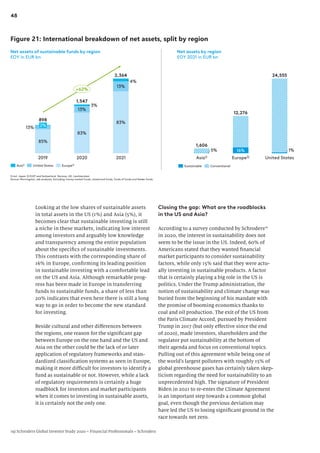
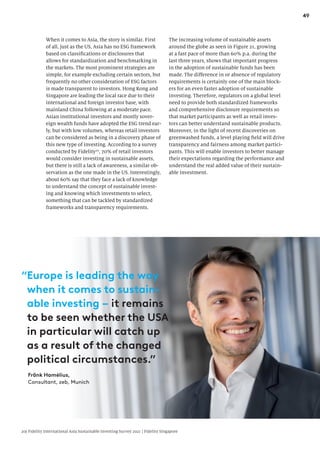
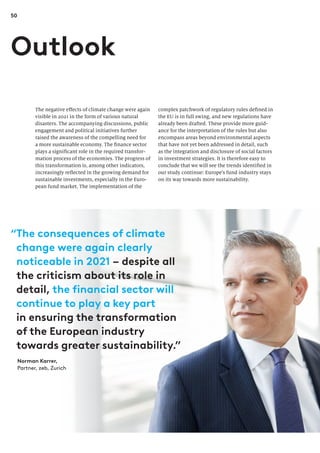
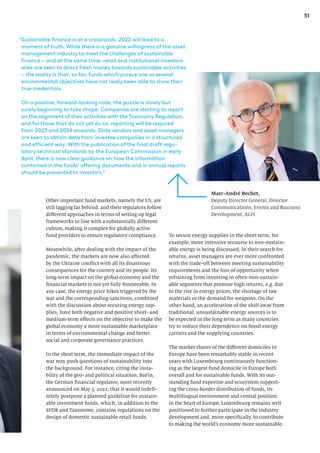
FUNDS STUDY 2022
Commissioned by the Association of the
Luxembourg Fund Industry (ALFI)
Sustainable funds: from niche to mainstream
Hitting the road
to a greener future
Content
Key results of our study
What’s in it for you?
Introduction and objective of the study
Recent trends in the European sustainable funds
industry
European regulatory landscape – latest developments
Global context – Europe as a forerunner in sustainability
Outlook
References
Annex
3
4
9
11
34
45
50
52
56
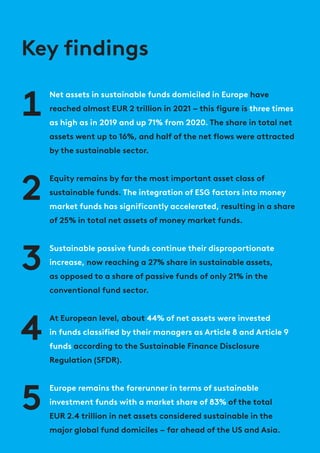
Key findings
Net assets in sustainable funds domiciled in Europe have
reached almost EUR 2 trillion in 2021 – this figure is three times
as high as in 2019 and up 71% from 2020. The share in total net
assets went up to 16%, and half of the net flows were attracted
by the sustainable sector.
Sustainable passive funds continue their disproportionate
increase, now reaching a 27% share in sustainable assets,
as opposed to a share of passive funds of only 21% in the
conventional fund sector.
Equity remains by far the most important asset class of
sustainable funds. The integration of ESG factors into money
market funds has significantly accelerated, resulting in a share
of 25% in total net assets of money market funds.
At European level, about 44% of net assets were invested
in funds classified by their managers as Article 8 and Article 9
funds according to the Sustainable Finance Disclosure
Regulation (SFDR).
Europe remains the forerunner in terms of sustainable
investment funds with a market share of 83% of the total
EUR 2.4 trillion in net assets considered sustainable in the
major global fund domiciles – far ahead of the US and Asia.
4
5
2
3
1
What’s in it for you?
This study provides a snapshot of the recent investment and regula-
tory trends in the sustainable fund market in Luxembourg and other
European fund domiciles. The following statements summarize the
key observations and principal learnings derived from the analysis of
the European fund market.
→ Sustainable funds have represented a growing segment of
investment solutions in Europe, especially in recent years. Based
on Morningstar’s strict definition of sustainability, net assets in
sustainable fund products have reached almost EUR 2 trillion,
a figure that is about three times as high as in 2019 and up 71%
from 2020. They now make up 16% of the total net assets of funds
domiciled in Europe at the end of 2021. Sustainable funds attracted
half of the net new money that went into the investment fund
market in 2021.
→ The steady increase in the share of sustainable assets is observ-
able in both the UCITS and the regulated open-end AIF spheres
although the proportion of sustainable net assets in the AIF
market is still comparatively lower.
→ Equity remains by far the most important asset class, making up
64% of the sustainable fund assets compared to 48% in conven-
tional funds, allowing asset managers to exert a greater influ-
ence on the ESG efforts of companies. Nevertheless, the interest
in fixed income has also risen steadily over the past three years.
Money market funds in particular have increasingly integrated
ESG factors into their investment strategies, resulting in an
above-average share of 25% of sustainable net assets in total
money market funds’ assets at the end of 2021 as opposed to only
13% in the previous year and 8% in 2019.
→ Sustainable passive funds continue their disproportionate increase,
their net assets reaching 27% of the total sustainable fund sector,
which represents an increase of 280% in sustainable net assets over
the past three years1
. This compares with a passive share of 21% in
the conventional sphere where passive net assets grew by only 24%
over the same period. Roughly 23% of new products were launched
in the passive sector, up from 16% in 2019.
→ Impact funds are still very much outweighed by funds with less
ambitious ESG objectives. Only about 1.5% of total European funds’
net assets follow an impact investing approach. Nevertheless,
assets in impact funds increased by 50% in 2021 compared to 2020,
reflecting a growing demand for more ambitious sustainable
strategies.
→ The classification of funds according to SFDR is ongoing. Of the
funds domiciled in Luxembourg, where 97% of net assets have
been reviewed by Morningstar so far, 44% and 6% of the corre-
1) Note that the sustainability criteria applied for passive funds are less restrictive than those for active funds. While ESG-
screened passive funds are part of the respective ESG universe, active funds that apply only limited exclusion criteria in their
investment strategy are not considered as sustainable, see section 2.1.
sponding net assets were classified as Article 8 and Article 9. The
respective shares for the whole European investment universe
are lower due to the inclusion of non-EU domiciles and funds that
are not marketed in the EU and do not need to be categorized –
39% of corresponding net assets are classified as Article 8 and 5%
as Article 9.2
These figures differ significantly from what is consid-
ered sustainable in our study, reflecting the strict, conservative
nature of Morningstar’s definition of sustainability that was applied.
→ In line with its positioning as the largest European fund hub,
Luxembourg maintains its market leader position also in terms
of sustainable fund products. As in previous years, about a third
of the assets managed by sustainable funds are domiciled in
Luxembourg. Ireland benefits from its leading position as a hub
for both sustainable and conventional passive funds where it
reached a market share of 44% in 2021.
→ The increased demand for sustainable funds can be observed
across Europe – the share of sustainable funds’ net assets in total
net assets domiciled in the respective countries grew significant-
ly across all countries, reaching almost 40% in Belgium, the
Netherlands and Sweden. Some domiciles like the UK, Switzerland
and France recorded 100% of their net inflows directed towards
sustainable funds at the expense of conventional funds which
experienced net outflows.
2) Note that these figures differ from other reports from Morningstar or other institutions due to a different coverage at
different times of data extractions and the exclusion of money market funds, funds of funds and feeder funds in this report.
→ Launches of new funds and the repurposing of traditional funds
reached record levels and resulted in 1,193 new funds being offered
to investors looking for sustainable strategies. 652 new funds were
launched with net assets of EUR 86 billion. While in 2019 the com-
bined net assets of new sustainable and repurposed funds were
less than half of those of new conventional funds, they were twice
as high in 2021.
→ The high concentration of the asset management industry has
not changed and is especially prevalent in the sustainable fund
sector of the major European fund domiciles. Of the net assets of
sustainable funds domiciled in Ireland, 58% were managed by the
top 5 fund providers alone, making Ireland particularly dependent
on individual asset managers. In this respect, Luxembourg benefits
from a broader range of fund initiators both in terms of individual
companies and provenience.
→ All figures confirm the ongoing transition that sustainable finance
is experiencing in Europe. With a share of 83% of global sustainable
funds’ net assets, Europe remains the sustainability driver of the
fund industry, far ahead of the US and Asia where the share of
sustainable funds’ net assets in total net assets domiciled in these
regions reaches only 1% and 5% respectively, as opposed to 16% in
Europe. Nevertheless, climate change, new regulatory require-
ments and changing investors’ preferences will see these regions
increasingly catch up in the future.
8
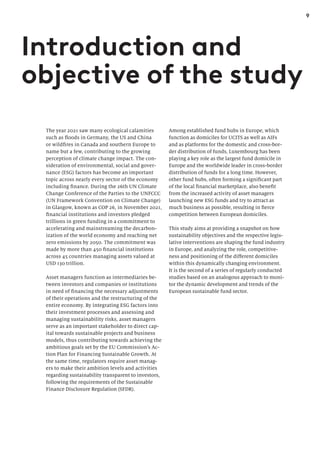
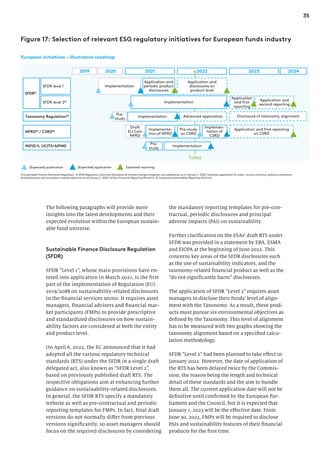
Net assets of sustainable funds domiciled
in Europe reach almost EUR 2 trillion
Net sustainable assets per domicile
EOY 2021 in EUR bn
Total EuropeA) 1,974
Luxembourg 663
Ireland 279
Sweden 213
France 198
United Kingdom 149
Switzerland 112
Germany 64
Belgium 64
Netherlands
Other domiciles
63
169
135
371
136
136
87
67
36
42
49
96
1,155
144
292
819
77
62
62
45
28
22
73
14
Net sustainable assets 2020 Change of net sustainable assets in 2021
A) EU27 and Switzerland, Norway, UK, Liechtenstein
Source: Morningstar Direct. Excluding money market funds, closed end funds, fund of funds and feeder funds.
9
The year 2021 saw many ecological calamities
such as floods in Germany, the US and China
or wildfires in Canada and southern Europe to
name but a few, contributing to the growing
perception of climate change impact. The con-
sideration of environmental, social and gover-
nance (ESG) factors has become an important
topic across nearly every sector of the economy
including finance. During the 26th UN Climate
Change Conference of the Parties to the UNFCCC
(UN Framework Convention on Climate Change)
in Glasgow, known as COP 26, in November 2021,
financial institutions and investors pledged
trillions in green funding in a commitment to
accelerating and mainstreaming the decarbon-
ization of the world economy and reaching net
zero emissions by 2050. The commitment was
made by more than 450 financial institutions
across 45 countries managing assets valued at
USD 130 trillion.
Asset managers function as intermediaries be-
tween investors and companies or institutions
in need of financing the necessary adjustments
of their operations and the restructuring of the
entire economy. By integrating ESG factors into
their investment processes and assessing and
managing sustainability risks, asset managers
serve as an important stakeholder to direct cap-
ital towards sustainable projects and business
models, thus contributing towards achieving the
ambitious goals set by the EU Commission’s Ac-
tion Plan for Financing Sustainable Growth. At
the same time, regulators require asset manag-
ers to make their ambition levels and activities
regarding sustainability transparent to investors,
following the requirements of the Sustainable
Finance Disclosure Regulation (SFDR).
Introduction and
objective of the study
Among established fund hubs in Europe, which
function as domiciles for UCITS as well as AIFs
and as platforms for the domestic and cross-bor-
der distribution of funds, Luxembourg has been
playing a key role as the largest fund domicile in
Europe and the worldwide leader in cross-border
distribution of funds for a long time. However,
other fund hubs, often forming a significant part
of the local financial marketplace, also benefit
from the increased activity of asset managers
launching new ESG funds and try to attract as
much business as possible, resulting in fierce
competition between European domiciles.
This study aims at providing a snapshot on how
sustainability objectives and the respective legis-
lative interventions are shaping the fund industry
in Europe, and analyzing the role, competitive-
ness and positioning of the different domiciles
within this dynamically changing environment.
It is the second of a series of regularly conducted
studies based on an analogous approach to moni-
tor the dynamic development and trends of the
European sustainable fund sector.
10
The categorization of funds as Article 8 or Article
9 has led to confusion as not all funds, in par-
ticular those qualifying as Article 8 funds, may
be considered as sustainable in a stricter sense.
This is best reflected by the significant differ-
ence between the share of sustainable funds’ net
assets in total net assets measured by Articles 8
and 9 funds on the one hand and the more rigid
Morningstar classification methodology applied
in this study on the other hand – contributing to
the discussion about greenwashing.
After a brief introduction into the data base and
methodological approach, the following section
looks at the key trends observed in the European
market for sustainable funds and investigates
the development path of sustainable funds
domiciled in Luxembourg and other traditional
European fund hubs. The next chapter gives an
update of the latest developments in the reg-
ulatory landscape for sustainable finance in
Europe. In the final section we put the observed
developments in Europe in a global context.
Looking back to 2021, all trends observed in our
last report have continued and strengthened as
expected, confirmed by the figures that we have
analyzed. These figures indicate an increased ac-
ceptance and demand for sustainable investment
products, satisfied by an intensified offering of
sustainable funds at the expense of conventional
products. 2021 will be remembered as the transi-
tion year for ESG as managers continued to work
their way through the required adjustments in
their investment processes and the respective
disclosures to comply with the ever-evolving Sus-
tainable Finance Disclosure Regulation (SFDR),
even though the final draft rules for the financial
product disclosure were published only towards
the end of 2021.
In the absence of Level 2 measures, the fund in-
dustry started to implement SFDR on a best-effort
basis. Combined with diverging understandings
between Member States this resulted in differ-
ent interpretations of the qualifying criteria and
disclosure requirements defined in the respec-
tive Articles 6, 8 and 9 of the SFDR. Nevertheless,
SFDR has split the EU fund universe into three
categories: funds that integrate sustainability
risks (Article 6), those that promote environmen-
tal or social characteristics (Article 8) and funds
that have sustainability objectives (Article 9).
Dr. Carsten Wittrock,
Partner, zeb, Frankfurt
“
Our new study confirms the
forecasts we made in our
previous study: the industry’s
shift towards sustainability
is progressing at high speed
despite an unprecedented
dynamic geopolitical and
regulatory environment.”
11
Analyzed fund universe
and definitions used
for sustainable funds
For the purpose of this study, the Morningstar
fund database was used. Relevant extractions
from it were performed in February 2022. The
study considers open-end funds (both UCITS
and regulated AIFs) including ETFs domiciled in
the EU-27 countries, Switzerland, Liechtenstein,
Norway and the United Kingdom (excluding
British Overseas Territories, crown colonies, etc.).
Feeder funds and funds of funds were excluded
from the analyzed fund universe to avoid double
counting of fund assets. Money market funds
are cash-equivalent investments and have also
been excluded from the core study as they tend
to be rather volatile in terms of flows due to the
short-term investment horizon of their investors
(which arguably is not consistent with the overall
sustainability principles aiming for a long-term
impact on sustainability goals). Nevertheless,
they are analyzed separately as ESG factors are
increasingly considered in the management of
money market funds as well. The analyses cover
the period from 1/2019–12/2021. Funds with
incomplete information on either flows or net
assets were excluded from the analysis.
Based on the data basis used, not all funds domi-
ciled in the EU and the selected European coun-
tries are considered. Especially the AIF sector is
only partially covered as only regulated open-end
AIFs such as UCIs3
in Luxembourg are taken into
account. Therefore, on a total level, most of the
figures do not match other statistics produced by
ALFI, EFAMA, CSSF or national fund associations,
which needs to be considered if different domi-
ciles are compared.4
As a result, the analyzed fund universe consists
of approximately 33,200 funds for 2021, of which
about 4,400 (2020: 3,200) are sustainable funds.
When counting fund numbers, only the oldest
non-liquidated share class with the longest histo-
ry of a fund is considered rather than each share
class reflected by ISINs, as share classes merely
differ in terms of fees, currency, etc., but not in
the actual investment strategy.
Recent trends in the
European sustainable
funds industry
3) Investment funds set up under Part II of the Law of 17 December 2010 relating to undertakings for collective investment. Other investment funds which may qualify
as AIFs are funds which are set up under the Law of 13 February 2007 relating to special investment funds and funds set up under the Law of 15 June 2004 relating to
the investment company in risk capital. The open-end AIF sector covered by the study represents only about 13% of the total AIF market in Europe at the end of 2021.
4) See annex for further information regarding the respective differences and the data coverage in general.
12
The EU, US and other jurisdictions are taking steps to improve
company reporting of sustainability-related information. How
will this change the products and services offered by ESG data
and rating providers?
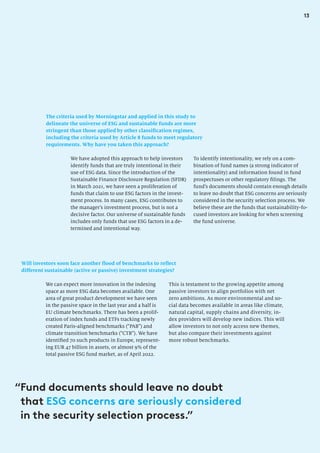
As more ESG data
becomes available,
ratings will improve
to further improve and develop new analytics to
help both the industry and end investors evalu-
ate financial products and companies through
various ESG lenses. At present, given the regula-
tory uncertainty in some areas and the fact that
many companies are not reporting the informa-
tion required by asset managers, the situation is
challenging for data providers.
Morningstar and Sustainalytics will continue to
review the regulatory rules coming from vari-
ous jurisdictions to ensure that any services we
provide allow our clients to fulfill their regulatory
requirements. As company-level sustainability
improves, this will enable data providers, such
as ourselves, to collect and supply more compre-
hensive information and use this information
Interview with
Hortense Bioy, CFA, Global
Director of Sustainability
Research, Morningstar
morningstar.com
13
The criteria used by Morningstar and applied in this study to
delineate the universe of ESG and sustainable funds are more
stringent than those applied by other classification regimes,
including the criteria used by Article 8 funds to meet regulatory
requirements. Why have you taken this approach?
To identify intentionality, we rely on a com-
bination of fund names (a strong indicator of
intentionality) and information found in fund
prospectuses or other regulatory filings. The
fund’s documents should contain enough details
to leave no doubt that ESG concerns are seriously
considered in the security selection process. We
believe these are the funds that sustainability-fo-
cused investors are looking for when screening
the fund universe.
We have adopted this approach to help investors
identify funds that are truly intentional in their
use of ESG data. Since the introduction of the
Sustainable Finance Disclosure Regulation (SFDR)
in March 2021, we have seen a proliferation of
funds that claim to use ESG factors in the invest-
ment process. In many cases, ESG contributes to
the manager’s investment process, but is not a
decisive factor. Our universe of sustainable funds
includes only funds that use ESG factors in a de-
termined and intentional way.
Will investors soon face another flood of benchmarks to reflect
different sustainable (active or passive) investment strategies?
We can expect more innovation in the indexing
space as more ESG data becomes available. One
area of great product development we have seen
in the passive space in the last year and a half is
EU climate benchmarks. There has been a prolif-
eration of index funds and ETFs tracking newly
created Paris-aligned benchmarks (“PAB”) and
climate transition benchmarks (“CTB”). We have
identified 70 such products in Europe, represent-
ing EUR 47 billion in assets, or almost 9% of the
total passive ESG fund market, as of April 2022.
This is testament to the growing appetite among
passive investors to align portfolios with net
zero ambitions. As more environmental and so-
cial data becomes available in areas like climate,
natural capital, supply chains and diversity, in-
dex providers will develop new indices. This will
allow investors to not only access new themes,
but also compare their investments against
more robust benchmarks.
“
Fund documents should leave no doubt
that ESG concerns are seriously considered
in the security selection process.”
14
Funds that merely employ exclusions of cer-
tain sectors, companies or practices but do not
integrate sustainability as a central and binding
feature into their investment strategy are not
considered sustainable and are assigned to the
conventional fund universe. In contrast to active
funds, this definition does not fully apply to
passive funds as ESG-screened passive funds
are part of the respective ESG universe whereas
active funds that apply only limited exclusion
criteria in their investment strategy are not con-
sidered to be sustainable.
All funds that are not (yet) characterized/flagged
as sustainable in the Morningstar database are
considered conventional funds. This conservative
approach is taken on purpose, although it may un-
derestimate the actual importance of sustainabili-
ty in the European fund industry in some areas.
Under the SFDR rules, European funds are classi-
fied by their managers into one of the following
three categories:
→ Sustainable or Article 9 funds: so called after
the regulation that defines them as funds that
have a sustainable investment objective.
→ Other ESG or Article 8 funds: a category of
financial products that promote, among other
characteristics, environmental or social char-
acteristics or a combination of those char-
acteristics, provided that the companies in
which the investments are made follow good
governance practices.
→ All other funds that have no stated sustain-
ability / ESG ambitions.
Morningstar was, during the time this study was
conducted, in the progress of reviewing the fund
universe regarding their regulatory classification.
By the end of 2021, 91% of the funds in scope of
the SFDR, i.e. funds available for sale in the EU,
were reviewed and classified.
For the identification of sustainable funds in this
study, the Morningstar classification has been
applied5
. Morningstar defines a strategy as “sus-
tainable” if it is described as primarily focusing
on sustainability, impact or ESG factors in the
prospectus or other regulatory filings and/or the
fund uses binding ESG criteria for its investment
selections. At the next level of granularity, “Sus-
tainable Investment” funds are categorized into
three distinct groupings.
“ESG Funds” prominently focus on incorpo-
rating binding ESG factors into the investment
process (e.g. by applying a best-in-class screen-
ing process, frequently in conjunction with the
exclusion of certain sectors or individual compa-
nies which are considered critical with regard to
ethical values or norms or their involvement in
the production or sale of tobacco, weapons, etc.).
“Impact Funds” seek to deliver a measurable
impact on specific issues (often with reference to
the well-known 17 UN Sustainable Development
Goals) or consider themes like gender diversity,
low carbon, or community development along-
side financial return. “Environmental Sector
Funds” are strategies that invest in environmen-
tally oriented industries like renewable energy or
water. In practice, all these sustainable strategies
are not mutually exclusive as various combina-
tions of the strategies are applied in order to con-
struct a sustainable portfolio. For a considerable
proportion of funds, two or even more categories
are therefore relevant at the same time. For the
purpose of this study, only a distinction between
impact funds and all other sustainable funds is
made. Funds are only considered as impact funds
if their investment strategy is solely directed
towards impact investments without combining
it with other strategies.
5) Morningstar Sustainable AttributesSM
, Framework and Definitions for “Sustainable Investment” and “Employs Exclusions” Attributes, July 2020.
15
European sustainable
funds market: trends
and characteristics
Luxembourg remains market leader for
sustainable funds in Europe
Net assets in sustainable funds domiciled in
Europe reached almost EUR 2 trillion at the end of
2021.6
This was a 70% increase over the EUR 1,155
billion record set one year ago and represents
about 16% of the total European fund market.
Nearly equally driven by net flows and market
performance, the significant increase in net as-
sets can be observed across all domiciles.
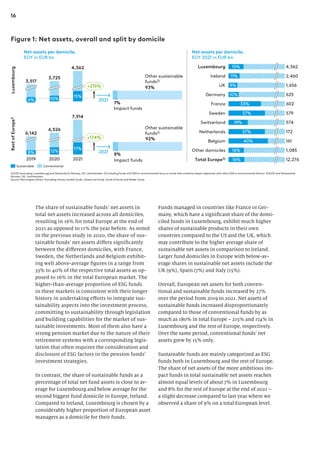
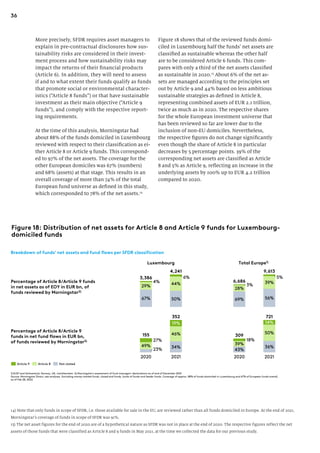
As Figure 1 shows, Luxembourg remains by far
the leading domicile for both conventional as
well as sustainable funds with regard to net
assets. Sustainable funds accounted for EUR 663
billion by the end of 2021, followed by Ireland,
Sweden and France. Compared to 2020, where
the net assets of these followers exhibited almost
identical levels of about EUR 135 billion, net
assets in Ireland increased disproportionately by
over 100%, making it the second largest domicile
for sustainable funds.
6) If sustainable net assets of money market funds were included, the respective net assets amounted to EUR 2,351 billion vs. EUR 1,297 billion at the end of 2020.
Marc-André Bechet,
Deputy Director General, Director Communications,
Events and Business Development, ALFI
“Sustainable finance
is at a crossroads.
2022 will lead to
a moment of truth.”
16
Funds managed in countries like France or Ger-
many, which have a significant share of the domi-
ciled funds in Luxembourg, exhibit much higher
shares of sustainable products in their own
countries compared to the US and the UK, which
may contribute to the higher average share of
sustainable net assets in comparison to Ireland.
Larger fund domiciles in Europe with below-av-
erage shares in sustainable net assets include the
UK (9%), Spain (7%) and Italy (15%).
Overall, European net assets for both conven-
tional and sustainable funds increased by 27%
over the period from 2019 to 2021. Net assets of
sustainable funds increased disproportionately
compared to those of conventional funds by as
much as 180% in total Europe – 215% and 174% in
Luxembourg and the rest of Europe, respectively.
Over the same period, conventional funds’ net
assets grew by 15% only.
Sustainable funds are mainly categorized as ESG
funds both in Luxembourg and the rest of Europe.
The share of net assets of the more ambitious im-
pact funds in total sustainable net assets reaches
almost equal levels of about 7% in Luxembourg
and 8% for the rest of Europe at the end of 2021 –
a slight decrease compared to last year where we
observed a share of 9% on a total European level.
The share of sustainable funds’ net assets in
total net assets increased across all domiciles,
resulting in 16% for total Europe at the end of
2021 as opposed to 11% the year before. As noted
in the previous study in 2020, the share of sus-
tainable funds’ net assets differs significantly
between the different domiciles, with France,
Sweden, the Netherlands and Belgium exhibit-
ing well above-average figures in a range from
33% to 40% of the respective total assets as op-
posed to 16% in the total European market. The
higher-than-average proportion of ESG funds
in these markets is consistent with their longer
history in undertaking efforts to integrate sus-
tainability aspects into the investment process,
committing to sustainability through legislation
and building capabilities for the market of sus-
tainable investments. Most of them also have a
strong pension market due to the nature of their
retirement systems with a corresponding legis-
lation that often requires the consideration and
disclosure of ESG factors in the pension funds’
investment strategies.
In contrast, the share of sustainable funds as a
percentage of total net fund assets is close to av-
erage for Luxembourg and below average for the
second biggest fund domicile in Europe, Ireland.
Compared to Ireland, Luxembourg is chosen by a
considerably higher proportion of European asset
managers as a domicile for their funds.
Net assets per domicile,
EOY in EUR bn
Figure 1: Net assets, overall and split by domicile
6% 10%
15%
3,725
3,517
4,362
+215%
8%
2019
12%
2020
17%
2021
6,142
6,526
7,914
+174%
1) EU27 (excluding Luxembourg) and Switzerland, Norway, UK, Liechtenstein 2) Including funds with ESG or environmental focus or funds that combine impact objectives with other ESG or environmental factors 3) EU27 and Switzerland,
Norway, UK, Liechtenstein
Source: Morningstar Direct. Excluding money market funds, closed end funds, funds of funds and feeder funds.
Rest
of
Europe
1)
Luxembourg
15%
11%
9%
10%
33%
37%
19%
37%
40%
16%
16%
2,460
625
579
161
1,085
574
602
Switzerland
172
Sweden
Netherlands
Luxembourg
Ireland
UK
France
Germany
12,276
Belgium
Other domiciles
Total Europe3)
1,656
4,362
Sustainable Conventional
Net assets per domicile,
EOY 2021 in EUR bn
7%
93%
8%
92%
Impact funds
Other sustainable
funds2)
Impact funds
Other sustainable
funds2)
2021
2021
17
Sustainable funds attract half of all flows
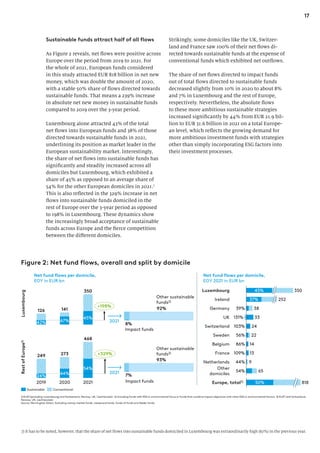
As Figure 2 reveals, net flows were positive across
Europe over the period from 2019 to 2021. For
the whole of 2021, European funds considered
in this study attracted EUR 818 billion in net new
money, which was double the amount of 2020,
with a stable 50% share of flows directed towards
sustainable funds. That means a 239% increase
in absolute net new money in sustainable funds
compared to 2019 over the 3-year period.
Luxembourg alone attracted 43% of the total
net flows into European funds and 38% of those
directed towards sustainable funds in 2021,
underlining its position as market leader in the
European sustainability market. Interestingly,
the share of net flows into sustainable funds has
significantly and steadily increased across all
domiciles but Luxembourg, which exhibited a
share of 45% as opposed to an average share of
54% for the other European domiciles in 2021.7
This is also reflected in the 329% increase in net
flows into sustainable funds domiciled in the
rest of Europe over the 3-year period as opposed
to 198% in Luxembourg. These dynamics show
the increasingly broad acceptance of sustainable
funds across Europe and the fierce competition
between the different domiciles.
Strikingly, some domiciles like the UK, Switzer-
land and France saw 100% of their net flows di-
rected towards sustainable funds at the expense of
conventional funds which exhibited net outflows.
The share of net flows directed to impact funds
out of total flows directed to sustainable funds
decreased slightly from 10% in 2020 to about 8%
and 7% in Luxembourg and the rest of Europe,
respectively. Nevertheless, the absolute flows
to these more ambitious sustainable strategies
increased significantly by 44% from EUR 21.9 bil-
lion to EUR 31.6 billion in 2021 on a total Europe-
an level, which reflects the growing demand for
more ambitious investment funds with strategies
other than simply incorporating ESG factors into
their investment processes.
50%
Europe, total3) 818
Figure 2: Net fund flows, overall and split by domicile
42% 67%
45%
126 141
350
+198%
2019
24%
44%
2020 2021
54%
249 273
468
+329%
Sustainable Conventional
1) EU27 (excluding Luxembourg) and Switzerland, Norway, UK, Liechtenstein 2) Including funds with ESG or environmental focus or funds that combine impact objectives with other ESG or environmental factors 3) EU27 and Switzerland,
Norway, UK, Liechtenstein
Source: Morningstar Direct. Excluding money market funds, closed end funds, funds of funds and feeder funds.
Net fund flows per domicile,
EOY 2021 in EUR bn
Net fund flows per domicile,
EOY in EUR bn
Rest
of
Europe
1)
Luxembourg
8%
92%
7%
93%
Impact funds
Other sustainable
funds2)
Impact funds
Other sustainable
funds2)
103%
Luxembourg
Sweden
37%
Ireland
Germany
86%
39%
45%
Switzerland
56%
131%
UK
65
Belgium
33
109%
Other
domiciles
22
44%
France
Netherlands
24
54%
9
350
252
38
14
13
2021
2021
7) It has to be noted, however, that the share of net flows into sustainable funds domiciled in Luxembourg was extraordinarily high (67%) in the previous year.
18
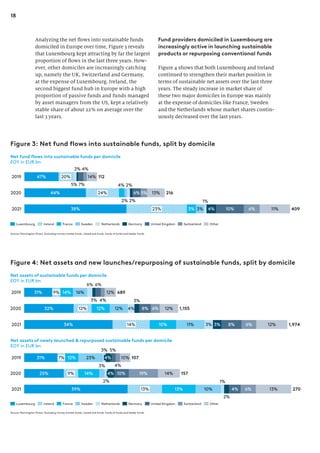
Analyzing the net flows into sustainable funds
domiciled in Europe over time, Figure 3 reveals
that Luxembourg kept attracting by far the largest
proportion of flows in the last three years. How-
ever, other domiciles are increasingly catching
up, namely the UK, Switzerland and Germany,
at the expense of Luxembourg. Ireland, the
second biggest fund hub in Europe with a high
proportion of passive funds and funds managed
by asset managers from the US, kept a relatively
stable share of about 22% on average over the
last 3 years.
Figure 3: Net fund flows into sustainable funds, split by domicile
Source: Morningstar Direct. Excluding money market funds, closed end funds, funds of funds and feeder funds.
Net fund flows into sustainable funds per domicile
EOY in EUR bn
2021
24%
20%
5%
47%
3%
13%
4%
5%
2%
2%
2%
4%
7%
4%
2019
44%
14%
6%
2%
23% 409
6%
2020
38% 3%
1%
10% 11%
112
216
Sweden
Luxembourg Ireland Netherlands
France Germany United Kingdom Other
Switzerland
Figure 4: Net assets and new launches/repurposing of sustainable funds, split by domicile
Source: Morningstar Direct. Excluding money market funds, closed end funds, funds of funds and feeder funds.
Net assets of sustainable funds per domicile
EOY in EUR bn
4%
3%
2020 6%
16%
1,974
14%
31%
8%
9%
6% 6%
12%
12%
2019
12%
32% 12%
8%
3%
12%
11%
3%
12%
34% 14% 10% 3%
689
6%
2021
1,155
4%
Luxembourg Ireland France Sweden Netherlands Germany United Kingdom Switzerland Other
Net assets of newly launched  repurposed sustainable funds per domicile
EOY in EUR bn
2019 7% 12%
3%
23%
5%
13%
2020
2%
4%
13%
19%
4%
39%
10%
25%
13%
9%
3%
31%
14% 4% 10% 14%
1%
10%
2%
4% 6%
2021
107
157
270
Fund providers domiciled in Luxembourg are
increasingly active in launching sustainable
products or repurposing conventional funds
Figure 4 shows that both Luxembourg and Ireland
continued to strengthen their market position in
terms of sustainable net assets over the last three
years. The steady increase in market share of
these two major domiciles in Europe was mainly
at the expense of domiciles like France, Sweden
and the Netherlands whose market shares contin-
uously decreased over the last years.
19
In 2021, about 14% of the net assets in sustainable
funds domiciled in Europe originated from new
fund launches and conventional funds that were
repurposed to sustainable funds by asset manag-
ers. This is consistent with previous years.
In contrast to previous years though, the share of
the different domiciles in net assets due to new
launches and repurposing of conventional to
sustainable funds is more in line with the overall
market share in sustainable net assets – apart
from Luxembourg which was able to increasingly
attract new fund launches with significant vol-
umes at the expense of other domiciles in 2021,
contributing to its strong market position.
Structural differences of the two major Eu-
ropean fund hubs remain
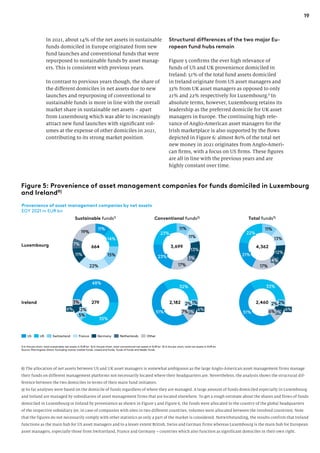
Figure 5 confirms the ever high relevance of
funds of US and UK provenience domiciled in
Ireland: 51% of the total fund assets domiciled
in Ireland originate from US asset managers and
33% from UK asset managers as opposed to only
21% and 22% respectively for Luxembourg.8
In
absolute terms, however, Luxembourg retains its
leadership as the preferred domicile for UK asset
managers in Europe. The continuing high rele-
vance of Anglo-American asset managers for the
Irish marketplace is also supported by the flows
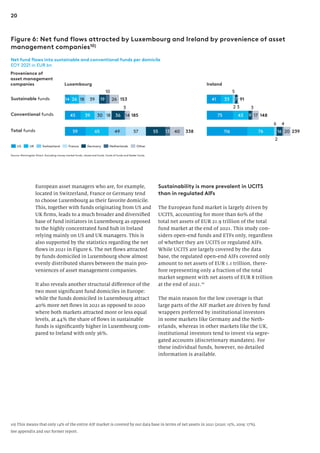
depicted in Figure 6: almost 80% of the total net
new money in 2021 originates from Anglo-Ameri-
can firms, with a focus on US firms. These figures
are all in line with the previous years and are
highly constant over time.
8) The allocation of net assets between US and UK asset managers is somewhat ambiguous as the large Anglo-American asset management firms manage
their funds on different management platforms not necessarily located where their headquarters are. Nevertheless, the analysis shows the structural dif-
ference between the two domiciles in terms of their main fund initiators.
9) So far analyses were based on the domicile of funds regardless of where they are managed. A large amount of funds domiciled especially in Luxembourg
and Ireland are managed by subsidiaries of asset management firms that are located elsewhere. To get a rough estimate about the shares and flows of funds
domiciled in Luxembourg or Ireland by provenience as shown in Figure 5 and Figure 6, the funds were allocated to the country of the global headquarters
of the respective subsidiary (or, in case of companies with sites in two different countries, volumes were allocated between the involved countries). Note
that the figures do not necessarily comply with other statistics as only a part of the market is considered. Notwithstanding, the results confirm that Ireland
functions as the main hub for US asset managers and to a lesser extent British, Swiss and German firms whereas Luxembourg is the main hub for European
asset managers, especially those from Switzerland, France and Germany – countries which also function as significant domiciles in their own right.
Provenience of asset management companies by net assets
EOY 2021 in EUR bn
Figure 5: Provenience of asset management companies for funds domiciled in Luxembourg
and Ireland9)
11%
22%
11%
7%
19%
14%
15%
11%
11%
13%
17%
3%
23%
23%
664 3,699
11%
17%
21%
4%
22%
13%
12%
4,362
Luxembourg
Ireland
US UK Switzerland Germany
France Other
Netherlands
1) In the pie chart, total sustainable net assets in EUR bn 2) In the pie chart, total conventional net assets in EUR bn 3) In the pie chart, total net assets in EUR bn
Source: Morningstar Direct. Excluding money market funds, closed end funds, funds of funds and feeder funds
Sustainable funds1) Conventional funds2) Total funds3)
48%
35%
3%
2%
5%
279
32%
51%
1%
2%
1%
7%
2,182
33%
51%
2%
2%
1%
6%
2,460
6% 6% 6%
20
Sustainability is more prevalent in UCITS
than in regulated AIFs
The European fund market is largely driven by
UCITS, accounting for more than 60% of the
total net assets of EUR 21.9 trillion of the total
fund market at the end of 2021. This study con-
siders open-end funds and ETFs only, regardless
of whether they are UCITS or regulated AIFs.
While UCITS are largely covered by the data
base, the regulated open-end AIFs covered only
amount to net assets of EUR 1.1 trillion, there-
fore representing only a fraction of the total
market segment with net assets of EUR 8 trillion
at the end of 2021.10
The main reason for the low coverage is that
large parts of the AIF market are driven by fund
wrappers preferred by institutional investors
in some markets like Germany and the Neth-
erlands, whereas in other markets like the UK,
institutional investors tend to invest via segre-
gated accounts (discretionary mandates). For
these individual funds, however, no detailed
information is available.
European asset managers who are, for example,
located in Switzerland, France or Germany tend
to choose Luxembourg as their favorite domicile.
This, together with funds originating from US and
UK firms, leads to a much broader and diversified
base of fund initiators in Luxembourg as opposed
to the highly concentrated fund hub in Ireland
relying mainly on US and UK managers. This is
also supported by the statistics regarding the net
flows in 2021 in Figure 6. The net flows attracted
by funds domiciled in Luxembourg show almost
evenly distributed shares between the main pro-
veniences of asset management companies.
It also reveals another structural difference of the
two most significant fund domiciles in Europe:
while the funds domiciled in Luxembourg attract
40% more net flows in 2021 as opposed to 2020
where both markets attracted more or less equal
levels, at 44% the share of flows in sustainable
funds is significantly higher in Luxembourg com-
pared to Ireland with only 36%.
14
45
59
26
39
65
18
30
49
39
18
57
19
36
55
10
3
13
26
14
40
185
153
338
US Germany
Switzerland
UK France Netherlands Other
Luxembourg Ireland
Source: Morningstar Direct. Excluding money market funds, closed end funds, funds of funds and feeder funds.
Net fund flows into sustainable and conventional funds per domicile
EOY 2021 in EUR bn
41
116
33
75
76
5
43
6
2
2
7
9
16
3
4
3
17
20
91
148
239
Figure 6: Net fund flows attracted by Luxembourg and Ireland by provenience of asset
management companies10)
Provenience of
asset management
companies
Sustainable funds
Conventional funds
Total funds
10) This means that only 14% of the entire AIF market is covered by our data base in terms of net assets in 2021 (2020: 15%, 2019: 17%).
See appendix and our former report.
21
Therefore, no specific reference can be made
regarding the share of sustainable assets and the
corresponding market shares of the European
domiciles across the whole AIF market, as the re-
spective information is restricted to the sub-seg-
ment of regulated open-end AIFs covered in the
study. Nevertheless, a closer look at this segment
may provide at least some high-level hints on
sustainability trends in the whole AIF sector.
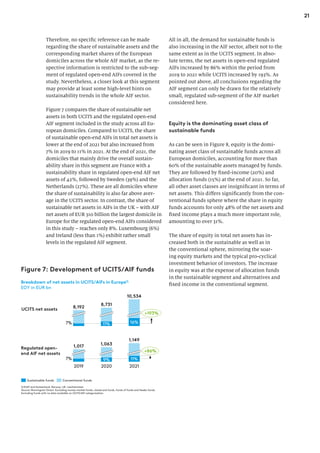
Figure 7 compares the share of sustainable net
assets in both UCITS and the regulated open-end
AIF segment included in the study across all Eu-
ropean domiciles. Compared to UCITS, the share
of sustainable open-end AIFs in total net assets is
lower at the end of 2021 but also increased from
7% in 2019 to 11% in 2021. At the end of 2021, the
domiciles that mainly drive the overall sustain-
ability share in this segment are France with a
sustainability share in regulated open-end AIF net
assets of 42%, followed by Sweden (39%) and the
Netherlands (27%). These are all domiciles where
the share of sustainability is also far above aver-
age in the UCITS sector. In contrast, the share of
sustainable net assets in AIFs in the UK – with AIF
net assets of EUR 310 billion the largest domicile in
Europe for the regulated open-end AIFs considered
in this study – reaches only 8%. Luxembourg (6%)
and Ireland (less than 1%) exhibit rather small
levels in the regulated AIF segment.
All in all, the demand for sustainable funds is
also increasing in the AIF sector, albeit not to the
same extent as in the UCITS segment. In abso-
lute terms, the net assets in open-end regulated
AIFs increased by 86% within the period from
2019 to 2021 while UCITS increased by 193%. As
pointed out above, all conclusions regarding the
AIF segment can only be drawn for the relatively
small, regulated sub-segment of the AIF market
considered here.
Equity is the dominating asset class of
sustainable funds
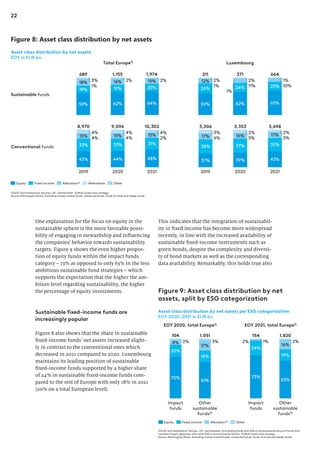
As can be seen in Figure 8, equity is the domi-
nating asset class of sustainable funds across all
European domiciles, accounting for more than
60% of the sustainable assets managed by funds.
They are followed by fixed-income (20%) and
allocation funds (15%) at the end of 2021. So far,
all other asset classes are insignificant in terms of
net assets. This differs significantly from the con-
ventional funds sphere where the share in equity
funds accounts for only 48% of the net assets and
fixed income plays a much more important role,
amounting to over 31%.
The share of equity in total net assets has in-
creased both in the sustainable as well as in
the conventional sphere, mirroring the soar-
ing equity markets and the typical pro-cyclical
investment behavior of investors. The increase
in equity was at the expense of allocation funds
in the sustainable segment and alternatives and
fixed income in the conventional segment.
1,149
7%
2019
9%
2020 2021
11%
1,017 1,063
+86%
UCITS net assets
Regulated open-
end AIF net assets
Sustainable funds Conventional funds
8,731
16%
10,534
8,192
7% 11%
+193%
1) EU27 and Switzerland, Norway, UK, Liechtenstein
Source: Morningstar Direct. Excluding money market funds, closed end funds, funds of funds and feeder funds.
Excluding funds with no data available on UCITS/AIF categorization.
Breakdown of net assets in UCITS/AIFs in Europe1)
EOY in EUR bn
Figure 7: Development of UCITS/AIF funds
22
One explanation for the focus on equity in the
sustainable sphere is the more favorable possi-
bility of engaging in stewardship and influencing
the companies’ behavior towards sustainability
targets. Figure 9 shows the even higher propor-
tion of equity funds within the impact funds
category – 73% as opposed to only 63% in the less
ambitious sustainable fund strategies – which
supports the expectation that the higher the am-
bition level regarding sustainability, the higher
the percentage of equity investments.
Sustainable fixed-income funds are
increasingly popular
Figure 8 also shows that the share in sustainable
fixed-income funds’ net assets increased slight-
ly in contrast to the conventional ones which
decreased in 2021 compared to 2020. Luxembourg
maintains its leading position of sustainable
fixed-income funds supported by a higher share
of 24% in sustainable fixed-income funds com-
pared to the rest of Europe with only 18% in 2021
(20% on a total European level).
Figure 8: Asset class distribution by net assets
Asset class distribution by net assets
EOY in EUR bn
37% 39% 43%
38% 37% 35%
17% 16% 17%
6% 5% 3%
3% 2% 2%
2019
3,698
2020 2021
3,306 3,353
43% 44% 48%
33% 33% 31%
15% 15% 15%
4% 4% 2%
4% 4% 4%
2019
9,096
2020
10,302
2021
8,970
59% 62% 65%
26% 24% 23%
12%
11% 10%
1%
1%
2% 2% 1%
211 371 664
59% 62% 64%
19% 19% 20%
18% 16% 15%
1%
3% 2% 2%
1,974
1,155
689
Allocation2)
Equity Alternative
Fixed income Other
Luxembourg
Total Europe1)
1) EU27 and Switzerland, Norway, UK, Liechtenstein 2) Multi-asset class strategy
Source: Morningstar Direct. Excluding money market funds, closed end funds, funds of funds and feeder funds.
Conventional funds
Sustainable funds
Figure 9: Asset class distribution by net
assets, split by ESG categorization
Asset class distribution by net assets per ESG categorization
EOY 2020–2021 in EUR bn
1) EU27 and Switzerland, Norway, UK, Liechtenstein 2) Including funds with ESG or environmental focus or funds that
combine impact objectives with other ESG or environmental factors 3) Multi-asset class strategy
Source: Morningstar Direct. Excluding money market funds, closed end funds, funds of funds and feeder funds.
70%
61%
20%
19%
8%
17%
2% 3%
1,051
Impact
funds
104
Other
sustainable
funds2)
Fixed income
Equity Other
Allocation3)
73%
63%
24%
19%
2%
16%
1% 2%
Impact
funds
Other
sustainable
funds2)
1,820
154
EOY 2020, total Europe1) EOY 2021, total Europe1)
This indicates that the integration of sustainabil-
ity in fixed income has become more widespread
recently, in line with the increased availability of
sustainable fixed-income instruments such as
green bonds, despite the complexity and diversi-
ty of bond markets as well as the corresponding
data availability. Remarkably, this holds true also
23
within the more ambitious impact funds segment
as revealed in Figure 9. While the 19% share of
fixed-income funds within the ESG and other
funds sectors remained constant compared to the
previous year, it increased from 20% in 2020 to
24% in 2021 within the impact funds sector.
In contrast, allocation and other fund strategies
lost further ground and reached only negligible
levels in the impact funds sector in 2021.
Passive investment strategies do not stop
at impact funds
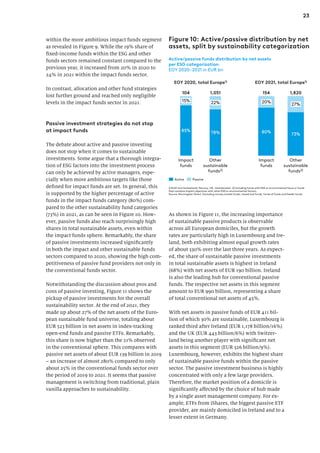
The debate about active and passive investing
does not stop when it comes to sustainable
investments. Some argue that a thorough integra-
tion of ESG factors into the investment process
can only be achieved by active managers, espe-
cially when more ambitious targets like those
defined for impact funds are set. In general, this
is supported by the higher percentage of active
funds in the impact funds category (80%) com-
pared to the other sustainability fund categories
(73%) in 2021, as can be seen in Figure 10. How-
ever, passive funds also reach surprisingly high
shares in total sustainable assets, even within
the impact funds sphere. Remarkably, the share
of passive investments increased significantly
in both the impact and other sustainable funds
sectors compared to 2020, showing the high com-
petitiveness of passive fund providers not only in
the conventional funds sector.
Notwithstanding the discussion about pros and
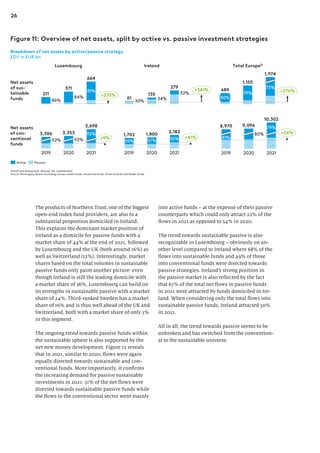
cons of passive investing, Figure 11 shows the
pickup of passive investments for the overall
sustainability sector. At the end of 2021, they
made up about 27% of the net assets of the Euro-
pean sustainable fund universe, totaling about
EUR 523 billion in net assets in index-tracking
open-end funds and passive ETFs. Remarkably,
this share is now higher than the 21% observed
in the conventional sphere. This compares with
passive net assets of about EUR 139 billion in 2019
– an increase of almost 280% compared to only
about 25% in the conventional funds sector over
the period of 2019 to 2021. It seems that passive
management is switching from traditional, plain
vanilla approaches to sustainability.
As shown in Figure 11, the increasing importance
of sustainable passive products is observable
across all European domiciles, but the growth
rates are particularly high in Luxembourg and Ire-
land, both exhibiting almost equal growth rates
of about 330% over the last three years. As expect-
ed, the share of sustainable passive investments
in total sustainable assets is highest in Ireland
(68%) with net assets of EUR 190 billion. Ireland
is also the leading hub for conventional passive
funds. The respective net assets in this segment
amount to EUR 990 billion, representing a share
of total conventional net assets of 45%.
With net assets in passive funds of EUR 411 bil-
lion of which 30% are sustainable, Luxembourg is
ranked third after Ireland (EUR 1,178 billion/16%)
and the UK (EUR 443 billion/6%) with Switzer-
land being another player with significant net
assets in this segment (EUR 326 billion/9%).
Luxembourg, however, exhibits the highest share
of sustainable passive funds within the passive
sector. The passive investment business is highly
concentrated with only a few large providers.
Therefore, the market position of a domicile is
significantly affected by the choice of hub made
by a single asset management company. For ex-
ample, ETFs from iShares, the biggest passive ETF
provider, are mainly domiciled in Ireland and to a
lesser extent in Germany.
Figure 10: Active/passive distribution by net
assets, split by sustainability categorization
1) EU27 and Switzerland, Norway, UK, Liechtenstein 2) Including funds with ESG or environmental focus or funds
that combine impact objectives with other ESG or environmental factors
Source: Morningstar Direct. Excluding money market funds, closed end funds, funds of funds and feeder funds.
85% 78%
15%
Impact
funds
22%
Other
sustainable
funds2)
1,051
104
Active Passive
80% 73%
1,820
27%
20%
Impact
funds
Other
sustainable
funds2)
154
Active/passive funds distribution by net assets
per ESG categorization
EOY 2020–2021 in EUR bn
EOY 2020, total Europe1) EOY 2021, total Europe1)
24
What are the advantages and the challenges of ESG integration
in private markets?
Active owners create
value by building
sustainable businesses
A strategic approach to ESG also comes with
challenges. Strong processes and control frame-
works are required to drive ESG initiatives, and
reliable data is required to measure the progress
we achieve. Whereas in public markets, one
can purchase data from external providers, data
collection in private markets is a much more in-
volved exercise. We collect every data point from
each portfolio company individually.
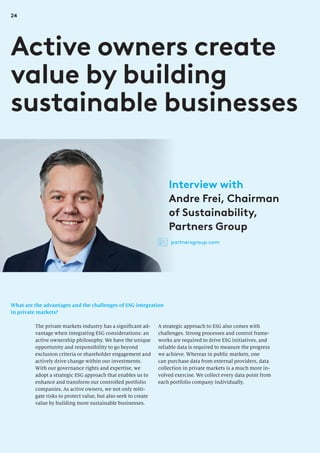
The private markets industry has a significant ad-
vantage when integrating ESG considerations: an
active ownership philosophy. We have the unique
opportunity and responsibility to go beyond
exclusion criteria or shareholder engagement and
actively drive change within our investments.
With our governance rights and expertise, we
adopt a strategic ESG approach that enables us to
enhance and transform our controlled portfolio
companies. As active owners, we not only miti-
gate risks to protect value, but also seek to create
value by building more sustainable businesses.
Interview with
Andre Frei, Chairman
of Sustainability,
Partners Group
partnersgroup.com
25
Is there a dimension of E, S and G you focus on more in terms of
targets or initiatives?
The focus of the initiatives depends on what ESG
topics are material for the respective portfolio
company. As part of our sustainability strategy for
controlled private equity and infrastructure assets
in our portfolio, we have defined four focus areas/
targets for each of the three ESG dimensions.
At Partners Group, ESG starts with the “G”. For the
assets and companies that we own and control
as majority shareholders on behalf of our clients,
we establish a clear ESG governance structure. We
appoint three leaders at asset level, who are re-
sponsible for ESG at every level – board, executive
and operational. We ask these leaders to develop
a meaningful ESG journey for their business and
to identify several strategic ESG initiatives with
meaningful impact in relation to environmental,
social or governance aspects.
Do you think that the positive risk/return properties often de-
clared for liquid investments are also applicable to private equity?
By building better and more sustainable portfo-
lio businesses, we aim to create long-term value
and generate superior financial returns for our
clients. However, while in public markets the per-
formance attribution of ESG is typically measured
by comparing the performance of stocks with
high ESG ratings to the benchmark, this approach
is not applicable to private markets.
Many of our ESG initiatives lead to measurable
positive financial impact. For example, in compa-
nies where we significantly increase the energy
savings, it contributes to reducing the GHG foot-
print, while also increasing the EBITDA. How-
ever, not all ESG progress can be translated into
financial return characteristics. For example, we
cannot measure what the valuation of a compa-
ny would have been if we had not improved the
health  safety standards or established a diversi-
ty  inclusion policy.
It is important for investors to note that trans-
formative ESG strategies can require significant
resources and capital expenditure. ESG is not a
“free lunch” but a long-term journey that requires
conviction, competence and capacity.
“We have the unique opportunity and
responsibility to go beyond exclusion criteria
or shareholder engagement and actively
drive change within our investments.”
26
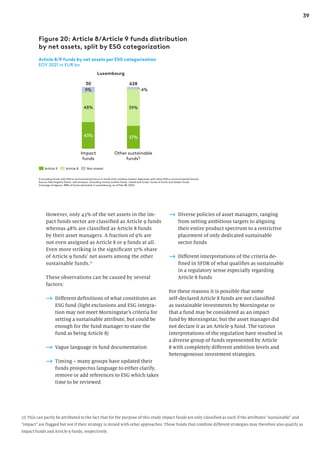
Figure 11: Overview of net assets, split by active vs. passive investment strategies
84%
211
86%
81%
371
664
+335%
Active Passive
80%
79%
73%
689
1,155
1,974
+276%
1) EU27 and Switzerland, Norway, UK, Liechtenstein
Source: Morningstar Direct. Excluding money market funds, closed end funds, funds of funds and feeder funds.
3,306 92%
92%
2019
92%
2020 2021
3,353
3,698
+9%
9,096
80%
81%
2019 2020
79%
2021
8,970
10,302
+24%
Net assets
of sus-
tainable
funds
Net assets
of con-
ventional
funds
Luxembourg Total Europe1)
Breakdown of net assets by active/passive strategy
EOY in EUR bn
55%
59%
2019
57%
2020 2021
2,182
1,702 1,800
+41%
Ireland
34%
32%
30%
135
61
279
+341%
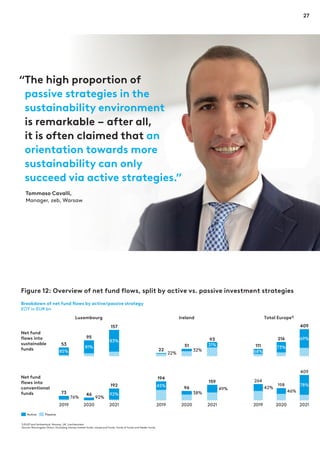
into active funds – at the expense of their passive
counterparts which could only attract 22% of the
flows in 2021 as opposed to 54% in 2020.
The trend towards sustainable passive is also
recognizable in Luxembourg – obviously on an-
other level compared to Ireland where 68% of the
flows into sustainable funds and 49% of those
into conventional funds were directed towards
passive strategies. Ireland’s strong position in
the passive market is also reflected by the fact
that 67% of the total net flows in passive funds
in 2021 were attracted by funds domiciled in Ire-
land. When considering only the total flows into
sustainable passive funds, Ireland attracted 50%
in 2021.
All in all, the trend towards passive seems to be
unbroken and has switched from the convention-
al to the sustainable universe.
The products of Northern Trust, one of the biggest
open-end index fund providers, are also to a
substantial proportion domiciled in Ireland.
This explains the dominant market position of
Ireland as a domicile for passive funds with a
market share of 44% at the end of 2021, followed
by Luxembourg and the UK (both around 16%) as
well as Switzerland (12%). Interestingly, market
shares based on the total volumes in sustainable
passive funds only paint another picture: even
though Ireland is still the leading domicile with
a market share of 36%, Luxembourg can build on
its strengths in sustainable passive with a market
share of 24%. Third-ranked Sweden has a market
share of 16% and is thus well ahead of the UK and
Switzerland, both with a market share of only 5%
in this segment.
The ongoing trend towards passive funds within
the sustainable sphere is also supported by the
net new money development. Figure 12 reveals
that in 2021, similar to 2020, flows were again
equally directed towards sustainable and con-
ventional funds. More importantly, it confirms
the increasing demand for passive sustainable
investments in 2021: 31% of the net flows were
directed towards sustainable passive funds while
the flows to the conventional sector went mainly
27
Figure 12: Overview of net fund flows, split by active vs. passive investment strategies
2019
76% 92%
2020
92%
2021
73 46
192
Active Passive
42%
2020
2019 2021
46%
78%
264
198
409
1) EU27 and Switzerland, Norway, UK, Liechtenstein
Source: Morningstar Direct. Excluding money market funds, closed end funds, funds of funds and feeder funds.
53
95
83%
85%
81%
157 409
69%
73%
68%
111
216
Breakdown of net fund flows by active/passive strategy
EOY in EUR bn
49%
38%
96
2019
45%
2020 2021
194
159
93
22%
51 31%
32%
22
Luxembourg Total Europe1)
Ireland
Net fund
flows into
sustainable
funds
Net fund
flows into
conventional
funds
Tommaso Cavalli,
Manager, zeb, Warsaw
“
The high proportion of
passive strategies in the
sustainability environment
is remarkable – after all,
it is often claimed that an
orientation towards more
sustainability can only
succeed via active strategies.”
28
other countries via these hubs – for both active
and passive funds. However, high concentration
also means high dependency on individual asset
managers leading to higher risks in terms of the
level and volatility of net flows and net assets. In
this respect, Luxembourg has significant advan-
tages over Ireland as the concentration regarding
both individual asset managers as well as their
provenience is much lower.
Special focus: sustainability has reached
the money market funds sector
Given their short-term nature and the specific
underlying investment objectives (mainly as cash
equivalent), money market funds were analyzed
separately, in line with our previous report. As
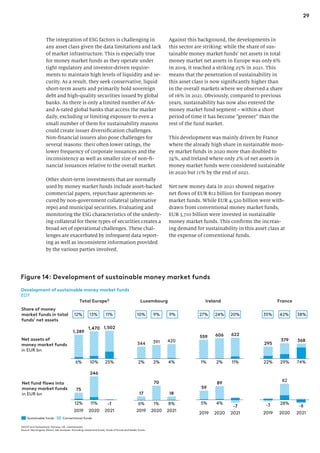
Figure 14 shows, money market funds in Eu-
rope are to a very large extent domiciled in three
major hubs: Ireland, Luxembourg and France.
They have traditionally been important in France
where their share in the total fund market in
terms of net assets reached over 35% in the past
three years. In Ireland, their share in total assets
amounted to 20% in 2021. A much lower rele-
vance of these funds can be observed in Luxem-
bourg where they have been representing a –
remarkably constant – 9% of the total net assets
over the past three years.
A marketplace dominated by large players
In our last report we confirmed the well-known
fact that the asset management industry is a
highly concentrated industry with only a few
large players dominating the markets. Nothing
has changed in this respect as the aggregated
market shares of the largest fund providers in
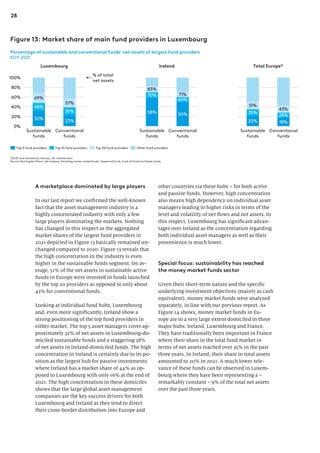
2021 depicted in Figure 13 basically remained un-
changed compared to 2020. Figure 13 reveals that
the high concentration in the industry is even
higher in the sustainable funds segment. On av-
erage, 51% of the net assets in sustainable active
funds in Europe were invested in funds launched
by the top 20 providers as opposed to only about
43% for conventional funds.
Looking at individual fund hubs, Luxembourg
and, even more significantly, Ireland show a
strong positioning of the top fund providers in
either market. The top 5 asset managers cover ap-
proximately 32% of net assets in Luxembourg-do-
miciled sustainable funds and a staggering 58%
of net assets in Ireland-domiciled funds. The high
concentration in Ireland is certainly due to its po-
sition as the largest hub for passive investments
where Ireland has a market share of 44% as op-
posed to Luxembourg with only 16% at the end of
2021. The high concentration in these domiciles
shows that the large global asset management
companies are the key success drivers for both
Luxembourg and Ireland as they tend to direct
their cross-border distribution into Europe and
Figure 13: Market share of main fund providers in Luxembourg
Percentage of sustainable and conventional funds’ net assets of largest fund providers
EOY 2021
32% 23%
80%
0%
20%
40%
60%
100%
39%
48%
69%
Sustainable
funds
57%
Conventional
funds
% of total
net assets
Other fund providers
Top 5 fund providers Top 10 fund providers Top 20 fund providers
Luxembourg Total Europe1)
22%
43%
18%
Sustainable
funds
35%
51%
28%
Conventional
funds
Ireland
58% 50%
70%
83%
60%
Sustainable
funds
71%
Conventional
funds
1) EU27 and Switzerland, Norway, UK, Liechtenstein
Source: Morningstar Direct, zeb analyses. Excluding money market funds, closed end funds, funds of funds and feeder funds.
29
The integration of ESG factors is challenging in
any asset class given the data limitations and lack
of market infrastructure. This is especially true
for money market funds as they operate under
tight regulatory and investor-driven require-
ments to maintain high levels of liquidity and se-
curity. As a result, they seek conservative, liquid
short-term assets and primarily hold sovereign
debt and high-quality securities issued by global
banks. As there is only a limited number of AA-
and A-rated global banks that access the market
daily, excluding or limiting exposure to even a
small number of them for sustainability reasons
could create issuer diversification challenges.
Non-financial issuers also pose challenges for
several reasons: their often lower ratings, the
lower frequency of corporate issuances and the
inconsistency as well as smaller size of non-fi-
nancial issuances relative to the overall market.
Other short-term investments that are normally
used by money market funds include asset-backed
commercial papers, repurchase agreements se-
cured by non-government collateral (alternative
repo) and municipal securities. Evaluating and
monitoring the ESG characteristics of the underly-
ing collateral for these types of securities creates a
broad set of operational challenges. These chal-
lenges are exacerbated by infrequent data report-
ing as well as inconsistent information provided
by the various parties involved.
Against this background, the developments in
this sector are striking: while the share of sus-
tainable money market funds’ net assets in total
money market net assets in Europe was only 6%
in 2019, it reached a striking 25% in 2021. This
means that the penetration of sustainability in
this asset class is now significantly higher than
in the overall markets where we observed a share
of 16% in 2021. Obviously, compared to previous
years, sustainability has now also entered the
money market fund segment – within a short
period of time it has become “greener” than the
rest of the fund market.
This development was mainly driven by France
where the already high share in sustainable mon-
ey market funds in 2020 more than doubled to
74%, and Ireland where only 2% of net assets in
money market funds were considered sustainable
in 2020 but 11% by the end of 2021.
Net new money data in 2021 showed negative
net flows of EUR 812 billion for European money
market funds. While EUR 4,520 billion were with-
drawn from conventional money market funds,
EUR 3,710 billion were invested in sustainable
money market funds. This confirms the increas-
ing demand for sustainability in this asset class at
the expense of conventional funds.
1) EU27 and Switzerland, Norway, UK, Liechtenstein
Source: Morningstar Direct, zeb analyses. Excluding closed end funds, funds of funds and feeder funds.
8%
2020
1%
18
6%
2019 2021
17
70
Luxembourg
Development of sustainable money market funds
EOY
Share of money
market funds in total
funds’ net assets
Net assets of
money market funds
in EUR bn
Net fund flows into
money market funds
in EUR bn
5%
2020
4%
2019
89
2021
59
-7 -8
2019 2020
-3 28%
82
2021
12%
2020 2021
75
2019
11%
246
-1
Ireland France
Total Europe1)
Conventional funds
Sustainable funds
2%
2%
344
4%
391 420
1% 2% 11%
559 606 622
12% 13% 11%
295
22%
379
29% 74%
368
1,289
6% 10% 25%
1,470 1,502
Figure 14: Development of sustainable money market funds
10% 9% 9% 27% 24% 20% 35% 42% 38%
30
Consistent with record numbers of fund launch-
es, repurposed funds also increased to a record
level. Asset managers seized the opportunity of
having to publish new SFDR-compliant prospec-
tuses to review their offerings, add binding ESG
criteria and exclusions and typically rebrand
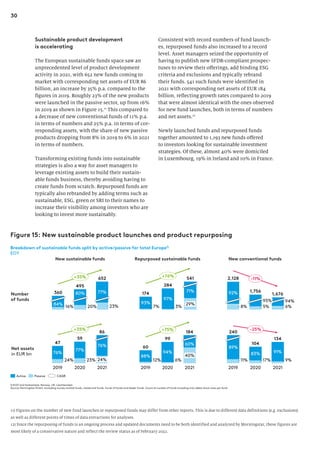
their funds. 541 such funds were identified in
2021 with corresponding net assets of EUR 184
billion, reflecting growth rates compared to 2019
that were almost identical with the ones observed
for new fund launches, both in terms of numbers
and net assets.12
Newly launched funds and repurposed funds
together amounted to 1,193 new funds offered
to investors looking for sustainable investment
strategies. Of these, almost 40% were domiciled
in Luxembourg, 19% in Ireland and 10% in France.
Sustainable product development
is accelerating
The European sustainable funds space saw an
unprecedented level of product development
activity in 2021, with 652 new funds coming to
market with corresponding net assets of EUR 86
billion, an increase by 35% p.a. compared to the
figures in 2019. Roughly 23% of the new products
were launched in the passive sector, up from 16%
in 2019 as shown in Figure 15.11
This compared to
a decrease of new conventional funds of 11% p.a.
in terms of numbers and 25% p.a. in terms of cor-
responding assets, with the share of new passive
products dropping from 8% in 2019 to 6% in 2021
in terms of numbers.
Transforming existing funds into sustainable
strategies is also a way for asset managers to
leverage existing assets to build their sustain-
able funds business, thereby avoiding having to
create funds from scratch. Repurposed funds are
typically also rebranded by adding terms such as
sustainable, ESG, green or SRI to their names to
increase their visibility among investors who are
looking to invest more sustainably.
11) Figures on the number of new fund launches or repurposed funds may differ from other reports. This is due to different data definitions (e.g. exclusions)
as well as different points of times of data extractions for analyses.
12) Since the repurposing of funds is an ongoing process and updated documents need to be both identified and analyzed by Morningstar, these figures are
most likely of a conservative nature and reflect the review status as of February 2022.
360
84%
16%
80%
20% 23%
77%
495
652
+35%
Figure 15: New sustainable product launches and product repurposing
Breakdown of sustainable funds split by active/passive for total Europe1)
EOY
1) EU27 and Switzerland, Norway, UK, Liechtenstein
Source: Morningstar Direct. Excluding money market funds, closed end funds, funds of funds and feeder funds. Count of number of funds including only oldest share class per fund.
Active Passive
97%
7%
93%
3%
29%
71%
174
284
541
+76%
8%
92%
95%
5%
94%
6%
2,128
1,756
1,676
-11%
Number
of funds
Net assets
in EUR bn
77%
2019
76%
24% 23%
76%
2020
24%
2021
86
47
59
+35%
88%
12%
2019
94%
6%
2020
184
60%
40%
2021
60
99
+75%
11%
240
2019
89%
83%
17%
2020
91%
9%
2021
104
134
-25%
New sustainable funds New conventional funds
Repurposed sustainable funds
CAGR
31
While in 2020 the number of new conventional
fund launches was still more than 2.2 times as
high as the combined number of new and repur-
posed funds in the sustainable sphere, this ratio
was much smaller in 2021 where it was only 1.4
times as high. Even more strikingly, the com-
bined net assets of new sustainable and repur-
posed funds were less than half of those from
new conventional funds in 2019 but twice as high
in 2021. As expected, all figures show a clear trend
towards sustainable funds.
As Figure 16 reveals, equity remained the source
of the greatest product development in 2021 with
a share of 55% in the new offerings in terms of
numbers, which is the same share as in 2020.
This was followed by fixed-income and allocation
strategies with 23% (2020: 20%) and 18% (2020:
19%), respectively.
While broad ESG funds continued to represent
the bulk of new offerings in 2021, impact funds
accounted for about 5% of new fund launches
and repurposed funds. Surprisingly, this is lower
than compared to 2020 (9%) given the increased
interest in impact investing.
Additional analyses show that climate funds
remained by far the most popular theme repre-
sented among new fund launches, spanning all
climate-related themes like low carbon, climate
transition and solutions, clean energy/tech and
green bonds. On the passive side, funds came
to market tracking the EU Paris-Aligned and EU
Climate Transition benchmarks. Fewer funds
focus on social issues, e.g. by investing in com-
panies that demonstrate gender and/or ethnic
diversity or that provide solutions empowering
social equality. Others offer exposure to emerging
markets through a broad ESG lens.13
13) See Morningstar, Global Sustainable Fund Flows: Q4 2021 in Review, January 2022.
Figure 16: Product development per asset class
Asset class distribution by number of new sustainable fund
launches and repurposed funds for total Europe1)
EOY 20212)
1) EU27 and Switzerland, Norway, UK, Liechtenstein 2) In the pie chart, total number of new sustainable fund launches and repurposed funds 3) Multi-asset class strategy 4) In the pie chart, total number of new sustainable
fund launches and repurposed funds 5) Including funds with ESG or environmental focus or funds that combine impact objectives with other ESG or environmental factors
Source: Morningstar Direct. Excluding money market funds, closed end funds, funds of funds and feeder funds. Count of number of funds including only oldest share class per fund.
55%
23%
18%
Fixed income
Equity
Other
Allocation3)
3%
1,193 5%
95% Impact funds
Other sustainable
funds5)
1,193
New sustainable fund launches and repurposed funds
by sustainable fund categorization
EOY 20204)
32
Investors’ trust is one of the most important factors for financial
services providers. How much is this affected negatively by reports
of greenwashing potential in the industry?
Greenwashing jeop-
ardizes the key role of
financial institutions
in their sustainable portfolios which are part of
the solution rather than companies just having
an ESG policy. They can be shocked to discov-
er that, rather than wind and solar companies,
their “sustainable” portfolios’ biggest holdings
are actually oil companies and bank stocks. The
Financial Times addressed this risk in an article
on a potential new mis-selling scandal for green
investments last February.
All in all, this may lead to investors becoming
suspicious of any sustainability claims made by fi-
nancial institutions and reluctant to invest in those
products. The resulting lack of capital inflow could
seriously hinder the much-needed transition in the
energy, agriculture, food and other crucial sectors.
Greenwashing is a serious problem for the finan-
cial sector at large as it jeopardizes the crucial
role the sector plays in the transition towards a
sustainable economy. To direct capital to places
where it is most needed to generate positive im-
pact, financial services providers need to deliver
on their promises and should be held account-
able for it. While it might seem lucrative in the
short term to capitalize on the market appetite for
sustainable products with offerings that are only
sustainable in name, this behavior will seriously
damage trust in the sector as a whole.
We see a risk of misleading and potentially
mis-selling of “green” / ESG funds. Retail inves-
tors expect specific companies to be included
Interview with
Hadewych Kuiper, Managing
Director, Member of the
Management Board, Triodos
Investment Management
triodos-im.com
33
Retail investors are considered to be not very knowledgeable about
investment topics, especially in countries with a limited capital
market culture. Do you believe that an interest in sustainability
may trigger some more interest in financial matters?
investments. The more it becomes clear that
the financial sector is key in the sustainability
transition, the more people will likely become
interested in it.
Moreover, we think it is key to involve citizens
in the sustainability transition. Not making
them part of this would increase the risk of
social unrest and exacerbate inequalities in soci-
ety. Sustainable finance can help engage retail
investors (and savers) in this transition, for ex-
ample by letting them participate in local green
energy cooperatives.
It is very well possible that interest in sustain-
ability leads to more interest in financial matters
as the two subjects are very much interlinked.
A huge amount of capital is needed to address
the enormous sustainability challenges that are
awaiting us, and retail investors have an impor-
tant role to play in freeing up this capital. Not
only with their personal investment decisions
but also because they can influence the way
banks, pension funds, insurance companies and
other big financial players invest their capital.
We are currently seeing increasing pressure, for
instance from NGOs, being put on the financial
industry to direct capital towards sustainable
Do you think that the different criteria applied by rating/data pro-
viders to assess the sustainability level of a fund, together with the
Article 8/9 classification according to SFDR, are beneficial or rather
counterproductive for the market with regard to the acceptance
and understanding of sustainable investments?
Neither the acceptance nor the understanding of
sustainable investments are being served by the
inconsistency of criteria applied to assess the sus-
tainability level of a fund. The introduction of the
SFDR classification into Article 8/9 is an impor-
tant step forward because it creates more clarity
for investors as to how sustainable a fund really is.
However, at this point classifications into Article
8 or 9 are still based on fund managers’ own as-
sessments of their products, leading to a situation
where not all funds really live up to their classifi-
cation yet. This will hopefully level out over time
but until then it does not help retail investors in
comparing sustainable fund offerings.
“
Investors may become suspicious of
any sustainability claims made by financial
institutions and reluctant to invest in
those products.”
34
The European Commission published its new
“EU Sustainable Finance Strategy for Financing
the Transition to a Sustainable Economy” on July 6,
2021, which builds on the EU Action Plan on
Sustainable Finance. To name but a few, actions
derived from the strategy encompass the develop-
ment of international sustainable finance initia-
tives and standards, ensuring the integrity of the
EU financial system and monitoring its orderly
transition to sustainability, increasing the con-
tribution of the financial sector to sustainability
and extending the existing sustainable finance
toolbox to facilitate access to transition finance.
The European Green Bonds Standard (EUGBS) and
the Delegated Act on Article 8 of the EU Taxono-
my Regulation constitute two further initiatives
provided by the renewed strategy. The Commis-
sion will report on the Strategy’s implementation
by the end of 2023.
Moreover, ESMA presented its “Sustainable
Finance Roadmap 2022–2024”. On top of this,
two of the cornerstones of sustainable finance
regulation in Europe, the Sustainable Finance
Disclosure Regulation (SFDR) and the Taxono-
my Regulation, have been updated and evolved.
Other regulations like CSRD, MiFID II, UCITS and
AIFMD have been modified, updated or finalized
in 2021.
The considerable number of legislative efforts
resulted in a high complexity of the current Euro-
pean regulatory landscape for sustainable funds.
The most important initiatives within the EU are
summarized in Figure 17.
While the demand for sustainable investment
products has skyrocketed, regulators have
strengthened their efforts to implement a more
regulated and standardized playing field in the
sustainable finance area.
By launching the European Union Action Plan on
Sustainable Finance in 2018, the EU laid the foun-
dation for a broad package of rules which intends
to reorient capital towards sustainable invest-
ments. The Action Plan brings together under
one roof the Taxonomy Regulation, a disclosure
regime including the Sustainable Finance Disclo-
sure Regulation (SFDR) as well as the Corporate
Sustainability Reporting Directive (CSRD) and
further regulatory initiatives or tools aiming to
connect financial investments and sustainability.
However, industry experts complain that current-
ly existing regulations could lead to an increase
in greenwashing practices and confusion regard-
ing sustainable investments. This is due to vague
definitions of what can be described as sustain-
able and differing interpretations of ESG criteria,
sustainability risks and targets as well as insuffi-
cient data on sustainability factors from investee
companies.
Hence, the last year was marked by launches of
new rules and regulatory updates aimed at com-
bating greenwashing and establishing a compre-
hensive consideration of regulatory aspects in the
sustainable investment fund universe.
European regulatory
landscape – latest
developments
35
The following paragraphs will provide more
insights into the latest developments and their
expected evolution within the European sustain-
able fund universe.
Sustainable Finance Disclosure Regulation
(SFDR)
SFDR “Level 1”, whose main provisions have en-
tered into application in March 2021, is the first
part of the implementation of Regulation (EU)
2019/2088 on sustainability-related disclosures
in the financial services sector. It requires asset
managers, financial advisers and financial mar-
ket participants (FMPs) to provide prescriptive
and standardized disclosures on how sustain-
ability factors are considered at both the entity
and product level.
On April 6, 2022, the EC announced that it had
adopted all the various regulatory technical
standards (RTS) under the SFDR in a single draft
delegated act, also known as “SFDR Level 2”,
based on previously published draft RTS. The
respective obligations aim at enhancing further
guidance on sustainability-related disclosures.
In general, the SFDR RTS specify a mandatory
website as well as pre-contractual and periodic
reporting templates for FMPs. In fact, final draft
versions do not normally differ from previous
versions significantly, so asset managers should
focus on the required disclosures by considering
the mandatory reporting templates for pre-con-
tractual, periodic disclosures and principal
adverse impacts (PAI) on sustainability.
Further clarification on the ESAs’ draft RTS under
SFDR was provided in a statement by EBA, ESMA
and EIOPA at the beginning of June 2022. This
concerns key areas of the SFDR disclosures such
as the use of sustainability indicators, and the
taxonomy-related financial product as well as the
“do not significantly harm” disclosures.
The application of SFDR “Level 2” requires asset
managers to disclose their funds’ level of align-
ment with the Taxonomy. As a result, these prod-
ucts must pursue six environmental objectives as
defined by the Taxonomy. This level of alignment
has to be measured with two graphs showing the
taxonomy alignment based on a specified calcu-
lation methodology.
SFDR “Level 2” had been planned to take effect in
January 2022. However, the date of application of
the RTS has been delayed twice by the Commis-
sion, the reason being the length and technical
detail of these standards and the aim to bundle
them all. The current application date will not be
definitive until confirmed by the European Par-
liament and the Council, but it is expected that
January 1, 2023 will be the effective date. From
June 30, 2023, FMPs will be required to disclose
PAIs and sustainability features of their financial
products for the first time.
2022
Figure 17: Selection of relevant ESG regulatory initiatives for European funds industry
European initiatives – illustrative roadmap
Taxonomy Regulation3)
(Expected) publication (Expected) application
SFDR1)
Implementation
MiFID II, UCITS/AIFMD
Pre-
study
1) Sustainable Finance Disclosure Regulation 2) SFDR Regulatory Technical Standards 3) Climate change mitigation and adaptation as of January 1, 2022. Extended application of water, circular economy, pollution prevention
and biodiversity and ecosystems-related objectives as of January 1, 2023 4) Non-Financial Reporting Directive 5) Corporate Sustainability Reporting Directive
NFRD4) / CSRD5)
Draft
EU Com
NFRD
Implementation
Application and
periodic product
disclosures
Implementation
2021 2023 2024
Implemen-
tation of
CSRD
Implementa-
tion of NFRD
Pre-study
on CSRD
Application and first reporting
on CSRD
Expected reporting
2020
2019
Pre-
study
Advanced application
SFDR level 1
SFDR level 22) Implementation
Application
and first
reporting
Application and
second reporting
Application and
disclosures on
product level
Today
Disclosure of taxonomy alignment
36
Figure 18 shows that of the reviewed funds domi-
ciled in Luxembourg half the funds’ net assets are
classified as sustainable whereas the other half
are to be considered Article 6 funds. This com-
pares with only a third of the net assets classified
as sustainable in 2020.15
About 6% of the net as-
sets are managed according to the principles set
out by Article 9 and 44% based on less ambitious
sustainable strategies as defined in Article 8,
representing combined assets of EUR 2.1 trillion,
twice as much as in 2020. The respective shares
for the whole European investment universe that
has been reviewed so far are lower due to the
inclusion of non-EU domiciles. Nevertheless,
the respective figures do not change significantly
even though the share of Article 8 in particular
decreases by 5 percentage points. 39% of the
corresponding net assets are classified as Article
8 and 5% as Article 9, reflecting an increase in the
underlying assets by 100% up to EUR 4.2 trillion
compared to 2020.
More precisely, SFDR requires asset managers to
explain in pre-contractual disclosures how sus-
tainability risks are considered in their invest-
ment process and how sustainability risks may
impact the returns of their financial products
(Article 6). In addition, they will need to assess
if and to what extent their funds qualify as funds
that promote social or environmental character-
istics (“Article 8 funds”) or that have sustainable
investment as their main objective (“Article 9
funds”), and comply with the respective report-
ing requirements.
At the time of this analysis, Morningstar had
about 88% of the funds domiciled in Luxembourg
reviewed with respect to their classification as ei-
ther Article 8 or Article 9 funds. This correspond-
ed to 97% of the net assets. The coverage for the
other European domiciles was 67% (numbers)
and 68% (assets) at that stage. This results in an
overall coverage of more than 74% of the total
European fund universe as defined in this study,
which corresponded to 78% of the net assets.14
14) Note that only funds in scope of SFDR, i.e. those available for sale in the EU, are reviewed rather than all funds domiciled in Europe. At the end of 2021,
Morningstar’s coverage of funds in scope of SFDR was 91%.
15) The net asset figures for the end of 2020 are of a hypothetical nature as SFDR was not in place at the end of 2020. The respective figures reflect the net
assets of those funds that were classified as Article 8 and 9 funds in May 2021, at the time we collected the data for our previous study.
Figure 18: Distribution of net assets for Article 8 and Article 9 funds for Luxembourg-
domiciled funds
1) EU27 and Switzerland, Norway, UK, Liechtenstein 2) Morningstar’s assessment of fund managers’ declarations as of end of December 2021
Source: Morningstar Direct, zeb analyses. Excluding money market funds, closed end funds, funds of funds and feeder funds. Coverage of approx. 88% of funds domiciled in Luxembourg and 67% of European funds overall,
as of Feb 28, 2022
Percentage of Article 8/Article 9 funds
in net assets as of EOY in EUR bn, of
funds reviewed by Morningstar2)
Breakdown of funds’ net assets and fund flows per SFDR classification
Percentage of Article 8/Article 9
funds in net fund flows in EUR bn,
of funds reviewed by Morningstar2)
44%
4%
29%
67%
6%
50%
3,386
4,241
Article 9 Not stated
Article 8
46%
2020
27%
34%
49%
23%
19%
2021
155
352
56%
5%
28%
3%
39%
69%
6,686
9,613
50%
14%
18%
2020
43%
39%
36%
2021
309
721
Luxembourg Total Europe1)
37
Given that more than two-thirds of the European
funds have already been reviewed, and 91% of
those available for sale in the EU, these figures
should provide a solid insight into the status of
the European market structure in terms of the
classification of funds according to SFDR, as-
suming that the structures within the remaining
net assets will not deviate significantly from the
ones reviewed.
The trend towards sustainable funds is supported
by the net flows shown at the bottom of Figure 18.
More than two thirds of the net flows are directed
towards sustainable funds both in Luxembourg
and Europe, with Luxembourg exhibiting a higher
percentage of flows attracted by Article 9 funds.
Interestingly, the share of net flows in sustainable
funds domiciled in Luxembourg has decreased in
2021 from a high level in 2020 (76%) in contrast
to Europe as a whole where it increased from 57%
to 64%. Irrespective of these differences, the
structure of the flows clearly shows the trend
towards sustainable strategies and confirms what
has been already observed by applying the sus-
tainability definition of Morningstar.
When comparing the shares of sustainable funds’
net assets in the total funds’ net assets based on
the regulatory classification and the definition
applied by Morningstar, a significant difference is
noticeable. While the share of sustainable funds
based on the regulatory classification is 44%
across European domiciles at the end of 202116
,
it is only 16% based on Morningstar’s approach.
Also, the share of Article 9 funds in net assets of
all Article 8 and 9 funds is about 11% (or 5% in net
assets of all funds that were reviewed) – higher
than the 8% share of impact funds’ assets in all
sustainable funds’ assets (or 1% in total net assets
of all funds) following Morningstar’s assessment.
If the underlying criteria for the qualification as
Article 8 or 9 funds were similar to those set by
Morningstar, the shares should be more or less
equal. One would particularly expect impact funds
to qualify as Article 9 funds, which would result in
similar respective shares in total net assets.
16) This is based on the assumption that the share of 44% observed in the universe reviewed so far does not materially change if the total net assets of
EUR 12.3 trillion domiciled in Europe are considered.
“Although the marketing
of funds as sustainable by the
industry is criticized in detail,
the general discussion of the
topic alone is of value for both
providers and investors.”
Arnd Heßeler,
Executive Manager, zeb, Luxembourg
38
As pointed out earlier, however, the definition
of sustainability used in this study is of a much
more conservative nature. To qualify as sus-
tainable, an investment strategy is required to
include sustainability as a central and binding
feature – rather than just employing exclusions of
certain sectors or practices, which can be found
in most investment guidelines nowadays anyway.
Figure 19 shows the shares of Article 8 and 9 funds’
net assets in the total net assets that have been
reviewed by Morningstar by February 2022 and the
match of the respective net assets with the classi-
fication used by Morningstar. As expected, almost
all of the Article 9 funds are also considered sus-
tainable by Morningstar. However, looking at the
net assets of funds whose providers categorized
as Article 8 funds, only 29% are also classified as
sustainable by Morningstar. This huge gap shows
the stringent approach used by Morningstar and
points to the confusion and different interpreta-
tion of the criteria defined by the regulators for
qualifying a fund as an Article 8 fund.
Figure 19: Breakdown of SFDR classification according to Morningstar
First data on SFDR implementation: breakdown of funds’ net assets, total Europe1)
461
5%
Not stated
Total AUM
(in EUR bn)
39%
Article 8
Article 9
12,276
3,772
5,380
SFDR classification of funds reviewed by Morningstar2)
as of Feb 2022, AUM as of Dec 2021
1) EU27 and Switzerland, Norway, UK, Liechtenstein 2) Morningstar’s assessment of fund managers’ declarations on Article 8/Article 9 funds as of December 2021
Source: Morningstar Direct, zeb analyses. Excluding money market funds, closed end funds, funds of funds and feeder funds.
Article 8 funds
Article 9 funds
71%
Total AUM
(in EUR bn)
Conventional
29%
Sustainable
3,772 1,085
2,687
based on MS classification
461
Total AUM
(in EUR bn)
Sustainable
96%
4%
Conventional
442
18
based on MS classification
Total European-domiciled funds
2,663
56%
Not
reviewed Reviewed
100%
It is also important to understand that the objec-
tive of the regulator was not to establish a differ-
entiated classification scheme for sustainable
funds, but to define disclosure requirements for
fund providers dependent on the character of
the funds’ strategy.
Figure 20 looks at these differences from another
angle: it shows the net assets of funds that are
classified as sustainable based on Morningstar’s
methodology, differentiated into impact funds
and other sustainable funds, and analyzes the
corresponding SFDR classification. Only funds
domiciled in Luxembourg are considered here
as the coverage of funds reviewed with regard to
SFDR is particularly high compared to other do-
miciles. Obviously, one would expect the net as-
sets of impact funds to be highly correlated with
net assets classified as Article 9 funds as opposed
to the rest of the sustainability strategy spectrum,
namely ESG funds, which should rather have a
high proportion of Article 8 funds.
39
However, only 43% of the net assets in the im-
pact funds sector are classified as Article 9 funds
whereas 48% are classified as Article 8 funds
by their asset managers. A fraction of 9% are
not even assigned as Article 8 or 9 funds at all.
Even more striking is the significant 37% share
of Article 9 funds’ net assets among the other
sustainable funds.17
These observations can be caused by several
factors:
→ Different definitions of what constitutes an
ESG fund (light exclusions and ESG integra-
tion may not meet Morningstar’s criteria for
setting a sustainable attribute, but could be
enough for the fund manager to state the
fund as being Article 8)
→ Vague language in fund documentation
→ Timing – many groups have updated their
funds prospectus language to either clarify,
remove or add references to ESG which takes
time to be reviewed
→ Diverse policies of asset managers, ranging
from setting ambitious targets to aligning
their entire product spectrum to a restrictive
placement of only dedicated sustainable
sector funds
→ Different interpretations of the criteria de-
fined in SFDR of what qualifies as sustainable
in a regulatory sense especially regarding
Article 8 funds
For these reasons it is possible that some
self-declared Article 8 funds are not classified
as sustainable investments by Morningstar or
that a fund may be considered as an impact
fund by Morningstar, but the asset manager did
not declare it as an Article 9 fund. The various
interpretations of the regulation have resulted in
a diverse group of funds represented by Article
8 with completely different ambition levels and
heterogeneous investment strategies.
Figure 20: Article 8/Article 9 funds distribution
by net assets, split by ESG categorization
43% 37%
48% 59%
9% 4%
Impact
funds
30
Other sustainable
funds1)
628
Article 9 Article 8 Not stated
Article 8/9 funds by net assets per ESG categorization
EOY 2021 in EUR bn
1) Including funds with ESG or environmental focus or funds that combine impact objectives with other ESG or environmental factors
Source: Morningstar Direct, zeb analyses. Excluding money market funds, closed end funds, funds of funds and feeder funds.
Coverage of approx. 88% of funds domiciled in Luxembourg, as of Feb 28, 2022
Luxembourg
17) This can partly be attributed to the fact that for the purpose of this study impact funds are only classified as such if the attributes “sustainable” and
“impact” are flagged but not if their strategy is mixed with other approaches. Those funds that combine different strategies may therefore also qualify as
impact funds and Article 9 funds, respectively.
40
There is currently a multitude of green taxonomies across the
world – what can be done to bring them together and why is this
important?
We should align the
processes of taxono-
mies across the world
In my view, we should focus on reaching align-
ment on the process across taxonomies, includ-
ing screening criteria, minimum social safe-
guards and the Do No Significant Harm principle,
and not necessarily try to reach full agreement on
specific KPIs or thresholds.
In terms of harmonization, the work done by the
International Platform on Sustainable Finance
on its Common Ground Taxonomy is essential
and can help improve the comparability and
interoperability of taxonomies across different
jurisdictions.
The lack of standardization of the underlying
methodology of different taxonomies is likely to
lead to fragmentation in the market. Different
taxonomies create confusion among investors
and complicate the investment decision process,
and the lack of harmonization also requires more
efforts from issuers. We have seen examples of
issuers that declare alignment with four different
taxonomies or standards when issuing a sustain-
able bond, each requiring an in-depth analysis,
which again multiplies costs and resources.
Interview with
Julie Becker, CEO,
Luxembourg Stock
Exchange
bourse.lu/green
41
How can funds investing in fixed-income instruments calculate
their alignment with the EU taxonomy and report on their sustain-
able investments?
This is what led us to build the LGX DataHub,
a unique centralized database providing struc-
tured sustainability data on more than 6,000
listed sustainable bonds. It provides investors
and asset managers with the data they need to
make informed investment decisions and report
on the social and environmental impact of these
investments.
Calculating and reporting on the alignment with
the EU taxonomy is a real challenge for many
market participants. Funds investing in equity or
in plain vanilla bonds will focus on the taxonomy
alignment of the corporates and may be able to
partially obtain these figures in 2023 only. How-
ever, when it comes to Green, Social or Sustain-
ability (GSS) bonds, it is ideally the alignment of
the Use of Proceeds that should be screened and
assessed against the EU Taxonomy.
Measuring concrete reductions in carbon emis-
sions and properly reporting on the environmen-
tal impact of the projects financed by the GSS
bonds require granular data, which may be avail-
able in the post-issuance reporting of the bonds,
but not in a structured and comparable form.
What tools are available for retail investors to verify that their
investments are truly sustainable?
Just as consumers are becoming more conscious
of their choices, investors are also increasingly
considering the sustainability angle before in-
vesting in a product.
There are certain tools available to guide inves-
tors in this respect, such as internationally recog-
nized sustainability labels, standards and ESG rat-
ings, although further transparency is needed on
the methodologies behind those tools. However,
there is no single tool that retail investors can use
to verify the green or social credentials of their
investment, and this is why financial literacy and
sustainable finance knowledge are key.
To fully understand what the concrete impact
of their investment is, investors need to analyze
different documents, gather data from different
sources and gain a deep understanding of what
different standards and labels represent.
Investors have a responsibility to inform them-
selves not just about the product they are investing
in, but also about the ESG profile of the issuer or
the entity itself. The financial industry should
focus on making that process easier and give
investors the means, notably via financial and sus-
tainability education, to better master these tools.
“
Investors have to inform themselves about
the ESG profile of the company they are
investing in. The financial industry should
make this process easier.”
42
Further sub-objectives include health and safety,
healthcare, housing, wages, non-discrimination,
consumer health and communities’ livelihoods.
The “Do no significant harm” principle is also
included in this taxonomy.
Furthermore, the report specifies the relation
between the social and the environmental taxon-
omy. Most economic activities inherently cause
greenhouse gases, but at the same time these ac-
tivities can be described as social by creating jobs
or by producing social goods. Therefore, the Plat-
form suggests that social and governance-related
minimum safeguards are part of the environ-
mental taxonomy and minimum environmental
safeguards should be part of the social one.
The proposed structure of the Social Taxonomy
corresponds to the Environmental Taxono-
my. Screening criteria will be used to identify
socially sustainable economic activities that
contribute to at least one social objective of the
EU Social Taxonomy, do not significantly harm
any other social objective and are carried out –
as already stated – in compliance with (social or
environmental) minimum safeguards. Depend-
ing on the respective social objective, either the
turnover or the capital expenditure and operat-
ing expenditure per socially sustainable eco-
nomic activity are to be reported. Thus, the tax-
onomy will affect numerous legislative efforts
such as the CSRD or the SFDR when it comes to
disclosure obligations on the alignment of fund-
ed activities with social objectives.
It is expected that the Social Taxonomy will serve
to direct investments towards funds focusing on
the protection of human rights and on the social
impact on the main stakeholder groups of em-
ployees, customers and communities.
Taxonomy Regulation
In 2021, the EU released the first set of technical
screening criteria to define activities that con-
tribute to two of the environmental objectives of
the EU Taxonomy: climate change mitigation and
climate change adaptation. However, in February
2022, the European Commission approved a draft
Complementary Climate Delegated Act stating that
specific nuclear and gas energy activities could
be considered as sustainable and are in line with
the EU Taxonomy, as they help accelerate the shift
from fossil fuels towards carbon neutrality. Many
concerns were expressed about this decision.
The second delegated act for the remaining four
environmental goals – protection and restoration
of biodiversity and ecosystems, sustainable use
and protection of marine water resources, transi-
tion to a circular economy and pollution pre-
vention and control – is expected to be released
in the second quarter of 2022. In July 2022, the
European Commission will report on the status of
the Taxonomy Regulation application, and from
January 2023, the disclosure of the remaining
four environmental objectives will be mandatory
for companies.
Beyond that, further work on a social taxonomy is
expected. In February 2022, the Platform on Sus-
tainable Finance published its final report on a
social taxonomy. Within their report, three social
objectives addressing different groups of stake-
holders such as workers, consumers and commu-
nities are suggested, as economic activities affect
different stakeholders:
1. Decent work (for own workforce) including
for value-chain workers
2. Adequate living standards and well-being
for end-users
3. Inclusive and sustainable communities
and societies
43
Further initiatives
Having entered into force on January 3, 2018,
MiFID is a legislative framework that intends to
strengthen investor protection and improve the
functioning of financial markets. In 2021, some
key ESG-related changes to MiFID II were finalized,
which will come into force on August 2, 2022.
These include the incorporation of ESG consid-
erations in organizational requirements and risk
management processes, the integration of sus-
tainability preferences of clients into the suitabil-
ity assessment of products, and the identification
of conflicts of interests, considering potential
damages to investors’ sustainability preferences.
From August 2022 onwards, investment advisors
and portfolio managers are required to include
sustainability preferences in reports on the suit-
ability of products provided to clients, to show
that sustainability factors are understood. This
requires respective policies and the consideration
of sustainability risks and factors in risk manage-
ment, internal reporting, organizational struc-
tures and decision-making processes.
Beyond that, from November 22, 2022 onwards,
MiFID II firms will have to integrate sustainabil-
ity factors in product governance. As a result,
product governance arrangements must include
sustainability-related objectives, and sustain-
ability factors need to be presented transparently.
Consequently, asset managers need to ensure that
their product offering conforms to MiFID require-
ments so that they can be sold to retail clients by
their sales partners.
As the Non-Financial Reporting Directive (NFRD)
is not suitable to serve as a basis for all informa-
tion required by the SFDR and the EU Taxonomy,
the Corporate Sustainability Reporting Directive
(CSRD) was proposed by the EC on April 21, 2021.
This Directive requires companies to provide the
information necessary to underpin the reporting
and disclosure obligations under the SFDR and
EU Taxonomy. They must report on how sustain-
ability issues affect their performance, position
and development and on their impact on people
and environment. The scope of companies
affected by the CSRD has been extended to all
listed companies on the EU-regulated market
and large companies that exceed two of the fol-
lowing three criteria:
1. Total assets of EUR 20 million
2. Net turnover of EUR 40 million
3. 250 employees
Approximately 50,000 companies in the EU are
therefore in scope. SMEs and listed companies
are given three years to comply. The new report-
ing standard will be defined by the end of 2022.
Companies should be able to apply the new
standard for the financial year 2023 and publish
financial reports integrating non-financial infor-
mation in 2024.
As part of the renewed sustainable finance strat-
egy, the EC unveiled its proposal for a EU Green
Bonds Standard (EUGBS). Once the proposal for
the EUGBS has been adopted, it will set a volun-
tary “gold” standard benchmark for issuers of
green bonds at EU level. This proposed standard
can be useful for both issuers and investors, as
the regulation intends to create a universal and
credible approach for the process of issuing green
bonds. On the one hand, investors benefit from
a high degree of transparency. For instance, the
proposal asks for third parties to ensure compli-
ance with the regulation and taxonomy align-
ment of the funded projects. On the other hand,
issuers face reputational benefits as their financ-
ing of activities goes hand in hand with public
and social opinions.
44
As sustainable finance has reached the main-
stream in recent years and in order to understand
and address the supervisory implications of new
legislation and market practices such as green-
washing, the second anchor point of the Road-
map aims to further acquire new skills beyond
traditional areas of focus. Based on this, ESMA
intends to build an advanced and efficient super-
vision on a national and international basis.
By monitoring, assessing and analyzing ESG mar-
kets and risks, the watchdog will focus on build-
ing its data analytics capabilities in order to foster
the supervision provided by itself and by NCAs.
ESMA’s Sustainable Finance Roadmap for 2022–
2024 is a response to current problems in the
European regulatory landscape. As mentioned,
legislative efforts such as SFDR are associated
with timing issues and differing interpretations.
ESMA itself admits that the current status of
sustainability reporting will still be “sub-opti-
mal” for some years to come. The rapidly evolving
sustainable investment funds market and the
respective complexity of greenwashing practices
require the watchdog to enhance its supervisory
work regarding ESG-related topics. The Roadmap
seems to be a step in the right direction.
ESMA Sustainable Finance Roadmap
2022–2024
Published by the European Securities and Mar-
kets Authority (ESMA) on February 10, 2022, the
“Sustainable Finance Roadmap 2022–2024”18
is a
tool in which ESMA’s priority work areas and its
respective deliverables on sustainable finance
are set out. The Roadmap intends to provide
more transparency on supervisory work regard-
ing sustainable finance and how this work will
be implemented until 2024. On its own, the EU
markets watchdog describes the Roadmap as a
“tool to ensure the coordinated implementation
of ESMA’s broad sustainable finance mandate for
the period 2022–2024”.
Within this Roadmap, three priority areas are
defined for ESMA’s sustainable finance work:
1. Tackling greenwashing and promoting
transparency
2. Building NCAs’ (National Competent
Authorities) and ESMA’s capacities
3. Monitoring, assessing and analyzing ESG
markets and risks
As shown in this study, money flowing into funds
advertised as sustainable has grown rapidly. This
evolution risks mis-selling in financial products
by greenwashing practices. Greenwashing is the
process of putting up a façade of sustainability
for investment funds while continuing to engage
in activities which, for instance, generate green-
house gases. This is quite a complex process and
takes various forms. As a result, such practices
can reduce credibility and trust in sustainable
investments.
18) Sustainable Finance Roadmap 2022–2024 (europa.eu)
45
The previous chapters focused exclusively on the
development of sustainable funds within Europe,
which is mainly driven by regulatory initiatives.
Indeed, the EU Commission and its supervisory
bodies are leading the race of regulation, having
laid the foundations for a sustainable future with
a large tool kit of disclosures, reporting and clas-
sification frameworks, to name but a few.
Other regions around the world, namely the
United States and Asia, have set none to only
few, less stringent requirements on sustainable
investing. What concerns market players most is
the confusion of different requirements around
the world that do not set the same standards. A
US asset management firm needs to comply with
European standards in order to market its funds
in the EU, while the same standards may not be
used or understood in the US. In this respect,
EU disclosure requirements do not only apply to
the EU, but to every market participant wanting
access to the EU markets.
The fact is, just as regulation, global warming
is an issue that concerns the entire globe, from
small to large countries, from heavy to low pol-
luters, from western to eastern regions. Taking
this into consideration, a look beyond the borders
of the European Union is necessary to understand
the global dynamics around sustainable assets
and to assess the current progress of Europe com-
pared to other regions. Moreover, considering the
weight and power of the United States and Asia
in financial markets and the world economy in
general, their developments in sustainable assets
cannot be neglected.
Figure 21 illustrates the global development of
sustainable fund markets. The total volume of
sustainable assets has grown significantly at
62% p.a. during the last three years to a level of
roughly EUR 2.4 trillion. A closer look confirms
that Europe is leading the way when it comes
to sustainable assets with an impressive mar-
ket share of 83%. Both the US and Asia lag far
behind with a market share of only 13% and 4%
respectively. Strikingly, the market shares of each
region have stayed relatively constant during this
growth phase. This means that even if Europe has
seen huge developments in sustainable assets in
the last three years, the US and Asia were able to
keep up and secured their market share. However,
the market share of sustainable assets gives no
indication of the progress that has been made
so far in transferring funds from conventional
to sustainable assets in order to make progress
towards a greener future.
Global context –
Europe as a forerun-
ner in sustainability
46
What are the key differences between the US and EU approaches
to sustainability in general? Will the US eventually look beyond
climate change to broader sustainability goals?
The EU is more open
towards regulation
investments. But that focus on disclosure re-
quirements is also consistent with the SEC’s his-
toric approach that the market ultimately decides
how best to allocate capital. In contrast, the EU is
much more overt in using regulation to drive the
capital markets to fund the net zero transition.
Thus, EU initiatives such as a sustainable finance
taxonomy, stress testing and capital require-
ments are quite novel in the United States.
Differences in the US and EU approaches can be
attributed to differences in regulatory systems,
legal frameworks and historic approaches to
capital markets regulation. The legal mandate
of the US Securities and Exchange Commission
(SEC) is to protect investors and facilitate capital
formation, and any move to incorporate climate
risk and human capital considerations must
be connected to this mandate. ICI believes that
promoting climate risk disclosure is consistent
with the SEC mandate, noting that investors need
consistent, comparable and reliable information
on climate-related risks that could impact their
Interview with
Eric Pan, CEO, ICI
ici.org
47
The US SEC recently proposed a comprehensive disclosure frame-
work for climate-related information. How does the US proposal
compare to the EU reporting regime, including the Taxonomy Reg-
ulation and the Corporate Sustainability Reporting Directive?
The EU is focused on the impacts of companies’
activities on external environmental factors.
Despite these differences, we do believe there
is potential common ground for both jurisdic-
tions to support the global baseline for corporate
disclosure reporting, which is being developed by
the ISSB, and we call on the US and EU to find this
common ground.
The SEC’s regulatory proposals avoid a mistake
that we feel has been a flaw in the EU reporting
regime, which is that asset managers have been
required to disclose climate information about
their investments before the companies they
invest in have had to report such information.
US policymakers also have not attempted and
likely will not attempt to create a taxonomy to
define what it means to be “sustainable”. Instead,
the SEC’s focus is on standardized disclosure of
climate risks to allow investors to make informed
investment and capital allocation decisions.
Are there differences in how regulators are approaching concerns
of greenwashing? Given that regulators are working at differing
speeds to address these concerns, what can funds do to ensure that
fund investors understand the sustainability characteristics of
investment products?
The pursuit of sustainability requires an econo-
my-wide approach to achieve net zero goals: that
means that the simplistic solutions you may hear
touted by some – like divestment from certain in-
dustries – are not a tenable or desirable approach.
Investing in companies across all sectors that are
effectively transitioning to net zero emissions is
part of the solution and is not greenwashing. A
“golden rule” for fund managers is to do what you
say and say what you do. The SEC has made sus-
tainability claims a key component of its annual
exam process to enforce this golden rule. This is
the right approach. EU policymakers are consid-
ering minimum standards for funds that hold
themselves out as sustainable.
ICI cautions against imposing minimum stan-
dards that attempt to create an arbitrary hierarchy
of sustainable products rather than providing
transparency for investors to make an informed
investment choice. Only by empowering inves-
tors to make informed choices will the market
evolve to meet investor demand for sustainable
investing. We welcome the fact that US and EU
regulators require all funds, including sustain-
ability-themed funds, to describe their invest-
ment goals and how they plan to achieve those
goals. Funds should ensure that this information
is clearly articulated and presented to investors
using such funds.
“
A ‘golden rule’ for fund managers is to
do what you say and say what you do.”
48
Closing the gap: What are the roadblocks
in the US and Asia?
According to a survey conducted by Schroders19
in 2020, the interest in sustainability does not
seem to be the issue in the US. Indeed, 60% of
Americans stated that they wanted financial
market participants to consider sustainability
factors, while only 15% said that they were actu-
ally investing in sustainable products. A factor
that is certainly playing a big role in the US is
politics. Under the Trump administration, the
notion of sustainability and climate change was
buried from the beginning of his mandate with
the promise of booming economics thanks to
coal and oil production. The exit of the US from
the Paris Climate Accord, pursued by President
Trump in 2017 (but only effective since the end
of 2020), made investors, shareholders and the
regulator put sustainability at the bottom of
their agenda and focus on conventional topics.
Pulling out of this agreement while being one of
the world’s largest polluters with roughly 15% of
global greenhouse gases has certainly taken skep-
ticism regarding the need for sustainability to an
unprecedented high. The signature of President
Biden in 2021 to re-enter the Climate Agreement
is an important step towards a common global
goal, even though the previous deviation may
have led the US to losing significant ground in the
race towards net zero.
Looking at the low shares of sustainable assets
in total assets in the US (1%) and Asia (5%), it
becomes clear that sustainable investing is still
a niche in these markets, indicating low interest
among investors and arguably low knowledge
and transparency among the entire population
about the specifics of sustainable investments.
This contrasts with the corresponding share of
16% in Europe, confirming its leading position
in sustainable investing with a comfortable lead
on the US and Asia. Although remarkable prog-
ress has been made in Europe in transferring
funds to sustainable funds, a share of less than
20% indicates that even here there is still a long
way to go in order to become the new standard
for investing.
Beside cultural and other differences between
the regions, one reason for the significant gap
between Europe on the one hand and the US and
Asia on the other could be the lack of or later
application of regulatory frameworks and stan-
dardized classification systems as seen in Europe,
making it more difficult for investors to identify a
fund as sustainable or not. However, while a lack
of regulatory requirements is certainly a huge
roadblock for investors and market participants
when it comes to investing in sustainable assets,
it is certainly not the only one.
Figure 21: International breakdown of net assets, split by region
2%
85%
13%
2019
3%
83%
13%
83%
2020
4%
13%
2021
898
1,547
2,364
+62%
United States
Asia1) Europe2)
Net assets of sustainable funds by region
EOY in EUR bn
Net assets by region
EOY 2021 in EUR bn
1) incl. Japan 2) EU27 and Switzerland, Norway, UK, Liechtenstein
Source: Morningstar, zeb analyses. Excluding money market funds, closed end funds, funds of funds and feeder funds.
1%
Europe2)
5%
Asia1)
16%
United States
1,606
12,276
24,555
Sustainable Conventional
19) Schroders Global Investor Study 2020 – Financial Professionals – Schroders
49
When it comes to Asia, the story is similar. First
of all, just as the US, Asia has no ESG framework
based on classifications or disclosures that
allows for standardization and benchmarking in
the markets. The most prominent strategies are
simple, for example excluding certain sectors, but
frequently no other consideration of ESG factors
is made transparent to investors. Hong Kong and
Singapore are leading the local race due to their
international and foreign investor base, with
mainland China following at a moderate pace.
Asian institutional investors and mostly sover-
eign wealth funds have adopted the ESG trend ear-
ly, but with low volumes, whereas retail investors
can be considered as being in a discovery phase of
this new type of investing. According to a survey
conducted by Fidelity20
, 70% of retail investors
would consider investing in sustainable assets,
but there is still a lack of awareness, a similar ob-
servation as the one made in the US. Interestingly,
about 60% say that they face a lack of knowledge
to understand the concept of sustainable invest-
ing and knowing which investments to select,
something that can be tackled by standardized
frameworks and transparency requirements.
The increasing volume of sustainable assets
around the globe as seen in Figure 21, growing
at a fast pace of more than 60% p.a. during the
last three years, shows that important progress
in the adoption of sustainable funds has been
made. The difference in or absence of regulatory
requirements is certainly one of the main block-
ers for an even faster adoption of sustainable
investing. Therefore, regulators on a global level
need to provide both standardized frameworks
and comprehensive disclosure requirements so
that market participants as well as retail inves-
tors can better understand sustainable products.
Moreover, in the light of recent discoveries on
greenwashed funds, a level playing field will drive
transparency and fairness among market partici-
pants. This will enable investors to better manage
their expectations regarding the performance and
understand the real added value of their sustain-
able investment.
“
Europe is leading the way
when it comes to sustain-
able investing – it remains
to be seen whether the USA
in particular will catch up
as a result of the changed
political circumstances.”
Fränk Hamélius,
Consultant, zeb, Munich
20) Fidelity International Asia Sustainable Investing Survey 2021 | Fidelity Singapore
50
complex patchwork of regulatory rules defined in
the EU is in full swing, and new regulations have
already been drafted. These provide more guid-
ance for the interpretation of the rules but also
encompass areas beyond environmental aspects
that have not yet been addressed in detail, such
as the integration and disclosure of social factors
in investment strategies. It is therefore easy to
conclude that we will see the trends identified in
our study continue: Europe’s fund industry stays
on its way towards more sustainability.
The negative effects of climate change were again
visible in 2021 in the form of various natural
disasters. The accompanying discussions, public
engagement and political initiatives further
raised the awareness of the compelling need for
a more sustainable economy. The finance sector
plays a significant role in the required transfor-
mation process of the economies. The progress of
this transformation is, among other indicators,
increasingly reflected in the growing demand for
sustainable investments, especially in the Euro-
pean fund market. The implementation of the
Outlook
“
The consequences of climate
change were again clearly
noticeable in 2021 – despite all
the criticism about its role in
detail, the financial sector will
continue to play a key part
in ensuring the transformation
of the European industry
towards greater sustainability.”
Norman Karrer,
Partner, zeb, Zurich
51
Other important fund markets, namely the US, are
still lagging far behind, and their regulators follow
different approaches in terms of setting up legal
frameworks in line with a substantially different
culture, making it complex for globally active
fund providers to ensure regulatory compliance.
Meanwhile, after dealing with the impact of the
pandemic, the markets are now also affected
by the Ukraine conflict with all its disastrous
consequences for the country and its people. Its
long-term impact on the global economy and the
financial markets is not yet fully foreseeable. In
any case, the energy price hikes triggered by the
war and the corresponding sanctions, combined
with the discussion about securing energy sup-
plies, have both negative and positive short- and
medium-term effects on the objective to make the
global economy a more sustainable marketplace
in terms of environmental change and better
social and corporate governance practices.
In the short term, the immediate impact of the
war may push questions of sustainability into
the background. For instance, citing the insta-
bility of the geo- and political situation, BaFin,
the German financial regulator, most recently
announced on May 3, 2022, that it would indefi-
nitely postpone a planned guideline for sustain-
able investment funds, which, in addition to the
SFDR and Taxonomy, contains regulations on the
design of domestic sustainable retail funds.
To secure energy supplies in the short term, for
example, more intensive recourse to non-sustain-
able energy is being discussed. In their search for
returns, asset managers are ever more confronted
with the trade-off between meeting sustainability
requirements and the loss of opportunity when
refraining from investing in often non-sustain-
able segments that promise high returns, e.g. due
to the rise in energy prices, the shortage of raw
materials or the demand for weapons. On the
other hand, an acceleration of the shift away from
traditional, unsustainable energy sources is to
be expected in the long term as many countries
try to reduce their dependence on fossil energy
carriers and the supplying countries.
The market shares of the different domiciles in
Europe have been remarkably stable in recent
years with Luxembourg continuously function-
ing as the largest fund domicile in Europe both
overall and for sustainable funds. With its out-
standing fund expertise and ecosystem support-
ing the cross-border distribution of funds, its
multilingual environment and central position
in the heart of Europe, Luxembourg remains well
positioned to further participate in the industry
development and, more specifically, to contribute
to making the world’s economy more sustainable.
Marc-André Bechet,
Deputy Director General, Director
Communications, Events and Business
Development, ALFI
“
Sustainable finance is at a crossroads. 2022 will lead to a
moment of truth. While there is a genuine willingness of the asset
management industry to meet the challenges of sustainable
finance – and at the same time, retail and institutional investors
alike are keen to direct fresh money towards sustainable activities
– the reality is that, so far, funds which pursue one or several
environmental objectives have not really been able to show their
true credentials.
On a positive, forward-looking note, the puzzle is slowly but
surely beginning to take shape. Companies are starting to report
on the alignment of their activities with the Taxonomy Regulation,
and for those that do not yet do so, reporting will be required
from 2023 and 2024 onwards. Data vendors and asset managers
are keen to obtain data from investee companies in a structured
and efficient way. With the publication of the final draft regu-
latory technical standards by the European Commission in early
April, there is now clear guidance on how the information
contained in the funds’ offering documents and in annual reports
should be presented to investors.”
52
ALFI, Global Overview UCI, April 2021
Bank of Finland, Responsible fixed income investments in the Bank of Finland (Blog), July 2018
https://www.bofbulletin.fi/en/blogs/2018/responsible-fixed-income-investments-in-the-bank-of-finland
Berg, Koelbel, Rigobon, the Divergence of ESG Ratings, MIT Sloan School of Management, Working Paper 5822-19,
August 2019
BVI Bundesverband Investment und Asset Management e.V. (German Investment Funds Association), Yearbook 2020.
UK Government, Amendments to 1995 Pension’s Act (1999/2000), January 2000
https://www.legislation.gov.uk/uksi/1999/3259/pdfs/uksi_19993259_en.pdf
UK Government, The Companies Act 2006 (Strategic Report and Directors’ Report) Regulations 2013, October 2013
https://www.legislation.gov.uk/uksi/2013/1970/made/data.pdf
Candriam, Sovereign Analysis: Natural Capital vs the Nature of Capital, November 2020
Chancellor of the Exchequer, Press release, November 2020
https://www.gov.uk/government/news/chancellor-sets-out-ambition-for-future-of-uk-financial-services
Dimson et al., Divergent ESG Ratings, The Journal of Portfolio Management, 47 (1) 75–87, November 2020
Eco-Business, ESG investing in Asia: from niche to mainstream, April 2022
https://www.eco-business.com/news/esg-investing-in-asia-from-niche-to-mainstream
EFAMA, quarterly statistical release Q4 2018, Q4 2019 and Q4 2020
EFTA, Regulation (EU) 2019/2088 of the European Parliament and of the Council of 27 November 2019 on
sustainability-related disclosures in the financial services sector – Sustainable Finance Disclosure, March 2021
https://www.efta.int/eea-lex/32019R2088
European Commission, Action Plan: Financing Sustainable Growth, March 2018
https://eur-lex.europa.eu/legal-content/EN/TXT/?uri=CELEX%3A52018DC0097
European Commission, Regulation (EU) 2020/852 of the European Parliament and of the Council of 18 June 2020
on the establishment of a framework to facilitate sustainable investment, and amending Regulation (EU) 2019/2088,
June 2020
https://eur-lex.europa.eu/legal-content/EN/TXT/?uri=celex:32020R0852
European Commission, Regulation (EU) 2019/2088 of the European Parliament and of the Council of 27 November
2019 on sustainability-related disclosures in the financial services sector, current consolidated version July 2020
https://eur-lex.europa.eu/legal-content/EN/TXT/?uri=celex%3A32019R2088
European Commission, Proposal for a regulation of the European Parliament and of the Council for a European single
access point for financial and non-financial information publicly disclosed by companies, inception impact assessment,
December 2020
https://eur-lex.europa.eu/legal-content/EN/TXT/?uri=PI_COM:Ares(2020)7748392
References
53
European Commission, Commission Delegated Directive amending Delegated Directive (EU) 2017/593 as regards the
integration of sustainability factors into the product governance obligations, Sustainable Finance Package, April 2021
https://ec.europa.eu/finance/docs/level-2-measures/mifid-2-delegated-act-2021-2612_en.pdf
European Commission, Commission Delegated Directive amending Directive 2010/43/EU as regards the sustainability
risks and sustainability factors to be taken into account for Undertakings for Collective Investment in Transferable
Securities (UCITS), Sustainable Finance Package, April 2021
https://ec.europa.eu/finance/docs/level-2-measures/ucits-directive-delegated-act-2021-2617_en.pdf
European Commission, Commission Delegated Regulation amending Delegated Regulation (EU) No 231/2013
as regards the sustainability risks and sustainability factors to be taken into account by Alternative Investment Fund
Managers, Sustainable Finance Package, April 2021
https://ec.europa.eu/finance/docs/level-2-measures/aifmd-delegated-act-2021-2615_en.pdf
European Commission, Commission Delegated Regulation amending Delegated Regulation (EU) 2017/565 as regards
the integration of sustainability factors, risks and preferences into certain organizational requirements and operating
conditions for investment firms, Sustainable Finance Package, April 2021
https://ec.europa.eu/finance/docs/level-2-measures/mifid-2-delegated-act-2021-2616_en.pdf
European Commission, Commission staff working document, executive summary of impact assessment report
{C(2021) 2800} – {SWD(2021) 152}, May 2021
https://www.euractiv.com/wp-content/uploads/sites/2/2021/04/Exec-summary-IA.pdf
European Commission, Proposal for a Directive of the European Parliament and of the Council amending Directive
2013/34/EU, Directive 2004/109/EC, Directive 2006/43/EC and Regulation (EU) No 537/2014, as regards corporate
sustainability reporting, Sustainable Finance Package, April 2021
https://eur-lex.europa.eu/legal-content/EN/TXT/?uri=CELEX:52021PC0189
European Securities and Markets Authority (ESMA), Letter to the European Commission on the main challenges
in the area of ESG ratings and assessment tools, January 2021
https://www.esma.europa.eu/sites/default/files/library/esma30-379-423_esma_letter_to_ec_on_esg_ratings.pdf
European Union Ecolabelling Board, Development of EU Ecolabel criteria for ‘retail financial products’, March 2021
https://susproc.jrc.ec.europa.eu/product-bureau//product-groups/432/documents
Federal Financial Supervisory Authority (BaFin), Insurance Supervision Act, 2001
https://www.bafin.de/SharedDocs/Downloads/EN/Aufsichtsrecht/dl_vag_en_va.pdf;jsessionid=9022C575937AD46C6A-
397F25AF749F20.1_cid503?__blob=publicationFilev=1
French Ministry of the Ecological and Solidarity Transition and French Ministry of Economy and Finance,
French Strategy for Green Finance, December 2017
https://financefortomorrow.com/app/uploads/2017/12/RAPPORT-finance-verte-1112.pdf
French Government, Law on New Economic Regulations, May 2001
https://www.legifrance.gouv.fr/loda/id/JORFTEXT000000223114
French Government, Law on Business Growth and Transformation, May 2019
https://www.legifrance.gouv.fr/jorf/article_jo/JORFARTI000038496242
54
French Government, Law on Energy Transition and Green Growth, August 2015
https://www.legifrance.gouv.fr/loda/article_lc/LEGIARTI000031048231
German Federal Government, Renewable Energy Act, 2012
http://www.gesetze-im-internet.de/eeg_2014/EEG_2017.pdf
German Federal Ministry of Finance, Fund Location Act (Draft), January 2021
https://www.bundesfinanzministerium.de/Content/DE/Gesetzestexte/Gesetze_Gesetzesvorhaben/Abteilungen/Abtei-
lung_VII/19_Legislaturperiode/2021-06-10-FoStoG/3-Verkuendetes-Gesetz.pdf?__blob=publicationFilev=2
German Sustainable Finance Committee, Press release on the final report 2021, February 2021
https://sustainable-finance-beirat.de/wp-content/uploads/2021/02/210224_SFB_-Abschlussbericht_Pressemeldung.pdf
Gouvernement du Grand-Duché de Luxembourg, Circular N ° 804bis, Portail de la fiscalité indirecte, February 17,
2021
Luxembourg Green Exchange (LGX), Corporate website
https://www.bourse.lu/pr-luxse-1000-sustainable-bonds-on-lgx
Morningstar, How Does European Sustainable Funds' Performance Measure Up?, June 2020
Morningstar, European Sustainable Funds Landscape: 2020 in Review, February 2021
Morningstar, Morningstar Sustainability Rating, Methodology, October 2019
Morningstar, Morningstar Sustainable AttributesSM
, Framework and Definitions for “Sustainable Investment” and
“Employs Exclusions” Attributes, July 2020
Nasdaq, New sustainable finance rules to shake up global ESG investing , March 2021
https://www.spglobal.com/esg/insights/new-global-sustainability-board-aims-to-cut-through-disclosure-confusion
Norwegian Government, Guidelines for observation and exclusion from the Government Pension Fund Global,
February 2017
https://www.regjeringen.no/globalassets/upload/fin/statens-pensjonsfond/formelt-grunnlag/guidelines-for-observa-
tion-and-exclusion-from-the-gpfg---17.2.2017.pdf
ShareAction, Point of No Returns, March 2020
Swedish Government, Sweden’s sovereign green bond framework, June 2020
https://www.government.se/49bcc9/contentassets/ed959d7b700e429a98cc85bdb64ef1af/swedens-sover-
eign-green-bond-framework.pdf
Swiss Federal Council, Sustainable Finance Guidelines, June 2020
https://www.sif.admin.ch/sif/en/home/finanzmarktpolitik/nachhalt_finanzsektor.html
Swiss Sustainable Finance et. al, Switzerland for Sustainable Finance, Transforming finance for a better world,
October 2019
https://www.sustainablefinance.ch/upload/cms/user/2019_10_07_SSF_Switzerland_for_Sustainable_Finance_RZ_digi-
tal.pdf
55
SP Global, New global sustainability board aims to cut through disclosure confusion, October 2021
https://www.spglobal.com/esg/insights/global-esg-regulation
zeb, European Asset Management Study 2020, September 2020
https://zeb-consulting.com/en-DE/publications/european-asset-management-study-2020
56
Annex
In this report, the same definition of sustainable funds as in our previous report is used. Morningstar is
continuously reviewing the fund universe by analyzing and reviewing legal filings and documents, iden-
tifying new ESG disclosures following the entry into application of SFDR in March 2021 as well as assign-
ing attributes based on its own strict definition of sustainability. This may result in a fund as not being
considered sustainable regardless of whether it lists ESG criteria to self-classify as promoting environ-
mental and/or social characteristics under Article 8. Since this is an ongoing process, not all funds have
been analyzed yet, and adjustments are likely over time as asset managers are revising their strategies and
adding ESG-related disclosures in legal documents.
At the beginning of 2020, Morningstar introduced a stricter definition of what is considered a sustain-
able strategy. To qualify as a sustainable fund, ESG must be the core of its strategy. The application of this
more stringent definition resulted in a significant number of reclassifications within the existing fund
universe. About 600 funds with net assets of EUR 345 billion (~35% of all sustainable assets by the end of
2019) were reclassified from being sustainable to being conventional at the beginning of 2020 without
having changed their strategy. In order to avoid drawing incorrect conclusions about developments from
the results of the analysis solely due to methodological changes in the period under review, all funds that
were recategorized from sustainable to conventional at the beginning of 2020 were also classified as con-
ventional for the preceding years retrospectively.21
For the purpose of the study, the following methodological approaches have been applied:
Morningstar data point Methodological remark
Domiciles in scope
All EU-27 countries, United Kingdom (excluding Channel Is-
lands and Gibraltar), Switzerland, Liechtenstein and Norway
Investment funds in scope
Only open-end and exchange-traded funds, excluding feeder
funds and funds of funds to avoid double counting of assets
Asset classes in scope
All, excluding money market (if not stated otherwise) which
are analyzed separately
Assets under management/net new
money
All values as of the respective year-end
Number of funds
Counts and sum of assets based on oldest share class only, to
avoid double counting of assets
Obsolete funds
Merged funds excluded from analysis to avoid double count-
ing of assets
Country of management
Approximation made by allocating the funds to the country
of the global head office of the respective asset management
company. In case of asset managers with multiple head of-
fices, assets distributed across countries.
UCITS data point (Y/N)
In case of funds with no information on UCITS classification,
funds considered as UCITS if fund flagged with “no” under
Morningstar AIF data point
Sustainable investment overall (Y/N)
Funds with no information available for data point “sustain-
able investment overall” counted as conventional funds
Definitions and methodology
21) Funds which were classified as sustainable in the past based on the less stringent definition but did not survive until 2021 were
not subject of the recategorization exercise performed by Morningstar. Therefore, such funds were not detected and could not be
reclassified accordingly. The effects are, however, insignificant since only a few sustainable funds were liquidated in 2020 and 2019.
57
Feeder funds and funds of funds were excluded from the analyzed fund universe to avoid double counting
of fund assets. The study includes regulated open-end funds only, and money market funds are treated
separately. Therefore, on a total level, most of the figures do not match other statistics produced by ALFI,
EFAMA, CSSF or national fund associations, which is particularly important if different domiciles are
compared.
The main differences in figures, apart from the exclusion of the above-mentioned fund categories, result
from the non-inclusion of certain categories of AIFs, which are captured in official statistics but not by
the Morningstar database and for which no fund-specific sustainability-related information is available.
One important category of these AIFs includes funds which are used by institutional investors to manage
their assets rather than relying on discretionary mandates, often for accounting and tax-related reasons.
This is, for example, the case for institutional investors in Germany, the Netherlands and Austria who
mainly use AIFs to manage such assets. In contrast, institutional investors in France and the UK tend to
rely on discretionary mandates. Since these kind of AIFs (in Germany and other markets referred to as
Special Funds) as well as discretionary mandates are not subject of this study, no explicit conclusions are
drawn regarding the institutional business and the sustainability investment levels (institutional share
classes of UCITS and AIFs only cover a fraction of institutional investments).
The following Morningstar data points have been used for the purpose of the study. All counts are based
solely on non-liquidated share classes of funds with the longest history. Extractions from the Morningstar
database were performed in February 2022.
Morningstar data point Data coverage information22
Fund domicile Coverage of 100% of funds
Assets under management Coverage of approx. 90% of funds
Net fund flows Coverage of approx. 92% of funds
Active/passive strategy Coverage of 100% of funds
Asset class Coverage of approx. 99% of funds
Fund provider Coverage of approx. 97% of net assets
UCITS flag (Y/N) Coverage of approx. 95% of funds
Morningstar Sustainable Investment –
Impact Fund (Y/N)
Coverage of approx. 83% of funds
SFDR Article 8/Article 9 flag
Coverage of 91% of funds in scope of SFDR, i.e. funds avail-
able for sale, at the end of 2021. This reflects approx. 88%
of Luxembourg-domiciled funds and 67% for all European
domiciles within the scope of this study.
Analyzed data and data coverage
22) Data coverage as per end of 2021. Percentages based on total fund universe in scope, i.e. excluding fund of funds, feeder funds
and counting only the oldest share class.
About Morningstar, Inc.
About zeb
About ALFI
Morningstar is a leading pro-
vider of independent invest-
ment research in North America, Europe, Australia
and Asia. The company offers an extensive line
of products and services for individual investors,
financial advisors, asset managers, retirement plan
providers and sponsors, and institutional investors
in the debt and private capital markets.
Morningstar provides data and research insights
on a wide range of investment offerings, includ-
ing managed investment products, publicly listed
companies, private capital markets, debt securities
and real-time global market data. The company has
operations in 29 countries.
Morningstar and its subsidiary Sustainalytics deliver
a combined suite of ESG solutions to meet regulatory
demands with a coherent and consistent approach at
zeb is a leading European strategy and
management consultancy specializing
in the financial services sector with more than 1,000
employees in 11 countries and 15 offices through-
out Europe. zeb has been offering strategy support
and transformation expertise along the entire value
chain in the financial services sector in Europe
since 1992. With dedicated practice groups, zeb has a
strong focus on asset management and capital mar-
kets, supporting clients in aligning and optimizing
The Association of the Lux-
embourg Fund Industry (ALFI)
represents the face and voice of the Luxembourg
asset management and investment fund communi-
ty, championing sustainable investing, mainstream
and private assets. ALFI’s mission is to promote Lux-
embourg as the world’s leading cross-border invest-
ment fund center, facilitate the transition towards
more sustainable economies globally and empower
investors to meet their goals. Created in 1988, the
Association today represents over 1,500 Luxem-
bourg-domiciled investment funds, asset manage-
ment companies and a wide range of businesses that
serve the sector. These include depositary banks,
the fund and company level. Sustainalytics is a glob-
al leader in ESG with over 25 years’ experience in de-
veloping innovative ESG research solutions (in 2020,
Sustainalytics was acquired by Morningstar). Several
of its established, high-quality ESG products are
already well aligned to the EU Taxonomy’s criteria.
The combined power of Sustainalytics and Morning-
star accelerates their ability to provide meaningful
ESG insights. Together, with Morningstar’s scale and
Sustainalytics’ specialty expertise, they are able to
develop ESG content, build ESG products and deliver
ESG data specifically with the goal of empowering
investor success at all levels.
Morningstar
21, rue Glesener
L-1631 Luxembourg
their business and operating models to master cur-
rent and future challenges, from strategy definition
to conceptual design and implementation.
zeb consulting
46A Avenue John F. Kennedy
L-1855 Luxembourg
fund administrators, transfer agents, distributors,
legal firms, consultants, tax advisory firms, auditors
and accountants as well as specialized IT and com-
munication companies. Luxembourg is the largest
fund domicile in Europe and a worldwide leader in
cross-border distribution of funds. Luxembourg-do-
miciled investment funds are distributed in more
than 70 countries around the world.
Association of the Luxembourg Fund Industry
12, rue Erasme
L-1468 Luxembourg
morningstar.com/company
alfi.lu
zeb-consulting.com
Dr. Carsten Wittrock
Partner
cwittrock@zeb.de
Frankfurt office
Tommaso Cavalli
Manager
tommaso.cavalli@zeb.eu
Warsaw office
Norman Karrer
Partner
norman.karrer@zeb.ch
Zurich office
Fränk Hamélius
Consultant
fraenk.hamelius@zeb.de
Munich office
Marc-André Bechet
Deputy Director General
marc-andre.bechet@alfi.lu
ALFI (Association of the
Luxembourg Fund Industry)
Arnd Heßeler
Executive Manager
arnd.hesseler@zeb.lu
Luxembourg office
Contact
zeb
|
B
|
W
|
EN
|
PDF
|
06.22
This publication has been prepared for general guidance only and does not take into account the reader’s individual investment
objectives or risk tolerance. The reader should not act according to any information provided in this publication without receiving
specific professional advice. zeb.rolfes.schierenbeck.associates gmbh shall not be liable for any damages resulting from any use
of the information in the publication. No part of this document may be reproduced, copied, distributed or transmitted in any form
or by any means without written permission from zeb.rolfes.schierenbeck.associates gmbh.
© zeb.rolfes.schierenbeck.associates gmbh 2022. ALL RIGHTS RESERVED.
© 2021 Morningstar. All rights reserved. Use of this content requires expert knowledge. It is to be used by specialist institutions only.
The information contained herein: (1) is proprietary to Morningstar and/or its content providers; (2) may not be copied, adapted or
distributed; and (3) is not warranted to be accurate, complete or timely. Neither Morningstar nor its content providers are responsible
for any damages or losses arising from any use of this information, except where such damages or losses cannot be limited or excluded
by law in your jurisdiction. Past financial performance is no guarantee of future results.

Hitting the road to a greener future

  • 1.
    EUROPEAN SUSTAINABLE INVESTMENT FUNDSSTUDY 2022 Commissioned by the Association of the Luxembourg Fund Industry (ALFI) Sustainable funds: from niche to mainstream Hitting the road to a greener future
  • 2.
    Content Key results ofour study What’s in it for you? Introduction and objective of the study Recent trends in the European sustainable funds industry European regulatory landscape – latest developments Global context – Europe as a forerunner in sustainability Outlook References Annex 3 4 9 11 34 45 50 52 56
  • 3.
    Key findings Net assetsin sustainable funds domiciled in Europe have reached almost EUR 2 trillion in 2021 – this figure is three times as high as in 2019 and up 71% from 2020. The share in total net assets went up to 16%, and half of the net flows were attracted by the sustainable sector. Sustainable passive funds continue their disproportionate increase, now reaching a 27% share in sustainable assets, as opposed to a share of passive funds of only 21% in the conventional fund sector. Equity remains by far the most important asset class of sustainable funds. The integration of ESG factors into money market funds has significantly accelerated, resulting in a share of 25% in total net assets of money market funds. At European level, about 44% of net assets were invested in funds classified by their managers as Article 8 and Article 9 funds according to the Sustainable Finance Disclosure Regulation (SFDR). Europe remains the forerunner in terms of sustainable investment funds with a market share of 83% of the total EUR 2.4 trillion in net assets considered sustainable in the major global fund domiciles – far ahead of the US and Asia. 4 5 2 3 1
  • 4.
    What’s in itfor you? This study provides a snapshot of the recent investment and regula- tory trends in the sustainable fund market in Luxembourg and other European fund domiciles. The following statements summarize the key observations and principal learnings derived from the analysis of the European fund market. → Sustainable funds have represented a growing segment of investment solutions in Europe, especially in recent years. Based on Morningstar’s strict definition of sustainability, net assets in sustainable fund products have reached almost EUR 2 trillion, a figure that is about three times as high as in 2019 and up 71% from 2020. They now make up 16% of the total net assets of funds domiciled in Europe at the end of 2021. Sustainable funds attracted half of the net new money that went into the investment fund market in 2021. → The steady increase in the share of sustainable assets is observ- able in both the UCITS and the regulated open-end AIF spheres although the proportion of sustainable net assets in the AIF market is still comparatively lower. → Equity remains by far the most important asset class, making up 64% of the sustainable fund assets compared to 48% in conven- tional funds, allowing asset managers to exert a greater influ- ence on the ESG efforts of companies. Nevertheless, the interest in fixed income has also risen steadily over the past three years.
  • 5.
    Money market fundsin particular have increasingly integrated ESG factors into their investment strategies, resulting in an above-average share of 25% of sustainable net assets in total money market funds’ assets at the end of 2021 as opposed to only 13% in the previous year and 8% in 2019. → Sustainable passive funds continue their disproportionate increase, their net assets reaching 27% of the total sustainable fund sector, which represents an increase of 280% in sustainable net assets over the past three years1 . This compares with a passive share of 21% in the conventional sphere where passive net assets grew by only 24% over the same period. Roughly 23% of new products were launched in the passive sector, up from 16% in 2019. → Impact funds are still very much outweighed by funds with less ambitious ESG objectives. Only about 1.5% of total European funds’ net assets follow an impact investing approach. Nevertheless, assets in impact funds increased by 50% in 2021 compared to 2020, reflecting a growing demand for more ambitious sustainable strategies. → The classification of funds according to SFDR is ongoing. Of the funds domiciled in Luxembourg, where 97% of net assets have been reviewed by Morningstar so far, 44% and 6% of the corre- 1) Note that the sustainability criteria applied for passive funds are less restrictive than those for active funds. While ESG- screened passive funds are part of the respective ESG universe, active funds that apply only limited exclusion criteria in their investment strategy are not considered as sustainable, see section 2.1.
  • 6.
    sponding net assetswere classified as Article 8 and Article 9. The respective shares for the whole European investment universe are lower due to the inclusion of non-EU domiciles and funds that are not marketed in the EU and do not need to be categorized – 39% of corresponding net assets are classified as Article 8 and 5% as Article 9.2 These figures differ significantly from what is consid- ered sustainable in our study, reflecting the strict, conservative nature of Morningstar’s definition of sustainability that was applied. → In line with its positioning as the largest European fund hub, Luxembourg maintains its market leader position also in terms of sustainable fund products. As in previous years, about a third of the assets managed by sustainable funds are domiciled in Luxembourg. Ireland benefits from its leading position as a hub for both sustainable and conventional passive funds where it reached a market share of 44% in 2021. → The increased demand for sustainable funds can be observed across Europe – the share of sustainable funds’ net assets in total net assets domiciled in the respective countries grew significant- ly across all countries, reaching almost 40% in Belgium, the Netherlands and Sweden. Some domiciles like the UK, Switzerland and France recorded 100% of their net inflows directed towards sustainable funds at the expense of conventional funds which experienced net outflows. 2) Note that these figures differ from other reports from Morningstar or other institutions due to a different coverage at different times of data extractions and the exclusion of money market funds, funds of funds and feeder funds in this report.
  • 7.
    → Launches ofnew funds and the repurposing of traditional funds reached record levels and resulted in 1,193 new funds being offered to investors looking for sustainable strategies. 652 new funds were launched with net assets of EUR 86 billion. While in 2019 the com- bined net assets of new sustainable and repurposed funds were less than half of those of new conventional funds, they were twice as high in 2021. → The high concentration of the asset management industry has not changed and is especially prevalent in the sustainable fund sector of the major European fund domiciles. Of the net assets of sustainable funds domiciled in Ireland, 58% were managed by the top 5 fund providers alone, making Ireland particularly dependent on individual asset managers. In this respect, Luxembourg benefits from a broader range of fund initiators both in terms of individual companies and provenience. → All figures confirm the ongoing transition that sustainable finance is experiencing in Europe. With a share of 83% of global sustainable funds’ net assets, Europe remains the sustainability driver of the fund industry, far ahead of the US and Asia where the share of sustainable funds’ net assets in total net assets domiciled in these regions reaches only 1% and 5% respectively, as opposed to 16% in Europe. Nevertheless, climate change, new regulatory require- ments and changing investors’ preferences will see these regions increasingly catch up in the future.
  • 8.
    8 Net assets ofsustainable funds domiciled in Europe reach almost EUR 2 trillion Net sustainable assets per domicile EOY 2021 in EUR bn Total EuropeA) 1,974 Luxembourg 663 Ireland 279 Sweden 213 France 198 United Kingdom 149 Switzerland 112 Germany 64 Belgium 64 Netherlands Other domiciles 63 169 135 371 136 136 87 67 36 42 49 96 1,155 144 292 819 77 62 62 45 28 22 73 14 Net sustainable assets 2020 Change of net sustainable assets in 2021 A) EU27 and Switzerland, Norway, UK, Liechtenstein Source: Morningstar Direct. Excluding money market funds, closed end funds, fund of funds and feeder funds.
  • 9.
    9 The year 2021saw many ecological calamities such as floods in Germany, the US and China or wildfires in Canada and southern Europe to name but a few, contributing to the growing perception of climate change impact. The con- sideration of environmental, social and gover- nance (ESG) factors has become an important topic across nearly every sector of the economy including finance. During the 26th UN Climate Change Conference of the Parties to the UNFCCC (UN Framework Convention on Climate Change) in Glasgow, known as COP 26, in November 2021, financial institutions and investors pledged trillions in green funding in a commitment to accelerating and mainstreaming the decarbon- ization of the world economy and reaching net zero emissions by 2050. The commitment was made by more than 450 financial institutions across 45 countries managing assets valued at USD 130 trillion. Asset managers function as intermediaries be- tween investors and companies or institutions in need of financing the necessary adjustments of their operations and the restructuring of the entire economy. By integrating ESG factors into their investment processes and assessing and managing sustainability risks, asset managers serve as an important stakeholder to direct cap- ital towards sustainable projects and business models, thus contributing towards achieving the ambitious goals set by the EU Commission’s Ac- tion Plan for Financing Sustainable Growth. At the same time, regulators require asset manag- ers to make their ambition levels and activities regarding sustainability transparent to investors, following the requirements of the Sustainable Finance Disclosure Regulation (SFDR). Introduction and objective of the study Among established fund hubs in Europe, which function as domiciles for UCITS as well as AIFs and as platforms for the domestic and cross-bor- der distribution of funds, Luxembourg has been playing a key role as the largest fund domicile in Europe and the worldwide leader in cross-border distribution of funds for a long time. However, other fund hubs, often forming a significant part of the local financial marketplace, also benefit from the increased activity of asset managers launching new ESG funds and try to attract as much business as possible, resulting in fierce competition between European domiciles. This study aims at providing a snapshot on how sustainability objectives and the respective legis- lative interventions are shaping the fund industry in Europe, and analyzing the role, competitive- ness and positioning of the different domiciles within this dynamically changing environment. It is the second of a series of regularly conducted studies based on an analogous approach to moni- tor the dynamic development and trends of the European sustainable fund sector.
  • 10.
    10 The categorization offunds as Article 8 or Article 9 has led to confusion as not all funds, in par- ticular those qualifying as Article 8 funds, may be considered as sustainable in a stricter sense. This is best reflected by the significant differ- ence between the share of sustainable funds’ net assets in total net assets measured by Articles 8 and 9 funds on the one hand and the more rigid Morningstar classification methodology applied in this study on the other hand – contributing to the discussion about greenwashing. After a brief introduction into the data base and methodological approach, the following section looks at the key trends observed in the European market for sustainable funds and investigates the development path of sustainable funds domiciled in Luxembourg and other traditional European fund hubs. The next chapter gives an update of the latest developments in the reg- ulatory landscape for sustainable finance in Europe. In the final section we put the observed developments in Europe in a global context. Looking back to 2021, all trends observed in our last report have continued and strengthened as expected, confirmed by the figures that we have analyzed. These figures indicate an increased ac- ceptance and demand for sustainable investment products, satisfied by an intensified offering of sustainable funds at the expense of conventional products. 2021 will be remembered as the transi- tion year for ESG as managers continued to work their way through the required adjustments in their investment processes and the respective disclosures to comply with the ever-evolving Sus- tainable Finance Disclosure Regulation (SFDR), even though the final draft rules for the financial product disclosure were published only towards the end of 2021. In the absence of Level 2 measures, the fund in- dustry started to implement SFDR on a best-effort basis. Combined with diverging understandings between Member States this resulted in differ- ent interpretations of the qualifying criteria and disclosure requirements defined in the respec- tive Articles 6, 8 and 9 of the SFDR. Nevertheless, SFDR has split the EU fund universe into three categories: funds that integrate sustainability risks (Article 6), those that promote environmen- tal or social characteristics (Article 8) and funds that have sustainability objectives (Article 9). Dr. Carsten Wittrock, Partner, zeb, Frankfurt “ Our new study confirms the forecasts we made in our previous study: the industry’s shift towards sustainability is progressing at high speed despite an unprecedented dynamic geopolitical and regulatory environment.”
  • 11.
    11 Analyzed fund universe anddefinitions used for sustainable funds For the purpose of this study, the Morningstar fund database was used. Relevant extractions from it were performed in February 2022. The study considers open-end funds (both UCITS and regulated AIFs) including ETFs domiciled in the EU-27 countries, Switzerland, Liechtenstein, Norway and the United Kingdom (excluding British Overseas Territories, crown colonies, etc.). Feeder funds and funds of funds were excluded from the analyzed fund universe to avoid double counting of fund assets. Money market funds are cash-equivalent investments and have also been excluded from the core study as they tend to be rather volatile in terms of flows due to the short-term investment horizon of their investors (which arguably is not consistent with the overall sustainability principles aiming for a long-term impact on sustainability goals). Nevertheless, they are analyzed separately as ESG factors are increasingly considered in the management of money market funds as well. The analyses cover the period from 1/2019–12/2021. Funds with incomplete information on either flows or net assets were excluded from the analysis. Based on the data basis used, not all funds domi- ciled in the EU and the selected European coun- tries are considered. Especially the AIF sector is only partially covered as only regulated open-end AIFs such as UCIs3 in Luxembourg are taken into account. Therefore, on a total level, most of the figures do not match other statistics produced by ALFI, EFAMA, CSSF or national fund associations, which needs to be considered if different domi- ciles are compared.4 As a result, the analyzed fund universe consists of approximately 33,200 funds for 2021, of which about 4,400 (2020: 3,200) are sustainable funds. When counting fund numbers, only the oldest non-liquidated share class with the longest histo- ry of a fund is considered rather than each share class reflected by ISINs, as share classes merely differ in terms of fees, currency, etc., but not in the actual investment strategy. Recent trends in the European sustainable funds industry 3) Investment funds set up under Part II of the Law of 17 December 2010 relating to undertakings for collective investment. Other investment funds which may qualify as AIFs are funds which are set up under the Law of 13 February 2007 relating to special investment funds and funds set up under the Law of 15 June 2004 relating to the investment company in risk capital. The open-end AIF sector covered by the study represents only about 13% of the total AIF market in Europe at the end of 2021. 4) See annex for further information regarding the respective differences and the data coverage in general.
  • 12.
    12 The EU, USand other jurisdictions are taking steps to improve company reporting of sustainability-related information. How will this change the products and services offered by ESG data and rating providers? As more ESG data becomes available, ratings will improve to further improve and develop new analytics to help both the industry and end investors evalu- ate financial products and companies through various ESG lenses. At present, given the regula- tory uncertainty in some areas and the fact that many companies are not reporting the informa- tion required by asset managers, the situation is challenging for data providers. Morningstar and Sustainalytics will continue to review the regulatory rules coming from vari- ous jurisdictions to ensure that any services we provide allow our clients to fulfill their regulatory requirements. As company-level sustainability improves, this will enable data providers, such as ourselves, to collect and supply more compre- hensive information and use this information Interview with Hortense Bioy, CFA, Global Director of Sustainability Research, Morningstar morningstar.com
  • 13.
    13 The criteria usedby Morningstar and applied in this study to delineate the universe of ESG and sustainable funds are more stringent than those applied by other classification regimes, including the criteria used by Article 8 funds to meet regulatory requirements. Why have you taken this approach? To identify intentionality, we rely on a com- bination of fund names (a strong indicator of intentionality) and information found in fund prospectuses or other regulatory filings. The fund’s documents should contain enough details to leave no doubt that ESG concerns are seriously considered in the security selection process. We believe these are the funds that sustainability-fo- cused investors are looking for when screening the fund universe. We have adopted this approach to help investors identify funds that are truly intentional in their use of ESG data. Since the introduction of the Sustainable Finance Disclosure Regulation (SFDR) in March 2021, we have seen a proliferation of funds that claim to use ESG factors in the invest- ment process. In many cases, ESG contributes to the manager’s investment process, but is not a decisive factor. Our universe of sustainable funds includes only funds that use ESG factors in a de- termined and intentional way. Will investors soon face another flood of benchmarks to reflect different sustainable (active or passive) investment strategies? We can expect more innovation in the indexing space as more ESG data becomes available. One area of great product development we have seen in the passive space in the last year and a half is EU climate benchmarks. There has been a prolif- eration of index funds and ETFs tracking newly created Paris-aligned benchmarks (“PAB”) and climate transition benchmarks (“CTB”). We have identified 70 such products in Europe, represent- ing EUR 47 billion in assets, or almost 9% of the total passive ESG fund market, as of April 2022. This is testament to the growing appetite among passive investors to align portfolios with net zero ambitions. As more environmental and so- cial data becomes available in areas like climate, natural capital, supply chains and diversity, in- dex providers will develop new indices. This will allow investors to not only access new themes, but also compare their investments against more robust benchmarks. “ Fund documents should leave no doubt that ESG concerns are seriously considered in the security selection process.”
  • 14.
    14 Funds that merelyemploy exclusions of cer- tain sectors, companies or practices but do not integrate sustainability as a central and binding feature into their investment strategy are not considered sustainable and are assigned to the conventional fund universe. In contrast to active funds, this definition does not fully apply to passive funds as ESG-screened passive funds are part of the respective ESG universe whereas active funds that apply only limited exclusion criteria in their investment strategy are not con- sidered to be sustainable. All funds that are not (yet) characterized/flagged as sustainable in the Morningstar database are considered conventional funds. This conservative approach is taken on purpose, although it may un- derestimate the actual importance of sustainabili- ty in the European fund industry in some areas. Under the SFDR rules, European funds are classi- fied by their managers into one of the following three categories: → Sustainable or Article 9 funds: so called after the regulation that defines them as funds that have a sustainable investment objective. → Other ESG or Article 8 funds: a category of financial products that promote, among other characteristics, environmental or social char- acteristics or a combination of those char- acteristics, provided that the companies in which the investments are made follow good governance practices. → All other funds that have no stated sustain- ability / ESG ambitions. Morningstar was, during the time this study was conducted, in the progress of reviewing the fund universe regarding their regulatory classification. By the end of 2021, 91% of the funds in scope of the SFDR, i.e. funds available for sale in the EU, were reviewed and classified. For the identification of sustainable funds in this study, the Morningstar classification has been applied5 . Morningstar defines a strategy as “sus- tainable” if it is described as primarily focusing on sustainability, impact or ESG factors in the prospectus or other regulatory filings and/or the fund uses binding ESG criteria for its investment selections. At the next level of granularity, “Sus- tainable Investment” funds are categorized into three distinct groupings. “ESG Funds” prominently focus on incorpo- rating binding ESG factors into the investment process (e.g. by applying a best-in-class screen- ing process, frequently in conjunction with the exclusion of certain sectors or individual compa- nies which are considered critical with regard to ethical values or norms or their involvement in the production or sale of tobacco, weapons, etc.). “Impact Funds” seek to deliver a measurable impact on specific issues (often with reference to the well-known 17 UN Sustainable Development Goals) or consider themes like gender diversity, low carbon, or community development along- side financial return. “Environmental Sector Funds” are strategies that invest in environmen- tally oriented industries like renewable energy or water. In practice, all these sustainable strategies are not mutually exclusive as various combina- tions of the strategies are applied in order to con- struct a sustainable portfolio. For a considerable proportion of funds, two or even more categories are therefore relevant at the same time. For the purpose of this study, only a distinction between impact funds and all other sustainable funds is made. Funds are only considered as impact funds if their investment strategy is solely directed towards impact investments without combining it with other strategies. 5) Morningstar Sustainable AttributesSM , Framework and Definitions for “Sustainable Investment” and “Employs Exclusions” Attributes, July 2020.
  • 15.
    15 European sustainable funds market:trends and characteristics Luxembourg remains market leader for sustainable funds in Europe Net assets in sustainable funds domiciled in Europe reached almost EUR 2 trillion at the end of 2021.6 This was a 70% increase over the EUR 1,155 billion record set one year ago and represents about 16% of the total European fund market. Nearly equally driven by net flows and market performance, the significant increase in net as- sets can be observed across all domiciles. As Figure 1 shows, Luxembourg remains by far the leading domicile for both conventional as well as sustainable funds with regard to net assets. Sustainable funds accounted for EUR 663 billion by the end of 2021, followed by Ireland, Sweden and France. Compared to 2020, where the net assets of these followers exhibited almost identical levels of about EUR 135 billion, net assets in Ireland increased disproportionately by over 100%, making it the second largest domicile for sustainable funds. 6) If sustainable net assets of money market funds were included, the respective net assets amounted to EUR 2,351 billion vs. EUR 1,297 billion at the end of 2020. Marc-André Bechet, Deputy Director General, Director Communications, Events and Business Development, ALFI “Sustainable finance is at a crossroads. 2022 will lead to a moment of truth.”
  • 16.
    16 Funds managed incountries like France or Ger- many, which have a significant share of the domi- ciled funds in Luxembourg, exhibit much higher shares of sustainable products in their own countries compared to the US and the UK, which may contribute to the higher average share of sustainable net assets in comparison to Ireland. Larger fund domiciles in Europe with below-av- erage shares in sustainable net assets include the UK (9%), Spain (7%) and Italy (15%). Overall, European net assets for both conven- tional and sustainable funds increased by 27% over the period from 2019 to 2021. Net assets of sustainable funds increased disproportionately compared to those of conventional funds by as much as 180% in total Europe – 215% and 174% in Luxembourg and the rest of Europe, respectively. Over the same period, conventional funds’ net assets grew by 15% only. Sustainable funds are mainly categorized as ESG funds both in Luxembourg and the rest of Europe. The share of net assets of the more ambitious im- pact funds in total sustainable net assets reaches almost equal levels of about 7% in Luxembourg and 8% for the rest of Europe at the end of 2021 – a slight decrease compared to last year where we observed a share of 9% on a total European level. The share of sustainable funds’ net assets in total net assets increased across all domiciles, resulting in 16% for total Europe at the end of 2021 as opposed to 11% the year before. As noted in the previous study in 2020, the share of sus- tainable funds’ net assets differs significantly between the different domiciles, with France, Sweden, the Netherlands and Belgium exhibit- ing well above-average figures in a range from 33% to 40% of the respective total assets as op- posed to 16% in the total European market. The higher-than-average proportion of ESG funds in these markets is consistent with their longer history in undertaking efforts to integrate sus- tainability aspects into the investment process, committing to sustainability through legislation and building capabilities for the market of sus- tainable investments. Most of them also have a strong pension market due to the nature of their retirement systems with a corresponding legis- lation that often requires the consideration and disclosure of ESG factors in the pension funds’ investment strategies. In contrast, the share of sustainable funds as a percentage of total net fund assets is close to av- erage for Luxembourg and below average for the second biggest fund domicile in Europe, Ireland. Compared to Ireland, Luxembourg is chosen by a considerably higher proportion of European asset managers as a domicile for their funds. Net assets per domicile, EOY in EUR bn Figure 1: Net assets, overall and split by domicile 6% 10% 15% 3,725 3,517 4,362 +215% 8% 2019 12% 2020 17% 2021 6,142 6,526 7,914 +174% 1) EU27 (excluding Luxembourg) and Switzerland, Norway, UK, Liechtenstein 2) Including funds with ESG or environmental focus or funds that combine impact objectives with other ESG or environmental factors 3) EU27 and Switzerland, Norway, UK, Liechtenstein Source: Morningstar Direct. Excluding money market funds, closed end funds, funds of funds and feeder funds. Rest of Europe 1) Luxembourg 15% 11% 9% 10% 33% 37% 19% 37% 40% 16% 16% 2,460 625 579 161 1,085 574 602 Switzerland 172 Sweden Netherlands Luxembourg Ireland UK France Germany 12,276 Belgium Other domiciles Total Europe3) 1,656 4,362 Sustainable Conventional Net assets per domicile, EOY 2021 in EUR bn 7% 93% 8% 92% Impact funds Other sustainable funds2) Impact funds Other sustainable funds2) 2021 2021
  • 17.
    17 Sustainable funds attracthalf of all flows As Figure 2 reveals, net flows were positive across Europe over the period from 2019 to 2021. For the whole of 2021, European funds considered in this study attracted EUR 818 billion in net new money, which was double the amount of 2020, with a stable 50% share of flows directed towards sustainable funds. That means a 239% increase in absolute net new money in sustainable funds compared to 2019 over the 3-year period. Luxembourg alone attracted 43% of the total net flows into European funds and 38% of those directed towards sustainable funds in 2021, underlining its position as market leader in the European sustainability market. Interestingly, the share of net flows into sustainable funds has significantly and steadily increased across all domiciles but Luxembourg, which exhibited a share of 45% as opposed to an average share of 54% for the other European domiciles in 2021.7 This is also reflected in the 329% increase in net flows into sustainable funds domiciled in the rest of Europe over the 3-year period as opposed to 198% in Luxembourg. These dynamics show the increasingly broad acceptance of sustainable funds across Europe and the fierce competition between the different domiciles. Strikingly, some domiciles like the UK, Switzer- land and France saw 100% of their net flows di- rected towards sustainable funds at the expense of conventional funds which exhibited net outflows. The share of net flows directed to impact funds out of total flows directed to sustainable funds decreased slightly from 10% in 2020 to about 8% and 7% in Luxembourg and the rest of Europe, respectively. Nevertheless, the absolute flows to these more ambitious sustainable strategies increased significantly by 44% from EUR 21.9 bil- lion to EUR 31.6 billion in 2021 on a total Europe- an level, which reflects the growing demand for more ambitious investment funds with strategies other than simply incorporating ESG factors into their investment processes. 50% Europe, total3) 818 Figure 2: Net fund flows, overall and split by domicile 42% 67% 45% 126 141 350 +198% 2019 24% 44% 2020 2021 54% 249 273 468 +329% Sustainable Conventional 1) EU27 (excluding Luxembourg) and Switzerland, Norway, UK, Liechtenstein 2) Including funds with ESG or environmental focus or funds that combine impact objectives with other ESG or environmental factors 3) EU27 and Switzerland, Norway, UK, Liechtenstein Source: Morningstar Direct. Excluding money market funds, closed end funds, funds of funds and feeder funds. Net fund flows per domicile, EOY 2021 in EUR bn Net fund flows per domicile, EOY in EUR bn Rest of Europe 1) Luxembourg 8% 92% 7% 93% Impact funds Other sustainable funds2) Impact funds Other sustainable funds2) 103% Luxembourg Sweden 37% Ireland Germany 86% 39% 45% Switzerland 56% 131% UK 65 Belgium 33 109% Other domiciles 22 44% France Netherlands 24 54% 9 350 252 38 14 13 2021 2021 7) It has to be noted, however, that the share of net flows into sustainable funds domiciled in Luxembourg was extraordinarily high (67%) in the previous year.
  • 18.
    18 Analyzing the netflows into sustainable funds domiciled in Europe over time, Figure 3 reveals that Luxembourg kept attracting by far the largest proportion of flows in the last three years. How- ever, other domiciles are increasingly catching up, namely the UK, Switzerland and Germany, at the expense of Luxembourg. Ireland, the second biggest fund hub in Europe with a high proportion of passive funds and funds managed by asset managers from the US, kept a relatively stable share of about 22% on average over the last 3 years. Figure 3: Net fund flows into sustainable funds, split by domicile Source: Morningstar Direct. Excluding money market funds, closed end funds, funds of funds and feeder funds. Net fund flows into sustainable funds per domicile EOY in EUR bn 2021 24% 20% 5% 47% 3% 13% 4% 5% 2% 2% 2% 4% 7% 4% 2019 44% 14% 6% 2% 23% 409 6% 2020 38% 3% 1% 10% 11% 112 216 Sweden Luxembourg Ireland Netherlands France Germany United Kingdom Other Switzerland Figure 4: Net assets and new launches/repurposing of sustainable funds, split by domicile Source: Morningstar Direct. Excluding money market funds, closed end funds, funds of funds and feeder funds. Net assets of sustainable funds per domicile EOY in EUR bn 4% 3% 2020 6% 16% 1,974 14% 31% 8% 9% 6% 6% 12% 12% 2019 12% 32% 12% 8% 3% 12% 11% 3% 12% 34% 14% 10% 3% 689 6% 2021 1,155 4% Luxembourg Ireland France Sweden Netherlands Germany United Kingdom Switzerland Other Net assets of newly launched repurposed sustainable funds per domicile EOY in EUR bn 2019 7% 12% 3% 23% 5% 13% 2020 2% 4% 13% 19% 4% 39% 10% 25% 13% 9% 3% 31% 14% 4% 10% 14% 1% 10% 2% 4% 6% 2021 107 157 270 Fund providers domiciled in Luxembourg are increasingly active in launching sustainable products or repurposing conventional funds Figure 4 shows that both Luxembourg and Ireland continued to strengthen their market position in terms of sustainable net assets over the last three years. The steady increase in market share of these two major domiciles in Europe was mainly at the expense of domiciles like France, Sweden and the Netherlands whose market shares contin- uously decreased over the last years.
  • 19.
    19 In 2021, about14% of the net assets in sustainable funds domiciled in Europe originated from new fund launches and conventional funds that were repurposed to sustainable funds by asset manag- ers. This is consistent with previous years. In contrast to previous years though, the share of the different domiciles in net assets due to new launches and repurposing of conventional to sustainable funds is more in line with the overall market share in sustainable net assets – apart from Luxembourg which was able to increasingly attract new fund launches with significant vol- umes at the expense of other domiciles in 2021, contributing to its strong market position. Structural differences of the two major Eu- ropean fund hubs remain Figure 5 confirms the ever high relevance of funds of US and UK provenience domiciled in Ireland: 51% of the total fund assets domiciled in Ireland originate from US asset managers and 33% from UK asset managers as opposed to only 21% and 22% respectively for Luxembourg.8 In absolute terms, however, Luxembourg retains its leadership as the preferred domicile for UK asset managers in Europe. The continuing high rele- vance of Anglo-American asset managers for the Irish marketplace is also supported by the flows depicted in Figure 6: almost 80% of the total net new money in 2021 originates from Anglo-Ameri- can firms, with a focus on US firms. These figures are all in line with the previous years and are highly constant over time. 8) The allocation of net assets between US and UK asset managers is somewhat ambiguous as the large Anglo-American asset management firms manage their funds on different management platforms not necessarily located where their headquarters are. Nevertheless, the analysis shows the structural dif- ference between the two domiciles in terms of their main fund initiators. 9) So far analyses were based on the domicile of funds regardless of where they are managed. A large amount of funds domiciled especially in Luxembourg and Ireland are managed by subsidiaries of asset management firms that are located elsewhere. To get a rough estimate about the shares and flows of funds domiciled in Luxembourg or Ireland by provenience as shown in Figure 5 and Figure 6, the funds were allocated to the country of the global headquarters of the respective subsidiary (or, in case of companies with sites in two different countries, volumes were allocated between the involved countries). Note that the figures do not necessarily comply with other statistics as only a part of the market is considered. Notwithstanding, the results confirm that Ireland functions as the main hub for US asset managers and to a lesser extent British, Swiss and German firms whereas Luxembourg is the main hub for European asset managers, especially those from Switzerland, France and Germany – countries which also function as significant domiciles in their own right. Provenience of asset management companies by net assets EOY 2021 in EUR bn Figure 5: Provenience of asset management companies for funds domiciled in Luxembourg and Ireland9) 11% 22% 11% 7% 19% 14% 15% 11% 11% 13% 17% 3% 23% 23% 664 3,699 11% 17% 21% 4% 22% 13% 12% 4,362 Luxembourg Ireland US UK Switzerland Germany France Other Netherlands 1) In the pie chart, total sustainable net assets in EUR bn 2) In the pie chart, total conventional net assets in EUR bn 3) In the pie chart, total net assets in EUR bn Source: Morningstar Direct. Excluding money market funds, closed end funds, funds of funds and feeder funds Sustainable funds1) Conventional funds2) Total funds3) 48% 35% 3% 2% 5% 279 32% 51% 1% 2% 1% 7% 2,182 33% 51% 2% 2% 1% 6% 2,460 6% 6% 6%
  • 20.
    20 Sustainability is moreprevalent in UCITS than in regulated AIFs The European fund market is largely driven by UCITS, accounting for more than 60% of the total net assets of EUR 21.9 trillion of the total fund market at the end of 2021. This study con- siders open-end funds and ETFs only, regardless of whether they are UCITS or regulated AIFs. While UCITS are largely covered by the data base, the regulated open-end AIFs covered only amount to net assets of EUR 1.1 trillion, there- fore representing only a fraction of the total market segment with net assets of EUR 8 trillion at the end of 2021.10 The main reason for the low coverage is that large parts of the AIF market are driven by fund wrappers preferred by institutional investors in some markets like Germany and the Neth- erlands, whereas in other markets like the UK, institutional investors tend to invest via segre- gated accounts (discretionary mandates). For these individual funds, however, no detailed information is available. European asset managers who are, for example, located in Switzerland, France or Germany tend to choose Luxembourg as their favorite domicile. This, together with funds originating from US and UK firms, leads to a much broader and diversified base of fund initiators in Luxembourg as opposed to the highly concentrated fund hub in Ireland relying mainly on US and UK managers. This is also supported by the statistics regarding the net flows in 2021 in Figure 6. The net flows attracted by funds domiciled in Luxembourg show almost evenly distributed shares between the main pro- veniences of asset management companies. It also reveals another structural difference of the two most significant fund domiciles in Europe: while the funds domiciled in Luxembourg attract 40% more net flows in 2021 as opposed to 2020 where both markets attracted more or less equal levels, at 44% the share of flows in sustainable funds is significantly higher in Luxembourg com- pared to Ireland with only 36%. 14 45 59 26 39 65 18 30 49 39 18 57 19 36 55 10 3 13 26 14 40 185 153 338 US Germany Switzerland UK France Netherlands Other Luxembourg Ireland Source: Morningstar Direct. Excluding money market funds, closed end funds, funds of funds and feeder funds. Net fund flows into sustainable and conventional funds per domicile EOY 2021 in EUR bn 41 116 33 75 76 5 43 6 2 2 7 9 16 3 4 3 17 20 91 148 239 Figure 6: Net fund flows attracted by Luxembourg and Ireland by provenience of asset management companies10) Provenience of asset management companies Sustainable funds Conventional funds Total funds 10) This means that only 14% of the entire AIF market is covered by our data base in terms of net assets in 2021 (2020: 15%, 2019: 17%). See appendix and our former report.
  • 21.
    21 Therefore, no specificreference can be made regarding the share of sustainable assets and the corresponding market shares of the European domiciles across the whole AIF market, as the re- spective information is restricted to the sub-seg- ment of regulated open-end AIFs covered in the study. Nevertheless, a closer look at this segment may provide at least some high-level hints on sustainability trends in the whole AIF sector. Figure 7 compares the share of sustainable net assets in both UCITS and the regulated open-end AIF segment included in the study across all Eu- ropean domiciles. Compared to UCITS, the share of sustainable open-end AIFs in total net assets is lower at the end of 2021 but also increased from 7% in 2019 to 11% in 2021. At the end of 2021, the domiciles that mainly drive the overall sustain- ability share in this segment are France with a sustainability share in regulated open-end AIF net assets of 42%, followed by Sweden (39%) and the Netherlands (27%). These are all domiciles where the share of sustainability is also far above aver- age in the UCITS sector. In contrast, the share of sustainable net assets in AIFs in the UK – with AIF net assets of EUR 310 billion the largest domicile in Europe for the regulated open-end AIFs considered in this study – reaches only 8%. Luxembourg (6%) and Ireland (less than 1%) exhibit rather small levels in the regulated AIF segment. All in all, the demand for sustainable funds is also increasing in the AIF sector, albeit not to the same extent as in the UCITS segment. In abso- lute terms, the net assets in open-end regulated AIFs increased by 86% within the period from 2019 to 2021 while UCITS increased by 193%. As pointed out above, all conclusions regarding the AIF segment can only be drawn for the relatively small, regulated sub-segment of the AIF market considered here. Equity is the dominating asset class of sustainable funds As can be seen in Figure 8, equity is the domi- nating asset class of sustainable funds across all European domiciles, accounting for more than 60% of the sustainable assets managed by funds. They are followed by fixed-income (20%) and allocation funds (15%) at the end of 2021. So far, all other asset classes are insignificant in terms of net assets. This differs significantly from the con- ventional funds sphere where the share in equity funds accounts for only 48% of the net assets and fixed income plays a much more important role, amounting to over 31%. The share of equity in total net assets has in- creased both in the sustainable as well as in the conventional sphere, mirroring the soar- ing equity markets and the typical pro-cyclical investment behavior of investors. The increase in equity was at the expense of allocation funds in the sustainable segment and alternatives and fixed income in the conventional segment. 1,149 7% 2019 9% 2020 2021 11% 1,017 1,063 +86% UCITS net assets Regulated open- end AIF net assets Sustainable funds Conventional funds 8,731 16% 10,534 8,192 7% 11% +193% 1) EU27 and Switzerland, Norway, UK, Liechtenstein Source: Morningstar Direct. Excluding money market funds, closed end funds, funds of funds and feeder funds. Excluding funds with no data available on UCITS/AIF categorization. Breakdown of net assets in UCITS/AIFs in Europe1) EOY in EUR bn Figure 7: Development of UCITS/AIF funds
  • 22.
    22 One explanation forthe focus on equity in the sustainable sphere is the more favorable possi- bility of engaging in stewardship and influencing the companies’ behavior towards sustainability targets. Figure 9 shows the even higher propor- tion of equity funds within the impact funds category – 73% as opposed to only 63% in the less ambitious sustainable fund strategies – which supports the expectation that the higher the am- bition level regarding sustainability, the higher the percentage of equity investments. Sustainable fixed-income funds are increasingly popular Figure 8 also shows that the share in sustainable fixed-income funds’ net assets increased slight- ly in contrast to the conventional ones which decreased in 2021 compared to 2020. Luxembourg maintains its leading position of sustainable fixed-income funds supported by a higher share of 24% in sustainable fixed-income funds com- pared to the rest of Europe with only 18% in 2021 (20% on a total European level). Figure 8: Asset class distribution by net assets Asset class distribution by net assets EOY in EUR bn 37% 39% 43% 38% 37% 35% 17% 16% 17% 6% 5% 3% 3% 2% 2% 2019 3,698 2020 2021 3,306 3,353 43% 44% 48% 33% 33% 31% 15% 15% 15% 4% 4% 2% 4% 4% 4% 2019 9,096 2020 10,302 2021 8,970 59% 62% 65% 26% 24% 23% 12% 11% 10% 1% 1% 2% 2% 1% 211 371 664 59% 62% 64% 19% 19% 20% 18% 16% 15% 1% 3% 2% 2% 1,974 1,155 689 Allocation2) Equity Alternative Fixed income Other Luxembourg Total Europe1) 1) EU27 and Switzerland, Norway, UK, Liechtenstein 2) Multi-asset class strategy Source: Morningstar Direct. Excluding money market funds, closed end funds, funds of funds and feeder funds. Conventional funds Sustainable funds Figure 9: Asset class distribution by net assets, split by ESG categorization Asset class distribution by net assets per ESG categorization EOY 2020–2021 in EUR bn 1) EU27 and Switzerland, Norway, UK, Liechtenstein 2) Including funds with ESG or environmental focus or funds that combine impact objectives with other ESG or environmental factors 3) Multi-asset class strategy Source: Morningstar Direct. Excluding money market funds, closed end funds, funds of funds and feeder funds. 70% 61% 20% 19% 8% 17% 2% 3% 1,051 Impact funds 104 Other sustainable funds2) Fixed income Equity Other Allocation3) 73% 63% 24% 19% 2% 16% 1% 2% Impact funds Other sustainable funds2) 1,820 154 EOY 2020, total Europe1) EOY 2021, total Europe1) This indicates that the integration of sustainabil- ity in fixed income has become more widespread recently, in line with the increased availability of sustainable fixed-income instruments such as green bonds, despite the complexity and diversi- ty of bond markets as well as the corresponding data availability. Remarkably, this holds true also
  • 23.
    23 within the moreambitious impact funds segment as revealed in Figure 9. While the 19% share of fixed-income funds within the ESG and other funds sectors remained constant compared to the previous year, it increased from 20% in 2020 to 24% in 2021 within the impact funds sector. In contrast, allocation and other fund strategies lost further ground and reached only negligible levels in the impact funds sector in 2021. Passive investment strategies do not stop at impact funds The debate about active and passive investing does not stop when it comes to sustainable investments. Some argue that a thorough integra- tion of ESG factors into the investment process can only be achieved by active managers, espe- cially when more ambitious targets like those defined for impact funds are set. In general, this is supported by the higher percentage of active funds in the impact funds category (80%) com- pared to the other sustainability fund categories (73%) in 2021, as can be seen in Figure 10. How- ever, passive funds also reach surprisingly high shares in total sustainable assets, even within the impact funds sphere. Remarkably, the share of passive investments increased significantly in both the impact and other sustainable funds sectors compared to 2020, showing the high com- petitiveness of passive fund providers not only in the conventional funds sector. Notwithstanding the discussion about pros and cons of passive investing, Figure 11 shows the pickup of passive investments for the overall sustainability sector. At the end of 2021, they made up about 27% of the net assets of the Euro- pean sustainable fund universe, totaling about EUR 523 billion in net assets in index-tracking open-end funds and passive ETFs. Remarkably, this share is now higher than the 21% observed in the conventional sphere. This compares with passive net assets of about EUR 139 billion in 2019 – an increase of almost 280% compared to only about 25% in the conventional funds sector over the period of 2019 to 2021. It seems that passive management is switching from traditional, plain vanilla approaches to sustainability. As shown in Figure 11, the increasing importance of sustainable passive products is observable across all European domiciles, but the growth rates are particularly high in Luxembourg and Ire- land, both exhibiting almost equal growth rates of about 330% over the last three years. As expect- ed, the share of sustainable passive investments in total sustainable assets is highest in Ireland (68%) with net assets of EUR 190 billion. Ireland is also the leading hub for conventional passive funds. The respective net assets in this segment amount to EUR 990 billion, representing a share of total conventional net assets of 45%. With net assets in passive funds of EUR 411 bil- lion of which 30% are sustainable, Luxembourg is ranked third after Ireland (EUR 1,178 billion/16%) and the UK (EUR 443 billion/6%) with Switzer- land being another player with significant net assets in this segment (EUR 326 billion/9%). Luxembourg, however, exhibits the highest share of sustainable passive funds within the passive sector. The passive investment business is highly concentrated with only a few large providers. Therefore, the market position of a domicile is significantly affected by the choice of hub made by a single asset management company. For ex- ample, ETFs from iShares, the biggest passive ETF provider, are mainly domiciled in Ireland and to a lesser extent in Germany. Figure 10: Active/passive distribution by net assets, split by sustainability categorization 1) EU27 and Switzerland, Norway, UK, Liechtenstein 2) Including funds with ESG or environmental focus or funds that combine impact objectives with other ESG or environmental factors Source: Morningstar Direct. Excluding money market funds, closed end funds, funds of funds and feeder funds. 85% 78% 15% Impact funds 22% Other sustainable funds2) 1,051 104 Active Passive 80% 73% 1,820 27% 20% Impact funds Other sustainable funds2) 154 Active/passive funds distribution by net assets per ESG categorization EOY 2020–2021 in EUR bn EOY 2020, total Europe1) EOY 2021, total Europe1)
  • 24.
    24 What are theadvantages and the challenges of ESG integration in private markets? Active owners create value by building sustainable businesses A strategic approach to ESG also comes with challenges. Strong processes and control frame- works are required to drive ESG initiatives, and reliable data is required to measure the progress we achieve. Whereas in public markets, one can purchase data from external providers, data collection in private markets is a much more in- volved exercise. We collect every data point from each portfolio company individually. The private markets industry has a significant ad- vantage when integrating ESG considerations: an active ownership philosophy. We have the unique opportunity and responsibility to go beyond exclusion criteria or shareholder engagement and actively drive change within our investments. With our governance rights and expertise, we adopt a strategic ESG approach that enables us to enhance and transform our controlled portfolio companies. As active owners, we not only miti- gate risks to protect value, but also seek to create value by building more sustainable businesses. Interview with Andre Frei, Chairman of Sustainability, Partners Group partnersgroup.com
  • 25.
    25 Is there adimension of E, S and G you focus on more in terms of targets or initiatives? The focus of the initiatives depends on what ESG topics are material for the respective portfolio company. As part of our sustainability strategy for controlled private equity and infrastructure assets in our portfolio, we have defined four focus areas/ targets for each of the three ESG dimensions. At Partners Group, ESG starts with the “G”. For the assets and companies that we own and control as majority shareholders on behalf of our clients, we establish a clear ESG governance structure. We appoint three leaders at asset level, who are re- sponsible for ESG at every level – board, executive and operational. We ask these leaders to develop a meaningful ESG journey for their business and to identify several strategic ESG initiatives with meaningful impact in relation to environmental, social or governance aspects. Do you think that the positive risk/return properties often de- clared for liquid investments are also applicable to private equity? By building better and more sustainable portfo- lio businesses, we aim to create long-term value and generate superior financial returns for our clients. However, while in public markets the per- formance attribution of ESG is typically measured by comparing the performance of stocks with high ESG ratings to the benchmark, this approach is not applicable to private markets. Many of our ESG initiatives lead to measurable positive financial impact. For example, in compa- nies where we significantly increase the energy savings, it contributes to reducing the GHG foot- print, while also increasing the EBITDA. How- ever, not all ESG progress can be translated into financial return characteristics. For example, we cannot measure what the valuation of a compa- ny would have been if we had not improved the health safety standards or established a diversi- ty inclusion policy. It is important for investors to note that trans- formative ESG strategies can require significant resources and capital expenditure. ESG is not a “free lunch” but a long-term journey that requires conviction, competence and capacity. “We have the unique opportunity and responsibility to go beyond exclusion criteria or shareholder engagement and actively drive change within our investments.”
  • 26.
    26 Figure 11: Overviewof net assets, split by active vs. passive investment strategies 84% 211 86% 81% 371 664 +335% Active Passive 80% 79% 73% 689 1,155 1,974 +276% 1) EU27 and Switzerland, Norway, UK, Liechtenstein Source: Morningstar Direct. Excluding money market funds, closed end funds, funds of funds and feeder funds. 3,306 92% 92% 2019 92% 2020 2021 3,353 3,698 +9% 9,096 80% 81% 2019 2020 79% 2021 8,970 10,302 +24% Net assets of sus- tainable funds Net assets of con- ventional funds Luxembourg Total Europe1) Breakdown of net assets by active/passive strategy EOY in EUR bn 55% 59% 2019 57% 2020 2021 2,182 1,702 1,800 +41% Ireland 34% 32% 30% 135 61 279 +341% into active funds – at the expense of their passive counterparts which could only attract 22% of the flows in 2021 as opposed to 54% in 2020. The trend towards sustainable passive is also recognizable in Luxembourg – obviously on an- other level compared to Ireland where 68% of the flows into sustainable funds and 49% of those into conventional funds were directed towards passive strategies. Ireland’s strong position in the passive market is also reflected by the fact that 67% of the total net flows in passive funds in 2021 were attracted by funds domiciled in Ire- land. When considering only the total flows into sustainable passive funds, Ireland attracted 50% in 2021. All in all, the trend towards passive seems to be unbroken and has switched from the convention- al to the sustainable universe. The products of Northern Trust, one of the biggest open-end index fund providers, are also to a substantial proportion domiciled in Ireland. This explains the dominant market position of Ireland as a domicile for passive funds with a market share of 44% at the end of 2021, followed by Luxembourg and the UK (both around 16%) as well as Switzerland (12%). Interestingly, market shares based on the total volumes in sustainable passive funds only paint another picture: even though Ireland is still the leading domicile with a market share of 36%, Luxembourg can build on its strengths in sustainable passive with a market share of 24%. Third-ranked Sweden has a market share of 16% and is thus well ahead of the UK and Switzerland, both with a market share of only 5% in this segment. The ongoing trend towards passive funds within the sustainable sphere is also supported by the net new money development. Figure 12 reveals that in 2021, similar to 2020, flows were again equally directed towards sustainable and con- ventional funds. More importantly, it confirms the increasing demand for passive sustainable investments in 2021: 31% of the net flows were directed towards sustainable passive funds while the flows to the conventional sector went mainly
  • 27.
    27 Figure 12: Overviewof net fund flows, split by active vs. passive investment strategies 2019 76% 92% 2020 92% 2021 73 46 192 Active Passive 42% 2020 2019 2021 46% 78% 264 198 409 1) EU27 and Switzerland, Norway, UK, Liechtenstein Source: Morningstar Direct. Excluding money market funds, closed end funds, funds of funds and feeder funds. 53 95 83% 85% 81% 157 409 69% 73% 68% 111 216 Breakdown of net fund flows by active/passive strategy EOY in EUR bn 49% 38% 96 2019 45% 2020 2021 194 159 93 22% 51 31% 32% 22 Luxembourg Total Europe1) Ireland Net fund flows into sustainable funds Net fund flows into conventional funds Tommaso Cavalli, Manager, zeb, Warsaw “ The high proportion of passive strategies in the sustainability environment is remarkable – after all, it is often claimed that an orientation towards more sustainability can only succeed via active strategies.”
  • 28.
    28 other countries viathese hubs – for both active and passive funds. However, high concentration also means high dependency on individual asset managers leading to higher risks in terms of the level and volatility of net flows and net assets. In this respect, Luxembourg has significant advan- tages over Ireland as the concentration regarding both individual asset managers as well as their provenience is much lower. Special focus: sustainability has reached the money market funds sector Given their short-term nature and the specific underlying investment objectives (mainly as cash equivalent), money market funds were analyzed separately, in line with our previous report. As Figure 14 shows, money market funds in Eu- rope are to a very large extent domiciled in three major hubs: Ireland, Luxembourg and France. They have traditionally been important in France where their share in the total fund market in terms of net assets reached over 35% in the past three years. In Ireland, their share in total assets amounted to 20% in 2021. A much lower rele- vance of these funds can be observed in Luxem- bourg where they have been representing a – remarkably constant – 9% of the total net assets over the past three years. A marketplace dominated by large players In our last report we confirmed the well-known fact that the asset management industry is a highly concentrated industry with only a few large players dominating the markets. Nothing has changed in this respect as the aggregated market shares of the largest fund providers in 2021 depicted in Figure 13 basically remained un- changed compared to 2020. Figure 13 reveals that the high concentration in the industry is even higher in the sustainable funds segment. On av- erage, 51% of the net assets in sustainable active funds in Europe were invested in funds launched by the top 20 providers as opposed to only about 43% for conventional funds. Looking at individual fund hubs, Luxembourg and, even more significantly, Ireland show a strong positioning of the top fund providers in either market. The top 5 asset managers cover ap- proximately 32% of net assets in Luxembourg-do- miciled sustainable funds and a staggering 58% of net assets in Ireland-domiciled funds. The high concentration in Ireland is certainly due to its po- sition as the largest hub for passive investments where Ireland has a market share of 44% as op- posed to Luxembourg with only 16% at the end of 2021. The high concentration in these domiciles shows that the large global asset management companies are the key success drivers for both Luxembourg and Ireland as they tend to direct their cross-border distribution into Europe and Figure 13: Market share of main fund providers in Luxembourg Percentage of sustainable and conventional funds’ net assets of largest fund providers EOY 2021 32% 23% 80% 0% 20% 40% 60% 100% 39% 48% 69% Sustainable funds 57% Conventional funds % of total net assets Other fund providers Top 5 fund providers Top 10 fund providers Top 20 fund providers Luxembourg Total Europe1) 22% 43% 18% Sustainable funds 35% 51% 28% Conventional funds Ireland 58% 50% 70% 83% 60% Sustainable funds 71% Conventional funds 1) EU27 and Switzerland, Norway, UK, Liechtenstein Source: Morningstar Direct, zeb analyses. Excluding money market funds, closed end funds, funds of funds and feeder funds.
  • 29.
    29 The integration ofESG factors is challenging in any asset class given the data limitations and lack of market infrastructure. This is especially true for money market funds as they operate under tight regulatory and investor-driven require- ments to maintain high levels of liquidity and se- curity. As a result, they seek conservative, liquid short-term assets and primarily hold sovereign debt and high-quality securities issued by global banks. As there is only a limited number of AA- and A-rated global banks that access the market daily, excluding or limiting exposure to even a small number of them for sustainability reasons could create issuer diversification challenges. Non-financial issuers also pose challenges for several reasons: their often lower ratings, the lower frequency of corporate issuances and the inconsistency as well as smaller size of non-fi- nancial issuances relative to the overall market. Other short-term investments that are normally used by money market funds include asset-backed commercial papers, repurchase agreements se- cured by non-government collateral (alternative repo) and municipal securities. Evaluating and monitoring the ESG characteristics of the underly- ing collateral for these types of securities creates a broad set of operational challenges. These chal- lenges are exacerbated by infrequent data report- ing as well as inconsistent information provided by the various parties involved. Against this background, the developments in this sector are striking: while the share of sus- tainable money market funds’ net assets in total money market net assets in Europe was only 6% in 2019, it reached a striking 25% in 2021. This means that the penetration of sustainability in this asset class is now significantly higher than in the overall markets where we observed a share of 16% in 2021. Obviously, compared to previous years, sustainability has now also entered the money market fund segment – within a short period of time it has become “greener” than the rest of the fund market. This development was mainly driven by France where the already high share in sustainable mon- ey market funds in 2020 more than doubled to 74%, and Ireland where only 2% of net assets in money market funds were considered sustainable in 2020 but 11% by the end of 2021. Net new money data in 2021 showed negative net flows of EUR 812 billion for European money market funds. While EUR 4,520 billion were with- drawn from conventional money market funds, EUR 3,710 billion were invested in sustainable money market funds. This confirms the increas- ing demand for sustainability in this asset class at the expense of conventional funds. 1) EU27 and Switzerland, Norway, UK, Liechtenstein Source: Morningstar Direct, zeb analyses. Excluding closed end funds, funds of funds and feeder funds. 8% 2020 1% 18 6% 2019 2021 17 70 Luxembourg Development of sustainable money market funds EOY Share of money market funds in total funds’ net assets Net assets of money market funds in EUR bn Net fund flows into money market funds in EUR bn 5% 2020 4% 2019 89 2021 59 -7 -8 2019 2020 -3 28% 82 2021 12% 2020 2021 75 2019 11% 246 -1 Ireland France Total Europe1) Conventional funds Sustainable funds 2% 2% 344 4% 391 420 1% 2% 11% 559 606 622 12% 13% 11% 295 22% 379 29% 74% 368 1,289 6% 10% 25% 1,470 1,502 Figure 14: Development of sustainable money market funds 10% 9% 9% 27% 24% 20% 35% 42% 38%
  • 30.
    30 Consistent with recordnumbers of fund launch- es, repurposed funds also increased to a record level. Asset managers seized the opportunity of having to publish new SFDR-compliant prospec- tuses to review their offerings, add binding ESG criteria and exclusions and typically rebrand their funds. 541 such funds were identified in 2021 with corresponding net assets of EUR 184 billion, reflecting growth rates compared to 2019 that were almost identical with the ones observed for new fund launches, both in terms of numbers and net assets.12 Newly launched funds and repurposed funds together amounted to 1,193 new funds offered to investors looking for sustainable investment strategies. Of these, almost 40% were domiciled in Luxembourg, 19% in Ireland and 10% in France. Sustainable product development is accelerating The European sustainable funds space saw an unprecedented level of product development activity in 2021, with 652 new funds coming to market with corresponding net assets of EUR 86 billion, an increase by 35% p.a. compared to the figures in 2019. Roughly 23% of the new products were launched in the passive sector, up from 16% in 2019 as shown in Figure 15.11 This compared to a decrease of new conventional funds of 11% p.a. in terms of numbers and 25% p.a. in terms of cor- responding assets, with the share of new passive products dropping from 8% in 2019 to 6% in 2021 in terms of numbers. Transforming existing funds into sustainable strategies is also a way for asset managers to leverage existing assets to build their sustain- able funds business, thereby avoiding having to create funds from scratch. Repurposed funds are typically also rebranded by adding terms such as sustainable, ESG, green or SRI to their names to increase their visibility among investors who are looking to invest more sustainably. 11) Figures on the number of new fund launches or repurposed funds may differ from other reports. This is due to different data definitions (e.g. exclusions) as well as different points of times of data extractions for analyses. 12) Since the repurposing of funds is an ongoing process and updated documents need to be both identified and analyzed by Morningstar, these figures are most likely of a conservative nature and reflect the review status as of February 2022. 360 84% 16% 80% 20% 23% 77% 495 652 +35% Figure 15: New sustainable product launches and product repurposing Breakdown of sustainable funds split by active/passive for total Europe1) EOY 1) EU27 and Switzerland, Norway, UK, Liechtenstein Source: Morningstar Direct. Excluding money market funds, closed end funds, funds of funds and feeder funds. Count of number of funds including only oldest share class per fund. Active Passive 97% 7% 93% 3% 29% 71% 174 284 541 +76% 8% 92% 95% 5% 94% 6% 2,128 1,756 1,676 -11% Number of funds Net assets in EUR bn 77% 2019 76% 24% 23% 76% 2020 24% 2021 86 47 59 +35% 88% 12% 2019 94% 6% 2020 184 60% 40% 2021 60 99 +75% 11% 240 2019 89% 83% 17% 2020 91% 9% 2021 104 134 -25% New sustainable funds New conventional funds Repurposed sustainable funds CAGR
  • 31.
    31 While in 2020the number of new conventional fund launches was still more than 2.2 times as high as the combined number of new and repur- posed funds in the sustainable sphere, this ratio was much smaller in 2021 where it was only 1.4 times as high. Even more strikingly, the com- bined net assets of new sustainable and repur- posed funds were less than half of those from new conventional funds in 2019 but twice as high in 2021. As expected, all figures show a clear trend towards sustainable funds. As Figure 16 reveals, equity remained the source of the greatest product development in 2021 with a share of 55% in the new offerings in terms of numbers, which is the same share as in 2020. This was followed by fixed-income and allocation strategies with 23% (2020: 20%) and 18% (2020: 19%), respectively. While broad ESG funds continued to represent the bulk of new offerings in 2021, impact funds accounted for about 5% of new fund launches and repurposed funds. Surprisingly, this is lower than compared to 2020 (9%) given the increased interest in impact investing. Additional analyses show that climate funds remained by far the most popular theme repre- sented among new fund launches, spanning all climate-related themes like low carbon, climate transition and solutions, clean energy/tech and green bonds. On the passive side, funds came to market tracking the EU Paris-Aligned and EU Climate Transition benchmarks. Fewer funds focus on social issues, e.g. by investing in com- panies that demonstrate gender and/or ethnic diversity or that provide solutions empowering social equality. Others offer exposure to emerging markets through a broad ESG lens.13 13) See Morningstar, Global Sustainable Fund Flows: Q4 2021 in Review, January 2022. Figure 16: Product development per asset class Asset class distribution by number of new sustainable fund launches and repurposed funds for total Europe1) EOY 20212) 1) EU27 and Switzerland, Norway, UK, Liechtenstein 2) In the pie chart, total number of new sustainable fund launches and repurposed funds 3) Multi-asset class strategy 4) In the pie chart, total number of new sustainable fund launches and repurposed funds 5) Including funds with ESG or environmental focus or funds that combine impact objectives with other ESG or environmental factors Source: Morningstar Direct. Excluding money market funds, closed end funds, funds of funds and feeder funds. Count of number of funds including only oldest share class per fund. 55% 23% 18% Fixed income Equity Other Allocation3) 3% 1,193 5% 95% Impact funds Other sustainable funds5) 1,193 New sustainable fund launches and repurposed funds by sustainable fund categorization EOY 20204)
  • 32.
    32 Investors’ trust isone of the most important factors for financial services providers. How much is this affected negatively by reports of greenwashing potential in the industry? Greenwashing jeop- ardizes the key role of financial institutions in their sustainable portfolios which are part of the solution rather than companies just having an ESG policy. They can be shocked to discov- er that, rather than wind and solar companies, their “sustainable” portfolios’ biggest holdings are actually oil companies and bank stocks. The Financial Times addressed this risk in an article on a potential new mis-selling scandal for green investments last February. All in all, this may lead to investors becoming suspicious of any sustainability claims made by fi- nancial institutions and reluctant to invest in those products. The resulting lack of capital inflow could seriously hinder the much-needed transition in the energy, agriculture, food and other crucial sectors. Greenwashing is a serious problem for the finan- cial sector at large as it jeopardizes the crucial role the sector plays in the transition towards a sustainable economy. To direct capital to places where it is most needed to generate positive im- pact, financial services providers need to deliver on their promises and should be held account- able for it. While it might seem lucrative in the short term to capitalize on the market appetite for sustainable products with offerings that are only sustainable in name, this behavior will seriously damage trust in the sector as a whole. We see a risk of misleading and potentially mis-selling of “green” / ESG funds. Retail inves- tors expect specific companies to be included Interview with Hadewych Kuiper, Managing Director, Member of the Management Board, Triodos Investment Management triodos-im.com
  • 33.
    33 Retail investors areconsidered to be not very knowledgeable about investment topics, especially in countries with a limited capital market culture. Do you believe that an interest in sustainability may trigger some more interest in financial matters? investments. The more it becomes clear that the financial sector is key in the sustainability transition, the more people will likely become interested in it. Moreover, we think it is key to involve citizens in the sustainability transition. Not making them part of this would increase the risk of social unrest and exacerbate inequalities in soci- ety. Sustainable finance can help engage retail investors (and savers) in this transition, for ex- ample by letting them participate in local green energy cooperatives. It is very well possible that interest in sustain- ability leads to more interest in financial matters as the two subjects are very much interlinked. A huge amount of capital is needed to address the enormous sustainability challenges that are awaiting us, and retail investors have an impor- tant role to play in freeing up this capital. Not only with their personal investment decisions but also because they can influence the way banks, pension funds, insurance companies and other big financial players invest their capital. We are currently seeing increasing pressure, for instance from NGOs, being put on the financial industry to direct capital towards sustainable Do you think that the different criteria applied by rating/data pro- viders to assess the sustainability level of a fund, together with the Article 8/9 classification according to SFDR, are beneficial or rather counterproductive for the market with regard to the acceptance and understanding of sustainable investments? Neither the acceptance nor the understanding of sustainable investments are being served by the inconsistency of criteria applied to assess the sus- tainability level of a fund. The introduction of the SFDR classification into Article 8/9 is an impor- tant step forward because it creates more clarity for investors as to how sustainable a fund really is. However, at this point classifications into Article 8 or 9 are still based on fund managers’ own as- sessments of their products, leading to a situation where not all funds really live up to their classifi- cation yet. This will hopefully level out over time but until then it does not help retail investors in comparing sustainable fund offerings. “ Investors may become suspicious of any sustainability claims made by financial institutions and reluctant to invest in those products.”
  • 34.
    34 The European Commissionpublished its new “EU Sustainable Finance Strategy for Financing the Transition to a Sustainable Economy” on July 6, 2021, which builds on the EU Action Plan on Sustainable Finance. To name but a few, actions derived from the strategy encompass the develop- ment of international sustainable finance initia- tives and standards, ensuring the integrity of the EU financial system and monitoring its orderly transition to sustainability, increasing the con- tribution of the financial sector to sustainability and extending the existing sustainable finance toolbox to facilitate access to transition finance. The European Green Bonds Standard (EUGBS) and the Delegated Act on Article 8 of the EU Taxono- my Regulation constitute two further initiatives provided by the renewed strategy. The Commis- sion will report on the Strategy’s implementation by the end of 2023. Moreover, ESMA presented its “Sustainable Finance Roadmap 2022–2024”. On top of this, two of the cornerstones of sustainable finance regulation in Europe, the Sustainable Finance Disclosure Regulation (SFDR) and the Taxono- my Regulation, have been updated and evolved. Other regulations like CSRD, MiFID II, UCITS and AIFMD have been modified, updated or finalized in 2021. The considerable number of legislative efforts resulted in a high complexity of the current Euro- pean regulatory landscape for sustainable funds. The most important initiatives within the EU are summarized in Figure 17. While the demand for sustainable investment products has skyrocketed, regulators have strengthened their efforts to implement a more regulated and standardized playing field in the sustainable finance area. By launching the European Union Action Plan on Sustainable Finance in 2018, the EU laid the foun- dation for a broad package of rules which intends to reorient capital towards sustainable invest- ments. The Action Plan brings together under one roof the Taxonomy Regulation, a disclosure regime including the Sustainable Finance Disclo- sure Regulation (SFDR) as well as the Corporate Sustainability Reporting Directive (CSRD) and further regulatory initiatives or tools aiming to connect financial investments and sustainability. However, industry experts complain that current- ly existing regulations could lead to an increase in greenwashing practices and confusion regard- ing sustainable investments. This is due to vague definitions of what can be described as sustain- able and differing interpretations of ESG criteria, sustainability risks and targets as well as insuffi- cient data on sustainability factors from investee companies. Hence, the last year was marked by launches of new rules and regulatory updates aimed at com- bating greenwashing and establishing a compre- hensive consideration of regulatory aspects in the sustainable investment fund universe. European regulatory landscape – latest developments
  • 35.
    35 The following paragraphswill provide more insights into the latest developments and their expected evolution within the European sustain- able fund universe. Sustainable Finance Disclosure Regulation (SFDR) SFDR “Level 1”, whose main provisions have en- tered into application in March 2021, is the first part of the implementation of Regulation (EU) 2019/2088 on sustainability-related disclosures in the financial services sector. It requires asset managers, financial advisers and financial mar- ket participants (FMPs) to provide prescriptive and standardized disclosures on how sustain- ability factors are considered at both the entity and product level. On April 6, 2022, the EC announced that it had adopted all the various regulatory technical standards (RTS) under the SFDR in a single draft delegated act, also known as “SFDR Level 2”, based on previously published draft RTS. The respective obligations aim at enhancing further guidance on sustainability-related disclosures. In general, the SFDR RTS specify a mandatory website as well as pre-contractual and periodic reporting templates for FMPs. In fact, final draft versions do not normally differ from previous versions significantly, so asset managers should focus on the required disclosures by considering the mandatory reporting templates for pre-con- tractual, periodic disclosures and principal adverse impacts (PAI) on sustainability. Further clarification on the ESAs’ draft RTS under SFDR was provided in a statement by EBA, ESMA and EIOPA at the beginning of June 2022. This concerns key areas of the SFDR disclosures such as the use of sustainability indicators, and the taxonomy-related financial product as well as the “do not significantly harm” disclosures. The application of SFDR “Level 2” requires asset managers to disclose their funds’ level of align- ment with the Taxonomy. As a result, these prod- ucts must pursue six environmental objectives as defined by the Taxonomy. This level of alignment has to be measured with two graphs showing the taxonomy alignment based on a specified calcu- lation methodology. SFDR “Level 2” had been planned to take effect in January 2022. However, the date of application of the RTS has been delayed twice by the Commis- sion, the reason being the length and technical detail of these standards and the aim to bundle them all. The current application date will not be definitive until confirmed by the European Par- liament and the Council, but it is expected that January 1, 2023 will be the effective date. From June 30, 2023, FMPs will be required to disclose PAIs and sustainability features of their financial products for the first time. 2022 Figure 17: Selection of relevant ESG regulatory initiatives for European funds industry European initiatives – illustrative roadmap Taxonomy Regulation3) (Expected) publication (Expected) application SFDR1) Implementation MiFID II, UCITS/AIFMD Pre- study 1) Sustainable Finance Disclosure Regulation 2) SFDR Regulatory Technical Standards 3) Climate change mitigation and adaptation as of January 1, 2022. Extended application of water, circular economy, pollution prevention and biodiversity and ecosystems-related objectives as of January 1, 2023 4) Non-Financial Reporting Directive 5) Corporate Sustainability Reporting Directive NFRD4) / CSRD5) Draft EU Com NFRD Implementation Application and periodic product disclosures Implementation 2021 2023 2024 Implemen- tation of CSRD Implementa- tion of NFRD Pre-study on CSRD Application and first reporting on CSRD Expected reporting 2020 2019 Pre- study Advanced application SFDR level 1 SFDR level 22) Implementation Application and first reporting Application and second reporting Application and disclosures on product level Today Disclosure of taxonomy alignment
  • 36.
    36 Figure 18 showsthat of the reviewed funds domi- ciled in Luxembourg half the funds’ net assets are classified as sustainable whereas the other half are to be considered Article 6 funds. This com- pares with only a third of the net assets classified as sustainable in 2020.15 About 6% of the net as- sets are managed according to the principles set out by Article 9 and 44% based on less ambitious sustainable strategies as defined in Article 8, representing combined assets of EUR 2.1 trillion, twice as much as in 2020. The respective shares for the whole European investment universe that has been reviewed so far are lower due to the inclusion of non-EU domiciles. Nevertheless, the respective figures do not change significantly even though the share of Article 8 in particular decreases by 5 percentage points. 39% of the corresponding net assets are classified as Article 8 and 5% as Article 9, reflecting an increase in the underlying assets by 100% up to EUR 4.2 trillion compared to 2020. More precisely, SFDR requires asset managers to explain in pre-contractual disclosures how sus- tainability risks are considered in their invest- ment process and how sustainability risks may impact the returns of their financial products (Article 6). In addition, they will need to assess if and to what extent their funds qualify as funds that promote social or environmental character- istics (“Article 8 funds”) or that have sustainable investment as their main objective (“Article 9 funds”), and comply with the respective report- ing requirements. At the time of this analysis, Morningstar had about 88% of the funds domiciled in Luxembourg reviewed with respect to their classification as ei- ther Article 8 or Article 9 funds. This correspond- ed to 97% of the net assets. The coverage for the other European domiciles was 67% (numbers) and 68% (assets) at that stage. This results in an overall coverage of more than 74% of the total European fund universe as defined in this study, which corresponded to 78% of the net assets.14 14) Note that only funds in scope of SFDR, i.e. those available for sale in the EU, are reviewed rather than all funds domiciled in Europe. At the end of 2021, Morningstar’s coverage of funds in scope of SFDR was 91%. 15) The net asset figures for the end of 2020 are of a hypothetical nature as SFDR was not in place at the end of 2020. The respective figures reflect the net assets of those funds that were classified as Article 8 and 9 funds in May 2021, at the time we collected the data for our previous study. Figure 18: Distribution of net assets for Article 8 and Article 9 funds for Luxembourg- domiciled funds 1) EU27 and Switzerland, Norway, UK, Liechtenstein 2) Morningstar’s assessment of fund managers’ declarations as of end of December 2021 Source: Morningstar Direct, zeb analyses. Excluding money market funds, closed end funds, funds of funds and feeder funds. Coverage of approx. 88% of funds domiciled in Luxembourg and 67% of European funds overall, as of Feb 28, 2022 Percentage of Article 8/Article 9 funds in net assets as of EOY in EUR bn, of funds reviewed by Morningstar2) Breakdown of funds’ net assets and fund flows per SFDR classification Percentage of Article 8/Article 9 funds in net fund flows in EUR bn, of funds reviewed by Morningstar2) 44% 4% 29% 67% 6% 50% 3,386 4,241 Article 9 Not stated Article 8 46% 2020 27% 34% 49% 23% 19% 2021 155 352 56% 5% 28% 3% 39% 69% 6,686 9,613 50% 14% 18% 2020 43% 39% 36% 2021 309 721 Luxembourg Total Europe1)
  • 37.
    37 Given that morethan two-thirds of the European funds have already been reviewed, and 91% of those available for sale in the EU, these figures should provide a solid insight into the status of the European market structure in terms of the classification of funds according to SFDR, as- suming that the structures within the remaining net assets will not deviate significantly from the ones reviewed. The trend towards sustainable funds is supported by the net flows shown at the bottom of Figure 18. More than two thirds of the net flows are directed towards sustainable funds both in Luxembourg and Europe, with Luxembourg exhibiting a higher percentage of flows attracted by Article 9 funds. Interestingly, the share of net flows in sustainable funds domiciled in Luxembourg has decreased in 2021 from a high level in 2020 (76%) in contrast to Europe as a whole where it increased from 57% to 64%. Irrespective of these differences, the structure of the flows clearly shows the trend towards sustainable strategies and confirms what has been already observed by applying the sus- tainability definition of Morningstar. When comparing the shares of sustainable funds’ net assets in the total funds’ net assets based on the regulatory classification and the definition applied by Morningstar, a significant difference is noticeable. While the share of sustainable funds based on the regulatory classification is 44% across European domiciles at the end of 202116 , it is only 16% based on Morningstar’s approach. Also, the share of Article 9 funds in net assets of all Article 8 and 9 funds is about 11% (or 5% in net assets of all funds that were reviewed) – higher than the 8% share of impact funds’ assets in all sustainable funds’ assets (or 1% in total net assets of all funds) following Morningstar’s assessment. If the underlying criteria for the qualification as Article 8 or 9 funds were similar to those set by Morningstar, the shares should be more or less equal. One would particularly expect impact funds to qualify as Article 9 funds, which would result in similar respective shares in total net assets. 16) This is based on the assumption that the share of 44% observed in the universe reviewed so far does not materially change if the total net assets of EUR 12.3 trillion domiciled in Europe are considered. “Although the marketing of funds as sustainable by the industry is criticized in detail, the general discussion of the topic alone is of value for both providers and investors.” Arnd Heßeler, Executive Manager, zeb, Luxembourg
  • 38.
    38 As pointed outearlier, however, the definition of sustainability used in this study is of a much more conservative nature. To qualify as sus- tainable, an investment strategy is required to include sustainability as a central and binding feature – rather than just employing exclusions of certain sectors or practices, which can be found in most investment guidelines nowadays anyway. Figure 19 shows the shares of Article 8 and 9 funds’ net assets in the total net assets that have been reviewed by Morningstar by February 2022 and the match of the respective net assets with the classi- fication used by Morningstar. As expected, almost all of the Article 9 funds are also considered sus- tainable by Morningstar. However, looking at the net assets of funds whose providers categorized as Article 8 funds, only 29% are also classified as sustainable by Morningstar. This huge gap shows the stringent approach used by Morningstar and points to the confusion and different interpreta- tion of the criteria defined by the regulators for qualifying a fund as an Article 8 fund. Figure 19: Breakdown of SFDR classification according to Morningstar First data on SFDR implementation: breakdown of funds’ net assets, total Europe1) 461 5% Not stated Total AUM (in EUR bn) 39% Article 8 Article 9 12,276 3,772 5,380 SFDR classification of funds reviewed by Morningstar2) as of Feb 2022, AUM as of Dec 2021 1) EU27 and Switzerland, Norway, UK, Liechtenstein 2) Morningstar’s assessment of fund managers’ declarations on Article 8/Article 9 funds as of December 2021 Source: Morningstar Direct, zeb analyses. Excluding money market funds, closed end funds, funds of funds and feeder funds. Article 8 funds Article 9 funds 71% Total AUM (in EUR bn) Conventional 29% Sustainable 3,772 1,085 2,687 based on MS classification 461 Total AUM (in EUR bn) Sustainable 96% 4% Conventional 442 18 based on MS classification Total European-domiciled funds 2,663 56% Not reviewed Reviewed 100% It is also important to understand that the objec- tive of the regulator was not to establish a differ- entiated classification scheme for sustainable funds, but to define disclosure requirements for fund providers dependent on the character of the funds’ strategy. Figure 20 looks at these differences from another angle: it shows the net assets of funds that are classified as sustainable based on Morningstar’s methodology, differentiated into impact funds and other sustainable funds, and analyzes the corresponding SFDR classification. Only funds domiciled in Luxembourg are considered here as the coverage of funds reviewed with regard to SFDR is particularly high compared to other do- miciles. Obviously, one would expect the net as- sets of impact funds to be highly correlated with net assets classified as Article 9 funds as opposed to the rest of the sustainability strategy spectrum, namely ESG funds, which should rather have a high proportion of Article 8 funds.
  • 39.
    39 However, only 43%of the net assets in the im- pact funds sector are classified as Article 9 funds whereas 48% are classified as Article 8 funds by their asset managers. A fraction of 9% are not even assigned as Article 8 or 9 funds at all. Even more striking is the significant 37% share of Article 9 funds’ net assets among the other sustainable funds.17 These observations can be caused by several factors: → Different definitions of what constitutes an ESG fund (light exclusions and ESG integra- tion may not meet Morningstar’s criteria for setting a sustainable attribute, but could be enough for the fund manager to state the fund as being Article 8) → Vague language in fund documentation → Timing – many groups have updated their funds prospectus language to either clarify, remove or add references to ESG which takes time to be reviewed → Diverse policies of asset managers, ranging from setting ambitious targets to aligning their entire product spectrum to a restrictive placement of only dedicated sustainable sector funds → Different interpretations of the criteria de- fined in SFDR of what qualifies as sustainable in a regulatory sense especially regarding Article 8 funds For these reasons it is possible that some self-declared Article 8 funds are not classified as sustainable investments by Morningstar or that a fund may be considered as an impact fund by Morningstar, but the asset manager did not declare it as an Article 9 fund. The various interpretations of the regulation have resulted in a diverse group of funds represented by Article 8 with completely different ambition levels and heterogeneous investment strategies. Figure 20: Article 8/Article 9 funds distribution by net assets, split by ESG categorization 43% 37% 48% 59% 9% 4% Impact funds 30 Other sustainable funds1) 628 Article 9 Article 8 Not stated Article 8/9 funds by net assets per ESG categorization EOY 2021 in EUR bn 1) Including funds with ESG or environmental focus or funds that combine impact objectives with other ESG or environmental factors Source: Morningstar Direct, zeb analyses. Excluding money market funds, closed end funds, funds of funds and feeder funds. Coverage of approx. 88% of funds domiciled in Luxembourg, as of Feb 28, 2022 Luxembourg 17) This can partly be attributed to the fact that for the purpose of this study impact funds are only classified as such if the attributes “sustainable” and “impact” are flagged but not if their strategy is mixed with other approaches. Those funds that combine different strategies may therefore also qualify as impact funds and Article 9 funds, respectively.
  • 40.
    40 There is currentlya multitude of green taxonomies across the world – what can be done to bring them together and why is this important? We should align the processes of taxono- mies across the world In my view, we should focus on reaching align- ment on the process across taxonomies, includ- ing screening criteria, minimum social safe- guards and the Do No Significant Harm principle, and not necessarily try to reach full agreement on specific KPIs or thresholds. In terms of harmonization, the work done by the International Platform on Sustainable Finance on its Common Ground Taxonomy is essential and can help improve the comparability and interoperability of taxonomies across different jurisdictions. The lack of standardization of the underlying methodology of different taxonomies is likely to lead to fragmentation in the market. Different taxonomies create confusion among investors and complicate the investment decision process, and the lack of harmonization also requires more efforts from issuers. We have seen examples of issuers that declare alignment with four different taxonomies or standards when issuing a sustain- able bond, each requiring an in-depth analysis, which again multiplies costs and resources. Interview with Julie Becker, CEO, Luxembourg Stock Exchange bourse.lu/green
  • 41.
    41 How can fundsinvesting in fixed-income instruments calculate their alignment with the EU taxonomy and report on their sustain- able investments? This is what led us to build the LGX DataHub, a unique centralized database providing struc- tured sustainability data on more than 6,000 listed sustainable bonds. It provides investors and asset managers with the data they need to make informed investment decisions and report on the social and environmental impact of these investments. Calculating and reporting on the alignment with the EU taxonomy is a real challenge for many market participants. Funds investing in equity or in plain vanilla bonds will focus on the taxonomy alignment of the corporates and may be able to partially obtain these figures in 2023 only. How- ever, when it comes to Green, Social or Sustain- ability (GSS) bonds, it is ideally the alignment of the Use of Proceeds that should be screened and assessed against the EU Taxonomy. Measuring concrete reductions in carbon emis- sions and properly reporting on the environmen- tal impact of the projects financed by the GSS bonds require granular data, which may be avail- able in the post-issuance reporting of the bonds, but not in a structured and comparable form. What tools are available for retail investors to verify that their investments are truly sustainable? Just as consumers are becoming more conscious of their choices, investors are also increasingly considering the sustainability angle before in- vesting in a product. There are certain tools available to guide inves- tors in this respect, such as internationally recog- nized sustainability labels, standards and ESG rat- ings, although further transparency is needed on the methodologies behind those tools. However, there is no single tool that retail investors can use to verify the green or social credentials of their investment, and this is why financial literacy and sustainable finance knowledge are key. To fully understand what the concrete impact of their investment is, investors need to analyze different documents, gather data from different sources and gain a deep understanding of what different standards and labels represent. Investors have a responsibility to inform them- selves not just about the product they are investing in, but also about the ESG profile of the issuer or the entity itself. The financial industry should focus on making that process easier and give investors the means, notably via financial and sus- tainability education, to better master these tools. “ Investors have to inform themselves about the ESG profile of the company they are investing in. The financial industry should make this process easier.”
  • 42.
    42 Further sub-objectives includehealth and safety, healthcare, housing, wages, non-discrimination, consumer health and communities’ livelihoods. The “Do no significant harm” principle is also included in this taxonomy. Furthermore, the report specifies the relation between the social and the environmental taxon- omy. Most economic activities inherently cause greenhouse gases, but at the same time these ac- tivities can be described as social by creating jobs or by producing social goods. Therefore, the Plat- form suggests that social and governance-related minimum safeguards are part of the environ- mental taxonomy and minimum environmental safeguards should be part of the social one. The proposed structure of the Social Taxonomy corresponds to the Environmental Taxono- my. Screening criteria will be used to identify socially sustainable economic activities that contribute to at least one social objective of the EU Social Taxonomy, do not significantly harm any other social objective and are carried out – as already stated – in compliance with (social or environmental) minimum safeguards. Depend- ing on the respective social objective, either the turnover or the capital expenditure and operat- ing expenditure per socially sustainable eco- nomic activity are to be reported. Thus, the tax- onomy will affect numerous legislative efforts such as the CSRD or the SFDR when it comes to disclosure obligations on the alignment of fund- ed activities with social objectives. It is expected that the Social Taxonomy will serve to direct investments towards funds focusing on the protection of human rights and on the social impact on the main stakeholder groups of em- ployees, customers and communities. Taxonomy Regulation In 2021, the EU released the first set of technical screening criteria to define activities that con- tribute to two of the environmental objectives of the EU Taxonomy: climate change mitigation and climate change adaptation. However, in February 2022, the European Commission approved a draft Complementary Climate Delegated Act stating that specific nuclear and gas energy activities could be considered as sustainable and are in line with the EU Taxonomy, as they help accelerate the shift from fossil fuels towards carbon neutrality. Many concerns were expressed about this decision. The second delegated act for the remaining four environmental goals – protection and restoration of biodiversity and ecosystems, sustainable use and protection of marine water resources, transi- tion to a circular economy and pollution pre- vention and control – is expected to be released in the second quarter of 2022. In July 2022, the European Commission will report on the status of the Taxonomy Regulation application, and from January 2023, the disclosure of the remaining four environmental objectives will be mandatory for companies. Beyond that, further work on a social taxonomy is expected. In February 2022, the Platform on Sus- tainable Finance published its final report on a social taxonomy. Within their report, three social objectives addressing different groups of stake- holders such as workers, consumers and commu- nities are suggested, as economic activities affect different stakeholders: 1. Decent work (for own workforce) including for value-chain workers 2. Adequate living standards and well-being for end-users 3. Inclusive and sustainable communities and societies
  • 43.
    43 Further initiatives Having enteredinto force on January 3, 2018, MiFID is a legislative framework that intends to strengthen investor protection and improve the functioning of financial markets. In 2021, some key ESG-related changes to MiFID II were finalized, which will come into force on August 2, 2022. These include the incorporation of ESG consid- erations in organizational requirements and risk management processes, the integration of sus- tainability preferences of clients into the suitabil- ity assessment of products, and the identification of conflicts of interests, considering potential damages to investors’ sustainability preferences. From August 2022 onwards, investment advisors and portfolio managers are required to include sustainability preferences in reports on the suit- ability of products provided to clients, to show that sustainability factors are understood. This requires respective policies and the consideration of sustainability risks and factors in risk manage- ment, internal reporting, organizational struc- tures and decision-making processes. Beyond that, from November 22, 2022 onwards, MiFID II firms will have to integrate sustainabil- ity factors in product governance. As a result, product governance arrangements must include sustainability-related objectives, and sustain- ability factors need to be presented transparently. Consequently, asset managers need to ensure that their product offering conforms to MiFID require- ments so that they can be sold to retail clients by their sales partners. As the Non-Financial Reporting Directive (NFRD) is not suitable to serve as a basis for all informa- tion required by the SFDR and the EU Taxonomy, the Corporate Sustainability Reporting Directive (CSRD) was proposed by the EC on April 21, 2021. This Directive requires companies to provide the information necessary to underpin the reporting and disclosure obligations under the SFDR and EU Taxonomy. They must report on how sustain- ability issues affect their performance, position and development and on their impact on people and environment. The scope of companies affected by the CSRD has been extended to all listed companies on the EU-regulated market and large companies that exceed two of the fol- lowing three criteria: 1. Total assets of EUR 20 million 2. Net turnover of EUR 40 million 3. 250 employees Approximately 50,000 companies in the EU are therefore in scope. SMEs and listed companies are given three years to comply. The new report- ing standard will be defined by the end of 2022. Companies should be able to apply the new standard for the financial year 2023 and publish financial reports integrating non-financial infor- mation in 2024. As part of the renewed sustainable finance strat- egy, the EC unveiled its proposal for a EU Green Bonds Standard (EUGBS). Once the proposal for the EUGBS has been adopted, it will set a volun- tary “gold” standard benchmark for issuers of green bonds at EU level. This proposed standard can be useful for both issuers and investors, as the regulation intends to create a universal and credible approach for the process of issuing green bonds. On the one hand, investors benefit from a high degree of transparency. For instance, the proposal asks for third parties to ensure compli- ance with the regulation and taxonomy align- ment of the funded projects. On the other hand, issuers face reputational benefits as their financ- ing of activities goes hand in hand with public and social opinions.
  • 44.
    44 As sustainable financehas reached the main- stream in recent years and in order to understand and address the supervisory implications of new legislation and market practices such as green- washing, the second anchor point of the Road- map aims to further acquire new skills beyond traditional areas of focus. Based on this, ESMA intends to build an advanced and efficient super- vision on a national and international basis. By monitoring, assessing and analyzing ESG mar- kets and risks, the watchdog will focus on build- ing its data analytics capabilities in order to foster the supervision provided by itself and by NCAs. ESMA’s Sustainable Finance Roadmap for 2022– 2024 is a response to current problems in the European regulatory landscape. As mentioned, legislative efforts such as SFDR are associated with timing issues and differing interpretations. ESMA itself admits that the current status of sustainability reporting will still be “sub-opti- mal” for some years to come. The rapidly evolving sustainable investment funds market and the respective complexity of greenwashing practices require the watchdog to enhance its supervisory work regarding ESG-related topics. The Roadmap seems to be a step in the right direction. ESMA Sustainable Finance Roadmap 2022–2024 Published by the European Securities and Mar- kets Authority (ESMA) on February 10, 2022, the “Sustainable Finance Roadmap 2022–2024”18 is a tool in which ESMA’s priority work areas and its respective deliverables on sustainable finance are set out. The Roadmap intends to provide more transparency on supervisory work regard- ing sustainable finance and how this work will be implemented until 2024. On its own, the EU markets watchdog describes the Roadmap as a “tool to ensure the coordinated implementation of ESMA’s broad sustainable finance mandate for the period 2022–2024”. Within this Roadmap, three priority areas are defined for ESMA’s sustainable finance work: 1. Tackling greenwashing and promoting transparency 2. Building NCAs’ (National Competent Authorities) and ESMA’s capacities 3. Monitoring, assessing and analyzing ESG markets and risks As shown in this study, money flowing into funds advertised as sustainable has grown rapidly. This evolution risks mis-selling in financial products by greenwashing practices. Greenwashing is the process of putting up a façade of sustainability for investment funds while continuing to engage in activities which, for instance, generate green- house gases. This is quite a complex process and takes various forms. As a result, such practices can reduce credibility and trust in sustainable investments. 18) Sustainable Finance Roadmap 2022–2024 (europa.eu)
  • 45.
    45 The previous chaptersfocused exclusively on the development of sustainable funds within Europe, which is mainly driven by regulatory initiatives. Indeed, the EU Commission and its supervisory bodies are leading the race of regulation, having laid the foundations for a sustainable future with a large tool kit of disclosures, reporting and clas- sification frameworks, to name but a few. Other regions around the world, namely the United States and Asia, have set none to only few, less stringent requirements on sustainable investing. What concerns market players most is the confusion of different requirements around the world that do not set the same standards. A US asset management firm needs to comply with European standards in order to market its funds in the EU, while the same standards may not be used or understood in the US. In this respect, EU disclosure requirements do not only apply to the EU, but to every market participant wanting access to the EU markets. The fact is, just as regulation, global warming is an issue that concerns the entire globe, from small to large countries, from heavy to low pol- luters, from western to eastern regions. Taking this into consideration, a look beyond the borders of the European Union is necessary to understand the global dynamics around sustainable assets and to assess the current progress of Europe com- pared to other regions. Moreover, considering the weight and power of the United States and Asia in financial markets and the world economy in general, their developments in sustainable assets cannot be neglected. Figure 21 illustrates the global development of sustainable fund markets. The total volume of sustainable assets has grown significantly at 62% p.a. during the last three years to a level of roughly EUR 2.4 trillion. A closer look confirms that Europe is leading the way when it comes to sustainable assets with an impressive mar- ket share of 83%. Both the US and Asia lag far behind with a market share of only 13% and 4% respectively. Strikingly, the market shares of each region have stayed relatively constant during this growth phase. This means that even if Europe has seen huge developments in sustainable assets in the last three years, the US and Asia were able to keep up and secured their market share. However, the market share of sustainable assets gives no indication of the progress that has been made so far in transferring funds from conventional to sustainable assets in order to make progress towards a greener future. Global context – Europe as a forerun- ner in sustainability
  • 46.
    46 What are thekey differences between the US and EU approaches to sustainability in general? Will the US eventually look beyond climate change to broader sustainability goals? The EU is more open towards regulation investments. But that focus on disclosure re- quirements is also consistent with the SEC’s his- toric approach that the market ultimately decides how best to allocate capital. In contrast, the EU is much more overt in using regulation to drive the capital markets to fund the net zero transition. Thus, EU initiatives such as a sustainable finance taxonomy, stress testing and capital require- ments are quite novel in the United States. Differences in the US and EU approaches can be attributed to differences in regulatory systems, legal frameworks and historic approaches to capital markets regulation. The legal mandate of the US Securities and Exchange Commission (SEC) is to protect investors and facilitate capital formation, and any move to incorporate climate risk and human capital considerations must be connected to this mandate. ICI believes that promoting climate risk disclosure is consistent with the SEC mandate, noting that investors need consistent, comparable and reliable information on climate-related risks that could impact their Interview with Eric Pan, CEO, ICI ici.org
  • 47.
    47 The US SECrecently proposed a comprehensive disclosure frame- work for climate-related information. How does the US proposal compare to the EU reporting regime, including the Taxonomy Reg- ulation and the Corporate Sustainability Reporting Directive? The EU is focused on the impacts of companies’ activities on external environmental factors. Despite these differences, we do believe there is potential common ground for both jurisdic- tions to support the global baseline for corporate disclosure reporting, which is being developed by the ISSB, and we call on the US and EU to find this common ground. The SEC’s regulatory proposals avoid a mistake that we feel has been a flaw in the EU reporting regime, which is that asset managers have been required to disclose climate information about their investments before the companies they invest in have had to report such information. US policymakers also have not attempted and likely will not attempt to create a taxonomy to define what it means to be “sustainable”. Instead, the SEC’s focus is on standardized disclosure of climate risks to allow investors to make informed investment and capital allocation decisions. Are there differences in how regulators are approaching concerns of greenwashing? Given that regulators are working at differing speeds to address these concerns, what can funds do to ensure that fund investors understand the sustainability characteristics of investment products? The pursuit of sustainability requires an econo- my-wide approach to achieve net zero goals: that means that the simplistic solutions you may hear touted by some – like divestment from certain in- dustries – are not a tenable or desirable approach. Investing in companies across all sectors that are effectively transitioning to net zero emissions is part of the solution and is not greenwashing. A “golden rule” for fund managers is to do what you say and say what you do. The SEC has made sus- tainability claims a key component of its annual exam process to enforce this golden rule. This is the right approach. EU policymakers are consid- ering minimum standards for funds that hold themselves out as sustainable. ICI cautions against imposing minimum stan- dards that attempt to create an arbitrary hierarchy of sustainable products rather than providing transparency for investors to make an informed investment choice. Only by empowering inves- tors to make informed choices will the market evolve to meet investor demand for sustainable investing. We welcome the fact that US and EU regulators require all funds, including sustain- ability-themed funds, to describe their invest- ment goals and how they plan to achieve those goals. Funds should ensure that this information is clearly articulated and presented to investors using such funds. “ A ‘golden rule’ for fund managers is to do what you say and say what you do.”
  • 48.
    48 Closing the gap:What are the roadblocks in the US and Asia? According to a survey conducted by Schroders19 in 2020, the interest in sustainability does not seem to be the issue in the US. Indeed, 60% of Americans stated that they wanted financial market participants to consider sustainability factors, while only 15% said that they were actu- ally investing in sustainable products. A factor that is certainly playing a big role in the US is politics. Under the Trump administration, the notion of sustainability and climate change was buried from the beginning of his mandate with the promise of booming economics thanks to coal and oil production. The exit of the US from the Paris Climate Accord, pursued by President Trump in 2017 (but only effective since the end of 2020), made investors, shareholders and the regulator put sustainability at the bottom of their agenda and focus on conventional topics. Pulling out of this agreement while being one of the world’s largest polluters with roughly 15% of global greenhouse gases has certainly taken skep- ticism regarding the need for sustainability to an unprecedented high. The signature of President Biden in 2021 to re-enter the Climate Agreement is an important step towards a common global goal, even though the previous deviation may have led the US to losing significant ground in the race towards net zero. Looking at the low shares of sustainable assets in total assets in the US (1%) and Asia (5%), it becomes clear that sustainable investing is still a niche in these markets, indicating low interest among investors and arguably low knowledge and transparency among the entire population about the specifics of sustainable investments. This contrasts with the corresponding share of 16% in Europe, confirming its leading position in sustainable investing with a comfortable lead on the US and Asia. Although remarkable prog- ress has been made in Europe in transferring funds to sustainable funds, a share of less than 20% indicates that even here there is still a long way to go in order to become the new standard for investing. Beside cultural and other differences between the regions, one reason for the significant gap between Europe on the one hand and the US and Asia on the other could be the lack of or later application of regulatory frameworks and stan- dardized classification systems as seen in Europe, making it more difficult for investors to identify a fund as sustainable or not. However, while a lack of regulatory requirements is certainly a huge roadblock for investors and market participants when it comes to investing in sustainable assets, it is certainly not the only one. Figure 21: International breakdown of net assets, split by region 2% 85% 13% 2019 3% 83% 13% 83% 2020 4% 13% 2021 898 1,547 2,364 +62% United States Asia1) Europe2) Net assets of sustainable funds by region EOY in EUR bn Net assets by region EOY 2021 in EUR bn 1) incl. Japan 2) EU27 and Switzerland, Norway, UK, Liechtenstein Source: Morningstar, zeb analyses. Excluding money market funds, closed end funds, funds of funds and feeder funds. 1% Europe2) 5% Asia1) 16% United States 1,606 12,276 24,555 Sustainable Conventional 19) Schroders Global Investor Study 2020 – Financial Professionals – Schroders
  • 49.
    49 When it comesto Asia, the story is similar. First of all, just as the US, Asia has no ESG framework based on classifications or disclosures that allows for standardization and benchmarking in the markets. The most prominent strategies are simple, for example excluding certain sectors, but frequently no other consideration of ESG factors is made transparent to investors. Hong Kong and Singapore are leading the local race due to their international and foreign investor base, with mainland China following at a moderate pace. Asian institutional investors and mostly sover- eign wealth funds have adopted the ESG trend ear- ly, but with low volumes, whereas retail investors can be considered as being in a discovery phase of this new type of investing. According to a survey conducted by Fidelity20 , 70% of retail investors would consider investing in sustainable assets, but there is still a lack of awareness, a similar ob- servation as the one made in the US. Interestingly, about 60% say that they face a lack of knowledge to understand the concept of sustainable invest- ing and knowing which investments to select, something that can be tackled by standardized frameworks and transparency requirements. The increasing volume of sustainable assets around the globe as seen in Figure 21, growing at a fast pace of more than 60% p.a. during the last three years, shows that important progress in the adoption of sustainable funds has been made. The difference in or absence of regulatory requirements is certainly one of the main block- ers for an even faster adoption of sustainable investing. Therefore, regulators on a global level need to provide both standardized frameworks and comprehensive disclosure requirements so that market participants as well as retail inves- tors can better understand sustainable products. Moreover, in the light of recent discoveries on greenwashed funds, a level playing field will drive transparency and fairness among market partici- pants. This will enable investors to better manage their expectations regarding the performance and understand the real added value of their sustain- able investment. “ Europe is leading the way when it comes to sustain- able investing – it remains to be seen whether the USA in particular will catch up as a result of the changed political circumstances.” Fränk Hamélius, Consultant, zeb, Munich 20) Fidelity International Asia Sustainable Investing Survey 2021 | Fidelity Singapore
  • 50.
    50 complex patchwork ofregulatory rules defined in the EU is in full swing, and new regulations have already been drafted. These provide more guid- ance for the interpretation of the rules but also encompass areas beyond environmental aspects that have not yet been addressed in detail, such as the integration and disclosure of social factors in investment strategies. It is therefore easy to conclude that we will see the trends identified in our study continue: Europe’s fund industry stays on its way towards more sustainability. The negative effects of climate change were again visible in 2021 in the form of various natural disasters. The accompanying discussions, public engagement and political initiatives further raised the awareness of the compelling need for a more sustainable economy. The finance sector plays a significant role in the required transfor- mation process of the economies. The progress of this transformation is, among other indicators, increasingly reflected in the growing demand for sustainable investments, especially in the Euro- pean fund market. The implementation of the Outlook “ The consequences of climate change were again clearly noticeable in 2021 – despite all the criticism about its role in detail, the financial sector will continue to play a key part in ensuring the transformation of the European industry towards greater sustainability.” Norman Karrer, Partner, zeb, Zurich
  • 51.
    51 Other important fundmarkets, namely the US, are still lagging far behind, and their regulators follow different approaches in terms of setting up legal frameworks in line with a substantially different culture, making it complex for globally active fund providers to ensure regulatory compliance. Meanwhile, after dealing with the impact of the pandemic, the markets are now also affected by the Ukraine conflict with all its disastrous consequences for the country and its people. Its long-term impact on the global economy and the financial markets is not yet fully foreseeable. In any case, the energy price hikes triggered by the war and the corresponding sanctions, combined with the discussion about securing energy sup- plies, have both negative and positive short- and medium-term effects on the objective to make the global economy a more sustainable marketplace in terms of environmental change and better social and corporate governance practices. In the short term, the immediate impact of the war may push questions of sustainability into the background. For instance, citing the insta- bility of the geo- and political situation, BaFin, the German financial regulator, most recently announced on May 3, 2022, that it would indefi- nitely postpone a planned guideline for sustain- able investment funds, which, in addition to the SFDR and Taxonomy, contains regulations on the design of domestic sustainable retail funds. To secure energy supplies in the short term, for example, more intensive recourse to non-sustain- able energy is being discussed. In their search for returns, asset managers are ever more confronted with the trade-off between meeting sustainability requirements and the loss of opportunity when refraining from investing in often non-sustain- able segments that promise high returns, e.g. due to the rise in energy prices, the shortage of raw materials or the demand for weapons. On the other hand, an acceleration of the shift away from traditional, unsustainable energy sources is to be expected in the long term as many countries try to reduce their dependence on fossil energy carriers and the supplying countries. The market shares of the different domiciles in Europe have been remarkably stable in recent years with Luxembourg continuously function- ing as the largest fund domicile in Europe both overall and for sustainable funds. With its out- standing fund expertise and ecosystem support- ing the cross-border distribution of funds, its multilingual environment and central position in the heart of Europe, Luxembourg remains well positioned to further participate in the industry development and, more specifically, to contribute to making the world’s economy more sustainable. Marc-André Bechet, Deputy Director General, Director Communications, Events and Business Development, ALFI “ Sustainable finance is at a crossroads. 2022 will lead to a moment of truth. While there is a genuine willingness of the asset management industry to meet the challenges of sustainable finance – and at the same time, retail and institutional investors alike are keen to direct fresh money towards sustainable activities – the reality is that, so far, funds which pursue one or several environmental objectives have not really been able to show their true credentials. On a positive, forward-looking note, the puzzle is slowly but surely beginning to take shape. Companies are starting to report on the alignment of their activities with the Taxonomy Regulation, and for those that do not yet do so, reporting will be required from 2023 and 2024 onwards. Data vendors and asset managers are keen to obtain data from investee companies in a structured and efficient way. With the publication of the final draft regu- latory technical standards by the European Commission in early April, there is now clear guidance on how the information contained in the funds’ offering documents and in annual reports should be presented to investors.”
  • 52.
    52 ALFI, Global OverviewUCI, April 2021 Bank of Finland, Responsible fixed income investments in the Bank of Finland (Blog), July 2018 https://www.bofbulletin.fi/en/blogs/2018/responsible-fixed-income-investments-in-the-bank-of-finland Berg, Koelbel, Rigobon, the Divergence of ESG Ratings, MIT Sloan School of Management, Working Paper 5822-19, August 2019 BVI Bundesverband Investment und Asset Management e.V. (German Investment Funds Association), Yearbook 2020. UK Government, Amendments to 1995 Pension’s Act (1999/2000), January 2000 https://www.legislation.gov.uk/uksi/1999/3259/pdfs/uksi_19993259_en.pdf UK Government, The Companies Act 2006 (Strategic Report and Directors’ Report) Regulations 2013, October 2013 https://www.legislation.gov.uk/uksi/2013/1970/made/data.pdf Candriam, Sovereign Analysis: Natural Capital vs the Nature of Capital, November 2020 Chancellor of the Exchequer, Press release, November 2020 https://www.gov.uk/government/news/chancellor-sets-out-ambition-for-future-of-uk-financial-services Dimson et al., Divergent ESG Ratings, The Journal of Portfolio Management, 47 (1) 75–87, November 2020 Eco-Business, ESG investing in Asia: from niche to mainstream, April 2022 https://www.eco-business.com/news/esg-investing-in-asia-from-niche-to-mainstream EFAMA, quarterly statistical release Q4 2018, Q4 2019 and Q4 2020 EFTA, Regulation (EU) 2019/2088 of the European Parliament and of the Council of 27 November 2019 on sustainability-related disclosures in the financial services sector – Sustainable Finance Disclosure, March 2021 https://www.efta.int/eea-lex/32019R2088 European Commission, Action Plan: Financing Sustainable Growth, March 2018 https://eur-lex.europa.eu/legal-content/EN/TXT/?uri=CELEX%3A52018DC0097 European Commission, Regulation (EU) 2020/852 of the European Parliament and of the Council of 18 June 2020 on the establishment of a framework to facilitate sustainable investment, and amending Regulation (EU) 2019/2088, June 2020 https://eur-lex.europa.eu/legal-content/EN/TXT/?uri=celex:32020R0852 European Commission, Regulation (EU) 2019/2088 of the European Parliament and of the Council of 27 November 2019 on sustainability-related disclosures in the financial services sector, current consolidated version July 2020 https://eur-lex.europa.eu/legal-content/EN/TXT/?uri=celex%3A32019R2088 European Commission, Proposal for a regulation of the European Parliament and of the Council for a European single access point for financial and non-financial information publicly disclosed by companies, inception impact assessment, December 2020 https://eur-lex.europa.eu/legal-content/EN/TXT/?uri=PI_COM:Ares(2020)7748392 References
  • 53.
    53 European Commission, CommissionDelegated Directive amending Delegated Directive (EU) 2017/593 as regards the integration of sustainability factors into the product governance obligations, Sustainable Finance Package, April 2021 https://ec.europa.eu/finance/docs/level-2-measures/mifid-2-delegated-act-2021-2612_en.pdf European Commission, Commission Delegated Directive amending Directive 2010/43/EU as regards the sustainability risks and sustainability factors to be taken into account for Undertakings for Collective Investment in Transferable Securities (UCITS), Sustainable Finance Package, April 2021 https://ec.europa.eu/finance/docs/level-2-measures/ucits-directive-delegated-act-2021-2617_en.pdf European Commission, Commission Delegated Regulation amending Delegated Regulation (EU) No 231/2013 as regards the sustainability risks and sustainability factors to be taken into account by Alternative Investment Fund Managers, Sustainable Finance Package, April 2021 https://ec.europa.eu/finance/docs/level-2-measures/aifmd-delegated-act-2021-2615_en.pdf European Commission, Commission Delegated Regulation amending Delegated Regulation (EU) 2017/565 as regards the integration of sustainability factors, risks and preferences into certain organizational requirements and operating conditions for investment firms, Sustainable Finance Package, April 2021 https://ec.europa.eu/finance/docs/level-2-measures/mifid-2-delegated-act-2021-2616_en.pdf European Commission, Commission staff working document, executive summary of impact assessment report {C(2021) 2800} – {SWD(2021) 152}, May 2021 https://www.euractiv.com/wp-content/uploads/sites/2/2021/04/Exec-summary-IA.pdf European Commission, Proposal for a Directive of the European Parliament and of the Council amending Directive 2013/34/EU, Directive 2004/109/EC, Directive 2006/43/EC and Regulation (EU) No 537/2014, as regards corporate sustainability reporting, Sustainable Finance Package, April 2021 https://eur-lex.europa.eu/legal-content/EN/TXT/?uri=CELEX:52021PC0189 European Securities and Markets Authority (ESMA), Letter to the European Commission on the main challenges in the area of ESG ratings and assessment tools, January 2021 https://www.esma.europa.eu/sites/default/files/library/esma30-379-423_esma_letter_to_ec_on_esg_ratings.pdf European Union Ecolabelling Board, Development of EU Ecolabel criteria for ‘retail financial products’, March 2021 https://susproc.jrc.ec.europa.eu/product-bureau//product-groups/432/documents Federal Financial Supervisory Authority (BaFin), Insurance Supervision Act, 2001 https://www.bafin.de/SharedDocs/Downloads/EN/Aufsichtsrecht/dl_vag_en_va.pdf;jsessionid=9022C575937AD46C6A- 397F25AF749F20.1_cid503?__blob=publicationFilev=1 French Ministry of the Ecological and Solidarity Transition and French Ministry of Economy and Finance, French Strategy for Green Finance, December 2017 https://financefortomorrow.com/app/uploads/2017/12/RAPPORT-finance-verte-1112.pdf French Government, Law on New Economic Regulations, May 2001 https://www.legifrance.gouv.fr/loda/id/JORFTEXT000000223114 French Government, Law on Business Growth and Transformation, May 2019 https://www.legifrance.gouv.fr/jorf/article_jo/JORFARTI000038496242
  • 54.
    54 French Government, Lawon Energy Transition and Green Growth, August 2015 https://www.legifrance.gouv.fr/loda/article_lc/LEGIARTI000031048231 German Federal Government, Renewable Energy Act, 2012 http://www.gesetze-im-internet.de/eeg_2014/EEG_2017.pdf German Federal Ministry of Finance, Fund Location Act (Draft), January 2021 https://www.bundesfinanzministerium.de/Content/DE/Gesetzestexte/Gesetze_Gesetzesvorhaben/Abteilungen/Abtei- lung_VII/19_Legislaturperiode/2021-06-10-FoStoG/3-Verkuendetes-Gesetz.pdf?__blob=publicationFilev=2 German Sustainable Finance Committee, Press release on the final report 2021, February 2021 https://sustainable-finance-beirat.de/wp-content/uploads/2021/02/210224_SFB_-Abschlussbericht_Pressemeldung.pdf Gouvernement du Grand-Duché de Luxembourg, Circular N ° 804bis, Portail de la fiscalité indirecte, February 17, 2021 Luxembourg Green Exchange (LGX), Corporate website https://www.bourse.lu/pr-luxse-1000-sustainable-bonds-on-lgx Morningstar, How Does European Sustainable Funds' Performance Measure Up?, June 2020 Morningstar, European Sustainable Funds Landscape: 2020 in Review, February 2021 Morningstar, Morningstar Sustainability Rating, Methodology, October 2019 Morningstar, Morningstar Sustainable AttributesSM , Framework and Definitions for “Sustainable Investment” and “Employs Exclusions” Attributes, July 2020 Nasdaq, New sustainable finance rules to shake up global ESG investing , March 2021 https://www.spglobal.com/esg/insights/new-global-sustainability-board-aims-to-cut-through-disclosure-confusion Norwegian Government, Guidelines for observation and exclusion from the Government Pension Fund Global, February 2017 https://www.regjeringen.no/globalassets/upload/fin/statens-pensjonsfond/formelt-grunnlag/guidelines-for-observa- tion-and-exclusion-from-the-gpfg---17.2.2017.pdf ShareAction, Point of No Returns, March 2020 Swedish Government, Sweden’s sovereign green bond framework, June 2020 https://www.government.se/49bcc9/contentassets/ed959d7b700e429a98cc85bdb64ef1af/swedens-sover- eign-green-bond-framework.pdf Swiss Federal Council, Sustainable Finance Guidelines, June 2020 https://www.sif.admin.ch/sif/en/home/finanzmarktpolitik/nachhalt_finanzsektor.html Swiss Sustainable Finance et. al, Switzerland for Sustainable Finance, Transforming finance for a better world, October 2019 https://www.sustainablefinance.ch/upload/cms/user/2019_10_07_SSF_Switzerland_for_Sustainable_Finance_RZ_digi- tal.pdf
  • 55.
    55 SP Global, Newglobal sustainability board aims to cut through disclosure confusion, October 2021 https://www.spglobal.com/esg/insights/global-esg-regulation zeb, European Asset Management Study 2020, September 2020 https://zeb-consulting.com/en-DE/publications/european-asset-management-study-2020
  • 56.
    56 Annex In this report,the same definition of sustainable funds as in our previous report is used. Morningstar is continuously reviewing the fund universe by analyzing and reviewing legal filings and documents, iden- tifying new ESG disclosures following the entry into application of SFDR in March 2021 as well as assign- ing attributes based on its own strict definition of sustainability. This may result in a fund as not being considered sustainable regardless of whether it lists ESG criteria to self-classify as promoting environ- mental and/or social characteristics under Article 8. Since this is an ongoing process, not all funds have been analyzed yet, and adjustments are likely over time as asset managers are revising their strategies and adding ESG-related disclosures in legal documents. At the beginning of 2020, Morningstar introduced a stricter definition of what is considered a sustain- able strategy. To qualify as a sustainable fund, ESG must be the core of its strategy. The application of this more stringent definition resulted in a significant number of reclassifications within the existing fund universe. About 600 funds with net assets of EUR 345 billion (~35% of all sustainable assets by the end of 2019) were reclassified from being sustainable to being conventional at the beginning of 2020 without having changed their strategy. In order to avoid drawing incorrect conclusions about developments from the results of the analysis solely due to methodological changes in the period under review, all funds that were recategorized from sustainable to conventional at the beginning of 2020 were also classified as con- ventional for the preceding years retrospectively.21 For the purpose of the study, the following methodological approaches have been applied: Morningstar data point Methodological remark Domiciles in scope All EU-27 countries, United Kingdom (excluding Channel Is- lands and Gibraltar), Switzerland, Liechtenstein and Norway Investment funds in scope Only open-end and exchange-traded funds, excluding feeder funds and funds of funds to avoid double counting of assets Asset classes in scope All, excluding money market (if not stated otherwise) which are analyzed separately Assets under management/net new money All values as of the respective year-end Number of funds Counts and sum of assets based on oldest share class only, to avoid double counting of assets Obsolete funds Merged funds excluded from analysis to avoid double count- ing of assets Country of management Approximation made by allocating the funds to the country of the global head office of the respective asset management company. In case of asset managers with multiple head of- fices, assets distributed across countries. UCITS data point (Y/N) In case of funds with no information on UCITS classification, funds considered as UCITS if fund flagged with “no” under Morningstar AIF data point Sustainable investment overall (Y/N) Funds with no information available for data point “sustain- able investment overall” counted as conventional funds Definitions and methodology 21) Funds which were classified as sustainable in the past based on the less stringent definition but did not survive until 2021 were not subject of the recategorization exercise performed by Morningstar. Therefore, such funds were not detected and could not be reclassified accordingly. The effects are, however, insignificant since only a few sustainable funds were liquidated in 2020 and 2019.
  • 57.
    57 Feeder funds andfunds of funds were excluded from the analyzed fund universe to avoid double counting of fund assets. The study includes regulated open-end funds only, and money market funds are treated separately. Therefore, on a total level, most of the figures do not match other statistics produced by ALFI, EFAMA, CSSF or national fund associations, which is particularly important if different domiciles are compared. The main differences in figures, apart from the exclusion of the above-mentioned fund categories, result from the non-inclusion of certain categories of AIFs, which are captured in official statistics but not by the Morningstar database and for which no fund-specific sustainability-related information is available. One important category of these AIFs includes funds which are used by institutional investors to manage their assets rather than relying on discretionary mandates, often for accounting and tax-related reasons. This is, for example, the case for institutional investors in Germany, the Netherlands and Austria who mainly use AIFs to manage such assets. In contrast, institutional investors in France and the UK tend to rely on discretionary mandates. Since these kind of AIFs (in Germany and other markets referred to as Special Funds) as well as discretionary mandates are not subject of this study, no explicit conclusions are drawn regarding the institutional business and the sustainability investment levels (institutional share classes of UCITS and AIFs only cover a fraction of institutional investments). The following Morningstar data points have been used for the purpose of the study. All counts are based solely on non-liquidated share classes of funds with the longest history. Extractions from the Morningstar database were performed in February 2022. Morningstar data point Data coverage information22 Fund domicile Coverage of 100% of funds Assets under management Coverage of approx. 90% of funds Net fund flows Coverage of approx. 92% of funds Active/passive strategy Coverage of 100% of funds Asset class Coverage of approx. 99% of funds Fund provider Coverage of approx. 97% of net assets UCITS flag (Y/N) Coverage of approx. 95% of funds Morningstar Sustainable Investment – Impact Fund (Y/N) Coverage of approx. 83% of funds SFDR Article 8/Article 9 flag Coverage of 91% of funds in scope of SFDR, i.e. funds avail- able for sale, at the end of 2021. This reflects approx. 88% of Luxembourg-domiciled funds and 67% for all European domiciles within the scope of this study. Analyzed data and data coverage 22) Data coverage as per end of 2021. Percentages based on total fund universe in scope, i.e. excluding fund of funds, feeder funds and counting only the oldest share class.
  • 58.
    About Morningstar, Inc. Aboutzeb About ALFI Morningstar is a leading pro- vider of independent invest- ment research in North America, Europe, Australia and Asia. The company offers an extensive line of products and services for individual investors, financial advisors, asset managers, retirement plan providers and sponsors, and institutional investors in the debt and private capital markets. Morningstar provides data and research insights on a wide range of investment offerings, includ- ing managed investment products, publicly listed companies, private capital markets, debt securities and real-time global market data. The company has operations in 29 countries. Morningstar and its subsidiary Sustainalytics deliver a combined suite of ESG solutions to meet regulatory demands with a coherent and consistent approach at zeb is a leading European strategy and management consultancy specializing in the financial services sector with more than 1,000 employees in 11 countries and 15 offices through- out Europe. zeb has been offering strategy support and transformation expertise along the entire value chain in the financial services sector in Europe since 1992. With dedicated practice groups, zeb has a strong focus on asset management and capital mar- kets, supporting clients in aligning and optimizing The Association of the Lux- embourg Fund Industry (ALFI) represents the face and voice of the Luxembourg asset management and investment fund communi- ty, championing sustainable investing, mainstream and private assets. ALFI’s mission is to promote Lux- embourg as the world’s leading cross-border invest- ment fund center, facilitate the transition towards more sustainable economies globally and empower investors to meet their goals. Created in 1988, the Association today represents over 1,500 Luxem- bourg-domiciled investment funds, asset manage- ment companies and a wide range of businesses that serve the sector. These include depositary banks, the fund and company level. Sustainalytics is a glob- al leader in ESG with over 25 years’ experience in de- veloping innovative ESG research solutions (in 2020, Sustainalytics was acquired by Morningstar). Several of its established, high-quality ESG products are already well aligned to the EU Taxonomy’s criteria. The combined power of Sustainalytics and Morning- star accelerates their ability to provide meaningful ESG insights. Together, with Morningstar’s scale and Sustainalytics’ specialty expertise, they are able to develop ESG content, build ESG products and deliver ESG data specifically with the goal of empowering investor success at all levels. Morningstar 21, rue Glesener L-1631 Luxembourg their business and operating models to master cur- rent and future challenges, from strategy definition to conceptual design and implementation. zeb consulting 46A Avenue John F. Kennedy L-1855 Luxembourg fund administrators, transfer agents, distributors, legal firms, consultants, tax advisory firms, auditors and accountants as well as specialized IT and com- munication companies. Luxembourg is the largest fund domicile in Europe and a worldwide leader in cross-border distribution of funds. Luxembourg-do- miciled investment funds are distributed in more than 70 countries around the world. Association of the Luxembourg Fund Industry 12, rue Erasme L-1468 Luxembourg morningstar.com/company alfi.lu zeb-consulting.com
  • 59.
    Dr. Carsten Wittrock Partner cwittrock@zeb.de Frankfurtoffice Tommaso Cavalli Manager tommaso.cavalli@zeb.eu Warsaw office Norman Karrer Partner norman.karrer@zeb.ch Zurich office Fränk Hamélius Consultant fraenk.hamelius@zeb.de Munich office Marc-André Bechet Deputy Director General marc-andre.bechet@alfi.lu ALFI (Association of the Luxembourg Fund Industry) Arnd Heßeler Executive Manager arnd.hesseler@zeb.lu Luxembourg office Contact
  • 60.
    zeb | B | W | EN | PDF | 06.22 This publication hasbeen prepared for general guidance only and does not take into account the reader’s individual investment objectives or risk tolerance. The reader should not act according to any information provided in this publication without receiving specific professional advice. zeb.rolfes.schierenbeck.associates gmbh shall not be liable for any damages resulting from any use of the information in the publication. No part of this document may be reproduced, copied, distributed or transmitted in any form or by any means without written permission from zeb.rolfes.schierenbeck.associates gmbh. © zeb.rolfes.schierenbeck.associates gmbh 2022. ALL RIGHTS RESERVED. © 2021 Morningstar. All rights reserved. Use of this content requires expert knowledge. It is to be used by specialist institutions only. The information contained herein: (1) is proprietary to Morningstar and/or its content providers; (2) may not be copied, adapted or distributed; and (3) is not warranted to be accurate, complete or timely. Neither Morningstar nor its content providers are responsible for any damages or losses arising from any use of this information, except where such damages or losses cannot be limited or excluded by law in your jurisdiction. Past financial performance is no guarantee of future results.