Centro di Riferimento Regionale
per la
Sclerosi Laterale Amiotrofica
SLA: i fenotipi
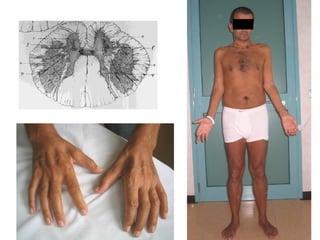
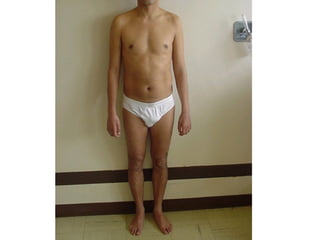
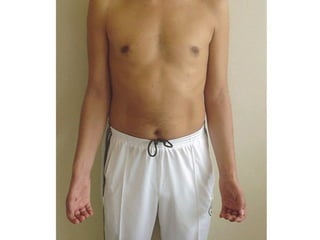
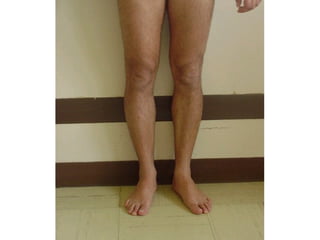
UMN-D
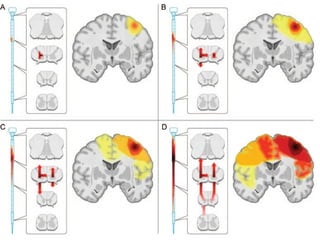
C.A: 41 years
4 years after the onset
Eterogeneità fenotipica della SLA
 Età di esordio
 Durata di malattia
 Combinazione relativa di segni di UMN e LMN
 Sede di esordio (bulbare vs spinale)
 Condizioni associate: FTD, Parkinson, psicosi, neuropatia, miopatia,
coinvolgimento del sistema autonomico
Eterogeneità fenotipica della SLA
 Età di esordio
 Durata di malattia (forme a lenta progressione vs forme aggressive)
 Combinazione relativa di segni di UMN e LMN
 Sede di esordio (bulbare vs spinale)
 Condizioni associate: FTD, Parkinson, psicosi, neuropatia, miopatia,
coinvolgimento del sistema autonomico
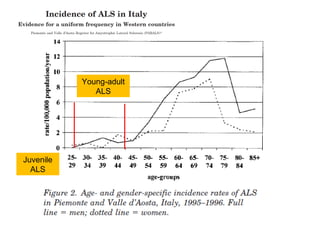
Juvenile
ALS
Young-adult
ALS
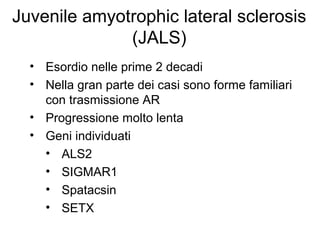
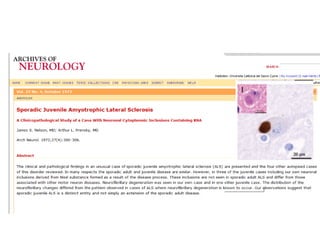
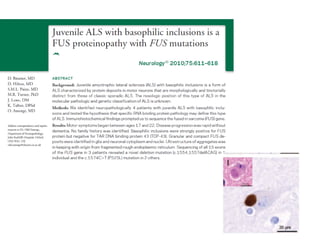
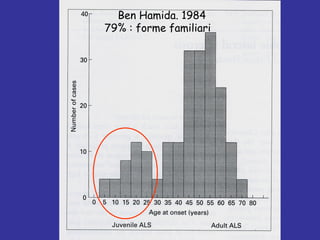
Juvenile amyotrophic lateral sclerosis
(JALS)
• Esordio nelle prime 2 decadi
• Nella gran parte dei casi sono forme familiari
con trasmissione AR
• Progressione molto lenta
• Geni individuati
• ALS2
• SIGMAR1
• Spatacsin
• SETX
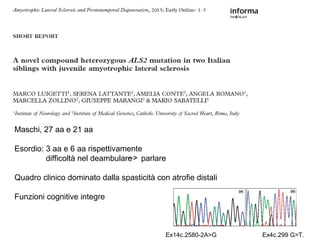
Ex14c.2580-2A>G Ex4c.299 G>T.
Maschi, 27 aa e 21 aa
Esordio: 3 aa e 6 aa rispettivamente
difficoltà nel deambulare parlare
Quadro clinico dominato dalla spasticità con atrofie distali
Funzioni cognitive integre
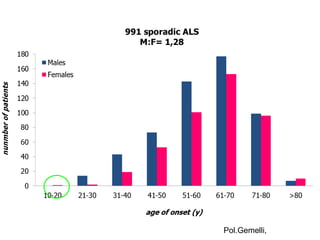
Pol.Gemelli,
Pol.Gemelli,
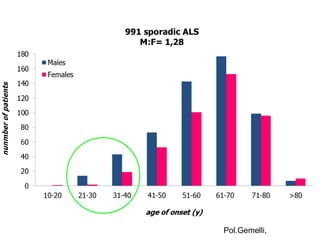
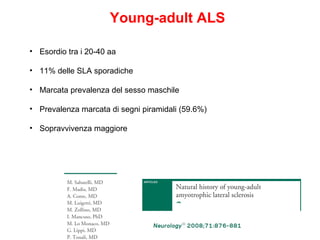
Young-adult ALS
• Esordio tra i 20-40 aa
• 11% delle SLA sporadiche
• Marcata prevalenza del sesso maschile
• Prevalenza marcata di segni piramidali (59.6%)
• Sopravvivenza maggiore
Eterogeneità fenotipica della SLA
 Età di esordio
 Durata di malattia (forme a lenta progressione vs forme aggressive)
 Combinazione relativa di segni di UMN e LMN
 Sede di esordio (bulbare vs spinale)
 Condizioni associate: FTD, Parkinson, psicosi, neuropatia, miopatia,
coinvolgimento del sistema nervoso autonomico
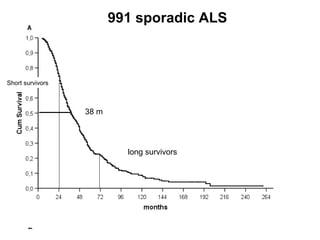
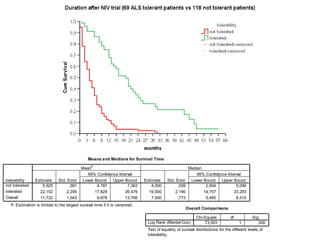
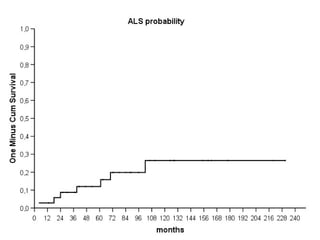
38 m
Short survivors
long survivors
991 sporadic ALS
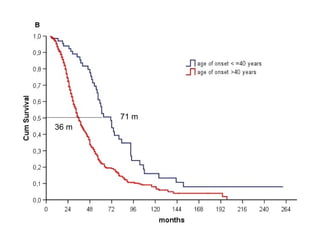
71 m
36 m
Means and Medians for Survival Time
5,925 ,581 4,787 7,063 4,000 ,559 2,904 5,096
22,152 2,206 17,828 26,476 19,000 2,190 14,707 23,293
11,722 1,043 9,678 13,766 7,000 ,773 5,485 8,515
tolerability
not tolerated
tolerated
Overall
Estimate Std. Error Lower Bound Upper Bound
95% Confidence Interval
Estimate Std. Error Lower Bound Upper Bound
95% Confidence Interval
Mean
a
Median
Estimation is limited to the largest survival time if it is censored.a.
Overall Comparisons
73,503 1 ,000Log Rank (Mantel-Cox)
Chi-Square df Sig.
Test of equality of survival distributions for the different levels of
tolerability.
Eterogeneità fenotipica della SLA
 Età di esordio
 Durata di malattia (forme a lenta progressione vs forme aggressive)
 Combinazione relativa di segni di UMN e LMN
 Sede di esordio (bulbare vs spinale)
 Condizioni associate: FTD, Parkinson, psicosi, neuropatia,
miopatia,coinvolgimento del sistema autonomico
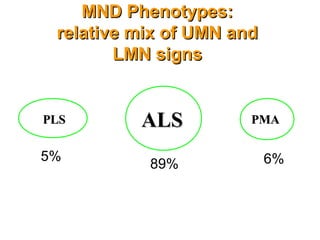
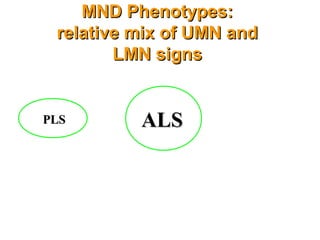
MND Phenotypes:MND Phenotypes:
relative mix of UMN andrelative mix of UMN and
LMN signsLMN signs
ALSALS PMAPMAPLSPLS
6%5%
89%
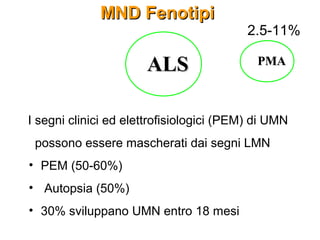
MND FenotipiMND Fenotipi
ALSALS PMAPMA
I segni clinici ed elettrofisiologici (PEM) di UMN
possono essere mascherati dai segni LMN
• PEM (50-60%)
• Autopsia (50%)
• 30% sviluppano UMN entro 18 mesi
2.5-11%
MND Phenotypes:MND Phenotypes:
relative mix of UMN andrelative mix of UMN and
LMN signsLMN signs
ALSALSPLSPLS
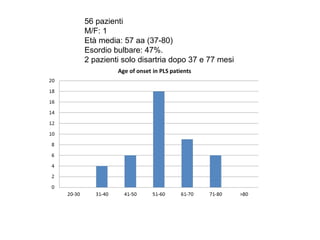
56 pazienti
M/F: 1
Età media: 57 aa (37-80)
Esordio bulbare: 47%.
2 pazienti solo disartria dopo 37 e 77 mesi
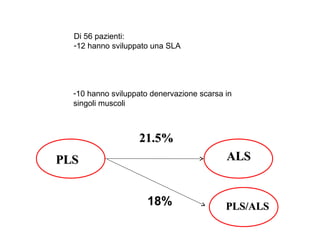
PLSPLS ALSALS
21.5%21.5%
Di 56 pazienti:
-12 hanno sviluppato una SLA
18% PLS/ALSPLS/ALS
-10 hanno sviluppato denervazione scarsa in
singoli muscoli
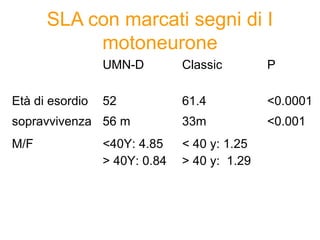
SLA con marcati segni di I
motoneurone
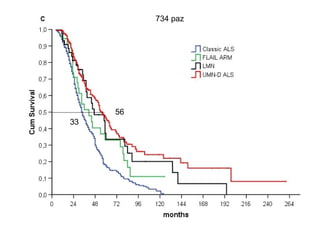
UMN-D Classic P
Età di esordio 52 61.4 <0.0001
sopravvivenza 56 m 33m <0.001
M/F <40Y: 4.85
> 40Y: 0.84
< 40 y: 1.25
> 40 y: 1.29
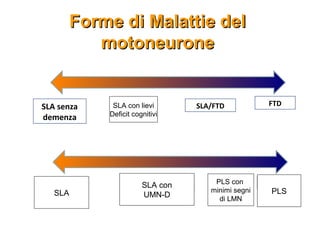
Forme di Malattie delForme di Malattie del
motoneuronemotoneurone
SLA senza
demenza
FTDSLA/FTD
SLA senza
demenza
FTDSLA/FTD
PLSSLA
PLS con
minimi segni
di LMN
SLA con
UMN-D
SLA con lievi
Deficit cognitivi
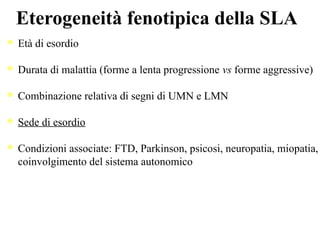
Eterogeneità fenotipica della SLA
 Età di esordio
 Durata di malattia (forme a lenta progressione vs forme aggressive)
 Combinazione relativa di segni di UMN e LMN
 Sede di esordio
 Condizioni associate: FTD, Parkinson, psicosi, neuropatia, miopatia,
coinvolgimento del sistema autonomico
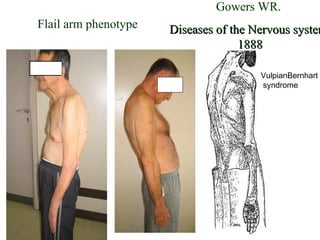
Gowers WR.
Diseases of the Nervous systemDiseases of the Nervous system
18881888
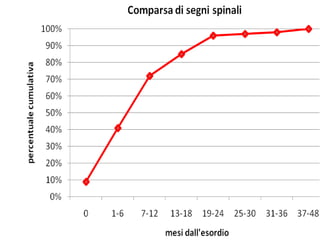
Flail arm phenotype
VulpianBernhart
syndrome
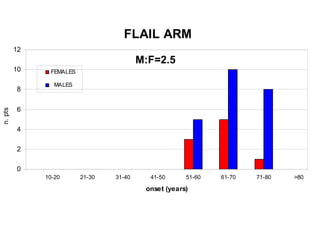
FLAIL ARM
0
2
4
6
8
10
12
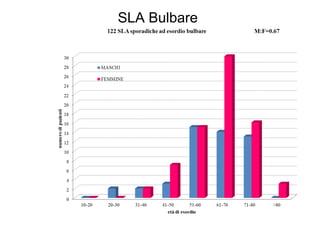
10-20 21-30 31-40 41-50 51-60 61-70 71-80 >80
onset (years)
n.pts….
FEMALES
MALES
M:F=2.5
734 paz
56
33
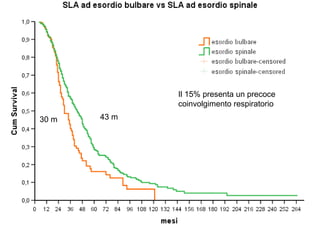
SLA Bulbare
43 m30 m
Il 15% presenta un precoce
coinvolgimento respiratorio
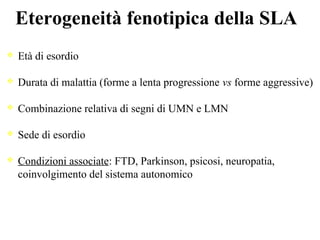
Eterogeneità fenotipica della SLA
 Età di esordio
 Durata di malattia (forme a lenta progressione vs forme aggressive)
 Combinazione relativa di segni di UMN e LMN
 Sede di esordio
 Condizioni associate: FTD, Parkinson, psicosi, neuropatia,
coinvolgimento del sistema autonomico
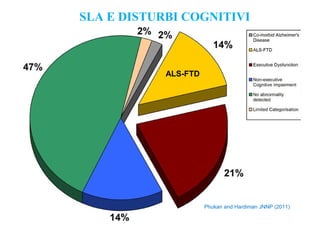
SLA E DISTURBI COGNITIVI
ALS-FTD
Phukan and Hardiman JNNP (2011)
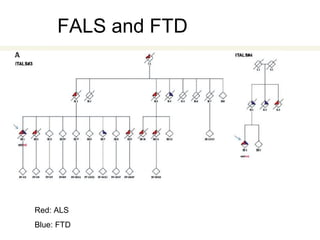
FALS and FTD
Red: ALS
Blue: FTD
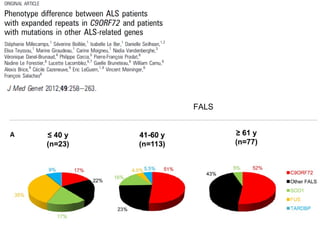
FALS
FUS
C9ORF72
SOD1
TARDBP
UNKNOWN
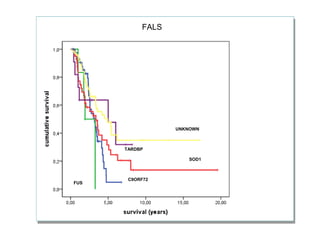
FALS
PLSPLS ALSALS
38%38%
1/3 dopo 4 anni1/3 dopo 4 anni
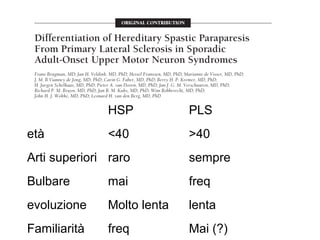
HSP PLS
età <40 >40
Arti superiori raro sempre
Bulbare mai freq
evoluzione Molto lenta lenta
Familiarità freq Mai (?)
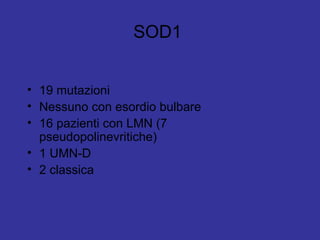
SOD1
• 19 mutazioni
• Nessuno con esordio bulbare
• 16 pazienti con LMN (7
pseudopolinevritiche)
• 1 UMN-D
• 2 classica
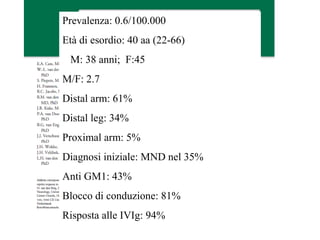
Prevalenza: 0.6/100.000
Età di esordio: 40 aa (22-66)
M: 38 anni; F:45
M/F: 2.7
Distal arm: 61%
Distal leg: 34%
Proximal arm: 5%
Diagnosi iniziale: MND nel 35%
Anti GM1: 43%
Blocco di conduzione: 81%
Risposta alle IVIg: 94%
Ben Hamida. 1984
79% : forme familiari
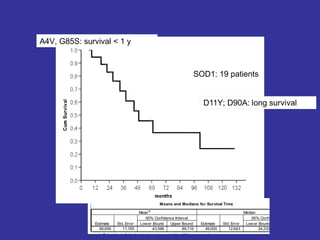
Means and Medians for Survival Time
66,656 11,765 43,596 89,716 49,000 12,643 24,220 73,780
Estimate Std. Error Lower Bound Upper Bound
95% Confidence Interval
Estimate Std. Error Lower Bound Upper Bound
95% Confidence Interval
Mean
a
Median
Estimation is limited to the largest survival time if it is censored.a.
SOD1: 19 patients
A4V, G85S: survival < 1 y
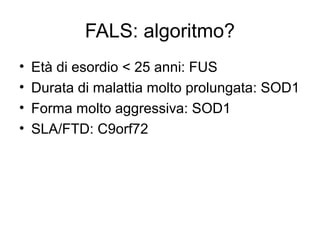
FALS: algoritmo?
• Età di esordio < 25 anni: FUS
• Durata di malattia molto prolungata: SOD1
• Forma molto aggressiva: SOD1
• SLA/FTD: C9orf72

Ldb valecoricerca_sabatelli_clinica

  • 1.
    Centro di RiferimentoRegionale per la Sclerosi Laterale Amiotrofica SLA: i fenotipi
  • 2.
    UMN-D C.A: 41 years 4years after the onset
  • 3.
    Eterogeneità fenotipica dellaSLA  Età di esordio  Durata di malattia  Combinazione relativa di segni di UMN e LMN  Sede di esordio (bulbare vs spinale)  Condizioni associate: FTD, Parkinson, psicosi, neuropatia, miopatia, coinvolgimento del sistema autonomico
  • 4.
    Eterogeneità fenotipica dellaSLA  Età di esordio  Durata di malattia (forme a lenta progressione vs forme aggressive)  Combinazione relativa di segni di UMN e LMN  Sede di esordio (bulbare vs spinale)  Condizioni associate: FTD, Parkinson, psicosi, neuropatia, miopatia, coinvolgimento del sistema autonomico
  • 5.
  • 6.
    Juvenile amyotrophic lateralsclerosis (JALS) • Esordio nelle prime 2 decadi • Nella gran parte dei casi sono forme familiari con trasmissione AR • Progressione molto lenta • Geni individuati • ALS2 • SIGMAR1 • Spatacsin • SETX
  • 7.
    Ex14c.2580-2A>G Ex4c.299 G>T. Maschi,27 aa e 21 aa Esordio: 3 aa e 6 aa rispettivamente difficoltà nel deambulare parlare Quadro clinico dominato dalla spasticità con atrofie distali Funzioni cognitive integre
  • 8.
  • 12.
  • 13.
    Young-adult ALS • Esordiotra i 20-40 aa • 11% delle SLA sporadiche • Marcata prevalenza del sesso maschile • Prevalenza marcata di segni piramidali (59.6%) • Sopravvivenza maggiore
  • 14.
    Eterogeneità fenotipica dellaSLA  Età di esordio  Durata di malattia (forme a lenta progressione vs forme aggressive)  Combinazione relativa di segni di UMN e LMN  Sede di esordio (bulbare vs spinale)  Condizioni associate: FTD, Parkinson, psicosi, neuropatia, miopatia, coinvolgimento del sistema nervoso autonomico
  • 15.
    38 m Short survivors longsurvivors 991 sporadic ALS
  • 16.
  • 18.
    Means and Mediansfor Survival Time 5,925 ,581 4,787 7,063 4,000 ,559 2,904 5,096 22,152 2,206 17,828 26,476 19,000 2,190 14,707 23,293 11,722 1,043 9,678 13,766 7,000 ,773 5,485 8,515 tolerability not tolerated tolerated Overall Estimate Std. Error Lower Bound Upper Bound 95% Confidence Interval Estimate Std. Error Lower Bound Upper Bound 95% Confidence Interval Mean a Median Estimation is limited to the largest survival time if it is censored.a. Overall Comparisons 73,503 1 ,000Log Rank (Mantel-Cox) Chi-Square df Sig. Test of equality of survival distributions for the different levels of tolerability.
  • 19.
    Eterogeneità fenotipica dellaSLA  Età di esordio  Durata di malattia (forme a lenta progressione vs forme aggressive)  Combinazione relativa di segni di UMN e LMN  Sede di esordio (bulbare vs spinale)  Condizioni associate: FTD, Parkinson, psicosi, neuropatia, miopatia,coinvolgimento del sistema autonomico
  • 20.
    MND Phenotypes:MND Phenotypes: relativemix of UMN andrelative mix of UMN and LMN signsLMN signs ALSALS PMAPMAPLSPLS 6%5% 89%
  • 21.
    MND FenotipiMND Fenotipi ALSALSPMAPMA I segni clinici ed elettrofisiologici (PEM) di UMN possono essere mascherati dai segni LMN • PEM (50-60%) • Autopsia (50%) • 30% sviluppano UMN entro 18 mesi 2.5-11%
  • 22.
    MND Phenotypes:MND Phenotypes: relativemix of UMN andrelative mix of UMN and LMN signsLMN signs ALSALSPLSPLS
  • 24.
    56 pazienti M/F: 1 Etàmedia: 57 aa (37-80) Esordio bulbare: 47%. 2 pazienti solo disartria dopo 37 e 77 mesi
  • 25.
    PLSPLS ALSALS 21.5%21.5% Di 56pazienti: -12 hanno sviluppato una SLA 18% PLS/ALSPLS/ALS -10 hanno sviluppato denervazione scarsa in singoli muscoli
  • 31.
    SLA con marcatisegni di I motoneurone UMN-D Classic P Età di esordio 52 61.4 <0.0001 sopravvivenza 56 m 33m <0.001 M/F <40Y: 4.85 > 40Y: 0.84 < 40 y: 1.25 > 40 y: 1.29
  • 32.
    Forme di MalattiedelForme di Malattie del motoneuronemotoneurone SLA senza demenza FTDSLA/FTD SLA senza demenza FTDSLA/FTD PLSSLA PLS con minimi segni di LMN SLA con UMN-D SLA con lievi Deficit cognitivi
  • 33.
    Eterogeneità fenotipica dellaSLA  Età di esordio  Durata di malattia (forme a lenta progressione vs forme aggressive)  Combinazione relativa di segni di UMN e LMN  Sede di esordio  Condizioni associate: FTD, Parkinson, psicosi, neuropatia, miopatia, coinvolgimento del sistema autonomico
  • 35.
    Gowers WR. Diseases ofthe Nervous systemDiseases of the Nervous system 18881888 Flail arm phenotype VulpianBernhart syndrome
  • 36.
    FLAIL ARM 0 2 4 6 8 10 12 10-20 21-3031-40 41-50 51-60 61-70 71-80 >80 onset (years) n.pts…. FEMALES MALES M:F=2.5
  • 37.
  • 40.
  • 41.
    43 m30 m Il15% presenta un precoce coinvolgimento respiratorio
  • 42.
    Eterogeneità fenotipica dellaSLA  Età di esordio  Durata di malattia (forme a lenta progressione vs forme aggressive)  Combinazione relativa di segni di UMN e LMN  Sede di esordio  Condizioni associate: FTD, Parkinson, psicosi, neuropatia, coinvolgimento del sistema autonomico
  • 43.
    SLA E DISTURBICOGNITIVI ALS-FTD Phukan and Hardiman JNNP (2011)
  • 44.
    FALS and FTD Red:ALS Blue: FTD
  • 45.
  • 46.
  • 47.
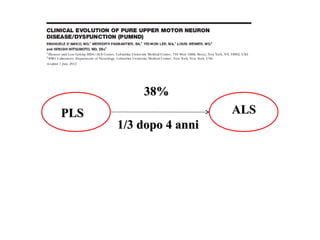
    PLSPLS ALSALS 38%38% 1/3 dopo4 anni1/3 dopo 4 anni
  • 48.
    HSP PLS età <40>40 Arti superiori raro sempre Bulbare mai freq evoluzione Molto lenta lenta Familiarità freq Mai (?)
  • 49.
    SOD1 • 19 mutazioni •Nessuno con esordio bulbare • 16 pazienti con LMN (7 pseudopolinevritiche) • 1 UMN-D • 2 classica
  • 50.
    Prevalenza: 0.6/100.000 Età diesordio: 40 aa (22-66) M: 38 anni; F:45 M/F: 2.7 Distal arm: 61% Distal leg: 34% Proximal arm: 5% Diagnosi iniziale: MND nel 35% Anti GM1: 43% Blocco di conduzione: 81% Risposta alle IVIg: 94%
  • 51.
    Ben Hamida. 1984 79%: forme familiari
  • 52.
    Means and Mediansfor Survival Time 66,656 11,765 43,596 89,716 49,000 12,643 24,220 73,780 Estimate Std. Error Lower Bound Upper Bound 95% Confidence Interval Estimate Std. Error Lower Bound Upper Bound 95% Confidence Interval Mean a Median Estimation is limited to the largest survival time if it is censored.a. SOD1: 19 patients A4V, G85S: survival < 1 y
  • 53.
    FALS: algoritmo? • Etàdi esordio < 25 anni: FUS • Durata di malattia molto prolungata: SOD1 • Forma molto aggressiva: SOD1 • SLA/FTD: C9orf72

Editor's Notes

  • #2 ALS is a neurodegenerative condition that targets primarily motor neurons, resulting in progressive paralysis and death within a few years from onset. Just like Alzheimer, Parkinson, and other neurodegenerative diseases, a proportion (10%) of ALS is dominantly inherited, with the remaining 90% (referred to as sporadic) of unknown origin. The identification in 1993 of mutation in the gene encoding superoxide dismutase 1 (SOD1) as the first or second most common form of inherited ALS (Rosen et al., 1993), and subsequent generation of transgenic mice expressing ALS-causing mutants in SOD1, initiated the molecular era of deciphering disease mechanism.
  • #3 He is the father of the “anatomo-clinical method.” by which he attempted to to determine the correlation between clinical signs detected during life and anatomical lesions seen at autopsy
  • #4 On the other hand , clinical heterogeneity is a recognized feature of the disease, with respect to several factor, the most important being age of onset and survival. It shoul be considered that topographic distribution of the clinical signs, duration of the disease, and age at onset. Based on the clinical pattern in the initial phases of illness, different variants have been described, including spinal, bulbar, and pseudoneuritic forms,4 flail arm syndrome,5 and Mill’s hemiparetic type.6 Most patients dis- There are no clear boundaries among ALS clinical phenotypes, since they represent points on a spectrum and each form may have multiple aetiologies as suggested by genetic studies in FALS. Nevertheless, efforts to better clarify different clinical categories may be helpful for properly addressing biological research. .
  • #5 On the other hand , clinical heterogeneity is a recognized feature of the disease, with respect to several factor, the most important being age of onset and survival. It shoul be considered that topographic distribution of the clinical signs, duration of the disease, and age at onset. Based on the clinical pattern in the initial phases of illness, different variants have been described, including spinal, bulbar, and pseudoneuritic forms,4 flail arm syndrome,5 and Mill’s hemiparetic type.6 Most patients dis- There are no clear boundaries among ALS clinical phenotypes, since they represent points on a spectrum and each form may have multiple aetiologies as suggested by genetic studies in FALS. Nevertheless, efforts to better clarify different clinical categories may be helpful for properly addressing biological research. .
  • #8 In conclusion, we describe the fi rst case of compound heterozygosity in the ALS2 gene in Italian patients, thus adding two novel mutations among those already described. ALS2 gene mutations should be suspected in all cases with an early onset motor neuron disease with a predominant/exclusive upper motor neuron involvement.
  • #15 On the other hand , clinical heterogeneity is a recognized feature of the disease, with respect to several factor, the most important being age of onset and survival. It shoul be considered that topographic distribution of the clinical signs, duration of the disease, and age at onset. Based on the clinical pattern in the initial phases of illness, different variants have been described, including spinal, bulbar, and pseudoneuritic forms,4 flail arm syndrome,5 and Mill’s hemiparetic type.6 Most patients dis- There are no clear boundaries among ALS clinical phenotypes, since they represent points on a spectrum and each form may have multiple aetiologies as suggested by genetic studies in FALS. Nevertheless, efforts to better clarify different clinical categories may be helpful for properly addressing biological research. .
  • #19 Non tollerata, rifiutata, dall’inizio trial
  • #20 On the other hand , clinical heterogeneity is a recognized feature of the disease, with respect to several factor, the most important being age of onset and survival. It shoul be considered that topographic distribution of the clinical signs, duration of the disease, and age at onset. Based on the clinical pattern in the initial phases of illness, different variants have been described, including spinal, bulbar, and pseudoneuritic forms,4 flail arm syndrome,5 and Mill’s hemiparetic type.6 Most patients dis- There are no clear boundaries among ALS clinical phenotypes, since they represent points on a spectrum and each form may have multiple aetiologies as suggested by genetic studies in FALS. Nevertheless, efforts to better clarify different clinical categories may be helpful for properly addressing biological research. .
  • #29 It’s nòticeable that the clinical presentation in the remaining 26 pts is really stereotypied in that the peculiar characteristics are
  • #30 Bilateral and almost contemporarely wasting and weakness of the distal mus©les at the very beginning of the disease.
  • #34 On the other hand , clinical heterogeneity is a recognized feature of the disease, with respect to several factor, the most important being age of onset and survival. It shoul be considered that topographic distribution of the clinical signs, duration of the disease, and age at onset. Based on the clinical pattern in the initial phases of illness, different variants have been described, including spinal, bulbar, and pseudoneuritic forms,4 flail arm syndrome,5 and Mill’s hemiparetic type.6 Most patients dis- There are no clear boundaries among ALS clinical phenotypes, since they represent points on a spectrum and each form may have multiple aetiologies as suggested by genetic studies in FALS. Nevertheless, efforts to better clarify different clinical categories may be helpful for properly addressing biological research. .
  • #43 On the other hand , clinical heterogeneity is a recognized feature of the disease, with respect to several factor, the most important being age of onset and survival. It shoul be considered that topographic distribution of the clinical signs, duration of the disease, and age at onset. Based on the clinical pattern in the initial phases of illness, different variants have been described, including spinal, bulbar, and pseudoneuritic forms,4 flail arm syndrome,5 and Mill’s hemiparetic type.6 Most patients dis- There are no clear boundaries among ALS clinical phenotypes, since they represent points on a spectrum and each form may have multiple aetiologies as suggested by genetic studies in FALS. Nevertheless, efforts to better clarify different clinical categories may be helpful for properly addressing biological research. .
  • #44 The syndrome of cognitive impairment in amyotrophic lateral sclerosis: a population-based study. Phukan J, Elamin M, Bede P, Jordan N, Gallagher L, Byrne S, Lynch C, Pender N, Hardiman O. Non-demented ALS patients were then divided into three groups based on the presence or absence of cognitive impairment and whether the executive domain was involved: 1. Impairment in executive dysfunction (ALS-Ex) single domain or in association with impairment in other cognitive domains (multidomain); 2. Non-executive cognitive impairment (ALS-NECI), single domain (eg, language only) or multidomain dysfunction (eg, language and memory); 3. No cognitive impairment.
  • #51 Prevalnza inferiore di 13 volte rispetto la SLA
  • #53 Sod1 sals e fals 19 casi