Asia’s Regulatory Developments1	Section 2
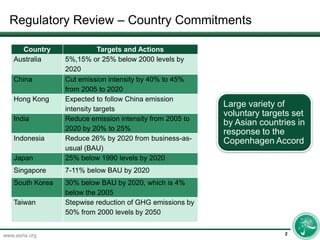
Regulatory Review – Country Commitments2
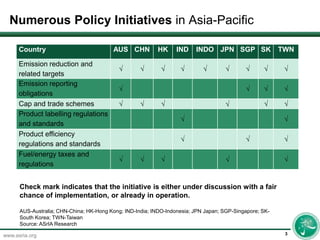
Numerous Policy Initiatives in Asia-Pacific3Check mark indicates that the initiative is either under discussion with a fair chance of implementation, or already in operation.AUS-Australia; CHN-China; HK-Hong Kong; IND-India; INDO-Indonesia; JPN Japan; SGP-Singapore; SK-South Korea; TWN-TaiwanSource: ASrIA Research
Please provide responses to the questions below4	This concludes Section 2.

LCIA Training Section 2

Editor's Notes

  • #2 Thanks for completing your responses for Section 1. Let’s move to section 2. Asia’s regulatory developmentsPlease continue.
  • #3 Governments in Asia are taking actions to respond to climate change. Investors need to be kept well informed of these regulatorydevelopments and the implications for their investments. The natural instincts of Asian governments are to encourage voluntary standards rather than legislative frameworks and there is no doubt that Asian governments have been dragging their feet over implementing legislation. However, the Korean and Taiwanese governments in particular have been engaged for some time now in industry dialogue; a process of moving towards the implementation of legislation has emerged.We want to provide a high level overview of climate change related regulatory and policy developments in the Asia-Pacific region. Following the climate change negotiations in Copenhagen in December 2009, countries in the Asia-Pacific region have set voluntary targets for reducing the carbon intensity of their respective economies. Slide 12 lists the targets and actions that Asian governments have committed to take under the Copenhagen Accord. A key point is that policymakers, although not in lockstep, are moving forward on regulatory changes to shift towards a low-carbon economy.Please continue.
  • #4 The variety of low carbon targets and initiatives in Asia Pacific is impressive. Slide 13 provides a quick overview of these policy directions.A check mark indicates that the initiative is either under discussion with a fair chance of implementation or already in operation.There are a range of policy initiatives under discussion with a fair chance of implementation or already in operation throughout Asia. From the top left of the table, these include GHG emission reduction and related targets, corporate GHG emission reporting obligations, cap and trade schemes, product carbon labelling regulations and standards, product efficiency regulations and standards, and fuel and energy taxes and regulations. You will notice that our selection of Asia-Pacific countries all have emission reduction and related targets. There are a wide variety of voluntary targets set by Asian countries in response to the Copenhagen Accord, as the previous slide indicated. India, for instance, intends to reduce emission intensity from 2005 to 2020 by twenty to twenty-five percent. Hong Kong, as a Special Administrative Region of the People’s Republic if China, does not technically have a seat at the climate negotiating table and therefore it is expected to follow China’s emission intensity targets.Of the six types of initiatives, we find that product labeling regulations and standards is the least widespread with only India and Taiwan considering its adoption.Please continue.
  • #5 We need you to answer the four questions below. You may go back to review the slides. After completing your answers, click next to continue. Once you click next you will not be able to come back to this section.Please continue.