LAW ENFORCEMENT
OPERATIONS
LECTURER: RAM CHRISTIAN C. DALIT, RCRI
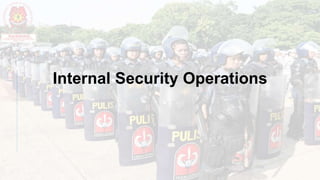
Internal Security Operations
GENERAL MANDATE
3
LAW
ENFORCEMENT
OPERATIONS
The PNP is mandated to provide active support to the
Armed Forces of the Philippines (AFP) in Internal
Security Operations (ISO) for the suppression of the
Communist Terrorist Movement (CTM) and other
serious threats to national security. (E.O. 546).
4
THE PNP IN AN ACTIVE
SUPPORT ROLE
LAW
ENFORCEMENT
OPERATIONS
The PNP shall perform the following:
1. Conduct sustained law enforcement actions against CTM
atrocities;
2. In urban areas, the PNP may assume the lead role in ISO
against the CTM, other threat groups and organized crime groups
engaged in armed offensives;
3. The PNP units may either operate as a single force or as a part
of joint PNP-AFP combat operations. In both cases, lateral
coordination is a must;
4. The PNP units in CTM-affected areas may be placed under
5
THE PNP IN AN ACTIVE
SUPPORT ROLE
LAW
ENFORCEMENT
OPERATIONS
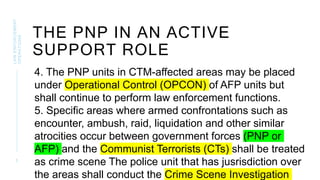
4. The PNP units in CTM-affected areas may be placed
under Operational Control (OPCON) of AFP units but
shall continue to perform law enforcement functions.
5. Specific areas where armed confrontations such as
encounter, ambush, raid, liquidation and other similar
atrocities occur between government forces (PNP or
AFP) and the Communist Terrorists (CTs) shall be treated
as crime scene The police unit that has jusrisdiction over
the areas shall conduct the Crime Scene Investigation
DEFENSIVE POSITION
6
PRESENTATION
TITLE
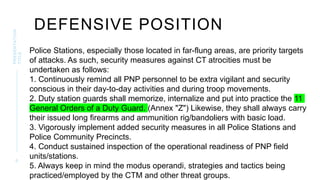
Police Stations, especially those located in far-flung areas, are priority targets
of attacks. As such, security measures against CT atrocities must be
undertaken as follows:
1. Continuously remind all PNP personnel to be extra vigilant and security
conscious in their day-to-day activities and during troop movements.
2. Duty station guards shall memorize, internalize and put into practice the 11
General Orders of a Duty Guard. (Annex "Z") Likewise, they shall always carry
their issued long firearms and ammunition rig/bandoliers with basic load.
3. Vigorously implement added security measures in all Police Stations and
Police Community Precincts.
4. Conduct sustained inspection of the operational readiness of PNP field
units/stations.
5. Always keep in mind the modus operandi, strategies and tactics being
practiced/employed by the CTM and other threat groups.
7
PRESENTATION
TITLE
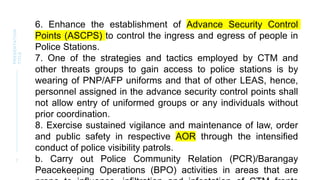
6. Enhance the establishment of Advance Security Control
Points (ASCPS) to control the ingress and egress of people in
Police Stations.
7. One of the strategies and tactics employed by CTM and
other threats groups to gain access to police stations is by
wearing of PNP/AFP uniforms and that of other LEAS, hence,
personnel assigned in the advance security control points shall
not allow entry of uniformed groups or any individuals without
prior coordination.
8. Exercise sustained vigilance and maintenance of law, order
and public safety in respective AOR through the intensified
conduct of police visibility patrols.
b. Carry out Police Community Relation (PCR)/Barangay
Peacekeeping Operations (BPO) activities in areas that are
8
PRESENTATION
TITLE
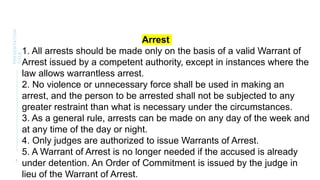
Arrest
1. All arrests should be made only on the basis of a valid Warrant of
Arrest issued by a competent authority, except in instances where the
law allows warrantless arrest.
2. No violence or unnecessary force shall be used in making an
arrest, and the person to be arrested shall not be subjected to any
greater restraint than what is necessary under the circumstances.
3. As a general rule, arrests can be made on any day of the week and
at any time of the day or night.
4. Only judges are authorized to issue Warrants of Arrest.
5. A Warrant of Arrest is no longer needed if the accused is already
under detention. An Order of Commitment is issued by the judge in
lieu of the Warrant of Arrest.
9
PRESENTATION
TITLE
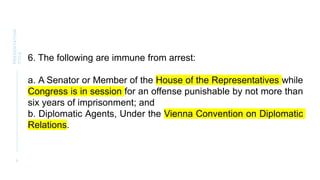
6. The following are immune from arrest:
a. A Senator or Member of the House of the Representatives while
Congress is in session for an offense punishable by not more than
six years of imprisonment; and
b. Diplomatic Agents, Under the Vienna Convention on Diplomatic
Relations.
1 0
PRESENTATION
TITLE
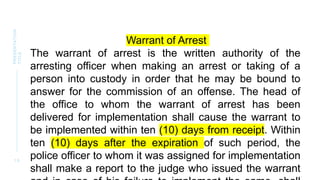
Warrant of Arrest
The warrant of arrest is the written authority of the
arresting officer when making an arrest or taking of a
person into custody in order that he may be bound to
answer for the commission of an offense. The head of
the office to whom the warrant of arrest has been
delivered for implementation shall cause the warrant to
be implemented within ten (10) days from receipt. Within
ten (10) days after the expiration of such period, the
police officer to whom it was assigned for implementation
shall make a report to the judge who issued the warrant
1 1
PRESENTATION
TITLE
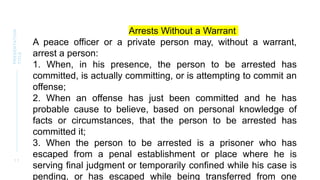
Arrests Without a Warrant
A peace officer or a private person may, without a warrant,
arrest a person:
1. When, in his presence, the person to be arrested has
committed, is actually committing, or is attempting to commit an
offense;
2. When an offense has just been committed and he has
probable cause to believe, based on personal knowledge of
facts or circumstances, that the person to be arrested has
committed it;
3. When the person to be arrested is a prisoner who has
escaped from a penal establishment or place where he is
serving final judgment or temporarily confined while his case is
pending, or has escaped while being transferred from one
1 2
PRESENTATION
TITLE
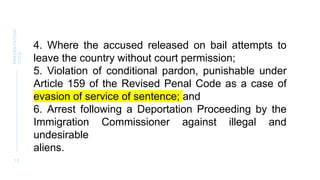
4. Where the accused released on bail attempts to
leave the country without court permission;
5. Violation of conditional pardon, punishable under
Article 159 of the Revised Penal Code as a case of
evasion of service of sentence; and
6. Arrest following a Deportation Proceeding by the
Immigration Commissioner against illegal and
undesirable
aliens.
1 3
PRESENTATION
TITLE
Authority of the Arresting Officer when Making an
Arrest
1. Police officer may summon assistance making a
lawful arrest may verbally summon as many persons
as he deems necessary to assist him in effecting the
arrest.
2. Right of a police officer to break into building or
enclosure -A police officer in order to make an arrest,
with or without warrant, may break into a building or
enclosure where the person to be arrested is or is
reasonably believed to be, if he is refused admittance
1 4
PRESENTATION
TITLE
3. Right to break out from building or enclosure - Whenever a
police officer has entered the building or enclosure to make an
arrest, he may break out there from, when necessary, to liberate
himself.
4. Arrest after escape or rescue - If a person lawfully arrested
escapes or is rescued, any person may immediately pursue to
retake him without a warrant at anytime and in any place within
the Philippines.
1 5
PRESENTATION
TITLE
Procedures
Serving of Warrant of Arrest
1. Verify the validity of the warrant and request for an
authenticated copy from the issuing court;
2. In serving the warrant, the police officer should introduce
himself and show proper identification;
3. Make a manifestation of authority against the person to be
Jo no arrested;
4. If refused entry, the police officer may break into any
residence, office, building, and other structure where the
person to be arrested is in or is reasonably believed to be in,
after announcing his purpose;
1 6
PRESENTATION
TITLE
5. The police officer need not have a copy of the warrant in his
possession at the time of the arrest. If the person arrested so requires,
the warrant shall be shown to the arrested person as soon as possible;
6. Secure the person to be arrested and use handcuffs for the protection
of the arresting officer, other individuals or the arrested person himself;
7. Conduct thorough search for weapons and other illegal materials on
the person arrested and surroundings within
his immediate control;
8. Inform the person to be arrested of his rights under the law (i.e.
Miranda Warning and Anti-torture Warning);
9. No unnecessary force shall be used in making an arrest;
10. Confiscated evidence shall be properly documented with the chain of
custody of evidence duly and clearly established;
1 7
PRESENTATION
TITLE
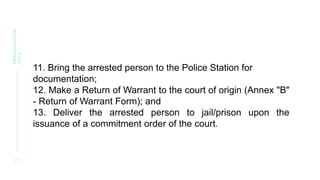
11. Bring the arrested person to the Police Station for
documentation;
12. Make a Return of Warrant to the court of origin (Annex "B"
- Return of Warrant Form); and
13. Deliver the arrested person to jail/prison upon the
issuance of a commitment order of the court.
1 8
PRESENTATION
TITLE
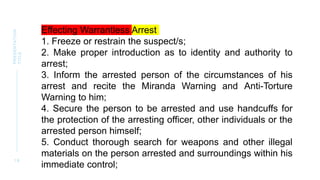
Effecting Warrantless Arrest
1. Freeze or restrain the suspect/s;
2. Make proper introduction as to identity and authority to
arrest;
3. Inform the arrested person of the circumstances of his
arrest and recite the Miranda Warning and Anti-Torture
Warning to him;
4. Secure the person to be arrested and use handcuffs for
the protection of the arresting officer, other individuals or the
arrested person himself;
5. Conduct thorough search for weapons and other illegal
materials on the person arrested and surroundings within his
immediate control;
1 9
PRESENTATION
TITLE
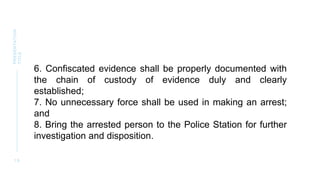
6. Confiscated evidence shall be properly documented with
the chain of custody of evidence duly and clearly
established;
7. No unnecessary force shall be used in making an arrest;
and
8. Bring the arrested person to the Police Station for further
investigation and disposition.
2 0
PRESENTATION
TITLE
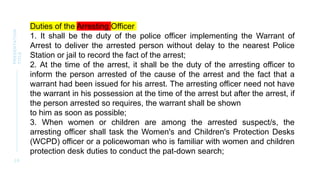
Duties of the Arresting Officer
1. It shall be the duty of the police officer implementing the Warrant of
Arrest to deliver the arrested person without delay to the nearest Police
Station or jail to record the fact of the arrest;
2. At the time of the arrest, it shall be the duty of the arresting officer to
inform the person arrested of the cause of the arrest and the fact that a
warrant had been issued for his arrest. The arresting officer need not have
the warrant in his possession at the time of the arrest but after the arrest, if
the person arrested so requires, the warrant shall be shown
to him as soon as possible;
3. When women or children are among the arrested suspect/s, the
arresting officer shall task the Women's and Children's Protection Desks
(WCPD) officer or a policewoman who is familiar with women and children
protection desk duties to conduct the pat-down search;
2 1
PRESENTATION
TITLE 4. In case of arrest without a warrant, it shall be the duty of the
arresting officer to inform the person to be arrested of his
authority and the cause of the arrest except when he flees or
forcibly resists before the arresting officer has the opportunity to
inform him or when the giving of such information will imperil
the arrest;
5. The person arrested, with or without warrant, shall be
informed of his constitutional right to remain silent and that any
statement he makes could be used against him. Also, that he
has the right to communicate with his lawyer or his immediate
family and the right to physical examination;
6. A person arrested without a warrant shall be immediately
brought to the proper Police Station for investigation without
unnecessary delay. He shall be subjected to inquest
2 2
PRESENTATION
TITLE
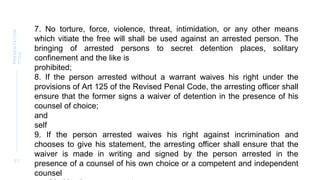
7. No torture, force, violence, threat, intimidation, or any other means
which vitiate the free will shall be used against an arrested person. The
bringing of arrested persons to secret detention places, solitary
confinement and the like is
prohibited;
8. If the person arrested without a warrant waives his right under the
provisions of Art 125 of the Revised Penal Code, the arresting officer shall
ensure that the former signs a waiver of detention in the presence of his
counsel of choice;
and
self
9. If the person arrested waives his right against incrimination and
chooses to give his statement, the arresting officer shall ensure that the
waiver is made in writing and signed by the person arrested in the
presence of a counsel of his own choice or a competent and independent
counsel
2 3
PRESENTATION
TITLE
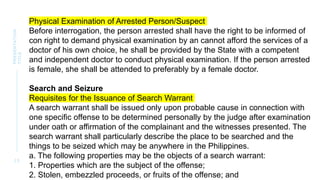
Physical Examination of Arrested Person/Suspect
Before interrogation, the person arrested shall have the right to be informed of
con right to demand physical examination by an cannot afford the services of a
doctor of his own choice, he shall be provided by the State with a competent
and independent doctor to conduct physical examination. If the person arrested
is female, she shall be attended to preferably by a female doctor.
Search and Seizure
Requisites for the Issuance of Search Warrant
A search warrant shall be issued only upon probable cause in connection with
one specific offense to be determined personally by the judge after examination
under oath or affirmation of the complainant and the witnesses presented. The
search warrant shall particularly describe the place to be searched and the
things to be seized which may be anywhere in the Philippines.
a. The following properties may be the objects of a search warrant:
1. Properties which are the subject of the offense;
2. Stolen, embezzled proceeds, or fruits of the offense; and
2 4
PRESENTATION
TITLE
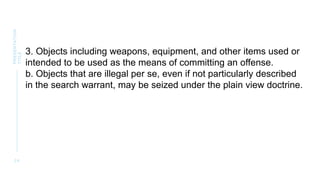
3. Objects including weapons, equipment, and other items used or
intended to be used as the means of committing an offense.
b. Objects that are illegal per se, even if not particularly described
in the search warrant, may be seized under the plain view doctrine.
THANK YOU FOR LISTENING!
2 5
PRESENTATION
TITLE

Law Enforcement Operations Operations w/ Crime Mapping

  • 1.
  • 2.
  • 3.
    GENERAL MANDATE 3 LAW ENFORCEMENT OPERATIONS The PNPis mandated to provide active support to the Armed Forces of the Philippines (AFP) in Internal Security Operations (ISO) for the suppression of the Communist Terrorist Movement (CTM) and other serious threats to national security. (E.O. 546).
  • 4.
    4 THE PNP INAN ACTIVE SUPPORT ROLE LAW ENFORCEMENT OPERATIONS The PNP shall perform the following: 1. Conduct sustained law enforcement actions against CTM atrocities; 2. In urban areas, the PNP may assume the lead role in ISO against the CTM, other threat groups and organized crime groups engaged in armed offensives; 3. The PNP units may either operate as a single force or as a part of joint PNP-AFP combat operations. In both cases, lateral coordination is a must; 4. The PNP units in CTM-affected areas may be placed under
  • 5.
    5 THE PNP INAN ACTIVE SUPPORT ROLE LAW ENFORCEMENT OPERATIONS 4. The PNP units in CTM-affected areas may be placed under Operational Control (OPCON) of AFP units but shall continue to perform law enforcement functions. 5. Specific areas where armed confrontations such as encounter, ambush, raid, liquidation and other similar atrocities occur between government forces (PNP or AFP) and the Communist Terrorists (CTs) shall be treated as crime scene The police unit that has jusrisdiction over the areas shall conduct the Crime Scene Investigation
  • 6.
    DEFENSIVE POSITION 6 PRESENTATION TITLE Police Stations,especially those located in far-flung areas, are priority targets of attacks. As such, security measures against CT atrocities must be undertaken as follows: 1. Continuously remind all PNP personnel to be extra vigilant and security conscious in their day-to-day activities and during troop movements. 2. Duty station guards shall memorize, internalize and put into practice the 11 General Orders of a Duty Guard. (Annex "Z") Likewise, they shall always carry their issued long firearms and ammunition rig/bandoliers with basic load. 3. Vigorously implement added security measures in all Police Stations and Police Community Precincts. 4. Conduct sustained inspection of the operational readiness of PNP field units/stations. 5. Always keep in mind the modus operandi, strategies and tactics being practiced/employed by the CTM and other threat groups.
  • 7.
    7 PRESENTATION TITLE 6. Enhance theestablishment of Advance Security Control Points (ASCPS) to control the ingress and egress of people in Police Stations. 7. One of the strategies and tactics employed by CTM and other threats groups to gain access to police stations is by wearing of PNP/AFP uniforms and that of other LEAS, hence, personnel assigned in the advance security control points shall not allow entry of uniformed groups or any individuals without prior coordination. 8. Exercise sustained vigilance and maintenance of law, order and public safety in respective AOR through the intensified conduct of police visibility patrols. b. Carry out Police Community Relation (PCR)/Barangay Peacekeeping Operations (BPO) activities in areas that are
  • 8.
    8 PRESENTATION TITLE Arrest 1. All arrestsshould be made only on the basis of a valid Warrant of Arrest issued by a competent authority, except in instances where the law allows warrantless arrest. 2. No violence or unnecessary force shall be used in making an arrest, and the person to be arrested shall not be subjected to any greater restraint than what is necessary under the circumstances. 3. As a general rule, arrests can be made on any day of the week and at any time of the day or night. 4. Only judges are authorized to issue Warrants of Arrest. 5. A Warrant of Arrest is no longer needed if the accused is already under detention. An Order of Commitment is issued by the judge in lieu of the Warrant of Arrest.
  • 9.
    9 PRESENTATION TITLE 6. The followingare immune from arrest: a. A Senator or Member of the House of the Representatives while Congress is in session for an offense punishable by not more than six years of imprisonment; and b. Diplomatic Agents, Under the Vienna Convention on Diplomatic Relations.
  • 10.
    1 0 PRESENTATION TITLE Warrant ofArrest The warrant of arrest is the written authority of the arresting officer when making an arrest or taking of a person into custody in order that he may be bound to answer for the commission of an offense. The head of the office to whom the warrant of arrest has been delivered for implementation shall cause the warrant to be implemented within ten (10) days from receipt. Within ten (10) days after the expiration of such period, the police officer to whom it was assigned for implementation shall make a report to the judge who issued the warrant
  • 11.
    1 1 PRESENTATION TITLE Arrests Withouta Warrant A peace officer or a private person may, without a warrant, arrest a person: 1. When, in his presence, the person to be arrested has committed, is actually committing, or is attempting to commit an offense; 2. When an offense has just been committed and he has probable cause to believe, based on personal knowledge of facts or circumstances, that the person to be arrested has committed it; 3. When the person to be arrested is a prisoner who has escaped from a penal establishment or place where he is serving final judgment or temporarily confined while his case is pending, or has escaped while being transferred from one
  • 12.
    1 2 PRESENTATION TITLE 4. Wherethe accused released on bail attempts to leave the country without court permission; 5. Violation of conditional pardon, punishable under Article 159 of the Revised Penal Code as a case of evasion of service of sentence; and 6. Arrest following a Deportation Proceeding by the Immigration Commissioner against illegal and undesirable aliens.
  • 13.
    1 3 PRESENTATION TITLE Authority ofthe Arresting Officer when Making an Arrest 1. Police officer may summon assistance making a lawful arrest may verbally summon as many persons as he deems necessary to assist him in effecting the arrest. 2. Right of a police officer to break into building or enclosure -A police officer in order to make an arrest, with or without warrant, may break into a building or enclosure where the person to be arrested is or is reasonably believed to be, if he is refused admittance
  • 14.
    1 4 PRESENTATION TITLE 3. Rightto break out from building or enclosure - Whenever a police officer has entered the building or enclosure to make an arrest, he may break out there from, when necessary, to liberate himself. 4. Arrest after escape or rescue - If a person lawfully arrested escapes or is rescued, any person may immediately pursue to retake him without a warrant at anytime and in any place within the Philippines.
  • 15.
    1 5 PRESENTATION TITLE Procedures Serving ofWarrant of Arrest 1. Verify the validity of the warrant and request for an authenticated copy from the issuing court; 2. In serving the warrant, the police officer should introduce himself and show proper identification; 3. Make a manifestation of authority against the person to be Jo no arrested; 4. If refused entry, the police officer may break into any residence, office, building, and other structure where the person to be arrested is in or is reasonably believed to be in, after announcing his purpose;
  • 16.
    1 6 PRESENTATION TITLE 5. Thepolice officer need not have a copy of the warrant in his possession at the time of the arrest. If the person arrested so requires, the warrant shall be shown to the arrested person as soon as possible; 6. Secure the person to be arrested and use handcuffs for the protection of the arresting officer, other individuals or the arrested person himself; 7. Conduct thorough search for weapons and other illegal materials on the person arrested and surroundings within his immediate control; 8. Inform the person to be arrested of his rights under the law (i.e. Miranda Warning and Anti-torture Warning); 9. No unnecessary force shall be used in making an arrest; 10. Confiscated evidence shall be properly documented with the chain of custody of evidence duly and clearly established;
  • 17.
    1 7 PRESENTATION TITLE 11. Bringthe arrested person to the Police Station for documentation; 12. Make a Return of Warrant to the court of origin (Annex "B" - Return of Warrant Form); and 13. Deliver the arrested person to jail/prison upon the issuance of a commitment order of the court.
  • 18.
    1 8 PRESENTATION TITLE Effecting WarrantlessArrest 1. Freeze or restrain the suspect/s; 2. Make proper introduction as to identity and authority to arrest; 3. Inform the arrested person of the circumstances of his arrest and recite the Miranda Warning and Anti-Torture Warning to him; 4. Secure the person to be arrested and use handcuffs for the protection of the arresting officer, other individuals or the arrested person himself; 5. Conduct thorough search for weapons and other illegal materials on the person arrested and surroundings within his immediate control;
  • 19.
    1 9 PRESENTATION TITLE 6. Confiscatedevidence shall be properly documented with the chain of custody of evidence duly and clearly established; 7. No unnecessary force shall be used in making an arrest; and 8. Bring the arrested person to the Police Station for further investigation and disposition.
  • 20.
    2 0 PRESENTATION TITLE Duties ofthe Arresting Officer 1. It shall be the duty of the police officer implementing the Warrant of Arrest to deliver the arrested person without delay to the nearest Police Station or jail to record the fact of the arrest; 2. At the time of the arrest, it shall be the duty of the arresting officer to inform the person arrested of the cause of the arrest and the fact that a warrant had been issued for his arrest. The arresting officer need not have the warrant in his possession at the time of the arrest but after the arrest, if the person arrested so requires, the warrant shall be shown to him as soon as possible; 3. When women or children are among the arrested suspect/s, the arresting officer shall task the Women's and Children's Protection Desks (WCPD) officer or a policewoman who is familiar with women and children protection desk duties to conduct the pat-down search;
  • 21.
    2 1 PRESENTATION TITLE 4.In case of arrest without a warrant, it shall be the duty of the arresting officer to inform the person to be arrested of his authority and the cause of the arrest except when he flees or forcibly resists before the arresting officer has the opportunity to inform him or when the giving of such information will imperil the arrest; 5. The person arrested, with or without warrant, shall be informed of his constitutional right to remain silent and that any statement he makes could be used against him. Also, that he has the right to communicate with his lawyer or his immediate family and the right to physical examination; 6. A person arrested without a warrant shall be immediately brought to the proper Police Station for investigation without unnecessary delay. He shall be subjected to inquest
  • 22.
    2 2 PRESENTATION TITLE 7. Notorture, force, violence, threat, intimidation, or any other means which vitiate the free will shall be used against an arrested person. The bringing of arrested persons to secret detention places, solitary confinement and the like is prohibited; 8. If the person arrested without a warrant waives his right under the provisions of Art 125 of the Revised Penal Code, the arresting officer shall ensure that the former signs a waiver of detention in the presence of his counsel of choice; and self 9. If the person arrested waives his right against incrimination and chooses to give his statement, the arresting officer shall ensure that the waiver is made in writing and signed by the person arrested in the presence of a counsel of his own choice or a competent and independent counsel
  • 23.
    2 3 PRESENTATION TITLE Physical Examinationof Arrested Person/Suspect Before interrogation, the person arrested shall have the right to be informed of con right to demand physical examination by an cannot afford the services of a doctor of his own choice, he shall be provided by the State with a competent and independent doctor to conduct physical examination. If the person arrested is female, she shall be attended to preferably by a female doctor. Search and Seizure Requisites for the Issuance of Search Warrant A search warrant shall be issued only upon probable cause in connection with one specific offense to be determined personally by the judge after examination under oath or affirmation of the complainant and the witnesses presented. The search warrant shall particularly describe the place to be searched and the things to be seized which may be anywhere in the Philippines. a. The following properties may be the objects of a search warrant: 1. Properties which are the subject of the offense; 2. Stolen, embezzled proceeds, or fruits of the offense; and
  • 24.
    2 4 PRESENTATION TITLE 3. Objectsincluding weapons, equipment, and other items used or intended to be used as the means of committing an offense. b. Objects that are illegal per se, even if not particularly described in the search warrant, may be seized under the plain view doctrine.
  • 25.
    THANK YOU FORLISTENING! 2 5 PRESENTATION TITLE