888-580-8373  www.hcca-info.org  75
ComplianceToday  August2016
A
dvancements in technology and
improved access to health informa-
tion have changed the landscape of
our healthcare system over the past decade,
and there can be little doubt that this trend
will only accelerate in the years ahead. As
a result, it is more important than ever that
those who design or use newly available health
technologies stay ahead of the possible privacy
and data security risks associated with these
advancements.
The move toward consumer driven
healthcare, the ease of sharing and exchang-
ing health information, and the passing of
the Affordable Care Act (ACA) have encour-
aged the creation of novel platforms in which
healthcare is structured and available directly
to patients, healthcare providers, and family
members. The concept of accountable health-
care fundamentally links healthcare and
wellness initiatives to positive outcomes.
Indeed, even before the inception of
the ACA, the Centers for Medicare
& Medicaid Services (CMS) imple-
mented the Meaningful Use program
via the American Recovery and
Reinvestment Act (ARRA) of 2009.
This program incentivizes hospitals
and physicians to adopt and use
electronic health records (EHR) in
meaningful ways. In addition, the
program also encourages patient
engagement and allows patients to be
more involved in their care, including
an understanding of their own health
outcomes via patient portals.
What is mobile health?
Mobile health, or “mHealth,” is a
rising use of consumer electronic technology
within the healthcare industry that fosters
greater transparency and convenience in
healthcare delivery. It enables both the patient
and the provider to access mobile tools at any
time, as well as providing continual care man-
agement across various devices and platforms.
One of the biggest challenges mHealth faces is
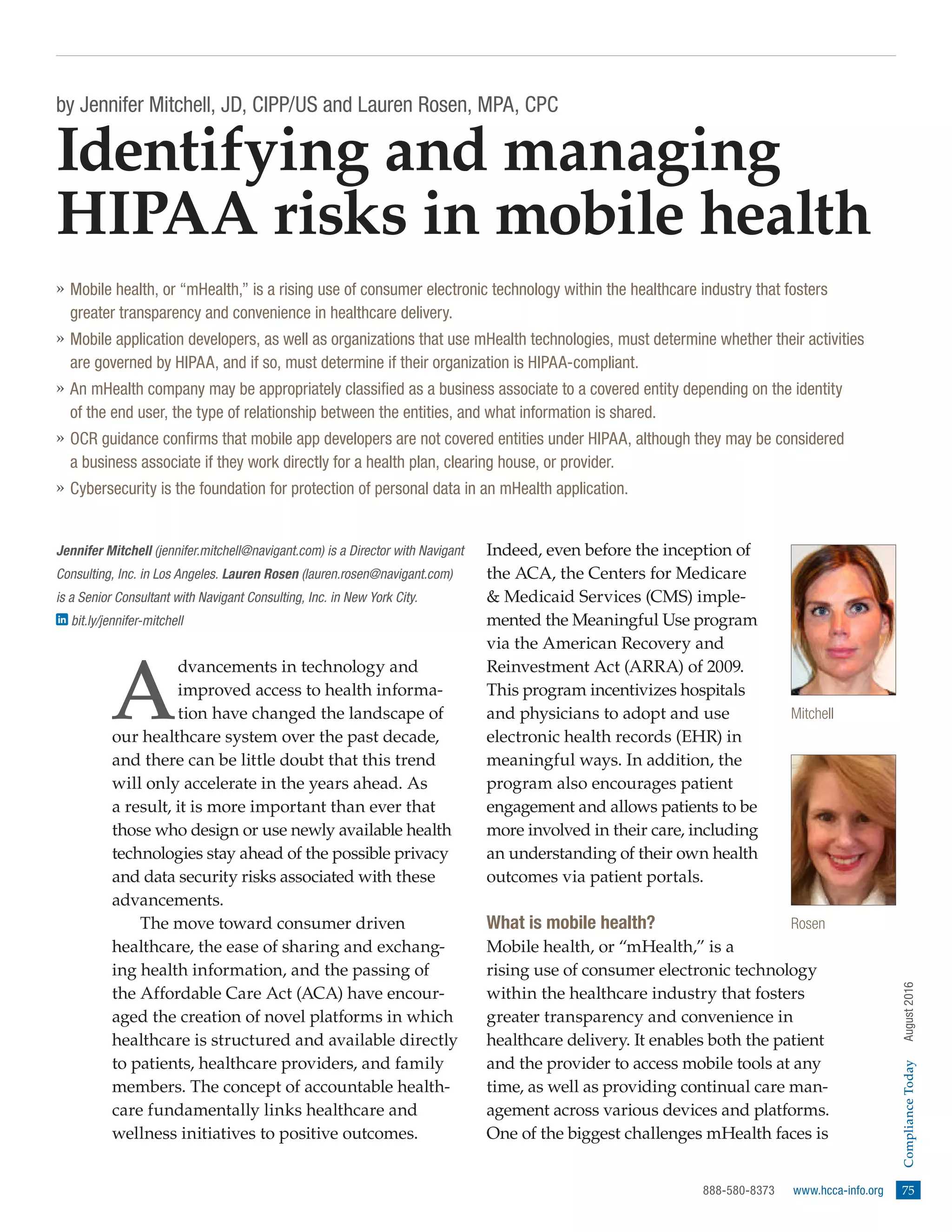
by Jennifer Mitchell, JD, CIPP/US and Lauren Rosen, MPA, CPC
Identifying and managing
HIPAA risks in mobile health
»» Mobile health, or “mHealth,” is a rising use of consumer electronic technology within the healthcare industry that fosters
greater transparency and convenience in healthcare delivery.
»» Mobile application developers, as well as organizations that use mHealth technologies, must determine whether their activities
are governed by HIPAA, and if so, must determine if their organization is HIPAA-compliant.
»» An mHealth company may be appropriately classified as a business associate to a covered entity depending on the identity
of the end user, the type of relationship between the entities, and what information is shared.
»» OCR guidance confirms that mobile app developers are not covered entities under HIPAA, although they may be considered
a business associate if they work directly for a health plan, clearing house, or provider.
»» Cybersecurity is the foundation for protection of personal data in an mHealth application.
Mitchell
Rosen
Jennifer Mitchell (jennifer.mitchell@navigant.com) is a Director with Navigant
Consulting, Inc. in Los Angeles. Lauren Rosen (lauren.rosen@navigant.com)
is a Senior Consultant with Navigant Consulting, Inc. in New York City.
bit.ly/jennifer-mitchell
76   www.hcca-info.org  888-580-8373
ComplianceToday  August2016
how to protect privacy and secure the sensi-
tive patient information exchanged. Although
the accessibility of healthcare data creates
enhanced pathways for providers and patients
to communicate and potentially make more
informed decisions about clinical intervention,
the ease in which data is accessed is also its
biggest threat.
Mobile health may include a variety of
mobile communication devices, such as smart-
phones and tablet computers, that support the
practice of medicine, health, and wellness. The
growing list of examples of mHealth includes:
·· Patient monitoring devices
·· Mobile telemedicine/telecare devices
·· Medicine adherence monitoring
·· Activity monitoring
·· Smart wearables/smartphone applications
(e.g., Jawbone/Fitbit)
·· Emergency response systems
·· Health-related mLearning or the general
public, and
·· Support for long-term or chronic conditions
According to the 2014 Mobile Devices
Study by the Health Information Management
Systems Society (HIMSS), 500 million global
smartphone users
would be using a
healthcare application
by 2015. Almost 83%
of the physicians who
participated in the
survey reported that
they had downloaded
at least one medical
app. Another 33% of
physicians and 75%
of nurses reported
that they used medi-
cal apps on smartphones daily as part of their
work. About a third (35%) of the responding
hospitals reported that they offered medical
apps to patients in the form of patient portals,
telehealth services, and various forms of
remote monitoring.1
As the mHealth sector
grows, however, the risks associated with the
storage and/or transfer of sensitive health
information across multiple platforms are
also on the rise. Mobile application develop-
ers, as well as organizations that use mHealth
technologies, must determine whether their
activities are governed by HIPAA, and if
so, must determine if their organization is
HIPAA-compliant.
HIPAA and the entities it regulates
The Health Insurance Portability and
Accountability Act of 1996 (HIPAA) safeguards
protected health information (PHI) from being
used or disclosed without a patient’s consent. In
addition, HIPAA imposes technical, administra-
tive, and physical safeguard requirements for
storing and transmitting electronic PHI (ePHI).
As the landscape of healthcare changed, the
HIPAA rules adapted to the growing amount of
information healthcare organizations collected
and managed. By 2013, now referred to as the
HIPAA Omnibus Rule, the HIPAA require-
ments evolved and created privacy and security
requirements for contractors and subcontractors
of healthcare organiza-
tions. Companies such
as health plans, health-
care clearinghouses,
and most healthcare
providers are consid-
ered covered entities
(CEs) under HIPAA,
and are therefore
regulated by HIPAA.
Most often, covered
entities are the initial
gatekeeper of PHI and
are likely to control the main data warehouse
where PHI is stored.
Many covered entities have relationships
and partnerships with other organizations,
As the landscape of
healthcare changed, the
HIPAA rules adapted to
the growing amount of
information healthcare
organizations collected
and managed.
888-580-8373  www.hcca-info.org  77
ComplianceToday  August2016
commonly known as business associates, such
as EHR vendors, law firms, and information
technology companies. These organizations
may utilize and/or
store some aspects
of PHI or all of the
PHI data elements.
Business associates
may also sub-contract
with other vendors
and relay the same
PHI housed by the
covered entity and
the business associ-
ate. If a covered entity
delegates any privacy
or security function
or duty to a business associate, the business
associate must perform in compliance with
the HIPAA Privacy and Security Rule. In fact,
business associates are subject to civil and, in
some cases, criminal penalties for the inappro-
priate disclosure of PHI.
Covered entities, business associates, and all
other downstream entities who adopt mHealth
technologies must be cognizant of the storage
and transmission of PHI across all related
entities, as well as other types of sensitive
consumer-generated data.
mHealth businesses:
Covered entities or business associates?
One of the initial challenges that the mHealth
industry faces is deciphering whether they
are regulated under HIPAA. An mHealth
company may be appropriately classified as a
business associate to a covered entity depend-
ing on the identity of the end user, the type
of relationship between the entities, and what
information is shared.
In February 2016, the U.S. Department of
Health and Human Services Office for Civil
Rights (OCR) provided much-awaited guidance
to mobile application developers to answer
the question of the applicability of HIPAA to
their operations. In addition, OCR provided
a crosswalk that maps the National Institute
of Standards and
Technology (NIST) to
the HIPAA Security
Rule. OCR also
designed an interactive
websiteto assist mobile
app developers and
healthcare organiza-
tions with submitting
questions in order to
determine whether
the entity is required
to follow HIPAA
rules and regulations.
The website also provides various examples
explaining circumstances under which an app
developer would be regulated by HIPAA.2
In its guidance, OCR confirms that mobile
app developers are not covered entities under
HIPAA, although they may be considered a
business associate if they work directly for
a health plan, clearinghouse, or provider.
Specifically, OCR stated that an mHealth appli-
cation is a business associate if: (1) they contract
with a healthcare provider or healthcare orga-
nization; (2) the device or software allows a
patient to enter their PHI; and (3) the informa-
tion transfers directly into the patient’s EHR for
purposes of care decision-making or planning.
The OCR guidance suggests mobile app devel-
opers consider the following questions in order
to determine if they are business associates:
·· Are your clients covered entities or other
business associates, such as hospitals,
doctor’s offices, clinics, pharmacies, or
other healthcare providers?
·· Do these covered entities or business asso-
ciates transmit PHI to health insurance
organizations or health and wellness pro-
gram-related information to a health plan
offered by an employer?
…OCR confirms that
mobile app developers are
not covered entities under
HIPAA, although they may
be considered a business
associate if they work
directly for a health plan,
clearinghouse, or provider.
78   www.hcca-info.org  888-580-8373
ComplianceToday  August2016
·· How will the covered entity or other
business associates use the data? (e.g., an
application that assists a physician with
following up with patients and providing
information about an office visit)
·· Were you hired by, or are you paid for your
service or product by, a covered entity?
·· How is the data collected? Is it transferred
directly to and collecting information for
or on behalf of consumers, or on behalf
of a provider, health plan, or healthcare
clearinghouse?
Conversely, according to the OCR guidance,
a mobile health app that allows consumers to
create, receive, maintain, or transmit information
about themselves is not likely required to comply
with HIPAA. In this scenario, the individual is
the gatekeeper for his/her own information, and
the individual has determined to transmit this
health information to a third party. Here, the
app developer does not have the requisite rela-
tionship with the covered entity or the business
associate, as the consumer controls all the deci-
sions regarding the
transmission of PHI
to the third party.
Accordingly, well-
ness apps and other
consumer-driven
health-related apps
not used by covered
entities or business associates may not be sub-
ject to HIPAA rules and regulations. However,
organizations should be aware that these com-
panies might be subject to other regulatory
bodies, such as the Federal Trade Commission
(FTC) and the Food and Drug Administration
(FDA). The FTC guidelines govern similar enti-
ties as HIPAA, including:
·· Vendors of personal health records (PHRs)
or EHRs,
·· PHR-related entities (i.e., web and mobile-
based apps for health information); and
·· Third-party service providers for a vendor
of PHRs or a PHR-related entity.3
Developers should also review the FDA
standards for mobile applications, some of
which are classified as medical devices. The
FDA defines a mobile medical application as
an app that is an accessory to a regulated med-
ical device, or transforms a medical device into
a regulated medical device.4
These require-
ments for FDA mobile apps continue to evolve,
and the FDA encourages mobile app develop-
ers to check these regulations periodically.
Importance of HIPAA breach
prevention in mHealth
There is no doubt that mHealth provides many
conveniences and the potential for health
enhancements for its users. However, the shelf
life of an app may be brief, because the market
is saturated and newer/improved versions of
these apps develop at a rapid pace. As a result,
a healthcare organization may rush to bring
new and improved apps to market and may
be tempted to over-
look critical security
measures.
Indeed, a 2016
study shows that,
among healthcare apps
tested, 86% of the 71
apps had at least two
critical security vulnerabilities. In addition, 54%
of the people they surveyed believed their
mobile health apps would be hacked within the
next six months. Within that group, 55% were
health app users and 48% were health app execs.
The study also reported the application layer
(i.e., binary protection) is the most vulnerable
to cybersecurity risks.5,6
HIPAA breaches are often costly and may
corrode a consumer’s confidence with an app
and/or the organization promoting the app.
Under HIPAA, PHI security breaches require
… among healthcare apps
tested, 86% of the 71 apps
had at least two critical
security vulnerabilities.
888-580-8373  www.hcca-info.org  79
ComplianceToday  August2016
notification of persons whose protected informa-
tion may have been compromised and can result
in penalties up to $50,000 per incident.
Conclusion
The best defense is to have the best offense.
Cybersecurity is the foundation for protection of
personal data in an mHealth application. Aside
from the usability and benefits mobile health-
care apps provide, protecting and securing PHI
are key to an app’s success. The following repre-
sent a sample of steps an mHealth app developer
should take into consideration to support the
security of their application and protect PHI:
·· Follow the technical, physical, and admin-
istrative specifications from organizations
such as OCR, FTC, and FDA, and keep
updated on any new developments from
these regulatory bodies;
·· Investigate whether data should be
encrypted at every point of data lifecycle in
the application (e.g., at rest and in transit);
·· Consider any encryption requirements for
email and other electronic communication;
·· Ensure the app comes equipped with a pass-
code requirement to access the application;
·· Determine whether technical safeguards
such as anti-tampering or anti-counterfeiting
measures need to be included in the devel-
opment of the app.
Navigant Consulting is not a certified public accounting
firm and does not provide audit, attest, or public accounting
services. See navigant.com/licensing for a complete listing
of private investigator licenses.
1.	HIMSS Analytics: 3rd Annual HIMSS Analytics Mobile Survey,
February 26, 2014. Available at: http://bit.ly/28KHh5O
2.	U.S. Department of Health and Human Services, Office for Civil
Rights: HIPAA Portal. Available at http://hipaaqsportal.hhs.gov/
3.	Federal Trade Commission: Complying with the FTC’s Health
Breach Notification Rule. Available at: http://1.usa.gov/28MM5Lv
4.	Food and Drug Administration: Nonbinding Guidance on Mobile
Medical Applications, February 9, 2015. Available at:
http://1.usa.gov/28LQHRz
5.	Arxan: 2016 State of Application Security: Top Health Care Apps in
Critical Condition. Available at: http://bit.ly/28MMaP6
6.	Arxan, 2016 State of Application Security: Infographic, Mobile
Health Apps. Available at: http://bit.ly/28LWl4G
Authors Debbie Troklus and Sheryl Vacca have updated Compliance 101 with
changes in federal regulations, including HIPAA, HITECH, and the Omnibus Rule
as well as new insights on what it takes to build an effective compliance program.
This book reviews the fundamentals in healthcare compliance, including the seven
essential elements of a compliance program. It includes:
• Step-by-step instructions on setting up and maintaining a
compliance program
• A chapter dedicated to HIPAA privacy and security regulations
• A glossary with compliance terms and definitions
• Sample compliance forms and policies
This book is ideal for compliance professionals new to the field, compliance
committee members, compliance liaisons, board members, and others who
need a foundation in compliance principles.
softcover available from HCCA: www.hcca-info.org/compliance101
Now Available!
Compliance101, Fourth Edition
DEBBIE TROKLUS  SHERYL VACCA
Compliance
FOURTH
EDITION
101

lauren_rosen_compliance_article

  • 1.
    888-580-8373  www.hcca-info.org  75 ComplianceToday  August2016 A dvancements intechnology and improved access to health informa- tion have changed the landscape of our healthcare system over the past decade, and there can be little doubt that this trend will only accelerate in the years ahead. As a result, it is more important than ever that those who design or use newly available health technologies stay ahead of the possible privacy and data security risks associated with these advancements. The move toward consumer driven healthcare, the ease of sharing and exchang- ing health information, and the passing of the Affordable Care Act (ACA) have encour- aged the creation of novel platforms in which healthcare is structured and available directly to patients, healthcare providers, and family members. The concept of accountable health- care fundamentally links healthcare and wellness initiatives to positive outcomes. Indeed, even before the inception of the ACA, the Centers for Medicare & Medicaid Services (CMS) imple- mented the Meaningful Use program via the American Recovery and Reinvestment Act (ARRA) of 2009. This program incentivizes hospitals and physicians to adopt and use electronic health records (EHR) in meaningful ways. In addition, the program also encourages patient engagement and allows patients to be more involved in their care, including an understanding of their own health outcomes via patient portals. What is mobile health? Mobile health, or “mHealth,” is a rising use of consumer electronic technology within the healthcare industry that fosters greater transparency and convenience in healthcare delivery. It enables both the patient and the provider to access mobile tools at any time, as well as providing continual care man- agement across various devices and platforms. One of the biggest challenges mHealth faces is by Jennifer Mitchell, JD, CIPP/US and Lauren Rosen, MPA, CPC Identifying and managing HIPAA risks in mobile health »» Mobile health, or “mHealth,” is a rising use of consumer electronic technology within the healthcare industry that fosters greater transparency and convenience in healthcare delivery. »» Mobile application developers, as well as organizations that use mHealth technologies, must determine whether their activities are governed by HIPAA, and if so, must determine if their organization is HIPAA-compliant. »» An mHealth company may be appropriately classified as a business associate to a covered entity depending on the identity of the end user, the type of relationship between the entities, and what information is shared. »» OCR guidance confirms that mobile app developers are not covered entities under HIPAA, although they may be considered a business associate if they work directly for a health plan, clearing house, or provider. »» Cybersecurity is the foundation for protection of personal data in an mHealth application. Mitchell Rosen Jennifer Mitchell (jennifer.mitchell@navigant.com) is a Director with Navigant Consulting, Inc. in Los Angeles. Lauren Rosen (lauren.rosen@navigant.com) is a Senior Consultant with Navigant Consulting, Inc. in New York City. bit.ly/jennifer-mitchell
  • 2.
    76   www.hcca-info.org  888-580-8373 ComplianceToday  August2016 howto protect privacy and secure the sensi- tive patient information exchanged. Although the accessibility of healthcare data creates enhanced pathways for providers and patients to communicate and potentially make more informed decisions about clinical intervention, the ease in which data is accessed is also its biggest threat. Mobile health may include a variety of mobile communication devices, such as smart- phones and tablet computers, that support the practice of medicine, health, and wellness. The growing list of examples of mHealth includes: ·· Patient monitoring devices ·· Mobile telemedicine/telecare devices ·· Medicine adherence monitoring ·· Activity monitoring ·· Smart wearables/smartphone applications (e.g., Jawbone/Fitbit) ·· Emergency response systems ·· Health-related mLearning or the general public, and ·· Support for long-term or chronic conditions According to the 2014 Mobile Devices Study by the Health Information Management Systems Society (HIMSS), 500 million global smartphone users would be using a healthcare application by 2015. Almost 83% of the physicians who participated in the survey reported that they had downloaded at least one medical app. Another 33% of physicians and 75% of nurses reported that they used medi- cal apps on smartphones daily as part of their work. About a third (35%) of the responding hospitals reported that they offered medical apps to patients in the form of patient portals, telehealth services, and various forms of remote monitoring.1 As the mHealth sector grows, however, the risks associated with the storage and/or transfer of sensitive health information across multiple platforms are also on the rise. Mobile application develop- ers, as well as organizations that use mHealth technologies, must determine whether their activities are governed by HIPAA, and if so, must determine if their organization is HIPAA-compliant. HIPAA and the entities it regulates The Health Insurance Portability and Accountability Act of 1996 (HIPAA) safeguards protected health information (PHI) from being used or disclosed without a patient’s consent. In addition, HIPAA imposes technical, administra- tive, and physical safeguard requirements for storing and transmitting electronic PHI (ePHI). As the landscape of healthcare changed, the HIPAA rules adapted to the growing amount of information healthcare organizations collected and managed. By 2013, now referred to as the HIPAA Omnibus Rule, the HIPAA require- ments evolved and created privacy and security requirements for contractors and subcontractors of healthcare organiza- tions. Companies such as health plans, health- care clearinghouses, and most healthcare providers are consid- ered covered entities (CEs) under HIPAA, and are therefore regulated by HIPAA. Most often, covered entities are the initial gatekeeper of PHI and are likely to control the main data warehouse where PHI is stored. Many covered entities have relationships and partnerships with other organizations, As the landscape of healthcare changed, the HIPAA rules adapted to the growing amount of information healthcare organizations collected and managed.
  • 3.
    888-580-8373  www.hcca-info.org  77 ComplianceToday  August2016 commonly knownas business associates, such as EHR vendors, law firms, and information technology companies. These organizations may utilize and/or store some aspects of PHI or all of the PHI data elements. Business associates may also sub-contract with other vendors and relay the same PHI housed by the covered entity and the business associ- ate. If a covered entity delegates any privacy or security function or duty to a business associate, the business associate must perform in compliance with the HIPAA Privacy and Security Rule. In fact, business associates are subject to civil and, in some cases, criminal penalties for the inappro- priate disclosure of PHI. Covered entities, business associates, and all other downstream entities who adopt mHealth technologies must be cognizant of the storage and transmission of PHI across all related entities, as well as other types of sensitive consumer-generated data. mHealth businesses: Covered entities or business associates? One of the initial challenges that the mHealth industry faces is deciphering whether they are regulated under HIPAA. An mHealth company may be appropriately classified as a business associate to a covered entity depend- ing on the identity of the end user, the type of relationship between the entities, and what information is shared. In February 2016, the U.S. Department of Health and Human Services Office for Civil Rights (OCR) provided much-awaited guidance to mobile application developers to answer the question of the applicability of HIPAA to their operations. In addition, OCR provided a crosswalk that maps the National Institute of Standards and Technology (NIST) to the HIPAA Security Rule. OCR also designed an interactive websiteto assist mobile app developers and healthcare organiza- tions with submitting questions in order to determine whether the entity is required to follow HIPAA rules and regulations. The website also provides various examples explaining circumstances under which an app developer would be regulated by HIPAA.2 In its guidance, OCR confirms that mobile app developers are not covered entities under HIPAA, although they may be considered a business associate if they work directly for a health plan, clearinghouse, or provider. Specifically, OCR stated that an mHealth appli- cation is a business associate if: (1) they contract with a healthcare provider or healthcare orga- nization; (2) the device or software allows a patient to enter their PHI; and (3) the informa- tion transfers directly into the patient’s EHR for purposes of care decision-making or planning. The OCR guidance suggests mobile app devel- opers consider the following questions in order to determine if they are business associates: ·· Are your clients covered entities or other business associates, such as hospitals, doctor’s offices, clinics, pharmacies, or other healthcare providers? ·· Do these covered entities or business asso- ciates transmit PHI to health insurance organizations or health and wellness pro- gram-related information to a health plan offered by an employer? …OCR confirms that mobile app developers are not covered entities under HIPAA, although they may be considered a business associate if they work directly for a health plan, clearinghouse, or provider.
  • 4.
    78   www.hcca-info.org  888-580-8373 ComplianceToday  August2016 ··How will the covered entity or other business associates use the data? (e.g., an application that assists a physician with following up with patients and providing information about an office visit) ·· Were you hired by, or are you paid for your service or product by, a covered entity? ·· How is the data collected? Is it transferred directly to and collecting information for or on behalf of consumers, or on behalf of a provider, health plan, or healthcare clearinghouse? Conversely, according to the OCR guidance, a mobile health app that allows consumers to create, receive, maintain, or transmit information about themselves is not likely required to comply with HIPAA. In this scenario, the individual is the gatekeeper for his/her own information, and the individual has determined to transmit this health information to a third party. Here, the app developer does not have the requisite rela- tionship with the covered entity or the business associate, as the consumer controls all the deci- sions regarding the transmission of PHI to the third party. Accordingly, well- ness apps and other consumer-driven health-related apps not used by covered entities or business associates may not be sub- ject to HIPAA rules and regulations. However, organizations should be aware that these com- panies might be subject to other regulatory bodies, such as the Federal Trade Commission (FTC) and the Food and Drug Administration (FDA). The FTC guidelines govern similar enti- ties as HIPAA, including: ·· Vendors of personal health records (PHRs) or EHRs, ·· PHR-related entities (i.e., web and mobile- based apps for health information); and ·· Third-party service providers for a vendor of PHRs or a PHR-related entity.3 Developers should also review the FDA standards for mobile applications, some of which are classified as medical devices. The FDA defines a mobile medical application as an app that is an accessory to a regulated med- ical device, or transforms a medical device into a regulated medical device.4 These require- ments for FDA mobile apps continue to evolve, and the FDA encourages mobile app develop- ers to check these regulations periodically. Importance of HIPAA breach prevention in mHealth There is no doubt that mHealth provides many conveniences and the potential for health enhancements for its users. However, the shelf life of an app may be brief, because the market is saturated and newer/improved versions of these apps develop at a rapid pace. As a result, a healthcare organization may rush to bring new and improved apps to market and may be tempted to over- look critical security measures. Indeed, a 2016 study shows that, among healthcare apps tested, 86% of the 71 apps had at least two critical security vulnerabilities. In addition, 54% of the people they surveyed believed their mobile health apps would be hacked within the next six months. Within that group, 55% were health app users and 48% were health app execs. The study also reported the application layer (i.e., binary protection) is the most vulnerable to cybersecurity risks.5,6 HIPAA breaches are often costly and may corrode a consumer’s confidence with an app and/or the organization promoting the app. Under HIPAA, PHI security breaches require … among healthcare apps tested, 86% of the 71 apps had at least two critical security vulnerabilities.
  • 5.
    888-580-8373  www.hcca-info.org  79 ComplianceToday  August2016 notification ofpersons whose protected informa- tion may have been compromised and can result in penalties up to $50,000 per incident. Conclusion The best defense is to have the best offense. Cybersecurity is the foundation for protection of personal data in an mHealth application. Aside from the usability and benefits mobile health- care apps provide, protecting and securing PHI are key to an app’s success. The following repre- sent a sample of steps an mHealth app developer should take into consideration to support the security of their application and protect PHI: ·· Follow the technical, physical, and admin- istrative specifications from organizations such as OCR, FTC, and FDA, and keep updated on any new developments from these regulatory bodies; ·· Investigate whether data should be encrypted at every point of data lifecycle in the application (e.g., at rest and in transit); ·· Consider any encryption requirements for email and other electronic communication; ·· Ensure the app comes equipped with a pass- code requirement to access the application; ·· Determine whether technical safeguards such as anti-tampering or anti-counterfeiting measures need to be included in the devel- opment of the app. Navigant Consulting is not a certified public accounting firm and does not provide audit, attest, or public accounting services. See navigant.com/licensing for a complete listing of private investigator licenses. 1. HIMSS Analytics: 3rd Annual HIMSS Analytics Mobile Survey, February 26, 2014. Available at: http://bit.ly/28KHh5O 2. U.S. Department of Health and Human Services, Office for Civil Rights: HIPAA Portal. Available at http://hipaaqsportal.hhs.gov/ 3. Federal Trade Commission: Complying with the FTC’s Health Breach Notification Rule. Available at: http://1.usa.gov/28MM5Lv 4. Food and Drug Administration: Nonbinding Guidance on Mobile Medical Applications, February 9, 2015. Available at: http://1.usa.gov/28LQHRz 5. Arxan: 2016 State of Application Security: Top Health Care Apps in Critical Condition. Available at: http://bit.ly/28MMaP6 6. Arxan, 2016 State of Application Security: Infographic, Mobile Health Apps. Available at: http://bit.ly/28LWl4G Authors Debbie Troklus and Sheryl Vacca have updated Compliance 101 with changes in federal regulations, including HIPAA, HITECH, and the Omnibus Rule as well as new insights on what it takes to build an effective compliance program. This book reviews the fundamentals in healthcare compliance, including the seven essential elements of a compliance program. It includes: • Step-by-step instructions on setting up and maintaining a compliance program • A chapter dedicated to HIPAA privacy and security regulations • A glossary with compliance terms and definitions • Sample compliance forms and policies This book is ideal for compliance professionals new to the field, compliance committee members, compliance liaisons, board members, and others who need a foundation in compliance principles. softcover available from HCCA: www.hcca-info.org/compliance101 Now Available! Compliance101, Fourth Edition DEBBIE TROKLUS SHERYL VACCA Compliance FOURTH EDITION 101