LAUNCHING LATE
The Student Loan Story,
told by medical professionals.
LAUNCHING LATE
FROM STUDENT TO PROFESSIONAL
Over the past few years, we’ve worked with many medical and dental students
and professionals who struggle with starting a career later in life, often finding
themselves behind the eight-ball, financially.
While their peers may have 8 or so years of spending and saving under their belt,
these professionals are just starting, generally with a mortgage’s worth of student
loans.
This is how it impacts them and the profession.
This is by no means exhaustive research and our findings in this document are
complemented by additional published findings throughout. We simply set out to
understand the state of young medical professionals and share it with you here.
2
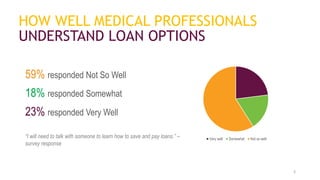
Very well Somewhat Not so well
HOW WELL MEDICAL PROFESSIONALS
UNDERSTAND LOAN OPTIONS
59% responded Not So Well
18% responded Somewhat
23% responded Very Well
3
“I will need to talk with someone to learn how to save and pay loans.” –
survey response
MEDICAL STUDENTS
NEED LOAN EDUCATION UP FRONT
Not one of the medical students or residents says that they
understand their student loans Very Well. Every single
respondent who had loans said Not So Well.
Only 38% of student loan holders said they calculated the
payment they would owe when obtaining their most recent
loan.
“I could use some help. This debt load is scary.”
4The National Financial Capability Study, 2016
AND MEDICAL GRADS
NEED LOAN EDUCATION AT GRADUATION
30% of medical graduates say that they
understood their loans very well.
“I feel much better having met a financial adviser who works
with me to be sure I am saving while handling my loans
properly. I didn't understand that I had private and federal
loans and that they were different.”
5
TALKING TO MY STUDENT
LOAN SERVICER IS LIKE
TALKING TO A WALL! "
- Anonymous
“
6
7
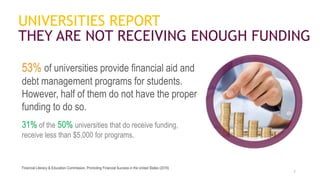
UNIVERSITIES REPORT
THEY ARE NOT RECEIVING ENOUGH FUNDING
53% of universities provide financial aid and
debt management programs for students.
However, half of them do not have the proper
funding to do so.
31% of the 50% universities that do receive funding,
receive less than $5,000 for programs.
Financial Literacy & Education Commission, Promoting Financial Success in the United States (2016)
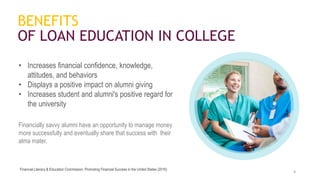
• Increases financial confidence, knowledge,
attitudes, and behaviors
• Displays a positive impact on alumni giving
• Increases student and alumni's positive regard for
the university
Financially savvy alumni have an opportunity to manage money
more successfully and eventually share that success with their
alma mater.
8
BENEFITS
OF LOAN EDUCATION IN COLLEGE
Financial Literacy & Education Commission, Promoting Financial Success in the United States (2016)
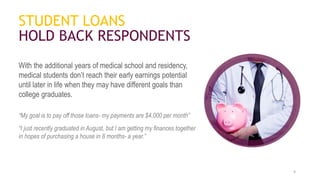
With the additional years of medical school and residency,
medical students don’t reach their early earnings potential
until later in life when they may have different goals than
college graduates.
“My goal is to pay off those loans- my payments are $4,000 per month”
“I just recently graduated in August, but I am getting my finances together
in hopes of purchasing a house in 8 months- a year.”
STUDENT LOANS
HOLD BACK RESPONDENTS
9
I HAD TO SEE A SPECIALIST
RIGHT AWAY TO
UNDERSTAND THE
HUNDREDS OF THOUSANDS
OF DOLLARS I HAD IN
STUDENT LOANS ”
-Anonymous
“
10
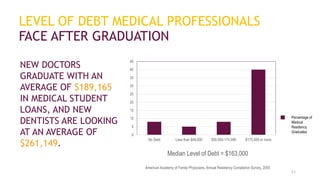
LEVEL OF DEBT MEDICAL PROFESSIONALS
FACE AFTER GRADUATION
Median Level of Debt = $163,000
American Academy of Family Physicians, Annual Residency Completion Survey, 2005
0
5
10
15
20
25
30
35
40
45
No Debt Less than $49,000 $50,000-174,999 $175,000 or more
Percentage of
Medical
Residency
Graduates
11
NEW DOCTORS
GRADUATE WITH AN
AVERAGE OF $189,165
IN MEDICAL STUDENT
LOANS, AND NEW
DENTISTS ARE LOOKING
AT AN AVERAGE OF
$261,149.
HOW PHYSICIANS
ARE PAID
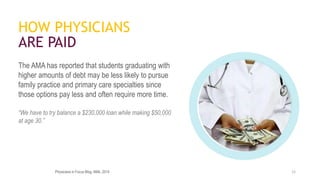
The AMA has reported that students graduating with
higher amounts of debt may be less likely to pursue
family practice and primary care specialties since
those options pay less and often require more time.
“We have to try balance a $230,000 loan while making $50,000
at age 30.”
12Physicians in Focus Blog, AMA, 2014
I TRIED TO LIVE THE
DOCTOR LIFE IN A
DOCTOR HOUSE AND
IT'S TOO MUCH LIFE
AND NOT ENOUGH
MONEY”
-Anonymous
“
13
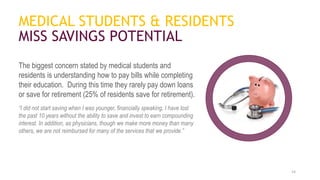
The biggest concern stated by medical students and
residents is understanding how to pay bills while completing
their education. During this time they rarely pay down loans
or save for retirement (25% of residents save for retirement).
“I did not start saving when I was younger, financially speaking, I have lost
the past 10 years without the ability to save and invest to earn compounding
interest. In addition, as physicians, though we make more money than many
others, we are not reimbursed for many of the services that we provide.”
MEDICAL STUDENTS & RESIDENTS
MISS SAVINGS POTENTIAL
14
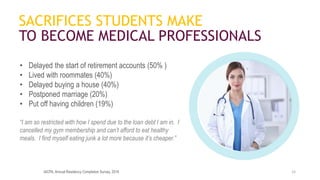
• Delayed the start of retirement accounts (50% )
• Lived with roommates (40%)
• Delayed buying a house (40%)
• Postponed marriage (20%)
• Put off having children (19%)
“I am so restricted with how I spend due to the loan debt I am in. I
cancelled my gym membership and can’t afford to eat healthy
meals. I find myself eating junk a lot more because it’s cheaper.”
15
SACRIFICES STUDENTS MAKE
TO BECOME MEDICAL PROFESSIONALS
AICPA, Annual Residency Completion Survey, 2016
HOW TO LESSEN THE BURDEN
OF STUDENT LOANS AND FINANCIAL AID
Scholarships, grants, work study, or part time
employment can minimize debt build-up during school
and help fill the funding gap.
Financial education before graduation, and after, is
another way to help busy young professionals start on
the right path.
16
We’d like to hear from you – as a medical
professional, student or friend of the
profession:
 Is this burden too great?
 Does it drive students to certain
specialties?
 What should we ask in our next
survey?
Send your feedback to:
amccarthy@plumtreefp.com
MY STUDENT LOANS
SCARED ME WHEN I GOT
OUT SO, ONCE I WAS
MARRIED, WE SAW A
FINANCIAL PLANNER WHO
DEVELOPED A PAY-OFF
PLAN WHILE WE SAVED.”
-Anonymous
“
17
ABOUT
PLUMTREE FINANCIAL PLANNING
PlumTree was born to change the financial planning industry. At PlumTree Financial Planning we partner with
recent graduates to help them launch into life with the skills and knowledge necessary to reach financial success.
We're with them every step of the way providing insight and guidance to make recent graduates more
comfortable with everyday financial decisions.
To learn more about how we can work together call us at 484.875.3072
18
SOURCES
Greenfield, W. R. (2016, October 01). In Search of an Effective Physician
Compensation Formula. Retrieved October 25, 2017, from
http://www.aafp.org/fpm/981000fm/cover.html
Source
Physicians in Focus Blog. (2014, April 9). Retrieved November 02, 2017, from
https://www.amainsure.com/physicians-in-focus/medical-school-student-
loan-debt-by-the-numbers.html
Source
AICPA. (2016, May 12). Study conducted by American Institute of CPAs. Retrieved
October 28, 2017, from http://www.aicpa.org/Press/PressReleases/2016/Pages/-More-
than-Eighty-Percent-of-American.aspx
Source
Financial Literacy & Education Commission (2016). Promoting Financial Success in
the United States. Retrieved from: https://www.treasury.gov/resource-center/financial-
education/Documents/National%20Strategy%20for%20Financial%20Literacy%202016
%20Update.pdf.
Source
U.S. Survey Data at a Glance. (2016). Retrieved November 01, 2017, from
http://www.usfinancialcapability.org/results.php?region=USSource
19
All other data was retrieved from a proprietary survey collected from September 20,
2017 to October 15, 2017 from local residents and medical professionals.

Launching Late

  • 1.
    LAUNCHING LATE The StudentLoan Story, told by medical professionals.
  • 2.
    LAUNCHING LATE FROM STUDENTTO PROFESSIONAL Over the past few years, we’ve worked with many medical and dental students and professionals who struggle with starting a career later in life, often finding themselves behind the eight-ball, financially. While their peers may have 8 or so years of spending and saving under their belt, these professionals are just starting, generally with a mortgage’s worth of student loans. This is how it impacts them and the profession. This is by no means exhaustive research and our findings in this document are complemented by additional published findings throughout. We simply set out to understand the state of young medical professionals and share it with you here. 2
  • 3.
    Very well SomewhatNot so well HOW WELL MEDICAL PROFESSIONALS UNDERSTAND LOAN OPTIONS 59% responded Not So Well 18% responded Somewhat 23% responded Very Well 3 “I will need to talk with someone to learn how to save and pay loans.” – survey response
  • 4.
    MEDICAL STUDENTS NEED LOANEDUCATION UP FRONT Not one of the medical students or residents says that they understand their student loans Very Well. Every single respondent who had loans said Not So Well. Only 38% of student loan holders said they calculated the payment they would owe when obtaining their most recent loan. “I could use some help. This debt load is scary.” 4The National Financial Capability Study, 2016
  • 5.
    AND MEDICAL GRADS NEEDLOAN EDUCATION AT GRADUATION 30% of medical graduates say that they understood their loans very well. “I feel much better having met a financial adviser who works with me to be sure I am saving while handling my loans properly. I didn't understand that I had private and federal loans and that they were different.” 5
  • 6.
    TALKING TO MYSTUDENT LOAN SERVICER IS LIKE TALKING TO A WALL! " - Anonymous “ 6
  • 7.
    7 UNIVERSITIES REPORT THEY ARENOT RECEIVING ENOUGH FUNDING 53% of universities provide financial aid and debt management programs for students. However, half of them do not have the proper funding to do so. 31% of the 50% universities that do receive funding, receive less than $5,000 for programs. Financial Literacy & Education Commission, Promoting Financial Success in the United States (2016)
  • 8.
    • Increases financialconfidence, knowledge, attitudes, and behaviors • Displays a positive impact on alumni giving • Increases student and alumni's positive regard for the university Financially savvy alumni have an opportunity to manage money more successfully and eventually share that success with their alma mater. 8 BENEFITS OF LOAN EDUCATION IN COLLEGE Financial Literacy & Education Commission, Promoting Financial Success in the United States (2016)
  • 9.
    With the additionalyears of medical school and residency, medical students don’t reach their early earnings potential until later in life when they may have different goals than college graduates. “My goal is to pay off those loans- my payments are $4,000 per month” “I just recently graduated in August, but I am getting my finances together in hopes of purchasing a house in 8 months- a year.” STUDENT LOANS HOLD BACK RESPONDENTS 9
  • 10.
    I HAD TOSEE A SPECIALIST RIGHT AWAY TO UNDERSTAND THE HUNDREDS OF THOUSANDS OF DOLLARS I HAD IN STUDENT LOANS ” -Anonymous “ 10
  • 11.
    LEVEL OF DEBTMEDICAL PROFESSIONALS FACE AFTER GRADUATION Median Level of Debt = $163,000 American Academy of Family Physicians, Annual Residency Completion Survey, 2005 0 5 10 15 20 25 30 35 40 45 No Debt Less than $49,000 $50,000-174,999 $175,000 or more Percentage of Medical Residency Graduates 11 NEW DOCTORS GRADUATE WITH AN AVERAGE OF $189,165 IN MEDICAL STUDENT LOANS, AND NEW DENTISTS ARE LOOKING AT AN AVERAGE OF $261,149.
  • 12.
    HOW PHYSICIANS ARE PAID TheAMA has reported that students graduating with higher amounts of debt may be less likely to pursue family practice and primary care specialties since those options pay less and often require more time. “We have to try balance a $230,000 loan while making $50,000 at age 30.” 12Physicians in Focus Blog, AMA, 2014
  • 13.
    I TRIED TOLIVE THE DOCTOR LIFE IN A DOCTOR HOUSE AND IT'S TOO MUCH LIFE AND NOT ENOUGH MONEY” -Anonymous “ 13
  • 14.
    The biggest concernstated by medical students and residents is understanding how to pay bills while completing their education. During this time they rarely pay down loans or save for retirement (25% of residents save for retirement). “I did not start saving when I was younger, financially speaking, I have lost the past 10 years without the ability to save and invest to earn compounding interest. In addition, as physicians, though we make more money than many others, we are not reimbursed for many of the services that we provide.” MEDICAL STUDENTS & RESIDENTS MISS SAVINGS POTENTIAL 14
  • 15.
    • Delayed thestart of retirement accounts (50% ) • Lived with roommates (40%) • Delayed buying a house (40%) • Postponed marriage (20%) • Put off having children (19%) “I am so restricted with how I spend due to the loan debt I am in. I cancelled my gym membership and can’t afford to eat healthy meals. I find myself eating junk a lot more because it’s cheaper.” 15 SACRIFICES STUDENTS MAKE TO BECOME MEDICAL PROFESSIONALS AICPA, Annual Residency Completion Survey, 2016
  • 16.
    HOW TO LESSENTHE BURDEN OF STUDENT LOANS AND FINANCIAL AID Scholarships, grants, work study, or part time employment can minimize debt build-up during school and help fill the funding gap. Financial education before graduation, and after, is another way to help busy young professionals start on the right path. 16 We’d like to hear from you – as a medical professional, student or friend of the profession:  Is this burden too great?  Does it drive students to certain specialties?  What should we ask in our next survey? Send your feedback to: amccarthy@plumtreefp.com
  • 17.
    MY STUDENT LOANS SCAREDME WHEN I GOT OUT SO, ONCE I WAS MARRIED, WE SAW A FINANCIAL PLANNER WHO DEVELOPED A PAY-OFF PLAN WHILE WE SAVED.” -Anonymous “ 17
  • 18.
    ABOUT PLUMTREE FINANCIAL PLANNING PlumTreewas born to change the financial planning industry. At PlumTree Financial Planning we partner with recent graduates to help them launch into life with the skills and knowledge necessary to reach financial success. We're with them every step of the way providing insight and guidance to make recent graduates more comfortable with everyday financial decisions. To learn more about how we can work together call us at 484.875.3072 18
  • 19.
    SOURCES Greenfield, W. R.(2016, October 01). In Search of an Effective Physician Compensation Formula. Retrieved October 25, 2017, from http://www.aafp.org/fpm/981000fm/cover.html Source Physicians in Focus Blog. (2014, April 9). Retrieved November 02, 2017, from https://www.amainsure.com/physicians-in-focus/medical-school-student- loan-debt-by-the-numbers.html Source AICPA. (2016, May 12). Study conducted by American Institute of CPAs. Retrieved October 28, 2017, from http://www.aicpa.org/Press/PressReleases/2016/Pages/-More- than-Eighty-Percent-of-American.aspx Source Financial Literacy & Education Commission (2016). Promoting Financial Success in the United States. Retrieved from: https://www.treasury.gov/resource-center/financial- education/Documents/National%20Strategy%20for%20Financial%20Literacy%202016 %20Update.pdf. Source U.S. Survey Data at a Glance. (2016). Retrieved November 01, 2017, from http://www.usfinancialcapability.org/results.php?region=USSource 19 All other data was retrieved from a proprietary survey collected from September 20, 2017 to October 15, 2017 from local residents and medical professionals.