LATERAL LYMPH
NODES
DISSECTIONIN
RECTAL CANCER
JOURNAL CLUB
MR.MEKKI HASSAN
POST CCT COLORECTAL FELLOW BRADFORD TEACHING HOSPITALS FOUNDATION TRUST
ARTICLE
BACKGROUND
Lateral local recurrences (LLR) are currently the most common type of
locoregional recurrence (LR) after rectal cancer surgery . In the past, LR
was often due to an incomplete resection, but this has significantly
improved since the introduction of total mesorectal excision (TME)
surgery and neoadjuvant (chemo)radiotherapy ((C)RT) . LLRs are most
likely caused by lateral lymph node (LLN) metastases, which primarily
occur in locally advanced rectal tumors situated below the peritoneal
reflection.
AIM
. This review provides an overview of recent literature evaluating the
indications for LLND,
a description of the technique and current discussion points important
for daily practice
METHODOLOGY
Review of recent Studies and guidelines evaluating:
1- prophylactic Vs selective LLND
2- role of radiotherapy.
3- criteria of suspicious LLND
3-role of restaging MRI
4-different surgical techniques / minimal invasive vs open / complications
RESULTS
Role of adjuvant therapy:
The guidelines from the
European Society Medical
Oncology (ESMO) declare that
the addition of neoadjuvant
(C)RT is considered superior
(higher efficacy and/or less
morbidity) to surgical resection
of the LLNs
prophylactic LLND
LLND in patients without LLN
enlargement, a randomized
controlled trail (RCT) was
performed in Japan between
2003 and 2010 with 701
patients. The JCOG0212 s.
No neoadjuvant therapy ??
RESULTS
Criterion suspicious
LLNs:MRI/PETCT
JCOG0212 (10 mm short-axis).
Kawai et al. (8 mm long-axis)
Kim et al : > 5mm short axis)
Ishihara et al. SUVmax 1.6
Lateral Node Study
Consortium:7mm(short axis)
The role of restaging MRI:
Malakorn et al: >5 mm short
axis.
Lateral Node Study
Consortium:(4 mm for internal
iliac LLNs and 6 mm for
obturator LLNs).
RESULTS:
SELECTIVE LLND AFTER
(C)RT
In the Lateral Node Consortium
Study in some centers LLND was
performed selectively.(1216
patients)When an LLND was
performed in patients with an
LLN 7 mm, the risk of LLR
declined to 5.7% from 19.5
Kroon et al. investigated the
added value of LLND after (C)RT
in Western patients. This study
was conducted in six
international referral centers.
LLND (>5mm)decrease LLR to
3% from 11 %
RESULTS
COMPLICATIONS:
JCOG0212 study had longer
operation times and a higher
rate of grade 3/4 complications
Akasu et al. indicate that an
LLND had worse functional
genitourinary outcomes
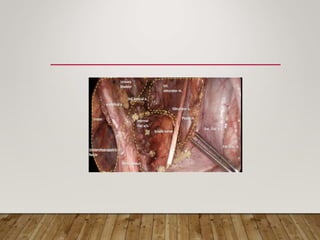
TECHMIQUES:
- Medial plane: ureter and pelvic
plexus e ureterohypogastric
fascia - Lateral plane: psoas and
internal obturator muscles -
Dorsal plane: internal iliac
vessels and the sciatic nerve
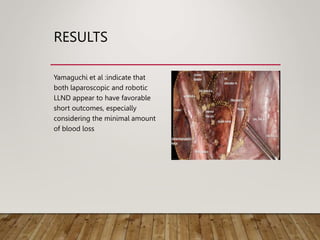
RESULTS
Yamaguchi et al :indicate that
both laparoscopic and robotic
LLND appear to have favorable
short outcomes, especially
considering the minimal amount
of blood loss
CONCLUSION
Patient with suspicious LLN >7 mm in pre neoadjuvant therapy who
subsequently got insufficient response (>4 mm in the internal iliac
compartment and >6 mm in the obturator compartment) may be
offered LLND
LLND for patients with suspicious lymph nodes found to decrease LLR .
Can be safely performed via laparoscopic or robotic approach
LLND caries high risk of morbidity
DISCUSSION
Large scale of literature review
Included different views
Different LLN definitions
Learning curve
• Thank You

lateral lymph node dissection.pptx

  • 1.
    LATERAL LYMPH NODES DISSECTIONIN RECTAL CANCER JOURNALCLUB MR.MEKKI HASSAN POST CCT COLORECTAL FELLOW BRADFORD TEACHING HOSPITALS FOUNDATION TRUST
  • 2.
  • 3.
    BACKGROUND Lateral local recurrences(LLR) are currently the most common type of locoregional recurrence (LR) after rectal cancer surgery . In the past, LR was often due to an incomplete resection, but this has significantly improved since the introduction of total mesorectal excision (TME) surgery and neoadjuvant (chemo)radiotherapy ((C)RT) . LLRs are most likely caused by lateral lymph node (LLN) metastases, which primarily occur in locally advanced rectal tumors situated below the peritoneal reflection.
  • 4.
    AIM . This reviewprovides an overview of recent literature evaluating the indications for LLND, a description of the technique and current discussion points important for daily practice
  • 5.
    METHODOLOGY Review of recentStudies and guidelines evaluating: 1- prophylactic Vs selective LLND 2- role of radiotherapy. 3- criteria of suspicious LLND 3-role of restaging MRI 4-different surgical techniques / minimal invasive vs open / complications
  • 6.
    RESULTS Role of adjuvanttherapy: The guidelines from the European Society Medical Oncology (ESMO) declare that the addition of neoadjuvant (C)RT is considered superior (higher efficacy and/or less morbidity) to surgical resection of the LLNs prophylactic LLND LLND in patients without LLN enlargement, a randomized controlled trail (RCT) was performed in Japan between 2003 and 2010 with 701 patients. The JCOG0212 s. No neoadjuvant therapy ??
  • 7.
    RESULTS Criterion suspicious LLNs:MRI/PETCT JCOG0212 (10mm short-axis). Kawai et al. (8 mm long-axis) Kim et al : > 5mm short axis) Ishihara et al. SUVmax 1.6 Lateral Node Study Consortium:7mm(short axis) The role of restaging MRI: Malakorn et al: >5 mm short axis. Lateral Node Study Consortium:(4 mm for internal iliac LLNs and 6 mm for obturator LLNs).
  • 8.
    RESULTS: SELECTIVE LLND AFTER (C)RT Inthe Lateral Node Consortium Study in some centers LLND was performed selectively.(1216 patients)When an LLND was performed in patients with an LLN 7 mm, the risk of LLR declined to 5.7% from 19.5 Kroon et al. investigated the added value of LLND after (C)RT in Western patients. This study was conducted in six international referral centers. LLND (>5mm)decrease LLR to 3% from 11 %
  • 9.
    RESULTS COMPLICATIONS: JCOG0212 study hadlonger operation times and a higher rate of grade 3/4 complications Akasu et al. indicate that an LLND had worse functional genitourinary outcomes TECHMIQUES: - Medial plane: ureter and pelvic plexus e ureterohypogastric fascia - Lateral plane: psoas and internal obturator muscles - Dorsal plane: internal iliac vessels and the sciatic nerve
  • 11.
    RESULTS Yamaguchi et al:indicate that both laparoscopic and robotic LLND appear to have favorable short outcomes, especially considering the minimal amount of blood loss
  • 12.
    CONCLUSION Patient with suspiciousLLN >7 mm in pre neoadjuvant therapy who subsequently got insufficient response (>4 mm in the internal iliac compartment and >6 mm in the obturator compartment) may be offered LLND LLND for patients with suspicious lymph nodes found to decrease LLR . Can be safely performed via laparoscopic or robotic approach LLND caries high risk of morbidity
  • 13.
    DISCUSSION Large scale ofliterature review Included different views Different LLN definitions Learning curve
  • 14.