CARCINOID TUMORS
MR.MEKKI HASSAN
POST CCT COLORECTAL FELLOW
BRADFORD TEACHING HOSPITALS FOUNDATION TRUST
INTRODUCTION
• Rare neuroendocrine tumors
• Incidence 1.1-2/100000
• 70 % in GIT
EMBRYOLOGICAL CLASSIFICATION
• Foregut Carcinoids (stomach ,duodenum , Pancrease ,lung and
thymus)
• Midgut Carcinoids (small bowel 30%- proximal 2/3 of colon)
• Hindgut Carcinoids (colon and rectum)
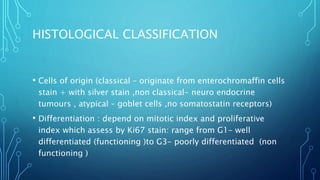
HISTOLOGICAL CLASSIFICATION
• Cells of origin (classical – originate from enterochromaffin cells
stain + with silver stain ,non classical- neuro endocrine
tumours , atypical – goblet cells ,no somatostatin receptors)
• Differentiation : depend on mitotic index and proliferative
index which assess by Ki67 stain: range from G1- well
differentiated (functioning )to G3- poorly differentiated (non
functioning )
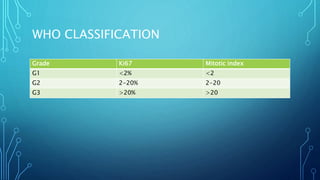
WHO CLASSIFICATION
Grade Ki67 Mitotic index
G1 <2% <2
G2 2-20% 2-20
G3 >20% >20
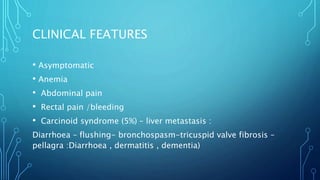
CLINICAL FEATURES
• Asymptomatic
• Anemia
• Abdominal pain
• Rectal pain /bleeding
• Carcinoid syndrome (5%) – liver metastasis :
Diarrhoea – flushing- bronchospasm-tricuspid valve fibrosis –
pellagra :Diarrhoea , dermatitis , dementia)
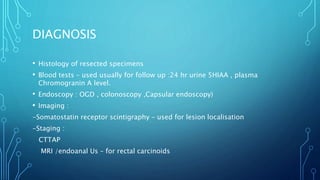
DIAGNOSIS
• Histology of resected specimens
• Blood tests – used usually for follow up :24 hr urine 5HIAA , plasma
Chromogranin A level.
• Endoscopy : OGD , colonoscopy ,Capsular endoscopy)
• Imaging :
-Somatostatin receptor scintigraphy – used for lesion localisation
-Staging :
CTTAP
MRI /endoanal Us – for rectal carcinoids
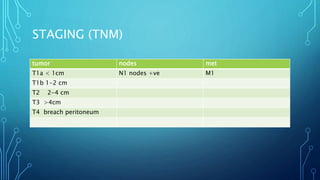
STAGING (TNM)
tumor nodes met
T1a < 1cm N1 nodes +ve M1
T1b 1-2 cm
T2 2-4 cm
T3 >4cm
T4 breach peritoneum
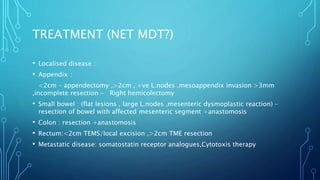
TREATMENT (NET MDT?)
• Localised disease :
• Appendix :
<2cm – appendectomy ,>2cm , +ve L.nodes .mesoappendix invasion >3mm
,incomplete resection – Right hemicolectomy
• Small bowel : (flat lesions , large L.nodes ,mesenteric dysmoplastic reaction) –
resection of bowel with affected mesenteric segment +anastomosis
• Colon : resection +anastomosis
• Rectum:<2cm TEMS/local excision ,>2cm TME resection
• Metastatic disease: somatostatin receptor analogues,Cytotoxis therapy
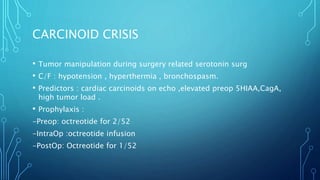
CARCINOID CRISIS
• Tumor manipulation during surgery related serotonin surg
• C/F : hypotension , hyperthermia , bronchospasm.
• Predictors : cardiac carcinoids on echo ,elevated preop 5HIAA,CagA,
high tumor load .
• Prophylaxis :
-Preop: octreotide for 2/52
-IntraOp :octreotide infusion
-PostOp: Octreotide for 1/52
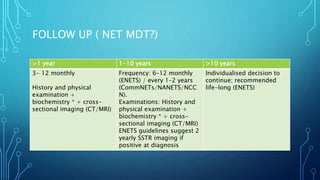
FOLLOW UP ( NET MDT?)
>1 year 1-10 years >10 years
3- 12 monthly
History and physical
examination +
biochemistry * + cross-
sectional imaging (CT/MRI)
Frequency: 6–12 monthly
(ENETS) / every 1–2 years
(CommNETs/NANETS/NCC
N).
Examinations: History and
physical examination +
biochemistry * + cross-
sectional imaging (CT/MRI)
ENETS guidelines suggest 2
yearly SSTR imaging if
positive at diagnosis
Individualised decision to
continue; recommended
life-long (ENETS)
FURTHER READING
• Consensus Guidelines for the Management and Treatment of
Neuroendocrine Tumors
• Pancreas. 2013 May; 42(4): 557–577.
• doi: 10.1097/MPA.0b013e31828e34a4

carcinoid tumors.pptx

  • 1.
    CARCINOID TUMORS MR.MEKKI HASSAN POSTCCT COLORECTAL FELLOW BRADFORD TEACHING HOSPITALS FOUNDATION TRUST
  • 2.
    INTRODUCTION • Rare neuroendocrinetumors • Incidence 1.1-2/100000 • 70 % in GIT
  • 3.
    EMBRYOLOGICAL CLASSIFICATION • ForegutCarcinoids (stomach ,duodenum , Pancrease ,lung and thymus) • Midgut Carcinoids (small bowel 30%- proximal 2/3 of colon) • Hindgut Carcinoids (colon and rectum)
  • 4.
    HISTOLOGICAL CLASSIFICATION • Cellsof origin (classical – originate from enterochromaffin cells stain + with silver stain ,non classical- neuro endocrine tumours , atypical – goblet cells ,no somatostatin receptors) • Differentiation : depend on mitotic index and proliferative index which assess by Ki67 stain: range from G1- well differentiated (functioning )to G3- poorly differentiated (non functioning )
  • 5.
    WHO CLASSIFICATION Grade Ki67Mitotic index G1 <2% <2 G2 2-20% 2-20 G3 >20% >20
  • 6.
    CLINICAL FEATURES • Asymptomatic •Anemia • Abdominal pain • Rectal pain /bleeding • Carcinoid syndrome (5%) – liver metastasis : Diarrhoea – flushing- bronchospasm-tricuspid valve fibrosis – pellagra :Diarrhoea , dermatitis , dementia)
  • 7.
    DIAGNOSIS • Histology ofresected specimens • Blood tests – used usually for follow up :24 hr urine 5HIAA , plasma Chromogranin A level. • Endoscopy : OGD , colonoscopy ,Capsular endoscopy) • Imaging : -Somatostatin receptor scintigraphy – used for lesion localisation -Staging : CTTAP MRI /endoanal Us – for rectal carcinoids
  • 8.
    STAGING (TNM) tumor nodesmet T1a < 1cm N1 nodes +ve M1 T1b 1-2 cm T2 2-4 cm T3 >4cm T4 breach peritoneum
  • 9.
    TREATMENT (NET MDT?) •Localised disease : • Appendix : <2cm – appendectomy ,>2cm , +ve L.nodes .mesoappendix invasion >3mm ,incomplete resection – Right hemicolectomy • Small bowel : (flat lesions , large L.nodes ,mesenteric dysmoplastic reaction) – resection of bowel with affected mesenteric segment +anastomosis • Colon : resection +anastomosis • Rectum:<2cm TEMS/local excision ,>2cm TME resection • Metastatic disease: somatostatin receptor analogues,Cytotoxis therapy
  • 10.
    CARCINOID CRISIS • Tumormanipulation during surgery related serotonin surg • C/F : hypotension , hyperthermia , bronchospasm. • Predictors : cardiac carcinoids on echo ,elevated preop 5HIAA,CagA, high tumor load . • Prophylaxis : -Preop: octreotide for 2/52 -IntraOp :octreotide infusion -PostOp: Octreotide for 1/52
  • 11.
    FOLLOW UP (NET MDT?) >1 year 1-10 years >10 years 3- 12 monthly History and physical examination + biochemistry * + cross- sectional imaging (CT/MRI) Frequency: 6–12 monthly (ENETS) / every 1–2 years (CommNETs/NANETS/NCC N). Examinations: History and physical examination + biochemistry * + cross- sectional imaging (CT/MRI) ENETS guidelines suggest 2 yearly SSTR imaging if positive at diagnosis Individualised decision to continue; recommended life-long (ENETS)
  • 12.
    FURTHER READING • ConsensusGuidelines for the Management and Treatment of Neuroendocrine Tumors • Pancreas. 2013 May; 42(4): 557–577. • doi: 10.1097/MPA.0b013e31828e34a4