Principles of Laparoscopic surgery
‫العاني‬‫الجواد‬‫عبد‬ ‫معتز‬‫د‬
‫الوالدة‬‫وحديثي‬ ‫االطفال‬‫احة‬‫ر‬‫ج‬ ‫ي‬‫استشار‬
‫التعليمي‬ ‫الخنساء‬ ‫مستشفى‬
‫الوالدة‬‫وحديثي‬ ‫االطفال‬‫احة‬‫ر‬‫ج‬ ‫في‬ ‫بي‬‫ر‬‫واالو‬ ‫اقي‬‫ر‬‫الع‬‫البورد‬ ‫شهادة‬
‫اقي‬‫ر‬‫الع‬‫البورد‬ ‫في‬ ‫مشرف‬
‫بي‬‫ر‬‫الع‬‫البورد‬‫و‬
‫االطفال‬‫احة‬‫ر‬‫لج‬
‫اقية‬‫ر‬‫الع‬‫الصحة‬‫ارة‬‫ز‬‫و‬ ‫في‬‫معتمد‬‫مدرب‬
‫عضو‬
‫لجنة‬
‫احة‬‫ر‬‫الج‬
‫ية‬‫ر‬‫المنظا‬
‫نينوى‬ ‫صحة‬ ‫لدائرة‬
General Information
Minimal access surgery differs from open surgery
small skin incisions minimize the morbidity and unsightly scars
,additionally better views by reaching deeper within the body cavity.
The procedure can still be invasive and traumatic, and therefore it is
more appropriate to describe the approach as “minimal access”
instead of “minimally invasive.”
The three interrelated performance-enhancing elements in optimizing
operative surgery are technology, ergonomics, and training .
Creation of the Operative Workspace
 An insufflator is used to create, maintain, and control an adequate
operative workspace.
 The insufflations are given in short pulses and not continuously.
 A filter is used to prevent back flow of fluid from the patient.
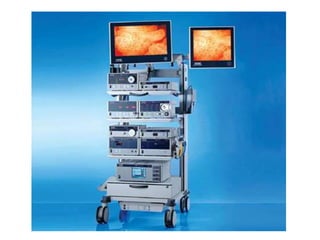
Visualization of the Operative Field
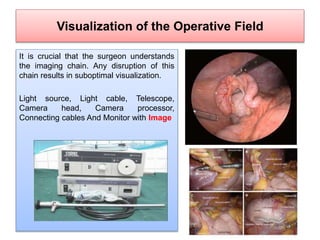
It is crucial that the surgeon understands
the imaging chain. Any disruption of this
chain results in suboptimal visualization.
Light source, Light cable, Telescope,
Camera head, Camera processor,
Connecting cables And Monitor with Image
Light Source
Most modern light sources use 300 watt
xenon bulbs that emit white light transmitted
via a fiberoptic light cable to the light post
of the endoscope.
Problems arise if there is
 A size mismatch between the light cable
and the endoscope size .
 Loose connections.
 Plus or minus broken fibers within the
light cable .
They generate a significant amount of heat,
which can cause thermal damage to tissue.
The endoscopes
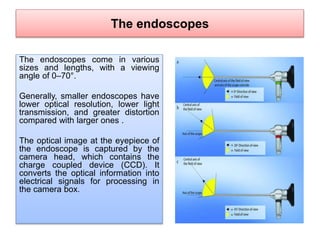
The endoscopes come in various
sizes and lengths, with a viewing
angle of 0–70°.
Generally, smaller endoscopes have
lower optical resolution, lower light
transmission, and greater distortion
compared with larger ones .
The optical image at the eyepiece of
the endoscope is captured by the
camera head, which contains the
charge coupled device (CCD). It
converts the optical information into
electrical signals for processing in
the camera box.
Laparoscopic Suction Irrigation
Suction-irrigation devices are useful
when there is spillage in the operative
field. They can also be used in blunt
dissection.
They require pressurized fluid for
irrigation. A specimen trap can be set
up for collection of the suctioned fluid.
Instruments
Instruments are available in disposable or reusable forms.
 Disposable instruments are always new, clean, sterile, and work
well as manufactured. However, they are expensive.
 Reusable instruments are generally more economical but have to
be cleaned, sterilized, packed, and serviced.
It is essential that the cleaning / sterilization department knows the
exact requirements of each instrument.
The Cannula (The Port) Trocar
Instrument access into a body cavity in MAS is usually via a port that
consists of the cannula (the port) and trocar.
There are various types of trocar tips (pyramidal, conical (sharp or
blunt), or with a retractable blade.)
.
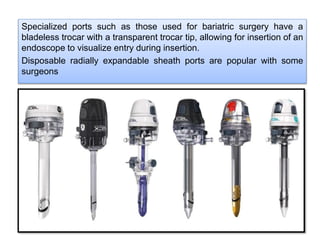
Specialized ports such as those used for bariatric surgery have a
bladeless trocar with a transparent trocar tip, allowing for insertion of an
endoscope to visualize entry during insertion.
Disposable radially expandable sheath ports are popular with some
surgeons
 The size of the port depends on
the instruments to be used.
 Most ports have a side stopcock
for insufflation and an internal
valve to prevent gas leakage when
the instrument is removed.
 Some allow instruments of different
sizes to be used without the need
for adaptors/reducers.
 The rubber bung at the outer end
maintains the gas seal when the
instrument is inserted.
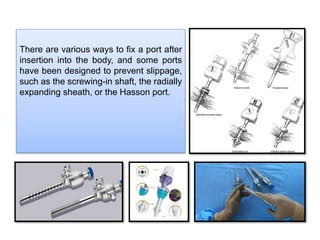
There are various ways to fix a port after
insertion into the body, and some ports
have been designed to prevent slippage,
such as the screwing-in shaft, the radially
expanding sheath, or the Hasson port.
In small children and infants, instruments can be inserted without a
port, especially if frequent instrument changes are unlikely, such as in a
pyloromyotomy.
The incision needs to be small and tight around the instrument to
minimize the leakage of gas.
Commonly used working instruments in MAS include
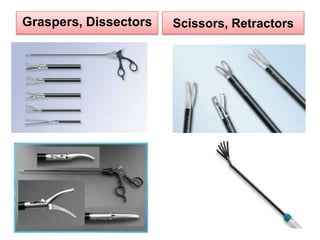
1. Graspers/Dissectors.
2. Scissors, Retractors.
3. Clippers/Staplers.
4. Ligature Placing Devices.
5. Suction/Irrigation Devices
6. Energy Supplying .
7. Devices Tissue Retrieving Bags.
Clippers/
Scissors, Retractors
Graspers, Dissectors
Staplers Endoloop
Devices Tissue Retrieving Bags
Pretied surgical loops (e.g., Endoloops )are useful for resection procedures
such as appendicectomy.
Specimen retrieval bags of various sizes and designs are available to avoid
contamination during organ/tissueremoval. These are usually too large for use
in infants.
Energy Devices
Electrosurgical devices are used extensively for hemostasis and
dissection in MAS.
Minor bleeding can obscure the view and reduce light reflection
within the operative field.
The general principles of monopolar and bipolar diathermy are
the same as those for open surgery .
Extra care must be taken when using monopolar diathermy to
avoid hazards caused by insulation failure, capacitive coupling,
and inadvertent direct (coupling) touching of another metal
instrument within the operative field.
The hook monopolar diathermy instrument is most commonly used for
dissection.
Bipolar diathermy uses special forceps without the need for use of the
patient return plate in monopolar diathermy.
In general, bipolar instruments are preferable because the electrical
circuit passes between the tips of the instruments, not through the
patient’s body.
Ultrasonic scalpels (e.g., the harmonic scalpel) convert
ultrasonic vibrations into energy for precision cutting and
coagulation without the need for an electrical circuit through the
patient.
Beware of collateral injury caused by thermal spread by the
heated instrument tip during or after use.
Vessel-sealing technology (e.g., LigaSure) uses an optimized
combination of pressure and energy to create seals by denaturing the
collagen and elastin in vessel walls.
It seals vessels up to 7 mm in diameter. When the seal is complete,
the computer-controlled feedback ceases the energy.
Some hand-held devices also come with a knife mechanism for
division of tissue that has just been sealed.

laparoscopic ergonomics.pptx

  • 1.
    Principles of Laparoscopicsurgery ‫العاني‬‫الجواد‬‫عبد‬ ‫معتز‬‫د‬ ‫الوالدة‬‫وحديثي‬ ‫االطفال‬‫احة‬‫ر‬‫ج‬ ‫ي‬‫استشار‬ ‫التعليمي‬ ‫الخنساء‬ ‫مستشفى‬ ‫الوالدة‬‫وحديثي‬ ‫االطفال‬‫احة‬‫ر‬‫ج‬ ‫في‬ ‫بي‬‫ر‬‫واالو‬ ‫اقي‬‫ر‬‫الع‬‫البورد‬ ‫شهادة‬ ‫اقي‬‫ر‬‫الع‬‫البورد‬ ‫في‬ ‫مشرف‬ ‫بي‬‫ر‬‫الع‬‫البورد‬‫و‬ ‫االطفال‬‫احة‬‫ر‬‫لج‬ ‫اقية‬‫ر‬‫الع‬‫الصحة‬‫ارة‬‫ز‬‫و‬ ‫في‬‫معتمد‬‫مدرب‬ ‫عضو‬ ‫لجنة‬ ‫احة‬‫ر‬‫الج‬ ‫ية‬‫ر‬‫المنظا‬ ‫نينوى‬ ‫صحة‬ ‫لدائرة‬
  • 2.
    General Information Minimal accesssurgery differs from open surgery small skin incisions minimize the morbidity and unsightly scars ,additionally better views by reaching deeper within the body cavity. The procedure can still be invasive and traumatic, and therefore it is more appropriate to describe the approach as “minimal access” instead of “minimally invasive.”
  • 4.
    The three interrelatedperformance-enhancing elements in optimizing operative surgery are technology, ergonomics, and training .
  • 6.
    Creation of theOperative Workspace  An insufflator is used to create, maintain, and control an adequate operative workspace.  The insufflations are given in short pulses and not continuously.  A filter is used to prevent back flow of fluid from the patient.
  • 7.
    Visualization of theOperative Field It is crucial that the surgeon understands the imaging chain. Any disruption of this chain results in suboptimal visualization. Light source, Light cable, Telescope, Camera head, Camera processor, Connecting cables And Monitor with Image
  • 8.
    Light Source Most modernlight sources use 300 watt xenon bulbs that emit white light transmitted via a fiberoptic light cable to the light post of the endoscope. Problems arise if there is  A size mismatch between the light cable and the endoscope size .  Loose connections.  Plus or minus broken fibers within the light cable . They generate a significant amount of heat, which can cause thermal damage to tissue.
  • 9.
    The endoscopes The endoscopescome in various sizes and lengths, with a viewing angle of 0–70°. Generally, smaller endoscopes have lower optical resolution, lower light transmission, and greater distortion compared with larger ones . The optical image at the eyepiece of the endoscope is captured by the camera head, which contains the charge coupled device (CCD). It converts the optical information into electrical signals for processing in the camera box.
  • 10.
    Laparoscopic Suction Irrigation Suction-irrigationdevices are useful when there is spillage in the operative field. They can also be used in blunt dissection. They require pressurized fluid for irrigation. A specimen trap can be set up for collection of the suctioned fluid.
  • 11.
    Instruments Instruments are availablein disposable or reusable forms.  Disposable instruments are always new, clean, sterile, and work well as manufactured. However, they are expensive.  Reusable instruments are generally more economical but have to be cleaned, sterilized, packed, and serviced. It is essential that the cleaning / sterilization department knows the exact requirements of each instrument.
  • 12.
    The Cannula (ThePort) Trocar Instrument access into a body cavity in MAS is usually via a port that consists of the cannula (the port) and trocar. There are various types of trocar tips (pyramidal, conical (sharp or blunt), or with a retractable blade.) .
  • 13.
    Specialized ports suchas those used for bariatric surgery have a bladeless trocar with a transparent trocar tip, allowing for insertion of an endoscope to visualize entry during insertion. Disposable radially expandable sheath ports are popular with some surgeons
  • 14.
     The sizeof the port depends on the instruments to be used.  Most ports have a side stopcock for insufflation and an internal valve to prevent gas leakage when the instrument is removed.  Some allow instruments of different sizes to be used without the need for adaptors/reducers.  The rubber bung at the outer end maintains the gas seal when the instrument is inserted.
  • 15.
    There are variousways to fix a port after insertion into the body, and some ports have been designed to prevent slippage, such as the screwing-in shaft, the radially expanding sheath, or the Hasson port.
  • 16.
    In small childrenand infants, instruments can be inserted without a port, especially if frequent instrument changes are unlikely, such as in a pyloromyotomy. The incision needs to be small and tight around the instrument to minimize the leakage of gas.
  • 17.
    Commonly used workinginstruments in MAS include 1. Graspers/Dissectors. 2. Scissors, Retractors. 3. Clippers/Staplers. 4. Ligature Placing Devices. 5. Suction/Irrigation Devices 6. Energy Supplying . 7. Devices Tissue Retrieving Bags.
  • 18.
  • 19.
  • 20.
  • 21.
    Devices Tissue RetrievingBags Pretied surgical loops (e.g., Endoloops )are useful for resection procedures such as appendicectomy. Specimen retrieval bags of various sizes and designs are available to avoid contamination during organ/tissueremoval. These are usually too large for use in infants.
  • 22.
    Energy Devices Electrosurgical devicesare used extensively for hemostasis and dissection in MAS. Minor bleeding can obscure the view and reduce light reflection within the operative field. The general principles of monopolar and bipolar diathermy are the same as those for open surgery . Extra care must be taken when using monopolar diathermy to avoid hazards caused by insulation failure, capacitive coupling, and inadvertent direct (coupling) touching of another metal instrument within the operative field.
  • 24.
    The hook monopolardiathermy instrument is most commonly used for dissection. Bipolar diathermy uses special forceps without the need for use of the patient return plate in monopolar diathermy. In general, bipolar instruments are preferable because the electrical circuit passes between the tips of the instruments, not through the patient’s body.
  • 25.
    Ultrasonic scalpels (e.g.,the harmonic scalpel) convert ultrasonic vibrations into energy for precision cutting and coagulation without the need for an electrical circuit through the patient. Beware of collateral injury caused by thermal spread by the heated instrument tip during or after use.
  • 26.
    Vessel-sealing technology (e.g.,LigaSure) uses an optimized combination of pressure and energy to create seals by denaturing the collagen and elastin in vessel walls. It seals vessels up to 7 mm in diameter. When the seal is complete, the computer-controlled feedback ceases the energy. Some hand-held devices also come with a knife mechanism for division of tissue that has just been sealed.