COGNITIVE DEVELOPMENT OCCURS IN
SOCIAL INTERACTION
The Internalization of Socially Shared
Processes
Every psychological function occurs twice,
first at the “intermental” level (between
people who are involved in social interaction),
and later at the “intramental” level (within
the individual)
An Example of Internalization of Socially
Shared Processes
The development of pointing:
• infant unsuccessfully reaches for desired object
• adult interprets action as an attempt to draw attention
to object
• meaning of instrumental attempt changed to an
attempt to communicate
• infant links reaching action to social situation, comes
to understand movement as directed at another person
• social meaning of action is internalized, becoming
a true gesture
An Example of Internalization of Socially
Shared Processes
A child learning to tie her shoes:
• at first, an adult assists the child, providing verbal
guidance (e.g., “now make a loop, and bring the other
lace around it …”)
• with time, the child internalizes the sequence of steps
so that she can control her own actions without adult
assistance
• the child may “hear” the adult’s instructions in her
“mind’s ear,” but she no longer needs the adult to
provide external support for her performance
COGNITIVE DEVELOPMENT OCCURS IN
SOCIAL INTERACTION
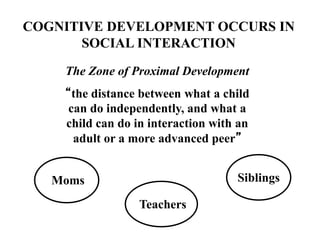
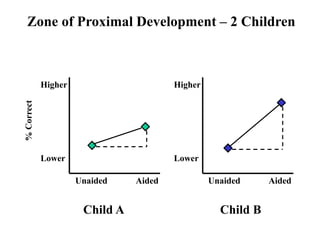
The Zone of Proximal Development
“the distance between what a child
can do independently, and what a
child can do in interaction with an
adult or a more advanced peer”
Moms
Teachers
Siblings
Zone of Proximal Development – 2 Children
Unaided Aided Unaided Aided
Higher
Lower
Higher
Lower
Child A Child B
%
Correct
An Example of Social Scaffolding
Scene: Mom is helping child construct a puzzle. They have a
model that they can refer to. The child tries to place green
pieces where they do not belong.
Mom: Did we find any green up here? (points to model)
Child: (looks at model) This one. (points to incorrect place
in the model)
Mom: I think maybe that’s a leftover. Do you think so?
Child: (nods)
Mom: Maybe we don’t need the green one, cause there
isn’t
any green one up there, is there. Remember?
Child: (looks at pieces pile, puts green pieces back, chooses
Key Factors in Sensitive Adult-Child
Interaction
 tailor support to child’s level of skill
development (cognitive readiness)
- one step ahead is best
 monitor child’s attention to intervene
at appropriate time
e.g., mothers who label objects for
their toddlers by following where
the child focuses his/her attention
Key Factors in Sensitive Adult-Child
Interaction continued
 prompt metacognitive awareness
- outline goals of the task
- discuss strategies for meeting goals
- involve child in making decisions
Peer Collaboration - Does it Work?
 helps to motivate child to try difficult
tasks
 provides opportunities to imitate and
learn each other’s skills
 opportunities to explain, put their
knowledge into words, enhances
understanding
Answer: Sometimes it Does, Sometimes it Doesn’t
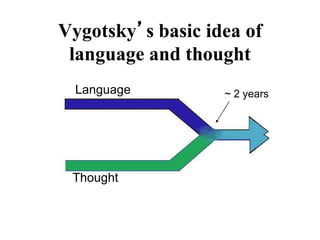
Vygotsky on Language and Thought
Thought and speech have different roots. The two
functions develop along different lines and
independently of each other. (p. 41)
At a certain point these lines meet, whereupon
thought becomes verbal and speech rational. (p.44)
[Thought and Language, 1962, MIT press]
[original published in Russian, 1934]
Vygotsky’s basic idea of
language and thought
Language
Thought
~ 2 years
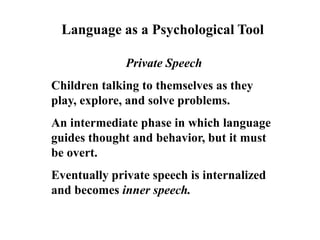
Language as a Psychological Tool
Private Speech
Children talking to themselves as they
play, explore, and solve problems.
An intermediate phase in which language
guides thought and behavior, but it must
be overt.
Eventually private speech is internalized
and becomes inner speech.
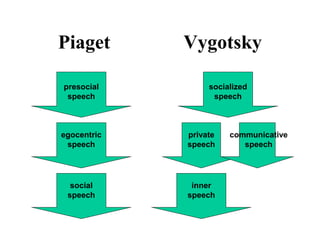
Piaget Vygotsky
presocial
speech
egocentric
speech
social
speech
socialized
speech
private
speech
inner
speech
communicative
speech
Pre-operational Period: Egocentric Speech
Mary: They wiggle sideways when they kiss.
John: (vaguely) What?
Mary: My bunny slippers. They are brown and red and
sort of yellow and white.
John: I have a piece of sugar in red pieces of paper. I’m
gonna eat it and maybe its for a horse.
Mary: We bought them. My mom did. We couldn’t find
the old ones. They were in the trunk.
John: Can’t eat the piece of sugar, not unless you take the
paper off.
Mary: And we found Mother Lamb. Oh, she was in Pough-
keepsie in the trunk in the house in the woods.
John: Do you like sugar? I do, and so do horses.
Pre-operational Period: Social Speech
Adam: If I grow up my voice will change and when you grow
up your voice will change. My Mom told me. Did your
Mommy tell you?
Jenny: No, your Mommy’s wrong. My voice, I don’t want it
to change.
Adam: Oh, well, we’ll stay little, right?
Jenny: What?
Adam: We’ll stay little.
Jenny: No, I don’t want to. I want my voice to change. I don’t
care if it changes.
Adam: I care.
Key Findings in Language Guided Thought
Preschool Years
 children produce more private speech
on more challenging tasks
 children’s private speech declines with
age (“goes underground”)
 private speech is not egocentric speech
talking aloud is not a failure to engage
in role taking
The Relationship Between Thought & Language
 Language Determines Thought
Whorf – linguistic relativity hypothesis
 Thought Determines Language
Piaget’s demonstration study
 Thought & Language Interact, Boot Strap Effect
cognitive readiness
zone of proximal development
BRUNER’S MODES OF
REPRESENTATION
Enactive Representation - using actions to represent
information, dominant mode of representation in
the sensori-motor period (0 to 2 yrs), “thought is
action”
Iconic Representation - using visualization to
represent information, dominant mode of
representation during the preschool years,
Piaget’s conservation tasks are good examples
Symbolic Representation - using language or other
symbols to represent information, middle
childhood and beyond
BRUNER’S CLASSIC SCREENING STUDY
Participants: 5 to 8 year old children who clearly failed the
conservation of liquid substance task.
Step 1: Screen is placed in front of the beakers before the
liquid is poured.
BRUNER’S CLASSIC SCREENING STUDY
Step 2: Blue liquid is poured from one of the tall beakers to
the wide beaker.
Step 3: Child is asked whether the liquid is still the same
amount.
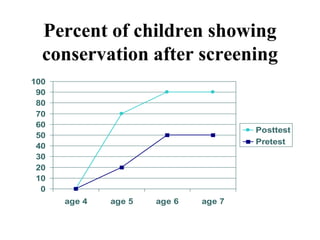
Results: When children do not have the misleading visual
information, they say “It’s the same, you only poured it”
Percent of children showing
conservation after screening
0
10
20
30
40
50
60
70
80
90
100
age 4 age 5 age 6 age 7
Posttest
Pretest
Bruner’s Interpretation
 Evidence of language as a representational
tool
 Evidence of the role of “cognitive readiness”
in prompting cognitive change
 Implications for classroom teaching and
interventions

COGNITIVE DEVELOPMENT.ppt

  • 1.
    COGNITIVE DEVELOPMENT OCCURSIN SOCIAL INTERACTION The Internalization of Socially Shared Processes Every psychological function occurs twice, first at the “intermental” level (between people who are involved in social interaction), and later at the “intramental” level (within the individual)
  • 2.
    An Example ofInternalization of Socially Shared Processes The development of pointing: • infant unsuccessfully reaches for desired object • adult interprets action as an attempt to draw attention to object • meaning of instrumental attempt changed to an attempt to communicate • infant links reaching action to social situation, comes to understand movement as directed at another person • social meaning of action is internalized, becoming a true gesture
  • 3.
    An Example ofInternalization of Socially Shared Processes A child learning to tie her shoes: • at first, an adult assists the child, providing verbal guidance (e.g., “now make a loop, and bring the other lace around it …”) • with time, the child internalizes the sequence of steps so that she can control her own actions without adult assistance • the child may “hear” the adult’s instructions in her “mind’s ear,” but she no longer needs the adult to provide external support for her performance
  • 4.
    COGNITIVE DEVELOPMENT OCCURSIN SOCIAL INTERACTION The Zone of Proximal Development “the distance between what a child can do independently, and what a child can do in interaction with an adult or a more advanced peer” Moms Teachers Siblings
  • 5.
    Zone of ProximalDevelopment – 2 Children Unaided Aided Unaided Aided Higher Lower Higher Lower Child A Child B % Correct
  • 6.
    An Example ofSocial Scaffolding Scene: Mom is helping child construct a puzzle. They have a model that they can refer to. The child tries to place green pieces where they do not belong. Mom: Did we find any green up here? (points to model) Child: (looks at model) This one. (points to incorrect place in the model) Mom: I think maybe that’s a leftover. Do you think so? Child: (nods) Mom: Maybe we don’t need the green one, cause there isn’t any green one up there, is there. Remember? Child: (looks at pieces pile, puts green pieces back, chooses
  • 7.
    Key Factors inSensitive Adult-Child Interaction  tailor support to child’s level of skill development (cognitive readiness) - one step ahead is best  monitor child’s attention to intervene at appropriate time e.g., mothers who label objects for their toddlers by following where the child focuses his/her attention
  • 8.
    Key Factors inSensitive Adult-Child Interaction continued  prompt metacognitive awareness - outline goals of the task - discuss strategies for meeting goals - involve child in making decisions
  • 9.
    Peer Collaboration -Does it Work?  helps to motivate child to try difficult tasks  provides opportunities to imitate and learn each other’s skills  opportunities to explain, put their knowledge into words, enhances understanding Answer: Sometimes it Does, Sometimes it Doesn’t
  • 10.
    Vygotsky on Languageand Thought Thought and speech have different roots. The two functions develop along different lines and independently of each other. (p. 41) At a certain point these lines meet, whereupon thought becomes verbal and speech rational. (p.44) [Thought and Language, 1962, MIT press] [original published in Russian, 1934]
  • 11.
    Vygotsky’s basic ideaof language and thought Language Thought ~ 2 years
  • 12.
    Language as aPsychological Tool Private Speech Children talking to themselves as they play, explore, and solve problems. An intermediate phase in which language guides thought and behavior, but it must be overt. Eventually private speech is internalized and becomes inner speech.
  • 13.
  • 14.
    Pre-operational Period: EgocentricSpeech Mary: They wiggle sideways when they kiss. John: (vaguely) What? Mary: My bunny slippers. They are brown and red and sort of yellow and white. John: I have a piece of sugar in red pieces of paper. I’m gonna eat it and maybe its for a horse. Mary: We bought them. My mom did. We couldn’t find the old ones. They were in the trunk. John: Can’t eat the piece of sugar, not unless you take the paper off. Mary: And we found Mother Lamb. Oh, she was in Pough- keepsie in the trunk in the house in the woods. John: Do you like sugar? I do, and so do horses.
  • 15.
    Pre-operational Period: SocialSpeech Adam: If I grow up my voice will change and when you grow up your voice will change. My Mom told me. Did your Mommy tell you? Jenny: No, your Mommy’s wrong. My voice, I don’t want it to change. Adam: Oh, well, we’ll stay little, right? Jenny: What? Adam: We’ll stay little. Jenny: No, I don’t want to. I want my voice to change. I don’t care if it changes. Adam: I care.
  • 16.
    Key Findings inLanguage Guided Thought Preschool Years  children produce more private speech on more challenging tasks  children’s private speech declines with age (“goes underground”)  private speech is not egocentric speech talking aloud is not a failure to engage in role taking
  • 17.
    The Relationship BetweenThought & Language  Language Determines Thought Whorf – linguistic relativity hypothesis  Thought Determines Language Piaget’s demonstration study  Thought & Language Interact, Boot Strap Effect cognitive readiness zone of proximal development
  • 18.
    BRUNER’S MODES OF REPRESENTATION EnactiveRepresentation - using actions to represent information, dominant mode of representation in the sensori-motor period (0 to 2 yrs), “thought is action” Iconic Representation - using visualization to represent information, dominant mode of representation during the preschool years, Piaget’s conservation tasks are good examples Symbolic Representation - using language or other symbols to represent information, middle childhood and beyond
  • 19.
    BRUNER’S CLASSIC SCREENINGSTUDY Participants: 5 to 8 year old children who clearly failed the conservation of liquid substance task. Step 1: Screen is placed in front of the beakers before the liquid is poured.
  • 20.
    BRUNER’S CLASSIC SCREENINGSTUDY Step 2: Blue liquid is poured from one of the tall beakers to the wide beaker. Step 3: Child is asked whether the liquid is still the same amount. Results: When children do not have the misleading visual information, they say “It’s the same, you only poured it”
  • 21.
    Percent of childrenshowing conservation after screening 0 10 20 30 40 50 60 70 80 90 100 age 4 age 5 age 6 age 7 Posttest Pretest
  • 22.
    Bruner’s Interpretation  Evidenceof language as a representational tool  Evidence of the role of “cognitive readiness” in prompting cognitive change  Implications for classroom teaching and interventions