Language
and
structure
Techinques
Dr. Asmaa Barakat Abu Auf
Humanities Lecturer
+201099653205
Language Arts:
Introduction
● Welcome to today's English Language class! In our journey through the intricate world
of literature and language, one of the most essential skills we'll develop is the ability
to analyze and appreciate the craft of writers. To truly understand a text and
appreciate its nuances, we must delve into two key aspects: language and structure.
● Language and structure are the twin pillars upon which powerful writing is built.
Language provides the words, phrases, and techniques that convey meaning and
evoke emotions, while structure determines the way these elements are organized to
create a compelling narrative or argument.
● In this session, we will embark on an exciting exploration of these fundamental
elements. We will learn how to identify, dissect, and appreciate the language and
structure techniques employed by writers to communicate their ideas effectively.
Whether you're studying a piece of literature, a newspaper article, or any form of
written communication, these skills will empower you to uncover hidden layers of
meaning and gain a deeper insight into the author's intent.
Introduction
● Throughout this class, we will discover that every word, sentence, and paragraph in a
text is meticulously chosen to serve a purpose. Writers use language to convey their
thoughts, emotions, and messages, and they employ various techniques to engage
and persuade their readers. These techniques are the building blocks of effective
communication and storytelling.
● Our journey today will equip you with the tools to recognize and analyze literary
devices, rhetorical strategies, and structural choices. From vivid imagery to persuasive
appeals, from narrative arcs to sentence structures, we will explore it all. By the end of
this class, you will have the skills and knowledge to deconstruct any text, uncover its
hidden treasures, and appreciate the craftsmanship of the writer.
● So, let's embark on this exciting exploration of language and structure techniques. By
the end of today's session, you will be well on your way to becoming a skilled textual
detective, capable of unlocking the secrets of literature and written communication.
Get ready to dive deep into the world of words and narratives as we embark on this
enlightening journey together!
Introduction
● understanding language and structure techniques is crucial for both readers and
writers. It enriches our comprehension of texts, fosters critical thinking, and enhances
our ability to communicate effectively in a variety of contexts. These skills are not only
academically valuable but also applicable to many aspects of life and various
professional endeavors.
● Language and structure techniques encompass a wide array of literary and rhetorical
devices that writers use to convey meaning, create emphasis, evoke emotions, and
engage readers.
Introduction
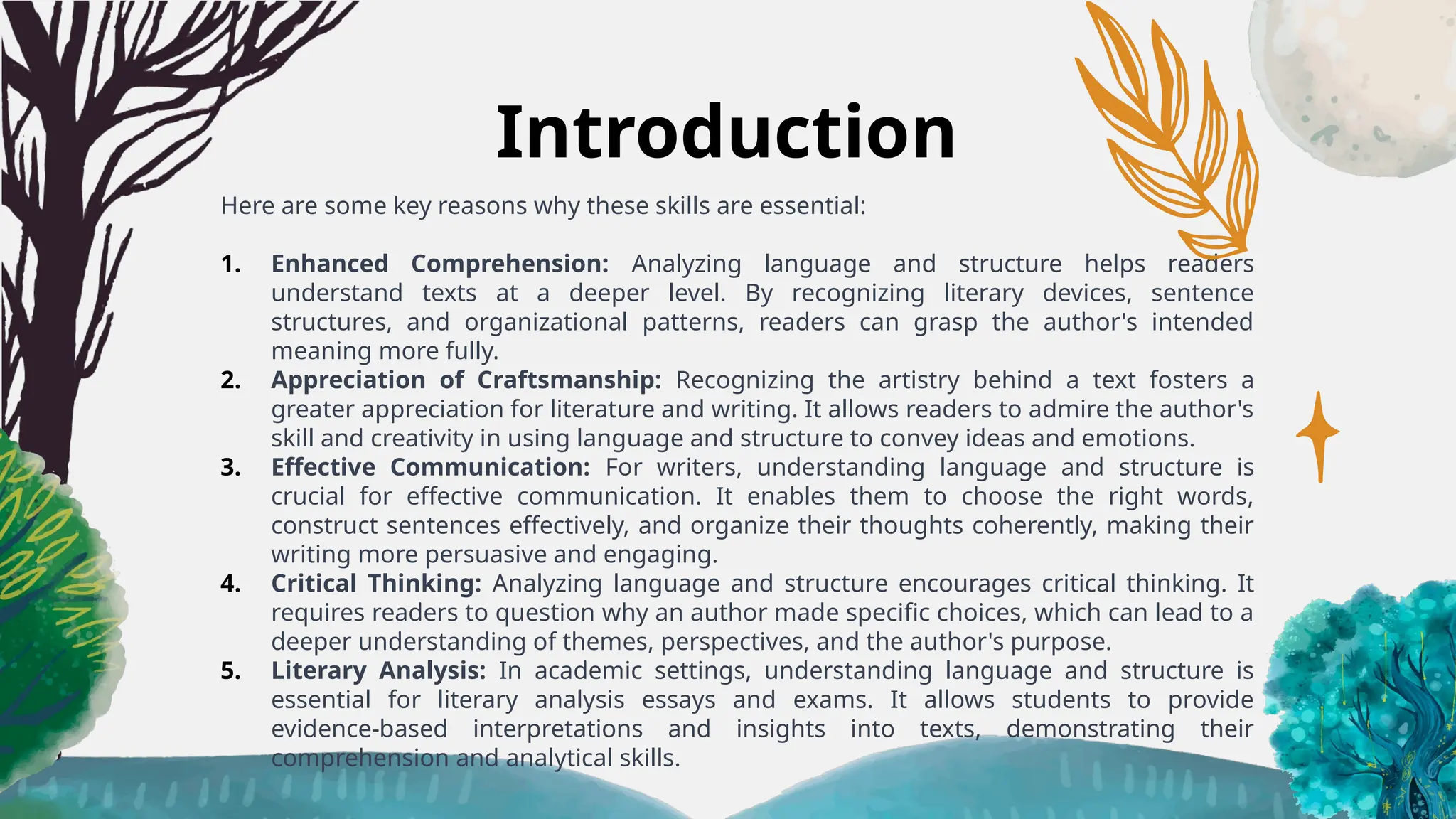
Here are some key reasons why these skills are essential:
1. Enhanced Comprehension: Analyzing language and structure helps readers
understand texts at a deeper level. By recognizing literary devices, sentence
structures, and organizational patterns, readers can grasp the author's intended
meaning more fully.
2. Appreciation of Craftsmanship: Recognizing the artistry behind a text fosters a
greater appreciation for literature and writing. It allows readers to admire the author's
skill and creativity in using language and structure to convey ideas and emotions.
3. Effective Communication: For writers, understanding language and structure is
crucial for effective communication. It enables them to choose the right words,
construct sentences effectively, and organize their thoughts coherently, making their
writing more persuasive and engaging.
4. Critical Thinking: Analyzing language and structure encourages critical thinking. It
requires readers to question why an author made specific choices, which can lead to a
deeper understanding of themes, perspectives, and the author's purpose.
5. Literary Analysis: In academic settings, understanding language and structure is
essential for literary analysis essays and exams. It allows students to provide
evidence-based interpretations and insights into texts, demonstrating their
comprehension and analytical skills.
Introduction
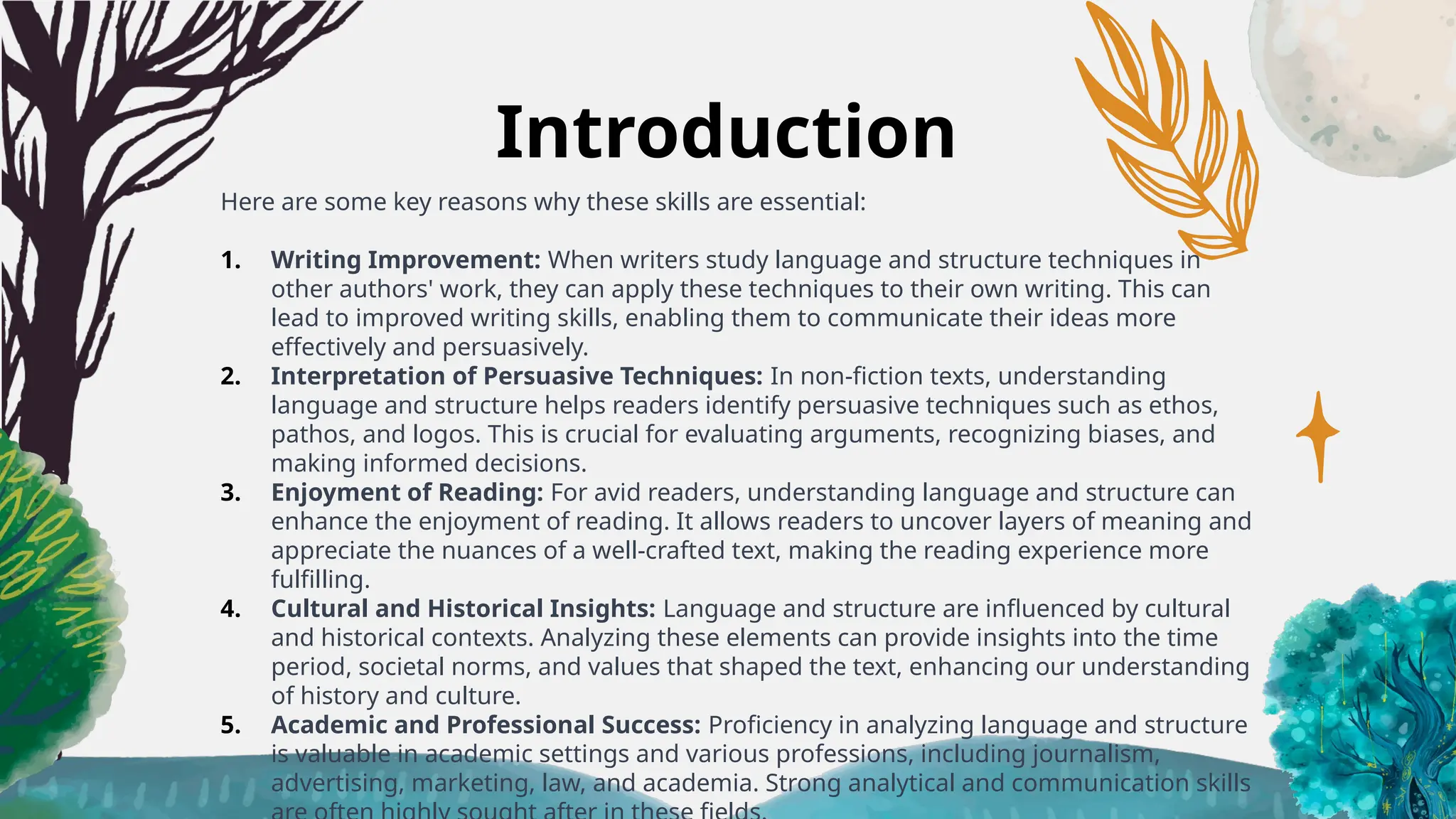
Here are some key reasons why these skills are essential:
1. Writing Improvement: When writers study language and structure techniques in
other authors' work, they can apply these techniques to their own writing. This can
lead to improved writing skills, enabling them to communicate their ideas more
effectively and persuasively.
2. Interpretation of Persuasive Techniques: In non-fiction texts, understanding
language and structure helps readers identify persuasive techniques such as ethos,
pathos, and logos. This is crucial for evaluating arguments, recognizing biases, and
making informed decisions.
3. Enjoyment of Reading: For avid readers, understanding language and structure can
enhance the enjoyment of reading. It allows readers to uncover layers of meaning and
appreciate the nuances of a well-crafted text, making the reading experience more
fulfilling.
4. Cultural and Historical Insights: Language and structure are influenced by cultural
and historical contexts. Analyzing these elements can provide insights into the time
period, societal norms, and values that shaped the text, enhancing our understanding
of history and culture.
5. Academic and Professional Success: Proficiency in analyzing language and structure
is valuable in academic settings and various professions, including journalism,
advertising, marketing, law, and academia. Strong analytical and communication skills
Language Techniques
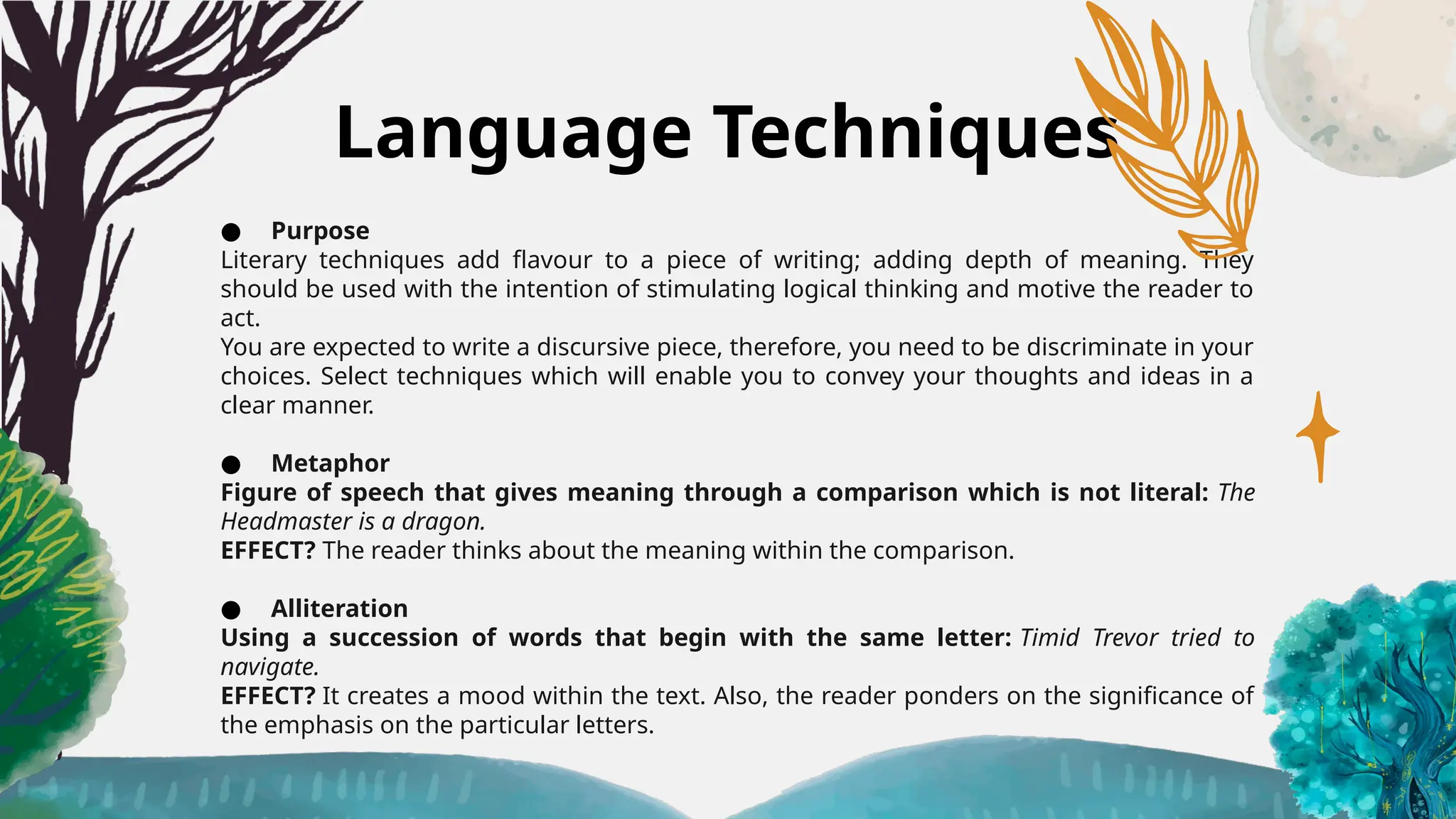
● Purpose
Literary techniques add flavour to a piece of writing; adding depth of meaning. They
should be used with the intention of stimulating logical thinking and motive the reader to
act.
You are expected to write a discursive piece, therefore, you need to be discriminate in your
choices. Select techniques which will enable you to convey your thoughts and ideas in a
clear manner.
● Metaphor
Figure of speech that gives meaning through a comparison which is not literal: The
Headmaster is a dragon.
EFFECT? The reader thinks about the meaning within the comparison.
● Alliteration
Using a succession of words that begin with the same letter: Timid Trevor tried to
navigate.
EFFECT? It creates a mood within the text. Also, the reader ponders on the significance of
the emphasis on the particular letters.
Language Techniques
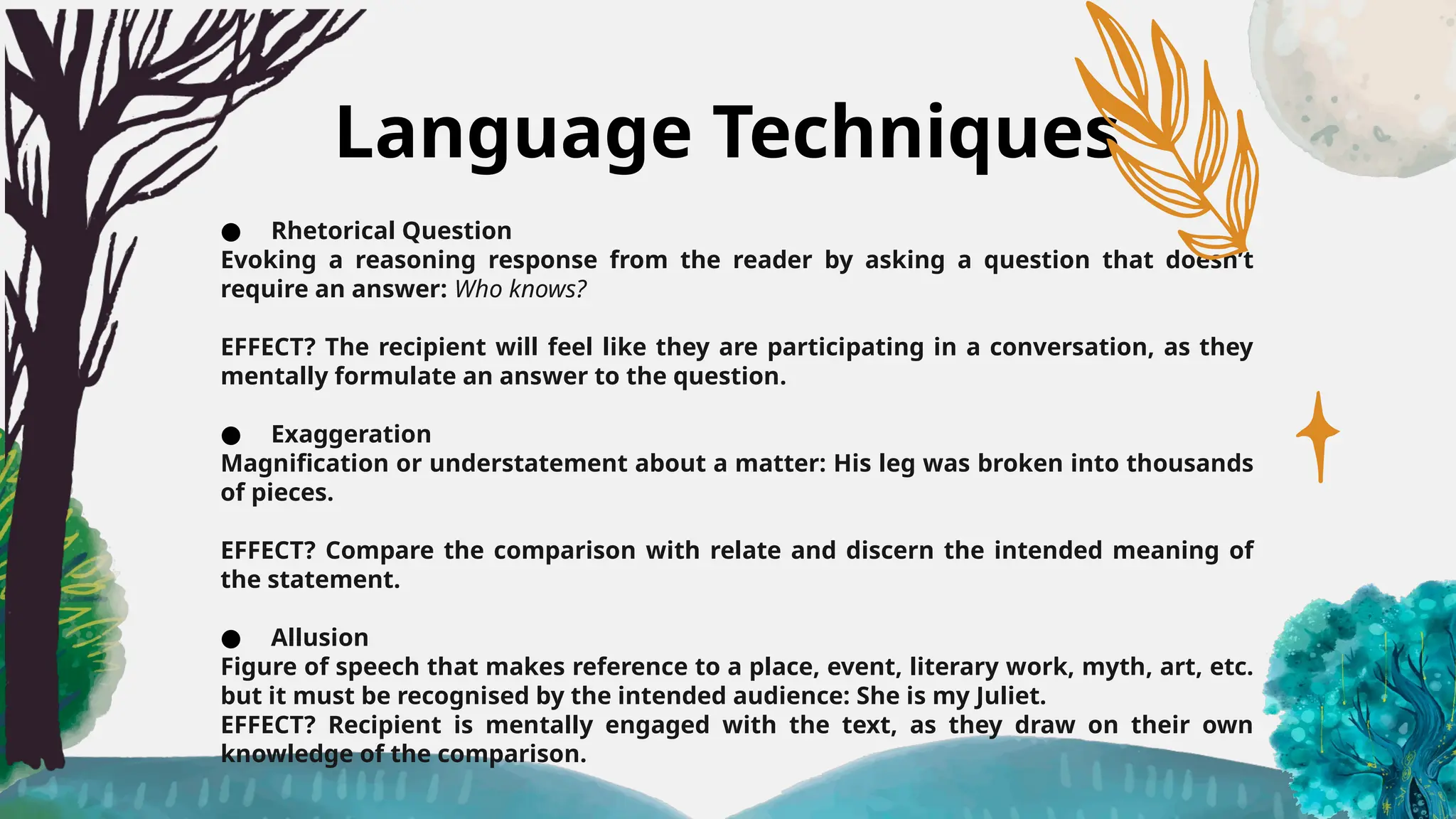
● Rhetorical Question
Evoking a reasoning response from the reader by asking a question that doesn’t
require an answer: Who knows?
EFFECT? The recipient will feel like they are participating in a conversation, as they
mentally formulate an answer to the question.
● Exaggeration
Magnification or understatement about a matter: His leg was broken into thousands
of pieces.
EFFECT? Compare the comparison with relate and discern the intended meaning of
the statement.
● Allusion
Figure of speech that makes reference to a place, event, literary work, myth, art, etc.
but it must be recognised by the intended audience: She is my Juliet.
EFFECT? Recipient is mentally engaged with the text, as they draw on their own
knowledge of the comparison.
Language Techniques
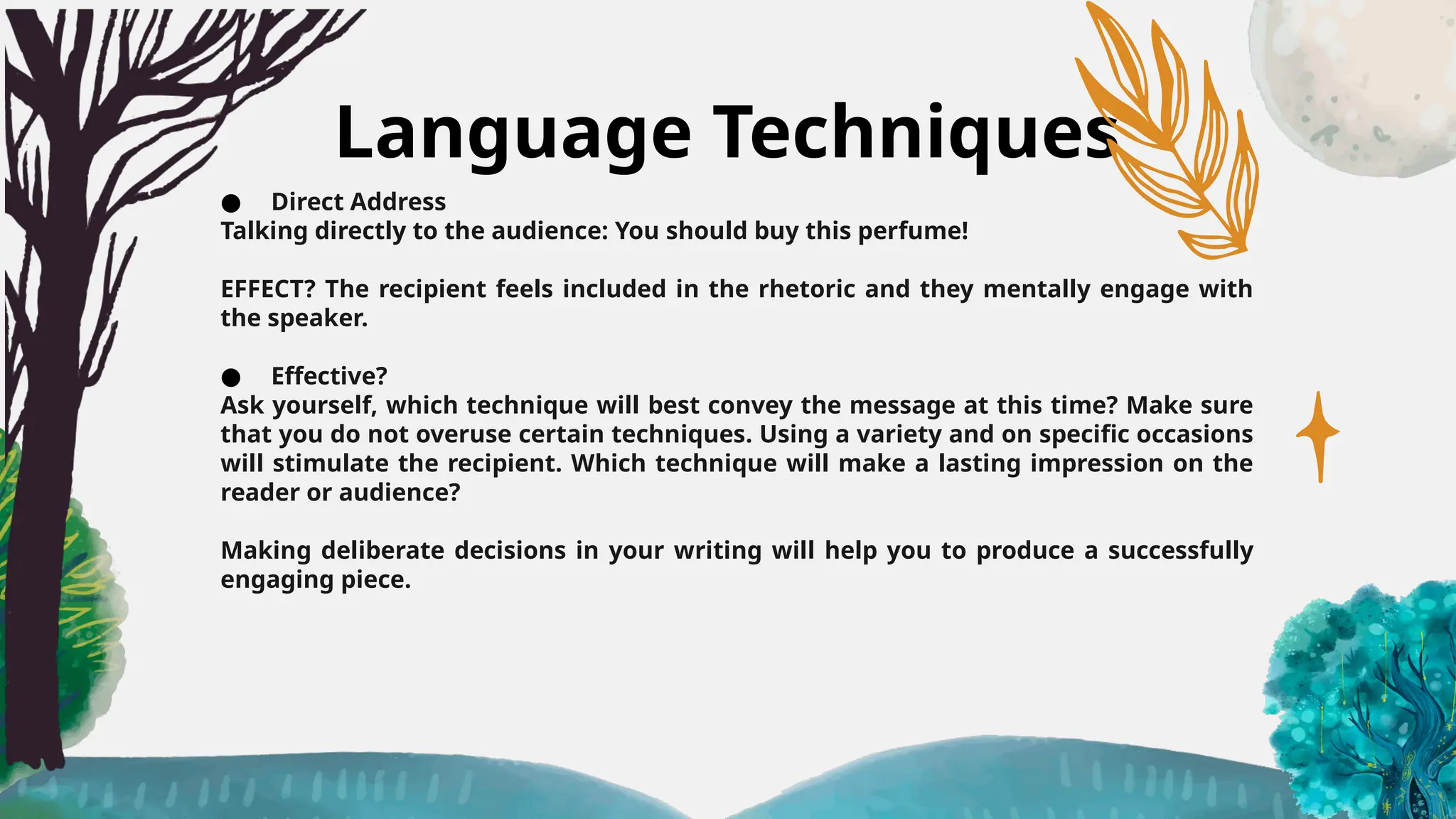
● Direct Address
Talking directly to the audience: You should buy this perfume!
EFFECT? The recipient feels included in the rhetoric and they mentally engage with
the speaker.
● Effective?
Ask yourself, which technique will best convey the message at this time? Make sure
that you do not overuse certain techniques. Using a variety and on specific occasions
will stimulate the recipient. Which technique will make a lasting impression on the
reader or audience?
Making deliberate decisions in your writing will help you to produce a successfully
engaging piece.
Language Techniques
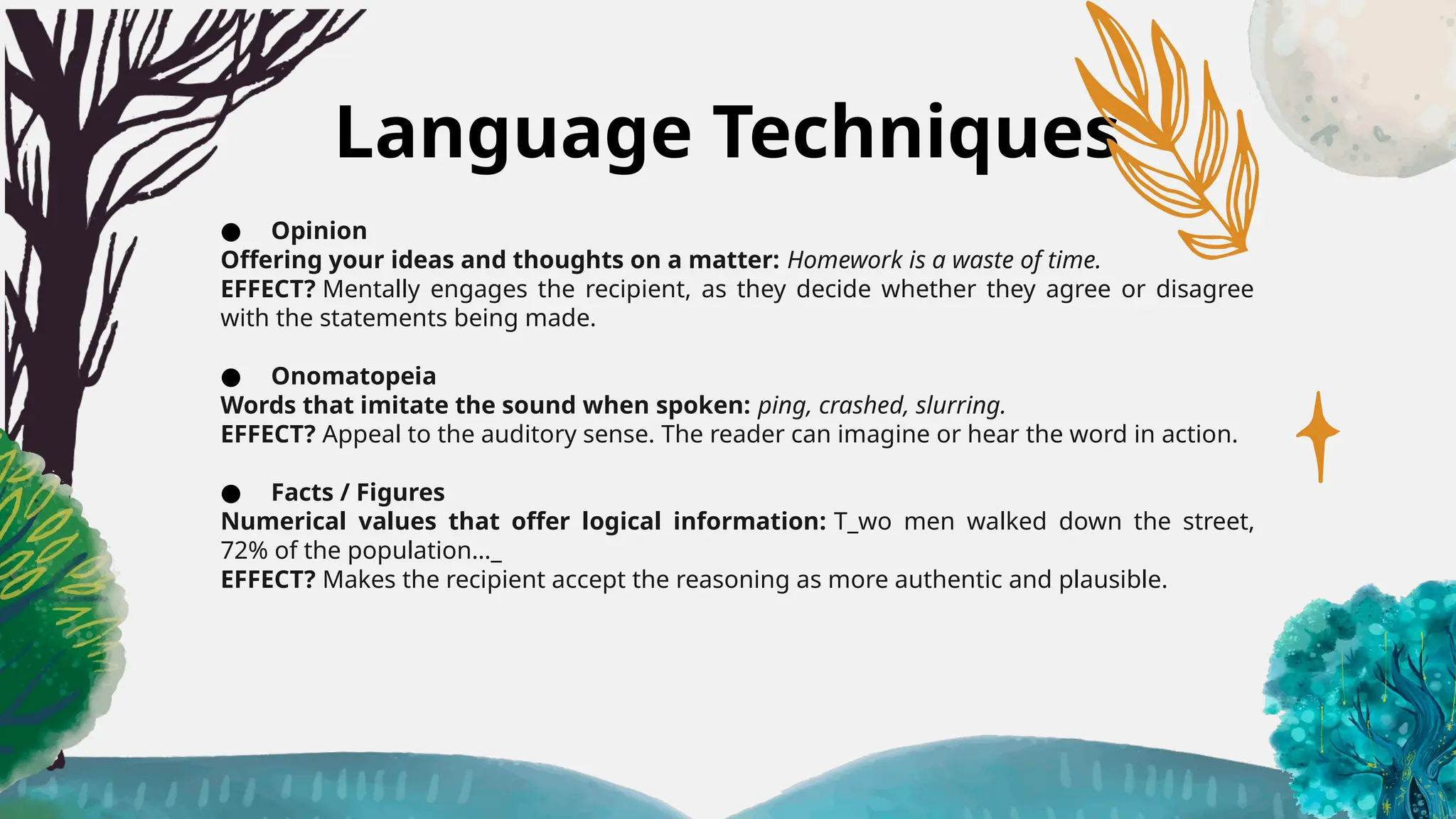
● Opinion
Offering your ideas and thoughts on a matter: Homework is a waste of time.
EFFECT? Mentally engages the recipient, as they decide whether they agree or disagree
with the statements being made.
● Onomatopeia
Words that imitate the sound when spoken: ping, crashed, slurring.
EFFECT? Appeal to the auditory sense. The reader can imagine or hear the word in action.
● Facts / Figures
Numerical values that offer logical information: T_wo men walked down the street,
72% of the population…_
EFFECT? Makes the recipient accept the reasoning as more authentic and plausible.
Language Techniques
● Opinion
Offering your ideas and thoughts on a matter: Homework is a waste of time.
EFFECT? Mentally engages the recipient, as they decide whether they agree or disagree
with the statements being made.
● Onomatopeia
Words that imitate the sound when spoken: ping, crashed, slurring.
EFFECT? Appeal to the auditory sense. The reader can imagine or hear the word in action.
● Facts / Figures
Numerical values that offer logical information: T_wo men walked down the street,
72% of the population…_
EFFECT? Makes the recipient accept the reasoning as more authentic and plausible.
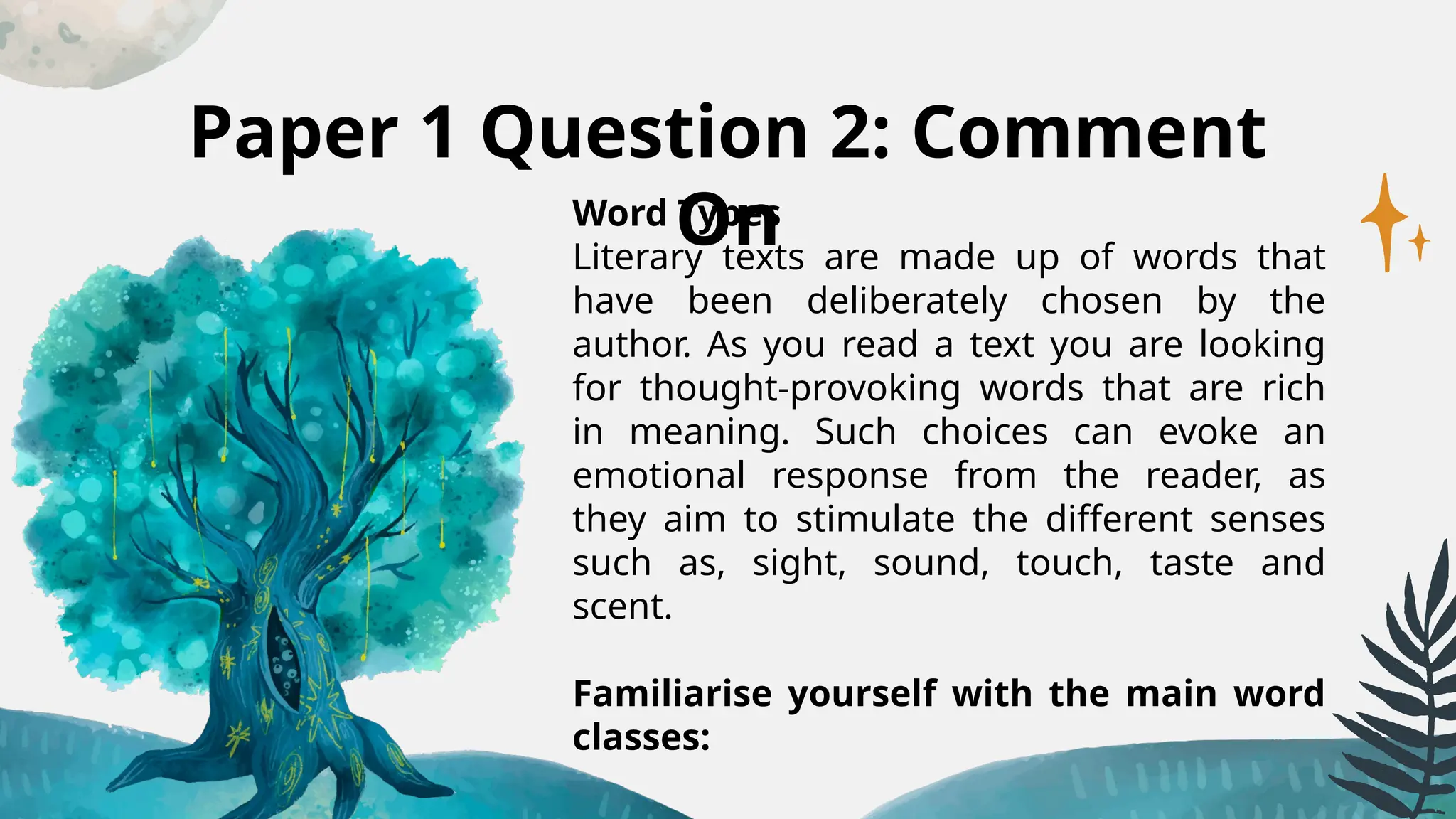
Paper 1 Question 2: Comment
On
Word Types
Literary texts are made up of words that
have been deliberately chosen by the
author. As you read a text you are looking
for thought-provoking words that are rich
in meaning. Such choices can evoke an
emotional response from the reader, as
they aim to stimulate the different senses
such as, sight, sound, touch, taste and
scent.
Familiarise yourself with the main word
classes:
Paper 1 Question 2: Comment
On
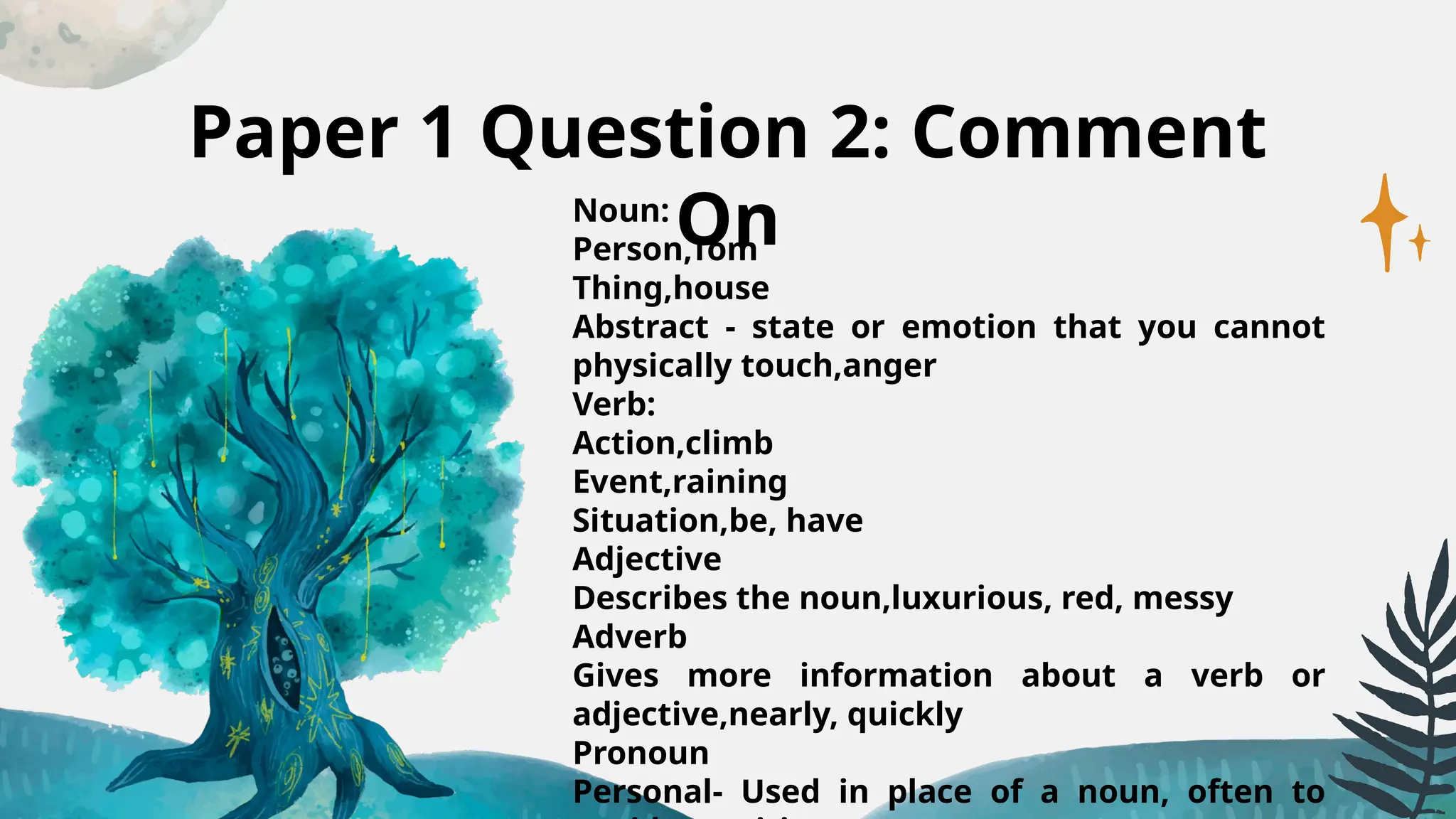
Noun:
Person,Tom
Thing,house
Abstract - state or emotion that you cannot
physically touch,anger
Verb:
Action,climb
Event,raining
Situation,be, have
Adjective
Describes the noun,luxurious, red, messy
Adverb
Gives more information about a verb or
adjective,nearly, quickly
Pronoun
Personal- Used in place of a noun, often to
Paper 1 Question 2: Comment
On
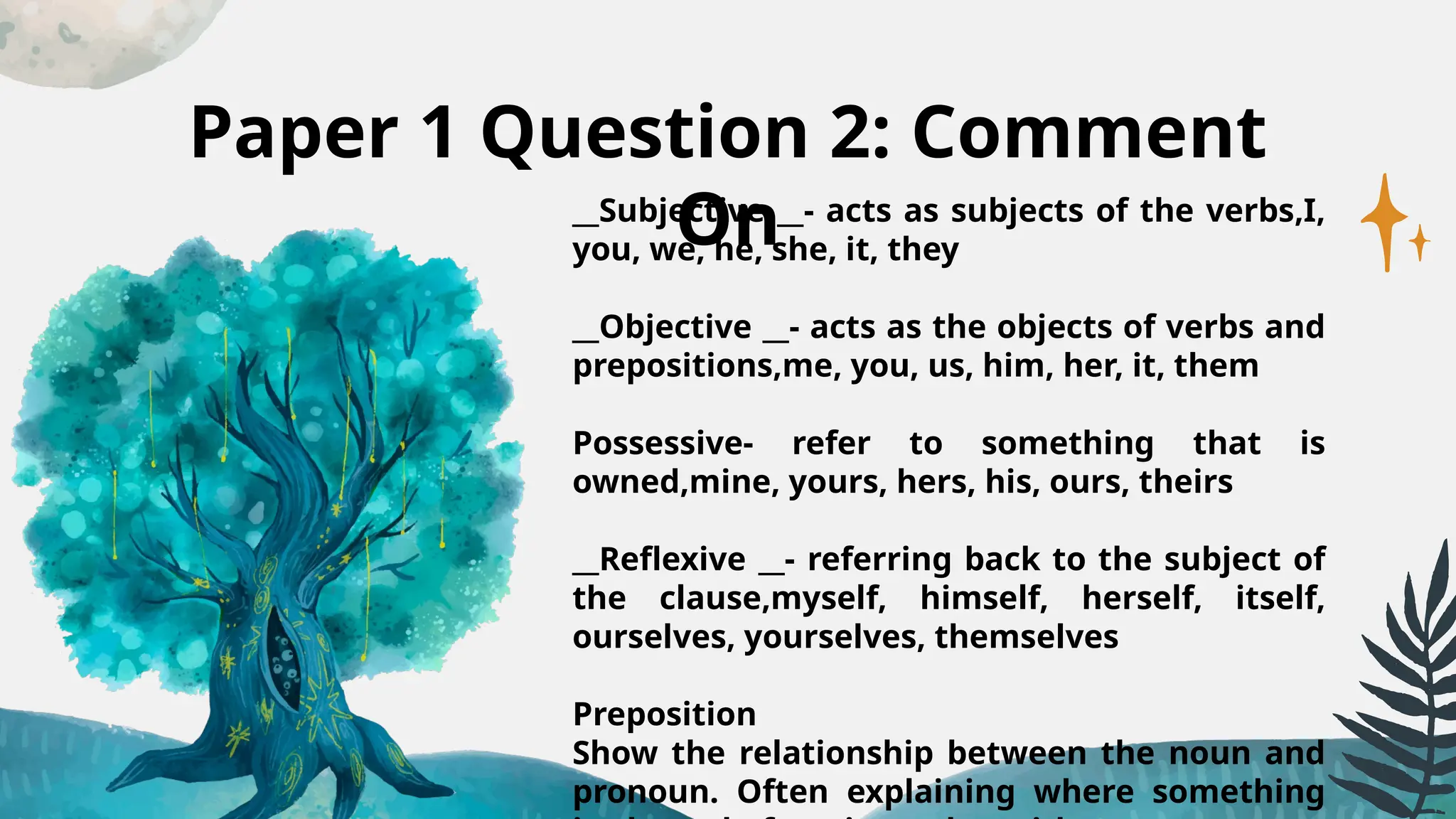
__Subjective __- acts as subjects of the verbs,I,
you, we, he, she, it, they
__Objective __- acts as the objects of verbs and
prepositions,me, you, us, him, her, it, them
Possessive- refer to something that is
owned,mine, yours, hers, his, ours, theirs
__Reflexive __- referring back to the subject of
the clause,myself, himself, herself, itself,
ourselves, yourselves, themselves
Preposition
Show the relationship between the noun and
pronoun. Often explaining where something
Paper 1 Question 2: Comment
On
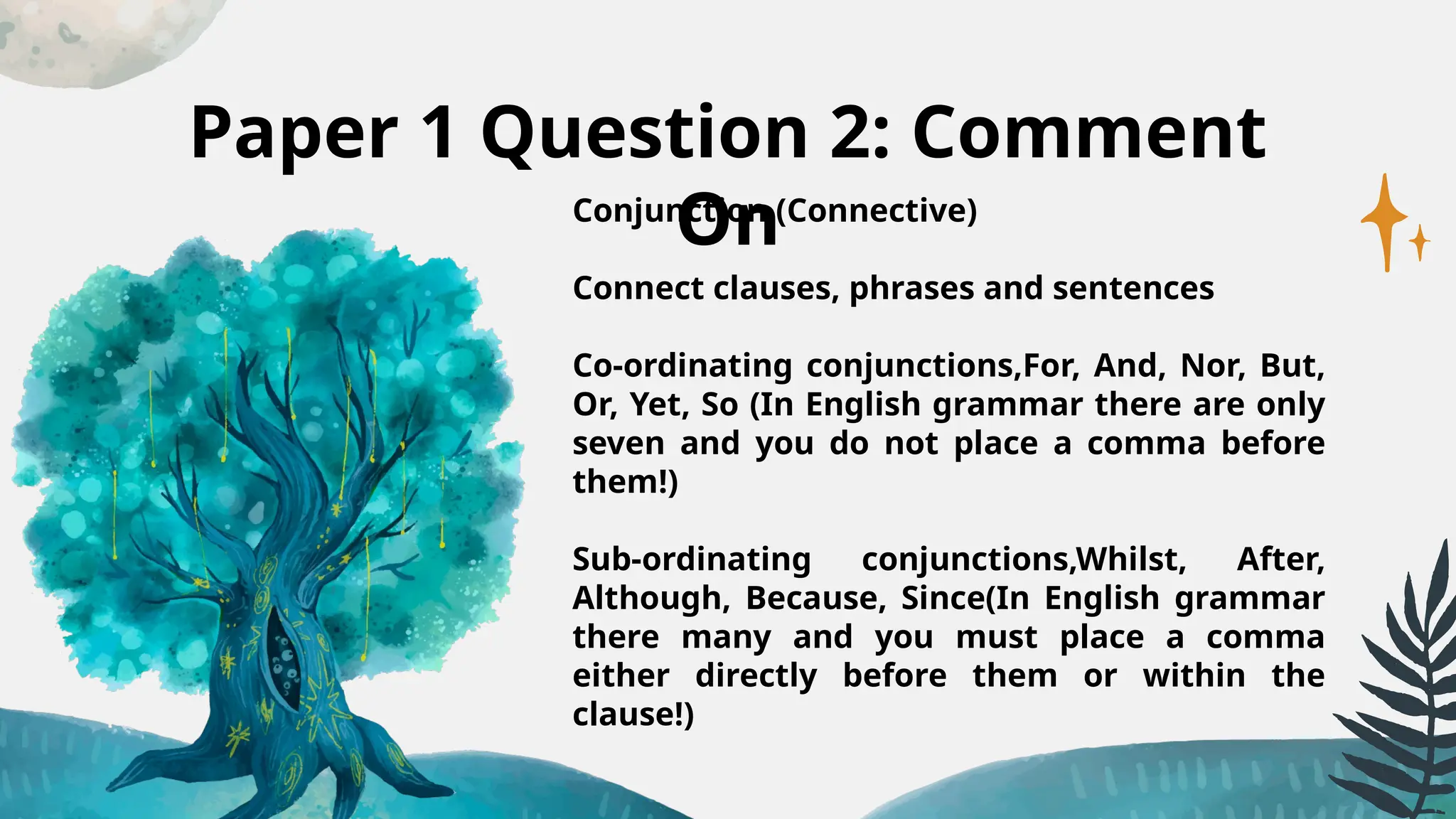
Conjunction (Connective)
Connect clauses, phrases and sentences
Co-ordinating conjunctions,For, And, Nor, But,
Or, Yet, So (In English grammar there are only
seven and you do not place a comma before
them!)
Sub-ordinating conjunctions,Whilst, After,
Although, Because, Since(In English grammar
there many and you must place a comma
either directly before them or within the
clause!)
Paper 1 Question 2: Comment
On
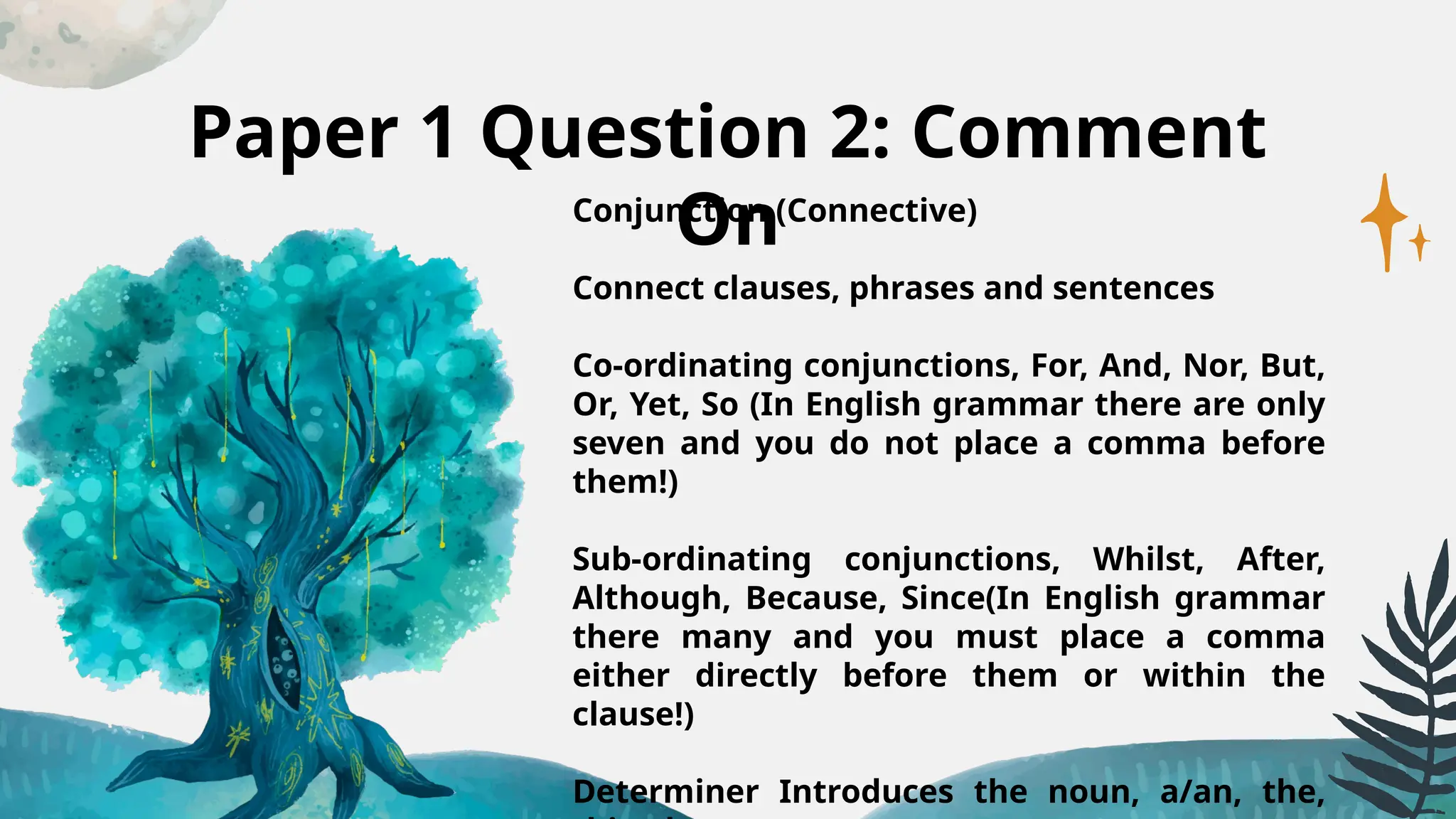
Conjunction (Connective)
Connect clauses, phrases and sentences
Co-ordinating conjunctions, For, And, Nor, But,
Or, Yet, So (In English grammar there are only
seven and you do not place a comma before
them!)
Sub-ordinating conjunctions, Whilst, After,
Although, Because, Since(In English grammar
there many and you must place a comma
either directly before them or within the
clause!)
Determiner Introduces the noun, a/an, the,
Paper 1 Question 2: Comment
On
Language Techniques
You need to be able to scan through the text
and identify which methods the writer has
deliberately used for effect. Literary
techniques have an emotional impact as they
aim to stimulate the different senses such as,
sight, sound, touch, taste and scent. They add
flavour to a piece of writing and heighten
meaning for the reader. Listed below are some
common techniques (I remember them as
MATES PROOF READ).
Paper 1 Question 2: Comment
On
__Writers use some of these devices to make
their writing more engaging: __
Metaphor
Figure of speech that gives meaning through a
comparison which is not literal,The
Headmaster is a dragon.
Alliteration
Using a succession of words that begin with
the same letter,Timid Trevor tried to navigate.
Paper 1 Question 2: Comment
On
Threes/List
A group of nouns, adjectives or verbs,Bold,
courageous, gallant King.
Emotive Language
Stirs emotion in the reader through specific
choices in vocabulary,The grieving, pot-bellied
orphans were destitute.
Personification
Giving an object human characteristics,The
trees danced gracefully in the tender
sunshine.
Paper 1 Question 2: Comment
On
Repetition
Reoccurring words or phrases,He was a very,
very, naughty child.
Opinion
Offering your ideas and thoughts on a
matter,Homework is a waste of time.
Onomatopoeia
Words that imitate the sound when
spoken,ping, crashed, slurring
Paper 1 Question 2: Comment
On
Facts/Figures
Numerical values that offer logical
information,two men walked down the street,
72% of the population…
Rhetorical Question
Evoking a reasoning response from the reader
by asking a question that doesn’t require an
answer,This makes sense, does it not?
Paper 1 Question 2: Comment
On
Direct Address
Talking directly to the audience,You should
buy this perfume!
Sentence Forms
Literary texts are formed through use of
sentences. Successfully engaging pieces use a
range of sentence forms or structures for
effect.
__There are commonly five types of sentence
forms in English: __
Paper 1 Question 2: Comment
On
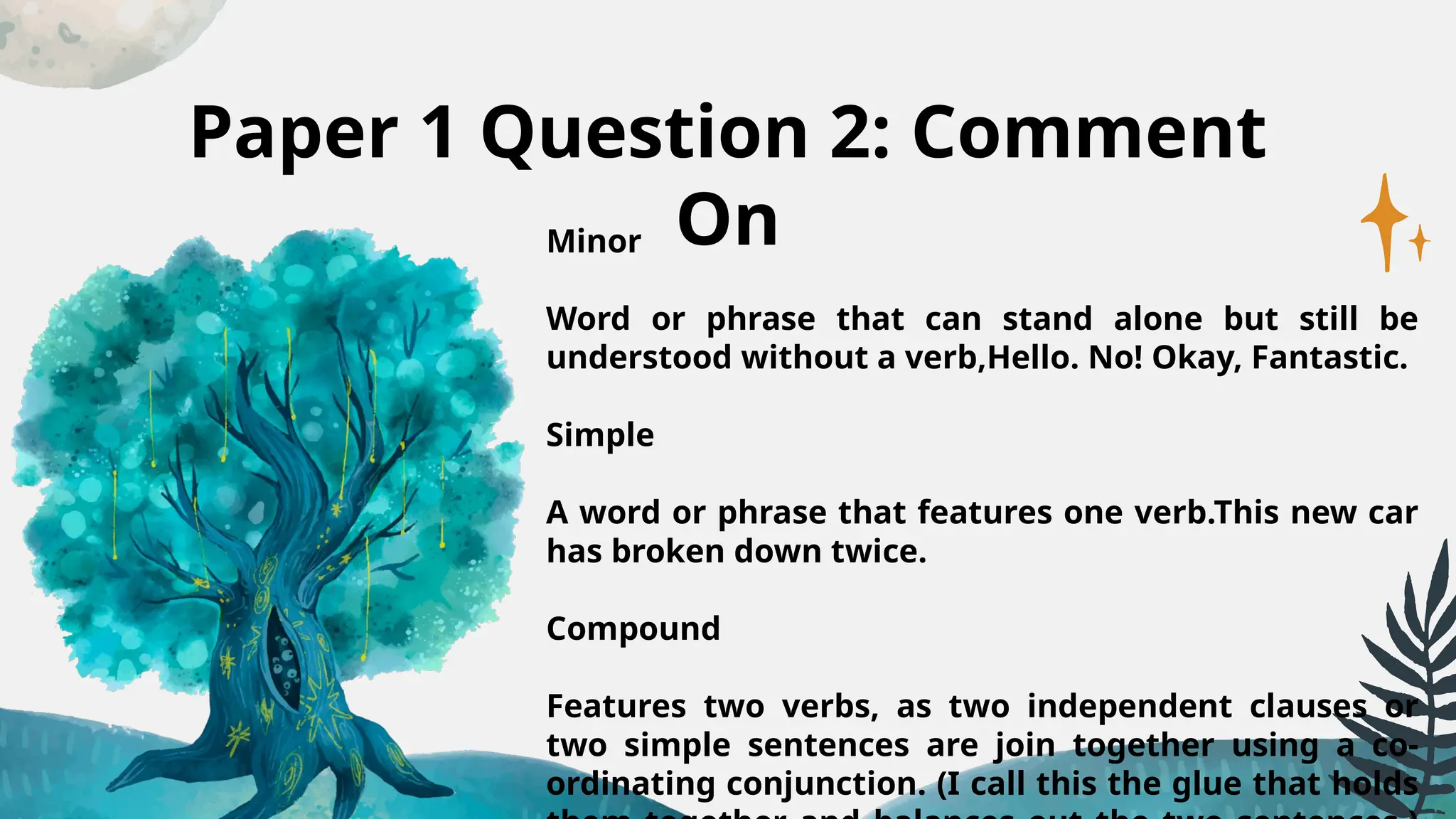
Minor
Word or phrase that can stand alone but still be
understood without a verb,Hello. No! Okay, Fantastic.
Simple
A word or phrase that features one verb.This new car
has broken down twice.
Compound
Features two verbs, as two independent clauses or
two simple sentences are join together using a co-
ordinating conjunction. (I call this the glue that holds
Paper 1 Question 2: Comment
On
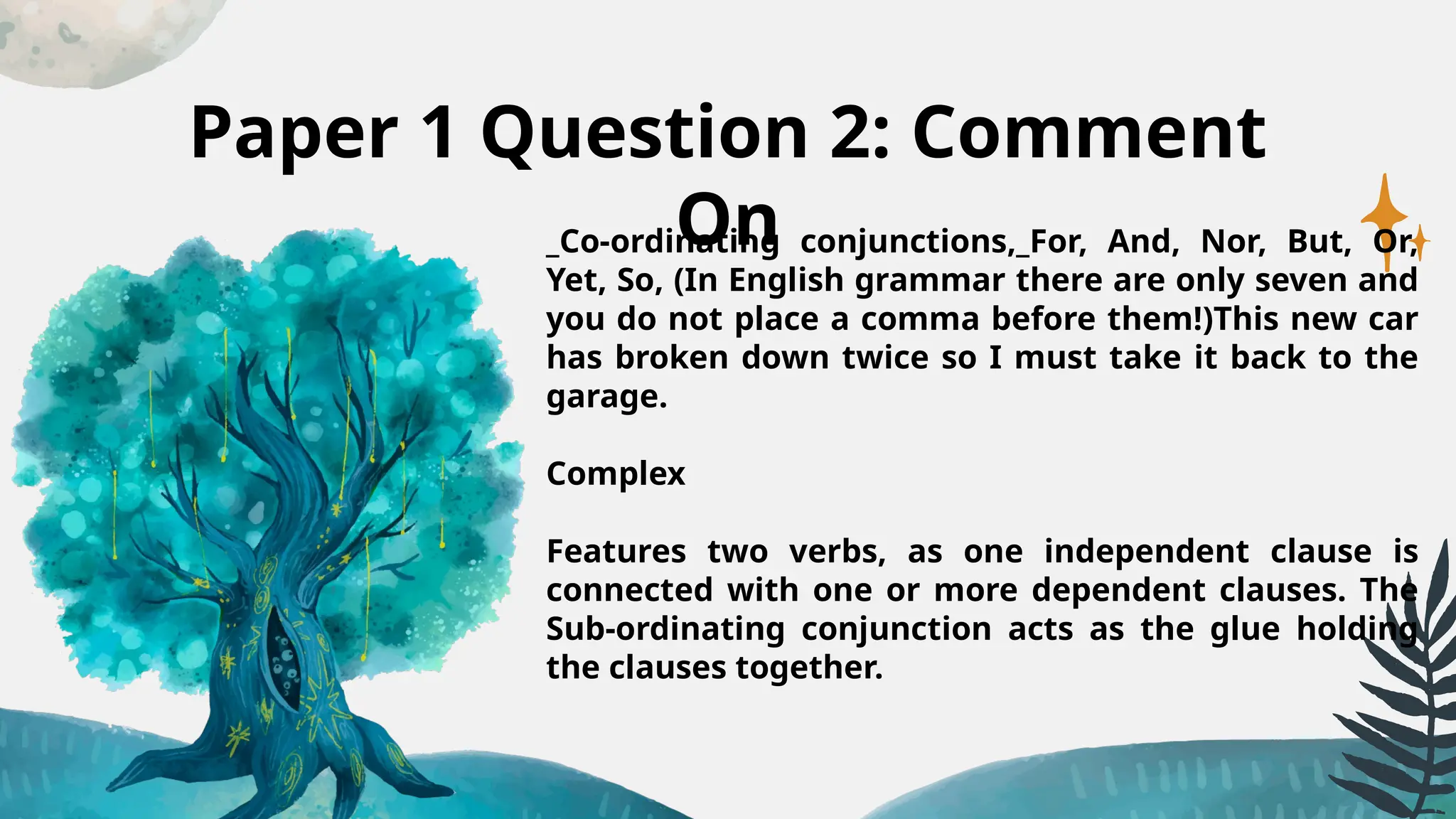
_Co-ordinating conjunctions,_For, And, Nor, But, Or,
Yet, So, (In English grammar there are only seven and
you do not place a comma before them!)This new car
has broken down twice so I must take it back to the
garage.
Complex
Features two verbs, as one independent clause is
connected with one or more dependent clauses. The
Sub-ordinating conjunction acts as the glue holding
the clauses together.
Paper 1 Question 2: Comment
On
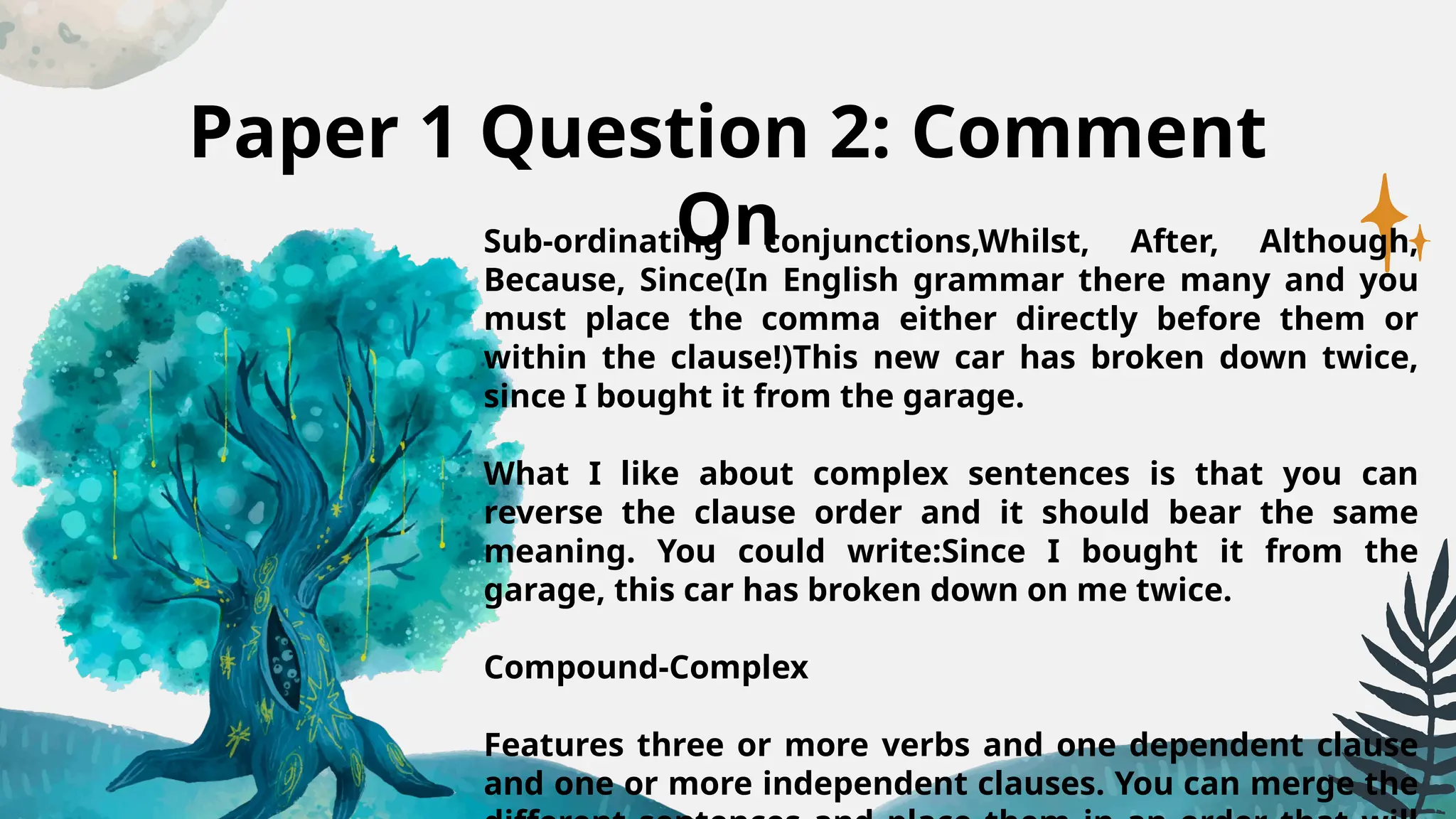
Sub-ordinating conjunctions,Whilst, After, Although,
Because, Since(In English grammar there many and you
must place the comma either directly before them or
within the clause!)This new car has broken down twice,
since I bought it from the garage.
What I like about complex sentences is that you can
reverse the clause order and it should bear the same
meaning. You could write:Since I bought it from the
garage, this car has broken down on me twice.
Compound-Complex
Features three or more verbs and one dependent clause
and one or more independent clauses. You can merge the
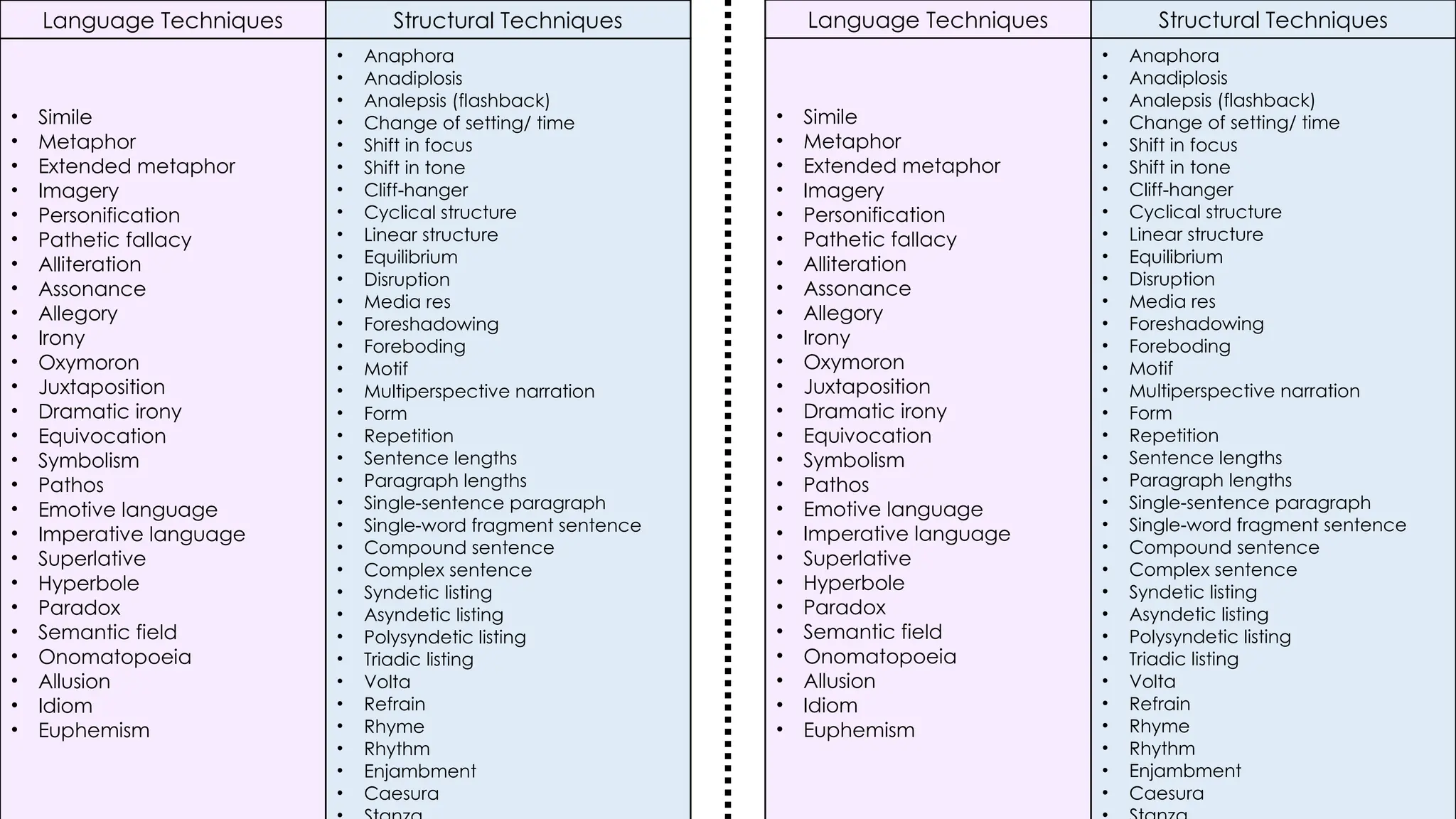
Language Techniques Structural Techniques
• Simile
• Metaphor
• Extended metaphor
• Imagery
• Personification
• Pathetic fallacy
• Alliteration
• Assonance
• Allegory
• Irony
• Oxymoron
• Juxtaposition
• Dramatic irony
• Equivocation
• Symbolism
• Pathos
• Emotive language
• Imperative language
• Superlative
• Hyperbole
• Paradox
• Semantic field
• Onomatopoeia
• Allusion
• Idiom
• Euphemism
• Anaphora
• Anadiplosis
• Analepsis (flashback)
• Change of setting/ time
• Shift in focus
• Shift in tone
• Cliff-hanger
• Cyclical structure
• Linear structure
• Equilibrium
• Disruption
• Media res
• Foreshadowing
• Foreboding
• Motif
• Multiperspective narration
• Form
• Repetition
• Sentence lengths
• Paragraph lengths
• Single-sentence paragraph
• Single-word fragment sentence
• Compound sentence
• Complex sentence
• Syndetic listing
• Asyndetic listing
• Polysyndetic listing
• Triadic listing
• Volta
• Refrain
• Rhyme
• Rhythm
• Enjambment
• Caesura
Language Techniques Structural Techniques
• Simile
• Metaphor
• Extended metaphor
• Imagery
• Personification
• Pathetic fallacy
• Alliteration
• Assonance
• Allegory
• Irony
• Oxymoron
• Juxtaposition
• Dramatic irony
• Equivocation
• Symbolism
• Pathos
• Emotive language
• Imperative language
• Superlative
• Hyperbole
• Paradox
• Semantic field
• Onomatopoeia
• Allusion
• Idiom
• Euphemism
• Anaphora
• Anadiplosis
• Analepsis (flashback)
• Change of setting/ time
• Shift in focus
• Shift in tone
• Cliff-hanger
• Cyclical structure
• Linear structure
• Equilibrium
• Disruption
• Media res
• Foreshadowing
• Foreboding
• Motif
• Multiperspective narration
• Form
• Repetition
• Sentence lengths
• Paragraph lengths
• Single-sentence paragraph
• Single-word fragment sentence
• Compound sentence
• Complex sentence
• Syndetic listing
• Asyndetic listing
• Polysyndetic listing
• Triadic listing
• Volta
• Refrain
• Rhyme
• Rhythm
• Enjambment
• Caesura

Language and Structure Techniques.pptxLanguage and Structure Techniques.pptx

  • 1.
    Language and structure Techinques Dr. Asmaa BarakatAbu Auf Humanities Lecturer +201099653205 Language Arts:
  • 2.
    Introduction ● Welcome totoday's English Language class! In our journey through the intricate world of literature and language, one of the most essential skills we'll develop is the ability to analyze and appreciate the craft of writers. To truly understand a text and appreciate its nuances, we must delve into two key aspects: language and structure. ● Language and structure are the twin pillars upon which powerful writing is built. Language provides the words, phrases, and techniques that convey meaning and evoke emotions, while structure determines the way these elements are organized to create a compelling narrative or argument. ● In this session, we will embark on an exciting exploration of these fundamental elements. We will learn how to identify, dissect, and appreciate the language and structure techniques employed by writers to communicate their ideas effectively. Whether you're studying a piece of literature, a newspaper article, or any form of written communication, these skills will empower you to uncover hidden layers of meaning and gain a deeper insight into the author's intent.
  • 3.
    Introduction ● Throughout thisclass, we will discover that every word, sentence, and paragraph in a text is meticulously chosen to serve a purpose. Writers use language to convey their thoughts, emotions, and messages, and they employ various techniques to engage and persuade their readers. These techniques are the building blocks of effective communication and storytelling. ● Our journey today will equip you with the tools to recognize and analyze literary devices, rhetorical strategies, and structural choices. From vivid imagery to persuasive appeals, from narrative arcs to sentence structures, we will explore it all. By the end of this class, you will have the skills and knowledge to deconstruct any text, uncover its hidden treasures, and appreciate the craftsmanship of the writer. ● So, let's embark on this exciting exploration of language and structure techniques. By the end of today's session, you will be well on your way to becoming a skilled textual detective, capable of unlocking the secrets of literature and written communication. Get ready to dive deep into the world of words and narratives as we embark on this enlightening journey together!
  • 4.
    Introduction ● understanding languageand structure techniques is crucial for both readers and writers. It enriches our comprehension of texts, fosters critical thinking, and enhances our ability to communicate effectively in a variety of contexts. These skills are not only academically valuable but also applicable to many aspects of life and various professional endeavors. ● Language and structure techniques encompass a wide array of literary and rhetorical devices that writers use to convey meaning, create emphasis, evoke emotions, and engage readers.
  • 5.
    Introduction Here are somekey reasons why these skills are essential: 1. Enhanced Comprehension: Analyzing language and structure helps readers understand texts at a deeper level. By recognizing literary devices, sentence structures, and organizational patterns, readers can grasp the author's intended meaning more fully. 2. Appreciation of Craftsmanship: Recognizing the artistry behind a text fosters a greater appreciation for literature and writing. It allows readers to admire the author's skill and creativity in using language and structure to convey ideas and emotions. 3. Effective Communication: For writers, understanding language and structure is crucial for effective communication. It enables them to choose the right words, construct sentences effectively, and organize their thoughts coherently, making their writing more persuasive and engaging. 4. Critical Thinking: Analyzing language and structure encourages critical thinking. It requires readers to question why an author made specific choices, which can lead to a deeper understanding of themes, perspectives, and the author's purpose. 5. Literary Analysis: In academic settings, understanding language and structure is essential for literary analysis essays and exams. It allows students to provide evidence-based interpretations and insights into texts, demonstrating their comprehension and analytical skills.
  • 6.
    Introduction Here are somekey reasons why these skills are essential: 1. Writing Improvement: When writers study language and structure techniques in other authors' work, they can apply these techniques to their own writing. This can lead to improved writing skills, enabling them to communicate their ideas more effectively and persuasively. 2. Interpretation of Persuasive Techniques: In non-fiction texts, understanding language and structure helps readers identify persuasive techniques such as ethos, pathos, and logos. This is crucial for evaluating arguments, recognizing biases, and making informed decisions. 3. Enjoyment of Reading: For avid readers, understanding language and structure can enhance the enjoyment of reading. It allows readers to uncover layers of meaning and appreciate the nuances of a well-crafted text, making the reading experience more fulfilling. 4. Cultural and Historical Insights: Language and structure are influenced by cultural and historical contexts. Analyzing these elements can provide insights into the time period, societal norms, and values that shaped the text, enhancing our understanding of history and culture. 5. Academic and Professional Success: Proficiency in analyzing language and structure is valuable in academic settings and various professions, including journalism, advertising, marketing, law, and academia. Strong analytical and communication skills
  • 7.
    Language Techniques ● Purpose Literarytechniques add flavour to a piece of writing; adding depth of meaning. They should be used with the intention of stimulating logical thinking and motive the reader to act. You are expected to write a discursive piece, therefore, you need to be discriminate in your choices. Select techniques which will enable you to convey your thoughts and ideas in a clear manner. ● Metaphor Figure of speech that gives meaning through a comparison which is not literal: The Headmaster is a dragon. EFFECT? The reader thinks about the meaning within the comparison. ● Alliteration Using a succession of words that begin with the same letter: Timid Trevor tried to navigate. EFFECT? It creates a mood within the text. Also, the reader ponders on the significance of the emphasis on the particular letters.
  • 8.
    Language Techniques ● RhetoricalQuestion Evoking a reasoning response from the reader by asking a question that doesn’t require an answer: Who knows? EFFECT? The recipient will feel like they are participating in a conversation, as they mentally formulate an answer to the question. ● Exaggeration Magnification or understatement about a matter: His leg was broken into thousands of pieces. EFFECT? Compare the comparison with relate and discern the intended meaning of the statement. ● Allusion Figure of speech that makes reference to a place, event, literary work, myth, art, etc. but it must be recognised by the intended audience: She is my Juliet. EFFECT? Recipient is mentally engaged with the text, as they draw on their own knowledge of the comparison.
  • 9.
    Language Techniques ● DirectAddress Talking directly to the audience: You should buy this perfume! EFFECT? The recipient feels included in the rhetoric and they mentally engage with the speaker. ● Effective? Ask yourself, which technique will best convey the message at this time? Make sure that you do not overuse certain techniques. Using a variety and on specific occasions will stimulate the recipient. Which technique will make a lasting impression on the reader or audience? Making deliberate decisions in your writing will help you to produce a successfully engaging piece.
  • 10.
    Language Techniques ● Opinion Offeringyour ideas and thoughts on a matter: Homework is a waste of time. EFFECT? Mentally engages the recipient, as they decide whether they agree or disagree with the statements being made. ● Onomatopeia Words that imitate the sound when spoken: ping, crashed, slurring. EFFECT? Appeal to the auditory sense. The reader can imagine or hear the word in action. ● Facts / Figures Numerical values that offer logical information: T_wo men walked down the street, 72% of the population…_ EFFECT? Makes the recipient accept the reasoning as more authentic and plausible.
  • 11.
    Language Techniques ● Opinion Offeringyour ideas and thoughts on a matter: Homework is a waste of time. EFFECT? Mentally engages the recipient, as they decide whether they agree or disagree with the statements being made. ● Onomatopeia Words that imitate the sound when spoken: ping, crashed, slurring. EFFECT? Appeal to the auditory sense. The reader can imagine or hear the word in action. ● Facts / Figures Numerical values that offer logical information: T_wo men walked down the street, 72% of the population…_ EFFECT? Makes the recipient accept the reasoning as more authentic and plausible.
  • 12.
    Paper 1 Question2: Comment On Word Types Literary texts are made up of words that have been deliberately chosen by the author. As you read a text you are looking for thought-provoking words that are rich in meaning. Such choices can evoke an emotional response from the reader, as they aim to stimulate the different senses such as, sight, sound, touch, taste and scent. Familiarise yourself with the main word classes:
  • 13.
    Paper 1 Question2: Comment On Noun: Person,Tom Thing,house Abstract - state or emotion that you cannot physically touch,anger Verb: Action,climb Event,raining Situation,be, have Adjective Describes the noun,luxurious, red, messy Adverb Gives more information about a verb or adjective,nearly, quickly Pronoun Personal- Used in place of a noun, often to
  • 14.
    Paper 1 Question2: Comment On __Subjective __- acts as subjects of the verbs,I, you, we, he, she, it, they __Objective __- acts as the objects of verbs and prepositions,me, you, us, him, her, it, them Possessive- refer to something that is owned,mine, yours, hers, his, ours, theirs __Reflexive __- referring back to the subject of the clause,myself, himself, herself, itself, ourselves, yourselves, themselves Preposition Show the relationship between the noun and pronoun. Often explaining where something
  • 15.
    Paper 1 Question2: Comment On Conjunction (Connective) Connect clauses, phrases and sentences Co-ordinating conjunctions,For, And, Nor, But, Or, Yet, So (In English grammar there are only seven and you do not place a comma before them!) Sub-ordinating conjunctions,Whilst, After, Although, Because, Since(In English grammar there many and you must place a comma either directly before them or within the clause!)
  • 16.
    Paper 1 Question2: Comment On Conjunction (Connective) Connect clauses, phrases and sentences Co-ordinating conjunctions, For, And, Nor, But, Or, Yet, So (In English grammar there are only seven and you do not place a comma before them!) Sub-ordinating conjunctions, Whilst, After, Although, Because, Since(In English grammar there many and you must place a comma either directly before them or within the clause!) Determiner Introduces the noun, a/an, the,
  • 17.
    Paper 1 Question2: Comment On Language Techniques You need to be able to scan through the text and identify which methods the writer has deliberately used for effect. Literary techniques have an emotional impact as they aim to stimulate the different senses such as, sight, sound, touch, taste and scent. They add flavour to a piece of writing and heighten meaning for the reader. Listed below are some common techniques (I remember them as MATES PROOF READ).
  • 18.
    Paper 1 Question2: Comment On __Writers use some of these devices to make their writing more engaging: __ Metaphor Figure of speech that gives meaning through a comparison which is not literal,The Headmaster is a dragon. Alliteration Using a succession of words that begin with the same letter,Timid Trevor tried to navigate.
  • 19.
    Paper 1 Question2: Comment On Threes/List A group of nouns, adjectives or verbs,Bold, courageous, gallant King. Emotive Language Stirs emotion in the reader through specific choices in vocabulary,The grieving, pot-bellied orphans were destitute. Personification Giving an object human characteristics,The trees danced gracefully in the tender sunshine.
  • 20.
    Paper 1 Question2: Comment On Repetition Reoccurring words or phrases,He was a very, very, naughty child. Opinion Offering your ideas and thoughts on a matter,Homework is a waste of time. Onomatopoeia Words that imitate the sound when spoken,ping, crashed, slurring
  • 21.
    Paper 1 Question2: Comment On Facts/Figures Numerical values that offer logical information,two men walked down the street, 72% of the population… Rhetorical Question Evoking a reasoning response from the reader by asking a question that doesn’t require an answer,This makes sense, does it not?
  • 22.
    Paper 1 Question2: Comment On Direct Address Talking directly to the audience,You should buy this perfume! Sentence Forms Literary texts are formed through use of sentences. Successfully engaging pieces use a range of sentence forms or structures for effect. __There are commonly five types of sentence forms in English: __
  • 23.
    Paper 1 Question2: Comment On Minor Word or phrase that can stand alone but still be understood without a verb,Hello. No! Okay, Fantastic. Simple A word or phrase that features one verb.This new car has broken down twice. Compound Features two verbs, as two independent clauses or two simple sentences are join together using a co- ordinating conjunction. (I call this the glue that holds
  • 24.
    Paper 1 Question2: Comment On _Co-ordinating conjunctions,_For, And, Nor, But, Or, Yet, So, (In English grammar there are only seven and you do not place a comma before them!)This new car has broken down twice so I must take it back to the garage. Complex Features two verbs, as one independent clause is connected with one or more dependent clauses. The Sub-ordinating conjunction acts as the glue holding the clauses together.
  • 25.
    Paper 1 Question2: Comment On Sub-ordinating conjunctions,Whilst, After, Although, Because, Since(In English grammar there many and you must place the comma either directly before them or within the clause!)This new car has broken down twice, since I bought it from the garage. What I like about complex sentences is that you can reverse the clause order and it should bear the same meaning. You could write:Since I bought it from the garage, this car has broken down on me twice. Compound-Complex Features three or more verbs and one dependent clause and one or more independent clauses. You can merge the
  • 26.
    Language Techniques StructuralTechniques • Simile • Metaphor • Extended metaphor • Imagery • Personification • Pathetic fallacy • Alliteration • Assonance • Allegory • Irony • Oxymoron • Juxtaposition • Dramatic irony • Equivocation • Symbolism • Pathos • Emotive language • Imperative language • Superlative • Hyperbole • Paradox • Semantic field • Onomatopoeia • Allusion • Idiom • Euphemism • Anaphora • Anadiplosis • Analepsis (flashback) • Change of setting/ time • Shift in focus • Shift in tone • Cliff-hanger • Cyclical structure • Linear structure • Equilibrium • Disruption • Media res • Foreshadowing • Foreboding • Motif • Multiperspective narration • Form • Repetition • Sentence lengths • Paragraph lengths • Single-sentence paragraph • Single-word fragment sentence • Compound sentence • Complex sentence • Syndetic listing • Asyndetic listing • Polysyndetic listing • Triadic listing • Volta • Refrain • Rhyme • Rhythm • Enjambment • Caesura Language Techniques Structural Techniques • Simile • Metaphor • Extended metaphor • Imagery • Personification • Pathetic fallacy • Alliteration • Assonance • Allegory • Irony • Oxymoron • Juxtaposition • Dramatic irony • Equivocation • Symbolism • Pathos • Emotive language • Imperative language • Superlative • Hyperbole • Paradox • Semantic field • Onomatopoeia • Allusion • Idiom • Euphemism • Anaphora • Anadiplosis • Analepsis (flashback) • Change of setting/ time • Shift in focus • Shift in tone • Cliff-hanger • Cyclical structure • Linear structure • Equilibrium • Disruption • Media res • Foreshadowing • Foreboding • Motif • Multiperspective narration • Form • Repetition • Sentence lengths • Paragraph lengths • Single-sentence paragraph • Single-word fragment sentence • Compound sentence • Complex sentence • Syndetic listing • Asyndetic listing • Polysyndetic listing • Triadic listing • Volta • Refrain • Rhyme • Rhythm • Enjambment • Caesura