Unveiling the Power of
Langchain and LLMs
2024-06-28
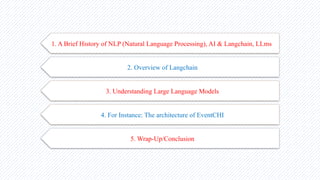
1. A Brief History of NLP (Natural Language Processing), AI & Langchain, LLms
2. Overview of Langchain
3. Understanding Large Language Models
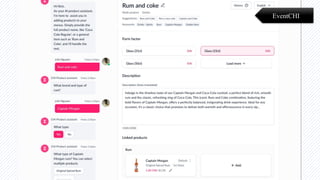
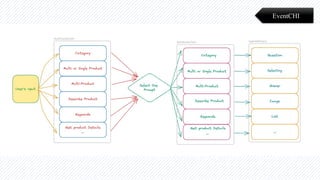
4. For Instance: The architecture of EventCHI
5. Wrap-Up/Conclusion
1. A Brief History of NLP (Natural Language Processing), AI & Langchain, LLms
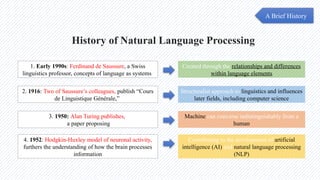
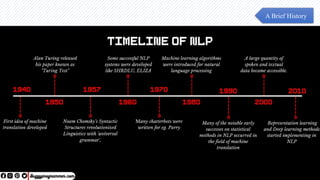
A Brief History
1. Early 1990s: Ferdinand de Saussure, a Swiss
linguistics professor, concepts of language as systems
Created through the relationships and differences
within language elements
2. 1916: Two of Saussure’s colleagues, publish “Cours
de Linguistique Générale,”
Structuralist approach to linguistics and influences
later fields, including computer science
3. 1950: Alan Turing publishes,
a paper proposing
Machine can converse indistinguishably from a
human
4. 1952: Hodgkin-Huxley model of neuronal activity,
furthers the understanding of how the brain processes
information
Contributing to the development of artificial
intelligence (AI) and natural language processing
(NLP)
History of Natural Language Processing
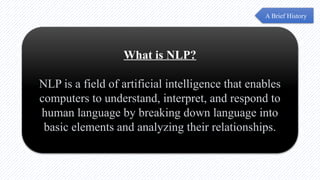
What is NLP?
NLP is a field of artificial intelligence that enables
computers to understand, interpret, and respond to
human language by breaking down language into
basic elements and analyzing their relationships.
A Brief History
A Brief History
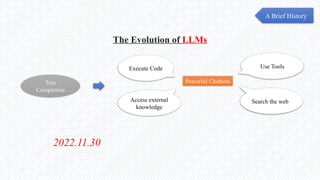
The Evolution of LLMs
A Brief History
Powerful Chatbots
Text
Completion
Execute Code
Access external
knowledge
Search the web
Use Tools
2022.11.30
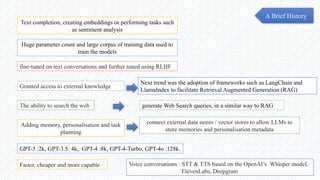
Text completion, creating embeddings or performing tasks such
as sentiment analysis
A Brief History
Huge parameter count and large corpus of training data used to
train the models
fine-tuned on text conversations and further tuned using RLHF
Granted access to external knowledge
Next trend was the adoption of frameworks such as LangChain and
LlamaIndex to facilitate Retrieval Augmented Generation (RAG)
The ability to search the web generate Web Search queries, in a similar way to RAG
Adding memory, personalisation and task
planning
connect external data stores / vector stores to allow LLMs to
store memories and personalisation metadata
GPT-3 :2k, GPT-3.5: 4k, GPT-4 :8k, GPT-4-Turbo, GPT-4o :128k.
Faster, cheaper and more capable Voice conversations : STT & TTS based on the OpenAI’s Whisper model,
ElevenLabs, Deepgram
A Brief History
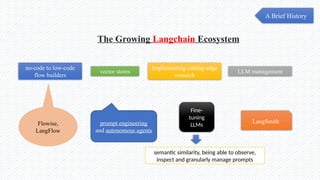
The Growing Langchain Ecosystem
no-code to low-code
flow builders
vector stores
Implementing cutting-edge
research
LLM management
Flowise,
LangFlow
prompt engineering
and autonomous agents
Fine-
tuning
LLMs
semantic similarity, being able to observe,
inspect and granularly manage prompts
LangSmith
2. Overview of Langchain
Langchain Overview
What is Langchain?
LangChain is a framework for developing applications
powered by language models.
Are context-aware: connect a language model to
sources of context (prompt instructions, few shot
examples, content to ground its response in, etc.)
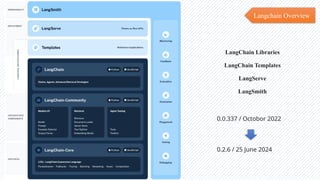
LangChain Libraries
LangChain Templates
LangServe
LangSmith
Langchain Overview
0.0.337 / Octobor 2022
0.2.6 / 25 June 2024
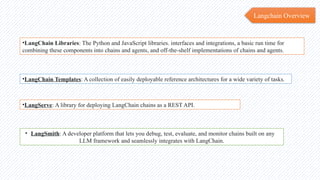
•LangChain Libraries: The Python and JavaScript libraries. interfaces and integrations, a basic run time for
combining these components into chains and agents, and off-the-shelf implementations of chains and agents.
•LangChain Templates: A collection of easily deployable reference architectures for a wide variety of tasks.
•LangServe: A library for deploying LangChain chains as a REST API.
• LangSmith: A developer platform that lets you debug, test, evaluate, and monitor chains built on any
LLM framework and seamlessly integrates with LangChain.
Langchain Overview
3. Understanding Large Language Models
Large Language Model
What is Large Language Model?
(LLM) is a deep learning algorithm that can
perform a variety of
natural language processing (NLP) tasks.
Large Language Model
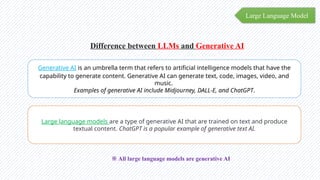
Difference between LLMs and Generative AI
Generative AI is an umbrella term that refers to artificial intelligence models that have the
capability to generate content. Generative AI can generate text, code, images, video, and
music.
Examples of generative AI include Midjourney, DALL-E, and ChatGPT.
Large language models are a type of generative AI that are trained on text and produce
textual content. ChatGPT is a popular example of generative text AI.
※ All large language models are generative AI
Large Language Model
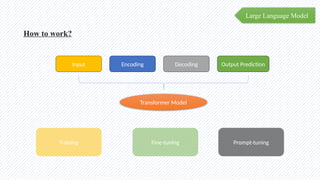
How to work?
Input Encoding Decoding Output Prediction
Transformer Model
Training Fine-tuning Prompt-tuning
Large Language Model
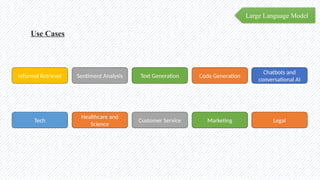
Use Cases
Informal Retrieval Sentiment Analysis Text Generation Code Generation
Chatbots and
conversational AI
Tech
Healthcare and
Science
Customer Service Marketing Legal
Large Language Model
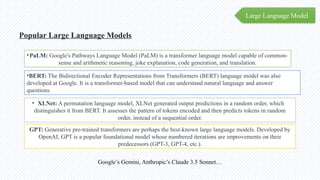
Popular Large Language Models
•PaLM: Google's Pathways Language Model (PaLM) is a transformer language model capable of common-
sense and arithmetic reasoning, joke explanation, code generation, and translation.
•BERT: The Bidirectional Encoder Representations from Transformers (BERT) language model was also
developed at Google. It is a transformer-based model that can understand natural language and answer
questions.
• XLNet: A permutation language model, XLNet generated output predictions in a random order, which
distinguishes it from BERT. It assesses the pattern of tokens encoded and then predicts tokens in random
order, instead of a sequential order.
GPT: Generative pre-trained transformers are perhaps the best-known large language models. Developed by
OpenAI, GPT is a popular foundational model whose numbered iterations are improvements on their
predecessors (GPT-3, GPT-4, etc.).
Google’s Gemini, Anthropic’s Claude 3.5 Sonnet…
EventCHI
EventCHI
Conclusion
In conclusion, understanding the synergy between Langchain and Large
Language Models is pivotal in advancing our AI and NLP capabilities, and as
we've explored today, through cultivating a comprehensive understanding and
practical application of these models, we can unlock immense potential in
various technological fields.
Langchainfdgdfsggfdgfsdgsdgdfsgfdgfdgfdgfd

  • 1.
    Unveiling the Powerof Langchain and LLMs 2024-06-28
  • 2.
    1. A BriefHistory of NLP (Natural Language Processing), AI & Langchain, LLms 2. Overview of Langchain 3. Understanding Large Language Models 4. For Instance: The architecture of EventCHI 5. Wrap-Up/Conclusion
  • 3.
    1. A BriefHistory of NLP (Natural Language Processing), AI & Langchain, LLms
  • 4.
    A Brief History 1.Early 1990s: Ferdinand de Saussure, a Swiss linguistics professor, concepts of language as systems Created through the relationships and differences within language elements 2. 1916: Two of Saussure’s colleagues, publish “Cours de Linguistique Générale,” Structuralist approach to linguistics and influences later fields, including computer science 3. 1950: Alan Turing publishes, a paper proposing Machine can converse indistinguishably from a human 4. 1952: Hodgkin-Huxley model of neuronal activity, furthers the understanding of how the brain processes information Contributing to the development of artificial intelligence (AI) and natural language processing (NLP) History of Natural Language Processing
  • 5.
    What is NLP? NLPis a field of artificial intelligence that enables computers to understand, interpret, and respond to human language by breaking down language into basic elements and analyzing their relationships. A Brief History
  • 6.
  • 7.
    The Evolution ofLLMs A Brief History Powerful Chatbots Text Completion Execute Code Access external knowledge Search the web Use Tools 2022.11.30
  • 8.
    Text completion, creatingembeddings or performing tasks such as sentiment analysis A Brief History Huge parameter count and large corpus of training data used to train the models fine-tuned on text conversations and further tuned using RLHF Granted access to external knowledge Next trend was the adoption of frameworks such as LangChain and LlamaIndex to facilitate Retrieval Augmented Generation (RAG) The ability to search the web generate Web Search queries, in a similar way to RAG Adding memory, personalisation and task planning connect external data stores / vector stores to allow LLMs to store memories and personalisation metadata GPT-3 :2k, GPT-3.5: 4k, GPT-4 :8k, GPT-4-Turbo, GPT-4o :128k. Faster, cheaper and more capable Voice conversations : STT & TTS based on the OpenAI’s Whisper model, ElevenLabs, Deepgram
  • 9.
    A Brief History TheGrowing Langchain Ecosystem no-code to low-code flow builders vector stores Implementing cutting-edge research LLM management Flowise, LangFlow prompt engineering and autonomous agents Fine- tuning LLMs semantic similarity, being able to observe, inspect and granularly manage prompts LangSmith
  • 10.
    2. Overview ofLangchain
  • 11.
    Langchain Overview What isLangchain? LangChain is a framework for developing applications powered by language models. Are context-aware: connect a language model to sources of context (prompt instructions, few shot examples, content to ground its response in, etc.)
  • 12.
    LangChain Libraries LangChain Templates LangServe LangSmith LangchainOverview 0.0.337 / Octobor 2022 0.2.6 / 25 June 2024
  • 13.
    •LangChain Libraries: ThePython and JavaScript libraries. interfaces and integrations, a basic run time for combining these components into chains and agents, and off-the-shelf implementations of chains and agents. •LangChain Templates: A collection of easily deployable reference architectures for a wide variety of tasks. •LangServe: A library for deploying LangChain chains as a REST API. • LangSmith: A developer platform that lets you debug, test, evaluate, and monitor chains built on any LLM framework and seamlessly integrates with LangChain. Langchain Overview
  • 14.
    3. Understanding LargeLanguage Models
  • 15.
    Large Language Model Whatis Large Language Model? (LLM) is a deep learning algorithm that can perform a variety of natural language processing (NLP) tasks.
  • 16.
    Large Language Model Differencebetween LLMs and Generative AI Generative AI is an umbrella term that refers to artificial intelligence models that have the capability to generate content. Generative AI can generate text, code, images, video, and music. Examples of generative AI include Midjourney, DALL-E, and ChatGPT. Large language models are a type of generative AI that are trained on text and produce textual content. ChatGPT is a popular example of generative text AI. ※ All large language models are generative AI
  • 17.
    Large Language Model Howto work? Input Encoding Decoding Output Prediction Transformer Model Training Fine-tuning Prompt-tuning
  • 18.
    Large Language Model UseCases Informal Retrieval Sentiment Analysis Text Generation Code Generation Chatbots and conversational AI Tech Healthcare and Science Customer Service Marketing Legal
  • 19.
    Large Language Model PopularLarge Language Models •PaLM: Google's Pathways Language Model (PaLM) is a transformer language model capable of common- sense and arithmetic reasoning, joke explanation, code generation, and translation. •BERT: The Bidirectional Encoder Representations from Transformers (BERT) language model was also developed at Google. It is a transformer-based model that can understand natural language and answer questions. • XLNet: A permutation language model, XLNet generated output predictions in a random order, which distinguishes it from BERT. It assesses the pattern of tokens encoded and then predicts tokens in random order, instead of a sequential order. GPT: Generative pre-trained transformers are perhaps the best-known large language models. Developed by OpenAI, GPT is a popular foundational model whose numbered iterations are improvements on their predecessors (GPT-3, GPT-4, etc.). Google’s Gemini, Anthropic’s Claude 3.5 Sonnet…
  • 20.
  • 21.
  • 22.
    Conclusion In conclusion, understandingthe synergy between Langchain and Large Language Models is pivotal in advancing our AI and NLP capabilities, and as we've explored today, through cultivating a comprehensive understanding and practical application of these models, we can unlock immense potential in various technological fields.