CLASS-VIII
SUBJECT-SOCIAL STUDIES
CHAPTER-2 (GEOGRAPHY)
LAND, SOIL, WATER, NATURAL
VEGETATION AND WILD LIFE
1st period
Students will able to :-
Understand different uses of land.
Analyze the reasons for the uneven distribution of
population.
Know about the different ways for resource
conservation.
LEARNING OBJECTIVES
WORD OF THE DAY
Topography - Physical features
of an area.
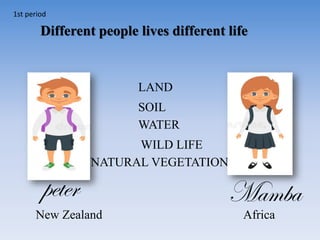
Different people lives different life
1st period
peter Mamba
New Zealand Africa
LAND
SOIL
WATER
NATURAL VEGETATION
WILD LIFE
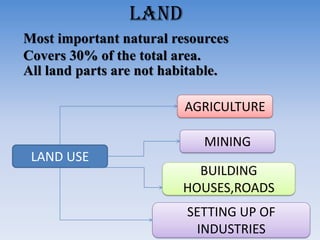
AGRICULTURE
MINING
BUILDING
HOUSES,ROADS
LAND
Most important natural resources
Covers 30% of the total area.
All land parts are not habitable.
SETTING UP OF
INDUSTRIES
LAND USE
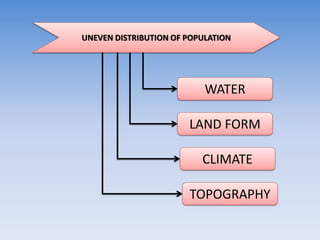
UNEVEN DISTRIBUTION OF POPULATION
WATER
LAND FORM
CLIMATE
TOPOGRAPHY
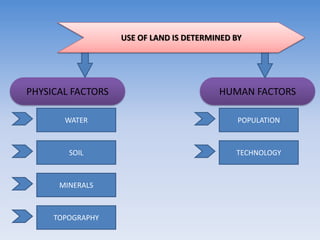
HUMAN FACTORS
PHYSICAL FACTORS
USE OF LAND IS DETERMINED BY
WATER
SOIL
MINERALS
TOPOGRAPHY
POPULATION
TECHNOLOGY
PRIVATE LAND
AND COMMUNITY
LAND
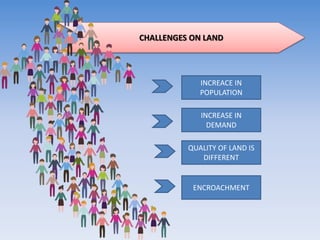
CHALLENGES ON LAND
INCREACE IN
POPULATION
INCREASE IN
DEMAND
QUALITY OF LAND IS
DIFFERENT
ENCROACHMENT
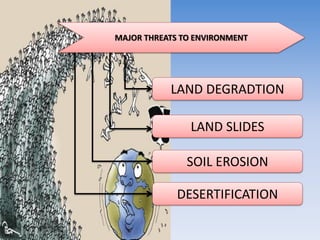
MAJOR THREATS TO ENVIRONMENT
LAND DEGRADTION
LAND SLIDES
SOIL EROSION
DESERTIFICATION
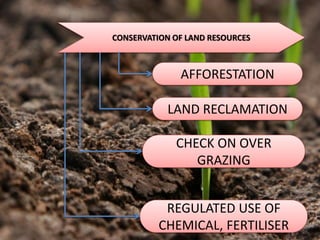
CONSERVATION OF LAND RESOURCES
AFFORESTATION
LAND RECLAMATION
REGULATED USE OF
CHEMICAL, FERTILISER
CHECK ON OVER
GRAZING
1. The growth of vegetation depends primarily on
__________ and _________.
RECAPITULATION
2. Write any two reasons for land degradation
today.
3. Why land is considered as an important
resource?
4. Differentiate between private and public land.
2nd period
Students will able to :-
Analyze the reasons and mitigation mechanisms
of landslides.
Understand about soil profile.
Know about the methods of soil conservation.
LEARNING OBJECTIVES
WORD OF THE DAY
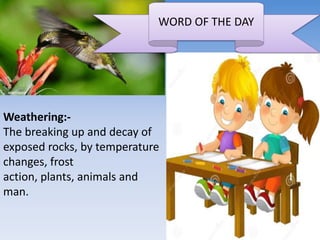
Weathering:-
The breaking up and decay of
exposed rocks, by temperature
changes, frost
action, plants, animals and
man.
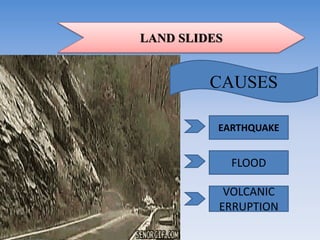
LAND SLIDES
EARTHQUAKE
FLOOD
CAUSES
VOLCANIC
ERRUPTION
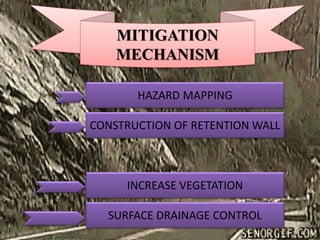
MITIGATION
MECHANISM
HAZARD MAPPING
CONSTRUCTION OF RETENTION WALL
INCREASE VEGETATION
SURFACE DRAINAGE CONTROL
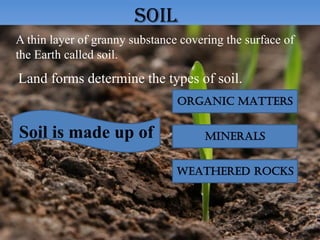
SOIL
A thin layer of granny substance covering the surface of
the Earth called soil.
Land forms determine the types of soil.
Soil is made up of
ORGANIC MATTERS
MINERALS
WEATHERED ROCKS
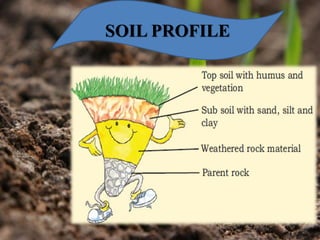
SOIL PROFILE
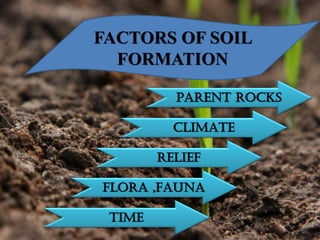
PARENT ROCKS
FACTORS OF SOIL
FORMATION
CLIMATE
RELIEF
FLORA ,FAUNA
TIME
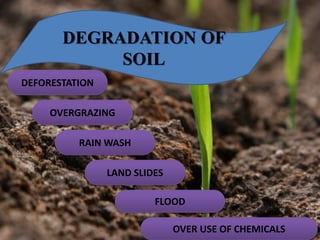
DEGRADATION OF
SOIL
DEFORESTATION
OVERGRAZING
RAIN WASH
OVER USE OF CHEMICALS
LAND SLIDES
FLOOD
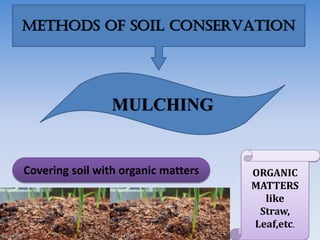
METHODS OF SOIL CONSERVATION
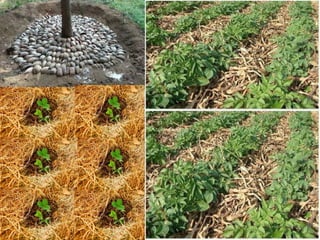
MULCHING
Covering soil with organic matters ORGANIC
MATTERS
like
Straw,
Leaf,etc.
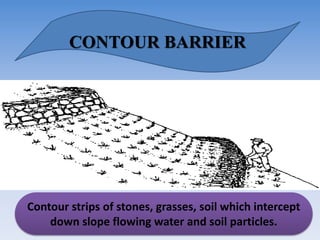
CONTOUR BARRIER
Contour strips of stones, grasses, soil which intercept
down slope flowing water and soil particles.
1. The breaking up and decay of exposed rocks, by
temperature changes, frost action, plants, animals and man
is called _____________.
RECAPITULATION
2. The thin layer of grainy substance covering the surface
of the earth is called___________.
3. Stones, grass, soil are used to build barriers along
contours is called _______.
4. The bare ground between plants is covered with a layer of
organic matter is called ___________.
5. What do you understand by land slide?
3rd period
Students will able to :-
Know about the methods of soil conservation.
Understand about the availability of water.
Analyze the use of water.
Know about the methods of water conservation.
LEARNING OBJECTIVES
Soil around us
In India soils could be alluvial, black, red, laterite, desertic
and mountain soil.
Each student will Collect soil from their surroundings and
attach with a small poly pack in s.st copy.
They will write its one characteristic with one uses.
Students will also collect crops/grains/fibre which will
favourable to grow in the respective soil and will show to
the teacher during the class.
ACTIVITY
WORD OF THE DAY
Trenches-
A trench is a type of excavation
or depression in the ground
that is generally deeper than it
is wide.
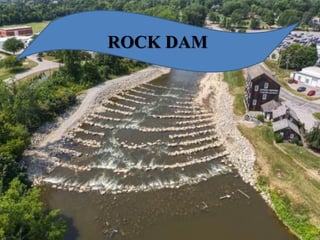
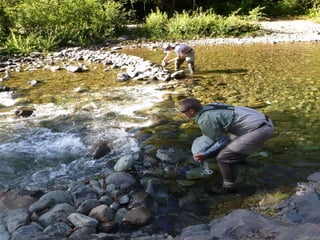
ROCK DAM
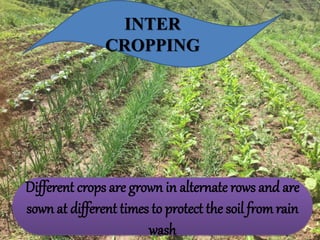
INTER
CROPPING
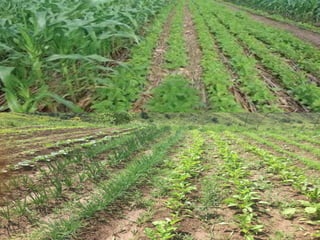
Different crops are grown in alternate rows and are
sown at different times to protect the soil from rain
wash
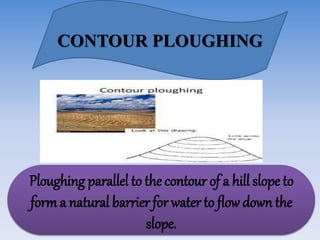
CONTOUR PLOUGHING
Ploughing parallel to the contour of a hill slope to
form a natural barrier for water to flow down the
slope.
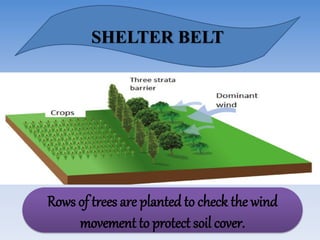
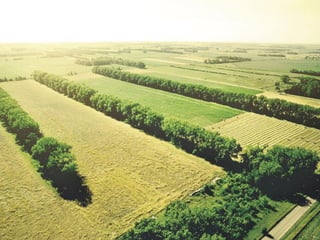
SHELTER BELT
Rows of trees are planted to check the wind
movement to protect soil cover.
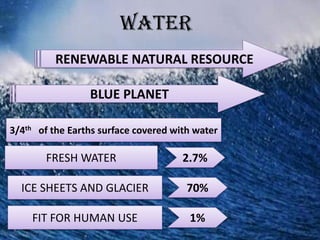
water
RENEWABLE NATURAL RESOURCE
BLUE PLANET
3/4th of the Earths surface covered with water
2.7%
FRESH WATER
ICE SHEETS AND GLACIER 70%
FIT FOR HUMAN USE 1%
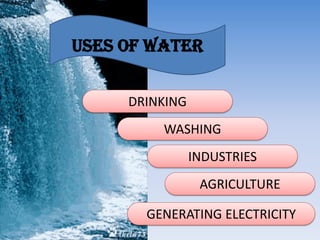
USES OF WATER
DRINKING
WASHING
INDUSTRIES
AGRICULTURE
GENERATING ELECTRICITY
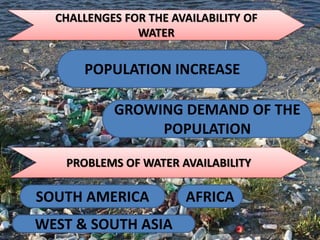
CHALLENGES FOR THE AVAILABILITY OF
WATER
POPULATION INCREASE
GROWING DEMAND OF THE
POPULATION
PROBLEMS OF WATER AVAILABILITY
AFRICA
WEST & SOUTH ASIA
SOUTH AMERICA
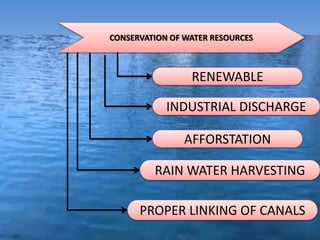
CONSERVATION OF WATER RESOURCES
RENEWABLE
INDUSTRIAL DISCHARGE
PROPER LINKING OF CANALS
AFFORSTATION
RAIN WATER HARVESTING
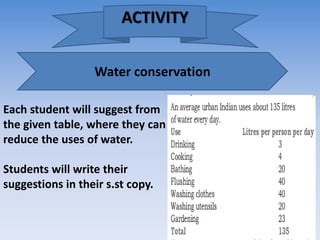
Water conservation
Each student will suggest from
the given table, where they can
reduce the uses of water.
Students will write their
suggestions in their s.st copy.
ACTIVITY
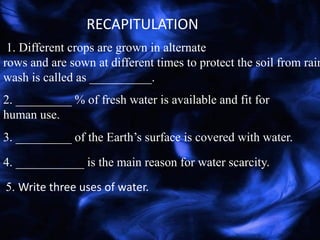
1. Different crops are grown in alternate
rows and are sown at different times to protect the soil from rain
wash is called as __________.
RECAPITULATION
2. _________ % of fresh water is available and fit for
human use.
3. _________ of the Earth’s surface is covered with water.
4. ___________ is the main reason for water scarcity.
5. Write three uses of water.
4th period
Students will able to :-
Understand about natural vegetation and wildlife.
Analyze the benefits of natural vegetation and
wildlife
LEARNING OBJECTIVES
WORD OF THE DAY
Biosphere reserves:-
Series of protected areas linked
through a global network,
intended to demonstrate the
relationship between
Conservation and
development.
Natural vegetation and
wild life
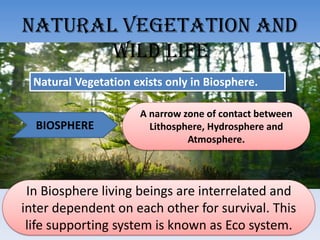
Natural Vegetation exists only in Biosphere.
BIOSPHERE
A narrow zone of contact between
Lithosphere, Hydrosphere and
Atmosphere.
In Biosphere living beings are interrelated and
inter dependent on each other for survival. This
life supporting system is known as Eco system.
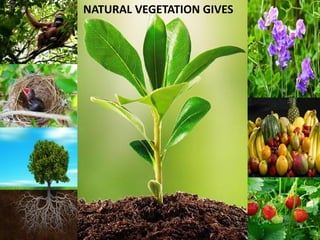
NATURAL VEGETATION GIVES
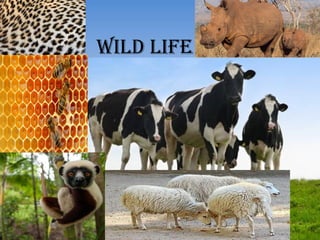
wild life
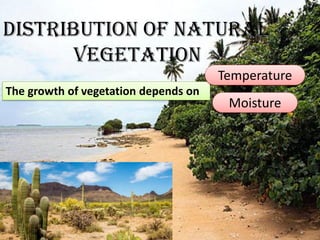
Distribution of natural
vegetation
The growth of vegetation depends on
Temperature
Moisture
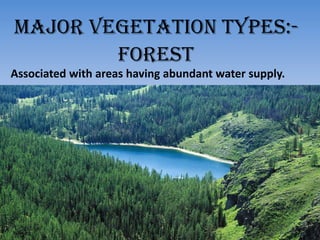
Major vegetation types:-
Associated with areas having abundant water supply.
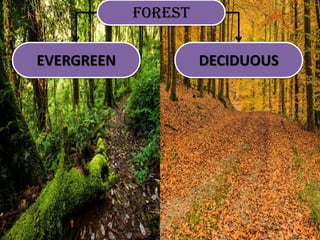
forest
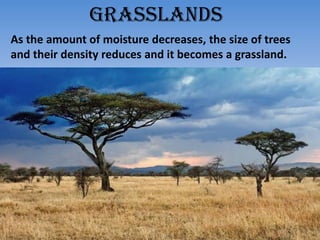
grasslands
As the amount of moisture decreases, the size of trees
and their density reduces and it becomes a grassland.
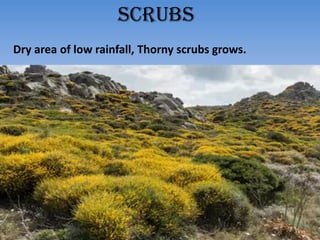
scrubs
Dry area of low rainfall, Thorny scrubs grows.
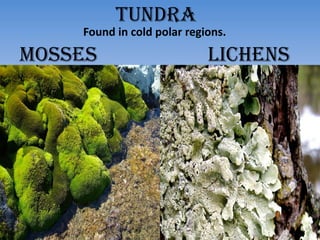
tundra
Found in cold polar regions.
mosses lichens
EVERGREEN DECIDUOUS
forest
1. A narrow zone of contact between the lithosphere,
hydrosphere and atmosphere that we call________.
RECAPITULATION
2. Ecosystem is a _________ system
3. Define Eco system.
4. Write three points on the distribution of natural
vegetation.
5th period
Students will able to :-
Know about the conservation measures taken by
the government.
Analyze CITE
LEARNING OBJECTIVES
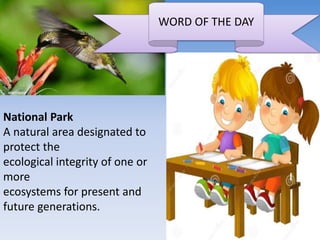
WORD OF THE DAY
National Park
A natural area designated to
protect the
ecological integrity of one or
more
ecosystems for present and
future generations.
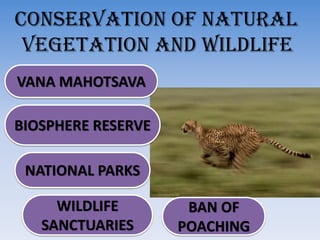
CONSERVATION OF NATURAL
VEGETATION AND WILDLIFE
NATIONAL PARKS
WILDLIFE
SANCTUARIES
BIOSPHERE RESERVE
VANA MAHOTSAVA
BAN OF
POACHING
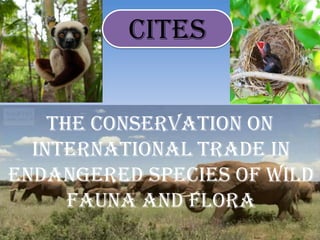
The conservation on
international trade in
endangered species of wild
fauna and flora
CITES
International agreement between
governments.
Its aim to ensure that International trade
of flora and fauna does not threaten their
survival.
Roughly 5,000 species of animals and
28,000 species of plants are protected.
1. . Mosses and Lichens are examples of _________
type off vegetation.
RECAPITULATION
2. Write one feature of tropical evergreen and
tropical deciduous forest.
3. What are the steps taken by the government for the
conservation of natural vegetation and wild life?
Land,soil,water class- VIII social science

Land,soil,water class- VIII social science

  • 1.
    CLASS-VIII SUBJECT-SOCIAL STUDIES CHAPTER-2 (GEOGRAPHY) LAND,SOIL, WATER, NATURAL VEGETATION AND WILD LIFE
  • 2.
    1st period Students willable to :- Understand different uses of land. Analyze the reasons for the uneven distribution of population. Know about the different ways for resource conservation. LEARNING OBJECTIVES
  • 3.
    WORD OF THEDAY Topography - Physical features of an area.
  • 4.
    Different people livesdifferent life 1st period peter Mamba New Zealand Africa LAND SOIL WATER NATURAL VEGETATION WILD LIFE
  • 5.
    AGRICULTURE MINING BUILDING HOUSES,ROADS LAND Most important naturalresources Covers 30% of the total area. All land parts are not habitable. SETTING UP OF INDUSTRIES LAND USE
  • 6.
    UNEVEN DISTRIBUTION OFPOPULATION WATER LAND FORM CLIMATE TOPOGRAPHY
  • 7.
    HUMAN FACTORS PHYSICAL FACTORS USEOF LAND IS DETERMINED BY WATER SOIL MINERALS TOPOGRAPHY POPULATION TECHNOLOGY
  • 8.
  • 9.
    CHALLENGES ON LAND INCREACEIN POPULATION INCREASE IN DEMAND QUALITY OF LAND IS DIFFERENT ENCROACHMENT
  • 10.
    MAJOR THREATS TOENVIRONMENT LAND DEGRADTION LAND SLIDES SOIL EROSION DESERTIFICATION
  • 11.
    CONSERVATION OF LANDRESOURCES AFFORESTATION LAND RECLAMATION REGULATED USE OF CHEMICAL, FERTILISER CHECK ON OVER GRAZING
  • 12.
    1. The growthof vegetation depends primarily on __________ and _________. RECAPITULATION 2. Write any two reasons for land degradation today. 3. Why land is considered as an important resource? 4. Differentiate between private and public land.
  • 13.
    2nd period Students willable to :- Analyze the reasons and mitigation mechanisms of landslides. Understand about soil profile. Know about the methods of soil conservation. LEARNING OBJECTIVES
  • 14.
    WORD OF THEDAY Weathering:- The breaking up and decay of exposed rocks, by temperature changes, frost action, plants, animals and man.
  • 15.
  • 16.
    MITIGATION MECHANISM HAZARD MAPPING CONSTRUCTION OFRETENTION WALL INCREASE VEGETATION SURFACE DRAINAGE CONTROL
  • 17.
    SOIL A thin layerof granny substance covering the surface of the Earth called soil. Land forms determine the types of soil. Soil is made up of ORGANIC MATTERS MINERALS WEATHERED ROCKS
  • 18.
  • 19.
    PARENT ROCKS FACTORS OFSOIL FORMATION CLIMATE RELIEF FLORA ,FAUNA TIME
  • 20.
  • 21.
    METHODS OF SOILCONSERVATION MULCHING Covering soil with organic matters ORGANIC MATTERS like Straw, Leaf,etc.
  • 23.
    CONTOUR BARRIER Contour stripsof stones, grasses, soil which intercept down slope flowing water and soil particles.
  • 24.
    1. The breakingup and decay of exposed rocks, by temperature changes, frost action, plants, animals and man is called _____________. RECAPITULATION 2. The thin layer of grainy substance covering the surface of the earth is called___________. 3. Stones, grass, soil are used to build barriers along contours is called _______. 4. The bare ground between plants is covered with a layer of organic matter is called ___________. 5. What do you understand by land slide?
  • 25.
    3rd period Students willable to :- Know about the methods of soil conservation. Understand about the availability of water. Analyze the use of water. Know about the methods of water conservation. LEARNING OBJECTIVES
  • 26.
    Soil around us InIndia soils could be alluvial, black, red, laterite, desertic and mountain soil. Each student will Collect soil from their surroundings and attach with a small poly pack in s.st copy. They will write its one characteristic with one uses. Students will also collect crops/grains/fibre which will favourable to grow in the respective soil and will show to the teacher during the class. ACTIVITY
  • 27.
    WORD OF THEDAY Trenches- A trench is a type of excavation or depression in the ground that is generally deeper than it is wide.
  • 28.
  • 30.
    INTER CROPPING Different crops aregrown in alternate rows and are sown at different times to protect the soil from rain wash
  • 32.
    CONTOUR PLOUGHING Ploughing parallelto the contour of a hill slope to form a natural barrier for water to flow down the slope.
  • 33.
    SHELTER BELT Rows oftrees are planted to check the wind movement to protect soil cover.
  • 35.
    water RENEWABLE NATURAL RESOURCE BLUEPLANET 3/4th of the Earths surface covered with water 2.7% FRESH WATER ICE SHEETS AND GLACIER 70% FIT FOR HUMAN USE 1%
  • 37.
  • 38.
    CHALLENGES FOR THEAVAILABILITY OF WATER POPULATION INCREASE GROWING DEMAND OF THE POPULATION PROBLEMS OF WATER AVAILABILITY AFRICA WEST & SOUTH ASIA SOUTH AMERICA
  • 39.
    CONSERVATION OF WATERRESOURCES RENEWABLE INDUSTRIAL DISCHARGE PROPER LINKING OF CANALS AFFORSTATION RAIN WATER HARVESTING
  • 40.
    Water conservation Each studentwill suggest from the given table, where they can reduce the uses of water. Students will write their suggestions in their s.st copy. ACTIVITY
  • 41.
    1. Different cropsare grown in alternate rows and are sown at different times to protect the soil from rain wash is called as __________. RECAPITULATION 2. _________ % of fresh water is available and fit for human use. 3. _________ of the Earth’s surface is covered with water. 4. ___________ is the main reason for water scarcity. 5. Write three uses of water.
  • 42.
    4th period Students willable to :- Understand about natural vegetation and wildlife. Analyze the benefits of natural vegetation and wildlife LEARNING OBJECTIVES
  • 43.
    WORD OF THEDAY Biosphere reserves:- Series of protected areas linked through a global network, intended to demonstrate the relationship between Conservation and development.
  • 44.
    Natural vegetation and wildlife Natural Vegetation exists only in Biosphere. BIOSPHERE A narrow zone of contact between Lithosphere, Hydrosphere and Atmosphere. In Biosphere living beings are interrelated and inter dependent on each other for survival. This life supporting system is known as Eco system.
  • 45.
  • 46.
  • 47.
    Distribution of natural vegetation Thegrowth of vegetation depends on Temperature Moisture
  • 48.
    Major vegetation types:- Associatedwith areas having abundant water supply. forest
  • 49.
    grasslands As the amountof moisture decreases, the size of trees and their density reduces and it becomes a grassland.
  • 50.
    scrubs Dry area oflow rainfall, Thorny scrubs grows.
  • 51.
    tundra Found in coldpolar regions. mosses lichens
  • 52.
  • 53.
    1. A narrowzone of contact between the lithosphere, hydrosphere and atmosphere that we call________. RECAPITULATION 2. Ecosystem is a _________ system 3. Define Eco system. 4. Write three points on the distribution of natural vegetation.
  • 54.
    5th period Students willable to :- Know about the conservation measures taken by the government. Analyze CITE LEARNING OBJECTIVES
  • 55.
    WORD OF THEDAY National Park A natural area designated to protect the ecological integrity of one or more ecosystems for present and future generations.
  • 56.
    CONSERVATION OF NATURAL VEGETATIONAND WILDLIFE NATIONAL PARKS WILDLIFE SANCTUARIES BIOSPHERE RESERVE VANA MAHOTSAVA BAN OF POACHING
  • 57.
    The conservation on internationaltrade in endangered species of wild fauna and flora CITES
  • 58.
    International agreement between governments. Itsaim to ensure that International trade of flora and fauna does not threaten their survival. Roughly 5,000 species of animals and 28,000 species of plants are protected.
  • 59.
    1. . Mossesand Lichens are examples of _________ type off vegetation. RECAPITULATION 2. Write one feature of tropical evergreen and tropical deciduous forest. 3. What are the steps taken by the government for the conservation of natural vegetation and wild life?