“God created the world,
but the Dutch created the
Netherlands”


    According to many foreigners, this familiar saying expresses what
    makes the Netherlands so different and so unique. Most of its land
    surface is made up of a delta of the rivers Rhine, Meuse, Scheldt
    and Ems – a delta that would be an almost uninhabitable swamp
    if hundreds of years of human effort had not been dedicated to
    making this marshy land fit for habitation. The success of these
    efforts is obvious today: with a population of more than 16
    million, the Netherlands is the most densely populated country in
    Europe. Sixteen million people wanting to carry out their
    everyday activities at home, school and work, to travel about the
    country, and sometimes to get away and enjoy more tranquil
    surroundings. Meanwhile, they all want to feel safe living behind
    the dunes and dikes that continue to be increased in height for the
    sake of security.

    Because the wishes of a growing population are always changing, the
    Netherlands is subject to ongoing alterations as well. It is this ability to
    recreate our land that is considered the most fundamental heritage of the
    Dutch. It seems as if it’s in our blood.


    History, heritage
    and heritage management
    Similar to other countries, much of the history of reclaiming, inhabiting and
    working the land can still be observed in the Dutch landscape. Differences in
    elevation, soil types, safety and accessibility have provided a great diversity
    of economic opportunities down through the centuries. And with this
    diversity has come the great variety in cities and landscapes that makes them
    an el dorado for historians, archaeologists, architectural historians and
    historical geographers. Even so, it has to be acknowledged that to
    accommodate people's ever-changing needs, the tradition of recreating the
    land has also involved making drastic changes to many cities and landscapes.
    Untouched historic landscapes are nonexistent; “stratified” land is the rule in
    the Netherlands.

    The enormous demand for space – comparable in large areas of the country
    only to the spatial dynamics typical of metropolitan areas – means that a
    cultural heritage policy aimed at preservation and restoration cannot be
successful in all cases. Of course, the Netherlands, too, is protecting,
                                                     restoring and whenever possible making its most exceptional buildings and
                                                     complexes accessible to the public. The Netherlands, too, is safeguarding its
                                                     most scenic landscapes from aspects that could damage their attractiveness.
                                                     And the Netherlands, too, is proud of its unique buildings and landscapes on
                                                     the UNESCO World Heritage List. But at the same time, the country is faced
                                                     with a need to build hundreds of thousands of homes, to realise business
                                                     parks for maintaining employment levels, to realise infrastructure for
                                                     ensuring mobility, to transform rural land for accommodating the latest
                                                     demands, and to regulate water management in such a way as to continue to
                                                     guarantee the safety of the inhabitants. New development, reuse and
                                                     restructuring: all are being applied to achieve these aims.

                                                     Each of these large-scaled and fragmenting spatial interventions has an
                                                     impact on the environment in which we live. And our cultural heritage is
                                                     always at issue in this process, whether it involves an underground Roman
                                                     archaeological site, a historic road, a unique area of historic importance in
                                                     regard to its water management, or a traditional post-war residential district.
                                                     For these dynamic situations, the usual methods of heritage management
                                                     aimed at preservation are less appropriate – if only because of the risk of
                                                     having a protected object become alien and isolated within a totally changing
                                                     environment. Such situations call for a different strategy: a strategy that gives
                                                     these objects the best possible place within unavoidable spatial development.

                                                     The Dutch heritage institution the National Service for Archaeology, Cultural
                                                     Landscape and Built Heritage (RACM); the Ministry of Education, Culture
                                                     and Science; the Ministry of Agriculture, Nature and Food Quality; the
                                                     Ministry of Housing, Spatial Planning and the Environment, and the Ministry
                                                     of Transport, Public Works and Water Management acknowledge this
                                                     situation. For this reason, they initiated a move in 1999 to develop an
                                                     alternative strategy that would supplement (not replace!) the existing
                                                     preservation and protection strategy. This alternative strategy of
                                                     “preservation by development” was established in the form of the Belvedere
                                                     Memorandum.


                                                     The Belvedere strategy
                                                     The objective of the Belvedere strategy is to promote a respectful approach in
                                                     regard to cultural and historic values within spatial development. This is to be
                                                     accomplished neither by vetoing changes nor by burying the past, but by
                                                     seeking effective ways to create win-win situations: to use space in such a
                                                     way that an object of cultural and/or historic importance is given a place and
                                                     will contribute to the quality of its newly created surroundings. According to
                                                     the Belvedere approach, “cultural heritage has to be regarded as being of vital
                                                     importance to our society and to each individual citizen. The preservation and
                                                     use of our cultural heritage adds an extra cultural dimension to the spatial
                                                     structure. The heritage approach to be adopted in dynamic situations is one
                                                     that centres on inspiring development rather than conservation or
Analysing the ‘symphony’ of buildings and building   replacement. This approach should be promoted and implemented by means
plots.                           Source: LA4Sale     of the overall spatial policy.” The Belvedere strategy aims at achieving this
                                                     goal by involving heritage experts early in planning processes and by
                                                     providing architects, urban and rural planners, and administrators with
                                                     effective, usable (and understandable!) information. This strategy requires
                                                     acknowledging the legitimate importance of others in the planning process as
                                                     well as the need for a give and take attitude. It also requires an awareness of
                                                     the fact that the heritage experts has something to offer: making use of our
                                                     cultural heritage, both physically and as a source of inspiration, offers
                                                     planners and designers an opportunity to develop a plan with added value
                                                     - a design with its own unique identity and often with unexpected economic
                                                     applications.
The Belvedere strategy also advocates presenting “the past” (i.e. heritage) as
a single, undivided concern. Instead of considering buried archaeological
sites, historic buildings and historically important landscapes as separate
entities, they should be seen as a single integrated public concern: cultural
heritage.

The Belvedere approach has often proven to be appealing to inhabitants
who are normally resistant to rigorous large-scale changes, yet who also
realise that changes are necessary to meet their needs for housing, mobility,
employment, safety, etc. The Belvedere approach can be a vehicle for gaining
acceptance for spatial changes provided that these changes result in a familiar
living environment. The use of cultural heritage often results in support for
plans.

With this in mind, the Netherlands has developed two parallel cultural
heritage policies. One is the standard policy aimed at preserving and
protecting our cultural heritage by attempting to preserve, protect, restore and
make accessible buildings, archaeological sites, landscapes and townscapes.
But where this policy is unfeasible or undesirable (e.g. an archaeological site
in a business park, a residential district in need of restructuring, an industrial
complex receiving a new function), the Belvedere strategy comes into play.
With the huge demand for space in our country, this strategy is often both
more effective and more desirable in terms of the needs of society.


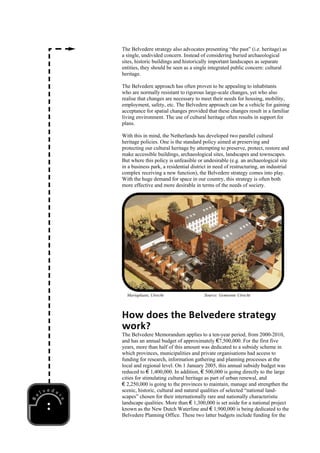
  Mariaplaats, Utrecht                  Source: Gemeente Utrecht


How does the Belvedere strategy
work?
The Belvedere Memorandum applies to a ten-year period, from 2000-2010,
and has an annual budget of approximately €7,500,000. For the first five
years, more than half of this amount was dedicated to a subsidy scheme in
which provinces, municipalities and private organisations had access to
funding for research, information gathering and planning processes at the
local and regional level. On 1 January 2005, this annual subsidy budget was
reduced to € 1,400,000. In addition, € 500,000 is going directly to the large
cities for stimulating cultural heritage as part of urban renewal, and
€ 2,250,000 is going to the provinces to maintain, manage and strengthen the
scenic, historic, cultural and natural qualities of selected “national land-
scapes” chosen for their internationally rare and nationally characteristic
landscape qualities. More than € 1,300,000 is set aside for a national project
known as the New Dutch Waterline and € 1,900,000 is being dedicated to the
Belvedere Planning Office. These two latter budgets include funding for the
offices’ personnel and material expenses, as well as the activities both of
                                      them conduct.
                                      The activities of the Belvedere Planning Office are aimed at stimulating and
                                      facilitating government authorities, non-profit organisations in the public
                                      domain, architects, landscape architects and private industry to embrace the
                                      Belvedere strategy. The planning office accomplishes this by stimulating
                                      historical research, gathering and distributing information, promoting the
                                      application of expertise and developing networks. The gathering of
                                      information for making use of cultural history is accomplished in spatial
                                      projects related to urban renewal, revitalising rural areas and improving water
                                      management, and in certain model projects (the Roman Limes Project, the
                                      New Dutch Waterline Project and the Lancewadplan Project). Belvedere
                                      funding is also paying three part-time professors working at three universities
                                      that are jointly responsible for education and research in applied cultural
                                      history. The integrated source of cultural historic information KICH has a
                                      website that provides planners, designers and commissioning parties with all
Dwelling mound Hogebeintum, Fryslân
Source: Dré van Marrewijk             the data available from the the National Service for Archaeology, Cultural
                                      Landscape and Built Heritage (RACM), the National Reference Centre for
                                      Agriculture, Nature and Food Quality (LNV, department of knowledge' ), and
                                      Alterra, a research institute for the natural environment. Information and
                                      experiences are also shared by means of courses, workshops, publications
                                      and networks.

                                      During the first seven years, more then 300 projects were subsidised by
                                      Belvedere funding. A carry-over effect has also been evident in national and
                                      provincial spatial policies. Making use of our cultural heritage in
                                      development plans is being considered everywhere in the Netherlands: from
                                      the “national landscapes” to urban restructuring projects and from water
                                      management plans to education. The tasks for the future will be aimed at
                                      consolidating the successes achieved so far by continuing to develop specific,
                                      usable information and instruments while reaching new target groups.

                                      Although the Netherlands is still a country engaged in recreating its physical
                                      environment, it is not losing sight of its past.

                                      more information: www.belvedere.nu


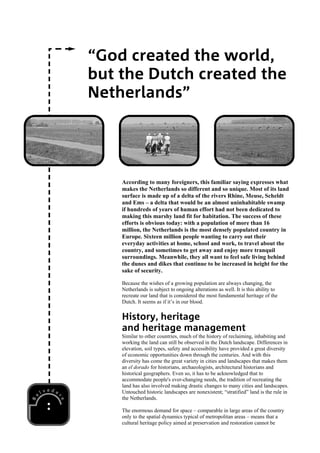
                                      Landscape and art: Beautifull Midden Delfland         Source: Frits van Ooststroom

The Belvedere Strategy

  • 1.
    “God created theworld, but the Dutch created the Netherlands” According to many foreigners, this familiar saying expresses what makes the Netherlands so different and so unique. Most of its land surface is made up of a delta of the rivers Rhine, Meuse, Scheldt and Ems – a delta that would be an almost uninhabitable swamp if hundreds of years of human effort had not been dedicated to making this marshy land fit for habitation. The success of these efforts is obvious today: with a population of more than 16 million, the Netherlands is the most densely populated country in Europe. Sixteen million people wanting to carry out their everyday activities at home, school and work, to travel about the country, and sometimes to get away and enjoy more tranquil surroundings. Meanwhile, they all want to feel safe living behind the dunes and dikes that continue to be increased in height for the sake of security. Because the wishes of a growing population are always changing, the Netherlands is subject to ongoing alterations as well. It is this ability to recreate our land that is considered the most fundamental heritage of the Dutch. It seems as if it’s in our blood. History, heritage and heritage management Similar to other countries, much of the history of reclaiming, inhabiting and working the land can still be observed in the Dutch landscape. Differences in elevation, soil types, safety and accessibility have provided a great diversity of economic opportunities down through the centuries. And with this diversity has come the great variety in cities and landscapes that makes them an el dorado for historians, archaeologists, architectural historians and historical geographers. Even so, it has to be acknowledged that to accommodate people's ever-changing needs, the tradition of recreating the land has also involved making drastic changes to many cities and landscapes. Untouched historic landscapes are nonexistent; “stratified” land is the rule in the Netherlands. The enormous demand for space – comparable in large areas of the country only to the spatial dynamics typical of metropolitan areas – means that a cultural heritage policy aimed at preservation and restoration cannot be
  • 2.
    successful in allcases. Of course, the Netherlands, too, is protecting, restoring and whenever possible making its most exceptional buildings and complexes accessible to the public. The Netherlands, too, is safeguarding its most scenic landscapes from aspects that could damage their attractiveness. And the Netherlands, too, is proud of its unique buildings and landscapes on the UNESCO World Heritage List. But at the same time, the country is faced with a need to build hundreds of thousands of homes, to realise business parks for maintaining employment levels, to realise infrastructure for ensuring mobility, to transform rural land for accommodating the latest demands, and to regulate water management in such a way as to continue to guarantee the safety of the inhabitants. New development, reuse and restructuring: all are being applied to achieve these aims. Each of these large-scaled and fragmenting spatial interventions has an impact on the environment in which we live. And our cultural heritage is always at issue in this process, whether it involves an underground Roman archaeological site, a historic road, a unique area of historic importance in regard to its water management, or a traditional post-war residential district. For these dynamic situations, the usual methods of heritage management aimed at preservation are less appropriate – if only because of the risk of having a protected object become alien and isolated within a totally changing environment. Such situations call for a different strategy: a strategy that gives these objects the best possible place within unavoidable spatial development. The Dutch heritage institution the National Service for Archaeology, Cultural Landscape and Built Heritage (RACM); the Ministry of Education, Culture and Science; the Ministry of Agriculture, Nature and Food Quality; the Ministry of Housing, Spatial Planning and the Environment, and the Ministry of Transport, Public Works and Water Management acknowledge this situation. For this reason, they initiated a move in 1999 to develop an alternative strategy that would supplement (not replace!) the existing preservation and protection strategy. This alternative strategy of “preservation by development” was established in the form of the Belvedere Memorandum. The Belvedere strategy The objective of the Belvedere strategy is to promote a respectful approach in regard to cultural and historic values within spatial development. This is to be accomplished neither by vetoing changes nor by burying the past, but by seeking effective ways to create win-win situations: to use space in such a way that an object of cultural and/or historic importance is given a place and will contribute to the quality of its newly created surroundings. According to the Belvedere approach, “cultural heritage has to be regarded as being of vital importance to our society and to each individual citizen. The preservation and use of our cultural heritage adds an extra cultural dimension to the spatial structure. The heritage approach to be adopted in dynamic situations is one that centres on inspiring development rather than conservation or Analysing the ‘symphony’ of buildings and building replacement. This approach should be promoted and implemented by means plots. Source: LA4Sale of the overall spatial policy.” The Belvedere strategy aims at achieving this goal by involving heritage experts early in planning processes and by providing architects, urban and rural planners, and administrators with effective, usable (and understandable!) information. This strategy requires acknowledging the legitimate importance of others in the planning process as well as the need for a give and take attitude. It also requires an awareness of the fact that the heritage experts has something to offer: making use of our cultural heritage, both physically and as a source of inspiration, offers planners and designers an opportunity to develop a plan with added value - a design with its own unique identity and often with unexpected economic applications.
  • 3.
    The Belvedere strategyalso advocates presenting “the past” (i.e. heritage) as a single, undivided concern. Instead of considering buried archaeological sites, historic buildings and historically important landscapes as separate entities, they should be seen as a single integrated public concern: cultural heritage. The Belvedere approach has often proven to be appealing to inhabitants who are normally resistant to rigorous large-scale changes, yet who also realise that changes are necessary to meet their needs for housing, mobility, employment, safety, etc. The Belvedere approach can be a vehicle for gaining acceptance for spatial changes provided that these changes result in a familiar living environment. The use of cultural heritage often results in support for plans. With this in mind, the Netherlands has developed two parallel cultural heritage policies. One is the standard policy aimed at preserving and protecting our cultural heritage by attempting to preserve, protect, restore and make accessible buildings, archaeological sites, landscapes and townscapes. But where this policy is unfeasible or undesirable (e.g. an archaeological site in a business park, a residential district in need of restructuring, an industrial complex receiving a new function), the Belvedere strategy comes into play. With the huge demand for space in our country, this strategy is often both more effective and more desirable in terms of the needs of society. Mariaplaats, Utrecht Source: Gemeente Utrecht How does the Belvedere strategy work? The Belvedere Memorandum applies to a ten-year period, from 2000-2010, and has an annual budget of approximately €7,500,000. For the first five years, more than half of this amount was dedicated to a subsidy scheme in which provinces, municipalities and private organisations had access to funding for research, information gathering and planning processes at the local and regional level. On 1 January 2005, this annual subsidy budget was reduced to € 1,400,000. In addition, € 500,000 is going directly to the large cities for stimulating cultural heritage as part of urban renewal, and € 2,250,000 is going to the provinces to maintain, manage and strengthen the scenic, historic, cultural and natural qualities of selected “national land- scapes” chosen for their internationally rare and nationally characteristic landscape qualities. More than € 1,300,000 is set aside for a national project known as the New Dutch Waterline and € 1,900,000 is being dedicated to the Belvedere Planning Office. These two latter budgets include funding for the
  • 4.
    offices’ personnel andmaterial expenses, as well as the activities both of them conduct. The activities of the Belvedere Planning Office are aimed at stimulating and facilitating government authorities, non-profit organisations in the public domain, architects, landscape architects and private industry to embrace the Belvedere strategy. The planning office accomplishes this by stimulating historical research, gathering and distributing information, promoting the application of expertise and developing networks. The gathering of information for making use of cultural history is accomplished in spatial projects related to urban renewal, revitalising rural areas and improving water management, and in certain model projects (the Roman Limes Project, the New Dutch Waterline Project and the Lancewadplan Project). Belvedere funding is also paying three part-time professors working at three universities that are jointly responsible for education and research in applied cultural history. The integrated source of cultural historic information KICH has a website that provides planners, designers and commissioning parties with all Dwelling mound Hogebeintum, Fryslân Source: Dré van Marrewijk the data available from the the National Service for Archaeology, Cultural Landscape and Built Heritage (RACM), the National Reference Centre for Agriculture, Nature and Food Quality (LNV, department of knowledge' ), and Alterra, a research institute for the natural environment. Information and experiences are also shared by means of courses, workshops, publications and networks. During the first seven years, more then 300 projects were subsidised by Belvedere funding. A carry-over effect has also been evident in national and provincial spatial policies. Making use of our cultural heritage in development plans is being considered everywhere in the Netherlands: from the “national landscapes” to urban restructuring projects and from water management plans to education. The tasks for the future will be aimed at consolidating the successes achieved so far by continuing to develop specific, usable information and instruments while reaching new target groups. Although the Netherlands is still a country engaged in recreating its physical environment, it is not losing sight of its past. more information: www.belvedere.nu Landscape and art: Beautifull Midden Delfland Source: Frits van Ooststroom