LANDSCAPE DESIGN
UNIT 2– ELEMENTS OF LANDSCAPE DESIGN
Hard and soft landscape elements; Hard landscape elements, Plant materials, Water and
Landform - classification, characteristics, use and application in landscape design
2.
Art!
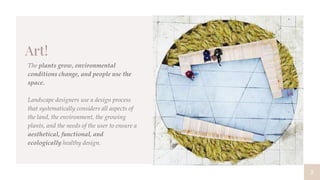
The plants grow,environmental
conditions change, and people use the
space.
Landscape designers use a design process
that systematically considers all aspects of
the land, the environment, the growing
plants, and the needs of the user to ensure a
aesthetical, functional, and
ecologically healthy design.
2
3.
Elements
and
Principles ELEMENTS OFDESIGN
LINE // FORM // COLOR // TEXTURE //
VIUSAL WEIGHT
PRINCIPLES OF DESIGN
SCALE AND PROPORTION // ORDER //
UNITY // EMPHASIS // HARMONY AND
CONTRAST (REPETITION)
The design process begins by
determining the needs and desires of
the user and the condition of the site.
The features of the design can be
physically described by the visual
qualities of elements. The principles
are the fundamental concepts of
composition that deserve as guidelines
to arrange or organize the features to
create an aesthetically pleasing or
beautiful landscape.
3
4.
Landscape
Elements
• The termsoft landscape to describe the vegetative materials which are used to
improve a landscape by design.
• The range of soft landscape materials includes each layer of the ecological
sequence: aquatic plants, semi-aquatic plants, field layer plants (including
grasses and herbaceous plants) shrubs and trees.
• The term hard landscape to describe the construction materials which are used
to improve a landscape by design.
• A wide range of hard landscape materials can be used, such as brick, gravel, rock
or stone, concrete, timber, bitumen, glass, metals, etc.
• 'Hard landscape' can also describe outdoor furniture and other landscape
products.
4
5.
Elements of
design
LINE
• Themost common element in a composition is line.
• Line creates all forms and patterns and can be used in a variety of ways in the
landscape.
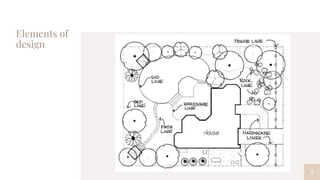
• Line in the landscape is created by the edge between two materials, the outline or
silhouette of a form, or a long linear feature.
• Lines are a powerful tool for the designer because they can be used to create an
infinite variety of shapes and forms, and they control movement of the eye and the
body.
• Landscape designers use lines to create patterns, develop spaces, create forms, control
movement, establish dominance, and create a cohesive themein a landscape.
5
6.
Elements of
design
PROPERTIES OFLINE
• Straight lines - structural and forceful; they create a formal character, are usually
associated with a symmetrical design, and lead the eye directly to a focal point.
Straight lines are most often found in hardscape edges and material.
• Curved lines - create an informal, natural, relaxed character that is associated more
with nature and asymmetrical balance. Curved lines move the eye at a slower pace and
add mystery to the space by creating hidden views.
• Vertical lines - move the eye up, making a space feel larger. An upward line can
emphasize a feature and has a feeling of activity or movement. Vertical lines in the
landscape include tall, narrow plant material, such as trees, or tall structures.
• Horizontal lines - move the eye along the ground plane and can make a space feel
larger. Low lines are more subdued and create a feeling of rest or repose. Horizontal
lines can spatially divide a space or tie a space together.
6
Elements of
design
FORM
• Shapeis created by an outline that encloses a space, and form is the three
dimensional mass of that shape.
• Form is found in both hardscape and plants, and it is typically the dominant visual
element that spatially organizes the landscape and often determines the style of the
garden.
• Formal, geometric forms include circles, squares, and polygons.
• Informal, naturalistic forms include meandering lines, organic edges, and fragmented
edges.
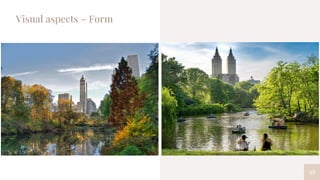
• Plants create form in the garden through their outlines or silhouettes, but form can
also be defined by a void or negative space between plants.
8
9.
Elements of
design
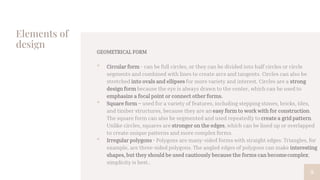
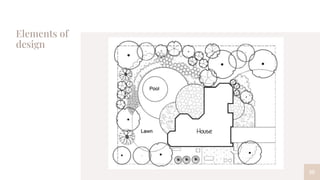
GEOMETRICAL FORM
•Circular form - can be full circles, or they can be divided into half circles or circle
segments and combined with lines to create arcs and tangents. Circles can also be
stretched into ovals and ellipses for more variety and interest. Circles are a strong
design form because the eye is always drawn to the center, which can be used to
emphasize a focal point or connect other forms.
• Square form – used for a variety of features, including stepping stones, bricks, tiles,
and timber structures, because they are an easy form to work with for construction.
The square form can also be segmented and used repeatedly to create a grid pattern.
Unlike circles, squares are stronger on the edges, which can be lined up or overlapped
to create unique patterns and more complex forms.
• Irregular polygons - Polygons are many-sided forms with straight edges. Triangles, for
example, are three-sided polygons. The angled edges of polygons can make interesting
shapes, but they should be used cautiously because the forms can becomecomplex;
simplicity is best..
9
Elements of
design
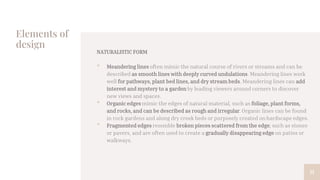
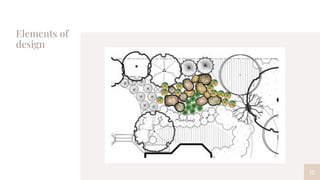
NATURALISTIC FORM
•Meandering lines often mimic the natural course of rivers or streams and can be
described as smooth lines with deeply curved undulations. Meandering lines work
well for pathways, plant bed lines, and dry stream beds. Meandering lines can add
interest and mystery to a garden by leading viewers around corners to discover
new views and spaces.
• Organic edges mimic the edges of natural material, such as foliage, plant forms,
and rocks, and can be described as rough and irregular. Organic lines can be found
in rock gardens and along dry creek beds or purposely created on hardscape edges.
• Fragmented edges resemble broken pieces scattered from the edge, such as stones
or pavers, and are often used to create a gradually disappearing edge on patios or
walkways.
11
Vegetative
material -
plants •Planting design is one of the essential tools in making and managing a living
environment where plants play a significant role in the development of a lively,
resilient, complex and sustainable landscape.
• It helps us to restore and maintain a sustainable relationship between people
and their environment in a context of change.
• Change in the environment changes the plant community, plant community can
also change the environment.
• Plants are growing, changing, interacting organisms and plant communities.
Continuously interacting with the environment. Environmental factors creates
big variations in growth of plants – some can be controlled and some cannot be
controlled.
• Plants also define and create space. Design is not only about the form of solid
structures, however, it is also concerned with the ‘empty’ space that the solid
form defines and creates.
14
Plant
selection
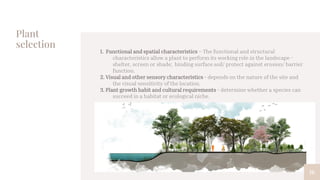
1. Functional andspatial characteristics – The functional and structural
characteristics allow a plant to perform its working role in the landscape -
shelter, screen or shade; binding surface soil/ protect against erosion/ barrier
function.
2. Visual and other sensory characteristics - depends on the nature of the site and
the visual sensitivity of the location.
3. Plant growth habit and cultural requirements - determine whether a species can
succeed in a habitat or ecological niche.
16
17.
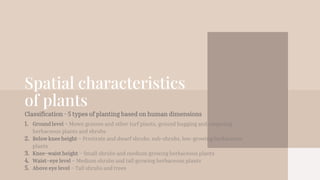
Spatial characteristics
of plants
Classification- 5 types of planting based on human dimensions
1. Ground level – Mown grasses and other turf plants, ground hugging and carpeting
herbaceous plants and shrubs
2. Below knee height – Prostrate and dwarf shrubs, sub-shrubs, low-growing herbaceous
plants
3. Knee–waist height – Small shrubs and medium growing herbaceous plants
4. Waist–eye level – Medium shrubs and tall growing herbaceous plants
5. Above eye level – Tall shrubs and trees
18.
18
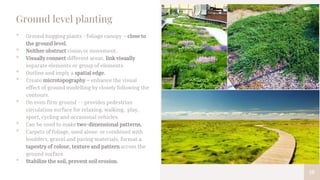
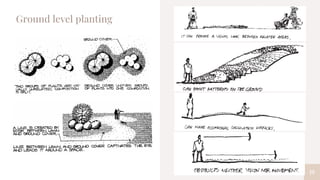
Ground level planting
•Ground hugging plants - foliage canopy – close to
the ground level.
• Neither obstruct vision or movement.
• Visually connect different areas, link visually
separate elements or group of elements.
• Outline and imply a spatial edge.
• Create microtopography – enhance the visual
effect of ground modelling by closely following the
contours.
• On even firm ground - - provides pedestrian
circulation surface for relaxing, walking, play,
sport, cycling and occasional vehicles.
• Can be used to make two-dimensional patterns.
• Carpets of foliage, used alone or combined with
boulders, gravel and paving materials, format a
tapestry of colour, texture and pattern across the
ground surface.
• Stabilize the soil, prevent soil erosion.
20
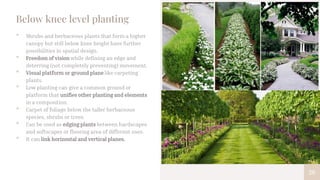
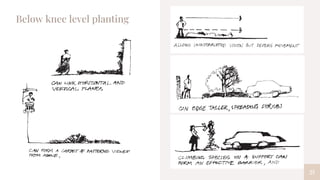
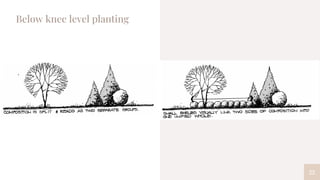
Below knee levelplanting
• Shrubs and herbaceous plants that form a higher
canopy but still below knee height have further
possibilities in spatial design.
• Freedom of vision while defining an edge and
deterring (not completely preventing) movement.
• Visual platform or ground plane like carpeting
plants.
• Low planting can give a common ground or
platform that unifies other planting and elements
in a composition.
• Carpet of foliage below the taller herbaceous
species, shrubs or trees.
• Can be used as edging plants between hardscapes
and softscapes or flooring area of different uses.
• It can link horizontal and vertical planes.
23
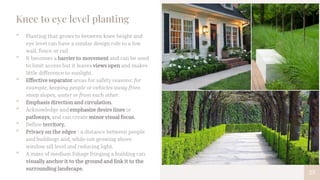
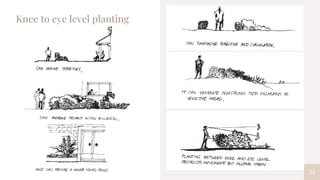
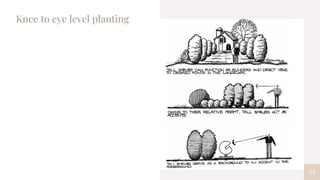
Knee to eyelevel planting
• Planting that grows to between knee height and
eye level can have a similar design role to a low
wall, fence or rail.
• It becomes a barrier to movement and can be used
to limit access but it leaves views open and makes
little difference to sunlight.
• Effective separator areas for safety reasons: for
example, keeping people or vehicles away from
steep slopes, water or from each other.
• Emphasis direction and circulation.
• Acknowledge and emphasize desire lines or
pathways, and can create minor visual focus.
• Define territory.
• Privacy on the edges - a distance between people
and buildings and, while not growing above
window sill level and reducing light.
• A mass of medium foliage fringing a building can
visually anchor it to the ground and link it to the
surrounding landscape.
26
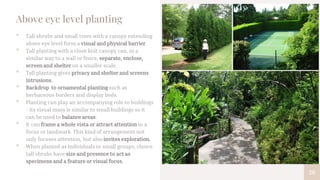
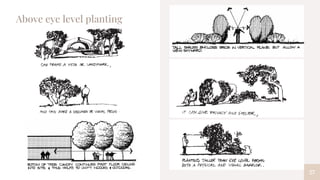
Above eye levelplanting
• Tall shrubs and small trees with a canopy extending
above eye level form a visual and physical barrier.
• Tall planting with a close knit canopy can, in a
similar way to a wall or fence, separate, enclose,
screen and shelter on a smaller scale.
• Tall planting gives privacy and shelter and screens
intrusions.
• Backdrop to ornamental planting such as
herbaceous borders and display beds.
• Planting can play an accompanying role to buildings
- its visual mass is similar to small buildings so it
can be used to balance areas.
• It can frame a whole vista or attract attention to a
focus or landmark. This kind of arrangement not
only focuses attention, but also invites exploration.
• When planted as individuals or small groups, choice
tall shrubs have size and presence to act as
specimens and a feature or visual focus.
28
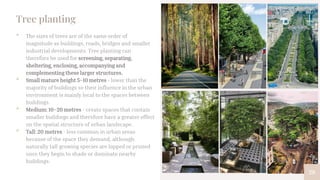
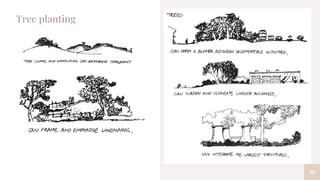
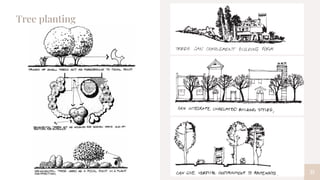
Tree planting
• Thesizes of trees are of the same order of
magnitude as buildings, roads, bridges and smaller
industrial developments. Tree planting can
therefore be used for screening, separating,
sheltering, enclosing, accompanying and
complementing these larger structures.
• Small mature height 5–10 metres - lower than the
majority of buildings so their influence in the urban
environment is mainly local to the spaces between
buildings.
• Medium: 10–20 metres - create spaces that contain
smaller buildings and therefore have a greater effect
on the spatial structure of urban landscape.
• Tall: 20 metres - less common in urban areas
because of the space they demand, although
naturally tall growing species are lopped or pruned
once they begin to shade or dominate nearby
buildings.
29.
29
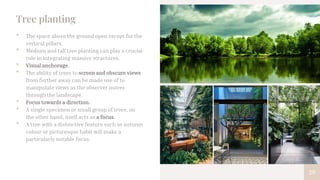
Tree planting
• Thespace above the ground open except for the
vertical pillars.
• Medium and tall tree planting can play a crucial
role in integrating massive structures.
• Visual anchorage.
• The ability of trees to screen and obscure views
from further away can be made use of to
manipulate views as the observer moves
through the landscape.
• Focus towards a direction.
• A single specimen or small group of trees, on
the other hand, itself acts as a focus.
• A tree with a distinctive feature such as autumn
colour or picturesque habit will make a
particularly notable focus.
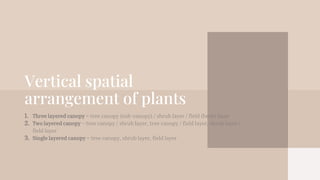
Vertical spatial
arrangement ofplants
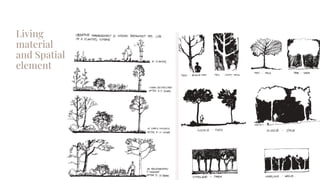
1. Three layered canopy – tree canopy (sub-canopy) / shrub layer / field (herb) layer
2. Two layered canopy – tree canopy / shrub layer, tree canopy / field layer, shrub layer /
field layer
3. Single layered canopy – tree canopy, shrub layer, field layer
33.
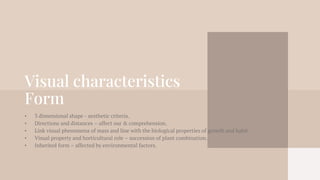
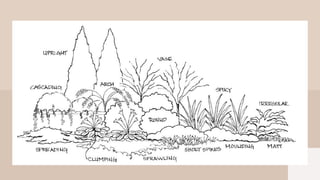
Visual characteristics
Form
• 3dimensional shape - aesthetic criteria.
• Directions and distances – affect our & comprehension.
• Link visual phenomena of mass and line with the biological properties of growth and habit.
• Visual property and horticultural role – succession of plant combination.
• Inherited form – affected by environmental factors.
35.
Visual
aspect -
form
35
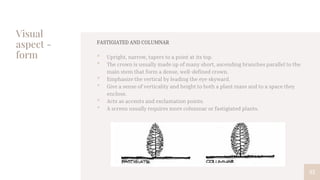
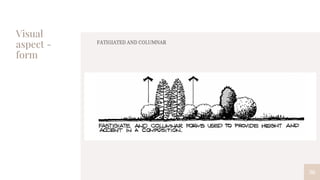
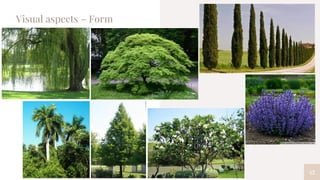
FASTIGIATED ANDCOLUMNAR
• Upright, narrow, tapers to a point at its top.
• The crown is usually made up of many short, ascending branches parallel to the
main stem that form a dense, well-defined crown.
• Emphasize the vertical by leading the eye skyward.
• Give a sense of verticality and height to both a plant mass and to a space they
enclose.
• Acts as accents and exclamation points.
• A screen usually requires more columnar or fastigiated plants.
Visual
aspect -
form
37
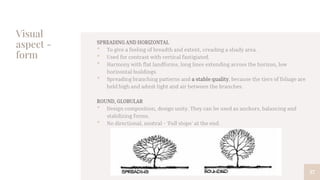
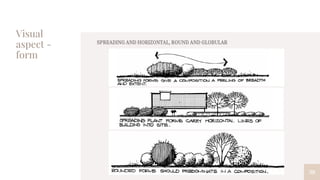
SPREADING ANDHORIZONTAL
• To give a feeling of breadth and extent, creading a shady area.
• Used for contrast with vertical fastigiated.
• Harmony with flat landforms, long lines extending across the horizon, low
horizontal buildings.
• Spreading branching patterns and a stable quality, because the tiers of foliage are
held high and admit light and air between the branches.
ROUND, GLOBULAR
• Design composition, design unity. They can be used as anchors, balancing and
stabilizing forms.
• No directional, neutral - ‘Full stops’ at the end.
Visual
aspect -
form
39
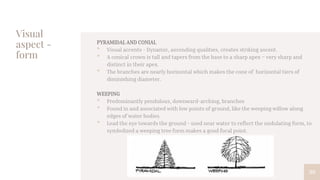
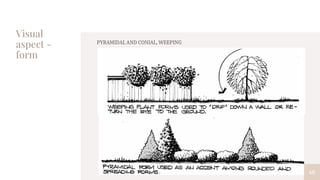
PYRAMIDAL ANDCONIAL
• Visual accents - Dynamic, ascending qualities, creates striking ascent.
• A conical crown is tall and tapers from the base to a sharp apex – very sharp and
distinct in their apex.
• The branches are nearly horizontal which makes the cone of horizontal tiers of
diminishing diameter.
WEEPING
• Predominantly pendulous, downward-arching, branches
• Found in and associated with low points of ground, like the weeping willow along
edges of water bodies.
• Lead the eye towards the ground - used near water to reflect the undulating form, to
symbolized a weeping tree form makes a good focal point.
Visual
aspect -
form
41
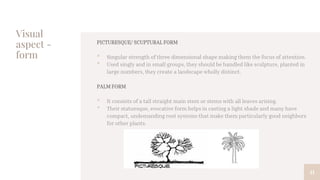
PICTURESQUE/ SCUPTURALFORM
• Singular strength of three dimensional shape making them the focus of attention.
• Used singly and in small groups, they should be handled like sculpture, planted in
large numbers, they create a landscape wholly distinct.
PALM FORM
• It consists of a tall straight main stem or stems with all leaves arising.
• Their statuesque, evocative form helps in casting a light shade and many have
compact, undemanding root systems that make them particularly good neighbors
for other plants.
Visual characteristics
line
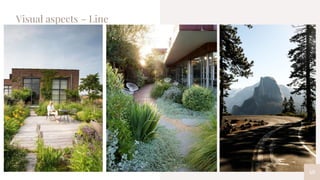
Line isclosely related to form, being the two-dimensional effect of edges. The essence of line is
direction, being the result of the movement of a point in space.
ASCENDING LINE // HORIZONTAL LINE // DIAGONAL LINE // PENDULOUS LINE
45.
Visual
aspect - line
45
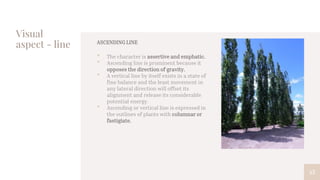
ASCENDINGLINE
• The character is assertive and emphatic.
• Ascending line is prominent because it
opposes the direction of gravity.
• A vertical line by itself exists in a state of
fine balance and the least movement in
any lateral direction will offset its
alignment and release its considerable
potential energy.
• Ascending or vertical line is expressed in
the outlines of plants with columnar or
fastigiate.
46.
Visual
aspect - line
46
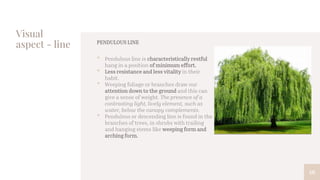
PENDULOUSLINE
• Pendulous line is characteristically restful
hang in a position of minimum effort.
• Less resistance and less vitality in their
habit.
• Weeping foliage or branches draw our
attention down to the ground and this can
give a sense of weight. The presence of a
contrasting light, lively element, such as
water, below the canopy complements.
• Pendulous or descending line is found in the
branches of trees, in shrubs with trailing
and hanging stems like weeping form and
arching form.
47.
Visual
aspect - line
47
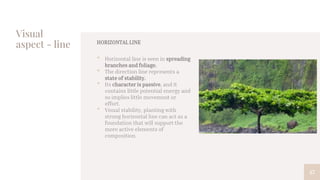
HORIZONTALLINE
• Horizontal line is seen in spreading
branches and foliage.
• The direction line represents a
state of stability.
• Its character is passive, and it
contains little potential energy and
so implies little movement or
effort.
• Visual stability, planting with
strong horizontal line can act as a
foundation that will support the
more active elements of
composition.
48.
Visual
aspect - line
48
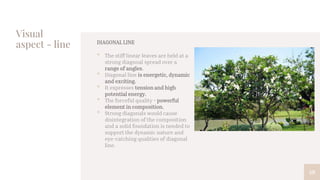
DIAGONALLINE
• The stiff linear leaves are held at a
strong diagonal spread over a
range of angles.
• Diagonal line is energetic, dynamic
and exciting.
• It expresses tension and high
potential energy.
• The forceful quality - powerful
element in composition.
• Strong diagonals would cause
disintegration of the composition
and a solid foundation is needed to
support the dynamic nature and
eye-catching qualities of diagonal
line.
Visual characteristics
texture
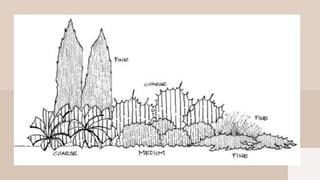
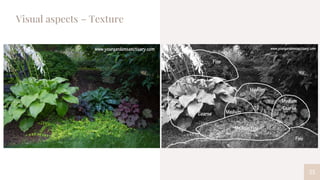
The resultof a pattern of lines but, if so, it is determined only by the scale of the pattern and not by the
direction of the lines. Texture, like form, depends on viewing distance, has specific visual effects.
COARSE TEXTURE // MEDIUM TEXTURE // FINE TEXTURE
52.
Visual
aspect -
texture
52
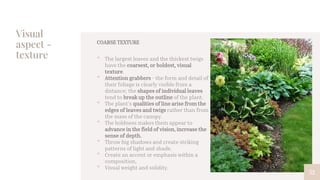
COARSE TEXTURE
•The largest leaves and the thickest twigs
have the coarsest, or boldest, visual
texture.
• Attention grabbers - the form and detail of
their foliage is clearly visible from a
distance; the shapes of individual leaves
tend to break up the outline of the plant.
• The plant’s qualities of line arise from the
edges of leaves and twigs rather than from
the mass of the canopy.
• The boldness makes them appear to
advance in the field of vision, increase the
sense of depth.
• Throw big shadows and create striking
patterns of light and shade.
• Create an accent or emphasis within a
composition,
• Visual weight and solidity.
53.
Visual
aspect -
texture
53
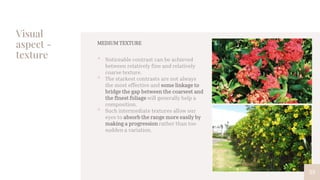
MEDIUM TEXTURE
•Noticeable contrast can be achieved
between relatively fine and relatively
coarse texture.
• The starkest contrasts are not always
the most effective and some linkage to
bridge the gap between the coarsest and
the finest foliage will generally help a
composition.
• Such intermediate textures allow our
eyes to absorb the range more easily by
making a progression rather than too
sudden a variation.
54.
Visual
aspect -
texture
54
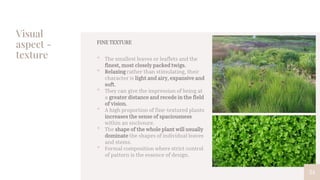
FINE TEXTURE
•The smallest leaves or leaflets and the
finest, most closely packed twigs.
• Relaxing rather than stimulating, their
character is light and airy, expansive and
soft.
• They can give the impression of being at
a greater distance and recede in the field
of vision.
• A high proportion of fine-textured plants
increases the sense of spaciousness
within an enclosure.
• The shape of the whole plant will usually
dominate the shapes of individual leaves
and stems.
• Formal composition where strict control
of pattern is the essence of design.
Visual
aspect -
texture
56
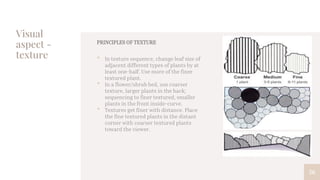
PRINCIPLES OFTEXTURE
• In texture sequence, change leaf size of
adjacent different types of plants by at
least one-half. Use more of the finer
textured plant.
• In a flower/shrub bed, use coarser
texture, larger plants in the back;
sequencing to finer textured, smaller
plants in the front inside-curve.
• Textures get finer with distance. Place
the fine textured plants in the distant
corner with coarser textured plants
toward the viewer.
57.
Visual characteristics
color
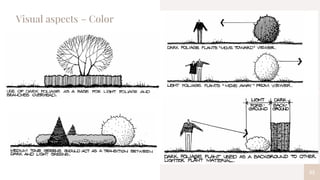
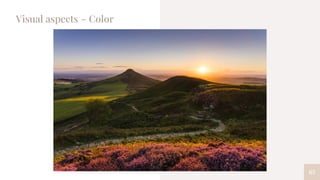
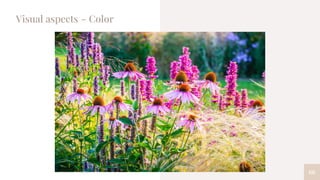
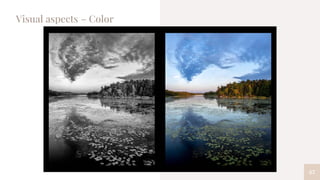
Color ispowerful in creating mood and feeling. The most notable visual characteristic of plant material.
Directly affects the feeling and mood of an outdoor space.
Bright colours convey a light, cheerful atmosphere; dark colours portray a more sober feeling.
58.
Visual
aspect -
color
58
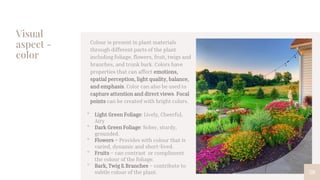
Colour ispresent in plant materials
through different parts of the plant
including foliage, flowers, fruit, twigs and
branches, and trunk bark. Colors have
properties that can affect emotions,
spatial perception, light quality, balance,
and emphasis. Color can also be used to
capture attention and direct views. Focal
points can be created with bright colors.
• Light Green Foliage: Lively, Cheerful,
Airy
• Dark Green Foliage: Sober, sturdy,
grounded.
• Flowers – Provides with colour that is
varied, dynamic and short-lived.
• Fruits – can contrast or compliment
the colour of the foliage.
• Bark, Twig & Branches – contribute to
subtle colour of the plant.
59.
Visual
aspect -
color
59
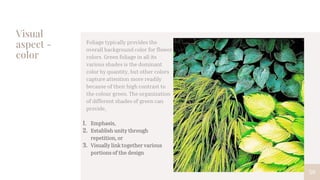
Foliage typicallyprovides the
overall background color for flower
colors. Green foliage in all its
various shades is the dominant
color by quantity, but other colors
capture attention more readily
because of their high contrast to
the colour green. The organization
of different shades of green can
provide,
1. Emphasis,
2. Establish unity through
repetition, or
3. Visually link together various
portions of the design
Visual
aspect -
color
62
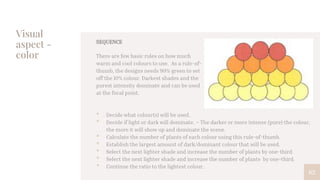
SEQUENCE
There arefew basic rules on how much
warm and cool colours to use. As a rule-of-
thumb, the designs needs 90% green to set
off the 10% colour. Darkest shades and the
purest intensity dominate and can be used
at the focal point.
• Decide what colour(s) will be used.
• Decide if light or dark will dominate. – The darker or more intense (pure) the colour,
the more it will show up and dominate the scene.
• Calculate the number of plants of each colour using this rule-of-thumb.
• Establish the largest amount of dark/dominant colour that will be used.
• Select the next lighter shade and increase the number of plants by one-third.
• Select the next lighter shade and increase the number of plants by one-third.
• Continue the ratio to the lightest colour.
63.
Visual
aspect -
color
63
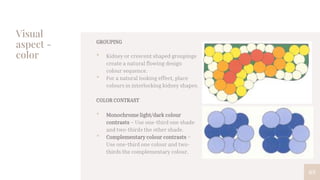
GROUPING
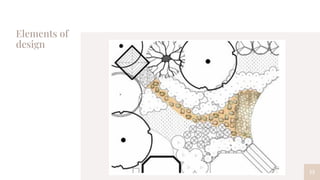
• Kidneyor crescent shaped groupings
create a natural flowing design
colour sequence.
• For a natural looking effect, place
colours in interlocking kidney shapes.
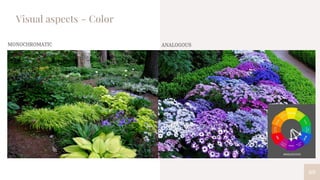
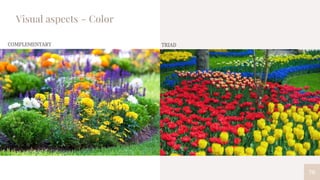
COLOR CONTRAST
• Monochrome light/dark colour
contrasts – Use one-third one shade
and two-thirds the other shade.
• Complementary colour contrasts –
Use one-third one colour and two-
thirds the complementary colour.
Visual
aspect -
color
68
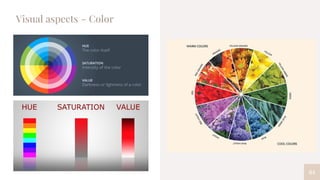
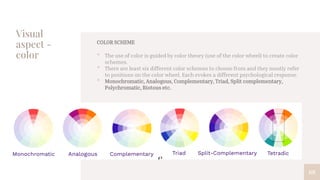
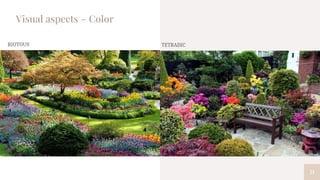
COLOR SCHEME
•The use of color is guided by color theory (use of the color wheel) to create color
schemes.
• There are least six different color schemes to choose from and they mostly refer
to positions on the color wheel. Each evokes a different psychological response.
• Monochromatic, Analogous, Complementary, Triad, Split complementary,
Polychromatic, Riotous etc.
Visual
aspect -
Foliage
73
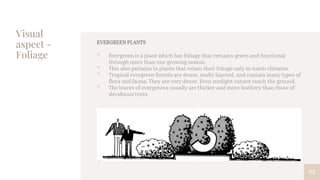
EVERGREEN PLANTS
•Evergreen is a plant which has foliage that remains green and functional
through more than one growing season.
• This also pertains to plants that retain their foliage only in warm climates.
• Tropical evergreen forests are dense, multi-layered, and contain many types of
flora and fauna. They are very dense. Even sunlight cannot reach the ground.
• The leaves of evergreens usually are thicker and more leathery than those of
deciduous trees.
74.
Visual
aspect -
Foliage
74
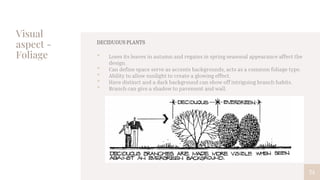
DECIDUOUS PLANTS
•Loses its leaves in autumn and regains in spring seasonal appearance affect the
design.
• Can define space serve as accents backgrounds, acts as a common foliage type.
• Ability to allow sunlight to create a glowing effect.
• Have distinct and a dark background can show off intriguing branch habits.
• Branch can give a shadow to pavement and wall.
75.
Visual
aspect -
Foliage
75
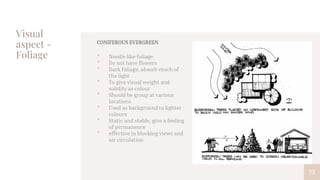
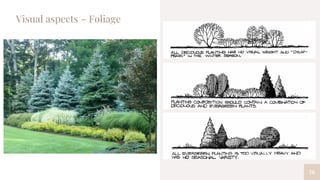
CONIFEROUS EVERGREEN
•Needle like foliage
• Do not have flowers
• Dark foliage, absorb much of
the light
• To give visual weight and
solidity as colour
• Should be group at various
locations
• Used as background to lighter
colours
• Static and stable, give a feeling
of permanence
• effective in blocking views and
air circulation
Visual
weight
78
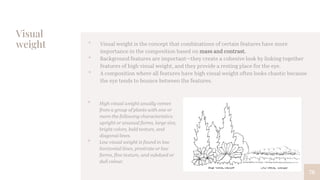
• Visual weightis the concept that combinations of certain features have more
importance in the composition based on mass and contrast.
• Background features are important—they create a cohesive look by linking together
features of high visual weight, and they provide a resting place for the eye.
• A composition where all features have high visual weight often looks chaotic because
the eye tends to bounce between the features.
• High visual weight usually comes
from a group of plants with one or
more the following characteristics:
upright or unusual forms, large size,
bright colors, bold texture, and
diagonal lines.
• Low visual weight is found in low
horizontal lines, prostrate or low
forms, fine texture, and subdued or
dull colour.
79.
Uses of
plant
material
79
AESTHETIC USES
•To relate a building
form to its surrounding
site.
• Unify and coordinate a
dis co-ordinate
environment.
• Reinforce certain
points and areas in the
landscape.
• Reduce the harshness
of hard architectural
elements.
ARCHITECTURAL USES
• Enframement
selected views
• Scale induction
• Defines pathway
ENVIRONMENTAL USES
• Microclimate
modifiers
• Conservation belt
• Erosion control
• Improving ground
water
• Retains soil fertility
80.
80
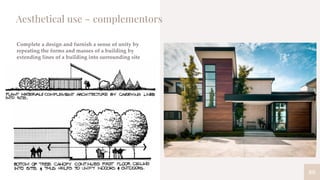
Aesthetical use –complementors
Complete a design and furnish a sense of unity by
repeating the forms and masses of a building by
extending lines of a building into surrounding site
81.
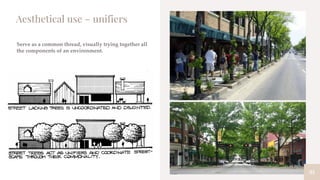
81
Aesthetical use –unifiers
Serve as a common thread, visually trying together all
the components of an environment.
82.
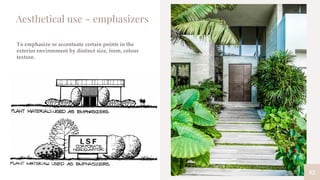
82
Aesthetical use –emphasizers
To emphasize or accentuate certain points in the
exterior environment by distinct size, form, colour
texture.
83.
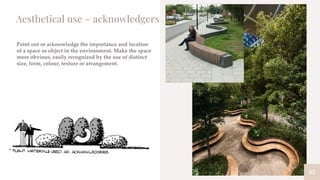
83
Aesthetical use –acknowledgers
Point out or acknowledge the importance and location
of a space or object in the environment. Make the space
more obvious, easily recognized by the use of distinct
size, form, colour, texture or arrangement.
84.
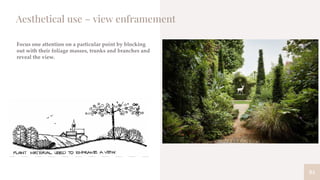
84
Aesthetical use –view enframement
Focus one attention on a particular point by blocking
out with their foliage masses, trunks and branches and
reveal the view.
85.
85
Architectural use
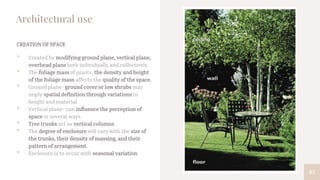
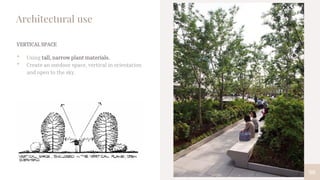
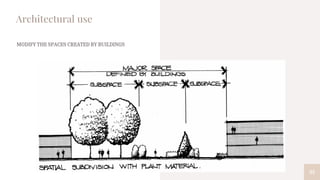
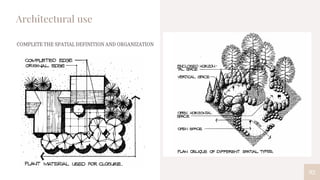
CREATION OFSPACE
• Created by modifying ground plane, vertical plane,
overhead plane both individually and collectively.
• The foliage mass of plants, the density and height
of the foliage mass affects the quality of the space.
• Ground plane- ground cover or low shrubs may
imply spatial definition through variations in
height and material.
• Vertical plane- can influence the perception of
space in several ways.
• Tree trunks act as vertical columns.
• The degree of enclosure will vary with the size of
the trunks, their density of massing, and their
pattern of arrangement.
• Enclosure is to occur with seasonal variation.
86.
86
Architectural use
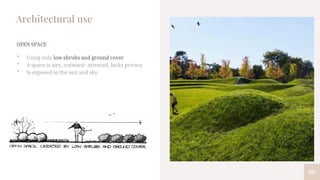
OPEN SPACE
•Using only low shrubs and ground cover
• A space is airy, outward- oriented, lacks privacy
• Is exposed to the sun and sky.
87.
87
Architectural use
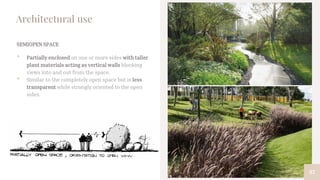
SEMIOPEN SPACE
•Partially enclosed on one or more sides with taller
plant materials acting as vertical walls blocking
views into and out from the space.
• Similar to the completely open space but is less
transparent while strongly oriented to the open
sides.
88.
88
Architectural use
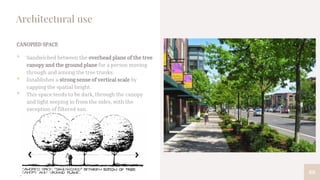
CANOPIED SPACE
•Sandwiched between the overhead plane of the tree
canopy and the ground plane for a person moving
through and among the tree trunks.
• Establishes a strong sense of vertical scale by
capping the spatial height.
• This space tends to be dark, through the canopy
and light seeping in from the sides, with the
exception of filtered sun.
89.
89
Architectural use
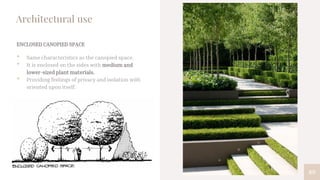
ENCLOSED CANOPIEDSPACE
• Same characteristics as the canopied space.
• It is enclosed on the sides with medium and
lower-sized plant materials.
• Providing feelings of privacy and isolation with
oriented upon itself.