Land and spatial planning

        Paul Speight
       DHoU, ENV B1
Structure of presentation
• 1) Why land is a resource under pressure
• 2) Why land use is crucial to the delivery
  of EU env policy
• 3) How what we do in the EU is
  inseparable from the rest of the world
• 4) What we know about land use and its
  likely evolution (EU and international)
• 5) Some possible solutions
• 6) Who should do what?
Population growth, diet change,30% food
waste = more land or more intensification
The bioeconomy
•   Traditional – wool, furniture, tallow...
•   Or, the new competitors:
•   Biofuels (Renewable Energy Directive)
•   Biomass (Emission trading scheme)
•   Green Chemistry (biorefineries)
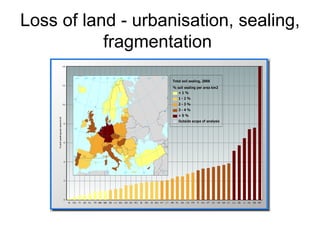
Loss of land - urbanisation, sealing,
           fragmentation
Habitats where there are multiple
uses, are those most under pressure
                                  Conservation Status - Habitats

    100%

      80%
                                                                             XX
      60%
                                                                             U2
      40%                                                                    U1
                                                                             FV
      20%

       0%


                                                                ts


                                                                 b
                                ns


                                 ts
                                ts


                                                                b


                                                               ts
                                                              ds


                                                             ru
                                                               s


                                                              ta


                                                             ru
                              ta
                            ita
                            fe


                                                            ta
                                                            st


                                                          sc
                                                          an
                                                           bi


                                                         sc
                           bi


                                                        re


                                                         bi
                         ab
          &


                                                       ha


                                                       sl
                        ha


                                                      ha
                                                      fo


                                                       s
                                                      &
                                                                     FV = Favourable
           s


                      lh


                                                   il u
                                                   as
       ir e


                                                  er


                                                   h
                      s


                                                  y
                    ta


                                                ph
                                                gr


                                                at
                   ne


                                                at


                                               ck
     ,m


                 as


                                                                     U1 & U2 = Unfavourable

                                            he
                                              w


                                             ro
                du


                                            ro
               co


                                         sh
   gs


                                          le
                                       sc
                                      fre
bo


                                                                     XX = unknown


     (But also, soil, climate, water quality, floods,
                 and droughts, etc...)
Impossible to separate EU actions and
         international impacts (direct and indirect)
      Indirect Land Use Change (ILUC) is caused
                 by crop displacement:

NO BIOFUELS                              WITH BIOFUELS
                                      EU field
   EU field
   growing
                                      growing
                                      crops for          +
   crops for
                                      biofuels          Extra
     food
                                                        field
         Diverting 1 ton EU wheat from food            growin
            to bioethanol will not change              g food
            emissions from that EU farm

…increased emissions to fill in the gap in the food market due to:
        - Land expansion (into natural vegetation or set-aside land)
        - Emissions from intensification
Modelling
and other
knowledge
on land use
and land
use change
now reliable
enough for
policy use
(but not to
predict land
use change
across the
board)
Solutions? Integration, planning, reducing
               pressures…        Green Infrastructure: If
                                          we could join up the
                                          green dots more
                                          effectively and planned
                                          our infrastructure at the
                                          landscape level, we
                                          would get more from our
                                          existing protected areas

                                          Consultation coming soon
                                          on this.

                                          Development without
                                          sealing the soil – EU soil
                                          sealing guidelines:

                                          http://ec.europa.eu/environmen

                                          Clean up of brownfield
                                          land...
Better processes?
• SEA, EIA – proper assessment of what
  development, and major policy processes
  will lead to on the ground
• Especially for sensitive areas – Integrated
  Coastal Zone Management
• Best practice from Member States – green
  belt, DE no land take target...
Resource efficiency
• Land as a resource Communication –2014
• "By 2020, EU policies take into account
  their direct and indirect impact on land use
  in the EU and globally, and the rate of land
  take is on track with an aim to achieve no
  net land take by 2050;"
• Rio + 20: "we will strive to achieve a land-
  degradation neutral world"
Who does what?
• Most of the concrete measures will need
  to be taken at the Member State, regional
  or local level
• EU level – raise awareness, look at EU
  policies that affect land use, spread best
  practice

Land and spatial planning

  • 1.
    Land and spatialplanning Paul Speight DHoU, ENV B1
  • 2.
    Structure of presentation •1) Why land is a resource under pressure • 2) Why land use is crucial to the delivery of EU env policy • 3) How what we do in the EU is inseparable from the rest of the world • 4) What we know about land use and its likely evolution (EU and international) • 5) Some possible solutions • 6) Who should do what?
  • 3.
    Population growth, dietchange,30% food waste = more land or more intensification
  • 4.
    The bioeconomy • Traditional – wool, furniture, tallow... • Or, the new competitors: • Biofuels (Renewable Energy Directive) • Biomass (Emission trading scheme) • Green Chemistry (biorefineries)
  • 5.
    Loss of land- urbanisation, sealing, fragmentation
  • 6.
    Habitats where thereare multiple uses, are those most under pressure Conservation Status - Habitats 100% 80% XX 60% U2 40% U1 FV 20% 0% ts b ns ts ts b ts ds ru s ta ru ta ita fe ta st sc an bi sc bi re bi ab & ha sl ha ha fo s & FV = Favourable s lh il u as ir e er h s y ta ph gr at ne at ck ,m as U1 & U2 = Unfavourable he w ro du ro co sh gs le sc fre bo XX = unknown (But also, soil, climate, water quality, floods, and droughts, etc...)
  • 7.
    Impossible to separateEU actions and international impacts (direct and indirect) Indirect Land Use Change (ILUC) is caused by crop displacement: NO BIOFUELS WITH BIOFUELS EU field EU field growing growing crops for + crops for biofuels Extra food field Diverting 1 ton EU wheat from food growin to bioethanol will not change g food emissions from that EU farm …increased emissions to fill in the gap in the food market due to: - Land expansion (into natural vegetation or set-aside land) - Emissions from intensification
  • 8.
    Modelling and other knowledge on landuse and land use change now reliable enough for policy use (but not to predict land use change across the board)
  • 9.
    Solutions? Integration, planning,reducing pressures… Green Infrastructure: If we could join up the green dots more effectively and planned our infrastructure at the landscape level, we would get more from our existing protected areas Consultation coming soon on this. Development without sealing the soil – EU soil sealing guidelines: http://ec.europa.eu/environmen Clean up of brownfield land...
  • 10.
    Better processes? • SEA,EIA – proper assessment of what development, and major policy processes will lead to on the ground • Especially for sensitive areas – Integrated Coastal Zone Management • Best practice from Member States – green belt, DE no land take target...
  • 11.
    Resource efficiency • Landas a resource Communication –2014 • "By 2020, EU policies take into account their direct and indirect impact on land use in the EU and globally, and the rate of land take is on track with an aim to achieve no net land take by 2050;" • Rio + 20: "we will strive to achieve a land- degradation neutral world"
  • 12.
    Who does what? •Most of the concrete measures will need to be taken at the Member State, regional or local level • EU level – raise awareness, look at EU policies that affect land use, spread best practice

Editor's Notes

  • #4 Population rises, but productivity is steady... More people, more urbanisation, more middle class, more western diets…
  • #5 Consequences of this competition still playing out – land use change, rise in food prices, traditional industries switch to new feedstock – tbc
  • #6 SOIL SEALING Urban land increased by 6% (about 10,000 km²) in the period 1990-2000 - Most of the land « consumed » came from agricultural land (84%), generally the most productive soils. Between 1990 and 2000, land take in EU27 was around 1,000 km² per year (approx. the size of Berlin) and artificial surfaces increased by 5.7%. Since then, land take has "slowed down" to 920 km² per year and artificial surfaces have increased by a further 3%. This corresponds to a 8.8% increase of artificial surface in the EU between 1990 and 2006. In the same period, population increased by only 5%. In 2006, almost 100,000 km² or 2.3% of the EU’s territory were actually sealed and each EU citizen was on average stocked with 200 m² sealed surface. Member States with high sealing rates exceeding 5% of the national territory are Malta, the Netherlands, Belgium, Germany, and Luxembourg. Furthermore, individual regions with high sealing rates exist all over the EU and include all major urban agglomerations, and most of the Mediterranean regions.  
  • #9 Slide shows one possible scenario tested using modelling work – shown as an example only – not intended to demonstrate specific land use points!
  • #10 Green infrastructure – getting more from the resource we have set aside – inefficient otherwise CAP reform, and better use of structural funds Reducing pressures from the fork – food choices and food waste