LALC: One more time By  Houeida Kammourié-Charara LALC Coordinator  Electronic Resources Librarian Lebanese American University Beirut, Lebanon © 2008
LALC “raison d’être” To cope with changes that took place in the university environment in Lebanon. To keep pace with users requests and expectations in academic libraries, in particular in the e-resources field. “ To cooperate in the selection, pricing negotiations and access methods of electronic resources in the best interest of the library users in an economical way for the library.”
LALC Story The vision began in 2001. The University of Balamand was the leader by inviting and encouraging all major academic institutions in Lebanon to develop a library consortium of electronic resources. Three private institutions replied to the UOB invitation (currently the Board members). Jointly they formed LALC, the first Arab and Lebanese formal Academic Library Consortium.
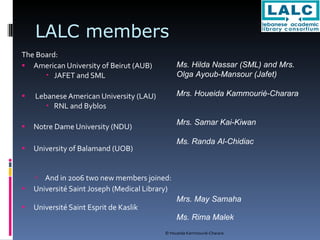
LALC members The Board: American University of Beirut (AUB) JAFET and SML Lebanese American University (LAU) RNL and Byblos Notre Dame University (NDU)  University of Balamand (UOB)  And in 2006 two new members joined: Université Saint Joseph (Medical Library)  Université Saint Esprit de Kaslik Ms. Hilda Nassar (SML) and Mrs. Olga Ayoub-Mansour (Jafet) Mrs. Houeida Kammourié-Charara Mrs. Samar Kai-Kiwan Ms. Randa Al-Chidiac Mrs. May Samaha Ms. Rima Malek
LALC By-Laws  In 2002 a By-Laws was drafted stating: “ LALC Mission Statement is to improve and expand the library services and resources of its institutional members. This is achieved through building a cooperative yet comprehensive collection of electronic resources and e-journals that will enable LALC member institutions to share resources and provide information to their users more efficiently and cost-effectively.” This draft has never been approved and was replaced by a Letter of Agreement (LOA).
Letter of Agreement In May 3 rd  2004, a formal LOA was signed between LALC members in which the parties agreed to establish a consortium under the name of "Lebanese Academic Library Consortium – LALC”. After 2 years of active work, LALC status was officially announced.  LOA governs all LALC activities, and it is renewed annually. 2007’s LOA included USJ and USEK in addition to the board members.
Administrative and Financial Structure Each member library is represented by one librarian designated by the institution.  Librarians meet regularly (or via email) in order to discuss resource acquisition and other relevant issues. A Consortium Coordinator is elected among LALC members for a period of three (3) years with the possibility of renewal. His duties are to convene meetings, keep minutes, draft annual reports, etc. LALC set procedures and guidelines for trialing, acquiring e-resources, & project proposals. All financial procedures, i.e., budget planning, payments and agreements are done according to each institution’s policies and procedures.
International Approach 2003 ICOLC 2004 AMICAL 2005 eIFL LALC is the first Lebanese and Arab consortium member in the International Coalition of Library Consortia (ICOLC) which primarily serves higher education institutions by facilitating discussion among consortia on issues of common interest Two American institutions members in LALC are also members in AMICAL which is an international consortium of American model, liberal arts institutions of higher education LALC worked on joining eIFL.net which is an independent foundation that strives to lead, negotiate, support and advocate for the wide availability of electronic resources by library users in transition and developing countries; However being a consortium of private institutions was the major barrier that forbids LALC from joining eIFL.
LALC Medical Consortium LALC  member institutions providing medical programs formed a specialized mini consortium: AUB-SML UOB USJ-Medical Library USEK This consortium acts as a sub-division of LALC and follows all LALC policies & procedures.
LALC & LIDS The idea of having an ILL/DD service was first conceived by LALC in 2004, but didn’t succeed due to internal private reasons. In October 1, 2007, the Lebanese ILL/DD Services (LIDS) was born and ILL/DDS policies and procedures were drafted. The main goal of LIDS is to initiate  processes & services to expand resource sharing. A consortial version of A-to-Z  (e-journal portal), was created to facilitate searching across LIDS members resources.  LIDS’ vision is to expand its services to Arab universities and colleges. This initiative fulfilled a LALC major objective .
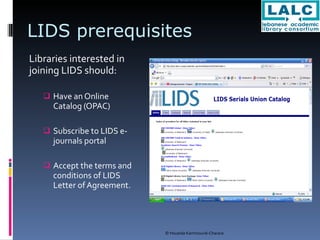
LIDS prerequisites Libraries interested in joining LIDS should: Have an Online Catalog (OPAC) Subscribe to LIDS e-journals portal Accept the terms and conditions of LIDS Letter of Agreement.
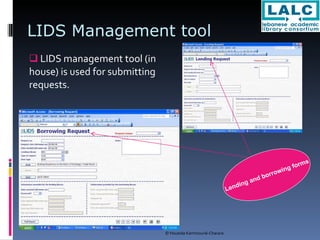
LIDS Management tool LIDS management tool (in  house) is used for submitting requests. Lending and borrowing forms
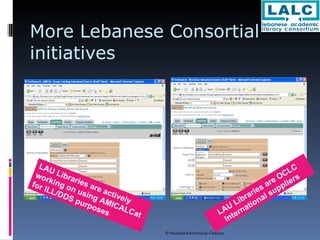
More Lebanese Consortial initiatives LAU Libraries are OCLC International suppliers LAU Libraries are actively working on using AMICALCat for ILL/DDS purposes
LALC “Good points” Overall performance: LALC has been successful. Increasing the number of full-text databases (35 DB in 2006), with more concurrent users (unlimited) and reducing the cost of annual subscriptions. Collaborating with organizations in Lebanon such as the Lebanese Library Association and outside Lebanon such as ICOLC. Improving the working relationship among librarians and providing an opportunity for them to learn from each other, and to strengthen their relationships with vendors, agents, publishers, etc. Geographic proximity is a major factor in the success of LALC:  Members can easily meet on demand Publishers or vendors can apply the same pricing model.
LALC “Bad points” Loss of autonomy: Every decision needs consensus. Extra effort is required to seal a consortial deal, which does not ‘necessarily’ result in substantial benefit. Responding to changing local needs cannot be done without the worry about the impact on other libraries. Publishers may have restrictions:  no. of members  payment methods  unrealistic offers Some have provided other institutions in Lebanon consortium deals without LALC’s knowledge
Future Challenges To review and evaluate the consortium work in order to create an example that would set standards for consortia in Lebanon To attempt to add more functions to LALC by exploring new ways of improving LALC; such as providing common training sessions and contributing in the compilation of e-resources manuals. Launching a website: In January 21, 2008, LAU offered to host LALC website accessible through the official LAU libraries’ website. To frequently attend conferences and promote LALC in order to recruit more members.
Thank you LALC success story is brought to you by a small  but PROUD country  Houeida Kammourié-Charara LALC Coordinator Electronic Resources Librarian Lebanese American University Libraries LEBANON E-mail  [email_address]
References Al-Chidiac, Randa .”  The challenging & daring experiment: LALC.”  eIFL Workshop, LAU, Beirut. March 2006. Habre, Cendrella.  " Lebanese Academic Library Consortium. “   AFLI 13 th  Conference, Beirut. Oct.-Nov. 2002. Kai-Kiwan, Samar.  “Lebanese ILL/DD services.”  LIDS meeting, Beirut. February 2008. Kammourié-Charara, Houeida.  " Academic library consortia with examples from the Arab World. “  MELCOM 25 th  Conference, Beirut. May 2003. Kammourié-Charara, Houeida.  “LALC: A successful challenge.”  eIFL  Collaborative Management Of Electronic Resources  Workshop, Cairo. April 2005. Kammourié-Charara, Houeida.  " The role of consortia in academic libraries: A case study of the Lebanese Academic Library Consortium (LALC). " Diss. U of Wales, 2003 . Lebanese Academic Library Consortium (2004).  Annual Report , 2003-2004. Lebanese Academic Library Consortium (2008).  Annual Report , 2005-2006 & 2006-2007.

LALC: One more time

  • 1.
    LALC: One moretime By Houeida Kammourié-Charara LALC Coordinator Electronic Resources Librarian Lebanese American University Beirut, Lebanon © 2008
  • 2.
    LALC “raison d’être”To cope with changes that took place in the university environment in Lebanon. To keep pace with users requests and expectations in academic libraries, in particular in the e-resources field. “ To cooperate in the selection, pricing negotiations and access methods of electronic resources in the best interest of the library users in an economical way for the library.”
  • 3.
    LALC Story Thevision began in 2001. The University of Balamand was the leader by inviting and encouraging all major academic institutions in Lebanon to develop a library consortium of electronic resources. Three private institutions replied to the UOB invitation (currently the Board members). Jointly they formed LALC, the first Arab and Lebanese formal Academic Library Consortium.
  • 4.
    LALC members TheBoard: American University of Beirut (AUB) JAFET and SML Lebanese American University (LAU) RNL and Byblos Notre Dame University (NDU) University of Balamand (UOB) And in 2006 two new members joined: Université Saint Joseph (Medical Library) Université Saint Esprit de Kaslik Ms. Hilda Nassar (SML) and Mrs. Olga Ayoub-Mansour (Jafet) Mrs. Houeida Kammourié-Charara Mrs. Samar Kai-Kiwan Ms. Randa Al-Chidiac Mrs. May Samaha Ms. Rima Malek
  • 5.
    LALC By-Laws In 2002 a By-Laws was drafted stating: “ LALC Mission Statement is to improve and expand the library services and resources of its institutional members. This is achieved through building a cooperative yet comprehensive collection of electronic resources and e-journals that will enable LALC member institutions to share resources and provide information to their users more efficiently and cost-effectively.” This draft has never been approved and was replaced by a Letter of Agreement (LOA).
  • 6.
    Letter of AgreementIn May 3 rd 2004, a formal LOA was signed between LALC members in which the parties agreed to establish a consortium under the name of "Lebanese Academic Library Consortium – LALC”. After 2 years of active work, LALC status was officially announced. LOA governs all LALC activities, and it is renewed annually. 2007’s LOA included USJ and USEK in addition to the board members.
  • 7.
    Administrative and FinancialStructure Each member library is represented by one librarian designated by the institution. Librarians meet regularly (or via email) in order to discuss resource acquisition and other relevant issues. A Consortium Coordinator is elected among LALC members for a period of three (3) years with the possibility of renewal. His duties are to convene meetings, keep minutes, draft annual reports, etc. LALC set procedures and guidelines for trialing, acquiring e-resources, & project proposals. All financial procedures, i.e., budget planning, payments and agreements are done according to each institution’s policies and procedures.
  • 8.
    International Approach 2003ICOLC 2004 AMICAL 2005 eIFL LALC is the first Lebanese and Arab consortium member in the International Coalition of Library Consortia (ICOLC) which primarily serves higher education institutions by facilitating discussion among consortia on issues of common interest Two American institutions members in LALC are also members in AMICAL which is an international consortium of American model, liberal arts institutions of higher education LALC worked on joining eIFL.net which is an independent foundation that strives to lead, negotiate, support and advocate for the wide availability of electronic resources by library users in transition and developing countries; However being a consortium of private institutions was the major barrier that forbids LALC from joining eIFL.
  • 9.
    LALC Medical ConsortiumLALC member institutions providing medical programs formed a specialized mini consortium: AUB-SML UOB USJ-Medical Library USEK This consortium acts as a sub-division of LALC and follows all LALC policies & procedures.
  • 10.
    LALC & LIDSThe idea of having an ILL/DD service was first conceived by LALC in 2004, but didn’t succeed due to internal private reasons. In October 1, 2007, the Lebanese ILL/DD Services (LIDS) was born and ILL/DDS policies and procedures were drafted. The main goal of LIDS is to initiate processes & services to expand resource sharing. A consortial version of A-to-Z (e-journal portal), was created to facilitate searching across LIDS members resources. LIDS’ vision is to expand its services to Arab universities and colleges. This initiative fulfilled a LALC major objective .
  • 11.
    LIDS prerequisites Librariesinterested in joining LIDS should: Have an Online Catalog (OPAC) Subscribe to LIDS e-journals portal Accept the terms and conditions of LIDS Letter of Agreement.
  • 12.
    LIDS Management toolLIDS management tool (in house) is used for submitting requests. Lending and borrowing forms
  • 13.
    More Lebanese Consortialinitiatives LAU Libraries are OCLC International suppliers LAU Libraries are actively working on using AMICALCat for ILL/DDS purposes
  • 14.
    LALC “Good points”Overall performance: LALC has been successful. Increasing the number of full-text databases (35 DB in 2006), with more concurrent users (unlimited) and reducing the cost of annual subscriptions. Collaborating with organizations in Lebanon such as the Lebanese Library Association and outside Lebanon such as ICOLC. Improving the working relationship among librarians and providing an opportunity for them to learn from each other, and to strengthen their relationships with vendors, agents, publishers, etc. Geographic proximity is a major factor in the success of LALC: Members can easily meet on demand Publishers or vendors can apply the same pricing model.
  • 15.
    LALC “Bad points”Loss of autonomy: Every decision needs consensus. Extra effort is required to seal a consortial deal, which does not ‘necessarily’ result in substantial benefit. Responding to changing local needs cannot be done without the worry about the impact on other libraries. Publishers may have restrictions: no. of members payment methods unrealistic offers Some have provided other institutions in Lebanon consortium deals without LALC’s knowledge
  • 16.
    Future Challenges Toreview and evaluate the consortium work in order to create an example that would set standards for consortia in Lebanon To attempt to add more functions to LALC by exploring new ways of improving LALC; such as providing common training sessions and contributing in the compilation of e-resources manuals. Launching a website: In January 21, 2008, LAU offered to host LALC website accessible through the official LAU libraries’ website. To frequently attend conferences and promote LALC in order to recruit more members.
  • 17.
    Thank you LALCsuccess story is brought to you by a small but PROUD country Houeida Kammourié-Charara LALC Coordinator Electronic Resources Librarian Lebanese American University Libraries LEBANON E-mail [email_address]
  • 18.
    References Al-Chidiac, Randa.” The challenging & daring experiment: LALC.” eIFL Workshop, LAU, Beirut. March 2006. Habre, Cendrella. " Lebanese Academic Library Consortium. “ AFLI 13 th Conference, Beirut. Oct.-Nov. 2002. Kai-Kiwan, Samar. “Lebanese ILL/DD services.” LIDS meeting, Beirut. February 2008. Kammourié-Charara, Houeida. " Academic library consortia with examples from the Arab World. “ MELCOM 25 th Conference, Beirut. May 2003. Kammourié-Charara, Houeida. “LALC: A successful challenge.” eIFL Collaborative Management Of Electronic Resources Workshop, Cairo. April 2005. Kammourié-Charara, Houeida. " The role of consortia in academic libraries: A case study of the Lebanese Academic Library Consortium (LALC). " Diss. U of Wales, 2003 . Lebanese Academic Library Consortium (2004). Annual Report , 2003-2004. Lebanese Academic Library Consortium (2008). Annual Report , 2005-2006 & 2006-2007.