Exercise 2
          Relative and absolute dating of geologic events


Introduction
The study of Earth history involves determining the sequence of geologic
events over immense spans of time. In most cases the correct order of
events can be determined without knowing their actual ages: that is, we
simply establish that event B occurred before event C, but after event A.
Such dating, in which the occurrence of events is determined relative to one
another, is known as relative dating.

Of course it is always useful to know the actual ages of rocks and events, if
possible. Actual ages are determinied by means of radiometric dating
techniques. Although several techniques exist, all rely on the fact that
radioactive “parent” isotopes decay into stable “daughter” isotopes at a
constant rate. With knowledge of the decay rate, ratios of parent and
daughter isotopes then can be used to derive an absolute date, in years, for
the age of a given mineral sample.

The purpose of this lab is to introduce the principles and concepts
associated with both relative and absolute dating.

Relative dating
The relative order of geologic events can be established in most cases by
applying four or fewer basic principles. (1) The Principle of Original
Horizontality states that sedimentary rocks are deposited as horizontal or
nearly horizontal layers. Any marked deviation from horizontality indicates
that some movement or deformation of the Earth’s crust occurred after
deposition of the inclined layer. (2) The Principle of Superposition states
that in an ordinary vertical sequence of sedimentary rocks, the layer at the
bottom of the sequence is oldest, and successively higher layers are
successively younger. (3) The Principle of Cross-cutting relationships
states that geologic features such as faults and igneous intrusions, which cut
through rocks, must be younger than the rocks through which they cut. (4)
The Principle of Inclusion states that if rocks or rock fragments are
included within another rock layer, the rock fragments must be older than


                                     2–1
the layer in which they are included. Examples of the application of these
        principles are given in the following block diagrams (Figure 1).


Figure 1—(A) Sedimentary beds 1–3 were deposited as horizontal layers. Sometime later, a normal fault occurred. (B) Sedimentary beds 1–7
were deposited as horizontal layers. Later, these beds were folded into an anticline. Later still, the anticline was truncated by an erosional
unconformity, and finally, an eighth sedimentary bed was deposited as a horizontal layer. Inclusions of older rock fragments (derived from beds
1–7) are found at the base of bed 8.


        Unconformities are especially useful in reconstructing Earth history. An
        unconformity is a surface that corresponds with a gap in sedimentation,
        either nondeposition or erosion. Rocks above an unconformity are younger
        than those below it. Three main types of unconformities are recognized
        (Figure 2): (1) angular unconformity, in which beds above and below the
        surface are not parallel; (2) nonconformity, in which sedimentary layers
        overly crystalline rocks (either igneous or metamorphic); and (3)
        disconformity, in which beds above and below the surface are parallel, but
        the surface itself is irregular, exhibiting evidence of erosional relief. In
        geologic block diagrams and cross-sections, unconformities are usually drawn
        as a wavy line.


                                      Figure 2—Three types of unconformities (from Stanley, 1998).


                                                                   2–2
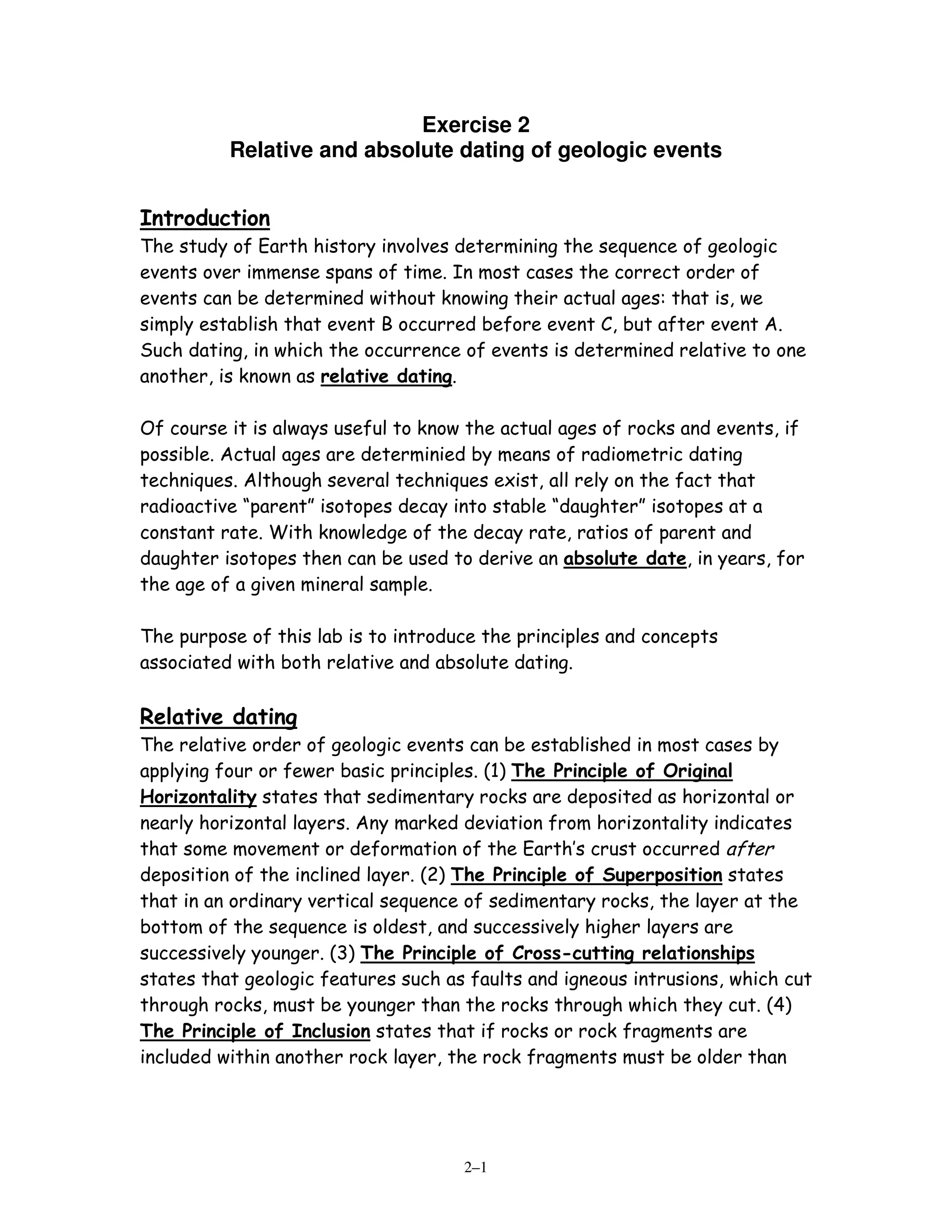
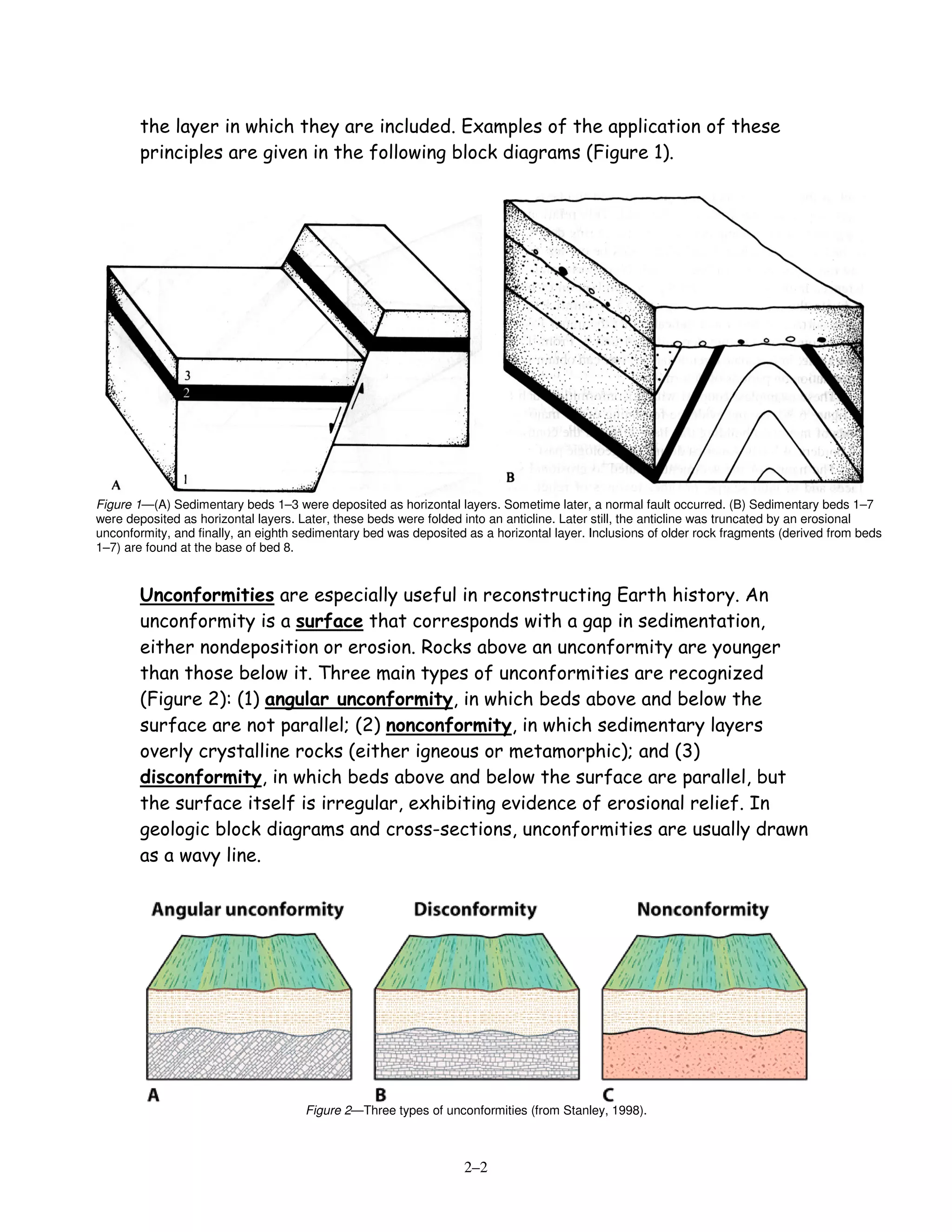
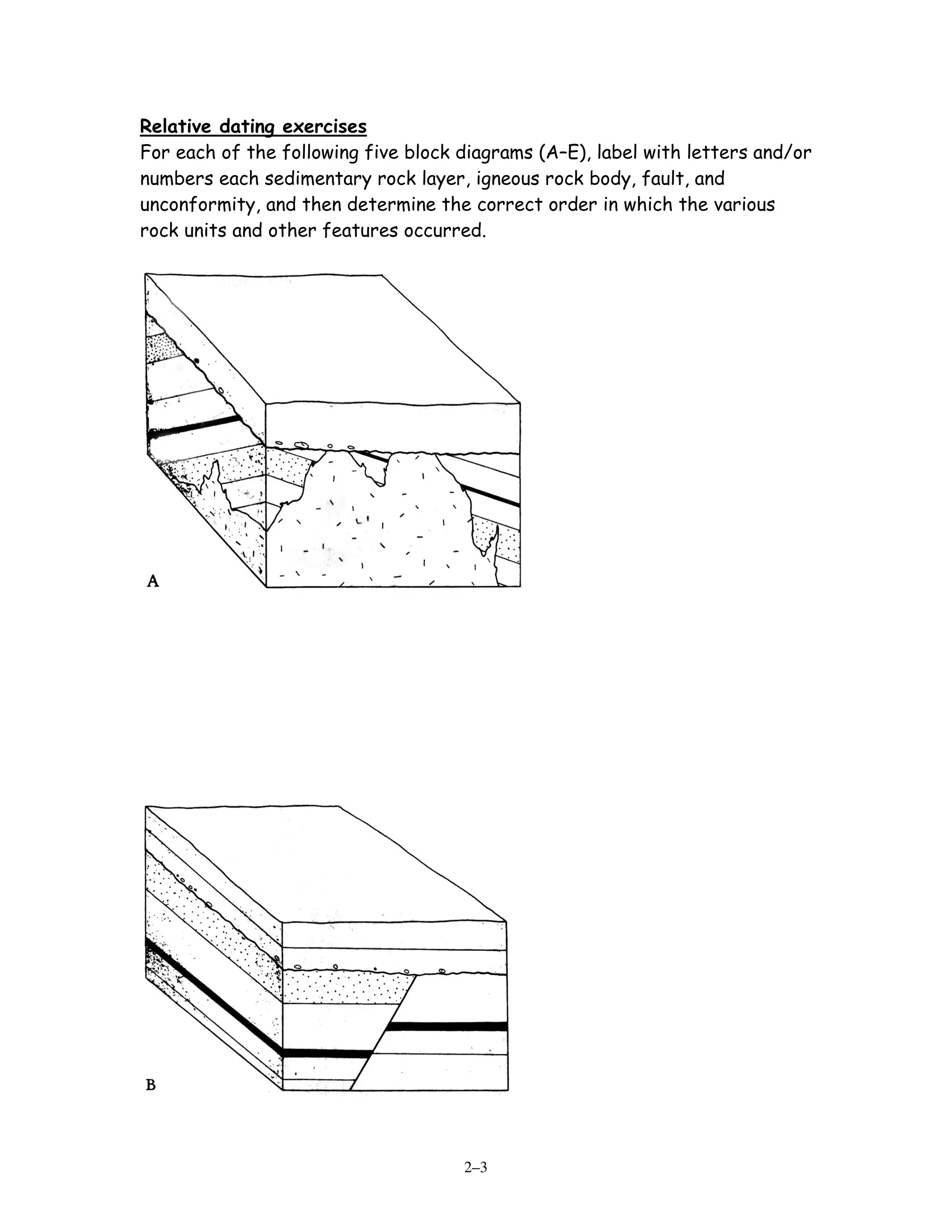
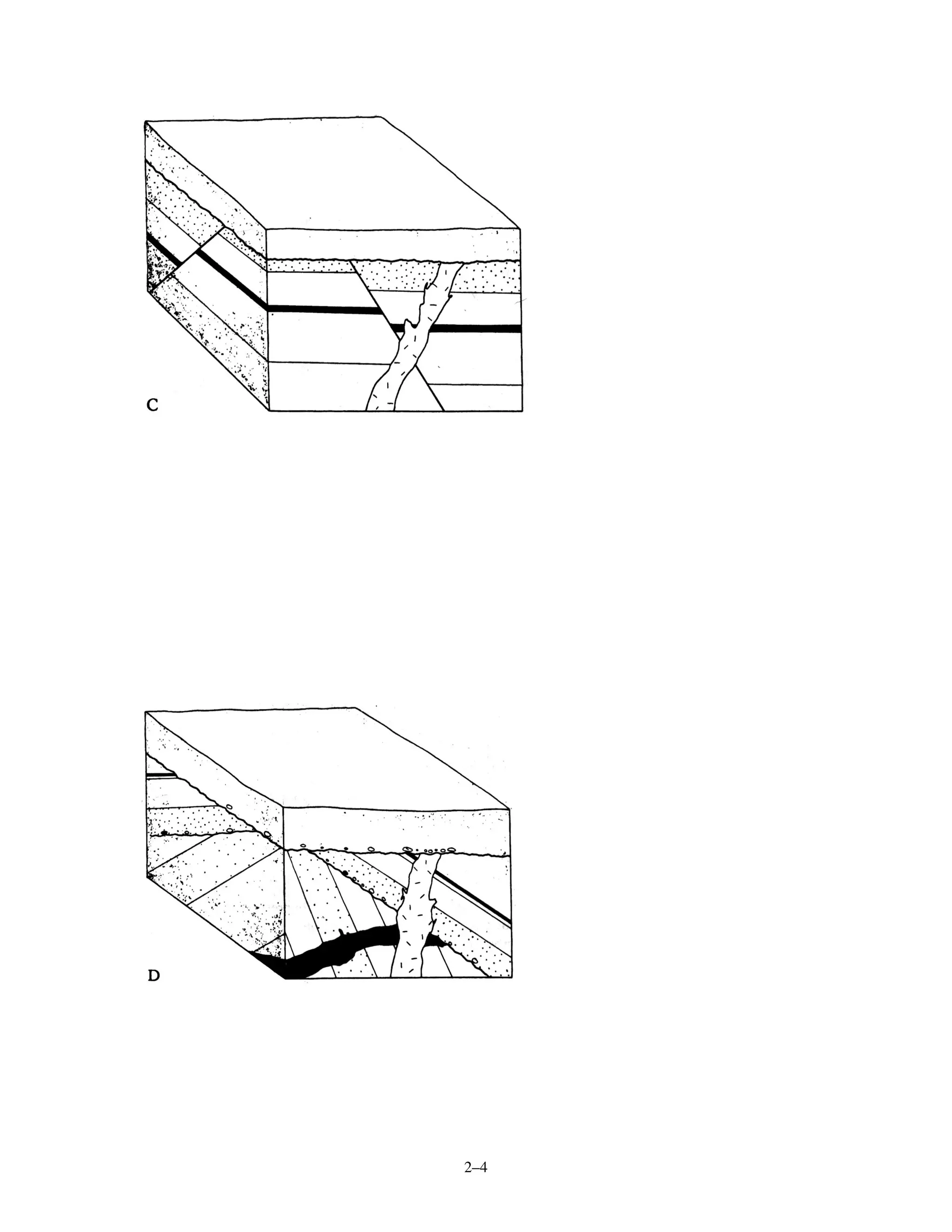
Relative dating exercises
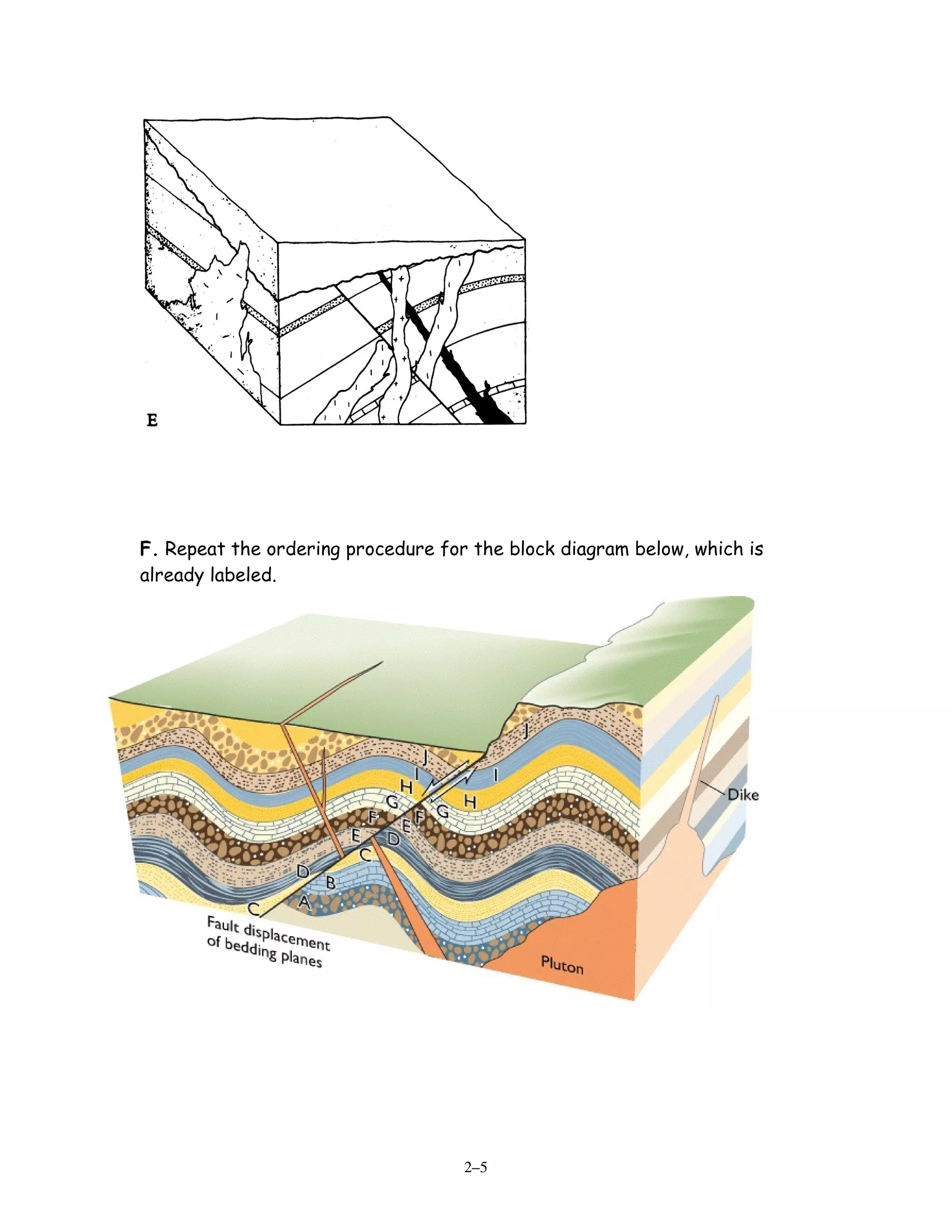
For each of the following five block diagrams (A–E), label with letters and/or
numbers each sedimentary rock layer, igneous rock body, fault, and
unconformity, and then determine the correct order in which the various
rock units and other features occurred.


                                     2–3
2–4
F. Repeat the ordering procedure for the block diagram below, which is
already labeled.


                                    2–5
Absolute dating
As mentioned, determination of the actual age, in years, of minerals is
accomplished by radiometric dating techniques. Radiometric dating is
possible because certain naturally occurring isotopes are radioactive and
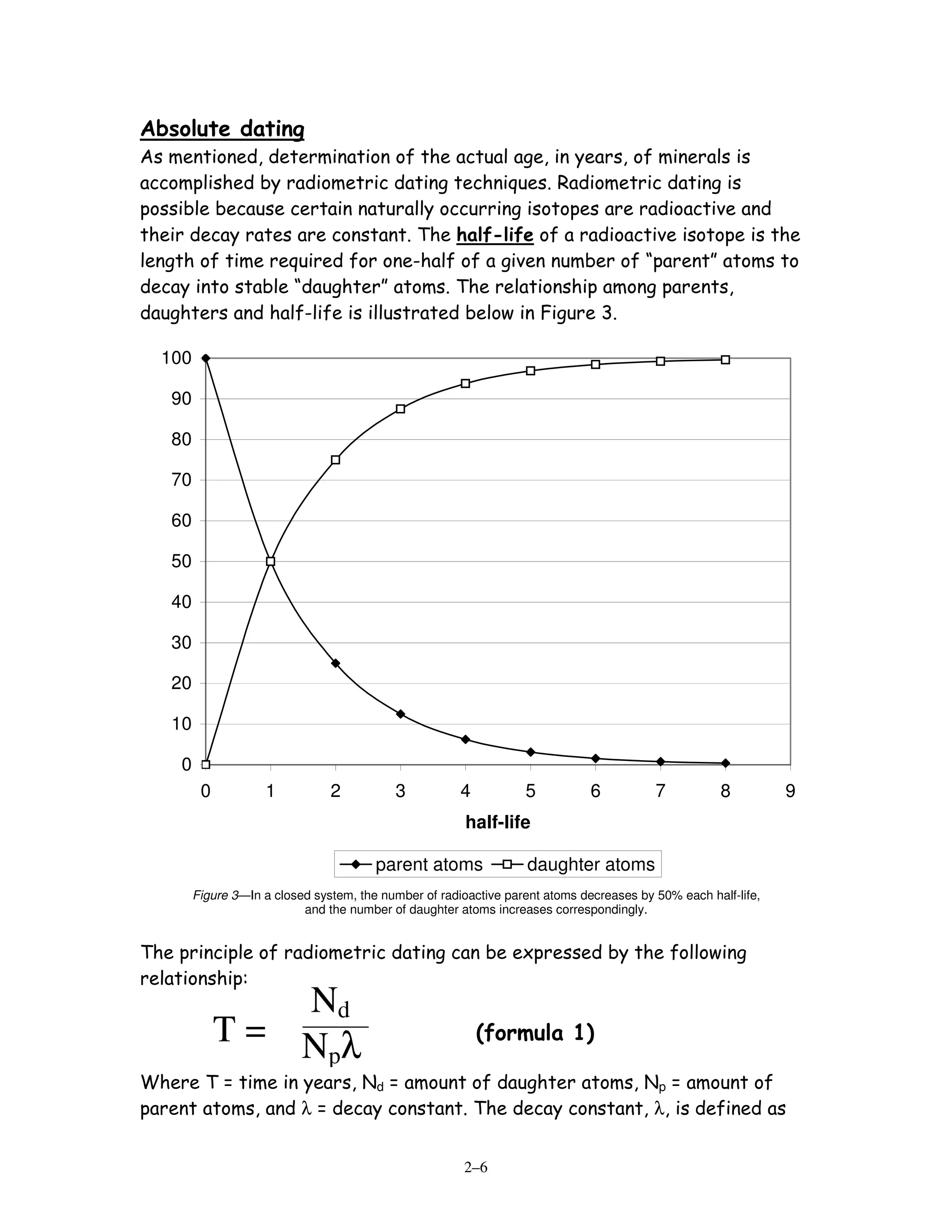
their decay rates are constant. The half-life of a radioactive isotope is the
length of time required for one-half of a given number of “parent” atoms to
decay into stable “daughter” atoms. The relationship among parents,
daughters and half-life is illustrated below in Figure 3.

  100

   90

   80

   70

   60

   50

   40

   30

   20

   10

    0
         0          1           2          3           4          5           6          7           8         9
                                                        half-life

                                        parent atoms              daughter atoms
        Figure 3—In a closed system, the number of radioactive parent atoms decreases by 50% each half-life,
                           and the number of daughter atoms increases correspondingly.


The principle of radiometric dating can be expressed by the following
relationship:
                Nd
             T= Nλ                                         (formula 1)
                 p
Where T = time in years, Nd = amount of daughter atoms, Np = amount of
parent atoms, and λ = decay constant. The decay constant, λ, is defined as


                                                       2–6
0.693/half-life. Table 1 lists some commonly used radioactive parents /
 daughters, their half-lives, λ’s, and effective dating ranges.

 Table 1—Isotopes commonly used in radiometric dating.
       Isotopes                Half-life                             λ               Effective dating
                                                                                          range
 238
     U / 206Pb           4.46 × 10⁹ years                1.55 × 10⁻¹⁰              > 100 m.y.
 40
    K / 40Ar             1.25 × 10⁹ years                λε = 0.581 × 10⁻¹⁰        > 100,000 years
                                                         λβ = 4.96 × 10⁻¹⁰
 87
    Rb / 87Sr            4.88 × 10¹⁰ years               1.42 × 10⁻¹¹              > 100 m.y.
 14
    C                    5730 years                                                ~50,000–70,000
                                                                                   years

 Radiometric dates reflect the time that has elapsed since a mineral formed
 and its chemical composition was set. Because the dating procedure requires
 measuring the existing amounts of parent and daughter isotopes, it is
 critically important to analyze only those mineral grains that have remained
 closed systems since their time of origin. A key requirement in radiometric
 dating is that there has been no loss or gain of parent or daughter atoms
 through partial melting, metamorphism, weathering, or any other agent.

 Another requirement in radiometric dating is that no daughter atoms were
 originally present in the grain to be analyzed. If some daughter atoms were
 originally present, then they must be corrected for.

 For 238U/206Pb dating, the general relationship in formula 1 (above) can be
 rewritten as follows:
                                                         (Dp – Di)
                   T=
                                1
                                λ
                                      × loge       [         Pp          +1   ]     (formula 2)

 Where              Dp = present amount of daughter
                    Di = initial amount of daughter
                    Pp = present amount of parent
                    T = time in years since crystallization of the grain

 Formula 2 must be modified for 40K/40Ar dating, because 40K decays into two
 daughter products, 40Ca and 40Ar. The modified equation is:


T=
             1
         (λε + λβ)
                   × loge            [[       40

                                              40
                                                Ar
                                                 K
                                                          ×
                                                                λε + λβ
                                                                  λε
                                                                          ]       +1   ]   (formula 3)

                                                          2–7
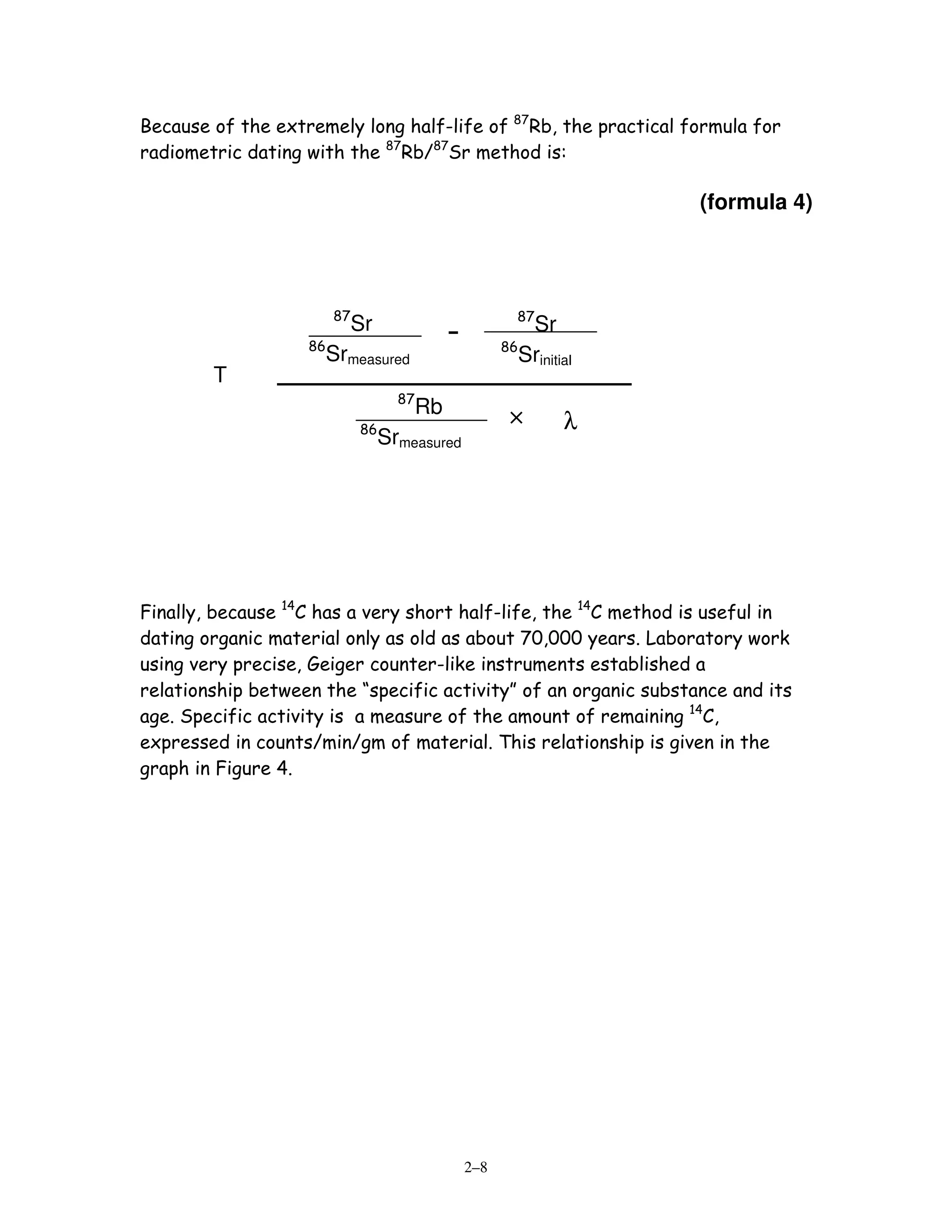
Because of the extremely long half-life of 87Rb, the practical formula for
radiometric dating with the 87Rb/87Sr method is:

                                                                         (formula 4)


                        87                               87
                             Sr               -               Sr
                   86                                   86
                        Srmeasured                           Srinitial
        T
        =                           87
                                         Rb
                             86
                                                         ×          λ
                                  Srmeasured


Finally, because 14C has a very short half-life, the 14C method is useful in
dating organic material only as old as about 70,000 years. Laboratory work
using very precise, Geiger counter-like instruments established a
relationship between the “specific activity” of an organic substance and its
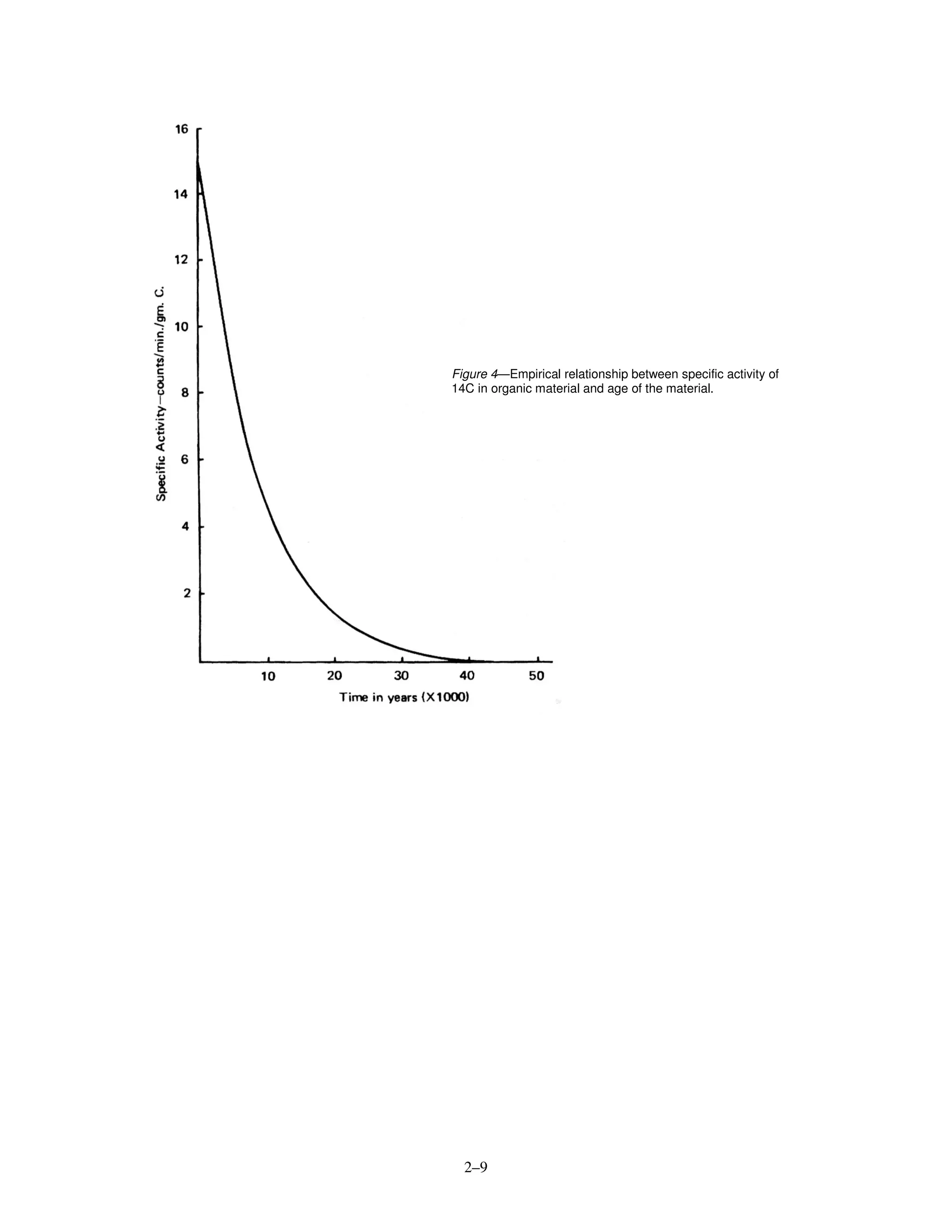
age. Specific activity is a measure of the amount of remaining 14C,
expressed in counts/min/gm of material. This relationship is given in the
graph in Figure 4.


                                                  2–8
Figure 4—Empirical relationship between specific activity of
14C in organic material and age of the material.


  2–9
Absolute dating exercises
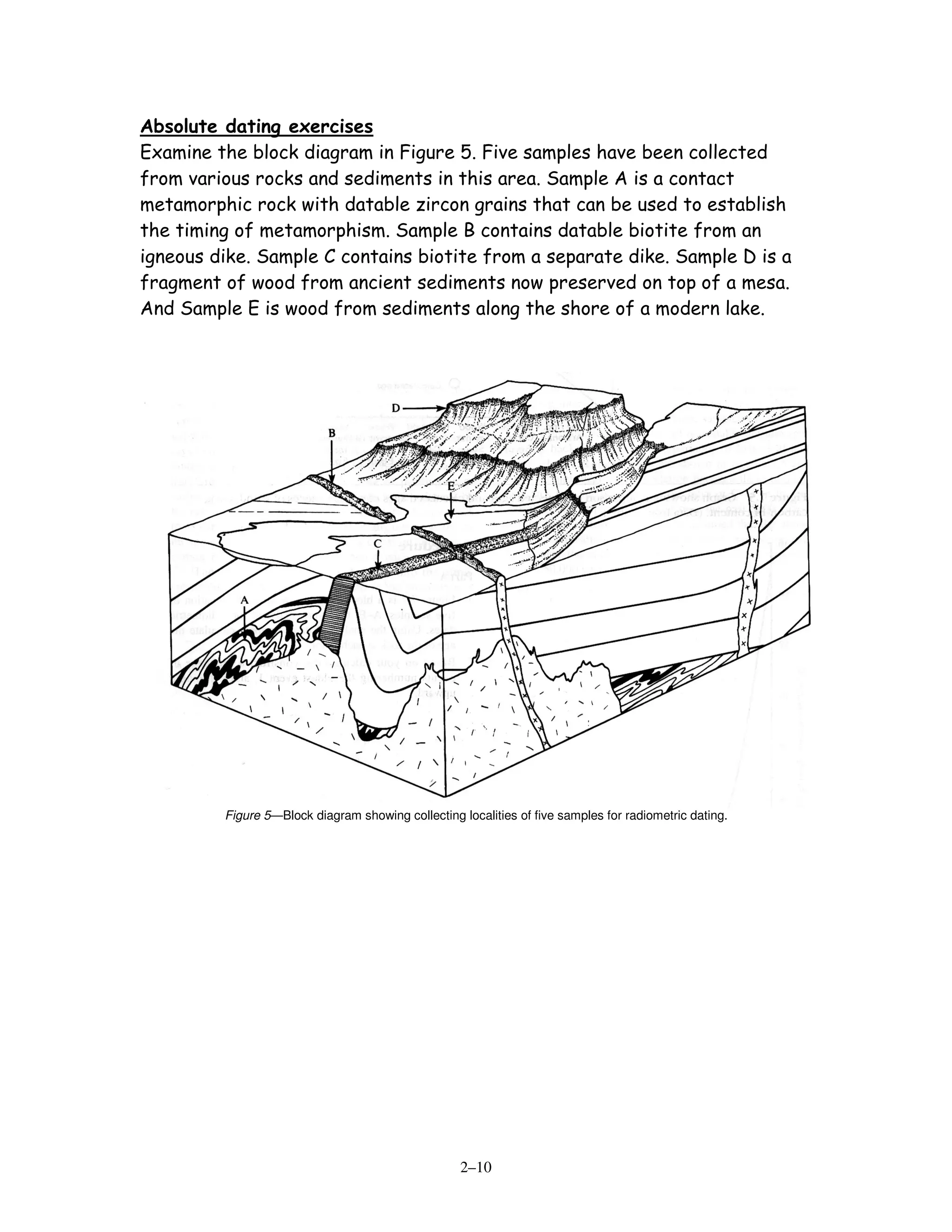
Examine the block diagram in Figure 5. Five samples have been collected
from various rocks and sediments in this area. Sample A is a contact
metamorphic rock with datable zircon grains that can be used to establish
the timing of metamorphism. Sample B contains datable biotite from an
igneous dike. Sample C contains biotite from a separate dike. Sample D is a
fragment of wood from ancient sediments now preserved on top of a mesa.
And Sample E is wood from sediments along the shore of a modern lake.


         Figure 5—Block diagram showing collecting localities of five samples for radiometric dating.


                                                    2–10
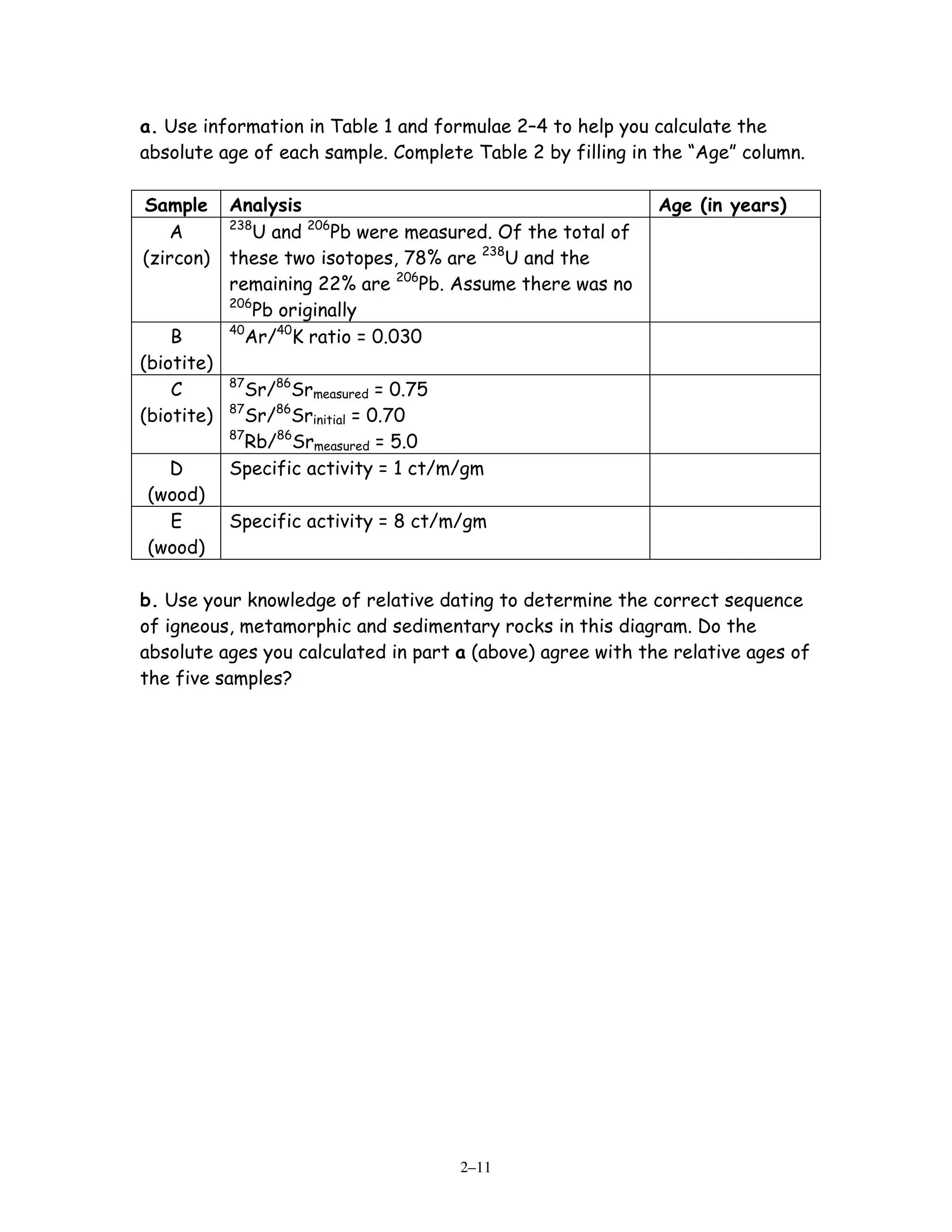
a. Use information in Table 1 and formulae 2–4 to help you calculate the
absolute age of each sample. Complete Table 2 by filling in the “Age” column.

Sample      Analysis                                         Age (in years)
            238
   A            U and 206Pb were measured. Of the total of
(zircon)    these two isotopes, 78% are 238U and the
            remaining 22% are 206Pb. Assume there was no
            206
                Pb originally
            40
    B          Ar/40K ratio = 0.030
(biotite)
            87
    C          Sr/86Srmeasured = 0.75
            87
(biotite)      Sr/86Srinitial = 0.70
            87
               Rb/86Srmeasured = 5.0
  D         Specific activity = 1 ct/m/gm
(wood)
  E         Specific activity = 8 ct/m/gm
(wood)

b. Use your knowledge of relative dating to determine the correct sequence
of igneous, metamorphic and sedimentary rocks in this diagram. Do the
absolute ages you calculated in part a (above) agree with the relative ages of
the five samples?


                                      2–11

Lab exercise02

  • 1.
    Exercise 2 Relative and absolute dating of geologic events Introduction The study of Earth history involves determining the sequence of geologic events over immense spans of time. In most cases the correct order of events can be determined without knowing their actual ages: that is, we simply establish that event B occurred before event C, but after event A. Such dating, in which the occurrence of events is determined relative to one another, is known as relative dating. Of course it is always useful to know the actual ages of rocks and events, if possible. Actual ages are determinied by means of radiometric dating techniques. Although several techniques exist, all rely on the fact that radioactive “parent” isotopes decay into stable “daughter” isotopes at a constant rate. With knowledge of the decay rate, ratios of parent and daughter isotopes then can be used to derive an absolute date, in years, for the age of a given mineral sample. The purpose of this lab is to introduce the principles and concepts associated with both relative and absolute dating. Relative dating The relative order of geologic events can be established in most cases by applying four or fewer basic principles. (1) The Principle of Original Horizontality states that sedimentary rocks are deposited as horizontal or nearly horizontal layers. Any marked deviation from horizontality indicates that some movement or deformation of the Earth’s crust occurred after deposition of the inclined layer. (2) The Principle of Superposition states that in an ordinary vertical sequence of sedimentary rocks, the layer at the bottom of the sequence is oldest, and successively higher layers are successively younger. (3) The Principle of Cross-cutting relationships states that geologic features such as faults and igneous intrusions, which cut through rocks, must be younger than the rocks through which they cut. (4) The Principle of Inclusion states that if rocks or rock fragments are included within another rock layer, the rock fragments must be older than 2–1
  • 2.
    the layer inwhich they are included. Examples of the application of these principles are given in the following block diagrams (Figure 1). Figure 1—(A) Sedimentary beds 1–3 were deposited as horizontal layers. Sometime later, a normal fault occurred. (B) Sedimentary beds 1–7 were deposited as horizontal layers. Later, these beds were folded into an anticline. Later still, the anticline was truncated by an erosional unconformity, and finally, an eighth sedimentary bed was deposited as a horizontal layer. Inclusions of older rock fragments (derived from beds 1–7) are found at the base of bed 8. Unconformities are especially useful in reconstructing Earth history. An unconformity is a surface that corresponds with a gap in sedimentation, either nondeposition or erosion. Rocks above an unconformity are younger than those below it. Three main types of unconformities are recognized (Figure 2): (1) angular unconformity, in which beds above and below the surface are not parallel; (2) nonconformity, in which sedimentary layers overly crystalline rocks (either igneous or metamorphic); and (3) disconformity, in which beds above and below the surface are parallel, but the surface itself is irregular, exhibiting evidence of erosional relief. In geologic block diagrams and cross-sections, unconformities are usually drawn as a wavy line. Figure 2—Three types of unconformities (from Stanley, 1998). 2–2
  • 3.
    Relative dating exercises Foreach of the following five block diagrams (A–E), label with letters and/or numbers each sedimentary rock layer, igneous rock body, fault, and unconformity, and then determine the correct order in which the various rock units and other features occurred. 2–3
  • 4.
  • 5.
    F. Repeat theordering procedure for the block diagram below, which is already labeled. 2–5
  • 6.
    Absolute dating As mentioned,determination of the actual age, in years, of minerals is accomplished by radiometric dating techniques. Radiometric dating is possible because certain naturally occurring isotopes are radioactive and their decay rates are constant. The half-life of a radioactive isotope is the length of time required for one-half of a given number of “parent” atoms to decay into stable “daughter” atoms. The relationship among parents, daughters and half-life is illustrated below in Figure 3. 100 90 80 70 60 50 40 30 20 10 0 0 1 2 3 4 5 6 7 8 9 half-life parent atoms daughter atoms Figure 3—In a closed system, the number of radioactive parent atoms decreases by 50% each half-life, and the number of daughter atoms increases correspondingly. The principle of radiometric dating can be expressed by the following relationship: Nd T= Nλ (formula 1) p Where T = time in years, Nd = amount of daughter atoms, Np = amount of parent atoms, and λ = decay constant. The decay constant, λ, is defined as 2–6
  • 7.
    0.693/half-life. Table 1lists some commonly used radioactive parents / daughters, their half-lives, λ’s, and effective dating ranges. Table 1—Isotopes commonly used in radiometric dating. Isotopes Half-life λ Effective dating range 238 U / 206Pb 4.46 × 10⁹ years 1.55 × 10⁻¹⁰ > 100 m.y. 40 K / 40Ar 1.25 × 10⁹ years λε = 0.581 × 10⁻¹⁰ > 100,000 years λβ = 4.96 × 10⁻¹⁰ 87 Rb / 87Sr 4.88 × 10¹⁰ years 1.42 × 10⁻¹¹ > 100 m.y. 14 C 5730 years ~50,000–70,000 years Radiometric dates reflect the time that has elapsed since a mineral formed and its chemical composition was set. Because the dating procedure requires measuring the existing amounts of parent and daughter isotopes, it is critically important to analyze only those mineral grains that have remained closed systems since their time of origin. A key requirement in radiometric dating is that there has been no loss or gain of parent or daughter atoms through partial melting, metamorphism, weathering, or any other agent. Another requirement in radiometric dating is that no daughter atoms were originally present in the grain to be analyzed. If some daughter atoms were originally present, then they must be corrected for. For 238U/206Pb dating, the general relationship in formula 1 (above) can be rewritten as follows: (Dp – Di) T= 1 λ × loge [ Pp +1 ] (formula 2) Where Dp = present amount of daughter Di = initial amount of daughter Pp = present amount of parent T = time in years since crystallization of the grain Formula 2 must be modified for 40K/40Ar dating, because 40K decays into two daughter products, 40Ca and 40Ar. The modified equation is: T= 1 (λε + λβ) × loge [[ 40 40 Ar K × λε + λβ λε ] +1 ] (formula 3) 2–7
  • 8.
    Because of theextremely long half-life of 87Rb, the practical formula for radiometric dating with the 87Rb/87Sr method is: (formula 4) 87 87 Sr - Sr 86 86 Srmeasured Srinitial T = 87 Rb 86 × λ Srmeasured Finally, because 14C has a very short half-life, the 14C method is useful in dating organic material only as old as about 70,000 years. Laboratory work using very precise, Geiger counter-like instruments established a relationship between the “specific activity” of an organic substance and its age. Specific activity is a measure of the amount of remaining 14C, expressed in counts/min/gm of material. This relationship is given in the graph in Figure 4. 2–8
  • 9.
    Figure 4—Empirical relationshipbetween specific activity of 14C in organic material and age of the material. 2–9
  • 10.
    Absolute dating exercises Examinethe block diagram in Figure 5. Five samples have been collected from various rocks and sediments in this area. Sample A is a contact metamorphic rock with datable zircon grains that can be used to establish the timing of metamorphism. Sample B contains datable biotite from an igneous dike. Sample C contains biotite from a separate dike. Sample D is a fragment of wood from ancient sediments now preserved on top of a mesa. And Sample E is wood from sediments along the shore of a modern lake. Figure 5—Block diagram showing collecting localities of five samples for radiometric dating. 2–10
  • 11.
    a. Use informationin Table 1 and formulae 2–4 to help you calculate the absolute age of each sample. Complete Table 2 by filling in the “Age” column. Sample Analysis Age (in years) 238 A U and 206Pb were measured. Of the total of (zircon) these two isotopes, 78% are 238U and the remaining 22% are 206Pb. Assume there was no 206 Pb originally 40 B Ar/40K ratio = 0.030 (biotite) 87 C Sr/86Srmeasured = 0.75 87 (biotite) Sr/86Srinitial = 0.70 87 Rb/86Srmeasured = 5.0 D Specific activity = 1 ct/m/gm (wood) E Specific activity = 8 ct/m/gm (wood) b. Use your knowledge of relative dating to determine the correct sequence of igneous, metamorphic and sedimentary rocks in this diagram. Do the absolute ages you calculated in part a (above) agree with the relative ages of the five samples? 2–11