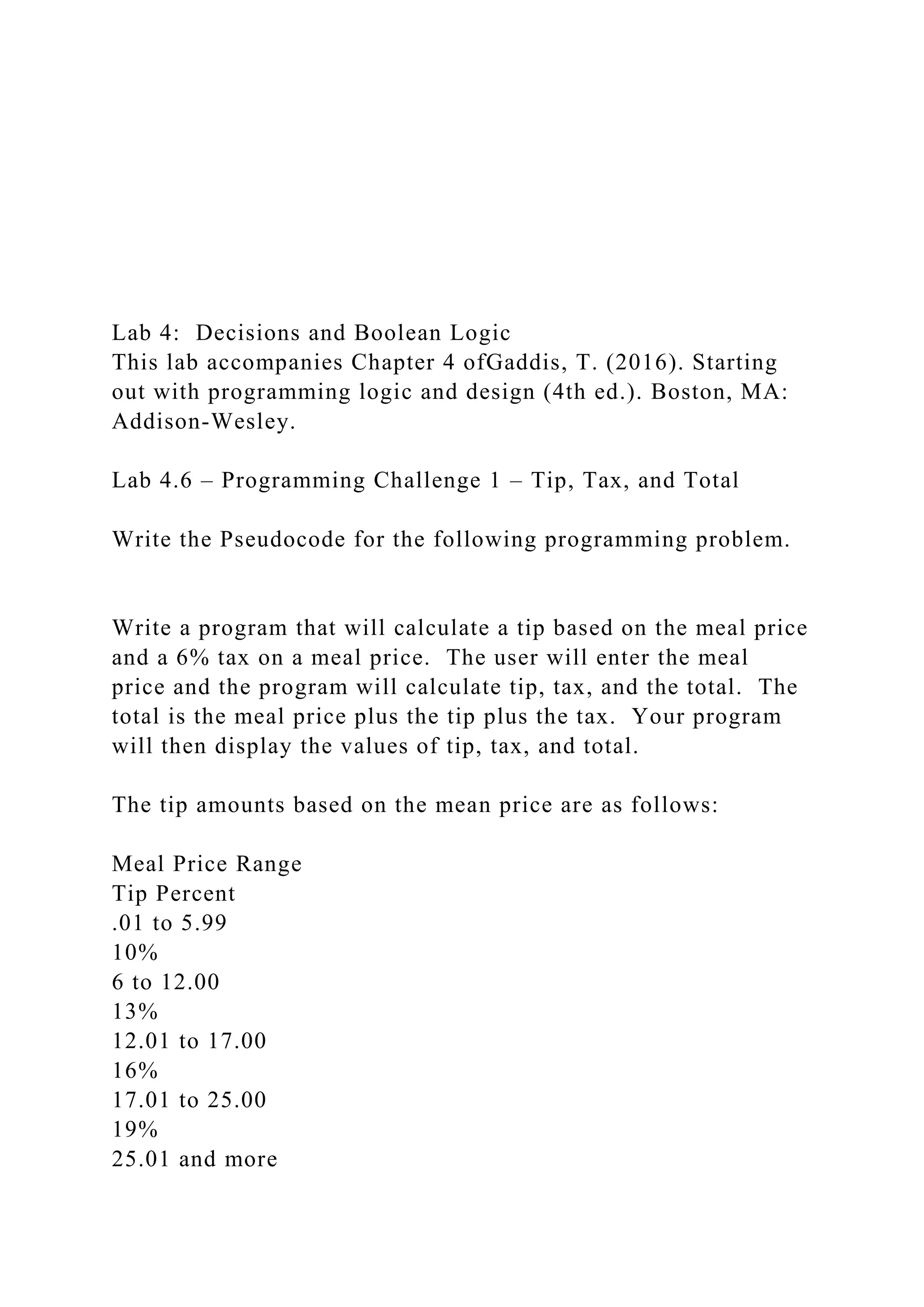
Lab 4: Decisions and Boolean Logic
This lab accompanies Chapter 4 ofGaddis, T. (2016). Starting
out with programming logic and design (4th ed.). Boston, MA:
Addison-Wesley.
Lab 4.6 – Programming Challenge 1 – Tip, Tax, and Total
Write the Pseudocode for the following programming problem.
Write a program that will calculate a tip based on the meal price
and a 6% tax on a meal price. The user will enter the meal
price and the program will calculate tip, tax, and the total. The
total is the meal price plus the tip plus the tax. Your program
will then display the values of tip, tax, and total.
The tip amounts based on the mean price are as follows:
Meal Price Range
Tip Percent
.01 to 5.99
10%
6 to 12.00
13%
12.01 to 17.00
16%
17.01 to 25.00
19%
25.01 and more
22%
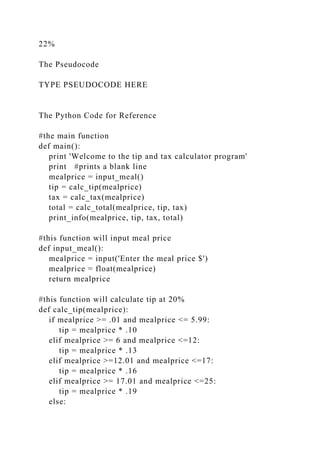
The Pseudocode
TYPE PSEUDOCODE HERE
The Python Code for Reference
#the main function
def main():
print 'Welcome to the tip and tax calculator program'
print #prints a blank line
mealprice = input_meal()
tip = calc_tip(mealprice)
tax = calc_tax(mealprice)
total = calc_total(mealprice, tip, tax)
print_info(mealprice, tip, tax, total)
#this function will input meal price
def input_meal():
mealprice = input('Enter the meal price $')
mealprice = float(mealprice)
return mealprice
#this function will calculate tip at 20%
def calc_tip(mealprice):
if mealprice >= .01 and mealprice <= 5.99:
tip = mealprice * .10
elif mealprice >= 6 and mealprice <=12:
tip = mealprice * .13
elif mealprice >=12.01 and mealprice <=17:
tip = mealprice * .16
elif mealprice >= 17.01 and mealprice <=25:
tip = mealprice * .19
else:
tip = mealprice * .22
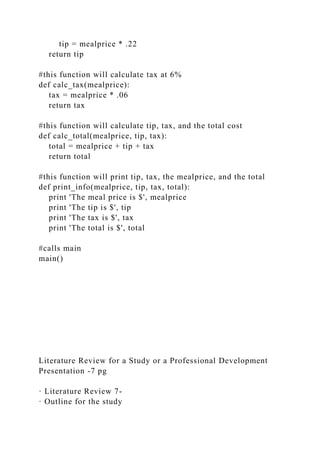
return tip
#this function will calculate tax at 6%
def calc_tax(mealprice):
tax = mealprice * .06
return tax
#this function will calculate tip, tax, and the total cost
def calc_total(mealprice, tip, tax):
total = mealprice + tip + tax
return total
#this function will print tip, tax, the mealprice, and the total
def print_info(mealprice, tip, tax, total):
print 'The meal price is $', mealprice
print 'The tip is $', tip
print 'The tax is $', tax
print 'The total is $', total
#calls main
main()
Literature Review for a Study or a Professional Development
Presentation -7 pg
· Literature Review 7-
· Outline for the study
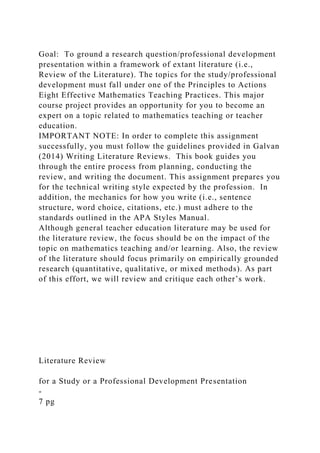
Goal: To ground a research question/professional development
presentation within a framework of extant literature (i.e.,
Review of the Literature). The topics for the study/professional
development must fall under one of the Principles to Actions
Eight Effective Mathematics Teaching Practices. This major
course project provides an opportunity for you to become an
expert on a topic related to mathematics teaching or teacher
education.
IMPORTANT NOTE: In order to complete this assignment
successfully, you must follow the guidelines provided in Galvan
(2014) Writing Literature Reviews. This book guides you
through the entire process from planning, conducting the
review, and writing the document. This assignment prepares you
for the technical writing style expected by the profession. In
addition, the mechanics for how you write (i.e., sentence
structure, word choice, citations, etc.) must adhere to the
standards outlined in the APA Styles Manual.
Although general teacher education literature may be used for
the literature review, the focus should be on the impact of the
topic on mathematics teaching and/or learning. Also, the review
of the literature should focus primarily on empirically grounded
research (quantitative, qualitative, or mixed methods). As part
of this effort, we will review and critique each other’s work.
Literature Review
for a Study or a Professional Development Presentation
-
7 pg
-
Literature
Review 7
-
-
Outline
for the study
Goal: To ground a research question/professional development
presentation within a framework of
extant literature (i.e., Review of the Literature). The topics for
the study/professional development must
fall under one of the Principles to Actions Eight Ef
fective Mathematics Teaching Practices. This major
course project provides an opportunity for you to become an
expert on a topic related to mathematics
teaching or teacher
education.
IMPORTANT NOTE: In order to complete this assignment
successfully, yo
u must follow the guidelines
provided in Galvan (2014) Writing Literature Reviews. This
book guides you through the entire process
from planning, conducting the review, and writing the
document. This assignment prepares you for the
technical writing style
expected by the profession. In addition, the mechanics for how
you write (i.e.,
sentence structure, word choice, citations, etc.) must adhere to
the standards outlined in the APA Styles
Manual.
Although general teacher education literature may be used
for the literature review, the focus should be
on the impact of the topic on mathematics teaching and/or
learning. Also, the review of the literature
should focus primarily on empirically grounded research
(quantitative, qualitative, or mixed methods).
As
part of this effort, we will review and critique each other’s
work.
Literature Review for a Study or a Professional Development
Presentation -7 pg
- Literature Review 7-
- Outline for the study
Goal: To ground a research question/professional development
presentation within a framework of
extant literature (i.e., Review of the Literature). The topics for
the study/professional development must
fall under one of the Principles to Actions Eight Effective
Mathematics Teaching Practices. This major
course project provides an opportunity for you to become an
expert on a topic related to mathematics
teaching or teacher education.
IMPORTANT NOTE: In order to complete this assignment
successfully, you must follow the guidelines
provided in Galvan (2014) Writing Literature Reviews. This
book guides you through the entire process
from planning, conducting the review, and writing the
document. This assignment prepares you for the
technical writing style expected by the profession. In addition,
the mechanics for how you write (i.e.,
sentence structure, word choice, citations, etc.) must adhere to
the standards outlined in the APA Styles
Manual.
Although general teacher education literature may be used for
the literature review, the focus should be
on the impact of the topic on mathematics teaching and/or
learning. Also, the review of the literature
should focus primarily on empirically grounded research
(quantitative, qualitative, or mixed methods).
As part of this effort, we will review and critique each other’s
work.
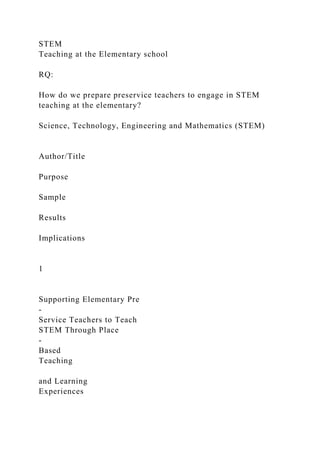
Literature review -Summaries
STEM Teaching at the Elementary school
RQ: How do we prepare preservice teachers to engage in STEM
teaching at the elementary?
Science, Technology, Engineering and Mathematics (STEM)
Author/Title
Purpose
Sample
Results
Implications
1
Supporting Elementary Pre-Service Teachers to Teach STEM
Through Place-Based Teaching and Learning Experiences
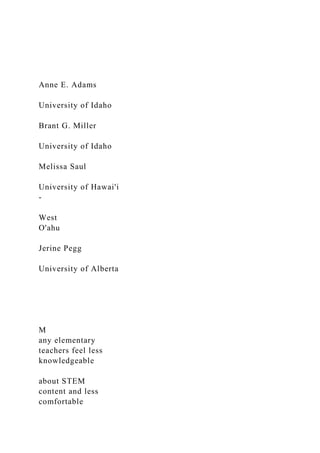
Anne E. Adams
University of Idaho
Brant G. Miller
University of Idaho
Melissa Saul
University of Hawai'i - West O'ahu
Jerine Pegg
University of Alberta
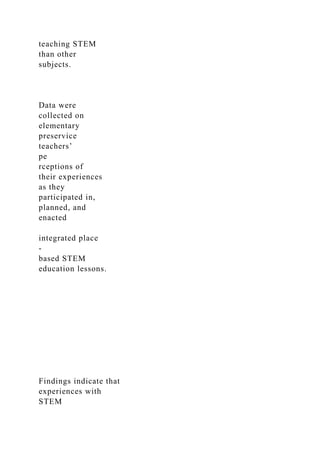
Many elementary teachers feel less knowledgeable
about STEM content and less comfortable teaching STEM than
other subjects.
Data were collected on elementary preservice teachers’
perceptions of their experiences as they participated in,
planned, and enacted
integrated place-based STEM education lessons.
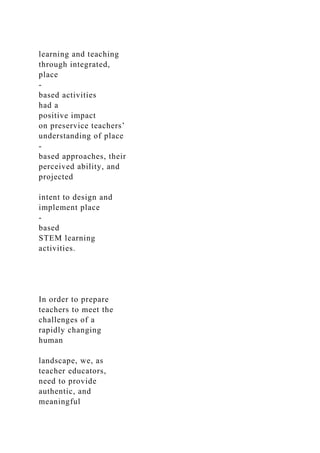
Findings indicate that experiences with STEM
learning and teaching through integrated, place-based activities
had a positive impact on preservice teachers’ understanding of
place-based approaches, their perceived ability, and projected
intent to design and implement place-based STEM learning
activities.
In order to prepare teachers to meet the challenges of a rapidly
changing human
landscape, we, as teacher educators, need to provide authentic,
and meaningful experiences that
are situated in place, build community, and show pre-service
teachers that they have resources
and partners eager to support the educational mission of
community schools beyond the walls of
their school buildings.
Our findings suggest that within teacher education courses,
methods instructors can
and should employ place-based pedagogy as a way to increase
knowledge of STEM related
elementary teachers’ comfort with learning and teaching STEM
content; and prepare pre-service
teachers for effectively using local spaces for inquiry
instruction
2
Examining Elementary Pre-service Teachers’ Science,
Technology,
Engineering, and Mathematics (STEM) Teaching Intention
Güney Hacıömeroğlu1
3
Taiwanese Preservice Teachers’ Science, Technology,
Engineering, and Mathematics Teaching Intention
Kuen-Yi Lin
P. John Williams
International Journal of Science and Mathematics Education
August 2016,
4
Makerspace and reflective practice: Advancing pre-service
teachers in STEM education
Blackley, Susan; Sheffield, Rachel; Maynard, Nicoleta; Koul,
Rekha; Walker, Rebecca
Australian Journal of Teacher Education (Online)
(2017)
5
Using a Makerspace approach to engage Indonesian primary
students with STEM
Susan Blackley Curtin University, Australia Yuli
Rahmawati, Ella Fitriani Universitas Negeri Jakarta, Indonesia
Rachel Sheffield and Rekha Koul Curtin University, Australia
Issues in Educational Research, 2018
6
Robotics to promote elementary education pre-service teachers'
STEM engagement, learning, and teaching
Kim, C., Kim, D., Yuan, J., Hill, R. B., Doshi, P., & Thai, C. N.
(2015). Computers & Education, 91, 14-31.
7
An Integrated Model for STEM Teacher
Preparation: The Value of a Teaching Cooperative
Educational Experience
Ellen W. Eckman
Marquette University
Mary Allison Williams
Marquette University
This study aims at examining elementary pre-service teachers’
integrative STEM intentions.
This study applies the theory of planned behavior as a basis for
exploring the impact of knowledge, values, subjective norms,
perceived behavioral controls, and attitudes on the behavioral
intention toward (STEM) education among Taiwanese
preservice science teachers.
The research presented in this paper describes a type of
Makerspace that is defined by its purpose: to improve the
confidence and ability of primary education students in STEM
education.
Examines the learning experiences integrated STEM project
purpose of helping teachers learn how to design and implement
(STEM) lessons using robotics.
The purpose of this article is to evaluate an intensive, integrated
model for teacher
preparation, specifically, a preservice STEM teacher education
model
Quantitative study, data were gathered from 401 elementary
pre-service teachers who were enrolled
in two public universities.
Questionnaires (N = 139) collected information on the
behavioral intention of preservice science teachers engaging in
STEM education. Data were analyzed using descriptive
statistics, path analysis, and analysis of variance.
a large set of qualitative data was collected, this paper reports
on the progress and reflections of the teacher education
students, and shares insights into their personal learning and
development as teachers.
9 female teacher education students and 71 schoolgirls in Years
5 and 6
Examines the learning experiences of 291 Year 5 and 6
Indonesian primary school students, across four schools in
North Jakarta, who participated in an integrated STEM project
Data were collected from surveys, classroom observations,
interviews, and lesson plans. Both quantitative and qualitative
data analyses indicated that pre-service teachers engaged in
robotics activities actively and mindfully.
STEM preservice teachers
participated in a cooperative teaching experience which placed
them at the school site
for their university course work and field placements, thus
ensuring a more seamless
connection between theory and practice.
Findings of this study showed that
there was no significant difference between pre-service
teachers’ scores on knowledge, attitude,
value perceived behavioral control, and behavioral intention
regarding gender.
However, there was
a significant difference between pre-service teachers’ scores on
subjective norm regarding gender.
Results revealed that, in terms of direct effects, higher
perceived behavioral control and subjective norms were
associated with stronger STEM teaching intention. More
positive attitude and greater knowledge were indirectly
associated with higher subjective norms and perceived
behavioral control, which resulted in stronger STEM teaching
intention
The results indicated that a Makerspace approach was very
effective in engaging students in the STEM space, and students
were also challenged to work collaboratively in groups
mentored by pre-service teachers.
analyses indicated that pre-service teachers engaged in robotics
activities actively and mindfully. Their STEM engagement
improved overall. Their emotional engagement (e.g., interest,
enjoyment) in STEM significantly improved and in turn
influenced their behavioral and cognitive engagement in STEM.
The findings from this comparative study of
the STEM preservice students in the teaching co-op and STEM
preservice teachers in a
traditional preparation model indicates that the STEM
preservice teachers in the teaching
cooperative model - - were more confident about their teaching
skills, more comfortable with
their content knowledge, and prepared to work effectively with
high-needs students
Using STEM activities in classroom environment would allow
opportunities for pre-service teachers to become effective
elementary teachers. Throughout the longitudinal
research studies,
observation notes can be taken, and interviews would be
conducted to investigate
elementary pre-service teachers’ STEM teaching intentions
deeply.
The most important factors appeared to include developing
preservice teachers’ (a) positive appreciation regarding STEM
outcomes and teaching and (b) competency in resolving
difficulties related to STEM teaching
STEM teacher education programs must stress developing
preservice teachers’ behavioral intention toward STEM teaching
and related socioaffective factors and not just emphasize
developing their knowledge in science, technology, engineering,
and mathematics
With the application of STEM knowledge and skills, we also
posit that the Makerspace approach is effective in the
acquisition and demonstration of 21st century skills: problem-
solving, critical and creative thinking, collaboration, and
communication.
suggest that robotics can be used as a technology in activities
designed to enhance teachers' STEM engagement and teaching
through improved attitudes toward STEM
Literature review
-
Summaries
STEM
Teaching at the Elementary school
RQ:
How do we prepare preservice teachers to engage in STEM
teaching at the elementary?
Science, Technology, Engineering and Mathematics (STEM)
Author/Title
Purpose
Sample
Results
Implications
1
Supporting Elementary Pre
-
Service Teachers to Teach
STEM Through Place
-
Based
Teaching
and Learning
Experiences
Anne E. Adams
University of Idaho
Brant G. Miller
University of Idaho
Melissa Saul
University of Hawai'i
-
West
O'ahu
Jerine Pegg
University of Alberta
M
any elementary
teachers feel less
knowledgeable
about STEM
content and less
comfortable
teaching STEM
than other
subjects.
Data were
collected on
elementary
preservice
teachers’
pe
rceptions of
their experiences
as they
participated in,
planned, and
enacted
integrated place
-
based STEM
education lessons.
Findings indicate that
experiences with
STEM
learning and teaching
through integrated,
place
-
based activities
had a
positive impact
on preservice teachers’
understanding of place
-
based approaches, their
perceived ability, and
projected
intent to design and
implement place
-
based
STEM learning
activities.
In order to prepare
teachers to meet the
challenges of a
rapidly changing
human
landscape, we, as
teacher educators,
need to provide
authentic, and
meaningful
experiences that
are situated in place,
build community, and
show pre
-
service
teachers that they
have resources
and partners eager to
support the
educatio
nal mission
of community
schools beyond the
walls of
their school
buildings.
Our findings suggest
that within teacher
education courses,
methods instructors
can
and should employ
place
-
based
pedagogy as a way to
increase knowledge
of STEM related
element
ary teachers’
comfort with learning
and teaching STEM
content; and prepare
pre
-
service
Literature review -Summaries
STEM Teaching at the Elementary school
RQ: How do we prepare preservice teachers to engage in STEM
teaching at the elementary?
Science, Technology, Engineering and Mathematics (STEM)
Author/Title Purpose Sample Results Implications
1
Supporting Elementary Pre-
Service Teachers to Teach
STEM Through Place-Based
Teaching and Learning
Experiences
Anne E. Adams
University of Idaho
Brant G. Miller
University of Idaho
Melissa Saul
University of Hawai'i - West
O'ahu
Jerine Pegg
University of Alberta
Many elementary
teachers feel less
knowledgeable
about STEM
content and less
comfortable
teaching STEM
than other
subjects.
Data were
collected on
elementary
preservice
teachers’
perceptions of
their experiences
as they
participated in,
planned, and
enacted
integrated place-
based STEM
education lessons.
Findings indicate that
experiences with
STEM
learning and teaching
through integrated,
place-based activities
had a positive impact
on preservice teachers’
understanding of place-
based approaches, their
perceived ability, and
projected
intent to design and
implement place-based
STEM learning
activities.
In order to prepare
teachers to meet the
challenges of a
rapidly changing
human
landscape, we, as
teacher educators,
need to provide
authentic, and
meaningful
experiences that
are situated in place,
build community, and
show pre-service
teachers that they
have resources
and partners eager to
support the
educational mission
of community
schools beyond the
walls of
their school
buildings.
Our findings suggest
that within teacher
education courses,
methods instructors
can
and should employ
place-based
pedagogy as a way to
increase knowledge
of STEM related
elementary teachers’
comfort with learning
and teaching STEM
content; and prepare
pre-service

Lab 4 Decisions and Boolean LogicThis lab accompanie.docx

  • 1.
    Lab 4: Decisionsand Boolean Logic This lab accompanies Chapter 4 ofGaddis, T. (2016). Starting out with programming logic and design (4th ed.). Boston, MA: Addison-Wesley. Lab 4.6 – Programming Challenge 1 – Tip, Tax, and Total Write the Pseudocode for the following programming problem. Write a program that will calculate a tip based on the meal price and a 6% tax on a meal price. The user will enter the meal price and the program will calculate tip, tax, and the total. The total is the meal price plus the tip plus the tax. Your program will then display the values of tip, tax, and total. The tip amounts based on the mean price are as follows: Meal Price Range Tip Percent .01 to 5.99 10% 6 to 12.00 13% 12.01 to 17.00 16% 17.01 to 25.00 19% 25.01 and more
  • 2.
    22% The Pseudocode TYPE PSEUDOCODEHERE The Python Code for Reference #the main function def main(): print 'Welcome to the tip and tax calculator program' print #prints a blank line mealprice = input_meal() tip = calc_tip(mealprice) tax = calc_tax(mealprice) total = calc_total(mealprice, tip, tax) print_info(mealprice, tip, tax, total) #this function will input meal price def input_meal(): mealprice = input('Enter the meal price $') mealprice = float(mealprice) return mealprice #this function will calculate tip at 20% def calc_tip(mealprice): if mealprice >= .01 and mealprice <= 5.99: tip = mealprice * .10 elif mealprice >= 6 and mealprice <=12: tip = mealprice * .13 elif mealprice >=12.01 and mealprice <=17: tip = mealprice * .16 elif mealprice >= 17.01 and mealprice <=25: tip = mealprice * .19 else:
  • 3.
    tip = mealprice* .22 return tip #this function will calculate tax at 6% def calc_tax(mealprice): tax = mealprice * .06 return tax #this function will calculate tip, tax, and the total cost def calc_total(mealprice, tip, tax): total = mealprice + tip + tax return total #this function will print tip, tax, the mealprice, and the total def print_info(mealprice, tip, tax, total): print 'The meal price is $', mealprice print 'The tip is $', tip print 'The tax is $', tax print 'The total is $', total #calls main main() Literature Review for a Study or a Professional Development Presentation -7 pg · Literature Review 7- · Outline for the study
  • 4.
    Goal: To grounda research question/professional development presentation within a framework of extant literature (i.e., Review of the Literature). The topics for the study/professional development must fall under one of the Principles to Actions Eight Effective Mathematics Teaching Practices. This major course project provides an opportunity for you to become an expert on a topic related to mathematics teaching or teacher education. IMPORTANT NOTE: In order to complete this assignment successfully, you must follow the guidelines provided in Galvan (2014) Writing Literature Reviews. This book guides you through the entire process from planning, conducting the review, and writing the document. This assignment prepares you for the technical writing style expected by the profession. In addition, the mechanics for how you write (i.e., sentence structure, word choice, citations, etc.) must adhere to the standards outlined in the APA Styles Manual. Although general teacher education literature may be used for the literature review, the focus should be on the impact of the topic on mathematics teaching and/or learning. Also, the review of the literature should focus primarily on empirically grounded research (quantitative, qualitative, or mixed methods). As part of this effort, we will review and critique each other’s work. Literature Review for a Study or a Professional Development Presentation - 7 pg
  • 5.
    - Literature Review 7 - - Outline for thestudy Goal: To ground a research question/professional development presentation within a framework of extant literature (i.e., Review of the Literature). The topics for the study/professional development must fall under one of the Principles to Actions Eight Ef fective Mathematics Teaching Practices. This major course project provides an opportunity for you to become an expert on a topic related to mathematics teaching or teacher education. IMPORTANT NOTE: In order to complete this assignment successfully, yo u must follow the guidelines provided in Galvan (2014) Writing Literature Reviews. This book guides you through the entire process from planning, conducting the review, and writing the document. This assignment prepares you for the technical writing style
  • 6.
    expected by theprofession. In addition, the mechanics for how you write (i.e., sentence structure, word choice, citations, etc.) must adhere to the standards outlined in the APA Styles Manual. Although general teacher education literature may be used for the literature review, the focus should be on the impact of the topic on mathematics teaching and/or learning. Also, the review of the literature should focus primarily on empirically grounded research (quantitative, qualitative, or mixed methods). As part of this effort, we will review and critique each other’s work. Literature Review for a Study or a Professional Development Presentation -7 pg - Literature Review 7- - Outline for the study Goal: To ground a research question/professional development presentation within a framework of extant literature (i.e., Review of the Literature). The topics for the study/professional development must fall under one of the Principles to Actions Eight Effective Mathematics Teaching Practices. This major course project provides an opportunity for you to become an
  • 7.
    expert on atopic related to mathematics teaching or teacher education. IMPORTANT NOTE: In order to complete this assignment successfully, you must follow the guidelines provided in Galvan (2014) Writing Literature Reviews. This book guides you through the entire process from planning, conducting the review, and writing the document. This assignment prepares you for the technical writing style expected by the profession. In addition, the mechanics for how you write (i.e., sentence structure, word choice, citations, etc.) must adhere to the standards outlined in the APA Styles Manual. Although general teacher education literature may be used for the literature review, the focus should be on the impact of the topic on mathematics teaching and/or learning. Also, the review of the literature should focus primarily on empirically grounded research (quantitative, qualitative, or mixed methods). As part of this effort, we will review and critique each other’s work. Literature review -Summaries STEM Teaching at the Elementary school RQ: How do we prepare preservice teachers to engage in STEM teaching at the elementary? Science, Technology, Engineering and Mathematics (STEM) Author/Title Purpose
  • 8.
    Sample Results Implications 1 Supporting Elementary Pre-ServiceTeachers to Teach STEM Through Place-Based Teaching and Learning Experiences Anne E. Adams University of Idaho Brant G. Miller University of Idaho Melissa Saul University of Hawai'i - West O'ahu Jerine Pegg University of Alberta Many elementary teachers feel less knowledgeable about STEM content and less comfortable teaching STEM than other subjects. Data were collected on elementary preservice teachers’ perceptions of their experiences as they participated in, planned, and enacted integrated place-based STEM education lessons.
  • 9.
    Findings indicate thatexperiences with STEM learning and teaching through integrated, place-based activities had a positive impact on preservice teachers’ understanding of place-based approaches, their perceived ability, and projected intent to design and implement place-based STEM learning activities. In order to prepare teachers to meet the challenges of a rapidly changing human landscape, we, as teacher educators, need to provide authentic, and meaningful experiences that are situated in place, build community, and show pre-service teachers that they have resources and partners eager to support the educational mission of community schools beyond the walls of their school buildings. Our findings suggest that within teacher education courses, methods instructors can and should employ place-based pedagogy as a way to increase knowledge of STEM related elementary teachers’ comfort with learning and teaching STEM content; and prepare pre-service teachers for effectively using local spaces for inquiry instruction 2
  • 10.
    Examining Elementary Pre-serviceTeachers’ Science, Technology, Engineering, and Mathematics (STEM) Teaching Intention Güney Hacıömeroğlu1 3 Taiwanese Preservice Teachers’ Science, Technology, Engineering, and Mathematics Teaching Intention Kuen-Yi Lin P. John Williams International Journal of Science and Mathematics Education August 2016,
  • 11.
    4 Makerspace and reflectivepractice: Advancing pre-service teachers in STEM education Blackley, Susan; Sheffield, Rachel; Maynard, Nicoleta; Koul, Rekha; Walker, Rebecca Australian Journal of Teacher Education (Online) (2017) 5 Using a Makerspace approach to engage Indonesian primary students with STEM Susan Blackley Curtin University, Australia Yuli Rahmawati, Ella Fitriani Universitas Negeri Jakarta, Indonesia Rachel Sheffield and Rekha Koul Curtin University, Australia Issues in Educational Research, 2018 6 Robotics to promote elementary education pre-service teachers' STEM engagement, learning, and teaching Kim, C., Kim, D., Yuan, J., Hill, R. B., Doshi, P., & Thai, C. N. (2015). Computers & Education, 91, 14-31.
  • 12.
    7 An Integrated Modelfor STEM Teacher Preparation: The Value of a Teaching Cooperative Educational Experience Ellen W. Eckman Marquette University Mary Allison Williams Marquette University This study aims at examining elementary pre-service teachers’ integrative STEM intentions.
  • 13.
    This study appliesthe theory of planned behavior as a basis for exploring the impact of knowledge, values, subjective norms, perceived behavioral controls, and attitudes on the behavioral intention toward (STEM) education among Taiwanese preservice science teachers. The research presented in this paper describes a type of Makerspace that is defined by its purpose: to improve the confidence and ability of primary education students in STEM education. Examines the learning experiences integrated STEM project
  • 14.
    purpose of helpingteachers learn how to design and implement (STEM) lessons using robotics. The purpose of this article is to evaluate an intensive, integrated model for teacher preparation, specifically, a preservice STEM teacher education model Quantitative study, data were gathered from 401 elementary pre-service teachers who were enrolled in two public universities.
  • 15.
    Questionnaires (N =139) collected information on the behavioral intention of preservice science teachers engaging in STEM education. Data were analyzed using descriptive statistics, path analysis, and analysis of variance. a large set of qualitative data was collected, this paper reports on the progress and reflections of the teacher education students, and shares insights into their personal learning and development as teachers. 9 female teacher education students and 71 schoolgirls in Years 5 and 6 Examines the learning experiences of 291 Year 5 and 6 Indonesian primary school students, across four schools in North Jakarta, who participated in an integrated STEM project
  • 16.
    Data were collectedfrom surveys, classroom observations, interviews, and lesson plans. Both quantitative and qualitative data analyses indicated that pre-service teachers engaged in robotics activities actively and mindfully. STEM preservice teachers participated in a cooperative teaching experience which placed them at the school site for their university course work and field placements, thus ensuring a more seamless connection between theory and practice. Findings of this study showed that there was no significant difference between pre-service teachers’ scores on knowledge, attitude, value perceived behavioral control, and behavioral intention regarding gender. However, there was a significant difference between pre-service teachers’ scores on subjective norm regarding gender.
  • 17.
    Results revealed that,in terms of direct effects, higher perceived behavioral control and subjective norms were associated with stronger STEM teaching intention. More positive attitude and greater knowledge were indirectly associated with higher subjective norms and perceived behavioral control, which resulted in stronger STEM teaching intention The results indicated that a Makerspace approach was very
  • 18.
    effective in engagingstudents in the STEM space, and students were also challenged to work collaboratively in groups mentored by pre-service teachers. analyses indicated that pre-service teachers engaged in robotics activities actively and mindfully. Their STEM engagement improved overall. Their emotional engagement (e.g., interest, enjoyment) in STEM significantly improved and in turn influenced their behavioral and cognitive engagement in STEM. The findings from this comparative study of the STEM preservice students in the teaching co-op and STEM preservice teachers in a traditional preparation model indicates that the STEM preservice teachers in the teaching cooperative model - - were more confident about their teaching skills, more comfortable with their content knowledge, and prepared to work effectively with high-needs students Using STEM activities in classroom environment would allow opportunities for pre-service teachers to become effective
  • 19.
    elementary teachers. Throughoutthe longitudinal research studies, observation notes can be taken, and interviews would be conducted to investigate elementary pre-service teachers’ STEM teaching intentions deeply. The most important factors appeared to include developing preservice teachers’ (a) positive appreciation regarding STEM outcomes and teaching and (b) competency in resolving difficulties related to STEM teaching STEM teacher education programs must stress developing preservice teachers’ behavioral intention toward STEM teaching and related socioaffective factors and not just emphasize developing their knowledge in science, technology, engineering, and mathematics
  • 20.
    With the applicationof STEM knowledge and skills, we also posit that the Makerspace approach is effective in the acquisition and demonstration of 21st century skills: problem- solving, critical and creative thinking, collaboration, and communication. suggest that robotics can be used as a technology in activities designed to enhance teachers' STEM engagement and teaching through improved attitudes toward STEM Literature review - Summaries
  • 21.
    STEM Teaching at theElementary school RQ: How do we prepare preservice teachers to engage in STEM teaching at the elementary? Science, Technology, Engineering and Mathematics (STEM) Author/Title Purpose Sample Results Implications 1 Supporting Elementary Pre - Service Teachers to Teach STEM Through Place - Based Teaching and Learning Experiences
  • 22.
    Anne E. Adams Universityof Idaho Brant G. Miller University of Idaho Melissa Saul University of Hawai'i - West O'ahu Jerine Pegg University of Alberta M any elementary teachers feel less knowledgeable about STEM content and less comfortable
  • 23.
    teaching STEM than other subjects. Datawere collected on elementary preservice teachers’ pe rceptions of their experiences as they participated in, planned, and enacted integrated place - based STEM education lessons. Findings indicate that experiences with STEM
  • 24.
    learning and teaching throughintegrated, place - based activities had a positive impact on preservice teachers’ understanding of place - based approaches, their perceived ability, and projected intent to design and implement place - based STEM learning activities. In order to prepare teachers to meet the challenges of a rapidly changing human landscape, we, as teacher educators, need to provide authentic, and meaningful
  • 25.
    experiences that are situatedin place, build community, and show pre - service teachers that they have resources and partners eager to support the educatio nal mission of community schools beyond the walls of their school buildings. Our findings suggest that within teacher education courses, methods instructors can and should employ place - based pedagogy as a way to increase knowledge of STEM related
  • 26.
    element ary teachers’ comfort withlearning and teaching STEM content; and prepare pre - service Literature review -Summaries STEM Teaching at the Elementary school RQ: How do we prepare preservice teachers to engage in STEM teaching at the elementary? Science, Technology, Engineering and Mathematics (STEM) Author/Title Purpose Sample Results Implications 1 Supporting Elementary Pre- Service Teachers to Teach STEM Through Place-Based Teaching and Learning Experiences Anne E. Adams University of Idaho Brant G. Miller University of Idaho Melissa Saul University of Hawai'i - West O'ahu Jerine Pegg
  • 27.
    University of Alberta Manyelementary teachers feel less knowledgeable about STEM content and less comfortable teaching STEM than other subjects. Data were collected on elementary preservice teachers’ perceptions of their experiences as they participated in, planned, and enacted integrated place- based STEM education lessons.
  • 28.
    Findings indicate that experienceswith STEM learning and teaching through integrated, place-based activities had a positive impact on preservice teachers’ understanding of place- based approaches, their perceived ability, and projected intent to design and implement place-based STEM learning activities. In order to prepare teachers to meet the challenges of a rapidly changing human landscape, we, as teacher educators, need to provide authentic, and meaningful experiences that are situated in place, build community, and show pre-service
  • 29.
    teachers that they haveresources and partners eager to support the educational mission of community schools beyond the walls of their school buildings. Our findings suggest that within teacher education courses, methods instructors can and should employ place-based pedagogy as a way to increase knowledge of STEM related elementary teachers’ comfort with learning and teaching STEM content; and prepare pre-service