What is theMarketing?
• is a group of activities designed to facilitate
and expedite the selling of goods and
services.
3.
The Marketing Concept
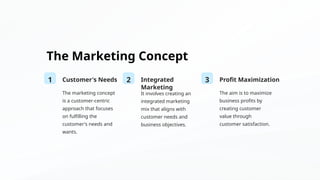
1Customer's Needs
The marketing concept
is a customer-centric
approach that focuses
on fulfilling the
customer's needs and
wants.
2 Integrated
Marketing
It involves creating an
integrated marketing
mix that aligns with
customer needs and
business objectives.
3 Profit Maximization
The aim is to maximize
business profits by
creating customer
value through
customer satisfaction.
4.
The Four P'sof Marketing
The Product
A product is anything that
can be offered to a market
to satisfy a need or want. It
can be a good or a service.
The Price
Pricing strategy is a crucial
component of marketing
mix. The price should reflect
the value that the product
provides to the customer.
The Place
Place refers to the
distribution channel that
the business uses to get the
product to the customer.
The Promotion
Promotion is the communication strategy that marketers use to reach their target market.
Examples include advertising, publicity, personal selling, and sales promotion.
5.
Strategic Marketing forEngineers
1 Selecting a Target Market
Marketing is a group of activities designed to facilitate and expedite the selling
of goods and sec
2 Developing a Marketing Mix
Once the target market is identified, engineers need to develop a marketing mix
that is aligned with customer needs and business objectives. This includes the four
P's of marketing- product, price, promotion, and place.
6.
Marketing Mix: TheProduct
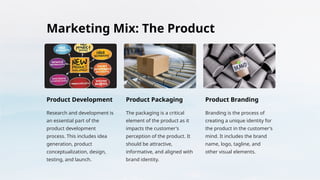
Product Development
Research and development is
an essential part of the
product development
process. This includes idea
generation, product
conceptualization, design,
testing, and launch.
Product Packaging
The packaging is a critical
element of the product as it
impacts the customer's
perception of the product. It
should be attractive,
informative, and aligned with
brand identity.
Product Branding
Branding is the process of
creating a unique identity for
the product in the customer's
mind. It includes the brand
name, logo, tagline, and
other visual elements.
7.
Marketing Mix: ThePrice
Cost-Plus Pricing
This pricing strategy involves calculating
the cost of producing the product and then
adding a markup. This approach is simple
but may not always reflect customer
willingness to pay.
Penetration Pricing
This pricing strategy involves setting a low
price to attract customers and grab market
share. This can help to build brand
awareness and customer loyalty.
Dynamic Pricing
This pricing strategy involves changing the
price based on demand, supply, and other
market conditions. It requires real-time
data tracking and analysis.
Value-Based Pricing
This pricing strategy involves setting a
price based on the perceived value of the
product to the customer. It requires a deep
understanding of customer needs and
competitor offerings.
8.
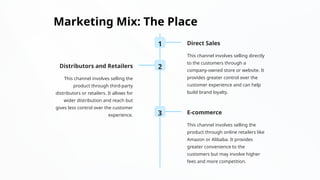
Marketing Mix: ThePlace
1 Direct Sales
This channel involves selling directly
to the customers through a
company-owned store or website. It
provides greater control over the
customer experience and can help
build brand loyalty.
2
Distributors and Retailers
This channel involves selling the
product through third-party
distributors or retailers. It allows for
wider distribution and reach but
gives less control over the customer
experience. 3 E-commerce
This channel involves selling the
product through online retailers like
Amazon or Alibaba. It provides
greater convenience to the
customers but may involve higher
fees and more competition.
What is theFinance Function?
The finance function is responsible for managing a company's
monetary resources, including budgeting, financial planning, and
ensuring effective use of funds.
11.
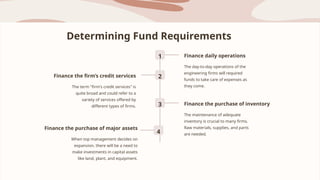
Determining Fund Requirements
1Finance daily operations
The day-to-day operations of the
engineering firms will required
funds to take care of expenses as
they come.
2
Finance the firm’s credit services
The term "firm's credit services" is
quite broad and could refer to a
variety of services offered by
different types of firms. 3 Finance the purchase of inventory
The maintenance of adequate
inventory is crucial to many firms.
Raw materials, supplies, and parts
are needed.
4
Finance the purchase of major assets
When top management decides on
expansion, there will be a need to
make investments in capital assets
like land, plant, and equipment.
12.
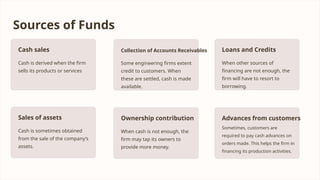
Sources of Funds
Cashsales
Cash is derived when the firm
sells its products or services
Collection of Accounts Receivables
Some engineering firms extent
credit to customers. When
these are settled, cash is made
available.
Loans and Credits
When other sources of
financing are not enough, the
firm will have to resort to
borrowing.
Sales of assets
Cash is sometimes obtained
from the sale of the company’s
assets.
Ownership contribution
When cash is not enough, the
firm may tap its owners to
provide more money.
Advances from customers
Sometimes, customers are
required to pay cash advances on
orders made. This helps the firm in
financing its production activities.
13.
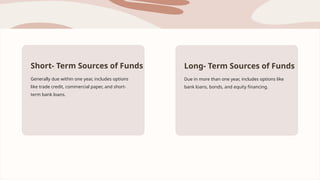
Short- Term Sourcesof Funds
Generally due within one year, includes options
like trade credit, commercial paper, and short-
term bank loans.
Long- Term Sources of Funds
Due in more than one year, includes options like
bank loans, bonds, and equity financing.
14.
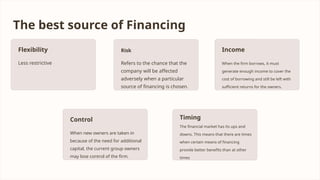
The best sourceof Financing
Flexibility
Less restrictive
Risk
Refers to the chance that the
company will be affected
adversely when a particular
source of financing is chosen.
Income
When the firm borrows, it must
generate enough income to cover the
cost of borrowing and still be left with
sufficient returns for the owners.
Control
When new owners are taken in
because of the need for additional
capital, the current group owners
may lose control of the firm.
Timing
The financial market has its ups and
downs. This means that there are times
when certain means of financing
provide better benefits than at other
times
15.
The firm’s financialhealth
Evaluating a company's financial health is crucial for making informed decisions and ensuring the
long-term sustainability of the business.
16.
Risk Management andInsurance
Effectively managing financial risks and having appropriate insurance coverage safeguards the
company's assets and mitigates potential losses.
17.
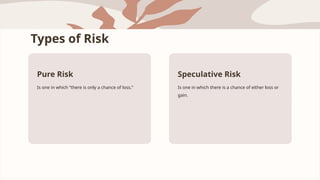
Types of Risk
PureRisk
Is one in which “there is only a chance of loss.”
Speculative Risk
Is one in which there is a chance of either loss or
gain.
18.
Risk Management
“is anorganized strategy for protecting and conserving assets and people.” The purpose of this is
“to choose intelligently from among all the available methods of dealing with risk in order to secure
the economic survival of the firm.”