ISE 503
Instructor: PraveenTripathi (PhD)
Fundamental Concepts of Database
Management-II
1
Lecture Slides Courtesy: Principles of Database Management, The practical
guide to storing, managing and analyzing Big and Small Data: W. Lemahieu, S.
V. Broucke and B. Baesens. Cambridge University Press.
Key definitions
 A database can be defined as a collection of related data items
within a specific business process or problem setting
 has a target group of users and applications
 A Database Management System (DBMS), is the software
package used to define, create, use and maintain a database
 consists of several software modules
 The combination of a DBMS and a database is then often called a
database system
2
Database Users
 Information architect designs the conceptual data model
 closely interacts with the business user
 Database designer translates the conceptual data model into a
logical and internal data model
 Database administrator (DBA) is responsible for the
implementation and monitoring of the database
 Application developer develops database applications in a
programming language such as Java or Python
 Business user will run these applications to perform specific
database operations
3
Database Languages
 Data Definition Language (DDL) is used by the DBA to express
the database's external, logical and internal data models
 definitions are stored in the catalog
 Data Manipulation Language (DML) is used to retrieve, insert,
delete, and modify data
 DML statements can be embedded in a programming language, or
entered interactively through a front-end querying tool
 Structured Query Language (SQL) offers both DDL and DML
statements for relational database systems
4
Advantages of Database Systems and Database
Management
 Data Independence
 Database Modelling
 Managing Structured, Semi-Structured and Unstructured Data
 Managing Data Redundancy
 Specifying Integrity Rules
 Concurrency Control
 Backup and Recovery Facilities
 Data Security
 Performance Utilities
5
Data Independence
 Data independence implies that changes in data definitions have minimal to
no impact on the applications
 Physical data independence implies that neither the applications, nor
the views or logical data model must be changed when changes are made to
the data storage specifications in the internal data model
 DBMS should provide interfaces between logical and internal data models
 Logical data independence implies that software applications are
minimally affected by changes in the conceptual or logical data model
 views in the external data model will act as a protective shield
 DBMS must provide interfaces between conceptual/logical and external layer
6
Database Modelling
 A data model is an explicit representation of the data items
together with their characteristics and relationships
 A conceptual data model should provide a formal and perfect
mapping of the data requirements of the business process and is
made in collaboration with the business user
 translated into logical and internal data model
 Important that a data model’s assumptions and shortcomings are
clearly documented
7
Managing Structured, Semi-Structured and
Unstructured Data
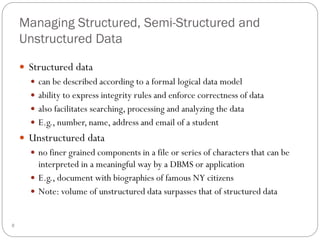
 Structured data
 can be described according to a formal logical data model
 ability to express integrity rules and enforce correctness of data
 also facilitates searching, processing and analyzing the data
 E.g., number, name, address and email of a student
 Unstructured data
 no finer grained components in a file or series of characters that can be
interpreted in a meaningful way by a DBMS or application
 E.g., document with biographies of famous NY citizens
 Note: volume of unstructured data surpasses that of structured data
8
Managing Structured, Semi-Structured and
Unstructured Data
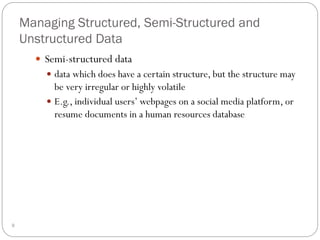
 Semi-structured data
 data which does have a certain structure, but the structure may
be very irregular or highly volatile
 E.g., individual users’ webpages on a social media platform, or
resume documents in a human resources database
9
Managing Data Redundancy
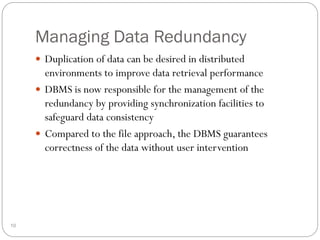
 Duplication of data can be desired in distributed
environments to improve data retrieval performance
 DBMS is now responsible for the management of the
redundancy by providing synchronization facilities to
safeguard data consistency
 Compared to the file approach, the DBMS guarantees
correctness of the data without user intervention
10
Specifying Integrity Rules
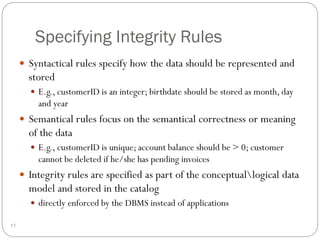
 Syntactical rules specify how the data should be represented and
stored
 E.g., customerID is an integer; birthdate should be stored as month, day
and year
 Semantical rules focus on the semantical correctness or meaning
of the data
 E.g., customerID is unique; account balance should be > 0; customer
cannot be deleted if he/she has pending invoices
 Integrity rules are specified as part of the conceptuallogical data
model and stored in the catalog
 directly enforced by the DBMS instead of applications
11
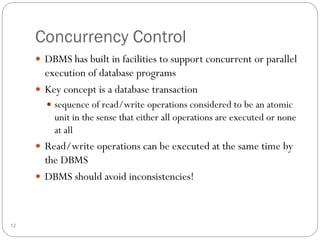
Concurrency Control
 DBMS has built in facilities to support concurrent or parallel
execution of database programs
 Key concept is a database transaction
 sequence of read/write operations considered to be an atomic
unit in the sense that either all operations are executed or none
at all
 Read/write operations can be executed at the same time by
the DBMS
 DBMS should avoid inconsistencies!
12
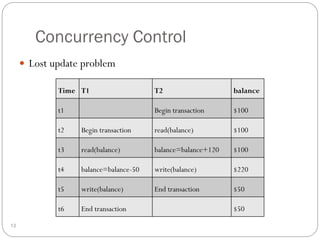
Concurrency Control
 Lost update problem
13
Time T1 T2 balance
t1 Begin transaction $100
t2 Begin transaction read(balance) $100
t3 read(balance) balance=balance+120 $100
t4 balance=balance-50 write(balance) $220
t5 write(balance) End transaction $50
t6 End transaction $50
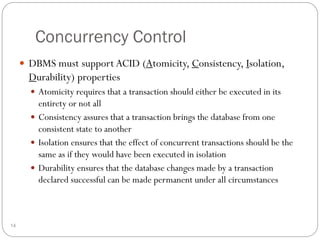
Concurrency Control
 DBMS must support ACID (Atomicity, Consistency, Isolation,
Durability) properties
 Atomicity requires that a transaction should either be executed in its
entirety or not all
 Consistency assures that a transaction brings the database from one
consistent state to another
 Isolation ensures that the effect of concurrent transactions should be the
same as if they would have been executed in isolation
 Durability ensures that the database changes made by a transaction
declared successful can be made permanent under all circumstances
14
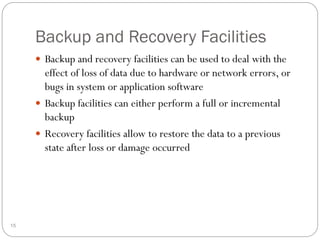
Backup and Recovery Facilities
 Backup and recovery facilities can be used to deal with the
effect of loss of data due to hardware or network errors, or
bugs in system or application software
 Backup facilities can either perform a full or incremental
backup
 Recovery facilities allow to restore the data to a previous
state after loss or damage occurred
15
Data Security
 Data security can be enforced by the DBMS
 Some users have read access, whilst others have write access
to the data (role-based functionality)
 E.g., vendor managed inventory (VMI)
 Data access can be managed via logins and passwords assigned
to users or user accounts
 Each account has its own authorization rules that can be
stored in the catalog
16
Performance Utilities
 Three KPIs of a DBMS are
 response time denoting the time elapsed between issuing a database
request and the successful termination thereof
 throughput rate representing the transactions a DBMS can process per
unit of time
 space utilization referring to the space utilized by the DBMS to store
both raw data and metadata
 DBMSs come with various types of utilities aimed at improving
these KPIs
 E.g., utilities to distribute and optimize data storage, to tune indexes for
faster query execution, to tune queries to improve application
performance, or to optimize buffer management
17

L1_IntroductiontoDataBase fundamentals Part2.pdf

  • 1.
    ISE 503 Instructor: PraveenTripathi(PhD) Fundamental Concepts of Database Management-II 1 Lecture Slides Courtesy: Principles of Database Management, The practical guide to storing, managing and analyzing Big and Small Data: W. Lemahieu, S. V. Broucke and B. Baesens. Cambridge University Press.
  • 2.
    Key definitions  Adatabase can be defined as a collection of related data items within a specific business process or problem setting  has a target group of users and applications  A Database Management System (DBMS), is the software package used to define, create, use and maintain a database  consists of several software modules  The combination of a DBMS and a database is then often called a database system 2
  • 3.
    Database Users  Informationarchitect designs the conceptual data model  closely interacts with the business user  Database designer translates the conceptual data model into a logical and internal data model  Database administrator (DBA) is responsible for the implementation and monitoring of the database  Application developer develops database applications in a programming language such as Java or Python  Business user will run these applications to perform specific database operations 3
  • 4.
    Database Languages  DataDefinition Language (DDL) is used by the DBA to express the database's external, logical and internal data models  definitions are stored in the catalog  Data Manipulation Language (DML) is used to retrieve, insert, delete, and modify data  DML statements can be embedded in a programming language, or entered interactively through a front-end querying tool  Structured Query Language (SQL) offers both DDL and DML statements for relational database systems 4
  • 5.
    Advantages of DatabaseSystems and Database Management  Data Independence  Database Modelling  Managing Structured, Semi-Structured and Unstructured Data  Managing Data Redundancy  Specifying Integrity Rules  Concurrency Control  Backup and Recovery Facilities  Data Security  Performance Utilities 5
  • 6.
    Data Independence  Dataindependence implies that changes in data definitions have minimal to no impact on the applications  Physical data independence implies that neither the applications, nor the views or logical data model must be changed when changes are made to the data storage specifications in the internal data model  DBMS should provide interfaces between logical and internal data models  Logical data independence implies that software applications are minimally affected by changes in the conceptual or logical data model  views in the external data model will act as a protective shield  DBMS must provide interfaces between conceptual/logical and external layer 6
  • 7.
    Database Modelling  Adata model is an explicit representation of the data items together with their characteristics and relationships  A conceptual data model should provide a formal and perfect mapping of the data requirements of the business process and is made in collaboration with the business user  translated into logical and internal data model  Important that a data model’s assumptions and shortcomings are clearly documented 7
  • 8.
    Managing Structured, Semi-Structuredand Unstructured Data  Structured data  can be described according to a formal logical data model  ability to express integrity rules and enforce correctness of data  also facilitates searching, processing and analyzing the data  E.g., number, name, address and email of a student  Unstructured data  no finer grained components in a file or series of characters that can be interpreted in a meaningful way by a DBMS or application  E.g., document with biographies of famous NY citizens  Note: volume of unstructured data surpasses that of structured data 8
  • 9.
    Managing Structured, Semi-Structuredand Unstructured Data  Semi-structured data  data which does have a certain structure, but the structure may be very irregular or highly volatile  E.g., individual users’ webpages on a social media platform, or resume documents in a human resources database 9
  • 10.
    Managing Data Redundancy Duplication of data can be desired in distributed environments to improve data retrieval performance  DBMS is now responsible for the management of the redundancy by providing synchronization facilities to safeguard data consistency  Compared to the file approach, the DBMS guarantees correctness of the data without user intervention 10
  • 11.
    Specifying Integrity Rules Syntactical rules specify how the data should be represented and stored  E.g., customerID is an integer; birthdate should be stored as month, day and year  Semantical rules focus on the semantical correctness or meaning of the data  E.g., customerID is unique; account balance should be > 0; customer cannot be deleted if he/she has pending invoices  Integrity rules are specified as part of the conceptuallogical data model and stored in the catalog  directly enforced by the DBMS instead of applications 11
  • 12.
    Concurrency Control  DBMShas built in facilities to support concurrent or parallel execution of database programs  Key concept is a database transaction  sequence of read/write operations considered to be an atomic unit in the sense that either all operations are executed or none at all  Read/write operations can be executed at the same time by the DBMS  DBMS should avoid inconsistencies! 12
  • 13.
    Concurrency Control  Lostupdate problem 13 Time T1 T2 balance t1 Begin transaction $100 t2 Begin transaction read(balance) $100 t3 read(balance) balance=balance+120 $100 t4 balance=balance-50 write(balance) $220 t5 write(balance) End transaction $50 t6 End transaction $50
  • 14.
    Concurrency Control  DBMSmust support ACID (Atomicity, Consistency, Isolation, Durability) properties  Atomicity requires that a transaction should either be executed in its entirety or not all  Consistency assures that a transaction brings the database from one consistent state to another  Isolation ensures that the effect of concurrent transactions should be the same as if they would have been executed in isolation  Durability ensures that the database changes made by a transaction declared successful can be made permanent under all circumstances 14
  • 15.
    Backup and RecoveryFacilities  Backup and recovery facilities can be used to deal with the effect of loss of data due to hardware or network errors, or bugs in system or application software  Backup facilities can either perform a full or incremental backup  Recovery facilities allow to restore the data to a previous state after loss or damage occurred 15
  • 16.
    Data Security  Datasecurity can be enforced by the DBMS  Some users have read access, whilst others have write access to the data (role-based functionality)  E.g., vendor managed inventory (VMI)  Data access can be managed via logins and passwords assigned to users or user accounts  Each account has its own authorization rules that can be stored in the catalog 16
  • 17.
    Performance Utilities  ThreeKPIs of a DBMS are  response time denoting the time elapsed between issuing a database request and the successful termination thereof  throughput rate representing the transactions a DBMS can process per unit of time  space utilization referring to the space utilized by the DBMS to store both raw data and metadata  DBMSs come with various types of utilities aimed at improving these KPIs  E.g., utilities to distribute and optimize data storage, to tune indexes for faster query execution, to tune queries to improve application performance, or to optimize buffer management 17