CPSC 322, Lecture 8 Slide 1
Heuristic Search: BestFS and
A*
Computer Science cpsc322, Lecture 8
(Textbook Chpt 3.6)
Sept, 21, 2010
Department of Computer Science
Undergraduate Events
More details @
https://www.cs.ubc.ca/students/undergrad/life/upcoming-
events
Resume Drop-in Editing Session
Mon. Sept 24, 12 – 3 pm
Rm 253, ICICS/CS Bldg.
Global Relay Info Session
Mon. Sept 24, 5:30 pm
DMP 110
Google Info Session
Tues. Sept 25, 5:30 pm
Wesbrook 100
UBC Career Days
Wed. Sept 26 & Thurs. Sept 27
10 am – 4 pm
SUB
Microsoft Info Session
Wed. Sept 26, 5:30 pm
Wesbrook 100
Tri-mentoring Kick Off
(invitation only)
Thurs. Sept 27, 5:30 pm
X860, ICICS/CS Bldg.
Avanade Info Session
Fri. Sept 28, 12 – 2 pm
Rm 206, ICICS/CS Bldg.
ACM Programming Team Try Out
Sat. Sept 29, 12 – 5 pm
Rm 005, Rm 011, ICICS/CS Bldg.
CPSC 322, Lecture 7 Slide 3
Course Announcements
Marks for Assignment0: posted on Connect
If you are confused on basic search algorithm, different
search strategies….. Check learning goals at the end of
lectures. Work on the Practice Exercises and Please
come to office hours
Giuseppe Tue 2 pm, my office.
Nathaniel Tomer Fri 11am, X150 (Learning Center)
Tatsuro Oya Wed 2 pm, X150 (Learning Center)
Mehran Kazemi Mon 11 am, X150 (Learning Center)
Assignment1: posted
CPSC 322, Lecture 7 Slide 4
Course Announcements
Inked Slides
• At the end of each lecture I revise/clean-up the slides.
Adding comments, improving writing… make sure you
check them out
CPSC 322, Lecture 8 Slide 5
Lecture Overview
• Recap Heuristic Function
• Best First Search
• A*
CPSC 322, Lecture 6 Slide 6
Admissible heuristic for Vacuum world?
states? Where it is dirty and robot location
actions? Left, Right, Suck
Possible goal test? no dirt at all locations
CPSC 322, Lecture 8 Slide 7
Lecture Overview
• Recap Heuristic Function
• Best First Search
• A*
CPSC 322, Lecture 7 Slide 8
Best-First Search
• Idea: select the path whose end is closest to a
goal according to the heuristic function.
• Best-First search selects a path on the frontier
with minimal h-value (for the end node).
• It treats the frontier as a priority queue ordered by h.
(similar to ?)
• This is a greedy approach: it always takes the path
which appears locally best
CPSC 322, Lecture 7 Slide 9
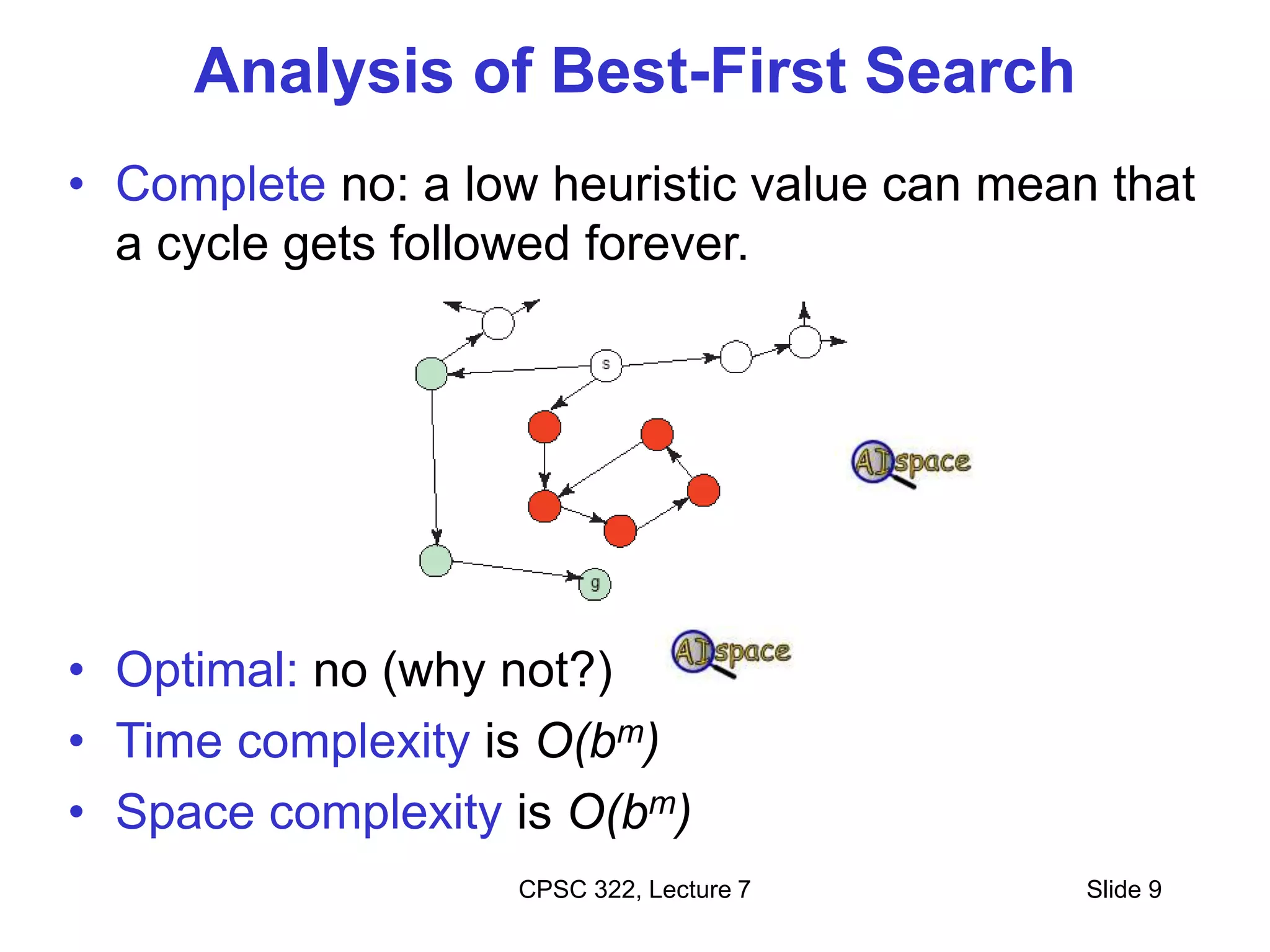
Analysis of Best-First Search
• Complete no: a low heuristic value can mean that
a cycle gets followed forever.
• Optimal: no (why not?)
• Time complexity is O(bm)
• Space complexity is O(bm)
CPSC 322, Lecture 8 Slide 10
Lecture Overview
• Recap Heuristic Function
• Best First Search
• A* Search Strategy
CPSC 322, Lecture 8 Slide 11
• A* is a mix of:
• lowest-cost-first and
• best-first search
• A* treats the frontier as a priority queue ordered
by f(p)=
• It always selects the node on the frontier with the
………….. estimated …………….distance.
A* Search Algorithm
f-value of UBC  KD JB? 6 10 11
9
Computing f-values
CPSC 322, Lecture 8 Slide 13
Analysis of A*
Let's assume that arc costs are strictly positive.
• Time complexity is O(bm)
• the heuristic could be completely uninformative and the
edge costs could all be the same, meaning that A* does
the same thing as….
• Space complexity is O(bm) like ….., A* maintains a
frontier which grows with the size of the tree
• Completeness: yes.
• Optimality: ??
DFS LCFS
BFS
CPSC 322, Lecture 8 Slide 14
Optimality of A*
If A* returns a solution, that solution is guaranteed to
be optimal, as long as
When
• the branching factor is finite
• arc costs are strictly positive
• h(n) is an underestimate of the length of the shortest path
from n to a goal node, and is non-negative
Theorem
If A* selects a path p as the solution,
p is the shortest (i.e., lowest-cost) path.
CPSC 322, Lecture 8 Slide 15
Why is A* optimal?
• A* returns p
• Assume for contradiction that some other path p' is actually the
shortest path to a goal
• Consider the moment when p is chosen from the frontier. Some
part of path p' will also be on the frontier; let's call this partial
path p''.
p
p'
p''
CPSC 322, Lecture 8 Slide 16
Why is A* optimal? (cont’)
• Because p was expanded before p'',
• Because p is a goal, Thus
• Because h is admissible, cost(p'') + h(p'')  for any path
p' to a goal that extends p''
• Thus for any other path p' to a goal.
p
p'
p''
This contradicts our assumption that p' is the shortest path.
CPSC 322, Lecture 8 Slide 17
Optimal efficiency of A*
• In fact, we can prove something even stronger
about A*: in a sense (given the particular heuristic
that is available) no search algorithm could do
better!
• Optimal Efficiency: Among all optimal
algorithms that start from the same start node
and use the same heuristic h, A* expands the
minimal number of paths.
Sample A* applications
• An Efficient A* Search Algorithm For
Statistical Machine Translation. 2001
• The Generalized A* Architecture. Journal of
Artificial Intelligence Research (2007)
• Machine Vision … Here we consider a new
compositional model for finding salient curves.
• Factored A*search for models over sequences
and trees International Conference on AI. 2003….
It starts saying… The primary challenge when using A*
search is to find heuristic functions that simultaneously are
admissible, close to actual completion costs, and efficient
to calculate… applied to NLP and BioInformatics
CPSC 322, Lecture 9 Slide 18
Sample A* applications (cont’)
Aker, A., Cohn, T., Gaizauskas, R.: Multi-
document summarization using A* search and
discriminative training. Proceedings of the
2010 Conference on Empirical Methods in Natural
Language Processing.. ACL (2010)
CPSC 322, Lecture 8 Slide 19
CPSC 322, Lecture 8 Slide 20
• The AI-Search animation system
http://www.cs.rmit.edu.au/AI-Search/Product/
• To examine Search strategies when they are applied to
the 8puzzle
• Compare only DFS, BFS and A* (with only the two
heuristics we saw in class )
DFS, BFS, A* Animation Example
• With default start state and goal
• DFS will find
Solution at depth 32
• BFS will find
Optimal solution depth 6
• A* will also find opt. sol. expanding
much less nodes
CPSC 322, Lecture 9 Slide 21
nPuzzles are not always solvable
Half of the starting positions for the n-puzzle are
impossible to resolve (for more info on 8puzzle)
http://www.isle.org/~sbay/ics171/project/unsolvable
• So experiment with the AI-Search animation system with
the default configurations.
• If you want to try new ones keep in mind that you may pick
unsolvable problems
CPSC 322, Lecture 7 Slide 22
Learning Goals for today’s class
• Define/read/write/trace/debug & Compare
different search algorithms
•With / Without cost
•Informed / Uninformed
• Formally prove A* optimality.
CPSC 322, Lecture 8 Slide 23
Next class
Finish Search (finish Chpt 3)
• Branch-and-Bound
• A* enhancements
• Non-heuristic Pruning
• Dynamic Programming

l012b.pptx

  • 1.
    CPSC 322, Lecture8 Slide 1 Heuristic Search: BestFS and A* Computer Science cpsc322, Lecture 8 (Textbook Chpt 3.6) Sept, 21, 2010
  • 2.
    Department of ComputerScience Undergraduate Events More details @ https://www.cs.ubc.ca/students/undergrad/life/upcoming- events Resume Drop-in Editing Session Mon. Sept 24, 12 – 3 pm Rm 253, ICICS/CS Bldg. Global Relay Info Session Mon. Sept 24, 5:30 pm DMP 110 Google Info Session Tues. Sept 25, 5:30 pm Wesbrook 100 UBC Career Days Wed. Sept 26 & Thurs. Sept 27 10 am – 4 pm SUB Microsoft Info Session Wed. Sept 26, 5:30 pm Wesbrook 100 Tri-mentoring Kick Off (invitation only) Thurs. Sept 27, 5:30 pm X860, ICICS/CS Bldg. Avanade Info Session Fri. Sept 28, 12 – 2 pm Rm 206, ICICS/CS Bldg. ACM Programming Team Try Out Sat. Sept 29, 12 – 5 pm Rm 005, Rm 011, ICICS/CS Bldg.
  • 3.
    CPSC 322, Lecture7 Slide 3 Course Announcements Marks for Assignment0: posted on Connect If you are confused on basic search algorithm, different search strategies….. Check learning goals at the end of lectures. Work on the Practice Exercises and Please come to office hours Giuseppe Tue 2 pm, my office. Nathaniel Tomer Fri 11am, X150 (Learning Center) Tatsuro Oya Wed 2 pm, X150 (Learning Center) Mehran Kazemi Mon 11 am, X150 (Learning Center) Assignment1: posted
  • 4.
    CPSC 322, Lecture7 Slide 4 Course Announcements Inked Slides • At the end of each lecture I revise/clean-up the slides. Adding comments, improving writing… make sure you check them out
  • 5.
    CPSC 322, Lecture8 Slide 5 Lecture Overview • Recap Heuristic Function • Best First Search • A*
  • 6.
    CPSC 322, Lecture6 Slide 6 Admissible heuristic for Vacuum world? states? Where it is dirty and robot location actions? Left, Right, Suck Possible goal test? no dirt at all locations
  • 7.
    CPSC 322, Lecture8 Slide 7 Lecture Overview • Recap Heuristic Function • Best First Search • A*
  • 8.
    CPSC 322, Lecture7 Slide 8 Best-First Search • Idea: select the path whose end is closest to a goal according to the heuristic function. • Best-First search selects a path on the frontier with minimal h-value (for the end node). • It treats the frontier as a priority queue ordered by h. (similar to ?) • This is a greedy approach: it always takes the path which appears locally best
  • 9.
    CPSC 322, Lecture7 Slide 9 Analysis of Best-First Search • Complete no: a low heuristic value can mean that a cycle gets followed forever. • Optimal: no (why not?) • Time complexity is O(bm) • Space complexity is O(bm)
  • 10.
    CPSC 322, Lecture8 Slide 10 Lecture Overview • Recap Heuristic Function • Best First Search • A* Search Strategy
  • 11.
    CPSC 322, Lecture8 Slide 11 • A* is a mix of: • lowest-cost-first and • best-first search • A* treats the frontier as a priority queue ordered by f(p)= • It always selects the node on the frontier with the ………….. estimated …………….distance. A* Search Algorithm
  • 12.
    f-value of UBC KD JB? 6 10 11 9 Computing f-values
  • 13.
    CPSC 322, Lecture8 Slide 13 Analysis of A* Let's assume that arc costs are strictly positive. • Time complexity is O(bm) • the heuristic could be completely uninformative and the edge costs could all be the same, meaning that A* does the same thing as…. • Space complexity is O(bm) like ….., A* maintains a frontier which grows with the size of the tree • Completeness: yes. • Optimality: ?? DFS LCFS BFS
  • 14.
    CPSC 322, Lecture8 Slide 14 Optimality of A* If A* returns a solution, that solution is guaranteed to be optimal, as long as When • the branching factor is finite • arc costs are strictly positive • h(n) is an underestimate of the length of the shortest path from n to a goal node, and is non-negative Theorem If A* selects a path p as the solution, p is the shortest (i.e., lowest-cost) path.
  • 15.
    CPSC 322, Lecture8 Slide 15 Why is A* optimal? • A* returns p • Assume for contradiction that some other path p' is actually the shortest path to a goal • Consider the moment when p is chosen from the frontier. Some part of path p' will also be on the frontier; let's call this partial path p''. p p' p''
  • 16.
    CPSC 322, Lecture8 Slide 16 Why is A* optimal? (cont’) • Because p was expanded before p'', • Because p is a goal, Thus • Because h is admissible, cost(p'') + h(p'')  for any path p' to a goal that extends p'' • Thus for any other path p' to a goal. p p' p'' This contradicts our assumption that p' is the shortest path.
  • 17.
    CPSC 322, Lecture8 Slide 17 Optimal efficiency of A* • In fact, we can prove something even stronger about A*: in a sense (given the particular heuristic that is available) no search algorithm could do better! • Optimal Efficiency: Among all optimal algorithms that start from the same start node and use the same heuristic h, A* expands the minimal number of paths.
  • 18.
    Sample A* applications •An Efficient A* Search Algorithm For Statistical Machine Translation. 2001 • The Generalized A* Architecture. Journal of Artificial Intelligence Research (2007) • Machine Vision … Here we consider a new compositional model for finding salient curves. • Factored A*search for models over sequences and trees International Conference on AI. 2003…. It starts saying… The primary challenge when using A* search is to find heuristic functions that simultaneously are admissible, close to actual completion costs, and efficient to calculate… applied to NLP and BioInformatics CPSC 322, Lecture 9 Slide 18
  • 19.
    Sample A* applications(cont’) Aker, A., Cohn, T., Gaizauskas, R.: Multi- document summarization using A* search and discriminative training. Proceedings of the 2010 Conference on Empirical Methods in Natural Language Processing.. ACL (2010) CPSC 322, Lecture 8 Slide 19
  • 20.
    CPSC 322, Lecture8 Slide 20 • The AI-Search animation system http://www.cs.rmit.edu.au/AI-Search/Product/ • To examine Search strategies when they are applied to the 8puzzle • Compare only DFS, BFS and A* (with only the two heuristics we saw in class ) DFS, BFS, A* Animation Example • With default start state and goal • DFS will find Solution at depth 32 • BFS will find Optimal solution depth 6 • A* will also find opt. sol. expanding much less nodes
  • 21.
    CPSC 322, Lecture9 Slide 21 nPuzzles are not always solvable Half of the starting positions for the n-puzzle are impossible to resolve (for more info on 8puzzle) http://www.isle.org/~sbay/ics171/project/unsolvable • So experiment with the AI-Search animation system with the default configurations. • If you want to try new ones keep in mind that you may pick unsolvable problems
  • 22.
    CPSC 322, Lecture7 Slide 22 Learning Goals for today’s class • Define/read/write/trace/debug & Compare different search algorithms •With / Without cost •Informed / Uninformed • Formally prove A* optimality.
  • 23.
    CPSC 322, Lecture8 Slide 23 Next class Finish Search (finish Chpt 3) • Branch-and-Bound • A* enhancements • Non-heuristic Pruning • Dynamic Programming