Lobby
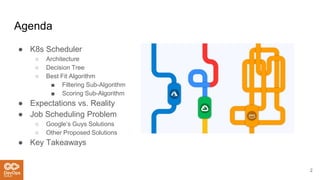
Agenda
● K8s Scheduler
○ Architecture
○ Decision Tree
○ Best Fit Algorithm
■ Filtering Sub-Algorithm
■ Scoring Sub-Algorithm
● Expectations vs. Reality
● Job Scheduling Problem
○ Google’s Guys Solutions
○ Other Proposed Solutions
● Key Takeaways
2
Before we start… the sources…
● ❌ Medium.com “look-at-me” posts.
● ❌ Vendor marketing mumbo-jumbo.
● ✅ Peer reviewed CS publications.
● ✅ K8s failure stories (https://k8s.af/).
● ✅ Golang code review.
● ✅ Memes.
3
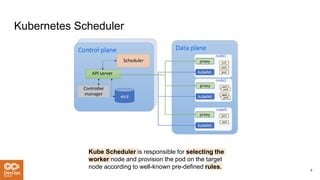
Kubernetes Scheduler
Kube Scheduler is responsible for selecting the
worker node and provision the pod on the target
node according to well-known pre-defined rules. 4
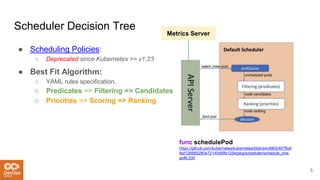
Scheduler Decision Tree
● Scheduling Policies:
○ Deprecated since Kubernetes >= v1.23
5
Metrics Server
func schedulePod
https://github.com/kubernetes/kubernetes/blob/e4c8802407fbaf
fad126685280e72145d89b125e/pkg/scheduler/schedule_one.
go#L335
● Best Fit Algorithm:
○ YAML rules specification.
○ Predicates => Filtering => Candidates
○ Priorities => Scoring => Ranking
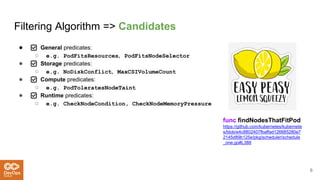
Filtering Algorithm => Candidates
● ✅ General predicates:
○ e.g. PodFitsResources,PodFitsNodeSelector
● ✅ Storage predicates:
○ e.g. NoDiskConflict,MaxCSIVolumeCount
● ✅ Compute predicates:
○ e.g. PodToleratesNodeTaint
● ✅ Runtime predicates:
○ e.g. CheckNodeCondition, CheckNodeMemoryPressure
6
func findNodesThatFitPod
https://github.com/kubernetes/kubernete
s/blob/e4c8802407fbaffad126685280e7
2145d89b125e/pkg/scheduler/schedule
_one.go#L388
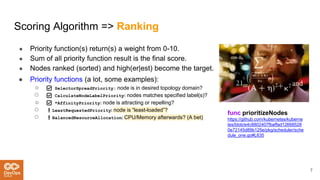
Scoring Algorithm => Ranking
● Priority function(s) return(s) a weight from 0-10.
● Sum of all priority function result is the final score.
● Nodes ranked (sorted) and high(er|est) become the target.
7
func prioritizeNodes
https://github.com/kubernetes/kuberne
tes/blob/e4c8802407fbaffad12668528
0e72145d89b125e/pkg/scheduler/sche
dule_one.go#L635
● Priority functions (a lot, some examples):
○ ✅ SelectorSpreadPriority: node is in desired topology domain?
○ ✅ CalculateNodeLabelPriority: nodes matches specified label(s)?
○ ✅ *AffinityPriority: node is attracting or repelling?
○ ❗LeastRequestedPriority: node is “least-loaded”?
○ ❗BalancedResourceAllocation: CPU/Memory afterwards? (A bet)
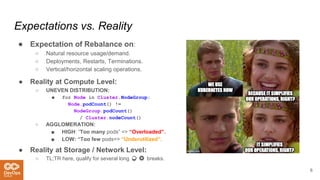
Expectations vs. Reality
● Expectation of Rebalance on:
○ Natural resource usage/demand.
○ Deployments, Restarts, Terminations.
○ Vertical/horizontal scaling operations.
8
● Reality at Compute Level:
○ UNEVEN DISTRIBUTION:
■ for Node in Cluster.NodeGroup:
Node.podCount() !=
NodeGroup.podCount()
/ Cluster.nodeCount()
● Reality at Storage / Network Level:
○ TL;TR here, qualify for several long ☕🍩 breaks.
○ AGGLOMERATION:
■ HIGH: “Too many pods” => “Overloaded”.
■ LOW: “Too few pods=> “Underutilized”.
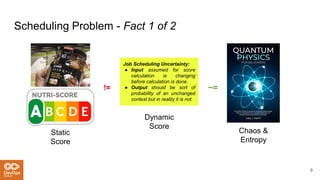
Scheduling Problem - Fact 1 of 2
9
Static
Score
Job Scheduling Uncertainty:
● Input assumed for score
calculation is changing
before calculation is done.
● Output should be sort of
probability of an unchanged
context but in reality it is not.
Dynamic
Score
!=
Chaos &
Entropy
~=
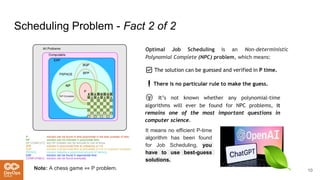
Scheduling Problem - Fact 2 of 2
Optimal Job Scheduling is an Non-deterministic
Polynomial Complete (NPC) problem, which means:
10
Note: A chess game ⇔ P problem.
✅ The solution can be guessed and verified in P time.
❗There is no particular rule to make the guess.
😲 It’s not known whether any polynomial-time
algorithms will ever be found for NPC problems, it
remains one of the most important questions in
computer science.
It means no efficient P-time
algorithm has been found
for Job Scheduling, you
have to use best-guess
solutions.
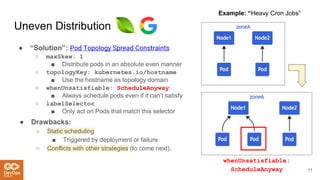
Uneven Distribution
● “Solution”: Pod Topology Spread Constraints
○ maxSkew: 1
■ Distribute pods in an absolute even manner
○ topologyKey: kubernetes.io/hostname
■ Use the hostname as topology domain
○ whenUnsatisfiable: ScheduleAnyway
■ Always schedule pods even if it can’t satisfy
○ labelSelector
■ Only act on Pods that match this selector
whenUnsatisfiable:
ScheduleAnyway
Example: “Heavy Cron Jobs”
11
● Drawbacks:
○ Static scheduling
■ Triggered by deployment or failure
○ Conflicts with other strategies (to come next).
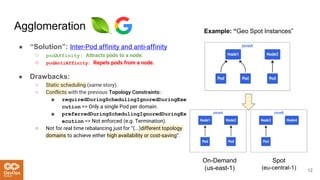
Agglomeration
● “Solution”: Inter-Pod affinity and anti-affinity
○ podAffinity: Attracts pods to a node.
○ podAntiAffinity: Repels pods from a node.
On-Demand
(us-east-1)
Spot
(eu-central-1) 12
Example: “Geo Spot Instances”
● Drawbacks:
○ Static scheduling (same story).
○ Conflicts with the previous Topology Constraints:
■ requiredDuringSchedulingIgnoredDuringExe
cution => Only a single Pod per domain.
■ preferredDuringSchedulingIgnoredDuringEx
ecution => Not enforced (e.g. Termination).
○ Not for real time rebalancing just for “(...)different topology
domains to achieve either high availability or cost-saving”.
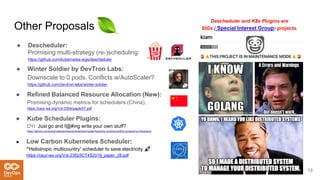
Other Proposals
● Descheduler:
Promising multi-strategy (re-)scheduling:
https://github.com/kubernetes-sigs/descheduler
13
🤡
Descheduler and K8s Plugins are
SIGs ( Special Interest Group) projects.
● Winter Soldier by DevTron Labs:
Downscale to 0 pods. Conflicts w/AutoScaler?
https://github.com/devtron-labs/winter-soldier
● Refined Balanced Resource Allocation (New):
Promising dynamic metrics for schedulers (China).
https://ceur-ws.org/Vol-3304/paper07.pdf
● Kube Scheduler Plugins:
DYI: Just go and f@#ing write your own stuff?
https://github.com/kubernetes/enhancements/tree/master/keps/sig-scheduling/624-scheduling-framework
● Low Carbon Kubernetes Scheduler:
“Heliotropic multicountry” scheduler to save electricity 🚀
https://ceur-ws.org/Vol-2382/ICT4S2019_paper_28.pdf
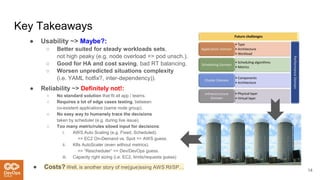
Key Takeaways
● Usability ~> Maybe?:
○ Better suited for steady workloads sets,
not high peaky (e.g. node overload => pod unsch.).
○ Good for HA and cost saving, bad RT balancing.
○ Worsen unpredicted situations complexity
(i.e. YAML hotfix?, inter-dependency)).
14
● Reliability ~> Definitely not!:
○ No standard solution that fit all app / teams.
○ Requires a lot of edge cases testing, between
co-existent applications (same node group).
○ No easy way to humanely trace the decisions
taken by scheduler (e.g. during live issue).
○ Too many metric/rules siloed input for decisions:
i. AWS Auto Scaling (e.g. Fixed, Scheduled).
=> EC2 On-Demand vs. Spot => AWS guess.
ii. K8s AutoScaler (even without metrics).
=> “Rescheduler” => Dev/DevOps guess.
iii. Capacity right sizing (i.e. EC2, limits/requests guess)
● Costs? Well, is another story of me(gue)ssing AWS RI/SP…
The
End

Kubernetes Workload Rebalancing

  • 1.
  • 2.
    Agenda ● K8s Scheduler ○Architecture ○ Decision Tree ○ Best Fit Algorithm ■ Filtering Sub-Algorithm ■ Scoring Sub-Algorithm ● Expectations vs. Reality ● Job Scheduling Problem ○ Google’s Guys Solutions ○ Other Proposed Solutions ● Key Takeaways 2
  • 3.
    Before we start…the sources… ● ❌ Medium.com “look-at-me” posts. ● ❌ Vendor marketing mumbo-jumbo. ● ✅ Peer reviewed CS publications. ● ✅ K8s failure stories (https://k8s.af/). ● ✅ Golang code review. ● ✅ Memes. 3
  • 4.
    Kubernetes Scheduler Kube Scheduleris responsible for selecting the worker node and provision the pod on the target node according to well-known pre-defined rules. 4
  • 5.
    Scheduler Decision Tree ●Scheduling Policies: ○ Deprecated since Kubernetes >= v1.23 5 Metrics Server func schedulePod https://github.com/kubernetes/kubernetes/blob/e4c8802407fbaf fad126685280e72145d89b125e/pkg/scheduler/schedule_one. go#L335 ● Best Fit Algorithm: ○ YAML rules specification. ○ Predicates => Filtering => Candidates ○ Priorities => Scoring => Ranking
  • 6.
    Filtering Algorithm =>Candidates ● ✅ General predicates: ○ e.g. PodFitsResources,PodFitsNodeSelector ● ✅ Storage predicates: ○ e.g. NoDiskConflict,MaxCSIVolumeCount ● ✅ Compute predicates: ○ e.g. PodToleratesNodeTaint ● ✅ Runtime predicates: ○ e.g. CheckNodeCondition, CheckNodeMemoryPressure 6 func findNodesThatFitPod https://github.com/kubernetes/kubernete s/blob/e4c8802407fbaffad126685280e7 2145d89b125e/pkg/scheduler/schedule _one.go#L388
  • 7.
    Scoring Algorithm =>Ranking ● Priority function(s) return(s) a weight from 0-10. ● Sum of all priority function result is the final score. ● Nodes ranked (sorted) and high(er|est) become the target. 7 func prioritizeNodes https://github.com/kubernetes/kuberne tes/blob/e4c8802407fbaffad12668528 0e72145d89b125e/pkg/scheduler/sche dule_one.go#L635 ● Priority functions (a lot, some examples): ○ ✅ SelectorSpreadPriority: node is in desired topology domain? ○ ✅ CalculateNodeLabelPriority: nodes matches specified label(s)? ○ ✅ *AffinityPriority: node is attracting or repelling? ○ ❗LeastRequestedPriority: node is “least-loaded”? ○ ❗BalancedResourceAllocation: CPU/Memory afterwards? (A bet)
  • 8.
    Expectations vs. Reality ●Expectation of Rebalance on: ○ Natural resource usage/demand. ○ Deployments, Restarts, Terminations. ○ Vertical/horizontal scaling operations. 8 ● Reality at Compute Level: ○ UNEVEN DISTRIBUTION: ■ for Node in Cluster.NodeGroup: Node.podCount() != NodeGroup.podCount() / Cluster.nodeCount() ● Reality at Storage / Network Level: ○ TL;TR here, qualify for several long ☕🍩 breaks. ○ AGGLOMERATION: ■ HIGH: “Too many pods” => “Overloaded”. ■ LOW: “Too few pods=> “Underutilized”.
  • 9.
    Scheduling Problem -Fact 1 of 2 9 Static Score Job Scheduling Uncertainty: ● Input assumed for score calculation is changing before calculation is done. ● Output should be sort of probability of an unchanged context but in reality it is not. Dynamic Score != Chaos & Entropy ~=
  • 10.
    Scheduling Problem -Fact 2 of 2 Optimal Job Scheduling is an Non-deterministic Polynomial Complete (NPC) problem, which means: 10 Note: A chess game ⇔ P problem. ✅ The solution can be guessed and verified in P time. ❗There is no particular rule to make the guess. 😲 It’s not known whether any polynomial-time algorithms will ever be found for NPC problems, it remains one of the most important questions in computer science. It means no efficient P-time algorithm has been found for Job Scheduling, you have to use best-guess solutions.
  • 11.
    Uneven Distribution ● “Solution”:Pod Topology Spread Constraints ○ maxSkew: 1 ■ Distribute pods in an absolute even manner ○ topologyKey: kubernetes.io/hostname ■ Use the hostname as topology domain ○ whenUnsatisfiable: ScheduleAnyway ■ Always schedule pods even if it can’t satisfy ○ labelSelector ■ Only act on Pods that match this selector whenUnsatisfiable: ScheduleAnyway Example: “Heavy Cron Jobs” 11 ● Drawbacks: ○ Static scheduling ■ Triggered by deployment or failure ○ Conflicts with other strategies (to come next).
  • 12.
    Agglomeration ● “Solution”: Inter-Podaffinity and anti-affinity ○ podAffinity: Attracts pods to a node. ○ podAntiAffinity: Repels pods from a node. On-Demand (us-east-1) Spot (eu-central-1) 12 Example: “Geo Spot Instances” ● Drawbacks: ○ Static scheduling (same story). ○ Conflicts with the previous Topology Constraints: ■ requiredDuringSchedulingIgnoredDuringExe cution => Only a single Pod per domain. ■ preferredDuringSchedulingIgnoredDuringEx ecution => Not enforced (e.g. Termination). ○ Not for real time rebalancing just for “(...)different topology domains to achieve either high availability or cost-saving”.
  • 13.
    Other Proposals ● Descheduler: Promisingmulti-strategy (re-)scheduling: https://github.com/kubernetes-sigs/descheduler 13 🤡 Descheduler and K8s Plugins are SIGs ( Special Interest Group) projects. ● Winter Soldier by DevTron Labs: Downscale to 0 pods. Conflicts w/AutoScaler? https://github.com/devtron-labs/winter-soldier ● Refined Balanced Resource Allocation (New): Promising dynamic metrics for schedulers (China). https://ceur-ws.org/Vol-3304/paper07.pdf ● Kube Scheduler Plugins: DYI: Just go and f@#ing write your own stuff? https://github.com/kubernetes/enhancements/tree/master/keps/sig-scheduling/624-scheduling-framework ● Low Carbon Kubernetes Scheduler: “Heliotropic multicountry” scheduler to save electricity 🚀 https://ceur-ws.org/Vol-2382/ICT4S2019_paper_28.pdf
  • 14.
    Key Takeaways ● Usability~> Maybe?: ○ Better suited for steady workloads sets, not high peaky (e.g. node overload => pod unsch.). ○ Good for HA and cost saving, bad RT balancing. ○ Worsen unpredicted situations complexity (i.e. YAML hotfix?, inter-dependency)). 14 ● Reliability ~> Definitely not!: ○ No standard solution that fit all app / teams. ○ Requires a lot of edge cases testing, between co-existent applications (same node group). ○ No easy way to humanely trace the decisions taken by scheduler (e.g. during live issue). ○ Too many metric/rules siloed input for decisions: i. AWS Auto Scaling (e.g. Fixed, Scheduled). => EC2 On-Demand vs. Spot => AWS guess. ii. K8s AutoScaler (even without metrics). => “Rescheduler” => Dev/DevOps guess. iii. Capacity right sizing (i.e. EC2, limits/requests guess) ● Costs? Well, is another story of me(gue)ssing AWS RI/SP…
  • 15.