qaware.de
Cilium
and Hubble
Bernhard Schaidhammer
Cilium and Hubble
1. What is Cilium?
2. The setting?
3. eBPF
4. Network Policies
5. Hubble
6. My experience so far
What is Cilium?
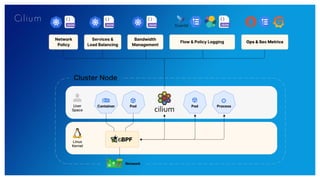
Cilium is an open source software for providing, securing and observing network connectivity between
container workloads - cloud native, and fueled by the revolutionary Kernel technology eBPF.
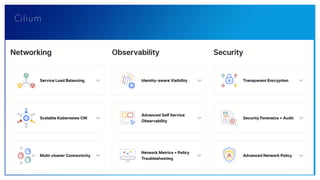
Cilium is an open-source eBPF-based networking, security und observability plugin for kubernetes
Cilium is a CNI = (Container Network Interface)
https://cilium.io/
Cilium
The Setting
● We want security and observability
● Linux is wide spread in the container/cloud landscape
● Encryption, Observability & Security must be installed on top in the user space
○ Limited access to kernel resources
○ Often sidecar proxy
○ Kernelmodule -> Complex and there are runtime risks
eBPF basics - https://ebpf.io/
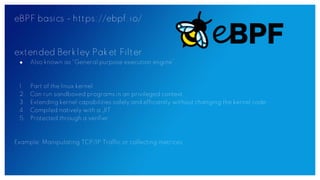
extended Berkley Paket Filter
● Also known as “General purpose execution engine”.
1. Part of the linux kernel
2. Can run sandboxed programs in an privileged context
3. Extending kernel capabilities safely and efficiently without changing the kernel code
4. Compiled natively with a JIT
5. Protected through a verifier
Example: Manipulating TCP/IP Traffic or collecting metrices
Cilium
Cilium Identities
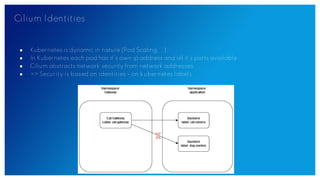
● Kubernetes is dynamic in nature (Pod Scaling, …).
● In Kubernetes each pod has it’s own ip address and all it’s ports available.
● Cilium abstracts network security from network addresses
● => Security is based on identities - on kubernetes labels
Cilium Network Policies
Network Policies work on the “Default Deny Principle”
● Identity based network security. Based on kubernetes labels.
Beispiel: Label app=my-cat-gw is allowed to connect to app=my-cat-backend
● Layer 4 capabilities are also possible
Beispiel: my-cat-gw darf nur auf Port 8080 von my-cat-backend zugreifen
● Layer 7 (HTTP und RPC) policies are possible.*
Beispiel: my-cat-gw can access /api/cat-shop/articles/[0-9]+ with GET.
*Standard Kubernetes Network Policies cannot do that.
Cilium Network Policies
● Cilium’s network policies can also be based on DNS.
Example: Label my-cat-service can access api.cat.com
● Cilium learns the IP address and will allow or deny traffic
● Wildcard mechanism
Example: *.catz.com
DONT: Use DNS based network policies for cluster internal communication. Use pure identity based policies.
Cilium Network Policies
Some examples
Hubble
Hubble is a fully distributed networking and security
observability platform. It is built on top of Cilium and eBPF
to enable deep visibility into the communication and behavior
of services as well as the networking infrastructure in a
completely transparent manner.
Hubble
● Hubble has its own web ui
● Hubble also has a command line tool
○ it is possible to filter for dropped packages
● Hubble is able to export metrices (e.g. prometheus)
Cilium & Hubble
Hands-On
My experiences so far
● Network policies are very powerful
● Communication encryption was very easy to set up
● Seems to be working very stable
● Hubble is extremely good at showing the network flow of the cluster
Insecurities:
● Still sometimes very complex
● Updating cilium can be cumbersome
○ When updating kubernetes itself we faced some stability issues in integration
● Didn’t try every feature yet. Still much to learn
Thank you very much,
do you have any questions?
Have a nice evening ! :-)
And a few links if you like…
information:
https://blog.container-solutions.com/wtf-is-cilium
https://cilium.io/
https://b-nova.com/home/content/ebpf-based-networking-with-cilium
https://www.youtube.com/watch?v=H5RqSAX-eo4&t=584s
Network Policy:
Editor: https://networkpolicy.io/ - Visualising network policies.
https://docs.cilium.io/

Kubernetes with Cilium in AWS - Experience Report!

  • 1.
  • 2.
    Cilium and Hubble 1.What is Cilium? 2. The setting? 3. eBPF 4. Network Policies 5. Hubble 6. My experience so far
  • 3.
    What is Cilium? Ciliumis an open source software for providing, securing and observing network connectivity between container workloads - cloud native, and fueled by the revolutionary Kernel technology eBPF. Cilium is an open-source eBPF-based networking, security und observability plugin for kubernetes Cilium is a CNI = (Container Network Interface) https://cilium.io/
  • 4.
  • 5.
    The Setting ● Wewant security and observability ● Linux is wide spread in the container/cloud landscape ● Encryption, Observability & Security must be installed on top in the user space ○ Limited access to kernel resources ○ Often sidecar proxy ○ Kernelmodule -> Complex and there are runtime risks
  • 6.
    eBPF basics -https://ebpf.io/ extended Berkley Paket Filter ● Also known as “General purpose execution engine”. 1. Part of the linux kernel 2. Can run sandboxed programs in an privileged context 3. Extending kernel capabilities safely and efficiently without changing the kernel code 4. Compiled natively with a JIT 5. Protected through a verifier Example: Manipulating TCP/IP Traffic or collecting metrices
  • 7.
  • 8.
    Cilium Identities ● Kubernetesis dynamic in nature (Pod Scaling, …). ● In Kubernetes each pod has it’s own ip address and all it’s ports available. ● Cilium abstracts network security from network addresses ● => Security is based on identities - on kubernetes labels
  • 9.
    Cilium Network Policies NetworkPolicies work on the “Default Deny Principle” ● Identity based network security. Based on kubernetes labels. Beispiel: Label app=my-cat-gw is allowed to connect to app=my-cat-backend ● Layer 4 capabilities are also possible Beispiel: my-cat-gw darf nur auf Port 8080 von my-cat-backend zugreifen ● Layer 7 (HTTP und RPC) policies are possible.* Beispiel: my-cat-gw can access /api/cat-shop/articles/[0-9]+ with GET. *Standard Kubernetes Network Policies cannot do that.
  • 10.
    Cilium Network Policies ●Cilium’s network policies can also be based on DNS. Example: Label my-cat-service can access api.cat.com ● Cilium learns the IP address and will allow or deny traffic ● Wildcard mechanism Example: *.catz.com DONT: Use DNS based network policies for cluster internal communication. Use pure identity based policies.
  • 11.
  • 12.
    Hubble Hubble is afully distributed networking and security observability platform. It is built on top of Cilium and eBPF to enable deep visibility into the communication and behavior of services as well as the networking infrastructure in a completely transparent manner.
  • 13.
    Hubble ● Hubble hasits own web ui ● Hubble also has a command line tool ○ it is possible to filter for dropped packages ● Hubble is able to export metrices (e.g. prometheus)
  • 14.
  • 15.
    My experiences sofar ● Network policies are very powerful ● Communication encryption was very easy to set up ● Seems to be working very stable ● Hubble is extremely good at showing the network flow of the cluster Insecurities: ● Still sometimes very complex ● Updating cilium can be cumbersome ○ When updating kubernetes itself we faced some stability issues in integration ● Didn’t try every feature yet. Still much to learn
  • 16.
    Thank you verymuch, do you have any questions? Have a nice evening ! :-)
  • 17.
    And a fewlinks if you like… information: https://blog.container-solutions.com/wtf-is-cilium https://cilium.io/ https://b-nova.com/home/content/ebpf-based-networking-with-cilium https://www.youtube.com/watch?v=H5RqSAX-eo4&t=584s Network Policy: Editor: https://networkpolicy.io/ - Visualising network policies. https://docs.cilium.io/