Distinguishing Hope Measures:
Manifold Determinants and Predictors
in the German and Swiss Sample
Amsterdam, July 04th, 2014
Andreas Krafft Andreas Walker
University of St. Gallen Swissfuture, Switzerland
Swissfuture, Switzerland
Symposium
The Annual Hope-Barometer and Positive Attributes Survey
in Switzerland, Germany and the Czech Republic
2
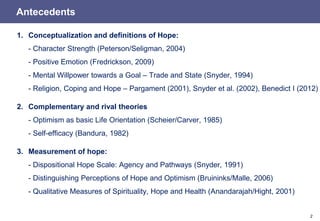
Antecedents
1. Conceptualization and definitions of Hope:
- Character Strength (Peterson/Seligman, 2004)
- Positive Emotion (Fredrickson, 2009)
- Mental Willpower towards a Goal – Trade and State (Snyder, 1994)
- Religion, Coping and Hope – Pargament (2001), Snyder et al. (2002), Benedict I (2012)
2. Complementary and rival theories
- Optimism as basic Life Orientation (Scheier/Carver, 1985)
- Self-efficacy (Bandura, 1982)
3. Measurement of hope:
- Dispositional Hope Scale: Agency and Pathways (Snyder, 1991)
- Distinguishing Perceptions of Hope and Optimism (Bruininks/Malle, 2006)
- Qualitative Measures of Spirituality, Hope and Health (Anandarajah/Hight, 2001)
3
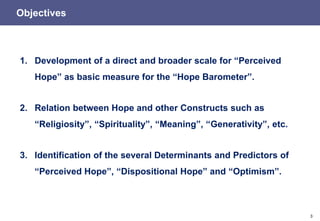
Objectives
1. Development of a direct and broader scale for “Perceived
Hope” as basic measure for the “Hope Barometer”.
2. Relation between Hope and other Constructs such as
“Religiosity”, “Spirituality”, “Meaning”, “Generativity”, etc.
3. Identification of the several Determinants and Predictors of
“Perceived Hope”, “Dispositional Hope” and “Optimism”.
4
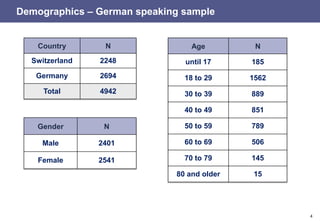
Demographics – German speaking sample
Gender N
Male 2401
Female 2541
Country N
Switzerland 2248
Germany 2694
Total 4942
Age N
until 17 185
18 to 29 1562
30 to 39 889
40 to 49 851
50 to 59 789
60 to 69 506
70 to 79 145
80 and older 15
5
Items Scales
1. Hope improves the quality of my life.
Perceived Hope
(new scale)
2. I feel hopeful.
3. I am hopeful with regard to my life.
4. In my life hope outweighs anxiety.
5. Even in difficult times I am able to remain hopeful.
6. My hopes are usually fulfilled.
1. There are lots of ways around any problem.
Pathways
2. I can think of many ways to get out of a jam.
3. Even when others get discouraged, I know I can find a way to
solve the problem.
4. I can think of many ways to get the things in life that are most
important to me.
1. I've been pretty successful in life.
Agency
2. I meet the goals that I set for myself.
3. I energetically pursue my goals.
4. My past experiences have prepared me well for my future.
1. In uncertain times, I usually expect the best.
Optimism2. Overall, I expect more good things to happen to me than bad.
3. I’m always optimistic about my future.
1. I hardly ever expect things to go my way.
Pessimism2. I rarely count on good things happening to me.
3. If something can go wrong to me, it will.
Scales
Dispositional
Hope
(Snyder, 1991)
Life Orientation
(Scheier/Carver, 1985)
6
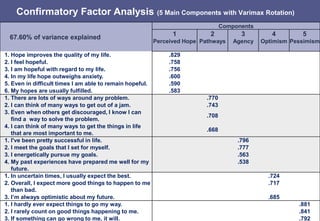
Confirmatory Factor Analysis (5 Main Components with Varimax Rotation)
67.60% of variance explained
Components
1
Perceived Hope
2
Pathways
3
Agency
4
Optimism
5
Pessimism
1. Hope improves the quality of my life. .829
2. I feel hopeful. .758
3. I am hopeful with regard to my life. .756
4. In my life hope outweighs anxiety. .600
5. Even in difficult times I am able to remain hopeful. .590
6. My hopes are usually fulfilled. .583
1. There are lots of ways around any problem. .770
2. I can think of many ways to get out of a jam. .743
3. Even when others get discouraged, I know I can
find a way to solve the problem.
.708
4. I can think of many ways to get the things in life
that are most important to me.
.668
1. I've been pretty successful in life. .796
2. I meet the goals that I set for myself. .777
3. I energetically pursue my goals. .563
4. My past experiences have prepared me well for my
future.
.538
1. In uncertain times, I usually expect the best. .724
2. Overall, I expect more good things to happen to me
than bad.
.717
3. I’m always optimistic about my future. .685
1. I hardly ever expect things to go my way. .881
2. I rarely count on good things happening to me. .841
3. If something can go wrong to me, it will. .792
7
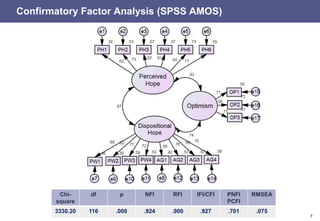
Confirmatory Factor Analysis (SPSS AMOS)
Chi-
square
df p NFI RFI IFI/CFI PNFI
PCFI
RMSEA
3330.20 116 .000 .924 .900 .927 .701 .075
8
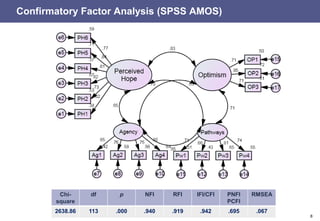
Confirmatory Factor Analysis (SPSS AMOS)
Chi-
square
df p NFI RFI IFI/CFI PNFI
PCFI
RMSEA
2638.86 113 .000 .940 .919 .942 .695 .067
9
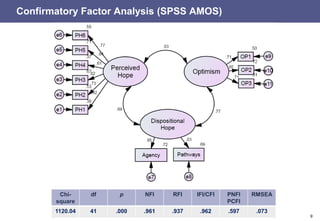
Confirmatory Factor Analysis (SPSS AMOS)
Chi-
square
df p NFI RFI IFI/CFI PNFI
PCFI
RMSEA
1120.04 41 .000 .961 .937 .962 .597 .073
10
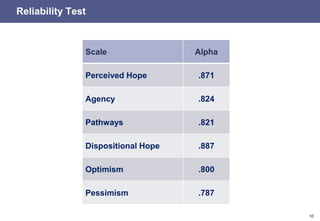
Reliability Test
Scale Alpha
Perceived Hope .871
Agency .824
Pathways .821
Dispositional Hope .887
Optimism .800
Pessimism .787
11
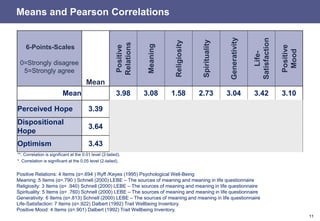
Means and Pearson Correlations
Positive Relations: 4 Items (α=.694 ) Ryff /Keyes (1995) Psychological Well-Being
Meaning: 5 Items (α=.790 ) Schnell (2000) LEBE – The sources of meaning and meaning in life questionnaire
Religiosity: 3 Items (α= .940) Schnell (2000) LEBE – The sources of meaning and meaning in life questionnaire
Spirituality: 5 Items (α= .760) Schnell (2000) LEBE – The sources of meaning and meaning in life questionnaire
Generativity: 6 Items (α=.813) Schnell (2000) LEBE – The sources of meaning and meaning in life questionnaire
Life-Satisfaction: 7 Items (α=.922) Dalbert (1992) Trait Wellbeing Inventory.
Positive Mood: 4 Items (α=.901) Dalbert (1992) Trait Wellbeing Inventory.
6-Points-Scales
0=Strongly disagree
5=Strongly agree
Mean
Positive
Relations
Meaning
Religiosity
Spirituality
Generativity
Life-
Satisfaction
Positive
Mood
Mean 3.98 3.08 1.58 2.73 3.04 3.42 3.10
Perceived Hope 3.39 .345
**
.537
**
.241
**
.199
**
.326
**
.658
**
.663
**
Dispositional
Hope
3.64 .317
**
.505
**
.071
**
.078
**
.298
**
.660
**
.593
**
Optimism 3.43 .321
**
.498
**
.148
**
.127
**
.276
**
.690
**
.698
**
**. Correlation is significant at the 0.01 level (2-tailed).
*. Correlation is significant at the 0.05 level (2-tailed).
12
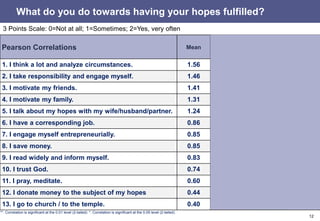
Pearson Correlations Mean
Dispositional
Hope
Perceived
Hope
Optimism
1. I think a lot and analyze circumstances. 1.56 .218
**
.092
**
.052
**
2. I take responsibility and engage myself. 1.46 .445
**
.301
**
.304
**
3. I motivate my friends. 1.41 .261
**
.220
**
.235
**
4. I motivate my family. 1.31 .333
**
.303
**
.288
**
5. I talk about my hopes with my wife/husband/partner. 1.24 .259
**
.273
**
.237
**
6. I have a corresponding job. 0.86 .291
**
.214
**
.233
**
7. I engage myself entrepreneurially. 0.85 .325
**
.202
**
.224
**
8. I save money. 0.85 .145
**
.127
**
.107
**
9. I read widely and inform myself. 0.83 .163
**
.186
**
.110
**
10. I trust God. 0.74 .051
**
.215
**
.129
**
11. I pray, meditate. 0.60 .071
**
.214
**
.122
**
12. I donate money to the subject of my hopes 0.44 .147
**
.211
**
.139
**
13. I go to church / to the temple. 0.40 .080
**
.215
**
.126
**
**. Correlation is significant at the 0.01 level (2-tailed). *. Correlation is significant at the 0.05 level (2-tailed).
What do you do towards having your hopes fulfilled?
3 Points Scale: 0=Not at all; 1=Sometimes; 2=Yes, very often
13
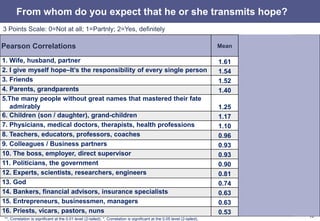
Pearson Correlations Mean
Disposi-
tional
Hope
Perceived
Hope
Optimism
1. Wife, husband, partner 1.61 .064
**
.135
**
.120
**
2. I give myself hope–It’s the responsibility of every single person 1.54 .290
**
.187
**
.215
**
3. Friends 1.52 - .077
**
.058
**
4. Parents, grandparents 1.40 .039
**
.050
**
.048
**
5.The many people without great names that mastered their fate
admirably 1.25 .084
**
.137
**
.087
**
6. Children (son / daughter), grand-children 1.17 .120
**
.151
**
.150
**
7. Physicians, medical doctors, therapists, health professions 1.10 - .060
**
-
8. Teachers, educators, professors, coaches 0.96 .043
**
.145
**
.088
**
9. Colleagues / Business partners 0.93 .049
**
.118
**
.113
**
10. The boss, employer, direct supervisor 0.93 .036
*
.103
**
.088
**
11. Politicians, the government 0.90 .043
**
.105
**
.077
**
12. Experts, scientists, researchers, engineers 0.81 .075
**
.108
**
.083
**
13. God 0.74 - .168
**
.083
**
14. Bankers, financial advisors, insurance specialists 0.63 - .029
*
.054
**
15. Entrepreneurs, businessmen, managers 0.63 .136
**
.156
**
.149
**
16. Priests, vicars, pastors, nuns 0.53 .030
*
.166
**
.084
**
From whom do you expect that he or she transmits hope?
**. Correlation is significant at the 0.01 level (2-tailed). *. Correlation is significant at the 0.05 level (2-tailed).
3 Points Scale: 0=Not at all; 1=Partnly; 2=Yes, definitely
14
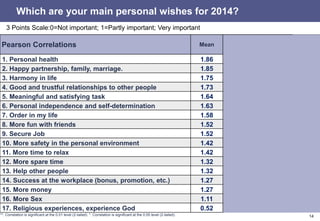
Pearson Correlations Mean
Dispositional
Hope
Perceived
Hope
Optimism
1. Personal health 1.86 .081
**
.095
**
.082
**
2. Happy partnership, family, marriage. 1.85 .032
*
.088
**
.066
**
3. Harmony in life 1.75 - .089
**
.043
**
4. Good and trustful relationships to other people 1.73 .052
**
.160
**
.102
**
5. Meaningful and satisfying task 1.64 .124
**
.189
**
.116
**
6. Personal independence and self-determination 1.63 .146
**
.097
**
.092
**
7. Order in my life 1.58 - .032
*
-
8. More fun with friends 1.52 -.008 - .035
*
9. Secure Job 1.52 -.060
**
-.032
*
-
10. More safety in the personal environment 1.42 -.073
**
-.051
**
-.056
**
11. More time to relax 1.42 .034
*
.036
*
.034
*
12. More spare time 1.32 - - -
13. Help other people 1.32 .107
**
.211
**
.134
**
14. Success at the workplace (bonus, promotion, etc.) 1.27 - -.046
**
-
15. More money 1.27 -.097
**
-.128
**
-.067
**
16. More Sex 1.11 - - -
17. Religious experiences, experience God 0.52 .033
*
.181
**
.089
**
**. Correlation is significant at the 0.01 level (2-tailed). *. Correlation is significant at the 0.05 level (2-tailed).
Which are your main personal wishes for 2014?
3 Points Scale:0=Not important; 1=Partly important; Very important
15
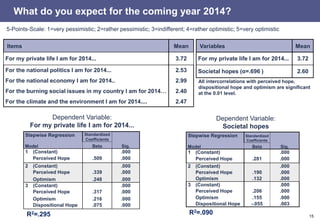
What do you expect for the coming year 2014?
Stepwise Regression
Model
Standardized
Coefficients
Sig.Beta
1 (Constant) .000
Perceived Hope .509 .000
2 (Constant) .000
Perceived Hope .339 .000
Optimism .248 .000
3 (Constant) .000
Perceived Hope .317 .000
Optimism .216 .000
Dispositional Hope .075 .000
Dependent Variable:
For my private life I am for 2014...
Stepwise Regression
Model
Standardized
Coefficients
Sig.Beta
1 (Constant) .000
Perceived Hope .281 .000
2 (Constant) .000
Perceived Hope .190 .000
Optimism .132 .000
3 (Constant) .000
Perceived Hope .206 .000
Optimism .155 .000
Dispositional Hope -.055 .003
Dependent Variable:
Societal hopes
Items Mean
For my private life I am for 2014... 3.72
For the national politics I am for 2014... 2.53
For the national economy I am for 2014.. 2.99
For the burning social issues in my country I am for 2014… 2.40
For the climate and the environment I am for 2014.... 2.47
Variables Mean
For my private life I am for 2014... 3.72
Societal hopes (α=.696 ) 2.60
5-Points-Scale: 1=very pessimistic; 2=rather pessimistic; 3=indifferent; 4=rather optimistic; 5=very optimistic
R2=.295 R2=.090
All intercorrelations with perceived hope,
dispositional hope and optimism are significant
at the 0.01 level.
16
Conclusions and Discussion
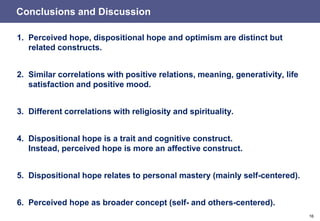
1. Perceived hope, dispositional hope and optimism are distinct but
related constructs.
2. Similar correlations with positive relations, meaning, generativity, life
satisfaction and positive mood.
3. Different correlations with religiosity and spirituality.
4. Dispositional hope is a trait and cognitive construct.
Instead, perceived hope is more an affective construct.
5. Dispositional hope relates to personal mastery (mainly self-centered).
6. Perceived hope as broader concept (self- and others-centered).
Thank you for your attention!
Questions?
18
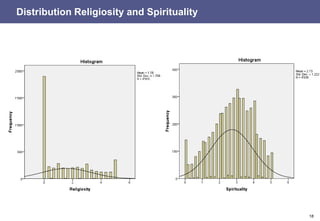
Distribution Religiosity and Spirituality
19
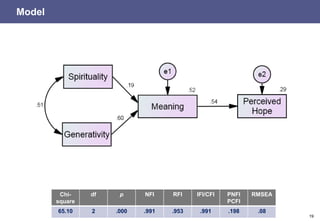
Model
Chi-
square
df p NFI RFI IFI/CFI PNFI
PCFI
RMSEA
65.10 2 .000 .991 .953 .991 .198 .08
20
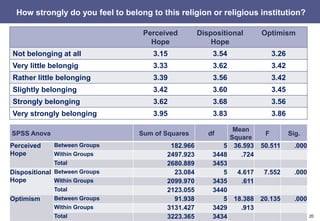
How strongly do you feel to belong to this religion or religious institution?
SPSS Anova Sum of Squares df
Mean
Square
F Sig.
Perceived
Hope
Between Groups 182.966 5 36.593 50.511 .000
Within Groups 2497.923 3448 .724
Total 2680.889 3453
Dispositional
Hope
Between Groups 23.084 5 4.617 7.552 .000
Within Groups 2099.970 3435 .611
Total 2123.055 3440
Optimism Between Groups 91.938 5 18.388 20.135 .000
Within Groups 3131.427 3429 .913
Total 3223.365 3434
Perceived
Hope
Dispositional
Hope
Optimism
Not belonging at all 3.15 3.54 3.26
Very little belongig 3.33 3.62 3.42
Rather little belonging 3.39 3.56 3.42
Slightly belonging 3.42 3.60 3.45
Strongly belonging 3.62 3.68 3.56
Very strongly belonging 3.95 3.83 3.86
21
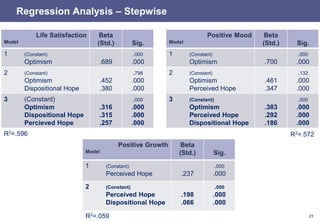
Regression Analysis – Stepwise
Life Satisfaction
Model
Beta
(Std.) Sig.
1 (Constant)
Optimism .689
.000
.000
2 (Constant)
Optimism
Dispositional Hope
.452
.380
.798
.000
.000
3 (Constant)
Optimism
Dispositional Hope
Percieved Hope
.316
.315
.257
.000
.000
.000
.000
Positive Mood
Model
Beta
(Std.) Sig.
1 (Constant)
Optimism .700
.000
.000
2 (Constant)
Optimism
Perceived Hope
.461
.347
.132
.000
.000
3 (Constant)
Optimism
Perceived Hope
Dispositional Hope
.383
.292
.186
.000
.000
.000
.000
Positive Growth
Model
Beta
(Std.) Sig.
1 (Constant)
Perceived Hope .237
.000
.000
2 (Constant)
Perceived Hope
Dispositional Hope
.198
.066
.000
.000
.000
R2=.596 R2=.572
R2=.059

Krafft s28

  • 1.
    Distinguishing Hope Measures: ManifoldDeterminants and Predictors in the German and Swiss Sample Amsterdam, July 04th, 2014 Andreas Krafft Andreas Walker University of St. Gallen Swissfuture, Switzerland Swissfuture, Switzerland Symposium The Annual Hope-Barometer and Positive Attributes Survey in Switzerland, Germany and the Czech Republic
  • 2.
    2 Antecedents 1. Conceptualization anddefinitions of Hope: - Character Strength (Peterson/Seligman, 2004) - Positive Emotion (Fredrickson, 2009) - Mental Willpower towards a Goal – Trade and State (Snyder, 1994) - Religion, Coping and Hope – Pargament (2001), Snyder et al. (2002), Benedict I (2012) 2. Complementary and rival theories - Optimism as basic Life Orientation (Scheier/Carver, 1985) - Self-efficacy (Bandura, 1982) 3. Measurement of hope: - Dispositional Hope Scale: Agency and Pathways (Snyder, 1991) - Distinguishing Perceptions of Hope and Optimism (Bruininks/Malle, 2006) - Qualitative Measures of Spirituality, Hope and Health (Anandarajah/Hight, 2001)
  • 3.
    3 Objectives 1. Development ofa direct and broader scale for “Perceived Hope” as basic measure for the “Hope Barometer”. 2. Relation between Hope and other Constructs such as “Religiosity”, “Spirituality”, “Meaning”, “Generativity”, etc. 3. Identification of the several Determinants and Predictors of “Perceived Hope”, “Dispositional Hope” and “Optimism”.
  • 4.
    4 Demographics – Germanspeaking sample Gender N Male 2401 Female 2541 Country N Switzerland 2248 Germany 2694 Total 4942 Age N until 17 185 18 to 29 1562 30 to 39 889 40 to 49 851 50 to 59 789 60 to 69 506 70 to 79 145 80 and older 15
  • 5.
    5 Items Scales 1. Hopeimproves the quality of my life. Perceived Hope (new scale) 2. I feel hopeful. 3. I am hopeful with regard to my life. 4. In my life hope outweighs anxiety. 5. Even in difficult times I am able to remain hopeful. 6. My hopes are usually fulfilled. 1. There are lots of ways around any problem. Pathways 2. I can think of many ways to get out of a jam. 3. Even when others get discouraged, I know I can find a way to solve the problem. 4. I can think of many ways to get the things in life that are most important to me. 1. I've been pretty successful in life. Agency 2. I meet the goals that I set for myself. 3. I energetically pursue my goals. 4. My past experiences have prepared me well for my future. 1. In uncertain times, I usually expect the best. Optimism2. Overall, I expect more good things to happen to me than bad. 3. I’m always optimistic about my future. 1. I hardly ever expect things to go my way. Pessimism2. I rarely count on good things happening to me. 3. If something can go wrong to me, it will. Scales Dispositional Hope (Snyder, 1991) Life Orientation (Scheier/Carver, 1985)
  • 6.
    6 Confirmatory Factor Analysis(5 Main Components with Varimax Rotation) 67.60% of variance explained Components 1 Perceived Hope 2 Pathways 3 Agency 4 Optimism 5 Pessimism 1. Hope improves the quality of my life. .829 2. I feel hopeful. .758 3. I am hopeful with regard to my life. .756 4. In my life hope outweighs anxiety. .600 5. Even in difficult times I am able to remain hopeful. .590 6. My hopes are usually fulfilled. .583 1. There are lots of ways around any problem. .770 2. I can think of many ways to get out of a jam. .743 3. Even when others get discouraged, I know I can find a way to solve the problem. .708 4. I can think of many ways to get the things in life that are most important to me. .668 1. I've been pretty successful in life. .796 2. I meet the goals that I set for myself. .777 3. I energetically pursue my goals. .563 4. My past experiences have prepared me well for my future. .538 1. In uncertain times, I usually expect the best. .724 2. Overall, I expect more good things to happen to me than bad. .717 3. I’m always optimistic about my future. .685 1. I hardly ever expect things to go my way. .881 2. I rarely count on good things happening to me. .841 3. If something can go wrong to me, it will. .792
  • 7.
    7 Confirmatory Factor Analysis(SPSS AMOS) Chi- square df p NFI RFI IFI/CFI PNFI PCFI RMSEA 3330.20 116 .000 .924 .900 .927 .701 .075
  • 8.
    8 Confirmatory Factor Analysis(SPSS AMOS) Chi- square df p NFI RFI IFI/CFI PNFI PCFI RMSEA 2638.86 113 .000 .940 .919 .942 .695 .067
  • 9.
    9 Confirmatory Factor Analysis(SPSS AMOS) Chi- square df p NFI RFI IFI/CFI PNFI PCFI RMSEA 1120.04 41 .000 .961 .937 .962 .597 .073
  • 10.
    10 Reliability Test Scale Alpha PerceivedHope .871 Agency .824 Pathways .821 Dispositional Hope .887 Optimism .800 Pessimism .787
  • 11.
    11 Means and PearsonCorrelations Positive Relations: 4 Items (α=.694 ) Ryff /Keyes (1995) Psychological Well-Being Meaning: 5 Items (α=.790 ) Schnell (2000) LEBE – The sources of meaning and meaning in life questionnaire Religiosity: 3 Items (α= .940) Schnell (2000) LEBE – The sources of meaning and meaning in life questionnaire Spirituality: 5 Items (α= .760) Schnell (2000) LEBE – The sources of meaning and meaning in life questionnaire Generativity: 6 Items (α=.813) Schnell (2000) LEBE – The sources of meaning and meaning in life questionnaire Life-Satisfaction: 7 Items (α=.922) Dalbert (1992) Trait Wellbeing Inventory. Positive Mood: 4 Items (α=.901) Dalbert (1992) Trait Wellbeing Inventory. 6-Points-Scales 0=Strongly disagree 5=Strongly agree Mean Positive Relations Meaning Religiosity Spirituality Generativity Life- Satisfaction Positive Mood Mean 3.98 3.08 1.58 2.73 3.04 3.42 3.10 Perceived Hope 3.39 .345 ** .537 ** .241 ** .199 ** .326 ** .658 ** .663 ** Dispositional Hope 3.64 .317 ** .505 ** .071 ** .078 ** .298 ** .660 ** .593 ** Optimism 3.43 .321 ** .498 ** .148 ** .127 ** .276 ** .690 ** .698 ** **. Correlation is significant at the 0.01 level (2-tailed). *. Correlation is significant at the 0.05 level (2-tailed).
  • 12.
    12 Pearson Correlations Mean Dispositional Hope Perceived Hope Optimism 1.I think a lot and analyze circumstances. 1.56 .218 ** .092 ** .052 ** 2. I take responsibility and engage myself. 1.46 .445 ** .301 ** .304 ** 3. I motivate my friends. 1.41 .261 ** .220 ** .235 ** 4. I motivate my family. 1.31 .333 ** .303 ** .288 ** 5. I talk about my hopes with my wife/husband/partner. 1.24 .259 ** .273 ** .237 ** 6. I have a corresponding job. 0.86 .291 ** .214 ** .233 ** 7. I engage myself entrepreneurially. 0.85 .325 ** .202 ** .224 ** 8. I save money. 0.85 .145 ** .127 ** .107 ** 9. I read widely and inform myself. 0.83 .163 ** .186 ** .110 ** 10. I trust God. 0.74 .051 ** .215 ** .129 ** 11. I pray, meditate. 0.60 .071 ** .214 ** .122 ** 12. I donate money to the subject of my hopes 0.44 .147 ** .211 ** .139 ** 13. I go to church / to the temple. 0.40 .080 ** .215 ** .126 ** **. Correlation is significant at the 0.01 level (2-tailed). *. Correlation is significant at the 0.05 level (2-tailed). What do you do towards having your hopes fulfilled? 3 Points Scale: 0=Not at all; 1=Sometimes; 2=Yes, very often
  • 13.
    13 Pearson Correlations Mean Disposi- tional Hope Perceived Hope Optimism 1.Wife, husband, partner 1.61 .064 ** .135 ** .120 ** 2. I give myself hope–It’s the responsibility of every single person 1.54 .290 ** .187 ** .215 ** 3. Friends 1.52 - .077 ** .058 ** 4. Parents, grandparents 1.40 .039 ** .050 ** .048 ** 5.The many people without great names that mastered their fate admirably 1.25 .084 ** .137 ** .087 ** 6. Children (son / daughter), grand-children 1.17 .120 ** .151 ** .150 ** 7. Physicians, medical doctors, therapists, health professions 1.10 - .060 ** - 8. Teachers, educators, professors, coaches 0.96 .043 ** .145 ** .088 ** 9. Colleagues / Business partners 0.93 .049 ** .118 ** .113 ** 10. The boss, employer, direct supervisor 0.93 .036 * .103 ** .088 ** 11. Politicians, the government 0.90 .043 ** .105 ** .077 ** 12. Experts, scientists, researchers, engineers 0.81 .075 ** .108 ** .083 ** 13. God 0.74 - .168 ** .083 ** 14. Bankers, financial advisors, insurance specialists 0.63 - .029 * .054 ** 15. Entrepreneurs, businessmen, managers 0.63 .136 ** .156 ** .149 ** 16. Priests, vicars, pastors, nuns 0.53 .030 * .166 ** .084 ** From whom do you expect that he or she transmits hope? **. Correlation is significant at the 0.01 level (2-tailed). *. Correlation is significant at the 0.05 level (2-tailed). 3 Points Scale: 0=Not at all; 1=Partnly; 2=Yes, definitely
  • 14.
    14 Pearson Correlations Mean Dispositional Hope Perceived Hope Optimism 1.Personal health 1.86 .081 ** .095 ** .082 ** 2. Happy partnership, family, marriage. 1.85 .032 * .088 ** .066 ** 3. Harmony in life 1.75 - .089 ** .043 ** 4. Good and trustful relationships to other people 1.73 .052 ** .160 ** .102 ** 5. Meaningful and satisfying task 1.64 .124 ** .189 ** .116 ** 6. Personal independence and self-determination 1.63 .146 ** .097 ** .092 ** 7. Order in my life 1.58 - .032 * - 8. More fun with friends 1.52 -.008 - .035 * 9. Secure Job 1.52 -.060 ** -.032 * - 10. More safety in the personal environment 1.42 -.073 ** -.051 ** -.056 ** 11. More time to relax 1.42 .034 * .036 * .034 * 12. More spare time 1.32 - - - 13. Help other people 1.32 .107 ** .211 ** .134 ** 14. Success at the workplace (bonus, promotion, etc.) 1.27 - -.046 ** - 15. More money 1.27 -.097 ** -.128 ** -.067 ** 16. More Sex 1.11 - - - 17. Religious experiences, experience God 0.52 .033 * .181 ** .089 ** **. Correlation is significant at the 0.01 level (2-tailed). *. Correlation is significant at the 0.05 level (2-tailed). Which are your main personal wishes for 2014? 3 Points Scale:0=Not important; 1=Partly important; Very important
  • 15.
    15 What do youexpect for the coming year 2014? Stepwise Regression Model Standardized Coefficients Sig.Beta 1 (Constant) .000 Perceived Hope .509 .000 2 (Constant) .000 Perceived Hope .339 .000 Optimism .248 .000 3 (Constant) .000 Perceived Hope .317 .000 Optimism .216 .000 Dispositional Hope .075 .000 Dependent Variable: For my private life I am for 2014... Stepwise Regression Model Standardized Coefficients Sig.Beta 1 (Constant) .000 Perceived Hope .281 .000 2 (Constant) .000 Perceived Hope .190 .000 Optimism .132 .000 3 (Constant) .000 Perceived Hope .206 .000 Optimism .155 .000 Dispositional Hope -.055 .003 Dependent Variable: Societal hopes Items Mean For my private life I am for 2014... 3.72 For the national politics I am for 2014... 2.53 For the national economy I am for 2014.. 2.99 For the burning social issues in my country I am for 2014… 2.40 For the climate and the environment I am for 2014.... 2.47 Variables Mean For my private life I am for 2014... 3.72 Societal hopes (α=.696 ) 2.60 5-Points-Scale: 1=very pessimistic; 2=rather pessimistic; 3=indifferent; 4=rather optimistic; 5=very optimistic R2=.295 R2=.090 All intercorrelations with perceived hope, dispositional hope and optimism are significant at the 0.01 level.
  • 16.
    16 Conclusions and Discussion 1.Perceived hope, dispositional hope and optimism are distinct but related constructs. 2. Similar correlations with positive relations, meaning, generativity, life satisfaction and positive mood. 3. Different correlations with religiosity and spirituality. 4. Dispositional hope is a trait and cognitive construct. Instead, perceived hope is more an affective construct. 5. Dispositional hope relates to personal mastery (mainly self-centered). 6. Perceived hope as broader concept (self- and others-centered).
  • 17.
    Thank you foryour attention! Questions?
  • 18.
  • 19.
    19 Model Chi- square df p NFIRFI IFI/CFI PNFI PCFI RMSEA 65.10 2 .000 .991 .953 .991 .198 .08
  • 20.
    20 How strongly doyou feel to belong to this religion or religious institution? SPSS Anova Sum of Squares df Mean Square F Sig. Perceived Hope Between Groups 182.966 5 36.593 50.511 .000 Within Groups 2497.923 3448 .724 Total 2680.889 3453 Dispositional Hope Between Groups 23.084 5 4.617 7.552 .000 Within Groups 2099.970 3435 .611 Total 2123.055 3440 Optimism Between Groups 91.938 5 18.388 20.135 .000 Within Groups 3131.427 3429 .913 Total 3223.365 3434 Perceived Hope Dispositional Hope Optimism Not belonging at all 3.15 3.54 3.26 Very little belongig 3.33 3.62 3.42 Rather little belonging 3.39 3.56 3.42 Slightly belonging 3.42 3.60 3.45 Strongly belonging 3.62 3.68 3.56 Very strongly belonging 3.95 3.83 3.86
  • 21.
    21 Regression Analysis –Stepwise Life Satisfaction Model Beta (Std.) Sig. 1 (Constant) Optimism .689 .000 .000 2 (Constant) Optimism Dispositional Hope .452 .380 .798 .000 .000 3 (Constant) Optimism Dispositional Hope Percieved Hope .316 .315 .257 .000 .000 .000 .000 Positive Mood Model Beta (Std.) Sig. 1 (Constant) Optimism .700 .000 .000 2 (Constant) Optimism Perceived Hope .461 .347 .132 .000 .000 3 (Constant) Optimism Perceived Hope Dispositional Hope .383 .292 .186 .000 .000 .000 .000 Positive Growth Model Beta (Std.) Sig. 1 (Constant) Perceived Hope .237 .000 .000 2 (Constant) Perceived Hope Dispositional Hope .198 .066 .000 .000 .000 R2=.596 R2=.572 R2=.059